Recent Articles:

Morning Headlines 4/28/20

April 27, 2020 Headlines Comments Off on Morning Headlines 4/28/20

Allscripts trims workforce by 5%, cuts pay for highest earners

Allscripts announces layoffs, which HIStalk readers reported earlier this month, plus pay reductions for high earners and executives like CEO Paul Black, who will see a 40% decrease for an anticipated six months.

Parkview Medical Center confirms cyber attack

Parkview Medical Center in Pueblo, CO works to restore its IT systems after an April 21 data breach.

Apple, Google pledge extra privacy protections

Apple and Google will update APIs for their jointly developed COVID-19 exposure tracking software to include randomly generated encryption keys, encryption of Bluetooth metadata, and an exposure time limit of 30 minutes.

Leading Telehealth Platform, Medici, Sees Immense Growth as Virtual Healthcare Continues to Rise

Telemedicine company Medici raises $24 million in a Series B round.

UnitedHealth’s Optum is in advanced talks to acquire remote mental health provider AbleTo for about $470 million

Optum considers acquiring mental telehealth company AbleTo for $470 million.

Comments Off on Morning Headlines 4/28/20

Curbside Consult with Dr. Jayne 4/27/20

April 27, 2020 Dr. Jayne 3 Comments

Just when I was getting used to being furloughed from my clinical gig, I was called to action for three days of work that just happened to coincide with the expected peak of COVID in my state. Although I was initially eager to get back in the game, I must admit that 36 hours in the trenches has eliminated any such enthusiasm.

After my initial shock over a couple of things, I decided to give it the benefit of the doubt and try not to draw any conclusions until I had worked at three sites with three teams. Now, with those shifts in my rear-view mirror, I have to say that some of my first impressions were correct. Here’s what I learned.

I’m probably more likely to be exposed to the novel coronavirus by my colleagues than by the general public. Our team is generally young and healthy, mostly EMTs and paramedics. Many of them are super fit, with extensive workout and nutrition routines. Several of them questioned why I was wearing my N95 mask all day, even for patients who didn’t have respiratory symptoms. It’s clear that our internal education has not met the mark as far as their understanding the idea of asymptomatic spreaders or the need to treat everyone with universal precautions since you can’t tell from looking who might be a carrier.

Most of them were donning and doffing various masks (alternating between N95 and standard surgical masks) and setting them on the workstation counter in between patients. Only two of us had a dedicated “drop zone” for our masks (a.k.a. paper towels with our names on them). Others were lowering their masks under their chin in between patients, which is a less-than-great infection control procedure. The good thing is that most of them responded well to a little in-person education and started doing better with mask hygiene.

Leadership note: just because you send out memos and instructions, it doesn’t mean people get it and are following the instructions. Sometimes you need the face-to-face contact to get the message across. It’s an expensive kind of communication, but it’s worth it.

Speaking of masks, the general public isn’t doing a great job of wearing them even when they have the good ones. I saw too many people with masks covering the mouth but not the nose, and too many whose nose pieces weren’t pinched to fit well around the nose. People whose glasses are fogging up due to their masks are incredibly grateful when you teach them how to pinch the nose of the mask. We as healthcare providers take it for granted that people know how to use them correctly.

I saw everything from top-of-the-line 3M models to simple bandanas. The best one was a homemade model on a patient whose wife is a professional seamstress. As someone who does a little sewing myself, the craftsmanship was something to behold. I told him to be sure to let her know that the doctor noticed her attention to detail and excellent topstitching.

I also learned that a good part of our surge was made up of people coming in for non-emergent conditions. People certainly aren’t afraid to venture out for minor things such as having wax removed from their ears even though they don’t have symptoms. Multiple people were there for medication refills since they either couldn’t get in touch with their physicians or were having trouble getting refills in a timely manner, and I was happy to help them.

We did see our share of urgent and emergent conditions as well, including multiple cooking-related lacerations among people who don’t usually cook, along with several home improvement injuries. Patient education note: working on an aluminum ladder while barefoot is not a good idea. We also diagnosed and treated multiple sexually transmitted infections, so some people’s ideas of stay-at-home might be a little different than others.

I ordered my fair share of COVID-19 testing swabs, and now I get to play the waiting game to see how long it takes the results to return so I can start my own “known exposure” countdown. I don’t know when I’ll be asked to work again, but I’ll definitely be staying close to home until the results turn up. I’m grateful we have testing capabilities and can at least collect the samples in the office without having to send patients elsewhere or fight the health department for approval like I had to a little more than a month ago.

My employer is keeping a close count on the testing swabs since they aren’t sure when we can get additional supplies. We’re a long way from testing everyone who wants to be, as we were promised once upon a time.

After my first day of patient care, I pretty much fell into my bed. As I tried to fall asleep, I wondered how long it would take the tingling in my face to go away. If you wear them properly, the N95 masks are pretty tight, and I was glad that my face was back to normal by the morning. However, after three days in a row, my face feels like it’s been in a vise and I have a splitting headache that I can’t get to go away.

I cannot even fathom what it must be like for the healthcare workers who are on dedicated COVID units or who have been working like this for weeks on end. I’m hoping to cruise some forums for tips on pressure reduction before I go back again. Hopefully, my face will bounce back overnight since I’m supposed to film some EHR training videos for one of my clients.

I’m glad I could pitch in, but I feel guilty for having been parked at home while my colleagues have been working. It’s definitely more mentally and emotionally exhausting than the work we were doing before, even in the middle of flu season. I never thought I would wish to go back to the Flumageddon season of 2017-18, but I do, to some degree. At least back then we knew what we were dealing with, we could test for it, and we had a hope of treatment. With this situation, we’re often flying blind and looking for outlier symptoms, such as loss of smell or “COVID toes.”

I noticed that our EHR vendor has added quite a bit of telehealth-specific content. Even though we’re not using it, I was glad to be able to check it out. It prompted a good conversation with my scribe, who was also seeing it for the first time. She didn’t know I worked in telehealth. She recently wrote a paper about telehealth for an undergrad class. It was good to have a bright moment like that in the middle of a very tiring day, and hopefully she learned something beyond what her research had shown her.

She also offered me the tip of putting Preparation H on my face if the redness doesn’t go away. Apparently, she learned it “on the pageant circuit,” but I’m too tired to even remotely consider masking up and going to the store.

Have any tips for dealing with the squeeze of a badly fitting mask when there aren’t any other mask options? Leave a comment or email me.

Email Dr. Jayne.

Readers Write: Healthcare Crisis Underscores Strategic Importance of Strong IT Support

April 27, 2020 Readers Write Comments Off on Readers Write: Healthcare Crisis Underscores Strategic Importance of Strong IT Support

Healthcare Crisis Underscores Strategic Importance of Strong IT Support
By Rob Dreussi

Rob Dreussi is CIO of HCTec of Brentwood, TN.

image

Take a moment to thank those who work on the IT service desk. Who knew they would play an essential role in maintaining operational continuity and getting our patients and providers up and running on telehealth?

Every large-scale crisis exposes shortfalls and creates opportunities for improvement in healthcare. The COVID-19 pandemic has highlighted the need for hospitals to think differently and more strategically about their IT service desks.

EMR patient portal usage has increased as telehealth and other patient-facing solutions are being rapidly deployed. Maximizing that kind of technology, keeping it running, and supporting it properly requires people with specialized HIT skills, training, and experience. Technology may be the tool, but people and solid operating processes are required to make it work.

This crisis is a powerful reminder of the IT service desk’s higher purpose—helping providers and patients by either resolving their immediate problem or finding the best next-level person to assist them. A mature IT service desk employs a diverse team of experts, including agents, coaches, trainers, workforce analysts, quality analysts, and related technology SMEs. Collectively, this team enables healthcare providers and patients to leverage technology rather than be hindered by it.

However, IT service desks have struggled to meet the increased demands related to the COVID-19 pandemic because their resourcing plans are based on historical support volumes. Who could have predicted:

  • Call volumes that are doubling and tripling.
  • Supporting new applications almost overnight that typically would have been deployed over months.
  • Assisting end users while they shifted in mass to working from home.
  • Continuing to deliver services while the IT service desk itself shifted to working from home.
  • Onboarding and training new agents 100% virtually.

Keeping up with all the change has been really hard.

The pandemic has put a spotlight on how the technical and user-facing skills that are needed for effective IT support have increased dramatically over the last decade. The demand for this dual skillset will only continue to increase as hospital clinical and overall operations grow increasingly reliant on technology. Already Meaningful Use and the movement toward value-based care have driven the adoption of complex clinical and business systems that require constant maintenance and inspire far greater security concerns.

Simultaneously, the expectations of providers and patients alike are rising, as we all have become accustomed to customer-friendly, tech-savvy support from companies like Amazon and American Express. As a result, the IT service desk’s role now includes representing the voice and brand of the health system. Delivering a strong overall experience — whether to patient, provider, or administrative user — is more critical than ever. In this new environment, the staffing, required skills and management of the IT service desk requires a more advanced and strategic approach.

It’s no surprise that COVID-19 has forced HIT support personnel to work overtime, late nights, and weekends. Their efforts are essential to ensuring that healthcare providers and their patients receive the support they need to improve delivery of care in a time when people need it most.

COVID-19 has made painfully obvious to a broader audience what we have always known — technology doesn’t always work as designed. It has also made it glaringly apparent that in healthcare we need people who understand how to effectively support technology so that patients and providers alike can leverage its power to improve care and outcomes.

Comments Off on Readers Write: Healthcare Crisis Underscores Strategic Importance of Strong IT Support

HIStalk Interviews Krishna Kurapati, CEO, QliqSoft

April 27, 2020 Interviews 1 Comment

Krishna Kurapati, MS is founder and CEO of QliqSoft of Dallas, TX.

SNAGHTML32dbaae9

Tell me about yourself and the company.

I’m the founder and CEO of QliqSoft. We’ve been in business for eight years. I have been tech entrepreneur for over 20 years. I started a couple of companies that were successful, one in communications and the other in security. That’s where I found the epiphany of having a secure communications company in healthcare.

How has demand for your virtual visit solution changed in the last few weeks?

Coronavirus stopped the healthcare system and its providers from seeing the patient in a personal, face-to-face setting. That has driven everybody to find ways to address that problem.

We had a simple solution that allowed quickly onboarding patients. The challenge in telehealth is always adoption by patients. The providers have the tools, but patients don’t want to download an app or get to a desktop. A key healthcare requirement with COVID-19 is ease of use, and providers were looking for a simple solution that allows them to reach their patients effectively. That’s one reason that tools like ours quickly sprung up and got lot of traction in the marketplace with providers.

From the demand point of view, we have never seen such a huge uptick in the use of telehealth. One health system is delivering 10,000 to 20,000 video visits in one day. That is unheard of. It used to take  a year or more for somebody to do that kind of volume, and how they’re doing it in one day. Some of our customers used 365 days’ worth of video minutes in just one week. There is a huge demand. There’s a bunch of solutions, but we offer something simple for providers to reach patients.

What factors distinguish one virtual visit solution from another?

Everybody is going virtual. The time to onboard and train is important. How fast can you onboard a clinic, practice, or health system? Then, how can they customize it to meet their needs?

A small practice and a large practice have different requirements. A dermatologist has different needs than an internist. They all want to get on board faster, but they also have specific requirements.

Traditional telehealth solutions have been built around monolithic, large implementation needs, and those do not help in rapid fashion. We built, with our Quincy chatbot and Quincy video visits platform, fast tools that let you onboard a provider, bring them up on video visits, and customize it to meet their needs. The solution needs to be easy for the patient, but it also must allow getting providers online and using the tool quickly.

Has the pandemic changed the long-term strategy of health systems that were using third-party telehealth services before, but now are offering virtual visits with their own providers?

Face-to-face visits will not go away after COVID-19. The need to see a patient face-to-face and give them advice will come back in a big way. But providers will offer services such as follow-ups, post-op visits, and other ancillary services virtually, along with services that have traditionally been offered by all-in-one telehealth solutions. As a patient, you trust the provider you know and who treats you. That has been a big problem with the all-in-one solutions all along. That option was OK, but not great.

When you have traditional providers offering the same solution, the patient gets better access to healthcare from wherever they are. They don’t have to leave the workplace. They don’t have to travel 50 miles from a rural area.

COVID-19, if you see a silver lining, has shocked the industry to go all in and see what the experience is. Some providers may hate it now, but I’ve talked to several of them, my customers and my friends, now that they are using the solution. Some wonder why they weren’t doing it before, saving time for themselves and the patient. Even some specialists, like orthopedic surgeons, are using it for post-follow-ups in a way that they were never using it.

The industry has shifted overnight in being forced to use it, but in turn, there’s a lot of lessons and a lot of best practices. The new way of doing business is not going to change.

How are health systems using chatbots?

Healthcare is good at using calls, faxes, and other technologies for inbound stuff, such as referrals or patient access. These technologies existed for a long time, and suddenly there is pressure on them. Call volumes went up. People are always on text and they know how to use it. The chatbot gave initial productivity to health systems that wanted to tackle call volume, to offload it and get people the appropriate help. The chatbot can send a form, send a survey post-visit, collect information that humans had traditionally collected, or serve in the arcane way of answering services.

Chatbots already had found their footing in traditional support and sales models in other industries. Healthcare has now found their value in this tough time when volumes are so high.

Once healthcare organizations have adopted the technology and become comfortable with the outcomes, they will next use it in places where it makes sense, such as post-op surveys, pre-op information gathering, and helping patients who are really in need. It’s the 80-20 rule — 80% of patients can be served by the chatbot.

COVID-19 has accelerated technology adoption, both for virtual visits and for using automated responses and navigating patients using chatbots.

What other technologies could see a usage uptick?

Think about physician pain points before and after COVID-19. They want to continue to serve their patients effectively and efficiently. How can they do it? What are the tools and technologies beyond the EHR?

It has to be a mix of digital and face-to-face, but beyond chatbots and virtual visits, there’s a need for other AI-based tools, such as for transcription and other technologies that can simplify the problem of EHR productivity. The timing is right, with everything becoming virtual.

Technology would go a long way toward furthering patient care if it could transcribe the physician-patient communication and immediately put a 30-page document into the EHR without the physician typing anything. The end goal should be to allow the physician to interact with the patient face-to-face without worrying about the technology.

How will the company’s direction change after we find a new normal?

Our goal is to help customers to achieve better outcomes and better efficiencies. I have been a strong believer in these two technologies for the last four to five years. Before that, it was secure messaging. We’re going to double down on our efforts to continue to serve our customers and innovate to meet their needs. A technology evolution is starting, and it will create requirements and needs that we can’t anticipate.

Think of a new product being introduced, such as the first IPhone, versus where it is today. We will see a rapid evolution of products towards the complete virtual value for healthcare. Community-wise, for a country or as a world, this will be a good outcome in the long run. If another pandemic happens, we will be prepared. These technologies will stay and evolve rapidly and we want to be part of it.

Morning Headlines 4/27/20

April 26, 2020 Headlines Comments Off on Morning Headlines 4/27/20

Cerner Provides Access to De-Identified Patient Data for COVID-19 Research and Vaccine Development

Cerner offers health systems and researchers free access to the de-identified data of COVID-19 patients for developing epidemiological studies, clinical trials, and medical treatments.

Mark Zuckerberg: How data can aid the fight against covid-19

Facebook is offering users a coronavirus symptom survey that was created by Carnegie Mellon University, with results from 1 million users per week being sent directly to CMU for predicting disease spread and county-by-county impact.

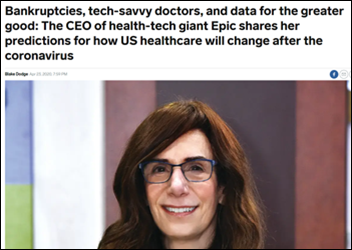
Bankruptcies, tech-savvy doctors, and data for the greater good: The CEO of health-tech giant Epic shares her predictions for how US healthcare will change after the coronavirus

Epic CEO Judy Faulkner says customers have reported revenue declines of up to 55%; and that post-pandemic mergers, acquisitions, and layoffs are likely, especially as small providers are purchased by large health systems with greater financial reserves.

Private sector races to build virus apps to track employees

Several companies are developing potentially mandatory apps that will monitor the spread of COVID-19 in offices and workplaces.

Comments Off on Morning Headlines 4/27/20

Monday Morning Update 4/27/20

April 26, 2020 News 11 Comments

Top News

image

Epic CEO Judy Faulkner discusses possible post-coronavirus healthcare changes in a Business Insider interview:

  • Some hospitals and medical practices will file bankruptcy, as she notes that Epic customers have reported revenue declines of up to 55%.
  • Mergers, acquisitions, and layoffs are likely, especially as small providers are purchased by large health systems that have greater financial reserves.
  • Video visits and at-home monitoring are here to stay.
  • Public health surveillance and the associated standardized data requirements will be a focus.

Meanwhile, Epic offers customers COVID-related applications with no charge for licenses, implementation, and support during the pandemic:

  • Bugsy Infection Control for infection tracing.
  • MyChart Bedside for communicating with isolated patients.
  • Remote Monitoring.
  • Secure Chat.
  • Transfer Center.
  • Willow Inventory for tracking PPE.
  • Rover for handheld nurse charting.
  • Nurse Triage.
  • MyChart, with no per-patient cost for new sign-ups.

HIStalk Announcements and Requests

image

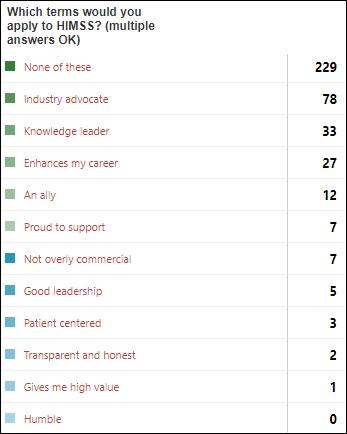
Poll respondents didn’t express a lot of positive thoughts about HIMSS, with transparency, value, and humility being the attributes they chose least often. I’m guessing that much of the ill will was caused by vendors and registrants who lost money from HIMSS20 refund decisions, but I also speculate that significant dissatisfaction and resentment has existed for years but has been masked by high HIMSS conference attendance numbers, which may have not been accompanied by any particular love or respect for HIMSS as an organization versus as an unavoidable vendor that runs the industry’s de facto gathering. Some respondents provided their own negative terms instead of choosing from the positive ones I listed. I doubt that any of us could come up with easy fixes, even if HIMSS were to agree that its past missteps require correction.

New poll to your right or here: Which types of virtual visit have you had since mid-March?

Listening: new from Delanila, moody, sultry alt pop fronted by composer Danielle Eva Schwob with the topical title of “It’s Been A While Since I Went Outside.” She filmed the official video (“visual poem”) herself in a COVID-emptied Manhattan. Her entire catalog under this name is just four singles, but all are magnificent and immediately addictive. I’m also enjoying the new, posthumously released single from Chicago rapper Juice WRLD, whose lyrics in “Righteous” (“taking medicine to fix all the damage”) foretold his drug overdose death in December 2019 at 21 years of age at Midway International Airport, when he downed of handfuls of pills to hide them from federal agents who were searching the private jet on which he was traveling (successfully, as it turned out) for the drugs and guns that were on board. Lastly, if you’re looking for a song that will burrow into your brain like toxoplasmosis, try “The Other Girl,” which sounds like Taylor Swift but is actually country pop singer Kelsea Ballerini with singer-songwriter Halsey (the latter’s first musical posting in 2012 was a parody of a Swift song, so there you go). 


Webinars

April 28 (Tuesday) 1 ET: “COVID-19: Managing an evolving patient population with health information systems.” Sponsor: Intelligent Medical Objects. Presenters: Julie Glasgow, MD, clinical terminologist, IMO; Reeti Chauhan, senior product manager, IMO. IMO recently released new novel coronavirus descriptors to help clinicians accurately record diagnoses and also created free IMO Precision COVID-19 Sets to help identify and analyze patients with potential or documented infection. The presenters will discuss these new tools and describe how to use them optimally.

Previous webinars are on our YouTube channel. Contact Lorre to present your own.


Acquisitions, Funding, Business, and Stock

Vocera announces Q1 results: revenue up 15%, adjusted EPS –$0.14 vs. –$0.17, beating Wall Street expectations for both. 

Amazon surveys its sellers about their health plans, creating speculation that it will offer health coverage.


Sales

  • Tift Regional Medical Center (GA) goes live on LiveProcess Emergency Manager to power its virtual command center.
  • Commonwealth of Massachusetts will offer free virtual visits to uninsured state residents who have COVID-19 symptoms or have been identified through contract tracing, powered by virtual care provider Doctor On Demand.

People

image

Eric Rose, MD (Intelligent Medical Objects) joins the VA’s Office of Health Informatics as chief terminologist.

image

New Jersey Innovation Institute hires Jennifer D’Angelo (Bergen New Bridge Medical Center) as VP/GM of healthcare.


Announcements and Implementations

image

In Australia, Queensland Health cancels its laboratory information system replacement contract with Sunquest after two years and having spent $24 million of the $43 million original contract award. It will instead upgrade its Auslab system that Sunquest was intended to replace.

image

Cerner offers health systems and researchers free access to the de-identified data of COVID-19 patients for developing epidemiological studies, clinical trials, and medical treatments. 

image

Waystar launches an analytics and business intelligence module ahead of schedule to support the coronavirus-driven decisions healthcare organizations are making.


COVID-19

image

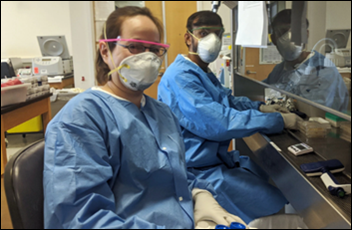
Researchers study the 14 available coronavirus antibody tests on which the hopes of reopening the US economy rest. Only three of the 14 tests — many of which are manufactured in China — delivered consistently reliable results, and none were perfect. All but one test sometimes gave false positive results (which could lead someone to think they are immune when they are not), the tests performed better when the patient had been infected for longer periods, and none of the tests have been approved or studied by the FDA. Meanwhile, an urgent care center near me is pitching COVID-19 testing for $40 cash plus the cost of the video visit, the latter of which is covered my many insurance plans for coronavirus screening. The unstated important point of all this is that (a) we have zero evidence that even correctly resulted seropositivity means that someone is immune, and (b) even if they are immune, we don’t know for how long. We could kill people by sending them back to work or causing them to throw coronavirus caution to the winds by assuming that past exposure indicates immunity. What we don’t know about this virus is nearly everything, except that it spreads and kills people with ruthless efficiency.

image

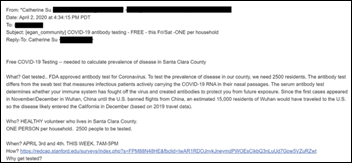
A Stanford seroprevalence study – which was was already being widely questioned for recruiting self-selected users via Facebook and going straight to a press release with no peer review — takes another hit when BuzzFeed News finds that the physician wife of the lead author recruited participants via a wealthy school’s listserv, skewing the demographics of participants. The preprint article estimated that up to 81,000 people are infected in Santa Clara County versus the officially reported 956, which would indicate a much lower death rate than previously believed. Another author is maverick Stanford researcher John Ioannidis, MD, DSc, of which an expert concludes may be “so attached to being the iconoclast that defies conventional wisdom that he’s unintentionally doing horrible science.” He and another of the paper’s authors had previously questioned in a Wall Street Journal op-ed piece and in several Fox News appearances whether the threat of COVID-19 is overblown.

SNAGHTML29821874

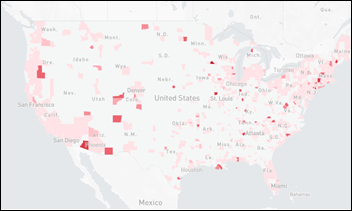
Facebook is offering users a coronavirus symptom survey that was created by Carnegie Mellon University, with results from 1 million users per week being sent directly to CMU for predicting disease spread and county-by-county impact. The first set of results will be published Monday. The map above indicates percentage of people with symptoms in each county (the redder, the worse), but I noticed that the symptom map allows showing percentage of people with symptoms by hospital referral region, which is useful in hospital planning (Rapid City, SD is about to get hammered).

US nursing homes have seen more than 10,000 deaths related to COVID-19, and nine of them that experienced coronavirus outbreaks that triggered “immediate jeopardy” federal citations were found to have significant problems meeting basic health standards – lack of PPE, failure to enforce physical distancing of residents, inadequate staffing, and failing to recognize and react to coronavirus symptoms. Routine federal inspection of nursing homes was stopped on March 20. They complain that federal help has been non-existent as hospitals received all the focus. More than half of reported COVID-19 deaths in some states were nursing home residents.

The Economist warns that governments are borrowing money at a level not seen since the end of World War II despite a dramatic drop in taxes collected, piling up coronavirus-related debt from issuing stimulus money and relief checks for people and businesses. The authors conclude that such spending is sensible in trying to forestall further economic slump — especially in the lower-risk US as the world’s reserve currency and with low interest rates — but working down the 1945 debt all over the world required high taxes on capital, the benefit of inflation, and a baby boom that was accompanied by higher levels of education. The authors also expect that the public — especially senior citizens who vote against politicians who attempt to limit entitlement spending — will demand higher levels of healthcare spending.

image

Former CMS Acting Administrator and United States of Care founder Andy Slavitt lists his takeaways after talking nearly non-stop to to scientists from all over the world:

  • Making effective, breathable, and even fashionable masks available at low or no charge to the entire US population could protect us (at worst) or eradicate the virus (at best) due to the power of exponential math of the infection rate. Masks, rather than a vaccine or therapy, may be the silver bullet.
  • We will solve the shortages of tests, ventilators, and hospital beds.
  • Individual immune response rather than the strain of the virus may drive COVID-19 outcomes.
  • Creating an effective vaccine by 2021, proving that it is safe, and then manufacturing and distributing it to the entire globe involves many challenges.
  • Even in the absence of a vaccine, COVID-19 could be managed as a chronic disease.
  • A vaccine may only be partially effective or may offer partial inoculation, in which case it could still be used in healthcare workers and high risk people.
  • We need to produce so much PPE that a glut is created, taking profiteers out of the picture.

image

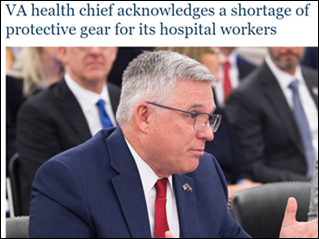
VA officials reverse their previous insistence that it is providing adequate PPE even as employees stated otherwise. VA Executive in Charge Richard Stone, MD says FEMA ordered the VA’s vendors to redirect its shipment of 5 million masks to FEMA for restocking the emergency stockpile, forcing the VA to limit employees who work directly with COVID-19 patients to one mask per day, while other employees who delivered food and medications to COVID wards received only one mask per week, with orders to staple the straps if they broke. The VA says that 1,900 of its own employees are sick with COVID-19 compared to the 6,300 infected veterans it has treated. The VA did not have enough tests for its employees until recent weeks, but its absenteeism rate is still tracking below the normal average at 4% as poorly equipped employees keep showing up for work.

White House officials are discussing plans to replace HHS Secretary Alex Azar, sources say, following widespread criticism of the federal government’s early response to the pandemic and misstatements to the White House about Azar’s reported demotion of HHS vaccine expert Rick Bright, PhD. 


Other

image

Something triggered a memory of XG Health Solutions, the Geisinger analytics and consulting spinoff that was splashily introduced in 2015 without much buzz since, The company apparently closed its doors last summer (shutting down instead of selling out for even a “better than nothing” price is a key indicator of spectacular failure). I attended their HIMSS15 launch and concluded:

From the hallway conversations I heard and my own opinions, here are the positives: Geisinger has developed a lot of expertise and content that’s less ivory tower than most big academic medical centers, they put some thought into involving the patient in the use of their apps, and the SaaS-based subscription means new best practices can be put into place quickly. Negatives: the company has significant venture capital ownership (they aren’t Geisinger, in other words), you might suspect that Geisinger applied soft pressure to the newly named EHR vendor partners to get on board with uncertain future commitments, and so far they’re a company that hasn’t done much to dent the market other than to do Geisinger stuff and make announcements. Success in commercializing hospital software is elusive, and while Version 1.0 is easy, it’s Version 2.0 that gets ugly with upgrades, design decisions, and testing. The first non-Geisinger betas will be important. 

image

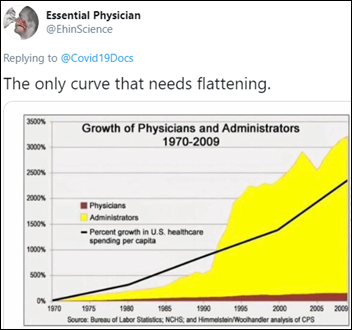
Best tweet of the weekend, although “other” would have been a lot more sarcastically effective and epidemiologically accurate than “only.”


Sponsor Updates

  • Impact Advisors publishes a white paper titled “The Future of EHR Implementation Post-COVID.”
  • Experian Health’s MyHealthDirect scheduling solution is now available in the Epic App Orchard.
  • Health Catalyst makes COVID-19 insights derived from its Touchstone platform of 80 million de-identified patient records available to customers, hospitals, public health authorities, governments, and biopharma working on treatments.
  • NextGate publishes a new white paper, “Why Patient Identity Management Tools are Critical for COVID-19 Surveillance.”
  • KLAS includes Nordic solutions in its latest report, “COVID-19 Technology and Services Solutions Guide.”
  • Clinical Computer Systems, developer of the Obix Perinatal Data System, releases the latest edition of its Critical Care Obstetrics Podcast, “Team Skills Simulation Training.”
  • PerfectServe congratulates customer Prisma Health on FDA approval of its VESper ventilator expansion device.
  • Experity will host a virtual job fair May 2 from 9am-noon CT.
  • Patient engagement vendor Relatient joins the Epic App Orchard.
  • ROI Healthcare Solutions announces comprehensive EDI optimization offerings for Info users.
  • Summit Healthcare publishes the “Galway Clinic Success Story: Solving Complex Interoperability Needs with the Latest in Integration Technology.”
  • In Europe, Synteract leverages the TriNetX platform and COVID-19 Rapid Response Network to find and enroll patients for coronavirus clinical trials.

Blog Posts


Contacts

Mr. H, Lorre, Jenn, Dr. Jayne.
Get HIStalk updates.
Send news or rumors.
Contact us.

125x125_2nd_Circle

Weekender 4/24/20

April 24, 2020 Weekender Comments Off on Weekender 4/24/20

weekender 


Weekly News Recap

  • Banner Health’s judge-approved $8.9 million payout for a massive data breach in 2016 includes $500 for each patient in the class and $2.9 million for plaintiffs’ attorneys.
  • The federal government announces that it will delay enforcing compliance with final interoperability rules so that healthcare stakeholders can focus on COVID-19-related operations.
  • Cognizant alerts customers that a ransomware attract is disrupting some of its services.
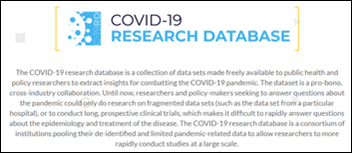
  • Several companies work together to create a database of de-identified, patient-level data for COVID-19 researchers.
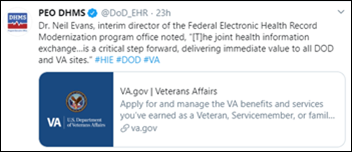
  • The VA and DoD launch a health information exchange that allows providers from both organizations to exchange patient information with community partners.
  • Google announces GA of the Google Cloud Healthcare API.
  • CMS announces that hospitals in areas that have low coronavirus outbreak risk can start offering routine services again.
  • FDA waives limitations on using digital health for treating psychiatric disorders.
  • UW Medicine (WA) publishes its IT experience in dealing with the health system’s coronavirus response.

Best Reader Comments

Re: VA & DoD HIE capabilities. Are we going to just sit here and pretend that both agencies weren’t already bi-directionally exchanging CCDs with huge amounts of outside clinicians via the eHealth Exchange for years? Maybe the massive note formatting issues from VA-crafted documents were just a fever dream of mine. (Perplexed)

These CCF models had the peak in mid-June WITH the distancing staying in place since mid-March. Those have been discounted. They also predicted 100,000 dead in Ohio in March WITH distancing. Then 10,000 dead in April. Their models have been WILDLY off. And unfortunately the public health people have been bludgeoning the politicians with freakishly wrong modeling, which has led to scaring the public to death and closing businesses indefinitely. (Meltoots)

RE: SDH referral platforms. The SIREN network (out of UCSF) published its evaluation last year (full disclosure I was a consultant on it). What’s missing from all these platforms and reports on them is their actual impact on health outcomes. (ex-hhc)


Watercooler Talk Tidbits

image

Readers funded the Donors Choose teacher grant request of Ms. M in North Carolina, who asked for multicultural development materials for her at-risk, pre-school class.  She reports, “This project been a surprising resource for my young students. The children noticed right away the different families’ cultures and they love to talk with their friends about what they see. The school is in a military town and most of my students come from different ethnic backgrounds. I appreciate the posters of real families from around the world. I cannot thank you enough for supporting our classroom.”

A scrubs-wearing nurse from Canada who told border authorities that she was driving to Detroit to help Henry Ford Hospital with COVID-19 is arrested when officers open her Ford Fusion trunk and find 150 pounds of marijuana.

image

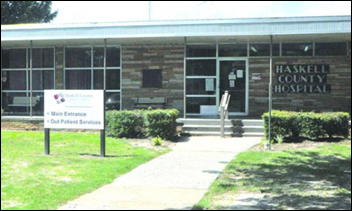
A bankrupt 25-bed critical access hospital in rural Oklahoma has only eight nurses and an office manager remaining as full-time employees, hoping to trim expenses by operating just the ED to attract a buyer. A company submitted the sole bid of $200,000 at a bankruptcy auction, but has backed out of the deal as coronavirus left it worried about being unable to meet operating costs. The hospital is one of 18 facilities that have closed or entered bankruptcy after being taken over by EmpowerHMS, which is being investigated by the Department of Justice for billing out-of-state lab tests through the hospitals to take advantage of their higher payment rates.

image

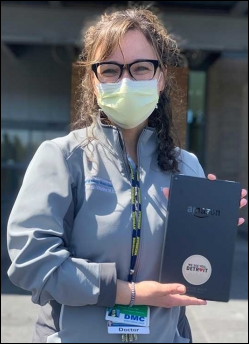
Detroit ED physician Luda Khait-Vlisides, MD, MS raises money to buy tablets to allow patients who are being placed on life support, allowing them to have what could be their final family conversations via video since visitors aren’t allowed.

image

A hospital nurse in Texas posts a note in the window of a COVID-19 patient’s isolation room to explain why he was staying longer than expected.

image

In Spain, a taxi driver who regularly drives people to the hospital for free is surprised there by doctors and nurses, who give him a standing ovation, an envelope with money, and the negative results of his coronavirus test.


In Case You Missed It


Get Involved


125x125_2nd_Circle

Comments Off on Weekender 4/24/20

Morning Headlines 4/24/20

April 23, 2020 Headlines Comments Off on Morning Headlines 4/24/20

Banner Health $8.9 Million Data Breach Settlement Gets Court Nod

Banner Health (AZ) will pay $8.9 million to settle claims from its 2016 data breach, which exposed the information of 3.7 million patients and health plan members.

The FDA just approved Columbia’s Covid-19 plasma therapy study, backed by Amazon

Amazon commits $2.5 million to an FDA-approved clinical trial at Columbia University that will assess whether plasma from 450 COVID-19 survivors can be used in potential treatments for the virus.

Tech company pays $1.7 million in restitution for defrauding hospital electronic records programs

EHR vendor KPMD pays $1.7 million to settle charges that Southwest Regional Medical Center (OH) falsely attested to state and federal governments that its ED met the requirements for EHR incentive payments even as the hospital was shutting down.

VR telemedicine platform XRHealth raises $7M

XRHealth raises $7 million, bringing the virtual reality-based telemedicine startup’s total funding to $15 million.

Comments Off on Morning Headlines 4/24/20

News 4/24/20

April 23, 2020 News 2 Comments

Top News

image

Banner Health will pay $8.9 million to settle claims from its 2016 data breach. An Arizona federal judge approved the settlement, which was reached in early December, on Tuesday.

Each patient who is covered by the class action will receive $500, while the plaintiffs’ attorneys will earn $2.9 million.

Cyberattackers breached Banner’s credit card payment system that is used in its food outlets, then extended their attack to other systems, exposing the information of 3.7 million patients and health plan members.


Reader Comments

From COVID Thoughts: “Re: traveling contractors. How will hospitals address vendors and consultants coming on site post-COVID? If widespread testing is not available, will they permit traveling contractors in their hospital and office buildings?” I’ll open the floor to what, at this point, will be speculation at best. I assume that whatever precautions hospitals will take with patient visitors – temperature checks, limits on numbers, etc. – will be applied to business visitors, but I wouldn’t expect getting them into the building will be a high priority. They could require meeting at locations other than buildings where patient care is provided.

From Disengage: “Re: chatbots. Those should keep people out of the ED even after the pandemic is controlled.” Don’t count on it. The customers of those chatbots are health systems who make a lot of money from ED patients in normal times, where the ED helps keeps heads in beds. The sudden interest in doing the opposite — keeping people away from the ED who don’t need to be there — could well be temporary. Health systems are happy to have full EDs as long as someone is paying, and I expect them to deploy their post-pandemic chatbots accordingly. You don’t run a successfully restaurant by testing prospective diners to verify that they are actually hungry.


Webinars

April 28 (Tuesday) 1 ET: “COVID-19: Managing an evolving patient population with health information systems.” Sponsor: Intelligent Medical Objects. Presenters: Julie Glasgow, MD, clinical terminologist, IMO; Reeti Chauhan, senior product manager, IMO. IMO recently released new novel coronavirus descriptors to help clinicians accurately record diagnoses and also created free IMO Precision COVID-19 Sets to help identify and analyze patients with potential or documented infection. The presenters will discuss these new tools and describe how to use them optimally.

Previous webinars are on our YouTube channel. Contact Lorre to present your own.


Sales

  • Cerner expands its VA contract with Vecna Technologies to include greater EHR systems integration and go-live support at Mann-Grandstaff VA Medical Center (WA).
  • TCARE, which offers a family caregiver support program, will use CareSignal’s COVID-19 programs (linking to local public health resources and information, a self-monitoring text system, and staff support) for its 20 million members.
  • The VA expands its contract with CirrusMD for the text-based VA Health Chat, in which VA employees provide medical advice, manage prescription refills, and schedule appointments.

Announcements and Implementations

image

Cleveland Clinic and SAS share predictive modeling code on GitHub that can help hospitals better prepare for COVID-19-related supply chain, capacity, medical device, and financial scenarios.

image

The Dallas VA implements cloud-based COVID-19 monitoring, surveillance, and tracking solutions custom-developed by CliniComp across 42 sites.

image

The Regenstrief Institute partners with the Indiana Health Information Exchange, Indiana University School of Medicine, and several state-based agencies to develop a COVID-19 tracking and response dashboard using data from the state’s health systems and labs.

image

A KLAS report on technical services providers finds that Galen Healthcare and 314e have the broadest range of clients, J2 Interactive and Navin, Haffty & Associates  are most consistent in client satisfaction, and those four vendors offer the best balance of prce and performance. Client scores from Atos, which grew in the US by acquisition, place it at the bottom. Prominence earned top scores for quality of staff and its deep Epic expertise.

image

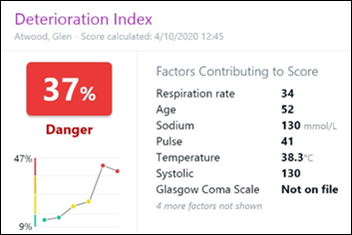
Epic reports that hundreds of hospitals are using its machine learning predictive model to alert clinicians of patients whose conditions are worsening. COVID-19 modules are being validated and used. 


Government and Politics

image

HHS updates providers on the distribution and timing of CARES Act Funds, stressing that payments will be made weekly beginning Friday. High-impact areas such as New York will be allocated $10 billion.

image

EHR vendor KPMD pays $1.7 million to settle charges that Southwest Regional Medical Center (OH) falsely attested to state and federal governments that its ED met the requirements for EHR incentive payments even as the hospital was shutting down. KPMD’s contract called for the hospital to send the company its government incentive payments. KPMD’s CEO Krishna Surapeneni later bought the hospital in September 2013 and closed it one year later.

image

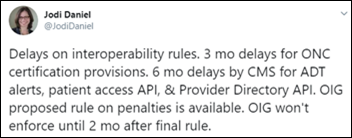
CMS, ONC, and the HHS Office of the Inspector General announce they will delay enforcing compliance with final interoperability rules so that healthcare stakeholders can focus on COVID-19-related operations.

image

FedScoop profiles HHS Protect, health data visualization technology used by the White House’s Coronavirus Task Force that comprises 187 datasets from federal agencies, state governments, healthcare facilities, academia, and industry partners. The dataset, developed and managed by the HHS Office of the CIO, gives 200 users access to COVID-19 case count sources; hospital capacity, utilization, inventory, and supply data; government and industry supply chain data; lab testing data; and data from community-based testing sites.


COVID-19

Scientists determine that coronavirus was spreading undetected in the US by early February and the first known death occurred February 6, as international and domestic travelers then spread the infection. New York City had 600 people with unidentified infections in mid-February and confirmed its first COVID-19 case on March 1, but the city may have had more than 10,000 cases by then.

NIH Director Francis Collins, MD, PhD cites research that found that 44% of coronavirus transmissions occur before the infected person develops symptoms, which will make contact tracing harder. Those studies suggest that people can spread the infection for 2-3 days before they become ill themselves, which then requires tracking down and quarantining 90% of their close contacts who by then have been exposed.

A Health Affairs blog post warns that US maps that show few COVID-19 cases outside of metro areas are misleading, concluding that “the virus is everywhere” based on hospital referral regions where people travel across county and state lines to seek hospital care. Case rates are increasing in all of those regions. The authors recommend that the referral region information be considered by states that are loosening their distancing requirements.

image

A Kaiser Family Foundation poll finds that:

  • 51% of Americans think the worst is yet to come with coronavirus, down 23 percentage points from three weeks ago.
  • 80% say shelter-in-place is worth it to protect people and limit spread.
  • The majority of respondents say they can continue physical distancing and shelter-in-place for more than another month.
  • Two-thirds of people support phone-based contact tracing after they were told that it could allow schools and business to reopen.
  • Twice as many people would be willing to download a contract tracing app if the data was managed by local or state health departments or the CDC instead of a technology company.
  • 38% worry that companies will sell data from contact tracing apps, while 33% think the federal government will use the data for purposes that go beyond tracking coronavirus spread.Two-thirds say they would not feel safer if phone-based contact tracing were in place.

Partners HealthCare (MA) turns its internal employee communications app into a COVID-19 messaging tool, giving its 78,000 staff members daily updates on testing protocols and stay-at-home policies.

image

Johns Hopkins University hosts a free public course titled “Understanding the COVID-19 Pandemic: Insights from the Experts.”

image

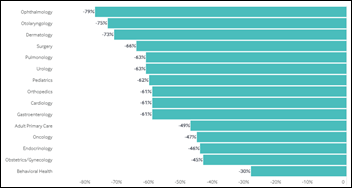
Researchers find that ambulatory practice visits dropped 60% overall starting in mid-March, a reduction that has not been fully offset by the upswing in telehealth visits.

A study finds that of 318 coronavirus outbreaks (three or more cases) in China, only a single outbreak happened outdoors and that outbreak involved just two cases. The study did not take note of the fact that most of the outbreaks occurred during winter when people would have been mostly indoors anyway, but the results may still encourage states to allow churches, restaurants, and gym classes to reopen with a recommendation to use outdoor spaces. The study also found that home contacts were involved in 80% of outbreaks and most of those involved 3-5 cases. A significant percentage involved public transportation.

image

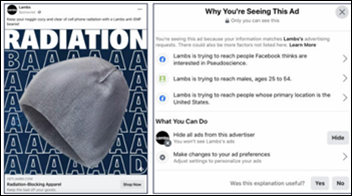
Facebook removes its “pseudoscience” user interest category — which tagged 78 million people — after a website discovered the targeting option when its reporter was served an ad for a radiation-blocking hat. Consumer Reports found that despite Facebook’s declared crackdown on false pandemic content, the magazine was able to buy ads claiming that social distancing doesn’t work and that drinking bleach preserves health.

Drugmaker Jaguar Health — whose only product is the diarrhea medication Mytesi that is approved for use in HIV/AIDS patients who are being treated with antiretroviral drugs — raised the price from $11 to $37 per tablet in early April, right after asking FDA to allow its use for COVID-19 patients being treated with remdisivir. The FDA denied the request. The company says it is going broke fast because insurers won’t pay for Mytesi, which is made from tree sap.


Privacy and Security

Hackers expose the stolen logon credentials of 25,000 users from WHO, NIH, CDC, and the Gates Foundation. WHO says only 457 credentials of the original 6,835 remain active. A white-hat hacker who gained access to WHO’s system using the stolen data says that nearly 50 accounts use “password” as their password, while others use the user’s name or “changeme.” White supremacist groups that have targeted hospitals and medical workers published the stolen credentials to their members almost immediately.


Other

image

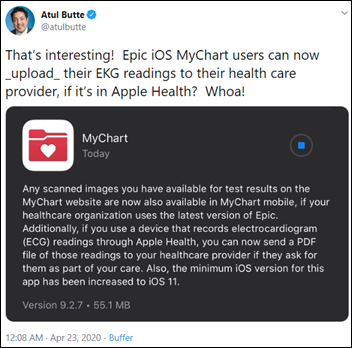
USCF’s Atul Butte tweets that patients can send their Apple Health-stored ECGs to their providers using Epic’s MyChart patient portal.

image

Hospitals that hope to avoid Joint Commission penalties by throwing away medical supplies with a close expiration date are now scrambling to obtain PPE.

image

This is pretty great.


Sponsor Updates

  • CareSignal and Texas Health Aetna launch a free, text-based COVID-19 education messaging service.
  • Ellkay releases a video in celebration of Medical Professionals Week 2020.
  • The Big Unlock Podcast features Wolters Kluwer Health VP and General Manager of Clinical Surveillance Karen Kobelski.
  • Hyland Healthcare and HIMSS Media publish 2020 Connected Care and the State of Interoperability in Healthcare study results.
  • Imprivata expands its collaboration with Microsoft to offer new digital identity innovations.
  • InterSystems announces that RxMx has built its new Chameleon platform on InterSystems IRIS for Health, powering a new COVID-19 testing and monitoring solution for employers.
  • Glytec customers AdventHealth and CHI Franciscan will lead the “Computer-Guided Insulin Dosing” session at the 2020 Diabetes Technology Society Virtual Hospital Diabetes Meeting April 24 at noon ET.
  • The local business paper profiles the rapid uptake in adoption of the Healow telemedicine app from EClinicalWorks.

Blog Posts


Contacts

Mr. H, Lorre, Jenn, Dr. Jayne.
Get HIStalk updates.
Send news or rumors.
Contact us.

125x125_2nd_Circle

EPtalk by Dr. Jayne 4/23/20

April 23, 2020 Dr. Jayne 1 Comment

Telehealth is a hot topic in the virtual physician lounge, with various specialty organizations providing cheat sheets and other reference materials to help practices figure out how to get paid. The American Academy of Family Physicians put together a nice table and flow chart identifying the appropriate E&M codes to use for various clinical and technology scenarios.

As the coronavirus response shifts, some states are allowing their emergency licensing waivers, which allowed many of us to see telehealth patients across state lines without separate licenses in those states, to expire. The recent expansion of telehealth coverage by the US Department of Health and Human Services also allowed providers to avoid HIPAA penalties for the good-faith provision of telehealth during a public health emergency, which led to a boom in use of things like Skype, FaceTime, Facebook Messenger, and other non-secure platforms. It’s unclear exactly how long the “public health emergency” status will last and how much warning we’ll have before the original rules return in force.

Although many healthcare delivery organizations are strapped for cash due to declines in elective procedure revenue, it’s time for them to start thinking about how they’ll transition to a HIPAA-compliant solution. In addition to the HIPAA angle, providers deserve better than using consumer apps. To have the best efficiency and patient safety features, telehealth platforms should integrate with the EHR and scheduling system for streamlined documentation and follow up.

I’ve heard of a couple of health systems looking at telehealth as a way to reduce their physical footprint and get out of costly leases. One executive I talked to spoke of turning some of their offices into the medical equivalent of WeWork sites, where providers could purchase just the time and space they need for face-to-face visits, which may fall below 25% in some specialties.

Stories about providers having their hours cut are everywhere, along with recent reports that healthcare staffing giant Envision Healthcare might be preparing to file for bankruptcy. The company has over $7 billion of debt. The entry of private equity into healthcare in recent years has sucked money out of the system at an alarming rate. Perhaps its time for hospitals to go back to employing physicians and treating them like valued members of the community instead of commodities.

Several physicians have asked me if I had read the statements from the Office of the National Coordinator regarding flexibility with the Interoperability Rule, and I had to admit that I hadn’t. The bottom line is the ONC and CMS, along with the HHS Office of the Inspector General (OIG – just wanted to see how many abbreviations I could string together) announced “a policy of enforcement discretion to allow compliance flexibilities regarding the implementation of the interoperability final rules announced on March 9th.” They went on to say that this “flexibility” is specifically due to the COVID-19 public health emergency. The discretionary period will run for three months past the original compliance dates, but I wouldn’t be surprised if it ends up being extended.

I was initially excited to see an email from Provation offering a “free COVID-19 order set and care plan” in order to “keep all our healthcare heroes equipped with the latest evidence-based order set and care plan content available for COVID-19.” Unfortunately, it requires provision of your email address and company info prior to access, followed by acceptance of terms of agreement that say you can download a single PDF copy “solely for evaluation purposes.” Given the lack of proven treatment for COVID-proper, there wasn’t anything too earth shaking in it.

I was pleased to see the American Academy of Family Physicians come out with a forceful statement about the lack of evidence for off-label use of medications for COVID. Physicians are getting numerous requests for unproven drugs, and those who give in to the badgering are inadvertently causing shortages for people that need the drugs for their actual approved use.

A colleague clued me in to a Miami organization that mailed her mother a bottle of hydroxychloroquine without her requesting it, along with information stating that patients were being placed on it as a preventive. I was happy to see that references to that activity have been sanitized from its website, although the South Florida Sun Sentinel preserved the CEO’s statements and advocacy for the drug for posterity. I hope regulators and license officials take the time to investigate any shenanigans that have already occurred.

I was also happy to see the announcement of an AMIA webinar next week focusing on Electronic Case Reporting. This is a problem I’ve been trying to solve for a client. Due to geographic spread, they have to report COVID-positive cases to dozens of public health authorities, all of whom have different forms. Required transmission modalities include phone, fax, email, web forms, and snail mail. The client has largely given up on reporting, preferring to ask for forgiveness rather than permission. Hopefully the pros on the call will have some ideas to help so I can stop tearing my hair out. If any readers have inside scoop, please share with the rest of the class.

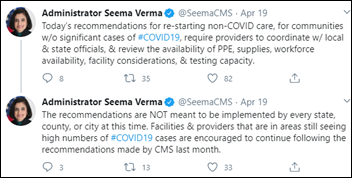
I was less happy to see the CMS document detailing strategies on how to reopen healthcare delivery in the US. First off, its title “Opening Up America Again” is a little too close to a political slogan than should be permissible with an official CMS document. I detest the use of the word “America” as a synonym for “the US” because it makes us appear ignorant of the fact that “the Americas” are a big place inhabited by lots of people other than us.

In short, the document recommends that organizations use telehealth when they can, but in-person care can resume in areas that have “the resources to provide such care and the ability to quickly respond to a surge in COVID-19 cases, if necessary.” Consideration should be given to facilities, workforce, testing, and supplies.

However, the CMS statement on Personal Protective Equipment (PPE) is weak. Basically they are recommending only surgical facemasks for healthcare workers unless high-risk procedures are being performed, and “patient should wear a cloth face covering that can be bought or made at home if they do not already possess surgical masks.” No mention was given to the relative ineffectiveness of cloth face coverings or the lack of science supporting their use, nor of the studies that show that in some circumstances cloth face masks can actually increase transmission of infection.

On the delivery side, the plan is to “conserve PPE,” which basically means healthcare organizations can require their employees to use items in ways that contradict documented approved uses and increase risk to staff. I fully understand that we can’t just use new masks for every patient like we used to, but I would love to see Seema Verma have a conversation with my friend Lil, a pediatric OR nurse who was denied a new mask by an OR supervisor despite her mask being soaked with sweat (and likely ineffective, since you’re not supposed to wear them if they’re saturated).

The document also calls for routine screening of workers and designation of “COVID-19 Care zones” and “Non-COVID Care” (NCC) zones, with separate buildings or separate entrances in the same building and with staff not crossing from zone to zone. It goes on to say that “all patients must be screened for potential symptoms of COVID-19 prior to entering the NCC facility, and staff must be routinely screened for potential symptoms as noted above. When adequate testing capability is established, patients should be screened by laboratory testing before care, and staff working in these facilities should be regularly screened by laboratory test as well.” I’d love for someone to sit down and explain how that should work in the average primary care office or urgent care, because it doesn’t feel like CMS is thinking beyond the hospital walls.

What do you think about the plan to reopen healthcare in the US? Leave a comment or email me.

Email Dr. Jayne.

Morning Headlines 4/23/20

April 22, 2020 Headlines 1 Comment

Cleveland Clinic and SAS share COVID-19 predictive models to help hospitals plan for current and future needs

Cleveland Clinic and SAS make predictive models available on GitHub that can help hospitals better prepare for COVID-19-related impacts on supply chains, capacity, medical devices, and finances.

Nearly 25,000 email addresses and passwords allegedly from NIH, WHO, Gates Foundation and others are dumped online

SITE Intelligent Group discovers that activists have shared 25,000 email addresses and passwords stolen from WHO, NIH, CDC, and the Gates Foundation.

IT services company Cognizant warns customers after ‘Maze’ ransomware attack

IT services company Cognizant – owner of RCM vendor TriZetto – confirms that a ransomware attack has caused service disruptions for some of its clients.

Readers Write: Blowing the Whistle on Technology Fraud in the Healthcare Industry

April 22, 2020 Readers Write 4 Comments

Blowing the Whistle on Technology Fraud in the Healthcare Industry
By Joseph Gentile, Esq.

Joseph Gentile, JD, Esq. is a partner with Sarraf Gentile LLP of Great Neck, NY.

image

The healthcare industry has always been an area susceptible to fraud. In fact, government investigators estimate that in 2016, about $95 billion was improperly paid out by Medicare and Medicaid. That’s only a single year’s amount of fraud in just two of the government’s many healthcare programs.

With an aging population, increased healthcare spending, the passage of the CARES Act, and the government’s multi-trillion dollar effort to mitigate the health and economic effects of the COVID-19 pandemic, fraud in the healthcare industry will only increase. With social distancing become the new normal, the use of technology to deliver healthcare services will also increase. Fraud in this area will, therefore, likely increase.

As a result, the need for insiders to blow the whistle on technology fraud in the healthcare industry is more important than ever. Whistleblowers help ensure that these precious government dollars go towards stopping the harmful effects of the virus and shoring up our economy—and not to line the pockets of opportunists.

The best tool for combating this scourge is the False Claims Act (FCA), a Civil War-era law that was passed to address the fraudulent sale of decrepit horses, ill mules, and faulty rifles to the Union Army (which not only stole tax dollars, but endangered soldier’s lives). The FCA has since been expanded to cover most government dollars, including healthcare spending such as Medicare, Medicaid, and Tricare.

The FCA has been regularly used to fight technology fraud in the healthcare industry. Just last year, the Department of Justice announced a $57.25 million settlement against Greenway Health LLC (Greenway), a Tampa, Florida-based developer of electronic health records (EHR) software for causing its users to submit false claims to the government by misrepresenting the capabilities of its EHR product Prime Suite and providing unlawful remuneration to users to induce them to recommend Prime Suite. 

The US Attorneys whose offices prosecuted the fraud said it best. According to Christina E. Nolan of the District of Vermont, “These cases are important, not only to prevent theft of taxpayer dollars, but to ensure that the promise of health technology is realized in the form of improved patient safety and efficient healthcare information flow.” According to Byung J. “BJay” Pak of the Northern District of Georgia, “Medical professionals and patients depend on the security and competency of electronic health records as a means to improving both the quality and coordination of health care services… Vendors who falsify the viability of their products erode the integrity of public health systems and will be held accountable for their misrepresentations.” 

Cases like Greenway are just the tip of the healthcare fraud iceberg. Indeed, the FCA has been used to recover billions in healthcare fraud and was most recently used in the government’s historic $1.4 billion recovery from Reckitt Benckiser Group involving the marketing of Reckitt’s opioid addiction treatment drug Suboxone. Whistleblowers were awarded over $100 million.

While blowing the whistle may not be easy, the FCA encourages it by offering anti-retaliation protections for those who out the fraud as well as lucrative financial rewards. Where the government obtains a recovery as a result of fraud, the whistleblowers are generally awarded between 15% and 30% of the recovery. Because many FCA healthcare cases are large by nature, the FCA’s financial rewards to whistleblowers have been historically large as well.

Our healthcare industry is being tested like never before, and the people in it — especially those who are working to use technology to improve its delivery and accuracy — play a critical part in ensuring its effectiveness, now more than ever. Those same people can help ensure that the billions of dollars being spent on healthcare aren’t being wasted by fraud. Every dollar counts. Pplicing that is not only a civic responsibility, but legally protected conduct that can result in significant economic awards.

HIStalk Interviews Jeremy Schwach, CEO, Bluetree Network

April 22, 2020 Interviews 1 Comment

Jeremy Schwach is CEO of Bluetree Network of Madison, WI.

image

Tell me about yourself and the company.

Bluetree is about 400 people strong. We help the largest healthcare organizations in the country tackle their biggest problems. About half of our folks come from an IT background, specifically Epic, and the other half comes from a provider background and really understands the business of healthcare. We put those two things together, we figure out what our clients need, and then we jump on it.

How will current events affect the consulting business, both now and in the future?

A lot of our work is core IT related. In some instances, we are as busy or even busier in certain areas. In other instances, we are helping with the big strategy projects that our clients have pushed.

For the most part, we haven’t seen anything totally cancelled. There’s a lot of instances where our clients are saying, and rightfully so, “We need to stay focused on the crisis at hand.” They are dealing with what the rest of the world is dealing with from an economic standpoint, trying to figure out how to prioritize.

Certainly the bottom isn’t falling out. We are taking a long-term view. We’ve seen new opportunities around telehealth. Organizations have moved incredibly quickly for their size compared to how long it has taken historically to get big enterprise projects done. We feel good about the long term and we know that we need to make sure that we are weathering the storm like the rest of the world.

Epic, Cerner, and Meditech have turned around a lot of COVID-19 related changes quickly, ranging from terminology updates to mobile hospital support to telehealth integration. Are customers taking advantage of these new options?

I would say yes. It’s amazing how focused the mission becomes when you are dealing with something that is as acute, and in some cases as devastating, as the current crisis. It ranges from vendors who are putting their best foot forward to clients who have accelerated two-year projects to get them done in two weeks.

I’m impressed with our own folks, who have gotten creative in tough situations. We were remote-first to begin with, so we had a little bit of an advantage. But no one was prepared to take on full childcare and also support their clients who were, in some cases, as busy as ever fighting on the front line. A lot of people in healthcare deserve a ton of credit as their mission comes into focus in times like these.

Are your clients worried about cash flow after being forced to temporarily shut down their most profitable services?

Everybody is concerned, in part because it’s hard to plan. How long does this thing go? When do we start letting patients come back in? “Elective” is the wrong word considering that no one wants to get surgery. At some point, you have to let patients back in.

That is made more difficult by the regional nature. We work with a 160 clients across the country, most of them large. You can take an inner city hospital that is battling this thing on the front lines. Then you go two hours in any direction and you can find a hospital that has had few or no COVID patients. They’re still planning for it, so they have the the same economic hardship from reduced census and lack of profitable electives. While the regional nature is bizarre, everybody is in the same economic quandary.

What technologies have been recently embraced that will stick after things get back to some kind of normal?

We are seeing the same things that you listed in your post. A lot of digital tools. Chatbots getting deployed more widely.

What is interesting is the amount of infrastructure that is required to stand up something like telehealth. Most people look at telehealth as the tool itself and the availability of physicians. There’s an underbelly infrastructure that is a big part of the heavy lift. For example, we take patient calls for some of our clients and have expanded that service because our clients need it. But regardless of the telehealth tool, a whole demographic of patients are just not going to be comfortable using it. It’s basic things, like opening the right browser and getting webcams set up. We’ve seen this huge spike in patient calls as a result of some of these new tools, and it’s not even COVID related, necessarily. You have to build an infrastructure around these things.

We expected our clients to kick the can on some of our big strategic projects to keep everybody focused. We haven’t seen that happen. In some ways, our clients are even more focused on this consumerization of healthcare. We do a lot of work on patient access centers. Because we are accelerating these new tools, clients are having to create the customer service infrastructure that other industries have built up over 10 years, but that is new to healthcare. We are seeing a lot of demand, and these hard, big projects that impact tens of thousands of users continue to move forward.

If you want to put in cool new texting apps or the latest fancy bell and whistles from your new startup, you need that baseline infrastructure. A patient has to be able to call in, talk to somebody about financial counseling, get a nurse in real time, get their prescriptions refilled, or get an appointment scheduled. Now you are adding telehealth volume and chatbot questions to that mix. Our clients are accelerating building that core infrastructure, because otherwise it’s hard to do anything in the consumerization patient world. It was surprising how quickly something so strategic kicked into high gear.

What interesting changes are you seeing from Epic and other vendors?

A lot of what clients are leveraging now existed in the past. We have just re-prioritized in healthcare. Vendors haven’t released a lot that is brand new or that was spun up quickly, but certainly they have been incredibly available on the analytics front. Maybe one of the surprising outcomes was Epic and other vendors working with the federal government to figure out, because of their large footprint, how to help from an overarching view of what’s happening in the country. Vendors weren’t necessarily doing or even feeling comfortable doing that historically. The current times demanded that, so they stepped up to the plate.

MyChart tools, chatbots, and telehealth all existed. It was a matter of prioritizing and then building the infrastructure.

What types of companies will be best positioned to weather the crisis and emerge strong on the other side?

We were acquired by Providence in July, which gave us a longer-term view. Our approach has been that current events are changing healthcare dramatically, and in some cases for the better. When we come out of this, the changes that we are already feeling will be accelerated. The opportunities in healthcare continue to grow and are maybe even being expedited by the current crisis. Anybody who takes a long-term view is going to be better positioned. We are doing everything we can to keep the team together, but our goal is to make sure that when times that are slower, we take advantage of the opportunity to build and focus on what our clients need now.

Your readers will roll their eyes when I say this because every CEO has to say this, but I personally feel incredibly fortunate to be attached to Providence. We are a small company that has an opportunity to make a big impact, because even as a small company, we work with some of the largest, most influential healthcare systems in the world, and on some of their most strategic projects. We feel fortunate to be in that position.

As a small company, you’re wondering about your long-term view and whether you can go about it as a solo practitioner. It is doable, but incredibly hard and increasingly rare.

You wonder if you  should take the financial buyer route, such as private equity. You know the pros and cons of that. One of the cons is that your company will be sold every three to five years by an owner that really cares about just one thing, which is their prerogative and goal.

Then you have the strategic, who will look at how to leverage the skill set, the people, or the customer base. 

Providence came to us in February and basically said, there’s a fourth option. We have this 170-year-old, mission-driven non-profit with an enormous footprint. We are one of the largest Epic clients on the planet. We want to keep delivering this vision for another 170 years. We know healthcare is changing, so we want to do things differently.

That was the Providence sales pitch to us. We could help them modernize and innovate, but we could also gain an opportunity to do things differently, remain independent, and work within a new commercial entity that can go out and do bigger things. We get the platform to do what we already do, but with a bigger impact.

We are nine months through it and it has been incredible. They have been an amazing partner because they aren’t a PE shop or a traditional strategic. They are totally different and they have been true to their word. We are fortunate to have them as a partner.

The initial announcement said that Providence planned to build a $1 billion business from their acquisition of Bluetree, Engage, and other companies. How is that working and what is the strategic direction?

The vision has been super clear from the beginning. It’s not easy to do. They’re a large organization. Those wheels have been turning for a very long time.

Before the acquisition was finalized, I had a chance to sit down with Mike Butler and Rod Hochman, the president and CEO. They said, tell me one other organization that is 170 years old, founded by a group of women, with our scale, that cares deeply about a non-profit mission, and that has survived for all these years because of that vision. Rod laughed and said, don’t think too hard about it because there isn’t any other.

They are in a unique position because of longevity, their 114,000 caregivers, and the skill to do it differently. Because of that vision, it’s been clear what we need to build. One of their guiding principles was that this would not be Bluetree and Engage folding into Providence. They could build that themselves. This is taking advantage of their scale and all of the smart people they have to build something different.

What’s been most surprising to us is that a consulting company, we’ve got folks across so many clients. We’ve got a pretty good long view of what’s happening. We felt like we could make a difference for Providence, and that’s important.

The crisis has shown us, in a short period of time, that Providence has as much to give us as we have to give them. Their response to the crisis has been unbelievable, that an organization with that level of scale could move that quickly. They had the first confirmed COVID-19 case in the US, so they had a head start. Not only did they stay focused and organized, they allowed us to come in and learn from them as they were going through this. Because they have this amazing non-profit vision, we posted their learnings publicly. Our website has a COVID-19 page and a lot of the content was from Providence’s learnings.

We did a deep dive as they were building their analytics tools across their large geographic regions and we learned a lot from them as they looked at cash, preserving cash, and accelerating cash as we come out of this. We got an inside view, the chance to exchange ideas, and then the opportunity to publish it quickly because it was good for the world. That drove home the fact that this is such an unusual partnership in healthcare.


Morning Headlines 4/22/20

April 21, 2020 Headlines Comments Off on Morning Headlines 4/22/20

Leading Healthcare Companies Announce COVID-19 Research Database

Several healthcare companies create COVID-19 Research Database, a secure repository of de-identified, patient-level, longitudinal datasets from claims and EHRs.

Statements from the Office of the National Coordinator for Health IT and the Centers for Medicare & Medicaid Services on Interoperability Flexibilities amid the COVID-19 Public Health Emergency

CMS says it will extend deadlines for compliance with final interoperability rules so that healthcare stakeholders can focus on COVID-19-related operations.

Microsoft hires a former GE exec to work with health companies in the midst of the coronavirus pandemic

Microsoft hires former GE Healthcare head of imaging Tom McGuinness as its VP of global healthcare.

Comments Off on Morning Headlines 4/22/20

News 4/22/20

April 21, 2020 News 2 Comments

Top News

image

The VA and DoD jointly launch a health information exchange that will allow clinicians to access patient records that are stored in the EHRs of community partners and health systems.

The HIE will connect to CommonWell later this year.

Both organizations were already able to access information from their own community health partners, but the HIE allow all providers to see data from all community partners.

Most of the 215 partners that are participating in the exchange can both send and receive patient data, although some allow only one-way sharing.


Reader Comments

SNAGHTML13d2f600

From Burned by TriZetto: “Re: TriZetto. We installed EClinicalWorks at our practice last year and chose TriZetto from the three revenue cycle vendors ECW offered us. ECW just announced that they are abandoning the company and their integration because of a massive security breach at TriZetto.” Cognizant, which acquired TriZetto for $2.7 billion in cash in 2014, was hit this past weekend by Maze ransomware. ECW has blocked all integration to TriZetto’s clearinghouse and patient statements. The Maze malware not only encrypts computers, it exfiltrates company data to the servers of the attackers, who then demand payment with the threat of publishing the data online. The publicly traded Cognizant, which reports annual revenue of $17 billion, warns in a new SEC filing that the attack could negatively affect its financial results. Meanwhile, Cognizant continues to offer end-to-end security solutions, including threat and vulnerability management and cyber threat defense.


Webinars

April 28 (Tuesday) 1 ET: “COVID-19: Managing an evolving patient population with health information systems.” Sponsor: Intelligent Medical Objects. Presenters: Julie Glasgow, MD, clinical terminologist, IMO; Reeti Chauhan, senior product manager, IMO. IMO recently released new novel coronavirus descriptors to help clinicians accurately record diagnoses and also created free IMO Precision COVID-19 Sets to help identify and analyze patients with potential or documented infection. The presenters will discuss these new tools and describe how to use them optimally.

Previous webinars are on our YouTube channel. Contact Lorre to present your own.


Acquisitions, Funding, Business, and Stock

Analytics vendor Komodo Health lays off 23 employees, representing 9% of its headcount, three months after it raised $50 million in a funding round. The company collects the de-identified data from 15 million patient encounters each day to follow patient journeys and analyze outcomes.


People

image

Microsoft hires Tom McGuinness (GE Healthcare) as corporate VP of global healthcare.
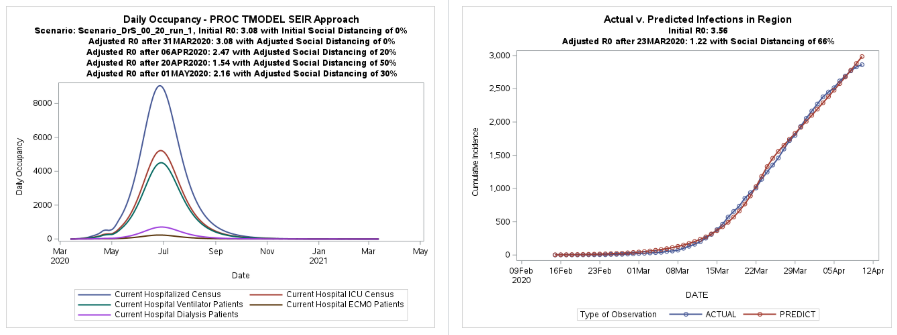

Announcements and Implementations

Google announces GA of the Google Cloud Healthcare API. The company also highlights its tools for supporting COVID-19 efforts, including Google Meet for virtual care, G Suite for sharing information, a newly launched Rapid Response Virtual Agent for patient interaction, Google Maps Platform for giving directors to patients, and researcher credits for Google Cloud

image

Nuance launches Dragon Ambient Experience (DAX), which creates clinical notes from the physician-patient conversation in either physical or virtual visits.

Surescripts reports that e-prescribing represented 80% of all prescriptions in 2019, while use of real-time benefit checking and electronic prior authorizations increased significantly.

Lark Health offers its text-based stress and anxiety coaching service to health plans and employers at no charge through July 1.

Redox announces a rapid deployment model that allows telehealth software developers to bring their solutions live with EHR integration in two weeks.

Premier enhances its solutions for COVID-19, including COVID-specific alerts for clinical surveillance, an early warning system for patient volumes, surge prediction, supply use prediction, COVID-19 clinical guidance, intervention effectiveness monitoring, and best practices deployment.

image

PCare will deliver provider-prescribed patient guidance and education from Quil on its interactive patient system and digital rounding solution, with COVID-19 Care Journey being among the first offerings.


COVID-19

image

CMS announces that hospitals that are located in areas that have low coronavirus outbreak risk can restart providing non-emergent, non-COVID-19 services. CMS advises hospitals to monitor COVID-19 trends in their area; prioritize by patient need; ensure that providers, staff, and patients wear facemasks at all times; screen staff and patients for symptoms before they enter the facility; and limit volumes so that six-foot distancing can be practiced in areas such as waiting rooms.

Baystate Health executive Andrew Artenstein, MD describes in a NEJM letter the health system’s drama-filled effort to obtain face masks and N95 respirators at five times the normal price from a broker who had a connection in China. The hospital team traveled to an industrial warehouse to meet two trucks that had been marked as food service vehicles to avoid being detained. FBI agents arrived demanded proof that the supplies were not bound for black market resale. The agents were satisfied, but the health system then had to use its political contacts to keep the shipment from being seized by the Department of Homeland Security.
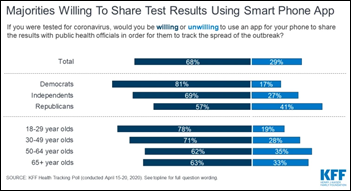

Providers who accept CARES Act relief funds are barred by mandatory acceptance terms in which they pledge to not balance-bill COVID-19 patients for out-of-network charges.

image

FDA authorizes use of LabCorp’s home self-test for COVID-19, in which a collection kit of nasal swabs and saline is used by the patient to take their own sample, which is then mailed to LabCorp for processing.

Former FDA Commissioner Scott Gottlieb, MD warns that most available serology tests have not been reviewed by the FDA and their quality varies, with some tests potentially being wrong half the time when they tell patients they have coronavirus antibodies. The tests are useful for public health studies, but not worth much for making decisions about individuals.

image

Influential technology investor Mary Meeker looks at the influence of coronavirus, with these healthcare-related observations:

  • COVID-19 research is being published at 20 times the rate of prior infectious diseases at the same stage.
  • Clinical research is rapidly mobilizing, with 500 clinical trials underway with 5 million participants.
  • The pandemic has exposed healthcare flaws that may be the call to arms to rethink a system that consumes 8% of GDP, $1.2 trillion in 2019 federal spending, and 28% of the federal budget.
  • Primary care hasn’t changed much since 1918’s Spanish Flu outbreak, as patients still visit the office (possibly infecting others), the doctor diagnoses based on outward symptoms, the patient is sent home to watch and wait, and the patient either gets better or goes to the ED.
  • A lack of connected data, despite decades of EHR investment, have left federal and state healthcare officials using spreadsheets to track hospital utilization and capacity. Prediction models have varied wildly based on the use of assumptions. Providers are too overwhelmed with  workload and high volumes of data to deliver the benefits of digitization.
  • Innovation will be driven around telehealth, connected devices for monitoring, rapid point-of-care testing, connecting the “dark pools” of EHR data using interoperability and APIs, using automation to improve data capture quality, and applying AI to EHR data to drive insights to providers at the right time.

image

Several healthcare companies create COVID-19 Research Database, a secure repository of de-identified, patient-level, longitudinal datasets from claims and EHRs. Researchers will be able to evaluate drug effectiveness, identify demographic and pre-existing condition risk factors, and predict the public health impact of quarantines.


Sponsor Updates

image

  • Bluetree employees across the country make 609 masks for nine organizations in eight states.
  • Avaya CEO and President Jim Chirico discusses on Fox Business how the company is donating video services to businesses during the pandemic.
  • Clinical Architecture releases a new edition of its Informonster Podcast, “Three Takeaways from the COVID-19 Pandemic and the Importance of Managing Data Quality.”
  • Dina wins the 2020 Transition of Care Challenge, sponsored by the New Orleans Business Alliance and Tulane Health System.

Blog Posts


Contacts

Mr. H, Lorre, Jenn, Dr. Jayne.
Get HIStalk updates.
Send news or rumors.
Contact us.

125x125_2nd_Circle

Morning Headlines 4/21/20

April 20, 2020 Headlines 1 Comment

VA, DoD implement new capability for bidirectional sharing of health records with community partners

The VA and DoD launch HIE capabilities, giving government providers the ability to share health data with their private-sector counterparts.

Aledade Raises $64 Million Series C on Nationwide Growth of Value-Based Care Network

Practice management company Aledade plans to expand its California footprint with a new $64 million funding round.

A buzzy healthcare startup that raised $50 million from Andreessen Horowitz 3 months ago just cut staff amid the coronavirus pandemic

After raising $50 million in January, healthcare data and analytics startup Komodo Health lays off 23 employees – nearly 9% of its staff.

Amazon is teasing a new health care offering — for its sellers

Amazon surveys its sellers to determine their satisfaction with current health insurance offerings and their interest in alternative coverage.

Our Healthcare API and other solutions for supporting healthcare and life sciences organizations during the pandemic

After a year in beta, Google Cloud announces GA of its Cloud Healthcare API, which enables the sharing of data between healthcare apps and those built on Google Cloud.

Curbside Consult with Dr. Jayne 4/20/20

April 20, 2020 News 1 Comment

Lots of conversation in the virtual physician lounge on when we will know when it is safe to start to resume “routine” patient care again.

Most of the employed physicians I know have taken salary cuts, and many of my independent peers are holding any physician payments while they try to cover expenses and staff salaries. Practices are running with a skeleton crew, and I’d estimate about half the practices are offering some kind of telemedicine services. (More telemedicine with primary care or non-procedural based subspecialties, less with those that relied on office or hospital-based procedures for their income.)

I know of a handful of physicians that have totally hung up their white coats. They were either close to retirement and are just “done with it,” so to speak, or their employers offered them some kind of buyout to ease the payroll.

A couple of us have been talking about last week’s New York Times piece on how we can safely move away from lockdown and stay-at-home conditions. We’re starting to see other countries that previously looked like they had a good handle on the pandemic who are starting to re-impose controls based on a resurgence of cases, which is unnerving. My state hasn’t hit its projected peak just yet, and without a robust testing strategy, it’s not even clear when we’ll know that we’re peaking. Too many patients are dying at home or in situations where they haven’t been tested.

The NYT piece quotes milestones laid out in an American Enterprise Institute report, which was authored by a group whose expertise many of us trust. One of the key points for moving forward is that “local hospitals are safely able to treat all patients requiring hospitalization without resorting to crisis standards of care, and the capacity exists in the state to test all people with COVID-19 symptoms, along with state capacity to conduct the active monitoring of all confirmed cases and their contacts.”

We’re a long way from that were I am. Healthcare workers don’t always have N95 masks, and those who do are being asked to wear them in a way that hasn’t been shown to be effective. Some care sites such as urgent cares aren’t offering any kind of decontamination or reprocessing – employees are just expected to rotate whatever masks they have (many of which were obtained from hardware stores or family members) until they disintegrate. Local hospitals are trying to figure out reprocessing, but it’s unclear how much the precious masks can take.

An ICU nurse friend of mine posted on Facebook how thrilled they were to get hand sanitizer from a local distillery. The post was accompanied by a photo of a colleague wearing a woodworking respirator. This is in a premier hospital in an affluent suburb of a major metropolitan area, not a safety-net facility or a place without resources.

It doesn’t feel to those of us on the clinical side like we’re even remotely ready to start talking about implementing societal changes that would place a larger burden on healthcare organizations. I applaud the companies like Battelle that are innovating (their mask reprocessing strategy is pretty cool, and the Pentagon is sinking big money into additional units for deployment across the country) but for goodness sake, healthcare workers are wearing trash bags for protection. Trash bags! In the year 2020, in the United States of America. To be honest, did any of us really see that coming? Did we ever think we’d practice in a situation where that was acceptable?

I’m furloughed from my clinical gig, but I still read the email updates. Their strategy when they run out of barrier gowns is to use cloth patient gowns and launder them since all sites have a washer. Let’s see, they’re cloth, they’re not moisture-proof, and then people are going to be at risk handling them for the laundry process. Sounds like a great plan. I think I’d rather have the trash bag, to be honest. They’ve had to remove the glove dispensers from patient rooms because the gloves were being stolen. It’s surreal.

I know many of our readers work for healthcare organizations and you already know these things. If you haven’t seen them with your own eyes, you’ve probably heard about them on command center calls or during supply chain management huddles or in any number of ways in which your world is being impacted by this pandemic. Healthcare organizations are burning through money without hopes of their coffers being replenished for some time, especially since some of them depend on non-emergent services for up to 80% of their budgets.

Families are in the same situation, burning through any emergency funds they had saved, unsure when they’ll be back to work. People are having to make tough choices, and the answers aren’t as cut and dried as any of us would like them to be.

At least in my area some of the safety nets are back up and running. School-based meal pick-up services had been halted after some worker infections, and one of the major food banks had closed temporarily while they figured out a sustainable strategy for continuing to help people.

One of the local community health centers is opening additional drive-through testing sites. I’m not sure how they got their hands on so many tests, but since their community is being disproportionately impacted by the pandemic, I’m glad they have them. At the same time, they’re working very diligently to try to make sure their patients have needed medications and chronic care services, to make sure they don’t just stay COVID-free, but also protect their health as much as possible.

It seems like a lifetime ago we were debating how much money hospitals were spending on massive EHR projects or whether they would ever see their return on investment. I hope all those organizations are pushing the limits of whatever features and functions they can to make the caregivers’ lives easier. I hope the executives are rolling up their sleeves and helping on the front lines and that they’re supporting the staff who feel uncertain or frankly afraid. It’s going to be a long time before we get to any semblance of “normal” and people need all the support they can get.

With that in mind, and in order to support your stress-baking habits, I offer up the Taste of Home Giant Buckeye Cookie. The inhabitants of Casa Jayne give it a “10 out of 10, would eat it again.” I would strongly recommend the ice cream to go along with. We didn’t have it, and it would have been lovely. Even if your local grocer is out of flour, you can probably score the cake mix it calls for.

What has your favorite stress baking recipe been? Leave a comment or email me.

Email Dr. Jayne.

Text Ads


RECENT COMMENTS

  1. Why does the displayed "exam room of the future" still have the classic "clinician has their back to the patient"…

  2. Anything related to defense will need to go to Genesis.

  3. That, or we see if Judy will announce Epic's new Aviation module (probably called Kitty Hawk) that has integrated Cruise…

  4. The $50 billion Rural Health payout is welcome. In context, it's less than the total cost of the F22 raptor…

Founding Sponsors


Platinum Sponsors


Gold Sponsors


RSS Webinars

  • An error has occurred, which probably means the feed is down. Try again later.