Recent Articles:

News 8/20/25

August 19, 2025 News 1 Comment

Top News

image

The Carlyle Group will acquire a majority stake in RCM vendor Knack Global for $500 million.

Blackstone acquired competitor AGS Health last month for $1.1 billion.


Sponsored Events and Resources

Instant Access Webinar: “Healthcare Data Strategies: Retire, Retain, and Ready for AI.” Sponsor: Triyam, an Access Company. Presenters: Sudhakar Mohanraj, founder and CTO, Triyam; Benjamin Cassity, director of research and strategy, KLAS; Jamie Greenstein, senior marketing manager, Access. The presenters deliver practical tactics to help IT leaders manage exploding data volumes — how to clean up legacy systems, craft smarter retention policies, and prepare historical data for analytics and AI.

Contact Lorre to have your resource listed.


Acquisitions, Funding, Business, and Stock

image

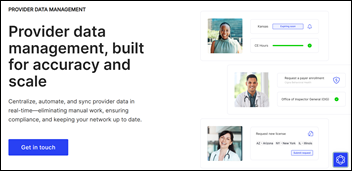
Provider credentialing company Medallion announces $43 million in new funding, bringing its total raised to $130 million. It has launched its CredAlliance credentialing clearinghouse to streamline provider onboarding across participating payers.

image

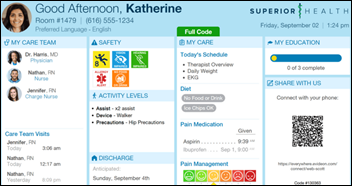
TigerConnect acquires smart room system vendor EVideon. 


Sales

  • Johns Hopkins Health System (MD) selects Talkdesk’s Healthcare Experience Cloud contact center technology.

People

image

Rebecca Whaley (Altera Digital Health) joins Nordic Global as SVP of marketing.

image

Nebraska Medicine names Michael Hasselberg, PhD (University of Rochester Medical Center) chief transformation and digital officer.

image

The University at Buffalo (NY) appoints Asim Khan, PhD (Allegheny Health Network) health sciences chief data and information officer.

image

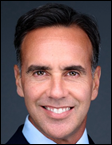
Don Trigg (Apree Health) joins Veradigm as CEO.

image image

Access TeleCare names Josh DeTillio (Nutex Health) CEO. Founder and former CEO Chris Gallagher, MD moves to chief strategy officer.

image image image

Healwell AI names James Lee (Orion Health) CEO and Brad Porter (Orion Health) chief commercial officer. Former CEO Alexander Dobranowski, MD has taken on the role of president. Healwell acquired Orion Health earlier this year.

image

Johns Hopkins Hospital promotes Khyzer Aziz, MD to CMIO.


Announcements and Implementations


image

Epic mentions several new capabilities at UGM via X:

image

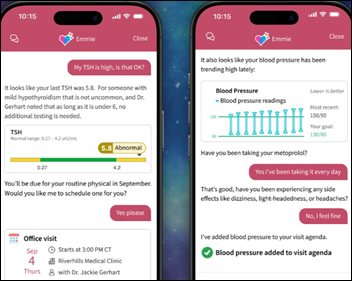
Emmie is a patient-facing Ai tool that explains test results and enables easy access to recommended next actions.

image

Art creates patient summaries for physicians, answers questions, and executes actions such as queueing orders into a shopping cart for end-of-visit approval. This is Epic’s previously rumored ambient documentation tool, which runs on Microsoft / Nuance speech recognition.

The upcoming MyChart Central will allow patients to use a single Epic-issued ID to connect to their MyChart records from multiple providers.


RLDatix adds AI-powered conversational documentation for entering event details into its to its safety and risk management system.

image

SouthEast Alaska Regional Health Consortium goes live on Meditech Expanse with help from Nordic Global.

Ozarks Healthcare (MO) rolls out Luma Health’s Patient Success Platform.

image

FirstHealth of the Carolinas goes live with EvidenceCare’s AdmissionCare admission assessment and documentation software across its four hospitals.

image

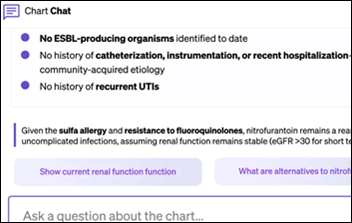
Ambience Healthcare announces Chart Chat, an AI copilot for Epic that offers chart retrieval, risk scoring, and access to medical literature.


Government and Politics

A federal judge in California issues a temporary order prohibiting HHS from sharing the personal data of Medicaid beneficiaries in 20 states with the Department of Homeland Security’s ICE agents.

ASTP issues a draft TEFCA GBD Exchange Purpose, which allows government entities at the federal, state, local, or tribal level to determine an individual’s eligibility for non-healthcare government benefits.


Sponsor Updates

  • Black Book Research offers the results of its latest survey in a brief titled “A New Set of Red Flags: What Really Disrupts Deals in 2025?”
  • Capital Rx releases a new episode of “The Astonishing Healthcare Podcast” titled “What Health Systems Need [From a PBM]: A Blend of Tech, Transparency, and Understanding, with Lindsey Butler, PharmD, and Chris England.”
  • Consensus Cloud Solutions will exhibit at Hyland Community Live August 25-28 in Las Vegas.
  • Optimum Healthcare IT becomes the first healthcare IT consulting firm to use Clear’s identity verification system to vet consultants.
  • Divurgent names Chad Laberge director of client service.

Blog Posts


Contacts

Mr. H, Lorre, Jenn, Dr. Jayne.
Get HIStalk updates.
Send news or rumors.
Follow on X, Bluesky, and LinkedIn.
Sponsorship information.
Contact us.

Morning Headlines 8/19/25

August 18, 2025 Headlines Comments Off on Morning Headlines 8/19/25

Carlyle to buy major stake in Knack Global

Carlyle Group will acquire a majority stake in RCM vendor Knack Global in a $500 million deal.

CentralReach Expands Its Market-Leading Platform to Enable Outcomes-Based Care with Acquisitions of AI.Measures and SpectrumAi; Dr. Tom Frazier Joins as Chief Clinical Officer and Ling Shao as SVP, Outcomes-Based Care

Autism and intellectual and developmental disabilities care software vendor CentralReach acquires SpectrumAi and AI.Measures.

Medallion Raises $43 Million to Expand AI Infrastructure and Launch the First National Credentialing Clearinghouse

Provider credentialing company Medallion announces $43 million in new funding, bringing its total raised to $130 million.

Comments Off on Morning Headlines 8/19/25

Curbside Consult with Dr. Jayne 8/18/25

August 18, 2025 Dr. Jayne 2 Comments

As a clinician, I often have difficult conversations with parents about how to reduce the amount of time that their children spend using screen-based devices every day. Many of the parents I encounter are unwilling to limit their children’s screen time because of a perception that children who don’t have devices will be “left behind” or potentially ostracized by their peers.

I see a fair number of folks who use devices to entertain their children rather than interacting with them, which I find sad. When I walk into an exam room and see a kid poking away at a tablet while their parent sits in a heads-down position with their own phone, it makes me wonder what happens when they are not at the physician office. Ultimately, kids become dependent on devices for interaction and this can be a problem when they reach school age, when teachers spend a good chunk of time policing phone-related behavior.

As of the start of this school year, more than half of US states have passed legislation or created policies regarding the use of cell phones in K-12 classrooms. These range from requirements that school districts create guidelines of their own to outright bans. Among the reasons for such bans, lawmakers cite the need to create a distraction-free learning environment, a desire to curtain social media use, and a hope that such strategies will have a positive influence on youth mental health.

My own local district had a well-researched plan that had been created after stakeholder listening sessions with students, parents, and teachers. It was pre-empted by a maneuver at the state level that is significantly stricter. When my district was creating its policy, it used its health advisory committee to comment on the potential risks and benefits of restricting cell phone use.

Physicians raised the issue of the use of cell phones for medical reasons, including students and faculty who use apps to manage health conditions like diabetes. It’s clear from looking at some of the state laws that these kinds of needs might not have been considered by legislators. Needless to say, people aren’t happy about it, and I’m sure there will be some settling in once school starts.

With that in mind, I ran across this article that covers the topic from the youth point of view. Although it mentions the fact that devices have addictive properties, it also digs into the ways in which childhood in the US is changing. It reviews a Harris Poll survey of 500 children ages 8-12, with the majority saying they had smartphones and half of the older members of the cohort saying that social media use was common in their peer groups.

One of my favorite quotes from the piece states that, “This digital technology has given kids access to virtual worlds, where they’re allowed to roam far more freely than in the real one.” As a proud member of Gen X who had the stereotypical “come home when the streetlights come on” childhood, this resonated with me. The article notes that many children haven’t so much as gone down a grocery store aisle alone and that a good number aren’t able to play unsupervised in their own yards.

The authors note that children expressed a desire to socialize in person with minimal supervision, but due to restrictions by their parents, they instead use their phones to socialize unsupervised. Of course, there are reasons that parents have become more restrictive with their children, including fear of injury or abduction, but one of the statistics mentioned in the article is that “a child would have to be outside unsupervised for, on average, 750,000 years before being snatched by a stranger.”

It goes on to say: “Without real-world freedom, children don’t get the chance to develop competence, confidence, and the ability to solve everyday problems. Indeed, independence and unsupervised play are associated with positive mental-health outcomes.”

The authors mention the creation of parenting networks where kids are encouraged to get together for unsupervised play and community organizations that are promoting screen-free time. The deeper I got into the article, the more I wondered what tech companies think about these efforts and whether they feel that such advocacy for unstructured device-free play might ever be a threat to their respective bottom lines.

I’ve been a volunteer in youth-serving organizations for over 20 years, and I would say that any threat wouldn’t be a serious one. To get kids to put down their phones, we would likely need to see parents doing it first. On second thought, though, maybe if there was a TikTok influencer that started telling parents it was cool to let their kids run around the neighborhood and dig holes in the yard as some of us did once upon a time, we might see a change.

I recently read the book “Klara and the Sun” by Kazuo Ishiguro. It’s a complex novel told from the point of view of Klara, who is an Artificial Friend purchased to serve as a companion to a child with a chronic illness. I won’t throw out any spoilers as to the nature of that illness, but it was an interesting read.

There are already enough ways that technology is impacting childhood, so I hope we don’t get to the point where life starts imitating the novel. On the other hand, there are some scenes in the book where the main human character is allowed to go outside to play with only the supervision of the Artificial Friend. It made me think a bit that if parents won’t let their kids explore the world alone, maybe there just might be a role for technology.

It will be interesting to see if there is any research published in the next couple of years with respect to these cell phone limitations and bans and whether they do have a positive impact on youth mental health. It’s estimated that mental health is impacting the US economy to the tune of $282 billion annually, so we can’t afford not to study how these interventions play out.

What do you think about the role of government in limiting the use of technology for individuals, whether they’re children or adults? Leave a comment or email me.

Email Dr. Jayne.

HIStalk Interviews Thomas Thatapudi, CIO, AGS Health

August 18, 2025 Interviews Comments Off on HIStalk Interviews Thomas Thatapudi, CIO, AGS Health

Thomas Thatapudi, MBA is CIO of AGS Health.

image

Tell me about yourself and the company.

We are primarily a revenue cycle management company. We work with pretty large enterprises, such as Mayo Clinic, Cleveland Clinic, and Baylor Scott & White Health. We offer services on the front end, which is usually scheduling, patient access-related functions, mid-cycle coding, and in the back end, AR and denials.  We are about 15,000 people. We are what I would call a tech-first services company.

My career over the past 20-odd years has been primarily in technology. I’ve been focused on building data-intensive apps. In the last two or three years, I’ve been pretty intrigued with AI and its applications.

What are the biggest pain points in RCM that technology may help solve?

I’ve been working on the provider side only since I’ve started working with AGS Health in the last four years, so I’ve seen a fair bit of insurance. When I say insurance, that’s  auto, home, and health insurance. I’ve worked a lot with payers, I’ve worked with credit card companies.

My take on providers is that healthcare has always been a laggard in terms of adoption of technology, and more recently, AI. Providers, even more. Even within providers, revenue cycle management is probably at the bottom of the totem pole when it comes to infusion of either the technology or capital that is required for technology.

RCM is primarily a labor-intensive enterprise. Because there are no unlimited resources for providers, it means that we need another toolset, or at least part of the toolset has to be technology or AI, to address some of the issues.

For example, the denial rates have only been going up in the last two to four years. The payers are making denials more complex. There is no way that providers can throw unlimited resources at it, and neither can the RCM providers like AGS Health. Therefore, each and every portion of the RCM life cycle, from when the patient has completed his or her interaction at the point of care to when the interaction is closed, whether it’s collected, denied, partially collected, or whatever. Through that whole function, it is important that there is some tech infusion happening, or else some of these things will fall through the cracks because there are only a limited number of humans that you can throw at some of these problems.

Are providers thinking about technology and AI for immediate cost reduction or revenue enhancement, are they looking at it strategically, or both?

I see a combination of both, at least in the last 12 months that I have been talking to customers. Last week I was with a chief revenue cycle officer who was progressive and wanted to get ahead of the curve in terms of adoption of AI. The reason is that the CFO comes back and says, can you squeeze more dollars from this? Can you do this? Instead of spending 7 cents collecting a dollar, can you do this using 4.5 cents? The bottom line always has to be, can I collect the dollars faster and more economically?

Others don’t want to miss the AI boom, so they make all the right noises, but actually don’t know how to wrangle with AI. You see both ends of the spectrum here.

How do RCM and consumerism intersect from a technology standpoint?

I’ll take something very simple. A patient needs to get a scan and the prior auth has been denied. Therefore, all it requires is informing the patient that his or her medical procedure has been denied and they need to go back to the clinician for an alternative clinical pathway. The question is, how exactly do you reach the patient to be able to inform them?

One of our customers has 50-odd people sitting in some town in Wisconsin making these calls. But half the time, nobody’s picking up those calls, because they don’t recognize the number.  You cannot even inform them that their procedure has been denied. If you leave them a voicemail or a message, it almost always triggers a call back into the contact center saying, “You left me a message. I have no clue. What am I supposed to do?”

These are patients who most probably have been waiting for that particular procedure for a long time. How do you actually reach out to the patient and make sure that their whole interaction with the healthcare system — getting the procedure done, making sure that they know how much they’re paying, making sure that their schedule is on time, and getting the right approvals from the payers — how do you make that interaction more seamless without making it burdensome? It’s a gnarly problem even now.

With mobile applications since 2010 and people being on social media and attuned to how they work on social media, we would have assumed that by 2025, some of these problems would have been more elegantly solved, but that doesn’t seem to be the case. This is an ongoing problem, so there’s a lot more opportunities than what it might seem.

How will healthcare use agentic AI? Is it too early to ask people if they are seeing results?

There’s been a lot of buzz about agentic AI, especially because of OpenAI and others. The VC-funded firms have been hyping up that word quite a bit. My own hypothesis is that it won’t solve world hunger, where all the humans disappear and there are just AI agents doing everything.  But it also doesn’t mean that the world will remain what it is. There will be some changes on that front.

With payers, when there is pressure in terms of claim loss and medical loss ratios going up, the first thing that they always go after is the provider contact center. One of the largest payers that I worked for had about 12,000 people in the contact center, with 7,000 of them addressing members and 5,000 working in the provider contact center. If the claim loss ratios are going up, the first thing that the CFO does is cut the number of people handling the provider contact center because as you can imagine, they’re not dying to answer questions about, where is my bill or is my prior auth approved? 

As I’ve talked to CTOs and CIOs on the payer side, they would like to deploy agentic AI to answer some of these provider questions. If it’s not already there, we should expect in the next 12 to 24 months that the payers will start fielding some of these agentic AI to answer questions either, if not to the members, at least to the provider community.

My own interaction with AI agents has been interesting. I suffered a home claim loss. I had to call on a Saturday because that’s when it happened. The insurance carrier was shut down, so they had a TPA taking that first notice of loss. It was an unpleasant interaction. It was almost like the lady was like, “How dare you have a claim loss on a Saturday?” I got the claim number, so the first thing that I did on Monday morning was to call them back to make sure that it was logged correctly.

For the first six or seven minutes, it was a very pleasant interaction. The other person was empathetic, saying all the right words, making sure that we were doing well, blah, blah. It took me a good eight or nine minutes to figure out that I was talking to an AI agent. Lo and behold, it was a good interaction. I got my details. I knew who I had to call as my next steps. I knew what to expect.

My assumption is that as the AI agents cross the uncanny valley of completely being unrecognizable as AI agents, patients and even payer contact centers might actually be comfortable talking to these AI agents. Going back to my example of calling up the patient to tell them that their prior auth has been denied, and they need to go back to the clinician. In my mind, there is no reason to do this using a human. We are piloting an AI agent to make these calls as we speak. 

We will start scratching the surface in terms of how many of these interactions can be done by AI agents versus humans. It’s a matter of time when it will happen, not whether it will happen.

Will companies treat AI agents as a feature, not something to hide, because many people would rather not talk to an actual human?

I was reading an article that the Gen Z’ers apparently don’t like calling at all. If they know they aren’t calling a human, they will be more open to calling.

I was at AWS last year and the CTO of Rocket Mortgage was presenting. He made an interesting observation that their mortgage conversion ratios are 3x when person who might take a loan talks to an AI agent rather than a human. There’s more empathy and understanding.

It will be an interesting phenomenon. My own assumption is that we as humans will most probably get attuned to it. When we are booking travel or ordering food on Uber Eats, many of our interactions will most probably be with AI agents. These AI agents in healthcare may not be such a curveball to patients or members. They might actually welcome it versus talking to a human.

How do you program AI to use the human knowledge, judgment, and intuition that a good employee develops and then teach it to apply it in a human-like fashion?

I simply don’t believe that all the human interactions will disappear and it will all be AI. Work will get delivered as a combination of humans and AI. Sometimes AI work being audited by humans and vice versa. Humans and AI are constantly interacting with each other in a seamless workflow. They are correcting each other, learning from each other, and auditing each other. They are passing work back and forth seamlessly.

We’re building a denial workflow as we speak. Right now the way that we do it is brute force. The denial reason that is being presented back to the payer, we’re going to use AI to present the denial letter back. We’re going to use AI to do the doc prep, which is supporting that denial letter. Then it goes to the doctor in Mexico, who says, I disagree with it , or I agree with it, and this is how I would audit it or edit it. Now that is being sent to the payer, but also being presented back to the AI. 

They are learning from each other. The human could learn from AI, oops, I didn’t think that this was like a credible reason or I didn’t think of this combination of CPT and ICD code. That’s a really good reason. AI and humans will constantly reinforce each other, learn from each other, and in my mind, work will get delivered as a combination of humans and AI.

If you think about autonomous coding and radiology, it could very well be that AI becomes 85 or 90%. But if it’s a complex denial more than $100,000, the AI could be just 20% or 25%. The ratio could differ, but it will always get delivered as a combination of human plus AI.

How do companies decide when to make a big AI bet, and if they are wrong, are switching costs so low that they will just take a different direction?

One of our customers told me that they need a full-time person to just monitor all the AI inquiries or propositions that they’re getting from startups. Everybody’s trying to solve for everything.

AGS Health was acquired by Blackstone just a couple of weeks ago. The whole investment hypothesis was, what do you think the scope is for AI? The way that I am approaching it within AGS Health is that we’re taking some very clear cut bets between four to five product lines. I’m looking at denial management. I’m looking at contact centers being up for disruption. I’m looking at how we can do more denials through AI and obviously autonomous coding. 

The question is, can we limit ourselves, fence ourselves, to four to five product lines, or four to five problem statements, and double down and triple down on them and make sure that we are working through them? It’s easy to look at 20 different problems. Each of them looks amenable to AI. The burnout ratio could be high if you end up chasing 20 of them.

The way that I’ve presented to Blackstone is that I’m picking five bets. Be ready for the fact that only three may work out and two may fail. But when the three work out, we will take a larger than reasonable market share. Therefore, we will be well off in the future.

It’s a little bit of change management, whether it’s to the customers or to my own investors, to tell them not to assume that every AI bet will pass the test and be ready for a 30 to 50% failure rate. But let’s take limited bets and see which ones pay off.

How will technology fit into the company’s strategy over the next few years?

The way that I always think about it, and the way that I talk to my own product and technology teams, is that it doesn’t actually matter how fancy the tech is. It could be the fanciest mousetrap in the world, but if it doesn’t solve the customer’s problem … can I collect the dollars faster and much more economically? Can I keep up with the denial claims ratios? Can I keep up with all the regulatory issues? Can I keep up with the payer whims and fancies? If I don’t solve for any of those, then it doesn’t actually matter.

Let’s take autonomous coding as an example. Whatever tech I put in place, if I cannot beat the offshore coder rate, then it doesn’t matter. Am I solving the customer’s problems and am I solving them at an economical rate?  If I have those two questions answered every time I build a mousetrap — whether it’s tech, AI, or a combination of tech, AI, and humans — then we have a winner on our hands.

Comments Off on HIStalk Interviews Thomas Thatapudi, CIO, AGS Health

Morning Headlines 8/18/25

August 17, 2025 Headlines Comments Off on Morning Headlines 8/18/25

Teladoc Health Acquires Telecare, Expanding Access to Specialist and Allied Health Care for Australians in Public and Private Health


Teladoc Health acquires Telecare, an Australia-based operator of virtual care clinics.

Hims & Hers Shares Sink After FTC Probe Details Emerge

Hims & Hers Health shares dip after new details emerge around the FTC’s investigation into the company’s membership subscription and advertising practices.
Judge orders RFK Jr.’s health department to stop sharing Medicaid data with deportation officials

A federal judge in California issues a temporary order prohibiting HHS from sharing the personal data of Medicaid beneficiaries in 20 states with the Department of Homeland Security’s ICE agents.

Comments Off on Morning Headlines 8/18/25

Monday Morning Update 8/18/25

August 17, 2025 News Comments Off on Monday Morning Update 8/18/25

Top News

image

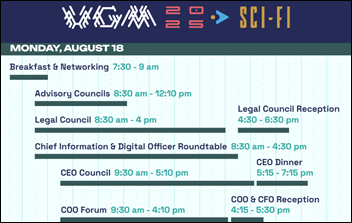
Epic UGM kicks off Monday, with good weather and highs in the upper 70s. 

Attendees are welcome to send me interesting tidbits from the conference, including details about rumored company announcements.  

Happy birthday to CEO Judy Faulkner, who turned 82 last week.


Reader Comments

From Inside Trader: “Re: Oracle Health. Pre-announcing an aspirational product with disclaimers that they aren’t actually promising anything is just marketing fluff. It’s an obvious effort to slow down the Epic train right before UGM. All hype until a customer goes on record about their success using it.”


HIStalk Announcements and Requests

image

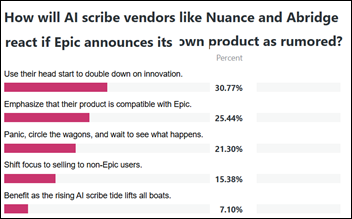
Poll respondents, probably similarly to ambient scribe vendors themselves, aren’t quite sure how Epic’s rumored release of its own product will affect the market. A couple of reader edited comments:

  • Any good product manager know that watching the success of and then imitating cutting edge technologies is a great way to stretch the R&D budget. Epic has followed the market, seen the early successes, and now believes that there is something “there.” The Epic offering will be solid but not flashy. Their big advantage is that the solution is native technology and not a third-party integration. Plus, no one knows their customers’ workflow better than Epic, so expect to see those features that are actually useful and not a bunch of impractical bells and whistles. Nuance and Abridge, et al should double down on new, cutting edge feature / function and figure out a way to license it to Epic before Epic fast follows with their own version.
  • The truth is painfully obvious but no one wants to admit it. Ambient is not a product, but a feature. If a company was built around ambient, it will now need to handle workflows. The painful truth is that the care workflow is called the EHR. Abridge has no option but to build an EHR, given the valuation they have raised on. Nuance is irrelevant.
  • The Epic product has to be just accurate enough, just efficient enough, and just cheap enough to be worth the hype. If all else is equal, integrated Epic or Oracle products will get the nod based on fewer headaches in installation, contracting, and project management, which translates into lower costs.

New poll to your right or here, as inspired by Dr. Jayne: What should your providers do to improve their appointment reminder text messages?


Sponsored Events and Resources

Instant Access Webinar: “Healthcare Data Strategies: Retire, Retain, and Ready for AI.” Sponsor: Triyam, an Access Company. Presenters: Sudhakar Mohanraj, founder and CTO, Triyam; Benjamin Cassity, director of research and strategy, KLAS; Jamie Greenstein, senior marketing manager, Access. The presenters deliver practical tactics to help IT leaders manage exploding data volumes — how to clean up legacy systems, craft smarter retention policies, and prepare historical data for analytics and AI.

Contact Lorre to have your resource listed.


Acquisitions, Funding, Business, and Stock

image

Teladoc Health acquires Telecare, an Australia-based operator of virtual care clinics.


People

image

Terri Couts, RN (The Guthrie Clinic) joins Sharp HealthCare as chief digital information officer.

Carol-Lynn Lloyd, MBChB (Servita) joins Altera Digital Health as chief medical officer. 


Announcements and Implementations

Five9 launches Fusion for Epic, which embeds advanced contact center capabilities into Epic.

Apple restores blood oxygen monitoring to the Watch, taking advantage of a US Customs ruling in its Masimo patent dispute that had forced its removal in 2023. 


Other

image

Fortune profiles the turnaround of NYU Langone, crediting its data-first approach and high-powered board members with growing it into sprawling system with $14 billion in annual revenue that delivers high quality with below-market prices. A key part of its operation is an 800-metric data dashboard that is its single source of truth. A quote from the well-written article:

Even as I marveled at the data available, I wondered if the dashboard-driven culture — part Moneyball, part panopticon — might feel oppressive to some. “It’s not for everyone,” Brotman later told me. “You’re on the hook 24/7, 365, and you’ve got this vulnerability and this expectation of accountability. If you don’t have the right disposition, it’s hard to deal with.”  

I felt awkward simply being in the room for moments of the “Snapshot Review,” a meeting where the chairs of clinical departments filed onstage for dashboard-informed questioning from administrators. The review sessions, in an airy conference room overlooking the East River, varied considerably in tone and substance. Some involved praise and practical problem-solving; others, discussions of “low-performing faculty members”; and another — featuring a relatively new leader who clearly hadn’t found his footing — the feel of a man pleading for mercy.


Sponsor Updates

image

  • ReferWell staff prep 90 breakfast bags for The Food Bank of Lower Fairfield County.
  • Surescripts will exhibit and present at NACDS TSE August 23-25 in San Diego.
  • Black Book Research’s latest survey reveals that a majority of global respondents have funded, active cloud programs scheduled for enterprise deployment within the next 18-24 months.
  • The latest survey from TrustCommerce, a Sphere company, finds that nearly 60% of older consumers are at least somewhat comfortable using digital payments for healthcare.
  • Conduce Health co-founder and Executive Chairman Eric Rosow joins the ArcheHealth advisory board.
  • Artera announces that its virtual agents have automated 42 million patient sessions, 94% of them with no staff intervention needed.
  • Netsmart will present at the Florida Behavioral Health Association’s 2025 conference August 20 in Orlando.
  • Optimum Healthcare IT releases a new episode of its “Visionary Voices” podcast titled “Finding an Inventive Path to Health IT.”
  • Waystar will exhibit at the California Ambulance Association Annual Conference August 20-21 in Monterey.
  • VisiQuate will exhibit at CAHAM 2025 September 2-5 in Newport Beach, CA.

Blog Posts


Contacts

Mr. H, Lorre, Jenn, Dr. Jayne.
Get HIStalk updates.
Send news or rumors.
Follow on X, Bluesky, and LinkedIn.
Sponsorship information.
Contact us.

Comments Off on Monday Morning Update 8/18/25

Morning Headlines 8/15/25

August 14, 2025 Headlines Comments Off on Morning Headlines 8/15/25

$5.3 billion Abridge is eyeing acquisitions. Here’s what the healthcare AI startup is looking for.

Abridge will use 80% of its available funds to expand beyond ambient documentation into claims, clinical decision support, and care management, with the remaining 20% reserved for acquisitions.

Isaac Health Raises $10.5M to Democratize Access to Dementia Care Amid Rising Public Health Crisis

Brain health and dementia care technology company Isaac Health announces $10.5 million in Series A funding.

Citizen Health Raises $30 Million to Build AI Advocate for Every Patient, Ushering in a New Era of Patient-Centered Healthcare

Personal health record vendor Citizen Health raises $30 million in Series A funding.

Apple Watch getting redesigned blood oxygen feature following legal dispute

Apple rolls out a newly designed blood oxygen feature to select Apple Watch users, the redesign of which was necessitated by a legal dispute several years ago with Masimo over similar technology.

Comments Off on Morning Headlines 8/15/25

News 8/15/25

August 14, 2025 News 6 Comments

Top News


Oracle releases its Oracle Health EHR for ambulatory providers in the US.

The company says it will add hospital functionality to the cloud-based, voice-first system in 2026.


HIStalk Announcements and Requests

image

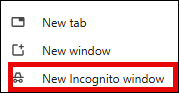
Browser tip: If you need to log in to multiple accounts on the same website, or if you want to test your password without logging out or resetting it, open a Chrome window in incognito mode. It ignores your cached data, cookies, and stored autofill data so you start fresh. You can also use incognito mode to avoid dynamic pricing (where the site knows it’s you and prices accordingly) or to read articles on sites that limit free views before showing a paywall. Bonus: it also hides profile and web history when Googling and thus can’t target ads or customize search results.


Sponsored Events and Resources

Instant Access Webinar: “Healthcare Data Strategies: Retire, Retain, and Ready for AI.” Sponsor: Triyam, an Access Company. Presenters: Sudhakar Mohanraj, founder and CTO, Triyam; Benjamin Cassity, director of research and strategy, KLAS; Jamie Greenstein, senior marketing manager, Access. The presenters deliver practical tactics to help IT leaders manage exploding data volumes — how to clean up legacy systems, craft smarter retention policies, and prepare historical data for analytics and AI.

Contact Lorre to have your resource listed.


Acquisitions, Funding, Business, and Stock

image

Abridge will use 80% of its available funds to expand beyond ambient documentation into claims, clinical decision support, and care management, with the remaining 20% reserved for acquisitions. Funding rounds in February and June 2025 value the company at over $5 billion.

Clearinghouse operator Stedi raises $70 million in a Series B funding round.

image 

Personal health record vendor Citizen Health raises $30 million in Series A funding.


People

image

Adam Tallinger, RPh, MHA (Huron) joins Nordic as Epic managing director and practice lead.

image

Cotiviti hires Robert Kopanic (Oracle Health) as chief revenue officer.


Announcements and Implementations

image

Rhapsody announces GA of Image Director, an image orchestration solution that simplifies routing imaging data from CT, MRI, and X-ray to PACS, VNAs, AI models, and cloud archives. 

The FDA grants De Novo authorization for ArteraAI Prostate, making the AI-powered digital pathology tool an FDA-regulated Software as a Medical Device. It predicts long-term outcomes for patients with non-metastatic prostate cancer.

Humana will use DrFirst’s prescription orchestration platform to close care gaps, starting with identifying patients who could benefit from statins and sending their providers prescription recommendations that they can approve with one click.

image

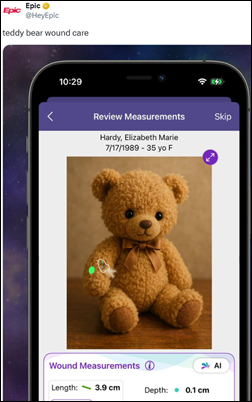
Epic enhances its wound care module with computer vision AI that calculates wound surface area and volume from a photo.

Athenahealth adds AI capabilities to its cloud-based AthenaOne that will eventually include fax processing, managing patient information from external sources, providing clinical summaries, and answering questions using all available clinical data.

image 

Altera Digital Health launches an ambient documentation solution for its TouchWorks EHR.


Other

An entrepreneur couple who bought telemarketer-pitched health insurance to avoid the high cost of ACA premiums spends $20,000 on coverage that paid almost none of their medical bills. The plans are sold by a shell company that secretly lists each customer as a limited partner to evade state insurance regulation, which provides an exemption for employer-provided plans. One Atlanta mailbox serves as the employer address for 30,000 such “workers.” Telemarketing firms used deepfake ads featuring Taylor Swift and Dr. Phil promising cash payouts to lure callers into insurance pitches.


Sponsor Updates

image

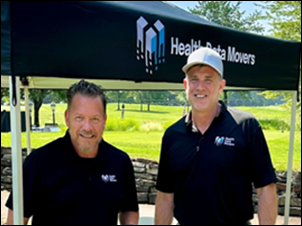
  • Health Data Movers sponsors the Northern Ohio HIMSS Charity Golf Classic & Collaboration Summit.
  • Medicomp Systems releases a new episode of its “Tell Me Where IT Hurts” podcast featuring Hearst Health EVP and COO and FDB Executive Chairman Chuck Tuchinda, MD, MBA.
  • Nordic and Clear partner to offer healthcare organizations a seamless, secure way to manage EHR accounts.
  • Wolters Kluwer Health enhances its Lippincott platform to streamline author workflow and expedite vital research dissemination.
  • Surescripts releases a new data brief based on the results of its latest survey titled “Healthcare Professionals Highlight Medication Prior Authorization Challenges & Solutions.”
  • Black Book Research offers a new report titled “Cloud Momentum in Healthcare: Adoption, Economics, and Vendor Performance.”
  • Healthcare IT Leaders will sponsor Workday Rising September 15-18 in San Francisco.
  • Inbox Health partners with Empower Healthcare & Compliance Partners to bring together patient billing technology and industry-leading compliance expertise.
  • Infinx releases a new episode of its “Revenue Cycle Optimized” podcast titled “Medicare Fee for Service Meets Prior Authorization.”
  • Inovalon releases a new episode of its “Inovators” podcast titled “What Individuals, Corporations, and the Healthcare System Can Do to Address Mental Health.”

Blog Posts


Contacts

Mr. H, Lorre, Jenn, Dr. Jayne.
Get HIStalk updates.
Send news or rumors.
Follow on X, Bluesky, and LinkedIn.
Sponsorship information.
Contact us.

EPtalk by Dr. Jayne 8/14/25

August 14, 2025 Dr. Jayne 1 Comment

image 

Perplexity made an unsolicited offer to buy the Chrome browser from Google for $34.5 billion. Several people I spoke with agree with the Axios statement that it’s a great marketing play, but unlikely to actually be accepted by Google.

I’ve seen friends and colleagues move away from Google in the months since it added its AI overview feature. I’ve been back and forth with it. I had three significant hallucinations in the same day recently, and all were related to simple fact-based searches that shouldn’t have been problematic. Perplexity claims to have financing in place for the deal, but we’ll likely never know who agreed to back it.

image

JAMA Network Open has become one of my go-to journals for relevant research that addresses hot topics in healthcare information technology, but at a level that is accessible to more frontline clinicians than might be found in a journal that was targeted towards clinical informaticists. An article this week addressed a great question: “Can a patient portal message with either a physician-created video or an infographic with a physician photograph increase end-of-season influenza vaccination rates?” The study was done at UCLA Health with 22,000 patients from 21 practices. Neither approach raised overall vaccination rates, but both methods increased immunization rates for children and the video message option scored slightly higher.

There’s a lot of vaccine hesitancy in the US, and the Health and Human Service secretary’s recent approval of influenza recommendations received little press coverage. Here’s to hoping that messages from trusted physicians can help drive the needle.

Another feature in the same issue looked at whether physicians made more edits to hospital course summary documents that were generated by large language models (LLM) compared to those generated by physicians. The study was small, looking at only 100 inpatient admissions to the general medical service. The authors found that the percentage of LLM-generated summaries that required edits was smaller than the percentage of physician-generated summaries. The studies were evaluated against a quality standard, with the authors concluding that since the LLM-generated documents needed fewer edits, they were of higher quality than those created by physicians.

I found the study design particularly interesting on this one. The hospital course summaries were randomly assigned to one of 10 internal medicine residents. They had three minutes to review each pair of summaries and edit them for quality purposes. The output of those editing steps was then reviewed and scored for quality by an attending hospitalist physician.

The authors controlled for document length by using a “percentage edited” score and also looked at how much the meaning of the original summary was altered. The authors noted that while the LLM-generated summaries required less editing and may have been “comparably or more complete, concise, and cohesive” they also “contained more confabulations.” They noted that the artificial time constraints may have influenced the result. The study overall supports the idea that using LLMs to help complete this task could be of value.

OpenAI has been trumpeting the release of its GPT-5 model, saying it does a better job with medical questions than its predecessor, but users have been clamoring for an option to return to the previous model. The majority of complaints are around system speed and increased errors. Others took issue with the fact that the new model was rolled out without notice, leading CEO Sam Altman to admit that “suddenly deprecating old models that users depended on in their workflows was a mistake.”

Those of us who have been in the healthcare IT trenches for years understand the value of adequate change management and communication strategies, so I was surprised to learn that the company thought it would be no big deal to just hot-swap the models. If they’re looking for a change management sensei, I might know a girl. Another great quote from Altman: “the autoswitcher broke and was out of commission for a chunk of the day, and the result was GPT-5 seemed way dumber.” Something to ponder for all the folks relying on these technologies. Sounds like they may need a testing advisor as well.

One of my favorite colleagues from residency was in town the other day, doing college visits with one of her children. Her family is going through additional challenges in the college hunt as they evaluate the medical and support resources available to help students manage chronic health conditions in their first few months away from their families. My friend is a brilliant physician who has worked in environments from academic to military to rural health, so she has seen it all.

One of her concerns was the sheer number of communications she receives from her child’s care team: “Seriously, I think I got 15 reminders and a survey, I don’t want to have this kind of a relationship. I already replied, so why are we still having this conversation?” She’s worried that when her child is on her own and receiving all those reminders and messages that they will cause anxiety, which is certainly valid.

Props to health organizations who allow patients to customize reminders and communications. I personally just need one reminder three days out and that’s all. My dentist sends a reminder at 10 days, seven days, three days, one day, and then hourly until you arrive. They claim they can’t adjust it. I’m not sure I’m buying that, but I’m not well versed in dental platforms.

image

Dr. Nick van Terheyden reached out to let me know that the Lown Institute is accepting nominations for its annual Shkreli Awards, named after notorious “pharma bro” Martin Shkreli. The awards are given “to perpetrators of the ten most egregious examples of profiteering and dysfunction in healthcare.” Previous winners have done such things as: selling the body parts of the deceased without notifying the next of kin, defrauding Medicare by submitting claims on behalf of patients who never received services, and bankrupting community hospitals while living a lavish lifestyle.

What’s the most egregious thing you’ve seen lately in healthcare, regardless of whether it’s worthy of a Shkreli award? Leave a comment or email me.

Email Dr. Jayne.

HIStalk’s Guide to Epic UGM 2025

August 14, 2025 News 3 Comments

Cardamom

image

Contact: Adam Dial, chief customer officer
608.469.6154

Cardamom is a Madison-based health IT startup that brings together experts in data, analytics, AI, and applications to help healthcare organizations maximize the value of their technology investments. With a technology-forward mindset, Cardamom takes a team-driven, outcomes-focused approach to solving complex IT and operational challenges across the healthcare enterprise, from revenue cycle optimization to EHR application support, patient engagement, and beyond.

Cardamom is hosting its annual Sunset on the Square, sponsored by Snowflake, on Tuesday, Aug. 19 from 8-11 p.m. Join us on our terrace overlooking the stunning Wisconsin State Capitol building for delicious bites, refreshing cocktails, and fantastic conversations. Whether you’re looking to make new connections with the Cardamom and Snowflake teams, or simply unwind, this is an event you won’t want to miss. Event details: Date: Tuesday, August 19 Time: 8 – 11 p.m. Location: 1 S. Pinckney St., Madison. Make sure to register to reserve your spot.


Clearsense

image

Contact: Glenn Wirick, chief commercial officer
480.450.4424

As health systems migrate to Epic, their legacy applications create a bloated portfolio that causes costly tech debt. Recent federal legislation heightens financial pressures to reduce OpEx spend for improved profitability. Clearsense leads the industry in accelerated archiving and decommissioning. Our solutions more rapidly reduce costs while simplifying user access to unified legacy patient data—a proven approach with the largest and fastest projects in the industry. (According to KLAS and Gartner, Clearsense has delivered the largest, most rapid archive projects in the industry.) Talk to Clearsense to learn how you can accelerate application decommissioning and cost savings.

Clearsense is co-sponsoring the Nordic Summer Social Event. Date: August 18th, 2025 Doors Open: 6 p.m. Location: The Edgewater Hotel, Madison, WI. Register here.


Divurgent

image

Contact: William Marshall, head of marketing
william.marshall@gmail.com

Divurgent is a full-service, healthcare-focused HIT consulting firm led by people you actually want to work with. We’re one of the only firms out there that has your back for the whole journey. We can help you select an EHR or tool, implement it, staff it, bring you live, optimize it, and more. Three hundred sixty degrees. We’d love to treat you to a drink and hear about what you’re working on!

Divurgent is hosting a happy hour in Madison on August 20 at the AC Hotel Madison Downtown, in the AC Lounge. Details and RSVP.


DrFirst

image

Contact: Colin Banas, chief medical officer
804.677.0656

DrFirst has 25+ years innovating in medication management with end to end solutions from Med Rec to patient adherence through personalized engagement. We are integrated into over 80+ Epic Health Systems and growing!

The DrFirst team will be in Madison Sunday through Thursday for partner meetings, dinners, and drinks. The more the merrier – please contact me via email cbanas@drfirst.com or on LinkedIn.


Findhelp

image

Contact: Rachel Harris, director of business development
rharris@findhelp.com

Integrate clinical care and social care with Findhelp. Pop by our booth to explore the solar system of our tailored Epic integrations, and learn about success stories and best practices from customers like NYC Health + Hospitals, Eskenazi Health, Cooper University Healthcare, and more.

Come by any time Monday through Wednesday to enter our raffle for a “cool” prize, then join us on Wednesday and Thursday at 8am for quick presentations on the latest Findhelp + Epic workflows and the winner announcement! (Must be present to win). Learn more.


Five9

image

Contact: Roni Jamesmeyer, senior healthcare marketing manager
972.768.6554

Five9 is a HIPAA-compliant cloud contact center solution for healthcare, integrating with EHRs like Epic to orchestrate patient access, scheduling, and revenue cycle workflows. Powered by Agentic CX and Genius AI, intelligent AI Agents automate complex tasks with built-in trust and governance—enhancing productivity, reducing costs, and improving patient experiences through secure, real-time, and scalable digital engagement.

Five9 was recently accredited into Epic’s Toolbox program with an adapter for Epic that enables healthcare contact center agents to manage patient interactions directly within the Epic interface. This helps streamline workflows and reduce average handle time. By embedding the core Five9 contact center platform into Epic, we deliver a unified, efficient, and patient-centric communication experience.

Five9 is hosting two offsite events during UGM that we would like to invite attendees to. Monday 8/18 – State Line Distillery 6pm-9pm,  Wednesday 8/20 – The Statehouse 6pm – 9pm. Please register here


Health Data Movers

image

Contact: Brooke Foster, marketing coordinator
847.404.0326

Health Data Movers (HDM) is a healthcare technology services firm. We are trusted partners to healthcare organizations, biotechnology companies, and digital health enterprises through our Services – Data Management, Integration, Project Management, and Clinical & Business Applications – we are the smart choice for creating unique solutions that empower patients and providers by unleashing the potential of healthcare data and technology. We Make IT Happen! V

Join Health Data Movers for Pints of the Patio at the Great Dane Downtown on Wednesday, August 20, from 5:00 – 7:00 PM! RSVP to let us know you’re coming!


Lincata

image

Contact: Adam DeRocher, chief revenue officer
712.541.9132

LincTV by Lincata is an Epic Toolbox approved solution which makes existing TVs compatible with MyChart Bedside TV. LincTV’s flexible offering also supports connected workflows with virtual nursing, live TV content, third party streaming applications, and more. Please visit the Lincata booth in the UGM exhibit hall to learn more.


Nordic Global

image

Contact: Bryana Curry, social media and PR manager
323.706.4628

Nordic, a global healthcare consulting firm, will host its annual Summer Social on Monday, Aug. 18, at The Edgewater Hotel during Epic UGM week. The event will celebrate 15 years of Nordic partnering with more than 700 healthcare organizations worldwide to improve healthcare IT solutions.

This year’s celebration also marks the announcement of Nordic’s new partnership with CLEAR, the secure identity company. CLEAR joins Nordic’s trusted partners AWS, Clearsense, Fortified Health Security, and Premier Stanson Health in sponsoring this year’s Summer Social. Additionally, Nordic will donate $20 on behalf of each attendee who checks in, contributing funds to the Community Foundation of Texas Hill Country to assist communities impacted by the Texas floods.


Tegria

image

Contact: Berit Rhody, manager of events and engagement
608.210.4863

Tegria is a global healthcare consulting and services company created by healthcare for healthcare. We deliver customized, end-to-end solutions that deliver outcomes and drive transformation. We proudly partner with provider and payer organizations to advance care, improve performance, and address healthcare’s biggest challenges.

Get ready to Rock the Rooftop with Tegria in the heart of downtown Madison! Join us on Monday, Aug. 18, from 6:00-9:00 pm on the rooftop of the Madison Museum of Contemporary Art for an evening of food, music, art, and networking. RSVP today


Wolters Kluwer Health

image

We providing trusted clinical technology and evidence-based solutions that engage clinicians, patients, researchers, and the next generation of healthcare providers in effective decision-making and outcomes across healthcare. We specialize in clinical effectiveness, learning, research, compliance, and data solutions.

Join the UpToDate team at The Edgewater after the Starlight Dinner for an evening of cocktails, conversation, and connection at the Starlight Soirée. Relax in a social atmosphere where you can network with peers and make stellar new connections. Reserve your spot today – space is limited.


Morning Headlines 8/14/25

August 13, 2025 Headlines Comments Off on Morning Headlines 8/14/25

Oracle Ushers in New Era of AI-Driven Electronic Health Records

Oracle Health announces its new AI-powered, voice-enabled EHR for ambulatory providers.

Healwell Reports Record Revenue Growth of 645% in Q2-2025 and Achieves First Quarter of Positive Adjusted EBITDA

Healwell AI reports record Q2 revenue, due in large part to its acquisition of Orion Health earlier this year, and its intent to consider strategic alternatives for its clinical research and patient services business units.

Infinx Invests in Maverick AI to Bring Real-Time Autonomous Medical Coding to Revenue Cycle Management

Infinx invests in autonomous medical coding company Maverick Medical AI and announces that it will integrate Maverick’s capabilities with its patient access and RCM solutions.

Comments Off on Morning Headlines 8/14/25

This Week in Health Tech 8/13/25

August 13, 2025 This Week in Health Tech Comments Off on This Week in Health Tech 8/13/25
LinkedIn weekly 081325 - Copy
Comments Off on This Week in Health Tech 8/13/25

Healthcare AI News 8/13/25

August 13, 2025 Healthcare AI News 2 Comments

News

image

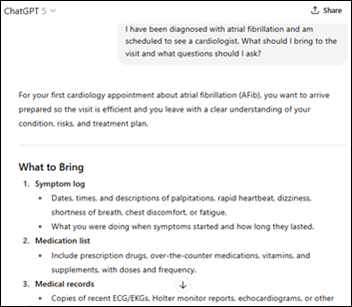
OpenAI says that its newly released GPT-5 is its best model yet for answering health questions as an “active thought partner,” offering improved explanations of test results and health risks, better understanding of medical terminology, simpler presentation of treatment options, and suggestions for topics to raise at the next provider visit.

image

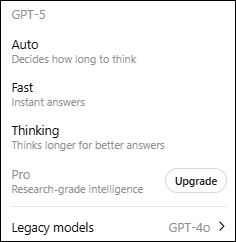
Note: My ChatGPT subscription now offers the option to switch to the previous version, GPT-4o, as many users had requested.

A new Illinois law bans the use of AI to make therapeutic decisions or deliver psychotherapy without clinician involvement.

image

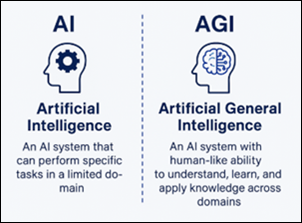
An AI expert shortens his AGI timeline, predicting that it will be able to learn and apply knowledge in a human-like way within five years. He proposes a system in which an AI agent solves a task, breaks the solution into reusable parts, and share those components to a global library where collective learning becomes the game-changer. He has created online games as a test in which AI and humans can try to figure out the unstated rules to win, which so far AI doesn’t do nearly as well as humans.


Business

image

India’s Apollo Hospitals will double its AI investment over the next two to three years, expanding its use beyond image and report analysis.


Research

Researchers find that AI use may degrade the diagnostic skills of clinicians who perform colonoscopies. A previous study reported that AI tools alter the “gaze patterns” of users, causing them to focus almost entirely on the AI-highlighted areas of diagnostic images. The authors suggest that users occasionally work without their AI tools to preserve their expertise.

A Black Book Research flash survey of hospital executives finds eight areas where AI delivers immediate benefit:

  1. Real-time predictive analytics for admissions, ED visits, and staffing. 
  2. Financial forecasting.
  3. Personalized clinical decision support.
  4. Automated compliance and risk management.
  5. Patient flow management.
  6. Cybersecurity.
  7. Supply chain optimization.
  8. Revenue cycle management and complex claims management.

Other

image

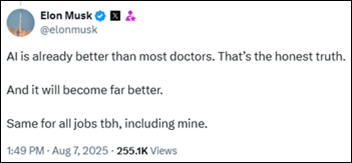
Elon Musk responds on X to a post that describes how patients are using ChatGPT to advocate for themselves and to challenge the conclusions of their doctors.

A South Korean hospital develops an AI system that matches patient EHR data with a legal database to flag potential malpractice risks.

image

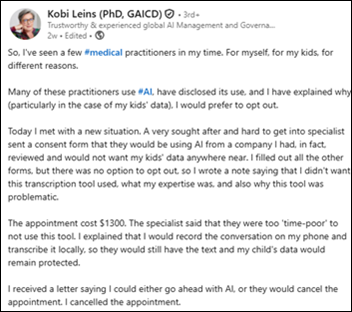
A parent in Australia says on social media that their child’s pediatrician canceled their appointment because the mom declined to allow the doctor to use an AI transcription tool. Australia’s health regulator says doctors aren’t obligated to see patients outside of emergencies, so they can turn down such visits although patient education about their use of AI might be a better approach. Startups that are developing these tools say their consent models allow opt-in or opt-out use, and one company that expected 30% of patients to decline AI involvement was surprised to see just 1% opt out. Patients can also request note deletion. Interestingly, the parent is an AI expert who questions the privacy and security oversight of such tools.


Contacts

Mr. H, Lorre, Jenn, Dr. Jayne.
Get HIStalk updates.
Send news or rumors.
Follow on X, Bluesky, and LinkedIn.
Sponsorship information.
Contact us.

Morning Headlines 8/13/25

August 12, 2025 Headlines Comments Off on Morning Headlines 8/13/25

Pacific HealthWorks ransomware attack, files leaked from 50 partner medical practices

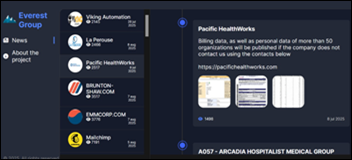
The Russia-based Everest ransomware group posts samples of the data it allegedly stole from physician practice management company Pacific HealthWorks and sister company La Perouse.

Arintra Raises $21M Series A to Expand Beyond Autonomous Medical Coding and Build the Future of Healthcare Revenue Assurance

AI-powered coding company Arintra announces a $21 million Series A round, which will help to fund the opening of new headquarters in the Bay Area.

Highmark Health, Abridge Announce Collaboration to Deploy AI Technologies Across an Entire Payer-Provider Ecosystem

Highmark Health (PA) implements Abridge’s ambient clinical documentation software, while its payer business will work with the vendor to develop AI-powered prior authorization capabilities.

Comments Off on Morning Headlines 8/13/25

News 8/13/25

August 12, 2025 News 2 Comments

Top News

image

The Russia-based Everest ransomware group posts samples of the data it allegedly stole from physician practice management company Pacific Healthworks and sister company La Perouse, though it does not mention a ransom demand or deadline.

Everest has taken credit for recent attacks on Mailchimp and Crumbl.

Pacific Healthworks provides management services to 1,200 hospital-based physician groups. The hackers claim to have the billing and patient data of 50 of them.


HIStalk Announcements and Requests

image

HIStalk sponsors who are participating in Epic UGM – tell me about what you’re doing by Wednesday, August 13 and I’ll include it in an online guide.


Sponsored Events and Resources

Instant Access Webinar: “Healthcare Data Strategies: Retire, Retain, and Ready for AI.” Sponsor: Triyam, an Access Company. Presenters: Sudhakar Mohanraj, founder and CTO, Triyam; Benjamin Cassity, director of research and strategy, KLAS; Jamie Greenstein, senior marketing manager, Access. The presenters deliver practical tactics to help IT leaders manage exploding data volumes — how to clean up legacy systems, craft smarter retention policies, and prepare historical data for analytics and AI.

Contact Lorre to have your resource listed.


Sales

  • Cambridge Memorial Hospital in Ontario selects Oracle Health’s Foundation EHR.

People

image

Divurgent promotes Wendy Hoffman, MHA to president and COO.


Announcements and Implementations

image

OU Health (OK) launches hybrid nursing in University of Oklahoma Medical Center’s neurology and neurosurgery unit using technology from Nexus Bedside. Virtual nurses will assist in-person nurses with patient education, care coordination, and medication management.

Highmark Health (PA) implements Abridge’s ambient clinical documentation software. Highmark’s payer business will work with Abridge to develop what it hopes will be nearly instantaneous, AI-powered prior authorization capabilities.

In Michigan, UP Health System’s Bell hospital will offer gastroenterology inpatients and their providers the ability to virtually connect with Henry Ford Health System specialists.

image

University Hospitals (OH) launches a remote care program at its Lake West Medical Center using virtual care technology from Vitalchat.

Reid Health (IN) deploys AI-enhanced virtual care technologies from Hellocare.ai, including virtual nursing and sitting, telehealth, and digital whiteboards and smart room signage.

image

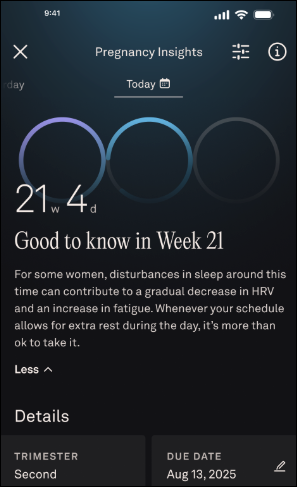
Oura adds pregnancy and perimenopause symptom tracking capabilities to the app for its Ring wearable.


Other

Ascension Wisconsin will outsource ICU physician staffing at its hospitals to TeamHealth, which physicians worry could impact patient safety if the company switches to virtual care models during certain timeframes.


Sponsor Updates

  • Meditech will bring healthcare leaders together to strategize and learn at Meditech Live, September 17-19 in Foxborough, MA.
  • Black Book Research’s latest survey offers insight into the challenges healthcare organizations are facing due to a lack of cybersecurity talent.
  • Agfa HealthCare partners with Powerteens to host an immersive hands-on STEM Day for girls in Orlando.
  • Altera Digital Health offers a new client story titled “Latrobe Regional Health enhances surgical efficiency and patient visibility with Sunrise Surgical Care and Provation iPro.”
  • Arcadia Chief Medical Officer Luke Hansen, MD joins “The Totally Adequate Podcast” in an episode titled “Insights and Strategies for Achieving High Quality Healthcare Provider Networks.”
  • Nordic will offer Clear’s reusable identity management.
  • Artera will exhibit at the CHI Community Health Conference & Expo August 17-19 in Chicago.
  • AvaSure Chief Clinical Officer Lisbeth Votruba, RN joins the “Ed Talks” podcast.
  • Memorial Healthcare System (FL) will launch a medication management program for a subset of diabetic patients using prescription fill data from DrFirst.
  • Wolters Kluwer Health will exhibit at the 2025 Defense Health Information Technology Symposium August 26-28 in Nashville, TN.

Blog Posts


Contacts

Mr. H, Lorre, Jenn, Dr. Jayne.
Get HIStalk updates.
Send news or rumors.
Follow on X, Bluesky, and LinkedIn.
Sponsorship information.
Contact us.

Morning Headlines 8/12/25

August 11, 2025 Headlines Comments Off on Morning Headlines 8/12/25

Ascension Wisconsin plans to outsource staffing of its ICU doctors, raising concerns about patient safety

Ascension Wisconsin will outsource ICU physician staffing at its hospitals to TeamHealth, which physicians worry could result in switching to virtual care models during certain timeframes.

OU Health launches hybrid nursing model with Nexus Bedside

OU Health (OK) launches a hybrid nursing model in its neurology and neurosurgery units using technology from Nexus Bedside.

Mercy Iowa City files complaint against MercyOne, CEO it says refused to mask

Bankrupt Mercy Iowa City continues its legal battle with former management company MercyOne, this time filing a 100-page complaint that highlights, among other issues, MercyOne’s failure to assist Mercy Iowa City in replacing its EHR.

Comments Off on Morning Headlines 8/12/25

Curbside Consult with Dr. Jayne 8/11/25

August 11, 2025 Dr. Jayne 1 Comment

image 

I was intrigued by Mr. H’s mention last week of the Mass General Brigham FaceAge AI tool that can estimate age from facial photos. Researchers found that patients with cancer appeared older than their stated age. The older they looked, the lower their odds of survival.

Although physicians have historically used visual assessments to predict potential outcomes, the tool uses face feature extraction to estimate a user’s biological age based on their photo. An article describing the tool was recently published in The Lancet Digital Health if you’re interested in all the details.

This item, as many things that Mr. H mentions, got me thinking. I found a couple of sites that host biological age calculators and completed the relevant surveys to get a couple of results. Some of them were more specific, asking for various lab values. Fortunately, I had results for all of the requested lab values and even some of the exercise performance measures that were included on one of the questionnaires. I also found a tool that is very similar to FaceAge, although not the exact one used in the study, and snapped my selfie.

The survey-based calculators estimated my biological age as anywhere from 4.6 to nine years below my actual age. The facial photo tool thought that I was more than 10 years younger. I suppose my liberal use of sunscreen and hats is paying off, since my facial wrinkles were scored as 2 out of a possible 100 points. I also did well on the “undereye” measure, although I admit that my photo was taken when I was well rested. I’m sure it would not have scored as well had it been taken after a shift in the emergency department.

I don’t look at a lot of high-resolution pictures of my face, and when I received my score report with a full-screen of my face right in front of me, I was somewhat surprised that you can still see some artifacts from years of wearing an N95 mask while seeing patients. I’m guessing that when I look in the mirror my brain somewhat processes that out, so it was a little startling.

I’d be interested to see how I would score on a medical-grade tool such as the one mentioned in the article. Although it was a fun exercise to complete the different surveys and see where I stand, none of the recommendations provided alongside the results of any of the tools were different from what I usually hear during my primary care preventive visits: keep moving, eat as healthy as possible, and watch out for the rogue genes you’re carrying around.

I would be interested to hear others’ experiences with similar tools and whether they have motivated you to do anything different from a lifestyle perspective.

image

Mr. H also recently mentioned efforts by NASA and Google to develop a proof-of-concept AI-powered “Crew Medical Officer Digital Assistant” (CMO-DA) to support astronauts on long space missions. As a Star Trek devotee, I couldn’t help but think of the Emergency Medical Hologram from “Star Trek: Voyager.”

The project is using Google Cloud’s Vertex AI environment and has been used to run three scenarios: an ankle injury, flank pain, and ear pain. The TechCrunch article noted that “a trio of physicians, one being an astronaut, graded the assistant’s performance across the initial evaluation, history-taking, clinical reasoning, and treatment.” A particular astronaut/physician came to mind when I read that, and if there’s a hologram to be created, I’m sure other space fangirls out there would find him an acceptable model.

The reviewers found the model to have a 74% likelihood of correctness for the flank pain scenario, 80% for ear pain, and 88% for the ankle injury. I’m not sure what the numbers are like for human physicians in aggregate, but I’m fairly certain I’ve had a higher accuracy rate for those conditions since they’re common in the urgent and emergency care space. However, NASA notes that they hope to tune the model to be “situationally aware” for space-specific elements, including microgravity. I would hazard a guess that most physicians, except for those with aerospace certifications, don’t have a lot of knowledge on that or other extraterrestrial factors.

The article links out to a NASA slide deck. Since I do love a good NASA presentation I had to check it out. I was excited to see that there is a set of “NASA Trustworthy AI Principles” that address some key factors that are sometimes lacking in the systems I encounter. The principles address accountable management of AI systems, privacy, safety, and the importance of having humans in the loop to “monitor and guide machine learning processes.” They note that “AI system risk tradeoffs must be considered when determining benefit of use.” I see a lot of organizations choosing AI solutions just for the sake of “doing AI” and not really considering the impacts of those systems, so that one in particular resonated with me.

Another principle that resonated with this former bioethics student was that of beneficence, specifically that trustworthy AI should be inclusive, advance equity, and protect privacy while minimizing biases and supporting “the wellbeing of the environment and persons present and future.” Prevention of bias and discrimination, prevention of covert manipulation, and scientific rigor are also addressed in the principles as is the idea that there must be transparency in “design, development, deployment, and functioning, especially regarding personal data use.” I wish there were more organizations out there willing to adopt a set of AI principles like this, but given the commercial nature of most AI efforts, I can understand why these ideals might be pushed to the side.

In addition to the CMO-DA project, three other projects are in the works: a Clinical Finding Form (CliFF), Mission Control Central (MCC) Flight Surgeon Emergency Procedures, and a collaboration with UpToDate. I love a catchy acronym and “CliFF” certainly fits the bill.

I recently finished the novel ”Atmosphere” by Taylor Jenkins Reid . If you are curious about the emergency procedures that a mission control flight surgeon might need to have at their fingertips, the book does not disappoint.

The deck goes on to discuss the evolution of Large Language Models, retrieval-augmented generation, and prompt engineering within the context of the greater NASA project. The deck specifically notes that any solution must be on-premise, which is particularly true when you experience the communications blackouts that are inherent in space travel.

There are more details in the deck about the specific AI approach and the scenarios. I particularly enjoyed learning about “abdominal palpation in microgravity” and the need to make sure that the patient is secured to the examination table to prevent floating away. I also learned that “due to the microgravity environment, the patient’s abdominal contents may shift,” which got me wondering exactly how many organs were subject to shifting since many of them are fairly well-anchored by blood vessels and other not-so-stretchy structures.

The deck listed the three physician personas who scored the scenarios. Based on physician specialty, it’s likely that my favorite astronaut wasn’t one of them, but I was happy to see that an obstetrician / gynecologist was included.

Apparently there was a live demonstration of the CMO-DA at the meeting for which the presentation deck was created, so if anyone has connections at NASA, I know of at least one clinical informaticist that would love to see it. I’ll definitely be setting up some online alerts for some of these topics and following closely as the tools evolve.

Did you ever dream of being an astronaut, and what ultimately sidelined you from that career? Leave a comment or email me.

Email Dr. Jayne.

Text Ads


RECENT COMMENTS

  1. "A valid concern..." Oh please. Everyone picks the software they like and the origin of that software is an afterthought.…

  2. I don't disagree with you completely, but to take the counterpoint: there is plenty of precedent for saying "this *entire…

  3. Teens will certainly find a way to use their social media apps of choice. I'm not in favor of the…

  4. I've been in this business a long time. Choosing the "right" technology product is fraught, especially when it comes to…

  5. EHRMusing - You make a lot of accurate statements about key factors in the selection process but the comment about…

Founding Sponsors


Platinum Sponsors


Gold Sponsors


RSS Industry Events

  • An error has occurred, which probably means the feed is down. Try again later.

RSS Webinars

  • An error has occurred, which probably means the feed is down. Try again later.