Recent Articles:

Curbside Consult with Dr. Jayne 11/10/25

November 10, 2025 Dr. Jayne 1 Comment

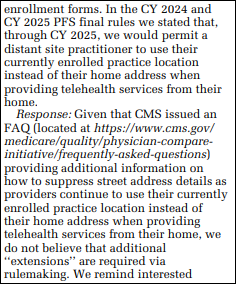
The hot news around the telehealth virtual water cooler this week was the new CMS billing requirement that telehealth physicians list their actual location rather than an office address. The previous requirements allowed us to avoid using a home address. This not only protected our personal information, but also provided uniformity for our practice organizations.

For those telehealth physicians employed by hospitals or health systems, this could lead to requirements that they physically go to the campus to provide telehealth services. This creates additional load on the hospital, which may not have space for telehealth providers. Allowing them to practice from home, while repurposing clinic space for additional providers, was one of telehealth’s benefits. The CMS rule does not address the needs of physicians like me who work for independent telehealth organizations that don’t have a campus or building in our local area. 

Although CMS claims it will protect the home addresses, I’ve been a victim of data breaches and identity theft enough times that I don’t trust anyone to keep my information private. Plenty of other government agencies don’t have appropriate policies to deal with people who practice from their homes, including the Drug Enforcement Administration and many of the state controlled substance agencies. Their regulations haven’t kept up with the times, but I don’t think anyone is surprised by that.

Also, there is no guarantee that a physician who is not in the office is doing telehealth from their home. I have done it from hotels in at least a dozen states, from the homes of family members, and from a docked ship. I certainly don’t expect my employer’s credentialing organization to keep up with that.

Other conversations around the water cooler continue to revolve around the ongoing government shutdown. Some clinics are seeing higher-than-usual rates of no-shows and cancellations. In lower income areas and the academic faculty clinics, patients are citing financial issues as a barrier to transportation.

Although some of our clinics can provide cab vouchers for patients to get home, it’s more difficult to arrange transportation to the clinic. Now that we’re over a month into the shutdown, we should start to see data on patient prescriptions and fill rates, and whether those have been delayed by all of the issues. I’ve seen data from at least one military facility that showed a clear impact, but I’m not able to access that kind of data for my own facility. It would be an interesting research project, however.

The hot clinical topic of the week was the news that the American College of Cardiology and American Heart Association have updated the hypertension guidelines. The new numbers mean that many more patients will qualify for a hypertension diagnosis. Depending on how much of a focus an organization has placed on the management of hypertension, this could potentially mean a fair amount of work will need to be done in the EHR and elsewhere in clinical applications.

Even if we’re talking about modifications to EHR-based alerts, the lift could be significant if the organization hasn’t standardized the EHR or has created different alerts for different locations, specialties, or types of visits. It can also mean modifying dozens or hundreds of reports, patient outreach campaigns, and patient education materials.

Although these two organizations have reached agreement on the recommendation, a number of other organizations have not endorsed the new guidelines. They include the American Academy of Family Physicians, the American College of Physicians, and the International Society of Hypertension. If your organization follows one of their guidelines, you probably have some time before these groups get on board with the new, lower numbers.

It’s still a good opportunity though to take inventory of your hypertension-related alerts, reports and outreach programs to get ahead. I’ve peered under the hood of a number of the EHRs of large healthcare organizations over the last 20 years and some of you have your work cut out for you.

It will also be interesting to see how long it takes consumer-facing healthcare apps and tools to update to the newer guidelines, or if instead they will just stay where they are. I’ll be keeping a close eye on my wearables to see if there are any changes and will report in when I see them. I only use a couple of apps, so if readers see anything before I mention it, please share.

Regardless of the technical ramifications of updated guidelines, there’s also the real-world clinical practice element related to a change like this. How do we as physicians convince our patients to lose more weight or take another medication to bring them into compliance? Many patients find it impossible to reach the previous goals, so there’s not much of a chance of them meeting the new ones.

It will also be interesting to see if the prior authorization processes for weight management medications follow the new goals right away or whether payers gravitate toward the guidelines with more lenient goals.

One of my informatics colleagues asked a question about how real-world evidence (RWE) fits in a situation like this where the proverbial cheese has been moved. Certain EHR vendors have pressured everyone to get on the RWE bandwagon. I’m no expert in the field, but if you’re looking to see how clinicians treated patients with a blood pressure that used to be normal but now isn’t, they’re not likely to have done many interventions because the blood pressure was viewed as normal. We will see how long it takes for real world evidence to shift and for there to be patterns that align with the new thresholds.

If you’re an expert in real-world evidence, I would love to hear from you, and I’m happy to keep you anonymous. Maybe a fireside chat on the hamster wheel of clinical guidelines is in order? Or just some good old-fashioned ranting about the challenges of practicing medicine in an era where physicians are seen as less knowledgeable than TikTok celebrities?

What do you think of the new clinical guidelines, the ramifications to your health IT systems, and their impact on real-world evidence tools? Leave a comment or email me.

Email Dr. Jayne.

HIStalk Interviews William Cavanaugh, CEO, Concord Technologies

November 10, 2025 Interviews Comments Off on HIStalk Interviews William Cavanaugh, CEO, Concord Technologies

William Cavanaugh, MBA is CEO of Concord Technologies.

image

Tell me about yourself and the company.

I’ve been in technology for over 30 years and health tech for 20. I’ve worn just about every hat there is to wear in a healthcare technology company, from making the coffee, developing the software, taking out the trash, closing the deals, and writing the business.

The high-level mission of Concord Technologies is to advance healthcare through universal exchange and intelligent processing of data. We leverage advanced AI to drive a smarter, faster, and more connected healthcare ecosystem.

What kinds of documents do health systems receive and what challenges do they experience in processing them?

The big challenge in healthcare is the exchange of data between disparate healthcare entities. You have to look at the volume of data. There are 2.3 zettabytes of data generated every year across healthcare. What’s a zettabyte? I can tell you that it’s a billion gigabytes, but that doesn’t really represent the challenge.

If you look at one hospital to paint the picture, one hospital creates 50 petabytes every year. Again, that is difficult to comprehend. Picture yourself in an NFL stadium, in the upper bowl. If you printed the physical equivalent of the annual data from just one average hospital, it would fill 750 NFL stadiums to the brim, and it is growing at 36% a year.

Now you need to share that data. You can’t email it to a doctor because it will go to junk or spam. You need a secure, ubiquitous way of sharing that data. Everyone thinks that the big EHR vendors are going to solve the problem, but there are 500 EHR vendors. They are also not the only player when you add in radiology information, PACS, payers, and pharma. There are thousands of different systems.

On the entity side, the US has 6,000 hospitals, but the number blooms over 200,000 disparate entities and growing when you add in post-acute, outpatient, private practices, urgent cares, specialty practices, et cetera. The problem that we are solving spans 200,000 disparate entities, 1,000 software vendors, 2.3 zettabytes of data growing at 36% a year, and you need to share data.

The space that we play in is documents. Think about documents between your payer, pharmacist, EHR, specialty, and primary. Our very large customers do big volumes. We do about 22 million pages a day through our network. Our big customers do over 50 million documents a month. One of our big EHRs does 90 million a month. We bring that data through an exchange protocol, universal protocol, and then we like to say that we bring it to life. We classify the document, extract key pieces of information, and then insert it into the systems that we’re on.

People might think of interoperability as a FHIR-based data exchange. How does that approach coexist with how documents are managed?

I always say that we’re not in the fax business. But at 10,000 feet, we are a fax company, even though we don’t use paper and fax machines. We use the digital fax protocol to exchange these documents.

FHIR has been around for a long time, plus HL7, integration engines, QHINs, and HIEs are trying to create the structured data exchange. We keep it simple. You have a phone number, and from any EHR, you click “send document.” If MD Anderson wants to send a document to Debbie’s Dermatology in Rice Lake, Minnesota from the EHR, they click “send document” and Debbie’s Dermatology, if she has a fax number, receives a document. Then it automatically sends a response back to the referring physician at MD Anderson that the document was received.

That’s what we do very simply, but we don’t stop there. Your big dermatology clinic gets 5,000 documents in a month. What is this document? We classify it. Then a dermatology clinic is looking for different pieces of information in that 50-page chart that just came across and that a urology clinic would be looking at. We extract the pieces of information, leveraging AI, that are relevant to the receiver of the document. That’s where we bring it to life.

Fax gets a bad rep in the market. I almost didn’t take this job as CEO because I heard we were a fax company, but we’re in the digital exchange business, using a universal protocol.

You asked about FHIR, though. There are instances where FHIR comes into play. We use FHIR to do a lookup to find that patient in Debbie’s Dermatology to match it so we can insert into the system a record. Then we use HL7, which has been around for 15 to 20-plus years as well.

The mental picture of faxing is someone watching thermal paper spool off a fax machine that is covered by taped-on “send” numbers. Is healthcare the only industry where faxing is still a viable way to exchange information?

When you say fax, you think of the curly paper, and if you’re as old as I am, the dial tone. That’s not the business we’re in.

We had a third party do some market research and I’m still surprised by the number of fax machines and paper faxing that is still done in healthcare. Anywhere from at least 10% to 15% of the documents still go through that old-fashioned, corded phone protocol.

Other entities also use fax, both digital and old-fashioned fax. Legal still uses it to fax documents. Payers, the FBI, and the IRS still use it. Other big government entities and institutions, along with mortgage companies, use old-fashioned fax. They’re also migrating to digital fax.

There is still that need when you want a secure ubiquitous protocol to send and receive documents where email doesn’t work, and that fax protocol is still used outside of healthcare. But I would say that around 70% of the digital document exchange via that fax protocol is within healthcare.

How does the process change in moving to digital fax, and what technology criticisms does that eliminate?

The biggest criticism of digital fax is that it’s not structured. By structured, I mean that you are mapping specific data fields from one system to the next. Fax comes in as an unstructured document, such as a PDF, Word document, or chart. It’s not broken down into its discrete fields. 

When that document is received, whether it’s a two-page prior authorization or a 500-page patient chart, it’s just a big PDF. What am I going to do with that big, unstructured document? If you stop just with the digital transmission, even through a cloud-based digital fax protocol, that’s the knock on fax. It doesn’t get me to where I need to be. I still need to scan through the document or read it to figure out what it entails.

With the introduction of large language models, which is the generative AI that is permeating all parts of society, I see the ability to grab unstructured data, pieces of information, from a 500-page patient chart through a large language model that can understand the context as well, which large language models are really good at. They extract the key pieces of information that are needed for the recipient. That will transform how digital fax will have higher quality, lower cost, and better efficiencies for healthcare than try to use things that have been around for a long time. I get to be too geeky, but it’s called CCDAs to structure all these fields in HL7 and FHIR to map all these discrete fields from one system to the other.

Why don’t we just do this mapping and do all this structured data exchange? Again, you just have to look at the volume. Epic has anywhere from 50,000 to 150,000 discrete data elements, based on the configuration, and every configuration of Epic alone is different. Doing that mapping isn’t rocket science, but it takes a lot of one-time work and ongoing effort to keep that up versus just sending the whole document through a secure, ubiquitous protocol that everybody has. You don’t need FHIR, HL7, a QHIN, or HIE. You have a phone number, so you can leverage the telecommunication backbone and security that is already there. Now let technology do the work to bring that unstructured document to life.

That’s relatively new even for our company, and within the overall digital fax industry. But it’s a way to transform interoperability within healthcare.

How much of the information in those documents needs to be integrated into the EHR and other systems?

The unstructured document that comes into the hospital, usually through digital fax protocol, is still probably at least 80% of the transmissions in healthcare. We’re seeing Direct Secure Messaging, and think of that as secure email. Maybe it’s about 10% of the transmissions right now. When you do it through a Direct Secure Message, it comes in through structured, but the challenge is that it doesn’t represent all of the data.

You can’t put an image in there, obviously. You’re not going to structure clinical notes. You still have to provide some unstructured data, which gives context to the recipient, the physician who needs to review the patient who was just imaged at a facility or gone to an emergency room, to get the whole context of the patient.

You call your AI approach “Practical AI.” What does that mean?

We call it Practical AI because it’s exactly what it is. A lot of AI doesn’t add much value. Ours is practical because it’s pretty straightforward and we’re focused on solving real, practical problems. So with 10,000 documents coming into a payer, hospital, or pharmacy, is it a purchase order that goes to finance? Is it a prior authorization with high priority that needs to be responded to within the next 30 minutes because there’s a patient in an ER waiting for that prior authorization? Or is it a claim that needs to be processed in the next 30 days? The first part of our Practical AI is that we’re going to look at this document that just came in and identify its type. 

The other part of the practical side is that in healthcare, nine times out of 10, there’s a patient associated with it, and probably a provider and a record number. We have to extract the patient and identify them by date of birth and address so we can find that patient in the recipient system. That’s a practical use of AI to classify, extract, and then decide what the system needs out of this 50-page document. Sometimes 20 pages and sometimes only three fields. We will make it practical in terms of what’s needed for this incoming transmission for that hospital provider or payer.

How does AI fit into the hype cycle and your company’s business strategy?

It is definitely advancing along the hype cycle and finding some real practical uses. We who use ChatGPT or any of the tools see its ability to digest information in human speech, synthesize information, and create really nice clinical summaries. If the meeting you’re in has three action items, you don’t have to take notes, because it’s going to find it for you. That’s the practical side of how AI is being used.

In our world, we’ve been doing machine learning for over 10 years. It requires a lot of training and use. It gets more challenging and specific with the introduction of large language models. Now you can throw large pieces of information at a large language model, especially when it’s been fine tuned with customized prompts for healthcare, to add real advantages of efficiency, accuracy, and clinical efficacy in the delivery of care.

Comments Off on HIStalk Interviews William Cavanaugh, CEO, Concord Technologies

Morning Headlines 11/10/25

November 9, 2025 Headlines Comments Off on Morning Headlines 11/10/25

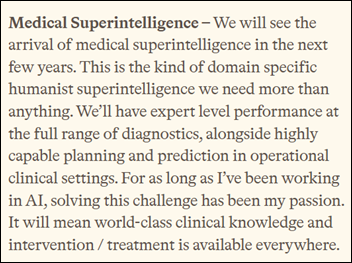
Towards Humanist Superintelligence

Microsoft forms an MAI Superintelligence Team to develop AI that exceeds human capability, with medical diagnostics being its first focus area.

Volpara Now Operating Under Lunit Brand

Cancer diagnostics company Lunit retires the Volpara Health Technologies brand, integrating its AI breast health technology under the Lunit name.

WISeR (Wasteful and Inappropriate Service Reduction) Model

CMS chooses six vendors to participate in the six-year, six-state WISeR pilot program to automate prior authorization with AI: Cohere Health, Genzeon, Humata Health, Innovaccer, Virtix Health, and Zyter.

Comments Off on Morning Headlines 11/10/25

Monday Morning Update 11/10/25

November 9, 2025 News 1 Comment

Top News

image

Microsoft forms an MAI Superintelligence Team to develop AI that exceeds human capability, with medical diagnostics being its first focus area.

The blog post was written by Mustafa Suleyman, who joined Microsoft as CEO of AI in March 2024 after co-founding DeepMind and Inflection AI.


Reader Comments

From VectorPilot: “Re: ChatGPT. It’s one thing to say ‘see a professional’ when asked for clinical advice. It’s another when it will still give a fully formed management plan if you fool it by saying it’s for an article or screenplay you are writing. Nobody can guardrail everything that AI does. For health systems, this is a governance test since this change doesn’t eliminate liability, it just migrates it to health systems. These are uncredentialed clinicians, not toys.”

From Over Easy: “Re: UnitedHealthcare’s decision to stop paying for most RPM because evidence is lacking. The real question isn’t what will be reimbursed, but rather who will fund the next wave of evidence generation when the payer says, ‘show me value now or vanish.’”


HIStalk Announcements and Requests

image[8][3]

Most poll respondents see a conflict when a health system pitches a product from one of its portfolio companies.

New poll to your right or here: Which recent development will hit health tech sales the hardest?

Listening after YouTube pushed it on me: Netherlands-based Focus. Forget that 1970 musical albatross “Hocus Focus” that wears out the welcome of excellent playing with manic yodeling and fluting and instead enjoy some decent 1970s prog rock, although keyboardist, flute player, and vocal gymnast Thijs van Leer looks like a coked up Dr. Frasier Crane attending to the Hammond B-3 organ. The two remaining original members still make pretty good music for appreciators of the genre, who also number about two.


image

I’m experimenting with Google’s experimental no-code mini-app builder Opal, where you simply describe what you want your app to do and it creates it. I made a little app where I provide a link to a company’s earnings report and it extracts the specific details that I track, retrieves share performance and market cap data from Yahoo Finance, compares results to analyst expectations, and calculates the 12-month share price change. Emboldened by immediate gratification, I build a second app that accepts a company’s website URL and then summarizes what the company does, the name and previous job of the CEO, the three latest news headlines, and the year the company was founded.

image[5][3]

Lastly, I used a sample blog writing app to create an article about OpenAI’s throttling of ChatGPT’s medical advice capability. It did a great job, including generating an Internet-standard cheesy clickbait graphic.


Sponsored Events and Resources

None scheduled soon. Contact Lorre to have your resource listed.


Acquisitions, Funding, Business, and Stock

Cancer diagnostics company Lunit retires the Volpara Health Technologies brand, integrating its AI breast health technology under the Lunit name.


Announcements and Implementations

image

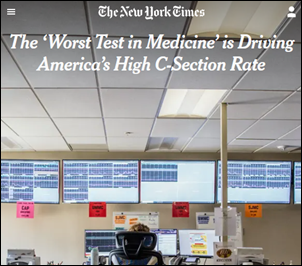
A New York Times article calls around-the-clock fetal monitoring “the worst test in medicine,” saying that it drives unnecessary C-sections despite its inability to reliably predict fetal distress. The article says the use of the technology stems from malpractice fears, hospitals running centralized remote monitoring centers to cut labor costs, and software vendors such as PeriGen that make unsupported claims. One obstetrician concludes, “We may be the only specialty that continues to do major abdominal surgery without a shred of evidence of benefit.”

WellSky launches a patient engagement solution that allows providers to deploy two-way text and chat campaigns for refill assessments, infection services, and onboarding.


Government and Politics

CMS chooses six vendors to participate in the six-year, six-state WISeR pilot program to automate prior authorization with AI: Cohere Health, Genzeon, Humata Health, Inovaccer, Virtix Health, and Zyter.

image

A large health system estimates that it will spend $1 million per year to comply with a new CMS rule that requires telehealth physicians to list their actual location, such as a home address, rather than their office address. The American Telehealth Association warns that hospitals would need to verify hundreds of addresses to stay compliant, and the health system says it may instead require remote clinicians to conduct telehealth sessions from the hospital.

India’s supreme court rules against a hospital that sought to move its lawsuit with a technology vendor into arbitration. The court affirmed earlier findings that although a contract section was titled “Arbitration,” it did not create an arbitration agreement since it required any unresolved disputes to be decided in civil court.


Other

Judy Faulkner says in her latest post in Epic’s “Hey Judy” series that she’s glad she didn’t get an MBA because she would have been taught to court outside investors, plan an IPO, issue impressive job titles, set and follow departmental budgets, and hire via interviews, none of which the company does. The company’s budget policy is “buy it if you need it,” Epic hires mostly based on test results, and she encourages employees who are attending conferences to just make up a job title. I’m curious to hear from anyone who made up an interesting Epic job title.

Police in South Korea charge four doctors and dozens of patients with faking medical records to collect $340,000 in insurance payments. The scheme collapsed when an insurer checked the address of the supposed inpatient facility and found it was a luxury hotel.


Sponsor Updates

  • CereCore joins Oracle’s partner program.
  • Netsmart will exhibit at the 2025 APTA Private Practice Annual Conference November 12-15 in Orlando.
  • Symplr CIO in Residence Theresa Meadows, RN joins the CHIME Foundation board of directors.
  • KLAS highlights Tegria’s Clinical Optimization Services in its “2025 Consistent High Performers Report” for achieving an overall performance score of 95+ for three years in a row.
  • Wolters Kluwer Health will exhibit at the AMIA 2025 Annual Symposium November 15-19 in Atlanta.
  • Censinet will present at AIMed25 November 11 and 12 in San Diego.
  • Altera Digital Health, AvaSure, CereCore, Clearsense, Clearwater, Divurgent, Ellkay, Health Data Movers, InterSystems, Meditech, Nordic, Optimum Healthcare IT, RLDatix, and Symplr will exhibit at the CHIME Fall Forum November 10-13 in San Antonio.

Blog Posts


Contacts

Mr. H, Lorre, Jenn, Dr. Jayne.
Get HIStalk updates.
Send news or rumors.
Follow on X, Bluesky, and LinkedIn.
Sponsorship information.
Contact us.

Morning Headlines 11/7/25

November 6, 2025 Headlines Comments Off on Morning Headlines 11/7/25

CareCloud Reports Third Quarter 2025 Results

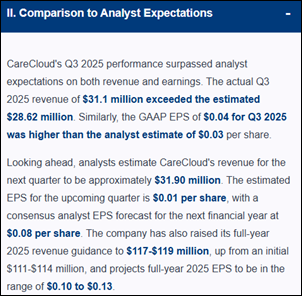
CareCloud reports Q3 results: revenue up 9%, EPS $0.07 versus –$0.28, meeting earnings expectations and beating on revenue.

Amae Health Gets $25M to Scale Nationwide, Deepen AI Capabilities

Severe mental illness provider Amae Health will use $25 million in new funding to expand its clinic footprint and further develop its AI-based care software.

Huron Acquires the Payor Consulting Services Division of Axiom Systems to Strengthen Digital-focused Payor Capabilities

Huron acquires the payer consulting services division of Axiom Systems.

Comments Off on Morning Headlines 11/7/25

News 11/7/25

November 6, 2025 News 1 Comment

Top News

image

From Informatics MD: “Re: UnitedHealthcare. Changing its payment policy to eliminate coverage of remote patient monitoring in most emerging uses. This is likely to have an adverse effect on future development and growth of evidence.” The insurer says that starting January 1, 2026, it will cover RPM only for heart failure and hypertensive disorders of pregnancy.

Googling “remote patient monitoring + insurance” lists a lot of RPM companies whose business model of being paid by a cut of increased provider billings just went poof.

The insurer says that evidence is lacking for conditions such as COPD, depression, and diabetes, and with revenue for those services dropping to zero, nobody will spend the money to generate new evidence.

One might also call out providers who were happy to bill for RPM but paid no attention to the alerts it generated, adding zero value except to their wallets. Patients might as well buy a smart watch and monitor themselves.


Reader Comments

image

From Dirk Dongler: “Re: the CarPlay dongle you bought for $16.99. It’s now $29.99. You are driving markets, like NYT Wirecutter or Kim Kardashian!” Tip: ask Amazon’s Rufus AI chatbot on the item’s page to “show price history.” Not only will it provide a graph of the item’s historical pricing from this seller, you can also ask it to compare the item with similar ones, where it will display a table and a summary of “Best Value” and “Most Reviews.”


HIStalk Announcements and Requests

image

Welcome to new HIStalk Platinum Sponsor SlicedHealth. SlicedHealth is a healthcare technology company that is transforming contract management through intelligent automation and hands-on support. Driven by SlicedIQ, our AI-assisted engine equips hospital leadership with the tools they need to model and optimize contract performance, streamline operations without adding additional staff, and maximize revenue recovery. From claim estimation and business intelligence to a robust price transparency module built for compliance, SlicedHealth empowers all hospital leaders to recover revenue lost to denials and underpayments, because revenue you can’t see is revenue you’ll never collect.

image

Speaking of SlicedHealth, the company just announced SlicedIQ, an AI-powered revenue cycle optimization platform for rural hospitals. I noticed from the announcement that industry veteran and pharmacist Reed Liggin, MBA (McKesson, RazorInsights, Athenahealth, and EasyScripts Technology) is co-founder and CEO of the company. 


Sponsored Events and Resources

None scheduled soon. Contact Lorre to have your resource listed.


Acquisitions, Funding, Business, and Stock

Virtual healthcare company LifeMD, which just made headlines for selling its WorkSimpli document management platform, delays its Q3 earnings report as it corrects prior revenue recognition issues.

CareCloud reports Q3 results: revenue up 9%, EPS $0.07 versus –$0.28, meeting earnings expectations and beating on revenue. Shares jumped 20% on the news, valuing the company at $125 million.

Huron acquires the payer consulting services division of Axiom Systems.


Sales

  • Mount Sinai Health System will implement Microsoft’s Dragon Copilot for ambient documentation.

Announcements and Implementations

image

The American Red Cross releases a resuscitation app that provides access to code and reference cards, protocol cards for all of its life support programs, compression and drug timers, and real-time documentation forms.


Other

image

Former health tech executive Chris Klomp tells Politico that he took his current job of running Medicare for CMS because he felt guilty for making a lot of money as a health tech entrepreneur. He adds that even though he founded Collective Medical to coordinate care and then sold it to PointClickCare for $650 million in December 2020, he found when he moved to DC that getting his kids’ medical records to their new pediatrician “involved fax machines and paper releases, and my wife sat and said, ‘Wait a minute, I thought you built a company that, like, fixed this whole interoperability thing.’”


Sponsor Updates

  • Fortified Health Security launches its Incident Response Program Module within its Central Command platform to ensure organizations can access their complete incident response resources directly from mobile devices even when networks are down.
  • Infinx will sponsor, present, and exhibit at the HIMSS Iowa Fall 2025 Conference November 12-13 in Altoona.
  • Navina offers a free, three-day online course on value-based care that begins November 18.

Blog Posts


Contacts

Mr. H, Lorre, Jenn, Dr. Jayne.
Get HIStalk updates.
Send news or rumors.
Follow on X, Bluesky, and LinkedIn.
Sponsorship information.
Contact us.

EPtalk by Dr. Jayne 11/6/25

November 6, 2025 Dr. Jayne Comments Off on EPtalk by Dr. Jayne 11/6/25

image 

Physicians around the virtual water cooler became excited earlier in the week when we heard that ChatGPT was going to start restricting how it manages medical and legal queries. The headlines were great, including gems like “OpenAI Bans ChatGPT From Giving Medical, Legal, or Financial Advice Over Lawsuit Fears.”

OpenAI clarified its position later in the week, explaining that the system will continue to provide general information on those topics, but it will also refer the user to appropriate professionals. The company also stated that users shouldn’t use the tool for “provision of tailored advice that requires a license, such as legal or medical advice, without appropriate involvement by a licensed professional.”

I test drove ChatGPT myself with the above question, along with several others. I was glad to see that it recommended consultation with a healthcare professional.

Looking at its use from the healthcare provider perspective, however, issues remain. I fed ChatGPT a clinical scenario that was chock-full of Protected Health Information (not from a real patient, of course) and asked it to operate from the persona of a medical resident. It didn’t even blink, giving me a list of initial assessments and interventions to perform. It even offered a more detailed management plan and checklists, and when I asked it to generate those, it included the patient’s name in its response.

ChatGPT isn’t Covered Entity, so it isn’t subject to HIPAA regulations. Still, the response tells me that the company doesn’t have many physicians on staff who are guiding its development.

image

Autumn is upon us, and those in the US who partake of Daylight Saving Time have shifted our clocks back to standard time. That means that some of us will endure weeks of people using the wrong convention when discussing options for scheduling meetings because they don’t fully understand the difference between using “EST” versus “EDT” in writing. I tend to take the lazy route and just say Eastern or Mountain for the date in question, which generally helps avoid the issue.

As a side note, given the number of healthcare organizations that operate nationally, include the appropriate time zone when offering meeting times unless you are sure that everyone on the email is in the same one. I wish I had a dollar for every reply I had to send asking, “Are these options Eastern?” rather than being able to simply indicate my availability.

The fall season also brings my annual complaint about the mammogram reminder letters that are sent by the health system where I receive most of my care. Despite spending hundreds of millions of dollars on an upgraded EHR, they still can’t figure out how to run their reminder letters from a report that takes into account whether patients have already scheduled their next study.

In addition to being a waste of money for the health system, it also creates anxiety for patients who wonder if their appointment was scheduled incorrectly, inadvertently canceled, or fell victim to some other IT misadventure. I have to log into my patient portal every year to confirm that my appointment is still there, which doesn’t build trust or confidence in the health system.

Speaking of complaints, one of my neighbors reached out for advice on how to handle a negative interaction that she had at a local medical practice. I won’t generally weigh in on the interaction or the specific clinical issues since I know that every story has multiple sides, but I’m happy to give advice on how to best provide feedback since most patients don’t understand the different practice structures in our area (academic practice, private practice, employed practice owned by a health system, employed practice owned by private equity, etc.)

This one threw me for a loop. Although the patient thought she was at physician-owned private practice, it was actually a private equity situation. The mid-level provider she saw doesn’t have a collaborative relationship with the physician the patient originally asked to see. Even though four physicians were in the office on the day of the visit, the NP’s supervising physician practices in an office 70 miles away and is never physically present at this location.

I’ve seen these kinds of arrangements in rural areas, but not in the city. I recommended feedback to the practice manager and the supervising physician, but the patient still feels like it was a bait-and-switch situation.

I’m familiar with the particular private equity organization that is involved, so I let her know that I’m happy to help when she gets her bill. It will be confusing and sent from a name and location that bears no resemblance to the site where she received care. It’s a sad commentary on the complexity of our healthcare system and how patients regularly find it confusing and unsettling.

From Jimmy the Greek: “Re: employees using AI to create fake receipts for expense reports. Companies are using AI to try to catch the fraudsters.” I hadn’t heard about this particular phenomenon. I quickly went down the search engine rabbit hole to see what kinds of scams people were pulling. We’ve come a long way from the days when taxi drivers gave you a blank paper receipt so you could fill in your own numbers, but dishonesty will always be there. For most of my career, I’ve reported to other physicians, and it has been interesting seeing which ones made a point of commenting on the contents of expense reports. One of my favorite supervisors mentioned on a team call once that too many of us were eating fast food and needed to make some changes to our meal choices.

It sounds like many of the expense report management vendors such as Expensify and Concur are using tools to catch these types of fraud. Coupling those kinds of audits with a company-issued credit card where expenses flow straight to the expense management platform seems like a fairly straightforward way to dramatically reduce the number of incidents.

Traveling employees who like playing the points and miles games don’t like to use a company card, but given the scope of fraud, I can see why organizations might require it. My hospital phased out company credit cards several years ago, but I wouldn’t be surprised if they bring them back based on stories like these. Younger employees missed out on some of the silliness we experienced when filing expense reports, like taping paper receipts to a sheet of copy paper so we could feed them through the fax machine.

From AI Naysayer: Re: attitudes about peer physicians using AI. Did you see the Johns Hopkins article? I can’t say that I’m surprised. Plenty of people at my institution do dumb things with AI that make them look less competent.” The piece explores the tension between clinicians who are pressured to be early adopters of generative AI technologies and those who are skeptical about its benefit. I thought it interesting that the promotional article mentions the underlying study but didn’t have a link, but it’s unclear if this was intentional or just sloppy writing. Either way, the piece leans toward there being a social stigma that may be blocking the growth of AI in healthcare.

It was fairly easy to find the publication in question. It was a small study, with only 276 clinicians participating. They were placed in three groups: one with no AI use, one with AI as the primary decision-making tool, and one using AI for verification only. Participants worked through diabetes care scenarios. The authors found that the verification option helped mitigate negative perceptions, but it didn’t eliminate them completely. They also note that this study was simplistic and that more research is needed, including creating specific measurement instruments and examining behaviors outside of the single participating health system.

Would you be more or less confident in a physician who used generative AI tools to create your plan of care? Leave a comment or email me.

Email Dr. Jayne.

Comments Off on EPtalk by Dr. Jayne 11/6/25

Morning Headlines 11/6/25

November 5, 2025 Headlines Comments Off on Morning Headlines 11/6/25

Titan Holdings, Building AI Businesses Across Key Industries, Unveils Newest Venture: Tala Health

Tala Health, which develops AI agents to support clinicians and to address administrative burden, raises $100 million in financing.

Omega Systems Expands Healthcare MSP Leadership with Acquisition of Peake Technology Partners

Managed IT and cybersecurity services company Omega Systems acquires healthcare-focused Peake Technology Partners.

DHA Seeks Industry Feedback on MHS Genesis Deployment Methods

The Defense Health Agency seeks industry input on MHS Genesis deployment methods that will minimize operational disruptions and ensure smooth transitions for new users.

Comments Off on Morning Headlines 11/6/25

Healthcare AI News 11/5/25

November 5, 2025 Healthcare AI News Comments Off on Healthcare AI News 11/5/25

News

image

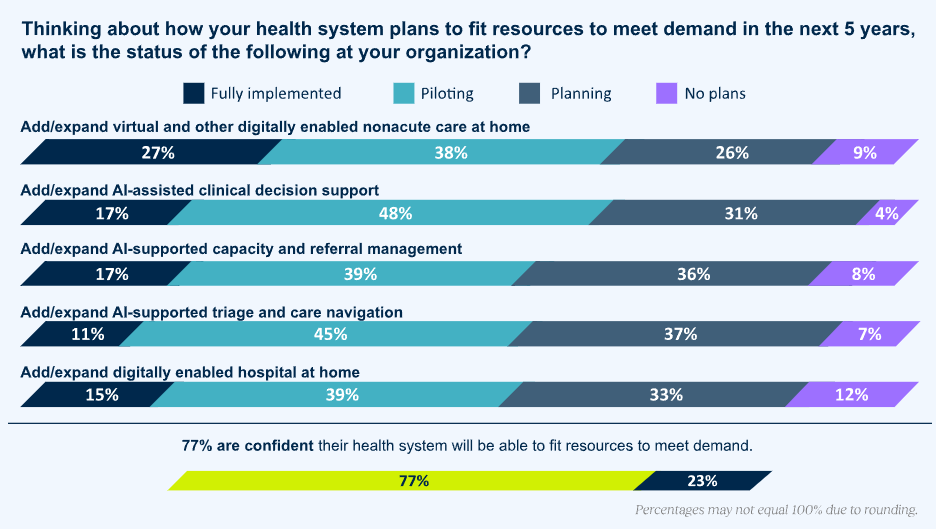
Nearly all surveyed health system executives believe that digital and AI tools can help them move to more proactive care. Most see key areas as providing off-campus care, using CRM systems to schedule ongoing care, collecting health data via devices, implementing AI health coaches to answer questions and help patients follow their care plans, and predicting health risks using AI. They also hope to personalize patient care using connected device monitoring, offering multiple communication channels, using technology to personalize care plans and messages.

Health insurers will use AI to counter the use by providers of AI-powered coding and billing, which they say has increased medical cost and thus decreased their profit. According to Centene’s CFO, “It does seem like hospitals have gotten better organized around the application of AI for coding than payers. But we’re going to catch up to that.”

image

OpenAI denies several viral social media posts claiming that ChatGPT has been disabled from providing health advice. However, the company says that its updated terms of service advise that the chatbot is not a substitute for professional advice and it will no longer provide a diagnosis or patient-specific treatment plan, reportedly due to legal and regulatory exposure.


Business

image

Hancock Health will use AI-driven robotic automation from Arrive AI to deliver lab specimens, a project that also includes drone-based transport for offsite deliveries.

Mayo Clinic announces Mayo Clinic Platform_Insights, which gives healthcare organizations access to its AI-driven clinical and operational expertise for digital solutions implementation. Mayo didn’t specify which modules or problem areas it will address or provide details about selling its services.

Healthcare AI agent vendor Hippocratic AI announces $126 million in Series C funding at a valuation of $3.5 billion. The company plans to use some of the proceeds to pursue mergers and acquisitions. It offers AI agents that handle non-diagnostic patient-facing tasks such as medication reminders and screening outreach.

For-profit urgent care chain Med First finds that AI-coded visits yield 6% more revenue than when physician codes visits themselves.

Tala Health, which develops AI agents to support clinicians and to address administrative burden, raises $100 million in financing.

image

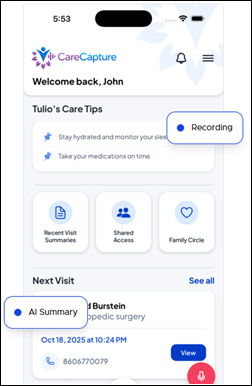
Tulio Health Technologies launches CareCapture, an app that generates AI summaries of visits that patients can share to improve recall, adherence, and confidence.


Research

Northwell Health researchers report that AI analysis of continuous wearable data from non-ICU inpatients accurately predicted patient deterioration an average of 17 hours in advance.


Other

OpenAI recognizes pharma and life sciences marketing firm Doceree for using 10 billion AI tokens, making it one of the most advanced users of AI technology.


Contacts

Mr. H, Lorre, Jenn, Dr. Jayne.
Get HIStalk updates.
Send news or rumors.
Follow on X, Bluesky, and LinkedIn.
Sponsorship information.
Contact us.

Comments Off on Healthcare AI News 11/5/25

This Week in Health Tech 11/5/25

November 5, 2025 This Week in Health Tech Comments Off on This Week in Health Tech 11/5/25
LinkedIn weekly 110525 - Copy
Comments Off on This Week in Health Tech 11/5/25

HIStalk Interviews Peter Bonis, MD, Chief Medical Officer, Wolters Kluwer Health

November 5, 2025 Interviews 1 Comment

Peter Bonis, MD is chief medical officer of Wolters Kluwer Health and an adjunct professor of medicine at Tufts University School of Medicine.

image

Tell me about yourself and the company.

I’m a gastroenterologist. I was at Yale on my first faculty job when I was recruited to join UpToDate as a startup. I joined the company, and along with many other capable people, I was able to lead it to grow, scale, and become a very important information resource that is used by healthcare professionals around the world.

Wolters Kluwer acquired UpToDate in 2008. We became part of a portfolio of information services across different verticals. Those verticals include health, tax and accounting, finance and corporate compliance, legal and regulatory, and corporate performance and ESG.

What are the advantages of presenting clinician-authored or clinician-supervised content at the point of care rather than using the literature search engine approach of some of your competitors?

Let’s frame the issue. Patients expect their doctors to give them the best possible advice. It’s a covenant that doctors would be seeking to counsel their patients with the best possible information.

As it turns out, clinicians have regular questions. When they get answers to those questions, they in fact change decisions about 30% of the time. As readers are out there doing the thought experiment of being with their clinician, imagine that they would change their plan if they had a particular piece of information. Those are the stakes.

We decided to address that information need, which has been well documented, by recruiting a faculty of the best people in the world who are clinically active and who are contributing to the body of knowledge in the area that they are writing about.

We framed the approach by understanding the types of questions at an extremely granular level, having an evidentiary way to look at the body of evidence, make that transparent, rate the level as a recommendation so that it’s highly transparent, and infuse into that the wisdom of these people who are some of the most deeply experienced clinicians in the world.

Human curation not only can summarize the body of evidence, but also can add to that the clinical wisdom and experience of considering factors that are important, such as patients’ values and preferences, to issue recommendations that are granular enough to be used at, or near, the point of care.

Doing that purely as a matter of information retrieval, even with advanced technology, is complicated. The expectation is that that technology can ingest all of that material, present it, prioritize it, and consider all of those factors that I just mentioned to make that experience transparent for both clinicians, and ultimately the patients that they’re serving.

Clinical decision support in its early days pushed guidance indiscriminately on physicians, with the assumption that they should digest it all and also to avoid malpractice issues from not offering complete advice. How do AI-focused tools address that, and could AI itself tailor the content to what an individual physician sees and how they react to the information, such as measuring overrides?

That is the frontier and the challenge, and indeed it’s the opportunity. We have plenty of opportunities to inject knowledge at or near the point of care, both for matters that might be more operationally focused, but also in this high-stakes domain of clinical care. Doing that well can improve care, remove friction, and help to ensure that every patient gets the best possible care, no matter who they are seeing and where they are being seen.

Doing that well is extremely challenging. It requires an enormous commitment to be sure that the experience is as accurate and usable as possible. And where feasible, to include information that is relevant to specific patients and make that experience transparent enough so that the clinician who is ultimately making those decisions can feel confident in the accuracy of that decision, or at least to be sure that they can serve as an interpreter when applying it to the patient in front of them.

To do this well, particularly in this area of decision support, requires a enormous commitment. You have to be sure that all of the different components of that which can break down are done as well as they possibly can be, and to provide an experience to clinicians that is as transparent and as effective as possible.

The business model of massively funded OpenEvidence appears to be running drug company ads that are targeted to the retrieved medical information of the patient. Will clinicians see the ad-supported model as a conflict of interest?

We focus on what we do and have always done well. We have been entirely supported through subscriptions. We have extremely strict policies related to conflicts of interest, particularly among our internal staff, but also all of our 7,500 external contributors, the external faculty and peer reviewers who contribute to UpToDate. We have found that important for maintaining integrity, increasing transparency, reducing bias, and ensuring that our sole purpose is to deliver care recommendations that are clear, unbiased, and free of any commercial taint.

Whether that can be done with a different business model remains to be determined. Ultimately, the market will let us know where the cracks are in that type of a model.

We will continue to do what we do and do well, which is to have a commitment to deliver an effective and easy-to-use experience, focusing on making it easy to do the right thing wherever frontline healthcare professionals are working in their EHR in an enterprise environment or on their mobile devices, Making that experience as free from bias as possible to ensure safety to the best of our capabilities. Providing transparency so that the entire experience is grounded in information that has been curated by humans, and in fact some of the most experienced clinicians in the world.

Will standards of care change as enterprise-associated physicians are provided access to sophisticated knowledge tools while others are financially forced to do without or to use free resources such as ChatGPT?

That’s an excellent point. It really comes down to the matter of how widely governance can be established across healthcare enterprises and small institutions as well. Obviously the governance involved in advanced technology such as AI requires a multidisciplinary approach. It’s not clear that that is going to be available widely for all of the different types of institutions that could take advantage of these technologies.

I do think there is a potential for creating a digital divide, or at least to have some institutions which have governance processes in place and others which may be relying on third parties such as their electronic medical record systems to do that governance process for them.

It ultimately comes down to the safety and effectiveness of the information services, particularly in the high-stakes domain of clinical decision support. For an institution that employs doctors, it’s not just the doctors, but it’s the institution itself that has risk involved, along with the potential benefits of helping to achieve high quality, consistent, and safe care. Having the right information available is certainly a fundamental piece of that equation.

Everybody cites the supposed fact that it takes 17 years to incorporate research findings into frontline care. Will that go away as point-of-care tools can put fresh information right on the screen of the person who is making a clinical decision?

It’s interesting you mention that. The 17-year statement has been cited often, to the point where I decided to hunt down one day the original source of that. In fact, there is documentation, but it’s much more nuanced than that. And in fact, it is not 17 years.

A lot of the adoption of new technologies and new approaches is related not just to having the information available, but also other factors, such as financial incentives, convenience, and superiority over alternatives. But there is a process of information diffusion. 

UpToDate since its origins has done very well to accelerate that process. We have, for many years, showcased some of the newer concepts in a specific feature within UpToDate called Practice Changing Updates. It describes what is new to ensure that our subscribers have an efficient way to know when practice has changed because of new studies, new guidelines, or simply new knowledge that has accrued.

Now with more tools available at or near the point of care, including Gen AI, that process will continue. Ideally, as new technologies evolve and new knowledge evolves, we as a system will have an easier time at implementing them for the right patients.

The physician who is making decisions from the EHR may be presented with patient summaries or suggestions, information they already know but might miss, and new information that they are seeing for the first time. How do you present that without overloading them data they don’t need?

It’s an excellent point. Doctors are overloaded, and that fact is critical to consider. 

Studies have looked at the number of tasks that clinicians have to perform to fulfill all of the requirements that are expected of them. Primary care, for example, would have to have about 26.7 hours per day to complete all the tasks that are required. That is impossible to achieve, obviously, so there’s always a matter of triage. Designing systems that do not produce a cognitive overload is a critical part of the overall design process, and also the approaches of who should be doing what. It doesn’t always have to be clinician facing.

The potential for overloading clinicians is absolutely there. Many organizations are seeking to have that mindshare and to inject knowledge in front of clinicians, and all of it can’t be done. It has to be prioritized and it has to be effective. How that will look is still a work in progress. There are many efforts to do this using advanced technologies, but there’s also a long track record of what works and what doesn’t work.

I’m optimistic that we can do better and that these advanced technologies will have an important role, but the devil is in the details. How will this work within workflow systems? What will the interaction look like with the data that are available within the clinical record, and perhaps even from other sources, to create an experience that helps frontline providers and their patients? That will be the journey that we’re on.

If I can digress for a moment, what is happening to the patients in all of this? All of what we are talking about is taking place in the background, when there is an enormous erosion of trust in healthcare services and healthcare professionals taking place in the backdrop. Patients are increasingly fed up. They are looking for alternatives. The healthcare system is increasingly unaffordable, and it delivers variable quality of care depending on where you are, your level of insurance, and other factors as well.

In more recent surveys this year, 15% of consumers don’t trust their doctors, which is up from 7% in 2023. Only 24% believe that their healthcare systems are focused on caring for patients, down from 77% in 2020. Instead, about three-quarters believe their hospitals are mostly focused on making money.

This process of busyness and the business of medicine is having a fundamental effect, not only on clinician burnout and the actual care delivery, but in a very fundamental way around trust and the experience that patients are having. Ideally, technology will help this problem, both for frontline providers and for patients who are seeking to have a better, more affordable experience.

We are in that potentially awkward phase where some physicians aren’t interested in technology for technology’s sake, but digital natives are coming out of medical school who can’t wait to do everything electronically. How will that change the way that physicians are educated and then trained?

There has already been an organic adoption of technologies, particularly by younger clinicians and those who are trainees. That has been going on for a very long time. It’s really no different that an adoption cycle occurring with Gen AI as well. Although it’s not uniform, clinicians of all ages and career statuses are facile at adopting technologies for it.

But I do think it will change education in many ways and we’re on that journey as well. One is where AI fits into traditional education and the awarding of continuing medical education credits. Is an AI experience and AI-generated content sufficient and trustworthy, for example, to award continuing education or CME credits?

For students, can you adapt these technologies to support a more effective learning journey and a lifelong learning journey? Certainly AI has been applied for adaptive learning. We at Wolters Kluwer have had a lot of experience in this area, and there are opportunities there.

There’s also training around healthcare professionals being an effective consumer of information services. And particularly now, to understand the limitations of Gen AI and how its convincing and compelling answers can make us falsely believe that they are accurate when they clearly need more interrogation.

A final point is that there is an emerging literature about the degradation of learning from overreliance on Gen AI tools. There is some empirical data that reliance on Gen AI tools might lead to a decreased ability to retain and then to apply that knowledge in other settings. That’s a fundamental pedagogical change. Where this comes out and how educators will approach all this remains to be determined.

For the moment, clinicians at all levels, including trainees, are adopting Gen AI tools. It’s important that the tools that they are adopting to lead to their training and to patient care will be effective, safe, and reliable over an extended period of time.

What about AI governance?

Governance is important. It is tempting to use tools that are expedient. In fact, they are so compelling that there’s a tradeoff that I think clinicians are willing to take around expediency when they haven’t really taken a sharp look at what’s being traded off for accuracy, reliability, and some of the other dimensions of challenges related to the core technology.

The word that I’d like to get out is the emphasis on adequate governance. That can be by a third party, such as the electronic medical record vendor who is forwarding and embedding these tools, or the governance committees themselves at institutions. They need to be sure that all the tools that they are onboarding that are provider-facing, or that take advantage of advanced technologies, are properly vetted, scrutinized against important benchmarks, and transparent. If there are deficiencies, you  have the tools necessary to understand those deficiencies over time in domains like we operate such as decision support, where a right and wrong answer to an untrained eye or even to a trained eye can look equally good.

You need a gold standard to be sure that each answer is complete, accurate, and contemporary. That’s hard to do, but nonetheless, that’s the work that needs to be done to be sure that we’re helping all the healthcare professionals live up to their covenant and deliver the best possible care for their patients.

How do you choose a company strategy when AI and other technologies change literally every day?

Across Wolters Kluwer, we have a lot of experience with adopting advanced technologies. Across our verticals, we have already released more than 20 Gen AI related products and services. We are reinvesting constantly into advanced technologies and innovation, including AI, SaaS, blockchain, and other emerging technologies.

In the area of clinical decision support, such as what UpToDate provides, we have to really live up to our own standards in this high-stakes domain. There’s an evolving regulatory framework, but we understand our North Star. We understand in constructing this content that we are part of a medical community. We adhere to those standards. We have 55 physicians who work for UpToDate as deputy editors. Many of them are still in practice, mainly in academic medical centers. So the culture is one of patient safety, of seriousness, of understanding that there is a live patient somewhere behind all of our computer screens.

We have taken our time, as we have looked at the advances and particularly in Gen AI and how they can be applied, so that we adhere to our own standards and the standards that have been expected for our more than 3 million users out there. That means very, very careful product development and extensive testing. We’ve had a lot of innovation around ways to ensure reliability, accuracy, and validity, including not having the known pitfalls of Gen AI solutions like the degradation of context.

These things are very important. Generic Gen AI tools, for example, may recommend drugs that can be unsafe because they don’t ask contextual questions such as, is the patient pregnant? We have found examples of generic Gen AI tools that recommend drugs that are potentially perfectly suitable for the condition, but not if the patient is pregnant or they could be harmful to the fetus.

There have been many examples like that, so we have to understand the limitations of the technology and understand where the technology is going. We grounded it in this database that we have built over 30 years, which is not only summarizing the evidence, but infusing it with the clinical wisdom of deep experts drawn from a faculty around the world.

It’s our own commitment, our own standards, that are deferential to what is expected of us from our customers and the responsibility to take our time to test, release slowly, develop feedback mechanisms, and ground exclusively in UpToDate not the chaos of the internet, and in my view, create one of the most effective Gen AI solutions for decision support that currently exists.


Morning Headlines 11/5/25

November 4, 2025 Headlines Comments Off on Morning Headlines 11/5/25

LifeMD Divests Majority Interest in WorkSimpli Software, Positioning Company as a Pure-Play Virtual Care and Pharmacy Platform

Virtual primary care provider LifeMD sells its majority ownership of WorkSimpli Software for $22 million in cash plus performance incentives.

Planbase Launches First AI-Native Employee Management Platform for Healthcare, Saving Clinics Hundreds of Hours Per Month on Administrative Tasks

AI clinic employee management platform vendor Planbase announces its launch and $2.1 million in funding.

Mayo Clinic launches Mayo Clinic Platform_Insights to advance digital innovation and quality improvement across healthcare

Mayo Clinic announces Mayo Clinic Platform_Insights, which gives healthcare organizations access to its AI-driven clinical and operational expertise for digital solutions implementation.

Comments Off on Morning Headlines 11/5/25

News 11/5/25

November 4, 2025 News 10 Comments

Top News

image

Healthcare AI agent vendor Hippocratic AI announces $126 million in Series C funding, bringing its total raised to $404 million at a valuation of $3.5 billion.

The company, which launched in 2023, will use the investment to globally scale its software and pursue mergers and acquisitions.


Reader Comments

From Rude Boy: “Re: Wellsoft. After CareCloud’s acquisition of Medsphere’s assets, they declined to offer positions to key Wellsoft staff, which will effectively sunset the Wellsoft product. Whether this is CareCloud’s intent is TBD.” Unverified. Medsphere acquired the ED EHR vendor Wellsoft in early 2019, also bringing on founder and CEO John Santmann, MD as CMIO. CareCloud closed its acquisition of Medsphere in August 2025.

From AzDave: “Re: Clinisys. Laying off as we speak!” Unverified. But honestly, are there any health tech companies that aren’t laying people off? The best you can hope for is that they hold off until after New Year’s, though I can’t remember a year when at least one cluelessly desperate outfit decided that it wasn’t beneath them to ruin the holidays for its allegedly valued associates and their shocked families.


HIStalk Announcements and Requests

image

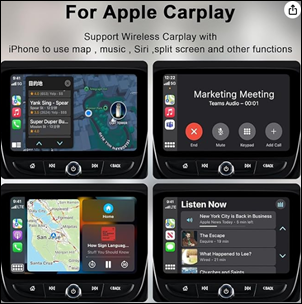
My aged car has a CarPlay-capable touch-screen entertainment system that works with my phone only if it is connected via a standard Lightning-to-USB cable. The phone then maddeningly disconnects at the worst possible navigational moments with the slightest jostling in its drink holder home, which probably means that either the port or the car unit itself is flaky. Enter this $17 dongle that takes about 30 seconds one time to pair with the phone via Bluetooth, after which the CarPlay panel comes up every time the car is started, the phone can remain pocketed, the cable can be retired, and I don’t forget to repocket the phone from the aforesaid drink holder upon egress. The gadget might fall just shy of being a change-your-life solution, but it’s close enough for $17.


Sponsored Events and Resources

None scheduled soon. Contact Lorre to have your resource listed.


Acquisitions, Funding, Business, and Stock

image

Healthcare consulting firm Canopii Collaborative acquires Anchor Healthcare Consultants. Anchor co-founder and CEO Joe Galea will become principal of Canopii’s provider solutions segment.

Popai Health, which offers AI-powered care coordination call technology, announces $11 million in new funding.

Risk adjustment and clinical quality solutions vendor Vatica Health acquires Cozeva, which offers value-based care enablement software. Both companies are #1 rated in Best in KLAS in their respective categories.

Remote robotic surgery company Sovato closes a Series B funding round that increases its total raised to $41 million.

Virtual primary care provider LifeMD sells its majority ownership of WorkSimpli Software for $22 million in cash plus performance incentives. LifeMD paid $1.25 million for its stake in the PDF and signing solutions vendor starting in 2018.

image

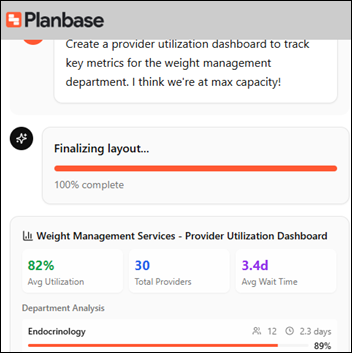
AI clinic employee management platform vendor Planbase announces its launch and $2.1 million in funding.

HealthStream announces Q3 results: revenue up 4.6%, EPS $0.20 versus $0.19, beating expectations for both.


People

image

Veradigm names Tehsin Syed (AWS) chief product and technology officer.


Announcements and Implementations

Netsmart launches an AI-powered clinical coding solution for post-acute and human services providers.

Intelerad will deliver a cloud-native medical infrastructure that uses Amazon Web Services HealthImaging. The AWS-hosted system will consolidate PACS, VNA, and image sharing workflows into a single back-end system.

Mayo Clinic announces Mayo Clinic Platform_Insights, which gives healthcare organizations access to its AI-driven clinical and operational expertise for digital solutions implementation.

image

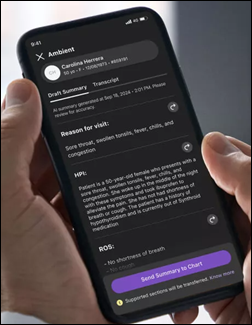
Athenahealth introduces an AI-native EHR clinical encounter for AthenaOne that includes an ambient scribe and a clinical co-pilot.


Other

Orlando Health’s South Lake Hospital launches a wearables pilot program for COPD patients using devices and software from B-Secur, Whoop, and Sensr.

image

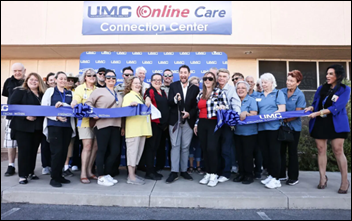
University Medical Center (NV) opens an Online Care Connection Center to help patients access virtual care in the rural area of Laughlin.

MaineHealth Patient Financial Services mistakenly sends letters to 531 living patients announcing their deaths and offering their next of kin instructions on how to settle accounts. The health system has attributed the correspondence to a software malfunction.


Sponsor Updates

  • CereCore releases a new podcast titled “Better Implementation: Northwest Specialty Hospital CEO’s Strategy On Innovation.”
  • Arcadia releases a new report titled “From Insight to Impact: How Top Health Systems Use Data to Make Healthcare Financially Sustainable.”
  • Black Book Research’s latest analysis highlights the importance hospital IT operations leaders will place on AI, interoperability, and cyber resilience in 2026.
  • Judi Health releases a new episode of “The Astonishing Healthcare Podcast” titled “Some [Healthcare] Data Visualization Treats, with Andrew Tsang.”
  • Great Lakes Consulting Services will leverage VisiQuate’s Harmoni Data Intelligence Platform to unlock insights and efficiencies across the revenue cycle.
  • CliniComp offers a new real-time results case study titled “Real-Time ICU Liberation Bundle Reporting Improves Recovery & Transforms Veteran Care.”
  • Netsmart adds an AI-powered ICD-10 coding tool and a companion virtual assistant to its Alpha RCM platform.
  • Inovalon announces the winners of its 2025 Impact Awards.

Blog Posts


Contacts

Mr. H, Lorre, Jenn, Dr. Jayne.
Get HIStalk updates.
Send news or rumors.
Follow on X, Bluesky, and LinkedIn.
Sponsorship information.
Contact us.

Morning Headlines 11/4/25

November 3, 2025 Headlines Comments Off on Morning Headlines 11/4/25

Hippocratic AI Raises $126 Million in Series C at $3.5 Billion Valuation Led by Avenir Growth to Expand Clinically Safe Generative AI Agents Across Healthcare

Healthcare AI agent software vendor Hippocratic AI announces $126 million in Series C funding, bringing its total raised to $404 million.

Canopii Collaborative Expands Into Provider Revenue Cycle Services Through Anchor Healthcare Consultants Acquisition

Healthcare consulting firm Canopii Collaborative acquires Anchor Healthcare Consultants.

Popai Health Raises $11M to Transform Care Coordination with Voice AI

Popai Health, which offers AI-powered care coordination call technology, announces $11 million in new funding.

Comments Off on Morning Headlines 11/4/25

Curbside Consult with Dr. Jayne 11/3/25

November 3, 2025 Dr. Jayne 2 Comments

The American Medical Association recently announced the launch of its Center for Digital Health and AI. It stated that it was “created to put physicians at the center of shaping, guiding, and implementing technologies transforming medicine.”

AMA leaders went on to say, “The new Center will tap the full potential of AI and digital health by embedding physicians throughout the lifecycle of technology development and deployment to ensure it fits into clinical workflow and physicians know how to utilize it.”

It’s a nice sentiment, but it feels aspirational. I don’t think the AMA has the resources to embed physicians anywhere, let alone in the spaces where this kind of development is happening.

The statement add that AMA will create policy and provide leadership in the regulatory space; provide “knowledge and tools” for physicians and care delivery organizations to integrate AI into their practices; collaborate with tech, research, government, and healthcare to drive innovation; and creating opportunities for doctors to shape AI and digital tools so they work within clinical workflows and enhance patient and clinician experience.

The latter is particularly interesting to me. How, exactly, will they be creating these opportunities? Some US care delivery organizations refuse to acknowledge the value of the CMIO role, so perhaps they can start by lobbying those folks. Oracle Health has eliminated a tremendous number of physician roles. Will the AMA demand that product teams receive adequate input from physicians who have formal informatics training and experience?

If you surveyed a room full of physicians, I’m not sure they would identify the AMA as an organization that looks out for the interests of frontline clinical providers. In the 1950s, approximately 75% of practicing physicians were members of the AMA. The best estimates I could find for recent years had estimates between 12% and 20%. If that’s accurate, it shows that physicians are voting with their pocketbooks. Dues are $420 per year for practicing physicians, which is a lot to ask from folks who don’t feel that the membership brings value.

It seems like an uphill battle advocate for more physician involvement in the development and implementation of AI tools. Organizations that already see the value of having physicians involved in the process are doing so. Given the cost of hiring a physician, it would be a hard sell for those that don’t already have a line item for that expertise in their budgets. A number of my physician informatics colleagues are concerned about keeping their current roles, since we’ve seen numerous CMIO and informatics roles eliminated either as part of the ever-growing list of health system mergers and acquisitions or just as a part of general restructuring efforts.

It will be interesting to circle back to this press release in six to 12 months to see if the AMA has gained traction with its efforts.

Speaking of look-back efforts, I took a look through my own retrospectoscope this week when I was digging through some paperwork. I found a sheet of notes from an AI symposium last year. It was about the impacts of generative AI on physicians, and featured a couple of physician executives talking about their health systems’ use of AI. I have a habit of capturing quotes when people are speaking. Some of the comments still ring true, but others haven’t stood the test of time. Let’s take a look:

  • “AI-powered analytics are great, but individual reporting freaks physicians out.” Many physicians have been resistant to seeing individual measures for years, so no surprise here. This will continue to be true as far as I’m concerned.
  • “I’m cautiously optimistic about generative AI in clinical applications; it seems like just one more thing.” I’d say this one is 50/50. We’ve seen tremendous growth in AI over the last year, but we’re also seeing a little bit of a backlash in some circles.
  • “AI is going to bring back the humanity in medicine. We will actually have time with patients rather than just taking a bill-and-go approach.” I’ll give 50/50 on this one as well. Studies have shown that where AI does provide some reduction in note generation times, physicians aren’t necessarily having longer patient-facing appointments or even spending less time in the EHR. We need more and better research in this regard.
  • “By 2025, this is totally going to bring the joy back into medicine.” I’m giving a thumbs down to this one, since we are well through 2025 and there are plenty of ways in which physicians still find the mechanics of medical practice to be soul-sucking.
  • “Data quality isn’t attractive. It’s not going to wind up on a movie poster.” I know quite a few people who thrill at the sight of beautifully normalized clean data, so beauty is in the eye of the beholder on this one. As a side note, I once saw a revenue cycle team that had shirts that said, “We put the sexy back in billing,” so I bet those folks would find data quality attractive too.
  • “Vendors kind of care about health, but really want to make money.” All too true, although it’s a continuum.
  • “Just because it has AI in the name doesn’t mean it’s useful.” True on this one as well.
  • “I hate the subscription model. You used to be able to just buy stuff.” This one is just as true today as it was last year.
  • “I’m tired of hearing about ‘move fast and break things.’ Vendors need to move fast, but also heal their broken things just like hospitals do.” I don’t think there’s a CMIO out there that would disagree with this one.
  • “AI is just giving us an escalating arms race of appeals and denials. They say we’re diagnosing too much sepsis even though they wanted us to find sepsis sooner.” The arms race is real. There’s a headline almost every week about care delivery organizations and payers taking approaches that counter each other. It reminds me of ‘’Spy vs. Spy” in Mad Magazine.
  • “Ambient documentation adoption will be limited because the operations people want a tangible ROI. How do you put a dollar amount on physician wellbeing? Our arguments about turnover and recruitment fall on deaf ears. They’ll probably just pass the cost on to clinicians.” I’ve seen health systems charge physicians for their ambient licenses or alternatively demand increased productivity in order to stay licensed, so I’ll say true on this one.

My favorite quote was when one of the speakers encouraged the audience (which included not only clinicians but also IT, operations, and finance colleagues) to “go play with ChatGPT and try to make it do the part of your profession that you hate.” It’s an interesting challenge, although I struggle with trying to find ways to add AI tools to my non-clinical workflows. I’m curious what others have done and whether it’s really making your work life better or if you have seen unintended consequences.

What odious parts of your work have you outsourced to AI tools? Have you been unsuccessful in automating others? Leave a comment or email me.

Email Dr. Jayne.

Readers Write: HLTH: Healthcare’s Burning Man for the Well Funded

November 3, 2025 Readers Write 5 Comments

HLTH: Healthcare’s Burning Man for the Well Funded
By Anonymous

I’ve been around this industry for decades. I have to admit that I’m still trying to wrap my head around all these newfangled conferences like HLTH.

Back in my day, HIMSS was the gold standard. Everyone knew it, everyone went, and you could count on a certain level of professionalism.

HLTH, on the other hand, feels like it’s out of control. I remember when it started in 2018 as just a small gathering in Las Vegas. It has apparently ballooned to 12,000 attendees and 900 sponsors. I guess that’s progress, although I’m not sure it’s all for the better.

When I went to my first HLTH a couple of years back, I was struck by how different it felt. Most companies had the same booth size, so you would think the focus would be on substance. Still, there were a lot more “tech bros” than I’m used to, with lots of sneakers and puffer vests but not many suits. It was supposed to be about conversation and content. 

Now we have big booths with espresso machines and ice cream carts. Honestly, it felt more like a popularity contest. Maybe I’m old-fashioned, but I miss the days when people were more interested in building real relationships than just being seen.

HLTH also doesn’t seem to care much for academic rigor or peer review. At HIMSS, you could count on presentations that were vetted and at least acted like they had substance. At HLTH, it feels like speakers are chosen for how much noise they make online, not for what they actually have to say. Most presentations are just opinions and visions, not proven results.

I suppose HLTH never claimed to be academically rigorous. They say they are about “healthcare innovation and societal well-being,” whatever that means. I’ve always believed that lofty goals are fine, but in healthcare, you need something concrete. I’ve seen plenty of big companies come and go, thinking they could fix healthcare, only to leave with their tails between their legs.

There were some positives at the 2025 HLTH conference, such as Kroger and Walgreens giving flu shots. But I ran into plenty of vendors who couldn’t explain what they actually do. I even asked a CEO for a simple elevator pitch, and all I got in return was a finger pointing to an iPad and a questionnaire. If you ask me, that’s not a good sign. Nobody bothered to ask about my organization or my needs, even though I have buying authority.

This year, HLTH was crawling with so-called “influencers.” I’ll be honest, I don’t care much for that term. Most of these folks seem more interested in building their personal brands than in driving real innovation. Some have medical degrees but never finished residency or got board certified. They’re quick to share opinions on topics where they don’t have much expertise. Their LinkedIn profiles are full of adviser roles and startup credits, but it’s hard to tell if they have actually accomplished anything.

There was even a dust-up online about a group of “physician founders” flying to the conference on a private jet, courtesy of an anonymous sponsor. The LinkedIn post and group photo were deleted after some backlash, but it makes you wonder how many of these folks still practice medicine.

HLTH seems to encourage this influencer culture, handing out free passes if you agree to post about the conference nine times. You could spot them in the exhibit hall, always taking selfies and blocking the aisles. They even had their own lounge.

Another trend I just don’t get is all the rebranding. Companies spend a fortune changing logos and colors, then throw parties to celebrate. Wouldn’t that money be better spent on employees or helping out struggling healthcare organizations? HLTH is also the time for big corporate announcements, most of which don’t mean much once you read the fine print.

And don’t get me started on the entertainment. The opening event was at Topgolf, way off the strip, and you needed a shuttle to get there. It just reinforces the old “business is done on the golf course” mentality. The Industry Night at Drai’s Beach Club was another example of excess. I even witnessed some pretty bad behavior at the casino bars, stuff I thought we had moved past.

Sponsors also go overboard with their own parties. I got at least 20 emails inviting me to events, but most required a certain profile to attend. Sometimes you had to apply, and even then, you might get rejected or have your invitation rescinded at the last minute. That’s just bad manners and bad business.

I didn’t bother with the hosted buyer program, even though I’m a budget owner. From what I overheard, it’s basically speed dating for vendors, and I heard some complaints from vendors that the buyers they met with acted bored, as if they were just doing it for the discounted registration.

Bottom line: HLTH and vendors need to take a hard look in the mirror. It’s become too much of a party, with way too much extravagance. In a year when care delivery organizations are facing more uncompensated care and cuts to Medicare and Medicaid, all this glitz just feels out of touch.

I will run pieces whose author prefers to remain anonymous, although they must submit it to me under their real name so I can check for credibility and conflict of interest.

HIStalk Interviews Dan Dodson, CEO, Fortified Health Security

November 3, 2025 Interviews Comments Off on HIStalk Interviews Dan Dodson, CEO, Fortified Health Security

Dan Dodson, MBA is CEO of Fortified Health Security.

image

Tell me about yourself and the company.

I have been in cybersecurity since about 2014, and in healthcare IT for 20 years. Fortified Health Security is a cybersecurity company that is focused exclusively on healthcare. We provide two kinds of services, advisory services and our managed security service provider business, or MSSP, for 24×7 monitoring and management of cyber technologies.

How does a healthcare-focused cybersecurity firm work differently than a more generalized company?

The attacks, adversaries, and the vectors they use are similar to other industries. The difference is how you respond to those threats and adversaries and risk reduction.

We believe strongly in having a knowledge base and an understanding of how healthcare organizations work, not only from a governance and regulatory perspective, but regarding infrastructure, legacy applications, mixed environments, EHRs, and medical devices. We build our playbooks and recommendations to take those elements into consideration. Our clients get more actionable intelligence so their teams can respond and take actions faster with the intelligence that is infused into our recommendations.

The top things organizations are trying to work through are AI, third-party risk, and training and awareness. Those three things are what organizations are talking mostly about with us.

What findings have surprised you in performing security risk assessments?

One surprise that we see is that everybody is at a different spot, and the weaknesses and the opportunities to improve are pretty vast. We’ve seen a lot of organizations make investments in different areas, some of which are reducing the risks that they set out to do. Sometimes they have opportunities for improvement. But as they’ve built their program over years, some areas tend to have significant gaps.

Third-party risk is a big area where organizations are struggling to tackle those challenges. Obviously with the rise of AI, we are in the early innings of understanding that from a risk perspective at the client side.

A lot of conversations are happening around end-user training and development. It’s a big challenge to actually drive better utilization of the tools to combat phishing, et cetera.

Are easily guessed or shared passwords still a big problem?

That certainly is still a challenge. The vast majority of compromises that could lead to a breach of data involve the end-user clicking on an email and giving up their credentials into a phishing email. Then the adversary comes in, moves laterally across the environment, and ultimately causes havoc. That’s still the number one entry point, so organizations are focused on combating that.

It seems like tools should have gotten sophisticated enough to block the clicking of suspicious links.

Tools are out there, and not having a tool would certainly increase your exposure. But this is an area where the adversaries are good. They are able to navigate around those tools and ultimately end in the inbox.

We see organizations thinking about how to reduce that attack surface. Do I have employees within the healthcare organization that maybe don’t need external email to execute their job? That’s a little bit of a culture challenge, because in the US, people associate their employment with having email. No one really talks about that. It’s the norm.

We are seeing some creative designs around that to make sure that we are limiting the attack surface. There are actually some cost benefits as well, such as fewer licenses for whichever email that you may use.

The other approach is training end users. A recent development is that most people are familiar with someone who was compromised personally for some type of phishing attack. Or, they have been impacted by breaches at Target or Nordstrom’s. One part of training is whether to focus more on the personal side and helping users understand how to protect themselves at the individual level. That would ultimately increase the level of protection for the organization.

What about users logging into their company email from personal devices?

That is still an issue. BYOD is prevalent. We have a lot of contract labor. If you live in a metro area, physicians have multiple privileges at multiple facilities. 

Who is winning the AI war between hackers and organizations?

I think the data would would tell us that the adversaries are being more successful. Breaches are continuing to occur. If you look at the Office for Civil Rights, the number of breaches year over year is stabilizing, but the impacts are getting larger. So I would say that, unfortunately, the adversaries are probably winning that fight. The adversaries are also using AI to launch more sophisticated attacks, both via email and help desk voice impersonations. They are definitely leveraging AI to hit us on all fronts.

How is the government’s role in healthcare cybersecurity changing?

Our view is that we are in a little bit of a standstill. There was a lot of energy at the end of the Biden administration. Senator Warner was leading that charge. Frameworks were put in place for programs that would provide clear expectations, along with some monetary support in a carrot-and-stick model to adopt said frameworks.

But a lot of that has stalled. The current view is that we may see tweaks to frameworks and expectations, but monetary support coming alongside that is probably off the table, at least in the near term.

Hackers have threatened to report their breach to HHS or have contacted individual health system executives, board members, media outlets, and even patients to threaten to expose breach information in hopes of getting a ransom payment. How do you address that dynamic, especially knowing that you wouldn’t be paying the most of honorable people with no recourse if they don’t deliver?

That’s the biggest challenge if you have a ransomware event or active breach that ends up in some type of negotiation. Thinking about adversarial intent, bad actors come after us to begin with because it’s monetary. They will pull all the strings that they can to create as much leverage against that organization to increase the likelihood of payment.

Also driving that behavior is class action lawsuits. Attorneys who used to chase car wrecks and malpractice cases have turned their eyes to cyberattack class action lawsuits. The adversaries know that, so they will weaponize that against the victim that is under attack. They will pull the strings on anything they can do to increase the likelihood of payment.

What are the advantages of organizations moving from point tools that are monitored by understaffed internal security groups to moving to a more centralized approach?

In most healthcare delivery organizations, teams are quite small. A lot of those individuals have been at that healthcare organization for a number of years and have made their way to the cybersecurity team. Health systems in general are not the best at training and having dollars available to train resources.

How do we make those individuals who have institutional knowledge about the networks, environment, and culture of the organization as effective as cyber warriors as possible?  We partner with those organizations to bring high-fidelity, actionable information to that team so that they can take quick and swift action.

As far as which service or what opportunity, I would just tell you that every healthcare organization is at a different point in their cybersecurity journey. They have made prior investments. Can our organization plug in, leverage existing investments, and operationalize that in a more efficient way to ultimately drive down risk?

One of your reports about downtime preparation quoted a chief nursing officer whose hospital experience an unanticipated problem because young nurses couldn’t read the cursive handwriting that doctors used to write paper orders. Is it common to find problems during downtime that weren’t anticipated in the plan?

Almost every time. Organizations do their best to prepare for downtimes that are short in duration. Hospitals go on diversion a lot for various reasons that have nothing to do with cybersecurity. They have downtime when they have to patch a system, implement a system, or upgrade a machine. We are relatively good at doing that for a short period of time. The challenge arises when you are down for a long duration and you don’t really know how to manage through days or weeks of not having access to the systems.

That’s driven by a couple of things. One, we are heavily reliant on systems when delivering care, whether that’s the EHR or the hundreds of other applications that power these health systems. So when they are down to some degree, the clinicians are frozen in their normal work habits. Anxiety and nervousness sets in because they want to take care of the patients, but they don’t have the technical controls in place to ensure that they provide swift, quality care. It slows down the care delivery model significantly.

Calculating is another issue we see. How am I calculating if I’m making an order for a particular medication? Med reconciliation is another thing that drives a lot of nervousness, making sure that I’m giving the right meds at the right dose to the right patient. Most of that at scale is done electronically, and that becomes an issue.

Communication is also another big challenge that we see. How are we communicating as a team if we’re using some type of a pager system or a walkie-talkie-system like Vocera and it’s down? That’s how we are used to communicating.

Lastly, a lot of the younger physicians have never operated in a world where they haven’t had technology. They were trained on an EHR at med school and they’ve been delivering care for years while being guided by electronic systems.

How do you advise organizations to deploy resources to protect their ever-increasing reliance on external technology vendors?

Step one is understanding how you interact with those third parties technically, so that if they have an event, you can take quick action to sever ties to limit the disruption to your organization from an adversarial perspective. But then comes the challenge that you need that system to deliver it, but the reality is that for the hundreds of systems that are that are in these healthcare delivery organizations, there’s not enough dollars to have backup systems for every single one of them. It’s unrealistic, both monetarily and operationally. That would also double your attack surface, so it’s not necessarily recommended. The first step is getting your arms around all of your third parties.

Step two is determining what the interaction is between your organization and those third parties. 

Step three is putting in some contractual language and some compensating controls on your side to try to limit the downtime.

Step four is that as you think about the disaster recovery plan, work with your clinical teams to understand how they would operate with certain critical systems down. Start with the ones that are most useful clinically and are most widespread so that you have some type of backup plan in place in the unlikely event that it’s unavailable.

What is the company’s strategy over the next few years?

Our strategy is to continue to work with healthcare organizations to increase their cybersecurity posture. We believe very strongly that a coordinated, programmatic approach through various elements of their cyber program can help minimize that risk. We are going to invest in our central command platform, which is our service delivery platform that provides actionable information and drives results across their entire organization to reduce risk.

Comments Off on HIStalk Interviews Dan Dodson, CEO, Fortified Health Security

Text Ads


RECENT COMMENTS

  1. "A valid concern..." Oh please. Everyone picks the software they like and the origin of that software is an afterthought.…

  2. I don't disagree with you completely, but to take the counterpoint: there is plenty of precedent for saying "this *entire…

  3. Teens will certainly find a way to use their social media apps of choice. I'm not in favor of the…

  4. I've been in this business a long time. Choosing the "right" technology product is fraught, especially when it comes to…

  5. EHRMusing - You make a lot of accurate statements about key factors in the selection process but the comment about…

Founding Sponsors


Platinum Sponsors


Gold Sponsors


RSS Industry Events

  • An error has occurred, which probably means the feed is down. Try again later.

RSS Webinars

  • An error has occurred, which probably means the feed is down. Try again later.