Dr. Jayne from HIMSS 2/29/16

February 29, 2016 Dr. Jayne 1 Comment

Usually the travel day to HIMSS is uneventful and this year didn’t start any different. I boarded my flight at O Dark Thirty and settled in to watch some software training videos that my client had created, since I knew there was a good chance they’d put me right to sleep. After a nice nap, it was time for email clean up.

I must have missed this before, but CMS has extended the Medicare EHR Incentive Program hardship deadline until July 1, 2016. If you haven’t submitted your application yet and want to avoid adjustments to your 2017 Medicare payments, you have plenty of time.

clip_image001

I touched down in Las Vegas right around the start time of the Hot Chocolate 15k run, which had multiple roads closed. Fortunately I had a taxi driver with a great personality, which made the delay tolerable. Although the roads were closed, I never saw any actual runners.

Speaking of runners, I mentioned previously that Edifecs has their #WhatIRun campaign live. I’m flattered to have my profile posted under the healthcare leaders section and appreciate their willingness to keep me anonymous.

For those of you who pop over to take a peek, yes, the comment about the refrigerator is true. Once I arrived at my hotel, I found out that my promised (and paid for) early check-in had been pushed back an hour. It was difficult to find somewhere to hang out that wasn’t completely smoke filled, which reminded me why I am not a huge fan of Las Vegas.

Once I finally received my room keys, I was quite surprised (as was he!) to find a naked guy who had apparently just stepped out of the shower. The front desk was apologetic and reversed my early check-in fee and also upgraded my room. It wasn’t their fault, though – the guest had checked out before he was actually ready to depart, so let that be a good lesson to only check out when you’re ready and also to use the privacy lock.

Once I was settled, I enjoyed the opportunity to get outside and actually see the sun since there is still snow on the ground in my world. I’m always saddened to see the panhandlers on the elevated walkways. Although it’s a complex problem, one man today was clearly having a psychotic episode outside the Palazzo. Hotel security were keeping an eye on things since he was accosting pedestrians. I hope he gets the help he needs.

clip_image003

The fountain at the Wynn was getting some maintenance and I imagine electricians who own dry suits are in demand across down. Registration was smooth, although there was a snafu with picking up bags and materials. At the registration area, they were telling people to come back in three hours to get everything. I decided to wander around the meeting areas and found the bag desk a few dozen yards away, fully stocked and ready to distribute. There were several people headed to the CHIME golf outing toting their clubs.

clip_image005

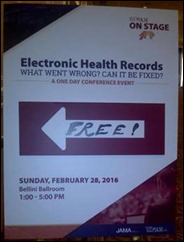
I stumbled across this Sunday session, featuring AMA president Steven Stack as well as Nancy Gagliano from CVS Minute Clinic and some others. From the time I saw it to when I returned to snap a photo, they had added the “free” to the signage. I registered and chatted with some of the staffers, who were very enthusiastic about their mission. I popped in for a bit and didn’t learn anything new, so headed back out for some more sun.

clip_image007

I connected later in the day with Dr. Lyle and some of his Healthfinch colleagues, who were on their way to a get-together at the Palazzo. My favorite part of HIMSS is catching up with people that I may only see once or twice a year. The rest of the evening was spent with friends old and new, as we christened the Southbound Greyhound as Dr. Jayne’s Official Drink of HIMSS16. (I personally like to muddle in a few blueberries, but there were none to be had.) Note to the bartenders at Treasure Island: you might want to stock in a few more bottles of Deep Eddy Ruby Red. You’re going to need them.

I was trying to unwind this morning in preparation for this evening’s big events, but despite the privacy sign on the door, the housekeeper opened the door without knocking. I always use the privacy lock, so she wasn’t able to get in, but it was annoying, especially since it was barely past 8 a.m. I know they’re in a hurry to turn over rooms, but I’m not checking out today and I did have the sign on the door.

I’m going to meet up with a good friend for lunch and lay out the battle plan for the week. Unfortunately I’ll miss the opening keynotes due to HIStalkapalooza prep, but I don’t think I’ll be missing anything earth-shaking.

clip_image008

For the rest of you prepping for the big night, may I suggest the liquor section at Walgreens, which has the Pedialyte thoughtfully displayed with the Ketel and Tito’s. I’m looking forward to the dance-floor stylings of Matthew Holt as we Party on the Moon. See you there!

Email Dr. Jayne.

From HIMSS 2/28/16

February 28, 2016 News 2 Comments

Hello from Las Vegas. I always skip the usual HIStalk format during the HIMSS conference, focusing on what I see or hear directly for the most part. I’m holding off mentioning all but the most significant vendor announcements until next week because I don’t have the time or interest to wade through the glut of press releases that companies unwisely held until this week while everyone is too busy to care.

image

image

The weather continues to be great in Lost Wages, so folks coming to the conference from cooler climes are going to love it. The trees and grass are green, the sky is blue, and the restaurant patios are perfect for a leisurely lunch. Until Tuesday, that is, when the area is overrun with pasty-skinned, tote bag-slinging HIMSS attendees determined to glad-hand their way out of winter and get in your way at every opportunity.

Here’s a tip if you need to drive to the Sands Expo for exhibit setup or some other reason – use the Palazzo parking garage and self park (don’t valet unless you want to wait to retrieve your car), which has a very busy entrance on Las Vegas Blvd. and less-busy one off Sands. It’s the best parking garage in Las Vegas with 4,000 spots, it’s free, and the escalator will take you right to the casino, from which it’s a short walk to the hall. Also, Uber finally beat the Las Vegas taxi lobby, so there’s that.

image

Here’s another tip. Just a few hundred yards down the street from the convention center across from the Wynn is Fashion Show Mall, which doesn’t look big, but has 250 stores and restaurants. If you rip your pants or realize you forgot your socks, there’s a Macy’s as well as a lot of higher-end stores right there (even an Apple Store). Good chain restaurant choices there that I can vouch for are Maggiano’s, Kona Grill, and RA Sushi.

image

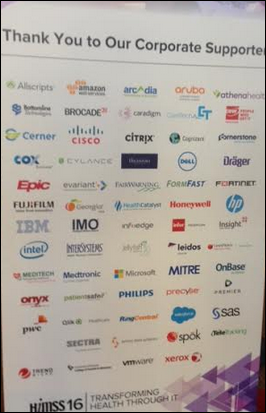
I snapped this photo in the conference center hall. It looks as though HIMSS has just over 60 corporate supporters, of which I note that at least 15 are also HIStalk sponsors (my iPhone picture isn’t quite clear enough to read every logo).

image

I’m impressed every year that HIMSS sells ads on nearly every square inch of available convention center real estate – walls, escalators, tabletops, and even on the floors. Here’s my business model for the only space they missed in the Sands (above): I propose to replace that ho-hum artwork above the urinals with vendor ads. In addition, I will hire someone just to stay in the restroom all day, and once a HIMSS attendee has settled in at his chosen spot, my lackey will sidle up behind him and announce in his ear, “Hi, I’d like to just say a couple of words about your restroom sponsor ABC Tech, which is in Booth #9999. Don’t stop what you’re doing – I’m just going to slip their business card into your pocket. Excuse me if we don’t shake hands.” When he’s not busy, my man will also slip printed collateral under the door of occupied stalls. Talk about your captive audience. It reminds me of the HIMSS conference a few years ago when a vendor brilliantly placed ad-imprinted drain screens in all the urinals, at least until they got busted by HIMSS.

image

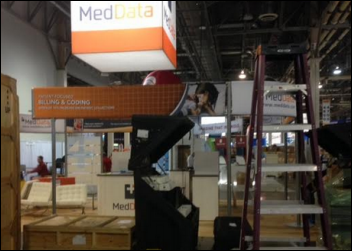
I look forward to only two things about the HIMSS conference: the Hyland magician and MedData’s scones. I had heard previously that the latter might be threatened by Sands Expo rules prohibiting baking in booths (can you imagine?) I was horrified to see actual evidence of this – the MedData booth contains no scone-baking apparatus. If the magician is a no-show, I’m going home.

image

image

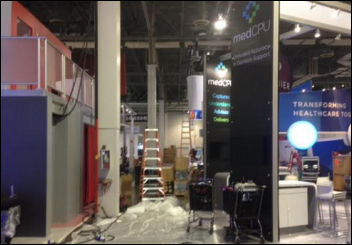
All of us exhibitors were doing setup today, with the exhibit hall acres covered with palletized equipment, plastic-covered carpet, yet-to-be installed signs and furniture, a few blue-jeaned vendor employees, and leisurely Freeman people with drills and ladders. We carted in our mighty HIStalk exhibit today, which involves two roll-up signs, a tablecloth, and a banner, weighing maybe 20 pounds total. It all fits into a single duffel bag. We have little to give away, nothing to sell, and no real reason to even be back in Booth #5069 by the freight door other than to give our fellow outcasts a place to call home among the multi-storied, fluorescent sterility.

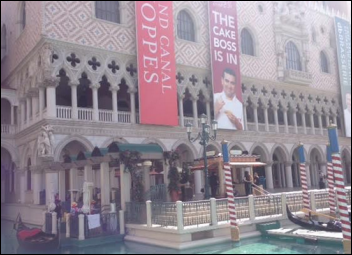
I always ponder as I walk through the Las Vegas hotel equivalent of a mall food court littered with cookie-cutter restaurants bearing celebrity chef names: have those big-name cooks ever actually set foot in the place? My suspicion is that they just license their name out to some dull restaurant chain operator, take their cash, and move on to their next venture. I picture the Venetian having one giant commissary kitchen that makes all the food for every individually branded restaurant using corporate-approved formulas and quality control, with the “chefs” given about as much creative freedom as they would have packaging airline meals or prison food. That’s one more way Las Vegas seems like Orlando to me other than they’re the only two cities hosting HIMSS conferences in the future – unsophisticated visitors can’t wait to try all the chain restaurants they don’t have back home.

Bands coming to town this week that I wouldn’t mind seeing are Iron Maiden, Metric, and Gin Blossoms. 

image

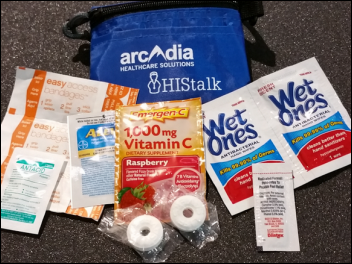
We’re giving away these first aid kits from Arcadia Healthcare Solutions in our booth. If the HIMSS conference gives you a headache, heartburn, foot blisters, or sticky hands (how could it not?), you’ll want one. Arcadia will have them in their booth, too. I snagged a couple of them last year and they’re very handy both during and after the conference.

From Former Bruin: “Re: City of Hope Medical Center (CA). Specializing in oncology treatment. Switching from Allscripts to Epic.” Unverified.

From The Oracle of Alpharetta: “Re: McKesson. All signs point to McKesson EIS to be in Stage 1 Shutdown Mode. Customers continue to leave for other vendors. Horizon conversions to Paragon are at a trickle. InSight users group attendance was abysmal. Customers are angry. EIS senior management have no healthcare experience, but they do have expertise in valuation and slimming down businesses prior to dissolving them. Large RIF likely coming in March. Development and QA rapidly shifting to third-party, offshore workers to reduce headcount and severance and bonus liabilities. Constant reorgs in Alpharetta, Charlotte, and Westminster. MCK will focus on its roots: pharma and med/surg distribution. HIT was fun while it lasted.” Unverified.

image

Ireland-based Oneview Health plans to go public on the Australian stock market, valuing the company at $200 million.

Next up: HIStalkapalooza. I’ll probably post a brief recap and some pictures Monday night. Safe travels.

Monday Morning Update 2/29/16

February 27, 2016 News 1 Comment

Top News

image

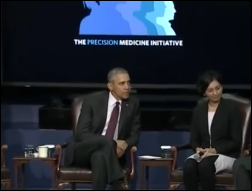
From the transcript of President Obama’s remarks Thursday about the White House’s Precision Medicine Initiative:

Part of the problem with have right now is that every patient’s data is siloed — it’s in a hospital here, a hospital there, a doctor here, a lab there. The goal here is if we can pool and create a common database of ultimately a million people that’s diverse so that they have a lot of genetic variation, we can now take a disease that may be relatively rare, but because we have a pretty large sample size and start seeing patterns that we might not have seen before. But a couple things that requires — it requires, first of all, us understanding who owns the data. I would like to think that if somebody does a test on me or my genes, that that’s mine, but that’s not always how we define these issues …

In terms of the model that we use for health records that hopefully will be digitized more and more, companies help hospitals keep and collect that data. They should get paid for that. They’re building software. They’re building an infrastructure. On the other hand, we don’t want that data just trapped. So if I am sick and voluntarily I want to join with other people who have a similar disease to mine and donate our data to help accelerate cures, I’ve got to be able to work with the electronic health record companies to make sure that I can do that easily. There may be some commercial resistance to that that we have to talk about — although we’re seeing some terrific participation now, and that’s part of what we’re announcing, of those companies in terms of helping that happen.

There’s privacy issues. We’ve got to figure out how do we make sure that if I donate my data to this big pool that it’s not going to be misused, that it’s not going to be commercialized in some way that I don’t know about. We’ve got to set up a series of structures that make me confident that if I’m making that contribution to science that I’m not going to end up getting a bunch of spam targeting people who have a particular disease I may have. 


Reader Comments

image

From Sitz Bath: “Re: your Epic report. How many people downloaded it?” About 1,200 that I know of, but the Politico people messed me up by publishing a direct link that avoided the sign-up page I had created to keep count. You can download it here.

From CMIOmaha: “Re: your Epic report. Much appreciate the amazing summary on Epic. The most objective and down to earth summary I’ve ever seen. I downloaded it this morning and shared with all our C-level with an immediate and incredible feedback! I wish you’d do the same with Cerner.” Maybe it would be interesting to ask the same questions to the executives of Cerner users. Peer60 did all the heavy lifting via their market feedback platform, so it wouldn’t take much of my time.

From HIMSS PR: “Re: Greenway Health. Second staff reduction in the past six weeks. Sales leadership and enterprise sales team taken out. Not the best PR heading into HIMSS.” Unverified. 


HIStalk Announcements and Requests


image

I’m writing this Saturday from Las Vegas, where it’s sunny and warm. I rented a huge, luxurious house five minutes off the Strip for $200 per night and it’s filled with friends and family (all female, I just realized) who are helping with HIStalkapalooza. We have a heated pool and hot tub in our outdoor oasis, so last night it was pizza and this afternoon I’m grilling hamburgers and hot dogs poolside. I fell asleep last night to the gurgling of the hot tub’s waterfall outside after catching up on emails on the 25-megabit Wi-Fi (take that, crappy hotel Internet made worse by guests streaming Netflix and porn). It’s nice to be able to relax before the madness starts Monday, not to mention that I’m saving a fortune in hotel and restaurant bills. I should hang the HIStalk booth banner over the garage door.

I’m not sure when I’ll post over the next couple of days. Certainly Monday night after HIStalkapalooza (which means I won’t sleep much before a long Tuesday), but maybe Sunday if anything interesting happens.

image

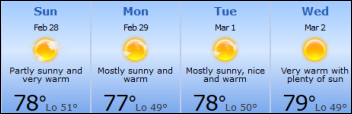
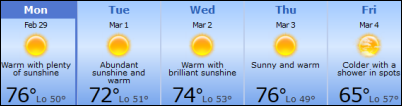
Here’s your Las Vegas weather forecast. Trust me, it’s probably nicer here than wherever you’re coming from.

I was amused that the marketing manager of a vendor I highlighted as misspelling HIMSS on their site emailed me to accuse me of Photoshopping the screen shot, saying they had spelled it correctly. However, the sneaky alterations were on their end – they took down the page with the misspelling and posted a new one, perhaps not realizing that I could simply email them a link to Google’s cached image of the original page to prove my point. Doh!

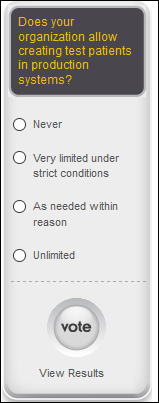
The results of the reader-requested poll of health systems allowing the use of test patients in production systems are as follows:

  • 15 percent say they never allow it
  • 46 percent they allow it under strict conditions
  • 30 percent they allow it as needed within reason
  • 9 percent say they allow it without restriction

Concerns listed by respondents include the possibility of dropping real charges, the downstream effects on interfaced systems, and inadvertent printing of documents (I’ve seen all of these). 

image

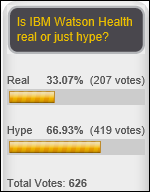
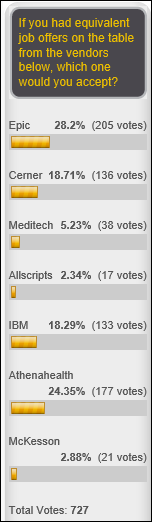
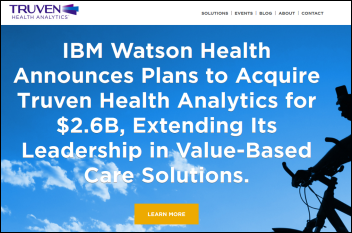
Two-thirds of poll respondents say IBM Watson Health is just hype. MEHIS Expert says it’s just an IBM ploy to increase consulting revenue, while HackerDoc questions whether IBM has the right medical informatics physicians with computer science backgrounds involved. Hype provided thoughtful analysis:

It’s beyond hype. They have now officially taken what was a brilliant branding strategy (personifying the intangible and making it both relatable and revolutionary sounding) and turned it into pure silliness. The Phytel acquisition last year was when my red flags were raised being that pop health is still just a buzzword, vapor and yet to be proven, but this addition just confirms that IBM is just trying to over-PR their revenue shell game. What is funny is that Truven began as the mixed bag business unit of Thomson Reuters after they went on a silly publishing buying binge while the publishing world was crashing (PDR, Micromedex, etc.). Thomson couldn’t find a way to blend those brands well into their financial and media strategies and spun them off, which resulted in Truven. How IBM is going to find a better fit for these brands that were too out-of-date for an old publishing co company is beyond my logical understanding. It makes me speculate that IBM may want to closely observe what is currently happening to Xerox. Bottom line, I no longer view Watson with the shock-and- awe wonderment that I once did.

New poll to your right or here: will EClinicalWorks and Athenahealth become major inpatient system vendors?

image

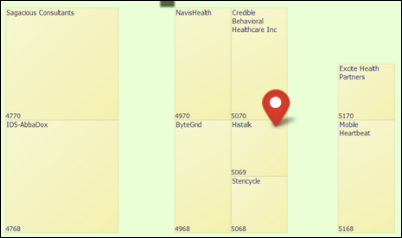
Here’s where Lorre will be spending the week – Booth #5069, with those other companies around us hopefully being OK with the significant traffic of interesting people we bring to an otherwise undistinguished location right next to an area labeled “Chain Link Fence – Storage.” I’m not sure I really get $5,000 worth of value from a 10×10 booth, but I’ll feel better about spending the money if everybody at least drops by to say hello.

Welcome to new HIStalk Gold sponsor Ellis & Adams. The Austin-based research and consulting firm offers IT strategic planning, project management, Lean workflow design, cost analysis, and data science services. Co-founder Don Ellis, MBA, MPH has a long industry history working for both providers and vendors; co-founder Jeff Adams, MBA spent a lot of time as a healthcare CTO; and partner Bill Blewitt has spent his whole career in healthcare IT. The company just published a description of its EHR optimization work with Dameron Hospital (CA). Thanks to Ellis & Adams for supporting HIStalk.

image

Healthcare IT Leaders donated $1,000 to DonorsChoose to attend my CIO lunch this week, which I used (along with third-party matching money) to fully fund these teacher grant requests while sitting by the pool:

  • Programmable robots for the media center of Ms. Becote’s elementary school in Florence, SC.
  • Physics learning kits for Ms. Stuckeman’s middle school science and math club in Fort Worth, TX.
  • Math games for Mrs. Wolfe’s fifth grade class in Little River, SC.
  • Programmable robots for Mrs. Marinin’s elementary school classes in Green Bay, WI (she is targeting females, hoping to expose them to careers in to computer science).
  • A maker space (programmable robots, invention kits, kinetic sand, and a duct tape creation kit) for the library of Ms. Harrison’s elementary school in San Juan, TX.
  • Six Amazon Fire tablets for the gifted elementary school classes of Mrs. Evans in Orlando, FL.

image image

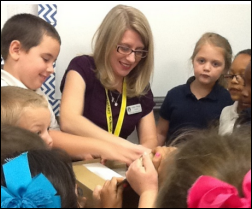
Mrs. Newman reports on the STEM activity kits we gave her Indiana second graders by funding her DonorsChoose grant request: “Thanks to you, my students are benefiting more from discovery learning as opposed to teacher led instruction. With team work, they are working collaboratively building roller coasters to learn more about gravity. They are also reading instructions on how to incorporate levers and pulleys into their creations. It is so exciting to watch them in action! Your help in providing these amazing STEM materials has been appreciated by my students, parents, and myself. Thank you very much!”

image

Also checking in is special education teacher Mrs. Allen from South Carolina, who reports, “My students were so excited when they came back from Christmas break to new headphones! They actually want to use the computers now … They have begun taking pride in our computer center and want the computers to look neat … I had no idea that something as simple as headphones could make such a difference in the attitudes of my students.”


Last Week’s Most Interesting News

  • The White House announces commitments from vendors and providers to support its Precision Medicine Initiative, most of them involving patient-contributed research data, patient access to their own data, and interoperability. 
  • HIMSS announces the retirement of two EVPs, John Hoyt and Norris Orms.
  • ResMed announces that it will acquire Brightree for $800 million.
  • EClinical Works announces plans to develop an inpatient EHR.
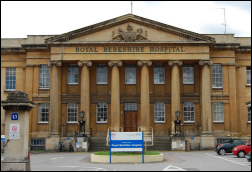
  • England’s Royal Berkshire Hospital cancels surgeries when its Windows XP pathology systems are taken down by malware.

Webinars

None scheduled soon. Contact Lorre for webinar services. Past webinars are on our HIStalk webinars YouTube channel.

We’re running a HIMSS special on webinars. Contact Lorre or see her at our booth #5069 (don’t blink or you’ll miss it).

Here’s the recording of Thursday’s webinar, “Analytics For Population Health: Straddling Two Worlds.” 


People

image

XG Health Solutions promotes Mike Bertrand to CTO.

image

Cerner reassigns John Glaser to SVP of population health. I’m not a fan of the title since “population health” is not at all the same as “population health management,” which in turn is not at all the same as “population health management software.” Despite his new title, John isn’t responsible for the health of any population other than his own.


Sponsor Updates

  • Whirl Magazine features TeleTracking’s volunteer activities in its March issue.
  • Validic publishes a new white paper, “The Unprecedented Convergence of Healthcare and Technology.”
  • The local news covers the opening of Versus Technology client University of Minnesota’s Health Clinic and Surgery Center.
  • Voalte publishes a case study featuring Frisbie Memorial Hospital (NH).
  • Leadership Excellence recognizes PerfectServe Vice President of Human Capital as a Top Corporate Leader in the over 35 category.
  • PeriGen releases a new eBook, “A Vision of the Future of Obstetrics.”

Blog Posts


Contacts

Mr. H, Lorre, Jennifer, Dr. Jayne, Lt. Dan.
More news: HIStalk Practice, HIStalk Connect.
Get HIStalk updates.
Send news or rumors.
Contact us.

125x125_2nd_Circle

News 2/26/16

February 25, 2016 News 10 Comments

Top News

image

The White House announces several commitments to its Precision Medicine Initiative call to action, including:

  • The Advisory Board Company will create APIs for up to five pilot sites interested in building FHIR-based applications.
  • Allscripts, Athenahealth, Drchrono, Epic, and McKesson will pilot open APIs that will allow patients to contribute their EHR data to research in “Sync for Science” pilot projects.
  • The CRISP HIE will enable consumer “data donation” to support research.
  • Get My Data will initiate a “virtual march” of consumers via pop culture events, social media, and media campaigns.
  • Hackensack University Medical Center will adopt FHIR and open APIs for patient access.
  • Intermountain Healthcare will create a patient portal for cancer genomic data.
  • Ochsner Health System will expand its wearables data pilots.
  • PicnicHealth will publish a guide explaining how consumers can get access to their data and will create a Web-based portal for requesting data from the country’s 500 largest health systems.
  • PCORnet will help patients get access to their EHR data and contribute it for research.
  • Sage Bionetworks will create a way for study patients to contribute data for research.
  • St. Joseph Health will make data from Allscripts and Meditech available through an API and allow patients to see, edit, and contribute their own data.
  • Surescripts will give patients participating in the first precision medicine cohort the ability to contribute their medication and health information.
  • University of California Health System will give patients tools to download their information from all five of its medical centers and to share the information with providers and researchers. It will also develop a Blue and Gold Button, working with Cisco on a standards-based interoperability platform.
  • Validic will give users an opt-in form that will allow them to donate their patient-generated data to researchers.
  • Yale New Haven health will give patients access to their full medical record and allow them to share or donate their information.
  • New York Genome Center will use IBM Watson to generate cancer insights.
  • Inova Health System will create a $100 million precision medicine venture fund.
  • UPMC will make its legacy EHR data available to applications and services via a FHIR API.
  • University of Arizona Health Sciences will spend $22 million to expand its open-source analytic methods for disease-associated gene expression changes.

Reader Comments

From Sage on the Stage: “Re: same old HIT problems. Usability, interoperability, and security require addressing socio-technical challenges that start-ups and politicians are reluctant to admit, much less address. For those going to the HIMSS conference, ask vendors the hard questions.” Here’s the list from SOTS:

  • Do your system designers observe real clinician users in their busy clinical setting, recording how many errors they make, the problems they have finding data, or workarounds used in providing care to someone’s mother? If you have conducted those observations, what are you doing to correct the problems? If not, do you have any free tee shirts?
  • How does your EHR identify patients from disparate organizations, reconcile clinical terminologies, and normalize the clinical and administrative data before importing it and integrating it into your EHR and displaying it to clinicians? If so, can you connect me with a customer using those features? If not, do you have any free golf balls?
  • Does your product use two-factor authentication for remote access? How do you ensure that clients have implemented all the appropriate security precautions and most recent application and OS updates? Do you perform announced penetration tests on your clients’ networks and databases?

From Boy Wonder: “Re: HIMSS conference. Today in our company-wide prep meeting we reviewed your ‘booth rules for vendors’ rant from a few years ago … such good content. Hopefully our team members will learn from it and not screw up!” It was a culmination of my life’s work a couple of years ago to capture the fleeting image of every single employee in one vendor’s booth simultaneously tuning out passers-by while obsessing over their phones. I can’t top that, but I will be on the prowl for inhospitable booth behavior that disrespects attendees and robs employers. I would offer to mystery shop for companies interested in my blunt, objective opinion, but I fear I would be overwhelmed with requests.

image image
image image

image image

From Blown Cover: “Re: HIMSS spelling. It’s crazy after decades that people in the industry don’t know the difference between HIMSS and HIMMS. Come on, people – get it together!” Googling “HIMSS16” gives 5,410 results, while searching for just “HIMMS” returns  577,000 results. Even hashtag “#HIMMS16# “ turns up usage by tweeters like CHCF Innovations, Carestream, GetMyHealthData, CSC Health, and Cylance. You might find this startling lack of attention to detail is concerning given that, by definition, it involves companies offering patient-impacting technology products.

image

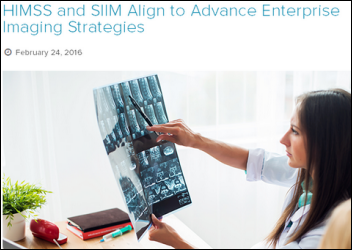
From Gone Guy: “Re: HIMSS and SIIM. Last time I checked they dealt in the digital world.” The stock photography doctor not only is peering intently at a now-antiquated film, she’s got a giant, turquoise syringe handy should she feel the need to inject something unsterile into someone. I can only imagine how often the HIMSS-SIIM Enterprise Imaging Workgroup’s name will be mangled into HIMMS-SIMM.


HIStalk Announcements and Requests

image image

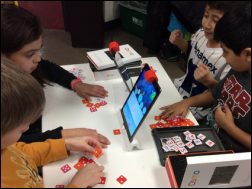
We provided an Osmo learning system in funding the DonorsChoose grant request from Ms. Murphy in Wisconsin, who emailed, “As you look around the room when students are using these materials, you can see the excitement on their faces, how highly engaged they are in the math, and the social skills that are being developed. You can hear mathematics vocabulary being used in their discussions and how they work together to solve problems, whether they are academic or social.”

image image

We also provided math picture books for Ms. Schmidt’s Indiana kindergarten class, which she says are so popular that the kids are reading them outside of their math workshop sessions.

This week on HIStalk Practice: The US Oncology Network and McKesson Specialty Health help oncologists move to value-based payment models. Family Health Care of Siouxland sees success in depression screening with new check-in tablets. : Andy Slavitt addresses physician burden, MACRA next steps at AMA conference. MBS/Net merges with Medsphere. KP Northwest enters the standalone – and telemedicine-friendly – clinic market in Portland. Georgia rolls out HIV telemedicine program at its public health clinics.

This week on HIStalk Connect: Fitbit shares fall 20 percent on low Q1 earnings and revenue guidance. Insurance startup Oscar Health raises a $400 million private equity round to expand its geographical footprint. Crisis Text Line releases a dataset containing more than 13 million de-identified text messages between its crisis counselors and teens that use the service. Opternative raises $6 million to ramp up its online eye exam business.

image

Welcome to new HIStalk Platinum Sponsor Ability Network. The Minneapolis-based company has for 20 years been helping providers and payers simplify the administrative and clinical complexities of healthcare through innovative applications and data analytics. It has helped hundreds of health IT vendors connect to Medicare and commercial payers, giving easy EDI payer access and embedding eligibility and claims management directly into the vendor’s software. Hospitals can take advantage of platforms for Medicare billing management, FISS/DDE connectivity, all-payer eligibility and claims, and Medicare claims submission and remittance advice. The company has grown tremendously, fueled by over $500 million in capital investment and several notable acquisitions, the most recent being Thursday’s acquisition of RCM and analytics services vendor G4 Health Systems. Industry long-timer, pharmacist, and former McKesson President and CEO Mark Pulido is Ability’s CEO and board chair. Thanks to Ability Network for supporting HIStalk.

image

image image

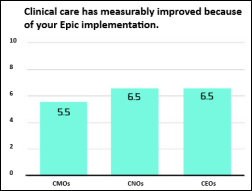
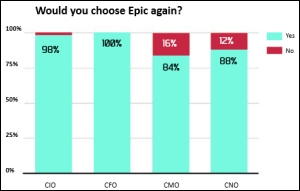
The folks at Peer60 helped me survey C-level executives from Epic-using organizations to create a free report, “Epic: the cold hard facts.” I came up with questions I always wanted to ask Epic sites. Are provider executives willing to speak up if they find Epic-related issues that could impact patient safety? Does Epic provide competitive advantage? Do Epic-using CIOs prefer Epic sites when looking for a new job? Did Epic go in on budget and do CFOs think it’s worth the cost? Are customers happy with Epic’s interoperability? It’s a free download – the form asks for basic information just for my use in understanding who is reading it, but you can enter dummy data if you aren’t comfortable sharing with me. It’s been crazy trying to get this finished during all the HIMSS hoopla and I’ve already noticed that I made a couple of aggravating minor typos, so forgive me for those. Free really is free: there’s no advertising, no charging vendors for copies, and no behind-the-scenes selling of data. Thanks to the provider executives who participated.

I’m heading to Las Vegas early this weekend, just to get settled in before the wave of HIT immigrants overwhelms the baggage carousels, taxi lines, and check-in desks. Nothing really happens until Monday, so I’m hoping to finally take a breath and get into HIMSS mode after a way too busy February.


Webinars

None scheduled soon. Contact Lorre for webinar services. Past webinars are on our HIStalk webinars YouTube channel.

We’re running a HIMSS special on webinars – 25 percent off produced and two-for-one on promoted. Contact Lorre or see her at our booth next week.

Here’s this week’s webinar, sponsored by LifeImage, titled, “Completing Your EMR with a Medical Image Sharing Strategy.”


Acquisitions, Funding, Business, and Stock

image

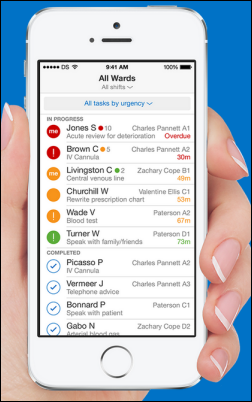
Google’s DeepMind Technologies forms DeepMind Health, offering two apps it acquired. Streams, for acute kidney injury detection, was developed by Royal Free Hospital London, while clinical task management  and communication app Hark was created by an Imperial College London team. Neither app uses DeepMind’s machine learning or artificial intelligence capabilities – these are apparently simple, hospital-built apps that don’t do a whole lot despite the Tweeters wetting their pants in anticipation of Google mounting an undeclared challenge to IBM Watson.

image

E-prescribing and electronic prior authorization network vendor CenterX raises $3.3 million in funding.

image

UPMC makes an unspecified investment in Vivify Health and will implement its care management and patient engagement technology. UPMC’s investment completes a round that was started in November 2014, increasing the company’s total to $23.4 million.

image

Meditech solutions provider Park Place International will rename itself CloudWave. 

image

Minneapolis-based employee health benefits management technology startup Gravie lays off 21 employees – 25 percent of its workforce, with CEO Abir Sen explaining, “It’s a bad market out there and we need to invest in growth.” Crunchbase reports that the company has raised $25.6 million, with its last round of $12.5 million being completed in April 2015.

VitalWare receives an unspecified growth investment from F-Prime Capital Partners, which gets two board seats.

Medsphere merges with EHR implementation consulting firm MBS/Net.


Sales

The State of Oklahoma chooses Orion Health’s Healthier Populations Solutions Suite for Health-e Oklahoma.

Mission Health (NC) selects PeraHealth’s clinical surveillance solution.

image

Maine Medical Center (ME) chooses Lexmark’s accounts payable automation, which includes Perceptive Intelligent Capture and Perceptive Content.

image

University of Kansas Hospital (KS) selects Cerner’s HealthIntent population health management system. I was distracted by the press release’s use of two pompous substitutions (“leverage” and “utilize”) for the perfectly serviceable “use,” but I’ll give them a bye for whipping out “proactive” a couple of times, which is two too many.

Intermountain Healthcare will use Ayasdi’s clinical variation management software.


People

image

LifeImage promotes Jim Phillips to SVP.

image

Orion Health prometes Wayne Oxenham to president of its North America operations.

image

Huron Consulting Group hires LaDonna Sweeten (Leidos Health) as managing director.

image

PatientSafe Solutions promotes co-founder Si Luo to president and CEO.

image image image

HIMSS announces pre-conference organizational changes: HIMSS Analytics EVP John Hoyt retires, Blain Newton is promoted to replace Hoyt, and HIMSS EVP/COO R. Norris Orms announces his retirement.


Announcements and Implementations

image

Catalyze announces Stratum, a compliance layer for healthcare infrastructure.

image

Aprima adds Chronic Care Management functionality to its EHR.

image

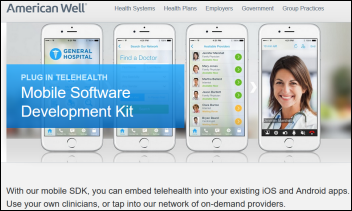
American Well releases a software development kit that allows providers to embed the company’s online doctor visit technology into their mobile apps.

image

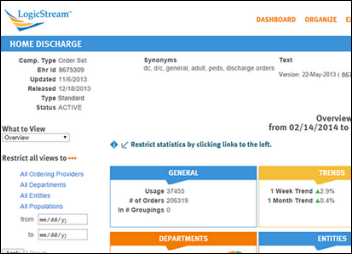
LogicStream Health adds an executive overview area to its clinical process measurement platform, allowing leaders to monitor care activity at levels ranging from specific conditions (such as CAUTI or VTE) to overall quality.

CHIME announces a “unique partnership” with OpenNotes, with the press release babbling endlessly without actually saying what the partnership involves until Paragraph 7, which finally gets to the point in explaining that CHIME’s task is to “bring greater awareness.”

First Databank announces its OrderSpace CPOE medication ordering content system, with McKesson Paragon being the first inpatient system to make it available to users.

image

Geisinger spinoff xG Health Solutions will use Cerner’s HealtheIntent population health management platform, while Cerner will use xG’s clinical content in its HealtheCare and HealtheAnalytics solutions.

image

The Partnership for Health IT Patient Safety releases Toolkit for the Safe Use of Copy and Paste.

image

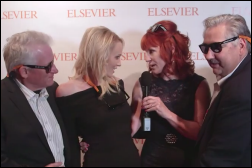
Elsevier lists its activities at the HIMSS conference, including serving as the red carpet sponsor of HIStalkapalooza. I’ve worn  the sunglasses they provided last year in Chicago countless times while running, sunning, or doing yard work — I call them my Elsevier safety glasses.


Government and Politics

image

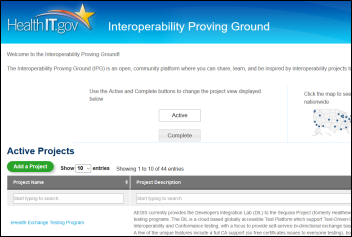
ONC announces its Interoperability Proving Ground, a community for sharing information about interoperability projects.

image

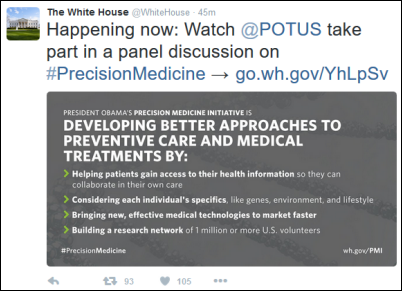
The National Institutes of Health says during Thursday’s White House summit on precision medicine that it hopes to be gathering data on 1 million people by 2019, also announcing that it will fund a Vanderbilt University study involving Verily (the former Google Life Sciences) to determine how to attract those volunteers.

Army veteran Dennis Magnasco spent two days trying to schedule an appointment with the VA clinic in Bedford, MA, but could never get through the phone tree to reach an actual human. He works for Rep. Seth Moulton (D-MA), who filmed Magnasco’s attempt and posted it to Facebook, where it received more than 2 million views. The outcry motivated the Bedford clinic to fix its PBX and earned Moulton several new sponsors for his Faster Care for Veterans bill that would require the VA to run an 18-month pilot project in which veterans can self-schedule using a smartphone app. Moulton criticized the VA’s plan: “They were planning to spend $623 million developing their own app. This is available today. God knows how long it would take them to spend that.” He says the VA just likes building its own proprietary systems, adding, “They gave a variety of silly excuses.”


Privacy and Security

A law professor’s USA Today op-ed piece that appears to be satirical proposes going back to paper to thwart hackers, explaining:

The truth is, paper records are inherently more secure. To steal 10 million electronic user records from a government agency, all you might need is a cracked password and a thumb drive. To steal that many records on paper, you’d need a fleet of trucks and an uninterrupted month. And ransomware wouldn’t work on paper records. What would you do – put a padlock on the file cabinets and demand ransom for the key? And often, putting things on computers is a crock anyway. Electronic medical records, touted as saving money and streamlining care, are a major cause of physician burnout. It’s gotten so bad that some hospitals actually advertise the lack of electronic medical record systems as a selling point in recruiting doctors. If I were running an intelligence agency, I’d have all my important stuff done in handwriting or on mechanical typewriters and distributed in sealed envelopes. If I were setting up a voting system, I’d use paper ballots. And if I were running a hospital, I’d seriously consider doing everything on paper. There’s a place for computer records, of course. But for things that really matter and that need to be genuinely secure, we should try a more advanced technology: Paper and ink. Take that, hackers.

SNAGHTML49526437

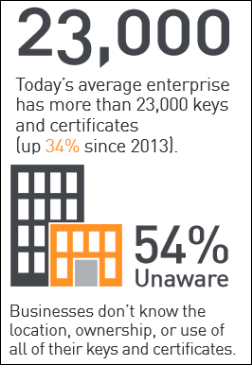
A Venafi survey finds that CIOs are not properly managing security keys and certificates. You will no doubt be shocked to learn that Venafi sells tools to secure keys and certificates. The survey suggests that more hackers are attacking using untrusted keys and certificates that can be bought on the black market for around $1,000 to encrypt their evil-doing traffic.

Pro football player Jason Pierre-Paul sues ESPN and one of its reporters for violating his privacy in running a photo of a surgery schedule proving that he had blown off a finger playing with fireworks on July 4, 2015. Jackson Memorial Hospital (FL) fired a nurse and a secretary earlier this month for sending the information to ESPN. JPP is suing under a Florida health professions regulation, which seems to hold little chance for legal victory since, like HIPAA, it covers providers but not sports networks running celebrity news.


Technology

image

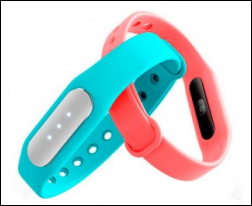
Apple sold 11.6 million Watches in 2015, placing it in wearables third place behind Fitbit and Xiaomi. I knew little about China-based Xiaomi, but learned that its $15 Band Plus Pulse (pictured above) added a heart monitor to its existing step counting, sleep analysis, incoming call alert, and integration with the iOS Health app.

image

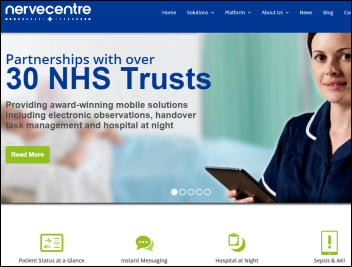
NHS England Nursing Technology Fund provides Princess Alexandra Hospital with $1.4 million to purchase Nervecentre’s mobile clinical platform software for iPad-based documentation.


Other

An analysis of LinkedIn’s share free-fall says the company’s problems are fundamental to its business model as somewhere between business card holder and spam delivery service: its only content is generated by self-promoting but sporadic users (often only when they’re looking for work) who are then pestered endlessly by recruiters. The article says LinkedIn should stop rewarding bad user behavior, allow users to block unwanted communications, and integrate better with email.

A Pennsylvania VA nurse is charged with assisting in an emergency surgery while drunk. The nurse, who says he forgot he was on call, drove recklessly from a casino bar and was caught on hospital security video stumbling into the facility. He then had problems logging in to the OR computer and documenting the procedure.


Sponsor Updates

  • The Atlanta Business Chronicle interviews Liaison Technologies President and CEO Bob Renner.
  • Allscripts announces that its APIs have been used to exchange data one billion times in three years.
  • HCI Group partners with Securonix to enhance its security offerings.
  • Extension Healthcare will add AirStrip’s mobility platform to its Engage Mobile, providing event notifications and waveforms 

Blog Posts


Contacts

Mr. H, Lorre, Jennifer, Dr. Jayne, Lt. Dan.
More news: HIStalk Practice, HIStalk Connect.
Get HIStalk updates.
Send news or rumors.
Contact us.

125x125_2nd_Circle

EPtalk by Dr. Jayne 2/25/16

February 25, 2016 Dr. Jayne 1 Comment

This week has been completely off the rails, with all my best-laid HIMSS preparation plans left undone. There’s nothing like five inches of mucky wet snow, flight delays, and a case of pinkeye to throw a girl off her game. Luckily I made it home, saw one of my partners for some eye drops, and am now playing a frantic game of catch up.

The pre-HIMSS news cycle is pretty slow. There was a flurry of mailings earlier in the week, most of which were nondescript post cards that wouldn’t lure me to a booth. Today there was nothing, but there will always be those post-HIMSS straggler mailings to look forward to.

clip_image002

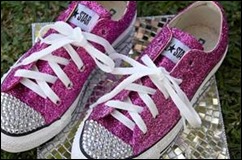
Several readers have been sending me their shoe pics, wondering if they’ll give them a proverbial leg-up on the competition. There’s even a HIMSS Style 2016 board  on Pinterest, with suggestions for both ladies and gents. I do like the pink socks and fetching wing tips pinned from www.dapperclassics.com.

clip_image004

Another sent me a pic of this two-heeled number from Christopher Dixon, which are supposed to be extremely comfortable. They’re also tech savvy, using Silicon Valley partner Chronicled to ensure authenticity. Shoes are tagged using a microchip and registered from a mobile app, allowing a future secondary market for non-knockoffs. Accessing the shoe’s chip via the app also displays a story about the inspiration behind the shoe and the sourcing of its materials. I doubt we’ll see any on the show floor, but a girl can dream.

I’m putting together my final social schedule for next week. Unfortunately, there are way too many events on Wednesday night and too few on Tuesday night. Most of the vendors who are hosting events are either gracious enough to allow public registration or are swayed by the MD accompanying my generic-sounding practice name.

I did have one of them question exactly how I received their invitation since it didn’t match their list. I had to just ignore it because I couldn’t exactly say, “Well, someone on your marketing team thought it was worth inviting Dr. Jayne.” One vendor offered to add me to its attendee list if I would send my real name – nope, not happening.

If you have an event on Tuesday that’s open to all readers, let us know. We’d be happy to have a member of the HIStalk team cruise by if time permits.

clip_image005

I tried to attend a Google Hangout this week, where NCQA was going to talk about the pilots for their redesigned Patient-Centered Medical Home program. The audio from the moderator’s PC was so bad that people couldn’t hear, which turned some attendees away. There were also a lot of people who weren’t muting their own microphones, adding to the problem.

Once the featured speakers started their talks, things got better, but it goes to show that Web conferences still can be tricky for a lot of people. At least the comments were fun to read.

I followed up after with one of my friends who does a lot of PCMH consulting work. She’s personally steering people away from NCQA, not only due to the complexity of their process, but also the growing fees. I haven’t had a chance to look at their new measures in depth, but she has seen them and thinks there are a few in there that are nonsensical. Looks like I have some reading to do.

CMS shut down the Medicare/Medicaid EHR Incentive Program attestation website over the weekend to correct an error preventing Eligible Professionals from claiming an exclusion for one of the measures in the Patient Electronic Access Objective. Those whose attestations were rejected previously must resubmit their information.

ONC has released a new Health IT Buzz post about “The Real HIPAA,” giving examples from care coordination and case management. This should be required reading for all the people who continually try to use HIPAA as an excuse not to share patient information when it is clearly permissible. The next installment is slated to cover Quality and Population-Based Activities and I’m looking forward to seeing what they have to say.

If you’ll be in Las Vegas next week and are interested in giving feedback to CMS, they will be hosting three Design Lean Planning Sessions during HIMSS. The goal is to receive feedback on the Merit-Based Incentive Payment System (MIPS). Sessions are one hour long and will be held March 1 at 2:30, March 2 at 2:30, and March 3 at 11:30 in the CMS Meeting Room, Venetian Level 4, Zeno 4603. Space is limited and you must email  with your session choice, name, title, role, and organization to register.

clip_image007

Another reader recommended I not spend too much time at HIMSS job hunting, suggesting that I consider a position in New Zealand. They’ve been trying to recruit a primary care physician for more than two years with no takers. The position has good compensation, no nights or weekends, and 12 weeks of holidays. I’m not ready to live in the southern hemisphere, but a nice locum tenens gig might hit the spot. Unfortunately, he’s been inundated with applications of dubious merit, so he probably won’t see mine.

clip_image009

My week also went askew thanks to the usability efforts (or non-efforts) of Microsoft, who decided in their infinite wisdom to “update” Office 365 with a feature that completely broke my workflow. I have been enjoying my Surface tablet, especially the Surface Pen, which I use in lieu of a mouse or the touchpad on the keyboard. I have been working on a huge editing project (textbook chapter, anyone?) and two days ago the pen stopped working as a selection device and only worked for annotation. Using classic user psychology, I assumed I had done something wrong or activated something unknowingly. I immediately knew better when I did a Google search and typed “Microsoft Surface Pen” and it automatically suggested adding “stopped working” to the search.

Apparently Microsoft engineers decided we no longer want to use a pen or stylus for anything but annotation — the pen is now locked in Ink mode while using Office products. Although there appears to be a button to return it to selection mode, it doesn’t work. Multiple users have already weighed in on a Word suggestion forum that there needs to be an option to go back, with several comments from people who used the pen as an accessibility and adaptation tool to help with physical limitations. I use mine with the keyboard, so I can use the touchpad even though I don’t like it, but I truly feel for those actually using it as a tablet. Having to use the touchpad reduced my editing productivity by more than 50 percent.

Even worse, the on-board Microsoft Help seems to brag that the “select objects” button (which should turn inking off) no longer works. The Microsoft Answer Tech gave me an escalation link that wasn’t customer facing and the escalation site shows they don’t know the difference between a country and a language (featured above).

Help a girl out by sharing the link and helping us tell Microsoft they’re offending their users. If I scurry home from HIMSS, I’ll still have two days left in my return window to offload it.

I won’t post again until I get to HIMSS, If I have to ditch the Surface, what’s your advice on a tablet? Email me.

Email Dr. Jayne.

Readers Write: HIMSS, Ice Cream, and the Law of Diminishing Returns (LoDR)

February 24, 2016 Readers Write 10 Comments

HIMSS, Ice Cream, and the Law of Diminishing Returns (LoDR)
By Mike Lucey

image

“Clearly the third scoop has fewer calories than the first and second. It is simply the law of diminishing returns.” This perverse application of the LoDR only returns a derisive, “You are pathetic” from my wife when used to justify the purchase of a large ice cream sundae. But I carry on and get the nuts on top — they are healthy.

It’s not that the LoDR doesn’t apply, just that I apply it to the wrong side of the counter. The medium at $2.75 (two scoops) and the large at $3.25 (three scoops) delivers less value to the ice cream lady. Extended (five or six scoops?), it would reach the breaking point where the ice cream would cost more to scoop then it would return in cash.

I wonder if some in our industry are confused as to which side of the counter they are on? More importantly, that the LoDR will flip the counter when we are not looking. Are we effectively and consistently asking the question, “Am I getting more than giving, or giving more than getting as I continue down this project path?”

Back in my days in financial services (maybe because our product was money), every project was systemically graded for current value. “Current” being the critical word. Not graded against the expected value we assigned at the start, but against the current costs, current value, and (here’s the kicker) current alternatives.

image

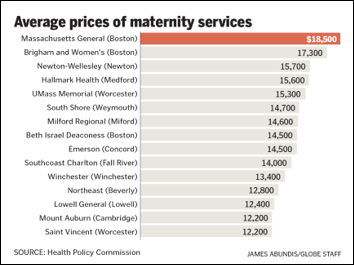
The Boston Globe recently published an article citing a Health Policy Commission study of the disparate cost of care in Boston-area hospitals. Using maternity services as an example, the study found large differences in what hospitals charge.

For us in the healthcare IT industry, it is notable that four of the five top hospitals are actively using or have recently installed Epic  with a big price tag (three Partners hospitals, one UMass). This correlation raises the question: how much IT cost flows through the system, and are there effective checks against these rising costs? Did LoDR flip the counter in these cases?

To Epic’s credit, there is a concerted effort on their part to control costs that are often embedded in questionable customization. In other words, the folks at Epic are applying the concern of LoDR against the impulse of the client to work toward the elusive “best” at an ever-growing expense.

As we head toward HIMSS, our annual festival of IT goodies, we get to see a whole new set of “current” alternatives. Can we review the new stuff through the filter of LoDR? Stuff that is truly new for me, does it get me more then I need to give? And the stuff that is newer than what I have, does it keep me on (or get me back on) the right side of the counter?

And for me the ultimate question: who’s giving away free ice cream? Because free ice cream has no calories. Everyone knows that.

Mike Lucey is president of Community Hospital Advisors of Reading, MA.

Readers Write: Removing Tunnel Vision from Enterprise Imaging

February 24, 2016 Readers Write 2 Comments

Removing Tunnel Vision from Enterprise Imaging
By Karen Holzberger

image

I find the evolution of technology to be fascinating. Just think about music. Fifteen years ago, CDs were the most popular way to access music. Now you can listen to music anywhere, instantaneously, from tiny devices. The population has universally embraced the change. Why has accepting change in healthcare been so slow and difficult?

I’m not saying we all need to be on the bleeding edge of innovation, but it’s important to remove the tunnel vision and recognize advances not just in diagnostic medicine or medical research, but also in health IT innovations that make things faster, easier, and less costly.

I was surprised when I read a recent report on enterprise imaging that their research and results was limited only to organizations with a vendor-neutral archive (VNA) or universal viewer (UV) technologies.

The need to access and store medical images has been the most common demand of radiology departments for decades, but to think that in 2016 enterprise imaging is only done with these two approaches – it’s like taking a Polaroid camera to the beach and waiting a week for the film to be developed.

Don’t get me wrong. This report got it half right, but VNA and UV solutions don’t fit the needs of every organization, and that can lead people down the wrong path. If healthcare facilities are going to succeed in advancing the quality of patient care, then it is time to accept new and nimble health IT solutions for enterprise imaging today that bring patient images to people’s fingertips as swiftly and securely as the cloud delivers your favorite song.

Over the last few years, cloud-based image exchanges have gained popularity as an option for enterprise imaging. A HIMSS Analytics Cloud Survey showed that 83 percent of healthcare organizations used cloud-based apps in 2014. While this simpler approach is not the same as a VNA, it allows facilities to achieve the same overall goals, often more efficiently. Facilities can be up and running on an image exchange in as little as two weeks and have central access to all necessary images via the cloud – anywhere, anytime.

VNAs are one of the oldest imaging technologies. When introduced, they finally allowed healthcare sites to collect data from all departments in one location and exchange that information with a broader audience. But what about patient care happening elsewhere and other types of patient data?

Today, it’s critical that facilities share information with other facilities, not just other departments within the same building. In addition, the shift to value-based care means facilities require quick, efficient technology that follows patients across a continuum, which takes more than just sending an image from point A to point B. Imagine only being able to listen to your favorite song on your iPod and not on any of your other connected devices.

VNAs can take up to two years to implement and can be horribly expensive. Further, since they don’t encapsulate all of a patient’s data, sites need to use them in connection with other solutions, like a picture archiving and communication system (PACS), to have a complete enterprise imaging strategy.

Cloud-based imaging, on the other hand, provides more than the seamless sharing of images. It delivers real value and efficiencies like capturing and sharing all relevant patient data, just like how the cloud allows you to access your music, videos, and playlists effortlessly between your phone, tablet and laptop. Which is why I’m perplexed that society openly welcomes this technology in our lives, but accepting technology that can make life-saving differences has proved to be so challenging.

The time to embrace is now. If not, I fear that we will only continue set back an industry that so desperately needs to move forward.

Karen Holzberger is VP/GM for diagnostics at Nuance of Burlington, MA.

News 2/24/16

February 23, 2016 News 2 Comments

Top News

image

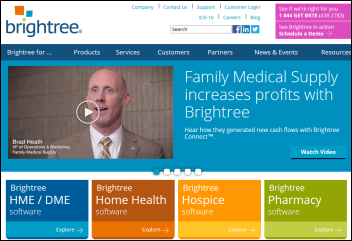
Sleep apnea technology vendor ResMed will acquire home health and durable medical equipment billing software vendor Brightree for $800 million in cash. ResMed, which also gets a $300 million tax benefit, will pay seven times revenue and 19 times earnings for Brightree.

Battery Ventures was an early Brightree investor and expanded the company with several acquisitions. It announced in December that it was exploring a sale of the company.


Reader Comments

image

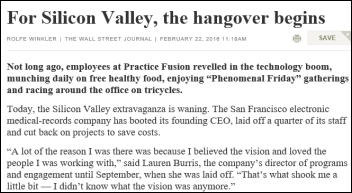
From Pointed Commentary: “Re: Practice Fusion. Tough times, per the Wall Street Journal. While the article doesn’t focus specifically on health IT, I believe the current investment environment will be brutal on startups and companies working to scale. I predict we are going to see accelerated consolidation of the space and private equity players are going to have a field day picking up companies that are struggling.” The article, titled “For Silicon Valley, the hangover begins,” gives Practice Fusion as its opening example of venture capital drying up and forcing cash-challenged companies to frantically change their business before their financial runway ends. That isn’t really surprising — it’s the usual cycle where innovative startups strike amazing business gold, the VC money flows in indiscriminately chasing the Next Big Thing before it takes someone else’s cash, and flawed startups ruin the party by going up in flames fueled by the money investors poured into them. It’s a cruel but necessary Darwinian process.


HIStalk Announcements and Requests

image

Welcome to new HIStalk Platinum Sponsor ECG Management Consultants. The Seattle-based, healthcare-only, full-service management consulting firm has offices in eight US cities. Its technology practice supports achievement of strategic, financial, and operational goals. The company has industry-leading expertise in system strategy, selection, implementation, and optimization, with a particularly notable history of helping ambulatory clinics improve their operations via technology, revenue cycle, and EHR systems. The company just announced formation of its bundled payments practice. Give their Value-Based Readiness Quiz a try or scroll through its impressive list of experts. Thanks to ECG Management Consultants for supporting HIStalk.

I found this ECG Management Consultants intro video on YouTube.

image image

Ms. Stitt from North Carolina says her second graders were so excited when our DonorsChoose package came with a library of books that they insisted she immediately read one of their new volumes, voting to skip recess.

image image

Also checking in was Ms. Tyler from California, whose Algebra 2 students are enjoying the eight scientific calculators we provided for students who can’t afford to buy their own.

image

CenterX donated $1,000 to DonorsChoose to attend my CIO lunch at the HIMSS conference next Wednesday, which funded these projects:

  • A programmable robotics kit for Mrs. Buchanan’s K-5 technology classes in Fort Mill, SC.
  • Electrical components for a student-led project at Ms. Read’s all-girls school in Austin, TX.
  • Eight motorized robot kits for the third-grade class of Mrs. Cespedes in Arcadia, FL.
  • Pizza gift cards to feed the after-school robotics team and their college engineering student advisors of Mr. Chen’s high school in Boston, MA. The student who is leading this project explains, “We are not trying to use the gift cards to start a feast, but we plan to use it slowly throughout the season. Also, Vivian sees that I, as the coach teacher, often provide my pocket money for getting the team food. As a result, she wants to take the lead to write this student-led project to get food for our team.” They emailed me to say, “Wow! Thank you so much for funding our project! We are writing to confirm with you that we have got the funding from you! We cannot be more excited to know about this! In the near future, we will share some pictures with you on how your donation helps our Robotics program! There are times that we hope that we can go easy on expenditures on food! Your help truly makes a huge difference! We cannot thank you enough for all this!”
  • An iPad Mini, case, and headphones for Ms. Alley’s elementary school class in Richmond, VA.
  • A 18-book STEM library for Mrs. Ochoa’s elementary school class in Phoenix, AZ.
  • A listening center and audio books for Ms. Bolinger’s elementary school class in Indianapolis, IN.

A couple of CIOs had to cancel their plans to attend the lunch. If you are a health system CIO who can spare a couple of hours next Wednesday to socialize and enjoy a delicious lunch (on me) with my donating vendors who are supporting DonorsChoose, contact Lorre.

image

Welcome to new HIStalk Gold Sponsor Audacious Inquiry. The Baltimore-based information policy and technology company helps government, private, and non-profit organizations share, manage, leverage, and protect information. Its implementation of master data management tools for health information exchange set the standard for HIEs throughout the US. Its Encounter Notification Service has securely delivered 10 million real-time event notifications and clinical summaries to patient hospitalization stakeholders in three years and powers FLHIE’s Event Notification Service, DHIN’s Encounter Notification System, UHIN’s cHIE alerts, CRISP’s Encounter Notification System, and HSX’s Encounter Notification Service. Here’s an overview of Audacious Inquiry’s Event Notification Services that I found on YouTube. Thanks to Audacious Inquiry for supporting HIStalk.


HIMSS Conference

The HIMSS ramp-up in HIStalk page views has started, with 8,700 of them in 6,700 unique visits Monday. The 52-week high is 13,500 page views on the Wednesday of HIMSS15. It would be cool to break the record this year.

I was looking over the HIMSS education schedule, which is indistinguishable from the exhibit hall stage talks given the number of sessions that have been turned over to vendor presenters, some of them using an entire slot just to talk about their products. It’s remarkable how the once-vital educational track has degraded into a lot of lame-sounding sessions presented by people I’ve never heard of. I’m clicking through the awkwardly designed session list on the HIMSS site trying to find something worth the time, but following my rule of never attending anything with a vendor presenter, there’s really not much left. Maybe providers are too busy cruising the exhibit hall for freebies to present.

I get this feeling that once I’m at the conference, I’ll just skip the education sessions and cruise the exhibit hall. The online guide shows 1,285 exhibitor booths, staffed by thousands of bored employees using them as the world’s most expensive telephone booths in screwing around with their phones instead of paying attention to attendees (although I admit that most of those attendees aren’t prospects or decision-makers anyway). I’m feeling sorry for the vendors banished to the downstairs Siberia that is Hall G (Booths # 9900 – 15209), which at HIMSS12 would have had few casualties if a bomb had leveled it. HIMSS must feel bad, too since they’re opening up only Hall G during Monday’s opening reception, giving it a few hours of undivided attention. We’ll be on the main floor in #5069 with our usual parade of interesting people sharing our area rug-sized space.

I doubt I’ll be the only attendee leaving Las Vegas long before Peyton Manning takes the mop-up snap after lunch on Friday to end the lamest set of keynotes I can recall. At least there’s no insurance company executives, Clintons, Bushes, Dana Carvey, or mountain climbers who hacked off their own arm this time around.

2-21-2012 1-58-54 AM

I was reading over my HIMSS12 Las Vegas coverage and decided I liked this line I wrote best: “Here’s a shot taken from the Venetian looking out to Las Vegas Boulevard. Inside, it’s a fake canal under a fake sky, women with fake breasts, and men with fake tans. Finally the exhibit hall isn’t the only place where things aren’t as they seem.” I opined that Las Vegas is like Orlando except with obnoxious adults instead of obnoxious kids.

DrFirst will be doing video interviews again at the HIMSS conference in the DrFirst-HIStalk “Roving Reporter” series. Healthcare IT leaders willing to share their experience, challenges, and perspective with their HIStalk-reading colleagues can schedule an interview time with Wendy Johnson.


HIStalkapalooza

HIStalkapalooza Sponsor Profile – NEC

image

Being the first enterprise communications technology provider in healthcare, NEC is proud to be part of HIStalk and the dedicated professionals who have grown with us and made this the most exciting, challenging and rewarding vertical industry. Leveraging 65,000 patents and over 100 years, NEC continues to develop healthcare industry-focused applications in communications infrastructure, IT/networking solutions, and award-winning biometrics. Want to learn more about NEC’s mission to orchestrate a brighter world through optimized solutions for healthcare? Follow us @NECHealthcare or #NECHIMSS16 and join our traveling “meet and greet!” We will post our positions to host you for coffee or a libation several times a day throughout HIMSS.


Webinars

February 24 (Wednesday) 1:00 ET. “Is Big Data a Big Deal … or Not?” Sponsored by Health Catalyst. Presenter: Dale Sanders, EVP of product development, Health Catalyst. Hadoop is the most powerful and popular technology platform for data analysis in the world, but healthcare adoption has been slow. This webinar will cover why healthcare leaders should care about Hadoop, why big data is a bigger deal outside of healthcare, whether we’re missing the IT boat yet again, and how the cloud reduces adoption barriers by commoditizing the skilled labor impact.

February 25 (Thursday) 1:00 ET. “Clinical Analytics for Population Health: Straddling Two Worlds.” Sponsored by HIStalk. Presenters: Brian Murphy, lead analyst, Chilmark Research; Jody Ranck, senior analyst, Chilmark Research. The Chilmark Research clinical analytics team will be sharing some of their key findings from the recently released “2016 Clinical Analytics for Population Health Market Trends” report. This will be followed by a Q&A session to make sure everyone goes to HIMSS16 well informed.

We’re running a HIMSS special on webinars – 25 percent off produced and two-for-one on promoted. Contact Lorre or see her at our booth next week.


Acquisitions, Funding, Business, and Stock

image

CTG announces Q4 results: revenue down 14 percent, EPS $0.16 vs. $0.08, beating earnings expectations but falling short on revenue and guiding down.  

Insurance startup Oscar Health receives a $400 million investment that values the company at $2.7 billion, up $1 billion since its last round in September 2015.


Sales

image

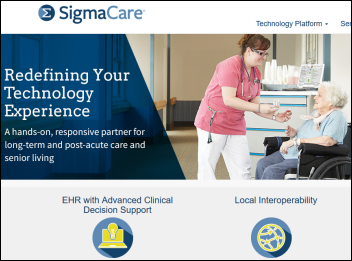
Northwell Health (NY) chooses SigmaCare’s EHR for its skilled nursing facilities.


People

image

Raj Sundaramurthy (Equifax) joins Catalyze as chief product officer.

image

Huntzinger Management Group hires Ed Fisher (E.L. Fisher Consulting) as practice executive of technical services.

image

PM/EHR vendor MedEvolve names private equity investor Jim Crook and Jon Phillips (Healthcare Growth Partners, above) to its board.

image

Tim Zoph (Northwestern Memorial Hospital) joins Impact Advisors as strategic advisor and client executive.

image

Former Merge Healthcare CEO Justin Dearborn is named CEO of Tribune Publishing, which owns the Chicago Tribune, Los Angeles Times, and several other newspapers. Merge Healthcare was controlled by Michael Ferro, whose investment company bought a $44 million stake in Tribune Publishing in February. Ferro’s $20 million Merge investment in June 2008 netted $190 million when IBM acquired the company  in October 2015 for $1 billion.


Announcements and Implementations

image

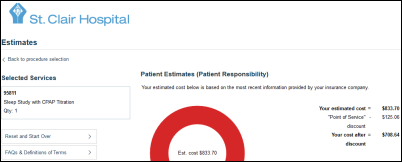
St. Clair Hospital (PA) launches a cost transparency portal, powered by Experian Health’s Patient Estimates, that allows patients to determine their estimated out-of-pocket cost for services using actual contracted cost.

image

EClinicalWorks announces that it will develop a cloud-based, single patient record EHR called EClinicalworks 10i that will span inpatient, ambulatory, and allied health. Tidelands Health (SC) will serve as development partner. The initial release in 2017 will focus on operations modules such as CPOE, bed management, inventory management, ED, surgery, and analytics. The CIO/SVP of Tidelands Health is Todd Rowland, MD, who completed a medical informatics fellowship at Harvard. I believe Tidelands is using Meditech.

image

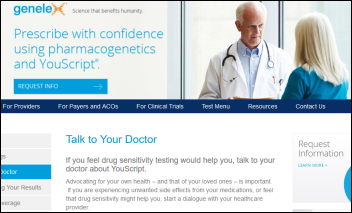
Epic will integrate genetics-powered drug ordering clinical decision support from Genelex into its product. Genelex’s YouScript Precision Prescribing software provides alerts if the patient’s genetic profile places them at higher risk for drug-specific adverse events. I see that Genelex will be exhibiting at the HIMSS conference, suggesting that it may be seeking additional EHR partners.

image

Forward Health Group’s PopulationManager achieves Oracle Validated Integration with Oracle Enterprise Healthcare Analytics.

image

FormFast announces its Mobile Bedside Consent Solution.

image

Clinical Architecture launches a natural language processing application for converting free text to discrete data, with the SIFT for Meds Web API service translating free text from clinical documents into RxNorm codes. It can also be used in real time to suggest coding as free text is being entered.

image

ZeOmega and Vivify Health will integrate their respective population health management and remote patient monitoring technologies.

image

Zynx Health announces a new release of its Knowledge Analyzer for management of clinical content and documents.


Government and Politics

image

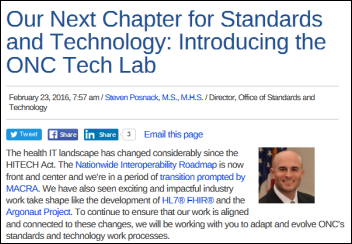
ONC announces the ONC Tech Lab that will coordinated interoperability standards, work on testing tools, conduct standards implementation pilots, and run challenge contests.

image

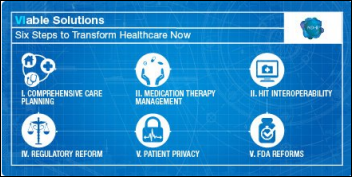
The Healthcare Leadership Council calls for six immediate steps to improve US healthcare, including setting a firm date of December 31, 2018 for achieving nationwide health IT interoperability.

A Harvard Business Review op-ed piece by David Blumenthal, MD and Aneesh Chopra calls for penalties “for providers and vendors that slow-walk the digital revolution to protect their economic interests” and a payment system that rewards improved quality and cost. It says, “If healthcare markets functioned well in the US, HITECH would have been unnecessary. The industry would have wired itself like our financial, travel, and retail sectors.”

The Wall Street Journal says New York’s hospitals and physicians will struggle to meet the state’s mandatory e-prescribing law that eliminates paper prescriptions as of March 27, 2016. Some providers are demanding an extension to the date that had already been moved back a year.

In Western Australia, the Labor party calls for the resignation of the health minister following an auditor’s report released last week that concluded that a $32 million data center contract has run $58 million over budget. The agreement with Fujitsu was amended 79 times, often by employees who were not authorized to make changes. The case has been referred to the state’s Corruption and Crime Commission.


Privacy and Security

image

Dartmouth College researchers announce a commercial prototype of a digital “magic wand” that allows non-technical home users to easily and securely configure new Wi-Fi devices, such as medical monitoring tools.

image

St. Joseph’s Healthcare (NJ) notifies 5,000 employees that their information has been exposed in a phishing scam.

image

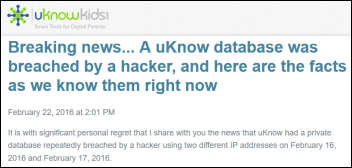
Child activity tracker uKnowKids announces that its database was breached by a white hat hacker who was trying to convince the company that its security systems were inadequate, exposing 6.8 million text messages, 1.8 million images, and the names and addresses of its young users.

Office of Personnel Management CIO Donna Seymour resigns two days before she is scheduled to face a House committee on the massive China-based theft of government personnel records last year. OPM’s OIG warned the office that the systems were insecure and therefore operating illegally, but Seymour overrode those concerns.


Innovation and Research

A small study funded by the Gates Foundation finds that fingerprick-drawn blood can give wildly different hematology results compared to venipuncture due to significant drop-by-drop variability. This could be important for point-of-care hospital testing and certainly adds another question mark to the nanotainer draws used by Theranos.


Technology

image

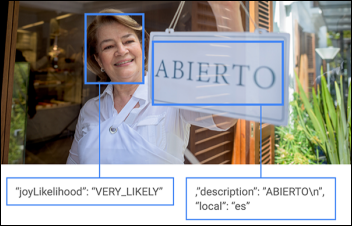
Google announces a Watson-like service called Cloud Vision API, which will generate insight from images. It can detect common objects, analyze the emotional attributes of people in the photos, and extract text using optical character recognition. Pricing is $2 per 1,000 images for label detection and $0.60 for 1,000 images for OCR.


Other

A man’s lawsuit against the nursing home in which his mother was killed by her roommate will test the legal validity of the arbitration clauses nursing homes insert into their contracts. Judges have consistently ruled that the clauses, which are also common in cell phone and credit card contracts, are binding if signed by the purchaser, even in cases where purchaser can’t read or write. The woman’s son argues that the contract he signed was not binding on his mother since he did not have power of attorney.

Alibaba Health shares drop 14 percent when the Chinese government’s version of the FDA decides to allow alternatives to its drug supply chain tracking system, support of which generates half of Alibaba Health’s revenue.

Healthgrades announces its top hospitals for 2016.


Sponsor Updates

  • Awarepoint customer Zion Medical Center (CA) – a Kaiser Permanente organization – wins the IHA 2016 Award for Innovative Healthcare.
  • Besler Consulting releases a podcast on the future of bundled payments.
  • Bottomline Technologies wins a Killer Content Award in the Agency/Publisher Partnership category from Demand Gen Report. 
  • Divurgent publishes a new white paper, “Improving Your ICD-10 Program: Preparing for Oct. 1 2016 & Beyond.”
  • CTG Advisory Services delivery directors Vivian Chun and Patricia Newcomb achieve the Patient-Centered Medical Home Certified Content Experts certification from NCQA.
  • Extension Healthcare is nominated for a Mira Award honoring the “Best of Tech in Indiana.”
  • SK&A publishes a market profile of US orthopedic surgeons.

Blog Posts


Contacts

Mr. H, Lorre, Jennifer, Dr. Jayne, Lt. Dan.
More news: HIStalk Practice, HIStalk Connect.
Get HIStalk updates.
Send news or rumors.
Contact us.

125x125_2nd_Circle

Curbside Consult with Dr. Jayne 2/22/15

February 22, 2016 Dr. Jayne 3 Comments

image 

I’ve mentioned a couple of times about having issues in the office recently, where our cloud-based EHR is down. A reader asks: “Please explain to me as an IT physician expert why your cloud EMR was ‘down again.’ Mission-critical systems should have backups. I also believed that bigger organizations should have more resources (like you) to prevent/remediate these events. Please tell your readers why this is happening and what procedures your organization has in place to prevent this?”

We actually went down again while I was seeing patients last week, although it only lasted for a few minutes. I’m happy to tell my story.

In my current clinical situation, I’m more representative of the “average Joe” (or Jayne) physician than an IT physician expert. Like many other physicians in practice, I am employed. Although I used to own my own practice, that was more than a decade ago and the demands of running the business took all the joy out of medicine, sending me into employed practice in the first place.

That was the position I was in when I became a CMIO – homegrown by my hospital/health system to take the reins as we moved into the EHR world, long before Meaningful Use was even thought of.

From a physician informatics consultant perspective, I live and breathe downtime strategy. Clients hire me to engineer their downtime strategies and ensure that being down is something they never have to encounter. Whether it’s the threat of utility providers with backhoes or a natural disaster, I’m all over it.

The downtime solutions I helped engineer when I was a CMIO were initially ridiculed by the IT department as overkill, but they proved themselves time and again as we encountered a variety of unstable situations. Car crash into the data center, knocking out power? Check. Flood in the backup data center? Check. IT guy pulls the Halon fire suppression system on accident, shutting down the building for half a day? Check. Network switch down? Check. Vendor fries your database with a bad upgrade? Check. We had it covered and I learned a great deal along the way.

However, when I go into the office now, I put on my physician hat. My employer knows full well what I do the rest of the time, and although we are a good-sized independent physician group, we don’t have the level of dedicated informatics or IT resources that a hospital-owned group or academic medical center might have. We sometimes run on paper-thin margins as we deal with shifting reimbursement schemes and a rising balance of patient pay accounts.

The bottom line is that that our management (like many other private practices) are not able (or perhaps willing) to pony up to have a full-time or even part-time expert deal with the situation.

That scenario is exactly why I went into consulting in the first place. I started my consulting practice on the side while I was still a CMIO, working with practices that might be on the smallish (or cheapish) side but that still wanted expert advice. Practices who may not feel like they can afford ongoing expert assistance, but might be willing to hire someone to come in, do an evaluation, and give them advice. But despite dire warnings and imperatives, clients don’t always take my advice and sometimes simply cannot afford to do so.

Eventually my consulting practice grew to where I also handle large hospitals and health systems, especially ones with more than their share of challenges. I left the hospital-based world some time ago and hung out my consulting shingle full time.

I had several locum tenens and urgent care-type assignments before settling in at my current practice. In my employment as “staff physician,” I am somewhat blinded to what our owners are doing with regard to the EHR vendor and the ongoing issues. I do receive direct emails from the vendor when the system goes down, and they’re “all customer” type bulletins, so I know that our outages aren’t due to local connectivity issues.

The level of redundancy our vendor may have is a black box to me as an end user. Although I have made suggestions about improving the downtime documentation tools and having regular drills, as an end user employee, dealing with the vendor is not my responsibility. (As a CMIO, I’d have had a vendor exec on a plane and hundreds of thousands of dollars of maintenance credits by now, had we had these issues.)

I’m not excusing the actions of my employer, but just sharing how it is in my world as an employed physician. They know what I do. They know I’m available if they want my opinion. Otherwise, my role is to care for patients and let management do the managing.

I will be visiting the vendor’s booth at HIMSS and asking a lot of pointed questions, but I won’t be doing anything to jeopardize my employment. A practice that lets me work a relatively limited schedule and is flexible with the demands of my consulting practice is rare. One that actually performs (from a clinical standpoint) at the level of my current employer is even more so. Despite the recent failures of our EHR, it does generate mounds of quality data that put us in the top decile for many benchmarks. Patients are voting with their feet as well, allowing the group to continue to grow.

You can bet that things would be different if I held a leadership or ownership position. But much like many other physicians across the country, I don’t. I am subject to the decisions of my employer. Maybe someday they’ll reach a place where they have dedicated informatics resources, but until then, I’m going to put my stethoscope around my neck and see patients.

How do you feel about being an employed physician? Email me.

Email Dr. Jayne.

HIStalk Interviews Michael Mardini, CEO, National Decision Support Company

February 22, 2016 Interviews 1 Comment

Michael Mardini is CEO of National Decision Support Company of Andover, MA.

image

Tell me about yourself and the company.

This is company number three for me in my career. It’s been 27 years in healthcare IT. I started back in 1992. I think that’s before healthcare IT was even an industry. [laughs]

I’m an entrepreneur focused on disrupting inefficient processes, keyed in on healthcare. It’s never really been about a market size opportunity for me. It’s something that somehow clicked for me, something that I found my passion for.

Startups won’t succeed unless you are waking up in the morning ready to take on the world. It’s intense. It’s pressure packed. I’ve been fortunate to have found a love in virtually everything that I’ve been involved in.

I’m getting a big charge out of NDSC. We’re at the precipice of defining how guidelines and pathways can be used in an actionable way, beyond paper and flowcharts, to impact outcomes in a positive way. We wake up every morning thinking that we’re doing something great.

What is the status of Medicare’s imaging appropriate use criteria?

It’s for outpatient Medicare imaging, the use of appropriate use criteria for all high-tech diagnostic imaging services. The original target was January 1, 2017. That has since been delayed. They haven’t set a specific date, but if you look at the regulations, all the timelines line up to January 1, 2018.

Is it a given that properly presented appropriateness guidance will change usage patterns?

How wouldn’t it? It really comes down to how it’s implemented. If you’re going to put guidance in front of a doc who’s about to do something wrong, where normally that order would just go through, and you give him guidance, how would it not have a positive impact?

The mechanisms that commercial providers use are radiology benefits management services. That’s an old-world version of what CDS does. It’s phone call driven. I’m going to make a call. I’m going to tell somebody that I want to order a test for a given reason. They’re going to look in a book. They’re going to say that’s a good reason or it isn’t.

CDS is embedded in the ordering process. It’s at the point of service. The easiest way I can describe it is that it’s the difference between calling the travel agent back in the day or logging onto Expedia. Implemented properly, there’s absolutely no reason why it won’t work. There’s evidence that shows this in multiple studies.

Did you look at existing clinical decision support models to decide how to present the guidance without being obtrusive or causing resentment?

There are two things that we hold near and dear to our hearts. First is the source of those criteria, meaning s credible source using a defined process for the answers that are given. It doesn’t mean that everybody’s going to agree with every piece of guidance. That’s impossible. But having a defined process and a recognizable and a reputable source is key.

The second big one is that workload has to be a seamless in what they’re working in. There were earlier CDS products in the market. They were standalone solutions. It was go to this portal, click 14 times, and it will give you an answer.

Everything that we do leverages the existing EMR infrastructure, whether it’s Epic, Cerner, etc.. The user never leaves their environment. In the best integration, they don’t even know that it’s there unless they do something outside of the guidance.

Even then, the advisories are those that are native to the EMR. It’s like any other advisory that they would see. There is no ACR Select physically on a user’s desktop when they’re working inside of an EMR.

That level of integration requires both technical work as well as convincing those EHR vendors to allow a separate system to present messages to their users. How did you make that happen?

The source of the content as a standard really got their attention. That was one thing. The fact that we were coming to the market, there was something that recognizable, that it’s something that they believe that if they did it right, all their customers would use it, gave us a platform to get in front of them and work with them.

I would argue that these guys get a little bit of a bum rap with respect to interoperability. I know the stories. We’ve had nothing but positive experiences with the major EMR vendors out there. There are always improvements that need to be made. There’s always timing issues with release cycles. But we use whatever industry standards are out there and are available, whether it’s XML or Web services. Even now they are working with us on the new FHIR and SMART standards.

It was hard. It took time and an unbelievable amount of patience. Every release, the integration gets better. We are reliant on their release cycles. We move faster. We’re a smaller company. These guys have thousands of users. Even if they wanted to turn on a dime, they couldn’t. It’s just taken time, an open mind, and some patience.

Who pays NDSC?

Primarily it’s whoever is at risk for payment. The majority of our clients now primarily use ACR Select for their at-risk population. In scenarios where there’s a third-party payer involved, there’s a relationship there, too. Bit it’s primarily the providers, because it’s an efficiency on their end and a savings on their end. If the risk starts to shift to the providers, we’re going to see even more of that.

Your website suggests that you’ll be moving into other types of order guidance.

Yes. ACR Select keeps me up at night. The new stuff, which is something called Care Select — which we’re announcing at HIMSS — is what gets me up in the morning. Care Select is going to be a revolutionary way of looking at how to put guidance at the point of care for a clinician around these high-impact areas in an actionable way and a credible way.

We’re leveraging everything that we learned, everything from how to structure content so it can be read by an EMR to integration into the physician workload. Everything that we learned through ACR Select, we are leveraging for Care Select. Whether it’s for high-cost drugs, antibiotic stewardship, admission criteria, or anything in that area where providers are identifying high variability of care that is resulting in quality issues, Care Select is going to be able to handle.

We’re focusing right now on our Choosing Wisely criteria as well as criteria from the Number Needed to Treat, which will be very familiar to the ED docs out there. That’s our baseline. Like I said, that’s what gets me out of bed in the morning.

What kind of employees do you have to get the clinical content into the technology?

We don’t create our own content. We are shepherding. We’ll work with NCCN. We’ll work with the Choosing Wisely guys. We work with the ACC and American College of Emergency Physicians.

The thing with their criteria is they’re all narratives. I’ll look at a 40-page document that talks about how to image for low back pain or how to treat a full thickness rotator cuff tear. Literally, it’s a 40-page narrative. How do you turn that narrative into structured data of inputs and outputs that are consumable and known by the EMR so you can put it into the workflow?

We have informaticists on our team that do nothing but that — take these known sets of guidelines, criteria, and narratives and turn them into something that is consumable by the EMR. We have tools to do that. We have tools to localize them for site-specific needs, too.

That’s a big piece of the organization. I would say 75 percent of the company is informaticists and engineers. The rest are admin, sales, and marketing.

Since the clinical content is managed by mostly non-profit associations that have already earned the respect of your users, do you have to license that intellectual property from them?

In some, cases we have to. In others, we don’t.

We actually prefer to license. We’ll run into a society that has built criteria just because it’s the right thing to do. We’ll approach them and show what we’re going to do. Get someone excited. Then we tell them that we want to give them money.

We want to give them money because we want them to have the resources to continue to build and support. It costs money to do that. These are not-for-profits. To the extent that we’re able to generate dollars for them to continue doing good work, we want to facilitate that. We want to foster that.

There have been scenarios where we have started with, "Here is licensing" where they’ve asked us, and there have been scenarios where we’ve offered and facilitated.

Where do you see the company in five years?

Healthcare is undergoing a significant change, driven by alternative payment models and everything else. Everything else fixed and situated on and what we hear every day about how we’re spending too much money on care without comparable outcomes to Finland or Sweden or whatever other homogeneous population that is out there. We see ourselves as at the precipice of helping the market to define and to drive standards of care and put those at the point of service such that they can be acted on.

There’s a lot of effort being spent on deep analytics to understand outcomes and understand where the problems are. Once they’re defined, how do you act on it? How do you impact on a doc’s decision when they’re in front of the patient, when they’re documenting in the EMR? That’s the next step. 

We see ourselves as a company that is well positioned to do that. We want to work with our partners. We want to work with providers, content partners, payers, and others to understand where those high-impact areas are that we’re able to impact immediately.

I could never predict five years out. But where we’re going is around actionable guidance embedded seamlessly in a physician’s workflow that will prevent mistakes from being made, driving appropriate care in accordance with agreed-upon pathways and guidelines. Five years from now, we’ll go from 100 customers to 1,000. That’s as accurate a statement as I can give you.

Empowering Patient-Centered Care – Will New OCR Guidance be Enough?

February 22, 2016 News Comments Off on Empowering Patient-Centered Care – Will New OCR Guidance be Enough?

We dig into the ramifications of OCR’s new clarifications on patient access to PHI.
By
@JennHIStalk

Since its introduction 20 years ago, HIPAA has come to mean a number of things to a number of people. Patients typically associate it with yet another form to be filled out without reading when visiting the doctor’s office, a vague reassurance via a Notice of Privacy Practices that their PHI will be protected from prying eyes.

Providers, meanwhile, see it as a framework governing security of that same health data – one that seems to have evolved into a rigid set of processes aimed at denying patients their PHI access rights. Business associates and payers likely look upon it with trepidation, wondering if and when their trove of hopefully secure health data will be breached.

What nearly all healthcare stakeholders seem to have forgotten is that HIPAA is also intended to be a means by which patients have clear rights of access to their data, a playbook that providers and patients can rely on to ensure timely delivery of sensitive – and sometimes life-saving – information.

Patient access complaints continue to mount even as the federal government widely publicizes its push for patient-centered and empowered care, a contradiction to be sure. To remedy the situation and send a reminder of what HIPAA is truly about, OCR issued updated guidance last month on how providers can best comply with patient PHI requests in a timely manner that doesn’t burden the patient with delay or expense. But will it be enough to truly turn the tide on an issue that seems to have historically been swept under the rug by both providers and OCR?

The Precision Medicine Push

image

OCR Deputy Director for Health Information Privacy Deven McGraw is confident the new guidance will bring HIPAA’s patient-empowerment side to light. “We have long wanted to provide additional guidance on this issue,” she explains. “When we began to get more involved in the White House’s effort to create the Precision Medicine Initiative, we could clearly see how the right of the individual to access a copy of her health information and send that information directly to a third party, like a researcher, could be very important. It would be very driven by the individual and their donation of data. The Precision Medicine Initiative really provided a hook to move this access issue up the priority list and get the new guidance out in a timely way.”

McGraw says that it’s been a long time coming, an issue that she has wanted to address from Day One. “The inability to access health information has always been one of the top five categories of complaints that we’ve received,” she explains. “When I interviewed for this position, I said, ‘I really want to work on the access issue,’ and it just so happened that they were thinking along the same lines.”

Understanding the Numbers

The sheer volume of patient access complaints (including Mr. HIStalk’s still-unresolved, six-month-long records request drama) may help explain why OCR has at times been sluggish in enforcing compliance with offending healthcare organizations.

“We get so many complaints that come into our office every year — in the tens of thousands,” says McGraw. “If one-fifth of those are complaints about access, we can’t investigate all of them. We try to deal with many of them by contacting the covered entity and just telling them they have to comply with the rules. I do suspect that often times what the individual or patient ends up getting may not be exactly what they want, and may not follow the letter of the law. Sometimes those people will complain again to our office and we’ll try to follow up, but often times they’ll just give up and take what they received, which is obviously not an ideal situation.”

The Root of the Problem

The access issue seems to stem from a lack of knowledge on the part of patients and a lack of efficient processes on the part of providers. Patient requests for records have historically been treated by providers as unusual occurrences. “It has not been built in as an ordinary function of providing healthcare,” says McGraw. “It’s really been dependent on people asking, and a lot of people didn’t know they had the right to ask. Sometimes they get turned away under the misimpression that HIPAA doesn’t allow them to obtain a copy of their own records, when in fact the truth is the exact opposite.”

McGraw continues, “An entity is required to give an individual a copy of their medical records. There has been a lot of misconception out there about what our rules require in terms of the actions that have to be taken by providers and health plans to respond to individual requests. That’s why we put the guidance out there.”

image

Because patients have been in the dark about their access rights, providers have in turn not rushed to make the process of delivering PHI efficient. “These processes may be antiquated for a variety of reasons,” says Erin Whaley, a partner at Troutman and Sanders law firm in Arlington, VA. “For instance, some providers still require individuals to deliver a request for access in person so that the individual’s identity can be confirmed. The provider isn’t trying to create a barrier to access. They’re trying to employ a best practice to verify the authenticity of a request.”

“They’ll need to make sure that they provide multiple avenues for an individual to request access, know which electronic formats they are capable of producing above and beyond the standard PDF, and enable various methods for transmitting the responsive information,” she adds. “Developing a new request form with all of this is obviously the first step. To the extent OCR has reviewed forms that it thinks represent the gold standard, it would be helpful to share those with the provider community.”

Getting the Word Out

McGraw and her team at OCR plan to move beyond the new guidance’s initial release with awareness campaigns aimed at trade groups, healthcare organizations, and patients. The office will release more in-depth FAQs into fees and the right of the individual to send their records to a third party within the next several months. It will also reach out to professional associations like AMA to help spread the word.

More consumer-friendly materials are also in the works via a partnership with ONC. “We’ve done some strategic thinking about how we’ll get these patient-centric materials out to people,” McGraw notes. “We’ve been in preliminary contact with other government agencies about how we can piggyback on their community outreach efforts. It’s premature to release any details about that.”

Enforcement is Coming

Enforcement is also a big part of the issue. That seems challenging given OCR’s bottlenecks in even responding to complaints, much less following up with enforcement.

McGraw emphasizes that enforcement isn’t an efficient process, with cases often taking years to resolve. She points to the civil monetary penalty levied against Cignet Health (MD) in 2011 – the only time a provider has been taken to such public task for violating the HIPAA Privacy Rule. Cignet willfully ignored the medical records requests of 41 patients between 2008 and 2009, and then disregarded OCR’s attempts to resolve the situation and subsequent subpoena in the years following. All to the tune of an eventual $4.3 million fine.

“The Cignet case was obviously an egregious one where there was a pattern of non-compliance,” McGraw explains. “It wasn’t just that they were making patients jump through hoops, but that they were refusing to give people copies of their records. Then on top of that, they didn’t cooperate with us. That was a pretty egregious set of circumstances.”

McGraw says OCR will step up enforcement. “Given the new guidance, we’re working with our regional office heads to come up with a strategy for how to step up our enforcement of these access cases. Clearly we’re going to have to pursue more of these. We will start enforcing this more aggressively. When we’re able to put out more details about this, we’ll do so. People shouldn’t put their heads in the sand about this. We’re quite serious.”

But Are Providers Ready?

Whatever the level of enforcement, Whaley believes providers are not ready for the increased scrutiny. “Providers know that OCR is looking to launch Phase 2 of its HIPAA audit program in early 2016 and are making sure that their house is in order in case they’re selected,” she explains. “While individual access is certainly part of HIPAA compliance, providers, for the most part, have been focusing their compliance efforts in other areas. There are still far too many who are not conducting a comprehensive annual risk analysis, or who have never updated their BAAs following the passage of the HIPAA Omnibus Rule. These providers are focusing on closing these gaps and not on their individual access processes. Hopefully, OCR will understand that while the individual access right is not new, there is a lot of new information in the guidance that will take providers time to implement. If providers are making good-faith efforts to respond to requests from individuals for access to their records, hopefully OCR will recognize this.”

Patients are the Decision-Makers

McGraw is enthusiastic about OCR’s efforts to shed more light on the patient access issue, and believes that fewer barriers will ultimately help speed up the road to interoperability and truly patient-centered care. “The role of the HIPAA rules is to create a baseline,” she says. “Nobody can fall below what we require in terms of access, but people can certainly go above and beyond. To be really patient-centered as a healthcare provider, even as a health plan, I think you have to give people the same access to the data that you have in terms of patient care and payment for care. Patients are the ultimate decision-makers for the type of treatment that they want. We have to give them information in order to enable them to make those choices.”

Monday Morning Update 2/22/16

February 21, 2016 News 1 Comment

Top News

image

In England, Royal Berkshire Hospital cancels surgeries after its Windows XP pathology systems are taken down by malware delivered as an email attachment. Australia’s Royal Melbourne Hospital had a similar problem a few weeks ago as malware affected its Windows XP pathology servers.


Reader Comments

From Red Zone: “Re: Allscripts India. President Nitin Deshpande is leaving Allscripts to join Valence Health. He set up the India office of Eclipsys from scratch in 2007.” Unverified.


HIStalk Announcements and Requests

image

Job seekers would choose Epic’s offer first, followed by Athenahealth. Allscripts and McKesson are the least-favored hiring companies. New poll to your right or here: is IBM Watson Health real or just hype?

image

A reader asked this question that I agreed to run as a poll for provider organizations: to what degree do you allow creating test patients in production systems? Feel free to help the reader out by clicking “comments” to explain after voting.

image

This weekend’s Las Vegas weather will be nice: high 70s and sunny, around 50 at night. It should be good HIMSS conference weather.

image

I feel like I’m running my own “Just Say No” campaign in fending off people determined to selfishly waste my crazy, pre-HIMSS time:

  • Can I bring a colleague HIStalkapalooza who didn’t sign up? No.
  • Can you interview my CEO right now so it will run right before HIMSS? No.
  • Can I pay you to run our article on your site? No.
  • Will you run a list of our HIMSS booth and speaking activities in your news post? No.
  • Can I schedule time to meet with you in our HIMSS booth? No.

I’m thinking this week will be slow as everybody saves their energy for next week’s conference.

image

Check out what HIStalk sponsors are doing at HIMSS with our online (and printable) guide. It lists everything from giveaways to educational presentations. For those sponsors who aren’t exhibiting, it includes their contact information for scheduling a meeting. Thanks for supporting the companies that support HIStalk.

image

Hollywood Presbyterian Medical Center’s decision to pay a hacker’s ransom to regain access to its malware-locked systems was probably a great business call by them – they had been without access for 10 days and were diverting patients as a result, so their $17,000 was well spent. Unfortunately for everybody else, their widely reported decision at will encourage ransomware hackers to step up their hospital attacks. The right thing for the hospital to do is to share what happened, how they detected it, how it affected their operation, and whether the FBI or other involved agencies advised them to pay up.

image

Mr. Ventura’s Nebraska school requires blurring student faces in photos, but he sent the one above showing a student using the green screen we provided in funding his DonorsChoose grant request. She is performing a Winter Concert reading as Apple’s iMovie projects behind her on the green screen, making it appear that she’s outdoors. They’re also using the green screen to allow students of the month to record their accomplishment. Next up is increasing the confidence of students by having them do Readers Theater projects on screen.

image image

I will allow Mrs. Swope from Alabama to describe the listening center project we funded in her own words: “The air in my class was charged with excitement when my students and I received a ‘mystery box’ one day after lunch. As I opened the box, my students couldn’t help themselves. They gathered around and proceeded to help me open our special gift (this has never happened to me before). It was almost as exciting as Christmas morning! As I unpacked each component to our new listening center, the children marveled at the equipment. They were so overwhelmed. The looks on their faces were priceless. My students couldn’t wait to get their hands on our new listening center. EVERY child has felt empowered when they have used the listening station to read books.”


HIStalkapalooza

image

Reminders for those invited:

  • You must RSVP the emailed Eventbrite order confirmation (click the “Attend Event” button). Once you’ve done that, you get a second email containing your actual PDF ticket. Once you get your ticket, you are set.
  • Print your ticket out in advance or installed the Eventbrite app on your phone – you’ll be checked in by scanning the unique barcode on your ticket.
  • We will close the check-in desk no later than 8:30, so arrive before then.
  • Security will turn away anyone without a ticket, just like at a Taylor Swift concert.

Last Week’s Most Interesting News

  • IBM announced plans to acquire Truven Health Analytics for $2.6 billion, rolling it into IBM Watson Health, the fourth such acquisition.
  • Hollywood Presbyterian Medical Center (CA) pays hackers $17,000 to return access to its systems that were crippled for 10 days by ransomware.
  • An investigative article warns consumers who might want to buy life, long-term, or disability insurance that any genetic testing results can legally be used to deny them coverage.
  • Cerner announced results that beat expectations, but shares dropped on the company’s first bookings miss since 2008.
  • Partners HealthCare’s $1.2 billion Epic project takes a hit on its operating profit.

Webinars

February 23 (Tuesday) 1:00 ET. “Completing your EMR with a Medical Image Sharing Strategy.” Sponsored by LifeImage. Presenters: Don K. Dennison, consultant; Jim Forrester, director of imaging informatics, UR Medicine. Care coordination can suffer without an effective, cost-efficient way to share images across provider networks. Consolidating image management systems into a single platform such as VNA or PACS doesn’t address the need to exchange images with external organizations. This webinar will address incorporating the right image sharing methods into your health IT strategy.

February 24 (Wednesday) 1:00 ET. “Is Big Data a Big Deal … or Not?” Sponsored by Health Catalyst. Presenter: Dale Sanders, EVP of product development, Health Catalyst. Hadoop is the most powerful and popular technology platform for data analysis in the world, but healthcare adoption has been slow. This webinar will cover why healthcare leaders should care about Hadoop, why big data is a bigger deal outside of healthcare, whether we’re missing the IT boat yet again, and how the cloud reduces adoption barriers by commoditizing the skilled labor impact.

February 25 (Thursday) 1:00 ET. “Clinical Analytics for Population Health: Straddling Two Worlds.” Sponsored by HIStalk. Presenters: Brian Murphy, lead analyst, Chilmark Research; Jody Ranck, senior analyst, Chilmark Research. The Chilmark Research clinical analytics team will be sharing some of their key findings from the recently released “2016 Clinical Analytics for Population Health Market Trends” report. This will be followed by a Q&A session to make sure everyone goes to HIMSS16 well informed.


Acquisitions, Funding, Business, and Stock

image

Opternative raises $6 million in Series A funding to further develop its app that allows consumers aged 18-40 to conduct their own vision exam, then send the result electronically to an eye doctor to have a prescription written. I’m sure it’s fine for generating a convenient eyeglass or contact lens prescription, but an exam should cover checking retinal health and screening for glaucoma. It seems like one of those bad ideas in which consumers get what they want instead of what they need. As the company’s disclaimer describes, “Opternative’s service does not include any type of eye health exam … our doctors recommend that all patients between 18 and 40 years old receive an eye health exam at least once every two years from a local eye care professional … Opternative’s technology is only intended and suitable for use by licensed ophthalmologists to perform online refractive eye exams on patients between the ages of 18 and 40 and in good health.”

image

Francisco Partners increases its ownership of CPSI to nearly 2 million shares, 14.6 percent of the company. Above is the one-year share price chart of CPSI (blue, up 4.5 percent) vs. the Nasdaq (red, down 9.2 percent).

image

From the Allscripts earnings call:

  • Recurring revenue made up 76 percent of 2015’s total.
  • Q4 bookings exceeded the company’s 2011 record quarter.
  • The company sells all products are being sold as subscriptions rather than upfront licenses.
  • Service volumes are down as clients choose hosted options.
  • The company expects growth in UK, Canada, Australia, and Southeast Asia.

Sales

image

Connecticut Children’s Medical Center (CT) chooses Fujifilm’s Synapse VNA version 6.0.

Sarah Bush Lincoln Health System (IL) chooses Cerner, which will replace Meditech.


Announcements and Implementations

image

Peer60 releases a new report called “The Big Mega HIT Purchasing Report.” The top purchasing plans for 2016 involve population health management and patient engagement. Epic continues to hold the top inpatient and outpatient EHR mindshare, although the outpatient figure really is hospital-based since only hospital employees were surveyed. Epic also holds the top mindshare for population health management and patient engagement, although that finding might call into question the interpretation of respondents. Cerner leads in enterprise analytics.


Other

Here’s another pretty funny Athenahealth commercial.

Weird News Andy says his proposed title of “Pharmacists > Crooks” is not a menu, but a mathematical representation. An Alabama pharmacist resolves situation in which a gunman took hostages and demanded drugs. She chose drugs that put the gunman to sleep, after which she took his gun and waved in police to arrest him. Or as WNA says, “Say ni-night, Mr. Robber. Hope you were not to surprised when you woke up in the Greybar Motel.”


Sponsor Updates

  • The St. Louis Business Journal profiles TierPoint’s new $30 million data center in Oklahoma City.
  • WeiserMazars donates books to the Ronald McDonald House New York as part of its #HookedOnBooks campaign.

Blog Posts


Contacts

Mr. H, Lorre, Jennifer, Dr. Jayne, Lt. Dan.
More news: HIStalk Practice, HIStalk Connect.
Get HIStalk updates.
Send news or rumors.
Contact us.

125x125_2nd_Circle

News 2/19/16

February 18, 2016 News 1 Comment

Top News

image

IBM will buy Truven Health Analytics for $2.6 billion, with Watson Health GM Deborah DiSanzo saying the acquisition makes IBM “the world’s leading health data, analytics, and insights company.”

The Watson Health unit houses previous acquisitions Phytel, Explorys, and Merge Healthcare.

Veritas Capital acquired the healthcare business of Thomson Reuters in June 2012 for $1.25 billion, renaming it Truven Health Analytics. Reports in March 2015 suggested that Truven was preparing for an IPO that would have valued the company at $3 billion.


Reader Comments

image

From CareCloudian: “Re: former CEO Albert Santalo. He has been fully removed and last Friday was his farewell party. That’s the second company he’s founded and then was fired from.” Unverified. He’s still listed on the company’s executive page and I assume he’s still chairman of the board. Santalo was removed as CareCloud CEO in March 2015. Revenue cycle vendor Avisena fired him as its president and CEO in September 2008 and then sued him and CareCloud, claiming that he had violated his non-compete agreement.

image

From Seashore: “Re: Sandlot Solutions. I heard they’re going bankrupt.” Unverified. I didn’t hear back from Rich Helppie or anyone from the company after running the rumor that they’ve had big layoffs.

From British Bulldog: “Re: EMIS Health, the former Ascribe. Phasing out operations in Asia Pacific through the end of 2017.” Unverified. The England-based vendor renamed itself in June 2015 to unify products that include EMIS (primary care software with 53 percent of the UK GP market), Rx Systems (retail pharmacy software), Ascribe and Indigo 4 (pharmacy and e-prescribing), and Digital Healthcare (retinopathy screening). EMIS bought Ascribe for $80 million in 2013.

image

From Dedicated Reader: “Re: Boston Children’s hacker. Caught after trying to flee to Cuba.” The FBI arrests 31-year-old Somerville, MA resident Martin Gottesfeld after he was rescued from his small boat off the coast of Cuba by a passing cruise ship. He is charged with coordinating a week-long denial-of-service attack against the hospital in April 2014 on behalf of the hacker group Anonymous. He faces a five-year sentence for conspiracy.


HIStalk Announcements and Requests

image

Welcome to new HIStalk Platinum Sponsor Catalyze. The Madison, WI company offers “Healthcare’s HIPAA Compliant Cloud,” making healthcare applications and digital health data secure, trustworthy, and interoperable. Developers build their tech stack, then turn things over to Catalyze to provide a HITRUST-certified platform-as-a-service that offers monitoring, dedicated logging, encryption, high availability, and backup and disaster recovery. The company just launched Redpoint, which offers an developer API that provides interface mapping, a RESTful API, a keep-alive VPN connection, and testing. Redpoint offers pre-configured EHR integration scripts (prescribing, encounter or note creation, results alerting, etc.), EHR connectors, and integration workflows. The company offers free reports, open source projects, and an innovator video interview series on its site. HIStalk readers will probably know co-founder, CEO, and privacy officer Travis Good, MD, MBA, who wrote HIStalk Connect for years until Catalyze grew so large (35+ employees) that he ran out of time. Thanks to Catalyze for supporting HIStalk.

image

Here’s a nice video of Catalyze’s Travis Good talking about compliance.

image

Ms. M from Colorado says, “I can’t believe someone would be this generous” in noting our funding of her DonorsChoose request for hands-on materials for her advanced placement statistics students.

image image

Also checking in was Mrs. Dickel from her Nebraska kindergarten class, explaining, “The kids are so into these new math tools that they even choose them over Legos during our regular center time! You are truly making a difference in these kids lives. THANK YOU!!!!”

This week on HIStalk Practice: Florida Accountable Care Services and UnitedHealthcare form Central Florida ACO focused on sharing technology and real-time data. Telemedicine market set to surpass the $13 billion mark by 2021. Associates in Dermatology rolls out Iagnosis telemedicine services. CMS introduces new core clinical quality measures. Brad Boyd ponders effective IT governance in the latest Consultant’s Corner. MTBC acquires Gulf Coast Billing. Genesis Medical Associates keeps acquirers at bay by staying tech savvy. Daria Bonner and Phillip Miles outline the importance of physician coder training systems in light of ICD-10.

This week on HIStalk Connect: As apparel companies race to build digital health ecosystems, Asics acquires fitness app Runkeeper for an undisclosed sum. Hackers turn to ransomware to monetize cyber attacks on provider organizations. Microsoft partners with Novartis to create a Kinect-based MS assessment tool. Researchers find little inter-rater agreement in a study designed to evaluate mobile health apps.

Listening: indie rock from Canada-based Wintersleep, whose upcoming release contains “Territory,” featuring a killer bass track by Rush’s Geddy Lee. They sound kind of like Nada Surf, which also has new album out in a couple of weeks. I’m also desk-drumming to a new release from the quirky boys of Weezer.


Webinars

February 23 (Tuesday) 1:00 ET. “Completing your EMR with a Medical Image Sharing Strategy.” Sponsored by LifeImage. Presenters: Don K. Dennison, consultant; Jim Forrester, director of imaging informatics, UR Medicine. Care coordination can suffer without an effective, cost-efficient way to share images across provider networks. Consolidating image management systems into a single platform such as VNA or PACS doesn’t address the need to exchange images with external organizations. This webinar will address incorporating the right image sharing methods into your health IT strategy.

February 24 (Wednesday) 1:00 ET. “Is Big Data a Big Deal … or Not?” Sponsored by Health Catalyst. Presenter: Dale Sanders, EVP of product development, Health Catalyst. Hadoop is the most powerful and popular technology platform for data analysis in the world, but healthcare adoption has been slow. This webinar will cover why healthcare leaders should care about Hadoop, why big data is a bigger deal outside of healthcare, whether we’re missing the IT boat yet again, and how the cloud reduces adoption barriers by commoditizing the skilled labor impact.

February 25 (Thursday) 1:00 ET. “Clinical Analytics for Population Health: Straddling Two Worlds.” Sponsored by HIStalk. Presenters: Brian Murphy, lead analyst, Chilmark Research; Jody Ranck, senior analyst, Chilmark Research. The Chilmark Research clinical analytics team will be sharing some of their key findings from the recently released “2016 Clinical Analytics for Population Health Market Trends” report. This will be followed by a Q&A session to make sure everyone goes to HIMSS16 well informed.


Acquisitions, Funding, Business, and Stock

image

Healthcare API vendor PokitDok receives an unstated investment from McKesson’s investment arm. The company had previously raised $46 million.

image

Leidos reports Q4 results: revenue up 10 percent, adjusted EPS $0.78 vs. $0.69.

image

Bloodbuy, which connects hospitals to blood centers, closes a $3.75 million financing round with Premier and St. Joseph Health (CA) as participants.

image

Allscripts announces Q4 results: revenue up 1 percent, EPS $0.09 vs. –$0.01, meeting earnings expectations but falling short on revenue.

The local paper profiles 20-physician, western Pennsylvania-based Genesis Medical Associates, which says UPMC and Allegheny Health Network are buying practices everywhere “to secure their patients, their referrals.” The practice says it has turned down “amazing” formal offers to be acquired. It describes its 2007 EHR implementation as “a challenge,” saying it will replace that system (apparently with Athenahealth) and adding that its patient portal isn’t user-friendly. However, the practice’s executive director embraces data-driven quality, seems to approve of the Meaningful Use program, and likes tracking referrals electronically.

image

From the Cerner earnings call:

  • The company says two big deals that didn’t close in Q4 would have allowed it to meet bookings guidance, avoiding the company’s first bookings miss since 2008, but says those deals are still on the table.
  • The former Siemens Health Services contributed $930 million in revenue for the full year. Cerner says the acquisition is meeting or exceeding financial expectations. However, Cerner says fuzzy revenue projections on the Siemens side impacted Cerner’s revenue expectations.
  • 2015 was Cerner’s best year ever for new footprint business, with 36 percent of Q4 bookings coming from outside.
  • President Zane Burke says the marketplace is becoming more aware of Epic’s high cost of ownership, lack of system openness, and lack of cloud-based systems to support population health, saying Cerner expects more success in new sales and selling population health software to Epic users. It says Epic-using Geisinger’s selection of Cerner’s HealtheIntent  validated “the shortcomings of our primary competitor.”
  • Forty Siemens customers signed to migrate to Millennium during the year.
  • Cerner says the EHR market is changing to what it envisioned in working with Intermountain, explaining, “We believe that EHR will evolve from a transactional system to an intelligent activity-based system that will enable faster adoption of best practices, reduce variance, personalize care, improve outcomes, and the ability to identify unit costs, which will be critical as reimbursement shifts to outcomes-based and bundled payments.”
  • EVP Jeff Townsend reports that Neal Patterson’s cancer treatments have gone well and he is progressing as expected.

Sales

Barnabas Health (NJ), East Texas Medical Center (TX), and Stanford Children’s Health (CA) choose Orion Health’s Rhapsody integration engine.

Partners in Care (NJ) chooses Wellcentive’s population health management solution.

AssistRx, Cerner, DrFirst, NextGen, and Practice Fusion subscribe to the ePrescribing State Law Review from Point-of-Care Partners to proactively identify system modifications that may be needed to address ongoing state and federal regulatory changes.

image

Phelps Memorial Health Center (NE) chooses Interbit Data’s NetRelay secure texting platform.

image

South Georgia Medical Center (GA) chooses Epic in a $50 million project to replace McKesson Horizon.


People

image

Divurgent will announce next week that it has hired Steve Eckert (MD Revolution, Encore) to the newly created position of president and COO.

image

Quality Systems hires Jamie Arnold, Jr. (Kofax) as CFO.


Announcements and Implementations

image

Nuance announces Dragon Medical One, a cloud-based, voice-driven physician documentation system.

Patientco announces Patientco Payments Hub, which allows RCM vendors to offer patient payment functions to their solutions with processing of all payment types and automated reconciliation. 


Government and Politics

image

Apple goes public with its refusal to comply with the FBI’s request that it add a security back door to a new iOS release that would allow the FBI to examine the phones used in the San Bernardino terrorist attacks in December. Apple says a security bypass could fall into the wrong hands and would then jeopardize the data of every iPhone user, adding that “the government is asking Apple to hack our own users” and taking the unprecedented step of trying to force an American company to weaken its security.


Privacy and Security

image

Hollywood Presbyterian Medical Center (CA) pays a $17,000 Bitcoin ransom to an unknown hacker to regain control of its computer systems that had been down for 10 days. The CEO says it was “the quickest and most efficient way to restore our systems,” as registrations had reverted to paper, medical records were unavailable, and the hospital was diverting patients to other facilities. The 434-bed for-profit hospital, which is owned by a Korean fertility specialist, was back up and running Monday. I assume they use a McKesson product since their portal is from RelayHealth. I collected some ransomware prevention tips:

  • Keep Windows, browser, browser plug-ins, and antivirus files updated.
  • Set the email servicer to block executable attachments such as .exe, .vbs, or .scr.
  • Disable Volume Shadow Copy Service (vssaexe), which ransomware sometimes uses to delete volume snapshots that could have otherwise been used to restore compromised files.
  • Disable Windows Script Host, Windows PowerShell, remote services such as RDP, and file sharing.
  • Store backups off site.
  • Don’t plug in USB storage or map network drives unless needed since ransomware often attacks there first. Use read-only folders wherever possible.
  • Define Software Restriction Policies to prevent executable files from launching from questionable folders such as /Temp and /AppData.
  • Make sure Office macros and ActiveX aren’t set to run automatically.
  • Enable “show file extensions” in Windows.
  • Install a browser pop-up blocker.
  • Deactivate AutoPlay.
  • Don’t stay logged on as an administrator unless necessary.
  • Install Office viewers so you can see what Word or Excel files look like before opening them.

image

A Fast Company article warns that while federal law prohibits medical insurers from denying coverage due to genetic testing results, companies that sell other forms of insurance (life, long-term care, and disability) are allowed to deny coverage to applicants with unfavorable genetic test results on file. Life insurance companies haven’t so far mandated that applicants be tested, but may decline to issue a policy if the applicant refuses to answer questions about past testing. The Genetic Information Non-Discrimination Act originally covered all types of insurance, but the legislative sausage-making stripped out everything except medical insurance. Researchers are concerned that more people will drop out of clinical studies for fear that their entire family could be denied life insurance forever.


Other

A New York Times op-ed piece titled “America’s Stacked Deck” points out the influence of money on elected officials, observing that drug companies spent $272,000 per member of Congress to lobby against allowing Medicare to negotiate Medicare drug prices, which it calls “a $50 billion annual gift to pharmaceutical companies.”

image

Florida deputies charge Malachi Love-Robinson with practicing medicine without a license upon finding that the 18-year-old is running a West Palm Beach holistic medical practice called New Birth New Life Medical Center & Urgent Care. The self-proclaimed doctor examined an undercover officer and provided medical advice, leading to his exit from his practice in handcuffs. He was also charged with stealing checks from an 86-year-old patient during a house call in which he wore a lab coat and a stethoscope, diagnosed her with arthritis, and charged her $3,500 for vitamins, later emptying her bank account by forging checks. Love-Robinson expressed indignation at his arrest, saying he feels “deeply saddened and a little disrespected.”


Sponsor Updates

  • Nordic publishes a new white paper, “Finding Your Balance: Applying Supply and Demand to Health IT for Growth and Efficiency.”
  • Computerworld profiles Nuance’s speech-to-text offerings.
  • Boston Software Systems offers white papers “Eliminate the Chaos: 5 Myths to Avoid in Your EHR Migration” and “Checking Medicare Claims Status: A Vendor Perspective.”
  • PatientPay announces the $10,000 Healthcare Billing Challenge.
  • Nordic releases a new HIT Breakdown podcast, “Chronic care management from three perspectives.”
  • Intelligent Medical Objects will exhibit at HackIllinois February 19-21 in Champaign-Urbana.
  • Oneview Healthcare publishes “5 Minutes with Niall O’Neill, COO.”
  • Verisk Health announces that its HEDIS solution is ready for the 2015 reporting system with HEDIS Certified Measures.
  • The Advisory Board Company announces two case studies in which health systems saved $7 million using its Crimson physician performance analytics software to identify improvement opportunities.
  • MModal announces that its Computer-Assisted Physician Documentation is being used at 150 sites.
  • Streamline Health will exhibit at the 2016 HFMA WA-AK Annual Conference February 24-26 in Seattle.
  • Sunquest Information Systems posts a client testimonial video from Tucson Medical Center (AZ).

Blog Posts


Contacts

Mr. H, Lorre, Jennifer, Dr. Jayne, Lt. Dan.
More news: HIStalk Practice, HIStalk Connect.
Get HIStalk updates.
Send news or rumors.
Contact us.

125x125_2nd_Circle

EPtalk by Dr. Jayne 2/18/16

February 18, 2016 Dr. Jayne 1 Comment

clip_image002 

Although health IT news is a bit slow in the run-up to HIMSS, I’m pleased to see that things are starting to pick up. I’m back on Twitter after a long hiatus and enjoying some of the conversations around HIMSS shoes. In looking for comfortable yet fun alternatives, I realized there is an entire market dedicated to alternative prom footwear of the sneaker variety. Although I’ve been to a wedding where the bride wore vintage Chuck Taylors, she was a PE teacher and it was part of a running joke. I’m going to have to completely rethink my plans for HIStalkapalooza.

clip_image004

I’m putting together my list of vendors to visit as well as my list of spectacles to try to photograph. As usual, several booths are planning a Las Vegas theme with blackjack or games of chance. Others such as FormFast are bringing exotic supercars or other “cool factor” displays. I always enjoyed the Indiana Jones-style guy they had in their booth that would throw hats to the audience. At least they’re tying in the car with their name and their business line through their “Fast Matters” campaign.

I’m also seeing an uptick in pre-HIMSS webinars as well as a couple of vendor campaigns encouraging practices to seek out replacement systems. I don’t know if it’s tied to HIMSS or not, but it was noticeable. My favorite communication from an EHR vendor this week was from Kareo, who asked me to take a survey about my practice’s success with their system. They should know that I haven’t logged on to their system in more than six months, which should be telling enough.

clip_image005

Edifecs has launched the #WhatIRun campaign supporting women in technology. They are donating a dollar to brightpink.org for every share or tweet of the #WhatIRun hashtag. Visit them at booth #8107 and they will also donate $5 to Miracle Flights for Kids.

clip_image006

NCQA has proposed an “ambitious redesign” of their Patient-Centered Medical Home recognition program. They’ll be hosting a Google Hangout on February 24 where practices can get an update on the redesign progress and hear from practices that participated in a redesign pilot program. I’m interested to hear about the changes, which will not only impact practices but also EHR vendors who support clients in achieving recognition. The Patient-Centered Medical Home movement is turning nine this month and the American Academy of Family Physicians put together a nice blog post summarizing a recent review of studies around the impact of PCMH on cost and quality.

clip_image007

Telemedicine is a hot topic and I was intrigued to hear about Nurx, which allows women in California and New York to receive prescription and delivery of FDA-approved contraceptives within 48 hours of accessing the app. They have plans to expand to HIV PrEP (pre-exposure prophylaxis) as well. Some are referring to Nurx as “the Uber of birth control” and I’ll be interested to see how it goes. I recently had the opportunity to speak at my local school board about proposed changes to their human sexuality curriculum, so I can imagine feelings about such a service will run the spectrum. Nurx waives its consultation fee for uninsured patients and in some markets patients can receive their medications the same day. Plans for expansion into markets in Illinois, Washington, and the District of Columbia are in progress.

For those of you who have been following my ongoing saga about Maintenance of Certification requirements for the Clinical Informatics subspecialty, I have some good news to report. Several Institute for Health Improvement Open School courses have been approved for ABPM LLSA credit. If you’re a member of an ABMS specialty board, you are eligible for a 10 percent discount by entering the code MOCABMS at check-out. Approved courses cover quality improvement, graduate medical education, and patient safety.

clip_image009

Packing for HIMSS is always a challenge and a reader shared a link to Heelusions as a way to make things easier. Invented by the reader’s wife and her mother, it allows you to accessorize a single pair of shoes for multiple looks. I’m all about supporting small businesses, so I’m happy to share. It’s a cool idea, but sadly my stiletto days are numbered.

Seeing patients this week has been a bit bumpy, with our cloud-based EHR being down intermittently for the last few days. Luckily our downtime procedures went more smoothly than the last time we had an outage, but it’s never fun when you don’t have all the regular tools at your disposal. I’m back in the office tomorrow so cross your fingers for me.

What’s the most annoying thing about the EHR being down? Email me.

Email Dr. Jayne.

HIStalk Interviews Matthew Hawkins, President, Sunquest

February 18, 2016 Interviews Comments Off on HIStalk Interviews Matthew Hawkins, President, Sunquest

Matthew Hawkins is president of Sunquest of Tucson, AZ.

image

Tell me about yourself and the company.

Sunquest is a market-leading provider of laboratory software to more than 1,700 laboratories. We help laboratories optimize their results to drive improved financial outcomes, improve patient safety, and work effectively across healthcare systems.

I have been with Sunquest for more than a year and a half now and love it. We have a great team of people here. We are headquartered in Tucson, Arizona, with more than 700 employees. I live in Tucson, where the business is headquartered, and thoroughly enjoy the company.

Software vendors selling standalone lab, pharmacy, and radiology systems have been hit hard as customers move to integrated offerings from Cerner and Epic or get bought by larger health systems that use those systems. How has that impacted your business?

I would emphasize that Sunquest continues to grow. Sunquest, as part of this growth, is absolutely committed to innovation and very focused on helping laboratories work effectively across an enterprise.

For example, Sunquest was a founding member of the CommonWell Health Alliance. We believe that interoperability across applications is very important. We don’t believe that any health system should have to sacrifice capability to select an enterprise. We think that our steadfast focus on helping laboratories do the best work they can outpaces the benefits of being part of an enterprise system.

Does the laboratory information systems business look simple until you understand what’s involved and the level of EHR integration that’s required?

On the surface, it could be perceived as easy. What actually is the case is it’s a very dynamic business. Laboratories play such an important role in the delivery of great healthcare.

Here’s a couple of stats that are surprising, but very important to understand. Laboratory testing represents typically less than two percent of overall healthcare spend, but influences more than 70 percent of all patient outcome and management decisions. Laboratory-related data makes up the majority of any patient’s electronic health record.

In some cases, there are basic blood tests, for example, that have become relatively simple to perform. In other cases, laboratory work is becoming increasingly sophisticated as our understanding of molecular and genetic science, for example, enables us to learn and understand so much more about a patient’s health.

Sunquest’s focus on laboratory excellence covers more advanced aspects of pathology, for example, in the cellular sciences — anatomic and microbiology, for example — as well as molecular and genetic testing capabilities. I feel that the next decade will enable us to know more about how to care for patients than any decade before. Hence, laboratories are becoming in some cases much more sophisticated operations than they’ve ever been.

Genetic and genomic data is a large amount of information that has to be immediately available in the work flow. How do you position the company against EHR vendors that may also see that as a market opportunity?

We see Epic and Cerner as nice electronic health record companies. The great news is that Sunquest integrates with them very effectively. We take large data sets — molecular and anatomic test results and now genetic test results — and can have those interpreted and put into a digestible report that can be inserted right into an electronic health record — for example, from an Epic or a Cerner or others — and be used in a clinical application to care for and treat a patient.

I would just emphasize that Sunquest’s commitment here is second to none. We’ve had a few recent acquisitions that I’d love to highlight, one of which is an investment — not a full acquisition yet, but an investment — that we’ve made in a business called GeneInsight, which is a genetic testing software platform developed by the folks at Harvard Medical School and the Laboratory for Molecular Medicine in Boston. It has been in continuous clinical use since 2005. Test result reports that are very complex and data-rich can be simplified and included in an electronic health record setting so that the ordering physician can use that to treat a patient.

What has changed in the almost four years since Sunquest’s private equity owners sold the company to a publicly traded industrial company, Roper Technologies?

Several things have changed. It’s a very exciting time at Sunquest.

We are financially backed by Roper Technologies. Roper Technologies is a publicly traded technology company listed on the New York Stock Exchange that invests for long-term growth and success of its businesses. We’re thrilled by that because that gives Sunquest a stable home.

In the last approximately year and a half since I joined Sunquest, we’ve had a considerable ramp-up in our internal product development efforts. We’ve invested heavily in product management and in product development. We have approximately 30 percent of our staff today that has been in and around a clinical setting or have clinical training and expertise. As a result of this last year and a half plus worth of effort, in 2016 alone, we plan to launch 15 substantial product upgrades, including two or three new product launches.

There’s a lot of things that have happened in the last few years since Roper acquired Sunquest. Many of these product upgrades include Web-based applications and support for the latest mobile devices. That’s what’s been going on organically.

We’ve also announced a new headquarters location for the business that promises very exciting things for our team members and employees, with great areas to collaborate and areas in which to work in an inspired setting in Tucson. We’re thrilled by that.

The other thing I would say that as far as Roper’s investment in the business, it hasn’t stopped. In fact, in the last 12 months, Roper — who is typically the acquirer of every company that it acquires and then will bolt them on or tuck them under the platform of various companies — has acquired three businesses that directly became part of the Sunquest platform. A business called Data Innovations, a business called Atlas Medical, and then a business called CliniSys, which is headquartered in Europe.

These acquisitions create across the Sunquest growing platform a unique breadth of capabilities that support laboratories in all of their facets, from connecting laboratories to very sophisticated lab instruments and equipment manufactured by the likes of Roche or Abbot or Beckman or others. Also, they help Sunquest solutions and Sunquest clients connect effectively to the healthcare communities, physician offices, and other places where — in the future and increasingly so — lab tests will be ordered and lab results will be shared with patients to improve the way patient care is delivered.

CliniSys has a large global footprint. How do you pair that up with the Sunquest offering for synergy or product alignment?

I’ll tell you a little more about Sunquest international business. That will bring this into a richer, more fulsome view.

Sunquest has approximately 1,700 laboratories that it works with. Nearly 200 of those are outside the United States and North America. Many are in Europe and in the United Kingdom.

For example, we have laboratory clients in the UK and in the Middle East that are a part of the Sunquest laboratory platform, and some in Australia. Sunquest also has a product called Sunquest ICE, which is an integrated clinical exchange solution that is in approximately 75 percent of the market in the UK, across several trust systems, et cetera.

The way we see CliniSys working closely with Sunquest, CliniSys has a market-leading presence in the United Kingdom for laboratory software. That will play very well working with the Sunquest Integrated Clinical Exchange product that will enable very efficient lab ordering and lab resulting back to the general practitioners in the United Kingdom.

CliniSys is also a market leader in France, Germany, Belgium, Netherlands, and Luxembourg. We think about CliniSys as being the Sunquest of Europe. We’re very excited about the opportunity to collaborate and identify ways that we can help our shared clients in the UK as well as new clients across Europe and other parts of the world take advantage of the efficiencies that our software can help deliver to those clients to emphasize the role of the laboratory in offering great healthcare services.

You made it clear in your introduction that Sunquest is a laboratory information system business, but at one time the company offered other software products, such as for radiology and pharmacy. Will that laboratory focus continue or would Roper consider non-laboratory acquisitions that might be paired with Sunquest products?

At Sunquest, our mission is to make healthcare smarter and patients safer. We believe that our focus on laboratories will enable those smart healthcare solutions. But in focusing on laboratories, we immediately see adjacent areas of focus as well that come into play and that we’re focused on organically as well as through Roper’s acquisition.

Let me highlight just a couple. One is, again, the advancement of precision medicine. It hasn’t historically played directly into the lab, but we believe it is absolutely becoming front and center in the way that patients will be treated. In the partnership today with GeneInsight, we are putting that software technology right into the heart of Sunquest and enabling those solutions to work for all of our clients.

Another exciting area that isn’t necessarily a core part of the lab today — but we believe will be and should be because of the incredibly important clinical data that laboratories produce — is in the whole world of analytics. We are launching a platform called Sunquest Analytics. We’re making significant investments in that platform, but in the future, that platform could also be bolstered by future acquisition opportunities aided by Roper as well.

Those are two examples of many that we’re focused on as we continue to round out Sunquest growing from a laboratory software platform to becoming a diagnostic solutions partner to the clients that we work with every day.

The industry is watching with fascination the train wreck that is Theranos. Do you think there’s lessons learned there for your business?

Absolutely. We believe that some lab tests — the basic lab tests and ones that don’t typically require a lot of consultative interaction with the pathologist — are likely to become more managed by a disruptive technology like a Theranos. There is probably a place in the market for those types of disruptive technologies for basic lab tests. We’re watching that very closely.

We also work with a number of high-performing, comprehensive laboratories that manage millions of lab tests and very sophisticated, complex cases every day. We see a segment of the market continuing to become more and more sophisticated given technology and clinical capabilities and understanding.

We’re excited about both ends of the market. We’ll continue to watch for and enable those disruptive technologies ourselves if we have the opportunity to do so, for the simple, direct-to-patient type testing capabilities. But for the comprehensive and complex test cases, we have comprehensive solutions that address those cases and enable the clients that we work with to manage those cases in a time-effective, cost-effective and patient safety-focused manner.

Where do you see the company in five years?

We see Sunquest continuing to grow and make significant headway in laboratory-related and diagnostic-related technologies that make healthcare smarter, improve patient safety, and deliver patient outcomes. The team members at Sunquest are truly inspired by our mission. We’re crazy enough to believe that, as we focus every day on serving our clients and on delivering innovative solutions, we can positively impact the lives of up to a billion patients. That’s our goal.

In five years, we see a company that’s passionate about serving our clients, committed to innovation in and around the laboratory that enables cost savings as well as dramatic work flow improvements that take direct costs out of the lab, but also dramatically impacts the indirect costs associated with downstream savings. For example, reduction in length of stay or reduction in returning to the hospital because patients weren’t diagnosed accurately the first time.

We’ll do this through dramatic improvements in the clinical applications around genetic testing and molecular testing. We’ll do this through the use of analytic information that’s produced by the laboratory to influence and help aid in physician diagnoses and patient outcomes. We’ll do this through helping health systems optimize the way they interact with laboratories. I’m very excited about the future for Sunquest.

Do you have any final thoughts?

We are really delighted that you would take the time to visit with us. I’m excited about being at Sunquest and about working with the team of very focused and dedicated people and helping to deliver solutions to our laboratory clients that make a difference in patients’ lives.

IBM To Acquire Truven Health Analytics for $2.6 Billion

February 18, 2016 News Comments Off on IBM To Acquire Truven Health Analytics for $2.6 Billion

image 

IBM Watson Health announced this morning that it will acquire Truven Health Analytics for $2.6 billion in its fourth acquisition since Watson Health was formed in April 2015. The acquisition will give Watson Health 8,500 new clients and increase its coverage to 300 million patient lives.

“With this acquisition, IBM will be one of the world’s leading health data, analytics, and insights companies, and the only one that can deliver the unique cognitive capabilities of the Watson platform,” said Deborah DiSanzo, general manager for IBM Watson Health.

The Watson Health unit houses previous acquisitions Phytel, Explorys, and Merge Healthcare.

Veritas Capital acquired the healthcare business of Thomson Reuters in June 2012 for $1.25 billion, renaming it Truven Health Analytics. March 2015 reports suggested that Truven was preparing for an IPO that would have valued the company at $3 billion.

HIStalk Interviews Bryan Hinch, MD, CMIO, University of Toledo Medical Center

February 17, 2016 Interviews 1 Comment

Bryan Hinch, MD is assistant professor of medicine and CMIO of University of Toledo Medical Center of Toledo, OH.

image

Tell me about yourself and your job.

I work clinically in internal medicine. I’m assistant professor of internal medicine and chief medical information officer at the University of Toledo Medical Center, as well as an associate program director for the internal medical residency. I wear a few hats.

On the CMIO tech side, I help coordinate, oversee, and am one of the decision-makers on the inpatient and outpatient EMR front. Most of my time is spent optimizing clinical activity or implementing new products.

I also help guide a skunk works that we’ve developed in house. We have a group of programmers that develop custom applications that fill niches that the bigger systems don’t fill. We’ve developed a number of applications that meet our unique needs. I help give them guidance and oversee what they’re doing and whatnot. That’s been my role lately.

I started here in 2008. I did my medical school training here. I did my residency here. I left for six years, four of which was in Dearborn, Michigan at Oakwood Hospital – a good place to work — my wife was doing her residency there in orthopedics.We went to Cleveland for a while and I worked at Metro Hospital. Then I came back because my wife’s family is from here and joined a group.

When I started, I was hired in in part to help them implement an outpatient EMR, which was Horizon Ambulatory Care, the McKesson system. From there, my responsibilities grew and I took over some of the inpatient stuff. They really didn’t have anybody like me on staff, so I started doing the CMIO position without the formal title. Eventually they formalized it with the title.

What is the medical center doing in the recently announced development project with Athenahealth?

We’re really excited about this. We were primarily — and still are — a McKesson shop, more or less. Horizon, McKesson’s systems, permeate everywhere. There was some dissatisfaction with the outpatient product. The practice plan decided a couple of years ago to begin looking at a replacement. Athena won that contract. 

From the clinical side, at least, we’ve been really happy. In terms of the clinical workflows, the number of complaints that I used to get with the McKesson system was enormous. Every day I’d get complaints from the docs about workflows or whatever. It’s a bit of an exaggeration, but not much.

With Athena, I had conversations with people about that. Are people just not happy with me and they’re not complaining to me any more, or are they happy with the EMR? It seems like they’re happy with the EMR and they’re complaining about other stuff now. They’re not complaining about IT on the outpatient side.

It’s been a relatively smooth transition. We’ve been live on Athena outpatient for just over a year. We went live on January 21. We basically swapped out the entire system, big bang in one day. It was about a five-month project. After contract signing, it took us about five months, which is a bit truncated, and it was a holiday. There was a ton of work in a short period of time, but we got it done.

It was relatively smooth. It was rough at first, but like any of these projects go, it was relatively successful.

There were some rumors going around with McKesson Horizon, but they made it very formal. Right as we were making this transition to Athena on the outpatient side, they told us that Horizon is going to be going away. They gave us a deadline of March 2018.

When we were reviewing our options, looking at budgets, timelines, Meaningful Use, and all of that stuff, we felt that we were somewhat going to be stuck with Paragon. McKesson was going to give us a deal that we were going to swap out what we currently own. There’s going to be a lot of cost reductions there because of swapping one-for-one for some of the stuff that we own. But Athena came along, and when we were doing our go-live on the outpatient side, they approached us with this idea of this partnership to help them work on the inpatient space.

We were relatively impressed with their vision, the corporate culture that they have, and what they’re trying to do with healthcare in general in terms of technology. We took this pretty seriously. We spent quite a bit of time reviewing our options and what it really meant to do an alpha. We understand it’s a ton of work. 

We ultimately decided that they have proven themselves in the outpatient arena of building a really good product. The KLAS rankings is one metric that shows that. Our internal satisfaction with the clinical workflows was another.

We had a kickoff meeting just about a week ago. I’m as impressed now as I was then with their approach. What they’re looking to do is not just build an EMR, because they’ve done that. They’ve got a product that’s in place in a couple of critical access hospitals that they’re using as a test bed. But the approach that they’re taking with us is more than that.

Yes, we’re going to have an EMR at the end, but they’re looking to use us to learn how hospitals — especially hospitals with an academic mission – work and identify what they call the hidden industry of scut work that could be automated or offloaded away from the staff, whether it’s nurses or doctors or whoever, to make them more productive.

It’s exciting. We’re really looking forward to taking this journey with them. We have some expectations of some concrete deliverables later this year, something we can show our board, “Yes, we’re making progress.” We expect to have something in place, like physician documentation or whatever. But so far, we’re pretty excited about this.

How do you draw the box around what you’re building with Athena?

A couple of things. The initial discussions with them were all about the clinical workflows. Lab would stay in place, so we’d keep McKesson. We have Horizon Lab, which I don’t think is getting sunsetted. But basically everything that’s getting sunsetted by McKesson, Athena’s made a promise to us that they’re going to swap out in some way, shape, or form.

That would be our ED system, so HEC, the nursing documentation system, HED, McKesson’s clinical portal, which is not the patient portal, but the physician workflows of looking at results and transcribed documents and that kind of stuff. That would be replaced. Physician workflows, order entry, and documentation, so HEO.

We had never implemented HEN, Horizon Expert Notes, which is the physician progress notes. We were never really satisfied with that product, so we were still paper until our skunk works built an online notes for the docs to use for progress notes if they want. That went live a couple weeks ago, but that was an internal thing. We built that thinking that’ we’ll be on Paragon, because Paragon is basically flip-the-switch two years from now. I wanted something in place for our medical students and residents to use, something electronic to give them that experience.

The pharmacy system is getting swapped out. That’s probably going to be later in 2017. Horizon Surgical Manager … we were under the impression that that would be sunsetted or at least swapped out, but McKesson is indicating that may not be the case, but we likely will swap that out, too.

Revenue cycle …  we approached them and said, if you do a good job with this, what do you guys think about revenue cycle? Star, which is the McKesson product, is our current revenue ADT feed. They said, why not?

If this all goes well, we may consider using them for our registration system, which would be nice because one of the troubles we have on the outpatient side is having the two registration systems. A lot of our clinics are facility-based and registering for both the facility side and the clinic side has been a bear. Getting that down to a single registration system would be ideal. That is contingent upon things going well with the clinical side.

That’s a long list of tasks to accomplish. How many people are Athenahealth and the Medical Center putting on the project?

From our side, because most of our resources on the inpatient side right now are in optimization mode and not implementation mode because we’ve got everything in place except for upgrades, those same resources, we expect, will be used for Athena. We have a core group that we think can handle the amount of work.

From the Athena side, we don’t have specifics yet, but we expect they’re going to be all over this place with folks, learning our culture, learning how the workflows operate in an academic setting, and helping us with all this work.

A big piece, of course, is our interface team. We are in the process of evaluating how much work the interface guys are going to need to do and bulking that group up on our side, but also on their side, making sure that we’ve got a good collaborative relationship with their interface team.

People who have worked with one system often end up building a new one that looks just like the old one because that’s their world view. On the other hand, the vendor needs to have enough knowledge to build a product that can be commercialized instead of just taking what one hospital says and going to market with it. How will you balance those interests?

I’ve given that some thought, as has our CIO. Our CIO, Bill McCreary, is taking on the stewardship of ensuring that what we create is going to be marketable to more than just us. He’s helping Athena negotiate that, thread that needle, so that we get what we need, but it’s also something you could sell tomorrow to another hospital.

We’re very aware that we’re not building just a custom job for us and that the relationship really is one of collaboration. We want this to be successful, and if we’re the only customer, we know that’s not going to be a success. We want it to be successful.

The second issue that you raised is, how do you prevent yourself from rebuilding what you have? The interesting thing is a lot of what we have in the clinical portal is what we built ourselves to meet our needs. It’s not just McKesson’s stuff in front of us. It really is a lot of custom work that we’ve built. We think we’ve got knowledge of how to interface with technology and provide physicians what they need at the time they need it. We want to take that knowledge and use it with Athena.

Athena, on their side, they’re planning on bringing some folks that are experts in human interface with technology. They’ve got some in-house expertise there. They’re going to bring those folks here and talk to us and do time-motion studies. Dive into the workflows and identify what needs to be blown up and what works and should be replicated.

Have you had discussions about the underlying technology?

It’s cloud-based. They’re going to host it. I don’t know their database architecture for this. That’s going to be one of our conversations, especially once we get with the interface team and start talking about this.

In terms of mobile access, to me, it’s a given. They already have a relatively decent mobile platform on the outpatient side. Most of our custom apps that we’ve built in-house, we’ve built with mobility in mind.

For instance, we have this patient hand-off tool that we built a couple of years ago. We’ve redesigned it twice ourselves. The redesign was specifically to make sure that we could scale it to an iPhone or equivalent smart phone. This replaces the traditional paper list that resident teams keep to track their patients. We saw that there was a need there. We just deployed it to the surgery department a couple of weeks ago. But medicine — my department – has been using it for two and a half years, squashing bugs and vetting it.

Mobility is going to be a big part of this. I don’t see nurses, especially, getting tied down to a computer. That’s one of the biggest complaints I have, and docs have, and nurses have, no matter what hospital I work in. I don’t just work at UT. I do teaching rounds at another hospital that uses Epic. The biggest complaint is that they feel like they’re tied to the computer typing all day. Is there a way around that?

The other thing that we implemented, right before Athena got in place, was voice-to-text. We use Nuance Dragon. How do we leverage that kind of technology to help speed up the process of inputting data in some way, shape, or form, and doing it in a way that’s hopefully structured so you can report against it?

There’s a lot of balls in the air, you’re right. How do we coalesce this down into a streamlined, functional workflow for the doc, the nurse, the physical therapist, et cetera? That’s what we’re looking to have these conversations with Athena about.

What happens if you don’t make the 2018 sunset date for the Horizon products?

We are going to be checking our progress. I think Bill McCreary, our CIO, is using Gartner as an external oversight to make sure that we are staying on task. We’re having a third party keep us honest in terms of making sure we hit these deliverables.

Worst case scenario, we would bail and go to Paragon, but I am loath to even consider doing that because the docs here have such an animus against the McKesson products. I think I’d be burned in effigy.

To answer your question, though, absent pulling a ripcord and jumping away from this — which to me, is a nonstarter — I don’t think it’s going to happen. Knowing our culture, at UT, we just get the job done. Historically, any time we ask the staff — the physician staff, the residents, the nursing staff — to step up, whether it’s Joint Commission or the ACGME coming through or Meaningful Use, they get the job done. They have this work ethic that’s phenomenal. 

I get that sense from Athena as well. When I’ve gone out to visit them and seen their folks and interact with them, they are just about getting the job done and doing it really well.

That being said, there’s a couple of possibilities. One is that if we miss the deadline, it’s not like suddenly the system is just shut down at midnight. They continue working. Our IT department has a wealth of knowledge of using these systems. McKesson has made it very clear that if this goes dark, you’re on your own. We understand that.

However, that being said, in terms of the core systems that we require to function on a day-to-day basis, I think we’ve got enough buffer in the timeline. Again, we don’t have a concrete timeline yet, but when we’re talking with Athena, we’ve got enough buffer in here that I feel pretty comfortable that we’re going to have things in place.

I think the other thing I would stress is that Athena’s not starting from scratch on this. They have acquired intellectual property through RazorInsights, their acquisition there, and with their agreement or their relationship with Beth Israel. I feel pretty good about saying this — they’ve got a pretty good bench strength on the pharmacy system and inpatient core systems that we need. I think they’ve got that knowledge, intellectual property, et cetera.

On top of that, you marry that up with our guys, like on our pharmacy team. Many of our custom apps are for the pharmacy and they’ve built them themselves. We’ve got guys in my pharmacy team who are both pharmacists and IT and they build apps. We feel pretty comfortable that whatever Athena can’t deliver on, we will probably be able to, in some way, shape, or form, take care of.

That’s a risk. This is the risk of the relationship. Going down this path with someone who has something that’s on the market. They’re in some critical access hospitals, they’ve deployed in a few places, but nothing like us. Nothing with the complexity of a larger hospital and the complexity of academics.

We understood that risk going into this. We made it very clear to the board and to all the decision makers that  the risk of going with another vendor is that you probably are going to have a lower-quality product for the capital expenditures and whatnot that we have available to us, versus going into a partnership with Athena. The risk is a little bit higher because there is a product that’s not basically on the market right now, but the expectation is that we’re going to have something truly awesome. We felt that that reward was worth the risk. 

We didn’t feel staying with McKesson was a safe choice, either. We really didn’t. They’re a good company and the folks we work with individually are wonderful, but we felt like in terms of the product we would get, we feel with Athena it’s going to be better.

That being said, our Plan B is to go back to McKesson, if this blows up in our face, and see what they can do. We’ll see, but I don’t think that’s going to happen.

Isn’t the medical school’s academic affiliation moving to ProMedica?

That is correct. The medical school is basically a victim of its own success. It has grown tremendously and is outgrowing the footprint of the hospital here. Same with the residency. We’ve grown the residency here as well.

We are busting at the seams with learners. As many medical schools do, they look outside and they look for some affiliations. We will be transitioning learners from this campus to the ProMedica campus. Yes, that is true.

Will you still be an academic medical center and the kind of partner Athenahealth originally envisioned?

That’s a good question. I don’t think all the learners are going to go. I think there’s still going to be learners here. This transition is a five-year plan in terms of transitioning the bulk of the learners over, at least the students, and some of the residents over.

To be honest with you, we had a pretty frank conversation with Athena about this. We tried to be as transparent as possible about this process. From my point of view, if you look at what they’re trying to get out of us, which is institutional knowledge of academics, that’s not going anywhere. I’m part of this process. The staff here all know how to work with residents. When you look at the timelines involved, the bulk of the work is done well before the significant number of learners will be over at ProMedica.

I think they’re going to get what they need out of us in terms of that knowledge and ongoing expertise. We were very upfront and transparent with Athena about that. They felt pretty comfortable understanding that things are changing here, too, in terms of that affiliation, but they still felt really comfortable going forward with us.


Text Ads


RECENT COMMENTS

  1. Re: Deliberately Faked Academic Papers in Nature See, this doesn't surprise me at all. Of course AI quotes these bogus…
  2. Challenger exploded on lift-off when the O-rings failed. Columbia disintegrated on reentry after one of the heat shield tiles were…

Founding Sponsors


Platinum Sponsors


Gold Sponsors


RSS Webinars

  • An error has occurred, which probably means the feed is down. Try again later.