

News 06/10/09
From EMR BloodClot: “Re: eHealth Ontario. It has just been reported that Sarah Kramer, the CEO of eHealth Ontario, has been given her marching orders to ‘beat it’ as CEO. She has wasted millions and lost track of the big picture, which is patient safety and clinician satisfaction with the Pan-Canadian EMR. Why does eHealth Ontario continue to ignore us, the clinicians, who will be the end custodians of this poorly thought out EMR implementation?” Because that’s what IT executives do (no offense to those CIOs who really do give physicians a strong voice in decision-making). I’ve been on that IT side and the working assumptions where I’ve been were that doctors and nurses (a) don’t understand organizational strategy; (b) are too easily swayed by demo eye candy and insincere vendor promises; (c) understand only products themselves and not the big picture IT world of vendor stability, product positioning, and integration; and (d) don’t appreciate IT’s technology, support, and organizational challenges. I’ve worked in three places where users were invited to review and recommend clinical systems. In every one, the first choice of doctors and nurses wasn’t the one that was purchased because we IT folks (some of whom were held in very high regard, mostly by themselves and their easily influenced peers) were so much more knowledgeable that we had the right … no, the obligation … to override them to buy what we thought was the best system. Their resulting adoption was about what you would expect. CIOs are often fixated on buying whatever will cause them the fewest headaches or that carries the lowest organization risk.
With Kramer booted from eHealth Ontario, do Courtyard Group and Accenture get a free pass for getting business from her under questionable circumstances? Or, as has happened before with BearingPoint and others whose inside contact was outed and ousted, does she go to work for one of them? She’s getting $317K in severance for up to 10 months unless she finds another job. I wouldn’t be looking too hard.


From The PACS Designer: “Re: Microsoft’s Bing. In a challenge to Google, Microsoft has released a new search engine called Bing. There’s Discover Bing Tour that Inga and others can use to shop for shoes, and at the same, time earn, some cash!” In a startling burst of originality, Microsoft swaps the order of Google’s six search options in creating its own unique user experience. Even the text ads look exactly the same. While I’m sure it works OK and maybe is even better than Google in some minor ways, it’s a shame that the best Microsoft can do these days is to follow paradigms created by competitors. I can’t see why I’d be interested even with zero switching costs since Google works fine for me.
From Richiebaby: “Re: ONCHIT. The comment period on funding for regional centers deadline is coming up … just so ya know. Here’s a link to the Fed Register: Notices May 28, 2009.”
A PR company e-mailed about my comment regarding InQuickER, which allows people to schedule ED visits online at participating hospitals (there aren’t many so far). My point: why are patients going to the ED if they aren’t sick enough to go through triage and wait? The PR company’s response (paraphrasing) is that it takes a long time to get a doctor’s appointment, so patients who need “ER care but are not experiencing an urgent situation” can wait for their arranged time comfortably from home and “help hospitals save money and become more efficient.” I don’t understand why towns of any size have an all-hours veterinary office/hospital that everybody else refers to, but in healthcare it’s only the ED working nights and weekends. You would think there’s business to gain.
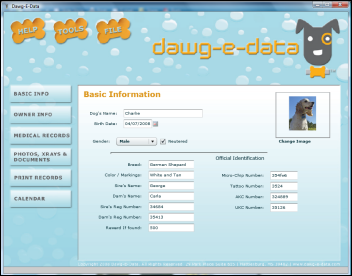
It had to happen: a company develops Dawg-E-Data, a $30 dog-attached USB PHR (or maybe CHR – canine health record) that holds medical information and gives appointment reminders. It was an unplanned side trip on the way to developing a human PHR. I kind of like it since people are more likely to keep their pet’s medical information current than their own.
Listening: Hammers of Misfortune, obscure California prog metal, kind of like Kansas or The Flower Kings. And watching: Deadliest Catch, although I have no idea why.
The VA will spend $3.5 billion for IT this year, but a new auditor’s report triggered by perpetually late VA planning documents says it isn’t capable of managing and overseeing its investments. The unusually pointed report (warning: PDF) says the VA’s problems started in 2006 when then-CIO Robert McFarland insisted on creating a centralized management structure reporting to him, but didn’t follow through with governance. McFarland says the criticism is a “silly, untrue and uninformed statement.” Roger Madura sent the link and postulates that the VA’s attempt to move from the much-heralded VistA to commercial software like Cerner Millennium must not be going so well.
Keane finishes its Keane Optimum iMed (Web-enabled clinical applications) implementation at Capital Health (NJ).
Nortel gets a mention in the Dallas paper for its high tech prototype medical clinic. Actually, it’s high tech only in the sense that it uses what Nortel sells: wi-fi, cellular, IVR, and RFID. London and Dubai will get their own prototypes later this year.
Former Eclipsys CFO Bob Colletti is named CFO of e-learning vendor Learn.com.
A Canada Free Press article called Healthcare: What Americans have to look forward to recaps the eHealth Ontario debacle (humorously, I might add). “CEO Sarah Kramer was earning a salary of $380,000 a year. While only being on the job a short while (the agency has only been in existence for nine months) she was awarded a bonus of $140,000. If she accomplished anything other than handing out attractive, untendered contracts to her friends and associates who, while the gravy train lasted, never had to pay for their tea and muffins, no one is quite sure of what it is. But there’s more. Beleaguered Ontario Health Minister, David Caplan last week ordered a third party review of eHealth Ontario’s expenditures, centering on the amounts paid for consultants. The province hired the firm of PricewaterhouseCoopers to conduct an examination of the way eHealth Ontario conducted its affairs. A third party review; in other words the province of Ontario hired a consultant to determine whether too much money was being spent on consultants.”
Vietnam’s economy is suffering because American technology companies that rushed in during boom times are now rushing out, leaving the country with a shrinking GDP and rising unemployment. Students are bailing out of science and technology programs and going into marketing and PR (bad idea).
Some anonymous blog commenters (not here) are demanding that Mark Leavitt step down from his role as CCHIT chairman, claiming his history with HIMSS will always taint CCHIT. My thoughts: I agree. HIMSS wisely used its clout to create CCHIT in its image and nurture it through general acceptance to advance its own agenda, but the strings need to be cut now (including replacing Steve Lieber as CCHIT board chair). I predicted when CCHIT was created that it wouldn’t really change the industry because the interoperability changes CCHIT was supposed to certify (and nothing more) weren’t capabilities customers cared about anyway. That’s what has happened, at least from my cheap seat. Now that CCHIT indirectly affects billions in stimulus dollars, I’d rather see it run by people with no trade group or vendor connections. If it isn’t willing to do that, I’d say choose or form another group to run the certification program. Some of what CCHIT wants to measure, report, or certify (functionality, security, specialty capabilities) is going way beyond what the government should be mandating anyway, although this particular government seems to enjoy telling carmakers and banks how to run their affairs (kind of like letting the Mafia buy into your business). It’s funny that the industry has fought tooth and nail to avoid FDA oversight that it couldn’t control, but seems to like CCHIT because it removes some competitors and sends innovation to the back of the line.
Speaking of CCHIT’s role expansion from simple interoperability certification to keeper of the official “here are the good EMRs” list, the poll to your right asks whether a mandatory EMR “Lemon Law” would be a better way to increase EMR adoption. The Yes votes are at 55%, while 45% say No.
Oregon passes a health reform bill that includes putting doctors and hospitals into a data network and also create statewide registry for the end-of-life wishes of citizens.

IT systems at Lawton Indian Hospital (OK) go down after a wind storm knocks power out.
iSoft launches a PACS product, developed with an Israel-based developer. It will be offered standalone or as part of Lorenzo.
Media reports said that Australia’s government would store health records on Medicare cards, but the government denies it. They still want to create a centralized database of medical records, with patient participation voluntary.
Idiotic lawsuit (dismissed): a woman loses her four-year lawsuit against the makers of Cap’n Crunch with Crunchberries when the judge rules that she shouldn’t have been deceived by the company, as she had claimed, that the cereal contains a real fruit called the Crunchberry. Her lawyer’s firm had previously lost a similar case in which they sued the Froot Loops people for deceiving highly literate customers who thought it contains real Froot.
HERtalk by Inga
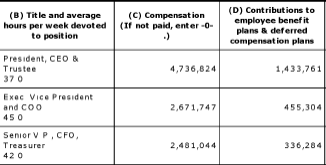
From Job Seeker: “Re: new job. I think I may have just found a contracting role to purse after reading Monday’s blog. Going to call Canada’s government agency eHealth and see if I can’t get to the bottom of why Peter Cho is paid 12% less than Richard Chen for the same job. And then there’s Kirk Chan, who earns quite a bit more than either one of them. Must be an alphabetical last name thing. That investigation should be worth $212/hour and a few uptight moments!” It’s pretty juicy happenings over at eHealth. President and CEO Sarah Kramer is now stepping down and there are calls for chairman Dr. Alan Hudson to do the same. Meanwhile, more reports of excessive reimbursement have surfaced, including a $30,000 for 78 hours of work (that’s $384/hour).
The administrator of Bradley County Medical Center (AR) says lack of capital and high cost is keeping his hospital from making its initial EMR investment, observing that “there’s nobody in the hardware and software business out there that’s cutting me a deal because I’m a small hospital.”

Meanwhile, the 11-bed Blue Mountain Hospital (UT) plans to implement Medsphere’s OpenVista in only three months.
The Minnesota-based Buyers Health Care Action Group rolls out myHealthfolio, a web-based PHR that utilizes the HealthVault platform. Avenet Web Solutions designed the application that will be utilized by Buyers’ coalition of public and private employees.
RelayHealth wins Target Corporation’s 2008 Partner Award of Excellence for demonstrating “innovative leadership, superior business practices and commitment” to Target’s core strategies. The award was presented at the recent National Council on Prescription Drug Program’s annual conference.
Former GetWellNetwork exec Bruce Matter joins Peminic, a healthcare workflow and process management supplier, as EVP over company growth and client satisfaction.
The VA announces plans to allow researchers to use de-identified, aggregated data of veterans to pinpoint the most effective treatments for specific conditions, including post-traumatic stress disorder and antibiotic-resistant staph infection.
James Giordano, president and CEO of CareTech Solutions, is named a finalist in Ernst & Young’s 2009 Central Great Lakes region’s Entrepreneur of the Year award.
Axolotl Corp. and Initiate Systems announce a partnership to integrate Axolotl’s Elysium Exchange and Initiate’s patient identification solution.
revelationMD wins a contract to provide clinical integration for Genesis Physicians Group (TX). The 1,460 member IPA will invest over $100,000 for the exchange technology.
The PPO Physicians’ Organization of the University Medical Center at Princeton selects iMedica as its recommended EHR/PM provider for its 500+ member physicians.
I upgraded from my old 2G iPhone to the new, hip, sleeker 3G model just two weeks ago. I am relishing in the fact that I was cutting edge – for exactly 14 days. I am now back in phone envy mode after Apple’s announcement of its new 3GS version.
Though 42% of CIOs in all industries cut their budgets by an average of 4.7% in Q1, healthcare CIOs reported an average increase of 2.2%.
And, according to HIMSS Analytics, US hospitals will spend $4.7 billion on IT this year and $6.8 billion by 2014. Providers will use an estimated 43% to 48% of their capital budgets on technology this year.

Sanford Health (SD) announces plans to construct its first international children’s clinic in Belize City, Belize. I’m already working on plans to have Mr. H send me to the ribbon-cutting.
If you are a provider organization wanting analysis on how well different vendors are positioned to meet yet-to-be-defined “meaningful use” criteria, KLAS has a new report to sell you. For $980, you can get opinions on how well nine different EHRs are delivering on CPOE, nurse charting, etc. Cerner and Epic received the highest rankings. If you would like this “Meaningful Use Leading to Improved Outcomes” report and you are not with a provider organization, you can still purchase it for a mere $18,800. (Did I mention that meaningful use is still not defined?)
Here is a sad sign of the times: retirees from Molson Brewery protest outside the St. Louis facility after the company announced a cut in their pension plans. The original pension package included six dozen beers per month, but, the company is now cutting this benefit down to one dozen monthly. Apparently, reception to the news fell flat.









































The author here keeps introducing irrelevant ideas. It's true that there are nimble organizations and bureaucratic ones. What is the…