Recent Articles:

HMS Acquires MEDHOST

February 1, 2010 News Comments Off on HMS Acquires MEDHOST

image

HealthTech Holdings, Inc., the parent company of community HIS vendor Healthcare Management Systems (HMS) based in Nashville, TN, announced this morning that it has acquired emergency department information system vendor MEDHOST of Addison, TX. HMS plans to develop an integrated EDIS for its hospital systems customers.

“This is a win-win transaction,” said Tom Stephenson, CEO of HMS. “We will work together to gain the benefits of collaboration and capitalize on each other’s strengths, bringing to market a truly customized and integrated product for our target market. HMS customers will benefit from the proven gains in productivity and safety brought on by automating emergency department visits. Moreover, MEDHOST’s automatic Charge Capture prevents lost charges and provides enhanced financial performance by calculating charges as care is documented. The system’s real-time notifications help keep ED clinicians and staff better informed about each patient’s status thereby improving quality of care.”

Comments Off on HMS Acquires MEDHOST

Concerro Acquires RES-Q

February 1, 2010 News Comments Off on Concerro Acquires RES-Q

image

Shift bidding software vendor Concerro announced this morning that it has acquired RES-Q Healthcare Systems, vendor of the 2009 Best in KLAS staff/nurse scheduling system. The RES-Q software includes applications for personnel management, enterprise-wide employee scheduling and staffing, open shift, surgery department management and case scheduling, patient acuity classification, and productivity management and reporting.

“RES-Q’s award winning labor management and scheduling applications are the only solutions that align completely with Concerro’s strategy to help healthcare organizations control labor costs through optimization rather than reduction,” said Graham Barnes, CEO of Concerro. “This acquisition reinforces Concerro’s commitment to delivering the most cost-effective and innovative solutions for hospitals. Unlike other legacy software, our management systems improve both quality of life and the bottom line across an installed base of more than 500 hospital facilities.”

Comments Off on Concerro Acquires RES-Q

Haemonetics To Acquire Global Med Technologies

February 1, 2010 News Comments Off on Haemonetics To Acquire Global Med Technologies

image

Blood management solutions vendor Haemonetics announced this morning that it will acquire Global Med Technologies for $60 million in an all-cash tender offer.

Brian Concannon, president and CEO of Haemonetics, said, "Efficient blood management is now being recognized as a critical component of improving clinical care while reducing cost, and Haemonetics is the only company positioned to address the needs of both the blood collection and transfusion markets.  Software is a key enabler for blood management, enhancing productivity, regulatory compliance and quality.  Global Med’s software offerings are a strategic complement to our existing products and will allow us to offer customers an end-to-end software solution for blood management, from donor recruitment to the patient transfusion."

Global Med’s companies include Wyndgate Technologies (donor center and transfusion systems), eDonor (donor relationship management), Hemo-Net (application service provider), PeopleMed (software validation services) and Inlog (donor, transfusion, and LIS technologies for European customers).

Comments Off on Haemonetics To Acquire Global Med Technologies

Monday Morning Update 2/1/10

January 30, 2010 News 11 Comments

From You’ll Know Who: “Re: Horizon Enterprise Revenue Management. Some observations from MCK’s January 26 conference call. It was said that HERM was designed ‘with an architecture similar to our clinical systems,’ which means it isn’t the same and not likely to be very integrated. Still scratching my head on the HERM amortization costs. Software revenue had to be deferred for ANY contract that mentioned HERM before it became GA. Now that it’s GA (supposedly), why is profit still declining and why did it trigger so much incremental amortization? McKesson tried to develop HERM quick and cheap in India, and when it didn’t work, executives were fired and the rumor now is that development is moving to Mexico. What happened to the original pilots, Gwinnett in Atlanta and Peninsula in Maryland?” All unverified. I still haven’t heard back from the Baptist CIO. I’ll say this: revenue cycle has been the Vietnam War of some big vendor superpowers. I was also thinking – is this the first product McKesson has actually built from scratch rather than bolted on from an acquisition? Maybe not, but I just can’t think of others.

From Lady IT: “Re: Sisters of Saint Francis. The rumor is true. I work for the vendor who is being displaced.” Hoosier is working there and agrees, saying Epic was chosen over McKesson.

From Bobby Orr: “Re: Rutland. They actually went Cerner for the EMR, not GE. Also, the vendor relationship movie was excellent. I think I’ve met some of those people in real life.” I thought that parody of bargain-seeking customers was funny, with excellent acting. Like my hero from the video says, we can do this!

From PeaPicker: “Re: CCHIT. Their committees haven’t met in a month and have done nearly nothing since early fall. CCHIT is completely focused on ARRA and has no interest in anything else.” Like the rest of the industry, unfortunately.

rmh

From Arnell: “Re: Riyadh Military Hospital. Is this a loss for QuadraMed? Saudi Arabian National Guard went live with then-Misys CPR in Fall 2004. Those implementations were also military hospitals. As a side note, it is interesting that when issues were created for that project, severity levels were determined by whether there was a member of the Royal Family involved as a patient or user.” Not much different than the small community hospitals I’ve worked in, where the entire facility went on red alert when a relative (even a distant one) of the hospital administrators or key doctors showed up. I’m not making this up: at one small hospital that was owned by a national for-profit chain, we management team members were convened in emergency session because the mother of our obnoxious eye surgeon had been admitted. Apparently the care those administrators oversaw for everybody else wasn’t good enough for people with connections. I wouldn’t exercise that privilege, though: I think you increase your chance for medical misadventure by breaking out of the routine.

From PBnJ: “Re: industry newbie. Which HIT publications should I subscribe to to learn, preferably free or low-cost ones?” You’re asking the wrong guy since I don’t read a single one of them, either hard copy or online, except for Inside Healthcare Computing. Try this test: go to the online site or current issue of any of them. Ask yourself, “Which stories gave me timely information that I can truly use in an informed manner?” Read the bios of the people involved – have they ever worked in healthcare? How quickly did the publication report on real news? Is the reporting balanced, or just typical fluff? If articles covered hospitals or people you know, were they accurately portrayed?

camels

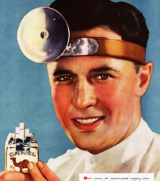
In honor of my intentionally politically incorrect logo, a reader sent links to smoking doctor posters from the 40s. I think I’ve run a couple of them before (Link 1, Link 2, Link 3). The guy above must be really good if the comparative size of his reflector is any indication. Using doctors to pitch cigarettes reminds me of the early days of the White Castle hamburger chain, which fed doctors and nurses workers free if they showed up in uniform, which inspired confidence in their product (kind of like the HIMSS conference). In those minimally regulated days before In-N-Out and Five Guys, people were wary of eating hamburgers in restaurants, probably for good reason. 

My calendar is surely defective. It cannot possibly be February already and just four weeks until HIMSS.

Speaking of HIMSS, initial response to the HIStalk reception was brisk, with over 100 RSVPs within the first couple of hours of the posting late Thursday night and 200 by Friday morning. The cutoff is 300, so thanks both to those who signed up and especially those may get shut out despite trying. I really appreciate the support (well, admittedly it’s free food and drinks and not exactly support per se, but I see lots of kindred spirits on the list). I hope folks will take pictures and send them afterward so I can show everybody can see how smart and cool HIStalk readers are.

Update: I got the RSVP list so far. Most common titles: VP variants (47) and CEO or president (40). Lots of CIOs, CMOs, consultants, etc. Many are familiar names, some listing new employers since I checked last. Nobody from my hospital is on the list, which is either good from my anonymity perspective or bad in the sense that my own co-workers don’t even read HIStalk (as Inga, would say, “Losers!”) I also like it when people leave comments with their RSVP, such as these: (a) Always love this event and the chance to mingle; (b) Save a dance for me, Inga; (c) Yours is the best networking, and most entertaining, event at HIMSS!; (d) Looking forward to chatting with all my HIStalk friends; (e) Always the best party of spring; (f) Many thanks to the kind hosts; and my favorite, (g) WooHoo! A couple of the comments even invited us to other parties, which was nice. Since I’m privy to who’s coming, I’ll share this: it is a stellar, fun group with lots of recognizable names. Deals will be made, people will be hired, and newsworthy events will result. Special thanks to the sponsors of HIStalk, HIStalk Practice, and HIStalk Mobile who are dropping by.

agr

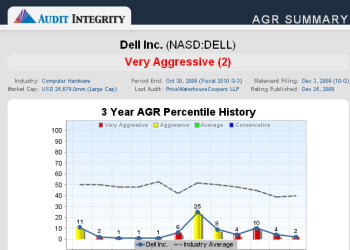
I ran across Audit Integrity, a free online tool that claims to be able to identify shareholder risk measured by “corporate integrity”, mostly related to accounting practices. The higher its AGR number (up to 99 since it’s a percentile), the better. I checked a few healthcare-related ones: Cerner (42), McKesson (5), Eclipsys (7), Quality Systems (54), athenahealth (99), Dell (2), and GE (1). I’m sure there is disagreement as to its criteria and usefulness, especially among the low-numbered companies.

AT&T will announce a premium group paging system this week that will let hospitals communicate with employees in an emergency. Employees or doctors on call will receive distinctive pager alerts and can call back or respond with a single click. It has its own ring tone that can be set to sound until the message is viewed, even overriding the user’s "quiet" or "vibrate" settings. The new service will work with AT&T’s Enterprise Paging service. I went down my hospital’s code list (Code Green, Code Brown, etc.) and this would be useful for any of those colors.

Wales NHS will introduce a new clinical portal that allow clinicians to view patient data and perform limited order entry. It will eventually allow clinicians to see a patient’s health record that includes information from physician practices once they work out information governance issues. The guy in charge makes subtle fun of NPfIT and it’s big bang, big bucks strategy. Wales kept it simple and its price tag was under $5 million. The portal has an interesting privacy approach: patients have to give their consent every time someone tries to look at their record.

CPSI’s Q4 numbers: revenue up 5.3%, EPS $0.33 vs. $0.44. The company blames hospital uncertainty about meaningful use, among other factors, as the reason it missed estimates. CEO Boyd Douglas from the conference call: “I think there’s obviously there’s hesitation on the part of new system sales. Some of that is coming from waiting on again while we have got the interim final rule, we still don’t have the final rule. And I think frankly, there’s some degree of skepticism out there amongst some of these hospitals about whether the money is really available, whether they really think they can meet meaningful use, things like that. And I think that will certainly turn once you start seeing some money flow. But hopefully, it will turn sooner than that.”

Quarterly results for Quality Systems/NextGen: revenue up 14%, EPS $0.46 vs. $0.46. Investors didn’t like the absence of an ARRA-fueled jump, punishing the stock as shares dropped from over $60 to close Friday at $51.54.

Albert Einstein Healthcare gets a mention in the local business journal for its $100 million EMR project. It’s happy about the prospect of ARRA payments, but concerned that only 50 of its 350 owned physicians will be eligible for stimulus money. They say that doesn’t make sense because they use different tools in their practices than they do in the hospital. A Pennsylvania Medical Society spokesperson also expressed concerns about the 80% CPOE requirement for practices, saying that as an example, radiology centers are not covered by the rules and therefore have little incentive to receive electronic orders.

McKesson announces GA of Horizon Practice Plus 12.0.

poll013010

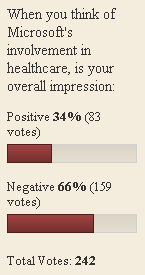
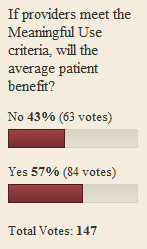
I guess our Redmond friends have their healthcare IT work cut out for them, based on the poll results above. New poll to your right, reader-suggested: same question except for Google this time.

Expensive politically correct action at Regional Medical Center (SC) results from its well-intentioned celebration of IT accomplishments, at which an employee in a gorilla suit handed out bananas at the “We’re Bananas For You” event. They always introduce their main speaker at those events with the sounds of “Hail to the Chief,” the timing of which offended someone whose outrage trigger meter must be set at 11. That’s good for an out-of-town diversity consultant, who gets a $78,000 contract to deliver a 2.5 hour mandatory employee in-service. Their Cerner implementation that was cause for celebration is going fairly well after some initial bumps.

The $28 million Epic implementation of Altru Health (ND) gets a mention in the local paper. A selling point: patients will get a single monthly bill that covers both clinic and hospital charges.

omnicell

Omnicell’s Q4 results: revenue down 11.9%, EPS $0.02 vs. $0.10. They’ve had some big Pyxis replacement wins, but those haven’t helped the bottom line so far.

Patrick Soon-Shiong, the drug billionaire with a big interest in interoperability, announces the spinoff of Abraxis Health from Abraxis BioScience. The new company will deal in personalized healthcare and molecular profiling. According to the press release, “Abraxis Health plans to develop a proprietary model for the delivery of healthcare, requiring a unique global computer software and hardware infrastructure that integrates patient data management, bioinformatics, discovery, molecular medicine and clinical development. Abraxis Health currently is designing and acquiring the necessary infrastructure and plans to acquire and internally develop the hardware and software modules to organize and integrate the data streams that form the foundation of this interactive database.” I’ve heard rumors that his foundation provided financial support to CAeHC, which recently benefitted from the unseating of CalRHIO as California’s statewide interoperability organization. Whatever group controls that project will be the conduit for billions of federal stimulus dollars in addition to sitting on a potentially lucrative database of patient information.

Iatric Systems brings in Aprima as its PM/EMR partner for physician practices connecting to Meditech. Aprima, as I have to remind myself every time I read the name, is the former iMedica. I interviewed CEO Michael Nissenbaum in the summer of 2008. He’s a straight shooter, even when I asked him some very direct questions (some of the best I’ve come up with on the fly, if I may humbly and impartially suggest).

If a well-placed rumor I heard pans out (and they usually do), I’ll be sending out a company’s acquisition announcement early in the week. Monday, in fact.

News from President Obama: stung by low approval numbers and voter backlash, healthcare is apparently no longer his administration’s showcase issue (since he didn’t mention it in his weekly address), replaced now by a new windmill at which to joust: reducing the crushing deficit that, according to him, is not his administration’s fault. I’m still anxious to be proved wrong about my Jimmy Carter reference from Inauguration Day.

A cardiologist is sentenced to four years in prison for underreporting taxes he owed on the estimated $40 million he made from day-trading in the late 1990s. He also has to cough up $16 million in back taxes, which must be extra painful since his portfolio went down in flames in 2000 along with the dot-bomb companies in which he was investing.

aventura

Billboards sprout up in South Florida as hospitals put up real-time ED wait times along busy highways, elbowing each other for market share of business that they always claim is a money-loser. Fast food restaurants and other businesses that rely on fast service don’t do this, of course, since McDonald’s would be out of business if they couldn’t promise fast service except when the sign says.

Inga did a really good interview with hand surgeon Neil Zimmerman, MD on HIStalk Practice:

But I’m very, very mobile now. I never know when I’m done with surgery. Some days it’s 1:00 p.m., some days it’s 4:00 p.m., but I just said, “Okay, I’m out of here,” because I can take my laptop, or I can even use my home computer and just VPN into our system and I’ve got every piece of paper that I can if I’m sitting in the office. For me, it got me out of the office today — I was done at 1:00 p.m. — it got me out about three hours earlier because I wasn’t sitting doing all my stuff there, which I normally would be, or taking home all those charts.

A preliminary report by the Massachusetts attorney general finds that insurance companies pay some hospitals and doctors twice the rate as others, with the main driver being the clout of the individual providers. “Everybody knows that there is dysfunction in the system, and nobody is happy with it. These rising costs are unsustainable. If we don’t do something about it, the only thing we’ll be able to afford is health care. No one will have money for food or housing.”

Michael Jackson’s father wants UCLA’s medical records pertaining to his son’s death so he can figure out how much to sue someone for. He claims there’s no doctor-patient privilege because MJ was long dead by the time he was taken to the hospital.

A British doctor living in Texas is in trouble for claiming a link between MMR vaccine and autism, which led to a resurgence of measles in England as moms passed on having their kids vaccinated. Lancet published his study that involved only 12 patients, including research in which he paid attendees at his son’s birthday party to give him blood samples. Reviewers say he was dishonest and irresponsible, noting that he was getting lawyer kickbacks from patients suing vaccine manufacturers. On the other hand, there’s a lot of money in traditional medicine that doesn’t want the apple cart upset, so who knows?

E-mail me.

News 1/29/10

January 28, 2010 News 12 Comments

From Ex-Cerner Guy: “Re: Yale New Haven. You’re not wrong, just early. Epic will unite all three facilities on a single enterprise-wide platform. Details are being worked out.” I have lots of moles feeding me information, some of them very well connected, so here’s the real story. YNHH recently hosted Epic demos and is actively discussing a system-wide implementation with them, but they are still working out the details and trying to figure out the money issues (back to rumor, someone told me over $150 million). They are reportedly not considering alternatives, possibly due to a strong desire to share data between the hospitals and their practices, which is an obvious Epic strong suit.

stanthony

From Certifiable: “Re: Sisters of St. Francis. The chain of 10-12 hospitals in the northwest Indiana area has signed with Epic for virtually all applications.” Unverified.

From GoogleWave: “Re: HIMSS10. A Google Wave has been set up. You must have a GW account to access. Search for HIMSS10 and join.” HIMSS is always dabbling with Facebook or Twitter or whatever tech fad du jour their marketing people convince them is cool. I’ll bet money right now that, like its one-time experiment with live-blogging the conference, its Wave won’t be around for the next one.

From Jedi Knight: “Re: HITSP’s ‘wake’. I was there and it didn’t feel particularly sad to me. Everyone is wondering what the successor will be; HITSP2 or some other acronym. Somebody has to turn vague federal mandates into specific implementation guides, after all. My personal feeling is that whatever is next will be a lot more paid employees and fewer volunteers. There is a giant pile of money being dumped in here after all for the beltway bandits and lobbyists to jump into. It’s a shame for the volunteers, but also interesting to think that there is a core group of seemingly salaried standards people from federal agencies and large companies doing all this work. It was also interesting to watch the attendance over the years; a small group swelling to a large group as newcomers were sent in to figure out how to get some ARRA pie. Then, to dwindle back down to the diehards who did all the work.” The government has extended HITSP’s contract until April 30 (without further payment) so it can participate in HIMSS and the Interoperability Showcase. They are trying to convince the board members to stick around until the newly extended end of the line.

From Anthony: “Re: Boxtee. There is also a neat iPhone app for Boxee that allows you to use your phone as a remote for your laptop.”

office2010

From The PACS Designer: “Re: Microsoft Office 2010 Beta. If you are contemplating the purchase of Microsoft Office for a new PC, you might want to wait a bit. Microsoft has posted their new Microsoft Office 2010 Beta for everyone to view and also try some new added applications such as Microsoft Office Home and Business 2010.” That’s advice that I will use since I’m on a trial version of Student and Home or whatever the cheap version is called. I don’t have much choice but to either buy or re-install since, in typical Microsoft fashion, its installer assured me that my existing Office XP installation would not be affected, but now I can’t open any of the old versions without getting the dreaded “Preparing to Install” error that means it really did. Be cautious if you try the Beta. Since I don’t often say nice things about Microsoft, here’s one: OneNote is darned cool, although they don’t really seem to understand how to market it since it’s rarely mentioned.

From Mallory Keaton: “Re: showcase. Whatever happened to your idea of having a (not) HIMSS event to showcase selected new healthcare-related technologies? One or two days in a non-expensive setting. It was, and still is, a great idea.” I’m going to reply personally to Mallory, but here’s my problem: I was really stoked about the “unconference” idea, but I have no time between my hospital job and HIStalk. I’m long on ideas, short on time, unless I go part time at work or learn to Halamka-nap instead of sleeping for six hours. I guess I could contract with someone to do the heavy lifting, but that’s another management headache right there.

pipe

From JN: “Re: logo. Am I the only person who thinks that your graphic of a presumed doctor smoking a pipe is a little over the top? Do you have any plans to change it?” (a) yes; (b) no. Actually some other folks obsess over the logo (“he’s SMOKING and it’s 2010, for God’s sake”) without seeing the anachronistic 1950s irony that I strongly signaled with the Ben Casey head reflector thingie. On the other hand, I like hearing that criticism because I know I’m getting new readers — the old ones have heard me explain it many times in the past (use the search box to your right to find “reflector” and you will see). My HIStalk Mobile logo guy is not smoking, so at least I’m showing progress.

From David: “Re: Meaningful Use. Do you know where the technical specifications for the quality measures are located?” Some information is in the incentive program document, but maybe someone knows a better source.

From Sinead: “Re: HIT worker shortage. How does the situation bode for us with new undergraduate degrees in healthcare informatics? Is there a place for us without healthcare experience, or are those degrees suited only for currently employed nurses or clinical workers?” I’ve been asked that question a couple of times in the last few days. First of all, you are always better off with more credentials and yours is a timely degree. However, as you noted, when employers look for “informatics” employees, that often means nurses with no formal informatics education (maybe an ANCC certification or 10×100 at best) or perhaps a dabbling doctor, but with hands-on implementation experience and peer credibility. The health systems in which I’ve worked (big ones) did not have formally educated informatics employees that I can recall. Perhaps you have technical experience such as programming or project management? Reader input, please.

party

The RSVP page for the HIStalk reception at HIMSS is now open. We’ve maxed out signups pretty fast in years past only to have a mountain of leftover name badges of people who RSVP’ed but didn’t come, so please don’t take up a spot if you aren’t sure you can come. Your hosts are Encore Health Resources, Symantec, and Evolvent, so thanks very much to them. I’m not exactly sure what’s on the agenda beyond lots of food and drinks, but it doesn’t matter anyway because the attendees are scintillating on their own.

Hamilton Healthcare System (TX) signs up for applications from Healthcare Management Systems.

marotta_robert mgma-9228

eHealth Initiative announces new board members, including Robert Marotta, Esq. of WebMD (chair) and William Jessee, MD of MGMA (vice chair).

The American Occupational Therapy Association is working with Cedaron Medical to develop and EMR and documentation system for OTs.

I’m not a fan of unions, but congratulations to the Teamsters, who get McKesson’s shareholders to agree that the company can’t pay John Hammergren’s family big money when he dies without first calling a shareholder vote. He’s already got $80 million in retirement money socked away on top of his $29 million annual income last year, but his family would have received another $3.5 million at his demise, not to mention another $30+ million in posthumous benefits that aren’t impacted by this new policy. MCK shares are up 139% since he took over in 2001, which isn’t terrible (about the same as competitor Amerisourcebergen) but still behind HIT competitors such as Cerner (up 366%) or Quality Systems/NextGen (up over 2300%).

vocera

I am honored to report that Vocera has joined HIStalk Mobile as a Founding Sponsor. David Brooks and I appreciate their support. We have other Founding Sponsors on board to announce shortly. In the mean time, e-mail me your thoughts about the iPad in healthcare, although I’m taking into account that in my January 2007 poll, 84% of you said the iPhone would have little to no impact on healthcare (doh!)

AT&T reports Q4 numbers: revenue down 0.7%, earnings of $3 billion, up 26%. Also announced: the company will spend an additional $2 billion in wireless network improvements this year, it added 2.7 million new customers in Q4, it activated 3.1 million new iPhones, and it’s offering an unlimited iPad data plan for $30 per month.

A couple of readers e-mailed me about the McKesson earnings announcement, wondering if the company is having problems with Horizon Enterprise Revenue Management since they wrote off some of their investment. I’ve e-mailed the CIO at Baptist Health System (KY) to see how well they’re doing as the first go-live, but haven’t heard back. As one reader wants to know, “is HERM following ProFit and Soarian?”

Riyadh Military Hospital in Saudi Arabia will implement Web-based clinical systems from ICT Health.

An interesting Q&A with Dan Rosen, assistant vice chancellor for personalized medicine at Vanderbilt, about its DNA sample database called BioVu and the Vanderbilt Electronic Systems for Pharmacogenomic Assessment:

The second thing we want is for BioVu to act like a giant clinical laboratory. The idea is that we all see the increasing robust science of genetic or genomic variation as ultimately coming to the bedside … It’s a pretty commonly held vision that at some point in the future a doctor will write a prescription and the electronic health system will say, ‘That’s the wrong drug,’ or ‘That’s the wrong dose of the drug for that patient,’ or ‘This particular patient doesn’t have the disease that you think they have because of genetic variations of some type.’ While people talk about that kind of vision, actually executing it presents a lot of practical problems, such as which genetic variants would you actually want to act on? What would be the strength of evidence? How expensive is it to do this? What information technology challenges are there? How do you store huge amounts of genetic data on huge numbers of patients, and access it rapidly?

Also going Epic: Genesis Healthcare System (OH), although the article isn’t clear on whether it’s inpatient, practice, or both.

E-mail me.

HERtalk by Inga


From YellowPad: “Re:iPad. I am interested to hear what HIStalk and its readers have to say about the iPad. I’m not sure why the market needs yet another device in addition to laptops, Kindles, and smartphones. On the other hand, Steve Jobs hasn’t made too many mistakes. My nine-year-old daughter wants one — that speaks volumes.” Like your daughter, I think it looks really cool and I’d love to have one to play with. However, it remains to be seen whether it can achieve widespread HIT adoption given its unique size, its price, and its lack of features compared to a notebook. I told Mr. H that I couldn’t see myself slipping the iPad into my purse on the way to a cocktail party, like I do my iPhone. And I wouldn’t want to use it all day, given the on-screen keyboard. However, if I traveled more, I’d like having one to take on the plane because it would make me look really hip.

From Weird Andy: “Re: $7 million to track down stolen hard drives. Well, yes, I bet there are some other people who think that it is a stimulus. However, instead of having a choice of where the $7M would be used, whether to buy equipment, reduce layoffs, improve facilities, or other options.”  All true, although in this case it was an (evil) insurance company that had the disk drives stolen and is now spending money for damage control. I bet those 700 temp employees aren’t complaining.

rutland

Rutland Regional Medical Center (VT) kicks off its $15 million EHR initiative and announces the project’s code name: SNOW (Simple Navigation to Online Wisdom). The project is scheduled to take 19 months to complete. I’m assuming GE is the vendor, since last fall Rutland agreed to serve as a national host site for hospitals considering GE products.

A Dell-sponsored survey by HIMSS Analytics concludes that data center demands for small and medium hospitals will increase 20-50% over the next two years. I’m sure Dell and its investors liked those results.

Valley Medical Center (WA) licenses Sunquest Collection Manager to automate specimen collection. Sunquest also recently installed its LIS and ICE Desktop solutions at employee clinics for the global airline Emirates.

Officials with University Medical Center (NV) say that personal information on traffic accident victims has probably been leaked from its trauma center. For more than three months last year, someone allegedly was selling patient information to personal injury attorneys. The FBI is involved.

McKesson and HP announce they are collaborating to accelerate EHR adoption among independent physician practices. The companies are bundling McKesson clinical and PM applications with HP solutions and including training, implementation, and local support. The program will be executed through HP distributor Tech Data. Good move, I’d say. McKesson seems to recognize that most practices, unlike hospitals, lack the internal resources required to coordinate the technical aspects of an EHR installation. And, despite how popular SaaS is becoming, there are plenty of providers who still insist on an in-house server. Offering a turnkey solution is going to appeal to a large constituency. HP is also a winner here because it’ll have a chance to increase its footprint in the small physician office space, a market where they’ve not been much of a player.

TX Ortho

A reader forwarded me this link to a blog compiled by Texas Orthopedics. Several of their physicians and other Texas clinicians are currently in Haiti helping earthquake victims. A few excerpts from real life heroes in action:

  • Our team performed around 14 surgeries today with 16-17 in-house patients remaining. The RNs and doctors will be taking turns over night to stay with these patients and take care of them.
  • The ORs at the Haitian hospital are like open out houses. Enclosed spaces with slits in the top of the walls to the outside. Our team converted a room into a two-bed OR with AC and an autoclave.
  • Today two women were getting their amputations revised, which involves cutting more of the leg off. They had spinals and were in no pain. Both of the women started singing a Haitian hymn while the saw blades were going.
  • Dr. Scott Smith from Texas Ortho group is hilarious. He is using his iPhone to entertain the kids in the village. He’s becoming a superstar!

McKesson announces the general availability of its Horizon Practice Plus 12.0 practice management system.

CareTech Solutions is providing healthcare help desk services to Mercy Memorial Hospital System (MI) and just implemented a Service Request Catalog to automate service requests.

Epocrates claims that over 350 medical centers and universities now use its mobile clinical and decision support software.

Odd lawsuit: A woman sues her oral surgeon for leaving an inch-long piece of steel in a mouth wound during a tooth extraction. Despite ongoing complaints of pain, nosebleeds, and sinus infections, she was told her reactions were normal and she needed to stop complaining. Eleven months later, after experiencing numbness and dizziness, she went to the ER and doctors found the metal piece. The steel has since been surgically removed.

 inga

E-mail Inga.

An HIT Moment with … Ford Phillips

January 27, 2010 Interviews 5 Comments

An HIT Moment with ... is a quick interview with someone we find interesting. Ford Phillips is the owner of River Bend Marketing.  

ford

How is healthcare IT marketing different today than it used to be?

Technology and social behavior are the driving forces behind the changes in marketing. In the mid-70s when I started, we had limited media at our disposal, so I used multiple forms of direct mail and print advertising to get my marketing messages to potential clients. Of course, we used press releases, but they served a different purpose during that era. Printing and postage were inexpensive and print ads were reasonably priced. We lived for the postman’s daily delivery of our BRC cards.

There were only about five or six trade magazines focused on healthcare at that time. Modern Healthcare came along in 1976, I believe, and Computers in Hospitals started in 1980. That magazine is today’s Health Management Technology. I was a charter advertiser in both of those magazines.

The advent of the Internet in the early 1980s changed everything, including marketing. Web sites became a company’s window to the world and e-mail addresses assumed a “golden glow.” Today almost every marketing medium my company uses is electronically generated and distributed.

For all of my clients in 2009, I did one large, print direct mail campaign. Everything else was electronic. Almost everyone one of my clients is using some form of social network marketing, something unheard of just two or three years ago. The methodology has changed in 30 years, but objective has not — get the right message in the right hands as cost-effectively as possible.

People often think that "marketing" and "advertising" are the same thing. How would you explain the difference?

People mix up the definitions because they do meld together in the minds of most people. That said, I have always used the following definitions for marketing and advertising. Marketing entails creating and communicating specific messages that position a company and its products’ value, features, and benefits in such a manner as to create a need for that product in the minds of potential end users.

When you pay to get that message disseminated through any medium, that’s advertising.

ARRA has unleashed a flurry of vendor press releases and programs such as interest-free loans and certification guarantees. What impact has this had on vendors and their prospects?

I have read all of the offers. The vendors are simply trying to use the smell of government money to attract as many prospects as possible. Some of the vendors are sounding a little desperate. An interest-free loan? Their products must be extremely expensive. And, how can you guarantee something that is still unknown?

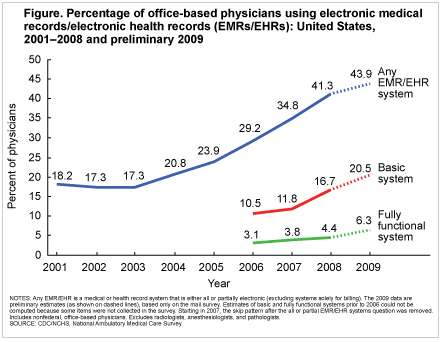
I’m certain the poor physicians are as confused as ever about the benefits of EMRs. EMR technology has been available, in some form or other, for a good while. The percentage rate for adoptions is still in the teens. There must be multiple reasons for that.

The economy is down, but healthcare IT is up. How has that affected your business? What are the right and wrong marketing actions that vendors might take in response?

The majority of my clients see the benefits of continuing a strong marketing communications program in any economic environment. We lost a few clients at the beginning of the downturn. Most of those were due to reduced investor financing.

The right thing to do in a down market is the right thing to do in an up market. In a nutshell, keep your marketing communications program focused. Identify three or four optimum marketing messages and target those messages to prospects who you know can benefit from your product.

Stay on your messages; don’t dilute them. Use the most cost-effective and varied communications strategies you can afford to disseminate your marketing messages to the target audiences.

What are the most important things about the healthcare IT market that new entrants and startups should know?

Be flexible in your planning and execution and be prepared to change directions quickly. Nothing will remain the same, industry-wise or technology-wise. If you remain flexible and can adapt to change, you will be successful in the healthcare marketplace. Not a single technology platform that my clients’ products use today was even envisioned when I started in this industry 30 years ago.

News 1/27/10

January 26, 2010 News 9 Comments

From Joe: “Re: NIST certification award. As I understand it, this is a contract extension of work that Booz is already delivering, modifying the simulation model for HIEs to test their connection to NHIN. That is the tenuous connection to certification since HIEs are expected to be an information source for CMS and a transfer point for regional hubs.”

From JJ: “Re: shortage of HIT workers. Do you have any information on the workforce situation?” Quite a few studies and SWAGs have been done, all claiming that the industry will grind to a halt due to a lack of experienced informatics people (especially the good ones). I hesitate to name any particular prediction since there are several and they vary widely. ONCHIT has even weighed in with similar conclusions. So while I think predictions on magnitude may differ, pretty much everybody says there will definitely be a shortage as lots of people try to implement systems simultaneously due the HITECH window.

boxee

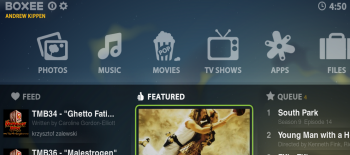
From The PACS Designer: “Re: Boxee. Another cool application has appeared that may be of use to HIStalkers. It is called Boxee and makes linking applications simple. With Boxee and a cable that sells for under $20, you can link your PC to your TV. Even MR. H can link his music on Pandora to his TV!” The folks who designed the Xbox 360 are designing the Boxee Box, which will go on sale shortly at under $200 with support for media of most every kind and some Web pages (Facebook, Twitter, etc.) Until then or as a free alternative, you can hook up your laptop directly to the TV and run the free download (Windows, Mac, Linux).

ynh

I ran a anonymous reader’s rumor claiming that Yale New Haven is replacing Eclipsys with Epic (no details were provided). Eclipsys e-mailed to say that is not true. I was at work at the time, so I removed that item pending further research (hard to do since Epic doesn’t issue press releases when they win and Eclipsys doesn’t issue them when they lose, which is why I ran it in the first place because I thought maybe it was commonly known even though Google turned up nothing). I asked Eclipsys for a statement from the hospital and haven’t heard back, but another reader ( not anonymous) said YNH has three hospitals, multiple systems, and outpatient facilities, so Epic could be in play somewhere or maybe nowhere. Anyway, I originally said the rumor was unverified and it remains so, but further information is welcome.

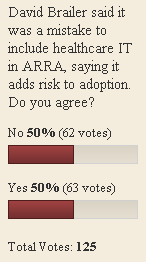
A couple of readers have reported crashing IE8 when opening the HIStalk page. The culprit appears to be the poll to your right, hopefully something to do with JavaScript and not the fact that it is reporting that 2/3 of respondents take a dim view of Microsoft’s involvement in healthcare. Nothing has changed on my end. I only use Chrome and occasionally Firefox, so I had no idea. It’s actually a known issue with IE8 and possibly Win7.

McKesson reports Q3 numbers: revenue up 4%, EPS $1.19 vs. -$1.12 (although most of that prior year’s loss was because of their AWP settlement). That beats Wall Street estimates. Technology Solutions didn’t do so great, with profits down 11%, although some of that was due to amortization of its revenue management product that went GA during Q2.

Q4 numbers for Philips: flat revenue, EPS $0.27 vs. -$1.99, beating expectations. And at Siemens, revenue was down 12%, operating profit up 11% after major cost-cutting.

ansongroup  

I am happy to welcome Anson Group of Carmel, IN as a Platinum sponsor of HIStalk. Their Connected Health Practice has a multidisciplinary team of experts ready to help clients commercialize their healthcare products while meeting regulatory requirements. They work with device manufacturers that provide networked devices to hospitals, tech companies submitting FDA 510(k) forms, consumers, and traditional HIT vendors interested in connecting their EMR, PACS, and other clinical systems to drug and device products. The company covers the gamut from FDA, HIPAA, reimbursement, coding requirements, and post-market support for participants in Connected Health. I was interested in their case study describing their work with a university to commercialize internally developed CT imaging technology. Thanks to Anson Group for keeping the keyboards clicking here at HIStalk.

tablet

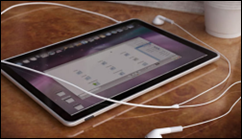
Wednesday is Apple Tablet day, supposedly. Is it an e-book reader? A supercharged netbook that runs iPhone apps? An overpriced version of a form factor that keeps failing? Yet another category killer that demonstrates how well Apple develops products, or perhaps how poorly their competitors do? We will know soon. Speculative rendering above by Wired/CNN.

Huffington Post has an interesting story reminding that when you open up electronic records to patients, somebody’s going to have to explain to them what the heck they are reading. Something as simple as displaying a routine lab result as “abnormal” will freak out some of them (generating anxious, no-reimbursement calls). Hopefully it will work as well as the system my doctor uses, where he adds a comment at the top of each results page to tell me what’s important. That probably takes us full circle back to paper charts, which providers were reluctant to let patients read not because they were secret, but because patients might do something irrational due to their lack of understanding. It’s not much different than trying to decipher that cryptic work order that your mechanic uses when aligning your car’s front end – invaluable to the mechanic, worthless to you.

It’s the end of HITSP, at least for now. The organization’s contract with ONCHIT has run out, although it or its participants will probably resurface in some form. I heard its final lunch this week was billed by ANSI as a celebration, but felt more like a wake because it was the end of the line.

Jobs: Clinical/EMR Project Manager, Misys (Allscripts) Practice Management Expert, Soarian Clinicals – Plan of Care, Application Analyst.

Listening: White Witch, the hardest rocking, most-imitated 70s band you’ve never heard of. The Tampa-based Southern glam/rock band released two albums including a killer debut, opened for big names like Grand Funk Railroad, then broke up. Two of the five former members have died of cancer since 2000, unfortunately making a reunion impossible.

Lindsey Jarrell, FACHE

Former BayCare SVP/CIO Lindsey Jarrell joins consulting firm DIVURGENT as a partner. He just won the CHIME-AHA Transformational Leadership Award.

Inga and I keep getting e-mails asking about the HIMSS reception, so here’s a minor change in plans: the RSVP Web page will be activated on Thursday. Don’t worry, sign-ups haven’t started.

histalkm

On the brand new HIStalk Mobile, we have an editorial on the impact of HIEs on mobility and a fun physician report on How I Use My Mobile Device. If you are a doctor or nurse, why not tell us how you use your mobile gadgets? And while you’re on the site, subscribe to the e-mail updates to stay in touch.

A couple of readers e-mailed that they liked my Marry in Haste, Repent at Leisure: Choose your EMR Soul Mate Carefully editorial, which I appreciate. Since they went and encouraged me, I wrote my next one for Inside Healthcare Computing about the most visible employee of any EMR vendor, called Notice of Proposed Rulemaking: Everybody Must Watch Jay Leno at 11:35 Eastern, a riff on Meaningful Use.

HIMSS Analytics names three new Stage 7 EMRAM hospitals: Citizens Memorial Hospital (MO), Stanford Hospitals & Clinics (CA), and University of Wisconsin Hospital & Clinics. Denni McColm and 74-bed Citizens stand tall between the giants.

hospital

Weird News Andy digs up a French-language video showing an inflatable hospital like the ones Doctors Without Borders will set up in Haiti. “No wonder healthcare costs are inflated,” he shamelessly quips.

Brighton Hospital (MI) is discussing a potential contract to manage a 250-bed addiction treatment hospital in Saudi Arabia. Part of the Saudi hospital’s interest is Brighton’s chemical dependency EMR, which Brighton developed with MCS.

Hackers hijack the e-mail accounts of several high-profile doctors in India, sending out e-mails asking friends and patients to send money by Western Union. Several did. At least one of the doctors wasn’t so bright: he got an e-mail claiming to be from Gmail telling him to e-mail back his user name and password or his account would be terminated, so he did.

At a primary care summit in Canada, a Kaiser Permanente presenter says EMRs can improve quality and outcomes, but a Canadian researcher says there’s no evidence to prove it and that Canada’s EMR investments are being driven by vendor profit motives rather than evidence. Interestingly, the Kaiser presenter also said that “none of the things we’ve achieved can be achieved within a fee-for-service healthcare system,” meaning as I read it that even Kaiser questions their value for most providers.

Kudos to Inga, who was prowling around this weekend and found that the online comments about the proposed Meaningful Use rules were visible on HHS’s site. I ran that information with the link Saturday afternoon. At least one publication ran it as “breaking news” Monday, although it was not mentioned how they obtained that bit of intelligence.

Two former owners of City of Angels Medical Center (CA) will pay $10 million to settle a lawsuit for paying recruiters for bringing in homeless people for unnecessary medical treatment that was billed to Medicare and Medi-Cal.

E-mail me.

HERtalk by Inga

BCBS Tennessee says it has spent over $7 million in response to the October theft of 57 old computer hard drives, including hiring more than 700 contractors to determine what data they contained. The drives, which were taken from an abandoned office and scheduled for permanent disposal, contained personal financial and clinical detail on as many as 500,000 individuals. I realize that identity theft is serious business, but am I the only who appreciates the “economic stimulus” that has resulted from this theft?

RelayHealth and Craneware team up, with Craneware adding RelayHealth’s eligibility verification functionality into Craneware’ Patient Charge Estimator.

day kimball 

Day Kimball Healthcare (CT) selects athenaClinicals and athenaCollectorM for its network of 200 physicians.

Mountain States Health Alliance signs an agreement to implement Schedule Maximizer and Order Facilitator from SCI Solutions. Mountain States will use the SCI products to support centralized scheduling across nine of its Tennessee facilities.

Virtual Radiologic releases its 2009 financial results, highlighted by a 13% jump in revenue to $121 million. Adjusted EBITDA grew 34% to $27.6 million.

HealthGrades releases its annual Hospital Quality and Clinical Excellence study and concludes the top 5% of hospital have a 29% lower risk-adjusted mortality rate. The top hospitals also had a 9% lower risk-adjusted complication rate. HealthGrades claims that more than 150,000 Medicare patient deaths and 13,000 in-hospital complications could be avoided each year if all hospitals performed as well as the top 5%. The complete list is here.

julie weber kramer

Healthland appoints Julie Weber-Kramer to the role of VP of client experience, meaning she’s responsible from the Healthland client relationship from initial contact to ongoing support. Most recently she served as a professor of management at the G. R. Herberger College of Business at St. Cloud State University.

Emdeon acquires FutureVision Technologies, a provider of electronic data conversion and information management solutions. Using FutureVision’s document conversion technology, Emdeon will be able to electronically process all patient and third-party healthcare agreements regardless of the format. Emdeon paid $20 million in cash at closing and may pay as much as $40 million more, depending on FutureVision’s financial performance over the next three years.

duane reade

Continuum Health Partners (NY) plans to expand its partnership with Duane Reade drugstores. Over the last two years, Continuum has placed physicians in Manhattan walk-in medical clinics located within Duane Reade pharmacies. Both companies say the arrangement has gone better than hoped and another 20 clinics will be added over the next year. No money exchanges hands between the two companies. Instead, Duane Reade benefits from increased retail sales, and the hospital system offers follow-up appointments at its own facilities. The companies believe that having clinics staffed with physicians, rather than PAs or nurse practitioners, is one reason for the arrangement’s success.

SRS names David Thomas to its Board of Directors. Thomas is the former chairman and CEO of IMS Health and a 28-year IBM veteran.

As Mr. H mentioned, I touched base with a few sponsors last week. Here are a few more updates:

  • Greenway Medical says that over the last year, more than 30 healthcare systems, PHOs, and IPAs have selected its PrimeSuite for their employed or affiliated physicians. New clients are  include the 1,400-member IPA Genesis Physicians Group (IP), Detroit Medical Center, and Bloomberg Health System (PA).
  • Huntzinger Management Group just released its first-ever newsletter. If you have yet to memorize all the ins and outs of Meaningful Use and ARRA, I found this article quite comprehensive. The Huntzinger folks included timelines, calculators, and clarification on what performance measures are required for which years.
  • maxIT is offering a MEDITECH Meaningful Use / Stage 6 Success Story webinar on Thursday, February 4th at 2:00 EST. More details here on how maxIT has helped organizations successfully complete a Meaningful Use implementation.
  • ICA has just revamped its Web site and it looks very Web 2.0ish (2.0 is still hip, right? If not, then replace “2.0” with “user-friendly and sleek.”) While you are admiring the site, you might also want to peek at their new white papers that highlight what ICA is all about and how they are helping organizations roll out EHR. ICA will have a booth at HIMSS and will be demonstrating the interoperability between ICA’s CareAlign system and Sevocity.
  • The Intellect Resource folks are putting together a number of Blog Radio Productions called IRBeat. The latest recording includes a conversation with Treff LaPlante, the president and CEO of WorkXpress, and discusses cloud computing and its impact on the HCIT industry. Coming soon is a chat with Lisa Disselkamp, one of the industry’s leading workforce management technology consultants and president of Athena Enterprises.

cure for baldness 

When an article has headline like this, how can one not be compelled to read the details? Seems as if the San Diego-based company Histogen has discovered “the cure” for baldness, but operations are a bit stalled due to a lawsuit. Apparently another company thinks Histogen and its execs stole proprietary hair growth secrets. Meanwhile, millions of men are left suffering. Personally, I hope the cure is never found. When it comes to sexiness, I think a shiny bald head may even beat out a pair of Christian Louboutin high-heeled pumps.

inga

E-mail Inga.

Readers Write 1/25/10

January 25, 2010 Readers Write 3 Comments

Submit your article of up to 500 words in length, subject to editing for clarity and brevity (please note: I run only original articles that have not appeared on any Web site or in any publication and I can’t use anything that looks like a commercial pitch). I’ll use a phony name for you unless you tell me otherwise. Thanks for sharing!

Provider E-Mails — Appearance is Everything
By Mark C. Rogers, Esq.

markrogers An experienced well-known medical malpractice defense attorney once gave me a very important piece of advice: in defending a healthcare provider in a medical malpractice action, appearance is everything. Legal counsel play an important role in the appearance of a medical malpractice defendant at trial.

Specifically, through pre-trial preparation, legal counsel will advise a client as to how they dress, where they sit in the courtroom, their facial expressions, and even what kind of car they drive to the courthouse — all of which a member of the jury may see and (like it or not) take into account during jury deliberations.

One of the things that trial counsel cannot affect, which does have a substantial impact upon a provider’s appearance at trial, is the provider’s documentation related to his/her care and treatment of a patient. Consider, for example, the following scene played out in medical malpractice trials throughout the country each day.

A patient’s attorney is questioning a physician on the witness stand about a note the physician wrote in the patient’s medical record several years earlier regarding some aspect of the physician’s care and treatment. In order to assist the jury, the attorney will use a “chalk” or a cardboard blow-up of the note. Through testimony, the note is analyzed for several hours and in some instances, several days, by the parties and their respective experts. A brief entry into the patient’s medical record that is incoherent or includes incomplete phrases may, at the very least, be perceived by the jury as consistent with the actions of a careless physician, and at the worst, evidence of negligence.

What now worries me and other attorneys who represent providers is what the provider said or didn’t say in their e-mail exchange with a patient. Already physician e-mails to patients are becoming a central focus of medical malpractice trials. Although some will argue that e-mails present providers with an excellent opportunity to demonstrate to a jury their appropriate care and treatment of a patient, they can also be seen, in some instances, as evidence of the provider’s failure to clearly communicate with the patient.

Providers who communicate with patients via e-mail need to ensure that such communications are clear and appropriate. A misunderstanding or misinterpretation by the patient or subsequent treating provider can have dire consequences for the patient and in turn for the physician in a subsequent medical malpractice trial.

A provider’s e-mails to a patient can have a significant impact upon their appearance at trial. In particular, a provider’s e-mails have the potential to undermine the provider’s qualifications and overall intelligence in the eyes of a jury. Simply put, the manner in which many people write e-mails as a conscious stream of thought without any consideration for the consequences is not appropriate in terms of a provider’s e-mails to his/her patients. Providers should consider a number of actions when communicating with patients via email or electronic communication:

  • Avoid acronyms and abbreviations that may not be understood by patients,
  • To the extent possible, write in clear and complete sentences.
  • Include a statement at the end of each e-mail that says if the patient does not understand anything within the provider’s e-mail, that he or she should contact the provider immediately.

The critical element to provider-patient e-mails is making sure that the patient understands what the provider is trying to communicate. If a provider believes that a patient will, by reason of the subject matter, not understand an e-mail communication or if it appears to a provider that the patient did not understand the previous e-mail communication, the provider should no longer communicate with the patient via e-mail regarding the subject matter. The provider should attempt to contact the patient via telephone (and should document these efforts).

Physician groups should consider maintaining a policy that addresses e-mail communications with patients. This policy should incorporate the above elements pertaining to patient comprehension of provider e-mails, and should also address such issues as encryption, informed consent, e-mail retention, confidentiality notices and e-mail use restrictions.

Furthermore, it is important to keep in mind that in many instances it may not be the physician who communicates via e-mail with a patient. Oftentimes such communications take place between the patient and a nurse practitioner, nurse, or staff member. Therefore, a provider’s patient e-mail policy should be broad enough to include non-physician staff.

A word of caution: once you issue a policy, it creates a standard. If a physician or any member of his/her staff does not follow that policy, it becomes evidence of negligence, which depending upon the circumstances, may be admissible at trial.

A provider who communicates with a patient via e-mail needs to understand that these e-mails are part of their care and treatment of the patient and, as such, can be seen as clear and convincing evidence of their appropriate, or inappropriate, actions. Appearance is everything.

Mark Rogers is an attorney with The Rogers Law Firm of Braintree, MA.


The Missing Piece: Enterprise Forms Management and the Electronic Health Record
By Chuck Demaree

chuckdemaree
  
With all the hype surrounding meaningful use and moving through the stages of the HIMSS Analytics EMR Adoption Model, many facilities overlook the integral role that an integrated forms management and content management approach plays in the successful operation of the EHR. For the sake of clarity, we’ll define a form as a paper-based or electronic tool used to capture and present information (or data) in an organized fashion.

If facilities are going to maximize the effectiveness of their EHR projects, they must understand how forms management can effectively collect information and present it in an organized and user-friendly fashion in their enterprise content management (ECM) system and EHR. An enterprise forms management (EFM) solution needs to provide the features to not only manage and control hospitals’ forms needs, but also provide strong integration of both electronic and paper forms into the EHR. Here are some things to consider as your facility evaluates your forms management strategy, alongside content management options:

Paper Forms

  • Every form should be bar coded with both the Form ID and Patient Identifiers. This eliminates bar code cover sheets, addresses Positive Patient ID issues, and facilitates automatic indexing into the EHR via the ECM system.
  • A forms management system should be able to auto-populate any form or forms packet with patient demographics .
  • A workflow engine that is complimentary to ECM functionality can help by interfacing forms data to fax and e-mail systems.
  • When bar coded forms print, there should be the capability to send a notification to the EHR so a deficiency or place holder can be created which will be resolved when the form is scanned.
  • Electronic signatures (preferably with biometric capture) can be placed on electronic forms via a tablet PC, LCD signature pad, or e-clipboard as part of a paperless registration or bedside consent process consent forms
  • At a basic level design, update and routing of paper forms should be in the hands of the hospital, a service of the vendor

Electronic forms

  • Should provide for database (ODBC) access to populate forms, as this removes effort on the front end.
  • Can leverage paper forms-focused functionality to manage printed output and routing to ECM, e-mail or fax.
  • Electronic signatures (preferably with biometric capture) can be placed on electronic forms via a tablet PC, LCD signature pad or e-clipboard, as part of a paperless registration or bedside consent process consent forms.
  • Need to adhere to HL7 standards for passing information back and forth to an HIS system (often provides the links the the EHR documents in the HIS system).
  • Form presentation is important, not only during the data collection process, but also once the document has been moved into the EHR. Often data is “COLD” fed into the EHR from ancillary systems, but the documents remain in the hard-to-use format outputted. If the EFM system can receive these feeds, reformat the presentation into a standard look and feed it directly into the EHR, the data is more user-friendly, reducing hassle for HIM staff. In addition, if a legal health record (LHR) is printed from the EHR via the content management system, it is in a more organized and usable format.

In summary, forms management needs to be evaluated from a data collection and presentation perspective as a gateway to a hybrid record and ultimately a true EHR.

Chuck Demaree is VP of product development at Access of Sulphur Springs, TX.


Preparing for the Geriatric Tsunami of 2030
By Peter Goldstein

petergoldstein A certain geriatric tsunami is heading our way as the over-age 65 senior population doubles to 71.5 million by 2030. Today, our country stands as unprepared and vulnerable as a coastal city with an unprotected shoreline. If we don’t take the necessary steps soon to prepare for the massive demographic realities ahead, our healthcare and long-term care systems simply won’t be able to cope with the overwhelming challenges of caring for the swelling ranks of seniors.

There are some signs of progress. A growing number of experts are embracing the “aging in place” movement as a cost-effective, practical, and inevitable solution that will enable more seniors to live independently, safely, and comfortably in the home setting of their choice within their communities. Independence is also what most Americans want for their old age. In an AARP survey, 89 percent of all American adults said they would prefer to stay in their homes as they age. Not surprisingly, this desire only increases with age: 95 percent of those 75 years and older said they would prefer to remain at home.

Monitoring technologies that can help support seniors’ independent living are finding increasing use across the country. A new study by the National Alliance for Caregiving in collaboration with the AARP found that nearly half of caregivers reported using at least one technology to help care for an aging relative.

However, significant barriers remain. Few resources exist to help family members navigate and coordinate all of the necessary care and support services for their loved ones. The lack of widely available coordinated care in this country is not only a frustrating and bewildering experience for families, but it also threatens seniors’ health, safety and long-term independence.

Clearly, the fragmented healthcare and long-term care industries cannot continue to operate separately; they must converge, aligning coordinated care services, resources, and technology under a unified and integrated environment that will support independent living for millions of the nation’s seniors and enable providers to take care of more patients, more affordably and efficiently.

Vendors must work together to establish new HL7-like standards that facilitate interoperability across disparate technologies used in the home, such as telehealth portals, electronic sensors to prevent falling, and medication adherence monitors, and provide a comprehensive 360-degree view of the patient’s wellbeing.

In addition, new incentives must be put in place to encourage care coordination and sharing of observable and diagnostic health information between the healthcare providers who diagnose illnesses and prescribe medications and the caregivers who assist with daily living activities such as dressing, bathing, and feeding.

An independent old age is the hope of every generation. For Baby Boomers, the growing convergence of the healthcare and long-term care systems, combined with improved technology interoperability, could help move that goal within reach and reinvent what it means to be a senior in a rapidly graying America.

Peter Goldstein is an expert on aging in place and executive vice president of Univita Health of Scottsdale, AZ.

Monday Morning Update 1/25/10

January 23, 2010 News 11 Comments

From Cannondale Guy: “Re: ACS. Xerox buys ACS. Xerox headquarters are in Connecticut. Hospital of Central Connecticut dumps ACS. Not a good way to start, I’d say.”

I’ve closed the HISsies, so if you voted, thanks. Winners will be announced at the HIStalk reception at HIMSS. I’ve invited some of the winners to speak, but history has prepared me for rejection.

cynergistek

Thanks to CynergisTek for joining our happy little band as an HIStalk Platinum Sponsor. The Austin, TX company offers general and healthcare-specific security services that include audit, compliance, information security, and infrastructure services. Some of their specific offerings that would make a good first step include vulnerability and penetration testing, Web security assessments, security tool selection, independent risk assessment, disaster recovery testing, and business continuity planning. Check out the experience of the executive team (I think I may have run across COO/CTO Mike Mathews, PhD at some point when he was CSO of Parkland). Thanks to CynergisTek for supporting HIStalk and its readers.

poll012310

I guess this is one of those “kissing your sister” results that satisfies nobody. New poll to your right, triggered by Steve Ballmer’s visit to Nashville: when you think of Microsoft’s involvement in healthcare, is your overall impression positive or negative?

An Oregon psychiatric hospital will spend $25 million on a new computer system from Netsmart Technologies.

You vendor types will like this reader-recommended video on the consumer equivalent of contract negotiation. My favorite line: “We can do this!” The follow-up video on marketing people designing a stop sign is also funny, especially the perky but clueless blonde.

Albany area hospitals weigh in on ARRA in the local business paper. Their concerns: penalties are just five years away, implementation takes time, insurance companies are not ready for electronic eligibility checking, and the requirements are all or none.

comment

Inga figured out how to view the comments that have been left so far about the proposed Meaningful Use criteria on HHS’s site. Only a couple of dozen have been posted, although that’s just one method of sending feedback to HHS. One I liked came from Christine Sinsky, MD, who previously wrote an AAFP opinion letter advocating technology, but not necessarily the current generation of EMRs:

I am concerned that the current emphasis, promoting adoption of existing EHRs, with little focus on the need to make EHRs better, will ultimately slow innovation. Subsidization of the EHR industry and allowing vendors to lock up the EHR marketplace with existing products will set us back in the long run. With six years experience using an EHR in both the inpatient and outpatient settings as a primary care physician I have trouble reconciling the high expectations for improved patient care and physician efficiency with my own experience. Usability is the Achilles heel of current EHRs. An EHR may meet all of the functionality requirements and yet be so burdensome to use that patient care is made more difficult. At this point we don’t need more EHRs, we need better EHRs.

Janeen Cook, our pen pal HIT marketing VP turned nursing student, is in a class contest for getting YouTube hits. You can help the “old lady in the class” (as she calls herself) “look cool to all the 20-some-year-olds” by watching her video on “Why Nursing is the Career for You”. 

Syed Tirmizi, MD, a VA physician and informatics expert, joins Quantros as VP of international business development and government relations.

cewest

IP5280 Communications acquires Denver-based CEWest Consulting, Inc., a vendor of data and voice over IP services to healthcare organizations using hosted EMRs, telemedicine, and videoconferencing.

GE Healthcare announces Q4 results: revenue down 2%, earnings down 3%, but Jeff Immelt says it was the strongest quarter since Q3 2008. GE itself had a 19% drop in Q4 earnings, but gave an upbeat forecast.

Sen. Charles Grassley, interviewed by an Iowa radio station, is asked about his letter to hospitals regarding technology:

There’s two reasons for doing it. One is, $19 billion is a lot of money, and that’s probably not all we’re going to spend on it. Some hospitals have had some experience in information technology on their own initiative without federal law and without federal money. And we want to know how it’s going, learn from any mistakes that are being made, so when we continue to spend more money and expand this program, we know that — that we can learn from the mistakes of the past. The other one is to check to see on the wise use of money, and then I suppose I’d better add a third one, and probably a third one is as important as the first two, because we’ve had some questions about interoperability of various software and systems set up. So if you’re going to have a medical technology information system, so when you’re in Algona in the — in the summer and you need a doctor, but you’re in, let’s say, Arizona in the winter, and you have a different doctor down in Arizona, but you want full access by both doctors to whatever’s done to you in the respective places, that that information is — is available. So it ought to be available wherever you are with whatever doctor or hospital you’re involved in and that you give them permission to use this information to know more about you, how you’ve been treated elsewhere. So if it’s not interoperable, that’s a problem. So we’re just generally trying to be ahead of the curve as we get further into more medical information gathering and computerization of it.

VC firms invested $7.73 billion in healthcare companies in 2009, including a jump in healthcare IT investments from $363 million in 2008 to $498 million.

Expect more of this as HITECH money pushes doctors into buying software for which they are not prepared. Several Florida physicians, lured by a reseller’s promise of ARRA-funded billing software, complain of unauthorized charges and a training session that lasted only one day. The reseller says the doctors “are all in a clique together” and sends cease-and-desist letters to prevent them from going public with their gripes. His trainer says the doctors didn’t know how to use computers and seemed scared to use a mouse. Even one doctor whose got everything free because she’s a former TV reporter was so unimpressed that her promised product endorsement wasn’t enthusiastic enough for the reseller, so he denied her access to her patient records on his server and sent her a software bill. Maybe Chuck Grassley should talk to them.

A hospital in Scotland suspends a nurse after colleagues spot Facebook pictures of patients undergoing surgery.

David Blumenthal is interviewed by InformationWeek. What he said: (a) he wants to see lots of comments on the proposed Meaningful Use criteria; (b) ONCHIT will be considering recommendations to simplify NHIN so that less tech-savvy providers can use it; (c) ONCHIT’s focus now is on creating a certification process, setting up NHIN governance, and finishing the Meaningful Use criteria; (d) on CCHIT, he said, “We’ll have to see what the regulation actually is and see where CCHIT fits in. CCHIT is clearly going to have the option to participate in certification going forward, but I can’t tell you what role exactly it will play.”;  (e) he suggests that reported shortages of healthcare-trained IT people can be mitigated by bringing in technical people with no healthcare exposure.

Strange: the former mistress of a high-ranking Oracle executive goes public in a big way, buying a three-story sign in Times Square and two other cities featuring a photo of the pair and the inscription, “You are my soul mate forever.” The potential successor to Larry Ellison, who made $20 million in 2009 and owns $80 million in Oracle stock, admits his indiscretion with the “writer and actress”.

United Health Group’s Q4 numbers: revenue up 6.5%, EPS $0.81 vs. $0.60.

I write regular editorials for Inside Healthcare Computing’s electronic news update, visible to subscribers only. The publisher really liked this latest one and suggest running it on HIStalk.

Marry in Haste, Repent at Leisure: Choose your EMR Soul Mate Carefully 
By Mr. HIStalk

Too much Meaningful Use has led me to Meaningless Musing. Here’s where it took me: the same handful of wrong reasons that convince people to marry unwisely also convince them to buy EMRs that will make them unhappy. 

Let’s start with lust. A good-looking partner often leads to hasty and ill-advised EMR marriages. Providers swoon over the slick, sexy sales demo of an EMR that seems cool and popular. They can’t wait to get legally hitched and embark on a lifetime of what they expect to be never-ending passion and soul-mating, flinging themselves at each other several times a day.

Once the vows are said and the papers signed, the romantically foggy lens they’ve been looking through clears shockingly. In the unforgiving harsh light of day, the sultry enigma turns into an endlessly argumentative pest, or maybe a hot mess looking for company in their downward slide. Your new EMR is Bobby Brown to your Whitney Houston.

The most in-vogue reason to marry an EMR is cold, hard cash. Certified EMRs come with a taxpayer-funded dowry. Golddiggers rationalize that it’s just as easy to marry someone rich as it is someone poor. You are Anna Nicole-Smith, trying to work up lustful yearnings for a billionaire who is 63 years your senior. And like Anna, EMR users may not live long enough to enjoy the fruits of their connubial labors. Once your $44,000 has been spent, you still have to enter orders and pay larcenous tech support rates for hardware maintenance.

There’s also the shotgun wedding, although that’s a hopelessly dated concept now that society’s moral linkage between parenthood and marriage has been fully disengaged. Still, HITECH-seeking hospitals and practices are sure to push doctors and EMRs together despite their inherent incompatibilities, unwilling to take no for an answer when ARRA money is on the line.

My college roommate’s mom had wise advice, triggered by his ill-disguised lust for all things female and fearing he would sully the family home by marrying the pregnant, drug-using dropout that he found endlessly fascinating (she even had a tattoo, unheard of back then). His mom told him to picture a person who is horribly disfigured and wheelchair-bound after being burned in a fire, requiring his constant care and attention. Would he still be happy to spend the rest of his days with that person? If not, she isn’t the one. She wasn’t, apparently.

If the sweet young thing of an EMR that’s catching your eye becomes old, cranky, or unreliable, would it still be attractive once the money is gone?

Doctors should not be shamed into EMR marriage because of societal pressure (all the other doctors are getting hitched), age (being an EMR spinster isn’t all that shameful), or lust (you can get free milk without buying the cow by messing around with computers as a hobby instead of actually using them in practice, i.e., like informatics doctors do).  

Ditto getting EMR betrothed because you want a big wedding (the vendor’s celebratory dinner) or to rebound from a bad previous marriage (the EMR you de-installed because the vendor was unresponsive).

Breakups are ugly. They involve a lot of ill will, money, and wasted time and energy. Like they say, marry in haste, repent at leisure.

The right reasons to get EMR nuptialized is that you’ve finally found that special lifetime companion with whom you want to spend every waking minute, the one you admire, that special person with whom you will grow together, and that soul mate with whom you will share intimate thoughts through good times and bad. For better or for worse, for rich or for poor, till death (or vendor insolvency) do you part.

I bet my roommate’s ever-practical mom would add one last item: just on the off-chance that you’ve chosen unwisely, get an ironclad pre-nup.

E-mail me.

News 1/22/10

January 21, 2010 News 14 Comments

From All Hat No Cattle: “Re: Senator Grassley. He’s at it again, asking hospitals about their experiences with EHR vendors.” Huffington Post Investigative Fund reports that 31 hospitals and health systems were sent a letter this week that asks about software problems and vendor responsiveness to them. It’s vague, open-ended stuff that will be hard to interpret. He also asks about any vendor-provided incentives for product purchases, citing two unremarkable examples: discounts based on contract size and shared royalties for co-development. Recipients are asked to respond by February 16.

From The PACS Designer: “Re: new iPhone features. As the iPhone gets more widely used by all segments of our economy, new features could make the iPhone a universal access device for healthcare. InformationWeek is reporting on a comment made by GoldmanSachs that the next feature to be announced later this year is a new touch feature involving motion using hand movements on the iPhone case to create commands similar to using a touchpad on laptops.”

From Capo DiTutti: “Re: HIStalk reception at HIMSS. Tell Encore that the Georgia Dome may be a more appropriate venue for the hoards of like-minded, sardonic skeptics that are drawn to your straight-up commentary. LOL.” I used to be ashamed of my cynical side, but then I realized that while it’s those glass-half-full go-getters that get stuff done, they need a real-world foil to their obnoxious, exuberant optimism and I’m just the person to provide it. The reception, since I keep getting e-mails from folks wondering if they’ve missed the announcement, is Monday, March 1. The RSVP page will go up early next week.

From Rumeister: “Re: a Washington hospital. They get poor grades on a vendor’s audit.” He or she sent over the full client assessment document from the Eclipsys Assessment Team. I have to say that the Eclipsys people did a great job, avoiding the consulto-babble and laying it out nicely without resorting to PowerPoint slides. They got into the details: charge on dispense vs. charge on administration, nursing use of the Sunrise messaging function, security groups, flowsheet setup, handling removal of Q72H patches, and ED setup. The hospital has work to do, but I am impressed with the logical, calm manner in which the ECLP people laid it out.

connectathon

From Joe DiNardo: “Re: Connectathon. It was great seeing bright system engineers from very competitive companies sitting arm to arm for days working together as a team to solve health care’s ills.”  They are my kind of people, revved up by piles of conference-sized non-decaffeinated soda in the picture. I’ve said it before, but I’ve seen few problems techies couldn’t solve if the suits were locked out of the room. The nerds are naive enough to solve problems, while their bosses fret and posture about why improving healthcare might be bad for their personal or corporate bottom line.

From HISWatcher: “Re: Eclipsys. It let go of VP of marketing and sales readiness, with more changes on the way as sales once again plans to reorganize.” Unverified, so I left the name out.

From Billy Bathgate: “Re: HL7. Like Tide’s ‘New and Improved’, HL7 changes its name and nothing else. It was a lost chance to come up with something catchy, like InfoStandards International.” In a wild and crazy moment, Health Level Seven radically changes its name to Health Level Seven International. I had to look up where the original name came from – according to Wikipedia, it was the seventh application layer of the OSI reference model, which smug network types recite reverently at every social opportunity (generally few in number in their case). Both the old and new name are constantly misspelled, forgettable, and meaningless to non-geeks, so I agree they could have done better, like opening it up to an HIStalk reader contest.

From Pedro Fumar: “Re: KLAS. Adding the KLASroom, an online community for discussions and the latest blogs from KLAS researchers.” Sounds swell, although I can say from painful experience that getting and keeping readers is hard. Getting them to interact just because you put up a forum to do so is even harder. Everybody and his brother is starting up sites, some of them using the sincerest form of HIStalk flattery, so readers have lots of choices of varying usefulness.

From Lemmy: “Re: Harvard Vanguard. Not a rumor, the official announcement of the new CIO, the fifth in three years.” The internal e-mail says Harvard University CIO Dan Moriarty has taken the CIO job at Atrius Health and Harvard Vanguard.

From North of the 49th: “Re: air travel like healthcare video. The concept works but the video is too long … kind of like the wait time to see a specialist.”

betty  

Betty Otter-Nickerson, former COO of the Lance Armstrong Foundation, is named president of Sage Healthcare Division. That news just came out, so I don’t have a link yet. Nasty Parts said in mid-November that the company was interviewing for the spot.

Inga conducted her Operation Reach and Touch Our Sponsors, checking with some of those we don’t often hear from to see what’s new:

  • SCI Solutions has several Webinars available for folks interested in access management. Also, Marta Kosarchyn, former product development director at Intuit, just joined the company as director of engineering.
  • CAP STS has posted its 2010 education schedule, including its free SNOMET CT Basics Webinar.
  • BridgeHead Software will exhibit at the HIMSS Europe’s World of Health IT in Barcelona, which I believe is in March. They will also exhibit at the HIMSS conference with a partner, so we will get specifics later.
  • Intellect Resources is on Twitter, offers daily news, and has job openings online.
  • Greenway is offering a January 27 Webinar, EHR “Meaningful Use” ~ How to Optimize the EHR Opportunity in your Practice.
  • Vitalize Consulting Solutions, Inc. has been named a PMI Registered Education Provider, allow it to provide project management training.
  • Wellsoft just issued its winter newsletter (warning: PDF) that includes news of its Best in KLAS ranking, a new medication verification module, an upcoming e-prescribing module, and several new and add-on customers.


Here’s an unusual way to wreck your day. A Virginia doctor working in his office hears what sounds like an explosion in his exam room 10 feet away. He checks it out and finds that a meteorite has crashed through the ceiling.

getwellnetwork

GetWellNetwork announces availability of new version of its patient care system. New features: a nursing dashboard, medication teaching, integration of the pain management interface with bar code verification and paging systems, and a patient orientation function that comes up when the TV is first turned on.

Science has a nice piece on informatics careers in translational and clinical research. It’s a good overview without being fluffy. Bill Hersh of OHSU is quoted and linked.

PeaceHealth will lay off 38 transcriptionists, shifting their work to domestic transcription companies. Said the CFO: “When I opened the meeting, I just wanted to thank them. When I closed the meeting, I just wanted them to go away.” OK, I may have made up that second sentence. I’ve been watching old Mystery Science Theater 3000 episodes, so I can’t resist riffing.

Interesting sleuthing: did the chair of the Kansas Republican Party (who is also a Cerner employee) donate $5,000 to the campaign of a Democrat at Cerner’s behest? That reminds me of my previous hospital employer, which strong-armed executives to make political donations (we had to write the checks out to the candidates, but give them to a hospital person to mail in a single envelope to make sure the candidate knew whose back to mutually scratch).

Microsoft CEO Steve Ballmer, speaking to HIT executives in Nashville, seems positively radiant about the healthcare technology market. “I’m optimistic. The money is coming. The national debate has been engaged.” I guess it’s too late to stop the money, but the national debate isn’t exactly going as planned as the approval rating of the budget-busting President heads steadily south, especially disappointing if you don’t like Newt Gingrich since I bet he’s itching to take him on after seeing Ted Kennedy’s seat won by a Republican. Anyway, Ballmer was asked about why healthcare is technologically behind and gave every answer except the right one: technology benefits everybody except the person who has to pay for it. Also announced was $1.25 million in grants (not federal ones, shockingly) to Tennessee nonprofits, with Microsoft donating $1 million in software (theirs) and HCA chipping in $250K in cash (theirs).

CCHIT’s Mark Leavitt cranks up some commentary about NIST’s award of a $400K contract to Booz Allen Hamilton. I didn’t exactly understand his conclusion, but I think he’s saying that the nature of the contract involves certification policies and procedures, not actually getting involved with certification.

Healthcare Growth Partners has released its latest Transaction Report, which you can download here.

Listening: nothing lately since I’ve been too busy, but I am watching Arrested Development DVR’ed from IFC and liking it a lot.

today

Weird News Andy notes this article, in which a man’s iPhone was literally a lifesaver. He was buried in the rubble of a collapsed Haiti hotel, used the iPhone’s light to check out his injuries, and then punched up a medical app for instructions on how to stop his bleeding. He was pulled out 65 hours later.

Strange: a Massachusetts school nurse giving employees what was supposed to be H1N1 vaccine instead mistakenly injects them with insulin.

QuadraMed announces that its identity management and HIM solutions earned #1 and #2 rankings, respectively, in the 2009 Top 20 Best in KLAS.

Sunquest announces that its Integrated Clinical Environment physician portal will be available this year.

All I could think of when reading about ultra-clueless NBC executives bungling their way through their self-inflicted Jay-Conan tribulations: this is the same GE that sells critical medical equipment and software.

E-mail me.

HERtalka by Inga

From MarlboroMan Re: no smokin’ at Memorial Hospital. Just a reflection that you’re probably too young to recall. When I was working in respiratory therapy in the early 70s in Atlanta, the Seventh Day Adventists built a beautiful circular, state-of-the-art hospital. They started staffing, but had a rule that no one, neither patients nor staff, could smoke on premises and no coffee to tea would be served. If memory serves, they were unable to find enough staff (especially on the 3-11 and 11-7 shifts) to open the hospital. It was eventually sold. How times have changed (for the good).” No way I could have worked there, Starbucks fan that I am. MarlboroMan also reminded me that way back then (way before my time) Maxwell House ruled the coffee pots and most coffee was served from vending machines. Oh my.

Northeast Alabama Regional Medical Center selects Allscripts EDIS for its emergency department.

Boston Business Journal names athenahealth one 10 Boston-area Businesses of the Decade, recognizing its solid growth and innovation.

CCHIT updates its 2011 certification requirements to reflect the latest changes in the interim final rules. For vendors who have already qualified for 2011 CCHIT certification, CCHIT will offer incremental testing at no charge.

FirstDataBank licenses its drug information and associated development software to Surgical Information Systems. The arrangement will allow SIS to integrate drug screening, dosing, and documentation into its perioperative software.

Siemens Health veteran Mark Lusser is appointed SVP of global sales and services for Carestream Health. Carestream also announces it received accreditation to be a wholesale distributor from the National Association of Boards of Pharmacy.

Hyland Software develops a new version of its OnBase document imaging and management system for hospitals running Meditech systems. These are the guys that always have the baseball theme booth at HIMSS, right? If so, they’ve always struck me as a fun bunch.

Since I’ve never plastic surgery (really!), I’m wondering if I’d be more inclined to get nipped and tucked if my first consult was via the Web. The docs with Surgeonhousecall.com are hoping that the anonymity of the Internet might encourage some patients to seek a virtual conversation with a plastic surgeon and discuss surgery options. Potential patients can chat via Web cam with three different surgeons who will recommend a course of action, complete with price.

Mr. H had me on special assignment today, so my post is a bit short. My virtual conversations will resume next week.

inga

E-mail Inga.

HIStalk Interviews Sheryl Crowley

January 20, 2010 Interviews 7 Comments

Sheryl Crowley is VP/CIO of Cape Cod Healthcare of Hyannis, MA.

sherylc 

Cape Cod was Meditech’s first client. What prompted the decision to look elsewhere?

I think it’s the same thing most clients that are still using Magic are facing, which is a pretty significant upgrade if you go to 6.0. Of course, we would all want to be on 6.0 because that’s going to be where their newest and best stuff is. That’s a technical term. [laughs]

Faced with that and saying we wanted to get to a different place in our use of systems, we were in the middle of developing a strategic plan and saying, “This is where we want to get to.” We felt we had to either go to Meditech 6.0 or do something else. 6.0 is really what prompted us to say, “Well, significant upgrade, significant dollars? It’s probably a good time to look at what else is available to us.”

Did you bring Meditech in for your demos?

Yes. Meditech was a part of the process, and certainly a strong contender given that they were the incumbent. Everyone had an opportunity to look at 6.0 in depth, as well as other vendors.

What systems did you consider and what were their strong and weak points?

We considered everything initially. Then we did a preliminary analysis of each vendor and ultimately wanted to see demos from Eclipsys, Siemens, Meditech, and McKesson Paragon. It ended up that Eclipsys was the only one that ultimately didn’t end up demonstrating. They all have pretty comparable functionality, with the exception of Paragon, which at that time didn’t have CPOE or physician documentation yet.

The thing that drove us towards Soarian was really their workflow engine that’s behind that application. The ability to take it — from our demos, our reference calls, and our site visits — to a different level.

Soarian has been viewed for years as a work in progress. Knowing that reputation, was it hard to determine that it was competitive and ready to implement?

Certainly. I think you could say the same about every vendor that we looked at, honestly. I think that we did our homework on each of the vendors and I think our team felt confident in their decision. You know, the proof is in the pudding.

I mean, we haven’t done the hard part yet. Selecting a vendor is pretty darned easy and it’s a lot of work. But I absolutely could not comment today on where I think we’ll be two to three years from now, other than we’re hopeful that we partnered with a good vendor. We certainly did our due diligence to make that happen.

What would you say are the strong and the weak points were of Soarian?

I would say that we thought the strongest points was the look and feel to it. Most people — and this isn’t me speaking, this is my team and my staff and the managers that looked at it throughout the organization — like the intuitive user interface and they like the workflow engine. Particularly, obviously, the revenue cycle piece would allow us to do everything in one application versus what we have. Today we have a lot of bolt-on applications and it just gets very confusing and labor-intensive to maintain all of them. So that was from the revenue cycle perspective. Then on the clinical side, I think they just really felt like it could make a difference in how they do their work.

What is the expected cost and timeline to implement Soarian?

I can talk a little bit about the timeline. The costs are obviously confidential. We negotiated with Siemens, as I think any organization would, and certainly my expectation and theirs is that those were confidential negotiations.

But the timeline I can talk about a little bit because I will tell you that Siemens has been really willing to be as aggressive as we want to be. Our bigger challenge is when can we get the resources together that’s required to do an implementation of this scope and size? So ultimately, this is going to be probably a two- to three- or four-year project as we bring different phases into it and that type of thing.

We’re actually heavy into the details of planning right now and are evaluating, obviously, the operating capital, budget impact, and all of that type of thing, the reality of what can an organization handle in an implementation like this. We’re right in the thick of that right now.

When you said resources, are you going to train your people or are you bringing in other resources or using consulting firms for implementation help?

What we’re primarily trying to do is use our own resources and train them and get them up to speed on the Siemens applications and back-fill legacy support with consulting resources. Ultimately, at the end of the day, we need our people to support this going forward. It’s not a lot of fun for them to sit back and watch somebody else implement it and then they have to support it and they didn’t have the opportunity to really dig into it.

That’s insightful. A lot of people do it the other way. Of course the other plus is you probably have a lot easier access to Meditech resources than Soarian resources. There are a lot more Meditech hospitals out there.

No question, no question. For us, not only did we have access to a lot of hospitals that use Meditech, but I have a lot of people who at one point in time somewhere in their career worked for Meditech because all of their employees are located in Massachusetts. I’ve got some really skilled people, but with very in-depth experience in Meditech. I want to keep their knowledge of our organization and of healthcare, but I want to bring them along and … I mean, we have a lot of non-Meditech applications in our organization, but our core, clearly, is Meditech.

I’ll ask you one more question about cost, and hopefully this isn’t too specific that you’ll be uncomfortable with it. But in the continuum of the least of the most expensive, where did Soarian fit?

I don’t really want to get specific, but what I will tell you is that we did rule out some vendors on initial costs that they brought to the table at the time of the RFP. Everyone was competitive, and that’s why they got in the door to do a demonstration. Whether one was a little more expensive than the other, ultimately those were un-negotiated costs at that point. But they were all very competitive and close to each other in order to get in the door for the demonstration.

I know you started the search a while back, but how much consideration did the HITECH funding fit into your decision?

Interestingly enough, we had developed our strategic plan prior to HITECH. Our strategic plan for IT was done in January, and then the ARRA passed in February. Much of what is going to be required by ARRA was already built in to our plan. Maybe not quite in the order that they’ve decided, but a key component of our strategic plan is adoption. We don’t want to just implement the systems and go, “OK, check, we’ve bought CPOE, we licensed it, and we went live with it. Nobody uses it. But hey, we’ve got it.”

We wanted better utilization than perhaps we’ve had in the past with systems. Our goal was really to do this differently than we’ve done in the past. As far as our process and who we brought into the mix for vendors, they all kind of converged at the same time, but we already knew what we wanted to do before the HITECH stuff passed.

Now that the initial pass of the meaningful use criteria is out, is there anything there that concerns you about your ability to be lined up for payment from there?

Oh yeah, all of it.

What parts do you think are going to be tough for hospitals, especially yours, to meet?

I’m actually in the process right now remapping, because we had actually remapped what we thought would happen to the criteria with the hopes that we would come close. Now I’m going back and saying, “OK, is there anything that concerns me in any of this?” I guess the answer to that is I’m still working on it.

To some degree, we have some of these things and they’re already challenging. Providing access to patient information; we have the ability to do that today. We use RelayHealth, so they can have a personal health record and they can also, if their physician is signed up, see their lab results or other test results. That’s great. We’re a fraction of the way there.

I think the concern I would have with any of these thing is the maturity level that I think we need to be at in order to be able to prove the meaningful use based on the measurement criteria. I think that’s going to be the biggest challenge for all of us. We may have a lot of these things in place or ultimately get there in the next couple years based on our plans.

The question will be, can we measure it in a way that truly proves it’s meaningful; and is that measurement criteria, which that’s the part I’m really diving into now saying, “OK, is that measurement criteria going to work for our organization in the way we had planned to do this implementation, or do we need to maybe change the road map a little bit to make the measurement criteria work in our situation?

Much of the documentation part was pushed off into the future and order entry to the forefront. Does that change your timeline and how do you engage your physicians?

It doesn’t change our timeline dramatically in the sense because Massachusetts has its own regulations which require hospitals to have CPOE in place by October 1, 2012. That’s a requirement to be licensed in the state of Massachusetts. Now that could change, like any of these things, as we get closer to the actual date. Suddenly it gets pushed out or that kind of thing, but I’m sort of planning for it to be a hard and fast date. If I don’t, it could be a challenge at some point. So yes, it’s a concern strictly for our organization.

We have CPOE in two ambulatory areas — our ED and our oncology area — but not in the acute area at all. So for us, it’s totally new and we really have to build that momentum with the physicians. Part of that was getting them involved in the selection process, and they were very involved. That helps generate enthusiasm and willingness to jump in on the CPOE implementation, but that certainly is going to be a challenge.

Will you have someone as the physician champion and the content builder?

We don’t have a CMIO today, but we’re looking at adding one and will have to have it. We need someone to lead that and champion it. We had a couple of great physicians who were on our selection committee who could easily do that and generate the enthusiasm and momentum. We just need to operationalize that into a position that accountable for doing that.

What advice would you have for Magic customers trying to decide what to do, facing the 6.0 upgrade or starting a search?

My advice is make sure they know what their organization is trying to accomplish. I think 6.0 is a great solution for some organizations. It didn’t happen to be the right fit for us. That has, perhaps less to do with Meditech and more to do with our organization and where we are.

I think every organization, before they even look at the vendors, have to know what it is they’re trying to achieve and accomplish. That will tell them should they even convert from Magic to 6.0. Or should they look at 6.0 and other vendors? Every organization is unique. If you don’t know what it is you’re trying to achieve, you’ll never know which solution is going to be the right solution for you.

Last question. When you look around at the projects that you have on your plate and the concerns you have as a CIO, what do you think the future looks like for the next three to five years?

It looks like a lot of work and a lot of pressure on my team and our end users. But I think, hopefully and ultimately, at the end of that period of time it looks like a much better place in terms of our ability to have our system support what it is our organization is trying to achieve in terms of patient care.

News 1/19/10

January 19, 2010 News 8 Comments

From Garnut: “Re: Michael Blackman. The former Berskshire CMIO moved to Charlotte to become CMO of McKesson Paragon, which got 42% of the small hospital market last year. He started today.” Unverified.

From Dr. Know: “Re: unfortunate rumor. [name omitted], CIO has come clean about an affair with one of the VPs he hired, [name omitted]. The buzz is all over the vendor community. She may be leaving, but I’m not sure if he gets the hook. Too bad, because he has some good accomplishments under his belt (no pun intended).” Obviously I can’t name names in the absence of real news (like if he quits), but maybe there’s a lesson in there somewhere.

From Anonymous: “Re: Epic Haiku. Complaints submitted / About the Haiku app should / Be in proper form.” Nicely done – 17 syllables exactly.

Weird News Andy contributes some non-weird research on charities with a presence in Haiti. He turned up Food for the Poor, which gets high marks from Charity Navigator, Ministry Watch, and Forbes with only 1.7% fundraising overhead. My charity of choice is always Salvation Army, so that’s another option.

policystat

An Indiana angel investor group invests in PolicyStat, an Indianapolis-based vendor of a policy and procedure management system.

Just a reminder: if you are on the HIStalk e-mail list, I’ve sent you two e-mails with a link to the HISsies 2010 survey. A couple of readers who didn’t see the e-mail asked for one final reminder, so I’ve sent that Tuesday evening. Thanks for voting! To prevent ballot box stuffing, only those on the e-mail list get a ballot and they get only one vote. I’ve peeked at the results so far and, as always, they are pretty interesting. Hopefully we can get a winner or two to join us in Atlanta for the HIStalk reception. The RSVP page for that will open up next week, by the way.

It was a short stay at IBM for Janet Marchibroda, who joined the company this past April as chief healthcare officer after a long stint as the founder of eHealth Initiative. Sources tell me she has taken a job with the Office of the National Coordinator, i.e. David Blumenthal, at what must have been a gigundous pay cut.

jcb

Coincidentally (as far as I know), Janet’s former employer eHI announces its new CEO, Jennifer Covich Bordenick. She has worked there since 2001, most of it under Janet as COO.

Inga’s series of questions and answers with several executives of EMR vendors about Meaningful Use continues in HIStalk Practice. In the series:

Were the criteria a surprise and will they require product changes?
Which criteria will physicians find hardest to achieve?
What kinds of practices will hit the 80% CPOE threshold?
Is clinical decision support and interoperability emphasized enough in the proposed criteria?
How will providers give patients electronic copies of their visit information?

This video would have been more effective if edited down by about 70%, but what do you think?

Complaints about Epic are not too common, so several readers sent over the link to a newspaper article describing staff gripes about the $61 million Epic implementation at University of Iowa Hospitals. On the list: the system takes too long to use, support is spotty, information is missing, and lots of useless information is generated. They went live big bang in May, migrating off a homegrown app (always hard since those systems could be made to do whatever harebrained task users demanded), so I don’t think I’d put too much stock in the early complaints of a few users.

A couple of Massachusetts hospitals offer the Dossia PHR to a subset of their employees.

histalkmobile

Several people have e-mailed me about more coverage of enterprise mobile technology in healthcare. I’m no expert in that topic, but I found someone who is: David Brooks, a co-founder of MercuryMD and the creator of a very cool and professional Mobile Resource Guide that has been downloaded something like 60,000 times strictly by word of mouth The result is HIStalk Mobile, which we’re just bringing up in soft opening mode. David will follow the tried and true HIStalk formula of news, rumors, opinion, and maybe the occasional cynical snark. We will also be cranking up a supercharged, online version of the Mobile Resource Guide shortly. Sign up on the site for e-mail updates if you are so inclined, and if you are an end user of mobile technology (especially the clinical kind), we might want to interview you about what you’re doing.

With the holidays behind us, I see quite a few new submissions to the HIStalk events calendar, to which you can add yours free.

Microsoft CEO Steve Ballmer will lead an HIT panel discussion in Nashville on Wednesday. A connected HIStalk reader invited me to attend, but I can’t get off work.

ericcarey

The Valley Hospital (NJ) promotes Eric Carey to VP/CIO.

Simon Samaha, MD is appointed to the New Jersey Health Care Facilities Financing Authority.

mtursky

Former Aultman Health CIO Martin Tursky is named VO/COO of Memorial Hospital of Rhode Island.

In what could be the first CCHIT domino to fall, NIST awards Booze Allen Hamilton a $400K contract to help it create testing and certification tools for EMRs.

Stanford Hospital and Clinics is involved with the Personalized Medicine World Conference, running now in Mountain View, CA. Attendees were “investment bankers, investors, attorneys, accountants and entrepreneurs,” so that pretty much says all you need to know about the business aspects of US healthcare.

Former VA head Sumner Whittier, who installed the agency’s first computer in 1959 (all 6,200 square feet of it) dies at 98.

Sad lawsuit: the family of a patient who died in a New Orleans hospital when Hurricane Katrina knocked out power to her respirator is suing the hospital for $11.7 million, claiming employees were negligent in not preparing for the disaster.

E-mail me.

HERtalk by Inga

From Intelligence-R-Us: “Re: reporting and IT stimulus package. Based on the new proposed guidelines, it’s clear that there are many reporting requirements that hospitals will be compelled to adhere to in order to qualify for funding. Each data source will exist in the form of certified systems, but hospitals will still lack the holistic reporting engine that can bring them all together to meet the requirements for the stimulus funds. Do you think that CIOs share this understanding?” In the last week or so I’ve talked to several CIOs, all of whom have understood the need for more advanced reporting. In fact, a couple admitted that their current systems lacked the required functionality and stated that they will need business information tools to capture the data. So, yes, at least some CIOs understand their reporting gaps and will be seeking new BI tools. However, I would also add that many facilities are probably even more concerned with getting the basic infrastructure in place and are not yet ready to address the reporting aspects. After all, you can’t do much reporting if you don’t have the data.

voalte

From Pink Panted Trey: "Re: Huntington Hospital. FYI … this is a direct result of HIStalk. I asked the CIO how he found out about us and it was HIStalk! We are currently installed at three sites and all three CIOs follow your Web site. Amazing!” Trey forwarded the latest press release from Voalte, announcing that the nurses at Huntington Hospital (CA) are now live on its application.

memorial hc

Memorial Healthcare System (FL) selects Axolotl’s Elysium Exchange to network their hospitals’ IT systems with the EMR in community physician offices.

Congrats to HIE provider Medicity, which announced a 91% increase in bookings in 2009 versus 2008. Medicity’s five-year revenue backlog also grew 35%.

I particularly enjoyed yesterday’s Readers Write, which included Tiffany Crenshaw’s Lessons Learned From Our Top 10 Infamous Interviewees. Some of those people sounded familiar. I’d add a Number 11 — the Limp Handshaker. I recall several years ago interviewing a gentleman who was 10 or 15 years older than me. When we first shook hands, I shuddered because he gave me one of those limp-wristed handshakes. You ladies in particular know what I mean –  it’s that handshake where the guy barely squeezes your three middle fingers, as if the he’s scared he will crush your delicate hand. I learned later than when he shook the hand of my male co-worker, he gave him a regular “guy” handshake. I gave him two more chances to shake my hand as I booted him out the door and his follow-up attempts were no better. Perhaps it was a cultural thing or an age thing, but I sure wasn’t going to hire a guy who even unconsciously saw me as the weaker sex.

Starting next month, Memorial Hospital (TN) will no longer hire people who use tobacco products. Potential employees will be tested for nicotine during a required drug test. The hospital, which is part of Catholic Health Initiatives, claims its move is not about saving money but about the hospital’s commitment to health. The rule does not apply to existing employees. It’s a slippery slope to ban employees for personal habits, but I applaud the move nonetheless.

ibiza

IB-Salut regional health services in the Spanish Balearic Islands implements Picis Critical Care Manager and PACU Manager at Hospital Can Misses in Ibiza. Sure looks like a nice place to visit. Anyone know what famous person was born in Ibiza?

Molina Healthcare agrees to acquire the health information outsourcing business of Unisys for $135 million in cash. This segment of Unisys provides outsourcing for several Medicaid systems.

eClinicalWorks signs a big order with Summa Physicians (OH) to provide EMR for its 223 physicians. Summa Health Systems is already an eCW client, having contracted with eCW in 2006 to provide EMR and PM solutions for its community physicians.

The Bureau of Labor Statistics says that mass layoffs of hospital staff will hit an all-time peak when the final 2009 number are tallied. Prior to December, there were a reported 145 mass layoffs (which is defined as a layoff of more than 50 people from a single employer). Unfortunately, economists are not ready to predict that the mass layoffs are over.

carenote

Meditech is integrating Micromedex CareNotes Systems from Thomas Reuters into four of its applications.

Microsoft announces a collaboration with Premera Blue Cross to integrate HealthVault with paid claims data. Premera provides coverage for Microsoft employees, so the partnership makes good sense. Now I am curious what percentage of Microsoft employees use Healthvault themselves.

Kronos announces the general availability of its Workforce Mobile Scheduler. This actually sounds pretty handy. Managers can broadcast a text message to the mobile devices of employees qualified to fill an open shift. Once an employee accepts the shift, it is automatically assigned and another message informs employees the spot is taken.

MRO Corp adds DeKalb Medical (GA) and St. Luke’s Hospital and Health Network (PA) to its customer base. Both have contracted to implement Audit Tracker Online.

Misys Open Source Software (MOSS) successfully tests its Connect Exchange application at the Chicago IHE Connectathon. MOSS representatives say it is the first time all the software needed to exchange electronic files in a healthcare community will be made freely available in open source.

aans

Here’s a cool idea. At the American Association of Neurological Surgeons meeting, doctors will be given iPod touches pre-loaded with all session information, summaries of research presented at the meeting, and vendor information. Doctors will also be able to use the iPods to message and interact with presenters during meetings. The Association says the perk increased registration fees by $100. But they’re neurosurgeons, so I’m sure they can afford it.

inga

E-mail Inga.

Readers Write 1/18/10

January 18, 2010 Readers Write 14 Comments

Submit your article of up to 500 words in length, subject to editing for clarity and brevity (please note: I run only original articles that have not appeared on any Web site or in any publication and I can’t use anything that looks like a commercial pitch). I’ll use a phony name for you unless you tell me otherwise. Thanks for sharing!

Is There Really an End In Sight? Will EHR Be the Answer?
By Pat Clark

With all of the media attention being given to the “new, improved and affordable healthcare in the US” who will actually benefit? The “real life” continuity of patient care seems to be worse now than ever. With the new federal regulations forcing healthcare providers to implement and use EHRs and physician’s being forced to track and record meaningless quality standards, you would think that the public is finally getting the “quality, affordable, well informed “ healthcare they deserve. 

In this age of unlimited access to all levels of information technology , including the ability to communicate sensitive patient information from one physician to another and/or between facilities, there is no reason for the major disconnect we still see in today’s patient care. All healthcare providers involved in a patient’s care should be completely informed about their shared patient and have access to that patient’s recent medical history and list of current medications.

Unfortunately, this is not the reality of today’s healthcare environment. The onus of healthcare and the continuation of care for each patient is still the sole responsibility of the patient and/or a family member (when possible) to battle the convoluted maze of US healthcare and “follow-up patient care”.

I have been involved in healthcare for over 30 years, both on the clinical and administrative sides. As a healthcare consultant, working with facilities to help interpret the federal guidelines, I have been a huge fan of the current push towards EHR and the true intent of HIPAA.

Recently, however, I have had the personal pleasure to experience the true disconnect between facility inpatient care and the transition to outpatient follow up care. I am totally amazed that any elderly patients survive post-hospital life. My experience is not limited to one facility or even to one state. 

My father was hospitalized in Asheville, NC after having a stroke in September 2009. He was evaluated, admitted, monitored, and released within two days. His stroke was considered minor, but he was left with memory and vision loss. 

His discharge papers were filled out accurately and he was promised a series of social and rehabilitative services, including: visiting home health, physical therapy, Meals on Wheels, and community transportation. Very few services were actually provided. Park Ridge Hospital did send a social worker to the house to assess my father’s needs. It was determined that he did indeed need home care to help with not only his physical therapy, but also his new assortment of pharmaceuticals (14 pills to be taken at different times throughout the day). 

It took five additional days to get another hospital employee to come out to the house to draw blood for his Coumadin management and then several additional phone calls to get a physician to monitor the dosage. Without  help, my father would not have survived!

Two months later, my father moved to Scranton, PA  to be closer to family. As a responsible adult, my father gathered all of his medical records and immediately made an appointment to establish a new primary care physician.

Within two weeks of his initial  visit, my father suffered a heart attack in our new house. Because my father is a diabetic, his heart attack symptoms were not classic chest pain but simply a “funny feeling”. When the “funny feeling” did not go away, we decided to go to the ER. At that point, my father began having trouble breathing and walking. The local police were wonderful and the ambulance services were quick to respond.

My father was taken to Moses Taylor Hospital, Scranton, PA, diagnosed with CHF, and then admitted to ICU for the acute MI. He was monitored and stabilized for 72 hours and then transferred to Mercy Hospital, Scranton, PA., where he had  a complete cardiac workup, including a heart catheterization and bypass surgery. Once my father was stabilized, I became terrified. How was I supposed to coordinate the care needed to allow my father to recuperate completely?

After having experienced such poorly coordinated post-hospital care in NC, I was nervous about the care required after a 20+ day hospitalization. This time, the discharge papers from Mercy Hospital were unbelievably disgraceful! There were drugs crossed out, dosage changes, and follow-up requests scribbled all over the place.  

I refused to take my father home until I personally spoke to a home health nurse that would follow up with my father upon discharge. Fortunately, my request was honored. It took the HH RN over three hours to identify what medications were active and which ones were to be discontinued. She also had to  negotiate between  physician offices to see who would monitor my father’s daily Coumadin.

After Christmas, the discharge notes stated that we needed to make three different follow-up physician appointments. Only one of three physicians even knew why we were calling.

Gotta love the new EHRs and transportation of patient information! I can’t wait to see the new “affordability” portion of healthcare in action.

Pat Clark is a healthcare consultant for a software vendor.

Future in Healthcare IT
by Mark Moffitt

Early in the morning Dr. Brimmer, chief hospitalist at Good Shepherd Medical Center, pours a cup of coffee and reaches for her iPhone. She logs into an iPhone application using a four-digit PIN, like her ATM, on a large virtual numeric keypad. Elapsed time to login: three seconds.

Dr. Brimmer is alerted that one of her patients has a critical potassium level. She taps on the icon “Contact Nurse” and the application dials her iPhone.

The nurse assigned to the patient feels her iPhone vibrate and reaches in the pocket of her lab coat, grabs her iPhone, and answers, “This is Sharon Thomas in A600 and how may I help you?” Dr. Brimmer identifies herself and instructs Sharon to give the patient potassium bolus of 40 mEq and repeat the lab test in five hours.

Sharon walks to a computer, selects an icon on her iPhone desktop, and a message is sent over Bluetooth to the computer and an application automatically logs her on and displays only those patients assigned to her. She taps the screen to select Dr. Brimmer’s patient and taps the “Order Med” icon. The application displays the top 25 meds most often ordered by Dr. Brimmer. The list is dynamically updated after every entry. Three more taps on the monitor and the med is ordered and transferred electronically to pharmacy. She repeats a similar process for the lab test. Sharon never touches a keyboard during these transactions. Elapsed time for entering both transactions: less than one minute.

Dr. Brimmer receives a text message on her iPhone notifying her she has an order waiting her approval. She selects the link and the med and lab order entered by Sharon is displayed on her iPhone browser. She approves the order. The transaction is recorded. Elapsed time for transaction: 15 seconds.

While entering the med order, Sharon is alerted that the patient’s allergy information has not been updated since 2008. She selects the “My Tasks” folder and taps the icon “Add a Task.” She selects “Update Allergy”, selects a patient, and enters “Now.” She selects “OK” to complete the task. She enters another task by tapping the icon “Lab Test,” selects a patient, Potassium lab test, and selects “5 hours.” She selects “OK” to complete the task. Elapsed time for both transactions: less than one minute.

Sharon gets distracted with other tasks and forgets to update the patient’s allergies. Five minutes later, her iPhone vibrates. She reaches for it and selects the link and it pulls up “Reminder: Update allergies on Mary Johnson” on her iPhone browser. Sharon walks to the patient’s room, obtains allergy information, and then enters allergy information on her iPhone while talking to the patient in the room. The patient shares with Sharon her grandson has “one of those gadgets” as she points to the iPhone. They both share a laugh. Sharon asks the patient the name of her grandson and discretely records the name using her iPhone. Sharon knows patient satisfaction scores can be improved by remembering important tidbits like a grandson’s name.

Ten minutes later, a pharmacist processes the patient’s med order. The pharmacist notes the recently updated allergy information and that the order was entered by Sharon and electronically approved by Dr. Brimmer. The pharmacist processes the order.

Dr. Brimmer completes her review of critical labs while she sits at her kitchen table sharing the time between preparing for work using her iPhone and talking to her kids before school. She appreciates the ease and convenience of the iPhone application that makes it easy to do both. As a result, she can spend more time at home in the morning with her kids while preparing for the day.

Sharon’s iPhone vibrates again and she reads that a patient’s med is available in Pyxis. She retrieves the med from Pyxis, gives it to the patient, and then records the administration on her iPhone. Tap, tap, tap, and she slips the iPhone into her lab coat pocket. Elapsed time for transaction on the iPhone: less than 15 seconds.

Later that day, Sharon’s iPhone vibrates and a text message is displayed with a link that takes Sharon to a Web page that alerts her to collect blood for a potassium lab test ordered earlier in the morning by Dr. Brimmer.

Note: All of these events are possible with current technology or will be possible with anticipated enhancements to the iPhone OS or with current unsupported third-party software. No $20 – $50 million healthcare IT system is required. This level of functionality is possible with legacy healthcare IT systems.

Mark Moffitt is CIO at Good Shepherd Health System in Longview, TX where his team is developing innovative software using the iPhone, a web services infrastructure, and a virtual clinical data repository.

Lessons Learned From Our Top 10 Infamous Interviewees
By Tiffany Crenshaw
tiffanyc

You just landed an interview with a coveted hospital in the city you’ve been dreaming of for years. It would mean a significant pay increase, along with stronger job opportunities for your spouse and better schools for your kids. As you don your best suit and head with sweaty palms to what you are hoping will be your next place of employment, don’t forget to pack your common sense. This list of our favorite infamous interviewees may serve as good reminders of what can happen when you leave your common sense behind. Enjoy!

The Dawdling Responder
One job seeker sailed through the interview process and was immediately offered the job. Perhaps no one told him that it would not be prudent to respond, “Thank you so much for this opportunity! Tell you what — I’ll be getting back to you in six months with a response on your offer.” Of course it may have been worse had he demonstrated his enthusiasm at the offer by busting out break-dance moves, but common sense would have dictated that he communicate sincere interest in the opportunity by providing a timely response. Six months — not so timely. If you need a few days or even a week to consider an offer, assure the interviewer that you will get back with her or him on a specific day. And then, of course, follow through.

The Mute Criminal
Criminal background checks are standard, no surprise there except to the interviewee who underwent a lengthy interview process all the while hoping that the misdemeanors he’d accumulated through the years (one per decade) would be ignored. It wasn’t, and this particular interviewee had no skill at spinning his experiences into positive outcomes, so he began his muddled reply with a rather uncomfortable and protracted pause. The interviewer, predictably, was not impressed. The candidate’s time was wasted, as was the prospective employer’s. If you have a skeleton or two in your closet, it won’t necessarily disqualify you from a position, but anticipate that the interview process will uncover those bones. Take control of this issue by bringing it up before a background check reveals it, and address the issue in a positive light, explaining how you have grown through or acquired new skills as a result of the experience.

The Lunch Lady
A well-dressed woman with a professional demeanor and a stellar resume was demonstrating to her interviewers how she led training sessions. Normally in these sessions she would provide snacks to the trainees, so she decided to provide snacks to the interviewers as well. After all, it was lunchtime, and there may have been a few stomachs rumbling. Unfortunately, though, to her interviewers, this smacked of unprofessionalism. Perhaps they were concerned about dribbling goo on their ties or blouses, or perhaps they did not want crunching sounds to compete with conversation. Either way, her decision to incorporate a potentially charming if slightly unusual interview tactic lost her the job. So if you are ever in doubt about whether an activity is appropriate, be conservative.

The Want-to-Be Comedian
A male interviewee was asked the familiar “How do you handle work pressure?” question. He drew a pensive expression and then creatively replied: “I liken it to my experience surviving in a household of teenage daughters with PMS.” And, readers, he didn’t stop there. He made a few jokes about preventive measures and calendars. Save it for the stand-up routine. An inappropriate analogy is a great way to offend the interviewer. Creativity is great, but when it borders on the offensive, it moves into hazardous territory. Stay in the region of known safety.

The Tumultuous Telephoner
Picture this: the dog is barking to be let out, the cats are scuffling loudly in the adjacent room, the baby is howling at the top of her lungs, and you are on the most important phone interview of your career. Not a comfortable scenario. Unfortunately, a candidate recently experienced a scene similar to that. The background noise during her phone interview was so disruptive that the interviewer asked if the candidate needed to reschedule for a more convenient time. And if that weren’t bad enough, the candidate’s spouse yelled in the background, “If the hiring manager thinks this is noisy, just tell him to call back in two hours when the rest of the kids get home!” One just cannot convey professionalism from a zoo. If your interview is by phone, lock yourself in a room, keep the pets out, and bribe your family with dinner out for an hour’s total quiet. With common sense in gear you can easily create the calm, distraction-free environment you need to present yourself as the competent, focused professional that you are.

The Chemically-Enhanced Candidate
Clearly nobody with even half an ounce of common sense is ever going to consider doing cocaine during an interview. Well, that part of the cranial grey matter was apparently missing for the job candidate who took a bathroom break during an interview in order to snort a line. Apparently this little fix depleted any other common sense he might have had. When he returned to the interview, he thought it wise to explain to the hiring manager why there may be traces of chemical substances in his drug screen. Hard to believe, but that is a true story. While you certainly will not be ingesting chemical substances in between questions about your professional background and skill sets, you may want to lay off the wine at lunch. And if a seemingly harmless indulgence like a heavy meal makes you drowsy, you’ll need to avoid that prior to an interview. Your mind should be razor-sharp and your thinking, quick.

The Unsavvy Dresser
One interviewee walked into the room and before he sat down, the interviewer had already formed an opinion that was not promising. The candidate was wearing black pants, a blue blazer, and brown shoes. Certainly your mother taught you that it is the inside that counts, right? But not in an interview — this is where you are judged by how you present yourself on the outside. Your professionalism, character, personality, and competence are being assessed visually from the moment you walk into the room. This candidate did not follow the basics of dress codes, and his indiscretion was perceived as an unforgiveable breach of professionalism. Never, ever forget the basics.

The Diverted Traveler
A gentleman booked a flight online for his upcoming interview with a large, highly respected health system. The route included a relatively lengthy layover in the world’s entertainment capital. To pass the time, this job seeker decided to partake in a few of the city’s diversions. Lady Luck was apparently pleased with him, though Lady Prudence was not. As his dollars (or alcohol) accumulated, his good sense diminished, so that when he should have been boarding his plane, he was cashing in his chips. Needless to say, he missed the connecting flight, and, consequently, the interview. The moral of the story: Don’t miss a connecting flight in Vegas on your way to an interview. What stays in Vegas is your good reputation.

The Fast Friend
One sharp, talented candidate was confident that she had not only wowed her interviewer, but also had clicked with her right away. They had several common interests and similar personalities. So, in her thank you follow up note, she included a photo from a recent family trip to a mutually appreciated vacation spot. The interviewer, much as she liked the candidate, was not impressed. The little red flag that signals “What you are about to do may be slightly inappropriate” failed to rise (or it did and she ignored it), and she lost a fantastic opportunity. It’s fantastic to have immediate rapport and that can make for a more relaxed interview, but remember that in the end, business is business.

The Gnashing Professional
The final reason-challenged candidate actually demonstrated a good deal of common sense in many key ways. Unfortunately, the demonstration of professionalism she established with her timely response, favorable background check, clean drug screen, punctuality, polished appearance, and professional appropriateness was dashed to pieces by a tiny wad of gum rolling around in her mouth during her interview. The result was more redneck than executive. But we know you have more common sense than that.

It all boils down to common sense. Although you may not even be able to conceive of doing anything remotely near what these interviewees have done, we have cringed while witnessing these very real events. These examples serve as good reminders to follow the red flags of prudence along the often stressful, but in the end, gratifying, process of interviewing.

Please accept our apologies if you resemble any of these remarks. We are on a mission to create better interviewers one candidate at a time. We believe a sense of humor, dash of common sense and willingness to learn from mistakes are ingredients for career success and life in general.

Tiffany Crenshaw is CEO of Intellect Recources.

Monday Morning Update 1/18/10

January 16, 2010 News 12 Comments

From LargePop: “Re: David Brailer comments on HITECH. He says he thinks Congress will back down on penalties. He also says we’re approaching the peak of the hype cycle and will slide back to reality once we see how slow the money comes from CMS.” Also interesting: he thinks it was wrong to dump healthcare IT into ARRA, saying it puts too much risk into adoption (I assume he means the accelerated timeline).

From Haiku: “Re: Epic’s Haiku iPhone app. It’s piece of junk, hiccupping and having connection issues. Epic needs to go back to the drawing board.”

extormity

From ChrisF: “Re: Extormity. Any chance you could get an interview with CEO Brantley Whittington?” I don’t know how I’d arrange an interview with the fictitious CEO of a fictitious company put up as satirical Web page by unknown individuals, but if I can figure it out, I will do so. Or, perhaps its equally fictitious CMO: “I may have graduated last in my class at the Medical School at Universidad de Guatemala, but the parchment still says MD” whose value is described as “Bartram’s recollections of practicing medicine bring a real world perspective to Extormity products and services.”

From KayBee: “Re: Picis. I’m shocked by how often Todd Cozzens and Picis is mentioned in only the positive questions in the HISsies again this year.” Every year I urge people to nominate, stating in advance that the nominees with the highest number of votes will be the finalists for the actual voting. Every year, someone who didn’t nominate anyone complains about the choices of the people who did. I don’t know what else to say except that democracy rules when it comes to the HISsies nominations and voting. 

From Kasabian: “Re: Michael Blackman of Berkshire Health Systems. Any idea where he went? You did a a great interview with him a while back.” E-mail to him bounces back saying he left BHS on December 11, but his LinkedIn profile has not been updated. I’ll let you know if he provides an update.

From Atlanta Observer: “Re: McKesson. The comment re: Dr. Bill O’Connor jumping ship from McKesson to Eclipsys to join Jay Deady has more than made MCK ‘not happy’. They are going to aggressively make an example of his non-compete agreement breach. Decided at the highest levels.” Unverified.

From Jessica: “Re: Haiti. I was searching for ways to help with the recent earthquake in Haiti and came across Partners in Health (PIH). They are doing medical work in a number of poor countries and even more interesting, have a number of volunteer opportunities for healthcare IT types – some in the Boston area, others remotely. Thought this would be a nice way for your audience to have the opportunity to make a difference with an organization making a really big
difference.”
I checked the organization in Charity Navigator and it looks solid: a four-star rating, low CEO salary, and low overhead (95% of income goes to programs).

ivohouse

From EMRDude: “Re: Ivo Nelson of Encore Health Resources. Heard that his house burned to the ground.” True, sadly, as Ivo confirmed to me by e-mail. Thank goodness nobody was hurt. Here’s an eloquent quote from Ivo’s e-mail: “I don’t think memories sit on shelves or hang on walls. Memories are what you did to procure those treasures. The real treasures are in our minds. Everything else is just ‘stuff’.” Here’s my one and only Ivo story since I met him only one time (and that was as me, not as Mr. HIStalk). I was talking to someone at the IBM booth at HIMSS shortly after they bought Healthlink and asked some “just being polite” question about something or other that didn’t really interest me all that much. The guy said, hey, come with me and I can get you an answer. I was sitting waiting and some guy walked in and started shooting the breeze, running off to get me a soda and talking about the good old days of being a consultant on the road. We swapped stories like old pals. He didn’t have a name tag and I wasn’t even sure he worked for IBM, so I said, “What company did you work for?” He said Healthlink. I said, what was your name again? He said Ivo Nelson. Dragging my memory, the light came on. I stammered out something like, “But … but … you are the guy!” He was really casual about it. Good guy. I’m really sorry to hear about the fire, but he’s taking it philosophically.
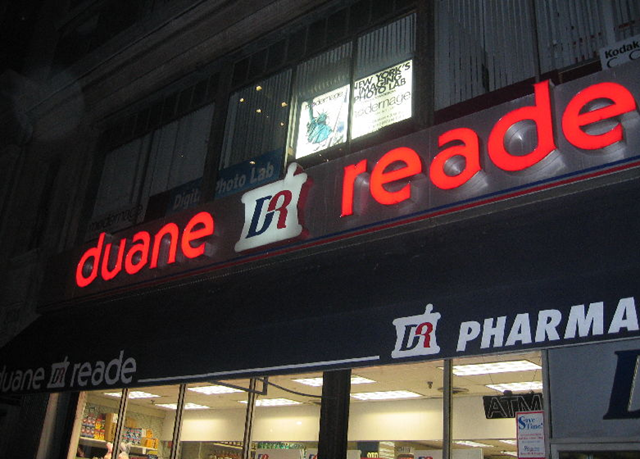
I’m traveling to a land where hotel wireless performance is awful (which narrows it down to everywhere, in my experience), so I’ll need to be uncharacteristically abbreviated this time around. I promise to resume posting massive tomes once I’m home. Thanks to Inga for handling Thursday’s post for me.  

poll011610

I think the above poll results speak for themselves, at least if uncertainty is a valid conclusion. New poll to your right: David Brailer said it was a mistake to include healthcare IT in ARRA, saying it adds risk to adoption. Do you agree?

Chris Rauber, the excellent San Francisco Business Times reporter, covers the stunning breakup of CalRHIO, which was until recently the lead contender to run all interoperability projects in that state and serve as a conduit for millions of stimulus dollars. He says CalRHIO and its competitor CAeHC were told by the state to settle their differences and figure out who should develop a statewide HIE by mid-January. They didn’t, so the state will create a new entity to replace them both. Chris says CAeHC seems to be working with the state, but CalRHIO has laid off all its staff and CEO Molly Coye (who had just started on July 1) has gone into consulting. Board members from both organizations (and possibly some employees) will be involved in laying out next steps. Molly Coye sent this statement to me:

HIStalk readers may have heard that CalRHIO and CAeHC, the two finalists in California for ARRA funding governance entity, were unable to negotiate an agreement and form a new organization as the state requested. As a result the state has taken the lead in forming a new governance entity, with input from board members of the two organizations. For the past six months, I served as CEO of CalRHIO, and I’d like to take this opportunity to clear up possible confusion about the basis for the state’s decision. The decision was in no way a rejection of CalRHIO’s technology, as some media reports have implied. In fact, the state did not review CalRHIO’s technology in the RFI process, and specifically welcomed our technology partner, Medicity, to participate in the open procurement process that the state and the new governing entity will initiate some time this spring.

Medicity has been an excellent partner, from planning through the early stages of implementation. CalRHIO is grateful to Medicity for its innovative thinking in developing with us a sustainable business model based on shared savings. We hope other states and local health information organizations will consider this model as they develop their long-term financial plans. Medicity also helped us develop the concept of statewide shared services, a framework that California seems likely to adopt. In collaboration with the Orange County Partnership RHIO, CalRHIO and Medicity teamed to launch HIE services in one of the largest counties in the state, an initiative that will continue to bring critical patient data to emergency rooms throughout the county.

For more information please see the statement from CalRHIO’s board at www.calrhio.org.

Hundreds of California health care leaders and stakeholders worked together to create and build CalRHIO over the past five years, and we want to thank them again for their pioneering efforts. We hope that the new governance entity will be convened promptly and that providers and consumers will be well served as HIE is deployed over the coming years in California.

Jackson Health System in Miami is tanking big-time, with its reported $56 million fiscal year loss possibly actually being as much as $150 million. One excuse for its $438 million in AR is its billing system change.

Back to normal soon, so e-mail me but don’t expect an immediate response until I dig out of the backlog in two or three days. Taking time off is really hard.

CIO Unplugged – 1/15/10

January 15, 2010 Ed Marx Comments Off on CIO Unplugged – 1/15/10

The views and opinions expressed in this blog are mine personally, and are not necessarily representative of Texas Health Resources or its subsidiaries.

Why I Fired and then Rehired Myself
By Ed Marx

I received a message New Years Eve from a former colleague in human resources at University Hospitals (UH). In response to something I’d shared a few years back about firing myself, she said, “I loved it so much I’m firing myself today, too. Monday will start a fresh look at my job (that is, if I hire myself back).”

I think we all should give ourselves the pink slip.

A few years ago, Intel was losing market share and profitability. Consequently, the company floundered. Knowing it was a matter of time before the Board would take mending actions, the leadership (Grove, Moore) discussed a particular phenomenon they’d observed. Nearly every time a company or division installed new leadership or brought in consultants, outcomes improved. They concluded that the new leader came in energized and with a fresh pair of eyes. Knowing he was being evaluated, he took his responsibility more seriously than a tired leader.

Needless to say, Intel’s old leadership had a brainstorm. Why not fire themselves and come back to the job as the “new” leaders? "If existing management want to keep their jobs when the basics of the business are undergoing profound change, they must adopt an outsider’s intellectual objectivity." They fired themselves over a weekend, and, after shifting markets (memory chips to microprocessors), Intel became the clear leader in a very competitive market.

Although UH and IT weren’t in dire circumstances as was Intel, we needed to guard against complacency. I challenged my leaders to follow my example and take time over the holidays to reflect. Pondering how you would approach your position as a new employee is a healthy and worthy assignment. Look at yourself as a potential candidate for your position then ask: How will I evaluate the talent, change processes, and service mix? Should I alter my interactions with customers, my personal engagement, or my attitude? Will I embrace innovative ideas I formerly rejected/feared? What strategies and tactics will I deploy to ensure business and clinical convergence with the health system? Do I have the courage and fortitude to remove employees that no longer add value? Am I stretching the boundaries of innovation? How will I be a better servant…?

The variations are endless! To survive, you probably won’t need to change anything you’re doing. But to thrive means constantly reinventing self and operating differently. We embraced change, adopted an innovation oriented culture and began to walk in the fullness of our authority. What Got You Here Won’t Get You There.

Several other University Hospital leaders fired and rehired themselves that New Years Day of 2007. The result? We experienced a dramatic shift moving from transactional to transformational services that had a net impact on our business and clinical operations. Our business, quality, and service metrics shot up to new heights. I experienced exponential growth, personally and professionally.

I’m due for another firing. What about you?


Ed Marx is senior vice president and CIO at Texas Health Resources in Dallas-Fort Worth, TX. Ed encourages your interaction through this blog. (Use the “add a comment” function at the bottom of each post.) You can also connect with him directly through his profile pages on social networking sites LinkedIn and Facebook, and you can follow him via Twitter – User Name “marxists.”

Comments Off on CIO Unplugged – 1/15/10

News 1/15/10

January 14, 2010 News 10 Comments

HERtak by Inga

From: TV Critic “Re: ‘Biggest Loser’ Loses Paper with help of GE’s EMR. Did you see this – actually pretty good marketing! Reminds me of 30Rock and all their corporate synergies.  Hmmm… maybe they could do a Mercy showing the nurses getting mad at the docs for not using CPOE, or a Law and Order on people who violate HIPAA, or a new Hero who has the ‘ability’ to actually use an EMR efficiently :)” It’s a curious world we live in. Perhaps they could do an American Idol and the “winner” would be the provider that documents the most complete chart at the point of care. Also curious: the only link I could find to this article was in the Ethiopian Review. I would have never guessed that Ethiopians were fans of Biggest Loser.

From: Trouble Brewing “Re: Ambulatory physician eligibility for ARRA. Thanks for providing the additional explanation about how a  hospital-based EP is defined. Lots of physicians and hospital administrators are not happy with the likelihood that a big segment of the physician population will be left out in the cold.” I’ve heard similar feedback. The committee reasoned that if the physician was using hospital owned clinics or facilities, they would most likely be paying for their own EHR. Maybe true, maybe not. If the hospital is paying for the physicians’ EHR and no one is eligible for stimulus funds, wouldn’t a hospital be inclined to make ambulatory EHR a lower priority and instead follow the money? I suspect we’ll hear more on this topic.

I’m flying solo today while Mr. H is out and about. I’m actually not sure what he is doing but I hope it is something fun.

spiegel

Siemens names Eric Spiegel CEO and president, taking over for the retiring George Nolen.The official press release hails Spiegel a top influential international management consultant and energy expert who previously served as SVP and senior partner at Booz & Co. I didn’t note anything in his background related to healthcare, by the way.

The NIST awards Booz Allen Hamilton Inc. a $400,000 contract to help develop a testing method and processes for certifying electronic health record systems.

eClinicalWorks joins several competitors in offering a guarantee that its software will meet meaningful use criteria. The company is also offering free meaningful use webinars, and, onsite and online readiness assessments. eCW says that 2009 was a great year for them, with revenues exceeding $100 million for the first time.

Congrats to Bill Spooner of Sharp Healthcare (CA) who was named CIO of the year by CHIME and HIMSS. In addition to his lifetime achievements in HIT, Sooner was recognized for spearheading his organization’s EMR transition.

Hum ho. Yet another insurance company reports the loss of confidential patient information. BCBS TN announces 500,000 patients records may have been compromised after 57 computer hard drives were stolen from a closet. The company believes at least 220,000 records included social security numbers.

Apparently the state of Connecticut was not happy about Health Net’s privacy breach last year. The state attorney general is filing suit against the company, charging it with violations of HIPAA privacy and security rules, based on the disappearance of a hard drive. The company believes the missing drive contained PHI on 1.5 million members, including 446,000 from Connecticut.

tents

The news out of Haiti is mind-numbing. This article highlights the work of Doctors Without Borders, who have already set up four tented facilities to treat the injured. Some are working in undamaged hospitals in Port-au-Prince, while others try to identify medical structures that are still intact.The organization is also waiting on the arrival of an inflatable field hospital, which sounds like a incredible piece of technology that includes two operating theaters and 100 beds. Lots of worthy organizations like Doctors Without Borders and The Red Cross are, of course, accepting donations. If you’d like a quick option, you can text “HAITI” to 90999 on your cell phone to donate $10 to Red Cross.

Cerner promotes Michael Valentine to COO, filling a vacancy that’s been open since 2007. Valentine previously served as Cerner’s US general manager.

Saint Peter’s University Hospital (NJ) plans to deploy Horizon Clinicals, including CPOE and enterprise care visibility. Saint Peter’s already utilizing McKesson’s revenue management products.

I was recently asked how I got this great opportunity to work with Mr. H and HIStalk. Almost three years ago, Mr. H made this small comment about needing an extra hand: “I need some help doing HIStalk (writing, chasing down information, etc.) If you know someone who’s interested and who might work remotely for a less than extortionate pay rate, let me know. I was thinking about hiring a grad student who might work a few hours a week to handle routine stuff. I’m just completely tapped out on time.” Since I was a big fan and at a point in my career where I had a bit of extra time, I begged him to hire me. One phone call later I was on board. When I arrived in April 2007, HIStalk had about 42,000 views for the month; today, between HIStalk and HIStalkPractice, we average nearly 100,000 hits a month. Mr. H is still tapped out and HIStalk now takes me more than just the original “few hours a week.” And it’s probably the most fun job I have ever had.

Eric Zimmerman, RelayHealth’s former SVP of marketing joins RedBrick Health Corp. as chief marketing officer.

Here’s something to contemplate: by 2020, the newest doctors will have been born after Amazon.com and will have never known a world without email or cell phones. MEDSEEK will discuss the impact of technology on patient care in its upcoming webinar “2020 Vision: The ePatient Evolution Over the Next Ten Years.” Register here for the January 27th event.

ridgeview

Ridgeview Medical Center (MN) expands its use of Wellsoft’s EDIS program, upgrading to v11 and adding electronic OE, charge capture and an HL7 interface to McKesson’s Paragon HIS.

Coming to HIStalkPractice tonight: ten execs answer the question, “What kinds of practices will be able to reach the 80% CPOE level?” I was personally a little shocked that a couple CEOs thought it was going to be so easy. Sign up for e-mail updates while you’re there.

Good news. Americans are not getting any fatter than we’ve been over the past 10 years. Of course a “hefty” number of adults (73 million or 34% of the adults) are still obese. A greater percentage of women are obese than men, but the guys are catching up pretty fast. Unfortunately, so are the kids. Perhaps too many folks are just sitting on their couches watching shows like the Biggest Loser.

inga

E-mail Inga.

News 1/13/10

January 12, 2010 News 11 Comments

From rx4change: “Re: dialog. This is a very interesting dialog at the President’s Council of Advisors on Science and Technology two days ago. Atul Gawande and Google CEO Eric Schmidt talk health technology and policy.” Schmidt should have kept his mouth shut, but instead expounded his unoriginal thought that practicing medicine should be a simple as having a doctor type in symptoms and then review the resulting computer list of best practices. Gawande gently sets him straight, mentioning the doctors have 15 minutes to manage six problems instead of plowing through reams of computer-generated junk. The problem with computer people is that when all you have is a hammer, everything looks like a nail. As nice as it would be if patients simply got better because of computer algorithms that matched Symptom A to Government-Approved Treatment B, that doesn’t work. I say let Schmidt find a doctor who practices that way and commit to seeing him or her for the next five years and then report back.

pc

From Computer Historian: “Re: first real microcomputer. This article says the first real microcomputer, three years before the Altair, was built to handle medical records.” That’s pretty cool. The article says the computer was built at Sacramento State University in 1972 specifically to manage medical records. Of course, Meditech had been in business for several years by then, but this refers to an actual PC built expressly for healthcare use. The only surprise is that some hospital isn’t still running it.

From The PACS Designer: “Re: Google Wave.TPD has alerted HIStalkers about the beta called Google Wave. Now, InformationWeek has some interesting comments on what Google Wave is trying to convey to users.” Its major problem seems to be that no one can explain what it is or what problems it solves. I guess it has passed the Peak of Inflated Expectations and moved on to the Trough of Disillusionment.

From Cryovac: “Re: Bill O’Connor. The former McKesson doc who was in charge of clinical sales support is now SVP of marketing at Eclipsys. He was connected with Jay Deady at McKesson, so I am sure McKesson is not happy about his move.”
wikibook

From Sylvester: “Re: wikibook. Here’s a compendium of wikipedia articles on informatics. The standard textbook is Shortliffe’s Biomedical Informatics. I don’t know how they compare, although this one is favorable on price!”

An insider says that the allegedly upcoming Apple tablet will be aimed at healthcare, not the consumer market. He makes the good point that the Intel C5, the hottest thing at HIMSS a few years back, has been pretty much a dud, now wildly overweight and overpriced. Of course, tablets haven’t exactly lit up the night skies of healthcare either, but Apple wasn’t involved.

I like to report on my personal technology experiments every now and then for you fellow geeks out there. Here are two winners: Dragon Naturally Speaking and SugarSync. I bought DNS Standard for $55 and it is truly amazing, deadly accurate straight out of the box and a very polite application on my modestly powered PC. I’m using it to reply to e-mails since my fingers tend to get tired after the third or fourth hour of typing after a full day doing exactly the same thing at work. SugarSync is an online backup application, of which I had tried Mozy and Carbonite without much satisfaction. SugarSync is fast, easy, and free with up to 2 GB of storage. It’s a real-time backup and has a Web interface that allows you to use or view your files from any PC or mobile device. I recommend both from my limited experience so far.

Allscripts announces Q2 numbers: revenue up 32%, EPS $0.10 vs. -$0.05. Showing how little I know about stock-picking, some analysts were disappointed despite what looked like gangbuster numbers to me. Market cap is at $2.8 billion. The company also announces its EHR certification guarantee, an EHR financing program requiring no payments for the first six months, and a faster implementation program. I also noticed that Glen Tullman mentioned HIStalk in the investor conference call.

Vince Kuraitis has a useful resource list for the proposed Meaningful Use rules.

Speaking of Meaningful Use, I like to think HIStalk is nimble in getting information to you faster. For that reason, I’m proud of Inga’s series on HIStalk Practice in which she connected with several industry executives to get their thoughts on the proposed regulations. She asked our 10 executive collaborators whether the proposed criteria were a surprise and whether they will have problems meeting them in Part 1. In Part 2, we find out what difficulties they expect physicians to have in meeting the proposed requirements. Thanks to our participants.

Our pen pal Janeen Cook, a former RelayHealth marketing VP now at graduate nursing school at Vanderbilt, says she’s torn between using her student discount or her AARP discount to attend HIMSS (funny). She’s doing a little marketing on the side, so that’s her Killer Marketing Collaborators text ad to your right. She’s trying to convince me to let people bid to sponsor her schooling in return for clinician and marketing services afterward. Sounds fun to me.

An internal Kaiser memo says that starting next week, patients will be able to securely e-mail images to their Kaiser doctors, giving patients an alternative to follow-up visits. Suggested uses are for post-operative wounds, lesions, acne, and rash. Their pilot project showed that 90% of received images were useful in making clinical decisions. Smart.

Gerard Livaudais MD, MPH, formerly of Kaiser-Hawaii, is named EVP of product management for Quantros.

Tim Adams, chief investment officer at Constitution Medical Investors, is named SVP and CFO of athenahealth, replacing the recently retired Carl Byers.

armc

Athens Regional Medical Center (GA), chooses Eclipsys PeakPractice PM/EMR.

careawareibus

Cerner’s CareAware iBus receives FDA pre-marketing clearance, making it generally available. It provides data exchange between EMR systems and medical devices.

It’s a Weird News Andy field day. A new blood test finds that 80% of people previously thought to be allergic to peanuts really aren’t. Expectant but absent fathers can see live videos of their unborn child on their iPhone. A British TV show seeks a terminally ill volunteer to be mummified Egyptian style. And a professional singer who hiccupped 20 million times over three years is cured by brain surgery.

The judge in Charlie McCall’s HBOC securities fraud trial freezes his assets and raises his bond to $4 million, uncomfortable with the ease that Charlie could hightail it in his yacht. He also denies the defense a new trial and soothes the concerns of his attorney that Charlie can’t pay him if his assets are frozen. Charlie got off on a solicitation charge in 2006 when the undercover officer’s tape recording was of poor quality. According to statements, he asked the female vice officer about “various options” and offered her $100 to accompany him back to his hotel.

ONCHIT is advertising for a vendor to attempt to re-identify a de-identified database, linking the data elements to individual patients.

Flagstaff Bone and Joint chooses the SRS hybrid EMR.

The National eHealth Collaborative posts its preliminary slate of board candidates for public comment.

encore

The Houston business paper does a writeup on Encore Health Resources, highlighting its growth from 10 employees a year ago to 41 currently with 10 new folks coming on board each month. The company is sponsoring the HIStalk event at HIMSS, which I appreciate. For all the experience Ivo and Dana have in consulting, they have obvious deep domain expertise in the bartender-to-guest metric, as evidenced by their wildly popular reception at the last HIMSS conference. I’m pretty sure a good time will be had by all.

The entire 26-member EMR team at Royal Berkshire Hospital is canned as part of its UPMC implementation partnership. Also in the UK, Charles Gutteridge is appointed as the first national clinical director for informatics.

A New York Times article mentions an upcoming study that concludes that the Danish HIT system is the most efficient in the world, saving doctors 50 minutes per day and the country $120 million per year. They have advantages for that kind of adoption, however: high taxes, free medical care, and different attitudes toward privacy. Not mentioned is the prevailing Scandinavian model of not having healthcare be a rampant playground for greedy capitalist enterprises. You get the feeling that their healthcare isn’t run by MBAs and multimillion dollar CEOs.

MediConnect Global acquires PHR vendor PassportMD.

The state of California establishes the use of open source software as an acceptable practice. The CEO of Red Hat notes that economic conditions are pushing companies to consider open source to offset budget shortfalls.

E-mail me.

HERtalk by Inga

From UB40: “Re: ambulatory physician eligibility for ARRA. I know there has been some fuzziness about MDs who work for hospitals, like pathologists, radiologists, anesthesiologists, ED docs, etc. Obviously, the object of the ruling was that if the EMR was bought and paid for by the hospital and the MD was working exclusively in a hospital setting, then he shouldn’t reap the benefit of the work the hospital did.” UB40 is referring to an upcoming conference call hosted by The Health Management Academy, to discuss the exclusion of “thousands of physicians practicing in hospital-owned ambulatory clinics or facilities, whether or not the physicians are employed by the hospital or health system.” Reading over the latest documents, the wording does indicate that hospital-based EPs are not eligible for the Medicare or Medicaid incentive payments. A hospital-based EP is defined as one who furnishes substantially all (90% or more) of his or her Medicare-covered professional services in a hospital setting  (inpatient and/or outpatient) through the use of the hospital’s facilities and equipment, including the hospital’s qualified EHR. In other words, if a provider performs 90% or more of his/her services under place of service codes 21, 22, or 23, regardless of the provider’s employer, he/she would not be eligible for stimulus funds. The assumption is that a provider providing 90% or more of his/her services in the hospital are not likely to expend significant resources related to EHRs in other, non-hospital settings. OHCHIT is looking for feedback on whether or not this assumption is correct. I admit their assumptions sound reasonable to me.

Rome Memorial Hospital (NY) selects McKesson to provide the software for its $7 million EHR investment. Last month Mr. H mentioned that a Congressman helped the hospital obtain $250,000 to help fund the effort.

Meditech and Zynx Health partner to provide Meditech Magic and C/S customers the Zynx Health portfolio of evidence-based order sets.

cdc ehr

The results of this new EMR usage survey indicate that 43.9% of physicians use an EMR, at least partially. However, only 6.4% utilize the full functionality of their systems. The survey used a self-reporting methodology, so the results may not be the most statistically valid. Regardless, adoption is clearly on the rise.

Thomson Reuters names Raymond Fabius, MD, FAAP, FACPE as chief medical officer of its Healthcare & Science business.

Frimley Park Hospital NHS Foundation Trust goes live with Picis in surgery and critical care.

bronx

Bronx Lebanon Hospital Center is now live on Sunrise Emergency Care in it ER and Ambulatory Care at a 40-doctor practice. The hospital plans to deploy the the Ambulatory Care solution to all it 27 outpatient clinics in 2010. Eclipsys also announces that New York Downtown Hospital (NY) is adding Sunrise Acute Care, Pharmacy, and Emergency Care applications.

University Medical Center at Princeton, a 10-year client of QuadraMed’s, plans to offer e-MDs to its affiliated physician practices. I was curious what would happen with the QuadraMed/e-MDs partnership now that QuadraMed is owned by Francisco Partners. Looks like the alliance is not dead yet.

Michael Martens takes over as Mediware’s new CFO. Martens replaces Mark Williams, who announced his retirement last fall. Martens’ previous employers include Euronet Worldwide and Cerner.

Geisinger Health System is implementing RelayHealth’s RevRunner solution for eligibility and benefits verification.

southeast alabama

Southeast Alabama Medical Center selects Wolters Kluwer Health to deploy Provation Order Sets, powered by UpToDate Decision Support. Fort Worth Endoscopy Center also contracts with Wolters Kluwer Health for ProVation MD for procedure documentation and coding and ProVation EHR for patient charting.

CliniComp says four military treatment facilities went live with Essentris inpatient documentation solution during Q4.

Florida Hospital, an eight-location system with 2,188 beds, deploys HealthPort’s release of information technology, alongside Cerner Millennium.

VirtualHealth Technologies announces plans to sell its Secure eHealth messaging division to Wound Management Technologies.

Now that the holiday season is behind us, I’m beginning to feel that pre-HIMSS excitement. I love opening my mailbox each day to discover all the informative junk mail from vendors. Mr. H and I have been so busy lately that we have yet to talk much about details. I am sure he’d like to hire a dozen fake Ingas in low-cut blouses to sashay about the exhibit floor. And for the last three years I’ve asked him to hire a Mr. H look-a-like — that would be someone looking a lot like George Clooney — to provide foot massages. If you have any suggestions on how we can make HIMSS more fun and/or informative, let us know.

inga

E-mail Inga.

Text Ads


RECENT COMMENTS

  1. Really interesting perspective — especially around the EHR market. What I’m seeing lines up with this: Epic keeps consolidating, Oracle/Cerner…

  2. Why does the displayed "exam room of the future" still have the classic "clinician has their back to the patient"…

  3. Anything related to defense will need to go to Genesis.

Founding Sponsors


Platinum Sponsors


Gold Sponsors


RSS Webinars

  • An error has occurred, which probably means the feed is down. Try again later.