Recent Articles:

Time Capsule: E-prescribing is Simple, Except That Most Physicians Don’t Use EMRs

October 5, 2012 Time Capsule Comments Off on Time Capsule: E-prescribing is Simple, Except That Most Physicians Don’t Use EMRs

I wrote weekly editorials for a boutique industry newsletter for several years, anxious for both audience and income. I learned a lot about coming up with ideas for the weekly grind, trying to be simultaneously opinionated and entertaining in a few hundred words, and not sleeping much because I was working all the time. They’re fun to read as a look back at what was important then (and often still important now).

I wrote this piece in December 2007.

E-prescribing is Simple, Except That Most Physicians Don’t Use EMRs
By Mr. HIStalk

mrhmedium

The push for electronic prescribing by physicians is accelerating. Mike Leavitt of HHS thinks doctors should get a bonus for doing it (actually, a chance to earn their money back from a planned reimbursement cut). Intel Chairman Craig Barrett, in his role as a member of the American Health Information Community, recently told CMS to use its purchasing power to lay down the law to its doctor vendors. He’s often a simplistic blowhard, but he’s probably right that the customer gets to make rules that suit them.

E-prescribing is theoretically efficient, easy, and secure. Why, then, is the industry still 95 percent based on wadded up, illegible, and easily altered paper prescriptions that are free of any context that could reduce errors, improve formulary compliance, and save time for patients?

I can think of several reasons.

E-prescribing, like almost all aspects of healthcare automation, doesn’t benefit the doctors who have to change their work patterns to use it.

Patients don’t benefit directly, so they don’t really care enough to push their doctors. With paper, they can (as many patients do) not get the prescription filled, save up money to pay for it, or try to order a cheaper supply from Canada or overseas. Paper gives them that control.

Existing e-prescribing systems are generally unsophisticated and lot less functional than you might expect (like not being able to handle pharmacy verification that the prescriptions were accepted and/or filled).

DEA and state regulations vary on what kinds of prescriptions can be issued electronically.

The chicken-and-egg dilemma. Pharmacies aren’t excited about processing prescriptions electronically because physicians aren’t sending them. Physicians don’t send them because, in many cases, the pharmacy is still stuck in yesterday’s world of telephone and fax.

Efficient electronic prescribing requires an electronic medical records system in the doctor’s practice, which is still a tiny minority of them.

That last item is the big one, of course. E-prescribing should be a by-product of documenting a patient visit. It’s just not reasonable to expect a physician to leave the treatment room, fiddle with a standalone e-prescribing system, and re-key duplicate information.

Scrawling out a paper prescription takes a fraction of that time. The act of writing it gives the doctor time to look away from the patient, collect his or her thoughts, and make notes on the ever-present paper chart. The ritual of handing it over offers a chance to counsel the patient and to add finality to the visit. It’s a rule: you put your pants back on while he or she is writing, you take the prescriptions with one hand and shake with the other, and then you beat it so the doc can make their patient quota for the day.

Everybody rolls their eyes at how backward healthcare is, but we’re not alone. It’s very likely that your visit to an attorney, accountant, or mechanic is computer-free, except for your final bill. In fact, here’s a challenge: name any professional other than a physician who is expected to peck clerical work into a computer while consulting with their customer.

That’s why the only answer is to reward doctors (or punish them less, under Leavitt’s proposal) for e-prescribing. If we truly believe that the benefit is significant (do we?) then somebody needs to cover its cost and maybe help out with EMR expenses too. Without either a carrot or a stick, neither electronic prescriptions nor EMRs will ever gain critical mass.

Comments Off on Time Capsule: E-prescribing is Simple, Except That Most Physicians Don’t Use EMRs

News 10/5/12

October 4, 2012 News 4 Comments

Top News

10-4-2012 6-05-54 PM

10-4-2012 6-11-18 PM

10-4-2012 5-56-15 PM

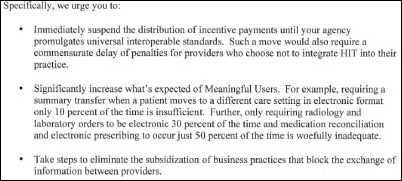
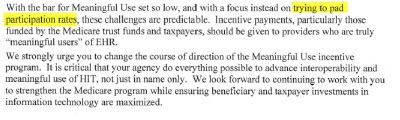
From DrLyle: “Re: House committee call to suspend HITECH payments. I’m at this meeting. Farzad is keeping his cool. He says it’s just pre-election rumblings and nothing can change without major legislative work.” Several House Republicans call on HHS Secretary Kathleen Sebelius (copying CMS Administrator Marilyn Tavenner and National Coordinator Farzad Mostashari) in an October 4 letter to immediately suspend HITECH payments because the Meaningful Use bar is set too low, resulting in a program that “squanders taxpayer dollars and does little, if anything, to improve outcomes for Medicare.” It claims that $10 billion has been wasted. It also references increasing payments due to higher levels of provider coding, as well as Stage 2 rules that don’t emphasize interoperability enough, leading to “our health care system trapped in information silos, much like it was before the incentive payments.” The letter also directly challenges the HHS/ONC count of HITECH provider participants, saying that HHS is “trying to pad participation rates.”

Signers of the House letter were Rep. Dave Camp (R-MI, Chairman, Committee on Ways and Means), Rep. Fred Upton (R-MI, Chairman, Committee on Energy and Commerce), Rep. Wally Herger (R-CA, Chairman, Committee on Ways and Means, Subcommittee on Health), and Rep. Joe Pitts (R-PA, Chairman, Committee on Energy and Commerce, Subcommittee on Health). One might presume given the timing and the fact that all four signatories are Republican that there’s a political motive, although that doesn’t change the fact that you either do or don’t agree with their assessment of HITECH. If their arguments are sincere, perhaps they should have made them earlier. Also, note that their objections aren’t to the value of EHRs but rather to the value of taxpayers in subsidizing them, so reciting a list of why EMRs are inherently good is not an appropriate rebuttal, nor would a list of accomplished users like Kaiser who got free money for using something they’d already bought without taxpayer bribes.

10-4-2012 6-54-59 PM

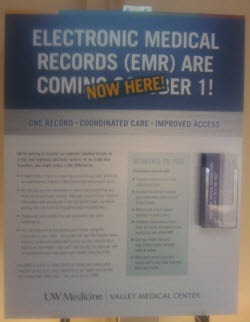
From BadgerMom: “Re: Valley Medical Center, Renton, WA. Goes live with Epic inpatient.” Congratulations to them. Thanks for the picture.

From Horshack’s Laugh: “Re: Caradigm. The company was simply a consolidation of two non-performing assets so that GE and MSFT could get them off their respective books and write off their significant losses ($1 billion over seven years for Qualibria alone) and allow Immelt and Ballmer to save face.” Unverified. I asked that question in my interview with CEO Michael Simpson.

From THB: “Re: Epic’s succession plan. What about HIStalk’s succession plan? You have built a great open source forum, but at some point you will be the old curmudgeon (and I mean that in the nicest sense!) Believe me, Judy reads this site, as does Glen T. and the rest of them. You share what you can and keep close to the vest what you cannot (that is a fine display of TRUST).” HIStalk is to me a hobby rather than a business, and given that I do it part time (as do my far-flung co-conspirators Inga, Dr. Jayne, Dr. Travis, etc.) I don’t have a specific plan for it to continue without me, nor am I vain enough to think that the healthcare IT world will stop spinning on its axis when I stop typing. Sometimes I feel guilty that Mrs. HIStalk would get no financial benefit from my years of labor if I flamed out tomorrow, but I don’t have a solution. It’s an inherently and intentionally amateurish operation.

10-4-2012 7-34-11 PM

10-4-2012 7-45-34 PM

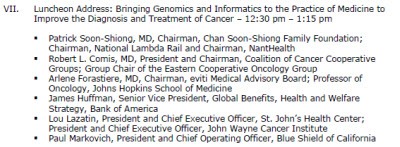
From Jeeves: “Re: Patrick Soon-Shiong. His announcement was a big deal. I want to point out that at the end of last year when all the pundits were doing their predictions, Travis of HIStalk Mobile was the only one that I’m aware of that said this would be the year that Patrick’s stuff becomes real.” Travis is looking good with his predictions for the year so far: (a) smart phones everywhere; (b) more research and pilots on mHealth; (c) AirStrip as the biggest mover in mHealth; (d) price transparency gets a foothold; and several others. Travis has a lot of experience (MD, startup, NGO, etc.) and you’re missing out on his insight if you haven’t signed up for e-mail alerts when he posts something new. Soon-Shiong’s announcement this week that his NantWorks group of companies has developed a package of supercomputing, high-speed networking, and mobile access that will let doctors instantly individualize cancer treatment based on the patient’s genome. I listened to the live webcast for a few minutes while I was at work and heard him taking the usual shots against outdated, MUMPS-based systems that don’t talk to each other, although I’m not sure what that has to do with his project, which in itself sounds fascinating depending on who’s paying for it and who’s making money from it. BPC has posted the full video of the all-day event, although I haven’t had time to watch it. There’s bonus footage of an extremely cool Farzad bow tie in his segment at around the 180-minute mark.


Reader Comments

10-4-2012 6-20-21 PM

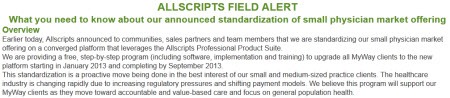
From Pick Six: “Re: Allscripts. Replacing MyWay with Pro.” An internal Allscripts e-mail says that it will standardize its small physician market offering on Allscripts Professional Product Suite, with free migration of MyWay users starting in January. The company also announced that its VAR network will be reduced from 40 to four resellers and that Pro Suite pricing will be standardized (it’s not clear from the wording whether MyWay users will get a free license or just a free migration once they’ve paid for Pro). Also not mentioned is what happens to MyWay, although the most common rumor we’ve heard is that it will be sold rather than mothballed (which makes more sense than Allscripts taking a write-off of some of its Misys acquisition costs). Allscripts is trying to consolidate platforms because of the development effort required for ICD-10, Meaningful Use Stage 2, and accountable care. The risks are that users of MyWay, rumored to be the most popular product Allscripts sells, could look elsewhere given the decision the company has forced on them. One potential winner is Aprima, which under its former name iMedica built the original version of MyWay that Misys licensed in 2007, followed by ugly disputes between the companies (see my July 2008 interview with Michael Nissenbaum). Since then, Aprima has rewritten the PM app and upgraded their version of both EHR and PM, so the gloves will come off if Aprima decides to offer an easy conversion from MyWay to their similar product, potentially also signing on some of the former Allscripts VARs who will be left scrambling. Also affected will be Etransmedia, an Allscripts partner that sells MyWay for $499 per month through Costco.


HIStalk Announcements and Requests

10-4-2012 3-38-32 PM

inga_small I noticed that one of my new Twitter followers is a “healthcare visionary,” leading me to ponder how one earns that designation. Self-assigned? Or is it an advanced accreditation available through HIMSS for those over-achieving members who feel the need for additional titles? I’m going with self-assigned, so from here on out I will refer to myself as Inga HIStalk, HV. Maybe I will get Mr. H to make some ribbons for HIMSS so fellow healthcare visionaries can promote themselves. By the way, feel free to follow me and my HIStalk buddies on Twitter, connect with us on LinkedIn, and be our virtual BFFs on Facebook.

inga_small This week’s highlights from HIStalk Practice: a rumor and a response from e-MDs. CareCloud gives Florida International University informatics students access to its EHR. Practice owners struggle over how to allocate incentive payments for employed providers.The Ohio AFP pilots a project to transform practices to the PCMH model, train medical students, and recruit physicians to practice in the state. Julie McGovern of Practice Wise offers tips for physicians to train for their EHR training – and don’t miss the comment from MarathonMan. You know what makes me happy: that two-second signup for HIStalk Practice e-mail updates. Thanks for reading. 

10-4-2012 8-05-40 PM

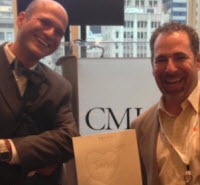
inga_small  Am I the luckiest gal in HIT or what? That’s Dr. Mostashari and Dr. Lyle Berkowitz holding up an IimageInga sign at today’s CMIO Leadership Forum. (Eat your heart out, BFF Dr. Jayne.)

10-4-2012 5-24-43 PM

Welcome to new HIStalk Platinum Sponsor VMware, which offers dependable, always-on frontline clinical systems access. Connect to your mobile clinical desktop from anywhere, view medical images, use any digital device securely with no clumsy security steps, and save time with a clinical desktop that follows you everywhere with fast logins to patient care systems. VMware offers cost-saving, secure, and IT-friendly solutions for virtualization, non-stop point-of-care desktops, trusted cloud security and compliance, and zero-downtime continuity and recovery. Thanks to VMware for supporting HIStalk.

From my obligatory YouTube cruise, I found the above VMware video wrap-up of HIMSS12. I like that they pictured and thanked their employees who staffed the booth.

10-4-2012 5-38-52 PM

Thanks to Philips Healthcare, supporting HIStalk as a Platinum Sponsor. The company’s solutions address interoperability (IntelliBridge Enterprise and Bedside to connect Philips products with others); clinical decision support (sepsis monitoring, vital signs and alert trending, EKG analysis, cardiac decision support); mobility (OB TraceVue for iPad-powered fetal information, HeartStartMRx ECG to smartphone, and IntelliSpace Event Management); and telehealth (eICU, IntelliSpace PACS, and Home Telehealth Solutions). I interviewed CMIO Joe Frassica, MD in August, who not only explained the company’s offerings well, but also got promoted to CMIO/CTO/VP right after the interview ran, according to his LinkedIn profile. Thanks to Philips Healthcare for supporting my work.

Here’s a brand new Philips Healthcare video that seems appropriate for Breast Cancer Awareness Month.

As a change of pace, I’ll refrain this week from urging you to sign up for e-mail updates and Like us and all that. Instead, I will suggest just one course of action: tell your colleagues you get news and opinions from HIStalk. I’ve received many e-mails from new readers and new sponsors who admitted that they hadn’t heard of HIStalk until people whose opinion they valued kept telling them they should read it. I appreciate that a lot.

I’ll be taking a little break next week, although I’m sure I won’t be able to resist the laptop’s siren song. My hiatus is minuscule compared to that of Vince Ciotti, who’s enviably taking his bride of 40 years to Europe for the whole month of October to re-live their honeymoon (and unlike me, he’s vowing to stay off the laptop). That means HIS-tory will return in November, and I can honestly say I will miss it since I enjoy every one of them.


Acquisitions, Funding, Business, and Stock

Homecare Homebase closes $75 million in senior securing financing from CIT Group.

Peak Health Solutions acquires the assets of consulting firm Health Data Essentials.


Sales

Managed care health plan Kern Health Systems selects McKesson’s VITAL Care Management programs to provide members with care management and educational materials.

10-4-2012 8-52-41 PM

Scottsdale Healthcare and Scottsdale Physician Organization will implement Harris Corporation’s Clinical Integration Solution to connect its hospitals, physicians, labs, and other providers.

Booz Allen Hamilton Holding announces 35 new federal and private healthcare contracts totaling more than $112 million in August and September.


People

10-4-2012 10-42-14 AM

Patient flow software provider Central Logic names Steve Erickson (SageCreek Partners) CFO.

10-4-2012 3-07-24 PM

Stephen Lawrence (Southern Illinois Healthcare Foundation) joins the Lincoln Land HIE as executive director.

10-4-2012 3-18-49 PM

Kaiser Permanente Chairman and CEO George Halvorson announces his retirement effective December 2013.


Announcements and Implementations

Inova (VA) becomes the first organization to participate in the ConnectVirginia HIE.

The New England Healthcare Exchange Network (NEHEN) selects the Massachusetts eHealth Collaborative to take over its executive management, business development, and operations management.

Mediware Information Systems earns updated 510(k) clearance from the FDA for its core blood management software products.

10-4-2012 8-54-09 PM

Penn State Milton S. Hershey Medical Center implements an interconnected CareFusion and Cerner solution that centralizes clinical information between the Pyxis MedStation 4000 system and Cerner Millennium EHR using Cerner’s CareAware iBus integrated device connectivity architecture.

Horm Memorial Hospital (IA) and Faulkton County Memorial Hospital (SC) beta-test Healthland’s Centriq Clinic, an ambulatory care solution for rural physicians.

Iowa Specialty Hospitals, The Gabrielson Clinic, and Orthopedic Specialists go live on EMR Oct. 8. The hospitals and clinics are all part of University of Iowa Healthcare, so that’s probably Epic.

CliniComp commits to meeting ONC Stage 2 MU certification with its Essentris EMR.

AHIMA calls for improved EHR patient documentation standards and principles at its conference this week.


Government and Politics

10-4-2012 6-50-43 PM

The Medicare Fraud Strike Force charges 91 individuals — including doctors, nurses, and other medical professionals — for falsely billing the government $492 million, including more than $230 million in home health fraud, $100 million in mental health fraud, and $49 million in ambulance transport fraud. Half the people, not surprisingly, operated out of Miami.


Technology

Qualcomm Foundation awards Scripps Health a three-year, $3.75 million grant to develop wireless medical devices, including biosensors that are inserted into the blood stream for disease detection; a mobile app that captures medical data from biosensors and transmits it to patients’ smart phones; and a handheld device to detect genetic variations that may prevent particular medications from working correctly.


Other

St. Francis Health Center’s (KS) will lay off eight patient accounting employees as a result of the hospital’s November 1 transition to Epic.

10-4-2012 7-15-33 PM

A Wall Street Journal article called “Hospital Horrors” covers a newly published book on hospital transparency written by a Hopkins surgeon. He says state medical boards do a poor job of policing doctors, hospitals are pushed by lower reimbursement to increase volumes to unsafe levels, and bad treatments pay better than good ones in many cases. He quotes a recent Hopkins survey of employees of 60 high-quality hospitals, where more than half of the respondents said they would not feel comfortable receiving care in the unit in which they work. I’ve said that many times: those of us working in the healthcare system are a lot more scared of it than laypeople when we become patients.

Friday is the premiere of “Escape Fire: The Fight to Rescue American Healthcare.” Variety gave it a pretty good review from its Sundance screening in January, but said it should have included more about how lobbying keeps the healthcare industry safe from political action.

Weird News Andy says he might believe the woman who blames lupus-triggered delusions for causing her to strip naked and chant religious phrases outside a high school, but that doesn’t explain why she was joined by her two adult daughters and teenage son. The adults got probation after pleading guilty to indecent exposure.

inga_small A Utah man is convicted of disorderly conduct and charged a $140 fine after paying a disputed $25 doctor bill in pennies. Apparently the practice did not appreciate having 2,500 pennies dumped onto the receptionist’s desk. Personally, I think his approach was creative, and I bet quite liberating.

inga_small Just in time for Breast Cancer Awareness month: a “smart” bra that uses sensors and predictive analytics for early breast cancer detection. Don’t look for it at Victoria’s Secret or anywhere else any time soon: the company does not expect to launch the product in the US until 2014.

clip_image001

inga_small Men with shaved heads are perceived to be more masculine, dominant, and in some case have greater leadership potential than those with longer or thinning hair. Thank you, University of Pennsylvania’s Wharton School for confirming what I have known for quite some time.

Bizarre: a man sues a stripper who was performing at his bachelor party, claiming she slid down the stripper pole and landed so hard on his abdomen that she ruptured his bladder.


Sponsor Updates

  • CMS names SuccessEHS a 2013 EHR Direct Qualified Vendor.
  • CareTech Solutions offers discounted pricing for its BoardNet portal to members of the AHA Center for Healthcare Governance.
  • The CliniSync REC (OH) profiles Premier Physician Center and its use of e-MDs.
  • API Healthcare celebrates customer service week by honoring its client-facing support staff.
  • The Journal of the Medical Library Association ranks DynaMed in the top ten among online clinical resources.
  • NextGate joins the partner network of HIT consulting firm Exsede.
  • Shareable Ink introduces its Meaningful Use program for anesthesiologists.
  • QlikView hosts an October 11 webinar featuring Nationwide Children’s Hospital (OH) and its use of QlikView for data discovery.
  • MedHOK announces that its technology platform positions participants in the Comprehensive Primary Care initiative to share in savings and improve patient care.
  • T-System showcases its RevCycle+ physician coding and billing solution at next week’s ACEP Scientific Assembly in Denver.
  • iSirona sponsors a Code-A-Thon programming challenge at Florida State University’s department of computer science.
  • Datapharm Australia Pty selects Merge Healthcare’s eClinical OS solution for enterprise-wide electronic data capture.

EPtalk by Dr. Jayne

I’m mourning the loss of a colleague today – one of my favorite partners is leaving our group. Patients adore him and I’d trust him to care for my loved ones. The reason: he’s fed up with insurance, bureaucracy, and paperwork and is launching a cash-only practice.

He will be sorely missed, but he’s not the only one. Increasing numbers of physicians are dropping participation in insurance plans. It doesn’t do much good to have patients insured when few will accept low-paying insurance plans (see: Medicaid). A New York Times piece this week shares some additional stories. More interesting than the feature itself are the reader comments.

clip_image002

Sponsored by ONC, the Blue Button Video Challenge runs through November 13. This is your chance to create an “engaging and entertaining” two-minute video to advocate use of the Blue Button to access health information online. Judging criteria include submissions being “fun, edgy, and memorable.” First prize is $3,000 to help motivate you creative types.

In the medical staff lounge this week, there has been a fair amount of discussion around the Annals of Internal Medicine article covering patient access to physician notes. The authors concluded that patients felt the practice was beneficial and that providers experienced “no more than a modest effect on their work lives.”

So many of my colleagues think the sky will fall if their patients have access to visit documentation. Not a week goes by that one of my peers doesn’t corner me about making parts of the patient plan documentation “hidden” or “non-patient-facing.” Although they profess concern that patients can’t handle the truth or that phone calls to explain the notes will be a burden, I really think they’re afraid that patients will discover their poor written communication skills.

Reading the notes of some of my peers is exhausting even when they’re dictated, so one can’t always blame the EHR. I wonder if some of them know how pompous they sound or that they simply ramble with no concept of sentence structure? In order to make sure our patients (and sometimes our colleagues) understand us, we need to be communicating clearly and often at an elementary-school reading level.

Even if your organization doesn’t have an open notes policy, I strongly encourage providers to start documenting as if patients will read the notes. Chances are they’ll be reading them in a few years whether you like it or not. Better to prepare now.

For those that are worried that patients can’t handle the truth (aka, “She’s not going to like it if I say she’s obese”) it’s time to be direct with patients. Tiptoeing around the edge of major national health problems like obesity, diabetes, hypertension, and coronary artery disease because we’re worried about hurting a patient’s feelings isn’t good for the patient or for society. I’m not saying we need to be unfeeling or unkind, but sometimes we need to just call it what it is and work to help patients address their health needs.

Being able to communicate well is a learned skill and needs to be taught in medical school and reinforced in residency and continuing professional activities. Last time I checked, online translator software doesn’t offer “Doctor” as a language choice (although I did find a pirate translator), so it’s time for healthcare providers to get with the program.

What do you think about patient-facing documentation? Do you use it in your practice? E-mail me.

Print


Contacts

Mr. H, Inga, Dr. Jayne, Dr. Gregg.

More news: HIStalk Practice, HIStalk Mobile.

HIStalk Interviews Michael Simpson, CEO, Caradigm

October 3, 2012 Interviews 24 Comments

Michael Simpson is CEO of Caradigm of Redmond, WA.

10-3-2012 5-13-39 PM

Tell me about yourself and the company.

I’ve been with Caradigm for 90 days like everyone else, starting June 1. Prior to that, I was with GE Healthcare, where I spent a year and a half working on the Qualibria joint development project with Intermountain Healthcare.

Prior to that, I was based in London, England working for McKesson Corporation as the chief technology and strategy officer for the international operations team. Before that, I spent almost four years with McKesson U.S. and ran their clinical operations for the Horizon product line. Prior to that, I was in high tech — Unisys, Philips, and Novell. Half of my life was spent in high tech, the other half in healthcare.


Tell me how Caradigm is structured and how many employees it has.

From a structure point of view, Microsoft had their HSG group and the GE team had the eHealth and the Qualibria teams. Coming across from the Microsoft side were about 200 or 250 Microsoft employees from the Health Solutions Group that worked on Amalga and the identity and access management team. That’s the former Sentillion group that I’m sure you remember. From the GE side was a group of about 250 folks who came in from the Intermountain-Mayo Clinic relationship with Qualibria. The rest of the team came from eHealth, which is the HIE product line.

We’ve got about 525 FTEs at Caradigm today, roughly around 750 people strong.


The original announcement said that Qualibria would be part of Caradigm, but the only Web reference I can find still has it under the GE Healthcare banner. It is part of Caradigm, right?

Yes, the intellectual property for that has come across. Qualibria as a brand is being decommissioned. All of the intellectual property on how you attach knowledge to data is going to be rolled into the Caradigm Amalga platform.

If you think about Amalga, it was really good at pulling a bunch of data together, but it didn’t have a lot of components on how to attach knowledge to that data. One of the reasons we did this joint venture was to be able to take all the connectivity that Amalga brings, the storage of the data, and the analytics and be able to attach the knowledge that we have learned between Mayo Clinic-Intermountain Healthcare to it.


Amalga was  the hottest thing going, but I haven’t heard much about it since the announcement even though there’s a ton of interest in data analysis and visualization. What’s the status of Amalga and where is it going?

Amalga v2 is still a shipping and selling product. We’re getting ready to announce – I’ll give you the scoop — Amalga Cloud. One of the complaints that a lot of people had about Amalga was that it was very heavy and difficult to install. The first wave of customers who had Amalga learned a great deal, and we learned a great deal from those customers.

What we learned is we really need to simplify the Amalga approach and where it’s headed, so we’re doing that first. By this fall, we’ll announce the Amalga Cloud services. The next year, of course, we will have a new version of Amalga that comes out.

Amalga is still key to our product line. It is very strong in what we’re doing moving forward. So, no changes from a strategy point of view relative to Amalga.


What are the benefits people are seeing from it and how do you expect that to change as the healthcare system changes?

Amalga’s value proposition is absolutely phenomenal from a connectivity point of view. For the last five years, everybody has been spending a ton of money on doing digitization of data in a dozen different silos. Now we need something to bring all that data together so we can now learn from that data and act on it in real time.

What Amalga brings to the table for a healthcare system or payer is that they can now directly attach to their EMR — whether that’s Epic, Cerner, McKesson, etc. — as well as their HIE and many of these other departmentals, put all this information together, and then start doing true analytics and change the way patients are being cared for in real time.


Is it an odd pairing that the former Sentillion access management products are paired up with Amalga, or does that makes sense in a way that I haven’t quite figured out?

Actually, it’s critical to our strategy. If you think about a physician and nurse workflow, having to bring in additional workflows — whether they’re in Epic or they’re in Horizon or they’re in Cerner — you want to develop applications that look at trends of information and add that information either back to the EMR or through some other tool. What the Vergence product line allows us to do is guarantee context. We can now share information inside the workflow of the existing physician and nurse without having them change applications.

Today, there’s dozens of great applications out there in the market that bring additional information — whether that’s TheraDoc, Humedica, all those types of applications — but it’s difficult to integrate those into workflow. If we look at where we want to go with Amalga, which provides this open platform for folks to write additional applications on, you want to go and integrate that into workflow without having to be concerned about context and logging in and all those pieces. Vergence ties all that together.


When the JV was formed, the reaction was either that a lot of innovation would occur or that both companies had just put products they didn’t really want into the new entity. What can Caradigm do that Microsoft and GE couldn’t do on their own?

At the end of the day, the things that both GE and Microsoft have been working on … it’s hard when you try to bridge the IT silos within healthcare to create new ways for organizations to look at the insights and create new workflows. It’s a new muscle that all the healthcare organizations are trying to do.

Caradigm had the benefit of looking at what GE was doing, what Microsoft was doing, and bring all those learnings together and advance that in a way that both companies as individuals couldn’t necessarily do on their own.

One thing I think we’ve all learned in healthcare over the last 10-15 years is there’s not a single vendor who can do it themselves. You need to have that open platform and allow others into your system so that you can get the benefit and the knowledge from many different people, whether that’s IT professionals, whether that’s content delivery folks, etc. You need one place for them to do that. As a new entity, from a Caradigm point of view, we are that open platform to digest and move forward.


Your background is with McKesson and GE Healthcare, two companies that lost market position in key areas, either because they didn’t invest and innovate or because they’re limited as publicly traded companies. What new opportunities will Caradigm have in operating outside of the giant corporate umbrella?

A joint venture structure gives Caradigm the ability to innovate and be a lot more nimble than you could within the corporate structures of large companies. Microsoft and GE are phenomenal organizations and they are great shareholders of Caradigm. Their ability to drive and deliver cash flow, fund the venture, and then to help us utilize their channels where we need to helps us be more effective as we move forward.


What are expectations of the corporate parents?

The expectation at the end of the day is how Caradigm can be a catalyst to deliver ACO solutions to the market, and I’ll use ACO in a global sense. It really is about integrated healthcare moving forward. Our parents are looking for Caradigm to be able to deliver on the function of connectivity, to deliver the function of learning into the healthcare environment so it can drive more innovation in the market.


I assume another goal was profitability. Will you need to take specific actions to get the products where they need to be?

The good news about having two great shareholders is that you can sit down and put a realistic plan together. Within a large company, you are required to make money in a certain period of time. As we created the joint venture, we sat down with both Microsoft and GE and said, first year you’ve got to organize the company. You’ve got all the joint venture pain to get through. You’ve got marketing to do. Then you can innovate and drive solutions. Year Three is when you really start to see the uptake from a market point of view.

The bottom line here is the two shareholders look at this as a growth play for both Microsoft and GE. They’re investing in the company to make sure that it hits its profitability goals in Year Four.


Are new products being built or new R&D being undertaken?

Absolutely. First, we continue to invest extremely heavily in Amalga as a platform. As well as in the eHealth space — this is in our health information exchange assets — and the identity and access management solutions within Vergence.

We’re also now working on a series of applications with our partners. If you look at the readmissions module, the ability for any hospital to understand algorithmically which patients are going to get readmitted based on things that we can see within Amalga.

There’s a whole series of applications that we will be announcing around the HIMSS timeframe which we will drive in the areas of transition of care, readmission, and other components around the integrated accountable care network.


These products are all being built internally?

Some are being built internally and some are being built with partners. Part of the mantra within Caradigm is that we provide the platform and the ecosystem. It’s not that Caradigm has to create all applications. Our goal is to create the environment so that we can have many different partners. It’s about bringing choice back into the healthcare environment.

If you think about it, 15 years ago, any hospital could go to a best-of-breed and then you had to worry about connectivity. In the last decade, you had to have one integrated solution. When it came to buying the best departmental for perinatal or the best departmental for theater management, you didn’t really have a choice.

Our goal with Caradigm is to bring this open ecosystem and platform to bear. Then you can decide on any partner you want to bring in.


A few companies have taken that message to heart. How do you see the idea of partnerships and opening up systems to third-party components changing the market in the next five or ten years?

The good news of what the HITECH Act and CMS have been doing is they’ve been driving additional IHE profiles, etc. All the governments around the world see the need to have an open healthcare environment. Most organizations and countries are requiring more and more openness to the common platforms. It makes it a lot easier for folks like Caradigm and others to be able to reach in and aggregate that data to provide different learnings.

If you think about the core EMR, in order to really deliver on the ACO message that we’re all trying to do over the next several years, it’s not just about the EMR. You need the EMR, but you also need a business analytics engine. You also need a lot of content brought in. You also need connectivity with HIEs. It’s a lot of different solutions.

What Caradigm delivers to market is an integrated solution. We can connect to any type of HIE or EMR. It is that umbrella application that allows us to glue all those together. They can start to focus not on the technology, but what’s important, to improve the quality of healthcare and then to reduce the cost and delivery. How are you going to manage those cohorts of patients and start to drive cohort design and focus in on the care rather than the technology?


The hospital EMR market has consolidated down to a handful of dominant vendors. Do you see opportunity if the EMR turns out to be a commodity, with much of the value being added on the back end?

Absolutely. I’m going to be politically correct here with you. The market has consolidated. There really are two, maybe three choices for any hospital to make as far their core EMR.

If you look at some our best customers, like Providence Healthcare System … they are a phenomenal Epic shop. They turned on Epic last year. What they’re now delivering with Amalga are early warning systems and care enhancements that allow them to go above and beyond what they’ve digitized within the EMR.

The EMRs are phenomenal at digitizing of data, and we absolutely respect and want those to continue. What we’re really good at is taking all that digitized data and allowing it to flow through the entire continuum of care — data brought in from the ambulatory side, the inpatient side, etc. — and then providing these early warning systems that add value to the EMR. Our goal is, how can we add value to the EMR and how can we add value to the HIE so we can improve healthcare?


I assume you spend a lot of your time meeting with customers and prospects. What are they telling you that they need or want, and what are they telling you that they would appreciate Caradigm’s involvement with?

The good news — and I’d say this is probably the most exciting thing about being with Caradigm — is what they want is what we have, from a message point of view. They want connectivity. They want to be able to connect all their different systems together. They want to be able to have one central place for all that knowledge. They want to tie learnings to that knowledge, and they want to give that information back to their clinicians.

What we can offer from a health information exchange to our core data asset, etc. is really what they’re looking for. The piece that they’re looking for the most is, how can we do it simply? When you think about all of the work that is on the plate of the IT department of the hospital, they’re looking for simple solutions. This is why we’ve come out with Amalga Cloud. They need the ability to actually send their data to the cloud to do the analytics so they don’t have to worry about the day-to-day operation of the technology. They want the outputs.

What we’re definitely seeing from a trend point of view is that hospitals, payers, physicians, etc. are all looking for the output. Historically, the conversation was all about the technology. Now what they’re looking for is, how can you help me design cohorts of patients? How can you help me put advanced early warning systems in place? How can you help me manage my ICUs better? It’s about the outcome versus the technology, which is a great conversation.


Lots of innovative stuff is going on, but hospitals are risk averse and often ignore smaller companies and focus on core systems. They’re not interested in talking about something new. Will the Caradigm name and corporate connections give you an opportunity to get in front of people with innovative solutions, possibly ones that you would acquire, and make that purchase more palatable?

No question. And again, that’s one of the great things about being a joint venture. We are Caradigm, which is a Microsoft and GE Healthcare company. We have the full support of both parents. You can look at all the folks who signed up for Amalga, the folks who signed up for GE eHealth … they signed up with very large healthcare companies due to  the expertise they could bring to the table and what else they could bring to the portfolio.

At the end of the day, if we’re driving toward a solution and we need help with Microsoft SQL, they’re only three blocks away. If we need help pulling data out of GE EMRs or CT, we’ve got the entire backing of GE Healthcare to help us do that work. So the answer is yes, I think we definitely can be a lot more nimble, but at the same time, can we provide a steady hand or a known factor from the customer point of view.


You probably have a lot of upselling opportunities, but you have a fairly limited number of products to sell. Do you see acquisitions in the future?

You know, you never turn down the opportunity. There’s a lot of market consolidation that’s going to be coming over the future. Again, my job at Caradigm is to provide this open platform. Whether it’s via acquisition or whether we provide platform services to many of these other niche players, I think time will tell.

At the end of the day, if you think about all the great companies out there, many of them have had to spend tens of millions of dollars developing a platform to gather and aggregate data. Then they add their value on top of that with their niche, whether it’s phenomenal business analytics, clinical analytics, decision support, etc. But they’ve spent all that money on a platform, and maintaining that platform is very expensive.

As we talk to different partners in the market, it’s not necessarily about acquisition, but how we can provide this platform so we all don’t have to keep spending money on developing a platform, which means we can offer services to our customers — the providers and the payers — at a much faster rate.


What are your top goals for the company over the next five years?

Five years from now, do we want to be profitable? Of course. Our shareholders definitely would like us to be profitable. But at the end of the day, what our shareholders are expecting is that we as Caradigm are a catalyst that helps control cost by improving the quality of the healthcare systems around the world.

The world will learn a lot over the course of the next four or five years as we drive toward an integrated and accountable care environment. We want to provide the tools to help bring that accountable care world to fruition.


Do you have any concluding thoughts?

It’s back to your question of GE, a great company, and Microsoft, a great company, and why Caradigm is different. We’re different because we can truly provide a tool set and a series of solutions that can help organizations deliver on the accountable care message. Our goal is to ensure that hospitals have the solutions that will help them manage the risk that they’re all going to have to take as we move forward.

I think globally we know that healthcare cannot continue to spend the way it’s spending today. Solutions are absolutely required to help manage cohorts of patients, manage populations, and manage the environment a lot differently than they have before. No one company on this planet can do it all. Our goal as Caradigm is to help provide this platform and open up all of this data so that the hospitals and the payers can help advance the care of patients.

It is about healthcare at the end of the day. We do drive toward profitability like any company does, but it’s really about how we can be that catalyst to help define where healthcare is going over the course of the next four or five years.

CIO Unplugged 10/3/12

October 3, 2012 Ed Marx Comments Off on CIO Unplugged 10/3/12

The views and opinions expressed in this blog are mine personally and are not necessarily representative of current or former employers.

Brand, or be Branded!

1997. Reverberating rave music generated a hip vibe. Cameras flashed as the crowd studied the student models.

Attending my first fashion show, I sat at the end of the runway—as one of the judges. The dean of my alma mater had appointed me to the board of the fashion school (long story). I and my fellow judges —all of whom were in the business of fashion models and designers—were responsible for appraising the graduate student champions of design.

Despite my initial excitement over the opportunity to act as a fashion critic, I quickly realized my business skills didn’t match my responsibility. And if you have seen my tie collection, you would understand. I felt as out of place as a punk rocker at a symphony.

But I gained one valuable lesson through that experience. The beauty of a model or her or his clothing design didn’t captivate me. The confidence with which the model walked did. They defined their brand despite the fabric or color.

Whether or not you embrace it, the cold, hard truth is that you are judged daily. Minus your own purposeful brand, your board, executive team, peers, subordinates, and business associates will do the branding for you.

In fact, you already have a brand and you don’t even know it. The work has been done for you. Rather than accept a label that may or may not be accurate, take responsibility and define and project your brand.

Borrowing a truism from my friends in marketing, brand or be branded.

First, do some intensive soul searching and decide on the brand you want. Examine your life. Ensure that your chosen brand is aligned with your core competencies and your personal vision. I posted on this subject several years ago in Taking Control of your Destiny.

Once you’ve defined your brand, here are a few ideas to create and manage it:

Network

Continually expand the breadth and depth of your professional and personal network. Proactively reaching out to others saves you from isolation and becoming irrelevant.


Publish

Editors are interested in genuine stories from real leaders. Send queries and don’t give up when initially rejected.

  • Magazines
  • Online services
  • Blogging


Present

Get over your fears. Presenting forces you to nail your subject matter and confront doubts.

  • Professional societies
  • Neighborhood associations
  • Your organization
  • Church, Synagogue, etc.


Get Involved

Jump into the community. Let leaders know you’re interested in adding value.

  • Professional societies
  • Special interest groups


Volunteer

Find regular opportunities, and your network will expand.

  • Internal to your organization
  • External to your organization


Routinely Self-Review

Build in times to review progress and make adjustments. Ask for feedback.


Self-Educate

Take the initiative to self-educate. Learn from inside and outside of IT and healthcare.

  • Blogosphere
  • Marketing resources
  • Conferences


Add to the Existing Body of Knowledge

Comment on what others have to say (you don’t always have to be the author).

  • Post to blogs
  • Contribute whenever the opportunity presents

No action will spoil your brand more than damaged credibility. While I’m all about a personal hallmark, it must be built upon a solid foundation of execution and excellence. These are not sequential tasks. Proactively improve performance and brand simultaneously.

Critics will say your brand is created and reinforced by your actions. This holds some truth, but it would be foolhardy not to be deliberate. Please! Take a look at politics for a second as we head into the presidential election. According to this study in The Journal of Personality and Social Psychology, when evaluating others, people prefer the potential of an individual over their past accomplishments. I maintain that this propensity for potential is stimulated by an effective brand.

Keep your brand in perspective, and let it humble you. The value of a stellar brand should reach far beyond you, and its primary benefits should accrue to the people and the organization served. If not, then it’s all about you. Possessing a personal brand, which should never come from arrogance or false humility, is key to success. For without it, you are allowing others to determine your brand and possibly your future.

You’re on the runway — lights flashing, cameras clicking. You may not always be able to select the specific clothes, but you must maintain poise and grace.

Make no mistake: the crowd is analyzing your every step. Brand yourself and accentuate it with confidence.

Ed Marx is a CIO currently working for a large integrated health system. Ed encourages your interaction through this blog. Add a comment by clicking the link at the bottom of this post. You can also connect with him directly through his profile pages on social networking sites LinkedIn and Facebook and you can follow him via Twitter — user name marxists.

Comments Off on CIO Unplugged 10/3/12

Healthcare IT from the Investor’s Chair 10/3/12

October 3, 2012 News 2 Comments

Whither Venture Financing? Or, Where Have All the Cowboys Gone?

I was delighted when Mr. H mentioned he’d gotten some feedback from readers that they would enjoy more columns from the Investor’s Chair. I really enjoy writing them, and even more, I enjoy the responses they generate.

Readers might recall my post two years ago that discussed several ways to capitalize a new venture. I’d like to use today’s post to discuss some of the root challenges in one of those options: venture financing.

While raising capital isn’t what I do at ST Advisors (though we do occasionally advise on aspects of it), from time to time I speak with entrepreneurs who need investors for their business. They tell me that raising venture dollars, especially for companies in earlier stages of development, has become increasingly difficult over the past few years. I attribute this to three major factors:

Funds have gotten larger … There are two main reasons for this fund size growth. Pensions and endowments have grown, so they have been looking to deploy larger amounts of capital. And, VCs are typically paid using a formula known as “2 and 20.” What that means is that 2 percent of the amount of the fund is used for a management fee, i.e., office space, support, travel, reporting, salaries (of both partners and associates), etc. The “20” refers to the carried interest, meaning the venture team gets 20 percent of the fund’s profits.

As a matter of historical curiosity, I recently learned (but have not been able to substantiate) that this virtually sacrosanct ratio was selected by one of the first venture funds and replicated the percentage of a clipper ship’s profits the captain and crew received. Of course, they were risking their lives…

At any rate, the 20 percent carried interest gets divided among the general partners and other fund employees as each fund sees fit. Simple math suggests 2/20 on a $500 million or $1 billion fund is much more appealing than 2/20 on a $100 million fund.

Whichever reason, it’s as much work for a venture fund to write a large check as a smaller one, and both the $2 million and the $10 million investment require similar time and effort for due diligence, negotiation, governance, management, and oversight. It’s only logical that investors are seeking to write bigger checks, as those will have a bigger impact on their funds’ (and their own) financial performance.

… but returns have been lacking … Further challenging the traditional venture investor is the fact that venture funds as an overall asset class, or type of investment (as opposed to real estate, public stocks and bonds, private equity) have underperformed the other asset classes over the past decade. A good overview of returns relative to public markets can be found in this excellent article. Some say that only $0.25 of every invested dollar has been returned. Even if you’re the best VC in the pack, raising money for a new fund in light of this performance has to be a challenge.

I’d postulate two primary reasons other than the most recent recession. First is the law of supply and demand. When venture was hot, too many funds were started and, in 1999, raising a fund was just too easy. With too many dollars chasing too few quality companies, too many bad (or even marginal) companies got funded at valuations that were simply unrealistic as investors were seeking to put money to work in a timely fashion. The chickens ultimately came home to roost, and so there’s been a shake up.

Second, cashing out has become orders of magnitude more difficult, even for investments in high quality companies. When I started my career as a research analyst in the mid-90s, $35 million IPOs were common. Today, as public equity funds (pensions and mutual funds) have gotten larger, a deal under $200 million is challenging to accomplish. Just as above, it’s harder to move the needle on a larger fund. It takes as much work to oversee a small position in a microcap company where you can only invest 0.01 percent of your holdings, as a more liquid stock where you can make a 5 or even 10 percent bet in your fund.

Not only is the stock market demanding larger IPOs, it’s also harder even for companies whose valuations can support an IPO to be public as a result of the Sarbanes–Oxley Act of 2002. Hastily passed as part of the backlash associated with Enron (overdue, but too long after the horses had left the barn, IMO), it contained needed laws and regulations for public companies. But it also undeniably increased the costs, risks, and difficulties of being public as well. An unintended consequence was that it further slowed the IPO market, especially for smaller, typically venture-backed companies.

Virtually by definition, fewer liquidity options will impact returns. Previously, smaller companies could contemplate an IPO for liquidity. Now M&A is often more attainable, and the buyers realize that. The more recently passed JOBS Act of 2012 may make IPOs easier, but I doubt it will prove to be a good thing for the investing public. See noted investor Dogbert for a common view of retail IPO investors (or simply check Facebook’s aftermarket performance).

…and so, there are fewer venture funds. The typical investors in venture funds — entities like pensions and endowments — typically follow a guideline on their asset allocation. They invest set percentages of their portfolio into different types of investments such as public equities (US and foreign), real estate, private equity, venture, etc. With the US stock market’s lackluster performance of late, the denominator has dropped. The total amount they’d seek to invest in venture, even if it performed well, has decreased. Given the poor asset class performance (and a certain degree of herd mentality), these investors have been piling into private equity rather than venture, further exacerbating the trend.

Furthermore, as readers of this blog know all too well, healthcare is complex and difficult to work in. Rooks’ First Rule of Healthcare Investing therefore states, “If you want buyers who make rapid and rational decisions, you shouldn’t target physicians or hospitals.” This means healthcare-focused venture has been hit particularly hard. The broader technology funds which seem to prefer to roll the dice on the next Instagram or gaming app are managing to raise billion-dollar funds despite the challenges of asset allocation, while some of the best venture-stage healthcare investors I know are struggling to raise their next fund, even though they have backed companies that are household names to the readers of this blog (and include current and former HIStalk sponsors.)

So, we have fewer venture investors out there, and they both need and want to want to write larger checks. What are they seeking? That’s likely another post, but in my mind, the top criteria tend to be:

  • Scale. Investors seek to maximize returns while minimizing risks. For many, that means they want to back a business that has already shown a lower adoption risk. In other words, does the business have a sales track record, and will the product or service sell? The proxy for this seems to be at least $5 million in revenues. One-time revenues such as licenses are often acceptable, but recurring (i.e., subscription) is obviously preferable. Investors love SaaS for a reason.
  • Barriers. What is proprietary about the offering? Can it be easily replicated by competitors with time and capital?
  • Market. What is the size of the addressable market? I find most of these statistics are pulled from thin air, but at least some attempt to quantify should be made, and please avoid what my entrepreneurship professor called The China Syndrome: “There’s a billion people in China, if they each buy one …” When a sector approaches 20 percent of the US GDP, this is an easy road to go down, but without an earnest attempt at quantifying the market for the specific product, it will lead to, “Interesting story, love the idea, call me back when …”
  • Team. “Bet the jockey, not the horse” is a truism that proves out repeatedly. Investors would typically prefer to back a failed entrepreneur than someone who’s never been one. Track record is why I believe Humedica has raised over $60 million and Castlight raised $100 million in one recent round alone. Whether they will prove to be good investments can’t be known, but the fact that Michael Weintraub and Giovanni Collella both ran successful businesses with good exits (Pharmetrics and Relay Health, respectively) is as good a predictor as one can find.

Filling the so-called “venture gap,” groups such as super angels have arisen, typically offering not only checkbooks, but also expertise and relationships similar to what VCs can provide. Exploring this topic will be a post for another day.

In the mean time, please keep those questions and notes coming. While I’m rarely shy about sharing an opinion or sounding off, my biggest challenge is what readers would find interesting. I’ve spent most of my career as an analyst or banker, so what I take for granted (albeit sometimes painfully gained knowledge), might be unfamiliar to readers whose daily lives are more focused on patient care or with a vendor. If there’s a relevant topic you’d like to read about, please let me know!

I’ll be attending Health 2.0 here in my new hometown in a few weeks, which I’m sure will provide the grist for another post. If you’d like to connect there, let me know.

Ben Rooks spent a decade as an equity analyst and six long years as an investment banker. In 2009 he formed ST Advisors to work with companies on issues that don’t solely involve transactions. He loves e-mail.

News 10/3/12

October 2, 2012 News 8 Comments

Top News

10-2-2012 6-33-03 PM

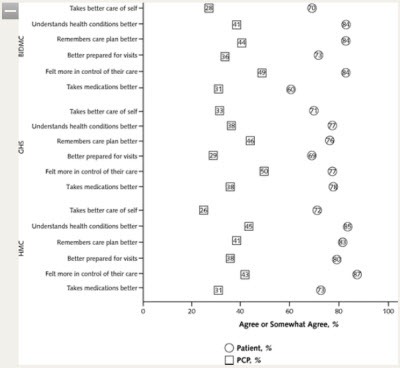
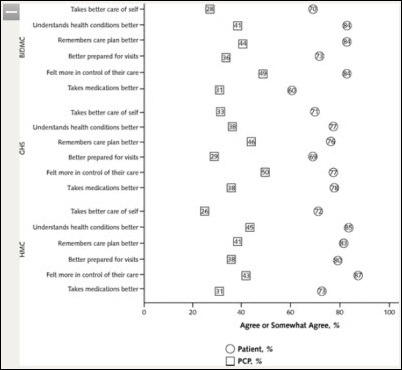
Patients say they are better equipped to help manage their own medical conditions when physicians give them access to their visit notes, according to the year-long OpenNotes study published in Annals of Internal Medicine. Ninety-nine percent of patients at the three participating hospitals who responded to the survey said they wanted the project to continue. None of the participating physicians elected to end their participation at the study’s conclusion — they were less enthusiastic about the patient benefits, but found that allowing patients to review their notes didn’t require any additional time or effort on their part. Responses to the potential benefits in the graphic above are indicated by circles (patients) and squares (physicians).


Reader Comments

From Jedi Knight: “Re: EHR adoption numbers. Has anyone pointed out that ONC and CDC are tracking very different numbers? They are showing 58 and 39 percent, respectively.”

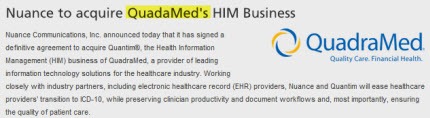
From Start and Stop Again: “Re: Nuance. How do you think 3M feels with Nuance acquiring QuadraMed’s Quantim and JATA, who clearly compete with 3M? This has to signal the end of Nuance’s Computer-Assisted Physician Documentation announced last February in a partnership with 3M. Does Nuance think it can stitch the pieces of two dusty companies into Frankenstein?” Unverified.
10-2-2012 7-28-23 PM

From Familiar with the Transaction: “Re: McKesson acquiring MED3OOO. It’s a good fit. MCK gets the InteGreat EHR, which has a lot of functionality including a data warehouse and integration with Medicomp’s Quippe. They get instant market share in specialty revenue cycle management such as lab, emergency, and ambulance billing. They get a new market in full management of multispecialty groups, and ACO market opportunity from someone further down the path than they were. Not to mention that they take out a competitor and pick up a decent client base.”

10-2-2012 9-49-49 PM

From What, Me Worry?: “Re: West Penn Allegheny downtime. Patient care was not affected – we rely on meaningfully used paper.” West Penn’s servers went down Tuesday morning after a power surge, forcing the hospital to use paper backups. Some systems were up eight hours later and others were expected to come online overnight. It’s not much of an EHR pitch when a hospital claims that being without the computer didn’t really make any difference in patient care. That’s probably more of a PR observation rather than a medical one, though.

From THB: “Re: Allscripts. Are the reports that the company is putting itself up for sale accurate? After your hard day at work, here I am asking you to validate more information, i.e. do more work.” Bloomberg News claimed Friday that Allscripts talked to several private equity firms before engaging Citigroup to explore its options, but neither company would confirm. Shares have risen 11 percent since then, which might be meaningless since (a) the original rumor may have been planted by someone anxious to sell their shares, which is always possible; (b) the rumor may be incorrect; or (c) the rumor may be correct, but may not result in any decisive action. Reasons that going private makes sense: (a) the company’s shares tanked and haven’t recovered after an ugly day in April in which the company fired its board chair, saw three other board members quit in protest, announced the departure of its CFO, and reported lower earnings and guidance; (b) the company conceded to demands by a large shareholder to add its three candidates to the Allscripts board, and those new directors may be influencing the discussion of strategic alternatives; (c) the critical Q3 earnings numbers will be announced in November, and if they aren’t looking so good, this would be the time to plan an escape route from the bloodbath that’s likely to follow; and (d) the stock has fared so poorly in a generally good market that any major strategic changes might be better conducted outside of Wall Street’s baleful glare. My answer, then, is that I have no idea if the rumor is true, but I suspect that it is, and even that wouldn’t mean much until Allscripts decides what it wants to do.


HIStalk Announcements and Requests

10-2-2012 4-49-59 PM

inga_small My new iPhone 5 arrived last Friday and I am happy to report I have successfully made the migration. It’s definitely faster, the camera is better, it’s lighter, and I like the bigger screen. The battery life, however, does not seem any better than the iPhone 4 and actually seems worse, if that is possible. Maybe the battery life is longer in standby mode, but not when you are using all the cool new features. I also checked out the new maps utility and was amused that my “hospitals” search presented me with an option for “The Shoe Hospital” and for an animal hospital, but no traditional hospitals. It did find more choices when I searched “hospital” (singular), however. An “emergency room”  search found a few urgent care centers, but missed the three closest me and didn’t find any ERs attached to a hospital. Good luck with that issue, Mr. Cook.


Acquisitions, Funding, Business, and Stock
10-2-2012 9-50-58 PM

Tenet Healthcare subsidiary Conifer Health Solutions will acquire InforMed Health Care Solutions, an information management and services company.

Ontario-based Kallo, Inc. enters into a $2 million stock purchase agreement with Kodiak Capital Group. The company offers EMR, PACS, and medical device connectivity solutions.
10-2-2012 9-51-50 PM

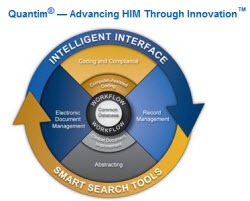
Nuance acquires JA Thomas and Associates, which offers clinical documentation improvement programs. Obviously Nuance is interested in clinical documentation and the ICD-10 transition given the September 27 announcement that it had acquired QuadraMed’s HIM solutions (coding, compliance, computer-assisted coding, abstracting, record and document management, workflow, and clinical documentation integrity) and its acquisition earlier this year of Transcend, which offered transcription and clinical documentation (including the documentation and charge capture solutions of Salar, which Transcend acquired last summer).

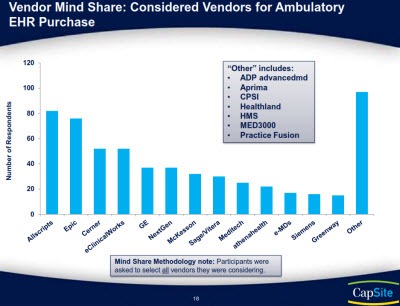
HIMSS acquires CapSite, which offers a vendor database that includes actual pricing and contract information as well as research services that HIMSS will fold into HIMSS Analytics. It will be interesting to see how HIMSS balances the confidentiality desires of its vendor members against CapSite’s detailed and vendor-specific pricing and contracting information. My speculation is that it will go away, replaced by aggregated non-identifiable vendor information. And as I tweeted when the news was announced, that means that HIMSS is now an inadvertent HIStalk sponsor, which Inga pounced on with great glee.

In one of the oddest healthcare transactions in recent memory, The Washington Post Co. buys a majority stake in a hospice and home health service, obviously desperate for further non-media diversification as its Kaplan education cash cow dries up after the government reins in for-profit colleges.
10-2-2012 9-14-38 PM

10-2-2012 9-13-00 PM

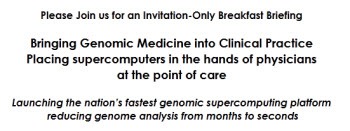
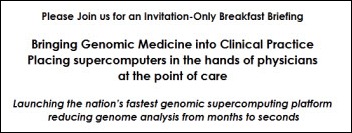
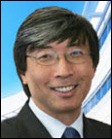
Healthcare billionaire Patrick Soon-Shiong announces a deal between his NantHealth company and Blue Shield of California, which will work with St. John’s Health Center in Santa Monica, CA to roll out healthcare breakthroughs and personalized medicine. He will present the news to a Bipartisan Policy Center conference in Washington, DC on Wednesday, starting with an invitation-only 8:00 a.m. small-group breakfast session and then a larger session later in the morning. He’ll be joined in the session covering the use of supercomputer-powered genomic medicine by Senator Bill Frist; J. Michael McGinnis of the IOM; the president of Blue Shield of California; the top medical executives from AT&T, Verizon, and Caremark; and several academics.


Sales
10-2-2012 8-38-44 PM

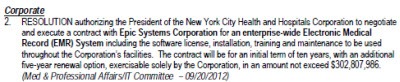
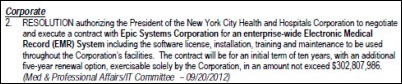
The board of New York City Health and Hospitals Corporation approves execution of a ten-year, $303 million contract to implement Epic throughout the entire corporation. I believe the incumbent was QuadraMed Affinity, although it’s been a long time since I’ve thought about HHC. Cerner and Allscripts were the losing bidders and Allscripts has formally protested the award to Epic, which I would assume means HHC passed on the lower bid by Allscripts, which isn’t at all unusual when prospects get Epic fever. I assume the only difference from the usual hospital decision is that HHC is a government entity, so there’s someone to complain to. UPDATE: readers tell me the product HHC is running is QuadraMed CPR, the former HDS Ulticare / Per Se Patient1 / Misys CPR that they bought from HDS in the early 1990s and used in all inpatient, outpatient, and ancillary areas. It won them a Davies Award in 2006.

Baton Rouge General Medical Center (LA) chooses RelayHealth for its enterprise HIE.

The 77-physician Optimal Radiology selects McKesson Revenue Management Solutions for billing, reporting, and collections.
10-2-2012 9-52-58 PM

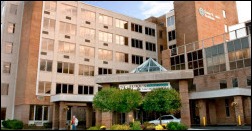
Faxton St. Luke’s Healthcare (NY) adds the Surgical Information System anesthesia information management system to its Allscripts Sunrise Surgery perioperative system.

The US Coast Guard awards Lockheed Martin a $2.3 million contract to develop a mobile interface to its Epic-powered EHR.


People

10-2-2012 6-16-38 PM 10-2-2012 6-17-19 PM 10-2-2012 6-18-00 PM

Device integration provider Nuvon appoints Christopher Gatti (Living Strategies) CEO and Stephen Spencer (Advantis Medical) VP of sales and marketing. Cathleen Asch will transition from CEO to EVP of strategic initiatives and remain on Nuvon’s board.
10-2-2012 6-19-41 PM

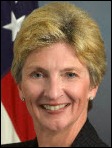
Jo Ann Rooney (DoD – above) and Robert Mills (ACS/Xerox) join Huron Consulting Group’s healthcare practice as managing directors.
10-2-2012 6-23-30 PM

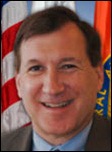
The Military Health System names David Bowen (FAA) CIO.
10-2-2012 6-38-06 PM

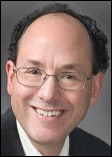
University of Buffalo School of Medicine names Peter Winkelstein, MD as executive director of the school’s Institute for Healthcare Informatics. He is also CMIO of UB/MD.

10-2-2012 7-10-15 PM

Impact Advisors hires C. Lydon Neumann (Accenture) as VP.
10-2-2012 7-13-19 PM

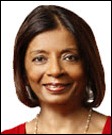
Health Care DataWorks names founder Jyoti Kamal, PhD as president. She was previously deputy CIO and director for the information warehouse at The Ohio State University Wexner Medical Center.
10-2-2012 7-40-03 PM

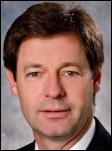
Aspirus names Todd Richardson (Deaconess Health System) as CIO.
10-2-2012 8-14-32 PM

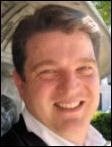
Jonathan Grau (AMIA) joins National Quality Forum as senior director of stakeholder collaboration.
10-2-2012 8-54-28 PM

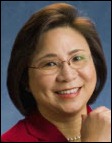
Florence Chang is promoted to EVP of MultiCare Health System (WA). She was previously SVP of clinical support services and CIO.


Announcements and Implementations

WakeMed Health & Hospitals (NC) implements the Philips eICU remote critical care monitoring technology.
10-2-2012 9-53-55 PM

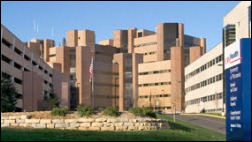
AHIMA awards the University of Wisconsin Hospital and Clinics the Grace Award for demonstrating effective and innovative approaches in using health information to deliver high quality healthcare.

Healthland will integrate Health Language’s terminology platform to support ICD-10 readiness and terminology standardization.

UnitedHealthcare commits $20 million to help 11 critical access hospitals in California improve their technology, including the addition of EHRs.

Partners HealthCare pledges to award Massachusetts community health centers $90 million over the next 15 years to upgrade technology and make other infrastructure improvements.

CORHIO announces that all six northern Colorado hospitals are connected to the HIE.

UPMC, Oracle, IBM, Informatica, and dbMotion will create a $100 million data warehouse that combines clinical, financial, administrative, and genomic information for analytics and predictive modeling applications.

Orion Health awards Cognosante a contract to provide integration and identity management for the first stage of the Massachusetts Statewide HIE program.

MModal makes available its Catalyst for Quality solution for clinical documentation.

North Carolina Healthcare Information & Communications Alliance offers a Vendor Management Policy Template that addresses HITECH requirements for business associate agreements. It’s free to NCHICA members, $50 otherwise.

A study published in the Journal of Clinical Epidemiology finds that DynaMed is ranked highest of 10 online clinical resources based on timeliness, breadth of coverage, and quality of supporting evidence.

CTG signs an Epic implementation contract with an unnamed five-hospital IDN.

The city of Billings, MT goes live with an ONC-funded and Dossia-powered pilot project to give its employees the ability to view and manage their electronic health information.

10-2-2012 7-50-16 PM

Dolbey announces the VoiceBox recording system that tags physician dictation so that the completed transcription can be inserted into the correct location of the EMR.

Verizon announces a cloud and data center infrastructure for storing and sharing PHI. Unlike non-healthcare cloud providers, Verizon will sign a business associate agreement that meets HIPAA requirements.

VersaSuite announces that its 8.0 product has earned pre-market CCHIT ED certification. VersaSuite is certified for both inpatient and ambulatory use, a distinction it says only two companies have achieved.


Government and Politics

Medicare initiates two ACA-legislated programs that target quality of care and readmission rates in hospitals. The Hospital Value-Based Purchasing Program allows the government to pay hospitals bonuses if they meet high performance standards on certain quality measures, while the Hospital Readmissions Reduction Program enables Medicare to reduce reimbursements up to one percent for hospitals with high readmission rates.

ONC announces a goal of helping 1,000 critical access hospitals achieve Meaningful Use by the end of 2014.

ONC releases a consumer-focused video on the benefits of electronic medical records, with cameos by Todd Park, Don Berwick, Farzad Mostashari, David Blumenthal, and others.


Innovation and Research

Kaiser Permanente researchers find that the use of an EHR improved drug therapy and follow-up monitoring of Type 2 diabetics, as well as improved the patients’ glycemic and lipid control.

10-2-2012 8-13-07 PM

Health Nuts Media launches a crowdfunding campaign, hoping to raise $90,000 to develop an asthma education app for children. Rewards are offered for various donation levels, with a $50 contribution earning a copy of the app, a “Wall of Fame” credit, coloring pages, a poster, recognition in the app, and a tote bag.


Technology
10-2-2012 4-43-10 PM

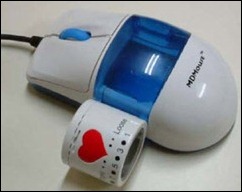
CalHealth prepares to launch MD Mouse, a device that measures pressure information when a finger is slid inside a cuff that folds out from the middle section of the mouse.


Other

The Census Bureau says adults under age 65 made an average of 3.9 visits to physicians in 2010, down from 4.8 visits in 2001. Possible explanations: more uninsured, fewer physicians, higher patient costs, innovation that allows providers to accomplish more in a single visits, and more meds available without a prescription.

Cerner expects over 10,000 attendees from 21 countries at its 27th annual Cerner Health Conference next week in Kansas City.

An Irish pediatric surgeon is found guilty of poor professional performance after a 2010 error in which the wrong mouth surgery was performed on a baby. The doctor correctly ordered an upper lingual frenulectomy in his patient notes, but an administrator entering the procedure into the hospital’s computer system said the only option it gave him was “tongue-tie.” He chose that option, it printed on the OR list, and the surgeons performed that operation. They chairman of the inquiry committee said he was satisfied with the decision even though the committee had concerns about the OR scheduling and coding systems.

10-2-2012 7-01-33 PM

Weird News Andy is amused that a study finds that tickling rats after inducing a stroke appears to prevent paralysis and sensory deficits, possibly by forcing a rerouting of blood through unblocked veins. Playing music seems to work equally well, leading to the “it may not help, but it can’t hurt” recommendation that when someone is suspected of having a stroke, squeeze their hand and talk to them. WNA is also amused at the prospect of giving the rats warfarin as a stroke treatment, which usually is dosed in much larger quantities in the form of rat poison.

WNA cheers this story with a hearty “Hear, hear.” Doctors at Johns Hopkins successfully create a new ear for a woman who lost the original to cancer. They grew the new ear under the skin of her arm until it was ready to be attached.

Strange: a veteran sues the VA for $10 million, claiming that a nurse packed his groin with ice for 19 hours following his genital surgery, causing frostbite that required reconstructive surgery.


Sponsor Updates
10-2-2012 9-57-30 PM

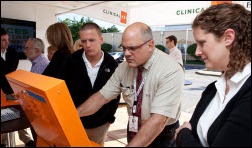
  • Elsevier launches its nationwide ClinicalKey Experience Tour, an all-day outdoor event at hospitals and academic centers to promote its ClinicalKey clinical reference tool.
  • Iatric Systems offers an October 11 webcast on Meaningful Use Stage 2 featuring Beth Israel Deaconess Medical Center CIO John Halamka, MD.
  • Michigan Orthopaedic Institute (MI) selects the SRS EHR for its 17 providers.
  • Intelligent InSites announces members of its Healthcare Advisory Board.
  • Collom and Carney Clinic Association (TX) selects MModal Fluency Direct to voice-enable its EHR.
  • Cynergis Tek CEO Mac McMillan achieves the Fellow of HIMSS designation in recognition of his advancement of privacy and security within healthcare.
  • Balsam Healthcare Corporation (Saudi Arabia) licenses First Databank’s Middle East Drug Knowledge solution for integration with the OASIS HMIS system. FDB also releases new customizable alert categories within its FCB AlertSpace alert management system.
  • Delta Health Technologies selects ZirMed as a preferred business partner to provide RCM solutions to homecare providers.
  • McKesson hosts its 25th Health Solutions Conference next week in Orlando.
  • Gregg Mohrmann and Mark Van Kooy, MD of Aspen Advisors will lead sessions at this week’s New Jersey HIMSS/Delaware Valley HIMSS joint annual conference.

A Report from athenahealth’s “More Disruption Please: The CEO Retreat”
By Jonathan Baran, Co-Founder and CEO, Healthfinch
10-2-2012 7-37-48 PM

Athenahealth’s recent "More Disruption Please" event brought together 50 CEOs of health IT companies and their investors to the Point Lookout Resort in Maine (a resort that athenahealth bought for $7.7M… a steal!). Each CEO was given their own private log cabin to stay in (or to sleep off late nights with Jonathan Bush). The purpose of the meeting was for athenahealth and these newer, innovative HIT companies to get to know and learn from each other.

Any time you get to spend time with Jonathan Bush, you never know what to expect. He did not disappoint, as he began at eight in the morning by impersonating Ali G, telling everyone how athenahealth gets "ka-ching and da bling for doing the right thing!" A couple of more presentations followed, including one by Marty Anderson, who asked how innovation can come from the top-down when "the healthcare industry is a giant cartel."

Then the fun began as 30 CEOs gave two-minute pitches, with five finalists promised a ten-minute presentation to 2,500 of athenahealth’s users. We (Healthfinch) were selected as one of the five finalists, along with iTriage, Entrada, Epion, and Wellframe. In a smart market research move, athenahealth then asked their customers to vote on which company’s product they would most like to see integrated with athenahealth. Ultimately, our scrappy startup from Madison, Wisconsin took second place to Aetna’s iTriage.

Jonathan Bush’s final display of how to "keep it real even when you’re CEO of a publicly traded company" began when he gave us a lesson on how to build a successful business model. Jonathan, like every other EMR CEO, drew inspiration from the “Saturday Night Live” skit, "D— in a Box." He gave us all the following instructions:

  1. Get a box (find a pile of work that users hate and suck at).
  2. Cut a hole in the box (figure out how to break into the market).
  3. Put your junk in the box (bring your secret sauce to the market).

I couldn’t say it any better myself.

Athenahealth also discussed more of their plans for their entire "More Disruption Please" program, the smartest move being their recognition that the biggest challenge in bringing innovation to market (and thus allowing small companies to flourish) is in the distribution channel. That’s why athenahealth is promising to bring the top innovations to their customers by rapidly scaling interesting products and innovations to their entire user base.

Time will tell if athenahealth can live up to its grand plans to become the information backbone of the health system, but their program (and their conference) seem to indicate they are on the right track.


Contacts

Mr. H, Inga, Dr. Jayne, Dr. Gregg.

More news: HIStalk Practice, HIStalk Mobile.

Curbside Consult with Dr. Jayne 10/1/12

October 1, 2012 Dr. Jayne 1 Comment

clip_image002

It’s the first Monday in October, which means the United States Supreme Court is back in session. No, those aren’t our justices dressed up as Santa Claus. That’s actually a photo of the Justices of the Supreme Court of Canada. I found it much more eye-catching than the photo of our Court, where poor Ruth Bader Ginsburg looks like she’s off in the time-out chair.

Just when the Court thought it was done dealing with healthcare and the right to refuse government intervention, it agreed to hear three cases this session that deal with those issues at least on some level:

  • Delia v. E.M.A. handles the concept of whether states can recover money spent to deliver care for poor or disabled Medicaid beneficiaries when it is found that they have received funds from another source.
  • Levin v. United States addresses whether military medical personnel can be immune from alleged “battery” while providing medical care to a civilian.
  • Missouri v. McNeely will look at whether law enforcement officers have the right to obtain blood samples from allegedly drunk drivers regardless of consent.

Except for the Medicaid issue, these cases don’t seem terribly earthshaking for the masses. There’s an underlying concern in some camps, however, that the Court is somewhat fractured after the Affordable Care Act drama of the last term. The Atlantic reports that Chief Justice John Roberts alienated his conservative colleagues when he saved the Act.

I trust that the Justices are adults and would be above any middle school-style backstabbing to make up for perceived (or real) slights in the previous term. They’re human, however, so there’s still the potential for some drama. I’m personally looking forward to some entertaining transcripts. Last year provided some rare treats, and I don’t think broccoli has received that much national press since George H.W. Bush refused to eat it.

Although the court has only accepted a few cases so far, more will be reviewed for inclusion this term. We could potentially be looking at decisions on same-sex marriage, the Voting Rights act, or election law. With a Presidential election looming, let’s hope we don’t have to hear any cases about hanging chads or other election day fallout.

Another major case on the docket, Fisher v. University of Texas at Austin, looks at affirmative action in university admissions. Depending on which way that one goes, it could lead to shakeups in medical school admissions that could have a profound impact on the diversity of the future health care delivery workforce.

Regardless of your political orientation, the Court always seems to bring something to the table for everyone to be happy about. We don’t get that very much from our other branches of government, so here’s to another term.

Have a favorite Justice? Want to suggest some kickier shoes for those that sit in the front row for the official portrait? E-mail me.

Print

E-mail Dr. Jayne.

Collective Action 10/1/12

October 1, 2012 Bill Rieger 4 Comments

The views and opinions expressed are those of the author personally and are not necessarily representative of current or former employers.

Collective Action. What does that mean, and why would Mr. H and team allow this to emerge on such a highly regarded and respected industry blog?

I will attempt to answer that question with a definition, a story, and a vision. To put this in context, you will need to know a little bit about me.  

My name is Bill Rieger. I work at Flagler Hospital in St. Augustine, FL, serving as the chief information officer for our community hospital.  Like all of you, I have many life experiences. Some of them were tragic, riding on the edge of self-destruction and death (let’s just say that the 80s were rough, but the last 21 years were much better). Some were hilarious, some were somber, and some were absolutely revolutionary and life altering.  

I have come to believe that all of those experiences were necessary to help me find my destiny.  I am not going to go off here on a deeply philosophical tangent, but I do believe we are all searching for something. Some of us — if not most — are waiting for something big to happen before we take that step we know we could or should take.  My destiny — my calling, if you will — is to encourage you not to wait, but instead to take that leap, that step of faith.

Wikipedia defines collective action as, “Any action aiming to improve the group’s conditions (such as status or power), which is enacted by a representative of the group.” I like the idea of aiming to improve healthcare. I strongly believe that healthcare will best be changed by those who have dedicated their life to this field and are willing to listen to every and all ideas to facilitate growth and improvement.  

The ideas this industry needs will not predominantly come from government, or even hospital executive leadership. I believe the greatest untapped resource for creative ideas will come from the ground floor. Yes, we the people.

The first time I realized this was when I was a golf cart attendant.  Golf is one of my passions. I am fairly decent, usually shooting somewhere in the mid 80s. I was putting carts away one evening as we were preparing to close up for the day. I saw this very Dilbert- looking man working on a rat’s nest of a wiring distribution frame. As I was patiently waiting for him to finish, my type A took over and we struck up a conversation. I asked him if he was a contractor, and he told me that he was not, he was the IT manager there at the resort. I shared my experience with working on wiring frames in the Navy. No sooner had I got that out of my mouth when he asked me to be his assistant. 

In shock, we both started to ask questions. I told him that I was in school trying to get my degree in computer science and that I could not work full time. He told me that was fine. I asked how much it paid. He asked me how much I made. I told him $5.50 per hour plus tips. He told me $12.00 per hour. SOLD! $12.00 per hour — that is crazy money, I thought. I AM RICH! I was living in a trailer. I had a old truck, an old motorcycle, and a snake. This 100+ percent increase in pay would allow me to move up to the big time and fix my floorboards.

I cannot tell you how many times I reflect on that story. There are so many lessons there, but it really epitomizes what I am trying to do with this column. Whether you are putting carts away, moving patients around, writing code, selling products and services to hospitals or ambulatory facilities, presenting to the board, or implementing and optimizing an EMR, you have value. This industry needs the value you have. That Dilbert guy — my now long-time friend Ted — thought I had value when I did not see it. I want to encourage ideas, leadership, creativity, and discipline. But most of all, I want to encourage you to take some action.  

My vision for this is to think big. Think big with regards to what you can accomplish. Think big because we have big problems to solve. Think big in case you succeed!  

I do not believe that all people are inherently good. I do believe, however, that all people are capable of accomplishing more than they think. My goal is to make these articles challenging, humorous, relative, entertaining, impactful, and most of all, encouraging. I welcome all feedback, even and especially a contradictory viewpoint — they are usually enlightening. Please share your steps, even small ones, as you progress with confidence to bring an industry through a new level of maturity.

Why would Mr. H and team want this on their blog? The spirit of HIStalk, according to the “About” section of the website, is informing people about industry news and trends. Mr. H must believe that encouraging HIT professionals to achieve great things in their respective professions is good for the industry and a trend that bears supporting.

10-1-2012 5-33-58 PM

Bill Rieger is chief information officer at Flagler Hospital of St. Augustine, FL.

HIMSS Acquires CapSite

October 1, 2012 News 4 Comments

image

HIMSS announced this morning that it has acquired CapSite, which publishes the CapSite healthcare technology database that includes vendor pricing and contracting information, including 5,000 actual vendor proposals and contracts representing 1,600 vendors.

HIMSS will incorporate CapSite’s offerings into its HIMSS Analytics services, which has not included pricing information. HIMSS says it will also add voice of the customer consulting services through customized research, including analysis of vendor market position that includes product gaps.

According to HIMSS President and CEO Steve Lieber, “The investment in CapSite follows our overall strategy for HIMSS Analytics to provide the best market intelligence on the hardware, software, and services selected by chief information officers and other users of information technology. We will maintain the CapSite office in Burlington, VT with CapSite employees joining the HIMSS roster as part of the HIMSS Analytics team.”

McKesson to Acquire MED3OOO

October 1, 2012 News 3 Comments

image

McKesson announced this morning that it will acquire MED3OOO, which offers physician practice administration services, revenue cycle management, and software. The Pittsburgh-based company employs 2,800, has 10,000 physician users, and has stated annual revenue of $200 million.

McKesson will incorporate MED3OOO’s products and services into its McKesson Revenue Management Solutions business. The announcement quotes its general manager, SVP Pat Leonard, as saying, “McKesson and MED3OOO share a commitment to help customers navigate growing healthcare complexity and achieve their full potential. We are excited about the opportunity to combine best practices and superior technologies to help providers and other customers improve their operations and achieve better business health as part of our Better Health 2020 strategy.”

We mentioned the acquisition several times over the past few weeks in HIStalk, although without specifically naming MED3OOO since McKesson is a publicly traded company. Our November 2011 interview with MED3OOO Chairman and CEO Pat Hampson provides more detailed information about the company.

Monday Morning Update 10/1/12

September 30, 2012 News 9 Comments

9-30-2012 3-12-23 PM

From DanburyWhaler: “Re: Western Connecticut Health Network. The manager we thought was being groomed to take over as CIO is gone after three months. They are laying off people left and right. The major construction budget is way over.” The hospital recently laid off 28 employees, citing economic conditions, state taxes, and general healthcare trends. The $150 million expansion is pictured above.

9-30-2012 3-20-54 PM

From Boomer: “Re: Patrick Soon-Shiong. The billionaire’s healthcare coming out event is this Wednesday, when he will announce the results of an oncology-focused application of his supercomputer / high-speed fiber / middleware / mobile platform that he has been building for years. He claims that 8,000 oncologists using his decision support tools lowered the patients receiving the wrong treatment from 32% to 0%.” He’s presenting at the Bipartisan Policy Center’s October 3 conference in Washington DC, Accelerating Electronic Information Sharing to Improve Health Care.

From At Northwestern: “Re: Epic. No commitment from Northwestern Memorial Hospital to move to Epic.” Like the original rumor saying they were making that move, this one is unverified.

From Bean Multiplier: “Re: Allscripts. I hear from a good source that the company would be willing to take a private equity deal for $15 per share.” Unverified. Shares closed Friday at $12.42, up 14% on rumors that the company is exploring a possible sale to private equity. Shares were last above $15 on April 26, the day before the company fired Chairman Phil Pead, after which three of the company’s board members quit in protest. Even now the P/E ratio is at 40, about the same as Cerner’s. I assume the P/E ratio takes into account the $200 million of repurchased shares, which would have raised earnings per share by reducing the share count rather than reflecting increased profits. Bloomberg did not cite the source of the “possible sale” rumors, which could either be an informed, unbiased source or a pump-and-dumper trying to unload some shares on the market’s reaction to the non-news.

From The PACS Designer: “Re: RIS/PACS integration. There’s been some fresh looks at how a RIS fits into the flow of information between radiology presents, and the submission for and completion of a radiology study. Since most configurations between the RIS and PACS are customized at each institution, it leaves many opportunities for a future RIS/PACS upgrade to be a more robust information source. This upgrade should provide two-way information flow so everyone can plan their activities each day more efficiently. One way to achieve the better information flow goal is to insist that the new system of a combined RIS/PACS come from the same vendor.”

9-30-2012 3-38-33 PM

From Miraculous Miler: “Re: John Landis of Cerner. Rumor is that he’s gone.” Cerner’s media relations department confirms that John Landis, SVP of ClientWorks, has left the company.  

From MumpsInToronto: “Re: University Health Network, Toronto. Going to RFP. They are running QuadraMed now, which is MUMPS based. From the volume of data that will need to be converted, you can bet they will be looking at Epic.” Unverified.

9-30-2012 3-28-25 PM

McKesson announced Better Health 2020 and an investment of $1 billion in R&D in last December. Three-quarters of poll respondents said the company’s healthcare IT position is worse now than then. New poll to your right: has the use of EHRs increased Medicare fraud?

9-30-2012 7-42-23 PM

Welcome to new HIStalk Gold Sponsor Agilum Healthcare Intelligence of Franklin, TN, which describes its offerings as “Business intelligence in a box.” Modules include Service Line Costing and Profitability (margins by service line and payer, case mix trends, length of stay and volume trends, DRG mix, margin by physician, etc.); Revenue Cycle Performance (dashboards, A/R performance indicators, ageing reports, net revenue modeling, and denials by reason); Operational Performance (executive view with KPI line item indicators, facilities operations and department dashboards, daily volume dashboards and forecast, and operating ratios); and Productivity Manager (departmental dashboard, pay period reports, daily reports, overtime ratio reports, and skill mix reports). One of the most technologically astute hospitals in the world, Bumrungrad International Hospital in Thailand, recently signed up for Agilum’s business intelligence solutions to improve its operational, managerial, and financial decision making. Thanks to Agilum Healthcare Intelligence for supporting HIStalk.

I headed over to YouTube to see what I could find on Agilum Healthcare Intelligence. Above is an overview.

I had heard reports that HCA signed a big contract with Epic to replace its Meditech system, but two HCA sources told me off the record that it’s still just one HCA site piloting Epic so far. HCA is still rolling out Meditech CPOE.

Epic consulting firm Nordic Consulting announces that it has raised growth capital from SV Life Sciences, Health Enterprise Partners, and HLM Venture Partners. All three backers focus on healthcare, with the one catching my eye being SV Life Science since Bruce Cerullo is a venture partner there in addition to being the CEO of Vitalize Consulting Solutions that was sold to SAIC a year ago.

9-30-2012 3-59-02 PM

CapSite releases its 2012 Ambulatory EHR & PM Study. It finds that 40 percent of organizations are still in the market for an ambulatory EHR, with most of them planning to buy within the next two years. The practice management market offers less opportunity, with only 27 percent of responding organizations indicating their interest in buying or upgrading and just 21 percent saying they would replace their current practice management system to move to an integrated PM/EHR.

9-30-2012 4-10-26 PM

Pearson and Cerner announce RealEHRPrep, an EHR learning tool for nursing students.

The UK’s Department of Health admits that the failure of its NPfIT project means it no longer owns rights to the software developed for it by CSC using billions of dollars of public funds. The original contract called for software ownership as one of four terms that were to protect the government’s interests if the project failed, which it did, but either the contract was incorrectly drafted or the government negotiated the rights away in trying to avoid a CSC termination lawsuit. The Department of Health and vendors involved (CSC and BT) are ignoring information requests, according to the ComputerWeekly.com article.

Also in the UK, and external review finds that the rate of clinical errors increased after NHS turned over operation of its pathology laboratories to the multinational corporation Serco. The report by a non-profit watchdog also found that the money-losing JV required hospitals to chip in cash to keep it afloat, and even then the company will pull out of certain markets. Computer problems caused some of the patient-related problems: a patient received the wrong blood type after the software failed to issue a warning, an incorrect creatinine clearance calculation was highlighted as a near miss, and the company’s blood analyzers were shut down for four days after becoming infected with a computer virus.

And also in the UK, a report commissioned by Imperial College Healthcare Trust concludes that 3,000 of its cancer patients have not been seen promptly because the hospital uses 17 different computer systems, some of them requiring manual data entry. The trust says they’re looking for a single system, but the report warns them of the risks involved.

9-30-2012 5-21-42 PM

A Wall Street Journal article listing the top 50 startups says that healthcare has fallen out of VC favor based on its somewhat subjective criteria, with last year’s top-ranked Castlight Health dropping off the list entirely.

The VA was expected to award a contract for mobile device management software by Sunday, September 30, the end of its fiscal year.

Weird News Andy likes this story, in which police used fingerprints to locate the former owner of a human finger that was found inside a fish caught from an Idaho lake. When the sheriff called a wakeboarder who had lost four fingers in a towline accident in June, he immediately responded, “Let me guess – they found my fingers in a fish.” The sheriff offered to return the well-preserved digits, but the man declined, saying, “Uh, I’m good.”

Another WNA find: pathology researchers at Georgetown Lombardi Comprehensive Cancer Center (DC) develop a method of testing the susceptibility of a patient’s specific cancer cells to various chemotherapy drugs, much like the routine culture and sensitivity tests that help doctors choose an appropriate antibiotic for a given infection.

Here’s Vince’s HIS-tory on QuadraMed, Part 3, which purely coincidentally provides a history of the Quantim product line that the company just announced that it’s selling to Nuance.


Sponsor Updates

9-30-2012 4-17-38 PM

  • Vitera Healthcare’s VIBE user group meeting was held September 12-14 at Disney’s Grand Floridian Resort & Spa in Lake Buena Vista, FL.
  • Optum announces an ICD-10 education program for hospitals.

E-mail Mr. H.

Time Capsule: If Nurse Shortages Require a 50 Percent Labor Reduction, What Technology Will You Install (or De-Install)?

September 30, 2012 Time Capsule Comments Off on Time Capsule: If Nurse Shortages Require a 50 Percent Labor Reduction, What Technology Will You Install (or De-Install)?

I wrote weekly editorials for a boutique industry newsletter for several years, anxious for both audience and income. I learned a lot about coming up with ideas for the weekly grind, trying to be simultaneously opinionated and entertaining in a few hundred words, and not sleeping much because I was working all the time. They’re fun to read as a look back at what was important then (and often still important now).

I wrote this piece in December 2007.

If Nurse Shortages Require a 50 Percent Labor Reduction, What Technology Will You Install (or De-Install)?
By Mr. HIStalk

mrhmedium 

The recent CDW Healthcare nurse survey about IT is both fascinating and sobering. Nurses are too busy with patient care to get application training or participate in IT projects. They continue to believe that IT can improve their jobs, even though current systems involve frustrating duplication. They also think that applications bought on their behalf are ineffective and unreliable.

“Nursing systems” really aren’t that at all. They are really “systems to get nursing to do stuff that someone else wants.” Electronic charting, medication administration, order entry, bedside barcoding, and patient assessment: none of these save nurse time. They may have an impact on quality (slight or otherwise) and they may create an impressive-looking electronic record for other people to read. What they don’t do is make it easier for nurses to finish their work by shift’s end.

Here’s an exercise to ponder. The hospital CEO comes to you and says, “Mr. or Ms. CIO, our RN shortage is serious this time. There’s no solution in sight. We have no choice but to use just half the nursing hours we have available today. You heard me right — I said half. Quality cannot suffer. You have an unlimited budget to implement whatever technology you can find that will deliver that result. Do that and you’ll get a nice bonus — I’ll let you keep your job.”

Let’s say you receive that ultimatum. Would you recommend clinical documentation systems or bedside barcoding as a way to survive on 50 percent fewer nursing hours? I’m pretty sure you wouldn’t. So what would you recommend?

You’d first need to find out how nurses spend their time. That’s a simple observation study, easily done by data-driven IT types, engineers, or quality experts.

Then, you’d push tasks that add minimal value down the food chain to cheaper and more readily available employees. That assumes you have those, of course. Many hospitals inexplicably got rid of LPNs and nurse aides years ago, using expensive and hard-to-find RNs to pass meal trays and give baths. Didn’t all those hospital suits learn anything about labor management in their MBA programs?

Then, you’d automate where you could to improve efficiency. Buy more PCs and Pyxis machines so nurses don’t wait in line. Provide portable communications devices. Have all drugs and supplies delivered to an in-room cabinet for each patient. Let someone else reconcile narcotics counts and give report. Integrate nurse call systems with other communications.

Maybe you’d even de-install some of those applications that quietly eat up nurse time because of poor design. Watch the kid at McDonald’s ring up your hamburger. Now imagine what the screen would look like if your current clinical systems vendor designed it. Real estate sales would skyrocket because every McDonald’s would need another mile of drive-through lane to hold the angrily waiting customers.

Maybe the RN shortage isn’t that severe at your place (so far, anyway). Still, you should make sure that IT systems aren’t contributing to it. When installing new systems, practice “first do no harm”: will they require more nurse time? Any answer other than “no” is unacceptable. And if you’re convinced that technology saves time, this is a great opportunity to prove it.

Comments Off on Time Capsule: If Nurse Shortages Require a 50 Percent Labor Reduction, What Technology Will You Install (or De-Install)?

HIStalk Interviews Alan Portela, CEO, AirStrip Technologies

September 30, 2012 Interviews Comments Off on HIStalk Interviews Alan Portela, CEO, AirStrip Technologies

Alan Portela is CEO of AirStrip Technologies of San Antonio, TX.

9-22-2012 3-31-03 PM

Tell me about yourself and the company.

I’m the CEO at AirStrip Technologies. I have about 20 years of experience in healthcare information technology. I came from the EMR side in the past. I have been on the board of AirStrip for about two years and have been the CEO for a little short of two years, since January 2011.

When I came to AirStrip, the core business was mobilizing medical devices — specifically in obstetrics — on the inpatient side. We were accessing fetal surveillance on mobile devices with 510(k) class II FDA clearance. We were the only company doing this with FDA clearance. We remain today the only company doing this with FDA clearance.

Since then, the company moved into mobilizing other medical devices in the inpatient care setting and adding applications for ambulatory care as well. We introduced a cardiology product, which is now deployed in about 60 medical centers. We also introduced a patient monitoring component for mobile devices. All of our medical device connectivity products are cleared with the same classification by the FDA.

Next, we’re moving into the home health space with a partnership we formed with Qualcomm Life to be able to take management of chronic diseases outside of the hospital walls into a patient / population-centric approach.

I interviewed Cameron Powell – the president, co-founder, and chief medical officer — in early 2010. He said that contrary to what people might think, AirStrip is not just a vendor of mobile waveform display applications, but instead is a mobile solution that can expose any data. How will that influence the direction of the company?

I’d like to talk a little bit about the industry trends, how we fit in, and how we evolved as a company to where we are today.

When I started at AirStrip, the comment I received from the members of the team is that AirStrip was viewed at that time — two years ago — as a nice-to-have tool. Mobility overall was viewed as the first technology that healthcare organizations were going to deploy as soon as they were finished with the implementation of their electronic medical records and electronic health records systems to comply with Meaningful Use requirements, at the time Stage 2 and moving to other stages in the future.

My comment coming from the EMR world to my team was, “Well, good luck, because it’s going to take a long time until the process of EMR and EHR deployment is ready. There’s always a new tool that is coming up and a new product that is coming out.” That was the market trend.

I stated to the team that there are a number of initiatives and challenges that we need to look at in the industry. One is the shortage of caregivers. We have known since the Leapfrog Report that there is a shortage of caregivers. Now as we’re going into an outcomes-based reimbursement model and a patient-centric care approach, everything is centered more around the specialists and the top chronic diseases – a cardiologist for heart disease, endocrinologist for diabetes, neurologist for stroke.

What we need to do is leverage mobile technology to bring the data to the specialists and the primary care physicians wherever they are, rather than bringing them to the data. Mobile technology has to become a mission-critical tool to be able to bring the clinically relevant data to those caregivers at the right time, so that they can make the right decisions.

We started looking at mobility throughout the continuum around chronic diseases. When we shifted our messaging to a patient-centric approach, we started experiencing significant growth. In 2011, we grew about 300% over 2010. We started signing contracts, developing partnerships with large healthcare organizations like HCA, Dignity, Vanguard, et cetera that clearly saw the importance of using mobile technology not only to attract patients to their facilities, but also to attract physicians to their systems by offering the right tools and improving their quality of life.

As we looked at this whole thing, we said if we are mobilizing one of the most important clinical data sources — medical devices — throughout the continuum, we need to make sure that we look at the other clinical data sources that are going to make the physician’s life much better. Immediately we looked at EMRs and EHRs. About three months ago, we acquired the intellectual property of a product that was developed at a healthcare organization by physicians on a very similar platform with a very similar approach as what we have done with medical devices. We acquired the IP for a mobile EMR extender.

This is where the other trend comes in. As you see more organizations creating ACOs to manage population health, you’re starting to see that a number of providers are expanding outside themselves by buying more hospitals or acquiring surgery centers, urgent care centers, imaging centers and the like. They’re adding to their systems. Mostly likely they are going to have multiple EMR vendors, even though primarily they were using one particular EMR or EHR vendor.

The moment you do that, it’s the same thing that we experienced on the medical device side. You’re going to have multiple vendors in different units. You need to have a seamless way of mobilizing all those devices into one view.

What we realized was that by buying the IP for this mobile EMR extender, we now needed to do the same thing we did with mobilizing medical devices — mobilize all EMRs and EHRs into one single view, being able to move data across the continuum and having physicians look at one view of their world, improving their workflow.

Of course, there are other things that we have to include. Later on, we’re going to look at imaging and at third-party components that we can apply on top of our platform. Then we will look into videoconferencing to be able to offer the complete solution.

I always talk about that announcement from Steve Jobs when he introduced the iPhone. He said, “It’s not a Web browser. It’s not a phone. It’s not an iPod. It’s everything in one.” That became a revolutionary announcement. What we are basically telling the industry now is, it’s not a medical device, it’s not an EMR/EHR, it’s not an imaging system. It’s all in one, fully integrated on a mobile device, bringing the data to the physicians in one view wherever they are. We create that whole concept of the virtual physician in a way we have all been trying to do for a long time.

The key is to be able to now support data standardization throughout the care continuum, looking at things like CCD — continuity of care documentation — as a standard, and also looking at how we can move HL7 data to create a true healthcare information exchange and take advantage of things that the government has made available to us. This includes NHIN Direct or NHIN Connect for routing, data warehousing and also for an enterprise master person index.

Today the company has evolved beyond medical device mobility. Now we’re mobilizing EMRs/EHRs in a seamless way for physicians. We are now working with the existing standards the same way we’ve been working with the FDA requirements. We’re looking at the standards for data standardization, nomenclature and healthcare information exchange to be able to support the care continuum.

I think that AirStrip now offers is equivalent to what Steve Jobs announced for the iPhone. I think that AirStrip is the next generation of healthcare transformation — being able to put everything into one view for caregivers.


The company is fairly new to have gotten this far with remote monitoring solutions and FDA approval. Are you concerned about what it will take to go after those goals you mentioned?

We all have to recognize that the transformation is necessary and we need to stick to the things that we know, that will be able to make a difference. Transformation will take place thanks to our mobile platform.

I always make the comparison of operating systems on your devices. On your PC, you have Microsoft, or on any Apple device, you have the O/S, the operating system. The true value that you bring to improve workflow in any industry comes from the ability to apply technologies or applications on top of those operating systems. For us, we have the same situation, but we not only have good applications in the mobile space, but we have a very solid platform that we view as becoming that platform or operating system in healthcare that is going to allow for us to bring not only our modules, but other third-party components on top of our platform to be able to solve the problems that we are discussing.

From a development standpoint, what we’re going to do is stick to our core. Today, our core is mobilizing medical devices, EMRs and EHRs. When it comes to imaging and videoconferencing, all we’re going to do is look at third-party packages, plug them into our platform, and then use standards to be able to support single sign-on, content management, and as I spoke about earlier, healthcare information exchange to move the data around.

The key for us, and we’re doing, is to pick those healthcare organizations that are the visionaries and partner with them to be able to move in baby steps toward implementing this huge transformation — but do it in a way that we start region by region — medical devices, EMRs, EHRs and then bring the tools to those regions to be able to replicate that model in other geographies. What we’re doing is carefully picking those healthcare organizations that have the right vision and have the right clinical level of expertise and the right intentions to improve outcomes while reducing cost. Then, working with them, we take things to the next level.

When I’m talking about the vision, I’m really explaining a vision that we’re planning to achieve in the next 12 months. Although the technology is ready today, the bigger challenge is continuity of care. It’s allowing all those systems that the hospitals have to be able to comply with the standards that already exist.


How big is the company today in terms of revenue and headcount and how large it will need to get in the near term?

As a privately held company, we don’t share our revenue figures, but I can tell you that when I came in about two years ago, we were probably about 20 people. We have over 100 already. We have offices in San Diego, Nashville, Chicago, and our headquarters is in San Antonio — that’s where the company started.

As I mentioned to you when I talked about the growth of last year, we added a lot of presence with some key customers. We introduced our cardiology solution officially about 10 months ago and we already have anywhere between 57 to 60 hospitals installed. We already have contracts with another 200 to go live over the next 12 months.

We definitely see a significant growth in the company, but where we are putting most of the emphasis is on what we call clinical / business transformation. We clearly identified that technology is just an enabler of transformation. Transformation happens as a result of aligning people and process as drivers, with technology as an enabler. We created a whole new team where we brought physicians from the top consulting firms to work with us to be able to partner with our customers –you’re going to see some announcements in this area coming out in the next few weeks – to partner with customers to deliver the value proposition.

I believe that technology moving forward is not going to be acquired unless the technology pays for itself, clearly proves out the value proposition on a daily basis and is aligned with the requirements for ACO and Meaningful Use. That’s also why one of the acquisitions we made about two weeks ago was a Meaningful Use tracker to be bundled with our EMR enhancer. We believe that the EMR enhancer on mobile devices is going to increase decision, adoption and utilization and that automatically creates the compliance with Meaningful Use, being able to go to Level 1 and Level 2 much faster.


You have an extensive background in selling systems to the federal government. Do you see that in AirStrip’s future?

Yes. As you know, I was part of the team that installed 60 medical centers at the Department of Defense and 30 at the VA. That is close to my heart. My biggest passion before coming to AirStrip was to help those wounded warriors. Today’s environments are more dramatic. You look today at shortening stent time, event-to-balloon time, for a patient that has a full blockage of the arteries. You look at the wounded warriors, you have to immediately react to patients that are injured in the battlefield and take them through several layers of care until you bring the right outcomes to those kids.

My goal is take this to the federal government and be able to learn from what they have done in areas like security. The federal government is doing security at a level that no one else is doing yet in the private sector. We’re going through that process as we speak because we want to bring that lesson to the private sector – security from the federal government. We also want to bring the experience that we have in the private sector to all the things that we’re doing in the military space. So, yes, it’s definitely an area that we’re planning for.


Do you anticipate further acquisitions or going public at some point?

At this point we are backed by Sequoia. We just closed our third funding round with the Wellcome Trust group, who are very close partners with Sequoia. Now we have a strong 18 to 24 month plan to be that game-changer in healthcare.

That’s our immediate goal. How can we make the transformation to the point that everybody will look back two years from now and say, “AirStrip recognized the importance of virtualizing the caregivers and supporting the patient / population-centric model.” Everybody will remember the types of discussions that we’re having, how we were able to do that by collaborating with large progressive health systems as partners but also large EMR/EHR vendors and medical device companies. We are talking to all of them. We are looking at all of those as partners in full collaboration.

The idea of IPO is not something that we are concentrating on right now. We are enjoying this incredible growth. Acquisitions of other products that will be synergistic to our vision … we are always open to that.


Any final thoughts?

The key moving forward is coming up with the right technological approach and partnering with the right people and the right processes to be able to transform healthcare. But when we talk about people, we have to recognize that that we are talking about the provider, the payers, the vendor community, the systems integrators, all working together and collaborating to be able to sustain the transformation.

We know that transformation is coming. The sense of urgency has been established. This is where you’re going to see more collaboration between all the sectors, more than you have ever seen before. The ones that do not collaborate are the ones that are going to be left out.

Comments Off on HIStalk Interviews Alan Portela, CEO, AirStrip Technologies

News 9/28/12

September 27, 2012 News 2 Comments

Top News

9-27-2012 7-39-56 AM

The American Hospital association agrees in a letter to HHS Secretary Kathleen Sebelius and the Attorney General Eric Holder that EMR-assisted cloning and upcoding should not be tolerated, but retorts that CMS has ignored its repeated recommendations to expand E/M (evaluation and management) codes to create a national standard for hospital ED and clinic services. My opinion: the election-sensitive, administration-friendly HHS’ers got blindsided by a Center for Public Integrity article that insinuated but didn’t prove that a shift to higher complexity codes means that EDs and physician practices are gaming the system to the tune of $11 billion, so given too little time between now and the November 6 election to actually do something useful (like identify and prosecute someone who’s actually guilty), HHS just went public with meaningless finger-wagging to make it appear that they’re on top of the situation. HHS keeps bragging on how great their fraud detection systems are (which they should be, given the hundreds of millions paid to fat cat contractors to develop them), yet they apparently trust journalists more than their own armies of bureaucrats to tell them they have a problem. The reimbursement system is even worse than the tax laws in being a confusing hodgepodge of rules that nobody, even CMS, really understands or can interpret consistently. Some providers are undoubtedly committing fraud and the 99% honest ones would love to see them shut down and punished. However, as with tax loopholes, there’s nothing illegal or immoral about taking the maximum benefit that the law allows. There’s a reason that crime syndicates are moving from drug dealing to Medicare fraud: payment is quick and rarely questioned, the money is great, and the risk of actually going to jail is almost zero.


Reader Comments

From High Roller: “Re: QuadraMed. Quantum is just the first QuadraMed domino to fall. Franciscan Partners isn’t interested in holding on to the rest of the company forever, so it won’t be long before the other pieces are sold off. QuadraMed has a large enough client base, so they could milk their revenue stream for awhile. More likely, Franciscan will look to sell what’s left to someone like Allscripts who’d be interested in having a larger client base to sell into.”


HIStalk Announcements and Requests

inga Highlights from the last week on HIStalk Practice: patients want more online access to their health records but most doctors don’t offer the option. Lack of staff impacts EHR adoption, especially in smaller practices. Tips for using an EHR as a marketing tool and to increase patient satisfaction. Parents are more likely to fill children’s e-prescribed prescriptions than paper ones. Physicians are working fewer hours and seeing fewer patients than they were four years ago. I am looking for some MGMA picks. Thanks for reading.

9-27-2012 5-59-09 AM

Welcome to new HIStalk Platinum Sponsor Emdat, which offers hybrid clinical documentation and transcription solutions that improve the productivity and satisfaction of EHR-using physicians. Instead of pointing and clicking, physicians continue to use the most efficient method of documenting patient encounters – dictation. Emdat’s DaRT system automatically tags sections of transcription content (chief complaint, medical history, etc.) and then seamlessly auto-populates discrete information directly into the EHR just as though the physician entered it directly using structured documentation. Its Emdat Mobile solution not only allows physicians to document encounters on the go, but provides a more patient-friendly way to document during an encounter. Loyola University Health System uses it with Epic and says the setup was simple, reducing transcription turnaround time by 50% and allowed doctors to continue dictation, which they say is faster and better for patient care. Thanks to Emdat for supporting HIStalk.

inga Mr. H took off a little early to treat Mrs. H to some fun, so today’s post is a bit shorter than usual.  He’ll be back to serve up a full course of the Monday Morning Update over the weekend.


Acquisitions, Funding, Business, and Stock

 9-27-2012 7-40-04 AM

9-27-2012 7-35-34 AM

As reported earlier today, Nuance will acquire QuadraMed’s Quantim product line. You have to wonder if Nuance didn’t rush the announcement a bit following our Wednesday mention of the deal on Twitter and HIStalk: early Thursday morning Nuance posted these (now corrected) announcements referring to “QuadaMed” and “Quantrim.”

The Kentucky Economic Development Finance Authority approves a $150,000 grant for Health Catalyst, a business accelerator for companies creating health-related software, including life-sciences and HIT companies. Health Catalyst will nurture five startups a year by providing work space, mentoring, and seed funding.


Sales

9-27-2012 3-48-26 PM

Evergreen Health (WA) selects MEDSEEK’s ecoSmart Patient Precisioning solution for predictive analytics.

Adventist Health selects MedeAnalytics’ Patient Access Intelligence solution for point-of-service cash collection across its 16 hospitals.


People

9-27-2012 6-42-20 AM

Mark Burgess (Cerner) joins Allscripts as director of solutions management.

Fletcher Allen Health Care (VT) hires Adam P. Buckley, MD (Beth Israel Medical Center) to be the organization’s first CMIO.


Announcements and Implementations

9-27-2012 3-31-19 PM

Wake Forest Baptist Health (NC) goes live on Epic.

Wellcentive announces Advance Risk Manager, a predictive risk modeling system for population health management that allows providers to focus on patients with specific risk profiles.

The three largest health systems in St. Louis join the Missouri Health Connection HIE.


Government and Politics

9-27-2012 4-41-20 PM

Rep. Mike Honda (D-CA) will introduce a bill to set up an Office of Mobile Health at the FDA to provide recommendations on mobile health issues. The legislation also calls for the creation of a support program at the HHS to advise app developers on privacy regulations and for a low-interest loan program for physician offices to purchase new technology.


Technology

9-27-2012 3-14-20 PM

The West Health Institute is developing Sense4Baby, a wireless and portable fetal monitor for high-risk pregnancies in remote clinics. The system, which is being piloted in Mexico, sends the captured data over a cellular network to the patient’s physician.


Other

The Seattle Times covers Caradigm, the Microsoft-GE joint venture whose headquarters opened this week in Bellevue,WA. Positive comments from Providence about Amalga are included, along with less enthusiastic ones from Swedish CMIO Tom Wood, who says he’s not sure how they can add a layer on top of EMRs without a lot of cooperation.

UMass Memorial Health Care (MA) will eliminate 140 positions, some of them in IT, in seeking $80 million in cost reductions.

John Reynolds, the former CEO of Hospital for Special Surgery (NY), is arrested for racketeering, charged with soliciting kickbacks from prospective vendors and extorting $300,000 from a hospital employee in return for arranging an annual bonus.

9-27-2012 6-59-04 AM

Weird News Andy wonders how this is possible. A women who is “internally decapitated” when her skull is torn from her spine in a car accident not only survives, but is basically back to normal.

Here’s a new video from St. Jude Children’s Research Hospital, featuring patients, employees, and celebrities singing “Hey, Jude” to highlight National Childhood Cancer Awareness Month. Some of those featured are Jennifer Aniston, Betty White, Robin Williams, and Michael Jordan.

Two-thirds of CHIME members report staff shortages and are in most need of more specialists to implement and support clinical applications.

A study published in the Journal of the American Medical Informatics Association concludes that CPOE was the main challenge among hospitals failing to achieve MU in the program’s first year.


Sponsor Updates

9-27-2012 6-50-09 AM

  • TELUS Health brings its TELUSHealth.com portal live to showcase its solutions that link Canadian patients to their providers.
  • Elsevier unveils its EduCode Clinical Documentation Improvement eLearning curriculum for ICD-10 at next week’s AHIMA meeting.
  • New York eHealth Collaborative spotlights five health IT champions at the NYeC gala October 15.
  • Muhannad Samaan, MD of Aultman Inpatient Medicine discusses how Ingenious Med’s charge capture software improved patient hand-off and communications.
  • Software Magazine ranks Macadamian #435 on its Software 500 list, which is based on revenues of the world’s largest software and services suppliers.
  • Sandlot Solutions releases a report on using data and analytics to improve healthcare delivery.
  • Skylight Healthcare Systems integrates its Service Recovery process with Vocera’s communication devices.
  • Optum launches its Optum ICD-10 Core Education program.
  • TI combines its DM8148 system on-a-chip with Imprivata OneSign to provide out-of-the-box strong user authentication into any software application.
  • McKesson expands its Intelligent Coding portfolio to include observation services.
  • First Databank executives Keith Fisher, MS and Patrick Lupinetti, JD  will present educational sessions at next month’s AMCP 2012 Educational Conference.
  • Vitera Healthcare Solutions reports record attendance at this month’s VIBE conference in Orlando.
  • 3M Health Information Systems adds 18 physician education modules to its Web-based curriculum to address ICD-10 readiness.

EPtalk by Dr. Jayne

Don’t forget — October 3 is the last day for Eligible Professionals to begin their 90-day reporting period for the Medicare EHR Incentive Program, aka Meaningful Use. One of my buddies in the consulting business has been sharing e-mails he is receiving from providers. Today’s special: “I would like to be Meaningful Use but do not know to begin. I need the money. Please send tips for me to start?” I guess that’s someone’s idea of a consulting RFP.

An American Medical News article lists common EHR blunders. I’ve seen all of these in various forms across practices from small to large. Topping the list: lack of infrastructure, lack of workflow assessment, lack of training, lack of buy-in, failure to communicate with patients about delays during the transition, and failure to appropriately integrate the computer into the patient-physician relationship.

News flash: Nearly one-third of US medical school students who initially planned to enter primary care ended up switching to a more lucrative specialty. Surveys of students in New York show that “medical students who anticipated high levels of debt upon graduation and placed a premium on high income were more likely to enter a high-paying medical specialty.” Really.

In similar news, the US medical schools that still don’t have Family Medicine departments are starting to get with the program. Some of these schools are big name and I know all too well what it’s like to attend one. Now we just need to get all medical schools to incorporate informatics into their programs. Let’s teach budding doctors (and nurses, and everyone else) how to leverage technology to better care for patients rather than fighting it or trying to undermine it. Although the new generation seems tech savvy, I see too many students trying to short-cut their documentation.

clip_image002

Mashable lists “10 Office Technologies on Their Way Out.” The list of items they predict will vanish in the next five years includes obvious items like fax machines, tape recorders, and the Rolodex. I’m not sure about desktop computers, cubicles, and standard working hours. There are a lot of entrenched management types out there who will resist. Although I won’t miss formal business attire, which includes pantyhose (#7), I’d like to lobby to keep fashionable shoes part of the equation. If I see one more pair of flip-flops in the office, I just might scream.

The Greater Atlanta area is a hotbed of health IT vendors, so I hope that none of you were recipients of the free kittens given away in the parking lot of the McDonough Walmart. Apparently they were rabid.

As Mr. H mentioned earlier this week, HIMSS registration is open and the room supplies are dwindling. I’m glad he gave me a reminder. I booked tonight, yet wasn’t able to get my preferred hotel or even my preferred dates. I’m leaving a day early, but that’s probably OK since I have to take vacation to attend this year. My hospital no longer has a conference budget or paid professional development days, so I’m not complaining about spending one less night in an overpriced hotel. Plus, I was able to snag a super-cheap plane ticket so I can afford some hot new shoes for Histalkapalooza.

Print


Contacts

Mr. H, Inga, Dr. Jayne, Dr. Gregg.

More news: HIStalk Practice, HIStalk Mobile.

Nuance To Acquire QuadraMed’s Quantim HIM Line

September 27, 2012 News 3 Comments

9-27-2012 8-26-30 AM

Nuance Communications announced this morning that it will acquire QuadraMed’s Quantim product line for health information management. Quantim includes applications for coding, compliance, computer-assisted coding, abstracting, clinical documentation integrity, record and document management, and workflow.

HIStalk reported Nuance as the buyer Wednesday on Twitter and on HIStalk following the filing of Federal Trade Commission documents. The announcement was reportedly originally scheduled for October 1, the first day of the AHIMA conference.

Readers Write 9/26/12

September 26, 2012 Readers Write Comments Off on Readers Write 9/26/12

Submit your article of up to 500 words in length, subject to editing for clarity and brevity (please note: I run only original articles that have not appeared on any Web site or in any publication and I can’t use anything that looks like a commercial pitch). I’ll use a phony name for you unless you tell me otherwise. Thanks for sharing!

Note: the views and opinions expressed are those of the authors personally and are not necessarily representative of their current or former employers.


Weaknesses Revealed:  Secrets Exposed by Data Integrity Summary Reports
By Beth Haenke Just

9-26-2012 7-37-49 PM

The data integrity summary report is one of the most powerful – yet underutilized – tools hospitals have at their disposal for maintaining the integrity of the data within their MPI. Digging deeper into the statistics provided in these reports reveals far more than the volume of overlaid or duplicate records within the system. It can also reveal areas of weaknesses that, left unchecked, could threaten the long-term integrity of the MPI, limit its usefulness in achieving quality and safety goals and Meaningful Use, and hamper participation in ACOs and HIEs.

In addition to pinpointing the root cause of data integrity issues, summary reports can identify specific areas upon which hospitals should focus corrective efforts. These may include improved education and training, policy clarification, enhanced communication, and other steps that result in fewer duplicates and overlays for a more accurate MPI and improved data integrity.

Regular reviews of summary reports can also reveal patterns of errors. For example, too many null or empty fields in certain records can signal problems with registration processes. Drilling down deeper, data integrity statistics can be used to track errors with greater specificity, such as identification of incorrect patients, transposed Social Security numbers, or non-compliance with naming conventions. Data integrity reports can even provide detailed insight into the specific types of errors that are happening most frequently within individual departments or facilities and even enterprise-wide.

Once patterns are identified, individual cases can be closely examined to pinpoint where additional training or policy refreshers might be required. Coupling the data integrity summary report with advanced analytics tools allows hospitals to determine precisely where errors are entering the system and the specific types of mistakes being made. This, in turn, allows education programs to be customized to strengthen specific areas of weakness.

For example, if the summary report reveals an unusually large number of registration errors being made within a short period of time, a hospital can drill down into the data to determine the department where the mistakes are originating, as well as who is making them, why, and how. Often the culprit is an individual who is unfamiliar with the registration process and who is attempting to save time by creating new records for every patient versus first searching the MPI for existing ones. Additional training and education will significantly reduce, and in some cases eliminate, these types of registration errors.

The integrity of patient identity data is critical to achieving care quality and safety goals and plays an integral role in the success of HIEs and ACOs. By taking advantage of the wealth of information found within summary reports, hospitals and health systems can ensure the long-term integrity of their data.

Beth Haenke Just, MBA, RHIA, FAHIMA is CEO and president of Just Associates of Centennial, CO.


Round Peg in a Square Hole: Behavioral Health and EMRs
By Kathy Krypel

9-26-2012 7-43-34 PM

Implementing an EMR for behavioral health is like putting a round peg in a square hole. Yes, you read that right: a round peg in a square hole (the opposite of the traditional analogy). The EMR (round peg) can fit, but unless certain steps are taken, it won’t fill the behavioral health (square hole) need entirely. Those steps that need to be taken include:collecting the appropriate data and offering the behavioral specific tools and care plans for optimal diagnosis and care delivery.

Why does it matter? Since many large hospital systems offer behavioral health services as part of their continuum of care, it is important to fill in the gaps and variances around the EMR. The following are just a few examples of why it is important to offer behavioral care services that are supported by a robust EMR:

  • One in eight (or nearly 12 million) ER visits in the US are due to mental health and/or substance use problems in adults.1 This is the most costly venue for care delivery.
  • Major depression is considered equivalent, in terms of its burden on society, to blindness or paraplegia. Schizophrenia is equivalent to quadriplegia.2

What are these behavioral healthcare EMR gaps and variances?

  1. Providers. Most behavioral health providers are not MDs. In fact, primary care physicians spend limited time with patients and are often hesitant to diagnose and treat behavioral concerns. Most behavioral health providers are clinicians with Masters or Doctorate degrees who have been licensed by their state(s) to diagnose and treat behavioral health disorders.
  2. The diagnostic process and tools. Behavioral health disorders are the only serious, chronic illnesses that are diagnosed based solely on self report. The tools used to assess the behavioral health patient’s mental status and substance abuse patterns are very different than the traditional medical diagnostic tools of imaging and lab work. Behavioral health diagnostic tools are most often elaborate question and answer tools that are can be both clinician-administered and self-administered. Behavioral health clinicians use tools such as the Beck Depression Inventory (BDI), Generalized Anxiety Disorder scale (GAD 7), and the Diagnostic and Statistical Manual (DSM IV). These tools need to be incorporated into the data capture and workflow built into an EMR. Additionally, behavioral health providers are required to develop elaborate treatment plans with the patient’s participation. Non-behaviorally focused EMRs typically don’t have tools built in for this and must be built (or ignored). If ignored, the EMR becomes nothing more than a word processor.
  3. Customization will always be required. While there are multiple behavioral health specific EMR vendors in the marketplace and enterprise-wide EMRs that can be configured to cover behavioral health, customization will be required to meet multiple state-specific mandates, practitioner specialty requirements, and federal privacy rules that apply to behavioral health.

Although there are challenges, successes are growing. The following recommendations help to ensure a positive implementation outcome:

  • Create a small but specific implementation team that aligns with your behavioral health leadership during the build and test period, so all build and testing work is completed in a collaborative manner.
  • Build using the most commonly used diagnoses and their DSM IV criteria into the EMR to make it easy for providers and therapists to use drop-down lists to create the diagnostic picture of the patient.
  • Build using ASAM criteria, so chemical dependency staffs can more easily complete treatment planning.
  • Design within the “tighter than HIPAA” federal constraints that govern confidentiality of patient information for patients receiving chemical dependency treatment (i.e., CFR 42).
  • Involve trainers and testers in the workflow discussions.

In order to avoid putting a round peg in a square hole, it’s essential to understand the variances in the behavioral health setting and address them in workflow, data capture, information exchange, provider engagement, and administrative requirements and incorporate them into the EMR project plan, design, and implementation.

Sources:

1. Mental Disorders and/or Substance Abuse Related to One of Every Eight Emergency Department Cases. AHRQ News and Numbers, July 8, 2010. Agency for Healthcare Research and Quality, Rockville, MD. http://www.ahrq.gov/news/nn/nn070810.htm

2. Disability Adjusted Life Year, DALY, Daly 2004

Kathy Krypel is master advisor at Aspen Advisors of Pittsburgh, PA.


Data Virtualization Best Practices Accelerate Time to Value
By Richard Cramer

9-26-2012 7-46-55 PM

Data virtualization offers a value proposition that quickly excites business leaders and technologists alike. Business executives are enthusiastic because data virtualization enables IT departments to more quickly respond to new requirements – often in days or weeks rather than months or quarters. Information technologists are similarly excited about being able to get more done, more quickly, and deliver higher value to their business customers.

However, unless we’re careful, this same enthusiasm can lead to organizations trying to use data visualization where it’s not appropriate and results in a classic “square peg in a round hole” situation. It is important to keep in mind that while data virtualization is an important part of the data management tool kit, it is not the right tool for every purpose, and doesn’t eliminate the need for a traditional data warehouse.

Successful deployments of data virtualization share some common characteristics. First is that data virtualization is most successful when it complements a mature data management infrastructure, development standards, and implementation processes. Best practice in these organizations is to use data virtualization as a part of an overall data management life-cycle where data mapping logic that had been built in the virtual solution is seamlessly reused in the physicalized data integration solution.

Second, there are specific use cases where data virtualization is most appropriate. Best practice is to vet candidate uses of data virtualization against these use cases. Just because data virtualization can be used does not mean it should be used.

This is particularly true in the early stages of adopting data virtualization technology, since missteps in using data virtualization for inappropriate use cases in the first project or two can give the technology a black eye that is hard to overcome later.

Good use cases for data virtualization share the following characteristics: (a) data needs are of a short duration; (b) business requirements are unclear or evolving; and (c) situations where quickly prototyping a view of integrated data is required.

Situations where data virtualization is not a good fit include: (a) complex join logic is required; (b) high performance query response is a driving requirement; or (c) source system availability is unreliable or unpredictable.
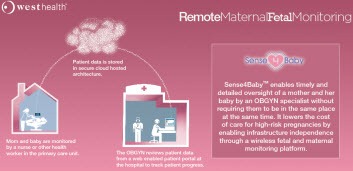
In this context of best practices, it is exciting to see the healthcare industry providing many opportunities where data virtualization can be a key enabler of organizations looking to maximize their return on data. There are a large number of healthcare organizations with traditional enterprise data warehouse solutions in place, and that can most benefit from the addition of data virtualization to their architecture.
There are also many examples of use cases that are appropriate for data virtualization and can quickly deliver high value. For example, data virtualization can be used to accelerate drug research by providing scientists with integrated views of internal and external information to aid in the drug discovery process. The unpredictable nature of discovery can be enabled by virtualized data integration solutions—quickly combining lesser-known external data with well-known internal data speeds up the decision-making process and ultimately reduces the time to bring new drugs to market.

For healthcare providers, the ability to respond to ambiguous and frequently changing data requirements in a rapidly changing regulatory and business environment is a must. The rapid prototyping enabled by data virtualization can be invaluable in meeting fleeting reporting and data needs today that may be gone or completely different tomorrow. 

Richard Cramer is chief healthcare strategist of Informatica Corporation of Redwood City, CA.


Coordinating Physician and Nursing Care
By David Lareau

9-26-2012 7-52-29 PM

Historically, physician and nursing systems and workflow have often been parallel, but independent of each other. Physicians and nurses must be able to share information to provide coordination of care.

For example, physicians must comply with standards such as ICD-10, ICD-9, SNOMED CT, RxNorm, LOINC, DSM-IV, and CPT, while nurses employ terminology like NANDA, NIC, NOC, ICNP, PNDS, and CCC. With so many different standards in place, creating an integrated picture of patient care can be difficult at best.

Fortunately, all of these standards have already been mapped to link physician and nursing information. The capability now exists to integrate physician and nursing documentation and care capabilities as well as provide links between a patient’s clinical diagnoses and nursing care.

To create this functionality, all existing nursing standards were evaluated to identify the best candidate for use at the point of care in computerized systems. The Clinical Care Classification (CCC) system was selected and 182 CCC Nursing Diagnoses were linked to the more than 55,000 clinical diagnoses. Linking the CCC and clinical diagnoses makes it possible for all members of the care team to generate a list of nursing diagnoses based on the physician’s clinical diagnoses for that patient.

In addition, CCC Nursing Diagnoses are linked to CCC Nursing Interventions and to more than 1,760 specific nursing actions. Also, a starter set of customizable documentation protocols has been developed for each of the nursing actions.

One of the most significant aspects of this work is that the same concepts in the nursing protocols are linked to the physician content where appropriate. Coordination of care has arrived.

David Lareau is chief executive officer of Medicomp Systems of Chantilly, VA.

Comments Off on Readers Write 9/26/12

HIStalk Interviews Paul Taylor MD, CMIO and Co-Founder, Wellcentive

September 26, 2012 Interviews Comments Off on HIStalk Interviews Paul Taylor MD, CMIO and Co-Founder, Wellcentive

Paul Taylor, MD is CMIO and co-founder of Wellcentive of Roswell, GA.

9-26-2012 5-56-09 PM

Tell me about yourself and the company.

I’m an internal medicine physician. I practice clinic-based internal medicine about half time. I see patients five days a week. I also chair the clinical integration committee for our PHO. Our committee oversees all the different quality work.

We’re part of the Trinity Health System. We’re in the process of forming a tiered network and just signed up as an ACO. That along with the experience as a practicing physician and chief medical information officer for Wellcentive … it’s been such a lot of fun to put those three different things together.

Wellcentive is a population health management company. We provide population health management solutions that help physicians and their organization across the entire spectrum of population health management, including point of care, care gap analysis, outcomes reporting, automated patient outreach, predictive modeling, risk assessment, care management, and care coordination.

We’re taking a broad view of what population health management means and providing tools developed by a physician for physicians and their organizations. We also focus on aggregating and normalizing data from a variety of sources to make the solution as useful as possible.


The concept of providers being responsible for population health management got thrown into their laps without much warning. Do you get the sense that they are ready to take that on?

I would say most of them are not ready. This is a whole new set of tasks and responsibilities that physicians are being called upon to execute, and lot of the time, don’t really understand. They also have a hard time changing. Most physicians are set in their ways. For us to practice medicine in a different way than we’ve done for potentially decades is a tall order.

The conversation around improving outcomes, cutting costs, and to a certain extent the payment reform of accountable care is going much faster than most physicians can keep up with.


Providers are always suspicious of payers and insurance companies, and those payers have been aggressively investing in analytics and population health management technologies for a long time. Do you think that providers are at a disadvantage against companies that have made analytics a core competency?

I would say that they are. There are some gun-shy physicians as well when it comes to technology. I don’t think that electronic medical records have been as well received by physicians as they could have been. Some physicians are frustrated by the interruption to their workflow.  

Using a population health management solution is really different than an EMR that would be just one more thing. Some physicians are reluctant to dip their toes in that water. Payment reform is going to push them hard in that direction, though.


There weren’t many incentives for physicians to implement technology, but now they’re going to need the information from systems that contain their data. Will this need for analytics drive technology adoption, specifically of electronic medical records?

The need for the data and for the reporting — but also the need for the ability to proactively make improvements in your clinical outcomes and financial outcomes for your patients — is really going to drive that technology adoption. It’s not enough to be looking backwards. 

Analytics are knowing where you’ve been, but it’s having the tools, processes, and programs in place in your office to look forward, know where you want to go, and put the programs in place to get there. That’s where we are and should be going.

EMRs can be helpful in some regard to that end. The amount of actionable data that you need to have good insight and to how you’re doing — that predictive, forward-looking analytics to know where your patient may be over the next year — that type of technology is a lot different than a traditional EMR ,though.


Let’s say you’re a health system with a large hospital, a couple of smaller ones, and perhaps some owned and affiliated practices that use several different EMRs and exchange information through an HIE. What technology pieces are you missing that you’ll need under this new paradigm?

One of the important components is an interfacing platform that can aggregate and normalize data from EMR systems, practice management systems, e-prescribing solutions, local and national labs, health information exchanges, payers, and a variety of other different data sources. That’s a core competency and a core need. 

Data analytics is important to be able to do flexible outcomes reporting, so that you can tailor the reporting that you do for your organization to your specific organizational goals and metrics. Having some sort of outreach tools where you can communicate with patients and help close the gaps in care is important. For organizations that are working with risk-based contracting, risk assessment tools and predictive modeling to give them a good idea of their financial risk and patient panel so that they can properly negotiate with payers and employers.

The one big concept that’s important to understand is that if you look at an accountable care organization, they have to take into consideration the whole landscape in their communities. They have to tie all of that together with their different EMR systems, different practice management systems, different e-prescribing tools, and so on. They need a tool that can do that to help with their different business and clinical objectives, too.


EMRs are driving an unintended consequence in causing small practices and hospitals to align with bigger and more technology-astute providers, such as practices either selling out to hospitals or turning their IT management over to them. Will the need to manage populations provide another push for small organizations to align with larger ones?

I do think so. The likelihood is that the development of accountable care organizations and tiered networks with their more community-based reporting requirements are going to drive alignment of physicians with healthcare systems and their specific overarching umbrella technologies in ways that are probably a little different than with EMRs.

EMRs dictate workflow in physician offices to a certain extent. Because of that, there’s a lot of personal preference for which physicians like this EMR system, or which like another. Having an EMR that a health system offers can be helpful, but it also can be polarizing. Whereas if you have a population health management solution that‘s just a core business function for your accountable care organization, all the physicians are going to be engaged with it, using it, and have their outcomes reported through it. I do think that’s a phenomenon we’re going to see again.


After all the time and money that hospitals and practices have spent implementing EMRs, do you think they will be able to implement these new tools?

I do. We work with physician groups and organizations that have EMRs and some who don’t. The value a population health management solution brings is significant, even for those offices that have an EMR system.

The way that the systems are used in an EMR office is different than the way it is in a paper-based office. In a paper-based office, it does tend to be more point-of-care, hands-on use — looking at clinical decision support tools and doing medication reconciliation directly in the tool as opposed to through an interface with an EMR. With an electronic medical record, we tend to rely a little more on electronic communication between the population health management tool and the EMR, so there is not a duplication of the workflow and effort.


If I’m the typical hospital or practice with an EMR, what’s the bang for the buck in looking for additional technologies to move toward with managing populations?

You are going to need a population health management tool — one that can help you with the reporting, one that can help collect actionable data from a variety of different sources in your community to help make the reporting that you get out of it meaningful to help make the identification of high-risk patients accurate.

For example, if you’re implementing a case management program, having a strong population health management toolset that’s highly integrated with the pertinent data sources within your community is really probably the next step.


Do you see an overlap between what EMR vendors offer and the more specialized tools you provide, and is it hard to convince providers that they need those tools?

It’s beyond just simple functionality. You can have a rules engine that does analytics, but if the data that you’re running the analytics on isn’t accurate, it’s not up to date, it’s not complete, then the reporting that you’re going to get out of it is not going to be very meaningful. The physicians aren’t going to trust it. They’re not going to pay attention to it. They won’t get engaged.

EMR vendors generally are not focusing on integration and interfacing of actionable data across a community. That’s an easy argument, and a very valid argument to make.

Some of the toolsets that you find in a solution that’s geared towards population health management are beyond what most EMR vendors do. For example, predictive modeling and risk assessment, using vetted algorithms to help identify patients that are high risk of poor outcomes, using different types of tools that way so that you can enroll them in case management programs, or help you in your conversations with payers through case mix adjustment, that sort of thing. Those technologies are a little beyond EMRs.

Being able to track the cost and utilization of healthcare across a population of patients is something that’s really valuable information for physicians, especially ACO-type organizations. That’s also something that you really don’t see in EMRs.

We generally don’t think of a population health management solution as being in competition with an EMR. We see them as different types of workflow, parallel technology tracks with some overlap in the uses of the systems. But the goal of the population health management solution is primarily improving the clinical outcomes for a whole population, and also improving the cost of the healthcare delivered to them at the same time.

I see population health management solutions shining in community-wide implementations, which is a distinct and parallel technology track with respect to EMR implementations. Population health management and EMR solutions are complementary, and I don’t see them as being in competition with each other. Their clinical and business purposes are very different.


If I’m a patient now being covered by your tools through my provider organization, what changes in my care will I see?

You might find that you get some automated outreach to you, maybe on a quarterly basis. You get a phone call telling you all the different things that you’re due for, like a diabetic foot exam, mammogram, colonoscopy, that type of thing. The information that’s given to you on that phone call is more likely to be accurate.

You will also probably find that your physician is little more engaged with population health, in that they might be more likely to have care management work that’s being done in their office, a care team that’s involved with helping with your care. You may find that there are other people inside the office who, at a visit or between visits, are using the solution to help improve your care. That’s something that patients generally notice.


As hospitals acquire or align with medical practices, what information do they need to manage that relationship?

Without the appropriate toolset, it’s difficult for health systems or physician organizations to have a good feel for the quality of care that their physicians are providing. If they want to have more insight into that, they need the core set of data — the patient demographic information, accurate information about what’s the patient’s medical history is, what their diagnosis is, what medication they take, what sort of procedures or tests have been performed, and what immunizations have been given and what should not be given.

It’s also important in today’s environment to have an understanding of which payer those patients have. Also, to be able to use a benchmarking tool to help see how an individual physicians stacks up against his or her peers within the office, their specialty, or within their region. A lot of times we see health systems or physician organizations proactively working with those physicians whose performance rates are not as good, trying to help bring them along. Which is, of course, good for everybody.


What changes would you expect the average hospital or physician practice to see in the next five years in terms of the things we’ve talked about, and what should be their priorities in doing something now to be ready?

We’re going to see a lot more collaboration. We’re going to see much tighter relationships between hospitals and the physicians around quality, cost, and outcomes. We’re going to see the business structures of those relationships change significantly, and I would imagine fairly quickly, over that time frame, such that there’s less, “Well, that’s the hospital and this is my clinic here,” more of a feeling like, “We’re all on the same team trying to work together to take care of patients.” 

I believe that the financial incentives are going to be rewarding a community of physicians to help improve those outcomes. The only way you can really do that is by care collaboration through communication, through being proactive, looking forward, and doing things that require a care team to accomplish, like case management, care management programs, that sort of thing. I think we’re going to see a lot of changes over the next five years.


Any concluding thoughts?

Wearing my physician hat, I look at all the technology in this conversation around solutions, data, and interfacing. In my mind, the technology is just enabling. It won’t get the job done for you, but it’s going to help you get there if you choose to put the effort in.

I’m a firm believer that this kind of quality improvement work needs to be led by physicians and managed by physicians. Patients don’t want to be taken care of by some stranger at the case management program. They want their doctor to take care of them.

I also think that it’s important for physicians to roll up their sleeves in their offices and change the way that they’re doing things, so that they utilize the staff that they have in different ways to help drive outcomes and put together an office-based clinical quality improvement program centered around trying to take care of all patients, not just the ones who were in the office that day.

I see all that technology helping to enable, that but it’s just critical that the physicians are leading the charge.

Comments Off on HIStalk Interviews Paul Taylor MD, CMIO and Co-Founder, Wellcentive

Text Ads


RECENT COMMENTS

  1. Merry Christmas and a Happy New Year to the HIStalk crowd. I wish you the joys of the season!

  2. "most people just go to Epic" that's a problem because then EPIC becomes a monopoly in healthcare, if it isn't…

  3. Only if CEO can post 'bail' which nowadays stands at 1B$ paid directly to the orange president or his family…

  4. I enjoy reading about the donations to Donor's Choice by HIStalk members. I also believe in the worthiness of Donor's…

Founding Sponsors


Platinum Sponsors


Gold Sponsors


RSS Webinars

  • An error has occurred, which probably means the feed is down. Try again later.