Recent Articles:

Morning Headlines 1/16/15

January 15, 2015 Headlines Comments Off on Morning Headlines 1/16/15

Google joins PwC’s Vista-based bid for military health records

Google will join PwC, General Dynamics, Medsphere, and DSS in their bid to install VistA as the DoD’s next EHR.

Whistleblower Lawsuit Calls Billionaire Patrick Soon-Shiong’s Healthcare Startup ‘Fraudulent’ And Dangerous

Two ex-employees of physician billionaire Patrick Soon Shiong’s startup NantHealth file a whistleblower suit alleging that the company is “engaged in a multitude of fraudulent activities.”

The new 10-year standard: Find a more accurate EHR total cost ownership

Becker’s Hospital Review calls for a change to the way total cost of ownership is calculated during EHR procurements, saying that five or seven year timelines are not long enough when in reality a successfully installed EHR won’t be replaced for ten years or longer.

Philips and MIT investigators collaborate to give researchers unprecedented access to critical care patient data

Philips is collaborating with MIT to provide researchers access to the de-identified medical records of 100,000 ICU patients that received care in one of Philips’s eICU centers.

Comments Off on Morning Headlines 1/16/15

News 1/16/15

January 15, 2015 News 5 Comments

Top News

image

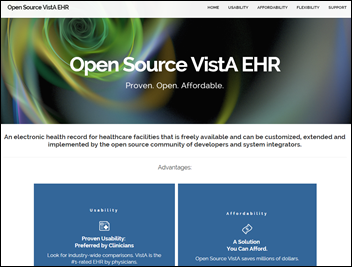
PwC adds Google to its Department of Defense EHR bidding consortium that is pitching the VA’s VistA. Google joins, PwC, General Dynamics IT, DSS, and Medsphere. Google’s contribution would be collaboration and search tools, which seems to be more sizzle than steak as PwC tries to make VistA sound sexier to the DoD, whose contempt for that system is legendary. The group has also put up a web page to make its case.


Reader Comments

image

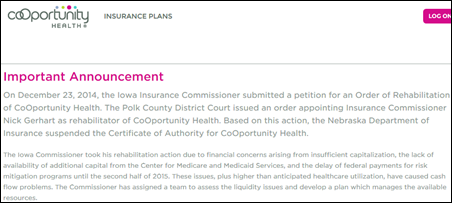
From Weird News Andy: “Re: Iowa health insurance startup, the second-largest co-op in the country and heavily funded by the federal government, fails. The key is in this quote: ‘CoOportunity Health’s pool of people was larger than expected, was sicker than expected, so their risk became much greater than the funds that were available.’ That’s an economics lesson. Sicker people spend more and choose the one that saves them the most money, so you end up with a pool of sicker, more expensive members. If the founders of the organization did not see this going in and did not charge enough for their service, the fault is theirs. But then if they charged more, fewer people would select them and …” That’s a big problem with medical insurance. The fingers of insurance company actuaries fly over their Excel worksheets in their attempt to assemble a customer base that includes lower-risk, healthier patients to offset the expensive ones so they can bid competitively. However, individual patients sign up expecting to use more services than they’re paying for, to the point of not even buying insurance until they’ve accumulated enough problems to make it worth their while. It’s like a buffet restaurant eyeballing prospective diners at the door in trying to choose a profitable mix of picky eaters and starving chowhounds for a predetermined price, but their downfall is that few picky eaters will pay for an all-you-can-eat buffet knowing they’re subsidizing those who inhale everything in sight.

From RVA: “Re: concierge medicine. My PCP is moving to concierge practice, saying he doesn’t want to use Epic and that he can’t provide good care because his face is always in the computer ((FYI, he cashed his MU check). The concierge company touts their USB chart that allows you to take your important clinical information anywhere — apparently MyChart was not good enough (the guy sitting next to me joked that when they run out of USB drives, they’ll switch to 8-track tapes). He has approximately 1,200 patients (mostly Medicare) and a poorly-managed practice. They showed a scary video about how doctors are ‘forced’ to give up their practices and referenced the use of ‘mid-level providers’ in a negative way. A lot of people ate it up and started pulling out their checkbooks – oh, he has limited capacity, so it’s first-come, first-served at $2,500 per year. I’m worried that we’re creating a class system where those who can’t afford the fee get less than premium care.” It’s tough to ignore economics by suggesting that those who pay less should receive equally generous, excellent, and responsive healthcare services, even though we as decent people wish that were possible. All of us working in healthcare expect to be paid, so unless we turn it back over to the nuns and counties that ran hospitals as true non-profits using cheap and volunteer labor, those days are likely gone. The ED is the last foothold of healthcare democracy, where everybody is treated the same based on need, but then again, it’s a cost cesspool for that reason and hardly a poster child for open access to all. Healthcare economics is like a balloon – squeeze it in one place to cut costs and another part bulges out as providers who are understandably unwilling to reduce their personal standard of living figure out new ways to charge for their services. We’re at three tiers now: (a) those who use ED and public clinics or who don’t buy insurance because they don’t see the immediate value; (b) the large middle class who have insurance but are getting hit hard by out-of-pocket costs and sometimes facing bankruptcy because of huge and often questionable bills, with that group subsidizing the first one by paying excessive charges and taxes; and (c) those whose assets are adequate to self-insure and whose time is valuable enough to make it worth finding the best and most customer-friendly providers who don’t take insurance. It’s unrealistic to expect the care and outcomes to be identical across all three groups. It’s also reasonable to expect people in the middle group to move down rather than up, and it’s the loss of that group that threatens to implode the system. It’s just like the tax system: some percentage of people pay nothing, the wealthy pay a low overall percentage because of their small numbers and large accounting tricks, and those in the middle foot most of the bill.


HIStalk Announcements and Requests

Last year right before the HIMSS conference I supported Donors Choose by offering companies a large, short-term banner that appears beside the HIStalk title on every page, using the proceeds to fund a bunch of projects for classrooms in need. It felt good and it was fun, so I’m doing it again this year. Contact Lorre if you’d like to book the most prominent ad on the page and help needy students in the process. Like last year, I’ll write up the projects we funded and share the student comments and photos that result.

image

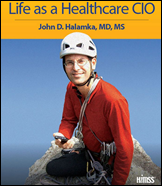
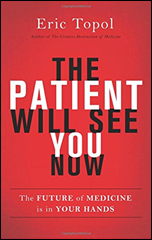
I followed through on a reader’s suggestion of an HIStalk Book Club sort of thing where I review an HIT-related book and invite readers to share their thoughts. I reviewed Eric Topol’s “The Patient Will See You Now” and next up is “America’s Bitter Pill.” Read along, add your thoughts, and suggest what book I should read next. I have a copy of John Halamka’s “GeekDoctor: Life as a Healthcare CIO” that HIMSS sent me in return for completing a survey, so maybe that should be next.

image

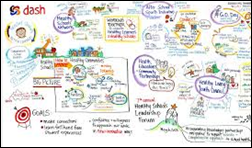
I’m sure we’ll see this at the HIMSS conference: every hip meeting now includes a “graphics facilitator” who documents everything on a flipboard, compelling attendees to proudly tweet out photos of the drawing afterward. I don’t want to attend a conference where a cartoonist understands the presenter better than I do.

Here’s one last appeal for you to complete my once-per-year HIStalk reader survey, which takes just a couple of minutes but helps me immensely.

image

This is a fond farewell to Agilum Healthcare Intelligence, whose marketing person told us, “I’ve never even heard of HIStalk” in declining to renew their sponsorship after many years. They’ve been supporters for a long time and I appreciate it. I also appreciate the service of the marketing guy, who though he has zero health IT experience, is a former Army infantry captain who led a field artillery battery in Iraq, according to his LinkedIn profile.

This week on HIStalk Practice: Telehealth reimbursements are set to go live in New York. Tulane University Medical Group implements eCW’s CCMR. Etherapi takes advantage of the Kaiser strike in California. HHS breaks down its own silos, and enjoys flying first class. Dr. Gregg looks into the future of healthcare IT, circa 2037. Third-party patient portals go head to head with vendor-specific options. Thanks for reading.

This week on HIStalk Connect: 23andMe finds a new source of revenue as it closes a $60 million deal with Genetech in which it will use its dataset to support Parkinson’s disease research. Athenahealth acquires cloud-based inpatient EHR vendor RazorInsights, and confirms that it will move into the hospital space. Augmedix raises $16 million to scale a promising Google Glass-based telecharting business. 


Acquisitions, Funding, Business, and Stock

image

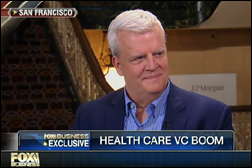
Todd Cozzens of Sequoia Capital is featured on Fox Business’s “Opening Bell” live from the JPMorgan Healthcare Conference. He mentions his firm’s investment in Health Catalyst (analytics) and MedExpress (retail clinics). A Forbes profile of Sequoia Capital mentions its 40-plus year history, including its 1980 investment in Apple’s IPO (the founder thought the 22-year-old Steve Jobs “looked like Ho Chi Minh”) and its recent gains from Airbnb, Dropbox, and WhatsApp. The firm’s partners make a fortune, apparently, as the article mentions a 2003 fund that returned gains of 41 percent per year for 11 years, with the firm’s partners pocketing $1.1 billion as “Sequoia is turning its own partners into billionaires while keeping outside investors purring.”

image

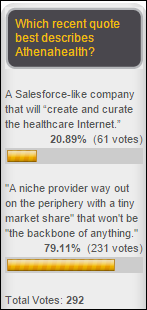
I mentioned that Athenahealth has acquired small-hospital EHR vendor RazorInsights for a rumored $40 million to give it an inpatient foothold. I really like what RazorInsights is doing in giving small hospitals an inexpensive, cloud-based system that covers both clinicals and financials, but I don’t see the benefit to Athenahealth in buying a four-year-old company with only a couple of dozen small customers. RazorInsights has much larger competitors (Meditech, CPSI, Medhost, NTT DATA, McKesson Paragon, etc.) with established infrastructure and most hospitals have already spent their money on a Meaningful Use dance partner, some of them even choosing to run Epic or Cerner as provided by another hospital (or to be acquired by those hospitals). Athenahealth has choked on its previous acquisition Epocrates, which is highly regarded but is stumbling even more than before under Athenahealth’s ownership. I think Athenahealth wants desperately to crack the inpatient market (after insulting that market for years), realizes it doesn’t have the expertise to build a new hospital system from scratch, and decided to spend money instead of time to get a name-plated product quickly to market and then ramp it up. The challenges are many:

  • RazorInsights is small for a reason and not being owned by Athenahealth may not be it.
  • Both product and company scalability are unknown.
  • Few big companies have low-enough overhead to profitably roll out products to cash-strapped 25-bed hospitals.
  • Expected synergies may (as they often do) prove to be elusive.
  • Companies have been historically lured into unwise acquisitions because the product aroused them technically and filled a perceived immediate need at high expense (Allscripts buying Eclipsys).

I think Jonathan Bush will talk this up as though Athenahealth is the next Epic (or Salesforce or whatever high-flying comparison comes to mind), but the acquisition is just another distraction as the company tries desperately to keep its Wall Street plates spinning in the air despite concerning profits and a year-long share price stall.

image

Aetna announces that it will raise its minimum wage to $16 per hour in April and will offer an enhanced insurance plan for employees who participate in wellness programs starting in 2016.

image

image

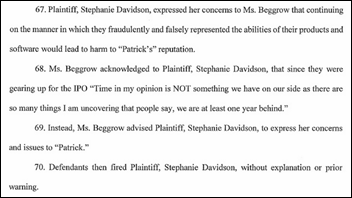
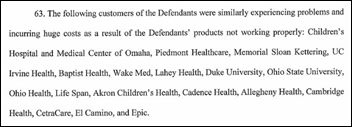
Two former NantHealth executives file a whisteblower lawsuit against billionaire doctor Patrick Soon-Shiong’s company, claiming that NantHealth is “engaged in a multitude of fraudulent activities,” violates HIPAA requirements, has failed mock FDA audits, and offers products that harm patients. Stephanie Davidson (former SVP of professional services) and William Lynch (former senior director of marketing) also claim that several customers were prepared to stop using the company’s Clinical Operating System, citing an internal report that characterized that product as “10 years behind in technology capability” that “runs on LUCK.” The pair claims that NantHealth’s marketing material is misleading and that Soon-Shiong’s charitable foundation defrauded Medicare by donating millions to a hospital that would then use CMS matching funds to buy NantHealth’s products. NantHealth’s responds that the employees, who are in a romantic relationship and had worked for the company for only a few months, demanded that NantHealth pay them $2 million to prevent them from launching a pre-IPO smear campaign after NantHealth fired Davidson. Perhaps it’s not a coincidence that the lawsuit was filed just as Soon-Shiong gave the company’s investor pitch at the JPMorgan Healthcare Conference.

image

Craneware says second-half sales for 2014 increased 10 percent and its board is confident of meeting 2015 expectations.


Sales

image

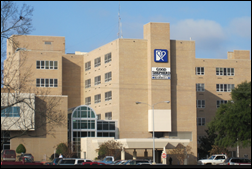
Good Shepherd Health System (TX) chooses Strata Decision’s StrataJazz for decision support and cost accounting.

Healthfirst (NY) selects InterSystems HealthShare as its HIE and clinical portal.

Providence Health & Services expands its relationship with Kyruus, which offers a doctor web search tool. That’s how I would describe their business, anyway, but if you don’t get enough buzzwords, here’s theirs: “Kyruus is an enterprise healthcare provider solutions company that helps health systems optimize their Patient Access, Referral Management and Care Coordination operations. Leveraging the cloud and a proprietary Big Data approach, the company enables the integration of massive amounts of information to create a single source of truth of providers. Kyruus helps health systems create customizable protocols for referral and scheduling across all channels of patient engagement to improve patient access and patient experience.”


People

image

Ralph Keiser (Deloitte) joins Recondo Technology as chief growth officer.

image

John Glaser (Siemens Healthcare) joins the board of the American Telemedicine Association.

image

Hayes Management Consulting hires Gay Fright (Coastal Healthcare Consulting) as VP of strategic services.

image

Huntzinger Management Group promotes David DiChiara to CFO.

image

Sachin Jain, MD, MBA (Merck) joins care plan CareMore as chief medical officer. He worked for ONC for a short time a few years ago. He said in a talk last week that most health IT startups offer products that are interesting but not really useful because (a) they’re trying to make a quick buck, and (b) they are mostly run by young, prosperous, healthy people and develop products in the context of their peers rather than for the sick, expensive patients that need help. He also said HITECH came about because everybody knew EHRs were good for patients, but hospitals put the interest of their resistant doctors first because they’re the ones who admit patients.

image

Ken Pool, MD, co-founder of OZ Systems and co-chair of the HL7 Public Health and Emergency Response Work Group, has died, according to a posting on the group’s listserv.


Announcements and Implementations

An article by Brad Swenson of Winthrop Resources Corporation suggests that the total cost of ownership of hospital EHRs should use a 10-year forecast rather than the more common five or seven years. It quotes The Valley Hospital (NJ) VP/CIO Eric Carey, who used a 10-year timeframe to make an upgrade-or-buy decision: “We felt no one should be replacing an EHR platform in less than 10 years unless a catastrophe happens. Also, probably the most expensive part of an EHR project is the army of consultants, staff, and project managers you need to have to pull everything together. Our implementation has involved 20 FTE over at least one year. Most organizations can’t afford to do that more than once.”

McKesson announces Paragon Community Plus, a package that includes its Paragon system, implementation, training, and remote hosting.


Government and Politics

image

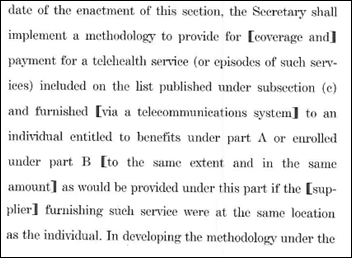
A House Committee on Energy and Commerce work group creates a draft policy that would require HHS to pay for telehealth services at the same rate as in-person visits within four years.


Innovation and Research

Philips gives MIT researchers access to the de-identified records of 100,000 ICU patients who were monitored via its eICU program. The records, which represent about 10 percent of all US adult ICU beds, include vital signs, medication orders, lab results, and severity of illness scores.


Technology

image

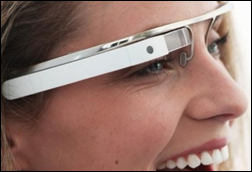
Google stops public sales of Google Glass and moves the product from its research lab to a separate business unit led by former fashion and eyewear designer Ivy Ross. Companies and developers will still be able to buy Glass units after the January 19 cutoff date. Google was supposed to release a new version of Glass in 2015 but hasn’t provided specifics. People seem to think this is the beginning of the end for Glass, but I’m not so sure: it desperately needed a reboot, graduation from beta status, and design help for its ugly form factor (which is true of most things Google), so perhaps this is its graduation into the real world, or even away from the consumer market and into the enterprise one.

A guest newspaper article by the CEO of a Missouri public policy organization says the state is still #49 in economic growth despite being one of nine labeled as “the corporate welfare kings of America.” He says of the Missouri’s $1.6 billion subsidy of Cerner’s $4.3 billion new campus, “If Cerner needs a corporate pleasure dome, it should pay for it on its own nickel.”

image

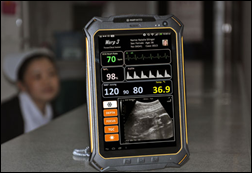
I thought sure this was a spoof since it was heavy with Star Trek puns and one of the pictures features a nurse wearing a 1970s-style cap, but apparently the just-started IndieGoGo campaign for the $3,500 Warp 3 Medical Tricorder is for real. It’s not the X-Prize, Scanadu-type consumer Tricorder, though – this China-based one will be just for doctors and will provide vital sign, ultrasound, and EHR functions.


Other

image

The local paper says that MultiCare Health System (WA) is not only represented on the advisory group IBM and Epic put together to help make their case to the Department of Defense as it selects its $11 billion EHR, but MultiCare will also serve as the pilot site should the IBM-Epic bid be chosen.

image

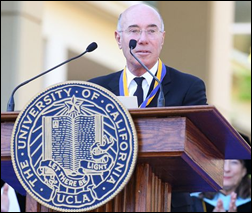
A physician’s New York Times editorial observes that 24 of the 141 medical schools in America are now named after big donors, causing graduates to be “embarrassed that there was a rich person’s name on their diploma, with the university name tucked below in small print.” Naming rights cost from $8 million (East Carolina University’s Brody School of Medicine) to $200 million (UCLA’s David Geffen School of Medicine, above). 


Sponsor Updates

  • Imprivata integrates its Cortext secure communications platform with the Citrix XenMobile enterprise mobility management solution.
  • HealthTronics selects AirWatch for enterprise mobility for its 500 employees.
  • ZeOmega is named as one of the 100 fastest-growing Dallas companies.
  • John Stanley of Impact Advisors is quoted in a San Diego newspaper’s article on the pros and cons of EMRs.
  • Divurgent will participate in the HIMSS East Tennessee Summit in Knoxville on January 22.
  • DataMotion covers the important role e-mail plays in file sharing in its latest blog.
  • CompuGroup Medical will participate in the Critical Care Congress in Phoenix, AZ from January 17-21.
  • CommVault expands its relationship with NetApp to offer integrated data protection solutions.
  • TechGig outlines CitiusTech CEO Rizwan Koita’s predictions for 2015 healthcare technology trends.
  • CareSync publishes a new blog on the importance of taking charge of a family’s health records.
  • Dignity Health VP/CMIO David Lundquist, MD offers insight into how to keep patients in mind when discussing the future of healthcare at AirStrip’s Mobile Health Matters blog.
  • ADP AdvancedMD offers “4 surefire signs you need a new EHR for MU2 and beyond” in its latest blog.

EPtalk by Dr. Jayne

clip_image002

It’s been a strange couple of weeks for me. We’re getting ready to go through some major changes at our hospital and everyone is on edge. Teams are being consolidated and it feels like the directors and VPs are playing a giant game of “Go Fish” only instead of cards, they’re playing with people. This comes right on the heels of our hospital’s push to reduce the number of accrued vacation days on the books, which had almost half of our employees taking significant time off during the last month or so.

Everyone is overworked and cranky as we try to make decisions based on forecast scenarios and half-developed plans. Sometimes we start to feel not only like the sky is falling, but that the world is burning down around us. We imagine it can’t possibly be this bad in other places. It’s difficult to reach out to colleagues at other organizations because we don’t want to admit that our own organizations are in frantic disarray.

It was in that frame of mind yesterday that I was trying to catch up on the ridiculous thing that is my inbox. I’m on staff at another hospital that’s not part of my health system. I almost got whiplash doing a double take at one of the emails I received. It was discussing the final steps of a system conversion they’ve been working on for years. They’ve been running dual platforms for the last six months during the transition and are finally pulling the plug on the legacy application.

Despite the robust features of the new system, the email wording left something to be desired. “Many fixes and enhancements have been done to NewApp to make it usable.” The email was sent out under the CMIO’s banner. Knowing him as I do, I’m pretty sure that’s not what he intended. I forwarded it to one of my colleagues – not as a way to humor ourselves at someone else’s expense, but as a confirmation that the people at our competitor across town are likely under the same pressures as we are. No matter how hard and how many long hours we work, things are falling through the cracks.

I thought about how fortunate I’ve been that during most of my time as a CMIO I’ve been surrounded by colleagues who are competent, confident, and motivated. I’ve always felt like they have my back and in turn I’ve had theirs. Over the last year and a half, however, it seems that everyone has been stretched thinner and thinner. We’re to the point where we can barely support ourselves, let alone each other. Although we’re certainly experienced in delivering the impossible, it’s become harder and harder to make it a reality.

Looking at the last few months in particular, not only has our energy been sapped, but we’ve lost some of our support structures. Our standing team meetings have been fragmented as we’re pulled in countless directions by competing demands. Those were our opportunity to update each other on our projects, potential risks, and needs. We received feedback and encouragement as well as ideas to remove blockers or handle difficult situations. Colleagues who had been in similar situations provided pointers and tips and lists of “gotchas” to look for.

I should have taken that email as a warning to stay vigilant. By the end of the day today, I watched one of my key projects go off the rails. In hindsight, I should have seen it coming, but I didn’t. Although ultimately it’s no one’s responsibility but mine, I can’t help but think that if we weren’t all so scattered and overwhelmed that someone else might have picked up on subtle signs that I missed. I spent most of the day with an impending feeling of doom and heartburn that made me want to eat a box of chalk.

I realized that given our current state of being overextended, under-resourced, and fatigued that it’s likely this isn’t going to be the last time something like this happens. This is an uncharted place that I’ve never had to operate in before. I’m officially working without a net and it doesn’t feel very good. But given the state of our industry today, I’m sure I’m not alone.

Do you have tips for how to work without backup? Email me.


Contacts

Mr. H, Lorre, Jennifer, Dr. Jayne, Dr. Gregg, Lt. Dan.

More news: HIStalk Practice, HIStalk Connect.

Get HIStalk updates.
Contact us online.


125x125_2nd_Circle

Morning Headlines 1/15/15

January 14, 2015 Headlines Comments Off on Morning Headlines 1/15/15

Athenahealth Acquires RazorInsights

Athenahealth acquires RazorInsights, an inpatient EHR vendor that has been selling its cloud-based system in the critical access and community hospital market since its 2010 launch.

BT to Offer Medsphere’s OpenVista Electronic Health Record

Medsphere announces that it will partner with BT to begin offering hosted OpenVista systems.

GAO kicks off review of HIE performance

Senators Lamar Alexander (R-TN), Richard Burr (R-NC), and Mike Enzi (R-WY) have asked the General Accounting Office to evaluate the effectiveness of state health information exchanges as the federal government’s $600 million effort to support their implementation winds down.

Comments Off on Morning Headlines 1/15/15

Book Review: “The Patient Will See You Now”

January 14, 2015 Book Review Comments Off on Book Review: “The Patient Will See You Now”

image

I enjoy reading articles and tweets by technology fanboy Eric Topol, MD. He’s focused and intense. He’s always whipping out a smartphone-equipped EKG gadget on a plane or sticking a smartphone otoscope in Steven Colbert’s ear on TV. A lot of the tools he digs up seems to be of the “hammer looking for a nail” category and he’s created a nice gig for himself as a geeky critic of the medical establishment (even taking the AMA to task), but sometimes he comes up with ideas that might make a difference someday.

Topol is an undisputed thought leader. I like what he has to say even if I’m often skeptical.

Topol’s new book, “The Patient Will See You Now,” is an impressive (some might say “undisciplined”) romp through the healthcare technology garden. However, it fails to live up to its title, which suggests that savvy, responsible patients armed with cool smartphone EKG devices and fitness trackers have quietly wrested control of healthcare from the government, corporations, and providers of “eminence-based medicine” that make up the plodding and oppressive medical establishment. It’s a cute and gimmicky title, but it contains more hype than the book can deliver.

In fact, it sounds a lot like his earlier book (which I didn’t read) called “The Creative Destruction of Medicine: How the Digital Revolution Will Create Better Health Care.” That one is three years old, so maybe everything in it came true and he moved on.

The book wanders around so much that the only overall sense I could make of it required me to summarize each chapter, as follows:

  1. Technology is widely adopted. Patients know their own bodies better than anyone.
  2. Doctors are trained to feel superior and to control the flow of medical information.
  3. The smart phone is like the Gutenberg press in democratizing and disseminating knowledge.
  4. Angelina Jolie’s decision to undergo a double mastectomy because of genetic testing was earth-shattering, but the FDA tried to shut down 23andMe because that testing completely ignored FDA’s inquiries about its marketing and its offer to help the company comply with US laws.
  5. I glazed over on Chapter 5 because it was a complex and questionably relevant primer on how genes work and how they can be used to personalize medicine. The bottom line: we should be doing more genetic testing for research and individualizing treatments.
  6. Silicon Valley darling Theranos is revolutionizing lab testing. People have the right to see their own information. They should also be informed about the radiation dosage in diagnostic imaging.
  7. Patients should be able to see their medical records. OpenNotes and Blue Button give that capability, but only 36 percent of patients can access their records and EHRs are primitive.
  8. Prices for hospital services and drugs are irrational and vary widely, especially when comparing high US prices to those the rest of the world pays. We have a lot of waste and spend a lot on treating complications.
  9. Telemedicine is cost effective and convenient, but doctors resist new technology just as they did the stethoscope when it was invented.
  10. Hospital stays, which are expensive and error-prone, are declining as surgeries move to outpatient. Technology allows care and monitoring to be moved to the home.
  11. People are willing to share their medical data for research, which will allow collecting and collating information to discover new research and best practices.
  12. People are selling and stealing medical data.
  13. Sensors can predict and track medical conditions.
  14. Cheap smartphone-connected technology will democratize medicine to less-developed countries.
  15. People own their medical data. Big employers should be using it to squeeze big insurance companies, but none have actually done that. Consumers haven’t mobilized. CMS and other administrative waste takes a lot of resources out of the system. Other countries will do better because of our archaic payment and regulatory model.

My frustration is that while the exhausting scattershot of technology nuggets is interesting (although hardly original since I’d heard of nearly all of them), it doesn’t prove the title’s hypothesis. It may well be that a few tech-savvy and demanding patients can convince their individual providers to let them get more involved in their care, but nothing suggests the presence of an unstoppable movement. In fact, while healthcare takes heat for being episode-based, a significant portion of consumers are even more episodic – they pay attention to their health mostly when something is bleeding, hurting, or swelling and then show up expecting a TV-like quick fix. The majority (especially the medically expensive ones) aren’t quantified-selfers or fully engaged participants.

A lot of people have smartphones, health apps, and fitness trackers, but those gadgets haven’t proven to make them healthier. Capturing and tracking information is just a tiny and easy part, as evidenced by the significant penetration of bathroom scales in the homes of overweight people. Patients (or consumers or whatever you want to call the 100 percent of us who will seek medical care at one time or another) can make consumer-like demands on their doctors, hospitals, and insurance companies, but I’ve heard few examples of where that actually accomplished anything other than possibly getting themselves labeled as a troublemaker.

People who receive medical services aren’t really pure consumers, so it’s not realistic to assume that the healthcare cheese can be massively moved by technology as happened in banking and entertainment. Patients don’t usually pay all their own bills. They go to whatever doctor and hospital the party that does pay (the insurance company) dictates, so threats to take their business elsewhere are usually hollow no matter how unpleasant or Luddite their doctors may be. Strap 10 smartphones with cool apps on your belt, pass out OpenNotes articles in the waiting room, and warn hospitals that they had better not make a medical mistake during your admission – your influence is still minimal despite being informed.

Topol’s broad observations and complaints aren’t really actionable. Patients have little control over the items listed above. The book title suggests that patients are in charge, and yet it’s still insurance companies authorizing payments, doctors entering orders and performing procedures, and the much-maligned medical establishment standing between patients and their maker. The healthcare system (or more correctly, the healthcare industry) was built around everybody except the patient. That establishment isn’t just going to step aside because patients carry iPhones. Any plan that requires people to voluntarily stop doing what they’re well paid to do will fail.

A few tech-powered concierge practices, retail clinics, and drug chains are threatening the status quo. They aren’t really scaring anyone. They may cherry pick a tiny bit of profitable business, but they aren’t much of a threat to health systems that keep buying up more providers and using their political influence as big employers to make sure they aren’t pushed away from the table. That’s the best hope for quick innovation that will reverberate through the hallowed walls, such as the real threat that Theranos will force high-margin hospital labs to either increase their efficiency or survive on a fraction of their current business.

Healthcare is like your car (at least if your car was built in this century). Your car is loaded with sensors (some of which, like the speedometer, you may conveniently ignore) and requires a computer to analyze its internal computer data stream. You can’t diagnose and fix it yourself when the idiot light comes on. You can study up all you want, but your only real decisions involve (a) whether you want to get it fixed, and (b) who you choose to fix it given your available options. You sit impatiently until the mechanic hands over a grease-stained list of procedures he or she performed along with a bill (as in hospitals, the computer that creates the bill is the most powerful one). All of that technology and data didn’t benefit you very much – it just generated more business for the mechanic, allowed him or her to work more effectively, and maybe avoided even more expensive repairs down the line. That’s pretty cool, but it’s hardly a revolution in empowering car owners.

That’s my takeaway from the book. Most of the technologies listed help doctors provide better care, assuming they are willing and able to use it. The role of their patients is, at best, to push for them to actually think about using genomics, following evidence-based medicine practices, reviewing their own outcomes information, and staying current on new medical developments. Patients, however, won’t usually voluntarily leave a doctor just because they don’t use an EMR or other gadgetry – that’s the art rather than the science of medicine – so it’s not really much of a threat.

Consumer choice in healthcare involves choosing the “best” provider to interpret, order, and perform procedures (or at least the “best” one willing to see you that your insurance covers). A doctor might be willing in the seven minutes you’re allotted for a return visit to look at your fitness tracker information, sit beside you as you Google your condition, or describe their charges to the price list from the MinuteClinic down the street. Don’t count on it. You’re only as empowered as is convenient for them.

Cardiologists make a great living and Eric Topol is no doubt excited to see his Scripps patients embracing technology and participating in their care, but it just doesn’t work that way for most doctor-patient encounters. People don’t get as broadly excited about health-related technologies as they might with social networking or music since the personal payoff is slower and less certain. Fitness trackers motivate and inform people who are already motivated and informed. Those aren’t the folks running up most of the country’s medical expenses.

Topol’s confidence that abundant technology will upend the US health system in favor of patients seems wildly simplistic. We can all – as patients and industry insiders – make a long list of what’s wrong with healthcare. That doesn’t mean we can change it through our individual actions. Healthcare is like the government in that it’s easy to identify what’s wrong, but hard to even agree on a solution, much less impose it against the will of far more influential people and corporations who are pretty happy with the present arrangement.

That doesn’t mean the book isn’t worth reading as a concise overview of what technologies are on the horizon. It’s good for that, at least for the next six months until it becomes outdated. It also doesn’t mean that Topol isn’t a passionate visionary because clearly he is. However, he could raise an army of fist- and smartphone-waving readers of his book who are upset with how most of us are treated as patients and health-seekers, but that alone won’t get our broken healthcare system fixed.

That’s my disappointment with “The Patient Will See You Now.” Reading it makes it easy to see what the future could be while knowing it probably won’t really happen, at least not in this country. I give it 3.5 stars out of five, docking it a half-star for an unrealistic title. Each chapter would have made a great blog post or magazine article, but I’m not finding them as compelling or entertaining in aggregate.

Comments Off on Book Review: “The Patient Will See You Now”

CIO Unplugged 1/14/15

January 14, 2015 Ed Marx 3 Comments

The views and opinions expressed in this blog are mine personally and are not necessarily representative of current or former employers.

Leadership and the Paradox of Shame

Ninety percent of successful business executives are driven by shame. Psychology Today defines shame: the painful feeling arising from the consciousness of something dishonorable, improper, ridiculous, etc., done by oneself or another. It’s an attitude toward self. Nobody needs to look long to see the roots and vines of shame snaking through my life.

Shame is a powerful motivator. I was afraid to being a failure, so I graduated in the top 20 percent in the corps of engineer officer academy. I dreaded being last in any race, so I drove my body until I reached Team USA status. I feared disappointing my parents, so I strove to be a senior vice-president. One boss told me I wore the wrong clothes, so I revamped my wardrobe to keep from being harassed. Shame became my identity.

It begins in youth. We are shamed by parents, educators, coaches, friends, and clergy. If we chose to believe the lies, our identity falls prey to …

The paradox of shame. On one hand, it’s an emotional prison. On the other, it’s a fuel for success.

I was led to believe I was never good enough. Never as smart as my eldest brother and sister. I never could score as many soccer goals as my middle siblings. For every mistake and failure to meet his expectations, Dad shamed me. If a scoop of ice cream slid off my cone, Mom called me an idiot. They labeled my adolescent tomfoolery criminal. They didn’t know any better.

The year I earned my master’s degree and got promoted to Army captain was a big deal for me. Yet my mother exclaimed, “You still have to prove yourself.” Shame was my parents’ subconscious method of motivation.

Following their ingrained model, I leveraged shame to my advantage. I had to prove to men that I was a man. I had to prove to women that I was desirable. I had to prove to the world that I was worthy of accolades. Shame drove me to accomplish some amazing things. In order to feel good about myself, I had to be number one in everything. All false beliefs.

I even used shame in my leadership practice. I’d shame others to get the results I desired. I subtly made people feel bad under the label of motivation. While the intent was OK, the technique was pitiful. I would belittle and criticize others openly. Often, it was not so much what I said but my body language. I would make others feel bad until they relented and did things as I wanted them done.

The day someone exposed my shame, I embraced it. Twisted thinking! I loved the benefit. The power. If I let go of shame, what would happen to my drive? How would I motivate my staff? Would I still be number one? Would I still accomplish great things? Would men still admire me and women find me attractive?

Crazy, right? It’s called deception.

Shame infiltrated my DNA. Can I reverse the curse? Yes! But at what cost? At what benefit? Is it worth the risk? What if I fail? What if I lose the admiration of friends, family and industry? What if it costs me all that I have gained?

I’ve really been searching and examining myself. How do I escape shame? How do I stop shaming others?

It comes down to releasing myself and others to be who they were created to be. If that means I’m not president of the United States, so what? If I don’t make the team, so what? If people no longer seek me out, so what? Easier said than done.

Truth: better to live in freedom than in bondage to a lie. Shame creates a void that will never be filled despite the drive it creates. And for a leader, the higher status you attain, self-deceit can spiral out of control. The only way to escape this vortex of deception is to jump. Forget what others think. It is about you and me being who we really are, despite title.

Then how do we fill the void once we denounce shame? It zeros back to identity. Figure it out and live who you were created to be. To be self-reliant is to dig a deeper hole and still never be good enough. Instead, reach out for help. Continuously explore faith. You’ll be a work in progress, as am I. Messy, yet loveable. Redeemable. Worthy.

Thoughts on work relationships and the keys to escape:

  • Acknowledge shame-driven ways (you might need to ask a friend).
  • Apologize for manipulating through shame.
  • Replace shame with sincere encouragement.
  • Do not tolerate shame from others.
  • Exhort your teams to be all they can be, no strings attached.
  • Tell them it’s OK to be something different than what you may have wanted
  • Surround yourself with truth-tellers who will call you out on shame tactics.
  • Hold fast to your true identity.
  • As you become free, they will become free
  • When you remain imprisoned, so do they.

One more thing. I believe it is probable that by operating in the opposite spirit of shame, your teams will shine brighter than you ever envisioned! They may not look or act like you, but they’ll be free to be their best. Better to be mortal and free rather than super successful and emotionally imprisoned.

Shame is the new “Hotel California.” You can check out any time you want, but you can never leave.

Thankfully, there is an escape route out of the vortex. Break free with me.

Ed Marx is a CIO currently working for a large integrated health system. Ed encourages your interaction through this blog. Add a comment by clicking the link at the bottom of this post. You can also connect with him directly through his profile pages on social networking sites LinkedIn and Facebook and you can follow him via Twitter — user name marxists.

HIStalk Interviews Peter Smith, CEO, Impact Advisors

January 14, 2015 Interviews 2 Comments

Peter Smith is CEO and co-founder of Impact Advisors of Naperville, IL.

image

Tell me about yourself and about the company.

I’m the CEO of Impact Advisors. We are a consultancy that’s dedicated to healthcare process improvement and technology consulting. That’s pretty concise, right? [laughs]


Many people say there’s flux in healthcare IT consulting as firms that are focused on staff augmentation and implementation work are are finding reduced demand for their services. How would you characterize the industry?

That observation is absolutely true. The market has shifted over the last year, and for reasons you don’t suspect. We went from an environment where the industry was doing large, foundational projects, particularly EMR replacements and revenue cycle replacements. The market shifted over the last year as those projects wound down. It’s now moving towards post-implementation optimization and scrappier, more nimble projects. Things like optimization, back to advisory services.

The quick answer is that observation is exactly what I think the market’s feeling. It’s hurt a lot of consulting firms.


What’s the future for those companies that are scrambling to find something new to keep their people busy?

Their evolution will go something like this. They’re going to try to weather this market to the best they can. They’ll probably downsize. They’re going to explore alternative channels through subcontracting relationships and things like that. They’ll try to hold on to their business as best as they can. But at the end of the day, I think it’s going to diminish for them.

The ones that can transform themselves from single, staff augmentation kinds of services into the next generation firm will survive, but it’s not going to be easy for them. I would suspect that the next year or two is going to be challenging for a lot of those firms.


Everyone who has been in healthcare IT for a while knows that the pendulum always swings back. Will it swing back from EHR implementation and Meaningful Use to something else?

Yes. The pendulum is definitely swinging. There will still be an EMR replacement market out there, but it’s just not going to be as robust as it was. The core business will still be there, but the market is going to shrink. There’s going to be a lot of merger and acquisition activity. 

There are replacements of a number of systems out there. The dominance of core players – Cerner, Epic, and Meditech – is fueling potentially a replacement of some other vendors. That dynamic will continue — it’s just not going to be as crazy as it’s been the last couple years. That’s one component of the market.

The other one is the shift to optimization services, although that’s a wide definition. Basically optimizing the EMRs and clinical systems already put in is going to be a continued emphasis for a lot of organizations and a continued business for a lot of consulting firms. Rev cycle replacements will be another key driver.

Those are things that will continue to fuel the consulting market. But I don’t think we’re going to see the kind of growth we have in the last couple of years. It will be slow and steady. That’s healthy for the market and for the industry. We’re looking forward to that.


Impact Advisors is an Epic partner. Does Epic have weaknesses it needs to fix or that other vendors can exploit?

Epic’s a really strong company. They’re doing a lot of things right, as are a number of other companies such as Cerner. I don’t see necessarily any weaknesses.

Our clients are typically concerned about Epic’s tremendous growth over the last couple of years. It’s both an asset and something to watch as you think about implementation with Epic, but they’ve been able to mitigate that risk pretty well. For the services that they typically provide and implementation, they still do a very good job.

Clients still have to be focused on their side of the work in terms of understanding the process and the operations of a hospital. Those are things that any vendor is not going to bring to the table. That’s a void that the client has to step up and fill as well as the third-party consulting marketplace, and that’s where a lot of folks have spent their time.

I don’t know if I necessarily see any weaknesses. I think you’re seeing the emergence of a couple of players in the vendor space that are going to continue to be very successful, Epic being one of them.


Are clients happy that they invested what it costs to implement those expensive systems from Epic and Cerner, especially with the ongoing maintenance costs?

The basic answer is yes, although it’s certainly a topic of conversation in the C-suite about the level of investment that they’ve made and the level of expense. Given the dollars and the prominence of these decisions in the executive and board level, it is clearly top of mind.

But at the end of the day, if you look at the last five years, the clients that have been through the implementations and are in steady state and now reaping the benefits of that investment are extremely happy. In fact, I think there’s even a sense of appreciation that they’ve been through it already.

It’s the clients now that are looking to just start that journey. There’s a lot of anxiety because they know they have the investment ahead of them. They know they’re getting to the tail end of the curve. Their competitors in the market have gone before them and they’re a little bit on the outside of the bell curve. That’s where the anxiety is right now, not necessarily on the people that have already done it.


It seemed a few years ago that we had nearly figured out interoperability, but it’s probably more contentious and more frustrating to people now than it was then. Where does it stand and where is it going?

It’s one of my personal disappointments. I had expected this industry to mature a lot faster, particularly around the technology associated with interoperability.

But at the end of the day, interoperability is a very interesting concept or philosophy because it’s not just technology. You’re getting to the core of whether organizations really want to interoperate. You get into the competitive dynamics in a marketplace. You get into what’s in the best interest of the patient. This is bigger than just technology.

By and large, the technology is starting to work. Arguably, there’s not that set of standards in the industry that’s implementable, and I would agree with that to some extent. But the ability to interoperate is technically feasible, and in some cases, organizations are doing it very well and some regions are doing it very well.

It’s bigger than just technology. It’s bigger than applications. It’s also politics. It’s a competitive aspect between providers and hospitals and having the incentives aligned to really interoperate. It’s a big one. Personally, it’s I think one of the disappointments of the industry that we haven’t been able to do a better job of doing that.


Given that providers have little incentive to share information with competitors and patients don’t have much of a say, should ONC be bolder about dictating interoperability standards or requiring that providers actually practice interoperability?

I generally think the market should dictate some of this more so than the government. The government can certainly give us a good head start, whether it be ONC or any other agency, and set the direction. You’ve obviously seen a lot of indirect influences and incentives by the government just through Meaningful Use and ICD-10 changes and all that that is clearly steering our industry in the right direction.

I think personally as an opinion that the market, our providers, our clients, and our consulting firms have a market-based obligation to take it to the next level. That’s getting it down to the tactics and the technology and the specifics around making it work.

The other dynamic is that patients are getting much more savvy, demanding, and customer-centric. I hope that that side of the market influence will be a catalyst to dictate some change in the industry. You’re already seeing that and it will continue to accelerate as patients are demanding more from their electronic experience with their providers. I think you’re going to continue to see it.

In essence, long-winded answer, but all the dynamics need to converge, whether it’s the government, whether it’s the market, or whether it’s patient and consumer influences that are going to take us in the right direction. The signs are there. Now we’ve just got to finish the journey.


Epic users in specific regions seem to talk a lot about sharing information with each other. Is it really that much different compared to, say, Cerner users?

I really don’t think there’s a difference. Just because the two vendors that you cited, Cerner and Epic, have such a large market share, you can find examples of really good interoperability between not only organizations with the same technical platform — whether it be Cerner or Epic — but even among Cerner and Epic. Just given their percentage of the market share in this country, you find good examples of both. I can’t necessarily say there’s a difference.

I know that there’s a lot of debate on that, certainly in the Epic world. But I think Epic would tell you that they interoperate better than any other vendor just based on the volume of transactions going back and forth. It’s a delicate balance, but you’ll find good examples all over the country. You’re starting to see that the influences that are going to dictate integration are probably less about technology and applications now and more about the competitive climate that you’re in.


Cerner has built an amazing business and is expanding into areas such as health management. The company is so big now that it has to find new ways to keep growing. Where do you see them going?

I give Cerner a tremendous amount of credit for their business strategies over the last couple of years. Not only are they tremendous competitors in their core space of EHR and now emerging revenue cycle and ambulatory products, but they also diversified their service portfolio. They got into consulting. They do a good job with their consulting environment. They also got into remote hosting and application management services. They’ve expanded internationally.

That’s an example of a company that not only is doing what they did well from a core standpoint, but also diversified their service and business model and continued to be very successful. I think you’re going to continue to see the same. I think what you’ll see with Cerner is a continued refinement of some of their core products, particularly around revenue cycle and their ambulatory and physician practice management applications, and that will be part of the next generation. 

You’ll also see a tremendous refinement of their business analytics capability. Their partnership with places like Intermountain Health will give them a tremendous opportunity to improve that side of their portfolio. I think all good things ahead for Cerner.


We seem to have an overwhelming number of startups, accelerators, and companies nobody’s ever heard of that suddenly claim they’ve figured something out. Where do you see them being successful in enterprises as opposed to the consumer side?

I see a lot of startups in the area of, obviously, analytics and business intelligence. You’ll see them in patient engagement. You’ll see them in products around revenue cycle. Those seem to be the cottage industries of these pop-up software and consulting firms.

This will follow the same trend as the HIS or EMR markets over the last 20 years. The market will rationalize. There will be winners. It will slowly self-select down to a set of players that will be viable market contenders.

Let’s take the business analytics space. I call that the Wild West right now because you have so many of these products out there that are generally focused on solving one component of business analytics. They might be doing Meaningful Use quality indicators or they might be doing patient engagement statistics. They all come into this space at a different place. What they’re trying to do is broaden their portfolio to be a full-service provider of business analytics and analytics capability. 

You’re starting to see some winners in that space right now. As they broaden their portfolio, as the market rationalizes, you’ll see a handful of winners in any one of these markets. That’s what I think will happen and I think that’s going to accelerate quickly. The market condensing right now is going to put a tremendous stress on the players that don’t have a viable business model or a viable product and they’ll wash out. You’ll see a rationalization of the market relatively quickly.


People seem less enchanted with Meaningful Use. Is ONC’s influence diminished?

Diminished is probably a strong word. They’re obviously going to be a major player in trying to not only shape policy, but the incentives and dynamics moving forward with subsequent releases of Meaningful Use. Diminished is probably the wrong word.

But market influences will accelerate. ONC’s direction, the government’s direction, and market influences are, I hope, aligned. You’re starting to see that they are aligned. Perfect storm is the wrong word, but you’re going to see a series of influences — whether it’s ONC, market forces, or consumerism — that are going to drive the industry in the same place.

So not necessarily diminished, but you’re going to see the prominence of the consumer side, particularly around employers. Employers are going to take a much bigger stance. Payers are going to take a much bigger stance in influencing the market and certainly the provider side. You’re going to see not so much a diminishing of the government influences, but an increasing of the other influences that are shaping the industry and a consistency on the other influences.


What do you read into the acquisition by pharma services vendor Quintiles of your consulting competitor Encore Health Resources?

It surprised us. We obviously watch the market and we watch our competitors and Encore has always been a great competitor with great leadership and great talent. So quite honestly, it was a surprise to us.

I’ve seen other of our competitors, friends, and colleagues on the consulting side that have taken different directions, which I applaud because there’s synergy in terms of some of their acquisitions and mergers. But quite honestly, the synergy of that acquisition wasn’t as apparent as others, I guess I would say. So yes, it surprised us.


Impact Advisors is part of the Epic-IBM bid for the DoD’s EHR contract. What effect will that project have on the overall industry?

It’s obviously a huge project, so I think it has the ability to be a very big influence.

First of all, it’s going to be a tremendous opportunity to influence healthcare in our country for the patients, the military families, and the military personnel that that system serves day in and day out. We’re excited to be a part of that bid. At the very utmost, it has the opportunity to be transformational for the healthcare service of our armed services. That’s number one.

Number two, on the industry side, I think it’s an $11 billion project, moving probably north of that over the next 10 to 15 years. As I think someone in the military told me, they said it’s going to be the largest government award that doesn’t involve steel or putting something into space. That gives you a sense of the magnitude of the project. 

We’re very excited to be part of it. I think it has the opportunity to be a major game changer, certainly for the armed services and the families that they serve. We’re proud to be part of that bid and we’re looking forward to hearing about that award.


What trends are you seeing from your broad exposure that might not be obvious?

The influence of the reimbursement market will have a tremendous impact on what happens in a technology space. What many of my clients call a tipping point or a pivot point is about to happen. That’s the true conversion from volume to value. You hear a lot of buzz terms around that, but basically the concept of being paid for quality rather than volume. That’s going to happen. We’ve been predicting that over the last couple of years, but we’re accelerating towards that.

When that pivot happens, it puts a tremendous premium on two things. One, provider organizational leadership. The leaders of the hospitals, IDNs, academics, and children’s hospitals are going to have to lead in a way they’ve never lead before. They’re also going to have to have a set of partners that they’ve never had before, primarily the payer side as well as other partners in their region and community. It’s going to be very interesting to see how that all manifests itself.  Not only will be an organizational change, it will be a structural change. It will require leadership change and ultimately all the way down the line to technology changes.

We’re excited about it. We think that kind of change is good for the industry, it’s good for healthcare, and ultimately it’s good for the firms that are serving that industry.


Do you have any final thoughts?

This is going to be a tremendously fun industry over the next couple of years. I don’t think we’re going to experience more change than we are in the next couple of years. It’s going to be fascinating and fun to be part of that. Healthcare is the most fascinating industry out there because of the dynamics and influences.


Athenahealth Acquires RazorInsights

January 14, 2015 News 3 Comments

image

Athenahealth announced this morning that it has acquired inpatient EHR vendor RazorInsights, which primarily serves rural, critical access, and small community hospitals. Terms were not disclosed, but an HIStalk reader who tipped me off early to the announcement says the acquisition price was $40 million.

Athenahealth says it will “leverage RazorInsights’ inpatient expertise and award-winning technology to extend its presence into the 50-bed-and-under inpatient care environment, which accounts for approximately one-third of the US hospital market.”

The announcement cites the RazorInsights customer base of 25 hospitals, the success of some of its customers in attesting for Meaningful Use Stage 2, and its cloud-based delivery model.

Athenahealth Chairman and CEO Jonathan Bush said in the announcement, “Today’s hospital market is woefully underserved when it comes to IT systems and IT partners that are accountable for reducing costs, increasing quality, and enabling a better patient experience. With RazorInsights, athenahealth will immediately be injected into the inpatient care environment; this is a natural extension for our cloud-based services, will tremendously grow our network knowledge, and will accelerate our introduction of results-oriented, inpatient solutions that hospitals can confidently invest in and demand accountability from.”

Morning Headlines 1/14/15

January 13, 2015 Headlines Comments Off on Morning Headlines 1/14/15

Data Analytics Update: Health IT Policy Committee Meeting

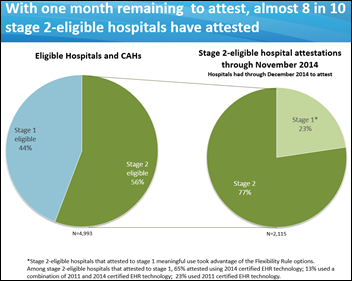
At this week’s Health IT Policy Committee meeting, ONC reports that 77 percent of eligible hospitals and 56 percent of eligible providers scheduled to attest to Stage 2 Meaningful Use have done so. Hospitals still have a month left to attest, while providers have three months left.

Ellmers Reintroduces the Flex-IT Act

Congresswoman Renee Elmres (R- NC) reintroduce HR 270, the Flexibility in Health IT Reporting Act of 2015, a two-page bill that would reduce the Meaningful Use reporting period from 365 days to 90 days.

Clinical Documentation in the 21st Century: Executive Summary of a Policy Position Paper From the American College of Physicians

The Annals of Internal Medicine publishes a paper investigating the effect EHRs have had on the structure and usefulness of clinical notes, concluding that EHRs have real room for improvement, but that the primary driver of change in clinical notes has been the documentation requirements imposed to support an increasingly complex billing process.

Why We’re Picking Walmart And CVS Over Doctors’ Offices

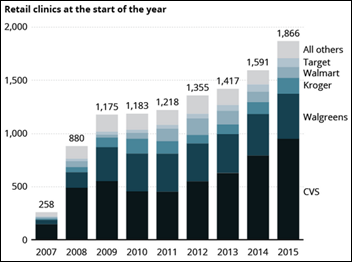
The Huffington Post covers the rise of retail clinics, whose numbers have seen a sevenfold increase since 2007, driven largely by CVS and Walgreens.

Comments Off on Morning Headlines 1/14/15

News 1/14/15

January 13, 2015 News 2 Comments

Top News

image

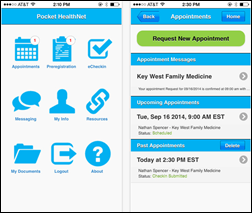
Pundits and associations won’t stop banging the “Meaningful Use is a failure” drum in pointing out low participation numbers, but ONC partially contradicts their grim calculations in reporting that 77 percent of MUS2-eligible hospitals have attested, as have 60 percent of MUS2-eligible practices. Those providers still have another one month and three months left, respectively, to attest. Those aren’t great numbers, but they’re a heck of a lot better than you might think, and as a taxpayer it’s nice to know that my money at least has minimal strings attached.

Reader Comments

From Poignant Moment: “Re: non-disclosure agreement. If a vendor requires a hospital to sign one for beta testing, how long does the vendor have to keep the NDA after testing is complete?” I’ll ask knowledgeable readers to help out, but I would say the signed copy should be retained at least until it expires since an NDA should cover a stated time period. That’s for making sure the agreement is followed – I doubt there’s any legal requirement to keep a copy at all.


HIStalk Announcements and Requests

I’m enjoying the articles written by startup CEOs and investors (Brian Weiss of Carebox, Bruce Brandes of Martin Ventures, and Marty Felsenthal.) Those authors and others will contribute ongoing articles on their experiences and lessons learned when working directly with startups. I appreciate their contribution. I’m learning from them since I’ve mostly only worked for non-profit hospitals and theirs is a foreign land to me.

Please take a couple of minutes to complete my once-yearly reader survey. I plan my entire year around the responses, so your time will be not only appreciated, but also well spent in my never-ending quest to reduce my level of suckitude.


Webinars

John Olmstead, RN, MBA, director of surgical and emergency services at The Community Hospital of Munster, IN delivered an absolutely perfect HIStalk webinar on Tuesday, “The Bug Stops Here: How Our Hospital Used its EHR and RTLS Systems to Contain a Deadly New Virus.” He was interesting, informative, and funny in describing technology used in his ED, including RTLS from Versus (who sponsored the webinar without turning it into a sales pitch), Epic EHR, Ascom phones, and Rauland nurse call. It did something that few webinars do in holding my rapt attention throughout and it wasn’t just me – the webinar’s control panel showed that 98 percent of attendees were hanging on to his words instead of checking email or web browsing. The average is more like 60 percent of people paying attention (and for companies that decline our webinar improvement suggestions, it’s as low as 15 percent). I’m confident that anyone with the slightest interest in ED challenges, quality improvement, and what happens when CDC shows up to investigate an infectious outbreak will enjoy this one a lot.


Acquisitions, Funding, Business, and Stock

image

Athenahealth adds two companies to its More Disruption Please Boston-based accelerator program: CredSimple (credentialing) and RubiconMD (referred remote consults). Athenahealth also announced that the accelerator will open a San Francisco office.

image

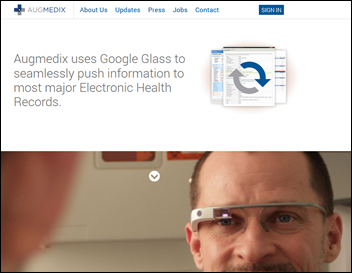
Augmedix, which offers Google Glass-powered physician documentation system, raises $16 million in Series A venture capital.

image

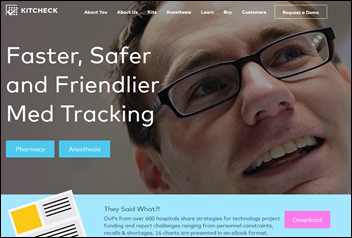
Kit Check, whose OR medication kit tracking system is live in 144 hospitals, raises $12 million in a Series B round led by Kaiser Permanente Ventures, increasing its total to $22 million.

image

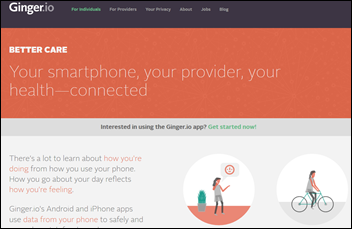
Digital mental health solutions vendor Ginger.io raises $20 million in a Series B round.

image

Cary, NC-based SmartLink Mobile, a spinoff of referral coordination software vendor Infina Connect,  raises $2.5 million in funding for its secure patient-doctor texting platform.

image

Israel-based startup MediSafe, which offers a medication reminder app, raises $6 million and opens a Boston office. One of its new investors is 7wire Ventures, run by former Allscripts executives Glen Tullman and Lee Shapiro.

image

IT services provider Syntel sues Cognizant and TriZetto over the former’s acquisition of the latter for $2.7 billion last year, with a Syntel business unit saying TriZetto refuses to pay rebates to which it is entitled because of the acquisition. Syntel claims contract interference and misappropriation of confidential information and wants $3.4 million plus $6.1 billion (with a “b”) in punitive damages.
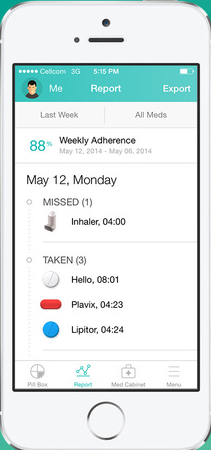
Alere completes the sale of its Alere Health business to Optum for $600 million in cash, announced in October.

image

Madison, WI-based population health software vendor Forward Health Group raises $5.7 million in funding.

AARP issues a call for startups with apps targeting the “50 and over” market for its May 14 pitch meeting in Miami. Applications are due by February 20, 2015 with no fee required. Companies will deliver a four-minute pitch, answer six minutes of questions from judges, and then have their idea voted on by consumers in attendance based on need, marketing, usage, and value.


Sales

image

Zwanger-Pesiri Radiology (NY) chooses the Visage 7 Enterprise Imaging Platform for its 58 Long Island radiologists, integrated with the practice’s vendor-neutral archive and enterprise workflow engine.

image

Eisenhower Medical Center (CA) chooses Mobile Heartbeat’s CURE clinical communications platform following its pilot project.

Good Samaritan Hospital-Southwest (CA) chooses Medhost’s remotely hosted clinical and financial solutions.

Mercy Health (OH) selects ProVation Care Plans from Wolters Kluwer Health for evidence-based care plan management.

People

image

Jamie Coffin, PhD (Clarify Healthcare) joins SourceMedical as CEO.


Announcements and Implementations

Wellcentive releases an analytics and reporting solution for providers participating in CMS’s Delivery System Reform Incentive Payment (DSRIP) program for Medicaid population care improvement.

HealthLoop releases an iPhone app that sends push notifications to a physician when a patient triggers a clinical alert or when another physician sends a triage handoff. It’s part of the company’s package that costs $199 per physician per month.

image

Bon Secours St. Mary’s Hospital (VA) goes live on Vox Telehealth’s OrthoCare program, which sends hip and knee replacement patients daily pre-op education and reminders and allows them to relay questions or concerns afterward.

Iatric Systems announces Auditor’s Desktop, which performs a daily risk analysis of potential privacy violations across multiple IT system audits.

Surgical Information System’s  anesthesia information management system is ranked #1 in a new KLAS report.


Government and Politics 

image

Congresswoman (and nurse) Renee Elmers (R-NC) reintroduces the Flex-IT act that would reduce the 2015 Meaningful Use reporting period from 365 days to 90.

A Washington Examiner investigative report finds that HHS spent $31 million on first-class flights between 2009 and 2013, including 253 trips that cost more than $15,000 each way. HHS executives taking the first-class flights claimed 70 percent of the time that it was necessary because of a medical disability. CMS officials paid $1,000 each for first-class tickets to fly from Charlotte, NC to Charleston, SC, which is a three-hour drive.


Other

image

Odd: Sentara Healthcare (VA) launches a web shop selling books, vitamins, exercise equipment, and non-prescription drugs, explaining it as “a branded option that offers a higher trust factor and unique patient experience.” A 200-tablet bottle of Advil is $27.99 vs. Walgreens online at $16.49; an Omron 5 blood pressure monitor is $95.99 vs. $45.95 on Amazon; and the book “Yoga Heals Your Back” is $19.99 vs.  $11.69 on Amazon (or $2.99 for the Kindle edition). Anyone smart enough to find and use Sentara’s site will also be web-competent enough to check prices elsewhere, so the site’s success will depend on how highly those people value the “unique patient experience” of clicking the “buy” button there vs. mainstream sites they’re already using. The underlying technology is from Paquin Healthcare, which also offers a system that integrates with EHRs to generate “lucrative new revenue streams” to “monetize major investments made in mandated EMR systems” by using the patient’s information to suggest that the doctor upsell items such as vitamins, wearables, and books. As the company explains, “If a patient’s medical record shows they have had heart disease, Embrace automatically recommends vitamins, pedometers, weight management tools, blood pressure monitors, and other such products suitable specifically for patients with that condition. When a patient purchases the recommended products or services, revenue from the sale is paid to the care provider.” 

Alibaba Health Information Technology settles its licensing dispute with Oracle. NYSE-traded, China-based e-commerce vendor Alibaba Group, whose shares are worth $255 billion and which has been predicted to be the world’s most valuable company in the next few years, bought and renamed the former Citic 21CN drug information business in early 2014.

image

A clinical documentation position paper from the American College of Physicians published in Annals of Internal Medicine says that EHRs provide minimal improvement over paper records because they were designed around billing and regulatory requirements and the practice of defensive medicine rather than improving patient care. It warns that the EHR is as overloaded with useless information as its predecessor paper chart (and will get worse with data from patient wearables) and that narrative entries are being unjustly devalued in favor of discrete data entry. The authors add that E&M guidelines forced data formatting rules that caused “coding and compliance trumping clarity and conciseness, as well as a harshly negative ‘gotcha’ mentality that saps the professionalism out of physicians.” The position paper says CMS overreacted in its condemnation of copied-pasted information, explaining that while copy-paste causes documentation bloat and perpetuation of originally incorrect information, physicians should not necessarily be required to create every new EHR entry manually – in other words, it’s the user and not the EHR function that should be of concern. The paper expresses tepid support for the Open Notes concept of letting patients review clinical documentation, saying it’s too early for a big rollout and that providers should be able to hide individual notes that could cause patient harm.

image

Huffington Post covers the growth of retail clinics. CVS alone plans to have as many MinuteClinics in operation by 2017 as exist overall today. Meanwhile, mall operators expect to fill empty spaces left by dying retailer chains such as Sears and RadioShack with walk-in clinics, of which more than a third of the 9,400 total are located in shopping centers.

I enjoyed these tips for making meetings more productive:

  1. Don’t invite more than 10 people.
  2. Schedule meetings for only 15 minutes, set a timer, and stop the meeting when the timer goes off.
  3. Take away the chairs to encourage creativity instead of passivity.
  4. Don’t allow laptops or phones – studies show taking notes by hand leads to greater understanding.
  5. Assign every task to a directly responsible individual.
  6. Take a two-minute silence break to think about a decision or issue.
  7. Ask each attendee to answer the “why are we meeting” question in five words or fewer to make sure everyone expects the same outcome.

image

Weird News Andy understands that, “It’s hard to re-member.” A woman in China cuts off her husband’s penis after catching him sexting with his lover, but surgeons successfully reattach his manhood. The wife, obviously still unhappy, sneaks back into her recuperating husband’s hospital room and cuts his penis off again, this time throwing it out the window of his hospital room. The couple was caught on camera fighting in the street outside as the man was naked and bleeding, but he won’t be reorganized a second time – the hospital says a dog or cat must have run off with his severed penis because they couldn’t find it. However, he may yet have a happy ending since his lover says she will marry him anyway.


Sponsor Updates

image

  • TransUnion unveils a new brand identity platform and logo.
  • MedAptus joins Athenahealth’s More Disruption Please program.
  • Forbes profiles the use of Strata Decision’s StrataJazz to reduce hospital costs.
  • Zynx Health will exhibit at the HealthIMPACT Southeast event on January 23 in Tampa.
  • Huron Consulting Group’s efacs software is selected as University Business Readers Choice Top Product.
  • Voalte offers advice for setting goals in 2015 in its latest blog post.
  • Verisk Health blogs about why value-based care will work.
  • T-System Director of Documentation Solutions Robin Shannon, RN offers tips on how to maintain efficiency and throughput during high patient volumes in flu season.
  • CEO/CFO Magazine interviews SyTrue CEO Kyle Silvestro on transforming medical data into refined smart data.
  • Surgical Information Systems will participate in the MUSE Executive Institute in Amelia Island, FL on January 19-20.
  • Summit Healthcare blogs about its preparations for the IHE North American Connectathon, taking place January 28 at the HIMSS Innovation Center in Cleveland.
  • SRSsoft offers four key ways to make and keep resolutions in the new year.

Contacts

Mr. H, Lorre, Jennifer, Dr. Jayne, Dr. Gregg, Lt. Dan.

More news: HIStalk Practice, HIStalk Connect.


Get HIStalk updates.
Contact us online.

125x125_2nd_Circle

Morning Headlines 1/13/15

January 12, 2015 Headlines Comments Off on Morning Headlines 1/13/15

FDA puts interoperability guidance on back burner

The FDA has published its list of priorities for 2015, which includes clarifying regulatory guidance on clinical decision support software, but does not include any short-term efforts to improve interoperability.

eLearning as good as traditional training for health professionals

Researchers at Imperial College in London, carrying out a study commissioned by the World Health Organization, review findings from 108 research studies and conclude that online learning is likely to be as effective as traditional education for training health professionals.

Health Poll: Data Privacy, Part 2

In a survey of 3,000 Americans conducted by Truven Health Analytics, only 53 percent of respondents report that they would be willing to anonymously share their medical data to support research.

Comments Off on Morning Headlines 1/13/15

Curbside Consult with Dr. Jayne 1/12/15

January 12, 2015 Dr. Jayne 1 Comment

It’s hard to believe that I just started my fifth year as a member of the HIStalk team. Even though I’m more “in the know” than I was before, I still depend on HIStalk as a valuable source of information on all things Health IT. I also enjoy the discussion of technology in general, since it’s hard to separate that from the healthcare part and goodness knows I don’t have time to read Wired magazine or surf tech blogs.

With that in mind, I chuckled when I saw The PACS Designer’s comments about Windows 10 and its new browser.

He mentioned that its code name is “Spartan.” I immediately wondered what attributes of the Spartan culture Microsoft was trying to celebrate. Sternly disciplined? Rigorously simple? Brave? Undaunted?

Certainly those dictionary descriptions seem desirable and noteworthy. For those of us who didn’t sleep through World History, there are some other more colorful Spartan characteristics and I’m wondering if they were considered before the name was chosen.

As a city-state in ancient Greece, Sparta was the dominant military power for several hundred years. That sounds a bit like Microsoft. The Spartans were eventually defeated, but remained independent until the Romans came along. While the overall society focused on excellence in military training, the social classes had rigidly defined roles. Legend has it that the Spartans would take children who were weak or disabled and leave them to die of exposure or alternatively throw them into a chasm.

That certainly sounds like a couple of vendors I’ve worked with, where products with a lot of potential are thrown out if they aren’t thought to be highly profitable. On the flip side, sometimes it feels like products are pushed forward just because they look good, regardless of whether they are truly game-changers or solve an unmet business problem in a compelling way. Marketing teams reign supreme in some organizations and it is increasingly difficult to separate the reality from the hype.

My health system has an enormous development shop since we’re one of the few best-of-breed organizations that haven’t yet succumbed to Epic. Sometimes it feels like they’ve taken the “Innovate or Die” mantra a little too seriously. Clinical end users don’t typically ask for more disruption or sassy new paradigms. They want things to be easy and fast rather than eye-catching and trendy. It’s hard to get developers to understand that when every single physician has a common verbiage for the parts of the patient visit note, we’re not likely to appreciate their capricious use of synonyms to try to make the work we do more fresh, exciting, or new.

I recently dipped my toe into “fresh, exciting, and new” with a foray into the land of the MacBook. Quite a few of my friends and a couple of family members are big advocates. I was a Mac devotee early on, but years in corporate IT have stifled the desire to use anything other than Windows. Although it’s been great for my non-work computing needs, I’ve been relentlessly teased at the office. The jury is still out on whether I’ll be able to make a go of it.

As for the Windows 10 browser, personally I hope they’re calling it Spartan because it’s going to be austere with muscular performance. I don’t need any new shiny objects in my life. I just need things that are easy to use and that work day in and day out. If Windows 10 and Spartan hit those marks, they’ll do well. If not, the user community will abandon them on the windswept edge of oblivion.

What do you think about the future of Microsoft and the debut of Windows 10? Email me.

Email Dr. Jayne.

Startup CEOs and Investors: Brian Weiss

Startup CEOs and investors with strong writing and teaching skills are welcome to post their ongoing stories and lessons learned. Contact me if interested.

Are We On Fire Yet? (Or, Where’s the Data?)
By Brian Weiss

image

A Star(tup) is Born

Healthcare IT startups can often trace their origins to an “Aha! Moment” when a tech-savvy entrepreneur-to-be experiences the healthcare system in a significant way (often, sadly, due to the illness of a loved one) and decides, “There has to be a better way to …” (avoid allergic reactions, make sure medications are taken properly, keep track of blood sugar readings, avoid filling out the same forms over and over in the waiting room, have this doctor know what that other doctor already did, make sure they amputate the correct limb …)

Eureka! A mobile app / web application is born. It will be “just like …” (Facebook, Instagram, Google, Uber,or any other multi-billion-dollar Internet wonder) – except, “It will  be perfect for …” (patients, doctors, caregiver moms,  hospitals, home care …) Not to mention that it rhymes with “ACO” and runs … (on a smartphone, in a cloud, directly on your retina in the next version …)

A related family of startups, loosely termed “healthcare analytics,” often starts with an entrepreneur who is a bit older and more seasoned, has enough business savvy to “follow the money trail,” and whose neighbor’s daughter is in her last year of grad school for the third year in a row. Said neighbor’s daughter says that given a standard blood test kit, a strand of hair, and the first and third letters of someone’s last name, we can “predictive analytics” (yes, it’s a verb — I say so) anything you want about someone’s future medical conditions with proven accuracy of at least 98.7 percent on all predictions for the time period following their death.

Now Let Me Explain …

These great ideas of my younger and hipper friends are predicated on a surprisingly problematic assumption. Namely, that patients (more broadly, “consumers”) have reasonable access to electronic copies of their own healthcare data. If you’re reading HIStalk, I probably don’t need to explain to you what a silly notion that is. Why do entrepreneurs assume this is the case?

First, some of them saw the hip-HIPAA video (or something similar) from Uncle Sam Productions stating that every person in America has a right to get an electronic copy of their records from anybody that maintains such an electronic record (which I think right now is almost everyone involved in healthcare in some way, with the possible exception of Aunt Emma and her world-famous chicken soup, and it’s just a matter of time before she attests for MU Stage 1.)

Throw into the mix some intuitive modern consumer expectations and you can begin to understand (not condone, of course, just relate to in a non-judgmental way) why some of our misguided youth are jumping to the wrong conclusions.

The result is cool apps that work great, as long as everyone either (a) has the actual same clinical data as in the sample data they used in development, or (b) wants to spend a few hours every weekend updating their clinical data manually from whatever scraps of it they can get their hands on.

But fear not! Fortunately for all of us, I now have this prominent published column that one or two of these lost souls might actually read, so here’s my chance to step up to the pulpit and set everyone straight.

My Friends! Salvation is Just One Committee, Acronym, and Decade Away

So, listen up, my young, big-idea friends.

The umpteenth committee in a series that began running before most of you were born is taking care of this problem even as we speak. Like every committee in the series, it includes multiple leading vendors, multiple leading standards organizations, and multiple very experienced (from previous committees – I wonder how the first one was formed?) leading experts.

This is not your father’s Oldsmo-committee. This one (did I mention it was “leading” and “multiple?” Yes, that’s an adjective for real, so I can use it any way I want) is dedicated to one of the principles our great country was founded on (whenever the public funding well runs dry): “More acceleration without regulation.” The original cry of the Boston Tea Party before a focus group said “taxation” and “representation” worked better.

This latest committee is hipper than most, as evidenced by a name taken from Greek mythology. They’ve published a charter that makes it clear they plan to work very, very quickly, so that by 2016 we’ll have a shiny new accelerated standard and then we can figure out if and how consumer data is actually going to be made ubiquitously available with it sometime in the 2020s (is that going to be a hip decade, with a name like that, or what?) for your cool apps.

You’ve got enough seed funding to carry you until then, right?

The new standard (OK, it was actually new quite a few years ago – but not enough people were paying attention back then) is called HL7. No, ASTM CCR. No, HITSP CCD. No, SMART. No, Blue Button Plus. No, C-CDA. No,C-CDA R2.0. No, no, no — it’s called FHIR (rhymes with “liar,” but that’s the honest truth).

The Lessons of Blue Button Plus

I (virtually) know a few Argonauts and some of the other folks who have been working on FHIR for many years. They are incredible folks who are smarter, more experienced, more capable, and more all kinds of stuff than me.

Then again, so were/are the folks who worked on something called Blue Button Plus (it had a bunch of other names like ABBI — I forget more easily at my age) back in what seems like just a few months ago.

Two years ago at HIMSS, there were some slick PHR startups showing off their Blue Button Plus capabilities for fetching data from Blue Button Plus-enabled sites.

I wasn’t personally involved, but I’m told that Blue Button Plus integration meetings were a bit like dating sites with members of only one gender registered. Lots of folks wanted to be Blue Button Plus clients, but nobody was offering to be a server (you can see why I didn’t want to pin down the gender in the dating site analogy – that could get me in trouble with the whole client-server thing).

One of the poster children for Blue Button was (and still is, I believe) MyMedicare.gov. You know what special next-generation data format they use when you Blue Button (yup, another verb I created) your records for re-use? FHIR? C-CDA? CDA? CCD? JSON? XML? If you guessed “ASCII text files,” you’re our lucky winner.

And you know what? That’s actually a whole lot better than what you (can‘t) get from most sites using Blue Button Plus or SMART or any of the other standards and frameworks that promised to deliver MU2-aligned C-CDA (or similar) data with push delivery, notifications, security and authentication, and an App Store-like ecosystem.

It’s Not (Just) the Data Format, It’s the Data Availability

Now I actually know a little bit about some of these standards. Once upon a time, HL7 even contracted me to help write some of their knowledge base articles on CDA and C-CDA.

I’ll send you my rubber stamp so you can add my signature to any learned commission or task-force reports listing what’s wrong with C-CDA. It’s complicated, ambiguous, overly academic, insufficiently documented, lacking examples, has too low a validation bar in MU2. Did I mention complicated?

There’s lots more work to be done on standards. FHIR sounds great. My FHIR friends assure me that in due time it will replace HL7 v2 and CDA, and might even shorten the coffee lines at HIMSS. And I’m told that if you can figure out how to play Candy Crush, you can write a great healthcare app with FHIR.

Don’t misunderstand my feeble attempts and rancorous wit. We definitely need better standards, better guidelines for MU Stage 3, and a better 5-10-50 year strategic data interoperability roadmap for posterity.

Just sayin’ that is not what I think we need most. That honorary title belongs to…. DATA ACCESSIBILITY.

Despite all its flaws, the M2 C-CDA standard we already have is all my fellow startupers (plural noun, yup) and I need right now to do all kinds of cool stuff. Actually, we would do fine with the MU1 CCD (aka “HITSP C32 CCD”). Or the CCR that came before that. Or even the HL7 v2 messaging before that. Or Blue Button Plus, or SMART, or whatever.

But wait. Don’t developers need simple RESTful APIs for their apps (as FHIR will provide)? Of course, but we don’t need another year or two (and I’m not even getting into the debate if those are human years, dog years, or ICD-10 years) to wait for FHIR, just for that.

The translations between whatever other formats are out there and actually available today and the mobile app-ready formats developers will adopt are not the real barrier or issue. My company and many others will try to kill ourselves outdoing one another to provide those more quickly.

The main issue is what is really out there and actually available today in terms of real patient clinical data. And without belittling the importance of how many steps you took today on your way from your desk to the restroom, I mean the clinical data in the myriad of EHRs and similar that contain your more traditional health records, not the stuff from your neon fitness bracelet or your mood ring.

If application developers could reasonably get the “C-CDA over DIRECT” data promised by MU2 and Blue Button Plus from every hospital, doctor, pharmacy, lab, clinic, we’d be flying.

How can I be so sure? Because we’re almost managing today, with a lot less.

If my friends at HL7 and FHIR were shown the minimalistic JSON being returned by early-stage commercial APIs that provide patient portal data to PHR developers, they’d have a heart attack (though they probably wouldn’t know it without the correct SNOMED codes for that condition , which aren’t provided).

The data available today is a hodgepodge of formats, coding standards, semi-structured text, and whatever else you can think of. It’s not pretty, but it’s a whole lot better than what we (can’t) get (yet) from “future standards.”

It’s Not Either-Or

If you ask me (you don’t really have to, it’s my column, so I get to make up both the questions and the answers), getting ubiquitous access to data now is as important to FHIR itself as whatever else is being worked on in Argonaut projects and similar.

“Build it and they will come” works in the movies. Everyone else has to get real-world feedback and iterate to the right solution. Lessons learned from real-word smartphoning (yes, it’s a verb) by consumers with apps running off of C-CDA document data as mandated for delivery by MU2 is as important to the future of FHIR as API connectathoning (ahem) with like-minded geeks.

Of course, focusing exclusively on data accessibility with existing problematic standards, flawed policies, undefined authentication APIs, incomplete code system alignment, and all the other myriad of gaping holes still open isn’t a good idea, either. We need to be working on these issues from all angles simultaneously: standards developers, established vendors, policy organizations, regulators, providers, industry leaders, payers, consumer groups, government agencies, startups, public opinion influencers, and more.

But the funny thing about the future is that you get there a whole lot quicker if you start now.

I think we need a lot more energy and focus on just getting vendors, portal providers, MU2-attesting providers, and everyone still playing hide-and-seek with consumer clinical data to align with both the letter and the spirit of the law. Let consumers get electronic copies of their data in the app(s) of their choice — today.

With apologies to Dickens, I think I might be speaking for a few of the other orphans in the room when I humbly ask, “Please, sir, I want some more consumer-centric clinical data, now.”

Brian Weiss is founder of Carebox.

Startup CEOs and Investors: Bruce Brandes

January 12, 2015 Startup CEOs and Investors Comments Off on Startup CEOs and Investors: Bruce Brandes

Startup CEOs and investors with strong writing and teaching skills are welcome to post their ongoing stories and lessons learned. Contact me if interested.

Why Your Pitch Makes You Sound Like Charlie Brown’s Teacher
By Bruce Brandes

image

Mr. HIStalk was kind to offer me this opportunity to periodically share anecdotes, observations, and insights from my career at the intersection of healthcare and information technology. My goal in writing for HIStalk is two-fold: to support  life-long healthcare folks charged with transitioning from a fee-for-service to a fee-for-value healthcare proposition, and to encourage young tech entrepreneurs who are building important solutions that accelerate healthcare transformation by giving them the best opportunity to succeed, given an array of unique challenges and historical realities.

My first job out of business school, over 25 years ago, was as a sales rep at IBM, which just so happened to assign me to the healthcare vertical. I thought then, “Healthcare is really screwed up. Certainly technology should be able to fix this mess.” While over the past quarter-century we have made some progress moving around the deck chairs on the Titanic, for the first time ever, it is clear that long-awaited, meaningful disruption is beginning to happen.

Subsequent to IBM, I have held sales, strategy, and leadership positions at early and growth stage companies including ESI, Eclipsys, HealthStream, AirStrip and Valence Health. Recently I joined Charlie Martin, a lifelong hospital operator and the founder and CEO of Vanguard Health Systems (now Tenet) to develop Martin Ventures. The Nashville-based firm invests in ideas and innovations that apply integrative approaches that simultaneously improve care, improve health, and reduce the cost of healthcare. Being a part of Martin Ventures has lifted the curtain for me on the venture capital and provider mindsets, which entrepreneurs must appreciate to build a successful business.

Having delivered thousands of presentations over the years, I am now on the other side of the table. I sit in the audience with my "investor hat" alongside long-time healthcare executives. The first observation I feel compelled to share is about your pitch deck (this also applies to sales presentations from vendors to prospects). 

To you, your message is unique and compelling. To your audience, this is the 20th presentation they have sat through this week with people who look just like you and are saying the same thing. Add to that, they have had a history of being misled by exaggerated claims, so skepticism is in the air even if they manage to stay awake while you read your slides.

At a recent conference with rapid-fire presentations from aspiring and emerging digital health entrepreneurs, Charlie (who has been building bricks-and-mortar hospital systems for 50 years) leaned to me and commented, “I don’t understand why anyone in the US still has diabetes. All these people have already solved the problem.” That is my point — you all sound the same!

My favorite TED Talk is a popular one from Simon Sinek, who reminds us that, “People don’t buy WHAT you do, they buy WHY you do it.” Reflecting on and embracing this idea may help set you apart.

When I was at AirStrip, shortly after our founders presented behind Steve Jobs at the 2009 Apple Worldwide Developers Conference, we had the opportunity to meet leading investors as we searched for our first round of growth capital. Prestigious Silicon Valley venture capital firms had a placeholder for several years for a portfolio company to address mobility in healthcare, having passed on everything before AirStrip.

As we built a relationship with the partners of a prominent Sand Hill Road firm, I later learned that it was not the content of our presentation (which we painstakingly developed for weeks) that attracted them to the company. Our allure was less about how we had built a broad platform for mobility specifically for healthcare or that we had proven the concept in obstetrics with a compelling value proposition.  

The investors were more interested in investing in the technical and clinical credibility, passion, and commitment of the founders to eliminate the geographical and informational boundaries that had historically hindered doctors, nurses, and patients from delivering and receiving the best possible care. People don’t buy what you do, they buy why you do it.

image

As a call to action, focus on how to set yourself and your organization apart from others – at your core, not just in your presentation – but, good grief, for the sake of your audience, at a minimum step up your game in how you present!  

A little guidance: 

  • Understand your audience well enough to meet them at a common baseline so you do not waste time telling them information which they already know.
  • Cut the number of slides in your deck in half (if you must use them at all) and ensure their purpose is to support your having a conversation with your audience, not to distract from it.
  • Tone down wildly speculative claims about the market, potential ROI, forecasted revenues, etc.
  • Be honest and realistic. Sincerity, insight, and integrity make a much stronger impression than telling your audience what you think they want to hear

Most importantly, read your audience to see if they are hearing what you are trying to convey, or if instead you are coming across as Charlie Brown’s teacher: “Wah, wah wah, wah wah wah."

Bruce Brandes is managing director at Martin Ventures, serves on the board of advisors at AirStrip and Valence Health, and is entrepreneur in residence at the University of Florida’s Warrington College of Business.

Comments Off on Startup CEOs and Investors: Bruce Brandes

Startup CEOs and Investors: Marty Felsenthal

Startup CEOs and investors with strong writing and teaching skills are welcome to post their ongoing stories and lessons learned. Contact me if interested.

The JPMorgan Healthcare Conference
By Marty Felsenthal

image

It’s bigger than the Super Bowl, the World Series, the World Cup, and the Winter and Summer Olympics. It’s more important than the BCS Championship game (particularly if you’re from Florida or Alabama) and maybe even the Famous Idaho Potato Bowl, the Scottish Highland Games, and the Cooper’s Hill Cheese Rolling and Wake Competition combined (unless you are from Idaho, Scotland, or, of course Gloucester, England).   

My name is Marty Felsenthal. I’m a middle-aged, workaholic healthcare venture capitalist with thinning hair and a thickening mid-section. Mr. HIStalk asked me to write a little bit about the JPMorgan Healthcare Conference taking place this week in San Francisco and to describe it for readers who have never attended. 

My life’s greatest joys and accomplishments are increasingly defined by (a) finding great post-holiday sales online; (b) the "sports" achievements of my nine-year-old, boy-girl twins, and occasionally, my seven-year-old daughter; and (c) by the nights my wife actually laughs at a joke I make rather than thinking I’m a workaholic, balding, overweight man who she periodically tries to pull a Chief Bromden on and pillow-suffocate for snoring in my sleep.

Since that is increasingly my life, the JPMorgan Healthcare Conference is actually a big deal for me. But it wasn’t always that way.

The conference has been taking place for decades. In fact, it used to be called the Hambrecht & Quist Healthcare Conference prior to H&Q being acquired by JPMorgan. But for decades, it was really dominated by drug companies, biotechnology companies, and medical device companies. On a relative basis, there was just less growth and innovation in healthcare services and healthcare information technology and, as a result, less investor interest.  

For clarity’s sake, I should point out that I’ve been a healthcare-focused venture capital investor for 18 years and work exclusively with what we hope are innovative healthcare services and healthcare information technology companies. This year, our firm will be hosting a reception during the conference for other venture capital firms who invest in healthcare services and healthcare information technology.  

This will be my twelfth consecutive year of co-hosting this reception. There were years when we had fewer than 30 venture capital investors show up. There was just nothing sexy about investing in venture-stage healthcare services and healthcare information technology. I was like the Kevin James of the JPMorgan Healthcare Conference.  

This year, however, we have over 150 venture capital investors attending and had to turn a number people away at the threat of the fire marshal. This year, I’m like the Kate Upton of the conference — actually, let’s say the David Beckham of the conference (and maybe with a lot of help from Photoshop, that could actually be the case). 

When did it change and why? That’s easy.  2009 and 2010 when the HITECH Act and Affordable Care Act were passed. They were catalysts for innovation in "my" sectors unlike anything I’ve experienced since I first got involved in healthcare in 1992.

The conference itself is held at the Westin St. Francis on Union Square. It’s a forum for hundreds of public healthcare companies and an increasing number of not-for-profit healthcare systems and health plans with public debt to present to mutual fund and hedge fund investors. These companies include drug and biotechnology companies, diagnostic companies, medical device companies, healthcare services companies, and healthcare information technology companies.  

JPMorgan is also increasingly inviting a number of still-private companies to present. My firm is fortunate to have a few of these — Teladoc, Redbrick Health, and Vet’s First Choice. I unfortunately don’t have a chance to actually go into the conference and listen to these companies present any more. I wish I did.  

The presenting companies are among the largest and most influential players in the US healthcare ecosystem. They include UnitedHealthcare, Wellpoint, Aetna, Cigna, Centene, and all the major health plans. They include large health systems such as HCA, Tenet, Geisinger, and Banner; pharmacy chains and PBMs such as Walgreens and CVS Health; and most of the country’s most influential health information technology companies, such as Cerner and Athenahealth.  

These companies are talking about much more than their financial performance. They are talking about their strategies and how they are evolving in the face of the huge changes sweeping across our health care system. They are talking about their efforts to help reduce healthcare costs in our country, to improve quality, to improve the consumer experience, and to help lay (or take advantage of) the healthcare information technology backbone so we can transition to a more value-based environment. They understand that, in the current environment, they have to adapt and innovate to survive and thrive, and this is what some of the largest players in the US healthcare ecosystem are presenting and discussing.

Unfortunately, I don’t have time to go into the conference any more. I won’t even have a chance to see our portfolio companies present. As the customers of our portfolio companies (broadly speaking, health plans, hospital systems, pharmacy chains, HCIT companies, distributors, etc.) have started needing and demanding more innovation, more innovative companies have formed to address these needs. These companies need capital. They need investment bankers. They need management teams. They need executive recruiters.

All of these constituents — many of whom are old friends from my days as "Kevin James" and many new to the industry as we became cool — descend upon San Francisco during the conference to network, to catch up, to search for new jobs, to craft business partnerships, to look for capital. There is as much if not more action taking place outside the Westin St. Francis as there is taking place in the actual conference.

At Mr. HIStalk’s suggestion, I took a look at my calendar. This is my week. I start at 5 p.m. on a Sunday, and from there, I am booked solid every hour on the hour, breakfast through dinner, until Friday at 10 a.m. 

I am meeting with seven investment bankers. These investment bankers know and represent many wonderful entrepreneurs and companies who are in need of capital (capital that we can provide). They are also looking to represent companies we invest in when they need more capital and/or want to sell their businesses or go public.  

I am meeting with six other venture investors/firms. These are organizations that we co-invest with already or that we would like to co-invest with. We talk about opportunities to work together within our existing portfolios, companies we are currently evaluating where there might be an opportunity to invest together, and areas of innovation of mutual interest.  

We have more than 20 meetings with executives from some of the largest health plans, pharmacy chains, distributors, HCIT companies, and hospital systems in the country. We’ll talk about innovation. We’ll discuss our portfolio, trends we’re seeing in the marketplace, and interesting companies we’re seeing. 

I have meetings with three entrepreneurs who just want to network or who are looking for new opportunities. I’m getting together with Pete Hudson, the very talented founder of iTriage/Healthagen, with someone who was formerly a senior executive at McKesson, and with a former senior executive from HCSC. 

We also have an opportunity to meet with more than 10 innovative companies that are seeking capital. For obvious reasons, I can’t name them, but they are providing analytics for health systems and provider groups, and they are developing novel insurance exchange platforms. They are developing tools that deliver better provider quality information to consumers. They are helping health plans manage patients with certain types of high-cost chronic diseases (in one case we’re particularly excited about, a very large problem that no one has previously tried to target), and they are helping hospitals lower labor and equipment costs and are also facilitating better patient collection efforts.  

Unfortunately, the meetings during the conference are always too rushed, but there are two highlights of the week for me. The first is getting to sit down with these great entrepreneurs seeking capital and learning about their businesses. Occasionally this leads to an investment, as was the case with a digital pathology company called Aperio that we met with at the conference in 2007.  

The other highlight is getting together with the large healthcare companies and learning about where they are looking for innovation. One of the most satisfying aspects of our job is when we actually help young companies develop relationships with these large players. It’s a lot of fun to try to marry the young, nimble, aggressive (and sometimes naive) startups with the large, sophisticated, complex, highly influential (and sometimes slower-moving) titans of our industry.  

Unfortunately, there are also lots of people and companies I don’t get to meet with during the conference. People have started reaching out to schedule meetings during the conference as early as November now (for a conference that takes place in January). This leads to a lot of calls the first and third weeks of January with the people I couldn’t meet.  

So in short, it’s a hugely productive week of networking. We learn a lot. We get to help drive revenue to our portfolio companies on occasion. We reacquaint with old friends. We meet new friends who might someday work with our portfolio companies or partner with them. If we’re lucky, we find a new investment.

When the week is over, I go home feeling like the rock star that is David Beckham. I grab a drink. I crack a joke to my wife, I get ready for my Posh Spice, and then I usually fall asleep and start snoring, which often coincides with her trying to suffocate me.

Marty Felsenthal is a long-time venture capital investor who invests in and works with growing healthcare information technology and healthcare services companies and has been attending the JPMorgan Healthcare conference since the 1990s.

Morning Headlines 1/12/15

January 11, 2015 Headlines Comments Off on Morning Headlines 1/12/15

HLM Venture Partners aiming at $150M for fourth investment fund

Boston, MA-based HLM Venture Partners raises its fourth funding round, a $150 million investment fund. While the new funds will likely be distributed across a wide variety of industries, HLM has a track record of investing in digital health.

Internists Suggest Congressional Actions to Improve American Healthcare

The American College of Physicians calls on Congress to: repeal the Medicare SRG formula, continue the current Medicare 10 percent primary care bonus, restore the Medicaid primary care pay parity program, and provide relief from “unrealistic Medicare meaningful use requirements for Electronic Health Records.” 

The Future of Medicine Is in Your Smartphone

In a Wall Street Journal op-ed, digital health advocate Eric Topol, MD predicts that new smartphone-based medical technologies will improve care delivery and create a “radically altered” doctor-patient relationship.

Comments Off on Morning Headlines 1/12/15

Monday Morning Update 1/12/15

January 9, 2015 News 12 Comments

Top News

image

HLM Venture Partners, which made several health IT investments in its first three funds, is raising up to $150 million to launch a fourth fund. Its portfolio companies include Nordic Consulting, Aventura, Medicalis, Phreesia, and Teladoc.

The investment challenge, it seems to me, is that in the frenzy to throw money at unproven healthcare IT startups, we’re well past the wheat and deep into the chaff. It’s good that demand for new technologies seems strong, but too many no-name companies confuse the market and many of them will fizzle out quickly. Companies that are thrown together purely to chase money usually don’t find it and there’s only so much proven management talent to go around. Incubators and accelerators are encouraging a lot of shaky startups that will experience the inevitable Darwinism. Still, a few of them will avoid enough minefields to get market traction or sell out to a bigger player.


Reader Comments

From Frustrated Surgeon and Developer: “Re: big health IT. Epic and Cerner are using strong-arm techniques to counter any move to interoperability. Congressman Dave Camp (MI) testified before Congress that he was being pressured by lobbyists paid for by Epic to remove interoperability from MU 2 ( and now 3) to secure their business position. Cerner said they weren’t interested in interoperating with my cloud-based system that several hospitals are using. APIs and licensing fees never came up — they just won’t do it. Cerner’s representative to ONC’s Jason Task Force is pushing hard to stop MU 3 interoperability requirements. We should not look to Epic and Cerner to open the doors. We need a HIE which Epic, Cerner, and all other permitted applications should use. It’s the data, not the application.” Unverified. I searched the Congressional Record for Epic-related comments by Dave Camp (who is now retired) but didn’t see anything relevant, although the search isn’t exactly Google quality.

From Jack Gutenberg: “Re: HIStalk book club. You should invite readers to read along and add their comments to yours.” I like the idea. I’m just starting Eric Topol’s “The Patient Will See You Now” in case anyone wants to start it along with me and then add their comments once I’ve posted mine. I’m not only interested in critiquing the book itself, but also discussing the interesting ideas inside. Books I’ve summarized here previously include “Connected for Health,” “Your Medical Mind,” “Safe Patients, Smart Hospitals,” and “Where Does It Hurt?

From The PACS Designer: “Re: Windows 10 browser. Rumors have been swirling for months about the next version of Windows 10 and its browser style since Internet Explorer and Bing have such a small market share compared to Firefox. The leaked browser is called Microsoft Spartan.”


HIStalk Announcements and Requests

image

More than three-fourths of poll respondents agree with a popular stock expert’s characterization of the Athenahealth as a “bubble stock” that won’t be “the backbone of anything” rather than the company’s stated high-flying ambition to be the Salesforce of healthcare. New poll to your right or here since I ask every year: what are your HIMSS15 attendance plans compared to HIMSS14?  

Ready for your input: the HIStalk reader survey and HISsies nominations. Thanks for participating. I’ll also randomly draw three reader survey responses for a $50 Amazon gift certificate.

I was thinking about Uber’s surge pricing model, where the app tells you in real time that local demand is high and you’ll have to pay more. I’m frustrated when I get that message, but it makes perfect sense from a supply and demand point of view. When cars are in short supply, the higher price does two things: (a) it allows price-sensitive consumers to seek alternatives to Uber such as taking a cab or walking, increasing Uber car availability for those willing to pay more; and (b) it encourages more Uber drivers to get out on the road and start picking up fares. (obviously it does a third thing: it raises Uber’s profits, so you have to trust them to proclaim surge pricing only when they really are swamped). An Uber model would work in medicine if it were a pure science instead of an art and if people actually paid cash for their services – you could have doctors willing to provide telemedicine consults at a given time and price via an Uber-type service and let patients decide what it’s worth to them, with an app setting the intersection of supply and demand. That leaves those unable to pay out of the picture, but medicine is already heading toward a two-tier system where cash-paying patients have better options anyway.


Last Week’s Most Interesting News

  • IBM and Epic enhance their DoD EHR bid pitch by announcing that they’ve already installed an Epic model instance in a DoD-hardened environment for testing and also formed an advisory committee.
  • Walgreens adds health management, real-time health coaching, and wearables connectivity to its website and mobile app, offering users reward card points for using the tools to meet their health goals.
  • The AMA says EHRs, ICD-10, prior authorization, and Medicare fraud detection are barriers to care that it will target in 2015.
  • Sue Schade of University of Michigan Hospitals and Health Centers wins the Gall CIO of the Year award.
  • Analytics vendor Inovalon files for a $500 million IPO.
  • Allina Health and Health Catalyst announced an analytics technology and quality improvement partnership, explained by Allina President and CEO Penny Wheeler, MD in my interview.
  • Only 24 percent of respondents to my poll said their impression of HIMSS is positive.

Webinars

January 13 (Tuesday) 1:00 ET. “The Bug Stops Here: How Our Hospital Used its EHR and RTLS Systems to Contain a Deadly New Virus.” Sponsored by Versus Technology. Presenter: John Olmstead, RN, MBA, FACHE, director of surgical and emergency services, The Community Hospital, Munster, Indiana. Community Hospital was the first US hospital to treat a patient with MERS (Middle East Respiratory Syndrome). It used clinical data from its EHR and staff contact information from a real-time locating system to provide on-site CDC staff with the information they needed to contain the virus and to study how it spreads. Employees who were identified as being exposed were quickly tested, avoiding a hospital shutdown.


Acquisitions, Funding, Business, and Stock

image

Francisco Partners makes an unspecified investment in Olathe, KS-based revenue cycle solutions vendor eSolutions.

image

The Columbus paper profiles Lyntek Medical Technologies, whose PatientStorm Tracker software provides a weather radar-like display of an inpatient’s overall condition. It’s being beta tested by OhioHealth Riverside Methodist Hospital. Founder and pulmonologist Lawrence Lynn, DO says the outdated fire alarm model of medical monitoring systems doesn’t provide useful information until vital signs hit specific limits. He adds, “You can be in the hospital dying of sepsis with a smartphone in your pocket that can detect the pattern of a song just by listening to it, but this sophisticated-looking monitor above you can’t detect a single pattern of evolving death.”


Sales

Atlantis Health Group chooses Influence Health’s Navigate population health management solution.


People

image

UMass Memorial Medical Center (MA) appoints Pam Manor, RN, MSN, DNP (St. Francis Hospital) as chief nursing informatics officer. 

image

William Hersh, MD (Oregon Health & Science University) is named the winner of the 2014 HIMSS Physician IT Leadership Award.

image image

Streamline Health promotes David Sides, who has been with the company for five months,  to president and CEO. Sides, on the left above, replaces Bob Watson, who will leave the company to become president of NantHealth but will remain on Streamline Health’s board. NantHealth announced in November that it will use Streamline Health’s analytics product in its system.


Government and Politics

The American College of Physicians urges Congress to: (a) repeal Medicare’s SGR formula; (b) continue Medicare’s 10 percent bonus for primary care; (c) restore the Medicaid program that pays primary care physicians no less than Medicare rates; and (d) provide relief from “burdensome and unrealistic” Meaningful Use requirements and “other excessive regulatory burdens.”


Other

image

An opinion piece slated for publication in Academic Medicine examines whether it’s ethical for medical students to use an organization’s EHR to track their former patients so they can match outcomes to the students’ original diagnosis and treatment. The authors conclude that the benefits outweigh the harms. I couldn’t agree more – it’s hard to believe that an intelligent argument could be made otherwise. The opportunity would only arise in teaching hospitals and I see no potential ethical or HIPAA conflicts since patients understand that their treatment has an educational component. The practice should not only be allowed, it should be mandatory, and perhaps not just for medical students. Medicine (and ancillary fields) are literature-based and that always involves aggregated, de-identified research, but what could be more educational than seeing how your care decisions impacted a particular patient’s life and whether your actions were ultimately right or wrong? The patient has to live with the impact, so  why shouldn’t the professionals who made those decisions? It would also be interesting to look at a patient’s overall perception of health and well-being (perhaps via a self-survey with results trended over time) instead of just a problem list if we’re really interested in improving their lives and not just their medical conditions. We have to leave the “treat ‘em and street ‘em” mindset behind.

The Wall Street Journal runs an essay by Eric Topol, MD titled “The Future of Medicine Is In Your Smartphone” in which he again predicts that technology will alter the patient-physician relationship, reduce costs, and empower patients. He thinks that doctors will still have a role, just not as today’s paternalistic “priestly class.” He has vested interests, however, even going beyond pitching his new book: he lists consulting engagements with Google, AT&T, Walgreens, Quanttus, and Sotera Wireless. A skeptical WSJ commenter weighs in: “I am in atrial fibrillation, now what? That is the rub. All these carnival barkers for the utopian vision of the smartphone/connected world are simply exhausting. For all its many benefits, the Internet is rife with misinformation when it comes to healthcare and the burden is now shifting to the consumer to sort out what is real and what is bogus.”

Ebola vaccine researchers face a surprising challenge: a sharp drop-off in the outbreak could make it hard to find enough victims to test new vaccines.


Sponsor Updates

  • HCI Group CMIO William Bria, MD will present at IMN’s HealthIMPACT Southeast on January 23 in Tampa.
  • Passport/Experian Health will exhibit and present at the HFMA Region 11 Healthcare Symposium January 11-14 in San Diego.
  • nVoq releases a case study on the success Teleradiology Specialists (AZ) experienced with its SayIt cloud-based speech recognition technology.
  • SCI Solutions VP of Business Development Bill Reid shares his thoughts on price transparency and how to equip patients with the right tools to understand the financial consequences of care.
  • Netsmart will participate in the New York Coalition of Behavioral Health Agencies conference on January 27.
  • Patientco outlines three healthcare finance game-changers for 2015 in a new blog.
  • MedData will participate in the ACEP Reimbursement Trends and Strategies in Emergency Medicine Conference in Las Vegas from January 13-15.
  • RazorInsights will exhibit at the Texas Hospital Association Annual Convention in Austin January 22-23.
  • PMD recaps the previous week in healthcare in a new blog post.
  • Nordic Consulting offers a new white paper, “Beaker Lab: Planning for Meaningful Use Stage 3.”

Contacts

Mr. H, Lorre, Jennifer, Dr. Jayne, Dr. Gregg, Lt. Dan.

More news: HIStalk Practice, HIStalk Connect.


Get HIStalk updates.
Contact us online.

125x125_2nd_Circle

Morning Headlines 1/9/15

January 8, 2015 Headlines Comments Off on Morning Headlines 1/9/15

Insider Selling: McKesson CEO Sells 77,100 Shares of Stock

McKesson stock hit a 52-week high of $215 this week, prompting CEO John Hammergren to sell 77,000 of his personal shares for a profit of $16 million.

NY State Ready to Deploy New Weapon in the Battle Against Prescription Drug Abuse

DrFirst reports that 80 percent of New York providers and 85 percent of New York hospitals are prepared for the states I-STOP deadline, at which point all prescriptions, including controlled substances, must be sent electronically. While 97 percent of the states pharmacies are setup to receive electronic prescriptions, only 58 percent are equipped with the additional security features required to receive controlled substance prescriptions electronically.

The BD Intelliport Medication Management System Receives Clearance from the Food and Drug Administration

BD Medical receives FDA clearance for a medication management system that focuses exclusively on IV bolus injections. The system verifies that the correct type and dose of medication are being administered, and checks for allergy conflicts at the point of administration, then it wirelessly records the medication administration in the EMR.

Comments Off on Morning Headlines 1/9/15

Text Ads


RECENT COMMENTS

  1. ... because it's a construction worksite. (It's a bit more evident from the second photo in the linked post.)

  2. I can't get past the helmets and safety vests. On everyone. Including the model patient. What, are they expecting the…

  3. I'm all for a startup mentality, but there really needs to be a net positive return for all that time,…

  4. Re: It would be interesting to compare after-hours use of generative AI solutions by patients who have access to after-hours…

Founding Sponsors


Platinum Sponsors


Gold Sponsors


RSS Webinars

  • An error has occurred, which probably means the feed is down. Try again later.