Recent Articles:

HIStalk Interviews Nancy Ham, CEO, Medicity

April 2, 2015 Interviews Comments Off on HIStalk Interviews Nancy Ham, CEO, Medicity

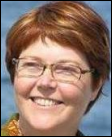
Nancy Ham is CEO of Medicity, A Healthagen Business.
image

Tell me about yourself and the company.

I’ve been in healthcare IT for an embarrassing number of years now, about 25. But I’ve always been focused on the same problem, which is, how do we move data in a way that empowers physicians to improve financial and clinical outcomes? And trying to conquer the barriers of siloed systems, lack of standards, lack of interoperability to make that possible and to try to serve it up to physicians in a way that meets them where they are and ideally flows into and supports their operational and clinical workflow.

The most recent two years, I have been leading Healthagen Technology Solutions, which is Aetna’s population health technology services and enablement arm.


It’s a little bit confusing that the company still operates as Medicity, but is under the Healthagen group name of Aetna. How does Medicity fit into Aetna’s overall business?

Aetna acquired Medicity four years ago, recognizing that the foundation of population health is real-time clinical data and the ability to then marry that with other kinds of data – increasingly like paid claims data and biometric data — but to marry it through a robust and secure infrastructure. I often talk about the iceberg principle — what’s above the water line is the new, updated GUI and the pretty dashboards, but the first product is the data itself.

Data quality, data security, patient matching, patient consent management … that’s really hard work. Medicity — which started as a health information exchange and that was the nature of the work that they did over about 10 or 15 years – has built up this robust foundation upon which now we can attach the other population health assets and capabilities that have come to us through Healthagen or Aetna. Medicity is now the unified face to the market. All of our products, no matter where they started, are now sold and delivered through Medicity.

Some of the newer capabilities we have through Medicity are Medicity Explore, bringing to market our analytics company, formerly called HDMS. A company that’s more than 10 years old and manages more than 30 million lives through analytics.

I think that’s a really important point for your readers. As they walk into HIMSS and into the barrage of all the companies all saying, “Here’s what we do,” think about scalability and maturity capabilities. One of the first questions I always ask of an analytics company is, "How much data has processed through your engine?” Because healthcare is just this giant pile of corner cases. You have to meet them and defeat them one by one.

We have Medicity Manage, which brings in our ActiveHealth Management capabilities, which include care management analytics, risk stratification, predictive algorithms, gaps in care, registries, and also brings a really elegant provider-facing care management workflow. Because at the end of the day, the point of all this data, all these products, is to change and improve the actual care you deliver to a real person at the end of that line. You have to put all these things together.


Are providers really demanding interoperability or is everybody else just wishing they would?

[Laughs] They are increasingly demanding it because they’re getting into significant enough population health programs that the lack of interoperability, or the gaps that are created, are expressing themselves. Just as an example, if you are managing a panel of congestive heart failure patients, when you see gaps in the care record, you realize that’s a problem — when you don’t see that they had an admission at that hospital or when you don’t see that they had a test at that physician. It’s now impeding your actual ability to provide continuous care. 

For me, that’s what population health is about. It’s moving from episodic, snapshot blinks of the patient to a movie. It’s like going to a movie and half the scenes are missing, so you can’t follow the plot line. That’s where the lack of interoperability is showing itself at scale now, because we are moving into true population health and people are saying, "This is not working. I need the whole movie."


Aetna has a view into all of healthcare. What does it see coming that the market might not have figured out yet?

We have a point of view, borne out by the recent Rand study, that providers buy into the fact the world is changing. They are moving from fee-for-service to something else. They are on the journey to risk. They might be at many different places on that continuum. What’s really fun is when they are at many places on that continuum simultaneously. They are in a different place for Medicare versus Medicaid versus commercial.

Technology alone is insufficient. Services alone are insufficient. Clinical alone is insufficient. You have to fuse it all together and bring risk management, i.e, I am going to be financially at risk. How do I think about that? How do I manage actuarial pricing?

Those are capabilities that health plans have that providers traditionally haven’t had to have. You have to have data and technology to move that data around appropriately to the right physician, respecting patient consent and privacy. Then you have to have clinical workflow to take advantage of everything you are doing. It needs to come together in a different kind of interoperable way.


What’s the big-picture view of interoperability and where is it moving?

I see the lines blurring. Medicity is very proud to power nine statewide HIEs, and yet when I think about the work that’s happening in those states, it is about public-private partnership. A really interesting example or theme is how payers are now becoming significant participants in these networks. One of my customers has a great phrase — she calls it ecosystems. We are evolving to healthcare ecosystems.

In a healthy ecosystem, everyone contributes as well as receives. What we are seeing now is new stakeholders come to these ecosystems and say, "I’m a payer. First of all, I have data to contribute to the ecosystem. I have claims data. I have medication history data. I have care management data. Let me contribute my data to that ecosystem. Then whether you are an individual physician or hospital participating in that ecosystem, you can now benefit. Let me receive information from that ecosystem, such as real-time clinical data, alerts that a member has just been admitted to the hospital, so I can activate my own care management programs."

We think it is a fading distinction between public, private, and regional. What we see are these localized healthcare ecosystems in which increasingly we are seeing everybody in. Which is exciting because that’s been the vision all along — creating clinically-connected communities. Wherever you go as a patient, wherever your family member goes, your data is accessible, contextual, and available.


Who should pay the cost of interoperability? How do we make sure that we aren’t building individual proprietary silos?

First of all, I hope no one out there is thinking that their main business model is selling data or monetizing data. Data is just an input into an improved healthcare system. We are all trying to lower the cost for data to flow into these ecosystems so they benefit the actual care and cost for what is going on.

I see that increasingly, people understand this mutuality. If I want to get data, I need to provide data. By the way, it is the patient’s data. We are all trying to contribute to create that clinically complete view of the patient, so that as they navigate the healthcare system, they are getting the best possible care. What I would like to see is simply a continued investment by us as an industry in standards in interoperability so that we reduce the cost and the friction of data moving.

The monetization should be by whoever’s at risk. If you are the payer, if you are the employer, if you are the state government, if you are the federal government, if you are the provider … Whoever’s at risk financially and clinically for that patient is who is benefiting from having access to a more complete clinical and financial record — they are the ones who should underwrite the cost of having created that.


How would you set up an economic incentive to align the interests of those who benefit from the data with those who contribute it for someone else’s benefit?

I would love to at some point have a longer conversation about some really successful statewide networks. Colorado, Ohio, Delaware, and Vermont have achieved, or are close to achieving, 100 percent connectivity — hospitals, physicians, DME, SNF, long-term post-acute, payers, the VA, Social Security, the prison system. They have developed models where all the constituents in their community are now participating in the system and have a shared goal of improving the health of their citizens.

There are statewide models that are working very effectively now on a multi-stakeholder basis. The revenue models are all a little different, but a lot of them were started up by hospitals wanting to replace phone, fax, and courier with more modern means of delivering clinical information electronically to physicians.

Now what you are seeing is the next wave of stakeholders coming in, contributing both data and funding. Any network has a semi-fixed cost, and spreading it across now a broader community, which is exciting to see. As new people arrive, they have to connect to the network and subscribe and help underwrite its cost as well as contributing their own data.


What is the next level beyond where we are now with population health management technology?

In some ways, I think we are still at the first level, which is trying to create data completeness. We talk about building complete, ubiquitous, and indispensable networks. Those words have a lot of meaning for us.

Complete means data completeness. No network is ever data complete because there’s always the new frontier. We conquered a lot of real-time clinical data. Now we are all trying to get ambulatory data, CCDs, consolidated CDAs out of ambulatory practices. Payers are arriving at scale to contribute the data they have. Biometric is a new frontier. We are doing a really interesting pilot with Cleveland Clinic and Medtronic. There’s always going to be more data. We will never be data done.

Ubiquity is around Moore’s Law — the more connection points on a network, the more powerful it is. If you think of networks as being geographically-oriented, clinically-connected communities, you are always going horizontally and vertically to create more data and connectivity density.

The new wave of population health is the third word, which is indispensable. Which is about, does any of this matter? Are we creating a difference in the Triple Aim? Are we improving health, improving care, improving cost? The new wave is actual measurement in ROI.

We are going to have to embrace and learn as an industry that a lot of things we are doing right now, while interesting, aren’t transformative. Trying to figure out where we can hone in. A lot of that honing is going to maybe be the fourth new frontier, which is direct patient engagement. Engaged in their own care, with their own data, with their own protocols.


Do you have any final thoughts?

I’m both excited and worried about the state of the state for population health. I’m excited about the pace of innovation, the number of new entrants, the amount of invention that’s happening. But I worry that it’s a little untethered from the jobs of cost and quality. That it’s untethered from risk management and care management. I want to be sure as an industry that we are being purposeful in effecting change, not just in creating new software tools.

Comments Off on HIStalk Interviews Nancy Ham, CEO, Medicity

News 10/14/15

April 1, 2015 News Comments Off on News 10/14/15

Top News

image

DrFirst firms up $25 million in equity financing from Goldman Sachs, bringing its total financing over the last year to $42 million. The company, which announced last week the integration of its medication management software and secure communications with the Rx30 Pharmacy Management System, will use the investment to ramp up sales, marketing, and product development.


#HIStalking Tweet Chat – Patient Engagement Outside the Office

image

Loran Cook (@loranstefani) will host the next #HIStalking tweet chat on Thursday, October 15 at 1pm ET. Check out discussion topics here.


Acquisitions, Funding, Business, and Stock

image

Sunnyvale, CA-based Health Gorilla secures a $2.4 million Series A led by Data Collective with additional financing from True Ventures, Harris Barton, Orfin Ventures and Venture Investment Associates. The company has also expanded its diagnostic test automation platform to include electronic ordering and secure messaging. Complete health history capture and sharing will be added to the new Clinical Network in the coming months. 

Nightingale Informatix finalizes the sale of its US-based PM business to Pulse Systems, with gross proceeds totaling $11 million. As part of the transaction, Nightingale and Pulse will refrain from selling into each other’s markets for three years.


Telemedicine


Announcements and Implementations

Georgia Health Information Network successfully connects to Alabama’s One Health Record HIE. The state-to-state connection is the second for GaHIN, which connected with South Carolina’s HIE late last year.

image

Three Pennsylvania-based HIEs – ClinicalConnect HIE, HealthShare Exchange of Southeastern Pennsylvania, and Keystone HIE – join the Pennsylvania EHealth Partnership Authority’s Pennsylvania Patient & Provider Network. (You can read my interview with Pennsylvania EHealth Partnership Authority Executive Director Alix Goss here.)

image

Smartphone patient scheduling vendor Everseat joins Athenahealth’s More Disruption Please program.


People

image

Pam Stampen (American Family Insurance) joins Nordic as vice president of human resources.


Research and Innovation

image

A two-year study of eight primary care practices and three mental health clinics determines that there’s no seamless way to bring behavioral health and primary care data together into their different EHRs. Clinicians developed workarounds to handle duplicate data entry, different templates for primary care and mental health, and reliance on physician or patient recall for inaccessible EHR information. Researchers conclude that vendors and physicians work together to design EHRs that better support: integrated care delivery functions, including data documentation and reporting; integrated teams working from shared care plans, template-driven documentation for common behavioral health conditions; and improved registry functionality and interoperability.


Other

image

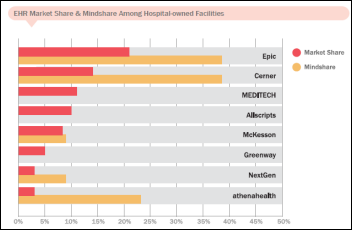
Peer60’s new standalone ambulatory facility EHR report (not ambulatory EHRs in general as other sites misinterpreted) finds that Epic and Cerner are tied for mind share leadership, with Epic holding a big market share lead. Meditech and Allscripts have decent market share in hospital-owned facilities, but zero mind share, meaning their customers are at risk for defecting. NextGen is also at risk since it has the highest market share among independently owned facilities, but also zero mind share in which Cerner, Epic, and eClinicalWorks dominate. Respondents said vendors should make their product easier to use, improve reporting, and improve practice management capabilities, although 32 percent say it won’t matter since the hospital dictates the EHR used.

image

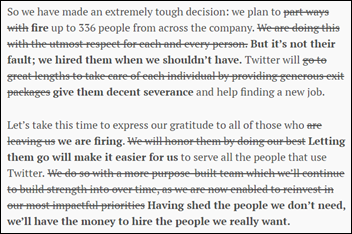
Quartz takes a refreshing crack at removing unnecessary business jargon from Twitter CEO Jack Dorsey’s memo announcing 336 layoffs. My inner journalist only wishes the editors had used red lines instead of black. 


Sponsor Updates

  • Aprima will exhibit at the Oklahoma Primary Care Association event October 14-16 in Oklahoma City.
  • EClinicalWorks will exhibit at The National Conference on Correctional Healthcare October 17-21 in Dallas.

Blog Posts


Contacts

JenniferMr. H, Lorre, Dr. Jayne, Dr. Gregg, Lt. Dan

More news: HIStalk, HIStalk Connect.

Get HIStalk Practice  updates.
Contact us online.
Become a sponsor.

JennHIStalk

Comments Off on News 10/14/15

Morning Headlines 4/2/15

April 1, 2015 Headlines Comments Off on Morning Headlines 4/2/15

How Medical Tech Gave a Patient a Massive Overdose

UCSF doctor and professor Bob Watcher, MD candidly tells the story of a recent EHR-related overdose that took place at UCSF’s Benioff Children’s Hospital in which a 16-year-old patient was given a dose of antibiotics 38 times larger than his doctor had intended. The ordering provider believed she was ordering a single 160 mg pill of Septra, but inadvertently ordered 160mg/kg, which resulted in a child being given 6,160 mg of the drug. The EHR, Epic, presented the doctor with an overdose warning but the order was placed anyway, pharmacists verified the order and filled it, and the floor nurse dutifully gave the patient 38.5 Septra pills. Fortunately the patient fully recovered.

Groundbreaking ways to deliver great healthcare.

Apple and IBM introduce four enterprise apps that they co-developed to support nurses, nurse managers, home health nurses, and technicians.

The Healing Power of Your Own Medical Records

The New York Times publishes a piece highlighting the OpenNotes movement and calling for broader patient access to medical records data.

CommonWell Health Alliance Welcomes New Members Across the Health Care Continuum

Meditech, Merge, Kareo, Surgical Information Systems, and PointClickCare have all joined the CommonWell health information exchange platform. With the new partners, CommonWell reports that its platform covers 70 percent of the acute care market and 20 percent of the ambulatory market.

Comments Off on Morning Headlines 4/2/15

HIStalk Interviews Tom Skelton, CEO, Surescripts

April 1, 2015 Interviews Comments Off on HIStalk Interviews Tom Skelton, CEO, Surescripts

Tom Skelton is CEO of Surescripts of Arlington, VA.

image

Tell me about yourself and the company.

I’ve been involved in healthcare and healthcare IT for a little over 30 years. The first 25-plus was on the provider side of automation – physicians, hospitals, home healthcare agencies, and the like. The last five years I’ve spent running a diagnostic imaging services firm, where I had the opportunity to, for the first time in my career, focus on running a care delivery organization. That was a great change and a great opportunity for me.


What was it like going back to the provider side after being a vendor?

It was a fantastic opportunity. It was really good to work in that environment again, side by side with the physicians working to do similar things. We’re trying to improve quality. We’re trying to increase efficiency. To be right there in the trenches with them was a great learning opportunity and I took away a lot, no question.


Is there anything left to accomplish with electronic prescribing other than getting everyone on board with the prescribing of controlled drugs?

We’ve asked the team to focus on three things. We’re trying to optimize every segment of the e-prescribing value chain. There’s a lot that still can be done in the areas of convenience, efficiency, and accuracy. We’ve got new modules for the prescribing offering that are designed to enhance those types of things. We can provide valuable information at the point of care and help make sure the patients are getting the best that the healthcare system has to offer.

The second we’re looking for is broadening the e-prescribing footprint. We still think there are some things to be done there. Electronic prescribing of controlled substances is a great example of that.

The last is enhancing clinical connectivity — attacking things in a much more general form. We think there are great opportunities there, leveraging assets and skills that we’ve developed over the years.

Let’s go back to that optimization of e-prescribing and touch on some of the keys there. One for us, certainly, is medication history. That’s a big one. You’ve got folks standing there at the point of care, if you’ve ever had to take a loved one to the hospital and had the nurse and the ED ask the question, "What prescriptions does your father take?" You just get this blank look, or at least I did. We’re in a fortunate position where we’ve got this type of history for three-quarters of the US population. It’s a great place to be, so we’ve productized that and are making that available.

The second one is electronic prior authorization. A physician’s office has to invest significant time to prescribe what the physician believes in. Then you’ve got patients waiting at the pharmacy. You’ve got pharmacists reaching back into the physician’s office. There’s a lot of waste and a lot of opportunity there. Our CompletEPA product is designed to help address that and to improve that level of efficiency and accuracy around authorizations.

The last area in optimization comes down to adherence. You’ve probably seen some of the same studies that we have that show that, particularly when it comes to chronic diseases and chronic care, this is a vital and costly component that needs to be addressed. People are getting the prescriptions, but they’re not getting them filled or they’re not taking them to conclusion. We’ve got some tools at the point of care that can inform the physicians exactly what’s going on in that area and help ensure they’re having the right dialogue with their patients when they are face to face.


How do manage the patient identification issue when creating a medication history from multiple care settings?

We’re in a pretty strong position there. We’ve got 270 million patients in our MPI that we can uniquely identify. The algorithms for this identification have been refined and honed over the years. There’s a lot of work and a lot of time and energy that’s gone into that. The MPI continues to grow as the number of folks that are covered by insurance across the country is growing. If you want to get deeper on the technology, frankly I’m not that guy, but I can help connect you to that guy if you want to know exactly what we’re doing.


If you have claims data that includes anyone who’s ever filed an insurance claim, you must have bigger data footprint than anyone.

We’ve got a tremendous footprint. If you look at the business, this is one of the most interesting parts of it. We’ve got 270 million folks in our MPI. We’ve got connectivity to 800,000 prescribers, primarily physicians, across the country. We’ve got strong connectivity to the pharmacies — virtually every pharmacy is connected to us. We’ve got connectivity to probably slightly less than half of the health systems in the country right now. 

We’ve got an awful lot of connectivity that we can bring to bear to help people move forward. While we’re very excited about optimizing e-prescribing as the first step, and secondarily moving on to broadening that footprint. We think there’s a lot to do in the world of clinical connectedness and interoperability that’s at the forefront of everybody’s mind. We think there’s some things we can do to help there.


Now that EHR penetration is high, how would you gauge interoperability progress and the opportunities for Surescripts now that the network is in place?

When we look at broadening our e-prescribing footprint, we are talking about two major thrusts. The first is the electronic prescribing for controlled substances. This is a big, big issue. We’re very excited to see movement at the state level. We’re participating. In fact, we just did a webinar on this and ended up with about 500 people, so there is an awful lot of interest here. 

There’s huge benefit to the system to getting these types of prescriptions digitized. This is very sensitive information, but on the other hand, it’s a situation where also there’s a lot of fraud and abuse and these types of things can be weeded out better in a digital environment than in a manual environment.

The second piece for us is long-term care. This is an area that didn’t get caught up in the first waves of e-prescribing. The hospitals and the ambulatory settings are very penetrative, with adoption rates of greater than 70 percent, but there’s a lot of work to be done in the long-term care arena. We feel very good about being able to do that.

Those are the two in terms of the e-prescribing footprint. When we move on to enhancing clinical connectivity, that comes down to leveraging the assets that we have.

We’ve created a pretty secure environment for these things. We’re one of only 105 firms in the country at this point in time that’s achieved ISO 27001. That’s something that we’re taking very, very seriously. It’s going to underpin two solid offerings that we’ve got here, the first being a a record locator service that I’ll explain on a personal level.

My in-laws live in Pennsylvania. They spend a chunk of the winter in Florida. They have very good friends in California. They’ve had healthcare events in all three environments. If my father-in-law were ever to be admitted to a quaternary facility or something like that, to pull all of his records in, it would be difficult for them to know where to go. We can give guidance on where these folks have been seen based on what we’ve seen in the prescribing patterns and allow them then to very quickly contact facilities to get the information they’d need to inform the care that my father-in-law should receive. We’ll be demoing it at the Connectathon at the HIMSS conference. I think the market is particularly interested in this as patients become more mobile and society becomes more mobile.

The other piece for us is clinical messaging. We’ve done an awful lot of work helping hospitals connect to physicians, payers connect to physicians and hospitals, and physicians to connect to other physicians. The directory that we talked about helped enable this and underlie this. We feel real good about the opportunity here and believe there’s huge value in allowing clinicians to exchange information electronically in a secure fashion.

When we look at expanding outside of the world of e-prescribing, these are the two core offerings that you’ll see most of.


People see big data pipes and worry about how the overseer of that information might be selling it in some fashion. Do people ask you about that?

I agree with you. The market is very, very concerned about that. We do not package or sell any data. That is not part of our business model.


Is CommonWell’s work complementary to what you do or are they a competitor?

When you look across the industry, any time you have a large number of stakeholders and a really big chunk of challenges, you’re going to get different types of alliances and approaches. I think there will be continuing effort to try and move interoperability forward more aggressively, things like CommonWell, DirectTrust, Healtheway, and Carequality. There’s a whole list of them. All of them serve a valuable role. They increase awareness. They drive focus. They bring energy behind the problems. Each will have their own aspects and approaches to trying to solve this.


What progress are you seeing in not just making external information passively viewable, but inserting it into the provider’s workflow?

You hit it right on the head. That was one of the keys to e-prescribing. I remember when folks were pushing handhelds for the docs to do e-prescribing and portals were the way of the world. If this stuff isn’t in a natural workflow for a physician, it’s going to be very, very difficult to get the uptake that you want.

My experiences over the last five years working with physicians reinforce that. These are busy people. They care an awful lot about what they’re trying to do. They love to delegate where they can. You’ve got to work with them and get it into a natural workflow.

We did it with e-prescribing. That’s at the core of everything that we’re doing around prior authorizations, that tight integration right into the workflow allows the physician’s office to really gain some tremendous efficiency in this area. I’s something we’re quite proud of and take seriously.


Where do you see the company going in the next five years?

We’ve got the three legs of the stool that we’re working on — optimizing e-prescribing, broadening the footprint, and enhancing clinical connectedness. A lot of what will transpire over the next few years is going to be linked to how quickly the demand for well-packaged information begins to match the supply.

What I mean by that is, to your point, there’s a lot of data out there. There’s a lot of people that want to push data at physicians and at caregivers, but the caregivers are trying to make sure they only get what they need when they need it. The industry has a huge opportunity here, but also a huge responsibility to get that right.

I think we’ll see some increases in adoption across the interoperability spectrum, and as we do with the impetus from Congress and everybody else, this thing will start to gain momentum pretty quickly. The fact that we’re starting slowly is very natural when you’re building a network. Over the course of the next five years, I would expect this type of messaging to become pretty much ubiquitous. It’s going to drive what we’re doing and really change healthcare. It will start to put us in a position where we can reap some of the benefits of the monies that have been invested in laying the EHR foundation.


Do you have any final thoughts?

We’ve been very fortunate and have had some great success. We consider ourselves a leader at a national level in the interoperability space, particularly as it relates to clinical transactions. I think it’s incumbent upon us as a leader to make sure that we’re extremely focused on our customers, our partners, and the stakeholders that have helped us be successful. 

As we continue to build out the portfolio, we’re certainly going to be keeping an eye on the market. I expect a lot of changes. I expect it to be very dynamic. We’ve got to be nimble enough to respond appropriately. That’s something that we’re looking forward to building into the Surescripts of tomorrow.

Comments Off on HIStalk Interviews Tom Skelton, CEO, Surescripts

Morning Headlines 4/1/15

March 31, 2015 Headlines 3 Comments

e-MDs Merges with MDeverywhere; Creates Market-Leading Provider of Clinical and RCM Software Solutions

Ambulatory EHR and practice management vendor e-MDs has been acquired by Martin Equity Partners and merged with existing Martin portfolio company MDeverywhere, a revenue cycle management and physician credentialing system.

Sentinel Event Alert 54: Safe use of health information technology

The Joint Commission issues a Sentinel Event Alert on the safe use of health IT, focusing on process improvement, leadership, and developing an internal culture focused on safety.

Doctor exodus over new e-health system rocks Defence

In Australia, 30 doctors resign from the Department of Defence over fears that its newly implemented EHR compromises patient safety.

News 4/1/15

March 31, 2015 News 3 Comments

Top News

image 

Marlin Equity Partners acquires PM/EHR vendor e-MDs and merges the company with another of its portfolio holdings, revenue cycle services vendor MDeverywhere. E-MDs founder and CEO David Winn, MD will retire.


Reader Comments

image

From Abe: “Re: Allscripts. I would like to know why the information of 250 people being laid off/fired at Allscripts is not on your web site. When all was good, you had them highlighted. Now that its looking grim … nothing.” Come on, Abe, at least read the darned posts before complaining – it was right there in Monday’s edition. I obviously wasn’t present for the layoffs and companies don’t announce them, so unless one of those 250 people tells me what happened (which they didn’t), I have no way of knowing, but I went with the second-hand report of two readers. And before you claim sponsor bias, Allscripts isn’t one any more – I got tired of their ignoring their months-overdue invoices and cancelled them. Meanwhile, a third reader who doesn’t indicate whether they work for Allscripts says “this very disorganized company” is laying off 265 people. The MDRX share price has dropped 35 percent in the past year, so the ever-struggling company is surely feeling pressure to try something different as it hopes its oft-repeated “population health management” mantra makes investors forget about the legacy ambulatory EHRs and low-selling Sunrise that make up most of its business.


HIStalk Announcements and Requests

I have to bite my tongue (or fingers) not to correct people who refer to times as “EST,” which is inaccurate until the clocks are turned back in November. We are in “EDT” and not “EST,” but if you want to simplify, just say “ET” year-round and you’ll always be correct. I’ve also had people get confused for interviews or calls when Lorre schedules them because she’s in Arizona, which doesn’t observe Daylight Saving Time (except for the Navajo Nation) and thus is on Mountain Standard Time year round, which is the same as PDT, meaning three hours behind EDT from spring until fall and two hours behind otherwise. We do all of this to try to unsuccessfully control nature, which ignores our human tinkering and raises and sets the sun regardless of how we play with our clocks.

Welcome to new HIStalk Platinum Sponsor Medecision. The Wayne, PA based company’s Aerial population health management technology identifies high-risk patients (or members), guides them to the most appropriate care, provides their clinicians with decision support tools, and automates manual operations, all via integration with existing systems. Aerial offers a unified clinical record, seamless integration feeds, hundreds of SOAP- and REST-based services, and a modular platform with 150 published Web services and APIs to facilitate interconnectivity. It’s appropriate for any healthcare organization that is bearing risk in the move from fee-for-service to fee-for-value, supporting care coordination, care management, case and disease management, advanced clinical content, and consumer engagement. Thanks to Medecision for supporting HIStalk.

I found a just-published YouTube video that introduces Medecision.

Also sponsoring HIStalk at the Platinum level is Peer60 of American Fork, UT, which describes itself as “the best B2B research solution on the planet.” CEO Jeremy Bikman founded the company after serving as a partner/EVP at KLAS. His folks tap into the company’s network of 100,000 decision-makers get feedback, generate leads, and perform custom market research. Client HIMSS Analytics got a response rate 500 percent higher than it expected after working with the company, while Sectra standardized all of its performance metrics on the Peer60 platform. You can download a free copy of “What Hospitals Plan to Buy in 2015” or its report on interoperability, among other available free reports. You can also visit them in HIMSS Booth # 5009, where they will again be giving away cool guitars. I also noticed the sly comment on their site that interoperability is “making news in the many of the largest news sources on the planet (WSJ, Fortune, Forbes, HIStalk),” which was cute. Thanks to Peer60 for supporting HIStalk.

I headed over to YouTube looking for a Peer60 video and came across this funny one called “It Was the Patient Catapult!” 

Listening: new trippy-happy-hippie music from The Mowgli’s, who first claimed that their misuse of the apostrophe in their name “represented the marginalization of society,” but later admitted that they were just stoned when they chose it. It’s as light and frothy as a pina colada on a summery beach.

image

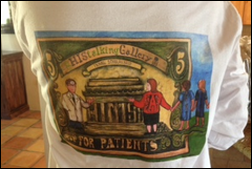
We received the shirts that our HIMSS conference patient advocate scholarship winners will be wearing. Look for long-sleeved white shirts with Regina Holliday’s HIStalking painting on the back.


HIStalkapalooza Sponsor Profile

image 

HIStalkapalooza! As one of the platinum sponsors for this event, The Santa Rosa Family of Companies — Santa Rosa Consulting, Sandlot Solutions, InfoPartners, and Fortified Health Solutions — will be circulating the main floor as well as hosting up to 20 people at a time in our opera box. Stop by our caricature drawing station to pose for a fun way to remember the night! We’ll send you a digital file of your drawing after the event to avoid worries about holding the drawing all night or protecting it while travelling home after HIMSS. Bottles of water will be provided for you as you leave House of Blues so you can hydrate on the way back to your hotel for a good night’s rest for the next big day at HIMSS15.

You can find The Santa Rosa Family of Companies at various places throughout the HIMSS15 show floor: main booth #2641, Sandlot Solutions market research booth #2939, and the Fortified Health Solutions Kiosk within the Cybersecurity Pavilion. Don’t miss our presentation on Monday, April 13 at 4:45 p.m. on “The Importance of Sensitive Information Discovery.” Take a tour of all of our locations at HIMSS15 with our Passport Giveaway Program –pick up your passport, obtain your stamps at our various locations, and you’ll be entered to win prizes that grow in value with each interaction.

We look forward to seeing you in Chicago!


Webinars

April 8 (Wednesday) noon ET. “Leveraging Evidence and Mobile Collaboration to Improve Patient Care Transitions.” Sponsored by Zynx Health. Presenter: Grant Campbell, MSN, RN, senior director of nursing strategy and informatics, Zynx Health. With mounting regulatory requirements focused on readmission prevention and the growing complexity of care delivery, ACOs, hospitals, and community-based organizations are under pressure to effectively and efficiently manage patient transitions. This webinar will explore the ways in which people, process, and technology influence patient care and how organizations can optimize these areas to enhance communication, increase operational efficiency, and improve care coordination across the continuum.

Here’s MedData’s webinar from Tuesday titled “Best Practices for Increasing Patient Payments.”


Acquisitions, Funding, Business, and Stock

image

Forbes profiles technology companies that are springing up to support the medical marijuana industry, with the pot equivalents of Yelp, Groupon, and Monster.com joining software developers that sell legally mandated inventory and sales tracking applications. One company is even creating a cannabis futures market that allows farmers to lock in prices for their crops.


Sales

image

HealthShare Exchange of Southeastern PA selects Audacious Inquiry’s encounter notification service for its regional exchange. The statewide Florida HIE’s Event Notification Service also uses the company’s technology.

Golding Living chooses HCS Interactant for revenue cycle management in its 300 long-term care centers.

Children’s Hospital Association chooses Health Catalyst’s data warehouse for its 220 hospital members.

image

Greenwood Leflore Hospital (MS) chooses Dbtech’s eFolders and Interactive eForms solutions for electronic forms, document storage, and electronic signatures.


People

image

HHS CTO Bryan Sivak resigns.

image image

Shareable Ink names board member Hal Andrews (Availity) as CEO. He replaces Laurie McGraw, who is leaving the company.

image image

Wake Forest Baptist Medical Center (NC) promotes VP/CIO Chad Eckes to EVP/CFO, where he will continue to oversee its IT department, and promotes Dee Emon to VP/CIO.


Announcements and Implementations

Forward Health Group joins the Health Data Consortium.

MedAptus launches Assign, which uses rules-based intelligence to automatically assign inpatients to hospitalists or other providers.

John Lynn of EMR & HIPAA posts a video interview with Vishal Gandhi, CEO of ClinicSpectrum.

Stanley Healthcare will offer Connexient’s MediNav indoor wayfinding solution.


Other

image

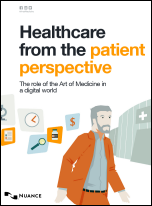
Consumers in the US, UK, and Germany want physicians to offer exam room privacy, explain their recommendations verbally, make eye contact, and offer physical contact. They also want (but don’t usually get) enough time during their visit to discuss their concerns. A commendable two-thirds of consumers bring a list of questions to their appointment, while 39 percent have checked an online source ahead of time. An amazing 97 percent are comfortable with their doctor’s use of technology, with 58 percent of them saying exam room computers improve their experience. The Nuance-conducted survey concludes that technology should serve a supporting role to the art of medicine and that physicians should provide time for discussion, advice, exam room privacy, and engagement.  

Joint Commission issues Sentinel Event Alert #54 on the safe use of health IT and offers a free online course on the topic that’s good for one hour of CE credit.

The CSC-led EHR project of Australia’s Department of Defense, which wildly overran its budget and timelines, causes at least 30 doctors resign in protest who say the system compromises patient safety. A big concern is that anybody can modify the doctor’s entries. This is probably not the news Allscripts wanted to hear as the DoD chooses its EHR vendor since CSC and HP are its partners.

The RSA Conference bans scantily clad booth babes from the exhibit hall, specifically mandating business attire that doesn’t include tops that display excess cleavage, miniskirts, and Lycra body suits. Conference attendees said in surveys that they want access to technically competent booth reps who can answer their questions quickly, and as the Fortune article drily notes, “booth babes are usually temporary hires and therefore not your best best if you want a deep dive on the latest cryptographic solutions.” However, it also observes that only 15 percent of the conference’s 30,000 attendees are female, so the booth babe ban may reduce that number even further. It might be fun to collect photos of obvious booth babes from the HIMSS conference since they usually aren’t hard to find and then call out the vendors who can’t attract attention without the sexist eye candy.

Weird News Andy urges that we “hold the eye of newt.” Scientists testing a ninth-century folk remedy eye salve made of onion, garlic, and cow’s stomach find that it kills MRSA. I wouldn’t get too excited just yet since lots of products kill bacteria in the lab but not in humans or with effectiveness tempered by unreasonable side effects.


Sponsor Updates

  • Galen Healthcare Solutions will resell PinpointCare’s patient engagement, care coordination, and management platform.
  • PatientSafe Solutions posts “Compassionate Care Part 1: Unlocking the Shackles of the Computer.”
  • Forward Health Group posts a video of Northwestern Memorial Physicians Group talking about its use of PopulationManager.
  • ADP AdvancedMD offers “4 Foolproof Tips to Collect More Patient Payments.”
  • AtHoc offers “Connected to a Safer World.”
  • Caradigm will exhibit at the National Association of ACOs Spring Conference April 1-2 in Baltimore.
  • Culbert Healthcare Solutions offers “Improving Patient Satisfaction.”
  • HX360 names Clockwise.MD as one of four finalists in its innovation competition at HIMSS15.
  • CareSync will participate in the Live Pitch event at the AARP Health Innovation@50+ Tech Expo.
  • Clinical Architecture posts the captivating origin story of ICD-10.
  • Capsule Tech explains how “Healthcare Technology Can be Hazardous to Your Health.”
  • Besler Consulting publishes a white paper focused on Medicare cost report reviews.

Contacts

Mr. H, Lorre, Jennifer, Dr. Jayne, Dr. Gregg, Lt. Dan.

More news: HIStalk Practice, HIStalk Connect.

Get HIStalk updates.
Contact us online.

125x125_2nd_Circle

HIStalk Interviews Jay Katzen, President, Elsevier Clinical Solutions

March 31, 2015 Interviews Comments Off on HIStalk Interviews Jay Katzen, President, Elsevier Clinical Solutions

Jay Katzen is president of Elsevier Clinical Solutions.

image

Tell me about yourself and the company.

I’ve been at Elsevier for just about eight years now. Elsevier is a world-leading provider of information solutions that enhance the performance of science, health, and technology professionals. The goal is to empower them to make better decisions, deliver better care, and sometimes make groundbreaking discoveries.

From a clinical solutions perspective, our goal is to deliver solutions to improve health across the care continuum, which goes to students, clinicians, and the extended care team as well as patients.


Elsevier’s offerings cover a lot of depth and breadth, ranging from research journals to point-of-care content. How does that help reduce the gap between knowledge discovery and actually putting information into practice?

One of the key things about Elsevier is that we cover research through action. It covers the educational side as well. Our #1 goal is to provide the right information to medical students and nursing students to help them be the best practitioners. We deliver our solutions to primarily the provider setting, although we also go into the commercial setting, which is retail pharmacies and things like that.

Generally, we provide our information to the enterprise for use by clinicians and the staff at any point of need. There are referential solutions to look up information about what’s the diagnosis, what’s the best treatment, what is the evidence supporting the information. Delivering information to be deeply embedded into their CPOE system or electronic medical record with a goal of providing the information at the point of need to make a better decision.

Part of the way we are closing the gap is that we cover across the spectrum. We also ensure that we localize it or customize it to the individual hospital’s practices.


Do you ever review what information people are looking up to detect trends, such as how Google Flu Trends works?

We do. I would say it’s in the early stages of some of that. We’re looking at some new products that help us analyze that more.

There’s obviously a lot of work going around big data and analytics, but we continually review a couple of things. Number one is what people search on in general. We look at click-through patterns and things like that to try to figure out if there are ways we can optimize the system to help individuals get to the answer faster. It’s also to understand whether there are gaps in what we’re providing because people may not be finding what they need. That’s on the clinical practice side.

On the research side, we look at this to see if there are areas where they want to perform new research or areas where we need to invest from a general standpoint.


Are users looking beyond just finding information to instead have it made actionable by presenting it automatically at the point where they might need it?

The industry is going much more towards point-of-need information. That’s not just for clinicians — that’s for patients as well.

As our customers evolve, they’ve made significant tens of millions or hundreds of millions of dollars of investment in their infrastructure, such as CPOE systems. The reality is that investing in systems alone is not improving quality across the care continuum. It’s not standardizing care. They need content to be embedded into their systems to drive improvement in care and to improve quality.

At least from what we’ve seen and in working with our customers, number one, they want the information more actionable. They want it embedded into the systems and tied to patient context. But they also want to make sure that it’s meaningful and that it can be impactful. Lots of research around alert fatigue. Our goal is not to alert the physician, pharmacist, or nurse on every potential thing out there — it’s to ensure that we deliver the information and that it’s going to be meaningful to them to make a better decision.

The same thing applies and is applying more to patients. We have a segment focused on patient engagement. If you look at Meaningful Use Stages 1, 2, and 3, more and more information has to be delivered to the patient with the goal of empowering the patient to take control of their care. The way to do this is not just to send general information about diabetes or Crohn’s or hip replacements — it is around customizing it to the individual needs as well as their specific instances.

The actionable information applies not only to clinicians, but applies to patients, but it also has to be delivered in the workflow, whatever the workflow might be, so it’s valuable to them versus having them be proactive and go search it. It has to be pushed down to the individual.


How do your products support care teams, including those that are virtual?

This is one of the benefits and differentiators we have as an organization. Our products are designed around interdisciplinary care teams, especially our care planning products, our order set products. We’ve put a lot of focus on how teams are working now and how they’re going to work in the future.

From a collaboration standpoint, some of the things we’re testing now are around patient engagement. Not just delivering information to an individual patient, but it’s also creating a seamless connection for the patients back to their clinicians. We’re looking at testing some products with some heart failure patients where they can flag things on their mobile device. That sends an alert back to their primary care physician, who can make a call and connect with the patient. There’s collaboration on the care team, but also an increased need for collaboration between the patient and the provider.


That sounds like your Tonic platform, where consumers can enter information on a mobile device. What kind of information can they enter and how does that flow through to the provider?

It’s a couple of things. One is the Tonic platform and one is a pilot we have which is called Digital Dialogues, which we’re doing with IMS.

Digital Dialogues is around congestive heart failure. The patient can capture information that is then sent back to the physician to create that connected network. 

Tonic is a tremendous platform that has a lot of potential to expand what we can deliver and when we can deliver it. Initially, patients go into a hospital and it’s around capturing information about that patient. The unique thing about the Tonic platform it’s a gaming-type system where it makes it fun for the patient to answer questions. Based on the questions, we can then deliver information that is more specific to them. If they have Crohn’s and we have information videos or other information on Crohn’s, we can direct it to them right at that point of need or action.

The platform allows us a lot of flexibility as far as when the patient or consumer is interacting with the platform and what we can deliver to them based on what their specific requests are, right at the point of need.


Is it a change in the company’s direction to go beyond supplying reference material for providers to supporting consumers who are seeking their own information, perhaps as an alternative to Web searches?

Absolutely. First of all, our primary market is to the institution for use by clinicians. But the reality is that in today’s healthcare market, the patient or consumer has to play a significant role in their care. We’re working with hospitals to implement the Tonic platform, which includes our content and information solutions. It’s the trusted provider — patients going into the hospital will get the same information that the hospital is using internally as well as when patients go home.

We cover the information needs across the spectrum, whether it’s a physician or pharmacist looking up information about a disease, what’s the best treatment, what’s the best plan of care, are there interactions, and things like that. We deliver all that from a clinical perspective, but just as importantly, we need to deliver similar type of information geared toward the patient so they can understand it and they’re empowered from a care standpoint.

If you look at the statistics today, there’s almost a trillion dollars of waste in healthcare. Big chunks of that are because patients don’t understand their care, they’re readmitted, they don’t follow the regimen that’s provided to them. It’s pretty critical that patients or consumers understand what their needs are, how to improve their care, and why it’s important to follow it, as well as what the implications are if they don’t, so that we can reduce the overall waste in the healthcare system.


Do you see any possibility of a single shared care plan where all of a patient’s providers and the patient themselves can contribute to it, perhaps wrapped around standard evidence-based content and some sort of workflow capability?

We’ve looked at that in the past, whether it was for care plans, order sets, or other type of content — a collaborative content creation or updating mechanism. What we’ve found is that while things are standardized across the US healthcare system or other systems, the reality is each healthcare system wants to put their own stamp on it or have their own tweaks, whether it’s care plans or order sets.

We provide mechanisms inside of an institution to collaborate across different kind of committees, whether it’s on care plans or order sets. We’ve talked to people outside to see if they want to do it in a more community-based environment, but so far, that hasn’t gotten a lot of traction.

I think it comes down to the fact that there are a lot of complexities around that, from a standpoint of keeping them current, ensuring that if evidence changes or a drug is removed, that’s propagated throughout everything. How do we reduce liability but ensure that people have access to the best information they can? Those are some of the challenges to the community-based infrastructure.


Where do you see the company going in the next five years?

My goal and the vision of the company is to lead the way in science, technology, and health. Healthcare is still in a state of disarray. Based on the stats from a study that came out, a thousand people die every day in the US from preventable medical errors. It’s just not acceptable. It’s our responsibility as a company to deliver our solutions to students and professionals to improve the quality of care.

If I look out at the next three to five years, it’s just continuing in the current strategy. We can significantly improve healthcare and reduce errors by ensuring that our care planning products and our order set products are implemented in these systems, utilized, and that the right training is delivered to the institution to ensure standardization of care. We’ll be delivering more and more of our information deeply embedded into our health HIT partners.

Another big component for us is around patient engagement. We talked about that already and how the patient is playing a much larger role in their care. That’s a focus for us. I see that continuing and evolving and increasing over the next three to five years.

We’re a global company. From a clinical solutions business standpoint, a significant part of our revenues comes from outside the US. We continue to invest in many countries outside the US. As the evolution of the infrastructure increases in the UK, Germany, Spain, China, Japan, etc. we continue deliver the same types of solutions and the same type of impact outside the US as well.


Do you have any final thoughts?

Whether it’s Elsevier or any company out there, it’s our responsibility to partner with our hospital customers, physician offices, and clinicians better to look at co-development and other ways to deliver our information. It’s our responsibility from an Elsevier perspective, and from the industry’s perspective, to solve this problem.

We’re not there. We haven’t done it yet. If you look at the stats, if anything, they’re going the wrong way. We need to be more successful in ensuring that our information and the evidence is delivered at the right point of time to improve care. It’s something that has to happen in this marketplace. It’s not sustainable and we shouldn’t accept it.

Comments Off on HIStalk Interviews Jay Katzen, President, Elsevier Clinical Solutions

Morning Headlines 3/31/15

March 30, 2015 Headlines Comments Off on Morning Headlines 3/31/15

HHS CTO steps down

Bryan Sivak will step down from his position as HHS chief technology officer at the end of April. Sivak joined HHS in 2012 and oversaw the Entrepreneurs in Residence program as well as the HHS IDEA Lab.

Scripps Selects Epic For New EHR

Scripps Health (CA) has chosen Epic as its next EHR vendor, replacing GE Healthcare’s Centricity Enterprise on the inpatient side and Allscripts Enterprise in its outpatient clinics.

Canadians Losing Out On Benefits Of Electronic Health Records

A C.D. Howe Institute report finds that widespread interoperability challenges are hindering efforts to reduce healthcare costs and improve care coordination. “Survey findings revealed that in primary care only 12 percent of physicians are notified electronically of patients’ interactions with hospitals or send and receive electronic referrals for specialist appointments,” says Denis Protti, the report’s author.

Comments Off on Morning Headlines 3/31/15

Readers Write: Your Interfaces Suck Because You Want Them To

March 30, 2015 Readers Write 7 Comments

Your Interfaces Suck Because You Want Them To
By T. Ruth Hertz

Your interfaces suck because you want them to. Yup, that’s the stone cold reality. 

I am looking at you Mr. /Ms. CIO. You may talk all day about interoperability, data normalization, HIEs, standards, etc. but unless the right data in the right format gets to the right place at the right time, you are wasting time and money and possibly risking patient safety.

But wait, you say. We insist that all applications have HL7 interfaces – we even put it in the contract! Yes, maybe you do, but do you take the time to get and review detailed specifications before you sign the contract? Do you require the vendors to demonstrate interfacing their application with the ones you already have? Not just give you a list of other clients that have “the same systems as you” but actually connect their system to your engine and downstream application test environments? How well would the physicians at your institution react to being given a list instead of a demo and / or site visit?

Do you let your interface experts ask the tough questions during due diligence? If you do, does it matter when the answers are wrong or evasive? Or do you just accept it when the vendor says, “You can fix it in the engine?” Do the interface experts get to go on the site visit, see the interface in action, and talk to the folks that have had to actually make the interface work?

Let’s face the facts:

  • It is in the application software vendor’s best interest to not interface well with other vendors’ apps. Selling a suite of apps that work well together but not well with others makes buying their products as a set look like the smart thing to do.
  • Application software vendors can make their interfaces work. They have the source code and the underlying database. They just need a very good reason to do so – like “no sale” if they don’t.
  • Your interface staff time isn’t free. All the time spent on analyzing, designing, and building workarounds to compensate for deficiencies in the sending and/or receiving applications costs hard money. That time is also time lost from other projects.

It’s time that the decision-makers who buy healthcare apps put a stop to this madness and insist that true interoperability be delivered by the software vendors – or no sale.

Readers Write: A Prescription for Getting Face Time with Doctors at HIMSS

March 30, 2015 Readers Write 1 Comment

A Prescription for Getting Face Time with Doctors at HIMSS
By Chris Lundgren

image

It’s no secret that it’s getting harder and harder to get face time with doctors. But I’m a sales guy, so I always see a silver lining in everything.

In this scenario, the silver lining is that doctors are just like you and me. They can’t live without their gadgets. Recent studies have shown that 75 percent of doctors own a smartphone and 55 percent use both a tablet and smartphone in their daily work. So while you may have a more difficult time connecting in person with doctors, you can still be very much connected.

The key to engaging doctors today is to use technology when the time is ripe. The upcoming HIMSS conference is the perfect example. It has a huge audience and nearly 60 percent of the attendees are healthcare providers. Let me repeat: thousands and thousands of doctors gathered in one space to live and breathe technology for five days. If that isn’t a jackpot waiting to happen, I don’t know what is.

Problem is, doctors are going to be running from one panel to another at HIMSS, so you can’t expect to get face time with them if you haven’t engaged them prior to the conference. And the way to do that is – you guessed it – through their gadgets. Here’s what I recommend:

  1. Ask them how they’re doing. Doctors are always asking others how they’re doing. Now that the pressure is on doctors to improve patient outcomes and reduce healthcare costs in measurable ways, it’s time to ask doctors how they’re doing and what’s on their minds. A quick and easy way to do that is a survey that asks 1-3 questions such as, “What topic(s) are you most interested in at HIMSS?”, “What do you hope to gain from learning about that topic?”, and “What other concerns are on your mind?”
  2. Make them a HIMSS-only offer. Limited time offers work time and time again because they create a sense of urgency. If you want to ensure that you get some face time at HIMSS, make sure you’re prepared to make offers that will only be available at the conference. Use the results of the survey to develop the offer or gather qualitative insights from your sales reps – what have their conversations revealed about doctors’ needs right now? Take advantage of email marketing for its quick response, analytics, and segmentation capabilities.
  3. Impress them with knowledge. A recent study showed that doctors are always hungry for new research, case studies, and other clinical knowledge that can help them in their work. But here’s the catch (and also the opportunity): they’re often too busy to look for it on their own. Do the work for them by delivering valuable content. Remember, they’re busy, so don’t deluge them with a library of links. Try a short list of statistics or a link to an article to get the conversation started. Tip: Information related to patients is hot right now and there’s a treasure trove of relevant content with a quick search.

Digital engagement is an essential component to any physician communication strategy. However, to maximize the results of such a strategy, the focus should be on quality rather than quantity. In addition, integrating a quality digital campaign with the right mix of print, mail, and telemarketing can optimize any effort. Be sure to get your reps to follow up with doctors on the phone or via email after a campaign goes out. Using this multi-channel approach can boost revenue by more than 10 percent. Good luck at the conference.

Chris Lundgren is VP of strategic sales for Healthcare Data Solutions of Lincoln, NE.

Curbside Consult with Dr. Jayne 3/30/15

March 30, 2015 Dr. Jayne 3 Comments

clip_image002 

I mentioned that we are having budget meetings this week. One of the hot topics is how we’re going to manage office space and various leases as we reorganize to consolidate onto a single vendor platform. The health system’s goal is to move everyone under the IT umbrella, so we’ll need more space at the mother ship.

We’ll also have to figure out what to do with existing office space leases at our regional campuses and how to transition people from one location to another in a timely fashion. Certain functions such as desktop support and provisioning will continue to be somewhat regional, so there’s going to be some delicate negotiating while we figure out which spaces to keep and which to let go.

I hadn’t given much thought to the new space they’ll be outfitting for the project. The last time I was involved in a significant office move was seven or eight years ago and we were going into a largely completed space. The biggest thing we had to decide was which staffers would be placed into which rows of cubes.

Late last week, I had the dubious pleasure of attending a half-day session to discuss design and construction of the upcoming office build-outs. Given some of the complaints we’ve gotten about the open office design at some of our newer facilities, I thought the topic might be contentious, but I had no idea just how much.

One faction came to the meeting armed with copies of a recent article in The New Yorker called “The Open-Office Trap.” It details the perils of the open office, citing examples of reduced productivity and higher levels of employee stress. Reports have also chronicled higher use of sick days and reduced cognitive performance. One study from Cornell University found that workers exposed to typical open-office noise had higher levels of the stress hormones that are typically associated with the fight-or-flight response. Another from Finland looked at whether younger employees did better with the open office platform and concluded that although they might seem to, there are trade-offs.

As we started the meeting, another attendee hastily emailed links to the Washington Post piece on the topic. The author mentions employees who have difficulty with the transition the open office paradigm and laments the lack of huddle rooms to be used when private conversations are required.

I know that the first time I had to transition from a private office to a cube, I had a hard time adapting. As a newly-minted medical director, I was given a “supercube,” which was essentially double sized with a small table for meetings. It was on a main thoroughfare in cubeland however, which seemed to invite people to plop around the table for impromptu conversations.

I was often interrupted with requests to borrow my chairs or by people just saying hello on the way to the bathroom, icemaker, elevator, or coffee pot. It was also difficult to have confidential conversations about physician behavior, especially since we didn’t have enough smaller meeting rooms. This led me to hide out in a poorly-lighted and recently-vacated office in the basement near hospital engineering, at least until that space was reassigned. The experience definitely strengthened my support for allowing staff to work from home.

Halfway through today’s already-rowdy meeting, another colleague emailed around a piece entitled “Open-Plan Workspaces Are the Work of Satan.” The meeting quickly spiraled out of control after that since it’s hard to take Formica samples and color swatches seriously after someone has invoked the Prince of Darkness. The design and construction team had brought along an intern and I’m sure she found the meeting to be highly educational, just not in the way it was originally intended.

I’m just glad I kept a low enough profile to avoid being volunteered for the subcommittee that will meet again to “continue the dialogue.” I’ve spent the last two months fretting about the future of my team and of my own career and it didn’t even occur to me that serious choices needed to be made on whether we want an aquatic color scheme or one that is desert-inspired or how many “rolling-wall” whiteboards we might need to order. I’m glad there are people that care and are thinking about these things, but at this point it feels frivolous.

The positions for our new clinical project were posted last week. It’s hard to watch my highly-qualified staff fret over whether they’ll be chosen. They’ve heard that they have to take a personality test and that there may be a preference for younger workers without “bad habits” gleaned from working with other vendors and systems.

I’m not part of the hiring decisions at all, but I certainly hope we don’t shoot ourselves in the foot by throwing away all the non-software knowledge we have amassed regarding how to effectively serve our physicians and their practices. In the mean time, I’ll have to amuse myself by running the betting pool on aquatic vs. desert color schemes.

What do you think about open offices? Email me.

Email Dr. Jayne. clip_image003

HIStalk Interviews Randy Campbell, President, FormFast

March 30, 2015 Interviews Comments Off on HIStalk Interviews Randy Campbell, President, FormFast

Randy Campbell is president of FormFast of St. Louis, MO.

image

Tell me about yourself and the company.

I started my career as a biology major in pre-med. I graduated, but didn’t go to med school for various reasons. My roommate, who was studying computer engineering, asked me a question one night. I thought, "Wow, this is really interesting. IT is where I need to be."

I started out in IT, software development in particular. I moved on from software development to a systems integrator, which is a company that provides hardware, software, and services to enterprises. I learned a ton in that field. Ultimately I decided I wanted to get back to a software development company in a area that I’ve always enjoyed. That was healthcare, so I ended up at FormFast.

FormFast is a privately held software company that only sells to hospitals. We’ve been in business for 23 years and have a very large market. We’ve sold to a lot of hospitals over the years.


How have hospitals improved care or efficiency using workflow or process automation that they couldn’t have done with an EHR alone?

That’s the sweet spot we’re in. We’re helping hospitals with all the stuff that supports their EHR and is part of the ecosystem of the hospital.

Our legacy products are electronic forms, in particular on the registration side. Being able to take the information that’s collected by the registrar and, without the expense and maintenance of paper forms, collecting that information, getting signed by the patient when necessary for consents or release of information forms, and then getting that information into a document repository. You would think that process would be core to an HIS or an EHR, but it’s not, because those vendors are more worried about the clinical processes and clinical workflow.

There’s plenty of examples elsewhere in the hospital, whether it’s in the back office, in materials management, and even with some major HIT vendors, with applications or workflows between their own applications that they don’t provide or have the capability to address. Physician coding query is an example, where the coder is able to communicate with the physician in a secure way to ensure that the appropriate codes are applied and that all the documentation is there to support those codes.


Hospitals that claim to be paperless still have a lot pallets of Office Depot paper and pre-printed forms coming in via the loading dock. What are the benefits of making paper processes electronic and workflow driven?

There’s the obvious cost of printing the forms themselves. A hospital is a very regulated environment, and even for forms that are part of the back office that don’t fall under particular government regulations, those forms change. 

Our traditional market has been the community hospital, but with the changes that are happening in healthcare now where so many hospital systems being purchased by larger systems or by IDNs, we’re finding ourselves in larger and larger hospital systems, including the very largest IDNs. It’s really about efficiency and being able to support their core business — which is delivering care — with systems and processes that are as sophisticated as the clinical processes need to be.

For instance, we are working with a number of hospitals around HR kinds of processes. Hospitals have a lot of transitions of staff and employees, people coming and going with mergers and acquisitions of facilities and people changing jobs. Being able to easily onboard, offboard, promote, and transfer employees becomes a major problem. It slows down their ability to focus on the more fundamental mission that they’ve got, which is providing care.

Not only do we provide software that enables hospitals to use those forms in an electronic version that easily integrates with other systems and provides the kinds of automated processing of that information and storing and archival of that information, but we also provide services to many hospitals to do the change management of those forms. That information is always changing, especially as organizations are being bought and sold.

We were having a conversation just this week around our checks application. Somebody asked, "What is the need in hospitals for an application to be able to process checks and generate financial reports and documents and so forth?" They’re changing banks, they need to change the logo, they’re part of a new hospital system, or they’re getting information from a different system. It’s amazing how dynamic the back office systems are.

Hospitals are becoming enterprises like in all other sectors. They have the same enterprise problems. With HITECH and Meaningful Use, more and more money is going into IT, and making sure that that information is in a form that it can be used, shared, and reported on is important. That’s true for the back office as much as it is for the clinical side.


More information is being collected from patients and families, some of whom might not be comfortable entering it using the same applications that clinicians use. Are hospitals using more electronic or scanned paper forms so that the patient-generated information isn’t just sitting in a drawer somewhere?

Yes. Hospitals are asking us to be able to present forms to patients directly, whether it’s for pre-registration or for getting consents signed before coming in.

With fee-for-value rather than fee-for-service, care is being pushed down more and more to clinics, primary care physicians, and even retail environments. That requires more ways of interfacing directly with patients instead of the traditional contact with the registrar or clinicians on the floor. We’re doing a lot of work on that because customers are asking us for more ways to engage patients.

We facilitate the ability to collect information in a very organized fashion using an interface called the form — but it could be a web application — that meets particular requirements and is easy to change. Other enterprises need to do that, and as hospitals add these additional touch points with patients, they’re going to have the same demand.


Is anyone doing anything interesting with barcodes?

It’s pretty exciting to be able to ensure that documents are properly identified, that they’re filed in the appropriate document management repository, and that information is not lost, misfiled, etc. A lot of our business still comes from barcoding forms. We can put not just the old style of barcodes, but 2D barcodes that can be read by the lab system and pharmacy system. We’ve worked with some major hospitals to use different kinds of barcodes that other applications within their clinical environment need to ensure that they’re able to identify that patient 100 percent accurately. The same goes for the forms themselves, the ability to ensure that those forms are stored with the appropriate medical record.

That continues to be a problem. It really is amazing that some of these very fundamental processes within a hospital still seem to have some real inefficiencies. I think it’s just because of inertia. All of the focus has been on getting electronic health records in place. Some of these other important supporting processes have been somewhat neglected. But I think that’s changing.


Do you have any final thoughts?

IT can help enterprises and hospitals are becoming enterprise organizations. They’re operating more like businesses.

We and other healthcare IT companies can help hospitals, especially with these new initiatives, become more efficient. They’ve got a lot of systems. They’ve got a lot of applications. There’s a lot of change in their environment. There’s a lot of things that IT can do to help improve their ability to operate as a business. The more they can operate efficiently as a business, the more they’re going to be able to focus on their core business of providing care to patients.

It’s exciting to see what we can bring to hospitals, perhaps things things they weren’t aware of or weren’t exploiting. It’s exciting for me and for FormFast to be part of that.

Comments Off on HIStalk Interviews Randy Campbell, President, FormFast

Morning Headlines 3/30/15

March 29, 2015 Headlines Comments Off on Morning Headlines 3/30/15

Senate delays vote on Medicare payment fix for two weeks

The Senate will not vote on the House-approved SGR repeal bill until mid-April, after its two-week recess ends.

Johnson & Johnson Announces Definitive Agreement To Collaborate With Google To Advance Surgical Robotics

Google and Johnson & Johnson will partner to develop a surgical robot that will leverage Google code to support surgeons.

Nearly Seven in 10 Patients Would Avoid Healthcare Providers That Experience a Data Breach

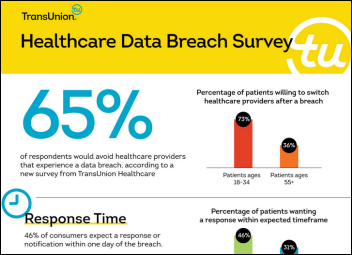
A Transunion Healthcare survey finds that 65 percent of respondents would avoid a healthcare provider that had experienced a data breach. Younger respondents were less forgiving than older respondents, with 73 percent of 18 to 34 year olds reporting that they would likely switch providers over a data breach.

Comments Off on Morning Headlines 3/30/15

Monday Morning Update 3/30/15

March 28, 2015 News 5 Comments

Top News

The Senate won’t review or approve the House-passed doc fix bill until after its two-week recess ends on April 13. You may recall that 2014’s one-year ICD-10 delay was inserted when the Senate, working hours before the previous SGR patch was set to expire, couldn’t muster enough votes to pass its own version of SGR bill that didn’t include the delay.


Reader Comments

image

From Raygun: “Re: Epic. They’ve never posted in social media, but I got this in my LinkedIn stream.”

From Hanoi Hotel: “Re: [vendor name omitted.] Supposedly laying off 300 people. Trying to get better intel.” I’ve omitted the name of the publicly traded company. Update: a second reader confirmed the first reader’s statement that the company is Allscripts.


HIStalk Announcements and Requests

image

The least-trusted interoperability organization is CommonWell, according to 50 percent of readers. If you add the totals of its members that are listed in the poll, the distrust number increases to 78 percent vs. Epic’s 22 percent. Respondent James explained his thought: “McKesson’s CEO has said in quarterly calls that he expects CommonWell to gush licensing money any day. Cerner’s documentation is near impossible to find. Epic’s HL7 documentation is there for all to see but that doesn’t do much in the expense department. Athena’s API is non-healthcare-industry-standard, which is a good thing, but it can’t move the market.” A third of the votes came from the Madison area, although Epic was hosting a bunch of customers there and there’s no way to separate their votes from those of Epic employees. New poll to your right or here: what’s the #1 reasons you would decline to do business with a startup?

image

A year ago I donated most of the proceeds from the Top Spot banner ad at the top of every HIStalk page (it mostly ran during the HIMSS conference) to classroom projects via DonorsChoose.org. Teach for America teacher Ms. Moore sent photos this week of her students enjoying the 50 library books we as HIStalk readers donated to her school (with matching funds from the Bill & Melinda Gates Foundation). Her school, in which 65 percent of students get free or reduced price lunches, is the sixth-highest performing school in North Carolina, with 97 percent of students performing at or above grade level and 100 percent of seniors accepted to college (85 percent of those are the first in their families to attend college). The Top Spot banners are still available if your company wants HIMSS exposure and to help me fund more classrooms in need.

image

Our networking event for HIStalk sponsors will be held Sunday evening (April 12). I’m offering great food and a premium open bar at a nice venue not far from the river and Miracle Mile. I had this last-minute thought: if you’re the CEO of a non-sponsor startup and want to network with some great folks, tell me why you’d like to come and I’ll choose up to five to join us at my expense.


Last Week’s Most Interesting News

  • The House passes an SGR doc fix bill that is free of ICD-10 delay language.
  • HHS publishes drafts of Meaningful Use Stage 3 and 2015 certification requirements.
  • Industry leaders John Halamka and Micky Tripathi question the direction and value of ONC’s Meaningful User and EHR certification programs.
  • Vermont’s governor threatens to shut down the state’s floundering health insurance exchange and move to Healthcare.gov.
  • The head of the Department of Defense’s EHR project suggests that it will choose the bid group that offers the best services, not necessarily the best EHR.

HIStalkpalooza Sponsor Profiles

image

Do you need a little Tonic to help face those Healthcare Challenges? Visit Elsevier booth #2207 to witness how our innovative solutions and services empower patients and providers and improve clinical outcomes embedding trusted medical content at every stage in the patient journey. Participate in our exciting Healthcare Challenge and win special event giveaways. Are you curious to learn about extreme patient engagement? If that doesn’t convince you, than how about cocktails and mocktails served with a flair? Please join us for our daily in-booth happy hours. We look forward to seeing you there.

image

Mark your calendars… HIStalkapalooza gold sponsor Divurgent will be bringing back their ever-popular Children’s Hospital Charity Drive to the HIMSS exhibit floor to raise monies for Ann & Robert H. Lurie Children’s Hospital of Chicago. Divurgent’s booth #1891 will feature a fast-paced, interactive Trivia Charity Drive, inspired by the explosively popular mobile app game, Trivia Crack. It will be hard to miss the vibrantly-colored Trivia Charity Wheel as HIMSS attendees spin to see what trivia category they will land on, along with what donation value Divurgent will contribute on the attendee’s behalf. Make sure to visit booth #1891 to help Divurgent meet their goal of raising $5,000 for Lurie Children’s.To view all of Divurgent’s exciting events and happenings during HIMSS, click here.


Webinars

March 31 (Tuesday) 1:00 ET. “Best Practices for Increasing Patient Collections.” Sponsored by MedData. Presenter: Jason Bird, director of client operations, MedData. Healthcare is perhaps the last major industry where the consumer does not generally have access to what they owe and how they can pay for their services. Collecting from patients is estimated to cost up to four times more than collecting from payers and patient pay responsibility is projected to climb to 50 percent of the healthcare dollar by the end of the decade. Learn how creating a consumer-focused culture, one that emphasizes patient satisfaction over collections, can streamline your revenue cycle process and directly impact your bottom line. 

April 8 (Wednesday) noon ET. “Leveraging Evidence and Mobile Collaboration to Improve Patient Care Transitions.” Sponsored by Zynx Health. Presenter: Grant Campbell, MSN, RN, senior director of nursing strategy and informatics, Zynx Health. With mounting regulatory requirements focused on readmission prevention and the growing complexity of care delivery, ACOs, hospitals, and community-based organizations are under pressure to effectively and efficiently manage patient transitions. This webinar will explore the ways in which people, process, and technology influence patient care and how organizations can optimize these areas to enhance communication, increase operational efficiency, and improve care coordination across the continuum.


Acquisitions, Funding, Business, and Stock

image

Valence Health will move to a new Chicago location as it plans to add 500 jobs by 2019.

Vince continues his 2014 review of health IT vendors in covering those that serve large health systems – Cerner, McKesson, Epic, Allscripts, and GE Healthcare.  


Sales

image

Public Hospitals Authority of the Bahamas chooses Surgical information Systems for perioperative systems.


Announcements and Implementations

image

EClinicalWorks subsidiary Healow announces integration with several wearable and fitness tracker products.


Government and Politics

Programming website GitHub is hit by a distributed denial of service attack from what appears to be the Chinese government, which is unhappy about GitHub tools that allow China-based users to bypass their government’s censorship.


Privacy and Security

image

A TransUnion Healthcare survey finds that two-thirds of recent patients (with a heavy representation of younger ones) would avoid a provider that has experienced a data breach. Half of the consumers expect to be notified within one day of the breach (hopefully of its announcement rather than the actual event since it’s foolish to announce a breach before doing preliminary investigation) and about the same percentage expect a dedicated phone hotline and website to answer their questions.


Technology

image

The local TV station profiles Seattle Children’s use of software from local startup Luum, which tracks how employees commute to work so that the employer can reward the use of sustainable transportation. Seattle Children’s gives employees a free fancy coffee if they don’t drive to work in a car.

Johnson & Johnson-owned medical device vendor Ethicon signs a collaboration agreement with Google to develop a robot-assisted surgical platform.

image

I’m interested in a couple of new apps (Meerkat and Periscope) that allow someone to stream a video broadcast from their smartphones to their chosen Twitter followers. It would be kind of cool to watch a live stream of the HIMSS keynotes or to show a first-person view of what’s going on at HIStalkapalooza.


Other

The City of Baltimore uses its Netsmart EHR to remind employees who are treating heroin addicts to test them for HIV and refer them to HIV care if positive.

I missed this until @Farzad_MD tweeted it out: great investor advice presented as quotes from venture capitalist Paul Graham:

“What investors are looking for when they invest in a startup is the possibility that it could become a giant. It may be a small possibility, but it has to be non-zero. They’re not interested in funding companies that will top out at a certain point.  A startup is a company designed to grow fast. Being newly founded does not in itself make a company a startup. Nor is it necessary for a startup to work on technology, or take venture funding, or have some sort of  ‘exit.’ The only essential thing is growth. Everything else we associate with startups follows from growth.… To grow rapidly, you need to make something you can sell to a big market … If you want to start a startup, you’re probably going to have to think of something fairly novel. A startup has to make something it can deliver to a large market, and ideas of that type are so valuable that all the obvious ones are already taken…. Usually, successful startups happen because the founders are sufficiently different from other people – ideas few others can see seem obvious to them.

Weird News Jeff channels WNA in providing this family-unfriendly story. Two UC Berkeley researchers develop SmartBod, an adaptive biofeedback app that manages the most personal of wearables in order to guarantee a happy ending, tracks performance over time, and allows proudly sharing the results with social media. If that’s not enough, the last names of the scientists (who are in fact a couple) are Klinger and Wang.


Sponsor Updates

  • Zynx Health client Meritage ACO (CA) achieves successful reduction of at-risk patient readmissions.
  • Senator Lois Wolk (D-CA) recognizes Geni Bennetts, MD of WeiserMazars as one of the Third Senate District’s “Women of the Year.”
  • Huron Consulting Group will sponsor and exhibit at the 2015 Cancer Center Administrators Forum March 29-31 in Lexington, KY.
  • Verisk Health offers “How the Boomers will Change the Shape of Medicare.”
  • T-System President and CEO Roger Davis weighs in on EHR interoperability.
  • Shareable Ink names Chris Buckley as regional sales director of the year.

Contacts

Mr. H, Lorre, Jennifer, Dr. Jayne, Dr. Gregg, Lt. Dan.

More news: HIStalk Practice, HIStalk Connect.

Get HIStalk updates.
Contact us online.

125x125_2nd_Circle

Morning Headlines 3/27/15

March 26, 2015 Headlines Comments Off on Morning Headlines 3/27/15

Cost Estimate and Supplemental Analyses for H.R. 2, the Medicare Access and CHIP Reauthorization Act of 2015

The CBO estimates that the House-passed SGR repeal bill will increase the federal deficit by $141 billion over the next ten years. The bill is now with the Senate.

The CMS and ONC NPRMs

John Halamka, MD weighs in on the recently published MU3 rules, concluding “The sheer number of requirements may create a very high, expensive and complex set of barriers to product entry.  It may stifle innovation in our country and reduce the global competitiveness for the entire US Health IT industry.”

Rethinking Radiology Informatics

An article in the American Journal of Roentgenology suggests that the ongoing shift to centralize IT services in hospitals has left radiology departments, which were often early health IT adopters, with fewer clinical IT experts and less control over the direction of innovation in their specialty.

Introducing TeleMED Assist from Seniors Wireless

Seniors Wireless launches a $30 per month telehealth service that promises unlimited 24/7 access to physicians by telephone or video for anyone over the age of 55.

Comments Off on Morning Headlines 3/27/15

News 3/27/15

March 26, 2015 News 6 Comments

Top News

image

The Congressional Budget Office says the Medicare doc fix bill that passed the House Thursday and moves on to the Senate will add $141 billion to the federal deficit. The cheers you may have heard came from people getting the money, not those providing it. Somehow “reform” always ends up costing taxpayers more. At least nobody has slipped in another ICD-10 Easter egg like last time, although Congressman Gary Palmer (R-AL) tried to work in another one-year ICD-10 delay Wednesday that was rejected in committee.


Reader Comments

image

From Lemmy: “Re: Children’s Hospital Boston. The EMR is down, clinics are cancelling appointments, and the labs are sending samples out.” I contacted CIO Dan Nigrin, MD, who explains:

“We recovered yesterday (Wednesday) from an extended, unplanned downtime caused by a failed segment of a storage array for the database underlying our EHR, and which caused significant database corruption. As you would expect, the hardware was architected to be fully fault-tolerant with complete redundancy, yet nonetheless it failed us. So we’re still figuring out root cause with the vendor. We used our disaster recovery system and paper-based processes to run the operation. To be on the safe side, we postponed a few elective admissions (for less than 48 hours), but otherwise care was delivered normally at the hospital.”

From DoDEHR: “Re: US Coast Guard. Considering scrapping their $40 million Epic rollout as the DoD selects its vendor. Funding is frozen and USCG hasn’t gone live in any of its 42 clinics after four years with no dates projected. They are in danger of reverting back to AHLTA/VistA.” Unverified. 

image

From Booth Babe: “Re: HIMSS exhibitor tips. Can you recap those you’ve run before?” You can use the search box to find them, but here’s my #1: confiscate the cell phones of employees while they’re working the booth. They are hopelessly addicted and will start by slipping furtive glances at email, but before you know it, they will be heads-down immersed in screwing around instead of paying attention to the prospects milling around their expensive telephone booth. I’ve seen guys playing with their phones while standing at an airport restroom urinal, so I guarantee people (especially the shorter attention span younger ones) won’t make it through a multi-hour booth shift unless you remove the temptation. I also suggest making it clear that booth employees aren’t allowed to talk to each other unless they’re collaborating on an attendee question because they’ll end up socializing, with is a huge turn-off to a prospect who might want to ask a quick question or who has a reasonable expectation of being welcomed without feeling like they’re intruding. It’s depressingly easy to find expensive booths staffed by inattentive employees. If your carrot needs a stick enhancement, mention that every year I take candid photos of inattentive booth employees and it will be pretty embarrassing to be memorialized on HIStalk that way.

From Job Hunter: “Re: taking a new job. Can you give me the link to what you ran previously about company danger signs?” I don’t think I’ve ever run such a list, but I would try to steer clear of companies with these characteristics:

  • The CEO is a well-traveled hack who has left a trail of corporate destruction behind him or her or is a private equity hired gun whose primary job is to boost the bottom line by whatever short-term means are necessary to get the company sold before the wheels come off.
  • The CEO can’t be bothered to relocate to the city where most of the employees work.
  • The executive job you’re being offered is not housed at the home office. Out of sight means out of mind, which is great until your ambitious peers conspire to stab your absent back.
  • The company requires new hires to sign a restrictive non-compete agreement that will harm your ability to find their next job. My favorite strategy is from Dilbert: scan the non-compete into Acrobat, change the wording, then print it and sign it. Chances are the always-clueless HR department won’t notice that what you signed isn’t what they handed you.
  • Budget and travel freezes are common. That means lazy executives don’t have a clue about what is essential, so they just penalize everybody equally regardless of corporate consequences.
  • They’ve laid people off in the past couple of years. Layoffs are a symptom of executive failure (either in hiring choices or in strategy) and indicate that the company would rather jettison people who have been loyally working in their assigned roles instead of retraining them even though they have a lot of reusable positive attributes beyond specific product knowledge. That or they don’t have the guts to fire people for cause and instead conduct a layoff of losers.
  • Executives with reserved parking spots. I loathe big shots  who think they’re better than everyone else.
  • Your interviewer is late, distracted, or someone you wouldn’t hang out with after work. They’re on their best behavior during your interview, so it can only get worse.
  • You get a vague answer when you ask what happened to your predecessor or the company declines to name them for fear you’ll solicit their honest opinion about why they left.
  • Your prospective boss talks about himself or herself instead of you.
  • Two people who are related serve on the executive team, especially if the position you are considering is also on the executive team. You, Sammy Hagar, serve at the pleasure of the brothers Van Halen.

HIStalk Announcements and Requests

I’m doing a video interview series at the HIMSS conference along with DrFirst and we need interviewees. We’ll probably ask simple questions, such as what interesting things you’re seeing at the conference or who has the best giveaways. Let me know if you’re willing to participate and we’ll set a time to connect in the exhibit hall.

Welcome to new HIStalk Platinum Sponsor Engage. The Spokane, WA-based company, a division of Inland Northwest Health Services, is one of the largest Meditech hosting partners in the country and offers four service lines: hardware integration, hosting services, Meaningful Use, and professional services. Its 225 application analysts provide Meditech implementation and support to 130+ customers, among them some of the first hospitals to successfully attest for MU Stage 1 and Stage 2. Its infrastructure solutions include hardware refresh, virtualization, data migration, and data center migration, working with partners such as HP, NetApp, IBM, and BridgeHead. Engage provides its customers with a 24x7x365 US-based help desk that covers both infrastructure and application support. Thanks to Engage for supporting HIStalk.

This week on HIStalk Practice: MUS3 proposed rules take the air out of one rural physician’s HIT sails. The Physicians Alliance expands its Wellcentive partnership. A new study confirms that urgent care and retail clinics are overtaking primary care practices in terms of patient preference. Aledade partners with WVMI and Qsource to establish ACOs in West Virginia and Tennessee. One MD makes the case for pulling primary care out of the insurance system. Practice Fusion integrates with Medi-Span. New study finds that the ACA did not flood physician practices with appointments. Dr. Tom offers practices tips on thinking like retailers. Dr. Gregg snapshots the technology-induced workloads of today’s busy physicians. Thanks for reading.

This week on HIStalk Connect: Meaningful Use 3 preliminary rules are published and include some aggressive patient engagement goals. Researchers from Mayo Clinic analyze potential use cases for drones in healthcare. A new Rock Health report finds that women are still sorely underrepresented in health IT leadership positions. In England, the NHS launches a mobile app library with clinically-vetted mental health apps.

Listening: the fairly new rarities boxed set from Seattle’s amazing grunge rockers Soundgarden. If you like Black Sabbath (and how could you not?) then you probably like Soundgarden. And since I’ve already mentioned Van Halen, they (including on-again, off-again singer David Lee Roth) will be touring heavily starting July 5, mostly doing the amphitheater circuit, and releasing a made-in-Japan live album from their 2013 tour. I called it nearly perfectly on that last tour when I said on February 13, 2012 that I wouldn’t buy tickets for shows after mid-March because I expected them to storm off mad and cancel the tour and sure enough they did, although not until a few weeks after I predicted. Eddie’s voice is mostly shot (just like DLR’s kicks only go about knee-high these days) but he can still shred the guitar and he looks a heck of a lot better at a slightly chunky 60 than a couple of years ago when could have passed for a homeless crackhead. 


HIStalkapalooza

image

Thanks to the fun folks at DrFirst who have volunteered to provide a videography team to cover HIStalkapalooza. That was one of the features we were going to eliminate since we are too buried in other event details to deal with it, but DrFirst is filming (not literally, since there’s no actually film involved) and will produce a YouTube video we can all enjoy after the fact. DrFirst’s stepping up so enthusiastically restored my enthusiasm and faith in humanity since I was pretty tired and frustrated dealing with all the not-so-fun parts of putting on HIStalkapalooza. They’re a fun bunch.

The only thing we haven’t arranged is someone to shoot still photos, so we will probably ask attendees to send us those they take.

I invited each of our event sponsors (which I’ve listed in a link box to your right for ongoing reference) to provide a little background on what they do and what they’re planning for the HIMSS conference and for HIStalkapalooza, which seems fair given that they are paying for your food, drinks, and world-class band. Here’s what the folks at Falcon Consulting Group have to say.

image

Soaring into HIMSS15, Falcon Consulting Group looks forward to showing attendees and exhibitors alike that we are no ordinary flock of consultants. Falcon brings together specialized EHR technical and clinical talent, Big-4 operational and industry expert leadership, and avant-garde strategies and technological solutions. We are landing in a reserved meeting room inside the Lakeside Center Building (MP-7), and we would love for you to stop by and let us show you how we can help your organization fly to new heights. In the event has worn out your wings at the conference, we will also be hosting nightly events throughout Falcon’s home city of Chicago. For more information, contact Steven Stull at 312.751.8900 or by email.


Webinars

March 31 (Tuesday) 1:00 ET. “Best Practices for Increasing Patient Collections.” Sponsored by MedData. Presenter: Jason Bird, director of client operations, MedData. Healthcare is perhaps the last major industry where the consumer does not generally have access to what they owe and how they can pay for their services. Collecting from patients is estimated to cost up to four times more than collecting from payers and patient pay responsibility is projected to climb to 50 percent of the healthcare dollar by the end of the decade. Learn how creating a consumer-focused culture, one that emphasizes patient satisfaction over collections, can streamline your revenue cycle process and directly impact your bottom line. 


Acquisitions, Funding, Business, and Stock

image

Analytics vendor Ayasdi, which offers a healthcare-specific package for identifying clinical best practices among its other non-healthcare products, raises $55 million in a round led by Kleiner Perkins, increasing its total to $100 million.

Orion Health’s US sales leader Paul Viskovich describes what it’s like being a New Zealand-based company selling predominantly to a US market and opening an office in Scottsdale, AZ: “It’s hard. You’re not from here. You talk differently. It wasn’t possible for us to go meet the CIO of UCLA — it was a good day if we talked to the security guard. Healthcare as a whole is largely not good with innovators either, and when you combine those two things, it’s very difficult … Our teams are cross functional. People in New Zealand are also working on projects at the same time as people in the United States, and if you manage that correctly, it can be a real benefit.”


Sales

image

Six-hospital Cone Health (NC) chooses Phynd to manage its 16,000 physicians in a single provider profile that crosses Epic and ancillary systems.


People

image 

Jitin Asnaani (Athenahealth) is named executive director of CommonWell Health Alliance.

image

The Integrated Healthcare Association hires Jeff Rideout, MD (Covered California) as president and CEO.


Announcements and Implementations

image

Seniors Wireless announces TeleMed Assist, a $30 per month, contract-free program ($40 for couples) that offers unlimited 24×7 access to physicians by telephone or video. Being a cynic and wondering how all these virtual visit companies will find reasonably competent doctors willing to take calls in real time, I’m picturing those 1990s 976-number dial-a-porn services where the hot Brazilian dominatrix you’re talking to is actually an obese, hirsute, 60-year-old Medicaid recipient whispering sweet nothings with Cheetos breath and a genetically confused grandchild on her knee while watching the muted “Jerry Springer Show.” I would be interested to talk to a physician who provides services through companies like this since I’m curious how it works.

Practice Fusion adds the Medi-Span drug database from Wolters Kluwer Health to its free EHR.

The Florida HIE announces that 200 hospitals have signed up for its event notification service for admissions, discharges, and ED visits.

GetWellNetwork announces that it added 58 new facilities and 10,000 new beds in 2014, with a 13 percent growth in employees to 250.


Government and Politics

image

Even the ever-optimistic and supremely knowledgeable John Halamka and Micky Tripathi seem to be fed up with the endless Meaningful Use parade, concluding of the latest MUS3 and certification requirements:

”… each incremental proposal is tolerable, but the collective burden is making practice impossible … the sheer number of requirements may create a very high, expensive, and complex set of barriers to product entry. It may stifle innovation in our country and reduce the global competitiveness for the entire US health IT industry by over-regulating features and functions with complicated requirements that only apply to CMS and US special interests …  The certification criteria are often not aligned with what EHR users ask for. In some cases, the criteria are completely designed to accrue benefits to people who aren’t feeling the opportunity cost … There needs to be a very public discussion with providers as to who should prioritize EHR development — ONC and the stakeholders they’ve included or EHR users.“

I’ll add my counterpoint, however. Providers who whine about irrelevant and burdensome MU requirements can ignore them completely, but rarely do. You sold your soul to the federal government, but you can buy it back by accepting the Medicare penalty and then start following your own agenda instead of someone else’s. MU money is either worth it or it’s not – your participation indicates that you think it is, and that acceptance drives the user-unfriendly development agenda of EHR vendors. You don’t even need to use an EHR at all if you truly (questionably) believe it has a negative impact on quality or revenue – it’s your business and your patients. I cite “Lost Boys” in reminding that a vampire can enter your home only if you invite them.

image

A great tweet from US Surgeon General Vivek Murthy, MD, MBA: “The levers for health aren’t in hospitals, they are in communities.” What Vivek didn’t tweet: “On the other hand, the hospital levers are raking in untaxed billions and thus they have little incentive to make communities healthier.” In the US, “public health” is export-only compassion and outreach to all who need help; domestic healthcare services delivery is a big business dominated by special interests that threatens to bankrupt the country; and never the twain shall meet.

image

Rep. Phil Roe, MD (R-TN) reintroduces a bill that would require the DoD and VA to develop a shared EHR using criteria established by a temporary panel that would be given 90 days to complete its work. The contract winner would get a flat $50 million upfront and then $25 million per year for five years to develop and implement the custom system, which Roe says would complement the $1 billion already spent by the DoD and VA in trying to create the integrated EHR. My opinion: the DoD-VA interoperability challenge is more about willingness and less about technology (the same as in the civilian world made up of uncooperative competitors, in other words). Those groups, despite how ridiculous it seems to taxpayers, distrust each other and refuse to stoop to each other’s level for the good of the serviceperson turned veteran. Perhaps they should be assessed a 1 percent CMS-type annual budget penalty for failing to interoperate.

image

Here’s an interesting quote from the head of DoD’s DHMSM project: “I’ve visited a number of facilities that have gone through this, and their message routinely is, it’s all about the change management and the training. It’s not about the tool. It’s about how you use that tool.” Maybe that’s a hint that DoD will choose whichever of the three bidding groups offers the best training, implementation, and optimization services rather than just the best EHR.

The Economist calls out inept US government financial management as chronicled by the GAO, including $125 billion in improper Medicare payments in the last fiscal year. The Brits seem to be enjoying our admittedly questionable DoD-EHR dual (or dueling) EHR projects:

”The GAO has few kind things to say about the government’s approach to information technology (IT), on which it plans to spend $79 billion in this fiscal year. Fragmented data storage and needless duplication have wasted billions of dollars. For example the Department of Defence—which accounts for around half of federal discretionary spending, and so may well not notice when billions of it vanish like loose change between sofa cushions—and the Department of Veterans Affairs are both now developing, from scratch, two separate electronic health-record systems, even though they will basically serve the same people. But the most common problem with the government’s IT ventures is a mix of grand ambitions and incompetence, as the launch of Healthcare.gov in 2013 handily showed.”


Technology

image

Michael Archuleta, IT director at 25-bed Critical Access Hospital Mt. San Rafael Hospital (CO), tweeted out this photo in announcing that the hospital’s server infrastructure is 99 percent virtualized. Nice.

image

Amazon announces unlimited consumer cloud storage for a flat fee of $60 per year with a free three-month trial.


Other

Among the reasons University of Mississippi fired its chancellor is the medical center’s signing of contracts without board approval, with an audit finding that its EHR RFP process in which Epic was chosen contained incomplete cost breakdowns.

image

An article by three prominent radiology informatics leaders questions whether IT centralization and standardization has caused radiologists — who were among the first hospital informatics practitioners — to lose control of the domain. It says early and profitable hospital radiology departments were able to hire clinical IT specialists that the IT department didn’t have, giving those departments the technical freedom to innovate that has since been revoked. The authors suggest that subspecialist informatics radiologists find a place at the hospital IT table despite current underrepresentation. My experience is similar – the other pioneering clinical departments (lab and pharmacy) integrated well into the IT environment because of share order entry systems that were used by a general audience, while radiology had its own pseudo-IT systems that were used by minimally visible doctors and techs working alone in dark rooms, often ignoring sound IT processes. The above graphic is correct – IT’s focus is on reduction of corporate risk exposure through standardization, centralization, and budget control, which usually extinguishes rather than encourages innovation. Whether that’s good or bad depends on whether you have a visionary CFO (is that an oxymoron?)

image

Reading Health System (PA) reorganizes its IT department and eliminates 33 positions after completing its $150 million Epic implementation.

Eighty percent of the 1,000 children and teens who have used Kurbo’s $25 per month weight management app and email-based coaching service have lost weight, the company says.  

Group brainstorming meetings don’t work, says Harvard Business Review. Reasons: people expend less effort when working within a group, introverted and less-confident attendees participate less, stellar performers are dragged down to the level of the least-competent ones, and groups larger than 6-7 people have logistical problems getting everyone’s ideas on the table.


Sponsor Updates

  • A family practice improves hypertensive control rates from 78 percent to 94 percent in the year after implementing Forward Health Group’s PopulationManager.
  • The Health Management Academy partners with MedCPU to identify solutions to overcome point-of-care challenges.
  • ZeOmega Founder and CEO Sam Rangaswamy describes how ZeOmega’s acquisition of HealthUnity positions the company.
  • A new Healthcare Data Solutions case study confirms that pharmacies using its Prescriber Validation Subscription Service have saved millions in potential hydrocodone fines.
  • Ivenix produces a video that highlights how its Infusion Management System is designed to help nurses improve patient safety and workflow efficiency for infusion therapy.
  • Hayes Management Consulting offers “10 Tips to Create a Workflow Manual That Your Users will Love.”
  • Valence Health announces that its Further 2015 annual conference will be held in Chicago September 23-25.
  • Galen Healthcare Solutions CEO Jason Carmichael welcomes the new GHS leadership team in the latest company blog post.
  • Impact Advisors offers early impressions of Meaningful Use Stage 3, plus looks at data center trends.
  • Healthwise offers “Creating a Group Health Culture Where Shared Decision Making is the Norm.”
  • LifeImage posts “Medical Image Exchange for Cardiology Care.”
  • InterSystems writes “Salty Cookies, Sweeter Outcomes: Shared Healthcare Decision Making.” 
  • The Atlanta Journal-Constitution names Navicure as one of its “Top Workplaces” for the second year in a row.
  • The New York eHealth Collaborative will exhibit at HxRefactored April 1-2 in Boston.
  • The latest episode in Nordic’s Making the Cut video series covers preparing for cutover and the role of operational management.
  • Patientco offers “Supergroup: Connecting the Stakeholders of Healthcare for a Rockin’ Future.”
  • Porter Research posts a blog on networking at HIMSS 15.

Contacts

Mr. H, Lorre, Jennifer, Dr. Jayne, Dr. Gregg, Lt. Dan.

More news: HIStalk Practice, HIStalk Connect.

Get HIStalk updates.
Contact us online.

125x125_2nd_Circle

EPtalk by Dr. Jayne 3/26/15

March 26, 2015 Dr. Jayne 1 Comment

clip_image002 

I read with interest Mr. H’s summary of Chicago’s April weather over the last several years. One of my friends was in Chicago this week and posted pics of snow. Right now I’m still planning a ball gown for this year’s Histalkapalooza, so I’m crossing my fingers against rain, snow, sleet, hail, and slush. I do have an opera length coat at the ready, but I am not looking forward to figuring out how to pack it all. The fact that I’m thinking about HIMSS planning right now underscores the fact that I’m procrastinating the continued reading of the Meaningful Use Stage 3 documents that were released last Friday.

I’ve only received a couple of pre-meeting mailers, but there have been a couple of ads in healthcare IT publications that caught my eye. Sponsor ChartMaxx is giving away some Chicago pizzeria gift baskets in their “Grab a Slice of the Windy City” promotion. Winners could receive a gift basket and pizzas delivered to their home – sign me up for that one. The two mailers I did receive both mentioned Apple Watches, but I’m not an iPhone girl, so they didn’t engage me. Additionally, one had my title wrong and another botched the address. It never ceases to amaze me when a mail merge goes awry or that people don’t proof things before they go out.

clip_image004

Speaking of proofreading, I wonder if 1-800-Contacts realizes that their most recent mailing provides a possible time-travel option for customers? Although it was mailed earlier this month, it invited me to place an order through January 2013. I guess it’s not just conference marketers who can’t get it straight, but I’m wondering if I can call and see if they’ll honor their 2013 pricing.

Procrastinating on the Meaningful Use documents also means catching up on journals this week. I’ve been doing a better job of keeping the pile on my entryway table to a minimum, but still am not current. A blurb about using Fitbit devices to predict recovery from back surgery caught my eye, however. Researchers at Northwestern University, New York University, and the University of California-San Francisco are looking at patient activity four weeks prior to a procedure and six months after. Preliminary data shows that patients not only reach their pre-procedure activity level after about a month, but continue to increase to levels that weren’t possible prior to surgery. Although they’re only looking at a subset of spine surgery procedures, I like the idea of capturing that data to model real-world results.

I’m glad I went through the journal pile because nestled in the back pages of American Family Physician was a “Patient Oriented Evidence that Matters” (POEM) segment answering the question of whether computerized decision support systems linked to EHRs improve patient outcomes. The ‘not really’ response cites a recent meta-analysis and I’m glad I read the original article. It was a little less pessimistic than the “bottom line” summary provided in the POEM. I printed a couple of copies of the actual paper to keep on my desk because I’m sure someone will bring the summary in next week as support for why we should not have an EHR. I’ll be ready when they do because at this point EHRs are not going away, but I do love a good medical literature spitting match.

Going back to January in the stack, I also found reference to an editorial in the Annals of Family Medicine that talks about allowing medical students to use EHRs so that they’ll be ready for later phases of training such as residency. Our students get a lot of experience with EHRs in our academic hospitals, but very little when they’re on their community-based rotations. The barriers cited by our sponsoring physicians include licensing issues with EHR vendors, lack of dedicated training for students, inability to separate student documentation from rendering physician documentation, and the transient nature of clinical rotations. Most of these were echoed in the editorial, which also mentions the need for students to learn how to manage populations using registries and other analytic components of EHRs.

I’ll be interested to see how the current generation of medical school and residency grads use EHRs after completing their training. In many parts of the country, we’re to the point where students may not even be exposed to paper charts. In my area, even our community free clinics are using EHRs. I’d love to do a study of new physician interactions with patients in an EHR-enabled exam room vs. physicians who transitioned from paper charts.

Got grant money? Email me.

Email Dr. Jayne. clip_image003

Text Ads


RECENT COMMENTS

  1. "A valid concern..." Oh please. Everyone picks the software they like and the origin of that software is an afterthought.…

  2. I don't disagree with you completely, but to take the counterpoint: there is plenty of precedent for saying "this *entire…

  3. Teens will certainly find a way to use their social media apps of choice. I'm not in favor of the…

  4. I've been in this business a long time. Choosing the "right" technology product is fraught, especially when it comes to…

  5. EHRMusing - You make a lot of accurate statements about key factors in the selection process but the comment about…

Founding Sponsors


Platinum Sponsors


Gold Sponsors


RSS Industry Events

  • An error has occurred, which probably means the feed is down. Try again later.

RSS Webinars

  • An error has occurred, which probably means the feed is down. Try again later.