Recent Articles:

Morning Headlines 9/28/15

September 27, 2015 Headlines Comments Off on Morning Headlines 9/28/15

‘Trust but verify’ – five approaches to ensure safe medical apps

Researchers at the Imperial College London find that mobile health apps consistently fail to deliver evidence-based clinical recommendations, while most also fail to meet basic data security standards, such as encrypting personal health information that is being transmitted over the Internet.

A Medical Detective Story: Why Doctors Make Diagnostic Errors

In a Wall Street Journal interview, Hardeep Singh, MD and chief of health policy, quality, and informatics at the Houston VA Medical Center, discusses diagnostic errors and the potential roles and roadblocks that electronic diagnostic tools will face in care delivery.

Iowa’s mental health bed-tracking database ‘not useful’ so far, hospitals say

In Iowa, a $15,000 bed-tracking system implemented to help rural hospitals find available inpatient mental health beds across the state is not working out as planned because the 29 facilities with psychiatric beds are not updating the system with availability information.

WEDI and National Association for Trusted Exchange (NATE) Announce Partnership

The Workgroup for Electronic Data Interchange (WEDI) will partner with the National Association for Trusted Exchange to continue work on WEDI’s Virtual Clipboard initiative, a project aimed at establishing industry standards for automating the patient check-in process.

Comments Off on Morning Headlines 9/28/15

Monday Morning Update 9/28/15

September 27, 2015 News 14 Comments

Top News

image

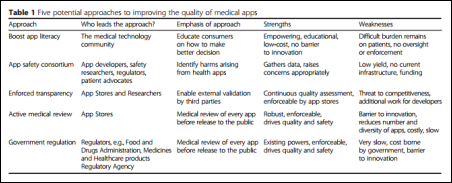
A study in England finds that NHS-endorsed medical apps often implement security and privacy poorly, give users bad advice, and have no track record of improving outcomes. Nine of 10 dose calculators don’t check the information entered by users, 70 percent don’t state their formulas, and half of the developers didn’t respond to questions about how their systems performed their calculations. The authors of a BMC Medicine article recommend educating consumers about how to evaluate apps. They also urge developers to be more transparent by providing documentation covering their design and testing methods, privacy policies, and business model. All of that, they say, is better than government regulation of apps as medical devices. It concludes,

The potential for benefit remains vast and the degree of innovation is inspiring, but it turns out we are much earlier in the maturation phase of medical apps than many of us would like to have believe. To build the future we want, in which patients can trust their medical apps, we need to verify that they function as intended.

Reader Comments

From Huskydoc: “Re: Epic. For many years, I’ve been practicing in Epic-based organizations. I’m now in a system that doesn’t. I was anticipating some minor, primarily aesthetic differences in the functionality between Epic and my new EMR… actually looking forward to the experience. But I must say that I was stunned by the inadequacies of my new EMR – a recognized brand name EMR that’s not Cerner. And I’m talking simple stuff, people. I now understand that Epic’s competitors’ boasts of interoperability are really just cries for help.”


HIStalk Announcements and Requests

image

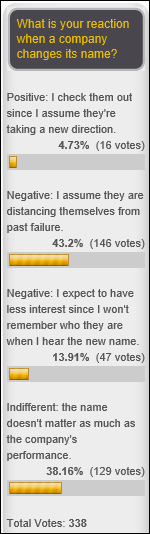
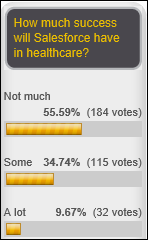
Only five percent of poll respondents view a company name change as a positive event, with more than 40 percent assuming that the company replaced its old name to distance it from past failures. Unrequited Marketer offered some great thoughts: (a) companies that have grown by acquisition often want their product lines to seem cohesive via consistent naming; (b) research has shown that there’s not much brand equity in B2B product names anyway; (c) many or most people keep using the old product name even after it’s been changed; and (d) he or she doesn’t know of any cases where a company changed a company or product name because of past failures and asks readers for examples. New poll to your right or here as the first in a series of polls I’ll call “Hero or Villain” – is Blue Cross Blue Shield a hero or villain? You can click the Comments link after voting to explain why you think so.

image

Dennis Lee donated $100 to my DonorsChoose project, which along with matching funds from my anonymous vendor executive and the NEA foundation bought 15 flash drives and six sets of headphones for Mrs. Winger’s fourth grade class in Seattle, WA and math learning tools (plan sets, Base 10 starter sets, and GeoBoards) for Ms. Fulford’s elementary school class in Santa Ana, CA. Meanwhile, it took only five days for Ms. Thomas’s Georgia elementary school class to receive their iPad and bean bag chair to create their Math Exploration Station, leading her to email to say, “It takes one moment to make an incredible impact on a child and you are responsible for this ‘one’ moment! I am so excited to see how this project will support my students in acquiring the independence needed to be successful! Your dedication to children and providing educational opportunities like this one is unmatched!”

image

Also checking in was Mrs. Wilson from Wisconsin, who sent photos of her students using the listening center we provided.

I’m just full of grammar and usage peeves being a “you kids get off my lawn” kind of curmudgeon in training, but here’s another one: people who spell “desert” when they mean “dessert.” It’s probably because the words are pronounced the same when “desert” is used as a verb, but that’s not a great excuse. If you ate desert, expect an undesirable consequence like sands through the hourglass. One more: the phrase “the Internet is buzzing” in a news story means two things: (a) they should give numbers to back up that conclusion; and (b) it’s probably not a real news story if its main attribute is that a large number of Facebook and YouTube zombies have mindlessly clicked on it.

A friend is taking care of a relative in hospice care, which involves three kinds of caregivers (nurse, aide, and social worker.) Each of them called to schedule their first visits with the usual over-explaining and chattiness that is well intentioned but a bit grating in a hospice situation. All three had the same conversation with my friend:

  • Caregiver: I’ll need turn-by-turn directions to get to your house. Can you give them to me now?
  • Friend: It’s quite a few miles with several turns. Can’t you use the GPS that came on your phone? I’m standing in line at Walmart buying medical items.
  • Caregiver: (without answering the GPS question) We need printed directions for the folder.
  • Friend: OK, then I’ll get on MapQuest myself, copy and paste the instructions from wherever you’ll be starting, and email them to you when I get back home.
  • Caregiver: Well, if you don’t have time to give me exact directions, I can figure it out.

It’s been years since someone asked me for directions to my house, and to be honest, I might be inclined not to hire them if they can’t figure out how to use free phone GPS apps instead of bugging every customer to spell out streets, distances, and turn directions that the free app would do much better (not to mention preventing them from crashing their car while trying to read and drive at the same time). The folks above make their living going to the homes of patients, so you would think they could fast-forward to the current decade where personal directions, AAA TripTiks, and gas station maps are all enjoying their much-deserved retirement.


Last Week’s Most Interesting News

  • The GAO says CMS seems to have prepared well for the ICD-10 switch, but cautions that all software projects carry risks that can’t be identified until after go-live.
  • Accenture acquires Epic-focused Sagacious Consultants.
  • Blue Cross Blue Shield announces its Axis claims and quality database, to which all 36 BCBS companies will submit data.
  • An IOM report on diagnosis recommends that ONC require health IT systems to support information flow across care settings.
  • The medical information of millions of people is found to be publicly available on Amazon Web Services, apparently from unsecured SQL backups stored there by claims management vendor Systema Software.
  • An updated report from Robert Wood Johnson Foundation finds that ONC made mistakes in managing its siloed grant programs and that EHR adoption digitized information only within “corporate islands” that were created by ever-expanding health systems as a way to improve their competitive position.

Webinars

October 7 (Wednesday) 1:00 ET. “Develop Your Analysts and They’ll Pay for Themselves.” Sponsored by Health Catalyst. Presenters: Peter Monaco, senior business intelligence developer, Health Catalyst; Russ Stahli, VP, Health Catalyst. It takes years for analysts to develop the skills they need to build reports and dashboards that turn data into valuable insights. This webinar will describe how to cultivate those analytical skills, including technical prowess and adaptive leadership. Leaders will learn how to develop a culture that fosters improvement, how to encourage analysts to develop the right skills, and ways to remove the barriers that stand in their way.

Contact Lorre for webinar services.


Acquisitions, Funding, Business, and Stock

image

Medical image exchange platform vendor LifeImage receives a $5 million investment from the investment arm of BCBS Massachusetts, raising its total to $62 million.


Announcements and Implementations

image

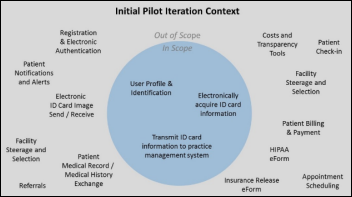
WEDI (Workgroup for Electronic Data Interchange) and NATE (National Association for Trusted Exchange) will work together on the next phase of Virtual Clipboard, a mobile app that would speed up patient check-in by transferring their demographic, insurance, and clinical summary information to the provider’s system.


Government and Politics

Three Alaska healthcare providers sue a Xerox subsidiary for causing delayed payments from the state’s new Medicaid system, claiming that Xerox lied about the system’s readiness for its October 1, 2013 go-live.


Other

image

We should all be grateful to hedge fund manager turned pharma bro Martin Shkreli of Turing Pharmaceuticals for exhibiting an astounding amount of greed, arrogance, and patient indifference by buying an old but vital single-source drug and jacking up its price by 5,000 percent. He’s a cartoonish bad boy who helped everybody finally realize how drug companies have been given capitalistic free rein in charging whatever they want while hiding the research costs they blame for their high prices, all while the pharma lobby successfully deleted planned price controls from the Affordable Care Act and US citizens pay dozens or hundreds of times the price the rest of the world enjoys as a result of our drug development subsidy. The soothing suits from the big drug companies have been coached to feign patient concern and a willingness to participate constructively in healthcare system dialog while Shkreli just told everyone unapologetically that he fully intends to make a lot of money and too bad if they didn’t like it. He’s exactly what we needed to bring the drug pricing issue to light in a way that even dim-witted citizens can get mad about. Healthcare is full of companies and people who try to make everybody forget that they’re in it for the cash and it’s refreshing for someone to finally say so, leaving the rest of us to decide what if anything we do about the system we built that allows it.

Eastern Iowa hospitals say a state-run database for locating available mental health beds isn’t useful because the psychiatric hospitals aren’t updating it with their available bed count.

Informatics and health policy expert Hardeep Singh, MD, MPH says common medical conditions such as UTI and CHF that are most often misdiagnosed, with the most common cause being the provider’s lack of time to conduct a thorough patient interview and then perform critical thinking. Doctors with a poor diagnostic track record are overconfident in failing to consult external resources. He shows modest hope for electronic diagnosis tools, saying they require complete patient data and doctors don’t use them for situations they think are routine. He says that nobody follows up on eight percent of abnormal lab tests, suggesting that electronic escalation could help and patients could take more responsibility in checking their own results on patient portals.


Sponsor Updates

  • Divurgent will host a cybersecurity dinner discussion during the AEHiX conference in Orlando on October 8, with guest speaker Sensato CEO John Gomez.
  • The SSI Group will exhibit at the 2015 SurgCenter Development Annual Conference September 27-28 in Clearwater Beach, FL.
  • Sunquest Information Systems is featured in a JAMA article on connecting healthcare data.
  • Nordic posts video highlights from its open house during Epic’s user group meeting. It was brilliant – they worked with a local brewery to create a custom beer, distributed it to 14 bars and restaurants, and donated $1 for every pint poured to The Road Home Program for veterans. I was trying to figure out ways to shamelessly steal their idea for the HIMSS conference. 
  • Surescripts will exhibit at the AAFP Family Medicine Experience October 1-3 in Denver.
  • TeleTracking’s annual users conference will feature a record number of health system presenters and innovative new products.
  • Valence Health will exhibit at the NASHCO Annual Conference 2015 September 27-29 in Denver.
  • Verisk Health will host the VHC2015 client conference September 30-October 2 in Orlando.
  • VitalHealth Software will exhibit at Transform, hosted by the Mayo Clinic Center for Innovation, September 30-October 2 in Rochester, MN.
  • Huron Consulting will exhibit at the Rural Health Clinic and Critical Access Hospital Conferences September 29-30 in Kansas City, MO.
  • Wellsoft Corp. will exhibit at Emergency Nursing 2015 September 28-October 3 in Orlando.
  • Zynx Health will exhibit at the Meditech on the Road Event September 30 in Toronto.
  • XG Health Solutions Chairman Glenn D. Steele Jr. takes part in the opening of Geisinger’s new laboratory medicine building.

Blog Posts


Contacts

Mr. H, Lorre, Jennifer, Dr. Jayne, Dr. Gregg, Lt. Dan.

More news: HIStalk Practice, HIStalk Connect.

Get HIStalk updates.
Contact us or send news tips online.

125x125_2nd_Circle

Morning Headlines 9/25/15

September 24, 2015 Headlines 4 Comments

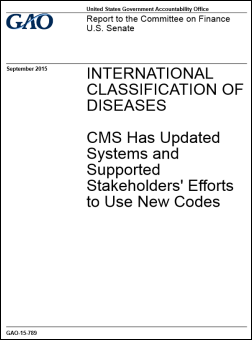
CMS Has Updated Systems and Supported Stakeholders’ Efforts to Use New Codes

The CMS GAO publishes a report on its investigation of the preparations made by CMS ahead of the ICD-10 transition, concluding that the agency will not truly know how prepared it is until it starts processing claims.

The breakdown of costs of Addenbrooke’s Hospital’s £200m Epic IT system

The Cambridge University Hospitals NHS Foundation Trust has been put on special measures “after over-spending an average of £1.2m a week, in part due to its new online patient-record system, which has been fraught with problems.”

OPM says 5.6 million fingerprints stolen in cyberattack, five times as many as previously thought

The Office of Personnel Management reports that 5.6 million fingerprints were stolen in its recent data breach, updating its original estimate of 1.1 million by more than five times.

News 9/25/15

September 24, 2015 News 3 Comments

Top News

image

A GAO report says CMS has done everything right in preparing for the ICD-10 switchover next week, but al software changes are likely to have unplanned problems and nobody will really know how well CMS did until it starts processing ICD-10 codes. CMS spent $116 million to update its claims processing systems, with last year’s one-year delay adding to the cost as CMS had to put the ICD-9 logic back in place after the unexpected decision. Problems or not, to get GAO’s blessing for following complex government procedures is impressive.


Reader Comments

From Meditech Customer: “Re: Meaningful Use. I’m seeking input from health systems that have undergone a system conversion during attestation. How have you handled the need to have data from the old and the new system available if you changed vendors?” Comments are welcome.

From Tuna Piano: “Re: Epic. I left the company four years ago. The only safe place to comment is from the sidelines. Epic will go after folks who speak ill of them. I know of at least one instance where Epic said they would withdraw from an RFP unless providers who were speaking ill of them stopped. Epic offers a great EMR and is a leader in so many ways, but there is no need to fear fair discourse or interoperability.” Unverified. If true, the most amazing aspect is that Epic’s threat to pull out of an RFP scares prospects so much they’ll squelch their own people. What kind of prospective vendor has that amount of clout?

From CD: “Re: McKesson. I heard they’re doing work with CRM/case management vendor Pegasystems. Could be a future acquisition?”

From Proud Yankee: “Re: Cerner. Interoperability may have gotten them the DoD bid.” The HIMSS-owned publication’s justification of its conclusion (published on July 30, the day the DoD bid was announced) is pathetic, citing a bunch of unrelated facts such as Cerner’s membership in CommonWell, its participation in DirectTrust, and an unsubstantiated claim that the market “perceives” that Cerner is more open than Epic. No evidence was provided that the DoD even considered interoperability as a reason to choose Leidos (and thus its partner Cerner). That may or may not have been the case, but it’s still just time-wasting speculative filler from the cheap sets as to why DoD chose the Leidos bid package and which EHR characteristics they valued since none of us really know. The reporter’s need to fill space is not necessarily congruent with the reader’s desire to get only concise, useful information.


HIStalk Announcements and Requests

My latest grammar and use peeve: saying “build out” instead of just “build,” which is admirable in trying to make something conceptual seem more concrete by using a construction term, but is still superfluous and therefore annoying. I’m also increasingly peeved when “spend” is replaced with “invest” to editorialize an expense into the financing of a wise decision. It also really bugs me that people (loosers?) who confuse “loose” with “lose” and say something like “I loose my cool.”

image

Mrs. Henson says her Arkansas second graders are using the wireless microphone photo booth setup we provider via DonorsChoose to create YouTube videos about what they’ve learned, using a green screen setup to add photos to the produced video. She says, “When a six-year-old has the courage to stand up in front of a small crowd of people and talk using a microphone, then I have created a future leader, or at least a very confident adult.” Another teacher borrows it to create news and events broadcasts that are played throughout the building.

I was thinking about the glut of worthless information contained in the typical patient’s medical record. It would be interesting if the patient and each person who cares for them could electronically flag individual data elements or snips of text as important, taking away the noise caused by capture of pointless click boxes and data points. It would also give the patient a voice in letting caregivers know which items they think are most relevant. Our old problem was that we collected too little data electronically. Our new problem is that we collect too much that isn’t relevant and fail to highlight the important parts.

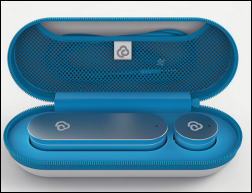
This week on HIStalk Practice: ONC goes into overdrive, releasing the Federal Health IT Strategic Plan 2015-2020, the latest round of EHR adoption statistics (primary care leads the way), and a consumer-centric paper on telemedicine. Medical students see the need for interoperability, but aren’t big believers in telemedicine for initial encounters. The Wounded Warrior Project teams with Brain Injury Services of Southwest Virginia to offer telemedicine to vets. Janet Munro offers telemedicine implementation best practices. Whoop launches an "elite" wearable wristband with round-the-clock analytics. Harrington Family Health Center finds success with tablets. Frank Fortner discusses portals, mobile devices, and patient engagement.


Webinars

October 7 (Wednesday) 1:00 ET. “Develop Your Analysts and They’ll Pay for Themselves.” Sponsored by Health Catalyst. Presenters: Peter Monaco, senior business intelligence developer, Health Catalyst; Russ Stahli, VP, Health Catalyst. It takes years for analysts to develop the skills they need to build reports and dashboards that turn data into valuable insights. This webinar will describe how to cultivate those analytical skills, including technical prowess and adaptive leadership. Leaders will learn how to develop a culture that fosters improvement, how to encourage analysts to develop the right skills, and ways to remove the barriers that stand in their way.

Contact Lorre for webinar services.


Acquisitions, Funding, Business, and Stock

image

Accenture acquires Sagacious Consultants, adding its 250 mostly Epic-focused employees into its EHR practice.

image

Revenue cycle services vendor MedData acquires Alegis Revenue Group of The Woodlands, TX, which offers eligibility and enrollment solutions.


Sales

image

Allegheny Health Network (PA) chooses Visage Imaging’s Visage 7 Enterprise Imaging Platform for primary diagnosis and clinical image distribution among its eight hospitals and 2,800 physicians.

The Central Virginia Health Services FQHC chooses the eClinicalWorks EHR for its 70 providers.


People

image

Stephanie Fraser (CHIME) joins Amendola Communications as senior media relations and social media director.

image

Voalte names Sean Friel (Siemens Healthcare) as VP of sales and marketing.

image

Stanford Health Care President and CEO Amir Dan Rubin resigns to take an EVP job with UnitedHealth Group’s Optum. 


Announcements and Implementations

image

The FHIR team publishes its second DSTU (draft standards for trial use) that includes a simplified RESTful API, extended search and versioning, definition of a terminology service, and broader functionality. This is the final specification before FHIR is published as a standard in 2017. 

Leidos donates another $40,000 to Georgia Tech’s Interoperability and Integration Innovation Lab, this time to fund a pilot data analytics platform.

image

Smilow Cancer Hospital at Yale-New Haven (CT) will implement telepharmacy at Lawrence + Memorial Hospital (CT), where centrally located oncology pharmacists oversee chemotherapy dose preparation, advise physicians, and counsel patients using digital imaging, audio, and video connectivity. The hospital announce a few weeks ago that it will join YNHHS  and implement Epic.

image

Riverside Medical Center (IL) will implement Epic, planning to go live December 31 for its 325 inpatient beds at a cost of $35 million.

image

Blue Cross Blue Shield Association announces that all of its 36 BCBS companies will contribute their quality and cost information to BCBS Axis, which will include information on one-third of Americans. Employers will be able to compare cost and outcomes and consumers will have access to provider and procedure information. 


Government and Politics

image

Congress may allow the VA to transfer $625 million from its budget to complete a scaled-back version of its half-built Denver hospital, which is $1 billion over budget.


Privacy and Security

The federal government’s Office of Personnel Management says that 5.6 million fingerprint profiles were stolen in its June 2015 breach, five times the number it originally reported. That’s an interesting shortcoming of biometrics – unlike a credit card number or password, users can’t simply swap them out once they’ve been compromised. Here’s a question for experts – what could a hacker do with the fingerprint profiles without having the fingerprints themselves? My understanding is that’s what stored is a mathematical model of the fingerprint pattern, which doesn’t seem like it could be used directly to mimic biometric ID. Meanwhile, the government has awarded a contract worth at least $133 million to provide identity theft services to the 21.5 million people whose information was exposed and expects to pay another $500 million for post-breach services.

HP will add Department of Defense-developed malware-blocking firmware to its LaserJet Enterprise printers.


Innovation and Research

image

Two Australia-based physicians will sell their CliniCloud kit — a smartphone-powered digital stethoscope and no-contact thermometer – in US Best Buy stores starting in November. The planned retail price is $149.


Technology

In England, the Leeds City Council hosts an NHS-funded open source healthcare project called Ripple, directed by a physician who was a chief clinical information officer at the Leeds Teaching Hospital. The Integrated Digital Care Record assembles information from NHS systems into a dashboard (via an integration engine) and offers online appointment scheduling.

image

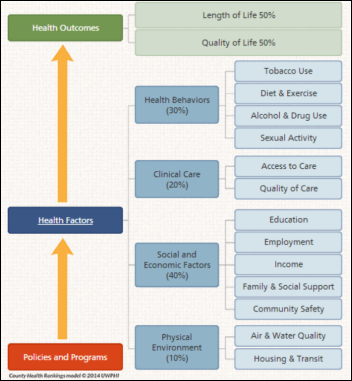
A Forbes article says that deflationary economics (reduced spending) will create startup opportunities in healthcare as it did for efficient online startups such as Amazon, where incumbent healthcare providers locked into a high-cost, poor-service, high-practitioner burnout model are vulnerable to lower-cost startups. It cites a study concluding that only 20 percent of health outcomes are driven by clinical care (“with a few exceptions, hospitalizations represent a failure to extinguish a medical ‘fire’ when it’s small.”) I don’t necessarily disagree, but I would observe that it’s naive to assume that big health systems, insurance companies, pharma, and medical equipment vendors will simply bow to better, cheaper competitors without first unleashing their extensive financial and legislative influence to protect their fiefdoms. The real determinant is the consumer, who despite being characterized as being fed up with the healthcare systems, seems grateful to have access to it even with its obvious faults.

Processed food vendor Nestle moves into higher-margin healthcare products in announcing that it will co-develop an Alzheimer’s disease diagnostic test with a Swiss biotech company.


Other

image

Need a good example of hammy, click-baiting headlines and irrelevant photos? This one takes a dry study and turns it into a comic book just like most of the reader-desperate health IT sites do in sounding like the old Batman show (Pow! Bam! Thwack!)

@JennHIStalk noticed this article describing the 18 bizarre domain names bought by Kaiser Permanente, all variations of HowKaiserKilledMyKid.com. They are registered to MarkMonitor, a Thomson Reuters company that protects brands from being hijacked.

image

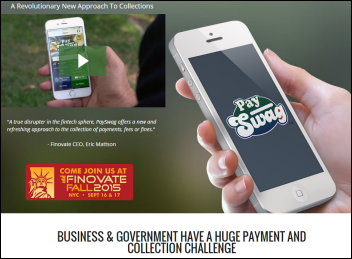
This could be interesting for healthcare. A startup creates a payment collections app that sends payment reminders, rewards customers for paying their bills on time, and the ability to request payment plan changes electronically after losing a job or bearing unexpected expenses.

image

In the UK, Computing magazine digs into the Epic project costs for Cambridge University Hospitals NHS Foundation Trust, which was just put into “special measures” for incurring host of financial, clinical and Epic-related problems. The project will cost $300 million over 10 years, of which Epic will be paid $91 million and the rest is IT infrastructure. Beyond that, the systems Epic replaced will remain in place at an annual cost of $15 million until their information can be migrated to Epic.

A note to vendors: your “how to prepare for ICD-10” articles are too late. It’s here and there’s no time left to start training, analyze the most commonly used codes, or arrange loans in case receivables get hung up.


Sponsor Updates

  • Hayes Management Consulting and Liaison Healthcare will exhibit at the 2015 Fall CHUG Conference October 1 in New York City.
  • Holon Solutions will exhibit at the NRHA Critical Access Conference September 30-October 2 in Kansas City, MO.
  • Ingenious Med CMO Steven Liu, MD is featured in The Atlanta Journal-Constitution.
  • InterSystems will exhibit at the iHT2 Health IT Summit September 29-30 in New York City.
  • Crossings Healthcare Solutions will exhibit at the Cerner Health Conference October 10-14 and the NJ/Delaware Valley Regional HIMSS meeting October 28-30.
  • LiveProcess will exhibit at the California Hospital Association’s Disaster Planning for California Hospitals Conference September 28-30 in Sacramento.
  • First Databank posts a video in which VP Dewey Howell, MD, PhD talks about the design and usability of its MedsTracker electronic medication reconciliation solution.
  • Talksoft Outreach 3.0 earns ONC-HIT 2014 Edition Modular Certification.
  • NVoq will exhibit at the RBMA Fall Education Conference September 27 in Austin.
  • PerfectServe will exhibit at the Maryland MGMA State Conference September 25 in Baltimore.
  • PeriGen offers a new white paper, “The Physiology of the Fetal Heart Rate Control.”

Blog Posts


Contacts

Mr. H, Lorre, Jennifer, Dr. Jayne, Dr. Gregg, Lt. Dan.

More news: HIStalk Practice, HIStalk Connect.

Get HIStalk updates.
Contact us or send news tips online.

125x125_2nd_Circle

EPtalk by Dr. Jayne 9/24/15

September 24, 2015 Dr. Jayne 1 Comment

clip_image002

We’re just under a week until ICD-10 hits and I’m starting to hear about some potential issues. One of my colleagues received an email from his vendor informing him that although he had taken all required patches and performed all necessary steps, he needs to take another small patch. Needless to say he’s not amused and I don’t blame him. As one of the few independent small practices left in the community, it’s not like he has a full IT staff that he can just hand it off.

clip_image004

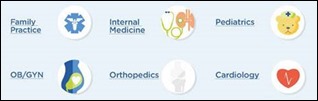
I’ll be glad to stop receiving daily emails about ICD-10, especially the ones from CMS including these questionable graphics. Although the cardiology and orthopedics ones make sense, I’m puzzled why family practice is represented by the Star of Life, which traditionally represents ambulance and emergency medical services. If you look carefully, there are two snakes on the staff, making it the staff of the god Hermes rather than the Rod of Asclepius. Wikipedia has a great summary of the “one snake or two” controversy, including some ironic points, if you’re looking for a diversion. At least we’re not represented by an unfortunately stylized uterus or a sad-appearing bear, so I shouldn’t complain.

It will be interesting to see if we have a government shutdown competing with ICD-10 for attention. Regardless, the work of ONC rolls on. Public comments are being accepted on a draft of the 2016 Interoperability Standards Advisory. The comment period is open through November 6. The Advisory includes not only recommendations from the HIT Standards Committee, but also feedback from public comments on the 2015 Advisory.

Primary care physicians are nowhere near the top of the physician salary list, so they’re often concerned about the cost of delivering new models of care. Although they will receive higher payments if they can demonstrate greater quality, it often requires hiring more staff to implement programs to move the quality needle well before the first payment increase arrives. One of my former partners forwarded a Medscape article that lists the cost of maintaining a Patient Centered Medical Home practice at over $100K per physician per year. This represents the extra staffing needed for increased quality reporting, patient outreach, and care management.

The data comes from a University of Utah study that looked at 20 primary care practices across Utah and Colorado. The data assumed a patient panel of 2,000 patients with an incremental cost per member per month of about $4. Physician leaders are using the information to help spur payment reform, including requests for upfront payments to transform practices and train staff. The study looked at practices that were already high functioning with EHRs in place. For less-advanced practices, the cost of PCMH will be even higher.

I’m extremely happy to report that I have delivered my last scheduled ICD-10 training session. I left a few days open for last-minute stragglers, but it doesn’t look like I’m going to have any takers. I’m glad for a couple of days without client engagements so that I can recover from the last six weeks. I can only describe them as a slog. I plan to catch up on Netflix (“Call the Midwife,” Season 4 is beckoning) and rest as much as possible. I’m sure next week will bring some emergency consultations and I want to be ahead on my beauty rest.

It won’t be all fun and games, though. I’ll be attending Monday’s FDA/CDC/NLM Workshop on “Promoting Semantic Interoperability of Laboratory Data.” I’m looking forward to the scheduled panel discussion on LOINC adoption. Although all the EHR vendors I work with support LOINC result codes, I’ve struggled with several reference lab vendors who fail to deliver the codes with results. Even the large national reference labs seem to struggle with this and I’ve had to push some regional lab representatives to deliver what my clients need. It shouldn’t be this hard. There’s also an open public comment section, but comments had to be submitted in advance, so I don’t expect much drama.

I wanted to be a physician since I was small. Thinking back on a career in medicine that morphed into one in informatics, sometimes I’m still surprised by some of the things I end up discussing in casual conversations. LOINC codes are one of those things. I stumbled into a lab normalization project at my health system that led to a clinical repository project that morphed into a standardized order project. After beating my head against the wall with disparate lab systems as they gradually came together, I really became a fan of LOINC and it’s something I enjoy working with.

I have a client who insists on pronouncing it “Low-Ink.” The first couple of times they said it, I had trouble connecting the dots to figure out what they were talking about. While I was cruising the LOINC website the other day, I came across this page confirming it really does rhyme with “oink” and also that the pig is the “unofficial official mascot” of LOINC.

Have you worked with a vendor or a technology that has a mascot? Email me.

Email Dr. Jayne.

Morning Headlines 9/24/15

September 23, 2015 Headlines 2 Comments

Accenture Adds Distinctive Electronic Health Record Consulting Capabilities with Acquisition of Sagacious Consultants

As reported by HIStalk readers yesterday, Accenture acquires Sagacious Consultants for an undisclosed sum.

GE Healthcare Announces $300 Million Commitment to Support Emerging Market Health

GE Healthcare, the $18 billion healthcare technology division of GE, announces the creation of a new business unit that will focus on bringing low cost, high impact health technology solutions to Africa and parts of Asia.

Interoperability Tops ‘To-Do’ List According to Medical Students

Athenahealth publishes findings from its annual Epocrates Future Physicians of America survey, which finds that 96 percent of medical students believe that improving EHR interoperability is important to patient care, while 87 percent support the creation of a universal patient record.

Why Cleveland Clinic Shares Its Outcomes Data with the World

Michael Kattan, PhD and the chair of the quantitative health sciences department at the Cleveland Clinic’s Lerner Research Institute, writes a Harvard Business Review article explaining how the Cleveland Clinic captures and analyzes its outcomes data and why it publically reports all of its findings.

Morning Headlines 9/23/15

September 22, 2015 Headlines Comments Off on Morning Headlines 9/23/15

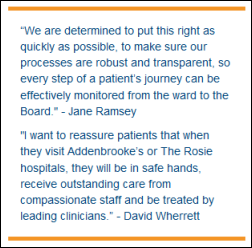
Addenbrooke’s and Rosie hospitals’ patients ‘put at risk’

In England, the Care Quality Commission inspects Cambridge University Hospitals Trust, Epic’s sole UK customer, and finds that the implementation negatively affected the hospitals “ability to report, highlight, and take action on data” and caused medications to be incorrectly prescribed.

The Future of Emergency Department Information Systems

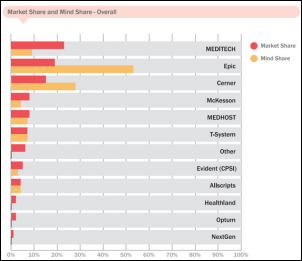
Peer60 publishes a report on the EDIS market, finding that 32 percent of respondents plan to switch ED vendors, with Meditech leading in market share and Epic leading in replacement vendor mind share.

FDA Announces First-ever Patient Engagement Advisory Committee

The FDA launches a new patient engagement advisory committee made up of nine voting members who are experts in clinical research, primary care patient experience, and the health care needs of patient groups.

Adventist Health System to pay $118 mln to settle fraud claims

Adventist Health System (FL) will pay $118 million to settle a whistleblower lawsuit alleging that it paid kickbacks to providers in exchange for referrals.

Comments Off on Morning Headlines 9/23/15

News 9/23/15

September 22, 2015 News 10 Comments

Top News

image

ONC’s just-released five-year “Federal Health IT Strategic Plan” says the federal government learned from HITECH that federal entities need to integrate their health IT planning and the need to move to a person-centric health IT infrastructure. ONC revised its plan based on stakeholder comments that it was too focused on data and systems rather than how participants in the healthcare system can work together. Nothing in it stood out as interesting, other than that I didn’t see any direct reference to ONC’s proposed Health IT Safety Collaboratory.


Reader Comments

image

From Long Time, First Time: “Re: Dr. Jayne’s post on Theranos. Is this what passes for critical thinking in the doctor’s lounge? I doubt Theranos or Ms. Holmes has any more obligation to educate patients than your profession does, which after centuries of privilege, takes little accountability for their ignorance.” I think Dr. Jayne will respond.

From K-Dog: “Re: Volkswagen emissions scandal. Did anyone else immediately think of EHR certifications?” Volkswagen sets aside $7.3 billion for recalls and penalties and the CEO of its US division admits that “we have totally screwed up” after the company was caught programming the software in its diesel cars to under-report their emission levels that were up to 40 times the allowed amount. I don’t know if there’s an EHR equivalent unless a vendor either earned certification fraudulently (which would be the certifier’s problem) or the once-certified certified product no longer meets the requirements. The one and only de-certification was because the company went out of business (as did the original certification body, CCHIT).

From Former Epic: “Re: Epic. Anyone grossed out by the passive-aggressive media blitz it’s running via its clients? Refusing to exchange more than minimum data and forcing providers to install EHR systems again is irresponsible and motivated by hubris. Legacy Health, no one is ‘snake oiling’ us into believing that Epic isn’t doing the right thing. They are showing us with their hypocritical rhetoric. Stop being a mouthpiece for a big vendor that can fight its own battles.” CIOs at Epic-using health systems can’t win. If they say anything good about the company, people who don’t like Epic for whatever reason accuse them of being mindless lemmings or cunning company shills. Not only that, people who wax pedantic on what they think is wrong with Epic marginalize those provider CIOs who actually chose and use the system, as though hands-on expertise is by definition tainted by self-interest. I don’t know of any other industry where sideline observers are assumed to have more credibility than paying customers. If healthcare IT were Yelp, we would allow each restaurant to be reviewed only by self-appointed experts who haven’t actually eaten there.

image

From Rumor: “Re: Cohealo founder Mark Slaughter. Removed from the website – out as CEO?” Apparently – his LinkedIn profile says he’s gone as of this month and is now a “healthcare entrepreneur.” According to the supply chain technology company’s executive page, he’s been replaced as CEO by co-founder and COO Brett Reed, whose pre-Healo career was at Burlington Coat Factory.

From Feeling Bamboozled: “Re: Sagacious Consultants. Announced to employees Tuesday night that they’re being bought by Accenture. Transition over the next 10 days, according to leadership.” Unverified since it’s late in the day Tuesday, but I’ll probably get confirmation or denial on Wednesday.


HIStalk Announcements and Requests

image

Bird Blitch was incorrect in tagging his $100 donation to my DonorsChoose project as “not being much, but it adds up.” It actually provided a lot for the elementary school class of Ms. Thomas from Jonesboro, GA, which will get an iPad Mini, a kid-proof case, and a bean bag chair to create a Math Exploration Station, with matching funds my anonymous vendor executive and that total amount doubled again by the Smarties candy folks. I even had enough money left over to give Mrs. Lantinga’s eighth-grade science class in Battle Creek, MI two science magazine subscriptions to replace the five-year-old copies they were using for their weekly class discussions about science “current” events, with matching money from my vendor person as well as the Bill & Melinda Gates Foundation. One of Mrs. Lantinga’s advisory council students explained why they hoped their grant requests would be funded on behalf of their 125 classmates: “I think that the rest of the kids will look at us as leaders because we saw a problem and came up with an idea for a solution and that’s what a leader would do."

Here’s one of the most valuable lessons I learned in my MBA program. Sunk costs (money already spent) shouldn’t affect go-forward decisions. In a  a real-life example from my own recent experience, I bought inexpensive tickets for a football game that I didn’t really care about other than to enjoy the game-related activities outside the stadium. Torrential rains caused those pre-game activities to be cancelled. Should I go anyway since I’d already bought the ticket? Correct answer: no. I wasn’t going to get the money back either way, so the only consideration was whether I’d rather spend the time doing something that didn’t involve huddling miserably under a poncho. When making a decision about anything in business or otherwise, forget historical financial or emotional investments and evaluate your options starting only with right this minute. In other words, don’t throw good money after bad.


Webinars

October 7 (Wednesday) 1:00 ET. “Develop Your Analysts and They’ll Pay for Themselves.” Sponsored by Health Catalyst. Presenters: Peter Monaco, senior business intelligence developer, Health Catalyst; Russ Stahli, VP, Health Catalyst. It takes years for analysts to develop the skills they need to build reports and dashboards that turn data into valuable insights. This webinar will describe how to cultivate those analytical skills, including technical prowess and adaptive leadership. Leaders will learn how to develop a culture that fosters improvement, how to encourage analysts to develop the right skills, and ways to remove the barriers that stand in their way.

Here’s the video of Tuesday’s webinar from The Breakaway Group titled “Just Step on the Scale: Measure Ongoing EHR Success and Focus Improvements using Simple but Predictive Adoption Metrics.”


Acquisitions, Funding, Business, and Stock

image

Phynd Technologies secures $1.1 million in Series A equity funding to accelerate growth of its provider management platform, raising its total to $3.1 million.

image

Specialty EHR vendor Modernizing Medicine raises $38 million in Series E financing, increasing its total to $87 million.

image

Ascension invests $18 million in data analytics vendor Atigeo and will use its technology as a customer. It’s not a healthcare-specific product.

Wolters Kluwer says it will acquired India-based digital health solutions startups.


Sales

image

John Muir Health (CA) chooses Health Catalyst’s enterprise data warehouse and analytics platform.

image

Sharp HealthCare (CA) chooses Qpid Health for PQRS compliance.

image

Duke Clinical Research Institute (NC) will implement VitalHealth Software’s QuestLink to allow clinical trials patients to report their outcomes electronically.

Memorial Medical Group (IL) chooses the eClinicalWorks EHR.


People

image image image

Healthgrades makes three executive hires: Keith Nyhouse (TeleTech) as chief marketing officer, Mayur Gupta (Kimberly-Clark) as SVP/head of digital, and Kate Hyatt (ProBuild Holdings) as SVP/chief people officer.

image

AxisPoint Health, the former McKesson Care Management division that was sold earlier this year, names Ron Geraty, MD (DermOne) as CEO.


Announcements and Implementations

AirWatch announces that its mobility management solution is iOS9 ready.


Government and Politics

image

Adventist Health System (FL) will pay $119 million to settle a whistleblower lawsuit that accused it of paying doctors kickbacks for their referrals, the largest settlement ever for referral improprieties. Three former employees of Park Ridge Hospital (NC) will divide up to $30 million of the settlement.

The FDA announces formation of a Patient Engagement Advisory Committee made up of experts and a single consumer representative that will advise it on complex issues.

image

England’s Chief Inspector of Hospitals recommends that Cambridge University Hospitals Trust be placed under remedial oversight after finding significant problems with its finances, staffing, and its Epic rollout that caused clinical issues. The inspector says employees are caring and skilled, but hospital executives have “lost their grip on some of the basics.”

I didn’t catch this story two weeks ago: CMS gives California Medicaid a waiver allowing it to keep submitting ICD-9 claims after the October 1 switch to ICD-10. California started a six-year, $1.6 billion upgrade of its Medicaid systems in 2010, but it’s still testing the Xerox-developed changes for ICD-10. CMS will allow California and three other states to submit ICD-9 codes that it will try to convert to ICD-10 equivalent using a crosswalk table.

image

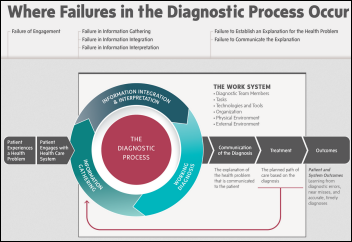
A new IOM report called “Improving Diagnosis in Health Care” makes these health IT recommendations:

  • Software vendors and ONC should ensure that health IT systems used for  diagnosis demonstrate usability, incorporate human factors knowledge, integrate measurement capability, integrate with clinical workflow, provide clinical decision support, and facilitate timely information flow among patients and providers.
  • ONC should require that IT systems allow effective flow of information across care settings to support diagnosis by 2018, including meeting interoperability standards.
  • HHS should require health IT vendors to have their software independently evaluated to determine if it could cause adverse effects on diagnosis.
  • HHS should help users exchange information about their experience with health IT design and implementation that could effect diagnosis.

Privacy and Security

NYU professor Arthur Caplan frets about the medical privacy of sensor-containing pills for NBC News, saying the just-approved tablets (he calls them “snitch pills”) from Otsuke Pharma and Proteus Digital Health “will let third parties snoop on you and nag you if they see you are not doing what the doctor ordered.” I think his concerns are unfounded and I would instead consider the broader problem of the societal cost of patients who intentionally don’t do what’s good for them. It’s like “intrusive” laws that require motorcyclists to wear helmets so the rest of us aren’t stuck footing the bill when their inevitable helmet-free crash sends them to years of expensive ventilator care. I think smart pills are an overly intrusive and expensive way to address patients who don’t take their meds as prescribed, but I seriously doubt that anyone is going to poach the entirely uninteresting data they create for evil purposes.


Other

image

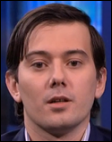
The 32-year-old former hedge fund manager turned CEO of a drug company that acquired a 60-year-old AIDS drug for $55 million and then increased its price from $14 per tablet to $750 says the drug costs only $1 per tablet to manufacture, but it was underpriced compared to other expensive drugs on the market. He responded to a tweet questioning the price hike with, “You are such a moron.” The Wall Street Journal noted in April the trend of aggressive drug companies buying patents of drugs sold by competitors and then jacking up their prices by multiples, with one company raising the price of two old heart drugs that still had no generic competitors by 525 percent and 212 percent the day they bought them. In related news, a drug company that bought rights to an old tuberculosis drug and then increased its price 20-fold gives the drug back to the non-profit that previously owned it just three weeks before, with both organizations stung by public outcries of price gouging. The most interesting aspect of all of these examples is that the drugs are off patent, yet nobody makes a generic, leading to one of two conclusions: (a) the market for the drugs is so limited that the few patients who need them have to pay the entire cost of manufacturing and marketing them; or (b) generic manufacturers have been bribed not to jump in. Either is a big problem for overall healthcare costs.

image

Peer60’s new EDIS report finds that hospital EDs are getting significantly more visits and one-third of them plan to switch ED information system vendors in the near future. Most interesting to me is that the integrated vendors (Allscripts, Cerner, Epic, and Meditech) are the most likely to lose clients. Meditech has big-hospital market share, but almost zero mind share, which sounds like an opportunity for someone. Usability was the #1 user-reported problem by far at 49 percent, but one-third of respondents say there’s nothing their vendor can do to keep them because they’re switching to their EHR vendor’s EDIS anyway. Nearly half of respondents say their increased ED volume is due to the lack of available primary care.

image

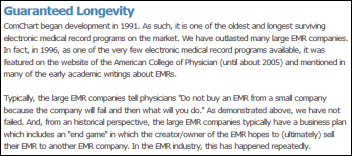
Howard Zwerling, MD, president of ComChart Medical Software, announces that he’s taking his company’s EMR off the market because its underlying technology (Filemaker, various browser plug-ins, and fax programs) makes upgrades too slow and unreliable. He takes shots at the EHR market on the way out the door, saying that evidence that healthcare IT is effective is lacking and “the large EMR/EHR vendors now have undue influence over the Federal Government’s HIT initiative.” I might offer a counterpoint – the predictable problems the physician had as a spare bedroom programmer trying to write, sell, and support an EMR as a side job is precisely why those big vendors are succeeding and he failed. He didn’t have a problem with the government and its EHR industry bailout when he was selling his system, saving his parting shot for when he shut down and left his customers in a lurch (after reassuring them otherwise – above). This necessary thinning of the EHR herd is exactly what the industry needs in getting to fewer but better vendors as we finally graduate from opportunists who incorrect believe that the software business is easy and then cut and run when they find it isn’t.

Medical school professor Aaron Carroll, MD, MS writes about health IT from his perspective as a chronic disease patient in the New York Times, observing that his health plan keeps changing lab providers that don’t share his information, faxes are flying around because labs don’t connect electronically with practices, mail-order pharmacies require starting over when the health plan changes to a new one, and a communications nightmare happens when he tries to coordinate getting his same old prescriptions and lab orders repeated as required by the insurance company.

The local paper explains the newly implemented visitor policy of Halifax Health (FL), which will print photo-bearing visitor badges after first checking the visitor against a sexual predator list.

Weird News Andy calls this story “Shark Snark,” which he found on “the highly respected site E-Online.” More people are killed taking selfies than are killed by sharks. WNA helpfully looked up the ICD-10 codes, W56.41 (bitten by a shark) and W56.42 (struck by a shark). Only one deals with selfies, Y93.C2 (activity, hand held interactive electronic device). WNA laments, “When, oh when are we finally going to have a coding system that accurately reflects the modern world in which we live?”


Sponsor Updates

  • AirStrip will exhibit at the Southeast Pediatric Cardiology Society Conference September 25-26 in Birmingham, AL.
  • Aprima Medical Software will exhibit at the Colorado MGMA Fall Conference September 24-25 in Breckinridge.
  • Capsule Tech will exhibit at the Academy of Medical-Surgical Nurses Annual Convention September 24-27 in Las Vegas.
  • Clockwise.MD CEO Mike Burke will speak at the Urgent Care Fall Conference September 24-26 in New Orleans.
  • Cumberland Consulting Group CEO Brian Cahill shares the company’s motto for growth with the Nashville Business Journal.
  • Nordic adds its 500th Epic consultant.
  • Forward Health Group CEO Michael Barbouche will speak at the American Heart Association’s Check, Change, Control summit in San Francisco on October 22.

Blog Posts


Contacts

Mr. H, Lorre, Jennifer, Dr. Jayne, Dr. Gregg, Lt. Dan.

More news: HIStalk Practice, HIStalk Connect.

Get HIStalk updates.
Contact us or send news tips online.

125x125_2nd_Circle

Morning Headlines 9/22/15

September 21, 2015 Headlines Comments Off on Morning Headlines 9/22/15

Federal Health IT Strategic Plan: 2015 – 2020

ONC publishes its five-year strategic plan which proposes shifting the national focus from EHR implementations to improving patient engagement, supporting the transition to value-based reimbursement models, expanding the use of EHR data mining in research, and improving the nation’s health IT infrastructure.

Google’s NIH steal Tom Insel on the ‘major paradigm shift’ of digitizing mental health care

Tom Insel, MD and former director of the National Institute of Mental Health, discusses his decision to move to Google and the work he plans to do there.

In Unit Stalked by Suicide, Veterans Try to Save One Another

The New York Times profiles the 2/7th Marine Regiment, whose veterans have a suicide rate 14 times higher than the average American, and the homegrown tracking systems that former members of the unit have created to help coordinate emergency response efforts at a national level.

Maintaining PCMHs Will Cost $105,000 per Physician per Year

Researchers calculate the number of hours it would take a primary care physician to complete the tasks outlined in the National Committee for Quality Assurance’s standards for maintaining patient-centered medical homes, and conclude that it would cost $105,000 per year in additional time spent.  

Comments Off on Morning Headlines 9/22/15

Curbside Consult with Dr. Jayne 9/21/15

September 21, 2015 Dr. Jayne 6 Comments

clip_image002 

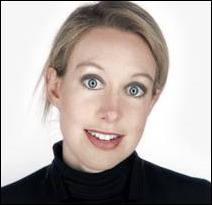
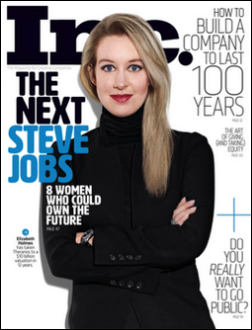
A quote in this week’s Monday Morning Update caught my eye. Billionaire CEO Elizabeth Holmes of Theranos addressed concerns that average patients aren’t capable of understanding their test results:

The idea that I as a human should not be free to access my own health information, especially using my own money – even though I can buy weapons and anything else I want – and rather should be legally prohibited from doing so, summarizes the root of the fundamental flaw we’re working to change in our healthcare system.

While Holmes may be a prodigy and a billionaire, I wonder how much real-world experience she has interacting with real world patients. It’s likely to be minimal, since she readily admits to barely having a life outside of Theranos. She’s quoted as saying she “doesn’t really hang out with anyone any more” and also doesn’t date, saying she “literally designed my whole life for this.” She even chooses her wardrobe based on efficiency and elimination of the need to make decisions.

Certainly she has advisors — some of them might want to clue her in on what the average patient’s situation looks like. Most of my patients don’t have the means to buy anything they want. Many haven’t had the opportunity to attend college and would find it hard to understand why someone would drop out. Some of them barely graduated from high school. General literacy is an issue, pushing health literacy farther down the list. Most of our patient education materials are written at the fifth grade level and even then it’s still not understandable.

I’m puzzled by her reference to buying weapons as well as her premise that we aren’t already free to access our own health information. Although it might be sometimes challenging (as Mr. H has illustrated in his quest to get a copy of his hospital chart), records are generally more open than they’ve ever been. I’m confronted on a regular basis by patients who have received laboratory results directly through a patient portal and are worried about what they see since it’s often delivered without context. I have had several patients bring in printouts from an EHR patient portal and ask for me to explain high or low lab values when they see them on the weekend and can’t get in touch with the ordering physician.

Unfortunately, they’re often out of context even for me. If I don’t have access to the ordering physician’s thought process or other benchmark values, I can’t really advise the patient one way or the other. Maybe it’s a low value and it’s trending up or maybe it’s getting worse, but it’s often impossible to tell. Knowing that many patients don’t understand the idea of reference ranges (defined by statistics – so that you can be “out of range” but still healthy) it’s likely they won’t understand more complex concepts such as the positive predictive value of a test or its ability to rule in or rule out a disease.

In the interview Mr. H referenced, the examples of breast and prostate cancer are mentioned. Screening tests can lead to false positives and unnecessary procedures. Over the last several years, we’ve seen PSA testing fall out of favor, but patients still request it. Once I discuss the evidence, a good percentage of patients decide to opt out. Given the availability and accessibility of cheap testing, patients might opt in to testing that could be dangerous to their health. Theranos has been instrumental in creation of Arizona laws that allow patients to order their own tests. Based on the fact that tests aren’t without risk, I’m not sure I agree with that approach.

I also disagree with their premise that 40 percent of people don’t get blood tests ordered by their physicians because of the fear of a traditional blood draw. Holmes is admittedly “terrified” of traditional needles. I agree with her assertion that cost is an issue that prevents patients from receiving recommended tests, but I’ve only seen one patient in my career with an actual fear of needles.

I do agree our healthcare system is broken. If Theranos can compete with the large reference labs, everyone will benefit from reduced costs, improved access, and less-invasive testing. If they inspire patients to take charge of their health, even better. But I’d challenge them make sure they’re putting their proverbial money where their mouth is by also providing education, not only to patients, but to the greater community.

Holmes is experimenting with life in the outside world and has been speaking to young women to promote academic achievement. I’d love to see her champion health literacy so that the average person can truly become empowered to take charge of his or her own health. Theranos has multiple job postings for creative, sales, and marketing positions – what better way to leverage them? Even though she’s dedicated her life to solving a narrow problem, she may find other ways to think about it as well as experiencing a greater connection with the people she’s trying to serve.

What do you think about Theranos? Email me.

Email Dr. Jayne.

HIStalk Interviews John Kenagy, PhD, SVP/CIO/CISO, Legacy Health

September 21, 2015 Interviews 3 Comments

John Kenagy, PhD is SVP/CIO and chief information security officer of Legacy Health of Portland, OR.
image

Tell me about yourself and Legacy Health.

Legacy Health is headquartered in Portland, Oregon. We’re a health system that operates in the southwest Washington / Portland area with six hospitals — two urban, a children’s hospital, three suburban hospitals, and a number of clinics. It’s a typical community-based health system with employed physicians and clinics, moving towards population health and more risk. A very traditional health system founded in 1875.

I have been the CIO here for about three and a half years. I’ve been a CIO for 26 years and have had the distinct honor to have worked in interesting organizations that were each very different. First in the VA system — I worked there for 13 years with my final job as a regional CIO, Then Oregon Health & Science University, the academic medical center here in Oregon. Then Providence Health & Services, a Catholic system throughout the west. Now Legacy.

What discussions are you and your peers having about how the organization should look in five or 10 years and IT changes that will be needed to support those changes?

Two themes are recurring and they’re very interrelated. One is the whole area of population health and risk. Value-based purchasing is risk, taking the entire premium and accountability for lives. That transition from paying for providing healthcare to maintaining health and what that implication is organizationally and of course from a technology perspective. The other one is around insurance. We’ve been a traditional healthcare provider for many, many years. Do we — through either partnership or de novo creation — get into the insurance business? 

Let me start with the first one, because I think it’s challenging and fascinating. I think all my peers are working on the same kind of issues, which is, as we move from patient care to population health, it is forcing us to look beyond the four walls. Whether that’s accountable care organizations, bundled payments, or again risk for care not only delivered in your organization, you want to do it the best value — the optimal quality at the lowest cost.

What happens when that patient is on vacation and goes to an ED? That cost is now attributed to your bundled payment, readmissions, and working outside of just the four walls. If you are a traditional organization like Kaiser or the VA, which has all that care within its organization, that’s one thing. You can control the IT, systems and access. For an organization like ours, which is very much a community-based hospital system, we employ 500 doctors, but our medical staff is 2,000. Those other 1,500 are not on our EMR. They’re very independent. They value their independence and worry about when the hospital tries to get more into that.

In the future, with population health and new payment mechanisms that focus on the overall quality and experience of the patients, it’s really a good thing. We’ve been working many years on integrating all of our data into a single system. We are an Epic shop and love the fact that we have an integrated information system, but now with population health, we are consciously moving away from a 20-year ride toward integration into a single database only to say, "That’s great for our hospital, but now we need to play well with every other EMR and now claims data and insurance information."

The complexity of how to do that is extremely challenging. We’re working through that right now, as I think many vendors are, and of course the EHR vendors as well.

Some publications and Epic detractors claim there’s a backlash against Epic after all these years. Is that the case? What is Epic doing right and wrong?

I see that a lot. The paparazzi follow the popular stars. Bad press comes to successful people. It’s our sick culture of wanting to kick the person in the top primary position. I think that’s what’s happening with Epic right now.

I am very pleased that we have Epic as our partner here at Legacy. I think that makes our healthcare better because of the integrated system across inpatient ED and outpatient, not to mention revenue cycle and all the other things. It’s an amazing organization that is very dedicated at its core to a patient care, but also to the success of its partners. I value that greatly.

I wouldn’t say this is what they’re not doing well, but they are burdened by the fact that they are a fully integrated system and have everything from hospice and home health to very acute ICU. You have niche players in the population health space that are coming in a little bit with snake oil and saying how fabulous they are and it’s very easy.

These other vendors, these competitors — particularly in the population health space — are 100 percent dedicating all their energy, all their R&D, all their engineers on that niche product. That’s hard for Epic because they need to do that and other innovations while also making sure that we successfully meet all the Meaningful Use requirements and the transition to ICD-10. I wouldn’t say that that’s something that Epic is not doing right. 

When you have an integrated system — CIOs deal with this all the time — we’re having to re-market that value of integration when in a niche clinical practice, operation, or this case pop health, our operational colleagues come with, "Here’s a vendor that’s promising to make it easy and doable." Everyone says they interface with Epic, but that makes it hard.

Which systems do you think you’ll need to buy from somebody other than Epic?

The big one, obviously, is blood bank. The easiest answer to that are the areas where Epic doesn’t have a product. If you’re a Meditech hospital, you can run payroll, materials management, and general ledger on your platform. Epic doesn’t do the administrative systems. They don’t want FDA regulation — not to speak for them — so they don’t have a blood bank system.

Obviously the items that are closer to clinical care and quasi-biomedical and quasi-EHR. One I’m thinking of is Provation for gastroenterology. We have a number of specialty clinical systems that attach into that system. Fetal monitoring, for instance.

The one that is challenging is business intelligence reporting and population health, where so much of the data resides in Epic but there’s also an incredible amount of data that is community EHRs and insurance information, payer information, and claims data.

We’re actually running two horses in the race. One is Epic and one is a different partner. Seeing where our long term is. I believe we’re in such the early infancy of that BI population health analytics world that I don’t think there’s a clear winner yet. We are exploring both Epic and partnership with Evolent in parallel.

Are genomics and personalized medicine important to your clinicians?

I don’t hear it. I love the way you phrase that question. Is it on our radar screen, or is it something that I’m being asked by our clinical folks? Not yet.

As a CIO, you’re always worried that there will be a sleeping giant, and then at the eleventh hour, we’ll get a knock on the door and they’ll want it in two and a half weeks. We’re keeping our ear to the ground, particularly genomics and how it would relate to pharmacy prescriptions and treatment planning. I think it’s probably end of the decade at the earliest. That’s kind of an off-the-cuff answer, but I think it’s going to be on our radar screen, but it’s not immediate.

If I’m a health IT vendor or consultant, how will my business change as big health systems get even bigger and swallow up what would have been their smaller competitors or different types of providers?

I’ve heard this era called the post-EHR era, which is funny, because it’s more like the post-EHR sales era. We’ll always have our EHR. 

The challenge for us as providers and what we seek vendors and consultants to help us with is a combination of merger and acquisition. The bottom line of this is all the data needs to come together at the right point for making decisions, whether that’s a broader decision around going into a business or what do I prescribe to this patient right in front of me. As I said, our industry’s had this 20-year march towards moving from best-of-breed and integrating into holistic systems that see the patients together, a Cerner or Epic or Allscripts where you have a fully integrated record.

We are at Legacy at HIMSS 7 across all of our hospitals, so it’s a really successful deployment of Epic everywhere. Now we’re saying, we’re going to merge with a smaller hospital that has Meditech. We need to work very collaboratively within our community, within the larger ecosystem. Inherently that is 45 deployments of about 15 different EMRs and how to do that well so that the data that are relevant to making a clinical or operational decision is readily available.

That challenge, while we’ve been focused on integrating to a single system … the funnel has become narrow, and as soon as we’re at that narrow point, now it’s open wide. Get data from, as I said earlier, claims, other EMRs, and even people who are not yet automated. That’s a big challenge. We’re all forging this new ocean independently and a little bit alone. It’s interesting to be Christopher Columbus in this era.

What kind of services or service venues will be developed in recognizing that a hospital’s future isn’t just keeping beds filled?

That’s a great issue. It is something that’s on the top of mind of our leadership team. Moving even the paradigm from beds and hospitals being a profit center to being a cost center.

We’ll always need beds. America is aging. Acuity rises. What we’re doing is taking low-cost, low-acuity out of the hospital and even outside of the ambulatory to the home. What you’re left with is beds that are incredibly required and incredibly acute. You become an inpatient because you need nursing care, not for almost any other reason. Very high-tech stuff that happens in the hospital, but also around-the-clock surveillance by nurses. That challenges us to be able to incorporate data from the home and ambulatory and get that to clinicians so that people are being able to look at change in status regardless of the venue.

Once you’re discharged after an MI, are you gaining weight? Are you retaining water? Is there an issue with taking your medications? Being able to intervene in a trajectory earlier on rather than waiting for it to become acute and come back to the ED and have a readmission. From a data perspective, it really is a challenge to bring all that information and analyze it with machine code to inform and give the right care manager information at his or her fingertips.

Will costs eventually go down? Health system budgets always seem to grow no matter what reimbursement pea is put under what shell.

The cost of healthcare is interestingly a big topic with our board. Our management has been working on it all along, but it’s raised the attention to the board as the cost of the healthcare in America and what percentage of a company’s employee costs are going into the healthcare costs.

Our board members are community leaders. Some are physicians, but a number of them run their businesses. They’re great leaders in the Portland and southwest Washington communities. “It’s costing me more, so what are you doing, Legacy, to help bend this cost curve?" When the board has a focus on something, we in management pay attention as well.

I think that there will be improvements in cost. Not in the sense of quality, so that’s what the balancing act is. Value is a mathematical equation with outcomes and satisfaction on the top and cost on the bottom. You reduce value by increasing cost because the denominator goes up or you decrease value if outcomes and patient experience go down as you put too much attention to cost.

We’re working with a company called Strata Decision. That’s our financial management system. We’re one of the pioneer adopters of what they’re calling continuous cost improvement. It is a way to bring clinical quality and cost data together and inform managers of needless variation and where costs are going up. I’m very excited about it. I think a year from now, we’ll have rich information in the hands of managers, the OR, the orthopedic product line, and the cardiology product line that will inform them of variations in quality, variations in cost, and focus their attention on doing things that reduce needless variation.

Measuring patient satisfaction gives patients a voice, but there’s the question of whether they are qualified to evaluate anything beyond the hotel part of their hospital stay. Do you talk a lot about how to balance patient satisfaction versus the quality metrics that they probably wouldn’t even comprehend?

We do a lot. The interesting driver of that is transparency. Patients trusted their doctor. They certainly didn’t trust their insurance company and they barely trusted the hospital, but they certainly trusted their physician. When the physician said, "You need to become hospitalized and I’m referring you to Legacy because I value them," patients assume a level of quality because they don’t have the data. They don’t understand what quality looks like.

As information becomes more transparent about outcome quality, whether that’s Healthgrades or HealthCompare, we’re doing a lot to engage patients. We’re starting to deploy GetWellNetwork at all of our hospitals to get real-time patient feedback from inpatients. Rate your pain. How are we doing in terms of informing you of what’s going on? It’s not just TV and infotainment. It really is a way to get patient engagement real time.

It is a national commitment, particularly in Medicare, to do post-hospitalization surveys. You get that survey and it runs through their process, so you know six weeks later how the thing was. That’s driving the car looking only in the rear-view mirror. Being information driven. Being able to solicit information and feedback from the patients during their stay about how informed you feel, how satisfied are you, is there pain and other experience during the inpatient stay. Being able to intervene on that real time is a big driver for us.

How does a health system avoid becoming the next front-page breach victim?

You can’t, which is a bleak answer to that. I’m beginning to hear in the CISO industry in healthcare the need to change the paradigm from villain to victim.

The one that I am very concerned about is that the breaches that are happening now are very concerted, usually foreign, usually well financed. It’s not just the simple hacker that’s trying to get something or the “I Love You” virus that someone gets their jollies putting that into the email system and that propagates around the whole Internet around the world. We’ve got a lot of things that solve that. It’s the persistent phishing, very pernicious attacks, Anthem and the very big ones.

I don’t know how I alone at Legacy with my information security team – a great team of five people and our 300 people in IT – can be our own shield against the People’s Republic of China. I just don’t know how that is the expectation. We’re fairly sophisticated in terms of our information security portfolio compared to a smaller hospital or a physician’s office, but if the commercialization of medical record numbers becomes 20 times the value of a credit card number, how am I supposed to defend against literally a foreign invasion done through electronic mechanisms? I think there needs to be a lot more federal attention to that.

If we have a violation like that, because of HIPAA, we become a villain. Turning a blind eye and basically saying, "There’s no defense and I can’t help myself" is an abrogation of your responsibility. But putting in the normal standard things and even advanced systems and surveillance and protections, you still get violated by persistent attack, a foreign-generated persistent attack. We have started changing our language from “if it happens” to “when it happens.”

Should there be a different level of concern or public announcement if information was actually used versus just exposed?

Right. Both our laws and the way we deal with it need to step up to where we are in terms of the real risk. All of our laptops are encrypted. Flash drives are encrypted. All of our actually desktops, so if you break a window and steal a desktop, data aren’t stored locally on drives any more and all that sort of thing. That kind of due diligence.

Like you said, it is the persistent attack. That’s a different level of breach. This whole cybersecurity thing has been a boon to the identity theft industry, because the first thing you do when you’ve lost medical records is pay for everybody having identity theft protection. I personally probably have five offers of identity theft protection at probably $2.30 a person from five different companies, including my insurer, Target, and Home Depot. There should be a minimum on that for the whole country rather than every organization paying into that sort of thing.

What are the biggest threats and opportunities in healthcare IT as you see it from the CIO’s chair?

The biggest opportunity is bringing in additional data. Building off a platform, for us as a provider system with an integrated electronic health record and a fabulous partnership with our vendor, to springboard that. To just bring more information that improves the care of patients, inclusive of claims data and data from other EMRs where the patient is seen. Being able to coordinate care better across a large ecosystem that is very independent.

It’s not a single national health system. We have a multi-faceted delivery of healthcare. Being able to use information and data to enhance that coordination of care in a way that masks the organizational complexity of the healthcare industry. That is exciting to me because I think that that will improve care, reduce cost, and deliver on the Triple Aim that we’ve all been striving for and that is so data dependent. That’s both the threat and the opportunity. The opportunity is that we know what we want to achieve, and then the complexity of having to get to it.

Another threat that I see on the horizon between now and the end of the decade is, for me at Legacy, retirement of very good IT professionals who have more than two decades of experience with our organization. The complexity of hiring people, finding talent, finding talent in unique places like nurses who come in to the organization to become IT analysts. How to marry the phenomenal skills of clinical practice and information technology.

That whole theme is staffing and resources because technology is the simple part. It’s the people. It’s the change management. It’s translating imprecise needs to our physicians and nursing clinical partners into what we need to do for IT. That takes a very amazing talent that’s built over time. As I lose about a fourth of my staff for retirement, how to build that in in the new generation where there’s a competition for resources with consulting firms that are trying to recruit the best talent. That’s a big threat in my opinion, against that opportunity of weaving together all this information that resides in multiple different systems and databases in order to provide better patient care across our ecosystem.


Morning Headlines 9/21/15

September 20, 2015 Headlines Comments Off on Morning Headlines 9/21/15

Oops! Error by Systema Software exposes millions of records with insurance claims data and internal notes

A data security hobbyist searching through public Amazon Web Services sub-domains finds exposed databases containing personal information from more than a million Kansas State Self Insurance Fund customers, as well as claims documents from cloud-based claims management vendor Systema Software.

Health Information Technology in the United States, 2015: Transition to a Post-HITECH World

The Robert Wood Johnson Foundation publishes its 2015 review of health IT, focusing on HIEs, payment reform, big data, and evaluating HITECH’s success.

The Changing Role of the CIO

John Halamka, MD is promoted to CIO of the BIDMC System, while his second in command Manu Tandon will take over as CIO of Beth Israel Deaconess Medical Center.

How Playing the Long Game Made Elizabeth Holmes a Billionaire

Inc. profiles Theranos CEO Elizabeth Holmes, calling her the next Steve Jobs and quoting Stanford University dean of engineering and Theranos advisor Channing Robertson as saying, “Just one or two of these people come forward every generation, and she’s one of them.”

Comments Off on Morning Headlines 9/21/15

Monday Morning Update 9/21/15

September 20, 2015 News 3 Comments

Top News

image

A hobbyist geek prowling around the publicly accessible subdomains on Amazon Web Services finds unencrypted SQL database backups, apparently from claims management vendor Systema Software, that contain the personal and medical information of at least 1.5 million people. He also found a complete backup of the Kansas State Self-Insurance Fund, thousands of PDF scans from Golden State Risk Management Authority, insurance files, fraud investigation notes, and a 570,000-entry address book. The SQL backups also contained user login information and proprietary information. Vendors and health systems that use AWS might want to double check their security settings.  


Reader Comments

image

From With a Spoon: “Re: vendor gag clauses. You are right and the online magazine is wrong. A gag clause is a specific set of contract language that prohibits a customer from saying or writing something negative about their vendor. Nothing else is a gag clause, especially intellectual property limitations, and nothing else has a negative impact on patient safety. Plus, just because a customer isn’t prohibited from alerting other users about a vendor software problem doesn’t mean they will – like information blocking, it’s not just what the vendor prohibits, but what customers are willing to actually do when it doesn’t benefit them.” Congress is hearing from people who don’t know what they’re talking about that gag clauses exist and they’ve provided no evidence. I also agree that everybody assumes it’s the bad old vendors who are responsible for the lack of information sharing among customers, which doesn’t hold water in most cases because it’s the customer who benefits from walling off their data.

image
image

Contrast Politico’s much-hyped headline with its non-story that obviously confuses IP clauses with non-disparagement clauses and provides no evidence of what the headline claims. Meanwhile, the folks at HIMSS Analytics have graciously offered to give me access to the CapSite contract database, so I’ll do my own looking for such clauses and will let you know what I find.

From Screener: “Re: sharing software screen shots. The reason vendors require customers to ask permission first is that much of a vendor’s product design and internal algorithms can be deduced from a screen shot. Collecting all screens of a vendor exposes the heart and soul of their design. Without a ‘you can’t post our screens without asking’ default, certain people would apply their personal critique indiscriminately, possibly funded by special interests or even competitors (some sites have on-site doctors who work for the competitors of their EHR vendor).” I admit that a couple of times early in my career, I used a vendor’s screen I remembered having seen as a basis for writing a program for my own hospital, although it didn’t affect that vendor since my stuff was for internal use only.  Courts have ruled that  vendors can’t claim copyright infringement for look and feel, screen layouts, and algorithms, meaning the only physical parts of software that are protected are the actual programming code and database schema. Therefore, the only way a vendor can protect itself from outright theft is to add terms of service that make customers responsible for not sharing sensitive information that can’t be copyrighted. Those terms also often protect the customer as well, giving them ownership and control of their own customizations instead of automatically conveying those rights to the vendor.

From Prior Restraint: “Re: sharing software screen shots. Say for example that someone who is seeking publicity asks permission to use an EHR’s screen shots to prove that the software is unsafe, but then alters the images to hide the big warnings that users ignored. The vendor could probably sue that person if their intent was to make the vendor look bad, but it’s easier for everyone for the vendor to make sure their product is represented accurately before giving permission.” Every person I’ve seen who publicly and bitterly complained that they personally ran afoul of a vendor’s terms on screen shot use works for an academic medical center that signed their vendor’s confidentiality terms. When enforcement of those terms impedes the complainer’s moonlighting projects (writing books, delivering keynote addresses, pontificating, etc.), they go public in charging that their free speech has been violated and the vendor is trying to hide something that the public needs to know (via their project, of course). Why aren’t they using their academic freedom to criticize their bosses who signed the contract in the first place? However, a researcher whose employer hasn’t signed a contract with the vendor they’re writing about should be legally OK, although just the threat of defending an unjustified lawsuit would deter most of us. Here’s a challenge: if an EHR vendor has threatened you (as a non-vendor employee) for going public with safety concerns, give me the details. I will keep you anonymous.

From Bowdlerizer: “Re: gag clauses. If someone wants health systems to call potentially safety-endangering vendor software issues to the public’s attention, wouldn’t it be equally beneficial for EHR vendors to find examples of provider medical errors and publish that information on the web? Transparency that benefits the public should work both ways, but health systems are fanatical about not allowing employees or vendors to say anything about mistakes they’ve made that might make them look bad. In fact, I bet some of them insert their own software contract gag clauses that prevent their vendors from saying anything about their operation or using their name without their approval.”

image

From Vendor Diesel CEO: “Re: ICD-10 preparations. We’ve been in high-volume test mode for nearly a year. We worked with users at our conference to find any one-off situations they could think of. Our entire RCM staff has been trained, not only on the practice side, but on the consultative side to address practice needs. Our EDI, product, training and implementation, and support groups have been trained as well. We have prepared videos and conducted free, continuous webinars to ensure an orderly transition and customers are getting regular countdown bulletins. We have brainstormed as to what we can’t control (payers) and worked with our clearinghouse partner to have rejections handled expediently. ICD-10 is a challenge, but also an opportunity to shine and perform. As Ed Harris said in ‘Apollo 13,’ failure is not an option.”

image

From Mike: “Re: grammar pet peeves. An item that continues to annoy me greatly is using modifiers to the term ‘unique.’ Something is either unique or it’s not; there is no such thing as ‘very unique’ or ‘highly unique.’” That one bugs me, too, along with recent others such as using the non-word “irregardless,” using “disinterested” when “uninterested” is intended, and people who say “less” instead of “fewer” when referring to a discrete unit (“fewer people” is correct, “less people” is not). Not surprisingly, people who don’t have the knowledge or respect for others to use words correctly strenuously object to the very idea that language can be right or wrong, figuring it’s easier for them to be sloppy and let the other guy figure it out (a smug indifference to personal responsibility grates on me like nothing else).

image

From Devious Septum: “Re: jury duty. I was called for a minimum of three months, but I knew my health IT vendor employer would either fire or reassign me to a ‘dangle position’ if I was away from my director-level job for that long. Was I wrong to wangle out of it with an excuse?” Most people can’t afford to miss work for weeks or months to serve on a jury, so society ends up with major legal decisions being made by students, the unemployed, and retirees as everybody else figures out how to pass the buck and then complain bitterly later that juries are irrational. I would never lie to avoid jury duty, but everybody has to figure out their own acceptable level of expedient dishonesty. A programmer who worked for me got stuck on a months-long, high-profile case and did his work after the court let out each day (often early since the legal system doesn’t feel much urgency despite claimed case backlogs), which worked out well all around. Corporations seem to have a habit of feel-good bragging about how wonderfully they treat and value their employees, which may be true collectively, but it takes only one nasty VP to make your life miserable by acknowledging your commendable desire to practice civic responsibility with, “Can’t you get out of it?” I was at jury duty once in March and a self-employed CPA tried to convince the judge (somewhat snottily, I thought) that she should be excused since her most important and most profitable work would occur in the upcoming weeks – the judge admonished her for suggesting that her work was more important than her duties as a citizen or that she should receive preferential treatment because she was more important than others in the jury pool who would have to cover her desired absence.

image

From Donald Keyhotay: “Re: DonorsChoose. I didn’t see instructions on how I can donate.” DonorsChoose came up with this process:

  1. Purchase a gift card in the amount you’d like to donate.
  2. Send the gift card by the email option to mr_histalk@histalk.com (that’s my DonorsChoose account).
  3. I’ll be notified of your donation and you can print your own receipt for tax purposes.
  4. I’ll apply the matching funds, and publicly report here (as I always do) which projects I funded, with an emphasis on STEM-related projects as the matching funds donor prefers. I fund only projects that have received no donations so far, so all the projects I mention were fully funded by readers with matching funds made available by an anonymous vendor executive.

HIStalk Announcements and Requests

image

Poll respondents aren’t too optimistic about Salesforce’s potential health IT success. Dr. Ed says tech firms who have forayed into healthcare is “a trail of tears,” while Olivia says it’s all hype since Salesforce can’t handle H7 natively and nobody’s going to want to work with them. Brian hopes Salesforce can bring their CRM approach to patient engagement, helping them follow clinical guidelines. New poll to your right or here: what is your reaction when a company changes its name?

image

My WiFi signal didn’t reach the the back yard, preventing me from using the laptop there or causing me to worry that streaming Pandora to a Bluetooth speaker was burning up my cell plan’s data allocation. I was finally inspired to see if I could install some kind of WiFi extender to carry the signal back there and Amazon had my solution: the TP-Link wireless range extender. It took literally two minutes to set it up since my router has WPS – you just plug the unit into a power outlet, push the WPS button on the router and the unit to establish wireless connectivity, and then unplug the unit and move it to a good spot inside the house (about halfway between the router and the desired location is ideal). Nothing has to be reset or reconfigured – your existing network just goes further. Now I have strong WiFi coverage all over the back yard, which I tested by shutting off cellular data and running Speedtest, which tells me I’m getting nearly the same speed as indoors. Best of all, the nicely packaged and documented extender costs only $19.99. Now I can freely stream music from  my phone and use my laptop and tablet outside. I’ve used powerline network adapters and those work great as well, but those require you to plug in your connected device via Ethernet cable. Check out the variety of similar extender devices if you have rooms, a workshop, or outdoor location with poor WiFi reception.

image

Reader Karen contributed $100 to my DonorsChoose project, which I put on the educational street immediately. I chose a large library of math manipulatives for Mrs. Brunetti’s elementary school class in Hector, AR (this was a $400 grant that required only $95 to fund since Economic Arkansas paid most of the money with the stipulation that the teacher find a donor for the rest). I also bought interactive math, letters, and comprehension software for Mrs. Wallace’s class of second- and third-graders with autism in Indianapolis, IN (with matching funds from the IPS Education Foundation). Karen got a lot of educational bang for her 100 bucks thanks to my anonymous vendor executive and other matching funds. It may well happen 30 years from now that one of these kids will do something amazing (even if that’s only leading a happy, productive life) and credit the time when a big box was delivered to their classroom, evidence that anonymous, distant strangers were willing to stand shoulder to shoulder with them in their education.

image

Mrs. Rose from New York City emailed to say that her students “were graciously overwhelmed” by our donation of a robotics kit and books. They’re building a robot for a city competition, for which they now have current robotics technology rather than the outdated version. She says the students are writing programs to learn the new Lego Mindstorms EV3 and have already built two robots as practice.

The stages of third-party data usefulness that I just made up:

  1. I don’t have any information that you want or need.
  2. I have information that you want or need, but I won’t give it to you.
  3. I have information that you want or need, but I will make it available only in a static, text-based form on a non-real time schedule.
  4. I have information that you want or need. I will put it on my own site in a schedule extract and you can log in and look at it.
  5. I have information that you want or need and I’ll push it to your system in real time, where you can just look at it more conveniently.
  6. I have information that you want or need and I’ll push it to your system in real time as discrete data that can automatically interact with your system in a helpful and non-intrusive way.

Last Week’s Most Interesting News

  • The Senate’s HELP committee and a bunch of provider organizations demand that HHS delay Meaningful Use Stage 3.
  • HP announces plans to lay off another 30,000 people when it splits into two companies later this year.
  • ONC announces availability of a Health IT Complaint Form, which is actually brought live a few days later.
  • A report finds that of 165,000 mHealth apps, most are primitive and seldom downloaded, with just 36 of them (mostly consumer and fitness tracker focused) making up half of all downloads. Providers hesitate to recommend apps because they operate in silos and haven’t been proven to be effective.
  • An HHS OIG report finds that CMS failed to manage its Healthcare.gov contractors, causing delays and cost overruns.
  • Two India-based technology executives launch a $500 million fund to acquire US digital health companies.
  • Qualcomm acquires medical device data integration vendor Capsule.

Webinars

September 22 (Tuesday) noon ET. “Just Step on the Scale: Measure Ongoing EHR Success and Focus Improvements Using Simple but Predictive Adoption Metrics.” Sponsored by The Breakaway Group. Presenters:  Heather Haugen, PhD, CEO and managing director, The Breakaway Group; Gene Thomas, VP/CIO, Memorial Hospital at Gulfport. Simple performance metrics such as those measuring end-user proficiency and clinical leadership engagement can accurately assess EHR adoption. This presentation will describe how Memorial Hospital at Gulfport used an EHR adoption assessment to quickly target priorities in gaining value from its large Cerner implementation, with real-life results proving the need for a disciplined approach to set and measure key success factors. Commit to taking that scary first step and step onto the scale, knowing that it will get measurably better every day.

September 22 (Tuesday) 5 p.m. ET. “Laying the Groundwork for an Effective CDS Strategy: Prepare for CMS’s Mandate for Advanced Imaging, Reduce Costs, and  Improve Care.” Sponsored by Stanson Health. Presenters: Scott Weingarten, MD, MPH, SVP and chief clinical transformation officer, Cedars-Sinai; Anne Wellington, VP of informatics, Stanson Health. Medicare will soon penalize physicians in specific settings who do not certify that they consulted "appropriate use" criteria before ordering advanced imaging services such as CT, MRI, nuclear medicine, and PET. This webinar will provide an overview of how this critical payment change is evolving, how it will likely be expanded, and how to begin preparations now. A key part of the CMS proposal is clinical decision support, which will help meet the new requirements while immediately unlocking EHR return on investment. Cedars-Sinai will discuss how they decreased inappropriate utilization of diagnostic tests and treatments, including imaging.


Acquisitions, Funding, Business, and Stock

image

Raleigh, NC-based referral management technology vendor Cguros receives $5.5 million in funding. Perhaps they can use some of the funding to hire an English professor to explain why their tagline is appallingly incorrect, which is also true of quite a bit of their website prose.

image

Insurance company Clover Health, which analyzes insurance claims to target high-risk patients with specific care manager interventions, raises $100 million in funding.


People

image

ONC policy director Jodi Daniel, JD, MPH has resigned, she says in her Twitter feed. She joined ONC in October 2005, moving over from HHS’s Office of the General Counsel.

image

Beth Israel Deaconess Medical Center (MA) promotes Manu Tandon to CIO. John Halamka, MD will move full time to CIO of the BIDMC system.
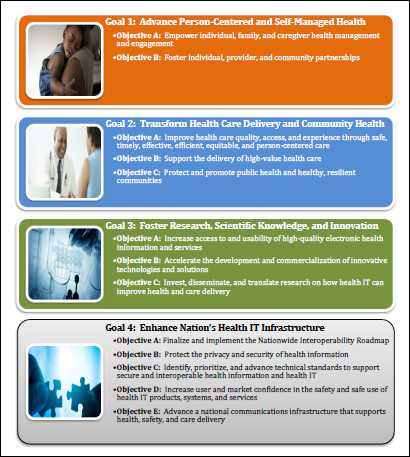
image

Jake Brewer, a senior policy advisor in the White House’s CTO office, died Saturday when he lost control of his bicycle in a cancer research fundraising ride. He was 34.


Privacy and Security

ABC News posts a breezy, click-me-please article called “The Medical Identify Theft Apocalypse? Fear the Walking Files.” Its list of ridiculous tips (or as it says, “How to Tell If You’ve Been Bit by the Medical ID Theft Zombie”) includes such gems as:

  • Don’t answer one-ring telephone calls.
  • Ask medical debt collectors to describe what you were billed.
  • Read all mail from healthcare providers and call them if something doesn’t look right (duh).
  • If you can’t access your medical records online, “ask your doctor to read it to you.”  (let me know how that works out).

Other

image

A Robert Wood Johnson Foundation report reviews the state of health IT in updating previous versions of the report with these findings:

  • Three-quarters of US hospitals have at least a basic EHR, but many of them won’t be able to meet Meaningful Use Stage 2.
  • Community HIEs are trying to evolve to find financial viability after struggling. They face many survival challenges that they will need to prioritize.
  • HITECH spurred EHR adoption but failed to achieve its goal of increasing healthcare efficiency and effectiveness through the use of IT. ONC was naive in overlooking barriers beyond its control and ran each of its grant programs in their own silos.
  • Big data isn’t a new concept in healthcare but it holds promise for transforming healthcare if issues related to security, analytics capability, stakeholder collaboration, and consumer engagement are addressed. Big data won’t be a silver bullet despite its position in the Gartner Hype Cycle’s “Peak of Inflated Expectations.” Bigger data isn’t necessarily better data. Not all providers are interested in providing information from their systems for public aggregation (which has minimal funding available to accomplish anyway) and dumping together information of unknown validation from a variety of sources adds additional potential for error.  
  • Regional Extension Centers helped providers implement EHRs but they have not been successful in helping them meet Meaningful Use criteria.
  • The hundreds of millions in grants ONC handed out for HIE development failed to meet ONC’s goals, with no state being able to offer all its providers bi-directional exchange. The federal government let states figure out their own approaches, leaving them on their own to figure out incomplete or inconsistently implemented national standards and lack of a national patient identifier or single patient-matching technology. Health system competition also stood in the way.
  • The report characterizes the uptake in EHR adoption as converting analog to digital within individual organizations that it calls “corporate islands.” It concludes that information exchange among health professionals hasn’t improved in 10 years, but new payment models will eliminate some of the boundaries. 
  • The report says HL7 failed as a standard because it allows too much implementation variation and requires hand-coded programming changes with every implementation, saying HL7v2 is “an artifact of the economic incentives of the organizations that wanted and created it.” It adds that HL7v3 has also failed because its adoption rate is “dismal” and it still doesn’t address semantic interoperability, but expresses hope that HL7 FHIR will allow developers to work more constructively with informaticists while SMART will allow them to build applications on top of EHRs without having to learn the underlying EHR.
  • ONC has embraced the PCAST, JASON, and JTF reports and favors API access and exchange languages with stakeholder involvement, which is bringing into focus a national interoperable HIT infrastructure.

Some interesting quotes from the report:

Some of these corporate islands have grown to incorporate smaller neighbors and create larger fiefdoms, increasing the number of patients on whom they zealously guard information; but they’ve also widened the barriers between every other corporate island … the larger vertically “integrated” health systems are rushing to warehouse clinical and financial data, but ultimately for the wrong reason. They simply want to enhance their private holdings.

[HITECH] corrupted the markets like all subsidies do … Once the government pays for certain behaviors, two things happen. First, the recipients figure out how to game the requirements to get the most from the least work. Second, they wait to do new things, trying to goad the government into paying for that also. Together, these undermine the very entrepreneurship and innovation that we need to move health care to a better future … The market will be wary of new investments if there is ever the potential for new government money to pay for it. (former National Coordinator David Brailer)

We want, in effect, for BMW to share its client list and their proclivities, their purchasing power, their use of services with Toyota. That’s what we’re asking the healthcare market. And we want it to be done free. Not just free, but we want Toyota and BMW to pay for the opportunity to give away some of their most precious proprietary assets. (former National Coordinator David Blumenthal)

image

Multi-billionaire Elizabeth Holmes, CEO of disruptive medical laboratory Theranos and featured on Inc.’s cover as “The Next Steve Jobs,” responds to concerns that average patients aren’t capable of understanding their test results:

The idea that I as a human should not be free to access my own health information, especially using my own money — even though I can buy weapons and anything else I want — and rather should be legally prohibited from doing so, summarizes the root of the fundamental flaw we’re working to change in our healthcare system.

In New Zealand, a pharmacy that provided 100 percent acetic acid instead of the 5 percent concentration needed for a woman’s colposcopy offers compensation for her severe intestinal burns and resulting medical bills – a letter of apology for its error and a $50 gas voucher “to cover your travel costs related to your readmission to the clinic.”


Sponsor Updates

  • The SSI Group will exhibit at the Texas Ambulatory Surgery Center 2015 Annual Meeting September 24-25 in San Antonio.
  • TriZetto Provider Solutions receives the Visionary for Children Award from the Children’s Home Society of Missouri.
  • Valence Health will exhibit at the Center for Healthcare Governance Fall Symposia September 20-22 in Chicago.
  • Visage Imaging will exhibit at the New York Medical Imaging Informatics Symposium September 21 in New York City.
  • Vital Images will exhibit at the North American Society for Cardiovascular Imaging Annual Meeting September 26-29 in San Francisco.
  • Huron Consulting Group is recognized by Consulting Magazine as a Best Firm to Work For for the fifth consecutive year.
  • XG Health Solutions Glenn Steele Jr., MD will speak at Geisinger Health System’s A Century of Transformation and Innovation Centennial Symposia September 24-25 in Danville, PA.
  • Recondo Technology CEO Jay Deady will speak at AGC’s Annual East Coast Technology Growth Conference September 21 in Boston.

Blog Posts

HIStalk sponsors exhibiting at the AHIMA conference September 26-30 in New Orleans include:

Access
Anthelio Healthcare Solutions
ChartMaxx
Clinical Architecture
Elsevier
Experian Health
FormFast
HCTec Partners
Imprivata
Lexmark
MModal
MEA|NEA
Streamline Health
T-System
VitalWare
Wolters Kluwer Health


Contacts

Mr. H, Lorre, Jennifer, Dr. Jayne, Dr. Gregg, Lt. Dan.

More news: HIStalk Practice, HIStalk Connect.

Get HIStalk updates.
Contact us or send news tips online.

125x125_2nd_Circle

Morning Headlines 9/18/15

September 17, 2015 Headlines Comments Off on Morning Headlines 9/18/15

HP spinoff to cut up to 30K jobs

HP announces that it will layoff 30,000 employees later this year as part of a restructuring plan that will split the company into two separate entities, HP Enterprise which will run the company’s enterprise business, and HP Inc, which will focus on hardware.

Health IT Complaint Form

ONC fixes early access problems with its health IT complaint form.

Why It’s Hard to Measure Improved Population Health

A Harvard Business Review article argues that organizations engaging in population health management are more likely to put efforts into improving care for easier or more cooperative patients, resulting in a further marginalized community.

Comments Off on Morning Headlines 9/18/15

EPtalk by Dr. Jayne 9/17/15

September 17, 2015 Dr. Jayne Comments Off on EPtalk by Dr. Jayne 9/17/15

clip_image002 

Even though I’m no longer on staff, I’m glad that my former employer still hasn’t taken me off its mailing list. The quarterly Medical Staff Newsletter is a nice way to keep up with my former colleagues. I was excited to see that the hospital recently launched a new community outreach program. In an attempt to prevent readmissions, it uses paramedics with advanced training to perform scheduled home visits. Patients can be assessed for signs that their chronic health conditions are progressing are becoming unstable. The paramedics also provide disease management counseling.

For an initial panel of pilot patients, emergency department usage was reduced by 67 percent. Since I work in a couple of different practices, I wondered how they are contacting the providers of record and whether we’d be seeing any communications in our EHR. Unfortunately they are using a standalone system that was designed for home health and it isn’t connected to anything but the hospital’s clinical data repository. The mode of communication to attending physicians: fax.

clip_image004

I also chuckled at its promotion of staff physicians who appeared in the “Best Doctors” edition of a local magazine. The methodology used by some publications to create those lists is sometimes questionable and reminds me of a high school homecoming court election. People often vote for the names they’ve heard most often, regardless of personal experience or knowledge. Two of the providers on the list have been gone from our community for more than 18 months, so they’d be hard to refer to. Another one is retired. My favorite entry is a physician who has been disciplined multiple times and who sexually harassed me in the operating room. It’s bad enough that they were included on the magazine’s list, but I’m embarrassed at the hospital using them for marketing purposes.

The newsletter also included the first communication I’ve seen about the new EHR conversion project. The vendor was officially selected in December, but planning has been kept fairly quiet. They’re still not saying which facilities will go first, but they’re at least warning clinicians that it’s going to take more than three years to complete the migration across all business entities. Although I wish them the best, I’m glad to not be fighting in that particular skirmish.

clip_image006

A reader sent me this awesome ICD-10 countdown clock, which I’ve added to my personal website. As I continue my practice road show, I’m seeing people who are seriously worried about the crash of the revenue cycle as we know it.

I’m thinking about making one of those construction paper chains that we used to do in elementary school as we counted down to holiday break. Tearing off a link each day as we march towards what some are describing as “billpocalpyse” might be therapeutic. One physician I trained today actually talked about provisioning a safe room in his house in case staff comes with pitchforks and torches when he can’t pay the bills. Although I think it was a joke, at some level I think he was actually consider it.

Several readers wrote in about their ICD-10 training experiences. One works is tasked with helping clients navigate the transition. At a recent client forum, he describes comments that, “Most of the training that is out there is useless. The only content that had any agreement on whether it was not it was useful was CMS’s Road to 10 specialty content – specifically the coding scenarios for each specialty.” As a physician (and purveyor of training myself), I agree that scenario-based practice is essential. In addition to making sure they know how to code items that are on specialty-society or CMS lists, providers should also ask their IT staff to run a list of their top 10 or 20 diagnoses and practice coding those. If your docs haven’t done it, please make the suggestion. You’ll be glad you did.

Another reader commented on my recent mention of electronic prescribing of controlled substances. Apparently Imprivata has a hands-free authentication solution, capturing the token code from a cell phone without requiring manual entry. I’m pretty sure we could get away with having phones as long as they stayed in our pockets. I’m definitely going to check it out and appreciate the tip because as much as I try to stay on top of new products and offerings, it’s impossible.

As part of one of my ICD-10 engagements this week, I also presented to a group of physicians about Meaningful Use. Although we know a final rule for Stage 3 is imminent, many of my colleagues think it has become a big joke. I’m hearing from more and more that they’re willing to take the penalties just to regain control of their practices. Of course I’m not hearing that from physicians who sold out to large health systems or to hospitals – they’re stuck with whatever is handed down. Many organizations have already budgeted the incentives and planned not to incur penalties and don’t seem open to altering the future balance sheet.

Have you opted out of Meaningful Use? Email me.

Email Dr. Jayne.

Comments Off on EPtalk by Dr. Jayne 9/17/15

News 9/18/15

September 17, 2015 News 1 Comment

Top News

image

Senate HELP Committee Chairman Lamar Alexander (R-TN) calls for Meaningful Use Stage 3 to be pushed back until January 1, 2017, saying that hospitals have told him that they are “terrified” of Stage 3 and patients won’t benefit from a rush job. He also wants the modified requirements for MU Stage 2 adopted to keep Meaningful Use moving.


Reader Comments

From Epic ICD-10er: “Re: Dr. Jayne’s piece on ICD-10 readiness, especially that of smaller vendors. Just to let you know where Epic stands: we’ve supported ICD-10 since 2008 and the entire customer base has been live on the supported software (the 2010 release) for over a year. Ninety-five percent of customers are documenting with ICD-10 clinical terminology today and 92 percent are dual coding accounts (the number doesn’t have to hit 100 percent since some organizations use ICD-10 without impacting coding resources). In early CMS calls, not many vendors were offering documentation using ICD-10 and dual coding. I’m pushing CMS to initiate vendor calls starting October 1 so we can communicate across the entire industry about issues we find and how to resolve them.” I like the idea of CMS opening an ICD-10 conference bridge as a hospital would do for a big IT go-live. Somehow I think the email inbox of its ICD-10 ombudsman is going to fill up quickly.

image

From Hadoopsie: “Re: unsolicited vendor email. This one wins the award for the silliest buzzwords!”

From Halen Hardy: “Re: NextGen. Little birdy within the company told me they just laid off 19 Austin-based employees.” Unverified. I think that’s the Hospital Solutions office that was formerly Opus Healthcare Solutions until QSI/NextGen acquired that company in 2010.

From Lemmy: “Re: John Halamka of BIDMC. Is having a town hall meeting with all IT staff today (September 17). This is his first one in three years.”

image

From BKG: “Re: readmissions. Dignity hospitals reduced 30-day readmissions by 25 percent by implementing AHRQ’s RED Toolkit.”

From Grammar Nazi: “Re: health system branding efforts. I’m sick of all the permutations of the word ‘healthcare,’ such as HealthCare and Health Care. It’s about time they got creative – aNytown hEalthcAre!” As a Grammar Nazi sympathizer, I don’t like fusing two words together into one while leaving the second portion capitalized, which passes for innovating thinking among creatively bankrupt marketing people. You see that a lot these days (Partners HealthCare, CommonWell, MedAssets, UnitedHealth Group) as all the good, trademarkable words have been taken, leaving companies to create gibberish. The name HIStalk isn’t far from those examples, so maybe I shouldn’t complain.


HIStalk Announcements and Requests

Deborah Kohn donated $100 to my DonorsChoose project, which I put to work immediately using matching funds from my anonymous vendor executive and from Smarties Candy Company’s “Smarties Think” classroom project. We provided six tablets for Ms. Long’s alternative high school ninth-grade class in West Point, MS. She reports that all of her students come from poor families (some of them get their only meal of the day at school) and they need stimulation to engage in science material. Two-student teams will use the tablets to quiz each other, create flash cards, and play related games. Ms. Long concludes, “I believe that someone taking an interest in them and their education could change their whole attitude about school.” Someone did – DK and her matching donors. Update: Ms. Long emailed to say, “OH MY GOSH! Thank you so much for your donation! You are going to help students know just how much someone cares about their education! You are amazing for doing this and I am sooooo fortunate that you have done this for me! I really appreciate it!”

image

We bought an iPad Mini for Mrs. Frazier of Memphis, TN, who teaches elementary classes, runs the after-school program, and just earned her library certification. She emailed to say that she is using the tablet to participate in technology webinars and offers it to students in their daily “academic choice” activity, where she says it’s popular because of the apps she has installed and the digital books that are available.

image

Also checking in was Mr. Schmook from Herminie, PA, whose elementary school class received a large bundle of STEM materials that we donated.

A note to non-experts trying to create hysteria over so-called vendor “gag clauses.” Those customer-signed terms that prohibit disclosing intellectual property such as source code, documentation, prices, and screen shots are not gag clauses – they don’t bar users from going public with patient-endangering problems, they only restrict them from exposing proprietary information that would be of little interest to anyone other than competitors. I don’t agree with including screenshots in that contractual definition since that prohibits sharing even user-designed screens with each other or in presentations (a clause that Epic is adamant about enforcing, which is what stirs up people the most), but none of that precludes going public with software problems. That limitation would be covered in a different part of the contract. I would also be interested at how often vendors actually threaten or undertake legal action against their customer, which would seem to send the wrong message to those who might want to become customers. It’s probably an indication of the three-vendor EHR market that customers sign those agreements without a peep, apparently happy to be allowed to fork over millions under whatever terms their vendor among limited choices demands.

Listening: Wolflight, new progressive music from former Genesis guitarist Steve Hackett. Since his former bandmates don’t seem interested in a reunion, I’m thankful he skillfully covered some of their songs on Genesis Revisited, including my favorite, Supper’s Ready. It’s not quite as good as the original Genesis (watch the previously omnipresent Phil Collins if you think he was only good for crooning lame pop tunes), but it’s the only live option other than cover bands like The Musical Box. 

This week on HIStalk Practice: Ian Crozier, MD tells a riveting tale of post-Ebola complications. Vermont physicians agree that administration and documentation burdens are taking away from patient care. ProEx Physical Therapy gets into the consulting business. Brad Boyd evaluates the financial return of clinical alignment tactics. HHS releases $500 million for primary care expansion. Boson Health goes with paging and answering service tech from TelmedIQ. Teladoc gets the green light to move forward with its case against American Well. Google moves into the fake body parts business to sell more wearables (no joke!).


Webinars

September 22 (Tuesday) noon ET. “Just Step on the Scale: Measure Ongoing EHR Success and Focus Improvements Using Simple but Predictive Adoption Metrics.” Sponsored by The Breakaway Group. Presenters:  Heather Haugen, PhD, CEO and managing director, The Breakaway Group; Gene Thomas, VP/CIO, Memorial Hospital at Gulfport. Simple performance metrics such as those measuring end-user proficiency and clinical leadership engagement can accurately assess EHR adoption. This presentation will describe how Memorial Hospital at Gulfport used an EHR adoption assessment to quickly target priorities in gaining value from its large Cerner implementation, with real-life results proving the need for a disciplined approach to set and measure key success factors. Commit to taking that scary first step and step onto the scale, knowing that it will get measurably better every day.

September 22 (Tuesday) 5 p.m. ET. “Laying the Groundwork for an Effective CDS Strategy: Prepare for CMS’s Mandate for Advanced Imaging, Reduce Costs, and  Improve Care.” Sponsored by Stanson Health. Presenters: Scott Weingarten, MD, MPH, SVP and chief clinical transformation officer, Cedars-Sinai; Anne Wellington, VP of informatics, Stanson Health. Medicare will soon penalize physicians in specific settings who do not certify that they consulted "appropriate use" criteria before ordering advanced imaging services such as CT, MRI, nuclear medicine, and PET. This webinar will provide an overview of how this critical payment change is evolving, how it will likely be expanded, and how to begin preparations now. A key part of the CMS proposal is clinical decision support, which will help meet the new requirements while immediately unlocking EHR return on investment. Cedars-Sinai will discuss how they decreased inappropriate utilization of diagnostic tests and treatments, including imaging.


Acquisitions, Funding, Business, and Stock

image

Kyruus raises $25 million in funding to expand adoption of its ProviderMatch health system patient scheduling and referral management system. Investors include one of its customers, Providence Health & Services, as well as McKesson Ventures.

HIMSS Media buys the oddly named MobiHealthNews. I don’t read it, but HIMSS claims it’s the “leading source of digital health news and analysis” and says “our sales team is looking forward to driving growth.” It covers topics that don’t interest me as an average health system reader (fitness trackers and uncritical digital health cheerleading). Still, I would rather have seen it remain independent than to be absorbed into the vendor-friendly, sales-focused HIMSS fold. HIMSS already publishes mHealth News, which it describes as “the only news publication completely focused on mobile innovation within healthcare,” which seems to have intentionally marginalized MobiHealthNews before the acquisition. Both sites are edited by people with zero health or IT experience other than writing about it, which to me is OK when they’re wordsmithing or quoting an expert, but not OK when they try to editorialize or analyze for an expert audience.

image

American Messaging Services will offer its 1,400 hospital customers real-time care coordination and communication from Cureatr.

image

HP will lay off up to 30,000 employees when it splits the company later this year into HP Enterprise (enterprise services) and HP Inc. (hardware), with the personnel cuts coming from the Enterprise business. HP had already laid off 55,000 people since Meg Whitman took the CEO job following disastrous decisions that followed no obvious strategy except to get bigger – overpaying for acquisitions, hiring and then firing Leo Apotheker as CEO, and dumping its PC business with hopes of making more money selling data center hardware and services. Its aspirations to be IBM were admirable except IBM had long since abandoned that same strategy by the time HP put its own into place.

image

The Nashville business paper digs up an SEC filing in which Emdeon says it will spend $126 million to “rebrand” itself to Change Healthcare.


Sales

Wellness Council of America chooses Validic to power its “On the Move” employee wellness challenge. Companies that sign up by February 2016 receive behavior programming, outcomes reporting, device integration, coordinator training, personalized assessments and coaching, and educational material.


Announcements and Implementations

image

Aprima expands its “Rescue Plan” that offers licensing discounts of up to 65 percent to users of an expanded list of EHRS that originally included only Allscripts MyWay.

McKesson wins the 2015 C. Everett Koop National Health Award for its employee health and wellness program that is powered by the Vitality, a South Africa-owned wellness program whose hallmarks are Know, Improve, Reward, and Support.

Imprivata integrates its Cortext secure communications platform with Forward Advantage’s Communication Director, allowing Meditech customers to automatically deliver patient alerts (transitions of care, consult requests, and critical test results)  to mobile devices and desktops.


Government and Politics

The health services of Scotland and Wales form the Health Informatics Service Alliance to collaborate on digital services, with Northern Ireland possibly becoming a third member down the road.

image

ONC fixes its Health IT Complaint Form, or as Modern Healthcare describes in an absurdly attention-seeking headline, “ONC wants to know what health IT issues grind your gears.” Now that the form is visible, I noticed that it offers submitters an option to remain anonymous. It doesn’t say if it will publish the issues it receives.


Privacy and Security

image

The Tampa VA hospital gets hit with ransomware, taking down the employee shared drive for five days.


Innovation and Research

image

A report by IMS Institute for Healthcare Informatics finds that the rapidly increasing number of apps that might be considered “mHealth” is at 165,000, but most simply provide advice related to wellness, diet, and exercise. A fourth of them focus on chronic disease. Only one in 10 connects to a device or sensor and just 2 percent exchange information with provider systems, but two-thirds have social media connections. Nearly half of all downloads are represented by just 36 apps. The authors suggest that providers prescribe health apps to increase adoption and ongoing use, but those providers hesitate because EHR connectivity is uncommon, technologies are ever-changing, providers are paid for volume and not quality, and studies that prove app effectiveness are lacking.


Technology

An interesting perspective on the addition of ad-blocking to iOS9 says Apple is threatening Google’s main source of revenue (advertising) as more users use mobile devices and Apple develops search capabilities that bypass Google. It says web content will suffer as small publishers lose advertising revenue, summarizing,

What you want is the content, hot sticky content … Unfortunately, the ads pay for all that content, an uneasy compromise between the real cost of media production and the prices consumers are willing to pay that has existed since the first human scratched the first antelope on a wall somewhere. Media has always compromised user experience for advertising: that’s why magazine stories are abruptly continued on page 96, and why 30-minute sitcoms are really just 22 minutes long. Media companies put advertising in the path of your attention, and those interruptions are a valuable product. Your attention is a valuable product.


Other

A Harvard Business Review article written by the dean of Boston University’s School of Public Health says it’s hard to measure population health success, but it’s tempting for organizations to cherry-pick the most cooperative of their patients and ignore the rest, which will leave marginalized communities (by race, income, and ethnicity) behind. He uses as an example apps that help people quit smoking, which even if they work, still leave out patients who lack the technology and the discipline to use them. The US smoking rate is stuck at 20 percent because it’s harder and more expensive to get poorer patients into cessation programs, which might redirect resources such that the overall smoking rate might increase even as equity is reached. It’s always fascinating to see the dramatic contrast between the beliefs of health system people and those whose world view is based on public health. I’d trust the latter far more than the former in reducing costs and providing the most good for the most people.
image

Weird News Andy says this article reads like a Medtronic advertisement, but is still pretty cool. Intervention neurologists use a stent retrieval device to fish out the blood clot that is blocking a woman’s carotid artery, reversing her early stroke symptoms within three hours, allowing her to  recover entirely in just a few days. Most impressive to me is the quick action of the hospital: the patient arrived in the ED at 10:29 a.m., the CT was finished at 10:44, thrombolytics were given at 10:47, a groin puncture was made at 11:10, and reperfusion occurred at 11:40, barely more than an hour after she arrived.


Sponsor Updates

  • Stella Technology co-founder and CEO Lin Wan will participate in the Nationwide Interoperability Pursuit panel at the Central Pennsylvania HIMSS conference on September 18 in Grantville, PA. She has a PhD in physics from Princeton and has held key technology roles at Axolotl and OptumInsight.
  • Forward Health Group posts a video interview with HealthLink CEO Beth Wrobel (I interviewed her this week) and CIO Melissa Mitchell.
  • Health Catalyst wins the 2015 Utah Ethical Leadership Award.
  • ShareCor names Fortified Health Solutions, a Santa Rosa Consulting company, as an endorsed security services vendor.
  • Experian Health is ranked #1 in Modern Healthcare’s 2015 list of largest revenue cycle management firms.
  • MedData will exhibit at the UCAOA Fall Conference September 24-26 in New Orleans.
  • Medicomp Systems releases a new video, “Doctors see 30% More Patients.”
  • Navicure will exhibit at the VMGMA 2015 Fall Conference September 20-22 in Norfolk, VA.
  • NTT Data will exhibit at the BCBS Information Management Symposium September 20-23 in Fernandina Beach, FL.
  • Oneview Healthcare will exhibit at The Beryl Institute Regional Roundtable September 24 in San Francisco.
  • PerfectServe will exhibit at the Maryland MGMA State Conference September 25 in Maryland.

Blog Posts


Contacts

Mr. H, Lorre, Jennifer, Dr. Jayne, Dr. Gregg, Lt. Dan.

More news: HIStalk Practice, HIStalk Connect.

Get HIStalk updates.
Contact us or send news tips online.

125x125_2nd_Circle

Morning Headlines 9/17/15

September 16, 2015 Headlines 1 Comment

HELP Committee chairman calls for flexibility in implementation of Stage 3 EHR rules

Senator Lamar Alexander (R-TN), chairman of the Senate Health, Education, Labor and Pensions Committee, calls for a phased in approach to the creation and implementation of MU3.

Hilo Medical Center Selected as 2015 HIMSS Enterprise Davies Award Recipient

Hilo Medical Center (HI) receives the HIMSS Davies Award, being recognized for using its EHR (Meditech) to drive $35 million in cost reductions and a $4 million overall ROI while reducing hospital acquired infections and the mortality rates of patients admitted with pneumonia.

Mayo Clinic and AVIA Announce Finalists Competing for $100,000 THINK BIG Challenge

Mayo Clinic announces the finalists of its Think Big Challenge, a design competition challenging engineers to build tools that promote health lifestyles or help people living with chronic diseases.

Text Ads


RECENT COMMENTS

  1. Anything related to defense will need to go to Genesis.

  2. That, or we see if Judy will announce Epic's new Aviation module (probably called Kitty Hawk) that has integrated Cruise…

  3. The $50 billion Rural Health payout is welcome. In context, it's less than the total cost of the F22 raptor…

  4. RE NEJM piece: He shouldn’t future-conditional with “they can retreat, which might mean abdicating medicine’s broad public role, perhaps in…

Founding Sponsors


Platinum Sponsors


Gold Sponsors


RSS Webinars

  • An error has occurred, which probably means the feed is down. Try again later.