Recent Articles:

Morning Headlines 7/19/18

July 18, 2018 Headlines Comments Off on Morning Headlines 7/19/18

UnitedHealth Is Among Suitors Circling Tenet’s Conifer Business

Tenet Healthcare considers selling its Confer Health Solutions business to UnitedHealth Group in a deal that could be worth $2 billion.

HHS Secretary Azar Announces Senior Advisor for Fourth Departmental Priority

Adam Boehler, director of the Center for Medicare & Medicaid Innovation, takes on the additional HHS role of senior advisor for value-based transformation and innovation.

Israel grants $33 million to GE, Medtronic, Change Healthcare to boost R&D

Israel’s Innovation Authority will award $33 million over six years to Change Healthcare, GE Healthcare, and Medtronic as part of a program to attract digital health companies to the country.

Comments Off on Morning Headlines 7/19/18

HIStalk Interviews Mudit Garg, CEO, Qventus

July 18, 2018 Interviews Comments Off on HIStalk Interviews Mudit Garg, CEO, Qventus

Mudit Garg, MSEE, MBA is co-founder and CEO of Qventus of Mountain View, CA.

image

Tell me about yourself and the company.

Qventus is an AI platform. We work with hospitals and health systems to help them manage their day-to-day operations. I’m one of the founders and CEO of the company. My background for the last 10-11 years has been in healthcare operations, specifically in lean process improvement. I’m proud of that. I started a few technology companies and spent time at McKinsey & Company’s healthcare practice. I’m an engineer by background.

How can data and dashboards be made useful to frontline people as they are making operational decisions?

That was one of the biggest prompts to start the company. The first time I walked into a hospital, I was struck by two things. One, how the managers and caregivers did whatever it took to provide care. Second, maybe because they cared so much and because the system was dependent on them doing these heroic acts day after day, the system itself never developed. My perhaps biased view in the beginning was that data could help folks be more prepared and to require fewer of these heroic acts.

We are comfortable in the conference room thinking all we want about dashboards and information, but in the moment when people are busy, nobody has any time to do something about it. Nobody logs into a dashboard. Nobody has time to read through a graph or a report and understand it. That was the earliest insight into the way of using data that we learned from.

We started talking a lot about what was needed in 2013. We said, what makes it so hard in healthcare operations? Typically the answer came back as, half my patients are unscheduled, we don’t know how long they will stay in the hospital, and the resources they will need is unknown. Predicting would be great.

It’s an often-used buzzword, but we started using machine learning tools back in 2013. My co-founder and I both had a background in it. We started predicting.

But we learned that predictions by themselves are sometimes counterproductive. While an average manager doesn’t have time to stare at a dashboard, they also don’t have time to interpret a prediction. A nurse we worked with at that time said, I don’t have time to figure out 30 percent chance do this, 40 percent chance do that. If my GPS said it’s a 30 percent chance to take a left, 40 percent chance take a right, I would toss it out the window. I have more load than I do while I’m driving. Just make it simple.

The goal of the product is not to expose more data, but to take those things that a really good manager would do. A really good manager in an emergency department anticipates. They say, things are getting really bad, I had better have my lab manager start doing X or start prioritizing these things. I had better tell the house supervisor to prioritize some beds. By doing those things two, three, or four hours in advance, they can get ahead of the situation. But that only happens when they have a calm environment where they have the time and capacity to look ahead and solve those problems.

Our product’s goal is to take away that mental load — the data processing, the evaluation of options — and to offer a suggestion in the moment as a message, discussion, or into the workflow in some way.

Hospitals usually have some internal expert they call in when they have a problem, but are lost when that person isn’t available. It would seem that once a hospital has formalized the decision-making process, it would be easier to then enhance it.

Absolutely. An excellent manager has to look at data and make sense of it. That depends on that manager’s time. What judgment they apply depends on that manager’s experience. All those things create inconsistencies.

But in that ED example I gave, the system would be saying, it’s Monday after Thanksgiving. The patients in the waiting room are much sicker. Dr. Smith is working and he tends to he tends to order more labs, but our lab is really slow right now. Based on all of this, we will run out of capacity in the next three hours.

Then the hospital can connect those subject matter experts. Gather the lab manager, house supervisor, and charge nurse and say, “Here is something that we see. We suggest you do this.” Let them have a workforce huddle on that discussion topic and do something about it well before the problem becomes bad.

Who would typically serve as the internal champion of that kind of real-time monitoring?

The executive sponsor often ends up being someone like a chief operating officer or a chief nursing officer. But the internal champion often comes from the lean groups in the hospital. They are the ones who have seen the day-to-day problems, are trying to improve them, are trying to build a system around them, and are connected enough to the day-to-day problems. They can be good champions. Oftentimes department heads will see these challenges, such as the medical or nursing director of the ED.

Those are the internal champions who want this to become a part of the system. The executive sponsors typically are the chief operating officer or the chief nursing officer, who are day-to-day focused on these problems and who jump in to help when things don’t go well.

What is the physical and operational manifestation of how your product gets used in a average hospital?

The ideal end state of the product is that there is no physical manifestation. The ideal end state is that it is invisible, like a really good assistant or someone who is helping you have the insight. It just disappears into the background and brings in the right information at the right time. That’s why it is like virtual air traffic control.

The product has three parts. The most important one brings the insight into the moment. It tells you, this patient in room 434 is likely to get admitted. We don’t have an admit order. We probably won’t have one for the next three hours, but let’s start preparing the bed. Or, this patient is likely to leave without being seen, or that we’re going to have a bad situation with this patient. It’s processing these insights in the background and delivering them in the moment — on a Vocera device, on a secure messaging device, or whatever the right mechanism might be.

Our system provides situational awareness, a sort of mission control. It can be in the break rooms or the huddle rooms, where people can have meaningful information displayed to help them understand the situation. Some of these nudges can be shown at that same place.

The last part is being able to understand the data to see where changes need to be made. An average department will get insight in the moment when they need to do something.

As hospitals centralize and and have larger deployments, there is an interesting role to play for a centralized place. In General Stanley A. McChrystal’s book “Team of Teams,” he talks about how the traditional image of command-and-control came to fail. The military started it, but in the most recent war, we struggled with that approach. They had to rebuild it and dismantle the command-and-control approach. He talks about the importance of spreading shared consciousness throughout the frontline people who are experiencing the situation and who have the most knowledge in the moment.

Our job is to spread the context, consciousness, and best knowledge to the people in the moment who are about to make that decision. While there’s a role to play for the central manifestation in escalation and awareness, the ideal situation is one where the information and the shared consciousness is going to the front lines. That’s how our product works.

Your site allows looking up any hospital’s efficiency index as calculated from publicly available information. What metrics might improve in using your system?

Our product is in 60 or 65 hospitals. Patient flow is a big use case — in the ED, inpatient, and OR. Length of stay, as you can imagine, is a really important metric, because it’s one of the most important measures of affordability and survivability for an organization to be profitable on Medicare patients. Length of stay is a big one on the inpatient side.

Length of stay is important in the ED, but so is patient satisfaction. The number of patients who are leaving without being seen is important.

On the operating room side, they look at efficiency — how much time it takes to turn a room, how many of the rooms are being used, whether supplies are being used appropriately, and how well patients are being informed throughout.

Then we have use cases for pharmacy and outpatient clinic access. In pharmacy, how to manage the drug spend. In outpatient access, how can the health system, with the resources it has, provide patients with quick access to care?

These metrics are beneficial regardless of the payment mechanism or the healthcare system’s economic model. As an example, one hospital freed up about a million minutes of patient wait time in their ED when they deployed the system. That helps them provide care to more patients in the community with the same resources. That lowers the cost, helps the hospital, and helps the patients. Regardless of the economic model, it helps both the health system and the patient.

Where do you see the company’s future being?

I grew up in India. We have in the US healthcare system the best clinicians, some of the best equipment, some of the best therapies. What’s holding back the potential of our system is oftentimes is the ability to execute on the processes day-to-day consistently and reliably, without placing an excessive burden on the people who provide it. If we can do that, if we can create a mechanism where it doesn’t take the heroic effort to provide that consistency and reliability, we can do that across every aspect of delivery of care. Whether it’s your experience in the unit, how well informed you are, your billing, or your staffing. Whether its in the emergency centers, in urgent cares, or in outpatient clinics.

My hope is that we can provide the infrastructure to allow for consistent, reliable execution of the clinical practices we know. Managing the logistics around delivery of care so that the human connection, and the calm that we can provide to people while delivering the care, is feasible. That’s my hope. I’m hopeful that we’ll be able to play a meaningful role in bringing that about.

Comments Off on HIStalk Interviews Mudit Garg, CEO, Qventus

Morning Headlines 7/18/18

July 17, 2018 Headlines 1 Comment

Nashville health-tech company buys data-analytics firm, changes name

PlayMaker CRM acquires post-acute market intelligence and analytics vendor ViaDirect Solutions and renames itself PlayMaker Health.

Promoting Telehealth for Low-Income Consumers

FCC will propose to fund a $100 million “Connected Care Pilot Program” that would promote using telehealth among low-income families and veterans by providing affordable broadband service.

Health Insurers Are Vacuuming Up Details About You — And It Could Raise Your Rates

Insurers are buying the lifestyle information of hundreds of millions of Americans from data brokers and then running it through algorithms that predict how much that person’s healthcare will cost.

UnitedHealth posts big profit jump but sees room to improve

UnitedHealth Group reports Q2 results: revenue up 12 percent, EPS $2.98 vs. $2.32. Its Optum segment booked $1.8 billion in profit on $25 billion in revenue for the quarter.

News 7/18/18

July 17, 2018 News 6 Comments

Top News

image

LabCorp shuts down its entire computer network when it detects that a hacker has penetrated its systems and is trying to access patient records.

The company says via an SEC filing that test processing and customer access was limited over the weekend. It will take several days to bring all systems back online, the company says, causing delays in results reporting.

LabCorp hasn’t yet said whether PHI was compromised.

The company does not use Twitter or Facebook, but its LinkedIn profile and its website don’t mention the outage.


Reader Comments

image

From Another Allscripts Casualty: “Re: Friday the 13th Allscripts layoff. Our VP used a lot of corporate jargon words like ‘synergy’ and ‘socialize the discussion’ to describe the streamlining process in which basically each manager had to remove one employee slot, even those with teams of just a handful of people. Team managers were notified only 30 minutes before the heads rolled. The cuts were not performance based, so producer worker bees were let go instead of middle layer fat. The McKesson EIS acquisition brought in a lot of overlapping people and I expect another round late this year or early next as more people are trained to be cross-functional. Allscripts is like the mythical Hydra – every time they lop off a head, another acquisition causes 10 more to pop up, and management is never lopping the right heads. I think some of the people at the top have a good idea of where they want to take the company, but the inertia of herding cats keeps them in the same rut.” Unverified. I’m not as confident that the company has a solid, rational strategy other than making undisciplined acquisitions that sometimes work out great (Netsmart, DbMotion) and sometimes just fizzle out quietly. That’s been the strategy all along, but other than a burst of investor enthusiasm that sent shares on a tear in 2000 (peaking then at more than six times today’s share price), it’s been a market-lagging stock that made headlines for mostly the wrong kind of reasons as it also came late to the post-MU EHR consolidation party by finally announcing that it would develop a new product, which is new territory for a company known for buying instead of building. Even with all that acquisition activity, Allscripts has a market cap of $2.2 billion, around 1/10 that of Cerner and one-third of Athenahealth’s market value. It has made some good deals, though – it paid just $185 million to buy the health IT business of a desperate and perpetually HIT-clueless McKesson, then sold off just the content management part to Hyland for up to $235 million.
From Fact Checquer: “Re: Allscripts. You mentioned the new EHR product Avenel. I find no mention of it on the company’s site.” It’s not listed on the physician EHR page with TouchWorks or Professional, but I found by Googling that it has its own site that says “machine learning” a lot and offers only a “contact us for more information” form. 

From Bjorn To Be Wild: “Re: HIStalk theme music. I don’t know when you added it, but I love it. It improved an already wonderful daily morning reading and coffee experience.” I put up the prog rock “HIStalk Theme” a few weeks ago. That musical style isn’t to everyone’s taste, so I’m considering commissioning a light jazz sort of tune for a more mellow experience. It’s surprisingly inexpensive (in the $100 range) to have custom music created to spec.

image

From RN Data Maven: “Re: National Guidelines clearinghouse shutdown. A tragic loss of a resource for practitioners to access evidence-based clinical practice guidelines. Fear of evidence-based scientific research or short-sighted funding decisions?” AHRQ says it can’t come up with the $1.2 million to keep the site running and thus took it down this week, but the non-profit ECRI – who managed the site for AHRQ — will bring it back in the fall with enhancements as a fee-based service. Some speculate that the site was doomed once then-Congressman Tom Price, MD (who later became HHS Secretary for a few months) demanded that AHRQ remove a study that was critical of a drug sold by one of his campaign donors.


HIStalk Announcements and Requests

Lorre has a backlog of inquiries for my annual “summer doldrums special” on new sponsorships and webinars, but she would still be happy to chat.

I was thinking today that Karl Marx’s “opiate of the masses” is no longer religion – now it’s actually opiates.


Webinars

July 26 (Thursday) 1:00 ET. “The Patient’s Power in Improving Health and Care.” Sponsor: Health Catalyst. Presenter: Maureen Bisognano, president emerita and senior fellow, Institute for Healthcare Improvement. Patients, even those with chronic diseases, only spend a few hours each year with a doctor or a nurse, while they spend thousands of hours making personal choices around eating, exercise, and other activities that impact their health. How can we get patients to be more engaged in their care, and help physicians, nurses, and healthcare providers transition from a paradigm of “what’s the matter” to “what matters to you?” This webinar will present stories of patients and healthcare organizations that are partnering together with tools, processes, data, and systems of accountability to move from dis-ease to health-ease.

July 31 (Tuesday) 12:30 ET. “How to Proactively Troubleshoot End User Experience Issues in Healthcare IT.” Sponsor: Goliath Technologies. Presenter: Goliath Technologies engineering staff. An early warning system for EHR access problems helps prevent downtime and user access problems before they impacts patients and collects objective technical evidence of the issue’s root cause. This webinar will describe how hospitals protect their investment in Allscripts, Cerner, Epic, and Meditech EHRs by anticipating, troubleshooting, and preventing end user experience issues and collecting the technical data needed to collaborate with their vendors on a solution.

Previous webinars are on our YouTube channel. Contact Lorre for information.


Acquisitions, Funding, Business, and Stock

image

UnitedHealth Group reports Q2 results: revenue up 12 percent, EPS $2.98 vs. $2.32. The company’s UnitedHealthcare insurance business took in $46 billion as membership increased to 49 million people. Its Optum segment, which provides pharmacy benefits management and technology services, booked $1.8 billion in profit on $25 billion in revenue for the quarter. 

image

Nashville-based post-acute care CRM software vendor PlayMaker CRM acquires post-acute market intelligence and analytics vendor ViaDirect Solutions and renames itself PlayMaker Health.


Sales

  • CoxHealth (MS) chooses Kyruus to provide a digital provider directory and patient-provider matching technology for its website and call center.
  • Southwest Mississippi Regional Medical Center selects Phoenix Health Systems for outsourced IT management and support.
  • Australia’s Canberra Hospital and University of Canberra Hospital will implement Alcidion’s Electric Patient Journey Board to reduce length of stay and improve patient flow from the ED.

Announcements and Implementations

image

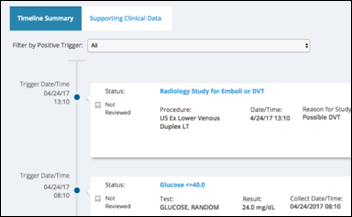
Health Catalyst launches a patient safety surveillance system and applies to become an AHRQ-certified Patient Safety Organization (PSO) that can offer clients a litigation-free environment for data analysis. The trigger-based system cost $50 million to develop. The company says EHRs offer limited surveillance capabilities and, unlike a PSO framework, are legally discoverable.

CompuGroup Medical launches its ELVI telehealth product.

Behavioral Health Network of Massachusetts goes live on ZeOmega’s Jiva population health management.


Government and Politics

image

NIH Director Francis Collins, MD, PhD pitches IRhythm’s Zio arrhythmia monitoring patch for detecting unknown atrial fibrillation, although noting that while the results may get patients to visit their doctor and begin anticoagulant therapy, its long-term benefit in reducing strokes, ER visits, and hospitalizations remain unproven. Collins concludes that the clinical trial was interesting because high-risk patients were recruited by email, had the patches mailed to them, then mailed them back at the end without having met a researcher face to face. Less exciting is the fact that we have yet another high-powered diagnostic tool to detect diseases that we as a country can’t afford to treat because we refuse to control healthcare costs — those newly ordered anticoagulants cost $15 per tablet, meaning someone will be paying $5,000 per year for the rest of each new patient’s life, although maybe that’s cheaper than treating the subset of them that would have otherwise had strokes.

FCC will propose in its August meeting to fund a $100 million “Connected Care Pilot Program” that would promote using telehealth among low-income families and veterans by providing affordable broadband service. Up to 20 providers that serve low-income populations would receive up to $5 million in funding in partnership with a broadband services provider.


Privacy and Security

image

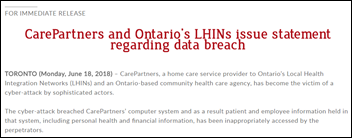
In Canada, home care provider CarePartners is hit by ransomware, with the hackers contacting CBC News with samples of the patient information they have stolen (the samples alone involve 80,000 patients).The cyberintruders, who say they found unpatched software that allowed them to penetrate the systems, are demanding unstated “compensation in exchange for telling them how to fix their security issues and for us to not leak data online.”

Change Healthcare introduces a kill switch for its HealthQX value-based care analytics suite that allows customers to instantly revoke access to their data as long as two of its authorized operators issue the command from separate locations as part of a “bring your own key” capability.


Other

A Quest Diagnostics survey finds that healthcare has made little progress toward value-based care since last year. More than half of health plan executives think physicians don’t have the tools they need to succeed under VBC arrangements, while 61 percent of doctors say their EHR doesn’t contain all the information they need to deliver patient care.

In Australia, 20,000 people opt out of sharing data with its My Health Record online system on the first day of the three-month opt-out period.

Western State Hospital (VA, rebranded from the more memorable Western State Lunatic Asylum) realizes that it hasn’t followed state laws allowing it to destroy the records of patients 10 years after their last date of service, forcing a three-year records review in which a single HIM employee examined 6,000 reels of microfilm dating back to the 1800s. And you thought your job was dull.

A New York Times report notes that rural hospitals are not only closing at alarming rates, they are eliminating OB services to the point that fewer than half of US rural counties still have hospitals that deliver babies. It notes that loss of OB services means that fewer women receive prenatal care due to the time and cost of traveling further, more of them deliver prematurely, infant mortality increases, and EDs deliver babies the best they can.

image

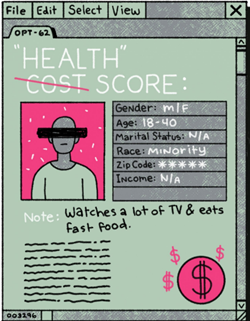
This is important as the White House dismantles ACA protections that prohibit insurers (including those who sell through employers) from denying coverage for pre-existing conditions or charging sicker people higher premiums. A ProPublica report finds that insurers are buying the lifestyle information of hundreds of millions of Americans from data brokers that includes race, educational level, TV habits, clothing size, net worth, credit, and social media activity, all of which are run through algorithms that predict how much that person’s healthcare will cost. The article notes that while the information is ostensibly used to manage population health, it could also be applied to premium pricing formulas. Experts say that while insurers can’t blatantly discriminate (at least for now), they have cherry-picked the healthiest people by choosing their geographic coverage based on population data, or as one data salesperson said, “God forbid you live on the wrong street these days.” An excerpt:

[LexisNexis] said it uses 442 non-medical personal attributes to predict a person’s medical costs. Its cache includes more than 78 billion records from more than 10,000 public and proprietary sources, including people’s cell phone numbers, criminal records, bankruptcies, property records, neighborhood safety, and more. The information is used to predict patients’ health risks and costs in eight areas, including how often they are likely to visit emergency rooms, their total cost, their pharmacy costs, their motivation to stay healthy, and their stress levels. People who downsize their homes tend to have higher healthcare costs, the company says. As do those whose parents didn’t finish high school. Patients who own more valuable homes are less likely to land back in the hospital within 30 days of their discharge. The company says it has validated its scores against insurance claims and clinical data. But it won’t share its methods and hasn’t published the work in peer-reviewed journals.

image

In New Zealand, an internal health board report finds that hospital generators failed to kick on after a power line was cut, with battery back-ups having just four minutes of power left when the power came back on. My experience with generators is not reassuring – even with regular testing and fuel monitoring, the switchover always seem to fail. What’s your experience?

In England, a nurse assistant is charged with fraud after submitting timesheets indicating that she had worked 242 shifts in 20 months instead of her actual 10, for which she was overpaid $66,000. She claimed that she thought she was entering the times she was available for work instead of logging her actual time. She had asked her manager to help her, which might have provided yet another clue to the manager that her entries were incorrect. The judge noted that the hospital makes such fraud easy.

SNAGHTMLf1c6b8d

Bizarre: a hospitalized prisoner who eats metal objects such as catheter clamp, thumbtacks, and screws racks up $1 million in medical bills, then is admitted under 24-hour watch to Loyola Medical Center in a stay that has added $500,000 to his tab as taxpayer-funded hospitals try to keep him from being admitted to their facilities and the hospital presses the prison for payment. The prisoner is a 6-foot, seven-inch former basketball player who has previously threatened hospital employees. The sheriff bluntly but accurately explains:

We have a guy right now that has cost us — has cost all the people in this room — close to a million dollars in health bills because he constantly eats the jail. Across the country, the easy thing to do was cut mental health services, and they’ve done it. So people don’t get better. They don’t get treatment. They go to jails and prisons and emergency rooms.

Welcome to a country run by lawyers. In Las Vegas, Mandalay Bay Hotel’s corporate parent MGM Resorts International sues 1,000 concert-goers injured in the Route 91 Harvest festival shooting last year, hoping to force a decision that it can’t be held liable because it hired a security firm that was certified by the Department of Homeland Security for protecting against mass injury. A lawyer representing some of the victims says the company – which also owns the concert venue — is “judge shopping” in trying to push any case into federal instead of state court.


Sponsor Updates

  • PatientKeeper publishes an e-book titled “Attending to Physicians: Why Healthcare Must Focus on Improving Physician Experience” and a video titled “PatientKeeper Charge Rescue Service.”
  • Buffalo Business First profiles Hamish Stewart-Smith, CTG’s managing director of sales for its North American healthcare business unit.
  • Huntzinger Management Consulting Group earns high rankings in the KLAS HIT Assessment & Strategic Planning 2018 report.
  • FDB releases a new video to help people understand how its Opioid Risk Management Module supports safer opioid risk management and prescribing.
  • Divurgent publishes its “Windows 10 Upgrade Benchmark Report.”
  • Optimum Healthcare IT publishes a white paper titled “Change How You Approach Change in Healthcare.”
  • Dimensional Insight VP George Dealy earns CHIME’s CFCHE credential.

Blog Posts


Contacts

Mr. H, Lorre, Jenn, Dr. Jayne.
Get HIStalk updates. Send news or rumors.
Contact us.

125x125_2nd_Circle

Morning Headlines 7/17/18

July 16, 2018 Headlines Comments Off on Morning Headlines 7/17/18

Walmart Names Humana Veteran to Run Its Health and Wellness Unit

Sean Slovenski (Healthways) joins Walmart as SVP of health and wellness.

Cerner to grow Dublin research hub

Cerner will add 50 new R&D jobs at its Dublin hub, home to its IP development team.

Joe Harpaz Joins Modernizing Medicine as President and Chief Operating Officer

Modernizing Medicine brings on Joe Harpaz (Thomson Reuters) as president and COO.

Lab Corp. (LH) Detected Suspicious Activity on its Information Technology Network

LabCorp works to restore full system functionality after detecting suspicious activity on its IT network over the weekend.

Comments Off on Morning Headlines 7/17/18

Curbside Consult with Dr. Jayne 7/16/18

July 16, 2018 Dr. Jayne 12 Comments

clip_image003 

I’m a voracious reader and enjoy many kinds of literature. I’m part of a book club, largely composed of women in healthcare IT, that meets monthly via Webex to talk about a good read. I see hundreds of manuals, summaries, and business documents come across my desk every year.

Given all these things, I’m a firm believer in the concept that words mean something. Unfortunately, I don’t think this belief is shared by some of our fellow travelers in healthcare IT. We may understand how a claim needs to be properly formulated for it to be paid, or a lab result so it can be delivered through an interface, but sometimes we fall short in the realm of communicating with people.

Almost every end user has complained about user guides or technical manuals at one point in their career. There are hazards in trying to convert a technical process into something that clinical people can follow, or that distracted physicians are willing to sit and read. My first EHR vendor put out a 1,000-page user manual that was nearly unreadable and would rival any piece of federal legislation for its sleep-inducing properties. They blamed its size on the included screenshots, but part of it was the overly-wordy description of a complicated documentation system that was a hybrid between legacy green screens and something more graphical.

My undergraduate institution’s English department has a program in technical writing. I’m surprised they don’t turn out more than the one or two graduates who earn degrees each year because it should be a skill that is in demand.

The language of healthcare itself often gives physicians something to chat about in the physician lounge. “Reimbursement” implies that someone is getting paid back for something  in an amount equal to a previous expenditure. It’s fancier than saying “payment” and tries to mask the transactional nature of the business of healthcare. Many physicians agree that those reimbursements don’t adequately cover the time, effort, supplies, and overhead required in delivering the service, especially when looking at payers such as Medicaid. Can you imagine your HVAC contractor or auto mechanic talking about reimbursement for their time as opposed to just delivering a bill for services rendered?

I also hear physicians complaining about marketing campaigns directed towards them, and there are certainly plenty of those to make fun of. We’ve grown out of having photos of physicians playing golf and fishing as a proxy for the free time that technology solutions are going to give them. Instead we’re depicting them in the office seeing patients, which is where they belong, but that does agree with how physicians see themselves working increasingly long hours. There’s greater emphasis on showing physicians and providers of various demographics, old and young, male and female, and of diverse racial and ethnic backgrounds. Although vendors have done better with some of their pictorial efforts, there are still issues with the words they use.

One of my bigger pet peeves is the overuse of the word “holistic.” Newsflash for marketeers: holistic means something that has parts that are interconnected and that the whole is greater than the sum of the parts. A holistic approach to a problem does not mean providing a laundry list of solutions that a client might want to purchase in order to solve a business problem. Holistic also has a certain connotation in medicine that I think vendors fail to understand. A reference to holistic medicine often implies complementary and alternative therapies, non-western medicine, naturopathy, and other modalities. Depending on the beliefs of the physician you are marketing to, use of the word holistic can either be a blessing or a curse. Beyond that, if your “holistic solution” doesn’t provide any benefit beyond that of its parts, then it’s not holistic and you just look confused about how you are describing your offering.

Other words that have lost their sparkle include innovative, novel, revolutionary, and cutting-edge. Everyone claims that their solutions and offerings fall into these categories, to the point where the words no longer have meaning. I had a rep recently pitching a tabletop lab analyzer machine which was similar to the one we already have in the office. He acted like it was something groundbreaking when there are multiple competitors in the field that offer similar devices. The real difference between his offering and others was the price point, which in his case was a disadvantage. Costing almost twice as much as the nearest competitor might be novel, but the data trying to show it as a better device wasn’t going to swing us into buying 36 of them.

Then there are the folks who are killing us with mostly meaningless buzzwords: artificial intelligence, blockchain, synergy, cloud-based, mobile, virtual reality, and more. I think people assume that if they include one of those words in an email that it means people’s ears will perk up and they will instantly be attentive. I think we’re all hyped out on many of those terms, at least until there is proof that their respective technologies can really make a difference.

Words also have meaning with interpersonal communication. I see far too many emails where people respond rapidly and appear that they may have done so without thinking. It feels like people are so concerned with moving messages out of their email boxes that they’re just flinging information back and forth without proofreading or making sure their responses make sense.

I see emails where someone has asked multiple questions and the response addresses only one of the points, or where it’s clear that someone wasn’t reading for comprehension. There are emails that are full of nonsense words – talking about circling back to review deliverables and determine which items are deal-breakers and the like. I once saw an email about “prioritizing show-stoppers” prior to a go-live. By definition, if they are show-stopping defects, aren’t they all of equal priority since they will bring the go-live to a screeching halt? It was worth a number of laughs, so I can’t make too much fun of it because it made several of us smile.

I’m a firm believer that people who are strong readers are better writers. If you’re responsible for creating content, writing blogs for your company, or preparing user guides and manuals, when is the last time you read something non-work-related? I want to challenge people in those roles to read a good book and see if it changes your frame of mind or if it positively influences your work.

What’s the last good book you’ve read? Leave a comment or email me.

Email Dr. Jayne.

HIStalk Interviews Eric McDonald, CEO, DocuTap

July 16, 2018 Interviews 1 Comment

Eric McDonald is founder and CEO of DocuTap of Sioux Falls, SD.

image

Tell me about yourself and the company.

My background is computer science and mathematics. I founded the company about 15 years ago. We have created an electronic medical record, practice management system, and strong business analytics solution for the on-demand space. That’s also known as the urgent care space, but it is morphing and changing into more what we call on-demand care.

What does that on-demand marketplace look like and how is it changing?

It has been known historically as the urgent care space. The term “urgent care” gives the impression that the patients’ needs are urgent. But realistically, this space is all about convenience and delivering a service to an on-demand society. Over the last half-decade to a decade, we have become more of an on-demand society. This part of healthcare has realized that and shifted its services to meet those needs. Not just in offering convenience and walk-in services, but also with the services themselves.

Historically, people thought of urgent cares as being urgent only and not offering primary care or other services. But now urgent cares are doing that. We’re seeing this shift to more of on-demand care versus urgent care. We’re seeing pediatricians and primary care docs move into this on-demand space and change their business model. Those things have led DocuTap to recognize that this is broader than just urgent care. It’s about being a technology company focused on on-demand care.

Who owns these on-demand centers? How many of them are operated by health systems?

Historically there has been a division between retail care — CVS’s MinuteClinics — and the tried-and-true urgent cares. In the urgent care world, about 25 percent are owned by health systems, Over the last half-decade, that has shifted by two to three points one way or another, but it hasn’t dramatically changed. You have seen a larger presence by corporations, larger chains like MedExpress, American Family Care, NextCare, or FastMed. Those continue to grow to take a larger percentage, probably 40 percent of the market.

The remaining urgent cares are provider owned. An ER doc decides to throw up a shingle and do it himself, and he’s maybe got one to three clinics. Or primary care docs who have changed their model to be more of an on-demand care as a hybrid between primary and urgent care.

That makes it tough to identify how many urgent cares are out there. Some clinics are primary care during the day, and then from 5:00 until 9:00 p.m., they become an “acute care urgent care.” By definition, it’s probably not an urgent care, but it really is. A number of these facilities are at times acting as an urgent care. You also have clinics or facilities that don’t offer x-rays or do laceration repairs, which are the basics that you would expect to have in urgent care.

The high-end number is about 10,000 urgent cares across the country. If you’re looking at a tried-and-true, pure-play urgent care, it’s probably 7,500 to 8,000 locations. That does not include retail clinics like MinuteClinic, which has been separated from urgent care because of their limited scope of service. They don’t have x-ray. They’re not going to manage a laceration. If you fracture something, they will not be taking care of those needs. But those would be expected in a visit to an urgent care. 

Retail clinics are limited in scope to sore throat, cough, earache, and maybe your flu shot. You got a half a dozen things that are going to be common in retail, which is different from urgent care. Having said that, I believe that will potentially shift over the next five years.

What are the technology needs of an urgent care center?

One of the challenges with a hospital-based system is that they are built to manage every specialty, every service. It’s one solution fits all, which means that it’s going to be clunkier. It’s hard to develop software that works well for every specialty. I learned early on that the best way for the company to be successful is to find one niche and be the best in it. When it comes to urgent care, it’s all about speed. How do you get patients in and out as fast as possible? When all we do is urgent care, it makes that simple.

When you start looking at the additional services that an urgent care needs — such as their revenue cycle management services, like billing services — there are some intricacies with urgent care that a hospital system is going to ignore, which impacts their revenue. We have robust data analytics, and when you’re dealing with consumers, you need to understand some of those consumer trends.

The marketing aspect plays into this. The urgent care space is consumer focused, whereas orthopedics and cardiologists aren’t. The tools that we deliver need to have a consumer play in ways that others don’t. When we talk about patient engagement, it will be very different than an oncologist or an ortho.

What kind of information exchange with other providers is typical for an urgent care center?

Interoperability, where you’re downloading information into the urgent care, is usually less important, because they’re usually acute visits such as for a sore throat or fracture. It’s less important for those providers to be aware of what’s going on. What’s important is that we get the information from this acute visit back into the health system or the mother ship. The most common interface is pushing data from our software back into systems like Epic or Cerner.

Having said that, there are situations where the hospital or health system is willing to let us pull that down as a patient walks in the door, but we wouldn’t ever keep those in sync. We would wait for a patient to walk in and do it on an on-demand basis.

How are urgent cares broadening their services?

One of the biggest buzzwords and the most important item within urgent care is patient experience. At the very onset, being able to remotely register from your phone, put your name in the queue, and wait at home or wherever you need to be instead of in the waiting room. The system will automatically text you when it’s your turn to be seen. You essentially walk right on back. Being able to remotely register and take a picture of your insurance card and driver’s license does it all for you and enhances that experience.

Our clients are embracing those items to enhance the experience. When that patient walks in, they’re going to be able to get in and out of that clinic in probably 40-50 minutes, under an hour for sure. The services that are rendered can be anything from acute-related items — sore throat, earaches, fractures – to proactive preventative items related to their care. Diabetic care, an annual physical, and “primary care lite” services. You’re going to see more moms that are using urgent cares as their pediatricians. Whether it’s pediatric care, primary care lite, or truly urgent fracture-related or lacerations stuff, you’ll see all of those happening within urgent cares.

How do you see the market and your company changing in the next 3-5 years?

We have to be very nimble. We have to assess our clients’ needs every year and shift as quickly as we can and stay ahead of them. That is hard to do because they are also quick and nimble. Many of our clients are backed by venture capital or private equity firms, which means that they’re growing quickly. They’re going to change their business models quickly if needed. It’s a tough niche to be in because it’s constantly changing and it’s changing quickly.

Do you have any final thoughts?

We got lucky. Sometimes people think that it’s crystal ball-ish, but in reality, we picked an amazing niche within healthcare. It will be fun to see how the urgent care space continues to evolve and changes how healthcare is delivered. It will push other specialties to be more consumer focused and to pay more attention to an enhanced patient experience.

Five or 10 years from now, we will look back as a healthcare industry and see that the urgent care space — which will be referenced as on-demand care — has changed how providers interact with their patients. There will be a higher expectation to offer an enhanced patient experience. Patients will have more control than they have had historically. I couldn’t be more proud of the niche we’re in, what it’s doing for healthcare, and DocuTap’s role in it.

Morning Headlines 7/16/18

July 15, 2018 Headlines 2 Comments

CMS Proposes Historic Changes to Modernize Medicare and Restore the Doctor-Patient Relationship

CMS issues a massive draft set of rule changes that it says will reduce provider administrative burdens, encourage price transparency, revamp the longstanding E/M codes to a single code in which physician payment is driven by time spent or medical decision-making required, and paying for virtual visits.

VA Establishes Office of Electronic Health Record Modernization to Support Transition From Legacy Patient Data System

The VA creates an Office of Electronic Health Record Modernization to oversee its Cerner implementation, to be headed by ONC Principal Deputy National Coordinator Genevieve Morris.

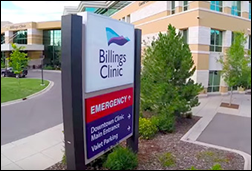
Billings Clinic employee’s email hacked during overseas travel; breach affects 8,400 people

The email account of an employee of Billings Clinic (MT) is hacked while he or she is traveling overseas, exposing the information of 8,400 people who were mentioned in the employee’s emails and attachments.

Blount Memorial Hospital to get medical records backup system following computer problems

Blount Memorial Hospital (TN) sets aside $30,000 to purchase a medical records backup system for its physicians group after unexpected computer downtime in May resulted in the cancellation of numerous appointments.

Monday Morning Update 7/16/18

July 15, 2018 News 5 Comments

Top News

image

CMS issues a massive draft set of rule changes that it says will reduce provider administrative burdens, encourage price transparency, revamp the longstanding E/M codes to a single code in which physician payment is driven by time spent or medical decision-making required, and paying for virtual visits (although at a very low rate).

CMS Administrator Seema Verma said in an announcement, “Today’s proposals deliver on the pledge to put patients over paperwork by enabling doctors to spend more time with their patients. Physicians tell us they continue to struggle with excessive regulatory requirements and unnecessary paperwork that steal time from patient care. This Administration has listened and is taking action. The proposed changes to the Physician Fee Schedule and Quality Payment Program address those problems head-on, by streamlining documentation requirements to focus on patient care and by modernizing payment policies so seniors and others covered by Medicare can take advantage of the latest technologies to get the quality care they need.”


Reader Comments

image

From Another Allscripts Casualty: “Re: Allscripts layoffs Friday the 13th. Follows the voluntary early retirement program. I don’t know the numbers, but it definitely involved US-based support for ProEHR, ProAPM, and interfaces. Knowledgeable staff were released and offshore customer support will become even more prevalent.” Unverified, and I didn’t even bother asking because Allscripts always declines to comment on personnel issues. Another reader says he heard 70 folks were let go. I was thinking that as I write this, I don’t even have a good mental picture of what Allscripts has become – a distant fourth-place inpatient EHR vendor; seller of badly aging EHR/PM systems but with a newly developed product in the wings; acquirer of fire-saled unrelated products like Paragon, Practice Fusion, and NantHealth; or a pseudo HIT mutual fund trying to tap-dance investors into a buy-and-hold stupor by promising a better future involving genomics and population health? Even that master-of-none pandering to financial markets hasn’t worked out great – since Paul Black hired on in December 2012, MDRX shares are up just 13 percent vs. the Nasdaq’s 149 percent gain and Cerner’s 49 percent jump. Let’s hear from you, however – what has Allscripts done well and not so well and what would you do first thing if installed as King or Queen of Allscripts for a day?

image[30]  image

Speaking of Allscripts, I just noticed a subtle change in the company’s logo to make the L’s look like they’re rising and to darken the font. The change was made sometime in April or early May, according to cached copies of the page. Hopefully the rationale for the change made it worth what must have been a significant cost to swap it out everywhere. While I was looking over their site, I also noticed that seven of eight executives are male, as are nine of nine board members, which is high even in man-centric health IT.

SNAGHTML3904477

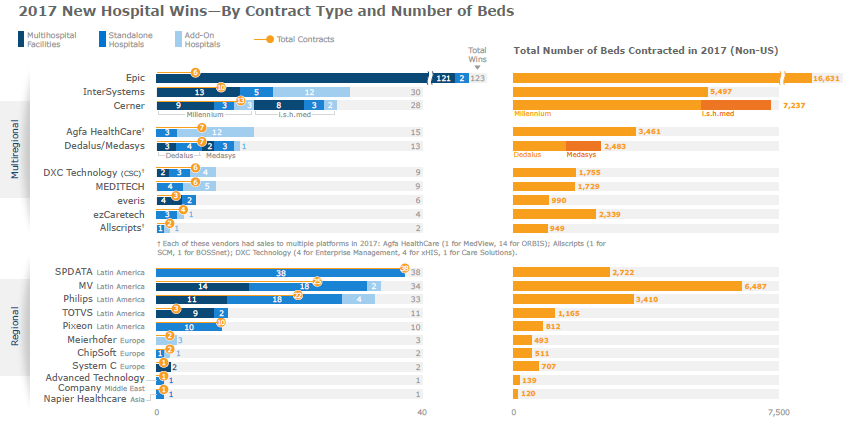
From Banty Rooster: “Re: KLAS’s EHR global market share report. Cerner signed the most contracts and more beds than InterSystems, yet KLAS positions ‘rapid growth’ for InterSystems while Cerner ‘lagged.’ The chart doesn’t seem to match the narrative.” I think KLAS struggled to characterize Cerner since it’s the only one of the top vendors that sells multiple systems that it targets to specific geographic regions, and half of its 2017 global contracts and a pretty big chunk of its new international bed count came from sales of its I.S.H. Med system instead of Millennium. I know basically nothing about I.S.H. Med other than Cerner inherited it with its acquisition of Siemens Health Services, which had bought the SAP-based system from Austria’s T-Systems (no relation to the US-based T-System as far as I know). KLAS’s summary from the full report: “Over the past five years, Millennium has not grown as quickly as its primary competitors. Cerner has slowed Millennium’s growth by limiting it to targeted markets, offering I.S.H Med in additional markets around the globe, and marketing their non-EMR platforms (like HealtheIntent). Those who do choose Millennium like its broad functionality and flexibility.”

image

From Measly Metric: “Re: population health. The tools are promising, but where’s the process?” My take on population health is simple – one of the biggest threats to your health is getting pulled into the bosom of the US healthcare “system” and having your insurance milked and your body tinkered with, most often to your detriment even with good intention as uncoordinated experts blast their diagnostic and therapeutic guns in ready-fire-aim fashion. PHM sounds like a good idea as long as doctors get paid only if you stay well, but otherwise, many people would remain healthier by steering a wide path around financially motivated doctors and hospitals whose “health” expertise (versus “healthcare services sales”) is minimal. Whatever you do, try not to be admitted to a hospital, because the dangers there – both clinical and financial — are staggering. I’ve seen them firsthand as a member of various hospital committees that review the plethora of errors, lack of coordination, and outright bad decisions — the reality of regular medical mayhem versus the proudly displayed crystal awards in the tasteful lobby is jarring. Executives fresh off an admission to their own hospital – even in luxury suites with piles of extra attention – invariably marvel among peers at how lucky they were to escape without permanent harm.


HIStalk Announcements and Requests

image

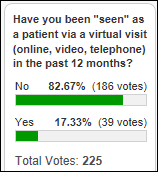
Virtual visits haven’t kicked much of a dent in the health IT universe, with 83 percent of us never having participated in one (and I generously included “telephone” in the category). Judy says Doctor On Demand costs her just $5 on her employer’s plan and she has avoided at least three ED/urgent care visits as a result. Carla loved a Sunday afternoon session for an infection. Allen says his insurance covers only office visits, making me wonder why employers wouldn’t embrace them to keep employees productive instead of wasting half a day driving and waiting. Jim loves MD-Live for routine issues and care in rural areas, noting that he was able to choose a highly qualified doctor from a list instead of paying retail clinic prices that now cost about as much as a PCP visit but that mostly use NPs/PAs instead of doctors.

New poll to your right or here, which popped into my head while I was thinking about Allscripts: who is the best CEO among the largest inpatient EHR vendors? Vote and then click the poll’s “comments” link to explain what “best” means to you and why your choice qualifies.

Listening: Australian singer-songwriter Courtney Barnett, an interesting combination of blandly delivered but smart, observational lyrics paired with her stripped-down guitar. Sample lyrics: “Tell me I’m exceptional and I promise to exploit you” and “I think you’re a joke, but I don’t find you very funny.” She’s one of those musicians whose modest singing and instrumental skills transform into something great just because it’s her words and her unpretentious, non-computer enhanced knack for saying what everybody feels. Music goes through predictable cycles where audiences finally rebel against corporately backed, wildly overproduced mindless mainstream pop, and when it happens again, Courtney will be ready.


Webinars

July 26 (Thursday) 1:00 ET. “The Patient’s Power in Improving Health and Care.” Sponsor: Health Catalyst. Presenter: Maureen Bisognano, president emerita and senior fellow, Institute for Healthcare Improvement. Patients, even those with chronic diseases, only spend a few hours each year with a doctor or a nurse, while they spend thousands of hours making personal choices around eating, exercise, and other activities that impact their health. How can we get patients to be more engaged in their care, and help physicians, nurses, and healthcare providers transition from a paradigm of “what’s the matter” to “what matters to you?” This webinar will present stories of patients and healthcare organizations that are partnering together with tools, processes, data, and systems of accountability to move from dis-ease to health-ease.

Previous webinars are on our YouTube channel. Contact Lorre for information.


People

SNAGHTMLda59973

New Ascension-owned process automation vendor Agilify hires Doug Thompson (NextStep Solutions) as president.


Government and Politics

image

The VA creates an Office of Electronic Health Record Modernization to oversee its Cerner implementation, to be headed by Genevieve Morris, who is on loan from ONC as principal deputy national coordinator.


Privacy and Security

image

The email account of an employee of Billings Clinic (MT) is hacked while he or she is traveling overseas, exposing the information of 8,400 people who were mentioned in the employee’s emails and attachments.


Other

JAMIA President Doug Fridsma, MD, PhD says in a BMJ editorial that medical students should be taught health informatics. 

The New York Times looks at a town in Mexico whose ongoing water shortages encourage residents to drink cheap, readily available Coca-Cola, of which the locals consume an average of a half-gallon per day. Public health has suffered, with the diabetes mortality rate jumping 30 percent in three years. Residents complain that the local bottler pays little for the water it uses and that money goes directly to the federal government in a sweetheart deal. A local activist neatly summarizes Coke’s business model as, “Coca-Cola is abusive, manipulative. They take our pure water, they dye it, and they trick you on TV saying that it’s the spark of life. Then they take the money and go.”

As a regular Waze user, I’m happy to see that the Google-owned GPS app will give cities access to its massive amount of traffic and driving data to support real-time emergency notifications and long-term infrastructure planning.


Sponsor Updates

  • LogicStream Health releases a new podcast, “How data analytics, data democratization and clinical process improvement are helping to increase innovation and control costs in healthcare.”
  • Mobile Heartbeat adds Amplion’s Alert nurse call system to its MH-CURE clinical communications and collaboration smartphone app.
  • Santa Rosa Chief Strategy Officer William Leander shares his presentation from HFMA titled, “Seven Critical Aspects of a Successful BI & Analytics Program.”
  • Summit Healthcare raises $3,900 for A Gift for Teaching, this year’s Heart of MUSE Foundation recipient.
  • Surescripts releases a new video, “Technology: A Prescription for a 21st Century Health Crisis.”
  • Optimum Healthcare IT is named as one of Jacksonville, FL’s list of fastest-growing companies for the third consecutive year.
  • Mazars employees volunteer at local communication organizations across six states for the company’s fourth annual “Days of Service.”
  • ZappRx will exhibit at Integrate 2018 July 23-25 in Philadelphia.
  • ZeOmega releases a Jiva customer success video featuring MCG Health.

Blog Posts


Contacts

Mr. H, Lorre, Jenn, Dr. Jayne.
Get HIStalk updates. Send news or rumors.
Contact us.

125x125_2nd_Circle

Weekender 7/13/18

July 13, 2018 Weekender Comments Off on Weekender 7/13/18

weekender 


Weekly News Recap

  • Facebook fixes security holes that allowed third parties to harvest the names and email addresses of people who signed up for its private groups, triggered by a breast cancer group’s concern
  • A new KLAS report covering non-US EHR activity finds that Epic doubled its relatively small market share in 2017, InterSystems continued its rapid growth, and Cerner experienced moderate activity
  • Cerner partners with and takes a $266 million equity position in value-based care operator Lumeris
  • AdvancedMD acquires competitor NueMD
  • England’s health secretary Jeremy Hunt takes the foreign secretary job vacated by Boris Johnson, with the country’s culture secretary taking over as health secretary in a major government shakeup

Best Reader Comments

The biggest challenge to telemedicine is the lack of insurance coverage. Medicare (which also sets the rules for most commercial payers) has a very limit set of originating sites (locations where the patient can be during the visit). The AMA is scared to death of how this technology could negatively affect their urban/ suburban member’s pocketbooks. (Former Community CIO)

Don’t forget one independent assessment [of University of Washington Medicine’s plan to move to a single EHR] was done showed no benefits after 10 years. If you don’t think part of new savings comes from staff, you haven’t read the notes. We lost millions of dollars last year and staff reduction is the plan to fix the problem. (JoblessInSeattle)

$190M in benefits on a $180M project seems pretty convenient. How much staff are they [UW Medicine] cutting? Are these numbers real? (EpicITStaffer)


Watercooler Talk Tidbits

image image

Readers funded the DonorsChoose teacher grant request of Ms. Z in New York City, who asked for a solar bag and solar beads for a STEAM project. She reports, “Exploring solar energy concepts can be challenging. With the materials that have been provided by this grant, my students explored new concepts, conducted hands-on activities, and had a great time learning. Students focused on solar energy, which is the most abundant renewable energy source. We conducted our investigations outside in our schoolyard. Students constructed necklaces and bracelets using the solar beads and were truly amazed by the color changing reaction by the sun. We also used the solar balloons which flew like hot air balloons, except we used the sun’s energy as the heat source. Thanks again!”

image

A jury orders Johnson & Johnson to pay $4.7 billion in damages to 22 women who sued the company for failing to warn them that its baby powder increases the risk of ovarian cancer because it may contain asbestos. The company says it will appeal, as it has successfully done in several similar lawsuits, and complains that the women were allowed to sue in Missouri even though most of them don’t live in that state.

HIMSS recaps its well-received HIMSS18 session titled “Boston Strong: Lessons Learned from the Boston Marathon Bombing” by former Boston Police Department Chief Daniel Linskey.

image

Boston Children’s Hospital achieves near-miraculous recoveries by infusing mitochondria from a patient’s healthy tissue into their ischemia-damaged hearts or lungs. The experimental procedure is credited with saving the live of Avery Gagnon (pictured above), whose post-open heart surgery ischemia was immediately resolved, allowing her to be taken off ECMO. Researchers say the procedure’s low risk make it potentially useful in every major heart surgery as well as in treating other organs and diseases.

image

A Texas couple whose six-year-old daughter requires around-the-clock medical care due to a chromosomal disorder considers divorcing to qualify the child for Medicaid as they are overwhelmed by $15,000 in annual out-of-pocket medical costs on top of expensive insurance premiums on a family income totaling $40,000.

SNAGHTML75ac522

Bristol-Myers Squibb Children’s Hospital (that a hospital would be named after a drug company tells you a lot about US healthcare) rehomes the 16-foot-tall statue of Geoffrey the Giraffe that had stood in front of the former headquarters of the defunct Toys R Us.

image

A Memphis woman sues her dermatologist after he greeted her during her visit with, “Hi, Aunt Jemima,” which he later admitted to reporters was a “misspoken blunder.”

This former Iowa Methodist Medical Center pharmacy technician is clever (maybe unintentionally so) in his apology to hospital patients whose injectable narcotics he swapped out with sterile water so he could use them himself — “I’m sorry for the pain I caused them.” The lawyer for several patients who are suing the hospital over the incident added his own possibly unintentional humor in declaring, “He hurt a lot of people.” The former tech will ache for his 30 months in federal prison to pass quickly.

image

A man is charged with using the identity of a New Jersey doctor to bill an insurance company for $1 million in medical services using a made-up practice name and an empty, unlocked office’s address. United Healthcare paid him $46,000 before a woman noticed that her insurance was being billed for services she hadn’t received.

image image

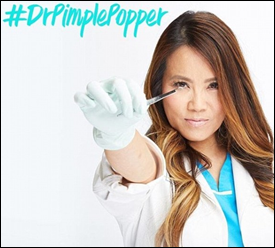
California dermatologist Sandra Lee, MD – whose pimple-popping videos have earned her 3.9 million YouTube subscribers, a just-premiered TV series, and the sobriquet Dr. Pimple Popper – launches an Operation-like board game titled Pimple Pete whose objective is to extract the most fake zits. Life must be good in America if millions of people have time to be entertained by pimple videos and doctors who were trained as healers at great taxpayer expense can make a career of creating them.

image

Bizarre: Michael Jackson’s former doctor – ex-cardiologist and now ex-convict Conrad Murray, who served time for accidentally killing the singer by injecting him with propofol for insomnia in 2009 – claims Jackson’s just-died father Joe chemically castrated MJ as a pre-teen so his voice wouldn’t change.


In Case You Missed It


Get Involved


125x125_2nd_Circle

Comments Off on Weekender 7/13/18

Morning Headlines 7/13/18

July 12, 2018 Headlines Comments Off on Morning Headlines 7/13/18

Facebook recently closed a loophole that allowed third parties to discover the names of people in private, ‘closed’ Facebook groups

After prompting from healthcare technologist Fred Trotter, Facebook eliminates a privacy setting that allowed third parties to glean the names of users who participate in private, closed Facebook groups.

Cue Announces $30 Million Funding Contract from U.S. Department of Health and Human Services’ Biomedical Advanced Research and Development Authority

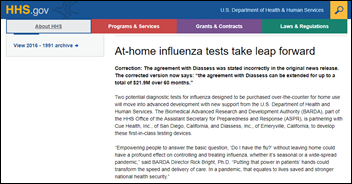
HHS awards Cue Health a $14 million contract to develop app-based flu-testing kits for the home and office that will include virtual consult and prescribing capabilities.

Chairman Roe, Ranking Member Walz Name Lawmakers to New Subcommittee on Technology Modernization

The House Committee on Veterans’ Affairs names members of the subcommittee that will oversee the VA’s Cerner implementation.

Comments Off on Morning Headlines 7/13/18

News 7/13/18

July 12, 2018 News 3 Comments

Top News

SNAGHTML48bea76

Facebook eliminates a privacy setting that allowed third parties to glean the names of users who participate in private, closed Facebook groups.

The company also shuts down the Grouply.io Chrome extension that was designed to allow marketers to harvest such information on a large scale.

image

The latter problem was discovered by the moderator of a group for BRCA-positive women who worried that their potential breast cancer information could be shared with insurance companies, with the extension’s behavior documented and reported to Facebook by healthcare technologist Fred Trotter.


Reader Comments

SNAGHTML4dcfaa9

From Dockside: “Re: BJC HealthCare Information Services. Laid off 68 employees and 45 contractors Wednesday following the Epic rollout on June 2 at the remaining facilities. Health Information Partners (HIP), the internal group responsible for the Epic implementation (a joint venture with BJC and Washington University) did not seem to suffer any layoffs. We knew this would be coming at some point, but in our opinion it was handled very poorly. People were told individually and were given an hour to remove their personal items prior to being walked out. Those on PTO were given the news by telephone and told not to return to the office – their personal items were shipped to them. Those of us who were left finally received an email saying what was going on just after 4:00 pm Wednesday. Any semblance of the ‘family’ culture that originally came from the hospitals pre-merger has pretty much been wiped out and replaced with the typical cold corporate culture.” I reached out to June Fowler, BJC SVP of communications, marketing, and public affairs, who confirmed Wednesday’s elimination of about 10 percent of the health system’s IT workforce. She provides this statement:

Market forces are driving all healthcare organizations to deliver patient care services in new, more efficient, and more cost-effective ways. BJC’s positioning for sustained long-term success in response to these pressures will rely increasingly on information technology and IT expertise for innovative solutions. As a business enabler, IT must increase focus on strategic priorities and align work and resources in support of these priorities. Reprioritizing the work towards improved system stability, strengthening of information protection, and disciplined execution requires changes in the IT staffing structure. This realignment includes an adjustment of skills and capabilities required in IT and will eliminate some current positions. In some cases, new job roles and responsibilities will be created to enable improved capabilities and assure accountability for execution as well.

To adjust staffing levels to meet current priorities, we made the difficult decision to reduce the IT workforce effective July 11. The workforce reduction affects 68 employees and 45 IT contractors.

We recognize any action that results in job loss has a significant impact on employees and their families. There is a comprehensive compensation and outplacement support package in place to assist those who are directly affected by this necessary action. The BJC human resources team is working closely with these affected colleagues to support them through this transition. The reduction initiates action towards a major transformation of our delivery capabilities where IT will realign resources to deliver against BJC’s most strategic intents.

From Plebe: “Re: health IT influencer blogs. What do you think of this site’s list?” It’s not up to me to decide who influences whom, but I checked out the 32 sites and found that: (a) 13 are no longer online; (b) nine rarely post anything; and (c) the remaining 10 write something at least occasionally. I’m not getting into a quality debate on the content of those 10, but for most, their rather simplistic articles wouldn’t seem likely to influence anyone who themselves have actual influence.


Webinars

July 26 (Thursday) 1:00 ET. “The Patient’s Power in Improving Health and Care.” Sponsor: Health Catalyst. Presenter: Maureen Bisognano, president Emerita and senior fellow, Institute for Healthcare Improvement. Patients, even those with chronic diseases, only spend a few hours each year with a doctor or a nurse, while they spend thousands of hours making personal choices around eating, exercise, and other activities that impact their health. How can we get patients to be more engaged in their care, and help physicians, nurses, and healthcare providers transition from a paradigm of “what’s the matter” to “what matters to you?” This webinar will present stories of patients and healthcare organizations that are partnering together with tools, processes, data, and systems of accountability to move from dis-ease to health-ease.

Previous webinars are on our YouTube channel. Contact Lorre for information.


Acquisitions, Funding, Business, and Stock

image

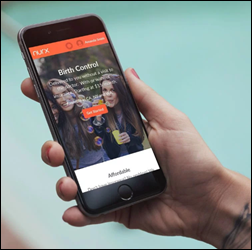
On-demand birth control delivery startup Nurx raises $36 million in a funding round led by Kleiner Perkins. The San Francisco-based company, which has raisd $41 million since launching four years ago, also offers access to anti-HIV medication and plans to offer at-home HIV testing lab kits.

Alphabet’s Verily health business will partner with medical device company ResMed to apply sleep data to study the health and financial impacts of undiagnosed and untreated sleep apnea. I’m not sure how that will work since ResMed mostly sells CPAP equipment that would be prescribed only after a positive diagnosis for sleep apnea.

image

Analysts predict that health IT company Henry Schein will downsize after a regulatory filing hints at plans to increase efficiencies. The Melville, NY-based company spun off its animal health business in April and announced a joint dental software venture with Internet Brands last week.

image

Epic Systems founder and CEO Judy Faulkner climbs three spots on the latest Forbes list of richest self-made women, proving that the “extreme fame leverage” of list cover girl Kylie Jenner (#27) isn’t necessary to achieve a net worth of $3.5 billion and the #3 ranking behind women involved in ABC Supply and Little Caesars (does anyone actually still buy awful Little Caesars pizza except as evening-out sustenance to be left for the kids and babysitter?)


People

image

Eric Pupo (Accenture) joins Columbia University Irving Medical Center as CIO.

image

Divurgent hires Sarah Sample-Reif (Modis) as VP of client services.


Sales

  • Hospital management company Candor Healthcare will implement MedSphere’s CareVue Cloud EHR at Rock Regional Hospital (KS) early next year as part of a facility-wide roll out that will include ChartLogic’s EHR and RCM software and services.
  • Benefis Health System (MT) selects patient self-scheduling and EHR integration software from MyHealthDirect.
  • Eagle Physicians & Associates (NC) opts for real-time patient care alerts from PatientPing.
  • MemorialCare Health System (CA) chooses RTLS-based patient workflow technology from Vizzia Technologies.

Announcements and Implementations

image

Virginia Hospital Center goes live on Bernoulli Health’s clinical surveillance, analytics, and medical device integration software.

image

CompuGroup Medical announces GA of Electronic Videoconsulting.

image

PatientSafe Solutions develops an app for rounding and clinical communications.

image

Allscripts, Athenahealth,  CareCloud, and DrChrono users can offer patients appointment scheduling through Alexa using Nimblr’s virtual assistant, Holly. Integration with Epic is scheduled for Q3.

CipherHealth introduces patient engagement technology for ACOs, including targeted outreach and care coordination tools.

image

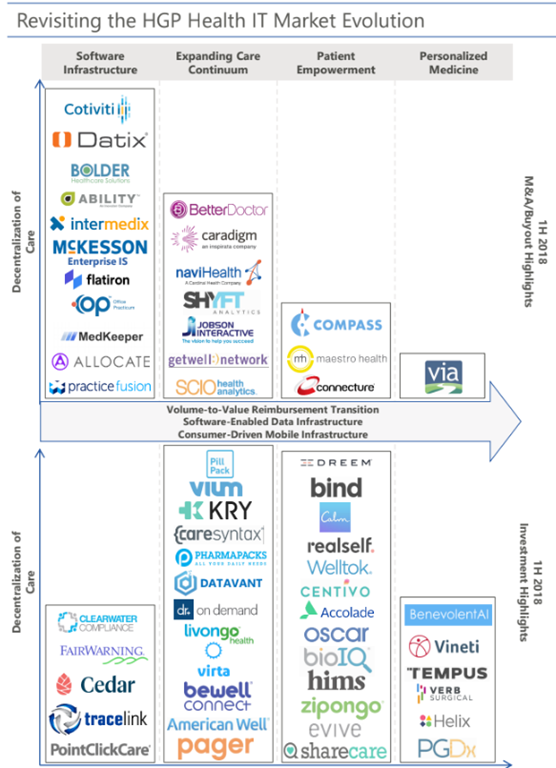
Healthcare Growth Partners publishes its always-brilliant midyear health IT market review. It notes:

  • Despite $29 billion in health IT investment since 2014, broad impact on care delivery, cost, and outcomes has been muted, but value is accruing.
  • Healthcare’s IT spending as a percentage of revenue is close to the average across all industries at 3.5 percent, but still runs about half of what banking and securities companies spend.
  • That healthcare IT spending, however, has been spent on infrastructure and by providers switching from one EHR or billing system to another, gaining little improvement in cost and quality.
  • M&A activity for smaller companies have three points at which value is assigned – proof-of-concept (the product can be sold and deployed commercially, with annual revenue less than $1 million); growth scalability (the company shows signs of profitability and growth scaling, with revenue $5-10 million), and mature scalability (the company takes on real infrastructure and begins to show strong profitability, with revenue $20 million and up).
  • HGP’s HIT Index gained 25.7 percent in 2017 and added another 21.6 percent in the first quarter of 2018.
  • Leading the Q1 HIT performance in share price change are Tabula Rasa Healthcare (up 128 percent), Connecture (up 116 percent), Evolent Health (up 71 percent), and Teladoc (up 67 percent). 
  • Bottom-performing in the Q1 HIT index are Inovalon Holdings (down 34 percent), Invitae (down 19 percent), Oneview Healthcare (down 19 percent), and Allscripts (down 18 percent).
  • Health IT IPOs have dried up completely, with zero in 2017 and so far in 2018.

image

A new KLAS report on non-US EHR activity finds that Epic gained 16,000 beds in signing six contracts in 2017, more than doubling its small, non-domestic market share as concerns about high-profile problems at Cambridge’s implementation in the UK faded. InterSystems continued its rapid growth, especially in smaller, multi-hospital organizations, while Cerner’s growth was moderate and lagged its primary competitors. The early days of the UK’s Global Digital Exemplar program has seen only four new contracts signed, of which Epic earned two, System C one, and Allscripts one.

Virginia Hospital Center (VA) goes live on Bernoulli One for clinical surveillance, medical device integration, and real-time analytics.

Advisory Board’s annual survey of health system CEOs finds that their top concern is preparing for sustainable cost control and creatively reducing expenses, followed by finding diversified revenue streams. A fast-growing #5 was meeting rising consumer demands for service.


Government and Politics

The House Committee on Veterans’ Affairs names to the subcommittee that will oversee the VA’s Cerner implementation Rep. Jim Banks (R-IN, chairman); Rep. Conor Lamb (D-PA, ranking member); Rep. Jack Bergman (R-MI);  Rep. Mike Coffman (R-CO); and Rep. Scott Peters (D-CA).

image

HHS awards Cue Health a $14 million contract to develop app-based flu-testing kits for the home and office that will include virtual consult and prescribing capabilities. The company announced a $45 million Series B funding round earlier this week. Diassess has been awarded a $10 million contract to develop a similar kit, though its focus will be on creating a disposable, battery-powered device for use during public health emergencies.


Privacy and Security

Public health officials in Nashville, TN discover that the PHI of thousands of HIV patients was accessible to all employees on a Metro Public Health server for almost nine months. The database, typically accessed by a small group of physicians, is used to track and help patients living with HIV.

image

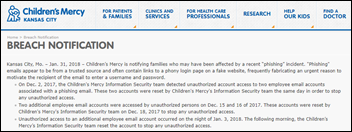
Children’s Mercy Hospital (MO) faces its fourth data breach-related lawsuit, this time pertaining to an email phishing scam discovered in January that potentially exposed the data of 63,000 individuals. Children’s Mercy faced another suit from the same firm over a 2017 breach involving the PHI exposure of 5,500 patients. Two additional lawsuits involved the theft of paper records from employee vehicles.

Fortified Health Security releases its mid-year cybersecurity report, noting that 28 percent of breaches so far this year involved an email attack.


Other

image

The FDA issues recalls on 39,000 Medtronic implantable heart devices after the company alerts providers that the devices need software updates to avoid potentially adverse events.

image

In England, the Royal College of Surgeons calls out the NHS after discovering the health service is still using 9,000 fax machines despite a nationwide push to convert to digital technologies. “NHS hospital trusts remain stubbornly attached to using archaic fax machines for a significant proportion of their communications,” says RCS chair Richard Kerr. “This is ludicrous. The NHS cannot continue to rely on a technology most other organisations scrapped in the early 2000s.”

image

UC Health describes its central data repository for all six UC Health systems at its Data Day in San Diego, noting these points:

  • The scientific method of asking questions and then making observations is becoming obsolete as ample data already exists, with the bottleneck not being the gathering of information, but rather “asking the killer questions.”
  • UC Health’s tools include UC-Rex, a search engine for anonymized patient information, and Epic’s SlicerDicer, which creates patient cohorts from EHR data.
  • Studies now start with looking at what has happened to patients clinically, then getting IRB approval to dig deeper.
  • Information that is being added to the data warehouse includes patient satisfaction and survey results, hospital operations data, claims data, and eventually genomics data.
  • Data analysis includes looking at how physicians spend their time and looking for potential burnout risk factors.

CNBC reports that Amazon and Xealth, a digital prescribing and analytics startup, are in talks with several health systems to develop bundled medical product recommendation and delivery services for patients just before discharge.

image

Weird News Andy is proud as a peacock that New Zealand scientists have performed the first 3-D, color X-ray on a human.


Sponsor Updates

  • CarePort Health extends its discharge planning and referral management software agreement with Jackson Health System (FL), and helps JHS integrate its software with the hospital’s Cerner EHR.
  • Elsevier Clinical Solutions will exhibit at the APC 2018 Annual Meeting July 15 in San Diego.
  • EClinicalWorks will exhibit at the 2018 FSASC Annual Conference July 18-20 in Orlando.
  • Optimum Healthcare IT publishes a video describing SkillMarket, software to manage EHR go-live resource evaluation, compliance, and scheduling.
  • Meditech publishes a case study titled “The Clatterbridge Cancer Centre NHS Foundation Trust Transforms Cancer Care.”
  • IMAT Solutions will exhibit at HealthImpact East July 18-20 in Washington, DC.
  • Butler Health System (PA) achieves 97-percent patient-matching accuracy using solutions from LexisNexis Risk Solutions and Occam Technologies.

Blog Posts


Contacts

Mr. H, Lorre, Jenn, Dr. Jayne.
Get HIStalk updates. Send news or rumors.
Contact us.

125x125_2nd_Circle

EPtalk by Dr. Jayne 7/12/18

July 12, 2018 Dr. Jayne Comments Off on EPtalk by Dr. Jayne 7/12/18

clip_image002

California’s new data privacy law comes under fire from tech companies that want to modify its impact before it goes into effect in 2020. The California Consumer Privacy Act of 2018 (CCPA) is one of the most stringent data privacy laws in the US. Under the law, Californians can access and delete the data that various companies collect on them, and can opt out of the sale of their data. The law is aimed at businesses with more than $25 million in annual revenue, or that amass data on more than 50,000 persons, or that generate more than 50 percent of their revenue from selling consumers’ personal information. Although this protects small businesses, it draws in a large number of entities.

One of my favorite privacy advocates was just at a seminar covering the General Data Protection Regulation (GDPR) enacted by the EU and notes many similarities between it and the CCPA. The so-called “right to be forgotten” is similar, along with the rights of data access and portability. However, the CCPA includes a provision for explicit damages in the event of a breach. The CCPA covers “consumers” who are California residents and also addresses metadata through the use of categories of personal data, categories of data sources, and categories of third parties with whom data may be shared. The CCPA also includes more prescriptive language about explanations that cover what data will be used for and requires businesses to add an opt-out link to their web page.

The CCPA also has a provision that allows the attorney general to prosecute on behalf of a consumer, along with some language that may limit class action lawsuits. There will be a public consultation period in 2019 where modifications may be made before the law goes into effect. Given the large number of tech companies in California, there’s a lot of lobbying going on for the likes of Google, Uber, Amazon, and Facebook, that are worried that the law will impact their operations. The Internet Association trade group has indicated it will be part of negotiations over coming months. The passage of the law prior to a June 28 deadline ended a movement for a ballot action in November, so it will be interesting to see what consumer groups think of industry lobbyists and whether the law will stay in its current state as it goes into effect. Critics note the speed at which the law was passed (one week) compared to its impact.

While tech companies hope to limit its impact, the American Civil Liberties Union of Northern California feels it hasn’t done enough and that it “fails to provide the privacy protections the public has demanded and deserved,” noting that it was “hastily drafted and needs to be fixed.” California is progressive in a variety of ways, so we’ll have to get out our “fifty nifty” scorecards and see who is ready to follow suit.

clip_image004

It’s a sign of our times: GoFundMe’s CEO tells Minnesota Public Radio that medical bills and related expenses now account for one-third of GoFundMe campaigns. There are over 250,000 medical requests launched each year, with more than $650 million raised. The campaigns include both uninsured and underinsured individuals, and request assistance for high medical bills, travel to specialty care facilities, and procedures denied or uncovered by insurance.

clip_image006

JAMIA publishes a study titled “Research use of electronic health records: patients’ perspectives on contact by researchers.” The authors note that “researchers will almost certainly discover discrepancies in EHRs that call for resolution, and in some cases, raise the ethical dilemma of whether to contact patients about a potentially undiagnosed or untreated health concern” and set out to “explore patients’ attitudes and opinions about potential contact by researchers who have had access to their EHRs.” Researchers used focus groups where situations were described and discussed. Many patients did feel researchers should act if a current health issue was identified, but felt that communicating through the patient’s physician was the best way to handle notification. Rural participants had a strong preference for researchers to take action compared to urban participants. The authors conclude that study construction should allow for addressing discrepancies found in the EHR and communicating with patients. The article is worth a read to see some of the actual patient comments noted in the focus groups.

The various federal rules that have come out over the last year are so large that I never make it through any of them in their entirety. I missed the fact that CMS intends to force adoption of the NCPDP SCRIPT Standard, Version 2017071 beginning on January 1, 2020. Although some may think it’s just another item to mark off on a checkbox, it adds significant benefits for many providers. My favorite improvement closes out an “enhancement” request I made back in 2003, when I implemented Medical Manager’s OmniChart product which used ProxyMed for e-prescribing. If you’re a provider who has ever had to prescribe a complicated prednisone taper or give detailed instructions for migraine medications, you’re going to be happy. Once the transition to the new standard is complete, providers will be able to send instructions that are larger than the current 140-character limit. They’re giving us a full 1,000 characters to play with, but there will be issues during the transition if provider systems are upgraded but pharmacies are not. In those cases, if instructions of more than 1,000 characters are sent, they will be rejected on the pharmacy side.

I’m looking forward to being able to spell out my favorite treatment for severe poison ivy without resorting to error-prone abbreviations. Until then, you’ll have to take your prednisone 3 PO TID for three days, then 2 PO TID for three days, then 1 PO TID for three days. And remember to wear long sleeves and long pants and also wash with Fels-Naptha soap when you come in from the woods.

What’s your favorite custom SIG for medication instructions? Are your providers going to do a happy dance? Leave a comment or email me.

Email Dr. Jayne.

Comments Off on EPtalk by Dr. Jayne 7/12/18

Morning Headlines 7/12/18

July 11, 2018 Headlines Comments Off on Morning Headlines 7/12/18

Alphabet and ResMed are spinning out a start-up to solve sleep apnea, a hidden health crisis

Alphabet’s Verily and ResMed will use “billions of night’s of data” to jumpstart a joint venture focused on diagnosing sleep apnea more effectively and helping patients better manage the condition.

Nurx raises $36 million and adds Chelsea Clinton to its board of directors

Birth control-focused telemedicine startup Nurx raises $36 million in a funding round led by Kleiner Perkins.

Medtronic says thousands of heart devices need software upgrades

The FDA publicizes Medtronic notices alerting providers that 39,000 implantable heart devices need software updates to avoid potentially adverse events.

Comments Off on Morning Headlines 7/12/18

Readers Write: Augmented Intelligence: Virtual Assistants Come to Healthcare

July 11, 2018 Readers Write Comments Off on Readers Write: Augmented Intelligence: Virtual Assistants Come to Healthcare

Augmented Intelligence: Virtual Assistants Come to Healthcare
By Andrew Rebhan

Andrew Rebhan, MBA is a health IT research consultant with Advisory Board of Washington, DC.

image

Natural language processing (NLP) techniques allow digital systems to streamline user interactions allowing machines to read text, understand meaning, and generate narratives from existing information. Recent advances in artificial intelligence (AI) technologies have accelerated progress in a broad range of NLP applications for healthcare, including digital assistants for clinical staff, concierge services for patients, and digital scribes to streamline documentation processes.

For example, last Fall Nuance Communications released its Dragon Medical Virtual Assistant to help health care providers interact with clinical workflows using NLP and other conversational AI functionality. Nuance announced at HIMSS18 that it will integrate its virtual assistant technology into Epic’s EHR.

According to the news release, the new partnership allows physicians to use the virtual assistant to ask for information from a patient’s chart, retrieve labs, medication lists, and visit summaries using Epic Haiku. Nurses using Epic Rover can use the assistant to conversationally interact with flowsheets to enter and confirm patient info and vitals. Finally, scheduling staff using Epic Cadence can converse with the assistant to check physician schedules and create or modify patient appointments. Vanderbilt University Medical Center recently announced it is leveraging Nuance’s technology to build a prototype voice assistant called “V-EVA” (Vanderbilt EHR Voice Assistant) to help caregivers navigate the hospital’s Epic EHR using natural dialogue.

A number of other healthcare providers have started piloting voice assistants. Northwell Health is testing Amazon’s Alexa across multiple use cases, including one that helps users determine the wait time at nearby emergency rooms and urgent care centers in Northwell’s system. People can ask their Alexa-enabled home devices to either search for the shortest wait time based on their ZIP code, or can ask for the wait time for a specific location. Once the user asks for this information, Alexa queries Northwell’s database of wait times (which analyzes check-in data every 15 minutes) for the best option. The Alexa feature can respond back with the location’s name, address, and wait time.

In another example, the University of Pittsburgh Medical Center (UPMC) is collaborating with Microsoft to create an intelligent scribe called EmpowerMD. The project is part of Microsoft’s Healthcare NExT initiative, which aims to use AI to accelerate healthcare innovation. The virtual scribe listens to conversations doctors have with patients, analyzing speech for clinically relevant concepts to make suggestions in the medical record. The goal is to allow doctors or other staff to engage with patients face to face, without the need to divert their attention to a computer screen. The scribe can make suggestions or take notes for follow up, which the doctor accepts or modifies after the encounter. Staff can also view a transcript of the conversation for greater context on the assistant’s suggestions. Using machine learning, the virtual assistant improves its performance as suggestions are accepted, rejected, or modified by the user.

Patients are also interested in AI-powered virtual assistants. Accenture recently released the findings of its 2018 Consumer Survey on Digital Health, which polled 2,301 US consumers on topics such as wearables, virtual care, and AI. Among the findings, the survey showed that roughly one in five consumers has experienced health-related AI, and in particular, showed an openness to using intelligent virtual assistants:

  • 61 percent said they would use “an intelligent virtual health assistant that helps to estimate out-of-pocket costs, schedule healthcare appointments and explain benefit coverage, bills, and payment options”
  • 57 percent would use an intelligent virtual coach
  • 55 percent would use “an intelligent virtual nurse that monitors your health condition, medications, and vital signs at home”
  • 50 percent would use “an intelligent virtual clinician that helps to diagnose health issues and navigate you to the right treatment options”

Is your team interested? Here are some considerations to get you started.

Identify your Goals

Virtual assistants can perform a variety of tasks described above. In addition, they can set reminders, answer basic patient questions, call for a nurse, or even address loneliness. However, virtual assistants may not always be the best solution for a given problem, particularly complex tasks that may benefit from visual displays (such as on a computer or tablet). Make sure your team is specific about how the technology will improve processes and where it fits into existing workflows.

Explore What’s Possible

The major technology companies such as Google and Amazon are trying to make their software development kits and APIs as open and user-friendly as possible – which means your organization can build new skills into these virtual assistants to better suit your needs, assuming you have the right staff skills to code these features. As you evaluate options, ensure that potential solutions are properly evaluated for HIPAA compliance, as natural language interfaces in a healthcare setting may capture sensitive information whether or not that is not part of their intended use.

Expect Change

The healthcare industry is starting to see rapid advancements in NLP, computer vision, and other subsets of AI, but the use of virtual assistants in hospitals is still nascent. The technology will likely continue to evolve as more organizations adopt and test these devices, and the broader industry forms new ways to implement and regulate their use. Early adopters will have an advantage in getting to use and gain experience with these tools, but may also have to update them more often as vendors release new editions with enhanced capabilities.

Comments Off on Readers Write: Augmented Intelligence: Virtual Assistants Come to Healthcare

HIStalk Interviews Dan Burton, CEO, Health Catalyst

July 11, 2018 Interviews Comments Off on HIStalk Interviews Dan Burton, CEO, Health Catalyst

Dan Burton is CEO of Health Catalyst of Salt Lake City, UT.

image

Tell me about yourself and the company.

Health Catalyst was founded by a couple of folks from Intermountain Healthcare. We provide a data platform that’s really good at aggregating data from lots of different sources. We analyze the data and we have a layer of analytics apps that pinpoints opportunities for improvement clinically, financially, or operationally. Then we provide clinical, financial, and operational expertise to go after those opportunities.

What led to the Medicity acquisition and what synergy do you expect to see?

We have deep roots and connections to Medicity going back to the company’s founding. Former Medicity President Brent Dover joined Health Catalyst a number of years ago, as did the former head of sales and other management team members. Like us, they are headquartered in Salt Lake City.

What Medicity does is complementary to what we do. The data asset that we have amassed is rich, especially on the acute care side, with about 100 million patient records. But it’s lighter than we would like on the ambulatory side, which is Medicity’s strength. They have about 75 million patient records, largely coming through the ambulatory space. Adding that data asset and the transactional capabilities of being effective in moving data to lots of different places felt like an important complement to the ability of our platform to meet the needs of our clients.

From a mission orientation perspective, the folks at Medicity are focused on using data to improve outcomes. That’s why we exist. We felt like from a data asset perspective and from a mission perspective, it lined up well.

How much of the information that a provider organization needs to meet today’s challenges exists outside their EHR?

The province of Alberta, Canada did a study about two years ago to try to answer that question. Their conclusion was that to effectively run population health for their province, only about 8 percent of the relevant data existed in the EHR. We think that’s about right, and our experience with our clients is similar. The EHR is an important source of data, but we have many clients that need to pull information from 50 or 100 additional sources. We also have clients that have four or five EHRs whose information needs to be brought together into a single source of truth.

What is the level of provider analytics maturity and what are the higher achievers accomplishing that the lower achievers are not?

We are still in the very early innings of analytics prowess or analytics maturity. Even our most advanced clients are still facing some of the same challenges that the rest of the client base that we work with seems to face.

One is a talent shortage. It’s hard to find great data scientists and great analysts in competing with Silicon Valley, with Google, Microsoft, Amazon, and many other tech companies. We’ve seen a real gap in our clients being able to staff the kind of analytics talent that they would like to have. That’s one of the reasons that our analytics expertise, our services offering, has exploded over the last three years. We’ve been fortunate to compete pretty well for talent against Silicon Valley, so we can bring that talent to bear.

It’s not surprising that our industry is early in developing analytics capabilities. It has taken us a long time to transition from paper to electronic data. Without electronic data, there was nothing to analyze. Since we’re early relative to other industries in that transition, it follows pretty naturally that we would be early in developing significant analytics prowess.

The best conference speaker I’ve heard was Billy Beane from the Oakland Athletics at your Healthcare Analytics Summit a few years back, who in “Moneyball” used analytics rigor to find market inefficiencies that could be exploited by an underfunded baseball team. Do we have a Billy Beane-like provider who is taking the culture in a new direction in ways that everybody else is missing?

The analogy is important, including the cultural change required and the doubts he had to overcome from within his organization. We experience a lot of the same in healthcare. But we see some of our most innovative health systems choosing to face the truth from the data, to realize that they have significant inefficiency and significant variation. There’s a lot of vulnerability, for example, in facing patient injury elements, but that’s a necessary step to transform and dramatically improve.

We are also seeing an interesting uptick in innovative openness to being data-driven, coming maybe from outside of the traditional provider segment of the healthcare ecosystem. I think that pattern will continue for a decade or more, where you will see innovative employers thinking differently about how they utilize the data they can collect on the health of the population that they care about most, which is their employees and their loved ones.

We think data and analytics have an important role to play through many different vectors, including the traditional delivery mechanisms, but it will play a role in non-traditional ways, too.

Health Catalyst spent a lot of money to create the Data Operating System. What does it offer that a data warehouse doesn’t?

A lot of value can still be realized from the concepts that were breakthrough for us a decade ago, like a late-binding data architecture. In many ways, that has become a more common practice in healthcare, which is great for the entire industry since it still offers value.

What we saw a number of years ago — and I’ll credit Dale Sanders, our head of technology, for seeing this before many others — was that there would be an explosion in the number of potentially relevant data sources. Specific use cases exist where having access to data sources such as genomics and social determinants of health data leads to much better decisions and dramatically improved outcomes, both financially and clinically.

That explosion in potentially relevant data sources requires a much more scalable data platform. A traditional, on-premise data platform using 10-year-old technology just can’t handle that level of scale. We feel that the right combination is a more modern technology stack that takes advantage of the best Silicon Valley thinking coupled with deep healthcare domain expertise.

We made a bet a few years ago to invest $200 million in this next-generation Data Operating System data platform to support that need to scale. We’re early in enabling our clients to realize the return on that investment, but we’re not super early. We’re seeing more and more interesting use cases where you bring in non-traditional data sources and you have compute power through an Azure-based, cloud-based, scalable technology infrastructure that you just couldn’t achieve in the old model.

Analytics is often applied to address clinical quality and outcomes, but health system cost pressure is increasing. What data tools do organizations use to manage costs?

A cost focus and a precise ability to measure cost at a granular level will become a central focus over the next five years. The low-cost providers will be the survivors, and those who are going to be low cost have to first understand their costs.

There are real challenges, partly because we are not systematically collecting all the data needed to answer the question of, what are my precise costs on a given day, with a given provider, in a given location, with a given procedure? There is data that needs to be collected at a very specific level, but that isn’t being collected today.

We’ve spent a good deal of time over the last five years developing a Pareto version of precise activity-based costing for healthcare, where you get 80 percent of the precision benefit with about 20 percent of the effort. It’s hard to do precision-based costing all the way. It’s incredibly expensive to collect all of that data in every case. We hypothesize an 80/20 rule that we’re finding actually exists. We co-developed this with UPMC.

My opinion is that five years from now, every surviving health system will be collecting all of that data and analyzing it very carefully to identify the hundreds and even thousands of cost-savings opportunities. The health systems that execute most flawlessly against those improvement opportunities will be the health systems that thrive and survive. Those that don’t pay attention are very much at risk.

Health Catalyst is on everybody’s list of health IT companies that are expected to go public next. I know you can’t talk about that specifically, but what does it take to prepare a company for growth?

It’s very hard to do. That’s probably appropriate. To become a successful publicly-traded company requires that size and scale be in place and to have predictability to the business model and the revenue. There needs to be stability in the client base and a significant Net Promoter Score or satisfaction level. In our opinion, there needs to be a culture that is built to last and team members who are deeply engaged in the company’s mission and the success of a client.

That’s a model that we have tried to follow in the event of a scenario where our board decides that going public would be the right path for our company to pursue. We have obviously chosen to raise capital from investors, so we understand that those investors eventually need liquidity and a return on their investment. One way that can happen is through the public markets.

One element that the leadership team really likes is the opportunity to remain as Health Catalyst for the long haul. That’s very important to us, and an appealing element of the public company path.

In any regard, preparing to be a successful public company overlaps significantly with preparing to be a scalable, independent, sustainable company as well. For a number of years, we’ve been trying to prepare ourselves to be the latter, and by preparing for the latter, you are also preparing for the former.

Do you have any final thoughts?:

It’s an exciting time to be in healthcare. It’s a time of transition, which can evoke feelings of nervousness and anxiety for good reason. But it also represents a real opportunity to think about things differently. Data and analytics provide us with visibility we’ve never had about what we should change and what we should do differently so we can see the industry transform. It’s a great thing to be a part of. It’s a meaningful activity to get up in the morning and work hard to fulfill.

Comments Off on HIStalk Interviews Dan Burton, CEO, Health Catalyst

Morning Headlines 7/11/18

July 10, 2018 Headlines Comments Off on Morning Headlines 7/11/18

Ingenious Med Announces Nimesh Shah as New CEO

Nimesh Shah (McKesson) replaces Joe Marabito as CEO of Ingenious Med.

Children’s Mercy faces class action lawsuit over data breach affecting thousands

Children’s Mercy Hospital (MO) faces another data breach-related lawsuit, this time pertaining to an email phishing scam that potentially exposed the data of 63,000 individuals.

Layoffs likely ahead at Henry Schein in latest move

Analysts predict health IT company Henry Schein, which recently spun off its animal health business, will downsize after a regulatory filing hints at plans to increase efficiencies.

Comments Off on Morning Headlines 7/11/18

Text Ads


RECENT COMMENTS

  1. Isn't that actually present perfect indicative?

Founding Sponsors


Platinum Sponsors


Gold Sponsors


RSS Webinars

  • An error has occurred, which probably means the feed is down. Try again later.