Recent Articles:

News 11/17/21

November 16, 2021 News 5 Comments

Top News

image

Population health management company Lightbeam Health Solutions will acquire CareSignal, which offers more than 30 condition-specific remote patient monitoring programs, for an undisclosed sum.

I interviewed CareSignal CEO Blake Marggraff last year. He launched the company coming out of pre-med in 2015 at the age of 22.


Webinars

None scheduled soon. Previous webinars are on our YouTube channel. Contact Lorre to present your own.

Here’s the recording of our recent webinar titled “Increasing OR Profitability: It May Be Easier than you Think,” sponsored by Copient Health.


Acquisitions, Funding, Business, and Stock

image

Ribbon Health raises $43.5 million in a Series B funding round. The company has developed an API that enables health IT developers to access data on doctors, insurance plans, and costs and quality of care.

image

Workforce management software vendor QGenda acquires Schedule360, which offers Best in KLAS nurse and staff scheduling software.

H1, which offers drug companies a platform to identify opinion leaders and to monitor the drug trials of competitors, raises $100 million in a Series C funding round.


Sales

  • The Maryland Department of Health will use NTT Data’s consulting services to enhance its Medicaid Enterprise Systems Modular Transformation program with tech-enabled solutions.
  • MetroHealth in Cleveland enters into a managed services agreement with Pivot Point Consulting for its Epic EHR.
  • Ergotron will integrate Imprivata’s Confirm ID technology with its CareFit Pro Medical Cart, giving hospital staff password-free access to cart drawer contents.
  • Premier’s PINC AI will conduct a hospital-acquired infections clinical trial with medical solutions company Mölnlycke using Premier’s anonymized clinical data and provider network to test interventions, including its TheraDoc clinical surveillance technology.

People

image

Nasim Afsar, MD, MBA (UCI Health) will join Cerner as its first chief health officer in January.

image

Oscar Callejas, MSE (Hillrom) joins Olive as SVP of customer programs.

image

Carrum Health hires Randy Hawkins, MD (ConsumerMedical) as chief medical officer.

image

Tony Burke (Pivot Health Advisors) joins Teladoc Health as SVP of partnerships and innovation.

image

Care transitions software vendor ReferWell hires Chad Baugh, MBA (Teladoc Health) as chief revenue officer.


Announcements and Implementations

image

PerfectServe brings together its clinical collaboration, physician scheduling, patient engagement, and practice communication technologies under the Unite platform.

Elevate Holistics launches a medical marijuana card platform that includes patient scheduling, an EHR that supports telehealth, an online store for selling nutraceuticals and CBD, and a partner marketing integration system with custom landing pages.

Big news from HIMSS22: Michael Phelps, who used to swim fast, will keynote. Maybe healthcare experts Dana Carvey, A-Rod, and that mountain climber who sawed his own arm off weren’t available to reprise.


Other

image

Researchers at the University of Texas Health Science Center at Houston develop the Epilepsy Tracking and Optimized Management Engine, an informatics tool designed to help physicians better manage the care of epileptic patients. Neurologist Katherine Harris, MD says the software has helped cut her billing documentation time down from 20 clicks in her EHR to just three clicks using EpiToMe, which also includes modules for reports, statistics, and scheduling.

A Stat investigative report says that Ascension, the country’s largest Catholic health system at 140 hospitals, is running a $1 billion private equity operation like a Wall Street firm rather than as a passive investor.  The article notes that the tax-exempt health system isn’t required to disclose how its investment profits are used to benefit vulnerable patients.

Analysis finds that private equity-owned air ambulance services bill higher rates and generate surprise patient bills more frequently, charging 60% more than other carriers.

image

Former Sanford Health (SD) CEO Kelby Krabbenhoft, who left the system in late 2020 after making controversial remarks about his refusal to wear a mask, received a payout of nearly $50 million. The health system says he would have been contractually owed the money regardless of his departure circumstances, which involved $15 million in severance, $29 million in retirement payout, and $5 million in salary. Sanford Health ended its planned merger with Intermountain Healthcare because of the leadership change.


Sponsor Updates

image

  • ConnectiveRx team members support Operation Gratitude with a financial donation and cards of support for veterans.
  • Netsmart will integrate the American Society of Addiction Medicine’s Continuum and Co-Triage assessment tools with its EHR.
  • Al Kindi Hospital in Jordan selects Wolters Kluwer Health’s UpToDate and Medi-Span Clinical solutions.
  • EClinicalWorks releases a new podcast, “PDMP Software for Safe Prescribing of Controlled Substances.”
  • The Behavioral Healthcare Executive Podcast features AdvancedMD President Amanda Hansen.
  • Actium Health releases a new Hello Healthcare Podcast, “Physician Relations: A Love Letter.”
  • Change Healthcare helps measure and reduce carbon emissions from the healthcare industry.
  • Optimum Healthcare IT wins the CHIME Foundation Partner of the Year Award.
  • Ellkay will exhibit at Modernizing Medicine’s Momentum Conference November 19-21 in Orlando.
  • Waystar achieves top rankings in Black Book’s latest customer experience RCM technology and outsourcing report in the categories of end-to-end RCM software & technology, hospital chains, systems, corporations, IDNs & corporation; and end-to-end RCM software & technology, community hospitals & medical centers.
  • OptimizeRx will host the second annual Innovate4Outcomes event virtually December 9.
  • Health Catalyst partners with Datavant, enabling healthcare and life sciences organizations to exchange tokenized, de-identified data within Health Catalyst’s Research Network and Touchstone Match.

Blog Posts


Contacts

Mr. H, Lorre, Jenn, Dr. Jayne.
Get HIStalk updates.
Send news or rumors.
Contact us.

125x125_2nd_Circle

Morning Headlines 11/16/21

November 15, 2021 Headlines 1 Comment

Lightbeam Health Solutions Announces Acquisition of CareSignal

Population health management company Lightbeam Health Solutions will acquire remote patient monitoring vendor CareSignal for an undisclosed sum.

Videra Health Announces $3 Million in Seed Funding to Scale Patient Interactions for Behavioral Health

Mental health-focused remote patient monitoring startup Videra Health raises $3 million in a funding round led by Artis Ventures.

Amazon’s healthcare business has landed Hilton as a key customer

Hilton Worldwide Holdings will offer its employees virtual and in-person care from Amazon Care.

Curbside Consult with Dr. Jayne 11/15/21

November 15, 2021 Dr. Jayne Comments Off on Curbside Consult with Dr. Jayne 11/15/21

Big news this week, as CMS announced that it would automatically apply the “extreme and uncontrollable circumstances” exception to the 2021 Merit-based Incentive Payment System (MIPS) performance year. Previously, clinicians would have been required to specifically apply for the exception. The automatic exception will be applied for the 2021 performance year and only to those clinicians who are participating as individuals. Those participating as groups, virtual groups, or alternative payment model entities will instead have to apply for performance category reweighting. This can be done on the Quality Payment Program website prior to December 31.

Those who are carefully following how MIPS works will note that the exception reweights the MIPS performance categories to zero, which means that there will be a “neutral payment adjustment” (aka no penalty) for the 2023 payment year. Given inflation, even a neutral adjustment is still a reduction in payments, which adds to physician unhappiness. CMS also reopened the exception application for the 2020 performance year; participants can apply prior to November 29 by submitting a targeted review form.

As physicians consider the ongoing calculus of how they are paid, how they deliver services, and what their patients want them to offer, I’m starting to see more of my primary colleagues considering direct primary care practices. In that model, patients pay a monthly membership fee to see their physician. There is no third-party billing, and the model is designed to delivery quality care at a reasonable cost. The Direct Primary Care Coalition notes that “most DPC memberships / subscriptions cost less than the average cell phone bill” and that patients typically have greater access, shorter waits, and longer appointments with their physician. In addition to reducing administrative burden and costs, the model has the goal of building back the old-school physician-patient relationship and a mutually trusting therapeutic environment.

Many patients are demanding telehealth, especially during hours that aren’t considered traditional office hours. Those practices that remain part of traditional fee-for-service arrangements are continuing to advocate for payment parity for telehealth services so they can be reimbursed at the same rate for virtual visits as they would for in-person ones. On the physician side, the thought is that the visits require the same level of cognitive expertise and also the same amount of time as in-person visits. Opponents of payment parity argue that those visits should be less expensive due to reduced resources, but the reality for most physicians is that they’re still paying rent, they’re still paying staff to assist them and manage patient data, and they’re also paying additional fees for either freestanding video conferencing software or telehealth modules / content from their EHR vendors.

In New Jersey, Governor Phil Murphy recently rejected parts of a bill that would have required payment parity for telehealth services. He noted that the cost to state taxpayers may be “substantial” and that in-person care should be prioritized except when telehealth would increase access and improve patient outcomes. Murphy reinforces the idea that providers should have long-term cost savings with telehealth due to decreased clinical space and support staff. It didn’t sound like he spends a lot of time talking to physicians who are running low-margin practices and working hard to keep the lights on while they are struggling to retain staff in a market where solid clinical personnel are commanding premium salaries. I’ve performed telehealth visits with no support staff as well as those in a model where staff did all the same pre-visit prep as they would in a brick-and-mortar office, and I have to say the latter is much preferred.

Murphy also notes a concern that over the long haul, “pay parity could over-incentivize telehealth, further limiting in-person options” and that it might be “especially detrimental for those in underserved communities.” On the other hand, pay parity might allow those in underserved communities to have consultations with distant primary care physicians without an untenable wait, which is already the case in many rural and underserved communities. It could also provide opportunities to consult with previously inaccessible subspecialists when patients are unable to travel the distance to tertiary care centers. I agree that Murphy has a valid concern that CMS hasn’t fully made up its mind on payment parity, which could create confusion for Medicare and Medicaid beneficiaries.

Murphy goes on to make it clear that he believes that telehealth “was intended as a stopgap to preserve public health during an unprecedented emergency” rather than something that patients and physicians have decided serves both of them well. It’s unfortunate that he sees it as a way to deliver care of last resort as opposed to a rapid evolution in healthcare delivery. The bill received a conditional veto, which allows the senate to potentially incorporate his recommended changes and amendments. Those include a requirement that the state health department would revisit payment parity over the next 18 months and make a subsequent recommendation. In the mean time, payment parity would be in place through the end of 2023 if the recommendations are followed.

As a patient, I enjoy having options. I have two physicians who I see who really need to be seen in person due to the nature of the examinations involved. I see each of those physicians annually, which between the two of them, results in a comprehensive physical examination with a fair amount of overlap every six months. They’re part of the same medical group as my internal medicine physician, who has full access to both their records. When I see my internist in person, 90% of the visit is a discussion – what’s working for me health-wise, what’s not, and a review of laboratory results, my goals, and how I feel. Very little of it is dedicated to the physical exam and that’s OK given my current state of health. In reality, I’m seeing him for his brain much more than I’m seeing him for his exam skills, especially since I monitor the most important indicators of my health at home. As a patient, it would be much better for my schedule to be able to see him virtually and have him compensated fully for his expertise, which is why I value his care.
Time will tell how much cost reduction can really happen with virtual care. I think a lot of it has to do with how integrated various platforms are and how well physicians can learn to work with patients virtually. Will we have it all figured out by 2023? I’m not sure, but I’m committed to trying.
What’s your preference in the virtual versus in-person care debate? Leave a comment or email me.

Email Dr. Jayne.

Comments Off on Curbside Consult with Dr. Jayne 11/15/21

HIStalk Interviews Tom Cox, President, Experian Health

November 15, 2021 Interviews Comments Off on HIStalk Interviews Tom Cox, President, Experian Health

Tom Cox, MBA is president of Experian Health of Franklin, TN.

 image

Tell me about yourself and the company.

The mission of Experian Health is to simplify administrative processes and improve operational efficiencies so that we can improve the healthcare journey. We primarily do that through patient access, revenue cycle management, and identity services. I’ve been with the company for two years, having joined through the acquisition of MyHealthDirect.

We’ve heard for years that collection of patient financial responsibility would become significant, and not only has that finally happened, investors are rewarding companies whose technologies and services support that collection. What trends do you see?

You will continue to see an acceleration of the digitization of healthcare. Certainly we’ve seen that through the pandemic, as folks were operating in a more remote environment. We saw the digitization of registration scheduling and even telehealth become more important. That trend was absolutely accelerated by COVID and I think you will see that trend continue in the future.

That dynamic of consumers paying a higher portion of their healthcare will drive a number of facts. First, it will require the whole healthcare system to operate much more like the rest of the economy. That is, to provide a better consumer patient experience from the beginning of the process through payments and collections on the back end. That will continue to accelerate.

From the provider’s perspective, the patient is paying a bigger portion, and what the patient pays is the hardest part to collect. Getting the right data upfront and collecting as much of the cost upfront will also be important for all providers and health systems.

How will healthcare use technology more other industries that use technology instead of handing their customer a clipboard and photocopying their documents?

You touched on a number of them. You will see scheduling, registration, and payments being digitized. You will also see healthcare start to use more data about consumers to improve the process of reviewing social determinants of health, understanding what challenges people might have in accessing the healthcare system, to make it easier for them to access the healthcare system and to improve their healthcare results. We know a lot about individuals that we’re not taking advantage of today to improve the healthcare system. You’ll see that change over time.

How do you see providers using consumer data insights, rather than just their own EHR data, to engage with their patients differently before, during, and after a visit?

That is still pretty nascent in healthcare. That provides a big opportunity for a company like Experian, which has a lot of consumer insights. The retail environment reaches out to individuals based on their desires and their wishes, engaging them in the process and then all the way through the process. That should happen similarly in healthcare. We know when patients need to engage in the healthcare system, so we should reach out to them proactively and get them engaged in the healthcare system so that they get the care that they need in a timely manner and improve their overall health. That’s what I think you’ll start to see changing going forward, but it’s still pretty early.

What technologies does Experian offer that would help providers treat their patients more like members?

We have a number of those tools to help the patient feel more like they are a valued patient, which is maybe is a better way to say it instead of as a member. I always worry about member because that tends to get associated with a health plan. From the consumer insights on the front end to anticipate the needs of an individual patient using our data and insights on consumers, to using our tools, to engage staff members through outreach, and to patient communications. Then facilitating the entire process, making that process easy for the patient along the entire journey through digital scheduling, digital registration, and online payments as a seamless, touchless process.

How do you see propensity-to-pay being used in a consumer-friendly way?

Having a propensity to pay will have help patients make more informed decisions. One of the challenges with healthcare, historically, has been that you make a very large purchase decision without any knowledge up front. Many times you only find out about that purchase decision on the back end. We are doing  couple of things to help that process. We provide estimates to patients so that they can make make an informed decision. Then, based on your ability to pay for that, you can then arrange different ways to pay for those services. Most healthcare systems are flexible in their payment terms because they know the patients need the care. They want to make that process as easy for them to get the care as possible.

Some diagnostic radiology practices offer patients a big discount if they pay cash upfront instead of using insurance or being billed. Will we see more of that?

I absolutely think that providers will continue to do all that they can to get the payment upfront. Providing that estimate is the best way to collect that upfront.

I recently experienced that myself with a procedure. I was offered a discount to pay in advance and certainly wanted to take advantage of that. The key to that process, though, is ensuring that the estimate is accurate so that there is no surprise on the back end. You are creating an expectation with the patient or with the consumer that your estimate is correct. When you make that advanced payment, you are not expecting to get another request on the back end. An accurate estimate is critical.

A significant part of patient satisfaction comes from the front end, such as ease of getting an appointment, to the back end, in getting a timely, accurate, and understandable bill. How are providers using those practices for competitive advantage?

In the US, the healthcare that individuals receive is always of really high quality, so you don’t get many complaints about care. The complaints come from the administrative processes, both on the front end of the process — scheduling, registration, asking for the same information repeatedly — and then on the back end, the lack of understanding of the billing, the explanation of benefits, and the statements. Providers are definitely realizing that improving those front-end and back-end administrative processes is a way to differentiate themselves in the market. Convenience and simplicity are the easiest outcomes to measure in healthcare and they drive how how many healthcare consumers make their decisions.

How important is it that providers react to negative patient feedback as part of their marketing efforts?

It’s important for the healthcare systems to engage with those patients who didn’t have a positive experience so they can learn and improve their processes going forward. Again, it’s most likely not related to the care that they received. It’s going to be most likely related to something on the front end or the back end of the administrative process.

What are the benefits of identity management beyond the obvious ones of efficiency, fraud prevention, and patient safety?

A number of benefits come from our identity solution. The first is eliminating any duplicate records that might be created when you’re going through the registration process or the intake process. Understanding that an individual may have moved or changed their names and making sure that you’re not creating a duplicate record. That has downstream effects of making sure that you have a complete view of that individual when you’re providing care, so that you don’t have a fragmented health record and information showing up in two different places.

A key element that we are seeing with identity getting access to digital tools. With COVID vaccinations, most health systems drove patients to their portals to register and then schedule the vaccines. Ensuring that the right identities and the right patients were getting the right vaccinations and attached to the right records was a key component that drove a lot of our growth for identity through the pandemic.

Would having a national patient identifier provide the benefits that people expect?

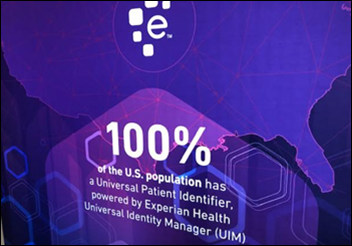
Having a unique identifier would certainly simplify things in healthcare. We have 328 million unique individuals that are represented through our universal identity manager tool. Using a tool like that, having a universal identity would make it easier to link your records from disparate systems to provide a holistic view of medical information.

Where do you see the company and the industry going in the next few years?

We are excited about the future and feel like the company is well positioned for growth. We think that many of the trends that were accelerated by COVID, like the digitization of healthcare, will continue. We think we are well positioned for that trend and are excited about our opportunity to deliver on our mission of simplifying the healthcare journey for all.

Comments Off on HIStalk Interviews Tom Cox, President, Experian Health

Morning Headlines 11/15/21

November 14, 2021 Headlines Comments Off on Morning Headlines 11/15/21

Blue Origin astronaut Glen de Vries dies in plane crash

Medidata co-founder Glen de Vries has died in a plane crash at the age of 49.

Tele911 Secures a Multimillion-Dollar Seed Round to Deploy Virtual Care into Emergency Medical Services

Tele911, a virtual care startup focused on emergency medical service triage, raises a multi-million dollar round of funding.

Rad AI Closes $25 Million Series A to Transform Radiology Workflow by Harnessing the Power of Artificial Intelligence

Radiology software vendor Rad AI raises $25 million in a Series A funding round.

Comments Off on Morning Headlines 11/15/21

Monday Morning Update 11/15/21

November 14, 2021 News Comments Off on Monday Morning Update 11/15/21

Top News

image

Glen de Vries, who rode a Blue Origin rocket into space with William Shatner and others last month, died in a plane crash Thursday along with a flight instructor. He was 49.

De Vries, who was also known as Captain Clinical, was co-founder of life sciences research platform vendor Medidata Solutions, which was acquired by Dassault Systèmes in October 2019 for $6 billion.

De Vries later wrote a book titled “The Patient Equation: The Precision Medicine Revolution in the Age of COVID-19 and Beyond.”


Reader Comments

From Bon Ivermectin: “Re: VPN Solutions in Richmond. I’ve heard from three practices that the hosting company was hit by ransomware on October 31 and their Allscripts clients have been unable to access charts since. Rumor is that the hackers demanded a $5.4 million ransom that was due Friday that won’t be paid.” I’ve emailed VPN Solutions and Allscripts but haven’t heard back so far. One of the practices mentioned — Piedmont Pediatrics in Charlottesville, VA — posted a notice on November 1 that its computers were down, but hasn’t updated since.


HIStalk Announcements and Requests

image

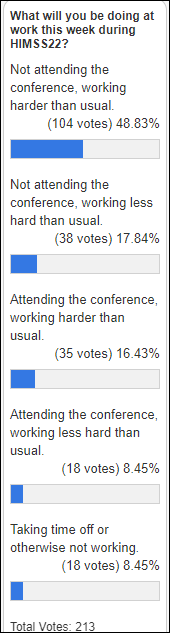
Video calls with cameras on are used more than any other one-to-one work meetings, poll respondents say. Some employers or teams mandate the use of video, commenters mentioned.

New poll to your right or here: What would worry you most about being remotely monitored at home while recovering instead of being hospitalized? I didn’t specify a condition, but use your own experience and assume that use cases will be actively developed by organizations that offer these services.

A word that I just realized is odd as I created the new poll: “hospitalized,” given the uncommon usage of “hotelized” since etymologists say that “hospital” and “hotel” share the same Latin root that refers to guests or visitors. It’s also odd in that a hospital can be about as inhospitable as it gets.

Thanks to the following companies that recently supported HIStalk. Click a logo for more information.

image
image
image
image
image
image
image
image
image
image


Webinars

None scheduled soon. Previous webinars are on our YouTube channel. Contact Lorre to present your own.


Acquisitions, Funding, Business, and Stock

image

A correction to last week’s post – Surescripts CEO Tom Skelton will retire on December 31, 2022 (not at the end of this year), leading the company through next year, participating with the company’s board to choose his successor, and working with the new CEO through the transition period.

OptimizeRx reports Q3 results: revenue up 53%, adjusted EPS $0.09 versus $0.07.


Sales

  • Essen Health Care (NY) chooses Verustat for remote patient monitoring, offering its underserved community patients take-home kits for tracking blood pressure, blood sugar, weight, and oxygen levels.
  • Woman’s Hospital (LA) chooses Spok Go for environmental services communication and real-time critical lab result notification.
  • Home health services vendor Sholom Home Care (MN) chooses VitalTech’s VitalCare for telehealth and patient-care manager interaction. 

People

image

David Harse (Cerner) joins HealthMark Group as SVP/GM of patient engagement.

image

Culbert Healthcare Solutions promotes Julie McGuire, RN, MSN to VP of Epic IT consulting services.


Announcements and Implementations

NYU Langone’s Predictive Analytics Unit in the Center for Healthcare Innovation and Delivery Science will host the Symposium for Machine Learning Implementation and Evaluation (SMILE) to discuss the latest advances in mobilizing machine learning to practice and evaluating and bringing machine learning to patients. The free, non-sponsored virtual event will be Thursday, November 18 from 12:30 to 5:00 ET.

A group of AMIA members asks folks who are developing FHIR-based software to complete their short survey by November 30. The results will be used to create a worldwide catalog of FHIR applications.


Other

image

A ProPublica report looks at the money machine that is St. Jude Children’s Research Center, which despite being ranked behind nine other children’s cancer hospitals, raises more many than all of them combined. Its reserves are $5 billion as it has spent only half of its $7 billion in contributions over the past five years on research and care. The hospital doesn’t bill the families of children for their care, but 90% have insurance that it bills. St. Jude has 5,700 employees and just 73 beds, while its fundraising organization has 2,200 employees working from Memphis and 36 regional offices, with 400 of the fundraising employees making more than $100,000. The former pediatrics chair at Albany Medical Center (NY) says St. Jude raises money from its nearby office, but almost all children with cancer are treated locally instead of in Memphis, to which he concludes, “They think of every way they can to make money and the least amount of ways to spend it. They deceive people into supporting something that is totally dishonest.”


Sponsor Updates

  • Sectra publishes a new e-book, “Radiology post-pandemic game plan.”
  • Talkdesk wins the 2021 Public Relations and Marketing Excellence Award from the Business Intelligence Group.
  • Visage Imaging contributes to a new report, “First PACS-integrated artificial intelligence-based software tool for rapid and fully automatic analysis of body composition from CT in clinical routine.”
  • Waystar will sponsor Bounce Back Kit family care packages for the Bounce Children’s Foundation.

Blog Posts


Contacts

Mr. H, Lorre, Jenn, Dr. Jayne.
Get HIStalk updates.
Send news or rumors.
Contact us.

125x125_2nd_Circle

Comments Off on Monday Morning Update 11/15/21

Morning Headlines 11/12/21

November 11, 2021 Headlines Comments Off on Morning Headlines 11/12/21

Kansas health care app company accuses Mercy of ‘stealing’ trade secrets in new lawsuit

LifeScience Technologies sues Mercy, which it claims disclosed trade secrets about LST’s M.Care virtual care platform to telehealth competitor Myia Health.

OPKO Health Leads $5 Million Investment in HealthSnap, to Help Rapidly Scale Remote Patient Monitoring Platform to Empower Better Chronic Condition Management

Remote patient monitoring startup HealthSnap raises $5 million.

Definitive Healthcare Reports Financial Results for Third Quarter Fiscal Year 2021

Definitive Healthcare, which went public in mid-September and finished its first week of trading with shares up 81%, announces Q3 results: revenue up 43%, adjusted EBITDA flat.

Comments Off on Morning Headlines 11/12/21

News 11/12/21

November 11, 2021 News 1 Comment

Top News

image

LifeScience Technologies sues Mercy, which it claims disclosed trade secrets about LST’s M.Care virtual care platform to telehealth competitor Myia Health.

The lawsuit claims that LST customer Mercy shared its system log-in credentials to Myia Health’s developers, allowing the company to develop a “derivative product” that Mercy then implemented to replace LST.

LST also says that Mercy invested $5 million in Myia Health. 


HIStalk Announcements and Requests

image

Welcome to new HIStalk Platinum Sponsor Current Health. The Boston-based company, which was acquired by Best Buy in November 2021, offers an enterprise care-at-home platform that enables healthcare organizations to deliver high-quality, patient-centric care at a lower cost. It integrates patient-reported data with data from biosensors – including its own continuous monitoring wearable device – to provide healthcare organizations with actionable, real-time insights into the patient’s condition. Leveraging clinical algorithms that can be tailored to the individual patient, it identifies when a patient needs clinical attention, allowing organizations to manage patient care remotely or to coordinate in-home care via the company’s integrated service partners. Its platform brings together telehealth capabilities, patient engagement tools, and cellular connectivity to provide a single solution to manage all care in the home. It has designed evidence-based care pathways that can be tailored to the needs of the individual patient, supporting a wide range of clinical conditions and acuity levels. To help its partners scale their care-at-home delivery, it also provides comprehensive logistics management, a Clinical Command Center, and integrations with in-home ancillary service providers, all serving as an extension of your team to help transform how healthcare is delivered at home. Thanks to Current Health for supporting HIStalk.


Webinars

None scheduled soon. Previous webinars are on our YouTube channel. Contact Lorre to present your own.


Acquisitions, Funding, Business, and Stock

Definitive Healthcare, which went public in mid-September and finished its first week of trading with shares up 81%, announces Q3 results: revenue up 43%, adjusted EBITDA flat. The company’s market value is just under $4 billion. Founder and CEO Jason Krantz described the company’s business in the earnings call: “I founded Definitive Healthcare to help companies analyze, navigate, and sell into the complex healthcare ecosystem. We bring clarity and in-depth knowledge of the entire market that we have a deep understanding of the interconnected relationships between physicians, hospitals, providers, insurance companies, government regulators, and the patients themselves.”

image

Remote patient monitoring startup HealthSnap raises $5 million.


Sales

  • SoftWriters will integrate First Databank’s Meducation medication adherence solution with its FrameworkLTC pharmacy management platform.
  • Flagler Health+ (FL) will implement Halo Health’s clinical collaboration technology.

People

image

Surescripts CEO Tom Skelton will leave his role at the end of 2022 in a planned transition.

image

Former National Coordinator Don Rucker, MD joins interoperability startup 1upHealth as chief strategy officer.

image

Virtual nurse assistant software vendor Care Angel names Nick Martin (DuPage Medical Group) CIO.

image

Brad Rennick (Modernizing Medicine) joins NThrive as chief client officer.

image image

Wolters Kluwer Health promotes Gregory Samios to president and CEO of Clinical Effectiveness and Peter Bonis, MD to chief medical officer of Clinical Effectiveness.


Announcements and Implementations

image

PeriGen announces GA of Vigilance Mobile, giving end users remote access to its AI-based early warning system and clinical decision support tools.


Government and Politics

Representative Kim Schrier, MD (D-WA), a former pediatrician and Cerner end user, shares her concerns with VA Secretary Denis McDonough about EHR usability and its impact on patient care after she toured a clinic that is connected to the VA’s first live Cerner site of Mann-Grandstaff VA Medical Center (WA). She notes that employees have told her the system frequently crashes, forcing them to re-type lost notes; and that its self-scheduling and prescription management features are so buggy that patients have resorted to calling the clinic, resulting in overwhelmed phone lines. “If they have to scrap this version of Cerner,” she says, “it’s probably better to do that and use something that’s tried and true than to try to fix a system that is just broken from within.”

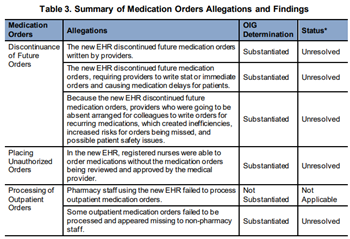
A VA OIG review of its implementation of Cerner’s patient scheduling system finds that while many schedulers prefer the more user-friendly Cerner system over that of the replaced Vista system, they didn’t receive adequate training on complex scheduling scenarios and weren’t given enough time for practice. The VA also went live without resolving significant lapses in functionality, such as Cerner’s inability to automatically mail appointment reminder letters and to switch a scheduled visit between telehealth and in-person. Scheduling supervisors also reported confusion over measuring wait times, a nationally critical problem that the Cerner scheduling system was supposed to help resolve. After going live, care was delayed as permissions issues limited the ability of schedulers to book certain types of appointments, data migration problems required some information to be manually deleted, and reminder calls had to be turned off because patients were being told to check in at the front desk for visits in which on-site care was not available.


Privacy & Security

image

Southern Ohio Medical Center reverts to downtime procedures and diverts ambulances as it deals with a cyberattack that occurred early Thursday morning.


Sponsor Updates

  • DirectTrust recognizes Cerner Director Greg Meyer as an Interoperability Hero during the third quarter.
  • Vocera Communications signs a reseller agreement with MDI Medical in Ireland.
  • Vyne Medical releases a new podcast, “How Patient Experience is Leading Hospitals Toward Digital Transformation.”
  • Olive adds ClosedLoop to its marketplace for healthcare solutions.
  • Fortified Health Security hires Joe Anderson (Geodis) as solutions architect.
  • Goliath Technologies rolls out enhancements to Goliath Performance Monitor.
  • For World Diabetes Day, Meditech shares stories of access to care.

Blog Posts


Contacts

Mr. H, Lorre, Jenn, Dr. Jayne.
Get HIStalk updates.
Send news or rumors.
Contact us.

125x125_2nd_Circle

EPtalk by Dr. Jayne 11/11/21

November 11, 2021 Dr. Jayne 3 Comments

I had dinner with one of my friends from residency tonight. She’s considering leaving practice even though she’s not even 50. She had two unvaccinated patients die from COVID this week, one of whom was only 46 years old and who died after being in the intensive care unit and on a ventilator for over two months. Her late patient left behind several children, and apparently their father spent the last several days harassing my colleague because she had refused to treat the patient with ivermectin. The harassment included threatening comments and a visit to my friend’s house, resulting in a call to the police and my friend bundling her own children off to their grandparents’ just in case. Physicians have been fighting this pandemic for more than a year and a half and they certainly didn’t sign up for what she experienced.

On top of that, her partner quit and the health system she works for has been unable to hire a replacement who is willing to join a rural practice, leaving her to care for more than 6,000 patients on her own. She has also developed a severe skin reaction from the soap and sanitizer used in the office, resulting in a worker’s compensation claim after multiple product changes failed to yield results. She’s had to miss work due to numerous physician visits, including second and third opinions from dermatologists at the local medical schools. Every time she takes off for a physician visit, it negatively impacts her office productivity, and the medical group’s newly appointed administrator asked her why she can’t schedule her visits after hours. As she was telling me the story, I wondered if the administrator had ever been a patient or caregiver, because that’s just an asinine suggestion.

She had a lot of questions about telehealth and whether that might be an option for her if she isn’t able to find a solution to her allergic skin reactions. Her only experience with telehealth was during the height of the pandemic, when the health system encouraged physicians to embrace virtual visits because patients didn’t want to come in. However, in her particular community, many patients didn’t think COVID-19 was a big deal and thought that dealing with a computer was a bigger nuisance than risking infection, so telehealth never really took off. From a technology standpoint, they were using a solution that was completely cobbled together and had no integration with their EHR, so I encouraged her not to judge her options based on that experience.

We talked about some trends in telehealth, including insurance plans that have a virtual-first focus. I would propose that such plans would be most effective if continuity could be preserved, either with the same care team providing both in-person and virtual care, or if dedicated virtualists had full access to the patient’s medical records. There are concerns about physicians providing virtual-only care as far as not being able to perform a physical exam. The new plans are designed to have networks of in-person physicians that can perform hands-on services when required, and who can coordinate with the virtual physicians. Although payer-sponsored plans might have their own patient records, they might have difficulty coordinating when patients receive services from non-network physicians or other care providers. Some of the plans have high deductibles for in-person care, which may serve as a deterrent. Additionally, they may not be compliant with the Affordable Care Act.

We also talked about the challenges of practicing telehealth, including technology issues. A recent piece in JAMA Network Open looked at factors influencing whether patients and physicians were able to successfully complete telehealth visits. The authors looked at over 137,000 video visits and found an overall success rate of 90%. Patient factors were “more systematically associated with successful completion of video visits” where “clinician comfort with technology was associated with successful video visits or conversion to telephone visits.” Certain factors were associated with conversion to telephone visits, including lower clinician comfort with technology, greater patient age, lower patient socioeconomic status (including low availability of high-speed internet), and racial/ethnic minority status.

The study has some limitations, including having been conducted at the height of the COVID-19 pandemic when most of us were still getting used to the idea of video visits and many providers were using substandard technology platforms to try to connect with patients. Visits at that time were often sporadic and urgent, and there was little lead time to help patients with technology or their comfort level with video encounters. The study also was conducted in the Midwest and at a single healthcare organization. Longer duration studies with a broader cross section of patients would be beneficial.

Our conversation crossed into a lot of different elements of practice, and she was interested to hear about my recent experiences in EHR training. We’re both veterans of multiple EHR conversions and implementations, and she asked if I had seen the story about the US Department of Veterans Affairs being ordered to pay $160 million to clinicians for extra work hours spent updating EHR data. I hadn’t seen it until she mentioned it, but the short version is that 3,200 nurse practitioners and physician assistants who were employed by the VA at the time worked overtime doing various EHR functions and weren’t compensated appropriately. The court ruled that employees should have had received overtime pay any time they worked more than eight hours in a day. In the class action suit, each member will receive about $50,000 in compensation.

The last thing we talked about as our bottle of pinot noir became depleted was an article that looked at whether physicians could accurately predict the out-of-pocket costs for medications they were prescribing. The authors found that only 21% of physicians could do so, which sounds like what I might expect given the craziness of medication pricing and the challenges in figuring out various formulary coverage, deductibles, co-pays, and annual caps. We’ve both used EHRs that were supposed to display formulary and eligibility data in a way that should help physicians figure this out, but have found that none of them were particularly effective, especially since different payers use different formulary levels that resulted in confusing EHR displays and data that just didn’t make sense.

The evening ended with a discussion of her children and their career plans and the fact that she’s completely baffled her children want to pursue careers in medicine despite her obvious dissatisfaction with it and eagerness to leave it. They’re still relatively young, in middle and early high school, so of course things can change. Given the way things are now, I know quite a few physicians who wouldn’t choose the career again, or if they did, would choose a different specialty. It’s a sad commentary on what healthcare has become for a lot of physicians.

If you had it to do over again, would you still choose healthcare? Leave a comment or email me.

Email Dr. Jayne.

Morning Headlines 11/11/21

November 10, 2021 Headlines Comments Off on Morning Headlines 11/11/21

Health Catalyst (HCAT) Reports Q3 Loss, Tops Revenue Estimates

Health Catalyst reports Q3 revenue of $61.74 million, with a quarterly loss of $0.18 per share.

Surescripts Announces Planned CEO Transition

Surescripts CEO Tom Skelton will formally step down from his role at the end of the year, but will remain with the company while his successor is found.

Oneview Healthcare raising $23 million via Canaccord

Patient engagement technology vendor Oneview Healthcare seeks to raise $23 million to expand its sales, marketing, and product development efforts.

CPSI Announces Third Quarter 2021 Results

CPSI’s Q3 revenue increases to $70.1 million, with total revenues at the nine-month mark also experiencing a bump up to $206.6 million.

Comments Off on Morning Headlines 11/11/21

Morning Headlines 11/10/21

November 9, 2021 Headlines Comments Off on Morning Headlines 11/10/21

GE Plans to Form Three Public Companies Focused on Growth Sectors of Aviation, Healthcare, and Energy

General Electric will spin off GE Healthcare, GE Aviation, and several other segments into public companies within the next two years.

Sirona Medical Secures $40M in Series B Funding to Accelerate Adoption of its Cloud-Native Radiology Operating System

Sirona Medical, a vendor of cloud-based radiology operating system software, raises $40 million in a Series B funding round.

Introducing the Truveta Platform: Unprecedented De-Identified Health Data Refreshed Daily with New COVID-19 Insights

Hospital network-owned Truveta launches its flagship clinical insights platform, giving researchers access to real-time, de-identified clinical data from care sites across the country.

Comments Off on Morning Headlines 11/10/21

News 11/10/21

November 9, 2021 News 4 Comments

Top News

image

General Electric shares jump on the news that the company will spin off GE Healthcare, GE Aviation, and several other segments into public companies within the next two years.

image

Former GE Healthcare manager Peter Arduini (Integra LifeSciences) will become president and CEO of GE Healthcare in January. The business is expected to become independent in 2023, focusing on equipment, diagnostics, imaging, therapy planning, life care, and digital.

SNAGHTML8f6b8f9

Readers may remember that Veritas Capital acquired GE Healthcare’s software (financial, ambulatory, and workforce management) business in 2018 for $1 billion, rebranding those assets to Virence Health several months later.

Veritas acquired Athenahealth around that same time for $5.7 billion with help from Evergreen Coast Capital, the private equity subsidiary of Elliott Management Corporation, which was the activist investor that targeted Athenahealth and forced out its co-founder and CEO Jonathan Bush earlier that year.

Virence Health wound up merging the former GE Healthcare’s Centricity business with Athenahealth. Veritas dropped the little-known Virence Health brand in favor of Athenahealth’s branding shortly thereafter.


Webinars

November 10 (Wednesday) 1 ET. “Too Important to Fail: How to Bring Better AI to Healthcare.” Sponsor: Intelligent Medical Objects. Presenters: Dale Sanders, chief strategy officer, IMO; Marc d. Paradis, VP of data strategy, Northwell Health. It’s relatively easy to obtain healthcare data and build an AI demo, but getting AI to perform reliably and with meaningful impact is much harder. However, strategies exist for delivering AI products to commercial markets. This fireside chat will review the status of AI in healthcare; discuss the vital importance of data quality, methodological rigor, and product focus; and explore what this means to the startup and investor world.

November 11 (Thursday) 1 ET. “Increasing OR Profitability: It May Be Easier than you Think.” Sponsor: Copient Health. Presenters: Michael Burke, co-founder and CEO, Copient Health; David Berger, MD, MHCM, CEO, University Hospital of Brooklyn at State University of New York Downstate Health Sciences University. The OR is a hospital’s biggest source of revenue and its costliest resource, yet it often sits idle because of unfilled block time even as providers with cases ready to book lack access. AI-powered emerging technologies can help fill unused OR time and provide decision support to structure workflows and optimize block allocation. This webinar explores the biggest challenges to profitability faced in the OR and the fastest, most impactful changes a hospital can make to address them.

Previous webinars are on our YouTube channel. Contact Lorre to present your own.


Acquisitions, Funding, Business, and Stock

Sirona Medical, a cloud-based radiology operating system software vendor, raises $40 million in a Series B funding round.

image

Ambulatory health IT vendor CareCloud reports record Q3 revenue of $38.3 million, a 21% increase over Q3 2020. The company attributes the numbers to organic growth and the June acquisitions of Santa Rosa Staffing and MedMatica Consulting – now known as MedSR. MTBC acquired CareCloud in January 2020 for $17 million in cash and $41 million in total consideration.


Sales

  • Family Health Centers will transition to EClinicalWorks at its eight facilities in Louisville, KY.
  • NorthShore University HealthSystem (IL) selects Carevive’s Patient Reported Outcomes Mobile Platform.
  • Baptist Health South Florida will implement Rx Capture software from Loopback Analytics.

People

image

Protenus names Michelle Del Guercio (Sunquest Information Systems) chief marketing officer.

image

Doug Duskin (Equality Health) joins Avel ECare as CEO.


Announcements and Implementations

GenieMD announces GA of Continuum, a virtual care platform encompassing telemedicine, remote patient monitoring, and chronic care management capabilities; as well as consumer and medical device integration.

image

Rochelle Community Hospital (IL) will go live on Epic next May.

LexisNexis Risk Solutions develops a Patient Centric Token to more effectively match de-identified patient records used for clinical research and patient care.

image

Truveta launches its flagship clinical insights platform, giving researchers access to real-time, de-identified clinical data from care sites across 42 states. The Seattle-based startup was launched in February by numerous health systems to provide its hospital owners, drug companies, and researchers with anonymized patient data for approved research projects.


Privacy and Security

Philips alerts end users to two vulnerabilities within its Tasy EHR that could allow hackers to extract data and potentially launch denial-of-service attacks. Upgrading the EHR software, according to the company, will remove the vulnerabilities.

image

Health officials in the Canadian province of Newfoundland and Labrador say health IT systems, including its Meditech EHR, are slowly being brought back online after last week’s cyberattack.


Other

image

This is interesting: Bluestream Health co-founder and CEO Matthew Davidge sells Med School Tutors to Blueprint Test Prep for an undisclosed amount. Davidge and business partner Joe Covey purchased the company in 2019. It is one of six they’ve acquired since 2008, including patient instructions and teaching systems vendor Logicare and several in-hospital television channels.


Sponsor Updates

  • Bamboo Health applauds its ACO partners for generating over $1 billion in the Medicare Shared Savings Program.
  • Cerner shares a new client achievement, “Children’s Mercy Kansas City Project HOPE training helps streamline provider documentation efficiency.”
  • Divurgent celebrates its membership with the KLAS Arch Collaborative with a newly released badge.
  • EVisit will exhibit and present at the virtual HealthImpact Live Fall Forum November 10-12.

HIStalk Sponsors exhibiting at HFMA include Ability Network, AGS Health, Cerner, Change Healthcare, Experian Health, Health Catalyst, Intrado, InterSystems, Nuance, Olive, and Waystar.

Blog Posts


Contacts

Mr. H, Lorre, Jenn, Dr. Jayne.
Get HIStalk updates.
Send news or rumors.
Contact us.

125x125_2nd_Circle

Morning Headlines 11/9/21

November 8, 2021 Headlines 1 Comment

CareCloud Reports Record Third Quarter Revenue and Net Income

MTBC subsidiary CareCloud reports record Q3 revenue of $38.3 million, a 21% increase over Q3 2020.

Cyberattack on health tech vendor QRS leads to data theft tied to 320K patients

EHR and practice management vendor QRS Healthcare Solutions announces it was the victim of a cyberattack in August that compromised a server dedicated to the patient portal of several customers.

Philips discloses TASY EMR vulnerabilities pose risk to patient data

Philips alerts end users to two vulnerabilities within its Tasy EHR that could allow hackers to extract data and potentially launch denial-of-service attacks.

Curbside Consult with Dr. Jayne 11/8/21

November 8, 2021 Dr. Jayne 1 Comment

The highlight of my weekend was attending a graduation party for one of my favorite former co-workers. I worked with her in the urgent care trenches for half a decade, through Flumageddon, COVID-19, the deaths of three co-workers, and a host of other calamities.

Of all the people I’ve worked with clinically, she’s one of the handful I would walk through fire for. Three years ago, she decided to go to nursing school and completed her bachelor of science in nursing degree while continuing to work part time. She’s one of the hardest working people I know. I had the privilege of working my last urgent care shift with her, so I was glad she invited me to come celebrate her achievement.

It was a mini reunion of former colleagues, 80% of whom have left our former urgent care employer. It seems like everyone is thriving since they left. Since I was kind of the “mom” of the practice sometimes, hearing their stories brought me joy. Several are in graduate school and others have moved to other healthcare settings, but all of them are still involved helping patients.

It was also fun meeting the graduate’s parents and brothers, and now I understand where she gets her sassiness. Sometimes we don’t get to see people bring their dreams to life, but I’m excited for her in her new role as a nurse in the emergency department of the city’s premier Level One trauma facility. Hopefully we’ll be able to catch up again down the road. It will be interesting to hear stories from a new graduate’s point of view.

The rest of the weekend was spent playing catchup – working on some personal projects and catching up on work I needed to finish after being out for a training class most of the week. For one of my new projects, I need to have a particular EHR certification that I’ve never done before, and it was quite the adventure. Since most vendors are still offering remote training, I decided to take advantage of that option. Not that I mind traveling, but it’s always better to be able to sleep in your own bed. I was pleased that the training had been adapted to remote learners, including having multiple trainers available to cover real-time questions while the main presenter continued presenting the content. That let people catch up while the rest of the class moved ahead. As someone who has taken countless in-person classes, I enjoyed that approach much better than when a single class member holds everyone up with questions since it’s much harder to hand someone off to a co-trainer in a live environment.

Of course, there were some technical glitches for attendees, with people intermittently losing audio or having glitchy video, but that’s to be expected even at this point where most of us have adapted to nearly 100% remote work and virtual meetings. There were also some people with multiple monitors who were having issues with popups they couldn’t see because they would open on a different monitor, and that seemed to be a little trickier for the remote training team to try to troubleshoot. Overall, I thought they did a nice job with plenty of breaks for people stretch and just get away from their desks, and also a full hour for lunch which I haven’t had before even in an in-person class. It was nice to be able to grab something to eat, check email, and walk around a little bit before settling in for another half day of classes.

Fortunately, I’ve worked with this part of the EHR before,so while I’ve never been certified, so the content wasn’t overwhelming. I imagine that if you were new to EHRs in general, such as an IT person who hadn’t done much clinical work but was diving in, the pace might have been a bit brisk. There are plenty of new terms to learn in healthcare (particularly in the wild and wacky world of US healthcare) so the learning curve on those items would have been steep. Most of the attendees were able to get through some clinical workflows though and had a good understanding of how their end users will be using the system. It’s always a good thing when clinical people can see what IT folks have to work with, and vice versa, in order to have a high functioning team.

I’m taking another class this week and it’s a much deeper dive into the underpinnings of the EHR, which I’m very excited about. I never met a database table I didn’t like and am looking forwarding to learning things I may not have known about the underlying structure. As a CMIO, I’m often at the 10,000-foot level, but it’s always good to understand the complexities of the system when I’m asking my team to consider using new features or attempting to customize around a native workflow. I’ve got a topnotch team of seasoned veterans, so I’m not worried about their skills, although I’ve had people working for me on previous engagements who tried to snow me on how hard it would be to do customizations or to modify workflows. I remember one upgrade when my team was acting like they’d have to do hundreds of hours of work to make changes to provider workflow templates, and when we did a work breakdown and estimation exercise, it turned out to be less than one person-week of work.

I also spent some time doing my quarterly Maintenance of Certification questions for both my primary and secondary board certifications. They use completely different methodologies and delivery systems for their questions, and I’m wondering why the different boards can’t get together and come up with a best-of-the-breed solution. One board allows five minutes per question, and you have to do 25 questions per quarter, where the other allows 10 minutes per question with 12 questions per quarter. Fortunately, they’re both open-book and open-internet, with the main limitation being that you can’t engage other people to help you or share the questions with others. I’m not close enough to retirement to consider dropping either certification, so I get to stay on the certification hamster wheel for many years to come.

Did you have a productive weekend, or were you just able to enjoy some down time? Leave a comment or email me.

Email Dr. Jayne.

Morning Headlines 11/8/21

November 7, 2021 Headlines Comments Off on Morning Headlines 11/8/21

Spok Reports 2021 Third Quarter Results

Spok reports Q3 results: revenue down 5%, EPS –$0.13 versus $0.16.

Biden nominates Kurt DelBene as chief information officer at VA

The White House nominates Kurt DelBene, MS, MBA (Microsoft) as VA assistant secretary and CIO.

It will take time to restore healthcare IT system, say Newfoundland officials

Health officials in the Canadian province of Newfoundland and Labrador say health IT systems, including its Meditech EHR, are slowly being brought back online after last weekend’s cyberattack.

Comments Off on Morning Headlines 11/8/21

Monday Morning Update 11/8/21

November 7, 2021 News 2 Comments

Top News

image

From the Allscripts earnings call, following the announcement of quarterly results that beat earnings expectations but fell short on revenue:

  • CEO Paul Black says that NIH has extended its contract for Sunrise for another five years.
  • Veradigm revenue grew 10% year over year.
  • The company admits being frustrated that Allscripts “stock is cheap” compared to companies that enjoy high multiples while operating businesses similar to Veradigm.
  • The core clinical and financial solutions business has seen some shrinking, part of that intentional in focusing on higher-quality clients, but also because of the tail end of a bolus of larger academic medical centers and clients going in a different direction.
  • Allscripts believes that non-US opportunities are “a more level playing field” even though those wins are hard to predict because they are mostly public sector clients with inconsistent deal times.
  • The company sold 2bPrecise at a small gain in August, taking a non-controlling stake in the combined entity instead of cash.
  • Allscripts expects to see managed services opportunities as clients deal with wage inflation and sending teams such as revenue cycle management to work from home, where they could just as easily be someone else’s employee.

HIStalk Announcements and Requests

image

An overall 85% of poll respondents seek ongoing engagement with a PCP, with a slightly higher percentage of over-35s looking for that kind of relationship. David says he wants ongoing engagement, but not ongoing disengagement where he sees the same doctor who never remembers much about him, while Kathy fears the “too many cooks” problem because whatever doctor was available to see her changed her treatment plan.

New poll to your right or here: How do you most often communicate in one-to-one work-related meetings? I’m curious because I do interviews via a conference line where I can record the call, and sometimes surprises people who have learned to spend their entire workday on video calls with cameras on. I say use video for one-on-one calls only if the value it adds exceeds the mental strain of being on camera, and I don’t know of many examples where that’s the case unless documents are being reviewed.


Webinars

November 9 (Tuesday) noon ET. “The Next Generation of Identity Resolution in Healthcare.” Sponsor: Verato. Presenters: J.P. Lugo, solution architect, Verato; Nick Orser, solution architect, Verato. This webinar will provide an overview of person-matching in healthcare, how challenges can be overcome with Verato Referential Matching, and how person-matching technology can support Customer 360, marketing, analytics, IT, and more.

November 10 (Wednesday) 1 ET. “Too Important to Fail: How to Bring Better AI to Healthcare.” Sponsor: Intelligent Medical Objects. Presenters: Dale Sanders, chief strategy officer, IMO; Marc d. Paradis, VP of data strategy, Northwell Health. It’s relatively easy to obtain healthcare data and build an AI demo, but getting AI to perform reliably and with meaningful impact is much harder. However, strategies exist for delivering AI products to commercial markets. This fireside chat will review the status of AI in healthcare; discuss the vital importance of data quality, methodological rigor, and product focus; and explore what this means to the startup and investor world.

November 11 (Thursday) 1 ET. “Increasing OR Profitability: It May Be Easier than you Think.” Sponsor: Copient Health. Presenters: Michael Burke, co-founder and CEO, Copient Health; David Berger, MD, MHCM, CEO, University Hospital of Brooklyn at State University of New York Downstate Health Sciences University. The OR is a hospital’s biggest source of revenue and its costliest resource, yet it often sits idle because of unfilled block time even as providers with cases ready to book lack access. AI-powered emerging technologies can help fill unused OR time and provide decision support to structure workflows and optimize block allocation. This webinar explores the biggest challenges to profitability faced in the OR and the fastest, most impactful changes a hospital can make to address them.

Previous webinars are on our YouTube channel. Contact Lorre to present your own.


Acquisitions, Funding, Business, and Stock

image

Spok reports Q3 results: revenue down 5%, EPS –$0.13 versus $0.16

image

Early-stage investor Colin Keeley provides a fascinating analysis of Canada-based software giant Constellation Software and its reclusive billionaire founder Mark Leonard. The company’s Harris unit contains a long list of acquired health IT vendors, such as Amazing Charts, QuadraMed, IMDSoft, Iatric Systems, Obix Perinatal Data System, and Picis. Interesting observations:

  • The company has acquired more than 500 vertical market software companies and has sold only one of those (in the early days, which Leonard regrets).
  • The company was launched in 1995 with the equivalent of $33 million 2021 US dollars. Its has grown at 30% per year to a publicly traded market cap of $31 billion.
  • Leonard started the company as a former venture capital operator who was frustrated that VCs were interested only in companies that have a large addressable market. He saw many businesses that were in niche spaces that generated high margins from recurring sales of mission-critical software. Constellation bought many of its companies directly from their founders.
  • Acquisition criteria include a mid- to large-sized vertical market software company with consistent earnings and growth, committed management, and an offering price that has already been determined. The average acquisition price ranges from $2 to $5 million, although the company has done bigger deals and says it will continue to do so. They also prefer companies that have low capital investment requirements just in case they need to weather a business downturn.
  • The company reportedly made 90 small acquisitions in 2020 alone.
  • One analyst estimates that Constellation acquires at a price of just 0.8 times annual sales, which is far below market.
  • Constellation leaves the management team of its acquisitions in place, supporting them with best practices and company-wide performance data.
  • The company says it offers its business unit managers autonomy, the ability to scale, and an environment in which rules are few and the focus is making the pie bigger, not fighting over how to divide it.
  • Constellation believes that growing companies create inefficiency by adding layers of management. They prefer that the original manager keep most of the business but then spin off a new business unit under a groomed protégé who can start with a blank slate and focus on customers.
  • All employees are given an explicit career path in which they first learn their particular vertical market, then transition into a leader of people who can run their own business unit. Leonard says, “Become a master Craftsman in the art of managing your VMS business. It is the most satisfying job in Constellation and will generate more than enough wealth for you to live very comfortably and provide for your family. For those whose ambition exceeds their good sense, we have a role that we call a Player/Coach. A Player/Coach continues to run their BU, but ambition drives them to acquire a sizable business, usually in another geography or another vertical “
  • The company’s bonus plan requires long-term investment in its shares, which has created several hundred employee millionaires.

Sales

  • CyncHealth selects Nuance PowerShare for accessing and sharing diagnostic imaging and reports and to alert ED physicians of prior studies.
  • Advanced Pain Care (TX) chooses Athenahealth.

People

image

The White House nominates Kurt DelBene, MS, MBA (Microsoft) as VA assistant secretary and CIO.

image

Jeffrey Brown, PhD (Harvard Medical School) joins TriNetX as chief science officer.

image

Walmart reportedly hires David Carmouche, MD (Ochsner Health) as SVP of its Omnichannel Care Solutions business that includes services that range from primary care to digital medicine and telehealth.


Announcements and Implementations

Nuance collaborates with Collective Medical to launch Nuance PowerShare Image Aware, which alerts ED physicians of prior radiology studies.

Redox announces a solution that enables payers to meet the CMS Interoperability and Patient Access final rule requirements.


Other

The Physician Network Advantage files a lawsuit against Santé Health Systems (CA) and related entities, which the EHR support company says failed to pay $1.5 million for Epic support. Santé says its agreement with PNA called for payment only as funded by grant funding and it notified PNA in September 2020 that the funding would be ending.

image

The National Nurses Union says its members are “horrified” at Kaiser Permanente’s pilot project for remote patient monitoring, saying it undermines the role of nurses, places the burden of work on family members, leaves patients far away from other services they usually need, and is intended to boost Kaiser’s profits by lowering costs while being paid by CMS at in-hospital rates under COVID-19 waivers for telemedicine.


Sponsor Updates

  • The highest-rated HIStalk Sponsor vendors according to the FeaturedCustomers Fall 2021 Hospital Communications Software Customer Success Report include Market Leaders Change Healthcare, Imprivata, Spok, and Vocera; and Top Performers Halo Health and PerfectServe.
  • Wolters Kluwer Health VP & GM Vikram Savkar joins The International Association for Scientific, Technical, and Medical Publishers’ Board of Directors.
  • HCI Group publishes a new remote patient monitoring case study featuring Integris Health.
  • RCxRules partners with AAPC to deliver an end-to-end physician risk adjustment coding managed service.
  • OptimizeRx publishes a new report, “Multiple Sclerosis: Understanding Treatment Barriers and Market Fragmentation.”
  • PerfectServe publishes a new customer success story, “Ridgeview Rehab Specialties department reduces no-show rate by 12.6% with automated text messages to patients.”
  • Surescripts announces that its Real-Time Prescription Benefit has 550,000 prescriber users and processed 300 million real-time prescription benefit checks in the first nine months of 2021.
  • Premier wins an NC Tech Awards winner for the innovative use of technology in the Analytics and Big Data category.
  • The Outcomes Rocket Podcast features RxRevu CEO Kyle Kiser, “Enabling Lower-Cost Prescribing at the Point-of-Care.”
  • TransformativeMed names Jason Larson (Care.ai) VP of sales.

Blog Posts


Contacts

Mr. H, Lorre, Jenn, Dr. Jayne.
Get HIStalk updates.
Send news or rumors.
Contact us.

125x125_2nd_Circle

Weekender 11/5/21

November 5, 2021 Weekender 1 Comment

weekender 


Weekly News Recap

  • Allscripts and Change Healthcare report quarterly results that beat earnings expectations but fall short on revenue.
  • EverCommerce announces that it will acquire DrChrono.
  • Worklfow automation vendor Notable raises $100 million in a Series B funding round.
  • CMS will increase the minimum penalty for hospitals that don’t comply with pricing transparency requirements to $10 per bed, per day starting on January 1, 2022.
  • 23andMe says it hasn’t decided how to integrate its recent acquisition of telehealth provider Lemonaid Health, but expects to incorporate genetic risk factors into its primary care prescribing.
  • A VA survey of employees at its initial Cerner implementation site find widespread worsening of morale, burnout, and lack of confidence in performing their jobs using Cerner, leading to the VA’s pledge to add executive oversight to the project.
  • Kareo and PatientPop merge to form Tebra.
  • Cerner and NextGen report quarterly results that beat expectations for revenue and earnings.
  • Cerner CEO David Feinberg addresses EHR usability and a tightening of less-profitable company products and partnerships in its quarterly earnings call.

Best Reader Comments

ECW is done, no group of size will consider them given their history with the ONC and DOJ. Ambulatory is a three headed race: NextGen, Allscripts, and Athena. And if you don’t want to outsource your billing and/or you want complete control over your data then Athena is out and it’s a two-headed race: Allscripts and NextGen. Yes, smaller market has a lot more competitors. Yes, when part of a hospital those deals automatically go to Epic / Cerner / Meditech / Allscripts. NextGen and Allscripts sitting pretty with cash, decades of data, and way less comp then three years ago. (Allscripts OUTSIDER)

Not sure why the Jonathan Bush post created that much “wake” this week (pardon the boat terminology). HIMSS isn’t any different from any large industry conference gathering including RSNA. Both are still dwarfed by the Consumer Electronics Show, too. HLTH is very well funded, run by experienced conference organizers, and benefited from a market right now (digital health) that is dealing with record inflows of funding. It isn’t some guerilla or boot-strapped effort run by industry outsiders. Probably rivals J.P. Morgan Healthcare Conference in SF right now for industry buzz and appeal to healthcare insiders. Just adding dental benefits to Medicare though would have a much more substantial and immediate impact than anything that comes out of the HLTH conference the next few years. (Lazlo Hollyfeld)

Telehealth is most likely to benefit patients by allowing patients to sidestep their local large medical groups and health systems. That really gets the hairs up on the medical establishment. The telehealth convenience aspects you discussed are very similar to how retail clinics shook out in the 2010s; consumer perceive retail clinics and telehealth to be strictly lower quality but the lower cost and convenience sometimes win out, especially within certain populations / conditions. There is only room for a couple players in this space who will have to have comparatively large scale and potentially with operations subsidized by another line of business. I don’t think any of the pandemic era entrants will survive long enough to challenge the existing participants.
I think what the money people are really interested in now is whether they can shake another business model innovation out of this tree. One model could be your insurance company employs your primary care provider who is readily available remotely. You trust this provider and they direct you to lower waste, lower cost, higher quality care. (IANAL)

Upcoding will always be a problem in the current payment model. Whatever is in the contract between the healthcare facility and the insurer will always trump short lived media attention. Whether it be state-owned hospitals sicking collections agents on their patients, massive hospital groups gobbling up competitors and driving prices up, or ruthlessly upcoding to extract as much revenue from the patient encounter as possible, the system financially rewards all of these behaviors. The hospitals give some discounts to patients exposed in the media, then quietly go about continuing mostly the same practices. (Elizabeth H. H. Holmes)


Watercooler Talk Tidbits

image

Readers funded the Donors Choose teacher grant request of Ms. S in New York, who asked for supplies to allow her first grade class to write letters and journal to offset all the time in front of Zoom and staying at home without siblings. She reports, “Thank you for the boost in letter writing! The children have been talking about their feelings, how they can be a good friend (while in COVID and at home), and have been excited by these extra materials that they have received. As you can see by their letters, they have been writing about how they can be kind, brave, responsible, honest, just to name a few. They are learning about making good choices and how to be great brothers, sisters, nieces, nephews, friends, and children. I have been teaching remotely to students via Zoom and I have to share with you how rewarding it is. They have been reading, writing, and wearing their capes to show their superpower! All of these activities are helping with expressing themselves. The families are so appreciative of all that we do and that YOU do! Thank you for your generosity and for enriching the lives of my children.”

A 65-year-old Utah man faces charges of posing as a doctor in selling medications and surgical procedures out of the basement of his house, which he limited to people who are in the US illegally. He diagnosed an undercover agent with multiple sclerosis, then offered to cure the condition for thousands of dollars in cash.

image

A New York Times article describes how tribe-operated Alaska Native Medical Center (AK) offers patients native fare items such as moose, herring roe, and seal, all donated and prepared as an exception to USDA guidelines since commercial sale is not allowed. Natives weren’t raised on chicken noodle soup and sandwiches, so the hospital added dishes made with traditional ingredient as a connection to the patients it serves. Food Services Manager Cynthia Davis says, “I do not believe that people go into a hospital for a gastronomic experience. I believe that they’re in a hospital because they’re sick or in pain, and they need care. They want comfort foods, foods that someone made for them when they were younger,  someone who loved them and made it with love. And that is our role.”


In Case You Missed It


Get Involved

Sponsor
Report a news item or rumor (anonymous or not)
Sign up for email updates
Connect on LinkedIn
Contact Mr. H

125x125_2nd_Circle

Text Ads


RECENT COMMENTS

  1. You know what will radically improve patient lives? Universal healthcare, access to housing, paid childcare, better public transport. Improve a…

  2. History strongly suggests that AI applications in health care will be more often than not focused on reimbursement, cost containment…

  3. Ageed Mike, "patients are the widgets that must be processed" additionally when it costs close to $3,700 a month for…

Founding Sponsors


Platinum Sponsors


Gold Sponsors


RSS Industry Events

  • An error has occurred, which probably means the feed is down. Try again later.

RSS Webinars

  • An error has occurred, which probably means the feed is down. Try again later.