Home » Readers Write » Recent Articles:

Readers Write 2/12/09

February 11, 2009 Readers Write 4 Comments

Submit your article of up to 500 words in length, subject to editing for clarity and brevity. I’ll use a phony name for you unless you tell me otherwise. Thanks for sharing!

Note: the first two articles were added as comments to previous articles, but because of the large number of links they included, they were automatically discarded by the blog spam-catcher, so I never saw them. I do not censor comments except in extreme cases (ones I’ve gotten include claims of past criminal records by named individuals, obvious vendor pitches disguised as a reader comment, and personal attacks – those I will either delete or edit). So, if you left a comment and it hasn’t appeared within a day or two, e-mail it directly to me.

Comments on MD Leader 1/27/09, Ministry Health and CattailsMD
By Pragma

Thank you for including links to back up your statements with peer review evidence. A good effort. It’s something we don’t see here often.

“EHRs Do Not Improve Quality” Your link to a study conducted between 2002 in 2004 (released in 2007) about ambulatory-only EMR systems, peer-reviewed, but disputed by many (even at the time). It is worth noting this is not a study referenced by… well anybody, in two years! And in medicine that wouldn’t hold up very well. Is it really that cut and dry? That clear?

http://www.bmj.com/cgi/content/full/bmj%3b330/7491/581
http://www.itif.org/files/HealthIT.pdf
http://www.pubmedcentral.nih.gov/articlerender.fcgi?artid=2253693
http://www.commonwealthfund.org/publications/publications_show.htm?doc_id=685103
http://www.cchit.org/about/casestudies/index.asp
http://www.fhin.net/eprescribe/Benefits/AdvantagesToProviders.shtml
http://www.fiercehealthit.com/story/ehrs-boost-quality-raise-costs-at-community-clinics/2007-01-22
http://www.pubmedcentral.nih.gov/articlerender.fcgi?artid=1479999

There are other studies. Often peer reviewed and indexed. I could go on and on and on … and on. But wouldn’t it be worth people doing the research themselves? This is medicine, the last time I checked it was a science. Let’s do the clinicians the service we expect of them.

Your basic statement is a truism, but it’s an obvious truism (or it should be). It’s not the EMR, it’s how it is used. How it is customized, and how the data is normalized and utilized. We must be cognitive of EMRs allowing the customer flexibility. EHRs do enable this. Paper does not. Paper and EHRs are just tools. And humans are pretty good at using them, when they are not given reason to not use them.

I am sure in Egypt there were many who railed against the failures of papyrus. Who advocated for more use of stone. Well they lost, and we as humans adjust. Cows? Not so much. I happen to think clinicians are better than cows. I have seen this. I have actually seen Doctors say they have seen the benefits and enjoy using an EMR! Wow! Kinda goes against everything people are saying here, right? Sometimes reading this site I think clinicians are cows. Who simply must have workflows duplicate their paper world exactly. So isn’t the question what are these people doing wrong? Because it can be right.

Wouldn’t a more constructive argument from the detractors be, “Which is the best EMR for quality, and why?”, not, “They do not work”, “There is no evidence”, “it’s a waste of money”? You wouldn’t know this from reading HIStalk, but there really is far more, recent, peer-reviewed empirical data to show they do. The truth is…. ahem.. out there?

Anyway, it’s an old and fruitless argument. They will be implemented, it’s just a case of how well. The people who care, and do not have an agenda, will ask questions such as “how do we make them better”, “How do we increase quality with available data”, “Isn’t all this data GREAT! What are we going to do with it!”, “Ok we have an EMR, now let’s try doing something for the Doctors, give a little back for the extra time they spend documenting”, “How can we make a logical thing like a computer, mirror illogical real life workflows?”, “How do we stop decision support annoying clinicians, so the continue to use it and not just click OK?”, “How do we take hospitals from hugely political organizations to ones that’s make decision to a truly best practice?”. The others often show their clear lack of objectivity.


Comments on the Interview with Glen Tullman, CEO of Allscripts
By Al Borges, MD

Dear Mr. Tullman:

Thank you for coming on HIStalk for an interview. This site is read on a daily basis for those of us with an interest in HIT, and having you come to visit is wonderful.

Didn’t President Obama pledge not to surround himself with lobbyists? Aren’t you, your company, and your coworkers the ultimate lobbyist group, showering Obama with donations for the past two years alone? From what little I could find on the Google, you personally gave President Obama at least $144,300.00 in donations in the two years prior to his election (1). Your employees gave $20,662 during the same period (2). Your company, Allscripts/Misys, also gave the possible future HHS Secretary Daschle $12,000 speaking fees on 8/2008 for a lecture (3).

Now this activity seems to have put you into the unusual position where you are the personal advisor of the President of the United States of America on how to channel money to your company, ultimately enriching yourself while the American taxpayer, and especially doctors have to foot the bill. President Obama has put the wolf to guard the hen house!

You can’t believe how much I resent the fact that you, a vendor selling a product, is now in a position of power where you can determine how Medicare pays me, a physician. I’m sure that I’m not the only doctor out there that feels this way. Unlike you, I don’t have the lobbying power to get Obama’s ear. You’ll be able to sign up in the short-term those who already have EMRs, but once you get close to 20% uptake of these incentives, you’ll begin to bump up against the less CCHIT-certified-EHR-hard-core, more knowledgeable physicians like myself who don’t want to buy into a multi-thousand dollar EHR to please the likes of the Medicare pinheads in order to be able to get paid adequately for our work.

What this bill will eventually do is to damage Medicare as physicians refuse to see new Medicare patients or dis-enroll altogether. It also will begin the process of destroying the small solo to group office over the next 10 years, offices where 75% of doctors work in currently. These offices won’t be able to survive under the burden of these unfunded, onerous, unneeded mandates that you are trying to promote to satisfy your agenda. Students will think twice before going into medicine if not only do they now have to pay off their loans but also pay for a $30,000.00 CCHIT-certified EHR, and worse yet, use it.

Lastly, you mention that “[CCHIT-certified EHRs are] a benefit to all of us in terms of quality and also in terms of cost reduction” without there being any real data showing such. In fact, there is data showing the opposite(13). Recently we’ve had alerts about data input errors from both the JACHO and the US Pharmacopeia (4,7-12). You have the National Research Council finding that HIT systems used by several major health providers has fallen short of achieving healthcare delivery goals envisioned by the Institute of Medicine (5). Recently, two HIT experts have penned an open letter to President Obama, warning him against investing too many federal dollars in existing electronic health records systems(6). David Kibbe, MD, a technology adviser to the AAFP, and Brian Klepper, PhD, founder of consulting firm Health 2.0 Advisors, stated that existing EHR systems are:

  • too expensive
  • difficult to implement
  • disruptive to practice workflows
  • not proven to improve patient care, and
  • don’t do a good job of sharing information with each other.

So Mr. Tullman, do the right thing and stop the insanity of using taxpayer money to bail out a portion of the economy that doesn’t need the economic help, at least not in this way. If you can do me a favor — show this letter to the honorable President Obama so that he can get an idea of how the other side feels.

Sincerely,

Dr. Borges

Citations:

1) http://www.campaignmoney.com/political/contributions/glen-tullman.asp?cycle=08
2) http://fundrace.huffingtonpost.com/neighbors.php?type=emp&employer=ALLSCRIPTS
3) http://www.democraticunderground.com/discuss/duboard.php?az=view_all&address=389×4968435
4) http://www.jointcommission.org/NewsRoom/NewsReleases/nr_12_11_08.htm
5) http://www.modernhealthcare.com/apps/pbcs.dll/article?AID=/20090109/REG/301099965/-1/TODAYSNEWS
6) http://medicaleconomics.modernmedicine.com/memag/submitBlogEntry.do#blog_confirmation_anchor
7) http://www.ama-assn.org/amednews/2005/01/24/prsa0124.htm
8) http://www.jamia.org/cgi/reprint/14/3/387.pdf
9) http://www.nytimes.com/2005/03/09/technology/09compute.html?ei=5089&en=402b792e748d99a2&ex=1268110800&adxnnl=1&partner=rssyahoo&adxnnlx=1150474153-xVix1BcYkvTKJpuLyHStrQ
10) http://jama.ama-assn.org/cgi/content/abstract/293/10/1197
11) http://www.jointcommission.org/SentinelEvents/SentinelEventAlert/sea_42.htm
12) http://www.usp.org/products/medMarx/
13) see my 2 slideshows located here (~130 slides full of data)- http://msofficeemrproject.com/Page3.htm

Why Doesn’t Someone Propose a National EMR?
By Winston T. Goode

While I appreciate the commitment to healthcare that "billions a year for x years" represents, I can’t help but think that we’re trying to plug leaky faucets with fistfuls of money. Electronic Health Records are not a goal, Electronic Health Records are a tool, and they will only realize their potential if they are installed in the pursuit of a loftier goal.

The Apollo program was not funded as a $135 billion exercise in building rockets. Knowledge is the most powerful and most capricious tool we can bring to bear on our health. The ethics of healthcare often prevent controlled, double-blind studies, meaning that often useful knowledge can only be attained post hoc and en toto. Sorting through the interactions of multitudinous variables and extracting a modicum of causality to use for the betterment of all is not a challenge that can be met by a single doctor, or often even a single health system.

The barest hints of the potential of EHRs we’ve seen already. How many years did we spend collecting information on tobacco use? How many patients died of Vioxx-related heart failure before we managed to make a
connection? We would have known more, sooner, if we had a nationwide EHR infrastructure.

As the benefits of EHRs are society-wide, so to should be the scale of the tools and projects used to implement them. Providing for the health of a population is not a project that can be funded piecemeal with
earmarks and pork, run through unaccountable cronyism, or bloated bureaucracies. Nor is it a project that can be handled by the private sector, or tax breaks, or ‘small government’ rhetoric. It must be above either party,
and across government agencies. 

We need a national EHR project to realize the benefits of an EHR. Otherwise, EHRs will continue to be yet another false idol of future technology on which we will have squandered our wealth and potential. This should be a grand endeavor, not limited only to healthcare, but spanning industries from agriculture and education, to law enforcement and government. We must exert control on those variables that correlate to our desired outcome,be they chemical,  behavioral or other. This must be a results-focused, not rhetoric-focused enterprise.

Privacy advocates rightfully fear the ways in which this information may be abused. There must be protections and opt-outs put in place, but it should not be a system that people will want to opt out of. No one is forced to use U.S. dollars as a form of currency. No one is forced to open a bank account or use a cell phone despite the obvious privacy risks these present. We should have the healthiest, and longest lived, population in world.  EHR’s can help us with this goal.

I sincerely hope there is someone in Washington with the vision and leadership to harness the vast potential of EHRs to better the health of all. But I’m sure not seeing it at the moment.

Readers Write 2/5/09

February 4, 2009 Readers Write 17 Comments

Submit your article of up to 500 words in length, subject to editing for clarity and brevity. I’ll use a phony name for you unless you tell me otherwise. Thanks for sharing!


Recession Creates Opportunities for Niche Healthcare IT Vendors
By Alan Portela, COO, CliniComp Intl.

Admittedly, I’m typically a “glass half empty” person, but even I have to acknowledge that the economic recession has produced much-needed changes in the power balance between healthcare IT vendors and healthcare providers. With plummeting healthcare IT budgets, providers can now demand that vendors put some “skin in the game” to ensure that tangible performance goals and promised savings are obtained.

The evidence of scalped healthcare IT budgets is widespread. In a November 2008 survey from The College of Healthcare Information Management Executives, National Alliance for Health Information Technology and AHA Solutions, Inc., results indicated that 57 percent of the CFOs are delaying IT purchases. Even existing initiatives have been impacted, with 52 percent of CFOs deferring or extending those project implementation time frames.

Is there any light at the end of the economic doom and gloom tunnel? Yes, with niche technologies. Even as healthcare networks cancel their plans to replace EMRs, they are maintaining their original time frames for automating niche areas, such as high acuity, due to the immense impact that area has on IT budgets, patient safety, and quality care. The irony of our current situation is that we were at this exact point just prior to the Y2K disaster that set the industry back ten years when companies re-installed core systems that lacked strong clinical modules. It appears that the recession has kept us from making the same mistake all over again.

In reaction to the decreasing sales of EMRs, many large HIT vendors are evaluating partnerships with niche vendors rather than investing the time and financial resources to build the niche applications in-house. Thus, the traditional competition between the Samsons and Goliaths of healthcare IT is starting to morph into a mutually beneficial relationship. But the true winners in this battle are healthcare providers, who are now empowered to improve specific areas or functions within their existing infrastructure without having to replace (once again) their main HIT vendors. In essence, the HIT vendor solutions have become the platform that interoperates with new niche technologies in areas such as intensive care, labor and delivery, ED, etc.

Niche vendors will also have to adapt to these turbulent times by improving their ability to integrate seamlessly with HIT vendors, as well as changing their pricing models to reflect a risk-sharing, transaction-based model. This new model ties payment to performance on metrics such as decreased average length of stay, improved staff efficiency and retention, reduced costs, and other clinical improvements.

Aligning stakeholder objectives is a best practice throughout all major industries. It’s about time that healthcare got on the Machiavellian self-interest bandwagon.

Comments on the HIStalk Practice Interview with Garrison Bliss, MD
By RegularDoc

I can understand why Dr. Bliss is pleased with his practice model — he can see less patients and make more money. But please, let’s not sugarcoat this. He is doing a VIP/Concierge model of care that helps him and a few patients, but hurts the healthcare system as a whole.

You are not doing "the right thing." You are doing "the easy thing," and some would say "the greedy thing" — taking advantage of your loyal patients who are being told they can’t see you anymore unless they pay an extra fee. They still need their regular insurance for any test you order, any specialist they see, or if they go to the ER or get admitted. 

With that said, your costs for "easy access to your docs" are a bit less than other VIP services (you charge $600-1500 a year, where the national average is closer often $2000 a year), but it is not cheap for a lot of people. And indeed, part of your plan is to cut the patient volume you have, likely from around 2500 patients to 500 (which would net you almost $500K a year before you even saw a patient!) 

In other words, you will have more time for those 500 patients, but you have screwed those other 2000 patients, who now have to go find another doctor. And guess what — there are not that many around! 

So, in one fell swoop, you have both increased the demand for PCP care and cut the supply. How can you feel good about that? Also, when you start seeing a lot less patients, you will find that your skills are in decline, not exactly what your patients are paying you for.

With that said, I agree there is a reimbursement problem, but we docs have other options. You could have charged just $50 or $100 a year per patient. Even if only half your patients paid that, you still make a nice little profit that can help pay for EMRs and extra services like medical home. You can get an NP or similar to help with patient overload, etc.  But please, figure out a way to take care of ALL your patients, not a way to only take care of the wealthy ones (and don’t pretend that giving discounts to a few makes up for it).

And by the way, the more docs that do this, the more commoditized it will become and the prices will go down. So the VIP docs in your area are likely now nervous that you have already cut the price. The Seattle docs used to charge $2500 to $15,000. You cut price, someone else cuts price, and eventually you are going to be sitting there with 500 patients paying $200 a year and you will be begging your old patients to come back. But, they will have found someone who only charges $50 a year and you will have lost what it means to be a doctor — the trust and respect of your patients.

Sorry to be so tough on you, but I take a macro view of the healthcare system. These VIP practices are simply taking advantage of the system and indeed hurting it at a macro level, so at least be honest about that. No one has shown that they improve care, even for the small number of patients who can afford them. Even if they did, is it worth the cost and failure to the other patients you have abandoned? 

The 10th Anniversary of a Windows PACS
By The PACS Designer

TPD designed a PACS in the mid-90s with input from Hewlett Packard and learned a lot from that experience to move on to designing a next generation PACS. In the late 90s, the need arose for a high speed PACS that could handle 500MB or larger image files, so TPD decided to put some trust in Bill Gates’s Microsoft Windows NT and Michael Dell’s high power workstation offerings to meet this challenge. In 1999, the first Windows-based PACS was introduced to the marketplace.

It was a daunting task to confront the requirement to move 500MB files with minimal to no latency over long distances. First, we had to define the right network topology, and because Ethernet was the predominant network architecture, we decided to stay with that solution since it was deployed everywhere. Also, a major upgrade in the mid-nineties for Ethernet to 100Base-T from 10Base-T was making Ethernet more attractive for high speed communication.

Another widely used standard for external communications is Transport Control Protocol over Internet Protocol (TCP/IP) so we wanted to stick with that method of communications.

After reviewing the various storage solutions, we decided to use Fibre Channel. Two conflicting fiber communications methods had  been combined to remove uncertainty and the American National Standards Institute put out one standard called ANSI X3.230-1994. Fibre Channel could meet the need by the institution for one common communications method for high speed transmission of image files, data strings, and any other information from legacy systems. 

Using Fibre Channel with existing Ethernet networks also would present minimal problems provided that an upgrade to 100Base-T was installed prior to a high speed PACS was being deployed in the institution. The communications to outside facilities was left to the phone system’s SONET ring technology to enhance the ability to send image files the a central archive.

Also of concern to TPD was the different DICOM flavors that existed due to each vendor’s adding private attributes to their product offerings. Since it was going to be a PACS design that would be sold around the world, TPD decided to prevent the addition of private attributes to the new design, thus the design was setup to be "native DICOM" (no private attributes).

As of 2008, there are more than 3,000 of these high speed PACS installed around the world, and TPD is not aware of there ever being a system crash!

So today, if you are contemplating upgrading your current PACS, be aware that systems that make use of Fibre Channel and/or Gigabit Ethernet (1000Base-TX) or better will provide your institution with the most reliable PACS communications and also bring maximum efficiency to the care process.

In conclusion, the Windows PACS wouldn’t have been possible without the help of others, so TPD owes a debt of gratitude to a work colleague, Duke University for help with DICOM configurations, the Cleveland Clinic for supplying their expertise on a suitable storage solution, and Washington Hospital Center for their environmental design work for a PACS equipment room configuration without which TPD wouldn’t be commenting ten years later on a successful PACS design.

Comment on 1/23 Posting – Are Physician Portals Obsolete?
By Bud Leight

In response to the portals discussion, I believe many hospitals are overlooking a golden opportunity to improve operations and save labor costs. To date, most portal efforts have focused on access to hospital EMR data.  While this is a good first step, why not move forward and improve workflow and patient satisfaction by implementing more self-service tools found in every other service industry? 

By this, I mean provide a customer-based model that focuses on choice, improved workflow, and cost reduction. For example, physicians (one category of customer, the other obviously being the patient) should be provided convenient access (i.e. using the Internet) to self-schedule appointments, send orders, and take care of their tasks visa vie the revenue cycle for hospital based services. 

In doing so, portals offer the means to reduce labor costs and minimize office disruptions (i.e. make them more productive) on both sides (for the physician office and the hospital). For example, one 570-bed hospital serving the Virginia tidewater area, using centralized scheduling with a portal for physician offices, was able to double scheduling productivity from 5,000 to 10,000 appointments per FTE per year (since 2000). 

A large part of this success comes from the hospital offering their providers (whether owned or not) the choice to either call and schedule or bypass the phone and go online and book the appointment (which also fulfills the order requirements and completes medical necessity checking). This hospital portal provides EMR (data) access, but also a customer-centric approach that has driven 20% of their appointment bookings to come from the Internet. The patient benefits by avoiding telephone tag regarding appointment times, having the ability to review procedure directions (i.e.NPO) and not having any financial surprises if the procedure doesn’t pass medical necessity. 

Improving workflow through self-service is a big win financially for all concerned and goes a long way toward building brand loyalty with physicians and patients.

Readers Write 1/15/09

January 14, 2009 Readers Write 8 Comments

Submit your article of up to 500 words in length, subject to editing for clarity and brevity. I’ll use a phony name for you unless you tell me otherwise. Thanks for sharing!

Comments on the National Research Council’s Report
By Peter Basch, MD, Medical Director of Ambulatory Clinical Systems
MedStar Health 

Kudos to the National Research Council for their comprehensive and sober analysis of the state of health information technology as it exists today, and for their thoughtful recommendations. These recommendations reflect not just their research and editorial advice, but the current conventional wisdom and implementation approach of nearly all clinical informatics leaders. These recommendations call for continued federal financial support for:

  • Improved care enabled by HIT (and not for HIT adoption per se);
  • Innovation on workflow and process improvement;
  • Development of enhanced and highly functional clinical decision support for providers and patients;
  • Health care institutions and communities that appropriately aggregate data for quality improvement;
  • Continued education and training; and
  • Interdisciplinary research.

However, in spite of this clear support for funding and continued development of HIT, some media headlines have painted this report as harshly critical of the potential of HIT in general and EHRs in particular. This media misinterpretation resulted primarily from two faults inherent to the report : (1) the NRC’s mislabeling of their recommendations as a change from what health IT leaders are advocating for; and (2) the NRC’s inappropriate assignment of blame to EHRs as being the cause of dysfunction rather than their understanding that EHR functionality and implementation deficits are a result of a dysfunctional reimbursement system, which is based on volume of episodic care and verbosity of documentation.

pbasch While it is true many early adopter systems believed (at the time) that merely switching off paper medical records to EHRs would lead to improved and safer care, nobody has believed that, or has advocated that position in years. The current conventional wisdom is that HIT is quality and safety agnostic, and that its role is to serve as enabling infrastructure (toward whatever ends it is pushed to support). And as long as providers are incented primarily for procedures and volume, it is a surprise to no one (including the health systems studied), that their implementations have resulted thus far in only modest care improvements.

That said, there is a much clearer understanding in 2009 of where potential value lies in HIT implementations, and most health systems implement very differently now than even a few years ago — focusing on custom clinical content and targeted decision support — which can lead to further care improvements even within a dysfunctional health care system.

The NRC faults current EHR build as not supporting the cognitive support necessary to optimize care. This deficiency is obvious and abundantly clear to veteran EHR and HIT users – many of whom work on their own or with vendors on new and better functioning clinical decision support. However, let’s be fair as to the root cause of this deficiency. It is neither lack of vendor vision nor limitation of IT technology; it is lack of a market. 

EHR vendors must build applications that will sell, and the advanced clinical decision support that the NRC appropriately calls for does not and will not have a market — until health care is less fragmented, efficiency goals are aligned, and payment policy moves away from procedures and volume to information and quality outcomes. In our current fragmented and dysfunctional system, EHR purchasers are looking for a toolset that helps their practice to function more efficiently (and pay off the HIT investment) — which equals coding and documentation support. This is not the fault of EHRs, but squarely the fault of our healthcare system.

The NRC also makes the point that EHR technology needs to change because many providers find that they spend more of their time on using the EHR to document care rather than spending sufficient time on providing care. While it is certainly true that EHRs could make documentation easier, let’s not forget that providers using paper records voice the same complaints. Documentation changed from a medical art to a burdensome chore, not with the advent of the EHR, but with the Evaluation and Management (E/M) payment system changes of the mid 1990s.

This payment schema effectively eliminated the possibility of concise and relevant documentation, replacing it with a “pay-for-verbosity” system. These payment requirements (along with the very real threat of fines and prosecution for billing fraud) have unfortunately also served as the basis for many EHR sales to physician practices, as there was and still is a clear market for documentation and coding support. Again, the fix is not technologic; it is health system and payment reform.

In spite of these criticisms, the NRC offers good advice on improving HIT and EHRs and sound recommendations for federal support. However, the key to getting it right is combining support for HIT with health system process and payment reform. Without alignment of efficiencies and defragmenting healthcare and healthcare delivery processes, even better HIT will not be consistently and optimally used. And without a concomitant commitment to a sustainable business case for health information management and quality, even universal adoption of optimized HIT will be a disappointment. The time for change coupled with wise investments is now.

Just Watching FnC and Not FnC
By Duuude

Can we have a cat fight? Just what we need to spice up my Wednesdays – watching Fish and Chips and Not Fish and Chips!

In looking at Not FnC’s comments, the first thought I had was the lyrics from These Things by She Wants Revenge:

There is nothing to see here people keep moving on
Slowly their necks turn and then they’re gone
No one cares when the show is done

OK, back to the serious stuff. Fish and Chips is off on how long the Sutter implementation has gone on. Not two years –I believe it’s been going on for five or six years. If a Sutter resource can confirm that timeline, feel free to confirm or correct. 

In defending Sutter, even though there were questions concerning the selection process of their Electronic Health Record (was there a bona fide selection process?), whether Sutter realized what it actually would take to implement across the enterprise as well as the whole standardization processes, to achieve said Electronic Health Record, they figured out their strategy in rolling out to their acute care affiliates. Note, they already have Epic ambulatory up and running at several ambulatory sites. Most notably, PAMF. Just ask Stanford (wasn’t that their primary business reason to ditch Carecast?)

FnC, do you realize how many disparate hospital information systems Sutter had across their enterprise? It literally spans across the vendor community! While they have a physician portal, that’s not the same. Also, supporting these disparate systems in Sac-town is a huge challenge! They needed to change and consolidate systems, standardize workflow, etc.

Now, can you raise a question about their selection process? Absolutely! In fact Mr. H can probably dig up previous discussions. Project planning methodology, cost realization, ROI, whether the Citrix farm will work across Sutter? Heck yeah! But remember, if you stack up Epic, Cerner, McKesson, Siemens, etc. and you’re looking for a good, integrated HIS, who do you think people will pick? The market is saying Epic, and from what I’ve seen, it’s a solid choice.

Now having said that, here’s my beef with what I’ve seen over the past few years. There are a lot of health systems that implemented one costly solution and decided a couple of years later to throw more money around at another solution when really the two different systems are hardly different. In a homogenous environment, if I have Cerner Millennium and I’ve been running it for four years, why would I then go and say, “Well, let me ask the Board to toss out a few hundred million more and get Epic because my competitor has it.”

Is Epic better than Cerner? Yes it is! Is tens or hundreds of millions dollars better? Not by a long shot. It looks like for the past year or so, the bandwagon-hopping system selection methodology has slowed quite a bit, but there are hospitals still looking for solutions and if they’re big or an academic setting, more likely than not, they’re implementing Epic.


Being Ricky Roma,
… Or, Tales From the Dark Side – Episode IV 

As a long-time reader who has enjoyed the high quality of the Mr HIStalk and HERtalk musings, I would like to share some personal thoughts, observations, and recommendations in the area of healthcare IT sales; aka, "the Dark Side". I have lived in both the hospital IT management world and the vendor world and have learned that most of you who work in hospitals ‘don’t know the power of the Dark Side’.

Sales is often called the "Dark Side" of our industry because of the perception of having to forfeit one’s ethics, morals, ruth (as in the opposite of ruthless), and all other goodness remaining in one’s soul in order to be successful. Plus you generally have to wear a suit and fancy shoes all of the time.

In many cases, an attempt to characterize any large group defaults to the actions of a few tainting the image of the many. However, in sales, this is usually not the case. Most sales people in nice suits in fact should be treated like Sith and duly avoided.

Even in this current economic climate, you may have an occasional desire to purchase new, or possibly even better, technology; and sometimes must engage with those who are specifically compensated to separate you from as much as your hard-budgeted money as possible. In this mini-ecosystem, all sales people and sales organizations plot to favorably position their wares. Some, will occasionally misrepresent their goods and/or services. To help you fight the Good fight, here are a few simple tips from the Dark Side

NEVER believe the demo
ANYTHING can be made to work in a PowerPoint/Web/canned environment. Please say this out loud, right now, in your best Senator Stuart Smalley affirmation voice. Anything, even an enterprise EMR that connects rromaseamlessly with any and all other applications, can be shown to work on a laptop. There are plenty of companies that put more resources into building demos than the product itself. The vendor product demonstration is a fair way to baseline what the product or service is supposed to do, but should always be viewed with suspended belief. Don’t believe the demo.

A good plan to ensure reality meets expectations is to write out the functionality you are looking for (some people use categories such as "Must Have" and Like to Have" for this) and then ask at least two vendors to see this functionality working in several actual installed customer sites (Web conference is a good way to do this logistically). Do this at the very start of your process. If the vendor balks at this, you should either run away as fast as possible or be fully cognizant that you will be signing a development deal.

Remember, the demo is an illusion. A lunch demo, doubly so.

Think carefully about the site visit
If it isn’t obvious to you, the site visit is the most one-sided event since the war in the Falklands. In my vendor career, I have only ever lost one deal out of many, many, many where we did a site visit. And that was my own fault for mismanaging cultural personality differences. We on the Dark Side love the site visit since we get to stack the deck and script 99.44% of the event. In my hospital career (pre-Dark Side), I usually felt like I was the mark in a shell game on these visits. How about you?

In the same amount of time that it takes to travel to TX, NY, CA, FL, WI, PA, KS, TN or anywhere else from that Johnny Cash song, you could do at least ten reference calls or Web meetings, while at the same time saving some of that hard-budgeted money. The bottom line is that ALL vendors have their one or two showcase sites in their proverbial back pocket. Getting beyond these "set-ups" and talking to regular customers will mean the difference between purchasing a solution that will bring value to you and your hospital and explaining the failure at next year’s capital budgeting committee meetings or at a job interview.

If you do decide upon doing a site visit, be sure to ask if the organization you are visiting receives any compensation (such as maintenance credits, discounts on past or future purchases, paid-for trips, etc) from the vendor for their hospitality.

Negotiations
The variety of individual and organizational negotiating styles never ceases to amaze me. Zillions of books, ranging from achieving win-wins to subconsciously hypnotizing your opponent, have been written on negotiating, so I won’t belabor this point except to provide two snippets of inside information from the other side of the table.

The first is to not agree to terms until you have had at least one "walk-away" from the deal. Even if you are the most soft-ball negotiator in America, you can get more of what you want (lower price, better terms, better support, etc) in this fashion. A week or two of delay in your buying process generally won’t harm a well-planned project, but it is just murder on a sales person who thinks he/she is close to signing a deal with you, especially when their sales manager/VP is breathing down their back to close it before the end of the month/quarter/fiscal year or pink slip.

The second point is to ALWAYS maintain a line of discussion with your back-up vendor, and tell your chosen vendor that you are still also in discussions with their closest competitor. I have often seen some hospitals take this a little too far literally undertake dual contract negotiations. My personal belief is that this is a waste of time. Lawyers, (who mostly live in an even Darker World ) may recommend this, but just keeping a back-up solution in the wings is generally sufficient.

The Good, the Bad, and the Ugly
My final recommendation from the Dark Side is to proactively do your best to work with good sales people. This may sound like the ultimate in oxymoronism to you. But, in my experience in interviewing more than a few sales candidates over the years is that Pareto Principle rules. Almost all sales organizations are made up of roughly 20% standouts (Good); 60% who are OK and can do the job (Bad); and 20% who should cause you to demand a replacement (Fugly). So, before you condemn all sales people back to the used car lot, there are several upsides to working with that top 20% sales person that you should know about:

  • They are a good litmus test for the quality of the company. They won’t stay at bad companies because they cannot earn the type of money they know they can command. Like the Canary in a Coal Mine, they will not be around if the company’s oxygen is depleting.
  • They carry a lot of clout in their organization, much like your hospital’s surgeons. If you need to ask a favor, they can almost always get something done for you.
  • They are almost always well connected in the industry and can make connections for you, for things like back door references on other projects, quality IT personnel you may want to poach from other healthcare organizations, pulled pork recipes, etc.
  • They can actually add value in helping you with your process and end goals. This may sound like heresy to those who think all sales people are predatory scum, but the Good’s history of success generally means that they have observed many best practices which can ultimately help make you more successful.
  • Show your sales person the door if they over-rely upon their number of years in healthcare to try to win credibility; or if they "name drop" more than four or five people in your meeting. If industry longevity is their only way of winning your trust, then you are not dealing with someone who can help you.
  • To test the credibility of your sales person, try asking a ridiculous question. Ask if their product will do something that is technically impossible or that you know cannot be done. Ask if the service can be customized to do something outside the bounds of reality. This may sound a little silly, but some sales people will say just about anything to try to win your business, especially if they are struggling or had their nest egg  invested in Fannie Mae. I guarantee you will be surprised and amused by the variety of responses you get to these character tests.
  • Finally, if do you get stuck with a Fugly, someone who is in that bottom 20% or even in the bottom 80% for that matter, but you think you might like the product or service they are selling; you should e-mail the company’s CEO to let her/him know that you were a underwhelmed by the quality of the sales effort. Tell them that you would like to either work directly with said CEO or be reassigned to the company’s top sales person. Either way, you are going to be guaranteed a high level of service going forward. Also, you are more likely to get a really good deal. If you didn’t already know this, a selling CEO is the bane of any VP Sales’ existence. We all know that the CEO will give away the farm to close the deal. As the top dog, he/she simply cannot allow himself or herself to fail at closing the deal.

I hope this brief peek into the power of the Dark Side was helpful for you. Also, for the sake of my Good peers, I ask that you use any of this information for good, not evil purposes.

END

Readers Write 12/11/08

December 10, 2008 Readers Write 11 Comments

Submit your article of up to 500 words in length, subject to editing for clarity and brevity. I’ll use a phony name for you unless you tell me otherwise. Thanks for sharing!


Low Cost IT Hospital Improvement Project
By Downin Katmandu, CIO

mirth 

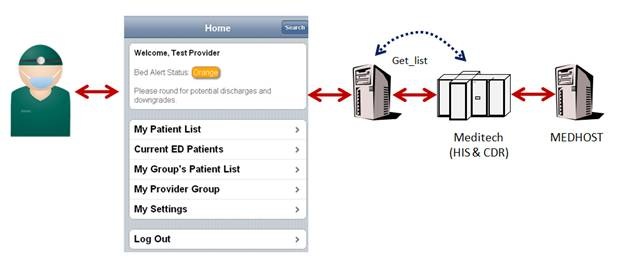
Our Information Services Department is working with our hospital’s Infection Control (IC) Department to create a system that sends a real-time, proactive notification of patients that present at hospital with chief complaints that might trigger operational or policy processes.

Due to the nature of our data collection process, specific diagnosis codes are rarely available during the admission/registration process. That being the case, we use the chief complaint as our primary data field for attempting to notify the IC department of patients that might benefit from more timely intervention by the IC staff.

The basis of our pilot study is to evaluate appropriate HL7 records and segments for keywords (keyphrases) defined by the IC department. If we find one of these words/phrases we will:

  1. Send the IC department an email containing a message that does not contain patient identifiable information (PHI, re: HIPAA), but it will contain the chief compliant. The IC department can use this field to prioritize their processes.
  2. Send a more descriptive file to a secure folder on the network
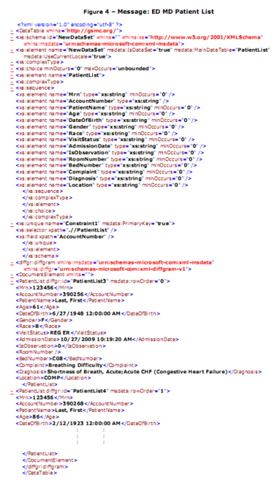
  3. The file we send will contain the following fields:

Patient Information

Message Information: A04
Patient MRN                 
Patient Account Number        
Patient Name                
Patient DOB                
Patient Sex                 

Admission Information

Admit Source                
Chief Complaint       
Admit Date Time       
Admitting Doctor      
Attending Doctor      
Current Location            
Patient Class               

A04: Patient Registration
A01: Patient Admission

The file naming convention that we are using to store the detailed reports is Lastname-AccountNumber-ccyymmdd-hhmmss.txt.

This same system is used by the Admitting Department to receive real-time notification of incomplete registrations. Our hospital information system does not require a chief complaint during admission and registration processes, but our hospital policy states that it must be entered. We use this system to help audit compliance.

Software: MIRTH Interface Engine (www.mirthproject.org – Open Source)
Hardware: Low end PC or server
HL7 Feed: Clone from ADT Feed from HIS to Laboratory System

Keyword examples: influenza, tuberculosis, lice, pertussis, diarrhea, chlamydia, strep, pinworms, measles, blood in sputum, bloody sputum.


You Can’t Give It Away
By Catherine Huddle, VP Market Development, Sevocity

While the Big Three automakers extend their tin cups on Capitol Hill, we hear that at least one of the first four communities designated by HHS to receive Electronic Health Record (EHR) funding, Louisiana, submitted only half the applications of the 100 available $58,000 grants. So, you can’t even give EHR away?

I believe that part of the problem is that most physicians didn’t know about or understand the HHS program. Our company saw the first four community initiatives as an opportunity to get in front of physicians at the most opportune time. We sent multiple mailers and made calls to hundreds of physicians in the first four communities. What we learned:

  • Mail that is not payment- or insurance-related may be ignored or lost. Less than 5% of our mail was returned, but over 80% of practice managers said they never received our mailing or couldn’t find it.
  • Nearly all the office managers and physicians we talked to were unaware of the HHS program. Those who had heard about it were confused and didn’t understand the difference between the EHR program and the national HHS ePrescribing initiative.
  • Trying to explain the available funding and the timing was difficult. If you review HHS’s Web site, this problem is clear — the process to obtain the funding is long and convoluted and the dollars to be expected is difficult to predict.
  • Physicians do not believe they will see any material funding from HHS.

So, if physicians had a clear program that helped them fund purchase of an EHR would it make a difference? I think the answer is yes — sometimes.

Just like a tax incentive encourages a would-be home owner to become a home buyer, I believe that clear, timely payments for EHR adoption would incent the physicians interested in EHR to go ahead buy EHR. Funding is such a clear motivator for the group already interested that I think it helps explain why our company is achieving record sales in a very weak economy.

The new customers I talk with tell me they purchased after months or years of looking because our solution is CCHIT-certified/complete, but only requires a small down payment and ongoing monthly payments. Their risk is minimized because their personal investment is minimized.

While there is a segment of physicians that is already motivated to buy EHR and will do so with some clear achievable financial assistance, I believe there is another segment that wouldn’t implement EHR if you gave it to them – right now. This is the segment that is downright terrified of implementing EHR. They have read and heard the horror stories of six-figure EHRs that sit unused. They are concerned the EHR will slow them down, knowing their productivity is the lifeblood of their income.

As EHRs evolve, physicians experience the benefits, and EHR vendors improve, I believe this will gradually change. As vendors, it is up to us to make this happen. We must listen to our potential customers and design affordable and easy-to-use systems.

Low Cost IT Hospital Improvement Project
By Julie

ceoexpress 

Having worked in healthcare for 20+ years in both the hospital and vendor settings, I see many opportunities for low cost IT projects. Many in the hospital setting are not utilizing the power of the Intranet to provide Web-based access to policy and procedure manuals, the automation of manual calculations (e.g. heparin protocols), and the use of paging/text messaging. Many other types of info (links to emedicine, Medline, etc) could be of great help if provided at the clinicians desktop in an easy to use format.

CEO-Express provides a desktop application that I’ve used for years both personally and in business. The generic MD-Express has potential as well, if taken private label and customized. I have no financial ties to the company, but have found it extremely useful.

Access to well-written, searchable policies and procedures is critical, with staff members (both nursing and ancillary) frequently being forced to float due to variations in patient populations and workloads. Also, with the diversity among providers today, communication can be hampered by regional and international accents and dialects. Text-based paging/messaging can be a non-obtrusive method of improving communication.

Having worked for Cerner and seeing real and planned “bleeding edge” technology only to return to a severely challenged community hospital has been extremely frustrating. Financial limitations and the staff’s lack of exposure to or fear of even 20th century technology are disturbing. And to think this organization is not that physically distant from both Partners and BIDMC is amazing! While expert rules firing off text messages to communicate critical values to providers is technology available to some, there have to be workarounds for financially challenged organizations.

Some things to think about: while most people choose a hospital perceived or documented to be the best, most progressive, well-staffed, or well-funded, the reality is that if you or a loved one is involved in an accident or suddenly falls ill, you may not have the choice of where you go for care. The nearest hospital becomes your best or only chance for survival. If that hospital is severely challenged in any way, you or your loved one may not make it. Transport to another hospital depends upon the patient’s stability. For those without the clinical knowledge and understanding to evaluate the limitations of a facility and where the best care would be for a particular condition, you are at the mercy of whoever is providing care.

Readers Write 12/4/08

December 3, 2008 Readers Write 2 Comments

Submit your article of up to 500 words in length, subject to editing for clarity and brevity. Use your real or phony name (your choice – we’ll substitute a phony one unless you ask specifically to be named). Submissions are subject to approval and become the property of HIStalk.

Low Cost IT Hospital Improvement Project
By Leonard Kravitz, Informatics Director
bb

We gave Blackberrys to all members our interdisciplinary ICU  team — physicians, nurses, social work, pharmacy, dietician, etc. It was a total of 39 devices. Most staff sign up for a device when they start their shift, although some have their own device (like the ICU director and physicians). These are text-only, no voice.

They provided a huge improvement in communication efficiency. There was no more wasted time trying to find the physician or nursing trying to find pharmacy about a missing med. The bottom line is faster, more efficient care for patients and reduced errors.

The total cost is around $17K. The only reason it is that much is because we are running the devices over a cell network. We will be moving to VoIP over Wi-Fi in the next year and costs should fall to $5K/year.

What is good about this is that it’s technology that works and makes a big difference. Text-only is not disruptive, it has a time-stamped, legible message, it can be sent to many people at once, and the pagers can receive alerts from our clinical system.

The key to success is giving devices to everyone on the team, which increases the value of the network.

Low Cost IT Hospital Improvement Project
By Larry Spannel, Hospital CIO

We discovered a significant opportunity to improve customer service for our nursing and clinical staff. Like everyone else, if a problem occurred with their computer equipment, the nursing staff was expected to call the Help Desk and arrange for service. We found that this rarely happened.

When a nurse or physician had a problem with a workstation, they would leave it and find one that worked. They never had time to call and report the broken device. It was not unusual for a nursing unit to have a large number of its workstations out of service before IT was aware of the problem. In our heavily automated clinical environment, this was a real concern.

We asked our Help Desk and Field Services staff to think of a better way to ensure that all of our nursing unit workstations were available all of the time. They developed an equipment rounding plan where our field services techs visit every nursing station, every weekday. The techs inspect every workstation and printer, and fix any problems they find.

We piloted the rounding program for a couple of weeks to see if it would be effective. We were amazed at the reception we received from the clinical staff. They loved the fact that they did not have to worry about equipment availability anymore, and that they were no longer tied up making calls to the Help Desk. Where once our clinicians had a very low regard for IT support, the techs are now welcomed and appreciated for their work.

The program was so successful that we quickly implemented it for our emergency department and all of our nursing units. The program is cited as an example of excellent customer service throughout the hospital. It was a zero-cost change since we rearranged the work of our existing staff to do the rounding.

The Impact of Technology on Diabetes
By Marc Winchester, President
Digital Healthcare Inc.

retasure 

Diabetes is a pervasive chronic disease that affects the coronary, neurological, renal and vision systems of over 22 million Americans with an additional 50 million termed as "pre-diabetic". If left untreated, it will remain the leading cause of lower limb amputations, end stage kidney failure, and blindness in the working age population. In terms of economic impact, the disease has no equal. Conservative estimates indicate that the annual cost of diabetes is now well over $100 million.

Technology has a critical part to play in the assessment of risk, diagnosis, treatment, and management of the disease. In order to manage the condition, technology needs to be pervasive across the care continuum.  

It may surprise some to learn that diabetes can be prevented and, in the early stages, it can be reversed. This requires lifestyle change and increased awareness among the high risk population group. The role of technology in the first instance is one of supporting public health communications. Patients need to have access to simple risk calculators that can predict early onset; Personal Health records need to be easy to use and easily accessible. However, it is important to realize that those at most risk tend to also be the most technology-averse. Until this issue is addressed, technology won’t have an impact on the care process until after a patient’s initial diagnosis.

When a patient presents to the primary care physician with diabetic symptoms, a series of tests is performed to confirm diagnosis. Most medical record systems are more than capable of storing the information. However medical record systems must identify those at risk through general health, genetic, and lifestyle data. A real advantage would be a system that assesses risk and red flags patients before they have full-blown diabetes.

As the disease progresses, physicians are left with a series of options to arrest its progress through pharmacological intervention, lifestyle advice, and ultimately, referral to secondary specialists, such as endocrinologists or ophthalmologists. Efficient referrals must aim to manage the patient through a defined "care pathway," but patients rarely comply with such instructions. Technology should integrate contact management systems to ensure that patients are "nagged" by whatever means to follow up on their prescribed care plan.

In order for technology to have a real impact on chronic conditions, it must integrate diverse components into a workflow similar to that used in manufacturing processes. At Digital Healthcare, we have found the way to achieve this is to place detection technology in the primary care setting and have an automated pathway send high resolution images and data to a clinical specialist. The specialist systematically assesses the risk and recommends the next treatment option, which is also defined in the pathway. So far, we have saved the sight of thousands of people around the world using this approach.

Until we see the convergence of technology with public health policy, evidence-based medicine, and uniform reimbursement strategies, simple disconnects will continue to contribute to many more deaths and the continuing rise in health insurance premiums.

Clinical Software Review -  Microsoft CUI – Secondary Care
By The PACS Designer

 ecg

The Microsoft Common User Interface has been released for review and user input based on Microsoft’s Silverlight platform.  We will be reviewing Secondary Care for Brian Johnson.

To proceed with this lesson you need to have Microsoft’s Silverlight platform installed on your system.

We are going to launch the Patient Journey Demonstration. Once you are on the Patient Journey Demonstration page, you are going to be navigating to the Secondary Care section, so click the "Launch Button" under "Secondary Care". Follow the steps below to learn the best method for navigating:

  1. Brian Johnson has been sent to the ECG Laboratory for a stress test. Brian is in Exercise Test Room One. While waiting for a message to appear on your screen, click "Molecule triggers allergy attack" in the "Health News box" to view the article, then close it. When the message pops up for viewing his test results, click the "View LIVE ECG" button in the message.
  2. Next, you will see Brian’s ECG images. The message requested that you look at V4, V5, and V6. Click the down arrow to the right of "Select a lead" then click "V4" to view the ECG image.
  3. Next, click the "white box" below "V4" to view "V5". Then click "white box" again below "V5" to view "V6". When done, click "V6" to return to all ECG images.
  4. At the left under "Chest Pain Clinic" click Brian Johnson’s "View Results" to see the data.
  5. Move your pointer over "Stage 4" that is on your extreme left and click the "Red Box" in the upper right corner to expand it. Next, move your pointer up to the numbers " 0 thru S" in the upper right of the screen and click the second "Red 4".  Again, click the small "Red Box" to expand it and when done viewing it click again to return.
  6. Next, click "Known Allergies" to see Brian’s allergies. When you are done, click the "Up Arrow" to the right to close.
  7. Click "Search Care Pathway Library" in the lower right hand corner, then click "Angiogram/Angioplasty" to see other aspects of Brian’s health record.
  8. At the bottom of the screen, click "Review results" in box marked "Angiogram" to see Brian’s angiogram. Click the "Play Button" to run the viewer. Next, on the left side of screen under "Select Run," click the down arrow and then click "LAO 30 Cranial 26" to view the 3D image, then use your pointer to move the 3D to the left and right for slower viewing.
  9. For the last step in this review, click the "Show Guide" in the upper right corner to view all the capabilities of the online viewer. The "Show Guide" can be accessed for each viewing screen for more information by clicking "1. Registrar landing page" through "5. Angiogram" for this Microsoft CUI. Close "Show Guide" when done.

This completes the third and last review of the Microsoft Common User Interface (previous lessons are here and here). Please let us know your feelings about this new concept from Microsoft.

Readers Write 11/19/08

November 19, 2008 Readers Write 2 Comments

Submit your article of up to 500 words in length, subject to editing for clarity and brevity. Use your real or phony name (your choice). Submissions are subject to approval and become the property of HIStalk.

IT Projects Resulting in Savings (for $25,000 or Less)
By Southeast CIO

These are based on my personal (15 years) experience in hospital IT. Some of these may be a little dated.

Medicaid Eligibility Double Check Before Aged Receivables Go to Bad Debt Agency
Annual Savings: $50,000

Hospital sometimes help patients apply for Medicaid, usually after the patient receives treatment. The patient is usually placed into some type of Medicaid-applied status. When the application is approved or denied, the status is changed. Sometimes all that works and sometimes it does not. We created a batch process that identified any self pay/indigent patient/guarantor ready for bad debt and applied that information against the Medicaid Eligibility source/TPA. Even in these HIPAA-friendly days, a second check will find an organization money.

Resigned/Terminated Employee Automatic Dis-enrollment from Benefit Plans
Annual Savings: $20,000

The base HR package didn’t automatically term benefits. HR had to dis-enroll employees manually from programs. Sometimes that would not happen in a timely manner or a step was missed. The option is to either buy an expense add-on module or script the series of key strokes. Scripting can resolve this problem, eliminating part of an FTE and saving benefit dollars.

Intranet Application That Assigns Registrars To Patients/Rooms, Reduces Overtime
Annual Savings: $15,000

Some hospitals provide bedside registration, especially for maternity wards. Registrars were constantly on the phone or going back to the main office for their next assignment. We created a basic application for the Intranet that could be updated showing next assignment. Registrars could access that from their mobile laptops on carts and indicate when done. Overtime went down, registration productivity went up. We also used instant messaging for these employees (policy was no IM at that organization).

Fax Server to Retain Surgical Case Documents Faxed To/From Physician Offices
Annual Savings: $50,000

Faxing with MDs office always has its challenges. On occasion, surgical cases are delayed, increasing overtime and frustrating many involved. A fax server that retains inbound and outbound faxes eliminates a lot of headaches.

Microsoft License Discounts for Educational Organizations – Teaching Hospitals
Annual Savings: $12,000

Microsoft provides discounts for educational organizations. A 400-bed hospital usually provides some type of education to residents, etc. Even if it is on a small scale, it will sometimes help qualify.

Reduction in Hospital Bill (claim) Hold from 5 to 4 days
Annual Savings: $35,000

Most HIS systems are set to hold charges for X days after patient discharge. The point is to enable all charges to be entered, scrubbed, then dropped on a claim. When most HIS systems go in, to be careful, bill holds are sometimes set high. With good charging processes and focus, you can reduce these days. Interest earned on one day of charges billed and paid one day earlier adds up.

Small Revenue-Enhancing Projects: The Rule of the Year for 2009-2010
By AgedObserver

You’ve preached for a long time that our industry, in many cases, has adopted technology for the sake of technology, without examining the fundamental reasons of “why” and “what benefit” (CPOE is the best example). There have been countless multi-million dollar projects in the last 10 years where the end result has been average technology, combined with poor execution, resulting in lousy adoption and no demonstrable ROI. 

Instead of accelerating the entity, the attempted technology has slowed the organization’s progress, and in the hindsight of today’s economic environment, has placed provider organizations at risk because hundreds of millions of dollars poorly invested has escaped from their bank accounts.

Jim Collins identified some key aspects of how leading organizations use technology as an accelerator, thereby “avoiding fads and bandwagons yet becoming pioneers in the application of carefully selected technologies.”  Clayton Christensen talks about innovation needs, not for the sake of innovation, but to move the business forward in a steady, directed fashion.

In today’s environment, where capital for large technology projects is very scarce, it’s important that every project be aimed at providing additional revenue to the organization for work already being done, i.e., if you’re leaving money on the table because you don’t have the right technology (square peg/round hole or one-size-fits-all) and you can get a vendor to guarantee financial improvement, you have a winning solution. Large projects don’t work today because the manpower and up-front costs lead to extended (if any) return on investment for the purchaser.  

Small, focused, revenue-enhancing projects should be (my prediction is they will be) the rule-of-the-year for 2009/2010. The tie between the clinical activities and revenue is obvious, but so many technologies put a 10-foot wall between the two, or try to solve only one part of the two sided-puzzle, and hence don’t resolve true issues and put more money into provider’s hands.

The Future of Primary Care
By TornMD

The NEJM just had a roundtable on saving primary care, with big names in the field talking about the usual things: medical home, changing reimbursement, etc. Personally, I don’t see how anything but a drastic increase in salary will attract people to the field. I’m also not sure those are the people you want as your doctor.

Even though most EMR systems are targeted to internists, more technology is not going to change the everyday workings of a primary care provider. I did an informatics fellowship, so I’ve never practiced more than three sessions per week, always in an academic setting (with two sessions of supervising residents). Though I’ve found my patient care sessions very rewarding, there’s no way I could have managed a full week of it. Primary care is just not that intellectually satisfying.

As our department chair told us when I was finishing residency (2001), there’s no future in primary care. PAs and NPs can handle 95% of the cases we see (as evidenced by the excellent PAs I work with in our walk-in clinic). I often feel that dealing with lower back pain, URIs, and diabetes management is a waste of an MD.

The reward I get from primary care is probably what most people in private practice find the most frustrating. Being in an academic setting without productivity constraints, I have (a lot of ) time to spend with patients. The whole medical home concept — case management, explaining lab results, dealing with specialists — is a lot of what I do (especially since I speak Spanish and may be one of the only providers who can talk to patients without a translator). It’s also a lot of what patients appreciate. I often feel much more like a psychologist than a doctor; however, I don’t need an MD to do what the patients appreciate most –  listen.

There will always (I hope) be people who go into medicine because of the rewards of patient interaction, but the current system makes that less and less viable. Because of the lack of intellectual challenge in primary care, I believe the only way to attract the “best” is to couple it with research or teaching and to work where patients really need you. I was miserable during my private practice sessions when I saw well-insured patients for yearly checkups, STDs, or blackberry thumb. When I see Medicaid, non-English speaking patients for diabetes control or atypical chest pain, however, I feel that I’m actually contributing and fulfilling my role as a physician. Unfortunately, a Medicaid-focused private practice is not really financially sustainable.

Readers Write 11/13/08

November 12, 2008 Readers Write 5 Comments

Submit your article of up to 500 words in length, subject to editing for clarity and brevity. Use your real or phony name (your choice). Submissions are subject to approval and become the property of HIStalk.


Report from AMIA 2008
By Grant Ritter
 

amia

As a (now part-time) academic, I love coming to AMIA to see what kind of blue-sky thinking is going on in all those NLM-funded labs. As I’ve attended more conferences, however, I find that I enjoy the panels more than the paper sessions.

Dr. David Eddy of Archimedes gave a great keynote about the development of his system. I then went to the public policy session where Dr. David Blumenthal, an Obama advisor, gave his opinion of what will go on in the new administration. Unfortunately, because of his position, he couldn’t give much detail, but there is hope that the $50 billion promised for HIT will somehow survive.

I had another meeting on Monday, so I was sorry I missed “Movie Magic in the Clinic — Computer-Generated Characters for Automated Health Counseling” from Northeastern, along with other sessions on virtual worlds-virtual patients. There was a lot going on during the session about promoting informatics as a recognized profession, with board certification, etc.

Also, several panels on the AHIC successor, whose business model I still don’t understand (in whose interest is it to pay dues?)

The AMIA exhibit hall is little league compared to HIMSS, certainly tailored to the mainly academic audience — NLM, ISO press, Elsevier, training programs … In other words, no booth babes or free cappuccinos.

There were several Web 2.0-themed sessions, from decision support to PatientsLikeMe to one of the top student papers, “A Scientific Collaboration Tool Built on the Facebook Platform”.

Dan Masys’s year in review was probably, as always, the best-attended session (his slides are available on the Vanderbilt Web site). Afterward was a great session on informatics and entrepreneurship.

My favorite speaker of the conference was Craig Feied, founder of Azyxxi (now Amalga) and 13 other companies. The panel also had Michael Kaufman, formerly of Eclipsys. Great for academics to hear from real business people, especially when Mr. Kaufman started talking about EBIDTA. The panel also included some businesses that failed, so great lessons on both sides.A good panel on medical homes Wednesday morning as well.

Above all, the best part about AMIA is being able to go up to people like David Bates and hear what they have to say about your (or their own) ideas. I’m not sure how much interest there would be for someone actually running a clinical information system, but hopefully it provided some glimpses of the future of HIT.

Report from World of Health IT
By Maurice Ganier

wohit 
I spoke at the World of Health IT last week. It was a real treat being at an HIT conference with only 2,000 attendees (“only” when compared with HIMSS 28,000) and where the focus was truly on the education sessions, most of which were very good. It was also enlightening to see how far behind we are here in the US compared to other countries with socialized medicine. Even just referring to what we call patients, as “citizens” brings home the point that they have a vested interest in caring for their populations.

Aside from the fact that Panasonic debuted their new mobile clinical assistant device to go head-to-head with the Motion C5 – and directly across the aisle from Motion’s booth, no less – the absolutely coolest thing in the hall was a booth run by the Danish government showing off their IT Experimentarium. It is a “dummy” hospital, complete with nursing unit and patient rooms equipped with all types of equipment, in which all health IT applications are designed, put through their paces to ensure that they address workflow adequately and optimally, and then used for training.

Better than the popular “conference room pilots” that we are accustomed to using, the “patients” (either real people being instructed by a doc behind the curtains through an earpiece, or a dummy with a built-in speaker through which the doc speaks) are able to convey real-life scenarios to the clinicians providing care either through a script or by incorporating “curve balls” to truly test the limits. There is a good video available all about it at www.regionh.dk/itx (scroll down to access the English-language version).

Clinical Software Review – Microsoft CUI
By The PACS Designer

image 

The Microsoft Common User Interface has been released for review and user input based on Microsoft’s Silverlight platform. We did a review of the "Microsoft CUI Introduction" previously, so now we are going to follow the path for finding a patient.

To proceed with this lesson, you need to have Microsoft’s Silverlight platform installed on your system. Get the download here.

After logging off and relaunching your system, you can go to the Microsoft CUI by clicking this link.

We are going to launch the "Patient Journey Demonstration". Once you are on the Patient Journey Demonstration page, you are going to be navigating to the Primary Care section first, so click the "Launch Button" under "Primary Care".  Follow the steps below to learn the best method for navigating:

We want to find a patient in the Microsoft CUI named Brian Johnson so we can see the details on his condition for his next appointment.

  1. The first step is to look for Brian Johnson’s name in Dr. Oliver Cox’s schedule on the "GP landing page".
  2. Dr. Cox has an 8:50 appointment with Brian and wants to review his medical history. To view it, double click Brian’s name on the appointment schedule for Dr. Cox and you’ll see the many aspects of his medical record.
  3. Under "Most Recent Activities," click the clear box in the upper right hand corner to expand the record. Since Brian’s hypertension is now accompanied by chest pain, you want to next click the box for Dr. Christina Lee in the lower right hand corner. You will see that Dr. Paul Dunton, a cardiologist, is covering for Dr. Lee since there is a Green Bullet before his name. Click the Green Bullet for contact options and click desired method to launch Outlet Express 6 if you wanted to communicate with him. Click box in upper right hand corner to return to previous screen.
  4. Next, click the clear box in "Patient Charts" to expand Bryan’s charts for hypertension. Click the different chart descriptions to see their data points. When finished, move the mouse pointer to 2. Patient Record under Scenes at top of screen to return to previous screen.
  5. For the balance of this exercise, navigate to the other aspects of this record to view their details.


This completes this view session for Silverlight and the Microsoft CUI.  TPD will be doing Secondary Care next.

Readers Write 10/29/08

October 29, 2008 Readers Write 1 Comment

CCS HIT Fall Report
By Pedro Borbon

The Fall CCS HIT summit had its ups and downs. I was surprised at how small it was. Apparently last year there were four times more people, but this year there were probably <50 attendees.

The first day’s content was average, but there were two very impressive speakers. John Geade, the CIO at El Centro Regional Medical Center who has done a great job integrating various HIT systems in his hospital and also installing an EMR in his ER, and Gay Madden, CIO of Florida Hospice of the Suncoast, which appears to have a much more advanced HIT system than many academic centers. Mark Probst of Intermountain Healthcare gave a good keynote, but pretty generic.

I think the problem with these types of presentations for us who are so steeped in the HIT world is that it’s hard to find anything really "new".

The small size made networking easier, especially on the second day, when there was a superior panel on PHRs: Missy Krasner (Google), Philip Marshall (WebMD), and Sanjay Gupta (Dossia).

Naomi Fried, VP of Innovation and Advanced Technology at Kaiser Permanente, has what seems to be a dream job (and who also seems like she would be a great HIStalk interview), and spoke about KP’s telehealth projects. There was also a good payer panel, with Charles Kennedy (Wellpoint), Julie Klapstein (Availity), and David Lanksy (Pacific Business Group on Health).

Dr. Lansky told us that he offered free trips to the Health 2.0 conference to every employer who makes up his group and not one of them took him up on the offer …

I don’t think I’ll be back, but maybe the spring summit will be better attended. Can’t tell if it was the content or the economy. Sofitel LA is a great hotel!


The Cloud Computing Phenomenon
By The PACS Designer

Cloud computing is the phenomenon that is sweeping through the vendor community lately. Some commentators are saying it is a fad that will pass, while others are forecasting a much wider cloud computing community.

TPD has been using clouds to describe design work for several decades, so the concept is far from being new. What is new is the movement of the cloud description from the development side to the public side. In the design workspace, clouds are used to describe future development features, and also the type of outside services that may be employed in the design.

Amazon thought that bringing cloud computing to its customers would expand its product offerings and also help retain existing customers for many years to come. So far, it appears to be working as planned even though there have been some service outages, but with any new service offering there are bound to be some bumps in the road that come up unexpectedly.

Hyperic, the company that designed the "CloudStatus" web site, fully understands the cloud computing concept and has formed their business plans around the aspects of IT services described as clouds. The concept does have some compelling ideas, which include lowering the costs of software support, using proven concepts others are using, and creating the opportunity to simplify the interfaces by eliminating custom interfaces and the costs associated with their design.

Hyperic had this to say about cloud computing: "Cloud computing is a system of technologies and services that have commoditized (sic) IT to make it more readily consumable, scalable, and cost-effective for everyone. It has leveraged the innovation and expertise of Internet giants like Amazon and Google, and is making it accessible to anyone with the next big idea. It removes the investment in physical and human resources to scale up a business. It affords more folks to try their ideas and vet its worth in the market. It also affords these same businesses to scale out as quickly as their business demands. Cloud computing, same as open source, is a way to package products and services to ease adoption so everyone benefits."

In summary, you can expect cloud computing, as a term used to describe outside services, to be around for many decades to come. It will provide a more robust platform for future designs as we move forward toward a more connected world environment.

Response to "Hallway Medicine"
By The Alchemist

Who would have ever “thunk” that Hallway Medicine is safe and good for the economy by simply moving patients to corridors while waiting for a room as a way to unclutter ERs? Just peruse this screen shot for the top 20 countries from the WHO Report Annex Table 1: Health System Attainment and Performance Ranked by Eight Measures (click to enlarge).

Anyone would agree that the U.S. is the leading country for health expenditures and proudly number one for the Responsiveness Level for Attainment of Goals. I knew that Management by Objectives would prove successful:

image

The reader can formulate their selective opinions on what are important metrics to define the U.S. Health System. Hint: The Middle East is not too impressed with U.S. ranking in Health Systems around the world but they will buy our products.

Readers Write 10/23/08

October 22, 2008 Readers Write 2 Comments

Submit your article of up to 500 words in length, subject to editing for clarity and brevity. Use your real or phony name (your choice). Submissions are subject to approval and become the property of HIStalk.


Personal Health Records are Durable Medical Equipment
By Manfred Sternberg, J.D.
Presiding Officer, Board of Directors, Texas Health Services Authority

There is little debate that knowledge and information have always been among a physician’s best clinical tools. Consistent with this fact, information technology (IT) should be viewed by the healthcare industry as a medical device. With the advent of evidence-based medicine coupled with advances of IT, we are in many ways on the brink of a golden age of medicine.

In the relatively near future, information supporting evidence based medicine will translate from bench to bedside at speeds never before witnessed. We will have more accurate information to treat health issues more appropriately, based on the data, than ever before.

Admittedly, IT is in many ways a crude medical device, but that is today. Many of the now traditional medical devices that were introduced into the healthcare market throughout history started off as crude devices; think about surgical tools.

ms Like other medical devices, this device is certain to evolve with use, experience, and continued development and innovation. Many predict that the use of this IT device by healthcare professionals will become the standard of practice, like scrubbing in before surgery. The legitimate debate generally centers on how and when.

As with other changes in medicine, the adoption of this new tool will be an evolution. It will not happen by just flipping a switch at the end of any given year, it will evolve. Consumers and their physicians must participate in this evolution for it to ultimately be successful. The consumer’s best platform to effectively and economically engage with the industry is a standardized personal heath record (PHR).

What is a PHR?

A PHR is an electronic record of health-related information on an individual that conforms to nationally recognized interoperability standards and that can be drawn from multiple sources while being managed, shared, and controlled by the individual.

PHRs may also include information that is entered by consumers themselves, as well as data from other sources such as pharmacies, labs, and care providers. PHRs enable individual patients and their designated caregivers to view and manage health information and play a greater role in their own health care. PHRs are distinct from electronic health records, which providers use to store and manage detailed clinical information.

The Benefits of using a PHR

There is consensus among stakeholders that the widespread adoption of health information technology will lead to safer, more effective healthcare. Experts believe adoption of technology will reduce preventable errors, such as medication errors, increase compliance with recommended treatments, improve treatment for people with chronic disease, and contribute to lower health care costs.

Ultimately, this new tool will allow physicians to benefit from improved information about each patient, and consumers and doctors can share that information to make the best decisions concerning their healthcare. Better data (e.g. timely, personalized clinical and billing data) provides better results whether in the hands of a physician, patient, health coach, or measurement program Additionally, care coordination from a process management perspective is critical to improved results

Consumer Empowerment

Consumers have great interest in the subject of healthcare. It is the most searched subject on the Internet, yet the long predicted wave of consumer empowerment in healthcare has yet to arrive.

Consumers, as well as the business community, are generally unaware of the healthcare cost and quality issues and interoperability issues. Nor do they recognize that they have a new, long anticipated, role as purchasers seeking value in the healthcare delivery system. They tolerate the existence of numerous inefficiencies and cost in the healthcare sector far more than in any other market, because of and in spite of its relative importance and their inability to judge value.

Today, the consumer is unable to identify value without information on cost and quality. Quality cannot be identified without measurement and it cannot be compared without standardization.

Since the mass adoption of the Internet, the benefits of IT have embedded themselves into society as one of the most powerful tools that consumers have ever had. Endless information is now available in everyone’s home. Society has embraced this new found consumer tool, but comprehensive personal clinical information has not digitally made its way into the consumer’s hands. To some degree it is not readily recommended or available, yet.

How does a consumer get educated about their new role in their own health and their interaction with the healthcare delivery system? Who do they trust to guide them? Consumers trust their physicians far more than any other group in the Healthcare system. They certainly value their doctor’s advice, even if they don’t follow it all of the time.

Today, the consumer is effectively, unwittingly waiting on their physicians to recommend this new medical device for their health. Therefore, engagement of the physician is the key to fostering consumer empowerment.

What is Durable Medical Equipment (DME)?

There is no single authority, such as a federal agency that confers the official status of DME on any device or product. A fairly comprehensive definition of Durable Medical Equipment as contained in a Texas Group Policy is as follows:

Durable Medical Equipment is defined as being equipment that:

  • can withstand repeated use; and
  • is primarily and customarily used to serve a medical purpose; and
  • is generally not useful to a person who is not sick or injured, or used by other family members; and
  • is appropriate for home use; and
  • improves bodily function caused by sickness or injury, or further prevents deterioration of the medical condition; and
  • is prescribed by a physician.

A consumer’s PHR fits the definition as follows:

Durable Medical Equipment means

equipment : Noun. An instrumentality needed for an undertaking or to perform a service.

that:

  • can withstand repeated use. A PHR easily withstands repeated use.
  • is primarily and customarily used to serve a medical purpose. A PHR contains a consumer’s relevant medical information so many medical decisions can be made based on the contents of the record.
  • is generally not useful to a person who is not sick or injured, or used by other family members. A PHR is not useful to anyone in the consumer’s family but the consumer and only the consumer can use it to track and support her health or coordinate her care when she is ill
  • is appropriate for home use. A PHR is appropriate for home use or anyplace a consumer has a connection to the Internet.
  • improves bodily function caused by sickness or injury, or further prevents deterioration of the medical condition. According to the trade association that represents insurance plans and the executives of most plans, there is consensus among stakeholders that the widespread adoption of health information technology will lead to safer, more effective health care. Experts believe adoption of technology will reduce preventable errors, such as medication errors, increase compliance with recommended treatments, improve treatment for people with chronic disease, and contribute to lower health care costs.

and is prescribed by a Physician; Can physicians professionally make this recommendation to their patients? It depends on whether they can professionally agree with the statement that “a PHR is a medical device that in certain cases can benefit their patient’s ongoing health or illness.”

If physicians prescribe a PHR for their patients, and the Payers collectively agree to pay the costs, the standard of practice in a community will change. Physicians will create a new business model in order to pay for their EMR system, and the power of a new medical device can be leveraged for the benefit of the consumer.

The PHR information must be stored in a secure way with patient privacy a cornerstone of the repository. Physicians must play a role in the central repository of this clinical information in terms of governance and oversight with appropriate financial compensation for their participation.

If every physician in Harris County, Texas prescribes a PHR for every patient that could benefit from such a device, it will be a catalyst for the creation of a clinical information database that would be owned and controlled by doctors and their patients.

The opportunity for today’s leaders is to take steps to enable our community to appropriately leverage the power and value of the data. To be sure, this is not as much a technology problem as it is a sociology issue. The first step is for the Industry is to acknowledge IT for what it is, a medical device.

Readers Write 10/16/08

October 15, 2008 Readers Write 1 Comment

Thanks to all who participated in the live chat with Glen Tullman of Allscripts on Wednesday evening. It’s pretty cool that a CEO went on live with a blog and its readers (recall, too, that Glen was typing his own responses in real time!) Glen passed along a message to everyone that he was happy with the chance to connect. If you missed it, you can scroll through the transcript here.

From the Floor of the American Academy of Pediatrics Convention
By Willis Jackson

I’m tired and burned out, but here is the news from the floor of the AAP show from a veteran booth slut.

The traffic was not bad, as attendance was up this year. The Hynes Convention center is a bit awkward (multiple floors, each floor is "split" in the middle), but most vendors we spoke to thought it went well. The last few years, the AAP floor has not been strong.

The sharks are in the water. About 15-20 EHR/PM vendors who haven’t set foot near a pediatric show in the last five years are suddenly in the house. Some claim pediatric customization, but that just means growth charts and some templates they got from a practice. Why now? We all think that it’s the CCHIT money … the Feds, et al, have thrown the chum over the back of the boat and the sharks are circling. Meanwhile, the AAP’s COCIT committee can’t must enough $$ to get a decent program and none of these companies can be bothered to help underwrite them.

The Allscripts booth did not have a corrective sticker slapped over the logo on Monday morning. They also didn’t have many people stopping by, either. Misys, I believe, may be the only mainline EHR/PM vendor who WASN’T at this show.

Word on the street, and I heard this from more than a dozen folks, is that Office Practicum is "the only pediatric EHR to consider" right now. Personally, I have to concur. They have leapfrogged everyone, including (and especially) eCW, NextGen, etc. Every person spoke to who attended the EHR showdown said that OP crushed it, though one person gave a half nod to iMedica, if I remember correctly.

The GE booth was big, quite sparse, and usually empty as well. The sales people were on their phones rather than attending to customers. We presume they were checking the Dow.

A small group of well-known pediatricians is focusing on creating a centralized, Web-services driven clinical data repository for things like pediatric dosing, immunization algorithms, etc. Ultimately, it looks like the goal would be to pass the ownership of this desperately needed material to the AAP. If you don’t get it, imagine a quarterly HL7 download from the AAP against which all of your pediatric norms, etc., could be compared. Right now, it’s a mess. I’m hoping it works.

The nagging flies throughout the conference were the folks from Phreesia (phreesia.com – like "Frees Ya!" – get it? – they say it has to do with a flower, I don’t buy it). It’s the "Patient Check-In Company." They have a Tang-orange tablet (with a mag strip reader) that walks patients through the standard questionnaire process on the tablet. Your standard patient kiosk concept, except that it prints the report and the entire thing is ad-supported. Client after client, potential and otherwise, stopped by and said, "You have to go work with those guys. That thing is so cool!" So, we stopped by. And, no, they don’t interface with any EHRs or PMs yet. It prints the report. From their FAQ: "Q: How does Phreesia work with EMRs?  A: Phreesia is compatible with EMRs." By this standard, so are paper charts. And the mag strip – which would be really really cool for collecting co-pays and reading insurance cards – doesn’t work yet either. Yet again, a vendor has chosen to take the pharma+ money up front  rather than build a good product to interface with others. Wasn’t that the PCN model, almost 20 years ago?

Clinical Software Review -  Microsoft CUI – Introduction
By The PACS Designer

image

The Microsoft Common User Interface has been released for review and user input based on Microsoft’s Silverlight platform. This Microsoft CUI introduction requires you to download and install Silverlight 2 Beta 2 on your system. Once you download it,  reboot your system and launch the application to see how the Microsoft CUI works in daily practice. Here us the download link.

After logging off and relaunching your system, open the Microsoft CUI by clicking this link.

We are going to launch the "Patient Journey Demonstrator".  Once you are on the Patient Journey Demonstrator page, you are going to be navigating the "Explore UI" section first, so click the "Launch Button" under "Administration". Follow the steps below to learn the best method for navigating:

  1. You will notice four physicians have their day’s schedule posted. The "Red Bullet" before Dr. Cox’s name indicates he is busy. Click the bullet to see the contacting options that are available to reach him.
  2. Next, move your cursor over Dr. Cox’s box and drag it to the right and place it over Dr. Yu’s box. You’ll notice that the two doctors with green bullets are now first and second in the order of physicians. The "Green Bullet" means they can accept new patients in their daily schedule.
  3. Dr. Cox has called to say he can’t see Hao Chen at 8:10, so drag Hao Chen to Dr. Gibbons at 8:10 so he can see the same doctor as his father, John Chen.
  4. Click the "Clear Box" in the upper right hand section for Dr. Gibbons to see his entire schedule for the day. Also note that the other three doctors are on the right and can be clicked to see their daily schedules.
  5. As the last step for this lesson, navigate by clicking the "Clear Box" of the other boxes so you can see the information they contain.

This ends the first lesson, come back to HIStalk to get the next lesson when it is posted. TPD will be doing a review of "Find a patient" next.

Goodbye ASSociates: Lessons Learned from Neal Patterson’s “Pizza Man” E-mail that Make Sense (Unfortunately) in Hard Times
By Mr. HIStalk

Rumor has it that Cerner’s Neal Patterson is trotting out his old "shot heard ’round the world" e-mail. You know, the pizza-and-parking lot one that sarcastically referred to EMPLOYEES instead of the HR-friendly “associates” because everybody was goofing off (I always write it as ASSociates because it sounds exactly what you’d expect dopey HR types to sit around dreaming up from their happy little floating HR cloud).

Somebody sent his internal-only e-mail to the press back in 2001, while the stench of dot-com smoke was still hanging heavy. Investors were spooked. Shares dropped fast and hard. Neal lost millions overnight while everybody was enjoying a good laugh at his "ready, fire, aim" approach.

Neal got the last laugh. Cerner headcount, profits, and his bankroll are immeasurably larger than they were back in 2001. And in a “goes around, comes around” kind of nostalgia, he’s supposedly proudly brandishing the famous e-mail to employees again, a shot across the bow as a reminder that he wasn’t kidding then and he isn’t now.

Here are some often overlooked facts about the original e-mail. Neal was griping about employees who were working less than 40 hours a week, which is an entirely reasonable bone to pick. He scolded his managers, not the slackers themselves, following the chain of command. It was a raw message intended for (and sent only to) the management team.

This is about as direct as you can get: "I think this parental type action SUCKS … what you are doing, as managers … makes me SICK … the majority of the KC based associates are hard working, committed to Cerner success and committed to transforming health care … this is a management problem, not an EMPLOYEE problem."

It wasn’t personal. It wasn’t even unreasonable (although the 60+ workweeks described are a bit much).

Neal isn’t some emotionless Wall Street hack brought in to push paper. He’s the founder, the owner, and the undisputed boss. When Cerner got too big for him to impose his will directly, he followed the chain of command in telling management to fix the problems he was seeing. Management by nastygram. That’s his right.

Everybody had great fun complaining and commiserating. Some EMPLOYEES left. Those with less backbone or fewer career options just kept whining safely out of Neal’s earshot while turning in fictitious timesheets.

Maybe one benefit of today’s economic meltdown is Depression-era common sense. Nobody promises lifetime employment. Nobody said work is always fun and fulfilling. Nobody promised that the boss might not occasionally behave like a horse’s ass in expressing disappointment in individual or group performance.

Employees with guts or valued skills don’t stick around to whine – they just move on. That’s how you hurt an unjust company (if there is such a thing) or an insufferable boss: you leave them, forcing them to forge on with a workforce of scared and compliant underperformers who have nowhere else to go. If the company thrives, you were wrong. If the company tanks, you were right.

Whether Neal is indeed rattling his e-mail saber again is irrelevant. The feel-good era of "associates" is over, if it was ever anything more than an illusion to start with. When jobs are hard to find, lots of people would love to have yours. Those would-be EMPLOYEES might even work harder, cheaper, or with less complaining. People tend to do that when they’re broke. That’s not to say that any particular company will start treating employees badly, but those who do will find it easier to keep them.

In that regard, Neal’s e-mail wasn’t the ranting of a tyrannical CEO. He was, as he often is, simply ahead of his time.

Readers Write 10/1/08

October 1, 2008 Readers Write 3 Comments

Submit your article of up to 500 words in length, subject to editing for clarity and brevity. Use your real or phony name (your choice). Submissions are subject to approval and become the property of HIStalk.

A Summary of Reader Predictions of How Economic Issues Will Affect Healthcare

Employment

  • White collar markets (including healthcare) will be flooded with hard working but ethically questionable employees displaced by the dismantling of the financial industry
  • HIT employment will drop slightly, but will increase in 2010-11
  • A big jump in unemployment will occur if the credit market seizes up
  • Consultants will do well because big system vendors will minimize headcount to keep P/E ratio looking good
  • Process redesign work increases as hospitals have to live off their own revenues instead of bond money
  • Sales reps will turn over because it will be hard to make the numbers and sales costs are easy to cut fast
  • Hospitals will reduce headcount before they reduce payments to vendors
  • Vendors will cut projects that haven’t gained market traction and those teams will be cut

Hospital Spending

  • No change
  • Slowdown in big capital projects due to funding problems
  • Ambulatory surgery center niche market dries up
  • Projects will shift from clinical improvements to operational improvements
  • Emphasis will be on throughput, staffing ratios, and cash flow
  • Projects that result in more referrals, lab orders, and radiology orders in the IDN’s big hospital will get focus

Physician EMRs

  • Physicians will buy only when affiliated hospitals insist
  • Downward pricing pressure
  • More interest in e-prescribing and disease registries, which cost little and provide benefits like CMS incentives
  • Less interest in EMR adoption because primary care providers will be squeezed even more
  • Physicians and physician groups will face tight credit and postpone big outlays

Healthcare Reform

  • Consumer-driven healthcare dies when consumers lose what little clout they had
  • Healthcare reform is moved back at least five years
  • High deductible health plans will increase, forcing employees to shop on price or defer treatment
  • Population health will decline as patients can’t afford chronic care
  • Employees will underfund health savings accounts
  • Emergent care will increase
  • Providers able to communicate value and patient relationships will compete for the fewer patients with enough healthcare savings account funds to afford care
  • Uninsured patients will rise in number
  • Only private pay will flourish
  • Patients will go overseas because of bad press about US healthcare
  • Providers will need to collect for the care they deliver since self-pay will increase due to uninsured patients and higher deductibles
  • Hospitals will struggle with how aggressive they should be in collecting payment and will be challenged on pricing

Provider IT Investments

  • A shift to those providing quick financial wins, probably at the expense of clinical and patient-centered systems
  • HIT will be pressed to prove the value of technology
  • Hospital EMR projects will be scaled back or not purchased because of long-term expense
  • No change in the short term because budget cycle is already underway
  • IT departments need to educate the executive team about their focus and value
  • Hospitals will scrutinize capital outlays more carefully since some will face liquidity crises because of their investments are in securities
  • Solutions with quick ROI and a cost that is not prohibitive will get purchased

Vendors

  • Consolidation due to credit constriction
  • Niche startups encouraged, other new entrants discouraged
  • R&D will be hard to fund for new companies trying to develop products with long cycles
  • Sales will keep dipping
  • Reductions in training and travel budgets, hiring freezes, salary freezes
  • Less presence at conferences
  • Foreign investment increases
  • Non-real estate investment companies will still look for companies at $20 million, but smaller will be too risky and not worth the trouble
  • Companies themselves will postpone IPOs, but mergers and acquisitions will pick up in hopes of finding synergies and cost savings
  • Increased push to outsource
  • Healthcare won’t be recession-proof this time
  • Small companies with an undifferentiated product will die more quickly
  • If the economic crisis lasts 2-3 years, mid-tier companies will be squeezed for operating capital and will be acquired
  • Large vendors will weather the storm if they monitor expenses
  • Middle tier companies will suffer, but more innovative companies will appear in 2-5 years
  • Lag of new technology development will create cheaper and better solutions in 4-10 years
  • Sales cycles will extend and some purchase decisions that are close to signing will be cancelled or postponed indefinitely
  • Small vendors will face more financial scrutiny from customers who fear being left holding the bag
  • Well capitalized vendors may use the uncertainty to push clients into term licenses or subscription models, which are less attractive than license payments, but require less cash and provide more flexibility
  • Minimal change in M&A activity because vendors will seek exits, but downward valuations will convince them to wait out the storm

Readers Write 9/24/08

September 24, 2008 Readers Write 28 Comments

Submit your article of up to 500 words in length, subject to editing for clarity and brevity. Use your real or phony name (your choice). Submissions are subject to approval and become the property of HIStalk.

Why Sarah Palin is Relevant to HIT
By Wilma Pearl Mankiller

I found it amusing that so many people took Inga’s comments about Sarah Palin and bangs and Botox and turned it into something political. I agree with the readers who think HIStalk isn’t the right forum for politics. We get plenty of that from every cable news channel every night.

That being said, the Sarah Palin story is relevant to our little healthcare technology world. There are some excellent women leaders in our industry, but men far outnumber the women in the top spots. With Palin, we see a working mom who has a realistic chance to be the #2 “guy” in the country. This makes her story relevant, interesting, and inspiring for those of us who have struggled to advance our careers while also balancing our family lives.

Years ago, when I was first newly pregnant, I went to dinner with my husband, a male co-worker, and the co-worker’s high-level executive wife. All but my husband worked for HIT vendors. At that dinner, I recall the wife warning me that no matter how much my husband claimed he was going to help carry the weight, some things would always fall to the wife/mother. At that time, I was young and naive and didn’t fully comprehend what she was telling me. All I really understood was that she and her husband had successfully raised three great kids and she managed to rise through the professional ranks at the same time. I aspired to be like her.

Fast-forward a few years. I supposed I can say that for the most part I achieved what I had hoped for: kids, a nice house, enough money, and some time as an executive. I suppose some would say I had it all. Perhaps I did. But the reality is that getting it “all” can include a few things you never expected or wanted, such as:

  • Tears, while sitting in the parking lot of my son’s daycare the first time I dropped him off.
  • The discomfort and inconvenience of expressing milk in airplane bathrooms and rental cars.
  • Resentment, from both men and women who felt it was unfair that they had to pick up the slack for me while I was getting paid time off just to hang out with a baby.
  • Frustration and guilt, for cancelling product demonstrations because I had a sick child at home who needed me.
  • Ambivalence, when removing my name from promotion consideration after learning I was (unexpectedly) pregnant again.
  • More ambivalence when I asked for lesser job with lesser pay so I would no longer have to travel.
  • Guilt and self doubt when others questioned (judged?) my career advancement decisions and my commitment to being a mom (and for some reason, the highly paid men with stay-at-home wives were the worst because they never seemed to understand that not every husband is the family’s major breadwinner).

Obviously and unfortunately, my frustrations weren’t unique to HIT. In fact, the same challenges exist in just about every industry, which is probably why there are only eight women CEOs running Fortune 500 companies. If you are a woman who chooses a career AND motherhood, you face challenges that only other working moms appreciate. The role models in our hospitals and companies are few and far between. While we can all name a few women that have shattered the glass ceiling, these leaders are the exceptions.

So, here we have Sarah Palin, a real mom who is potentially the country’s next VP. She got where she is by some combination of brains, ambitions, timing, good looks, and luck. We can appreciate that she has to take a baby on the campaign bus. Her kids aren’t perfect. She has critics who think she should be staying home with the kids. Unlike Condoleezza Rice or Janet Reno, she has a family. And if she can succeed, then it gives the rest of us hope that maybe more of us will have a chance to run a hospital/IT department/software company one day.

That’s how Sarah Palin is relevant to HIT.


Observations from the Epic User’s Group Meeting
By SNL

Epic is an engaging, dynamic company. They definitely put on a good show. But the smart observer can figure out their MO.

When Epic wants to build a new software tool or enhance an old one, they put a couple of recent college grads on the project. After "research", and whatever that involves and an hour or two of client Webex’s, they release the upgrade. If QA is done, it’s by other non-clinical people.

When a client complains, especially a doc, they shower them with attention, phone calls, a trip to Madison. "We want to work with you and hear your feedback." Then, after a number of back and forths, all volunteer time on the doc’s part, the module is improved. This can take years.

Meantime, no one really asks "Why didn’t you do a better job building the thing before you released it?" Anyone who does and doesn’t volunteer to pitch in is not a "team player".

Who loses in this game? The doctor/nurse/lab tech, and then the patient, who suffers through the risk of alpha software.

Who wins? Epic, who doesn’t seem to ever pay a dime for this expert help. Kaiser Permanente seems to be learning this the hard way.

Do other companies play this game? Has anyone ever been a paid expert for Epic design? Does Boeing design airplanes this way?


From the Mailbag

Got questions for Mr. H or Inga? E-mail them over!

inga125


Dear Inga,

Did you see where one of the AAFP directors suggested EMR vendors are part of a big Ponzi scheme and the only ones making money are the vendors? What do you think? – Carlo P.

clip_image002 clip_image004


Dear Carlo,

Dr. L. Gordon Moore is the doctor who apparently doesn’t like EMR vendors. What Dr. Moore said supposedly said was, “Beware of the monolithic, expensive IT vendor, because there are always things they don’t do well. The whole thing can be a Ponzi scheme. The only ones making money from most of these products are the vendors selling them.”

First of all, is there something about making a profit that should make a vendor ashamed? Of course EMR vendors are trying to make a profit. Making a profit is a good thing because it means your vendor is more likely to stay in business to support you and continue developing the products.

So, was Dr. Moore suggesting his EMR did not help his practice become more profitable? Is that why Dr. Moore bought an EMR??? In my experience, the physicians who utilize EMR most successfully are those who initially went into the project looking to improve patient care (by making information more readily available, records more complete, reminders automated, etc.) EMRs can definitely increase efficiencies, which might make the practice more money. Of course some vendors and solutions are better than others and there are always things a particular vendor doesn’t do well as another. This is true with both the monolithic and expensive vendors and the nimble and inexpensive start-ups.

Bottom line, Carlo, I don’t think Dr. Moore is the kind of guy I’d have fun chatting up at a cocktail party.

Dear Mr. H,

I saw a reader comment in an earlier Readers Write about the problem with meetings. What is your take on them? – Lorena

Dear Lorena,

I detest meetings. Really. They are like gases – they expand to fit whatever space and time is allotted to them, yet nothing ever results except a vow to hold even more meetings to which even more people are invited. I don’t like attending them and I don’t like conducting them. I will do anything, including faking an emergency page or coughing spell, to escape back out into the sweet, cool air of freedom.

The really bad ones are when the suit-du-jour is running a meeting of the worker bees. Everybody’s jockeying for the boss’s love and admiration, so it will take twice as long as usual to achieve nothing. When a boss is present (hint: they’re the ones with the suits who came late and are furiously keying BlackBerry e-mails instead of listening to people who actually showed up in person) they will pretend to be fully engaged by randomly spouting out one of these non sequiturs:

  • Make sure you document that
  • Let’s put that in the parking lot
  • How about a bio break?
  • Schedule another meeting with (cast of thousands)
  • E-mail me the details
  • Give me a completion date
  • Send me a list of the risks involved
  • I need to review that before you send it out

Notice how none of these items really adds any value except to support the illusion that the boss is vital to the outcome?

Some people are meant to conduct valiant battles on a field of laptops, armed with minimal knowledge and maximal need to prove it. Others just get the job done instead of yammering about it.

Dear Inga,

What kind of sales tricks should doctors look out for when considering the purchase of a PM/EMR system? – Suspicious Doc

clip_image006

Dear Suspicious Doc,

Are you buddies with Dr. Moore, by chance? Since when did EMR vendors get put in the same category as used car salesmen? Although I do recall hearing about this sales guy who used to “hide” a second PC and switch box underneath the table during a demo. At just the right moment, he would switch from the computer running the PM software to the one running the EMR. He was such a pro at it that prospects never realized the two products were in no way integrated. He was smooth.

Anyway, I think one thing important to understand is if the software version you are reviewing is actual live and in production. If it is a pre-release version, that is ok, but it’s important to understand whether or not the version you are looking at is fully tested and the one you will be getting. Also, definitely talk to other practices and ask them about implementation, support, and whether or not the software works as advertised. If you believe a particular function is critical for your operations, make sure you talk to at least one practice (anywhere, any specialty) that uses that feature.

Finally, assume that in most cases that whatever price you are presented initially can be negotiated. It’s likely that the vendor is more concerned with the total contract amount than individual line items. If they throw in a PC or an extra day of training, understand the value of the item so you can access if it represents 1% or 10% of the total deal. If you are offered a lease option, keep in mind the sales rep (and maybe the company) receives some sort of commission for the lease, so they may be willing to give you a little bit better deal on the total price. Also, lease rates can usually be negotiated if your credit is good.

Dear Inga,

I know a female sales rep who slept with a hospital IT person and her company’s product was chosen. Is that common? – Ms. Kitty

clip_image008

Dear Ms. Kitty,

That is a one of the oldest sales tricks ever (check out the Old Testament). Seriously, I guess I am just naïve enough to believe that women (or men!) don’t give up their bodies to win business. I bet what happened with your female sales friend is that she just happened to find true love with that IT person and her product just happened to be the best solution.

Dear Inga,

I loved your avatar! I was in love with your mind before, but now that I realize you must also be beautiful I’m beginning to think we might be made for each other. By the way, are you getting all sorts of cyberspace love letters from wacky IT nerds? – Obsessed Fan

Dear Obsessed Fan,

Um, you are the first. (that was a pretty creepy e-mail.)

Readers Write 9/10/08

September 10, 2008 Readers Write 6 Comments

Submit your article of up to 500 words in length, subject to editing for clarity and brevity. Use your real or phony name (your choice). Submissions are subject to approval and become the property of HIStalk.

A Physician’s Experience with Kaiser’s Epic/HealthConnect Rollout
By Bernie Tupperman, MD

I am a Kaiser physician in Northern California and a user of HealthConnect (Kaiser’s implementation of Epic) for inpatient and outpatient records. Our medical center has used Epic’s outpatient software since early 2005. We recently went live with the inpatient EMR and operating room software. I read the HIStalk reports about Stanford’s physicians supposedly rebelling after their Epic rollout. I wanted to tell you informally about our experience.

Eight of our medical centers are live for inpatients in Northern California. Each rollout has been smoother and smoother. It takes proper preparation, the right education, and peer group help.

Preparation for an Epic inpatient implementation starts years in advance. In Northern California, central planning and coordination of support, educational web-based training, and training of regional physician and specialty staff is coordinated from a central headquarters in Emeryville, CA.

kp1

Each hospital is linked to Kaiser’s data centers across the country. Implementation of computer layout and wireless PC cart connections starts 18-24 months in advance: networks, computers, UPS power in closets, design of networks (vendors), review of construction and facilities, switches and access points… and testing.

Epic inpatient software is purchased off-the-shelf (inpatient, CPOE, Operating Room, Reports), but national and regional builds are created with the help of regional specialty groups and domain groups. A domain group is a local committee of multidisciplinary users who work in a specific area of the hospital, such as pharmacy, inpatient nursing, periop, etc. They make local policies, identify and solve problems, and develop workflows for their area.

The Epic inpatient modules were first rolled out in one medical center, where problems were ironed out and methods of implementation were tried out. Epic programmers worked with local physicians and team leads to troubleshoot the deployment and create training materials and customized "navigators" to guide physicians, nursing, and ancillary staff into a logical workflow, helping to smooth the interaction between Epic and the human users. Total time to troubleshoot was about a year and a half.

Things have worked so well that the pace of installation and rollout will be increased from one medical center every three months to one every month.

Medical centers going live on inpatient are required to already be live on the Epic outpatient EMR, preferably with several years’ of physician and staff experience. The inpatient and outpatient modules are similar in function and appearance, so that makes training easier.

Probably the most important resource Kaiser has developed to improve physician and nurse acceptance and training is the creation of Physician Clinical Experts (PCEs) and nursing Faculty Clinical Experts (FCEs). These are self-selected or nominated physician or nursing IT champions who are given time off for additional orientation in the inpatient modules and are given early access to training environments for practice. They are given the opportunity to attend a medical center go-live and are allowed to assist other staff in this time period. They get experience helping others use the software while being assisted by regional physician and nursing leads. The new physician follows an experienced physician and learns basic troubleshooting techniques and how to solve the most common problems.

Experienced specialty physicians who have regional support and appointments develop departmental connections with IT departmental champions and mentor them in preparing their department.These are frequently leaders who emerged from the early go-live department centers.

Four to five months before go-live, groups of physicians are begun on early adopter programs, allowing them to use limited inpatient charting tools. Web-based training is the primary method of instruction, but the physicians are free to use "sandbox" Web sites to get some familiarity with the system.

kp2

Early adopters primarily use Epic inpatient charting with special limited navigators, but orders are not placed at this time or accepted since there is no one to acknowledge them. Since these inpatient charts are still primarily paper, all notes written in the inpatient modules still have to be printed and placed in the chart. However, physicians have access to problem lists and special smart abbreviations to create history and physical exams, operative notes, discharge summaries, and, most importantly, complete patient discharge instructions that fulfill all regulatory requirements. Familiarity with the electronic charting and navigator use simplifies the steep learning curve and makes the conversion to the full inpatient modules easier.

Two to three months before a medical center go-live, all inpatient specialties are asked to take Web-based training covering the basic functionality of the inpatient Epic modules. This includes inpatient specialty physicians, nursing, pharmacy, ADT, interventional radiologists, and other inpatient support staff (clerical, respiratory services, physical therapy, discharge planning, and utilization services).

Three to four weeks before go-live, training starts in earnest. Groups of physicians work in a training environment in a computer lab, overseen by an instructor who runs through basic functionality using a pre-determined script. Most classes are small and supported with written customized manuals, additional computer support staff, and a physician IT champion or clinical expert with inpatient software experience. Questions that cannot be answered are logged and answers are provided afterwards.

Teams of physicians and nurses are recruited from other medical centers to support a go-live. In addition to the Regional teams of leaders who have responsibility for the go-live, local teams are formed from admitting, pharmacy, nursing, radiology, dietary, biomedical engineering, IT, and programmer technical support. A reporting bridge is set up for reporting trouble; programmers are available 24 hours a day to test and fix software. A quality hub is set up for monitoring of all aspects of charting and ordering and all activity is monitored, including medication administration, discharge instructions, orders needing co-signing, pended notes and orders, prescriptions, discharge summaries, history/physicals, and more.

On go-live day, chart cutover begins early in the morning. Groups of staff from specialties and departments meet in conference rooms and receive their assignments, process, and schedules for the day. Between 15 and 30 teams of physicians and nurses are dispatched to every ward and await the signal to begin reviewing each chart and entering the patient’s paper orders into the electronic medical record. Cutover does not begin until the pharmacy, X-ray, and lab are ready to receive orders and process them.

Once the go-ahead is received, all orders are carefully scrutinized by physicians and entered into the electronic medical record. The chart is passed to one of several nurses on the team to enter the nursing flowsheets. The orders and flowsheets are verified with the patient’s nurse to be sure that everything is correct. Finally, the chart is sealed with a distinctive rubber band and marked with a red sticker confirming that the chart is now in HealthConnect.

It is not usually necessary to enter the medications during cutover since pharmacy has already entered these. Only nursing care orders, diet, code status, and ancillary staff consultations such as respiratory therapy, physical therapy, or nursing care consults are entered, simplifying the conversion. The charts are converted and sealed one by one until the last chart is done. The unit is then marked as being on HealthConnect.

Some teams move to other wards to continue the cutover, while some remain on the unit to offer post-live support and to assist the staff with their charting and workflows, which had previously only been practiced on the training environment. Certain key members of the staff on the nursing unit coordinate the flow of charts and make sure that new orders are not entered in the paper chart or paper notes are written after the chart is sealed.

During the go-live, emergencies always occur that require urgent surgical care. All staff are told that patient care comes first. Charting and orders in the EMR can be done later. A periop PCE (Physician Clinical Expert) is available at all times to assist physicians with the workflows and can be summoned by a simple phone call. PCE and FCE (nursing) support continues for three weeks after the go-live, 24 hours a day. After that, there is local trained software support staff for several more weeks. Telephone support is available through a local hotline and night support through a regional toll-free number. That continues indefinitely.

What have we learned?

First of all, the EMR absolutely does not change our business. We always focus and take care of the patient first. When you actually look at what we did before and how we do things now, the basic workflow, orders, and actions are the same as the paper chart. The difference is that the computer is much more specific about what goes where. It presents the same activities in a new manner that tends to trip people up or makes them feel like they are learning to practice medicine all over again.

There are inefficiencies and inconveniences and a lot of learning how to do things at first. With familiarity, improvements are evident within days. Those more than make up for the steep learning curve.

We stress to the staff that it is OK to make mistakes in learning the new workflow, telling them to do their best, focus on the patient, ask for help (since there is plenty of nursing, administrative, and physician support there in the first few weeks), keep their sense of humor, and give others the benefit of the doubt. We have found that encouraging the staff to stay in the workflows that were developed for them (navigators) and to keep documentation simple and concise helps all learn and become comfortable.

What about emergencies where there is not time to document? This actually happens. If we have time, we document the minimum, make the phone calls, take care of the patient, and document later. In a surgical emergency, patients can be brought from the ER to the OR with minimal documentation and can be taken care of in the usual fashion, with documentation following later. In these situations, even paper documentation is appropriate in the Epic workflow.

What about physicians who resist or are angry and "act out," or refuse to cooperate? There will always be these types of physicians, but their numbers are fairly small, perhaps two percent or less. With time, they can be usually brought around once the software nuances become more apparent and the advantages of an EMR are clearer. Peer pressure helps, too. Their complaints are listened to, acknowledged, and sympathized with, but they are reminded that there is no perfect medical record system.

What about physicians who cannot appear to "keep up" or fall behind? A few physicians, even in the paper record, fail to keep up or do sub-standard charting. The EMR makes their work or deficiencies easier to track and monitor. The most difficult decision that the local medical center leadership has to make is what to do about these deficiencies.

I am a strong advocate about why we are going to an electronic medical record. With the paper chart, only one person can work in it or review it at a time. If the chart is moved off the ward to another part of the hospital, no one has access to it. You can’t find it. If you want to write an order, you have to find the chart. If you write a brief operative note but the note is torn out and lost, then the note is lost for good. If you put a form in the chart that is accidentally removed, it is gone. If the binder comes loose and all the notes and charting falls on the floor, someone has to pick it up and put it together again. If you want to write an order but you are not physically present in front of the chart, you have to call and wait for a nurse and give a verbal order. If you want to see how the patient is doing, you have to call the nurse to get a report or go up and see the patient and look at the chart. If you want to review the orders to see what the patient is getting or what labs are ordered, you have to walk up to the floor and look at the chart. If a consultant is writing a consult in the chart, then you have to wait until they are done before you can review the chart. If the nurse is charting and you want to see the chart, then she has to stop what she is doing and give you the chart.

With the electronic medical record, at every day and at every moment, I can see and review the active medications and care orders and make corrections. It is a tremendous patient safety feature. I can communicate securely to the nurse and my associates using the medical record. Computerized physician ordering can help enforce national guidelines for antibiotics, deep vein thrombosis prophylaxis, and accidental ordering of medications to which the patient is allergic. Both medications and the patient are bar-coded, so deviations or overrides in medicine administration can be tracked and active interventions carried out.

I think you get the idea.

From the Mailbag 

To have your question answered by Mr. H or Inga in From the Mailbag, just e-mail (note: if this is a medical emergency, please log off and dial 911).

Not long ago, Mr. H sent me the link to a certain Dr. V, aka Dr. Venus Nicolino. Dr. V is a psychologist who, according to Mr. H, is a “hottie” (he liked the clunky glasses just waiting to come off and the bedroom hair). He even suggested we might want to consult with her next time we had a neurotic poster or the like.

clip_image002

Since I wasn’t about to be displaced for a moment by someone named Venus, I volunteered to go through my recent e-mails and provide my own expert opinions on some of the more worldly matters that readers have brought to my attention. And to make me feel better about not having a smoldering head shot like Dr. V, Mr. H sprang for an artist-rendered picture (no kidding) that, while possibly a bit customer-flattering like all commissioned portraits, was actually drawn using real photos of me as a model. So, this is me as a Barbie doll.

inga125


Dear Inga,

I am totally with you on the fist bump thing. It’s just not me and not very professional. However, what do you do when one of your male co-workers presents his fist for bumping? There is a part of me that wants to be one of the guys and I really don’t want to come off as a wet hen. Signed, Handshake Gal.

Dear Handshake Gal,

I appreciate your desire to fit in with the guys. Guy co-workers can make the job fun and it usually is a good career move to get along with any of your fellow employees. So, the interesting thing about men in the workplace is that many aren’t much different than the guys you went to school with in 7th grade.

clip_image004 

Remember the guys that would hit you because they liked you? It didn’t really make sense that they were smacking you, but in truth the guys just didn’t know how else to act around you. Many guys still haven’t got the whole woman thing figured out, especially those in the workplace. They don’t know if they should treat you as one of the guys (e.g., giving you the fist-bump) or as a delicate flower (like they do with their wives and girlfriends.)

The key to guys is you have to tell them what to do (this is a universal truth, by the way.) Unlike females, men don’t get offended if you tell them something plainly and don’t spend a week analyzing the situation to death.

So, next time you get a fist and you rather have a handshake, simply explain you aren’t a fist-bump kind of woman. Or, perhaps make him feel special and tell him nothing makes your day more than feeling the palm of a man’s hand. Trust me, this method works particularly well.


Dear Inga,

I’ve been thinking about that study you mentioned about the presence of a particular genetic variant that makes some men more prone to unfaithfulness. I think some men certainly seem to have trouble staying faithful no matter the circumstances. I found myself wondering what percentage of those men with high levels of the hormone were still prone to stray if the sex life at home was fulfilling and frequent. Can you tell I’m divorced? Signed, Manly Man.

Dear Manly Man,

There is no doubt that some men are simply pigs. However, those that choose to act like pigs should be aware that the female pig goes into heat only once every three weeks. I suspect everyone would be happier if people didn’t act like pigs.

clip_image006

Dear Inga,

I don’t know if you pay much attention to politics, but don’t you think it is pretty cool that there is a female on the presidential ticket? And she is attractive, smart, AND well-spoken. Even if one doesn’t agree with her politics it’s a great step for women! OK, so between us girls, what do you think of her hairstyle? Signed, Hear Me Roar.

clip_image008

Dear Hear Me Roar,

I have to admit I was pleasantly surprised by Palin. Even if her ticket doesn’t win, I suspect we will see more of her in the future.

Regarding the hair, I suspect it’s the bangs that you find troublesome. If that is the issue, I bet you are under the age of 40. You see, when you get to be a certain age, your choices are bangs or Botox to cover unsightly forehead wrinkles. I’m not loving the bangs either, but governors with five kids simply don’t have time for Botox.

Readers Write 9/3/08

September 3, 2008 Readers Write 3 Comments

Submit your article of up to 500 words in length, subject to editing for clarity and brevity. Use your real or phony name (your choice). Submissions are subject to approval and become the property of HIStalk. Thanks for your thoughts!

Lab Integration: Feds Mandate HITSP
By Product Management Guru

I probably won’t be the only one to point this out, but Interoperability Spec #1 from the federal HIT standards group is lab. This standard is ‘recognized’ by the government, meaning the Fed won’t purchase a product for lab EHR unless it complies. Of course, the standards are complex and most don’t mandate compliance. But, Fed now does.

The purpose of this Interoperability Specification is to describe the top-level specification for the HITSP EHR Use Case. This Use Case comprises two scenarios that describe the entities and interactions that would be needed to implement an electronic EHR or other clinical data system with a laboratory interface. The goals supported by this Interoperability Specification are stated in the EHR Use Case:

  • Transmission of complete, preliminary, final and updated laboratory results to the EHR system (local or remote) of the ordering clinician
  • Transmission of complete, preliminary, final and updated laboratory result (or notification of laboratory result) to the EHR system (local or remote) or other clinical data system of designated providers of care (with respect to a specific patient)

Many labs don’t care about the Fed and meeting the recognized standard. Or, the existing healthcare standards have plenty of gray areas to squeeze into. I think a lot of people do support the standards like HL7, ANSI, etc., but while the standards provide help for transport and app layers, they often leave mismatched coded values and other vagueness.

So, the two sides still need to spend a lot of time talking about what they place in the transactions. Plenty of people say that some vendor-specific format is less work then figuring out a standard. This seems to be the history of healthcare integration.

HITSP, specifically for the federal use cases identified by the Office of the National Coordinator, is trying to complete the picture by stating ‘use this spec’ as well as ‘use it like this.’ As a major purchaser, the Fed will influence vendor decisions. Early adopters are emerging already.

I noticed John Halamka coincidentally writes about lab values in his blog today (he is also chairman of HITSP). I’ve heard Dr. Halamka talk about how standards have knocked integration projects from $100K-200K to $10K-20K. HITSP is trying to knock them down to $1K-2K (paraphrasing – he may use different numbers). In the interest of disclosure, I have been volunteering time (or my company’s time) on some HITSP committees.


Lab Integration: Labs are Blocking the Plan
By Lab Dude

I think the labs agree this needs to happen, but just don’t want to invest in it. It is very painful to get a lab interface up and running. Each lab has multiple regions that act differently, have their own compendiums, etc. Because there is no standard test code, all the codes are proprietary. Testing is required for each and every one.

The EHRVA had a lab summit meeting in July and brought together the major players in lab (reference labs, EHR vendors, American College of Pathologists, HL-7, CCHIT, etc.) The goal was to create a three-year plan for faster adoption. We decided to create a use case to send to ONC, spent around six calls on it, then wrote it. All along, the labs were involved.

Recently a lobbyist for the labs sent a letter claiming the jointly developed use case goes too far and the labs can’t possibly do it. So, it looks like the labs are banding together to block the plan. It’s very frustrating. How are we going to get better?

Lab Integration: ELINCS Initiative
By e-Practice Management Chief

With respect to your request for comments about lab standards, there actually has been a great deal of work done in recent years in an attempt to establish a standard. While the HL-7 specifications are typically used for results communications, the individual lab providers themselves have different terminologies/codification of results within that specification. The ELINCS initiative attempts to set this straight by:

  1. Establishing a more standard construct for the HL-7 specification so that there is less variance in where different pieces of data are placed (e.g. last and first names which are critical for matching). HL-7 adopted the standard in 2006.
  2. Using LOINC codes as a standardized nomenclature for observations/results instead of "local" codes designed by different Lab Information System (LIS) providers, which result in variances between systems for the same concept.

One of the barriers right now is a normal one for our industry: the existence of entrenched systems which would be very costly to change. Since there are many regions with just one or two dominant lab players who control their local markets, there isn’t a great deal of momentum to make the changes happen very fast. However, the ELINCS standard definitely has traction with major players such as the Markle Foundation, CMS, HL-7, etc. and it is also the standard for results for CCHIT certification which is obviously a major force.

The California HealthCare Foundation has managed this work, including pilots. Sujansky & Associates was contracted for technical consulting and other management. They have also provided an excellent and free testing tool (EDGE) which we use whenever we have to interface to a new LIS and do testing of those third party results files. Most of the time we seem to get cooperation, but there are some cases where a particular system and its technicians are not familiar with the standard and have problems with making changes.

This link provides good information about ELINCS.

With respect to the ordering process, there is enormous variation with very few true bi-directional interfaces available. Some clearinghouse operations are attempting to act as middlemen, but it is very challenging. Most of the demonstrations still show a manual entry process at the clinic side because they are not used to getting true orders which are typically expressed by doctors using billing terminologies (CPT).

We find that most labs are stuck on legacy systems and held hostage to the LIS vendor’s willingness to make changes. We don’t require that they meet the specs 100%, but we do refer them to ELINCS as optimal specs. Our interface developers think that maybe half of the vendors actually go to the ELINCS site to at least look at the specs. Because changes may have to be made anyway, labs have to invest some time and money changing their format, to some degree. This is also a reason why some entities like hospitals often contract to third parties like Iatric. They can keep their existing system and have the middleware keep up with other changes.

elincs

Lab Integration: Nobody Dislikes Standards
By Bob Nadler

You asked, "Are lab standards an issue one of the various work groups is addressing? Are the labs on board?"

When you say lab, what you’re really talking about is the large number of medical devices commonly found in both hospitals and private practice offices. As you note, the need for interfaces to these devices is so the data they generate can be associated with the proper patient record in the EMR. This not only allows a physician to have a more complete picture of the patients’ status, but the efficiency of the entire clinical staff is vastly improved when they don’t have to gather all of this information from multiple sources.

The answer to your second question is yes: many labs — medical device companies — are actively in involved in the development of interoperability standards. The EMR companies are also major participants. There are two fundamental problems with standards, though:

  • A standard is always a compromise
  • A standard is always evolving

By their very design, the use of a standard will require the implementer to jump though at least a few hoops (some of which may be on fire). Also, the device-to-EMR interface you complete today will probably not work for the same device and EMR in a year from now. One or both will be implementing the next-generation standard by then.

Nobody dislikes standards. Interoperability is usually good for business. There are two primary reasons why a company might not embrace communications standards:

  1. The compromise may be too costly, either from a performance or resources point of view, so a company will just do it their own way.
  2. You build a propriety system in order to explicitly lock out other players. This is a tactic used by large companies that provide end-to-end systems.

The standards problem is not just a healthcare interoperability issue. The IT within every industry struggles with this. The complexity of healthcare IT and its multi-faceted evolutionary path has just exacerbated the situation.

So, the answer is that everyone is working very hard to resolve these tough interoperability issues. Unfortunately, the nature of beast is such that it’s going to take a long time for the solutions to become satisfactory.

Lab Integration: The Thorny Problem of Semantic Interoperability
By Huckleberry

I work with hospitals sending data to physicians’ ambulatory EMRs. I had to say "thank goodness I’m not alone" when reading your comments.

I’ve been to many conferences (TEPR, HIMSS, World Health Congress, etc.), and nobody seems to be able to tackle the thorny problem of semantic interoperability. Everyone can speak HL7, but that’s only half the problem. There are so many different entities that need to agree on what each of those data elements MUST ACTUALLY MEAN that I’m not sure we’ll ever see a solution.

I heard one speaker say something like, "We can send a man to the moon, but we can’t exchange healthcare data." His point was that it might take that type of governmental effort (and mandate) to make this happen. I cringe thinking about it based on what’s happened so far on the governmental front with the NHIN, CCHIT, etc., but he may be right.

Something hilarious. Check the box at the top of the Wikipedia definition of semantic interoperabilty. Well, that’s it in a nutshell, isn’t it?!

SI 


Open Software Review -  Aurora by Adaptive Path
By The PACS Designer

Aurora is a concept video presenting one possible future user experience for the Web, created by Adaptive Path as part of the Mozilla Labs concept browser series. Aurora explores new ways people could interact with the Web in the future based on projected technological trends and real-world scenarios.

Through the development and release of Aurora, Adaptive Path, a research and development practice, will contribute its design expertise to support Mozilla’s efforts to inspire and engage a global community in an open design process to spur improvements.

The increasing ubiquity and importance of the web browser made it an excellent candidate for an R&D project. Mozilla Labs and its efforts to scale its open design process offered Adaptive Path an opportunity to contribute to the community and help Mozilla reach out to designers as well as developers. Adaptive Path’s emphasis on collaboration and openness was a good match for the culture and values of the Mozilla community.

The key components of Aurora are:

  1. Natural interaction: Spatial, visual, and physical engagement with the Web
  2. Continuity: Seamless, consistent Web and browser experience across devices
  3. Multi-user applications: The Web as a space for collaboration, sharing, and remixing
  4. Context awareness: Products that know where you are and what you’re doing, both physically and virtually

There’s a video of the Aurora solution.

While Aurora is possibly a Web 3.0 solution, it is a good example of what developers are focusing on to make the web experience more interactive and informative.

Readers Write 8/27/08

August 27, 2008 Readers Write 11 Comments

Submit your article of up to 500 words in length, subject to editing for clarity and brevity. Use your real or phony name (your choice). Submissions are subject to approval and become the property of HIStalk. Thanks for your thoughts!


CCHIT, The 800-Pound Gorilla
By Jim Tate, EMR Advocate

cchit

Yes, it’s true. There is a monster in the jungle and he is devouring all that is creative and laying waste to the brilliant small companies trying to lead the way in HIT development. Only the giant dinosaurs will be left the divide up the swamp once the blood bath is over. We are doomed, the sky is falling, and the Mayan prophecies of the end of the world are coming true.

That seems to be the belief of those who rant and rave against the presence of the CCHIT.

I beg to differ. I remember all too well when there were NO STANDARDS. I remember physicians being completely at the mercy of salesmen with slick demos (now they are at least somewhat less subject to the snake oil speech). I remember the industry making minimal progress on interoperability until it became a standard. I remember when there was no forward pathway that gave any indication of where EHR development was headed.

Say what you will about the CCHIT. I have found it to be an extremely transparent organization that is helping level the playing field and make it safer for clinicians to take the plunge into electronic records. In my experience, the staff at CCHIT has been incredibly responsive and helpful providing answers and directing me to clarifying resources. They set the standard on credibility. Certainly more open, helpful, and responsive than any major EHR vendor I have every contacted for support.

So there it is. You can throw stones if you wish, but you ignore them at your own risk. The CCHIT is here and is becoming ingrained in the road that lies before us. As Dylan said, “You don’t need a weatherman to know which way the wind blows."

ICD-10 Risk Assessment
By Art Vandelay

icd10

Discussion around this topic will benefit us all.

With the changes to the ICD-10 coding scheme, I have classified our systems into four categories – highest risk, moderate risk, low risk and no-risk.

I determined the categories by considering a few areas of risk: (1) the perceived impact to their applications’ architectures; (2) perceived capability of the vendor to handle these types of changes based on past experience with HIPAA and Y2K; (3) the vendor’s ability to share a plan for ICD-10 (few have been thinking ahead); (4) the vendor’s use of ICD-9 in application and interface logic, such as order checking rules and code-to-procedure checking rules); and (5) the use of discrete ICD-9 or groups of ICD-9s to drive key reports.

After considering the areas of risk, our main ancillaries (pharmacy, surgery, pathology, radiology) and revenue cycle add-on products are in the highest-risk category. Also in the category is our EHR. This was only due to the decision rules around the EHR and the way the department-focused portions of the EHR are used. It could be much worse here if we were using more reporting or decision rules. The revenue cycle add-on products are the most troubling. These include claims scrubbing, coding rules, and charge edits.

In the moderate risk category are our revenue cycle, scheduling, medical records, and decision support products. The revenue cycle vendor has a decent plan in place.

The low-risk category includes many of the biomedical and patient education applications. These applications do not have much logic associated with a diagnosis. They also do not send interpreted data outside of the system. Some raw data without diagnoses is sent.

The no-risk category includes our enterprise resource planning (ERP) systems and document imaging system.

ICD-10 also enables the HIPAA-compliant claim attachments. We have not performed this risk analysis, but believe our EHR product will help. My fingers are crossed.

Because of this change, the independent physicians may start to approach the hospitals for some EHR-Practice Management system donations under the Stark and Anti-kickback law changes. This will place the hospitals in the unenviable position of thinking about themselves and their projects versus keeping the physicians happy. It could also impact the forms, order sets, and other data to be built in these applications because there are more possibilities to consider.

We have added ICD-10 contract language to our list of the usual items we negotiate with both our systems and medical devices. This mirrors our HIPAA and Y2K language.

Soarian Financials
By Clinton Judd

Last week, Otis Day clarified his positive comments regarding Soarian development to say he meant Soarian Clinicals, not Soarian Financials (SF). He went on to say, "I do agree that Siemens is looking to improve short-term and milk INVISION. And why should Siemens care, or the customer, for that matter? If the customer is happy (and paying their invoices), where’s the problem? Does Mr. Judd suggest this is a negative situation?"

Soarian Cynic answered this in Monday’s HIStalk by detailing how his hospital has waited six years for SF and they were recently told to wait at least two more (and asked to extend INVISION for at least five more, just in case). This is two years before SF is ready for them to start implementing. Hospitals have been hurt by the delay. They have been sold on the functionality to come in SF and, as a result, accepted that INVISION would stop being enhanced (not sunsetted, but few significant enhancements in years). 

If hospitals had known in 2005 that they wouldn’t have an integrated contracted management system or an integrated EMPI until 2012, they may well have solved their revenue cycle challenges with Eclipsys’ Sunrise Financials (formerly SDK) or they might have invested in bolt-ons to INVISION to get them the process improvements they sought. Waiting for Soarian Financials has frozen some hospitals with respect to patient access and revenue cycle improvements at a time when they desperately need to improve and be efficient. CIOs (particularly ex-CIOs) have been hurt by the Soarian delays, too.

Despite still collecting high-margin INVISION fees, Siemens has been hurt, too. For example, Monday’s HIStalk mentioned Oregon Health Sciences’ (OHSU) implementation of Epic to replace A2K and LCR (A2K is OHSU’s name for INVISION). Siemens lost a very big customer there to Epic. Soarian simply wasn’t ready to compete with Epic and a number of other very large accounts nationwide have or will make the same decision to stop waiting and go with Epic. Similarly, I have heard (second-hand) that MedSeries4 has lost a number of customers to Meditech in recent years. Perhaps Soarian would have helped there too.

The difficulty with Soarian Financials isn’t because there aren’t a whole lot of good people trying hard. Siemens has invested a ton in this effort (I think SMS started the effort in 1998). The challenge is that Siemens is replacing INVISION.

INVISION certainly has its weaknesses and shortcomings, but customers have done a lot with it. It is surprisingly flexible and open to integration, if you have the skilled resources. This flexibility will make (has made) it very hard to replace. It’s the hospital’s billing system, so any replacement has to do everything INVISION does plus more. SF not only has to be a super, everything-to-everyone solution, but it effectively has to be backward-compatible too. 

Oh, and it needs to keep up with the market too. Ten years ago, it didn’t need a patient portal for billing and self-scheduling, but it needs one now. Five years ago, it didn’t need registrar score cards; it needs them now. Three years ago, it didn’t need a patient payment estimator, but it needs one now. These are all bolt-ons Siemens’ customers keeping connecting to INVISION and now want in SF or require SF to integrate to. 

The goal line for Soarian Financials keeps moving back. I don’t envy SMS/Siemens for having to create a replacement to INVISION. 

Siemens has done much better with Soarian Clinicals, as Otis Day commented on. Soarian Scheduling is more like SF; at least one regional medical center de-installed Soarian Scheduling after just months of use for scheduling radiology.

When Soarian Financials is finally ready (however ‘ready’ is defined), the next challenge for Siemens and its customers will be the conversion process. Implementing SF is a massive, long project — a 24-month effort? It is supposed to replace the entire revenue cycle, soup to nuts. Everything. Siemens probably still has 400-500 hospitals using INVISION. How many can they convert/implement a year? If they can do 50 a year (one a week), they’ll need 8-10 years. That’s IF they could do 50 a year. If anyone has heard Siemens’ answer to this conversion/implementation effort, I’d be interested in what they think they can do.

So, Soarian Cynic, if I were your hospital’s CFO, I’d either sign up for five more years of INVISION (maybe get a better price for seven years) and beef up your bolt-ons (there are great solutions available to enhance your access/revenue cycle processes).

Readers Write 8/20/08

August 20, 2008 Readers Write 2 Comments

Submit your article of up to 500 words in length, subject to editing for clarity and brevity. Use your real or phony name (your choice). Submissions are subject to approval and become the property of HIStalk. Thanks for your thoughts!

Software as a Service
By John Holton, President and CEO, SCI Solutions

jholton 

Software as a Service (SaaS) emerged with a new technology delivery (ASP) and a new business model (subscription) a little more than eight years ago. Since this time, SaaS has evolved from simple collaborative applications, such as e-mail aimed at small to medium businesses, to enterprise-wide systems (manufacturing, HR) utilized by Fortune 100 companies. A recent study by Goldman Sachs of more than 100 of large enterprises (including a number of prominent health systems) indicates that 55% of these companies currently utilize SaaS services for some of their IT needs.

One statistic highlights how far along the adoption curve SaaS has traveled: 10% of the companies currently have more than 25% of their applications being delivered via the SaaS model. A Saugatuck Technology survey reported that by 2012, "at least 40% of the mid to large companies will seriously evaluate SaaS-based ‘core’ financial systems of record.” In other words, they will rely on SaaS vendors for one of their most important IT applications.

Another area receiving increased attention is SaaS-supplied core IT infrastructure applications for a variety of system management services for desktop computers, servers, and mobile devices. SaaS is quickly moving from the confines of small business to being purveyors of mission-critical services to the enterprise.

Initially, large enterprises employing SaaS solutions were concerned with service levels, such as up-time reliability and software response time. Today, those concerns have been assuaged, with the SaaS vendors now focusing on interoperability with legacy on-premise software and compliance with the strict identity and access management requirements of large corporations (e.g. HIPAA). Enterprises moving forward with SaaS applications have benefited in a number of ways.

First, since SaaS vendors take responsibility for all aspects of software delivery, many IT departments have leveraged their internal resources by assigning increasingly more projects to SaaS vendors.

Second, because the SaaS vendors know their software intimately, installation and training is much faster with fewer problems than on-premise applications. Upgrades and services packs are installed almost immediately after general availability without being reliant on customer IT resources.

Third, since the business model is subscription-based without large upfront fees, capital can be utilized for other projects. The SaaS return on investment is almost immediate after go-live since the client receives benefits but has little capital invested.

Large corporations have had to adapt to SaaS realities that are different from their traditional on-premise experience. These adaptations include (a) limited control over the delivery of mission-critical applications; (b) less customization of software than they have had in the past;  (c) more vendor due diligence required before selection to insure compliance.

To continue their success, SaaS vendors will have to address enterprise expectations of customization, integration, and workflow. In addition to these challenges, unseating legacy vendor “stickiness” may prove difficult.

To date, successful SaaS companies began with the SaaS model and have not evolved from the traditional on-premise model. Traditional on-premise vendors have had difficulty with the SaaS model and its emphasis on rapid sales, installation, and training and software enhancement.

Saugatuck Technology predicts that by 2012, 50% of the SaaS companies will be pure plays and 50% will be today’s major players who started with traditional on-premise models (Microsoft, Oracle, SAP) that have re-positioned their businesses. This means major on-premise vendors will buy their way into the SaaS world. Expect significant consolidation within the current SaaS vendor community over the next several years.

Eight years after in inception, SaaS is a major component of successful IT management and a significant part of an enterprise’s cloud computing strategy (IT utilizing the Internet).

Siemens Layoffs
By Clinton Judd

Otis Day is wrong. The Soarian development layoffs are not because Soarian Financials is ready and stable. The truth is that Siemens is having trouble converting even single-hospital INVISION sites to Soarian, let alone multi-hospital or academic sites.

For example, Medicorp Health System has pushed their go-live back for at least the second time, for a total 11-month delay. The implementation will be about 27 months long if they hit their new go-live date.

My opinion, and this last comment is just an opinion, is that Siemens is looking to improve short-term results and continue to milk the INVISION product line, even if it means that Soarian development and adoption will slow. I don’t think Siemens really cares whether the sites use INVISION or Soarian — they basically get paid the same regardless (except for the one-time implementation and conversion fees).  If I were a Soarian customer, I’d be concerned.

The Problem with Meetings
By Richard Hell

Here is my thunk-the-head insight from attending hundreds of meetings.

The problem with meetings starts with the invitation list. You and everybody else looks to see who else will be there and how they rank among their fellow attendees. One of two strategies is chosen: either dominate the meeting because you’re the big dog or use the opportunity to impress everyone with the details they missed or the insight that only you could bring to the table. You were invited, so show you earned your chair. 

The only value managers can add is to question those who know their stuff, often without zero preparation. The engine that powers overheated gum-flapping is vast experience and intuition, not quiet diligence. It’s mental combat and it’s personal.

First meeting: horror of horrors, you’re not as uniquely brilliant as you thought. All the good ideas and smart conclusions have been taken by the other attendees. How dare they steal your brilliance? Now you have to challenge their thoughts as the quiet sage who has seen and done it all, or maybe make up a quick new tack right on the spot. Either way, you have to elbow into that limelight and show you deserve to be there. That means shooting down their ideas and furthering your own, all while self-importantly working the BlackBerry instead of paying attention to anyone else talking.

The big loser is the convener of the meeting. Instead of just validating the work already done, now there’s a rat’s nest of new concerns, options, and points of view. Everybody is engaged and empowered, although nobody wants to do any real work. Just looking smart in meetings is good enough. Losers do legwork.

So, the problem with meetings is meetings and the egos of those attending them. By definition, meetings ensure that broad viewpoints are represented. They also ensure that nobody gets anything done except ongoing posturing at the inevitable follow-up meetings. For managers who always pace the sidelines instead of influencing the game on the field, the conference room is its own battlefield.

Readers Write 8/13/08

August 13, 2008 Readers Write 1 Comment

Siemens Medical Solutions Layoff Rumors

From The Walrus: “After years of making ugly PowerPoint presentations, ignoring to the customer voice, and mainly keeping themselves busy with internal fights and not much more, Siemens Medical Solutions, Malvern PA has started the dreaded massive layoffs. 480 people have lost their jobs this week out of a team of 1100 So-Aryan developers. And this is just the beginning … What happened to all those ‘world class leaders?”

From Azkaban: “It’s no rumor. Siemens Med laid off around 350 in Malvern, and about 250 in Bangalore who were working on Soarian Clinicals. Lots of senior people let go in Malvern. Feel free to speculate on what this means for the future.”

From Bestürzt: “About 400 people were laid-off today at Siemens in Malvern, PA.”

Note: I e-mailed a Siemens spokesperson to confirm or deny and received no response, so this should be taken as nothing more than a (widely reported) unconfirmed rumor. Still, the parent company announced barely a month ago that it would be axing 17,000 workers.

Planning to Fill the “Career Is Over (CIO)” Position
By Art Vandelay

At least once I month, an article, blog post, vendor or consultant makes reference to CIO meaning "Career Is Over." This is happening at the same time that many organizations are realizing their leadership positions are graying. Some are not only graying in the leadership ranks, but also in their key technical positions. One organization realized that over 2/3 of their leadership and 3/4 of their technical positions supporting their major application were within five to 10 years of retirement.

The only way to ensure a flow of qualified candidates exists for the CIO position is to prepare the staff and to fill the pipeline. This post is about preparing the staff. A future post will be about filling the pipeline. Staff need to be prepared for what the job is now and what the job and our departments should be.

From my view of the world, some organizations have begun to reexamine their career ladders and formally defined succession plans. Fewer have provided leadership training or formally defined mentors with time carved out for key leaders to mentor staff. The fewest have defined cross-department leadership rotation programs. These are all traditional human resources and organization development techniques.

To ensure the best prepared candidates, I’d recommend each of the techniques contain the following. Career ladders need to encourage the ability to work horizontally across rungs to gain knowledge of other disciplines within your department and in the organization. Succession plans need to groom the staff for the position rather than just aging them in their departmental barrels without guidance. Mentor programs need to be supported by executives who want to participate and these executives need the time to participate. The mentors should include IS and non-IS executives to provide alignment with the business. Also realize that not everyone is good mentor and protégé material. Cross-department rotations need to include real opportunities to run projects and operations.

All of this needs to be done while taking into account individual learning styles. Some people learn by observation, some by doing, and some by discussion and reflection. One size doesn’t fit all. It also needs to take into account how the workforce is changing. Expectations of and tolerance for telecommuting, communication styles and techniques, diversity in race, ethnicity and age, along with work-life balance expectations, are elements of the changing workforce.

If someone creates, implements, and continues to operate such a program, let me know. That is a place I want to work. This type of a program would deliver aligned and well-rounded leaders. It would also foster mutual respect between IS and the business. I am planting the seeds of this in my own organization. I hope they grow.

Pharmacy Barcoding
By Mort R. Pescle

You said it right. The technology most vendors are peddling would not have helped those 17 Texas babies who were overdosed with heparin when pharmacy staff put the wrong drug dose in their IVs.

Most errors that harm patients are caused by IVs. Most of those that don’t get caught are due to mistakes in mixing, not mistakes in ordering or hanging. The huge investments in CPOE and bedside barcoding systems haven’t addressed the majority of potential patient harm even in the unusual situations where those systems are actually used as planned without workarounds or deficiencies. Minimally trained pharmacy technicians put clear drug solutions in clear IV solutions, so the only check is to compare the containers they said they used with what the label says.

The fix involves barcoding inside the pharmacy walls. Barcode what is received from vendors to make sure nothing was shipped incorrectly. Barcode again when packages are broken down to stock shelves in the IV room to make sure drugs are put in the right place (which they aren’t in many cases, surprisingly). Barcode again when mixing the IV to compare what was ordered against what was chosen to mix.

Unlike bedside barcoding, this is really not very hard. The pharmacy system “knows” what items were intended. Each of those can have a list of acceptable NDC numbers defined. Scan the label against the product and it either matches or it doesn’t (with some exceptions due to imprecise ordering when employees aren’t necessarily aware of the exact packages that will be used to prepare the IV).

No technology can detect having the wrong dose drawn up of the right drug, but catching wrong drug IV mistakes should be a piece of cake, at least if there’s any money left that wasn’t squandered on unused CPOE systems.

Open Software Review -  WebVista
By The PACS Designer

With all the talk about the VistA EMR System and how it is languishing in the healthcare space, TPD thought it would be good to review an open source solution from ClearHealth called WebVista.

ClearHealth has taken the powerful VistA EMR system which powers the Veterans Administration health network and modernized it. With added, seamless, scheduling and billing WebVista offers the only fully comprehensive VistA based system in a cost-effective, Web 2.0 package. Utilize all of the capabilities from a standard web browser.

ClearHealth’s WebVista system has many examples of forms and dashboards on their website which can be accessed at:

http://www.clear-health.com/content/view/41/51/

After clicking on an example, you can zoom the document by clicking once on it for easy reading.  Since there are quite a few to view, it is recommended that you proceed through each one to get a better perspective of its usefulness to you.

ClearHealth is still looking for more Beta testers, so if you want to help, feel free to contact them to further the VistA movement.

You  can contact ClearHealth at info@clear-health.com or call 877-571-7679.  Also, you can go to the Open Enterprise Platform for more on ClearHealth at:

http://www.op-en.org/

While there is a reluctance to use the VistA EMR system by the DoD and other government agencies, it is worthwhile to use the open source path to perhaps make VistA more usable by other healthcare organizations around the world through enhancements to WebVista.

Text Ads


RECENT COMMENTS

  1. Anything related to defense will need to go to Genesis.

  2. That, or we see if Judy will announce Epic's new Aviation module (probably called Kitty Hawk) that has integrated Cruise…

  3. The $50 billion Rural Health payout is welcome. In context, it's less than the total cost of the F22 raptor…

  4. RE NEJM piece: He shouldn’t future-conditional with “they can retreat, which might mean abdicating medicine’s broad public role, perhaps in…

Founding Sponsors


Platinum Sponsors


Gold Sponsors


RSS Webinars

  • An error has occurred, which probably means the feed is down. Try again later.