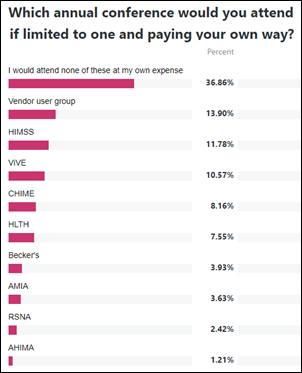
HIMSS Will Sell its Annual Conference

London-based B2B publishing and events firm Informa announces its exclusivity to acquire the HIMSS Global Health Exhibition and Conference in its six-month financial report.
HIMSS has not commented on the news.

London-based B2B publishing and events firm Informa announces its exclusivity to acquire the HIMSS Global Health Exhibition and Conference in its six-month financial report.
HIMSS has not commented on the news.
A study finds chest x-ray analysis didn’t improve when radiologists were assisted by AI tools that, on their own, outperformed two-thirds of the radiologists involved.
The authors say that the radiologists did not correctly use the AI’s information and instead applied their own biases.
Using AI also increased the per-case time of radiologists, which the report speculates is due to radiologists digesting the information it provided.
The report concludes rather startlingly that “the majority of cases are optimally decided by either the radiologists or the AI alone, but not by the radiologists with access to AI.”

From HISTalkFan: “Re: Cerner/Oracle Health hospital count gain in the past five years in the KLAS report. Surprising. Are they counting DoD/VA gains?” Yes. I found an old KLAS US hospital market share report that says Cerner added 167 hospitals in 2018 via its VA contract, but it lost 65 hospitals that year. The company had little change from 2019 through 2022, although it lost ground to Epic in the percentage of total hospital beds served (nearly 50% for Epic at the end of 2022 versus less than 30% for Oracle Health). Epic is the only vendor that gained both facilities and beds in 2022.
July 26 (Wednesday) 1 ET. “Lessons We’ve Learned Since Launching our Cancer Prevention Program.” Sponsor: Volpara Health. Presenter: Albert Bonnema, MD, MPH chief medical information officer, Kettering Health System, and Chris Yuppa, product owner for oncology services and cancer prevention, Kettering Health System. Kettering’s IT department has played a critical role in providing an EHR-driven framework to bring cancer risk assessment and individual prevention plans to more than 90,000 patients. Primary care, OB/GYN, oncology, and imaging providers are now able to assess the hereditary, genetic, and lifestyle factors that affect the risk of developing lung, breast, ovarian, colon, and prostate cancer in any patient encounter. Learn how Kettering brings together people, processes, and technology to be more proactive in the fight against cancer and where its cancer prevention program is headed next.
July 27 (Thursday) noon ET. “Why You Shouldn’t Wait to Use Generative AI.” Sponsor: Orbita. Presenter: Bill Rogers, co-founder, president, and chairman, Orbita. The advent of generative AI tools truly represents a paradigm shift. And while some healthcare leaders embrace the transformation, others are hesitant. Invest 20 minutes to learn why you shouldn’t wait. When combined with natural language processing, workflow automation and conversational dialogs, generative AI can help leaders address a raft of challenges: from over-extended staff, to the rising demand for self-service tools, to delivering secure information to key stakeholders. You will learn where AI delivers the greatest value for providers and life sciences, how it can solve critical challenges faced by healthcare leaders, and how Orbita has integrated generative AI into its conversational platform so healthcare leaders can leverage its full capabilities safely and securely.
July 27 (Thursday) 2 ET. “Denial Prevention 101: How to stop denials from the start.” Sponsor: Waystar. Presenter: Crystal Ewing, director of product management, Waystar. There’s a reason denial prevention is prominent everywhere in healthcare RCM. Denials reduce cash flow, drive down revenue, and negatively impact the patient and staff experience. More than half of front-end denials don’t have to happen, but, once they do, that money is gone. It’s a pretty compelling reason to take some time now to do some preventative care on your revenue cycle. This webinar will help you optimize your front end to stop denials at the start. We’ll explore the importance of not only having the right data, but having it right where staff need it, when they need it.
Previous webinars are on our YouTube channel. Contact Lorre to present or promote your own.
The US Air Force awards IncludeHealth a $1.5 million Tactical Funding Increase, which will enable the physical therapy provider to expand its virtual and in-person MSK care services to additional service members.
Imaging analysis vendor RetinAI and retina care provider Retina Consultants of America will partner to develop a real-world evidence database in ophthalmology.
HealthStream announces Q2 results: revenue up 5%, EPS $0.13 versus $0.10, beating expectations for both. HSTM shares have lost 2% in the past 12 months versus the Nasdaq’s 20% gain, valuing the company at $688 million.

Amar Desai, MD, MPH (CVS Health) joins Optum Health as CEO.

Clarify Health names Terry Boch (Diameter Health) chief commercial officer.

UCI Health promotes Julie Eastman, RN, MBA to CIO.
A federal judge sentences Vishal Vasanji, co-founder and CEO of bankrupt telehealth app vendor Relief Telemed, to 28 months in prison for wire fraud involving the embezzlement of $260,000 of investor funds that he used for personal expenses.
The Federal Trade Commission sues to block the acquisition of Propel Media by IQVIA, a Fortune 500 company that sells provider and prescription records databases to drug companies for marketing their drugs to professionals. FTC says that the acquisition would give IQVIA, which has annual revenue of $14 billion, a market-controlling advantage.

Fortified Health Security’s mid-year cybersecurity report finds that the number of breaches that were reported to HHS doubled versus the same period last year, affecting 40 million people. Breaches involving business associates jumped from 22 to 82. Most of the breaches originated from attacks on network servers rather than email. The report notes an uptick in hackers using file transfer tools such as FileZilla and Windows Secure Copy – some of which don’t require administrative privileges to install or to run from flash drives – to move PHI and other information to cloud storage sites such as Dropbox. The report indicates increased health system use of risk-based identity alerting, in which unexpected user activities trigger multi-factor authentication, system lockouts, or IT alerts.

A new paper by researchers Dean Sittig, PhD and Adam Wright, PhD looks at the use of EHR audit logs in malpractice cases, listing best practices for healthcare organizations to minimize risk. Some of those include monitoring who is looking at VIP records, identifying those EHR elements that will be produced for a plaintiff’s attorney who asks for the “complete medical record,” and reviewing the EHR function to print a patient’s record to a file to make sure it matches the policy of what will be provided in response to a subpoena.

Don’t try this at home. Cricket fans – many of them from the US — who are finding that hotel rooms are expensive or fully booked for the India-Pakistan World Cup match in India on October 15 are instead scheduling overnight-stay checkups in Ahmedabad hospitals that are near Modi Stadium. A night in the hospital, which includes medical costs and meals, costs as little as $37 versus $900 in some hotels that have raised rates 20-fold for the match.
Blog Posts
Mr. H, Lorre, Jenn, Dr. Jayne.
Get HIStalk updates.
Send news or rumors.
Contact us.

![]()
The Federal Trade Commission and HHS OCR send a joint letter to 130 health systems and telehealth providers, warning them that the use of online tracking technologies such as Meta Pixel and Google Analytics may create privacy and security issues that violate HIPAA, the FTC Act, or the FTC Health Breach Notification Rule.
FTC notes that companies that aren’t covered entities under HIPAA are still responsible for protecting against unauthorized disclosure of PHI, noting FTC’s recent enforcement actions against BetterHelp, GoodRx, and Premom.

Most poll respondents don’t think that DoD’s successful completion of MHS Genesis has predictive value for the VA’s implementation of the same Oracle Health system.
New poll to your right or here: How much control should patients have in the sharing of their EHR information? I’m also interested in what providers think about receiving what seems to be a complete medical record that may have had some information intentionally hidden by the patient.
July 26 (Wednesday) 1 ET. “Lessons We’ve Learned Since Launching our Cancer Prevention Program.” Sponsor: Volpara Health. Presenter: Albert Bonnema, MD, MPH chief medical information officer, Kettering Health System, and Chris Yuppa, product owner for oncology services and cancer prevention, Kettering Health System. Kettering’s IT department has played a critical role in providing an EHR-driven framework to bring cancer risk assessment and individual prevention plans to more than 90,000 patients. Primary care, OB/GYN, oncology, and imaging providers are now able to assess the hereditary, genetic, and lifestyle factors that affect the risk of developing lung, breast, ovarian, colon, and prostate cancer in any patient encounter. Learn how Kettering brings together people, processes, and technology to be more proactive in the fight against cancer and where its cancer prevention program is headed next.
July 27 (Thursday) noon ET. “Why You Shouldn’t Wait to Use Generative AI.” Sponsor: Orbita. Presenter: Bill Rogers, co-founder, president, and chairman, Orbita. The advent of generative AI tools truly represents a paradigm shift. And while some healthcare leaders embrace the transformation, others are hesitant. Invest 20 minutes to learn why you shouldn’t wait. When combined with natural language processing, workflow automation and conversational dialogs, generative AI can help leaders address a raft of challenges: from over-extended staff, to the rising demand for self-service tools, to delivering secure information to key stakeholders. You will learn where AI delivers the greatest value for providers and life sciences, how it can solve critical challenges faced by healthcare leaders, and how Orbita has integrated generative AI into its conversational platform so healthcare leaders can leverage its full capabilities safely and securely.
July 27 (Thursday) 2 ET. “Denial Prevention 101: How to stop denials from the start.” Sponsor: Waystar. Presenter: Crystal Ewing, director of product management, Waystar. There’s a reason denial prevention is prominent everywhere in healthcare RCM. Denials reduce cash flow, drive down revenue, and negatively impact the patient and staff experience. More than half of front-end denials don’t have to happen, but, once they do, that money is gone. It’s a pretty compelling reason to take some time now to do some preventative care on your revenue cycle. This webinar will help you optimize your front end to stop denials at the start. We’ll explore the importance of not only having the right data, but having it right where staff need it, when they need it.
Previous webinars are on our YouTube channel. Contact Lorre to present or promote your own.

Tanya Townsend, MSMI (LCMC Health) joins Stanford Medicine Children’s Health as chief information and digital officer.

KLAS looks at the key performance grades of several EHRS and the change in their net number of hospital customers over five years:
Altera / Allscripts: D+, net loss of 143 hospitals.
Epic: A-, net gain of 434 hospitals.
Evident: D+, net loss of 91 hospitals.
Meditech: B, net gain of 14 hospitals.
Oracle Health: D+, net gain of 99 hospitals.

A Wall Street Journal report says that AI-powered medical scribe service DeepScribe employs a team of 200 contractors to fix mistakes made by its AI, noting that the level of inaccuracy is a reflection of AI’s limitations rather than product shortcomings. The contractors listen to the audio recordings, use Google searches to find billing codes, and catch errors. Current and former workers say the rare mistakes that slip through are always caught by the originating doctor. The co-founders say that the company’s software can create 80% of a given medical record without human help, and WSJ notes that they are transparent about that fact and the rigor of their review process in their sales presentations.
ONC publishes Version 4 of the US Core Data for Interoperability (USCDI), which includes 20 new data elements and a new data class for describing the physical location of services provided.
Ashavan founder and CEO Cyrus Bahrassa urges the White House to add EHR vendor interoperability charges to its list of much-hated fees that most commonly include Ticketmaster, Airbnb, and banks. He cites the high fees associated with HL7v2 interfaces, FHIR API subscription fees, and the costs of listing and distributing apps via EHR vendor app marketplaces as “interoperability’s junk fees.”
A Johns Hopkins study finds that use of hearing aids was associated with a 48% reduction in cognitive decline in high-risk people. The authors speculate that the benefit is created by a reduced need for the brain to interpret audio signals, the possible reduction in brain atrophy, and higher social activity when hearing problems are reduced.

AMA President Jesse Ehrenfeld, MD, MPH describes his view of using AI in medicine:

Cancer survivor and Clearsense marketing director Kate-Madonna Hindes declines to serve as the human interoperability engine for Mayo Clinic in transcribing her Epic-stored information onto a clipboard form. Twitter comments suggest that many of us are tired of being asked to restate the same information and worrying how it will be reconciled on the back end, even if few of us have her nerve to just say no (Mayo folks are always bragging on their technology expertise and commercial tie-ins, so maybe they can explain the point of such redundant analog documentation and how they process the completed form):
Blog Posts
Mr. H, Lorre, Jenn, Dr. Jayne.
Get HIStalk updates.
Send news or rumors.
Contact us.
![]()
Private equity firm Thomas H. Lee Partners sells specialty EHR/PM vendor Nextech to another PE firm, TPG, for $1.4 billion.
THL bought the company for $500 million in June 2019, after which it acquired TouchMD and MyMedLeads.
From Jetty: “Re: forgiven federal Paycheck Protection Program loans. The DOJ is investigating those of over $1 million. Big-dollar exhibitors at ViVE and HIMSS are large takers of these forgiven loans that were intended to keep workers employed during COVID-19.” The reader compared ProPublica’s PPP loan database to online sources that estimate the revenue of privately held companies, noting that two health IT companies derived more than 20% of their annual revenue from forgiven PPP loans, 14 health IT vendors had loans of over $2 million that were forgiven, and 27 HIT companies received $1 million or more of loans that they don’t have to repay. My take: while this is mildly interesting, nothing suggests improper activity. The federal government’s loans – which covered up to eight weeks of payroll costs, including benefits — were forgiven if the recipients documented that at least 60% of the money was spent on payroll. The federal government is reviewing the Small Business Administration’s disbursement of $1.2 trillion in COVID-related loans, of which its OIG estimates that $200 billion involves fraud. The real news will be if the feds accuse any of the health IT companies of wrongdoing, which hasn’t happened.
July 26 (Wednesday) 1 ET. “Lessons We’ve Learned Since Launching our Cancer Prevention Program.” Sponsor: Volpara Health. Presenter: Albert Bonnema, MD, MPH chief medical information officer, Kettering Health System, and Chris Yuppa, product owner for oncology services and cancer prevention, Kettering Health System. Kettering’s IT department has played a critical role in providing an EHR-driven framework to bring cancer risk assessment and individual prevention plans to more than 90,000 patients. Primary care, OB/GYN, oncology, and imaging providers are now able to assess the hereditary, genetic, and lifestyle factors that affect the risk of developing lung, breast, ovarian, colon, and prostate cancer in any patient encounter. Learn how Kettering brings together people, processes, and technology to be more proactive in the fight against cancer and where its cancer prevention program is headed next.
July 27 (Thursday) noon ET. “Why You Shouldn’t Wait to Use Generative AI.” Sponsor: Orbita. Presenter: Bill Rogers, co-founder, president, and chairman, Orbita. The advent of generative AI tools truly represents a paradigm shift. And while some healthcare leaders embrace the transformation, others are hesitant. Invest 20 minutes to learn why you shouldn’t wait. When combined with natural language processing, workflow automation and conversational dialogs, generative AI can help leaders address a raft of challenges: from over-extended staff, to the rising demand for self-service tools, to delivering secure information to key stakeholders. You will learn where AI delivers the greatest value for providers and life sciences, how it can solve critical challenges faced by healthcare leaders, and how Orbita has integrated generative AI into its conversational platform so healthcare leaders can leverage its full capabilities safely and securely.
July 27 (Thursday) 2 ET. “Denial Prevention 101: How to stop denials from the start.” Sponsor: Waystar. Presenter: Crystal Ewing, director of product management, Waystar. There’s a reason denial prevention is prominent everywhere in healthcare RCM. Denials reduce cash flow, drive down revenue, and negatively impact the patient and staff experience. More than half of front-end denials don’t have to happen, but, once they do, that money is gone. It’s a pretty compelling reason to take some time now to do some preventative care on your revenue cycle. This webinar will help you optimize your front end to stop denials at the start. We’ll explore the importance of not only having the right data, but having it right where staff need it, when they need it.
Previous webinars are on our YouTube channel. Contact Lorre to present or promote your own.
Open access publisher JMIR Publications acquires the Online Journal of Public Health Informatics.

Weight loss and health coaching platform vendor Noom hires Geoff Cook (The Meet Group) as CEO as the company transitions into the obesity drugs business. He replaces co-founder Saeju Jeong, who will continue as executive board chair.

Prescription benefits technology vendor Capital Rx hires Sunil Budhrani, MD, MPH, MBA (Innovation Health) as chief medical and innovation officer.

Scott Maratea (Motivo Health) joins Curve Health as chief revenue officer.

WellSky promotes Mitchell Morgan, MBA to VP of sales.

Brian Briscoe, MD, who pioneered the implementation of digital radiology in his work at the Baltimore VA in the early 1990s and demonstrated workstation-based image reading at RSNA 2000, died July 2. He was 91.

Industry long-timer Glenn Gross, whose sales roles over the years included time with Tempus Software / QuadraMed and The SSI Group, died last week at 64.
MemorialCare and Pacific Dental Services will open the first of several planned co-located medical and dental offices, where dentists will use the same Epic system as the center’s family medicine, OB/GYN, and pediatrics physicians. PDS completed its Epic implementation in August 2022, converting the records of 9.7 million patients at its 885 practices in 25 states, training 14,000 employees. The company says using Epic allows its clinicians to create better treatment plans based on oral health’s impact on systemic conditions, identify systemic diseases earlier based on oral health changes, build more trust with patients, and communicate with patients via MyChart.

KU Medical Center interviews Diego Mazzotti, PhD, assistant professor of medical informatics, about his sleep disorder research. He is connecting data from EHRs, CPAP machines, and sleep studies to determine the types of sleep apnea patients who are most at risk for heart disease and to determine the effectiveness of CPAP in preventing it.

South Georgia Medical Center recognizes six members of the IT department’s network team as Health System Heroes for their work in protecting patient privacy and health system security.
Franciscan Alliance will rebadge 61 IT employees of Franciscan Health Indianapolis to managed services provider R4 Solutions.

UCSD nanoengineering researchers say that digital technologies can help mitigate health system burden as life expectancy grows, specifically wearables that allow older adults to monitor their health and maintain independence at home. They predict the rise of smart homes whose body-worn and surveillance tools are connected to telehealth platforms and a cloud analytics platform to provide remote monitoring. They expect to see foot-worn sensors; smart mirrors that can identify appearance changes, detect falls, and serve as a visual display; the use of digital personal assistants to provide reminders and cognitive stimulation; and deployment of robots to support care and to provide stimulation.
Froedtert Hospital will pay $2 million to settle a class action lawsuit over its use of Meta’s Pixel web user tracking tool on its MyChart portal and public websites.

Debbie Sukin, MHA, PhD, EVP/CEO of Houston Methodist The Woodlands Hospital, describes present and future use cases of ambient intelligence:

Internist Michael Stillman, MD’s “Death by Patient Portal” JAMA opinion piece describes his struggle to management patient portal messages and his decision to send a message to all of his patients laying out his guidelines. He was surprised to find that many of them told him that they, too are fatigued by hundreds of messages each day and an expectation of constant accessibility. He laid out these expectations, which immediately generated 50 responses from patients expressing their support:

Technology entrepreneur and investor David Heinemeier Hansson – who is also a fine business tech writer whose style reminds me of “Joel on Software” — proudly proclaims that “We have left the cloud,” explaining why software vendor 37signals moved six legacy applications, including one that was developed as a cloud application, from AWS back to its own hardware. Points:
Blog Posts
Mr. H, Lorre, Jenn, Dr. Jayne.
Get HIStalk updates.
Send news or rumors.
Contact us.
![]()

Chatbot-based virtual care company K Health raises $59 million in a funding round led by Cedars-Sinai, bringing its total raised to $325 million.
The company’s primary care service offers unlimited text-based visits, remote annual wellness visits, chronic condition management, prescription management, and urgent care services for $49 per month for residents of all states except Alaska and Hawaii.
Cedars-Sinai will offer K Health’s AI-powered app to its patients in California by the end of the year, integrated with Epic and using the health system’s clinicians.
K Health also sells its technology to payers through Hydrogen Health, which it launched with Anthem (now Elevance) and investment firm Blackstone in 2021.

From Frumious Bandersnatch: “Re: data segmentation. How can you program something that allows a patient to decide after the fact that they want something hidden in their medical record? You can’t just uproot a tree whose roots are interlaced with other trees.” Kevin Baumlin, MD says that ONC’s proposal to require clinicians to redact medical records data elements when a patient requests involves “legalizing tampering with the medical record” that could prove harmful in that patient’s future encounters. He cites examples of patients hiding opioid use or a history of depression. I’ll side with a brilliant reader who says the only practical implementation of the well-intentioned rule would be if patients serve as their own data intermediary, obtaining a copy of their summary as a file that they could edit before sharing. I’m rarely in the “blockchain could fix everything” camp, but perhaps some sort of versioning and permissioning could be involved. I’ll make this the topic of this weekend’s poll. It’s an interesting question — the patient can choose to divulge as much or as little of their history as they want during an in-person encounter, so should that control carry over into digital records? Should providers trust data that the patient may have selectively edited? Perhaps as with redaction, deletions could be obscured but noted to alert the clinician that they are not seeing a complete record. Or, you could get really creative and allow the patient to insert their own notes to explain. But the big challenge is probably propagation across multiple provider data copies – I ask my psychiatrist to hide depression details, so should copies in the EHRs of my PCP, surgeon, and hospital reflect that request or would I need to make individual requests? It would be more manageable if everything flowed through a single HIE or service, but the issue is complex, just like trying to correct EHR entries that have propagated all over the place.

From Eric: “Re: transplant dispute. Thought you would find this interesting.” The non-profit United Network for Organ Sharing (UNOS) — which oversees the entire US transplant system — and organ screening firm Buckeye Transplant Services will take their data dispute to arbitration. Buckeye’s automated tool extracts transplant data directly from hospitals, which UNOS says is unauthorized use of information that only UNOS can provide. UNOS has threatened to lock Buckeye out of its DonorNet organ clearinghouse, which would put Buckeye out of business and force its 63 hospital customers to perform their own screening. The federal government announced in March that it would break up the organ transplant monopoly of UNOS, whose most recent financial report indicates $75 million in annual revenue.

From Anon E. Mous: “Re: Legacy Health financial issues. They have shown sound financial management and avoided excessive spending and vanity projects and navigated the COVID years with care and compassion in the shadow of behemoth Providence. This could be a bellwether for similar systems in the Pacific Northwest.” Six-hospital Legacy, which is losing $10 million per month, will sell its lab operations to LabCorp in hopes of hitting lender-mandated financial metrics.
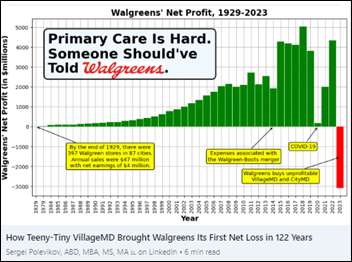
From IPC: “Re: Walgreens. The recent earnings call suggests why it previously acquired a majority stake in VillageMD. Maybe they should start branding themselves as ‘pharma-centered care.’” The US healthcare division of Walgreens lost $113 million in the quarter, which it blames on the underperformance of VillageMD and CityMD due to a mild flu season and soft market demand. It also notes an 83% drop in COVID vaccinations and a steep slide in COVID test sales. The company will close 450 stores and lay off 10% of its corporate workforce. IPC’s observation comes from an earnings call comment that 50% of patients who are seen in a co-located VillageMD clinic go next door to get their prescriptions filled at Walgreens, and each clinic generates 40 additional prescriptions per day, with associated profit for the drugstore. WBA shares have lost 22% in the past 12 months versus the Nasdaq’s 24% gain.
Mr. H here, reporting back refreshed after several days away on vacation and happy that Jenn’s solo coverage rendered my presence optional anyway. I’m catching up, so remind me if I owe you something.
July 26 (Wednesday) 1 ET. “Lessons We’ve Learned Since Launching our Cancer Prevention Program.” Sponsor: Volpara Health. Presenter: Albert Bonnema, MD, MPH chief medical information officer, Kettering Health System; Chris Yuppa, product owner for oncology services and cancer prevention, Kettering Health System. Kettering’s IT department has played a critical role in providing an EHR-driven framework to bring cancer risk assessment and individual prevention plans to more than 90,000 patients. Primary care, OB/GYN, oncology, and imaging providers are now able to assess the hereditary, genetic, and lifestyle factors that affect the risk of developing lung, breast, ovarian, colon, and prostate cancer in any patient encounter. Learn how Kettering brings together people, processes, and technology to be more proactive in the fight against cancer and where its cancer prevention program is headed next.
July 27 (Thursday) noon ET. “Why You Shouldn’t Wait to Use Generative AI.” Sponsor: Orbita. Presenter: Bill Rogers, co-founder, president, and chairman, Orbita. The advent of generative AI tools truly represents a paradigm shift. And while some healthcare leaders embrace the transformation, others are hesitant. Invest 20 minutes to learn why you shouldn’t wait. When combined with natural language processing, workflow automation, and conversational dialogs, generative AI can help leaders address a raft of challenges: from over-extended staff, to the rising demand for self-service tools, to delivering secure information to key stakeholders. You will learn where AI delivers the greatest value for providers and life sciences, how it can solve critical challenges faced by healthcare leaders, and how Orbita has integrated generative AI into its conversational platform so healthcare leaders can leverage its full capabilities safely and securely.
July 27 (Thursday) 2 ET. “Denial Prevention 101: How to stop denials from the start.” Sponsor: Waystar. Presenter: Crystal Ewing, director of product management, Waystar. There’s a reason denial prevention is prominent everywhere in healthcare RCM. Denials reduce cash flow, drive down revenue, and negatively impact the patient and staff experience. More than half of front-end denials don’t have to happen, but, once they do, that money is gone. It’s a pretty compelling reason to take some time now to do some preventative care on your revenue cycle. This webinar will help you optimize your front end to stop denials at the start. We’ll explore the importance of not only having the right data, but having it right where staff need it, when they need it.
Previous webinars are on our YouTube channel. Contact Lorre to present or promote your own.
![]()
Medication supply chain technology company Bluesight, which renamed itself from Kit Check in December 2022, will use a strategic growth investment from Thoma Bravo in its acquisition of drug diversion analytics vendor Medacist.

DocBuddy, which offers an EHR workflow solution, raises $1.8 million in a seed funding round.

Behavioral health technology vendor NeuroFlow acquires Capital Solution Design, whose measurement-based care solutions are used by the VA.
UnitedHealth Group reports Q2 results: revenue up 16%, adjusted EPS $6.14 versus $5.99, beating Wall Street expectations for both. Its Optum unit saw revenues increase 25% to $56.3 billion.

Medical coding automation vendor Fathom hires Enoch Shih, MS, MBA (Gusto) as COO.

RLDatix hires Frank Manzella, JD, MBA (Availity) as EVP of global corporate development.

Steve Aspling (Millennia) joins CorroHealth as regional VP of business development.

Trove Health hires Anthony Leon (InteropShop) as VP of growth.

Todd Johnson (SomaLogic) joins Abundant Venture Partners as CEO of the venture studio.

Matthew Kull, MBA (Cleveland Clinic) joins Inova Health System as chief information and digital officer.
Pediatric Cardiology Center of Oregon implements EClinicalWorks and its Prisma health information search tool.
Medhost will offer Availity’s eligibility and claim verification features to its hospital customers.
The Connected Health Initiative and Duke Margolis Center for Health Policy will host “AI and the Future of Digital Healthcare” on September 26 at the National Press Club in Washington, DC. Panel proposals are due August 1.
Teladoc Health will integrate Nuance DAX into its Teladoc Health Solo platform.
The GAO seeks nominations for appointments to the Health Information Technology Advisory Committee.
A fascinating report titled “How Private Equity Raided Safety Net Hospitals” looks at PE-backed safety net hospital operator Pipeline Health. It notes that similar to what happened with the now-closed Hahnemann University Hospital, PE firms are breaking promises they make to the community and to regulators in favor of maximizing profit (shocking, I know). Their strategies include monetizing the real estate, expanding unwisely, laying off employees, applying bankruptcies strategically, and closing hospitals. All but one of the eight hospitals that Pipeline has owned earned a CMS star rating of two of a possible five, while one earned three stars. It sold Weiss Memorial Hospital’s parking lot to a real estate developer for $10 million to build luxury apartments.
Blog Posts
Mr. H, Lorre, Jenn, Dr. Jayne.
Get HIStalk updates.
Send news or rumors.
Contact us.

![]()

NextGen Healthcare will pay $31 million to settle allegations that it violated the False Claims Act by misrepresenting the capabilities of select versions of its EHR software, and that it offered kickbacks in the form of credits of up to $10,000 to users whose recommendations led to new sales.

It’s full steam ahead when it comes to IT projects for the majority of poll-takers. Lacy says she chose ‘Somewhat’ because “our organization has a very large (several year) IT project underway and for some unexplained reason our management team has decided to manage project intake so that we don’t have multiple competing projects for resources. So we have scaled back for the moment, but once our major project is completed, I expect we will be running multiple projects again. So happy to be working in an organization that is planning IT projects instead of just saying yes and throwing everything at the team at the same time!”
New poll to your right or here: Does the DOD’s declaration of mission accomplished make you any more confident that the VA will be able to complete its own systemwide EHR implementation? I asked a similar question just over a month ago. Sixty-one percent of readers at that time did not believe the VA’s Oracle Cerner roll out would ever be finished.
July 26 (Wednesday) 1 ET. “Lessons We’ve Learned Since Launching our Cancer Prevention Program.” Sponsor: Volpara Health. Presenter: Albert Bonnema, MD, MPH chief medical information officer, Kettering Health System, and Chris Yuppa, product owner for oncology services and cancer prevention, Kettering Health System. Kettering’s IT department has played a critical role in providing an EHR-driven framework to bring cancer risk assessment and individual prevention plans to more than 90,000 patients. Primary care, OB/GYN, oncology, and imaging providers are now able to assess the hereditary, genetic, and lifestyle factors that affect the risk of developing lung, breast, ovarian, colon, and prostate cancer in any patient encounter. Learn how Kettering brings together people, processes, and technology to be more proactive in the fight against cancer and where its cancer prevention program is headed next.
July 27 (Thursday) noon ET. “Why You Shouldn’t Wait to Use Generative AI.” Sponsor: Orbita. Presenter: Bill Rogers, co-founder, president, and chairman, Orbita. The advent of generative AI tools truly represents a paradigm shift. And while some healthcare leaders embrace the transformation, others are hesitant. Invest 20 minutes to learn why you shouldn’t wait. When combined with natural language processing, workflow automation and conversational dialogs, generative AI can help leaders address a raft of challenges: from over-extended staff, to the rising demand for self-service tools, to delivering secure information to key stakeholders. You will learn where AI delivers the greatest value for providers and life sciences, how it can solve critical challenges faced by healthcare leaders, and how Orbita has integrated generative AI into its conversational platform so healthcare leaders can leverage its full capabilities safely and securely.
July 27 (Thursday) 2 ET. “Denial Prevention 101: How to stop denials from the start.” Sponsor: Waystar. Presenter: Crystal Ewing, director of product management, Waystar. There’s a reason denial prevention is prominent everywhere in healthcare RCM. Denials reduce cash flow, drive down revenue, and negatively impact the patient and staff experience. More than half of front-end denials don’t have to happen, but, once they do, that money is gone. It’s a pretty compelling reason to take some time now to do some preventative care on your revenue cycle. This webinar will help you optimize your front end to stop denials at the start. We’ll explore the importance of not only having the right data, but having it right where staff need it, when they need it.
Previous webinars are on our YouTube channel. Contact Lorre to present or promote your own.

Patient intake and engagement software vendor Phreesia acquires MediFind, which uses AI-powered technology to help patients find best-fit physicians. MediFind CEO Patrick Howie, a former head of global analytics at Merck, has joined Phreesia as VP of product management.

Amazon Pharmacy, the online retailer’s standalone prescription delivery service, lays off 80 employees. Amazon has laid off nearly 30,000 staff within the last year.
RCM vendor Aspirion acquires Continuum Health Solutions, which offers motor vehicle accident and third-party liability RCM services.

Texas Children’s Hospital implements Oracle’s Fusion Cloud Applications Suite, bringing seven systems onto one platform.
CommonWell Health Alliance surpasses 200 million users on its information-sharing network, equating to health data-sharing for 62% of the US population.
Blog Posts
Mr. H, Lorre, Jenn, Dr. Jayne.
Get HIStalk updates.
Send news or rumors.
Contact us.

![]()

The Defense Health Agency announces that stateside roll out of MHS Genesis has been completed on time and on budget. The Oracle Health-powered EHR will be implemented at DOD facilities overseas in the coming months.
The DOD and VA will oversee synchronous deployment of MHS Genesis at the James A. Lovell Federal Health Care Center (IL) in March 2024.
July 26 (Wednesday) 1 ET. “Lessons We’ve Learned Since Launching our Cancer Prevention Program.” Sponsor: Volpara Health. Presenter: Albert Bonnema, MD, MPH chief medical information officer, Kettering Health System, and Chris Yuppa, product owner for oncology services and cancer prevention, Kettering Health System. Kettering’s IT department has played a critical role in providing an EHR-driven framework to bring cancer risk assessment and individual prevention plans to more than 90,000 patients. Primary care, OB/GYN, oncology, and imaging providers are now able to assess the hereditary, genetic, and lifestyle factors that affect the risk of developing lung, breast, ovarian, colon, and prostate cancer in any patient encounter. Learn how Kettering brings together people, processes, and technology to be more proactive in the fight against cancer and where its cancer prevention program is headed next.
July 27 (Thursday) noon ET. “Why You Shouldn’t Wait to Use Generative AI.” Sponsor: Orbita. Presenter: Bill Rogers, co-founder, president, and chairman, Orbita. The advent of generative AI tools truly represents a paradigm shift. And while some healthcare leaders embrace the transformation, others are hesitant. Invest 20 minutes to learn why you shouldn’t wait. When combined with natural language processing, workflow automation and conversational dialogs, generative AI can help leaders address a raft of challenges: from over-extended staff, to the rising demand for self-service tools, to delivering secure information to key stakeholders. You will learn where AI delivers the greatest value for providers and life sciences, how it can solve critical challenges faced by healthcare leaders, and how Orbita has integrated generative AI into its conversational platform so healthcare leaders can leverage its full capabilities safely and securely.
July 27 (Thursday) 2 ET. “Denial Prevention 101: How to stop denials from the start.” Sponsor: Waystar. Presenter: Crystal Ewing, director of product management, Waystar. There’s a reason denial prevention is prominent everywhere in healthcare RCM. Denials reduce cash flow, drive down revenue, and negatively impact the patient and staff experience. More than half of front-end denials don’t have to happen, but, once they do, that money is gone. It’s a pretty compelling reason to take some time now to do some preventative care on your revenue cycle. This webinar will help you optimize your front end to stop denials at the start. We’ll explore the importance of not only having the right data, but having it right where staff need it, when they need it.
Previous webinars are on our YouTube channel. Contact Lorre to present or promote your own.

Wavely Diagnostics raises $1.35 million in seed funding. The company has developed a telemedicine app and companion medical device that can help pediatricians virtually diagnose ear infections.
Parker Health, developer of FHIR-based health management software that aggregates patient data from a variety of sources, raises $25 million.

North Country Hospital (VT) establishes a NICU telemedicine program that gives its pediatricians access to real-time video consults with neonatologists at University of Vermont Medical Center.
Censinet announces GA of its new HIPAA Security Rule enterprise risk assessment and remediation module.
Get Well announces eight new smart patient room implementations in conjunction with new hospital tower construction projects.
VA officials say they are opposed to proposed legislation that would impose strict requirements on the department’s EHR Modernization program, but express support for legislation that would increase oversight of future acquisitions projects.
UMass Chan Medical School will use a $17 million federal grant to launch the Center for Accelerating Practices to End Suicide through Technology Translation. The school will work with partnering organizations to establish best practices for implementing new and existing suicide-prevention technologies. CAPES will also focus on patient-centered care, business development, and ethics.

Nearly 60% of surveyed IT decision-makers are looking to adopt or replace patient engagement technologies, according to the latest research from Black Book. Survey-takers gave InteliChart top marks for its patient engagement and consumer outreach capabilities.
Epic is working to develop a sixth campus in its hometown of Verona, WI. Still in the preliminary design phase, the expansion will be preceded by a recently approved underground parking structure that will open in 2025. The company is already planning to add two new buildings to its Wizards Academy campus to accommodate an additional 1,700 employees. Those facilities are expected to open next year.

The State Medical Board of Ohio permanently revokes the license of former plastic surgeon Katharine Roxanne Grawe, also known as Dr. Roxy on TikTok, for neglecting patients as she livestreamed surgical procedures, spoke directly into the camera, and responded to live viewer questions.
Blog Posts
Mr. H, Lorre, Jenn, Dr. Jayne.
Get HIStalk updates.
Send news or rumors.
Contact us.
![]()
HCA Healthcare announces that hackers have stolen patient data from an external storage site used to automate email message formatting and posted it for sale on an online forum.
According to DataBreaches.net, the dataset includes 27.7 million rows, personal patient details, and information related to appointment reminders. The hackers made contact with HCA around July 4, and gave the company until July 10 to meet their unspecified demands.
Based in Nashville, HCA Healthcare manages the operations of 180 hospitals and 2,300 outpatient facilities in the US and UK.

The pessimists slightly outweigh the optimists when it comes to health IT business conditions over the next year. IT/OPs_ProjectManager’s experience with recent IT staffing budgets certainly gives credence to the former: “The institution I work with has reduced budget for contracted IT staff and is purposefully throttling the IT project pipeline due to resource ($$ and people) constraints coming out of the pandemic. Knowing this plan makes me think the ‘non-core’ IT projects will be under much more scrutiny.”
New poll to your right or here: Has your organization recently pressed pause on or significantly scaled back IT projects? Feel free to share observations as to why project priorities are changing, and what types of projects are still getting the green light.
July 12 (Wednesday) 2 ET. “101: National Network Data Exchanges.” Sponsor: Particle Health. Presenter: Troy Bannister, founder and CEO, Particle Health. It’s highly likely that your most recent medical records were indexed by a national Health Information Network (HIN). Network participants can submit basic demographic information into an API and receive full, longitudinal medical records sourced from HINs. Records come in a parsed, standardized format, on demand, with a success rate above 90%. There’s so much more to learn and discover, which is why Troy Bannister is going to provide a 101 on all things HIN. You will learn what HINs are, see how the major HINS compare, and learn how networks will evolve due to TEFCA.
July 26 (Wednesday) 1 ET. “Lessons We’ve Learned Since Launching our Cancer Prevention Program.” Sponsor: Volpara Health. Presenter: Albert Bonnema, MD, MPH chief medical information officer, Kettering Health System, and Chris Yuppa, product owner for oncology services and cancer prevention, Kettering Health System. Kettering’s IT department has played a critical role in providing an EHR-driven framework to bring cancer risk assessment and individual prevention plans to more than 90,000 patients. Primary care, OB/GYN, oncology, and imaging providers are now able to assess the hereditary, genetic, and lifestyle factors that affect the risk of developing lung, breast, ovarian, colon, and prostate cancer in any patient encounter. Learn how Kettering brings together people, processes, and technology to be more proactive in the fight against cancer and where its cancer prevention program is headed next.
July 27 (Thursday) noon ET. “Why You Shouldn’t Wait to Use Generative AI.” Sponsor: Orbita. Presenter: Bill Rogers, co-founder, president, and chairman, Orbita. The advent of generative AI tools truly represents a paradigm shift. And while some healthcare leaders embrace the transformation, others are hesitant. Invest 20 minutes to learn why you shouldn’t wait. When combined with natural language processing, workflow automation and conversational dialogs, generative AI can help leaders address a raft of challenges: from over-extended staff, to the rising demand for self-service tools, to delivering secure information to key stakeholders. You will learn where AI delivers the greatest value for providers and life sciences, how it can solve critical challenges faced by healthcare leaders, and how Orbita has integrated generative AI into its conversational platform so healthcare leaders can leverage its full capabilities safely and securely.
July 27 (Thursday) 2 ET. “Denial Prevention 101: How to stop denials from the start.” Sponsor: Waystar. Presenter: Crystal Ewing, director of product management, Waystar. There’s a reason denial prevention is prominent everywhere in healthcare RCM. Denials reduce cash flow, drive down revenue, and negatively impact the patient and staff experience. More than half of front-end denials don’t have to happen, but, once they do, that money is gone. It’s a pretty compelling reason to take some time now to do some preventative care on your revenue cycle. This webinar will help you optimize your front end to stop denials at the start. We’ll explore the importance of not only having the right data, but having it right where staff need it, when they need it.
Previous webinars are on our YouTube channel. Contact Lorre to present or promote your own.

Automated provider credentialing and compliance software vendor Verifiable raises $27 million in a Series B funding round, bringing its total raised to $47 million since launching three years ago.

Aaron Neinstein, MD (UCSF) joins Notable as chief medical officer.
![]()
Consulting firm Healthcare IT Leaders forms an Elite Advisor group to offer peer-to-peer advisory services to healthcare executives.
Montage Health leverages Xealth’s digital health integration and digital prescription referral platform as a part of its digital health support programs for behavioral health, consumer wellness, orthopedics, and patient education.
Los Angeles Network of Enhanced Services adopts Google Cloud’s Healthcare API and BigQuery enterprise data warehouse.

Garrett Regional Medical Center (MD), part of the WVU Medicine health system, goes live on Epic.
Barts Health NHS Trust, the UK’s largest, reports a ransomware attack in which BlackCat hackers stole 70 terabytes of data. The group claims it is the largest healthcare data breach in UK history.

Regenstrief Institute and Indiana University researchers develop natural language processing algorithms that can extract text data related to social determinants of health from within EHRs. The researchers say that their algorithms are easier to implement and use than more sophisticated risk models.
Blog Posts
Mr. H, Lorre, Jenn, Dr. Jayne.
Get HIStalk updates.
Send news or rumors.
Contact us.

![]()

An Epic analysis of 1.7 billion clinical notes written by 166,318 outpatient providers during a nearly three-year period finds that average note length increased just over 8%, while the average time spent on documentation decreased 11%.
Analysts also determined that providers spent less time on reviewing clinical activities within the EHR, and that providers who decreased their use of copy/paste functionality and smart documentation tools reduced their average note length.
The analysis was undertaken to determine if CMS changes made in 2021 to evaluation and management CPT billing codes did indeed lead to a hoped-for reduction in administrative burden.
July 12 (Wednesday) 2 ET. “101: National Network Data Exchanges.” Sponsor: Particle Health. Presenter: Troy Bannister, founder and CEO, Particle Health. It’s highly likely that your most recent medical records were indexed by a national Health Information Network (HIN). Network participants can submit basic demographic information into an API and receive full, longitudinal medical records sourced from HINs. Records come in a parsed, standardized format, on demand, with a success rate above 90%. There’s so much more to learn and discover, which is why Troy Bannister is going to provide a 101 on all things HIN. You will learn what HINs are, see how the major HINS compare, and learn how networks will evolve due to TEFCA.
July 26 (Wednesday) 1 ET. “Lessons We’ve Learned Since Launching our Cancer Prevention Program.” Sponsor: Volpara Health. Presenter: Albert Bonnema, MD, MPH chief medical information officer, Kettering Health System, and Chris Yuppa, product owner for oncology services and cancer prevention, Kettering Health System. Kettering’s IT department has played a critical role in providing an EHR-driven framework to bring cancer risk assessment and individual prevention plans to more than 90,000 patients. Primary care, OB/GYN, oncology, and imaging providers are now able to assess the hereditary, genetic, and lifestyle factors that affect the risk of developing lung, breast, ovarian, colon, and prostate cancer in any patient encounter. Learn how Kettering brings together people, processes, and technology to be more proactive in the fight against cancer and where its cancer prevention program is headed next.
July 27 (Thursday) noon ET. “Why You Shouldn’t Wait to Use Generative AI.” Sponsor: Orbita. Presenter: Bill Rogers, co-founder, president, and chairman, Orbita. The advent of generative AI tools truly represents a paradigm shift. And while some healthcare leaders embrace the transformation, others are hesitant. Invest 20 minutes to learn why you shouldn’t wait. When combined with natural language processing, workflow automation and conversational dialogs, generative AI can help leaders address a raft of challenges: from over-extended staff, to the rising demand for self-service tools, to delivering secure information to key stakeholders. You will learn where AI delivers the greatest value for providers and life sciences, how it can solve critical challenges faced by healthcare leaders, and how Orbita has integrated generative AI into its conversational platform so healthcare leaders can leverage its full capabilities safely and securely.
Previous webinars are on our YouTube channel. Contact Lorre to present or promote your own.

Loyal names Lauren Struck (BioDigital) chief people officer.

Lovelace Health System in New Mexico implements CareHarmony’s AI-powered care coordination software to help patients with two or more chronic conditions better manage their treatment, including medications.
CMS proposes a voluntary pathway, dubbed Transitional Coverage for Emerging Technologies, that will enable companies with emerging medical “breakthrough devices” to more easily secure Medicare coverage.
Intermountain Health expands its Pediatric Telehealth program to give its ER doctors access to virtual consults with pediatric specialists at Primary Children’s Hospital in Utah.
Blog Posts
Mr. H, Lorre, Jenn, Dr. Jayne.
Get HIStalk updates.
Send news or rumors.
Contact us.

![]()
Sleep management technology company ResMed acquires Somnoware, a sleep and respiratory care diagnostics software vendor based in California.
July 12 (Wednesday) 2 ET. “101: National Network Data Exchanges.” Sponsor: Particle Health. Presenter: Troy Bannister, founder and CEO, Particle Health. It’s highly likely that your most recent medical records were indexed by a national Health Information Network (HIN). Network participants can submit basic demographic information into an API and receive full, longitudinal medical records sourced from HINs. Records come in a parsed, standardized format, on demand, with a success rate above 90%. There’s so much more to learn and discover, which is why Troy Bannister is going to provide a 101 on all things HIN. You will learn what HINs are, see how the major HINS compare, and learn how networks will evolve due to TEFCA.
July 26 (Wednesday) 1 ET. “Lessons We’ve Learned Since Launching our Cancer Prevention Program.” Sponsor: Volpara Health. Presenter: Albert Bonnema, MD, MPH chief medical information officer, Kettering Health System, and Chris Yuppa, product owner for oncology services and cancer prevention, Kettering Health System. Kettering’s IT department has played a critical role in providing an EHR-driven framework to bring cancer risk assessment and individual prevention plans to more than 90,000 patients. Primary care, OB/GYN, oncology, and imaging providers are now able to assess the hereditary, genetic, and lifestyle factors that affect the risk of developing lung, breast, ovarian, colon, and prostate cancer in any patient encounter. Learn how Kettering brings together people, processes, and technology to be more proactive in the fight against cancer and where its cancer prevention program is headed next.
July 27 (Thursday) noon ET. “Why You Shouldn’t Wait to Use Generative AI.” Sponsor: Orbita. Presenter: Bill Rogers, co-founder, president, and chairman, Orbita. The advent of generative AI tools truly represents a paradigm shift. And while some healthcare leaders embrace the transformation, others are hesitant. Invest 20 minutes to learn why you shouldn’t wait. When combined with natural language processing, workflow automation and conversational dialogs, generative AI can help leaders address a raft of challenges: from over-extended staff, to the rising demand for self-service tools, to delivering secure information to key stakeholders. You will learn where AI delivers the greatest value for providers and life sciences, how it can solve critical challenges faced by healthcare leaders, and how Orbita has integrated generative AI into its conversational platform so healthcare leaders can leverage its full capabilities safely and securely.
Previous webinars are on our YouTube channel. Contact Lorre to present or promote your own.
Constellation Software’s Harris Computer business acquires the US-based EHR, practice management, and RCM assets of Canadian company CloudMD for $6.3 million.
TytoCare will reportedly lay off 20 employees, or 10% of its workforce. The company, which has offices in Israel and New York City, offers a virtual care app and companion diagnostic devices.

Cincinnati Children’s promotes Tony Johnston to VP of information services and CIO.

CMS Digital Service Director Andrea Fletcher takes on the additional role of chief digital strategy officer.

Habersham Medical Center goes live on Epic as part of its transition to the Northeast Georgia Health System.
In New York, Finger Lakes Health will implement Epic when it becomes a part of the University of Rochester Medical Center system in August.

The Georgia Health Information Network will use a $1 million USDA grant to develop a telehealth network that will improve patient access to care in rural communities. GaHIN will work on the project with HealtHIE Georgia, Jefferson Hospital, Emanuel Medical Center, Wills Memorial Hospital, Washington County Regional Medical, Ready Computing, and InterSystems.

Johns Hopkins Medicine (MD) joins at least 14 other healthcare providers across the country in charging patients for certain types of messages sent through their patient portals. Beginning July 18, patients with private insurance can expect to incur charges of between $10 and $50 for messages pertaining to health issues that require clinical judgment and more than five minutes to answer.
Blog Posts
Mr. H, Lorre, Jenn, Dr. Jayne.
Get HIStalk updates.
Send news or rumors.
Contact us.

![]()

Staffing and consulting services company Optimum Healthcare IT acquires ECloud Managed Solutions, a cloud adoption and digital transformation firm based in Georgia. ECloud Managing Partner Eric Sanders will transition to Optimum as head of business development.

A majority of patients have been receptive to their physician’s decision to not prescribe a desired drug or treatment.
New poll to your right or here: How will health IT business conditions change in the next 12 months?
July 12 (Wednesday) 2 ET. “101: National Network Data Exchanges.” Sponsor: Particle Health. Presenter: Troy Bannister, founder and CEO, Particle Health. It’s highly likely that your most recent medical records were indexed by a national Health Information Network (HIN). Network participants can submit basic demographic information into an API and receive full, longitudinal medical records sourced from HINs. Records come in a parsed, standardized format, on demand, with a success rate above 90%. There’s so much more to learn and discover, which is why Troy Bannister is going to provide a 101 on all things HIN. You will learn what HINs are, see how the major HINS compare, and learn how networks will evolve due to TEFCA.
July 27 (Thursday) noon ET. “Why You Shouldn’t Wait to Use Generative AI.” Sponsor: Orbita. Presenter: Bill Rogers, co-founder, president, and chairman, Orbita. The advent of generative AI tools truly represents a paradigm shift. And while some healthcare leaders embrace the transformation, others are hesitant. Invest 20 minutes to learn why you shouldn’t wait. When combined with natural language processing, workflow automation and conversational dialogs, generative AI can help leaders address a raft of challenges: from over-extended staff, to the rising demand for self-service tools, to delivering secure information to key stakeholders. You will learn where AI delivers the greatest value for providers and life sciences, how it can solve critical challenges faced by healthcare leaders, and how Orbita has integrated generative AI into its conversational platform so healthcare leaders can leverage its full capabilities safely and securely.
Previous webinars are on our YouTube channel. Contact Lorre to present or promote your own.

Specialty medication enrollment software startup RxLightning opens an office – its first – in Indiana after having been a remote-only company since its launch in 2020.

Bright Health exits the insurance business with the sale of its California Medicare Advantage business to Molina Healthcare for $600 million. The company, which now solely operates 70 clinics in California, Florida, and Texas, announced in March that it had overdrawn its credit and was unsure about its ability to remain in business. Its valuation at the time was down 97% since its IPO height of $11 billion two years ago.
Mental health and meditation app Headspace Health lays off 181 employees, its second round of job cuts since December.

Vyne Medical names Caleb Manscill (DentalRay) president.

Kathleen Bresette (DrFirst) joins RxLightning as chief revenue officer.

In New York, Northwell Health’s Forest Hills Long Island Jewish Hospital launches a tele-burn virtual consult service, giving on-site providers the ability to virtually consult with specialists at Staten Island University Hospital’s Regional Burn Center.
Amazon Pharmacy’s PillPack will pay $300,000 to settle allegations that it failed to keep accurate records of controlled substances. Amazon acquired PillPack in 2018 for $753 million.
In Idaho, Mountain View Hospital and Idaho Falls Community Hospital and its partner clinics restore their clinical systems after a cyberattack forced them offline over a month ago. Administrative functions, including billing, have yet to be fully restored.
Blog Posts
Mr. H, Lorre, Jenn, Dr. Jayne.
Get HIStalk updates.
Send news or rumors.
Contact us.

![]()

Just in time for the long holiday weekend, HHS publishes a 130-page final rule outlining the civil money penalties health IT developers will incur for information-blocking. HHS may publish a proposed rule for provider penalties in September.
July 12 (Wednesday) 2 ET. “101: National Network Data Exchanges.” Sponsor: Particle Health. Presenter: Troy Bannister, founder and CEO, Particle Health. It’s highly likely that your most recent medical records were indexed by a national Health Information Network (HIN). Network participants can submit basic demographic information into an API and receive full, longitudinal medical records sourced from HINs. Records come in a parsed, standardized format, on demand, with a success rate above 90%. There’s so much more to learn and discover, which is why Troy Bannister is going to provide a 101 on all things HIN. You will learn what HINs are, see how the major HINS compare, and learn how networks will evolve due to TEFCA.
July 27 (Thursday) noon ET. “Why You Shouldn’t Wait to Use Generative AI.” Sponsor: Orbita. Presenter: Bill Rogers, co-founder, president, and chairman, Orbita. The advent of generative AI tools truly represents a paradigm shift. And while some healthcare leaders embrace the transformation, others are hesitant. Invest 20 minutes to learn why you shouldn’t wait. When combined with natural language processing, workflow automation and conversational dialogs, generative AI can help leaders address a raft of challenges: from over-extended staff, to the rising demand for self-service tools, to delivering secure information to key stakeholders. You will learn where AI delivers the greatest value for providers and life sciences, how it can solve critical challenges faced by healthcare leaders, and how Orbita has integrated generative AI into its conversational platform so healthcare leaders can leverage its full capabilities safely and securely.
Previous webinars are on our YouTube channel. Contact Lorre to present or promote your own.

The Idaho Health Data Exchange prepares to exit bankruptcy after filing for Chapter 11 last August. The nonprofit found itself facing insolvency after government funding dried up and business deals fell through, leaving it $4 million in debt and facing lawsuits from creditors. The exchange, which replaced its executive director several weeks ago, plans to achieve funding through user fees, which may be a challenge given that only 46 healthcare organizations are currently signed up for IHDE’s top tier of service.

Cordea Consulting names Mike Blundell (Sharp HealthCare) VP of consulting and delivery.

Evelyn Daniels (2Morrow) joins Laguna Health as VP of business development.

Sarah Bush Lincoln Health Center (IL) integrates Sonifi Health’s patient engagement and educational content with its interactive bedside television system.
Community Health Northwest Florida rolls out EClinicalWorks across its 19 locations.

Cleveland Clinic prepares to open a new hospital in Ohio that will offer patients in each of its 57 rooms the ability to access telehealth services from off-site specialists.
EMPI vendor 4medica announces GA of its new EZReg patient registration software.
AtlantiCare leverages Unite New Jersey, the care coordination and social services referral network developed by Unite Us.
IHealth Solutions, doing business as medical coding, billing, and health IT services vendor Advantum Health, will pay $75,000 to settle potential HIPAA violations related to the 2017 unauthorized transfer of PHI from an unprotected server.
Blog Posts
Mr. H, Lorre, Jenn, Dr. Jayne.
Get HIStalk updates.
Send news or rumors.
Contact us.

![]()
Navina develops a generative AI assistant to help improve the workflows of primary care physicians.
Ballad Health will use MedAware’s AI-powered medication safety monitoring platform to identify and prevent medication-related safety errors.

Former Optum Health Chief AI Officer Dennis Chornenky joins UC Davis Health as its first chief AI advisor, tasked with establishing an AI strategy for the health system.
Nuance will make its Dragon Ambient EXperience Express solution available to select Epic users this summer. The AI-powered tool can automatically generate draft clinical notes after a patient visit, as well as quickly generate notes from real-time recordings of physician/patient interactions.

Medical imaging data and AI company Flywheel raises $54 million in a Series D investment round.
BeeKeeperAI, a San Francisco-based AI development and deployment support startup, announces $12 million in funding.

In an effort to even out workloads for cancer patient navigators, researchers at OSF Healthcare develop a smart algorithm that predicts upcoming navigator workloads and then distributes new patients to navigators accordingly. The health system plans to incorporate the algorithm within its OSF Community Connect automated workflow platform and pilot it when its new OSF Cancer Institute opens next year.

A new report from the World Economic Forum highlights the challenges and promises of using AI in healthcare, noting that provider shortages, an exponential growth in health data, and increasingly swift advances in AI technology make its adoption and utilization an almost foregone conclusion in the areas of diagnosis and risk stratification, outbreak prediction, and clinical trial optimization.
Researchers determine that large language models like ChatGPT may potentially assist primary care providers in making clinical decisions, evaluating patients, and ordering appropriate imaging tests for breast cancer screenings and breast pain.

FedScoop reviews an ONC proposed rule, released in April, that would require EHRs that use predictive solutions like AI and algorithms to provide end users with an explanation of how that technology works, as well as a description of the data it uses. ONC is reviewing comments now and hopes to have a final rule published later this year.
Senate Majority Leader Chuck Schumer (D-NY) pushes forward with potential legislation regulating AI, highlighting national security, misinformation and bias, and transparency from AI developers.
Mr. H, Lorre, Jenn, Dr. Jayne.
Get HIStalk updates.
Send news or rumors.
Contact us.

![]()

Amazon postpones the launch of its Amazon Clinic expansion by three weeks after lawmakers raise concerns about the company’s privacy practices, specifically its method of collecting and sharing customer health data.
Launched last November, Amazon Clinic offers a form-initiated, message-based telemedicine service in 33 states. Amazon had planned to expand it this week to all 50 states with the additional offering of video-based consults.
From NighttimeSleepAid: “Re: First-ever Meditech layoffs.” An internal email shared by NSA indicates the company has decided to “downsize the company by less than 2% of our staff” as it seeks ways to adjust expenses and compensate for overstaffing. Impacted roles will mainly include newer staff hired within the last year and niche roles that are no longer needed.
July 12 (Wednesday) 2 ET. “101: National Network Data Exchanges.” Sponsor: Particle Health. Presenter: Troy Bannister, founder and CEO, Particle Health. It’s highly likely that your most recent medical records were indexed by a national Health Information Network (HIN). Network participants can submit basic demographic information into an API and receive full, longitudinal medical records sourced from HINs. Records come in a parsed, standardized format, on demand, with a success rate above 90%. There’s so much more to learn and discover, which is why Troy Bannister is going to provide a 101 on all things HIN. You will learn what HINs are, see how the major HINS compare, and learn how networks will evolve due to TEFCA.
July 27 (Thursday) noon ET. “Why You Shouldn’t Wait to Use Generative AI.” Sponsor: Orbita. Presenter: Bill Rogers, co-founder, president, and chairman, Orbita. The advent of generative AI tools truly represents a paradigm shift. And while some healthcare leaders embrace the transformation, others are hesitant. Invest 20 minutes to learn why you shouldn’t wait. When combined with natural language processing, workflow automation and conversational dialogs, generative AI can help leaders address a raft of challenges: from over-extended staff, to the rising demand for self-service tools, to delivering secure information to key stakeholders. You will learn where AI delivers the greatest value for providers and life sciences, how it can solve critical challenges faced by healthcare leaders, and how Orbita has integrated generative AI into its conversational platform so healthcare leaders can leverage its full capabilities safely and securely.
Previous webinars are on our YouTube channel. Contact Lorre to present or promote your own.
UnitedHealth Group-owned Optum beats out Option Care Health in its bid to acquire home healthcare provider Amedisys in a deal valued at $3.3 billion. Amedisys will join home health and hospice provider LHC Group – acquired by UnitedHealth in February for $5.4 billion – under the Optum umbrella.

Home healthcare provider Signify Health, acquired by CVS Health earlier this year for $8 billion, opens a technology center in Galway, Ireland. It is the Dallas-based company’s first facility outside of the US.

Evangelical Community Hospital (PA) promotes Elizabeth Price to VP of information systems and CIO.

Erica Franko (AGS Health) joins Ventra Health as chief transformation officer.

Loyal names Austin Pauls (Stord) as its first CFO.

NHS England promotes John Quinn to CIO.

Vanderbilt University Medical Center (TN) names Vanderbilt professor Paul Harris VP for research informatics.
The US Virgin Islands Office of Health Information Technology will work with CRISP Shared Services to launch a pilot interoperability program that will serve as the initial infrastructure for its first HIE CRISP supports HIEs in six states and Washington, DC.

Mass General Brigham’s Newton-Wellesley Hospital implements Smart Placement transitions-of-care decision support software from Radial Analytics.
VA Assistant Secretary for Congressional and Legislative Affairs Patricia Ross assures Cathy McMorris Rodgers (R-WA) that the VA “will spare no expense” to maintain services and staff at its hospitals in Spokane and Walla Walla, where budget constraints caused by the troubled Oracle Cerner roll out have led to talk of layoffs.
In England, the NHS mandates that 90% of its nearly 225 trusts should have EHRs by December of this year, while 95% should have them by March 2025; and that 75% of adults should be registered on the NHS app by March 2024.
El Camino Health (CA) launches a healthcare technology innovation fund, initially focusing on investing in projects related to remote patient monitoring, contactless patient check-in, and AI-powered diagnostic imaging, among several others.
Blog Posts
Mr. H, Lorre, Jenn, Dr. Jayne.
Get HIStalk updates.
Send news or rumors.
Contact us.

![]()
Struggling UK-based digital health company Babylon will merge with brain technology vendor MindMaze in a take-private transaction.
The companies say that their combination will create a digital-first, AI-driven business that will transform healthcare in moving to predictive and preventative services.
Shares in Babylon, which went public via a SPAC merger in October 2021 at a valuation of $4 billion, have since shed 99.8% in valuing the company at $20 million.
MindMaze has raised $341 million, including a 2017 investment by Leonardo DiCaprio as the company sought to expand its technology from patients regaining movement to adding interactivity to movies.

Most poll respondents don’t let a fear of getting fired compromise their work.
New poll to your right or here: In the 12 months, have you disagreed with a doctor who wouldn’t prescribe the drug or treatment you wanted? I’m fascinated by people who trust a doctor to guide their most important health decisions until that doctor’s well-considered logic conflicts with poorly sourced online advice or advertisements, which I’m sure annoys them to no end. On the other hand, I wouldn’t hesitate to choose a restaurant or movie that looks interesting despite critical disdain, so so if I’m paying and the risk is minimal (although neither are guaranteed in healthcare), I guess the customer gets to choose.
We have the usual summer-related travel and time off upcoming at HIStalk now that the longest day of the year is behind us, which fortunately coincides with the slowdown in industry news until Labor Day. We’ll be here as usual, but with less to write about, and that’s a nice break for writers and readers alike. As always, I guarantee that you won’t miss anything important even with skinnier updates.
July 12 (Wednesday) 2 ET. “101: National Network Data Exchanges.” Sponsor: Particle Health. Presenter: Troy Bannister, founder and CEO, Particle Health. It’s highly likely that your most recent medical records were indexed by a national Health Information Network (HIN). Network participants can submit basic demographic information into an API and receive full, longitudinal medical records sourced from HINs. Records come in a parsed, standardized format, on demand, with a success rate above 90%. There’s so much more to learn and discover, which is why Troy Bannister is going to provide a 101 on all things HIN. You will learn what HINs are, see how the major HINS compare, and learn how networks will evolve due to TEFCA.
July 27 (Thursday) noon ET. “Why You Shouldn’t Wait to Use Generative AI.” Sponsor: Orbita. Presenter: Bill Rogers, co-founder, president, and chairman, Orbita. The advent of generative AI tools truly represents a paradigm shift. And while some healthcare leaders embrace the transformation, others are hesitant. Invest 20 minutes to learn why you shouldn’t wait. When combined with natural language processing, workflow automation and conversational dialogs, generative AI can help leaders address a raft of challenges: from over-extended staff, to the rising demand for self-service tools, to delivering secure information to key stakeholders. You will learn where AI delivers the greatest value for providers and life sciences, how it can solve critical challenges faced by healthcare leaders, and how Orbita has integrated generative AI into its conversational platform so healthcare leaders can leverage its full capabilities safely and securely.
Previous webinars are on our YouTube channel. Contact Lorre to present or promote your own.
Group messaging app IRL, which has raised $200 million from investors, shuts down when a board investigation following the dismissal of its founder-CEO finds that 95% of its claimed 20 million active users are bots.

AvoMD, whose no-code platform allows clinicians and hospitals to turn existing and new clinical evidence into their own point-of-care clinical pathway apps, closes $5 million in seed funding. Co-founder and CEO Yair Saperstein, MD, MPH is double-boarded in internal medicine and clinical informatics.
Medicare Advantage insurer Clover Health settles several investor lawsuits involving failing to disclose that the company was the subject of a federal investigation when it went public via a SPAC merger in January 2021. CLOV share have since lost 94%, valuing the company at $425 million.
UNC Health will launch an internal chatbot next month, powered by Microsoft Azure OpenAI Service, that allows employees to access reference materials, documents, and training libraries by asking questions.
Oklahoma’s governor rejects the formation of statewide HIE.
New York passes a bill that would prohibit any agreement that would prohibit or restrict an employee’s post-employment work, with language that goes further than the FTC’s proposed non-compete rule or California’s limitations. The bill has been submitted to the governor for signing.
The International Information System Security Certification Consortium will retire the HCISPP healthcare security certification credential as of December 1, 2026.
Mr. H, Lorre, Jenn, Dr. Jayne.
Get HIStalk updates.
Send news or rumors.
Contact us.

![]()

Tennessee Attorney General Jonathan Skrmetti requests information from Vanderbilt University Medical Center that includes patient referrals, email records, and copies of W9 and 1099 forms that detail its payments to physicians. His office is investigating possible billing fraud related to VUMC providing gender-affirming services to people who are covered by state insurance.
Tennessee law does not require the attorney general to obtain a subpoena or court order to compel VUMC to provide the requested information, although HIPAA supersedes state law.
VUMC has already provided the medical records of a list of specific patients that the AG provided from unspecified sources. VUMC notified those patients months after the fact.
Skrmetti said last fall that he would investigate VUMC after a political commentator claimed on social media that the hospital had punished employees who don’t agree with its gender-related treatments, which VUMC denied. A new Tennessee law takes effect on July 1 that criminalizes the provision of gender-affirming services to minors.
An updated statement from the AG’s office says that it launched an investigation almost a year ago, when it says a VUMC doctor publicly stated that she was manipulating billing codes to bypass insurer coverage limitations on gender-related treatment.
The AG’s office says it was surprised that VUMC recently notified patients, adding that it has no desire to turn a fraud investigation into a “media circus.”
From Sebum: “Re: NEJM article. Extraordinarily good piece.” A perspective article titled “Ellipsis” by CU Medicine hospitalist Samuel Porter, MD describes the disconnect of receiving texted questions and requests from other caregivers that he mostly doesn’t know, where pager messages that were a “faceless voice” have progressed to phone messages that are a “voiceless face” of avatars. He says, “My avatar stretches its influence across a vast complex of specialized structures to dictate care from its pixelated mouthpiece.” He says that hospital physical sprawl and time pressure don’t allow seeing the patient directly, so the only constant is his computer, and the measure of his day’s work is counting icons rather than seeing facial reactions. It’s interesting to think about practicing medicine without even the visual feedback of a video visit, and I’m picturing doctors sitting in dark rooms “processing” requests and orders like a video gamer shooting aliens for dopamine jolts.
Welcome to new HIStalk Platinum Sponsor Linus Health. The Boston-based digital health company is dedicated to transforming brain health for people across the world, with a focus on Alzheimer’s and other dementias. By advancing how we detect and address cognitive and brain disorders – leveraging cutting-edge neuroscience, clinical expertise, and artificial intelligence – the company’s goal is to enable a future where people can live longer, happier, and healthier lives with better brain health. Its digital cognitive assessment platform provides a proven, practical solution for early detection; empowers providers with actionable clinical insights; and supports individuals with personalized action plans. The company is proud to partner with leading healthcare delivery, life sciences, and research organizations to advance cognitive care. Visit its website to learn more about its practical solutions for proactive brain health. Thanks to Linus Health for supporting HIStalk.
Here’s a Linus Health explainer video that I found on YouTube.
July 12 (Wednesday) 2 ET. “101: National Network Data Exchanges.” Sponsor: Particle Health. Presenter: Troy Bannister, founder and CEO, Particle Health. It’s highly likely that your most recent medical records were indexed by a national Health Information Network (HIN). Network participants can submit basic demographic information into an API and receive full, longitudinal medical records sourced from HINs. Records come in a parsed, standardized format, on demand, with a success rate above 90%. There’s so much more to learn and discover, which is why Troy Bannister is going to provide a 101 on all things HIN. You will learn what HINs are, see how the major HINS compare, and learn how networks will evolve due to TEFCA.
July 27 (Thursday) noon ET. “Why You Shouldn’t Wait to Use Generative AI.” Sponsor: Orbita. Presenter: Bill Rogers, co-founder, president, and chairman, Orbita. The advent of generative AI tools truly represents a paradigm shift. And while some healthcare leaders embrace the transformation, others are hesitant. Invest 20 minutes to learn why you shouldn’t wait. When combined with natural language processing, workflow automation and conversational dialogs, generative AI can help leaders address a raft of challenges: from over-extended staff, to the rising demand for self-service tools, to delivering secure information to key stakeholders. You will learn where AI delivers the greatest value for providers and life sciences, how it can solve critical challenges faved by healthcare leaders, and how Orbita has integrated generative AI into its conversational platform so healthcare leaders can leverage its full capabilities safely and securely.
Previous webinars are on our YouTube channel. Contact Lorre to present or promote your own.

Outbound AI, which sells virtual agent technology for healthcare revenue cycle management, raises $16 million in a seed funding round.
Real-world data company Verana Health launches a subscription-based tool to help ophthalmology-related clinical trial sponsors and contract research organizations find potential trial sites.

Chilmark Research founder and CEO John Moore died Wednesday after a long battle with cancer.
VA officials say despite last week’s layoffs in Oracle’s Cerner business that may have been driven by the VA’s own stalled implementation, it expects the company to provide the talent and expertise that is needed to fulfill its contractual commitments.
UK physician groups urge NHS England to pause its tender for a $600 million contract for a federated data platform, predicting that nearly half of NHS patients will opt out if the government choose analytics firm Palantir – which has ties to US security agencies – as its vendor. They propose alternatives based around the open source platform Open Safely and OneLondon, which they say are more transparent. Meanwhile, Palantir – which the physician groups say spending big dollars on lobbying to win the bid – is awarded a 12-month, $32 million contract to transition existing NHS projects into the new platform, which critics say raises concerns about the procurement program’s transparency and scope.
A NBC News investigation finds that publicly traded hospital operator HCA Healthcare used an algorithm to identify hospitalized inpatients who were likely to die, then pushed them into palliative or hospice care to improve hospital performance measures that are tied to executive bonuses.
ChatGPT passes a simulated clinical informatics board examination, raising questions about the future of unproctored, at-home certification testing.
Mr. H, Lorre, Jenn, Dr. Jayne.
Get HIStalk updates.
Send news or rumors.
Contact us.
![]()

Healthcare shift-bidding platform vendor CareRev will reportedly lay off one-third of its corporate workforce, about 100 employees, following the departure of founder and CEO Will Patterson, RN. He resigned after admitting to colleagues that he delivered an investor Zoom pitch – which resulted in a $50 million Series A round — while taking LSD.
Patterson announced in January 2023 that the company would focus on expanding its technology platform, which would require laying off an unstated number of employees.
From Amicus Briefly: “Re: Oracle Cerner layoff. A physician says in a private member group that its whole clinical team was eliminated, including nurse and physician executives.” Unverified since the company hasn’t said a word on that topic, but I haven’t seen that claim elsewhere. Layoffs in big, far-flung companies are often hard to quantify otherwise since those involved don’t have easy ways to compare information. It’s easier in a one-office business because you see the empty cubes or watch out the window to see who’s being marched out. Those who should eventually notice are the company’s customers, whose interests are not necessarily aligned with those of shareholders.
June 22 (Thursday) 2 ET. “The End of COVID Public Health Emergency is Here. Is Your Rev Cycle Ready?” Sponsor: Waystar. Presenter: Vanessa L. Moldovan, commercial enablement + insights program manager, Waystar. This webinar will describe the proactive steps that are needed to avoid increased rejections and denials. It will cover regulatory waivers and flexibilities, major shifts in telehealth, changes to reimbursement, and the impact of the end of the PHE on Medicaid coverage.
July 12 (Wednesday) 2 ET. “101: National Network Data Exchanges.” Sponsor: Particle Health. Presenter: Troy Bannister, founder and CEO, Particle Health. It’s highly likely that your most recent medical records were indexed by a national Health Information Network (HIN). Network participants can submit basic demographic information into an API and receive full, longitudinal medical records sourced from HINs. Records come in a parsed, standardized format, on demand, with a success rate above 90%. There’s so much more to learn and discover, which is why Troy Bannister is going to provide a 101 on all things HIN. You will learn what HINs are, see how the major HINS compare, and learn how networks will evolve due to TEFCA.
Previous webinars are on our YouTube channel. Contact Lorre to present or promote your own.

Gradient Health, which offers AI developers a library of 350 million raw and labeled medical images from 1,000 partner hospitals for system training, raises $2.75 million.

The founders of India-based vanity drug telehealth vendor Mojocare admit — following an investor-commissioned forensic audit after the company laid off 80% of its employees — that they were falsifying sales. A report says that the “judgment-free wellness platform” vendor was selling products to companies that were owned by the relatives of the founders, then restocking the delivered products, inflating its gross merchandise value. The money-losing company raised $21 million in a Series A funding round in August 2022 after reporting that its revenue had increased 38-fold. The two founders have no healthcare experience.

Evergreen Healthcare Partners promotes John Evans to SVP of operations.
Malaysia’s Health Ministry will implement an expanded, cloud-based EHR nationwide in 2026.
Silver Cross Hospital expands its use of Kyruus ProviderMatch to include scheduling of primary care, gastroenterology, and cardiology.

Microsoft opens a public preview of Azure OpenAI Service that allows running models on client-owned data, eliminating the need for training.

A Tennessee news site reports that Vanderbilt University Medical Center has notified some of its patients that it has sent their medical records to the state’s attorney general, who it says is investigating VUMC’s billing for transgender care services for patients who are covered by state-sponsored insurance. Commenters question the legality of providing the records under HIPAA and how VUMC chose the patients whose records it sent. HHS advises under its HIPAA “Court Orders and Subpoenas” guidance that providers can share PHI under a court order, or in the case of a subpoena, if the patient has been notified in advance to give them the chance to object or seek a protective order. The cited VUMC communication refers to a “civil investigation” in which the patient records were “requested.” The AG’s chief of staff says that the office is “surprised that VUMC has deliberately chosen to frighten its patients like this,” adding that its billing investigation involves only VUMC and certain providers, not patients.
Mr. H, Lorre, Jenn, Dr. Jayne.
Get HIStalk updates.
Send news or rumors.
Contact us.
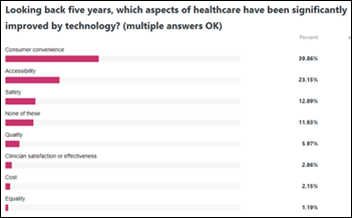
![]()
Traditionally Professional Courtesy is something that physicians gave each other - but we had to be careful with it when…