Readers Write: Santa Claus, Flying Reindeer, and the HIPAA-Compliant Data Center

December 18, 2013 Readers Write 1 Comment

Santa Claus, Flying Reindeer, and the HIPAA-Compliant Data Center
By Grant Elliott

12-18-2013 11-14-48 AM

This holiday period will see a rerun of many classic holiday movies, with one of my particular favorites being Miracle on 34th Street. A delightful film about the importance of retaining faith, even in the absence of any evidence – in this case, whether Santa Clause is real. As C.F. Cole puts it in the 1994 remake of the movie, “We invite you to ask yourself this one simple question: do you believe in Santa Claus?” following which all across the city people start putting up signs proclaiming, “We believe.”

As I walked around the exhibition floor of the 2013 mHealth Summit last week, I felt I was being asked to take a similar leap of faith. Specifically, that every company there was HIPAA compliant simply because they said so. For most, it would be part of their sales pitch. The term “HIPAA compliant” would be sprinkled liberally throughout the description of their service. For some, it was actually emblazoned on their wall posters. “HIPAA Compliant Data Hosting” and “HIPAA Compliant Mobile Development” are two I specifically recall.

When I challenged them on what they were actually doing to be HIPAA compliant, the answer was too often limited to, “We store our data in an encrypted database,” or, “We use a HIPAA-compliant data center.” Therein lies a key challenge within the SMB health tech marketplace. Too many companies simply do not know what it means to be HIPAA compliant. That is a particular concern given that recent changes in the law mean they are now federally required to be so.

Why is simply storing data in an encrypted database an insufficient response?

The objective of HIPAA is to protect the “confidentiality, integrity, and security” of electronic Protected Health Information (ePHI). While encrypting data can certainly be a part of this, it does not cover the many other aspects also required, including determining who has access to the data; how and where the data is being shared; who can edit or delete the data; and so on.

The HIPAA security rule alone contains 42 standards and implementation specifications spread across three groups – administrative, physical, and technical. This is separate from the HIPAA Privacy and Breach Notification Rules, both of which are part of the overall HIPAA compliance requirements.

Even if you scratch a little deeper into the companies that claim to offer HIPAA-compliant hosting services, you should pay particular attention to the wording they use. While they may be willing to sign a Business Associate Agreement, they deliberately stop short of promising to provide a HIPAA-compliant solution. This is because they do not control access to the application — the solution provider does.

The next time a company tells you they are HIPAA compliant because they store their data in a HIPAA-compliant database or data center, you are certainly welcome to take a leap of faith. In the movie, after Judge Henry Harper is presented with evidence that the US Postal Service is delivering letters addressed to Santa Clause, he declares that, “…since the United States Government declares this man to be Santa Claus, this court will not dispute it.” However, I doubt that the enforcement arm of the Office for Civil Rights will be as liberal in its judgments.


Grant Elliott is founder and CEO of
Ostendio of Washington, DC.

News 12/18/13

December 17, 2013 News 6 Comments

Top News

The 2014 defense authorization bill, which has been endorsed by both the House and Senate, requires the DoD and VA to develop by the end of January “a detailed plan for the oversight and execution of the interoperable electronic health records with an integrated display of data, or a single electronic health record.” If the agencies miss the deadline they risk losing their ability to spend more than 25 percent of the estimated $344 million in funding needed for the project and will be required to notify military and veterans committees before dispensing any project funds in excess of $5 million. The system deployment deadline is end of 2016.


Reader Comments

12-17-2013 1-11-40 PM

inga From Lion: “Re: LinkedIn. OK, I’m curious. What is the deal with your profile picture?” There’s no faster way to peg yourself as a HIStalk Newbie than by asking Mr. H why a healthcare-related website features a smoking doctor or why I have hot shoes on my LinkedIn profile. I shared with Lion that I used to have the Inga avatar on my profile, but the LinkedIn police took it down, saying only photos were acceptable. I feel like such a renegade every time I see the sexy shoe photo on LinkedIn, though I’m now thinking it’s time to feature a new pair. Stay tuned.  

12-17-2013 6-32-42 PM

From Leaving T-System: “Re: big changes at T-System last Friday. Sunny Sanyal will leave the company in January, now looking for new CEO. Mikael Ohman, COO will be working on special projects only. Jim Mullen, SVP Sales is leaving to join Allscripts. Mark Horner is now SVP & GM over RevCycle+, already updated his LinkedIn page.” Varian Medical Systems has already announced that Sunny Sanyal will be taking over as SVP and president of its Imaging Components businesses as of February 7, 2014.  We appreciate T-System’s response to our inquiries:

It is with mixed emotions that we can confirm those changes are accurate. Sunny made the decision based on a personal need to work closer to his family and spend more time with his wife and three children. Sunny was very well-liked and respected at T-System and we will truly miss him. Sunny will remain as the CEO of T-System until the end of January. On a positive note, we have some additional, exciting changes that we would like to share with HIStalk readers. John Trzeciak, a long-standing board member and principal at Francisco Partners, will help with the transition and step in as the interim CEO of T-System while we search for a replacement. John has an extensive background in leading healthcare organizations and helping companies manage leadership transitions, and is already engaged in the T-System business through his role on the board. We are excited to announce that Tom Dunn has been named as Executive VP of sales and marketing. Tom had tremendous success as the sales and marketing VP at QuadraMed, helping the company achieve double-digit growth. We anticipate that he will drive further alignment of our new revenue cycle and documentation solutions. Jim is leaving to pursue new opportunities and we’re grateful for his contributions. Additionally, Mark Horner was promoted to senior VP and GM of our revenue cycle solutions while Steve Armond, T-System CFO, was promoted with additional responsibilities that include operations for client services and performance solutions.

12-17-2013 9-41-01 PM

From Dr. L: “Re: technology tip. I appreciated your review of the Asus MeMo Pad and the tip to find it on sale at Office Depot! I checked immediately and snagged the last one at my local store. I’m in a similar situation with an aging device, and it’s helpful to follow someone you trust to wade through the plentiful options. I was considering one of the new iPad Minis, but I agree the Asus delivers a lot of value and doesn’t feel like I’m skimping. You’d have a lot of grateful followers if you included a regular Personal Technology section on your blog. I recall a comment several years ago about your strategy to use your iPod Touch on WiFi instead of an iPhone, and I adopted that idea, too. Many thanks to you and your team for all you do each week. You’re the highlight of my day!” I appreciate those nice words and I’m still loving the Asus, especially for $120 (try playing this movie on it to appreciate the HD display.) I don’t buy a whole lot of technology, but I usually get excited about it when I do, because I’m a nerd, obviously, and a bargain hunter besides. It would be fun to have readers weigh in on their latest purchases and the deals they’ve found.


HIStalk Announcements and Requests

12-17-2013 6-48-04 PM

Welcome to new HIStalk Platinum Sponsor Lincor. The 10-year-old Nashville-based company’s patient engagement technology portfolio includes PatientLINC (touch-screen, in-room access to clinical information for caregivers and  patient tools, communication services, and entertainment such as on-demand video and games); ClinicalLINC (secure bedside EMR access via wall-mounted terminals);  MediaLINC (in-room patient access to educational materials and entertainment); and MobileLINC (patient access to medical information, educational materials, and entertainment on their mobile devices). All of these increase patient satisfaction and improve outcomes, helping hospitals meet Medicare-funded requirements for patient satisfaction, readmissions, and Meaningful Use. The company’s systems are used by 120 hospitals and 25,000 beds all over the world, and the world headquarters have been moved from Cork, Ireland to Nashville. Just this week the company announced another funding round, this time of $3 million, to expand in the US and EMEA. Thanks to Lincor for supporting HIStalk.

My YouTube cruise turned up this new and well-done video overview of Lincor’s LINC technology.


Acquisitions, Funding, Business, and Stock

12-17-2013 6-33-29 AM

HealthTech Holdings, which includes the HMS, Patient Logic, and Medhost brands, changes its name to Medhost and names Craig Herrod president. He previously served as president and CEO of the Medhost division.

Juniper Networks will acquire WANDL, a provider of software solutions for multi-layer networks, for $60 million. 


Sales

At Home Healthcare (TX) selects Procura Homecare software as its home and community care platform.

The Louisiana Senior Care Coalition chooses eClinicalWorks Care Coordination Medical Record as its population health management solution for advancing ACO objectives.

12-17-2013 6-22-19 PM

The VA St. Louis Health Care System will implement LiveData PeriOp Manager and integrate it with its existing VistA EHR.

Hospital Sisters Health System (IL) chooses Passport to provide RCM solutions and services to its 14 hospitals and network of affiliated facilities.

Intermountain Healthcare (UT) selects Elsevier ClinicalKey to provide electronic medical reference and knowledge-based information to its clinicians and medical libraries.


People

12-17-2013 10-48-26 AM

Medfusion names Vern Davenport (MModal) president and an equity partner.

12-17-2013 9-28-06 AM

Jack Redding (Mount Sinai Medical Center) joins Halfpenny Technologies as SVP of sales and marketing.

Oncologist Susan Desmond-Hellman, MD, MPH (UCSF) is named CEO of the Bill & Melinda Gates Foundation. One of her key policy recommendations to the National Academy of Sciences was creation of a knowledge network that would allow sharing patient data across research and clinical practice to tailor treatments to individual patients.

T-System appoints Tom Dunn (QuadraMed) EVP of sales and marketing.

12-17-2013 5-50-58 PM

inga Kathleen Sebelius announces the appointment of former Microsoft executive Kurt DelBene as senior advisor to lead and manage the Healthcare.gov project. DelBene was president of the Microsoft Office division, leading me to wonder if he’ll be typing many of his own memos in Word and if the memos will ever include the term “EHR.” Wouldn’t it be great if he were able to lobby his former employer to fix that annoying EHR/HER auto-correct issue?


Announcements and Implementations

HIMSS and HHS are recruiting for an “Innovator in Residence” to serve a two-year term to develop and implement a nationwide patient data matching strategy.

12-17-2013 6-18-02 PM

Susquehanna Health (PA) implements Summit Provider Exchange technology to provide bidirectional integration between its hospitals and physician practices running NextGen EMR.

Bay Area Medical Center (WI), which recently signed a letter of intent to partner with Aurora Health Care (WI), begins implementation of Epic, the platform already in place at Aurora.

The Illinois HIE and Missouri Health Connection will share clinical patient data.

12-17-2013 12-10-00 PM

Essentia Health-Virginia (MN) goes live on Epic.

Polk County Human Services (WI) adopts Forward Health Group’s PopulationManager to track and analyze the progress of patients with substance abuse disorders.

Palomar Health (CA) goes live with AirStrip ONE for remote EKG access, co-developed by the organizations based on Palomar’s MIAA (Medical Information Anytime Anywhere) platform that AirStrip acquired in mid-2012.

12-17-2013 7-50-09 PM

Oncology EMR vendor Altos Solutions and outcomes and analytics vendor COTA announce a partnership to sell value-based cancer care systems in the US.

In the UK, the Department of Health opens bidding to choose a new outsourcing provider for its Oracle HR management system, planning to replace McKesson after 13 years. The contract is valued at up to $730 million over six years.

12-17-2013 8-21-36 PM

UPMC’s Children’s Hospital (PA) will make its physicians available for second opinions to members of MDLIVE, which offers secure online access to physicians.

In England, NHS’s clinical research group uses QlikView to review clinical data quality and find unusual patterns.


Government and Politics

12-17-2013 6-19-56 PM

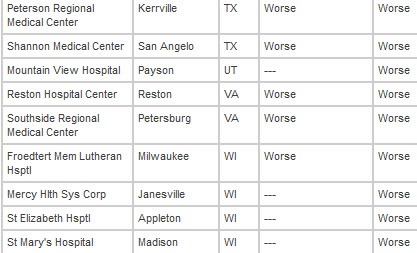
Medicare publishes a list of the 97 best and 85 worst hospitals for hip and knee replacements based on post-surgery complications and readmissions.

inga Congressmen Erik Paulsen (R-MN) and Jim Matheson (D-UT) propose legislation that would mandate the use of clinical decision support software by physicians receiving Medicare and Medicaid reimbursement when they order diagnostic imaging tests. The goal is to provide doctors with immediate feedback and recommendations for the appropriate tests to order. Sounds like a great idea that would likely create a few administrative nightmares.

Big pharma wants an independent investigation of the FDA’s computer security after a database containing clinical trial results and drug marketing plans submitted by drug companies was hacked last month. The drug companies are afraid their confidential information could end up in the hands of a competitor. FDA says the attacked system didn’t contain such information.


Other

12-17-2013 9-05-13 PM

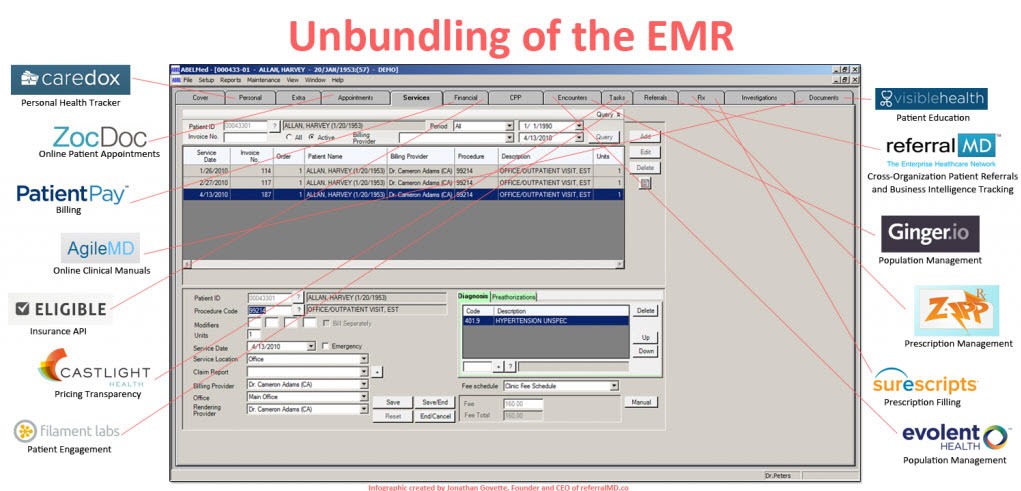
ReferralMD Founder and CEO Jonathan Govette, like others, says that EMRs will become unbundled the same way that a myriad of Craigslist features turned into much better individual platforms started by others. Above is how he sees that happening (click the image to enlarge). Tip from @ForwardHealthGP.

HIMSS will hold an mHealth Summit Middle East in Abu Dhabi in May 2014.

12-17-2013 9-54-13 PM

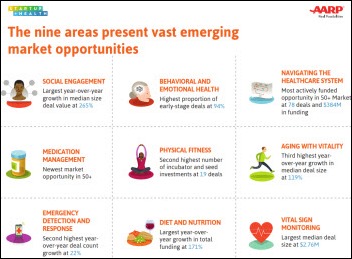
StartUp Health and AARP release a report on digital health in consumers over 50. Like much of what’s packaged as mHealth, it’s mostly aimed at investors rather than consumers.

Saint Francis Hospital (NY) says its Meditech implementation forced it into bankruptcy with $50 million in debt, but adds that it was the hospital’s own poor financial implementation and not Meditech that cost it “tens of millions of dollars” of uncollectible revenue. The hospital will sell itself once it exits bankruptcy.

A group of New York City parents files suit against the city and the Department of Education, claiming that disruptive 6- and 7-year-olds are being sent by ambulance to area EDs in violation of the Americans with Disabilities Act solely because the schools can’t handle them. According to one mom, “It has caused a financial and emotional strain for me and my entire family. I feel that they sent my son to the emergency room as an excuse to not do their job. If my child acts up at home I cannot send my son to the hospital emergency room.”

12-17-2013 10-39-45 PM

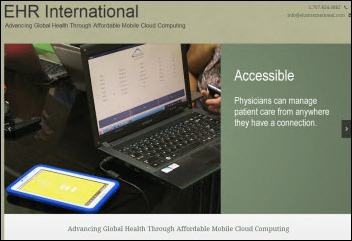
A California newspaper profiles 20-employee, Sebastopol-based E-Health Records, which develops EHRs primarily for use in developing nations. It runs on Android-powered tablets over Amazon cloud services.  

inga A former HHS investigator shares tips for preparing and responding to a fraud and breach investigation. The investigator says one of the biggest mistakes an organization can make during an on-site visit is to make the investigator wait. I’m guessing he’s never had to be on hold forever while trying to follow up on a Medicare claim. Now that’s waiting.

12-17-2013 7-46-39 PM

Weird News Andy summarizes this story as, “Makes it easy to put on socks.” Doctors in China reattach a man’s severed hand to his ankle for a month while he regains strength for hand surgery. I’m not entirely buying it – the story sounds suspicious and the picture looks a bit Photoshoppy.

WNA also notes this non-weird story, which describes November’s US hospital admissions as the lowest in a decade, with the survey sample of 98 hospitals reporting that admissions were down more than four percent.


Sponsor Updates

  • LRS releases the Mobile Connector for VPSX software, which allows users to print documents from any mobile device to any VPSX-defined output destination.
  • Athenahealth will integrate Merge Healthcare’s iConnect Network into its athenaClinicals EHR to allow users to receive and view exam results and diagnostic-quality images.
  • Wolters Kluwer Heath integrates its Health Language Provider Friendly Terminology with Epic EHR for mid-size to large practices and for hospitals.
  • Greenway Medical adds Digital Assent, a provider of patient satisfaction survey solutions, to its online Marketplace of value-added partners.
  • McKesson Episode Management releases 22 new episodes based on the PROMETHEUS Payment Evidence Informed Case Rate definitions, making it the first automated bundled payment solution to support the latest PROMETHEUS model.
  • InstaMed has grown to 1,000 providers and has processed over $30 billion in healthcare payments in 2013.
  • Razornsights employees celebrate the company’s Founder’s Day by building shoebox gifts in support of Operation Christmas Child.
  • Minnesota’s Office of the Commission of Health certifies Sandlot Solutions a health data intermediary, authorizing the company to provide HIE services in the state.
  • Maryland hires Optum/QSSI to provide project management and operational support for the Maryland Health Connection website.
  • A Nashville paper spotlights Lincor Solutions and the launch of its patient engagement technology for hospitals and health systems.
  • Health Catalyst board member and former Intermountain CIO Larry Grandia wins the 2013 Utah Governor’s Medal in Science and Technology.
  • Fujifilm demonstrated its Synapse products and the showed the MU Stage 2 capabilities of its Synapse RIS at RSNA
  • T-System authors a case study featuring its facility coding customer Memorial University Medical Center (GA), which boosted its ED revenues 20 percent through its coding initiative. 

Contacts

Mr. H, Inga, Dr. Jayne, Dr. Gregg, Lt. Dan, Dr. Travis, Lorre

More news: HIStalk Practice, HIStalk Connect.

125x125_2nd_Circle

Curbside Consult with Dr. Jayne 12/16/13

December 16, 2013 Dr. Jayne 2 Comments

The vast majority of ambulatory organizations have either implemented EHRs or in the process. There are different challenges for large organizations and small practices. In talking with a couple of my peers in the physician lounge over the last few weeks, one challenge is the same: determining whether EHR projects should be clinical, operational, or IT initiatives.

When I went live on my first EHR nearly a decade ago, the project was under the IT department. It was run by analysts who knew very little about what happens at a medical practice other than what they had experienced as patients. I was in a solo practice situation at the time, but part of a larger ambulatory group who wanted to use me as a pilot for the EHR system they were planning to roll to everyone else.

The vendor was well known, however, more in the billing space than the EHR space (as was common at the time.) I was busy running my practice and seeing patients, so just went along with what the IT department recommended. At the time, I didn’t know much about project management and lacked the experience to know that things were going very badly.

The vendor sent a trainer who taught us on a different version than what we had installed, and no one caught it before I was in training. There was no training around how to modify office workflow or transform practice. It was merely a parade of templates and how to use them, hour after hour, until our minds were numb.

We struggled with the system for the first six months. It wasn’t just the software, but issues with wireless connectivity, signal interference from the tenant next door, hardware failures, and a lack of a support structure. Eventually we discovered the software had been omitting data during the note-signing process. That was what allowed us to put a nail in its coffin.

I didn’t know at the time how visible the project had been since I was just trying to muddle through while also growing a new practice and seeing patients. When we started the Request for Proposal process for a new vendor, however, it became clear that many eyes had been on the project. Based on the events of the failed pilot, hospital leadership ordered that the next ambulatory EHR initiative would not be IT driven.

The project team that was ultimately assembled had leaders from operational and process excellence disciplines. They quickly hired a physician champion who was in place before the system selection was final. One of the key drivers of the project was clinical transformation rather than just a paperless transition. This required a lot more work than a simple EHR installation. I didn’t understand at the time how important that was, but I certainly do now. By focusing on outcomes from the beginning, we were able to drive adoption in a way that we could not have otherwise.

Our IT resources reported to our project leadership through a charge-back arrangement, but it was clear that they worked for us. They were tasked with supporting the infrastructure and helping us maximize the application and its capabilities. The rest of the team focused on understanding clinical workflow and practice operations. At the same time, they learned the system so that they could pull it all together and identify the best ways to implement various features.

The arrangement served us well and allowed us to deploy the platform to several hundred physicians, but I’m not sure we could make it work in a different organization with different leadership. With that in mind, when people ask me the question about where ownership of EHR projects should sit, my answer has to be, “it depends.” It really does depend on the organization, its goals, its strengths and weaknesses, and the people involved.

Small practices see this acutely, especially those who are trying to implement EHR at this stage of the game. We’re clearly in the realm of the late adopters, and I suspect many of them wouldn’t be doing it at all if not for the Meaningful Use money or the fear of penalties.

I’ve seen a couple of my colleagues fall prey to the idea that these are IT projects and don’t need much operational or clinical involvement. I was recently asked to assist a practice that had signed up for a hosting arrangement which only covered infrastructure. They had a complete lack of understanding of what it takes to maintain a system even if they were using it in a vanilla fashion.

They didn’t understand the difference between an upgrade and a software patch, so needless to say, they hadn’t applied any since going live, yet were baffled when things in the system weren’t up to date. They didn’t attend any of the complimentary training their vendor offered. They have no idea what it takes to attest for Meaningful Use, yet plan to do so in the first quarter of 2014. I hated to break it to them that they didn’t even have all the required components installed, and that based on their continued use of paper telephone messages and dictation of office visits, they are a long way off from being true meaningful users.

I’d like to see EHR vendors perform an “informed consent” process for new EHR clients, especially the late adopters. They should spell out what it takes to be successful and warn clients of the risk if those precepts are not followed. They should explain the need to have involvement from clinical, operational, and technical leaders even if they all happen to be the same people in a small practice.

When clients fail to heed this advice, they should not demand that the vendor move heaven and earth to get them back on track. Although vendors have a vested interest in the success of their clients, practices have to bear a large part of the responsibility for success.

Over time and as our project has gone into maintenance mode, management of our EHR has transitioned to shared ownership between its clinical and operational owners and the IT department. The leadership has matured and learned from its experiences and we’ve all become stronger as a result. It hasn’t been easy, and I have colleagues at different institutions that have had completely different experiences, but I would never trade what we’ve been through together. What do you think of EHR project ownership? Email me.

Print

Email Dr. Jayne.

Readers Write: My First Experience at the mHealth Summit

December 16, 2013 Readers Write Comments Off on Readers Write: My First Experience at the mHealth Summit

My First Experience at the mHealth Summit
By Kevin Lasser

12-16-2013 7-08-54 AM

I was inspired by Mr. H’s comments regarding his experience at the fifth annual mHealth Summit. So much so that I want to share my experiences from a little different vantage point.

I was kindly invited to not only speak on the topic of return on investment,  but also to talk to the press about my participation in mHIMSS Roadmap V2.0. Honestly, I am not sure I would have gone otherwise, but I am happy I went. Here are my thoughts.

Exhibit Hall

It was filled with very large and small companies with a few exceptions. I did not get a sense that the large companies were really doing much in the mHealth space. However, they were happy to be at the Summit because they may be able to form ventures with some of the smaller companies.

Those smaller companies seemed to be primarily looking for three things:

  • Validation of product
  • Money from “bankers”
  • A venture with a larger company


Unabashed Product Pushes

These were also called breakout sessions and executive spotlights.

I did a breakout session on ROI. The thing I was most proud of was the number of audience members who approached afterwards who said, “I have no idea what you do. Can you tell me…..” I considered that a great compliment.

I witnessed one session where a panelist had company logos and diagrams in his slide presentation. He turned every question from the audience into a product pitch. Based on those in the audience rolling their eyes and lack of people who approached this individual afterwards, I would say I was not the only one sick of his vendor pitch.

When are people going to learn that being a self-serving shill pitching your products under the guise of education works exactly the opposite way? (i.e. nobody cares about you or your product – YOU TURN PEOPLE OFF.)

State of the Industry

As a synopsis, I believe the following as it pertains to the mHealth industry:

  • There is a lot of confusion. It is hard to distinguish one app from the next.
  • Exhibiting a “real” ROI to prospective clients is a must. If a vendor answers a question regarding ROI with, “Imagine if …” that is not a real ROI.
  • That HIMSS designated talented people and monetary resources to mHealth is a very encouraging sign for the future.
  • Technology needs to be invisible. Nobody really cares about the technology. It is what the technology can do to lower costs, keep costs contained, and improve healthcare.

Lastly, regarding Mr. H’s comment that he snickers any time she sees someone wearing Google Glass, personally, I get a little nauseous.

Kevin Lasser is CEO of JEMS Technology of Orion, MI.

Readers Write: Musical Commentary on Mr. H’s mHealth Conference Summary

December 16, 2013 Readers Write 1 Comment

Musical Commentary on Mr. H’s mHealth Conference Summary
By DJ LooptyLoop

I have to say, your synopsis of mHealth sounds a little grim indeed. Chain restaurants lacking personality? Boring. Destination developments? Depressing. Terrible weather? Bearable when inside, but energy-zapping nonetheless.

If you’ve listened to Arcade Fire’s 2010 album “The Suburbs,” you would immediately relate the above description to my favorite track on the album, Sprawl II. “Sometimes I wonder if the world’s so small that we can never get away from this sprawl,” sings frontwoman Régine Chassagne. “Living in the sprawl. Dead shopping malls rise like mountains beyond mountains, and there’s no end in sight.”

But the most disappointing of all is the abandonment of the African public health project speakers. Actually, the abandonment of all global health issues in general is pretty appalling. The mHealth slogan reads, “Where technology, business, research, and policy connect.” One would think the policy research might actually be reflected via keynote speakers who speak to global solutions at this scale. But then again, maybe they don’t exist yet.

Arcade Fire’s new jam from their 2013 Reflektor album “Here Comes the Night Time” touches on this global health issue abandonment. “And the missionaries tell us we will be left behind. We’ve been left behind a thousand times, a thousand times,” cries frontman Win Butler. “If you want to be righteous, get in line.” Well, I suppose it’s back of the line for the emerging countries at the mHealth Summit, though I did see an announcement that mHealth Alliance plans to transition its base of operations in 2014 from the UN Foundation in DC to South Africa, so let’s scratch that and bump them up to the middle of the line.

And, there’s NO MUSIC? I guess conference attendees could throw on Reflektor with just one earbud in whilst walking from speaker to speaker so as not to be completely antisocial. The album hooks listeners at the initial beat-drop with a catchy Talking Heads vibe mixed with the fearless imagination of Daft Punk. Though I’d be careful with the feedback from other conference-goers, if Win Butler’s prediction holds true. “And when they hear the beat coming from the street, they lock the door. But if there’s no music up in heaven [or in our case, the mHealth Summit], then what’s it for?”

On a separate note, I would like to think that LCD Soundsystem and Reflektor producer James Murphy would be beaming to know his music has had a far-reaching impact. He did turn down a job as a writer for Seinfeld to make music, after all. He clearly wanted to make an impact elsewhere – and that impact has reached all the way into the world of healthcare IT.

Monday Morning Update 12/16/13

December 14, 2013 News 11 Comments

12-14-2013 3-20-22 PM

From Epic Fail: “Re: Epic. During the Q&A portion of a talk by Bernard Tyson (Kaiser CEO) at Epic today, an Epic employee stood up in front of a full Epicenter and asked Mr. Tyson if he thought that Kaiser would consider selling insurance in the future.” I will generously assume that the interrogator was one of Epic’s youthful, perfect-SAT savants who performed a quick scenario analysis and was shrewdly suggesting to Mr. Tyson that Kaiser’s business model might need to adopt to ever-changing healthcare requirements by focusing on other aspects of the corporate portfolio beyond its extensive insurance offerings. Either that or it was the typical Epic 24-year-old philosophy graduate who knows nothing about healthcare, but who has gained unwarranted conversational confidence from telling hospital people how to run their businesses using knowledge obtained from reading software manuals.

12-14-2013 8-48-04 AM

From Sharing is Caring: “Re: Kaiser. I just got this and it is very interesting… revolutionary, in fact. We can now share patient information between any Kaiser and all of the major hospitals in the SF Bay Area that use Epic-Sutter, Stanford, UCSF, and Alta Bates.” Shared Epic information includes just about everything from the patient, encounters, and results, omitting only flowsheets, images, smart forms, and scanned documents.

12-14-2013 9-39-51 AM

From The PACS Designer: “Re: RSNA highlights. The 2013 RSNA featured an interesting shift in how radiologists can interact with patients. Aunt Minnie listed five areas that drew the attention from attendees. TPD was pleased to see informatics among the list of the top five categories presented in the list for radiologists to consider for adoption.” According to the writeup:

In the past, big iron scanner introductions drew the lion’s share of attention at McCormick Place. One of the defining characteristics of the “new normal” for the RSNA meeting, however, may be the continued prominence of imaging informatics software in the exhibit halls and the scientific program. Indeed, market interest in these technologies seemed to provide a rare sign of hope amidst the overall malaise that still seems to be plaguing much of radiology.

That radiology maturation seemed inevitable – it happened in lab, where the intelligence moved from the instruments to the software managing the information the instruments created. Imaging costs, radiation exposure, remote viewing, patient image sharing, and radiology efficiency are all key issues that smart software (rather than the latest and greatest scanner) can improve.

12-14-2013 7-48-50 AM

Even hospital people like HIStalk readers don’t pay attention to published hospital quality data when making medical decisions for themselves. New poll to your right: is the term “mHealth” obsolete or unnecessary? I think it’s not only meaningless (as is “digital health”) but also unnecessarily divisive as companies and people wall themselves off behind that label instead of jumping into the mainstream of just “health.” That’s not a criticism of the companies waving the mHealth banner – we’re having the same identity crisis in “healthcare IT” as well as it becomes clear that our horizons should be “health” and not just “healthcare” and we try to figure out how population health management and wellness fit among our stodgy billing and order entry episode-based applications. Somewhere among all of that self-imposed digital segregation are consumers-slash-patients wondering why we have to make everything so provincial, fragmented, and complicated.

My latest grammar pet peeve examples, provided without explanation since they are hopefully obvious: (a) I went away for a couple days; (b) So I read a new book; (c) I eat breakfast everyday in the backyard. I’m also still frustrated constantly by lame articles with supercharged headlines that make them sound useful and insightful when they clearly aren’t, leaving me to feel as though I wasted my time with the journalistic equivalent of trying to make a meal of air-filled Cheetos and instead ended up still hungry and with embarrassing orange gunk on my lips (I’m often led to those worthless articles by Twitterers and Facebookers who seem to love being the first to link to awful healthcare IT articles.)

12-14-2013 9-18-37 AM

Welcome to new HIStalk Platinum Sponsor Proximare Health. The 10-year-old Savannah, GA-based company improves the referral process, with 3,000 users processing 25,000 referrals per month through its clinical rules-powered IRIS (Internet Referral Information System). The result: referrals are made to the most appropriate service, the appropriateness is validated from the Web-based system, eligibility and authorization are verified, patients are prioritized by condition, clinical documentation is managed, and results are shared among a patient’s providers. IRIS was built with the help of clinicians from nearly every specialty at Cook County in Chicago, who were trying to solve access challenges by making sure referrals were clinically appropriate, with the referral process managed by (and supported by) clinicians instead of a non-clinical utilization management department. Cook County’s results: (a) referral processing time was reduced from three months to 5.5 days; (b) 22 percent of the referrals were rejected as inappropriate; (c) referral volume increase sevenfold with fewer employees needed to manage it. Check out the short  videos covering order entry, rules engine, scheduling, document and results sharing, patient messaging, appointment preparation, interoperability, and business intelligence. Thanks to Proximare Health for supporting HIStalk.

Proximare had lots of its own YouTube videos, but I found one created by Portland IPA on how it uses the IRIS referral management system.

12-14-2013 8-32-16 AM

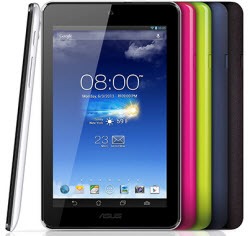
My first-generation iPad is getting long in the tooth to the point it can’t run newer versions of apps. I don’t use it enough to justify spending $499 on an iPad Air or even $299 for an iPad mini, so I did my research and instead bought an Asus MeMo Pad HD 7 for $119 from Office Depot on Friday. It’s amazing how much technology you get these days for so little money and in a thin, 10-ounce package: a high-definition display, super fast performance with 1 GB of DDR3 memory, front and rear cameras, dual speakers that sound really good, 10-hour battery life, highly responsive touch, 16 GB of storage, and a Micro SD card reader slot for cheap storage expansion. A seven-inch screen is plenty big when you have an HD display — even tiny text is crisp and playing a YouTube HD movie will just about take your breath away (I’ll use it to watch movies on planes, I’m sure.) Picking up my old iPad now is like hefting a yellowed, weighty encyclopedia volume from 1970. The MeMo Pad feels every bit as satisfying and well designed as my iPhone and Android is just as easy to use as iOS. Thank you, Google, for developing an economical and powerful alternative to the OS wares of Apple and Microsoft.

12-14-2013 8-06-25 AM

Cerner announces a $217 million share repurchase program. As a review, those programs involve companies using their cash to buy their own shares (which they often consider undervalued) on the open market. Or at least that they’ve announced plans to do so – companies don’t always follow through. Those purchases take shares off the market, which increases earnings per share even though overall earnings haven’t changed. They also increase executive bonuses tied to earnings per share at the expense of reduced cash that might have been spent on R&D or acquisitions. In other words, share repurchase programs don’t mean a thing despite the feel-good message that “we love our stock so much that we’re buying it ourselves.” Above is the five-year performance of CERN vs. the Nasdaq.

12-14-2013 8-10-17 AM

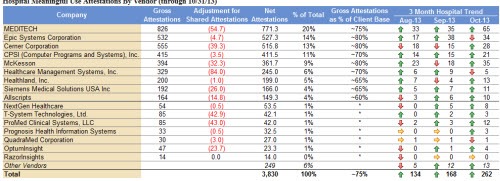
Jamie Stockton of Wells Fargo Securities provides the above slice-and-dice of hospital Meaningful Use attestations through 10/31/13. Meditech leads by far in total and net number of attestations, while Epic, Cerner, and McKesson have the highest percentages of clients successfully attesting. Trailing the pack in client percentages are Healthland, Siemens, and Allscripts.

12-14-2013 3-26-42 PM

Duke University Health System goes live with Strata Decision Technology’s StrataJazz for capital and long-range financial planning. 

12-14-2013 3-16-40 PM

A former IT director of The Advisory Board Company pleads guilty to defrauding his employer of $100,000 by approving the payment of invoices to a sham company he created for that purpose.

12-14-2013 3-28-52 PM

Barron’s says athenahealth’s stock drop late last week was due to concerns raised at the company’s investor meeting: (a) CEO Jonathan Bush announced that he will take a two-month leave next year; (b) the company guided next year’s earnings expectations down; (c) the company’s use of flattering but unusual financial measures that have given it a “thin-air valuation” of $5 billion; (d) athenahealth’s statement at the investor meeting that it will double its market opportunity by selling inpatient clinical software to hospitals and by doing so will “undermine the foundations” of Cerner and Epic; (e) the company has little choice for selling to hospitals because they are acquiring its practice-based customers and replacing athenahealth’s products. Athenahealth’s hospital plans apparently involve pre-certification and referrals.

Weird News Andy titles this story as “Now that’s what I call a gestation period,” although he notes that “the train never left the gestation.” Doctors find that an 82-year-old woman with stomach pain has a 40-year-old fetus inside her.

Here’s Vince’s Christmas edition of HIS-tory.


Contacts

Mr. H, Inga, Dr. Jayne, Dr. Gregg, Lt. Dan, Dr. Travis, Lorre.

More news, HIStalk Practice, HIStalk Connect.

125x125_2nd_Circle

Time Capsule: Marry in Haste, Repent at Leisure: Choose your EMR Soul Mate Carefully

December 14, 2013 Time Capsule Comments Off on Time Capsule: Marry in Haste, Repent at Leisure: Choose your EMR Soul Mate Carefully

I wrote weekly editorials for a boutique industry newsletter for several years, anxious for both audience and income. I learned a lot about coming up with ideas for the weekly grind, trying to be simultaneously opinionated and entertaining in a few hundred words, and not sleeping much because I was working all the time. They’re fun to read as a look back at what was important then (and often still important now).

I wrote this piece in January 2010.

Marry in Haste, Repent at Leisure: Choose your EMR Soul Mate Carefully
By Mr. HIStalk

125x125_2nd_Circle

Too much Meaningful Use has led me to Meaningless Musing. Here’s where it took me: the same handful of wrong reasons that convince people to marry unwisely also convince them to buy EMRs that will make them unhappy.

Let’s start with lust. A good-looking partner often leads to hasty and ill-advised EMR marriages. Providers swoon over the slick, sexy sales demo of an EMR that seems cool and popular. They can’t wait to get legally hitched and embark on a lifetime of what they expect to be never-ending passion and soul-mating, flinging themselves at each other several times a day.

Once the vows are said and the papers signed, the romantically foggy lens they’ve been looking through clears shockingly. In the unforgiving harsh light of day, the sultry enigma turns into an endlessly argumentative pest, or maybe a hot mess looking for company in their downward slide. Your new EMR is Bobby Brown to your Whitney Houston.

The most in vogue reason to marry an EMR is cold, hard cash. Certified EMRs come with a taxpayer-funded dowry. Golddiggers rationalize that it’s just as easy to marry someone rich as it is someone poor. You are Anna Nicole-Smith, trying to work up lustful yearnings for a billionaire who is 63 years your senior. And like Anna, EMR users may not live long enough to enjoy the fruits of their connubial labors. Once your $44,000 has been spent, you still have to enter orders and pay larcenous tech support rates for hardware maintenance.

There’s also the shotgun wedding, although that’s a hopelessly dated concept now that society’s moral linkage between parenthood and marriage has been fully disengaged. Still, HITECH-seeking hospitals and practices are sure to push doctors and EMRs together despite their inherent incompatibilities, unwilling to take no for an answer when ARRA money is on the line.

My college roommate’s mom had wise advice, triggered by his ill-disguised lust for all things female and fearing he would sully the family home by marrying the pregnant, drug-using dropout that he found endlessly fascinating (she even had a tattoo, unheard of back then). His mom told him to picture a person who is horribly disfigured and wheelchair-bound after being burned in a fire, requiring his constant care and attention. Would he still be happy to spend the rest of his days with that person? If not, she isn’t the one. She wasn’t, apparently.

If the sweet young thing of an EMR that’s catching your eye becomes old, cranky, or unreliable, would it still be attractive once the money is gone?

Doctors should not be shamed into EMR marriage because of societal pressure (all the other doctors are getting hitched), age (being an EMR spinster isn’t all that shameful), or lust (you can get free milk without buying the cow by messing around with computers as a hobby instead of actually using them in practice, i.e., like informatics doctors do).

Ditto getting EMR betrothed because you want a big wedding (the vendor’s celebratory dinner) or to rebound from a bad previous marriage (the EMR you de-installed because the vendor was unresponsive).

Breakups are ugly. They involve a lot of ill will, money, and wasted time and energy. Like they say, marry in haste, repent at leisure.

The right reasons to get EMR nuptialized is that you’ve finally found that special lifetime companion with whom you want to spend every waking minute, the one you admire, that special person with whom you will grow together, and that soul mate with whom you will share intimate thoughts through good times and bad. For better or for worse, for rich or for poor, till death (or vendor insolvency) do you part.

I bet my roommate’s ever-practical mom would add one last item: just on the off-chance that you’ve chosen unwisely, get an ironclad pre-nup.

News 12/13/13

December 12, 2013 News 1 Comment

Top News

12-12-2013 7-22-35 PM

Athenahealth lowers FY14 guidance, projecting EPS of $0.98-$1.10 vs. analyst expectations of $1.38, sending shares down 14 percent Wednesday.


Reader Comments

From Norm: “Re: HHS Office for Civil Rights. I’m not surprised the OCR had issues with their internal security practices based on my past interactions. I’ve been through a couple of OCR audits and my staff and I spent almost as much time educating the auditors on the MU requirements and the meaning of various measurements as we did compiling the reports for the actual audit. I’m curious if that is also the experience of other HIStalk readers.” Readers are welcome to weigh in.

12-12-2013 8-47-43 PM

From Bobby Orr: “Re: Lifespan (RI). Having to borrow another $50 million during bad financial times to buy Epic may not have been the best idea.” Lifespan’s net earnings dropped from $41 million to a loss of $5 million in the most recent fiscal year excluding a one-time gain. The health system blames the “unique dynamic in play nationwide.” It paid its CEO $7.88 million in 2011.


HIStalk Announcements and Requests

inga_small In you’ve gotten behind on your ambulatory reading in the midst of the busy holiday season, here are a few highlights: MGMA requests end-to-end ICD-10 testing with physician offices. CMS will develop guidelines for the practice of copying and pasting in EHRs. Private physicians office are predicted to net profit margins of 12.7 percent for 2013. Only 17 percent of Medicaid EPs are meaningful EHR users, though 76 percent have been paid an EHR incentive. An autism module added to an EHR’s clinical decision support system improves screening. Brad Boyd of Culbert Healthcare Solutions considers the value of EHR optimization. Dr. Gregg wonders if health IT cares. If you take a moment to sign up for the HIStalk Practice email updates it will be like buying a Christmas present for your BFF (in this case me) and getting a present for yourself at the same time (come on, you know you’ve done that.) Thanks for reading.

On the Jobs Page: VP of Product Management.


Acquisitions, Funding, Business, and Stock

12-12-2013 10-36-18 PM

Streamline Health Solutions reports Q3 results: revenue flat, EPS -$0.50 vs $0.18.

12-12-2013 7-25-08 PM

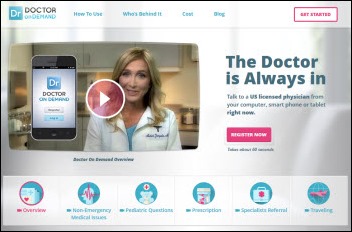
Doctor on Demand, which offers $40 video chats with US-licensed doctors, closes $3 million in seed funding. Investors include athenahealth’s Jonathan Bush, Venrock, and Google Ventures.

12-12-2013 7-27-18 PM

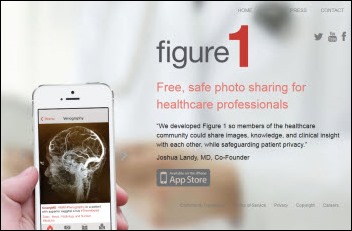
Toronto startup Figure 1, which offers a photo-sharing app for physicians, raises $2 million in seed money.

12-12-2013 8-37-59 PM

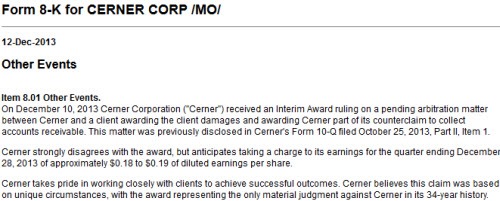
Cerner will take a Q4 earnings charge of up to $0.19 per share (vs. expected earnings of $0.35) after an arbitrator rules in favor of Trinity Medical Center (ND). The value of the settlement wasn’t announced, but the hospital had sought $240 million, claiming that the Cerner Pro-Fit financial system it bought in 2008 was dysfunctional. CERN shares closed down 1 percent Thursday.


Sales

12-12-2013 7-28-50 PM

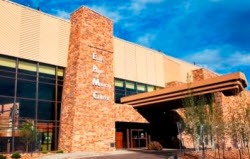
Estes Park Medical Center (CO) selects Summit Healthcare to integrate its Meditech HCIS and MEDHOST EDIS.

12-12-2013 7-29-40 PM

Butler County Health Care Center (NE) selects Access electronic patient signature and e-forms solutions to complement its Meditech rollout.

Springhill Medical Center (AL) chooses Allscripts Sunrise Surgical Care to manage the perioperative care process.

The 16-bed Crook County Memorial Hospital (WY) contracts with RazorInsights for its ONE-Enterprise Edition.


People

12-12-2013 7-31-58 PM

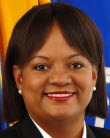
Alere appoints former US Surgeon General Regina M. Benjamin, MD to its board.

12-12-2013 9-14-10 PM

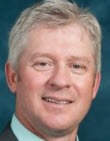
MidMichigan Health names Dan Waltz (University of Michigan Health System) as VP/CIO.

12-12-2013 9-26-02 PM

Joe Craver, president of the health and engineering sector of Leidos, resigns. The parent company of the split-up SAIC announced this week that it lost $7 million in the most recent quarter vs. a profit of $100 million year over year. Revenue in Health and Engineering dropped 20 percent, which the company attributed to completed projects, less new business, and shrinking hospital budgets. That division includes SAIC’s healthcare consulting acquisitions, Vitalize Consulting Solutions (July 2011, price not disclosed) and maxIT Healthcare (July 2012, $473 million.)


Announcements and Implementations

CommonWell Health Alliance will launch its interoperability services in early 2014 in Chicago; Elkin and Henderson, NC; and Columbia, SC.

12-12-2013 7-34-24 PM

Cerner will offer KidsHealth pediatric-specific discharge and after-care instructions within the Cerner Millennium Patient Education Content.

Practice EMR vendor drchrono releases an API that will allow developers to extend and enhance its platform.


Government and Politics

HHS Secretary Kathleen Sebelius reports that 365,000 individuals had selected plans from the state and federal marketplaces by the end of November, with November’s enrollment in the federal marketplace four times greater than that of October. Sebelius also reveals that the IT costs for the website totaled $677 million through the end of October.

12-12-2013 7-16-39 PM

HHS launched the Spanish version of the marketplace website last weekend.

12-12-2013 8-33-04 PM

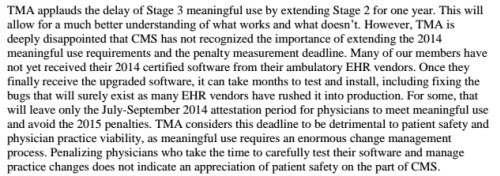
Texas Medical Association urges CMS to extend the MU Stage 2 deadlines for another year.

A Kentucky doctor announces closure of his practice, erroneously blaming Obamacare (rather than ARRA) for requiring him to adopt electronic medical records. He says the change would be too expensive and would require thousands of hours of work to convert his paper records.

12-12-2013 10-21-08 PM

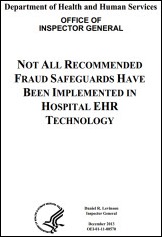
An OIG report on fraud prevention safeguards in hospital EHRs recommends that hospitals:

  • Turn on EHR audit logging at all times (ONC responded that it will make this a certification requirement for vendors)
  • Revoke permissions for users to delete or edit the audit
  • Use audit logs to detect fraud, not just monitor for HIPAA violations
  • Develop policies for using EHR copy-paste capabilities, issue warnings to users copying and pasting, and capture copy-paste activity in the audit log (CMS responded that it will develop guidelines on copy-paste use)

ONC will discuss findings from its patient matching initiative next week in Washington, DC.


Innovation and Research

12-12-2013 7-35-55 PM

Kaiser Permanente’s use of data analytics is helping to lower hospital mortality rates, according to CMIO John Mattison.

HIE data can identify ED frequent flyers better than a single hospital’s records, according to a Health Affairs-published study of 10 hospitals participating in the New York Clinical HIE.

Researchers at Johns Hopkins University are working with a Belgium-based technology company to developed a nanotechnology-based “lab on a chip” that would allow diagnostic testing to be performed anywhere.


Technology

In England, an NHS-funded patient safety project replaces paper charting of vital signs with automatic recording via an iPad app, which also calculates an Early Warning Score. Project developers Oxford University Hospitals was also awarded a grant to develop a system that links the EHR to the pharmacy packaging robot so that take-home meds can be prepared and delivered automatically, decreasing discharge delays.


Other

12-12-2013 1-26-26 PM

The Fire Department of NYC sends a medical bill, addressed to “unknown Asian” to The New School of New York, a 10,000 student college.  A spokesman for FDNY says their billing contractor is fixing the problem.

HIMSS names MedPeds (MD) a 2013 Ambulatory HIMSS Davies Award of Excellence winner for its use of EHR to improve the healthcare delivery process and patient safety while achieving a demonstrated ROI.

12-12-2013 9-19-17 PM

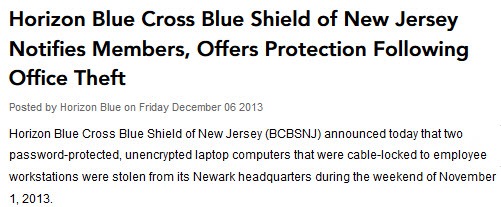
Horizon Blue Cross Blue Shield of New Jersey notifies 840,000 customers that their personal and clinical information has been exposed after two unencrypted laptops are stolen from its offices. 

Healthcare app platform vendor Happtique, which sells services to app vendors intended to improve provider confidence, suspends its certification program when an outside developer finds that apps in the first group Happtique certified two weeks ago store usernames, passwords, and data as easily exposed plain text.

A tweet by UCSF physician Bob Wachter, MD says that each ICU patient triggered an average of 1,156 alarms per day, leaving nurses with 2.5 million alarms to deal with in one month.

Weird News Andy suggests redefining “never.” In England, NHS reveals that 150 patients were harmed in six months by “never” events that included performing heart surgery on the wrong patient, removing a woman’s fallopian tube instead of her appendix, and 69 cases in which surgery implements were left inside patients.


Sponsor Updates

  • Market research firm Radicati Group names AirWatch a “Top Player” in the Enterprise Mobility Management Market Quadrant.
  • Cornerstone Advisors Group chooses three client-related hospital projects to support from its Cornerstone CAres charitable program funded by the company and its employees.
  • The Orange County Register names Kareo a top workplace in the mid-sized company category.
  • Clinithink wins the 2013 MediWales Innovation Judges Award for the development of innovative technology and outstanding contribution to the life science sector.
  • Business NH Magazine names Bottomline Technologies to its Best Companies to Work For Hall of Fame for 2013.
  • The HROToday Forum names Aspen Advisors and its big data platform Pando the Top Technology Innovator for 2013.
  • Forward Health Group CMIO John Studebaker,  MD discusses the transition to value-based care in an MGMA on-demand webinar.
  • Halfpenny Technologies discusses how access to actionable and complete lab and clinical results data enables health insurance organizations improve care management.
  • DrFirst presents a case study profiling Edward Sobel, DO and David Krasner, DO and and their transition to e-prescribing.
  • Craneware sponsors a December 17 HFMA webinar featuring Lake Regional Health System’s (MO) development of an audit management process. 
  • The Boston Globe names Imprivata one of the city’s best places to work for 2013.
  • Porter Hills Retirement Community Services and Home Care shares how it found flexibility and time savings through the use of the HealthMEDX Vision solution. 
  • Liaison Healthcare predicts six 2014 trends that will make an impact on the healthcare and life sciences industries.
  • Laura Kreofsky and Jason Fortin of Impact Advisors provide commentary on the recently announced extension of Stage 2 and Stage 3 MU deadlines.
  • Lincor Solutions launches a portfolio of products for delivering patient engagement to hospitals and health systems.
  • Truven Health Analytics releases MarketScan Oncology EMR Database for oncology-focused research studies.

EPtalk by Dr. Jayne

I enjoyed reading Rebecca Sutphen’s piece on bringing up family health history during the holidays. Not only is it important for individuals to understand their family history for genetic purposes, but it’s good for the younger generations to be aware of conditions their older relatives may be treating. Knowing that Uncle Sal is diabetic may be helpful if he starts acting funny on Christmas Eve and he hasn’t been hitting the eggnog.

It can also be important to understand relatives’ end-of-life plans. I encourage everyone to discuss their wishes with family, especially if they don’t have an Advance Directive in place. The holidays may be the only time families get together and talk about these important issues. Good information on talking points can be found at FamilyDoctor.org.

I’ve received a lot of correspondence regarding Monday’s Curbside Consult discussing the CMS changes to Stage 2 and Stage 3. I got quite a few questions about the three years of Stage 2 for those practices that started Meaningful Use in 2011 or 2012. At this time, participating providers and hospitals will have to complete all three years and there won’t be any skipping allowed. All of the CMS materials will need to be updated, but I’m sure they will be clarifying this.

As CMS tries to use information from Stage 1 and Stage 2 to inform Stage 3, a reader shared John Halamka’s recent blog (written before the announcement) about rethinking certification. Make no mistake, the recent timeline shift does not do anything to delay the need for hospitals and providers to have their certified 2014 software live so that they can attest in 2014. I agree with his assessment that the certification criteria are “overly burdensome…. And disconnected from the attestation criteria.” Some of the certification criteria have also forced vendors to modify functionality in ways that fracture provider workflows and make it more difficult to provide care.

Since I use several different big-name products, I know that there are some nuances in the ways that vendors implement these requirements, but some of them are particularly difficult to implement with good usability in a way that actually supports clinical care. I visited one of my providers the other day and listened to what can only be described as a tirade against all the bells and whistles that don’t do anything to help him provider better care to his patients. I agreed, but also pointed out that it’s bigger than Meaningful Use and EHRs, though – there are many things that have happened in medicine during the last few decades that do little to improve patient care.

E&M coding rules, draconian audit methodologies, Medicare RAC hit squads, pre-payment audits, and the rise of defensive medicine have done little to improve care. In my experience as a patient, I think that patient portals are the best thing since sliced bread. I enjoy being able to use secure communications to take care of issues without having to take phone calls at work or schedule time off.

However, in looking through communications with my physicians over the last two years, not a single question has been medical. I don’t think it’s because I’m a physician and am making my own medical judgments. My clinical history looks very similar to most women in my age group and it’s not that complicated. Looking at the topics of communication across a couple of practices reveals: requesting a mammogram order with a wet signature for no good reason other than the imaging center wants one because it’s afraid of an audit; dealing with wacky insurance rules that require me to reschedule a visit because it’s one day earlier than the insurance plan allows; requesting to have a prescription rewritten with specific directions because my pharmacy benefit manager disagrees with one that meets all of the Surescripts guidelines for correct and accurate prescribing; and dealing with a co-pay issue because the office didn’t understand that I don’t pay one for preventive visits. There are more, but the theme is the same.

My fear (which I think is well founded) is that things are only going to get more complex. To make things more interesting, like many Americans, I have brand new health insurance starting after the first of the year. Now I get to figure out all the nuances that took me years to figure out with my previous carrier. At least we can all sympathize. It’s looking like 2014 is shaping up to be a very interesting year indeed.

A shout-out to my friend Dr. Doug Farrago of the Authentic Medicine Gazette for sharing this quote of the week which sums up my recent challenges as a CMIO:

clip_image002

I never did give anybody hell. I just told the truth and they thought it was hell.


Contacts

Mr. H, Inga, Dr. Jayne, Dr. Gregg, Lt. Dan, Dr. Travis, Lorre.

More news, HIStalk Practice, HIStalk Connect.

125x125_2nd_Circle

From the mHealth Summit 12/10/13

December 11, 2013 News 2 Comments

I’ve been at the conference for two days and it still doesn’t have a clear identity in my mind. Others told me the same thing – it’s unfocused and hard to describe, much like “mHealth” itself.

The term “eHealth” was coined a few years ago and was quickly hijacked by companies and people who didn’t have much credibility in the non-eHealth world. Everybody else piled on to avoid being seen as passe’, turning eHealth into a frothy marketing term that meant whatever you wanted it to mean. It didn’t take long to shake out the 80 percent of that movement that was unsound and absorb the rest into the mainstream of healthcare IT. The term was retired because it was no longer necessary.

The concept of mHealth as a separate area of focus needs to be retired. It no longer means anything. It was born when so few healthcare people were using smartphones that it seemed like a geeky special interest that required intentional cultivation.

Since then, the mission has been accomplished. Mobile is a given. Nobody spends their lives perched in front of a desktop PC or even a “mobile” computer on wheels. You’re mobile if you use a connected smartphone, laptop, or tablet. That’s pretty much everybody, which means the mobile device itself as a common thread of interest is no longer compelling.

The mHealth Summit features topics that have little in common. Some themes might be:

  • Consumer-facing apps
  • Global and population health outreach
  • Clinician access to systems and information
  • Connected health devices and real-time body monitoring systems
  • Non-mainstream and often naive ideas about transforming healthcare and health
  • Startups and investors (by far the overriding theme)

The HIMSS conference has a lot of subject areas as well, but it’s so big and the content so deep that any attendee can create their own track and feel fulfilled. Most of them are hospital people, but those from other work settings (practices, research, technology, etc.) can find plenty to keep them busy and justify their employer’s cost to send them.

Not so at the mHealth Summit. Few people make “mHealth” their living, so most of what is being presented is irrelevant to any given individual. If you are interested in physician mobile access to enterprise systems, you aren’t likely to care about SMS health messaging in Africa or some cool gaming app for nutrition. The fact that they both run on smartphones is irrelevant.

Most of the people I saw at the conference seemed to be wandering around in a daze trying to figure out what they should be doing. I felt the same way. I spent time in the exhibit hall trying to find something that interested me and came up short for the most part. I couldn’t find many compelling educational sessions, especially after ruling out those that didn’t involve a vendor.

Health 2.0 offered a co-located afternoon track. Someone remarked to me that the mHealth Summit probably needed Health 2.0 more than the other way around. Both place heavy emphasis on startups, mostly those selling to consumers, sometimes for passionate health-related reasons but often because their people and products are too rough around the edges to sell into the conservative hospital and physician practice market.

Both conferences seem to highlight companies that are just as interested in selling themselves as their products. The mHealth Summit feels like a speed-dating event for questionable companies and wary investors, with all of us other attendees there trying to educate and entertain ourselves around the commerce-driven mating rituals. Maybe that’s what the mHealth Summit should morph into – a conference purely for startups and investors. They dominate the proceedings anyway and that would at least allow prospective attendees to plan accordingly.

I wonder how many of this year’s attendees are first-timers and where the returning attendees work. My speculation is that people from broad healthcare IT go once and don’t find a reason to come back, while the company and investment people dutifully return hoping to raise or invest money, find partners, and recruit staff.

12-11-2013 8-30-15 AM

It’s interesting to me that the mHealth Summit is run by HIMSS Media, which probably explains the both heavy presence and promotion of its own advertiser-driven products and the appearance of vendors in nearly every aspect of the conference, including opening keynotes by company executives who were mostly pitching their companies. Even the wildly commercialized HIMSS conference doesn’t usually give company CEOs timeslots in the first morning’s session where attendees don’t have alternatives (both conferences, however, shut down the educational track for blocks of hours to herd attendees into the cash machine of the exhibit hall.) The pre-HIMSS mHealth Summit featured keynoters from the National Institutes of Health or heads of foreign governments rather than VPs from Qualcomm and AT&T.

A few random observations:

  • The biggest racket on the planet is Freeman, the company that provides exhibitors with carpet, chairs, and technology. Need a single cheaply made chair for your booth? That’s hundreds of dollars, probably 10 times or more to use the chair for three days than buying it outright. If you want to plug in your laptop, that will be $100 per day for the power strip and connection, please. Our tiny booth had only a chair and table and it will end up costing me over $1,000, Lorre says. I knew it was expensive, but somehow seeing it on an invoice brings it home.
  • Maybe I’ll get over the urge to snicker every time I see someone walking around in public wearing Google Glass, but I don’t think it will be any time soon.
  • The conference badges were slick, including embedded RFID chips instead of barcodes for booth scanning, but the font was unreadably small unless you planted your face directly into someone’s chest.
  • Imprivata was giving away those gloves with the little metal things on them that allow you to use your mobile device in the cold. Several people asked me where I got mine.
  • Like every other conference, most of the people in the booths were screwing around with their phones at any given moment. I saw several booths in which people walked up, waited, and finally grabbed a couple of pieces of collateral and walked away, all while the booth rep intentionally ignored them by staring into their phones.
  • I heard quite a few complaints about the food service set up inside the hall. Apparently the pre-made sandwich, chips, and a drink cost $15. I feel pickpocketed every time I attend a conference and have no alternative to overpriced concessions that still require waiting in line. Lunch alternatives were nearly non-existent – the open-air restaurant outside the exhibit hall had a sign up that said “Now Serving Breakfast and Lunch” and I was hungry enough to be willing to pay $16 for the salad and soup bar, but promptly at 11:00 they stuck out a sign that said they were closed until the next day, leaving only the sports bar.
  • I was surprised to gaze down the Innovation Zone exhibit area and see almost all men in dark suits, making it look like a Secret Service convention. I didn’t picture the environment there as being heavy on suits, so I don’t know if these were the startup people, investors, or attendees who just don’t feel complete without a tie.
  • The best discovery is that right across from the Gaylord is a CVS drugstore well stocked with snacks and drinks that, unlike everything else in National Harbor, don’t carry a “you don’t have a choice” surcharge. They even had pre-made sandwiches and salads that looked better than the ones in the Gaylord at half the price or less.

12-11-2013 9-25-25 AM

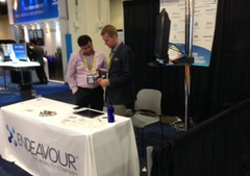
Lorre wants to thank our exhibit hall booth neighbors from Endeavour, who helped her hang our banner and took messages from booth visitors while she was away from the exhibit hall running the DocuSign webinar. On the other side of our booth, the Kore rep let her plug in her laptop to charge since she knows I would have vetoed $100 a day for a power strip. Across the aisle, Geoff from AT&T was really friendly and tracked down our expensive Freeman-provided chair that someone in another booth took because they hadn’t rented their own. We don’t know anything about exhibiting, so Lorre appreciated the support from folks who weren’t new to it.

12-11-2013 9-32-30 AM

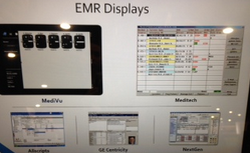
I took a look at MediVu, which offers a tablet-based EMR view that gives doctors the big picture of all their patients. It was pretty cool, although I bet interfacing to the EMR would be ugly.

12-11-2013 9-34-46 AM

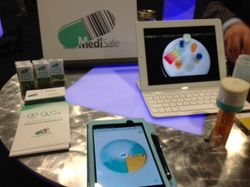
I saw a brief demo of MediSafe, a family-oriented medication adherence solution that lets you visually follow your own medication schedule or monitor the adherence of a loved one. They sell the software and partner with another company to provide the pill bottle sensors.

12-11-2013 9-37-15 AM

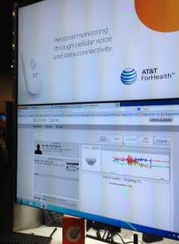
AT&T demoed some cool solutions in their ForHealth lineup. EverThere is a hands-free personal monitoring device that monitors a person’s activity with fall detection and connects to a call center. The real-time graph was pretty slick – it was easy to detect changes in movement pattern or a fall to a horizontal position.

I also looked at Toggle from AT&T, which allows enterprises to create a virtual desktop-type setup on a person’s individual mobile device to allow them to securely run enterprise apps in BYOD situation.  They’re offering a 30-day free trial, according to Lorre’s friend Geoff who gave me the demo.

12-11-2013 9-40-46 AM

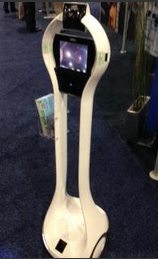
The VGo mobile telepresence robot was interesting.


mHealth Summit Observations from Anonymous CIO

Monday

I saw the HIStalk booth and stopped by and introduced myself to Lorre. I thought she represented the site very well.

This is my first time at this conference. I came with a set of expectations that does not seem to align with what I’ve seen. In my view, a mobile health strategy for a provider should address all four quadrants found below (sorry for the rudimentary examples in each category).

12-11-2013 9-15-26 AM

Much of what’s been presented at the educational sessions and on the exhibit floor focuses on the Patient Health quadrant. A tiny bit addresses the physician component. (I thought that the Wired Magazine Health Conference in NYC a month or so ago did a better job, in a shorter, less expensive forum, providing a greater breadth of info – and much, much better food included in the price.)

I am surprised to see how few — relative to vendors or developers – hospitals and health systems seem to be represented here. When at HIMSS, I can barely move five feet without encountering someone I’ve worked with during the decades of my career. Here, I’ve found barely one. So it begs the question, what are providers doing about developing a mHealth strategy?

Some of the sessions I attended were completely mislabeled. As an example, a session called “Adopting mHealth Strategies to Remain Competitive” was nothing more than four independent vendors promoting their wares. (I notice that this conference does not ask for participant feedback on each session – probably a good thing).

The Executive Breakfast that I paid additional money to attend, entitled “The World is My Waiting Room” I thought would be chock full of discussion about patient outreach in a variety of ways, seemed like nothing more than friendly banter amongst the presenters. The “breakfast” was nothing more than croissants, yogurt, fruit and coffee – none of it remarkable. I left disappointed and hungry. I paid to attend tomorrow’s breakfast as well. I’ll eat before I go.

Weather apparently kept more than a few presenters away, so maybe this isn’t the right time of year for this forum.

All your comments about the venue and location itself I agree with.

So maybe I expected too much? Maybe this part if the industry is too new to provide what I’m looking for? I don’t know. What I do know is that in my new role in the health system into which we’ll be merging, I’m tasked with developing and implementing a Phase One mHealth strategy, and thus far, this conference isn’t giving me much to work with.

Tuesday

For whatever reason, the sessions I attended seemed more interesting than yesterday’s. In most cases providers, were interspersed with technology providers. A lot more real-life stories of how to deploy technology for the betterment of a certain patient population were told.

At the Executive Breakfast, Nasrin Dayani from AT&T for Health and David Levin from Cleveland Clinic brought real passion to the discussion about mHealth’s role in patient engagement. Still stumped as to why I had to pay to attend this session – which was full. This panel seemed just like all the others in content and message.

At today’s keynote, both Astrid Krag (Denmark) and Muhammad  Yunus (Bangladesh) did a great job speaking about how technology improves a population. Is it wrong to say I admire what I perceive as somewhat homogenously populated countries who seem to be able agree on an agenda to actually get things done? Eric Dishman’s personal story was effective too.

One of the two most significant sessions for me was “Aligning mHealth to Your Strategic IT Plan.” That’s just what I showed up to this conference to hear and I took away really useful info.  

At “Streamlining Chronic Care: Keeping the Patient and the Bottom Line Healthy,” I’m not sure they effectively covered all of that, but all presenters were really good and spoke to actual experience in the mHealth space.

My other favorite session was “Lessons Learned from the mHealth Grand Tour.”  It showed what breaking down the walls of politics and connectivity can do to achieve something great for a specific population group, in this case, diabetics,  in mHealth.

Sometimes at these events, I’ll buy my lunch and look for random folks join at a table to start a conversation. I actually picked a great table and the conversation was flowing. It got even better when Kyle Samani sat down with is Google Glass.


News 12/11/13

December 10, 2013 News 6 Comments

Top News

12-10-2013 5-23-25 PM

Practice Fusion closes a $15 million Series D round led by Qualcomm Ventures, bringing the company’s total funding raised to date to $149 million.


Reader Comments

12-10-2013 5-53-48 AM

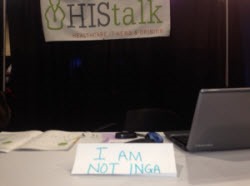
From Lorre: “Re: mHealth. So many people were coming up to me asking if I was Inga that I finally had to make this sign. I am going to get a well-made one for HIMSS. At one point today I showed someone my shoes and he said, ‘Yeah, you’re not her.’” Lorre was holding court at our little HIStalk booth at this week’s mHealth conference. I’m going to recommend that she not only get a better sign for HIMSS but step up her shoe attire, just to confound suspicious readers.

From Helen: “Re: mHealth Summit. I met Lorre – she rocks!” Lorre enjoyed meeting those (few) readers who attended the conference this week. I’m not sure it was relevant enough for a return next year, but we’ll see.

From ASMD: “Re: floppy disks. New York Times or Dilbert?” An article points out that government is not the most sophisticated technology user, noting that The Federal Register often receives submissions from federal departments via 3.5” floppy disks.


Acquisitions, Funding, Business, and Stock

12-10-2013 5-26-09 PM

HealthLoop, which offers an automated patient follow-up solution, raises $10 million in Series A funding led by Canvas Venture Fund. The company’s CEO is Todd Johnson, the former CEO and president of Salar.

IMS Health, a big data firm that aggregates and sells large databases of de-identified healthcare data, acquires Pygargus, a Swedish health analytics firm. Bloomberg, by the way, reports that IMS Health is considering an IPO in 2014 and  may seek a company valuation of at least $8 billion.


Sales

The Indiana HIE selects AT&T’s healthcare Community Online information exchange platform for clinical messaging and medical record sharing.

12-10-2013 1-49-05 PM

Crystal Run Healthcare (NY) selects the Health Catalyst data warehousing and analytics platform.

12-10-2013 1-48-17 PM

UF Health Shands (FL) contracts with Besler Consulting for its Transfer DRG recovery services.


People

12-10-2013 1-50-04 PM   12-10-2013 1-53-47 PM

HMS Holdings names Joel Portice (Verisk Health) divisional president of government solutions and corporate strategy and Douglas M. Williams (Aveta) divisional president of commercial solutions.

12-10-2013 1-54-45 PM

Teleheatlh solution provider AMC Health appoints Lisa J. Roberts (Viterion Corporation) SVP of its government market division.

12-10-2013 11-54-26 AM

Juan Diaz (Association Capital Resources) joins The HCI Group as SVP/general counsel.

12-10-2013 4-37-04 PM

Bobbie Byrne, MD is named SVP/CIO of Edward-Elmhurst Healthcare, created by the merger of her former CIO employer Edward Hospital and Elmhurst Memorial Healthcare. She will also have responsibility for the facilities and construction departments at Edward as well as the two locations of the Edward Cancer Centers.  

Next Wave CONNECT names Doug Cusick (HP/IBM), Robert Cothron (Singing River Health System), Becky Heflin (IBM), John McDowell (Oslo’s), and Sherry Reynolds (HHS) to its community management team.


Announcements and Implementations

12-10-2013 8-21-45 AM

St. Mary’s Health Care System (GA) makes the Epic MyHealth portal available for hospital patients.

Billings Clinic (MT) implements Omnicell automated dispensing cabinets integrated with Cerner Millennium EHR via the CareAware iBus.

Mercy Medical Center (MD) deploys BridgeHead Software’s Healthcare Data Management for the protection of its Epic system data.

PA eHealth, eVantage Health, and Caradigm will complete the pilot for their HIE project in early 2014.

The Mount Sinai Health System (NY) will use $5 million in funding from the NYC Economic Development Corporation to establish the Mount Sinai Institute of Technology. The Institute will initially focus on digital health technologies, biologically integrated technologies, and prescription technologies.


Government and Politics

The FDA, ONC, and FACC will release a report early next year outlining strategies and recommendations on an HIT framework that promotes innovation, protects patient safety, and avoids regulatory duplication.

Do as I say, not as I do: the OIG finds that the HHS Office of Civil Rights failed to comply with certain federal cybersecurity requirements for the IT systems used to store HIPAA-compliance investigation data. The OCR says all deficiencies have now been corrected.


Other

Almost 76 percent of the largest not-for-profit senior living organizations are implementing EHR technology and 83 percent are implementing point-of-care systems.

12-10-2013 12-25-49 PM

KLAS finds that despite vendor claims of the importance of technology differentiation, providers find that technology platforms do not accurately predict EMR capabilities or clinical success.

12-10-2013 12-45-36 PM

Also from KLAS: StatRad, Rays, and TRS earn top scores for overall customer satisfaction in a report on teleradiology in the ED.

12-10-2013 12-33-20 PM

Thanks to Brian Ahier for forwarding an updated graphic that clarifies the newly proposed timeline changes for MU. Brian notes, “I think the important point here is that although there will very likely be more changes to come, healthcare organizations and providers should not count on any delay or changes but prepare for plans to proceed under this current current regulatory framework.”

Further thoughts on the MU Stage 2 extension: the Stage 2 timeline is unchanged, as Brian’s graphic depicts. Just because Stage 3 has been pushed back a year doesn’t mean that ONC is ignoring concerns about Stage 2 as CHIME and other groups seem to assume by their ballistic reaction to the Stage 3 announcement. ONC’s decision-making process has been thoughtful, participative going back to when Farzad was named National Coordinator. ONC announced the Stage 3 decision Friday and mentioned this week that it will offer a public comment period for the regulatory strategy being worked on with HHS and FDA when that report comes out in in early 2014. Those events show show that nothing has changed just because Farzad has moved on – ONC is listening and won’t blindside anyone with salvos of dictatorial imperatives. The pundits are also missing another important point – decoupling product certification from MU gives vendors more predictable certification updates and the change to give input. Vendors can deliver what the market wants (usability and patient safety features, for example) instead of chasing certification checkboxes.

A Massachusetts man spends about $10 and 20 minutes to make a prosthetic hand for his 12-year-old son on a 3D printer using plans he found on the Internet. The estimated cost for a traditional prosthetic hand is $20-$30,000.


Sponsor Updates

  • API Healthcare reports that more than 250 hospitals and other healthcare providers have chosen its ShiftSelect to automate staffing and scheduling processes.
  • HMS will integrate Medi-Span Controlled Substances Drug File from Wolters Kluwer Health into its Prescriber Eligibility solution.
  • Visiongain includes AT&T and Airstrip on its list of Top 20 Mobile Health Companies for 2014.
  • Anthelio Healthcare Solutions and Encore Health Resources align to promote economies of scale and expand available services.
  • Certify will participate in next month’s IHE NA Connectathon 2014 in Chicago.
  • Caristix posts a white paper on managing predictable outcomes and margins with  HL7 integrations.
  • Iatric Systems hosts a December 12 webinar on integrating EHRs with Welch Allyn vitals.
  • Billian’s HealthData shares its list of the five most popular health market reports for 2013.
  • Twenty-nine percent of patients participating in the 2013 Connance Consumer Impact Study rate their most recent hospital billing experience with top satisfactions scores, though 19 percent express full dissatisfaction.
  • PeriGen hosts a December 11 webinar featuring the company’s chief clinical officer Thomas Garite, MD and a discussion on problems with Category II fetal heart rate problems.
  • KLAS gives 3M Health Information Systems the highest overall performance score among vendors for the 360 Encompass System, 3M’s inpatient CAC technology.

Contacts

Mr. H, Inga, Dr. Jayne, Dr. Gregg, Lt. Dan, Dr. Travis, Lorre

More news: HIStalk Practice, HIStalk Connect.

From the mHealth Summit 12/9/13

December 9, 2013 News 2 Comments

12-9-2013 5-01-58 PM

12-9-2013 4-00-25 PM

I’m at the mHealth Summit at the Gaylord National Resort and across the Potomac River from Washington, DC on the Maryland side. It’s a 2,000-room hotel surrounded by chain restaurants and stores in one of those destination developments aimed squarely at tourists who want to travel without being exposed to anything new, or heaven forbid, local (think Orlando on the Potomac. ) The weather has been terrible with snow and freezing rain, which has added to the feeling of captivity of being in a hotel intentionally located far from competing restaurants and stores and with no convenient shuttle service or Metro station access, meaning everything you eat or drink will cost twice what the market would otherwise command. It’s an expense account crowd, so they don’t seem to mind.

The last time I attended this conference was in 2010, when it was still being run by the Foundation for the National Institutes of Health and held in the Washington Convention Center. HIMSS took over in the meantime and attendance has more than doubled to around 5,000. Quibbles aside, HIMSS knows how to run conferences much better than the NIH, meaning there is good signage, an annoyingly peppy opening session featuring questionable curated pop music and lighting, and a strong vendor and commercial presence. It’s much more enjoyable.

I felt as though I had intruded on a geeky academic conference in 2010, although with Bill Gates, Ted Turner, and Aneesh Chopra speaking, the keynote star power was a lot higher then than now. Presentations back then were often about public health projects in Africa, government informatics research, and government policy. The “exhibit hall” was mostly just a part of the hallway where public health poster presentations were displayed, along with a modest presence by the telecom companies. I felt somewhere between virtuous and bored being there.

HIMSS, as it usually does, put all of that unsexy and unprofitable subject matter almost out of sight. Now the conference is a freewheeling ode to capitalism showcasing companies willing and able to pay big bucks for space in the exhibit hall and in the endless number of HIMSS-owned publications. The exhibit hall is like a downsized version of that at the HIMSS conference and most of the educational sessions are either about companies or feature vendor people as presenters or moderators. The attendee demographic seems to have shifted from a heavy non-US presence to the same kind of minimally diverse suited people who go to the HIMSS conference, except few of the folks here are from hospitals since we hospital rabble are seen as part of the problem, not of the solution.

HIMSS seems to be positioning the mHealth Summit as the minor league of its conference portfolio. Most of the small mHealth exhibitors will be toast in a couple of years, but those who survive will graduate to the big show, the HIMSS conference. It’s an untapped market for HIMSS since companies at this conference aren’t selling to hospitals and practices. It’s become more of an investment conference than anything else.

The same issues dominated this year as in 2010. Nobody’s really sure what mHealth is, basically punting off by saying anything that runs on a smart phone must be, which means the subject matter is entirely unfocused and confusing. Startup companies keep trying to convince each other that they can hang on long enough to be bought out. Everybody fervently believes that mobile apps and brash startup spirit can transform the US healthcare system into one that’s cheaper, more health-focused, and more consumer driven. It’s always easy for me to be cynical and dismissive, but especially so at the mHealth Summit.

Speaking of disruptive, I had firsthand experience with a business that truly is. Take a look at Uber, which is fairly new to DC and several other cities. Cab companies and the local governments that regulate and tax them are freaking out over Uber. You punch up on your smart phone that you need a run (either a limo-type service or  cab). Uber tells you how many minutes it will be until your car arrives, and you can watch it moving toward you in real time on a map. Your driver calls to confirm, takes you to your destination, and then you just walk away since Uber charges your credit card plus a 20 percent gratuity automatically. You don’t have to flag down a cab, figure out the whole payment forms/ tip / receipt issue, or explain on the phone where you need picked up. It’s pretty amazing, and clearly the deceptively simple app is connected to a super-sophisticated back-end system. I loved everything about it except the two cab problems that even it apparently can’t solve – my driver spoke no English and never heard of National Harbor so I had to punch it up on my phone and show him the screen so he could type it into his phone’s GPS.

12-9-2013 5-02-46 PM

The opening keynotes I saw all involved vendors or investors. It almost made me miss the puzzlingly unrelated but occasionally interesting HIMSS conference speakers, like Dana Carvey or that mountain climber who sawed his own arm off. The Qualcomm guy proudly mentioned its venture arm’s new investment in Practice Fusion, which has zero to do with mHealth, but given that everybody wanted to talk about investments and valuations, maybe he was just caught up in the moment.

Investor Ester Dyson was interesting, although a bit prickly. She observed that cell phones didn’t compete with land lines, they just showed up and created their own market. She said that mHealth is like that, where it doesn’t have to compete with or earn the approval of entrenched companies. She also observed that mHealth has too many iffy apps and not enough real companies.

AOL founder Steve Case said mHealth needs to move from features to products to platforms. He gave an example in the early days of the PC, companies did nothing but sell printer drivers, but that didn’t last long. He says the market will open up in 5-10 years (the timeline apparently hasn’t changed much since the 2010 conference since that’s what they were saying then). Steve’s Revolution Health was a flop so he got rid of most of it and turned it into an investment vehicle that doesn’t seem to have kicked much of a dent in the universe either, so I don’t know if finding a rich, clueless buyer for AOL right before the dot-com bust makes him a sage, so take it for what its worth.

Dyson made an observation I heard a couple of brave skeptics utter at the 2010 conference. All of these cool apps haven’t had much impact on health. One company doubled the rate of smoking cessation, but that was still a jump from just 5 percent to 10 percent. In 2010 they were talking about the need for more outcomes research; apparently there still isn’t much of it. Case may have explained that in his talk – healthcare and education are the two sectors in which consumers have so little influence (and government has so much influence) that you can’t encroach on them via consumer pressure, you have to partner with the entrenched players.

12-9-2013 4-57-29 PM

12-9-2013 4-58-58 PM

I floated around some sessions and the exhibit hall, not really seeing much that interested me. Apparently the Twitter crowd was more easily impressed since they were lighting up the Twittersphere with observations about both the educational sessions and the exhibits. The biggest and busiest booths were Qualcomm and the National Institutes of Health, which should illustrate my “unfocused” observation pretty well.

I went to a session on government mHealth policy and outcomes. Jodi Daniel of ONC said the FDA, HHS, and ONC are working on a draft strategy report related to the FDASIA report and the FDA’s potential role in regulating healthcare IT. She said the report will go out for public comment in early 2014. Credit ONC for always trying to get input from all stakeholders before just laying the law down.

12-9-2013 4-54-25 PM

The exhibit I appreciated most was Alego Health, which not only had a bartender handing out wine and beer, they also had a nice cheese board that prevented me from having to pay $8 for a cold wrapped sandwich. I looked them up and they do EMR consulting, which doesn’t seem like a good fit for this conference, but I was glad to see them.

12-9-2013 5-00-06 PM

The exhibit hall had an Innovation Zone, where smaller, newer companies got a small demo space in a dedicated area in the back.

12-9-2013 5-06-45 PM

We had a little HIStalk booth (a freebie from the conference people as a media partner, meaning we write about the event, like right now) where Lorre said hi to anyone who dropped by. Enough people were convinced that Lorre is actually Inga and challenged her on it, so we made her a sign to put front and center assuring that she isn’t. She will be in the booth again tomorrow (#1305).

I’ve chosen some session for Tuesday that sound interesting. It’s fun to see a different side of healthcare and healthcare IT than I’m used to as a hospital person. If you’re at the conference, feel free to leave a comment with your takeaways so far. Let me know if you saw something amazing in the exhibit hall that I shouldn’t miss.

Curbside Consult with Dr. Jayne 12/9/13

December 9, 2013 Dr. Jayne 1 Comment

CMS tried to bury it with a late press release on a Friday afternoon, but their proposed extension of Meaningful Use Stage 2 is already making waves. Initially it seems there was quite a bit of confusion about “delaying Stage 2” when the start date doesn’t change. For those of you who haven’t read the actual CMS release (the site was unresponsive most of the times I tried today), the key point is that Stage 2 will be extended through 2016 and Stage 3 will begin in 2017 for those providers that have completed at least two years in Stage 2.

Clear as mud? I thought so. CMS claims the change will allow it to focus on successful implementation of the Stage 2 requirements and also to allow it to use Stage 2 data to “inform policy decisions for Stage 3.” What does this mean for those of us in the trenches, particularly small practices? Is Stage 2 going to be a “best two out of three” where if you miss in one of the years, you can use a mulligan? Are they going to use the data to see that people are failing and make Stage 3 more realistic? Will they see that people are opting out by abandoning Medicare and make some changes? I doubt it.

If CMS really wanted to make a difference for rank and file providers (keeping in mind that not everyone is employed by a hospital, health system, or large medical group) it would remove the need for Eligible Providers to meet every requirement in an all-or-nothing fashion. Our hospital has an entire team of people devoted to keeping up with CMS and reading all the FAQs. The team subsequently educates the employed physicians. I can’t even fathom what it would be like to be in a solo practice or a small group and to try to keep up with it all.

The release summarized the goals of Meaningful Use. It’s been a long time since I read the initial announcements and documentation from CMS and maybe in trying to keep up with all the details I had forgotten what they were. Seeing them again struck me a little funny: “The phased approach to program participation helps providers move from creating information in Stage 1, to exchanging health information in Stage 2, to focusing on improved outcomes in Stage 3. This approach has allowed us to support an aggressive yet smart transition for providers.”

Really? Aggressive yet smart? In my experience as a CMIO having to coach my peers through this, it hasn’t seemed very smart. Although we’re certainly creating a lot of information, it doesn’t feel like most physicians are using it to do anything other than check the boxes for the Meaningful Use requirements. Why couldn’t we have followed Stage 1 with an outcomes stage directly related to the data collected initially? Exchanging information is important, especially for patients who see multiple physicians and receive care in multiple environments, but putting too much focus on it seems a bit like putting the cart before the horse.

In Stage 1, providers are busy clicking boxes about tobacco use, gathering structured ethnicity and race data, and essentially doing nothing with it. I’m not seeing many of my peers using that information to better their attempts to help their patients stop smoking let alone to create or improve population-based interventions based on the makeup of their patient panels even though they now have that data. Physicians feel like they’re on a hamster wheel with no way off and are not making the connection with how the data will be helpful in the future.

In putting outcomes last, CMS shows they’re focused on large-scale outcomes rather than the micro-type outcomes that lead to better health for individuals. In looking at how public health has tackled population-based problems in the past, we’ve seen that it can take decades to move the needle where national health issues are concerned and sometimes we aren’t moving it anywhere near enough, such as with obesity.. Most of my physician colleagues are focused more on individual outcomes and work to do their best for every patient each time he or she is seen rather than worrying about everyone out there.

It’s challenging to get them to think about populations when they’re trying to figure out how to get the patient in front of them enrolled in multiple pharmaceutical company patient assistance programs, how to arrange transportation to other appointments, how to order tests and referrals, and how to address multiple mental health issues all in a 10- to 15-minute appointment. Additionally, let’s not forget trying to get all these services pre-authorized and pre-approved because insurance companies try to block them even though they’re medically necessary. And they’re also doing it while trying to see enough patient volume to pay for employees to handle all of the above so they can actually care for patients.

Hindsight is 20/20, but it seems like it would have made more sense to put in place strategies for physicians to see how gathering discrete data can be of benefit and use those experiences to encourage people to continue through the Meaningful Use program. For those of us in groups that were ahead of the game and have been gathering that data and using it for years, how about bonuses for moving more quickly through the program?

In the announcement CMS also notes that this timeline shift will allow “more consideration of potential Stage 3 requirements [and] additional time for preparation for enhanced Stage 3 requirements.” Any Eligible Providers who don’t think this is an opportunity to make Meaningful Use even more arduous and complicated than it already is should rethink their impressions of the program. There are some providers out there who actually think this is just a three-act play. I would be shocked if Stage 3 is the end.

CMS plans to release a Notice of Proposed Rulemaking for Stage 3 in the fall of 2014 along with the 2017 Edition of the ONC Standards and Certification Criteria. The final rule is to be released in the first half of 2015 which still only gives providers and hospitals (not to mention vendors) about a year and a half to be fully compliant. That certainly doesn’t feel like we’re coming off the treadmill as much as most of us would like.

Organizations such as CHIME have already come out stating that the timeline shift doesn’t change the fact that Stage 2 and ICD-10 are going to hit at the same time in a “perfect storm.” CHIME is pushing for flexibility in the start date of Stage 2. HIMSS is supportive of the extension but continues to ask that the first year of Stage 2 allow at least 18 months for attestation.

I did find one bit of silver lining in the announcement, and that is the voluntary nature of the 2015 Edition of certification criteria. The release specifically states that providers will not be required to upgrade to a 2015 Edition EHR and vendors who have certified to the 2014 Edition would not need to recertify. Since I’m already on a certified version that’s ready for Stage 2, it is a relief to not have to take another major regulatory upgrade for a while. Instead we can focus on updates that bring actual clinical functionality to help our patients which unfortunately feels like a novel concept, assuming our vendor is able to get back to the development plans they had before Meaningful Use reared its sometimes-ugly head.

The devil will be in the details, but I’m not going to lose sleep waiting to find out what they are. I strongly suspect our hospital will elect to continue on our current trajectory (minus the anticipated Stage 3 payments for 2016.) Unless CMS pulls a rabbit out of its hat, we’ll be OK. What do you think about the proposed changes to the MU timeline? Email me.

Email Dr. Jayne.

Monday Morning Update 12/9/13

December 7, 2013 News 8 Comments

12-7-2013 7-45-29 AM

From Beyond the Legalese: “Re: revised Stage 2 timelines announced late Friday. What exactly does this delay mean? If we are a hospital that must attest to Stage 2 by end of fiscal year 2014, does this mean we now have until end of fiscal year 2015 for our first MU2 attestation year?” My impression is that the Stage 2 start date hasn’t changed, only the end date, so it’s not really a “delay” as much as it is an “extension” to make Stage 2 a three-year program. In that regard, I’m not sure the extension is cause for universal celebration since the 2014 dates remain unchanged for Stage 1 and Stage 2 – it’s really only Stage 3 that has been delayed. Feel free to leave a comment. CMS and ONC “announced” the change in a potentially obscure blog post late on a Friday without making supporting material available to clarify, but I expect they will provide more details. CHIME is already complaining that the 2014 start dates haven’t changed as it and other organizations wanted (nobody feels guilty about looking the taxpayer gift horse in the mouth, apparently.)  

From The PACS Designer: “Re: smartphone overview. With the holiday season upon us, TPD thought it would be useful to post features of the smartphones currently available from various sources. As smartphones get more integrated into everything we do daily, it’s important to match the intended use with the right smartphone features, whether it be iOS or an Android system.”

12-6-2013 3-46-17 PM

Respondents are split on whether the FDA should regulate clinical software to any degree. New poll to your right: have you made a personal medical decision based on published hospital quality data in the past one year? I’ll admit that having worked almost my entire adult life in hospitals, I’ve never looked at the published quality data of local hospitals, including my own (although I’ve also never been hospitalized, so I had little motivation.)

I’ll be writing from the mHealth Summit this week. Drop by the microscopic HIStalk booth (#1305) and say hello if you are so inclined. The event has more than doubled in attendance since the last time I attended in 2010 and I’m hoping that the conference logistics have improved after HIMSS took it over from the National Institutes of Health.

12-6-2013 4-39-53 PM

Welcome to new HIStalk Platinum Sponsor Juniper Networks. A secure, reliable network is mandatory for EMRs, HIEs, telemedicine, PACS, high definition video, remote patient monitoring, real-time wireless location, and mobile clinicians. Juniper’s Healthcare Network Solution provides clinician access from any mobile device, secure access to patient records, a single user policy for all network points, and reductions in cost and risk via a unified wired and wireless infrastructure. Juniper’s WLAN solution provides the highest levels of reliability, scalability, management, and security to meet the needs of a mobile healthcare workforce. See “Top 10 Reasons Healthcare Prefers Juniper Wireless.” A case study quote from Juniper customer Lurie Children’s Hospital (IL): “We need to broker the complex relationship between stability and speed. We want to be able to put new applications on the network and adjust the network to meet the need. But on the other hand, we want to retain a stable network. We need a network that has very predictable behavior.” Juniper powers 60 percent of the world’s Internet transactions. Thanks to Juniper Networks for supporting HIStalk.

I found this new Juniper Networks video on YouTube.

Thanks to the following sponsors, new and renewing, that recently supported HIStalk, HIStalk Practice, HIStalk Connect, and HIStalk Webinars. Click a logo for more information.

12-6-2013 4-03-56 PM
12-6-2013 4-05-11 PM
12-6-2013 4-09-48 PM
12-6-2013 4-15-53 PM
12-6-2013 4-16-41 PM
12-6-2013 4-17-49 PM
12-6-2013 4-18-40 PM
12-6-2013 4-19-27 PM
12-6-2013 4-20-16 PM
12-6-2013 4-21-34 PM
12-6-2013 4-22-29 PM
12-6-2013 4-23-27 PM
12-6-2013 4-24-58 PM
12-6-2013 4-25-48 PM
12-6-2013 4-31-56 PM
12-6-2013 4-27-10 PM
12-6-2013 4-28-09 PM
12-6-2013 4-30-18 PM
12-6-2013 4-31-06 PM
12-6-2013 4-33-03 PM
12-6-2013 4-33-51 PM
12-6-2013 4-35-02 PM
12-6-2013 4-36-12 PM
12-6-2013 4-37-09 PM
12-6-2013 4-38-17 PM 

Medicaid fraud is too common to be newsworthy, but not when foreign diplomats are involved. Among the 49 people charged with defrauding Medicaid of $1.5 million are dozens of Russian diplomats and their wives, who federal prosecutors say misstated their income to get Medicaid to pay their medical bills and then used the money for luxury vacations and helicopter rides. The government, of course, didn’t blame itself for happily paying the bills of non-citizens.

12-6-2013 7-59-11 PM

Nashville-based healthcare IT consulting firm eMids raises $13 million in funding.  

12-7-2013 6-52-41 AM

Emory University Hospital (GA) uses IBM InfoSphere Streams real-time analytics and data acquisition software from Excel Medical Electronics to analyze ICU patient data in real time. If you want to play around with stream computing, there’s a free download of InfoSphere Streams.

12-7-2013 7-50-25 AM

Huntsville Hospital Health System (AL) chooses Caradigm Health Information Exchange to connect its affiliates. Caradigm signed a partnership deal earlier this year to market Orion Health’s HIE product.

A former Epic employee files a class action lawsuit against the company, claiming he and hundreds of other Epic quality assurance employees should have been paid overtime wages over several years. Epic disagrees, saying federal law is clear in classifying QA people as salaried rather than hourly.

12-7-2013 7-05-04 AM

Keith Seaman (Department of Veterans Affairs) joins VMware as chief technology executive for healthcare.

Saint Francis Health System (OK) chooses Epic.

Norton Healthcare (KY) reports that it has earned $12 million in HITECH payments in the third year of its $200 million, five-year Epic implementation.

Houston Methodist Hospital reports that a laptop containing the information of 1,300 transplant patient was stolen last week, but as is rarely the case when these announcements are made, the laptop was encrypted.

12-7-2013 7-40-39 AM

A 22-year-old woman sues a doctor, Northwestern Memorial Hospital, and the Feinberg School of Medicine (where the doctor is a pain management fellow) after he posts pictures of the woman drunk in the ED on Facebook and Instagram. The doctor also posted a Facebook invitation to join him for cocktails near the ED while waiting for the woman to recover from alcohol poisoning. He wasn’t actually her doctor – he came to the ED at the request of a mutual friend – and the hospital now claims he inappropriately accessed the patient’s medical records.

Illinois chiropractors consider going off the insurance grid and making patients pay cash due to high patient deductibles, medical coding issues, and the cost of software. According to one chiropractor, “The Affordable Care Act will make deductibles so high that people will soon be paying out-of-pocket for chiropractic medicine anyway. So why not go cash-only? This way, I can get rid of the headache of dealing with insurance companies, bring costs down for my patients, and get back to spending more time helping people.”

Ed Marx got a lot of responses to his “Identity and Leadership” CIO Unplugged post last week and has decided to delve deeper into the topic in the specific areas of titles and physical appearance. Watch for his next post.

The last 100 directory assistance operators in Connecticut will lose their jobs in February due to smart phones, which caused 411 calls to drop by 70 percent in the last three years.

12-7-2013 6-41-08 AM

Congratulations to those physicians (Dr. Jayne among them) who received notice Friday that they passed the exam to become board certified in clinical informatics.


Contacts

Mr. H, Inga, Dr. Jayne, Dr. Gregg, Lt. Dan, Dr. Travis, Lorre.

More news: HIStalk Practice, HIStalk Connect.

125x125_2nd_Circle

CMS Proposes Meaningful Use Stages 2/3 Pushback

December 6, 2013 News 9 Comments

12-6-2013 5-07-29 PM

CMS has proposed a new Meaningful Use timeline that would extend Stage 2 through 2016. Eligible providers who have completed two years of Stage 2 would begin Stage 3 in January 2017.

CMS and ONC say the relaxed timeline will allow more thoughtful review of stakeholder feedback and data collection and give vendors more time to prepare their systems for Stage 3 requirements. Several industry groups had called for a Stage 2 delay.

ONC is proposing that certification criteria be updated more frequently, including a 2015 Edition that would be optional for providers and vendors already certified under the 2014 Edition criteria.

News 12/6/13

December 5, 2013 News 8 Comments

Top News

12-5-2013 8-03-31 PM

Healthcare Informatics owner Vendome Group acquires The Institute for Health Technology Transformation (IHT2), which offers executive health IT conferences, webinars, and research reports.


Reader Comments

12-5-2013 8-52-52 PM

From Quilmes Boy: “Re: Medseek. Underwent another round of layoffs this morning. My role was one of them.” Medseek CEO Peter Kuhn provided this response to our inquiries: “Over the past 12 months, Medseek has developed a significant offshore development operation, adding almost 150 personnel in India to accelerate product development and enable us to respond quickly to changing market dynamics and evolving customer requirements. In addition, weeks ago we funded the acquisition of Madison, WI-based Symphony Care, a leading population health and care management solution provider. Today, the company initiated a planned restructure to take full advantage of these recent investments. Medseek has retained all key personnel to deliver on customer commitments and deliver on near and long-term strategic goals.”


HIStalk Announcements and Requests

inga_small Some recent goodies from HIStalk Practice include: McKesson may close its Seattle office. Physician EMR adoption in the US is up but still lags behind many countries. Texting while doctoring could negatively impact patient care and safety. CMS finalizes the 2014 Medicare Physician Fee Schedule, which includes a 24 percent pay cut if the SGR formula is not amended. Patent data from EHRs provide reliable measures of the process of care and the patient-centeredness of a primary care practice. A gastroenterologist finds pleasure in his move to a low-tech office. Lab ordering rates among primary care physicians decline with providers have a real-time display of cost information within their EMRs. Dr. Gregg takes a trip back to the future. Thanks for reading.

On the Jobs Page: Program Manager – Healthcare Resellers.


Upcoming Webinars

December 17


How to Drive ROI in Your Healthcare Improvement Projects,” presented by Bobbi Brown and Leslie Hough Falk, RN, MBA, PMP of Health Catalyst. Sponsored by Health Catalyst. Tuesday, December 17 at 1:00 Eastern. At a time when average hospital’s margins are stagnating, executives should be asking tough questions about the ROI of "indispensable" technologies. Will new technologies prove their worth or drive them further into the red? How do you measure and track ROI?

December 10
  

Paperless Practices: Harnessing EHR Value by Improving Workflows with Electronic Data,” presented by Jay Ward of Kryptiq, Mike Kelly of DocuSign, and Sam Clark of  Asheville Head, Neck, & Ear Surgeons, P.A. Sponsored by DocuSign. Thursday, December 10 at 1:00 Eastern. During this Webinar, panelists will discuss how industry and market trends have aligned to rationalize the adoption of e-signature in healthcare. They will also review primary, practical considerations such as legality, security, and mobility. Finally, panelists will highlight case studies and relevant examples of organizations that have successfully jumped onto the “path to paperless”.

December 11

 
Audit Readiness: Three Simple Steps to Protect Patient Privacy,” presented by Mark Combs of WVU Healthcare System and Rob Rhodes of Iatric Systems. Sponsored by Iatric Systems. Wednesday, December 11 at 2:00 Eastern. Join us for this insightful Webinar to learn what you can do to keep your healthcare organization safe from unauthorized access to patient data.

December 12


Looking Behind the Curtain: Value Based Care’s Impact on the Revenue Cycle ,” presented by Karen Marhefka, MHA, RHIA of Encore Health Resources. Sponsored by Encore Health Resources. Thursday, December 12 at 1:00 Eastern. This webinar provides a basic understanding of value-based health care, or accountable care, explain why value-based reimbursement may not impact the core revenue cycle components immediately, discuss the key focal points for change needed to maintain profitability in a value-based reimbursement model, review why organizations will be pressured to consolidate revenue cycle systems, list the type of tools that are being introduced or are changing with the move to value-based reimbursement and name the major changes that will be required from organizations to move to value-based care and reimbursement.

December 17
The Power of Doctor Happiness: Why The Ideal Patient Experience Needs to Start with the Ideal Provider Experience,” presented by Lyle Berkowitz, MD, FACP, FHIMS (DrLyle). Sponsored by HIStalk. Thursday, December 17 at 2:00 Eastern. Hear from a "Doctor Happiness Guru" who describes how to think innovatively about using healthcare IT in ways which can automate and delegate care, resulting in time savings to doctors as well as improved quality and efficiency for patients.


Acquisitions, Funding, Business, and Stock

12-5-2013 5-49-33 PM

ClearDATA Networks closes a $14 million Series B funding round.

Accelera Innovations will pay $4.5 million in cash for Behavioral Health Care Associates, a billing and PM provider.
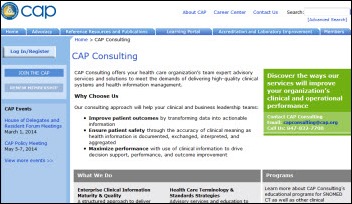
12-5-2013 6-48-07 PM

The College of American Pathologists (CAP) confirmed with Inga that it will shut down its CAP Consulting business over the next few months, concluding that, “The Board decided to exit the CAP Consulting business, our division located in our Lake Cook Road office that provides terminology and clinical information consulting services. CAP Consulting has made steady progress against its business objectives over the past several years; the services it provides are incredibly important and valuable. But with current fiscal constraints, the CAP is not able to continue to invest at the level needed to sustain and grow the business.” Employees were told on November 21. CAP hopes to place those affected in open positions, but also recognizes that the vendors it works with may have an interest in hiring them. CAP will continue to support existing products such as Electronic Cancer Checklists and Electronic Forms and Reporting Module.
12-5-2013 9-50-01 PM

Carl Icahn raises his stake in Nuance to nearly 19 percent of the company’s shares. NUAN shares rose around 6 percent in the past week.


Sales

St. Luke’s Hospital (TX) will add Craneware’s Pharmacy ChargeLink.

San Diego Orthopaedic Associates Medical Group (CA) selects SRS EHR.
12-5-2013 5-54-24 PM

Marin General Hospital (CA) engages MedAssets to support the optimization of clinical support resources through cost and operational management improvements.

Baptist Health South Florida will implement the Medseek Empower enterprise patient portal and integrate it with its existing Siemens and NextGen EMRs.
12-5-2013 7-25-07 PM

Banner Health selects Wolters Kluwer Health’s Health Language solutions to navigate the ICD-10 conversion process.

University Physicians of Brooklyn-Anesthesia (NY) will implement OpenTempo’s staff scheduling and case management solutions.


People
12-5-2013 3-59-33 PM

Experian names Jennifer Schulz (Visa) group president of its vertical markets group, which includes the company’s healthcare business. Its healthcare-related acquisitions include SearchAmerica (December 2008), Medical Present Value (June 2011), and Passport Health Communications (November 2013).

12-5-2013 8-24-11 PM

The National Association of Professional Women names Trudy Easton, RN, senior clinical consultant with McKesson, as its Professional Woman of the Year.

MedSynergies hires Doug Hansen (Accelion Health) as CFO.


Announcements and Implementations
12-5-2013 9-52-27 PM

Homecare and medical staffing company Interim HealthCare implements Procura Home Care Software across 47 locations.

Pediatric genetic testing laboratory Claritas Genomics will implement Cerner’s Millennium Helix solution, join Cerner’s Reference Lab Network, and collaborate with Cerner to develop a laboratory solution for molecular diagnostics. Cerner Capital has also invested in Claritas, closing the company’s Series A round.

Impact Advisors completes a feasibility analysis for Sutter Health (CA) that consider the possibility of Sutter sharing its EHR platform with a community hospital.

Healthix and the Brooklyn HIE (NY) complete their merger and will combine their separate technology platforms over the next year. The organization will retain the Healthix name.

PerfectServe introduces Clinical Event Push, which automatically informs physicians of important clinical events as they occur.

Coastal Healthcare Consulting announces Fusion, a solution to help healthcare organizations achieve peak performance from their EMR investment.

12-5-2013 9-21-07 PM

Mediware releases the MediLinks WTS workload solution for respiratory therapist staffing. 


Government and Politics

ONC’s HIT Policy Committee votes to urge HHS to abandon a proposed requirement for providers to give patients reports showing who looked at their EHR data. Though patient advocacy groups support the requirement, opponents claim the option would be technically impractical and administratively burdensome.

CMS reports that 85 percent of eligible hospitals have received a MU incentive payments through the end of October and 60 percent of Medicare EPs are meaningful users. Agency representatives also note that 89 percent of EHs have attested to Stage 1 MU using a primary vendor that had any 2014 edition product, while 70 percent of EPs used a primary vendor that had any 2014 edition product.

12-5-2013 1-35-14 PM

Rep. Scott Peters (D-CA) introduces the Health Savings Through Technology Act, which would create a commission to investigate how digital health technologies could help reduce healthcare costs and how they could be integrated into federal healthcare programs.


Innovation and Research

Researchers find that physicians who receive email notifications of lab results for tests pending at the time of patient discharge are significantly more likely to be aware of abnormal test results. Authors of the AHRQ-supported study suggest that widespread use of such automated systems could improve patient safety.

When it comes to HIE adoption, physicians are more influenced by other physicians with whom they interact and have common patients than by geographical proximity or other factors, according to a study published in the Journal of the American Medical Informatics Association,


Technology
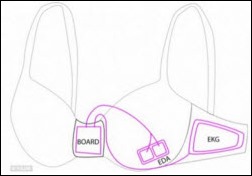
12-5-2013 9-50-31 AM

inga_small Microsoft researchers develop a smart bra prototype embedded with sensors that flash smartphone warnings when the wearer’s mood suggests they might be about to eat too much. Enterprising hackers would be well advised to seek fast food chains willing to underwrite lingerie infiltration activities to redirect consumers’ dietary choices.

12-5-2013 7-01-41 PM

A study of 19 healthcare systems using the Philips eICU ICU telemedicine system finds that mortality and length of stay were reduced, adding that patients were 26 percent more likely to survive their ICU stay and were discharged from the hospital 15 percent faster. The study also identified the most important criteria in delivering patient care and cost benefits from an tele-ICU program:
12-5-2013 7-00-32 PM

I spoke to principal author Craig M. Lilly, MD, professor of medicine, anesthesiology, and surgery at the University of Massachusetts Medical School and director of the eICU program at UMass Memorial Medical Center (MA), who told us, “All of the things we found made sense." The most important factors affecting patient outcome and cost were:

  • Having a remote or local intensivist review the patient and care plan within an hour of ICU admission
  • Reviewing the results of the program regularly
  • Responding faster to patient alerts and alarms
  • Following ICU best practices
  • Conducting interdisciplinary rounds
  • Running an effective ICU committee

Lilly clarified that the organizations studied were hospitals which had not outsourced their intensivists to a for-profit company.

I asked about previous vendor-supported studies that claimed benefits from tele-ICU programs that independent studies rarely validate. He emphasized that no commercial ties existed in this study. "Any meta-analysis that’s done going forward will definitely show improvement whether you include or whether you exclude the studies that were done by the commercial manufacturers."

Several health systems have shut down their tele-ICU programs due to cost and questionable benefit, most recently MaineHealth, and I asked Lilly about that. He said, "The MaineHealth outcome is really interesting. They had withdrawn it from about 35 community hospital intensive care beds and those folks actually signed up with another vendor. Even though MaineHealth wasn’t going to support it or subsidize it — and they were providing a pretty darned good subsidy, I can tell you, to have it in these community hospitals, which I think is when it became financially unviable and that was one of the reasons they wanted to cut it down — these other community hospitals absolutely saw the value in it for their patients and also for their financial outcomes.They signed up with another vendor and paid a lot more money to do so."

In summarizing his study, Lilly told me, "It didn’t matter whether you had in-house intensivists or didn’t and a lot of these places did. They still got better when they added this layer on. Even though they had somebody in house, that person couldn’t be everywhere they needed to be when they needed to be there. Because while they were dealing with the emergency in Bed 1, the patient in the the ICU three floors above them in Bed 7 was really getting sick and they didn’t know about it. This technology allowed hospitals with good intensivists and great bedside nursing to get the right expertise when they needed it, where it needed to be there because they were able to get on the alerts and alarms in less than three minutes and they couldn’t before."


Other

Allscripts India opens a new and expanded office in Vadodara to house 275 existing employees and to accommodate up to 400. Allscripts has 2,000 employees in India, up from 850 in 2010.

A psychiatrist warns peers about blanket authorizations that patients sign to get their insurance companies to pay for their care, with an example of a subsidiary of Quest Diagnostics requesting the complete paper file on one of his patients. He found that the company mines prescription data and sells it to life insurance companies to consider when deciding whether to issue policies. Psychiatric News, which ran the story, said, “Steven Daviss, MD, chair of the APA Committee on Electronic Health Records, told Psychiatric News that health information exchanges (HIEs), which connect different sources of patient health care data for the use of practitioners caring for patients, can also be an unexpected source of sensitive information. In Maryland, for example, the HIE contains information on hospital treatments, laboratory and radiology data, diagnoses, and medications. ‘This is valuable information that improves the continuity of care, but states have different policies regarding access to these data beyond treatment purposes,’ he said. ‘Most states have mechanisms that allow one to opt out of the HIE and to see who has accessed your information.’”
12-5-2013 10-02-58 PM

Boston Children’s Hospital (MA) reports a substantial drop in medical errors with the introduction of more standardized communication during patient handoffs, including a structured handoff tool within the EMR that self-populates standard patient information.

Vendors, beware: lawsuit-happy MMRGlobal is awarded its tenth healthcare IT patent entitled “Method and System for Providing Online Records,” which covers prescription and appointment reminders as well as e-prescribing.
12-5-2013 7-43-28 PM

A New York Times opinion piece by Pulitzer-winning writer Tina Rosenberg says hospital quality data is inconsistently reported and hard to understand. She says, “But at times it seems as if hospitals aren’t trying very hard. They like to report process measures on which they score well. But with 440,000 deaths from hospital error per year, their record is poor on key safety outcomes. This somewhat dampens their enthusiasm for public reporting. And what hospitals want matters a lot.”
12-5-2013 7-52-42 PM

A study finds that hospitals have a median of two employees assigned to manage population health, with mid-level managers being the most likely to be involved. It concludes that hospital population health approaches are inconsistent and poorly integrated.

In Europe, big drug companies are enlisting patient groups to lobby against legislation that would require them to publish all results of clinical trials, not just favorable ones, so that independent researchers could validate their conclusions. The two drug company trade associations want patient advocates to protest the release of such data by expressing concerns that it would be misinterpreted by non-experts. According to a trade group SVP, “EMA’s proposed policies on clinical trial information raise numerous concerns for patients. We believe it is important to engage with all stakeholders in the clinical trial ecosystem, including the patients who volunteer to participate in clinical trials, about the issue. If enacted, the proposals could risk patient privacy, lead to fewer clinical trials, and result in fewer new medicines to meet patient needs and improve health.”

Adoption of core medication MU elements reduces adverse drug event rates with cost savings that recoup 22 percent of IT costs, according to a study published in the American Journal of Managed Care.

12-5-2013 6-40-22 PM

An op-ed piece in New England Journal of Medicine reviews the OpenNotes initiative that calls for patients to have access to the notes made about them by their clinicians, citing previous studies showing that most patients read the notes and reported improved understanding, medication adherence, and feeling of control, with the vast majority of both patients and clinicians urging that the program continue. However, the article finds that while electronic medical records created the opportunity, they also complicate it:

Early adopters are learning that implementation means more than simply mailing notes or visit summaries or having patients log on to a portal. For starters, the knowledge that patients (and often their families) will have access to records affects the intent and sometimes the content of clinical documentation. Writing accurately about a suspicion of cancer, for instance, can be difficult for clinicians who don’t want to worry patients unnecessarily, and addressing character disorders or cognitive dysfunction in ways that are useful to patients, consulting providers, and others who use the records requires carefully considered words. These challenges are compounded by today’s electronic records, in which the story weaving together social, familial, cultural, and medical contributors to the patient’s health and illness often disappears, obscured by templates. A boon to billers, quality assessors, and researchers, such records can become formulaic and susceptible to data-entry errors. Moreover, they’re often filled with copied-and-pasted information that buries the essential narrative under voluminous repetitive text.

You may think you possess an unnatural ability to speak Siamese Thai when watching this video from Bumrungrad International Hospital in Thailand that describes its planned January go-live with inpatient nursing documentation using Medicomp’s Quippe.
12-5-2013 7-34-04 PM

Weird News Andy racked his brain to come up with “From Doobies to Boobies” as his working title for this article, which describes the potential for marijuana smoking to cause gynecomastia in men (i.e., moobs). WNA also likes the story of Ben Taub Hospital’s ED director (above), who is charged with breaking into the home of another female physician and using red lipstick to write “whore” and “homewrecker” on her bathroom mirror, presumably for reasons not involving emergent care.


Sponsor Updates

  • Clinical insights platform vendor QPID is named a finalist for a publisher’s innovation award, as chosen by a panel of hospital CIOs and other executives.
  • Greythorn conducts a market survey for HIT professionals to analyze compensation, benefits, job satisfaction, hiring trends, and industry participation. Greythorn will donate $1 to the Boys and Girls Clubs of Bellevue and Chicago for every submission.
  • MedcomSoft partners with Liaison Healthcare to connect its Record EHR platform to more than 120 labs and imaging centers integrated within the Liaison EMR-Link Lab Hub.
  • Aprima Medical integrates DMEhub into its EHR, allowing physicians to write orders for durable medical equipment directly from their Aprima EHR.
  • First Databank begins publishing the National Average Drug Acquisition Cost pricing file from CMS.
  • Aspen Advisors spotlights Baystate Health’s (MA) EHR optimization efforts following Aspen’s review and analysis of the organization’s EHR options.
  • API Healthcare highlights the top 10 interview questions to ask nurses.
  • The Indiana HIE details its work with Predixion Software to develop predictive analytics healthcare solutions at this week’s National Readmission Summit.
  • Truven Health Analytics extends its contract to use Post-n-Track’s cloud-based web services platform for the exchange of eligibility data.
  • AT&T launches EverThere, a wearable device that connects to a 24/7 call center if it detects that the wearer has fallen.
  • Impact Advisors principal Laura Kreofsky discusses the sharing of patient data between hospitals.
  • Quantros launches Quantros Member Center, a customer portal that provides immediate access to support cases, training videos, release notes, and user groups.

EPtalk by Dr. Jayne

From The Grey Goose: “Re: RSNA. Booth traffic felt like it was up. The temps were much warmer than last year (except they dip to the 20s later this week) so that probably helped improve the moods. All the big anchor exhibitors continue to improve their booths – more flash, more high tech, better organized space – so people wouldn’t get log-jammed in the middle. Lots of focus on moving data to HIPAA-compliant clouds and being able to access it securely on any device, anywhere. Folks not looking at that seem to be in the minority now which is a big shift from a year or two ago. People want to be more efficient to drive down costs in the land of Obamacare.” Thanks for sharing your experience. It’s great to have roving reporters fill us in on the meetings we’re not able to fit onto our busy dance cards.
clip_image002

From Converse All-Star: “Re: your Thanksgiving column. Mentioning readers sending photos of shoes brought to mind a pair of shoes that my lovely wife possesses. As you might expect, she saves them for special occasions and they also occupy a place of honor in our closet at home.” I’ll let our readers guess what state they represent. The coordinating scarf definitely puts these over the top! Is this the beginning of a 50-state themed challenge? Or better yet, perhaps we could convince The Walking Gallery’s Regina Holliday to branch out into shoes?

Dr. Jayne’s HIMSS Registration Update
clip_image003

More fun and games on the HIMSS website this week. After the HIMSS14 registration site couldn’t figure out how to charge my membership, I decided to go to the HIMSS main website to try to update my membership first so I wouldn’t have to do that step on the conference page. No luck – this critical error message was all I received. The site also refuses to recognize my MD and I can’t figure out how to update that part of my demographics (although it does refer to me as “Dr.” so it’s even more confusing).

I tried it again a couple of days later. I didn’t get the critical error, but when I tried to renew my membership, it adjusted the expiration date by a month since I’m renewing before mine expires, making it effectively only good for 11 months. At that point I was just glad my housing reservation was successful. I gave up for the night.
clip_image005

I decided to go back to the conference website and try it again that way. I am still receiving an alert that it can’t find the pricing for a membership renewal, but at least it has my expiration date in the wrong year. For those of you who are not familiar with the concept of positive pessimism, that’s an example: following up a negative statement with another negative statement to take the edge off the current problem. You’ll learn more about it if you are actually able to register for HIMSS and stay until Thursday to hear Erik Weihenmayer speak. He’s one of the best motivational speakers I’ve heard.

clip_image007

I tried to do it again without the membership renewal (thinking I’d try to do it on the main HIMSS site in January) and got this great new alert. Unfortunately it doesn’t tell me what to do with “please note” rather than “error” or “warning.” Perhaps we could use this as a testing scenario for next year’s Clinical Informatics board exam. Is anyone else having these issues? Or is it as I suspect and half the attendees are either vendors or media so they have a different registration process entirely and no one has complained yet?

I finally broke down and called because I didn’t want to miss the Early Bird discount. I was directed into a phone queue that didn’t have an option that applied to my scenario. Unfortunately the best advice the live agent could give was, “log out and log in again” and we all know how much end users love to hear that. I explained that I had been trying to register using multiple browsers on multiple different devices over many days, so I didn’t think logging out would help.

I asked if they could manually register me. She had to ask a supervisor. Ultimately the blame was placed on the data file that HIMSS sent with the incorrect expiration date, although they said they had no access to the file to try to verify the correct dates. After roughly half an hour of back and forth, they were able to shadow me in their system and bypass the problematic steps, so I suppose now I’m good to go. Inga and I are well into planning our social schedules, so please keep those event invitations coming.


Contacts

Mr. H, Inga, Dr. Jayne, Dr. Gregg, Lt. Dan, Dr. Travis, Lorre.

More news: HIStalk Practice, HIStalk Connect.

125x125_2nd_Circle

CIO Unplugged 12/4/13

December 4, 2013 Ed Marx 55 Comments

The views and opinions expressed in this blog are mine personally and are not necessarily representative of current or former employers.

Identity and the Leader

I vividly recall, at age 17, jumping off the bus at the in-processing station of Ft. Dix, New Jersey, where a drill sergeant greeted me—screaming. By the third day, I was wearing a uniform, had a shaved head, and was organized into a squad and a platoon.

The drill sergeant shouted, “Look to your left, look to your right, and now look down at yourself. In nine weeks, one of you will not be here, because you do not have what it takes to be a United States warrior!” Gulp. He scared the crap out of me.

But looking around myself, I determined I was better than at least one or two of my fellow trainees. Yep, I would be OK.

A couple of weeks after I graduated as Private Marx, I entered freshman orientation at Colorado State University as a poster child for insecurity. I have no recollection of who spoke that day, but I do remember him saying that 80,000+ students had graduated in the past 100 years. I pondered the odds and decided that surely there were other bozos who made it, so I, too could succeed.

Since childhood, the comparison method had been a pervasive mindset. My identity had been in what I was rather than who I was. And I had based my success on what I could create rather than why I had been created. I floundered under that junior-high mentality of “I am significant because you are less significant.”

This warped attitude gave me a false confidence in the workplace. I compared myself to my peers and to those above me. Sometimes I would try to learn from others who were stronger and smarter than I, but more often than not I would pounce on their weaknesses to climb over them and up the career ladder. Sure, my skills and talents have helped boost my success, but I was also counterfeiting my identity and confidence based on others’ deficiencies and weaknesses.

Leaving that mindset behind, I’ve been searching for the real me and trying to live as the genuine Ed—insecurity surrendering to conviction.

After qualifying for the USA national championship Duathlon (run-bike-run) as an average athlete, I had just hoped to finish the darned race. Qualifying for a spot on Team USA was not only about to become a dream come true, but also a test of my desire to be the genuine Ed.

At first, I suffered second thoughts based on my insecurities. The odds for success were not in my favor. In fact, competing at this elite level, I would likely end up embarrassing myself. But there I was already comparing myself again. Yet this was my only shot to compete with the gifted.

When I arrived in Tucson and began the registration process, I started doing what most athletes do—comparing myself to others. That guy has less body fat. Another athlete was clean-shaven all over. The guy next to him had a $10,000 bike. The woman in the corner was sponsored … And pretty soon I stood there mentally defeated with the race a mere two days away. I was still basing my success on how I compared to others, not on who I was.

Damn that warped thinking! I stopped it and chose to walk in the opposite spirit. I decided that what I had—a strong heart, a decent bike, and an OK albeit hairy body—was sufficient. I chose to look forward and not to my right or left. The outcome wasn’t in my hands anyway. As an athlete, what mattered was, how will my stats in this performance compare to my stats in the previous races? Was I improving? Forget the guy racing next to me. If I was meant to represent Team USA at the 2014 World Championships, then that would happen.

Identity is a tricky thing. What is it? How is it formed? How does it impact who we are and our performance? Most of the time, I base my identity on how I believe I compare to others. I suspect most of us are mis-wired to think this way.

I don’t claim to have it figured out; I already proved that. My true identity is squaring who I was made to be and living congruent with this truth. I’m still working on it, but as I approach 50, I’m finally getting close. If these ideas help nudge you in the right direction, I will have accomplished my goal for this post.

Some self-reflection ideas:

  1. Is my life/career mission about me, or about the betterment and growth of those around me?
  2. What do I stand for?
  3. Do my values reflect a desire to see others succeed, or do they revolve exclusively around my personal success?
  4. Does my behavior reflect a value for the human soul?
  5. What’s my gauge for comparison: other people or stable virtues?
  6. Am I able to sincerely rejoice in others’ accomplishments, or do I have to one-up people all the time?
  7. Do I go to bed praying that no one finds out how insecure I am?

Who are you really? And are you happy with you?

To view my full reflections in depth, leave a comment with a request and I’ll send you “Identity and the Leader” Part 2.

Ed Marx is a CIO currently working for a large integrated health system. Ed encourages your interaction through this blog. Add a comment by clicking the link at the bottom of this post. You can also connect with him directly through his profile pages on social networking sites LinkedIn and Facebook and you can follow him via Twitter — user name marxists.

News 12/4/13

December 3, 2013 News 4 Comments

Top News

12-3-2013 6-04-00 PM

Hearst Corporation will acquire 85 percent of Homecare Homebase, the #1 KLAS-ranked software provider for the homecare and hospice market. Hearst’s other healthcare IT companies include First Databank, Map of Medicine, MCG, and Zynx Health.


Reader Comments

From N2InformaticsRN: “Re: CAP Consulting. The College of American Pathologists is dissolving CAP Consulting, its informatics consulting practice. This is the group that was doing exceptional work in terminology and standards with a deep understanding of the information needs and challenges faced by providers across the health care delivery and laboratory spectrum. More recently they developed an effective framework to assess and tackle health information management.  The team has unique skill sets and helped us ensure ontological correctness by developing a terminology roadmap. It will be interesting to see who picks these folks up or whether they form a consulting group on their own.” Unverified. We have a call scheduled for Wednesday with CAP Consulting to learn more.


HIStalk Announcements and Requests

12-3-2013 6-53-05 PM

Welcome to new HIStalk Platinum Sponsor Physician Technology Partners. The physician-owned and led consulting company offers provider-to-provider services that make Epic-using physicians more productive. Its physician champions hold ASAP and EpicCare Ambulatory certifications. PTP’s six-phase approach to building to optimize for quicker ROI includes strategic planning, implementation, build and validation, training, go-live support, and optimization. They’ve done it for customers that include Ohio State, UCSF, Sutter, Exempla, Texas Children’s, Providence, University of Miami, and a bunch more names you would know. PTP’s expertise also includes making Dragon speech recognition work optimally in an Epic environment. Thanks to Physician Technology Partners for supporting HIStalk.

I have an interesting challenge with HIStalkapalooza. Jonathan Bush has a conflict and, for the first time since the inaugural HIStalkapalooza in 2008, we may need to find someone else to present the HISsies awards (travesty, I know.) I need someone who has commanding stage presence, a wicked sense of humor, and a cynical view of healthcare IT (extra points for being able to swig large-format bottles of high-gravity beer while uttering a non-stop stream of one-liners during the otherwise august proceedings.) Let me know if you’ve seen anyone who can approximate JB’s on-stage magic since otherwise Inga’s going to have to get up there and she will be terrified.


Acquisitions, Funding, Business, and Stock

12-3-2013 6-06-47 PM

Post-acute care software provider Brightree acquires MedAct LLC, a developer of home medical equipment and DME software solutions.

12-3-2013 6-07-45 PM

Entrada, a developer of workflow products that are integrated with EHRs from athenahealth, Allscripts, Greenway, and NextGen, raises $1.12 million in new equity.

12-3-2013 6-16-06 PM

Shareable Ink closes $10.7 million in Series C financing and names former Allscripts CEO Glen Tullman to its board.

12-3-2013 6-16-57 PM

Lexmark will consolidate four acquired businesses — Pacsgear, Saperion, Twistage, and Acuo Technologies — under its Perceptive Software subsidiary.


Sales

12-3-2013 9-21-02 PM

AnMed Health (SC) will implement technology from Iatric Systems to integrate multiple hospital and departmental systems.

The Metropolitan Chicago Healthcare Council selects HIE technology from Sandlot Solutions.

Children’s National Medical Center (DC) will deploy Streamline Health’s OpportunityAnyWare business analytics software suite.


People

12-3-2013 7-47-10 PM

Kristina Greene (Proxicom) joins Lucca Consulting Group as RVP.

12-3-2013 8-14-35 AM

Acusis names Richard Simonetti (Horiba Medical) VP of strategic business solutions.

12-3-2013 8-35-54 AM

Kareo hires Amyra Rand (HireRight) as VP of sales.

12-3-2013 8-34-56 AM

Perigen appoints Chip Long (Merge Healthcare) SVP of growth and development.

12-3-2013 6-11-55 PM 12-3-2013 6-12-47 PM

RCM service provider MedData appoints Paul Holland (QuadraMed) VP of sales and Carl Naso (Aleris International) corporate controller.

12-3-2013 6-14-43 PM

Stephen Bernard (Accretive Health) joins Connance as VP of professional services.

12-3-2013 12-51-06 PM    12-3-2013 12-50-27 PM

Valence Health names Nathan Gunn, MD (Verisk Health) VP of population health and Dan Blake (AirStrip Technologies) SVP of software product development.

KLAS names six members to its first-ever imaging advisory board: Mark Christensen (Intermountain Healthcare), Karen McGraner (Exempla St. Joseph Hospital Denver), Eugene V. Pomerantsev (Massachusetts General Hospital), Peter S. Rahko (University of Wisconsin Hospital), Pablo Ros (University Hospitals HS Cleveland), and Brian Wetzel (Our Lady of Lourdes Memorial Hospital Binghamton.)


Announcements and Implementations

Pro-Laudo, a teleradiology practice in Brazil, implements eRAD PACS with integrated reporting and speech recognition.

12-3-2013 8-53-08 AM

PeaceHealth Medical Group in Longview, WA goes live on Epic.

Hospitals and skilled nursing facilities in California’s Santa Clara county will deploy CareInSync’s Carebook platform to coordinate care transitions.

12-3-2013 9-24-47 PM

Cheyenne Regional Medical Center (WY) converts patient information and data from seven legacy systems into a single platform integrated with Epic using Hyland Software’s OnBase ECM solution.

More than 50 Adventist Health/Central Valley Network (CA) facilities go live this week on Cerner.

12-3-2013 6-19-51 PM

Martin Health System (FL) deploys the RightPatient iris biometrics patient identification system from M2SYS Healthcare Solutions.

Providence Health & Services (WA) opens a clinic without a waiting room in its first go-live of RTLS from Versus Technology.

UCLA Health System (CA) opens the Lockheed Marking UCLA TeleHealth Suite and Lockheed Martin Outpatient Recovery Suites for Wounded Warriors of Operation Mend, which were made possible by a $4 million gift from Lockheed Martin.

GE Healthcare launches Centricity 360, an online clinical collaboration tool that provides real-time sharing of data.

3M Health Information Systems releases 3M ChartScriptMD Software for Radiology, a reporting application that allows radiologists to create, sign, and distribute complete reports and communicate diagnostic findings from a single, integrated system.

12-3-2013 7-33-20 PM

Congratulations to Tampa General Hospital (FL), which VP/CMIO Richard Paula tells me has earned HIMSS EMRAM Level 7 with its $90 million Epic system.


Innovation and Research

Researchers from NORC at the University of Chicago will study how Cerner employees respond to cost transparency tools from Change Healthcare. The RWJF-funded study will assess the impact of price, quality, and engagement approaches on consumer choice of healthcare.

Researchers at the University of Pittsburgh create a publicly searchable digital database of infectious diseases cases dating back 125 years.


Other

12-3-2013 9-47-33 AM

The Leapfrog Group publishes its annual list of top hospitals based on quality of care.

Carolinas HealthCare System launches analytics capabilities that integrate data for evidenced-based health management, individualized patient care, and predictive modeling. The health system’s in-house analytics group built the data analytics models and are using de-identified clinical and financial information from 10.5 million patient encounters. I interviewed SVP/CIO Craig RIchardville in September.

Happtique certifies 19 health and medical apps, which requires them to meet privacy, security, and operability standards and pass clinical content testing.

WEDI, EHNAC, and DirectTrust partner to promote and accelerate the adoption of a national accreditation program for information “trusted agent” service providers.

12-3-2013 1-46-45 PM

inga_small The New York Times highlights the insanity of US hospital charges, including pricing that is often arbitrary; wide variations in pricing for the same service across different facilities and regions; and, heavily inflated prices for routine supplies and services. For example, the average cost of treating a cut finger in an ER ranges from $790 in New England to $1,377 in the Pacific. Also noted: the hefty incomes of many executives in non-profit health systems, including 28 Sutter Medical Center officials who each make more than $1 million a year.

12-3-2013 1-31-36 PM

inga_small A tone-deaf boy in Denver suffers a concussion playing lacrosse, recovers, and develops the ability to play 13 instruments. His physician theorizes that the musical talent was “latent in his brain and somehow was uncovered by his brain rewiring after the injury.” Sort of gives new meaning to the term, “one-hit wonder.”

Crain’s Chicago Business points out that despite the hoopla around the 34 hospitals MetroChicago HIE has announced as members, it has failed so far to sign at least three of the biggest ones: Northwestern, University of Chicago Medicine, and NorthShore.

Weird News Andy finds himself thankful for piercings after reading this story, which describes a joystick-like device implanted as tongue piercing that allows paralyzed people drive their wheelchairs by flicking their tongues.

WNA may have a new competitor, as a reader provided this toothsome morsel of prose. A Swedish prisoner escapes two days before his scheduled release to have a tooth fixed, having been denied service by the prison dentist. He has the tooth removed and then returns to his cell. The prison gives him an oral warning and extends his stay by 24 hours to make up his time.


Sponsor Updates

  • Administrators from Nemours Children’s Hospital (FL) explain how Rauland-Borg Corporation, Versus Technology, and GetWellWork integrated their technologies to inform patients about their doctor or nurse as they walk into a patient room.
  • Mike Silverstein and Kasey Fahey of Direct Recruiters, Inc. interviewed 21 healthcare IT executives about trends and predictions.
  • Capsule Tech joins the Continua Health Alliance.
  • Greenway Medical Technologies will integrate data analytic tools from Inovalon into its PrimeSUITE EHR platform.
  • AirWatch develops app reputation scanning technology for its platform in support of corporate-owned and BYOD deployments.
  • Vital Images showcases clinical enhancements to its VitreaAdvanced software at this week’s RSNA meeting.
  • MedAssets shares a video case study highlighting how it helped the Texas Purchasing Coalition achieve $60 million in cost reductions and increase efficiencies.
  • Culbert Healthcare Solutions hosts a December 13 webinar on the ICD-10 impact of revenue cycle operations and clinical workflows.
  • Quantros offers a December 11 webinar on quality reporting requirements for inpatient psychiatric facilities.
  • Nuance adds speech recognition accuracy and workflow enhancements to the PowerScribe 360 platform.
  • Beacon Partners publishes a white paper outlining best practices when connecting affiliated physicians to the health system.
  • Merge Healthcare releases iConnect Network, an imaging network for the secure electronic exchange of imaging information.
  • FUJIFILM Medical Systems introduces Synapse VNA technology and demonstrates Synapse RIS EHR solution at this week’s RSNA meeting.


RSNA Impressions

12-3-2013 7-12-28 PM
Deborah Kohn checks in with a high-level reaction to RSNA.

Based on my observations of RSNA 2013’s multitude of imaging informatics products, radiology (and other image-generating “ology” or department) PACS continue to be “deconstructed”.

For example, the “A” in PACS (for Archiving) remains the focus of many Vendor Neutral Archive (VNA) system products. No noteworthy independent (of PACS vendors) VNA products are being introduced this year, and most of the PACS vendor VNA products are trying to catch up to the independents by highlighting new functionality. This year’s newer focus centers on enterprise viewers, which consolidate provider organizations’ large number of disparate clinical system viewers, such as those of the multi-modality PACS (DICOM), Enterprise Content Management (non-DICOM), and even EHR system viewers.

Also moving to the enterprise level are the image share / image exchange capabilities, which include the taking-along of key clinical content down/uploaded from/into the EHR. An impressive Johns Hopkins Medicine work-in-progress at IHE’s Image Sharing Demonstration included Face Time/Skype-like (yet HIPAA secure) video conferencing for consultations and/or second opinions. The remote providers collaborated on diagnostic-quality views of DICOM images with side-by-side, structured EHR data and unstructured text reports – all in one view at the click of a button.

In summary, traditional PACS functionality continues to be siphoned off into other, more robust and often enterprise components, leaving traditional PACS as the important workflow engines for the modalities.


Contacts

Mr. H, Inga, Dr. Jayne, Dr. Gregg, Lt. Dan, Dr. Travis, Lorre

More news: HIStalk Practice, HIStalk Connect.

125x125_2nd_Circle

Text Ads


RECENT COMMENTS

  1. Re: Deliberately Faked Academic Papers in Nature See, this doesn't surprise me at all. Of course AI quotes these bogus…


  2. Challenger exploded on lift-off when the O-rings failed. Columbia disintegrated on reentry after one of the heat shield tiles were…

Founding Sponsors


Platinum Sponsors


Gold Sponsors


RSS Webinars

  • An error has occurred, which probably means the feed is down. Try again later.