Readers Write: New State Mandates for Opiates Create the Next Wave of Requirements for EHRs

June 1, 2016 Readers Write Comments Off on Readers Write: New State Mandates for Opiates Create the Next Wave of Requirements for EHRs

New State Mandates for Opiates Create the Next Wave of Requirements for EHRs
By Connie Sinclair, RPh

image

New York’s I-STOP mandates have dominated health information technology news for the last three years. I-STOP requires electronic prescribing  for all prescriptions, which has driven most EHR and e-prescribing vendors to come fully up to speed on e-prescribing for controlled substances (EPCS). Now many of these same vendors are moving on to the huge task of rolling out their EPCS-compliant versions to prescribers in other states.

More states are expected to follow suit with their own legislative mandates, especially now that New York’s deadline has passed without earth-shattering problems. Indeed, Massachusetts and Maine have recently passed sweeping changes to address the opiate crisis, but in true federalist style, each state is addressing the problem in unique ways and are calling upon the EHRs and e-prescribing systems to fall into line in new and different ways.

Very recently, Massachusetts and Maine passed new laws that will limit the quantities of opiate prescriptions prescribed; require the prescribers to view the prescription drug monitoring program (PDMP) under specific circumstances; and require the pharmacy to notify the prescriber via the EHR if lesser amounts of opiates are dispensed than what was prescribed. Most pharmacies do not have the ability to send messages of this type to the prescriber’s EHR, and EHRs are not equipped to receive them.

This notification requirement is similar to the biosimilar substitution notice required by several states and will require a different type of interoperability between pharmacy and EHR than what exists in practice today. Maine’s new law will also require EPCS for opiates and also impacts prescriptions for benzodiazepines. Massachusetts patients will have the ability to complete a non-opiate directive form which indicates that the patient does not want to be prescribed opiates. The prescriber must retain this form and rules have not yet been promulgated to describe how this information can be recorded in the “interoperable electronic health record.”

With all of these legislative mandates, it is clear that states and the federal government are reacting to the national epidemic of drug overdoses. According to the Centers for Disease Control and Prevention, nearly half a million people died from drug overdoses from 2010 to 2014, the vast majority of which were from prescription pain medications and heroin. Put another way, 78 Americans die every day from an opioid overdose. Officials fear the death toll will continue to escalate, which is creating urgency for new laws and programs to address the situation.

One method that seems to be successful in addressing the opiate problem is the popular mandate to require PDMP viewing by prescribers. PDMPs are databases maintained by each state (except Missouri) of prescriptions for controlled substances. This information can help prescribers be more savvy about their patients who may be inappropriately seeking pain medications. This one feature alone goes a long way toward inhibiting the doctor shopping (patients who go from one practitioner to the next requesting new prescriptions).

Some states have the technology and laws to support PDMP data sharing with neighboring states to better address this problem. A few states have enacted laws to require or encourage the integration of state PDMPs into EHR systems and workflows. The federal government also is working to make PDMPs more interoperable with EHRs and each other.

Addressing opioid abuse is one of our nation’s top priorities. States will continue to introduce bills for new mandates to address the opiate crisis. The challenge for EHRs and practitioners is that each state seems to put its own twist on their laws, so that they impact a different subset of drugs or require different quantity limits or PDMP viewing time frames. Vendors will be challenged to keep up with this developing patchwork of regulation and determine how to facilitate workflows that will help their prescriber clients with compliance.

Connie Sinclair, RPh is director of the Regulatory Resource Center of  Point-of-Care Partners of Coral Springs, FL.

HIStalk Interviews Lisa Maki, CEO, PokitDok

June 1, 2016 Interviews 2 Comments

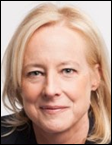
Lisa Maki is co-founder and CEO of PokitDok of San Mateo, CA.
image

Tell me about yourself and the company.

I’m the co-founder and CEO of PokitDok. We’re a digital health company providing an open platform of APIs streamlining the business of health.

Explain how APIs work and the types commonly found in healthcare.

I started in software back in 1989, working on pre-Windows DOS versions of consumer and enterprise-facing software. I did that at Microsoft. Over the years, as software evolved into many industries, health included, it became clear that you needed services that would connect different siloed sources of data, different siloed sources of functionality, so that the enterprise IT professional software developers could create seamless business, user, and consumer experiences across all those silos.

How that shows up in healthcare increasingly is a set of APIs that can give access to interoperability, exchanging data between the EHRs and others in the form of standards that FHIR supports. APIs like ours that connect you to insurance X12 EDI or eligibility, claims, benefit enrollment, pre-authorizations.

The beauty of an API is it can be integrated anywhere into new digital or existing products. It doesn’t need to dictate your user experience. It can integrate into it and provide that service as you think best fits your business model or your user experience.

Non-technologists might think that APIs are pain-free and foolproof, providing instant interoperability. What are the challenges involved, both technical and non-technical?

APIs are intended to do the underlying infrastructure or operating system heavy lifting for software developers and IT professionals. It doesn’t remove work. It still assumes that you’re doing some work on your side to build the product or integrate it into the product.

In the case of our APIs that connect to insurance companies for access to X12 EDI services, eligibility and claims, those insurance companies — that’s over 400 now — still change their endpoints, those things we’re connecting to, often on a daily basis. 

Part of the value that we provide software developers is we keep track of that. We detect it. We adapt to it. We manage that so software developers don’t have to. They have one endpoint they can go to and they can get access to all those insurance companies, all those services. The value we provide is managing that complexity on the back end.

But that software developer still has to integrate that into their own software, perhaps into a very complex system on their side. Maybe they service multiple EHRs, multiple practice management systems, in one single healthcare system, especially with consolidation. That can be very challenging and a lot of work.

It’s not an instant solution. It does a lot of the heavy lifting to get to that solution.

We also provide an identity management API that is not open like our others. We want to talk to you first because it is complex. Sometimes we assist our customers to put in an identity management solution across their health system because they have several instances of the same person in many different repositories. That identity management solution gets them to one instance of it.

But yes, there’s work involved. It’s not a switch. It’s not an on and off.

How do companies or systems that offer APIs coordinate software changes so that the end-to-end functionality won’t be broken?

It starts at the heart of how you architect your APIs. If you are architecting your APIs such that it requires a change in configuration every time — say in our case, an insurance company changes their endpoint or their gateway — then you haven’t done a good job architecting. That’s the bottom line. We have architected our APIs so that we can handle those changes and not put that burden on the users of our APIs. There can be exceptions to that, but a large part of our value is removing that burden.

There are things that we can’t control, like downtime of the insurance companies or changes for our identity management solutions. For example, I can’t control whether or not Cerner, Epic, or Allscripts is changing something about your installation, but I can certainly architect it to remove the majority of the heavy lifting. That onus is on all of us who are API providers. We have to architect that correctly.

We also have to provide open and transparent dashboards for our customers. For developers, one of the things we provide — and encourage any other API provider to also give their customers — is transparency all the way through the development process. You’re making an API call. You should know exactly where that API call is in the process. If something is being held up, you should know where in the system and where in the call, for what reasons, and get all of that feedback in real time.

That’s something we provide our development customers. If it’s downtime of a major insurance trading partner, they should be able to communicate that to their customers in real time with transparent information. For things we can’t control like that, it’s the goal to be as transparent as possible so that our customers can as well.

Much of the interoperability barrier is cultural rather than technical. What elements of trust or permissions have to be built into APIs so that data can move freely?

You hit the nail on the head. There are no technical reasons why we can’t have interoperability in healthcare. There are absolutely no technical reasons. Most of these technical obstacles have been solved back in the 1990s in other industries that are equally complex. Financial — heavily regulated, very complex — has addressed these issues.

You have to have a will to achieve a business model and create a business model that rewards interoperability and openness instead of closed systems. Most of the time, we’re overcoming habit. We’re overcoming misinformation around security and compliance. There’s confusion over what the P for HIPAA stands for. It stands for portability. There’s a lot of behavioral issues that have to be overcome to achieve the interoperability that we all want.

A lot of progress is being made. The progress is being made because the market has shifted. Any time you see someone like us and a company like PokitDok going into a market like healthcare … we’re not healthcare experts. We’re technology experts who want to make the tools available so that people who are experts in healthcare can create the patient onboarding experiences and the business models they need to support their business in this changing market.

We come in because there has been a market shift, like you see with consumers moving to  high-deductible plans. All of a sudden consumers are starting to change their behavior. They have to pay for it out of pocket. They’re demanding more transparency and service at the point of scheduling or checking in before they have the procedure. That’s a huge market shift.

In order for health systems to respond to that, to compete, to protect their revenue cycle stability instead of seeing their former reimbursement revenue now go to collections, they need new tools. They need the ability to schedule, check eligibility, and take a payment in real time, both mobile and Web-based. That’s what we respond to. 

The market shift is overcoming any behavioral or former business model resistance, both from EHR and API providers.

What healthcare APIs are most commonly used and most needed?

There are not a lot of APIs available in healthcare that would fit my definition of a developer-ready open API. We are one set. FHIR is certainly another, early but evolving and getting a lot of interest. There are certainly your standard developer APIs, when you’re creating that new product from software technology providers.

Early efforts from CommonWell and other alliances are attempting to provide API access. EHR vendors like Cerner and others are looking to release access to APIs. Even sandboxes represented by Athena, Epic, Allscripts, or Greenway are heavily business model controlled API sets. They require a lot of heavy lifting, a lot of time and interaction in a sandbox before you can take something to market quickly.

Today’s software developers who are building truly innovative solutions for either their own or for their customers in healthcare expect modern API experiences, not sandboxes. Not long, lengthy vetting processes to get something to market. We’re seeing some interesting things from companies like Redox who are doing intra-EHR interoperability. There’s some interesting things from companies like PatientPing. I’m excited by this because they’re following more of the modern developer standard and expectation for open APIs. I think the market will follow.

Most of the handful of surviving hospital EHRs use a 1990s style client-server architecture at best. Are those companies up to the task of creating scalable, secure APIs that use more modern technologies than their own products?

It’s a huge cultural shift for those companies. My co-founder and I both come from companies like Microsoft and Apple and various startups. We’ve released product into many industries and now healthcare for the past 10 years. It’s going to take an immense amount of leadership in those companies to prepare them for this shift.

It must and will happen. New technologies are showing up every day that will make the shift for them whether or not they’re ready. If I were in those leadership positions of those companies, I would be starting parallel projects with people who are used to those sorts of open and technologically advanced environments, cloud-based Web services. I would start that now if you haven’t already and I would start it really fast, because it is coming and it’s likely that with your current systems, all you will be doing is migrating them over.

You will need a different set of people familiar with with building and supporting those systems. If you haven’t already started it, then starting it today would be your next best bet.

I would also partner. You’ve got companies like Microsoft who are trying to build API-driven architectures that do much of the heavy lifting, even compliance and security, into the fabric of Azure, their cloud offering for healthcare enterprise development. You’re going to see a lot more of that.

EHRs also have to get clear on what part of this they are going to own moving forward as the business shifts to the cloud. Which part will be owned by companies like Microsoft, Google, Oracle, and IBM that will be built into the cloud fabric. You want to get clear on that quickly because it affects your strategy.

Where do you see the company going in the next five years?

We want to be the house for all healthcare enterprise business transactions. We hope to achieve that in five years. That’s our big goal. There are a lot of unnecessary ones that add friction and operational cost to healthcare enterprise today that we hope to remove and then there are new ones that we hope to add.

There’s no reason why our healthcare customers — and this is what we provide them today — shouldn’t be getting up-to-date and real-time business outlooks and intelligence off of all their business transactions today. There’s no technical reason why they can’t have it. That’s what we deliver and that’s what we want the entire healthcare industry to be enjoying from its business and ultimately clinical transactions on a daily basis.

Do you have any final thoughts?

I love what you’re doing. These sorts of conversations, as the industry is going through such a massive market and technical shift, are super-important. More of us talking about what is technically possible and identifying, as you’ve astutely said, the behavioral and business impediments to healthcare enterprise moving forward to deliver the kinds of patient, provider, and business experiences it needs to. Those are the right topics.


News 6/1/16

May 31, 2016 News 7 Comments

Top News

image

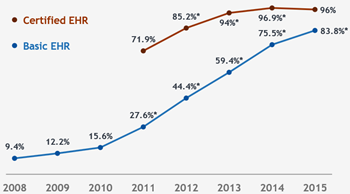
An ONC survey finds that 84 percent of US hospitals were using at least a Basic EHR at the end of 2015, a nine-fold increase since HITECH was adopted in 2009, although adoption by psychiatric and children’s hospitals lags. A Basic EHR must have the capability (even if the physician doesn’t actually use it) of accepting physician orders, recording meds and allergies, documenting encounters, recording problem lists, and viewing lab and imaging results.

Someone tweeted out what an inarguably great thing this is, but for the $31 billion in taxpayer bribes that were required to make providers use the same EHRs they were otherwise avoiding like the plague, maybe we should expect a bit more than just market penetration and instead look at outcomes, access, and data portability. I’m not so sure that I as a patient feel any safer, better cared for, or more appreciated as a customer just because I’ve seen some spotty,  half-hearted technology use amidst the still-mountainous piles of provider paper.


Reader Comments

From Burnt Steak: “Re: Epic’s mandatory employee arbitration clause. Whose side would you take?” I really dislike the idea of mandatory arbitration, especially when it’s buried (as it is with most retail contracts, like for credit cards and cell phone service) in small print. However, a lack of willingness to walk away means those employees or customers accept the terms offered. I have limited respect for employees who complain about their jobs, go on strike, or file employer lawsuits – they should prove their point by finding a better job elsewhere. The market will quickly tell them if they are underappreciated, and if it turns out nobody else is willing to give them more money or benefits, that should be a clue that they are sitting precisely at the intersection of supply and demand for their services and shouldn’t embarrass themselves further by complaining. You’re not going to make yourself look better by griping about the employer (or your spouse or the city that you live in, for that matter) that you freely chose.


HIStalk Announcements and Requests

image image

Mrs. McCullough says her Georgia kindergartners are using the six Kindle Fires we provided in funding her DonorsChoose grant request to engage with reading and math apps and to participate in a weekly learning center, where they listen to stories and play phonics games.

image

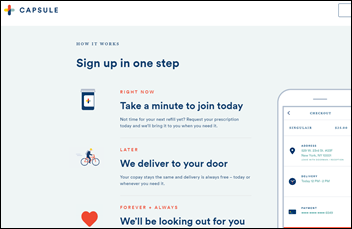
It’s hard to accept rampant healthcare inefficiencies and indifference when people in many US cities can place an Amazon order by noon and receive it by bedtime that same day. Although maybe there’s hope from companies like Capsule, a just-launched New York startup that delivers prescriptions by bicycle at no extra charge and that uses technology for refill requests, medication instructions, and patient communication, although the founders wisely decline to label the company as the inevitable “Uber for drugs.”

I finally had my appointment with a new doctor (actually, her PA) last week for my annual physical, following the miscue from a few weeks back where I showed up for my appointment, filled out a mountain of paperwork, and waited for some time before being told that the doctor was out of the office for previously scheduled surgery (they said they tried to call me earlier, but had incorrectly entered my phone number). This time wasn’t perfect, either – all of the paperwork I had completed previously (medical history, insurance information, NPP, etc.) had been mysteriously lost, meaning I had to fill out the clipboard full of forms all over again. To add insult to injury, the PA either didn’t see or didn’t use the information, repeating questions about allergies, meds, smoking status, and other topics that I had already documented minutes before but that hadn’t yet been entered into their Practice Fusion free EHR. At least the EHR wasn’t intrusive during the visit (since she mostly documented on paper) and the e-prescribing worked OK.

My latest linguistic peeve: the use of “unpack” as a synonym for “explain,” which doesn’t save syllables or add nuance and is therefore pointless other than to make self-aware authors feel smugly clever.

Thanks to the following sponsors, new and renewing, that recently support HIStalk, HIStalk Practice, and HIStalk Connect. Click a logo for more information.

image
image
image
image
image
image
image
image
image


Webinars

June 28 (Tuesday) 2:00 ET. “Your Call Is Very Important.” Sponsored by West Healthcare Practice. Presenters: Cyndy Orrys, contact center director, Henry Ford Health System; Brian Cooper, SVP, West Interactive. The contact center is a key hub of patient engagement and a strategic lever for driving competitive advantage. Cyndy will share how her organization’s call center is using technologies and approaches that create effortless patient experiences in connecting them to the right information or resource. Brian will describe five key characteristics of a modern call center and suggest how to get started.

Contact Lorre for webinar services. Past webinars are on our HIStalk webinars YouTube channel.


Acquisitions, Funding, Business, and Stock

image

DrFirst acquires Meditech consulting firm The IN Group, saying the acquisition will allow DrFirst to help its customers make the most of their healthcare IT investments. 


Sales

MD Anderson selects Nuance’s Dragon Medical and PowerScribe 360 for physician documentation as part of its Epic rollout. MDA will also use services from Epic consulting firm Physician Technology Partners, which the announcement says is now owned by Nuance.

image

Pontiac General Hospital (MI) chooses Medsphere’s OpenVistA EHR. The financial turnaround of the hospital, which has filed bankruptcy twice as Doctors Hospital of Michigan, is being led by 25-year-old Sanyam Sharma, whose computer scientist parents started eligibility software vendor Infrahealth and put him on the payroll when he was 14. He’s now EVP of the company and heads up Sant Partners, a company his parents created to buy Pontiac  following his father’s discovery as a consultant that the hospital had extensive revenue cycle problems. 

image

Ohio State University Wexner Medical Center chooses Strata Decision’s StrataJazz for decision support, cost accounting, and contract analytics.


People

image image

Home monitoring technology vendor Sentrian hires Bryan Ness (Wellcentive) as chief revenue officer and Molly Cogan (Wireless Life Sciences Alliance) as VP of marketing and communications.


Announcements and Implementations

Liaison Technologies will launch its Alloy Health cloud-based integration service in Europe.

image

Peer60 publishes “Hottest Trends in Medical Imaging IT (UK).”

UPMC (PA) signs its third agreement with organizations in China, collaborating with for-profit First Chengmei Medical Industry Group to offer clinician training and to advise the hospitals on hospital operations, including IT.

image

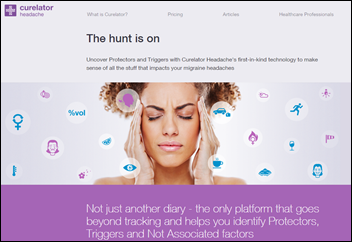
Cincinnati Children’s Hospital Medical Center (OH) will use the Curelator Headache app to study the factors that precede migraine headaches in children and adolescents. The study’s 60 participants will use visual data entry tools to document emotional, dietary, physical, and environmental factors in 2-3minutes per day to show them their associated migraine triggers so they can make lifestyle changes. The app is commercially available in a limited-functionality free version and as a $50, six-month subscription that includes trigger tracking.


Government and Politics

A Congressional stalemate forces the CDC to cut emergency public health funding in many cities—including lab services, mosquito control, and disease surveillance — to free up money to address the Zika virus. It’s amazing given the amount of federal money that is wasted on low-quality, unneeded, and sometimes questionably billed hospital care that CDC has to choose which outbreak to fund with a fixed few million dollars.

China’s FDA reverses its push toward making non-prescription drugs available online, ordering e-commerce provider Alibaba to tell its vendors – include drug store chains — to immediately stop selling OTC drugs on its online marketplace.

In other Alibaba news, Hong Kong regulators say the company violated takeover rules in its 2014 investment in pharma data and barcode tracking company CITIC 21CN (now known as Alibaba Health Information Technology) because the deal included buying a medical technology company from a shareholder who was also the brother of the company’s vice chairman, giving the company an unfair advantage. The acquisition raised some eyebrows at the time because Citic 21CN’s small amount of revenue came from sales to the Chinese government and both companies have Communist Party and military leaders as investors. The acquisition and subsequent rise in Alibaba’s share price made Chen Xiaoying, wife of a former general, a billionaire. She bought a $68 million home two days before the deal was announced. 


Privacy and Security

The ED physician staffing service used by two Carondelet hospitals in Arizona notifies 1,000 patients that their information was disclosed when an ED logbook was stolen from the car of one of its doctors.


Technology

USA Today summarizes a report indicating that telehealth usage would increase if it was more affordable to hospitals and if medical studies prove that it works. I think it’s time to separate vendor-provided telehealth (online services that connect cash-paying patients with whatever doctor the vendor has available in the belief that patients think all doctors are equal) versus using the technology to interact with the patient’s trusted ongoing provider in a more convenient way. Some patients and conditions can be treated by a doctor in a speed-dating type of consultation where they don’t know anything about the patient except what they can learn by asking a few quick questions, but few would argue that an encounter of that type will be as successful as having a virtual visit with their regular provider who is armed with their medical records (although “successful” to most patients means, “I got the prescription I wanted.”)


Other

A man presenting to the ED with atrial fibrillation is successfully treated after the team notices his heart rate-recording Fitbit and determines that his AF was triggered by a seizure, therefore making him a candidate for electrical cardioversion. The case was described in a journal article that is mildly entertaining while not being all that medically useful since AF is treated all the time without consulting the patient’s wearable and instead asking them their history.

A London newspaper profiles a hepatitis C patient whose only hope for survival is the new drug Harvoni, which has a 95 percent cure rate at an astonishingly high price. The man finds a doctor in Australia who imports a cheaper version of the drug from India and China, where drug company Gilead Sciences was forced to license the manufacture of local versions since those governments say Harvoni is almost identical to older, cheaper drugs and therefore won’t pay for it. The doctor tests the imported drug’s purity and mails it to patients who pay his consultation fee. Some NHS doctors will work with such “buyer’s club” patients since NHS can’t afford to provide the drug to everyone who needs it and buying prescription drugs from other countries isn’t illegal in England. However, the British pharma trade group says patients who buy drugs offshore are stifling innovation and taking away treatments intended for poor countries. US insurers and governments are struggling to pay for Harvoni, which costs $1,125 per pill and $95,000 per treatment. The same pill in India costs $10.

Here’s a pretty funny “EHR in the exam room” video from Athenahealth that I ran across while looking for something else. 

The Wall Street Journal profiles the use by Northwell Health (NY) of an evidence-based calculator that assesses the likelihood of strep throat, respiratory infection, and deep-vein thrombosis based on physician answers to questions popped up in the EHR and then guides appropriate ordering of medications and tests. A medical school professor overseeing testing of the software in Wisconsin primary care clinics says physician participation in the optional program  is low, however, because “there is a big backlash against clinical decision support.” 

The speaker at a Memorial Day ceremony in Anthem, AZ is Bill Krissoff, MD, a since-retired orthopedic surgeon who shuttered his practice following the 2006 death of his Marine son in Iraq. He joined a Marine Corps medical battalion at age 60, deploying to Iraq and Afghanistan “to finish Nathan’s unfinished tasks” in serving on the resuscitative surgical team as primary or assisting surgeon for 225 serious casualties.

Weird News Andy finds it ironic that “smart” tampons double as a blood collection tool that allows women to track their reproductive health via an iPad (WNA snickers right about there). I can’t decide if this is a great use of technology or the moment where we collectively jumped the quantified-self shark.


Contacts

Mr. H, Lorre, Jennifer, Dr. Jayne, Lt. Dan.
More news: HIStalk Practice, HIStalk Connect.
Get HIStalk updates.
Send news or rumors.
Contact us.

125x125_2nd_Circle

Monday Morning Update 5/30/16

May 29, 2016 News 3 Comments

Top News

image

NantHealth’s previously postponed IPO will happen this holiday-shortened week, with insiders taking the majority of the $91 million offering. The company’s IPO documents don’t specify how it will spend the money, saying only that it will be used for “general corporate purposes.” NantHealth’s filings indicate that the company lost $72 million on $58 million in revenue in 2015, with $291 million in liabilities.

image

Meanwhile, shares of Patrick Soon-Shiong’s cancer therapy company NantKwest have dropped 79 percent since its July 2015 IPO, erasing $3.1 billion of the company’s $3.7 billion first-day valuation and creating a legal boom as law firms line up offering to represent shareholders in class action lawsuits. Above is the share price of NK (blue) vs. the Nasdaq (red).


Reader Comments

From Mutton Dipper: “Re: the ‘Women in Health IT’ section of that industry rag. I don’t think they’re doing women any favors by carving them out as a special interest curiosity.” We’ve talked about this previously, but perhaps it’s time to see the content they think women in health IT need that isn’t available elsewhere. Stories on the site are: (a) the Gates Foundation donates money to study gender inequality, which has zero to do with health IT; (b) HIMSS celebrates nursing informatics, apparently in the gender-biased belief that it’s a female-only profession; and (c) two women took new jobs, something us menfolk apparently wouldn’t care about. Every story was just a padded out rehash of a press release (without crediting the press release).


HIStalk Announcements and Requests

image

It is Memorial Day, created not as a nonchalant summer kickoff, but rather to set aside time to remember those who died while serving in the armed forces (unfortunately, people usually forget to observe the latter in celebrating the former). 

In Flanders Fields
By John McCrae

In Flanders Fields the poppies blow
Between the crosses row on row
That mark our place; and in the sky
The larks, still bravely singing, fly
Scarce heard amid the guns below.

We are the Dead. Short days ago
We lived, felt dawn, saw sunset glow,
Loved and were loved, and now we lie
In Flanders fields.

Take up our quarrel with the foe:
To you from failing hands we throw
The torch; be yours to hold it high.
If ye break faith with us who die
We shall not sleep, though poppies grow
In Flanders fields.

image

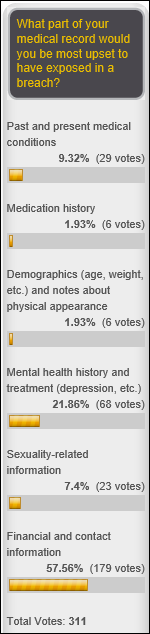
More than half of poll respondents say exposure of their financial and contact information would be the worst part of a medical records breach, while 22 percent say they would be most upset about having their mental health history made available. The results don’t surprise MobileMan, who says he’s always believed that people worry more about their money than their health. JaneOrJohnDoe just lies when clinicians ask about potentially embarrassing behavior, avowing that he or she never has sex, smokes, drinks, or uses drugs because co-workers and the HR department don’t need to know. Missy C22 takes the opposite approach, saying people can get any information they want, so she doesn’t worry about breaches.

New poll to your right or here: what level of unexpected medical expense would you struggle to pay?

image

My insurance company told me my travel-related malaria prevention medication was covered and would cost $80. The Walgreens pharmacist said no, actually it’s not covered, so he offered me the cash price of $268. I looked online while standing at the Walgreens counter and found a coupon on GoodRX that Walmart accepts. I called Walmart from the Walgreens parking lot and asked them to call for a copy of my prescription, which they priced at $140 for cash-paying customers. It was ready when I arrived – I just showed them the coupon on my phone to make my final price $70, saving me nearly $200 for just a couple of minutes of effort since I was going to Walmart anyway. This is a great example of screwy American healthcare for several reasons:

  • The old drug is unreasonably expensive and going up all the time.
  • The insurance company would apparently prefer to treat me for malaria than to pay upfront to prevent it (the same lack of logic that leads them to decline to pay for birth control pills).
  • Prices are all over the place – how can Walmart sell the same drug for half the Walgreens price?
  • A less-persistent customer would have wasted a lot of money by not shopping the drug price and not being aware of GoodRx.
  • Sometimes a discounted cash price is cheaper than using insurance.
  • GoodRx makes money by using an unspecified PBM’s negotiated discounts, passing the savings along to their customers while taking a transaction fee for themselves and giving the PBM big volume. That’s a brilliant business model in which everybody wins.
  • The price varies wildly even when using the GoodRX coupon – Walgreens actually accepts the same coupon but charges $127, while the PillPack online pharmacy tops the price curve at $275 (the first two examples lead me to assume that the PBM’s discount on this drug is 50 percent since it cut the price in half at both Walmart and Walgreens).
  • Maintenance drugs offer even more savings. A month’s supply of generic Lipitor whose cash price ranges from $90 to over $400 depending on the pharmacy is just $19 using a GoodRX coupon.
  • Healthcare is the only example I can think of where paying cash carries a penalty rather than a discount. I remain unconvinced by arguments saying it’s not reasonable to force providers to give cash-paying patients the lowest price they’re willing to accept from any other payer.

image image

We providing kits and equipment for the inaugural robotics team of Ms. Sobosan’s Nevada  high school in funding her DonorsChoose grant request. Team member Bryan concludes, “The robotics resources changed the way I looked at programming. I’m not very good, but it has inspired me to learn even more when I program apps, robots, and games. Although it won’t be easy, I will push myself to keep learning. The robot we are building is taking a while to assemble, but so far it is going very well and I expect to have fun with the projects you have sent.”

I was thinking about CMS Acting Administrator Andy Slavitt’s comment that interoperability isn’t like sending a man to the moon. Actually, it is — if you told the 1960s-era US and Soviet Union that it would be optional but nice if they shared information for the good of their respective space travelers even while they are desperately trying to beat the other in getting there first.


Last Week’s Most Interesting News

  • A federal appeals court finds that Epic’s mandatory employee arbitration clause violates federal labor law.
  • A renowned cognitive science expert says IBM Watson Health should stop “making up nonsense” about analyzing cancer and admit that its technology doesn’t really use cognitive computing.
  • Apple CEO Tim Cook says health use of the Apple Watch is a major company priority.
  • Kansas Heart Hospital pays ransomware demand but declines to make further payments as the hackers demand to release its files.
  • The ACLU sues a genetic testing company to force it to give patients their complete results rather than just a subset.

Webinars

June 28 (Tuesday) 2:00 ET. “Your Call Is Very Important.” Sponsored by West Healthcare Practice. Presenters: Cyndy Orrys, contact center director, Henry Ford Health System; Brian Cooper, SVP, West Interactive. The contact center is a key hub of patient engagement and a strategic lever for driving competitive advantage. Cyndy will share how her organization’s call center is using technologies and approaches that create effortless patient experiences in connecting them to the right information or resource. Brian will describe five key characteristics of a modern call center and suggest how to get started.

Contact Lorre for webinar services. Past webinars are on our HIStalk webinars YouTube channel.


Acquisitions, Funding, Business, and Stock

image

Cerner says in its annual shareholder meeting that:

  • More hospitals run its systems than anyone else’s.
  • The company has 22,000 employees who are paid an average annual salary of $80,000, with an average age in the mid-30s.
  • Cerner will spend $750 million on population health management R&D.

SNAGHTML2e9d981f

Last Thursday’s Chicago federal appeals court ruling that Epic violated federal labor laws in requiring its employees to agree to arbitration clauses is reverberating throughout the country. The three-judge panel ruled that the National Labor Relations Act gives employees the right to band together even if they aren’t represented by a union. Conflicting previous rulings in other cases may take the issue back to the US Supreme Court. Studies have found that mandatory arbitration clauses often result in employees simply giving up their complaints, while federal and state officials worry that forced arbitration allows companies to hide employment wrongdoing. Cerner is certainly watching closely since it told employees in December 2015 that they had to choose between signing arbitration clauses or giving up future salary increases.


Announcements and Implementations

image

The board of ETMC-Tyler (TX) approves the purchase of MedHost, Athenahealth, and Novarad.


Privacy and Security

image

A dozen FBI agents, one of them armed with an assault weapon, raid the home of a Texas software security researcher and take him away in handcuffs after he reports to dental software vendor Eaglesoft that the information of 22,000 patients on their servers is freely visible over the Internet. The company, instead of thanking him, notifies the FBI that he illegally accessed its server and thus violated the Computer Fraud and Abuse Act, leading the FBI to haul him away from his family in his underwear. The same researcher previously alerted the FTC that Henry Schein Dental was misleading customers by claiming it encrypts their data. He had also alerted a Pennsylvania dental practice in December 2013 that their patient information was visible online, only to receive a cease and desist letter from the practice demanding that he never mention their practice or doctors again.

image

A ProPublica study finds thousands of examples where doctors, dentists, or their employees responded to negative Yelp patient reviews with information that included PHI. The HIPAA violations ranged from the simple (acknowledging that the Yelper was indeed treated, for example) to posting extensive medical, dental, and family information.


Other

image

An 87-year-old senior living resident choking on a hamburger is saved by a fellow resident who springs to her side to perform the Heimlich maneuver. That fellow resident was 96-year-old Henry Heimlich, MD, the surgeon who created the technique in the 1970s, who had never actually performed it on an actual choking victim. On a less-upbeat note, Heimlich’s son has bitterly renounced his father for years as a fraud and claims he stole the idea from peers, adding that he has advocated bizarre therapies for AIDS and cancer. Back on the upbeat side of the story, Heimlich’s nephew is 66-year-old Anson “Potsie” Williams from “Happy Days,” whose affected, white-bread musical warblings on the show also caused Heimlich-like projectile vomiting.

image

In Vancouver, ED and ICU doctors at Nanaimo Regional General Hospital refuse to continue using its nine-week-old Cerner EHR and instead go back to paper due to patient safety concerns. The doctors say Cerner calculates drug doses incorrectly and is causing meds and lab tests to be delayed, adding that it takes them twice as long to enter orders and that serious patient errors are happening every day. Island Health will spend $134 million on the project, which will be rolled out to hospitals in Victoria next year.

image

In Australia, Cairns Hospital’s budget crisis is so significant that it’s telling doctors to stop using pens and to turn off unused lights. The medical staff says the real problem is its new Cerner EHR, described as slow and impeding accurate documentation for payment.

image

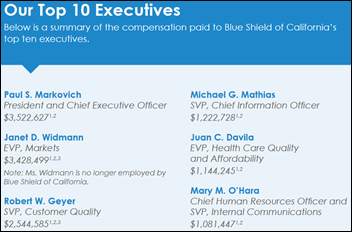
Blue Shield of California, pressured to review the salaries of its executives as non-profits always do, issues a report showing that its CEO made $3.5 million in 2015, while SVP/CIO Mike Mathias was paid $1.2 million.


Vince and Elise recap the top physician practice systems vendors in their latest installment. Feel free to add comments if you agree or disagree with their conclusions.


Sponsor Updates

  • For the Record magazine features a story about clinical process measurement by LogicStream Health’s Dan Rubin, MD, MHI.

Blog Posts


Contacts

Mr. H, Lorre, Jennifer, Dr. Jayne, Lt. Dan.
More news: HIStalk Practice, HIStalk Connect.
Get HIStalk updates.
Send news or rumors.
Contact us.

125x125_2nd_Circle

News 5/27/16

May 26, 2016 News 6 Comments

Top News

image

A federal judge grants Epic’s request to dismiss a patent infringement lawsuit brought by patent troll (or “non-practicing entity” in legal terms) Preservation Wellness Technologies, which sued Epic, Allscripts, Athenahealth, and NextGen for violating its 2009 patent covering the idea of giving patients and doctors access to electronic medical records with different levels of authorization. Apparently the US Patent and Trademark Office thought this was something new since they granted the patent.

The “inventor” apparently runs Carlo Coiffures, a beauty salon in New York. The lawsuit was brought by a Texas corporation with a Texas mail drop address that filed the suit in the rural Eastern District of Texas, which attracts 25 percent of the patent lawsuits filed in the entire US because that district’s troll-friendly practices make it hard for defendants to get a ridiculous lawsuit dismissed. A fascinating episode of “This American Life” describes a building in Marshall, Texas (population 24,000) whose long corridors contain locked offices representing the only physical presence of companies whose entire business is filing frivolous patent infringement lawsuits. Kudos to Epic for not just paying off the troll, although you have to wonder how much it had to spend to prove that it did nothing wrong.

Meanwhile, Epic didn’t fare as well in a federal appeals court where it had asked to have an unpaid overtime lawsuit brought by its technical writers dismissed. Epic argued that the arbitration terms that it forced all of its employees to accept to keep their jobs precludes employee class action lawsuits like the overtime one. The judge sides with the employees, ruling that  Epic’s mandatory arbitration clause violates the National Labor Relations Act because it prevents employees from acting together on employment issues, which they are allowed to do even if they aren’t union members.


Reader Comments

From Pumice Stone: “Re: vendor agnostic. Pet peeve time! Agnostic means someone who claims neither faith nor disbelief in God.” I agree. “Vendor-neutral” is a better way to convey a lack of bias, although the grammatical horse has left the barn and dictionaries that strive to reflect rather than define usage will no doubt be adding “vendor-agnostic” along with other recently added non-words like “WTF,” “beer o’clock,” and “awesomesauce” as lexicographers use the “everybody gets a trophy” model in rewarding those who create cutesy new words despite their obvious lack of mastery of the perfectly fine choices already available.

image

From Maple: “Re: Evariant. They just took Series C money this month but apparently laid off 30+ folks. No jobs are listed on their jobs board. A new CFO was announced this week, too.” Evariant, which has received $69 million in funding, sells a patient marketing system. I checked their executive page from a year ago and seven of the 10 people listed then aren’t on the current version of the page. 


HIStalk Announcements and Requests

image image

Mrs. Steele says her Tennessee kindergarten class is using the headphones and wireless mice we provided in funding her DonorsChoose grant request to listen to level-tailored stories to help them read better.

This week on HIStalk Practice: Compulink debuts an EHR for gastroenterologists. Pavlovian wearable helps curb user behaviors. Direct Urgent Care sends heart and lung sounds to its EHR via connected stethoscope. Duke University physicians share advice for PCPs in need of MACRA help. Connecticut passes telemedicine-friendly Medicaid legislation. Ohio physicians will soon have real-time access to controlled substances prescriptions.


Webinars

June 28 (Tuesday) 2:00 ET. “Your Call Is Very Important.” Sponsored by West Healthcare Practice. Presenters: Cyndy Orrys, contact center director, Henry Ford Health System; Brian Cooper, SVP, West Interactive. The contact center is a key hub of patient engagement and a strategic lever for driving competitive advantage. Cyndy will share how her organization’s call center is using technologies and approaches that create effortless patient experiences in connecting them to the right information or resource. Brian will describe five key characteristics of a modern call center and suggest how to get started.

Contact Lorre for webinar services. Past webinars are on our HIStalk webinars YouTube channel.


Acquisitions, Funding, Business, and Stock

The software half of HP’s November 2015 split into two publicly traded businesses will spin off its enterprise services business in a tax-free merger with CSC that will create “a pure-play global IT services leader.” CEO Meg Whitman, who predicts industry consolidation, said on the earnings call related to corporate spinoffs, “We have this thing down to a science” in “unlocking the value of these two companies.”

Wellth, which rewards high-risk patients for taking their meds or testing their glucose correctly, raises $2 million in a seed round.

image

IMS Health acquires Privacy Analytics, which offers data de-identification tools.

image

Zebra Medical Vision, which sells a medical imaging analytics engine that supports diagnosis, raises $12 million in a round led by Intermountain Healthcare, increasing its total to $20 million.


Sales

image

Shore Medical Center (NJ) chooses Phynd to manage the information of its 5,000 providers within Cerner and other systems.


People

image

WEDI gives interim CEO Charles Stellar (AHIP) the permanent position.

image

Paul Tang, MD (Palo Alto Medical Foundation) joins IBM Watson Health as VP/chief health transformation officer.


Government and Politics

image

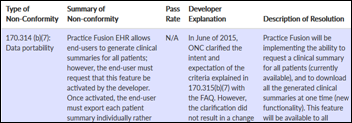
ONC publishes a list of health IT products and vendors that have not complied with its certification program.

The FDA will collaborate with Flatiron Health to explore how the de-identified treatment data of patients who aren’t enrolled in clinical trials could be used to investigate the safety and effectiveness of immunotherapy.

image

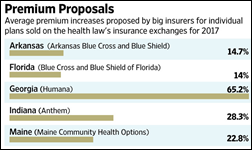
Health insurers stung by Affordable Care Act losses follow through on warnings of premium increases as a sicker-than-expected insured pool drives up their costs. The highest increase requested so far is in Western Pennsylvania, where Highmark wants to hike premiums by 38 percent. The administration continues to downplay the high premium costs, saying that most people will get federal premium subsidies.

image

A House committee wants the Justice Department and the state attorney general to investigate former Oregon Governor John Kitzhaber and CMS for the botched rollout of the Cover Oregon insurance exchange, which spent $305 million in federal money and never enrolled a single person before shutting it down and moving to Healthcare.gov at no cost.

image

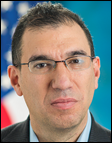
CMS Acting Administrator Andy Slavitt — about whom I’ll editorialize is the most transparent, visionary, patient-focused executive in federal healthcare (I’m even placing him ahead of Karen DeSalvo because he gave up a huge income to work for CMS and he took a thankless job) — speaks to the Massachusetts Medical Society:

[User-driven policy] is actually not that radical a concept in the real world. In the real world it might be called “talking to your customers about what they want.” Perhaps in Washington, though, it is a bit of a new concept … Interoperability in some respects needs to just be as simple as this: how can we collaborate for the best outcomes when a patient is going to experience different parts of our fragmented healthcare system? What we want out of interoperability is simple: having a patient referred for other care and understanding what happens at that visit; or communicating with the physician when a patient is discharged from the hospital to make sure they are taken care of and are healing at home … We are not talking sending a man to the moon. We are actually expecting technology to do the things that it already does for us every day. So there must be other reasons why technology and information aren’t flowing in ways that match patient care. Partly, I believe some of the reasons are actually due to bad business practices. But, I think some of the technology will improve through the better use of standards and compliance. And I think we’ll make significant progress through the implementation of APIs in the next version of EHRs which will spur innovation by allowing for plug and play capability. But the reason that the pledge is important is because the private sector has to essentially change or evolve their business practices so that they don’t subvert this intent.


Privacy and Security

image

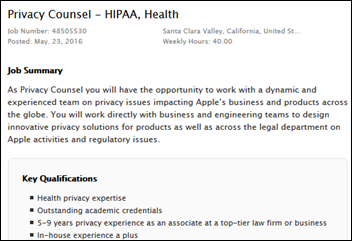
Apple posts a job opening for a HIPAA-focused privacy lawyer.


Innovation and Research

image

Cognitive science expert Roger Schank, PhD, says IBM Watson is “not doing ‘cognitive computing’ no matter how many times they say they are,” adding that “Watson can’t draw real conclusions by counting words in 800 million pages of text.” He concludes, “It would be nice if IBM would tone down the hype and let people know what Watson can actually do and stop making up nonsense about love fading and out thinking cancer. IBM is simply lying now and they need to stop. AI winter is coming soon.”


Technology

image

Citrix announces the HDX Ready Pi, a Raspberry Pi-powered thin client that will cost under $90 when it reaches the market in a few weeks. The device configures itself automatically when plugged into an available display; can be simply thrown into the recycle bin if it fails since its cost is negligible and there’s nothing to re-image; and it can be given to remote workers since it doesn’t store data.


Other

image

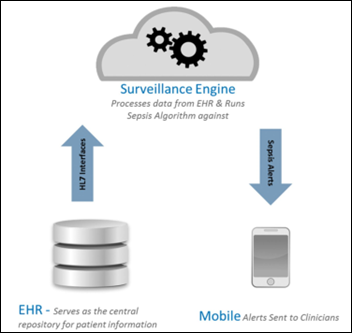
A JAMIA-published study by consultants from Wolters Kluwer Health describes how Huntsville Hospital (AL) reduced sepsis-related deaths by 53 percent following implementation of a program that included change management, electronic surveillance, and sepsis detection algorithms.

image

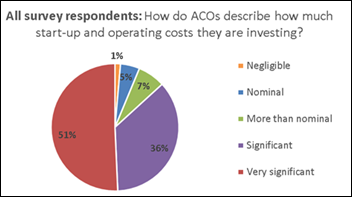
Surveyed single ACOs spend an average of $2 million per year to participate, with $563,000 of that going toward health IT technology, population analytics, and reporting. More than half say they won’t stay in the Medicare Shared Savings Program if they don’t earn the 5 percent MACRA Advanced APM bonus.

A Federal Reserve Board survey finds that nearly half of Americans would struggle to pay an unexpected $400 expense, which might explain why people whose exchange-issued health insurance policies carry a $6,800 annual deductible before insurance starts paying anything aren’t necessarily going to actually seek care (or renew their policies for 2017).

image

In China, scalpers are tying up Beijing’s ATMs, which allow scheduling hospital appointments, to book hospital and doctor appointments that they then sell to buyers from $50 to $500.


Sponsor Updates

Blog Posts


Contacts

Mr. H, Lorre, Jennifer, Dr. Jayne, Lt. Dan.
More news: HIStalk Practice, HIStalk Connect.
Get HIStalk updates.
Send news or rumors.
Contact us.

125x125_2nd_Circle

EPtalk by Dr. Jayne 5/26/16

May 26, 2016 Dr. Jayne 2 Comments

My hospital’s “chasing the quality numbers” work is in full swing. This morning I received a five-page packet on how to appropriately document our new tobacco cessation Core Measure.

I’m not sure why it takes that many pages to explain that a) everyone needs to quit using tobacco; and b) we are required to help them do it. What’s worse, the packet didn’t even include instructions on how to do the documentation in the EHR – it was strictly around the philosophy of the core measure.

I pinged the physician who replaced me when I left my leadership position and asked whether they had built the workflow into the EHR. Unfortunately, they haven’t. They didn’t add tobacco cessation medications to the admission orders, nor did they include an easy way to document when you’re not ordering them due to a medical issue. This would seem to be an area that is ripe for order sets and clinical decision support. It wasn’t clear whether timeline or capabilities were the barrier, but either way, it’s a sad commentary on missed opportunities.

Other than that, my visit to the hospital was uneventful. I stopped by the physician lounge to grab a bagel to go. There was some conversation about the pending “star ratings” for hospitals and a recent Washington Post article was being cited. One of the health systems interviewed noted that smaller hospitals that treat less complex patients earned higher ratings than tertiary care centers. According to the article, the preliminary calculations for the stars would result in awarding five stars to only 100 hospitals nationwide. There’s no firm date on when the ratings will be released (it’s been postponed from its July date).

I understand the desire to have some kind of composite rating system for patients to use, but the lack of granularity makes it difficult to truly assess how well a hospital is performing. If I were advising my relatives, I’d recommend they look at specific data for the procedure they were having or the condition for which they were being treated, not an overall “feel good” rating. I’d rather go to a hospital with fewer stars but the top rating for my disease, if I have that choice. When this rating scheme is rolled out at the provider level, as is planned, it will get even more interesting. More to come.

clip_image002

The last couple of weeks, I’ve had an increase in unwanted email volume. It’s not truly spam, but a combination of things that have to be dealt with, even if it’s just by deleting it. The folks who do the email blasts for the Annals of Internal Medicine apparently sent out a test blast of what looked like an online journal notification. It was followed up by an email saying it was a technical error on a test, and that it included “online journal content that was not valid.” Sure, they may take seconds to read, but it adds up throughout the day. I’m also seeing a deluge of LinkedIn requests. Pro tip: If you don’t have a last name, I’m deleting the email without opening it.

Furthering the email overload, this week AMIA migrated to a new online community platform and asked the Clinical Informatics Community of Practice to confirm receipt of the migration by replying to an individual. This resulted in dozens of “reply all” emails and even a request to be removed from the group. Those were pretty easy to sift out, but the last category of unwanted emails is more insidious. I receive quite a few emails each week from different vendors and organizations wanting to partner with me, often on the recommendation of someone I know. They start along the lines of, “I was talking to X the other day and they said we should consider working together” and then range from a general assessment of interest to a, “We’d like to talk to you on Thursday at 2.”

When I think I have colleagues or vendors who might be a good fit, I say something along the lines of, “I work with someone who does X. Would you be interested in seeing if there could be some collaboration?” If they’re interested, I then talk to the other party to see if THEY are interested and if both are amenable, I do an introduction. I don’t ever give out people’s direct contact information and would be horrified if I connected someone who reached out to my contacts and demanded a meeting at a certain time.

I had one of these situations this week and the vendor (which is actually a competitor) emailed me daily asking for meetings at specific times. Apparently they didn’t get the message that when someone ignores a cold-call email, they’re not interested. I’m usually pretty good at taming the email beast, but lately it’s just gotten out of control.

My HIStalk email has also been fairly full of people asking for advice, career coaching, and more. I try to incorporate as much of the advice and coaching into my posts as possible because the topics in question are usually of interest to a broad segment of readers. I’ve had several recent requests, however, where readers want me to review books or papers they’re writing or give advice about specific situations they’re encountering. I’ve had a couple of people get pretty demanding when I said I wasn’t able to accommodate their requests.

I think people forget that HIStalk isn’t my full-time job. I run a consulting company and also see patients I usually write Curbside Consult and EPtalk while I’m on a plane or sitting in an airport. If I’m at home, I’m usually writing it well after midnight. I still enjoy writing it, but some weeks its harder than others to find the time.

How do you keep your email under control? Email me.

Email Dr. Jayne.

Readers Write: Why HIT Leaders Should Consider Mentoring

May 25, 2016 Readers Write Comments Off on Readers Write: Why HIT Leaders Should Consider Mentoring

Why HIT Leaders Should Consider Mentoring
By Frank Myeroff

image

The most successful leaders in healthcare IT tend to have something in common: they all have had a mentor or multiple mentors. A mentorship program can offer support towards an individual’s career as well as help to build knowledge among mentees which ultimately strengthens the organization.

Through four different types of mentorship programs, HIT leaders can use their experiences and knowledge to share with mentees, but also can benefit their own careers.

  • New hire mentorships. Mentors offer insight and guidance through new employees’ first couple of weeks of work. This helps mentees to become acclimated to the new work culture and environment while learning new things from an experienced HIT employee quicker.
  • Career mentoring. Mentors assist in the development of a mentee in the healthcare IT field. This could be formally organized through a mentorship program or informally take place in an organization where managers accept mentoring requests from employees. Professionals who are one or two positions above mentees can give valuable coaching and help to work through challenging work situations.
  • Networking mentoring. This allows individuals to share ideas and contacts throughout the marketplace. Networking mentoring is often informal and can take place at industry trade shows, healthcare IT conferences, or even social media platforms such as LinkedIn. Jeffrey Pelot, CIO at Denver Health, has used networking mentoring in his career. “I have sought out CIOs in various industries that have been willing to provide mentorship or act as sounding boards when I have been faced with difficult situations.”
  • Untapped potential mentoring. This type of mentoring is targeted towards an average or underperforming employee who has great potential, but has other components preventing them from reaching it. This can help an employee develop and discover how to excel in the field, and provide he or she with knowledge to succeed.

HIT leaders can participate in any of these mentorship programs to offer advice, share past experiences, and help up-and-coming leaders in the field. In fact, HIT leaders should view mentoring as an essential leadership skill. Mony Weschler, chief technology and innovation strategist at Montefiore Medical Center (NY) has had many great mentors who helped propel his career. Now he gives back, and according to Weschler, “What I really enjoy is mentoring others and infecting them with a passion for healthcare IT.”

There’s no doubt that mentoring others can be quite rewarding. By participating and becoming a mentor, you are likely to:

  • Obtain personal satisfaction from making a difference to the career development of another person.
  • Help in shaping future leaders and thereby impact the organization’s succession planning.
  • Increase your professional networks.
  • Enhance your people skills in areas such as leadership, interpersonal skills, and communication.
  • Learn more about areas in the organization where you may not be as knowledgeable.
  • Re-energize your career.

Overall, mentors can provide so much value for mentees and often mentorship programs are what shape future leaders of companies. When asked about mentors, Sue Schade, founding advisor at Next Wave Health Advisors and serving as Interim CIO at University Hospitals in Cleveland, summed it up nicely: “I’ve had mentors along the way, people I have either worked side by side with or as my boss. These have been some really solid people who have been able to give me good advice and who have been supportive and helped me stretch. Knowing how I have been supported in my career is why I have been so willing to do the same for others, to give back now that I have something to offer.”

Frank Myeroff is president of Direct Consulting Associates of Cleveland, OH.

Readers Write: Ten Ways to Avoid Making the List

May 25, 2016 Readers Write 1 Comment

Ten Ways to Avoid Making the List
By Ryan Secan, MD, MPH

image

In honor of the Year of the Hospitalist, I would like to share some hard-earned wisdom with those just entering our profession.

There are many unique things about hospitalist medicine – the seven on/seven off schedule (don’t get me started on this one – that’s another post), the exclusive inpatient focus, and the unfortunate administrative tasks that always seem to fall on our shoulders. Since we don’t have appointments, our patient assignments are determined early each morning at about 7:00 a.m. And often, ‘making the list’ is a job that falls to one of the hospitalists (despite hospital administrators consistently talking about everyone practicing at the top of their license). This remains a manual process that is time-consuming, painful, and delays everyone’s start to the day.

In my 15+ years of experience as a practicing hospitalist, I’ve never run into anyone who enjoys this process, and in fact have seen lots of creative ways that folks have been able to avoid the job. At one of my prior programs, the first doc who arrived in the morning made the list, so everyone started coming in later and later to avoid it. When you feel like you aren’t up for the task, feel free to borrow from:

The Top Ten Ways to Avoid Making the List

  1. Refuse to shovel your driveway. Even if the hospital sends someone out to get you, the list should be done by then (this will only work in Boston through April).
  2. Delete Waze and just accept that traffic will make you late.
  3. Make the list really badly once. They’ll never ask you again.
  4. Keep handy a picture of your car with a flat tire. Send to your program director in the morning as needed (but remember, you have four tires).
  5. Hide in your car until everyone else has gone in.
  6. Park really far away to get those 10,000 steps.
  7. Schedule 7:00 a.m. family meetings.
  8. Fake an emergency page.
  9. Become a nocturnist.
  10. Talk to IT. Isn’t there an app for that?

Ryan Secan, MD, MPH is chief medical officer of MedAptus of Boston, MA.

Readers Write: Telehealth Can Create a Healthcare Nirvana: More Access, Lower Cost, and Enhanced Experience

May 25, 2016 Readers Write Comments Off on Readers Write: Telehealth Can Create a Healthcare Nirvana: More Access, Lower Cost, and Enhanced Experience

Telehealth Can Create a Healthcare Nirvana: More Access, Lower Cost, and Enhanced Experience
By Rohan Kulkarni

image

Healthcare in the United States generally inspires a sense of foreboding despite the progress that has been made since the 2010 enactment of the Affordable Care Act (ACA). While there continues to be challenges on both the cost of care and patient experience fronts, I believe that the most progress has and can continue to occur with access to care, which can in turn impact cost and experience.

It’s important to recognize the evolving patient population and how that will impact healthcare over the next 5-10 years.

clip_image002

The Millennial generation was recently recognized as the largest generation, overtaking the baby boomers. They make up approximately a third of our total population.

The implications of that are highly consequential. Consider this: Millennials are currently low consumers of healthcare, accounting for less than 10 percent of the total spend. But historically, care consumption begins to steadily rise at a dramatic pace after women turn 25 and after men turn 30. This trend indicates that over the next five years, Millennial consumption of healthcare will significantly increase. Given the size and consumption preferences of that population, we are going to see marked changes in how healthcare is delivered.

One area in which Millennials will drive a seismic shift is the engagement of providers through virtual and mobile channels. It is seismic not only because of the size of the generational population, but their impact on the adjacent generation of Gen X who have had to continuously adapt to the new technologies. Let us consider a few ways in which they will manifest the idea.

Access

  • Alternate channels. In early 2016, Oliver Wyman published a white paper titled “The new front door to healthcare is here” in which they describe non-primary care physician interaction such as pharmacy- based clinics, mobile apps, and telemedicine in an alternate setting as the new front door of healthcare. As consumers find these alternate channels better, easier to access, and possibly less expensive, close to $200 billion in current healthcare spend is poised to flow from traditional venues to one or more of these alternatives. In fact, once you use a retail clinic or telemedicine, you are less likely to use traditional care.
  • Increased conditions supported. Telemedicine used to be for the simple stuff. Not any more. It is able to support more complex situations including strokes, intensive care unit situations, and behavioral health. As the number of conditions expands from the simple to the complex and as the monitoring of chronic conditions such as sugar levels for diabetes, heart rate, blood pressure, etc. becomes more stable, telemedicine will potentially become the channel of choice for healthcare interactions.

Cost

  • Impact on cost of care. There is a sense that telemedicine will bend the cost curve. However, it will be a while before the needle begins to move in any meaningful manner. In the short term, providers will need to strategically invest in telemedicine to extend their front offices all the way to patient homes or wherever it is that patients choose to connect from. But this investment will be a fraction of what it would take to build new physical structures. Consequently, there will be near term capital cost benefits with longer term operational savings that will be sustainable and meaningful.
  • Payers are paying. Recognizing the value of telemedicine both in its ability to provide care and optimize costs in the midterm, more payers are willing to reimburse these costs. Today, 29 states require insurers to pay for telemedicine services. Medicare is also beginning to pay for telemedicine-based care, which is a strong signal of the faith in the efficacy of this newer channel.

Experience

  • Convenience. Telemedicine offers new levels of convenience: the ability to get healthcare from the comfort of one’s home is very compelling. Paired with the prospect of having the physician send prescriptions to the local pharmacy that can deliver it to the home enhances medication adherence. This heightened level of convenience will influence the use of care in a timely manner. Patients will be able to avoid driving through traffic and decreased productivity at work but still receive the care they need.
  • Streamlined service. There is a very high likelihood that healthcare is about to be digitized end to end like never before, and that has healthy consequences. The telemedicine platform will be connected to the EMR platform, claims, and revenue cycle management, driving new levels of efficiency and enhanced patient experience. Healthcare will be at the tip of your digits.

Telemedicine is coming of age thanks to the large Millennial population that is likely to consume healthcare through this newer channel and payers’ willingness to pay for it. It is improving access at a fraction of the cost of a new ambulatory setup and giving rural constituents a chance for good healthcare. While still very small as a channel for healthcare delivery, it is about to be turned on its head like never before.

Rohan Kulkarni is vice president of strategy and portfolio for Xerox Healthcare Business Group.

HIStalk Interviews Brad Huerta, CEO, Lost Rivers Medical Center

May 25, 2016 Interviews 1 Comment

Brad Huerta is CEO of Lost Rivers Medical Center of Arco, ID.

image

Tell me about yourself and the hospital.

I am the chief executive officer of Lost Rivers Medical Center. We are a Critical Access Hospital in central Idaho. We are located in two really different communities in the middle of Idaho. One is Arco, Idaho, where we have our hospital and our rural health care clinic. The other is Mackay, Idaho, where we run a rural healthcare clinic.

The hospital itself is in fact a hospital district. We’re a taxing district. We operate in a geographical boundary that is larger than the state of Rhode Island. Despite that, we have fewer than 8,000 people in terms of population in that district. We are in an extraordinarily rural, mountainous area in the middle of Idaho. The census bureau doesn’t even consider us rural – we’re considered a frontier hospital because of the population density. We are in the middle of the wilderness.

As big health systems get bigger, are Critical Access Hospitals getting lost in the shuffle?

One of our biggest obstacles to overcome is the remoteness. You see that a lot with recruiting specialties in here, and sometimes on the technology side. There are a lot of additional considerations that we have to deal with that maybe larger hospitals, tertiary hospitals, and MSAs don’t have to focus on. The flip side of that coin is that one of the greatest benefits we have is the fact that we are remote. We have a very specific audience. We’ve cornered the market, if you will, in our area. That part is kind of helpful as well.

Are you using remote services or telemedicine to access expertise outside your geographic area?

Absolutely. In my own humble opinion, remote technology is the greatest force multiplier Critical Access Hospitals have at their disposal. We utilize a significant amount of telemedicine with a remote presence specialist that comes in from the University of Utah, Level One trauma centers, burn centers, telestroke, tele-STEMI, tele-ED, tele-behavioral health. These are things that, because of our location and our remoteness, we simply could not offer and certainly could never hope to recruit for in our area, short of any physician that just really loves to fly fish or go hunting. We use that quite a bit.

Our hospital was the very first hospital in the state of Idaho to utilize telepharmacy in conjunction with Idaho State University. We rely heavily on it. We are big adopters of it. We oftentimes are on the leading edge of technology for small hospitals. Certainly in Idaho, I think we are. It’s a huge part of our service lines and our mix of how we offer services.

We picked Athenahealth because of that. We talk about recruiting physicians, medical specialties, nurses, or whatever it is, but hospitals of my size in the middle of nowhere also have recruiting issues for IT people. One of the reasons we picked Athena was because at the time that we made this decision, about 18 months ago, they were the only strong platform for cloud-based EMR. We had come from another platform that wasn’t offering that.

Now it’s become the standard, but 18 months ago, one of the big things for me was that I can’t afford to have a server farm at my hospital. And even if I bought $100,000 worth of servers, I don’t have an IT person who can come out here and babysit those 24 hours a day. The remoteness piece, we see it on the clinical side in the applications that we use for patient care, but there is also these other externalities that often get overlooked, and part of that is the IT equation. Certainly anything we can throw in the cloud or do remotely — whether it’s patient care or patient records or EMR — that is something that we absolutely adopt.

Every patient room and clinic room utilizes an IBM thin client for uploading patient documentation or patient records, all done in real time. We do have servers and I do have kind of a part-time IT guy who lives here. He also does fire safety and telephones and everything else, but it’s mostly minimal. A lot of the on-site stuff for technical assistance we contract out with a company out of Idaho Falls, Idaho. They come up about once a month just to kind of kick the tires to make sure we have all of the right updates and all of that.

The Athenahealth platform was critical for us because it’s all cloud based. We utilize several components of their platform. Our entire outpatient or clinic population is managed by the Athenahealth platform. Our entire billing department is managed by Athenahealth. Our entire emergency room and acute care wing is managed by Athenahealth, and we are just doing that implementation right now as of last week. We are also doing all of our purchasing with the Athena Jump Stock program. We’ll have a unified platform across all of the hospital operations.

What are the most pressing hospital issues?

We came from a dated 1993 Healthland platform that we were getting no value out of. Small hospitals kick every rock over and hit every bush we can for revenue. One of the important things for us was making Meaningful Use attestation for Stage 1. That was huge. We hit the ground running. I got here about three years ago. We didn’t have a viable EMR. One of the things we had to do to make attestation to get reimbursement was to have an operational EMR right out of the gate. That is really what consumed us for the first 18 months.

Now that we’ve attested successfully and gotten our reimbursement, we are onto different phases of attestation. One of the things that I have enjoyed f is having a unified platform across the clinic, the hospital, the billing, and the purchasing. Instead of having two or three different programs, all of these programs are knit together to give us a unified platform. Not that physicians can’t negotiate different platforms, but the easier we make it on our physicians, the happier they are going to be. If they only have to learn one system, that is a huge employee satisfaction deal for us.

What are you doing with managing populations?

Being a Critical Access Hospital, we want to be the provider of choice. One of the challenges we have in terms of managing our population would be getting the appropriate specialties to  come up here. Like I said, our population is pretty small. The other part of it is that it’s an older population. We don’t deliver a lot of babies, but we do see a lot of trauma. Being rural, we will see a lot of shotgun and hunting incidents, ATV rollovers, horseback incidents, or cattle, these kinds of things.

Having services that cater to an older population from nuts to soup. It’s geriatric psych. Maybe it’s diabetes education or nephrology. We are looking at older population health issues for a crowd that is probably 45 and older, generally speaking. We do have young people, of course, but most of our biggest challenge is focusing on developing service lines that cater to an older population that we can serve by bringing in specialists from outside. That can be kind of a challenge. There’s just not a lot of physicians to be had anyway and there are even fewer that are willing to come out to a remote place like us. That is probably the biggest challenge.

How do you see the next five years?

We have stabilized hospital operations. We’re cash flowing nicely. We are capturing every bit of revenue that we possibly can.

Two main issues concern me. One is a political question, looking at the ongoing election and what is going to happen to healthcare depending on what party takes control. If it is in fact going to be one party, you hear talk of repealing, removing, or replacing the Affordable Care Act. That would cause absolute havoc for every hospital, not just small hospitals.

We’re just now continuing to try to implement the mandates of the ACA. Any type of change now would be catastrophic. That would hurt a lot of hospitals. It’s like steering the Titanic — you just can’t do something one day and turn around and go 180 degrees the next day. These things take time. As we’ve we’ve gone down the path of the Affordable Care Act, whether you like it or not, hospitals have adjusted their operations to start to accommodate that new environment. Any change to that would be extraordinarily difficult.

A component of the ACA is the mandate for accountable care organizations. Or in our case, any type of option that may allow itself to something different, like a CCO, or a community care organization. You are going to be moving towards a value- as opposed to volume-based reimbursement system. On one hand, that is probably a great harbinger for small hospitals because we do great quality care here. Our HCAHPS scores are some of the highest in our state. We are constantly fighting the battle with volume. We do great care, but we just don’t get a lot of patients.

Any payment system that replaces volume for value is a good thing, and I think my hospital in particular is uniquely positioned to do well in that environment. But at issue is some of the restrictions with regards to ACOs, where you are saying, "You have to have population health management.” You have to have a population to do that. If you are talking a population of 75,000 or 150,000 or a half a million people, that is one thing, but I live in a community with 8,000 people. How am I going to share risk and bring value if the reimbursement is tied to a certain percentage or a certain number of covered lives? 

Small hospitals are going to have to look hard at who they want to partner with on these ACOs because you can’t do it by yourself. Rural hospitals with small populations are going to be asked to do population health and we’ve only got small pockets of populations. You are going to have to throw in with shared markets and bigger hospitals. That is not necessarily a bad thing, but certainly you want to be careful of who you partner with.

There is a lot of subtle distinctions between for-profit and not-for-profit and critical access and trauma centers and what kind of trauma centers there are. There is a lot of differences in hospitals. Some of the governing philosophies of what makes sense or doesn’t make sense are going to come into play. There is going to come a time when small hospitals are going to have to decide, are we going band together in an organization — perhaps a community care organization that has maybe a lot of small hospitals making a threshold for population — versus, are we just going to go with the biggest hospital next to us and hope for the best?

That to me is a real challenge that Critical Access Hospitals are going to have to face, probably in the next 18 to 24 months. It’s a mandate. We are going to have to go to value. I guess right now we are all in the dating phase to see who we want to take to the dance.

News 5/25/16

May 24, 2016 News 5 Comments

Top News

image

NantHealth’s Patrick Soon-Shiong invests $70.5 million in newspaper publisher Tribune Publishing in a transaction arranged by another health IT billionaire. Tribune chairman Michael Ferro, who sold Merge Healthcare to IBM  for $1 billion last fall, enlisted Soon-Shiong’s financial help in fighting off a hostile takeover bid from USA Today publisher Gannett.

Chicago-based Tribune, which publishes newspapers in Chicago, Los Angeles, Orlando, South Florida, San Diego, and other cities, named former Merge CEO Justin Dearborn as CEO in February 2016.

Soon-Shiong says he will use healthcare-developed artificial intelligence to “bring together editors and reporters and create a completely new news network … where you integrate through fiber infrastructure and through cloud computing and you centralize a news network but actually take local news and bring it in on a daily real-time basis.”


Reader Comments

image

From Turkish Taffy: “Re: Tampa General Hospital. They’re live on American Well in offering $49 virtual visits. It’s interesting that they decided to outsource instead of using local physicians.” It probably makes sense to scale up quickly with an established provider rather than trying to organize local physicians to respond to instant-on video visits as part of their workday, not to mention the malpractice and billing considerations. They can always insource the service later. I don’t know how the revenue split works, but it’s probably not going to be a big money-maker for the hospital anyway unless it drives referrals.

From Hans Morefield: “Re: Fred Morefield. It’s with sadness but also appreciation that I share the May 22 passing of my father. He was an HIT veteran who established and led SMS’s international business starting in 1978, conceived of and led Healthcare Data Exchange (HDX) in 1990, and contributed to Denver Health’s turnaround during six years there. He was responsible for key industry innovations, and as I hear all the time, for launching many careers, including my own.” 

From Clinically Insignificant: “Re: HIT news. What topics interest you least?” I gloss over at press releases about:

  • Newly announced partnerships. Nobody cares when one company “partners” with another except customers who will be told directly of what is usually just cross-selling.
  • Appointments to advisory boards. If the company really respected that person’s value, they would put them on their real board.
  • Launch of yet another innovation fund. All the good companies have long since found a financial dance partner.
  • Company funding of less than $1 million. I’ll pay more attention when success generates larger investments and Darwinism has weeded out the pretenders.
  • The results of vendor surveys whose methodology is either unstated or indefensible.
  • Companies and publications hoping to milk exposure by giving some other company a questionably devised award. The only award that counts is being awarded business from customers.

HIStalk Announcements and Requests

image

We funded the DonorsChoose grant request of Ms. Garris in providing headphones so that her students can focus on their learning station laptop exercises while she’s working with small groups. One of the students says the group learning has changed from “chaos” to “peaceful” as a result.

Listening: new from Mudcrutch, Tom Petty’s pre-Heartbreakers band from the early 1970s, which regrouped with Petty to make a 2008 album and has now done so again prior to a US tour that kicks off this week. I don’t particularly like the past music of 65-year-old Tom Petty or even Southern rock in general with its obligatory pedal steel and harmonica all that much, but Mudcrutch has a clean, strong sound with catchy touches of Dylan, the Byrds, and occasional 1960s-sounding throaty organ and fuzz guitar. It’s a good choice for a summer soundtrack.


Webinars

None scheduled soon. Contact Lorre for webinar services. Past webinars are on our HIStalk webinars YouTube channel.


Acquisitions, Funding, Business, and Stock

image

Orion Health announces FY2016 results: revenue up 26 percent, EPS –$0.23 vs. –$0.28.

image

Unstructured data analytics vendor Apixio raises $19 million in a Series D funding round.

image

Fired Practice Fusion founder and CEO Ryan Howard launches iBeat, which will offer a heart monitor and emergency notification watch.

image

Varian Medical Systems will spin off its imaging hardware and software business into a publicly traded company.

image

Forbes says Keith Dunleavy, MD, who founded data analytics firm Inovalon, is now a billionaire due to rising share price.

McKesson acquires Laboratory Supply Company.


Sales

Adventist Health (CA) chooses VitalWare for pricing intelligence, coding compliance, and charge master analytics.
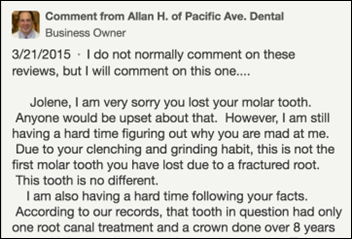

People

image image

Columbus Regional Health (IN) hires Steve Baker (Indiana University Health System) as VP/CTO/CIO. He was CRH’s IS director for 11 years through 2010, seeing the IT department through the June 2008 flood that destroyed the hospital’s data center and closed the hospital for several months. He replaces CIO Diana Boyer, who will retire after 31 years of service.

image

Care coordination software vendor PingMD names Susan Driscoll (Wolters Kluwer Health) as president and CEO. She replaces co-founder Gopal Chopra, who will remain board chair.

image

SPH Analytics hires Bill O’Connor, MD (Orion Health) as chief medical officer.


Announcements and Implementations

image

SSM Health goes live with Surescripts National Record Locator Service to allow clinicians to retrieve the records of patients seen elsewhere and review them within Epic.

A Nuance study finds that its clinical documentation improvement customers improved their financial performance metrics quarter-over-quarter after implementing ICD-10.


Government and Politics

HHS clarifies an earlier statement involving a $6.50 flat charge for providing an individual with a copy of their medical records, saying that providers are allowed to charge a flat fee of up to $6.50 per request, but otherwise can still calculate their fees  based on the allowable labor costs for either a specific request or for an average request.


Innovation and Research

Apple CEO Tim Cook says the company is focused on health and its entry point is Apple Watch, to which new sensors will be added.


Technology

image

Chromebooks (of which I have one) outsold Apple Mac desktops and laptops (of which I have none) for the first time in Q1, with sales of at least 2 million units. I’m very happy with my recently purchased Asus that cost around $200 – it’s like a tablet with a really nice keyboard built in since it’s instant-on, instant-off with a battery life of around 10-12 hours, no need for antivirus or other add-ons, and software that is automatically updated from the cloud. It’s perfect for travel and doing keyboard-intensive tasks (like ordering stuff) while relaxing on the couch with a small, lightweight device with a decent-sized screen in your lap. Just about the only negative is the maddeningly clunky Google apps (like Docs) that it uses by default, even to make a simple list or to edit an emailed Word document. It only works when connected to the Internet, although most parts of the country have adequate cell phone coverage to tether anyway. I’m taking both the Chromebook and my iPad Mini next time I travel to see which one I find more useful – I would bet on the former.


Other

Mike Lynch, the billionaire who sold big data company Autonomy to HP for $10 billion during the latter’s disastrous Leo Apotheker years (not to be confused with the company’s only slightly disastrous Carly Fiorina years a bit earlier), says Google mishandled its patient data deal with England’s NHS. On the other hand, Lynch is an investor in DeepMind competitor Sophia Genetics, which offers hospitals genomics-powered diagnoses.

I’ve written several times about the phenomenon in India of friends and family members forming an angry mob to attack doctors and hospital officials following the death of their hospitalized loved one. The Washington Post says it’s getting worse as medical residents at underfunded government-run hospitals, who work up to 20 hours per day, are requesting permission to carry guns to defend themselves from people who blame them for poor care or long delays.

Iatric Systems President Frank Fortner creates a song parody about virtual visits in which he channels Daughtry in declaring “I’m staying home in the place where I belong, where telehealth is often good enough for me.” For my money, Frank’s version is better than the original.


Sponsor Updates

  • Aprima will exhibit at the Practice Management Institute June 2-3 in New Orleans.
  • Catalyze launches Change Agent, a new publication on Medium.
  • Besler Consulting’s latest podcast focuses on comprehensive care for join replacement quality measures.
  • CapsuleTech will exhibit at the 2016 International MUSE Conference May 31-June 3 in Orlando.
  • Frost & Sullivan recognizes Validic with its 2106 visionary innovation leadership award, calling the company “an industry leader and de facto standard in health data interoperability.”
  • Forbes names The Chartis Group as one of America’s best management consulting firms, with “best firm” distinction in healthcare, data analytics, and digital transformation.
  • CitiusTech founder and CEO Rizwan Koita authors an article about healthcare technology in India for LiveMint.com.
  • ZeOmega will integrate its Jiva population health management solution with McKesson’s InterQual Connect.
  • Crossings Healthcare Solutions will exhibit at the Cerner Great Lakes RUG May 31-June 2 in Chicago.
  • CTG receives a marketing excellence award from its partner, Dynatrace.
  • DrFirst presents  “What good is secure text messaging if no one uses it?” at MUSE 2016.
  • Direct Consulting Associates will exhibit at the Northern Ohio Chapter of HIMSS Regional Conference May 26 in Cleveland.
  • Elsevier Clinical Solutions and FormFast, Galen Healthcare Solutions, and HealthCast Solutions will exhibit at the 2016 International MUSE Conference May 31-June 3 in Orlando. 
  • Extension Healthcare will exhibit at the AAMI Annual Conference June 3-6 in Tampa, FL.
  • HCS will exhibit at the ONC Annual Meeting May 31-June 2 in Washington, DC.
  • HDS and Healthwise will exhibit at the Cerner Great Lakes RUG May 31 in Chicago.

Blog Posts


Contacts

Mr. H, Lorre, Jennifer, Dr. Jayne, Lt. Dan.
More news: HIStalk Practice, HIStalk Connect.
Get HIStalk updates.
Send news or rumors.
Contact us.

125x125_2nd_Circle

Curbside Consult with Dr. Jayne 5/23/16

May 23, 2016 Dr. Jayne 6 Comments

I’m working with a client who hired my partner and me to do a complete review of their practice operations and both financial and clinical workflows. Initially, they had requested us for a system selection engagement since they were ready to jettison their vendor and look for greener pastures.

Since I’ve worked with this particular vendor multiple times, I strongly suspected that the problem wasn’t with the system at all, but with how it had been implemented and was being used. The client has been on the system for a long time and I suspected they hadn’t been keeping up with newer releases, or if they had, that they hadn’t been adopting new features and incorporating them in their workflows.

They understood that paying us for a thorough review and potentially executing a remediation plan would definitely be more economical than completely throwing out the system. My partner started digging through their financial workflows a couple of weeks ago and we didn’t find anything too surprising there.

The practice is a group of procedure-driven subspecialists. In our experience, those groups tend to be fairly strong at maximizing their financial returns. We found some opportunities as far as them not using some of the automation available in their system. Although it may save them a couple of staffing FTEs, in a group their size, it wasn’t truly earth-shaking. If we had to give them a grade on how well they’re using the system and keeping up with the times, we’d give them a solid B+.

The clinical team’s use of the system was something else entirely. As we worked through their clinical workflows, it was apparent that they hadn’t taken advantage of many of the system upgrades that had occurred since their initial go-live more than five years ago. Once we review the user workflows, we typically meet with the physician champion or super users to determine whether they are aware of new workflows and made a conscious decision not to use them or whether they were not aware of the best practices. We try to avoid having these conversations with end users because they become frustrated when they learn that there were enhancements that could have helped them and their practice didn’t implement them for one reason or another.

The group has had a fair amount of turnover with regard to EHR super users, although the same EHR lead has been present since system selection. With every feature we discussed, her answer was, “Nobody told me about this” despite the vendor offering free Web-based training every time a system upgrade was available.

The physician champion just wanted to argue about how poor the system was and how they were going to replace it anyway rather than wanting to learn about the features that would eliminate their pain points. He clearly was not on board with the practice’s executive committee decision to bring us in to try to fix the current system rather than chuck it.

We also found that essentially they had been doing what needed to be done to get their Meaningful Use incentive payments, but hadn’t at all embraced the clinical realities of the metrics they met. For example, they made sure that every patient had an entry on his or her problem list, but the lists were not up to date; nor was there any policy or procedure in place to cover how often they should be updated or by whom. As far as they were concerned, since their vendor provided documentation that the problem list was “in use,” that’s all they needed.

One of the providers I interviewed told me that he didn’t put any problems on the patient’s list that he didn’t personally treat. This is the classic view of the problem list as “the physician’s problem list” rather than “the patient’s problem list.” I tried to have a conversation with him about the goals of Meaningful Use in providing more comprehensive records for patients, making it easier for practices to integrate data, the evolution of patient-driven medicine, etc. but he was having none of it.

He mentioned that his job was to take care of patients and made statements that sounded an awful lot like he felt he was above making sure he was aware of all the different problems impacting the patient. I tried to use logic with him, noting that although he doesn’t manage a patient’s hypertension or diabetes, they’re certainly important factors to consider prior to putting the patient on an operating table.

I also demonstrated his system’s functionality to filter the problem list by sorting the problems that are attributed to him to the top of the list, but he continued to push back. Although he seemed to agree in principle, he wouldn’t arrive at the point where he admitted that he (or his staff) should be keeping an updated problem list.

Having tried the “it’s good clinical care” angle and failed, I decided to press a little more on the MU aspect. I asked how he felt about the fact that he accepted federal incentive payments for doing something that he clearly wasn’t doing.

Mind you, I had no problems pressing this guy because he’s taking home more than half a million dollars a year. He’s also pontificating about being there to care for the patient, but refusing to do the basics. I tend to get a little aggravated with people like this, having come from the primary care trenches where many of my peers were working long hours updating charts to provide complete and accurate data for their patients (simply because it is the right thing to do) while making 70 percent less money than this guy.
He rationalized his actions (or lack thereof) by saying that the EHR vendor provided documentation that he met the performance threshold. I explained that the reports deal with the fact that the problem list contains data, not that anyone is actually working with it or keeping it current. Ultimately the physician is responsible when someone attests on his behalf that he has done something that he clearly hasn’t.

Although this guy may be a technically brilliant surgeon, I’m not impressed with his professional ethics. When I told this story to a friend, he assumed the surgeon in question was older and had been trained in a more paternalistic model. This physician finished his training within the last decade, so I’m not buying that excuse.

Medical schools are doing a lot of work trying to shift physician culture and educate in the benefits of patient-centric care. Regardless of whether you use an EHR to document your work or not, we need to be doing things differently and this guy clearly doesn’t get it.

Still, as one of the highest-compensated physicians in his region, he’s being rewarded because we still value procedures over cognitive skills. Ultimately the drive towards value-based care should help with some of this, but I don’t think I’m going to see the change in my career lifetime.

Is it just me, or are there still a lot of physicians like this out there? Do you have to deal with them? Email me.

Email Dr. Jayne.

HIStalk Interviews Peter Butler, CEO, Hayes Management Consulting

May 23, 2016 Interviews 2 Comments

Peter Butler is president and CEO of Hayes Management Consulting of Newton Center, MA.

image

Tell me about yourself and the company.

I’ve been with Hayes for 22 years. I’ve been running the company since 2007. From a company milestone standpoint, at the end of 2015, we did a management-led buyout and bought Paul Hayes, our founder, out of the company so he could go off into retirement and enjoy the fruits of his work. We’re excited to continue carrying on the legacy.

Hayes started as a consulting company. We started in revenue cycle management and optimization. We grew from there into clinical optimization, always with an IT component, but also the business of delivering care and operating a business. That’s where we got our grounding.

We got into the software business in 2006. We have a software solution that we call MDaudit to help billing compliance managers run their business more efficiently and identify risk areas for their organization.

Sometimes it’s hard to tell whether a given company does true consulting versus providing staffing services. Is that ratio changing in the industry in general?

We’ve seen over the last several years firms that started as consulting firms have become staff augmentation firms, mostly around Epic implementation services. There’s just been so much demand in the industry. Those services have been commoditized over the years.

There’s still a need for consulting firms. Where I see the differentiation is where people can come in and do interim leadership, management, business process change on those levels, coupled with the IT implementations as well.

How does a company grow from just letting their individual warm bodies wing it versus developing mature, repeatable processes?

From repeat types of projects or very similar projects, you develop a methodology that’s  packageable. You can replay that and bring in along with it best practices. What the client is getting is for that targeted effort — whatever that might be, a revenue cycle improvement project — here are the top six steps that we follow and it’s a methodology. Sometimes it’s not a software solution or something that’s easily demoable, but it is a methodology that could be followed.

For example, bringing in key leadership stakeholders, interviewing at that level, understanding what they have a need for, and then dropping down a level into the management level and saying, "What are you really executing in the delivery of your business?" Then looking further, you get into the IT side of things and have a certain methodology there as well that you’re looking for these top 25 items. You put that together in one methodology and you can make some improvement.

Is it easier or harder to recruit people into consulting compared to two or three years ago?

It hasn’t been harder. We tend to see a lot of people who are later in their careers who want to get into consulting if they haven’t been there previously. For them, it’s the thrill of a new project and not being tethered to the politics of any one organization. They also have to have a pretty strong willingness and interest in travel.

For us, it’s been fairly easy to recruit people that are interested in making a difference one project at a time. We haven’t see many people pulling back from the consulting ranks from the types of projects that we’re hiring into.

How important is developing relationships with prospects or current customers?

It’s absolutely critical. I was under the misunderstanding when I solicited Paul Hayes and said, "Can I go out to the West Coast? I’d really like to live out there first of all, but I think there’s some business opportunity.” I thought it would be a matter of setting up a shingle and publishing a phone number on a website.

What I found was a lot of hard work over the next couple of years being a face of an organization, meeting a lot of people, and seeing them on a regular basis at industry conferences or speaking at industry conferences to the point where they knew you and knew what you were capable of and could trust you enough to ask questions. It took awhile to get to that point because, typically, people are very defensive of a new face or new player. Being able to build up that trust  opened up a lot of doors through many many conversations.

What makes someone decide to hire a new firm instead of continuing working with their current one?

You’re really only as good as your last project. Typically, firms will get replaced if they if they stub their toe. The client will cut you some slack if you put a resource if it’s not quite a good cultural fit. They’ll give you an opportunity to replace that person. If you have a couple of events like that, they start to lose confidence in you. Or if you’re asked to present before their board and you’re not prepared enough, or you don’t understand the politics in the room when you walk in, you can really stub your toe there.

Those provide opportunities for firms like us to get an opportunity to, “Give me a shot — I think we can make this right.” Then, you just got to put on your A game.

Can you usually tell ahead of time when a consultant or engagement is having problems?

We try as hard as we can. One of the best ways to do that is a regular touch point with the client. We’re checking in and you’ll hear, "Hey, everything’s going great. Everything’s going great." On a regular tempo, as you’re checking in, you might start to hear, "This meeting didn’t go as well as we thought it would." You make some changes and identify potentially what the reasons were and address it early and often. That’s key to managing client expectation and the way the consultant is presenting themselves.

What are the biggest changes that have occurred in consulting in the last few years?

There’s an incredible amount of anxiety in the industry and attention to detail around expense management and revenue. As we know, there’s a razor-thin line on the healthcare bottom line. That’s only getting tighter. We’re seeing an increased level of need or concern around, “Are we getting every dollar we possibly can? Are we leaving anything on the table? What tools can we employ to help us run our business more efficiently? What reporting functions can I get, dashboards or analytics, that will help us identify risk areas before they become problems?”

What does MDAudit do?

When it first launched, it was really a work flow improvement tool. Clients were using spreadsheets and so forth, a very manual process for conducting physician audits and identifying physicians on a manual basis with no audit. Where are they improperly coding? Where are we as an organization at risk for fraudulent billing?

What it’s morphed into in the last couple of years is, as organizations are buying up practices and adding physicians at a very rapid clip, they’re going out and auditing those physicians — usually after they’re bought — and identifying risk areas and then providing educational opportunities to those physicians to fine tune their coding practices.

What we’re seeing now as a trend is more risk-based audits. Rather than looking at every individual physician, it’s looking at what the RAC auditors are looking for in the current coming year.

There’s a whole list of other auditors who are coming knocking and looking for improper billing practices. Where is my organization most at risk? Seeing that on the dashboard, and being able to drill in and say, the greatest risk is coming from this particular department or these physicians. Let’s go target a training effort there to get them coding properly so we can mitigate that risk and move on. We also see that as an important area with the new billing regulations that are coming out and the diminished need for fee-for-service type billing and being able to run a proactive effort as you’re managing physician billing and facility billing.

How will MACRA impact the industry?

It’s going to be a huge burden to the industry. I feel for the physicians, as Dr. John Halamka mentioned in his blog. It’s going to be difficult to manage. It’s very onerous. But it’s a necessary direction that we need to go as an industry. The larger organizations should be able to deploy the resources around helping position the organization and physician billing appropriately to manage against those metrics. It’s the smaller practices that are going to struggle in meeting the requirements.

Do you have any final thoughts?

It’s an exciting time in the industry. I know it’s painful for many clinicians and physicians. There’s so much work that needs to be done and so much modernization. I look forward to the next 10 years working in this industry and helping our clients to migrate and manage through the process of transitioning from fee-for-service into more of a value-based delivery system. As a patient, I’m really looking forward to that.

Monday Morning Update 5/23/16

May 22, 2016 News 4 Comments

Top News

image

Kansas Heart Hospital (KS) is hit with ransomware,  pays the ransom that it calls a “small amount,” and is still denied access to unspecified systems when the hackers demand further payments. The hospital says it won’t pay again.

The hospital didn’t announce which systems were affected or whether they have been restored, only saying that patient information wasn’t placed at risk.


Reader Comments

From Danbury Whaler: “Re: Western Connecticut Health Network. Laying off significant management, including the president. They blame it on state funding declines. IMO, they are way over budget in the construction of a new building and way over budget in IT.” EVP Dan DeBarba just resigned from the three-hospital network, which confirms that it has laid off several managers because of the $1 million it had to pay in a newly implemented state tax on non-profit hospitals. The system chose Cerner in September 2015.


HIStalk Announcements and Requests

image

The vast majority of poll respondents would recommend their most recently experienced hospital or practice. New poll to your right or here: what part of your medical record would you be most upset to have exposed in a breach?

I was looking back through my old polls to see what topics were hot long ago. These caught my eye:

  • NAHIT paid consultants to define five common acronyms such as EMR and RHIO, saying consensus will increase HIT adoption. Do you agree? (May 2008 — 86 percent said no.)
  • The HIMSS “Taking HIT to the Streets” program will pay attendees to attend EHR vendor demos. Is that an acceptable practice? (November 2009 – 80 percent said no).
  • What impact will the iPad have on healthcare? (April 2010 — 42 percent said little or none, 29 percent said some, 29 percent said a good bit).
  • What’s the best way to encourage better usability? (May 2010 — it was an even division among just letting the market decide, adding usability criteria to EHR certification, having an independent organization rank and announce usability test results, and educating providers better).
  • What credential earns the title of “informaticist?” (November 2010 — 35 percent said a clinical degree plus work experience, 22 percent said clinical degree plus certification, 23 percent said non-clinical experience, and 20 percent said a graduate degree in informatics).
  • Will state HIEs be viable once they’ve spent their stimulus money? (July 2010 — 81 percent said no).
  • Do KLAS ratings accurately represent product performance? (September 2010 — 61 percent said no).
  • What will HITECH’s legacy be? (July 2011 — 42 percent said increased EHR adoption, while 31 percent said waste of taxpayer money).
  • Are Regional Extension Centers worth the $650 million taxpayers are paying for them? (November 2011 — 84 percent said no).
  • Do you agree with Neal Patterson that Cerner and Epic will be the only surviving hospital information system vendors? (May 2012 — 75 percent said no).

image image

Ms. Hayes in North Carolina says students in her STEM-focused high school are using the six 3D puzzles we provided in funding her DonorsChoose grant request to work as teams and have fun learning about engineering and history.


Last Week’s Most Interesting News

  • Theranos admits that the results of all of the lab tests it ran on its proprietary Edison analyzer in 2014-2015 are unreliable.
  • The VA says its new Web front end for VistA will be rolled out by the end of summer.
  • Two Missouri HIEs continue their bickering and political maneuvering.
  • John Halamka clarifies his MACRA thinking in suggesting that HHS pare the program down to focusing on just three specialty-specific outcomes at a time, also recommending that EHR certification be stripped down to include only the interoperability required for basic care coordination.

Webinars

None scheduled soon. Contact Lorre for webinar services. Past webinars are on our HIStalk webinars YouTube channel.


Acquisitions, Funding, Business, and Stock

image

My Coverage Plan Inc., a Madison, WI-based for-profit subsidiary of a non-profit public interest law firm, is awarded a five-year, $1.6 million NIH grant to develop software to train hospitals to determine patient eligibility for public health programs. The company also sells a patented decision support software that helps hospital financial counselors qualify patients for Medicaid and other programs.

image

Cambia Health Solutions-owned diagnostic software vendor Enigma Health apparently shuts down. Another Cambia investment, point-of-service patient technology vendor Wellero, closed in January.

The year-old health Internet subsidiary of China-based insurer Ping An Group raises $500 million in Series A funding, valuing the company at $3 billion.The  Ping An Good Doctor app offers video visits, appointment scheduling, disease management, sale of over-the counter medications and medical devices, and insurance coordination. It claims 77 million registered users and up to 250,000 daily consultations.


People

image

UConn Health (CT) hires Dirk Stanley, MD, MPH (Cooley Dickinson Hospital) to the newly created position of CMIO, where he will help lead its Epic implementation. 

image image

Athenahealth promotes Karl Stubelis to SVP/CFO following the resignation of Chief Financial and Administrative Kristi Matus, who had held the position for less than two years. The company says she’s leaving because her job will be split into the CFO position and an SVP of talent and culture, for which a search has been initiated. Jonathan Bush seemed nervously defensive and uncharacteristically inarticulate on the call announcing the change, sounding like he’s imitating other companies in trying to aggressively manage company culture, hiring consultants and placing great value on what he heard at Microsoft’s CEO conference as Athenahealth nears its goal of $1 billion in annual revenue. He mentioned several times that things change at that $1 billion mark and he seemed worried about employee comments left on GlassDoor.


Announcements and Implementations

image

Six-hospital St. Luke’s University Health Network (PA) says its January 2016 Epic go-live was a success, giving a nod to VP/CIO Chad Brisendine. The health system will go live on Epic ambulatory by January 2018.


Government and Politics

image

The ACLU files an OCR HIPAA complaint against genetic testing company Myriad Genetics, claiming the company denied  four consumers access to their full genetic test results. Myriad released the information to the consumers as soon as the ACLU announced a press conference about their complaints. HHS regulations give individuals a right to receive the full genetic test results, not just those genetic characteristics known to be associated with disease. Myriad says it didn’t know about the regulation since it was announced only in an HHS blog post that clarified provider responsibilities for information release under HIPAA. One of the consumers wants to donate her genetic information to the NIH-run ClinVar research database, but Myriad won’t submit its breast cancer genetic information to ClinVar even though other testing companies do so.


Privacy and Security

Lawrence General Hospital (MA) tests employees by sending faux phishing emails with subject lines like “Prince’s last words on video” and “Banking statement: your transaction failed” to see how many employees click the link. The hospital publishes the number of links clicks and disciplines employees who open three or more attachments.


Innovation and Research

An Israel-based startup is working on eyeglasses that work like smartphone cameras in focusing on whatever the wearer is looking at, potentially eliminating the need for vision testing and having new glasses made to deal with age-related nearsightedness.


Technology

image

Microsoft releases Skype for Business App SDK Preview, which allows iOS and Android developers to add instant messaging, audio, and video to their apps. Virtual visit company MDLive is using it.


Other

image

A local TV station reports that Effingham Health System (GA) has fired CIO Mary Pizzino as the 25-bed critical access hospital converts to non-profit.

The CEO of Wake Forest Baptist Medical Center (NC) steps down to become executive director of the hospital’s venture arm, where he will focus on commercializing healthcare technologies that include analytics and digital health.

Vince and Elise post their Physician Practice Vendor Review, which he notes with amusement is often called “ambulatory.” Technically, that would mean that those patients arriving at an ambulatory care center in a wheelchair should not be allowed in since they are not in fact ambulant. The word “ambulance” is a variant, although it refers to the ambulating horses that pulled medical wagons in 1800s France. One might also quibble with the word “clinic,” which originally defined doctors who visited patients at their location rather than the modern-day opposite where the sick person is expected to make their way to where the doctor is sitting.


Sponsor Updates

  • T-System will exhibit at the 2016 PHIMA Annual Meeting May 23-25 in Lancaster, PA.
  • Validic will present at the Digital Health Summer Summit June 7 in San Francisco.
  • Vital Images will exhibit at the HIMSS Minnesota Spring Conference May 24 in Plymouth.
  • Hamad Medical will showcase Zynx Health at the Cerner Middle East Regional User Group May 31 in Dubai.
  • Experian Health, PatientMatters, and The SSI Group will exhibit at the NAHAM Annual Conference May 24-27 in New Orleans.
  • PeriGen offers an update on its go live at Oschner Baptist (LA).
  • Streamline Health will exhibit at the 2016 HFMA Western Michigan Spring Institute May 23-25 in Mt. Pleasant.
  • Sunquest Information Systems will exhibit at the Pathology Informatics Summit 2016 May 23-26 in Pittsburgh.

Blog Posts


Contacts

Mr. H, Lorre, Jennifer, Dr. Jayne, Lt. Dan.
More news: HIStalk Practice, HIStalk Connect.
Get HIStalk updates.
Send news or rumors.
Contact us.

125x125_2nd_Circle

News 5/20/16

May 19, 2016 News 1 Comment

Top News

image

Theranos cancels or corrects the results of tens of thousands of lab tests it ran in 2014-2015 on its proprietary Edison analyzer. Basically, the company says none of those results can be trusted even though the medical decisions made from them have long since happened.

One doctor who sent a patient to the ED in 2014 because of abnormal lab results recently received a revised report in which the corrected results were actually normal. In addition, an insider says Theranos regularly reported inaccurate coagulation results because it incorrectly programmed its Siemens analyzer.

This admission by Theranos is ample cause for the company’s doors to close even before CMS metes out its likely punishment. The privately held (and therefore minimally transparent) company hyped its technology without medical evidence; claimed as its niche a questionably advantageous (except in pretending to be a high-multiple technology company) finger-stick sampling method that turned out not to work; loaded its board and management team with people who know nothing about healthcare; expended extraordinary effort to avoid participating in the mainstream medical community; advocated that consumers order their own lab tests even though the clinical and financial impact of that practice has not been studied; and now admits to a remarkable level of incompetence in not even being able to correctly program another company’s analyzer. Selling cheaper lab tests isn’t much of a draw (no pun intended) if the results are untrustworthy. Theranos needs to give back the tiny bit of volume it took from Quest and LabCorp and find something less critical for its college dropout founder to pursue while waiting for the inevitable patient class action lawsuits to gather steam.


Reader Comments

From Damascus Sword: “Re: MD Anderson. Encore did the selection, Santa Rosa did the go-live, but whoever ran the implementation (Deloitte, I think) would have been paid fees far exceeding the other two.” Unverified.


HIStalk Announcements and Requests

I’ve figured out how to filter out the 99 percent of political “news” (especially of the emotional Facebook and Twitter variety) that is really just zealots spewing intolerant invective: skip anything that uses a carefully chosen unflattering photo of a political figure or that refers to that person by last name only. I apply similar criteria for scientific or technical articles in which the author pretends to be informative while actually editorializing – I move on immediately if I see the words “fortunately” or “unfortunately.”

image image

Mrs. Boyd says students in her North Carolina class have “taken ownership of their learning and celebrate each other’s success” by using the two Osmo gaming systems we provided in funding her DonorsChoose grant request. Most interesting to me is that she reports — as have other teachers for whom we have provided group learning technology – that it has brought some shy students out of their comfort zone as they participate more actively, which will probably benefit them long after they’ve forgotten the specific lessons.

This week on HIStalk Practice: Keizer Solutions acquires Colonial Valley Software. PatientPop raises a $20 million Series A. The Midwest Independent Physicians Practice Association gets into telemedicine. The Center for Rheumatology’s expansion strategy highlights the tough choices physicians must make to remain independent. Medical Association of Georgia plans to launch private HIE. Consortium of Independent Physician Associations opens for business in Ohio. CityMD CMO David Shih, MD shares the challenges urgent care facilities face when it comes to adopting healthcare IT.


Webinars

None scheduled soon. Contact Lorre for webinar services. Past webinars are on our HIStalk webinars YouTube channel.


Acquisitions, Funding, Business, and Stock

image

EHR hosting and support vendor ITelagen acquires competitor Planet Logic.

Onex Corp. again places medical imaging vendor Carestream Health on the market, considering separating its medical imaging and dental imaging business in raising up to $3 billion. The buyout firm acquired Eastman Kodak’s healthcare business for $2.35 billion in 2007 and failed to attract a buyer in 2013 at the $3.5 billion price it sought. The company made $360 million EBIDTA on revenue of $2.1 billion in 2015.

Quality Systems (NextGen) reports Q4 results: revenue flat, adjusted EPS $0.19 vs. $0.21, meeting revenue expectations and beating on earnings. 


Sales

image

England’s Sandwell and West Birmingham Hospitals NHS Trust chooses Cerner pending financial approval.

image

Lake Health (OH) chooses Cerner Millennium and HealthIntent, replacing Soarian.

image

Houston Methodist (TX) selects Phynd to manage and share the data of its 21,000 providers.

Decatur Morgan Hospital (AL) chooses InfoPartners for its Meditech 6.0 to 6.1 upgrade.


People

image

Stratus Video hires Brad Blakey (CareCloud) as VP of sales and marketing.


Announcements and Implementations

SAP announces its Connected Health ecosystem and its most recently announced partners CancerLinQ, Castlight Health, and Dharma Platform.

image

Health IT startup Vericred announces availability of API-driven drug formulary datasets for health plans in all 50 states. The API returns information on drug formulary tiers, prior authorization, step therapies, and quantity limits.

InterSystems releases its TrakCare Enterprise laboratory business management system, with initial implementation in two NHS trusts.


Government and Politics

CHIME and the Association for Executives in Healthcare Information Security send comments to a Senate hearing on ransomware, suggesting that Congress remove the HHS restriction on pursuing a national patient identifier (which it says will make health records less attractive to hackers since they won’t have otherwise identifiable information such as SSN) and to “encourage investment through positive incentives for those who demonstrate a minimum level of cyberattack readiness and mature information risk management programs.” I can’t imagine any industry other than healthcare that could keep a straight face while asking Congress to pay its members for keeping their own business information secure.


Privacy and Security

image

A hacker claiming to be part of the Anonymous group leaks a database from two hospitals in Turkey in retaliation for a previously rumored Turkish hacker’s attack on two US hospitals. Anonymous denies any involvement.

image

The hackers behind the TeslaCrypt ransomware sunset their product and post the master decryption key on their support site.


Technology

UC Irvine’s medical school posts a video showing the use of smartphone-powered digital health technologies. 


Other

FHIR architect Grahame Grieve says FHIR is being hyped as the solution for interoperability, adding that groups like HL7 can’t impose prescriptive information models or force vendors and providers to standardize processes – it can only provide a common way for them to do it if they’re so inclined. He adds that conforming to FHIR doesn’t accomplish anything unless it’s supported by cultural changes. 

image

A prenatal imaging clinic in Canada blames a computer virus after it gives a dozen parents-to-be identical ultrasound images that also match the sample image featured on the company’s website.

image

Australian Computer Society profiles the year-old, non-profit CancerLinQ, an American Society of Clinical Oncology project that is analyzing the information of 1 million US cancer patients to identify treatment patterns and to allow doctors to search symptoms and treatments. Its CEO says that only three percent of cancer patients qualify for clinical trials, but the automated collection of EHR information for the other 97 percent creates a rapid learning system in which any doctor who contributes de-identified information can use the entire database.

image

Weird News Andy sings happily along to his just-created TV jingle, “Cleaner, Fresher, Softer Arteries!” Scientists find that a sugar that’s the active ingredient in the Febreze air freshener can remove plaque from hardened arteries. WNA cynically notes that the article’s last line should really be its first – the sugar can’t be patented, so drug companies aren’t interested in sponsoring the clinical trials that would allow it to reach the human market.


Sponsor Updates

  • Valence Health opens registration for its Further 2016 value-based care conference September 14-16 in Chicago. 
  • HDS will exhibit at the Cerner Great Lakes RUG May 31 – June 2 in Chicago.
  • Influence Health will exhibit at the Healthcare Marketing & Physician Strategies Summit May 23-25 in Chicago.
  • InterSystems will exhibit at the Midas+/Xerox Annual Symposium May 23-25 in Tucson, AZ.
  • National Decision Support Company adds support for ACR’s Radiology-TEACHES and R-SCAN initiatives to its platform.
  • Frost & Sullivan recognizes Intelligent Medical Object’s medical terminology platform for enabling the clearest patient narrative.
  • LiveProcess will exhibit at the Mississippi Preparedness Summit May 24-26 in Biloxi, MS.
  • Obix Perinatal Data System will exhibit at the HIMSS Northern Ohio Trade Faire & Conference May 26 in Cleveland.

Blog posts


Contacts

Mr. H, Lorre, Jennifer, Dr. Jayne, Lt. Dan.
More news: HIStalk Practice, HIStalk Connect.
Get HIStalk updates.
Send news or rumors.
Contact us.

125x125_2nd_Circle

EPtalk by Dr. Jayne 5/19/16

May 19, 2016 Dr. Jayne 1 Comment

The week has been chock full of stories that unfortunately I can’t even remotely write about. Although some of my experiences are universal and could happen almost anywhere, sometimes I run into situations that I can’t imagine happen more than once. I’m pretty good about writing them down, though, in the hopes that I can change them up a little bit and use them in the future.

If nothing else, this week I have gotten a lot of practice in trying to maintain my composure when I literally wanted to laugh out loud. I’ve also made good use of my skills in talking executives off the proverbial ledge when they’re ready to jettison staffers, building hope that with hard work and thorough follow-up, we can turn things around and prevent further casualties.

One thing I can talk about is my work with customers who want to work on population health projects. The first thing I do is a run a working session called “What is Population Health” that forces the organization’s leaders to come to terms with the fact that it’s often ill-defined, and even more so given the fact that everyone around their table has a different idea of what they think they need.

Plenty of people still think they’re going to be able to buy a single technology solution that’s going to deploy itself with minimal input. These are the folks that also think that these are IT projects rather than clinical and operational ones, and who are generally surprised when I explain that it’s going to take a village to get them done and that no one is going to be allowed to abdicate their responsibilities.

My clients often complain about their software vendors, demanding more bells and whistles than what exists in current general release versions. In my experience, many customers are using only a fraction of the tools they’ve already got, and sometimes the continued banter about future content is just an excuse to avoid dealing with current-state problems.

One of my clients had been fighting with a vendor about their ability to create complex reports to identify certain sub-populations of patients. In reality, the client wasn’t ready to handle even the simplest of population health work flows and refused to admit it. They need to spend a lot more time looking at their staffing and deciding who they want to be as a practice before they start outreach and disease management programs. For starters, they have to deal with their six-month appointment backlog and their insane phone volumes. Until they address those issues, they can’t handle more patient visit volume or consider offering non-face-to-face visits.

I love a good challenge, and the groups I’m working with right now are unlikely to disappoint. Although they require the kind of long-term consulting that’s going to need not only my partner and me but some contractors to execute, some of the help they need is of a more routine nature. I’m never surprised by how many organizations lack the basics, such as communication plans, service level expectation agreements, and other types of policy and procedure documentation.

There are different ways to approach dysfunctional organizations. Sometimes it needs to be done from the top down, sometimes from the bottom up, and sometimes you just want to implode the whole thing and start from scratch. Figuring out the best way to approach it given an organization’s culture and leadership is sometimes more of an art than a science and sometimes it’s frankly voodoo.

clip_image002

The week has also been full of non-work laughs, with the best occurring at my home airport, recently made infamous by a viral video about their TSA lines. Fortunately, I had TSA PreCheck, so I was in a shorter (yet still long) line when my companion and I observed a woman with a hula hoop trying to cut the line. She started all the way at the back of the regular line and just kept working her way past passengers until she got to the first airport employee who was sorting the PreCheck passengers from those with regular clearance. She was slurring her speech, explaining that she was going to miss her flight and that she needed to get to the front of the line with her friends. Although the agent stalled her for a bit, eventually she was let through.

By now plenty of people were watching the spectacle from all four or five lines that were snaking their way towards the actual TSA agents. She was just shoving past people by this point, with no one stopping her. Whether they were worried about getting into a confrontation with someone who was possibly impaired or disturbed or something else, most of them stepped aside as she pushed past, thumping passenger after passenger with her hula hoop slung over her shoulder. Most of us in the PreCheck line were waiting for TSA to send her packing, but were surprised that they let her through.

This circus was a stark contrast to my experience at another airport recently, where my friend was forced to check her bag because it was slightly non-rectangular, having been crushed on an earlier flight to the point where it exceeded the bag-sizer’s dimensions by half an inch due to its skewed shape. At that airport, they were examining bags before people were allowed in the security line, vs. my recent experience where the hula hoop was allowed through. I’m pretty sure a hula hoop fits neither in the overhead compartment nor under the seat in front of you, so I wonder what they did with it on the flight.

Regardless, it was good to have some diversion before I boarded a flight where I knew I’d be immersed in the exciting world of QRUR reports, which require a 20-page document to explain their contents. I envy the travelers that board with a stack of magazines or their headphones and eye mask. Those magical minutes during takeoff, taxi, and landing before I can fire up my laptop and get to work are always good times to reflect on the week ahead or behind, depending on which way I’m heading.

I chuckled to myself as I thought of one client leader who still can’t figure out how to pronounce my name despite multiple onsite visits. One of his colleagues told me they play a behind-the-scenes game to see how he’ll mangle it next. Someday I’m going to write a book, and it’s going to center around the fact that you can’t make this stuff up.

What are the craziest things you encounter during your work day? Email me.

Email Dr. Jayne.

GE Healthcare Announces Project Northstar

May 18, 2016 Interviews 9 Comments

image 

GE Healthcare announced this morning at its Centricity Live 2016 user conference in Phoenix, AZ its next-generation IT solution for ambulatory care delivery. I spoke with GE Healthcare IT VP/GM Jon Zimmerman of the company’s value-based care solutions team ahead of the announcement.

Describe Project Northstar that is being announced.

Project Northstar is GE Healthcare’s next-generation IT solution for ambulatory care delivery to fundamentally help practices thrive in the world of value-based care. We strongly believe that the move to value-based care is on. It’s not going to be a light switch. It will be a transition over time.

We also see that the tools and services that have been built around population health have not been integrated with care delivery from a community perspective. It’s certainly not completely integrated with revenue cycle management with both value and volume in mind. Payers are changing, too, so there’s new payer connectivity required.

We’re taking a point of view from a physician’s workflow and driving population health integrated with care delivery, integrated with revenue-cycle management both value and volume, with new forms of payer connectivity to take waste out of the system. Our drive is to increase quality, efficiency, and financial performance for customers.

Is this a standalone product or is it just for Centricity users? Who is the target customer?

The audience starts with GE Centricity Practice Solutions / GE Centricity EMR first, but we built it with open principles. We believe that some of the advanced ACOs may want to take some of the capabilities that we’re offering and also make them useful and integrated on top of other EMRs.

Is it an upgrade or a separate product that Centricity customers will buy?

Look at it as an extension from what people have today with a migration path to roll it over Centricity over the next few years. We believe that a big-bang replacement would be a very bad and disruptive idea. Many of our customers have given us great clues on how to do a safe, smart migration transition. It’s not a big bang, turn that off, turn that on.

What providers and partners did you work with?

We worked with Westmed Practice Partners in Westchester, NY starting almost two years ago. One of the things that was highly attractive about working with Westmed is that they were scoring very high in their quality measures. Their efficiency measures and their ability to collect revenue from their fee- and value-based contracts were also very good. Their leadership knew what they were doing. They knew how they did it.

They were pushing our products up to and beyond their capabilities in order to make that happen. When I thought about how we were going to get to that next generation and who we could work with, I thought it would be good to start with somebody who was so very skilled and who knew us so well. That was Westmed Practice Partners, specifically Dr. Simeon Schwartz, the chairman and CEO.

Was the product built from scratch?

It is not being built from scratch, nor is it being acquired. This was a big discussion that Simeon and I had in the beginning. We are building certain components. We’re also assembling capabilities from different technology providers across the industry.

I don’t think anybody is going to be able to have the time to just go build from scratch, but taking a modern, 21st-century approach is going to be key. We have the luxury of leveraging is a lot of the investments that GE is making with Health Cloud, so this is an extension of what GE is doing as well.

It seems that you’re picturing an ecosystem with components provided by partners. How will that look?

First and foremost, we took a tabula rasa approach, meaning a blank slate. Once we got comfortable with one another in Westmed – and other practices have also helped us design this — one of the keys was, how do you guys work? What do you do all day? We went even to the depths of, with appropriate permissions,observing their delivery of care.

We broke it down with a number of usability experts. GE Corporate, GE Digital has been investing in usability expertise and usability engineers. We leveraged those to break down the work processes of a pretty complex multi-specialty practice. We also focused strongly on, as you would imagine, that primary care is the quarterback, and that user experience is a big deal.

On the business side, we said, how does that work? How can we make a system provide more value for the providers? We broke the providers’ work into basically four areas.

Number one is that I need to understand. When I’m going to see a patient, I need to know a lot about them. How should a system gather that information for me?

Once it gathers that information, I need to know what I’m supposed to do. I need to know how to work. Underneath that is a rules engine that we’ve selected. The rules will be based on what the clinicians want to do. We’ll get rules from specialty societies or individual practices and combinations thereof. They will create a rules-driven system that’s based on a modern user experience with workflow guidance to then get the providers to do what the providers know that they need to do. Our approach here will remove clicks, but also provide consistency through the guidance of the decision-makers for that practice.

The next piece of work is that I need to review and sign. Rules comes in and say, did I do all the things that I’m supposed to do that will be impactful for my volume-driven revenue cycle? Did I document what’s required for my quality reporting?

Last but certainly not least, there’s follow-up care coordination and care management that creates a continuous loop in the system versus a set of independent acts.

For the user experience, we’re using the same technology that Google uses. That’s called AngularJS. For the rules engine, we’ve purchased a commercial rules engine and we’ve put that into our stack. To fill the rules engine, we’re working with a number of practices, with Dr. Schwartz being the first. We have another one signed up specifically for cardiology. We have a workflow engine. Our cloud provider is technologies from GE Health Cloud and supplemented by some things we’ve been doing with Microsoft and Azure over the last few years.

You mentioned reduced clicks and the user experience. You’re not replacing the UI of Centricity, correct?

We had a lot of robust dialogue with our customers on this. The first and greatest impact that we can have is the process of creating intelligent orders — orders that take the context of the patient, the context of the payer, and the context of evidence-based practice and build them into one.

In our initial implementation, users will be in Centricity up to the point where it’s time to create an order. Then the new system takes over seamlessly. It pulls all the information that customers are used to in Centricity. Now you’re into the cloud experience, the next-generation system. Once you complete that set of tasks, we bring you back into the world that you live in.

Physicians spend an awful lot of their time, as they should, in workflows for ordering and diagnosing. That’s why we did that. The more that we talk with customers, they said, "You made absolutely the right choice."

How are you using payer information?

I was one of the lucky people who got to work as a pioneer to invent what we know today as the EDI systems of the US for healthcare starting back in the late 1980s. I have a long-term relationship with working between payers and providers. Just before I came to GE, I was lucky enough to work with a great company called Availity, a provider / payer network owned by 21 Blue Crosses and Humana. I got the opportunity to  understand a lot of the payer processes and what’s missing in the bridge between payers and providers that creates an awful lot of wasted work.

GE was an inaugural investor in the AHIP Innovation Laboratory. AHIP, the payers’ professional association, knew that they had to create more innovation because of the trends that we see. We are inaugural investors.

We are reverse engineering the exchanges of information between payers and providers that goes through phone calls, faxes, physical mail, and portals and embedding that into our current and next-generation systems. A very important point: this is not going to have to wait for a next generation. We’re doing that now.

Let me give you a couple of examples. In Medicare Advantage, being able to prove as a payer that you are closing gaps in care and that patients are getting  good care requires that if the payers see that things are not happening at differential analysis, then we can take a gap in care directly from a payers’ system. Some are pushing them out through sidecars and eligibility transactions. We put that information into the providers’ workflow so the know what’s necessary to be done. Then the providers can use their normal processes to get the work done and deliver the care.

Then payers are going to want it reported back. They’ll  take it through a claim, or some are asking for CCDAs to be sent to them. We also are building the capabilities to deliver the clinical care documents, then the summaries with details, back to the payers so they can ingest them into their various systems, not their claim systems.

Another example is the need for hierarchical condition categories for risk adjustment. We can construct the appropriate data sets that payers are constantly calling the providers for and we can deliver it to them electronically. We know this because we work directly with payers and providers in their distinct workflows to be able to build these new bridges, to do it as electronically as possible within the workflows to reduce burden, reduce waste, and deliver on the Triple Aim.

What’s the timeline for delivering the product?

The first wave is going to come out in Q1 ’17. We’re working with our user groups and providers directly. There’s that preparatory. Then the orders module will come out first, followed by more enhancements that we’re going to be delivering in the RCM, followed by more and more clinical documentation and a collaboration. We’re also simultaneously building a lot more interoperability for collaboration among providers.

Everything that we’re doing from a workflow and technology perspective is being supported by a cloud-based interoperability collaboration hub and supported by analytics that are integrated as well, because there’s going to be a lot of adjustments over time.

We see this complete picture rolling out over the next three years. Based on demand and based on the number of ecosystem partners that we see, we hope to be able to accelerate that, but we want to first and foremost do no harm and create a lot of value as people have to change their business models during this very dynamic time, like none other that we’ve seen before in this industry.

Text Ads


RECENT COMMENTS

  1. Challenger exploded on lift-off when the O-rings failed. Columbia disintegrated on reentry after one of the heat shield tiles were…

Founding Sponsors


Platinum Sponsors


Gold Sponsors


RSS Webinars

  • An error has occurred, which probably means the feed is down. Try again later.