EPtalk by Dr. Jayne 4/27/17

April 27, 2017 Dr. Jayne Comments Off on EPtalk by Dr. Jayne 4/27/17

image 

I attended the Physician Compare Benchmark and 5-Star Rating webinar this week. The team shared information about their new ABC Benchmark methodology and asked for physician feedback on the proposed approach.

Frankly, after attending the webinar, I’m disheartened. What they are proposing is complex and there is debate about whether a cluster method or equal-ranges method should be used to assign the ratings. There is also debate on what to do when providers are so high performing they can’t determine how to allocate fewer than five stars. For those measures, they’re discussing only displaying those providers who had five stars vs. not displaying those measures at all. It seems counterintuitive to not report something that people are good at. Not to mention, if it’s this complicated, it’s going to be less meaningful for patients.

At the beginning of the webinar, the speaker specifically stated that sometimes when they use a five-point scale, that people see it like school grades: A, B, C, D, F. But that’s not what they’re trying to do here, etc. I challenge the people involved in this to understand that most of the public is still going to see this like school grades. Regardless of footnotes or explanations on the website, people see three stars and think you’re a C performer.

These ratings become even more complex for measures where everyone is doing well. So how about this proposal: set benchmarks related to a grade scale and let patients truly compare not only from physician to physician, but across measures. Say we want 100 percent of diabetic patients to have a foot exam. Ninety percent is five stars, 80 percent is four, 70 percent is three, etc. Or heck, just use letter grades to make it easier. Maybe your physician gets As and Bs on everything relevant to your needs and you’re good to go. Maybe they get Bs and Cs and you need to look for someone else. Maybe all physicians get a C on some measures, which helps you understand that it’s difficult to achieve. It certainly would save the millions of dollars they’re spending to put this together and would create a system that fits into an already accepted cultural schema rather than creating something new that takes a statistician to explain.

The slides are available here if you want to check them out yourself, and if you want to share feedback, it can be sent to PhysicianCompare@westat.com with a subject line of “5-Star Rating Feedback” prior to May 10.

image

NCQA announced a new Oncology Medical Home recognition program, following the Patient-Centered Medical Home and Patient-Centered Specialty Practice models already available. They’ll host a webinar on May 5 to discuss the new program and how to achieve recognition. I’ve assisted several organizations through the NCQA recognition process and it’s not for the faint of heart (or the light of pocketbook).

Regenstrief Institute, along with the American Medical Association, has launched a mock EHR tool for use by medical students. It contains simulated patient data and allows students to practice documentation along with processing information in a typical EHR format. These kinds of tools are increasingly needed as hospitals institute fragmented policies around whether students are allowed to document in the EHR, and if they are, what kind of user rights and training they receive. My hospital allowed students to use the EHR, but didn’t give them full rights for ordering, writing scripts, or many of the other functions they had in the paper world.

The Regenstrief EHR Clinical Learning Platform tool was co-developed with Indiana University School of Medicine and is also in use at the University of Connecticut School of Medicine and the University of Southern Indiana College of Nursing and Health Professions. AMA will assist in its distribution.

Given the expansion of patient-generated health data through home monitors, fitness trackers, and more, ONC has created a challenge to find solutions to the problem of capturing data provenance. I know many physicians who are reluctant to allow patient-generated data into the EHR due to concerns about reliability as well as quantity. Anyone who has been faced with home blood pressure logs documenting five or six readings a day for three months knows what a burden this data can be. ONC recognizes that reliability and trustworthiness of data are issues.

The $180,000 challenge is in two phases, the first involving submission of white papers describing current methods with the second phase requiring winners to develop and test their solutions. Information about the challenge can be found here and phase 1 submissions are due May 22.

I’m enjoying reading Mr. H’s coverage of Missouri’s ongoing failed attempts to create a Prescription Drug Monitoring Program. Hopefully they’ll eventually arrive at a workable solution. Opioid addiction continues to be a national issue and CDC recently launched an online training series around opioid prescribing. The first of eight modules is now available. Future modules include patient communication, non-opioid pain management options, dosing/titration, and risk reduction. I’m still slogging through a bunch of online CME, so let me know if you’ve test driven the module and what you thought.

image

I subscribe to dozens of communications from various governmental organizations in an attempt to keep up with all the warnings, alerts, proposed rules, and dictates that impact physician practices. Every once in a while I see an email subject line that truly catches my attention, as did this one about “Mixing Kentucky Spirits with Food Safety.” We think about the FDA as regulating medications and foods, but it also has jurisdiction over veterinary issues. Grain byproducts of brewing and distilling are often used as livestock feed. The 20-member FDA team found their visits to various production facilities (including Woodford Reserve, Wild Turkey, and Jim Beam) to be “extremely productive” with there being “no substitute for actually seeing how these beverages are produced.” I can say that I felt the same after a recent pilgrimage to the distillery responsible for my favorite adult beverage. However, I wonder if the FDA tour ended with a complimentary drink and a souvenir glass, as mine did? I also wonder if the FDA sends as large of a contingent to less-exciting venues such as sunscreen manufacturers.

Email Dr. Jayne.

Readers Write: A Prescription for Poor Clinician Engagement with Health IT: Stop Communicating and Start Marketing

April 26, 2017 Readers Write 16 Comments

A Prescription for Poor Clinician Engagement with Health IT: Stop Communicating and Start Marketing
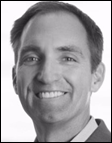
By David Butler, MD

image

David Butler, MD is associate CMIO of the Epic/GO project of NYC Health + Hospitals of New York, NY. 

My first lesson in healthcare marketing came in the spring semester of my junior year at Texas A&M University, when I accepted a prestigious internship with a little company called Merck Pharmaceuticals. Believe it or not, I hadn’t even heard of this company, but I soon found out one of the many reasons for their meteoric rise.

That summer, Merck was releasing a new prostate drug. They posed the question to their young crop of interns: where should we market this drug? Field & Stream! Men’s Health! Cigar Aficionado! We shouted rapid-fire.

Wrong, wrong, and wrong again. Our instructor basked in our ignorance for a moment before he uttered the answer: Good Housekeeping. Targeting the significant others of the drug’s target audience was actually the smarter way to go. They were more likely to notice changes in their partner’s behavior and push them to go to the doctor.

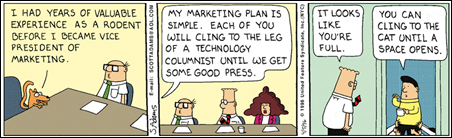
Fast-forward 25 years later and healthcare is approaching physicians and nurses with the non-WIIFM, non-behavioral economics approaches similar to what my intern class suggested.

We spend hundreds of millions of dollars to implement technology for our best and brightest to leverage to care for patients, yet we continue to allow these transformative changes to the software to enter into their workflows without rollout efforts that match the investment and the desired results.

Healthcare needs to stop communicating and start marketing new health IT projects and improvements to existing provider-facing solutions. Too many initiatives fail not on the merit of the technology, but because the organization failed to successfully relay the value to the end users.

Here are five ways to help launch a full-fledged marketing campaign to capture your end users’ attention and effectively roll out new technology and important updates to current systems:

Change the mindset.

Health IT project teams need to think of their communication differently. It should not only inform, it should persuade. If you were going to sell something to physicians to get them to actually buy it, how would you change your communication? That should be a question asked during the creation of every piece of project collateral. How do you find the wife or the Good Housekeeping marketing equivalent from my opening example?

Get docs and nurses to want to do your desired action, or even better in some cases, understand why it would hurt not to do it.

Spotlight the value.

Too often healthcare organizations spend a bunch of R&D resources creating or improving something really cool, and then communicate that in an email with a laundry list of other changes that aren’t as meaningful. If you’ve added technology that will help save lives or otherwise have a profound impact on clinician efficiency, give it the spotlight it deserves.

For example, it used to be a policy at Sutter Health (my former organization) that if a nurse gave a patient insulin, a second nurse had to log in to double-check the dose. The organization finally changed the policy so that second nurse and verification was no longer needed. Some genius asked how much nursing clicks, time, or dollars would this save. We actually took the time to figure it out.

After calculating the size of organization and the insulin doses given each day, we figured that policy change resulted in $400,000 in savings of nurses’ time—and that’s the value we marketed. Not only to the nurses, but also to the board. We told the nurses how much of their time we were giving back to them and told the board about the significant cost savings for the organization.

Once you find the value to spotlight, think about what that value means to different parties and market that ROI.

Devise a catchphrase.

If you want end user attention, you’re going to have to earn it. There are too many competing priorities for a busy physician’s or nurse’s attention. Have some fun and get some eyeballs by devising a catchphrase for your campaign.

For example, when I was helping roll out a secure messaging solution to thousands of physicians, we could have promoted it with “New! Secure Messaging” or even “Pagers to Smartphones” messaging. Instead, we used “Safe Text.” It was fun and catchy—there were plenty of good-natured jokes and buzz around the campaign—and it also tapped into their own motivation to protect PHI. Make your catchphrase not only descriptive, but also memorable. That’s marketing.

Include a call to action.

What do you want your audience—physicians, nurses, or whichever group it may be—to actually do after they’ve read your communication? Good marketing always includes a call to action, or CTA. After you create marketing for the group, ask yourself what the CTA should be. Do you want them to download an app or an update? Submit their feedback? Add an event to their calendar? Always make the CTA big, bold, and if possible, frictionless.

For example, include a link that can automatically add the event to their calendar, or seamlessly forward it to a friend or colleague. You can also think about the tools you already have and how you might get innovative with them to drive follow-through.

One prominent health system in the Pacific Northwest used their EHR alerts to creatively capture clinician attention at various workflow points within the EHR. They were greeted by a respected physician leader — their CMO — whose image and quote reminded them to complete certain crucial activities within the EHR. Having his face staring at the clinicians alongside that CTA made it much more influential.

Rinse and repeat.

If a company you already like and engage with introduces a new product, they’re going to be marketing that to you on every channel they can: Direct mail, email, TV commercials, social media ads, display ads. Follow a similar approach for internal projects: Emails, flyers, reader boards, table tents in the cafeteria, digital banners on internal websites, announcements at town halls, free tchotchkes—anything you can think of where your end users might see it.

Physicians rarely understood why drug companies would provide free prescription pads, pens, and other items. They stated, “It doesn’t affect my prescribing patterns.” However, after many years of research on this, it actually does. So let’s wise up and follow other marketing examples from other verticals to keep the messaging in front of them. It may take several exposures for the message to resonate, but you can keep it fresh by switching up the format, colors, and graphics.

Finally, don’t forget to ask for help if you need it. Most healthcare organizations have talented marketing teams that are consumer-facing, but may be willing to help out with internal initiatives. They’re just not always asked.

With these five strategies, you can help your organization’s IT team pivot from communicating new technologies from boring emails to full-fledged campaigns that truly market the value to doctors and nurses and successfully bring them on board.

Readers Write: Deep Neural Networks: The Black Box That’s Changing Healthcare Decision Support

April 26, 2017 Readers Write 1 Comment

Deep Neural Networks: The Black Box That’s Changing Healthcare Decision Support
By Joe Petro

image

Joe Petro is SVP of research and development with Nuance Communications.

Don’t look now, but artificial intelligence (AI) is quietly transforming healthcare decision-making. From improving the accuracy and quality of clinical documentation to helping radiologists find the needle in the imaging haystack, AI is freeing clinicians to focus more of their brain cycles on delivering effective patient care. Many experts believe that the application of AI and machine learning to healthcare is reaching a crucial tipping point, thanks to the impact of deep neural networks (DNN).

What is a Neural Network?

Neural networks are designed to work in much the same way the human brain works. An array of simple algorithmic nodes—like the neurons in a human brain—analyze snippets of information and make connections, assembling complex data puzzles to arrive at an answer.

The “deep” part refers to the way deep neural networks are organized in many layers, with the intermediate (or “hidden”) layers focused on identifying elemental pieces (or “features”) of the puzzle and then passing what they have learned to deeper layers in the network to develop a more complete understanding of the input, which ultimately produces a valid answer. For example, a diagnostic image is submitted to the network and the output may be a prioritized worklist and the identification of a possible anomaly.

Like us humans, the network is not born with any real knowledge of a problem or a solution; it must be trained. Also known as “machine learning,” this is achieved by feeding the network large amounts of input data with known answers, effectively teaching the network how to interpret and understand various inputs or signals. Just like showing your child, “This is a car, this is a truck, this is a horse,” the network needs to be trained to interpret an input and convert it to an output.

For example, training a DNN for medical transcription might involve feeding it billions of lines of spoken narrative. The resulting textual output forms a truth set consisting of spoken words connected with transcribed text. This truth set expands over time as the DNN is subjected to more and more inputs. Over time, errors are corrected and the network’s ability to deliver the correct answer becomes more robust.

A key feature of a neural network is that when it gets something wrong, it is corrected, Just like a child, it becomes smarter over time.

The Black Box

Here’s where it gets interesting. Once the DNN has that baseline training and it begins to analyze problems correctly, its neural processes become a kind of black box. The DNN takes over the sophisticated, multi-step intelligence process and figures out how the inputs are connected or related to the outputs. This is a very powerful concept because we may not fully understand exactly how the network is making every little decision to arrive at an output, but we know it is getting it right.

This black box effect frees us from having to contemplate—and generate code for—all the complex intermediate variables and countless analytical steps required to get to a result. Instead, the DNN figures out all intermediate steps within the network, freeing the technologist from having to worry about every single one. And with every new problem we give it, we provide additional truth sets and the neural network gets a little bit smarter as it trains itself, just like a child learning its way in the world.

How smart is smart? One of the biggest challenges with speech recognition is accommodating language and acoustic models, the specific and very individual aspects of the way a person speaks—including accent, dialects, and personal speech anomalies. Traditionally, this has required creating many different language and acoustic models to cover a diverse range of speakers to ensure accurate speech recognition and improve the user experience across a large population of speakers.

When we started using special purpose neural networks for speech recognition, we discovered something surprising. We didn’t need as many models as before. A single neural network proved robust enough to handle a wider range of speech patterns. The network essentially leveraged what it learned from the massive amounts to speech data we used as a training set to improve its accuracy and understand people across the entire speaker population, reducing the word error rate by nearly 30 percent.

Anecdotally, I’ve heard from people seated across from a physician dictating with such a thick accent at such high speed that they could not comprehend what was said, yet DNN-driven speech recognition technology understood and got it right the first time.

It’s important to note that neural networks are not magic. DNNs require problems that have clear answers. If a team of trained humans agrees with no ambiguity and they can repeat the agreement across a large set of inputs, this is the kind of problem that neural nets may help to solve. However, if the truth set has grey areas or ambiguity, the DNN will struggle to produce consistent results. The problems we choose and the availability of strong training data is key to the successful applications of this technology.

Putting DNNs to Work in Healthcare

So how are DNNs changing the way healthcare is practiced? Neural networks have been used in advanced speech recognition technology for years, and that’s just the beginning. The potential applications are nearly endless, but let’s look at two: clinical documentation improvement (CDI) and diagnostic image detection.

Clinical documentation includes a wide range of inputs, from speech-generated or typed physician notes to labs, medications, and other patient data. Traditionally, CDI involves having people who are domain experts reviewing the documentation to ensure an accurate representation of a patient’s condition and diagnosis. This second set of eyes helps ensure patients receive the appropriate treatment and that conditions are properly coded so the hospital receives appropriate reimbursement. The CDI process requires time and resources and can be disruptive to physicians’ workflow since the questions coming from CDI specialists are generally asynchronous with the documentation input.

Technology is used to augment the CDI process. Applications exist that capture and digitize CDI processes and domain expertise, creating a CDI knowledge base at the core. This involves processing clinical documentation, applying natural language processing (NLP) technology to extract key facts and evidence, and then running these artifacts through the knowledge base. The output of this complicated process is a context-specific query that fires for the physician in real time as she is entering patient documentation, linking, say, a relevant lab value with key facts and evidence from the case to indicate the possibility of an undocumented infection, for example. This approach to addressing a common documentation gap is a technically arduous and complex processing task.

What if we applied neural networks to change the paradigm? Many institutions have been doing CDI manually for years and we can leverage not only the existing clinical documentation (the input), but also the queries generated (the output) from those physician notes to create a truth set for training the neural network with a repeatable, deterministic process. The application of neural networks allows us to skip over complexity of digitizing domain expertise and processing the inputs through a multi-step process. Remember the black box concept? The DNN essentially determines the intermediate steps, based on what it learned from the historical truth set. In the end, this helps improve documentation by having AI figure out the missing pieces or connections to advise physicians in real time while they’re still charting.

The applications of neural networks are not limited to speech or language processing. DNNs are also changing the game for evaluating visual data, including radiological images. Reading the subtle variations in signal strength associated with identification of an anomaly requires a highly-trained eye in a given specialty. With neural networks, we can leverage this deep experience by training the network with thousands of radiological images with known diagnoses. This enables the network to detect the subtle differences between a positive finding and a negative finding. The more images we feed through it, the more experienced and accurate the DNN becomes. This technology will streamline the busy workflow of the radiologist and truly amplify their knowledge and productivity.

Augmenting, Not Replacing

While the possibilities for neural networks are incredibly exciting, it’s important to note that they should be viewed as powerful tools for augmenting human expertise rather than replacing it. In the case of diagnostic image detection, for example, a DNN can serve as a first line review of films, helping prioritize them so radiologists focus first on those that are most critical. Or it might serve as an automated second opinion, possibly spotting something that might have been overlooked.

Today, AI in healthcare decision support is still in its infancy. But with the exciting possibilities created by DNNs, that infant is poised to transition from crawling to walking and even running in the foreseeable future. That’s good news for providers and patients alike.

CIO Unplugged 4/26/17

April 26, 2017 Ed Marx 6 Comments

The views and opinions expressed are mine personally and are not necessarily representative of current or former employers.

The Disintermediation of the CIO

The role of the CIO has reached its zenith. Over the next several years, we will see the title deconstruct. Just as the baby boomers held on to “Data Processing Director” concepts as long as they could, a few of us diehard GenXers will grasp on to the CIO title until our retirement. Millenials and Gen Z will jump on the chance to blaze new trails and transform our profession to reflect the rapidly changing world we live in. There will be less concern with title and more focus on the depth of impact on business and on remaining relevant.

The transition began the day the CIO title was adopted. Moore’s Law became the norm and change a constant. As a profession, we metamorphosized through a variety of stages ranging from pure technical manager to today’s C-level executive. The changes ahead are not for lack of skill or talent, but are at best reflective — at worst reactive — to cultural and technological changes.

What makes this transition more profound is that the majority of CIOs never made it to the C-suite. They allowed themselves to get stuck someplace in between. The opportunity for them to close the gap is gone..

Empowered internal and external consumers and the ubiquitous nature of technology are key drivers for the change. We are seeing the democratization of data, information, and knowledge. CIOs can no longer control technology proliferation nor cap or meter its utilization. Service desks are becoming a relic of the past. Millennials grew up in a self-service age and have expectation of the same. The average consumer has 30+ applications on their smartphone and few if any come with call center support. Think cloud, blockchain, mobile, big data, consumerization, and social supported by disruptors. There is diminishing need for traditional IT.

Granted, there will always be a need for technical expertise. IT will revert back to pure technical play. IT divisions will become cost centers again and will fade into the background. IT will be focused on providing safe networks and connections and can be summed up as “interoperability and security.” Staff size and budgets will shrink and investment cut by 50 percent or more. Data centers will go lights-out and most companies will either convert the space for document storage or sell them outright. The data center is a financial albatross ripe for partnering. “Shadow IT” will become partners, not adversaries. It is not the old centralization versus decentralization, but pure and simple disintermediation.

So where are today’s CIOs headed? We are already seeing some directional signs. I was contacted twice this year by recruiters who were trolling for chief digital officers (CDO). In both cases, the existing CIOs were bypassed and would report to the CDO. While I think CDO has legs and will stick, it is not the final destination, but perhaps an intermediate layover. Just as Uber disrupted transformation, IT is being disrupted. Uber is an intermediate step for the next wave in transportation. We are beginning to see self-driving vehicles and the proliferation of drones for transport.

I don’t have a savvy prediction on how you spell the CIO title five years from now. What I am confident in is that we need to change and adapt or report to those that do. We must evolve and continuously retool ourselves and focus heavily on innovation, entrepreneurship, and value creation. We must be able to see the future and collaborate with partners, developing strategic solutions grounded in the practical realities of taking the best care of our patients. We must be the one trusted advisor who can see across the business enterprise and facilitate change at 10 times the speed of Moore’s Law.

Finally, we can’t forget that our primary talent must remain focused on being experts in the people business. When consultants say people, process, and technology, it is really people (85 percent), process (10 percent), and technology (5 percent). This is how we add value and remain relevant. Retool, yet never forget that we are in the people business and always keep the patient in the center of all we do. This is not the age of the stodgy hotel; this is the age of AirBnB.

If we don’t shape the future, others will change it for us and leave us behind.

 edmarx

Ed encourages your interaction by clicking the comments link below. He can be followed on LinkedIn, Facebook, Twitter, or on his web page.

News 4/26/17

April 25, 2017 News 2 Comments

Top News

image

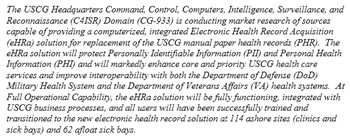
The Coast Guard posts an RFI for an EHR that can achieve interoperability with the EHRs of the Department of Defense and VA.

USCG gave up on its Epic implementation in 2015 without going live anywhere and finally elected not to renew its Epic contract that expired in early 2016, citing unspecified risks. It had spent five years and several dozen million dollars, also deciding along the way to add the US State Department to its ultimately failed rollout.

After the Epic project was halted, the Coast Guard determined that it could not revert back to its previous CHCS/AHLTA system and went back to paper instead.

The lead contractor in USCG’s Epic project was Leidos, which later won the DoD $4.3 billion bid in offering Cerner.

SAIC, which spun itself off in 2013 as its parent company renamed itself to Leidos, originally developed the DoD’s CHCS system (interestingly, as a customization of the VA’s VistA) in a billion-dollar 1988 initial contract. The DoD is rumored to have spent at least $20 billion on CHCS and its add-on AHLTA, which was not interoperable with the VA’s VistA. Defense contractor Northrop Grumman was paid at least $5 billion to develop AHLTA, rated in a 2016 physician survey as the worst EHR in the country. The DoD keeps giving Leidos and Northrop Grumman high-dollar contracts to keep the old systems running.

Cerner should have a slam dunk here unless a well-connected defense contractor takes the Coast Guard down a puzzling path or if the DoD’s project isn’t faring as well as they’ve announced. Leidos might have taken a black eye in the Coast Guard’s failed Epic project, but I still assume they’re the frontrunner as long as Cerner is game to partner with them again, which surely they are given their strong bidding position after their DoD win. Or maybe the Coast Guard will figure out how to participate in the DoD’s Cerner contract instead of mounting a separate project, given that it’s a uniformed service just like the Army, Marines, Navy, and Air Force.


Reader Comments

image

From Indigenous Species: “Re: Orion Health. Laid off 20 people last week – I have the list of those affected if you want it. My position was eliminated two weeks ago. Share price is way down from last year.” The New Zealand-traded shares of the company have shed 66 percent in the past year, valuing it at $223 million. The stock was pounded earlier this month on the company’s announcement of expected lower annual revenue and continuing (but improving) annual operating losses. CEO Ian McCrae said in that announcement that Orion will launch a cost reduction program and will evaluate partnership or minority investment interest.

image

From Dense Matters: “Re: Readers Write articles. Some of them are pretty lame. Do you run all of those submitted?” I actually reject most of them. Folks with creative ideas and insightful opinion apparently aren’t writing articles since most of those I receive are PR-polished vendor fluff pieces. I justifiably rejected one of those this week by randomly choosing five sentences from it and defying the PR person who sent it to me to find a single original or interesting thought in any of them (example: “Payers and providers recognize that future survival in the fee-for- value world depends on having the right systems in place.”) Restating dull, obvious facts isn’t a good way to draw the interest of my readers and yet people keep proudly sending me that crap like it’s wonderful. If you don’t like what I’ve run, imagine how bad the articles were that I rejected.


HIStalk Announcements and Requests

image image

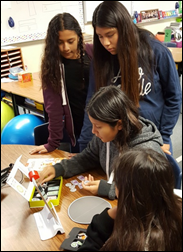
We funded the DonorsChoose grant request of Ms. B in Arizona, who asked for a document camera for her second grade class. She provides this update: “Since I teach math, we use it almost every day and now I wonder how we survived without it before! My students love it because they get to see what I and their peers are doing from the document camera to the projector. It arrived at the perfect time — the week before our measurement unit. I put the ruler under the camera, and when it appeared huge, detailed, and gigantic on the screen, the class was in awe. I know that thank you letters were not requested but my students seriously thank you. They feel lucky that there are people out there who care about their educations that they spent their time and money donating an expensive tool to their classroom to benefit their learning. It is so, so helpful. You really helped out a great group of second graders immensely.”

I needed to get my medical records from an old, distant provider today and called the office. They need me to sign a release form, which is fine, but the only way they can send me this generic, blank form is via fax or mail. The conversation went like this:

Office person: We can send that form to you. Do you have a fax machine?
Me: No, this is actually the 21st century, where the only fax machines left running are in hospitals and doctors’ offices. I don’t even have a landline even if I wanted to set up my multifunction printer to fax. It’s just a blank form. Can you email it to me?
Office person: No. If you don’t have a fax machine, we will have to mail it to you and you can fill it out and mail it back.

My only secret weapon is those online fax services that allow you to send an ad-supported free fax, where I can at least scan and send the completed form back to them quickly. I am baffled why no doctor’s office I’ve ever asked can (or will) send email attachments for routine, non-PHI containing forms like this. Probably because nobody’s willing to pay them to change their ways.

Listening: Kiefer Sutherland (yes, Donald’s boy Jack Bauer). Movie stars obviously get a fast track for crossover music deals (especially when they own the record label as Kiefer does), but his 2016 album is really good with his gruff, whiskey-sounding voice, which is probably appropriate given his string of DUI arrests and prison time. The album has been characterized as country, but despite an occasional on-stage cowboy hat, it sounds more like blues-rock tinged Americana to me. Here’s a healthcare connection – Keifer’s grandfather created North America’s first universal healthcare program in Saskatchewan, Canada as the father of Canada’s Medicare program. If you’re instead feeling proggish, there’s a new album by former Genesis guitarist Steve Hackett, who provides an alternate ending to Phil Collins turning the shockingly talented prog rockers into the Archies.


Webinars

April 26 (Wednesday) 1:00 ET. “SSM Integrated Health Technologies Clinical Data Migration: Functional and Technical Considerations.” Sponsored by Galen Healthcare Solutions. Presenters: Sandy Winklemann, MHA, RHIA, project manager, SSM Integration Health Technologies; Tyler Mawyer, MHA, managing consultant, Galen Healthcare Solutions; Kavon Kaboli, MPH, senior consultant, Galen Healthcare Solutions. GE Centricity and Meditech to Epic EHR transition. Join us for a complimentary webinar as present the decisions that are important to consider when performing a clinical data migration from the point of view of  the healthcare organization program manager, the clinical analyst, and the technical implementation team. Our expert panel will survey data migration considerations, best practices, and lessons learned. The webinar will present a unique client perspective, offering insight into considerations surrounding staffing, clinical mapping, legacy application support, and validation and testing.

April 28 (Friday) 1:00 ET. “3 Secrets to Leadership Success for Women in Health IT.” Sponsored by HIStalk. Presenters: Nancy Ham, CEO, WebPT; Liz Johnson, MS, FAAN, FCHIME, FHIMSS, CHCIO, RN-BC CIO, Acute Care Hospitals & Applied Clinical Informatics – Tenet Healthcare. Join long-time C-level executives Liz Johnson and Nancy Ham as they share insights from nearly three decades of navigating successful healthcare careers, share strategies for empowering colleagues to pursue leadership opportunities, and discuss building diverse executive teams. This webinar is geared toward female managers and leaders in healthcare IT seeking to further develop their professional careers. It’s also intended for colleagues, executives, and HR personnel who are looking to employ supportive techniques that ensure diversity in the workplace.

Previous webinars are on our YouTube channel. Contact Lorre for information on webinar services.


Acquisitions, Funding, Business, and Stock

SNAGHTML35689611

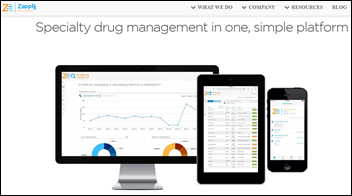
Specialty drug prescribing software vendor ZappRX raises $25 million in a Series B funding round, increasing its total to $33 million.

image

Mpirica, which publishes surgery quality scores for hospitals and surgeons using claims data, receives a $4.6 million crowdfunding investment. 

image

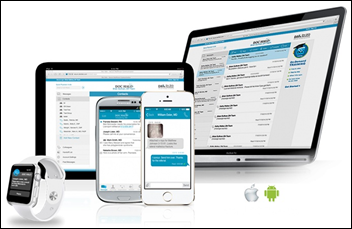
Clinical communication system vendor Doc Halo receives $11 million in a Series A funding round. 

image

Care management company Lumeris acquires analytics vendor Forecast Health.

image

HealthVerity, which sells drug companies de-identified healthcare research data that it assembles from 30 suppliers, raises $10 million in a Series B round.

image

UK-based video- and chat-based virtual visit provider Babylon Health raises $60 million in funding, valuing it at $200 million. The company is also working on an AI-powered chatbot for NHS’s 111 non-emergency line and plans to further develop AI-powered diagnosis.

Surgical Information System acquires SourceMed, which sells ambulatory surgery center software. SourceMed’s president, CEO, and board chair since December 2014 is Jamie Coffin, PhD, who was VP/GM for Dell’s healthcare and life sciences business from 2007 to 2013.


Announcements and Implementations

Epic will offer patients health information from Mayo Clinic in its MyChart and MyChart Bedside tablet apps, available by clicking an Infobutton or on a keyword.

SNAGHTML35a5aec1

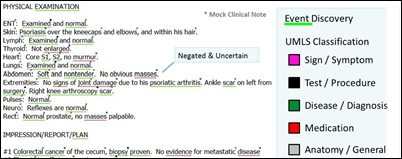
Apache Software Foundation releases v4.0 of its open source cTakes natural language processing engine for healthcare-related free text.

SNAGHTML363bc4fe

Smartphone clinical study participation vendor Medable will use API services from Redox to integrate EHR data into their system.

SNAGHTML37107898

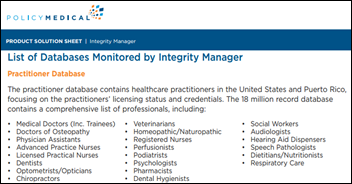
PolicyMedical announces GA of Integrity Manager, which automates the electronic review of vendors, business associates, and employees to meet the compliance requirements of OIG and OCR.

image

Cerner will integrate concussion management software from NeuroLogix Technologies into its HealtheAthlete health management system. I’ll be honest in admitting that I’ve never heard of HealtheAthlete.

image

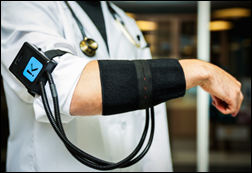
This seems bizarre: Klick Labs releases a “tele-empathy” device that allows Parkinson’s Disease patients to transmit their tremors to a Bluetooth-connected muscle stimulation armband, allowing whoever is wearing it to feel their tremors and understand their effect on activities of daily living. The company says future versions will transmit symptoms to remote doctors for diagnosis. It’s also working on “symptom transference” for diabetes and COPD and hopes to use virtual reality to “virtually put other people in that patient’s shoes.”

Partners HealthCare will work with Persistent Systems to create an open source, SMART/FHIR-powered platform that will allow providers to exchange best practices knowledge.

Medsphere releases a patient scheduling tool for its OpenVista inpatient and ChartLogic ambulatory EHR.

QuintilesIMS will develop Salesforce solutions for managing clinical trials, recruitment, and marketing that will be marketed to life sciences companies.


Government and Politics

image

Former President Barack Obama will speak at the healthcare conference of Wall Street investment banker Cantor Fitzgerald in September for a rumored $400,000 fee. I bet someone at HIMSS is talking to his people about opening HIMSS18, which would certainly represent an improvement in the string of vendor CEOs to which HIMSS has recently bestowed the prime time speaking slot, although maybe the former President is too expensive (HIMSS paid Hillary Clinton $225,500 for her HIMSS14 speech). You’ve likely heard the Cantor Fitzgerald name – 658 of its 960 New York-based employees died in the World Trade Center attacks of 2001.


Privacy and Security

image

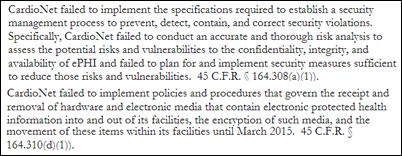
Ambulatory EKG monitoring services vendor CardioNet pays $2.5 million to settle HIPAA charges following the 2012 theft of an employee’s laptop that contained the PHI of 1,400 people. HHS OCR found that the company didn’t perform adequate risk analysis and risk management and hadn’t implemented its draft security policies. My conclusions from this:

  • CardioNet would have had no HIPAA responsibilities if it were simply a technology vendor, but the company provides services to Medicare patients and thus is a covered entity subject to HIPAA.
  • It would seem true in most cases that a breached covered entity could be accused of failing to provide adequate risk analysis and management.
  • The company will begin encrypting laptops, flash drives, SD cards, and other portable media.
  • I’m not sure what this means, but HHS will require the company to implement training that includes “out of-office transmissions.”

Other

A Nemours Children’s Health System survey finds that while only 15 percent of parents have used telemedicine services for their children, 64 percent plan to do so within the next year, the unlikely massive uptick in projected usage recalling that consumer responses to surveys often differ vastly from their actual behavior. It was also an online survey, which doesn’t necessarily draw a representative sample of all patients. I couldn’t find the 2014 version of the Nemours survey, which I expect contained rosy telemedicine projections that didn’t pan out. Respondents said they favor using telemedicine for their own convenience (acute conditions such cold and flu) but have little interest in having the chronic conditions of their children managed remotely.

Erlanger Medical Center (TN) posts improved quarterly revenue, but the CEO warns the board that its $100 million Epic rollout that starts May 1 will temporarily cause reduced revenue due to loss of productivity until staff become comfortable with it.

image

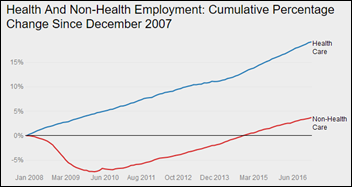
This is not sustainable in a globally competitive environment: healthcare employs one in nine Americans as communities embrace expanding health systems whose swollen headcount replaces jobs lost from dying industries. More than half of the $3.4 trillion spent annually on healthcare is made up of labor costs, with each physician being outnumbered by 16 other workers, half of whom function in non-clinical roles.

image

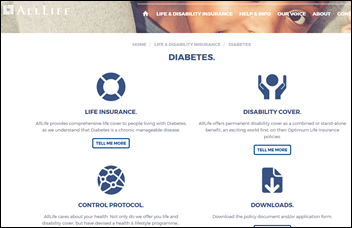
A Warren Buffett-backed insurer offers life insurance for poorly controlled diabetics in the UK using a process called “robo-underwriting” in which the insurer uses technology-powered medical data analysis to set premiums based on user behavior such as medication adherence and having their blood glucose levels tested regularly. Customers are required to comply with the company’s diabetic control policies, with their annual monitoring results sent directly to the company for premium adjustments that can range from a 4.5 percent discount to a 7.5 percent penalty.

SNAGHTML372c7f85

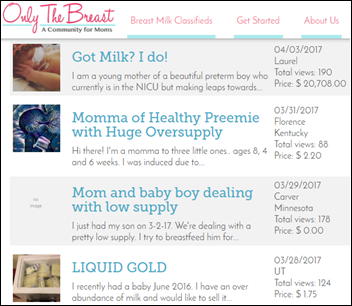
Kaiser Health News notes the proliferation of breast milk banks, some of which are run by for-profit companies that pay new moms $1 per ounce for milk that they then resell to other mothers and even hospital NICUs for up to $300 for a one-day supply or to drug companies who use the milk in manufacturing. The facilities are not overseen by the FDA and studies have found that a significant amount of the product being sold is either contaminated with bacteria or has been diluted with plain old supermarket milk. 

image

I missed this great story from last month. Myron Rolle — a former NFL player and a Rhodes Scholar from Florida State University – has not only earned a master’s in medical anthropology at Oxford, but has also graduated from FSU’s medical school and has matched to Mass General’s neurosurgery residency program. He says he had football playing years left, but was anxious to avoid the potential concussions and hand injuries that could have ended his dreams of becoming a neurosurgeon.

 image

Police use home network and fitness tracker data to charge a Connecticut man with murdering his wife. Home network logs showed that the husband logged into Outlook at the time he claimed to have been at work, the couple’s home security system log showed doors opening at times that didn’t agree with his story, and the wife posted to Facebook and recorded her Fitbit steps after he claimed to have found her dead.


Sponsor Updates

  • Impact Advisors publishes a new white paper titled “Ensuring Effective Physician Engagement.”
  • Besler Consulting releases a new podcast, “A look at the United Healthcare orthopedic bundled payment program.”
  • The Advisory Board includes CareVive Systems in its Cancer Care Transformation Playbook.
  • Casenet will deliver evidence-based content from XG Health Solutions via its care management platform.
  • Crossings Healthcare Soutions GM Justin Monnig is featured in a Goliath Technologies case study.
  • Health Catalyst wins the Gallup Great Workplace Award for the second year in a row.
  • Cumberland Consulting Group will exhibit at the Asembia Specialty Pharmacy Summit 2017 April 30-May 3 in Las Vegas.
  • Direct Consulting Associates will exhibit at the iHealth 2017 clinical informatics conference May 2-4 in Philadelphia.
  • ECG Management Consultants will present and exhibit at the 2017 ASCA Annual Meeting May 3-6 in Oxford Hill, MD.
  • EClinicalWorks will exhibit at the CAMGMA 2017 Annual Conference April 27-29 in San Diego.
  • Evariant will exhibit at the Healthcare Communications Conference May 1-3 in Baltimore.
  • Healthwise will exhibit at ZeOmega’s client conference May 2-4 in Plano, TX.
  • Imprivata and Intelligent Medical Objects will exhibit during the HIMSS UK eHealth Week May 3-4 in London.
  • Ingenious Med will exhibit at the Society of Hospital Medicine’s 2017 annual meeting May 1-4 in Las Vegas.
  • InstaMed will present at the World Health Care Congress May 3 in Washington DC.
  • InterSystems will exhibit at the HL7 international meeting May 6-12 in Madrid.

Blog Posts


Contacts

Mr. H, Lorre, Jenn, Dr. Jayne, Lt. Dan.
More news: HIStalk Practice, HIStalk Connect.
Get HIStalk updates. Send news or rumors.
Contact us.

125x125_2nd_Circle

Curbside Consult with Dr. Jayne 4/24/17

April 24, 2017 Dr. Jayne 1 Comment

I’ve been working with several challenging clients over the last several weeks. All of them have been playing various versions of the blame game: clinical blames IT, IT blames operations, operations blames clinical, some blame the consultant, most blame the government and payers, and everyone blames the vendor.

I think I’ve finally put my finger on the underlying problem: learned helplessness. Essentially, learned helplessness happens when a subject undergoes repeated painful stimuli and loses the ability to employ escape or avoidance behaviors. The subject feels they have lost control and ultimately stops trying.

In the case of healthcare IT, the repeated painful stimuli have taken the form of multiple rounds of governmental regulations, reduced physician payments, increasing numbers of risk-bearing arrangements, and shrinking organizational pocketbooks in response to greater uncertainty. The complexity of the environment in which healthcare organizations are asked to work makes it difficult to manage all the details unless one has full-time teams dedicated to doing so. Most smaller organizations simply can’t afford that kind of infrastructure, so they try to cobble together resources from local and state medical societies, professional organizations, and their IT vendors to try to make sense of all of it.

Many of these organizations are struggling to make sense of it themselves, depending on their size and level of funding. Based on my clients’ experiences, the amount of information put forth by EHR vendors ranges from comprehensive to zero. One vendor was even worse than zero, putting out information that was incorrect and therefore placed their clients at risk. Clients who use web-based platforms where the vendor upgrades them automatically have one set of issues, where they have to keep up with the vendor’s plans and be ready to roll out workflows over which they have little control. At the other end of the spectrum are clients who can choose when to upgrade and which features to enable, which can lead to analysis paralysis.

Provider organizations are understandably worried about the certification status of their vendors. A recent surfing of the Certified Health IT Product List shows a shrinking number of vendors who have completed the most current certification. Those organizations that need 2015 Edition software installed before January 1, 2018 are understandably nervous, especially those that are large or complex. These are the kinds of organizations that are finding their way into my client pool, trying to completely avoid the pain of an upgrade by outsourcing the entire thing.

I’m not sure what other consulting organizations do, but the first thing I explain to these potential clients is that it’s very difficult to entirely outsource an upgrade (or a go live, or many other IT processes). There will always be parts of the project plan that require ownership and involvement by the client for best results. These steps may include decision-making around new features; training schedules; whether or not demonstration of mastery will be required; and user acceptance testing.

Regarding the latter, I’ve found that no matter how good your test scripts might be, there are always undocumented (and often aberrant) workflows that no one will know to test that will cause you heartburn on go-live day. The best way to avoid issues is to have actual end users perform user acceptance testing, rather than analysts or contractors.

Clients also need to have active involvement if there are decisions to be made around customizations. Whether to retire or retain customizations depends on whether the vendor’s workflows are equivalent to the customization or will create issues. Although a third party can make an objective analysis of the pros and cons, we sometimes don’t have the understanding of organizational culture that is needed to make the ultimate decision. I’m not saying we can’t do the majority of the heavy lifting for our clients, but we’re not going to allow them to completely abdicate all responsibility.

Another critical piece of upgrades that often involves organizational culture is the training plan. Clients need to take ownership of whether providers and end users will be pulled out of clinic for training, whether they will be compensated for training, whether it will be mandatory, etc. Although we as consultants can execute on whatever is decided, we can’t force an organization to mandate training for providers and ensure they actually show up. Sure, we can beg, plead, cajole, and even put monetary incentives around getting a client to perform one way or another, but ultimately the client has to participate in the process.

I went through the discovery process with a potential client last week, who has some major barriers between them and an upgrade. They’ve had near total staff turnover during the last two years and are three versions behind on their vendor’s software. They can’t find any previous project plans, testing plans, test scripts, or training plans from previous upgrades. They want to hire someone to “just take care of it,” but are reluctant to pay for the time it would take to document their existing workflows, create a testing strategy, determine a training plan, etc.

They keep mentioning that they are a community health center with limited budget, but don’t seem to appreciate that third-party vendors can’t give away their services for free. It makes for a very challenging business relationship, and with this particular prospective client, I’m not sure we’re ever going to have a relationship.

I’ve also run into some passive-aggressive clients who expect EHR vendors to spoon feed them information on various governmental programs while taking no accountability themselves. Although vendors can be good sources of information, clients still have to create their own policies and procedures and operationalize them to ensure compliance with regulatory programs. Your vendor isn’t going to stand behind your staff and make them perform medication reconciliation. Ultimately, provider organizations have to ensure that their staff members do their jobs and meet expectations.

My team provides first-line support for a handful of small practices. Sometimes there are basic workflow questions, such as, “How do I document XYZ?” Other times they’re outside of scope of EHR support.

One of those came in this week from a provider. He wanted to know how to document in the EHR that he disagreed with the nurse practitioner’s assessment and plan, and how to reject it and send it back to her. My team escalated it to me since it had medico-legal ramifications, so I got on the phone with the provider. I asked how he would have documented it in the paper chart and his answer confirmed what I suspected: he wouldn’t have documented it in the paper chart — he would have had a conversation with the NP, asked her to adjust the treatment plan, and then documented his review after the patient had been notified, etc.

I asked him why he would now want to have that liability-rich conversation in the electronic record rather than verbally. It took a few beats but he finally got my point, that there are certain things that just need to be done outside the EHR. But in some ways, he had become unable to think it through on his own, instead relying on the EHR’s workflows to direct him what to do.

I’m not sure what the answer is in these situations, but it’s good for those of us in the trenches to be able to commiserate.

What examples of learned helplessness are you seeing? Email me.

Email Dr. Jayne.

EHR Design Talk with Dr. Rick: Keep or Replace VistA? An Open Letter to the VA 4/24/17

April 24, 2017 Rick Weinhaus 26 Comments

Mr. Rob C. Thomas II
Acting Assistant Secretary & Chief Information Officer
US Department of Veterans Affairs

Dear Mr. Thomas:

The decision whether to bring state-of-the-art innovations to the VistA electronic health record (EHR) system or to replace it with a commercial EHR such as Cerner, Allscripts, or Epic will have far-reaching and long-term repercussions, not just for the VA, but for the entire country’s healthcare system.

Several years ago, when Farzad Mostashari was head of ONC, I attended a conference (see post) where he stated that when talking with clinicians across the country, the number one issue he heard was that their EHR was unusable, that "the system is driving me nuts." After his presentation, we had the opportunity to talk. I asked him, given the dominant market share (nearly monopolistic for hospital-based EHRs) that a handful of EHR vendors were in the process of acquiring, where would innovations in usability come from? His answer was that they would come from new “front ends” for existing systems.

In your deliberations, I would urge you to consider how innovative front end EHR user interfaces, based on the science of Information Visualization, could improve our country’s healthcare system. The field of Information Visualization systematically designs interactive software based on our knowledge of how our high-bandwidth, parallel-processing visual system best perceives, processes, and stores information. Stephen Few describes the process as translating “abstract information [e.g., EHR data] into visual representations [color, length, size, shape, etc.] that can be easily, efficiently, accurately, and meaningfully decoded.”

Sadly, while EHR technology has almost totally replaced paper charting over the past decade, not much has changed in EHR user interface design. For a number of reasons, the major EHR vendors have not made it a priority to develop better front ends based on principles of Information Visualization. The adverse consequences for physicians and other healthcare providers, for patients, and for our entire healthcare system are immeasurable. An Institute of Medicine Report found that current EHR implementations “provide little support for the cognitive tasks of clinicians . . .[and] do not take advantage of human-computer interaction principles, leading to poor designs that can increase the chance of error, add to rather than reduce workflow, and compound the frustrations of doing the required tasks.”

A well-known example of an EHR user interface design contributing to a medical error is the 2014 case of Mr. Thomas Eric Duncan at Texas Health Presbyterian Hospital, where there was a critical delay in the diagnosis and management of Ebola Virus. No doubt, this case is just the tip of a very large iceberg because most major EHRs use similar design paradigms (and because many medical errors are never reported or even recognized, and even when reported, are rarely available to the public). In the most comprehensive study to date of EHR-related errors, the most common type of error was due the user interface design: there was a poor fit between the information needs and tasks of the user and the way the information was displayed.

Furthermore, current EHR user interfaces add to physician workflow. A recent study found that nearly half of the physicians surveyed spent at least one extra hour beyond each scheduled half-day clinic completing EHR documentation. In addition, current EHR user interfaces frequently fail to provide cognitive support to the physician.

Innovative EHR user interfaces, based on principles of Information Visualization, are the last free lunch in our country’s healthcare. EHR usability issues are becoming increasingly recognized as a major barrier to achieving the Triple Aim of enhancing patient experience (including quality and satisfaction), improving the health of populations, and reducing per capita costs. Well-constructed EHR user interfaces have the potential to improve the quality and decrease the cost of healthcare while improving the day-to-day lives of physicians. In my opinion, a well-designed EHR user interface would easily increase physician productivity by more than 10 percent, probably by much more, while reducing physician stress and burnout.

On the design front, innovative EHR front end designs, based on principles of Information Visualization, are already being created by a number of research groups, including Jeff Belden’s team at the University of Missouri (Inspired EHRs). See also my design for presenting the patient’s medical record chronologically using a dynamic, interactive timeline.

In addition, technological advances in computer processing speed and programming language paradigms now support the development of a comprehensive, open source library of interactive, dynamic Information Visualization tools. In this regard, see the work of Georges Grinstein and colleagues at the Institute for Visualization and Perception Research at UMass Lowell.

The beauty of building new front ends on top of existing EHR data bases is that the underlying data structure remains the same. This makes the design much easier to implement than if the underlying data base structure and software code had to be rewritten. Fortunately, all of the EHR systems being considered by the VA, including VistA, have excellent and robust underlying data base structure and organization.

The question then becomes, which EHR system is most likely to embrace intuitive visually-based user interface designs and make these designs widely available? In my view, the clear winner is VistA, for the following reasons:

  • VistA, unlike the other for-profit vendors, is government owned. Its goal can be to improve the VA’s and the country’s healthcare system.
  • VistA became a world-class EHR through its now famous open source model of distributed development, incremental improvement, and rapid development cycles. Using this same model, visually-based cognitive tools for the EHR could be rapidly created, developed, tested, and implemented. Commercial EHRs do not use the same development model and their development cycles are typically much longer.
  • VistA is the only EHR in contention which is open source. Any innovative user interface designs developed in VistA would be freely available to commercial EHR vendors and third-party developers and would thereby benefit our entire healthcare system.
  • A major federal health IT goal is for EHRs to “be person-centered,” permitting patients to aggregate, organize, and control their own medical records, regardless of the sources. Innovative user interface designs developed in VistA could, with modification, serve as the basis for an intuitive, open source patient-centered medical record.

If the VA’s goal in selecting an EHR, both for the VA and for the country as a whole, is to improve health outcomes, reduce costs and errors, and improve physician satisfaction, then VistA is the clear choice. Any other choice will set our country’s healthcare system back decades.

image

Rick Weinhaus, MD practiced clinical ophthalmology in the Boston Area until 2016. He writes on how to design simple, powerful, elegant user interfaces for electronic health records (EHRs) by applying our understanding of human perception and cognition. He welcomes your comments and thoughts on this post and on EHR usability issues. E-mail Dr. Rick.

News 4/5/17

April 4, 2017 News 9 Comments

Top News

image

The VA confirms that it remains on track to make a decision about the future of VistA by July 1. It also raises the possibility of continuing to use VistA, but as a vendor-hosted service.

image

VA Secretary David Shulkin committed to the July 1 date last month. He has also said that the VA made a mistake in not working with the Department of Defense — which chose Cerner for its MHS Genesis project – to buy a single, integrated system.

image

Acting VA CIO Rob Thomas says a commercial solution remains an option, specifically mentioning Cerner.

The VA has hired consulting firm Grant Thornton to create a business case for four possible actions, one of which is to turn VistA over to a vendor that would then provide it as a service.


Reader Comments

image

From CIO Uptime Monitor: “Re: BIDMC/Harvard Medical School job posting. Says the CIO is retiring this spring. Is that John Halamka?” No. That job posting is for the Harvard Medical School CIO position held by Rainer Fuchs, PhD, who has been at HMS since 2012 and who is indeed retiring.


HIStalk Announcements and Requests

SNAGHTML604b22ac

Welcome to new HIStalk Platinum Sponsor Docent Health. The Boston-based company provides health systems with the people, technology, and insights they need to improve and personalize the patient experience, giving each person a set of customized touch points to cover their journey. Its consumer-centric approach drives higher satisfaction scores by satisfying the human need of patients to understand and to be understood. The company provides on- and off-site liaisons – or docents – who coordinate with patients before, during, and after their clinical experience and who participate in nursing huddles and rounds to make sure the non-clinical needs and preferences of patients are met and to empower clinical staff to deliver empathetic care. Health systems get operational patient data dashboards and executive reporting to spot service gaps and identify community health needs. Doing the right thing also drives measurable return on investment via more loyal customers, better satisfaction compensation, and long-term savings. I interviewed CEO and industry long-timer Paul Roscoe a few days ago, obviously catching him off guard with my spur-of-the-moment question wondering whether “data-driven empathy” is an oxymoron. Thanks to Docent Health for supporting HIStalk.

image image

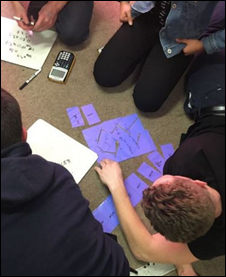
We funded the DonorsChoose grant request of Mrs. S in Missouri, who says her high school pre-calculus students are learning from the Breakout EDU problem-solving kit we provided. She says, “This donation to my classroom has completely engaged students. They are thinking critically and creatively while also practicing the content. I am so proud of my students during these challenges and their willingness to persevere and solve the problem. It is truly a learning environment any teacher would be thrilled to witness and it is all thanks to your generosity!”


Webinars

April 26 (Wednesday) 1:00 ET. “SSM Integrated Health Technologies Clinical Data Migration: Functional and Technical Considerations.” Sponsored by Galen Healthcare Solutions. Presenters: Sandy Winklemann, MHA, RHIA, project manager, SSM Integration Health Technologies; Tyler Mawyer, MHA, managing consultant, Galen Healthcare Solutions; Kavon Kaboli, MPH, senior consultant, Galen Healthcare Solutions. GE Centricity and Meditech to Epic EHR transition. Join us for a complimentary webinar as present the decisions that are important to consider when performing a clinical data migration from the point of view of  the healthcare organization program manager, the clinical analyst, and the technical implementation team. Our expert panel will survey data migration considerations, best practices, and lessons learned. The webinar will present a unique client perspective, offering insight into considerations surrounding staffing, clinical mapping, legacy application support, and validation and testing.

Previous webinars are on our YouTube channel. Contact Lorre for information on webinar services.


Acquisitions, Funding, Business, and Stock

image

Healthcare payments system vendor Ability Network acquires ShiftHound, which offers staff scheduling and credentialing systems.

image

image

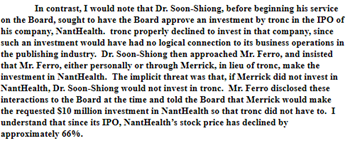
Attorneys for Chicago-based Tronc (the former Tribune Publishing) file a letter with the SEC in response to a complaint by NantHealth’s Patrick Soon-Shiong, who made a $70 million investment in the company last year to help thwart a hostile takeover attempt by Gannett. The company says that before investing in Tronc, Soon-Shiong first suggested that Tronc invest in NantHealth’s IPO, and after being rebuffed, then insisted that Tronc Chairman Michael Ferro make a personal investment in NantHealth is an “implicit threat” to pulling out of the deal. Tronc says Ferro took a $10 million stake in NantHealth to pacify Soon-Shiong. Tronc has removed Soon-Shiong for board member re-election and has capped his ownership stake, leading to accuse the company of intentionally squeezing him out. Tronc also claims that Soon-Shiong is demanding payments for Nant-provided technology he made available to Tronc to monetize its online content even though the technology turned out to be unsuitable.

image

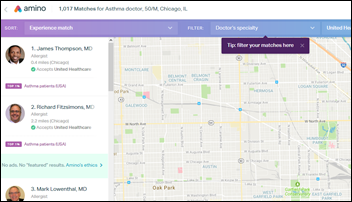
Doctor search website Amino raises $25 million in a Series C funding round, increasing its total to $45 million. The company makes money selling customized versions of its search function to employers and health plans and by offering access to its insurance claims database.

image

Orion Health Group shares drop sharply after the New Zealand company’s trading update predicts lower revenue. They’re down 61 percent in the past year with a market cap of $226 million. The company says it still hopes to swing to profitability in 2018.

image

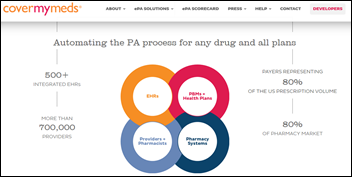
McKesson completes its $1.1 billion acquisition of CoverMyMeds.


Sales

image

Pomona Valley Hospital Medical Center (CA) chooses Cerner Millenium to replace Cerner Soarian Clinicals and NextGen ambulatory. It will continue to use Cerner Soarian Financials.

Bon Secours Virginia Health System will implement Tonic Health to automate its intake and payments processes.

image

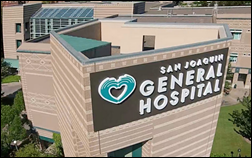
Skagit Regional Health (WA) and San Joaquin General Hospital (CA) choose MPI clean-up services from Harris Healthcare’s QuadraMed Patient Identity Solutions as they move to Epic and Cerner, respectively.  


People

image

Nadine Hays (Verscend) joins OmniClaim as chief growth officer.

image

Texas Health Resources promotes Debbie Jowers to VP of ambulatory ITS services.


Announcements and Implementations

image

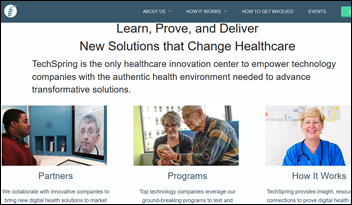
Baystate Health’s Techspring innovation center launches a software development and testing environment for its partners, built on the InterSystems HealthShare interoperability platform.

Rock Health releases its Q1 2017 digital health report, indicating that providers and health plans are delaying expenditures based on regulatory uncertainty but key players remain cautiously optimistic and feel well positioned to navigate any regulatory changes. In Q1, they counted 71 digital health deals totaling over $1 billion. The top six categories by deal volume were Analytics/Big Data, Care Coordination, Telemedicine, Hospital Administration tools, Consumer Engagement, and Wearables/Biosensing.

A small Spok survey finds that health systems rarely apply strategic hospital initiatives to their mobile strategy and don’t often include clinicians in their planning teams.

Change Healthcare releases InterQual 2017.  


Government and Politics

The revised ACA replacement apparently being pushed for quick approval would allow individual states to permit insurers to offer less than the current “essential health benefits” and to charge higher premiums for people with pre-existing conditions. Both were the pre-ACA norm, when less-expensive insurance bought directly from insurers (rather than via an employer) often didn’t cover pregnancy or drug addiction treatment and denied policies to those with relatively minor medical conditions.


Privacy and Security

image

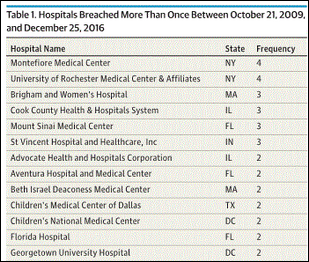
A review of significant hospital data breaches finds that major teaching hospitals were more commonly involved than smaller or non-teaching hospitals from 2009 to 2016, possibly because they allow more employees to view patient data.

image

Hackers breach the systems of the International Association of Athletics Federations, exposing the information of athletes who have applied for exemptions that would allow them to use drugs contained on anti-doping lists. The Fancy Bears hacker group, which claims responsibility, previously published the medical records of mostly American and British Olympic athletes after the IAAF accused Russia of state-sponsored doping and banned their teams from competition. 

ABCD Pediatrics (TX) is hit with ransomware, and though it was able to restore from backups without paying the hacker, it found evidence that its systems had been compromised for some time.

SNAGHTML660de6e5

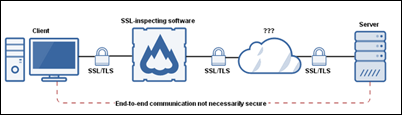
HHS OCR warns healthcare organizations that use HTTPS security that malware-detecting HTTPS interception products may not pass along any warnings or errors, allowing the organization to validate only the connection between themselves and the interception product’s certificate rather than all the way to the server.


Other

image

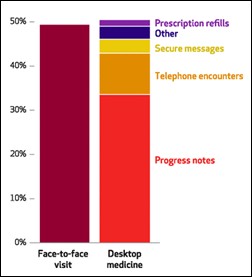
Ambulatory practice physicians in a community-based health system spend about as much time practicing “desktop medicine” as they do in face-to-face office visits, an analysis of time-stamped EHR records finds. Physicians are spending an increasing amount of time communicating with patients via the  patient portal, managing prescription refills, ordering tests, communicating electronically with staff, and reviewing test results, none of which are billable activities. Work that isn’t logged in the EHR made up the remaining 20 percent of the average doctor’s day. The authors suggest using scribes to manage progress notes, which they estimate would free up one-third of the physician’s time.

image

World Wide Web creator Sir Tim Berners-Lee wins the Turing Award (computing’s Nobel Prize) for that 1989 accomplishment, but his concern for net neutrality and an overly centralized, commercialized Web storage model that threatens individual privacy has led him to create Solid. Users would be able to decide where their data is stored and how it is shared. He’s also concerned that the web has been turned into a “purveyor of untruth” by an ad revenue model that rewards click-baiting rather than accuracy.

A study finds that ABIM’s Choosing Wisely campaign that encourages both clinicians and patients to skip low-value services had a small but statistically significant reduction in back pain imaging, for which patients often must pay out of pocket. It concludes that the 4-5 percent reduction indicates that consumer incentives may be ineffective for reducing low-value medical care.

image

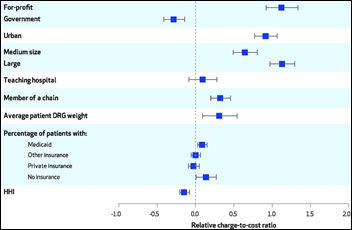
A study finds that chargemaster prices not only vary widely among hospitals, they correlate to the price actually paid by insurers and patients. Not surprisingly, list price was not correlated with hospital quality. The authors conclude that hospital list prices are neither irrelevant nor indicative of price gouging, but are rather a subtle method hospital use to get favorable deals from insurers, leaving uninsured patients stuck with paying the made-up high prices in cash while everybody else gets negotiated discounts.

image

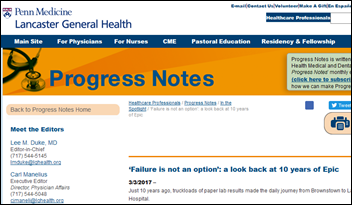
Doctors at Lancaster General Health publish a medical staff newsletter retrospective on its 10 years of using Epic. It refreshingly includes negatives as well as the expected positives – its larger-than-expected $100 million cost, the extra time some doctors spend documenting after hours, and its contribution to physician burnout. One surgeon says Epic is struggling to fulfill its potential because he has to look in other systems to review images, operative reports, and pathology reports, while also noting that EHRs are designed to optimize billing and therefore relevant clinical information is “buried in giant pile of clinically unimportant information.”

image

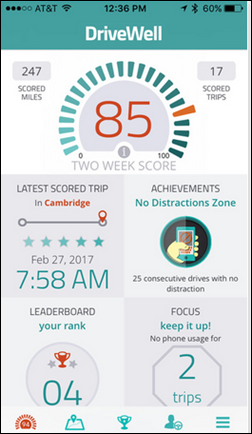
Cambridge Mobile Telematics, which offers brilliant smartphone driving apps to educate drivers and allow auto insurance companies to set rates based on driving habits, analyzes its user records to determine that drivers were distracted by their phones in 52 percent of trips that ended in crash, with an alarming one driver in four using their phone within 60 seconds of their crash. The company also found that distraction was just as bad in states with laws against using phones while driving. Users of the company’s DriveWell program reduce their phone distraction by 40 percent within two months.

image

In England, a newspaper’s undercover investigation of the NHS 111 non-emergency hotline call center finds that workers sleep at their desks, send text messages while pretending to listen to callers, and put suicidal callers on hold until they hang up because “after a while you can’t talk to them no more – it just gets awkward.”

image

In England, an Iran-born doctor referred to by co-workers as “Little Hitler” loses his medical license after being found guilty of several bizarre outbursts in which he used vulgar terms to describe patients who didn’t bring him gifts, called his receptionist a “fat blob,” referred to a colleague as a cockroach that he hoped would die, and described to female co-workers his vacation adventure in which he “inserted his private parts into a hole in the wall at a nightclub.”


Sponsor Updates

  • Crossings Healthcare Solutions posts its most recent newsletter.
  • Daw Systems will integrate CoverMyMeds electronic prior authorization into its ScriptSure e-prescribing system.
  • Bernoulli’s John Zaleski and Jeanne Venella, RN co-author an article in the Spring 2017 issue of AAMI Horizons.
  • Besler Consulting releases a new podcast, “How much revenue is your chargemaster costing you?”
  • Black Book honors top cybersecurity firms at InfoSecWorld Conference and Expo.
  • Dimensional Insight will exhibit at the Cannabis Business Expo April 12-14 in Phoenix.
  • Healthgrades announces Outstanding Patient Experience and Patient Safety Excellence Award recipients.

Blog Posts


Contacts

Mr. H, Lorre, Jennifer, Dr. Jayne, Lt. Dan.
More news: HIStalk Practice, HIStalk Connect.
Get HIStalk updates. Send news or rumors.
Contact us.

125x125_2nd_Circle

Curbside Consult with Dr. Jayne 4/3/17

April 3, 2017 Dr. Jayne 1 Comment

clip_image002 

I’ve been doing a lot of thinking about my work lately. I’ve been doing consulting for a while now, starting with side work even when I was a CMIO. I left that ersatz glamour to do consulting full time and it’s been an adventure.

My clients are generally good to work with, and that is a side effect of being your own boss and having the ability to terminate clients who are difficult or want to play mind games. Still, they get stressed out like anyone does, and often the consultant is expected to try to fix issues whether they’re in scope or not. That creates some tension around whether I should allow them to change the scope of work or whether I need to send them in another direction, especially when they try to game the system to get their new problem included for free.

Everyone is under significant economic pressures and I understand where they are coming from. Just because you’re in healthcare, though, doesn’t mean that we can give you services for free. Especially as a small consulting firm, even small discounts can make a big dent in our bottom line. We’re in the purest of “eat what you kill” models and even though we have low overhead, we still have bills to pay like everyone else. Fortunately, my partner and I are both fairly frugal and we’re not in this business for the money (although it is nice at times). But with increasing financial pressures due to the shift from volume to value, many more of our client-facing conversations are about money rather than vision, mission, or strategy.

Our clients feel increasingly like they’re in the crosshairs with payer audits, federal and state regulations, anti-kickback worries, medico-legal issues, and legislative uncertainty. Not to mention there are also decreasing contract rates, more bundled payment initiatives, and the ever-present worry about the inefficiencies of EHR. For the most part, we can help clients tackle many of their stressors, but the fact that healthcare delivery continues to be in a state of rapid change is something that we can’t do a lot about. Of course, we can help the clients with strategic planning and trying to future-proof their businesses, but that’s a big change for clients who thought they would be independent practitioners forever.

I work for myself, which has a lot of perks. I can generally control my travel schedule and have no problem saying no, although clients have been less flexible the more they are stressed. We have a solid plan to divide and conquer when our clients have needs for specific expertise, although we can cross cover each other enough that we don’t ever feel we are working without a net. Still, I thought we’d be at a different place by now in the evolution of healthcare. Unfortunately, we’re still grappling with some of the same concepts that we grappled with decades ago. They were challenging then, but throw the technology piece at them as well and they can be even more messy.

I’ve been in the healthcare technology leadership space for more than a decade and I’m still fighting the fact that my clients (and their patients) don’t have full access to their medical records. In a lot of ways, they can’t even cobble together a medical record because of the barriers to sharing that are all around them. I’m personally enrolled in four patient portals. One has two of my physicians on it, but they don’t share any data. It might be better that we’re not sharing data, though — my new primary care physician sent me a summary of care record, but unfortunately it has multiple family history errors and even gave me some new diagnoses that I never knew I had, including a pulmonary embolus and clear cell carcinoma.

Because of the crazy way our payment system works, many providers game the system to gain the maximum reimbursement possible. Anyone who has experienced provider-based billing knows what I’m talking about, as do those who have pushed the boundaries on time-based services to achieve higher codes. This creates a lot of stress in the ambulatory space as everyone struggles to figure out how they’re going to add headcount for care management and preventive services while fee-for-service payments are decreasing. Although there are some programs seeking to provide those payments up front, such as the Comprehensive Primary Care Plus program, providers are constantly under the threat of missing some kind of documentation, reporting deadline, or other hurdle that might mean they have to pay back those monies even though they were trying to do the right thing by their patients and communities.

We’ve thrown a lot of precious time and billions of dollars at a healthcare system that isn’t generating the return on investment that we need it to. Divorced from the payment scheme by insurance and other third parties, the majority of patients have no idea whether their providers are gaming the system or not. Is the price they’re charging fair? Is the patient receiving value? It’s hard to tell. In many parts of the country, the only entity that has even close to a full picture of the patient is the payer, and that’s a shame. I’m watching my friends who are only 20-25 years into their careers plan for early retirement when they realize selling out to a big health system wasn’t the answer to their struggles with independent practice.

When physicians are together, we talk about the predicaments we’re in and whether the primary care physicians can hold on long enough for the balance to tip in their favor, helping them come off the hamster wheel and be able to truly connect with their patients again. I know of many physicians who have gone into politics – talk about going from the frying pan into the fire. Although most of them are altruistic, one in my state makes spectacularly poor decisions about a variety of issues. For those in the trenches, especially after the last election cycle, there is plenty uncertainty around tomorrow even if they make it through today.

Some days it’s harder than others to grind through the muck. Whether you’re seeing patients or whether you’re trying to help practices and organizations survive an obstacle course that would make an American Ninja Warrior take cover, it’s tough. I miss the days when we were adding technology to our lives because it solved problems, not because we were forced to and certainly not if it added hardship. Although I see the bigger picture and try to translate it to our clients, it’s getting harder to convince people to hang in there and keep moving forward.

I relish my office days, when I put on my hourly employee hat and just see patients to the best of my ability. For the most part, I make patients’ bad days better and they’re grateful. It reminds me of why I wanted to be a doctor in the first place. But I know that behind the scenes there is still a seedy underbelly of coding, billing, modifiers, and more. I’m spoiled by how well my partners run our practice and spend a lot of time thinking about how much I’d like to bottle their leadership skills and atomize their fortitude around my clients.

Although it feels like healthcare is behind where it should be, it also feels like we’re on the verge of something big. We do things every day that no one had heard of when I was in medical school, and that’s a good feeling. It makes me want to stay in this game another month, another year, another five just to see what happens.

If you could bottle one thing and spread it all around healthcare, what would it be? Email me.

Email Dr. Jayne.

The Blockchain Interview with Jason Goldwater

April 3, 2017 Interviews 3 Comments

Jason Goldwater, MA, MPA is senior director at National Quality Forum of Washington, DC.
image

What healthcare problems can blockchain solve?

There are three, initially, that it has the potential to solve.

First is access to data. The way that systems have been set up in hospitals or large integrated physician networks is that the data will either reside in a centralized server or now the trend is to reside it in a cloud. That’s fine and that certainly has been effective, but you’re talking about a large consolidation of data in a centralized location. 

Blockchain is very different because it is what is known as distributed ledger technology. Essentially translated, that means the data is not all residing in one place. The data is residing in various different locations. Every time a change to the data is made, that change is reflected across all the locations of which the data is stored. If there are going to be threats or hacks to data, it’s easier, to some extent, to hack into a centralized location to find a large amount of patient-generated data, whereas it’s more difficult to be able to get a large amount of patient data when it’s distributed across a large number of networks.

The second thing it potentially has the possibility of helping is in the area of interoperability. That’s where most of the attention has come from with respect to blockchain. A lot of individuals are looking at this as possibly a solution to the problems of interoperability over the years, Some have even gone so far as to label it as panacea of sorts. I don’t think it’s that, but I do think it has far-reaching potential to help with interoperability because it allows data to flow in whatever syntax and whatever structure to be stored across locations.

If a provider, care team member, patient, or a patient’s family needs access to that data, the data can be delivered through the blockchain to whoever is requesting it as long as authorization has been given by the individual of where that data came from. If I’m the patient and you’re a doctor and you need to see my complete patient record to help aid in decision-making for a particular diagnosis, and I grant you access to the blockchain, then you’re able to get all of the data that has been stored. Regardless of how it is structured, you will be able to access all of that data and potentially use it.

It does not solve the problem of interpretability, which is if your system cannot read the data, it’s not computable to the system that you have. If it’s in a standard or a structure that your system cannot interpret, you’re still not going to be able to access the data, but it does allow for more free-flowing exchange of data as long as I’m authorizing you to view it.

The third biggest potential for blockchain, and what I wrote about and have been speaking about, is that it can help move forward the idea of patient engagement and patient empowerment. The emphasis now is that with the amount of technology that’s around us, we’re generating more data than we ever have before, through wearable technologies and through portals. Even through genomics, with organizations like 23andMe, where you can get an entire genetic profile that you then have and can then send off to whomever you so choose.

If I’m a patient and I have data that I’m able to view, and you’re a provider and you want to view that data, or you want to examine that data and then work with me on how to improve particular aspects of my health based upon what you’re reading, we can engage in a conversation where we both have access to the very same information. You could help me interpret what that information means. I would be able to look at that data on a regular basis to be able to see if I’m making improvements. As long as I’m authorizing you to be able to examine the data, then you’re able to look at that and then work with me on aspects of health that need to be improved.

Even if we get out of the provider relationship and we get more into the performance measurement aspect of it, if I’m a patient and I have a wearable technology that measures the amount of exercise and steps that I take, if I’m on an online nutrition diary, I’m also on another website where I’m measuring my stress level and other aspects of my mental health, and I’m sending all of that information to a blockchain. If I authorize you as an administrator, provider, or a quality measurement professional to look at that data and put that into a measure, you’re able to measure the performance of the care that I’m getting. Not just at a particular episode, but over a significant period of time.

Every time that that data changes, the blockchain changes. Since I’ve authorized you to have access to that blockchain, you’re viewing that data as it’s changing. You can then view and see exactly what changes are being made in my health as a result of activities that I’m doing that may have been prescribed by you, if you’re a provider, or may have been prescribed by another entity.

Profit and legislative mandate drive much of what happens in healthcare. Who would benefit financially to move forward with blockchain, and is it implicit that the patient must control their own data?

There are two incentives. You’re right, nothing really is going to change in healthcare, particularly in IT, without there being some sort of legislative intent or incentive to do so. But MACRA is upon us, so we are moving from a fee-for-service into a value-based delivery system. That has been a change that’s been evolving over a number of years. That’s not something that has just suddenly come about. That’s something that has been evolving and has been directed towards the medical associations for a long period time.

Understandably, there’s concern about that. How are you adequately going to be able to measure value-based care? You have a number of quality standards and performance metrics and you measure those during the course of an encounter to see if you have met what evidence is dictating should be done for a patient off a basis of a process — whether the structure’s in place to fit the patient, or whether the outcome is exactly what’s intended, if you have followed the correct actions. As long as that’s done, then you’re getting value for your care and the physician is reimbursed.

That data has generally either come from manual extraction of clinical records, which is starting to fade, or it’s coming from electronic health records, That has posed problems as well, because not every EHR is the same. Not every one is conforming to the same standards. Not every one is conforming to the same syntax. There’s movement in that area. There are ways of examining how that can be measured to see how we go forward, but we’re still in the beginning phases of that.

Where blockchain can assist in value-based care is that if you have a distributed ledger where data is going to be shared across a number of areas, you are authorizing the blockchain to receive the data, and you’re working with your provider to be able to look at that data on a regular and continual basis, the provider can understand what needs to be done in order to improve the outcomes of your health and what processes need to be taking place. That, in turn, then meets the value threshold for reimbursement. As such, by doing that, they’re able to continually examine and understand a patient’s health in a way that they may not have been able to before. Because it usually relied upon a patient coming in, or in some cases having a virtual visit, and they would diagnose and look at the patient then and be able to prescribe the appropriate treatment protocols.

With blockchain, you’re taking a large amount of data, personally available data that patients are generating, and being able to look at that on a regular and continual basis to drive better outcomes of care, which then in turn drives value. That’s the first thing.

The second thing is the market dynamics are changing. Twenty-some odd years ago, it was a pretty basic concept. A patient would come in, they would say, "This is wrong with me," or they would come in for a regular checkup. They would be diagnosed and the provider then would recommend the appropriate medications, labs, treatment protocols, whatever it may be. The only data that was generated at that point was the data that was generated during the encounter.

That is not the case any more. The data is being generated everywhere. There is more data available for a patient than there has ever been. It’s not just the data that would come from wearables, portals, and smartphones, it’s also the data that’s available on social media sites, where patients write very eloquently about their health. It’s available through validated instruments that they have filled out over the course of their care. It’s available through sites like PatientsLikeMe that store an abundance of patient-generated data. There’s more data available. Patients have more control and more access to data than they have.

How, then, do we take that bolus of data and turn it into something where we can use it for improvement of care? You could store it all in one location and access it when it’s needed. That’s what people are doing, and there’s nothing wrong with that. Having cloud-based storage allows you to access that data and those applications as a service, so when you need it, you get it.

Blockchain allows the data to be distributed across a variety of locations, but the benefit of that is that the patient and the provider both have access to it. I have to authorize you to look at that, and every time that data changes, every time on a daily basis, if things begin to change — my heart rate changes, my blood pressure changes, my mood changes, I’m not exercising as much, I’m not taking the medications I need to be — that data is updated and sent to the provider on a regular basis.

If the provider understands that they’re going to get that data on a regular basis and that it will aid in the decision-making, that they can put that data into an EHR and send that data around to provide access to that patient’s care, and understand that that data is then available to not only aid in decision-making, but to provide the impetus for better decisions — because the value based market is demanding that — then certainly that’s going to be an impetus to push towards better interoperability and better use of the data.

Three things come to mind as barriers. The terminology and syntax issues among EHRs, the need to convince EHR vendors to modify their systems to interact with the blockchain, and the lack of a unique patient identifier.

I’ll start with the second one. There’s no need to rip and replace. Blockchains are peer-to-peer networks. It’s a distributed ledger technology, but it’s peer-to-peer, It’s shared through numerous different systems that generate data. If you have a public blockchain – there’s plenty of them, like Hyperledger, which is written about and spoken about as an open source blockchain – EHRs serve as the access control point for what information is going to be sent to the blockchain. That would have to be done with the consent with the patient, obviously. There’s no need to be ripping and replacing. It’s a matter of, are you going to grant access to the blockchain through your system? Are you going to then engage the patient? There’s going to be continual contributions of data, That data is stored in a blockchain in a  chronological, linear order, and then as it’s updated, it’s changed. There’s no real need to be replacing systems.

The syntax, the semantic structure of data, and how that data is presented is not something the blockchain universally can solve. It’s not something that you can force the issue from. But the dynamics of the market are changing to the point where value-based purchasing is going to become the norm. It’s not something that’s just going to be an option. There’s going to be a bigger demand and a better drive towards improved outcomes of care and better processes of care, but the emphasis is really going to be on outcomes. If you’re looking at the potential of blockchain to assist that, then you’re talking about being able to store significant amounts of data on this peer-to-peer network where that data is being generated from patient devices, but also being generated from an EHR, and that patient is able to work with a provider to control that access and flow of information.

Does it solve the problem of standardization? No. Does it lend itself to creating a better environment for improving outcomes for value-based care that in and of may change it? Possibly, yes.

To your third point, there’s no unique identifier. You’re correct — there’s not. Blockchain  doesn’t solve the problem, but when data is uploaded to the blockchain, a patient has to authorize that access and they authorize the provider to view that. A digital fingerprint is created between the provider and the patient. That fingerprint contains all of the data attributable to that patient that’s being uploaded from the variety of devices or technologies in which the provider and the patient will use to improve care.

So, it can be attributable to a patient because a fingerprint is created in which only that block of data on the chain can be viewed by the provider of the patient, but it does not create a unique identifier. It does create a unique fingerprint. When you talk about financial transactions of bitcoins, which is where blockchain really came from, there hasn’t been any issue to date with respect of bitcoins being attributable to the wrong individual. They’ve been attributable to the individual that has the fingerprint that’s associated with it. The theory is that the same thing would work in healthcare. Has that been tested? It’s been tested in a laboratory environment. Has that been tested in a actual market? No, not yet. At least not to my knowledge it hasn’t.

What should health system CIOs and technology vendor executives be doing now with regard to blockchain?

They definitely need to be interested in it. I would not say at this point they need to immediately start implementing a blockchain and sending data there. But what they need to understand, first and foremost, is the scalability. They have a system now that stores records and stores information about patients. Whether they can send that information to other providers or members of a care team that are responsible for that patient, I don’t know.

Does blockchain provide enough scalability for them to be able to increase the amount of data they can have for a patient? Does it provide the ability to exchange data across partners that could access that where they could either add to the blockchain or they could use the blockchain to help provide care for the patient? Because if it’s going to come down to value-based services and greater outcomes of care, how can blockchain, from the scalability standpoint, be able to improve those outcomes for your environment, be able to improve outcomes for that patient, and be able to meet the dynamics of this new value based marketplace?

The second is to start to look at the access security issues with respect to blockchain. That’s always going to be a paramount issue. The real thrust right now is for patients to have access to data. It’s the patients’ data. They should have access to it and they should be able to engage in a shared conversation with their provider using the data to understand their care better and for the provider to work with them on what needs to be improved. Understand how blockchain can improve access security between the provider getting data and the patient getting data and how that dynamic would change. How that dynamic would improve outcomes, enhance patient care, and enhance patient engagement, which is another part of this value-based dynamic.

They really should also look at their data and their data privacy. How is their data stored? How is their data encrypted? How is their data protected? Is it vulnerable? Does it have the potential to be accessed and hacked? Is there a potential for a breach? No technology will solve that completely, but blockchain provides a greater ability to be able to protect data because it’s not stored in a centralized location. It’s stored in a peer-to-peer network.

The EHR on the blockchain can be access control manager. Who gets access to the data? What data flows into it? Does that significantly improve what they already have? If it does, then it’s a solution worth considering, because it can scale upwards in the ability of for them to not only gather more data, provide more data to the patient, and be able to exchange more data. It not only addresses better access security between the provider and the patient, but it may also improve privacy overall. Rather than the data being in a centralized location — whether it’s a cloud storage system or whether it’s in a centralized server — a distributed ledger provides a better mechanism by which data privacy can be maintained.


HIStalk Interviews Denise Basow, MD, CEO, Wolters Kluwer

April 3, 2017 Interviews Comments Off on HIStalk Interviews Denise Basow, MD, CEO, Wolters Kluwer

Denise Basow, MD is president and CEO of the Clinical Effectiveness business unit of Wolters Kluwer, which includes UpToDate, Lexicomp, Medi-Span, and Facts & Comparisons.

image

Tell me about yourself and the company.

I’m a primary care physician by training. I practiced internal medicine for about four years. In 1996, I had the good fortune of meeting the founder of UpToDate and decided to join at a fairly early stage of the business as an editor. I then held a variety of roles in the business on the editorial side for many years.

In 2008, when UpToDate was acquired by Wolters Kluwer, I became the general manager. I led the business operations of the business until around 2015, when we did some reorganization of the Health division at Wolters Kluwer and decided to form this Clinical Effectiveness business unit. Since 2015, I’ve been the CEO of Clinical Effectiveness, which includes UpToDate; our clinical drug information solutions Lexicomp, Medi-Span, and Facts & Comparisons; and our newest acquisition on the patient engagement side, which is called Emmi.

What’s the process of reviewing ever-changing medical literature in huge quantity, assessing those new findings, and then figuring out how to present the new information to clinicians?

It’s interesting that you asked the question in that way, because in the early days of UpToDate, we used to say that we wanted to be the first place that doctors would go to when they needed an answer to a clinical question. Then when we realized that was happening, we said, wow, we need to really put a lot of thought into how we put together an editorial process so that we get things right. We felt like we had this tremendous responsibility to do this in a very high quality way, because not only were people looking at the content, they were acting according to what we said.

I put all of that into the editorial process that we’ve developed over many, many years. It involves a number of in-house experts who edit the content, but then also the 5,000-plus contributors that we have around the world and multiple layers of review. Having the right people looking at the content with the right expertise. Always having a focus on the patient, having a focus on the provider who needs an answer to a clinical question, and making sure that we’re giving them the best answer that we can provide.

The style of medical journal articles makes it hard to extract what’s important and actionable. What’s involved once you’ve decided that an article is clinically useful to present it in context to a busy physician at the point of care?

As physicians, we are all trained to read the medical literature. We can take any individual study and understand what it says, understand at a reasonable level whether it’s a good study or whether it has some limitations. The real challenge is not in reading any single study. It’s how you take that particular study and put it in the context of everything else that’s been written and decide how that applies to the patient sitting in front of you.

A simple example would be a new drug for hypertension that’s studied in literature. Study X comes out and says that it’s effective for patients with hypertension. That raises a whole series of questions. Should it replace other medications that my patient is on? Do I need to call in every patient that I have who’s on another drug and change them to this one? What are the side effects of this drug? So many questions come up.

That’s what we focused on early on. What are those questions? How do we train our editorial team to think about those questions, but also to write the information in a way that is accessible to people at the point of care? Even if people have the expertise to put of that together, nobody has the time.

Physicians are often resistant to having someone else summarize literature for them, but they are accepting that by using a trusted reference. How does that change the way they practice?

One of the things that attracted me to this business early on was that I understood how hard it was to get this information, because I was out there practicing. It’s a very uncomfortable feeling to be sitting in front of a patient and wanting to do the best job that you can, but feeling that it’s difficult to get that information. And, knowing that even if you have the expertise to understand the medical literature, you don’t have the time to do it.

I don’t feel like there’s a lot of resistance, in that sense, for clinicians to look at a resource that they trust and to look to it to give them help. All physicians want to do the right thing. I haven’t seen that there’s been much resistance at all. We’re not trying to tell people what to do. We’re trying to help them make the best decisions that they can. I think some of the resistance that you’re speaking of is more along the lines of being told what to do versus our approach of, let’s help you do your job.

Is there a place to incorporate evidence that’s accumulated from actual physician experience rather than being generated by a study?

I’ll give you a little anecdote, which may be a piece of trivia. The original name of UpToDate was Consultant, but the name couldn’t be trademarked, so it was changed. But the original concept was almost as you’re saying — to be a consultant for the clinicians along the concept of what you described.

The editorial process has been built around that. What we’re saying is that we’ve been able to work with the best experts in the world to deal with all of the clinical issues that we address. We’re giving every physician, every healthcare provider, access to the best consultants.

As we grade our recommendations, we have some very strong recommendations and some weaker ones. Usually that’s because we have very good evidence for the stronger ones and much weaker evidence for the others. The strong recommendations are in the minority, unfortunately. That’s just the state of the medical literature.

We very much consider that not only what’s in the published literature, but the experts that we have involved in the content are a part of the evidence. Our responsibility to the provider, or to the person looking at our content, is to be transparent about how strong that recommendation is. Is it based on solid medical literature, or is this based more on the expertise that we have because that’s the best evidence that’s available? We have always considered all of that to be evidence — it’s just a matter of how strong or weak that is.

Do you collect user feedback to harness their collective opinion on how useful a particular recommendation is in their actual practice?

We get a lot of feedback from our subscribers. Sometimes it helps us understand gaps, where maybe there’s a particular clinical question that we haven’t answered. That’s very useful for us because we try to intuit the questions, but we can’t get all of them. That’s kind of one category of feedback.

We also get feedback from some subscribers who may not agree with our recommendations. All of that feedback goes to our editorial team and is answered by our editorial team. We consider the whole world to be our peer review, in a sense, and we encourage getting that feedback. It makes a big difference in our content.

What makes physicians practice in ways that don’t reflect best practice or best available evidence?

That’s the billion-dollar question. More of a trillion-dollar question, actually, if you think about how much we spend on healthcare.

What you’re describing is what has been talked about for 40-plus years –unwanted variability in care. There are a lot of things that contribute to that. Some of it is certainly access to the right information, and we have lots of examples of that. Some of it is that we come out of training and we practice in a certain way and we tend to stick with that level of practice. Some of it is that our clinicians are making very good decisions, but things break down somewhere else in the process.

That’s why we have tried to broaden things from saying that, as UpToDate, we’ve been able to make an impact on clinical decision-making. We’ve been able to demonstrate that that impact on decision-making influences outcomes, but that’s only a piece of the puzzle. The whole thought behind broadening this to a clinical effectiveness mission was to say, how can we begin to attack some of the other areas where this breaks down?

Office physicians used to excuse themselves from the patient to look something up in a paper reference. How has that changed with EHR workflow and clinical decision support?

That still happens. “Excuse me, I’ll be right back” and go look something up. What we’ve seen over the years is more and more providers trying to involve patients directly in the decision-making. More and more we’re seeing physicians looking those things up while sitting with the patient and being comfortable saying, we’re going to look this up together and make sure that we’re doing the right things here.

I think that’s a very good thing. Patients are the most underutilized resource in our healthcare system. We need to continue to involve them more in their care. Educating them directly and giving them access to what our providers are looking at is a way to do that. That’s the biggest change that I’ve seen. Certainly when I was practicing, I would excuse myself and go look at a textbook, which is what we had available at the time. Now a lot more of that is happening with the patient in the room.

Doctors spend a lot of time debunking irrelevant or inaccurate mass media information patients ask about. Is there value in presenting objective information that’s more patient-focused?

Part of it is that. Early on when we were thinking about how we would address the patient education side of things, I would occasionally hear people say, doctors don’t really want to educate patients. That’s absolutely false. What providers want is for patients to have good information. Not to spend time debunking, but let’s spend time making sure you have the best information because you’re an important part of the healthcare continuum. To achieve our vision for clinical effectiveness, that has to happen.

What we’ve tried to do is say, how do we provide information that clinicians feel comfortable sharing with patients? How do we build information that doesn’t just provide information to patients, but engages them in their care? There’s a big difference between handing patients a leaflet or a monograph of information and understanding how to speak with them in a way that allows them to take action.

We’ve focused on the behavioral science behind that. How do we truly engage patients in their care, and do it in a way that physicians don’t feel like they have to debunk things, but where the patients become an active participant in their care?

As to the behavioral aspect, physicians are the target of multi-million dollar drug company and medical device campaigns intended to sway their opinion. Is it difficult for practicing physicians to go back to the literature and double check what the sales rep is telling them?

There’s been a lot of studies that have looked at the influence that third parties, like pharmaceutical companies, have on providers. Most of it has shown that providers don’t think that they have any influence, but the studies show that they do.

There’s always that little bit of disconnect, but we don’t spend a lot of time thinking about that. What we’re trying to do — whether you’re a doctor, nurse, pharmacist, physical therapist, or anybody touching a patient – is that if you’re the patient, making sure that we provide the best information that we can to help that provider make a good decision to help that patient be as informed as they can be to participate in their care. In that respect, try to begin to solve this problem of variability in care and improve clinical effectiveness.

Do you have any final thoughts?

When I think about the challenges that we have, I always keep a vision of a patient sitting in an exam room and the responsibility we have to to provide the best care that we can and to make good decisions for that patient. Whether it’s in providing information, whether it’s in educating that patient, for those of us involved in helping provide good healthcare, if we always keep those patients in mind and the ultimate mission and vision of what we’re trying to do, it’s very helpful in the decisions that we make in staying true to what we’re trying to achieve.

Monday Morning Update 4/3/17

April 2, 2017 News 9 Comments

Top News

image

HHS quietly hires Don Rucker, MD, MBA, MS as National Coordinator, as evidenced by his new entry on the HHS employee list.

image

Rucker holds a Penn MD and Stanford master’s degrees in business and informatics. He is an adjunct professor in biomedical informatics at Ohio State, but is best known as being chief medical officer for Siemens Healthcare from 2000 to 2013.

image

Apparently reporting to Rucker is former Rep. John Fleming, MD (R-LA), who said previously that he thought his newly created position of HHS deputy assistant secretary for health technology reform was equivalent to National Coordinator.

image


Reader Comments

image

From Lisa Buller:”Re: Skagit Regional Health’s Epic project. As the project director of this implementation, I can tell you the post regarding our EHR project is not only unverified – it is untrue. We are very happy with our selection of Epic and look forward to our on-time go live of October 1, 2017 and the improvement in quality, safety, and efficiency that it will bring to the care we provide our communities.” Lisa referenced the original Epic announcement that indicated a mid-2017 go-live date. Publicly available information suggests that the IT department added 53 positions with 20 more planned to implement Epic (although those employees are often rolled back to their previous jobs after go-live) and CIO John Dwight moved to EvergreenHealth in February. Both items were mentioned by the rumor reporter whose main point was that budget overruns of the $72 million project, if they exist, have not been publicly acknowledged. UPDATE: Lisa provides additional information: “Our project is on time for go live on October 1, 2017 across our organization, including two hospitals and 18 clinics. The project cost is $72 million. We moved our go live from July to October 1, 2017 to ensure adequate time for project build, test, and training. We currently have 23 consultant-employed FTEs – not 60 as was reported in the unverified post. The pay rate referenced in the post is also false.”

image

From Steve: “Re: NTT Data’s divestiture of its healthcare software division. The acute EHR/RCM products are so far behind any of the competitors, have next to no market share, don’t show up in any industry reports, and NTT Data lost so many clients. I will be curious to see if they recover under the new company. It’s the same leadership that ran that division at NTT Data, so chances are probably pretty slim.” I’m thinking the prize there is the NetSolutions long term care software product line, which runs in 1,700 facilities.


HIStalk Announcements and Requests

image

Nearly three-fourths of poll respondents have a negative reaction to the White House’s recent HHS appointees.

New poll to your right or here: When will blockchain have a significant healthcare impact?

image image

We bought three Chromebooks for Mrs. J’s first grade class in South Carolina. She reports, “Our class LOVES our Chromebooks. They are a fundamental part of the reading process in our classroom. Students use them almost daily for taking AR quizzes, reading online information, playing learning games, and practicing math facts. They are really enjoying being able to access the tools they need. I’m so thankful that donors like you continue to make a difference through DonorsChoose. It makes teachers like me and students like mine extremely grateful.”

SNAGHTML5add8bdf

This infuriatingly common mistake bugs me. Is it really so hard to match a singular subject to a singular verb? As the headline writer might say, the grammatical sloppiness of Americans are driving me crazy.

Thanks to the following companies that recently supported HIStalk. Click a logo for more information.

image
SNAGHTML5a78c355
image
image
image
image
image
image
image
image
image
image
image
image
image
image
image
image


This Week in Health IT History

image

One year ago:

  • The Department of Defense names its Cerner-centered EHR project MHS Genesis.
  • A study finds wide clinical variation in how patient visits are conducted by six virtual visit companies.
  • Southcoast Health lays off 95 employees after running over budget on its $100 million Epic implementation.
  • Massachusetts General Hospital and other Partners HealthCare sites go live on Epic.

SNAGHTML51a1abc5

Five years ago:

  • CSC announces plans to launch iSoft in the US after poor performance in England’s NPfIT.
  • 3M acquires CodeRyte.
  • HHS awards $50,000 to the designers of THUMPr, a web-based heart health consumer profile tool.
  • HIMSS lists the HIT-related affects that would arise from a Supreme Court finding that some or all of the ACA is unconstitutional.
  • Seven-month-old hospice management software vendor Hospicelink predicts that it will hit $50 million in sales by the end of the year.
  • TriZetto announces plans to build a $40 million headquarters building in Denver.

Weekly Anonymous Reader Question

Last week I asked readers to describe their proudest moment in health IT, with these responses:

  • Getting the result interfacing going from our lab to the local cancer treatment facility. It had been a months-long project with many fits and starts, but seeing it actually happen was amazing. They went from needing up to a week to get results to make changes to chemotherapy regimens to being able to make changes in a few hours. They can actually correlate some improved survival rates to being able to respond faster to changes in their patients’ health.
  • Being the first (and maybe only?) IT person to receive the Employee Recognition Award at the health care organization I worked for.
  • When I first started out in health IT, I was part of a SWAT team who would swoop into troubled sites. I was disheartened about six months into the job. I then went to my fifth or sixth site and sat with a doctor who was visibly frustrated. A few tweaks, 30 minutes of coaching and training, and customizing the program and all was better. I went back about three months later and the doctor gave me the biggest hug and looked at me with tears in his eyes and said "I’m no longer stuck in the dictation room until 7, 8, 9:00 at night. I leave the hospital at 6:00 at the latest every day since you came. I’ve made it to all of my son’s tee-ball games this season, my wife and I eat dinner together, I sleep better, and my nurses have all noticed a change in my patient care. Thank you so much. You have made me want to stay in medicine and keep doing what I was put on this Earth to do." Cue me totally getting all teary right ahead of a big executive meeting 🙂 But I remember that doc, and all the other docs on days where it’s kinda crappy. End of quarter, forecast calls, dealing with code issues, trying to keep customers… It’s all kinda crappy, but if I can do one thing each day where I help one person be able to go out there and do better at keeping people healthy and alive, that’s good enough for me.
  • Around 10 years ago, I was a sales executive working with small independent medical groups trying to help them move to our network-enabled rev cycle service. There was a wonderful physician I was working with who provided great family practice services to an undeserved population, but struggled to run her practice. I was fortunate enough to help her make the leap of faith to join our network. A year later, I called to check in. The physician started tearing up over the phone. (full disclosure: I went into panic mode once I heard her voice crack). I asked what was wrong and she said, "Wrong? Nothing’s wrong. Yesterday I was able to pay my daughter’s tuition in full for the first time and I owe that to your company.” Thinking about that moment still makes the hair on the back of my neck stand up.
  • When the first customer I helped acquire their eICU program verified the clinical, operating, and financial results we had promised. The icing on the cake is when one of the practicing intensivists also reported that for the first time in years he was sleeping through the night uninterrupted, and he felt more alive and happy than he had in years.
  • I designed and helped build a bedside critical care CIS that at one site operated nonstop for four-plus years without a server reboot. It was the only system in the data center that kept operating when all the others went down during a hurricane.
  • In a meeting, a frustrated physician, who felt burdened and attacked, retorted, "What’s the point? Nothing ever changes here anyway." After the meeting, I compiled a list of the changes that we had made in the past year. Some were IT, some were process, some were new initiatives. In all, I listed 24 accomplishments that we had completed in the previous 12 months. I leaned back in my chair, kicked my feet up on my desk, and raised my hands behind my head. In the silence, I swore I could hear a faint echo of applause.
  • In the late 1970s, I wrote a master’s thesis on clinical decision systems, which I defined (simplistically for research) as a physician, nurse, and patient. Key to the triad is the patient as an equal member of the decision team. IT wasn’t until a decade or so into the 21st century that the patient was recognized as a key decision-maker in his/her care. I was proud in retrospect that I had identified the key role a patient plays in their care, based on the different kinds of information which they hold and on which only they can act. Similarly with the differences among physicians and nurses and their unique and special knowledge and decision characteristics.
  • One thank you note from a former customer: “The richness of your experience and knowledge is a true asset to the HIT community and it’s always a pleasure to shine the spotlight on you. You never disappoint!”
  • Leading an EMR conversion and receiving Joint Commission accreditation 16 days post-EMR conversion with zero nursing citations at a hospital that had never passed Joint Commission without citations previously.
  • I was at the Magnet nursing conference doing a demo in our booth and a random attendee walked up and interrupted the demo and said, "I use your product every day and I love it" and then she just walked away.
  • Seeing a presentation about better care of patients by a customer using a tool I was integral in designing and testing. It’s pretty awesome to see someone talking about things that were were not possible prior to the existence of something I helped create.
  • Oddly, a proud time was spending New Year’s Eve 1999 on call and having almost nothing to do because the years of Y2K preparations were done right. Management invested appropriately and early enough to the work done, people worked hard to address all the issues, and the results were there. We were also prepared for what didn’t happen. I can’t recall another go-live that went as well.
  • Hearing a doctor exclaim, "Look, it’s right here!" as she pulled up a hospital discharge report in real time while the patient was in her office for a follow-up. No calls to the hospital chasing paperwork, no checking billing office inboxes or wire baskets — everything ready to go while the patient was in front of her.
  • Chair of an AMC department walking through exhibits at a conference, taking a few steps backward, turning to me at the booth and saying, "I may not have said this before, but your system has changed the way (our specialty) is practiced in America. Thank you."
  • Teaming with Kaiser Permanente in Southern California in a partnership to build and deploy an application integrated with Epic that used NLP to automatically calculate the E&M code at the point of care. This was an early (2005) commercial use of AI. The end result was an a operational success for Kaiser and a commercial success for our small company. The technology is now owned by Nuance.
  • Being the first hospital to activate the first commercially available EMR 19 years ago and it’s still running fine. And it only cost $16 million for an 800-bed hospital.
  • I don’t really have one other than doing a great job every day before the Big Vendor came along and there needed to be 8-10 of me.
  • My first invitation to Histalkapalooza.

image

The question this week: What is your favorite moment from any past HIMSS conferences?


Last Week’s Most Interesting News

  • An IBM report finds that the number of healthcare records exposed via breach dropped 88 percent for 2016 vs. 2015, with just 29 percent of incidents involving outsiders.
  • The FBI warns healthcare organizations that hackers are targeting FTP servers configured to allow anonymous access.
  • The White House appoints Roger Severino as director of HHS’s Office for Civil Rights.
  • A review of UCSF’s virtual glucose management service finds significant improvement in glucose control.

Webinars

April 26 (Wednesday) 1:00 ET. “SSM Integrated Health Technologies Clinical Data Migration: Functional and Technical Considerations.” Sponsored by Galen Healthcare Solutions. Presenters: Sandy Winklemann, MHA, RHIA, project manager, SSM Integration Health Technologies; Tyler Mawyer, MHA, managing consultant, Galen Healthcare Solutions; Kavon Kaboli, MPH, senior consultant, Galen Healthcare Solutions. GE Centricity and Meditech to Epic EHR transition. Join us for a complimentary webinar as present the decisions that are important to consider when performing a clinical data migration from the point of view of  the healthcare organization program manager, the clinical analyst, and the technical implementation team. Our expert panel will survey data migration considerations, best practices, and lessons learned. The webinar will present a unique client perspective, offering insight into considerations surrounding staffing, clinical mapping, legacy application support, and validation and testing.
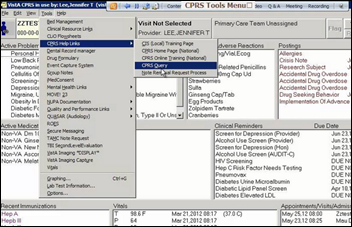
Previous webinars are on our YouTube channel. Contact Lorre for information on webinar services.


Acquisitions, Funding, Business, and Stock

image

NTT Data sells its hospital and long term care software suites to newly created and PE-backed Cantata Health. Those products involve Optimum (hospital clinical and RCM) and NetSolutions (for skilled nursing, assisted living, and independent living). The PE backer is GPB Capital Holdings. NTT Data acquired the software with its acquisition of Keane in October 2010 at a rumored $1.2 billion. Cantata Health will be led by former NTT Data healthcare technologies division executives Mike Jones (CEO) and Rich Zegel (CTO).

image

NantHealth reports Q4 results: revenue up 18 percent, EPS –$0.19 vs. -$0.10, beating earnings estimates but falling short on revenue, sending shares down 3 percent Friday. The company lost $184 million in the fiscal year, doubling its 2015 losses.


Decisions

  • Community Health Systems (TN) chooses Infor for enterprise financial management and will begin rollout this year.
  • University of California Irvine Health System (CA) will go live with Oracle PeopleSoft ERP in 2018.
  • Charlton Memorial Hospital (MA) will go live with Oracle PeopleSoft HR this year.

These provider-reported updates are provided by Definitive Healthcare, which offers powerful intelligence on hospitals, physicians, and healthcare providers.


Other

Public radio profiles Kaiser Permanente’s opioid prescribing program, implemented in 2009 after clinical leaders noted that OxyContin was among its most-prescribed drugs, patients were on the medication for long periods with ever-increasing doses, some of the prescriptions were for 1,000 or more pills, and doctors were specifying brand name drugs that weren’t covered by insurance but that command a higher street value. KP studied its opioid use from its Epic data, sent reps to counter pharma sales pushes to use more, programmed Epic to help guide physician decisions, and implemented “The Difficult Pain Conversation” to encourage patients to stop demanding opioid prescriptions.

The VA complains about employee-friendly laws that force it to keep paying workers it’s trying to fire, with the latest example being an employee who was caught watching pornography while with a patient who the VA has to keep paying for at least 30 days while the bureaucracy-laden termination process is followed.
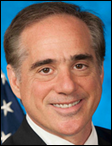
A heart surgeon who sued former employer Memorial Hermann (TX) for using peer review and quality data to discredit him after he complained about quality problems wins $6.4 million in a jury award.

image

Epic’s April Fool’s web page makeover included these stories:

  • Introduction of TinDR, an Epic app that allows doctors and patients to choose each other via a right or left swipe, quoting a doctor user as saying, “I didn’t do great in med school, but I hit the gym six days a week, and that’s finally paying off.”
  • The meeting of AI systems IBM Watson and Epic Bruce, in which Bruce sent Watson a 2 a.m. messaging questioning, “You up?”
  • The release of Chirp, a clinical notification app for the Apple iRing that displays college insignia or birthstones in the absence of pending notifications.

image

A hacker defeats the facial recognition security of the just-released Samsung Galaxy S8 smartphone by copying the registered user’s Facebook photo and then just sticking it in front of the phone’s camera.

A med student’s interesting article says that the broken medical residency electronic match program is leaving half of new graduates without a residency slot. The author says the electronic application process encourages blasting out applications en masse, overwhelming the ability of the residency programs to evaluate their candidates wisely. He concludes that pen and paper applications might force applicants to be more selective in expressing their true interests, adding that the number of electronic applications per student could also be limited but that’s not likely because the AAMC-owned system makes a lot of money per application.

image

California-based surgery collaboration app vendor Casetabs (which describes itself pointlessly as “the Uber of surgeries”) runs a Craigslist ad (where apparently all the health IT experts look for work) for a sales development rep with some fun requirements:

  • “Sales sniper with a proven track record of crushing sales quotas.”
  • “Extreme comfort in cold-calling (70-100 calls/day).”
  • “Water Garden office complex in Santa Monica (sofas, fire pit, B-ball, football, corn hole, Foosball, etc.)”
  • “High performance, high pay environment (eat what you kill).”

Here’s Part 2 of the top 10 HIS vendors report from Vince and Elise.

image

Dr. Weird News Andy would like to order a vodka drip, stat. Veterinarians save a cat that poisoned herself by licking spilled brake fluid off her fur by administering IV vodka to counter the effects of ethylene glycol. Princess the cat is recovering at home, which by WNA’s calculation leaves her with eight remaining lives.  


Sponsor Updates

  • Clinical Computer Systems, Inc., developer of the Obix Perinatal Data System, celebrates its 20 years in healthcare.
  • ZeOmega will exhibit at NAACOS Spring 2017 Conference April 5-7 in Baltimore.

Blog Posts


Contacts

Mr. H, Lorre, Jennifer, Dr. Jayne, Lt. Dan.
More news: HIStalk Practice, HIStalk Connect.
Get HIStalk updates. Send news or rumors.
Contact us.

125x125_2nd_Circle

News 3/31/17

March 30, 2017 News 5 Comments

Top News

image

An IBM security report finds that healthcare is the #5 most-hacked industry sector, with just 29 percent of the incidents involving outsiders.

“Inadvertent actors” — such as employees who fall for phishing or malware scams — made up nearly half the total number of incidents, while malicious insiders were behind just about as many attacks as external hackers.

Many successful healthcare attacks involved smaller organizations, resulting in an 88 percent drop in exposed records in 2016 vs. 2015.

The report estimates that criminals made $1 billion from ransomware in 2016 and that 44 percent of spam email contains malicious attachments, most of it ransomware.

IBM warns that the success of hackers has driven down the black market value of structured data, adding that “unstructured data is big-game hunting for hackers and we expect to see them monetize it this year in new ways.”


Reader Comments

From Jake Serpent: “Re: ransomware. The FBI is investigating a case where PCP’s clearinghouse account was hacked and $86,000 in insurance payments were routed to other bank accounts. Interestingly, the FBI advised them not to disclose to their EHR/PM vendor’s IT support that they had been hacked until they had learned more. This is a new hole in the cash flow for thieves to exploit.” Unverified.

image image

From Jigger: “Re: NantHealth. Allscripts invested $200 million in the company in mid-2015 before the NH IPO, while NantHealth’s Patrick Soon-Shiong personally invested $100 million in Allscripts. How have they fared?” The best I can tell, Allscripts spent $200 million to acquire shares that are now worth $74 million, so they are down $126 million. Soon-Shiong’s $100 million investment in Allscripts shares is now worth around $92 million. In the past year, MDRX shares are down 7 percent, while those of NH have shed 73 percent since they began trading in June 2016.

From Oleander: “Re: Aventura. Has ceased operations and closes Friday.” Unverified, but folks in the know say they’re winding it down. It’s highly unusual for a company that sells a product (rather than a service) to just walk away instead of selling out for whatever price the market will bear. I expect to have more details soon.

image

From Lugubrious Lad: “Re: Missouri’s lack of a prescription drug monitoring program. From reports I’ve read, it’s a small group led by a powerful state legislator that has blocked a statewide program. State Senator Rob Schaaf once said people who die of overdoses remove themselves from the gene pool.” Senator Schaaf is a doctor, with his obvious lack of empathy perhaps validating that he’s better suited for power-brokering than attending to patients. Schaff’s PDMP objections involve patient privacy – he proposes his own bizarre system in which doctors would send the state the names of patients for whom they are considering issuing prescriptions for narcotics and then the state would let the doctor know of any concerns (given that they have no medical information to review and that such a system wouldn’t work with that of any other state, including those that border Missouri). Schaaf says he will filibuster any attempts to implement a PDMP other than his own: “I’d just as soon not have a PDMP. Would they rather have a database that protects privacy or no database at all?” On the other hand, his skimpy legislative body of work includes designating Jumping Jacks as the official state exercise.

image

From Tip Toe Through the Tulips: “Re: Skagit Regional Health (WA). The 185-bed system’s consultant and another consulting firm that was being paid $500 per hour contracted for Epic for $72 million to replace Meditech and NextGen, more than larger sites have paid. The cost is now over $100 million and the IT department has gone from 53 FTEs to 113 plus 60 consultants. They are missing deadlines, dates have been pushed back, the consultant-turned-CIO has gone, and they are continuing without a CIO. This coupled with a money-sucking HIE they own with Island Health that is in disarray, for which they have hired another expensive consulting group to review. Time will tell whether this system survives a $1 million per bed Epic project.” Unverified.


HIStalk Announcements and Requests

image image

We funded the DonorsChoose grant request of Mrs. V in Texas, who asked for a 8×10 carpet for her first grade class’s reading area. What won me over was her eloquent description of its importance to her classroom in replacing the worn out one they had been using for years: “We start from only knowing mostly sounds and basic words to reading chapter books. We will basically summit a knowledge mountain this year to be prepared for our future. I do my job so that someday these students will have the opportunity to have a career of their own. The carpet is the heartbeat of our classroom. We share all of our lessons there. We share joy, excitement, heartbreak, breakthroughs, and growth on that piece of cloth. The battle of education is fought and won in one spot in the classroom and that is on that carpet.”

SNAGHTML4aef8e99

The government’s Internet privacy protections rollback revived my interest in using a private VPN service for web browsing (though to be fair, those protections hadn’t taken effect yet anyway, so nothing has changed.) My requirement of a free trial led me to VyprVPN at $45 per year. Speedtest shows no slowdown and it’s painless to install and use. A VPN also protects you when using public WiFi, but even more intriguingly, it apparently can save money on Internet purchases, where price is often set by the user’s location — VyprVPN priced the same SYD-LAX flight on Kayak by connecting through servers in several countries and it ranged from $2,900 to $5,400. VyprVPN runs great on the laptop and iPad, although it didn’t work on my Chromebook because of router settings that I didn’t bother changing because it wasn’t really important.

This week on HIStalk Practice: Congratulatory AHCA ads fly fast, furiously, and prematurely. Facial recognition software helps physicians diagnose rare pediatric disease. Wisconsin MDs prepare for mandatory PDMP reporting. Eastern Shore Psychological Services implements MediWare EHR. EPatientFinder’s Lance Hayden offers inexpensive steps to better practice cybersecurity. IHealth acquires AllDocuments. Mecklenberg County health officials accidentally release PHI. Navicure’s Jim Denny eases providers into care cost transparency practices.


Webinars

April 26 (Wednesday) 1:00 ET. “SSM Integrated Health Technologies Clinical Data Migration: Functional and Technical Considerations.” Sponsored by Galen Healthcare Solutions. Presenters: Sandy Winklemann, MHA, RHIA, project manager, SSM Integration Health Technologies; Tyler Mawyer, MHA, managing consultant, Galen Healthcare Solutions; Kavon Kaboli, MPH, senior consultant, Galen Healthcare Solutions. GE Centricity and Meditech to Epic EHR transition. Join us for a complimentary webinar as present the decisions that are important to consider when performing a clinical data migration from the point of view of  the healthcare organization program manager, the clinical analyst, and the technical implementation team. Our expert panel will survey data migration considerations, best practices, and lessons learned. The webinar will present a unique client perspective, offering insight into considerations surrounding staffing, clinical mapping, legacy application support, and validation and testing.
Previous webinars are on our YouTube channel. Contact Lorre for information on webinar services.


Acquisitions, Funding, Business, and Stock

image

San Francisco-based primary care practice Carbon Health raises $6.5 million in a seed funding round to expand use of its patient app that offers appointment scheduling, payments, and prescription refills.

image

Health kiosk vendor Higi receives an unspecified Series B investment from BlueCross BlueShield Venture Partners and acquires EveryMove, which offers a health rewards system to health plans.


Sales

image

Three Ontario hospitals will implement Meditech 6.1 Web EHR, hosted by Markham Stouffville Hospital.


People

image

Evariant names Clay Ritchey (Imprivata) as CEO.

image

Leidos Health hires Bill Kloes (Nuance) as VP of operations integration of its health group.

image

Terri Ripley, MIT (Inova Health System) joins OrthoVirginia as CIO.

image

The Strategic Health Information Exchange Collaborative hires Pam Mathews, RN, MBA (Pam Mathews & Associates) as interim executive director.

image image image

Solutionreach promotes Paul Kocherans to SVP of sales; Justin Everette to VP of marketing; and Lance Rodela to VP of product management.


Announcements and Implementations

IBM will incorporate SNOMED CT terminology in its Watson Health offerings.

CMS approves Forward Health Group’s PopulationManager as a qualified registry for the 2017 performance year.

image

The World Health Organization launches a global initiative to reduce severe, avoidable medication error harm by 50 percent over the next five years. It will offer guidance, strategies, plans, and tools.

image

Healthwise provides a $2 million grant to fund the Informed Medical Decisions Program at Massachusetts General Hospital’s Decision Sciences Center. Michael J. Barry, MD, Healthwise chief science officer, will return full time to MGH to direct the center, which will study how to incorporate the patient’s voice in making healthcare decisions.

The Connecticut Hospital Association and Bayer will create a statewide database to track patient exposure to radiation from CT scans.


Government and Politics

image

Senators Lamar Alexander (R-TN) and Bob Corker (R-TN) introduce legislation that would allow Americans who live in a county where no insurers offer ACA plans in 2018 to apply any federal subsidy they receive to plans they buy directly from insurers. The challenge, which they didn’t mention, is that those same counties may well have no insurers willing to sell individual policies either, meaning that those who can’t get insurance through an employer can’t obtain it at any price.

image

Meanwhile, Sen. Corker responds to the comments of fellow Republican and House Speaker Paul Ryan (R-WI), who expressed concern in a TV interview that President Trump will reach out to Democrats to get healthcare legislation passed instead of twisting the arms of party loyalists to repeal ACA in purely partisan fashion. A new poll finds that 62 percent of Americans think President Trump has mishandled healthcare reform, sending his record-low approval rating even lower to 35 percent following last week’s AHCA drama.

The Texas Senate appears to have ended the state’s relentless efforts to stifle the use of telemedicine.


Privacy and Security

Thieves hoping to steal petty cash from a clinic of CoxHealth (MO) also grab patient fee slips from the state, triggering the requirement that the incident be reported as a breach to HHS.


Other

image

A New York Times Magazine article describes the expensive industry created around “coder vs. coder” billing code jockeying that occurs among hospitals, insurers, and auditors that often leave patients holding an indecipherable bills from multiple providers involved in a single episode of their care that may bankrupt them despite their best intentions. Some excerpts:

Individual doctors have complained bitterly about the increasing complexity of coding and the expensive necessity of hiring their own professional coders and billers … But they have received little support from the medical establishment, which has largely ignored the protests. And perhaps for good reason: The American Medical Association owns the copyright to CPT, the code used by doctors …  when Medicare announced that it would pay only a set fee for the first hour and a half of a chemotherapy infusion — and a bonus for time thereafter — a raft of infusions clocked in at 91 minutes … Today many medical centers have coders specializing in particular disciplines … The Business of Spine, a Texas-based consulting firm with a partner office in Long Island, advises spine surgeons’ billers about what coding Medicare and commercial insurers will tolerate, what’s legal and not, to maximize revenue. The evolution of this mammoth growth enterprise means bigger bills for everyone.

Colorado’s new Medicaid payment system for developmental disability services is rejecting provider claims due to coding errors that the state blames on users who didn’t pay attention to its communication about the changes over the past 18 months. Speech therapy clinic operator Jill Tullman says she bills up to $12,000 per week to Medicaid, but has been paid only $288 in the past month. She also spent 2,500 minutes trying to get help from the state’s call center, run by Hewlett Packard Enterprise, which still has 90-minute wait times even after fixing software and connectivity problems. The state has paid 48 percent of submitted claims in the first month. 

A Florida State University psychology researcher studies the EHR data of 2 million patients to create a machine learning method that can predict whether someone will attempt suicide within the next two years with 80-90 percent accuracy.

image

The University of Texas system regents will pay Ron DePinho, MD — the just-resigned president of MD Anderson Cancer Center — over $1 million per year to serve as a professor of cancer biology, placing his compensation at nearly triple that of his boss, the cancer biology chair. He will also receive $1 million per year to fund his research projects. Cynics might presume that his resignation was neither voluntary nor unchallenged.


Sponsor Updates

  • Consulting Magazine profiles Peter Smith of Impact Advisors.
  • Imprivata will exhibit at the VHHA Spring Conference April 5-7 in Williamsburg, VA.
  • Philly.com profiles InstaMed.

  • InterSystems will exhibit at the HIMSS Population Health Forum April 3-4 in Boston.
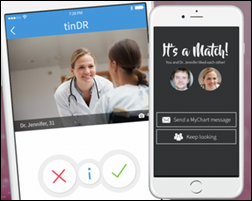
  • Intelligent Medical Objects will exhibit at AORN International Surgical Conference & Expo April 1-5 in Boston.
  • Kyruus hosts NewCoBos April 5-6 in Boston.
  • NTT Data’s Lisa Woodley presents at the LOMA 2017 Customer Experience Conference March 30 in Las Vegas.
  • Point-of-Care Partners will exhibit at the HL7 Mini-Connectathon April 10-12 in Chicago.
  • Protenus hosted its inaugural Privacy and Analytics Conference last week at its headquarters in Baltimore.
  • SK&A publishes “Physician Office Usage of EHR Software.”
  • PatientSafe Solutions will demonstrate new Rounding and Early Warning System worfklows of its PatientTouch platform at AONE/ANIA.

Blog Posts


Contacts

Mr. H, Lorre, Jennifer, Dr. Jayne, Lt. Dan.
More news: HIStalk Practice, HIStalk Connect.
Get HIStalk updates. Send news or rumors.
Contact us.

125x125_2nd_Circle

EPtalk by Dr. Jayne 3/30/17

March 30, 2017 Dr. Jayne Comments Off on EPtalk by Dr. Jayne 3/30/17

image 

I spent some time this week coaching a physician informaticist on some of the less-exciting aspects of running a team. At first, he was very excited to be the leader of a team of optimization specialists to work with clients across the south. He didn’t understand what he’d have to deal with as far as the actual logistics of managing people though – vacation approvals, travel authorizations, and the dreaded expense reports.

We talked through the idea of creating some team policies and procedures beyond the standard corporate policies in an attempt to manage the chaos. He has more than 20 people on his team, which is a lot to handle when you’ve never managed people.

Some of the problems were simple solutions. For example, processing the vacation requests 1-2 times a week based on a published timeline for the team, and then ad-hoc for last-minute issues. For travel authorizations, processing daily at mid-day so that his team could complete booking tickets before the travel agency closed. That way he felt less fragmented and less like he was in and out of different software applications all day long.

Creating a strategy to manage his team’s expense reports became the highlight of my day. I have to admit that in reviewing some of the problems he is dealing with, I developed an appreciation for the level of shenanigans his employees were putting forward. Several were pushing the limits of the daily meal allowance, logging the wait staff gratuity as a separate line item under “cash expenses” so they could expense an extra cocktail on their dinner checks without hitting the cap.

Another’s expense reports can only be described as stream of consciousness. Despite traveling to the same client every week, he files reports in a random way that doesn’t seem to line up with any of the scheduled trips. A third consultant included airport hotel bills for the night prior to his travel, “just in case the weather was bad” even though he only lives 20 miles from the airport.

The winner, though, was the consultant who repeatedly stops to purchase a single beer at the gas station next door to the rental car pickup. The timing seemed a little odd, especially since he stays at a hotel where you can purchase single beers in the lobby. It makes me wonder if he is drinking it in the car as he heads to the hotel. All things considered, and especially working for a healthcare company, I’d probably just pay for that out of pocket and not try to expense that $2.85 worth of my day. Not to mention that my client may want to encourage his employee to purchase his beverages at the local package store and pass the cost savings onto their customers.

We had to do some back and forth with the corporate expense people to find out whether some of the outlier expenses were prohibited or acceptable but just tacky. Not all of his employees were gaming the system, though. Several use coupons for their airport parking to save the clients’ money, and at least five of his team members were spot on with their expenses. We’re using those good corporate citizens as an example to the rest of the team and plan to leverage a couple of them to teach the others how to file an expense report that doesn’t drive the reviewer mad.

Another challenge was coaching him on what to do with some of his new employees who are having challenges with professional behavior. That’s always rough when you inherit a team from someone else, or when candidates are hired without your input.

One is struggling with professional dress. My client mentioned that he never thought he would have to tell a field trainer that wearing a fishing hat to the client site isn’t appropriate. That was mild compared to the employee that he described as a “predator” based on reports from multiple clients. Apparently, this trainer would meet members of his training classes at bars after class, with all the imaginable bad decisions taking place. Whether you go to medical school, business school, or any other school, nothing prepares you for having to deal with employees on the prowl, especially when they’re propositioning your clients. The employee is currently on a performance improvement plan, but it’s surprising that people are having to deal with that type of behavior after all the stories we hear about sexual harassment and inappropriate behavior.

One of the most egregious examples of unprofessional behavior was the team member who asked a client physician (the CMO no less) whether he could write her a script for some Ambien because she left hers at home. Her previous manager left the incident hanging out there for my client to deal with when he inherited the team, an act which is unprofessional in its own right. Clearly the employee didn’t find asking a client to write a controlled substance script to be a problem, so it’s likely to be an interesting conversation when the inevitable counseling occurs.

I could never work in human resources because I don’t have the poker face to deal with some of the things that come through the door. One of the funniest books I’ve read in the last few years is Let’s Pretend this Never Happened by Jenny Lawson. There’s a chapter about her past life as a human resources staffer that will make your head spin. (Warning: language may be inappropriate for the workplace, although common.)

I sincerely enjoyed working with this new client this week and look forward to several more sessions in the coming months. It’s always fun to see someone who is idealistic and enthusiastic who hasn’t been beaten down like so many of the rest of us. I’ve enjoyed teaching him my favorite Jedi tricks around email management and getting through days with high volumes of meetings and little productivity. I hadn’t imagined myself as an elder statesperson in the realm of corporate survival, but it seems that I may have arrived there. It’s definitely a new adventure.

What’s your best story about bogus expense reports? Email me.

Email Dr. Jayne.

HIStalk Interviews Paul Roscoe, CEO, Docent Health

March 29, 2017 Interviews Comments Off on HIStalk Interviews Paul Roscoe, CEO, Docent Health

Paul Roscoe is co-founder and CEO of Docent Health of Boston, MA.

image

Tell me about yourself and the company.

I’ve been in healthcare my whole career. I’ve had the privilege of working with some amazing teams over the past 25 years at Sentillion, the Advisory Board, and Crimson.

I’ve been very privileged now to work with an equally amazing team of folks here at Docent Health solving a problem that is a top priority for most, if not all, health system CEOs. Which is, how do you think about the patient experience in dramatically different ways and more compelling ways than we’ve seen to date? 

If you think about other industries that have done an amazing job of redefining the experience their customers have when they’re engaging them, healthcare has a lot to gain and learn. That’s why we created Docent Health — to be able to think about a completely new approach to experience for patients as they go through their healthcare journeys.

What do your patient liaison folks — your docents — actually do? How do they integrate with the traditional healthcare team?

There are two parts to the story. One is the use of technology to fill a gap that exists today between the electronic medical record — which has a very good, rich, clinical representation of the patient — and maybe the CRM, which has a more sales and marketing orientation of the patient. There’s this gap between the two, which is providing a rich profile on the patient as a human being.

What are their concerns? What are their anxieties? What are their preferences? Building out a rich profile so we can understand previous experiences and then personalize an experience to them.

It feels like health systems are treating patients as a stranger every time they interact with them. There’s a lot of opportunity to capture this information and make sure we’re personalizing the experience.

There’s a large role for technology, but we felt that there was also a bit of a service gap in terms of how you then engage with a patient. Clinicians are extremely busy, focused on top of license. There’s an opportunity to partner with those caregivers to deliver a new service approach. In our business, that is through a service function that we call the docent program.

Docents are empathetic, hospitality-trained, customer service-oriented people coming out of healthcare. They may have been nurses who don’t want to nurse, or they’ve come from hospitality or other customer service industries. They provide a bridge in many ways between the patient and the caregiver. They act as a guide. They set expectations.

They are providing service touches throughout the journey. Not just in an inpatient setting. That’s obviously the logical one, but we’re now engaging with patients throughout they’re journey.

One of our health systems is focused on maternity. If you think about the journey for a mother, her inpatient stay is only two or three days, but there’s all this time before and sometime afterwards where we can be engaging with them to understand what they want from their experience. That’s the role of the docent.

When hospitals get docents involved, is there resentment or conflict with staff who are accustomed to being the only connection to the patient?

I’m not sure I would frame it as resentment, but certainly there are logical and understandable concerns that one must initially overcome. Clinicians feel they have a sense of responsibility for the patient and they’re bringing on a new resource. You almost have to earn your stripes.

One of the things we do at Docent Health is to very much focus initially on that relationship between the docent and the caregiver. What we’re already starting to see from the work that we’ve done with our customers is that there’s a lift in staff engagement. Clinicians have joined healthcare, on the whole, to deliver great care. Many of them have become somewhat disenfranchised because they’re not able to provide the amount of time on an individual patient basis.

The docents now are building relationships with patients in more meaningful ways. Perhaps earlier on in their journey, starting to capture this picture of what’s important to patients. Then sharing it with the caregiver, so that when the caregiver does interact with that patient, it’s not generic — it’s personalized to things that are relevant for that patient.

Our belief is that for experience to be successful, it must meet two tests. It’s got to be a better experience for patients — make them feel like they want to come back, make them feel loyal. It also absolutely has to be a great experience and have lift for the staff, because at the end of the day, it’s a complete, total experience.

One view would be that we don’t have ways to capture the necessary non-clinical information, while the other would be that clinicians don’t have the time or maybe even the ability to do something with it even if we did. Does the docent make the process less laborious than reading a lengthy, free-text narrative at the right time in the process?

It’s a good observation. The logical technology solve to this might have been to say, "We’re capturing all this information about what’s important to a patient. Why don’t we just push that up into the electronic medical record?" The reality is that clinicians are already at their breaking point sometimes on the use of EMR, so putting more data in there and flagging it wouldn’t necessary be the solve.

We’re engineering processes where the docents — on a daily, maybe even more frequent basis than that — are huddling with clinicians, and at the right, appropriate time, delivering information that might be relevant for that particular patient. We operate in the nursing huddles. We participate in the rounding meetings.

Rounding is an interesting concept in a hospital. It’s like the general manager of a hotel randomly knocking on four or five doors saying, "How are we doing?" What we’re able to do with the docent program integrated with the caregivers is have rounding that is more personalized and adaptive to the issues the patients are facing rather than generic. That’s an example of a process where we’ve integrated the docents into that rounding so that we can provide a lot more lift and a lot more information that’s relevant to the patient.

What incentive do health systems have to get to know their patients better?

It comes back at the end of the day to whether you are in a fee-for-service world or a risk-sharing world. Health systems are waking up to the realization that they haven’t done a lot of work in terms of building a relationship with a patient, a relationship that takes their brand and makes it much more personal to that patient. Consumers are paying more for their healthcare then they’ve ever done before, having more choice, and going to different venues to make that choice. They don’t go to the common channels that health systems might like around cost and quality. They’re going to Yelp. They’re going to other social media resources.

The final frontier for a health system to build a relationship is not just about clinical outcomes. That’s a much more of a level playing field these days. It’s about experience. If you look at outside of healthcare, great brands have created an experience around their products and services. Product and service, in many ways, is somewhat incidental to the experience they can wrap around. Their belief — and there’s proof — is that that experience creates a relationship, and the relationship equates to retention, loyalty, and maybe in a more advanced state, advocacy.

Health systems are realizing that consumers have choice and are paying more for their healthcare. There are new entrants to healthcare coming up — urgent care clinics and retail medicine — that don’t have the same baggage as the health system. They’ve figured out how to get an appointment quickly. They’ve figured out what customer service is. 

Health systems are increasingly concerned about those.They are realizing that experience is almost an untapped asset. If they do it well, it creates this relationship with a patient that’s great for both the mission and the business.

Is data-driven empathy an oxymoron?

Data-driven empathy? [laughs] When you think about the tech-enabled service model that we’ve deployed at Docent Health, they go hand in hand. You can’t have one without the other.

Just data for data’s sake but not empathetically driving an interaction comes across as clinical and vanilla in many cases. Empathy itself — just being touchy-feely without knowing what the right actions are and using the data to direct those actions — also doesn’t necessarily solve the problem and doesn’t scale. Our view is that you need both.

I go to health system CEOs and say, "If you had $20 million to improve your experience, where would you start?" There’s a lack of data to figure out what things make a difference to a patient that you should be focused on. We’re hoping to provide much more data inside our platform to help guide those.

The empathetic service model is as important as the data. I would point out that our way of doing it through our docents may not be the right answer for everyone. There are some health systems out there that have already invested in this, both culturally and in terms of resources. For that customer, the technology that we provide might be the most important for them as opposed to the technology and the service.

What kinds of patient information that you collect are most often relevant yet missed by hospitals?

Let’s take the journey of a middle-aged knee replacement patient who has been to that hospital in the past. We can craft an experience for that patient that combines things we know about him individually and preferences of perhaps other patients who have been through similar processes and similar procedures before. There’s a segmentation set of activities that will allow us to tailor this experience. We can look at past experiences and what worked, what didn’t. Whether there were previous service recovery moments in a past experience that we can learn from.

Did he have a good experience with anesthesia in the past? Has he expressed any specific concerns or fears that we want to be able to capture? Do we know of any specific sport that he participates in and he’s anxious to get back to, so we can anticipate his questions and perhaps his needs around physical therapy?

Based on all this data, the journey we could prescribe could include interactions. Pre-surgery discussion of how he’s going to get his knee ready to go back and play his tennis championship in three months because that’s what he’s so focused on. Suggestions for physical therapy near his house that are focused on that.

For us, it’s about taking a personalized approach, but combining that with data we’re capturing on like patients in similar cohorts. Then combining that with data science that says, "We’ve done 10,000 of these journeys for this type of patient before. What we’ve noticed is that if we deliver an experience in this way with these steps — some of them digital, some of them human — the likelihood of a great experience is Y."

Do you have any final thoughts?

For me, after being in healthcare for so many years, it’s invigorating and a thrilling time to be in the patient experience space. The beauty of it, in many ways, is that there’s already a playbook in front of us. Restaurants, hotels, airlines, and other industries have been rethinking customer journeys over the last 20 years or so. There’s been a term for that — the experience economy. It’s been a well-known economic industry that’s been created through these experiences. In many ways, they had no choice but to innovate and to evolve. 

Now healthcare has this same opportunity. It’s an extremely exciting time to be able to use my experience in healthcare and that of my team to fuse that with these learnings, best practices, and approaches that have worked in other industries.

News 3/29/17

March 28, 2017 News 1 Comment

Top News

image

The FBI’s Cyber Division warns medical and dental facilities that hackers are launching cyberattacks by exploiting FTP servers that have been configured to allow anonymous access.

The alert cited a 2015 University of  Michigan review called “FTP: The Forgotten Cloud” that warned of security flaws in the nearly 50-year-old protocol and the 1 million FTP servers that are not password protected.


Reader Comments

From Gilded Lily: “Re: list of ‘100 great healthcare leaders to know.’ More crapware.” Asking fresh liberal arts grads to create such a list ensures reliance on Googling. At least they claim nothing more in leaving their methodology unstated. Or as one of their readers astutely observed and boldly commented on the site, “This rings about as true as a Best Hospitals list that’s based largely on reputation. Oh, well. It will drive clicks and traffic to the website.”

image

From Jelly Roll: “Re: Qventus expanding to the periop environment. That’s kind of BS since the company started in periop when they were AnalyticsMD. They didn’t get much traction, so they explored the ED and other areas and are now making this announcement to get some press after raising a bunch of capital. Read some of their early blog posts – they talk about OR solutions and exhibited at periop-oriented conferences three years ago.” I pulled up a cached copy of AnalyticsMD.com from 2013 and they were talking about OR deployment then, along with “in-patient wards” (that’s almost as bad as the health IT site whose young reporter creatively but incorrectly expanded the press release’s term “OR” into “operative room.”) Qventus raised $13 million in November 2016.  


HIStalk Announcements and Requests

image

I’m enjoying the upbeat stories being sent in my “Proudest Moment” survey. It’s good to occasionally take a break from never-ending pressure and negativity and reflect on the big-picture positive work we do. Some of the reports I’ve received (and will list in Monday’s HIStalk) are moving. What’s going to be on your HIT career tombstone?

image SNAGHTML407e2b07

We provided iPad modules for art, math, and coding for Mrs. F’s middle school class in California. She reports, “My students are enjoying integrating technology and art into our core curriculum. They love being able to take photographs, create sketches, and animate their creations. My students also love using Osmo Numbers during math center time to increase their comprehension of number sense and operations with decimals.”


Webinars

March 29 (Wednesday) 1:00 ET. “Improving patient outcomes with smartphones: UW Medicine Valley Medical Center’s story.” Sponsored by Voalte. Presenters: James Jones, MBA, MSN, VP of patient care services and nursing operations, UW Medicine Valley Medical Center; Wayne Manuel, MBA, SVP of strategic services, UW Medicine Valley Medical Center. UW Medicine Valley Medical Center dramatically improved patient outcomes after moving to a smartphone-based platform for clinical communication and alarm and alert notification. Before-and-after analysis shows a reduction in hospital-acquired pressure ulcers and skin integrity events, fall and slip events, and medication errors. By limiting overhead paging, the medical center also created a calmer, quieter environment and improved engagement among nursing and hospitalists. Hospital executives will describe their experience and vision for the future in addressing quality, cost, and the patient-caregiver experience.

April 26 (Wednesday) 1:00 ET. “SSM Integrated Health Technologies Clinical Data Migration: Functional and Technical Considerations.” Sponsored by Galen Healthcare Solutions. Presenters: Sandy Winklemann, MHA, RHIA, project manager, SSM Integration Health Technologies; Tyler Mawyer, MHA, managing consultant, Galen Healthcare Solutions; Kavon Kaboli, MPH, senior consultant, Galen Healthcare Solutions. GE Centricity and Meditech to Epic EHR transition. Join us for a complimentary webinar as present the decisions that are important to consider when performing a clinical data migration from the point of view of  the healthcare organization program manager, the clinical analyst, and the technical implementation team. Our expert panel will survey data migration considerations, best practices, and lessons learned. The webinar will present a unique client perspective, offering insight into considerations surrounding staffing, clinical mapping, legacy application support, and validation and testing.

Previous webinars are on our YouTube channel. Contact Lorre for information on webinar services.


Acquisitions, Funding, Business, and Stock

image

Tesla and SpaceX founder Elon Musk forms Neuralink, which will develop an implantable brain-computer interface.

The US Supreme Court is reviewing whether church-affiliated health systems are exempt from federal laws that protect employee pensions. Advocate Health Care says it shouldn’t have to follow ERISA laws that require its pension plan to be funded and insured, saying it could owe billions of dollars in retroactive penalties if the court says it intentionally disobeyed the law.


Sales

image

UAE-based Emirates Hospital Group will implement InterSystems TrackCare in all its facilities.


People

image

Ries Robinson, MD (Medici Technologies) joins Presbyterian Healthcare Services (NM) as SVP/chief innovation officer.

image

Spok hires Mike Wallace (Intermedix) as CFO.

image image

Real-time patient safety solution vendor Bernoulli hires as consultants Neil Halpern, MD (Memorial Sloan Kettering Cancer Center) and Amar Setty, MD (AnesthesiaStat).

image

Modern Healthcare’s health IT writer Joe Conn, who is a rarity in actually understanding the topic he covers, retires. I trusted what he wrote and admire that he didn’t let his ego interfere with his reporting.

image

Chris Edwards (Validic) joins Conversa Health as chief marketing and experience officer.  

image

Weber State University (UT) honors Associate Professor of Computer Science Richard Fry, PhD with its faculty and staff award. His accomplishments include a long career in the Air Force, developing technology to help orphaned children in Thailand learn English, converting paper medical records into an EHR in Ghana, developing an open source web application to help New Zealand document the lack of health services in rural communities, and creating an order queuing system for a local Air Force base to support its special needs employees.

image

Don Fisher, PhD, president and CEO of the American Group Medical Association since 1980, dies of cancer at 71.


Announcements and Implementations

image

Kyruus releases a new version of its ProviderMatch Analytics that helps health systems track patient access channel trends and optimize their provider networks.

image

Cerner and Nevada, MO will launch a county-wide prescription drug monitoring program as part of their Healthy Nevada program, trying to fill the gap left by the clueless Missouri state government that keeps finding excuses to remain the only state that can’t muster enough consensus to launch its own program.

image

Health Catalyst launches Leading Wisely, an executive decision support system.

Allscripts will resell abstracting and physician query solutions from Streamline Health Solutions.


Government and Politics

Days after President Trump declared that he was moving on to other priorities and leaving the Affordable Care Act intact after failing to win enough votes to repeal it, the White House and House Republican leaders have restarted negotiations. “We are going to work together,” declared House Speaker Paul Ryan (R-WI), with “we” being his fellow Republicans alarmed at the President’s hint that he might actually get some Democrats involved after his party failed to support him in sufficient numbers.

image

House Republicans vote to eliminate privacy rules imposed by the FCC last year, allowing broadband providers to sell the browsing data of their customers without asking permission. All that remains is for the law to be signed by President Trump, who indicates he will do so.


Privacy and Security

From DataBreaches.net:

  • A Kentucky chiropractic practice notifies 5,000 patients that its systems were attacked by ransomware.
  • Urology Austin (TX) notifies 280,000 patients of a ransomware attack.
  • A study finds that 40 percent of used electronic devices listed for sale contain still-readable personal information.
  • Med Center Health (KY) says a former employee obtained the billing information of 160,000 patients in 2014-2015.
  • Washington University School of Medicine in St. Louis notifies an unstated number of patients that their information was exposed by employees who fell for a phishing scam.

Innovation and Research

image

UCSF’s virtual glucose management service – in which diabetes specialists remotely review abnormal glucose lab values and make recommendations as an Epic care note – reduced the number of hyperglycemic patients by 39 percent and the number of severe hypoglycemic events from 40 to 15.


Other

image

An American College of Physicians position paper says doctors are overloaded with administrative responsibilities, one of them being EHRs that were designed for patient care but that have been co-opted for non-clinical purposes to the point that EHR vendors have little time left to improve their patient care capability. ACP recommends that EHRs support the “write once, reuse many times” philosophy; embed tags to show where information originated; and allow clinicians to search available data when writing notes and allow them to link to it or copy/paste using tags. It also suggests that stakeholders use the same data elements and reporting formats, that clinical decision support replace non-real time data exchange such as prior authorization, and that agencies used shared registries to query for whatever information they need.

Pharma data technology companies QuintilesIMS and Veeva sue each other over the use of prescriber databases for drug marketing. Veeva says QuintilesIMS is engaging in anti-competitive practices by refusing to let Veeva customers load QuintilesIMS data into its network, while QuintilesIMS says it won’t provide the information because Veeva won’t guarantee that it will be protected following reports of unauthorized access.

image

STAT reports that Patrick Soon-Shiong and his Nant companies may have violated FDA regulations by talking about curing cancer in referring to drugs not yet approved by the FDA. Soon-Shiong, NantKwest, and NantHealth – stung by two critical STAT reports – have ramped up their feel-good social media PR campaign. After STAT’s inquiries, videos were deleted that had referred to the company’s treatments as a “breakthrough” that can “kill cancer.” A physician with drug promotion expertise summarized the 12-patient, modest results study referred to by Soon-Shiong as a breakthrough as, “The data is blatantly not supporting that statement, and the video blatantly uses emotion, not science, to make the case that this drug deserves a try.”

The Supreme Court hears a class action lawsuit brought against SAIC (now Leidos) by six retirement and pension funds for “the single largest fraud ever perpetrated on the city of New York.” Leidos says it has improved compliance efforts and noted its successful DoD EHR bid in defending SAIC’s performance in developing a city payroll system that was budgeted at $63 million that ended up costing $760 million and that resulted in long prison stretches for three consulting firm employees. SAIC paid $500 million to avoid federal prosecution, sending shares down and triggering the investor lawsuit that claims the company misstated information in its SEC filings.

image

Two second-year Mass General internal medicine residents die in an avalanche in Canada. Lauren Zeitels earned a MPhil in medical genetics at University of Cambridge and an MD/PhD in human genetics from Johns Hopkins and planned to purse a career in rheumatology. Cornell graduate Victor Federov, MD, PhD hoped to specialize in hematology-oncology.

image

Late-breaking April 1 news from an obviously tyred Weird News Andy, with whom I’ll need to have a natter: Cerner changes the name of its British Isles operation to Cernre to better reflect traditional UK spelling habits. "Having Cerner spelled one way and Centre spelled the other confused many people when they came to front door of our building in London. With this change, we believe we will blend in with the local flavour," according to a spokesperson from Cernre.


Sponsor Updates

  • DrFirst wins two awards for its company culture and employee-centric work environment.
  • Audacious Inquiry publishes a series of white papers called “21st Century Cures Act: Compliance for HIOs.”
  • Optimum Healthcare IT creates an infographic titled “How to Navigate an EHR Implementation Lifecycle.”
  • Spok will present and exhibit at the Becker’s Hospital Review 8th Annual Meeting April 17-20.
  • Aprima and Healthwise will exhibit at the ACP Internal Medicine Meeting March 30-April 1 in San Diego.
  • Arcadia Healthcare Solutions will exhibit at the NAACOS 2017 Spring Conference April 5 in Baltimore.
  • Besler Consulting will exhibit at the Hudson Valley HFMA Annual Institute April 6 in Tarrytown, NY.
  • CompuGroup Medical will exhibit at the COLA Annual Symposium April 5-8 in Las Vegas.
  • CoverMyMeds will exhibit at Computer-Rx Idea Exchange 2017 March 31-April 1 in Oklahoma City.
  • Direct Consulting Associates will exhibit at the Central & Southern Ohio HIMSS Springs Conference April 5 in Dublin.
  • ECG Management Consultants will present at the 2017 ACHE Congress March 29 in Chicago.
  • Elsevier Clinical Solutions announces a reseller agreement with PolicyMedical.
  • EClinicalWorks will exhibit at the Pediatric Urgent Care Conference March 30-31 in New Orleans.
  • FormFast will exhibit at ANIA 2017 March 30-31 in New Orleans.

Blog Posts


Contacts

Mr. H, Lorre, Jennifer, Dr. Jayne, Lt. Dan.
More news: HIStalk Practice, HIStalk Connect.
Get HIStalk updates. Send news or rumors.
Contact us.

125x125_2nd_Circle

Curbside Consult with Dr. Jayne 3/27/17

March 27, 2017 Dr. Jayne 2 Comments

After my recent adventures in healthcare, Mr. H asked me my thoughts about “playing the doctor card” when a physician becomes the patient.

I’ve had some experience with it at multiple times in my career and have chosen different strategies depending on the nature of the situation and the potential risk/benefit equation. It’s definitely more straightforward when you’re dealing with an emergency situation or if you’re in a situation where you’re seeking care at a facility where you are on staff vs. just being a physician. If you’re at your own facility, depending on how large it is, the odds that someone will recognize the fact that you’re on staff are higher, so sometimes it’s better to just identify yourself and avoid awkwardness.

I’ve done that when calling ahead to the emergency department to let them know I’m bringing in a close family member who has an emergency, and also to ask who is on call for whatever specialty care might be needed in case I want to go somewhere else based on the call schedule, or call a colleague and ask them to come in when they’re not on call. To be honest, though, I would do the same thing for one of my patients, so I’m not sure how much that really is playing the doctor card.

If I’m having difficulty scheduling an outpatient appointment, or want a certain time slot (first patient of the day, something like that) I may mention to the schedulers that I’m a physician and looking for a particular time so that I can accommodate patient care hours. I wouldn’t ask them to double book me or work me in, though, but rather add the physician component just so they understand I’m not trying to be difficult, but just need the first available appointment that meets my criteria so we don’t waste time looking at slots that I won’t take. Sometimes this is an issue when offices are performing practice improvement activities, when the staff is pressured to get patients on the schedule quickly, but I need to wait.

When I was recently in the emergency department for acute abdominal pain, I didn’t play the doctor card until I was in the room being seen by the physician. It was more for context since I wasn’t going to mince words about my symptoms and didn’t want to put him in the position of trying to figure out why I was spouting medical jargon. It seemed the best way to expedite care and also to give him the picture that, “Hey, this must be bad if she’s a physician who is going to have to call in for her shift because she’s here” as far as the severity of my symptoms. It turned out that his wife is one of my colleagues, so it was a bit of a bonding moment as well.

The decision to mention you are a physician or not can often be difficult. On one hand, you want to be able to interact with your treating clinicians at a higher level. But on the other hand, you don’t want them to leave things out because they assume you know more than you really do about an issue.

My recent appointment with the genetic counselor was a great example of a visit that went well. Since the patient history forms asked for occupation, I’m certainly not going to hide it — it’s a fact of demographics and social history just like my education level. The counselor asked open-ended questions about why I was there and what I hoped to get from the visit, which let me explain what I knew and didn’t know, and which allowed her to figure out where I was coming from. When we arrived at the discussion of the risk model, she asked if it was OK to skip the overview of genetics and inheritance and go straight to the details. I appreciated the fact that she asked, as well as the fact that we could have a deeper and more specific conversation due to the fact that I already knew most of the background information.

My recent inpatient stay had a couple of interesting interactions around the fact that I was a physician. The nurse who did my intake on the med/surg floor specifically asked if I wanted to be called “Dr.” or something else. I said to use my first name and she made a point of saying she just wanted to check, since I had “earned it” and she was happy to honor my preference. I appreciate that her statement was beyond just the, “How would you like us to address you?” question that all patients should be asked.

Once she put my name on the whiteboard, though, I was back to being Jayne, and no one asked again. I didn’t have to mention it until the craziness with the overnight nursing staff who had difficulty administering scheduled medications on time, and I attempted to be a “normal patient” until the delays became ridiculous and then I played the MD card. In that situation, however, they probably should have been more worried about the fact that my brother is a personal injury attorney rather than the initials behind my name. Fortunately there were no negative outcomes, however, so I didn’t have to play that card.

I’ve also been very upfront about being a physician when I’m about to do something that would be perceived as unusual for a “typical” patient. For example, rolling into a seemingly routine outpatient procedure with a copy of my healthcare power of attorney and living will. It’s more of a, “I’m a physician and I know things can go south even for the smallest procedures, so here are my documents” statement rather than a request for special treatment. I feel pretty strongly about my end-of-life wishes and want them honored, so I’m not afraid to play the card there.

My general thought process around when I say I’m a physician or leave it out is this. Does the person I’m interacting with really need to know? Is it germane to my care? Would I be mentioning it just to mention it, potentially creating an awkward situation? Or would mentioning it help diffuse an awkward situation? Is there something inappropriate going on where it might help correct the issue? Will I get better care if I mention it?

I’ve only had a negative reaction once when mentioning that I’m a physician, and that was in a situation where the care missed the mark so badly that I wasn’t surprised. It was a last-ditch effort to improve the situation and their response to it was very telling.

Putting on my physician hat, I’ve had multiple experiences where I have cared for other healthcare providers and wished they’d revealed their professional background sooner in the encounter. Case in point: I tend to have detailed discussions with my patients about why I’m choosing one medication over another and how it’s going to work to take care of their problem. I wish the patient who was a faculty member at the local pharmacy school would have jumped in earlier when I was discussing the relative effectiveness of various antibiotic families and why I was recommending one drug over another. When he finally did, though, he had a sense of humor and said he would give me an A+ on my explanation.

I’d be interested to hear from other clinicians on their experiences, positive and negative. Being on the front lines of healthcare delivery is like being part of a somewhat bizarre fraternity. No matter where you trained or where you work, you’re still linked by that underlying kinship and by subsets of shared experiences. Sometimes mentioning that you’re a clinician is in lieu of the secret handshake and just intended to say, “Hey, I’m one of us, it’s OK, I understand.”

Email Dr. Jayne.

Text Ads


RECENT COMMENTS

  1. Challenger exploded on lift-off when the O-rings failed. Columbia disintegrated on reentry after one of the heat shield tiles were…

Founding Sponsors


Platinum Sponsors


Gold Sponsors


RSS Webinars

  • An error has occurred, which probably means the feed is down. Try again later.