News 8/23/17

August 22, 2017 News 20 Comments

Top News

image

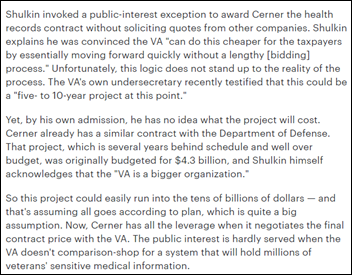
CliniComp files a bid protest lawsuit against the VA, saying that it improperly issued Cerner a no-bid contract for an EHR that will replace VistA. CliniComp’s systems are used in several VA hospitals.

CliniComp prevailed in a similar 2014 lawsuit in which it protested that the VA’s selection process was flawed when it awarded a $4.5 million bid to Picis instead of low bidder CliniComp.

The White House took credit for the VA’s surprise selection of Cerner, apparently believing that interoperability with the Department of Defense will be easier if the organizations use the same vendor’s system. 


Reader Comments

image

From Givenchy: “Re: Athenahealth. Their community hospital webpage is misleading customers by claiming financial success for a time period in which it had no hospital customers.” I’m not clear from Athenahealth’s community hospitals web page if the claimed improvement in financial and quality measures is specific to hospitals, but I’m thinking not since, as you observed, the footnote cites customer data “based on a weighted average for Athenahealth clients with valid pre-Athenahealth benchmark data that had their 15 month anniversary with Athenahealth between January 1, 2010, and October 31, 2013.”  Athena didn’t acquire RazorInsights and its small-hospital system until early 2015. They also could be referring to hospital customers that use its other systems in their ambulatory operations.

From Lab Animal: “Re: best-of-breed LIS vendors. I left one of those companies to work on Epic’s clinical solutions in a major medical center. Beaker is now competitive enough to convince enterprise customers to convert. I have seen the advantages of integrated solutions. It’s not a new trend, though – my peers and I are contacted several times each week by recruiters looking for people experienced on the LIS I previously worked on to keep the lights on while the LIS team goes to Epic training and builds Beaker. The best-of-breed writing has been on the wall for years.” Sunquest and SCC (but not so much Orchard from what I can tell) are trying to find runway in the genetics information system business to offset their significant customer losses due to LIS domination by Epic and Cerner. Sunquest has also smartly branched out into lab instrument interface software, specialty pathology applications, and clinician collaboration, although I haven’t seen numbers of how much profit those products contribute or whether revenue is growing significantly. You don’t want to be a best-of-breed vendor these days unless Cerner and Epic don’t offer your particular product (yet, anyway, since Epic’s selling the industry-leading LIS also seemed unlikely a few years ago).

From Boomer: “Re: Medhost. Heard a rumor they are being considered for acquisition by a physician systems vendor that might be interested in entering the hospital market. They are strong with chains like Community Health Systems, which is selling off a bunch of its hospitals.” Unverified.

SNAGHTML270c4a79

From Leftcoaster: “Re: Portland Adventist’s partnership with OHSU and scheduled conversion to Epic. It’s at risk due to a high-profile infant death lawsuit that could place OHSU at risk if the partnership occurs.” 
image

From Failed Merger: “Re: Presence Health merging into Ascension Amita. That should be interesting as Ascension is on Cerner, the Resurrection portion of Presence is on Epic, and the Provena part is on Meditech. At one point, Adventist Midwest was McKesson.” Thanks to Turnaround Failure, who tipped me off over the weekend of the merger rumor that I ran in the Monday Morning Update. Ascension proposes to acquire the struggling, 11-hospital Presence Health and operate it within its Amita Health joint venture that includes Adventist Midwest Health, pending regulatory approval.


image

Lloyd McKenzie, who is a co-chair of HL7’s FHIR Management Group, provided some background on the FHIR specifications that a reader asked about last week.

There are two mechanisms for sharing FHIR specs. The first is a computable format that uses FHIR itself. It allows sharing system capabilities and expectations; rules around data elements, such as what elements are required, optional, or conditional; what codes are allowed for use for which elements; etc. That format is intended to support automated testing, comparison of system capabilities, software configuration, etc. It can also be rendered for human review. The computable “resource” format is formally defined as part of the FHIR specification. HL7 strongly encourages implementers to expose their capabilities using this format.

The second mechanism is the human-readable rendering of FHIR implementation guides. Typically this is an HTML representation with hyperlinks back to the FHIR specification. HL7 produces tooling to support generating such human-readable rendered views, but does not mandate it. The tooling is also quite flexible, allowing content to be organized in a variety of ways, so it’s certainly possible to find interface documentation of varying quality and expressiveness that is generated using the same tooling. As well, the HL7-maintained IG publisher is not the only set of tooling available. HL7 developed and maintains it because it also needs a way to publish implementation guides and we’re happy for other organizations and implementers to make use of it. Best practices for producing human-readable FHIR interface documentation are far from settled, so expect the tooling to continue to evolve based on implementer feedback.


HIStalk Announcements and Requests

image

I questioned as a card-carrying cynic why so many people – many of them ignorant or even dismissive of science and math – would rearrange their lives to watch the moon block the sun for a short period, much like sticking your thumb into the air and obscuring the celestial fireball yourself for 10 seconds of child-like fun. I’ve heard that airlines weren’t able to meet the demand for flying in and out of certain (and hopefully cloud-free) parts of the country and hotels there were charging extortionate room rates for out-of-towners. I’m pretty sure that quite a few fad-following science haters who don’t vaccinate their kids, who don’t think climate change is real, or who argue passionately that the earth is actually flat still confidently uttered “totality” at every opportunity. I took a hooky break and went to the golf course — I’ve never played an actual round of golf, but I like to blast balls unskillfully on the driving range, putt on the practice green while quietly imploring others nearby to “miss it, Noonan,” and then have a burger and beer afterward, which seem to be the best parts of the game anyway – and nobody was paying the slightest attention to the sky or fishing in their golf bag for a flashlight. At least it got folks looking up from their phones long enough to share a rare in-person experience and it gave long-faded singer Bonnie Tyler a chance to sing her 34-year-old hit that has nothing at all to do with an actual eclipse (the writer, who isn’t Bonnie,  says it’s about vampire love).


Webinars

September 13 (Wednesday) 1:30 ET. “How Data Democratization Drives Enterprise-wide Clinical Process Improvement.” Sponsored by: LogicStream Health. Presenter: Katy Jones, program director of clinical support, Providence Health & Services. Providence is demonstrating positive measurable results in quality, outcomes, and efficiency by implementing clinical process improvement solutions in arming operational and clinical stakeholders with unlocked EHR data. Providence’s army of process engineers use their self-service access to answer questions immediately instead of waiting for reports to be written and double checked for possibly inaccurate information. The presenter will describe practical applications that include antibiotic stewardship, hospital-acquired infections, and comprehensive knowledge management.

Previous webinars are on our YouTube channel. Contact Lorre for information on webinar services.


Acquisitions, Funding, Business, and Stock

image

Vestar Capital Partners acquires health plan network management software vendor Quest Analytics.

SNAGHTML2827427a

Discharge software vendor SilverVue acquires Ergo Sum Health, which offers preventive care software that supports MACRA payments to providers.
image

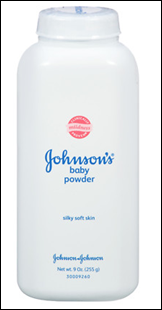
A jury orders Johnson & Johnson to pay $417 million to a woman who blames her use of the company’s baby powder for her ovarian cancer, extending a string of verdicts against the company of $110 million, $55 million, and $72 million despite a lack of evidence that the product is unsafe. That’s a lot to pay out from revenue of a product that sells for $3 at Walgreens.


Sales

image

University of Utah non-profit reference lab ARUP Laboratories will offer physician users Illumicare’s Smart Ribbon to display cost and risk of patient harm on EHR screens.


People

image

Andy Page (23andMe) joins Livongo as president and CFO.


Announcements and Implementations

image

Rush University Medical System (IL) sues Draeger for fraud, claiming the $18 million patient monitoring system it bought issued unreliable alarms, erased log data, and lacked the promised capability of automatically switching from wired to wireless monitoring during patient transport. Rush replaced the system for $30 million last year.

Datica posts a “Rethinking Health Technology” ebook that includes contributions from several industry luminaries, including St. Luke’s Health System VP/CIO Marc Chasin, MD and University of Wisconsin Health Center SVP/CIO Jocelyn DeWitt, PhD.

In the UAE, Al Jalila Children’s Specialty Hospital goes live on Vocera’s secure text messaging and hands-free voice communication platform.
image

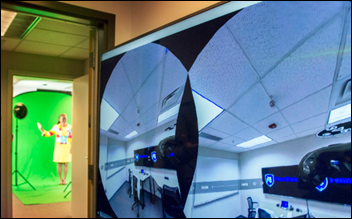
A Department of Justice-funded project at Penn State’s nursing school will use telehealth technology to support rural sexual assault nurse examiners, offering them live physical exam mentoring, peer review, and education.


Government and Politics
image

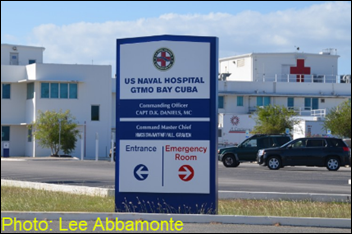
The DoD proposes spending $250 million to build a five-bed hospital at Guantanamo Bay that would serve 5,500 residents and 41 prisoners. The Senate Armed Services Committee has asked for an analysis of why a tiny remote hospital would cost $50 million per bed.  


Privacy and Security
image

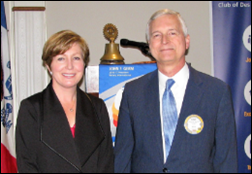
Patient rights groups complain to insurer Wellmark that one of its executives described at a local Rotary Club meeting how a 17-year-old’s hemophilia cost the company $1 million per month to treat in trying to explain that health insurance doesn’t work actuarially if only people who are already sick sign up. The group claims that the remarks constitute a HIPAA violation, which might be the case since she cited the patient’s specific age even though she didn’t step over the HIPAA line in providing geographic information that is more granular than state level.


Other
image

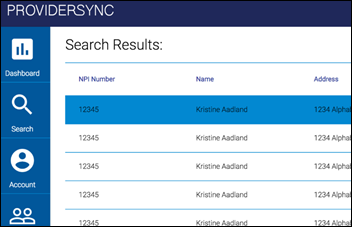
A DC magazine profiles Meghan Buck, a former political consultant who formed Veda Data to apply machine learning to keeping physician directories updated.

image

This is either heart-wrenching, morbid, or both. A St. Louis hospital buys Cuddle Cots, a refrigerated bassinet that allows parents of stillborn or deceased babies to “put time on hold” in allowing them take photos and dress the body instead of moving it directly to the morgue. An article from earlier this year profiles families who spent up to two weeks with their deceased child’s body, taking it home and going for stroller walks as part of their grieving process.

image

The Miami paper runs a Q&A with CareCloud, whose CEO Ken Comee says the company will go public because, “My competitors are 20- and 30-year-old technologies and I have the best damned platform in the space.”

In India, the dean of a medical school’s hospital is placed on leave for trying to sabotage the parent company’s enterprise patient record and imaging project in favor of the hospital’s preferred vendor.

A Forbes Africa report finds that trained doctors are forced to work as restaurant servers and call center operators due to restrictive government policies and lack of coordination between the Department of Health and individual provinces, even as hospitals struggle with a shortage of practitioners.

In India, the government denies that a reported drop in oxygen levels killed three hospitalized babies. This follows an incident in which 60 babies died when another hospital’s oxygen supply ran out due to non-payment of bills. This time, a NICU doctor noticed low levels in the oxygen storage unit and called the hospital operator, who didn’t answer and was later arrested for being drunk and asleep on the job. The hospital says parallel systems kept the oxygen flowing to the wards while the problem was resolved, blaming the deaths on natural causes and therefore declining to perform autopsies, triggering the predictable complaints of a cover-up.  

Weird News Andy isn’t elevated by this news. In Spain, a 25-year-old woman who had just delivered a daughter by C-section is crushed to death when a hospital elevator malfunctions on the way to the maternity ward. Her daughter was on the same gurney, but was unharmed.


Sponsor Updates
image

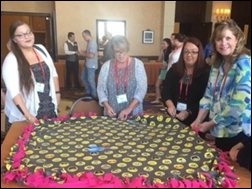
  • Attendees at Aprima’s annual user conference make and donate 150 blankets to the Children’s Medical Center in Dallas.
  • Datica announces self-service onboarding and free trials of its updated platform.
  • Besler Consulting releases a new podcast, “Utilizing data and technology to manage your EPM programs.”
  • Nine healthcare organizations select Nuance solutions to replace legacy radiology systems.
  • ClinicalArchitecture and Diameter Health will exhibit at the SHIEC Conference August 27-30 in Indianapolis.

image

  • The CoverMyMeds hockey team wins the league championship.
  • CTG will exhibit at the AI Summit August 24-25 in Cincinnati.
  • Cumberland Consulting Group raises over $2,000 for the Center for Family Services Project Backpack initiative.
  • Ohio Business Magazine includes Direct Consulting Associates in its list of Best Places to Work in 2016.

Blog Posts


Contacts

Mr. H, Lorre, Jenn, Dr. Jayne, Lt. Dan.
Get HIStalk updates. Send news or rumors.
Contact us.

125x125_2nd_Circle

Curbside Consult with Dr. Jayne 8/21/17

August 21, 2017 Dr. Jayne Comments Off on Curbside Consult with Dr. Jayne 8/21/17

My practice values service to the community and often does workshops for scout groups. Sometimes we’re teaching essentials of CPR and sometimes it’s first aid.

This weekend, I had the chance to help one of my partners put on a workshop for the Medicine merit badge for his son’s Boy Scout troop. He’s an official merit badge counselor and asked me to help a couple of months ago. My brother is an Eagle Scout, so I remembered seeing the merit badge booklets around the house and thinking that they had all kinds of interesting information. Apparently now they’re full color and you can also get electronic copies, so I was glad to see that scouting is keeping up with the times.

There are also a host of unofficial sources for information. My partner steered me to a website that had a PDF workbook for the items that the boys were expected to cover. I grabbed a copy of the actual book from the library, but ended up procrastinating the actual preparation until a couple of days ago, thinking I could just do my parts of the presentation off the top of my head

When I finally hit the merit badge website Thursday night to prepare and cracked open the paper booklet, I noticed that the last update to the book was 2002 (although the website mentioned that the requirements were updated in 2005). I figured I’d be in for some entertainment as I read about how medicine was portrayed to scouts 15 years ago. I was surprised, though, with how well the materials have held up. The healthcare professionals portrayed in the booklet represent a diverse workforce and are filling a variety of roles in medicine. I realized as I was reading that much of the information provided should be required reading for people entering medical fields or for people who want to better understand the medical people they work with.

Game time came too quickly for someone who had procrastinated their preparation. I found myself Saturday morning in our break room in front of a group of teenagers eager to show their knowledge medicine. During the first part of the requirements, the scout has to do a great deal of research on historical medical figures – individuals like Hippocrates, Florence Nightingale, Louis Pasteur, Jonas Salk, Marie Curie, and more. I was impressed by the boys’ ability not only to throw out interesting facts about their subjects, but to talk about why those contributions are important to healthcare even today. (A note to the Boy Scouts: if you consider updating this, let’s think about throwing in Larry Weed for his contributions to patient care and healthcare IT).

We next moved into my part of the morning, which was to teach the boys how to take a pulse and perform a blood pressure measurement. I was quickly cast aside by an older scout who asked if he could teach the group because he had volunteered at a blood pressure screening. I’m not sure why I was even there (other than to prevent them from doing goofy things with the blood pressure cuffs, which may or may not have happened) because the scout did a great job using the EDGE method, which includes explaining, demonstrating, guiding the student, and enabling their success. Since I spend a great deal of my time dealing with processes that have gone wrong, it was so gratifying to see a teenager taking charge and getting things done. Frankly, he was a better teacher / trainer than some of the folks I work with on a daily basis. I suspect that he is going to have a great future regardless of the field he chooses.

I was also tasked with talking to them about the instruments we use in the office, including EKG machines, pulse oximeters, spirometers, and more. We talked a little about electronic health records and how information sharing works in healthcare today, and I gave a little plug for careers in healthcare IT. I don’t think any of them had ever been exposed to a clinical informaticist before (not that I would expect them to have been) and I could see a couple of the boys perk up when we started talking about the technology. They perked up the most when we talked about defibrillating people and what that process actually entails. The drama of shouting “clear” and shooting electricity through someone’s body is well-portrayed on TV and they were definitely interested in learning more about it.

Another requirement is for the boys to discuss what makes a good screening test and why tests aren’t always perfect. Listening to them tell me about specificity and sensitivity and how patients had to be informed consumers so they didn’t spend a lot of money on tests that wouldn’t do them any good truly warmed my heart. These kids are clearly growing up in a world where being an informed patient is going to be critical to staying healthy and they were embracing it.

They branched off into a little discussion on the Affordable Care Act and how people didn’t understand that it was the same thing as Obamacare and why it was a mess. I knew these kids would be informed (one of the other requirements is to research the healthcare delivery systems in Sweden and China and compare them to the United States health system) but I was impressed. I know some of them have been working with my partner individually on the requirements, but they’ve clearly done their research.

The badge also requires the scout to discuss the roles of medical societies, the government, and the insurance industry in how they influence the practice of medicine in the US. From the presentation one of the scouts gave, I suspected we had a ringer in the group who had a physician in the family. It turns out that his mom is a family medicine physician, and he talked about how much his mom’s group struggles with Meaningful Use and other programs. That was an eye-opener for some of the other boys, whose only exposure to healthcare may have been at their own doctor’s office or through what they had read in the merit badge booklet and at our workshop.

They also have to explain how their state monitors healthcare quality and how it provides care to patients who don’t have insurance. These are pretty deep subjects for the average adult, let alone for a 12-18 year old boy, and I was impressed by the fact that the badge dug into it. The boys also had to present on different types of healthcare providers along with their training and educational requirements, as well as different subspecialties and what it takes to become a physician in those disciplines. It was entertaining to hear what the boys thought some of the specialties do vs. what we actually do – paperwork and charting were never mentioned in any of their synopses.

The scouts also had to research the Hippocratic Oath and explain it, along with comparing the original to a more modern version. They had to “discuss to whom those subscribing to the original version of the oath owe the greatest allegiance” (for those of you who haven’t read it lately, it’s not the patient). That led to a discussion of the patient-physician relationship and how it’s important in delivering quality care.

We also discussed the role of patient confidentiality and HIPAA. A couple of the boys in the group are 17 and will be adults soon, so I was able to talk to them a little about deciding whether to include their patients to be able to receive information when they go to the doctor and who they would want to make decisions for them in the event that they couldn’t. These are topics that most parents don’t cover with their young adults before they head off to college. It was a little bit outside of requirements, but it was a valuable discussion.

The scouts also have to volunteer at a health-related event in the community that they’ve had approved by my partner. Some of them have already done their volunteer work and it was interesting to hear what they did – handing out health flyers at a community event, volunteering at a free clinic, and working as a teen aide at the hospital. A couple more are planning to work at an upcoming blood drive and then they’ll be able to earn their badges. Looking at the information they had to explain, discuss, and tell about during the workshop (more than an hour and a half of discussion for each scout) plus the additional research to prepare for their presentations and the documentation they all brought, it seems like this might be one of the more intense merit badges the boys are exposed to. According to my partner, the Public Health merit badge has even more requirements.

It was exciting to see the leaders of tomorrow motivated to learn about our field and willing to spend time serving their community. It gives me hope that even as complicated as healthcare is, we have bright young people eager to try to figure out the best ways to serve patients in the coming decades.

Have you talked to young people about your career in healthcare IT? Email me.

Email Dr. Jayne.

HIStalk Interviews Gadi Lachman, CEO, TriNetX

August 21, 2017 Interviews Comments Off on HIStalk Interviews Gadi Lachman, CEO, TriNetX

Gadi Lachman is CEO of TriNetX of Cambridge, MA.

image

Tell me about yourself and the company.

I was born in Israel. I served in the Special Forces there. Everybody starts as a soldier and a few become officers. I was lucky to become one.

I studied accounting and law. I turned around my father’s business, which was educational services. He was a big entrepreneur there. Then I came to the United States. I did my MBA at Harvard and was a Baker Scholar. I worked at Lehman Brothers, and after that, a lot of technology IT companies, always in the healthcare space. A lot of healthcare IT, all either in extreme build-out mode and extreme growth or turnaround situations. I live in the Boston area with my wife, my three kids, and my dog.

How is technology changing the clinical trials enrollment process?

It’s technology, it’s data, and it’s a huge desire for change. All good people, all trying to develop therapies for the benefit of patients. Structural problems in that industry make it very hard to be successful, to develop good therapies in a short timeframe and at an OK cost, not at a cost that’s skyrocketing and goes up and up.

The main structural impediment to the success of this industry is the fact that each part of that industry tries to do the best job themselves, but the collaboration between the different industry players has been minimal and tactical. You have hospitals and institutions that have a lot of data, but it has been hard to use that data in an efficient way in the drug development process. You have players that need that information, but develop very tactical relationships with the healthcare organizations on the side.

We are a Novartis vision and a Novartis idea. They wanted to disrupt the clinical trial design space. Some of the reasons that clinical trials fail are good reasons. Some drugs and therapies should never be developed. They’re just not effective. It’s OK and good for those things to fail as soon as possible so people can move on quickly.

But a lot of times, the development of good drugs and good therapies is failing for the wrong reasons. It’s failing because of bad protocol design and bad trial design because the wrong sites are being selected.

We were created to solve the bad reasons for which some of those processes are failing. Novartis’s vision was, and our vision is, that a solution to big problems has to come from collaboration at the strategic level that did not exist before we came. Hence, what we do and what we’re trying to solve and disrupt. We’re building a global network of collaboration between pharma companies and companies that serve them, such as the CROs and HCOs. When I say HCOs — healthcare organizations — those are mega-hospitals, those are big institutions that see a lot of patients and have access to millions and millions of patient records.

The idea was that the only way to solve the big problem is to bring all those players to the table strategically. We are almost a club. Everybody brings different things to that club and gets different points of value from the club. Only by doing something like that, we believe, can you tackle a really big problem.

What can a large health system do differently in being in a network with other players?

By joining a network like that, you help support the process of designing an efficient protocol with real-world data, which is data that has been generated in real care settings as opposed to lab-generated data. You’re going to get more visibility to all the pharma members of that network, which means you’re going to get more study opportunities. You don’t have to take every opportunity pharma is giving you, but now you have the privilege, by joining the network, to see more opportunities in the therapeutic areas that are interesting to you.

A few of the sites that are members of our network got more than 50 trial opportunities from pharma and CROs that they would otherwise not get. Did they elect to participate in all those 50? Absolutely not. But now they can be more selective. They can decide to participate in trials that are interesting to them and try to give more hope to their patients any trials that they think they can be successful in delivering. As an HCO, you become part of a deal flow of studies that are coming your way.

Second, and I didn’t know this when we started the company, we’re living in the era of networks. Because everything is precision medicine, every cohort is getting smaller and smaller. Every therapy is becoming more and more directed at smaller subsets of the population. If you’re just one site — even if you have access to data of three or four or five million patients — it’s just not good enough. You start to look at the rare disease cohorts that you have and it’s not enough to get any insight.

Sites that join us get the privilege to be able to collaborate with other sites and share data, so if there is a rare disease that you have five patients, but you add another five sites to your network, now your researchers at the site can see data from 30 patients and that is very meaningful. That’s another reason they join us – not just to get more business from pharma and CROs, but so they can do a better job researching cohorts that they can’t do by themselves.

A third reason is that we are giving the sites very powerful tools to conduct clinical research. Before we came, their researchers needed to use suboptimal systems with very limited insight. We are giving them a user interface and the ability to query large amounts of data in a way that makes a lot of meaning for those that are interested at the HCO, not just to take care of and treat patients, but also to make progress with research and to move the boundary forward.

What do you think of organizations such as UCSF that are mining the wealth of data from their EHRs and other systems to look for new drug uses or correlations between genomics and disease states?

That’s exactly why we have TriNetX, absolutely. I wholeheartedly believe in that. Everybody who works for me and myself, we’ve all lost family members for therapies that were developed and brought to market a few years later. It’s also relevant for us as people that want to live longer and with high quality. A lot of the data to make a big impact is already available — it’s just no one was able to make it available.

I’ll give you a few numbers. We have more than 55 huge HCOs joining us that have together more than 80 million patients from all over the world. We have sites in the US, Germany, Hungary, Italy, the UK, Israel. We just recently signed Singapore. We’re building global collaboration and we’re giving it back to the researchers because they will come up with the questions and they will come up with the answers. They will find the correlations that no one even thought to ask and no one even thought made sense in the first place.

To do something like that, you’ve got to be able to harmonize tons of data all over the world. Demographics are important in our mission. There are populations from a demographic standpoint that are being under-represented in studies, and therefore the therapies that are being developed could potentially be less relevant for them. By building a global network that has all nationalities and all those different types of patients, you can start finding correlations between things, again, that you didn’t even think to ask.

I feel we hit the market at the right time. Maybe if we tried to do that 10 years ago, people would have been shy about that. Today, it’s the opposite. They are very savvy. They want to collaborate. They want to come together into a gigantic network. Not everybody is fortunate to be a part of the UC system, so you want to be part of something bigger. We are providing them with that opportunity and they get a ton of capabilities in return, exactly like that collaboration that you mentioned.

Will the FDA’s role change as study cohorts become virtual and study methods change?

Absolutely. I think if you look at the history of development of therapies from fighting bacteria to finding a way to live with HIV, things that used to take 50 years then take five and three and two years if everybody’s really in it together and doing things differently. I think the FDA and every regulatory body was doing extremely important work to protect the safety and balance all those different forces from that ecosystem. They’re starting to take a look at those technologies and those access points to data that we provide and figuring out that some things could be accelerated. Some trials could be conducted in real-world settings. There are alternative ways to understand the potential positive or negative impact of therapies and drugs and they are much more accelerated and they’re cheaper, potentially, on massive quantities of data.

If you think about it, there are so many trials being conducted today where nobody is calling them a trial. Every time an off-label drug is being recommended or prescribed, there are a lot of interested parties that would love to know the effectiveness of that off-label behavior, including those that are prescribing it. It just wasn’t able to be a reality a couple of years ago, but our vision is to make this a reality. To be able to take all this data and bring it back to the people that need to see that.

It’s not just the FDA,  just to add another facet to your question. You have people and players that avoided research because they couldn’t afford to be part of that, to license those technologies, or they never had access to the data. But by making it available in such a broader way, you will bring more participants into this research community, and I think only good things will happen from that.

What can we learn from the disproportionate success of Israel-based entrepreneurs and startups?

One is a mindset. I did work on that when I did my MBA, not to say I’m an expert on the entrepreneurial success of Israel and why, but there are structural components to the success there. One, as an example, the lack of natural resources and the need on the military side to compete with enemies that are 10 times your size. If Israel will always have one tank and the nations surrounding it have 10, then it means that one Israeli tank needs to take out 10 tanks in order for Israel to prevail.

How do you trade effectiveness of 1 to 10? The answer is mostly technology. Israel was always forced to take technology to the cutting edge in order to survive. All those military technologies and a lot of that mindset, even if it’s not a military technology, transpires. You have a lot of entrepreneurs and a lot of new ideas.

Also in Israel, everybody has to serve in the military. You get that mindset. When you leave the Army, you still have that mindset. You are OK daring and trying to do new things and trying to get that 1 to 10 ratio that you were taught in the military that that’s what you need to have in order to survive.

Having your back against the wall, the need to be an innovator or die, and the access you had to like-minded people and cutting-edge technology — you can then bring it back and try to do other things with that.

Do you have any final thoughts?

I would love all the players to always, in the end, think of the patient. That should drive every decision they make, more than financial decisions, more than “this is my data and I’m not letting anyone touch it,” more than “I’ll be the biggest I can be, but maybe I don’t need to collaborate with anyone else.” If there’s something I pray for, it’s that alongside corporate decisions, P&L decisions, financial decisions, and this and that, people always go back to that inner soul that they have and that helps drive some of the big decisions as well. I think it will help a lot.

Monday Morning Update 8/21/17

August 20, 2017 News 4 Comments

Top News

image

The New York Times reviews patients recording their doctor visit for their later review.

The article notes that one family practitioner records patient visits himself, then uploads the annotated recordings to a secure web platform that patients and family members can review at any time. He says the de-identified recordings could help researchers find ways to improve medical communication.

University of Texas Medical Branch at Galveston buys recorders and batteries in bulk and offers them to cancer patients, with 300 of them accepting the devices each year. The program will be expanded to internal medicine and geriatrics.

image

The article describes how a neurosurgeon records his visits on an iPad and posts them to a platform he created called Medical Memory. He says half of the patients watched their videos more than once and its use has cut the practice’s malpractice insurance costs in half. 

image

A recently published research proposal describes a Dartmouth project to develop a platform that would store visit recordings and use machine learning to tag their specific elements, such as the treatment plan.


Reader Comments

image

image

From Nutmeg Grater: “Re: Allscripts. This is their new, top-secret EHR. Two years of work and just recently deemed not ready to demo at ACE. I wonder if they forgot about this website?” The Care Otter website doesn’t mention Allscripts specifically, but (a) some of the folks whose bios are listed hail from there, and (b) I found a cached copy of a since-removed API documentation page whose FHIR API license agreement lists Allscripts as the licensor. The company touts its “bleeding edge technology” and data science. The group’s address is, per Google Maps, a defunct steakhouse in Litchfield, IL. Their job postings list technologies such as Azure, Power BI, Apple’s Swift 3, the Xamarin moble app development platform, and reactive programming. Care Otter’s LinkedIn lists 56 employees, including former Allscripts engineering SVP Jeff Franks as president. Here’s a YouTube video highlighting Silicon Valley aspirations with dogs running around the office, free snacks at the bar, impromptu kite-flying, and collaborative slouch-ready furniture in what they call the “SiloCorn Valley.” I like the strategy of putting a creative group in a freewheeling setting far from corporate overseers, although the ultimate success measure is whether Care Otter earns market share.

image

From ACD_Fan: “Re: Epic. Our local hospital seems to be moving to it under the Community Connect program of Parkview Health Systems in Fort Wayne, IN. Another Paragon client jumps ship.” DeKalb Health’s web page says it is moving to Epic.

SNAGHTML1d26c52d

From Turnaround Failure: “Re: Presence Health. Word on the street is that Presence Health will announce Monday its merger with Ascension. Bet that Advocate, North Shore, and Northwestern will have something to say about that.” Unverified. The struggling 11-hospital Presence, created by the 2011 merger of Provena Health and Resurrection Health Care, announced plans earlier this month to sell two downstate hospitals to OSF HealthCare. I think Presence uses Epic, while Ascension is mostly Cerner.


HIStalk Announcements and Requests

image

I ran a reader’s query last week about the status of Cerner PowerInsight. The company provided this response, although the referenced HealtheEDW does not appear anywhere I could find on Cerner’s website:

PowerInsight Explorer is still available and widely used across Cerner’s US and global client base as a real-time reporting tool for Cerner Millennium. Cerner’s go-forward enterprise data warehouse, HealtheEDW, was released in 2011 and built on the source-agnostic cloud platform HealtheIntent. PowerInsight EDW will be supported in the US and sold globally as Cerner transitions legacy clients to HealtheEDW and stands up the cloud platform in global markets.

I received these responses to the reader’s question about FHIR specs:

  • Much better than HL7’s old-style PDF bundles. Faster to navigate, easier to reference in our own documentation.
  • I’m confused by what Sweet Ride is asking. I’ve done next to nothing with FHIR, having spent most of my career working with 2.x and V3/CDA, so maybe I’m looking at the wrong specs but the FHIR specs I’m looking at on hl7.org (starting with http://hl7.org/fhir/) are HTML and seem to me to be well-organized and easy to use. It’s definitely different than the PDFS HL7 used to use but I find it easier to navigate than previous specs – particularly V3/CDA.
  • Anything is better than the current format.

image

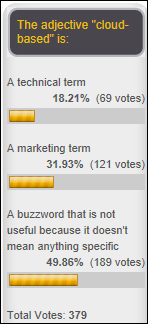
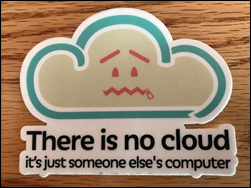
It’s probably a lost cause trying to take the term “cloud-based” back to its original technical meaning as companies have turned it into a loosely-defined marketing slogan. Clustered says that while it really just means “in our basement instead of yours” and marketing departments have abused the term, it’s still accurate although incomplete, requiring prospects to perform due diligence.

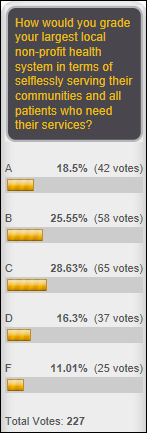
New poll to your right or here: which of these inpatient EHR vendor companies do you admire most? I’ve hidden the interim results this time to hopefully decrease desperate ballot box stuffing. Feel free to add a comment explaining your choice.

image

Welcome to new HIStalk Platinum Sponsor Image Stream Medical. The Littleton, MA-based company’s technology connects providers with visual information and collaborative insight that allows them to make better decisions and to spend more time caring for patients. Solutions include procedure space integration, procedure recording, medical virtual presence for teaching, live video streaming, real-time room status, clinical video and image content management, video editing, and integrating procedure and video images with EHR, PACS, VNA, and other repositories to create a unified patient record. Healthcare systems benefit from increased clinical efficiency, reduced risk, improved patient safety by automating tasks, and reduced infection risk in allowing observers to participate outside the procedure room. The company, acquired by Olympus Corporation of the Americas in May 2017, just announced MedPresence, a virtual presence solution that allows surgical and interventional clinicians to connect and collaborate virtually. Thanks to Image Stream Medical for supporting HIStalk.


This Week in Health IT History

One year ago:

  • Gartner predicts via its Hype Cycle that the technologies that will most quickly find mainstream adoption are machine learning, software-defined anything, and natural language question answering.
  • Promedica (OH) attributes its swing to a big first-half loss on the cost of implementing Epic, while MD Anderson Cancer Center (TX) also blames Epic-caused higher expenses and lower patient revenue for its 77 percent drop in net income.
  • A Medscape physician EHR survey finds that Epic is the most-used by far, Allscripts falls from #2 to far down in the list in user scoring, the VA’s VistA is the top-rated EHR overall, and VistA and Epic lead the pack in connectivity.

Five years ago:

  • NextGen President Scott Decker resigns following the addition of dissident shareholder representatives to the board of parent company Quality Systems.
  • Walgreens announces plans to deploy an customized version of Greenway PrimeSuite as its pharmacy EHR.
  • University of Michigan Health System names Sue Schade as its new CIO.

Ten years ago:

  • Congress gives the VA $1.9 billion for EMR and DoD integration, with the Appropriations Committee calling for blocking any EMR expenditures for software that won’t work with DoD systems and for the VA to work with private software companies to improve interoperability and mobile apps.
  • West Penn goes live on Eclipsys.
  • Misys licenses iMedica’s PM/EHR to get a small-practice system to market quickly.

Weekly Anonymous Reader Question

I got a ton of responses to “best musical group or performer seen live,” so I will excerpt (the asterisked ones were named more than once):

  • Prince*
  • Depeche Mode*
  • Bruce Springsteen*
  • Rolling Stones*
  • Led Zeppelin*
  • Moody Blues*
  • Garth Brooks*
  • U2*
  • Pink Floyd*
  • Billy Joel and Elton John*
  • Paul McCartney*
  • Adele*
  • Santana*
  • Radiohead
  • Nine-Inch Nails
  • AC/DC
  • Journey
  • Tedeschi Trucks Band
  • My Morning Jacket
  • LCD Soundsystem
  • The Who
  • Living Colour
  • Nektar
  • Grateful Dead
  • Genesis
  • Annie Lennox
  • Jason Mraz
  • Dead Kennedys
  • Earl Scruggs Review
  • Train
  • Chicago
  • The Wiggles
  • Soundgarden
  • Bryan Ferry
  • Lindsey Buckingham
  • Ray Charles
  • Paco de Lucia
  • John Prine
  • Arcade Fire
  • Ed Sheeran
  • Mark Knopfler
  • Tragically Hip
  • Meatloaf
  • The White Stripes
  • Kid Rock
  • Styx
  • Beyonce
  • James Taylor
  • Steve Wonder
  • Godspeed You! Black Emperor
  • Kendrick Lamar
  • The Clash
  • Sarah Brightman
  • John Mayer
  • Phish
  • Great Big Sea
  • Shinedown
  • Alanis Morrisette
  • Red Hot Chili Peppers
  • Jethro Tull
  • John Hiatt
  • Steve Winwood and Traffic
  • Savages
  • Jimi Hendrix
  • Neil Young with Booker T and the MGs
  • Uncle Tupelo
  • The Old 97s
  • Gladys Knight and the Pips
  • Big Head Todd and the Monsters
  • Coldplay
  • Brian Wilson
  • J. Geils
  • Air Supply
  • Guns N Roses
  • Clarence Clemons
  • The Rippingtons
  • Metallica
  • Lynyrd Skynyrd
  • Bee Gees
  • Iron Maiden
  • Frank Zappa
  • Melissa Etheridge
  • The Eagles
  • Jimmy Buffett
  • Aretha Franklin
  • Van Cliburn
  • Dixie Chicks
  • Gil Shaham

image

This week’s question:  what is the most memorable, creative, or effective thing you’ve seen a HIMSS conference exhibitor do to drive business, establish relationships, or create buzz?


Last Week’s Most Interesting News

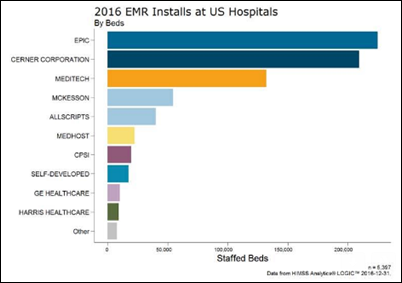
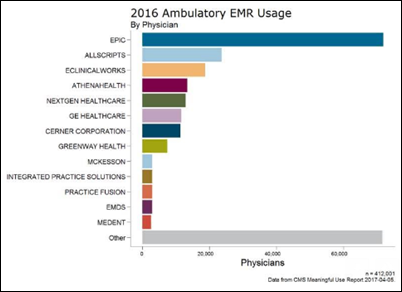
  • HIMSS Analytics data shows Cerner holding a slight edge over Epic in overall US hospital count, but Epic handily leading in large-hospital customers, total beds served, and doctors that use its ambulatory EHR.
  • Google buys Senosis Health, which is developing smartphone sensors and apps for diagnosis jaundice, reduced lung function, and low hemoglobin.
  • NIH awards Children’s Hospital of Philadelphia an NIH grant to mine databases to look for causes of pediatric cancer and birth defects.

Webinars

September 13 (Wednesday) 1:30 ET. “How Data Democratization Drives Enterprise-wide Clinical Process Improvement.” Sponsored by: LogicStream Health. Presenter: Katy Jones, program director of clinical support, Providence Health & Services. Providence is demonstrating positive measurable results in quality, outcomes, and efficiency by implementing clinical process improvement solutions in arming operational and clinical stakeholders with unlocked EHR data. Providence’s army of process engineers use their self-service access to answer questions immediately instead of waiting for reports to be written and double checked for possibly inaccurate information. The presenter will describe practical applications that include antibiotic stewardship, hospital-acquired infections, and comprehensive knowledge management.

Previous webinars are on our YouTube channel. Contact Lorre for information on webinar services.


Acquisitions, Funding, Business, and Stock

image

Investment research firm Hedgeye picked up the rumor I ran last week from reader At Last an Alias that Baylor Scott & White will replace Allscripts with Epic starting in the next few weeks, saying another research company confirmed the rumor with Allscripts. The firm’s tweets say that Allscripts has lost two of its top five Sunrise customers in the last six months (New York-Presbyterian and now BSW, assuming they have confirmed the rumor), with those two health systems representing 12.5 percent of all US Sunrise business with their 19 hospitals and 7,000 licensed beds. They tweeted out the graphic above (click to enlarge) that shows the top 25 Sunrise customers and indicating which are at risk. The elephant in the room is obviously Northwell Health (the former North Shore-LIJ) which along with University Hospitals are the only two of the top six Sunrise customers that haven’t already announced plans to replace it with Epic or Cerner. The former Baylor Health System is the only part of BSW that still runs Allscripts following its 2013 merger with Epic-using Scott & White.

image

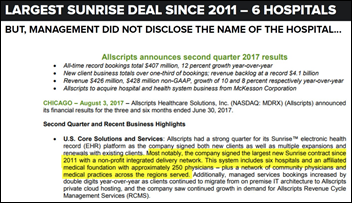
Meanwhile, Hedgeye speculates on the identity of the puzzlingly unnamed six-hospital system that Allscripts announced as a new Sunrise customer in its August 3 earnings announcement. NantHealth’s Patrick Soon-Shiong bought struggling six-hospital Verity Health in July. The company later worked out a deal that allowed Allscripts to trade back its devalued $200 million investment in NantHealth for the FusionFx software suite and NantHealth’s promise to buy Allscripts products. The Allscripts 10-Q form says its Q1 bookings growth was almost entirely driven by “a large new multi-year relationship with a commercial partner that was executed during the second quarter of 2017.”


Decisions

  • Enloe Medical Center (CA) will switch from Meditech to Epic in 2018.
  • Erlanger Bledsoe Hospital (TN) will go live on Epic in October 2017.
  • Erlanger East Hospital (TN) will go live on Epic in 2017, replacing McKesson.
  • Virtua Memorial Hospital (NJ) will go live on Epic in the spring of 2018.

These provider-reported updates are supplied by Definitive Healthcare, which offers a free trial of its powerful intelligence on hospitals, physicians, and healthcare providers.


Announcements and Implementations

SNAGHTML17c3b60d

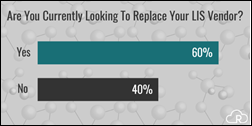
A new Reaction report from a survey of 119 people (most of them lab managers and directors) covers trends in laboratory information systems, concluding that best-of-breed LIS vendors such as Sunquest, SCC, and Orchard are at significant risk as a shocking 60 percent of LIS customers overall say they are considering replacing systems, with many of those likely to move to their EHR vendor’s offering in enterprise decisions made by executives instead of lab managers. Sunquest is listed as having the highest risk of contract replacement and the lowest net promoter score among the best-of-breed vendors as well as the lowest mindshare among all vendors that offer LISs, while the report notes that Epic has massive mindshare despite its KLAS-leading LIS offering that is just five years old. Orchard leads the NPS scores of all vendors by far, but it’s a tiny sample size. The report concludes, “It’s also not unreasonable to expect continued (although modest) consolidation, as the writing may be on the wall for some best-of-breed LIS vendors, causing them to seriously consider finding suitors among the EHR vendors.” Allscripts is now in the LIS business with its acquisition of McKesson EIS that includes a lab system as well as a blood bank module that Epic says it will never develop. Allscripts has previously offered Orchard LIS to its Sunrise customers. 


Technology

image

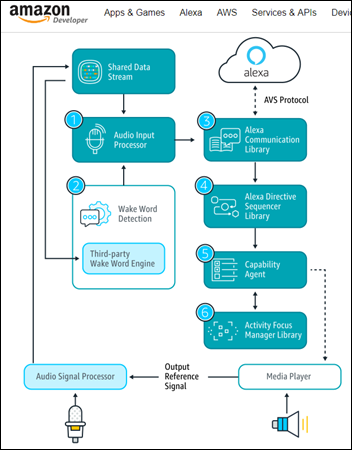
Amazon releases a developer toolkit for Alexa that provides programming interfaces for adding hands-free voice control to software products.


Other

SNAGHTML187df4d3

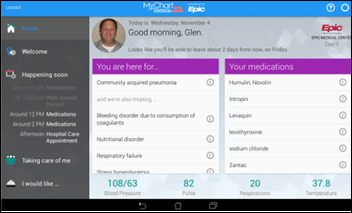
An Atlanta-area business paper profiles the use by several area WellStar hospitals of Epic’s MyChart Bedside, in which the hospitals give patients a tablet that contains care team bios, meds, lab results, vital signs, and treatment schedules.

image

MaineGeneral Medical Center (I detest that spelling) blames a technical error for its sending of nearly 10,000 bills of under $25 to a collection agency.

image

US tourists are apparently being served tainted or drugged alcohol at upscale, all-inclusive resorts in Mexico’s Riviera Maya, sometimes resulting in crimes being committed against them. The story says nobody in Mexico really seems to care, including the resorts themselves, as visitors are assaulted, extorted by police, fall victim to drowning, or are regaining consciousness only to find unexplained broken bones or other injuries and no memory of the preceding hours, all after minimal alcohol consumption and often with simultaneous symptoms among group members. The US State Department has issued a Mexico travel warning about tainted alcohol and the Mexican government confirms that up to half the alcohol consumed there is produced illegally. Tourists report frustration at the indifference of the resorts when they report problems, the upfront cash required to obtain medical treatment at hospitals, and the fact that nobody ever gets arrested even though the tourists file reports in person with the local police departments.

When injured tourists turned to police, an instinctive step for many Americans, they were often stonewalled again. For starters, resorts in Mexico don’t typically call law enforcement to the scene. Vacationers have to take complaints to the police station. The few who did encountered further indifference: Nothing to investigate. It was an accident. You were drunk. In one case, a woman who was sexually assaulted by a hotel security guard … said the police chief overseeing her case seemed genuinely concerned and determined to help her … The chief tried to get the Iberostar Paraiso Maya resort to cooperate with the investigation and to provide photos of security staff. Frias was shot dead in his squad car months later. Local news reports said it was likely a killing meant to intimidate law enforcement.

image

The money-losing visiting health service of Mid-Columbia Medical Center (OR) says its use of a non-Epic EHR while the hospital uses Epic is hard since physician care plans don’t move electronically, but the service is still not willing to spend $750,000 to implement Epic.

image image

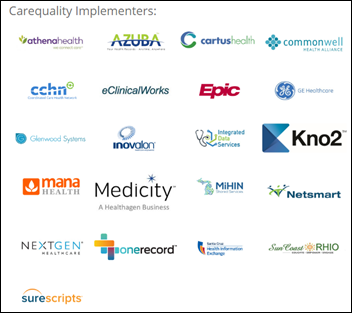
I’m surprised that the names and logos of these healthcare services companies haven’t earned the attention of Epic’s legal team.

image

Potential jurors being interviewed by attorneys involved in the securities fraud case against pharma bro Martin Shkreli had some interesting comments recorded, although perhaps some of them were just grandstanding to get out of  jury service:

  • I’m aware of the defendant and I hate him.
  • He’s the most hated man in America. In my opinion, he equates with Bernie Madoff with the drugs for pregnant women going from $15 to $750.
  • I just walked in and looked right at him and that’s a snake.
  • I believe the defendant is the face of corporate greed in America.
  • I don’t think I can [judge him impartially] because he kind of looks like a dick.
  • The only thing I’d be impartial about is what prison this guy goes to.
  • I just can’t understand why he would be so stupid as to take an antibiotic which HIV people need and jack it up 5,000 percent. I would honestly, like, seriously like to go over there …
  • It’s my attitude toward his entire demeanor, what he has done to people. And, he disrespected the Wu-Tang Clan.

A hospital visitor in China is detained by police after posting online criticism of the price of the cafeteria’s meals, saying he “wanted to faint” when he saw the small portion of his $2 bowl of noodles, adding, “Poor quality, expensive prices, little food – is this still a hospital for the people?” After the man’s arrest, local police reminded Internet users that it is illegal to post false information online although they didn’t actually say he was lying. The article reminds me of how weird hospital cafeterias are: (a) they are just about the only place other than grocery store food bars to sell some foods by weight; (b) they don’t allow free refills on their overpriced drinks; (c) they are often outsourced to companies accustomed to serving low-bidder meals to prisoners and high school students, outfitting their unsmiling employees in jaunty, chef-like attire to suggest culinary artistry instead of the heating of frozen institutional entrees; and (d) they are passionate about portion control but indifferent to taste, customer experience, and wiping down tables and chairs between occupants, some of them wearing scrubs bearing materials you would not want near you while eating. There’s a challenge for you – send me photos of whatever you find weird about your hospital’s cafeteria.


Sponsor Updates

  • Redox will exhibit at Health:Further August 23-24 in Nashville.
  • Impact Advisors employees donate 385 pounds of personal care products to troops deployed overseas.
  • The SSI Group will exhibit at the NC HFMA Summer Institute August 23 in Myrtle Beach, SC.
  • Sunquest Information Systems will host its users group meeting August 21-24 in Tucson, AZ.
  • Visage Imaging publishes a new whitepaper, “Can you? Visage can. Volume 1: Speed.”
  • Medecision is named to the 2017 IDC Health Insights HealthTech Rankings Top 50.

Blog Posts


Contacts

Mr. H, Lorre, Jenn, Dr. Jayne, Lt. Dan.
Get HIStalk updates. Send news or rumors.
Contact us.

125x125_2nd_Circle

News 8/18/17

August 17, 2017 News 12 Comments

Top News

image

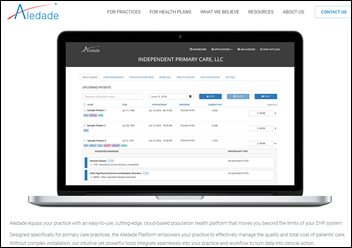
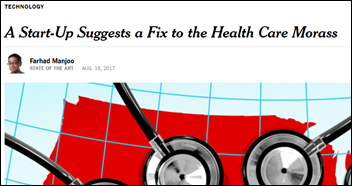
The New York Times profiles Aledade, started by former National Coordinator Farzad Mostashari, MD, ScM.

image

The piece calls Aledade a tech startup (it has raised $75 million in investor funding), which seems incorrect since technology is just a tiny part of its ACO program to improve healthcare quality and reduced cost via its primary care doctor participants. The profile was run in the Technology section of the paper.

Aledade gets paid only if it saves Medicare money, which didn’t happen in 2016. Second-year results are due in October and Mostashari says he expects the company to generate revenue then.


Reader Comments

image

From At Last an Alias: “Re: Baylor Scott & White. Replacing Allscripts with Epic starting in October, estimated to take 18 months. I think this just refers to the 10 owned facilities. The North Texas ambulatory practices (aka Health Texas Provider Network) converted from Centricity to Epic in October 2016.” Unverified.

SNAGHTMLd41a6c7

From Sweet Ride: “Re: FHIR. Older health standards are published as PDF or text documents, but FHIR has developed a new format for sharing specs that has the same look, feel, and functionality as the FHIR Standard for Trial Use, which they believe will be preferable to their developer audience. Our organization is trying to decide if we should move fast or slow to this format for our FHIR specs given that most hospitals and vendors aren’t used to FHIR yet and may prefer PDFs. Any chance you could run a survey to get input from your readership?” I set up a survey for those willing to help Sweet Ride out. I don’t know anything about it, so maybe we could all stand some enlightening from those who do.

From BI Watcher: “Re: Cerner PowerInsight. Did they quietly discontinue it? I’m looking at the latest KLAS analytics report and there’s no mention of it. It was listed last year, albeit with dismal scores.” I don’t know, but I bet someone who does will respond.


HIStalk Announcements and Requests

image

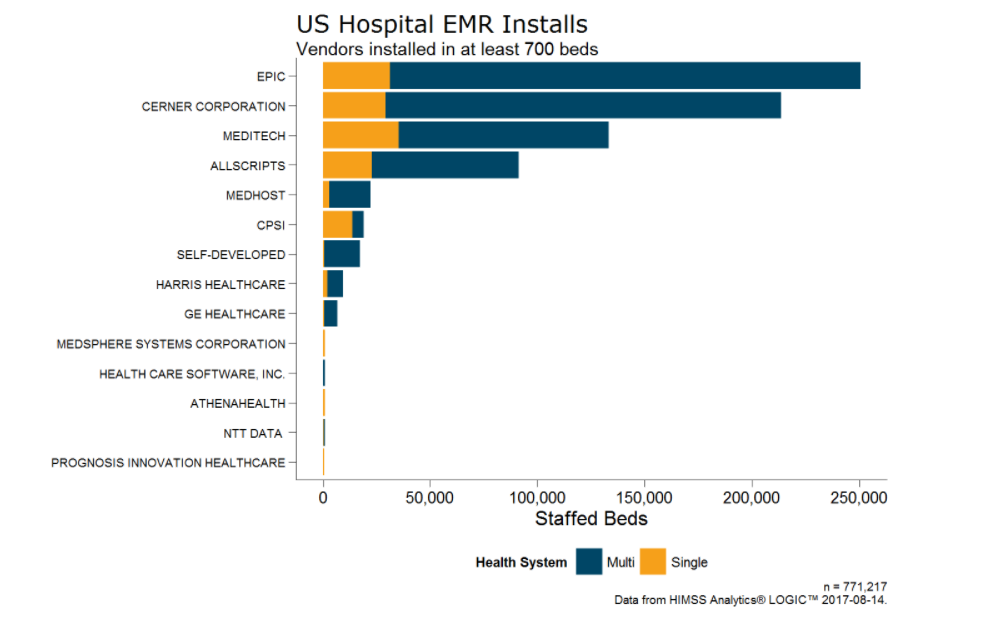
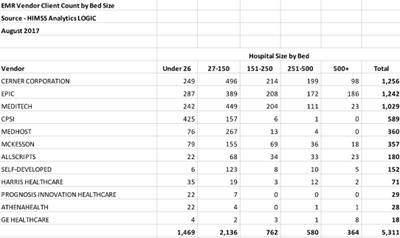
Blain Newton of HIMSS Analytics is providing great information on EHR vendor footprints, which I appreciate. Here’s his latest, responding to an HIStalk reader who wondered about total inpatient beds served by vendor (click to enlarge). The dominance of Epic and Cerner is obvious.

image

image

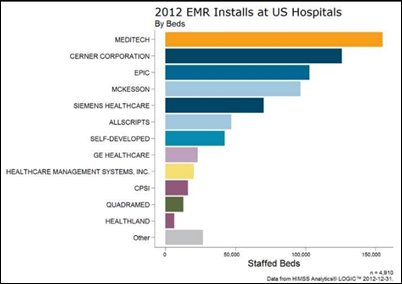
Here’s a view comparing 2012 market share by bed count vs. that of 2016. Meditech and Allscripts each lost 15 percent of their bed coverage over those years as hospital EHR uptake was booming, while McKesson customers stampeded for the door (and into the arms of Cerner and Epic) as the company lost nearly half of the beds it was covering in 2012. Both Cerner and Epic gained a lot of business, but Epic jumped most significantly (120 percent) to lead the pack. 

image

This last graph shows the utter dominance of Epic in terms of physicians using its ambulatory EHR and the dismal failure of Cerner to make a respectable showing.

I’ve also asked Blain if he can identify the fastest-growing large health systems/chains and which system they use corporately (which would foretell vendor footprint gains for doing nothing but watching their customers grow). It would also be really interesting to add up the total revenue of each vendor’s customer base as an even better indicator of customer footprint, but that sounds like a daunting project. Fascinating stuff. It’s pretty cool that Blain is willing to share this information given that HIMSS Analytics is in the business of selling rather than gifting it. I certainly appreciate it.

SNAGHTMLf3c2f92

An anonymous HIStalk reader donated to my DonorsChoose campaign. Her money plus matching fully funded the first project below and provided the remaining funds needed to complete the other three:

  • Beginner robotics and STEM activities for Ms. M’s first grade class in Knoxville, TN
  • Tolerance and individuality books and study desks for Mrs. P’s first grade class in Williamsburg, VA
  • Educational materials for teaching tolerance through STEM exploration for Ms. P’s first grade class in Orlando, FL
  • Frederick Douglass autobiography books for the tolerance project of Ms. O’s high school class in San Antonio, TX

I’m growing increasingly impatient at articles – most of them written by inexperienced industry newbies, some of them submitted to me as Readers Write articles aimed at a C-level audience – whose authors think they are insightful in reciting dull, plainly obvious facts, often to pad out questionably valuable articles. I’m a harsh self-editor perpetually in “just the facts” mode and such journalistic flab drives me nuts. Here’s a sampling from some of those sites that elicit an instant “duh” when I read them:

  • Get everyone on the same page.
  • Now is the time to start steering toward actionable information for the sake of clinicians and, even more important, the patients that IT, administrators, executives and caregivers all serve.
  • The barriers to EHR implementation and interoperability are slowly coming down and once they do, vendors will start looking to add more functionalities to the systems.
  • Improved healthcare interoperability is a top priority for providers, policymakers, and patients in 2017.
  • Getting a footing in the health IT industry is more challenging than it looks.
  • Care coordination between healthcare settings can have a significant impact on patient care.

This week on HIStalk Practice: Amazing Charts decides to sunset InLight. AdvancedMD develops physician reputation management tool. HHS celebrates National Health Center Week with grants to centers across the country. Aledade partners with local PCPs to launch New Jersey ACO. DuPage Medical Group welcomes $1.45 billion investment. UnitedHealthcare helps fund telemedicine services at Kansas FQHC. Prescription management and delivery service company Phil raises $10 million. New Jersey Academy of Family Physicians President believesphysicians are shouldering too much of the opioid epidemic blame. AMA President David Barbe, MD shares his frustration with home state of Missouri’s PDMP efforts.

Listening: Ayreon, progressive metal rock opera from a Netherlands-based virtuoso who “casts” singers to portray “characters” that perform only in studio since the “band” never appears on stage. With one exception: they’re playing their first-ever actual concerts September 15-17 in the Netherlands featuring 16 singers, including the incomparable Floor Jansen of After Forever and Nightwish. 


Webinars

None scheduled soon. Previous webinars are on our YouTube channel. Contact Lorre for information on webinar services.

Vince and Frank put their usual expert and brutally honest spin on “Allscripts’ ‘Repeal and Replace’ of McKesson’s EIS” in Thursday’s webinar. We had a bunch of people watching live and the boys answered their questions at the end, guaranteeing that your one hour of watching the YouTube video will be well spent. I tuned in for a quick look and ended up hooked into watching the entire presentations.


Acquisitions, Funding, Business, and Stock

SNAGHTMLd3bb2cb

Israel-based Medaware, whose technology warns a physician when their drug order appears to deviate from the normal prescribing patterns of similar patients, raises $8 million in Series A funding, increasing its total to $12 million. 

SNAGHTMLe9b9b6a

Revenue cycle technology vendor ESolutions acquires RemitData, which offers comparative analytics.

Forbes names Salesforce as the world’s most innovative company for 2017.

EpiPen maker Mylan will pay $465 million to resolve False Claims Act charges that the company intentionally misclassified the drug product as a generic drug to avoid paying rebates to Medicaid.


Sales

SNAGHTMLf45ff1b

St. John’s Medical Center (WY) chooses Cerner Millennium CommunityWorks, explaining that it “began seeking an alternative EHR vendor when industry events called into question the hospital’s ability to ensure that support from the vendor would continue to be available.” I believe they are (soon to be were) a McKesson (soon to be Allscripts) Paragon user.

image

Gwinnett Medical Center (GA) chooses ROI Healthcare Solutions to provide around-the-clock support for its legacy systems during its new EHR implementation.


People

image

The Strategic Health Information Exchange Collaborative names Kelly Thompson (Pennsylvania Department of Health) as CEO.

Verisys hires Joe Montler (McKesson) as SVP of sales.


Announcements and Implementations

image

Glytec earns its fourth FDA clearance for components to Glucommander, the core of its patented EGlycemic Management System: a titration module for enteral nutrition patients, an insulin-to-carb ration titration for outpatients, a more streamlined transition of inpatients from intravenous to subcutaneous insulin therapy, and general enhancements to the user interface, workflow capabilities, and messaging.

image

Allscripts will offer its EHR users access to clinical trials via integration with the trials recruitment system of Elligo Health Research.

image

Sunquest Information Systems will resell automated laboratory testing software from Software Testing Solutions.


Other

A St. Louis podiatrist who owns a company that services nursing homes is sentenced to 90 months in prison and ordered to repay $7 million for creating an EHR that automatically logged diseases and symptoms the patients didn’t have and for pressuring his employed podiatrists to provide unneeded services. His attorney wife is already in prison for the same conspiracy and the company’s CEO and four of its podiatrists are awaiting sentencing.

A 31-year-old restaurant owner is charged with assault after a cardiology clinic’s front desk employee told him his test wasn’t covered by insurance, after which he grabbed her computer monitor (luckily, it was a flat panel) and threw it at her.

SNAGHTMLd515f70

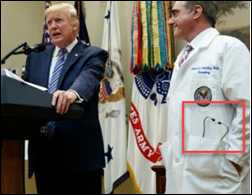
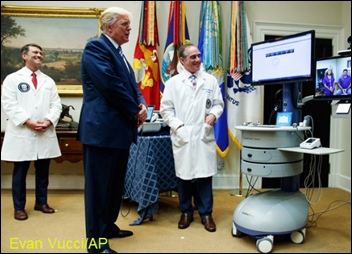
I was amused by this newswire photo, which suggests that VA Secretary David Shulkin, MD rushed right over from hospital rounds to appear in a White House photo op, stethoscope poking conspicuously from his pocket. I have to laugh when doctors who clearly have no use for a stethoscope – such as administrators, psychiatrists, and dermatologists – still drape one over their shoulders or hang it prominently from their pocket to make sure everybody reflexively genuflects. At least Shulkin is an internist and still sees patients, according to some reports. My early experience in rural community hospitals was that the biggest quacks we had on staff – mostly foreign medical graduates back then when standards were low and they didn’t even have to take US boards – were likely to strut around in stiffly starched, name-embroidered lab coats adorned with stethoscopes, perhaps for convenience in pronouncing dead the patients they were mismanaging with a stunning mix of incompetence and arrogance.

A Jackson Memorial Hospital (FL) respiratory therapist is arrested for attempting to view child pornography on a hospital computer that a co-worker had left logged on. There was no happy ending to the story — he couldn’t even see the material he was arrested for seeking because the hospital’s web monitoring software blocked him (doh!)


Sponsor Updates

  • Medecision Chief Marketing Officer Ellen Dalton will speak at a Technology Association of Georgia Marketing roundtable September 6 in Atlanta.
  • Meditech and Parallon Technology Solutions will exhibit at the HIMSS Summit of the Southeast August 23-24 in Nashville.
  • Navicure will exhibit at the Azalea Health annual user conference August
  • Optimum Healthcare IT interviews Jon Morris, former SVP/CIO of WellStar Health System.
  • Imprivata joins the CommonWell Health Alliance.
  • NTT Data begins accepting applications for its global Open Innovation Contest.
  • Nvoq will exhibit at Aprima’s annual users conference August 18-20 in Dallas.
  • Clinical Computer System, developer of the Obix Perinatal Data System, will exhibit at the Indiana AWHONN State Conference August 25 in Plainfield.
  • Uniphy Health appoints Ken Fishbain (Cardiothoracic & Vascular Surgical Associates) to its health advisory board.

Blog Posts


Contacts

Mr. H, Lorre, Jenn, Dr. Jayne, Lt. Dan.
Get HIStalk updates. Send news or rumors.
Contact us.

125x125_2nd_Circle

EPtalk by Dr. Jayne 8/17/17

August 17, 2017 Dr. Jayne 1 Comment

clip_image002 

The Office of the National Coordinator continues to advocate for strengthening the health IT workforce. The September 6 webinar will review workforce training materials that were available to the more than 9,000 people who participated in recent programs on population health, care coordination, interoperability, and analytics. Registration is open, and as a participant in one of the educational programs, I’d say it’s worth a look.

In other government news, the Medicare Quality Payment Program hardship application for the 2017 year is now available. Applications must be submitted by October 1, 2017 to avoid payment adjustments in 2018. I continue to run across providers that aren’t sure if they qualify for a hardship exception or not, so if you’re in the practice management or operations space, do your docs a favor and make sure they understand.

Physicians who are in the know have been very happy with the CMS final rule that makes the use of 2015 Edition certified EHRs optional for Medicaid Meaningful Use in 2018. Depending on vendor status, many practices were looking at having to upgrade their EHRs prior to January 1 so they could complete full-year reporting on a 2015 Edition system. The requirement now calls for a 90-day reporting period for Meaningful Use measures. Although Clinical Quality Measure reporting is still full-year, providers can now use 2014 Edition, 2015 Edition, or a combination of Certified EHR Technologies. It’s a welcome reprieve for organizations that are suffering from change fatigue and who may lack the resources to manage an upgrade along with other clinical and business initiatives. Although that change was documented in a final rule, unpublished guidance seems to indicate that practices that are part of the Next Generation ACO program can use either 2014 Edition or 2015 Edition CEHRT.

It’s been a relatively busy time in governmental circles, with the Department of Veterans Affairs also announcing their new telehealth project, “Anywhere to Anywhere VA Health Care,” which will permit VA providers to treat patients across state lines using telehealth technology. Providers can practice across the country within their designated specialty scope of practice. They also released their new VA Video Connect app. Veterans can use their mobile devices to access 250+ VA providers at nearly 70 sites across the country. Although solutions like the app have the potential to reduce travel hardships for veterans, they assume adequate capacity. If providers don’t have adequate time for patient care, simply shifting away from in-person encounters isn’t going to be a solution.

There’s also been action in the Senate to authorize a CMS Innovation Center project to boost use of certified EHRs in the behavioral health space. Psychiatric hospitals, community behavioral health centers, clinical psychologists, and social workers would be encouraged to expand EHR use along with residential and outpatient mental health and substance abuse treatment facilities. The 2009 HITECH Act didn’t apply to many mental health treatment organizations, which may help explain low rates of information sharing between behavioral health and other providers. A parallel bill has already been introduced in the House. Hopefully both will begin to work their way through the House and Senate committees soon.

One of the exciting parts of being in the healthcare information technology space is watching researchers come up with innovative solutions to difficult problems. Laboratory medicine is a big part of clinical informatics, so I was glad to hear about a new technology for Zika virus testing in the field. Researchers from Washington University in St. Louis are using nanorods to develop a test that can provide results without electricity or refrigeration. Proteins attached to the nanorods change color when exposed to Zika virus-containing blood. Although the initial study was very small, it shows a great deal of promise. I was also glad to see the varied affiliations of the authors – mechanical engineering, anesthesiology, and biochemistry/molecular biophysics. The engineering and biophysics fields are expanding rapidly and make great areas of emphasis for premedical students who aren’t sure about their future in patient care.

Speaking of laboratory medicine, LOINC is looking for experts to join four new special topics workgroups. The groups will meet monthly and provide recommendations to the LOINC Committee. Workgroup topics include: Document Ontology, which looks at the framework for displaying clinical results; LOINC ShortName for addressing situations where LOINC codes need to be stored or exchanged but the ShortName is not appropriate; Cell Marker Naming for review of ambiguous terms; and High-Sensitivity Troponin, which will look at the best way to model cardiac assays in LOINC. Workgroups start August 30 and more information can be found on the LOINC website.

clip_image004

I haven’t been able to attend the MGMA conference in years, the last time being when it was in San Antonio. For those who can’t make it to Anaheim for MGMA17, there is an opportunity to attend remotely via MGMA 2017 Monday Live. Registration is $350 for MGMA members and includes access to the general session and several breakouts. Advertising collateral mentions the opportunity to not only listen to sessions but to “network with your peers,” which might be a little challenging given the virtual environment.

Virtual environments are less of a barrier for the one-on-one contact of telehealth. Employers are gravitating toward inclusion of telemedicine services in employee benefits plans. The Large Employers’ 2018 Health Care Strategy and Plan Design Survey estimates that nearly 96 percent of employers will offer telemedicine services in states where it is permitted, with more than 50 percent including behavioral health as part of the offering. More employers are also offering on-site health centers. My local school district is piloting an on-site employee clinic that received a fair amount of traffic in its first year. They haven’t made a decision to expand, but will continue to pilot during this academic year.

Do you have access to an employer-based health center? Have you had the occasion to use it? Email me.

Email Dr. Jayne.

News 8/16/17

August 15, 2017 News 7 Comments

Top News

image

The Congressional Budget Office scores the expected impact of the White House’s threat to stop paying Affordable Care Act-mandated cost-sharing reductions:

  • Insurers would pull out, leaving 5 percent of the country with no access to exchange insurance.
  • Premiums would increase 20 percent in the first year.
  • The federal deficit would increase by $194 billion through 2026.
  • The number of uninsured people would increase slightly in 2018 but then start moving slightly lower in 2020.

CBO qualifies its prediction based on how and when the White House stops making the payments, which the President has incorrectly described as “insurance company bailouts.”

The big takeaway is the deficit estimate. Paying premium subsidies based on income actually saves the country money.

CBO adds that President Trump’s CSR threats alone have already driven premiums up since insurers are required to request approval for their 2018 prices now.

The House of Representatives sued over the ACA’s cost-sharing reductions in 2014, arguing that the payments are illegal since Congress never appropriated the money to fund them. That case remains open.


Reader Comments

image

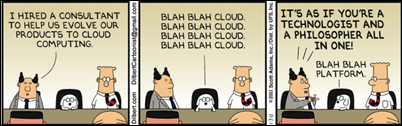
From Keelhauler: “Re: cloud computing. Thought you would enjoy this.” I did, thanks.

image

From Surprise!: “Re: Allscripts. Layoffs today of around 60 worldwide. Some senior people had their positions eliminated. Pretty eventful couple of weeks with the Paragon and NantHealth stuff.” Unverified, but reported by several readers. I reached out to the company’s media contact, who responded, “Allscripts does not discuss rumors or speculation,” which leaves the rest of us to do so without its participation.

image

From Life’s Changing the Ocean Floor: “Re: [health IT site name omitted]. Seems to be dead.” Sure does. Googling turns up no user outrage or fond reminiscing, which suggests that its demise was not untimely.

image

From Pacifico: “Re: Caradigm. LinkedIn shows that several top execs, salespeople, and security team members have left. GE is taking over, cutting headcount and leveraging shared services.” Unverified. I compared the company’s September 2016 leadership page to the current version – the 13 executives are now down to seven, of whom two are new.

image

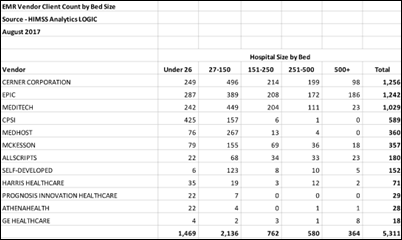
From Gaslighter: “Re: market share by hospital size. Were those numbers for US hospitals only? Wondering since Meditech has a significant presence in Canada.” Blain Newton of HIMSS Analytics, who provided the count, says the numbers cover only domestic hospitals.

From Supine on the Sand: “Re: market share by hospital size. The most meaningful stat is the 500+ bed hospitals since they often take smaller hospitals with them when they choose a vendor, which is why Meditech and Siemens (Cerner) have lost hospitals. Number of beds is most important since it equates better to the number of people – particularly doctors – who use the systems. Meditech is in big trouble because it has no ambulatory presence and Cerner, too takes a hit with ambulatory. Epic is much stronger than Cerner because of its 500+bed dominance and its ambulatory market share. I would love to see market size by beds and by ambulatory doctor count.” I mentioned your interest to Blain and he’s going to analyze EHR vendors by total beds and total physicians, so watch for that. I think Meditech can maintain its relevance for those hospitals that can’t manage the complexity or afford the cost of Epic or Cerner, but I agree that Meditech waited too long to conclude that the offering of partner LSS – which Meditech later bought – wasn’t the integrated ambulatory answer many of its clients and prospects were looking for. All three companies have common traits: they offer single-platform products for nearly every hospital service, they rarely acquire companies (“never” in the case of Epic), and they run on a single database. Those characteristics seem obviously desirable with 20-20 hindsight, but were lost on now-lagging competitors who were busily milking their cash cows, buying and nameplate-integrating anything that moved, and waltzing with Wall Street.

image

From EclipsysGal: “Re: Chad Eckes. Glad to see an IT leader move into the CEO role.” Chad takes the CEO role at Pinnacle Dermatology, a private equity-backed dermatology practice in the Midwest that hopes to expand to 100 locations. He has served time as CIO of Cancer Treatment Centers of America and EVP/CFO of Wake Forest Baptist Medical Center (NC).

image

From Vaporware?: “Re: MHS Genesis pilot sites. I found this testimony from March that says interoperability at Fairchild is through the legacy JLV portal via logging into AHLTA. Future plans include moving the legacy portal into Genesis. Fair to take that as a ‘no’ on CommonWell?” I’ll invite knowledgeable readers to chime in since I don’t know much about the DoD and the planned interoperability with the VA once they’re both on Cerner. It may be that workarounds are necessary until Genesis is live at all DoD facilities.

image

From Eco Chambers: “Re: nonsensical terminology. I submit ‘ecosystem’ or ‘hyper-convergence.’ Where does this stuff come from?” I suspect someone (probably folks aspiring for cleverness in their books or articles) spends a lot of time coming up with words they hope will spread virally. Unfortunately, that sometimes happens, replacing perfectly serviceable and accepted words with cute new ones that only a marketer could love. 


HIStalk Announcements and Requests

image

I thought my old Plantronics USB headset was failing since my new laptop wouldn’t recognize it (it wasn’t failing, as it turned out – I fixed the problem by deleting and reinstalling the latest version of the motherboard’s audio driver). I wanted a more comfortable headset since I often listen to music for hours while writing HIStalk and remembered that the best one I’ve owned was a gamer version. My solution: the fantastic EasySMX PS4 for $18.99 (for some reason, it’s gone up to $28.99 since last week). The driver-free headset’s deep ear cushions eliminate room noise while pumping out impressive bass from its 40mm driver with a cool option to vibrate as well, which I like. I’m rocking out to the much richer sound.

Listening: new from former Oasis singer-songwriter Liam Gallagher, whose Lennon-like brilliance is tempered by bizarre behavior that should make him a top pick in the rock dead pool. I’m also enjoying the immensely talented Sia, who is suddenly a global superstar at 41 (you’ve surely heard her stunning tropical house hit “Cheap Thrills” or “Chandelier”) after writing songs for other stars and battling personal demons.

image

The healthcare relevance of the folks HIMSS chooses for keynote speakers often puzzles me and Magic Johnson is no exception. His accomplishments, as far as I can tell, were (a) surviving HIV when most other patients didn’t, and (b) getting rich off basketball and the business deals he struck after he retired (I’ll skip his awful 1998 TV talk show, whose low quality and alarmingly short tenure was eclipsed only by the pitiful late-night efforts of Chevy Chase and Pat Sajak). At least he has directed some of his attention toward social causes and that alone will probably make his speech interesting. He’s on the agenda for Friday of HIMSS week, with the absence of most of us dearly departed attendees providing an intimate setting for those stalwarts can never get too much time at conferences or in my least-favorite city.

SNAGHTML30bd8fd image

Thanks to HIStalk sponsors EClinicalWorks and ZappRX for upgrading their Gold sponsorship to Platinum.

image

Thanks to Nuance, which apparently dropped their long-held HIStalk Founder sponsorship by mistake and have reconnected as Platinum since their original spot had already been snapped up by the time they realized it.


Webinars

August 17 (Thursday) 2:00 ET. “Repeal and Replace McKesson’s EIS.” Sponsored by HIStalk. Presenters: Frank Poggio, CEO, The Kelzon Group; Vince Ciotti, principal, HIS Professionals. The brutally honest and cynically funny Frank and Vince will analyze the Allscripts acquisition of McKesson’s EIS business. They will predict what it means for EIS’s 500+ customers, review what other vendors those customers might consider, describe lessons learned from previous industry acquisitions, and predict how the acquisition will affect the overall health IT market. Their 2014 webinar on Cerner’s acquisition of Siemens Health Services has generated over 8,000 YouTube views.

Previous webinars are on our YouTube channel. Contact Lorre for information on webinar services.


Acquisitions, Funding, Business, and Stock

image

Credentialing technology vendor Silversheet raises $5 million in Series A funding, increasing its total to $10 million. I interviewed CEO Miles Beckett, MD just over a year ago since I was fascinated that he created the “lonelygirl15” web series that ruled YouTube in 2006-2008.

image

A Goldman Sachs report says Amazon’s initial healthcare ambitions may involve partnering with a pharmacy benefits manager to optimize prescription ordering and delivery. The report also speculates that Amazon could provide patient monitoring and telemedicine visits via its Echo that would then allow patients to order the drugs prescribed. It also says Amazon could be interested in using the patient data it collects to cross-sell products, which wouldn’t be the day’s best privacy news.

image

Google buys Seattle-based Senosis Health, which was developing apps that use smartphone sensors for diagnosing newborn jaundice, reduced lung function, and low hemoglobin levels. Those apps have yet to earn FDA’s marketing clearance.

image

Medication management technology vendor Swisslog Healthcare makes an unspecified investment in managed telepharmacy solutions vendor PipelineRx. 

image

Personalized health behavior change technology vendor Happify Health raises $9 million in funding.

image

Dublin, Ireland-based Clanwilliam Group makes its 13th medical technology acquisition in three years in buying digital dictation vendor Medisec Software, which is a supplier to NHS.

image

CHOP spinoff Haystack Informatics closes an additional funding round to expand the rollout of its privacy solution, which analyzes EHR activity logs to identity potentially inappropriate user activity.

image

Clinical research organization PRA Health Sciences will pay $520 million to acquire Symphony Health Solutions, which resells prescription data of 280 million US citizens to drug companies who use the information to market their products to doctors.


Sales

image

St. Luke’s University Hospital (PA) will implement MModal’s Fluency Direct EHR-integrated clinical documentation as it moves to Epic in 2018. St. Luke’s CMIO James Balshi, MD calls MModal’s platform “cloud-based but not cloud-dependent.” 

image

Children’s Hospital New Orleans (LA) selects Vocera’s smartphone app for secure text messaging and hands-free communication.

image

Saint Luke’s Health System (MO) will expand its FormFast implementation in rolling out the company’s electronic signature product.

In England, Bolton NHS Foundation Trust chooses Allscripts Sunrise.

MIT’s student and faculty ambulatory care center chooses Cerner Millennium and HealtheIntent.


People

image

Libby Curtis Webb (Copatient) joins ZappRX as SVP of product.


Announcements and Implementations

image

Children’s Hospital of Philadelphia (PA) will run an NIH-funded project to mine big data to look for causes of pediatric cancer and birth defects, with partner organizations running several data portal, genomics standards, and analytics sub-projects that will combine clinical and genetic sequence data from several cohorts into a centralized database.

SNAGHTML411be18

PatientPop – which offers practice-building tools – adds the ability for Google searchers to schedule an appointment directly from the practice’s Google My Business listing that shows up to the right of the search results.

image

Navient subsidiary Xtend Healthcare buys HIM and revenue cycle consulting firm Elipse.

image 

A technology paper profiles Phynd, with founder and CEO Tom White explaining its provider data management solution. The company’s Phynd a Doc consumer search function is used on Duke Health’s website (above).

SNAGHTML4a9ccea

The Tennessee Hospital Association and Audacious Inquiry launch ConnecTN, which will share real-time ED visits and hospital admissions among THA’s hospital members and TennCare.

Apple is reportedly talking to Aetna about making the Apple Watch available for free or at a discount to the insurer’s customers, which would extend the program beyond Aetna’s wellness program that covers its 50,000 employees.

Optimum Healthcare IT opens a managed services office in Duluth, MN and is profiled in the local paper.

OpenEMR enhances its open source EMR to operate as an out-of-the-box cloud services solution using Amazon Web Services, providing benefits that include automatic scaling of computational resources for cost effectiveness, cutting edge network security, zero hardware maintenance, easy software deployment, and robust backup and recovery solutions.


Privacy and Security

The Department of Justice demands that web hosting company DreamHost turn over the personal information of 1.3 million visitors to an anti-Trump website, ordering the company to provide IP address, contact information, photos, and emails.


Technology

image

Microsoft defensively downplayed a Consumer Reports estimate from last week that 25 percent of its Surface tablets and laptops experienced problems – which caused CR to withdraw its “recommended” rating – but internal Microsoft documents suggest that Microsoft was fully aware that the Surface Pro 4 and Surface Book have high customer return rates. Here’s some easily-remembered advice: never buy hardware from Microsoft other than keyboards, mice, joysticks, and Xbox components. The rest of their lineup is stuff other companies sell better and cheaper (unless you still believe the Zune was a great digital media player and subscription music service).


Other

image

The HR SVP and an interim hospital CEO of Broward Health (FL) quit following the resignation of an SVP who had been accused of overpaying a politically connected marketing company by $1.7 million in a secret side agreement. The health system’s then-CEO committed suicide 18 months ago, after which the board ignored the candidates presented by its search firm and instead gave a fellow board member the $650,000 job. That CEO is a nurse whose only graduate degree was issued by a notorious diploma mill that has since closed.

image

I hadn’t seen this: Physicians Healthsource sues Allscripts under the Telephone Consumer Protection Act for sending junk advertising faxes without opt-out instructions. The plaintiff claims it received 36 faxes from 2008 through 2011 and seeks class action status. The judge labeled Physicians Healthsource as a “professional class-action plaintiff” that has filed several similar “junk fax” class action lawsuits using he same law firm and notes that fax machines have mostly been replaced by computer software, meaning that recipients expend little money or time in discarding unwanted faxes even though federal law still allows filing such lawsuits. The judge also noted that Allscripts had previously been sued by a physician’s office for the same issue and paid $600,000 in legal fees plus whatever settlement they agreed to, concluding that Allscripts “should adjust its marketing strategy a bit, or at the very least, stop sending faxes to what might be one of the more litigious businesses, in terms of junk fax litigation, in the country.” The court also notes that the maximum penalty for junk faxing is $500, but such class action lawsuits can create a windfall for the law firm as both sides pay expensive attorneys to argue over the small sum. The judge’s comments are entertaining and cynical, showing obvious disdain in the ruling above for a Congress-created law that he clearly thinks is ridiculous.


Sponsor Updates

  • UnityPoint Health (IA) is optimizing its EHR build by using LogicStream Health’s Clinical Process Improvement solutions to review sepsis screenings and to compare protocol usage to evidence-based best practices in real time.
  • EClinicalWorks supports National Health Center Week and the 700 Community Health Centers that use its systems. The company was also named as a Frost & Sullivan customer value leadership award winner for its RCM services.
  • Kyruus will integrate its ProviderMatch for Consumers with Binary Fountain’s online patient reviews to enhance its online search directory pages.
  • Besler Consulting will present at the HFS Provider User Meeting August 18 in New Orleans.
  • Gartner includes Dimensional Insight and its analytics applications in three healthcare research reports in July 2017.
  • IDC Health Insights includes Medecision in its HealthTech Rankings Top 50.
  • Glytec CMO Andrew Rhinehart, MD discusses Glytec’s contributions to value-based reform.
  • Ingenious Med will exhibit at the HFMA NC Summer Institute August 23-26 in Myrtle Beach, SC.
  • InterSystems will exhibit at the Sunquest User Group meeting August 21-24 in Tucson, AZ.

Blog Posts


Contacts

Mr. H, Lorre, Jenn, Dr. Jayne, Lt. Dan.
Get HIStalk updates. Send news or rumors.
Contact us.
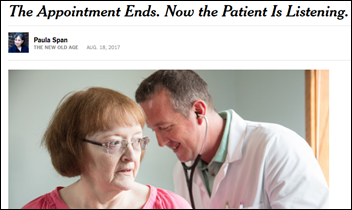
125x125_2nd_Circle

Curbside Consult with Dr. Jayne 8/14/17

August 14, 2017 Dr. Jayne Comments Off on Curbside Consult with Dr. Jayne 8/14/17

I work all over the country, so I see both national and regional trends. For a while now, we’ve seen private equity firms sinking money into larger practices, particularly in the profitable subspecialties such as dermatology and oncology. In these larger organizations, the private equity involvement usually starts around capital expenditures, such as opening surgery centers, infusion centers, or purchasing equipment. The organizations themselves are already fairly well developed and may be looking to expand or merge with another practice, but they’re typically pretty savvy about running a business and how to interact with financial backers. Recently though, I’ve seen a couple of scenarios play out where smaller organizations have gotten themselves involved in with private equity money and the practices are clearly in over their heads.

The first organization I saw this with was a primary care group that had a decent number of physicians, but at 50 or so providers, was in no way a large group. They were located in Texas and had delusions of expanding their group statewide and had gotten some backing to do so. I was working with them peripherally through a consulting subcontract with their laboratory vendor, so was able to watch it play out from the sidelines. I watched the practice administrator threaten leadership from their EHR vendor, using phrases around their plan to “triple in size” and to become “a force to be reckoned with.”

First off, even if they tripled in size, that would put them in the 150-physician range, which their vendor doesn’t even remotely see as a “large” client. The practice had failed to realize this before making their demands for free services and free software in preparation for their growth. They also failed to understand that primary care practices rarely have the footprint or financial ability to become a force as they envisioned unless they are very large or have very tight ties to key subspecialties.

The practice administrator had sold her physicians a bill of goods and they were all buying into the illusion that someday they would be the pre-eminent primary care practice in Texas, and by bringing in some PE financing, they were on their way. The physicians didn’t understand that once you bring PE into the mix, you lose a fair amount of control because you’re spending someone else’s money. I never had the opportunity to read the agreement, but it was clear that either they gave away more rights than they understood or that the PE group was taking advantage of them.

The administrator, who is from Detroit, and the PE leader, who hailed from New York, also failed to understand Texas culture. They never could quite figure out why small practices and independent providers weren’t interested in merging with them. Having spent several years living there and dissecting the culture as a relative outsider, I could have given them some pointers.

First off, although Texas is legally a single state, when you travel around it and meet lifelong residents, you quickly realize that it might as well be multiple states. I know people who live in Dallas and Fort Worth who have never been to the other city despite them being only about 30 miles apart. For those folks, crossing that gap might as well be a trip to the moon, which is a shame when you consider what each of the cities has to offer.

When you look at the cities that are farther apart physically, the differences are even more striking. The drive from Brownsville in the South to Texline in the north is almost 900 miles and you cross through multiple cultural traditions on the way. Parts of Texas think they’re in the old south, parts of it think they’re in the Old West, parts of it think they are in old Mexico, parts of it think they’re “big cities,” parts of it ooze small-town charm, and parts of it are just weird (Austin, you know I love you). Oh yeah, and then there’s the Gulf Coast.

To think that you’re going to be able to understand and accomplish expanding to physician practices across that broad of a spectrum within 12 months seems like a long shot. Some of us can’t even get physicians to agree across county lines, let alone across cultural divides and geographic barriers. I’m not saying it can’t be done, but it’s going to be expensive and psychologically exhausting as you try to address the distrust that people have of each other when they’re coming from different perspectives.

Eventually, the practice burned through a lot of money trying to figure out the expansion and the PE group became frustrated. In the end, they were snapped up by a hospital system that they had previously shunned.

Another group I worked with more recently was a procedural subspecialty practice in the Midwest. They had been wooed by a PE firm promising market dominance and expansion, which resonated with the practice’s leadership. Although they’re just trying to achieve regional expansion and grow from their 30-physician size, they didn’t understand that the face they were presenting to the market they were trying to conquer wasn’t a nice one.

My first exposure to them was a meeting where the head of the practice opened with expletives and started shouting at the vendor in front of the PE team. Never a good sign. This guy would go out to practices they were looking at “merging” with (code for acquiring) and behave inappropriately. I once watched him threaten prospective partners and promise that they would be sorry if they didn’t align with his group. I felt like I was in a 1920s-era gangster movie and expected to see Robert De Niro walking around the room with a bat.

I was somewhat gratified to see both his administrative and IT teams begin to ally themselves with the PE team against him. This continued for weeks and he never had a clue that the axe was going to fall until they walked him out the door. In the aftermath, the physicians feel hoodwinked, and frankly I don’t think they wanted to expand that much at all but were relatively powerless to block the actions of the administrator because of their previous corporate setup. They clearly didn’t want to give up as much autonomy as they did for the promise of being the top dogs. If they thought their schedules were oppressive before, they are certainly not enjoying the MBA-level micromanagement that is now going on behind the scenes. I don’t doubt that the practice will eventually grow, but the PE managers have a vested interest in tightening the collective belt so that they spend as little of their own money as possible.

Anyone who doubts that medicine has become a business needs only to look at these types of examples to understand what is going on. Medical schools have done a great job adding courses in patient engagement and complimentary / alternative medicine to their curricula. Now they need to add solid business courses. If they don’t, then physicians need to seek this knowledge on their own just like they would learn a new procedure or therapeutic regimen. There are plenty of smooth-talking individuals looking to work with physician groups and all too easy for them to be on higher ground.

How does your group learn about trends in practice management? Have you had private equity interest? Email me.

Email Dr. Jayne.

Monday Morning Update 8/14/17

August 13, 2017 News 4 Comments

Top News

image

NantHealth shares dropped 14 percent on Friday after Thursday’s announcement of poor financial results, a 300-employee layoff, and re-acquisition of heavily devalued NH shares previously purchased by Allscripts. NH shares closed Friday at $3.49, valuing the company at $424 million.

image

Above is the one-year share price chart of NH (blue, down 71 percent) vs. the Nasdaq (green, up 19 percent).

CEO Patrick Soon-Shiong said in the earnings call that acquisitions had swelled NantHealth’s payroll to 1,000 employees. He says synergies, a refocusing on artificial intelligence and decision support products, and transferring some employees to Allscripts as part of its purchase of NantHealth’s patient-provider portal product will enable the 30 percent headcount reduction.

Soon-Shiong says the FusionFx product that Allscripts is buying is non-core business because the company can exchange clinical documents without its interoperability component and that “this middleware that actually talks to EMRs was merely a tool and not really core and was better in the hands of an organization with hundreds of salespeople calling on customers during EMR implementations.”

NantHealth’s FusionFx was part of its July 2015 acquisition of Harris Healthcare Solutions, which had previously acquired the former CareFx in early 2011 for $155 million in cash. That offering included HIE, patient and provider messaging, and single sign-on. 


Reader Comments

image

From Ciro Cumulus: “Re: the question of whether Epic is a cloud-based system. Based on your criteria, I would say yes.” CC provided this review of Epic’s offering:

  • It connects via the Internet.
  • The user organization doesn’t pay capital expense, just a cost per concurrent user with license fees to InterSystems.
  • The standard term is five years with renewals.
  • Epic uses software-defined networks and state-of-the-art virtualization across compute, storage, and network.
  • Customers can scale up or down on the fly.
  • Epic manages the infrastructure and applies upgrades, although with more coordination than the typical cloud provider since application software requires more testing, training, and integration review.
  • Epic provides service-level agreements for performance and uptime.

HIStalk Announcements and Requests

image

Poll respondents are not really sure who will benefit most from Allscripts acquiring Mckesson’s EIS business, but the customers of both companies top the list. New poll to your right or here: what kind of term is “cloud-based?”

image

Blain Newton, EVP of HIMSS Analytics, was kind to answer my question about hospital count by bed size in providing the worksheet above. The information should dispel the notion that the inpatient EHR market is a wide-open race with many participants. My takeaways:

  • Cerner, Epic, and Meditech are far ahead of the pack in terms of overall hospital count.
  • Epic has nearly double the number of 500+ bed hospitals as Cerner.
  • The good news for Allscripts (sort of, anyway) is that McKesson had twice as many hospitals as Allscripts pre-acquisition, but most of those are under 150 beds.
  • I consider 250 beds to be the minimum size hospital to provide significant revenue opportunity and that race is all Epic (38 percent), Cerner (31 percent), and Meditech (14 percent).
  • Allscripts, which was touted by a reader as being a major, competitive player that generated my original question, is not – they have just 6 percent of the 250+ bed hospital market and only 3 percent of hospitals overall vs. Cerner’s 24 percent, Epic’s 23 percent, and Meditech’s 19 percent.
  • The unstated factors involve the “which modules” question — running a full suite of available products vs. just a few key systems from a particular vendor – as well as the overall trend in switching from one vendor to another. Hospitals are often all in with Cerner, Epic, and Meditech, but I suspect much less so with Allscripts given its more limited product line (although Allscripts has a strong ambulatory presence). There’s also the issue of which hospitals are running a system vs. who is paying for it and how much, which then gets into how health systems buy software corporately.
  • Regardless of the slicing and dicing applied, I’ll stand by my long-held conclusion that it’s all Epic and Cerner with Meditech as the dark horse when it comes to inpatient EHRs. Everybody else is eating their dust and likely to lose business due to hospital consolidation and a shift toward the most successful vendors as much as all of us who – for our own reasons – wish that weren’t the case. We need more and better competition.

It’s a slow news time every year from early August through Labor Day. After that, everybody puts their nose back to the grindstone, conferences gear back up, and a flurry of work kicks in that lasts until Thanksgiving. Until then, the news is mostly an occasional big announcement (like acquisitions and quarterly earnings reports) and a product sale every now and then.


This Week in Health IT History

One year ago:

  • Karen DeSalvo, MD, MPH resigns as National Coordinator, replaced by Vindell Washington, MD but continuing in her full-time role as Assistant Secretary for Health.
  • Bon Secours Health System (VA) notifies 665,000 patients that a revenue cycle optimization vendor’s mistake left their information freely discoverable on the Internet.
  • Patient advocate Jess Jacobs dies.
  • The FTC resolves its patient privacy complaint against Practice Fusion, which it accused of soliciting patient reviews about their doctor and posting them to its website without adequate warning.

Five years ago:

  • SAIC completes its acquisition of MaxIT Healthcare.
  • The Surgeons of Lake County (IL) reports that its system was attacked by ransomware.
  • Arkansas Heart Hospital signs a $10 million deal to implement Siemens Soarian.
  • CMS publishes requirements for Meaningful Use Stage 2.

Ten years ago:

  • The first screenshots of Google Health are leaked.
  • Healthcare billing company Verus shuts down following a string of system breaches.
  • CompuGroup wins the bidding for taking over iSoft.
  • Epic opens its $100 million, barn-red learning center as Campus 2 construction begins and the company’s revenue hits $422 million.
  • Walmart announces plans to open 400 in-store medical clinics.

Weekly Anonymous Reader Question

image

Responses to last week’s question:

  • I would love to live in Maui — mild weather, beautiful landscape, and friendly people.
  • The Tuscany countryside.
  • Boulder, CO.
  • Fiji has the most wonderful people I have ever encountered, and it’s beautiful. New Zealand is also beautiful, has wonderful people, and is progressive. I’m buying a house in both places.
  • Near my family and my (hopefully) eventual grandchildren.
  • Madison, WI.
  • San Francisco.
  • A restored Vanderbilt mansion in Newport, RI in the summer and a hut on Little Palm Island near Key West in the winter.
  • A beach house in Playa del Carmen.
  • Notre Dame du Pre, France.
  • London.
  • Scandinavia or Holland.
  • Paris.
  • La Jolla, CA.
  • New Zealand! Tropical beaches, rainforests, mountains, glaciers, and volcanoes all within driving distance (long ferry ride potentially required).
  • Jacksonville, FL.
  • Captiva Island, FL, the Caribbean island in the US.
  • Denver.
  • Oahu, Hawaii — slower pace of life, great weather, great people, great natural world, but still has modern world amenities.
  • US Virgin Islands.
  • Right where I already am – on the North Shore of Lake Superior.
  • Moorea, FP.
  • Curacao or the Bahamas.
  • Jekyll Island, as close to Driftwood Beach as I can get.
  • Alaska.
  • Fairhope, AL on the bay.
  • In a giant fifth-wheel, exploring the country (and probably spending a lot of time in New England and California)
  • Byron Bay, Australia.
  • Western Montana.
  • London on the Northern or Western ends so I can still have trees around me, and since money isn’t a factor I’m going to have a little cottage on the lower Cape, maybe Eastham or Orleans. Water, but set way back so my house won’t fall into the ocean for at least 20 years.
  • Coastal Southern California.
  • Lauterbrunnen, Switzerland or some other spectacular Alpine town. Clean water, clean air, solar power and living life in person instead of through an electronic device.
  • Florence, Italy.
  • Carmel, CA.
  • St. John, USVI.
  • Destin, FL.
  • San Diego, CA.
  • Goodyear, AZ.
  • Chicago downtown.
  • Chapel Hill, NC.
  • Paris.
  • Vegas, with summer trips to the rest of the world.
  • Encinitas, CA.
  • Auckland.
  • SoCal rocks.
  • Carlsbad, CA.
  • Jackson, WY.
  • Boston.
  • Munich, Paris, NYC.
  • Redmond, OR.
  • Coronado Island Calfornia. The best climate in the country year round and a beautiful beach! Can’t beat it.
  • St. Maarten.
  • Mobile Bay, AL.
  • San Diego. Best of all worlds n the US. Vancouver for Canada.
  • Hands down – Ireland (just got back – amazing), also Wyoming, Ft. Myers, FL.
  • London.
  • Florence, Italy near the Ponte Vecchio.
  • I would live a nomadic life in a class B motor home. Then I would really more deeply experience places I’ve visited that caught my eye. Durango, CO, Travelers Rest SC, Venice FL, Seattle, WA, Saranac Lake, NY.
  • With George Clooney. Before he was married and had kids.
  • San Francisco or Seattle.
  • The house I grew up in. There I knew happiness and love.
  • San Diego.
  • Big Island, Hawaii.
  • Costa Rica. It’s an amazing place with amazing people. Have been there five times and am overdue for a trip back!
  • Hawaii.
  • Santa Fe.
  • London.
  • The Alaskan Bush.

image

This week’s question, which isn’t really work related but interesting to me personally since all work and no play makes Mr. H a dull boy:  which musical group or performer is the best you have ever seen in a live, in-person performance?


Last Week’s Most Interesting News

  • Allscripts swaps its mostly devalued NantHealth shares for NantHealth’s provider and patient engagement solutions.
  • NantHealth announces poor quarterly results and a restructuring that involves laying off 300 employees.
  • UC San Diego Health migrates from its self-hosted Epic implementation to an Epic-hosted version.

Webinars

August 17 (Thursday) 2:00 ET. “Repeal and Replace McKesson’s EIS.” Sponsored by HIStalk. Presenters: Frank Poggio, CEO, The Kelzon Group; Vince Ciotti, principal, HIS Professionals. The brutally honest and cynically funny Frank and Vince will analyze the Allscripts acquisition of McKesson’s EIS business. They will predict what it means for EIS’s 500+ customers, review what other vendors those customers might consider, describe lessons learned from previous industry acquisitions, and predict how the acquisition will affect the overall health IT market. Their 2014 webinar on Cerner’s acquisition of Siemens Health Services has generated over 8,000 YouTube views.

Previous webinars are on our YouTube channel. Contact Lorre for information on webinar services.


Acquisitions, Funding, Business, and Stock

image

Nordic expands its Madison, WI office, adding space for another 60 employees. The company says the new space won’t last long as it rapidly expands beyond its 800 employees and 2016 revenue of $180 million.

image

Technology company The Bitfury Group and Baltimore-based AI startup Insilico Medicine will work together to develop blockchain applications for healthcare.


Decisions

  • Dukes Memorial Hospital (IN) will replace McKesson with Cerner in 2018.
  • Dupont Hospital (IN) will go live with Cerner in 2018.
  • Carroll Hospital (MD) will replace McKesson with Cerner in 2018.
  • UMass Memorial – HealthAlliance Hospital (MA) will implement Epic in October 2017, replacing Siemens.
  • Bryan Medical Center – East (NE) will go live on Epic in March 2018.

These provider-reported updates are supplied by Definitive Healthcare, which offers a free trial of its powerful intelligence on hospitals, physicians, and healthcare providers.


People

image

Santa Rosa Consulting hires Mike Ragan (NTT Data) as chief revenue officer.


Announcements and Implementations

HIMSS Analytics expands its Logic health IT market intelligence platform with international data, increasing its coverage to 380,000 facilities in 47 countries, including 100 percent of US hospitals. 


Other

In India, the head of a state-run medical college is suspended after the deaths of 60 children in the past week – at least 30 of them on Thursday and Friday alone — that local newspapers claim were due to the hospital’s oxygen vendor cutting off the hospital’s supply after it accumulated $90,000 worth of unpaid bills. The administrator says he repeatedly warned the state that the hospital didn’t have the money to pay the overdue oxygen bills but was ignored. Witnesses say doctors handed out manual resuscitator bags to family members asked them to pump it themselves as many of them watched their children die needlessly.

In Ireland, Mater Hospital’s storage-area network fails, forcing the hospital – which is among the country’s busiest – to divert ambulances and cancel appointments.

Here’s Vince’s final HIS-tory installment on Cerner, closing out a nice look back on the company’s history.


Sponsor Updates

  • Forrester Research names Salesforce Service Cloud a leader in its latest report on customer service solutions for enterprise organizations.
  • Surescripts will present at ONC’s 2017 Technical Interoperability Forum August 15-16 in Washington, DC.
  • T-System joins Athenahealth’s More Disruption Please program.
  • Wake Forest Baptist Medical Center joins the TriNetX Global Health Research Network.
  • ROI Healthcare Solutions hires Jeff Powell as director of business development.

Blog Posts


Contacts

Mr. H, Lorre, Jenn, Dr. Jayne, Lt. Dan.
Get HIStalk updates. Send news or rumors.
Contact us.

125x125_2nd_Circle

News 8/11/17

August 10, 2017 News 7 Comments

Top News

image

image

Allscripts will trade its significantly devalued 15 million shares in NantHealth for most of NantHealth’s provider and patient engagement solutions. That includes NantHealth’s FusionFx business, unstated “components of the NantOS software connectivity solutions,” and a guarantee that NantHealth will book an unstated minimum value of Allscripts product sales over a 10-year period.

The NH shares for which Allscripts paid $200 million two years ago are worth around $50 million. The company announced in last week’s quarterly earnings report that it will write down $145 million of its investment.

NantHealth’s FusionFx was part of its July 2015 acquisition of Harris Healthcare Solutions, which had previously acquired the former CareFx in early 2011 for $155 million in cash. That offering included HIE, patient and provider messaging, and single sign-on. 

NantHealth’s Patrick Soon-Shiong personally invested $100 million in Allscripts shares in the mid-2015 deal. He is down around $8 million as MDRX shares have fallen almost 10 percent since.

image

Meanwhile, NantHealth announces Q2 results: revenue up 17 percent, EPS –$0.58 vs. -$0.54. The company’s quarterly losses increased from $87 million to $111 million. NantHealth said in the earnings announcement that it will reduce headcount by 300 in a restructuring that will focus on cancer machine learning systems.

Soon-Shiong’s other publicly traded company, NantKwest, IPO’ed in July 2015, with a first-day closing share price of $34.64. NK shares now trade at $5.67.


Reader Comments

image

From Captain Beefheart: “Re: the term cloud-based. Several publications used this term for UCSD’s move to an Epic-hosted system. Epic isn’t really a cloud-based system just because they run the same product from their data center.” Health IT has long blurred the definition once it devolved from a technical term to a marketing one, simply renaming “hosted” systems (which also include the various forms of “just a longer cord” such as Saas, ASP, etc.) as being “cloud-based,” the same way “software” became “solutions” without changing anything. Googling didn’t turn up a firm definition of cloud-based systems, but here’s my best summary that begs for more technically astute readers to weigh in, with my interpretation being that calling Epic a “cloud-based system” is incorrect even though I’m guilty of having done so in UCSD’s case without really thinking about it:

  • Connection to the remote system is via the Internet.
  • The user organization doesn’t pay capital expenses but rather is billed at regular intervals based on a fixed monthly expense or for metered services.
  • The hosting data center uses a shared pool of infrastructure (multi-tenancy) that can be managed virtually and provisioned on the fly. It is not simply moving the customer’s servers to a more distant data center owned by someone else.
  • Customers can add or decrease system capabilities (bandwidth, server processing power, storage) on their own in flexing their metered capacity to their needs.
  • The host manages the infrastructure and applies updates without using the customer’s resources.
  • The host guarantees service levels for response time and downtime.

image

From Gene Gene: “Re: HIStalkapalooza. Wondering if you had reconsidered since we’re planning our own event and don’t want to compete.” I haven’t reconsidered. It’s a ton of work and a great financial risk for me personally without any benefit. I thought about it again a few months ago when: (a) we devised a new invitation/admission idea that would have eliminated much of the work, and (b) a company expressed interest in underwriting much of the cost in reducing my risk, but it didn’t work out. I have just one FTE (Lorre) for non-writing tasks and she spends ridiculous hours starting in early January trying to get event sponsors so I don’t go broke and arguing over who gets invited, not to mention that while we’re trying to set up and run our own little HIMSS booth, people are messaging both her and me nearly non-stop asking silly event questions or making unreasonable demands that reek of self-entitlement. RIP HIStalkapalooza, whose life reached its timely end at 10 years of age. HIMSS might actually be fun for us without all those headaches.

From Bilge Pump: “Re: Paragon. Why don’t you think Allscripts can sell it?” McKesson wasn’t having much luck selling it, so the question then becomes whether Allscripts has the sales force and channel to outperform McKesson in getting 150-bed hospitals to sign up for Paragon instead of Meditech, CPSI, Athenahealth, or even hosted Epic or Cerner systems that are admittedly overly complex for their needs. And while I admire the company’s upfront demarcation line of saying that Paragon will be pushed only for hospitals with fewer than 250 beds that offer no specialty services (of which there are quite a few), my cheap-seats experience is that vendors with overlapping products struggle with sales team infighting and confused prospects. Maybe Allscripts can move some of the Series and Star users to Paragon or the larger Paragon customers to Sunrise, but that won’t be a slam dunk – a project of that cost and magnitude requires a look at the other vendors who often win those deals and McKesson failed to accomplish that as well. They had better act quickly since the number of independent under-250 bed hospitals seems to be decreasing fast as they are acquired by health systems that mostly use Cerner and Epic. I would be interested in the customer count by bed range for all the inpatient EHR vendors if anyone has access to that information, although Cerner and Epic are playing the Electoral College-type strategy in focusing on enterprise size rather than a simple count of hospitals. 

image

From Denizen: “Re: Carequality. Our organization of long-term acute care hospitals was quoted $400,000 per year to onboard to Carequality as an implementer so we can get patient information from short-term acute care facilities, more than half of which run Epic. We don’t receive Meaningful Use incentives to help pay for this technology and we feel the costs are excessive given that the data belongs to the patient and it would allow us to provide them with better quality and safer care.” I contacted the non-profit Sequoia Project, which runs the eHealth Exchange, Carequality, and RSNA Image Share Validation. Their spokesperson explained:

Carequality is designed to connect networks and is not intended to be a network that providers directly join. As a result, the Carequality fees that you saw apply to the networks themselves, not to provider organizations who participate in a data sharing network. The assumption is that providers like this are already connected to a health data sharing network of some kind. If their “home network” is a Carequality implementer, then the provider should be readily able to connect to other Carequality connections. There are a number of health data sharing networks available in the market that this hospital may already be leveraging. Some of these networks are geographic-centric, such as regional and statewide HIEs. Others have a more nationwide focus, such as eHealth Exchange, Surescripts, and CommonWell Health Alliance. While still others are facilitated by the health IT vendor that the provider uses. Providers that would like to share health data via Carequality need to contact their participating network. If their network is not an implementer, they can encourage their network to implement the Carequality Interoperability Framework to dramatically expand their connectivity options.

image

From Non-Annoying Vendor: “Re: Stanford Health Care CIO position. Accepted by [name omitted].” I’ve emailed the person whose name I omitted for confirmation since it’s not cool to run unverified job changes. UPDATE: Verified. Eric Yablonka, VP/CIO of University of Chicago Medicine, emailed me to confirm that he will start at Stanford at the end of September. He replaces Pravene Nath, MD, who is now an executive in residence at Summation Health Ventures.

image

From Roman Hands: “Re: CHIME. It’s paying President and CEO Russell Branzell $500K per year, which seems like a lot for a non-profit whose revenue is less than $7 million.” Basically all of the $529K in member dues CHIME took in for FY2015 went toward Russ’s paycheck. It collected $1.6 million from conference registration and vendor advertising and $4.27 million from the CHIME Foundation. I’m not interested in doing compensation research, but one study I saw said that non-profit CEOs of organizations with budgets of $5 million to $10 million are paid an average of $100K. I remember doing some legwork years ago on Steve Lieber’s HIMSS compensation vs. similarly-sized member associations and he was certainly at the top of the chart (the current median is about one-fourth of what Steve makes). Whether either is worth the lofty salary is up to members to decide, not just in the amount of their dues, but how comfortable they are being pimped out to high-paying vendors that contribute most of the revenue.


HIStalk Announcements and Requests

This week on HIStalk Practice: The American Telemedicine Association looks for new leadership. A Chance to Change invests in telemedicine for behavioral health patients. Delaware physicians hope blockchain will speed up the prior authorization process. WellAve expands mobile dermatology clinic business. Colorado physicians up in arms over delinquent Medicaid reimbursements. ApolloMed takes a minority equity stake in LifeMD. Cow Creek Health & Wellness Center Clinic Director Dennis Eberhardt details the ways in which a new commercial EHR will better serve patients. Independent MDs express extreme dissatisfaction with MACRA. Buoy Health raises funding for symptom checker software.


Webinars

None scheduled soon. Previous webinars are on our YouTube channel. Contact Lorre for information on webinar services.


Acquisitions, Funding, Business, and Stock

SNAGHTMLeac27b7c

The New York Times profiles Eko Devices, started by three UC Berkeley undergrads. The company has sold 6,000 digital stethoscopes and will this fall introduce the FDA-cleared Duo, a prescription-only version for home use that collects EKG readings and heart sounds to send to doctors. One of Eko’s founders says the product should work like “Shazam for the heartbeat” in being able to recognize unusual heartbeat patterns just like the Shazam app can “listen” to a song being played and then display its title and artist. The Duo is intended only for heart patients and will cost $350 plus $45 per month. The Duo’s main competitor will be AliveCor’s Kardia, a $99 smart phone add-on that records EKGs.


People

image

Justin Diehl (Healthware Partners) joins Parallon Technology Solutions as VP of Epic services.

image

NHS England’s first chief clinical information officer, Keith McNeil, MBBS resigns after 13 months, returning to Australia to become CMIO of Queensland Health.


Announcements and Implementations

image

AdvancedMD launches AdvancedReputation, which automatically emails or texts patients a one-question satisfaction poll following their office or telemedicine visit and invites those who score positively to post their feedback on the practice’s Google business profile. Those who score negatively are asked to describe their experience to be posted privately to the provider’s dashboard.

image

Christus Health reports its results from implementing Epion Health’s iPad appointment check-in system: collections per encounter increased 3.5 percent, patient portal sign-ups increased 300 percent, and 21,000 patients opted in for text messages. Epion CEO Joe Blewitt graduated from the United States Air Force Academy, was on active duty in the Air Force for 10 years, then spent 17 years as an Air Force Reserve pilot at McGuire Air Force Base.

Change Healthcare adds the capability of adding attachments to dental claims submissions.


Government and Politics

image

The Austin, TX paper reviews the state’s lawsuit against Xerox, which the state says did shoddy pre-authorization reviews for Medicaid dental services. The company hired high school dropouts and gave them just a one-hour training session. One of them responded to a deposition question about the definition of severe handicapping malocclusion, “Not a clue. Their teeth are messed up.” Records show Xerox ran the process like a high-pressure boiler room where supervisors ordered employees – many of whom worked from home and thus couldn’t even see the records that had been submitted by dentists – to “push those keys as fast as you can.” Xerox hired just one dentist to review hundreds of requests each day, with one such review being clocked at exactly six seconds. HHS OIG ordered the state to repay it $133 million for services it had paid that didn’t pass pre-authorization rules. Records show the state knew about the rubber-stamped authorizations but did nothing for several years, eventually culminating in the firing of Xerox and the lawsuit brought against the company in hopes of covering the HHS repayment.

President Trump declares the opioid crisis a national emergency, contradicting a statement made two days ago by HHS Secretary Tom Price, who said such a declaration is unnecessary. 

image

Australia’s government approves automatic sign-up of citizens for its My Health Record provider and patient e-health system, formerly known as PCEHR. People will have to opt out if they don’t want their information shared. The government hopes to approve interoperability standards in 2022 and to make secure provider-patient and provider-provider communication universally available the same year. The government published its national digital health strategy this week. Reports suggest that the government has spent at least $1 billion on My Health Record, which has struggled with poor patient and provider participation.

Oregon’s governor demands and receives the resignation of the head of its health authority following leaking of a document describing her planned smear campaign against a Medicaid provider who sued the state claiming that the agency’s rate-setting process is not fair.


Privacy and Security

Princeton Community Hospital (WV) is still down from its June 27 malware attack, saying it is dealing with a transcription backlog and interfaces that aren’t working yet following its complete rebuilding of systems.


Technology

CNBC covers the potential use of the Amazon Echo for helping homecare patients with medication reminders, instructions, and staying connected with family. It mentions voice startup Orbita, which offers an Amazon Alexa skill and a graphical development tool for Amazon Echo, Google Home, and other voice platforms.


Other

image

This should help dispel those negative perceptions of Alabama.

In South Australia, 20 percent of surveyed doctors say the government’s EPAS electronic health record is causing medication errors, critical delays, and pathology mistakes, with one-third of respondents saying the Allscripts system has caused near-misses. 

image

State auditors accidentally find that a struggling 15-bed Missouri hospital was apparently used as a shell company to bill $90 million worth of lab tests that were performed by other hospitals run by the same management company that installed its president as the hospital’s CEO. The auditors also found that the CEO and his company were paid nearly $1 million in the first 10 months of the agreement, the hospital paid $10.6 million to the hospital company’s lab division in just three months, and the hospital was covering the salaries of 33 phlebotomists of other company-run hospitals. The state, which is considering a corruption investigation, says decisions made by the hospital’s management and board were “astounding in their irresponsibility.” The CEO has charges pending against him in Louisiana related to a another managed hospital’s claims that he forged checks made out to another management company he owned. The state auditor says the hospital did no background checks and minimal due diligence before turning its operations over to the management company and CEO.

image

A Texas Public Radio report covers the dispute between Nuance and its remote workers following its extended malware-caused downtime, during which the company’s transcriptionists say they were promised overtime and incentive pay that was later rescinded. The report reviewed the recording of a management conference call for transcriptionists in which Nuance clarified that the incentives it had offered (and that its managers had promised) were not intended for all transcriptionists, but said its message was misunderstood because its communications systems were also down due to the malware. One employee who worked more than 12 hours per day saw that her expected $3,000 extra payment ended up being just $21. The recorded call also captures a Nuance manager who explained that the error was widespread, adding, “We blew it. We completely blew it.” The article concludes that it’s tough for remote workers to react to employment conditions since they can’t band together to protest in person. They may still get their chance – several lawyers added their contact information to the article’s comments.


Sponsor Updates

  • CSI Healthcare IT completes its at-the-elbow support for the Epic ambulatory go-live at Atlantic Health System (NJ).
  • Meditech will exhibit at the Mid-South Critical Access Hospital Conference August 16-18 in Nashville.
  • Spok announces that all 20 of the hospitals on US News & World Report’s list of best hospitals as well as all 10 of the best children’s hospitals use its solutions for enterprise healthcare communications.
  • Netsmart will exhibit at the FADAA/FCCMH Annual Conference August 16 in Orlando.
  • Experian Health will exhibit at the HFMA Arkansas Summer Conference August 16-18 in Hot Springs.
  • PatientPing names former Medicare deputy administrator and director Sean Cavanaugh as an advisor.

Blog Posts


Contacts

Mr. H, Lorre, Jenn, Dr. Jayne, Lt. Dan.
Get HIStalk updates. Send news or rumors.
Contact us.
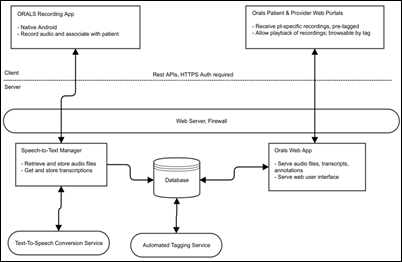
125x125_2nd_Circle

EPtalk by Dr. Jayne 8/10/17

August 10, 2017 Dr. Jayne 1 Comment

clip_image002 

My HIMSS planning is officially underway and I’m happy to report securing my preferred hotel for my preferred dates for the first time in several years. The shifted schedule (Monday through Friday) always throws me off when we’re in Las Vegas. The updated schedule now shows Magic Johnson as the closing keynote speaker on Friday, but I’m sure that quite a few of us will be departing before then.

Much of the agenda is similar to years past, but I did note the addition of a fee-based session for Thursday. “Rock Stars of Emerging Healthcare Technologies” is a $295 additional charge and purports to cover disruptive and innovative technologies. I’d be interested to see who is in the lineup, but I’m not eager to spend that much money.

I’ve been catching up on medical reading and continuing education. Many of our readers would be happy to know of a new report linking moderate drinking to cognitive health in old age, at least for some demographic groups. Although it found that patients who consumed a moderate amount of alcohol on a regular basis were more likely to live to age 85 without cognitive impairments or dementia, it’s hard to know the exact nature of correlation vs. causation. The study ran for 29 years and used the standardized Mini Mental Status Examination to gauge cognitive health. Adults with “moderate to heavy” alcohol intake five to seven days a week were twice as likely to stay cognitively intact than those with little alcohol intake. Wine-drinking tends to correlate with higher income and education levels that are accompanied by reduced rates of smoking and greater access to healthcare. The majority of study participants were Caucasian and from a middle-class suburb of San Diego.

The Agency for Healthcare Research and Quality (AHRQ) is seeking nominations for public members of its National Advisory Council. The Council advises the AHRQ Director, the Secretary of Health and Human Services, and other bodies on national health services priorities. Nominees must be willing to serve a three-year term, meeting in Washington, DC three times per year. Desired qualifications include medical practice, other health professional experience, researchers, healthcare quality experts, and health economists, attorneys, or ethicists. Additional information is available in the Federal Register.

There has been a lot of chatter in the physician lounge about Anthem’s recent statements that they will not cover non-emergency conditions when patients seek care in the emergency department. Primary care physicians who have a large number of Anthem patients are starting to worry about capacity and creating plans to care for an influx of patients. Retail clinics and urgent cares are eager to accept the overage. Anthem has piloted this in several states and is in the progress of expanding it to others.

We already see plenty of patients in the urgent care setting who could be easily treated with over-the-counter remedies, so it will be interesting to see how this impacts the patient mix in states where it is a factor. In my area, a visit to the local pharmacy’s clinic runs 40 percent less than a comparable physician office visit and about a quarter of what is charged in the urgent care setting. All are significantly less than the $800-900 typically charged for a basic visit in the emergency department.

Wearing both my family medicine and urgent care hats, the missing piece is education and triage. It’s one thing to simply tell a patient that their bill won’t be covered unless it’s a true emergency, but it would be even better if the payer spent a little bit of the anticipated cost savings educating patients and providing after-hours nurse lines where patients could seek advice. Lots of people surf the Internet for information or get their advice from Dr. Google, but education is still a great value in the long run. My insurance carrier has serious limitations on emergency visits, but offers nothing in the way of other support to triage patients to the appropriate care setting. At our urgent care, we sometimes see patients who started at the retail clinic but couldn’t be treated there due to limited scope-of-practice agreements, which leads to an additional and more costly visit with us.

There has also been a fair amount of chatter around the recent JAMA research letter about Maintenance of Certification (MOC) and Board Recertification fees. Although the medical specialty boards are supposed to be non-profits, they’re taking in significant amounts of money from examinees and those required to demonstrate participation in MOC activities. According to the research, the amount of income from exam fees is out of proportion to the amount it actually costs to administer the exams.

For those of us who are board certified in multiple subspecialties, the expenses can add up. Even for those of us board certified in clinical informatics, we are required to maintain a primary specialty board certification. This seems rather unfair to the large number of clinical informaticists who no longer see patients and might be inclined to allow their primary certifications to lapse. Current policies also exclude a number of clinical informaticists who had already discontinued their primary certifications before the clinical informatics certification became a reality.

I’m due to retake my primary boards in 2019 and figure I’ll have to take them at least twice more before I retire unless something changes. I’m not looking forward to the time commitment or to studying information that has no bearing on my practice, such as obstetrics. I failed to buy a lottery ticket for this week’s Powerball, so it looks like I’ll be in the trenches for the foreseeable future.

Email Dr. Jayne.

CIO Unplugged 8/9/17

August 9, 2017 Ed Marx 12 Comments

The views and opinions expressed are mine personally and are not necessarily representative of current or former employers.

Brokenness in Leadership

I finished my keynote presentation for the New York HIMSS chapter and surrendered the stage back to my host. With Yankee Stadium as the backdrop, the entire day’s event had been spectacular.

Lit, I spoke about customer service. I had no intention of sharing a Top 10 list of things you could replicate in your organization to create a culture of customer service. Rather I aimed to pierce the hearts and souls of each and every person listening. If I pierced hearts, leaders might be transformed and the Top 10 action items would be created and owned by them.

I shared real stories how hearts were pierced – mine and others. Pierced hearts drove us to create, design, and deliver superior customer service, and in turn, improve clinical and business outcomes. It is one big ecosystem, I suspect, a softened heart that beats to serve and changes culture which improves outcomes. The cycle begins with brokenness.

Leaders approached me at the reception with tears in their eyes. Tears glistening on his cheeks, a battle-tested CEO shared how he never cried. But there he stood. Pierced. Changed.

One by one they stood in line, sharing how their worlds got rocked. The big question was, how could I be vulnerable to my teams, let alone strangers? How could I display raw emotion while recounting core-shaking stories? How could they get in touch with themselves at that level and with transparency?

Those are deep questions and I am not sure I have the answer. Perhaps part of the answer involves brokenness. I realize I am a broken person. I have failed as much as I have succeeded. I have been challenged in life and career. I have struggled with work, I have struggled with sport, I have struggled with kids, I have struggled with marriage. I have hit rock bottom. Hard.

I know I am weak. I also know on my own there is no way up. I am a grateful survivor. I realize the gap between my brokenness and my recovery is filled by grace. If karma is real, I am in big trouble. Really big trouble. Grace is my new BFF.

Some are too prideful to admit weakness and resist brokenness. We compete to be better than the pack and hide behind façades. We are pretenders. In pain. We don’t let others see or touch it. In fact, we bully others who show weakness. We resort to over-medication, legally or otherwise.

Ideally, we realize the need to get real and accept our brokenness. Perhaps acceptance is the start. We embrace brokenness as something bigger than ourselves. Acceptance creates capacity for gratefulness. I sometimes tear up because I am so thankful to others. I recognize that my accomplishments are not about me, but because of others.

I also learned compassion and empathy growing up. The youngest of seven, I spent significant time with my mother alone and bonded tightly. Mom suffered her entire life with chronic illness as I watched her deal with pain with a brave face. She was a servant who loved her kids and husband. Days before she traded her earthly rags for robes of righteousness, we talked about it. Why did God allow her to suffer so long? Why was such a great woman taken so early and cruelly?

We never realized the answer, but at the end I whispered in her ear that her quiver full of successful kids, grandkids, and great-grandkids was a testimony of her significant legacy. In her suffering we observed grace and learned empathy. My heart pierced multiple times in her journey.

As I gained experience serving in hospitals, I began to see patients in the normal course of work. Here I was, healthy, while around me was sickness and death. As an anesthesia tech, I assisted in many procedures, including the harvesting of organs. I watched parents surrender their child’s body to medicine in hopes a tragic suicide would bring life to others they could never know.

I passed gurneys that seemed empty except for the body hidden underneath drapes. I experienced poignant reminders that life is fragile. I understood my service was to make people well while also ensuring the dignity of death. Even as I write this, my mind is full of memories. How can I not cry?

Leadership. Through life and circumstances, we become hardened. Work can be tough and family tougher. Life happens. Even the most supple arteries get clogged. Yet to be effective, our hearts must remain pliable and soft.

For me, volunteering weekly in hospitals keeps my heart pure and the blood flowing. Seeing sick children in particular touches me. I regularly shadow clinicians and hide tears. Patients. I have to see patients. They pierce my heart. They re-orient my focus.

As leaders, we must remain vulnerable and transparent. We must demonstrate that it is OK to cry. Emotions are strength, not weakness.

Demonstrate brokenness. Become a vehicle of mercy and grace to others. Once you embrace your brokenness, you are able to lead others through theirs.

edmarx

Ed encourages your interaction by clicking the comments link below. He can be followed on LinkedIn, Facebook, Twitter, or on his web page.

News 8/9/17

August 8, 2017 News 18 Comments

Top News

image

UC San Diego Health (CA) moves from its self-hosted Epic system to an Epic-hosted, cloud-based system, the first academic medical center to undertake that particular migration.

UCSD says it is shifting away from running its own hosted centers to cloud-based systems because of cost and reliability. The Epic switch involved 10,000 workstations and integration of 100 third-party applications.

UC Irvine Health will move to UCSD Health’s Epic cloud-based instance in November 2017.

UC San Francisco announced a $10 million grant in late July that will fund a project to mine the combined Epic databases of all five UC medical centers to discover new insights and possibly find new uses for existing drugs.


Reader Comments

image

From Sister Sledge: “Re: Allscripts. One of the rags ran a map of where McKesson EIS had customers, claiming that geography matters to a vendor and that Allscripts will benefit from gaining more customers in the West. Think so?” I don’t think so. Geography can affect sales, but only for companies that have clear momentum and neither McKesson nor Allscripts have ever had that. My prediction is that Cerner, Epic, and maybe Meditech will benefit most when those customers start looking for replacement systems. It’s not at all similar to when Cerner bought Siemens Health Services and could offer them a lifeline from their rapidly sinking systems to a market-leading one. Allscripts can boast about a higher customer count or wider geographic reach, but a lot of those customers are likely to defect in the next few years as the Cerner and Epic train keeps rolling over everything in its path (accelerated by big hospitals buying smaller ones) and the acquisition encourages those former McKesson customers to review their positions. The direction of change in customer satisfaction post-acquisition will predict a lot. MDRX shares are at the same price as they were in mid-1999, so stock performance won’t create much confidence – Cerner shares are up 322 percent in the past 10 years, McKesson shares are up 167 percent, and the Nasdaq index is up 136 percent, all while Allscripts shares were losing 52 percent of their value. 

image

From Lucille Two: “Re: Epic’s response to Politico’s article about Joe Biden. Don’t you find Epic’s PR statement a bit confusing, saying that the VP was ‘consistently polite and positive’ unless it’s to cover their tracks? Wouldn’t Biden’s staffer, who has no reason to disparage him, know him well enough?” Politico excerpted comments from a video made at a conference’s fireside chat by Greg Simon, now president of the Biden Cancer Initiative, who said the VP and Epic CEO Judy Faulkner got into a heated exchange over why Biden might want his own full medical record. I wasn’t there and Simon was, but my observations from watching him tell the story on video are:

  • Simon seemed a bit swaggering and over-the-top in the video, which left me feeling that his comments were more of an entertaining story for the in-person conference audience rather than a trustworthy, verbatim discussion of what was said by others in his presence.
  • Simon’s tone in the remainder of his remarks was clearly anti-EHR vendor. I got the feeling that the Biden story was his chance to take a shot at them. 
  • The conversation between Biden and Faulkner he described took place nearly seven months ago, resulting in zero reaction until the conference video from Simon’s session was published.
  • Simon’s background: aide to VP Al Gore, lobbyist, charity founder, drug company executive. He’s long been a critic of the lack of data-sharing in healthcare, but he originally seemed to blame providers rather than EHR vendors in saying, “The technology of sharing has increased exponentially, but the willingness to share has not.” 
  • Others in attendance (it was not a private meeting) have not corroborated Simon’s account, and in fact have said the meeting was, as Faulkner said, cordial and polite.
  • Even accepting Faulkner’s supposed comments at face value, it’s a leap to assume that her message was dismissive, paternalistic, or defensive about patients accessing their data. Tone is everything and her supposed comment that Biden wouldn’t be able to make sense out of an Epic EHR data dump is generally accurate, although perhaps Biden took offense thinking he was being spoken down to.
  • The bottom line for me is that it’s much ado about nothing regardless of whether Simon’s recap is accurate. It was a fun story for a couple of days, but not necessarily accurate or indicative of any particular trend or practice, especially in the absence of commentary from Biden himself. If he were that riled up, he’s had seven months to say so.

HIStalk Announcements and Requests

I notice that Rolling Stone has a profile of singer-songwriter Khalid mentioned on the cover of the current issue, mostly because I recommended his music in January 2017 with my summary, “Mark your calendars for six months from now – Khalid is going to be big.” 


Webinars

None scheduled soon. Previous webinars are on our YouTube channel. Contact Lorre for information on webinar services.


Acquisitions, Funding, Business, and Stock

image

Pharmacy supply chain technology vendor Swisslog Healthcare acquires Talyst Systems, which offers medication management solutions to acute care and long term care facilities. 

image

Evolent Health reports Q2 results: revenue up 89 percent, EPS –$0.13 vs. –$0.25, beating revenue expectations and meeting on earnings. News of the company’s plan to launch a $175 million secondary public offering  sent shares down 17 percent in early after-hours trading Tuesday.


Sales

image

Connecticut Children’s Hospital chooses InstaMed’s healthcare payments solution.

image

Toronto-based Baycrest Health Sciences selects Caradigm’s single sign-on and context management systems.


People

image

Stephen Grossbart, PhD (Stephen Grossbart and Associates) joins Health Catalyst as SVP of professional services.

image image

Ingenious Med hires Girish Pathria (Visiant) as VP of products and insights and names Nancy Cunningham (Accord Services) as VP of implementations.

image

Susan Steagull (Novant Health) joins VCU Health System (VA) as CIO.


Announcements and Implementations

image

Fresno Surgical Hospital (CA) goes live on FormFast’s electronic signature solution in its Meditech environment.


Privacy and Security

The now-retired NIST manager who in 2003 was ordered to quickly develop password-setting guidelines says he was wrong about recommending that passwords be required to conform to bizarre rules that require mixed-case letters and special characters. New NIST guidelines recommend that passwords be created from long but easily-remembered phrases. Analysis found that a password like “correcthorsebatterystaple” would require 550 years to crack, while an old-rules version such as “Tr0ub4dor&3” could be broken in just three days. The guidelines also say that passwords need not be auto-expired, with users forced to change their passwords only if they are known to have been compromised.

In India, a hospital IT director and one of his former employees are arrested for stealing hospital data required for accreditation and selling it to other hospitals.


Other

image

A study of all US opioid prescriptions issued over a nine-year period finds that doctors who graduated from low-ranked medical schools prescribe a lot more opioids than those who attended top-tier programs, concluding that physician educational outreach might help with overuse. Based on the graph above, it looks like osteopaths (DOs) are a much bigger problem than just about everyone else, including foreign medical graduates, although that wasn’t the subject of the study. I’m not sure I buy the conclusion, however, since it would be interesting to also look at number of years since graduation and the practice location — I would bet that many graduates of top-ranked schools tend to practice locally afterward and have a different kind of peer group and big-hospital oversight that happens mostly in major teaching hospitals with employed doctors. The bottom-ranked schools, in case you are as interested as I am, are Drexel, University of Nevada, Michigan State, West Virginia University, and University of South Carolina, which might be especially concerning if your doctor finished at the back of the pack of his or her graduating class.

image

Oopsie.

image

A researcher observes with some alarm that post-Millennials are “on the brink of the worst mental health crisis in decades” because they spend all their free time on Snapchat or texting instead of physically interacting with people, with a steep drop-off in time spent with friends even though virtual interaction leaves them less happy. Those who proudly document their activities on social media also cause everybody else to feel left out or to obsess over how many “likes” they earn. In a somewhat related article, a small study finds that AI-powered analysis of Instagram photos (color, comments, likes, posting frequency) is much more accurate at diagnosing depression than face-to-face doctor visits.

Giving employees a healthcare price transparency tool didn’t reduce overall spending, a study finds, noting that only 12 percent of the employees even bothered to look at it. The price tool saved an average of 14 percent of the cost of advanced imaging studies, but only 1 percent of those patients consulted the tool before having the test performed.

image

We are so blessed in healthcare IT to have access to a $3,480 report written by obvious experts.

image

In Egypt, 10 doctors launch an operating room-themed restaurant that claims its food is safer because of the medical training of the owners.


Sponsor Updates

  • Aprima will host its annual user conference August 18-20 in Dallas, TX.
  • Besler Consulting releases a new podcast, “Preparing for the Social Security Number Removal Initiative.”
  • Optimum Healthcare IT publishes a white paper titled “Epic Upgrades are Epic Events.”
  • Nordic publishes a podcast titled “Why change management is critical to a successful EHR transition.”
  • EClinicalWorks announces that users of its EHR have exchanged two million documents in the past 12 months through the Carequality Interoperability Framework.
  • Dresner Advisory Services honors Dimensional Insight with its Industry Excellence Award for business intelligence expertise.
  • Glytec showcases the impact its therapy management software along with connected device systems has on insulin management at the American Association of Diabetes Educators conference.
  • Healthfinch VP of Operations and Finance Leah Roe will speak at Forward Fest Madison August 17-24 in Wisconsin.
  • Influence Health announces the speaker lineup for its Influence! Healthcare Consumer Experience Conference September 27-28 in Orlando, FL.

Blog Posts


Contacts

Mr. H, Lorre, Jenn, Dr. Jayne, Lt. Dan.
Get HIStalk updates. Send news or rumors.
Contact us.
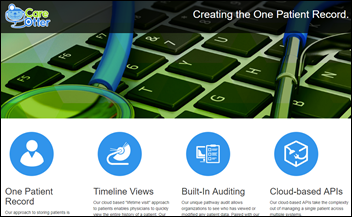
125x125_2nd_Circle

Curbside Consult with Dr. Jayne 8/7/17

August 7, 2017 Dr. Jayne 2 Comments

I’ve been working on a project involving laboratory interfaces for a mid-sized multispecialty practice that is trying to integrate with multiple local hospitals. They’re valiantly trying to stay independent, which is quite a challenge given the rampant consolidation that is going on in nearly every healthcare market.

The practice’s leadership figures that if they interface with the hospitals in addition to the reference labs they already send to, it will make it easier to manage patients regardless of where they are admitted. As they were putting together this plan, however, they didn’t understand the complexity of working with organizations that aren’t entirely focused on earning the practice’s laboratory business like the national reference labs are.

Since the practice’s previous interface projects took 30 to 45 days, they assumed that working with the hospital would be the same. They also assumed that the hospital laboratory representatives who regularly come to the practice to tell them about new tests would be able to assist them in navigating the entire process, not realizing that those reps were more sales agents than true account managers.

The first surprise came when Hospital One told them it would be a minimum of three months before they could even talk about a timeline for starting a lab interface project, so they would have to stay on paper for the foreseeable future. It would be a fairly straightforward process to create a printable laboratory requisition so we could move the practice away from the hospital’s carbon-paper form and into EHR-based ordering. However, the lack of an interface had already created a significant amount of extra work for the nursing staff who was expected to manually key all lab results that were related to reportable clinical quality measures.

Even though we couldn’t fix the interface problem, I helped them create a new workflow for keying the results, which involved their medical records staff in addition to the nursing staff, so the workload could be better distributed. Cross-training is always a good thing, and assuming adequate training and quality assurance review, there was no reason why the medical records staff couldn’t be part of the workflow. Still, given the nature of the one-off workflow to key results, compared to the interfaces with the reference labs, I didn’t foresee the practice sending any more orders to Hospital One than they had been with handwritten orders.

Hospital Two was a significantly more accommodating, probably in part due to the fact that the practice hadn’t been sending business to its lab previously. Although they didn’t have available staff to assist with a bi-directional interface project, they were willing to set up a results-only interface that would at least allow discrete results to come into the patient chart without the staff needing to be involved.

Unfortunately, the client’s EHR handles this type of situation by creating two orders in the patient chart — one for the actual order and one that is created when the unsolicited result hits the system. This leads to extra work because someone has to reconcile the orders and match them up, and it would leave the practice with the same amount of extra work as the first hospital. When I mentioned the inconvenience and asked if they were willing to help us implement a workaround that would function as a semi-solicited interface, they were eager to hear about what it would take.

Having done it with other clients, I knew the hospital’s lab system was capable of holding the client’s internal accession number, and that keying it on each order would solve the problem. Usually only about half the hospitals I interact with are willing to do this, often citing the risk of error or the magnitude of the extra work for their lab staff. However, this facility jumped at the chance to see if they could make it work in order to obtain a piece of the practice’s business.

They were so eager to move the project forward that they agreed to send someone to the practice to key in the orders for testing so that the practice didn’t have to hardly expend any resources. Once the orders were keyed, they resulted them promptly, faster than almost any hospital lab I’ve ever worked with. The entire testing phase took barely more than a week and they resolved any issues that were found by the end of the next business day. I have to admit, it was a dream project and the entire thing was done in less than four weeks.

Many of us in healthcare are a tiny bit superstitious (never say the word “quiet” in the emergency department) so I knew that given the success of the project with Hospital Two that the next project was likely to be a nightmare. My vague suspicion grew into actual worry when I met the IT project manager the hospital had assigned to the interface project. I could sense the rarified air around him as soon as I walked in the room and had to suffer through his overly complicated explanation of what an interface project entails. I think he assumed that as a physician I didn’t know anything and he totally missed the part where the practice administrator explained that I was their consultant and had assisted multiple clients with interface projects.

He went on for a good 20 or 30 minutes that seemed like a lifetime, talking about all the important work the hospital IT team would be doing to make the interface happen and how little the lab and practice teams would impact the process. When I finally was able to jump in and explain my experience and the practice’s goals and objectives, I was treated to a rainbow of colors on his face as he went from angry red to bilious green to white. I think it had honestly never occurred to him that anyone on the practice side could have a clue how things should be done.

Since he claimed he didn’t have a sample project plan to review with us, I provided him with my own, which produced an outstanding level of pallor as he realized he wasn’t going to be able to put one over on us. We asked him to review the proposed timeline and comment on it and he said he would be able to get back with us in the next couple of weeks. That’s never a good sign, but I couldn’t tell if he was actually backlogged or just being passive aggressive. As time went on and he haggled about everything from the selection of components for the test scripts to the way in which labs would be resulted, I knew it was the latter. The project has been stalled in every imaginable way, with various resources being unavailable or on vacation at various times despite the hospital having agreed to a project plan and timeline.

The practice’s pleas to hospital leadership have fallen on deaf ears. This week I’ll have to have a serious discussion about halting the project. We’ve been using too many resources with little return, and if this is how a hospital acts when a practice wants to send them their business, I doubt they’ll be responsive if there are issues. The other hospital’s semi-solicited interface has been working like a dream, and to the end users, it functions just like the reference labs’ bi-directional interfaces. There are a couple of kinks for the practice’s IT staff every now and then, but overall, it’s been a big success. There simply isn’t much reason to continue working with a competitor hospital that just puts roadblocks in the way.

It will be interesting to see whether the first hospital ever circles back to us or whether a halted project will bring the third one in line. I suppose some hospitals are simply so big that they forget about their base, or maybe leadership just lets certain constituencies run amok. I can’t say that healthcare IT will ever be dull and am grateful that organizations like this create job security for people like me.

How does your hospital earn business from independent practices? Email me.

Email Dr. Jayne.

Monday Morning Update 8/7/17

August 5, 2017 News 5 Comments

Top News

image

Allscripts will write down $145 million of its $200 million investment in NantHealth, whose shares have dropped 77 percent since the investment. Allscripts said in its earnings announcement, “This impairment is based on management’s assessment of the likelihood of near-term recovery of the investment’s value.” Shares in NH, which closed at $18.59 on their first day of trading in June 2016, are now at $4.20, valuing the company at $510 million.

Allscripts says it will exchange its NantHealth ownership stake for “certain technology assets and client relationships” of NantHealth as well as a commitment that NantHealth will buy Allscripts software and services.

image

Other items from the Allscripts earnings call:

  • Allscripts CEO and long-time Cerner executive Paul Black opened the call by offering his condolences to Neal Patterson’s family and colleagues.
  • Black says executives have been talking for some time about the need to boost the company’s inpatient EHR market share, with the McKesson EIS acquisition adding hundreds of new inpatient clients who present cross-selling opportunities for systems for EHR, post-acute care, population health management, and precision medicine.
  • The company signed the largest Sunrise agreement since 2011 with a six-hospital system.
  • President Richard Poulton said in response to an analyst’s question about why the company would take on the risk of buying McKesson EIS, “This is an industry that is going to continue to transition. You can go around the horn for both inpatient and outpatient competitors and you’d find several of them are either for sale actively, have been recently for sale, or will be for sale most likely in the not too distant future … as the market matures, consolidation is a natural occurrence and it’s inevitable.”
  • Poulton says what’s left of the retired Horizon business will wind down within two quarters of the acquisition’s closing.
  • Allscripts hopes to improve the McKesson customer defection rate that started when it announced plans to exit healthcare IT.
  • The company says it will recommend Paragon for under-200 bed hospitals with simple product and service lines and Sunrise for larger, more complex health systems. Poulton admits that the company found it hard to sell Sunrise into small hospitals because of the effort required to implement it and the difficulty for a small hospital to get full value from it, adding that competitors have reached the same conclusion.
  • Asked which McKesson solutions might appeal to Sunrise customers, Black listed lab, blood bank, surgery, anesthesia, the OneContent document management system, and supply chain.

Reader Comments

image

From Tater Consultancy: “Re: Epic. The contract from a just-signed Epic site says Care Everywhere is licensed via a transaction fee for each CCD exchanged with a non-Epic EHR. Epic made a big deal at HIMSS15 about waiving the $2.35 per record fee due to industry pressure. Looks like not much has changed, although a specific fee isn’t mentioned in the contract.“ Judy Faulkner said at HIMSS15 that data exchange via Care Everywhere would be free “at least until 2020.” Fees prior to that were $0.20 for each message sent to an HIE and $2.35 per year for a given patient for whom messages were received from foreign EMRs regardless of the message count. About that time, Athenahealth said it would pay customer fees for participating in CommonWell indefinitely and Cerner promised to do the same through at least 2017. I’m happy to run any fee updates from Epic, Athenahealth, or Cerner customers. I summarize with my common conclusion: Q: Why do vendors charge xxx? A: Because they can, and because customers keep signing those contracts. UPDATE: an Epic spokesperson says the company has not broken the 2020 promise — CCD exchanges are free, also adding, “In our new contracts, CCD exchanges with non-Epic EHRs are free indefinitely, and this is a standard we are applying to both new and existing customers, regardless of what their contract says.”

SNAGHTMLcc7e9d04

From Confused Consultant: “Re: Summa Health. Cutting 300 jobs to cover a $60 million operating loss. Implemented Epic from Catholic Health Partners last year while claiming they want to remain independent as the city’s largest employer, turning over what is likely their largest non-personnel expense line to a larger IDN who might be a likely purchaser. I’m not saying it’s the case here, but some mega systems wield Epic as an instrument to influence referral patterns or M&A activity, and industry narrative that has been largely unnoticed by trade media.” Summa made a PR and professional mess of its ED staffing change early this year and large physician groups started sending patients elsewhere due to quality concerns, both of which gave it a community black eye even before this latest financial bombshell. It’s also located in Akron, an industrial city whose population is declining and skewing older. Still, I agree that a larger, Epic-provisioning organization might get first dibs at acquiring a given hospital that uses its services. That could be for several reasons: a successful, non-competitive working relationship; the smaller hospital’s willingness to outsource a key service and its underlying motivation to do so; more transparent referral patterns; and if the organizations indeed express acquisition interest, access to better due diligence data and a potentially smoother transition afterward. My conclusion is that large health systems are acquiring smaller ones that stumble operationally or financially and technology makes it more attractive. Good or bad, we seem to be heading toward big regional and national health systems owning most hospitals, a situation that is almost universal in every industry outside of healthcare.

image

From Art O. Deal: “Re: VA. The taxpayer watchdog in The Hill makes the same point you’ve made about Shulkin (Trump) giving away leverage by no-bidding the VA.” The president of Taxpayers Protection Alliance says no-bid contracts have become the rule rather than the exception at many federal agencies, observing that the Department of Defense spent more than $100 billion in 2016 — more than half of its spending — via non-competitive contract awards. It questions the assertion of Secretary of Veterans Affairs David Shulkin that the VA “can do this cheaper for the taxpayers by essentially moving forward quickly without a lengthy process” when he has no idea how long the project will take or what it might cost. President Trump and White House advisor Jared Kushner both bragged on pushing the VA to choose Cerner without exploring the only viable alternative (Epic) or sticking with VistA, with Shulkin obediently framing the choice as obvious since the DoD is already implementing Cerner. The Trump clan brags about being skilled deal-makers – at least when it’s their money and not that of taxpayers —  but telling a vendor they’ve been chosen without first hashing out a contract is about as amateurish as you can get. I think everybody, especially Congress, was just sick of DoD and VA making excuses why they can’t exchange information, with active service military members starting over with a nearly blank page after transitioning to veteran status. 

From Compromized Consumers: “Re: Optum 360. Will obtain patient records of UnitedHealthcare members and dependents, not just claims and EOB, but also labs and prescriptions. They will then build a personal health record similar to Microsoft HealthVault. To avoid regulator and consumer rights backlash, they will partner with someone like Apple or Experian, with the final solution marketed as a consumer convenience under the partner’s name. This update will be shared with VIPs attending the Optum event in DC this week.” Unverified.


HIStalk Announcements and Requests

image

Poll respondents give their largest local non-profit health systems mixed marks on serving patients selflessly, with 44 percent grading them A or B, 29 percent a gentleman’s C, and 27 percent going with D or F.

New poll to your right or here: who will benefit most from the proposed acquisition of McKesson EIS by Allscripts?

image image

HIStalk readers funded the DonorsChoose teacher grant request of Ms. M in Missouri, who asked for science books and weather kits. She reports, “You have awakened a love for science in my classroom! Our new materials have allowed us to get knee-deep into our content. Having the chance to put together a pulley system gave students the opportunity to really see how they work, and to decide for themselves that they do lighten the amount of work it takes to lift an object. The power of seeing this first-hand really helped the concept to stick! In the same way, the model we put together to show how the moon rotates around the earth gave rise to a number of interesting discussions. Students were able to seek answers to their own questions and share these with their classmates. This went so far beyond what a normal paper-and-pencil lesson could have done.”


This Week in Health IT History

One year ago:

  • Theranos CEO Elizabeth Holmes announces in her AACC Q&A session that the troubled company will pivot into manufacturing the MiniLab sample processing machine.
  • Drone delivery vendor Zipline says it will deliver medical supplies to areas of Maryland, Nevada, and Washington within a year.
  • Senator Elizabeth Warren’s NEJM opinion piece recommends that underlying data from submitted journal articles, as well as from both successful and failed clinical trials, be shared openly.
  • Hackers breach Newkirk Products, which issues BCBS insurance cards in several states.
  • A New York Times article questions whether “did we control your pain” hospital satisfaction survey question encourages doctors to over-prescribe opiates since satisfaction scores impact their bonuses.

Five years ago:

  • Massachusetts announces that it will create a statewide HIE, paid for by the federal government.
  • McKesson announces Cardiology Inventory and Surgical Point-of-Use Integration Module.
  • The VA begins implementing the first sites of its $543 million RTLS contract, with HP as the prime contractor.
  • Allscripts CEO Glen Tullman says in an earnings call after the company fell short on earnings that Sunrise Financial Manager will be released in Q4, it expects to win more hospital business as competitors step away, and that demand for the company’s open, less-expensive hospital systems will grow.

Ten years ago:

  • The CEO of Lawson Software says software-as-a-service won’t live up to its hype.
  • Perot Systems acquires JJWild for $89 million in cash.
  • IMedica reports that its customer base grew 76 percent in the first six months of the year.

Weekly Anonymous Reader Question

image

Responses to last week’s question:

  • Chased love, laughter, and friendship, not money and fame. Crossed the finish line a WINNER.
  • You can never have enough rope!
  • Appears he didn’t hear us yell “Duck!”
  • That reminds me of a story…
  • When I die at the age of 103: “Life – like me – was short, but sweet.”
  • The “Clean up Woman.”
  • She put the fun in dysfunctional.
  • Have a drink on me. (with a bottle opener mounted on the tombstone).
  • When I am dead and gone and my time on earth has passed, I hope they bury me upside down, so my critics can kiss my a$$.
  • I told you I was sick!
  • It’s too hard not to have a good time.
  • And now, for something completely different…
  • Oh what a tangled web we weave when first we practice to deceive.
  • Faithful to us here, we loved him to the last.
  • He left life better than he found it.
  • He found love, joy. and peace in family.
  • S/He was born at a young age, and lived until the end.
  • Adventure.
  • Cheer up, there’s no hope.
  • The measure of what a human being could be.
  • He had nothing, but gave it his all.
  • I told you so.
  • Made a positive difference in numerous lives by being alive and was a great friend.
  • She made a difference.
  • Smart from the start, caring and overbearing, made a difference with little deference.
  • The most difficult thing she ever did was live when all she wanted was to die.
  • Veni, vidi, vici.
  • That was fun!
  • Mostly sorry for before 25. I spent the next 50 working to even the balance.
  • Left this world wondering what difference she made. Hopefully will find out now.
  • He tried every day to be the man his dog thought he was.
  • Been there, done that.
  • A joyful scoundrel gone, not forgotten.
  • This was harder than I thought!
  • Life is too important to be taken seriously. Smile.
  • No situation is so bad that it can’t get worse.
  • I tried really hard.

image

This week’s question: of the places you’ve experienced, where would you choose to live if job or money wasn’t a factor?


Last Week’s Most Interesting News

  • Allscripts announces that it will acquire McKesson’s Enterprise Information Solutions business for $185 million in cash.
  • The VA announces expansion of its telemedicine program, including allowing its employed providers to conduct sessions across state lines.
  • A Politico report claims that then-VP Joe Biden scolded Epic CEO Judy Faulkner in a January 2017 meeting for her questioning him as to why he would want his complete medical records, which Epic says is an “inaccurate and misleading” description of his meeting with EHR vendors.
  • Drug maker Merck warns that its manufacturing process is still being disrupted by its June 27 malware attack and warns of potential drug shortages and unknown financial impact.
  • Athenahealth announces that it will target $100 million in cost savings and strips Jonathan Bush’s president and board chair titles in recruiting replacements.
  • Quality Systems says it has received a Civil Investigative Demands letter from the Department of Justice and says it has heard of other vendors receiving the same letter, which involves a false claims investigation such as the one that cost EClinicalWorks a $155 million settlement.
  • The White House’s opioid crisis committee recommends that state doctor-shopping databases be connected and that the government relax the HIPAA requirement that prevents addiction treatment professionals from sharing patient information with other providers without consent.
  • A $10 million donation will fund the launch of a UCSF institute that will perform analytics-based drug discovery using a newly created dataset covering all five UC system medical centers.

Webinars

None scheduled soon. Previous webinars are on our YouTube channel. Contact Lorre for information on webinar services.


Decisions

  • Wadley Regional Medical Center At Hope (AR) will go live with Cerner in December 2017.
  • Sartori Memorial Hospital (IA) will switch from McKesson to Cerner in October 2017. Its clinic will remain on an Epic ambulatory EHR.
  • Hereford Regional Medical Center (TX) will switch from Healthland (a CPSI company) to Cerner next month.
  • Select Specialty Hospital – Danville and Gainesville (PA) plans to switch to Epic.
  • Regency Hospital Of Central Georgia will go live with Epic in 2019.

These provider-reported updates are supplied by Definitive Healthcare, which offers a free trial of its powerful intelligence on hospitals, physicians, and healthcare providers.


Announcements and Implementations

image

The Madison business paper profiles the recent launch of Datica’s Digital Health Success Framework that helps startups get their products to market.


Privacy and Security

image

It’s tough to stay on the pedestal once placed there. The security researcher who single-handedly stopped the May 2017 WannCry ransomware attack is arrested at the Las Vegas airport while boarding a plane back home to the UK after attending the DefCon hacking conference, charged with creating and then selling malware that targeted banks in 2014-2015.

Siemens warns users of several of its molecular imaging systems that those systems could be easily hacked remotely because of bugs in their Windows web server and HP Client Automation Service software. The company is working on a patch, but recommends in the meantime that the Windows 7-powered machines be disconnected from the network or run on isolated network segments. 


Other

image

Pharma bro Martin Shkreli is convicted on three counts of securities fraud charges, for which he faces up to 20 years in prison. Prosecutors say Shkreli ran a Ponzi-like scheme in which he convinced people to invest in his hedge funds by falsely claiming he knew what he was doing, then lost a lot of their money and diverted some of the funds to start up a drug company while falsely claiming positive returns and giving the runaround to investors who wanted to cash out. All of that is unrelated to his turmoil-filled time at Turing Pharmaceuticals, which bought an old, cheap drug that is still sometimes useful in treating AIDS and raised its price by 5,000 percent. As I observed above: Q: Why do vendors charge xxx? A: Because they can. Behavior that some might find despicable isn’t necessary illegal.

Ireland’s Health Services Executive says the recently publicized national imaging system bug that caused the “less than” symbol to be omitted from reports was discovered in January 2016 by the system’s vendor, Change Healthcare, who didn’t let customers know about the problem until it was fixed in August 2016. Change Healthcare became the vendor in its recent merger with most of McKesson’s health IT business. The company’s Canadian subsidiary, McKesson Medical Imaging, reportedly sent out a field safety notice this week to all customers, many of which are in the US.

Here’s the next-to-last installment of Vince’s series on Cerner from a few years back.


Sponsor Updates

image

  • The Summit Healthcare team sorted through 10,000 pounds of food while volunteering at The Greater Boston Food Bank.
  • The SSI Group will exhibit at the HFMA Region 8 conference August 7 in Kansas City, MO.
  • ZappRx is nominated for Xconomy’s inaugural Life Science Awards
  • A Datica podcast features an interview with Naomi Fried, PhD on digital health companies supporting drug company innovation. 

Blog Posts


Contacts

Mr. H, Lorre, Jenn, Dr. Jayne, Lt. Dan.
Get HIStalk updates. Send news or rumors.
Contact us.

125x125_2nd_Circle

Morning Headlines 8/4/17

August 4, 2017 Headlines 1 Comment

Allscripts to acquire McKesson’s Enterprise Information Solutions business

Allscripts will acquire McKesson’s Enterprise Information Solutions health IT business for $185 million cash, planning to offer Paragon to small hospitals while continuing to market Allscripts Sunrise to larger health systems.

Remarks by President Trump at Department of Veterans Affairs Telehealth Event

The VA will expand its telemedicine program, already the country’s largest, with VA Video Connect.

Medicare and Medicaid Electronic Health Record (EHR) Incentive Program Requirements for Eligible Hospitals, Critical Access Hospitals, and Eligible Professionals;

CMS will allow hospitals to submit only one quarter of data for 2018 incentive payments and will allow using 2014, 2015, or a combination of CEHRT to satisfy requirements for CY 2018.

News 8/4/17

August 3, 2017 News 4 Comments

Top News

image image

Allscripts will acquire McKesson’s Enterprise Information Solutions health IT business for $185 million cash. McKesson EIS offers Paragon EHR, Star, Series, Healthquest, Lab Analytics and Blood Bank, and OneContent.

Allscripts plans to offer Paragon to small hospitals while continuing to market Allscripts Sunrise to larger health systems.

McKesson announced in June 2016 that it was exploring strategic alternatives for the EIS business as it merged most of its IT offerings with Change Healthcare. It wrote off $290 million in October 2016 related to the EIS business. McKesson will apparently retain RelayHealth and its recently acquired CoverMyMeds, both network-focused, high-growth communications products that are aimed more at pharmacies and insurance companies than health systems.

Meanwhile, Allscripts reports Q2 results: revenue up 10 percent, adjusted EPS $0.15 vs. $0.14, meeting earnings expectations and beating on revenue. MDRX share priced dropped 18 percent in the past year in valuing the company at $2.1 billion.

Allscripts shares rose 16 percent in after-hours trading immediately following the acquisition and earnings announcements.


Reader Comments

SNAGHTMLc71e8887

From Bow Tie Is Really a Camera: “Re: EClinicalWorks interview. Will it lose a lot of customers following the Department of Justice settlement?” I highly doubt it. While various reports claim that a big chunk of ECW’s customers are considering mass defection, I don’t think that will ever happen since the incident doesn’t affect them personally. They either like the system or they don’t and the high-profile settlement doesn’t provide any new incentive to expensively rip-and-replace even though ECW is now on the hook to provide migration assistance should they choose to move to a new system. It’s not like painlessly boycotting a brand of soda by just reaching two shelves over for the nearly identical sugar water. In fact, the DOJ’s mandated company changes will probably make ECW’s software and support better. People subconsciously try to please a surveyor and to express indignation that they rarely act on. Customers might also appreciate the little-observed fact that ECW paid $155 million in settlement partly to protect them from having to individually repay their Meaningful Use incentives. I don’t think the settlement is going to have much effect on the somewhat stagnant ambulatory EHR market.

image

From Broken Tiller: “Re: the HIMSS-owned publication. How did they mistake Amazon’s healthcare projects as building an EHR?” There’s so much to dislike about this clickbait piece: the gratuitous “Wait! What?” plea for attention, calling Amazon’s rumored healthcare projects an “investigation,” and claiming in the headline that the companies are building EHRs when nothing in the CNBC article that they reworded into a lame story suggests any such thing .

From Weezy: “Re: Allscripts acquiring McKesson EIS. Why?” Good question. They bought it cheap, apparently, like day-old bread that the store is anxious to get rid of while it’s still sellable. I have to assume that the net present value of the EIS maintenance revenue stream will cover most of the acquisition price. I see no product synergy whatsoever and I seriously doubt that many Paragon, Star, or Series customers will have an interest in moving to Sunrise, just like users of the mothballed McKesson Horizon product – like the market in general — nearly universally passed on Paragon in favor of Epic and Cerner. Maybe the bottom line is that Allscripts just likes to acquire companies (Eclipsys, Misys, Jardogs, dbMotion, etc.) in hoping that it will either all come together or that investors will remain interested in a healthcare vendor that, like McKesson in years past, runs itself like a health IT mutual fund.


HIStalk Announcements and Requests

Listening: new from Alice Cooper, which has some pretty good tracks until things get even better in the final two songs, which feature the surviving members of the original Alice Cooper band, formed by the five Phoenix high school friends in the mid-1960s and named after a minor character in the “Mayberry RFD” TV series of that era. There’s also stunning new EP from Canada grungers Theory of a Deadman that brilliantly and savagely attacks our drug-happy culture. Finally, I’m enjoying outstanding old power pop from The Posies.


Webinars

None scheduled soon. Previous webinars are on our YouTube channel. Contact Lorre for information on webinar services.


Acquisitions, Funding, Business, and Stock

image

Medical imaging and data management vendor UltraLinq Healthcare acquires Northern Ireland-based Intelesens, which offers wearable vital signs monitoring devices.

image

Viome, which offers at-home kit that monitors  gut microorganisms to recommend diet changes, raises $15 million in a Series A funding round. Twice-yearly stool sampling and metabolic challenge tests cost $700 per year.

image

Aurora Behavioral Health signs a $20 million contract South Korea-based EZCareTech, which will create a US version of its hospital information system that is used by Seoul National University Hospital called Best Care 2.0B. They exhibited at HIMSS17, which I summarized as:

I was interested in Best Care, a Korea-based inpatient EHR whose monitors showed a cool-looking product that they are apparently trying to market to US hospitals. I tried to strike up a conversion with the stern guy standing there and he wouldn’t really talk to me. I tried again with another guy and all he said was that company is “from Korea, like K-pop” and then didn’t say anything else. I tried a third time in asking a different person on the other side of the booth if it was OK if a snapped a photo of the screen and they shooed me away. I think the company had best hire some US sales talent if they want to sell here.

image

Theranos settles the $140 million breach of contract lawsuit brought against it by Walgreens over its in-store Theranos lab sample drawing sites.


Sales

Cedar Valley Medical Specialists (IA) chooses EHR and population health solutions from EClinicalWorks.


People

image

Sutherland Healthcare hires Shailja Dixit, MD, MS, MPH (Intercept Pharmaceuticals) as chief medical officer and global head of digital innovation.

image

Health Systems Informatics hires Mary Beth Seaman (Pivot Point Consulting) as VP of business development.

image

Michael Jackman (GE Healthcare) joins imaging systems vendor Mach7 Technologies as CEO.


Announcements and Implementations

Caradigm integrates Insignia Health’s self-management survey into its Care Management solution.

image

Community Hospital Anderson (IN) goes live on Imprivata PatientSecure biometric patient verification.

Parallon Technology Solutions leads the migration of the two hospitals of Thomas Health (WV) to Meditech 6.15 from Meditech Magic and Siemens.


Government and Politics

A new CMS rule will allow hospitals to submit only one quarter’s worth of eCQM reporting requirements for incentive payments in 2018 vs. the previously required full year. It also allows hospitals to use either a combination of 2014 and 2015 Editions of CEHRT or either individual edition to satisfy 2018 eCQM certification requirements for CY 2018. CMS says it will determine requirements for CY 2019 and future years “in future rulemaking.”

image

The VA will expand its telemedicine program – the largest in the country — with VA Video Connect in a collaboration with Jared Kushner’s American Office of Innovation, offering virtual visits from 300 VA medical providers at 67 hospitals and clinics. President Trump said in a statement Thursday,

Today, I’m pleased to announce another historic breakthrough that will expand VA services to many more patients and veterans.  We will do this through telehealth services.  It’s what it’s called — telehealth services.  

We’re expanding the ability of veterans to connect with their VA healthcare team from anywhere using mobile application on the veteran’s own phone or the veteran’s own computer.  This will significantly expand access to care for our veterans, especially for those who need help in the area of mental health, which is a bigger and bigger request — and also in suicide prevention.  It will make a tremendous difference for the veterans in rural locations in particular.  

We’re launching the mobile app that will allow VA patients to schedule and change their appointments at VA facilities using their smartphones.  So this is something they were never able to do.  Technology has given us this advantage, but unfortunately we have not taken advantage of that until now.

CMS withdraws its plan to require hospital accreditors such as The Joint Commission to publicly list the problems they find and the steps being taken to fix them. CMS says federal laws prohibit it from disclosing inspection reports and fears such a requirement could be viewed as an attempt to circumvent the law.

image

Attorney General Jeff Sessions announces formation of a Department of Justice unit that will seek out opioid-related healthcare fraud by reviewing prescribing and dispensing data for suspicious patterns. The DOJ will also fund 12 assistant US attorneys for three years who will focus exclusively in investigating and prosecuting opioid-related healthcare fraud.

The GAO announces its 15 appointees to the HIT Advisory Committee that will make recommendations to ONC as established by the 21st Century Cures Act. The first five members listed were already appointed b HHS or as consumer advocates:

  • Cynthia Fisher (entrepreneur)
  • Anil Jain (IBM Watson Health)
  • Steven Lane (Sutter Health)
  • Steve Ready (Norton Healthcare)
  • Patrick Soon-Shiong (NantHealth)
  • Michael Adcock (University of Mississippi Medical Center)
  • Christina Caraballo (Get Real Health)
  • Tina Esposito (Advocate Health Care)
  • Brad Gescheider (PatientsLikeMe)
  • John Kansky (Indiana HIE)
  • Kensaku Kawamoto (University of Utah Health)
  • Denni McColm (Citizens Memorial Healthcare)
  • Brett Oliver (Baptist Health)
  • Terrence O’Malley (Massachusetts General Hospital)
  • Carolyn Petersen (Mayo Clinic)
  • Raj Ratwani (MedStar Health)
  • Sasha TerMaat (Epic)
  • Andrew Truscott (Accenture)
  • Sheryl Turney (Anthem Blue Cross Blue Shield)
  • Denise Webb (Marshfield Clinic Health System)

ONC announces a five-year plan to switch from its own custom EHR certification testing tools to industry-developed replacements.


Privacy and Security

image

A New York Health + Hospitals IT employee is arrested for using the hospital’s computer and network to download child pornography. Daniel Sherlock, 28, is on probation from a similar 2015 case in which he pleaded guilty. The conditions of that case prevented him from owning a computer, he told authorities, so he used his HHC one instead. He avoided registering as a sex offender in the previous case because his low IQ classified him as intellectually disabled, a situation that apparently did not prevent him from holding a $62,000 corporate account management job at HHC.


Other

image

A Politico report quoting a single source claims that Epic CEO Judy Faulkner told Vice-President Joe Biden at a private January 2017 Cancer Moonshot meeting, “Why do you want your medical records? They’re 1,000 pages, of which you understand 10,” to which Biden was reported to have responded, “None of your business. If I need to, I’ll find someone to explain them to me and, by the way, I will understand a lot more than you think I do.” The source was Greg Simon, now president of the Biden Cancer Initiative and a cancer survivor. Politico’s source material was apparently this video from Simon’s fireside chat at MedCity Converge conference this week in Philadelphia. I transcribed his full comments from the video:

I think everybody here is familiar with the problem with EHR companies, which is they’re billing systems, and yet we rely on them to track doctors’ visits, our treatments, our outcomes. But they’ve never been designed to be patient friendly. They’ve never been designed to be shared. They’ve never been designed to be interactive with other systems.

The EMR companies blame all that on their customers, the hospitals primarily, and large provider networks, and they have some guilt here as well. But the Cures act that passed in December requires data from electronic medical records to be shared in a digital, longitudinal way that can be used by patients.

When we had a meeting just before we left the White House with several EMR companies, hospitals, and others,  we had, as they say in the State Department, a candid exchange. The head of a company that won’t be named – Epic – said to Vice President Biden – I should have sold tickets to this part – “Why do you want your medical records? They’re 1,000 pages, of which you understand 10.” So Biden said what I knew he would say, “None of your business. If I want to nail them to the walls of my kitchen, that’s my business. I don’t have to understand 1,000 pages. I want my records. If I need to, I’ll find someone to explain them to me, and by the way, I’ll understand a lot more than you think I do because people with cancer and their families and their friends and themselves learn a lot. So don’t make assumptions.” And it went downhill from there …

How can I as patient make better use of my medical records than having them sit in my doctor’s office? … if your financial advisor says, “Why do you want your statement?” run to the nearest police station .. we did spend tens of billions of dollars to encourage people to buy their products and we made billionaires of the executives of these companies. They’ve had fun – now it’s our turn.

image

An Epic spokesperson sent me this response to the Politico article:

The recount of a portion of the January 2017 White House meeting is inaccurate and misleading. Vice President Joe Biden was consistently polite and positive to every person, including every vendor, in the meeting. Epic supports patients’ rights to access their entire record, something they have been able to do for decades. In the meeting, Judy raised an issue regarding the 21st Century Cures Act that would potentially require a patient’s EHR information be transmitted in a way that was “easy to understand.” She said that a requirement to translate EHR medical terminology into patient-friendly language could be a barrier to getting the medical record out to patients. Vice President Biden agreed, saying, “That’s actionable” and requested that one of his staff get the requirement fixed.

image

A fascinating Bloomberg article profiles the 20-something brothers from rural Ireland who started credit card processing Stripe and built it into a company worth $9 billion and made themselves billionaires. The company just announced a deal in which it will process some of Amazon’s transactions in its goal to “increase the GDP of the Internet” and expanding its product line to help businesses incorporate, pay workers, and detect fraud so that “two people in a garage [will have] the same infrastructure as a 100,000-person corporation.” The frugal brothers moved the company into San Francisco office space previously occupied by Dropbox, immediately getting rid of the Lego room, sofa swings, and gourmet meals cooked to order, explaining, “It’s slow and indulgent to wait for food.” One of the brothers keeps a countdown clock on the wall that estimates how much time he has left to live, explaining, “When you talk to people who are old, some wish they had enjoyed themselves more, but not many wish they had wasted more time … It’s not that I don’t enjoy TV. If I had infinite time, I would watch it. This might be the entirely wrong optimization.” It’s Atlas division offers a startup toolkit that provides Delaware incorporation, a bank account, a Stripe account, and both free and discounted professional advice.

Ireland’s Healh Services Executive warns physicians that a bug in its image archive omits the less than symbol (<), so that reviewing a result that lists stenosis as “<50 per cent” would be displayed as “50 per cent.” At least 25,000 images are affected. The HSE CIO resigned right after the story ran, but HSE says his departure is not related to the glitch.

image

Hurley Medical Center (MI) will identify patients with food insecurity via two EHR questions, with positive responses generating a referral to the hospital’s food pharmacy that will dispense a two-day supply of healthy food. The hospital hopes to provide assistance to its Flint patients who don’t necessarily live in poverty, but whose financial circumstances may require them to choose between buying medications and buying food.

In England, a Business Insider investigative article finds that Google-owned DeepMind has paid Moorfields Eye Hospital $144,000 in expense reimbursement in a project to apply artificial intelligence to optical coherence tomography scans, hoping to automate the early detection of diabetes-related macular degeneration. The hospital performs 3,000 of the tests each week.


Sponsor Updates

  • ROI Healthcare Solutions is sponsoring the RocketShot 5K on August 12 in Roswell, GA. 
  • Learn on Demand Systems CEO and Chief Product Architect Corey Hynes receives the Microsoft Most Valuable Professional Award.
  • Inc. profiles Logicworks CEO Ken Ziegler.
  • Forrester names Salesforce Health Cloud a leader in its latest report on enterprise health clouds.
  • MedData and Experian Health will exhibit at the HFMA Region 8 – MidAmerican Summer Institute August 7-9 in Kansas City, MO.

Blog Posts


Contacts

Mr. H, Lorre, Jenn, Dr. Jayne, Lt. Dan.
Get HIStalk updates. Send news or rumors.
Contact us.

125x125_2nd_Circle

Text Ads


RECENT COMMENTS

  1. The news about AHRQ is very unfortunate. The AHRQ staff were always excellent to collaborate with. They had an impressive…


  2. Re: Deliberately Faked Academic Papers in Nature See, this doesn't surprise me at all. Of course AI quotes these bogus…

Founding Sponsors


Platinum Sponsors


Gold Sponsors


RSS Webinars

  • An error has occurred, which probably means the feed is down. Try again later.