Readers Write: How Technology Could Aid Amazon’s Prescription Drug Play

November 1, 2017 Readers Write Comments Off on Readers Write: How Technology Could Aid Amazon’s Prescription Drug Play

How Technology Could Aid Amazon’s Prescription Drug Play
By Thomas Borzilleri

image

Thomas Borzilleri is the founder and CEO of InteliSyS Health of San Diego, CA.

Amazon’s plans to enter the healthcare market may not be ready for prime time, but it is high time for the healthcare industry to take Amazon’s threat seriously. A recent report from Goldman Sachs notes that with 2016 prescription spending (net of rebates) topping $400 billion, high repeat purchases, lack of price transparency, and an increasing cost burden on the consumer, it’s no surprise that prescription drugs have attracted the attention of the 800-pound e-commerce gorilla. But the Goldman Sachs report goes on to warn Amazon of the complexity of the drug supply chain and the high barriers to entry for new players.

This is all certainly true. Most patients still buy their drugs the old-fashioned way, at retail pharmacies or through mail order services that reflect negotiated prices between public and private payers and pharmacy benefit managers (PBMs). These relationships will be challenging to break up. But as customers pay more for their prescription drugs, they will increasingly clamor for more price transparency and the ability to shop around, as they are starting to do for other healthcare services. As consumers increasingly drive decisions about their own care, Amazon may well find a path to success. The key is to partner with emerging technologies to bypass prescription drug middlemen and deliver real savings.

Amazon could wade in slowly to the healthcare sector. It could easily sell durable medical equipment online. There is no prescription needed and Amazon could most certainly lower prices if it can capture enough volume. At the very least, the e-tailer could offer free shipping as an incentive to choose Amazon over smaller DME vendors. Amazon could also, reasonably easily, get into the market to sell over-the-counter medicines, as discount clubs like Costco and BJ’s have already done with great success. Again, these purchases do not need to involve insurers or physicians, and Amazon can appeal directly to the consumer.

But this approach only scratches the surface of the opportunity for Amazon. If Amazon wants to go after the big Kahuna—prescription drugs—it will have to meet three essential goals

Inspire Trust

Amazon must inspire trust throughout the healthcare ecosystem, among patients, first and foremost, but also among doctors who agree to write e-prescriptions to a preferred pharmacy. Amazon may also have to inspire trust among insurers if it decides to partner with them to get access to drug coverage, formularies of preferred drugs, and guaranteed patient volume. They must convince all parties that the drugs they will deliver are as safe and effective as those found in retail pharmacies.

Promise Convenience

Amazon must offer added convenience over traditional mail-order pharmacies. The holy grail of two-hour or same-day delivery will require a large number of distribution centers, all of which need to be inspected by the US Food and Drug Administration and will require a high level of security. These demands, including added manpower to run these facilities such as highly-paid pharmacists, will be costly.

Deliver Value

Amazon can only succeed if it can offer a lower price point, and it can only offer better prices if it can capture significant patient volume. If Amazon simply seeks to replace existing pharmacy benefit managers by winning brand-new contracts with insurers, this will be a challenge. Amazon will not, starting out, have the volume-based discounts that PBMs enjoy. Meanwhile it will face a variety of new startup costs. Additionally, Amazon will face a fierce battle from entrenched PBMs.

Amazon must, as it has done in other markets, forge an entirely new path by connecting directly with consumers and offering reliable products conveniently and affordably. Amazon has chosen a fortuitous moment, as the consumerization of healthcare is finally gathering steam. Consumers are paying more out-of-pocket than ever for prescription drugs due to rising deductibles, co-pays, and co-insurance. Meanwhile, most patients have no idea that the price of drugs varies widely and that buying medications retail may be cheaper than their co-pays. This sets up a unique opportunity for Amazon to help lift the veil on drug prices and offer patients lower-priced alternatives.

By operating independently of insurers, Amazon can sidestep a head-on fight with established PBMs. Instead of spending resources trying to pick off patients one insurer at a time, they could choose to woo patients directly, competing on price at the point of care where prescribing decisions are made.

PBMs ostensibly exist to provide volume discounts to insurers on drugs. But in reality, these “discounts” are riddled with padding. Insurers are receiving volume discounts off the manufacturer’s retail price, but PBMs tack on something called “ingredient spread” while also charging a per-transaction fee. Meanwhile, prices vary widely from one pharmacy to the next, even in the same town, and consumers typically have no idea. Consumers who buy their drugs using insurance coverage usually accept the PBM-mediated price at their closest pharmacy because they don’t have the knowledge or the ability to shop around.

Instead of allying with manufacturers and insurers (the supply side of the prescription drug transaction), Amazon would do much better to join forces with the demand side, appealing to consumers and doctors. But how can Amazon get into a doctor’s office? Send sharply dressed salesmen and women like the makers of Lipitor and Viagra? Since the Sunshine Act and other rules regulate interactions between healthcare providers and the pharmaceutical industry, drug sales personnel have less access to providers than ever.

Amazon could instead leverage new technologies that help doctors and patients access real-time drug prices at nearby pharmacies. Amazon’s prices could be listed along those at traditional retail pharmacies to allow patients and doctors to choose the lowest-priced vendor, depending on whether the retail price or the co-pay is a cheaper option. These tools, if accessed seamlessly within the e-prescribing workflow, would integrate Amazon into the existing marketplace of drug retailers and give the e-tailing behemoth a seat right in the exam room alongside the doctor and patient, giving Amazon direct and immediate access to patients across different private health insurers, public payers, and the uninsured/underinsured.

Amazon would still face the challenge of establishing mail order centers and getting them certified by the FDA. But they wouldn’t be seeking to replace one middleman—pharmacy benefit managers—with another. By going straight to the consumer and the provider at the point of care, Amazon would have a unique opportunity to disrupt both the supply chain and the pricing models for prescription drugs. This could potentially have far-reaching benefits for consumers by causing overall downward price pressure and further exposing price-gouging that PBMs engage in, even while promising discounts.

The Goldman Sachs report posits that Amazon’s best chances for success rely on choosing a partner that can help it get into the market, such as an existing PBM. While this approach may be a boon for Amazon, it won’t do much to disrupt drug prices and transparency. If Amazon is serious about remaking the way Americans buy their prescription drugs, the e-commerce behemoth should look to cut out the middlemen—PBMs—and appeal directly to consumers to help tackle the prescription drug affordability crisis in the United States.

Readers Write: Why Healthcare Organizations Take So Long to Make Buying Decisions and How We Can Fix It (Part 3 of 4)

November 1, 2017 Readers Write 3 Comments

Why Healthcare Organizations Take So Long to Make Buying Decisions and How We Can Fix It (Part 3 of 4)
By Bruce Brandes

image

Bruce Brandes is founder and CEO of Lucro of Nashville, TN.

In Part 2 of this series, we discussed the importance of first clearly defining and aligning regarding the problem a buyer seeks to solve before evaluating products. The next key element is to invite trusted colleagues to contribute insights and experience in the context of that problem and possible solutions.

Below we will share more about the type of buying decisions most impacted by a lack of trust and explore how healthcare buyers can gain more confidence in the choices they must make.

There are three buckets of non-labor spend in health systems:

  1. Supply chain — traditionally influenced by group purchasing organizations (GPOs.
  2. Pharma — traditionally influenced by pharmacy benefit management companies (PBMs).
  3. “Everything else,” which falls into a category known as purchased services (traditionally managed less centrally).

Purchased services represent 20-30 percent of a hospital’s expenses and include a wide array of vendors ranging from health IT and digital health to outsourced professional and ancillary support services. Many health systems are seeking to drive standardization, minimize duplication, and realize greater value related to purchased services.

Vendor selections for purchased services are generally complex, collaborative processes. With input required from so many key stakeholders for a purchase commitment of a significant amount, how do risk-averse health systems ever make a buying decision? The challenge is exacerbated by an array of third-party sources of market insight, including consultants, industry associations, purchasing groups, etc., all with their own opinion about the “best” vendor for that area of focus.

If you are responsible for this buying decision, who do you trust? How can you efficiently synthesize so many disparate data points of opinion about the best product in the market to put them all into context to make the right decision for your organization?

Healthcare buyers take many of these outside opinions with a grain of salt, skeptical of the motivations of some. Vendors may compensate the “non-partisan” organizations to endorse their products. Unsolicited information received from cold calls or spam emails can rarely be trusted.


When you are making a strategic hire to your team, do you ever expect the personal and professional references given you by the candidate to say anything too negative? More commonly, even before an interview, it is wise to do a quick check of LinkedIn to seek common connections that you know will give you more clear and honest insight (this works in both directions for the candidate and organization).


Similarly, buyers want an efficient, private way to tap into trusted colleagues across their professional network,  those who have experience in tackling this same problem in an organization like theirs.


The time and cost associated with deciphering vendor claims, vs. hype, vs. reality are untenable for the entire industry. With today’s time and financial pressures, physical site visits and reference calls are (finally) antiquated. Thus, it is critical to gain necessary insights from those you trust to reduce the risk associated with strategic vendor selections.


The value of a trusted network is compounded when this collaboration is contextualized with the problem and potential solutions under consideration. As trusted communities come together, the entire industry can benefit.

News 11/1/17

October 31, 2017 News, Readers Write 2 Comments

Top News

image

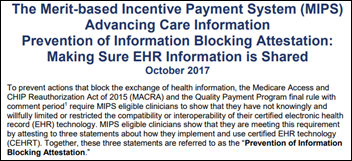
CMS clarifies the information blocking requirement of MIPS for providers. Eligible providers must attest that they:

  • Haven’t disabled the interoperability capabilities of their EHR.
  • Have implemented their EHR without taking any actions to limit interoperability.
  • Quickly respond to requests from patients and other providers who ask for information retrieval or exchange.

CMS advises that no documentation is required to be submitted as part of the attestation. It also notes that while attesting providers aren’t expected to understand or enable the technical side of interoperability, it’s their job to let their implementers and EHR vendors know that they will be attesting and hold them accountable for enabling that capability.


Reader Comments

image

From Good-Time Charlie: “Re: Practice Fusion. I didn’t remember until your poll that they were even still around.” They are, but seemingly barely, well out of contention as an ambulatory EHR disruptor despite having raised $200 million from investors under that premise. ONC places Practice Fusion as the #9 most commonly used ambulatory EHR based on attestation data, which isn’t so good given that their product is free (and the products that follow them on ONC’s list aren’t really major-name EHR vendors). The company seemed unstoppable when doctors flocked to its product to collect $44,000 in Meaningful Use money in return for spending nothing, but the company’s business model was questionable, they were selling practice data in less-than-transparent ways (such as not naming who was buying it and for what purpose), its self-reported usage figures were head-scratching at times, and there was always the question of just how deeply practices engaged with the product since they had no skin in the game (no hardware cost, contract, training cost, etc.) The company fired founder and CEO Ryan Howard in mid-2015 right before a planned IPO, promoted a replacement with skimpy credentials for taking a company public, and largely fell off everyone’s radar.

From Dinky McQueen: “Re: GE’s rumored discussion about selling its healthcare IT business. Is it everything from Centricity on down, or just smaller, unaligned divisions such as the GE-Intel Care Innovations JV?” I haven’t heard specifics but would be interested. The health IT business includes the many products labeled as Centricity, workforce management (the old API Healthcare), Health Cloud, diagnostic-related software, and some analytics stuff. It’s hard sometimes to figure out where healthcare IT begins given the overlap with the company’s diagnostic business, which I assume won’t be dealt off. GE has built a poorly managed, unfocused portfolio of acquisitions that will be hard to sell off to a single buyer, which will probably elongate any process to make its unlamented healthcare IT exit.

image

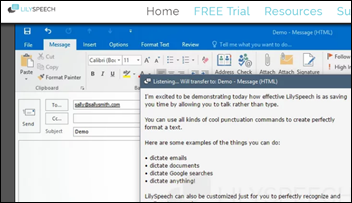
From Just Saying: “Re: speech recognition. You mentioned years ago using speech recognition to write HIStalk. Do you still do that?” I don’t. Three or so times I bought the latest version of Dragon and got excited about how much easier it was to “write” HIStalk by talking instead of typing, but the sheen wore off due to Dragon’s heavy system usage, occasional mysterious errors that lost what I had dictated, and the time required for me to fix its mistakes (nearly always caused by my not articulating crisply enough). I’m thinking about trying again with LilySpeech, a cloud-based system that uses Google’s speech-to-text system. I don’t need voice-controlled system automation – I just want to dictate into a text box and paste the result into my editor or Gmail. I’ll give the 30-day free trial a shot.


HIStalk Announcements and Requests

image

I enjoyed reading a recent interview with freshly named economics Nobel winner Richard Thaler and was therefore happy to see his “Misbehaving: The Making of Behavioral Economics” pop up as a free Prime Reading Kindle book this week. I was engrossed and entertained by it, to the point that I ordered a softcover version (at full price) just so keep it handy and to be able to lend it out. This book and his earlier “Nudge” explain why humans don’t always follow rational economic thought, which of course has healthcare implications along with big-time business impact. I highly recommended the first book and will no doubt do the same for the second once I’ve read it. He’s a great explainer and pretty funny besides.

The only iOS device I have left is my iPad Mini, but even that is now a little closer to Android – I replaced the default iOS mail app with Gmail and like it much better, especially for deleting endless streams of spam without having to swipe emails individually and trying to recall the difference between “archive” and “move to trash.”


Webinars

November 8 (Wednesday) 1:00 ET. “How Clinically Integrated Networks Can Overcome the Technical Challenges to Data-Sharing.” Sponsored by: Liaison Technologies. Presenters: Dominick Mack, MD, executive medical director, Georgia Health Information Technology Extension Center and Georgia Health Connect, director, National Center for Primary Care, and associate professor, Morehouse School of Medicine;  Gary Palgon, VP of  healthcare and life sciences solutions, Liaison Technologies. This webinar will describe how Georgia Heath Connect connects clinically integrated networks to hospitals and small and rural practices, helping providers in medically underserved communities meet MACRA requirements by providing technology, technology support, and education that accelerates regulatory compliance and improves outcomes.

November 15 (Wednesday) 1:00 ET. “How Hospitals and Practices Can Respond to Consumerism by Better Engaging Patients Through Price Transparency and Payment Options.” Sponsored by: Change Healthcare. Presenters: Kathy Moore, president, Moore Martini Medical; Linda Glidewell, VP of business development, consumer payment solutions, Change Healthcare. Healthcare consumerism and high-deductible health plans require providers to offer upfront estimates and payment options throughout all points of service. In his webinar, we’ll discuss consumerism as a critical area of opportunity in revenue cycle management and review numerous areas across the revenue cycle where your staff interacts with patients and leaves lasting impressions. From your first interaction with patients on the phone to discuss financial responsibility; to collecting payments at all points of service; to offering payment plans and various payment options — these are all areas that can be game-changing. With the right approach to consumerism, you can improve patient collections and optimize revenue from the start while also improving the overall patient experience.

Previous webinars are on our YouTube channel. Contact Lorre for information.


Acquisitions, Funding, Business, and Stock

image

Meditech announces Q3 results: revenue up 9.8 percent, EPS $0.47 vs. $0.68. Product revenue jumped 50 percent, but a slight drop in services revenue and an 18 percent increase in operating expense drove earnings down 31 percent.

image

Roper Techologies (Sunquest, Strata Decision Technology, Atlas Medical, Data Innovations, CliniSys) announces Q3 results: revenue up 23 percent, adjusted EPS $2.36 vs. $1.96, meeting revenue expectations and beating on earnings.

image

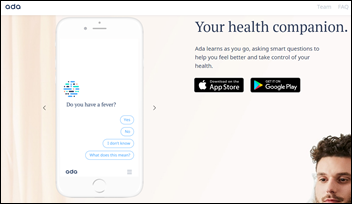
Germany-based Ada Health, which offers consumers an AI-powered health chat app that also connects users to doctors, raises $47 million and announces plans to open a US office.


Sales

image

Hospital for Special Surgery (NY) will expand its use of Docent Health to provide customized, whole-person support that addresses each patient’s needs, fears, and concerns.

image

Orlando Health chooses Phynd to manage the information of 25,000 providers across nine hospitals.


People

image

Geoff Hogan (Imprivata) joins Diameter Health as chief commercial officer.

image image

Impact Advisors promotes VPs Paula Elliott and Bill Faust to leadership roles over its quality services and strategic implementation services practices, respectively.


Announcements and Implementations

image

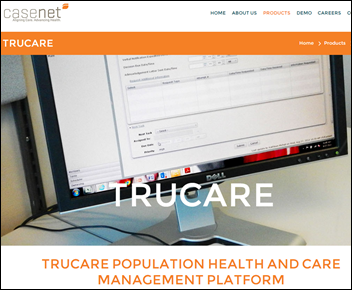
Casenet’s TruCare is named Best Population Health Management Software Provider in a UK healthcare and pharmaceutical awards program.

image

HIMSS announces that Alphabet Executive Chairman Eric Schmidt will deliver the opening keynote at HIMSS18 in the “still seems weird” time slot of Monday, March 5 at 5:00 p.m. PT. Schmidt provided the very long keynote at HIMSS08 in Orlando, where he pitched since-failed Google offerings like Health and Flu Trends. 


Government and Politics

image

Politico reports that HHS privacy leader Deven McGraw, JD has left government service to join an unnamed Silicon Valley health technology startup.

Publicly traded, Cincinnati-based Chemed, which owns the country’s largest for-profit hospice chain, will pay $75 million to settle False Claims Act charges that it billed Medicare for services involving patients who were not terminally ill and paid its employees bonuses for recruiting new patients. Three whistleblowers will share in the payout. Trivia: Chemed’s other big holding is Roto-Rooter. 


Other

Vanderbilt University Medical Center (TN) will go live on Epic this week.

image

The April 1 Cerner go-live at Medical Center Health System (TX) led to billing delays that left it behind for the fiscal year ending September 30. A consultant’s report says that hospital executives blamed staff for lack of commitment and not paying attention during training, but most employees said that training was insufficient for doing their jobs. 

image

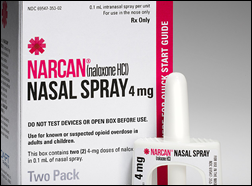
A study finds that 10 percent of Massachusetts residents who were revived from opioid overdoses with rescue drug Narcan died within a year, highlighting that only five percent of overdose survivors receive longer-term treatment drugs such as Suboxone.

Brilliant: a company in Japan gives non-smokers an extra six days of vacation, both as an incentive for smokers to quit and to give non-smokers the same amount of non-productive time enjoyed by smokers.

SNAGHTML64f3311d

Weird News Andy helpfully notes that maybe the patient should have considered flossing. Doctors examining a woman with a decades-long history of nosebleeds believed to be caused by rhinitis finally determine the cause – a fully grown tooth embedded in her nasal cavity. Dentists say “supernumerary teeth” can grow in odd spots on the face in the 4 percent of people affected, but having them erupt in the nasal cavity is extremely rare. 


Sponsor Updates

  • Meditech, which has 20 customer sites in Puerto Rico, donates money to United for Puerto Rico.
  • AdvancedMD will exhibit at APTA’s Private Practice Section event November 1-4 in Chicago.
  • HIS 2017 recognizes Agfa Healthcare in the IT Industry category – RIS and PACs during its annual awards ceremony.
  • AssessURHealth publishes a new white paper, “The Missing Piece: Holistic Care through Preventive Screenings.”
  • Bernoulli Health will exhibit at HealthAchieve November 6-7 in Toronto.
  • Besler Consulting will present at the Minnesota HFMA Regulatory Conference November 2 in Bloomington.
  • CSI Healthcare IT completes the first wave of Epic go-lives at Lovelace Health System (NM).
  • Clinical Architecture will exhibit at the AMIA 2017 Annual Symposium November 4-8 in Washington, DC.
  • CoverMyMeds, CTG, and Cumberland Consulting Group will exhibit at the CHIME Fall CIO Forum October 31-November 2.

Blog Posts


Contacts

Mr. H, Lorre, Jenn, Dr. Jayne, Lt. Dan.
Get HIStalk updates. Send news or rumors.

Contact us.

125x125_2nd_Circle

Curbside Consult with Dr. Jayne 10/30/17

October 30, 2017 Dr. Jayne 1 Comment

clip_image002

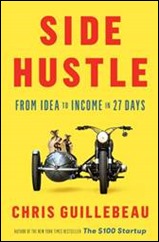
When I first started consulting, I did it as a bit of a “side hustle” on top of my CMIO day job. My initial focus was helping small practices with system selection, since this was in the early days of EHR adoption and many didn’t have the resources, time, or understanding to know where to begin with the process. It was as much about providing a service to my peers and keeping them from being led astray by vendors who would promise them the moon but who were only able to deliver them a lump of gray dust.

I had a fair amount of experience in this area, having been through a process with my first EHR which barely worked and where every question I asked was treated as an “enhancement request.” Of course, I also had some pretty hefty student loans to pay off and wanted to make a larger dent in them than I was able to do with my salary, so I can’t say my motivation was entirely altruistic.

As Meaningful Use launched and the market exploded, my side hustle grew and I learned more about what made different kinds of practices tick, long with a great deal about what turned that ticking into a time bomb. I started to run into work where I would need to help recover what was often billed as a poor EHR installation but turned out to be organizational dysfunction, and started focusing my available continuing education time on change leadership and related disciplines. I moved into optimization work, and as most of you know, was able to eventually quit my day job and go into business for myself.

I’m seeing history repeat itself, though, as the number of requests for assistance with system selection is increasing. Of course, this time around they’re largely system replacements rather than new installations, but the themes I’m seeing are the same.

Even though some practices are reluctant to move forward based on uncertainty around CMS reporting requirements in the coming years, others see the relative relaxation in requirements as a reason to move ahead with a new EHR system for 2018. Although the industry is seeing migration of smaller practices onto hospitals’ community platforms, we’re seeing a good number of groups that want to remain independent but don’t think their current vendor is doing right by them. The largest uptick in interest that I’ve seen is in specialty practices who want to move off of a broader EHR platform onto something that is more specialty specific, which poses its own challenges since the market has been consolidating and quite a few niche vendors have either left the market or have decided not to pursue full certification.

This has been educational as clients bring some vendors forward that I haven’t heard of before let alone interacted with, so there is a general feeling of déjà vu. It’s been a nice challenge to research the different vendor candidates and get to know their products and review the information they provide to sort the wheat from the chaff. This time around there are many more vendors who are willing to give clients short-term access to web-based products so they can kick the tires themselves rather than relying on sales demonstrations or just talk. I’m seeing more willingness for vendors to provide complimentary analysis of financial and claims data and offer recommendations on how to optimize the revenue cycle in preparation for a turnover. Some are offering packages to help work down the accounts receivable in the legacy system as a part of their quote for a new system. I’m also seeing willingness to deliver clinical optimization services as part of the sales process, making sure the prospective clients have the best chance at a successful migration.

None of this comes cheap, though, so vendors are really putting it on the line this time around. Maybe I’m seeing some over-confidence or maybe they have just learned from experience that successful EHR adoption is more than implementation of a system and automation or revision of processes. They want to fully understand where their potential clients are coming from so they don’t get burned by unhappiness after a less-than-successful implementation or wind up with a client who leaves them in five years or so.

In some ways, this is wise, but I’ve seen it play out in different ways with clients depending on what is found in those complimentary analyses. Some shoppers may see it as a chance to work with a knowledgeable vendor who has a vested interest in their future success. Others, however, are seeing it as a chance to go back for a do-over with this current vendor, often asking for complimentary services similar to or in addition to what they have already received from a potential replacement vendor.

This is causing significant stress for vendors at risk for replacement, who are being asked to spend what can be a relatively large amount of resources to retain their clients. For those who aren’t good at managing these expectations, it can accelerate a client’s departure.

I ran into a conflict of interest situation recently, where I was working with a client on a system selection. They wanted to leave a vendor for whom I have previously done some contract consulting, so I was familiar with how the vendor operates. Knowing the strength of the system and the way the client was struggling alerted me to the fact that the client had some non-software operational issues that needed resolution. I pointed this out to the client, but they wanted to proceed anyway and engaged me to attend demos with them and provide objective analysis. One of their prospective vendors also provided some complimentary services, so they decided to ask their current vendor for the same services.

Not knowing the client was working with me on a replacement evaluation, their current vendor reached out to me to try to salvage them. I would have loved to have switched hats and transfer my efforts to fixing the client on their current system since I had pointed out the client-side issues to my client in the first place, but contractual obligations tend to get in the way in situations like this. The client may decide to stop their replacement evaluation and switch gears to a remediation project, in which case I’m going to probably be out of the picture because the client isn’t going to pay me to do what the vendor is offering for free and I’m not comfortable working with the vendor on this particular client since I have specific knowledge of the recommendations of their competitors. I’m fine with it either way. I just want the client to receive what they need to get things moving in the right direction in the most financially responsible way.

I’m afraid this type of engagement may become the new normal as the forces of market consolidation continue to work and as clients become more concerned about the future. It’s often tempting to spend resources on buying a new system rather than spending to fix what you have. Although some might think of the latter as throwing good money after bad, often it’s a more responsible choice if the underlying system is a solid one. We’ve all seen people who spend $40K on a new car because they don’t want the hassle of spending $700 a couple of times a year on an old one, even though $1,400 per year is a lot cheaper than $8,000 a year in car payments plus higher insurance. From an economics perspective, this may not be much different, but the psychology around it is much more challenging. It certainly brings up issues that are challenging and that I’m looking forward to helping clients address.

Are you seeing movement with system replacements? Email me.

Email Dr. Jayne.

Monday Morning Update 10/30/17

October 28, 2017 News 4 Comments

Top News

image

From the Cerner earnings call following announcement of Q3 results that fell short of expectations for both revenue and earnings:

  • The company blames its bookings shortfall on “several large deals that were forecast for the quarter that did not come through,” with ITWorks complete outsourcing providing deals being a big contributor to the shortfall.
  • Cerner notes that the lack of Meaningful Use-driven customer urgency is making it harder to create reliable sales forecasts.
  • The company says it is seeing success against Epic as customers focus on return on investment and notes that new hospital EHR entrants “have over-promised and under-delivered.”
  • The company expects to sign its contract with the VA by the end of the year, in which Cerner will function as the prime contractor with subcontractor partners to be announced later.
  • President Zane Burke expects that the VA contract terms will involve a series of task orders that will provide percentage-of-completion payments over several years.

Cerner shares dropped 8.43 percent Friday after the earnings report.

image

Above is the five-year share price of CERN (dark blue, up 68 percent) vs. the Nasdaq (light blue, up 125 percent).


Reader Comments

image

From Snowman: “Re: Citrix. Hearing 40 percent increases in maintenance fees when renewing. That’s another $300,000 per year for our medium-sized facility. Does that make them a monopoly?” Unverified. Anyone else seeing big maintenance jumps? Citrix isn’t exactly a monopoly since alternative virtual desktops exist, but its product is deeply embedded into the infrastructure and software vendor contracts of most hospital IT shops. I would be interested to hear from hospital CIOs who switched successfully from Citrix to something else for their core healthcare-specific apps and whether they experienced support issues.

image

From IT Maven: “Re: University of Washington. UW Medicine has had three chief health system officers in less than a year. Does this have anything to do with their decision no to go with Epic?” I doubt Epic was a key consideration for an executive of that level. The new CHSO’s predecessor lasted less than a year before stepping down in a mutual decision, replaced by an interim that I assume the reader is counting as the third person to hold the job since November 2016.

image

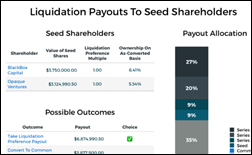
From Master of Startup Puppets: “Re: Crunchbase series. I think HIStalk readers would enjoy it.” The series called “A Startup Takes Flight” is an interesting fictional case study that covers early-stage funding, venture capital deal terms, and what happens when a startup sells.

From Not A Client: “Re: Medi-Span data. Has been removed from RxNorm at the request of Wolters Kluwer. Not sure if this is newsworthy since I’ve seen nothing outside the NLM site.” The October 2 RxNorm release notes verify that Medi-Span data was removed from RxNorm at the company’s request. NLM has just announced that the September 2017 RxNorm release expanded the Medi-Span data set.

From The PACS Designer: “Re: LiFi Mobile. LEDs can act as transmitters of signal in wireless systems. LiFi is high speed, bi-directional networked and mobile communication of data using light. LiFi comprises of multiple light bulbs that form a wireless network, offering a substantially similar user experience to Wi-Fi except using the light spectrum.” It sounds interesting, but line-of-sight requirements, as well as possible interference from ambient light, would seem to limit usefulness.


HIStalk Announcements and Requests

image

Poll respondents are mostly skeptical that IBM Watson will make a healthcare splash.

New poll to your right or here: which ambulatory EHR vendor has fallen hardest from HIT front-runner status? I recognize that Allscripts and GE Healthcare aren’t just ambulatory EHR vendors, but their presence there earns them a poll spot.

For those with short memories or short healthcare IT careers, it’s time to relearn the oft-repeated lesson that big companies dip their toes into and out of the healthcare IT waters all the time with little loyalty to anyone except shareholders. McKesson bailed out this year and now GE  is apparently mulling its exit after wrecking a slew of acquisitions over many years. Siemens is long gone. Nothing good ever comes from conglomerates licking their chops at what they naively think is easy money and higher growth than their other verticals (see also: Misys and Sage). How hard could this healthcare thing be?


This Week in Health IT History

One year ago:

  • A poor McKesson earnings report sends shares down 23 percent, while competitors Allscripts and Cerner also post lackluster earnings.
  • A Politico article says that Epic and EClinicalWorks are impeding data-sharing with public and specialty registries.
  • CMS approves continuous 90-day reporting period for its EHR Incentive Program and eliminates specific objectives and measures.

Five years ago:

  • McKesson talks up its MedVentive and MED3OOO acquisitions in its earnings call, hints that the company might work with Athenahealth following its acquisition of PSS World Medical, and admits that some Horizon customers are passing on the chance to migrate to Paragon.
  • A Wells Fargo Securities analysis finds that the lowest-percentage hospital EHR attestation vendors are GE Healthcare, QuadraMed, NextGen, and McKesson.
  • CHIME President and CEO Rich Correll announces plans to move to a COO role.
  • SCI Solutions founder John Holton retires from the company.
  • Humana acquires Certify Data Systems.

Ten years ago:

  • CSC acquires First Consulting Group.
  • Perot Systems conducts massive layoffs.
  • ZDNet declares MIsys to be an open source health IT competitor to Medsphere.
  • ONC funds a significant grant to have definitions developed for the terms EHR, EMR, PHR, HIE, and RHIO.
  • Virtua Healthcare (NJ) says its $500 million, 368-bed new medical campus will use technology to transform healthcare.
  • Philips announces plans to sell its 70 percent stake in MedQuist. 

Last Week’s Most Interesting News

  • Cerner falls short of Wall Street expectations for both revenue and earnings in its quarterly report, sending shares down hard.
  • CVS is rumored to be in talks to acquire Aetna.
  • GE explores selling its healthcare IT business.
  • A second former executive of Cleveland Clinic Innovations is arrested for fraud involving spinoff Interactive Visual Health Records.

Webinars

November 8 (Wednesday) 1:00 ET. “How Clinically Integrated Networks Can Overcome the Technical Challenges to Data-Sharing.” Sponsored by: Liaison Technologies. Presenters: Dominick Mack, MD, executive medical director, Georgia Health Information Technology Extension Center and Georgia Health Connect, director, National Center for Primary Care, and associate professor, Morehouse School of Medicine;  Gary Palgon, VP of  healthcare and life sciences solutions, Liaison Technologies. This webinar will describe how Georgia Heath Connect connects clinically integrated networks to hospitals and small and rural practices, helping providers in medically underserved communities meet MACRA requirements by providing technology, technology support, and education that accelerates regulatory compliance and improves outcomes.

Previous webinars are on our YouTube channel. Contact Lorre for information.


Acquisitions, Funding, Business, and Stock

image

Quality Systems (NextGen) announces Q2 results: revenue up 4 percent, adjusted EPS $0.22 vs. $0.23, beating analyst expectations for both. From the earnings call:

  • The company says it was hit by turnover in its sales team as “a number of legacy sales resources and managers elected to move on,” with the resulting loss of client relationships hurting the close rate for larger deals. The company confirmed that 13 of 70 salespeople have left and have been replaced.
  • The company is still trying to salvage one unnamed large client that has threatened to defect.
  • NextGen is emulating Athenahealth in offering pricing based on a percentage of net collections.

image

Above is the five-year share price of QSII (dark blue, down 19 percent) vs. the Nasdaq (light blue, up 125 percent).

image

Tenet Health will lay off 1,300 employees.

image

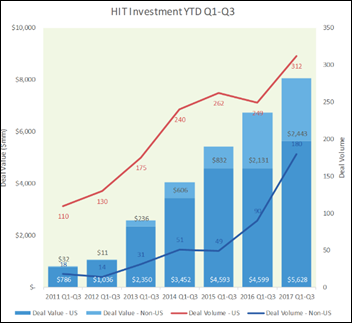
A Healthcare Growth Partners report finds that health IT investment is continuing at a record pace even as M&A activity has stagnated. The quarter’s big M&A deals were the merger of Navicure and ZirMed, the sale of The Advisory Board Company’s healthcare business to Optum Health, and the sale of WebMD. The big investment theme was genomic medicine. The article notes that the industry must be assuming that total addressable market and M&A activity will increase to absorb the 46 percent annual growth rate in investment that has occurred since 2011.


Sales

Everest Rehabilitation Hospitals (TX) chooses Medhost for two hospitals to be constructed.


People

image

Aviacode CEO Keith Hagen takes on the additional role of board chair.


Announcements and Implementations

image

Medecision launches 10 care management apps for care, utilization, and disease management; network management; and care coordination.

image

T-System says 70 percent of its new contracts involve its hosted solutions for episode-based care, which includes hospital EDs, freestanding EDs, and urgent care centers.

image

Definitive Healthcare adds retail health clinics and assisted living facilities to its healthcare provider database.

image

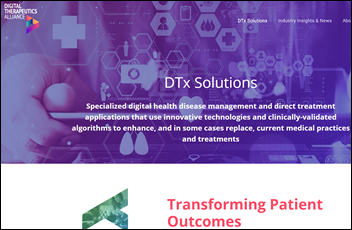
Akili Interactive, Propeller Health, Voluntis, and WellDoc launch the Digital Therapeutics Alliance to support clinically validated solutions.  


Privacy and Security

image

Drug maker Merck says it lost $135 million in Q3 sales and spent $175 million in direct cost due to its Petya ransomware attack in June. The company said in the earnings call that its Q4 results will be similarly impacted, raising the cost of its ransomware attack to at least $620 million.


Other

image

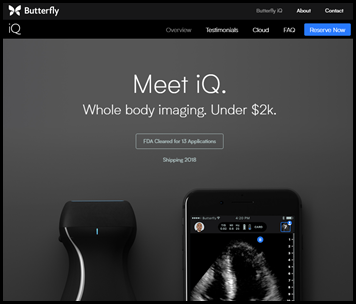
A vascular surgeon testing the FDA-cleared Butterfly IQ ultrasound device for smartphones decides to scan his sore throat, the result of which reveals that he has a since-treated cancerous mass.

image

Microsoft ends production of its Kinect 3-D mapping and body movement sensor that in addition to is main purpose as an Xbox game controller was used in some healthcare applications, such as those for physical therapy, rehab, and health screening. Part of Kinect’s technology has been rolled into Microsoft’s Hololens.

image

Medical device executive David Mortara, PhD donates $25 million to the UCSF School of Nursing to fund a center that will study alarm fatigue and overly sensitive ECG machines that contribute to it. Mortara sold his diagnostic cardiology and patient monitoring device company to Hill-Rom for $330 million in cash in January 2017.

image

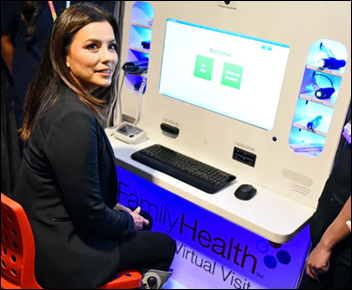
Actress and investor Eva Longoria helps introduce a virtual visit kiosk that will be offered to residents of an affordable workforce housing community in Texas.

image

An interesting article looks at the big business of scrubs, worn every day by the nearly one in five Americans employed in healthcare who generate $10 billion in annual sales, mostly to wearers who buy their own. The latest innovation beyond adding licensed cartoon characters and form-flattering designs: scrubs impregnated with antimicrobials to help reduce the spread of infection.

In Scotland, the Royal Pharmaceutical Society says community pharmacists don’t have access to the electronic medical records of patients as they were promised, requiring them to call an NHS hotline to obtain the information they need.

Thomas Health (WV) lays off 10 IT employees following consolidation of systems it didn’t name. The hospital announced plans last year to move from Cerner/Siemens Soarian and Meditech Magic to Meditech 6.1.

image

Weird News Andy is weirded out by this story covering the largely unregulated “tissue banks” that offer free cremation – sometimes in cahoots with funeral homes who invest in the companies — in return for donating organs to “advance medical studies.” It calls out Southern Nevada Donor Services, whose employee was caught using a garden hose in the parking lot of its warehouse to thaw a human torso, sending tissue and blood into a gutter. Most of the known “body brokers” are for-profit companies, one of which earned $12.5 million in three years. The companies were launched for as little as the $100,000 needed to buy a van and freezers, with some of the more frugal ones using a chainsaw instead of the much more expensive surgical saw to disassemble their donors into marketable components.

Vince takes us back to November 1987, when pre-adult Tiffany (who is now 46 years old) ruled the pop charts with “I Think We’re Alone Now” and a surprising health IT vendor’s ad bragged on being backed by a $5 billion company (which, like most big companies dabbling in healthcare, didn’t stick around long).


Sponsor Updates

  • Forward Health Group founder and CEO Michael Barbouche is named to Madison Magazine’s M List of health innovation leaders and will speak at a reception and dinner on November 9.
  • ZappRx will attend the CHEST conference October 28 – November 1 in Toronto and the North American Cystic Fibrosis Conference November 2-4 in Indianapolis. The company will also exhibit at the PFF Summit November 9-11 in Nashville.
  • Aprima will exhibit at the American College of Phlebology’s 2017 Annual Congress November 2-5 in Austin, TX.
  • Surescripts will exhibit at the Digital Quality Summit November 1-3 in Washington, DC.
  • T-System sees swelling demand for its hosted healthcare solutions.
  • TriNetX will exhibit at the AMIA Annual Symposium November 4-8 in Washington, DC.
  • Mazars USA elects Cody Cass, Julie Petit, and Kristen Walters partners.
  • The Boston Globe features ZappRx CEO Zoe Barry in a profile on women in technology.

Blog Posts


Contacts

Mr. H, Lorre, Jenn, Dr. Jayne, Lt. Dan.
Get HIStalk updates. Send news or rumors.

Contact us.

125x125_2nd_Circle

Monday Morning Update 10/23/17

October 21, 2017 News 9 Comments

Top News

SNAGHTML313a88f6

Athenahealth shares jumped over 8 percent Friday following Thursday’s announcement of mixed financial results, layoffs, office closures, and a cost reduction plan.

image

From Friday’s Athenahealth earnings call:

  • Jonathan Bush says that the company’s slowing growth rate is due to “lackluster market conditions in the post-Meaningful Use era” as overall buying activity has dropped off. It hopes to generate 15 percent revenue growth for 2018.
  • The company blames its revenue expectations miss on having one fewer working day in Q3 as well as hurricane-related usage decreases. It also notes that visits per provider are dropping.
  • Workforce reductions of 9 percent of the company’s total headcount will be completed by the end of 2017, with the goal of removing management layers and increasing employee engagement. The company “right-sized” sales and marketing and “rationalized” general and administrative support.
  • Bush says “We’re sharpening our focus, taking action to operate in a significantly more efficient way, and move faster on our highest-value strategic objectives.”
  • The company will close its San Francisco and Princeton, NJ offices, rent out office space freed up by the layoffs, and sell its Challenger 300 jet.
  • The company is still recruiting an independent board chair, CFO, and president.
  • Athenahealth has 56 small hospitals live and has retained 95 percent of the hospitals brought live on AthenaNet since entering the market three years ago.
  • Bush credits the pressure brought by an activist investor for causing the management team to “look at the company through different eyes” and for “helping us find our way.”
  • Population health and Epocrates are not keeping up with the core business growth.
  • The company expects to connect with 100 percent of Epic’s installed based and 45 percent of Cerner’s this year.
  • Bush said hospitals say, “I hope somebody buys Epic or whatever it is after me so I don’t have to be the last guy who went and put half a billion dollars into enterprise software in 2017.”

HIStalk Announcements and Requests

image

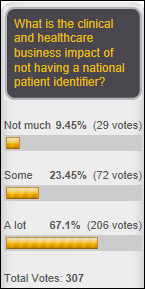
Two-thirds of poll respondents say not having a national patient identifier is a pretty big problem.

New poll to your right or here: How much impact will IBM Watson have on healthcare?

image image

Ms. B reports that her North Carolina middle schoolers “couldn’t keep their hands off” the science activity tubs we provided in funding her DonorsChoose teacher grant request.


This Week in Health IT History

One year ago:

  • McKesson says it will take a $290 million write-down of its Enterprise Information Systems business as it continues to seek a buyer for the division that includes Paragon.
  • Vocera acquires Extension Healthcare.
  • Jonathan Bush admits in the Athenahealth earnings call that followed a revenue miss that shifts in the market mean the company cannot maintain 30 percent bookings growth.

Five years ago:

  • An OIG report finds that the VA paid $6 million for 400,000 PC encryption licenses but has installed them on only 65,000 devices.
  • Apple announces the iPad Mini.
  • Allscripts sues Aprima for using the MyWay name in advertising aimed at getting those customers to switch to Aprima.
  • Athenahealth confirms that is negotiating with Harvard University to purchase the 11-building Arsenal on the Charles complex in Watertown, MA.

Ten years ago:

  • Misys creates an open source division to which it contributes its Connect software.
  • Misys announces MyWay, a hosted EHR it licensed from iMedica.
  • Medsphere CEO Mike Doyle predicts that the company will be the largest healthcare IT vendor.
  • Microsoft and HIMSS announce an overseas expansion of the MS-HUG conference.

Last Week’s Most Interesting News

  • Athenahealth announces big layoffs and planned expense reductions in response to pressure from an activist investor.
  • CVS and Epic will implement Epic’s Healthy Planet software to give prescribers point-of-care formulary and pricing information.
  • President Trump signs two executive orders to further destabilize the ACA, declaring that Obamacare no longer exists.
  • A state audit finds that University of Utah violated state procurement laws in its dealings with Patrick Soon-Shiong’s Nant companies.

Webinars

October 24 (Tuesday) 1:00 ET. “Improve Care and Save Clinician Time by Streamlining Specialty Drug Prescribing.” Sponsored by: ZappRx. Presenter: Jeremy Feldman, MD, director, pulmonary hypertension and advanced lung disease program and medical director of research, Arizona Pulmonary Specialists. Clinicians spend an average of 20 minutes to prescribe a single specialty drug and untold extra hours each month completing prior authorization (PA) paperwork to get patients the medications they need. This webinar will describe how Arizona Pulmonary Specialists automated the inefficient specialty drug ordering process to improve patient care while saving its clinicians time.

October 25 (Wednesday) 1:00 ET. “Delivering the Healthcare Pricing Transparency that Consumers are Demanding.” Sponsored by: Health Catalyst. Presenter: Gene Thompson, director, Health City Cayman Islands. Health systems are unlike every other major consumer category in not providing upfront pricing information. Learn how one health system has developed predictable, transparent bundled pricing for most major specialties. Attendees will gain insight into the importance of their quality measures and their use of actual daily procedure costing rather than allocated costs. They will also learn about the strategic risk of other market participants competing with single bundled pricing. The organization’s director will expand how its years-long process is enabling healthcare delivery reform.

October 26 (Thursday) 2:00 ET. “Is your EHR limiting your success in value-based care?” Sponsored by: Philips Wellcentive. Presenters: Lindsey Bates, market director of compliance, Philips Wellcentive; Greg Fulton, industry and public policy lead, Philips Wellcentive. No single technology solution will solve every problem, so ensuring you select the ones most aligned to meet your strategic goals can be the difference between thriving or merely surviving. From quality reporting to analytics to measures building, developing a comprehensive healthcare strategy that will support your journey in population health and value-base care programs is the foundation of success. Join Philips Wellcentive for our upcoming interactive webinar, where we’ll help you evolve ahead of the industry, setting the right strategic goals and getting the most out of your technology solutions.

November 8 (Wednesday) 1:00 ET. “How Clinically Integrated Networks Can Overcome the Technical Challenges to Data-Sharing.” Sponsored by: Liaison Technologies. Presenters: Dominick Mack, MD, executive medical director, Georgia Health Information Technology Extension Center and Georgia Health Connect, director, National Center for Primary Care, and associate professor, Morehouse School of Medicine;  Gary Palgon, VP of  healthcare and life sciences solutions, Liaison Technologies. This webinar will describe how Georgia Heath Connect connects clinically integrated networks to hospitals and small and rural practices, helping providers in medically underserved communities meet MACRA requirements by providing technology, technology support, and education that accelerates regulatory compliance and improves outcomes.

Previous webinars are on our YouTube channel. Contact Lorre for information.


Acquisitions, Funding, Business, and Stock

image

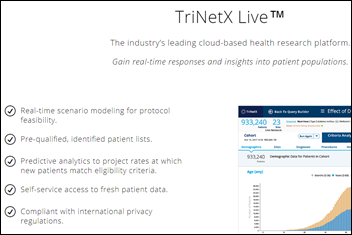
Global health research network operator TriNetX will expand its Cambridge, MA office space as its headcount has expanded from 20 to 75. The new 20,000 square foot space will also include a network operations center.

Harris Healthcare acquires practice management software vendor Clinix Medical Information Systems.


Sales

image

Population health management services provider HMC HealthWorks will implement Medecision Aerial applications that include analytics, financial performance dashboards, care management, evidence-based clinical programs, and personal health record.

SNAGHTML3142d867

In Dubai, UAE, Latifa Hospital for Women and Children chooses Vocera’s intelligent communication technology.


Decisions

  • Fort Madison Community Hospital (IA) will replace Greenway’s ambulatory EHR with Meditech in 2018.
  • Women’s Healthcare Associates (OR) will switch from GE Healthcare to Epic’s ambulatory EHR in May 2018.
  • Palmetto Health (SC) will replace McKesson Star with Cerner revenue cycle management in October 2018.

These provider-reported updates are supplied by Definitive Healthcare, which offers a free trial of its powerful intelligence on hospitals, physicians, and healthcare providers.


Announcements and Implementations

ZeOmega launches a Jiva certification program for third-party consultants


Government and Politics

image image

Wisam Rizk, former CTO of Cleveland Clinic Innovations spinoff Interactive Visual Health Records, is arrested for defrauding the clinic of $2.8 million. The charges came nine days after former Cleveland Clinic Innovations Executive Director Gary Fingerhut pleaded guilty and agreed to serve federal prison time for accepting $469,000 from Rizk in return for lying to the FBI during their fraud investigation. Prosecutors say Rizk created a shell company that he hired to develop IVHR’s medical charting product at an inflated price, then contracted with an offshore company to do the actual work and pocketed the difference.


Privacy and Security

image

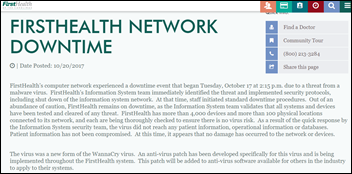
Computer systems of FirstHealth of the Carolinas (NC) have been offline for several days following a ransomware attack that it attributes to “a new form of the WannaCry virus.”

image

An interesting research project finds that anyone willing to pay $1,000 for online ads can track a mobile phone user’s movements, their precise location in near real time, and the apps they use, as long as they can obtain that person’s mobile advertising ID by examining their phone or eavesdropping on their wireless connection. The target doesn’t even need to click the ads – just having the ads displayed on their device records the information. Advertisers are already receiving this information, of course.


Other

image

Anesthesiologist and Georgia state representative Betty Price, MD – who is married to fired HHS Secretary Tom Price – asks a state public health official in a public meeting if it would be legal to prevent the spread of HIV by quarantining people who have it. She flaunts clinical expertise in noting that dead HIV sufferers can’t spread it: “It’s almost frightening the number of people who are living that are … carriers with the potential to spread. Whereas in the past, they died more readily, and then at that point, they’re not posing a risk. So we’ve got a huge population posing a risk if they’re not in treatment.”


Sponsor Updates

  • Liaison Technologies makes its Alloy platform available in Europe.
  • MedData will exhibit at the Ohio AAP 2017 Annual Meeting October 27 in Columbus.
  • Colquitt Regional recognizes the benefits of Meditech’s EHR in a new video.
  • Navicure and Surescripts will exhibit at the Centricity Healthcare User Group Fall 2017 October 26-28 in New Orleans.
  • Madison Magazine recognizes Nordic President of Managed Services Vivek Swaminathan as an innovative leader.
  • Experian Health will exhibit at the HFMA First Illinois Fall Summit October 24-25 in Oakbrook Terrace.
  • Patientco CEO Bird Blitch aims to make the company a “Best Place to Work in Atlanta.”
  • T-System will exhibit at the 2017 Urgent Care Fall Conference October 26-28 in Anaheim, CA.
  • ZirMed will exhibit at the 2017 MedTrade Fall Conference October 23-26 in Atlanta.

Blog Posts


Contacts

Mr. H, Lorre, Jenn, Dr. Jayne, Lt. Dan.
Get HIStalk updates. Send news or rumors.

Contact us.

125x125_2nd_Circle

News 10/20/17

October 19, 2017 News 2 Comments

Top News

SNAGHTML2893c430

Athenahealth announces Q3 results: revenue up 10 percent, adjusted EPS $0.56 vs. $0.60, beating earnings expectations but falling short on revenue.

The company announced that it will lay off 9 percent of its workforce in cutting a reported 450 jobs. Boston newspapers cited sources who said they saw security officers escorting people out of the company’s Watertown, MA offices Thursday morning.

Athenahealth is undertaking a strategic review, pressured by an activist investor, expecting to generate up to $115 million of annual pre-tax savings by the end of 2018.

As part of the cost-cutting program, Athenahealth will close its offices in San Francisco, CA and Princeton, NJ, both of which house employees of Epocrates, the drug information app company that Athenahealth acquired for $293 million in January 2013.

Anonymous people posted on an Internet layoff discussion board that the company is selling its jet as well as the 387-acre Point Lookout resort in Maine that it bought for $7.7 million in 2011 as a training and entertainment venue.

ATHN shares dropped 4 percent during Thursday’s trading and were down another 4 percent in early after-hours trading.


HIStalk Announcements and Requests

SNAGHTML28e5f10d

image

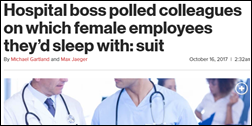
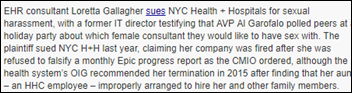
NYC Health + Hospitals took exception to my mentioning a recent article in the New York Post headline above, with its complaints below. I’m sympathetic since I don’t usually run one-sided lawsuit recaps, especially of the “he said, said” variety, but several readers had sent this link over with obvious interest and I saw it popping up in a lot of places, so I simply recapped the Post story.

  • “The lawsuit had nothing to do with sexual harassment.” That’s true and I’ve corrected my wording. I said in considerable detail that the lawsuit was related to wrongful termination, but I worded the part poorly where I referred to sexual harassment – the Post article focused on that, but the lawsuit itself didn’t.
  • “The former IT director was never deposed.” The Post story said he was and quoted what it said was his sworn testimony directly, so I had no reason to doubt that.
  • “The actual lawsuit alleging wrongful contract termination was dismissed.” That wasn’t mentioned in the Post article, which references an “ongoing gender discrimination case” that doesn’t make it clear whether she filed one lawsuit or two. I don’t have access to court records unless I can turn something up by Google searching for something that isn’t behind a paywall, which I didn’t in this case. I did turn up the OIG report item not mentioned in the Post article that was mostly favorable to the health system and summarized that, which the Post article did not.
  • “You make it appear as though it is your original reporting, which would be WRONG, WRONG, WRONG.” I linked to the Post article like I do all news item I cite, so I can’t imagine anyone thinking I was writing from a New York courtroom instead of my stereotypical blogger’s spare bedroom.

Listening: The Tragically Hip, thoughtfully rocking with an intact lineup as the pride of Canada since 1994 until this week, when front man Gord Downie died of brain cancer at 53. Reaction to his death has overtaken the Toronto newspaper, but an article written last year about what turned out to be the band’s final tour is the most poignant. Prime Minister Justin Trudeau delivered a tear-filled tribute to Downie, declaring, “We are less as a country without Gord Downie.”

Amazon’s continuous rollout of features amazes me. Last night I received a text message indicating that my package had been delivered, complete with a driver-taken photo of the item sitting on my doorstep. I’m not sure why I need it other than that it answers the question of whether the delivery went to the mailbox or to the doormat, but it’s cool.

This week on HIStalk Practice: EHR-related medical malpractice claims continue to increase. PatientPop ramps up Google-related physician marketing capabilities. Health Affairs offers context around OIG’s ACO analysis. Pine Rest Christian Mental Health Services goes with Epic. Walgreens brings 300 jobs to staff its new technology center of excellence. Medsphere acquires Stockell Healthcare Systems. Texas Medical Association begins doling out disaster relief funds to wiped-out practices. PRM Pro Jim Higgins offers practical solutions for physician tech-integration challenges.




Webinars

October 24 (Tuesday) 1:00 ET. “Improve Care and Save Clinician Time by Streamlining Specialty Drug Prescribing.” Sponsored by: ZappRx. Presenter: Jeremy Feldman, MD, director, pulmonary hypertension and advanced lung disease program and medical director of research, Arizona Pulmonary Specialists. Clinicians spend an average of 20 minutes to prescribe a single specialty drug and untold extra hours each month completing prior authorization (PA) paperwork to get patients the medications they need. This webinar will describe how Arizona Pulmonary Specialists automated the inefficient specialty drug ordering process to improve patient care while saving its clinicians time.

October 25 (Wednesday) 1:00 ET. “Delivering the Healthcare Pricing Transparency that Consumers are Demanding.” Sponsored by: Health Catalyst. Presenter: Gene Thompson, director, Health City Cayman Islands. Health systems are unlike every other major consumer category in not providing upfront pricing information. Learn how one health system has developed predictable, transparent bundled pricing for most major specialties. Attendees will gain insight into the importance of their quality measures and their use of actual daily procedure costing rather than allocated costs. They will also learn about the strategic risk of other market participants competing with single bundled pricing. The organization’s director will expand how its years-long process is enabling healthcare delivery reform.

October 26 (Thursday) 2:00 ET. “Is your EHR limiting your success in value-based care?” Sponsored by: Philips Wellcentive. Presenters: Lindsey Bates, market director of compliance, Philips Wellcentive; Greg Fulton, industry and public policy lead, Philips Wellcentive. No single technology solution will solve every problem, so ensuring you select the ones most aligned to meet your strategic goals can be the difference between thriving or merely surviving. From quality reporting to analytics to measures building, developing a comprehensive healthcare strategy that will support your journey in population health and value-base care programs is the foundation of success. Join Philips Wellcentive for our upcoming interactive webinar, where we’ll help you evolve ahead of the industry, setting the right strategic goals and getting the most out of your technology solutions.

November 8 (Wednesday) 1:00 ET. “How Clinically Integrated Networks Can Overcome the Technical Challenges to Data-Sharing.” Sponsored by: Liaison Technologies. Presenters: Dominick Mack, MD, executive medical director, Georgia Health Information Technology Extension Center and Georgia Health Connect, director, National Center for Primary Care, and associate professor, Morehouse School of Medicine;  Gary Palgon, VP of  healthcare and life sciences solutions, Liaison Technologies. This webinar will describe how Georgia Heath Connect connects clinically integrated networks to hospitals and small and rural practices, helping providers in medically underserved communities meet MACRA requirements by providing technology, technology support, and education that accelerates regulatory compliance and improves outcomes.

Previous webinars are on our YouTube channel. Contact Lorre for information.


Acquisitions, Funding, Business, and Stock

image

Medsphere acquires its long-time revenue cycle implementation partner Stockell Health Systems, which will retain its name as a division of Medsphere.

image

Population health management system vendor BaseHealth receives an $8.5 million investment in a Series C funding round, increasing its total to $18 million. 

image

Medical image virtual reality software vendor EchoPixel raises $8.5 million in a Series A funding round, increasing its total to $14.5 million. I declared it the coolest product I saw (and played around with) at HIMSS16.


Sales

image

Community Health Network (IN) will implement Stanson Health’s clinical decision support and analytics.

image

Liberty Regional Medical Center (GA) and Veterans Memorial Hospital (IA) will replace an unnamed vendor (a reader with HIMSS Analytics access says it is Athenahealth) to return to the Evident Thrive EHR of CPSI. CPSI will also gain two McKesson/Allscripts Paragon customers as Thrive EHR users – Jenkins County Medical Center (GA) and Monroe Regional Hospital (MS).

image

Holy Name Medical Center (NJ) will use CareCloud’s EHR/PM in its 35 ambulatory medical practices. The hospital’s inpatient systems were mostly developed in-house, which is an outlier in this day and age.


People

image

Infor promotes Dann Lemerand to VP of strategy and product management of its CX Suite customer.

SNAGHTML27375759 

Kansas state representative Erin Davis joins Cerner as senior government strategist, raising questions about possible conflicts of interest that the company dismisses with the explanation that she will be involved with government sales only in the Northwest.

image

Secure health information exchange and claims attachment system vendor Vyne hires Robert Patrick (Carestream Dental) to the newly created position of president of its dental division. He will report to Lindy Benton, who remains president and CEO of Vyne.

image

John Mangano (Digitas Health) joins Healthgrades as SVP of business intelligence.


Announcements and Implementations

image

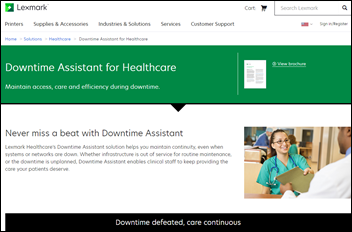
Lexmark announces GA of Downtime Assistant for Healthcare, which refreshes the hard drives of the company’s multi-function printers with EHR-generated reports, forms, and checklists that are needed for patient care when the EHR is down.

SNAGHTML274550cd

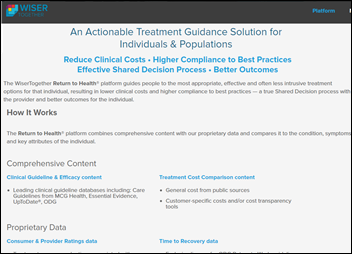
Treatment guidance solution vendor WiserTogether adds reporting and analytics to its Return to Health product, giving healthcare organizations insight into patient behavior that can be used to create pathways.

image

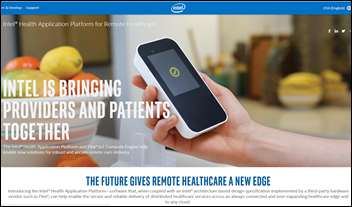
Intel launches its Health Application Platform platform that is integrated with a stable, secure Android edge device from Flex to connect consumer health monitoring devices to support remote care delivery.

Apple and GE release a software development kit for GE’s Predix Internet of Things platform that will allow developers to create industrial IoT apps for the iPhone and iPad. GE will also promote Macs for its 330,000-employee workforce, which would surely be the largest corporate deployment of Macs ever if they actually swap them all out.


Government and Politics

image

A state audit finds that University of Utah violated procurement laws in accepting a $12 million donation from Patrick Soon-Shiong that required the university to spend most of that money buying genetic sequencing tests from Soon-Shiong’s Nant companies. Auditors said the university let Soon-Shiong create specifications that assured a no-bid contract, also noting that competing companies could have provided the same genetic sequencing services for one-third the price.

image

The FBI arrests “Dr. Dave,” a Fort Worth personal trainer who registered as a CMS provider under 19 phony names in fraudulently billing $25 million to insurance companies. 


Privacy and Security

Iliuliuk Family and Health Services (AK) acknowledges that it was hit by ransomware that “temporarily blocked” access to its systems in August, but doesn’t say if it paid the demanded ransom.


Innovation and Research

JDRF announces an initiative to encourage innovation and family involvement in open-protocol artificial pancreas systems, where it will provide funding and regulatory advice to bring do-it-yourself and reverse engineered diabetes management technology projects to market.

Other

image

A JAMA editorial questions whether an oversupply of ICU beds has caused overutilization, noting that 1 percent of the entire United States gross domestic product is spent on ICU care, representing half of all US hospital expenses.

In England, a BBC review finds that the registered organ donor wishes of one-third of newly deceased people are not respected because of family objections. The law recognizes only the legal consent of the donor, but NHS says family objections – usually involving the time the process requires — are always upheld, denying hundreds of people the organ transplants they need. A 17-year-old registered donor says, “What’s the point of signing up if I could be overruled anyway?”

image

A Kaiser Health News report finds that 90 percent of Indiana’s nursing homes have been leased or sold to hospitals that are using a Medicaid loophole to earn a 30 percent higher payment, which in the case of leased facilities is shared with the city or county government owner. Advocates say that rural hospitals use the profit to remain solvent, while critics argue that hospital operators keep residents longer and the federal government is paying more for quality that hasn’t improved. Indiana Medicaid spends two-thirds of its long-term care budget on nursing homes vs. the US average of less than half, but as a state, Indiana is ranked among the worst for nursing home quality. A hospital CEO acknowledges that it makes money from putting more patients into its nursing homes, explaining, “Welcome to healthcare. It’s a complex and confusing environment where we have all different competing incentives.”

image

A local paper’s review of Vermont’s history as a health IT hub gives a nod to Rich Tarrant and Robert Hoehl’s Burlington Data Processing — later renamed to IDX Systems and then sold to GE Healthcare in 2006 for $1.2 billion – whose profits allowed some employees to fund new startups. Companies mentioned include Ona, ThinkMD, OhMD, Galen Healthcare Solutions, and Physician’s Computer Company.

This is hard to believe: an inmate with the porn-like name Dustin Lance sues the county jail for $5 million, claiming staff ignored his pleas for medical help after he swallowed a pill given to him by another inmate that caused him to have a painful erection that lasted 91 hours.


Sponsor Updates

  • Optimum Healthcare IT publishes an infographic titled “Rules of Thumb, Benefits, and Dangers of EHR Alerts.”
  • EClinicalWorks will exhibit at the 2017 TAHP Managed Care Conference & Trade Show October 23-24 in Houston.
  • FormFast will exhibit at the 2017 Fall HCP Hospital & Healthcare IT Conference October 18-19 in Chicago.
  • MModal is named 2017’s s health IT innovation leader by the Pittsburgh Technology Council.
  • Healthwise will exhibit at the HealthTrio 2017 Users Group Conference October 25-27 in Tucson.
  • Greg Walton of Next Wave Health Advisors, a Huntzinger Management Company, becomes a Life Fellow Member of HIMSS.
  • Iatric Systems will exhibit at the Midwest Fall Technology Conference October 22-24 in Indianapolis.
  • Surgical Products nominates Image Stream Medical’s MedPresence solution for the 2017 Excellence in Surgical Products Awards.
  • Impact Advisors VP Lydon Neumann becomes a CHIME Foundation Certified Healthcare Executive.
  • Imprivata collaborates with Welch Allyn to enhance security for medical devices
  • InterSystems will exhibit at RSNA 2017 October 26-November 1 in Chicago.
  • Kyruus will present at the Healthcare Internet Conference October 23-25 in Austin.

Blog Posts


Contacts

Mr. H, Lorre, Jenn, Dr. Jayne, Lt. Dan.
Get HIStalk updates. Send news or rumors.
Contact us.

125x125_2nd_Circle

EPtalk by Dr. Jayne 10/19/17

October 19, 2017 Dr. Jayne 1 Comment

clip_image002 

With the growth of my business, I’ve been trying to recruit some additional consultants to the fold. We’re busy enough now to support employees along with our contractor consultants, which is a good problem to have although I don’t like the additional administrative work that comes with it. Fortunately, my partner takes care of a lot of it, but I still get pulled into a fair amount.

We are using a variety of sources to find people and have found a couple of additional contractors that I would love to hire full time. Unfortunately, they have other ongoing work that they don’t want to give up, so I’m happy for them to work with us in a relative state of 1099 bliss.

Finding contract consultants seems to be fairly easy. We see quite a few who have strong backgrounds with major firms who either want to slow down the pace or who are semi-retired. We have one consultant who was a hard-charging leader at one of the big firms who took time off for family and wants to put a toe back in the water. There’s a lot of variety. The only downside we’ve seen to working with these folks is coordinating availability around other projects. Some of them are great to work with on physician engagements because they are willing to do calls and web conferences in the evenings after physicians are done seeing patients (and after the consultants are done working with other clients during the day). Although we have to pay contractors more than we might pay an employee, even with benefits at play, we’ve been fortunate to have some high-quality players working with us.

Finding consultants as employees is a little different. Although we’ve gotten lucky with a couple of hires, there are a lot of people out there who fancy themselves as consultants but who really don’t have any experience as actual consultants. I blame this on the proliferation of the word “consultant” into job titles far and wide. At a local department store, the sales team members are “retail consultants.” At some EHR vendors, trainers are now referred to as “implementation consultants” even though they are simply delivering prescribed checklist-based training with no consultative aspect to it at all. There’s a thought that because people are great trainers, or great support analysts, or call center reps, that they’ll naturally be good consultants. I’ve found that I can train people on different EHR platforms or different revenue cycle systems far easier than I can train them to be consultants.

Being a consultant is more than being a deep subject matter expert or having process improvement skills. You have to have a large toolbox and know when to use which techniques to help move your client forward. You have to be part expert, part salesperson, part therapist, and part janitor at times. Often, we’re thrown into messy situations with lots of dysfunction, and have to push past the obvious list of projects we’re supposed to tackle to address the root issues that will prevent any of them from being successful. We have to help clients understand who on their teams is working for them and who is actually working against them and what changes they need to be successful. We have to convince people to do things they adamantly do not want to do, or to get their buy-in that at least if they won’t do what we ask them to do, that they won’t sabotage us as we try to move others through a process.

I’ve been weeding through countless resumes of people with “consultant” in their employment history who don’t seem to have practical skills for actual consulting. I’m also finding that people have trouble reading and processing a job description and mapping their qualifications to the potential role. For example, our posted job description is fairly specific about wanting to see actual consulting experience, along with at least two years working for a mid-size to large healthcare organization. I’m looking at a resume right now for someone who has only worked in ambulatory physician offices and never at a group larger than five providers. He’s also looking like a bit of a job-hopper, having moved about every 18 months over the last six years. Once can attribute a short tenure somewhere to “bad fit” or “took something because I had to,” but not when you see it repeated over and over. There’s usually something else going on there.

One of the positions we’re recruiting for is strictly clinical and we need applications to have an actual clinical credential of some kind. They can be a medical assistant, nurse, pharmacist, paramedic, etc. and we’re flexible about it, but they do have to have a credential or equivalent work experience if they worked in a situation where a credential was not involved (sometimes we see this with our military applicants). We continue to have applications by people who have been EHR analysts or EHR trainers whose only clinical experience is working with clinicians. Needless to say, I’m not impressed by their ability to read and comprehend if they apply without a credential and without some kind of other documentation of experience that would explain why they are applying without a credential. It seems like they aren’t reading for detail and that’s definitely not someone I’d want to try to build into a consultant.

I continue to be surprised by the number of just mechanically bad resumes I see. Mismatched fonts that make them look like a ransom note, failed formatting, typos, absent or overdone spacing, and more. (pro tip: emojis do not belong in a professional resume). I also see some pretty over-the-top cover letters. One applicant talked about his “excitement to take the reins of your organization and steer its future in the right direction.” He seemed to have missed the part where I was recruiting for a field consultant, not a CEO. Another resume listed a degree that I didn’t recognize and couldn’t find on Google, which is a direct trip to the recycle bin. If you have an unusual or international credential, a brief explanation would be appreciated (although I’m still suspicious that I couldn’t find it on Google).

Another applicant is a desktop support rep and has been deploying laptops to end-users for a large corporation. No mention of EHR or clinical skills and can only travel half-time despite the position being posted for at least 75 percent travel. One applicant said she could travel 10 percent. Another has been in sales for the last five years, mostly with behind-the-scenes hospital systems like autoclaves and laundry machinery. Before that, she was a real estate broker. I understand that people may be in difficult circumstances and are applying for anything that might remotely fit, but a lot of time is wasted by applications that appear to be spammed out without respect to the actual job description.

My favorite application is one from a gentleman who boasted of “creative use of accounting systems to identify opportunities to address reporting issues.” As a business owner, I usually don’t want to see the words “creative” and “accounting” in the same sentence. I’m sure he was trying to convey that they used the accounting systems in a novel way or used accounting to address a clinical problem, but we’ll have to wait and see. I scheduled a phone interview with him just out of curiosity. Other than the potential verbiage concern, he meets all the other posted criteria and has been consulting for a couple of years. Sometimes you just have a to take a chance on someone.

Have any good tales from the hiring manager trenches? Email me.

Email Dr. Jayne.

News 10/18/17

October 17, 2017 News 9 Comments

Top News

image

Senators Lamar Alexander (R-TN) and Patty Murray (D-WA) release their bipartisan plan to stabilize the health insurance exchanges in the short term. It quickly earned President Trump’s blessing “to get us over this immediate hump.”

Reported terms of the plan, announcement of which without specific draft language sent healthcare stocks flying on Tuesday, include:

  • Payment of the ACA cost-sharing reductions that the President just ordered to be stopped would be reinstated for two years.
  • $100 million of ACA sign-up assistance would be restored.
  • The waiver process for states that want to customize ACA rules would be simplified.
  • The availability of high-deductible, less-expensive policies would be expanded to all ACA enrollees, not just those under 30 years of age.

image

Vocal ACA supporter Andy Slavitt, former CMS acting administrator, is a fan of the Murray-Alexander proposal (even though he frets that it won’t get passed or that Senate Republicans won’t stop their quest to repeal the ACA entirely) since it would:

  • Preserve the ACA.
  • Reverse some of the White House’s ACA “sabotage.”
  • Provide new affordable plan options that, while not for everyone, are still better than no insurance.
  • Bring healthier people into the market.
  • Give states the flexibility they have been demanding while protecting lower income and sicker populations.

Reader Comments

image

From Lingua Frank: “Re: grammatical errors. I recently heard a cyberscurity expert talking about ‘security tenants,’ which I assume was supposed to be ‘tenets.’ An HIT project manager described dividing a project into ‘epics’ instead of ‘epochs.’” I was about to rail about colleges that graduate students who are poor writers, but I realized that the real culprit is a culture that accepts poor grammar and writing, as well as sloppy presenters and writers who indignantly insist that we stop grammar Nazi-ing them and instead serve as their auto-correct by proxy. Facebook has taught me to immediately stop reading posts from people I don’t know personally that feature misspelled words or hideously bad grammar since I have to assume that the person is equally lazy in their logic and execution. We all make mistakes, but only some of us care enough to fix them. I’m not as militant about mistakes like these two examples since it’s easy to misuse similar-sounding words especially when you hear them more often than you read them, and if you don’t know the difference between the words, no amount of spell-check will help.

image

From Peony: “Re: Allscripts. The press release mangles the name of their new customer, Catholic Medical Center.” Indeed it does, but at least only after listing the name correctly six times. “Care Medical Center” is actually a pretty good name.


HIStalk Announcements and Requests

image

I was curious about the five-year share price performance of some of the publicly traded health IT vendors. Buying Cerner or Athenahealth would have earned you a five-year return of around 85 percent, while Allscripts and Quality Systems were dead money and buying CPSI would have lost you 40 percent over five years. With 20-20 hindsight, you would have passed on these and instead bought index funds for the S&P 500 (up 78 percent) or the Nasdaq (up 120 percent), both of which provided great returns without the white-knuckle share price rollercoaster thrills along the way. Click the chart above to enlarge.

Listening: new from Mostly Autumn, an English progressive rock band (Pink Floyd-ish at times) formed in 1995 mostly known for near-constant touring, not signing with a big record label, and having a considerable turnover of personnel that has necessarily changed their sound over time. YouTube made a good related suggestion in 4th Labyrinth, which in addition to playing decent pop-tinged prog rock, has one of the most mesmerizing bass players you’ll ever see in Claudia McKenzie (they do a nice cover of “Locomotive Breath.”)


Webinars

October 19 (Thursday) noon ET. “Understanding Enterprise Health Clouds with Forrester:  What can they do for you, and how do you choose the right one?” Sponsored by: Salesforce. Presenters: Joshua Newman, MD, chief medical officer, Salesforce; Kate McCarthy, senior analyst, Forrester. McCarthy will demystify industry solutions while offering insights from her recent Forrester report on enterprise health clouds. Newman and customers from leading healthcare organizations will share insights on how they drive efficiencies, manage patient and member journeys, and connect the entire healthcare ecosystem on the Salesforce platform.

October 24 (Tuesday) 1:00 ET. “Improve Care and Save Clinician Time by Streamlining Specialty Drug Prescribing.” Sponsored by: ZappRx. Presenter: Jeremy Feldman, MD, director, pulmonary hypertension and advanced lung disease program and medical director of research, Arizona Pulmonary Specialists. Clinicians spend an average of 20 minutes to prescribe a single specialty drug and untold extra hours each month completing prior authorization (PA) paperwork to get patients the medications they need. This webinar will describe how Arizona Pulmonary Specialists automated the inefficient specialty drug ordering process to improve patient care while saving its clinicians time.

October 25 (Wednesday) 1:00 ET. “Delivering the Healthcare Pricing Transparency that Consumers are Demanding.” Sponsored by: Health Catalyst. Presenter: Gene Thompson, director, Health City Cayman Islands. Health systems are unlike every other major consumer category in not providing upfront pricing information. Learn how one health system has developed predictable, transparent bundled pricing for most major specialties. Attendees will gain insight into the importance of their quality measures and their use of actual daily procedure costing rather than allocated costs. They will also learn about the strategic risk of other market participants competing with single bundled pricing. The organization’s director will expand how its years-long process is enabling healthcare delivery reform.

October 26 (Thursday) 2:00 ET. “Is your EHR limiting your success in value-based care?” Sponsored by: Philips Wellcentive. Presenters: Lindsey Bates, market director of compliance, Philips Wellcentive; Greg Fulton, industry and public policy lead, Philips Wellcentive. No single technology solution will solve every problem, so ensuring you select the ones most aligned to meet your strategic goals can be the difference between thriving or merely surviving. From quality reporting to analytics to measures building, developing a comprehensive healthcare strategy that will support your journey in population health and value-base care programs is the foundation of success. Join Philips Wellcentive for our upcoming interactive webinar, where we’ll help you evolve ahead of the industry, setting the right strategic goals and getting the most out of your technology solutions.

November 8 (Wednesday) 1:00 ET. “How Clinically Integrated Networks Can Overcome the Technical Challenges to Data-Sharing.” Sponsored by: Liaison Technologies. Presenters: Dominick Mack, MD, executive medical director, Georgia Health Information Technology Extension Center and Georgia Health Connect, director, National Center for Primary Care, and associate professor, Morehouse School of Medicine;  Gary Palgon, VP of  healthcare and life sciences solutions, Liaison Technologies. This webinar will describe how Georgia Heath Connect connects clinically integrated networks to hospitals and small and rural practices, helping providers in medically underserved communities meet MACRA requirements by providing technology, technology support, and education that accelerates regulatory compliance and improves outcomes.

Previous webinars are on our YouTube channel. Contact Lorre for information.


Acquisitions, Funding, Business, and Stock

image

CNBC reports that Apple was recently considering acquiring its on-site medical clinic operator Crossover Health or national primary care clinic One Medical, although the sources did not indicate whether Apple’s interest was in running health clinics (which would be huge mistake and one that Apple is too smart to make) or partnering with them in an unstated technology role. The article describes Crossover Health  as a startup, which might stretch the term since the venture-backed company was founded in 2006 by Medsphere co-founder Scott Shreeve, MD after Medsphere bizarrely fired and sued him and his Medsphere co-founder brother Steve for publicly releasing source code, an odd move for an open source software vendor. Crossover Health has raised $114 million, runs four locations in Silicon Valley and one in New York City, and Scott remains as CEO, which I think takes it beyond the “startup” label.

image

Non-profit accelerator BioEnterprise Corp.will take over management of Cleveland’s county-owned, money-losing Global Center for Health Innovation. The building, which is attached to a convention center, changed its name from the less-sexy Medical Mart before it opened to a collective yawn in 2013. HIMSS signed on early as the anchor tenant.

SNAGHTML1e681cd9

Eye Care Leaders, which sells EHR/PM for ophthalmologists and optometrists, acquires competitor IMedicWare.


Sales

image

Adventist Health System will implement Glytec’s EGlycemic Management System at 39 of its hospitals.

image

Three hospitals in Belgium choose Cerner Millennium, although the company already announced University Hospital of Antwerp early this year.

CVS – whose MinuteClinic and specialty care management programs use Epic — will implement Epic’s Healthy Planet population health and analytics platform to give prescribers point-of-care information about drug formulary status, suggest lower-cost alternatives, and perform electronic prior authorization. The integration will also send a patient’s non-prescription drug purchases made via digital store front to their record in Epic’s EHR .

image

China-based Internet technology vendor Tencent – whose messaging apps are used by two-thirds of China’s population – will offer its users evidence-based consumer healthcare information from Healthwise that it calls “the best health information in the world.” 

image

Catholic Medical Center (NH) will implement Allscripts CareInMotion for population health management.


Announcements and Implementations

image

The American Medical Association launches its Integrated Health Model Initiative that will attempt to create a physician-developed holistic common data model around topics such as function, state, and goal to apply medical knowledge and improve interoperability. Initial communities are hypertension management, diabetes prevention, asthma functional status and patient goals, and defining wellness. Collaborators include AAFP, the American Heart Associaation, AMIA, Apertiva, BioReference Laboratories, CareCloud, Cerner, Clinical Architecture, IBM, Intermountain Healthcare, PCORI, PCPI, Prometheus Research, and SNOMED International. The announcement contained a lot of vague, lofty statements, so what AMA will actually do is not obvious.

image

Bernoulli Health will expand into Canada to offer its device integration, continuous monitoring, and clinical surveillance solution.

image

Healthgrades publishes its 2018 analysis of the top quality US hospitals and its “Report to the Nation.” It finds that if all hospitals performed as well as its five-star hospitals, 220,000 lives would be saved each year. Also released is the company’s National Health Index that lists the country’s 25 healthiest cities, with Minneapolis-St. Paul, Denver, Sacramento, Cincinnati, and Portland, OR taking the top five spots.

image

Voalte and Lightning Bolt Solutions will integrate their respective caregiver communications and hospital physician scheduling systems.


Government and Politics

image

President Trump declares in a Monday cabinet meeting that the term Obamacare is obsolete, explaining, “Obamacare is finished. It’s dead. It’s gone. It’s no longer. You shouldn’t even mention it. It’s gone. There is no such thing as Obamacare any more.” I’ll take all wagers that the President himself will tweet that term within a few weeks in trying to blame someone else for the inevitable “Trumpcare” meltdown.

Meanwhile, UnitedHealth Group says it’s excited about selling short-term medical plans again per the President’s executive order that extends their maximum coverage period from three months to one year. Investors loved the company’s reaction, which probably means prospective customers should be wary given the history of those policies excluding of pre-existing conditions (even if the insured person doesn’t know about them) and generating consumer complaints and lawsuits.

image

Politico reports that Seema Verma and Scott Gottlieb have fallen off President Trump’s short list to replace Tom Price as HHS secretary, with the frontrunner now being Alex Azar, a former HHS deputy secretary (basically HHS’s COO) who ran drug maker Lilly’s US operations until he left the company in January.

Three New York City doctors are sentenced to two years in prison for accepting cash, strip club tabs, and sex acts in exchange for referring patient blood samples to a private New Jersey lab company. Fifty people have been convicted so far, 36 of them doctors, for a bribery scheme run by Biodiagnostic Laboratory Services that improperly steered $100 million in Medicare and insurance payments to the company.


Privacy and Security

image

Chase Brexton Health Care (MD) notifies 17,000 patients that four of its employees fell for a phishing scam by filling out a phony email survey that gave hackers access to their email accounts. The hacker re-routed the paychecks of those employees to their own bank account. In terms of exposed PHI, the FQHC said the employee email accounts contained a lot of it that triggered the breach notice, but didn’t explain further.


Other

image

Venture capitalist Vinod Khosla famously said years ago that computers would replace doctors, which I thought was arrogant, clueless blather until I read this new interview with him that goes beyond the sound bite in elaborating on his thought process. Snips:

  • [On why he said we need algorithms rather than doctors] “I tore my ACL skiing … I did an MRI and I took it to three different docs and they recommended three different things. I said, this is stupid. There’s one right answer. When I talked to them about probability, they didn’t understand probability, and these are really good docs.”
  • “NNT (number needed to treat) is an incredibly important number that few doctors are aware of … If (medicine) was a science, for any given patient, you’d always have the same answer no matter who you ask, even if it is a probability distribution of outcomes. My goal became to change the practice of medicine, which is pretty damn good, into the science of medicine.”
  • “We don’t even measure the stuff that doctors can’t directly understand. We’re starting to run into this a little bit because in genomics, you might get 1,000 data points and no doctor can look at 1,000 data points. So in the past, we didn’t measure anything humans couldn’t consume, which meant they can at best look at a few numbers. We should have thousands of numbers per patient, per episode.”
  • “Anything that’s computing-based is near zero cost eventually. Which is why we spend way more compute cycles on a two-cent ad on Google than $10,000 medical decisions like, do you need a meniscus repair? … Let’s say you’re dealing with something serious like colon cancer. Does he know what each of the thousands of mutations could be? No, he doesn’t. So when he’s sitting down with the patient and saying, ‘You’ve got this cancer mutation,’ does he remember the 5,000 papers published in oncology journals recently? No, he doesn’t. He can’t.”
  • “There’s a company in Israel called Zebra Medical Vision (note: Khosla is an investor in the company)… In India today, they are offering reading any image for a dollar. Now that’s impactful. There aren’t enough radiologists in India … you have the analysis done almost immediately, if you are connected, for a dollar .. we will see better results than a radiologist and way faster. Higher quality, faster, and dirt cheap. The radiologist couldn’t do a phone call for a dollar. What else do you need?”
  • “There’s no reason an oncologist should be a human being. The right kind of oncologist isn’t the research oncologist. They know the most, but the guys who know how to take care of a patient are the community oncologists in Fresno or Stockton. They cannot always read all these journals, but they care for patients … They can be assisted with a virtual tumor board or an AI oncologist.”
  • “Watson could do AI. IBM has the scientific talent to do AI, but they chose to package Watson and market it for what it wasn’t. I think they can do much more, but the early efforts have been less than successful because they over marketed its capabilities.”

image

A federal judge invalidates the expired patent of drug maker Allergan for dry-eye treatment drug Restasis, allowing the sale of generic products despite Allergan’s attempt to protect its patent by transferring it to an Native American tribe to shield it from administrative review. Allergan offered the St. Regis Mohawk Tribe $13.5 million upfront and $15 million per year as long as the tribe used its sovereign immunity to keep the patent intact, a tactic the judge slammed as a “scheme to evade their legal responsibility.”

Bloomberg reviews the history of short-term medical plans that would become legal to sell again under President Trump’s executive order, recalling that those policies generated a lot of patient lawsuits for refusing to cover the cost of pre-existing conditions. A woman bought a short-term policy to cover her between jobs, was diagnosed with breast cancer, and was left on the hook for the $400,000 treatment cost when the insurer refused to pay even though she wasn’t aware that she had cancer until after she signed up. An attorney of a patient whose insurer refused to pay for treatment of his newly diagnosed throat cancer said more insurance choices isn’t necessarily a good thing: “With insurance it, doesn’t work that way. You’ve got to put everyone in the same pot.” Everyone could save a fortune by buying barebones insurance (or none at all, for that matter) if only they had a functional crystal ball, but until that happens, health systems should assume they’ll be eating a lot more cost as patients who can’t afford the patient portion of their low-coverage insurance will still show up demanding care. My biggest frustrations in the insurance debate are: (a) lack of political will to look at provider and pharma costs means every solution is just another form of cost-shifting and rationing; and (b) politicians seem clueless about how insurance and charity care works in declaring that nobody should be forced to buy insurance they don’t need, raising the question of how they know they won’t need it or who pays for the care they will demand if they guess wrong.

image

I ran a sample quote for United Healthcare’s short-term medical insurance, assuming a 40-year-old, non-smoking resident of Chicago under today’s underwriting policies. The company’s best Golden Rule-issued plan would cost $94 per month and would carry a $10,000 deductible, 60/40 co-insurance, 20 percent co-pay, and a $10,000 out-of-pocket maximum. The maximum lifetime coverage is $2 million. All payments, including ED and hospital, require the insured to pay the $10,000 deductible. No prescription benefit is included, nor is any out-of-network coverage at all (I would probably buy relatively inexpensive travel insurance with medical coverage while traveling on business or on vacation). Pre-existing conditions aren’t covered at all, defined as those for which the insured sought diagnosis or care in the previous 24 months or if the insured had symptoms for which “an ordinarily prudent person” would have sought care in the previous 12 months (at least you know upfront if that’s you). The price is great, you get United’s much-lower negotiated prices instead of paying provider list prices for cash, and people who can absorb the financial risk will be OK as long as they don’t get a new diagnosis of a chronic disease. Those with any existing or newly diagnosed chronic medical problems or who have less than $10,000 in liquid assets might not fare as well unless the ACA plans remain available so they can jump back in the next enrollment period (which isn’t really the way insurance is supposed to work).

EHR consultant Loretta Gallagher sues NYC Health + Hospitals, with a former IT director testifying that AVP Al Garofalo polled peers at a holiday party about which female consultant they would like to have sex with. The plaintiff sued NYC H+H last year, claiming her company was fired after she was refused to falsify a monthly Epic progress report as the CMIO ordered, although the health system’s OIG recommended her termination in 2015 after finding that her aunt – an HHC employee – improperly arranged to hire her and other family members.

image

Pretty funny.


Sponsor Updates

  • Black Book names MModal the leading vendor in transcription technology solutions and services as well as a top industry disruptors and challenger.
  • Spok welcomes 150 customers to its Connect 17 annual conference in New Orleans.
  • Diameter Health posts a podcast titled “Quality Measures Past, Present, and Future.
  • Meditech’s 6.1 and Client/Server EHR platform and portal earn Infoway’s certification for meeting standards in Canada. 
  • Ability Network announces the top-performing home health agencies in its annual HomeCare Elite program.
  • Agfa Healthcare releases “Enterprise Imaging crosses The Tipping Point – Episode 1.”
  • Aprima will exhibit at the Academy of Integrative Pain Management Annual Meeting October 19-21 in San Diego.
  • Besler Consulting will present at the MAPAM Annual Fall Conference October 23 in South Yarmouth, MA.
  • CarePort will exhibit at the Florida Association of ACOs annual conference October 19-20 in Orlando.
  • Clinical Architecture joins the AMA’s new Integrated Health Model Initiative.
  • The Jacksonville Business Journal recognizes CSI Healthcare IT CEO Rafe Sanson as a 2017 Ultimate CEO.
  • Direct Consulting Associates and Dimensional Insight will exhibit at the HIMSS Midwest Fall Conference October 22-24 in Indianapolis.

Blog Posts


Contacts

Mr. H, Lorre, Jenn, Dr. Jayne, Lt. Dan.
Get HIStalk updates. Send news or rumors.
Contact us.

125x125_2nd_Circle

Curbside Consult with Dr. Jayne 10/16/17

October 16, 2017 Dr. Jayne Comments Off on Curbside Consult with Dr. Jayne 10/16/17

clip_image002 

I work with a fair number of dysfunctional organizations and hear regularly from readers that they can see pieces of their own organizations in my writings. I hope not too many of you see yourselves or your employers in this week’s installment, which deals with the subject of accountability.

Generally defined as responsibility, in some organizations, it has become little more than a corporate buzzword. Some groups like to throw accountability around without much mention of its companion, governance. Especially when you’re dealing with projects that are a combination of clinical/technical or operational/technical elements, governance is key.

I actually like what Wikipedia has to say about it, that “accountability is the acknowledgement and assumption of responsibility for actions, products, decisions, and policies including the administration, governance, and implementation within the scope of the role or employment position and encompassing the obligation to report, explain, and be answerable for resulting consequences.”

The line about being within the scope of the role is particularly key, as I see many examples where organizations expect employees to be accountable for things beyond their control. Asking a manager to be accountable for the output of their team is fairly common, as long as it’s clearly part of the job responsibilities and the manager is given the tools needed for the team to be successful. All too often I see organizations asking leaders to be responsible for work product that is outside the expertise of their teams or to try to produce results with wishful thinking as their principal tool.

When my clients start throwing around accusations of lack of accountability or engaging in finger-pointing, I like to introduce them to tools that their leadership teams can use to better understand how accountability and responsibility really work. My favorite is the RACI matrix, although I’ve worked with different variations such as RACIQ and RASCI.

For those of you who may not have worked with a RACI matrix, it’s basically a chart of who does what in a business process. It helps clarify roles and responsibilities and can prevent the kind of “not me” conversations we see when things are not progressing according to plan. RACI illustrates that as much as we like to think about the proverbial buck-stopping with a singular individual, department, or team, the one-man-show rarely works in modern business.

RACI breaks down overall responsibility/accountability into the following subgroups:

  • Responsible. The people or teams who actually perform the work.
  • Accountable. The individual who answers for the completion of the work, which may be delegated to others or to a team. They have to approve the work done by the responsible group. To be successful, accountability needs to be owned by a single person, although I see entirely too many examples of failed attempts at shared accountability.
  • Consulted. The people who are subject matter experts or otherwise have an opinion about the work being done. Conventionally this can include legal, compliance, or other professionals who don’t have to actually do the work but whose policies may dictate how it’s done.
  • Informed. The people who need to understand the progress of the project or process. Often this may be notification that a project is complete.

We’ve all been part of projects where we find out too late that there was someone who should have been in the Consulted group, but we didn’t bring them into the process until things were too late. This results in rework, frustration, and low morale when projects have to be redone or revised.

Unless the use of a tool like RACI is baked into a company’s culture, teams may not spend enough time during planning phases to identify what inputs are needed or what communication needs to occur. The idea here is that time should be spent in deliberate thought around making sure project stakeholders are identified. When you first start doing it, it seems time-consuming and artificial to classify tasks and deliverables but after you’ve done it a few times it starts to feel natural and flows more quickly. It’s a way to prevent surprises that becomes worth the effort.

It’s also a way to help counter the siloed work that sometimes happens in larger organizations. When you have a process that forces you to actively think about who should be informed, it helps the clinical people remember to talk to the technical and operational people and so forth. It reduces the chance of a project leader being asked, “Why didn’t I know about this?” or, “How long has this been going on?” The key, however, is to have the process discipline to make sure that you’re thinking about the various parts of a project and not skipping quickly through the matrix, or just doing enough of the matrix to be able to say that you’ve done it. Leaving blanks in the chart isn’t desirable, but can be done to allow a project to move forward with near-term follow up to resolve the empty field.

One of the keys to RACI is that it can identify the way responsibility and accountability shift throughout the lifecycle of a project. At one stage, a group may simply be informed or consulted, where in a subsequent stage, they may be responsible. Accountability may move from a design manager to a build manager to a marketing manager to a sales manager as a project moves to market. Simply having the matrix as part of organizational processes can bring people together around common definitions. I’ve worked with groups who have varying definitions of accountability, which can lead to confusion and disappointment. Bringing everyone onto the same page is always a strong move towards ensuring project success, and if you’re going to use a responsibility matrix, it’s a must.

I’ve been working recently with a consultant who hails from Australia. I love learning different idioms and phrases he uses to describe situations that are common no matter where you work. In talking about ways to help organizations through their dysfunction, he introduced me to a new one that fits right in with what RACI is trying to accomplish. I think I’m going to steal his description for the next time I have to teach it to a client. Because who doesn’t like a tool that can help keep you from acting like a jellyfish at a disco?

What’s your favorite idiom? Email me.

Email Dr. Jayne.

HIStalk Interviews G. Cameron Deemer, President, DrFirst

October 16, 2017 Interviews 1 Comment

G. Cameron “Cam” Deemer is president of DrFirst of Rockville, MD.

image

Tell me about yourself and the company.

I’m president of DrFirst. I’ve been with the company for about 13 years. DrFirst originally began as a standalone e-prescribing vendor about 17 years ago. Since then, we’ve migrated into a technology platform vendor serving over 300 EMRs. We have a large chunk of the hospital market, which typically uses our medication history services and our discharge prescribing. We’re now migrating also into the patient-facing application space.

What challenges remain for e-prescribing now that adoption is nearly universal?

At this point, most of the physicians who are ready to adopt have access to e-prescribing. There’s a couple of pockets that we found that are still issues. A lot of this came up when New York implemented the I-STOP program and suddenly we found pockets of physicians all over the state who had not yet adopted e-prescribing for one reason or another.

For instance, think about surgeons who typically write a very limited number of scripts. They don’t really see the need for an EMR. They’re not going to see the patients on a repeated basis, things like that. There were still those pockets out there where they still had a use for standalone e-prescribing because they’re not strongly committed to EMR use yet.

The other one is physicians after hours and away from the EMR who are still writing scripts on paper or calling it into the pharmacy because they don’t have a good mobile solution. That’s a problem we’re trying to solve right now.

What is the role of technology in addressing the opioid issue?

There’s an interesting transition happening literally right now. For the first time, state PDMP data — the controlled substance registries — are being made available in the workflow for physicians through a few vendors. I would say it’s experimental right now, trying to figure out what works best for the physicians. It’s the first time they haven’t been asked to go to a separate portal, log in, enter patient information, and go through all that, which they were reluctant to do.

Instead, in the process of writing a prescription, you’re able to see all the fills the patient has had for opioids. From a physician perspective, our experience has been they love that. It just becomes part of their workflow. They don’t have to do anything special to consume it.

What I believe will happen over time is that as physicians become more aware of patient behavior, the problem will shift back to illegal drugs. States must have some strategy there to nail down that side of the issue as well.

I think we can get the legitimate drug prescribing side well under control as we move this into the workflow.

The market has shown strong interest in tools for price transparency, electronic pre-authorization, specialty drug prescribing, and especially the electronic monitoring of drug adherence. How do you see that layer of intelligence that’s built on top of e-prescribing moving to the next level?

One of the most exciting things right now is price transparency. If you look at surveys, usually the number one complaint of patients is, I have no idea how much this is going to cost. Regularly you see that pricing issues and affordability are the top reasons for patient non-compliance.

If we’re going to deal with outcomes, we need to get price transparency under control. We’ve done quite a lot of work around that in the last couple of years. Humana rolled a program out nationally with us and we gained experience in how physicians respond. Since then, it brought several additional payers into that space to contribute their information.

Payers have tried to do that to some degree, but they are reluctant to share their actual drug costs with prescribers, they don’t necessarily have access to insurance-specific charges, and they struggle to account for differences in dose forms such as a tablet vs. a liquid.

You really nailed the problem. Until now, e-prescribing vendors and EMR vendors have had access to basic formulary and benefit information as a result of participating in the e-prescribing networks. That gave us a general understanding of how drugs are covered, but without patient-specific or employer-specific information. It varies dramatically among pharmacy benefit managers, PBMs, even with the same formulary. Certainly it does not include pricing information.

We knew we had to get better than that. How do you get the real information, down to the penny, of what the patient is going to pay? The only way to do that was to do an actual adjudication of the prescription before it is sent to the pharmacy. Let the physician know that this is the exact impact, specifically for this patient under whatever part of the patient’s coverage plan they happen to be in at the moment and considering everything that’s happened before with that patient.

The PBM is the only one that knows that, so you must do an adjudication. The real challenge for us and for the PBMs was, how do you do that? It’s different. They’re used to adjudicating pharmacy claims using the data that comes from a pharmacy. They’re used to receiving certain fields and responding with certain fields in a certain way. They’ve been doing that for years.

Now you’re moving upstream to the physician. Physicians don’t prescribe the same way the pharmacies dispense. For instance, a physician isn’t concerned with a specific NDC code as a pharmacy would be, but it’s a representative NDC. They just pick one that represents that drug name and that’s typically what we send to the pharmacy. The PBM is going to need something more specific than that to adjudicate it properly in their system.

There also can frequently be mismatches, where the EMR may not have kept its drug database up to date. The PBMs generally do, but they may not sync with what the EMR is using. There might be a difference in drug compendia, where the EMR is using one set of drug databases while the PBM uses one from a different company. Nobody’s done the work to sync that up or make sure they even know which compendium is being used.

The other challenge is about how physicians write quantities in prescriptions. The physician may have a way of describing the quantity of a drug that the pharmacist understands, but that is not what the PBM requires to adjudicate a prescription rather than a claim.

Even after a couple of years, the industry is still experimenting with that, to be able to make sure that the results get closer and closer to working every time rather than erroring out because something wasn’t understood. It’s getting much better as we allow people to experiment.

The other thing, how are they going to adjudicate that claim? The PBM industry has for years had the concept of a dummy claim. A pharmacy system vendor or a pharmacy could send a dummy claim just to make sure things were adjudicating correctly. Theoretically, you could run a physician’s prescription through that same process. Once you’ve cleaned up the prescription enough that it will process through that function, how do you connect to that function? It’s usually a different connection than what we would use out of an EMR or an e-prescribing system. It’s an NCPDP claims connection.

The response may not come back fast enough since it could be a slow system. If it does come back fast enough, you still only have one answer and you need several. You need to know not just that drug, but other drugs the physician could choose from that might have more favorable pricing for the patient if they want to see alternatives.

The dummy claim system isn’t made for that. It’s not made to hit it over and over and over and over with transactions. It’s made for occasional transactions. There’s some cost on the PBM side of building their system slightly differently to allowing a transaction to process multiple times for multiple drugs that are all related, but are more preferred than the drug that was submitted.

It’s a more complex logic involving systems that have a higher requirement on them. They still need to return their response very fast before the physician loses interest and moves on.

Is there opportunity in connecting technically sophisticated pharmacy chains like CVS and Walgreens back to prescriber systems?

That’s an interesting question. With what we’ve just been discussing about price transparency, that doesn’t quite apply in the same way, but there is a connection there.

What we’ve been discussing so far was getting plan information from the PBM. On the pharmacy side, there are other options for patients. Many of the pharmacies belong to programs that provide favorable cash pricing for a patient. A patient wouldn’t necessarily know anything about that favorable pricing if they have to pay cash, and today, many plans have shifted to high deductibles and HSA-based plans. In that kind of an environment, patients are often going to be out of pocket on their drug costs, so the ability to know that a discount would apply is very important.

That’s one of the things that we combine in our price transparency solution. Not just the PBM response, but also when applicable, discount information for the patient on some of the other networks that pharmacies participate in. In that sense, we’re bringing something that’s unique to the pharmacy into the physician workflow as well.

We address the general question of communication through a secure messaging solution that we’ve been implementing at pharmacies as well as in physician offices. They can have a two-way back and forth very efficiently.

Drug chains offer patients the chance to pay cash if that would be cheaper than their co-pay, often offering the patient coupons from third-party companies like GoodRx that offer PBM-type discounts. Should that be a factor?

We’ve partnered with those companies to make those plans available to patients, but we’ve moved it upstream. Instead of the pharmacist having to take time to do that, we let the patient walk in with that information ahead of time. That’s exactly what I was talking about — the discount programs the pharmacies have available.

Where do you see the company’s opportunities going forward?

Whenever something new like this enters the industry, it’s always interesting because there are incumbents in the industry. There are people who would like to play a bigger role and everybody tries to jump in on what’s new.

Two things slow down innovation. One is attempting to drive exclusive arrangements. They assume, “If I can get every payer to be exclusive with me, then all of the physicians will have work with me as well.” It’s a way to corner the market on physicians.

The problem with that, of course, is that everyone who would like to play in the price transparency space has only part of the market attached to them. Because of that, to drive these technologies out quicker and to get more innovation in the space, it’s much better to have non-exclusive relationships, where everybody can play with everybody for the role they can provide.

That’s a very important part of helping price transparency blossom in the country. We’ll see how it develops over time. Generally, people are uncomfortable with exclusive arrangements, but that’s the ugly business side of this space that people should be aware of when they’re deciding how they want to play here.

To get back to your question about possibilities, one of the neat things we’ve seen is that in addition to increasing the rate of compliance for patients because they’re already prepared for what they’re going to see at the pharmacy, it has a real strong tie into electronic prior authorization as well. Instead of thinking of it as price transparency, think of it as understanding how to maximize the use of your benefit or maximize the use of your plan.

If the physician is writing a drug that has a prior authorization component, maybe quantity limits, in the old days before this real-time connection, nobody really knew if any individual patient had already met the criteria. When you adjudicate the prescription real time and come back with the benefit information, you know exactly whether the patient has already PA’d on that drug, or if it’s step therapy, if they have already completed the first part of the step therapy. The PBM knows that already and can just say, prior auth is not required on this one.

We’ve seen a huge decrease in prior authorization requests as a result of freeing up this benefit information from the PBMs. That’s one of the things we’re exploring. How do we apply this pricing transparency workflow to reduce the number of times something else would take the physician out of the workflow?

I was talking about how everything happened at the pharmacy previously and now we’re moving that upstream into the physician, so that when they’re writing the prescription, they can consider price. We’re also moving it downstream to the patient. Maybe the physician was busy and didn’t take the time to have a conversation with the patient about their options. It may end up that sticker shock at the pharmacy causes the patient to decide just not to get the drug and not tell the doctor that they didn’t fill their prescription.

We’re taking that same pricing information out to the patient to let them better understand their options for different venues where they could consume the drug. Maybe they get a better deal at a preferred pharmacy, or maybe a home delivery has a more favorable price. Maybe it’s one of their local pharmacies that has a better cash price than the patient can get with their plan.

We feel that patients deserve a shot at the information as well. We’re getting a huge response from patients who love the ability to see that and then have a conversation with their doctor if they see something they think would work better for them in terms of affordability.

Do you have any final thoughts?

This is an exciting new opportunity. It’s too soon to squeeze it into a one-size-fits-all space. A lot of talk in the industry is about trying to make everyone use a standard transaction for this. It’s really not the time for that. People are experimenting with APIs and different formats for prescriptions. We really ought to let it bloom and let innovation flow. This is so important that we must get it right, and the best way to get it right is to try a lot of different things.

Monday Morning Update 10/16/17

October 15, 2017 News 2 Comments

Top News

image

President Trump continues the dismantling of his predecessor’s programs without Congressional involvement by signing an executive order that would prohibit HHS from paying legally required (but also legally challenged) premium-lowering payments to insurers.

A CBO report from August predicted that such an order would increase premiums 20 percent immediately and increase the federal deficit by $194 billion over ten years, but would not significantly increase the number of people without insurance.

The immediate effect on the open enrollment period that starts in just over two weeks will vary by insurer and state. Some insurers built the expected action into their new premium prices, others advised insurers to assume the payments would be made in setting their prices, and the timing of the executive order makes it unlikely that insurers can get re-filed rates approved before enrollment begins, raising the possibility that they will pull out of the market.

Eighteen states have sued the White House over the executive order.

HHS Acting Secretary Eric Hargan and CMS Administrator Seema Verma release a statement supporting the order and criticizing the laws they swore to uphold, saying that “Obamacare is bad policy” and that cost-sharing reduction payments were authorized in an unlawful “unconstitutional executive action” (which is arguably true and the subject of the legal challenge).


Reader Comments

image

From Faith-Based Hill: “Re: Outcome Health. Overstating claims and fudging numbers will get you hundreds of millions in investment that you can use to buy time to hopefully turn things around. Too often the poor schmucks who try to build legitimate, ethical business get no such boost. The VC/PE world is ripe for such perverse incentives. A $5.5B valuation for putting TVs in doctors’ offices so Rx companies can prey on (cough, cough) I mean advertise to patients? How is this innovative? How is this going to actually benefit patients, lower costs, and (as their name ironically suggests) really improve outcomes? Sorry for ranting, but these Theranos-esque shysters make EHR vendors look like friggin’ Mother Teresa by comparison.” I’ll be interested to see how Outcome Health, as a privately held company, proceeds and how investors and customers react. Companies usually fire a few mid-level executive serving as scapegoats (giving them big go-away money and an ironclad NDA to prevent them from saying what really happened); apologize; and claim that the public penance marks a new chapter in the newly reinvented company’s inevitable destiny. The worst thing about Outcome’s business model of promoting drugs to patients at their vulnerable moments is that it works – doctors naively think they are immune from pharma propaganda and irrational patient pressure, but prescribing data proves otherwise. The most important “outcome” is boosting pharma’s bottom line. It’s distasteful to be reminded constantly that healthcare is like all other industries in being driven almost exclusively by profits, which was inevitable going back to the 1960s, when Medicare made the potential economic scale interesting to investors.

image

From Desperado: “Re: Cerner. Next CEO is … Zane Burke.” Unverified, but hardly shocking if true. CERN shares appeared (from my quick graph look) to have hit an all-time high after a nice run-up last, week, closing Friday at $73.57 as the company’s market cap approaches $25 billion. I’m happy that Burke at least earned an advanced degree (MBA) since so many healthcare executives rose through the sales ranks where graduate education is seen as a waste of time.

From ImageEnabler: “Re: Philips. Now requiring customers migrating away from their iSite PACS solution to use their third-party migration vendor of choice. Who owns the data again?” Unverified.

From Dr. Trump: “Re: ACA. Will Trump’s repeal of the health insurance subsidies and encouraging cheap individual health plans benefit Oscar Health, Joshua Kushner’s startup?” I expect so. The struggling Oscar was on the wrong side of Trump’s ACA wrath when he was elected since the company sold ACA plans, but it announced in April that it would start selling the kind of individual plans that will probably gain business from the executive order.


HIStalk Announcements and Requests

image

Incumbent HHS Secretary “None of the above” remains the favored candidate of poll respondents, although readers expressed tepid enthusiasm for having HUD Secretary Ben Carson swap chairs.

New poll to your right or here: what is the clinical and healthcare business impact of not having a national patient identifier?


This Week in Health IT History

One year ago:

  • Allscripts acquires CarePort.
  • AHIMA announces its plans to offer a health informatics certificate.
  • The Internet goes dark in many parts of the country when hackers hit DNS routing company Dyn.

Five years ago:

  • Wolters Kluwer announces that it will acquire Health Language.
  • NYC H+H’s board minutes explain why it chose Epic to replace QuadraMed CPR, a decision that led Allscripts to sue the health system for giving Epic the bid in what it claimed was improper procurement.
  • Google shares drop sharply when its financial printing firm releases the company’s SEC Form 8K in the middle of the day instead of after hours.
  • An IOM report finds that a health system co-managed by the DoD and VA s is spending an extra $700,000 per year for pharmacists to enter prescription data, required because their separate EHRs cannot create a sequential prescription number.

Ten years ago:

  • Medsphere settles its $50 million trade secrets and contract breach lawsuit brought against founding brothers Scott and Steve Shreeve.
  • Eclipsys announces plans to move its headquarters from Boca Raton, FL to Atlanta.
  • A Misys report concludes that doctors don’t use EMRs because they are expensive and hard to use.

Last Week’s Most Interesting News

  • A Wall Street Journal report says that waiting room digital advertising company Outcome Health misled investors about its advertising performance as fresh investment sent its valuation soaring to $5 billion.
  • President Trump signed an executive order that allows people to sidestep exchanges to buy less-expensive but less-comprehensive policies, a move that threatens to further destabilize ACA insurer risk pools.
  • Express Scripts announces plans to acquire EviCore Healthcare for $3.6 billion.

Webinars

October 19 (Thursday) noon ET. “Understanding Enterprise Health Clouds with Forrester:  What can they do for you, and how do you choose the right one?” Sponsored by: Salesforce. Presenters: Joshua Newman, MD, chief medical officer, Salesforce; Kate McCarthy, senior analyst, Forrester. McCarthy will demystify industry solutions while offering insights from her recent Forrester report on enterprise health clouds. Newman and customers from leading healthcare organizations will share insights on how they drive efficiencies, manage patient and member journeys, and connect the entire healthcare ecosystem on the Salesforce platform.

October 24 (Tuesday) 1:00 ET. “Improve Care and Save Clinician Time by Streamlining Specialty Drug Prescribing.” Sponsored by: ZappRx. Presenter: Jeremy Feldman, MD, director, pulmonary hypertension and advanced lung disease program and medical director of research, Arizona Pulmonary Specialists. Clinicians spend an average of 20 minutes to prescribe a single specialty drug and untold extra hours each month completing prior authorization (PA) paperwork to get patients the medications they need. This webinar will describe how Arizona Pulmonary Specialists automated the inefficient specialty drug ordering process to improve patient care while saving its clinicians time.

October 25 (Wednesday) 1:00 ET. “Delivering the Healthcare Pricing Transparency that Consumers are Demanding.” Sponsored by: Health Catalyst. Presenter: Gene Thompson, director, Health City Cayman Islands. Health systems are unlike every other major consumer category in not providing upfront pricing information. Learn how one health system has developed predictable, transparent bundled pricing for most major specialties. Attendees will gain insight into the importance of their quality measures and their use of actual daily procedure costing rather than allocated costs. They will also learn about the strategic risk of other market participants competing with single bundled pricing. The organization’s director will expand how its years-long process is enabling healthcare delivery reform.

October 26 (Thursday) 2:00 ET. “Is your EHR limiting your success in value-based care?” Sponsored by: Philips Wellcentive. Presenters: Lindsey Bates, market director of compliance, Philips Wellcentive; Greg Fulton, industry and public policy lead, Philips Wellcentive. No single technology solution will solve every problem, so ensuring you select the ones most aligned to meet your strategic goals can be the difference between thriving or merely surviving. From quality reporting to analytics to measures building, developing a comprehensive healthcare strategy that will support your journey in population health and value-base care programs is the foundation of success. Join Philips Wellcentive for our upcoming interactive webinar, where we’ll help you evolve ahead of the industry, setting the right strategic goals and getting the most out of your technology solutions.

November 8 (Wednesday) 1:00 ET. “How Clinically Integrated Networks Can Overcome the Technical Challenges to Data-Sharing.” Sponsored by: Liaison Technologies. Presenters: Dominick Mack, MD, executive medical director, Georgia Health Information Technology Extension Center and Georgia Health Connect, director, National Center for Primary Care, and associate professor, Morehouse School of Medicine;  Gary Palgon, VP of  healthcare and life sciences solutions, Liaison Technologies. This webinar will describe how Georgia Heath Connect connects clinically integrated networks to hospitals and small and rural practices, helping providers in medically underserved communities meet MACRA requirements by providing technology, technology support, and education that accelerates regulatory compliance and improves outcomes.

Previous webinars are on our YouTube channel. Contact Lorre for information.


Sales

Pine Rest Christian Mental Health Services (MI) chooses Epic.


People

image

Former CMS Acting Administrator Andy Slavitt joins growth equity firm General Atlantic as special advisor, focusing on healthcare investments in underserved populations. HIStalk readers are cited in General Atlantic’s announcement for voting Slavitt as their “Healthcare IT Industry Figure of the Year” for 2016.


Announcements and Implementations

image

Hospital operator Mercy’s IT organization and device maker Medtronic will work together to capture de-identified data from heart failure patients to analyze their response to cardiac resynchronization therapy. Medtronic, based in Ireland after a controversial 2015 move of its US headquarters to Dublin to dodge US taxes, sells an implantable device that offers that therapy.


Government and Politics

Two senators write to President Trump to inquire why he declared on August 10, 2017 that “the opioid crisis is an emergency and I’m saying officially right now it is an emergency” without following through on the legal rather than the rhetorical declaration that is required to take federal action.


Privacy and Security

A Microsoft executive says that the government of North Korea was responsible for using stolen NSA tools to create the WannaCry malware that hit hospitals hard earlier this year.


Other

image

A 28-year-old New York man and self-described “serial data tracker” says his two-year-old Apple Watch saved his life by alerting him that his heart rate had jumped, which turned out to be a symptom of a pulmonary embolism that was successfully treated.

An 85-year-old New Hampshire pediatrician says the state is shutting her practice down for not using an EHR and therefore not checking the state’s doctor-shopper database before prescribing, although she fails to note that she willfully signed an agreement to close the practice after an investigation into poor documentation and questionable decision-making. The Poland-trained doctor claims that New London Hospital, with which she is affiliated, is trying to steal her patients. She doesn’t believe in technology:

I cannot practice medicine because the system practices with electronics. The computer is giving the diagnosis and telling them what medicine to prescribe. They practice medicine, and I practice medical art. They manage the patient, and I treat the patient … It’s fine if you are with the system. If you are not, you are an enemy of the system.”

Patients in England report that their doctors are ridiculing and threatening patients who research their issues on the Internet before a visit.

image

CNN finds that drug companies are making hundreds of millions of dollars each year – much of it paid by Medicare – on Nuedexta, intended for treating a relatively rare condition that causes laughing and crying in multiple sclerosis patients, but being aggressively marketed by salespeople for dementia patients in nursing homes. Its manufacturer has also paid many millions to doctors in honoraria and consulting fees, with doctors who have received those payments being responsible for nearly half of the Medicare claims paid for the drug. Nuedexta, which costs over $9,000 per year, contains two ancient, dirt-cheap drugs – dextromethorphan (in over-the-counter cough syrups) and quinidine sulfate (a bark-derived heart drug that’s so old that nobody can remember when it was first used). The unfortunately not-rare condition it causes rather than cures is excessive pharma laughing all the way to the bank.

A visitor is stabbed to death in his son’s hospital room at Johns Hopkins Hospital (MD), with police investigating a domestic issue trying to determine whether it was murder or suicide.

image

In India, a bystander captures on video a hospital dumping its medical waste into a river.

Weird News Andy is singing “Sole Man” while failing to identify a good ICD-10 code after reading this story. A man in England goes into cardiac arrest after swallowing a six-inch Dover sole, saved by a first responder who was able to remove the fish after six tries. The man claimed that the fish spontaneously leaped from the water into his mouth, but a friend told the first responder that the intrepid angler was fooling around by putting the just-caught fish over his mouth, only to be rendered speechless when it wriggled down his throat.


Sponsor Updates

  • Harris Healthcare will exhibit at AHAAM’s Annual National Institute Conference October 18-22 in Nashville.
  • Vocera will exhibit at the ANIA DFW Clinical Informatics Academy October 18 in Grand Prairie, TX.
  • Black Book ranks ZeOmega number one for care management workflow applications, and includes it on its list of Top 50 Disruptive Health IT Companies.

Blog Posts


Contacts

Mr. H, Lorre, Jenn, Dr. Jayne, Lt. Dan.
Get HIStalk updates. Send news or rumors.
Contact us.

125x125_2nd_Circle

News 10/13/17

October 12, 2017 News 7 Comments

Top News

SNAGHTML4760349

A Wall Street Journal report says that Chicago-based waiting room digital advertising company Outcome Health overcharged drug company advertisers by intentionally claiming an inflated number of screens in use, manipulating third-party ad performance analyses, and creating phony ad campaign screen shots.

The company, formerly known as ContextMedia Health, has placed three employees on paid leave pending an investigation.

A former executive who confronted co-founder and CEO Rishi Shah about questionable business practices lasted only two weeks, joining the seven executives who have left the company so far this year.

Chicago Mayor Rahm Emanuel helped dedicate a 29-story building that was renamed Outcome Tower in late September, the same day the company finalized plans to lay off 76 of its 600 employees.

Drug companies had previously obtained refunds from the company after their reps noticed that claimed devices in medical practices weren’t actually there. Outcome has also been accused of altering prescribing data from QuintilesIMS to make its campaigns look more successful, which earned Outcome a scolding from IMS.

image

Outcome Health’s last fund-raise valued it at $5 billion, making co-founders Rishi Shah and Shradha Agarwal, aged 31 and 32, respectively, paper billionaires.


Reader Comments

From Kyle vs. Givenchy: “Re: Athenahealth. Per the KLAS report, 13 of 28 Athenahealth customers have delayed or cancelled go-lives, not the 20 claimed. Seven of eight reported pharmacy-related issues, while end users are less enthusiastic than executives.” Unverified. I don’t see KLAS reports since they quit sending them to me, so I’ll take your word for what it found.

From Jake Asp: “Re: telemedicine. I didn’t see this news item mentioned.” I rarely mention telemedicine news because it has nearly zero to do with health IT. Talking to a doctor over a video connection is no different than calling them up on the telephone and that’s not going to get health IT geeks excited. I’m puzzled by health IT sites fawn over virtual visit news or proposed telehealth regulatory changes, maybe because those topics are easy for inexperienced people to write about. I go off-topic only (sometimes wildly) when I read something that I think will interest my peers and even then it’s only a tiny blurb rather than a padded-out article.


HIStalk Announcements and Requests

image

Welcome to new HIStalk Platinum Sponsor Change Healthcare. The new, Nashville-based, 15,000-employee Change Healthcare — one of the largest independent technology companies in the US — includes most of the former McKesson Technology Solutions as well as the former Emdeon, which was renamed Change Healthcare when Emdeon acquired that company in September 2015. The company serves payers (Intelligent Healthcare Network for financial and administrative transaction processing); providers (eligibility, claims, productivity, imaging, clinical workflow, and value-based care); and consumers (True View Health Shopping Platform). The company just announced healthcare’s first enterprise blockchain solution. Thanks to Change Healthcare for supporting HIStalk.

Listening: new from the amazing Michigan-based hip-hop artist NF (born Nathan Feuerstein), whose hard-hitting yet non-explicit lyrics allow focusing on the anger and self-doubt he describes rather than the usual vapid, misogynistic swagger. The 26-year-old wrote about his mother’s drug overdose death in “How Could You Leave Us?”: “I don’t get it mom, don’t you want to watch your babies grow?; I guess that pills are more important, all you have to say is no; But you won’t do it, will you? You gon’ keep popping ’til those pills kill you; I know you gone but I can still feel you.” His long tour that starts in January includes a lot of stops in health IT centers like Nashville, Atlanta, Raleigh, Boston, Madison, and Kansas City. I’m also enjoying questionably named but inarguably talented Wales-based hard rockers Catfish and the Bottlemen.

This week on HIStalk Practice: Lightbeam Health Solutions will provide population health management solutions to American College of Osteopathic Family Physicians. In the Consultant’s Corner, Brad Boyd offers tips to help practice administrators proactively address physician burnout. Azalea Health merges with Prognosis Innovation Healthcare. Vermont physicians face criticism as medical marijuana clinics attempt to take off. ZDoggMD brings the house down at MGMA. Follow-up study shows PCP antibiotic overprescribing habits could benefit from “nudges.” Hope Orthopedics of Oregon kicks off patient-reported outcomes program. Formativ Health helps independent MDs in Pennsylvania transition to value-based care.


Webinars

October 19 (Thursday) noon ET. “Understanding Enterprise Health Clouds with Forrester:  What can they do for you, and how do you choose the right one?” Sponsored by: Salesforce. Presenters: Joshua Newman, MD, chief medical officer, Salesforce; Kate McCarthy, senior analyst, Forrester. McCarthy will demystify industry solutions while offering insights from her recent Forrester report on enterprise health clouds. Newman and customers from leading healthcare organizations will share insights on how they drive efficiencies, manage patient and member journeys, and connect the entire healthcare ecosystem on the Salesforce platform.

October 24 (Tuesday) 1:00 ET. “Improve Care and Save Clinician Time by Streamlining Specialty Drug Prescribing.” Sponsored by: ZappRx. Presenter: Jeremy Feldman, MD, director, pulmonary hypertension and advanced lung disease program and medical director of research, Arizona Pulmonary Specialists. Clinicians spend an average of 20 minutes to prescribe a single specialty drug and untold extra hours each month completing prior authorization (PA) paperwork to get patients the medications they need. This webinar will describe how Arizona Pulmonary Specialists automated the inefficient specialty drug ordering process to improve patient care while saving its clinicians time.

October 25 (Wednesday) 1:00 ET. “Delivering the Healthcare Pricing Transparency that Consumers are Demanding.” Sponsored by: Health Catalyst. Presenter: Gene Thompson, director, Health City Cayman Islands. Health systems are unlike every other major consumer category in not providing upfront pricing information. Learn how one health system has developed predictable, transparent bundled pricing for most major specialties. Attendees will gain insight into the importance of their quality measures and their use of actual daily procedure costing rather than allocated costs. They will also learn about the strategic risk of other market participants competing with single bundled pricing. The organization’s director will expand how its years-long process is enabling healthcare delivery reform.

October 26 (Thursday) 2:00 ET. “Is your EHR limiting your success in value-based care?” Sponsored by: Philips Wellcentive. Presenters: Lindsey Bates, market director of compliance, Philips Wellcentive; Greg Fulton, industry and public policy lead, Philips Wellcentive. No single technology solution will solve every problem, so ensuring you select the ones most aligned to meet your strategic goals can be the difference between thriving or merely surviving. From quality reporting to analytics to measures building, developing a comprehensive healthcare strategy that will support your journey in population health and value-base care programs is the foundation of success. Join Philips Wellcentive for our upcoming interactive webinar, where we’ll help you evolve ahead of the industry, setting the right strategic goals and getting the most out of your technology solutions.

November 8 (Wednesday) 1:00 ET. “How Clinically Integrated Networks Can Overcome the Technical Challenges to Data-Sharing.” Sponsored by: Liaison Technologies. Presenters: Dominick Mack, MD, executive medical director, Georgia Health Information Technology Extension Center and Georgia Health Connect, director, National Center for Primary Care, and associate professor, Morehouse School of Medicine;  Gary Palgon, VP of  healthcare and life sciences solutions, Liaison Technologies. This webinar will describe how Georgia Heath Connect connects clinically integrated networks to hospitals and small and rural practices, helping providers in medically underserved communities meet MACRA requirements by providing technology, technology support, and education that accelerates regulatory compliance and improves outcomes.

Previous webinars are on our YouTube channel. Contact Lorre for information.


Acquisitions, Funding, Business, and Stock

image

Atlanta-based ambulatory EHR/PM vendor Azalea Health acquires community hospital EHR vendor Prognosis Innovation Healthcare, which was known as Prognosis Health Information Systems until it was renamed in 2014 by its new private equity owners. I interviewed Ramsey Evans, then CEO of Prognosis, way back in September 2010. He left the company in 2013 to return to Keais Records Retrieval as CFO and board chair – the Houston-based company offers electronic medical records retrieval for attorneys.

image

Consumer health benefits and wellness technology vendor Welltok acquires Tea Leaves Health, which offers consumer and physician relationship management systems. Ziff Davis, which bought 60-employee, Atlanta-based Tea Leaves for $30 million in 2015, sold it to Welltok for $83 million. Ziff Davis is owned by Internet company J2 Global, which also owns Everyday Health (MedPage Today, KevinMD.com and MayoClinic.org). ZD said in February 2017 that Tea Leaves might never make a profit.

SNAGHTML3938615

The private equity owner of revenue cycle technology vendor Practice Insight sells the business to an unnamed buyer.

image

Wellness app vendor StayWell, a subsidiary of drug maker Merck, acquires MedHelp’s health engagement platform. Meanwhile, health shopping site operator Vitals buys MedHelp’s online health communities business.


Sales

image

North Carolina Hospital Association chooses PatientPing to offer statewide, real-time care coordination.


Announcements and Implementations

image

Cerner tells its user group attendees that it will continue to offer free CommonWell services through 2020.

SNAGHTML36aea74

Flirtey, which uses drones to deliver emergency medical supplies, will send automated external defibrillators in response to 911 cardiac arrest calls received by northern Nevada emergency medical provider REMSA. 

image

Summit Healthcare chooses system integrator Speedum Technologies Health Solutions to resell its integration platform, scripting tool, and downtime reporting system.

image

EClinicalWorks will partner with clinical data registry and analytics vendor FIGmd to offer its EHR users connectivity to specialty registries.


Government and Politics

image

President Trump takes another step to kill the Affordable Care Act by signing an executive order that will make it easier for small businesses and perhaps even individuals to band together to buy health insurance across state lines (which is already legal but rarely done since it’s hard for insurers to create networks in new states and such sales require state-by-state approval). The order will also again allow the sale of short-term policies that don’t cover pre-existing conditions, which the ACA halted. Critics worry that cheap but low-quality plans will draw healthy people away from ACA plans, driving up premiums as sicker people are left without alternatives. Health systems will be watching the change in their patient bases closely. ACA expert Charles Gaba’s expert analysis is sobering and is a reminder that “slicing up the risk pool does absolutely nothing to lower the total cost of healthcare.” HHS will be responsible for setting definitions in drafting the legislation, which will likely take several months if the order survives the inevitable legal challenges.


Privacy and Security

image

A security researcher finds that the website of Equifax – fresh off its massive breach that exposed the information of 146 million people – was hacked this week, with visitors being tricked into installing an adware-pushing app posing as an update to Adobe Flash.


Other

image

Paul Purcell, administrator of STEP Pediatrics (TX), reports that Memorial Hermann some doctors are going back to paper after a nine-day performance problem caused by an EClinicalWorks upgrade.

image

An interesting review by Pew Charitable Trusts finds that a remarkable number of Americans use life-sustaining technologies in their homes and are thus vulnerable to storm-related power outages. HHS mined its Medicare claims database to create a map of people who had received government-provided medical equipment to help health officials locate them in an emergency.

In a PR move that always strikes me as a self-serving form of cost-shifting, at least one Las Vegas hospital and two ambulance services announce that they will not charge victims of the recent mass shooting for the services they received. Other patients whose circumstances were judged as less meaningful will have to cover the cost of the non-profit largesse, which would ring truer if the organizations just did it without crowing.

A Harvard Business Review article by two Bain & Company’s healthcare partners cites surveys suggesting that doctors understand that the cost of drugs and clinical care are too high, but that nobody’s inviting them to the table to figure out how to control costs, improve performance, or move to new reimbursement models.

image

Analysis finds that dialysis operator DaVita makes more than half its profit from patients who receive charity help to pay their insurance premiums, with 13 percent of its patients receiving help from the American Kidney Fund to which DaVita makes tax-free donations. The company benefits because private insurance pays more than Medicare or Medicaid, with charity-funded insured patients contributing $540 million to the company’s annual profit.

The hospitals in Ontario’s largest network are reviewing five million electronic patient records after a patient-reported error leads them to discover a few incorrect records.

image

Count me in for a comprehensive $3,300 report on the “HER” market, as it’s referred to 25 times in the announcement without the sharp-eyed editors noticing their mistake. Adding to my interest is that the company’s address from which a wide variety of crappy reports emanate is — like the addresses of some of its 25 associated publishers — a house in a residential neighborhood. The report description is loaded with fractured English as a second language, but I’ll focus on “till,” best used as a synonym for “cash register” or as a verb referring to “plow” rather than a sloppy substitute for “until.”

Ross Martin, MD and his The American College of Medical Informatimusicology debuts his new song “DigituRN” at the Tri-State Health Informatics Summit this week. The term refers to transforming the nursing profession through informatics and digital innovation.  

Weird News Andy likes that several animation studios worked with the Pediatric Brain Tumor Foundation for free to create short videos explaining procedures and conditions to children, a project they call Imaginary Friend Society.


Sponsor Updates

  • MedData and Experian Health will exhibit at the TAHFA & HFMA South Texas Fall Symposium October 15-17 in San Antonio.
  • Meditech will host the 2017 Physician and CIO Forum October 18-19 in Foxborough, MA.
  • Navicure will exhibit at the Raintree User Conference October 16-18 in San Antonio.
  • Health Catalyst is named as the 17th fastest-growing company in Utah, with sales growing 1,700 percent in five years.
  • National Decision Support Co. and Parallon Technology Solutions will exhibit at the Meditech 2017 Physician and CIO Forum October 18-19 in Foxborough, MA.
  • Netsmart will exhibit at the National Association for Home Care and Hospice Conference October 15 in Long Beach, CA.
  • Clinical Computer Systems, developer of the Obix Perinatal Data System, will exhibit at the Washington State AWHONN Conference October 15-17 in Lake Chelan, WA.

Blog Posts


Contacts

Mr. H, Lorre, Jenn, Dr. Jayne, Lt. Dan.
Get HIStalk updates. Send news or rumors.
Contact us.

125x125_2nd_Circle

EPtalk by Dr. Jayne 10/12/17

October 12, 2017 Dr. Jayne Comments Off on EPtalk by Dr. Jayne 10/12/17

My travel schedule has been very busy with organizations that are taking advantage of the relative relaxation of requirements in some of the regulatory programs. They’re using the time to tackle workflow issues and work towards standardized best practices in preparation for the next round of regulatory hurdles. A fair number of my clients are non-profit organizations, but there are significant variations in their ability to fund these initiatives depending on how non-profit they are and how they run. We all know of non-profit organizations that have millions (if not billions) in the bank and those that run on a shoestring. At least half of my non-profit clients fall into the latter category, including community health organizations and other programs which are largely grant-funded.

Working with these organizations is a challenge and I was pulled into one of those situations last week. The practice is experiencing severe performance impairment in not only its EHR and practice management system, but in other applications. They brought their IT services in-house a couple of years ago to save money and have been trying to diagnose the issues without success.

I had recommended an IT vendor to do an assessment and it took several months to get them to agree to the cost. When he finally had the opportunity to look at the system, there are multiple potential root causes. The first is that their servers are well beyond their service life and everything is running on versions of software that are no longer supported. They haven’t taken maintenance releases or patches in more than a year on some of the applications and system resource use is off the charts. If their IT systems were a patient, I’d have to diagnose multi-system organ failure.

Now that we had data defining the problem, it was time to sit down and talk about a timeline for solutions. We discussed the fact that any attempts to enhance the EHR or the other applications would likely not have demonstrable results due to the overall performance issues. Not to mention that their situation leaves them vulnerable to total system failure, hackers, and more. Their cash-strapped state is why they gave up their white-glove IT support in the past and they’ve been holding things together with the proverbial bubble gum and duct tape since then. When you’re working with an organization that has prohibited overtime and reduced clinical shift coverage due to lack of funding, asking them to spend tens of thousands of dollars on servers and software is a non-starter. We discussed moving their system to a hosted environment to reduce some of the issues, but they don’t think they even have the cash flow to handle the monthly charges.

It’s difficult knowing that their users are experiencing the pain of using a system that often just doesn’t run properly, but that there isn’t a ready answer. Their patients are experiencing less-than-optimal care because the practice can’t implement some of the newer bells and whistles of the system because it will barely handle the basics. I spent several hours with the CEO and CFO, with the ultimate outcome being that they simply can’t afford upgrades and will have to just “make do.” They’re a safety net care provider, so it’s not like they can raise their fees or start offering lucrative cosmetic procedures to boost the bottom line. We’re now looking into additional grant programs and funding sources, but there isn’t going to be a quick fix if we can find one at all. I hate to see an organization like this flounder, but unless someone wins the lottery and throws some cash their way, they’re a bit stuck.

In addition to their IT woes, I was also asked to assist with some staffing issues. They’ve having trouble with physician retention and have had to start filling in with some locum tenens providers, which usually isn’t great for continuity or morale. To make matters worse, on one of the days I was there, the locum physician had the license plates stolen from her rental car. Apparently, the practice has provided special anti-theft screws to employees to secure their plates, but didn’t think about the locum. It made me think twice since I was in a rental car as well, although I didn’t think my plates from across the country would be as much of a temptation since they’re memorable and obvious, which might be a theft deterrent.

The practice is also struggling with hiring new staff, with some applicants being afraid to work at one of the organization’s locations. They don’t have the payroll to add security guards, and apparently there have been some incidents with angry drug-seekers threatening staff. This has introduced friction because the organization decided that requiring at least one male to be present on every shift was the solution and the men don’t want to work there, either. Although I can help with things like standardizing workflows to make the day flow better and people to be more efficient, I doubt the employee satisfaction that brings will do much to fix some of the deeper problems.

For people who work in other parts of the healthcare IT industry who might not always see this side of the equation, I offer it as food for thought. Whether you’re in development, marketing, public relations, finance, investing, etc. you may not always be exposed to the different situations that practices are living up to. It’s important to remember that ultimately the patients are the customers, and the teams that have to use our systems and solutions to care for them. A practice that is worried about keeping the lights on or worried about keeping its employees safe may not care very much whether your corporate logo is in one font or another or whether you’re using the most agile development methods. If they’re less than interested in what you’re trying to get them to buy, it may be because they’re farther down on the hierarchy of need than you can imagine.

This week, I’m working with a practice that is the polar opposite, one in an affluent suburb that is looking to maximize patient engagement and specialized offerings while delivering enough wow factor to lure patients from the competition. It makes me feel like I’ve gone through the looking glass into another world after last week.

Have any tips for helping practices on a shoestring budget? Email me.

Email Dr. Jayne.

News 10/11/17

October 10, 2017 News 4 Comments

Top News

image

Pharmacy benefits manager Express Scripts will acquire care management vendor EviCore Healthcare for $3.6 billion.

Private equity firm General Atlantic formed EviCore in 2014 in merging its acquisitions CareCore (acquired in January 2014 for an undisclosed price) and MedSolutions (acquired in November 2014 for a reported $1 billion). The company renamed itself to EviCore in June 2015. 

EviCore was rumored to be seeking a buyer in May 2017 in hoping for a valuation of more than $4 billion, but was simultaneously planning an IPO in case no acceptable offers were made.

EviCore Chairman and CEO John Arlotta has worked for General Atlantic and was previously president of Express Scripts competitor Caremark RX (now CVS Caremark).


HIStalk Announcements and Requests

Every October Lorre offers a deal for new HIStalk sponsors – sign up now and get the rest of 2017 free. Contact her if you want in before the usual pre-HIMSS rush that, shockingly, will be here before we know it.

image

I wanted to buy a baby monitor for some relatives who are new parents and ran across this IP-based camera that was so cool I had to get myself one afterward. The TenVis HD camera features two-way audio, rotation, night vision with 32-foot range, a micro SD card slot for recording, optional emailing of a snapshot or a telephone alert when it detects movement, and an app that allows viewing real-time video from anywhere. That’s a lot of technology in a $40 device. Setup was nearly instantaneous over WiFi, although I had to throttle back my router to 2.4 GHz for configuration and then switch it back to 5 GHz afterward because of some quirk. I don’t need to monitor babies, but it’s fun to check out what’s happening in the living room from anywhere in the house or anywhere in the world, while other Amazon reviewers love it for keeping an eye on elderly parents or driving their dogs crazy by talking to them from afar. My gift recipients report an added benefit that I hadn’t thought of – they’ve given the far-away grandparents access so they can take a wistful look at the little one whenever they want.


Webinars

October 17 (Tuesday) noon ET. “Improve Care and Save Clinician Time by Streamlining Specialty Drug Prescribing.” Sponsored by: ZappRx. Presenter: Jeremy Feldman, MD, director, pulmonary hypertension and advanced lung disease program and medical director of research, Arizona Pulmonary Specialists. Clinicians spend an average of 20 minutes to prescribe a single specialty drug and untold extra hours each month completing prior authorization (PA) paperwork to get patients the medications they need. This webinar will describe how Arizona Pulmonary Specialists automated the inefficient specialty drug ordering process to improve patient care while saving its clinicians time.

October 19 (Thursday) noon ET. “Understanding Enterprise Health Clouds with Forrester:  What can they do for you, and how do you choose the right one?” Sponsored by: Salesforce. Presenters: Joshua Newman, MD, chief medical officer, Salesforce; Kate McCarthy, senior analyst, Forrester. McCarthy will demystify industry solutions while offering insights from her recent Forrester report on enterprise health clouds. Newman and customers from leading healthcare organizations will share insights on how they drive efficiencies, manage patient and member journeys, and connect the entire healthcare ecosystem on the Salesforce platform.

October 26 (Thursday) 2:00 ET. “Is your EHR limiting your success in value-based care?” Sponsored by: Philips Wellcentive. Presenters: Lindsey Bates, market director of compliance, Philips Wellcentive; Greg Fulton, industry and public policy lead, Philips Wellcentive. No single technology solution will solve every problem, so ensuring you select the ones most aligned to meet your strategic goals can be the difference between thriving or merely surviving. From quality reporting to analytics to measures building, developing a comprehensive healthcare strategy that will support your journey in population health and value-base care programs is the foundation of success. Join Philips Wellcentive for our upcoming interactive webinar, where we’ll help you evolve ahead of the industry, setting the right strategic goals and getting the most out of your technology solutions.

November 8 (Wednesday) 1:00 ET. “How Clinically Integrated Networks Can Overcome the Technical Challenges to Data-Sharing.” Sponsored by: Liaison Technologies. Presenters: Dominick Mack, MD, executive medical director, Georgia Health Information Technology Extension Center and Georgia Health Connect, director, National Center for Primary Care, and associate professor, Morehouse School of Medicine;  Gary Palgon, VP of  healthcare and life sciences solutions, Liaison Technologies. This webinar will describe how Georgia Heath Connect connects clinically integrated networks to hospitals and small and rural practices, helping providers in medically underserved communities meet MACRA requirements by providing technology, technology support, and education that accelerates regulatory compliance and improves outcomes.

Previous webinars are on our YouTube channel. Contact Lorre for information.


Acquisitions, Funding, Business, and Stock

image

Telahealth technology vendor Avizia acquires Seattle-based virtual clinic operator Carena.

image

Pittsburgh-based AI vendor Petuum — which  is developing  products for several industries including an EHR-powered disease and treatment module — receives a $93 million investment, increasing its total to $108 million. Two of the three founders earned PhDs from Carnegie Mellon University in computer science and machine learning, respectively.


Sales

image

Aetna selects Stanson Health to automate its clinical prior authorization process by integrating with provider EHRs to collect both discrete and free-text information.

SNAGHTML22892d20

Southwestern Health Resources (TX) chooses Phynd’s provider management system that will integrate with its Epic and credentialing systems, managing 50,000 providers in 31 hospitals.


People

image

Chris Mathia (Hyland) joins Innara Health as EVP of sales.


Announcements and Implementations

image

Clinical Architecture releases version 2.0 of its Symedical enterprise terminology management platform.

image

EClinicalWorks announces that its EHR now supports the OpenNotes initiative in allowing clinicians to share visit notes with patients via its patient portal.

image

Nokia will cease development of its $45,000, 360-degree Ozo virtual reality camera for filmmakers, saying that the VR market is developing more slowly than the company expected. Nokia will focus on digital health, enabled by its June 2016 acquisition of France-based consumer medical gadget vendor Withings for $191 million.

image

HIMSS Analytics launches a mobile version of its Logic database, giving health IT salespeople access to information about provider organizations and their technology-related activities.

image

Switzerland-based Ascom releases Digistat Vitals, which allows bedside EHR entry of vital signs and clinical scores in eliminating double entry and paper transcription.

image

PatientKeeper announces a hosted version of its physician charge capture solution.


Government and Politics

A study finds that the FDA‘s requirement that direct-to-consumer drug advertisements list side effects paradoxically increases sales of potentially dangerous drugs. The “argument dilution effect” leads consumers to assume that the mandatory long list of possible side effects – some of them included because of frequency of occurrence rather than severity – misleads them into thinking a drug isn’t likely to harm them.

image

A former Missouri nursing home company CEO is sentenced to 41 months in prison and ordered to pay $667,000 in restitution for using Medicaid payments to pay for strippers, casinos, and country clubs as residents of his facilities were given clear broth as meals and did not receive their meds because the company failed to pay its pharmacy provider.


Privacy and Security

image

Security researchers find an unsecured Amazon Web Services S3 file containing the medical information of 150,000 people, apparently patients of anticoagulant monitoring company Patient Home Monitoring Corporation.

image

In a related item, another security firm finds four unsecured, Accenture-owned AWS S3 buckets holding customer decryption keys, passwords, and certificates. Ironically, the exposed information includes software for Accenture Cloud Platform, the company’s enterprise cloud offering.


Technology

A Wall Street Journal review of scientific studies confirms my suspicion that smartphones make their users stupider. Not only do phones distract people from real-world tasks (the average phone user whips theirs out 80 times per day), keeping a phone “nearby and in sight” diminishes the ability to learn, reason, and solve problems even as users suffer from “delusions of intelligence” in confusing what they actually know vs. what they can look up on their phones. The article notes,

It isn’t just our reasoning that takes a hit when phones are around. Social skills and relationships seem to suffer as well. Because smartphones serve as constant reminders of all the friends we could be chatting with electronically, they pull at our minds when we’re talking with people in person, leaving our conversations shallower and less satisfying … The evidence that our phones can get inside our heads so forcefully is unsettling. It suggests that our thoughts and feelings, far from being sequestered in our skulls, can be skewed by external forces we’re not even aware of … A quarter-century ago, when we first started going online, we took it on faith that the web would make us smarter: More information would breed sharper thinking. We now know it isn’t that simple. The way a media device is designed and used exerts at least as much influence over our minds as does the information that the device unlocks.

image

In England, the local paper covers the use by King George Hospital of Vitalpac, an iPad-based vital signs documentation system from System C Healthcare that has reduced hourly rounding time by 75 percent. McKesson bought England-based System C for $140 million in 2011, then sold it to private equity form Symphony Technology Group in 2014 as McKesson began its health IT exit.


Other

image

Two Northern California hospitals – Santa Rosa Memorial and Queen of the Valley Medical Center — evacuate patients after Wine Country wildfires spread to 100,000 acres, burning down 1,500 buildings and killing a least 11 people. If there’s such a thing as wine futures, now would be a great time to load up.

A. James Bender, MD, medical director for clinical informatics at Virginia Mason (WA) and his Virginia Mason Center for Health Care Solutions co-author write in Harvard Business Review that the EHR is increasing innovation, with these examples:

  • Alerting clinicians about possible omissions in care based on evidence.
  • Adding transparency to patient and family engagement with ICU electronic patient scoreboards to prevent blood clots.
  • Providing intelligence, such as auto-ordering of labs when specific drugs are ordered.
  • Blocking orders for high-cost imaging studies that are not supported by evidence.

image

The local paper reports that three-hospital Maui Health System (HI) has experienced a few technology problems in the first 100 days of turning over operation of the to Kaiser Permanente. Community-based doctors say they don’t automatically receive faxed information about the hospital visits of their patients like they used to, causing billing delays.

image

The Salt Lake City, UT police chief fires the detective who handcuffed an ED nurse who refused to allow him to draw a blood sample from a patient without obtaining a warrant as hospital policy requires.

image

The work of Richard Thaler, who just won the economics Nobel  prize, has healthcare implications. His specialty is behavioral economics, which studies why people act irrationally when it comes to money, why they fail to stick with their plans, and how they choose whether to act selfishly or selflessly. He says people segregate money in mental accounts and it’s easier for them to spend someone else’s money. He also urges organizations and government to nudge people to help them make good decisions, which would make his observations on the US healthcare system interesting. He said previously that employer healthcare insurance sites are too complicated, such as displaying deductibles as a full-year sum while pricing premiums by the paycheck. One of his significant contributions involved 2006 federal retirement savings plan changes that encouraged employers to make participation opt-out rather than opt-in, which doubled participation, although he’s disappointed that companies encourage under-contribution by setting the default contribution at the minimum amount instead of escalating it over time.

image image

A woman in Japan posts Instagram-worthy photos of the hospital meals she was served following the birth of her child, making it obvious that they do things differently there. 


Sponsor Updates

  • Colquitt Regional Medical Center (GA) describes the benefits it has seen from its summer 2016 go-live on Meditech 6.1.
  • Fortified Health Security President Dan Dodson will present “Out of the Dark: Seeing and Securing Network-Connected Medical Devices” at the Raleigh Health IT Summit on October 20.
  • Aprima will exhibit at the American Academy of Home Care Medicine Annual Meeting October 13-14 in Rosemont, IL.
  • Besler Consulting will present at the SC HFMA Fall Institute October 12 in Greenville.
  • Black Book publishes the results of its annual outsourced coding and HIM market client experience surveys.
  • CoverMyMeds partners with Pelotonia to raise over $100,000 for cancer research.
  • CTG will exhibit at the Northwest Arkansas Technology Summit October 17 in Rogers.
  • Direct Consulting Associates, Imprivata, and InterSystems will exhibit at the Health Connect Partners Hospital & Healthcare IT Conference October 18-20 in Chicago.
  • Dimensional Insight will exhibit at the HFMA Region 2 meeting October 18 in Verona, NY.
  • FormFast will exhibit at the ASHRM Annual Conference & Exhibition October 15-18 in Seattle.
  • Healthwise will exhibit at Philips Connect2Care October 16-18 in Los Angeles.

Blog Posts


Contacts

Mr. H, Lorre, Jenn, Dr. Jayne, Lt. Dan.
Get HIStalk updates. Send news or rumors.
Contact us.

125x125_2nd_Circle

Curbside Consult with Dr. Jayne 10/9/17

October 9, 2017 Dr. Jayne Comments Off on Curbside Consult with Dr. Jayne 10/9/17

clip_image002 

I spent another weekend seeing patients, the by-product of a practice that is expanding physically faster than it can expand its staffing. In an environment where various organizations are grappling for market share, there’s good business justification to grow quickly, but it can create pressure on the people, processes, and technology needed to support the growth.

I mentioned last week that we had a mini-release from our EHR vendor that added some clunks to the documentation workflow. The clunks are still there, with no end in sight as far as streamlining around them. They were added to facilitate document upload to a health information exchange, but we’re not connected to one. Based on some of the patients who arrived at my location, I could really have used the HIE.

The day started pretty slow, allowing me to catch up on some journal reading and continuing education. I read an interesting article on physician burnout from the state medical society in one of the states where I’m licensed but don’t practice. In addition to physician burnout, it talked about how physicians receive healthcare in general, which is to say poorly at times. There are many physicians who feel like seeking care is a burden, either to their schedules (having to cancel office days or move patients for a sick visit) or to their colleagues, who have enough on their plates.

This leads to physicians often treating themselves, which is generally a bad idea. It’s hard to be objective about your own symptoms and examining yourself isn’t the most productive diagnostic activity. Nevertheless, it happens, with studies estimating the prevalence of self-treatment from 52 to 90 percent. Physical illness can impact how we render care, as can psychological problems like burnout. The article mentions that in the particular state, licensure applications require physicians to self-report any conditions that limit or impair judgment or affects the ability to practice medicine in a safe and competent manner.

I’d argue that burnout can affect the ability to practice medicine in a competent manner – loss of empathy, loss of patience, tunnel-vision, and more – but physicians aren’t likely to self-report because that triggers the need for a sheaf of documentation and an investigation from the licensing board. The article goes on to mention a 2009 study that found that 69 percent of state medical licensing applications ask questions that would be considered “likely impermissible” or “impermissible” based on the Americans with Disability Act and relevant case law. Other countries have fewer barriers to physician care, with Norway leading the pack with a group of physicians trained by the Norwegian Medical Association to specifically care for other physicians.

It was in the context of having read this article and been thinking about physician stress and burnout that I cared for a couple of challenging patients. The first had some drug-seeking behavior that was validated by a query to my state’s Prescription Drug Monitoring Program. It’s not integrated with my EHR, but rather is a separate website, but I was happy to do those extra clicks to confirm what I suspected. Score one for technology assisting the physician, although the technology doesn’t make the conversation with the patient any easier, especially when you’re denying them the care they’re seeking. Fortunately, this was a patient who accepted her situation rather than one who became angry when I refused to prescribe oxycodone, because as an urgent care, we’re not well equipped to handle angry or potentially violent patients.

That happy technology-enabled bubble burst a few patients later, however, when I was confronted with a medically complex patient with difficult social circumstances. She had issues following a transplant for over a year, largely related to changes in her insurance and inability to get new coverage. Transplant patients need coordinated care that has many inputs, including the surgical team, organ-specific team, pharmacists, social workers, and more. Being disconnected from your team and having to rely on episodic care can result in organ rejection and serious complications. She had bounced around due to the insurance issues and then was further impacted by a recent hurricane, which displaced her to another state.

At least in her previous city, urgent care or walk-in clinic providers might be willing and able to call the transplant team for advice, regardless of the insurance coverage situation. However, providers in another state aren’t going to necessarily have that willingness to try to make that connection, especially if they’re in a stressed healthcare system. The patient realized that and had been trying to connect with a transplant group in her new state, but began to have signs of organ failure before establishing that connection.

Due to some family issues, she traveled to yet another part of the country, and several weeks and a 30-pound weight loss later, she wound up in my urgent care an hour after we closed, halfway across the country from either of her previous residences, feeling terrible and looking very ill. As soon as I heard the basics of the story from my triage nurse, I was wishing that clicky HIE popup was actually connected to something. I can log in separately to a regional HIE, but it’s a fairly immature repository that rarely contains anything useful for my local patients, so I wasn’t hopeful about finding anything on this interstate traveler. Regional HIEs often have web access for people like me, but I doubt they’d be too keen on a request from out of state, and even if they were, it’s not like that request is going to get validated and turned around at 11:00 on a Sunday evening.

After seeing the patient and dividing her concerns into short-term and longer-term categories, I started to work on a plan. One concern for transplant patients is the sensitivity of their medication regimens and their relatively immune-compromised status. In general, you can’t rely on the “bread and butter” medications we use every day because they can have serious consequences. I maximized my use of drug interaction checking but was still unsure about my plan, and had to turn to a quick literature search to see if I could get the answer. The search was fairly silent about what I was considering in my plan of care, and without documentation of safety, I couldn’t use it.

As a community physician, I don’t have any transplant colleagues I can just call up and ask questions. The hospital I’m most closely affiliated with doesn’t have transplant services, so that was a dead end as well. Since this was after closing time, we were paying overtime to our staff, and as an hourly employed non-partner physician, I couldn’t authorize more overtime to have them start to call around to the local academic centers and hope we could track down a transplant fellow on call as it approached midnight.

I was left with providing simple and supportive advice to the patient for her short-term problem, with the hopes that she could reach her original transplant team in the morning and that they would be able to offer definitive advice despite the lapse since her last visit with them. I can’t begin to describe the feelings of helplessness that these situations evoke for caregivers. We are wired to help people and our training supports that. But when we’re placed in situations like this, it’s hard to not internalize that sense of failure or the feeling that you should have been able to do more. Especially when there are multiple and ongoing situations like this, they contribute to physician burnout and further stress our healthcare system.

In thinking back through it with my CMIO hat, would a true national HIE have helped? Maybe a little. If I could have looked through past records and seen how her previous physicians handled similar symptoms, that might have given me a clue. If I could have accessed past medication lists (older than the year I could get from our Pharmacy Benefit Manager link) that might have helped. Direct messaging to providers wouldn’t have helped given the time of day or the acuteness of the situation, but at least I would have felt more like I was doing something. Direct messaging might have been tricky though, because she didn’t know the individual names of her physicians, but rather listed the transplant program as her primary care provider.

Health information technology has so much promise, but most of us are working with only bits and pieces of it and it’s not in an integrated fashion. The care we’re giving isn’t worse than it was in the paper world, but how we feel about it has changed. We feel like we should be able to do more with the technology or that we could have done better if we were fully connected along with the rest of a patient’s caregivers. There’s a certain psychic load to knowing what could be and comparing it to where we are.

I don’t know what the answers are, but hope that the people who are making healthcare policy and deciding how and if we are going to fund different healthcare initiatives think about situations like this. It’s not only how it impacts the patient, but also how it impacts the caregivers and their ability to stay resilient. In my area, losing a physician from active practice can result in between $200K and $300K in replacement and ramp-up costs, not to mention the lost patient accessibility during the transition time.

We’ve got to find a better way to ensure the available technology makes it to caregivers across the country, not just those in academic medical centers or large cities. We have to figure out how to help those who are in backwards states that don’t adequately fund PDMP or HIE efforts. We have to figure out how to get past hospitals and health systems that are actively engaging in information blocking and refuse to share patient information with the greater clinical community.

Do you see a solution in your crystal ball? Email me.

Email Dr. Jayne.

Readers Write: Interoperability and Standards Will Be Areas of Focus Through Year End

October 9, 2017 Readers Write 4 Comments

Interoperability and Standards Will Be Areas of Focus Through Year End
By Michael Burger

image

Michael Burger is practice lead, EHRs and EDI, for Point-of-Care Partners of Coral Springs, FL.

While there are many uncertainties in healthcare, interoperability and standards will undoubtedly be areas of focus through the end of 2017. To that end, the government and industry will continue to refine existing standards and address interoperability challenges. This involves activities by the Office of the National Coordinator (ONC) and ongoing efforts by standards development organizations (SDOs) and electronic health record (EHR) vendors.

Despite potential severe budget cuts, ONC says it is committed to interoperability and standards as main areas of emphasis. For example, ONC is putting the finishing touches on its Proposed Interoperability Standards Measurement Framework, the final document for which will be issued this fall. It also is accepting comments through November 20 for the Interoperability Standards Advisory, which is a stakeholder-informed catalog of the standards and implementation specifications that can be used to meet interoperability needs in healthcare. The newly created Health Information Technology Advisory Committee will also be influential with regard to standards and interoperability. Its recommendations to ONC doubtless will be translated into rulemaking and policy.

The next few months also should see continued progress by SDOs in refining standards for interoperability with a focus on practical use cases by EHR vendors.

One example is FHIR (Fast Health Interoperability Resources), which is one of the newest standards from Health Level 7 (HL7). Vendors are beginning to embrace the most recent iteration of the standard for various clinical use cases and FHIR is being used to extract relevant clinical data from EHRs.

Also, the National Council for Prescription Drug Programs (NCPDP) is refining the SCRIPT standard to facilitate the transition to electronic prescribing of specialty medications. Today, specialty prescribing is largely a manual process that isn’t easily adapted to existing electronic prescribing workflows. An NCPDP task group is looking at ways in which new data elements could be added to the SCRIPT standard to handle enrollment for specialty medications, which accompanies the prior authorization that is required for nearly all such medications. The goal is to enable enrollment and electronic prior authorization (ePA) for specialty medications. Changes to the standard will enhance the ePA functionality, which EHR vendors have already built for non-specialty medications.

There are still obstacles that must be overcome to move health IT interoperability down the field. Three come to mind:

  • Lack of a national patient identifier. One of the biggest interoperability challenges is the lack of a national patient identifier. While industry solutions are being developed, they are one-offs that are not totally standards based. True interoperability cannot be achieved unless this problem is solved.
  • Changes in business models. There is much talk around data-blocking by EHRs, but this is not so much a technology challenge as a business one. The competitive nature of healthcare delivery is primarily what prohibits the exchange of clinical information, as competitors don’t want to make it easy for patients to seek care outside of their networks. When there is demand among customers to connect systems, software vendors respond by building and selling connectivity solutions. The most successful of these solutions rely on standards that have been created and vetted through SDOs.
  • Variations in standards implementation. Other interoperability challenges are created by variations in how standards are used in application program interfaces (APIs) with EHRs. Sometimes these APIs rely on technology that is not standardized, thus adding to the complexity and inconsistency in how data are exchanged among EHR platforms. The goal of using standards to achieve interoperability can only be met when standards are interpreted, implemented, and used consistently.

These are but some of the opportunities and challenges we see in the waning months of 2017 when it comes to standards and interoperability. These issues are not going away anytime soon and will continue to occupy stakeholders’ attention in 2018.

Text Ads


RECENT COMMENTS

  1. Challenger exploded on lift-off when the O-rings failed. Columbia disintegrated on reentry after one of the heat shield tiles were…

Founding Sponsors


Platinum Sponsors


Gold Sponsors


RSS Webinars

  • An error has occurred, which probably means the feed is down. Try again later.