Insider Report: Apple Brings Provider Medical Records Into the IPhone

January 25, 2018 News 3 Comments

image 

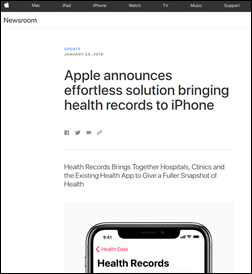
Apple announced Wednesday an update to the IPhone’s IOS 11.3 beta that will allow consumers to view their EHR information from one or more participating providers within Apple’s existing Health app. I spoke to insiders at some of the beta sites to get more information.

Participating Beta Sites

The initial sites involved are:

Johns Hopkins Medicine (Epic)
Cedars-Sinai (Epic)
Penn Medicine (Epic)
Geisinger Health System (Epic)
UC San Diego Health (Epic)
UNC Health Care (Epic)
Rush University Medical Center (Epic)
Dignity Health (Cerner)
Ochsner Health System (Epic)
MedStar Health (Cerner)
OhioHealth (Epic)
Cerner Healthe Clinic (Cerner)

What Patients See

image

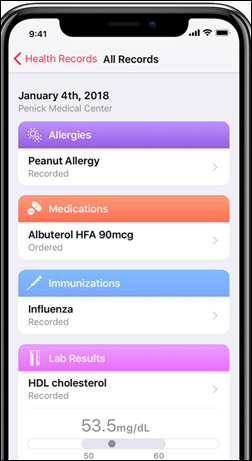
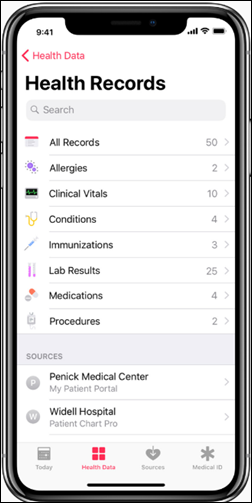
Patients will be able to view information extracted from the provider’s EHR that includes their allergies, conditions, immunizations, lab results, medications, vital signs, and procedures. The encrypted information is stored on the user’s IPhone rather than on Apple’s servers. Apple will not be able to see the information unless the user gives their permission.

image

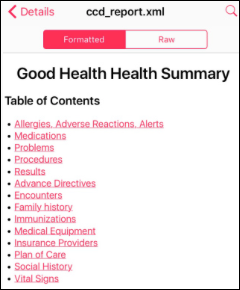
The EHR-to-Apple connection goes beyond the extraction of patient-downloaded C-CDA documents, which Apple Health already supports (pictured above). Apple Health Records retrieves discrete data directly from the EHR using HL7’s Argonaut FHIR standard, triggered by the user’s interaction with Health Records.

“It’s interesting,” one provider told me, “that Apple is possibly the most proprietary, closed software and hardware vendor and Epic is sometimes seen as its healthcare equivalent, yet they are connecting using open standards. That’s awesome.”

Patients of Epic-using health systems, for example, log into their MyChart account, retrieve an authorization code, and agree to share it with Apple. They then receive a token. “The process is slick,” a provider told me, adding that the process will likely be further polished and hardened to allow hospitals to onboard more easily. Epic will most likely productize the access method via an App Orchard app.

image

Apple’s Motivation

It’s important to note that Apple, unlike consumer medical records competitors such as Google, sells only hardware. Apple doesn’t develop enterprise apps, sell or use patient data, or have ambitions to build or acquire an EHR company. “Their only goal is to sell more IPhones,” a health system source said, adding, “we’re a lot more comfortable working with them than other companies with less-transparent ambitions.” Having direct access to EHR information is a differentiator from Android-based competitors whose market share is increasing over the IPhone.

The IPhone presents more than just a static display. Allergies include severity levels and lab results include the provider’s normal range and an explanation of the results.

I asked an insider about the testing involved and was told that Apple “does real testing, not just the usual hospital user acceptance testing.” That person was also impressed with the depth of health IT expertise that Apple has hired.

Apple’s Gliimpse Acquisition

Apple in mid-2016 acquired startup Gliimpse, which was developing a platform by which consumers could collect and share their health information. That company described itself as, “Gliimpse solved the hardest medical data problem, aggregation plus standardization. Our product collects data from medical portals – without human intervention – combined with self-entered plus wearable info, all shared with others. Through Oauth & APIs, partners can build consumer and analytic apps.” Some of that technology or subject matter expertise presumably found its way into Health Records. Apple is also working on a variety of health sensors.

Apple is losing smartphone market share worldwide, though it leads the industry in profits. It is not likely that an Android phone maker can muster the resources and ecosystem control to develop something similar, although Google may try if it can enlist hospital development partners. Google retired its Google Health app due to lack of adoption after just four years in 2012, before the widespread use of EHRs, interoperability standards, and personal health devices. It ended up being a little-used place for people to manually enter their own health information that was then stuck inside the app.

image

What the Mainstream Press is Missing

The mainstream press is dutifully re-wording Apple’s announcement, but is missing some significant but unstated points that will impact the health IT industry.

  • Patients can store information from multiple health systems on their phones, turning themselves into mini-HIEs as they can simply show any other provider their aggregated information. Apple fixes the patient identification issue that plagues HIEs by requiring the patient themselves to establish the connection from the EHR patient portal’s log-on.
  • Apple or a third-party developer could, at some point, add the ability for patients to push their data to a different, non-connected provider in the absence of other available integration in an app-powered form of “sneakernet.”
  • Apple’s use of the FHIR standard gives it the capability to extract any information supported by the FHIR standard and the specific EHR vendor.
  • Apple’s high-profile rollout will not only sell more IPhones, but will also encourage patients to press their providers to offer EHR connectivity to Health Records. It will also increase consumer use of patient portals.
  • Consumers trust Apple and will be encouraged to think of their medical data as their own since it will be in the palms of their hands.
  • App developers can build products that use previously inaccessible patient information, having Apple as a single, reliable data source instead of being hamstrung by a hospital’s EHR vendor and the technical intricacies of FHIR, vocabulary, and data validation.
  • App developers can list their products on Apple’s App Store – as Epic and Cerner do — instead of only in the EHR vendor’s marketplace since they are directly installable by any consumer without prior arrangement, giving those apps a wide audience and easy monetization.
  • Possible apps made possible by Health Records include medication information or cross-checking; further interpretation of lab results; patient education tools based on actual patient data;combining activity data that is already being collected within the existing Apple Health app with newly available provider data; and sifting through real-time information updates to provide alerting of relevant changes. 

    HIStalk Interviews Brent Lang, CEO, Vocera

    January 24, 2018 Interviews Comments Off on HIStalk Interviews Brent Lang, CEO, Vocera

    Brent Lang is president and CEO of Vocera of San Jose, CA.

    image

    Tell me about yourself and the company.

    Vocera Communications makes clinical workflow solutions that simplify and improve the lives of healthcare professionals and patients. We’re focused on enabling hospitals to enhance both quality of care and operational efficiency. That has direct impact on patient satisfaction and caregiver resiliency as well.

    The company has about 600 employees. We did roughly $160 million in revenue last year. I’ve been the president and CEO of Vocera since 2013 and I’ve worked with the company since 2001. I spent the first six years as the VP of marketing and then spent another six years as the president and chief operating officer before taking over as the CEO.

    In terms of my personal background, I have an MBA from Stanford. I have an engineering degree from the University of Michigan. In 1988, I had the privilege of being part of the US Olympic Swimming Team and won a gold medal in the 4×100 freestyle relay in South Korea, which ironically is the location of this year’s Winter Olympics. Thirty years later, it’s returning back to Seoul, South Korea, and I’m really excited and interested to see that.

    Vocera has been around since 2001, the company is publicly traded, and competitors have come and gone in those years. How would you characterize the market and Vocera’s position in it?

    It is an interesting market. It has definitely evolved over time — our offering into the market, how we’ve broadened our solution, and the way the market perceives us. We were the creators of the category, and for a long time, had to educate the market about the value proposition.

    What we’re seeing today is a recognition that clinical communications is a high priority. More and more customers are reaching out to us proactively to help them optimize their data and mobilize their data in the post-Meaningful Use era, where most hospitals have their electronic health record deployed. They’re looking for ways to empower the mobile workers inside their buildings. Getting the right information to the right worker is a real challenge for them.

    We’ve evolved from being more of a pure communications company to being more of a clinical workflow company. Much more software-centric. The clinical relevance of our solution has definitely risen up. As a result of that, the competitive landscape has evolved over the years. Initially, we were replacing pagers and in-building wireless phones. We were replacing a lot of inefficient processes, where people were running the hallway looking for the right person. 

    Today, we’re much more focused around the idea of clinical workflow and how we can empower care providers to be more efficient. Also, how we can reduce the level of burnout or burden on those care providers by giving them the tools that allow them to do their job on a daily basis.

    Have we figured out alarm and event notification?

    It’s definitely still a work in process. Connectivity from all these clinical systems to mobile workers was a Phase I solution that created as many problems as it solved. All the research would indicate that the vast majority of those interruptions and alarms that caregivers are receiving don’t require immediate action.

    A real focus for us is using intelligence, analytics, and rules engines to try to filter out only the most appropriate alarms, alerts, or messages. Then, delivering those only to the most appropriate person. This idea of the interruption fatigue or alarm fatigue that results from being bombarded by all these clinical alarms is a real concern. It has resulted in a high degree of burnout among clinicians.

    For us, the key is pulling situational awareness from the environment. What’s going on with the patient? What’s going on with the care team and their care plan? What’s going on with the other data points that might be accessible from other systems in the hospital? Then, using that to filter out only the most relevant and most urgent messages to be delivered to a particular care provider.

    Is it a market differentiator to offer an enterprise strategy instead of point solutions, multiple devices, or a lot of connectivity points?

    Our approach has always been to try to listen to the pain points of our customers. You may not know this, but when Vocera was originally founded, we were not a healthcare company. We were a solution that could be used across a variety of vertical markets. It was a  function of listening to specific pain points within our customer base that made us more and more focused on the healthcare space.

    As we’ve evolved the product over time, it’s always been driven by, how do we not think of it as a particular technology or a particular point solution, but how do we think of it in terms of solving particular clinical problems or customer problems? Even our sales approach is one of a consultative inquiry, where we actually send out clinicians. These are people who have worked as nurses before they came to work at Vocera. They do a clinical assessment, where they interview people at a customer site to understand what problems are top-of-mind for them. Then we try to apply the solutions to that. 

    We’ve always had this solution mindset. I think the market is evolving in that direction. If you look at some of the more recent analyst reports, they’ve moved away from looking at it in terms of vendors that might only provide text messaging or might only provide integration. The landscape today is around who can deliver a unified platform that enables true collaboration and clinical communication across these different care providers. 

    I view that as validation of the strategy that we’ve been pursuing for the last several years. I think that the rest of the marketplace is recognizing that and realizing that they need to move more in that direction.

    It must have been both a blessing and a curse to have been identified so strongly with the Star Trek Communicator thing early on, and people might still associate Vocera with that communications badge. How do your other services — such as patient experience tools, pre-arrival preparation, follow-up care, and PCP notification of patient hospitalization — fit in your business?

    You’re absolutely right. The Star Trek connection, the uniqueness of the badge, and the iconic nature of the Vocera badge has been both a blessing and a curse over the years. It’s driven a tremendous amount of brand awareness for the company and a tremendous amount of differentiation and uniqueness in terms of our offering. But it does tend to limit people’s perspectives on the value proposition that we’re delivering to marketplace. We have had to invest time and energy over the last several years to educate the marketplace that there’s much, much more to the Vocera platform than just the badge or just voice communication.

    Our goal is to deliver across the care continuum in interacting with patients and care providers. The products that you mentioned — pre-arrival, post-discharge communication, the rounding solution — these are all software solutions that we feel like fit into our vision around enabling the real-time health system. We have to do a better job of informing the marketplace that we have that breadth of solution.

    For us, it’s all about how we can simplify the lives of these care providers and improve patient satisfaction, There’s a variety of ways we can do that, whether it’s clinical communication, secure text messaging, alarms and notifications, patient experience monitoring, or analytics. These are all areas that become part of a unified platform. By tying them together, we’re able to do some exciting things that you wouldn’t be able to do if they were simply just point product solutions.

    Are caregivers changing their work communications expectations because of the apps they use at home?

    It’s certainly raising the expectation, both in terms of their experience on consumer devices as well as their interaction with voice interactions. Things like the Amazon Echo, Siri, and Google Home. When we were first introducing our products 15 years ago, the idea of using speech recognition as a user interface was fairly new and took some getting used to. Today, consumers are very comfortable using speech as a user interface. That has generated a whole new level of interest in our products, because people are more comfortable with that in the rest of their daily lives. Mobile technology is another area that has become more prevalent for all of them.

    Having said that, we still believe that there are some unique requirements for the healthcare environment. In general, it’s very difficult to bring a true consumer device or consumer experience into the healthcare environment.  You’ve got issues associated with security and privacy of patient information. You’ve got cleaning and sterilization issues. You’ve got security on the wireless network standards. You’ve got breakage. Hostile environments are really tough on electronic devices, and most consumer-grade phones have a hard time surviving in the hostile environment.

    Our purpose-built solution has created a large degree of differentiation for us because we’ve solved the problems of how you get a wireless device to roam inside a hospital. How you create the ability to block out background noise so that you can have a clear communication in a very noisy environment. How you can share a device across multiple users while having it be fully encrypted and logged into the highly secure wireless network environment that an enterprise customer has. Those are all examples where the expectations of their daily lives as a consumer influence their technology choices, but to bring it into the enterprise environment, you have to up the game one step further.

    Another example has to do with text messaging itself. Several years ago, there was a feeling that text messaging by itself was going to be a communication solution for hospitals. Today, the market has spoken and made it very clear that while it’s an interesting feature, it is not a complete solution for mission-critical, real-time environments like hospitals delivering acute care. Secure text messaging combined with real-time voice communication, alerting and alarming, and clinical integration are all required to put together a complete solution. 

    The consumer offering tends to be the baseline. To be successful in the enterprise, you have to build upon that and solve for not only the environmental issues, but also the specific workflow challenges associated with a hospital.

    I didn’t realize until recently how widely deployed Vocera is within the VA and DoD. Does their Cerner implementation present any new challenges or opportunities?

    It really doesn’t affect our business directly. We love our federal customers, both in the VA and in the DoD with the military hospitals. They’re great customers for us. They have a tremendous level of loyalty. They’re great users of the product. They drive standardization across their facilities, something that the healthcare industry overall has not necessarily done a great job of and is moving more in that direction. People are recognizing that to drive greater efficiency and better quality outcomes, standardization is a key. The DoD and the VA are leading that effort and have done a great job of standardizing the product.

    We integrate with Cerner. We have a lot of great Cerner customers that are able to send alerts and alarms from the Cerner EHR out to the Vocera clients. The DoD and the VA were very clear that it is important for Cerner and Vocera to work effectively together in that environment. To some extent, it’s another source of great data that can be delivered out to the mobile workers. In fact, the Cerner employees doing the deployment in that environment are going to be wearing Vocera badges during the deployment and rollout of the Cerner EHR.

    What business lessons did you take away from your experience competing in the Olympics?

    Swimming was a big part of my life growing up. Certainly the Olympics was a key accomplishment along that path. But one of the key lessons you learn as a competitive athlete that translates directly to the business world is that life is not a sprint. It’s a marathon. 

    I was a sprinter. I swam on the 400 freestyle relay. I swam the 50 and 100 freestyle. These are races that last less than a minute, but you train for them for 15 years. Even though the glory happens and the media focuses on the 20 seconds or the 50 seconds that you’re in the water, it’s the preparation that goes into that ahead of time. 

    The business world is very similar to that. People focus on an event. They focus on the IPO, the sale of the business, or a big customer win. But success in sports and success in business is about putting in the effort every day. Having the discipline. Having a clear vision of where you’re trying to go with your life or your company and focusing every day on making progress towards that and not letting the day-to-day highs and lows impact your progress towards that end goal.

    Do you have any final thoughts?

    I’m really excited about the market transition that we’re going through. I think in the post-Meaningful Use era, there is an opportunity to transition care delivery across the care continuum and to use technology to not only improve patient satisfaction and patient safety, but also improve the caregiver resiliency. We have a major problem with burnout among nurses and physicians. Technology has been a source of that problem, historically. 

    Vocera is committed to using technology to restore the human connection to healthcare and to enabling care providers to go back to doing what they went to nursing school for in the first place, which is to care for patients. Our employees and our customers are passionate about that. It drives us every day.


    News 1/24/18

    January 23, 2018 News 2 Comments

    Top News

    image

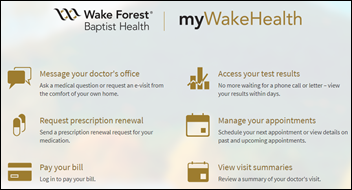
    Winston-Salem, NC’s two biggest health systems – Novant and Wake Forest Baptist Health – go live on “Happy Together,” in which the Epic MyChart instances of the respective systems are combined into a single patient view.

    image

    Novant CMIO Keith Griffin, MD said in an announcement, ““Happy Together for MyChart will allow patients to combine data from the two systems into a single view to improve their understanding of medications, lab results, plan of care, and follow-up appointments. It is truly a major step forward towards the goal of patient engagement and elimination of barriers of information and confusion.”

    Novant says it will expand the program to include other Epic-using organizations.


    Reader Comments

    From Finance Guy: “Re: consultants. I switched to corp-to-corp because of the new pass-through tax rules. I think the 20 percent deduction will be big enough to justify the extra hassle. I don’t think most consultants will do it, though even for the extra money. Most are used to the firm holding their hands and are delusional in thinking the firm is looking out for their interests. Corp-to-corps can contribute 20 percent of their net profit to a self-employed 401(k).” I’m fascinated at how people create businesses with themselves as the only employee. I bet that practice ramped up after the ACA came into law and allowed them to buy competitively priced insurance on their own, although those days might be coming to an end. I also read about professional employer organizations, where for a small annual fee a company will permanently hire “your” employees that still work for you, offer whatever benefits (including health insurance available at big-group rates) you’re willing to pay for, and run the entire HR function, all for a single check.

    image

    From Epic Trainee: “Re: Advocate Health Care. At least 10 people from the long-time Cerner and Allscripts shop were in my Epic Implementation Overview class. New CIO and a merger with Aurora = another Epic shop.” Unverified.

    image

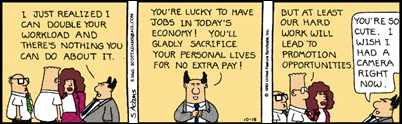
    From Movin’ On: “Re: bad job situations. Complaining doesn’t get you anywhere – either work with you employer’s leaders to make things better or move on. It’s time when: (a) they don’t offer career growth in your desired area; (b) you have no confidence in leadership or there’s unprofessional or unethical behavior at the top; or (c) personal reasons come up such as not wanting to relocate or travel.” I’ve hung on to jobs that made me miserable at least a couple of times because I was scared of change, it wasn’t a good time to upend my life (hint: it never is), and I secretly worried that I wouldn’t be good enough to compete with a new set of ladder-climbers. The final straw that forced me to move on – for which I was eventually grateful – was differences with a new boss. My conclusion is that unless you are anointed as a fast-tracker early on, your best path at moving up is to move out as the opportunity arises, probably at least every 3-5 promotion-free years unless you plan to live to 150. It’s OK to stay put if the prospect of change is too scary, but you then need to downsize your expectations and find some other source of ego-stroking beyond the company to whom you are unhappily selling the majority of your waking hours. I’m embarrassed when people complain about their jobs because it means they’ve settled for something they don’t like, which suggests a lack of either motivation or ability (I’m experientially jaded having suffered from both). It gets really bad when your occupational frustration, disappointment, and embarrassment bleed over into your family life and you feel personally diminished as a result. ”Spent a lifetime hunched over from the weight of a soul-sapping job” makes a poor epitaph.

    image

    From Amazon Grace: “Re: Martin Levine, MD’s role at Amazon. They posted a chief medical officer job last April to run their ‘healthcare’ practice’ that was pulled after 24 hours. It wouldn’t surprise me if that’s the role he is filling.” Seems reasonable since his background is regional chief medical officer for the highly regarded Medicare primary care practice of Iora Health. I expect Amazon is paying a big chunk of expense to pay for our overutilized, overpriced healthcare system, so they could be looking at either offering their own employee healthcare service or creating one as a business.

    image 

    From Sarah: “Re: Ingenious Med. Fired CEO Joe Marabito and CRO Phil Spinelli over the weekend.” Unverified, but their bios have been expunged from the company’s executive page despite their unchanged LinkedIn profiles. I reached out to the company but haven’t heard back. Marabito joined the company in September 2016, while Spinelli came on board in April 2017.

    From WorryWart: “Re: ransomware. Have you heard of patients with conditions such as STDs being blackmailed for bitcoin based on leaked PHI?” I haven’t heard of that. It doesn’t seem practical for a hacker – they would have to identify who to go after, limit their efforts to those with assets and fear of exposure, contact them electronically (email addresses are cutting edge to some practices), and come up with a fear-inducing list of people they would contact. I think the greater risk is that someone local – like a provider’s employee – gets the information and recognizes the patient as a rich target, although the threat of serving time under US extortion laws is probably a dissuader. My conclusion: hackers, like lawyers, don’t waste time on shallow pockets.


    HIStalk Announcements and Requests

    Last chance to tell me about ““What I Wish I’d Known Before … Implementing a Vendor’s Cloud-Based Application.” Responses are few, which likely marks an untimely demise to the reader-suggested  “What I Wish I’d Known Before …” series that will otherwise be cancelled after only the pilot episode has aired.

    image

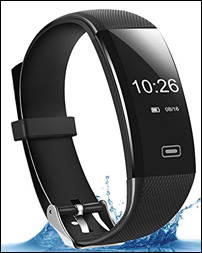
    Need an inexpensive fitness tracker that — beyond the usual counting of steps and calories burned — includes monitors for heart rate, blood pressure, and blood oxygen? I just bought this one for less than $25 and it works great – it even includes an extra band. It’s probably not amazing, but then again, neither is my workout regimen.

    I watched the premiere of “The Resident” on Hulu and it was kind of interesting, but cliche. The idea that hospitals are money-grubbing, faceless corporations led by bean-counters rang somewhat true since I’ve worked for those, but the titular protagonist with the bad-boy facial fuzz and the ability to bond only with patients he just met is a stereotypical cartoon – brilliant, cynical, anti-antiauthority, unaccepting of incompetence, quick to thrust his endless libido at convenient nurses, and full of unconventional medical methods that magically pull patients (sometimes not even his own) back from the brink after they were nearly killed by the dreaded evidence-based medicine, team care, and expert consensus. All we need, apparently, are more world-weary, narcissistic clinical cowboys who think they know more than the entire body of medical literature.


    Webinars

    January 24 (Wednesday) 1:00 ET: “Location, Location, Location: How to Deploy RTLS Asset Management for Capital Savings.” Sponsor: Versus Technology. Presenter: Doug Duvall, solution architect, Versus Technology. Misplaced or sub-optimally deployed medical equipment delays patient care and hampers safety-mandated preventive maintenance. It also forces hospitals to buy more equipment despite an average utilization that may be as low as 30 percent, misdirecting precious capital dollars that could be better spent on more strategic projects. A real-time locating system (RTLS) cannot only track asset location, but also help ensure that equipment is properly distributed to the right place at the right time. This webinar will provide insight into the evaluation, selection, and benefits of an RTLS-powered asset management solution.

    February 13 (Tuesday) 1:00 ET. “Beyond Sliding Scale: Closing the Gap Between Current and Optimal Glycemic Management Practices.” Sponsor: Monarch Medical Technologies. Presenter: Laurel Fuqua, BSN, MSN, EVP/chief clinical officer, Monarch Medical Technologies. The glycemic management practices of many hospitals and physician staff differ from what is overwhelmingly recommended by experts and relevant specialty societies. As a result, they are missing an opportunity to improve the quality, safety, and cost of care for their patients with diabetes and hyperglycemia, which commonly represent more than 25 percent of their inpatient population. Hospitals that transition from sliding-scale insulin regimens to consistent use of basal / bolus / correction protocols are seeing reductions in hyperglycemia, hypoglycemia, and costs. Making this shift more effective and efficient is the use of computerized insulin-dosing algorithms that can support dedicated staff using a systematic approach.

    February 14 (Wednesday) 2:00 ET. “Time is Money: Aurora Health’s Journey of Implementing and Advancing Cost Accounting.” Sponsor: Strata Decision Technology. Presenter: Patrick Nolan, VP of finance, Aurora Health Care. Aurora Health Care’s implementation of Strata’s Decision Support module involved not only building an improved cost accounting model, but improving the process to engage a cross-functional team in cost development. It now has accurate, consistent cost data to support decision-making. Aurora’s next phase will be to use actual procedure and visit times to allocate costs. This presentation will provide a detailed view into both the implementation and future direction of the Strata Decision Support program within Aurora.

    Previous webinars are on our YouTube channel. Contact Lorre for information.


    Acquisitions, Funding, Business, and Stock

    The state of Kentucky sues McKesson for providing pharmacies with the narcotics its not-being-sued doctors prescribed. Perhaps they should go after Kroger next for selling its overweight people Doritos and Vienna sausages.


    Sales

    Ohio Valley Hospital (PA) selects Parallon Technology Solutions to provide training go-live and support for its implementation of Meditech physician documentation.

    image

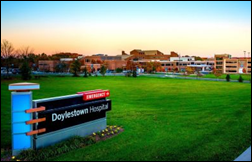
    Doylestown Hospital (PA) chooses the cloud-based EHR of EClinicalWorks for its 169 providers.


    People

    image image

    Release-of-information vendor Ciox Health hires Mike Connolly (PwC) as president of retrieval services and Leke Adesida (Anthem) as SVP/chief compliance officer.

    image

    Divurgent promotes Liz Keller to VP of client services.

    image

    Industry long-timer Meg Aranow (SRG Technology) joins Brighton, MA-based urgent care EHR vendor Edaris Health as COO.

    image

    Henry Ford Health System (MI) hires Paul Browne (Tenet Healthcare) as SVP/CIO.


    Announcements and Implementations

    Colorado’s CORHIO goes live on Medicity’s Community Interchange, which gives clinicians CCDs for making patient care decisions.

    Clinical Computer Systems, Inc. announces Obix as a Service, a cloud-based version of its Perinatal Data System.

    CenTrak adds Bluetooth Low Energy beacon technology to its Enterprise Location Services infrastructure, offering advantages over off-the-shelf beacons that include interoperability, reliability, five-year battery life, and scalability. 

    Four new published studies find that use of Glytec’s EGlycemic Management System improves treatment safety and effectiveness versus paper-based diabetes and insulin management protocols.

    Nuance releases Dragon Medical Practice Edition 4.

    Cleveland Clinic Florida describes its $4,000 per year concierge medicine program as providing “consistent, comprehensive, personalized medical care while cultivating in-depth patient-physical relationships that support patients’ health goals,” “assistance with medical records,” and “always ample time” during office visits. Apparently we rabble who are paying for visits with insurance and cash can’t expect such service.


    Other

    A claims analysis study finds that commercially insured Americans used less healthcare in 2016 than 2015, but rising prices  — especially drug, surgery, and ED costs — drove 2016 spending up more than any of the past five years.

    The corporate communications director of Fairview Health Services walks back the CEO’s pointed criticism of Epic for being anti-innovation, soothing vendor relations with, “Given Epic’s prominence as an electronic health record provider, they are uniquely positioned to support collaboration for innovation in healthcare.” Notice that she didn’t actually say what Epic is or isn’t doing and thus contradict her boss – only that the company is “uniquely positioned.”


    Sponsor Updates

    • AdvancedMD will exhibit at the Expert Roadshow January 24 in Salt Lake City.
    • Arcadia Healthcare Solutions will exhibit at the CCO Oregon Winter Conference & Annual Meeting January 30 in Salem.
    • Dan Dodson, president of Fortified Health Security, appears on an EHealth Radio podcast.
    • Besler releases a new podcast, “Examining the relationship between the concentration of Medicare Advantage plans and premiums.”
    • CoverMyMeds will exhibit at the NorCal HIMSS Innovation Conference & Showcase February 1 in Santa Clara.
    • Bizwomen recognizes CSI Healthcare IT Division President Kate Mays as a Headliner in Technology.
    • EClinicalWorks will exhibit at the 2018 Star Ratings Congress January 29-30 in Scottsdale, AZ.
    • Healthgrades names the recipients of its 2018 Distinguished Hospital Award for Clinical Excellence.
    • Iatric Systems will exhibit at the HCCA Regional Meeting January 26 in Atlanta.
    • Influence Health will exhibit at The Joe Public Summit January 30-31 in New Orleans.
    • Kyruus will exhibit at the GA HFMA Winter Finance Summit January 24 in Atlanta.

    Blog Posts


    Contacts

    Mr. H, Lorre, Jenn, Dr. Jayne.
    Get HIStalk updates. Send news or rumors.
    Contact us.

    125x125_2nd_Circle

    Curbside Consult with Dr. Jayne 1/22/18

    January 22, 2018 Dr. Jayne 2 Comments

    I had several people calling me over the last couple of days, wanting to talk about the recent Allscripts ransomware issue. A couple wanted my advice on protecting themselves, even though they use different vendors and have different system configurations. I have some good friends who spend the majority of their time during security risk analysis and white-hat hacking, so was happy to hand them over to the experts. One was a physician liaison at my former hospital, who wondered if I would write a guest column for their newsletter to help community physicians be more aware of the risks of ransomware. Their deadline is a couple of weeks out, so I’m happy to help.

    Another was from a friend who uses Allscripts and wasn’t sure if her practice was impacted or not, so I got to explain the difference between being self-hosted and vendor-hosted. It sounds like her system is self-hosted but connected to vendor-hosted subsystems that have been impacted. For the most part she was just glad that she could see her charts and also glad to have “someone who speaks IT and can translate” available. She had been getting emails from her practice that included language forwarded from Allscripts that didn’t meet the need for understanding.

    I also received a call from a former colleague who now works for a vendor and who “just wanted to catch up.” The call quickly turned into the most glaring example of schadenfreude I’ve seen in a long time. He went on and on about how this is going to be the death knell for Allscripts and how he was going to hit his territory hard and try to make sales. I had to remind him that his company has had its own share of issues, not necessarily with ransomware, but with outages on its own hosting platform.

    There is plenty of quicksand for any vendor to land in, and sometimes I think only dumb luck prevents vendors from falling into the pit. Not to mention, going into a practice that has been impacted by a major outage and trying to sell a replacement system might not be a good idea in the short term. The proverbial corpse isn’t even cold and practices are still down, so a little patience and respect might be in order.

    I have always preferred vendors who sell their products based on their own merits rather than by tearing down their competitors. Trying to make a purchaser feel bad about their current vendor calls into question their past decision-making and isn’t a way to win friends, in my book. Outages aside, every system has flaws and there isn’t one perfect solution out there. For every rock-solid feature, it seems like there’s something clunky hiding in the background to haunt you after you’ve already signed the contract. EHRs aren’t different from any other technology. As features evolve, sometimes they hit the mark and sometimes they don’t. It’s like buying a car – there’s always something you miss from your old car, or something you didn’t find on the test drive that becomes a daily annoyance.

    I feel bad for the hosted physicians who are having to deal with the consequences of the ransomware and are being told to plan to be down on Monday. Although Allscripts is working on a read-only solution, it’s not clear how they’re going to deploy it or what it will include. This should be a wake-up call to physicians and hospitals and a good prompt to review their downtime solutions and maybe even give them a test. At my practice, we have monthly reviews of the downtime process and site leads have to check weekly that their downtime supplies are ready to go, but despite the preparations it’s always at least a minimum level of mayhem when downtime hits. The reality is that although ransomware and hacking get the spotlight, the majority of downtime events have more conventional or mechanical causes.

    I’ve personally been the victim of the guy with the backhoe that cuts the fiber, the guy who accidentally triggers the Halon fire suppression system, and the lady who crashed into the data center and knocked out the electrical transformer. There’s also the winter storm that took down power lines, the system that froze because the server was out of memory, and the person who triggered a giant report to run against the production server in the middle of the day. Any one of those issues can make a system unusable and lead to a downtime event.

    In my career at Big Health System, we had a utility that created a “lite” version of charts each night, sending records for all the patients in my panel to a local desktop. The lite chart basically contained the medication list, allergies, diagnosis list, and six months’ worth of laboratory and radiology data. It didn’t include scanned documents, but was enough to field a patient’s phone call. The utility also sent a “full” version of the chart for each patient scheduled for an appointment in the next 72 hours, which included the lite chart plus six months’ of chart notes and scanned documents from the laboratory, radiology, and consults filing structure. Theoretically, that would be enough to get one through an office visit with enough essential information.

    That solution was great for a network outage but not for a power outage, so we had to make sure we had a fully-charged laptop with either a wireless modem or the ability to tether to a cell phone in the event that we lost power. The belt-and-suspenders coverage provided by this combination served us well through a variety of challenging situations. Of course, we also had a full disaster recovery plan, with distant servers and near-real-time fail-over processes, but thankfully I only had to experience that situation a couple of times.

    Not every practice is fortunate enough to have staff dedicated to ensuring a smooth downtime. Still, you’d think with all the natural disasters we’ve seen in the past two years, that people would be doing a better job of it. I look forward to the day when I no longer hear about a practice whose only downtime preparation includes some photocopied visit note forms and a hope that someone printed a copy of the patient schedule before they went home last night.

    For vendors servicing smaller practices, offering services to help clients put together a solid downtime plan would be great. I’d be interested to hear what vendors offer support for that type of a solution, and what other organizations small practices look to for downtime advice.

    In the short term, however, I’m wishing the best to my colleagues on Allscripts. I hope the outage is short lived and your sanity makes it through mostly intact.

    Have you been impacted by ransomware? Email me.

    Email Dr. Jayne.

    Monday Morning Update 1/22/18

    January 21, 2018 News 6 Comments

    Top News

    image

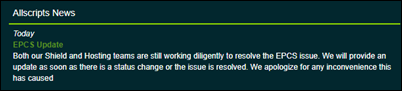
    From the Allscripts ransomware update Sunday morning:

    • The ransomware attack involved SamSam malware, but not the same strain that took down the systems of Hancock Health.
    • The vulnerability that was exploited wasn’t within the Allscripts application, so self-hosted customers are not at risk.
    • The many services that were taken offline strictly as a precaution have been restored.
    • Professional EHR and Allscripts PM are being brought back online in a rolling basis, but clients should plan for their systems to be down Monday. Allscripts is trying to put together a view-only solution.
    • Clients that have been brought back online are running normally, not on a temporary instance of their system.
    • The malware does not propagate as a worm or via VPN, so client computers will not be infected.
    • The company will let customers know what if any HIPAA breach reporting is required.

    Allscripts hasn’t said how the malware was introduced, but SamSam’s sole method of entry seems to be unpatched installations of JBoss software, for which Red Hat released SamSam-protecting patches nearly two years ago.

    I was mildly amused that to listen in on the Web-based Allscripts ransomware update Sunday morning, I had to install the notoriously buggy and unsecure Flash browser plug-in, which took forever to load, suggested adding other crap software, and required a browser restart. The Allscripts folks on the call noted that several participants couldn’t hear the Flash-powered audio and suggested trying Chrome or Firefox instead of IE/Edge. I was appreciating the potential irony of an anxious doctor dreading an EHR-less Monday morning having his or her home PC infected with Flash-enabled malware while listening to a Flash-required malware update.


    Reader Comments

    From Tired of the Greed: “Re: Optum Ventures. Bought several companies in 2017, including Advisory Board, because UnitedHealth Group was making so much money they wanted to put capital in the marketplace. Tax reform gave them a huge windfall that they will not be sharing with employees. Raises remain in the usual 1 to 1.5 percent range with zero bonuses for most of my department. Yet upper and senior management (all male in my division) will get nice bonuses and who knows what kind of raises. This is an old boys’ network lining its pockets and those of its shareholders on the backs of patients and physicians with cooked-up ways to deny paying for legitimate medical care.” My reactions are as follows:

    • Salary and benefits exist at the intersection of supply and demand. Lack of a mass exodus means employees don’t see better options and thus implicitly accept their employment conditions. I’m sympathetic because a truly fluid employment market means being willing to relocate, travel, or take a less-satisfying job full of uncertainty and family disruption, but it’s a free market both ways.
    • You can easily test your worth to the company by threatening to leave unless you get a promotion or raise, but expect the company to call your bluff. They have a ton of employees, but you have only one job.
    • Don’t expect a company to be “fair.” Lofty vision statements aside, companies (including non-profit hospitals) exist solely to take in more money than they spend since failure to do so means shutting down. Your only hope is that the person you report to is fair.
    • Don’t conflate gender equity with gender-neutral executive entitlement. While it’s true that executive management is dominated by males, it’s probably also true that the suits aren’t secretly doling out perks to their male underlings.
    • Executives are also sometimes clueless about working in a non-executive job. I’ve had to soothe many ruffled feathers when a hospital C-level executive forgot who he (being male in this example) went off script in a department meeting and joked about his bonus being at risk if employees failed to deliver and how he liked the view from his expansive office or the convenience of his reserved parking spot hundreds of yards closer than where we peons jacked up our adrenaline levels first thing every work day jockeying for any available spot. He wasn’t evil, just cluelessly entitled and smug about his executive ascent, which he attributed to his brilliance and work ethic (both questionable given even brief observation). Executives are “Animal House’s” Douglas C. Neidermeyer, while the non-privileged are banished to the couch with Jugdish, Sidney, and Clayton.
    • Companies (and people) do what someone pays them to do. If they’re making money, they are filling a market need, no matter how socially conscionable their actions are. Blame who’s paying them.
    • As cold as it sounds, if you want to control your own future, you have to work for yourself instead of someone else.

    From Party Shoes: “Re: HIStalkapalooza. I read HIStalk religiously every day and haven’t seen the details.” It’s amazing how many people who claim to pore over my every word somehow missed the several times I’ve mentioned that I’m not doing the event this year. TL;DR: no HIStalkapalooza this year.

    From Chuck Roast: “Re: HIStalk. I read your email newsletter every day. Good job!” I stopped putting teaser bullets in the email blast for exactly this reason – people were confused into thinking it was a self-contained email newsletter rather than a single link to the real online thing. Other folks haven’t figured out that the daily headlines are in addition to the usual M-W-F full posts and complain about overlap. My advice has never changed – if you don’t check HIStalk each weekday, you are almost certainly missing something I thought was important. Just click the home page link and read down the page until you hit something you’ve already seen. The email link goes directly to that particular article, so you won’t see the other stuff there from that link.

    From Bitter Pill: “Re: Amazon and Google in healthcare. How could they possibly fail?” In about a million ways, foremost being the error in seeing healthcare as, like every other industry, being driven by consumers who simply require new technology to further empower them with the threat of taking their business elsewhere. Evidence: if patients were empowered consumers, hospitals wouldn’t offer inconvenient parking, 9-5 weekday hours for non-inpatient services, halls full of roaming providers who aren’t in the patient’s insurance network, next-available appointments running weeks into the future, and inflated but incomprehensible bills. Unlike every other market, healthcare is poorly run and consumer-hostile, but full of entrenched players who can easily steamroll any outsider’s efforts to make it better at their expense.


     HIStalk Announcements and Requests

    image

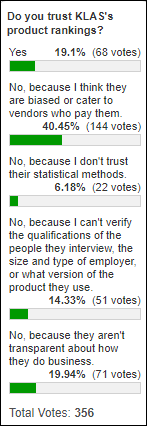
    Of the 81 percent of poll respondents who don’t trust KLAS’s product rankings, half think the company is biased or caters to paying vendors.

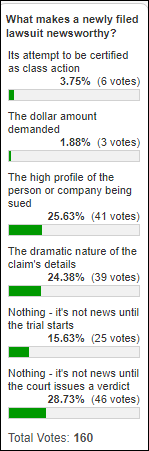
    New poll to your right or here: is Epic an impediment to innovation as Fairview’s CEO says?

    image

    I received good responses to my post on “What I Wish I’d Known Before … Replacing My Hospital’s Time and Attendance System.” Next up:  “What I Wish I’d Known Before … Implementing a Vendor’s Cloud-Based Application.” I made a list of fun future topics, but it will evaporate if few folks participate.


    Webinars

    January 24 (Wednesday) 1:00 ET: “Location, Location, Location: How to Deploy RTLS Asset Management for Capital Savings.” Sponsor: Versus Technology. Presenter: Doug Duvall, solution architect, Versus Technology. Misplaced or sub-optimally deployed medical equipment delays patient care and hampers safety-mandated preventive maintenance. It also forces hospitals to buy more equipment despite an average utilization that may be as low as 30 percent, misdirecting precious capital dollars that could be better spent on more strategic projects. A real-time locating system (RTLS) cannot only track asset location, but also help ensure that equipment is properly distributed to the right place at the right time. This webinar will provide insight into the evaluation, selection, and benefits of an RTLS-powered asset management solution.

    February 13 (Tuesday) 1:00 ET. “Beyond Sliding Scale: Closing the Gap Between Current and Optimal Glycemic Management Practices.” Sponsor: Monarch Medical Technologies. Presenter: Laurel Fuqua, BSN, MSN, EVP/chief clinical officer, Monarch Medical Technologies. The glycemic management practices of many hospitals and physician staff differ from what is overwhelmingly recommended by experts and relevant specialty societies. As a result, they are missing an opportunity to improve the quality, safety, and cost of care for their patients with diabetes and hyperglycemia, which commonly represent more than 25 percent of their inpatient population. Hospitals that transition from sliding-scale insulin regimens to consistent use of basal / bolus / correction protocols are seeing reductions in hyperglycemia, hypoglycemia, and costs. Making this shift more effective and efficient is the use of computerized insulin-dosing algorithms that can support dedicated staff using a systematic approach.

    February 14 (Wednesday) 2:00 ET. “Time is Money: Aurora Health’s Journey of Implementing and Advancing Cost Accounting.” Sponsored by Strata Decision Technology. Aurora Health Care’s implementation of Strata’s Decision Support module involved not only building an improved cost accounting model, but improving the process to engage a cross-functional team in cost development. It now has accurate, consistent cost data to support decision-making. Aurora’s next phase will be to use actual procedure and visit times to allocate costs. This presentation will provide a detailed view into both the implementation and future direction of the Strata Decision Support program within Aurora.

    Previous webinars are on our YouTube channel. Contact Lorre for information.


    Sales

    Three-hospital Astria Health (WA) will implement Cerner under the company’s CommunityWorks hosting program.


    People

    image

    Amazon hires Martin Levine, MD — a geriatrician and Seattle-area medical director of Medicare primary care practice Iora Health – for an unstated role.


    Other

    Maybe this isn’t new, but I hadn’t noticed. Signing up for any HIMSS18 pre-conference symposium includes the Pre-Conference Plus benefit. You pay for a particular session, attend its opening keynote, but then are free to move around to other symposia during breaks (it would  be interesting to see which sessions send attendees fleeing for the doors). They all cost $350, so there’s no gaming the system by signing up for the cheapest one and then switching. I also noticed that some conference sessions now list “conference supporters” that HIMSS has convinced to spend even more money, removing yet another safe space for non-vendors trying to evade commercial pitches (you knew that was coming when HIMSS started selling escalator advertising). My brilliant ideas – pay the food court vendors to attach flyers to their $13 chicken Caesars or hire one of those Las Vegas stripper card flippers to further clog the seedy sidewalks. 

    image

    Open source EHR vendor OpenMRS – whose product is used in developing countries – receives a $1 million donation from cryptocurrency philanthropy organization Pineapple Fund (its tagline: “because once you have enough money, money doesn’t matter.”) OpenMRS learned that the person who started that organization had previously  contributed OpenMRS software patches. OpenMRS is a non-profit collaborative led by Regenstrief Institute and Boston-based Partners in Health.


    Sponsor Updates

    • IBM names Salesforce its preferred customer engagement platform for sales and service.
    • Sunquest Information Systems will exhibit at the Precision Medicine World Conference January 22-24 in Mountain View, CA.
    • Huron will exhibit at the Association of Cancer Executives Annual Meeting January 28 in Portland.
    • Conduent will exhibit at the Middle Tennessee Antimicrobial Stewardship Symposium January 26 in Nashville.

    Blog Posts


    Contacts

    Mr. H, Lorre, Jenn, Dr. Jayne.
    Get HIStalk updates. Send news or rumors.
    Contact us.

    125x125_2nd_Circle

    What I Wish I’d Known Before … Replacing My Hospital’s Time and Attendance System

    That our hospital’s Time and Attendance policies were not being applied throughout the organization equitably in all departments.  We found a lot of departments that were providing extra incentive pay to nurses in order to boost their salaries. Other departments were making up their own on-call pay programs for their personnel.


    That employees were getting around showing up late by not punching in and then later stating that the system must not have worked when they “clocked in.”


    Anything that directly or indirectly to do with payroll is EXTREMELY sensitive. Expect people to freak about any test results that don’t match the result of the existing system in payroll, down to the penny.


    If your facility is non-union, and has been working to stay that way despite onslaughts by SEIU and others, expect to deal with lots of very complex pay premiums. Don’t be surprised if disgruntled employees and/or organizers try to make something sinister out of the system change.


    Place time clocks in areas with enough room to hold all the employees standing around waiting to clock in in the morning and clock out in the afternoon.


    If your internal sponsor is the HR director, make sure that you reassure that person early and often that the system change won’t accidentally result in pay changes.


    Hospital pay rules are more complex than any other industry, sometimes exceeding the capability of non-healthcare specific payroll systems to handle them. It was shocking to find how many departments were running their own unapproved overtime, call time, and bonus programs in direct contradiction to hospital policy. It takes a lot of time and finesse to find these exceptions and then some HR backbone to bring those departments into compliance instead of building rules just for them.


    If your implementation involves installation of hardware, allow lots of time to make it happen. Hospital construction can be very tricky from a permitting standpoint.


    Plan to run tests through month end and end-to-end with payroll to make sure everything is perfect before you agree to a cutover plan.


    Don’t let Procurement sunset the contract with your existing vendor until you are absolutely confident in your cutover dates.


    Policy over technology. Users run in the door and swipe at 8:14:59, then get ready for work, and out the door at 4:45:01.


    Pay attention to the choice of letting employees clock in by telephone and limit that to in-house phones.


    Expect managers to express shock and indignation that it’s their job to review time clock reports against reality. And to look the other way if they’re worried the offending employee might quit over being paid accurately rather than generously.


    I wish we had understood the complexities of overtime, the number of salaried employees that are required to clock-in/clock-out even though their pay doesn’t change (and the frequency with which they forget or delay their swipe), and I wish it was understood exactly how much manual overriding would be needed over the first four payroll cycles to make sure employees were appropriately paid. I also wished we had budgeted for all of the overtime required for staff that were perpetually on call to handle these and other issues during the transition period. In short, I wish we knew everything since what we actually knew was nothing, and our vendor was complicit in helping us fail pretty spectacularly during the process.


    Will employees be able to access accrued PTO in their current paycheck (leaving a zero PTO balance) or will their pay be docked even though they have PTO remaining? This “feature” has to be manually overridden by our HR personnel with management approval.


    How difficult is it for employees to enter multiple days off in a row. Do they have to do every single day as a separate entry or is the multiple-entry feature seamless and user-friendly?


    That a focus on staffing workflow impact is equally or more important than the specific technology. That includes integration with upstream and downstream systems.


    Don’t underestimate the creative nature of employees clocking in and out. Before we got wise and changed it, some would stop and clock in and or out at our remote locations (30-45 minutes away) and then drive in to the hospital. We noticed a spike in overtime. Also we noticed an incredible number of time sheet edits by non-management folks who had the authority previously. Their role went away and the authority moved to managers (some of whom argued it wasn’t their job?) Every management level now had to sign off for their areas. The number of edits decreased but it took a long time and a lot of oversight.


    A story about a payroll system. I don’t recall the name but it was a Mom & Pop vendor (Mom was the CEO and Pop was the techie) selected by the HR division. On January 31 with no other option, we had to mask out the SSNs on a couple hundred (or more) printed W-2s, then run them through the printer as blank sheets with a correctly placed SSN cell from Excel. We moved on to a new vendor and the company was gone the next year.


    They were in negotiations to be acquired by a competitor and there equipment would be sunset within the year.


    It’s not the system that causes issues. It’s the clock in/out & OT calculation policies & procedures.


    Weekender 1/19/18

    January 19, 2018 Weekender Comments Off on Weekender 1/19/18

    weekender


    Weekly News Recap

    • Allscripts-hosted EHR and e-prescribing systems go down early Thursday due to a ransomware attack.
    • DoD confirms that its Cerner rollout is on hold not because of problems, but rather according to the original project plan, which called for a comprehensive review of the first four pilot sites that won’t be completed until later in 2018.
    • Change Healthcare acquires National Decision Support Company.
    • Microsoft kills its HealthVault Insight app less than a year after its rollout.
    • Senator Jerry Moran (R-KS) questions the VA’s contract-signing delay with Cerner, asking in a letter to Secretary David Shulkin what he hopes to learn or do differently after digging deeper into Cerner’s interoperability capabilities.
    • The VA’s CIO says its legacy VistA system will need to remain running (and funded) for the 10 years it will take it to fully implement Cerner.
    • Hancock Health (IN) pays the demanded $55,000 ransom to regain access to its systems following a ransomware attack, saying it was a good business decision given the time it would have taken it to restore them from backups.
    • The CEO of Fairview Health Services (MN) calls for a “march on Madison” to demand that Epic encourage innovation by opening up its system and intellectual property management practices.
    • McKesson, 70 percent owner of Change Healthcare, says Change’s IPO could be run this year.

    Best Reader Comments

    Epic’s model does assert the ability to use any IP in App Orchard without compensation or limitation, it’s why the few vendors I’ve spoken to are hesitant to use it. The only reason that they’re considering it is because Epic has a stranglehold on their customers. That atmosphere isn’t really innovation-encouraging. (DrM)

    Amused by the fact that the most engagement an HIStalk post has received in months is due to a hospital executive saying something critical of Epic. Thin skin in Madison. Epic is Big Healthcare. With that kind of company financial success, you are going to have your critics. Comes with the turf, guys. (CheapSeats)

    There’s a world of difference between updating the OS or AV software, where users shouldn’t be affected at all, and updating software that affects of the UI and workflow of knowledge workers. The number of decision-makers involved is an order of magnitude different, and simply understanding the effects of workflow changes can take far more than three months. (DrM)

    So “pace of change and innovation is stifled” and “pace of change in software is too fast”? I’m confused. (Doesn’t compute)

    VA CIO: Expect another 10 years of VistA in facilities during new EHR rollout. This is clear indication of how the VA and government agencies are dysfunctional. There is so much wrong with this it’s hard to decide where to begin. Interoperability issues between systems only being exacerbated over years as patients move from a region on Cerner back to a facility still on VistA. How do you call a system new 10 years after it’s installed in the organization? In 10 years the VA and DOD could be replacing Cerner with another system. (Matt)

    Will this Cerner dust-up with the DoD now give us a real granular discussion on a national level as to what Interoperability really means as far as how much is exchanged, degree of exchange and access, and who is responsible for it ($$$$ from vendors or hospitals paying for the infrastructure)? More realistically, will it force Cerner deeper in to a “commitment” to the CommonWell Health Alliance? Commitment in quotes means a lot of things. Really publicizing how well (and how much) it shares between itself and the other vendors and Epic. Having to commit more resources to it, including education and architecture for their customers and hospitals using other vendors. Perhaps how Cerner has to address this could chip away at the conventional wisdom that eventually you will have to be on either Epic or Cerner. (You might say I’m a dreamer)

    I played Theme Hospital as a child and always thought it was a joke that the hospital systems were out for profit. Now I write EMR software. It was the longest, darkest punchline.(ThemeHospital)

    Epic doesn’t assert ownership over any the apps on their App Orchard or the hundreds and hundreds of third-party apps that work with Epic. Their model is just like Apple. And, if there are literally billions of dollars and so many smart people in Silicon Valley, why didn’t they solve healthcare automation in a hugely, bigly amazingly way by now? They’ve had that money and those smart people for a while. How did a podunk outfit out of Madison Wisconsin get the drop on all of them? Good thing they haven’t found Kansas City yet. Give us a break James. What specific innovation do you feel is being impeded? (What’s with the Fairview guy?)

    Even though Apple could take IP directly from the Apple ecosystem developers, their usual model is to just buy the companies. Same is true for Google and Microsoft. The big guys get the IP in the end, but developers get an exit strategy. Because of Epic’s stance against acquiring, that option isn’t available to Orchard developers. I would be hesitant, too. (Bob)

    I wonder if there should be an EHR feature where patients if they’d like can subscribe to access to their record where they get emailed every time it gets accessed with a note on who accessed it and their role? (AC)

    I’ve stopped believing any story about celebrity doctors saving people on planes unless there’s photographic proof of it happening. Eric Topol figured out it’s a completely unverifiable way of getting extra publicity for whatever device he happens to be talking about at the time, and obviously Oz learned the lesson. My prediction – Oz has a show coming up about the dangers of air travel. Regular doctors respect those peoples’ privacy and don’t go humble-bragging about their clinical acumen. (DrM)


    Parental Leave Policy Responses

    A few folks responded to Allspice’s question about paid leave for new dads, which his company doesn’t offer.

    • Athenahealth – 12 weeks for mom, six weeks for dad.
    • Unnamed health system – no maternity, paternity or family leave. Employees have to use FMLA and cobble together PTO and short-term disability if you’ve given birth. “People always assume that because I work in healthcare, I have great health benefits, and I just respond with a slightly unhinged laugh.”
    • A reader from Canada – leave policy is mandated by the federal government. New moms get a maximum 15 weeks at 55 percent of average compensation, while those caring for a new child get a maximum 35 weeks at 55 percent of earnings (can be shared between parents) or 61 weeks at 33 percent of average earnings.
    • Epic – new moms get 5-8 weeks of short-term disability, then can use PTO to cover the rest of FMLA time up to 12 weeks. They can then come back part-time for another three months, but that’s a problem for those in travel roles. New dads get nothing. “I was back on the road 17 days after the little one was born. They will tell you that they support your time off, but if you have an escalated client, you are responsible for it, period. As a company that preaches about health and doing the right thing, they missed the boat on being progressive on this key area for welcoming a newborn.”
    • Merge Healthcare/IBM – IBM increased the paid time for paternity, maternity, and adoption from six weeks to 12 and even back-granted extra time for new parents.
    • Unnamed health system – women get short-term disability and FMLA (no specific paid maternity leave) and dads get FMLA.
    • Epic – no paid time off, just FMLA.
    • Unnamed health system – introduced a new benefit of two weeks PTO for both parents with a birth or adoption, Previously, dads got PTO/FMLA and moms got short-term disability after a two-week waiting period.
    • Unnamed health system – new dads get nothing outside of FMLA, moms get short-term disability if they give birth and only FMLA if they adopt.
    • WebPT – for birth, surrogacy, adoption, or foster care, no benefit for less than six months of service, two weeks time off for 6-24 months, four weeks for two or more years of service. Employees get two weeks for foster care.

    Watercooler Talk Tidbits

    image

    Thanks to those impressively credentialed readers who signed up for my Rolodex – I really appreciate it. The link will always be listed at the bottom of the Weekender posts, along with links to other permanent and short-term opportunities to help me out or get involved. It’s heart-warming to see CIOs, other hospital executives, CEOs, technologists, consulting firm executives, and clinicians offer to provide me with occasional guidance and news reaction.

    image image

    HIStalk readers provided science game night activities for the elementary school class of Mrs. S in Mississippi in funding her DonorsChoose teacher grant request. She reports, “Thank you so much for helping my students fall in love with science. It warms a teacher’s heart when they actually want to learn! They were so eager to see the new products that we got to use for our projects. Their favorite one so far has been the Augmented Reality dinosaur project. They just love that they can make it come to life with just the use of an iPad. I cannot wait for my students to use the globe next. That is our next standard in science. They will get to learn all about the seven continents and ‘see’ them just as if they were there.”

    SNAGHTML302e3f62

    The fun folks at Ellkay sent cool swag our way through Lorre. I thought the “15 years” mug was to commemorate HIStalk’s 15th anniversary (this coming June), but I realized in rotating the mug that it refers to Ellkay’s 2002 founding. Inside the cool cardboard container is some Ellkay honey supposedly harvested from bees kept on its roof, and even though I can’t verify its source, it’s still a great marketing idea.

    A few readers let me know they got an error trying to read HIStalk Thursday afternoon. It was actually a good problem if there is such a thing – so many folks jumped on to read my Allscripts ransomware news item (to which kind readers alerted me) that my dedicated, rather high-powered server was overloaded for 30 minutes or so. Thursday didn’t set a readership record since, other than the Allscripts item, I hadn’t published anything except headlines and Dr. Jayne since Tuesday night, but it was still over 11,000 page views in a 24-hour period. Tops of all time was DoD’s Cerner announcement day, July 30, 2015,  when 17,000 folks checked it out and many others weren’t able to get in, leading me to dig out my wallet to beef up the hardware yet again.

    Uber hires a HIPAA-focused lobbying firm for unstated purposes, but possibly related to transporting people to medical appointments or for professionals booking rides for patients.

    “The Resident” premieres on Fox Sunday night following the NFC championship game. It’s apparently cynical and darkly funny in covering healthcare ethical issues, an incompetent surgeon bullying staff to cover up his mistakes, and the never-ending quest by hospitals to boost their bottom lines.


    In Case You Missed It


    Get Involved


    125x125_2nd_Circle

    News 1/19/18

    January 18, 2018 News 2 Comments

    Top News

    SNAGHTML3261c95f

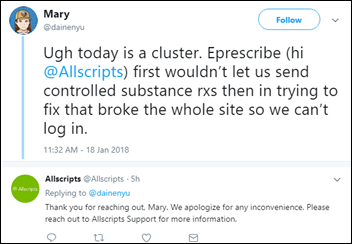
    Some Allscripts remotely hosted systems, including its Professional EHR and controlled substances e-prescribing modules, went down due to a ransomware attack early Thursday.

    SNAGHTML31791dd6

    Only customers whose systems are hosted in the company’s Raleigh and Charlotte, NC data centers are affected.

    Allscripts hopes to restore the systems quickly from a backup.


    Reader Comments

    SNAGHTML329fafcf

    From Canary: “Re: Vindicet. Heard it is closing its doors next week.” Unverified, since my email to the company’s listed address bounced back as undeliverable. I interviewed CEO Yann Beaullan-Thong back in 2012, but the company has apparently pivoted from electronic referral technology to business intelligence and IT services. The executives listed on its site seem to have all moved on and expunged their history with the company from their LinkedIn profiles.

    image

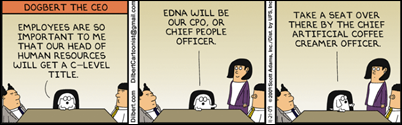
    From Undying Like: “Re: bloat in C-suite titles. Chief Growth Officer? Chief Revenue Officer? Perhaps you should have a contest of how many C-suite titles can be created. I wonder what’s driving this growth of overhead?” I’ve forwarded your request to my Chief Contest Officer. Health systems have made up quite a few C-level titles as well, although I question whether the incumbents actually have equal standing in the mahogany-paneled C-suite. Titles are cheap.


    Webinars

    January 24 (Wednesday) 1:00 ET: “Location, Location, Location: How to Deploy RTLS Asset Management for Capital Savings.” Sponsor: Versus Technology. Presenter: Doug Duvall, solution architect, Versus Technology. Misplaced or sub-optimally deployed medical equipment delays patient care and hampers safety-mandated preventive maintenance. It also forces hospitals to buy more equipment despite an average utilization that may be as low as 30 percent, misdirecting precious capital dollars that could be better spent on more strategic projects. A real-time locating system (RTLS) cannot only track asset location, but also help ensure that equipment is properly distributed to the right place at the right time. This webinar will provide insight into the evaluation, selection, and benefits of an RTLS-powered asset management solution.

    February 13 (Tuesday) 1:00 ET. “Beyond Sliding Scale: Closing the Gap Between Current and Optimal Glycemic Management Practices.” Sponsor: Monarch Medical Technologies. Presenter: Laurel Fuqua, BSN, MSN, EVP/chief clinical officer, Monarch Medical Technologies. The glycemic management practices of many hospitals and physician staff differ from what is overwhelmingly recommended by experts and relevant specialty societies. As a result, they are missing an opportunity to improve the quality, safety, and cost of care for their patients with diabetes and hyperglycemia, which commonly represent more than 25 percent of their inpatient population. Hospitals that transition from sliding-scale insulin regimens to consistent use of basal / bolus / correction protocols are seeing reductions in hyperglycemia, hypoglycemia, and costs. Making this shift more effective and efficient is the use of computerized insulin-dosing algorithms that can support dedicated staff using a systematic approach.

    February 14 (Wednesday) 2:00 ET. “Time is Money: Aurora Health’s Journey of Implementing and Advancing Cost Accounting.” Sponsored by Strata Decision Technology. Aurora Health Care’s implementation of Strata’s Decision Support module involved not only building an improved cost accounting model, but improving the process to engage a cross-functional team in cost development. It now has accurate, consistent cost data to support decision-making. Aurora’s next phase will be to use actual procedure and visit times to allocate costs. This presentation will provide a detailed view into both the implementation and future direction of the Strata Decision Support program within Aurora.

    Previous webinars are on our YouTube channel. Contact Lorre for information.


    Acquisitions, Funding, Business, and Stock

    image

    The Illinois Chief Procurement Office for Higher Education rejects Cerner’s protest of UI Health’s September 2017 decision to award Epic a $62 million contract, citing Cerner’s inability to “submit a proposal that showed its technical qualifications at the minimum level required” and Epic’s submission that met all of UI’s requirements on price. UI Health CFO Mike Zenn says the protest, filed in late September, has set the implementation back by three months.

    image

    Change Healthcare acquires medical guidelines technology vendor National Decision Support Company for an undisclosed sum.

    image

    In California, Petaluma Valley Hospital struggles to find new ownership after potential suitor Paladin Healthcare has second thoughts related to replacing PVH’s EHR, which is coupled with the systems of its former owner, St. Joseph Health. St. Joseph says it would be expensive to remove the hospital from its system and offered $2 million toward its replacement, which would cost $5.5 million, and Paladin said OK as long as the hospital agreed to be taken over first.

    Several large health systems that operate 300 hospitals and possibly the VA will form a non-profit company that will provide generic drugs for hospitals. They will attempt to work around situations where shortages occur because only one or two companies manufacturer a generic product or where a company uses its monopoly to jack up the price of old drugs.


    People

    image

    Daniel Castillo, MD (Evolution Health) joins patient decision support company WiserCare as CEO.

    image

    Carevive Systems hires Jamel Giuma (Sunquest) as VP of product management.


    Sales

    Deaconess (IN) chooses Stanson Health’s clinical decision support.

    Digestive Care (FL) will replace its Greenway Health EHR with EClinicalWorks.


    Announcements and Implementations

    image

    DirectTrust says Direct users sent 167 million message transactions in 2017, a 70 percent increase over 2016. The number of DirectTrust addresses increased 16 percent to 1.6 million.

    image

    According to his LinkedIn, former HIMSS President Steve Lieber will sell consulting services (governance development, analysis, business expansion) to associations and companies as well as acting as a technical and business advisor to start-ups, all under the newly created umbrella of Avisos Partners. Google tells me that Avisos is Catalan for “warnings.”


    Government and Politics

    FCW confirms that the DoD’s Cerner rollout is on a routine hold as the project plan has specified all along, not as the result of a new decision triggered by support tickets as a recent Politico report indicated. The rollout was to be reviewed through most of 2018 before implementation beyond the four pilot sites would continue and that plan hasn’t changed.


    Research and Innovation

    image

    Penn Medicine researchers find that ED physicians prescribe fewer opioid pills when an EHR default setting of 10 tablets units is introduced.


    Privacy and Security

    image

    Adams Health Network (IN) works to restore its servers after a January 11 ransomware attack that took down its scheduling and EHR systems. Hospital employees say their screens indicated “sorry,” common wording of the SamSam ransomware that infected Hancock Health (IN) last week, for which that hospital paid the demanded $55,000 ransom.

    image

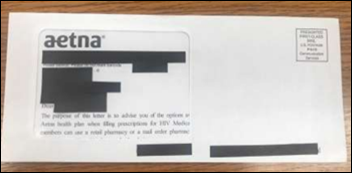
    Aetna will pay $17 million to settle a class-action lawsuit filed after it mailed HIV medication notices to patients in envelopes with see-through windows.


    Other

    image

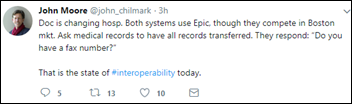
    All of us have had this experience. Many have, like me, also had the health system flat out refuse to give me my data electronically even after I filed an HHS OCR complaint that resulted only in HHS offering it “technical assistance” when technology was not the problem at all.

    image

    Microsoft will discontinue its HealthVault Insight app less than a year after its introduction, saying that it was a research project whose insights will be used in other projects. It joins the Microsoft Band fitness tracker in the trash heap of no-longer-shiny objects. Validic was chosen to provide connectivity to the app’s patient-generated health data in a splashy May 2017 announcement.

    image

    In Canada, radiologists at BC Children’s Hospital will manually review thousands of charts after finding that integration of ultrasound results with its EHR has been disabled for a year, sometimes preventing doctors from realizing that results were available.

    image

    Bankrate’s latest Financial Security Index finds that only 39 percent of Americans have enough savings to cover an unexpected $1,000 expense, such as an ED visit. The likely choice that wasn’t mentioned for the ED example was “ignore the hospital’s bill in prioritizing cell phone and cable payments first because those companies will actually shut me off from my all-important entertainment.”

    ACEP pushes back at Anthem’s decision to charge members for unnecessary visits to the ED with a TV commercial.


    Sponsor Updates

    • Healthcare Growth Partners recaps the nine transactions it closed in 2017 – RPA, Ontellus, Kognito, Prognosis Innovation Healthcare, Callpointe, Symplr, OmniSys, Clockwise.MD, and High Line Health.
    • PerfectServe publishes a new success story featuring The University of Tennessee Medical Center, “Streamlined follow-up appointment scheduling aims to reduce readmissions.”
    • LogicStream Health launches a podcast series.
    • ChartLogic parent Medsphere reports a 45 percent growth in 2017 subscription revenue.
    • LifeImage celebrates its tenth anniversary with major milestones.
    • MarketsandMarkets recognizes Liaison Technologies as a “Visionary Leader in the Hybrid Integration Platform Market.”
    • MedData will exhibit at the ACEP Reimbursement & Coding Conference January 22-26 in Nashville.
    • Meditech announces that 92 healthcare organizations implemented its Web EHR in 2017, 47 of which were new customers.
    • Lane Regional Medical Center selects CloudWave hosting services for its Meditech EHR.
    • W2O Group features PokitDok CTO Ted Tanner in its JP Morgan recap.

    Blog Posts


    Contacts

    Mr. H, Lorre, Jenn, Dr. Jayne.
    Get HIStalk updates. Send news or rumors.
    Contact us.

    125x125_2nd_Circle

    Ransomware Attack Takes Down Some Allscripts Systems

    January 18, 2018 News 15 Comments

    SNAGHTML31791dd6

    Allscripts reports that a ransomware attack has taken down some of the applications that are hosted in its Raleigh and Charlotte, NC data centers.

    The company says Allscripts Professional EHR is unavailable to customers hosted in those data centers, as are instances of its electronic prescribing of controlled substances system.

    Allscripts says it expects to restore its systems quickly from backups.

    image

    An Allscripts user and HIStalk reader reports that other functions have been down since this morning, including InfoButton, regulatory reporting, clinical decision support, direct messaging, and Payerpath.

    The company has not acknowledged the downtime on its website or social media accounts.

    I emailed a media contact but haven’t heard back. UPDATE: the Allscripts media contact provided this statement:

    We are investigating a ransomware incident that has impacted a limited number of our applications. We are working diligently to restore these systems, and most importantly, to ensure our clients’ data is protected. Although our investigation is ongoing, there is currently no evidence that any data has been removed from our systems. We regret any inconvenience caused by this temporary outage.

    EPtalk by Dr. Jayne 1/18/18

    January 18, 2018 Dr. Jayne Comments Off on EPtalk by Dr. Jayne 1/18/18

    clip_image002 

    The US News & World Report “Best Health Care Jobs” list is out, with a confusing Top 10 that illustrates how the list has become irrelevant. Pediatrician and obstetrician / gynecologist are ranked separately from physician in the top 10, and looking into the top 25, we find that anesthesiologist, surgeon, and psychiatrist are also separated out. Perhaps they’re confusing “physician” with “primary care physician,” but that doesn’t make sense with the separation of pediatrician.

    Regardless of how you slice and dice the MDs and DOs, the physician assistants and nurse practitioners beat us at #2 and #3, respectively. Topping the list was dentist.

    Even if you go into the “Best Health Care Support Jobs” list you don’t find healthcare IT folk, which is sad since I think we have some of the best jobs in the business. We get to play a key role in supporting all the other healthcare jobs and figuring out ways to get them the information they need to do their jobs better. We also keep the time and attendance systems running to ensure people get scheduled, the payroll systems up to ensure they get paid, the learning management systems available to train, the drug cabinets dispensing, and the equipment tracking and bed board systems running, not to mention the countless other systems we support. Here’s to healthcare IT!

    clip_image004

    The hot topic around the physicians lounge this morning was the President’s recent physical. Everyone had an opinion despite not having examined the patient. There was quite a bit of debate about the inclusion of cognitive testing, which isn’t part of a traditional examination of the President. The Montreal Cognitive Assessment was administered, and as of Wednesday afternoon, the website was down with a message that it was “under maintenance.”

    It would be simplistic to say that passing that test means someone has ideal mental health. It screens for mild cognitive dysfunction, looking at memory, attention, and other processes. It doesn’t screen for depression, anxiety, personality disorders, or a host of other conditions that fall under the spectrum of mental health. Focusing on this test as a sole marker of mental health does a tremendous disservice to the many patients who face mental health issues every day.

    There was also quite a bit of discussion regarding Eric Topol, Sanjay Gupta, and their curbside reviews of the released Presidential cardiovascular data. There was much debate about the definition of “excellent” health as mentioned by the Navy physician. I don’t know anything about the physician who performed the examination and his usual patient population, but I know that many of us in the trenches (and anyone who has been sued) tend to avoid such superlative terms when speaking with or about patients. We’re more likely to say someone’s values are within established guidelines or are within the published normal range, or to say they have average risk based on their history and physical, than we are to say someone is in “excellent” health. I haven’t seen physicians be so passionate about a “checkup” in a long time, but I doubt it’s going to lead to a boom in primary care careers.

    clip_image006

    Props to ONC for its new handout (which it refers to as a graphic novel) outlining how sharing medical information can help care teams make better decisions, and how not sharing information can lead to negative outcomes. It uses the example of someone in substance abuse recovery who might end up being prescribed opioid pain medication, which is a real-world scenario that I see often in my line of work. As much as many of us complain about ONC, their efforts in this situation are appreciated.

    clip_image008

    AMIA has issued a Call for Participation for its 2018 Annual Symposium, to be held November 3-7, 2018 in San Francisco. This year’s overall theme is “Data, Technology, and Innovation for Better Health” and submissions close March 8. AMIA seems to love San Francisco, Washington, DC, and Chicago for conferences. For those of us on limited conference budgets, how about some variety venues such as Denver, San Diego, Dallas, or Atlanta? Most of those have pretty decent weather in November.

    Weird news of the day: BMJ Case Reports documents a situation where a man who tried to hold in a sneeze ended up with a perforated throat. Since sneezes can propel droplets at over 100 miles per hour, I appreciate his willingness to keep it to himself. He probably would have been better off sneezing into a tissue or into his elbow if no other alternatives were available. Blocking a high-pressure sneeze can also result in damage to the ear drums and pulled muscles.

    A reader reached out in response to my recent ponderings around Epic’s Share Everywhere. It went live recently for patients at UCSF. I asked whether there are any patient case stories yet, but haven’t had a chance to hear back. Several of the hospitals in my area use Epic, but I haven’t heard of any recent upgrades. I’m heading back to the clinical trenches this weekend and will remain hopeful that a patient will roll in, give me a token, and grant access to a wealth of medical records.

    That’s more of a pipe dream, as is the hope that the regional influenza peak will start winding down. Our patient volumes continue to be more than double what they usually run, so staff is really getting worn down and we’re ready for some relief. There were thousands of new cases of flu across the state this week, which is roughly 20 percent of the cases reported this season, so I’m not thinking we’ve hit peak yet. Just short of 700 people in our state have died of influenza this season and several colleagues are reaching out to patients asking them to cancel office visits if they have flu-like symptoms.

    Good luck to everyone as you try to stay healthy and avoid influenza – wash your hands, avoid crowds, and cover your cough, but don’t stifle your sneeze.

    Email Dr. Jayne.

    Morning Headlines 1/18/18

    January 17, 2018 Headlines 1 Comment

    Senator seeks answers on pause in VA’s Cerner deal

    Senator Jerry Moran (R-KS), a member of the committee that must approve the VA’s request to move money to fund its Cerner project, expresses frustration with the VA’s contract signing delay, questioning whether the VA did its interoperability due diligence, asking if it is seeking contract changes or considering alternate solutions, and wondering if Cerner can reschedule 900 engineers that were supposed to start work on the project in the Pacific Northwest.

    Elsevier Acquires Via Oncology, a Leading Provider of Clinical Decision Support Solutions for Oncology Professionals

    The UPMC spinoff provides cancer care management best practices and decision support.

    Senate panel endorses Trump’s pick for Health secretary

    The nomination of former drug company executive Alex Azar for HHS secretary moves on to a Senate confirmation hearing.

    Forget Diets, Weight Watchers Wants You for Life

    Weight Watchers International attempts to reposition itself from short-term weight loss support to becoming a life-long wellness service.

    News 1/17/18

    January 16, 2018 News 21 Comments

    Top News

    image

    Hancock Health (IN) pays a hacker’s demanded four bitcoin in ransom – worth $55,000 at the time of payment — to regain access to its systems. The health system’s CEO says it made business sense to pay the hacker instead of taking weeks to recover its systems.

    Once paid, the hackers restored the hijacked files within two hours, allowing the health system to bring its systems back up Monday after four days’ of downtime.

    Hancock Health says the hacker penetrated its systems via its remote access portal — using the login credentials of one of the health system’s vendors — to manually deploy the SamSam ransomware. That same malware took down Erie County Medical Center (NY) in May 2017 and Hollywood Presbyterian Medical Center (CA) in early 2016, both of which also paid the ransom.

    Hancock Health  did not mention the attack on its website or social media until after it had recovered its systems, with the announcement saying nothing about paying ransom. The explanation is ironically positioned on its website right above the hospital’s press release touting its award for “Most Wired.”


    Reader Comments

    From Watcher of the Skies: “Re: tax reform’s pass-through provision. I’m wondering if more health IT consultants are setting up shop as independent contractors rather than consulting firm employees?” Readers, please weigh in. The tax bill slashed corporate tax rates from a maximum of 39 percent to a flat 21 percent. Congress then added the pass-through tax to provide similar benefits to small businesses such as sole proprietorships, partnerships, LLCs, and S-corporations, giving high earners who pay individual tax rates of up to nearly 40 percent an incentive to pass that income through a lower-taxed business entity they control. 


    HIStalk Announcements and Requests

    image

    You can join my Rolodex if you’re willing to provide occasional reaction to news items and to give me ideas about things I should write about. I won’t spam you and I’ll use whatever method of communication you prefer. Example: suppose the VA announces something about Cerner – I would go to my Rolodex to see who might knowledgably comment (anonymously or not) for my write-up. Thanks.


    Webinars

    January 24 (Wednesday) 1:00 ET: “Location, Location, Location: How to Deploy RTLS Asset Management for Capital Savings.” Sponsor: Versus Technology. Presenter: Doug Duvall, solution architect, Versus Technology. Misplaced or sub-optimally deployed medical equipment delays patient care and hampers safety-mandated preventive maintenance. It also forces hospitals to buy more equipment despite an average utilization that may be as low as 30 percent, misdirecting precious capital dollars that could be better spent on more strategic projects. A real-time locating system (RTLS) cannot only track asset location, but also help ensure that equipment is properly distributed to the right place at the right time. This webinar will provide insight into the evaluation, selection, and benefits of an RTLS-powered asset management solution.

    February 13 (Tuesday) 1:00 ET. “Beyond Sliding Scale: Closing the Gap Between Current and Optimal Glycemic Management Practices.” Sponsor: Monarch Medical Technologies. Presenter: Laurel Fuqua, BSN, MSN, EVP/chief clinical officer, Monarch Medical Technologies. The glycemic management practices of many hospitals and physician staff differ from what is overwhelmingly recommended by experts and relevant specialty societies. As a result, they are missing an opportunity to improve the quality, safety, and cost of care for their patients with diabetes and hyperglycemia, which commonly represent more than 25 percent of their inpatient population. Hospitals that transition from sliding-scale insulin regimens to consistent use of basal / bolus / correction protocols are seeing reductions in hyperglycemia, hypoglycemia, and costs. Making this shift more effective and efficient is the use of computerized insulin-dosing algorithms that can support dedicated staff using a systematic approach.

    Previous webinars are on our YouTube channel. Contact Lorre for information.


    Acquisitions, Funding, Business, and Stock

    Nordic acquires the revenue cycle transformation practice of The Claro Group. which says it will refocus on its core businesses of disputes, claims, and investigations.


    People

    image

    Mon Health (WV) hires Mark Gilliam (Owensboro Health) as CIO.

    image

    Sam Adams (Image Stream Medical) joins Patientco as chief growth officer.

    image

    FormFast hires Art Nicholas (NoteSwift) as chief revenue officer.


    Announcements and Implementations

    EHNAC releases its 2018 accreditation criteria for electronic data exchange.

    In China, Amcare Women’s & Children’s Hospital’s Wanliu Campus goes live on InterSystems TrakCare.


    Government and Politics

    Politico says the DoD is placing its MHS Genesis Cerner project on hold for eight weeks because of a large number of open problem tickets and doctor complaints about poor workflows that those doctors say were copied directly from fellow Cerner customer Intermountain Healthcare. I don’t understand Politico’s statement, however, that further installations won’t go forward until fall – the DoD’s project plan had already called for no further implementation beyond the four initial sites until late 2018 pending completion of the required independent review of cost and suitability.

    image

    Gallup finds that 2017’s 1.3 percent increase in the number of uninsured Americans is the largest single-year jump since it starting tracking the number in 2008. The number, now at 12.2 percent, peaked at nearly 18 percent in January 2014 just before the ACA’s individual mandate and Medicare expansion took effect. Subgroups with the highest rate of uninsured include Hispanics, people in households with incomes under $36,000, and those aged 26-34. The percentage of people who bought their own insurance plans – such as through exchanges – dropped 1 percentage point in the past year, the first time that number has gone down since the ACA was enacted.


    Other

    image

    The CEO of Fairview Health Services (MN) tells a healthcare CEO panel that Epic is an “impediment to innovation” and calls for customers to “march on Madison.” The Twin Cities business paper quotes James Hereford as saying,

    I will submit that one of the biggest impediments to innovation in healthcare is Epic, because the way that Epic thinks about their [intellectual property] and the IP of others that develop on that platform. There are literally billions of dollars in the Silicon Valley chasing innovation in healthcare, and yet Epic has architected an organization that has its belief that all good ideas are from Madison, Wisconsin. And on the off chance that one of us think of a good idea, it’s still owned by Madison, Wisconsin … There is an opportunity for us to go to Epic and say, look, you have to open up this platform. It’s for our benefit in terms of having an innovative platform where all these bright, amazing entrepreneurs can actually have access to what is essentially 80 percent of the US population that is cared for within an Epic environment. I would love for us to get together to see how we march on Madison.

    Amazon posts a job for HIPAA Compliance Lead for “a new initiative,” listing among its preferred qualifications experience with FDA’s medical device approval process.

    image

    Coalinga State Hospital (CA) – a 1,500-bed, state-run psychiatric hospital for repeat sexual offenders who are receiving extended treatment — goes on lockdown when inmates riot following the hospital’s ban on electronic devices that can play media from sources other than commercially produced CDs and DVDs.

    image

    Fans watching the dramatic finish of Sunday’s Saints-Vikings football playoff game say their Apple Watches warned them they might be having heart attacks. Previous studies have proven that rabid fans, especially those with coronary artery disease, are more likely to have heart attacks when game intensity hikes their pulse rates by as much as 100 percent. Maybe people who are bored by watching sports should tune them in to lower their pulse and BP as they nod off in front of the TV.

    Sega announces Two Point Hospital — a hospital management simulation game from the creators of 1997’s Theme Hospital — with a funny, infomercial-like video teaser.


    Sponsor Updates

    • Audacious Inquiry will exhibit at the DVHIMSS Winter Symposium January 18 in Philadelphia.
    • Besler and Culbert Healthcare Solutions will exhibit at the MA/RI HFMA Revenue Cycle Conference January 18-19 in Foxborough, MA.
    • Iatric Systems will exhibit at the HCCA Charlotte Regional Conference January 19 in North Carolina.
    • InstaMed will exhibit at the MA/RI Chapter HFMA Revenue Cycle Conference January 18-19 in Foxborough, MA.

    Blog Posts

    Contacts

    Mr. H, Lorre, Jenn, Dr. Jayne.
    Get HIStalk updates. Send news or rumors.
    Contact us.

    125x125_2nd_Circle

    Curbside Consult with Dr. Jayne 1/15/18

    January 15, 2018 Dr. Jayne 1 Comment

    clip_image003 

    Wintery weather has snarled my travel plans somewhat. I’ve been feeling a bit like the characters in “Planes, Trains, and Automobiles” having to cobble together various arrangements to get from point A to point B.

    My laugh of the trip occurred after dealing with a canceled flight from Chicago’s Midway Airport. Fortunately, I was able to quickly book a rental car, then grabbed some caffeine at a local restaurant and headed on my way. Since I was in a hurry to get ahead of traffic, I didn’t look at my receipt in detail until I was several hours away, snug in my hotel and working on my expense report. Apparently Diet Coke is now a “sweetened beverage,” at least according to this charge under the Cook County Sweetened Beverage Tax. I did a quick Internet search to see if it applied to all soda or just drinks with sugar and found out that the tax has been repealed and actually expired December 1, 2017. I guess a software update is in order for this point of sale system.

    I was immediately missing my other clients who are located in warmer climates, but enjoyed working with a new chief medical officer who wanted an independent opinion of his hospital’s long-range plan. It was a good change to be able to do some forward-looking work rather than the clean-up and troubleshooting involved in some of my engagements.

    As more seasoned physicians retire, I’m seeing younger physicians move into leadership positions. These newly-minted leaders may have MBAs or MHAs, but not a lot of experience managing their peers, especially if those colleagues have been on staff for a long time. Larger organizations may have resources in place to mentor these physicians, but others hope they’ll just grow organically into what the hospital needs. I’ve been through enough formal leadership development exercises to know that the skills they will need aren’t going to just appear overnight.

    Various organizations including EHR vendors offer “boot camp” programs for new medical leaders. The ones I know of are pretty solid programs, but some of them are expensive and might be only offered once a year. They are generally a couple of days of intense meetings and quite a bit of instruction.

    For a new medical leader, it can be a bit like drinking from the proverbial fire hose. Then, when you return to your day job, it can be hard to try to apply some of the strategic concepts that you were presented with when you’re struggling with day-to-day issues. You might also be trying to learn the EHR systems while building a clinical practice. You may also have to figure out the best way to deal with colleagues who are looking to possibly manipulate new leadership into giving in to their demands. We’ve all heard stories of medical members that set upon a new chief of staff or chief medical officer and try to convince him or her that the EHR is the root of all evil and needs to be replaced. Some dive in and investigate before coming to their own conclusions, and others take reports of widespread dysfunction for fact, which can be disastrous if acted upon out of context.

    There are many power dynamics at play within the average hospital’s medical staff organization. When new leaders are brought in from the outside, it can create uncertainty, distrust, and in some situations, it might even bring out some underlying paranoia. I’ve worked with clients like that, who have medical staff members who are convinced that new leadership has been brought in strictly for the purpose of shaking things up and that the new CMO or CMIO is going to try to fire everyone.

    Although there are certainly situations where some serious housekeeping needs to take place, for the most part, hospital administrators aren’t looking to completely clean house. There may be a few disruptive physicians who need to be dealt with, but it’s not exactly easy to replace an entire medical staff, especially if the physicians are voluntarily on staff rather than employees. One wouldn’t want to lose the referral base that comes with community-based physicians, especially if the facility has a solid referral network that is tied to an accountable care or other risk-sharing platform.

    At times I think about going back to the CMIO trenches, but then I’m reminded of how a new CMIO is sometimes treated. I’ve worked in an organization that had a previous CMIO who I replaced and that can be difficult if your predecessor was well liked or if there was very little boat-rocking. I’ve been around when the CMIO position is newly created and that can have challenges as well. Technology leaders can be nervous that the CMIO will meddle in their affairs and operational leaders can be suspicious as well. Other clinical leaders can be worried about losing control of their departments or service lines, especially if the new CMIO is overly enthusiastic.

    In my first CMIO position, I was subjected to senior members of the medical staff who demanded referrals, and sometimes not very subtly. It was implied that I’d need to send business their way if I expected their support in medical staff matters.

    I had a close friend who became the first CMIO at a large health system. Since he came from the ambulatory side, the hospital medical leaders didn’t trust him. Other ambulatory physicians didn’t trust the fact that he was a generalist. One particular senior cardiologist continuously harassed the new CMIO, telling everyone that he personally would have been better suited for the job even though he had no informatics experience and didn’t apply for the position. The organization’s leadership didn’t do much to help solve the problem, especially the CIO, who was more interested in how the organization appeared on “best places to work” lists than he was in how the clinical and financial systems were performing and whether the health system was receiving solid return on investment.

    I’ve looked at some open CMIO positions and it’s hard to think about uprooting yourself and moving to an environment that might not be quite as advertised. I’ve been on site with clients who put on a great show for visitors, then as you become more familiar and they let their guard down, you learn things that want to make you run shrieking away. Several of the positions require candidates who have completed Epic rollouts from soup to nuts, which puts those of us who come from best-of-breed organizations at a slight disadvantage. I’m not thinking about making a change in the near future, but always like to keep my eye out for interesting opportunities.

    Looking for a CMIO, particularly in a warm locale that doesn’t have a tax on Diet Coke? Email me.

    Email Dr. Jayne.

    Monday Morning Update 1/15/18

    January 14, 2018 News 8 Comments

    Top News

    image

    Systems at Hancock Health (IN) remain down following a ransomware attack Thursday. I saw no patient advisory on the health system’s website or social media accounts, but its patient portal gives a “this site can’t be reached” error.

    The health system’s CEO said the attack wasn’t triggered by an employee opening a malware-infected email, adding, “This was not a 15-year-old kid sitting in his mother’s basement.” He declined to disclose the amount of the ransom being demanded.


    Reader Comments

    From Pulpy Juice: “Re: KLAS. They should separate reports from a provider who has invested in a vendor in a separate category.I know of two companies that fit this situation, where the glowing reports of customers who own a stake in a vendor are folded in with those of real customers that have no financial interest.” It’s the same as site references or visits, where the supposedly objective peer organization is either being paid by the vendor or owns a stake in it. That situation can be somewhat resolved by asking that the provider and/or vendor disclose any relationships that might compromise objectivity, although you have no way to make them do it or to verify their claims. In KLAS’s case, the only solution I see would be to require vendors to disclose any customer ownership, then skip surveying those organization since KLAS has no way to tell whether the interviewee is influence by (or even aware of) that connection.

    From Nida Partee: “Re: HIMSS parties. Can you post details of vendor parties that we as providers can be invited to? I think Cerner is having theirs Tuesday night but I can’t find others.” I never get invitations so I don’t know when they are. If you’re a vendor and are OK with providers registering to attend your event, send me the signup link and I’ll run it here. I would be hesitant to mention a “no signup required” party since I have a few dozen thousand readers and you don’t want to be overwhelmed.

    image

    From Searcher: “Re: searching HIStalk for keywords and showing the results in chronological order. Can this be done?” Yes. Use the second of the two search widgets, with or without specifying a date range. It’s not as slick as the Google custom search above it since I had some guy create it for me, but it does allow specifying a keyword which then displays the results in date order. It is surprisingly difficult to even display a date on WordPress search results, much less to filter or sort the results by it.

    From Born Free: “Re: GLG’s expert network. I’m curious about HIStalk readership from both sides – have you joined this or other network or does your company use one?” Readers are welcome to share their experience. It’s a brilliant business model for sure. I joined GLG many years ago in my pre-HIStalk days, specifying my area of expertise and desired hourly rate. They then emailed me occasionally with opportunities to complete a survey or get on a call with a vendor, although 90 percent of the time, that vendor wanted specific experience I didn’t have (such as working daily in the imaging field). Invoicing and payment was online, which was pretty cool back then. I remember getting on a call with an investment guy looking for health IT stock insight and I concluded that he should just recommend or buy Cerner shares. I should have taken my own advice now that I’ve looked up CERN’s historical share price – had I invested $10,000 on that day, my shares would now be worth $70,000.

    From Allspice: “Re: employee leave policies. My employer, a large EHR vendor, says our maternity, paternity, and family leave policies are competitive. New dads get nothing, however, beyond the standard FMLA. I would be interested in what readers or even company spokespeople have to say about family leave policies.” Readers can email me their company’s policies anonymously and I’ll summarize them here. 


    HIStalk Announcements and Requests

    image

    Poll respondents think a filed lawsuit is newsworthy if it involves a high-profile dependent or makes dramatic claims, although 44 percent agree with me that since anyone can file a lawsuit and make unproven claims, it’s not news until a decision is rendered or a settlement is reached (possibly years later given our constipated, expensive legal system). Furydelabongo says he/she doesn’t care about intellectual property disagreements but likes to hear about those in which there’s an opportunity for public comments. Clustered is interested in lawsuits that resonate with his/her experience or that test some principle, although I would say it’s hard to separate a watershed moment from a plaintiff simply hitching a ride on a popular belief that may or may not be relevant.

    New poll to your right or here, as suggested by a reader: do you trust KLAS’s product rankings? Click on the poll’s “comments” link after voting to elaborate further.

    Listening: new from Norway’s The Dogs, one of my favorite hard-rocking bands ever.


    What I Wish I’d Known Before …

    image

    A reader survey respondent brilliantly recommended a new feature called “What I Wish I’d Known Before …” in which I provide the topic, you provide the answers, and we all learn from them. The first installment will be, “What I Wish I’d Known Before Replacing My Hospital’s Time and Attendance System,” a question you will hopefully answer here. This is a great idea, but it will die quickly if I don’t get enough responses to be interesting.


    Webinars

    January 24 (Wednesday) 1:00 ET: “Location, Location, Location: How to Deploy RTLS Asset Management for Capital Savings.” Sponsor: Versus Technology. Presenter: Doug Duvall, solution architect, Versus Technology. Misplaced or sub-optimally deployed medical equipment delays patient care and hampers safety-mandated preventive maintenance. It also forces hospitals to buy more equipment despite an average utilization that may be as low as 30 percent, misdirecting precious capital dollars that could be better spent on more strategic projects. A real-time locating system (RTLS) cannot only track asset location, but also help ensure that equipment is properly distributed to the right place at the right time. This webinar will provide insight into the evaluation, selection, and benefits of an RTLS-powered asset management solution.

    February 13 (Tuesday) 1:00 ET. “Beyond Sliding Scale: Closing the Gap Between Current and Optimal Glycemic Management Practices.” Sponsor: Monarch Medical Technologies. Presenter: Laurel Fuqua, BSN, MSN, EVP/chief clinical officer, Monarch Medical Technologies. The glycemic management practices of many hospitals and physician staff differ from what is overwhelmingly recommended by experts and relevant specialty societies. As a result, they are missing an opportunity to improve the quality, safety, and cost of care for their patients with diabetes and hyperglycemia, which commonly represent more than 25 percent of their inpatient population. Hospitals that transition from sliding-scale insulin regimens to consistent use of basal / bolus / correction protocols are seeing reductions in hyperglycemia, hypoglycemia, and costs. Making this shift more effective and efficient is the use of computerized insulin-dosing algorithms that can support dedicated staff using a systematic approach.

    Previous webinars are on our YouTube channel. Contact Lorre for information.


    Acquisitions, Funding, Business, and Stock

    image

    McKesson CEO John Hammergren says Change Healthcare, of which McKesson owns 70 percent, may run its IPO in 2018.

    image

    Athenahealth will move forward with previously announced plans to expand its Atlanta office by 40,000 square feet at a cost of $2.7 million. The company cut 60 Atlanta jobs in October as part of restructuring and elimination of 9 percent of its 5,500 jobs nationwide.


    Decisions

    • Ochsner Hancock Medical Center (MS) will replace Evident with Epic.
    • Gunderson Moundview Hospital and Clinics (WI) will switch from Cerner to Epic in 2018.
    • Animas Surgical Hospital (CO) will switch from Harris Healthcare to Cerner in 2018.

    These provider-reported updates are supplied by Definitive Healthcare, which offers a free trial of its powerful intelligence on hospitals, physicians, and healthcare providers.


    Announcements and Implementations

    CVS lists a position for senior product manager of its Boston-based digital innovation lab.


    Government and Politics

    image

    The VA’s Aurora, CO hospital – construction of which the VA has acknowledged to be running more than $1 billion over budget and years behind schedule – won’t have enough positions filled to be fully operational at its planned summer opening and won’t actually be fully completed. The new campus lacks  space for a rehab center, so the Denver hospital that the new one replaces will remain in use for at least three years. Total price for the new 182-bed hospital, originally pitched as $328 million, will exceed $2 billion, or $11 million per bed. The project is being run by the Army Corps of Engineers.


    Privacy and Security

    image

    Oklahoma State University for Health Sciences (OK) notifies 280,000 Medicaid patients that their billing information has been exposed to an “unauthorized third party” who gained access to network folders.


    Other

    image

    A frozen parking lot drain causes a sink to overflow in the lower level of an office building that houses the data center of MaineHealth’s Memorial Hospital (NH), causing service interruptions that won’t be resolved until Monday at the earliest when new servers and other equipment are delivered.

    image

    A doctor who has studied 757 physician suicides finds that:

    • It’s a seven-to-one ration of male doctors to female.
    • Anesthesiologists are the highest-risk specialty, most of whom kill themselves by overdose and often in call rooms.
    • Outwardly happy doctors often commit suicide to the shock of their co-workers.
    • The death of a patient seemed to be a factor in several cases.
    • Medical students who failed their boards or don’t get their desired residency have killed themselves.
    • Inhumane working conditions and administrative pressure are sometimes mentioned in suicide notes.
    • Sleep deprivation is a factor.
    • Doctors don’t seek help because they don’t trust that their mental health records will remain confidential.

    image

    AAFP offers forms that allow family doctors to screen patients for social needs (aka social determinants of health). I’m not sure how this information could be incorporated easily into an EHR other than by manual scanning, however.

    In Canada, a consultant’s report concludes that Nanaimo Regional General Hospital’s over-budget, behind-schedule Cerner rollout has been mismanaged by Island Health and recommends that further rollouts across Vancouver Island be halted until problems are fixed. The report disputes the  perception of the hospital’s loudly-complaining doctors that software is causing patient safety issues. The consultants say the hospital wasn’t ready for go-live, employees weren’t adequately engaged and trained, and the hospital’s toxic climate of distrust made it worse.

    image

    Weird News Andy says, “Dr. Ook will see you now.” Researchers from the Borneo Nature Foundation filming orangutans catch them creating a muscle-soothing ointment from plants by chewing them into a paste and then rubbing the paste onto the affected joints, piquing the interest of researchers who wonder if the plant’s anti-inflammatory properties could be used in humans. WNA says it’s weird because they could even use their feet to unscrew medication bottle lids.


    Sponsor Updates

    • Summit Healthcare will exhibit at the IHE Connectathon January 15-19 in Cleveland.
    • Voalte publishes a white paper, “3 keys to patient-centric care team communication.”
    • Access will showcase its paperless, web-based eForms, and electronic patient signatures solutions at the 2018 MUSE Executive Institute.

    Blog Posts


    Contacts

    Mr. H, Lorre, Jenn, Dr. Jayne.
    Get HIStalk updates. Send news or rumors.
    Contact us.

    125x125_2nd_Circle

    Weekender 1/12/18

    January 12, 2018 Weekender 3 Comments

    weekender


    What the Heck Is This?

    HIStalk Weekender is a way to close out the week in a Hawaiian Shirt Friday kind of casual way, free of the limitations of the regular M-W-F news format. It incorporates suggestions from my reader survey, such as:

    • Lighten the M-W-F news posts but still run interesting stuff in its own section for reading at less-busy times
    • Keep DonorsChoose updates but separate them from the news
    • Recap the week’s best reader comments that might have been missed or posted later
    • Provide links to the entire week’s posts for those who are catching up
    • Queue up items through the week to allow posting Weekender by Friday afternoon

    Readers who are of the “just give me the news headlines customized to my personal interests and nothing else” genre can skip these posts and just read the daily headlines, but as I always caution, succeeding in a profession means keeping up with it instead cocooning off Facebook-style or glancing at headlines. I wouldn’t put something on HIStalk if I didn’t think it was important, debatable, or interesting to C-level executives, even if only as watercooler topics.


    Weekly News Recap

    • Change Healthcare retools its claims management network to use blockchain, the industry’s first high-volume test at 50 million claims-related events each day.
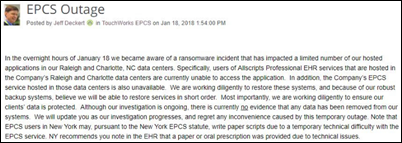
    • Allscripts buys Practice Fusion for $100 million in cash.
    • ONC’s Genevieve Morris says regulations will be published this spring that will define and regulate information blocking.
    • ONC publishes a draft of its Trusted Exchange Framework.
    • Cerner hires former Philips North America CEO Brent Shafer as CEO and board chair.
    • Wolters Kluwer Health sells Provation MD for $180 million in cash.

    Best Reader Comments

    Cerner has a gap to close and it would help everyone if the VA pushed them to increase the clinical value of their interoperability to rival Epic’s. (Switch Clicker)

    Allowing physicians to run the whole show sounds good, except it led to healthcare being a lagging adopter of technology, unsustainable cost growth, and a 17-year delay (on average) in clinical best practices receiving universal adoption. Healthcare was run like a medieval guild. That’s what physicians running everything led to and leads to. (Brian Too)

    With regards to Cerner and the VA, I would agree with you. I, too, am surprised that they didn’t leverage the Leidos relationship and have them act as the primary, similar to what occurred with the DoD. To my knowledge, Cerner, on their largest government contracts, hasn’t been the direct supplier. They won the DoD with Leidos playing lead, and in the United Kingdom, they first were with Fujitsu as the primary before BT took over for Fujitsu. (Associate CIO)

    It’s amazing how the ONC thinks that healthcare organizations are adopting FHIR. Not one single EMR, LIS, or RIS vendor in the US utilizes FHIR yet for interoperability. If they really want to invoke change, they need to figure out ways to either force adoption or incentivize it. (Annon)
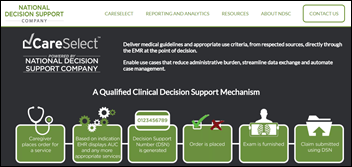
    Eva. Once again, a virtual assistant is given a woman’s name. (HIT Girl)

    The amount of times I have sat in a room to have two physicians in the same organization get into a shouting match as to how something should work is uncountable. If you cannot figure out your ideal workflow, how is a vendor supposed to create software to support it? Vendors/developers still need to be in charge of creating software, there simply needs to be more input from qualified clinicians, and less regulation on the specifics regarding clicks and metrics from the government. As someone who has grown up with a laptop in hand, the state of Health IT is atrocious, and the fact that far greater strides have not been made is an absolute travesty. (Seargant Forbin)

    Reducing the cost of health care with interoperability, even with the sharing of information, isn’t going to happen until physicians learn to trust the documentation and test results of other facilities. If a CT has been done at Facility A and the patient is then consulted on by Facility B, they are likely to repeat the CT since they trust their technicians. (Barbara)

    I see that healthcare is similar, in more ways than clinicians know or admit, to software development in every other industrial sector. Real software solutions are built on a foundation of failure and inadequacy, slowly rising to competence. Fortunes are spent on this process. A few winners emerge over time. Sectors like Finance had the advantage of (far) fewer data elements and strong theory, widely taught (this includes GAAP and goes all the way back to Luca Pacioli). Biology is more complicated but healthcare will get there. The real question should be, why did physicians expect highly competent EMRs to exist when so few physicians bought them, used them, or participated in designing them? A market economy will build what the market supports. Low investment results in sub-par results. Except, sub-par EMRs also discourage physician adoption and chokes off investment. (Brian Too)


    Watercooler Talk Tidbits

    image

    Ms. C says of the 200 sets of headphones readers provided to her Utah elementary school class in funding her DonorsChoose teacher grant request, “One project for STEAM that we are excited to use these headphones for is studying living and non-living things. We will watch live feeds and videos to see animals in their habitats, write observations, and report on our findings. Our headphones will help us hear these videos, so thank you for donating them!”

    Here’s a welcome video from new Cerner Chairman and CEO Brent Shafer.

    SNAGHTMLc960c8b

    Allscripts provided this slide in its presentation at the J.P. Morgan Healthcare conference, describing its role as an “industry consolidator.”

    image

    France-based technology company Blade launches a cloud-based, subscription-priced replacement for the PC, with an initial target audience of gamers. PCs, Macs, or mobile devices plug into the Shadow box and app, turning them into a high-powered PC (eight-threaded dedicated Xeon server, 12 GB RAM, 256 GB storage, high-end NVidia graphics card) for an annual fee of $420 in offering “the last PC you’ll buy,” at least as long as your always-on Internet connection delivers at least 15 Mbps.

    An excerpt from Genome Mag’s look into the commercial and research implications of DNA theft and health data ownership:

    Stanford University Law School professor Hank Greely agrees that human biology does not fit neatly into the property box. “Do you own your kidney?”’ he asks. “Well, kind of. No one can take it from you without your consent, but neither can you sell it.” And, he says, the same awkward fit holds true for data. “I’d like to think that I own my electronic health record, but do I really? I can’t keep the hospital from using it, or sharing it with an insurer, or giving it in de-identified form to a researcher, or giving it to the FBI if the FBI asks.”

    image

    Two old-money Kansas City, MO families donate $75 million each to Children’s Mercy Kansas City to form the Children’s Research Institute and to build it a nine-story, 375,000 square foot building that will house 3,000 mostly new employees.

    image

    The 15,000 square foot Chicago mansion previously rented by Outcome Health CEO Rishi Shah for $50,000 per month is listed for sale at $9.99 million, down from the previous $15 million. The house became famous when the 31-year-old paper multi-billionaire Shah fled the property OJ-style in a black Escalade to avoid being served a summons related to allegations that the waiting room advertising company misled investors.

    A surgeon in England is sentenced to community service for using an argon beam coagulator to burn his initials into the livers of two patients during transplant surgery in 2013. He said it was an attempt to relieve OR tension, but the judge scolded him in letting his “professional arrogance” stray into criminal behavior even though patients weren’t endangered.

    image

    Dr. Oz rushes to the aid of a fellow airline passenger and breathlessly recounts his heroic intervention to reporters – he asked the guy to lie down and raise his legs. At least he didn’t shove a weight loss pill down his throat or apply his entertainment-level medical guidance that experts say deviates from accepted medical knowledge at least 50 percent of the time.


    In Case You Missed It


    Get Involved


    125x125_2nd_Circle

    EPtalk by Dr. Jayne 1/11/18

    January 11, 2018 Dr. Jayne 1 Comment

    It’s been a while since I’ve shared from the reader mailbag. I have to say it’s been hard to keep up lately. I’ve been filling on an “interim” CMIO engagement that feels like it’s never going to end. The hospital hasn’t taken my advice on productive work and process improvement, so every day is an email battle. Couple that with an increase in spam and nonsense press releases landing in my Dr. Jayne account and it’s a recipe for late night eye-crossing.

    From Retail Medicine: “Re: CVS-Aetna merger. I agree with your concerns. I envision their community approach to healthcare being short on care and long on profit. How do we work to protect patients who are not aware that they are not receiving the care that they need and deserve? It is clear that those setting the rules have little understanding or empathy of the situation.” The reader attached a copy of the letter they sent to the CEOs of both companies, which brings up many good points. A significant portion of visits to retail clinics may be unnecessary since they are for upper respiratory infections, sprains, and strains – all of which can be self-managed without clinical intervention using common sense remedies such as rest, fluids, and over-the-counter medications. We see this at our urgent care, where patients come in when they have had symptoms for only a few hours and haven’t tried anything to address the symptoms. Nurse triage lines could help, but many patients aren’t aware of the services their insurance plan offer. It remains to be seen whether higher co-pays for emergent and urgent visits will make a difference with these visits. Other points included the need for retail clinics to coordinate with primary care physicians through a comprehensive communication system.

    From Vintage: “Re: smart glass in exam rooms. Sounds like big fins on autos in the early 1960s – eye-catching, but useless and phased out in a year or two. Surely the money paid for smart glass could have been allocated to investments with more direct impact on patient care or improvements to the working facilities of care givers. But it looks cool, I guess.” I suspect another way that cost savings could be achieved would be eliminating the large-screen monitors for so-called transparent charting. I’m sure there are plenty of physicians who don’t want their lack of typing skills or difficulty navigating the EHR to be obvious to patients. There are still too many physicians who fall into those subsets. I work regularly with physicians who have been using an EHR for years, but when you watch them, they navigate as if they have never seen the screens. I wonder if there is a biological condition that inhibits formation of muscle memory in a subset of end users? I’m always amazed when physicians who mastered complex medical disciplines struggle with straightforward actions like entering a chronic condition on a problem list.

    From The Field: “Re: observations from implementing Epic. My clinical work is entirely divorced from my IT work – I show up, see patients, and head out, electing not to get involved in a multi-layered bureaucracy. No one thought to ask me to jump in on the rollout. As my clinical colleagues struggled with various issues and just blamed the EHR, I found myself slicing the baloney thinner. Some issues were with software. With a little research and overhearing some scuttlebutt, it became apparently that other issues were because certain modules of the software weren’t purchased. Still other issues involved configuration and some were user –dependent, where users upstream in the flow of clinical information weren’t using the EHR in ways that allowed downstream users to have a flow of data. A year and a half later, I realize that we are really still implementing the system, finally getting back around to fixing things. On another aspect, the support teams could be very enthusiastic but counterproductive. I began to dread calling in a bug because of the time it would take to process it while I was trying to see patients.” There are always rude surprises when end users discover they’re missing critical pieces needed for them to be successful. I see this when practices purchase a laboratory interface but fail to spring for the mapping needed to make ordering tests a seamless experience for clinicians. Or when content is missing for key specialties, or when non-visit but high-volume workflows such as care coordination or telephone medicine are weak. I admire a clinical informaticist who can manage scope well enough to avoid being sucked into a black hole that’s not in his or her sphere of ownership. The point about the help desk is well-taken – the best support systems I’ve seen involve having strong local super users who can quickly document the details of an issue and log it on the clinician’s behalf, allowing patient care to continue.

    From Weirder than Weird: “Re: do-it-yourself circumcision kits. Did you see this article?” I intended to mention it, but it was lost in the holiday shuffle. There is a similar listing on the US Amazon site, although the item appears to be unavailable. That has left the door open for plenty of interesting questions, answers, and reviews. It made me curious what other medical or quasi-medical offerings were on Amazon. I was surprised to find biopsy forceps, uterine curettes, prostate biopsy transport vials, and ringing in at $1,400, a positioning kit for breast MRIs. While the “Young Scientist” brain dissection kit is unavailable, you can have a porcine heart or a fetal pig shipped for less than $45. From the comments on some of the listings, there are plenty of families gathering around the kitchen table to learn about anatomy. Apparently you really can get it all on Amazon.

    Email Dr. Jayne.

    Cerner Names Brent Shafer as Chairman and CEO

    January 10, 2018 News 8 Comments

    image 

    Cerner announces that it has hired Brent Shafer as its board chair and CEO, effective February 1. The 60-year-old Shafer had been CEO/EVP of Philips North America from since 2014 and a Philips employee since 2005. Prior to that, he held roles at Hill-Rom, GE Medical Systems, HP, Johnson & Johnson, and Intermountain Healthcare.

    Cerner co-founder Cliff Illig, who has held interim roles as CEO and board chair since the death of Neal Patterson in July 2017, will resume his previous role as vice-chairman of the board.

    Illig said in a statement, “Brent is a proven chief executive who has helped lead the growth and strategies of a complex, multinational organization over a number of years. He is committed to innovation, with extensive knowledge of healthcare, technology, and consumer markets and an exceptional skill set that complements Cerner’s strong leadership team. Since our founding, Cerner has used the power of information technology to disrupt and improve healthcare. The addition of Brent to our leadership team positions Cerner well for our next era of growth.”

    Shafer said in the announcement, “For decades, Cerner has built its reputation on meaningful innovation and driving client value. This company’s history of remarkable, sustained growth is testament to a strong leadership culture and I’m excited to celebrate many new milestones with Cerner associates around the world. My commitment to Cerner’s clients, shareholders, and associates worldwide is that we will continue to be the catalyst for real and effective improvement across healthcare.”

    According to SEC filings, Shafer will earn a base salary of $800,000, will be eligible for a $1.2 million annual bonus, will be awarded $4 million worth of Cerner shares plus a $3.7 million award to replace his forfeited Philips equity, and will be allowed use of Cerner’s corporate aircraft up to $100,000 annually. He will be paid two years’ salary if the company is sold.

    Text Ads


    RECENT COMMENTS

    1. Re: Deliberately Faked Academic Papers in Nature See, this doesn't surprise me at all. Of course AI quotes these bogus…

    2. Challenger exploded on lift-off when the O-rings failed. Columbia disintegrated on reentry after one of the heat shield tiles were…

    Founding Sponsors


    Platinum Sponsors


    Gold Sponsors


    RSS Webinars

    • An error has occurred, which probably means the feed is down. Try again later.