Readers Write: HLTH 2018 Recap: A Transformation in Talking about Healthcare Transportation

May 11, 2018 Readers Write 1 Comment

HLTH 2018 Recap: A Transformation in Talking about Healthcare Transportation
By Travis Good, MD

Travis Good, MD is co-founder, CEO, and chief privacy officer of Datica of Madison, WI.

image

The premiere, sold-out HLTH conference ended last week in Las Vegas with a generally positive impression on its new style of healthcare conference. I, along with 3,500 attendees, laughed with Jonathan Bush, CEO of Athenahealth, as he entertained us with statements like, “All we do, all of us, is fail… And then we die!” We sat in stunned silence as Harold Paz, MD, executive vice-president and chief medical officer at Aetna shared the disturbing facts of the opioid crisis — facts like 116 people die every day in America, where we consume more opioids than any other country on Earth, and that more Americans will die this year than died through the entire AIDS epidemic or the Vietnam War.

HLTH was different than many healthcare conferences I’ve attended with its rapid-fire panel discussions, where the panelists didn’t waste time explaining high-level concepts like Blockchain, but instead jumped right in to describing the details of the emerging technology details. Numerous announcements and visionary ideas were also presented. The slick nature of the well-orchestrated HLTH event, likely made possible by the $5 million garnered in venture money, left an overwhelming impression for a first-time event.

The HLTH organizers did have one major miss: lack of strong representation of female healthcare leaders. Evidence of that agenda oversight gained audience criticism in social media and questions to panelists (including me) on why they thought few women graced the stage.

Two general themes prevailed throughout the conference. One centered on transforming the current healthcare business model to improve everything from interoperability, costs, and patient outcomes to physician burnout. The second theme that emerged throughout the conference focused on the exploration of entirely new business models that could transform the healthcare industry.

Announcements ranged from the splashy — like former CMS Acting Administrator Andy Slavitt’s launch of Town Hall Ventures, his shift from the government to investing in technologies that facilitate real change in our communities, and Change Healthcare teaming up with Adobe and Microsoft to orchestrate better patient engagement — to the mundane, like Marcus Osborne, VP of healthcare transformation at Walmart announcing, “Walmart isn’t going to stand for this” in describing the poor quality of care their associates have had to endure and Walmart’s push toward an evidence-based approach that ends physician’s entitlements.

Topics around blockchain, genomics, artificial intelligence (AI) and machine learning, cloud, augmented reality, and interoperability prevailed. During a lively panel, the so-called “unicorns of healthcare” shared their predictions of the next generation of unicorns. Anne Wojcicki, CEO and co-founder at 23andMe, predicted that the next unicorn will be in AI or chatbots. Frank Williams, CEO at Evolent Health, says precision medicine. Jonathan Bush thinks they’ll be new reimbursement models or therapeutics.

One theme woven throughout conference presentations is the idea that caring for health needs should extend beyond the walls of a treatment room and out into the community. On the first evening of the conference, David Feinberg, Geisinger president and CEO, described his vision of a new direction for healthcare for the communities Geisinger serves. The vision included not only traditional healthcare, but also feeding and housing people who need it.

Later in the conference, Lauren Steingold, head of strategy at Uber Health, described the company’s innovative new patient transportation offering that could help eliminate the $150B yearly cost to the healthcare industry resulting from 3.6 billion Americans who miss appointments due to transportation issues. Steingold described her vision of expanding that model to encompass telemedicine patients who need a ride to the pharmacy or even surgery patients who need a ride home.

My favorite quote from the conference, which pretty much sums up the current state of healthcare transformation, came from Anne Wojcicki. “What happens in healthcare is you have people who really want to do the right thing, but the ships are pointed in the wrong direction.”

All in all, the conference left attendees more informed and energized. Now HLTH organizers are taking what they learned from the first conference and planning for expansion next year.

What I Wish I’d Known Before … Working with Doctors on Technology Projects

May 11, 2018 What I Wish I'd Known Before Comments Off on What I Wish I’d Known Before … Working with Doctors on Technology Projects

I wish I had known that once I crossed the line to help IT that I would be an IT person and no longer viewed as a credible physician. My former peers became dismissive of my opinions, coming up with a variety of reasons — I hadn’t been in practice as long as them, I no longer saw as many patients as them, I wasn’t in a procedural specialty, etc. Looking back on their behavior, it was bullying, plain and simple.


How often one person can derail an entire initiative regardless of the validity of the reasoning.


I wish I had known the depth of ignorance on both sides of the tech / physician engagement. Be it the languages used, the ability to decipher thoughts and requirements, the ability to say, “No, not that, but maybe this.” I wish there was more empathy on both sides of the house and more diligence in learning from each side.

From the tech side, realizing that the doc/nurse in front of you has a job to do that isn’t to interact with the computer. That our tech needs to make it easier to do that job and not harder. That clinicians have trained very hard to get where they are and that it is appropriate to ask the “why” question so you can learn from their experience — and by asking why your product will be better suited to the task and use. That when the tech side makes assumptions they need to validate those assumptions against the clinicians experience. And, that the clinical roles are not all the same — learn the workflows of the roles under development.

For the doctors, realizing that customization is expensive across the development life cycle — almost as expensive as flexibility. That there is a need to be prescriptive while still being flexible. That you should call out bad design and usability, but show them how you want to use the system. Use your active listening skills to ensure that they understand what you are conveying. Realize that we don’t hate you and aren’t trying to kill your patients or ruin your practice — even if it feels like that at times

For both, that there is a need to exchange the data, information, knowledge, and wisdom that is the potential of electronic health records. Think about how your suggestions and decisions will impact analytics, research, and semantic exchange.

Lastly, maybe walking a mile or six in the other guy’s shoes wouldn’t hurt as long as you don’t get to thinking a little experience gives you great competence (e.g. the Dunning-Kruger effect).


A savvy physician who understands IT and the challenges we face and yet holds us accountable is the most powerful and effective program sponsor I have ever had. This physician leader, who practiced emergency medicine, pushed and led our IT organization to achievements we didn’t think were possible. He provided air cover to the program with physician colleagues across the organization. He had built trust with that community over decades of steady delivery of IT-related projects that met the needs of the physician community without incorporating the latest shiny thing. His participation was invaluable. I have seen few like him, but he was worth his weight in platinum.


I wish I’d known just how many of them would tell me “I took some programming classes in college” and would then proceed to inform me how an application should be built. Cool story, doc. I took a CPR class once, so let me tell you how to treat pulmonary hypertension.

I have also worked with some great physicians who were really open to the discovery process, and in my non-scientific sampling, the ones most tolerant of unexpected or undesired behavior were primary care physicians and the least-tolerant were orthopedic specialists. I’m not sure which way causality runs, but physicians whose entire job function is the human narrative and who trade in identifying root cause from a flood of poorly-described symptoms are way more amenable to testing things out and trying them in an unfinished state than people whose entire job is fixing an already-defined problem.


The vendor is going to have its own idea of how the software implementation plan should go and this will likely include a recommendation for staff, including doctors, to watch some videos and maybe do some reading before the vendor staff show up at the office. However, the doctors will most likely NOT do this and that changes much. Never did figure out why a doc would spend many thousands of dollars on a system and not take the vendor’s suggestion. This most often leads to a planned failure or less than successful launch and more down the road issues and the aforementioned tantrums and bad-mouthing of the vendor (couldn’t be the doctor’s fault, right?)

Maybe a possible solution would be to have the doctor sign a contract outlining the vendor recommendation to study up before go-live and an agreement to pay extra for on-site staffing when things go bad if they don’t do the pre-study.

Doctors usually want to buy a system that is totally customized to their workflow and uniqueness (think lots of $$$$$) but pay for a “one size fits all” commodity software (think much less $$).

Some docs still think they can work a full day of patients and have a successful go-live.


That there are many more physicians who are helpful and positive than those that are negative and resistant. It is just that the resistant ones make a lot more noise, commotion, and are experts at getting attention. It takes strong organizational leadership and the willingness to put some teeth into the medical bylaws to hold the resistant physicians accountable for their negative actions.


Maybe to be a little more appreciative. Looking back, some of the best projects I’d worked on. A chief pathologist who never missed a project meeting, gave a personal number for emergencies, and taught us all about lab billing. Another chief pathologist who validated an ancient AP system conversion, patiently looking side by side, old and new, checking every procedure type. In the end, 25 years of data converted, no errors. An anesthesiologist who remained obstinate through an entire Lean event, pushing the team to the edge of insanity, then led the implementation and blew down barriers in the department we did not know existed. Many other great memories of physicians who were not only generous with their time but were also key contributors.


I wish that I had known that doctors are flawless beings incapable of making a mistake and that an EMR will not work and do the same task a dozen different ways every time a doctor interacts with it.


The pervasive power of delayed adolescence fused with authority, enabled by administrative leadership complicity and medical leadership effeteness.


Every doctor I’ve worked with will not admit upfront to ignorance about system capabilities or their lack of knowledge about software in general. Why would they? Start new projects with level-setting demonstrations about what your system can do (or will soon be able to do). Physicians will react to what they see presented and offer specific insights rather than speaking in generalities.


Understand your audience. Understand what the physicians and other providers want to get out of the system. Frame your language in a way that they can understand what you’re saying. I’ve seen too many people jump into wonky language when describing projects, systems, or configurations. If they don’t understand you, they will assume the worst. And then it will be much more difficult to convince them to change anything.


Practicing medicine is an art, not only a science, so there is no cookie cutter treatment for every patient and scenario. If you understand that up front, you will not be disappointed that your plans / solutions / workflows do not work with every provider or department. You need to always seek second opinion.


That all those years of babysitting and talking kids down from tantrums would come in so handy in my future.


Weekender 5/11/18

May 11, 2018 Weekender 5 Comments

weekender


Weekly News Recap

  • The VA says it will make a decision on how to proceed with a Cerner contract by May 28.
  • Mayo Clinic goes live on Epic.
  • Virtual visit provider HealthTap dismisses founder and CEO Ron Gutman after investigating high employee turnover and reports about abusive conduct.
  • A DoD OIG report finds that Navy and Air Force treatment facilities have not consistently implemented security protocols to protect patient information in EHRs and other system.
  • Athenahealth shareholder Elliott Management makes an all-cash offer for the remainder of the company it doesn’t already own, valuing it at up to $6.9 billion and sending ATHN shares soaring.

Best Reader Comments

FAMIA – if they model it after the ACMI fellowship, I think it could be successful. ACMI is full of academics who don’t have a clue about real world issues that Informaticists “in the trenches” deal with, and so would be nice to have some formal recognition for those of us who actually get things done (instead of just write about them, like lots of ACMI members). (Alphabet Soup)

Back in spring 2017, UIC had a meeting with vendors to kick off the procurement process. I was there with my company and Cerner people were in the room as well. Impact Advisors was introduced to all as the group that would be helping UIC. No one objected, including Cerner. Then many months later when Cerner finds out that they lost the bid to Epic, suddenly it is all about a conflict of interest with Impact Advisors. The more likely explanation is that this is just about sour grapes. Time to look for another reason for why Cerner lost. I got one – maybe UIC also figured out that the Cerner Revenue Cycle is not good. (Abe is watching)

In addition to the immediacy benefit of the 1800s anesthesia / antisepsis comparison was that anesthesia benefited the physician (no screaming patient as I cut him/ her open) and antisepsis benefited the patient. Doctors will always do what’s best for them. Every time you ask a physician to do something you need to find a way that it will benefit him/ her and the quicker, the better. (Was a Community Hospital CIO)

Athenahealth has always struggled with monetizing the data because they don’t own the data. They own the right to use de-identified aggregate data (which they use in things their flu trend reporting), but most of the valuable applications of data in healthcare require PHI that is either not de-identified or is easily re-identified, which Athena doesn’t have the right to sell. So much as they would like to monetize the data, it’s always been out of their reach. (Debtor)

It amazes me how much blame Facebook has successfully deflected onto Cambridge Analytica. (Martin Shkreli)

Athena will be out of the hospital space and focus exclusively on their core ambulatory when this merger happens. Total available market for hospital is shrinking with market pressure from new and increased entrants to the small hospital space. There is no path to profitability in that race to the bottom. Look for them to try and reinvent as an app maker. (Crazy Joe)

The #2 female finisher of the Boston Marathon this year is a nurse anesthetist, and #4 is a registered dietitian. Apparently health care makes good runners. Oh, and the #5 female finisher (nurse practitioner) worked a 10-hour shift the day after the Marathon, after driving home from Boston to NYC. (Kermit)


Watercooler Talk Tidbits

image image

Readers funded the DonorsChoose teacher grant request of Ms. R in Arizona, who asked for headphones for her classroom’s listening centers. She reports, “My students are now able to record themselves and listen and review their fluency. They have headphones that allow them to listen to audiobooks in groups and listen to their intervention program. These headphones will be helpful when going into AzMerit as there will be a listening portion and many of my students do not have access to headphones. My students loved that they can fold the headphones and use the microphone on any device we have available for the day in the classroom.”

image image

Also checking in was Ms. G from Texas, who asked for Dash Robots to introduce her students to coding and robotics. She says, “Thank you for allowing my students to have the opportunity to experience coding in this fun and engaging way. My kids love Dash and they are so engaged when using them in the Maker Space. At this time my kids are completing the challenges that Dash gives them. This will prepare them for the next step, which is a robot competition. The kids are practicing for the big day! They will be competing with their robots to complete some mazes and other exciting activities. All this was possible thanks to you. Thank you again for your donation and for making a difference in my students’ education.”

President Trump appoints TV huckster Dr. Oz and “Incredible Hulk” actor Lou Ferrigno to HHS’s sports, fitness, and nutrition council.

Ireland attempts to name its new national children’s hospital as “Phoenix Children’s Health,” but is forced to reconsider when Phoenix Children’s Hospital (AZ) threatens to sue over the name. An executive of Ireland’s Children’s Hospital Group tried to contact the US hospital about the proposed name, but the email went astray because he misspelled “Phoenix” as “Pheonix” in the email address.

image

TV actor Ken Jeong rushes from the stage of his stand-up gig to attend to an audience member who was having convulsions. He’s qualified – he earned his MD degree from University of North Carolina at Chapel Hill School of Medicine in 1995, completed an internal medicine residency at Ochsner Medical Center (LA), and maintains a California license, although he no longer practices medicine. He developed and starred in the ABC sitcom “Dr. Ken” that ran from 2015-2017. His wife is also a doctor.

Mayo Clinic prepared for its Epic go-live this week by warning employees that parking areas will be restricted May 5-25 to squeeze in the 2,200 on-site consultants and Epic employees involved.

image

Medical ethics professor Arthur Caplan, PhD criticizes the “root for your roots” advertising campaign of DNA testing company 23andMe that urges American soccer fans whose team was eliminated to instead root for World Cup soccer teams based on shared genetics from the company’s database. He says there’s already too much racism in soccer as “soccer hooligan bigots” taunt minority athletes and notes that countries aren’t neatly sorted out by genetic racial groups, also adding:

There is no correlation between genetics and who is a member of a nation’s soccer team.  People from many ethnic and racial backgrounds play for many nations. There is no Argentinian or Croatian team genotype. And why would information about your genetic ancestry lead you to root for a particular athlete or team? How about the team’s skill, not their skin color or biological makeup?

image

Self-proclaimed “OB-GYN and media personality” Draion Burch, DO wins the trademark application protest brought against him by rapper, music producer, and Beats founder Dr. Dre. The patent office didn’t buy Dre’s argument that consumers would be confused by the similarly named media personalities. Dr. Drai, as he prefers to be called, is apparently not especially proud of his DO degree since he insists on just being called “Dr.” in his noted scholarly works such as “Discover 20 Strange but True Secrets About the Vagina” and the penetrating commentary in his opus titled “20 Things You May Not Know About the Penis.”

image

A Missouri woman is hospitalized with facial injuries after a wild turkey crashes through the windshield of the van in which she is riding. She is OK, but the turkey is not. She was not reported to have echoed the comments of WKRP GM “Big Guy” Arthur Carlson in failing to say, “As God is my witness, I thought turkeys could fly.”


In Case You Missed It


Get Involved


125x125_2nd_Circle

EPtalk by Dr. Jayne 5/10/18

May 10, 2018 Dr. Jayne 3 Comments

clip_image002 

Primary care physicians continue to look for ways to get off the hamster wheel that our profession has become. The Direct Primary Care (DPC) movement is the answer for growing numbers of physicians who engage with patients on a cash or retainer basis, cutting the insurers and health systems out of the equation. The 2018 DPC Summit will be held in Indianapolis in July, welcoming both existing DPC practices and those looking to explore their options.

I have several good friends with DPC practices. The movement is something that health IT companies should start thinking about if they’re not already. These practices often embrace electronic health records and technology that better enables connections with their patients along with comprehensive and high-quality care, but they don’t want the distractions of convoluted workflows to support billing requirements or other regulatory content.

My practice’s EHR has a setting that allowed us to completely turn off all of the Meaningful Use content, which was a great physician satisfier when we made the change. There are niche vendors such as Atlas.MD whose product is designed for DPC practices, but physicians often look for ways to transition their practices without a system switch. If your products can’t handle monthly recurring credit card billing, telemedicine, and plug-and-play interoperability, you’re going to miss out on these practices.

I’m often asked if I would ever go back to the primary care trenches. Informatics is definitely my first love, but I do miss the ongoing patient relationships I had previously. Given the stresses to the system and the level of burnout that many physicians are experiencing, I think the only way I would do it would be to either be part of a direct-type practice or part of a relatively closed system such as a civilian contractor to the military. Of course, there is a magical salary number that would take me back into the trenches tomorrow, but I have better odds of winning the PowerBall than I have of seeing a typical primary care physician hit that number.

I was somewhat puzzled by the headline on this CMS press release: “CMS Announces Agency’s First Rural Health Strategy.” Correct me if I’m wrong, but hasn’t CMS had a rural health strategy for a long time through the Rural Health Clinic (RHC) program? I’m a big fan of the idea that words mean something, so it’s kind of disheartening to think that people who have been working in the Rural Health arena for years might be hearing that their hard work wasn’t part of any strategy. CHS formed its Rural Health Council in 2016 and the Health Resources and Services Administration’s (HRSA) Federal Office of Rural Health Policy (FORHP) was created in 1987. I guess they didn’t have any strategy either. But maybe we’re just now calling it a strategy?

I’m unimpressed by the level of rhetoric coming out of CMS lately, which seems more political than patient focused. I’ve searched through some press releases I kept from previous years and I don’t see “this Administration” or “the X Administration” mentioned nearly as often as I see “the Trump Administration” mentioned. Of course, this is strictly anecdotal and has no statistical power – maybe one of my AMIA colleagues will consider doing an analysis of the content of HHS, CMS, and ONC press releases to see if the language really is that different.

clip_image004

Speaking of AMIA, the organization is introducing a new program to recognize applied informatics professionals. Fellows of AMIA will demonstrate education, commitment to the practice of informatics, contributions to the field of applied informatics, and a sustained commitment to AMIA. The organization plans to begin recognizing Fellows at the AMIA 2018 Annual Symposium and will begin accepting applications by July. I’m not sure I’ll qualify since my practice of informatics is far from typical, but I’ll check it out nevertheless.

CMS recently updated its Hospital Compare website with new Hospital Consumer Assessment of Healthcare Providers and Systems (HCAHPS) data on patient experience. The new data was collected between July 2016 and June 2017. The patient experience ratings are separate from the overall CMS quality star ratings and cover 11 publicly reported measures. One available map I found listed hospitals in the wrong place, so I hope patients using the map look carefully at the legend to ensure they’re getting the right information. My 4-star hospital was replaced on the map by a 2-star hospital, so I had to do a double take.

The 11 patient experience measures are: cleanliness; nurse communication; doctor communication; staff responsiveness; pain management; communication about medicines; discharge information; care transition; overall hospital rating; quietness, and willingness to recommend the hospital.

clip_image006

I’ve spent quite a bit of time on aircraft over the last decade and continue to be amazed by the level of self-centeredness of some of the passengers. Despite recent in-flight incidents, people continue to ignore safety briefings and defy flight attendant instructions. Usually I sit in the exit row, but was near the front due to a tight connection, and watched four people try to use the lavatory while the seatbelt sign was on and the plane was on its initial climb. The flight attendant sent each of them back to their seats, but no one seemed to pay attention to the person in front of them being turned away or the multiple overhead announcements.

On another flight where the row in front of me didn’t recline, I had an irate woman (who had already been told by the flight attendant that the seat didn’t recline due to being in front of an exit row) lift herself up in the seat and try to force the seat to recline with her whole body weight, almost breaking my laptop screen. We had people jumping up and out of their seats while we were still taxiing, requiring the flight attendants to unstrap themselves and force people to sit down.

It’s not just the lack of following published rules, but the general lack of civility. I watched a woman berate a flight attendant for not putting enough cream in her coffee, even after the flight attendant carefully verified how many units of cream and sugar the passenger wanted. The coffee was almost white and I had to resist the urge to remind the passenger that this was a Southwest Airlines flight, not a Starbucks.

Right now, I’m watching a woman give a full-on back rub to a man with no shoes, using a massage tool that she pulled out of her carry-on. I also saw someone rubbing liquor on the lips of his sleeping companion, trying to wake her up. I had to look around and make sure I wasn’t on some episode of a prank TV show. If you’re a ground-based employee and interact with road warriors, give them a little slack if they seem grumpy. They may have just gone through three hours of wondering what crazy thing would happen next.

Email Dr. Jayne.

HIStalk Interviews Kevin Fleming, CEO, Loyale Healthcare

April 25, 2018 Interviews Comments Off on HIStalk Interviews Kevin Fleming, CEO, Loyale Healthcare

Kevin Fleming is CEO of Loyale Healthcare of Lafayette, CA.

image

Tell me about yourself and the company.

I’ve been in financial services in the healthcare industry for about 30 years. I had a long career at Ernst & Young. I ran a nationwide M&A practice and did well there. I then transitioned to Electronic Data Systems, where I was an executive. I ran a large strategic business unit with healthcare and financial services companies, some of the largest in the nation. It was heavy lifting — IT outsourcing, business process operations, claims processing. Roll up the sleeves, serious heavy lifting type of operational and IT activities.

Then I got a greater good calling. I took over as CFO — and then as the turnaround CEO — of the first full risk-bearing accountable care organization in the United States called Paradigm Outcomes, based in California but with a nationwide footprint. A lot of Paradigm’s business model was baked into what we now know as accountable care organization standards and programs.

I tried multiple times to retire but failed miserably at each of those. I found that my calling in life was to work. I took on another greater good calling, which was to help patients and providers deal with what perhaps is the most complex, perplexing, and most important issue — or at least it should be on their plate — and that is the phenomenon of consumerism in healthcare. That’s why I joined EPay Healthcare, and we’ve since rebranded to be Loyale.

As the tagline suggests, Loyale thinks patient responsibility shouldn’t be a burden. It’s an opportunity to create lasting loyalty and Net Promoters out of patients. In fact, the very survival of a lot of what we call the healthcare delivery network today depends on being able to do that.

How much patient dissatisfaction is caused by the financial aspects of their encounter?

I think if there were an accurate capturing mechanism for that, it would probably be well north of 80 percent. The patient’s first experience entering a healthcare setting is often administrative and that immediately becomes financial — looking for a co-pay. Their last experience is making that final payment or some other outcome, such as not paying a collection agency.

We see a lot of companies avoiding even capturing the satisfaction with the financial dimension of the relationship. We think that’s not only fundamentally wrong, but dangerous. To some degree, it’s low-hanging fruit, something that could change in a hurry with a little bit of effort. It could change dramatically for the better with a real patient financial engagement solution. That’s what we’re all about.

Consumers are fine with other industries in which companies require payment upfront and that market selectively to those who can afford their product or service. How can a physician practice have a different kind of relationship with people they know are able and likely to pay versus those who are not?

That hits one of the critical success factors to patient financial engagement. It’s a critical part of patient satisfaction overall.

The number one issue now — even exceeding anxiety over the clinical procedure to be performed — is financial anxiety. The inability to deal with the responsibility that everybody knows is coming, especially with the proliferation of high-deductible plans. The patient knows it’s coming. They don’t know the exact amount, but they know it’s going to be negative.

Using segmentation upfront to understand where a patient is with regards to both ability to pay and propensity to pay is a wise thing to do. It’s wiser yet to use it to dictate how you to interact with the patient financially.

That should never mean, in any way, compromising the quality of clinical care delivered. In fact, it’s consistent with the Hippocratic Oath — do no harm. The harm that the patient is afraid of is not just clinical, it’s financial. If you’re identifying those patients who are going to have a hard time paying and giving them options up front — showing a plan, showing a solution to eliminate that anxiety — you’re helping them, and of course, helping yourself.

Studies have shown that patients, younger ones in particular, are willing to pay if given a convenient way to do so. Does technology play a greater role in financial transparency and ultimately collections?

Yes, very much so. There are five or six golden opportunities for healthcare in having a patient financial engagement business strategy and follow-through capability. That’s one that’s near the top of the list — having a powerful digital channel, a portal, a go-to place.

You probably saw some of the same studies that I did that suggest in the next five years or so, Millennials will be making 70 percent of all healthcare decisions in the United States. I don’t know if that’s true or not, but we do know that the percentage is increasing constantly. Sixty to 80 percent of Millennials want to do all their business online, including clinical interactions, including making payments.

That does a lot of good things for everybody. You’re servicing them in the channel where they want to do business. You’re servicing them better at a higher standard that can cover all things clinical and financial in one setting. Working with us, they’re exposed to financing tools and vehicles, a variety of them that they probably wouldn’t see elsewhere. They’re able to work out their own plan, their own financial solution if you will, to deal with their responsibilities.

I don’t think that’s unique to Millennials. Obviously as a demographic, especially as they move more and more into prominence by numbers, they’re focused more on healthcare decisions. We’ve found high pickup rates for almost all demographics, including those at the upper end of the Baby Boomer age range. It’s not unique. People want to be able to do business in a convenient setting and a digital portal is very much one of those options.

It also reduces dramatically the provider’s cost to collect. As you can imagine, once the automation is in place, the cost of service is pennies on the dollar compared to rendering physical statements. Maybe a lot of those statements, because you extend out to multiple collection cycles because the patient isn’t paying. To pay for a call center, to pay for facility staff who many times would just as soon not to be involved with this at all.

They went to medical school, but now with the bleed-over effect, as we call it, instead of delivering medicine, they’re answering patients questions about, “Why is my estimate so high?” All that can be done extremely well in a digital portal. That needs to be a primary part of any provider’s financial engagement strategy, in our opinion.

Hospitals that don’t often have a strong reputation for being friendly or efficient with their billing and collection practices are increasingly acquiring, sometimes invisibly, practices and urgent care centers. Are you seeing patient engagement and loyalty changing as a result?

I had a front-row seat to consolidation in the financial services industry. We’re seeing a slightly different version of the same movie and the same end effect — a lot fewer entities. The banking industry consolidated almost by 50 percent in terms of the number of banks. A few large networks and regional networks were established. Specialty players came in, like PayPal, and picked up some very lucrative areas.

The same thing is happening in healthcare right now. Hospitals and healthcare networks are looking at that same near-extinction event as the financial crisis of 2008-9. They are over-leveraged and their operating cash flows are impaired for a lot of reasons. One at the top of the list is patient responsibility and the inability to collect. There are a lot of reasons that consolidation will pick up steam.

That’s one reason we were selected by the nation’s largest healthcare network, HCA, to be their platform and solution standards. The idea of episode of care. You can deal with a patient if they have a primary care physician or urgent care physician that they see ad hoc who then refers them to the hospital or outpatient setting, surgery centers, and so on. It doesn’t really matter. Our system will pick up all those physicians, all those caregivers, and amalgamate them into one financial episode of care.

The patient can see all of that at once. Instead of receiving five different bills and maybe one financing option or even maybe none, they’ll see a holistic solution for all the episodes of care coming from that healthcare network. In terms of consolidation, that’s an important thing to be able to do.

Part of this is you always want to service the patient better. But in terms of share of wallet, you want to be giving care in all those different modalities and stages and presenting an easy to understand financial bill instead of alternatives in aggregate for all of them. That’s a tremendous advantage.

Are providers recognizing that, as in other businesses, patients who are willing and able to pay cash up front would probably be more inclined to do so if they’re offered a discount?

The more forward-thinking ones are. We have a tool within our platform called Affordability Workbench. One of the doors, if you will, is our prompt pay discounts. Those would be highly apropos for self-insured patients who are not otherwise getting negotiated discount rates. The full charge master price without any discounts just isn’t going to work for them. There’s no way they can shoulder it.

I can’t say that’s universally applied, but we’ve specifically provided for it in the toolset for that very reason, to give the patient options that they don’t always see. Hopefully one of them works.

We also have a comprehensive array of payment plans that are extremely flexible. The patient is able to self-construct their own payment plan according to their cash flows within certain parameters that the facility controls. We have connections with all of the major third-party lenders, secured and unsecured facilities, and a pretty good idea of where they play well and where they won’t play well based on a provider’s requirement and patient financing needs.

Do you have any final thoughts?

The critical thing here is to get in the game and to play the game to win. If this plays out like the financial services industry consolidation, as many as half the healthcare providers in the country just won’t be there, probably within the next 10 years. You have behemoths like Walmart, Walgreens, Amazon, and CVS aligning with the mega payers. They are going to cherry pick some of the very best business in primary care, urgent care, and pharma. They are absolute experts and masters at consumerism given their retail origin.

It’s vital to play this game to win. Status quo is not winning. Just getting started is the biggest part of the battle. We have phased implementation with customers, so they can do it in pieces that they can absorb. Within 18 to 24 months, they’re all the way there.

The biggest message I would leave is to get in this game. This is the biggest issue on the table, the biggest elephant in the room. I know you’ve got a lot of other fires burning around you — value-based care, EHRs, filling capacity, and so on — but no patient, no mission. No money, no mission. Those are literally the table stakes here. Get in the game and get in the game to win.

News 4/25/18

April 24, 2018 News 9 Comments

Top News

SNAGHTML2a79b000

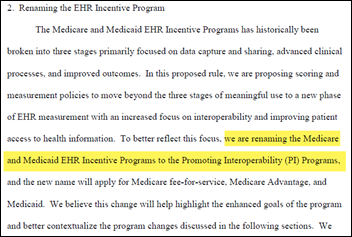
A proposed HHS rule would retarget the Medicare and Medicaid EHR Incentive Programs to “a new phase of EHR measurement with an increased focus on interoperability and improving patient access to health information.”

CMS proposes renaming the incentive programs to “Promoting Interoperability Programs,” noting that the word “incentive” is obsolete now that most payments have ended.

The rule would require using CEHRT certified for the 2015 Edition beginning with the 2019 covered year. It would allow a 90-day reporting period for 2019 and 2020.

image

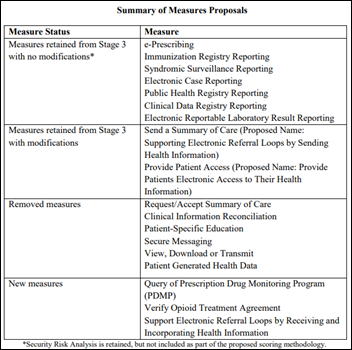
HHS proposes to replace the six Medicare EHR Incentive Program measures with four:

  • E-prescribing
  • Health information exchange
  • Provider-to-provider exchange
  • Public health and clinical data exchange

HHS also proposes two opioid-related e-prescribing measures for connecting to PDMPs and verifying treatment agreements that would be optional for the first year.

The proposed changes would also require hospitals to publish their charge master price list online every year, but asks whether more specific information might be useful to consumers, such as details on a hospital’s average discounted charges across all payers. HHS also asks if providers should be required to disclose a patient’s out-of-pocket cost for a service before performing that service, presumably to reduce surprise out-of-network charges.

The public’s comments about the 1,900-page document are due June 25.


Reader Comments

image

From Stealthily Healthy: “Re: HLTH conference. I’ve been asked a dozen times if I’m attending and I’m uncertain. What do you think?” Beats me. The speaker roster is huge, which I expect is because the VC-funded first-time conference used its cash to pay expenses and hype it up a bit. They’re also offering free provider registration hoping to give vendors their money’s worth in corralling prospects. I’m not sure anyone’s thrilled at going back to Las Vegas in early May after just leaving HIMSS there in March. The big question is whether it will do well enough financially to warrant a repeat next year. The conference claims it will create “a much-needed dialogue focused on disruptive innovation in healthcare” even though it’s run by two tech guys with zero healthcare experience and the track record of folks waving the “disruptive” flag without understanding what they’re disrupting isn’t great. We have way too many healthcare conferences, but fortunately for those offering them, way too many people willing to spend their employer’s time and expense money to attend them with questionable outcomes beyond glad-handing self-validation. Ironically, I would bet that high-accomplishment conference presenters didn’t actually waste their early-career time attending those same conferences.

From System CIO: “Re: HIStalk. It’s a really valuable read for me. I’m not one of those CIOs who is constantly networking with everything and everyone in our industry to keep up (primarily because there’s so much work to do and time necessarily spent focused inwardly) but HIStalk allows me to see/stay connected more broadly. Thank you for all of the time and effort you spend to make it what it is.” Thanks for making my day.


HIStalk Announcements and Requests

image

I’m getting good responses to this week’s question. I’m sure yours would be even better (hint).

Listening: reader-recommended The Prefab Messiahs, a barely-noticed early 1980s punk band that college students have rediscovered with their new album. It’s raw and I expected the typical garage band weak vocals, but they sound good when belting out wry, withering social commentary on songs like “The Man Who Killed Reality.”

I’ve seen video from recent conferences in which attendees were urged to hug each other, dance at their seats, or exchange high-fives, all of which seem not only to be crassly contrived, but straying way outside the comfort zone of many in the audience. I remember one hospital management event I attended where they hired a super-cheesy motivational speaker (some local guy who formerly played in an awful rock band with small talent and big hair) who demanded that we all “share” with our tablemates, which made me want to rip off his $2,000 suit and choke him with it. At the long-awaited end of his de-motivational speech, he brought up a slide of his wife and fake-cried about how much he loved her, leading all of us recent sharers to wonder what exactly we were supposed to do with that. Dear conference organizers and presenters – just do your presentation without expecting the paying audience to do anything except watch. Or just thrust your microphone Ozzy-style at the crowd and let them read the slides while you wiggle your hands approvingly as a conductor rather than performer.


Webinars

May 9 (Wednesday) 2:00 ET. “How to Make VBC Work for You: The Business Case to Transform Into the Health System of the Future.” Sponsor: Philips Wellcentive. Presenters: Mason Beard, co-founder and chief product officer, Philips Wellcentive; Scott Cullen, MD, principal, ECG Management Consulting; Seema Mathur, director of strategy, Sage Growth Partners. How well is your organization funding its transformation to VBC? This free webinar explains how to achieve ROI as your organization transforms to meet the future. You’ll learn how VBC is impacting healthcare system management, three strategies for funding your transformation, and what the healthcare system of the future will look like.

May 24 (Thursday) 1:00 ET. “Converting Consumers into Patients: Strategies for Creating Engaging Digital Experiences People Demand.” Sponsor: Healthwise. Presenters: Antonia Chappell, director of consumer solutions, Healthwise; Josh Schlaich, senior product manager, Healthwise. Nearly three-quarters of US adults use a digital channel to manage their health and the internet to track down health information. It’s clear that consumers have come to expect online interactions as an integral part of their overall patient experience. In fact, the Internet may be the first way people come in contact with your organization. They have more choice than ever on where to get healthcare services, and their decisions are increasingly influenced by how well organizations connect with them in the digital space. This webinar will show you how to create engaging digital and web experiences that convert casual consumers into patients and keep them satisfied throughout their entire patient journey.

May 29 (Tuesday) 1:00 ET. “Increase Referrals and Patient Satisfaction with a Smarter ‘Find a Doctor’ Web Search.” Sponsors: Phynd Technologies, Healthwise. Presenters: Joseph H. Schneider, MD, MBA, FAAP, retired SVP/CHIO, Indiana University Health; Keith Belton, VP of marketing, Phynd. A recent survey found that 84 percent of patients check a hospital’s website before booking an appointment. However, ‘Find a Doctor’ search functions often frustrate them because their matching functionality is primitive and the provider’s information is incomplete or outdated. Referring physicians need similarly robust tools to find the right specialist and to send the patient to the right location. Attendees of this webinar will learn how taxonomy-driven Provider Information Management improves patient and referrer satisfaction by intelligently incorporating the provider’s location, insurance coverage, specialty and subspecialty, and services offered that can be searched via patient-friendly terms.

Previous webinars are on our YouTube channel. Contact Lorre for information.


Acquisitions, Funding, Business, and Stock

image

China’s largest Internet healthcare platform, insurance subsidiary Ping An Healthcare and Technology, plans a $1.1 billion IPO on the Honk Kong exchange. The 900-employee, AI-assisted service provides 370,000 free consultations each day and offers free, two-hour prescription delivery in major cities. Its network includes 3,100 hospitals and 7,500 pharmacies. Reports from a year ago suggested that investors were losing interest because of profitability concerns despite huge demand that is driven by dissatisfaction with China’s overwhelmed healthcare system.

image

Twitter co-founder Biz Stone invests an unspecified amount in India-based Visit, which offers AI-supported video visits.


Sales

War Memorial Hospital (MI) expands its use of FormFast electronic forms and workflow solutions, integrated with Meditech 6.1.


Announcements and Implementations

image

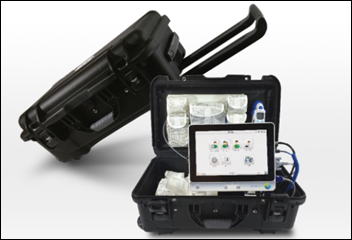
Mobile technology vendor Dictum Health adds a video laryngoscope to its Virtual Exam Room platform. The company offers a suitcase-sized patient examination system, an in-clinic telehealth system, and a medical telehealth tablet connected to cloud services.

image

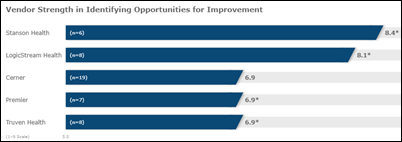
A small KLAS study on clinical process improvement finds that Stanson Health and LogicStream Health lead the way in analyzing clinician EHR use to optimize alerts and order sets, respectively, and identifying training opportunities for individual users. KLAS also finds that while many clinicians don’t trust the data presented to them or ignore recommended care guidelines and workflows, frontline doctors say that tools from Stanson and LogicStream are easily understood and useful.


Government and Politics

image

The Senate postpones the VA secretary nomination hearing of Admiral Ronny Jackson, citing allegations of improper conduct in his military career that require further investigation. President Trump nominated Jackson via Twitter without the usual vetting process that would have resolved any confirmation issues outside the public eye. The New York Times says the issues were raised by anonymous White House associates of Jackson and involve his oversight of a hostile work environment, overprescribing of drugs, and claims that Jackson drank on the job. President Trump distanced himself in his reaction to the delay, blaming partisan opposition but admitting, “There’s a lack of experience.” He concluded, “If I were him, I wouldn’t do it.”


Privacy and Security

image

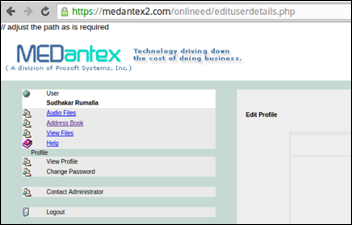
Kansas-based transcription firm Medantex takes down its customer web portal after security researcher Brian Krebs notifies the company that its audio recordings and site administrative functions were wide open to any Internet user. Medantex says it had been attacked by WhiteRose ransomware and apparently misconfigured the servers it rebuilt, exposing them to the world. I tried to pull up the company’s public webpage and was blocked by Bitdefender’s malware detection system.


Other

image

A small study finds that anticoagulation lab test and drug ordering improves when physicians use the CDC’s PTT Advisor app.

The family of Prince sues Trinity Medical Center (IL) for failing to correctly identify the counterfeit drug he had taken before the singer’s private plane made an emergency landing in Moline on April 15, 2016. They’re also suing Walgreens for filling his narcotics prescriptions that were written under his bodyguard’s name. Prince lied about his drug intake and refused all testing in the hospital in hopes of concealing his years-long addiction from the public, but the family says the hospital should have run extensive tests to determine that the black market drug he thought was Vicodin actually contained fentanyl. He died six days later of a fentanyl overdose. That’s the disadvantage of being a celebrity addict surrounded by sycophantic coat-tailers– your star-stuck doctor will write any prescription; your handlers will get it filled under their name and score illegal drugs to supplement when necessary; and you have enough time, money, and enablers to make addiction seem like a normal response to pain, stress, or disappointment.


Sponsor Updates

  • IMAT Solutions will exhibit at the National Association of ACOs spring conference in Baltimore April 25-27.
  • LabFinder.com will use Ellkay’s integration services to connect with physician office EHRs.
  • Obix Perinatal Data System vendor Clinical Computer Systems, Inc. earns SOC 2 and HITRUST certification.
  • AdvancedMD will exhibit at ACOG April 27-29 in Austin, TX.
  • Aprima will exhibit at AROC April 25-26 in Atlantic City, NJ.
  • Arcadia will exhibit at the NAACOS Spring 2018 Conference April 25 in Baltimore.
  • AssessURhealth publishes a new customer success story featuring LoCicero Medical Group.
  • CarePort CEO Lissy Hu, MD will present at ACMA National April 26 in Houston.
  • Netsmart receives the first ONC-Health IT 2015 Edition Certified solution for palliative care.
  • Spok and Bernoullli Health partner to improve clinical alarm management.
  • The local paper profiles CoverMyMeds after its top ranking as a best place to work in Columbus, OH.
  • CTG will exhibit at the Texas Regional HIMSS Conference April 26-27 in Dallas.
  • DrFirst VP Linda Fischer will participate in a panel discussion at the Critical Connections’ Opioid Crisis Symposium April 25-16 n Baltimore.
  • Consulting Magazine names Divurgent Principal Ralph Whalen a 2018 rising star in healthcare.
  • EClinicalWorks will exhibit at the 2018 Physician Practice Management & ASC Symposium April 25-26 in Nashville.
  • Healthwise will exhibit at GetWellNetwork’s getconnected 2018 conference April 30-May 2 in National Harbor, MD.
  • InstaMed will exhibit at the Georgia MGMA Annual Conference April 29-May 1 in Savannah, GA.
  • AWS features Kyruus in its coverage of hot startups for April 2018.

Blog Posts


Contacts

Mr. H, Lorre, Jenn, Dr. Jayne.
Get HIStalk updates. Send news or rumors.
Contact us.

125x125_2nd_Circle

Readers Write: How AI and Blockchain Can Combine to Benefit Population Health

April 23, 2018 News 1 Comment

How AI and Blockchain Can Combine to Benefit Population Health
By David Campbell

David Campbell is senior developer for Macadamian of Gatineau, Quebec.

image

The adoption of artificial intelligence (AI) continues to gain momentum as we see how it can augment a healthcare system’s effectiveness. Similarly, blockchain’s potential is very appealing to the healthcare industry for helping to solve the interoperability challenge.

While they have each individually demonstrated their potential to impact the industry, combined together they could greatly benefit population health and transform healthcare.

It seems inevitable that AI will revolutionize healthcare. The potential of AI is massive and our responsibility is to harness its power to maximize its benefits. For instance, how useful would it be for a doctor to compile a list of conditions to which their patient is susceptible to based upon their medical records and cross-referenced with general medical trends? AI can make this happen.

However, before AI can play a full role in healthcare, data collection, transportation, and storage present some complex privacy, integrity, and availability challenges that must be addressed.

Finding data sources is another major hurdle, but with the advent of consumer Internet of Things (IoT) devices, raw data is increasingly available. AI algorithms can use anonymized data from these devices to show general population health trends, but the challenge is mining the huge amount of raw data for useful information with a finite amount of computing power.

Enter blockchain.

Healthcare blockchain represents another source of medical data. The prevalence of these blockchains in the medical domain is increasing because they store transactions in a network of distributed servers, which offers a high degree of availability. This adds protection against network outages and hardware failure. Also, the format of the transactions makes it almost impossible to tamper with the data. Data integrity and accountability are paramount to any healthcare solution.

While the quantity of data does not approach the amount of raw data that can be collected by medical devices, the data received by a medical blockchain is richer.

Using a blockchain solution in an electronic health record (EHR) system allows for the creation of transactions between entities such as patients and medical conditions. In this case, we can think of the diagnosis of a condition as a transaction between a patient and a known condition.

Not only can we store this information as a distributed immutable transaction in a patient record, we can also record the relationship. By updating a patient record using transactions between entities, a graph database can be constructed.

A graph database is a way of storing unstructured data and the relationships amongst the data. For example, if a physician prescribes a drug to a patient, the patient, the doctor, and the drug would be stored along with the relationships amongst the pieces of data. The relationship between the doctor and the patient would be regular doctor / patient or it could be specialist / patient. The relationship between the drug and the doctor would be prescriber.

The graph database can show latent variables, which is information hidden within the data. This can be taken a step further.

One example of a machine learning algorithm that uses graph database to extract and use latent variables is a Bayesian network. A Bayesian network is a graph database built on relationships of cause and effect.

The strength of a Bayesian network is its ability to determine probabilities. When applied to general population health data, it can help make powerful predictions and correlations between seemingly unrelated pieces of information.

For example, smoking has an elevated probability of causing lung cancer. AI can mine data surrounding this relationship from a general graph database using various algorithms. The resulting Bayesian network can be used as a model to predict diagnosis based on the medical history of a patient.

Think about the possibilities where healthcare organizations can leverage the power of these two technologies so that they can find the largest number of common connections such as: if a population is suffering from Condition X and the largest shared connection is prescription to Drug Y, it would be reasonable to investigate whether Drug Y has a side effect that causes or contributes to Condition X.

This only begins to scratch the surface. While there are many obstacles, the potential for AI and blockchain to combine forces is immense and could prove to transform healthcare as we know it.

Curbside Consult with Dr. Jayne 4/23/18

April 23, 2018 Dr. Jayne 2 Comments

I met up with a colleague this weekend who is knee-deep in an enterprise-wide EHR installation. They’re rolling it across several hospitals and are dealing with the challenges of trying to unite community-based physicians, hospital-employed physicians, and a couple of residency programs on the same platform.

My friend is one of the hospital-employed physicians. He splits his time between clinical and administrative duties. Originally hired to streamline implementation of the hospitals’ soon-to-be-legacy EHR nearly a decade ago, he has a great deal of experience in change leadership and trying to unite people around a common goal. He was looking forward to the new project, thinking it they could use some of the same strategies and techniques that had been used with success in the past.

The first thing that set him back was the way that the project was legally structured. Since it is a joint venture between the hospital and the residencies (which have ties to both the hospital and a medical school in the region), the software purchase was handled by a new entity with representation and funding from the constituent entities. Although technically they’re supposed to be partners, it sounds like there is constant tension between the parties as each struggles to be in control of various decisions. The hospital is definitely larger with its employed medical group and large number of community physicians who are on staff, but the residencies try to bring the weight of the medical school to bear and play the prestige card when they feel they’re not being allowed to be in charge.

From my time at Big Medical Center, I know that often the employed physicians are easiest to deal with. Although they will hem and haw and posture about various decisions, they ultimately understand where their paychecks come from and will eventually get on board with the project. There will be tensions among the specialties and between the hospital-based physicians and the ambulatory-based medical staff, but usually there is enough common identity to get everyone to pull together.

Then there are the community physicians, those who have admitting privileges at the hospital but who might also see patients at various other facilities. They tend to be a little more challenging to work with since they frequently will threaten to pick up their patients and go elsewhere if decisions aren’t to their liking. Depending on the specialties involved (think orthopedic surgery and interventional cardiology), the financial impact to the hospital can be significant, so project teams are often instructed to “play nice” with them.

The reality of the threat to “go elsewhere” is that it tends to be a hollow one. If you’re in a city with multiple hospitals or health systems, everyone has an EHR and everyone has similar challenges and mandates, so it’s unlikely that they can move their cases across the street and have 100 percent of their demands met. They’re going to run into employed physicians and hospital administrators over there, too.

Although some community physicians still attend at multiple hospitals, the stresses of that type of practice are great. We’re seeing more and more community-based physicians who have put their proverbial eggs in one basket with a single hospital and the pain of change is worse than the pain of same when it comes to moving to another facility. They already know how their current hospital schedules, what schedule they can be guaranteed in the operating room, if the hospital carries their preferred joint implants and medical devices, etc. Still, the EHR project teams have to deal with these threats and pressure from administrators to ensure physician happiness, so it’s something that has to be considered.

Residency programs are another situation entirely. In some of the smaller programs that aren’t based at an academic medical center, there may be a mix of attending physician types. Some might be from a local medical school, but rotate through the residency program a couple of weeks or one month a year to provide that academic pedigree. That can mean accommodating a dozen or more physicians and their opinions, although they don’t have a lot of dedication to the program since it’s not their primary focus. There may be full-time hospital-employed or community-based physicians that form the core of the faculty, and then part-time physicians who provide additional coverage or who keep working in the program as they move towards retirement or who just want to keep their toe in the residency world.

Then there are the resident physicians. Some may be dedicated to the program and will be part of the care team for three or more years. Others may just rotate through a month or two across a three-year span, such as family medicine residents who rotate through OB/GYN programs. These various structures lead to the need for a lot of users who are in the system but not on the system with great regularity, as well as a breadth of opinions about how the system should work that you won’t see anywhere else.

As we caught up over coffee, my friend lamented the fact that the organization seems to have underestimated how diverse the opinions would be when they began working with these different constituencies. He thought they would be able to apply some of the governance principles that they had used successfully on the hospital side in the past as they united with the other two hospitals, but the reality was very different. He’s been pulled into nearly a year of infighting, posturing, threatening to leave the legal entity, and backstabbing behavior. The lack of governance is a real challenge and he doesn’t have a lot of hope that it will be resolved anytime soon.

They’re also faced with cost overruns as they discover that certain parts of the project were under-scoped or not scoped at all. For example, the pathology lab interfaces were forgotten – the scoping team assumed they were part of the main hospital laboratory system. There were plenty of similar misses across the facilities, each of which adds a little bit more to the price tag. In the realm of under-scoping, they forgot to account for the needs of community physicians and part-time physicians in the training budget, failing to appreciate that these providers would want to train after hours or through different modalities than the hospital classroom. They’ve been working with consultants, but recently decided to add several other consulting groups to handle various subprojects, which will likely add more challenges to the situation.

It was good to commiserate and I think my friend felt validated in the fact that I see similar situations across the country. It doesn’t seem like there are a lot of good answers unless you have strong leadership that is willing to find the right mix of persuasion, financial incentives, and maybe even a “take no prisoners” approach to get the job done.

As our catch-up time wound down, my friend asked whether I knew of any good opportunities in the area or whether I had any recommendations on working with physician search firms. It seems he may be reaching the end of his tolerance for the process and I certainly sympathize with him. We scheduled another coffee date for the end of summer. I’ll just have to see how he is hanging in there.

How has your EHR project team handled governance? Did you survive a situation like this one? Leave a comment or email me.

Email Dr. Jayne.

Monday Morning Update 4/23/18

April 22, 2018 News 2 Comments

Top News

image

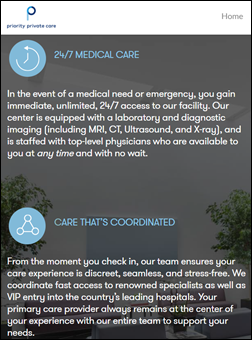
The New York Times covers concierge EDs such as those run by Priority Private Care, where affluent families pay thousands of dollars per year to gain access to VIP emergency rooms that — unlike hospitals that prioritize patients by acuity — get them in and out quickly by seeing only a handful of patients each day.

image

The art-filled facilities don’t handle trauma, but instead address a market in which three-fourths of ED visits don’t involve emergency care.

The membership fees don’t include the cost of services themselves, which are billed to insurers at pricey ED rates. House calls, executive wellness services, and travel medicine are offered at extra cost.

The facilities have clinical staff without much to do, so they don’t discourage low-acuity member visits. The article profiles a man who dropped by to have staff look at a troublesome pimple.

The company has a cozy relationship with hospitals, offering “VIP services … including access to private rooms and direct admissions.” It has also extended coverage into the Hamptons, offering summer house calls and partnership with a helicopter service for medical transport.


HIStalk Announcements and Requests

image

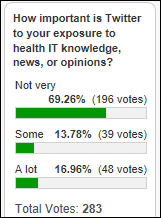
Most poll respondents don’t go to Twitter to obtain health IT knowledge, news, or opinions. Some commenters expressed shock that others don’t share their active Twitter involvement as a source of information and connection to various communities; one respondent “called BS” that so many respondents voted “not very” (I’m not sure what kind of conspiracy he’s picturing, but IP analysis at least suggests there isn’t an organizational one); one claims that people who don’t use Twitter lack critical thinking skills, and another respondent said those voting negatively must not know how to use Twitter to participate in the “thriving community of thought leaders, influencers, and curious minds.” Taking the other point of view was a respondent who said he has never understood why people waste time on Twitter; another who says he tweets but is pretty sure he’s the only one reading; and another respondent who says decision-making executives don’t use Twitter and don’t care about any of the reasons listed by the Twitter fans. The vote was actually about six percentage points more in the “not very” category until a few folks tried to drum up support via Twitter in urging non-HIStalk readers to vote, but the resulting swing wasn’t significant.

New poll to your right or here: which organization do you feel more positively about following Cerner’s protest of University of Illinois Hospital selecting Epic?

image

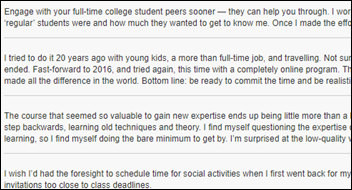
I always learn a lot from responses to my “What I Wish I’d Known Before” questions and I usually end up being moved in some way (sometimes in an uplifting manner, sometimes not) from what readers share there. That’s true of last week’s question, “What I Wish I’d Known Before … Taking College Courses While Still Working Full Time.”

image

This week’s question is more pragmatic and targeted to health system IT management. I might have to add my own response since I’ve done this enough times to have some war stories. 

Listening: a surprise, marvelous new release from The Longshot, a new band formed by Green Day front man Billie Joe Armstrong, with a sound that ranges from dead-on “Please Mr. Postman” Beatles to thrashing punk to lighter-swaying balladry. I’m also liking (without being able to articulate why since I really don’t enjoy Sting much) the unlikely Sting-Shaggy reggae collaboration on “44/876,” which Rolling Stone aptly describes as “Roxanne hitting a Sandals resort” (trivia: the Jamaica-born Shaggy served in the US Marines as an artilleryman in Operation Desert Storm and developed his singing style from calling marching cadence). It channels the joy and color of a Caribbean island with UB40 playing on a cheap radio, which makes me long for coconut shrimp and a Carib beer while sitting on a decrepit plastic chair ankle-deep in pee-warm beach water. I’m also enjoying new, frenetic basement pop from Ohio-based pop Remember Sports (which just changed its name from just Sports), along with some great Norway art rock from Gazpacho, which has a new album due any day now.  


Webinars

None scheduled soon. Previous webinars are on our YouTube channel. Contact Lorre for information.


Acquisitions, Funding, Business, and Stock

image

A PwC/CB Insights report finds that VC seed round investments have dropped considerably even as overall funding increases, AI had its first big investment quarter, and healthcare was the #2 sector (behind Internet) in both number of deals and deal value.


Decisions

  • Sheridan Memorial Hospital (WY) will go live with a Change Healthcare cardiovascular information system in 2019.
  • Hutchinson Regional Medical Center (KS) will switch from Philips Healthcare to Merge Healthcare cardio in September 2018.

These provider-reported updates are supplied by Definitive Healthcare, which offers a free trial of its powerful intelligence on hospitals, physicians, and healthcare providers.


People

image

Vocera’s board elects President and CEO Brent Lang as chairman, replacing Bob Zollars. I interviewed Brent a few weeks ago.


Announcements and Implementations

A Black Book survey of 3,000 hospital EHR users finds that two-thirds of hospitals don’t use patient information from outside their own EHRs because it’s not available within their workflows. Top-ranked vendors in client experience are CPSI Evident (small and rural hospitals), Meditech (101-250 beds), Cerner (teaching hospitals), and Epic (over 250 beds). 


Other

image

The Detroit business paper covers the ICU redesign of Beaumont Hospital Royal Oak (MI), which displays data from Epic and monitors in a big-screen graphical format. The ICU director says, “The regular Epic system, you needed to click 13 times to get to the chest X-ray we needed to see. Now we click once to get where we need. Deeper dives into data comes up as a long, scrolling, table five feet long that has everything lined up vertically by time. You see everything happening now and at anytime in the past.”

image

A Wall Street Journal article says the UK’s NHS is struggling with long waits and shortages of beds and doctors, but as Eric Topol notes, they’re still far ahead of the US.

UCSF’s Bob Wachter, MD worries in a New York Times op-ed piece that immunotherapy-based cancer treatments have made it harder to help families consider palliative care, with the staggeringly expensive and side effect-causing treatment offering near-miraculous cures but only for around 15 percent of patients. Wachter advocates that “comfort or cure” decisions not be considered as mutually exclusive by insurers, training doctors on how to explain benefit vs. harm, and including in studies the question of how to identify that minority of patients that could benefit.

An NPR reporter trying to get her mother placed in a rehab center has to pay $12,000 due to Medicare’s “dueling rules and laws” that require a three-night inpatient hospital stay to be covered for rehab placement, while hospitals are threatened with audits for admitting rather than keeping patients on multi-day observation. In her mother’s case, the “admission or observation” decision was made by McKesson InterQual. The reporter concludes, “I sped to the hospital in a rage. I demanded to know why they were releasing her when she still couldn’t walk. Further, I wanted to know, why were they calling her an ‘outpatient’ when she was sleeping in their bed, under their blankets, wearing their hospital gown, and being cared for by their staff.”

image

This is brilliant: Children’s Healthcare of Atlanta at Scottish Rite soothes NICU babies by recording their mothers singing and reading stories to them, with the CDs then played back to them when the mom can’t be there.


Sponsor Updates

  • WiserTogether releases a new version of its Return to Health platform that guides consumers to the most effective treatments for their specific conditions and attributes.
  • The SSI Group will present at the HFMA Texas State Conference April 22 in Austin, TX.
  • Surescripts will exhibit at the AMCP Managed Care & Specialty Pharmacy Annual Meeting April 23-26 in Boston.
  • Philips Wellcentive will exhibit at the NAACOS event April 25-27 in Boston.
  • ZappRx will exhibit at the ASEMBIA Specialty Pharmacy Summit April 29-May 2 in Las Vegas.
  • ZeOmega releases the annual updates to the integrated patient assessments of its Jiva PHM solution.

Blog Posts


Contacts

Mr. H, Lorre, Jenn, Dr. Jayne.
Get HIStalk updates. Send news or rumors.
Contact us.

125x125_2nd_Circle

What I Wish I’d Known Before … Taking College Courses While Still Working Full Time

April 21, 2018 What I Wish I'd Known Before Comments Off on What I Wish I’d Known Before … Taking College Courses While Still Working Full Time

That taking classes when you’re over 40 is pointless. Few, if any, employers believe that those over 40 have anything left to offer, regardless of one’s interest in continuing their education and staying current.


Nothing. I was glad I earned my MBA while working when I was 24-25 years old. At the time I knew it would be a short-term sacrifice for long-term gain and it was. I started the program part time in the evenings while I worked full time and concluded full time while working part time for eight months. To those of you in your mid-20s thinking about earning an advanced degree, get practical work experience for a few years first. It will make the degree more valuable as you will apply professional experience to course work and learnings from the program immediately in your work setting.


I wish I had known just how little sleep I would get! I went back to school after a divorce. I was a single parent working full time, carrying a full load of at least 12 credit hours, and it was a huge test of my stamina. However, it was the most rewarding experience. I wish there were online programs when I did it, I had to physically go to school.

I encourage all of my employees to follow their dreams and go to school as well. One finished her MBA, another just graduated with a BA, another is in school now. They all found programs that are online and that seems to be more manageable.

It’s worth doing. Time management, prioritizing and letting the unnecessary stuff go are the keys to sanity. And remember, there is a light at the end of the tunnel. Just get through one class at a time and eventually you’ll be done.


Engage with your full-time college student peers sooner — they can help you through. I worked full-time nights as a nurse, taking graduate-level business classes in the morning. I was so tired I didn’t sense how curious the ‘regular’ students were and how much they wanted to get to know me. Once I made the effort, they became a great support system.


I tried to do it 20 years ago with young kids, a more than full-time job, and travelling. Not surprisingly, I could not sustain the effort and was unprepared for the amount of non-class time I would have to commit, so that effort ended. Fast-forward to 2016, and tried again, this time with a completely online program. The coursework was still extremely challenging (more so than I remember from my brick-and-mortar experience), but the flexibility made all the difference in the world. Bottom line: be ready to commit the time and be realistic about your current life situation before jumping back in.


The course that seemed so valuable to gain new expertise ends up being little more than a high-level theoretical overview of the area. After a day of professional work with software, a computer science course seems like a step backwards, learning old techniques and theory. I find myself questioning the expertise of the professor compared to my professional colleagues. After a week of full-time work, I rarely have much energy to spend on deep learning, so I find myself doing the bare minimum to get by. I’m surprised at the low-quality work that is acceptable to get a decent grade.


I wish I’d had the foresight to schedule time for social activities when I first went back for my master’s. If I don’t look for opportunities to meet up with friends early, I either end up becoming a hermit or accepting last-minute invitations too close to class deadlines.


I wish I’d known how helpful programs like Khan Academy and even YouTube channels can be for brushing up on the basics. My advice for anyone going back for another degree after a long time out of academics would be to put pride aside and find a way to test how much you may have forgotten.


That I would immediately want to quit my job and go to school full time, forever.


It’s 100 percent worth it when you’re done. MBA.


You will be forced into TOUGH choices. After a while, it becomes hard to juggle school, work, and family. Additionally, I had travel related to school and for work. I ended up quitting work midway through the degree because my employer didn’t care about my MBA and I felt that I had reached my ceiling there. That helped me regain sanity.


I wish I’d known how much effort it would be. I knew college courses were hard, but I signed up, waxing nostalgic over going to college full time. Working then going to class after was totally different. It was basically paying a ton of money to do extra work. It feels especially hollow when you realize there are a dozen courses online where you could learn the same things for free.


That as time-consuming as it was, it wasn’t as bad as I thought it would be. I had put off getting my master’s degree for years because I thought I wouldn’t be able to handle all the extra hours. Once I got into my new routines, it was challenging but doable.


That success in school meant getting up early before work to read, staying up late to complete assignments, eating lunch at my desk at work while reading, and basically using every free moment to pull out my tablet and/or phone and chip away at assignments. Oh, and doing schoolwork on every vacation for four years, including on cruise ships.


Even though it was hard, it was worth it.


Academia is very different then real world and professors have a book perspective on leading business. Look for a school that has professors who have worked in your field and can provide real-world perspective.


There were three things I wanted to do well: work, family, and school. I found that one of these always suffered, and since family had the least-noticeable short-term consequences, that’s usually what I sacrificed. In the long term, however, the family impact was significant and I ultimately stopped taking classes. For anyone who is married or has a family, I would ask them to seriously consider whether a lack of degree is truly what is holding them back in their career. For me, it was not, and school was not worth sacrificing family time. If you’re single, go for it!


I wish I had known that my academic medical center’s (!!) implementation of software and a third-party vendor was done to suppress the usage of their highly-touted education benefits. I stopped taking classes after it became too much of an exhausting chore to utilize the “XX credits per year free!” benefit. (The “Benefits” [sic] department kept insisting I needed to pay for classes and fees that should have been covered by the education benefit.)


That it is well worth it – should have started sooner! Don’t be afraid to take more than one course at a time so you can finish your degree.


That I would be giving up my personal time completely for three years to complete my graduate degree. Online and flexible sounded wonderful when I started, but on top of a 50-hour work week, it didn’t take long for me to be on the computer every waking hour just to keep up.


The struggle was worth the effort. It took me five years to complete what would have been a full year on campus, but having that BS degree allowed me to move on. Without it, I would have not been eligible for most of the positions around the country that I have enjoyed and friends I made along the way. Now getting ready to retire from this life in HIS-land after 41 years.


That it was going to take five years for a master’s. I would still do it; it was the best thing I did for my career.


That work levels are exponential with more classes when you have a full time job. One class seems like a class load of work, two seems like four, and three seems like eight. I suspect with so much time taken up with your real job, being a full-time student makes the impact on limited free time more forcefully felt.


If there was an option to move the registration of the course to incomplete, audit, or pass/fail when work falls apart. Time allowed for completion of incomplete.


I had a very positive experience in completing a master’s degree while working full time. But it could have been a very different experience and outcome if it weren’t for the following factors:

  • The program was an asynchronous distance learning program, so I could do the work at night regardless of when I finally got home.
  • There was a lot of flexibility in the time for completion of the degree, so I could limit myself to one course at a time.
  • The faculty were excellent. I was impressed by the other students in the program. The topics, even in the required courses, were interesting, all of which kept my motivation high.
  • I had some flexibility in juggling my work responsibilities as I wasn’t doing full time patient care and my work deadlines tended to have some advance notice.
  • I had very minimal travel requirements for my job and for the degree.
  • My spouse was supportive in every possible respect

Taking two+ courses while working full time is incredibly difficult, especially if you come home from a day at work mentally exhausted. My tip: wake up early and get schoolwork done before you go to work. It’s tough, but it can be done! I would not recommend taking more than two courses at a time.


I did this in my late twenties while earning my MBA and enjoyed it thoroughly. Having context for the classwork in my daily life kept my engagement level high and helped to develop my time management skills. I would not necessarily recommend approaching undergraduate work this way, as there are important social aspects to a college education.


Weekender 4/20/18

April 20, 2018 Weekender 3 Comments

weekender


Weekly News Recap

  • The Illinois state procurement board recommends voiding University of Illinois Hospitals’ $62 million Epic contract, saying that Cerner’s bid was lower and referring the issue to the state’s Executive Ethics Commission after noting that Impact Advisors was involved in the selection and could have been awarded implementation services work as a result.
  • Livongo Health acquires Retrofit.
  • VA Interim CIO Scott Blackburn, who was heavily involved in its plan to implement Cerner, resigns and is replaced by the White House with by the Trump campaign’s former data director.
  • A study finds that app-issued medication reminders don’t help people with high blood pressure bring it down.
  • Hospital chain Community Health Systems lays off at least 70 Nashville-based corporate IT employees.

Best Reader Comments

Regarding VA software: The most interesting part of this is the conflict of interest with Leidos leading the Epic MASS project. SMS was part of the Lockheed acquisition with Leidos. SMS/Leidos was required to rebid on the MASS project in 2017 with an updated ROM. Leidos leads the DoD Cerner implementation, and now the Epic MASS scheduling implementation. Given the history surrounding the Coast Guard failed Epic install in 2016, this seems like a conflict of interest for sure. (Douglas Herr)

Providers prefer MHS Genesis to AHLTA, the absolute worst EMR ever. And yet, AHLTA is still more interoperable, because AHLTA is connected to the read-only Joint Legacy Viewer (JLV) and Genesis is not. Live for a year and connected to nothing and no one. It’s either “can’t” or “won’t” and neither is an acceptable answer. (Vaporware?)

Is it a good or bad thing that Dr. Jeffrey Johnson stopped practicing (at this hospital at least) because he wouldn’t learn how to use an EHR? I don’t know if it’s good or bad. But I wouldn’t want my money riding on the chance that a 75 year-old obstetrician is keeping up with the latest practice standards and could really do the job that an OB-GYN needs to do. I would not be surprised if some of his colleagues are relieved. Something had to “force” him into retirement, maybe it’s good that it was this. (Filutanion)

Mumps evolved to Standard M before InterSystems consolidated its dominance on the M market, and Caché to this day not only fully implements Standard M, but all the modern object-oriented extensions are built seamlessly on top of Standard M. Another current Standard M implementation is GT.M Many people don’t realize that M(umps), being the original NoSQL platform, is very well suited for the type of data processing that’s needed in healthcare. (Eddie T. Head)


Watercooler Talk Tidbits

image image

Readers funded the DonorsChoose teacher grant request of Ms. M in Philadelphia, who asked for headphones for the classroom learning center. She reports, “The headphones have been great for students to use during their time on the computers. There is no longer a noise distraction to the other students who are working on something other than the computer. The students who are on the computers can hear the sound more clearly now that they have headphones. I’m so glad that the students are now able to go to their centers and produce quality work with a noise distraction! We are so grateful!”

image image

We also supported Mrs. I’s South Carolina classroom project to promote gender and ethnic diversity in STEM fields, proving it with a camera and supplies. Individual students passed along their thoughts:

  • The STEM career project really helped me get more insight on what I want to be. It gave me an exposure on what to expect and what classes I need to focus on in high school and in college. I appreciate the fact that we had a guest speaker and she was great! (Samantha)
  • Thank you for your generous donation to us. Thank you for making it possible for us to get exposed to the different carriers on the STEM fields. The STEM career project has made me more aware of the field in OB-GYN and has made me feel like I am ready for my future. The guest speaker made me realize that money is not everything. I learned that the love for the profession is more important and should be what drives you to do your best every day. (Joseph)
  • The project has really opened my eyes and it is making me want to strive for greatness. I am not happy with the number of years I have to be in school to become a medical doctor. But I would still try, because the guest speaker was a minority and I believe that if she could do it, then I can do it too. She taught me to keep going and never give up no matter what.

I’m all-Android except for my aging IPad Mini, so I rarely have reason to visit the Apple Store. I dropped in today to check out the new 9.7” IPad since I think it’s probably the best tablet available in that price range ($329, although it’s galling that Apple still charges a lot for extra memory instead of supporting SD cards like Android tablets do). The store seems to have gone downhill – it was slightly crowded (less than I recall from my last visit) and I was happy not to be waiting for the Genius Bar, but employees ignored me even though they were just standing around. I asked an Apple guy who was steadfastly avoiding eye contact about the tablet and he just pointed at a table and said, “First two corners.” Nothing in the whole store was labeled or priced, so you had no idea what you were looking at, and had those products been truthfully labeled, the sign would have said “overpriced and uninspiring.” I may still end up with their tablet since they’ve priced it low since it’s little improved from the old one, but the experience so far was memorable only in negative ways. It feels like that dent in the universe is repairing itself.

 image

InteliSys Health CEO Tom Borzilleri told me in a recent interview that CVS and Walgreens charge a lot more for prescriptions than independent or grocery store pharmacies despite consumer perception that they’re the price leaders. A new Consumer Reports article proves Tom to be correct. The magazine price-checked a one-month supply of five commonly prescribed generic drugs and found a range of $66 (from HealthWarehouse.com) to $928 (CVS). Independent pharmacies were among the cheapest, but the range was huge ($69 to $1,351). I hadn’t heard of HealthWarehouse.com, but it looks great for cash-paying patients – it sells a 90-day supply of generic Lipitor for $19.80, for example. They also sell over-the-counter drugs, diabetic supplies, and veterinary prescriptions (their prices for flea and tick meds are really low).

image

Bloomberg profiles data mining company Palantir Technologies, started by Peter Thiel and other former PayPal executives. The article describes JP Morgan’s use of the product to monitor its bank employees, summarizing it as “an intelligence platform designed for the global War on Terror was weaponized against ordinary Americans at home” as it analyzed bank employee emails, browser histories, GPS locations reported from company-issued phones, recorded phone call transcripts, and printer and download activity. It is being used by police departments in several US cities and those agencies can now identify more than half of US adults. JP Morgan invested in the company as well, but the company cut back on its use after it was exposed. Palantir has scandals of its own: it admitted to stealing some of its technology (claiming it had a right to do so because it was for the greater good) and it pitched programs to sabotage liberal groups, spy on and infiltrate progressive activist groups, run bot-powered social media campaigns, and plant false information to discredit liberal groups.The company, once exposed, used the Cambridge Analtytica excuse – they say it was the unauthorized work of a single rogue employee. Palantir offers healthcare solutions such as clinical trials analysis, fraud detection, and value-based care analysis for insurers.

image

I missed this first time around. An office design ideas site profiles the new Chicago digs of Strata Decision Technology. This is one more reason I know I’d make a terrible CEO – I would be too cheap to spend more than the bare minimum on everything, so my company’s offices would like like one of those unfinished farm garages made of sheet metal.

“Big Pasta” fights back against the low-carb movement, with companies such as Barilla funding the research behind mass market headlines such as “Eating Pasta Linked to Weight Loss in New Study.” This is a reminder for those who don’t understand that not all research is created equal: (a) someone has to fund a study to begin with, and the funder often has a financial interest in the findings; (b) studies that don’t deliver the hoped-for findings are often buried while the favorable ones are promoted; and (c) headlines are chosen for clickbait value rather than for scientific validity, with the publisher basically colluding with the study funder to make the findings seem a lot more significant and trustworthy than the underlying research supports. Highly-touted studies should always be approached with skepticism – who paid, who did the work, what methodology did they use, and how generalizable are the results?

image

Hiral Tipirneni, candidate for the Arizona House and a former ER physician who hasn’t practiced following a 2007 malpractice judgment, takes heat from her opponents for running a campaign ad showing herself in scrubs but wearing an Apple Watch that indicates the photo was made long after her physician days were over. 

image

Princeton University will hold an on-campus memorial service for highly influential professor and health economist Uwe Reinhardt on Saturday, April 21. He died November 15, 2017 at 80 after a 50-year Princeton career.

image

Yale health economist Zack Cooper, PhD isn’t impressed with the just-announced consumer health platform project between Independence Health and Comcast.


In Case You Missed It


Get Involved


125x125_2nd_Circle

EPtalk by Dr. Jayne 4/19/18

April 19, 2018 Dr. Jayne Comments Off on EPtalk by Dr. Jayne 4/19/18

clip_image002 

So many things are going on in the healthcare IT world that it’s impossible to keep up. I came across an article about the telehealth program at New York Presbyterian, which has been implemented in the emergency department to reduce wait times. The Express Care program is credited with a significant impact, moving the needle on low-acuity patients from a more than two-hour wait to one that sits closer to 30 minutes. The patient care flow is integrated into the existing emergency department care path. At the time of the initial nursing examination, patients who meet criteria are asked if they want to participate in a virtual visit in a private room rather than waiting for an in-person visit. Patients are seen by the system’s existing emergency physicians, which is said to reduce potential patient concerns about quality of care.

New York Presbyterian is known for some of its other virtual programs, including a second opinion program that is delivered through an online patient portal. They also have an inter-hospital consult program for system physicians to collaborate along with a digital urgent care service. Virtual visits can be done in lieu of some office visits, and they also staff a mobile stroke unit.

I did some additional research into telehealth, looking particularly at the demographics of patients who gravitate towards the services. One might be tempted to assume that it would be millennials and Generation Y. I found some data from an Advisory Board survey of close to 5,000 patients that indicated that although more than 75 percent of patients said they’re open to a virtual visit, only 20 percent have actually experienced one. Of those who have used the services, nearly 60 percent are under age 50.

This might be due to payment policies more than affinity for technology, due to the Medicare restrictions on telemedicine services. It could also be due to employers providing telehealth services as a way to offset declines in employer-paid coverage and rising deductibles. A good number of parents would consider using a virtual visit for a sick child, and I suspect this is not only a function of accessibility and wait times but also one of convenience as workers struggle with leaving work for medical visits.

There are some variations in how medical providers want to approach telehealth. I was approached at HIMSS by vendors in two different models – one which was third party and another which hoped to leverage a client’s existing physicians to deliver services. As a provider, there’s a certain allure to having your patients cared for by members of your group, but that arrangement still requires providers to take call and provide services after hours. That arrangement is less appealing to physicians who see medicine more as a business than as a calling. Telemedicine visits tend to skew around a couple of key areas – acute care needs, and routine requests such as medication refills.

clip_image004

Lots of conversation in the physician lounge this week about Amazon exiting the pharmaceutical business before it even really got started. The company has spent the last year soliciting approval from state pharmacy boards so that they could become a wholesale pharmacy distributor. They completed the process in just 12 states and apparently discovered that it’s harder to recruit large hospitals away from their existing suppliers and contracts then they thought. In my experience, hospitals tend to be locked in with either McKesson or Cardinal Health or tend to be part of larger group purchasing programs that don’t make it easy to change suppliers. According to some reports, Amazon also failed to fully appreciate the complexity of fulfilling medical supply orders when some of the items must be refrigerated or frozen. That’s a wrinkle that certainly doesn’t fit smoothly into their well-oiled logistics and warehousing process.

Some of my procedural colleagues in smaller organizations had been hoping Amazon would be able to make a go of it, to enable speedy deliveries of smaller-scale orders so that they don’t have to deal with the larger vendors. The ability to ask Alexa to ship you a couple of cases of normal saline or some assorted suture materials certainly might be a draw when you’re already using her to order your coffee and restock your household supplies. Amazon may still head in this direction, delivering medical office supplies such as gloves and other consumables to smaller organizations such as independent ambulatory surgery centers and physician practices. For that book of business, they’re already approved for licensure in 47 states plus the District of Columbia. There is still a fair amount of speculation that Amazon might be entering the retail pharmacy or direct to consumer spaces. It would be interesting to see how they tackle some of the rebate issues that exist in the retail space and add confusion to the price of medications.

clip_image006

A reader reached out regarding my recent comments about groups that compensate providers based on RVUs as opposed to making the transition to value-based compensation. She recently did some compensation analysis research and noted that the majority of physicians are compensated largely based on productivity, with potentially 10 percent or 20 percent being paid relative to quality metrics, patient satisfaction, or access. She found an interesting trend with groups that are moving towards paying physicians a guaranteed salary in order to account for time spent on non face-to-face activities such as chronic care management. Guaranteed salaries are also cited as a way to help smooth out access issues in group practices, where one provider might create bottlenecks because he or she won’t allow patients to see a colleague due to fear of lost income. Guaranteed salaries may also hold potential for reducing burnout and increasing collaboration. These goals are typically aided by structures which might pay bonuses based on group growth rather than individual productivity. New models of compensation which include guarantees typically include a performance threshold to ensure physicians maintain a minimum level of activity.

These new compensation models may lead to increased reporting needs for organizational leaders, which translates to requests for IT teams to generate data for compensation analysis. Several of the practice management systems I work with struggle with functions like capitation and prospective payment management, so they may also be ill-equipped to handle this level of productivity reporting. If you’re on the technical or support side it might be tempting to ignore trends in provider compensation, but it might be worth following if those trends are going to start sending more work your way.

Is your organization structuring compensation to encourage collaboration? Leave a comment or email me.

Email Dr. Jayne.

HIStalk Interviews Nathan Read, Senior Director of IT, The George Washington University Hospital

April 18, 2018 Interviews 1 Comment

Nathan Read is senior director of IT at The George Washington University Hospital in Washington, DC.

image

Tell me about yourself and the hospital.

I’ve been in healthcare IT my whole career, which is going on 20 years now. The first 15 to 20 years was working on the software vendor side. I was a software developer for a laboratory information company and an EMR company in Texas. I ultimately became the COO of that company that led to an acquisition by a publicly-traded healthcare company, NextGen, where I stayed on there as vice-president of R&D for a few years before I moved over to hospital IT operations. It’s an interesting background in the sense that I’ve been on both sides of the business for my career.

I’m the CIO / senior director at an academic hospital in the heart of Washington DC. We’re engaged and involved in a variety of technology-related projects that are specific to all hospitals and healthcare. Being located in DC, we have some uniqueness into the types of things that we pay attention to.

What are your major technology platforms?

We’re a big Cerner shop. We have IBM/Merge, which has a pretty significant presence in terms of imaging at the hospital.

As a former vendor executive, what was the biggest surprise or the biggest change when you took the job at the hospital?

How lean hospitals run. When you’re selling healthcare products, a lot of the products on the market are very expensive. There’s always pushback for discounts and pricing. But to see how lean hospitals in general, not just in IT, have to operate with the limited budget and a lot of the pressures that the hospitals feel from the insurance companies and payers. They’re always getting crunched from a price point.

It’s kind of interesting seeing this day coming where the technology solutions are expensive and their prices are only going up, and yet the reimbursement for the patients that we’re caring for tend to be going down. The hospital market in general is lean. There’s not a lot of margin in it. Those two worlds are going to collide at some point, probably in the near future. Technology purchases are going to be limited because of that.

Knowing the financial constraints, what does it take to get you to investigate a product?

A good champion in the hospital. The person bringing it has to be strong and supportive. If there’s not a clear ROI that we can come up with relatively quickly, it’s not worth doing any other parts of the investigation. Is it improving patient safety? Those are probably the top three things.

What makes an ROI attractive?

Obviously there’s the financial side. Is there a financial benefit to the organization through the purchase? Also compliance and patient experience. It’s important to our organization to have a positive reputation and have our customers who are our patients have a high level of satisfaction. But that factors into reimbursement as well, so it comes a little bit back to the financial side. Really our mission is patient care and the focus is on that.

There’s some cool technology stuff that we do, especially being an academic hospital, that’s new to the marketplace. We do those things, but they are usually offered at a highly discounted price or are free because they’re interested to get their product proven in the marketplace and in an academic setting. We’re doing some virtual reality stuff that’s relatively new to the marketplace.

What technologies are attractive in terms of patient experience and patient engagement?

Anything that gives you real-time data on the patient experience so that you can react to it. I don’t know if this is unique to being in the DC marketplace, but if our patient is not having a positive experience, they’re quick to report that. Within 24 to 36 hours, you’ll see patients escalate within our own organization if they’re not having a good experience.

The ability for us see, in real time, if there’s a patient not having the experience we want them to have that we can then respond to is powerful for us. It doesn’t do us any good to find out a week later or a month later that a person had an experience that wasn’t what the hospital wanted. We need to know within 24 hours of that happening so that we can do some service recovery and respond to those patients. Luckily we don’t have a lot of that, but there are human interactions that at times create perceptions that we want to address quickly.

How do you get that real-time patient satisfaction feedback?

Right now it’s not through technology. It’s manual. We do rounding every day. Outside of the nurses who are required to round on their patients hourly, management rounds on patients every day. Even myself as the IT leader will go up and round on five or six patients every day. I talk to them about their experience, whether it’s the cleanliness of the environment, physician communication, nursing communication, or pain control. We have a template that we go through. If every leader is doing five or six patients, that pretty much covers every patient at the hospital every day. If there’s any patient experience issues, there’s a protocol we follow to address those right away. That’s been very successful.

There are some technology solutions that we have started to look at where, through the TV system, patients can provide real-time surveys or concerns that are reported back quickly. We haven’t implemented anything like that, although I know some hospitals have. It’s something that we’re looking at.

What hospital strategic decisions or changes are requiring IT participation?

Patient experience. Improving our overall scores, the CMS score that came out. There’s a lot of focus on our part about how we move those scores up. Our reputation in the community, improving that reputation and continuing to work towards being seen as the top academic hospital in this region. Those things typically drive leadership conversations and then what IT systems can be put in place to support that.

We have implemented patient portals and other technology solutions that were a Meaningful Use requirement. How can we enhance that experience to differentiate us from other healthcare facilities in the area?

What’s most different from the typical hospital in being a major teaching hospital in Washington, DC?

The complexity of the patients that come in. The DC metroplex draws a lot of different types of people. We have to be sensitive to variety of the patients that come into the hospital, which I’m sure is true of other big urban areas like New York. The case mix is diverse and the healthcare needs in the District are high, even though there are several hospitals in a pretty small radius. Most of them tend to be at capacity, so there’s always more need for more services in the District that aren’t necessarily provided.

Do you feel the impact of federal government decisions more acutely being in DC?

We have an opportunity to have some influence. For example, drug shortages are having significant impact on caring for certain patient populations. We have some government officials coming in this week to spend time with our physician leadership and walk around and talk to some of the nurses so they can better understand how these shortages are impacting care. I think that is a unique aspect of being here in the District.

Cyber security is obviously a huge topic in healthcare and has been for the last few years. We have some involvement with some of the agencies that come in and do some sessions with us to better understand our environment and to get feedback on potential regulatory changes and responses to cyber security. We’re physically located here and it’s easy for them to do that.

News 4/18/18

April 17, 2018 News 5 Comments

Top News

SNAGHTML6df04d6

UNC Health Care (NC) announces that it has achieved HIMSS Stage 7 for inpatient, ambulatory, and analytics, of which neighboring Duke Health was the first trifecta winner.

The announcement includes a little dig at Duke, noting that UNC is “the only health system in the US to achieve Stage 7 status on all three HIMSS Analytics domains … and also honored as ‘Most Wired Advanced.” UNC is one of the 17 health systems (of which Duke isn’t one) to be so recognized in that latter contest.

UNC also announces UNC Urgent Care 24/7, which offers $49 video visits via MDLive’s service.


Reader Comments

image

From Private Privatized: “Re: Share Lab. The joint venture between HCA and Sharecare is shutting down and had layoffs last week.” Unverified. I didn’t get a response from Sharecare to my inquiries. The JV was formed in January 2015 to “create innovative digital patient engagement solutions.” Sharecare was founded in 2010 by TV huckster Dr. Oz and WebMD founder Jeff Arnold. Share Lab was working on enterprise scheduling and provider search. UPDATE: A Sharecare spokesperson confirms that the project is being placed on hold. More in the next HIStalk news post.

image

From Languishing Liz: “Re: MHS Genesis. DoD doctors prefer it over AHLTA,  according to this article’s headline. The story is ridiculous.” The health IT “news” site’s 17-paragraph story – illustrated with gratuitous clipart and crafted by a 2016 creative writing graduate – simply re-words a story from the Pensacola News Journal that was in turn syndicated by something called Military Update by Tom Philpott. Tom didn’t exactly knock himself out on research for this article, having interviewed a single, DoD-chosen doctor (yes, ONE, which is why I passed on the story) to conclude that MHS Genesis is experiencing “gains in user support.” Everyone involved in passing off this lazy fluff as news (including those who tweeted it out) should be ashamed. In addition, you would certainly hope that doctors like Cerner better than the bottom-ranked AHLTA (vs. the VA’s #1 rated VistA) given its many billion dollar price tag, a characteristic it shares with both AHLTA and VistA.


HIStalk Announcements and Requests

image

Welcome to new HIStalk Platinum Sponsor Pivot Point Consulting. The Brentwood, TN-based firm is a healthcare IT consulting leader that offers strategic advisory services, EHR and ERP implementation, training and activation, project management and PMO, optimization, technology services, managed services, and permanent placement. Clients range from large, multi-hospital networks to academic institutions, pediatric hospitals, and local community clinics. The company has earned industry and workplace quality recognition, including being the highest-rated vendor in KLAS Implementation Services Select Category (July 2017 report), #1 in KLAS for Epic Consulting in the Select Category in 2016, and #9 in Modern Healthcare’s Best Places to Work in 2016. Thanks to Pivot Point Consulting for supporting HIStalk.


Webinars

None scheduled soon. Previous webinars are on our YouTube channel. Contact Lorre for information.


Acquisitions, Funding, Business, and Stock

image

Livongo Health acquires 80-employee, Chicago-based Retrofit, which provides online programs for weight management and disease prevention. The company has raised $16 million, but its most recent funding round was in December 2013. It pivoted from a direct-to-consumer model to emphasize corporate programs in early 2015, although it still offers the consumer service starting at $248 per month (no wonder it needed to pivot at those prices). A 2016 company-sponsored study found that around half of participants had a clinically significant weight loss after 12 months, although that excludes the 40 percent of participants who dropped out.

image

Nokia is close to unloading the assets of France-based consumer connected health hardware vendor Withings, which it acquired for $190 million less than two years ago. The French government is pressing Nokia to find a buyer in France, reports say, which could box out Google, which has reportedly expressed interest.

Signify Research questions why it took GE so long to decide to unload its struggling health IT business, postulating that the company was unwilling to exit the population health management market. It notes that Project Northstar – which is developing an ambulatory PHM solution – is part of the package that is being dealt off to Veritas Capital, but Caradigm will remain with GE despite a puzzling fit that could make it next on the block if GE investors continue to press the company hard. I interviewed GE Healthcare VP/GM Jon Zimmerman about Project Northstar when it was announced in May 2016.

Amazon abandons its plan to become a drug distributor to hospitals, saying it’s too hard to convince hospitals to reconsider buying through their group purchasing organizations from traditional middlemen like Cardinal Health and McKesson. Drug distributor and chain drugstore shares rose on the news.

image

Greenway Health, spurred by $520,000 in state in local incentives, has added 104 jobs at its Tampa headquarters as it closed offices in Lake Mary, FL, Birmingham, AL, and Atlanta.

image
image

I’m not sure the “affordable” thing fits.


Sales

Puerto Rico Primary Care Association Network selects Health Gorilla as its clinical information exchange platform. The announcement notes that half of doctors in Puerto Rico don’t use an EHR and thus the platform has to manage faxes.


People

image

Michael Farrell (Cerner) is named SVP/GM of the hospital business of virtual visit provider MDLive.

image

Janet Moga (Genentech) joins Carevive Systems as VP of research operations.

image

Prime Healthcare hires Will Conaway (Dignity Health) as CIO.

image

Optum promotes industry long-timer Vito Augusta to VP.


Announcements and Implementations


image

A small KLAS study of medical staff credentialing services and software vendors finds that Verge Health, ASM’s MD-Staff, and HealthStream’s Morrissey (presumably not the English singer who recorded “We Hate It When Our Friends Become Successful”) lead the tiny pack. It’s written in a confusing manner, especially in intermingling product and company names, so my already slight interest was reduced quickly. Three of the six reviewed vendors declined to participate. On the plus side, KLAS provided the number of responses it received for each vendor, which ranged from six to 19.

A Black Book satisfaction survey of 19,000 ambulatory EHR users names AdvancedMD, Modernizing Medicine, NextGen, Epic, and Allscripts as vendor performance leaders. It also notes that smaller practices are the most dissatisfied with EHRs, but are also less likely to use advanced EHR tools. Nearly one-third of practices in the 12-and-over practitioner category say they’ll replace their EHR by 2021, hoping most for cloud-based systems that offer analytics, telehealth, and speech recognition.  


Government and Politics

The GAO previously placed the VA on its High Risk List of programs that are vulnerable to fraud, waste, abuse, and mismanagement. The VA announces the five mostly vague improvements it will make, one of them being implementing Cerner to improve interoperability with the DoD and community health partners.

image

Interim VA CIO Scott Blackburn, who was heavily involved in its plan to implement Cerner, resigns for unspecified reasons.


Other

image

A JAMA op-ed piece looks smartly at the myth vs. reality of mentoring millennials.

image

A small study published in JAMA Internal Medicine finds that people with poorly controlled blood pressure who were sent medication reminders via the Medisafe smartphone app showed minimal improvement in medication adherence and zero improvement in systolic blood pressure. Even worse, study participants were chosen from a volunteers who were not only motivated, but technologically capable to use the app, which might not be generalizable to patients as a whole. Participants were also required to take their blood pressure “periodically” over the 12-week study using a study-provided home device, which in itself may have improved medication adherence. The listed study limitations don’t include what I would think is a considerable one: the short-term variability of medication effect on patients already known to have poorly controlled BP.

image

Michigan State University — reacting to the sexual assault conviction of its medical school professor Larry Nassar, DO — says in a board of trustees meeting that its MSU HealthTeam physician practice now documents in its EHR that a chaperone is present during sensitive examinations. The group has also updated its treatment consent form to notify patients that chaperones are permitted for adult patients and required for minors. That bit of news was overshadowed by an 18-year-old victim of Nassar’s, who claimed in a statement presented at the same meeting that MSU Interim President John Engler pressed her to settle her civil lawsuit without her attorney present. She also said Engler told her that the sexual misconduct arrest of Nassar’s former boss — resigned medical school dean William Strampel, DO — was “only just a slap on the butt” and that MSU’s osteopathic doctors are being unfairly lumped in with one bad one. She didn’t get to finish her statement to the board – Engler stopped her, saying her “time was up,” an unfortunate choice of on-the-record words given the existence of the celebrity #TimesUp movement against sexual harassment and assault.

image

Struggling Sonoma West Medical Center (CA) — which was making $1.25 million per month by performing mail-in toxicology tests for Florida-based rehab testing lab – says it needs to “increase revenue through extra lines of work” after insurer Anthem got wise to the scam and sued the ambulance-chaser lawyer who owns the rehab testing lab. The hospital was billing at hospital rates that were up to 10 times what a toxicology lab would have charged and Anthem wants its money back. Googling also turns up that the rehab testing lab’s owner bought Chestatee Regional Hospital (GA) for $15 million, ran the same billing scheme through that hospital, and is now shutting the rural hospital down. He also owns Jenkins County Medical Center (GA) and sends bills through it.

image

The Vanderbilt Children’s Hospital (TN) contracted window-washer who earned national attention in 2014 for dressing up as Spiderman to cheer up the children inside may have had a darker motivation – he’s been sentenced to 100 years in prison for molesting two children and posting photos of the attacks on the Internet, with prosecutors saying  his Spiderman garb was an attempt to “access other vulnerable children” at the same time the acts occurred.


Sponsor Updates

image

  • Docent Health team members support Dignity Health’s Marian Regional Medical Center Foundation’s Day of Hope.
  • AdvancedMD publishes a new e-guide, “5 Ways to Increase Front Desk Revenue.”
  • Aprima will exhibit at the Colorado Rural Health Center Forum April 19-20 in Lakewood.
  • Carevive co-founder and Chief Clinical Officer Carrie Stricker, RN talks about patient engagement at #AMCCBS.
  • Change Healthcare will exhibit at the ACMA 2018 National Conference April 23 in Houston.
  • CoverMyMeds will present at AMCP April 23-26 in Boston.
  • CTG will exhibit at the Texas Regional HIMSS Conference April 26-27 in Dallas.
  • Parallon Technology Solutions leads the Meditech Ambulatory 6.15 go-live of Cass Regional Medical Center (MO).
  • Dimensional Insight will exhibit at the HIMSS Southern California Chapter’s Annual Healthcare IT Conference April 20 in Los Angeles.
  • Elsevier Clinical Solutions will exhibit at the American Society of PeriAnesthesia Nurses event April 29 in Anaheim, CA.
  • EClinicalWorks and IMAT Solutions will exhibit at the NAACOS 2018 Conference April 25-27 in Baltimore.
  • Hyland Healthcare announces several recent go-lives.
  • Healthwise will exhibit at the Healthcare User Group April 22-25 in San Antonio.
  • OmniSys and Comprehensive Pharmacy Services partner to support the hospital outpatient pharmacy market.
  • Wolters Kluwer Health expands the global reach of its Ovid Discovery with more multi-language search offerings.
  • Casenet announces the speaker lineup and program for its Connect 2018 conference, which will take place April 23-25 in Boston.
  • InstaMed will exhibit at Health Evolution Summit April 18-20 in Laguna Beach, CA.
  • Intelligent Medical Objects will exhibit at the Allscripts Mid-Atlantic Client User Group Meeting 2018 April 19-20 in Baltimore.
  • Kyruus will exhibit at the 2018 Texas Regional HIMSS Conference April 26-27 in Dallas.

Blog Posts


Contacts

Mr. H, Lorre, Jenn, Dr. Jayne.
Get HIStalk updates. Send news or rumors.
Contact us.

125x125_2nd_Circle

Curbside Consult with Dr. Jayne 4/16/18

April 16, 2018 Dr. Jayne Comments Off on Curbside Consult with Dr. Jayne 4/16/18

image 

I’ve written a bit lately about burnout and how it’s impacting people in healthcare IT. A couple of years ago, I took up a hobby that was 180 degrees from my day job. I don’t fancy myself an artist, but it was a way to use my mind in a different way than I typically do while creating projects that others can enjoy, or at least find useful.

The Internet has been a great teacher. I’ve been able to benefit from various teachers who have published videos to help beginners, as well as some who conduct web-based educational sessions. With travel and work responsibilities, I don’t have much time to attend classes or workshops in town, but I keep my eye out for various opportunities. I had heard about a craft retreat more than a year ago and languished on the waitlist for nearly a year, but ended up being able to go this weekend.

I was looking forward to getting away from the informatics rat race and focusing on learning new techniques, meeting new people, and being able to spend some time in a beautiful place recharging my mental batteries. Of course, there was the standard pre-vacation hustle as I tried to tie up all the loose ends before leaving, and I’m not looking forward to the post-vacation shuffle as I work to handle everything that accumulated in my inbox and on my voice mail while I was gone.

Since most of the meetings and conference I go to revolve around healthcare or IT and are held at large convention centers or well-known hotels, I was looking forward to the more casual atmosphere of the state park where it was held (although I did opt for a room in the lodge rather than in a yurt, which was also available.)

When I’m meeting new people in a non-work environment, I don’t advertise that I’m a physician, especially when part of the purpose of doing something like this is to get away from the industry and the stress. People do tend to talk about what they do in their day jobs and I usually say I work with medical office software. I was surprised when the first person I said that to asked if I worked for Epic, since knowing what company is your physician or hospital’s vendor might not be the most common scenario. The woman I was talking to was a nurse who recently retired from a hospital as they transitioned from McKesson to Epic. We talked about burnout in nursing and she mentioned that several other people at the conference that she knew from previous years were also in healthcare.

It turns out that of the 80 or so people at the retreat, more than a dozen were escapees from the healthcare arena. Mostly nurses, with a respiratory therapist, a hospital social worker, and a medical transcriptionist in the mix. It was really a cross-section of people, with 26 states and two countries represented besides the US. The organizers encouraged people to mix it up at meals and breaks. I met a former welder who became disabled after a car accident, a recent MBA grad who found his accounting work “soulless,” and quite a few retirees and semi-retirees who are supplementing their incomes through craft fairs and online shops.

I didn’t hear a peep about healthcare until breakfast on the last day, when someone was talking about flu season and the conversation morphed into a discussion of unanticipated medical expenses. As a physician and as someone who works closely with healthcare organizations in crafting their strategies, it was like watching a focus group without having to recruit people or do the meeting planning. A few minutes into the discussion, I wished that I had a hidden camera to capture the conversation, because it hit on many of the issues that patients face that sometimes we on the administrative, care delivery, and informatics sides don’t understand as well as we might think we do.

As expected, high premiums and high deductibles were topics. One attendee is a teacher in Colorado and is thinking about switching her insurance to a catastrophic plan, but is worried that she can’t get coverage because of her age. She is a fairly savvy consumer, having researched what it would look like to pay cash – and having received a quote from her primary care physician of over $600 for a well visit with some basic lab work. The physician didn’t offer any kind of discount for being self-pay up front, which seemed surprising. She mentioned the practice is hospital-owned, which may be part of the issue. Her plan is to use the urgent care, which charges $99 for an office visit, as her primary until she goes on Medicare.

Other topics included the wackiness of pharmacy benefit management plans, how long it takes to get bills from medical providers, and liking the fact that they could see their lab results on their phones. One attendee at our table was from Canada and spent a bit of time explaining her personal experience with that health system (which was overwhelmingly positive).

Each person had some kind of healthcare story. The general theme is that we in the healthcare business can do better and should be doing better for our patients. I’d love to have hospital executives hear about people’s experience with the cost of healthcare when they are thinking about building that new bed tower or spending tens of thousands of dollars rebranding the hospital. I’d enjoy seeing legislators hear the stories of people who live in rural areas and have to drive hours to see physicians because their states haven’t figured out how to address telemedicine. I’d like to see IT directors and software engineers sit down with people who have retired from caregiver positions because the tools they are expected to use to do their jobs add stress with little benefit. And I’d like to see policymakers interact with people who just want to get the most out of life so they can spend time fishing, crafting, raising their kids, or playing with their grandchildren and keep everyone as healthy as possible.

I’d like to challenge people in healthcare, technology, and administration to get out and interact with the people they serve, whether they serve caregivers, end users, patients, or other parts of the system. Hear their voices directly, not just through marketing and survey data. Understand the challenges they’re facing and what we can do to help. Learn what is working and what is broken in our crazy system.

And while you’re at it, sit by a lake and watch the ripples in the water. Contemplate the value of things other than your stock price or what your shareholders will think. As yourself whether you’re doing the right thing for the people you serve or whether you’re just marking time or playing it safe. Listen to pine needles crunching under your feet. Find something outside of work that challenges you in a different way or makes you feel happy and fulfilled. It might just give you a new perspective when you go back to your day job.

How do you recharge your emotional batteries? Leave a comment or email me.

Email Dr. Jayne.

HIStalk Interviews Matt Sappern, CEO, PeriGen

April 16, 2018 Interviews Comments Off on HIStalk Interviews Matt Sappern, CEO, PeriGen

Matt Sappern is CEO of PeriGen of Cary, NC.

image

Tell me about yourself and the company.

I’ve been in healthcare IT for more than 15 years, holding various leadership roles across product development, services, support, and sales. Probably most formatively, I was at Eclipsys in the years leading up to its acquisition by Allscripts, and then I spent some time at Allscripts as well.

PeriGen has been a remarkable learning opportunity for me over the past six years. PeriGen uses artificial intelligence to build nursing productivity tools, and more importantly, early warning tools for labor and delivery. All of these tools are embedded in PeriWatch, our comprehensive electronic fetal surveillance system, or EFM.

We’ve also just started to sell tools that work outside of the EFM of record so that hospitals don’t have to rip and replace their current system. I’ve heard too many department heads say, “I really need to use your analytics to provide better care, but we have to use Cerner’s system or we just signed a contract with another vendor before you got to us.” For those situations, we’ve developed Vigilance, an early warning system that works independently and provides the capacity for every nurse, every doc, every mother, and every baby to benefit from real-time analytics in labor without a costly rip-and-replace project.

What are the hot issues in labor and delivery?

The same chronic issues affecting all service lines. The rise of diabetes, hypertension, and obesity are extremely bad for the baby. Mothers are also getting older, which presents some complications as well.

At the same time, a lot of nurses are leaving the field. Phenomenally experienced baby boomer nurses are retiring. Young nurses have great levels of energy and great training, but they don’t have 10 years of experience and that developed gut to fall back on.

You have fewer OBs, less-experienced nurses, and nurses who are being asked to do quite a bit more relative to documentation and helping colleagues at the same time as you have a more complex maternal profile. It’s the perfect storm for trouble.

The US infant mortality rate is among the worst in the developed world, although the contributing factors are mostly social rather than medical. Have hospital advances made their care safer?

Well, we certainly have. We published a study along with MedStar where including our solution reduced unanticipated admissions to the NICU by about 50 percent. That’s pretty remarkable.

With bad outcomes in labor and delivery, it often comes down to the nurse not recognizing that there’s a problem on the strip. They don’t see the trends, they haven’t been trained, or they don’t have the equipment to see the long-term patterns. We show trending data, as opposed to, “In this second at this point in the day, there’s a fetal heart rate deceleration.” We’re showing the four-hour trend and a 12-hour trend, so the nurses get a more complete picture.

When you talk about reducing unanticipated NICU events by 50 percent, that’s remarkable. At MedStar, we took their medical malpractice payouts that were associated with OB from a full third of what they were paying in medical malpractice awards to — I think the last number I saw was in 2016 — about 8 percent, which is virtually unmatched by other hospitals in the country.

Unnecessary C-sections also affect outcomes and cost. Is that still a big issue?

C-sections are always going to be a heated debate. A lot of health systems have done a great job at managing the C-section rate, at least the low-hanging fruit where voluntary C-sections or planned C-sections have been reduced. You’re seeing a lot fewer planned C-sections for convenience, so that’s a good thing.

The trick is to not focus on too few or too many C-sections, but rather, “Have we made this decision with all the right data?” We’ve had hospitals use our solution to decide to not do a C-section and the mother had a successful vaginal birth 20 minutes later. It’s really a question of what data you have access to at that critical moment of judgment.

C-sections and labor progress for many years was focused purely on a linear time measurement. We’ve built tools that look at other issues. What’s the gestational age? Have they had a child before? Did they have an epidural? Have they had a C-section before? These are things you can do in real time with algorithms and artificial intelligence that can’t be done any other way.

Having worked with artificial intelligence, what are the lessons you’ve learned or your feelings about its place in healthcare?

It’s a very powerful tool that can be harnessed to help the clinician. There’s so much data that’s being generated. More and more monitoring is being done, both in the inpatient and outpatient world. But all of this data needs to be managed somehow. You need to take an approach of looking for exceptions in data. That’s what we use AI to do.

We use Google’s TensorFlow tools. We’re fairly advanced in how we use them. We work with a consortium of other Google users in Montreal, where we have a lab. As one builds algorithms, with machine learning, it is critical to teach these tools what they’re looking at and for. After that complex process, we lock down that algorithm and then build it into our application. We’re an FDA-cleared device, so we can’t have algorithms that are changing all the time.

We’ve taken a group of experts and used their review of many thousands of strips to teach the TensorFlow system what it needs to be looking for. We validated that, locked it down, and sent it through the FDA. It’s complex to use AI when you are working with software as a medical device.

What opportunities exist from having all of this data being collected electronically?

The challenge with data is its accuracy. Nurses, who generate a huge percentage of the data out there, are often challenged to be documenting exactly what should be documented at exactly the right time. Clinical settings are pretty crazy and they are always going to put the patient’s health above documenting, so there are inconsistencies in EMR documentation.

That’s just the nature of anything that is based on human input. There will always be levels of subjectivity. There will always be issues associated with time lag. That’s why we largely focus on data that’s being generated directly from medical devices.

That’s what makes our partnership with Qualcomm so interesting. They feel the same way. They bought Capsule and they’re focused on how to take information directly from medical devices and make it usable in real time. That’s what we do today. We’re the poster child for what Qualcomm is trying to do with Intelligent Care.

How does the Qualcomm relationship work?

PeriGen takes data directly from a device, digests it in real time, and serves it up to the clinician in a helpful manner to help them make decisions and monitor patients. That’s really what this relationship is all about. That’s what Qualcomm Life’s Intelligent Care platform is all about. Qualcomm looked at PeriGen and said, we need to be doing this across all service lines, both inpatient and outpatient.

We’re working with Qualcomm Life to think about what ambulatory devices in obstetrics can become. How data management in the ambulatory arena, how non-stress tests can be made more affordable, more frequent. Things that are going lead to better outcomes for premature babies as well. They’re a great partner. We think exactly alike and approach it from different and complementary strengths.

How can clinicians monitor that huge amount of data?

It’s a big issue. More often than not copious data becomes a tremendous distraction. It’s not only the amount of data, but the quality of data. The degree of human intervention is directly related to the degree of inaccuracy that you’re going to have in this data.

Better to take the data directly from devices, perform real-time analytics on it, and present it up to the clinician to help their view of what’s going on with the patient. Not to tell the doctor what’s happening to this patient and certainly not to tell the doc what to do to this patient, but to serve it up to the doctor and nurse as, “This is what we are seeing. Your health system has asked you to consider something when this is going on.”

When we started working with HCA, they said, “We have developed some of the most remarkable safety protocols for managing oxytocin and other things. How do we help the nurses in a clinical setting on the floor take advantage of these protocols? When a patient starts exhibiting non-reassuring signs, how do we make sure that we’re getting to that patient in a timely fashion across the board in a standardized way? How do we automate our checklists?”

That’s what PeriGen does. Nurses and docs know how to care for patients in certain conditions. We’re just trying to make sure that they understand and see those conditions coming much more frequently, more consistently, and in a more standardized fashion.

Is there overlap with what EHR vendors are doing with their products?

We’re quite complementary to what most of the EMR vendors are doing. We’re not about documentation and that’s their strong suit. Epic, Cerner, Allscripts, and Meditech manage an awful lot of data. They are looking at ways that they can create specific alerts and reports from the data and create telemedicine monitoring capability. I applaud that. Those are all things that must happen in healthcare.

We’re doing the same thing. We’ve created a telemedicine platform that allows a single clinician to look out over 10, 12, or 20 hospitals and intervene on only the cases that are starting to show non-reassuring trends. The difference is that the EMR vendors are using EMR data, which is meaningful, but often subjective, and the timing is somewhat subjective as well. We’re taking information directly from the medical device in real time.

I think there’s a great alchemy there. We have clients using Epic’s tools for telemedicine in unison with some of the tools that we provide. They seem happy having access to both. It’s sort of a left and a right side of the brain effect.

We continue to roll out our telemedicine functionality at Ochsner. Just about every client and prospect we’re talking to right now is interested in our telemedicine hub, which allows a single clinician to look out over multiple labors and determine if there’s something out of the norm that needs intervention. Some of our clients want to make a business out of it, where they provide an over-watch service for community hospitals in their regional area. Some will use it with a single individual who provides great clinical leverage across the entire health system.

Do you have any final thoughts?

My hope is that a lot of other companies start doing what PeriGen is doing in terms of managing data and making it meaningful. We can’t lose sight of the fact that improved and distributed capability for monitoring patients generates more and more data that has to be managed by fewer and fewer clinicians. There will continue to be a reliance on tools like PeriGen’s to separate the wheat from the chaff. What do I have to tackle immediately and intervene before it gets tough?

I would challenge the rest of the industry to be looking for ways to employ artificial intelligence and other types of algorithmic approaches to managing data. It’s just overwhelming for clinicians at this point.


Monday Morning Update 4/16/18

April 15, 2018 News 3 Comments

Top News

image

Nashville-based hospital chain Community Health Systems lays off at least 70 corporate IT employees. Anonymous rumors say the data center and deployment areas were hit hard and the company may be looking to send data center support offshore.

Wayne Smith, CEO and board chair of the publicly traded company, was paid $5 million with an $812,000 performance bonus in 2017 even as the company lost $2 billion and share price dropped 52 percent. CHS has sold 40 hospitals recently as it struggles to absorb its 2013 acquisition of Health Management Associates for $7.6 billion that left the company $14 billion in debt.
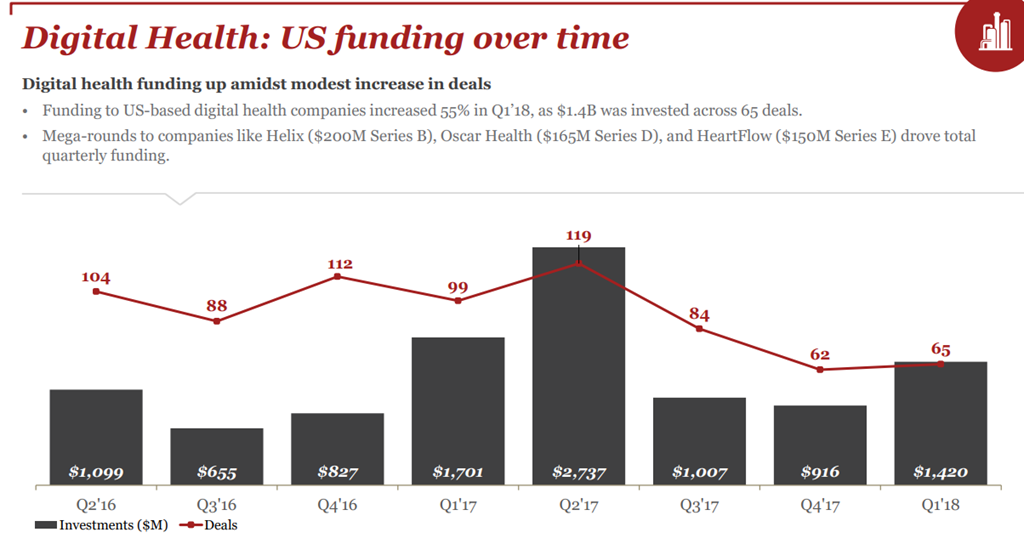

Over the past five years, CHS share price has slid 88 percent vs. the Dow’s 64 percent gain, decreasing its market cap to just $466 million. 

Microsoft sued the company two weeks ago, claiming that CHS intentionally facilitated unauthorized use of its software in some of its divested hospitals and obstructed Microsoft’s ability to perform a full enterprise software audit as its agreement allows, claiming that limited information suggests that CHS’s enterprise size is at least six times what CHS had indicated. 


HIStalk Announcements and Requests

image

Just 9 percent of poll respondents think their de-identified patient data is safe from being re-identified. One respondent recalls the 1990s brash assurance of Massachusetts Governor William Weld that the publicly released hospital records of state employees were safe because they had been de-identified. Graduate student Latanya Sweeney (now a computer science PhD and Harvard professor) easily found the governor’s hospital records, including his diagnoses and prescriptions, and sent them to his office. She knew he lived in Cambridge, so she paid $20 to buy the city’s voter registration rolls and matched up the records from the two databases – only six residents shared the governor’s birthdate, only three of those were men, and only one lived in his ZIP code. Sweeney later showed that 87 percent of Americans can be uniquely identified by just their ZIP code, birthdate, and gender. Imagine what Facebook could do with its technology, money, and huge store of personal information.

New poll to your right or here: How important is Twitter to your exposure to health IT knowledge, news, or opinions? Click the Comments link after voting to explain further.

Check out the responses to my question, “What I Wish I’d Known Before … Selecting a Consulting Firm for EHR Implementation or Optimization.”

image

Answers to this week’s question might help those trying to decide if taking college courses while working is doable and worth the effort.


Webinars

None scheduled soon. Previous webinars are on our YouTube channel. Contact Lorre for information.


Acquisitions, Funding, Business, and Stock

Veritas Capital has arranged $850 million in leveraged loans to support its acquisition of GE Healthcare’s IT business for $1.05 billion.

image

Need proof that healthcare is a business rather than a compassionate service to humankind? Goldman Sachs warns gene therapy companies that “one shot cures” will not deliver sustained cash flow compared to the recurring revenue generated by treating — but not curing — chronic conditions.

CVS Health hires the chief medical officer of Iora Health as chief medical officer for its MinuteClinic division, perhaps signaling CVS’s interest in providing services to Medicare Advantage patients as part of its proposed merger with Aetna.

image

An LA Times article describes the lawsuit filed by California’s attorney general that claims that Sutter Health has used its market power to inflate Northern California inpatient costs to as much as 70 percent more than in Southern California. The article says:

  • Prices rose 113 percent at Sutter and Dignity Health systems from 2004 to 2013 vs. 76 percent for all California hospitals.
  • Sutter acquired Summit Medical Center in 1999 and raised prices by 72 percent, a practice that experts say allows all competitors to also raise prices.
  • Sutter’s insurance contracts don’t allow any of its hospitals to be excluded or for patients to be charged a higher co-pay at specific hospitals regardless of their cost or outcomes. Sutter claims otherwise, but previous testimony showed that its conditions were that out-of-network visits – most commonly, ED visits where Sutter hospitals are the only option — would be charged at 95 percent of billed charges. Blue Cross estimated that Sutter’s profits on those visits would be 270 percent.
  • Employers are forbidden legally from sharing cost information with third parties.

Sales

Drug maker Pfizer joins the global health research network of TriNetX, which will enable the company to access clinical, genomic, and oncology data for study design, site identification, and patient recruitment.


Decisions

  • Hutchinson Regional Medical Center (KS) will switch from Philips Healthcare to Merge Healthcare cardiology information system in September 2018.
  • Hannibal Regional Hospital (MO) is considering purchasing a new hemodynamic recording system.
  • Pikeville Medical Center (KY) plans to switch from Philips to a Merge cardiology information system.

These provider-reported updates are supplied by Definitive Healthcare, which offers a free trial of its powerful intelligence on hospitals, physicians, and healthcare providers.


People

image

Sound Physicians hires Lisa Shah, MD (Evolent Health) as chief innovation officer. The company provides hospitalists and other physician services.


Announcements and Implementations

image

WiserTogether adds risk warnings to treatment recommendation plans in its Return to Health platform that include opioids as a treatment option.

Memorial Hermann Health System (TX) joins the Greater Houston Healthconnect Network.


Privacy and Security

Judges in the UK and France order Google to remove search result links to old stories covering the criminal convictions of two executives. The men complained that laws don’t require them to report previous convictions to prospective employers and therefore Google is presenting irrelevant information that infringes on their “right to be forgotten.” 

Nova Scotia’s government charges a teen with unauthorized use of a computer after discovering that he had created a script to download all documents stored on a Freedom of Information Act portal, some of which weren’t supposed to be publicly available. The province had implemented no security on the site – documents were numbered sequentially, so the teen simply wrote a script to increment each URL and download the corresponding document, bypassing the site’s public page. Privacy experts say the government is looking for a scapegoat since the teen did nothing with the information he retrieved.


Other

image

Seventy-five-year-old Jeffrey Johnson, MD gives up his obstetrics privileges at St. Alexius Medical Center (IL) after refusing to take its EHR training classes. He said, “I can’t practice any more at our hospital because I don’t know how to do the computer efficiently. I don’t really give a damn. I care that I can’t practice any more and I care that the corporation who bought our hospital says that I have to know how to do the computer to continue to practice.”

India-based Apollo Hospitals develops a heart risk scoring tool that use Microsoft’s healthcare AI technology to analyze EHR data.

image

The New York Times exposes law firms that hire telemarketing firms to cold-call women who have received vaginal mesh implants and urge them to have them removed at company-hired surgery clinics. The reason: the law firms are pursuing mass tort lawsuits against the manufacturer and have realized that settlements are lower when the implant remains in place. The women were flown to Florida and Georgia, housed in motels, and sent to walk-up clinics for their procedures without meeting the surgeon first. Doctors who performed the surgeries made up to $14,000 per day, while the medical centers kept at least $15,000 per case even as some women experienced debilitating effects from the removal surgery. The patients sign a form binding them to pay back the surgery cost plus double-digit interest if their case is favorably settled, with upfront funding provided by firms that are backed by international banks and hedge funds.

image

I’ve been looking over Alex Scarlat, MD’s book, “Medical Information Extraction & Analysis: From Zero to Hero with a Bit of SQL and a Real-life Database.” It’s a hands-on clinician guide for using SQL (the database tools and de-identified patient database are included) to answer common clinical / informatics questions, such as, “What are the number of patients and admissions associated with sepsis-related diagnoses?” I think it’s important for clinicians to be able to do their own data discovery – sometimes you don’t realize what information is available or how it’s represented until you look at the underlying database, which often then leads to more useful queries. I’m pretty good with SQL and understanding data definitions and table relationships, but for those who aren’t and who learn best from hands-on experience (which is nearly everyone), then you’ll have fun with this book.

Banner Health will pay $18 million to settle False Claims Act charges, but HealthLeaders Media finds the most interesting aspect to the story – this is the third such lawsuit filed by the same whistleblower involving previous health system employers. Cecilia Guardiola has netted $6 million from filing her lawsuits after just 16, 19, and 3 months of employment at Christus Spohn, Renown Health, and Banner, respectively. She’s both an RN and a JD and appears to have worked for Optum as a clinical documentation improvement specialist. Banner must not Google prospective hires since her previous lawsuits were filed before they hired her in mid-2012.

Vince and Elise complete their series on 2018’s top health IT vendors by annual revenue by reviewing the companies in positions 7-10 – CPSI, Harris Healthcare, Medhost, and Cantata Health.

image

Odd: a couple in China dies days before their scheduled in vitro fertilizations, after which their respective parents sued each other hoping to convince a judge to give one of the couples access to the frozen fertilized embryos as “the only carriers of the bloodlines of both families.” The court agreed to release the embryos to a hospital, but since surrogacy is illegal in China, the four parents had to hire a woman in Laos to carry the baby. The baby boy was delivered on December 9, 2017, four years after his parents died.


Sponsor Updates

  • The SSI Group will exhibit at the AL HIMSS Spring Conference April 18 in Huntsville.
  • Huron will exhibit at the HCCA Annual Compliance Institute April 15-18 in Las Vegas.

Blog Posts


Contacts

Mr. H, Lorre, Jenn, Dr. Jayne.
Get HIStalk updates. Send news or rumors.
Contact us.

125x125_2nd_Circle

Text Ads


RECENT COMMENTS

  1. Challenger exploded on lift-off when the O-rings failed. Columbia disintegrated on reentry after one of the heat shield tiles were…

Founding Sponsors


Platinum Sponsors


Gold Sponsors


RSS Webinars

  • An error has occurred, which probably means the feed is down. Try again later.