News 6/20/18

June 19, 2018 News 3 Comments

Top News

image

Walmart patents a system for storing a patient’s vital medical information in blockchain database housed in a wearable device.


Reader Comments

From Uncle Carbuncle: “Re: IT department names. I’ve seen it go from DP to MIS to IT and now sometimes to technology services.” I would add “information services” to your list. I once worked in a health system’s IT department that used that name, I had a pretty great office in the executive building near the flagship hospital’s entrance. Many early mornings a patient or a visitor would exit confused from the elevator and follow the light to my door (since I was usually the first one in the office suite). They had seen the “information services” sign on the sidewalk close to the hospital’s entrance and were looking for directions. I actually enjoyed riding back down the elevator with them and walking them to the front door, especially since I’m sure some of them were nervous. I also knew that their way-finding challenges were just beginning since we had a remarkably unhelpful system of colored floor lines, puzzlingly named zones, and signage that failed to overcome user-unfriendly hallways created by constantly tinkering with the available space in ways that left even employees lost at times.

From Electric Avenue: “Re: your list of sponsors that are leaving. Did you insult them with something you wrote or failed to write?” Never, as far as I know, since my sponsors understand that they don’t get editorial control or the option to post fluff pieces on HIStalk like other sites offer. The most common reasons for dropping are: (a) the company’s low-level marketing person who was assigned to deal with us leaves and nobody left knows anything; (b) the company is acquired; (c) they’re out of money; or (d) a new marketing VP is trying to score points by cancelling any relationships they didn’t personally initiate. The first reason is by far the most common – turnover in vendor marketing departments, especially among the less-senior folks, is apparently astronomical. 


HIStalk Announcements and Requests

I forgot to mention another gratifying aspect of my unplanned urgent care visit this past weekend that happened while taking a mini-vacation way out in the sticks. I was worried whether my problem required an ED visit and recalled that my new concierge service includes having the personal cell number of my solo practice PCP. I reluctantly called him just after dawn on Saturday morning. My doc was perfectly caring, thoughtful, and supportive in suggesting a plan of action. I told him how much I hated waking him up and he reassured me with, “that’s what I’m here for.” It’s an amazing deal for an all-inclusive price of $60 per month, which includes many lab tests, imaging procedures, minor surgical procedures, and at-cost prescriptions. He treats me like a valued customer with whom he has a long-term relationship that benefits us both. I only hope he doesn’t go broke in hesitating to price his services more reasonably.


Webinars

June 21 (Thursday) noon ET. “Operationalizing Data Science Models in Healthcare.” Sponsor: CitiusTech. Presenters: Yugal Sharma, PhD, VP of data science, CitiusTech; Vinil Menon, VP of enterprise applications proficiency, CitiusTech. As healthcare organizations are becoming more adept at developing models, building the skills required to manage, validate, and deploy these models efficiently remains a challenging task. We define operationalization as the process of managing, validating, and deploying models within an organization. Several industry best practices, along with frameworks and technology solutions, exist to address this challenge. An understanding of this space and current state of the art is crucial to ensure efficient use and consumption of these models for relevant stakeholders in the organization. This webinar will give an introduction and overview of these key areas, along with examples and case studies to demonstrate the value of various best practices in the healthcare industry.

Previous webinars are on our YouTube channel. Contact Lorre for information.


Acquisitions, Funding, Business, and Stock

image

Appleton-WI-based healthcare provider management and network access technology vendor Quest Analytics acquires provider management system vendor BetterDoctor.


Sales

Christus Health will implement Vyne Medical’s Trace voice recording and quality assurance platform to identify discrepancies or confusion about the information given to patients.


Announcements and Implementations
image

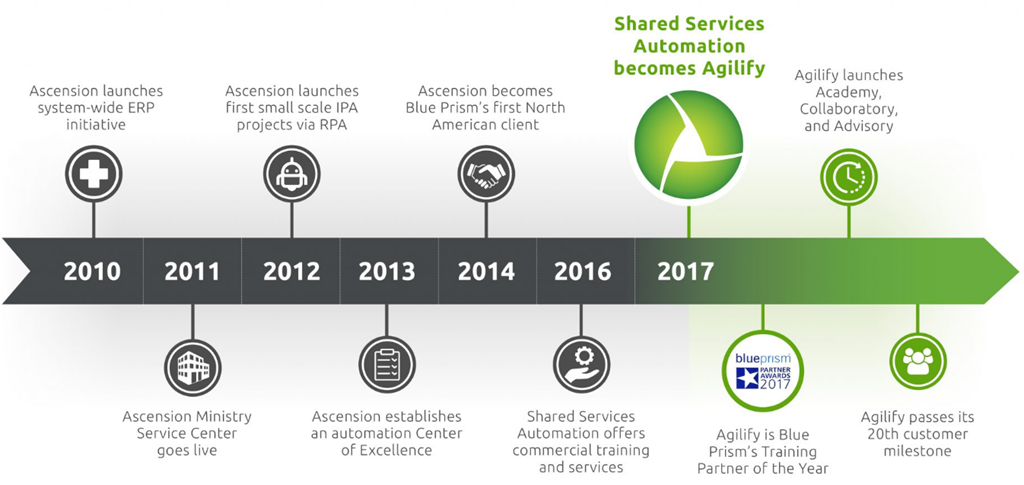
Ascension’s shared services subsidiary launches Agilify, which will offer help with intelligent process automation.

A Change Healthcare payer study finds that value-based care is reducing healthcare costs more than expected and now account for two-thirds of payments.

UK-based Medicalchain will explore the potential benefits of blockchain in healthcare with Mayo Clinic. 
image

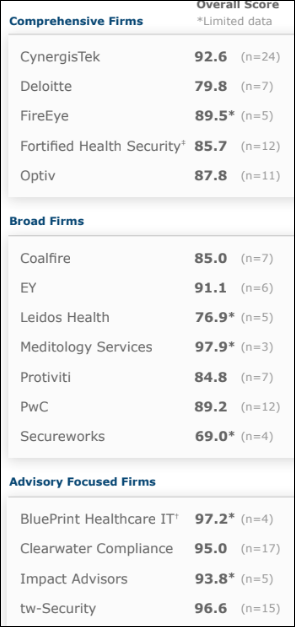
A new KLAS report on cybersecurity services (advisory, technical, and managed) finds that CynergisTek leads in breadth of services and number of engagements for advisory and technical services, while Fortified Health Security has the highest number of managed services engagements. The most commonly requested services are performing risk assessments and security program assessments. 


Government and Politics

An HHS law judge upholds HHS OCR’s $4.3 million HIPAA fine against MD Anderson Cancer Center for losing two unencrypted USB drives in violation of its own policies that require encryption.

The pre-existing conditions political football has generated interesting debate, including the Republican argument that guaranteeing coverage and the same premium prices to those who are either sick or well tests well in voter polls … until the question is reformulated to ask whether it’s OK for sick people to pay the same premiums as healthy ones, in which case even many Democratic voters say no. It’s an interesting exercise trying to educate healthcare-uninformed voters exactly how insurance works, who pays and who profits, and how risk pools work to calculate premiums.


Privacy and Security

Washington Health System (PA) suspends at least 12 employees who are suspected of looking at the medical records of a co-worker who was killed when a driver lost control of his car and ran into a WHS building.


Other
SNAGHTML1671dc8d

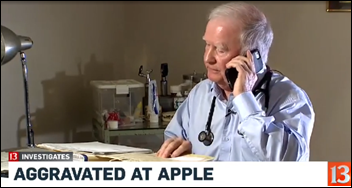
An Indiana doctor sues Apple for interrupting his medical practice with the “devious trick” of forcing IOS updates without the user’s approval as a requirement for its further use. He sent Apple a bill for the $200 time he claims he lost and demanded that his phone be returned to the previous IOS version, then filed the lawsuit after Apple declined to do either.
image

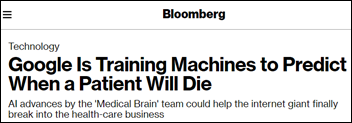
Bloomberg profiles – with an embarrassingly click-baiting headline – the outcome-predicting Medical Brain project of Google. It notes (barely) the failure of IBM Watson Health to accomplish the same goals of reducing cost or improving outcomes. The author’s analysis must have been superficial in failing to note that Google has already tried and failed to “break into the healthcare business” with its miserable, short-term Google Health project.

I missed this article until someone tweeted it out: “Why Doctors are Running Out of Empathy,” a physician’s bleak look at what our healthcare “system” has turned into with some interesting insights:

If we take the word “healthcare” to mean the mishmash of hospitals, doctors, insurance companies, and vendors that profit from our physical and mental maladies, then perhaps it would be more accurate to call [our healthcare system] “sickness-billing” … Government food policies … resulted in a massive increase in calorie-dense, nutrient-poor, and highly processed “foods” in our diet …led to dramatic increases in obesity, diabetes, heart disease, cancer, and autoimmune disorder rates in the United States. The costs borne by Medicare and insurance companies consequently swelled, producing a strained “system” unprepared to handle the increasing need for preventive care. In response to rapidly rising costs, Medicare (to which most insurance companies look for guidance) created a growing number of obstacles to reimbursing doctors and hospitals, and all payers followed suit. These obstacles started as documentation-focused rules, requiring doctors to record a certain number of data points for each medical visit, otherwise reducing reimbursement. This is why your doctor, during your visit for an ankle sprain, may ask if you have had any constipation, vaginal bleeding, or ringing in your ears … EMRs dramatically reduced physician productivity. This was primarily because the EMR companies got away with designing software with horrendous user interfaces and user workflows .. . the Internet buzzed with stories of Epic bullying anybody who criticized its software. Can you imagine the backlash if Microsoft or Google tried to place gag orders to prevent criticism of their software?
image

This says a lot about US healthcare. UK-based drug company Indivior will seek an injunction to halt FDA’s approval of a generic to its opioid addiction drug that generates 80 percent of its $1.1 billion revenue and $320 million profit. It also obtains a restraining order against an India-based competitor that was preparing to launch the generic. Indivior says it will introduce a generic of its own for some reason and will cut its operational costs, Shares dropped 23 percent on the FDA news.
image

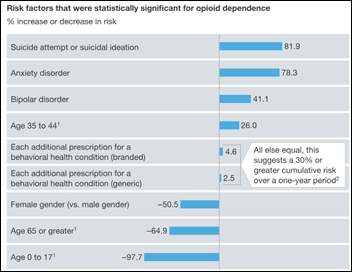
A McKinsey analysis of claims data finds that opioid prescribing patterns vary wildly among doctors:

  • Opioid prescribing is widespread and not just the result of clinician outliers
  • Geography plays a significant role
  • Much of the prescribing resulted from a surgery rather than acute medical care, with up to 70 percent of the patients who underwent specific procedures being given opiate prescriptions
  • Prescribing was inconsistent even within a single medical practice, varying by the condition being treated
  • Doctors often prescribe opiates to patients who have known risk factors, such as having a history of non-opioid substance abuse, having two or more behavioral health issues, or using more than four doctors or pharmacies to obtain opioid prescriptions in the preceding six months
  • Most prescriptions are written by a clinician who isn’t the “quarterback” for managing the patient’s primary problem
  • EDs issue relatively few opioid prescriptions

WHO adds “gaming disorder” to ICD-11, saying that it is similar to drug addiction because it can take precedence over the patient’s other activities, they can’t stop playing even after they experience negative consequences, and their sleep, diet, and work performance suffer.  


Sponsor Updates

  • Formativ Health will exhibit at HFMA’s annual conference June 24-26 in Las Vegas.
  • PeriGen will demonstrate its AI-powered Vigilance fetal and maternal early warning solution at AWHONN Connection June 23-27 in Tampa.
  • North West Anglia NHS Foundation Trust goes live with Agfa Healthcare’s enterprise imaging for merged Peterborough City, Stamford, and Hinchingbrooke Hospitals.
  • Boston Software Systems signs a multi-year contract with a national health system for RPA, EHR, and data optimization services.
  • Chief Executive profiles CarePort Health CEO Lissy Hu, MD.
  • The Tech Tribune includes CareSync in its list of “10 Best Tech Startups in Florida.”
  • Kyruus will host its Fifth Annual Thought Leadership on Access Symposium (ATLAS) in Boston October 15-17.
  • CenTrak reports significant growth in its hand hygiene business and an increase in hospital compliance rates.
  • Change Healthcare publishes a new payer study, “Finding the Value: The State of Value-Based Care in 2018.”
  • CoverMyMeds will exhibit at the ASAP Mid-Year Conference June 20-22 in Palm Beach, FL.
  • The Cleveland Plain Dealer recognizes Direct Companies, the parent company of Direct Consulting Associates, as a Top Workplace in Northeast Ohio for 2018.
  • Divurgent publishes a new health system case study, “Success Story: Windows 10 Upgrade.”

Blog Posts


Contacts

Mr. H, Lorre, Jenn, Dr. Jayne.
Get HIStalk updates. Send news or rumors.
Contact us.

125x125_2nd_Circle

HIStalk Interviews John Talaga, EVP/GM, OnPlan Health

June 19, 2018 Interviews 1 Comment

John Talaga is co-founder and EVP/GM of OnPlan Health of Bannockburn, IL.

image

Tell me about yourself and the company.

I’m a co-founder of OnPlan Holdings. I co-founded HealthCom Partners, which was acquired by McKesson in 2006. We developed introduced PatientCompass, which was the first online account management tool for hospitals.

OnPlan Health addresses the market shift to high-deductible health plans. Co-founder and CTO David King and I created OnPlan to help hospitals settle balances with patients with high out-of-pocket costs. The business also supports and serves higher education, which has similar challenges to healthcare.

Premiums and deductibles are rising and few people in America have enough savings set aside for even modest unexpected expenses. What’s it like on the front line of health systems?

The shift has hit the boardroom. Over the last couple of years, the level of executive presence on the rev cycle side has increased. You have VPs of revenue cycle and chief revenue officers that you never had in the past. When you hear the term “third payer” — the patient being the new payer — it’s real. Hospitals are having to deal with so much of the self-pay that it’s as much as commercial and Blue Cross, in many cases.

The front lines are asking, what do we do about it? A lot of technology has poured in and has been invested in. Companies are offering automated payment plan functionality, front-end collection at point of service, and scheduling. It’s a form of retail-ization — trying to collect as much as they can up front, but also trying to automate and reduce the cost that it takes to collect on the back end.

You have this new focus of, “The old way of doing things is no longer good enough. We don’t have the staff to be able to do that.” Companies are turning to outsourcing early outs. Some are turning towards financing. But those solutions are expensive and they disintermediate the patient, so they are looking at technology that allows them to work on their own to prevent having to place accounts with those options.

Is the financial conversation that might precede the medical conversation awkward for both the patient and the provider?

It’s a very different environment when you talk about the doctor’s office versus the health system and the hospital. Where my company spends the most time is in the health system, where physicians are part of the health system and are connected to a hospital with the higher cost.

In the doctor’s office environment, there still is an expectation that you’re going to pay for your service. We know what it costs, typically. There’s nothing emergent that comes from that visit. They will bill on the back end and typically patients have the money to pay that.

It’s the surprising bills that come with services that cost more, typically coming from a service that involves the hospital. The patient doesn’t have budget and sometime doesn’t even realize what they signed up for — what their employer provided them for a health plan — until the bill comes. They wonder, why am I getting a bill for $2,500 when I have insurance? Reality sinks in.

It’s this surprise factor that’s difficult on the financial side. Setting those expectations has been a big priority of hospitals. We’re going to do an estimate for you and this is approximately what you’ll owe. They try to collect as much as they can up front, but that expectation carries through after adjudication of the balance.

Is the approach the same for patients who are unable to pay versus those who are simply unwilling to pay?

The expectation is that 80 percent of the patients are willing to pay. They just have to understand what it is they owe. Then they have to have the means.

The introduction of revenue cycle analytics has been positive. Though analytics can be used from a propensity-to-pay perspective to identify the patient’s ability to pay, but also to determine how how much means they have to cover a specific balance. Analytics isn’t just directional. It’s getting to the point where, this patient owes this balance, they have this much left on the deductible, so here’s what they can afford.

That technology is done on the front end. But now more hospitals are also doing it for self -pay as well. How should we approach this patient? What should we offer them to pay as opposed to just asking for the full balance knowing that they’re probably not going to be able to pay it and they may end up in collections? Propensity-to-pay has evolved into revenue cycle analytics.

Those unwilling to pay is going be a difficult one to solve. Those are probably for the collection agencies, simply because you’ve got a different problem than somebody who just doesn’t have the means.

What do health systems do in that case where someone hasn’t made progress on their previous payment plan obligation?

The analytics only go so far. It gives you the profile of this patient at the moment. Hospitals are now taking it to the next level to automate processes and policies to avoid the traditional one-on-one negotiation. In the past, payment plans were set up on a phone call. Somebody who needs help seeks it out and agrees to a payment arrangement.

Now companies are using analytics to provide a payment plan offer proactively. We give them an installment offer that they’re able to pay. And if they’re able to pay that, let’s give them the ability to self-activate without having to call us. That could be by going online or mobile to activate the plan or even writing a check based on what they’re willing to do a payment plan for.

If they take the call center mostly out of it, like 70 percent of those payment plans that are activated, the next step is whether the patient stays on that plan. The rules are in place. You have to make your payments. You can’t miss two payments or you’re going be terminated from your plan. Those patients will be treated differently the next time they come in for service.

It’s working the analytics visibility to the staff, putting it into automation so that they don’t have to do hand-to-hand combat, if you will. But then also being able to utilize what happened when the patient presents themselves back in the office.

Is discounting the initial price for someone who has to pay cash a significant factor in creating the payment plan?

For revenue cycle leaders, the goal is still to get someone to pay in full. The goal isn’t to get them on a plan. But for a segment of patients, that’s the only way they’ll be able to pay. The discounting usually comes in after uninsured discounting, when a patient has a balance after insurance or they owe a patient responsibility. They’re driving incentives such as, you can get on this payment plan and we’re willing to do this for you. But if you pay us in full in the next 30 days, as a prompt pay discount, we’ll take 5 or 10 percent off.

What they’re doing instead is driving discount incentives, mainly post-service, to try and get them to pay off their balance as opposed to getting on a plan. The plan itself should be enough of incentive to pay over a time that makes sense for them.

On the front end, if the analytics are there, they will offer some deeper discounting to be able to get them to pay in full. But again, what you’re seeing is payment plans being set up off the estimates. It’s easier to say, you owe $1,000. Do you want to pay $1,000, or do you want to pay a portion of it? How about we set you up on a plan for $100 a month? Then when your insurance pays, we will adjust your balance and your $100 a month will continue until the end of the term. It’s easier for a consumer to accept that as opposed to just paying some dollars towards a cost they don’t know yet.

I assume it’s not in the best interest of either the provider or the patient to turn a bill over to collections,.

That comes across loud and clear in terms our business and how we position ourselves to serve hospitals. They’re trying to reduce bad debt and the amount of placements that they send to bad debt collections, But also even to their pre-collect, early out vendors. Even though early out vendors are first party, you have hospitals that are turning them over at Day One.

The big concern is, if I’m using this outsource vendor, they’re collecting and I’m paying for balances that maybe the patient would have automatically paid with a payment plan. If I can get some automation in place, then maybe I only have to place accounts that are expensive to early out at a later time. If I’m placing accounts at Day 60 and I’m trying to collect on my own internally before Day 60, then how can I collect as many as I can by settling on payment plans before I have to turn them over to a collections agency?

The whole idea of turning patients over to a collections agency is perceived negatively. They’re trying to keep engagement and patient loyalty so they will come back to the health system. To do that, they want to have that direct interaction with them without having a collection agency asking them to pay their bill.

Do you have any final thoughts?

The revenue cycle leaders are trying to reduce the pain points of increased self pay, so there’s a resurgence of patient financing. You hear about these recourse options for essentially getting a loan to pay off their bills. In terms of financing, the revenue cycle leaders are debating whether to sell their receivables. Where it’s falling is that if they can get more of the functionality and tools with analytics and automation in their system to do it themselves, with the reserves they’re willing to fund for these balances, then they only use financing on the back end for those balances that need long terms. That is the direction that is becoming more acceptable with these leaders, as opposed to one or the other.

Curbside Consult with Dr. Jayne 6/18/18

June 18, 2018 Dr. Jayne Comments Off on Curbside Consult with Dr. Jayne 6/18/18

clip_image003 

One of the hot topics in the physician lounge lately has been telemedicine. Several of the larger physician organizations are pursuing strategies to incorporate telemedicine into their practices. It’s interesting to see the different strategies they’re taking, and given the similarities of their patient populations, I’ll be looking forward to seeing which one is more effective.

The first group wants to render the telemedicine services in-house because they think it’s going to be key for patient loyalty. They’re looking at different platforms that will enable their physicians to not only perform video visits in lieu of face-to-face visits in the office, but to perform after-hours services. One of the major drivers of the latter is trying to prevent some of the revenue leakage that’s currently going to urgent care and retail clinics. Of course, they pay some lip service to quality of care and continuity of care, but the conversations their decision-makers are having seem more about the revenue than anything else. The members of the group that are part of administration are completely on board with it, but the rank and file physicians aren’t entirely in favor.

The group is multi-specialty and leadership seems to think that the primary care physicians are more willing to consider telemedicine than the subspecialty physicians. Even among those willing to consider it, though, there are some doubts since many of the primary physicians have given up non-office practice. They no longer see patients in the hospital and haven’t taken call in years, preferring to use nurse triage services rather than being awakened in the middle of the night. For physicians who aren’t even willing to call out antibiotics for an uncomplicated illness without seeing a patient in the office regardless of the validity of the symptoms and history, it will be a huge cultural shift for them to sit at the computer or use their phones to speak with patients who are angling for medication or other treatments over the phone.

For them to be successful, they need a platform that will help them document what they’re doing. It will need to connect seamlessly with their EHR to ensure that the records of evaluation and treatments are not lost. The physicians aren’t going to tolerate having their documentation sit in a separate system or be unavailable to them in the future. They’re also going to have to figure out how to divide up the work and the revenue for the visits, because I can’t imagine every physician wanting to be on call 24×7. If the subspecialty physicians agree to it, they may adapt more easily since they’re already used to sharing call and taking care of each other’s patients without specifically being compensated for it since many of their procedures are billed on a global basis. Many of the procedural subspecialists have physician assistants that work with them and I can imagine the PAs will handle most of the telemedicine work.

Unfortunately, they’re on an EHR platform that doesn’t have telemedicine capabilities and hasn’t integrated with any of the telemedicine companies they’re looking at. Although the group’s leadership is eager to get started, I suspect it could take a year for them to really be ready to implement a solution. First they have to make a decision, then they’ll enter the contracting phase (which is never speedy for them), and then they’ll have to figure out the integration and implementation pieces. If they are smart, they’ll work on the cultural pieces and figure out the call schedule and compensation parts while the IT team is working their magic.

The other group has a similar patient population, but they believe their analysis shows that their patients are less concerned about loyalty than they are about being able to reach a physician quickly after hours. The physicians aren’t terribly interested in video visits as an alternative to office visits, but they do want to capture the revenue that they’re losing to after-hours competitors. They’ve elected to outsource telemedicine for primary care since that’s where most of the business is – it’s not like there are after-hours orthopedic surgery or neurology clinics that patients are going to, so the group is going to hold off on doing anything with their subspecialty physicians. They’ve found a vendor that will send documentation to them for all telemedicine visits, and although the data is going to be formatted as a document rather than as discrete data, they’ll be able to have the solution up and running in a matter of weeks.

If you’re an informatics purist, that might not be a palatable solution. But if you’re looking to solve the business problem of revenue leakage, they’re at least going to get a percentage of the revenue if they go about it this way, rather than getting zero revenue for patients going to urgent care or retail clinic facilities. They’re also contractually guaranteed to receive records from the visits rather than crossing their fingers and hoping they’ll get something back from the pharmacy clinic. Hopefully their understanding of their patients is accurate and there won’t be too many concerns about being cared for by physicians who don’t know them or their histories. I asked the physicians I was talking to whether the telemedicine company will have access to the EHR for medication lists or notes and they weren’t sure. That will need to be ironed out during the contracting process for sure.

Once they are established with the after-hours component, they have the option to expand how they use telemedicine technology. I think their strategy is prudent. Rather than waiting for the perfect solution, they’re at least going to dip their toes into the proverbial waters and see how it plays for their patient population. I’ll have to make a point of checking in with them in a couple of months and see how things are going – whether they were able to get through the contracting phase quickly and whether they were right in their assumptions about how their patients will receive their new offering.

Have you implemented telemedicine? How is it going? Leave a comment or email me.

Email Dr. Jayne.

Monday Morning Update 6/18/18

June 16, 2018 News 26 Comments

Top News

image

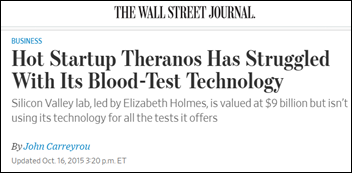
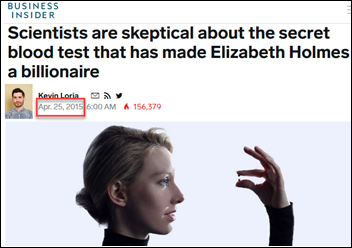
The US Attorney indicts Theranos founder and CEO Elizabeth Holmes and former President and COO Sunny Balwani for fraud, charging that as Theranos executives, they knew that the company’s blood testing technology was unreliable and was not competitive with conventional lab testing.

Holmes resigned as Theranos CEO just before the charges were announced Friday. She will remain on the company’s board, for whatever that’s worth when the company in question is on its last legs.

Holmes and Balwani face up to 20 years in prison plus fines and restitution payments. 


Reader Comments

From Portal in the Storm: “Re: patient portals. My EClinicalWorks patient portal still lists the prep for my year-ago colonoscopy on my current medication list. I asked the doctor’s nurse to fix it, so she changed it to ‘not taking,’ but it was still listed on my portal as a current med. I mentioned it to my doctor, who discontinued it, but it still shows up on my current medication list. ECW’s My PHR shows the status as ‘not taking.’ Also, my poor doctor sees all meds, both taking and not taking, in a single current medication list with no option to sort or filter to show just the active meds. When folks complain about usability, I always assume it’s some advanced review these systems need, when in fact it’s obvious things any new user could point out.” Unverified.


HIStalk Announcements and Requests

image

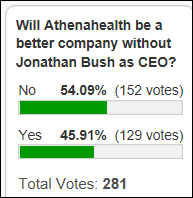
A slight majority of poll respondents think Athenahealth will be a lesser company without Jonathan Bush. Some respondents worry that the finance guys will take over from the visionary and cultural leader and instead of fixating on customers and product delivery, will jack up prices and hack at costs to improve the bottom line. Others say that without his dogged determination in focusing on long-term objectives, the bean counters will stifle innovation by just delivering what short-sighted customers say they want. One respondent said directly, “Steve Jobs was a douche, but I don’t think Apple is better off today.”

New poll to your right or here: has your employer had layoffs or other workforce reductions so far in 2018?

image

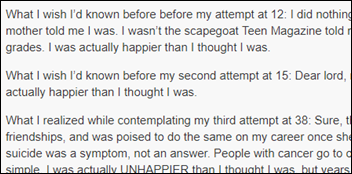
Thanks to respondents who provided honest, painful thoughts about how suicide has affected them.

image

This week’s question involves co-worker relationships.

Welcome to new HIStalk Platinum Sponsor Goliath Technologies. The Philadelphia-based company’s technology improves EHR user experience by helping IT departments anticipate, troubleshoot, and prevent issues related to slow log-in and application performance. It brings application monitoring for Cerner, Epic, Meditech, and other EHRs and business applications into a single console with real-time performance data, covering everything from endpoint to Citrix or VMware Horizon delivery infrastructure. Universal Health Services uses the system to monitor performance of its hosted Cerner system deployed nationally, where it logs into several Cerner applications every 30 minutes using a user’s exact keystrokes and network access to identify failures or slowdowns so they can be fixed quickly. That monitoring allowed UHS to pinpoint WiFi problems in a specific hospital. The company offers a demo and a 30-day free trial. I interviewed CEO Thomas Charlton a couple of weeks ago just because he sounded interesting and the company then decided to become a sponsor as a result. Thanks to Goliath Technologies for supporting HIStalk.

Here’s a video I found on YouTube describing Goliath’s Cerner monitoring system.

I had a good experience this weekend with an independent urgent care center in a tiny, remote town whose physician assistant recently treated my minor injury. The place was well staffed but empty, so I didn’t have to wait. They don’t accept my insurance but they charge just a fixed $75 (which in my case included a lidocaine injection, a bunch of silver nitrate sticks, and the usual odds and ends) and they used the insurance card information to retrieve my meds and problem lists, which they verified with me at the start of the visit. I received an email immediately afterward containing a link to sign up for the practice’s Athenahealth patient portal, and that went painlessly in simply entering the numeric code that was texted to my telephone number on file. I really worried about being forced to some hospital’s ED with the strong likelihood of getting stuck with out-of-network charges, so being quoted $75 made me happy, even more so when they treated and streeted me quickly.


Webinars

June 21 (Thursday) noon ET. “Operationalizing Data Science Models in Healthcare.” Sponsor: CitiusTech. Presenters: Yugal Sharma, PhD, VP of data science, CitiusTech; Vinil Menon, VP of enterprise applications proficiency, CitiusTech. As healthcare organizations are becoming more adept at developing models, building the skills required to manage, validate, and deploy these models efficiently remains a challenging task. We define operationalization as the process of managing, validating, and deploying models within an organization. Several industry best practices, along with frameworks and technology solutions, exist to address this challenge. An understanding of this space and current state of the art is crucial to ensure efficient use and consumption of these models for relevant stakeholders in the organization. This webinar will give an introduction and overview of these key areas, along with examples and case studies to demonstrate the value of various best practices in the healthcare industry.

Previous webinars are on our YouTube channel. Contact Lorre for information.


Acquisitions, Funding, Business, and Stock

image

IBM Watson Health executives tell employees that the company will scale back its hospital pay-for-performance tools business.

image

Former Cleveland Clinic President and CEO Toby Cosgrove, MD joins the board of Denver-based prescription decision support vendor RxRevu. The company’s board chair, Stephen McHale, was founder, CEO, and board chair of Cleveland Clinic spinoff Explorys,  which was acquired by IBM in 2015 and rolled into Watson Health.

Google is hiring for its Brain division, apparently for a research project called Medical Digital Assist that will use AI and speech recognition to create physician documentation. It may be a continuation of its Stanford Medicine digital scribe study from last year.


Announcements and Implementations

The AMA weighs in on augmented intelligence in a policy approved at its annual meeting, insisting in its own involvement to set direction, ensure physician friendliness, and integrate it with medical practice. AMA used the term AI to describe “augmented intelligence,” with the subtle difference being important – “augmented” means that AMA considers AI’s role as offering recommendations to doctors who are free to use them or not.


Sponsor Updates

  • Vocera will exhibit at the Cleveland Clinic Patient Experience Summit June 18 in Cleveland.
  • In the Netherlands, The Princess Maxima Center for Pediatric Oncology implements Wolter Kluwer’s UptoDate and Lexicomp solutions.
  • ZappRx expands its partnership with prior authorization services company PARx Solutions to include all treatment areas on the ZappRx platform.

Blog Posts


HIStalk Sponsors Named to the HCI 100

#4 Change Healthcare
#5 Philips
#9 Leidos
#17 Nuance
#20 Ciox Health
#21 Wolters Kluwer Health
#23 Roper Technologies
#26 InterSystems
#30 EClinicalWorks
#31 Meditech
#41 Experian Health
#43 MModal
#44 Netsmart
#47 Waystar
#52 Hyland
#56 Nordic
#58 Spok
#59 Elsevier
#60 Harris Healhcare
#61 Vocera
#62 CSI Healthcare IT
#65 Optimum Healthcare IT
#66 Imprivata
#67 Medhost
#68 Agfa Healthcare
#72 HCTec
#73 The HCI Group
#82 Cumberland Consulting Group
#87 AdvancedMD
#89 Impact Advisors
#90 Medecision
#93 The SSI Group
#97 WebPT


Contacts

Mr. H, Lorre, Jenn, Dr. Jayne.
Get HIStalk updates. Send news or rumors.
Contact us.

125x125_2nd_Circle

What I Wish I’d Known Before … Considering or Attempting Suicide or Losing a Friend, Family Member, or Co-Worker To It

I wish I would have known that I would be “judged” on my level of grief after the loss. One of my classmates in medical school committed suicide during the last half of our last year. Even though I wasn’t in his most inner circle of friends (really just his fiancée and a couple of others), we had been on many rotations together and saw each other almost every day, so I took the loss very hard. I started talking to other classmates about collecting for a memorial (our school already had a piece of art in the lobby dedicated to a previous student who also committed suicide) and was quickly approached by the dean, who told me I had overstepped my bounds and that this should be left for his friends to do.

I was shocked, and had no idea that there were different levels of grief and response which one was limited to based on one’s perceived relationship to the deceased. I certainly considered him my friend and I think that not being able to do anything “useful” in response to the loss made it worse for me. Two decades later, I still think about him – seeing him was one of the bright spots of my day, and I think about the loss for the patients who never got to experience his brand of caring and compassion. He would have been an outstanding physician.


We were brand new parents, and my husband was terribly depressed. I didn’t know it. I knew he was worried about his work situation, money, our living situation, and he didn’t like me being the primary provider. I didn’t know that as a new dad, he worried he that he’d turn out like his paranoid schizophrenic, alcohol-abusing bio-father despite the fact that he never consumed alcohol. I had no idea about the depth of his worry, struggles and depression. Certainly, no idea he was dealing with suicide-level depression – or that he’d stopped going to his crappy job during day and instead, went to his parent’s place where no one was, and that he’d pull a gun from the cabinet and contemplate killing himself. I wish I’d known what everyone wishes: That I knew. That he spoke up.

My husband didn’t end up taking his life. Two things happened that day: One, my cousin, who worked at the same place my husband had been called to see if he was feeling okay, so I knew something was up. (He hadn’t been to work in over a week.) I’m glad someone noticed he wasn’t there! Two, that day, my husband had a gun in his mouth. He heard a voice, that he was sure was God, tell him not to do it. That he was loved and needed, and that he’d be causing more pain than he’d take away. He came home, confessed/cried (without me asking where he’d been), and then we talked with family and our pastor.

That was nearly 14 years ago. He found a job he liked not long after. Our kids are 13, 10 and 1, and he’s now a stay-at-home dad for our youngest, with only gratitude for getting to stay home vs. feeling “less of a man”. It was a turning point for us in terms of depth of our relationship. We always communicate, and I don’t worry that he’d do that to me/us, and I haven’t since those early days. I wish they knew things aren’t as bad as they seem, and they can get even better.


People perceive and react differently, but these have been helpful.

https://www.ted.com/talks/andrew_solomon_depression_the_secret_we_share

https://www.ted.com/talks/kevin_briggs_the_bridge_between_suicide_and_life


I wish I’d known how incredibly cruel people can be in the wake of a suicide, as I witnessed the “friends” of a woman I know gossip about her and blame her for her husband’s suicide. It costs exactly nothing to offer condolences, mow someone’s lawn, help tidy their house and wash dishes, and keep your base thoughts to yourself. Conversely, you gain nothing by spreading malicious gossip about a family in anguish.


I don’t think it can ever be overstated – talk about it. Talk about anxiety and depression and that it can happen to anyone. It’s okay to have it, it’s okay to talk about it, it’s okay… Maybe your anxiety/depression isn’t as severe, but you should still talk about it. You’re not on an island, you’re not alone. We all have it, whether we want to admit it or not.


Two things:

The emotional bleakness that drives one to attempt suicide really will go away
When people do die by suicide their family and friends never get over it.

Over the years, I’ve lost several acquaintances to suicide and I wish they had chosen to reach out for help. Unfortunately, I’ve felt the sense of loss and tragedy when the lives of decent and talented individuals are ended prematurely. I’ve also seen the way in which it haunts their family, their close friends and any treating health care professionals. Sometimes that’s what suicidal individuals want — to make others suffer, out of anger — but plenty of others who care about the person will suffer as well. Unlike other kinds of grief where the sadness subsides and good memories predominant, with suicide one never can remember the person without those memories being tinged or overwhelmed by the way that the person chose to die.

For many years while in late adolescence and early adulthood, there was rarely a week that I didn’t consider suicide. I attempted suicide several times and was hospitalized many more. At the time, I never thought I’d live long enough to be able to legally get a drink. Finally, with the help of excellent psychiatrists who didn’t give up on me and with medications and years of weekly therapy, those thoughts went away entirely. Now I’m approaching retirement and I am genuinely happy and content. I have had a very successful career, wonderful spouse and great friends and family. And I am extremely grateful that I’ve been able to enjoy all of that.


My son committed suicide. I’m angry with him for making the last chapter of his short biography the defining event of his life, meaning that in trying to forget the painful memories of the event itself, we’ve ended up forgetting him.


I lost a cousin to suicide and a brother-in-law to suicide. My brother-in-law (JP) left two young girls in 2006. His 17-year-old daughter found him post GSW to the head. I wish I had talked to his daughters or his estranged wife to know that he was exhibiting some of the signs of suicide. He pushed his daughters away and completed the items on his bucket list in a short period of time. He was having financial difficulties and marital difficulties. He had counseled a seventeen year old against suicide in the weeks preceding his own suicide. I have witnessed the devastation this loss has put on his family and most especially his daughters. There is always the question of what if? And why?

Having been close to JP and knowing how kind, loving and dedicated he was to his family and church, it is hard to hear people speak cruelly of those that have succeeded in their attempt. I know that at the time JP died, he thought he was doing the absolute best thing for everyone and saving them the grief of dealing with his perceived mistakes. He just didn’t realize how devastating it would be for the rest of their lives. My niece still grieves deeply and asks what if and why on the anniversary of the day it happened, his birthday, Christmas, Father’s Day …


That he was suffering from something which hurt him so much that he took his own life at such a young age.


I found my girlfriend after she had taken her life in the bedroom we shared. Finding someone is a whole other subset of suicide survivorship that comes with special considerations. Talk to someone, and be self-aware and accepting that it’s okay to experience symptoms of PTSD. I let myself feel them so I can process and deconstruct them. See a professional and be honest with yourself most of all. There are many survivorship support groups to help you, take advantage of them. Take care of yourself. You become acutely aware that obligations to yourself need to sometimes take priority over others. There are a few thoughts that I’ve consciously decided to accept to help me get through it:

1) It’s not my fault
2) I’ll never know exactly why she did it, and that’s okay
3) The pain of this loss will never get smaller, will never resolve itself, will never reach some form of poetic closure. But that’s okay. Although I’ll always carry this pain, I am able to get stronger in carrying it. A mile never gets shorter, 10 lbs is always 10lbs, but as long as you practice dealing with those things in a healthy way, you will get stronger in your ability to carry on.

I try to honor her memory by being good to myself and others. I much prefer it to the alternative.


How much you blame yourself for your family members actions. You constantly question why didn’t I know, why didn’t I see, why didn’t I call them that morning, why didn’t I tell them I love them more, etc. WHY, WHY, WHY. The only thing I can do now is try to educate others to not carry the survivor guilt.


I have a perspective from both sides.

Before Considering: How much (and how many) people actually love and care about you even when you feel very very alone and unsupported. People you don’t even realize care love you. That suicide is a permanent solution to a temporary problem even when that problem doesn’t seem temporary in the slightest. That life gets better and there is in fact a light at the end of the tunnel even if you can’t see the light right now. The light may not show up immediately either but it is there and you will eventually see it.

Before Losing a Friend: How much I’d wish I would have reached out more, kept in touch better, not let life get in the way of my relationships with people and been there to support them through a hard time. Knowing how much pain someone was going through to choose suicide makes me incredibly sad. I care so incredibly much about my friends and family and really humans in general that I don’t want to see anyone hurting in that way. I am not always great at showing it but I care very much.


What I wish I’d known before before my attempt at 12: I did nothing to deserve three years of bullying and teasing. I wasn’t the “easy taaaahhhget” my mother told me I was. I wasn’t the scapegoat Teen Magazine told me I was. I wasn’t the “fat loser” my sister told me I was. I was just a shy kid who got good grades. I was actually happier than I thought I was.

What I wish I’d known before my second attempt at 15: Dear lord, not finishing my science project was not a big deal. I didn’t need to be perfect. I was actually happier than I thought I was.

What I realized while contemplating my third attempt at 38: Sure, the three years of a manipulative sister-in-law had taken its toll on my marriage and friendships, and was poised to do the same on my career once she joined my employer…but I was the only one in a position to fix myself. Considering suicide was a symptom, not an answer. People with cancer go to oncologists, and people with suicidal thoughts go to therapists. It was surprisingly that simple. I was actually UNHAPPIER than I thought I was, but years of stuffing down my emotions and trying to live up to others’ expectations had left me unable to recognize my own feelings.

I’ll say it again: considering suicide is a symptom, not an answer. It’s a flag to reach out and get help. Help is there. Keep reaching, keep trying. Suicide leaves the survivors with a hole filled with confusion, anger, loss and regret…because the person who left is more meaningful than they realize.


Logic does not work.


Taking your life ruins others people’s lives. It causes so much pain and struggle to the family/friends that you know. It’s hard to live on without that person. It’s like a massive hole in their hearts for the rest of their lives. When someone famous or someone in the limelight takes their lives the Suicide rate peaks putting suicide at the forefront of minds for folks struggling.


That a person who has many friends, and posts happy photos on FB is actually in many cases lonely and should be reached out to.


Assuming that the person did not have the courage (or could be selfish enough) to take their own life and destroy the lives of their children and family in the process.


Wish there was a way we could know that someone is so depressed they would rather not live. Good lesson of really asking someone if they are doing okay.


I lost my nephew to suicide, a veteran who suffered from PTSD and had trouble adapting. I wish I had known or understood the severity of what vets go through. I wish I would have pushed harder to have him meet with a mentor friend. I wish that our VA would listen when vets reach out for help. I don’t think them buying Cerner will help – they should be investing in more humans to serve, not more computers to record.

Suicide is not selfish. It’s a result of a sickness. Awful people said awful things about that when he died. We don’t demonize the cardiac patient for the heart attack, yet its 80 percent preventable. Depression is an illness. It made him think he was helping his family and kids by removing himself from the equation. We need more connecting and less computers and tech.


Weekender 6/15/18

June 15, 2018 Weekender Comments Off on Weekender 6/15/18

weekender


Weekly News Recap

  • GPB Capital acquires Maryland-based RCM/EHR vendor Health Prime International.
  • Inspirata acquires Caradigm from GE Healthcare
  • Former IBM employees say Watson Health’s troubles stem from the company’s inability to successfully merge the assets of its acquired Phytel, Explorys, and Truven Health
  • The VA announces plans to create a device implant registry

Best Reader Comments

I think many rural providers/clinicians feel like they are forgotten or not considered in the larger healthcare picture. (Kallie)

Digital health / telemedicine is going to be the cheap, low-quality option that serves the masses while high-touch, in-person visits with an actual physician is going to be the gold standard that is expensive in 10 years. You already see this playing out in the wealth management industry and healthcare will be no different. (Lazlo Hollyfeld)

Someone can have full knowledge of what the #MeToo movement is about and still feel that it should be acceptable to acknowledge a male’s contributions to his field. Even if that guy has his flaws, although admittedly, I don’t know how big they are – the news coverage seems sensationalistic and other accusations are somewhat vague. (Clustered)

I love my 20+ year marketing career, but there are definitely “special internal challenges” faced by marketing teams that other teams like finance and development would never have to deal with, i.e. everyone knows how to do marketing. (Christine)


Watercooler Talk Tidbits

image image

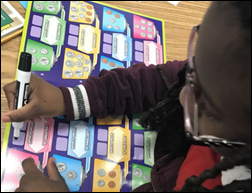
We provided STEM materials for Ms. H in Alabama, whose DonorsChoose teacher grant request explained that her school provides at-home services to special needs children who have experienced significant vision or hearing loss. She reports, “This means the world to me and my students. By providing our students with materials to TAKE HOME is amazing. We have never had the opportunity to send materials home with students before. The materials have allowed the students the ability to show off their progress and things we have been working on at school to their parents. Students are going to succeed above and beyond due to your generosity.”

image SNAGHTML52e698

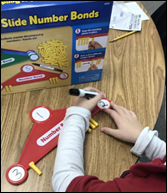
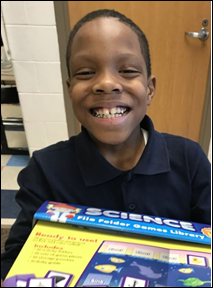
Also checking in was Ms. H from Ohio, whose first graders received take-home math and science materials. She says, “When we opened the boxes, they were excited that they would be able to take these materials home with them. They were happy that they would get to use these with their families at home. We have been able to help build and grow our math and science skills. These resources create meaningful and engaging activities for the students.”

Uber files a patent application for an AI-powered enhancement to its app that would analyze a user’s typing mistakes, walking patterns, and time and location in the hopes of identifying ride requesters who are drunk, allowing the company to alert the driver (who might be paid more to deal with an intoxicated passenger) and possibly to decline to dispatch a shared ride.

This it fascinating. Forty years ago in June 1978, punk rock band The Cramps played at a California state mental hospital, caught on low-quality videotape despite pre-HIPAA patient confidentiality concerns. The fascinating part is that the band overcame a puzzled, tepid reception to rock the place out and dance with the residents. Lead singer Lux Interior (who died of aortic dissection in 2009 at 62) bluntly told the audience, “Somebody told me you people are crazy, but I’m not so sure about that. You seem to be all right to me.”

Forbes profiles the billionaire founder of a Minnesota hearing aid company that he started by buying an existing business for $13,000, after which he built it into the country’s largest hearing aid manufacturer. It’s not a feel-good recap, though, as the company has struggled since the founder moved on to charitable efforts and misdeeds by his assigned replacements – one of them his stepson – have led to loss of market share as innovation stalled.

A hospital in Vancouver that caters to “birth tourism” — in which expectant mothers from China have their babies delivered there to earn them instant Canadian citizenship — sues a since-vanished mother from China whose baby required a $300,000 stay. The hospital, which has been labeled a “passport mill” along with untold numbers of “baby houses” that market to cash-paying foreigners, delivers an average of one baby per day to parents from China.

Coming this fall: Two-Point Hospital, a PC video game that’s interesting to me because of odd items in the make-believe hospital: old-fashioned radiators, live plants in most rooms, and a Sega videogame in the lobby.


In Case You Missed It


Get Involved


125x125_2nd_Circle

EPtalk by Dr. Jayne 6/14/18

June 14, 2018 Dr. Jayne Comments Off on EPtalk by Dr. Jayne 6/14/18

Mr. H has mentioned the rise of private equity in healthcare, most recently in this week’s news and morning headlines. I’ve seen it both from the consulting side and from the trenches as I’ve watched several of my friends sell their independent practices.

It’s amusing to watch their thought process. These are the same physicians who wouldn’t consider selling their practices to a local health system for fear of being beholden to “the man,” yet they’ll get in bed with private equity. Even before the ink is dry, some of them have seen their worlds completely reorganized with less of a focus on clinical quality and patient care and more of a focus on profits. I’m not sure why my colleagues are surprised when this happens. By definition, private equity firms are investment management companies,. Not healthcare companies, not charities, and certainly not physician-led organizations.

Allowing private equity investments puts you on a slippery slope, but selling to private equity moves you squarely into the realm of being a for-profit business, whether you want to put an altruistic healthcare face on it or not. I’ve been in consulting engagements (working for physician groups) where the PE firm brings in its own consultants and starts slashing and burning before even trying to understand the practice’s culture, patient population, and what they’ve tried to do already. I’ve watched dermatology practices converted to almost exclusively cosmetic enterprises over the protests of the former controlling physicians who actually want to practice dermatology.

There’s only so much money out there. It’s tempting to think that the PE firm is actually going to invest in you and grow your business the way you might have done on your own, but in reality, they’re likely to drastically change your way of life and profit will be the driving force behind most decisions moving forward. Caveat emptor!

I got a kick out of Jacob Reider’s comments about potential suitors for Athenahealth following the departure of Jonathan Bush. He discounts the possibilities of Apple, Cerner, and Microsoft, but gives 10 percent odds to Salesforce. He also throws the possibility of Roper/Strata Decision into the mix. I agree with Jacob that Strata CEO Dan Michelson gets the EHR market, and the last time I saw him in action, it made me want to go home and learn more about cost accounting – something you don’t hear too many people hankering to do in their free time.

From No Surprise Here: “Re: HDHPs. Check out this article about high-deductible plans keeping patients from accessing preventive care services. No surprise, right?” The link is from the American Academy of Family Physicians and cites a study from the Robert Graham Center for Policy Studies in Family Medicine and Primary Care. The study found that patients who have high-deductible health plans but who do not have health savings accounts to go with them are less likely to receive preventive care or care from primary physicians or subspecialty service providers. The authors looked at data from 2011-2014 for almost 26,000 privately insured adults in four categories: no deductible, low deductible, high-deductible plan with savings account, and high-deductible plan without savings account. Those in the latter category were 7 percent less likely to receive breast cancer screening and 8 percent less likely to receive a flu vaccine. Screenings for hypertension were slightly (4 percent) less.

Under the Affordable Care Act, preventive care is supposed to be exempted from out-of-pocket charges, including deductibles, but this only applies to certain identified preventive services. It definitely doesn’t apply to my breast MRI, which is indicated due to my very high lifetime cancer risk, and fortunately as a physician, I can afford to pay for it. But for those services that are explicitly exempted — such as well visits, screening tests, and vaccinations — many patients don’t realize they have access without a deductible, so they don’t seek care.

As I’ve said before, there’s not the greatest incentives for insurance companies to advertise all the services they cover at minimal cost to the patient since the return on investment is likely to be years down the road when the patient may be with another payer. One would hope the payers could adopt the attitude of “we’re all in this together” since the number of patients moving around is likely to impact all of them, but I haven’t seen much education to patients in this regard. Failure to have patients take advantage of preventive services that are shown to be cost-effective illustrates the lack of attention to public health efforts in our nation. We’re relying on the primary care workforce to identify all these gaps in care and take care of them, but if the patients don’t have a primary to see (the wait in my community is well over six months), aren’t eligible to be seen at a clinic, or just don’t go, then no one is handling it for the patient.

I’ve always found the AAFP to be a solid source of information, both as a physician and as a patient. I was sad to see their writeup on increased suicide rates across the US. Looking at data through 2016, the suicide rate has increased nearly 30 percent, with 45,000 Americans age 10 or older taking their own lives. We hear about the celebrities, but we don’t hear about the others, and we don’t hear enough about the people who tried and didn’t succeed.

One of the most heartbreaking situations I ever encountered was a pre-teen who tried to hang himself and was found by his parents, but not quickly enough, resulting in severe anoxic brain injury. I cared for him several years later due to some complications of his multiple medical issues. It’s never to early to talk about mental health.

In the times that suicide has touched me personally, for most, there was no warning. This is borne out by data that shows that in states reporting complete information for 2015, 54 percent of the time there were no known mental health conditions. The data also shows an increase in visits for non-fatal self-harm, rising 42 percent between 2001 and 2016. Firearms were used in 48 percent of cases.

Suicide is preventable. The article lists key strategies:

  • strengthening economic supports (housing stabilization policies, household financial support)
  • teaching coping and problem-solving skills to manage everyday stressors and prevent future relationship problems, especially in early life
  • promoting social connectedness to increase a sense of belonging and access to informational, tangible, emotional and social support
  • identifying and better supporting people at risk (military veterans, people with physical or mental health conditions)

As a side note, the next to last bullet does not refer to Facebook, Snapchat, Instagram, or other social media that can actually increase feelings of decreased self-worth and hopelessness. We’re talking real, interpersonal connections that might be made when people are actually together interacting like human beings. I see a lot of people who are well “connected” but have no one they can really turn to. Reach out to your friends, your neighbors, and the people you know and consider getting to know them better.

I’ll get off my soapbox now and get back to the business of working on a lab interface. Thanks for listening.

Email Dr. Jayne.

News 6/13/18

June 12, 2018 News 3 Comments

Top News

image

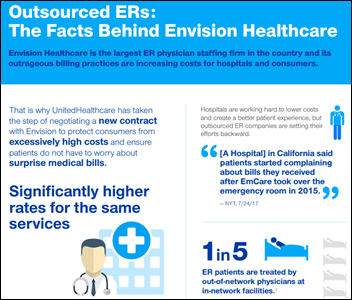
An Axios report says that private equity firms love buying healthcare provider companies that wield a lot of market power, especially physician and ED staffing groups and air and ground ambulance companies. Those businesses make money when their providers are forced on hospital inpatients (often at out-of-network rates) or during moments when the patient has no choice.

Part of the company’s high margins come from the “surprise” portion of bills that insurance doesn’t cover.

SNAGHTML4e82a490

The article was triggered by news of KKR’s planned acquisition of Envision Healthcare Corporation for $9.9 billion.

image

Envision provides ED doctors, hospitalists, anesthesiologists, radiology, and children’s services in 1,800 clinical departments in 45 states. It also operates a freestanding surgery center.

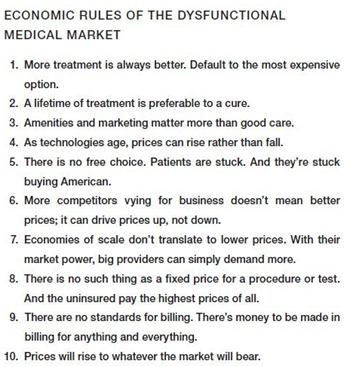
Elizabeth Rosenthal, author of last year’s bestseller “An American Sickness” and editor of Kaiser Health News, tweeted out in response her book’s rules of our medical market.


HIStalk Announcements and Requests

image

This week’s question has generated quite a few heart-wrenching but sometimes uplifting recaps. I didn’t explain well why I solicited stories that are in ample supply elsewhere — these are coming from health IT peers and might resonate more strongly with struggling folks who work in our industry.

My least-favorite word of the moment: “seasoned,” a self-descriptive adjective used mostly by executives but sometimes companies who feel their experience needs its own laudatory designator. The mental picture it always creates for me is either (a) someone getting salted and peppered, or (b) a person or company as a stack of firewood that has dried up and is ready to go up in flames. It’s kind of like “innovative,” “nimble,” “entrepreneurial,” and “successful” in being self-congratulatory, yet conveniently unquantifiable.

Listening, only because it immediately caught my ear as played on a pirate sort of anti-corporate streaming radio station: Kevin Ayers, whose 1969 “Lady Rachel” was new to me (as was he himself, in fact). He was an original member of Soft Machine in the mid-1960s and played in the prog subtype of Canterbury Sound, which can range from whimsical to psychedelic, but always melodic (Soft Machine shared bills with Pink Floyd). Kevin died in 2013 at 68 with his Soft Machine heyday long passed. The lyrics and the voice he sings them in are kind of creepy: “Then she unwraps the parcel, And discovers a castle inside, The drawbridge is open, And a voice from the water, Says welcome my daughter, We’ve all been expecting you to come. She climbs…” His life’s finale was 2007’s “The Unfairground,” recorded with members of then-popular bands such as Teenage Fanclub and Roxy Music. 


Webinars

June 21 (Thursday) noon ET. “Operationalizing Data Science Models in Healthcare.” Sponsor: CitiusTech. Presenters: Yugal Sharma, PhD, VP of data science, CitiusTech; Vinil Menon, VP of enterprise applications proficiency, CitiusTech. As healthcare organizations are becoming more adept at developing models, building the skills required to manage, validate, and deploy these models efficiently remains a challenging task. We define operationalization as the process of managing, validating, and deploying models within an organization. Several industry best practices, along with frameworks and technology solutions, exist to address this challenge. An understanding of this space and current state of the art is crucial to ensure efficient use and consumption of these models for relevant stakeholders in the organization. This webinar will give an introduction and overview of these key areas, along with examples and case studies to demonstrate the value of various best practices in the healthcare industry.

Previous webinars are on our YouTube channel. Contact Lorre for information.


Acquisitions, Funding, Business, and Stock

SNAGHTML4e97de09

Billionaire doctor Patrick Soon-Shiong says that despite the poor stock performance and heavy criticism of his two publicly traded companies NantHealth and NantKwest, he will IPO a new chemotherapy development company later this year. Investors might want to proceed cautiously – shares in NantHealth and NantKwest have dropped 77 percent and 46 percent since their respective IPOs.

image

Private equity firm GPB Capital acquires Maryland-based RCM/EHR vendor Health Prime International. Among GPB’s other holdings are dozens of car dealerships, several garbage collection companies, a concert video streaming service, life sciences firms, and health IT vendors Cantata Health, ITelagen Healthcare, MDS Medical, and Meta Healthcare IT Solutions.

image

Inova’s healthcare accelerator invests in CoverMyTest, which automates prior authorization workflow for genetic and genomic testing. The company name seems like it would be legally challengeable by McKesson-owned CoverMyMeds, which offers the same type of PA service for medications.

image

Sentry Data Systems, which sells 340B hospital drug subsidy program software, wins the first round in its antitrust lawsuit against CVS, which bought its own 340B administrator and required that its hospital and clinic customers use that company exclusively.

image

Moody’s downgrades the credit rating of Beth Israel Deaconess Medical Center parent CareGroup, citing concerns about its $534 million BIDMC expansion project and significantly lower margins at Mount Auburn Hospital following its $110 million FY2017 implementation of Epic. Moody’s also worries about planned Meditech upgrades at three CareGroup community hospitals. However, the ratings firm says a proposed merger with Lahey Health would create economy of scale and market share that could make CareGroup competitive with Partners HealthCare in the Boston area.


People

image

John Elms (Connexall USA) joins nurse call system vendor Critical Alert Systems as CEO.


Announcements and Implementations

image

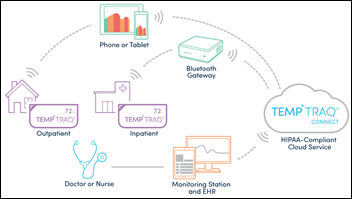
A Cincinnati Children’s study that is really small in sample size and scope finds that TempTraq’s Bluetooth-powered continuous temperature monitoring patch detects early fevers better than the usual episodic methods. The company says it can be integrated into central monitoring and EHR systems.TempTraq is part of Blue Spark Technologies, which makes flexible printed batteries similar to the temp-monitoring patch.

The Concord newspaper profiles former medical software technologist Chris Stakutis, who is working on a skill for Amazon Alexa for elderly people that reads news and emails aloud, allows creating messages, and asks questions about their health.


Other

SNAGHTML4cacf3b8

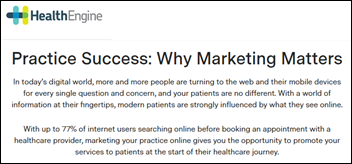
In Australia, doctor finder and appointment scheduling service HealthEngine is caught modifying more than half of patient-submitted practice reviews to make them sound more positive, with the local paper somehow tinkering with the site’s HTML to obtain before-and-after images. The company says it “has never intended to be a traditional ratings and review site” since its goal is to “celebrate high-performing practices” by publishing only positive reviews and sending negative ones privately to the practice (which is the real story that the paper mostly missed). Hopefully it takes fewer liberties with its medication management app. Meanwhile, it has removed the reviews from its site as it contemplates its future.

image

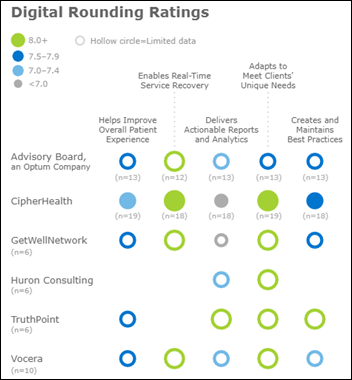
A new KLAS report on digital rounding technologies – which includes rounding by nurses as well as non-clinical employees – finds the market to be immature, with few use cases and low customer expectations beyond replacing paper-based systems. Most of the vendors had too few customer responses to assure data validity.

image

Spok’s annual mobile strategies report, derived from a smallish survey of 300 hospital employees, finds that 57 percent of hospitals have a mobile strategy, a decrease from 2017. Half said their strategy addresses communications needs, with 25 percent each saying it’s either a clinical or a technology initiative. The survey found that clinicians are increasingly involved in developing mobile policies, mostly to offer input on technology selection and to improve adoption rates. In-house Wi-Fi and cellular coverage remains the biggest problem, reported by more than half of respondents.

image 

Weird News Andy gets this potty started by filing this breaking news item under Porta-Jong. A North Korean defector who served in the military says that Kim Jong-un always travels with his own private restroom, including one that’s installed in an armored black limousine for motorcading. WNA assumes that if Western intelligence agencies gained access to his leavings, it might lead to a serious data dump about his health, although he acknowledges that the rumor was leaked by a stool pigeon. 


Sponsor Updates

  • ChartLogic’s ambulatory EHR earns ONC’s 2015 Edition certification, with the company noting that 100 percent of its clients who participated in its 2017 MIPS program attested successfully.
  • Memorial Medical Center (TX) is featured in a video testimonial about its use of the hosted version of the Obix Perinatal Data System.
  • Santa Rosa Consulting publishes a white paper titled “Utilizing Lean Management Principles During a Meditech 6.1 Implementation.”
  • Meditech posts a podcast titled “Rural Healthcare and the Role of the CIO,” featuring Methodist Hospital CIO and 2017 Gall CIO of the Year winner Randy McCleese.
  • In Ireland, Aut Even Hospital moves to an integrated radiology department with Agfa HealthCare’s enterprise imaging.
  • A new customer study shows that medical practices using Aprima’s EHR with Kno2 saved 103 hours per provider annually.
  • AssessURHealth publishes a new customer success story featuring Mark Weissman, MD of GMS Florida West Coast.
  • Burwood Group accelerates its cloud management practice with the adoption of HyperGrid’s HyperCloud platform.
  • Change Healthcare will exhibit at the AMDIS 2018 Physician-Computer Connection Symposium June 18-23 in Ojai, CA.
  • Divurgent publishes a new white paper, “Blockchain: The Challenges and Opportunities in Healthcare.”

Blog Posts


Contacts

Mr. H, Lorre, Jenn, Dr. Jayne.
Get HIStalk updates. Send news or rumors.
Contact us.

125x125_2nd_Circle

HIStalk Interviews Jeremy Schwach, CEO, Bluetree Network

June 12, 2018 Interviews Comments Off on HIStalk Interviews Jeremy Schwach, CEO, Bluetree Network

Jeremy Schwach is CEO of Bluetree Network of Madison, WI.

image

Tell me about yourself and the company.

I’m Minneapolis-St. Paul-born, so I’ve got those Midwest roots. I was born to an accountant and a microbiologist, and unfortunately, I didn’t get either of those skills, so I was forced into business. I found myself at UW, where I started my first company out of my dorm room. It was a bus company. That went pretty well and whetted my palate for the entrepreneurship journey. It didn’t really run in the family, but I had a very good support structure. I had supporting parents and they said failure was OK, which pushed me out of my comfort zone.

I got the first company running. Then I found this weird little software company out of Verona right out of UW. After a brief stint living in South Africa, I moved back to Wisconsin and started my career at Epic. I was there for about six years. After living out my non-compete at a large health system and understanding how hard it is to deliver healthcare, I jumped into this next entrepreneurial thing with co-founders and started Bluetree.

We today are about 250 or so people. We’re not that great at marketing, so people don’t know this, but we’re about 60 percent staff augmentation, specifically in the Epic space. But about 40 percent of what we do is what we call solutions, which is more around strategy. Clients come to us to ask, “We’ve got all this data coming into Epic. Can you help us make sense of it and maybe pull payer data in?” Or, “We know we can do a lot more and make our physicians more productive. Can you guys help us do that?”

Where we’re a little bit different is that we focus on Epic because we know it so well. We like to come in and help with figuring out what the plan is, the strategy, but then we get our teeth into actually getting it done. We always say that ultimately we want our result to be that we delivered something tangible that worked well for our client.

How do you differentiate yourself in that market where there are a lot of competitors?

We didn’t actually want to be a consulting company. We raised a little bit of friends and family. The problem we were trying to solve was that having worked at Epic– and about 40 percent to 50 percent of us came from Epic — we looked out in the wild and saw all of these different consultants, but there weren’t a lot of great consultants.

We thought technology could solve that, so we started as a matchmaking platform. Luckily I failed many times in life, so I knew after that didn’t work, there was still a path forward. We were trying to solve this quality problem. We built this matchmaking platform and went out to clients and said, “You can find the specific skill sets within Epic that you need. Everybody’s going to get reviewed Amazon ranking style. Pretty soon you’ll start to see who all the great people are.”

Potential clients said, “You kids know nothing. It’s a good idea. The transparency and quality problem is a real problem for us. But we’re not going to social network our way to consultants. Sometimes we need 10 people. If things are going great, we want to just pick up the phone and call you. For all those reasons, we’re not going to use your silly platform. But here’s all our needs.”

That was 2013. We learned pretty early on that the market wasn’t ready for a tech platform, but that this consulting thing could probably work. We just said, if we’re going do this like everybody else, let’s stick to our guns on the core quality piece in this area that we know really well called Epic. That was the differentiator.

With some dumb luck on timing, we grew really quickly post the big implementation boom, after everybody had Epic live and had to figure out, what do I do with this super powerful machine now that it’s up and running? Clients started saying not just, “Do you have a strong hospital billing person?” but also, “Our AR over 90 is spiking,” or, “We’ve got to figure out how to build managed care dashboards.” The questions started to change. That was the impetus for the shift to a more outcome-based strategy or solutions.

Half our company comes from the provider space, knows the business of healthcare, knows what it’s like working in a health system. Half of us come from Epic, so we know this tool really well and we’ll be able to maximize the power of it. That’s how we differentiate and have been able to continue growing over the last six years.

Sometimes hospitals only care about getting someone who holds a specific certification. How much of what you learned from your original iteration of letting customers rate their consultants did you apply to the way that you hire and place consultants at Bluetree?

It’s the big reason that we stuck around in the Epic space. We constantly have questions about, should we help Cerner clients or Meditech clients? What we found is we know the Epic space so well that we can use our network and feedback from our clients to help differentiate who’s the rock star. They say in service work that a great person is 10 times better than the median. That is precisely the reason we’ve stayed focused in the Epic niche. We feel like we’re able to differentiate that quality piece.

How has the Epic consulting market changed in the past two or three years?

Again, a lot of life is just dumb luck. Not a lot of people know this, but the only reason I picked Epic out of UW is because they were going to pay me $1,000 extra over Maytag. I very easily could be servicing Home Depots right now.

In terms of our trajectory, we found our footing in 2013 and 2014. There was still a lot of implementations, but you had some really big players that specialized in implementations. Therefore, a lot of our early clients had Epic live and were figuring out what to do next. We got a little bit lucky in that we were on the end of that wave, perhaps the downward slope, as optimization, the next level wave, took off. All of our growth is in what we call solutions. It’s managed services. It’s everybody trying to figure out, how do we do this thing much more cost effectively?

Epic is a really robust, big system. Five years ago, we weren’t seeing that a lot of clients were ready to outsource a lot of that. Now I think the opposite is happening. We see that growing pretty quickly. Then it’s all this stuff, all the buzzwords you read about. We’re on the ground working with clients to figure out, how do we make physicians — happier is not a great word — but how do we ensure that they’re able to get their work done the way that they perceive that they used to? What we’re finding on that particular front is that it’s not about squeezing in extra patients. Physicians are documenting and then going home and having dinner with their kids and then documenting again before they go to sleep. A lot of what we’re doing now is, we might not be able to squeeze in extra patients, but we can help you get more efficient. You’ve got this amazing system that frankly you’re probably not using to the best of its abilities. It’s those types of conversations that now make up the majority of what we’re doing.

What interesting things are you seeing clients do with the wealth of Epic data they’re suddenly sitting on?

Man, I wish I had a lot of cool stories. A lot of what we’re seeing is more foundational. You go live with Epic. You have a massive amount of data. As users start to get comfortable with the data, they start to ask the right questions. From there, you have to figure out, what’s the strategy so that we can iterate fast enough? A lot of our work is around that basic foundation. A lot of clients have data warehouses. They also have Caboodle. Many of them have visualization tools. A lot of our work is around the strategy of, how do we make sense of all of these tools? How do we help you iterate faster?

I don’t know if this is cool yet. I think the outcomes are going to be really cool, but even getting payer data back into the warehouses, back into Epic, is a relatively new thing. We’re seeing more and more clients start to work with payers who, perhaps not overly surprisingly, don’t all want to give up their claims data. Part of the work is figuring out how to work with the payer to get the data back, and then once it’s in Epic, that’s the opportunity to start using it. We’re seeing a lot of foundational type of stuff happening.

What are the most impactful things that you learned from working at Epic that affect how you do business now with your own company?

This perhaps isn’t controversial, but I cannot think of a place I’d rather start than Epic. We’ve grown from zero to well over 250 employees in five and a half years. I truly believe that without learning a lot of those fundamental lessons that I learned and we learned at Epic, I don’t think we would have been able to do it.

First and foremost, Epic does such a good job training their people. It’s not just training, but it’s giving people opportunity. One of the best technical people I worked with at Epic was a philosophy major. Epic just found a smart person and said, “We can use this raw talent and mold it.” I really respect that philosophy. We see some of our clients taking a similar philosophy — hire a lot of really smart people, regardless of whether they’re healthcare or not, and then introduce them to healthcare and train them on their processes and allow them to fail and learn. Epic was just so good at that.

I think the other thing they did pretty well is that the talent bar stayed high at Epic. That’s probably easy when you’re a small company, but it gets progressively harder as you grow. You have to be laser focused and deliberate about keeping that quality bar high. Epic used to say, get those A players. Get the best people. Those best people will figure anything out, regardless of the problem. Then those A players will find other A players, and you’ll be able to scale that way. You’re going to make mistakes. You’re going to hire B’s, and that is OK, but you have to fix the mistake. You have to grow those people, Because if you don’t, those B players make mistakes and hire C’s, the C’s hire other C’s, and pretty soon the A’s are looking over at the C’s and saying, “Why am I doing all this work?” and they leave.

Epic did such a good job training and was focused on giving people opportunity. Then they did a fabulous job, mostly through culture, of keeping the strong people there. I was there for about six years and it was just a remarkable experience.

Do you have any final thoughts?

Can I use this time to promote something unrelated? I don’t get a lot of opportunities. There’s a great non-profit I’m associated with called Year Up. They’re a workforce development program in about 15 cities. They’re trying to bridge the opportunity divide. There’s a lot of really talented urban, young adults who have raw talent and are looking for work. There’s a lot of companies with open, entry-level positions. They do a good job facilitating those connections. It’s about a year-long program where they’re taking these talented young adults and training them up to start a career in corporate America. There’s a big focus on finance and software development in certain regions, and there’s a push for healthcare. Northwell in New York uses Year Up interns and one of the Sutter hospitals uses them. There’s just an amazing opportunity to get really smart young people trained up in healthcare and do good while doing it.

If I get to reach any health systems that are interested, they should feel free to contact Year Up directly or reach out to me and I’ll connect them.

HIStalk Interviews John Birkmeyer, MD, Chief Clinical Officer, Sound Physicians

June 11, 2018 Interviews 1 Comment

John Birkmeyer, MD is chief clinical officer of Sound Physicians of Tacoma, WA.

image

Tell me about yourself and the company.

I’m a general surgeon and a health services researcher by training. I spent most of my scholarly life focusing on the phenomenon of variation in surgical performance and outcomes.

I am chief clinical officer of Sound Physicians, which is a national physician practice focusing on hospital-based position practices. I also serve on the advisory board for Caresyntax, which is a technology company that specializes in big data integration and offers a variety of tools for helping improve the performance of operating surgeons.

What causes surgical variation how much does it affect outcomes?

If you think about it, there’s no reason to be surprised that surgeons would vary in their performance, skill, and ultimately outcomes any more than tennis players, golfers, or musicians. It’s a pretty fine skill. Surgeons just vary in the degree to which they ultimately master it.

If you look at the scientific literature, depending on what procedure and what specialty you’re talking about, there is, give or take, a three- to five-fold spread in surgeon outcomes and costs. At the end of the day, that has enormous implications for both public health and healthcare costs, particularly as you consider that 40 or 50 million surgical procedures get done in the US alone every year. There’s a very deep and complex body of research that aims to understand what drives observed variation in surgeon outcomes.

Part of it, depending on the procedure, is driven by environmental factors and attributes of the hospital at which a surgeon is practicing. Certainly there’s aspects of the team — the skill and competence of anesthesia and critical care — that ultimately drive how well a surgeon’s patients do. However, my own work, as well as that of others, has shown that a lot of that variation is driven by the intrinsic ability of the operating surgeon. While technical skill and proficiency isn’t the only type of surgeon attribute that varies, it’s the most important and the most obvious.

My hospital experience is that surgeons are fiercely autonomous and aren’t all that interested in having others get involved in their work. How much of the issue of variation is based on surgeon psychology?

There’s no doubt that there’s a stereotype associated with surgeons, which is partly true and partly reinforced by how important surgeons are to the economics and to the smooth running of any hospital. I think part of what you’re describing about surgeons is something that is not specific to surgeons, but it’s a paradigm that’s applies to all physicians. There’s this general assumption that if you’re smart and if you do four,  five, or up to seven years of post-medical school training, then you’re good to go. You’re at the flat part of the curve with regards to your abilities in your mastery of the craft.

Given how complex surgery is, and even given the scientific literature, it’s clear that surgeons continue on the learning curve for many, many years after they finish their training. My belief is that surgeons could be so much better than they are if they adapted a philosophy of deliberate practice and continuous learning and if they increasingly started to harness some of the empirical tools that are being brought to bear in many other disciplines.

Your video study of procedures found that some surgeons have easily observed poor technique, yet no surgeon thinks they are a less-than-average performer. How much of the surgical process is based on defensible, concrete standards?

Perhaps it’s not a surprise, given the stereotype associated with surgeons, that most surgeons think they’re above average. There’s no doubt that part of what made my own research feasible was the willingness of surgeons to supply videos of themselves operating, probably under the assumption that their peers could learn from watching them. We all know that it’s just a fact that in any sample, that half of all the members will be average or below average.

The things that surprised me about that particular study in The New England Journal of Medicine were, number one, just how stark the differences were in both technique and skill. Number two, it was amazing to me just how immediately obvious those variations in skill were. Not just to professional observers — surgeons watching each other operate — but if you show those 20 videos to lay observers who don’t know anything about surgery, they can almost just as easily segregate the best from the worst. In fact, there’s great research that’s recently been published showing that crowdsourcing by lay observers gets you basically to the same ratings as professional ratings by surgeon peers. Finally, I was really shocked by just how powerfully related surgeon skill was to various outcomes that are relevant either to patient outcomes or to cost.

As I watch all of those videos, as somebody who’s himself a practicing bariatric surgeon, there was not a single surgeon whose technique was outside of the standard of care. Nobody was violating accepted professional standards for how to do that procedure. It just speaks to the fact that our standards are fairly loosey goosey, to the extent that we have a very imprecise estimate of what’s optimal technique and what’s not. It also speaks to the fact that it’s not so much the technique that a surgeon deploys as it is the fidelity or the precision in the skill by which that technique is deployed.

The surgeons who contributed their videos were self-selected, which probably means that you were not seeing the worst surgeons in the US. Beyond observing voluntarily donated videos, what data elements or analysis would allow assessment of all surgeons?

You’re absolutely right that in my study, that was a self-selected group of surgeons. But it was also a group surgeons that had the luxury of being able to choose their best case. Nobody sent me videotapes of cases gone sour. They basically sent me what they thought was typical in sometimes their best work. Imagine what it would look like if it was just a random sample of everybody in all cases.

I’m sure that, for many procedures, if you really did have the universe and the entire library of all of their cases, that there’s a significant minority of surgeons that half the peers would say, “This person should not be operating or should not be doing procedures as complex as this.”

The second part of your question was about what’s a scalable strategy for vetting and providing feedback to all surgeons, not just this highly selected group of volunteers. That’s what’s attractive to me about technology approaches. Such a high percentage of surgical procedures these days, particularly those that are most complex and are the highest stakes from the perspective of patients, are done videoscopically, which means that there’s a real-time video recording of what’s going on in the surgical field and at the tips of the surgeon’s instruments.

What’s really exciting to me is to leverage all of that rich data infrastructure and convert the real-time video information to digital, empirical information that gives surgeons real-time feedback about how they’re doing relative to techniques and maneuvers that ultimately lead to the best outcomes. Google and Uber may ultimately get us to a self-driving car — with all of the externalities, in all of the craziness that has to be accounted for — and can help the car or the driver make better decisions. 

I don’t think it’s a huge stretch, given how reproducible certain types of procedures are, that machine learning based on digital video-based information could do the same thing. With regard to not only providing digital analysis and giving a surgeon a report card about how well he or she did with that case that just ended, but also giving real-time information that could help those procedures be better in the first place. Like the angle of attack, how much random motion there is, the amount of force that’s being applied either to the instrument or to the tissue. All of these things that we measured holistically and by human judgment in my study could, in my belief, very readily be replicated in a much more powerful way using the data technology.

Every surgeon wants to do a good job, but nobody likes to judge or be judged by peers. Doctors are competitive enough to want their numbers to look good. Will the procedure data be acted on through self-policing or will hospitals need to get involved?

I think the answer is both. At the end of the day, there needs to be more rigorous procedures for doing two things. One, identifying and policing that small subset of surgeons that really should not be operating, or at least should be operating with a less-complex scope of practice. Number two, finding ways to make all surgeons better. In other words, not just worrying about the bad apples on one tail of the distribution, but finding a way to shift that whole performance curve to the right and make everybody better via the data-informed practice.

With regards to self-policing, there’s a whole bunch of discussion underway about the role of the American Board of Surgery and similar boards for using that as a part of the board certification. Hospitals are increasingly insisting that new surgeons submit videotapes of themselves operating as part of their hospital credentialing process. Those are all fairly important but low-tech approaches to identifying that small number of surgeons who just are not ready for prime time.

What’s most exciting to me is how you make everybody better. Certainly there are practical and sociological barriers to making everybody better purely via a paradigm of person-to-person coaching. Not just because that’s expensive, because surgeon time is expensive, but also because a lot of surgeons just are reluctant to be taught or coached by their peers. They think they’re done and it’s an admission of inferiority to accept that kind of coaching when you’re well-established in your practice.

That’s what’s so appealing to me about the more anonymous, confidential, data-driven performance feedback that I believe is eminently feasible now with both robotic surgery and other types of videoscopic surgery. There still is a lot of work to be done in terms of exactly what that feedback would look like and how to get that feedback in real time to surgeons as they’re operating in a way that does not distract them from what they’re doing, but improves what they’re doing. I think it’s really exciting. I don’t think that it’s 15 years from now. I think we’re getting very close.

As an informaticist, could the expanded information about how a patient’s surgery was performed be connected to other existing data to look at whether the surgical technique contributed to patient outcomes?

If I were chunking this up into three informatics needs, all of which need to be present to some degree to get to the outcome that I was describing earlier, I’d say that number one is there needs to be continued advances in how we collate, curate, and link very heterogeneous, very complicated sources of data that ultimately allow us to link empirical information from the procedure itself to the late outcomes of surgery. Most of which don’t occur during the operating room — they occur the next day or the next week or the next month. If you can’t link measurable aspects of skill in the procedure itself to outcomes later, you just simply don’t have all the data that you’d need for that system to learn.

Once that data platform is in place, there need to be both statistical and probably machine learning-based tools that allow you to identify a subset of high-leverage maneuvers or skills that the surgeon is deploying and to be able to measure them and link them to outcomes in the most parsimonious way.

Obviously there’s a thousand potential micro processes that a sophisticated algorithm could pick up during the course of an operation. Machine learning could help us identify the most important four, five, or six levers and avoid information saturation with the surgeon by focusing on just a small number of levers to get better. It’s much the same way when you take a golf lesson. It’s generally a bad idea for the pro to tell you 14 different things that you should be doing different on your golf swing. You typically do it one or two changes at a time. I think there’s some aspects of that muscle memory in operative surgery as well.

Finally, there is a technology need to not only identify what optimal practices are, but ultimately to get them in the hands of the surgeon in real time, allowing them to modify the course of the procedure as it is being performed. As I think about it, there’s really two ways that that could happen. One way is simply a dashboard in the corner that blinks red when something is sub-optimal and allows the surgeon to self-correct. The second option would be something akin to autopilot, whereby for certain parts of the procedure, you’re letting the technology take over and letting the surgeon guide it and override it exactly as if you’re flying a plane or you’re driving a self-driving car of the future.

What is the prevalence of robotically-assisted devices in the OR and how is that field progressing?

That field is progressing really, really fast. The vast majority of community hospitals, at least those with at least 100 beds, have at least one robot. At the hospital that I was most recently associated with before I joined Sound Physicians, there were four robots that were used virtually around the clock in thoracic surgery, general surgery, urology, and OB-Gyn. It’s really been staggering to see how quickly robotic surgery has started to take over many of the biggest surgical disciplines.

There’s lots of reasons why that is. While we’re collectively on this big learning curve, it also creates this huge opportunity for digital technology to not only make it feasible to conduct more operations through minimally invasive techniques, but also to create this new opportunity for us to do those procedures better than we had in the past.

What steps would you take if you were personally facing a significant surgery?

Unfortunately, surgical patients have very limited publicly available information on which to choose a surgeon. I’m hoping that that may change sometime in the future as a corollary to what we’ve been talking about.

Right now, if I needed some procedure, I would stick with the tried and true techniques for identifying best surgeons. The first is that for whatever type of procedure I need — particularly if it’s one that is complex and/or high-risk — I would learn which surgeon had the highest volumes and specialized in those types of procedures. Both volume and specialization are hugely correlated with better outcomes with most procedures.

Second, I would ask my primary care physician about the reputations of surgeons for the sub-specialties that attach to the procedure I needed. There’s scientific evidence showing that traditional things like the surgeon’s pedigree — in terms of medical school and training — are very poorly correlated with outcomes. Hospitals are small enough places that a physician’s reputation is usually much better than not having that information at all. Even though it’s imperfect, it certainly will help you surface and help you avoid that small number of surgeons that are known to have poor skill or poor outcomes.

Curbside Consult with Dr. Jayne 6/11/18

June 11, 2018 Dr. Jayne 2 Comments

clip_image003 

I’ve been doing a bit of locum tenens work lately. It’s always interesting because it exposes you to not only new people, but different healthcare technologies. It also tends to invigorate my consultant brain, as I am exposed to all kinds of people and situations.

This particular assignment was a veritable cornucopia of adventure. I was looking forward to it, because the rural emergency department I signed up to staff has an EHR system I’ve not used before. It’s always good to see whether the grass is really greener on the other side of the fence or not, but in this case it was hard to tell whether there was going to be grass there at all.

Typically, my locum agency will send me some introductory training material or links to online training if the facility has a system that I haven’t worked with before. That lets me get up to speed before I have a crash course with a super user at the site once I arrive. Depending on the contract, the facility might allow a couple of hours for training or maybe even a half day. Facilities that have scribes may not include training time, but I think that’s a bad idea since the physician still needs to be able to use the EHR in at least a rudimentary fashion. Generally, I avoid those kinds of postings, because if the facility is too cheap to include a couple of hours for training, it’s probably going to be painful in other ways.

My agency said the hospital never sent any materials despite having been asked for it several times. They didn’t even provide a version number for the software so I could do a little research on my own. Without it being clear what product was in use, I didn’t want to waste time trying to scrounge up materials, since that’s a challenge in itself because vendors don’t exactly broadcast their workflows on their websites. Not to mention that even the most straightforward product can be customized to the point of being nonfunctional. I decided to just see how it went when I got there.

I arrived in town over the weekend because I wanted to be able to check out the area, stock up on groceries, and figure out my non-work plans for the engagement. In smaller towns, the lodging facilities vary greatly and it’s worth spending a couple of hours figuring out if you’re going to be able to stock in a week’s worth provisions, whether you can cook, or whether you’re going to be working with a dorm-sized refrigerator and a sketchy toaster oven. This was one of the better assignments, with a hospital-owned apartment that they use to house locums and visiting subspecialists from a children’s hospital that sends out subspecialists a couple of days a month. I knew I’d have the place to myself the first week for my 24-on, 24-off adventure.

People always ask how I handle those long shifts, and in a rural emergency department it’s not that big of a deal since there’s not a steadily high volume of traffic. It’s possible to nap during the day and often to get at least four hours of uninterrupted sleep overnight. However, when it’s busy, it can be scary-busy since you’re the only show in town and some of the cases are challenging – patients having strokes when the nearest stroke center is hours away, patients having heart attacks, and patients with major trauma.

Often in the smaller facilities, attending physicians come into the emergency department to work up their patients, which is great as far as feeling like you have backup along with generating a sense of belonging. People also tend to do double-duty at times, such as seeing pediatric patients when they’re not a pediatric subspecialist or covering subspecialty areas that are bit outside what their specialist colleagues would practice in a larger city. I learned this all too well a bit later in the engagement.

The first day of work was uneventful, with me getting my badge, signing paperwork, having a four-hour block of training with a super-user, and then working 10 hours in the emergency department as a “training shift” with one of the full-time emergency physicians. The patient mix was pretty routine, with asthma exacerbations, pneumonia, a motor vehicle collision, some stitches, and a broken arm following toddler vs. trampoline. They were handled the same way I’d handle them in the urgent care at home, and patients didn’t mind my slowness as I documented in the room with them. I went home, ready to hit the sack and return the next morning for my first solo shift.

The next morning was pretty slow as far as emergency patients, although I was called to the medical / surgical floor a couple of times to assess patients who were having issues and there was going to be a delay in their own physician being able to get there. Most of the physicians work out of an office suite that is attached to the hospital, so it’s not a frequent problem during the day unless the attending physician has a day off without close coverage. It was kind of fun feeling like a resident again, when we could be called to see a patient on any floor for any issue, although I was much more comfortable reliving those non-glorious years in a sparsely-populated 60-bed hospital as opposed to the 600+ bed hospital of my residency days.

When I got back to my cubby after one of those sojourns, I found a printed email and packet of documents from the ED nurse. Apparently there had been an EHR upgrade over the weekend and they were just sending out the vendor’s release notes – three full days after the upgrade. This was a new one for me since I’m used to being on the other side of the equation, translating the vendor release notes into an actionable document for my end users. Maybe the unmentioned upgrade was the reason they wouldn’t send over any documentation or training materials prior to my arrival.

This particular document was not only less than timely, but included documentation of features that clinical users normally don’t see, like the charge master setup screens, along with features that the hospital didn’t even have live, such as patient portal statements and payments. Did I mention the document was 24 pages long, in spreadsheet format, and printed landscape with items wrapping from page to page? It’s unlikely that physicians are going to sit and read that, not to mention the level of distraction with irrelevant features.

The only pieces that were important to me were the fact that a medication database update was installed as was a formulary update, and those were both summarized in the email. The rest of the features were specific to other disciplines, but it was fun to see what other vendors do as far as documentation. Pro tip: less is more.

Mid-week, I was invited to attend a medical staff meeting, which seemed like a great chance to meet other physicians as well as to score a dinner I didn’t have to cook myself or eat at a local restaurant where everyone else knows each other. In reality, it was a prime opportunity to see the kind of turf war I hadn’t seen in years.

In a large city, people are always competing for business and insurance is always changing, so when patients move around, it’s not a big deal. In a small community, though, where there may only be two physicians in a given subspecialty, “poaching” may be taken as a personal affront. There are complex unwritten rules about non-solicitation of patients, even after physicians cross-cover each other’s patients, and apparently someone had stepped out of line. I thought it was going to come to blows, but the president of the medical staff did a great job disarming them. Although he is young and the squabbling physicians were his senior in several ways, he used some great de-escalation skills and leveraged other leaders in the room to calm the situation. It was like being in a role play for management training.

Over the first weekend, I had my first “pack and ship” experience, which basically means the patient is critically ill and needs to go to a facility with more capabilities, either by ambulance or by air. The facility had a great checklist and the nurses were outstanding, making all the phone calls and getting the paperwork ready while all I had to worry about was the patient. In situations like this, the first thing the physician should do is check his or her own pulse. At moments I did have to remind myself to breathe, but in less than an hour, the patient was on his way to a higher level of care. I’ve spent more time on the receiving end of those cases and have seen people at the tertiary care center belittle the work that’s done at smaller hospitals, but I have to say my team was first rate.

The second week was largely uneventful, with a steady flow of respiratory problems, orthopedic injuries, and minor trauma. The one thing I noticed was that during the time I had been there, the patients were much sicker than I saw at home and often had been referred in by their physician, who called ahead for them rather than just having patients show up. The primary physicians and orthopedic doctor in this community tended to see many walk-in patients every day and patients were happy to wait in line to be seen where they were known, rather than roll to the emergency room first. You knew when they sent someone over that they needed help – patients weren’t just coming out of convenience or lack of being able to be seen elsewhere. I had expected to see more minor sick cases since there isn’t an urgent care or retail clinic anywhere around, but it just didn’t turn out that way since they were being seen at the office.

The uneventful nature of the week came to a screeching halt, though, during the overnight portion of my second-to-last shift. I was napping in the ED call room when one of the nurses threw open the door and flipped on the light switch. Since they would never normally do that (these were nurses that apologized profusely when they had to wake you), I knew something was up. She threw me a set of shoe covers and said, “We have to go to the OR.” I knew something was up. We headed to the operating suite, where an emergency C-section was about to take place.

Long story short and intentionally left vague, I was asked to pinch-hit for a provider who was called in but couldn’t make it to the hospital. In a case like this, I suppose a family medicine doc turned ED locum tenens is better than no one when you need multiple licensed physicians in the room and lives are possibly at stake. It’s amazing how your reptilian residency brain kicks in. I started to scrub while thinking through what might happen next. My ears caught up to my brain as the staff told me which providers were already in the room and who was on the way — they only wanted me there as a precaution. I must have missed that on the way over and was glad to hear it, but still on an adrenaline rush.

I was gowned and ready, but mom and baby were stable. I got to stand there with a surgical towel over my hands, watching a midwife and a physician assistant give directions and prepare the patient until the rest of the team was in place. You can bet that my pulse slowed considerably at that moment. I was ready to head back to the ED once everyone was scrubbed in, but they asked me to stay just in case they ended up needing an extra set of hands with the baby.

As much as health IT has evolved, C-sections haven’t changed much in the decade since I last saw one, and we’re still using the Apgar score after 66 years. I did wind up helping a bit and was still hopped up on adrenaline when I made it back to the ED, so I stayed up chatting with the night nurse. Apparently, similar situations happen more often than you’d think, with weather being a challenge during the winter as well as the chance of two patients needing to unexpectedly go to surgery at the same time. Many medical leaders have the luxury of not thinking about that kind of scenario, but it was a good reminder of the fragile system of care that many Americans live with every day.

My last shift in the ED brought a cake, a couple of jars of homemade pickles and jelly to take home, and a goofy picture of me with one of the nurses at the local sale barn after I had just stepped in something less than floral but decidedly fresh. Overall, it was a great experience, and I hope they request me the next time they need a locum. At least then I’ll know what EHR to expect and I’ll remember to bring an old pair of boots.

Email Dr. Jayne.

Monday Morning Update 6/11/18

June 10, 2018 News 2 Comments

Top News

image

UMass Amherst nursing professor Rachel Walker, PhD, RN is named to the American Association for the Advancement of Scientists.

Walker says doctors are too often credited with innovations that were actually invented by nurses, such as feeding tubes, hospice care, and hand sanitizer.

Walker’s own inventions include glasses that measure fatigue in cancer patients, a machine that turns water into IV fluid in disaster zones, and a device that measures chemotherapy toxicity. Her background includes working as a rural EMT, volunteering with the Peace Corps, and oncology nurse certification.

She serves on the steering committee of Center for Personalized Health Monitoring, with her interest being using smartphone-connected wearable sensors rural areas that don’t have broadband access.


Reader Comments

From Cosmos: “Re: pre-existing conditions. Please comment on this news item if you would be so kind.” The Trump administration says its Department of Justice will no longer legally defend the ACA requirement that insurers offer the same coverage and premium price to everyone regardless of their medical history, threatening the guaranteed insurance coverage of somewhere between 50 million and 130 million people with pre-existing conditions. The challenge of 20 conservative states isn’t likely to succeed since Congress explicitly retained the pre-existing requirements (probably because voters would have reacted negatively otherwise) and there’s also the tricky legal footing involved with the White House ordering DOJ to selectively defend and enforce only the laws it likes. Regardless of this announcement, it’s going to be a new financial world for providers as the rate of uninsured patients goes up because of ever-increasing premiums, lack of companies willing to sell policies to individuals or to those with a history of illness, the sale of junk policies riddled with coverage exclusions, and the realization by many people that they might as well drop their expensive insurance and go without because they don’t have the money to even hit their deductible before insurance starts helping. US healthcare just keeps getting uglier in its transition from charitable human endeavor to big business to political weapon.


HIStalk Announcements and Requests

image

Insurance companies were most identified by poll respondents as being responsible for high US healthcare costs, with drug and device vendors coming in second and health systems a distant third. Readers noted the lack of regulation over insurance companies, employer-provided insurance that separates patients from payments, aging Baby Boomers, poor lifestyle choices, and a society willing to spend big on delaying death.

New poll to your right or here: will Athenahealth be a better company without Jonathan Bush as CEO? Vote and then click the poll’s “comments” link to explain why you think so.

image

I’ve been happy with the IPad Mini 2 that I bought in late 2015, but it had lost its snap in sometimes locking up on web pages full of crappy ads and videos and it was finicky about its WiFi connection, not to mention that it seemed to be shrinking the more I enviously saw people using larger ones with shockingly crisp displays. My decision was made when I ran across Apple’s GiveBack trade-in program, in which they gave me $90 toward the $329 cost of the 32GB IPad 9.7-inch model, which I can confidently say is the best value among all tablets for 95 percent of people. I’m happy in every respect so far, especially since the Mini originally cost me only $199 at Walmart. My Apple Store experience, unlike my last visit, was stellar – I was greeted quickly, my salesperson walked me through the transaction in a friendly and efficient manner, and I got to hang out with the cool kids at the “setup table” as they made sure my ICloud restore worked (which it did, flawlessly). I’m happy it uses the same Lightning connector and mini headphone jack so that I don’t need to buy anything else other than a case.

image

I gained a new appreciation for marketing and PR folks after reading their responses to “What I Wish I’d Known Before … Working in Public Relations or Marketing,” which should be mandatory reading for C-level executives and salespeople.

image

This week’s question will be more serious as I try to make sense of the death of Anthony Bourdain. Your responses are anonymous and may help someone.


Webinars

June 12 (Tuesday) 2:00 ET. “Blockchain in Healthcare: Why It Matters.” Sponsor: Quest Diagnostics. Presenter: Lidia Fonseca, CIO, Quest Diagnostics. Blockchain technology is gaining traction in many industries, including healthcare. It’s not only a hot topic, but is also showing promise with real-world applications. This webinar will share how blockchain may play a key role in the future of healthcare IT by helping to solve some of the industry’s challenges, distinguishing the hype from reality by discussing how it works, how it can impact healthcare providers, and its future application in healthcare IT.

June 21 (Thursday) noon ET. “Operationalizing Data Science Models in Healthcare.” Sponsor: CitiusTech. Presenters: Yugal Sharma, PhD, VP of data science, CitiusTech; Vinil Menon, VP of enterprise applications proficiency, CitiusTech. As healthcare organizations are becoming more adept at developing models, building the skills required to manage, validate, and deploy these models efficiently remains a challenging task. We define operationalization as the process of managing, validating, and deploying models within an organization. Several industry best practices, along with frameworks and technology solutions, exist to address this challenge. An understanding of this space and current state of the art is crucial to ensure efficient use and consumption of these models for relevant stakeholders in the organization. This webinar will give an introduction and overview of these key areas, along with examples and case studies to demonstrate the value of various best practices in the healthcare industry.

Previous webinars are on our YouTube channel. Contact Lorre for information.


Acquisitions, Funding, Business, and Stock

image

WJS reporter and “Bad Blood” author John Carreyrou provides a couple of new tidbits about Elizabeth Holmes. He says she believes Theranos employees were responsible for the company’s problems and that “she sees herself as sort of a Joan of Arc who is being persecuted.” Amazingly, Holmes is apparently pitching a new startup idea (hopefully not healthcare-related) to potential investors who must certainly be out of their minds to even listen.


Decisions

  • Garfield County Memorial Hospital (WA) will replace its NextGen ambulatory EHR with Athenahealth in September 2018.
  • Pickens County Medical Center (AL) will go live with Cerner by fall 2018.
  • Fillmore County Hospital (NE) will go live with Cerner in October 2018.

These provider-reported updates are supplied by Definitive Healthcare, which offers a free trial of its powerful intelligence on hospitals, physicians, and healthcare providers.


Announcements and Implementations

SNAGHTML3dab1827

William Hersh, MD and Robert Hoyt, MD publish the seventh edition of “Health Informatics: Practical Guide.”

Newly formed Lancaster, PA-based accelerator Smart Health Innovation Lab will offer a 12-week certification program for validating new healthcare technologies and integrating them into clinical workflows. 


Government and Politics

The VA will create a medical implant registry to allow it to notify patients about recalls, identify devices in emergencies, and track outcomes.


Other

image

Vanderbilt University Medical Center fires Asian-American surgery resident Eugene Gu, MD three years into his five-year program after his social media criticism of President Trump, Republicans, gun culture, and the hospital itself. He was one of seven people who successfully sued President Trump for violating their First Amendment rights by blocking them on Twitter. Vanderbilt says it decided not to renew his contract because of unspecified work performance issues, adding that it has chosen not to address his “many claims over the past two-plus years.”

image

A federal judge certifies as class action a 2012 lawsuit brought by a nurse practitioner against the VA that claims that NPs and physician assistants are required to work unpaid overtime to monitor its View Alerts patient updates system.

In England, Sandwell Hospital cancels 147 appointments and goes back to paper when an “unplanned internal update” takes several of its IT systems offline. They’re putting their planned go-live on their Unity project (which I believe is Cerner) on hold to catch up on the patient backlog and will freeze IT changes until after go-live.

North Carolina’s legislature considers giving police officers access to an individual’s records in the state’s controlled substances prescribing database when they are working an active case, raising privacy concerns. One of bill’s sponsors admits, “We are not going to arrest our way out of the addiction epidemic.”

NYU Langone Health is testing Amazon Business for allowing employees to order supplies directly. Amazon Global Healthcare Leader Chris Holt said in speaking at the hospital’s Health Tech Summit that location and past experience won’t be enough to attract patients to hospitals as telehealth takes over, adding, “”Probably in the next 10 years, I’m only going to interact with a person for the most acute care issues in my life. Everything else will be done digitally. You’re going to have reinvent your brand in a digital setting with a new type of customer.”

image

Rhode Island Hospital will spend at least $1 million to improve its patient-order matching process following mistakes in which it performed three tests (a CT angiography, an angiogram, and a mammogram) on the wrong patients and operated on the wrong vertebra of another patient. Among the consent agreement’s requirements is that the hospital give the Department of Health a worksheet listing all of its EHR users and the number of patient records they can open, access, or edit simultaneously, suggesting that a contributing factor was charting orders on the wrong patient because of multiple open EHR windows.

A Massachusetts court rules that a pharmacist must alert both the prescribing doctor and the patient when a prescription requires prior authorization, triggered by the 2009 seizure death of a 19-year-old woman who went without her anticonvulsant  prescription when Walgreens didn’t send the PA forms to her doctor. A previous ruling had found that Walgreens isn’t responsible for serving as the intermediary between doctor and insurer.

image

In India, five ICU patients die when the hospital’s air conditioning fails. Some families claim that the AC worked, but was turned on only when doctors were rounding. Daily temperature highs in Kanpur reach 105 to 110 degrees. 


Sponsor Updates

  • Qventus will exhibit at the Lean Healthcare Transformation Summit June 14-15 in Chicago.
  • The SSI Group will exhibit at the Gulf States ASC Conference June 13 in Biloxi, MS.
  • Surescripts will host the 2018 Empowering Exceptional Care User Conference June 13-15 in Dallas.
  • Vocera’s Rounds solution wins the Best Overall Patient Engagement Solution Award from MedTech Breakthrough.
  • Philips Wellcentive will exhibit at the NG Healthcare Summit June 13-15 in Houston.

Blog Posts


Contacts

Mr. H, Lorre, Jenn, Dr. Jayne.
Get HIStalk updates. Send news or rumors.
Contact us.

125x125_2nd_Circle

What I Wish I’d Known Before … Working in Public Relations or Marketing

Management would want entire marketing plans in 5-point type on one slide.


The number of PowerPoints you will create. My daughter thinks that is what I do for a living — make and edit decks.


That sales won’t partner with you (not everywhere, but it’s common) and you will be viewed as a source of tchotchkes and money for golf outings, or be expected to be a savior when the numbers are bad.


Trade shows are a LOT of work!


How little people *actually* read.


How little time and energy I’d have to dedicate to my personal brand while I was busy helping build someone else’s.


How the work lives in “never-done” limbo. There is always another improvement that could be made to content, always another distribution channel to explore, always another deadline looming. Silver lining: job security?


How contentious the space between sales and marketing can be and how beautiful it is when you can effectively bridge the gap between the two.


How critical having a provider that’s willing to publically vouch for a vendor company would be to gain traction with and attention from healthcare editors.


How difficult it would be juggling multiple PR and marketing initiatives on behalf of multiple accounts. I managed marketing efforts end to end for a single vendor in my past life. While my to-do list often pulled me in multiple directions on any given day, it utterly pales in comparison to how it feels to project-hop across multiple accounts with very different content needs serving distinctly different healthcare niches. The scatterbrained effects of that kind of multi-tasking can be overwhelming.


What I learned while working in technology strategic marketing and product management: “The best strategy is one that the competition can’t respond to.”


I wish I’d known how quickly relevancy dies out. Even if the content / context is good, your sales team won’t absorb it and they’ll want the next best thing you haven’t created yet.


I wish I’d known marketing would grow so expansive. The company recognizes “marketing” and thinks you can do it all.. but today, there’s all the traditional stuff, plus Content Marketing, Digital Marketing, Social Media Marketing, Influencer Marketing, Email Marketing, PPC/SEO, Video, Graphics, Website / HTML. Once person can’t do it all, and you now need both creative and technical elements in order to be successful.


Your budget will never be what you need it to be.


Everyone believes we have to do marketing and PR, but no one outside of marketing believes it can deliver measurable results.


Telepathy is at least equally important—probably more—than any other skill you bring to the table.


Everyone – I mean everyone – has an opinion. I spent hours debating the color scheme of some billboard or brochure with clinicians, even finance people. I would never tell them how to do their job, but everyone felt very comfortable telling me how to do mine.


How great of a part of any org that marketing is! As a corporate events director I am usually involved in the rally cry of the company,  so exciting and ever-changing I wouldn’t have it any other way. I am constantly educating my niece and her friends on what marketing is and the opportunities that it offers. I feel not enough of us take the time to do this.


That I would be regularly and stridently asked to make mediocre or bad products sound amazing by people with full knowledge of their mediocrity.


That I would be able to measure the impact of marketing initiatives in actual dollars. Before I had a marketing role, I looked at marketing as fluff. Once I was in a marketing role, I learned there were ways to measure the impact not only of programs, but of individual messages (split testing) in actual orders taken and dollars booked. It was a real eye-opener, and I gained more respect for the profession as a result.


People often think that since they are consumers of products and services that doing marketing is easy and that anyone and everyone is an expert. As a lifelong marketing professional, that is very irritating. Also, the field of marketing and PR is ever changing and is far more software an metrics-driven, which is good, but because of that, far too many analytical people are drawn to the field. What they lack is clear and concise writing ability and creative aptitude – which will ultimately hurt this profession.


It can be gratifying to know that you’re providing information in a useful way; information that will help people do their job better. It can be disheartening when you can’t get layperson-understandable information out of the technical and other operations teams – or when the news is bad and you have to make it sound better because otherwise senior leadership will complain.


How difficult it would be to get a happy customer to sign off on publishing a story about the successes they’ve had with your product.


How hard it is to buck the general mindset that marketing is parties and pretty designs. Great marketing is as strategic as any other business discipline and can be tied directly to business outcomes (although that takes a lot of effort). Because it does have a creative aspect to it, it often misunderstood, resulting in less respect.


I’ve worked in both. I changed careers from publishing / editorial to PR, then to health IT Marketing. I knew that it would not be glamorous, but I would learn a lot and meet great people. I didn’t know that the work would include a lot of internal paperwork, getting stalled by processes, regulations, internal tools that don’t work, and fighting internal stakeholders. The hours are long and you can lose a week at a time due to travel in the blink of an eye. Integrating IT systems with partners takes much longer than expected and the projects often don’t make it to completion. I’ve spend countless months working on integration V-teams only to have a partner or management abandon the projects with nothing to show for it. Very frustrating.

Turnover at C-level and upper management levels bog down projects, your messaging direction and priorities, partner execution, and overall direction for most projects far more than you would expect. I’ve been in health IT marketing since the mid-90s. It is never boring! I didn’t expect to meet so many customers doing great things to help patients and hospital systems. I didn’t expect to be in IT marketing for so long, or like it as much as I do. That said, I want to quit just about every month due to all of the above. The pace of change in our industry leads to burn out. But I’m not going anywhere soon!


Two things:

(1) I thought I was “settling” for marketing (long story), but I wish I had known what a rewarding but challenging career it would be. When I started, I had no idea how many different aspects of marketing there are to learn (lead gen, brand, events, PR, writing, content management, marketing technology, graphic design, web analytics, customer experience, graphics, product marketing) and how I could keep learning new things over many years. It turns out I didn’t settle after all, but have been very blessed with this career.

(2) You can be in marketing and have integrity, honesty, and compassion. In other words, it has a bad rep, but there are many of us who are working diligently to just find the right solution to our customer’s problems. Yes, really.


One thing I hadn’t expected when I first started working in marketing is the dynamics between marketing and the sales organization. In reality, there are two sets of customers: your end-user customers who purchase your company’s products or services, and your sales team. If sales isn’t on board with your offering and the support you provide them, you won’t get anywhere. Also, they are often your best eyes and ears into the marketplace. Nurture those relationships and you will be not only more successful but more happy and satisfied in your work.


You must work for a market-focused organization to have an impact. Creating shiny object messaging is not a product strategy. Working with third-party lead generation companies can be akin to used car sales”men.” Wordsmithing for the sake of a press release is like eating confetti


How uninformed, arrogant, and self-important executives are in determining the importance of company updates and events. Not everything deserves a press release, case study, or blog post. I know the content I’m putting out is chock full of buzzwords, fluff, nonsensical phrases and, more often than I’d like to admit, outright lies, but I also know my job depends on cranking out that drivel.


Weekender 6/8/18

June 8, 2018 Weekender Comments Off on Weekender 6/8/18

weekender


Weekly News Recap

  • Jonathan Bush resigns as CEO of Athenahealth, which will review its options to sell, merge, or continue operating as a private company
  • Apple releases an API that gives developers access to information stored in Health Records and HealthKit for building apps
  • Microsoft acquires open source repository GitHub for $7.5 billion in stock
  • A Stanford Medicine poll finds that more than half of doctors are dissatisfied with EHRs and desire short-term changes that include user interface redesign
  • Teladoc acquires virtual visit competitor Advance Medical to expand its international offerings
  • Illinois rejects Cerner’s challenge of the EHR selection of Epic by its customer, University of Illinois Hospitals

Best Reader Comments

Immelt’s comments are classic. Not a word about patients, clients, or employees. Sounds like my data is more valuable than my health. Certainly happy I am not a patient, client, or employee associated with Athena. (Duh)

For anyone at Athena to pretend this is a surprise is disingenuous at best. I have seen JB make inappropriate comments in person several times. The truth is that Athena stock value was served, or at least not harmed, by having a manic, headline-grabbing, consequences-be-damned CEO until now. (Healthcare Consultant)

“To ensure Athenahealth maximizes shareholder value.” Music to the ears of every current and future customer, right? (Sam Lawrence)

Dredging up every bad action in one’s past by a third party who wasn’t personally involved for the purpose of affecting public opinion negatively fits the definition of mud-slinging quite well. Especially when both the real women involved stated that they forgave and support him. (Dr. Gonzo)

Device overuse is like so many other issues: other people have the problem, but certainly not me! (Kevin Hepler)


Watercooler Talk Tidbits

image image

Readers funded the DonorsChoose project of Ms. H in Nebraska, who asked for gloves and hats for her third graders, many of whom are recently immigrated refugees who don’t have warm clothes for recess or waiting for the bus. She says, “This winter, we have been able to play outside more often than in the past. Being able to go outside to run and burn off energy keeps my students more focused during the school day and provides a time to interact with peers and practice social skills. The students take very good care of their hats and gloves. They were so excited when I told them they would be able to take them home when we didn’t need them at school anymore. Some of them said they would keep them safe so they would have them next year.”

image

Johns Hopkins University honors its MPH graduate Virginia Apgar on what would have been her 109th birthday. She graduated medical school from Columbia; was steered away from male-dominated surgery into anesthesiology (which was almost all nurses back in the 1930s); created the Columbia’s Division of Anesthesia and was the only member of it for several years; and as a medical school professor, developed the baby health-measuring and still universally used Apgar Score in 1952.

image

Bloomberg profiles billionaire dermatologists Katie Rodan and Kathy Fields, whose celebrity-endorsed and infomercial-pitched acne product Proactiv made them rich in the 1990s, after which they started skincare product manufacturer Rodan + Fields, sold it to Estee Lauder in 2002, and bought it back as a multi-level marketing company in 2007 that now does $1.7 billion in annual revenue. It’s fascinating when you go to a dermatologist’s office how much of their business involves peddling big-profit vanity products and procedures that have next to nothing to do with the curative arts. Some of them seem more like those white-coated cosmetics makeover people in the mall than real doctors.

CNBC runs Jonathan Bush’s goodbye email to Athenahealth employees, saying that “working for something larger than yourself is the greatest thing a human can do” but acknowledging that the qualities that made him useful to the company for 21 years “are now exactly the things that are in our way” and that the company will heal “whatever wounds my own weaknesses have inflicted.”

Medicare trustees, most of whom are Republican government officials, say the White House’s elimination of the individual mandate and the Independent Payment Advisory Board as well as its tax cuts will cause its hospital insurance trust fund to be depleted in 2026. It says that dismantling of the Affordable Care Act is causing more people to be uninsured, leaving Medicare to have to pay hospitals disproportionate share subsidies.

image

Delaware hospitals are storing photos and footprint scans of newborns in their EHRs and sending electronic copies to the National Center for Missing & Exploited Children. The technology is provided by Fairfield, CT-based CertaScan Technologies, which charges a per-baby fee that the hospitals say is less than $10 and that eliminates the cost and aggravation of inkpad-and-paper capture. The company also provides 24×7 access to a specialist who can confirm a baby’s identity.

image

The San Diego paper covers the nascent bio-economy, where patients are paid “sequencing subsidies” by researchers who need more DNA. Today’s model is that consumer DNA testing companies like 23andMe and Ancestry sell the information directly to drug companies, while companies like Nebula Genomics  propose to create a marketplace between donors and buyers.

SNAGHTML37fd5ddb

Puma and MIT Design Lab are working on Deep Learning Insoles, a shoe insert that analyzes sweat compounds to send real-time fatigue and performance information to the user’s smartphone. Under the hood (or foot) is technology from Penn startup Biorealize, which offers the Microbial Design Studio desktop bioprototyping studio for designing, growing, and testing genetically modified organisms.

A New York man CVS for HIPAA violations and for causing him “severe mental injury”of an unspecified nature when a drugstore employee mentions to his wife that their insurance won’t cover his new prescription for Viagra.


In Case You Missed It


Get Involved


125x125_2nd_Circle

EPtalk by Dr. Jayne 6/7/18

June 7, 2018 Dr. Jayne Comments Off on EPtalk by Dr. Jayne 6/7/18

Quite a few of my clinical informatics colleagues do public health work and the discipline is certainly part of the informatics board exam. I enjoyed this article mentioning the return on investment for public health interventions. As the article notes, funding for public health is low because “the private sector can’t make money on it.” Many of the interventions are long-term plays, such as the return on investment for vaccinations or disease prevention. In many situations, by the time the “savings” happens the patient will be on Medicare, so unless there’s a shorter-term benefit payers might not be willing to spend the money.

Given the current mobility of our work force, employers are challenged to see return on investment for the longer-term conditions as well. Even in this high-tech day and age we still struggle with things like safe drinking water. It’s not just in underdeveloped nations – it’s in places like Flint, Michigan. Even if spending on public health didn’t have demonstrable ROI, it’s something we should simply consider as the right thing to do for the future of humanity.

clip_image002

I just finished reading Atul Gawande’s book “Being Mortal,” which should be required reading for broad segments of the population, such as people who have elderly relatives or anyone who might at some point be elderly, which is (hopefully) most of us. I’m a huge fan of his work and now that I’m at a point in my life where handling affairs for elderly relatives is a reality, it was a timely read. It’s good for those of us who live on the bleeding edge of all kinds of healthcare technology to think about the value of interventions and, as Gawande says, “what matters in the end.”

Speaking of reading, one of my favorite professional journals is Family Practice Management, put out by the American Academy of Family Physicians. Historically, family medicine residency programs have put an emphasis on being able to actually run a successful practice, not just learning the medicine, and the journal cuts to the chase on many of the financial issues that primary care physicians face today. The journal’s online “In Practice” blog addressed quality reporting this week, simplifying some principles that I know many physicians are not thinking about when they consider MIPS quality measures reporting.

Here’s the Cliffs Notes version for those of you who advise physicians in this area. Because they care about their patients, physicians are often tempted to report on measures that have clinical significance to their practice, or on measures that they know they are doing well on. However, this doesn’t take into account the fact that MIPS quality reporting is based on performance to a benchmark and that decile scoring is involved. Even though a provider might do the “right” action 90 percent of the time, which sounds like good performance, if the rest of the world is performing that action 95 percent of the time, the provider may receive fewer points than they expect because they’re actually a low performer relative to benchmark. Some of these measures are also considered “topped out,” where the benchmarks are high enough that it’s extremely difficult to make it into the top decile.

Physicians may also not be aware of bonus points available for high-priority measures or certain reporting strategies. For providers trying to navigate MIPS and other programs on their own, it’s very challenging to understand all the nuances. I would encourage them to reach out to their professional societies to see what guidance is available, whether by specialty, region, or practice type.

The American Academy of Family Physicians does a fair amount of advocacy work for docs in the trenches. I applaud their recent efforts to encourage major national laboratory vendors such as LabCorp and Quest Diagnostics to improve reporting mechanisms so that data is more easily shared among care teams in value-based care paradigms. They’re also encouraging the labs to facilitate data sharing for small practices so they can more easily stay in the game and not be burdened by interface and other costs.

I’d love to see AAFP get into the fray with them (along with many other labs) about reporting LOINC data with results. LOINC codes are critical to strong performance in several reporting arenas, and when codes aren’t sent, it can result in low data quality or large amounts of manual work for practices to try to map results to codes. The latter can be problematic due to many LOINC codes for tests that are similar but not identical, resulting in errors.

I used to provide LOINC mapping for my clients, but there ended up being so much back-and-forth with the performing laboratories and too little information available in their online test directories to the point where I couldn’t make it a cost-effective offering. Ultimately, the performing laboratory is in the best position to know exactly what test they are performing and which methodology is being used, which drives the code. I’d like to see reference labs be mandated to provide the codes in results transmissions so that providers can have solid data.

Failing to require labs to send LOINC codes reminds me of requiring physicians to e-prescribe but not mandating that pharmacies deploy systems that can accept electronic prescriptions. Our patients deserve better and it’s time for non-provider parts of the healthcare system to start ponying up.

clip_image004

It’s never too early to begin shopping for great shoes for HIMSS parties, so I was delighted when a friend sent me a pic of these sparkly numbers. Alas, they’re halfway across the country, so I won’t be getting them, but they give new meaning to the term “reach for the stars.” Speaking of HIMSS, now that it’s summer it’s probably time for me to think about booking my hotel so I don’t get stuck riding the shuttle bus from somewhere in conference Siberia.

Email Dr. Jayne.

HIStalk Interviews Thomas Charlton, CEO, Goliath Technologies

June 6, 2018 Interviews Comments Off on HIStalk Interviews Thomas Charlton, CEO, Goliath Technologies

Thomas Charlton is chairman and CEO of Goliath Technologies of Philadelphia, PA.

image

Tell me about yourself and the company.

I started my career talking to surgeons about the benefits of minimally invasive surgery and the impact on patient care. Way back then, 25 years ago, health IT was an afterthought. Now I’m back talking to health systems and the IT departments about the impact on patient care from an IT perspective. It’s interesting how things have come full circle and healthcare has changed so much.

Goliath Technologies focuses on creating software to ensure that when clinicians or healthcare workers attempt to access electronic patient records, they can do so without struggling with application access. We want them focused on patient care, not fumbling around with applications.

We sell tourniquets at Goliath Technologies, not vitamins. If you are an IT pro — and those are our customers — and you’re having problems with end user experience issues, especially as it relates to clinical and business applications in a healthcare setting, we may have software that can help stop the bleeding.

What kinds of performance issues do you see with EHRs and hospital infrastructure such as Citrix?

I would say about 90 percent of the performance issues occur at one of three stages of the user experience. One is logon initiation — they’re having trouble accessing the application. Two, the logon is slow — they’re trying to log on to the application, they’re getting through a few screens, but the overall process is slowing them down from accessing the application. Then, it’s in-session performance as we call it, whether it’s Citrix or VMware Horizon, which we’re seeing more of. Regardless of what the clinical application or the EHR application is, whether it’s hosted or on-premise, they have problems in the same three key areas.

About five years ago, we started bringing out technologies that focus very considerably on helping folks anticipate, troubleshoot, and then prevent issues in those three areas. We dig very, very deep and get tremendous amounts of metrics and data to try to be able to help them solve the performance issues in those three key areas — initiation, logon duration, and session performance.

I would assume those system vendors are happy that you can either fix the problem or at least prove that their application isn’t the cause of it. How do your customers work with those vendors as they try to get to the bottom of the issue?

It has really taken off. We have two very forward-looking vendors, Cerner and Epic. Cerner now resells Goliath Technologies products, so they can sell our technology into Cerner hospitals. We have a lot of very large Cerner hospitals. UHS, which I believe is a top 10 for-profit health system, is a big Cerner customer. I believe they’re the top 15 in Cerner, but they’ve been a customer of ours for years.

Epic has started the Epic Orchard program that gives performance vendors like ourselves access to Epic application data and information to correlate that with end user experience and IT delivery infrastructure data.

These forward-looking vendors realize that performance issues — standard, everyday IT performance issues, whether you’re on-premise with Epic or hosted with Cerner — impact the end user experience. A lot of the finger-pointing goes to Cerner.

I can give you one very good example with UHS. They were having downtime at a particular hospital. They opened a support ticket with Cerner. There was quite a bit of frustration. They had our technology on-premise, and there’s a real key component here — they had a problem with WiFi. It had nothing to do with Cerner. Of course, everybody sees Cerner on the console, so that’s who they blame. We found out that it was an on-premise WiFi issue that was causing the downtime.

We have situation after situation where that occurs. Our technology looks at things outside of the application that can cause problems with accessing the application or using the application.

You’ve introduced a cloud monitoring product for AWS and Azure. What healthcare demand are you seeing for it?

That remains to be seen. If I could make a statement about movement to the public cloud, we’re seeing a lot of adoption of cloud-based services, but your formal IT organizations are doing a lot of moving to internal cloud, centralizing applications for efficiency and things of that nature. We’re just starting to see hybrid clouds in the enterprise, where Viacom is a big customer of ours and BBVA. They are moving small amounts of their infrastructure to the cloud.

At Viacom, for example, they’ve been using technology in the cloud to build websites for movies for years and years. They’ve used AWS, but traditional IT is moving slowly. It’s even more so the case in healthcare IT. They’re worried about other things. Not only do you lose a bit of control when you move to the cloud and there’s a cost associated with it, but then there are all the concerns around privacy and security. We’re not seeing the move to the cloud in healthcare that we’re even starting to see in the enterprise. I think it’s probably going to move a little bit more slowly.

What’s it like selling technology to hospitals versus other industries?

What’s very interesting about healthcare IT is that they are much more traditional in terms of their approach, and very pragmatic. Things tie back, oftentimes, to patient care. So when you think about the challenges in healthcare IT, there are three critical things that we see across the board in relation to their enterprise counterparts.

Budgets and headcount. Almost always, they’re about a half to a third of what their enterprise counterparts would be. If you’re a health system and you’re supporting 5,000 users, your IT budget and your staff is probably about half of what a similarly-sized enterprise would be.

Desktop virtualization. A huge challenge. Healthcare uses desktop virtualization in a considerable fashion to access the clinical and business applications that they use because it provides them with secure access. But that also adds complexity, on top of the fact that they have smaller IT staffs.

Patient care is at the root and gives a little bit different focus. You may have a marketing person, a salesperson, or a developer who can’t access their application in an enterprise, and that’s one thing. But when you have a surgeon, physician, or clinician who can’t access patient records when they’re trying to have an interaction with the patient — or, God forbid, the patient is on the table, so to speak, in a clinical setting — that adds a considerable amount of focus.
When we deal with healthcare versus enterprises, there seems to be a little bit more focus and a little bit more sense of urgency to solve these particular issues. The underlying current is that everyone is concerned about patients. It’s a little bit more critical on the healthcare side than it seems to be on the enterprise side.
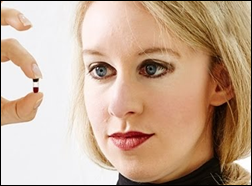
You were described in a 2002 profile as being an aggressive leader who pushes employees hard, puts performance monitoring in place, and then gets results from companies that were previously struggling. Have you changed your approach? What problems do you most often see in companies?

That was an interesting article. You have to take an article like that and put it up against the common sense and logic test. That was Silicon Valley, and Silicon Valley certainly went through the dot-com boom or bust for awhile. But things have not changed a whole lot in Silicon Valley. If someone doesn’t like where they’re working or they believe they’re being pushed too hard, they can always go work somewhere else.

I’ve done five other companies since then, Goliath Technologies being the latest. All of those five companies were successful turnarounds. Some led to exits, built a lot of shareholder value, and launched a lot of careers for people.

What was missing in that article, and what I’ve seen consistently — and I’m talking about taking over companies in New York, Israel, Canada and different parts of the United States — is that regardless of generation, there are people who are extremely driven and want to prioritize advancing their careers, for whatever reason, over doing other things. It’s talked about in terms of being aggressive and hard-driving, but really I was very lucky to be engaged with teams where there were lots and lots of hard-driving people.

I honestly don’t philosophically think that you can drive anybody. You want to find driven people and then create the type of an environment where those types of driven people want to come and have a long-term career.

Do think it’s your personality or the rigor with which you approach the business with an end goal in mind that makes you successful?

I say to people all the time when we’re interviewing them that we are in the people business at Goliath Technologies. When I was taking over venture capital-backed businesses, I used to get pushback from the boards many times for the amount of money that I would spend on training, ongoing education, and my focus on promoting people from within. My father brought this up to me one time. He said, you’re in the software business. There’s no plant. There’s no equipment. There’s no collateral. There’s people. You’re in the people business. You just happen to build software.

People come up with the ideas. Other people take those ideas and turn them into workable products. Other people then market, sell them, and then support those customers on an ongoing basis. We are in the people business. We just happen to sell software.

Do you have any final thoughts?

As an organization, we will be very successful if we focus very intently on two things — the careers of our employees and solving problems for our customers. The marketplace is moving in our direction. There’s an increasing reliance on desktop virtualization. The major EMR/EHR vendors are coming to the realization that outside of their application, there’s a tremendous amount of IT infrastructure that can impact the end user experience with their application, and therefore, their brand and reputation. Organizations like Cerner and Epic are working with us now in a formal partnership.

We will focus on employees and customers and ultimately be proud of what we’re doing to positively impact patient care.

Book Review: “Bad Blood”

June 6, 2018 Book Review 13 Comments

image

I’ll save you the $13.99 Kindle price right now. Theranos was a fraud in every possible way. Elizabeth Holmes was its paranoid, money-fixated mastermind who was enabled by media that were enchanted with the crowd-pleasing and unfortunately rare story of a young, female Silicon Valley founder. Holmes didn’t care a bit that patients were endangered by the company’s entirely inaccurate blood testing system. She was a paper multi-billionaire until a series of exposes in the Wall Street Journal took the company down and put her on “healthcare’s most reviled” leaderboard ahead of Martin Shkreli. Thanks for coming out, I’m here all week, try the veal.

Or, maybe the $13.99 is worth it just to see how the company used its heavyweight legal team and connections to keep the scam alive. Or for the guilty pleasure of reading how Holmes sweated as the noose tightened, eventually going all Hitler in the bunker as she realized that at 34, she would never be trusted or taken seriously again.

You’ll like John Carreyrou’s book if you’re a fan of “All the President’s Men” or “Spotlight” and would enjoy the dramatic (and overly dramatic at times) account of how the reporter bagged the story of a lifetime and then got to double-dip his WSJ salary by repurposing his work into a bestseller. He’s probably worth a lot more than Holmes at this point.

image

Everything about the company was an elaborate hoax and so was Holmes, coached to ditch her thick glasses, speak in a creepily low register, wear black turtlenecks, and make lofty pronouncements about changing the world. She was like a lipsticked Steve Jobs except her fake voice was deeper, she was even better at milking the reality distortion field except to commit fraud instead of inspire achievement, and instead of kicking a dent in the universe, she was sent kicking and screaming into shame and ridicule (with a vacation behind bars a distinct future possibility).

Like Jobs, she was petulantly demanding, leaving a trail of fired employees and board members who dared question whether the empress was indeed wearing any clothes other than that ever-present turtleneck. Her 20-member armed security detail marched out employees who questioned the company’s patient-endangering technology that never worked. She oversaw her empire from an office she had designed as a replica of the White House’s Oval Office, which is about as weird as you can get.

The book opens with the company’s CFO playing his dutiful Silicon Valley role in inflating his already-inflated financial projection at Holmes’ insistence that she needed one of those hockey-stick growth charts like everybody else in Silicon Valley trots out while trying to keep a straight face. The CFO wasn’t too inquisitive about why Holmes refused to show him the drug company contracts on which his fantasy financials were based. His downfall came when he questioned Holmes about a demonstration of her blood testing machine that he knew didn’t actually work, charging Holmes (accurately) with simply faking the whole thing. She fired the CFO on the spot and the board didn’t press her for a reason (hello, clueless board). He was the company’s first and only CFO – despite heavy investment and a $9 billion paper company value, Theranos never had one again (hello, clueless investors).

image

Holmes dropped out of Stanford’s chemical engineering program after two semesters and wrote a patent application for an arm patch that would both diagnose and treat medical conditions. Her only fear in life was needles, which she vowed to eliminate for blood draws in favor of a finger stick, which sounds great to a 22-year-old college dropout who didn’t know or didn’t care that entire companies are filled with experts who have tried and failed to make that idea work. The sample size is too small, the dilution is too error-fraught, the repeated microfluidic flow through the testing machine is too complicated, and the skin material that is sucked up along with the blood always throws the results off.

Asked to describe how its product works, Holmes provided The New Yorker with a “comically vague” explanation:

A chemistry is performed so that a chemical reaction occurs and generates a signal from the chemical interaction with the sample, which is translated into a result, which is then reviewed by certified laboratory personnel.

Despite having no product, the business plan Holmes cooked up was brilliant. She envisioned drug companies paying her fortunes to perform home blood testing of clinical trials subjects, claiming that real-time reporting could save them 30 percent of their research costs and alert them to stop the therapy if patients experienced problems. Holmes was healthcare illiterate, but at least she knew that in search of health riches, you go where the money is (drug companies).

Holmes whipped employees into working crazy hours, spied on their email and telephone calls, hired private investigators to follow them, and didn’t allow company groups to interact with each other for fear of compromising her intellectual property. Her second-in-command was Sunny Balwani, her secret lover who was 18 years older than she. She marginalized the company’s board as “just a placeholder” that she charmed into giving her 99.7 percent of the voting rights, rendering the aged former heads of state and billionaires irrelevant as they joined the company’s investors in breaching their fiduciary duty. They treated her like a darling granddaughter who could do no wrong, smacking their lips approvingly at the inedible Easy-Bake Oven cake she proudly served them.

The blood testing technology didn’t work, so engineers jury-rigged a glue-dispensing robot to move pipettes around. Holmes immodestly named it the Edison. It was fraught with the same problems that plagued everything that Theranos ever designed – it could perform only a few tests, it wasn’t suitable for home use, and it ran only one sample at a time. Most importantly, it delivered inaccurate results. She had a very slick, Apple-looking case designed for it, though (it was not known to wear black turtlenecks).

image

Theranos ran an admirable “fear of missing out” scam on Walgreens, playing on that company’s fears that CVS would sign a deal first. Walgreens invested heavily even though Holmes refused to show them her lab and wouldn’t allow them to run side-by-side samples with commercial labs to verify the Edison’s accuracy (hello, clueless due diligencers).

Theranos avoided CMS and FDA oversight by claiming that its technology was “laboratory-developed tests” that fall between their respective jurisdictions, with the government predictably paying no attention. All Theranos had was a CLIA certificate and lab that was being run by a dermatologist with no lab experience. Holmes tried to work her connections to have the military use her product, only to become infuriated when a military expert said she would need an IRB-approved study and FDA approval. Holmes tried to get him fired. It didn’t matter anyway since she simply lied in claiming to anyone who would listen that the military was using Theranos in Afghanistan battlefields. She said it, so it must be true, and at some point she probably repeated it enough times to believe it herself.

Also scammed was the grocery chain Safeway, which envisioned a sexy future in wellness. It spent $350 million to add swanky Theranos testing stations to its stores somewhere back between the meat department and the rotisseried chickens.

Theranos started developing the MiniLab in 2010. Its only innovation over commercial machines was a smaller footprint for home and retail use. Holmes kept a straight face in calling it “the most important thing humanity has ever built.” She hired Apple’s former marketing company for $6 million to orchestrate a splashy product rollout and her own photo shoots.

Theranos couldn’t make its technology work in time to meet a Walgreens deadline, so Holmes simply bought a bunch of commercial blood testing machines and hacked them to try to make them work with the fingerstick samples. The friendly, fawning press asked no awkward questions. Her orchestrated fame emboldened her to fudge the numbers even more – she assured one investor that the company would make a $1 billion profit in 2015, while nearly simultaneously telling another investor that it would be $100 million. Her patient result numbers were equally all over the place, as the company performed untested processing on the modified commercial machines in its Phoenix-area rollout at Walgreens. They were just Fedexing samples back to California, which introduced another problem Theranos hadn’t thought of – the sweltering Phoenix summer sun was ruining the samples as they sat on hot Fedex planes. Doh!

The hoax started to unravel when a pathology blogger noticed that a paper Holmes co-authored had been published by a pay-for-play online journal in Italy and it involved a study of only six patients. The blogger contacted Wall Street Journal reporter John Carreyrou, who conducted his own test by having blood drawn at an Arizona Walgreens. He thought it was odd that it was a traditional needle draw rather than a finger stick, becoming even more puzzled when his same tests performed by LabCorp gave wildly different results.

While Carreyrou was investigating, the Theranos deception continued. The machines kept screwing up during demonstrations, so engineers rigged a “waiting” icon on display so the company could  blame connectivity problems and then run the samples later on commercial machines that actually worked. Holmes would encourage investors and reporters to have blood samples drawn in her offices and would show them the sample being inserted into the MiniLab, but as soon as they left, employees would pull out the sample and run it on a commercial lab machine.

image

In honor of a visit by Vice-President Joe Biden, Theranos built a fake lab in a conference room, stacking up non-functional MiniLabs and ordering employees to stay home in case anyone asked embarrassing questions.

image

SNAGHTML2f23e345

Carryrou’s first article created a firestorm, although Business Insider’s Kevin Loria scooped him by a full six months in running a skeptical article quoting scientists in April 2015 – he really should get the credit. Many people defended Holmes, while others questioned how a medical company’s board and investors could have only healthcare-inexperienced people.

Holmes took to the airwaves to defend her company, proclaiming, “When you work to change things, first they think you’re crazy, then they fight you. And then all of a sudden you change the world.”

You know the rest. FDA declared the nanotainer to be an unapproved medical device. A surprise CMS inspection said Theranos was posing immediate jeopardy to patient health and safety. Holmes made Balwani her sacrificial lamb, firing him and breaking up with him. All Edison test results were voided, Walgreens and Safeway ended their Theranos partnership, Holmes was banned from the industry, and everybody involved sued Theranos, which had burned through $900 million of investor money and was rapidly going broke defending itself. As icing on the cake, the SEC began an investigation, declaring Theranos to have been a “massive fraud” from the beginning.

I’d like to think that most of us in healthcare eventually saw through the Theranos scam, or at least would have been skeptical enough to ask the questions that its investors and Holmes fanboys didn’t. The company made big claims without publishing peer-reviewed data. Its value proposition wandered – was the story the finger stick, the consumer access to blood tests, or the cost-lowering threat to LabCorp and Quest? Dropouts in their early 20s might well start technology companies like Facebook, but the Theranos board and leadership team were remarkably inexperienced and naive about healthcare and the huge players entrenched in it that had already already tried and failed to commercialize fingerstick testing. They also had the advantage that in terms of lab services, it’s all about draw-station locations and the economy of scale of running thousands of tests per minute through a highly automated factory, and Theranos would have needed to scale to thousands of times its volume to take even 1 percent of their market.

Theranos is a good reminder to healthcare dabblers. Your customer is the patient, not your investors or partners. You can’t just throw product at the wall and see what sticks when your technology is used to diagnose, treat, or manage disease. Your inevitable mistakes could kill someone. Your startup hubris isn’t welcome here and it will be recalled with great glee when you slink away with tail between legs. Have your self-proclaimed innovation and disruption reviewed by someone who knows what they’re talking about before trotting out your hockey-stick growth chart. And investors, company board members, and government officials, you might be the only thing standing between a patient in need and glitzy, profitable technology that might kill them even as a high-powered founder and an army of lawyers try to make you look the other way.

Text Ads


RECENT COMMENTS

  1. Challenger exploded on lift-off when the O-rings failed. Columbia disintegrated on reentry after one of the heat shield tiles were…

Founding Sponsors


Platinum Sponsors


Gold Sponsors


RSS Webinars

  • An error has occurred, which probably means the feed is down. Try again later.