Recent Articles:

News 11/14/25

November 13, 2025 News 4 Comments

Top News

image

RCM vendor R1 sells Tonic Health to patient access, engagement, and intake technology vendor Luma Health.

Tonic Health offers a mobile patient intake, survey, and payments platform.


Reader Comments

image

From Gaucho Marx: “Re: Adventist Health Portland. After investing $20 million to convert from Cerner to OHSU’s instance of Epic, it will join the enterprise instance in September 2026. This is surprising, since there is a good deal of benefit to AH Portland to remain a part of OHSU Health’s large patient network, such as more negotiating power with payers and the ease of transferring and referring patients. Adventist Health will bring all hospitals except AH Portland live on September 1, 2026 in a $500 million project. Portland was out of scope because of their business agreement involving tens of millions of dollars in loans from OHSU, which has had a tough time with financial losses and layoffs.”


HIStalk Announcements and Requests

Trivia: I asked ChatGPT to name the 10 best US cities to live in, which it calculated from multiple, evidence-based sources. Which was the only state to have two cities on the list? Which city was #1?


Sponsored Events and Resources

None scheduled soon. Contact Lorre to have your resource listed.


Acquisitions, Funding, Business, and Stock

Oracle’s reorganization under co-CEOs has left 64,000 of the company’s employees, or 40% of its workforce, reporting up to CTO, co-founder, and chairman Larry Ellison. Co-CEO Mike Sicilia oversees the largest headcount at 84,000 workers, which includes Oracle Health.


Sales

  • Cigna Healthcare will offer Headspace’s meditation and sleep app at no cost to seven million people who receive behavioral health services through their employer.
  • Smart infant monitoring technology vendor Owlet chooses Rhapsody for EHR integration of its pulse oximeter.

People

image

Marc Probst, MBA (MF Probst Strategic Advisory) rejoins Ellkay as CIO advisor.

image

MRO hires Lidia Bernik, MHS, MBA (Flatiron Health) as president of Curation Solutions.


Announcements and Implementations

image

A PerfectServe survey of 350 clinicians finds that three-fourths spend time dealing with manual aspects of scheduling, more than half say that waiting for calls takes time away from patient care (it was the #1 time-sapping task), and 60% say that existing systems aren’t much help in prioritizing urgency.

image

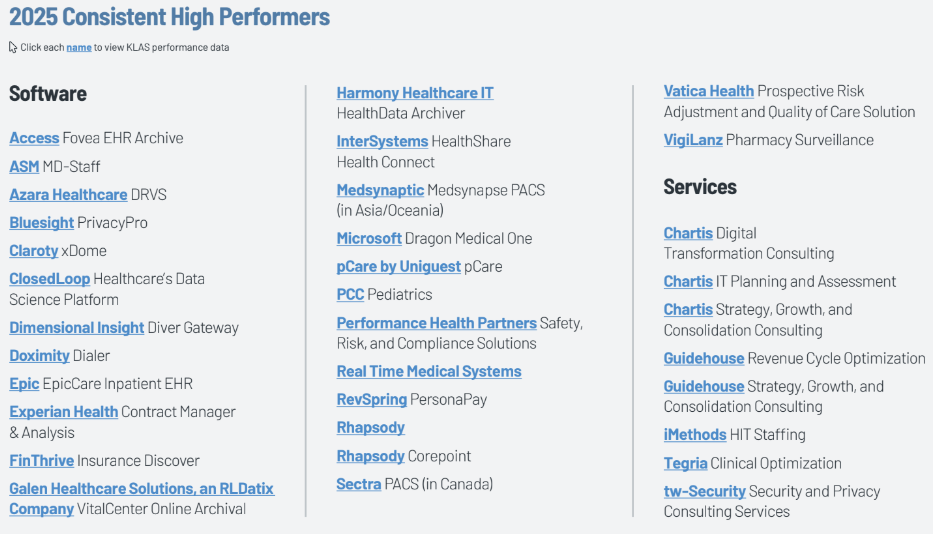
KLAS names its 2025 Consistent High Performers.


Government and Politics

image

The deal to end the federal government shutdown will extend Medicare’s coverage of telehealth through January 30 and will pay providers retroactively for virtual services that they provided since October 1. The Senate package also  provides $3.4 billion to the VA for its Oracle Health rollout work in FY2026, contingent on it providing Congress with a revised timeline and cost estimate. 

The VA awards Accenture Federal Services a six-month, $7.7 million contract to support its Oracle Health implementation, including program management, support, and data integration services, with options to extend the work for four additional one-year periods and one six-month period.


Other

The family of a two-year-old sues University of Florida Health, alleging that a physician’s decimal error caused a fatal tenfold overdose of electrolyte replacement. The lawsuit claims that pharmacists did not catch the error even though their computer system generated a Red Flag dose warning.

image

Caring Brands either just pulled off the biggest capital raise in human history or it needs to hire a more careful headline writer.


Sponsor Updates

  • Netsmart will integrate ScribePT’s documentation system with its TheraOffice PT and rehab EHR/PM.
  • CTG’s parent company Cegeka earns Microsoft Partner of the Year award for Microsoft Dynamics 365 Supply Chain.
  • Arrive Health names Alison Bechtel senior director of marketing.
  • AvaSure announces that its Virtual Care Platform has achieved designation in Epic’s Toolbox for the Inpatient Virtual Care category.
  • Findhelp welcomes new customers Hospital in Your Home, Allied Behavioral Health Solutions, and the Tennessee Department of Veterans Services.
  • HCTec offers a new case study titled “HCTec Technical Managed Services Elevate the End-User Experience.”

Blog Posts


Contacts

Mr. H, Lorre, Jenn, Dr. Jayne.
Get HIStalk updates.
Send news or rumors.
Follow on X, Bluesky, and LinkedIn.
Sponsorship information.
Contact us.

EPtalk by Dr. Jayne 11/13/25

November 13, 2025 Dr. Jayne 1 Comment

image 

NCQA is accepting public comments on the AI standards that it is proposing for its 2027 Health Plan Accreditation and Health Plan Ratings program. Patients, health plan stakeholders, healthcare professionals, state agencies, and others are invited to weigh in as the program is being created. You have until December 5 to share your thoughts on topics such as AI program structure, governance, pre-deployment evaluation, and ongoing monitoring and intervention.

I’ve been through several NCQA recognition processes on the provider side. The staffers I’ve met are genuinely invested in improving healthcare quality and are responsive to organizational feedback.

My hospital is considering the addition of a new C-suite role, partly in response to escalating conflicts and violence against healthcare workers. There is debate around several potential job titles, but no consensus on whether the title should focus on safety or security.

A particularly vivid conversation ensued when the use of “public safety” in the title was brought up, since that mimics some state law enforcement agencies and might indicate the role has more authority than intended. Concern was also expressed that the use of “public” was more focused on patients and visitors rather than employees and caregivers. Future meetings will further discuss the role, so we’ll see where the wordsmiths land.

Earlier this week, Mr. H mentioned the Black Book Research survey on AI governance. I wanted to weigh in from the CMIO chair, although I’m not sure that I should call it a chair anymore because I’m spending more of my time lately in the clinical work areas sitting on a rolling stool that I swiped from an exam room.

One theme of the survey is that hospital budgets are underfunded for AI governance and safety, with a median 4.2% of IT quality and safety budgets devoted to AI oversight for 2026. Although that sounds like a small number, I’m curious as to what other line items are funded either higher or lower.

It’s hard to derive meaning from numbers out of context. Governance is likely a line item that scales better than others because it becomes a sustainable process after creation. It’s not like an implementation line item, which may vary dramatically across facilities or service lines as well as for applications or solutions that are being implemented.

As expected, large health systems with 10 or more facilities have a higher share of spend, but I would bet that’s because of the number and complexity of AI applications rather than the process itself. For those who have dug into the full report, I would be interested to hear your thoughts.

image

PerfectServe recently released a report on “The Rise of Emoji in Healthcare Communication.” From informal research via my texting app, folks from The Silent Generation and Baby Boomers are the most likely to send me messages using standard emoji. It’s hit and miss with my Millennial friends, although they tend to use a lot of GIFs. My Generation Z contacts are most likely to communicate through memes, although I do see a fair amount of photomoji use in that population, which is always entertaining.

The report recaps the use of pictographs and symbols in communication going back to 3000 BC, and highlights the pictographic elements that are already found in healthcare, such as the Wong-Baker FACES Pain Rating Scale.

It shares some interesting data points, such as an estimate of 10 billion emoji being sent every day. It also mentions Adobe data that shows that healthcare workers are losing their hesitancy around including emoji.

I’m glad it mentioned the early emoticons we once used that cobbled together colons and parentheses to look like faces. Younger generations probably find that quaint.

The authors set out to look within the PerfectServe ecosystem to see if they could identify trends in emoji use and if it could be tied to clinicians who are under stress or burned out. They concluded that rather than being potentially unprofessional, emoji were “used to convey politeness and positive intent.”

Other interesting tidbits included the “thumbs up” being the most frequently used symbol in medical communications. Internal medicine clinicians were more likely to use symbols than their peers. Other emoji making the top 10 included the “person facepalming” and the “person shrugging,” which makes me smile.

The authors also looked at explorations of emoji use in the medical literature, namely an article in The Journal of the American Medical Association (JAMA) from 2021 that cites emoji as containing “the power of standardization, universality, and familiarity, and in the hands of physicians and other health care providers could represent a new and highly effective way to communicate pictorially with patients.”

I learned that a lot of my correspondents might be confusing the “tears of joy” emoji with the “cry-laugh” one, which is fairly easy to do depending on the level of zoom in your messaging app.

The paper has a lot of other interesting information, including emoji frequency by subspecialty and day of the week. It will be interesting to see how this evolves over time. I would also like to see information on geographic variations or seasonal trends.

image

I’m always on the lookout for interesting uses of AI. A friend mentioned SessionKeeper, which uses ambient listening capabilities to create session summaries for tabletop role-playing games such as Dungeons & Dragons. In addition to capturing plot points and character details and building a knowledge base, it offers “story insights” that create a podcast-style analysis of play. I got a kick out of learning about the cultural background of trolls and how it can impact conversations, as well as seeing some of the AI-generated artwork.

I was pleased to see a clear data privacy statement in the FAQ, with the company clearly stating, “We’ve made sure companies like Anthropic, Google Cloud AI, and OpenAI can’t use your gaming sessions to train their systems.” 

What creative uses of AI have you seen? What do you find most useful in your non-work life? Leave a comment or email me.

Email Dr. Jayne.

Morning Headlines 11/13/25

November 12, 2025 Headlines Comments Off on Morning Headlines 11/13/25

Luma Acquires Tonic, Taking on Healthcare Bottlenecks for Over 1,000 Health Systems and 100 Million Patients

RCM vendor R1 sells Tonic Health, which offers a a mobile patient intake, survey, and payments platform, to patient access, engagement, and intake vendor Luma Health.

Shutdown deal extends Medicare telehealth coverage

The deal to end the federal government shutdown will extend Medicare’s coverage of telehealth through January 30 and ensure providers are retroactively paid for virtual services provided during that time.

Andor Health and Sentara Health Complete Rollout of Agentic, AI-Powered ThinkAndor Virtual Nursing Across 1,742 Rooms across 12 hospitals

Sentara Health will implement Andor Health’s agentic AI virtual care software at its 12 hospitals, starting with virtual nursing, virtual sitting, remote consultations, and transactional care management.

Comments Off on Morning Headlines 11/13/25

Healthcare AI News 11/12/25

November 12, 2025 Healthcare AI News Comments Off on Healthcare AI News 11/12/25

News

image

The Vatican convenes a Rome conference this week titled “AI and Medicine: The Challenge of Human Dignity,” where a church official warned of the risk of “transforming health and illness into mere numerical data … the ability to personalize treatment remains an irreplaceable medical skill.” In his remarks to participants, Pope Leo XIV urged healthcare professionals to use AI responsibly, emphasizing that healthcare cannot be reduced to problem-solving and that technology must not interfere with the patient–caregiver relationship. He concluded by cautioning that “vast economic interests are often at stake in the fields of medicine and technology, and the subsequent fight for control.”

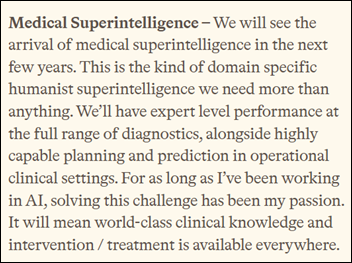
Microsoft forms an MAI Superintelligence Team to develop AI that exceeds human capability, with medical diagnostics being its first focus area.

OpenAI is reportedly considering entering the consumer health market, such as creating a personal health assistant or health data aggregator


Business

image

Sentara Health will implement Andor Health’s agentic AI virtual care software at its 12 hospitals, starting with virtual nursing, virtual sitting, remote consultations, and transactional care management.

InterSystems launches HealthShare AI Assistant, which provides a conversational chat user interface for its HealthShare Unified Care Record.


Research

image

A small study of patients in Africa finds that frontline nurses and community health workers can identify patients who are at risk for reduced ejection fraction heart failure by using Eko Health’s AI-assisted stethoscope.

A Black Book Research survey finds that most US hospitals are underfunding AI governance even as adoption accelerates. Only 22% say they could deliver an auditable AI explanation to regulators or payers within 30 days, citing lack of vendor explainability as the biggest barrier.


Other

image

A TV station’s test finds that while ChatGPT and Gemini answered health questions with disclaimers that they aren’t real people or licensed professionals, AI storytelling platform Character.AI displayed a similar warning but then falsely claimed to be a real doctor, giving the user a fake name with a valid medical license number that belongs to a Los Angeles immunologist. The company says that user-created characters are fictional and for entertainment only, which is why it includes the disclaimer.

The American Nurses Foundation (ANF) partners with Hippocratic AI to fund three nurse-led grants of $10,000 each for experienced frontline nurses to explore AI and innovation in nursing.

image

A healthcare empathy professor says that while AI can generate empathetic-sounding written responses, the real issue is that a broken healthcare system has drained clinicians of empathy through paperwork, burnout, and rigid protocols, effectively turning them into machines. He warns that we are moving toward an ironic world where AI takes over the parts of care humans do best, while humans are left doing tasks that computers should handle. He concludes:

The technology will continue advancing, regardless. The question is whether we’ll use it to support human empathy or substitute for it and whether we’ll fix the system that broke our healthcare workers or simply replace them with machines that were never broken to begin with.

Psychiatrist and political anthropologist Eric Reinhart, MD argues that when AI is installed in “a health sector that prizes efficiency, surveillance, and profit extraction,” it becomes just another tool for commodifying human life. He adds that AI can’t improve medicine by leapfrogging structural change, but it does give policymakers and corporations an excuse to ignore abysmal public health and hospitals a way to squeeze more profitable productivity out of doctors. He says:

We risk entering a perverse loop: machines are supplying the language with which patients relay their suffering, and doctors are using machines to record and respond to that suffering. This cultivates what psychologists call “cognitive miserliness”, or a tendency to default to the most readily available answer rather than engage in critical inquiry or self-reflection. By outsourcing thought, and ultimately the most intimate definitions of ourselves to AI, doctors and patients risk becoming yet further alienated from one another.


Contacts

Mr. H, Lorre, Jenn, Dr. Jayne.
Get HIStalk updates.
Send news or rumors.
Follow on X, Bluesky, and LinkedIn.
Sponsorship information.
Contact us.

Comments Off on Healthcare AI News 11/12/25

This Week in Health Tech 11/12/25

November 12, 2025 This Week in Health Tech Comments Off on This Week in Health Tech 11/12/25
LinkedIn weekly 111225 - Copy
Comments Off on This Week in Health Tech 11/12/25

Morning Headlines 11/12/25

November 11, 2025 Headlines Comments Off on Morning Headlines 11/12/25

Get Well, a leader in patient engagement software, and RhythmX AI, a leader in AI-powered precision care, will combine to form GW RhythmX to usher in the next generation of precision care

SymphonyAI Group combines its holding Get Well patient engagement business with its AI-powered precision care company, RhythmX AI, to form GW RhythmX.

MedEvolve Announces Acquisition by Emergence to Accelerate AI-Driven Revenue Cycle Transformation

Investment holding company Emergence acquires RCM technology vendor MedEvolve, which sold its RCM services business a month ago.

Covid-era rules for addiction medication, Ritalin are extended again

The federal government prepares to once again extend a temporary rule that allows physicians to prescribe select controlled substances via telemedicine.

Comments Off on Morning Headlines 11/12/25

News 11/12/25

November 11, 2025 News 2 Comments

Top News

image

SymphonyAI Group combines its holding Get Well (formerly known as GetWellNetwork) patient engagement business with its AI-powered precision care company, RhythmX AI, to form GW RhythmX.

RhythmX AI founder and CEO Deepthi Bathina will lead the new company, while Get Well founder and CEO Michael O’Neil will serve as vice chair.


Reader Comments

From PagingDrLeftOnHold: “Re: CMS requirement that telehealth doctors list their actual location. A health system spending $1 million a year to confirm that doctors are at home feels like a perfect American healthcare story.”


HIStalk Announcements and Requests

2025-11-11_08-22-56 (1)

More fun with the Opal AI app builder. I made Interview Grader, which evaluates any HIStalk interview against a 10-item rubric that I developed and then assigns letter grades for each item and overall. It has no practical use other than as an experiment.

image

PR and marketing people: I then applied that rubric to make an interview prep sheet. I also generated a promotional plan for an interview that uses my most recent one as an example.

image

Thanks to our veterans and their families for the quiet sacrifices they have made on behalf of the rest of us. The impact of your service, from basic training to separation, continues long after the uniform comes off.


Sponsored Events and Resources

None scheduled soon. Contact Lorre to have your resource listed.


Acquisitions, Funding, Business, and Stock

image

Investment holding company Emergence acquires RCM technology vendor MedEvolve, which sold its RCM services business a month ago.

TruBridge announces Q3 results: revenue up 2%, EPS $0.88 versus –$0.21, beating analyst expectations for both.

image

NextSense raises a $16 million Series A round to market its wireless earbuds that monitor EEG patterns and use auditory stimulation to enhance slow-wave sleep. The device costs $399 plus a $15 monthly subscription.


People

image image

Vitalchat promotes Brady Keeter to SVP of product and Mackenzie Laughridge to SVP of people.

image

MPulse names Eileen Cianciolo (Clarity Software Solutions) chief product officer. MPulse acquired payer-focused Clarity in August.

image

Rutland Regional Medical Center CMIO and medicine chair Rick Hildebrant, MD, MBA, MA is appointed commissioner at the Vermont Department of Health.

image

The American Telemedicine Association promotes Kyle Zebley to CEO. He replaces Ann Mond Johnson, who has retired.


Sales

  • Baraga County Memorial Hospital (MI) will implement Oracle Health CommunityWorks and expand its use of the vendor’s clinical AI agent.
  • AdventHealth Manchester (KY) will launch virtual care smart rooms using technology from HelloCare.
  • DRH Health (OK) selects Commure’s Ambient AI clinical documentation software.
  • Saudi Health Holdings will implement RapidAI’s imaging AI system.

Announcements and Implementations

CalmWave develops Alarm Insights to give clinical device managers visibility into bedside monitor alarm functionality and patterns.

CTG will offer Hippocratic AI consulting services and will co-develop solutions with the company.

image

UF Health (FL) goes live on Epic’s MyChart Central, giving patients the ability to log in to their medical records from across participating organizations using a single sign-on.


Other

OpenAI is reportedly considering entering the consumer health market, such as creating a personal health assistant or health data aggregator.

image

Nemours Children’s Health will expand its new advanced care at home program, which offers remote patient monitoring and virtual support, to its hospital in Delaware. Launched in June at the health system’s hospital in Orlando, the program has helped families avoid 91 emergency department visits and prevented 27 readmissions.


Sponsor Updates

  • The American Medical Informatics Association inducts Clinical Architecture Senior Informaticist and Clinical Architecture Anand Kulanthaivel, PhD into the Fellows of the AMIA.
  • Judi Health releases a new episode of “The Astonishing Healthcare Podcast” titled “The Survey Says: Inflation is a Problem, and Change is Imminent, with Business Group on Health’s Jim Winkler.”
  • AvaSure achieves Epic Toolbox designation for inpatient virtual care.

Blog Posts


Contacts

Mr. H, Lorre, Jenn, Dr. Jayne.
Get HIStalk updates.
Send news or rumors.
Follow on X, Bluesky, and LinkedIn.
Sponsorship information.
Contact us.

Morning Headlines 11/11/25

November 10, 2025 Headlines Comments Off on Morning Headlines 11/11/25

Nemours Children’s Health Launches Nation’s First Pediatric Advanced Care at Home

Nemours Children’s Health prepares to expand its new advanced care at home program, which offers remote patient monitoring and virtual support, to its hospital in Delaware.

Baraga County Memorial Hospital Selects Oracle Health CommunityWorks to Enhance Clinician and Patient Experience

Baraga County Memorial Hospital (MI) will implement Oracle Health CommunityWorks and expand its use of the vendor’s clinical AI agent.

Duval DOGE to look into city’s telehealth provider

A city councilmember in Jacksonville, FL, questions the city’s contract with telemedicine vendor Telescope, citing potential misuse of taxpayer funds and rumors of potentially illegal conduct.

Comments Off on Morning Headlines 11/11/25

Curbside Consult with Dr. Jayne 11/10/25

November 10, 2025 Dr. Jayne 1 Comment

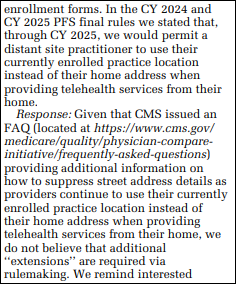
The hot news around the telehealth virtual water cooler this week was the new CMS billing requirement that telehealth physicians list their actual location rather than an office address. The previous requirements allowed us to avoid using a home address. This not only protected our personal information, but also provided uniformity for our practice organizations.

For those telehealth physicians employed by hospitals or health systems, this could lead to requirements that they physically go to the campus to provide telehealth services. This creates additional load on the hospital, which may not have space for telehealth providers. Allowing them to practice from home, while repurposing clinic space for additional providers, was one of telehealth’s benefits. The CMS rule does not address the needs of physicians like me who work for independent telehealth organizations that don’t have a campus or building in our local area. 

Although CMS claims it will protect the home addresses, I’ve been a victim of data breaches and identity theft enough times that I don’t trust anyone to keep my information private. Plenty of other government agencies don’t have appropriate policies to deal with people who practice from their homes, including the Drug Enforcement Administration and many of the state controlled substance agencies. Their regulations haven’t kept up with the times, but I don’t think anyone is surprised by that.

Also, there is no guarantee that a physician who is not in the office is doing telehealth from their home. I have done it from hotels in at least a dozen states, from the homes of family members, and from a docked ship. I certainly don’t expect my employer’s credentialing organization to keep up with that.

Other conversations around the water cooler continue to revolve around the ongoing government shutdown. Some clinics are seeing higher-than-usual rates of no-shows and cancellations. In lower income areas and the academic faculty clinics, patients are citing financial issues as a barrier to transportation.

Although some of our clinics can provide cab vouchers for patients to get home, it’s more difficult to arrange transportation to the clinic. Now that we’re over a month into the shutdown, we should start to see data on patient prescriptions and fill rates, and whether those have been delayed by all of the issues. I’ve seen data from at least one military facility that showed a clear impact, but I’m not able to access that kind of data for my own facility. It would be an interesting research project, however.

The hot clinical topic of the week was the news that the American College of Cardiology and American Heart Association have updated the hypertension guidelines. The new numbers mean that many more patients will qualify for a hypertension diagnosis. Depending on how much of a focus an organization has placed on the management of hypertension, this could potentially mean a fair amount of work will need to be done in the EHR and elsewhere in clinical applications.

Even if we’re talking about modifications to EHR-based alerts, the lift could be significant if the organization hasn’t standardized the EHR or has created different alerts for different locations, specialties, or types of visits. It can also mean modifying dozens or hundreds of reports, patient outreach campaigns, and patient education materials.

Although these two organizations have reached agreement on the recommendation, a number of other organizations have not endorsed the new guidelines. They include the American Academy of Family Physicians, the American College of Physicians, and the International Society of Hypertension. If your organization follows one of their guidelines, you probably have some time before these groups get on board with the new, lower numbers.

It’s still a good opportunity though to take inventory of your hypertension-related alerts, reports and outreach programs to get ahead. I’ve peered under the hood of a number of the EHRs of large healthcare organizations over the last 20 years and some of you have your work cut out for you.

It will also be interesting to see how long it takes consumer-facing healthcare apps and tools to update to the newer guidelines, or if instead they will just stay where they are. I’ll be keeping a close eye on my wearables to see if there are any changes and will report in when I see them. I only use a couple of apps, so if readers see anything before I mention it, please share.

Regardless of the technical ramifications of updated guidelines, there’s also the real-world clinical practice element related to a change like this. How do we as physicians convince our patients to lose more weight or take another medication to bring them into compliance? Many patients find it impossible to reach the previous goals, so there’s not much of a chance of them meeting the new ones.

It will also be interesting to see if the prior authorization processes for weight management medications follow the new goals right away or whether payers gravitate toward the guidelines with more lenient goals.

One of my informatics colleagues asked a question about how real-world evidence (RWE) fits in a situation like this where the proverbial cheese has been moved. Certain EHR vendors have pressured everyone to get on the RWE bandwagon. I’m no expert in the field, but if you’re looking to see how clinicians treated patients with a blood pressure that used to be normal but now isn’t, they’re not likely to have done many interventions because the blood pressure was viewed as normal. We will see how long it takes for real world evidence to shift and for there to be patterns that align with the new thresholds.

If you’re an expert in real-world evidence, I would love to hear from you, and I’m happy to keep you anonymous. Maybe a fireside chat on the hamster wheel of clinical guidelines is in order? Or just some good old-fashioned ranting about the challenges of practicing medicine in an era where physicians are seen as less knowledgeable than TikTok celebrities?

What do you think of the new clinical guidelines, the ramifications to your health IT systems, and their impact on real-world evidence tools? Leave a comment or email me.

Email Dr. Jayne.

HIStalk Interviews William Cavanaugh, CEO, Concord Technologies

November 10, 2025 Interviews Comments Off on HIStalk Interviews William Cavanaugh, CEO, Concord Technologies

William Cavanaugh, MBA is CEO of Concord Technologies.

image

Tell me about yourself and the company.

I’ve been in technology for over 30 years and health tech for 20. I’ve worn just about every hat there is to wear in a healthcare technology company, from making the coffee, developing the software, taking out the trash, closing the deals, and writing the business.

The high-level mission of Concord Technologies is to advance healthcare through universal exchange and intelligent processing of data. We leverage advanced AI to drive a smarter, faster, and more connected healthcare ecosystem.

What kinds of documents do health systems receive and what challenges do they experience in processing them?

The big challenge in healthcare is the exchange of data between disparate healthcare entities. You have to look at the volume of data. There are 2.3 zettabytes of data generated every year across healthcare. What’s a zettabyte? I can tell you that it’s a billion gigabytes, but that doesn’t really represent the challenge.

If you look at one hospital to paint the picture, one hospital creates 50 petabytes every year. Again, that is difficult to comprehend. Picture yourself in an NFL stadium, in the upper bowl. If you printed the physical equivalent of the annual data from just one average hospital, it would fill 750 NFL stadiums to the brim, and it is growing at 36% a year.

Now you need to share that data. You can’t email it to a doctor because it will go to junk or spam. You need a secure, ubiquitous way of sharing that data. Everyone thinks that the big EHR vendors are going to solve the problem, but there are 500 EHR vendors. They are also not the only player when you add in radiology information, PACS, payers, and pharma. There are thousands of different systems.

On the entity side, the US has 6,000 hospitals, but the number blooms over 200,000 disparate entities and growing when you add in post-acute, outpatient, private practices, urgent cares, specialty practices, et cetera. The problem that we are solving spans 200,000 disparate entities, 1,000 software vendors, 2.3 zettabytes of data growing at 36% a year, and you need to share data.

The space that we play in is documents. Think about documents between your payer, pharmacist, EHR, specialty, and primary. Our very large customers do big volumes. We do about 22 million pages a day through our network. Our big customers do over 50 million documents a month. One of our big EHRs does 90 million a month. We bring that data through an exchange protocol, universal protocol, and then we like to say that we bring it to life. We classify the document, extract key pieces of information, and then insert it into the systems that we’re on.

People might think of interoperability as a FHIR-based data exchange. How does that approach coexist with how documents are managed?

I always say that we’re not in the fax business. But at 10,000 feet, we are a fax company, even though we don’t use paper and fax machines. We use the digital fax protocol to exchange these documents.

FHIR has been around for a long time, plus HL7, integration engines, QHINs, and HIEs are trying to create the structured data exchange. We keep it simple. You have a phone number, and from any EHR, you click “send document.” If MD Anderson wants to send a document to Debbie’s Dermatology in Rice Lake, Minnesota from the EHR, they click “send document” and Debbie’s Dermatology, if she has a fax number, receives a document. Then it automatically sends a response back to the referring physician at MD Anderson that the document was received.

That’s what we do very simply, but we don’t stop there. Your big dermatology clinic gets 5,000 documents in a month. What is this document? We classify it. Then a dermatology clinic is looking for different pieces of information in that 50-page chart that just came across and that a urology clinic would be looking at. We extract the pieces of information, leveraging AI, that are relevant to the receiver of the document. That’s where we bring it to life.

Fax gets a bad rep in the market. I almost didn’t take this job as CEO because I heard we were a fax company, but we’re in the digital exchange business, using a universal protocol.

You asked about FHIR, though. There are instances where FHIR comes into play. We use FHIR to do a lookup to find that patient in Debbie’s Dermatology to match it so we can insert into the system a record. Then we use HL7, which has been around for 15 to 20-plus years as well.

The mental picture of faxing is someone watching thermal paper spool off a fax machine that is covered by taped-on “send” numbers. Is healthcare the only industry where faxing is still a viable way to exchange information?

When you say fax, you think of the curly paper, and if you’re as old as I am, the dial tone. That’s not the business we’re in.

We had a third party do some market research and I’m still surprised by the number of fax machines and paper faxing that is still done in healthcare. Anywhere from at least 10% to 15% of the documents still go through that old-fashioned, corded phone protocol.

Other entities also use fax, both digital and old-fashioned fax. Legal still uses it to fax documents. Payers, the FBI, and the IRS still use it. Other big government entities and institutions, along with mortgage companies, use old-fashioned fax. They’re also migrating to digital fax.

There is still that need when you want a secure ubiquitous protocol to send and receive documents where email doesn’t work, and that fax protocol is still used outside of healthcare. But I would say that around 70% of the digital document exchange via that fax protocol is within healthcare.

How does the process change in moving to digital fax, and what technology criticisms does that eliminate?

The biggest criticism of digital fax is that it’s not structured. By structured, I mean that you are mapping specific data fields from one system to the next. Fax comes in as an unstructured document, such as a PDF, Word document, or chart. It’s not broken down into its discrete fields. 

When that document is received, whether it’s a two-page prior authorization or a 500-page patient chart, it’s just a big PDF. What am I going to do with that big, unstructured document? If you stop just with the digital transmission, even through a cloud-based digital fax protocol, that’s the knock on fax. It doesn’t get me to where I need to be. I still need to scan through the document or read it to figure out what it entails.

With the introduction of large language models, which is the generative AI that is permeating all parts of society, I see the ability to grab unstructured data, pieces of information, from a 500-page patient chart through a large language model that can understand the context as well, which large language models are really good at. They extract the key pieces of information that are needed for the recipient. That will transform how digital fax will have higher quality, lower cost, and better efficiencies for healthcare than try to use things that have been around for a long time. I get to be too geeky, but it’s called CCDAs to structure all these fields in HL7 and FHIR to map all these discrete fields from one system to the other.

Why don’t we just do this mapping and do all this structured data exchange? Again, you just have to look at the volume. Epic has anywhere from 50,000 to 150,000 discrete data elements, based on the configuration, and every configuration of Epic alone is different. Doing that mapping isn’t rocket science, but it takes a lot of one-time work and ongoing effort to keep that up versus just sending the whole document through a secure, ubiquitous protocol that everybody has. You don’t need FHIR, HL7, a QHIN, or HIE. You have a phone number, so you can leverage the telecommunication backbone and security that is already there. Now let technology do the work to bring that unstructured document to life.

That’s relatively new even for our company, and within the overall digital fax industry. But it’s a way to transform interoperability within healthcare.

How much of the information in those documents needs to be integrated into the EHR and other systems?

The unstructured document that comes into the hospital, usually through digital fax protocol, is still probably at least 80% of the transmissions in healthcare. We’re seeing Direct Secure Messaging, and think of that as secure email. Maybe it’s about 10% of the transmissions right now. When you do it through a Direct Secure Message, it comes in through structured, but the challenge is that it doesn’t represent all of the data.

You can’t put an image in there, obviously. You’re not going to structure clinical notes. You still have to provide some unstructured data, which gives context to the recipient, the physician who needs to review the patient who was just imaged at a facility or gone to an emergency room, to get the whole context of the patient.

You call your AI approach “Practical AI.” What does that mean?

We call it Practical AI because it’s exactly what it is. A lot of AI doesn’t add much value. Ours is practical because it’s pretty straightforward and we’re focused on solving real, practical problems. So with 10,000 documents coming into a payer, hospital, or pharmacy, is it a purchase order that goes to finance? Is it a prior authorization with high priority that needs to be responded to within the next 30 minutes because there’s a patient in an ER waiting for that prior authorization? Or is it a claim that needs to be processed in the next 30 days? The first part of our Practical AI is that we’re going to look at this document that just came in and identify its type. 

The other part of the practical side is that in healthcare, nine times out of 10, there’s a patient associated with it, and probably a provider and a record number. We have to extract the patient and identify them by date of birth and address so we can find that patient in the recipient system. That’s a practical use of AI to classify, extract, and then decide what the system needs out of this 50-page document. Sometimes 20 pages and sometimes only three fields. We will make it practical in terms of what’s needed for this incoming transmission for that hospital provider or payer.

How does AI fit into the hype cycle and your company’s business strategy?

It is definitely advancing along the hype cycle and finding some real practical uses. We who use ChatGPT or any of the tools see its ability to digest information in human speech, synthesize information, and create really nice clinical summaries. If the meeting you’re in has three action items, you don’t have to take notes, because it’s going to find it for you. That’s the practical side of how AI is being used.

In our world, we’ve been doing machine learning for over 10 years. It requires a lot of training and use. It gets more challenging and specific with the introduction of large language models. Now you can throw large pieces of information at a large language model, especially when it’s been fine tuned with customized prompts for healthcare, to add real advantages of efficiency, accuracy, and clinical efficacy in the delivery of care.

Comments Off on HIStalk Interviews William Cavanaugh, CEO, Concord Technologies

Morning Headlines 11/10/25

November 9, 2025 Headlines Comments Off on Morning Headlines 11/10/25

Towards Humanist Superintelligence

Microsoft forms an MAI Superintelligence Team to develop AI that exceeds human capability, with medical diagnostics being its first focus area.

Volpara Now Operating Under Lunit Brand

Cancer diagnostics company Lunit retires the Volpara Health Technologies brand, integrating its AI breast health technology under the Lunit name.

WISeR (Wasteful and Inappropriate Service Reduction) Model

CMS chooses six vendors to participate in the six-year, six-state WISeR pilot program to automate prior authorization with AI: Cohere Health, Genzeon, Humata Health, Innovaccer, Virtix Health, and Zyter.

Comments Off on Morning Headlines 11/10/25

Monday Morning Update 11/10/25

November 9, 2025 News 1 Comment

Top News

image

Microsoft forms an MAI Superintelligence Team to develop AI that exceeds human capability, with medical diagnostics being its first focus area.

The blog post was written by Mustafa Suleyman, who joined Microsoft as CEO of AI in March 2024 after co-founding DeepMind and Inflection AI.


Reader Comments

From VectorPilot: “Re: ChatGPT. It’s one thing to say ‘see a professional’ when asked for clinical advice. It’s another when it will still give a fully formed management plan if you fool it by saying it’s for an article or screenplay you are writing. Nobody can guardrail everything that AI does. For health systems, this is a governance test since this change doesn’t eliminate liability, it just migrates it to health systems. These are uncredentialed clinicians, not toys.”

From Over Easy: “Re: UnitedHealthcare’s decision to stop paying for most RPM because evidence is lacking. The real question isn’t what will be reimbursed, but rather who will fund the next wave of evidence generation when the payer says, ‘show me value now or vanish.’”


HIStalk Announcements and Requests

image[8][3]

Most poll respondents see a conflict when a health system pitches a product from one of its portfolio companies.

New poll to your right or here: Which recent development will hit health tech sales the hardest?

Listening after YouTube pushed it on me: Netherlands-based Focus. Forget that 1970 musical albatross “Hocus Focus” that wears out the welcome of excellent playing with manic yodeling and fluting and instead enjoy some decent 1970s prog rock, although keyboardist, flute player, and vocal gymnast Thijs van Leer looks like a coked up Dr. Frasier Crane attending to the Hammond B-3 organ. The two remaining original members still make pretty good music for appreciators of the genre, who also number about two.


image

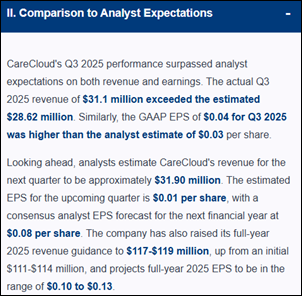
I’m experimenting with Google’s experimental no-code mini-app builder Opal, where you simply describe what you want your app to do and it creates it. I made a little app where I provide a link to a company’s earnings report and it extracts the specific details that I track, retrieves share performance and market cap data from Yahoo Finance, compares results to analyst expectations, and calculates the 12-month share price change. Emboldened by immediate gratification, I build a second app that accepts a company’s website URL and then summarizes what the company does, the name and previous job of the CEO, the three latest news headlines, and the year the company was founded.

image[5][3]

Lastly, I used a sample blog writing app to create an article about OpenAI’s throttling of ChatGPT’s medical advice capability. It did a great job, including generating an Internet-standard cheesy clickbait graphic.


Sponsored Events and Resources

None scheduled soon. Contact Lorre to have your resource listed.


Acquisitions, Funding, Business, and Stock

Cancer diagnostics company Lunit retires the Volpara Health Technologies brand, integrating its AI breast health technology under the Lunit name.


Announcements and Implementations

image

A New York Times article calls around-the-clock fetal monitoring “the worst test in medicine,” saying that it drives unnecessary C-sections despite its inability to reliably predict fetal distress. The article says the use of the technology stems from malpractice fears, hospitals running centralized remote monitoring centers to cut labor costs, and software vendors such as PeriGen that make unsupported claims. One obstetrician concludes, “We may be the only specialty that continues to do major abdominal surgery without a shred of evidence of benefit.”

WellSky launches a patient engagement solution that allows providers to deploy two-way text and chat campaigns for refill assessments, infection services, and onboarding.


Government and Politics

CMS chooses six vendors to participate in the six-year, six-state WISeR pilot program to automate prior authorization with AI: Cohere Health, Genzeon, Humata Health, Inovaccer, Virtix Health, and Zyter.

image

A large health system estimates that it will spend $1 million per year to comply with a new CMS rule that requires telehealth physicians to list their actual location, such as a home address, rather than their office address. The American Telehealth Association warns that hospitals would need to verify hundreds of addresses to stay compliant, and the health system says it may instead require remote clinicians to conduct telehealth sessions from the hospital.

India’s supreme court rules against a hospital that sought to move its lawsuit with a technology vendor into arbitration. The court affirmed earlier findings that although a contract section was titled “Arbitration,” it did not create an arbitration agreement since it required any unresolved disputes to be decided in civil court.


Other

Judy Faulkner says in her latest post in Epic’s “Hey Judy” series that she’s glad she didn’t get an MBA because she would have been taught to court outside investors, plan an IPO, issue impressive job titles, set and follow departmental budgets, and hire via interviews, none of which the company does. The company’s budget policy is “buy it if you need it,” Epic hires mostly based on test results, and she encourages employees who are attending conferences to just make up a job title. I’m curious to hear from anyone who made up an interesting Epic job title.

Police in South Korea charge four doctors and dozens of patients with faking medical records to collect $340,000 in insurance payments. The scheme collapsed when an insurer checked the address of the supposed inpatient facility and found it was a luxury hotel.


Sponsor Updates

  • CereCore joins Oracle’s partner program.
  • Netsmart will exhibit at the 2025 APTA Private Practice Annual Conference November 12-15 in Orlando.
  • Symplr CIO in Residence Theresa Meadows, RN joins the CHIME Foundation board of directors.
  • KLAS highlights Tegria’s Clinical Optimization Services in its “2025 Consistent High Performers Report” for achieving an overall performance score of 95+ for three years in a row.
  • Wolters Kluwer Health will exhibit at the AMIA 2025 Annual Symposium November 15-19 in Atlanta.
  • Censinet will present at AIMed25 November 11 and 12 in San Diego.
  • Altera Digital Health, AvaSure, CereCore, Clearsense, Clearwater, Divurgent, Ellkay, Health Data Movers, InterSystems, Meditech, Nordic, Optimum Healthcare IT, RLDatix, and Symplr will exhibit at the CHIME Fall Forum November 10-13 in San Antonio.

Blog Posts


Contacts

Mr. H, Lorre, Jenn, Dr. Jayne.
Get HIStalk updates.
Send news or rumors.
Follow on X, Bluesky, and LinkedIn.
Sponsorship information.
Contact us.

Morning Headlines 11/7/25

November 6, 2025 Headlines Comments Off on Morning Headlines 11/7/25

CareCloud Reports Third Quarter 2025 Results

CareCloud reports Q3 results: revenue up 9%, EPS $0.07 versus –$0.28, meeting earnings expectations and beating on revenue.

Amae Health Gets $25M to Scale Nationwide, Deepen AI Capabilities

Severe mental illness provider Amae Health will use $25 million in new funding to expand its clinic footprint and further develop its AI-based care software.

Huron Acquires the Payor Consulting Services Division of Axiom Systems to Strengthen Digital-focused Payor Capabilities

Huron acquires the payer consulting services division of Axiom Systems.

Comments Off on Morning Headlines 11/7/25

News 11/7/25

November 6, 2025 News 1 Comment

Top News

image

From Informatics MD: “Re: UnitedHealthcare. Changing its payment policy to eliminate coverage of remote patient monitoring in most emerging uses. This is likely to have an adverse effect on future development and growth of evidence.” The insurer says that starting January 1, 2026, it will cover RPM only for heart failure and hypertensive disorders of pregnancy.

Googling “remote patient monitoring + insurance” lists a lot of RPM companies whose business model of being paid by a cut of increased provider billings just went poof.

The insurer says that evidence is lacking for conditions such as COPD, depression, and diabetes, and with revenue for those services dropping to zero, nobody will spend the money to generate new evidence.

One might also call out providers who were happy to bill for RPM but paid no attention to the alerts it generated, adding zero value except to their wallets. Patients might as well buy a smart watch and monitor themselves.


Reader Comments

image

From Dirk Dongler: “Re: the CarPlay dongle you bought for $16.99. It’s now $29.99. You are driving markets, like NYT Wirecutter or Kim Kardashian!” Tip: ask Amazon’s Rufus AI chatbot on the item’s page to “show price history.” Not only will it provide a graph of the item’s historical pricing from this seller, you can also ask it to compare the item with similar ones, where it will display a table and a summary of “Best Value” and “Most Reviews.”


HIStalk Announcements and Requests

image

Welcome to new HIStalk Platinum Sponsor SlicedHealth. SlicedHealth is a healthcare technology company that is transforming contract management through intelligent automation and hands-on support. Driven by SlicedIQ, our AI-assisted engine equips hospital leadership with the tools they need to model and optimize contract performance, streamline operations without adding additional staff, and maximize revenue recovery. From claim estimation and business intelligence to a robust price transparency module built for compliance, SlicedHealth empowers all hospital leaders to recover revenue lost to denials and underpayments, because revenue you can’t see is revenue you’ll never collect.

image

Speaking of SlicedHealth, the company just announced SlicedIQ, an AI-powered revenue cycle optimization platform for rural hospitals. I noticed from the announcement that industry veteran and pharmacist Reed Liggin, MBA (McKesson, RazorInsights, Athenahealth, and EasyScripts Technology) is co-founder and CEO of the company. 


Sponsored Events and Resources

None scheduled soon. Contact Lorre to have your resource listed.


Acquisitions, Funding, Business, and Stock

Virtual healthcare company LifeMD, which just made headlines for selling its WorkSimpli document management platform, delays its Q3 earnings report as it corrects prior revenue recognition issues.

CareCloud reports Q3 results: revenue up 9%, EPS $0.07 versus –$0.28, meeting earnings expectations and beating on revenue. Shares jumped 20% on the news, valuing the company at $125 million.

Huron acquires the payer consulting services division of Axiom Systems.


Sales

  • Mount Sinai Health System will implement Microsoft’s Dragon Copilot for ambient documentation.

Announcements and Implementations

image

The American Red Cross releases a resuscitation app that provides access to code and reference cards, protocol cards for all of its life support programs, compression and drug timers, and real-time documentation forms.


Other

image

Former health tech executive Chris Klomp tells Politico that he took his current job of running Medicare for CMS because he felt guilty for making a lot of money as a health tech entrepreneur. He adds that even though he founded Collective Medical to coordinate care and then sold it to PointClickCare for $650 million in December 2020, he found when he moved to DC that getting his kids’ medical records to their new pediatrician “involved fax machines and paper releases, and my wife sat and said, ‘Wait a minute, I thought you built a company that, like, fixed this whole interoperability thing.’”


Sponsor Updates

  • Fortified Health Security launches its Incident Response Program Module within its Central Command platform to ensure organizations can access their complete incident response resources directly from mobile devices even when networks are down.
  • Infinx will sponsor, present, and exhibit at the HIMSS Iowa Fall 2025 Conference November 12-13 in Altoona.
  • Navina offers a free, three-day online course on value-based care that begins November 18.

Blog Posts


Contacts

Mr. H, Lorre, Jenn, Dr. Jayne.
Get HIStalk updates.
Send news or rumors.
Follow on X, Bluesky, and LinkedIn.
Sponsorship information.
Contact us.

EPtalk by Dr. Jayne 11/6/25

November 6, 2025 Dr. Jayne Comments Off on EPtalk by Dr. Jayne 11/6/25

image 

Physicians around the virtual water cooler became excited earlier in the week when we heard that ChatGPT was going to start restricting how it manages medical and legal queries. The headlines were great, including gems like “OpenAI Bans ChatGPT From Giving Medical, Legal, or Financial Advice Over Lawsuit Fears.”

OpenAI clarified its position later in the week, explaining that the system will continue to provide general information on those topics, but it will also refer the user to appropriate professionals. The company also stated that users shouldn’t use the tool for “provision of tailored advice that requires a license, such as legal or medical advice, without appropriate involvement by a licensed professional.”

I test drove ChatGPT myself with the above question, along with several others. I was glad to see that it recommended consultation with a healthcare professional.

Looking at its use from the healthcare provider perspective, however, issues remain. I fed ChatGPT a clinical scenario that was chock-full of Protected Health Information (not from a real patient, of course) and asked it to operate from the persona of a medical resident. It didn’t even blink, giving me a list of initial assessments and interventions to perform. It even offered a more detailed management plan and checklists, and when I asked it to generate those, it included the patient’s name in its response.

ChatGPT isn’t Covered Entity, so it isn’t subject to HIPAA regulations. Still, the response tells me that the company doesn’t have many physicians on staff who are guiding its development.

image

Autumn is upon us, and those in the US who partake of Daylight Saving Time have shifted our clocks back to standard time. That means that some of us will endure weeks of people using the wrong convention when discussing options for scheduling meetings because they don’t fully understand the difference between using “EST” versus “EDT” in writing. I tend to take the lazy route and just say Eastern or Mountain for the date in question, which generally helps avoid the issue.

As a side note, given the number of healthcare organizations that operate nationally, include the appropriate time zone when offering meeting times unless you are sure that everyone on the email is in the same one. I wish I had a dollar for every reply I had to send asking, “Are these options Eastern?” rather than being able to simply indicate my availability.

The fall season also brings my annual complaint about the mammogram reminder letters that are sent by the health system where I receive most of my care. Despite spending hundreds of millions of dollars on an upgraded EHR, they still can’t figure out how to run their reminder letters from a report that takes into account whether patients have already scheduled their next study.

In addition to being a waste of money for the health system, it also creates anxiety for patients who wonder if their appointment was scheduled incorrectly, inadvertently canceled, or fell victim to some other IT misadventure. I have to log into my patient portal every year to confirm that my appointment is still there, which doesn’t build trust or confidence in the health system.

Speaking of complaints, one of my neighbors reached out for advice on how to handle a negative interaction that she had at a local medical practice. I won’t generally weigh in on the interaction or the specific clinical issues since I know that every story has multiple sides, but I’m happy to give advice on how to best provide feedback since most patients don’t understand the different practice structures in our area (academic practice, private practice, employed practice owned by a health system, employed practice owned by private equity, etc.)

This one threw me for a loop. Although the patient thought she was at physician-owned private practice, it was actually a private equity situation. The mid-level provider she saw doesn’t have a collaborative relationship with the physician the patient originally asked to see. Even though four physicians were in the office on the day of the visit, the NP’s supervising physician practices in an office 70 miles away and is never physically present at this location.

I’ve seen these kinds of arrangements in rural areas, but not in the city. I recommended feedback to the practice manager and the supervising physician, but the patient still feels like it was a bait-and-switch situation.

I’m familiar with the particular private equity organization that is involved, so I let her know that I’m happy to help when she gets her bill. It will be confusing and sent from a name and location that bears no resemblance to the site where she received care. It’s a sad commentary on the complexity of our healthcare system and how patients regularly find it confusing and unsettling.

From Jimmy the Greek: “Re: employees using AI to create fake receipts for expense reports. Companies are using AI to try to catch the fraudsters.” I hadn’t heard about this particular phenomenon. I quickly went down the search engine rabbit hole to see what kinds of scams people were pulling. We’ve come a long way from the days when taxi drivers gave you a blank paper receipt so you could fill in your own numbers, but dishonesty will always be there. For most of my career, I’ve reported to other physicians, and it has been interesting seeing which ones made a point of commenting on the contents of expense reports. One of my favorite supervisors mentioned on a team call once that too many of us were eating fast food and needed to make some changes to our meal choices.

It sounds like many of the expense report management vendors such as Expensify and Concur are using tools to catch these types of fraud. Coupling those kinds of audits with a company-issued credit card where expenses flow straight to the expense management platform seems like a fairly straightforward way to dramatically reduce the number of incidents.

Traveling employees who like playing the points and miles games don’t like to use a company card, but given the scope of fraud, I can see why organizations might require it. My hospital phased out company credit cards several years ago, but I wouldn’t be surprised if they bring them back based on stories like these. Younger employees missed out on some of the silliness we experienced when filing expense reports, like taping paper receipts to a sheet of copy paper so we could feed them through the fax machine.

From AI Naysayer: Re: attitudes about peer physicians using AI. Did you see the Johns Hopkins article? I can’t say that I’m surprised. Plenty of people at my institution do dumb things with AI that make them look less competent.” The piece explores the tension between clinicians who are pressured to be early adopters of generative AI technologies and those who are skeptical about its benefit. I thought it interesting that the promotional article mentions the underlying study but didn’t have a link, but it’s unclear if this was intentional or just sloppy writing. Either way, the piece leans toward there being a social stigma that may be blocking the growth of AI in healthcare.

It was fairly easy to find the publication in question. It was a small study, with only 276 clinicians participating. They were placed in three groups: one with no AI use, one with AI as the primary decision-making tool, and one using AI for verification only. Participants worked through diabetes care scenarios. The authors found that the verification option helped mitigate negative perceptions, but it didn’t eliminate them completely. They also note that this study was simplistic and that more research is needed, including creating specific measurement instruments and examining behaviors outside of the single participating health system.

Would you be more or less confident in a physician who used generative AI tools to create your plan of care? Leave a comment or email me.

Email Dr. Jayne.

Comments Off on EPtalk by Dr. Jayne 11/6/25

Morning Headlines 11/6/25

November 5, 2025 Headlines Comments Off on Morning Headlines 11/6/25

Titan Holdings, Building AI Businesses Across Key Industries, Unveils Newest Venture: Tala Health

Tala Health, which develops AI agents to support clinicians and to address administrative burden, raises $100 million in financing.

Omega Systems Expands Healthcare MSP Leadership with Acquisition of Peake Technology Partners

Managed IT and cybersecurity services company Omega Systems acquires healthcare-focused Peake Technology Partners.

DHA Seeks Industry Feedback on MHS Genesis Deployment Methods

The Defense Health Agency seeks industry input on MHS Genesis deployment methods that will minimize operational disruptions and ensure smooth transitions for new users.

Comments Off on Morning Headlines 11/6/25

Healthcare AI News 11/5/25

November 5, 2025 Healthcare AI News Comments Off on Healthcare AI News 11/5/25

News

image

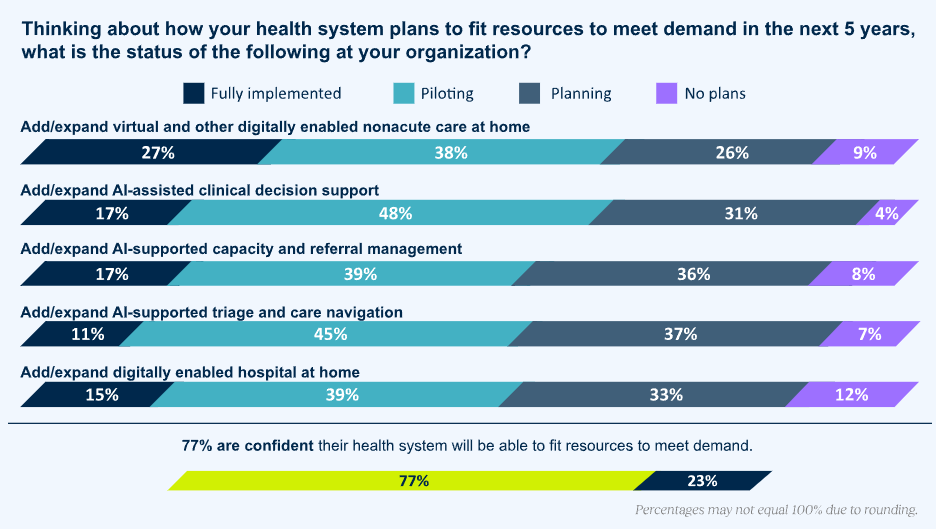
Nearly all surveyed health system executives believe that digital and AI tools can help them move to more proactive care. Most see key areas as providing off-campus care, using CRM systems to schedule ongoing care, collecting health data via devices, implementing AI health coaches to answer questions and help patients follow their care plans, and predicting health risks using AI. They also hope to personalize patient care using connected device monitoring, offering multiple communication channels, using technology to personalize care plans and messages.

Health insurers will use AI to counter the use by providers of AI-powered coding and billing, which they say has increased medical cost and thus decreased their profit. According to Centene’s CFO, “It does seem like hospitals have gotten better organized around the application of AI for coding than payers. But we’re going to catch up to that.”

image

OpenAI denies several viral social media posts claiming that ChatGPT has been disabled from providing health advice. However, the company says that its updated terms of service advise that the chatbot is not a substitute for professional advice and it will no longer provide a diagnosis or patient-specific treatment plan, reportedly due to legal and regulatory exposure.


Business

image

Hancock Health will use AI-driven robotic automation from Arrive AI to deliver lab specimens, a project that also includes drone-based transport for offsite deliveries.

Mayo Clinic announces Mayo Clinic Platform_Insights, which gives healthcare organizations access to its AI-driven clinical and operational expertise for digital solutions implementation. Mayo didn’t specify which modules or problem areas it will address or provide details about selling its services.

Healthcare AI agent vendor Hippocratic AI announces $126 million in Series C funding at a valuation of $3.5 billion. The company plans to use some of the proceeds to pursue mergers and acquisitions. It offers AI agents that handle non-diagnostic patient-facing tasks such as medication reminders and screening outreach.

For-profit urgent care chain Med First finds that AI-coded visits yield 6% more revenue than when physician codes visits themselves.

Tala Health, which develops AI agents to support clinicians and to address administrative burden, raises $100 million in financing.

image

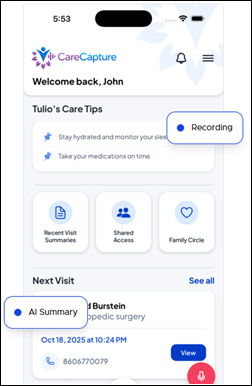
Tulio Health Technologies launches CareCapture, an app that generates AI summaries of visits that patients can share to improve recall, adherence, and confidence.


Research

Northwell Health researchers report that AI analysis of continuous wearable data from non-ICU inpatients accurately predicted patient deterioration an average of 17 hours in advance.


Other

OpenAI recognizes pharma and life sciences marketing firm Doceree for using 10 billion AI tokens, making it one of the most advanced users of AI technology.


Contacts

Mr. H, Lorre, Jenn, Dr. Jayne.
Get HIStalk updates.
Send news or rumors.
Follow on X, Bluesky, and LinkedIn.
Sponsorship information.
Contact us.

Comments Off on Healthcare AI News 11/5/25

Text Ads


RECENT COMMENTS

  1. The sentence was "most people just go to Epic UGM" - that's people going to Epic's annual user conference and…

  2. Merry Christmas and a Happy New Year to the HIStalk crowd. I wish you the joys of the season!

  3. "most people just go to Epic" that's a problem because then EPIC becomes a monopoly in healthcare, if it isn't…

  4. Only if CEO can post 'bail' which nowadays stands at 1B$ paid directly to the orange president or his family…

Founding Sponsors


Platinum Sponsors


Gold Sponsors


RSS Webinars

  • An error has occurred, which probably means the feed is down. Try again later.