Recent Articles:

Morning Headlines 5/7/18

May 6, 2018 Headlines Comments Off on Morning Headlines 5/7/18

Mayo Clinic launches massive medical records overhaul

Mayo Clinic goes live on Epic at its Rochester, MN campus as part of a $1.5 billion system-wide software overhaul that will bring all of its facilities onto a single platform.

Buffett targets CEO for Berkshire-Amazon-JPMorgan healthcare venture soon

Berkshire Hathaway CEO Warren Buffett reiterates his commitment to the healthcare improvement project his company is launching with JPMorgan and Amazon, emphasizing that a CEO will be in place within the next two months.

Trump May Pick 40-Year VA Insider To Run Veterans Health Administration

DisabledVeterans.org suggests that President Trump will meet with National Association of Veterans Affairs Physicians and Dentists President Samuel Spagnolo, MD to discuss his potential nomination for VA Secretary.

Comments Off on Morning Headlines 5/7/18

Monday Morning Update 5/7/18

May 6, 2018 News 2 Comments

Top News

image

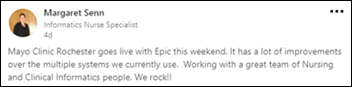
Mayo Clinic goes live on Epic at its Rochester, MN campus as part of a $1.5 billion system-wide software overhaul that will bring all of its facilities onto a single platform. Preparation for the big-bang event on May 5 was so extensive that the local power company created a new substation to power it.

image

Mayo has already implemented Epic at its facilities in Wisconsin and southern Minnesota, and expects to begin deployment at its hospitals in Florida and Arizona after the Rochester implementation is complete.


HIStalk Announcements and Requests

image

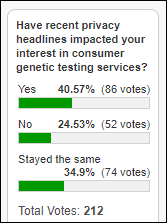
Recent privacy breaches have swayed the majority of reader interest in consumer genetic testing services, though the comments left don’t give me a good indication if they’ve been more swayed into not using these types of services. Wary Consumer points out that, “When you add to the privacy breaches the fact that Chinese companies have invested in the DNA companies and are now offshoring our genetic data, it should give all of us pause. Additionally, you’re paying for a service, so unlike free sites where you basically pay with your data, you’re basically paying twice, since you know they’re going to reuse or resell your data. It’s crazy that people don’t stop to consider this when clicking through end user agreements that they don’t read.” Steve’s interest has stayed the same – zilch. “Wasn’t interested before, still am not. People are so concerned with the risk that their credit card information might end up on line (when you can easily cancel a credit card). Some of these same people are more than willing to send in their DNA to be stored for years to come. How many hackers do we think are actively working to find their way into those databases?”

New poll to your right or here: Does connectivity to your EHR make you more or less likely to buy a Fitbit?

image

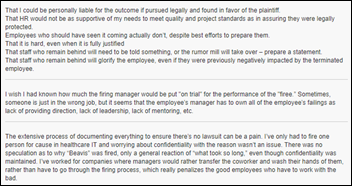
Here are reader responses to “What I Wish I’d Known Before … Firing Someone for Cause.” A lack of support, plus a tendency to tiptoe around tossing bad apples seem to be common themes.

image

I’m hoping Epic employees and others toiling in the Minnesota trenches of the Mayo Clinic will anonymously weigh in on this week’s question.


Webinars

May 9 (Wednesday) 2:00 ET. “How to Make VBC Work for You: The Business Case to Transform Into the Health System of the Future.” Sponsor: Philips Wellcentive. Presenters: Mason Beard, co-founder and chief product officer, Philips Wellcentive; Scott Cullen, MD, principal, ECG Management Consulting; Seema Mathur, director of strategy, Sage Growth Partners. How well is your organization funding its transformation to VBC? This free webinar explains how to achieve ROI as your organization transforms to meet the future. You’ll learn how VBC is impacting healthcare system management, three strategies for funding your transformation, and what the healthcare system of the future will look like.

May 16 (Wednesday) 1:00 ET. “You Think You Might Want to Be a Consultant?” Sponsor: HIStalk. Presenter: Frank Poggio, CEO/president, The Kelzon Group. Maybe you just got caught in a big re-org and don’t like where things are headed, or, after almost a year of searching for a better opportunity your buddy says, “You’ve got decades of solid experience and you’re a true professional, you should become a healthcare IT consultant.” Now you start thinking, "This could be my ticket to success. I know the healthcare industry and can show people how to do things right. The sky’s the limit!" Not so fast. Consulting offers many advantages, and many pitfalls. This webinar will discuss both the rewards and the risks of moving into a full-time consulting role, as an independent, or part of a large firm. It will present a checklist you can apply to assess whether consulting is a good fit for you, and present the ground work necessary to be a successful consultant.

May 24 (Thursday) 1:00 ET. “Converting Consumers into Patients: Strategies for Creating Engaging Digital Experiences People Demand.” Sponsor: Healthwise. Presenters: Antonia Chappell, director of consumer solutions, Healthwise; Josh Schlaich, senior product manager, Healthwise. Nearly three-quarters of US adults use a digital channel to manage their health and the internet to track down health information. It’s clear that consumers have come to expect online interactions as an integral part of their overall patient experience. In fact, the Internet may be the first way people come in contact with your organization. They have more choice than ever on where to get healthcare services, and their decisions are increasingly influenced by how well organizations connect with them in the digital space. This webinar will show you how to create engaging digital and web experiences that convert casual consumers into patients and keep them satisfied throughout their entire patient journey.

June 5 (Tuesday) 1:00 ET. “Increase Referrals and Patient Satisfaction with a Smarter ‘Find a Doctor’ Web Search.” Sponsors: Phynd Technologies, Healthwise. Presenters: Joseph H. Schneider, MD, MBA, FAAP, retired SVP/CHIO, Indiana University Health; Keith Belton, VP of marketing, Phynd. A recent survey found that 84 percent of patients check a hospital’s website before booking an appointment. However, ‘Find a Doctor’ search functions often frustrate them because their matching functionality is primitive and the provider’s information is incomplete or outdated. Referring physicians need similarly robust tools to find the right specialist and to send the patient to the right location. Attendees of this webinar will learn how taxonomy-driven Provider Information Management improves patient and referrer satisfaction by intelligently incorporating the provider’s location, insurance coverage, specialty and subspecialty, and services offered that can be searched via patient-friendly terms.

Previous webinars are on our YouTube channel. Contact Lorre for information.


Acquisitions, Funding, Business, and Stock

image

Berkshire Hathaway CEO Warren Buffett reiterates his commitment to the healthcare improvement project his company is launching with JPMorgan and Amazon. At Berkshire’s annual shareholders meeting, he reiterated that all three companies want their 1 million-plus employees to receive better care at lower costs, but didn’t get into specifics. He did mention that a CEO for the new venture will likely be placed within the next two months.


People

image

TeleTracking promotes Christopher Johnson to president.

image

David Nace, MD (Lantern) joins Innovaccer as CMO.


Announcements and Implementations

In the UK, the Somerset Partnership NHS Foundation Trust joins TriNetX’s research network.


Sales

  • Renown Health selects Phynd to synthesize, transform, and share provider information across its health network in Nevada.
  • In Australia, the Victorian government allocates $124 million to implement Epic at three hospitals.
  • Calvary Hospital (NY) will host their Meditech system on CloudWave’s OpSus Healthcare cloud.
  • Massac Memorial Hospital (IL) selects Parallon Technology Solutions to implement and host its Meditech Expanse software.

Decisions

  • Holzer Medical Center (OH) will switch from Allscripts to Athenahealth in late May or early June.
  • Kingman Regional Medical Center (AZ) will go live with Meditech supply chain management software in September.
  • Crisp Regional Hospital (GA) will switch from Meditech to Cerner in 2019.

These provider-reported updates are supplied by Definitive Healthcare, which offers a free trial of its powerful intelligence on hospitals, physicians, and healthcare providers.


Government and Politics

image

New York City-based urgent care chain CityMD will pay $6.6 million to settle a civil fraud lawsuit filed by a whistleblower and the Manhattan US Attorney General’s Office. CityMD, which has 88 facilities, admitted to billing Medicare for procedures that weren’t as lengthy or complex as it claimed.

image

This article suggests that President Trump will meet with National Association of Veterans Affairs Physicians and Dentists President Samuel Spagnolo, MD to discuss his potential nomination for VA Secretary. Spagnolo is also a senior attending physician at the VA Medical Center in Washington, DC and a professor of medicine at George Washington University. He has served in numerous positions within the VA throughout his career.


Other

image

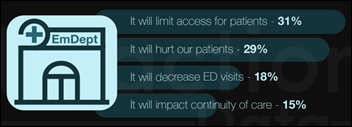
The majority of respondents in a Reaction Data survey of 145 believe that Anthem’s decision to stop covering ER visits it deems unnecessary will have a negative impact on their organizations and patients, especially when it comes to out-of-pocket patient expenses and restricted clinical care.


Sponsor Updates

  • Medicity publishes a new perspective paper, “Interoperability 2.0: How to Consume, Organize and Share Health Data to Achieve Greater Value.”
  • The New York State Psychiatric Association endorses DrFirst medication management tools for use by the psychiatric community in New York State.
  • Mobile Heartbeat will present at the 2018 ANIA Conference May 12 in Orlando.
  • Liaison Technologies is accepting applications for its fall semester 2018 Data-Inspired Future Scholarship.
  • Meditech, PatientSafe Solutions, and PerfectServe will exhibit at the 2018 ANIA Annual Conference May 10-12 in Orlando.
  • The National Council for Behavioral Health awards Netsmart the 2018 Mental Health First Aid Business Leadership Award.
  • Clinical Computer Systems, developer of the Obix Perinatal Data System, will exhibit at the Allscripts Client Experience May 8-9 in Saskatchewan.
  • OmniSys, Experian Health, and Surescripts will exhibit at the NCPDP Annual Technology & Business Conference May 7-9 in Scottsdale, AZ.
  • Qventus and TriNetX exhibits at the HLTH 2018 conference through May 9 in Las Vegas.
  • T-System partners with Precision Practice Management to develop the Complete Care clinical and business solution for urgent care providers.
  • T-System exhibits at the 2018 UCAOA Urgent Care Convention & Expo through May 9 in Las Vegas.
  • Heather Russell joins TransUnion as chief legal officer.
  • Wellsoft will exhibit at the Annual Rural Health Conference May 8-11 in New Orleans.
  • WiserTogether partners with digital health marketplace ZendyHealth.
  • The local news profiles ZappRx.
  • Consulting Magazine includes Impact Advisors VP Keith MacDonald in its list of top 25 advisors of 2018.

Blog Posts


Contacts

Mr. H, Lorre, Jenn, Dr. Jayne.
Get HIStalk updates. Send news or rumors.
Contact us.

125x125_2nd_Circle

What I Wish I’d Known Before … Firing Someone for Cause

How much stress I would feel leading up to the actual moment. I find myself spending a lot of time worrying about the impact on the person, their family, their potential future mental state, etc., particularly if I have had a good personal relationship with them and the cause is poor professional performance rather than something more obviously "fireable" like sexism, racism, theft, etc. And, in these cases, how much less stress I found myself under after making the decision, going through the documentation and attempted rehabilitation process, and then finally moving on. Having poor performers around drags down the entire team and moving them on lifts a weight from everyone else.


That I could be personally liable for the outcome if pursued legally and found in favor of the plaintiff.
That HR would not be as supportive of my needs to meet quality and project standards as in assuring they were legally protected.
Employees who should have seen it coming actually don’t, despite best efforts to prepare them.
That it is hard, even when it is fully justified
That staff who remain behind will need to be told something, or the rumor mill will take over – prepare a statement.
That staff who remain behind will glorify the employee, even if they were previously negatively impacted by the terminated employee.


I wish I had known how much the firing manager would be put "on trial" for the performance of the "firee.” Sometimes, someone is just in the wrong job, but it seems that the employee’s manager has to own all of the employee’s failings as lack of providing direction, lack of leadership, lack of mentoring, etc.


The extensive process of documenting everything to ensure there’s no lawsuit can be a pain. I’ve only had to fire one person for cause in healthcare IT and worrying about confidentiality with the reason wasn’t an issue. There was no speculation as to why “Beavis” was fired, only a general reaction of “what took so long,” even though confidentiality was maintained. I’ve worked for companies where managers would rather transfer the coworker and wash their hands of them, rather than have to go through the firing process, which really penalizes the good employees who have to work with the bad.


That you may not get to replace the employee because of attrition. The company uses empty positions for potential attrition cost savings.


Timing is never ideal when firing someone, but timing can be better than others; we terminated an employee of middle management two weeks post bringing in a consultant team. Gave the appearance that the consultant team was changing the org chart.


How hard it would be. Internally, our employees are so well protected, it’s hard to get them out based on performance – even over a lack of showing up. They are given every benefit of the doubt, and we end up down a person for months and months, yet we’re still accountable for our metrics.


Would I have done so for anybody or was this person an anomaly. Remove all personal bias and read your rationale, asking if this were X, would I do the same? If not, expect repercussions.


Regardless of the amount of documentation or agreement from those within your department, there will always be those that feel the employee was treated unfairly. You know the reasons for the firing, but that’s not something you can easily explain to others due to confidentiality issues. If you’re going to fire someone, you have to be confident in your decision and not let pushback from others impact your team’s performance.


Don’t count on your manager supporting your decision! You’re probably on your own here.


I wish I’d known how to convince my company to let me do it. They never let us fire anyone – always has to be something sneaky, like a layoff, which sometimes has collateral damage. There are bad apples out there that need to be tossed, but our HR team is dreadfully afraid of letting us do when needs to be done.


Many not-for-profits seem to treat most people with performance-based challenges as if they have guaranteed lifetime employment and it seems like everyone plays by union-like rules. That is – many write-ups. It seems like you need to have HR in the loop well in advance of the first inkling of an issue and it takes multiple performance improvement plans, sometimes with arbitration-like discussions, to move someone on.
In other cases, where the previous "model employee" is cited by someone as having caused a non-performance issue, it seems to be guilty until proven innocent. I really fear for the surfacing of potential accusations from many years back. I have yet to hear about a "statute of limitations" at my employer. These are truly crazy times.

Weekender 5/4/18

May 4, 2018 Weekender 2 Comments

weekender


Weekly News Recap

  • In the UK, Health Secretary Jeremy Hunt brings in Eric Topol, MD to lead a review of how to best train NHS staff on using new technologies including AI, digital health, robotics, and genomics.
  • Reports surface that a West Palm Beach physician with ties to President Trump’s inner circle may be behind the VA/Cerner contract delay.
  • Fitbit will use Google’s Cloud Healthcare API to share user data with providers via their EHRs.
  • Beth Israel Deaconess taps CIO John Halamka, MD to lead its new Health Technology Exploration Center, which will explore the role of emerging technologies like blockchain and IoT in healthcare delivery.
  • Cerner shares drop after the company reports lower than forecasted Q1 revenue of $1.29 billion.

Best Reader Comments

Moskowitz: ‘I know because I have to use it!’ The gall of a physician user pointing out that Cerner powerpoints don’t align with Cerner reality. (Vaporware?)

Have to ask: Is Bruce Moskowitz,the next nominee to head the VA? I mean, he is a doctor after all and that qualifies him for pretty much anything. Also: Would blockchain have prevented Trump from writing his own medical assessment (“healthiest individual ever elected to the presidency.”)? (Recovering CIO)

They absolutely seem lost since Neil died. It looks like no one wants to make decisions or set a direction. I was hoping the new CEO would step in and set a new direction, but that doesn’t seem to be, at the moment. The Siemens acquisition was interesting. They were basically buying market share and being the low cost ($1B being low, all things considering) they have basically made their money back. However, what they have done with Financials is baffling to me. One would have thought they would have taken the good parts of Soarian Financials and what little good parts there are with Millennium and create a new product. Yet, they have kept both lines and are still selling both financial systems. I mean, 3 years seems to be plenty of time to architect a new Revenue Cycle platform considering their resources …. The UIC issue you have to take as an outlier. Yes, Cerner pursued legal action but the fact remains, they are actually right in this context, whether we like it or not. Was the procurement process followed, NO. It is very clear, especially when Impact Advisors put in writing that they would ONLY bid on Epic work, should Epic win the bid. That is a clear conflict of interest, any way you slice it, and thus, violated the procurement process the state of Illinois has. Not to mention, Epic Implementation costs were NOT in the final bid, which again, was a requirement of the RFP. You may hate Cerner, and fine whatever, to each his own, but the FACTS are that there were violations of State Procurement and thus the selection process has to happen all over again. Epic probably still wins and the outcome is the same, but that isn’t the point. If anything, this is almost more on Impact than it is UIC. I mean, really, when you are doing a vendor selection, you NEVER state that you would ONLY support one vendor over the other. You have to stay neutral through the whole process. (Associate CIO)


Watercooler Talk Tidbits

image image

We funded the teacher grant request of Ms. H in Texas, who asked for STEM game night activities for her special education class. She reports, "I cannot thank you enough for your donation to our classroom. My students and I have formed an obsession with STEM projects. My students love to learn about jobs they could have in the future based on information provided in the STEM activity. I have students that, at a young age, are picking what they would love to be when they grow up based off of these activities. My students are able to explore, plan, build, and report at a higher level due to these interactive STEM activities."

image

“Big data” (and “Big Brother” for that matter) takes on new meaning in China, where manufacturing companies have taken to outfitting workers with brainwave-monitoring helmets in an effort to keep tabs on their levels of concentration, anxiety, depression, and rage. One brain science academic in China ominously explains that, “When the system issues a warning, the manager asks the worker to take a day off or move to a less critical post. Some jobs require high concentration. There is no room for a mistake.” The technology is also being rolled out in hospitals to help staffers keep an eye on potentially violent patients.

NBC investigators get back unexpected results during the course of a report on at-home DNA testing kits. Results from Orig3n DNA’s $29 kit were included in a seven-page report that listed attributes like strong muscle force and cardiac output, but failed to note the DNA in question was in fact from a dog.

image

Boston Marathon officials decide to award prize money to non-elite runners who finished with faster times than their professional counterparts. Fifth-place finisher Jessica Chichester, a nurse practitioner from Brooklyn, will take home $15,000. She has jokingly claimed that “[f]requent hand washing and Lysol-ing everything” have been key to her running success.

Bill Gates turns down a semi-serious job offer from President Trump after he asks about the White House’s vacant science advisor position during a meeting in the Oval Office on global health security.


In Case You Missed It


Get Involved


125x125_2nd_Circle

Morning Headlines 5/4/18

May 3, 2018 Headlines Comments Off on Morning Headlines 5/4/18

Allscripts to significantly expand FollowMyHealth® patient engagement platform portfolio with new, advanced capabilities through acquisition of HealthGrid

Allscripts will acquire patient engagement and CRM company HealthGrid for $60 million.

Up to 270 women may have died after breast cancer screening IT error

NHS Health Secretary Jeremy Hunt says a 2009 algorithm error likely contributed to 450,000 women missing breast cancer screenings over an eight-year period, resulting in the deaths of between 135 and 270.

Health Catalyst Acquires Medicity

Data analytics vendor Health Catalyst acquires HIE vendor Medicity – both based in Salt Lake City – for an undisclosed price.

Comments Off on Morning Headlines 5/4/18

News 5/4/18

May 3, 2018 News 8 Comments

Top News

image

Allscripts announces Q1 results: revenue up 24 percent, adjusted EPS $0.16 vs $0.17. CEO Paul Black says the company is looking forward to integrating Practice Fusion, McKesson’s Enterprise Information Solutions business, and Change Healthcare Homecare’s solutions – via Netsmart – into its portfolio.

image

The Chicago-based company will expand its FollowMyHealth patient engagement offering with the acquisition of patient engagement and CRM company HealthGrid for $60 million. HealthGrid co-founders Raj and Charkri Toleti headed up patient self-service kiosk startup Galvanon until its acquisition by NCR in 2005.


Reader Comments
image

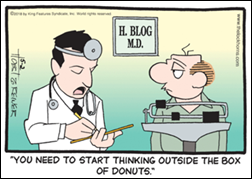
From mike: “Re: The Lockhorns. This comic in my analog copy of the newspaper on Wednesday caught my eye; first because of the doctor’s head mirror; but especially the "H Blog" on the wall … could this be a direct reference to HIStalk? Hmmm.” It’s certainly fun to think so, though it may be some sort of homage to a Harold Blog, MD a New York-based internist who passed away several years ago. H. Blog MD appears in several of the comics.

From Associate CIO: “Re: Trinity Health’s move to Epic. This is rather stunning as they had been in the process of rolling out Cerner to the remainder of their hospitals as late as last year…. Cerner seems to be lost after the passing of Neil …” In announcing the move, the Michigan-based health system added it will train 100,000 employees on the new software.

From TryToStayAnon: “Re: Your Health Catalyst/Medicity news. Notable for a few reasons – Medicity is struggling with data architecture and analytics. Clients exploring that space with Medicity should be rejoicing. It isn’t clear to what extent Aetna will remain engaged with Medicity clients. Most likely, this announcement will also clear the path for the CVS and Aetna deal to close.”


Webinars

May 9 (Wednesday) 2:00 ET. “How to Make VBC Work for You: The Business Case to Transform Into the Health System of the Future.” Sponsor: Philips Wellcentive. Presenters: Mason Beard, co-founder and chief product officer, Philips Wellcentive; Scott Cullen, MD, principal, ECG Management Consulting; Seema Mathur, director of strategy, Sage Growth Partners. How well is your organization funding its transformation to VBC? This free webinar explains how to achieve ROI as your organization transforms to meet the future. You’ll learn how VBC is impacting healthcare system management, three strategies for funding your transformation, and what the healthcare system of the future will look like.

May 16 (Wednesday) 1:00 ET. “You Think You Might Want to Be a Consultant?” Sponsor: HIStalk. Presenter: Frank Poggio, CEO/president, The Kelzon Group. Maybe you just got caught in a big re-org and don’t like where things are headed, or, after almost a year of searching for a better opportunity your buddy says, “You’ve got decades of solid experience and you’re a true professional, you should become a healthcare IT consultant.” Now you start thinking, "This could be my ticket to success. I know the healthcare industry and can show people how to do things right. The sky’s the limit!" Not so fast. Consulting offers many advantages, and many pitfalls. This webinar will discuss both the rewards and the risks of moving into a full-time consulting role, as an independent, or part of a large firm. It will present a checklist you can apply to assess whether consulting is a good fit for you, and present the ground work necessary to be a successful consultant.

May 24 (Thursday) 1:00 ET. “Converting Consumers into Patients: Strategies for Creating Engaging Digital Experiences People Demand.” Sponsor: Healthwise. Presenters: Antonia Chappell, director of consumer solutions, Healthwise; Josh Schlaich, senior product manager, Healthwise. Nearly three-quarters of US adults use a digital channel to manage their health and the internet to track down health information. It’s clear that consumers have come to expect online interactions as an integral part of their overall patient experience. In fact, the Internet may be the first way people come in contact with your organization. They have more choice than ever on where to get healthcare services, and their decisions are increasingly influenced by how well organizations connect with them in the digital space. This webinar will show you how to create engaging digital and web experiences that convert casual consumers into patients and keep them satisfied throughout their entire patient journey.

June 5 (Tuesday) 1:00 ET. “Increase Referrals and Patient Satisfaction with a Smarter ‘Find a Doctor’ Web Search.” Sponsors: Phynd Technologies, Healthwise. Presenters: Joseph H. Schneider, MD, MBA, FAAP, retired SVP/CHIO, Indiana University Health; Keith Belton, VP of marketing, Phynd. A recent survey found that 84 percent of patients check a hospital’s website before booking an appointment. However, ‘Find a Doctor’ search functions often frustrate them because their matching functionality is primitive and the provider’s information is incomplete or outdated. Referring physicians need similarly robust tools to find the right specialist and to send the patient to the right location. Attendees of this webinar will learn how taxonomy-driven Provider Information Management improves patient and referrer satisfaction by intelligently incorporating the provider’s location, insurance coverage, specialty and subspecialty, and services offered that can be searched via patient-friendly terms.

Previous webinars are on our YouTube channel. Contact Lorre for information.


Announcements and Implementations

image

Island Hospital (WA) goes live on Meditech Expanse with help from hosting partner Engage.


People

image

Meditech promotes Geoff Smith to VP, product development.

image

Beth Israel Deaconess Medical Center (MA) taps CIO John Halamka, MD to lead its new Health Technology Exploration Center, which will explore the role of emerging technologies like blockchain and IoT in healthcare delivery.


Acquisitions, Funding, Business, and Stock

image

Data analytics vendor Health Catalyst acquires HIE vendor Medicity – both based in Salt Lake City – for an undisclosed price.
image

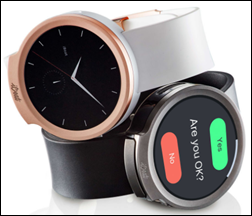
Heart monitor smartwatch company IBeat raises $5.5 million in seed funding, bringing its total funding to $10 million. Launched by Practice Fusion founder and former CEO Ryan Howard in 2016, the startup will use the investment to prepare for initial shipments of its Heart Watch this summer.

image

Surgery coordination software vendor Casetabs secures $6 million in a Series A funding round led by Nueterra Capital.

image

Doc Halo rebrands to Halo Communications.

image

HGP publishes a refreshingly concise look back at the public market health IT landscape, noting that the number of publicly-listed companies is decreasing while IPOs are outpaced by privatizations and acquisitions.

image

Cerner shares drop after the company reports lower than forecasted Q1 revenue of $1.29 billion, and a $13 million decline in net earnings so far this year. President Zane Burke attributed the decline to “the delay of a large contract,” referring to the $16 billion VA contract that has yet to come through the pipeline. “We still expect to sign the contract,” he clarified, adding that it will now likely be signed in the second half of the year.


Sales

  • McLaren Health Care (MI) will implement PerfectServe’s clinical communication and collaboration software across 20 locations including 14 hospitals.
  • WakeMed Health & Hospitals (NC) selects analytics, supply chain services, and performance improvement tools from Premier.
  • Mayo Regional Hospital (ME) will transition from three different EHRs to Cerner Millenium in January 2019.

Privacy and Security

Florida Hospital notifies an undisclosed number of patients about malware on three of its websites – FloridaBariatric.com, FHOrthoInstitute.com and FHExecutiveHealth.com – that may have compromised some patient information.

A report from Protenus and DataBreaches.net finds that 110 health data breaches occurred in the first quarter of 2018, impacting 1,129,744 patient records. The analysis also found that it took healthcare organizations an average of 244 days to detect a breach.


Other

image

A new patient payment study from Waystar finds that nearly 100 percent of the 900 hospital executives surveyed report billing patients with paper statements, and yet half of the 1,000 patients surveyed would prefer an electronic billing option.

image

NHS Health Secretary Jeremy Hunt says a 2009 algorithm error likely contributed to 450,000 women missing breast cancer screenings over an eight-year period, resulting in the deaths of between 135 and 270. Hunt has stressed that an independent inquiry will be conducted, and that patients and their families will be contacted. “For them and others,” he said, “it is incredibly upsetting to know that you did not receive an invitation to screening at a correct time and totally devastating to hear you may have lost or be about to lose a loved one because of administrative incompetence.”

image

Hospital networks with integrated technology products report higher user utilization and product satisfaction rates than those that use different EHR and RCM systems, according to new research from Black Book. Top-rated health IT vendors included Allscripts, Meditech, Cerner, McKesson, Epic, and CPSI. Of the 490 hospitals surveyed, a majority of those under 150 beds who haven’t yet settled on an single-source vendor plan to do so by the end of the year.
image

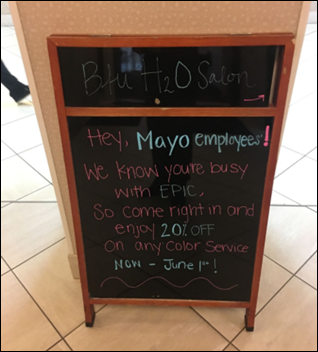
A hair salon near the Mayo Clinic in Rochester, MN wants to help staffers look their best for this weekend’s Epic go-live.


Sponsor Updates

image

  • Ellkay hosts a rappelling event at its office to raise $70,000 for the autism-focused Alpine Learning Group.
  • EClinicalWorks will exhibit at the 2018 UCAOA Urgent Care Convention & Expo May 6-8 in Las Vegas.
  • Change Healthcare updates its Acuity Revenue Cycle Analytics to include front-end patient access analytics.
  • Formativ Health will exhibit at HLTH 2018 May 6-9 in Las Vegas.
  • FormFast publishes “The Essential EHR Guide to Value & Sustainability, a Meditech eBook.”
  • Healthfinch will exhibit at the National Physicians Conference May 10-12 in Fort Lauderdale, FL.
  • Healthwise will exhibit at the EClinicalWorks Health Center Summit May 9-11 in Orlando.
  • LogicStream Health publishes a new case study featuring Carilion Clinic, “Reduction of Post-Surgical Venous Thromboembolism with Clinical Process Measurement.”
  • Iatric Systems will exhibit at ANIA 2018 May 10-12 in Orlando.
  • Loyale Healthcare adds patient financing solutions from ClearBalance to its Patient Financial Management software.
  • Imprivata exhibits at NAHAM May 3-6 in Denver.
  • Owler names Pivot Point Consulting Managing Partner Rachel Murano one of the top 10 female leaders of private companies.
  • Intelligent Medical Objects will exhibit at the AMIA Clinical Informatics Conference May 8-10 in Scottsdale, AZ.

Blog Posts


Contacts

Mr. H, Lorre, Jenn, Dr. Jayne.
Get HIStalk updates. Send news or rumors.
Contact us.

125x125_2nd_Circle

Health Catalyst Acquires Medicity

May 3, 2018 News 1 Comment

image

Data analytics vendor Health Catalyst acquires health information exchange vendor Medicity. The companies are 14 miles apart from one another in Salt Lake City. 

“Based on the evolution of Aetna’s consumer health strategy,” a company representative says, “we have agreed to divest Medicity to Health Catalyst. The transaction is expected to close within 90 days. We are not disclosing further details at this time.”

Though the company rep didn’t disclose price, it’s worth noting Aetna acquired Medicity in early 2011 for $500 million.

image

Health Catalyst President Brent Dover served as president of Medicity prior to joining Health Catalyst in 2013. His time with the company began with Park City Solutions, which Medicity acquired in 2006. This acquisition is Health Catalyst’s second. It purchased competitor Health Care DataWorks in 2015. Though the Medicity team alerted us to the development early, I chose not to release the news until employees and customers had been notified.

EPtalk by Dr. Jayne 5/3/18

May 3, 2018 Dr. Jayne Comments Off on EPtalk by Dr. Jayne 5/3/18

I had a medical student working with me this week and delivered a mini-lecture on healthcare funding in the United States and why some practices don’t take Medicaid or opt out of Medicare. It was an eye opener to a student in his third year, which tells me that healthcare finance isn’t part of his medical school’s curriculum. He was surprised to learn that compared to the cost of delivering care in our metropolitan area, that Medicare typically pays 80 cents on the dollar but Medicaid only pays 24 cents on the dollar. Something tells me that after our conversation, his primary care fire is not burning bright.

We spent some time talking about concierge medicine and direct primary care, and he found this piece about concierge emergency services. Apparently, patients on New York’s Upper East Side can afford to pay upwards of $5,000 annually for access to a private emergency practice plus per-visit fees. According to the article, the facility keeps two physicians and a physician assistant ready to see patients at all times, but only see a handful of patients each day. I couldn’t help but try to calculate their expense model in my head while he was telling me about the piece, and as I saw my 16th patient in three hours, I began to wonder if they are hiring.

We also discussed this American Academy of Family Physicians “In the Trenches” blog post addressing the need for competition and innovation in the EHR market. It brings up some good tidbits that I had forgotten. First, let’s take a look back to 2004. President George W. Bush included computerized health records in his State of the Union Address, and in April of that year launched a campaign to promote healthcare transformation. The initiative projected that “within the next 10 years, electronic health records will ensure that complete healthcare information is available for most Americans at the time and place of care, no matter where it originates.” That decade has come and gone, and for most of us, health records are held in a patchwork of systems that don’t talk to each other.

My favorite quote from blog author Shawn Martin is regarding EHRs: “They suck. They suck as products, and they suck the life out of everyone that uses them.” He goes on to describe other technology platforms such as Facebook, Twitter, iPhone, Uber, and others, which significantly transformed how people communicate and interact, and the lack of transformation in healthcare technology. That’s not to say that innovative tools aren’t out there, but there are quite a few dinosaurs that feel like they should already be extinct. One of my colleagues jumped into the conversation, and we reminisced about a couple of key features that we used to have in our ancient Medical Manager OmniDoc system circa 2003 that we still don’t have in our current system in 2018, despite numerous “enhancement requests.”

Martin hits the nail on the head with his summary of the AAFP efforts to improve innovation: “Eliminate or reduce administrative requirements placed on health IT products – the poor usability of EHRs is often due to external requirements established by regulators and payers, such as clinical documentation, which do not add clinical value.” I remember the copy of the physician note that my father brought back from a trip to Australia, when he had a wicked case of sinusitis. Basically, it documented a brief history, described the physical exam as it related to sinus findings, then proceeded to a diagnosis and an antibiotic recommendation. There was no capturing bullet points to substantiate billing requirements or other such nonsense. The detail told me exactly what was going on with the patient and didn’t drive me to distraction. Sure, it didn’t include an assessment of my father’s chronic conditions, his nutritional status, whether he is a fall risk, or a number of other data points, but I envy the physician who was able to focus on the problem at hand and still get paid, even in the outback. I look forward to the day when we have systems that are better at highlighting important data while allowing less-critical data points to fade to the background unless clinical decision support or other algorithms identify a need to bring that information to the front.

image

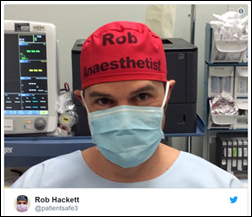
I heard about the idea of “signing your scrub cap” several months ago, but hadn’t seen it in person until this week. I was attending a Grand Rounds lecture at my hospital, and several people walked in with their name and role written on their scrub caps. Of course, one always has to wonder why people wear their caps outside the surgery suite, but I appreciate the move towards clear identification of the care delivery team. Having been the nameless student responding to “you, more tension on the retractor” for several years, it might have added some humanity to medical school rotations. As a patient, there are so many people in and out when you’re having a procedure, it would be great to not have to guess who is who especially when you have mind-altering drugs dripping through your IV.

I wrote about the All of Us Research Program some time ago, and its national launch is finally here. Beginning on May 6, adults 18 and older can join this project, which is part of the Precision Medicine Initiative. Billed as potentially the longest and most diverse longitudinal health research program ever developed, it needs more than a million individuals to provide data. Participants will share both patient-generated and EHR data, and may also be asked to provide biometric data along with blood and urine samples. The consent process takes up to 30 minutes to complete and can’t be interrupted, so if you decide to take part be sure you have a comfy chair to work from.

image

Not from Weird News Andy, but might as well be: A hotel guest recently allowed to stay at the Fairmont Empress in Victoria after being banned more than a decade ago due to some bad decisions involving pepperoni. As the story goes, the traveler had a “suitcase full of pepperoni” and left it near an open window so it would stay cool. While he was out of the room, seagulls discovered the suitcase, ate the pepperoni, and left a mess in the room. I’ve seen a raccoon open a tab-top soda can, but after reading the story I wasn’t exactly sure how a seagull opens a suitcase. Fortunately, NPR had some more thorough reporting and explained that the pepperoni was actually laid out on a table near the window.

Email Dr. Jayne.

Comments Off on EPtalk by Dr. Jayne 5/3/18

Morning Headlines 5/3/18

May 2, 2018 Headlines Comments Off on Morning Headlines 5/3/18

Beth Israel Deaconess Medical Center Launches Health Technology Exploration Center

Beth Israel Deaconess taps CIO John Halamka, MD to lead its new Health Technology Exploration Center, which will explore the role of emerging technologies like blockchain and IoT in healthcare delivery.

Cerner Reports First Quarter 2018 Results

Cerner shares drop after the company reports lower than forecasted Q1 revenue of $1.29 billion.

Nokia is selling its smart watch and digital health business

After acquiring Withings in 2016 to build out its digital health business, Nokia plans to sell the business to Withings co-founder and former chairman Éric Carreel.

Comments Off on Morning Headlines 5/3/18

Morning Headlines 5/2/18

May 1, 2018 Headlines Comments Off on Morning Headlines 5/2/18

Health2047 Inc. Secures $27.2M Investment From the American Medical Association to Fuel Business Momentum

AMA invests $27 million in the Health2074 technology company it founded in 2016 with a $15 million investment.

EXL deepens investment in Healthcare and Analytics by signing a definitive agreement to acquire payment integrity and population risk management company SCIOInspire Holdings, Inc.

Operations management and analytics company EXL will acquire SCIO Health Analytics for $240 million.

Jackson Won’t Return As Trump’s Personal Physician, Report Says

White House officials conclude that several of the allegations made against President Trump’s former personal physician and VA Secretary nominee Ronny Jackson, MD released last week by Senator Jon Tester (D-MT) are not true.

Comments Off on Morning Headlines 5/2/18

News 5/2/18

May 1, 2018 News 10 Comments

Top News

image

Reports surface that West Palm Beach family physician Bruce Moskowitz, MD has participated in several planning calls with the VA/Cerner contracting team, and may in fact be responsible for its delay. Moskowitz, who has ties to President Trump’s inner Mar-a-Lago social circle, has been vocal about his dislike of Cerner’s software based on his use at two Tenet hospitals in Florida – technology deemed out of date by investigators from the VA’s Office of Information and Technology.

image

Moskowitz’s influence and that of Marvel Entertainment Chairman Ike Perlmutter, who has also been on the calls, reportedly rankled former VA Secretary David Shulkin, MD and clinicians involved with the EHR project. Their influence came to national light in 2016, when they helped to convene a hush-hush meeting at Mar-a-Lago between President-elect Trump and leaders from the Cleveland Clinic, Johns Hopkins, the Mayo Clinic, and Partners HealthCare.


HIStalk Announcements and Requests

image

Responses to this week’s question are trickling in, with most emphasizing the tightrope managers must walk in firing someone that deserves it, but not being able to articulate the reasons why to the rest of the company for confidentiality reasons. I hope you’ll add your experience to the mix.


Webinars

May 9 (Wednesday) 2:00 ET. “How to Make VBC Work for You: The Business Case to Transform Into the Health System of the Future.” Sponsor: Philips Wellcentive. Presenters: Mason Beard, co-founder and chief product officer, Philips Wellcentive; Scott Cullen, MD, principal, ECG Management Consulting; Seema Mathur, director of strategy, Sage Growth Partners. How well is your organization funding its transformation to VBC? This free webinar explains how to achieve ROI as your organization transforms to meet the future. You’ll learn how VBC is impacting healthcare system management, three strategies for funding your transformation, and what the healthcare system of the future will look like.

May 24 (Thursday) 1:00 ET. “Converting Consumers into Patients: Strategies for Creating Engaging Digital Experiences People Demand.” Sponsor: Healthwise. Presenters: Antonia Chappell, director of consumer solutions, Healthwise; Josh Schlaich, senior product manager, Healthwise. Nearly three-quarters of US adults use a digital channel to manage their health and the internet to track down health information. It’s clear that consumers have come to expect online interactions as an integral part of their overall patient experience. In fact, the Internet may be the first way people come in contact with your organization. They have more choice than ever on where to get healthcare services, and their decisions are increasingly influenced by how well organizations connect with them in the digital space. This webinar will show you how to create engaging digital and web experiences that convert casual consumers into patients and keep them satisfied throughout their entire patient journey.

June 5 (Tuesday) 1:00 ET. “Increase Referrals and Patient Satisfaction with a Smarter ‘Find a Doctor’ Web Search.” Sponsors: Phynd Technologies, Healthwise. Presenters: Joseph H. Schneider, MD, MBA, FAAP, retired SVP/CHIO, Indiana University Health; Keith Belton, VP of marketing, Phynd. A recent survey found that 84 percent of patients check a hospital’s website before booking an appointment. However, ‘Find a Doctor’ search functions often frustrate them because their matching functionality is primitive and the provider’s information is incomplete or outdated. Referring physicians need similarly robust tools to find the right specialist and to send the patient to the right location. Attendees of this webinar will learn how taxonomy-driven Provider Information Management improves patient and referrer satisfaction by intelligently incorporating the provider’s location, insurance coverage, specialty and subspecialty, and services offered that can be searched via patient-friendly terms.

Previous webinars are on our YouTube channel. Contact Lorre for information.


Acquisitions, Funding, Business, and Stock

image

Agfa Healthcare receives FDA 510(k) clearance for its DR 800 multipurpose digital imaging system.

image

Enterprise telemedicine vendor InTouch Health acquires competitor Reach Health for an undisclosed sum.

image

AMA invests $27 million in the Health2047 technology company it founded in 2016 with a $15 million investment. The company launched health data network Akiri (fka Switch) last year, and plans to develop additional companies in the areas of physician productivity, value-based care, chronic disease, and data exchange.

image

Operations management and analytics company EXL will acquire SCIO Health Analytics for $240 million.

image

Health data management company Datavant raises $40 million and acquires data de-identification vendor Universal Patient Key. Former FDA CIO Eric Perakslis now serves as Datavant’s chief scientific officer.


People

image

Lety Nettles (Baker Hughes) joins Novant Health as CIO.

image

Omkar Kulkarni (Cedars-Sinai) joins Children’s Hospital Los Angeles as its first chief innovation officer.

image image

Clearwater Compliance names John Moore (PwC) chief risk officer and Richard Staynings (Cisco) chief security and trust officer.


Announcements and Implementations

In an effort to keep up with the Apple and Amazon Joneses, Fitbit will use Google’s Cloud Healthcare API to share user data with providers via their EHRs.

image

Providence St. Joseph Health (WA) launches a Virtual Health System comprising 50 telemedicine programs across 100 facilities in five states.

image

UCHealth Yampa Valley Medical Center (CO) will go live on Epic in early May.

image

Kaweah Delta Medical Center (CA) goes live on Cerner. The organization was due to replace its Cerner/Siemens Soarian system with Cerner Millenium in November 2017.

Main Line Health (PA) integrates Bernoulli Health’s clinical surveillance, medical device integration, and data analytics platform with its EHR at four hospitals.

The SSI Group adds patient payment management capabilities to its Access Management line of revenue cycle software.


Government and Politics

image

CDC Director Robert Redfield, MD asks for and receives a pay cut after reports surface that his projected salary of $375,000 was far above those of his HHS colleagues, including his boss, HHS Secretary Alex Azar. Redfield’s initial compensation was determined by the Title 42 salary program, which was established to attract top-notch researchers to government posts.

image

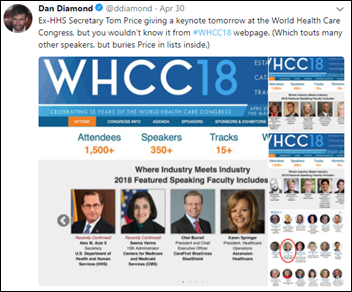
Former HHS Secretary Tom Price, MD gives a keynote at the World Health Care Congress, during which he admits that doing away with the individual mandate “actually will harm the pool in the exchange market because you’ll likely have individuals who are younger and healthier not participating in that market. And, consequently, that drives up the cost for other folks in that market.”

image

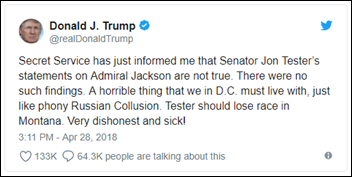
White House officials conclude that several of the allegations made against President Trump’s former personal physician and VA Secretary nominee Ronny Jackson, MD released last week by Senator Jon Tester (D-MT) are not true. Jackson, who withdrew his nomination after the allegations came to light, will stay on as an active duty Navy physician within the White House medical unit.


Sales

  • University of New Mexico Hospital will implement Glytec’s eGlycemic Management System.

Privacy and Security

The NHS will convert all devices to Windows 10 in an effort to prevent cyberattacks like WannaCry, which last year hit a third of its facilities and led to the cancellation of thousands of appointments and procedures.


Other

image

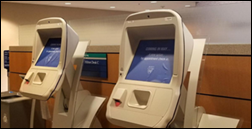
As part of its $1.5 billion transition to Epic this weekend, Mayo Clinic will activate 51 patient intake kiosks at its campus in Rochester, MN. This won’t be the health system’s first foray into kiosks. It tried out two HealthSpot telemedicine kiosks in 2014 to remotely serve a local school and employer. That endeavor ended when HealthSpot went out of business two years later.


Sponsor Updates

  • Pivot Point Consulting partners with Trinisys to help customers migrate their legacy EHR data to new systems.
  • Clinical Architecture and CompuGroup Medical will exhibit at HLTH 2018 May 6-9 in Las Vegas.
  • KLAS gives Health Catalyst an “A” for high rates of customer satisfaction and customer retention in a new report, “Decision Insights 2018: National Trends & Best Practices.”
  • AdvancedMD will exhibit at APA’s annual conference May 5-9 in New York City.
  • Docent Health CEO Paul Roscoe will speak at HLTH 2018 May 8 in Las Vegas.
  • Casenet adds MCG Health’s Chronic Care Guidelines to its new TruCare Assessment and Care Plan Interface.
  • Aprima and Surescripts will co-present at Asembia’s 2018 Specialty Pharmacy Summit May 2 in Las Vegas.
  • Bluetree Network will exhibit at the 2018 Spring Hospital & Healthcare IT Conference May 2-4 in Atlanta.
  • Datica CEO Travis Good, MD will present at HLTH 2018 May 6-9 in Las Vegas.
  • Cumberland Consulting Group will exhibit at the NCPDP Annual Technology and Business Conference May 7-9 in Scottsdale.
  • Surescripts publishes a new white paper, “Changing the Course of the Opioid Epidemic: The Power and Promise of Proven Technology.”
  • Vyne develops an exchange platform to help payers manage member-related communications.
  • Medecision adds appeals and grievances monitoring, tracking, and management capabilities for payers to its Aerial product line.
  • GCS Medical College, Hospital & Research Centre in India selects the eClinicalWorks Hospital Management Information System.
  • ZappRx adds FDB’s e-prescribing capabilities to its specialty drug prescribing and prior authorization platform.

Blog Posts


Contacts

Mr. H, Lorre, Jenn, Dr. Jayne.
Get HIStalk updates. Send news or rumors.
Contact us.

125x125_2nd_Circle

Morning Headlines 5/1/18

April 30, 2018 Headlines 2 Comments

Fitbit stock soars after announcement of collaboration with Google

Fitbit will use Google’s Cloud Healthcare API to share user data with providers via their EHRs.

American Well to Acquire Avizia, Deepening Capabilities in Acute Care Delivery

American Well will acquire acute care telemedicine vendor Avizia for an undisclosed sum.

‘Who the hell is this person?’ Trump’s Mar-a-Lago pal stymies VA project

Reports surface that a West Palm Beach physician with ties to President Trump’s inner circle may be behind the VA/Cerner contract delay. Bruce Moskowitz, MD has expressed dissatisfaction with Cerner’s technology based on his use at two hospitals in Florida.

Datavant Acquires Universal Patient Key and Closes $40M Financing Round

Health data management company Datavant raises $40 million and acquires data de-identification vendor Universal Patient Key.

Curbside Consult with Dr. Jayne 4/30/18

April 30, 2018 Dr. Jayne Comments Off on Curbside Consult with Dr. Jayne 4/30/18

image

A former colleague of mine is working on some health system initiatives to deliver community-based care. They’re working to identify the disease states that have the most potential to benefit patients who frequently wind up in the emergency department due to lack of care for chronic conditions. While they sort through the data, they’re already partnering with a set of local charities to address basic issues such as food insecurity through school-based food pantries. For many of the children in their target communities, the federal school lunch program may be providing the only balanced meal of the day, and this changes dramatically when schools let out for the summer. They are also working to provide clothing including school uniforms, and have found additional challenges with families who may receive uniforms but don’t have access to facilities to launder them. The health system is working under the hypothesis that they’re not going to be able to drive the needle on patient outcomes unless they address some of the basic needs in the community, in partnership with organizations already working in that direction.

The health system is already targeting adult populations with a mobile unit that performs diabetes outreach, but they’ve found that many of the patients that come to the mobile unit are already diagnosed and have physicians, but visit the van for testing that they feel is more convenient than going to the doctor’s office. There’s a risk of care fragmentation in that scenario, and the mobile unit has had to change its protocols to shift from strictly performing screening to adding care coordination and communication with primary care physicians. In looking at the next phase of community-based care, they have completed an amazing amount of analysis with emergency department records, community health clinic records, and data from state registries.

She told me about a couple of organizations that they have researched as potential models for their programs, and I took a peek at one of them. There is truly some amazing work going on that goes right along with the transformation to value-based care, but aren’t readily visible to many of us in the trenches. One of them is Mobile Care Chicago, which deploys vans to address childhood asthma in underserved communities. Their community health workers partner with schools to screen children for asthma symptoms, then reach out to the parents of those children to consent for care. Those who opt in receive an examination and often a diagnosis of asthma. The van visits schools monthly and tries to ensure the patients have continuity of care with providers over time.

Patients are seen an average of four times during the first year, and those who are not showing progress are referred for home visits. The cost savings data is pretty impressive, especially considering that some children with asthma might visit the emergency department more than a dozen times in a year, often without a formal diagnosis of asthma or a commitment for follow-up. Missed school days are down; emergency department visits and admissions are down as well, from 36 percent to 3 percent. The cost savings is impressive – it costs $900 annually to deliver care via the van, versus $15,000 for children who have to be hospitalized. The potential savings to local health systems is over $6 million.

Mobile Care Chicago also offers a dental van and a general children’s health van in addition to the asthma van. I’m curious what systems they use for documentation, to ensure the patients have a comprehensive health record and to make sure data is available for continuity purposes if a patient would arrive at the emergency department. There are always challenges when public and private organizations are involved, and sometimes data ownership and coordination become barriers. Years ago, I worked on an HIE project where various community clinics couldn’t agree on data sharing and governance, resulting in a structure that resembled more of a data vault than something that was truly interoperable. Providers could view data from other facilities but couldn’t download it or incorporate it into the clinical chart, making it less attractive to use especially given the separate login and clunky web interface. There were always battles about how new interfaces were going to be funded and whether new member organizations would be allowed to submit their data for viewing. Based on recent projects I’ve seen, those kinds of challenges are still out there.

I’d be interested to hear from clinical informaticists that are working with organizations like Mobile Care Chicago on how they leverage technology to make this all happen. Are they using available public health data from sites like HealthData.gov or gathering their own from local providers and facilities? How do they decide what communities to target? Do they change their outreach strategies based on modeling versus current data trends? Is it better to expand over a wider geographical area or to add more depth to services in areas that are already being served? In looking at potential models for our community, there will have to be a fair amount of consideration of the mobile approach versus trying to develop school-based clinics. I’m sure there are a multitude of legal and regulatory hurdles that will need to be fully evaluated for either option.

The Mobile Healthcare Association helps connect groups interested in mobile clinic operations, and offers regional coalitions for shared learning along with special interest groups for mammography and vision care providers. The organization advocates for mobile health delivery organizations and hosts an annual forum for members. They also help connect organizations with other members who might be selling their pre-owned clinics, and provide tips on selecting a diesel- or gasoline-powered vehicle. Those are entirely new dimensions for healthcare delivery that I hadn’t even considered.

Bringing healthcare to the people isn’t a new concept, but it’s something to think about every time a hospital builds a shiny new addition. Are we really serving patients better by expanding tertiary referral centers versus considering alternate delivery options such as mobile, school-based, or workplace clinics? It should be fairly straightforward to analyze the data over the next few years and determine who really is getting the best bang for their buck.

Are you involved in the delivery of mobile healthcare? How does your organization leverage information technology? Leave a comment or email me.

Email Dr. Jayne.

Comments Off on Curbside Consult with Dr. Jayne 4/30/18

Morning Headlines 4/30/18

April 29, 2018 Headlines Comments Off on Morning Headlines 4/30/18

DOD’s e-health record implementation to kick back off in 2019

DoD officials reassure legislators that the MHS Genesis roll out will pick back up with West Coast facilities in 2019, and that full deployment by 2022 is still achievable.

Erlanger earnings take a hit from new record system

Erlanger Health System (TN) attributes its third quarter $4 million shortfall to a 10-year, $100 million Epic implementation that kicked off with inpatient services last fall.

Jeremy Hunt launches review into training NHS staff to use new tech

In the UK, Health Secretary Jeremy Hunt brings in Eric Topol, MD to lead a review of how to best train NHS staff on using new technologies including AI, digital health, robotics, and genomics.

Comments Off on Morning Headlines 4/30/18

Monday Morning Update 4/30/18

April 29, 2018 News 3 Comments

Top News

image

DoD officials reassure legislators that the MHS Genesis roll out will pick back up with West Coast facilities in 2019, and that full deployment by 2022 is still achievable. Implementation of the Cerner-based system had been paused for several months to deal with issues at the program’s four pilot sites, including problems with e-prescribing, referrals, log-in time, and training. The DoD has been sharing its experiences with VA officials on a regular basis to prepare them for their own Cerner roll out, provided a contract is signed in the coming months as some still optimistically expect.


HIStalk Announcements and Requests

image

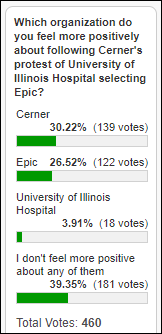
The contract drama playing out in Illinois hasn’t swayed the majority of poll respondents to think more positively about the parties involved, though Cerner does have a slight lead in a vendor-to-vendor matchup (an outcome one reader has attributed to ballot-box stuffing). At this point, I have to wonder how in-the-trenches end users feel. Email me if you happen to work at the health system, or have experienced a similar situation at another organization and would like to share your thoughts – anonymously, of course.

New poll to your right or here: Have recent privacy headlines impacted your interest in consumer genetic testing services? It seems we live in a time when data breaches are par for the course, and signing away your data rights just to trace your ancestry doesn’t give people as much pause as it should. I could offer a number of response options, but I’m keeping it simple with just three in hopes that you’ll explain in the comments why your interest has waned, stayed the same, or increased.

image

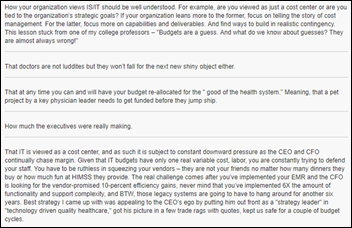
Check out reader responses to “What I Wish I’d Known Before … Creating, Defending, or Managing a Hospital IT Budget.” While I can’t say I’m surprised by any of them, I can say I appreciate the advice of “realistic contingency” from a reader’s college professor.

image

This week’s question seems timely given the plethora of headlines surrounding government officials who are being shown the door through media (and Twitter) pressure.


Webinars

May 9 (Wednesday) 2:00 ET. “How to Make VBC Work for You: The Business Case to Transform Into the Health System of the Future.” Sponsor: Philips Wellcentive. Presenters: Mason Beard, co-founder and chief product officer, Philips Wellcentive; Scott Cullen, MD, principal, ECG Management Consulting; Seema Mathur, director of strategy, Sage Growth Partners. How well is your organization funding its transformation to VBC? This free webinar explains how to achieve ROI as your organization transforms to meet the future. You’ll learn how VBC is impacting healthcare system management, three strategies for funding your transformation, and what the healthcare system of the future will look like.

May 24 (Thursday) 1:00 ET. “Converting Consumers into Patients: Strategies for Creating Engaging Digital Experiences People Demand.” Sponsor: Healthwise. Presenters: Antonia Chappell, director of consumer solutions, Healthwise; Josh Schlaich, senior product manager, Healthwise. Nearly three-quarters of US adults use a digital channel to manage their health and the internet to track down health information. It’s clear that consumers have come to expect online interactions as an integral part of their overall patient experience. In fact, the Internet may be the first way people come in contact with your organization. They have more choice than ever on where to get healthcare services, and their decisions are increasingly influenced by how well organizations connect with them in the digital space. This webinar will show you how to create engaging digital and web experiences that convert casual consumers into patients and keep them satisfied throughout their entire patient journey.

May 29 (Tuesday) 1:00 ET. “Increase Referrals and Patient Satisfaction with a Smarter ‘Find a Doctor’ Web Search.” Sponsors: Phynd Technologies, Healthwise. Presenters: Joseph H. Schneider, MD, MBA, FAAP, retired SVP/CHIO, Indiana University Health; Keith Belton, VP of marketing, Phynd. A recent survey found that 84 percent of patients check a hospital’s website before booking an appointment. However, ‘Find a Doctor’ search functions often frustrate them because their matching functionality is primitive and the provider’s information is incomplete or outdated. Referring physicians need similarly robust tools to find the right specialist and to send the patient to the right location. Attendees of this webinar will learn how taxonomy-driven Provider Information Management improves patient and referrer satisfaction by intelligently incorporating the provider’s location, insurance coverage, specialty and subspecialty, and services offered that can be searched via patient-friendly terms.

Previous webinars are on our YouTube channel. Contact Lorre for information.


Acquisitions, Funding, Business, and Stock

image

Erlanger Health System (TN) attributes its third quarter $4 million shortfall to a 10-year, $100 million Epic implementation that kicked off with inpatient services last fall. The system held off on billing during November as it worked through software issues, ultimately writing 30 million lines of code to resolve 15,000 workflow problems as part of an expected stabilization phase.

From the Athenahealth earnings call, which sent shares down 11 percent on Friday:

  • The company expects to continue to rely on its core ambulatory and growing small-hospital markets.
  • Management team and board member Dave Robinson and Chief Product Officer Kyle Armbrester have both left the company, with an ongoing search for a president progressing apace.
  • CEO Jonathan Bush admits the company hasn’t done much with market share: “We are good at getting our clients’ patients back, when it’s time for them to come back. But new work needs to be done to get net new market share for our clients. I believe I mentioned when we were talking about the cost guarantee a couple of calls ago that someday I wanted to have a market share guarantee.”
  • Bush also points out that the company’s coordinator and inpatient software may have been brought to market too early.
  • Sales and marketing spend may have been cut too drastically, though the company isn’t scrambling to adjust its budget yet. Its strategic overhaul of staff and spending is nearly complete.
  • With regard to a national patient-centric medical record, Bush said that the “ability to be integrated in to all the hospitals in the country, all the labs in the country to present whether it’s a pharmacy, clinical staffer, pharmacy based staffer or virtual physician or an emergency room doc, with a complete picture of a patient regardless of where they’ve gotten their care is a power position that no one has right now in the country, no one. We believe we will attain that position.”
  • The company’s lighter bookings season has given Bush’s team time to reassess the way it assigns customer success managers and on-boards new clients. “We’re getting much more instrumented,” Bush stressed; “we are working very hard on the number of days associated with ramping up some ones’ collections to full volume after they go live.”
  • Bush attributes churn to ambulatory M&A: “We’ve seen as groups get consolidated up in to bigger networks, if the bigger network is on competitive product, decision might be to go on to one platform, and that has tended to be the biggest driver of churn.”
  • Bush says, “Epocrates is crushing it. Docs on the app are increasing and the appetite to feed a content is increasing, the ability for us to manage content, serve it up in a modern way for our advertising customers is improving and the energy is just electric. I can’t tell you how proud we are after such a long road.”
  • Regarding recent layoffs and reductions, Bush says that “[a]fter-surgery recovery is a big deal, even if the surgery is life saving and Athena certainly inflicted surgery upon itself in the fourth quarter of last year. So attrition and cultural confidence, engagement, belief that there is not some other shoe looking to drop, these are the kinds of things that are the prime focus for me and my team right now.”

Sales

  • Cape Fear Valley Health System (NC) will replace two Cerner systems with Epic beginning in Summer 2019.

People

image

Athenahealth SVP of Network Services Jonathan Porter takes on the role of chief product officer.


Privacy and Security

image

In Montana, Billings Clinic notifies 934 patients of an email data breach that may have compromised patient names, birth dates, phone numbers, and some medical information.


Other

image

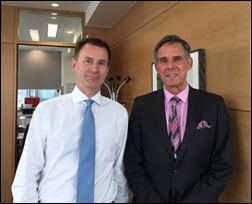
In the UK, Health Secretary Jeremy Hunt brings in Eric Topol, MD to lead a review of how to best train NHS staff on using new technologies including AI, digital health, robotics, and genomics. NHS is in the middle of its 100,000 Genomes Project, which aims to use genetic sequencing and big data to develop precision medicine programs.

image

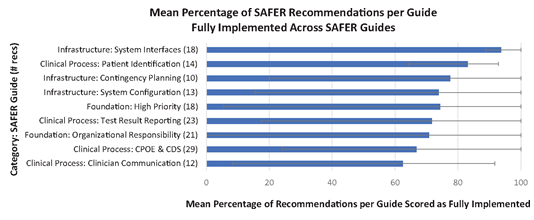
A new study in JAMIA finds that health system adherence to the ONC-funded SAFER (Safety Assurance Factors for EHR Resilience) guides developed in 2014 is lacking. Researchers found that only 25 recommendations were fully implemented at the eight health systems who participated in SAFER self-assessments. The study’s authors conclude that national policy programs are needed to ensure proactive SAFER assessments become a best practice.

image

In his latest “Doctors Gone Wild” segment, Weird News Andy recounts the arrest of Georgia family practice physician Marian Antoinette Patterson, MD who threatened to slit the throats of her employees, and cut another’s head off for use as a hallway bowling ball. Her other unsavory activities, which some have attributed to intoxication but WNA thinks also exude a hint of physician burnout, include throwing water on employees and tearing her diploma off the wall and stomping on it.


Sponsor Updates

  • Surescripts will exhibit at the MicroMD User Conference 2018 May 2-3 in Warren, OH.
  • Vocera Communications will host its first Chief Experience Officer Roundtable April 25-26 in San Francisco.
  • WebPT publishes a new guide, “Retention, Please: Why Patient Dropout is Killing Rehab Therapy Practices – and How to Stop It.”
  • KLAS recognizes LogicStream Health as a high performer in its latest report on clinical process improvement.

Blog Posts


Contacts

Mr. H, Lorre, Jenn, Dr. Jayne.
Get HIStalk updates. Send news or rumors.
Contact us.

125x125_2nd_Circle

What I Wish I’d Known Before … Creating, Defending, or Managing a Hospital IT Budget

How your organization views IS/IT should be well understood. For example, are you viewed as just a cost center or are you tied to the organization’s strategic goals? If your organization leans more to the former, focus on telling the story of cost management. For the latter, focus more on capabilities and deliverables. And find ways to build in realistic contingency. This lesson stuck from one of my college professors – "Budgets are a guess. And what do we know about guesses? They are almost always wrong!"



That doctors are not luddites but they won’t fall for the next new shiny object either.


That at any time you can and will have your budget re-allocated for the " good of the health system." Meaning, that a pet project by a key physician leader needs to get funded before they jump ship.


How much the executives were really making.


That IT is viewed as a cost center, and as such it is subject to constant downward pressure as the CEO and CFO continually chase margin. Given that IT budgets have only one real variable cost, labor, you are constantly trying to defend your staff. You have to be ruthless in squeezing your vendors – they are not your friends no matter how many dinners they buy or how much fun at HIMSS they provide. The real challenge comes after you’ve implemented your EMR and the CFO is looking for the vendor-promised 10-percent efficiency gains, never mind that you’ve implemented 6X the amount of functionality and support complexity, and BTW, those legacy systems are going to have to hang around for another six years. Best strategy I came up with was appealing to the CEO’s ego by putting him out front as a "strategy leader" in "technology driven quality healthcare," got his picture in a few trade rags with quotes, kept us safe for a couple of budget cycles.


After a go-live, be real clear with the CFO on the difference between remediation and optimization. Twenty percent on top of the original TCO for optimization in ok, but if a buzz starts that the 20 percent is just to deliver things originally promised, that’s a problem.


That a boss at a previous employer was more concerned about giving his buddy some business he would move around project priorities based on which vendors got the bid rather than actual need. Which is how we ended up buying a metric crapload of servers and networking gear but no racks or power distribution to actually install them.


That leadership would not stick to the budget and would always find a way to fund special projects without any considerations of the resource planning that had already taken place. Especially when leadership bends the budget for non-IT departments to purchase new IT-dependent products without allowing for any increase in the IT budget for implementation and support.


That finance sets the rules and will let you know when you are not following them but do not necessarily tell you what the rules are. Always add a minimum of 10 percent to your best-guess cost projection to cover the unknown.


Previous budget data, operational metrics, and how more/less efficient the proposed budget is.


Weekender 4/27/18

April 27, 2018 Weekender 4 Comments

weekender


Weekly News Recap

  • A proposed HHS rule would retarget the Medicare and Medicaid EHR Incentive Programs to “a new phase of EHR measurement with an increased focus on interoperability and improving patient access to health information.”
  • Kansas-based transcription firm Medantex takes down its customer web portal after security researcher Brian Krebs notifies the company that its audio recordings and site administrative functions were wide open to any Internet user.
  • Doctor on Demand raises $74 million in a Series C funding round led by Princeville Global and Goldman Sachs Investment Partners.
  • Rear Admiral Ronny Jackson, MD withdraws his nomination for VA Secretary after Senate Democrats publish allegations against him that include giving out prescription drugs to staffers, drinking to excess while on the job, and managerial misconduct.
  • The FDA launches a digital health incubator and announces it will tweak its pre-certification software program to better accommodate AI-powered technology.

Best Reader Comments

All the hullabaloo around UIC’s Epic and Cerner mess is pretty pointless. And so are the Black Book and KLAS results. Nobody, absolutely nobody (and that includes providers, patients, IT support people) is delighted with either Cerner or Epic (13 clicks to get the right information out in ICU from Epic!!!). At the end of the day, these are two highly mediocre products with not much daylight between them in an industry that has traditionally not asked much from its IT vendors probably because as an industry, it itself doesn’t believe in excellence in customer service. To paraphrase an old computer science term: “mediocrity in, mediocrity out.” (John Yossarrian)

I’m not struck by the infighting or backstabbing; that’s par for the course at a complicated organization as you describe. I am struck — shocked even — that you’ve got physicians who want to be involved in decision making during the implementation. Maybe we all have finally learned that if you’re at the table, you get to make decisions. All too often, docs who were begged to come to meetings but are “too busy” are upset at the final result they see at go-live! (Craig Joseph, MD)

I have seen a mixed bag of tricks for these situations. There is no specific singular “path” for for every organization or hospital/medical center to follow. “Buy in” starts with ownership and who has control of the purse strings- for instance, one hospital contracted their anesthesiologist and the anesthesia group contracted their nurse anesthetist who did not want to use the electronic surgical record. “ Buy In” came when we worked with the anesthesia group to give them the “WIIFM” (What’s In It Form Me) benefits of using the EHR. Once we had anesthesia on board. We worked with the nurse anesthetist groups “key influencers” to gain their willingness. ultimately, the organization made the EHR trading mandatory and they agreed to pay for RNA’s time spent learning to use the EHR which turned out to be the biggest “buy in.” We worked out the residency problems by coming to the conclusion the organization would hire scribes in emergency areas. These methods may not have worked in another organization or another part of the country. It also depends on whether they have unions and the budget. (Lisa Hahn, RN)

On the whole conference thing and engaging the audience. If the purpose of a conference (or one of the main purposes) is to educate an audience, and if the lecture is one of the least effective methods for educating an audience, then it would follow that trying some different techniques to engage the audience would make sense. There’s a pretty great story of how Professor Eric Mazur changed his teaching at Harvard (physics), when he discovered his students really didn’t learn anything (just memorized). You can take a deep dive on that here. My point is not that a cheesy unmotivational speaker is good, but rather that most presentations done in a lecture format deliver far less educational value than methods that engage the learner. I get that you are a no-nonsense guy, and I really don’t want to hug people I don’t know either, but we can do better than a talking head and a PPT. (jp)


Watercooler Talk Tidbits

image image

Readers funded the DonorsChoose grant request from first-year teacher Ms. P in Louisiana, who asked for math manipulatives and whiteboard supplies for her Grade 7-8 special education math class. She checks in, "Thank you for your support of my students in our classroom! Our class operates 2-5 years below grade level, but still needs to access seventh-grade material. With your help, our new math ‘toys’ have made a tremendous difference in their understanding and ability to conceptualize many abstract math practices. Thank you again for being a champion and cheerleaders for our class."

image

In Australia, Royal Adelaide Hospital comes under fire for spending money on memos instructing staff on how to open doors that don’t even appear to be new. The hospital made news in February after a software failure led to a power outage during two surgeries.

image

After being fired from the Texas Health and Human Services Commission for unspecified HIPAA violations, the agency mistakenly mails Tracy Ryans a box full of state assistance applications that include Social Security numbers, billing statements, check stubs, green card certificates and driver’s license copies. The matter has since been referred to the OIG, which is looking into any HIPAA-related transgressions.

image

California investigators attribute the capture of suspected Golden State Killer Joseph James DeAngelo to DNA samples and genealogical websites, though 23andMe, Ancestry.com, and MyHeritage have denied any involvement. Privacy experts have been quick to point out that law enforcement can access genetic information from these companies.

image

It’s all about perspective.


In Case You Missed It


Get Involved


125x125_2nd_Circle

Text Ads


RECENT COMMENTS

  1. It doesn't look like much more than a computer facing a wall!!

  2. Really interesting perspective — especially around the EHR market. What I’m seeing lines up with this: Epic keeps consolidating, Oracle/Cerner…

  3. Why does the displayed "exam room of the future" still have the classic "clinician has their back to the patient"…

Founding Sponsors


Platinum Sponsors


Gold Sponsors


RSS Webinars

  • An error has occurred, which probably means the feed is down. Try again later.