

EPtalk by Dr. Jayne 5/29/25
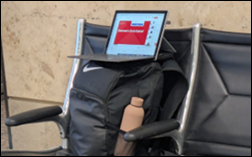
As someone who has had to sit through entirely too many training sessions about the importance of protecting your laptop when you’re in public, I couldn’t help but stop and take a picture when I was changing planes and came across this unattended backpack and laptop. It was at a gate where the flight was apparently canceled and there was literally no one around who might have been watching it. I scanned the area pretty thoroughly to see if anyone was watching before walking up to it suspiciously to see if it was actually connected to a meeting. No one confronted me, so I sat nearby for a full 10 minutes before I saw someone come out of a nearby restaurant and walk to this row of chairs. Today may have been their lucky day as far as no one messing with it, but I can’t believe someone would take that risk.

I was back on the patient side of the equation this week, leading myself to ask yet again, “Why are what should be straightforward healthcare processes at an allegedly world-class facility so terrible?” I’ve been to this “center of excellence” before and had previously been punked by the check-in kiosk that hides on the wall behind the door through which you enter, so I thought I’d be ahead of the game and immediately turn around and check myself in. It was seamless until I got to the part that told me I needed to go to the registration desk to complete my registration. The registrar had her back turned and was having a personal conversation with someone who was working on the printer behind her, which was unfortunate as she had several patients in front of her waiting for service. Once I finally made it to the desk, I was given a blank form to fill out that didn’t even have my patient identifier information on it. I guess we haven’t learned anything about preventing errors by generating those forms directly from the EHR so they’ll have the headers on them. Instead, I had to write my name and date of birth on both sides. I guess I can understand people not wanting to print out the forms if they have a lot of no-shows, but considering that most of us schedule this particular visit several months in advance and it’s nearly impossible to reschedule them, I’d bet they don’t get a lot of people that fail to arrive.
I completed the form and took it back to the desk, where I was told to sit down and keep the form and the clipboard until someone came to take me to the back. I was sure that she hadn’t told me to keep it, and I watched her do the same with several people who came behind me, so I felt a little better about not having forgotten the proper instructions for the form when I received it. I also watched two more people try to turn in the form at the desk and be told to “just keep it.” When the staff member came from the back of the facility to collect me, the registrar interrupted him and asked if he wanted some of the food she had brought and now had on her desk. I wish I could have seen my face at that point, because I’m sure the fact that I thought the whole interaction was unprofessional would have been obvious. As the tech walked me to the changing area, he commented that, “It looks like you missed part of this form,” but didn’t ask me to complete it. I was kind of baffled, since I knew I completed every box and double checked the form.
In the changing area, the tech failed to give me the correct instructions for double gowning, which didn’t register until he had left the room. Fortunately, I’ve had this procedure before and knew what to do, but had I been new to this corner of healthcare I guess I’d have either done it incorrectly or had to step out and try to find someone to ask. I sat for a bit in the changing area waiting for someone to get me again and was taken to the area where IV access is placed. There were two other patients waiting, which is unusual for this subspecialized part of the facility. One of the patients asked if I knew what time it was, since none of us had watches. I told her the time I left the changing area and she said it was already 30 minutes past her test time, but no one had mentioned a delay. She finally flagged down a staff member to ask for a blanket and asked what was going on, and we were told there had been an emergency and they were running late. I couldn’t help but think about all the “service recovery” training I have been through over the years and how little things like advising patients of delays make all the difference. And maybe offering blankets to all the patients sitting there in gowns, and not just the one who specifically asked for it, might have been nice, too (especially since you were going to the blanket warmer anyway).
The tech finally came back to attempt my IV and asked me where I wanted it, then made it clear that he felt inconvenienced by what I said, since it was opposite the side of the chair where a table had been placed for his supplies. He told me, “You’ve got nothing over here,” and just stared at me – so I told him he could try the other arm if he needed to. It would have been nice if he’d actually said something more akin to, “I’m not finding anything that’s ideal for the contrast medium we have to use. Would you mind if I looked on your other arm?” It isn’t that hard of a thing to say. When he finally placed the IV and walked away, my new friend in the waiting area commented, “Well, isn’t he just Mr. Personality?” He came back again to ask me how I had my gowns on, I suppose after realizing that he didn’t tell me what to do.
Finally, the other patient was called back for her test, and eventually a different staffer came to get me. I’ve had this imaging study done nearly a dozen times and could tell the table wasn’t quite set up properly. I didn’t say anything, but instead wound up waiting in an uncomfortable position while she bustled around the room finding the rest of the padding and draping she needed to get me set up. The procedure itself went off without a hitch (at least as far as one can tell when they’re inside the claustrophobic coffin of truth for a good hour), except for the part afterwards where the staffer wanted to remove my IV while I was just standing there. I guess she’s never had a patient pass out at the sight of blood or feel woozy while their blood vessels are being manipulated and suggested I’d prefer to sit down first. She then told me that, “There was a form that the front desk was supposed to give you, and I’ll need you to fill that out now,” and took me back to the internal waiting room. I suppose the registrar being busy chatting with the printer guy and offering her breakfast to others prevented her from making sure the correct contents were on the clipboard. Having that form would also have been the prompt to tell the first tech which procedure I was having, which theoretically should have reminded him to tell me how to gown.
Although this form already had my name and medical record number on it, it asked no less than 14 questions that were answerable by data that was already in the EHR. The tech told me, “If you don’t know the exact answer, just guess,” which always blows me away in healthcare – and doubly so when the actual information (such as the date when I last had this imaging study done) is in the chart. Knowing that the radiologist would be pulling up my previous scans for comparison and wouldn’t be inconvenienced, I wrote “in EHR” on a couple of blanks out of frustration, which I admit made me feel a tiny bit better. I did wonder if the radiologists knew that the techs were telling people to “just guess” on what’s supposed to be a clinically important form, but maybe it’s not as important as we’ve always thought it was.
Of course, many of the issues I just pointed out are small things, but as a physician who has spent the better part of three decades delivering care, this isn’t what I would expect for my patients or for myself. The majority of patients can’t just go elsewhere if they’re unhappy with the service they’re receiving because of network provider contracts and financial limitations. Not to mention, if you’re involved in an ongoing plan of care at a particular facility, the emotional pain of change often does not outweigh the pain of same. The issues I encountered are particularly sad because these things are fixable without too much cost or effort and might make all the difference for patient safety and satisfaction. For any readers who might find themselves on the non-patient side of the imaging equation, I encourage you to see how your facility stacks up with a few suggestions:
- Give patients the instructions needed to streamline their visits. If you want them to keep a form and clipboard, tell them to do so. It was easy for me to pop up to the desk and be told to keep it, but less easy for the elderly patient with the cane. Double check the clipboard to be sure it has everything needed.
- Don’t tell a patient they failed to fully complete a form when the problem is that the form itself is missing.
- If your job is to make sure patients are gowned appropriately for a procedure, make sure you know what procedure they’re having.
- Don’t make patients feel bad about their anatomy. Those of us with sad little veins already know it and can’t do anything about it.
- Critically evaluate all data collection forms being used in your process. Consider preprinting them with patient headers to reduce errors and make it easier for patients. Where clinically important information is collected, prepopulate it from the EHR (when possible) to ensure accuracy. If you think it’s OK for patients to “just guess” at the answers, consider the importance of the form.
Last, but not least: Make patients feel like they’re important and not a distraction. You have no idea whether you’re seeing them on what might turn out to be the worst day of their life – and they deserve your attention.
Have you had a recent patient-side experience, and did it meet your expectations? Any advice you’d offer the facility? Leave a comment or email me.

Email Dr. Jayne.





























The author here keeps introducing irrelevant ideas. It's true that there are nimble organizations and bureaucratic ones. What is the…