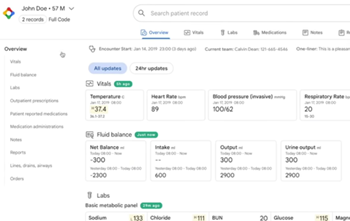
Recent Articles:

Morning Headlines 10/30/20

October 29, 2020 Headlines Comments Off on Morning Headlines 10/30/20

HHS Extends Compliance Dates for Information Blocking and Health IT Certification Requirements in 21st Century Cures Act Final Rule

HHS and ONC extend compliance dates for the Cures Act information blocking provisions to April 5, 2021, while 2015 Edition health IT certification criteria updates and standard API functionality deadlines are moved out to December 31, 2022.

Allscripts Announces Third Quarter 2020 Results

Allscripts reports Q3 results: revenue down 9.6%, adjusted EPS $0.20 versus $0.17, beating earnings expectations but falling short on revenue.

KēlaHealth Raises $12.9M in Combined Seed and Series A Financing Round to Deliver AI-Powered, Clinician-Centered Solutions That Improve Surgical Care

Surgery analytics vendor KelaHealth raises $12.9 million in combined seed and Series A financing.

Cyberattack causes ‘significant’ UVM Health Network technology outage

The University of Vermont Health Network begins recovering from a cyberattack that has impacted its seven hospitals, most notably University of Vermont Medical Center.

Comments Off on Morning Headlines 10/30/20

News 10/30/20

October 29, 2020 News 2 Comments

Top News

image

HHS and ONC extend compliance dates for the Cures Act information blocking provisions to April 5, 2021, while 2015 Edition health IT certification criteria updates and standard API functionality deadlines are moved out to December 31, 2022.


HIStalk Announcements and Requests

My least-favorite term lately is “patient leakage,” which elicits two unsavory visuals: (a) bodily fluids dribbling uncontrollably from health system customers, and (b) millionaire health system executives dragging patients by the scruffs of their necks back to the facilities that they hoped to avoid.


Webinars

November 11 (Wednesday) 1 ET. “Beyond the Firewall: Securing Patients, Staff, and the Healthcare Internet of Things.” Sponsor: Alcatel-Lucent Enterprise. Presenter: Daniel Faurlin, head of network solutions for healthcare, Alcatel-Lucent Enterprise. The biggest cybersecurity risk for healthcare IoT isn’t the objects themselves, but rather the network door they can open. This webinar will address meeting the challenges of security, management, and monitoring using ALE’s Digital Age Networking, a single service platform for the network infrastructure that includes an autonomous network, onboarding and managing IoT, and creating business innovation with automated workflows. Specific use cases will be described, including COVID-19 quarantine management, locating equipment and people, and ensuring the security of patients.

November 12 (Thursday) 5 ET: “Getting Surgical Documentation Right: A Fireside Chat.” Sponsor: Intelligent Medical Objects. Presenters: Alex Dawson, product manager, IMO; Janice Kelly, MS, RN, president, AORN Syntegrity; Julie Glasgow, MD, clinical terminologist, IMO; Lou Ann Montgomery, RN, BSN, nurse informaticist, IMO; Whitney Mannion, RN, clinical terminologist, IMO. The presenters will discuss using checklists, templates, the EHR, and third-party solutions to improve documentation without overburdening clinicians. They will explore the importance of surgical documentation in perioperative patient management, the guidelines and requirements for surgical documentation and operative notes, how refining practices and tools can improve accuracy and efficiency, and the risks and implications of incomplete, inconsistent, and non-compliant documentation.

November 16 (Monday) 1 ET. “COVID-19 and Beyond: A CISO’s Perspective for Staying Ahead of Threats.” Sponsor: Everbridge. Presenter: Sonia Arista, VP and global chief information security officer, Everbridge. While hospitals worldwide work to resume elective care amid COVID-19, they’re quickly adapting and responding to a variety of emerging risks that have tested their resilience, including a surge in cybersecurity and ransomware attacks. This webinar will highlight emerging IT vulnerabilities and best practices designed to help hospitals anticipate and quickly mitigate cybersecurity risks. A former hospital CISO will share her expertise in responding to high-impact IT incidents and mitigating risks during critical events given the “new normal” that COVID-19 has created.

November 18 (Wednesday) 1 ET. “Do You Really Have a Telehealth Program, Or Just Videoconferencing?” Sponsor: Mend Family. Presenters: J. D. McFarland, solutions architect, Mend Family; Nick Neral, national account executive, Mend Family.  Healthcare’s new competitive advantage is telehealth, of which a videoconferencing platform is just a small part. This presentation will describe a comprehensive patient journey in which an organization can acquire new patients, reduce check-in time, reduce no-shows, and increase patient satisfaction, all using virtual care. Health systems did a good job in quickly standing up virtual visits in response to COVID, but telehealth and the digital front door are here to stay and now is a good time to re-evaluate tools and processes that support patient scheduling, digital forms, telehealth, and patient engagement as part of a competitive strategy.

November 18 (Wednesday) 2 ET. “Leveraging a Clinical Intelligence Engine to Solve the EHR Usability Crisis.” Sponsor: Medicomp Systems. Presenter: Jay Anders, MD, MS, chief medical officer, Medicomp; David Lareau, CEO, Medicomp. Healthcare is long overdue for a data makeover. Clinician burnout is fueled by inaccurate, inconsistent, and incomplete clinical data, but that can be improved without scrapping existing systems. The presenters will describe the use of tools that work seamlessly with EHR workflows to deliver actionable data, improve interoperability; support the clinician’s thought process; and improve usability for better decision-making and accurate coding.

Previous webinars are on our YouTube channel. Contact Lorre to present your own.


Acquisitions, Funding, Business, and Stock

SNAGHTML340191dd

Allscripts reports Q3 results: revenue down 9.6%, adjusted EPS $0.20 versus $0.17, beating earnings expectations but falling short on revenue.

image

Cerner reports Q3 results: revenue down 4%, adjusted EPS $0.72 versus $0.62, beating Wall Street expectations for earnings but falling short on revenue. From the earnings call:

  • EVP/CFO Marc Naughton will leave the company in 2021 after 29 years.
  • An analyst noted that two recent high-level hires came from Leidos, suggesting an interest in getting more federal business, which Cerner hinted is the case. It was mentioned later in the call that Cerner is looking at “adjacencies” to its DoD and VA business, such as Indian Health Service, and “looking at ways that we can use data proactively with different branches of the government.”
  • President Don Trigg says the next focus in its relationship with Amazon Web Services will be CareAware, also noting that Amazon’s PillPack pharmacy will play into pharmacy trends.
  • Cerner had 22,000 people register for this month’s virtual Cerner Health Conference, with an advantage of the virtual format being able to see which sessions attendees choose and compare that to company focus and investment. Cerner mentioned interest in real-time workforce management, hospital operations, and consumer focus.
  • Data opportunities include release-of-information for life insurance, legal, and workmen’s comp; the Learning Health Network; and clinical trials identification and enrollment for non-academic medical centers.
  • Cerner will consider making acquisitions, but will also focus on repurchasing shares and paying dividends.

image

Surgery analytics vendor KelaHealth raises $12.9 million in combined seed and Series A financing. The company says its software improves surgical quality while preventing complications. It was formed by a group of Duke-affiliated surgeon-scientists, including founder and CEO Bora Chang, MD.

image

Fitness and sleep monitoring membership company Whoop raises $100 million in a Series E funding round that values the company at $1.2 billion. The $30 per month membership includes a simple monitoring strap (heart rate, sleep, and respiratory rate) and access to its analytics and community.


Sales

  • Digital therapeutics vendor Voluntis will use the interoperability platform of Redox to offer providers actionable, EHR-integrated insights on how patients experience treatment at home.
  • Greater Baltimore Medical Center (MD) will deploy app-based way-finding, appointment reminders, Epic MyChart integration, and mobile bill pay from Phunware.
  • Alliance Health (NC) will implement ZeOmega’s CareIntel for population health management.

People

image

Marshall Health (WV) promotes Shannon Browning, RPh, MD to the newly created position of CMIO.

image

Greenway Health hires Michael Blackman, MD, MBA (Allscripts) as chief medical officer.

SNAGHTML3293182d

Long-time friend of HIStalk David B. Dillehunt is retiring as VP/CIO from FirstHealth of the Carolinas in Pinehurst, NC at the end of the year. He sent me a nice note about HIStalk that would be vain of me to post (but I appreciate it anyway), and he also mentioned that FirstHealth will do its own VP/CIO search without using a recruiter, so interested folks can apply on its website. An email search finds that Dave and I first exchanged messages in early 2006, so we go back a ways.


Announcements and Implementations

Optum’s annual health executive AI survey finds that 59% of them expect to see a payback period on investments in under three years and 95% think that hiring AI-experienced employees is a priority. The top three use cases identified are wearables monitoring, accelerating research, and assigning billing codes.

Ellkay launches its Women in HIT recognition interview series program, noting that while all of its own departments have more women than men, tech companies in general have just 25% women. Nominations are accepted online.

Epic says in an increasingly common press release that 190 health systems will go live this fall.

SNAGHTML3417be32

Tampa General Hospital says its use of GE’s command center has eliminated $40 million worth of inefficiencies, including decreasing length of stay and ED diversion that equate to 30 additional beds.


Government and Politics

HHS releases its final Transparency in Coverage rule that requires health insurers to disclose their negotiated rates and patient out-of-pocket costs for 500 shoppable services for plan years that begin on or after January 1, 2023. They will also be required to show historical payments from and payments to out-of-network providers as well as negotiated prices for prescription drugs.

Aetna pays $1 million to settle three HIPAA breaches in 2017, one related to an online document display and the other two involving mailing envelope disclosures.


COVID-19

White House advisor Jared Kushner said in a recorded interview in April that President Trump was “getting the country back from doctors” in developing a strategy to push states to reopen for his political benefit, after which the White House would then blame state governors for any resulting coronavirus spread.

Politico reports that HHS spokesperson Michael Caputo, who is on medical leave, privately pitched its $300 million, pre-election  “defeat despair” coronavirus ad campaign as “Helping the President will Help the Country.” HHS declines to say whether the ad campaign will ever run, is accused by House Oversight leaders of not providing documents they requested, and said that HHS Secretary Alex Azar was not aware of Caputo’s direct involvement. The $300 million cost was taken from CDC’s budget.

image

Atlanta magazine examines the botched rollout of Georgia’s coronavirus dashboard that left public health officials, local governments, businesses, and residents uncertain about how to comply with the governor’s push to reopen or to evaluate his wisdom in doing so. He assigned the dashboard’s development to to the state’s budget office instead of its public health department, where it was then outsourced to private contractor SAS. The state’s epidemiologists took the black eye for its lack of reliability and confusing presentation. National public health experts say it is unusual to let a third party contractor publish unvetted data to a state health department’s website. A much-Tweeted gaffe was a chart that appeared at first glance to show a steady decrease in case counts, but the X-axis case counts were sorted from greatest to least instead of by date.

Chicago’s NPR station looks at the lack of a central agency to coordinate COVID-19 patient transfers, with one small hospital that mostly treats low-income people of color being told by several hospitals that they had no available ICU beds despite having reported them empty to a state database. Some hospitals told the smaller one directly that they wouldn’t take a transfer if the patient had certain public-funded health insurance. The hospital was also rejected by the 3,000-bed field hospital that was built inside McCormick Place, which was mostly empty. The station notes that no state agency or public health official can force a hospital to accept a transfer and they have no incentive to cooperate with each other.

Science says that October was good for remdesivir manufacturer Gilead Sciences, which got an early look at WHO’s Solidarity trial results – which showed that remdesivir doesn’t decrease mortality or recovery time – before it signed a billion-dollar EU distribution deal and earned FDA’s approval even though FDA did not have its information reviewed as usual by its panel of outside experts. Gilead says it won’t renegotiate its $2,400 price following the Solidarity study’s disappointing findings about efficacy. Gilead got a look at the Solidarity study results on September 23, which FDA didn’t see until October 10 prior to its full approval on October 22. Gilead has sold $873 million worth of remdisivir (Veklury) so far this year.


Other

image

The FBI warns that Russian ransomware hackers are targeting US health systems and have taken down four of them so far. A cybersecurity expert says that hackers are demanding more than $10 million per target and discussing plans to infect 400 hospitals and clinics. Another analyst reports that 59 US providers have been impacted so far in 2020, disrupting care in 510 facilities. St. Lawrence Health System (NY) went on diversion and back to paper documentation in three hospitals Tuesday following a ransomware attack, while University of Vermont Health Network reported a system-wide outage Thursday. Sky Lakes Medical Center (OR) also reported a ransomware attack Tuesday and remains down. The Cybersecurity & Infrastructure Security Agency has issued an advisory describing how Trickbot-deployed Ryuk ransomware works and offers the usual broad mitigation suggestions, most of them not easily implemented quickly (although applying US updates, reviewing RDP ports, auditing user accounts with administrative privileges, backing up systems and storing the copies offline, and auto-updating antivirus software should be done regularly anyway).

image

I’m intrigued by posed skeleton displays in yards for Halloween. This Zoom call one best represents 2020, although I also like the cleverly topical ones in which an evil skeleton flings lurid coronavirus balls at others who are desperately fleeing while wearing masks.


Sponsor Updates

clip_image001

  • Healthwise volunteers help the Idaho Food Bank deliver food to seniors.
  • Experity makes its Virtual User Experience sessions available online.
  • Saykara President and Chief Medical Officer Graham Hughes, MD authors a Medical Economics article titled “Can AI Rescue Physicians from their EHR Woes?”
  • Fortified Health Security publishes a new white paper, “Using Zoom for Telehealth Visits: How to Maintain an Acceptable Risk Profile.”
  • Aspioneer includes Goliath Technologies CEO and chairman Thomas Charlton on its list of revolutionary CEOs of 2020.
  • Healthcare Triangle publishes a new case study, “Standardization Across Surgical Areas for ASC to HOPD Conversion at Great Falls Clinic Hospital.”
  • IDG Connect profiles Imprivata CTO Wes Wright.
  • FeaturedCustomers ranks LiveProcess as a Rising Star in its “Fall 2020 Customer Success Report.”
  • Meditech recognizes the role of virtual care during Canadian Patient Safety Week.
  • NextGate publishes a new case study, “UHIN Leverages Leading Patient Identification Platform to Drive Quality and Coordination of Care, Support COVID-19 Response.”

Blog Posts


Contacts

Mr. H, Lorre, Jenn, Dr. Jayne.
Get HIStalk updates.
Send news or rumors.
Contact us.

125x125_2nd_Circle

EPtalk by Dr. Jayne 10/29/20

October 29, 2020 Dr. Jayne 5 Comments

clip_image002 

Hospitals and health systems are going on the offensive against COVID. One example is this two-page ad in the Tulsa World that illustrates hospitalizations within Saint Francis Health System.

Hospitals in my metropolitan area are approaching maximum capacity, having taken numerous transfers from rural hospitals that quickly became overwhelmed as cases surged. Our flagship tertiary care hospital has put limits on elective operative cases, not only to preserve bed capacity, but also to try to mitigate the load on care delivery staff who are anticipating a rocky winter.

One of my ICU nurse colleagues has been working with COVID patients since the beginning, spending several months in a vacant college dorm to reduce the risk that she would take the virus home to her high-risk household. In the ultimate show of compassion, another nurse from a “regular” unit offered to trade places for a few weeks so that my friend could have a break. It’s people like these that drew many of us to healthcare, those who truly set the example of service. But it’s a sad commentary on where we are right now and the concerns around what is to come. We had two more resignations at my practice this week and I fear more are to come.

clip_image003

ONC released a data brief this week looking at the state of interoperability among major US cities. The report looked at variation in interoperability within 15 cities, which are represented by combined statistical areas. They looked specifically at four key areas of interoperability – to find, send, receive, and integrate electronic health information with sources outside their health system. Data on HIE participation was also included.

Not surprisingly, small / independent hospitals performed the worst, with system-owned hospitals reporting higher rates of engagement across all domains. I practice in one of the areas that was surveyed and can attest to our paltry performance. The hospitals refuse to share information with independent facilities, and most of the time, my best source of information at the point of care involves the patient handing their phone to me so I can flip through their MyChart account.

The state HIE isn’t much help either since they won’t let individual physicians participate. Physicians only get access if they’re part of an organization that is sharing data. There are plenty of us that are independent, locum tenens, or contract physicians who care for patients outside the walls of a hospital or across multiple rural facilities, and it would be useful to have access to the data when those patients cross our threshold. That’s how the state’s prescription drug monitoring program works – it’s funded by tax dollars and each provider has their own login. Not sure why the HIE needs to be different.

clip_image005

My office recently suffered the devastating loss of a staff member, who passed away at the practice during the work day. It’s been an incredibly difficult time for everyone. The office has been closed and we just re-opened Wednesday. Based on the experience, I have a new item to add to our contingency plans for such a situation. If you have shared PC workstations, I highly recommend having someone log in to the PC that was last in use by the staffer in question and make sure that their login screen isn’t going to pop up for the next person to see. It never occurred to me that it might be an issue until I walked past a staff member who was staring catatonically at a login screen with her departed co-worker’s name, waiting for her password. The whole situation has been traumatic. This was another hurt that the team didn’t need on our first day without her.

clip_image007

Especially in a pandemic, there’s a lot of focus on the clinical workers at hospitals, along with those who perform essential functions such as food service, housekeeping, and facilities engineering. You don’t hear much about the unsung IT heroes, although they’re just as critical where taking care of patients is concerned.

One of my physician friends reached out to me recently about what she perceived as an IT disaster and I had to agree with her assessment. The hospital has had some significant delays in the return of pathology results over the last few months, due to layoffs and backlogged specimens. She’s been waiting for several sets of patient results to return and checking the system daily because she knows it’s a big deal for her patients. The lab director had told her to be patient, but I understand her reluctance to do so when she was waiting for information that could change her patients’ lives.

Late Sunday evening, she received a large volume of pathology results to review, some of which had been finalized and released by the lab more than five days previously. Apparently one of the interfaces had gone down and the results had been available but just sat there queueing until someone finally noticed an issue and pushed them through after restarting the interface. Her hospital recently outsourced quite a few of its IT functions and she couldn’t help but wonder if the changeover had anything to do with the failure, so called for my thoughts. My impression is that of a multi-level failure, first with the interface itself, then with the monitoring systems, then with a lack of notification to the responsible providers explaining the situation.

She had several dozen sets of results to address, but in a system her size, there may have been hundreds if not thousands of patients who were impacted. I know she felt terrible about the delays and was trying to figure out how to find time in a busy Monday office schedule to call notify all the patients. The reality is that on the other side of each one of those pathology results sits a woman who has likely been worrying about the outcome of her biopsy and that failure of the system added additional burden that she probably didn’t need right now.

It’s important for those of us in the healthcare informatics world to realize how critical our work truly is, and for the leadership that manages our departments to make sure we have the resources to do the work properly. My heart goes out to all the patients who had their results delayed and especially to those who received news that likely changed their lives.

Has your hospital cut resources for infrastructure reporting and monitoring? How does it notify patients and clinicians of similar situations? Leave a comment or email me.

Email Dr. Jayne.

Morning Headlines 10/29/20

October 28, 2020 Headlines Comments Off on Morning Headlines 10/29/20

Outcome Health may have found a merger partner

Outcome Health, which offers pharma-backed advertising software for waiting and exam rooms, is reportedly in talks to merge with competitor PatientPoint in a deal that could value the combined company at $600 million.

Mayo Clinic, Google launch AI initiative for radiation therapy

Mayo Clinic and Google Health partner to develop algorithms that will improve the treatment of patients undergoing radiation therapy for head and neck cancers.

Cerner Reports Third Quarter 2020 Results in Line with Company Expectations

Cerner meets Q3 revenue and beats earnings expectations; and announces the impending departure of EVP and CFO Marc Naughton.

Comments Off on Morning Headlines 10/29/20

HIStalk Interviews Cary Breese, CEO, NowRx

October 28, 2020 Interviews 3 Comments

Cary Breese is co-founder and CEO NowRx of Mountain View, CA.

image

Tell me about yourself and the company.

I’ve done a few startups in my life, insurance and database. I’ve always had an automation focus, using technology to automate things in legacy industries.

I started NowRx in 2016 with an idea of making the pharmacy experience better. The real question that always intrigued us when we thought of the idea was, how do you make it profitable? That’s where the technology comes into play. We believe that if you can focus and optimize all the operations, software, robotics, and logistics, you can create a profitable model that’s a full replacement for a Walgreens and CVS experience. That has been the goal, and we think we have created it. We have since expanded from the Bay Area into Orange County, south of LA, and Phoenix, Arizona.

How do you think chain drugstores have failed to meet consumer needs?

The dirty little secret in the retail pharmacy world — and I think there’s enough evidence there – is that they want consumers to continue to come into their stores. That has been their model for decades. That creates a disincentive with where consumers are moving. They are looking for more and more convenience. I can get a car to come pick me up in two minutes and take me wherever I want. I can get my groceries delivered. I can get my lunch delivered. But the retail pharmacies don’t like that model. They want to have you come into a store for an in-store pickup.

They keep the pharmacy operation itself in the back of the store. They fill 15,000 square feet of space with all other products under the sun, and that’s where the majority of their profits come from. There’s a misaligned incentive. It has been exacerbated even more during COVID, where customers and patients are realizing there’s got to be a better way than going to stand in line for essentially a commodity product at a crowded store and risk exposure to COVID.

We work with some hospitals as well. Since we’re delivering prescriptions all day long anyway, we deliver right to patients on the day of the discharge.They get all their outpatient medication delivered to their room before they go home. We can reduce readmissions and hospitalizations. We think we’ve moved the needle on medication adherence and better patient outcomes through better prescription management. People are less inclined to not take their medications because they didn’t go to the pharmacy, they were too busy, they didn’t have time. Maybe they lack access to transportation. Maybe they just forgot. We resolve all of those issues right out of the gate. Plus we have some patient analytics that we’re layering on top of that as well to do pharmacy-based interventions to target chronically ill patients and try to make a more convenient and more reliable refill and just medication-adherence procedures.

Walgreens and CVS deliver through third-party services, and mail order pharmacies, including Amazon’s PillPack, deliver to the patient’s door. Why is it an improvement to have a physical, licensed pharmacy doing its own delivery?

Mail delivery pharmacy has been around for decades. We’re not too interested in that space. We think that works well for certain patients. Chronic meds are not urgent, and the 90-day fill can be a convenience.

But if you notice, mail delivery has been around for 20 years, as in Express Scripts and Caremark, but it hasn’t made a huge dent in retail pharmacy. Retail pharmacy is still the preferred model for many customers, particularly for medications that don’t necessarily fit a mail order delivery, like antibiotics that you need today, pain medications, or when your doctor changes the medication dosage and you need to get it refilled. All of those needs exist today and are a big pain point for customers. We believe that the right model is neither retail, which requires a patient to come into a store, or mail delivery. We see there’s a optimal model in between those two that picks the best of both worlds.

We use DEA-licensed pharmacy facilities. We call them micro fulfillment facilities. They are like the operation of the pharmacy inside Walgreens or CVS, but just the pharmacy part in the back. We take that out and put in a warehouse. We put it local to customers in their communities, within 10 or 15 miles of any patient that we serve. We do all the same things that a full-service pharmacy would do. We have pharmacist consultations over the phone, text, or video chat. We have technicians. We have our own inventory in those micro fulfillment centers. Everything is delivered right to the patient same day.

For a patient, they get the same-day service they would get from a regular pharmacy. We can do all the chronic meds and refills that a normal mail order pharmacy would do as well. We can do all of that and bring it right to your house, free of charge. You just pay your normal co-pay.

Inside the pharmacy, we take the best out of the mail-order pharmacies — the technology, the automation, the robotics, and all of that streamlined software. We built our own pharmacy management systems. We’ve been awarded the White Coat Award by Surescripts as one of the most accurate pharmacy management systems in the industry. Through that automation and our logistics, we believe that we can build a better solution for patients, taking the best of the other two models that are available.

How is chain drug store technology inadequate and how have you improved it?

I’d like to say that there’s more to fixing retail pharmacy than just adding delivery. That’s one of the problems we see, which is adding a third-party delivery service. You mentioned using Instacart or some other third-party delivery company. It doesn’t really fix the bottlenecks that are inside retail pharmacy, which we think are the key.

You have someone counting out pills, typically manually in a CVS or Walgreens. You also typically have a fairly antiquated software system that gets errors from insurance companies. Patients usually have to stand on line. There’s someone behind the counter on the phone waiting for 20 minutes to talk to the insurance company about how to resolve the claim. You can manage all of that with software.

Our software also connects with physician offices electronically. We have two-way communication. We get electronic prescriptions in, but we can also coordinate refill orders going back out. We also coordinate with the insurance companies. Then we have our own logistics.

Fixing those bottlenecks can make this a much more efficient process. The mail order pharmacies are  super high volume. They have far less labor costs per prescription because they’ve been able to automate. You don’t see that kind of automation in a CVS or Walgreens, so they don’t have enough money to spend on good customer service. They’re spending it all on all those manual processes and bottlenecks. That’s how we think we can fix the industry.

I assume that you would like NowRx to be valued as a technology company, but even with a closed-door pharmacy in individual communities, you still have to get a state license and hire pharmacists. How can you scale given the limitation of opening up individual, almost neighborhood-level pharmacies?

The key is the “almost.” It’s almost neighborhood-level, but it’s actually quite a much smaller footprint than a CVS or Walgreens that are, let’s face it, just about every two or three miles. I think Walgreens claims to be within five miles of every man, woman, and child in the US. 

We have far, far lower footprints than that. We have about one-twentieth of the required footprint compared to a CVS or Walgreens. We cover a much bigger territory per one of our micro fulfillment centers. A 15-mile radius is about 10 or 12 times the radius of a typical CVS, which only draws about a mile and a half or two mile radius. Each of our locations is a third the size. We don’t need 15,000 square feet of retail space, we need about 5,000 square feet. We don’t pay as much per square foot. We pay about a third the cost per square foot because we’re in commercial space, not retail.

Add that all up — about one-twentieth the number of locations and each one is one-third the size and one-third the price – and you’re getting pretty close to 1% of the fixed overhead that the big guys play. That’s additional savings for us that drops rates to the bottom line.

I assume that the chains stuff their stores between the front door and the prescription counter with all those products because the margin on them is high. Can you make enough money from just selling prescriptions?

They do have more margin on those products. A typical CVS makes about 60% of their profit from the front of the store, but they’re paying a big cost for that. The fixed overhead is very costly in the retail setting to have all of that product. That’s why they want people in the store. That’s why their whole model is there. They have that retail space. It’s an upsell model. They want the impulse buys. They put the pharmacy in back to try to attract customers.

We sell a list of about 250 non-prescription related items. It’s much easier for me to warehouse that product. I don’t need fancy retail shelving. I can just stack it in my warehouse. We get the customer the same convenience they would have by having additional add-on items like vitamins, probiotics, cough remedies, or pain remedies, whatever they would need to add on to their pharmacies. We don’t add so many products like back-to-school supplies or beauty aids, or I even saw tennis balls at my local CVS. We don’t go down that path. But vitamins, pain relievers, cough remedies, and things like that, we do offer today. It is a higher profit margin business, and it’s very easy for us to keep in the warehouse and add into a bag that’s heading out for delivery.

Telehealth has a last-mile problem where the online visit still requires a trip to the drugstore or lab. Can that be improved?

I couldn’t agree with you more. We’ve always been big believers in telehealth. The stat I like to use is that 70% of physician appointments result in or involve a prescription medication. You are exactly right — it’s kind of ridiculous to expect a patient to have an online meeting with their physician and then be expected to get out of their pajamas and go down to CVS. We think we’re a critical component to the telehealth movement, which will is going more and more mainstream now because of COVID. We are really excited about that.

In fact, we have some additional technology offerings that are going to dovetail right in with the telehealth platform, including feedback to physicians in a portal that gives them real-time updates on the prescriptions and if they have been delivered. Did they hit the insurance plan, or does it hit a prior authorization? Do we need to do an alternate prescription? We coordinate with that physician. Then you start to have a powerful combination of collaboration between the physician, patient, and pharmacy to drive better care.

I think of all these third-party delivery services driving around to individual houses bringing groceries, takeout food, and prescriptions. An individual business, like a restaurant, might work with several of those services. There seems to be a lot of inefficiency in making multiple trips to the same front doors. Could there be a point where someone creates a Post Office-like network that does white-label delivery from any company that wants to hire them as a courier?

It’s theoretically possible, but pharmacy is so complex. There are regulatory concerns. There are patient privacy concerns.

We always felt like from the very beginning – and we’ve been even more strong in our beliefs as we’ve moved along the last few years — that the best way for this industry to provide this kind of customer experience where you’re fully remote and everything is delivered is to own the delivery stack yourself. You have your own employees of the pharmacy that are the drivers. We can background check them. We can drug test them. We check their driving. They’re branded NowRx. They wear the NowRx shirts. They are in branded cars.

The patients get a level of comfort seeing the drivers pull up. Many of these patients that are on recurring medications see the same driver month-in and month-out. They’re on the same routes. There’s no privacy issues as far as coordinating refills and who owns the patient file that you would run into with a third-party delivery service. We handle narcotics, so we deliver all kinds of medications, including Schedule II narcotics. That’s very difficult to do if you’re a third-party delivery company and trying to make that work. We’ve always come down on the side of, let’s make the best customer experience that we possibly can, make it as seamless as possible, and make it as a complete of a service as we can. To do that, you’ve got to own your own drivers.

Chain drugstores have tried multiple concepts to get more sales per square foot out of their physical footprint, sometimes launching their own services and sometimes contracting them out, such as with urgent care and lab access centers. How will that play out over the next few years?

Our original hypothesis about this space is right. The big chains are going to keep doubling down and try to make a retail model work. They have too much invested in all that retail space.

You look at the recent announcement about a month ago. Walgreens acquired a company called VillageMD, which adds clinic services inside the retail stores. Exactly what you’re saying. That confirms my hypothesis that they are going to continue to double down. They are adding reasons to bring customers into a store, and customers are looking for fewer reasons to go into the store, so there’s a misalignment there. 

In four or five years, you’re going to continue to see displacement of customers out of the retail, traditional brick-and-mortar model into these other modes. At some point, there is going to be a significant disruption. You touched on Amazon earlier — they might be a trigger point if they try to make a move. Right now, they’re doing mail order, but at some point, they’re going to try to move to a two-day delivery for pharmacy or maybe even a one-day delivery. That will put so much heat on the retail pharmacies that they will have to have a real heart-to-heart meeting with themselves to figure out how they can change their model to survive. 

Frankly, I don’t think the existing retail model will survive more than four or five years. I think consumers are going to pull away from the retail model. They want free, same-day and even same-hour delivery, and that’s where we’re going to end up.

Morning Headlines 10/28/20

October 27, 2020 Headlines Comments Off on Morning Headlines 10/28/20

Human API raises $20 million to standardize health records with AI

Health data standardization and sharing startup Human API raises $20 million in a Series C round that brings its total raised to $36.6 million.

Harris acquires UK-based maternity ward software provider K2 Medical Systems

Harris acquires UK-based maternity ward software vendor K2 Medical Systems.

Fitbit CEO reveals the company’s plan to conquer fitness wearables and telemedicine

Fitbit co-founder and CEO James Park hints at the wearables company’s telemedicine plans, saying that adding a virtual visit benefit could be key to bolstering its subscription service.

3 St. Lawrence County hospitals hit by ransomware

St. Lawrence Health System (NY) diverts some ambulances to Gouverneur Hospital as it recovers from a ransomware attack on three of its hospitals early Tuesday morning.

Comments Off on Morning Headlines 10/28/20

News 10/28/20

October 27, 2020 News 2 Comments

Top News

image

Blank-check company Health Assurance Acquisition Corp. prepares for an IPO of up to $500 million.

The SPAC is sponsored by General Catalyst and is backed by former Livongo executives who didn’t make the jump to its acquirer Teladoc, including former chairman Glen Tullman and former president Jennifer Schneider, MD; as well as Thomas Jefferson University and Jefferson Health CEO Stephen Klasko, MD, DuPage Medical Group Board Director Anita Pramoda, and several General Catalyst executives.

HAAC is looking for companies that are involved in health assurance, have high growth potential in expanding addressable markets, and are led by mission-driven CEOs who are committed to responsible innovation. Its SEC filings state, “We know that health assurance companies can generate both positive clinical outcomes and outsized shareholder returns because our team built the first one—Livongo Health, Inc.”

It further defines the companies it will consider: “Health assurance companies deliver modern consumer health experiences while decreasing the overall healthcare GDP and are rooted in partnership with existing care providers. In a world built on health assurance, care is continuous, proactive, personalized, and available everywhere. Health assurance companies will be rewarded based on patient outcomes, enabling free-market economics to perform their important role in creating best-in-class solutions.“ It predicts that the digital health sector will eventually command more dollars and time than the physical sector.

HAAC’s chairman and CEO will be Hemant Taneja, a 45-year-old General Catalyst partner and Livongo lead investor who has written books about AI-based innovation and healthcare innovation. His Livongo shares are worth more than $2 billion.


Reader Comments

From Bubonic Relationship: “Re: Teladoc. I’ve never seen so many top execs bail when their company was acquired, especially one as new as Livongo.” The departing Livongo senior suits could spend their days making snow angels in the Teladoc-provided cash avalanche, but instead they’re off on a new venture to create another company to take public. I’m also surprised that Teladoc didn’t make the acquisition contingent on the whole management team signing up for a year of transition while the new owners figure out how their $18.5 billion acquisition works. Still, it’s inevitable that an acquired company’s leadership team won’t last long after the deal is done, even though they are the ones who created the value for which the acquirer paid a big premium, and Teladoc is keeping enough folks to keep the lights on.


HIStalk Announcements and Requests

Katie, freshly graduated from college with a journalism degree, started working as a paid HIStalk intern this week, earning her the sobriquet “Katie the Intern.” She and I are figuring how to ease her into the industry and put her to productive use given some limitations: (a) neither of us has internship experience; (b) I work alone and am not accustomed to explaining what I do or how I do it; and (c) we’ll be communicating remotely. I’ve given her some assignments to introduce herself in an upcoming HIStalk post, write a weekly column about what she’s learning, and review other health IT sites to see how they approach industry news. She’s also reviewing the comments of readers who suggested what I should have her do. You’ll hear from her shortly, but in the mean time, contact her if you would like to tell her about your job and how HIStalk fits into it because she has no idea. 


Webinars

October 28 (Wednesday) noon ET: “How to Build a Data-Driven Organization.” Sponsor: Newfire Global Partners. Presenters: Chris Donovan, CEO and founder, Adaptive Product Consulting; Harvard Pan, CTO, Diameter Health; Jason Sroka, chief analytics officer, SmartSense by Digi; Jaya Plmanabhan, data scientist and senior advisor, Newfire Global Partners; Nicole Hale, head of marketing services, Newfire Global Partners. The panel of data experts will discuss the opportunities that data can unlock and the challenges involved with becoming a data-driven organization. Attendees will learn why having a data strategy is important; how to collect, manage, and share data with internal and external audiences; and how to combat internal resistance to create a data-driven culture.

October 29 (Thursday) 1 ET. “How Presbyterian Healthcare Services Is Preparing for a Post-Pandemic Future Using Digital Care Tools.” Sponsor: Bright.md. Presenters: Ries Robinson, MD, SVP/chief innovation officer, Presbyterian Healthcare Services; Ray Costantini, MD, MBA, co-founder and CEO, Bright.md. Presbyterian Healthcare Services changed the way New Mexico patients access healthcare with its pres.today digital front door, which has given patients easy access to care during a global crisis. The health system’s digital care strategy goes beyond simply offering virtual visits and instead makes every episode of care — regardless of where it is delivered — better by streamlining clinical workflows and by directing patients to the most appropriate venue of care. The presenters will describe how Presbyterian has continued to meet patient needs during the pandemic, how it is deploying digital tools to tackle the combined COVID-19 and flu seasons, and how the health system is innovating care delivery to prepare for a post-pandemic future.

November 11 (Wednesday) 1 ET. “Beyond the Firewall: Securing Patients, Staff, and the Healthcare Internet of Things.” Sponsor: Alcatel-Lucent Enterprise. Presenter: Daniel Faurlin, head of network solutions for healthcare, Alcatel-Lucent Enterprise. The biggest cybersecurity risk for healthcare IoT isn’t the objects themselves, but rather the network door they can open. This webinar will address meeting the challenges of security, management, and monitoring using ALE’s Digital Age Networking, a single service platform for the network infrastructure that includes an autonomous network, onboarding and managing IoT, and creating business innovation with automated workflows. Specific use cases will be described, including COVID-19 quarantine management, locating equipment and people, and ensuring the security of patients.

November 12 (Thursday) 5 ET: “Getting Surgical Documentation Right: A Fireside Chat.” Sponsor: Intelligent Medical Objects. Presenters: Alex Dawson, product manager, IMO; Janice Kelly, MS, RN, president, AORN Syntegrity; Julie Glasgow, MD, clinical terminologist, IMO; Lou Ann Montgomery, RN, BSN, nurse informaticist, IMO; Whitney Mannion, RN, clinical terminologist, IMO. The presenters will discuss using checklists, templates, the EHR, and third-party solutions to improve documentation without overburdening clinicians. They will explore the importance of surgical documentation in perioperative patient management, the guidelines and requirements for surgical documentation and operative notes, how refining practices and tools can improve accuracy and efficiency, and the risks and implications of incomplete, inconsistent, and non-compliant documentation.

November 16 (Monday) 1 ET. “COVID-19 and Beyond: A CISO’s Perspective for Staying Ahead of Threats.” Sponsor: Everbridge. Presenter: Sonia Arista, VP and global chief information security officer, Everbridge. While hospitals worldwide work to resume elective care amid COVID-19, they’re quickly adapting and responding to a variety of emerging risks that have tested their resilience, including a surge in cybersecurity and ransomware attacks. This webinar will highlight emerging IT vulnerabilities and best practices designed to help hospitals anticipate and quickly mitigate cybersecurity risks. A former hospital CISO will share her expertise in responding to high-impact IT incidents and mitigating risks during critical events given the “new normal” that COVID-19 has created.

November 18 (Wednesday) 1 ET. “Do You Really Have a Telehealth Program, Or Just Videoconferencing?” Sponsor: Mend Family. Presenters: J. D. McFarland, solutions architect, Mend Family; Nick Neral, national account executive, Mend Family.  Healthcare’s new competitive advantage is telehealth, of which a videoconferencing platform is just a small part. This presentation will describe a comprehensive patient journey in which an organization can acquire new patients, reduce check-in time, reduce no-shows, and increase patient satisfaction, all using virtual care. Health systems did a good job in quickly standing up virtual visits in response to COVID, but telehealth and the digital front door are here to stay and now is a good time to re-evaluate tools and processes that support patient scheduling, digital forms, telehealth, and patient engagement as part of a competitive strategy.

November 18 (Wednesday) 2 ET. “Leveraging a Clinical Intelligence Engine to Solve the EHR Usability Crisis.” Sponsor: Medicomp Systems. Presenter: Jay Anders, MD, MS, chief medical officer, Medicomp; David Lareau, CEO, Medicomp. Healthcare is long overdue for a data makeover. Clinician burnout is fueled by inaccurate, inconsistent, and incomplete clinical data, but that can be improved without scrapping existing systems. The presenters will describe the use of tools that work seamlessly with EHR workflows to deliver actionable data, improve interoperability; support the clinician’s thought process; and improve usability for better decision-making and accurate coding.

Previous webinars are on our YouTube channel. Contact Lorre to present your own.


Acquisitions, Funding, Business, and Stock

Harris acquires UK-based  maternity ward software vendor K2 Medical Systems.

image

Lux Capital’s newly formed SPAC, Lux Health Tech Acquisition, launches a $300 million IPO in hopes of eventually merging with or acquiring a health IT company. CEO and Director Josh DeFonzo comes from the Robotics & Digital Solutions division of Johnson & Johnson.

Intermountain Healthcare and Sanford Health will merge, with the combined organization having 89,000 employees, 70 hospitals, 435 clinics, and 1.1 million insurance customers.


Sales

  • NCH Healthcare System (FL) will implement EVideon’s Patient Smart Room technology across its two hospitals.
  • Baptist Health (KY) selects provider online search and appointment-scheduling software from Kyruus.
  • Virginia Health Information chooses Collective Medical to provide hospital ADT notifications to a patient’s provider as required CMS starting May 1, 2021.

People

image

James Lawson (Verge Health) joins Sectyr as CEO.


Announcements and Implementations

image

Freeman Health System (MO) develops a text-based messaging app to update family members on a patient’s surgical status.

WellSpan Health implements Epic at several facilities that were previously part of Summit Health. The two health systems merged in late 2018.

Baptist Health (FL) deploys LifeLink’s chatbot software to expedite ED-to-PCP referrals and COVID-related care.

Population health management vendor Arcadia becomes a reseller of PatientPing’s real-time care notification technology.

image

A new KLAS report on health system AI purchases finds that that they are seeking specific solutions rather than concentrating on a single AI vendor, with the expected results taking longer than they expected. Jvion has a large client base but declining client satisfaction; Epic Cognitive Computing is growing fast, especially with readmission and sepsis prediction, but organizations need to drive outcomes on their own; and Cerner’s HealtheDataLab is early in its life cycle, with few live sites and little consideration in the market. Among products that allow customers to develop their own models, KenSci has high client satisfaction, DataRobot’s customers express concern about lack of completeness and the company’s lack of healthcare expertise; and Health Catalyst has weak customer satisfaction as its product is slowly maturing. Big tech firm offerings are seen as average, with Microsoft’s healthcare expertise and partnerships taking it to the top of the list, as Google and Amazon are perceived as light on healthcare knowledge and IBM Watson Health is seen as over-promising, under-delivering, and offering low value.


COVID-19

In California, San Francisco and Alameda counties sever ties with Google’s sister company Verily seven months after the state signed a multi-million dollar contract with the company to expand COVID-19 testing sites. They are concerned about racial disparities because Verily requires people to sign up using a Gmail account, uses confusing two-factor authentication, and asks health questions whose answers could be exposed to Google or third parties. A community health center CEO who shut down the Verily-run program after just six days summarized, “From where we sit, this is an old story. Corporations that are not really invested in the community come helicoptering in, bearing gifts, but what they’re taking away [user data] is much more valuable.” 

A New York Times opinion piece written by the director of the Institute for Health Metrics and Evaluation says that most of the useful COVID-19 data that the federal government collects isn’t being made available to public health researchers. This includes county- and city-level counts of cases, hospitalizations, and deaths as well as implementation dates of mandates for testing, distancing, and mask-wearing. It notes that the Times had to sue CDC under the Freedom of Information Act to get a case breakout by race and ethnicity, which revealed major societal implications. HHS also doesn’t release individual hospital data; break out hospitalization totals by age or sex; or indicate how many hospitals reported data on a given day. Unanswered questions that the data could answer include whether transmission is moving to younger people, whether death rates improved because of better treatment, and how local mandates have affected cases and admissions.

HHS data shows that only 60% of hospitals are fully complying with its COVID-19 reporting requirements, potentially exposing them to being banned from billing Medicare and Medicaid.


Other

image

Fitbit co-founder and CEO James Park hints at the wearables company’s telemedicine plans, saying that adding a virtual visit benefit could be key to bolstering its subscription service. The company was acquired by Google last year for $2.1 billion.

In Finland, hackers who breached a national psychotherapy provider are emailing individual patients and threatening to disclose their personal information publicly unless they send a bitcoin payment. The organization fired its CEO Monday after discovering that he failed to disclose two breaches going back to November 2018 and did not act quickly to fix identified security vulnerabilities.


Sponsor Updates

  • Startup.info profiles Saykara founder and CEO Harjinder Sandhu.
  • Clinical Architecture releases a new podcast, “A FHIRside Chat.”
  • Kettering Health Network expands its use of Nuance’s Dragon Medical One physician documentation software with the addition of emergency department guidance.
  • Surescripts VP and CISO Judy Hatchett joins the EHNAC Commission.
  • Ingenious Med publishes a white paper titled “Rising to the Challenge: How Leading Healthcare Organizations are Thriving in an Evolving Revenue Environment.”
  • Unified Communications Today features Alcatel-Lucent Enterprise’s efforts to transform healthcare during the pandemic.
  • Change Healthcare releases a new podcast, “Capital Connection: 2020 Year-End Outlook.”
  • Clinical Computer Systems, developer of the Obix Perinatal Data System, will exhibit at the virtual AWHONN Convention November 1-4.
  • InterSystems adds Adaptive Analytics to its IRIS for Health data aggregation and app development platform.
  • Allscripts recognizes Healthfinch’s prescription renewal delegation engine Charlie as its App of the Month for October.
  • Virginia Health Information adds Collective Medical’s ADT-based care coordination and notification capabilities to its HIE services.

Blog Posts


Contacts

Mr. H, Lorre, Jenn, Dr. Jayne.
Get HIStalk updates.
Send news or rumors.
Contact us.

125x125_2nd_Circle

Morning Headlines 10/27/20

October 26, 2020 Headlines 1 Comment

Lux Health Tech Acquisition Corp. Announces Launch of $300 Million Initial Public Offering

Newly formed blank-check company Lux Health Tech Acquisition launches a $300 million IPO in hopes of eventually merging with or acquiring a health IT company.

Unlike many employers, Athenahealth hiring

Athenahealth plans to hire 100 employees at its office in Belfast, Maine to fulfill positions in analytics, customer support, medical coding, and operations.

Health Assurance Acquisition Corp. Announces Filing of S-1

Backed by former Livongo executives, blank-check company Health Assurance Acquisition prepares for an IPO.

Curbside Consult with Dr. Jayne 10/26/20

October 26, 2020 Dr. Jayne 2 Comments

clip_image002 

Mr. H posted a poll yesterday looking to better understand when patients / readers have most recently encountered a scribe and in what context. Having spent the better part of more than a decade working with scribes in various different capacities, I thought I would chime in with my experiences.

I had my first encounter with the idea of scribes in 2006 when I was working on my first large-scale EHR go-live. We had a couple of physicians in our medical group who were not technology savvy by any stretch of the imagination. One of them had never used a home computer, even for email, Internet surfing, or the occasional game of solitaire. We began her implementation with some basic computer usage, working on tasks such as turning on a laptop and getting the hang of using a mouse by playing solitaire. Over the course of multiple weekly visits, we tried to work with her on being able to do basic EHR tasks, such as prescribing medications and reviewing patient history elements.

Even though she was willing to try, given the volumes in her clinic and the complexity of her patients, it became clear that she wasn’t going to be able to continue to practice the way she wanted to while trying to use the EHR. We were able to convince our administration to consider allowing us to train one of her medical assistants as a scribe.

The next step was to try to find a scribe training curriculum. I found one online that had been created by a medical student and included plenty of content on medical terminology and how to act in the exam room. Since this was a seasoned medical assistant, she already knew the latter, but she wasn’t that keen on sitting through a bunch of PowerPoint slides about terminology.

We ended up doing some modified on-the-job training, where we pulled several dozen notes from the physician’s files and used them to role-play mock encounters, with one trainee acting as the patient and the other supporting the medical assistant as the scribe. We also had to do simulated patient care scenarios with the physician to teach her how to communicate with the scribe, such as how to describe her examination findings and how to ask the scribe to find EHR information and show her any lab results that she could act on during the visit.

Even though we thought it would be a short-term arrangement since the physician’s retirement was always a topic of conversation, it continued for nearly a decade. Patients were happy since they already knew her long-time medical assistant, although we had to make sure that we backfilled her role as a medical assistant so she wasn’t trying to do two jobs at the same time. It’s clear that having a scribe extended the physician’s ability to stay in practice while still meeting all of the medical group’s benchmarks.

Fast-forward to today, where I’m in an organization with its own in-house scribe training program that is extremely rigorous. Our scribes are first hired as medical techs, where they are put through an extensive classroom program followed by a rigid schedule of on-the-job training where they are required to demonstrate mastery of a subset of procedures and skills before moving to the next level. After more than a dozen supervised 12-hour shifts, they are required to work independently for six months before they can apply to be scribes.

Once they make the cut, it’s back to the classroom for more medical terminology training and additional work with the EHR, followed by a written test. If they pass, they begin to practice in-person scribing, followed by several shifts with the company’s founder and other senior physicians. Some don’t make it through, but those who do know that they are gaining invaluable experience since nearly all of them are pre-med students. The company makes them commit to at least a year of work before they’re hired, which most of them are happy to do as they use the time to work on med school applications and attend interviews.

I love having a scribe and it’s rough when I work a shift without one. You get so used to having everything you say automatically added to the orders or the note that sometimes when you are flying solo, you forget to order things. It takes time for the brain to adapt back to doing things yourself. Fortunately my staff is patient as they ask me whether I was planning to include discharge instructions for a patient or ask whether I’ve reviewed labs that have been added to one patient’s chart while I was seeing another.

Quite a few of our scribes began medical school this fall, so we are knee-deep in training the next class. Given the volumes we’re seeing with our recent COVID surge, they’re certainly getting an education.

I’m not sure what I think about virtual scribes, even though the idea is clearly a hot topic. I definitely think that patients need to be informed of the presence of a virtual scribe and to be given the chance to opt out, much as they might when a human scribe is present in person. In reality, I’ve only had a couple of patients opt out of having someone else in the room. Most of the time they are thrilled that I can focus on them rather than the EHR, and the encounters go much quicker because the documentation is done in real time. However, the virtual model has limitations in being unable to truly interact with the scribe or to use the scribe’s laptop in real time to show patients their lab trends or copies of their imaging studies.

I would be  interested to hear from anyone who is using a virtual scribe model. In what clinical situation have you implemented virtual scribes? How accepting have your patients been? What are the challenges? Any unexpected successes? If you had it to do over again, would you do anything differently?

Leave a comment or email me.

Email Dr. Jayne.

HIStalk Interviews Paul Ricci, CEO, SOC Telemed

October 26, 2020 Interviews Comments Off on HIStalk Interviews Paul Ricci, CEO, SOC Telemed

Paul Ricci is interim chairman and CEO of SOC Telemed of Reston, VA.

image

Tell me about yourself and the company.

I’ve been the chairman and CEO of SOC for about six months. Before that, I was the chairman and CEO of Nuance for about two decades. What brought me to SOC was the opportunity to accelerate the participation of the company in the exciting area of telemedicine and virtual care.

Telehealth usage skyrocketed, then tapered back off. What is driving its adoption?

COVID was an accelerant to a trend that was already underway, which was to take advantage of the efficiencies that virtual care and telemedicine offer for ensuring that we are matching patients with the best available healthcare that they can receive, independent of geographic proximity. We are focused on that in the acute setting, but it applies more broadly than that in the ambulatory, post-acute, and home settings as well.

What are the technology implications?

We serve the acute telemedicine market, so the consultations are taking place under high-acuity situations, such as a stroke victim in the emergency room or an emergency psychiatric visit. These tend to be high-acuity events. There needs to be a telemedicine specialist available with high predictability and with the requisite skills necessary to manage the consultation and provide quality care. In the case of a stroke victim in neurology, you would need to have a stroke neurologist specialist available.

The technology that is required to do that efficiently must rapidly access an appropriate specialist who is licensed in the state, privileged at the particular hospital, and with the requisite skills. That specialist has to be made available within a few minutes, with a high degree of confidence. The software and operational requirements to do that are quite demanding. It’s not really about the video link. The video link is the enabling transport mechanism for information. But it’s really about the software that fractionalizes and makes physicians available efficiently under these high-stress conditions.

Is it easier to address licensure issues since you serve specific clients in their specific locations?

You do have to address the problem of the appropriate licenses and privileging before the service goes live. But that is a significant challenge, and doing it 50 states compounds that problem. Building this kind of business at national scale is a complex operational task. That’s part of the value that we deliver to the hospitals we serve.

We’re starting to see telehealth services differentiate themselves, some offering clinical expertise and others just a platform, while some focus on remote monitoring or ongoing behavioral services versus low-urgency, episodic encounters. Are health systems offering new services through your services or are they augmenting what they were already doing?

There will be a heterogeneity of outcomes to the question you’re asking. Some hospitals will want significant coverage from a telemedicine solution, perhaps in entirely covering particular shifts or times. Other hospitals will want simply peak load support augmentation in addition to the existing resources they have, which might be their own resources or a third-party physician network. That mixture will evolve over time for a variety of reasons having to do with unpredicted scarcity, retirements, and peak demands that might occur because of prevailing illnesses. 

For us, we have built our business to be fluid with respect to that. Our software platform is agnostic to the source of the physicians, whether it’s our telespecialists, the hospital’s telespecialists, or the telespecialists they have contracted from someone else. Our platform is agnostic to that and meant to optimize under those heterogeneous circumstances.

How does the telepsychiatry service work with health system emergency departments?

Emergency rooms and hospital systems become backed up with patients who require psychiatric attention. There are strict protocols about how that has to be managed, and the capabilities and expertise necessary may not be available in the emergency room and may not be available through local staffing support. The backlogs within some facilities can become quite long, more than 24 hours, for example. Using telespecialists, we can help that facility significantly reduce their backlog, which is beneficial to the patient and beneficial to the facility as well.

What expectations have investors built into the high valuation of telehealth companies?

The market is anticipating that telemedicine is going to play a more significant role and that virtual care generally is going to play a more significant role in the delivery of healthcare services. As we look ahead five, 10, or 20 years, I think that is directionally correct. These companies, including ours, are being evaluated as having a significant growth opportunities within that growing market opportunity for the virtual provisioning of healthcare services, which has a number of benefits. It eliminates geographical inefficiencies and geographical restrictions. It allows optimizing the provisioning of very expensive scarce resources. It enables more data and analytics behind the delivery of the service, which over time will help to optimize service.

Can you describe the benefit of going public via a special purpose acquisition company or SPAC as SOC Telemed is doing versus the traditional IPO?

A SPAC is the merger of an operating organization, in this case SOC, into an investment company, in this case Healthcare Merger Corporation. By merging, the operating company SOC effectively ultimately goes public. That final event occurs, in our case, in a few days.

The advantages of doing that were twofold. One, the Healthcare Merger Corporation came with leadership with deep skills in the healthcare field. In particular, the CEO of Healthcare Merger Corporation, Steve Shulman, has a long history in the healthcare industry and is going to become the chairman of SOC.

It also brought a second benefit, which was that in a relatively short period of time — we announced the merger in July and will be consummating the transaction at the end of October — it allows access to capital, and SOC needed access to capital to prosecute the growth opportunities that are available for it in the market. Management expertise and capital for growth are really the advantages.

What lessons did you learn in your long career with Nuance?

There were lots of lessons over 18 years of Nuance. But the ones that in the end mattered the most were that if you have a big vision, stay focused on that vision and the mission of what that vision entails, assemble a great team, and pursue it with urgency and speed, you can get a great deal done. That’s really the story of Nuance.

We didn’t know when we started all the various avenues that would become available to us, but we worked incredibly hard. We took nothing for granted. We had a team that worked with a great deal of solidarity. We had an expansive vision about the ways in which speech and natural language could change the ways people engaged with information systems. All of that came together. We had a little luck along the way, of course, and in doing it, we affected some significant changes and built a great company with terrific associates.

Where do you see the SOC Telemed moving in the next few years?

SOC will be the leading provider of acute telemedicine services. The prediction that as much as 20 or 30% of acute healthcare can be done through virtual care and telemedicine is probably reasonable. Therefore, it’s an expansive opportunity.

The company will continue to build deep expertise in its existing specialties of neurology, psychiatry, and critical care, but it will grow and it expand into other specialties as well. It will increase the technological content of its solution, perhaps through the incorporation of more predictive analytics, incorporation of some AI capabilities, more sophisticated workflow, and integration into other aspects of clinical technology systems. All of that will continue to evolve over the next five years. SOC Telemed will be a leader and a visionary in doing that for acute settings.

Do you have any final thoughts?

The virtualization of healthcare is going to represent a significant opportunity for making healthcare more efficient and improving the quality of outcomes. SOC is proud to be a part of that because it will be a significant move toward the increased digitalization of healthcare.

Comments Off on HIStalk Interviews Paul Ricci, CEO, SOC Telemed

Morning Headlines 10/26/20

October 25, 2020 Headlines 1 Comment

VA marking milestone with initial EHR rollout, but long-term road ahead still unclear

Mann-Grandstaff VA Medical Center (WA) goes live on Cerner as the VA’s first implementation site.

Symplr To Acquire TractManager

Healthcare governance, risk management, and compliance software vendor Symplr acquires TractManager, which offers solutions for contracting, sourcing, and provider management.

ChristianaCare Builds One of the First Alexa Skills in the U.S. Exclusively for Home Health Patients

ChristianaCare’s Health & Technology Innovation Center develops Home Care Coach, an Alexa skill patients can use to access custom care plans developed by their physicians.

SOC Telemed and HCMC Announce Customer Commitment to Invest in PIPE

Bon Secours Mercy Health will make a private investment in the business combination that will take acute care telemedicine provider SOC Telemed public in early November.

BridgeHealth Merges with Transcarent; Completes $40 Million Series A Funding

BridgeHealth, which guides employees of self-insured companies to cost-effective surgery providers, merges with healthcare consumer information platform vendor Transcarent as part of its $40 million Series A funding round.

Monday Morning Update 10/26/20

October 25, 2020 News 6 Comments

Top News

image

Mann-Grandstaff VA Medical Center (WA) goes live on Cerner as the VA’s first implementation site.


Reader Comments

image

From Chris Stenrud: “Re: Teladoc Health. Your headline doesn’t reflect reality. Our chief product officer, chief data scientist, and chief medical officer for product and analytics all come from Livongo.” A recap of the SEC filing: (a) five Livongo executives will leave following the acquisition; (b) seven of eight of the CEO’s direct reports will come from Teladoc; (c) two of six R&D executives will come from Teladoc; (d) seven of nine commercial organization executives will come from Teladoc; and (e) one of five executives in the US Group Health segment will come from Teladoc. Chris is Teladoc’s VP of communications. My point is that Teladoc is paying $18.5 billion for Livongo but isn’t bringing over Livongo’s founder and executive chairman, CEO, president, CFO, and SVP of business development as announced so far, while other Livongo execs aren’t mentioned as either coming over or not.


HIStalk Announcements and Requests

image

Nearly two-thirds of poll respondents haven’t taken a consumer DNA test, but 50% of those who have done so received surprising results about their known or unknown close relatives. Peter says it has been a pain since he and his wife took a test for fun –his wife started getting hits for half-siblings from all over the world because she was unknowingly fathered by a sperm donor instead of her legal father, which her parents refuse to acknowledge. Peter suggests leaving the test’s “family” features turned off.

New poll to your right or here: As a patient, when have you encountered scribes in the past one year? It occurs to me that I don’t know if it’s legally or ethically OK for a clinician to have a remote scribe listening in without telling the patient – thoughts? I’ve only been in one encounter with a scribe – the doctor introduced her and she didn’t say anything other than quietly responding to the doctor’s questions or instructions as she worked from within the EHR, leaving him free to focus on me. It was a good experience, although it probably wouldn’t work with a PCP who would need look more frequently at the EHR or share its contents.

image

I listened to the rehearsal for Bright.md’s Thursday webinar, which will be in the form of an interview with Ries Robinson, MD, SVP/chief innovation officer of Albuquerque-based Presbyterian Healthcare Services. It’s a no-BS description of how the health system ramped up technology to respond to COVID needs and what that experience taught them for redesigning care going forward. Interviewer Ray Costantini, MD of Bright.md was so careful to avoid any hint of doing a company pitch that we had to urge him to at least give a one-minute overview of the technologies the company offers and that PHS uses. One thing I learned — Ries talked about how it’s no easier for doctors to stay on schedule with fixed-length telehealth visits than with in-person visits, but patients hate waiting online and are quicker to give up than when they’ve driven into the office and are already sitting in the room, so technologies can help with pre- and post-visit work to keep the physician on schedule. My first question in reviewing a webinar’s content is, will someone whose employer doesn’t own the sponsor’s product still learn something useful? In this case, the answer is yes, and I enjoyed the no-slides conversational format.


Webinars

October 27 (Tuesday) noon ET. “Don’t Waste This Pandemic (From a Former Healthcare CEO).” Sponsor: Relatient. Presenter: Monica Reed, MD, MSc, former CEO, Celebration Health. Some healthcare organizations are trying to get back to the normalcy of 2019, but tomorrow’s leaders are accelerating even faster in 2020. Two- or three-year roadmaps were accomplished in six months, so what’s next? The presenter will describe how technology was changing before COVID-19, how the pandemic accelerated plans, what we can expect to see as a result, how leaders and providers can adapt, and what healthcare’s digital front door looks like going forward and how it can be leveraged.

October 28 (Wednesday) noon ET: “How to Build a Data-Driven Organization.” Sponsor: Newfire Global Partners. Presenters: Chris Donovan, CEO and founder, Adaptive Product Consulting; Harvard Pan, CTO, Diameter Health; Jason Sroka, chief analytics officer, SmartSense by Digi; Jaya Plmanabhan, data scientist and senior advisor, Newfire Global Partners; Nicole Hale, head of marketing services, Newfire Global Partners. The panel of data experts will discuss the opportunities that data can unlock and the challenges involved with becoming a data-driven organization. Attendees will learn why having a data strategy is important; how to collect, manage, and share data with internal and external audiences; and how to combat internal resistance to create a data-driven culture.

October 29 (Thursday) 1 ET. “How Presbyterian Healthcare Services Is Preparing for a Post-Pandemic Future Using Digital Care Tools.” Sponsor: Bright.md. Presenters: Ries Robinson, MD, SVP/chief innovation officer, Presbyterian Healthcare Services; Ray Costantini, MD, MBA, co-founder and CEO, Bright.md. Presbyterian Healthcare Services changed the way New Mexico patients access healthcare with its pres.today digital front door, which has given patients easy access to care during a global crisis. The health system’s digital care strategy goes beyond simply offering virtual visits and instead makes every episode of care — regardless of where it is delivered — better by streamlining clinical workflows and by directing patients to the most appropriate venue of care. The presenters will describe how Presbyterian has continued to meet patient needs during the pandemic, how it is deploying digital tools to tackle the combined COVID-19 and flu seasons, and how the health system is innovating care delivery to prepare for a post-pandemic future.

November 11 (Wednesday) 1 ET. “Beyond the Firewall: Securing Patients, Staff, and the Healthcare Internet of Things.” Sponsor: Alcatel-Lucent Enterprise. Presenter: Daniel Faurlin, head of network solutions for healthcare, Alcatel-Lucent Enterprise. The biggest cybersecurity risk for healthcare IoT isn’t the objects themselves, but rather the network door they can open. This webinar will address meeting the challenges of security, management, and monitoring using ALE’s Digital Age Networking, a single service platform for the network infrastructure that includes an autonomous network, onboarding and managing IoT, and creating business innovation with automated workflows. Specific use cases will be described, including COVID-19 quarantine management, locating equipment and people, and ensuring the security of patients.

November 12 (Thursday) 5 ET: “Getting Surgical Documentation Right: A Fireside Chat.” Sponsor: Intelligent Medical Objects. Presenters: Alex Dawson, product manager, IMO; Janice Kelly, MS, RN, president, AORN Syntegrity; Julie Glasgow, MD, clinical terminologist, IMO; Lou Ann Montgomery, RN, BSN, nurse informaticist, IMO; Whitney Mannion, RN, clinical terminologist, IMO. The presenters will discuss using checklists, templates, the EHR, and third-party solutions to improve documentation without overburdening clinicians. They will explore the importance of surgical documentation in perioperative patient management, the guidelines and requirements for surgical documentation and operative notes, how refining practices and tools can improve accuracy and efficiency, and the risks and implications of incomplete, inconsistent, and non-compliant documentation.

Previous webinars are on our YouTube channel. Contact Lorre to present your own.


Acquisitions, Funding, Business, and Stock

image

NextGen Healthcare reports Q2 results: revenue up 4%, EPS $0.30 versus $0.24, beating Wall Street expectations for both. NXGN shares are down 13% in the past one year versus the Nasdaq’s 42% rise. From the earnings call:

  • RCM and EDI business volumes are at 93% and 95%, respectively, of their pre-COVID levels.
  • 20% of its business came from winning competitive situations.
  • Quarterly spend was reduced by $0.04 per share via short-term cost reductions, but those savings won’t be repeated.

image

Healthcare governance, risk management, and compliance software vendor Symplr acquires TractManager, which offers solutions for contracting, sourcing, and provider management.

BridgeHealth, which guides employees of self-insured companies to cost-effective surgery providers, merges with healthcare consumer information platform vendor Transcarent as part of its $40 million Series A funding round.

Bon Secours Mercy Health will make a private investment in the business combination that will take acute care telemedicine provider SOC Telemed public in early November.

image

Tech Mahindra’s US subsidiary will acquire a 6% equity position in VitalTech Holdings for $3 million, with an option to invest an additional $5 million through January 2021. VitalTech offers telehealth and remote patient monitoring technology, while Tech Mahindra owns healthcare consulting firm The HCI Group.

SNAGHTML19cccde5

Former Microsoft executive Terry Myerson forms Truveta, which he describes vaguely as working with large amounts of health data to extract insights that will improve patient care. The website lists 19 employees so far, including two physicians, and job openings for bioinformatics engineers, software engineers, clinical informatics and data managers, and marketing and communication VPs.


People

image

Amanda Hundt (WE Communications) joins Health Catalyst in the newly created position of VP of corporate communications.

image

OptimizeRx promotes Karen Lauer to VP of product development.


Announcements and Implementations

image

Relatient releases Broadcast Messenger, which allows health systems to send text, email, and voice call messages to many patients and groups at once.

OmniSys announces Encounter-Rx, a cloud-based solution that allows pharmacies to integrate data and services to support expanded pharmacist roles such as point-of-care testing, disease counseling, and immunizations.

Four large Illinois health systems will exchange patient information with Blue Cross and Blue Shield of Illinois by joining Epic’s Payer Platform, which will launch later this year. The payer-provider system can exchange information about ED visits, tests, lab results; support priority authorization and claims payment; and apply care management strategies.


COVID-19

image

The US reported a record-breaking 84,000 new COVID-19 cases on Friday and again Saturday, with experts predicting that daily new case counts will hit six figures soon and deaths will spike over the next 3-4 weeks. State governments say the primary spreader events aren’t reopened schools, but rather social and religious gatherings.

President Trump tells attendees at a Wisconsin rally that “doctors get more money and hospitals get more money” in the US if they classify deaths due to other serious conditions and terminal illnesses as being caused by COVID-19, artificially inflating our death counts because “this country and their reporting systems are really not doing it right.”

FDA approves Gilead’s remdisivir for COVID-19 treatment, surprising many experts who note that the drug doesn’t have a long tracked and its only proven effect is to shorten hospital stays rather than improve survival or reduce ventilator use.The drug has been available since May under FDA’s Emergency Use Authorization.

Vice-President Pence, who had five close staff members test positive for COVID-19 over the weekend, will ignore CDC guidelines and continue his campaign travel and public rallies because he is “essential personnel,” according to White House Chief of Staff Mark Meadows. Meadows told reporters Sunday that the US is “not going to control the pandemic” and instead will focus developing on vaccines and treatments.

The Wall Street Journal reports that HHS’s controversial $250 million “defeat despair” coronavirus ad campaign has been cancelled. It notes that part of the campaign would have given early COVID-19 vaccine access to performers who portray Santa Claus, Mrs. Claus, and their jolly elves as essential workers. The disappointed chairman of the Fraternal order of Real Bearded Santas told WSJ that “this was our greatest hope for Christmas 2020, and now it looks like it won’t happen.”


Other

image

A genetic counselor sends DNA samples to consumer genetics testing company Orig3n for childhood development analysis, extracting one sample from her dog and the other from her kitchen faucet. The report failed to notice the non-human origins, but advised that the tap water will need longer to develop language skills. The company is also facing CMS sanctions for its COVID-19 tests, which have produced least 383 false positive results this year.


Sponsor Updates

  • Change Healthcare offers ICAD’s ProFound AI platform as part of its Mammography Plus solution.
  • SOC Telemed announces new board nominations ahead of its merger with Healthcare Merger Corp.
  • Pure Storage releases a new podcast, “Tales from the Ransomware Crypt.”
  • Spirion wins multiple Globee International and One Planet Awards for its privacy and security product, customer deployments, and its COVID-19 company response.
  • Summit Healthcare publishes a new use case featuring Galway Clinic, “Solving Complex Interoperability Needs with the Latest in Integration Technology.”

Blog Posts


Contacts

Mr. H, Lorre, Jenn, Dr. Jayne.
Get HIStalk updates.
Send news or rumors.
Contact us.

125x125_2nd_Circle

Weekender 10/23/20

October 23, 2020 Weekender Comments Off on Weekender 10/23/20

weekender


Weekly News Recap

  • Tibco will acquire Information Builders.
  • Teladoc Health announces that several Livongo executives will leave once the acquisition has been completed.
  • LabCorp uses the capabilities of two recent acquisitions to connect patients to drug company remote clinical trials.
  • Patient safety solutions vendor RLDatix acquires provider credentialing software company Verge Health.
  • A new report from Center for Connected Medicine and KLAS finds that the surge in telehealth will end if emergency payments go back to pre-COVID levels, as 80% of health systems say they will stop doing them.
  • Allscripts files a trademark lawsuit against telemedicine and urgent care company CarePortMD, saying the name is too similar to that of CarePort Health, which Allscripts is selling to WellSky.

Best Reader Comments

HIMSS relevant to CIOs? Not for years. CHIME is on the same path. (Justa CIO)

21st Century Cures Act has been a all-hands-on-deck issue for us for the past couple of months. We were already in a good place interoperability-wise and the deadline was a good excuse to review all our data-sharing policies and settings in our system. Since in Massachusetts, children are considered medically emancipated at 12, we have had to review our proxy settings and our patient portal setup in general. As far as our providers go, they have been complaining about the notes transparency and results release changes that the Cures Act brings with it. Unfortunately a mandate is a mandate, so there is not much anyone can do to push back against the impending regulation. (Craig Molway)

In my experience, staying after resigning invariably alters the relationship with your employer and you will never be fully trusted again. Additionally, this situation will certainly leak to your peers and other workforce members who will also look at you thru a different lens. (Festus)


Watercooler Talk Tidbits

image

Readers funded the Donors Choose teacher grant request of Ms. M in Alabama, who asked for headphones for her kindergarten class. She said in late February, “We are so grateful for your donation. We have increased our use of the rolling computer lab and increased our on task time for our weekly target. Your generous donation has helped students focus more on their own screen. The headphones have minimized noise distractions. The students are more engaged in completing their learning lessons. Four of my students have even increased their pass rate while engaged in their lessons. The success rate can only go up from here. It has been a game changer. We couldn’t have done it without your help!”

A former chief of prosthetics and orthotics at Walter Reed National Military Medical Center pleads guilty to accepting money, travel, and sporting events tickets from a company to which he steered $25 million in equipment business. Federal agents asked him about unexplained cash bank deposits, which he inconsistently claimed came from selling bicycles at swap meets, moonlighting, and selling moonshine.

image

A New York pediatric otolaryngologist who also serves as a county legislator, an opioid addiction prevention advocate, and an ordained minister is arrested in a sting operation where be planned to swap oxycodone for sex with a prostitute with whom he has had a long-term relationship. The married father of three thought he was texting with the sex worker he has been seeing for two years, unaware that she had recently died of a heroin overdose and that she had also been working as a police informant. Undercover agents used her phone to set up meetings in several sting operations, with a least one other doctor being arrested.

image

Seven South Carolina hospital nurses form an honor guard to watch over the caskets of deceased nurses in funeral homes and to provide a Florence Nightingale Tribute at their funerals.

SNAGHTML1492b96e

A $7 million donation to Novant Health by former NBA star and current Charlotte Hornets majority owner Michael Jordan has supported the opening of two Charlotte, NC family medical clinics that bear his name.

In India, ENT surgeon Arup Senapati cheers up hospitalized coronavirus patients by dancing to a Bollywood movie song on his seventh consecutive day of COVID duty before he began mandatory quarantine.


In Case You Missed It


Get Involved


125x125_2nd_Circle

Comments Off on Weekender 10/23/20

Morning Headlines 10/23/20

October 22, 2020 Headlines Comments Off on Morning Headlines 10/23/20

TIBCO Announces Agreement to Acquire Information Builders, Inc.

Analytics vendor Tibco Software will acquire competitor Information Builders, parent company of data analytics business Omni-HealthData, for an undisclosed price.

Loyal Announces $12.5 Million Round Led by Concord Health Partners

Chatbot and provider search technology vendor Loyal raises $12.5 million in a Series A funding round.

Senior leadership announcement

Teladoc Health announces the team that will run the company following the completion of its acquisition of Livongo, all but one of them coming from Teladoc.

Cohere Health Closes Additional $10 Million in Funding to Accelerate Delivery of Patient Journey Platform for Better Healthcare Quality and Outcomes

Cohere Health raises $10 million in a Series A funding extension, increasing its total to $20 million.

Comments Off on Morning Headlines 10/23/20

News 10/23/20

October 22, 2020 News 4 Comments

Top News

image

Analytics vendor Tibco Software will acquire competitor Information Builders for an undisclosed price.

The healthcare offerings of Information Builders include Omni-HealthData data analytics.


Reader Comments

image

From Morris the Cat: “Re: HIMSS IT Exec Community. What do you make of this email? It’s the second one from Hal Wolf in as many weeks and reeks of desperation to keep HIMSS relevant to CIOs.” Hal’s VIP-only invitation to become a free member of the new group pitches year-round programming, thought leadership opportunities, and peer-to-peer exchanges. I bristle when I see that “luminary-level” folks get perks that we underachievers don’t, even though I know they indirectly pay the bills in the “ladies drink free” arbitrage model in which high-paying vendors buy access to low-paying prospects. Still, I pay as much or more in member dues and registration fees, so why am I made to feel less important by HIMSS itself? Meanwhile, if HIMSS21 actually happens, you can find the CIOs and apparently now vendor C-levelers segregated in their luminary-only area whose air is lightly tinged with the intoxicating scent of thought leadership, where attentive service teams keep their onsite meals and snacks refreshed to fuel their higher-level creative energies while we lesser mortals charge down to the food court mosh pits seeking a day-old, $15 Caesar salad to eat sitting on the floor.

From I’m Onedering: “Re: One Brooklyn Health. They named Ron Goldman CIO and I can’t find information about his experience or qualifications. Anyone know where he came from?” His name is on a bid from March, so he must have been there awhile, maybe as interim. I found two dormant, skeletal LinkedIn IT manager / director profiles for that name under Brookdale Hospital and Medical Center and Wyckoff Heights Medical Center, both of which are part of One Brooklyn Health. Neither listed education or job history.


HIStalk Announcements and Requests

image

I’ve had at least three CEO interview subjects miss our scheduled call because Gmail inserted a unhelpfully presumptuous calendar link to its own Google Meet, which my recipient then clicked instead of following the less-pushy conference line dial-in instructions.


Webinars

October 27 (Tuesday) noon ET. “Don’t Waste This Pandemic (From a Former Healthcare CEO).” Sponsor: Relatient. Presenter: Monica Reed, MD, MSc, former CEO, Celebration Health. Some healthcare organizations are trying to get back to the normalcy of 2019, but tomorrow’s leaders are accelerating even faster in 2020. Two- or three-year roadmaps were accomplished in six months, so what’s next? The presenter will describe how technology was changing before COVID-19, how the pandemic accelerated plans, what we can expect to see as a result, how leaders and providers can adapt, and what healthcare’s digital front door looks like going forward and how it can be leveraged.

October 28 (Wednesday) noon ET: “How to Build a Data-Driven Organization.” Sponsor: Newfire Global Partners. Presenters: Chris Donovan, CEO and founder, Adaptive Product Consulting; Harvard Pan, CTO, Diameter Health; Jason Sroka, chief analytics officer, SmartSense by Digi; Jaya Plmanabhan, data scientist and senior advisor, Newfire Global Partners; Nicole Hale, head of marketing services, Newfire Global Partners. The panel of data experts will discuss the opportunities that data can unlock and the challenges involved with becoming a data-driven organization. Attendees will learn why having a data strategy is important; how to collect, manage, and share data with internal and external audiences; and how to combat internal resistance to create a data-driven culture.

October 29 (Thursday) 1 ET. “How Presbyterian Healthcare Services Is Preparing for a Post-Pandemic Future Using Digital Care Tools.” Sponsor: Bright.md. Presenters: Ries Robinson, MD, SVP/chief innovation officer, Presbyterian Healthcare Services; Ray Costantini, MD, MBA, co-founder and CEO, Bright.md. Presbyterian Healthcare Services changed the way New Mexico patients access healthcare with its pres.today digital front door, which has given patients easy access to care during a global crisis. The health system’s digital care strategy goes beyond simply offering virtual visits and instead makes every episode of care — regardless of where it is delivered — better by streamlining clinical workflows and by directing patients to the most appropriate venue of care. The presenters will describe how Presbyterian has continued to meet patient needs during the pandemic, how it is deploying digital tools to tackle the combined COVID-19 and flu seasons, and how the health system is innovating care delivery to prepare for a post-pandemic future.

November 11 (Wednesday) 1 ET. “Beyond the Firewall: Securing Patients, Staff, and the Healthcare Internet of Things.” Sponsor: Alcatel-Lucent Enterprise. Presenter: Daniel Faurlin, head of network solutions for healthcare, Alcatel-Lucent Enterprise. The biggest cybersecurity risk for healthcare IoT isn’t the objects themselves, but rather the network door they can open. This webinar will address meeting the challenges of security, management, and monitoring using ALE’s Digital Age Networking, a single service platform for the network infrastructure that includes an autonomous network, onboarding and managing IoT, and creating business innovation with automated workflows. Specific use cases will be described, including COVID-19 quarantine management, locating equipment and people, and ensuring the security of patients.

Previous webinars are on our YouTube channel. Contact Lorre to present your own.


Acquisitions, Funding, Business, and Stock

image

Teladoc Health announces the team that will run the company following the completion of its acquisition of Livongo, all but one of them coming from the Teladoc side of the “merger.” Livongo’s Michelle Bucaria, Zane Burke, Jennifer Schneider, Lee Shapiro, and Steve Schwartz will wriggle happily on their newly acquired mountains of cash instead of joining Teladoc Health, which will be run by this group:

  • Jason Gorevic, CEO (Teladoc)
  • Arnnon Geshuri, chief human resources officer (Livongo)
  • Mala Murthy, CFO (Teladoc)
  • David Sides, COO (Teladoc)
  • Dan Trencher, SVP of corporate strategy (Teladoc)
  • Drew Turitz, SVP of corporate development (Teladoc)
  • Adam Vandervoort, chief legal officer (Teladoc)
  • Stephany Verstraete, chief marketing and engagement officer (Teladoc)
  • Yulan Wang, interim R&D (Teladoc)

Patient safety solutions vendor RLDatix acquires credentialing Verge Health.

image

Cohere Health raises $10 million in a Series A funding extension, increasing its total to $20 million. Its website is unhelpful in describing exactly what the company does beyond slinging lofty buzzwords like “paradigm shift” and “collaboration,” but it seems to primarily offer prior authorization of treatment plans, peer review, provider quality analytics, and optimizing value-based payment. I truly don’t understand why companies feel that it is limiting or demeaning to just say what they’re selling.

image

Chatbot and provider search technology vendor Loyal raises $12.5 million in a Series A funding round.


Sales

  • Humana chooses Cohere Health’s collaboration platform for managing prior authorization for musculoskeletal treatments.
  • Telemedicine platform vendor Bluestream Health will implement EHR integration from Redox.

People

image

Dan Nigrin, MD, MS (Boston Children’s Hospital) will join MaineHealth as CIO in January. He has been at Boston Children’s for 25 years, including SVP/CIO for 19 of those. His Defective Records electronic music label will survive the relocation, Dan says, and you can check out its latest retrospective release, which to me would make a fine playlist for doing focused work or exercising.

image

Conversational AI vendor Gyant hires Justin Graham, MD, MS (Anthem) as chief medical officer.


Announcements and Implementations

image

T-System, a CorroHealth company, launches an app store for solutions that complement its EDIS.

Edwards County Medical Center (KS) goes live on CPSI Evident’s clinical and financial systems and RCM solutions from sister company TruBridge.

image

A new KLAS report finds that Epic is steadily improving its pharmacy offerings to the point that customers are considering replacing third-party software, although hospitals get less hand-holding from Epic and more of the initiative must be taken by the health system’s Willow analysts. Willow performs well out of the box in medication inventory, but customers report having to do more work to implement wholesaler integration, waste and expiration tracking, and medication shortage management. Basic integration with third-party systems is good, but customers would like to see improvements (both from Epic and from those vendors) for order returns, controlled substance inventories, sizing conversions, purchase tracking, 340B ordering, and drug pricing. Users of IV Dispense Prep for barcode scanning, remote verification, and photo capture verification report above-average satisfaction, but would like to push further with gravimetric verification, guided workflows, hard stops, recommended substitutions, and custom reporting, all of which are challenging because Epic doesn’t manufacture clean room hardware. KLAS concludes that Epic’s pharmacy functionality offers breadth but not depth, as solutions and the customer base’s usage have not yet reached maturity


COVID-19

CDC expands its “close contact” definition of coronavirus exposure, from a continuous 15 minutes within six feet of someone infected to a cumulative 15 minutes over a 24-hour period, which will have a significant impact on schools, workplaces, and other group settings where multiple brief encounters with a COVID-positive individual are more likely.

Politico reports that HHS Secretary Alex Azar is seeking White House permission to fire FDA Commissioner Stephen Hahn, MD, angered that his high safety standards for COVID-19 vaccines will prevent President Trump from delivering on his promise to have a vaccine available before Election Day.

image

Analysis by Columbia University’s National Center for Disaster Preparedness says 130,000 to 210,000 US deaths from COVID-19 could have been prevented with better leadership and earlier response from the federal government, specifically in lagging the world in testing, reporting of inconsistent state data, inadequate contact tracing, delayed interventions and lockdowns, lack of mask-wearing guidance or mandates, and the White House’s open hostility toward CDC and WHO and mocking of basic mitigation strategies.

Drug companies, public health officials, and hospitals are preparing to hide and secure COVID-19 vaccine shipments to prevent theft, to the point that the manufacturers will track shipments by GPS and will send out dummy trucks to confuse would-be thieves.

image

Two new studies find that deaths of hospitalized COVID-19 patients have dropped sharply as clinicians have learned how to treat them more effectively and to recognize problems faster. Mortality has dropped from 25.6% of those hospitalized to 7.6% even after adjusting for risk, which is important since older, frailer patients were hard hit early but hospitalization of younger patients has increased since. Authors add that survival rates are higher when hospitals aren’t fighting a surge, making mitigation strategies even more important.

Puerto Rico closes its 911 call centers when employees at both locations test positive for coronavirus.

CDC says the government will issue “vaccine cards” on which people who get the first dose of a COVID-19 vaccine will bring the completed card back to make sure they get the correct second dose. It’s low tech, but probably the best anybody can do given urgently short timelines and the need to support people who don’t go back to the same location for their second shot.

The Washington Post looks at the increasing number of nursing home COVID-19 deaths one month after the on-campus return of partying students to the three colleges in La Crosse, WI. City nursing homes went from never having lost a resident to COVID-19 to 19 deaths, aided by successful county-level blocking of state orders that closed bars and required wearing masks. Public health officials can’t say for sure how the virus is spreading since few patient samples have been genetically sequenced, but they suspect that it moves from nursing home employees to residents who otherwise have minimal outside contact.


Other

Southeast Health (MO) went back to paper for two days last week when its network was taken down in response to a high load of external Internet traffic that was apparently caused by a hacking attempt, preventing access to its remotely hosted Cerner system. The hospital also went on ED diversion.

image

London-based virtual visit provider Vala Health urges competitors to join it in ending their Facebook advertising until the company improves its protections for the mental health of young people. The action was triggered by the late 2017 suicide of a seemingly stable 14-year-old girl who committed suicide after looking at disturbing suicide images and videos on Facebook-owned Instagram.

Doulas are using Facebook to warn each other about people who falsely claim to be pregnant to engage their services, either because they are role-playing a parental fantasy or acting out what one calls “a creepy fetish.”

In England, a patient dies of a raptured aortic aneurysm after being discharged by an ED doctor who was unknowingly looking at another patient’s CT scan. The coroner says doctors at the hospital seem to be confused by its “unwieldy” computer systems, which are scheduled to be replaced next year, Meanwhile, the hospital’s radiology department will now call doctors directly for a discussion when a scan is abnormal instead of just letting them know that a patient’s report is available.


Sponsor Updates

  • Everbridge featured President George W. Bush speaking on leadership and critical event management, as well as CNN’s Dr. Sanjay Gupta as keynoters during its COVID-19: Road to Recovery Symposium.
  • RxCap’s patient-facing mobile app will feature educational content from First Databank’s Meducation solution.
  • Halo Health publishes a new case study, “Mobile Clinical Communication Ecosystem Supports Asante’s Award-Winning Patient Care.”
  • Hayes achieves HITRUST CSF Certification to manage risk, improve security posture, and meet compliance requirements.
  • Optimum Healthcare IT publishes a case study titled “Leading a Virtual International Epic Go-Live Through a Pandemic.”
  • HIStalk sponsors exhibiting at the HIMSS Prioritizing Healthcare Information Technology for an Unpredictable Tomorrow virtual conference November 12 include Dimensional Insight, Healthcare Triangle, InterSystems, 314e, Arcadia, Bluetree, CloudWave, and Nuance.
  • Impact Advisors receives high marks in the latest KLAS implementation leadership report.

Blog Posts


Contacts

Mr. H, Lorre, Jenn, Dr. Jayne.
Get HIStalk updates.
Send news or rumors.
Contact us.

125x125_2nd_Circle

EPtalk by Dr. Jayne 10/22/20

October 22, 2020 Dr. Jayne Comments Off on EPtalk by Dr. Jayne 10/22/20

clip_image001 

Continuing its ongoing slide towards irrelevance, HIMSS issues its call for proposals for the 2021 conference, which is slated to take place in Las Vegas in August.

There are quite a few places I’d rather be during the summer than there, so I’m rethinking my plan to attend. Part of me wants to see what the stripped-down version of HIMSS looks like, but I’d rather save my desert trips for the winter months. For those of you interested in presenting, proposals are due by November 2, meaning the material will be nine months old by the time you take the podium. Speakers receive complimentary registration, but then again, most of the rest of us are also receiving “free” registration since they refused to refund our fees for the canceled 2020 conference.

The Journal of the American Medical Informatics Association publishes a review on “Physicians’ electronic inbox work patterns and factors associated with high inbox work duration.” Looking at primary care physicians, they quantified the time spent on inbox management while looking at use patterns to identify which types of messages took the most clinician time. They found that PCPs spent an average of 52 minutes managing the inbox on workdays, with 19 of those minutes occurring outside work hours. Most time was spent on patient-initiated messages and results management. The authors conclude that interventions targeting these two areas would help reduce inbox workload.

I’ve long been a promoter of having support staff assist physicians in managing the inbox, but there continue to be barriers in this regard. Some organizations think there is too much medico-legal risk to have staff screen or triage messages, but others are supportive of the approach. Most employed physicians I’ve worked with seem reluctant to push back, since their employers don’t want to spend money on qualified support staff and they feel like it’s a losing battle. Many physicians feel like they’re in captive employment situations, and you can bet employers take advantage of this, knowing they’re not likely to vote with their feet.

Despite promises of coverage for the expenses of COVID patients, patients are starting to see surprise medical bills arrive in their mailboxes. Patients who don’t have a documented positive test due to testing shortages or those who end up seeking care out of their insurance network seem to be the most at risk. These examples further demonstrate the brokenness of our US healthcare system, where people routinely delay in seeking care because they’re worried that they won’t be able to pay for it.

I treated an elderly patient recently who needed a cardiac workup to confirm whether her symptoms were being caused by a heart attack. There’s not a lot we can do in the urgent care to definitively make the call. Because her home country has a nationalized health service, she was resisting a transfer to the hospital because she had heard of the exorbitant cost of hospital visits in the US. Ultimately she agreed to go, but declined an ambulance transfer. Since our local hospitals routinely block independent physicians from receiving follow-up information, I’ll never know if she made it there or not or what her outcome was.

The ongoing pandemic is a huge stressor to patients and healthcare workers alike. Some companies are offering virtual therapy and meditation apps to try to help their workers cope. Kaiser Permanente is offering the Calm meditation app to millions of its members, and other payers have been bolstering their mental health service offerings as well. My primary clinical practice recently suffered a devastating loss as a staffer died at the site. Given the age distribution of our employees and their engagement with technology, I suspect they’d be more apt to engage mental health services through an app rather than having to pick up a phone and call the employee assistance program.

The Joint Commission issues a “Quick Safety” bulletin covering “the optimal use of telehealth to deliver safe patient care.” They seem a little late to the dance since it’s October and most organizations have been using telehealth services since the spring, often with great success. They include some good pieces of advice, including the need to develop protocols for virtual care to reduce variation between providers. They also note that staff roles and responsibilities need to be defined.

The latter is something I still see organizations struggle with, as they make the assumption that virtual visits need to be 100% the responsibility of the provider. The most efficient telehealth platforms allow for a similar flow to the in-person visit, with staff performing pre-visit and post-visit tasks so that the physician can focus on the parts of the visit that require their specific attention.

The American Medical Association, which controls the CPT codes used in medical billing, has released two new codes for COVID testing this week. Both of them address use of combination tests that look for Influenza A and B along with COVID-19.

Academic medical centers and other large institutions have been developing their own tests for this, but what we really need is mass quantities of a rapid test that covers these pathogens and can be administered and resulted at the point of care. My state continues to be in a surge, and it’s become painfully obvious that the only thing that is going to keep some people home is having an actual positive test result. Many are clear about their intentions to continue “living their lives” in the absence of a positive result, regardless of their symptoms or exposures.

It’s certainly a disheartening time to be a physician. My community just lost another physician to suicide this week. We’re also seeing COVID take a toll on our providers who have other health issues but who have been trying to “power through” due to the extreme need in the community. Two of my colleagues are on bedrest for pre-term labor and two more have taken unspecified medical leaves.

There’s also an emotional toll. We are expected to just keep going regardless of what we’re seeing around us. While hospitals typically have post-event shakedowns after tragic Code Blue or major trauma events, there’s not a parallel for most of us in the ambulatory realm other than just trying to look after one another. No one’s clapping and cheering for the healthcare providers any more, but some of us are working harder than we have since the initial spring peaks. I’m definitely seeing some unhealthy coping behaviors, so keep an eye on your friends and family if they’re in the clinical trenches.

What is your organization trying to do to bolster morale ahead of flu season? Leave a comment or email me.

Email Dr. Jayne.

Comments Off on EPtalk by Dr. Jayne 10/22/20

Morning Headlines 10/22/20

October 21, 2020 Headlines Comments Off on Morning Headlines 10/22/20

Oula Launches with $3.2 Million in Seed Financing to Build a Modern Maternity Center

Maternity care company Oula will use $3.2 million in seed funding to open a prenatal clinic and birthing center, and develop and offer collaborative care models as well as app-based virtual coaching and monitoring.

RLDatix Acquires Verge Health, Creating Largest Safety-Led Compliance and Credentialing Software Platform Specifically Designed for Healthcare

Patient safety solutions vendor RLDatix acquires provider credentialing software company Verge Health for an undisclosed amount.

Austin-based Verifiable raises $3 million for its API toolkit to verify healthcare credentials

Verifiable raises $3 million to further develop its API that automates real-time credentialing verifications and compliance monitoring for more than 50,000 healthcare providers.

Comments Off on Morning Headlines 10/22/20

Text Ads


RECENT COMMENTS

  1. The orthopedic and PT strain is 100% accurate. Had a knee injury in the family and the doc had to…
  2. I don't think the Paradigm transaction includes OncoEMR....just plans to collaborate on it. Looks like the only bought the clinical…

  3. You know what will radically improve patient lives? Universal healthcare, access to housing, paid childcare, better public transport. Improve a…

  4. History strongly suggests that AI applications in health care will be more often than not focused on reimbursement, cost containment…

Founding Sponsors


Platinum Sponsors


Gold Sponsors


RSS Industry Events

  • An error has occurred, which probably means the feed is down. Try again later.

RSS Webinars

  • An error has occurred, which probably means the feed is down. Try again later.