Recent Articles:

Morning Headlines 7/17/25

July 16, 2025 Headlines Comments Off on Morning Headlines 7/17/25

E Health Partners acquires Assertus to expand digital health leadership

In Puerto Rico, EHR vendor E Health Partners acquires RCM company Assertus Holdings.

CRMC confirms ransomware attack

Cookeville Regional Medical Center (TN) takes its systems offline while it investigates a ransomware attack first detected Sunday.

Can AI Detect Hidden Heart Disease?

Researchers at Columbia University and NewYork-Presbyterian develop a highly accurate AI tool that analyzes ECGs to identify patients who should undergo more expensive ultrasound screening for structural heart disease.

Comments Off on Morning Headlines 7/17/25

Healthcare AI News 7/16/25

July 16, 2025 Healthcare AI News Comments Off on Healthcare AI News 7/16/25

News

image

AdventHealth Shawnee Mission sues Blue Cross Blue Shield of Kansas City, accusing the insurer of withholding $2 million in payments by using Apixio AI chart review technology to flag “clinically invalid” diagnoses.

Mayo Clinic radiology department chair Matthew Callstrom, MD, PhD says that the organization is building AI into its fabric and has brought 97 AI applications live. He told attendees of his keynote at its AI Summit:

A lot of what clinicians do is they serve Epic. The future of healthcare — and it’s not very far away — we actually use technology in a different way. We push it into the background, we enable and empower our physicians and caregivers so that they actually have the information that they need in a way that is most effective.

image

Hippocratic AI and Sheba Medical Center will collaborate to integrate generative AI into clinical operations to improve patient care, focusing initially on conversational AI for patient communication and support.


Business

image

AI-powered medical search and clinical decision support company OpenEvidence raises $210 million in a Series B funding round that values the company at $3.5 billion.

Five-month-old AI startup Thinking Machines, which was founded by former OpenAI executive Mira Murati, raises $2 billion at a $12 billion valuation despite having neither products nor revenue.


Research

Researchers at Columbia University and NewYork-Presbyterian develop a highly accurate AI tool that analyzes ECGs to identify patients who should undergo more expensive ultrasound screening for structural heart disease.


Contacts

Mr. H, Lorre, Jenn, Dr. Jayne.
Get HIStalk updates.
Send news or rumors.
Follow on X, Bluesky, and LinkedIn.
Sponsorship information.
Contact us.

Comments Off on Healthcare AI News 7/16/25

This Week in Health Tech 7/16/25

July 16, 2025 This Week in Health Tech Comments Off on This Week in Health Tech 7/16/25
LinkedIn weekly 071625 - Copy
Comments Off on This Week in Health Tech 7/16/25

Morning Headlines 7/16/25

July 15, 2025 Headlines Comments Off on Morning Headlines 7/16/25

Abacus and Medicus IT Merge, Creating The Leading Financial Services and Healthcare-focused IT Managed Services Platform

The private equity owner of Abacus Group and Medicus IT will merge the managed services providers into a new company.

OpenEvidence, the Fastest-Growing Application for Physicians in History, Announces $210 Million Round at $3.5 Billion Valuation

AI-powered medical search and clinical decision support company OpenEvidence raises $210 million in a Series B funding round.

Sellers Dorsey Acquires DignifiHealth

Healthcare consulting firm Sellers Dorsey acquires DignifiHealth, which offers value-based care and population health data analytics.

Comments Off on Morning Headlines 7/16/25

News 7/16/25

July 15, 2025 News Comments Off on News 7/16/25

Top News

image

University of Maryland Medical System launches supply chain technology vendor Gallion Health.

It is the first spinoff from UMMS’s innovation center.


Sponsored Events and Resources

July 22 (Tuesday) 1 ET. “Innovating the Consumer Experience Beyond the EMR with Open Standards.” Sponsor: Praia Health. Presenters: Ryan Howells, principal, Leavitt Partners and program manager, The CARIN Alliance; David LaBine, VP of software engineering, Providence Digital Innovation Group; Robin Monks, CTO, Praia Health; Kristen Valdes, CEO, b.well. As healthcare faces rising consumer expectations and tighter regulations, the high cost of maintaining fragmented, proprietary systems is no longer sustainable. While patient data access has improved, the lack of open standards continues to hinder innovation, drive up integration costs, and limit the potential of digital health beyond the EHR. This webinar will discuss how open standards like OIDC,  HL7 FHIR, and open technology requirements are essential for reducing integration burdens, accelerating development, and lowering maintenance costs. Panelists will describe how every closed integration represents a lost opportunity and will offer practical strategies for leveraging open technology as a competitive advantage that improves efficiency, ensures compliance, and strengthens patient trust.

Contact Lorre to have your resource listed.


Acquisitions, Funding, Business, and Stock

The private equity owner of Abacus Group and Medicus IT will merge the managed services providers into a new company.


Sales

  • Memorial Hospital Biloxi (MS) selects virtual sitting technology from CareView Communications.
  • Cleveland Clinic will pilot virtual dementia care from Remo Health as part of its ACO program for Medicare patients.
  • Allina Health (MN) will implement Evidently’s AI chart summarization and documentation software across its care settings.
  • Hendrick Health (TX) selects remote patient monitoring and chronic and transitional care management services from CareAtlas.
  • The Massachusetts Health Data Consortium will use ZeOmega’s HealthUnity software to help participating providers and payers automate prior authorization processes.

People

image

Harmony Healthcare IT promotes Brian Liddell to president and CFO.

image

Bronson Healthcare promotes CMIO Todd Bennett, DO, MBA to VP of medical affairs / chief medical officer.

image

Joe Kozon, director of clinical applications at Health Choice Network, died Sunday at 40. He previously worked at Health Data Movers and Cumberland Consulting Group. Funeral information and a fundraiser for his daughter are available here.


Announcements and Implementations

image

Rush University System for Health (IL) launches on-demand and subscription-based, AI-powered, virtual care services using technology from Fabric.


Government and Politics

image

CMS seeks comment on its 2026 Medicare Physician Fee Schedule proposed rule, which could simplify the process of making select services available via telehealth and expand payment policies for digital mental health treatments.

The VA’s Million Veteran Program, which holds the DNA records of more than one million retired military service members, is threatened by grants cutbacks and potential loss of access to supercomputing systems from the Energy Department.


Other

image

Atrium Health (NC) will use Duke Endowment grant money to implement virtual nursing capabilities at its Stanly hospital, study the effects of a recently implemented AI translation tool, and develop an app and online platform for improved communication between the health system and its virtual clinics in local schools. The virtual nursing program is expected to create up to 50 jobs.

image

Forbes profiles OpenEvidence co-founder and CEO Daniel Nadler, PhD, whose 60% share of the company is worth $2 billion based on its most recent valuation. The company has signed up 40% of US doctors for its advertising-based, AI-powered medical literature review platform that was launched from Mayo Clinic’s incubator. He previously started a financial analysis software company whose sale to S&P netted him $350 million.


Sponsor Updates

  • Crossings Healthcare will sponsor the Oracle Health and Life Sciences Summit in Orlando September 9-11, where it will demonstrate its Oracle EHR-integrated behavioral health software module.
  • Consensus Cloud Solutions offers a complimentary plan of its eFax digital cloud fax solution to support those impacted by the recent flash floods in Texas.
  • Arrive Health offers a new white paper titled “From Obstacles to Opportunities: Advancements in Prior Authorization Technology.”
  • The Oregon Council for Behavioral Health will offer its members solutions and services from Netsmart’s CareFabric platform.
  • Censinet releases a new episode of its “Risk Never Sleeps” podcast titled “The Startup Prescription for Healthcare IT – Part II, with Elevsis Delgadillo, SVP of Customer Success at KeenStack.”
  • Optimum Healthcare IT releases an episode of its “Visionary Voices” podcast featuring an interview with Advocate Health SVP/Chief Digital Officer Andy Crowder.
  • Clearsense releases a new case study, “Trinity Health Drives IT Cost Optimization With Legacy Decommissioning.”

Blog Posts


Contacts

Mr. H, Lorre, Jenn, Dr. Jayne.
Get HIStalk updates.
Send news or rumors.
Follow on X, Bluesky, and LinkedIn.
Sponsorship information.
Contact us.

Comments Off on News 7/16/25

Morning Headlines 7/15/25

July 14, 2025 Headlines 1 Comment

FTC Takes Action Against Telemedicine Firm NextMed Over Charges It Used Misleading Prices, Fake Reviews, and Deceptive Weight Loss Claims to Sell GLP-1 Weight-Loss Programs

Online weight-loss prescription delivery company NextMed will pay $150,000 to settle FTC charges related to deceptive and false representation of its products and consumer reviews.

CMS Proposes Physician Payment Rule to Significantly Cut Spending Waste, Enhance Quality Measures, and Improve Chronic Disease Management for People with Medicare

CMS seeks comment on its 2026 Medicare Physician Fee Schedule proposed rule, which, if adopted, could simplify the process of making select services available via telehealth and expand payment policies for digital mental health treatments.

Goldman Sachs Alternatives Leads EvolvedMD’s $34mm Series B Investment

EvolvedMD, which offers primary care providers tech-enabled behavioral healthcare coordination services, raises $34 million in a Series B funding round.

Curbside Consult with Dr. Jayne 7/14/25

July 14, 2025 Dr. Jayne 3 Comments

There’s always a lot of buzz around wearables. The majority of US adults have a smartphone in their pocket or purse, so a treasure trove of data can be collected without adding a secondary device.

Most of the people I talk to have no idea how much information is being captured by the apps on their phones, let alone the types of entities to which vendors are selling their personal data. Nearly everyone I know leaves their location services on 24×7. About half the people I interact with, along with their families, use tracking apps to keep up with each other’s location.

An article in JAMA Network Open this week caught my eye with its title, “Passive Smartphone Sensors for Detecting Psychopathology.” The authors analyzed two weeks of smartphone data from 550 adult users see if “passively-sensed behavior” could identify particular psychopathology domains. They noted that this is important work because smartphones can continuously detect behavioral data in a relatively unobtrusive way.

They had two main objectives. First, to determine which domains of psychopathology can be identified using smartphone sensors. Second,  to look for markers for general impairment and specific transdiagnostic dimensions such as internalizing, detachment, disinhibition, antagonism, and thought disorder.

Data were pulled from global positioning systems, accelerometers, motion detection, battery status, call logs, and whether the screen was on or off.

The authors were able to link nearly all the domains with specific sensor-captured behaviors, creating “behavioral signatures” by measuring things like call volume, mobility, bedtime, and time at home. Specifically, they were able to link disinhibition with battery charge level and antagonism with call volume.

Based on the phone-related behaviors I observe, it would be interesting to see if my gut feeling about a user’s psychopathologic situation is accurate. I would also be curious to know if there is a difference in the data looking at other age groups that weren’t studied, such as teens or the elderly. Although the study was done on adults, the mean age was 38 with a standard deviation of 8.8, so there is certainly some opportunity to look in detail at other groups.

I was recently with a large group of individuals in their 70s. Their visible phone behavior would rank them right up there with the teenagers I know.

Reading about this made me think about all the data that companies are collecting now that they’re focusing on potentially eliminating remote work and ensuring high levels of productivity. There are plenty of stories out there about people using so-called “mouse jigglers” to make it look like they’re working so that their computers don’t go to sleep. Of course, companies that restrict what kinds of USB devices can be plugged in might be attuned to that, and there are also more sophisticated monitoring tools that also look at keyboard usage patterns and can detect if something shady is going on.

Remote work isn’t the only place people might be slacking off. I see plenty of people who have in-person jobs who constantly use their phones for potentially non-work activities. Many apps  might be adjunctive to job role and responsibilities, but I see a lot of online shopping and social media use as well.

I’d love to see some robust research that looks at communication and collaboration strategies within an organization to see which workers might thrive with one style more than another. I’ve worked in organizations that have documented communication plans that make it clear what kinds of work should be conducted using meetings, phone calls, email, instant messaging, and texting, but those kinds of policies are few and far between these days.

Even without a written policy, workplace culture defines how things get done, but when you’re a new person, a consultant, or a contractor, it can be difficult to try to figure that out unless someone clearly explains the rules of engagement.

I worked in one organization that basically used Slack as the connective tissue of the organization. I have to admit that I struggled there. Every time I asked where to find a resource, the answer was, “It’s in Slack,” but it didn’t seem like there was any rhyme or reason to how things were organized. More often than not, important documents were accessed through links within a message thread rather than being in a “files” area or in specific channels that made sense to those of us who were new.

A tremendous amount of work seemed to get done via direct messages rather than channels, making it even more difficult to find things. At one point, during a critical issue with a release, I had a separate cheat sheet of which conversations to look through when I needed certain kinds of information, since I had an endless list of direct message conversations with various combinations of the same group of people.

When I asked if there was any team- or company-level documentation on how it was all supposed to work, I felt like I was revealing myself as someone who simply couldn’t keep up. As a consultant, I had multiple conversations with leaders at the company about how this was working and how I had seen it contribute to process defect rates and rework. I also knew of plenty of examples at that company where people downloaded documents to their own hard drives so they could find things later, but who then ended up working off of outdated specifications since they were using local copies rather than shared ones. Not to mention that if people can’t find clear information, they are more likely to improvise or otherwise wing it, which is generally a bad idea when you’re building healthcare software.

If you could use data to find scenarios where someone was working on a deliverable – say, a slide deck or a document — and then spent 10 minutes rapidly flicking through various file structures or messaging platforms, opening and closing multiple documents, and doing web searches before finally returning to the document, it could be an indicator of disordered work patterns that might benefit from some kind of intervention.

If you see multiple people on a team with these work habits, that may be indicative of the need for a different kind of organizational structure for work product and other materials. I think those patterns are much more important to explore than knowing whether someone’s mouse is moving

What do you think about looking at smartphone or other device data to learn more about people’s behavior and the potential for psychopathology? Would having more information make things better or potentially make things worse? Leave a comment or email me.

Email Dr. Jayne.

Morning Headlines 7/14/25

July 13, 2025 Headlines Comments Off on Morning Headlines 7/14/25

KC-area hospital sues Blue KC, says AI-powered insurance denials ignored doctors

AdventHealth Shawnee Mission sues BCBS of Kansas City, claiming that the insurer withheld $2 million in payments using Apixio’s AI chart review technology, which flagged “clinically invalid” physician diagnoses.

Duke Endowment awards $4M to Atrium, funding first rural NC virtual nursing facility

Atrium Health (NC) will use Duke Endowment grant money to implement virtual nursing capabilities at its Stanly hospital, study the effects of a recently implemented AI translation tool, and develop an app and online platform for improved communication between the health system and its virtual clinics in local schools.

Samsung to launch AI health coach beta in US by end-2025

Samsung will roll out a beta version of an AI-powered health coach chatbot in the US by the end of the year.

Comments Off on Morning Headlines 7/14/25

Monday Morning Update 7/14/25

July 13, 2025 News 2 Comments

Top News

image

Johns Hopkins Health System launches Illustra Health, which applies analytics and Hopkins best practices to population health management.


HIStalk Announcements and Requests

image

Poll respondents aren’t convinced that insurers will voluntarily streamline prior authorization

New poll to your right or here: Do you support the federal government subpoenaing the medical records of minors who have had gender-related care?


Sponsored Events and Resources

July 22 (Tuesday) 1 ET. “Innovating the Consumer Experience Beyond the EMR with Open Standards.” Sponsor: Praia Health. Presenters: Ryan Howells, principal, Leavitt Partners and program manager, The CARIN Alliance; David LaBine, VP of software engineering, Providence Digital Innovation Group; Robin Monks, CTO, Praia Health; Kristen Valdes, CEO, b.well. As healthcare faces rising consumer expectations and tighter regulations, the high cost of maintaining fragmented, proprietary systems is no longer sustainable. While patient data access has improved, the lack of open standards continues to hinder innovation, drive up integration costs, and limit the potential of digital health beyond the EHR. This webinar will discuss how open standards like OIDC,  HL7 FHIR, and open technology requirements are essential for reducing integration burdens, accelerating development, and lowering maintenance costs. Panelists will describe how every closed integration represents a lost opportunity and will offer practical strategies for leveraging open technology as a competitive advantage that improves efficiency, ensures compliance, and strengthens patient trust.

Contact Lorre to have your resource listed.


Acquisitions, Funding, Business, and Stock

KVC Health Systems implements WellSky’s behavioral health platform.


Announcements and Implementations

image

Samsung will roll out a beta version of an AI-powered health coach chatbot in the US by the end of the year. The company says the AI coach will alert users to potential health warning signs.


Government and Politics

The Justice Department subpoenas 20 doctors and hospitals, demanding the medical records of minors who have received gender-related care. The subpoenas were issued by the consumer protection group in an apparent attempt to sidestep patient confidentiality protections.


Other

AdventHealth Shawnee Mission sues BCBS of Kansas City, claiming that the insurer withheld $2 million in payments using Apixio’s AI chart review technology, which flagged “clinically invalid” physician diagnoses. The hospital says that the denials violate its contract as well as state and federal laws. Apixio says that its software finds faulty or unsupported diagnoses in 60% of inpatient stays.

I see few LinkedIn posts that go beyond AI-overwrought self-promotion posing as “wisdom,” but I enjoyed this one by Bland AI co-founder and CEO Isaiah Granet. A healthcare-applicable snippet that describes why McKinsey’s $500 per hour PowerPoints won’t be displaced by AI:

The paradox makes sense once you realize what companies actually buy. It’s not the deck. It’s the permission to fire 10,000 people that comes from hearing it from someone in a $3,000 suit who went to Wharton with your board member.
Every industry has these relationship premiums hidden in plain sight. Sommeliers exist because wine descriptions need to come from someone French. Executive recruiters charge 30% of first-year comp to introduce people who are already connected on LinkedIn. Investment bankers take 2% to blessing deals that were decided on the golf course. These jobs survive automation because they were never about the output. They’re about the human need to buy from humans we trust.


Sponsor Updates

image

  • Symplr sponsors the PeaceHealth St. John Golf Classic.
  • Medicomp Systems releases a new episode of its “Tell Me Where IT Hurts” podcast featuring Medicomp CEO Dave Lareau.
  • Healthcare IT Leaders releases a new episode of its “Leader to Leader” podcast titled “Getting the Foundations Right: Lessons from MultiCare on AI, Innovation, and Authentic Leadership.”
  • Navina announces a partnership with ABW Medical, an Athenahealth-focused RCM vendor.
  • Nordic releases a new episode of its “Designing for Health” podcast featuring Christian Pulcini, MD.
  • Praia Health secures a third patent for seamless patient experiences through account orchestration.
  • Redox welcomes Rhythm Express to the Redox Connection Network.
  • SmarterDx and Tegria will exhibit at the AHA Leadership Summit July 20-22 in Nashville.

Blog Posts


Contacts

Mr. H, Lorre, Jenn, Dr. Jayne.
Get HIStalk updates.
Send news or rumors.
Follow on X, Bluesky, and LinkedIn.
Sponsorship information.
Contact us.

Morning Headlines 7/11/25

July 10, 2025 Headlines 1 Comment

Canopy and Commure Announce Strategic Partnership to Advance Staff Safety in Healthcare

Canopy Health drops its May 2025 lawsuit against Commure and will take over customer management of Commure’s Strongline Pro panic button system.

Johns Hopkins Health System Announces the Official Launch of Illustra Health

Johns Hopkins Health System (MD) makes its new Illustra Health suite of population health analytics and implementation services commercially available.

Humanoid robot startup Diligent taps Cruise executives as it looks beyond healthcare

Diligent Robotics, which sells the Moxi hospital robot, hires two executives from a robotaxi firm as it moves into other industries.

News 7/11/25

July 10, 2025 News Comments Off on News 7/11/25

Top News

Canopy Health drops its May 2025 lawsuit against Commure and will take over customer management of Commure’s Strongline Pro panic button system.

Canopy had alleged that Commure used its insider knowledge as a Canopy reseller to develop a competing product.

In mid-May, a federal court ordered Commure to stop marketing and selling Strongline Pro until the case was resolved.


Sponsored Events and Resources

July 22 (Tuesday) 1 ET. “Innovating the Consumer Experience Beyond the EMR with Open Standards.” Sponsor: Praia Health. Presenters: Ryan Howells, principal, Leavitt Partners and program manager, The CARIN Alliance; David LaBine, VP of software engineering, Providence Digital Innovation Group; Robin Monks, CTO, Praia Health; Kristen Valdes, CEO, b.well. As healthcare faces rising consumer expectations and tighter regulations, the high cost of maintaining fragmented, proprietary systems is no longer sustainable. While patient data access has improved, the lack of open standards continues to hinder innovation, drive up integration costs, and limit the potential of digital health beyond the EHR. This webinar will discuss how open standards like OIDC,  HL7 FHIR, and open technology requirements are essential for reducing integration burdens, accelerating development, and lowering maintenance costs. Panelists will describe how every closed integration represents a lost opportunity and will offer practical strategies for leveraging open technology as a competitive advantage that improves efficiency, ensures compliance, and strengthens patient trust.

Contact Lorre to have your resource listed.


Acquisitions, Funding, Business, and Stock

Hearst-owned QGenda acquires New Innovations, which offers medical residency management software.

image

Palantir EVP Louis Mosley criticizes British doctors who oppose the NHS’s use of the company’s software, saying “our software is going to make lives better” and accusing dissenting physicians of “choosing ideology over patient interest.” The British Medical Association passed a motion last month that opposed the NHS’s decision to award Palantir a $450 million contract to provide its Federated Data Platform.

image

Diligent Robotics, which sells the Moxi hospital robot, hires two executives from a robotaxi firm as it moves into other industries.


Sales

  • Hackensack Meridian Health integrates DrFirst’s AI tools with Epic to give clinicians faster access to patient medication histories and insurance coverage details.

People

image

Population health management software vendor Zyter TruCare hires Sundar Subramanian, MBA, MS (Strategy&) as CEO.


Announcements and Implementations

HL7 launches an office that will establish healthcare AI standards. Daniel Vreeman, PT, DPT, MS, the organization’s chief standards development officer, will serve as chief AI officer.

image

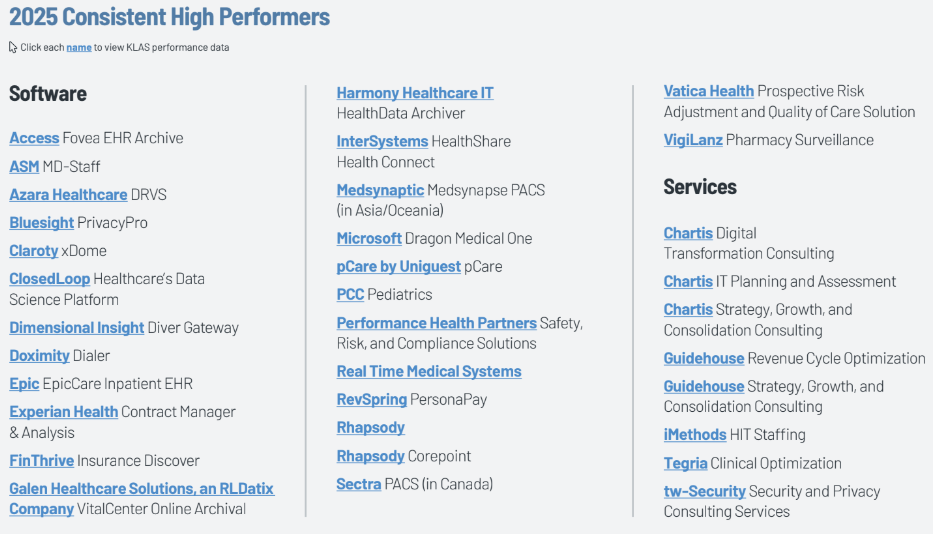
A new KLAS report on oncology systems finds that many independent oncology practices have been acquired by health systems. They have also increased their use of cloud technology.


Government and Politics

Curacao’s trade commission rules that an after-hours primary care group that holds a 70% market share abused its market position by requiring doctors to use a specific software system to use its services. The government will order the group to create and fund an open API connection to competing systems.


Sponsor Updates

image

  • CTG staff volunteer with the United Way of Buffalo & Erie County during its Day of Caring at Buffalo River Fest Park.
  • Altera Digital Health selects MedAllies as its QHIN partner for its Paragon Denali EHR.
  • Capital Rx releases a new episode of “The Astonishing Healthcare Podcast” titled “The Benefits You Probably Didn’t Know You Have, with Marsha Perry.”
  • Black Book Research announces its 2025 rankings of RCM vendors serving physician practices, with HIStalk sponsors FinThrive and Waystar achieving top marks in several categories.
  • Agfa HealthCare achieves HITRUST i1 Certification.
  • Navina and Nabla partner to deliver real-time support across clinical encounters.
  • “The Big Unlock” podcast features Arcadia Chief Strategy Officer Aneesh Chopra in an episode titled “Reimagining Healthcare From Meaningful Use of Data to AI-Driven Equity.”
  • Censinet releases a new episode of the “Risk Never Sleeps” podcast titled “The Startup Prescription for Healthcare IT – Part 1, with Elevsis Delgadillo, SVP of Customer Success at KeenStack.”
  • A new Black Book Research survey of inpatient EHR users reveals meaningful disparities in satisfaction across major inpatient EHR platforms.

Blog Posts

Sponsor Spotlight

image

FDB (First Databank) delivers clinically robust, workflow-integrated drug knowledge that is patient-specific and actionable, enabling more precise medication decisions. Trusted for quality, clinical expertise, and collaboration, FDB helps improve patient safety, operations, and outcomes. FDB’s drug databases and medication decision support solutions power information systems used by the majority of hospitals, physician practices, pharmacies, payers, and beyond, impacting millions of clinicians, business associates, and patients every day. Follow FDB on LinkedIn. (Sponsor Spotlight is free for HIStalk Platinum sponsors).


Contacts

Mr. H, Lorre, Jenn, Dr. Jayne.
Get HIStalk updates.
Send news or rumors.
Follow on X, Bluesky, and LinkedIn.
Sponsorship information.
Contact us.

Comments Off on News 7/11/25

EPtalk by Dr. Jayne 7/10/25

July 10, 2025 Dr. Jayne 3 Comments

image 

I finally had time to dig into the recent paper about the “accumulation of cognitive debt” that happens when using AI assistants.

As a proud member of Generation X, I first experienced those rites of passage called “the five-paragraph essay” and “writing a research paper” in middle school. My English teacher  — this was before everyone called it Language Arts or something else more inclusive — made us create a 3×5 index card for every reference. We had to have cards for every quote or idea we planned to use. For those of us whose brains were wired for reading and writing, it was a painful process. We just wanted to jump in and start writing. However, for others it was an exercise in organizing thoughts and making sure to have enough materials to support your conclusions.

Fast forward to my university days, when I was a teaching assistant for an English 101 “Thinking, Writing, and Research” class. Those pesky index cards were still recommended, although not required. Personal computers had just made their way into dorm rooms, but as I graded research essays, I could easily tell who knew how to organize their thoughts and who was simply phoning it in.

The professor I worked with always selected obscure topics for the assignments, so it was nearly impossible to copy the work of others. That made grading all those essays quite an adventure. This was the era when those with computers had to figure out how to best use them on an as-you-go basis, because there certainly weren’t any classes offered that explained the best ways to use various pieces of software. Subsequent generations always had access to computers for schoolwork, so I’m not sure how much of the process aspect of writing is still taught versus enabling people to just sit down at the keyboard and get to it.

Within that context, I started reading the paper. It looked at how three cohorts completed an essay writing task. LLM-only, search engine-only, and brain-only groups completed three writing tasks using their assigned method. They then had a fourth task where some of them were crossed to another group. The participants were monitored with electroencephalography (EEG) to assess the cognitive load during the tasks. Additionally, essays were assessed using natural language processing, scoring with the assistance of a human teacher and scoring by an AI judge.

The authors concluded that the brain-only group had the strongest brain connectivity, followed by the search engine group. The LLM group had the weakest connections. Additionally, participants in the LLM group had lower self-reported ownership of their essays and had difficulty quoting their own work. Ongoing analysis showed that “LLM users consistently underperformed at neural, linguistic, and behavioral levels.”

The authors commented, “These results raise concerns about the long-term educational implications of LLM reliance and underscore the need for deeper inquiry into AI’s role in learning.” Given some of the personal statements that I’ve read for medical students over the last two years, there’s so much LLM use that it’s hard to get a feel for who the candidates really are as people. Maybe this research will convince folks to dial it back a bit.

image

I enjoy learning about new players on the healthcare IT scene. One that I’ve been watching in recent months is CognomIQ. The company’s semantic-based data management solution has been optimized for healthcare, in particular for research institutions.

The company originally caught my eye when I heard that industry veteran Bonny Roberts had joined the team as VP of customer success. She’s a long time HIStalk fan and served as co-host of the final HIStalkapalooza back in the day. I trust her to recognize the real thing.

The company’s CTO, Eric Snyder, can discuss the importance of data without succumbing to industry buzzwords or getting bogged down in jargon. He recently delivered a guest lecture for a data and visualizations class at the University of Rochester. He followed it up with a social media post on data literacy and the problems that happen when different parts of the healthcare system describe parts of the care continuum in different terms.

My favorite quote: “I struggle with the answer to the data literacy in healthcare problem because it’s like creating a second floor of a house when the first floor is propped up on sticks. We never solidified the foundation as an industry, instead we moved on to AI.”

I wish more people in the industry understood this way of thinking. I would even go a step farther to say that we’ve built a house of cards and now we’re putting AI on top of it, but I’m trying to be less cynical. Those of us on the patient care front lines have spent the last quarter century creating a tremendous volume of patient-related data that is just floating around and isn’t helping organizations reach their potential. I think of all the wasted hours of clinicians clicking and the back-end systems being unable to do anything useful with the data because of  lack of standardization or inconsistent standards.

Snyder has spent the better part of the last decade leading technology innovation work at the Wilmot Cancer Institute and understands the importance of data to solve complex problems. The platform can aggregate hundreds of data sources and transform it in an automated fashion, which sounds awfully attractive to those of us who have had to engage in weeks or even months of cleanup prior to embarking on reporting or research efforts.

I also have to give a shout out to the company’s CEO, Ted Lindsley, whose LinkedIn profile boasts, “Healthcare Data that doesn’t suck.” Honestly, seeing that made my little informatics heart go pitter-patter, because it’s incredibly refreshing to see someone who is excited about what they do and is ready to express it in no uncertain terms.

I reached out to Ted to learn more. He was willing to entertain my anonymous inquiries. Recent highlights include the company coming out of stealth mode, showcasing its work at the recent Cancer Center Informatics Society Summit, and announcing its seed round. He had some great analogies about technology leaping forward and had me laughing about moving from MS-DOS and Windows 3.1 to Windows 95, even though my ability to talk about that transformation likely betrayed my age. He’s certainly no stranger to the work that needed to give the industry a kick in the pants and get it moving ahead. I’m looking forward to seeing where CognomIQ goes this year and beyond.

image

The last couple of weeks have been pretty exhausting and free time has been scarce, so I had to rely on an AI-generated cake in celebration of this being my 1500th post. I was hoping to whisk myself to a beach to celebrate, but instead I have to make it through another major upgrade first. When I was a young medical student sitting down at a green-screen terminal to access lab results, I never imagined writing about my experiences with healthcare IT, let alone there being people who would read it on a regular basis. Thanks for supporting my work, and a special thank you to those readers who share their comments and ideas so I can keep the words flowing.

Email Dr. Jayne.

Morning Headlines 7/10/25

July 9, 2025 News Comments Off on Morning Headlines 7/10/25

Vytalize Health raises fresh $55M and eyes deals

Value-based care practice management company Vytalize Health reportedly raises $55 million, bringing its total funding to over $230 million.

HL7 International Launches AI Office to Set Global Standards for Healthcare’s AI Revolution

Open standards organization HL7 establishes an AI office to develop foundational standards for the use of AI in healthcare.

QGenda Announces Acquisition of New Innovations

Healthcare workforce management software vendor QGenda acquires residency management software company New Innovations.

Comments Off on Morning Headlines 7/10/25

This Week in Health Tech 7/9/25

July 9, 2025 This Week in Health Tech Comments Off on This Week in Health Tech 7/9/25
LinkedIn weekly 070925 - Copy
Comments Off on This Week in Health Tech 7/9/25

Healthcare AI News 7/9/25

News

image

Rock Health reports that US digital health startups raised $6.4 billion in the first half of 2025, which represents a modest increase over the same period last year. AI-enabled companies captured 62% of that total, raising average round sizes that were nearly double those of non-AI startups. Nine of the 11 funding rounds of greater than $100 million went to companies that offer AI-driven products, including two mega-rounds for Abridge within just four months.

An AI cybersecurity company says that its average health system audit uncovers 70 active AI applications, many of them embedded in tools from Microsoft, Salesforce, Google, and LinkedIn. It notes that while healthcare organizations often believe that they have limited AI use by blocking tools like ChatGPT and Gemini, they often overlook AI features that are contained in vendor-provided technology.

Cleveland Clinic Abu Dhabi appoints Peng Xiao, the CEO of Emirates-based AI development company G42, as its board chair.


Business

image

John Snow Labs spins off Martlet.ai, which will apply AI to HCC coding.

image

FDA grants Breakthrough Device Designation to Artera’s precision medicine tool for prostate cancer.


Research

UCLA researchers create an AI tool that turns structured EHR data into “pseudo-notes” that can be used by clinical decision support systems without EHR integration.

Mayo Clinic develops an AI tool that diagnoses surgical site infections by analyzing patient-taken photos of wounds after surgery.

University of South Florida researchers develop an AI system that assesses pain in NICU babies in real time by analyzing data from cameras and sensors.


Other

image

Huntsville Hospital (AL) upgrades its campus security system with 1,800 AI-powered cameras that employ facial recognition and license plate detection.


Contacts

Mr. H, Lorre, Jenn, Dr. Jayne.
Get HIStalk updates.
Send news or rumors.
Follow on X, Bluesky, and LinkedIn.
Sponsorship information.
Contact us.

Morning Headlines 7/9/25

July 8, 2025 Headlines Comments Off on Morning Headlines 7/9/25

Samsung Electronics Acquires Xealth, Bridging the Gap Between Wellness and Medical Care

Samsung Electronics will acquire digital health integration company Xealth.

University of Maryland Medical System Announces Spinout of Gallion Health, Developer Of Award-Winning Supply Chain Application

Gallion Health launches out of University of Maryland Medical System’s IHarbor Innovation Center to offer providers cloud-based digital supply chain capabilities.

Naviant Acquires Amitech Solutions to Expand Healthcare and Intelligent Automation Capabilities

Intelligent automation and process consulting company Naviant acquires healthcare services firm Amitech Solutions.

Comments Off on Morning Headlines 7/9/25

News 7/9/25

July 8, 2025 News Comments Off on News 7/9/25

Top News

image

Samsung Electronics will acquire digital health integration company Xealth.

Xealth announced an undisclosed amount of funding from Morningside Ventures earlier this year. The company spun out of Providence in 2017 to sell its platform that allows providers to prescribe digital health programs and tools.

Samsung says the acquisition will help it reach more health systems and digital partners through connected care.


Reader Comments

From Abacab: “Re: the VA. They posted an RFI on July 3 titled ‘Electronic Health Record Modernization (EHRM) Systems Integration Support to the EHRM Integration Office.’ If they proceed, it most likely strips Oracle Health of the prime integration responsibility and shifts it to a traditional government systems integrator. Oracle has had notable failures with its Oracle Health rollout. Shifting it to an SI who has similar experience at least brings risk down substantially.”The RFI seeks input on selecting a system integrator to support the VA’s enterprise-wide rollout of Oracle Health, covering implementation, integration, management, and sustainment. My initial, non-expert assumption was that Oracle Health would remain the prime contractor, with funding and operational responsibility shifting to the integrator. Leidos seems to be a likely frontrunner given its role as prime contractor for the DoD’s Oracle Health rollout. However, a reader who has deep federal contracting experience believes that the VA may actually be looking to replace Oracle Health as the prime, not just add an integrator. They noted it never made sense for Cerner – who had never installed its system for the government and never served as prime contractor on a big federal project as far as I know — to receive a no-bid contract for both software and responsibility as prime, which of course let it keep most of the money.

image

From Dropsy: “Re: Becker’s Health IT & CIO Report. Amenities Health founder and CEO Aasim Saeed, MD, MPA rips them on LinkedIn for running an Epic blog post as its lead story.” I agree that it’s not real journalism to run a lead story that summarizes a vendor CEO’s company blog post. News is always sparse right after a holiday, but surely this was the most questionable choice from the 10 stories listed.


Sponsored Events and Resources

July 22 (Tuesday) 1 ET. “Innovating the Consumer Experience Beyond the EMR with Open Standards.” Sponsor: Praia Health. Presenters: Ryan Howells, principal, Leavitt Partners and program manager, The CARIN Alliance; David LaBine, VP of software engineering, Providence Digital Innovation Group; Robin Monks, CTO, Praia Health; Kristen Valdes, CEO, b.well. As healthcare faces rising consumer expectations and tighter regulations, the high cost of maintaining fragmented, proprietary systems is no longer sustainable. While patient data access has improved, the lack of open standards continues to hinder innovation, drive up integration costs, and limit the potential of digital health beyond the EHR. This webinar will discuss how open standards like OIDC, HL7 FHIR, and open technology requirements are essential for reducing integration burdens, accelerating development, and lowering maintenance costs. Panelists will describe how every closed integration represents a lost opportunity and will offer practical strategies for leveraging open technology as a competitive advantage that improves efficiency, ensures compliance, and strengthens patient trust.

Contact Lorre to have your resource listed.


Acquisitions, Funding, Business, and Stock

image

Health and human services technology company VitalHub acquires patient flow software vendor Novari Health for $32 million. Canada-based VitalHub’s recent acquisitions include Induction Healthcare (patient engagement and virtual care), MedCurrent (clinical decision support), and Strata Health (care coordination).


People

image

PointClickCare promotes James Yersh to president.

image

Kumar Murukurthy, MBBS (Altais) joins Optimum Healthcare IT as chief clinical officer.


Announcements and Implementations

image

La Paz Regional Hospital (AZ) goes live on Meditech Expanse.

Lifepoint Health and Community Health Systems implements Cadence’s new Proactive Care Engine for Advanced Primary Care Management of Medicare patients.

image

Hannibal Regional Healthcare System (MO) will go live on Epic this week.

Black Book Research surveys clinicians to measure how their input shapes AI product design, using eight qualitative KPIs that are tied to workflow fit, usability, and trust. Top-scoring vendors are Epic, Signal 1, Aidoc, Suki AI, Notable, and Viz.ai.

image

A new KLAS report on EHR clinical optimization names Nordic and Chartis as the top-performing firms.


Government and Politics

image

KLAS surveys 169 health system executives to understand how they are dealing with the uncertainty of federal policy, with the largest expected impact being cuts in Medicare and Medicaid. It concludes that financial pressures are forcing the organizations to “plan through the fog” by taking action now even without clear direction. A summary:

  • Payment reforms are forcing organizations to reconfigure themselves, not just cut expenses, as they scale back services and expand high-margin service lines. This survival strategy creates implications for patient access.
  • Most organizations plan to shift IT spending to vendor partnerships that offer quick ROI rather than cutting their IT budgets.
  • Nearly 40% of the organizations are betting on AI as a way to reduce administration costs, but few have progressed beyond pilot projects.
  • The organizations are reevaluating payer partnerships, Medicare Advantage growth, and contract performance. This is influencing broad organizational strategy.
  • Smaller organizations are reacting similarly, but without the resources needed, leaving them with little margin for error in retooling their strategies.
  • Few organizations are optimistic about government policy changes and are already being hit by financial policies and tariffs.

Other

The New Jersey Department of Health and Department of Human Services works with RWJBarnabas Health and the New Jersey Health Information Network on a pilot project that automates the filing and creation of birth certificates via data exchange between hospital EHRs and the state’s Vital Statistics Birth Registry.


Sponsor Updates

image

  • Kyruus Health staff volunteer with Seeds of Hope in Portland.
  • Healthcare IT Leaders publishes “The State of Oracle Health in 2025,” which analyzes Oracle Health’s platform and strategy using commentary from the company’s leadership and customers.
  • Capital Rx releases a new episode of “The Astonishing Healthcare Podcast” titled “A Look at What’s Really Driving Drug Spend, and How it Impacts Us, with IQVIA’s Michael Kleinrock.”
  • The “HITea with Grace” podcast features First Databank SVP of strategy and product management Virginia Halsey in an episode titled “Virginia Halsey Spills the Tea on Smarter Medication Decision Support.”
  • Fortified Health Security names Hannah Cook product manager for advisory services and Eli Herran security compliance analyst.
  • Health Data Movers will sponsor the Northern Ohio HIMSS Charity Golf Classic & Collaboration Summit August 5-6 in Highland Heights.
  • HIStalk sponsors Arcadia, TruBridge, Waystar, FinThrive, VisiQuate, and Infinx earn top rankings for AI-powered RCM applications based on Black Book Research’s latest survey.
  • Impact Advisors partners with Montage Health on its Workday financial management and Workday supply chain management go live.
  • Infinx releases a new episode of its “Revenue Cycle Optimized” podcast titled “RCM Insights – AI Agents Transform Claim Status Checks.”
  • Linus Health advisors author a study published in the Journal of Alzheimer’s Disease titled “Precision neurocognition: An emerging diagnostic paradigm leveraging digital cognitive assessment technology.”
  • Nordic collaborates with GoHealth Urgent Care in Atlanta on its Epic implementation.
  • Redox releases a new episode of its “Shut the Backdoor” podcast titled “The Healing Network – CISO Relationships in a Ransomware Era.”
  • SmartSense by Digi will exhibit at the Association for Diagnostics and Laboratory Medicine’s annual conference July 27-31 in Chicago.
  • The G2 Summer 2025 Grid reports recognize Symplr’s access, clinical communications, provider, talent management, and workforce solutions.

Blog Posts


Contacts

Mr. H, Lorre, Jenn, Dr. Jayne.
Get HIStalk updates.
Send news or rumors.
Follow on X, Bluesky, and LinkedIn.
Sponsorship information.
Contact us.

Comments Off on News 7/9/25

Text Ads


RECENT COMMENTS

  1. I'll bite on the disagreement side. 25+ years in EHR implementation, sales, and support. First, regarding the decision effect. Sure,…

  2. And which "political exercise[s]" by a private entity are appropriate for state governments in this country to punish with a…

  3. What do you mean? What was the "political exercise" that prompted this response?

  4. Many, yourself included, chose to make healthcare and Healthcare IT a political exercise. Shouldn't be shocked when the other side…

  5. I see a lot of people dislike what I said. I assume some don't like it because what I said…

Founding Sponsors


Platinum Sponsors


Gold Sponsors


RSS Webinars

  • An error has occurred, which probably means the feed is down. Try again later.