


Curbside Consult with Dr. Jayne 6/20/11
Well, it seems Dr. Jayne has a new not-so-secret crush. His name is Ricky Roma. Seriously, I almost swooned reading his response to my recent Curbside Consult.
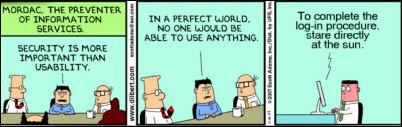
Why, you ask? Because 90% of the time, I sit on that wall right beside the fearless IT warriors at my hospital, defending security policies and standards as well as truth, justice, and the Enterprise Way.
I’m the one who has the fun of giving the smack-down to whiny end users (frequently Department Chief types or high-profile surgeons) who don’t understand why giving their passwords to their students and staff is a bad idea. I get to explain why each department can’t have their own customized software when we’ve got a large health system to run. I’m a huge fan of that speech in A Few Good Men and I’ve used a variation of it more than a few times.
One of the things I enjoy most about writing for HIStalk is for Dr. Jayne to be able to represent viewpoints that are not necessarily mine. I’ve been an “IT guy” long enough to know that we do play a somewhat parental role. Like those who celebrated Father’s Day yesterday, giving in to everything that’s asked of us isn’t a good idea.
Another aspect I enjoy is the ability to throw topics out and see what’s hot and what’s not. And this is clearly hot. I’d like to share some of the responses I received. Regarding my comment about an orthopedic colleague who had the wide-aspect laptop, one reader pointed out:
The hardware issue is really a software issue. Your point about software working on 4:3 vs. 16:9 screen displays is valid to a point. However, I find that my Web apps can adjust to my display, especially if the display is a phone. It seems to me that with the growth of HD capable monitors and gaming- and video-optimized laptops that software vendors would let go of their control of each pixel and allow folks to optimize their software for the aspect ratio of their system.
One of the coolest things I ever saw was a technical writer would could take his massive 16:9 monitor and pivot it from landscape to portrait orientation and his application (Word in this case) reoriented the display to take advantage of the orientation. He went from side-by-side book layout of two pages to one page over the other. Very, very cool.
HIT should demand that kind of separation of display from the underlying application. I know it can add to support costs, but is the goal here to reduce support costs or make medical practitioners more efficient and comfortable in their work.
I don’t disagree. More vendors need to make their user interface dynamic. However, when the vendor clearly states in the documentation that there is a specific aspect ratio and resolution required for the product but the IT staff purchases something different, it’s a hardware/people issue. Agreeing on that point, the reader added:
Having started in healthcare at a startup years ago then moved on to other fields, including mobile, and then back into healthcare and EMRs, I felt as if the industry had not changed in my absence. What I see is that there just has not been enough money in the market for anyone to actually maintain apps the way they should be, which is managing the infrastructure as well as just shoveling on more features.
In the ambulatory EMR market, I just see a race to add functionality without investment in redesign so you get these incredibly long series of tabs with very difficult discovery of how to do what you want to do next. In this world of Google, it is crazy that many searches are still bound to a particular field rather than being ‘softer’ and allowing for searches across multiple fields with a list sorted by relevance.
There is this huge disconnect for healthcare workers between the systems they use at work and those they use in their private pursuits.
This last statement is incredibly profound. It supports why so many physicians want to use the technologies available to them in other arenas when they are caring for patients.
Trust me, I understand security. I understand encryption. I understand HIPAA, OCR penalties, and the perils of letting users slap any old device on the network. I also understand load balancing, network and server performance metrics, and a host of other things that, when spoken about in mixed company, render other physicians clueless.
Having had not only my physician data breached (including SSN) but also my own PHI, I really do get it. What I have difficulty understanding though, is an IT department that runs Windows XP across the board and will allow Fujitsu tablets on the network but not HP devices.
Some savvy readers noticed that although many reader comments were of the “no Apple, no way” variety, other than citing the project at Albany Medical Center, I never suggested that IT departments should allow users to put personal devices on the network at their every whim, or that Apple products didn’t have potential security issues. In speaking of the variety of hardware in the market today, I used the word “nightmare” to describe the consequences of lack of standardization. I didn’t suggest that IT departments throw the baby out with the bathwater, but noted that those who are able to temper their requirements have an advantage over those who don’t.
Not every IT department is understaffed, underfunded, or abused. One correspondent cited a hospital where the IT department has more employees than any other business unit, as well as a level of funding that is many times that of the top clinical divisions combined. (word of advice – if you don’t want to “out” your employer, don’t message on Facebook because I can see who you work for. And BTW, I am not surprised!)
What’s extremely hard for CMIOs to do, even those of us who sit in solidarity with our IT brothers and sisters, is to explain to the physician who is working with the ergonomics team because of a visual disability that the IT department does not have any devices to offer her other than a fixed-location PC with a large monitor (even though they’re readily available from the vendor) because they’re not “standard.” As Shipes commented, maybe it’s an IT governance problem.
How should we respond to the colleague who has read about competitors using different technology, or the one who is on staff at a competitor hospital who allows iPads for patient care? HIStalk and other media are full of articles about healthcare organizations embracing the iPad. Clearly some organizations have figured out ways around the security issues, or are able to limit use to certain applications. Clinicians are looking for facts, not fear. As I was thinking that I’d like to hear from those groups how they do it, my inbox made its happy little ‘ding’ sound, and a fellow CMIO hit the nail on the head:
Security and productivity can’t be mutually exclusive, or healthcare is doomed. It is imperative that everyone in IT from the CIO and CMIO down to PC support realize we all share a common mission: (1) patient safety and satisfaction (often forgotten); (2) organizational productivity (no margin, no mission); and (3) physician satisfaction (we like happy docs). If this means devoting resources to figure out how we can provide secure access from physician devices, we should plan on that investment. I often hear from my colleagues that we care little about their practice, we have no consideration for patient care, and we have no interest in helping them with daily activities of being a physician. IT has become integral in the care of patients and needs to act that way.
We are in the process of provisioning the Epic Haiku (iPhone) and Canto (iPad) app to probably close to 1,000 physicians. We did an internal survey and discovered 90% of our physicians use smart mobile devices, greater than 75% the Apple platform. The Epic mobile app allows them to have deep access to the patient’s current chart and past history in real time, and with AT&T, they can be speaking with a nurse or colleague while reviewing the chart simultaneously. Please tell me how that sort of convenience isn’t worth the extra steps to ensure secure PHI. The app is set up as a remote viewer, no PHI is stored on the phone, and it requires three-factor authentication (user ID, password, and unique device ID). That’s much more secure than random papers floating around in hallways and cars.
As a CMIO, it’s my job to represent the physician perspective and help bridge the gaps between the needs of IT, the needs of clinicians, and the almighty budget. When I’m not drowning my end of day sorrows in a nice scotch, I’m hoping for the miracle that allows me to deliver the impossible with solutions that are simultaneously fast, safe, and physician friendly. In the meantime, though, I’m right next to you on that wall, Ricky Roma.




The news about AHRQ is very unfortunate. The AHRQ staff were always excellent to collaborate with. They had an impressive…