EPtalk by Dr. Jayne 1/9/25

January 9, 2025 Dr. Jayne Comments Off on EPtalk by Dr. Jayne 1/9/25

The hot topic around the virtual water cooler this week was the push to use real-world evidence (RWE) while caring for patients. This topic has become more relevant as increasing number of clinicians have access to RWE while caring for patients.

This kind of data can have particular strengths, including demonstrating how medications and other treatments actually work with real patient populations versus those found in clinical trials. It can also be used for post-marketing surveillance of new drugs and treatments.

However, there can be challenges depending on how clinicians are looking at the data. For example, if you’re looking at how clinicians are treating certain types of patients, one has to still understand why they might be choosing those therapies and whether those patterns are consistent with the evidence from rigorous clinical trials.

If you don’t take that into consideration, there can be a slippery slope where “everyone’s doing it, I should too” overrules graded recommendations. Depending on how data is sourced, there’s the potential for RWE to function as an echo chamber.

For example, if a large health system is pulling RWE data from their EHR, it’s going to be influenced by the formularies that are in place at its facilities. One might not see more appropriate treatment patterns that better match conventional evidence because the majority of drugs that are being prescribed for a given condition are done so in order to achieve formulary compliance and to avoid prior authorizations or additional work.

The consensus among physicians in the discussion was that real-world evidence has its place, but it shouldn’t overshadow the recommendations that are gleaned from robust clinical trials or gathered through expert consensus.

Mr. H. mentioned it earlier this week, but I would be remiss if I didn’t include my own mention of the Lown Institute’s 2024 Shkreli Awards, recognizing “the worst examples of profiteering and dysfunction in healthcare.” The list is named after so-called pharma bro Martin Shkreli. If you’re not familiar with his exploits, I would recommend spending a minute or two with your favorite search engine.

There have been a number of terrible individuals and organizations in healthcare over the last several decades. I might have reconsidered my career choices had I known how bad it could be. My academic advisor had a sweet job lined up for me in the world of publication, and although I’m sure it would have been interesting, I can’t imagine it would have been as much of a thrill ride as healthcare has been.

For people who are new to the industry, I would encourage you to look at previous iterations of the Awards. Many of you are inspired and altruistic, and previous lists will provide some clues about things to watch out for.

This year’s list includes a medical school that failed to notify the next of kin before selling the body parts of the deceased, inappropriate procedures to “treat” infant tongue ties, exorbitant air ambulance bills, the focus on profits of private equity hospitals, and insurance companies behaving badly. Although it only ranked fourth on the list of 10, my personal pick for the worst of the worst is an oncologist who recommended unnecessary cancer treatment for patients. Let me know if you have other callouts for folks that should have made the list but didn’t.

Speaking of tacky behavior, I recently received a so-called “grateful patient” solicitation from an organization where I recently received care. The problem is that the care I received was not in keeping with the standard of care and left me confused, concerned, and a witness to a HIPAA violation. I reported these issues to the provider at the time of care and was asked to reflect them in my patient survey when I received it. I did that and have had exactly zero contact from the institution. Let’s see if attaching a summary of my recent visit to the grateful patient response card inspires anyone there to reach out.

I admit that I fall victim to clickbait-style headlines as much as the next person, so this one caught my attention: “Hospital at home needs an ‘Uber app,’ Mayo Clinic leader says.” The piece features comments from Michael Maniaci MD, chief clinical officer of advanced care at home for the organization. He notes that Mayo Clinic can’t scale beyond its current volume of 30-35 patients per day due to lack of coordination for staffing, supply, and other patient needs. He states, “Imagine an Uber app where the car chassis, the tires, the fuel, the engine, and the driver all show up separately. You have the tubing coming from someplace, prescription medication coming from another place, the nurse coming from one place, the DME and the pump coming from another place — and they all have to show up at the same time.”

Sounds a bit like what healthcare organizations have been doing in other developed countries for years, minus the “we need an app” bit. I have a medical school classmate who worked for an organization in Germany that provided care to patients in their homes. It sent out a fully equipped medical vehicle that was stocked with almost everything you could receive from a high-acuity urgent care or freestanding emergency department. Another classmate who worked in the United Kingdom was partnered with public health nurses who rounded on patients and provided care beyond what we consider typical nursing care in the US.

For these models to be successful, you need a certain degree of vertical integration that we don’t typically have in our fragmented healthcare system. When your insurance contracts with a home care agency that isn’t affiliated with the hospital from which you were just discharged, there will be disconnects. I’m not convinced that an app is the answer, and would instead put my money on concepts that align all facets of care with the patient and their outcomes rather than aligning with profit motives or passing the buck to other agencies.

Another article that caught my eye this week was a viewpoint piece in the Journal of the American Medical Association that addressed health privacy and the use of synthetic data. Although this approach can help mitigate issues with insufficient private health data, it introduces additional challenges due to the fact that healthcare is a complicated and highly regulated environment. The authors note difficulties in creating data points that accurately represent rare conditions or highly complex clinical presentations such as scenarios that take place in the intensive care unit. There is also the risk of bias with synthetic data particularly when it is used at scale.

They go on to state the need for standards to generate and evaluate synthetic data. I woud be interested to hear from readers who are involved in organizational use of synthetic data and the approaches that are being taken to ensure that the promise is fulfilled.

clip_image002

Shortly after many people around the world rang in the New Year with a cocktail, US Surgeon General Vivek Murthy released a recommendation that alcohol products receive a warning label that advises consumers of the increased cancer risk associated with alcohol consumption. This would literally require an act of Congress. As we head towards HIMSS and another year of conferences, it will be interesting to see if health-forward organizations continue hosting alcohol-laden happy hours in their booths or if they use it as an opportunity to trim budgets as well as to promote health.

Will you reduce or eliminate alcohol consumption based on these recommendations? Whether yes or no, what’s your favorite beverage pick for 2025? Leave a comment or email me.

Email Dr. Jayne.

Healthcare AI News 1/8/25

January 8, 2025 Healthcare AI News 1 Comment

News

FDA issues draft guidance for supporting development and marketing of AI-enabled devices throughout the Total Product Life Cycle. It also publishes draft guidance for the use of AI to support development of drugs and biologicals.

image

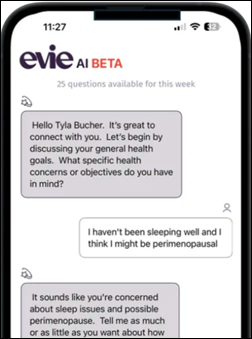
Women’s health smart ring maker Movano announces EvieAI, a chatbot that was trained on peer-review medical journals. The company said in its CES announcement that the chatbot’s accuracy is 99%.

Law professors suggest that the Supreme Court’s recent overruling of the Chevron Doctrine — which allows federal agencies, rather than courts, to interpret and implement statutes when authorized by Congress — could impact the FDA’s ability to regulate AI, as its approach often relies on non-binding guidance documents and position papers.


Business

image

Hartford HealthCare implements Aidoc’s AI platform, which includes 17 FDA-cleared algorithms.

image

UK-based digital pathology vendor Deciphex raises $32 million in a Series C funding round.


Research

image

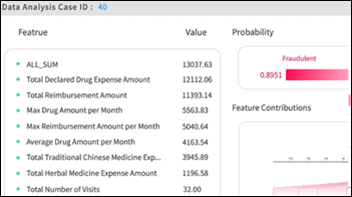
Researchers in China develop a health insurance fraud detection model for insurers and auditors.

A study finds that while AI is effective at making a diagnosis when fed exam-style questions, if fares worse when analyzing real-world conversations. The authors make these recommendations for AI developers:

  • Train and test systems on conversational, open-ended questions as are found in unstructured doctor-patient conversations.
  • Assess the model’s ability to ask the right questions.
  • Design models to work across multiple conversations.
  • Design models that can capture both textual data and images.
  • Incorporate non-verbal cues such as facial expressions, voice tone, and body language.

Other

A health news site lists ways that North Carolina providers are using AI:

  • Analyzing lung nodule scans to predict cancer risk (Atrium Health).
  • Electronic follow-up with patients who have received a hip or knee replacement (OrthoCarolina).
  • ED scanning of images to detect serious conditions (Novant Health).
  • AI-drafted responses to patient portal messages (Atrium Health and WakeMed).
  • Cognitive impairment detection (Wake Forest University School of Medicine).
  • Flagging patients who are due a follow-up visit or imaging (Wake Forest Baptist).
  • Early detection of sepsis (Duke Health, UNC Health).
  • Suicide risk assessment (Novant Health).
  • Optimizing OR use by predicting the length of surgical procedures (Duke Health).
  • Answering provider administrative questions (UNC Health).

A popular TV journalist in Israel who lost his voice due to Lou Gehrig’s disease returns to Channel 12 by using AI that was trained on his voice to narrate his stories.

Health authorities in Sudan are hoping that AI can perform some of the work of doctors who have been killed in the country’s civil war.

A bioethicist warns that healthcare AI systems that allow customization could restrict exposure to important information in catering  to the user’s preferences and biases. She presents distinctions between systems that are customized for information discovery and those intended for information delivery.


Contacts

Mr. H, Lorre, Jenn, Dr. Jayne.
Get HIStalk updates.
Send news or rumors.
Follow on X, Bluesky, and LinkedIn.
Contact us.

News 1/8/25

January 7, 2025 News 2 Comments

Top News

image

Clinical surveillance and alarm management company AirStrip Technologies acquires Decisio Health, which specializes in clinical decision support and remote patient monitoring software.

Former AirStrip CEO Alan Portela launched Depth Health, which is focused on AI-enabled patient care and traffic flow optimization, last August.


Webinars

None scheduled soon. Previous webinars are on our YouTube channel. Contact Lorre to present or promote your own.


Acquisitions, Funding, Business, and Stock

image

Sanford Health (SD) finalizes its acquisition of Marshfield Clinic Health System (WI), which was announced in July. Hospital leaders expect that pooled resources and access to Sanford’s $350 million virtual care center will enable the combined systems to offer more virtual care services to their rural patient populations. The organizations will invest up to $500 million to transition Marshfield from Cerner to Epic.

image

CalmWave announces $5.25 million in new funding. The company has developed AI software to help ICUs manage alarm fatigue.

Evidence generation platform vendor Highlander Health acquires Target RWE, which generates real-world datasets. Highlander Health was launched in September 2024 by oncologists Amy Abernethy, MD, PhD and Brad Hirsch, MD.

Teleradiology services company Onrad acquires the 80-radiologist Direct Radiology practice from Philips, making it the largest independent teleradiology vendor in the US.

Health tech venture capital firm Providence Ventures spins off from Providence to form Allumia Ventures.


Sales

  • The Illinois Public Health Institute will use 4medica’s data-sharing technology to power its new Chicago Regionwide Community Information Exchange.
  • AdventHealth will implement hospital-at-home software and clinical care services from Biofourmis as a part of its new remote patient monitoring program for patients in Central Florida.
  • USA Health (AL) selects managed services from Healthcare IT Leaders.

People

image image

Direct Recruiters promotes Stephen Benson and Bradley Morrison to partners.

image

US Air Force veteran Eric Gardner, MBA (Flagship Health) joins Leidos QTC Health Services as VP of operations. Gardner’s 20-year career in the Air Force included stints as a Medical Service Corps officer and as the CFO and VP of the Air Force Medical Operations Agency.

image image

Topcon Healthcare names Jacques Gilbert (Nuance) chief strategy and business development officer and Christian Odaker, PhD (Smart Reporting) CTO.

image

Susan Grant, DNP, RN (Wellstar Health System) joins Symplr as chief clinical officer.

image

Impact Advisors names Wes Arnett (Compassus) as president of its revenue cycle managed services business.

image

Parkland Health promotes Brett Moran, MD to SVP / chief health officer.


Announcements and Implementations

Six health systems in Southeastern Ontario form the Lumeo Regional Health Information System to implement Oracle Health throughout their enterprises.

A study finds that nearly two-thirds of patients who reviewed a standard prostate pathology report were unable to determine whether they had cancer, whereas nearly all of those who received a plain-language version could easily understand their diagnosis.

Uvalde Memorial Hospital (TX) goes live on Meditech Expanse.

image

Analysis finds that the claims-based undiagnosed dementia algorithm of Linus Health-owned Together Senior Health can accurately identify high-risk patients.

A review by TrustCommerce, a Sphere Company finds that 96% of surveyed providers accept patient credit cards, 69% offer flexible payment plans, and four of five identify expanding payment options as a key focus area.


Other

image

People in every other developed nation will struggle to grasp this. A White House rule will ban lenders from factoring medical debt into loan approval decisions (affecting 15 million people owing $49 billion) and prohibit repossessing medical devices, wheelchairs, and prosthetic limbs from those who can’t pay (imagine that repo job). While it protects credit scores from billing errors that are awaiting resolution, a health justice group’s take highlights the wagging tail of medical debt while ignoring the dog: our wildly overpriced healthcare “system” that this change does little to fix:

Nobody, no matter where we live or how much money we have, should be forced to make the impossible choice between getting essential care and going into debt. And they should not have to worry that medical debt could prevent them from buying a house or securing an auto loan because of its impact on their credit.

image

The Lown Institute names the 2024 winners of its Shkreli Awards, which are named after the notorious price-gouging, ex-con pharma bro CEO Martin Shkreli:

  1. Steward Health Care CEO Ralph de la Torre, MD: Collected $250 million in private equity profits while the hospitals under his management declared bankruptcy.
  2. UnitedHealth: Boosted Medicare Advantage profits through rushed patient visits and aggressive coding practices.
  3. Amgen: Ignored research showing that its cancer drug was effective at lower, safer doses that would have reduced its revenue by $180,000 per patient annually.
  4. An oncologist at St. Peter’s Hospital (MT): Administered unnecessary cancer treatments and altered patients’ end-of-life plans without their consent, becoming the hospital’s top earner.
  5. Private equity-owned New Mexico Hospital: Denied care to cancer patients, even those with insurance, unless they made upfront payments.
  6. Pretty in Pink Boutique: Operated a fraudulent medical supply scheme, one of seven suppliers that billed Medicare $2 billion for questionable urinary catheters in 2023.
  7. Cigna: Refused to cover a $98,000 air ambulance bill for an infant who was in respiratory distress, labeling the transport as medically unnecessary.
  8. Zynex Medical: Profited from shipping unordered batteries and electronic pads to users of its nerve stimulation devices, with these supplies accounting for 70% of the company’s revenue.
  9. Dentist who perform dubious tongue-tie surgeries on babies: One supplier of equipment for the surgeries hosted a “Tequila and Tongue Ties” dentist training session that was followed by shots and margaritas.
  10. University of North Texas Health Science Center: Sold body parts from unclaimed bodies to for-profit companies after making minimal efforts to locate relatives.

Sponsor Updates

image

  • Healthcare IT Leaders partners with Locums Choice and Christmas Tree Santas for its annual Christmas tree giveaway benefiting the Children’s Development Academy.
  • CereCore releases a new podcast, “Automating EHR Implementations: A Must-Have for Managing Healthcare Informatics.”
  • Uvalde Memorial Hospital (TX) upgrades its Meditech system to Meditech Expanse.
  • Inovalon completes its three-year transformation of its analytics platform to the cloud.
  • Capital Rx releases a new episode of “The Astonishing Healthcare Podcast titled “High-Cost Orphan Drugs, Securing Claims Data, and More, with Dr. Eric Bricker.”
  • Censinet releases a new episode of its “Risk Never Sleeps. podcast, “From Stage Fright to Spotlight: Building Presentation Skills That Inspire, with Anthony Lee, partner at the Heroic Voice Academy.”
  • DrFirst publishes a new guide, “Unlocking Faster Access to Specialty Medications With Prior Authorization Automation.”

Blog Posts


Contacts

Mr. H, Lorre, Jenn, Dr. Jayne.
Get HIStalk updates.
Send news or rumors.
Follow on X, Bluesky, and LinkedIn.
Contact us.

Curbside Consult with Dr. Jayne 1/6/25

January 6, 2025 Dr. Jayne 6 Comments

clip_image002 

Since the Snowpocalypse is upon large portions of the US, I decided to show solidarity by staying home, making baked goods, and working on my reading list.

I’ve gravitated towards audiobooks in a big way. They have become my preferred way to consume fiction because I can enjoy them while doing household tasks, driving, and in many more situations than I can enjoy a paper book or even one on my trusty Kindle. For non-fiction, I still like to have a physical book in hand, especially one that references previous sections or chapters since it’s so much easier to flip back and forth.

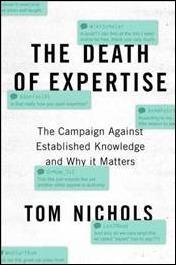
This weekend’s paper read was one I had picked up from the library a number of weeks ago. I decided to finish it so that it could go back into circulation. I was originally drawn to the book through a reference in an article I was reading that talked about how the internet is responsible for making people “dumber.”

Barely into the first chapter, I was seeing parallels between the book’s discussion of how true expertise is being devalued and the conversation I had recently with a colleague who cited “patients arguing with me all the time” as the chief source of her burnout. The first chapter addresses the idea of differentiating “experts” from “citizens” and the role that each has played in society. Experts typically have specific credentials, although the book identifies different levels of experts bearing credentials: those with aptitude or talent or experience in the field who also have credentials, and those who just have credentials.

We see the latter in medicine and I see it often in the startup world. People who have the MD or DO degree decided to go into business rather than completing a residency, and thus have never cared for patients independently or learned to bear the direct individual responsibility for another person’s life. It’s different when you’re talking about lives in the abstract or in the aggregate than when you’re sitting at the bedside with a patient and family whose treatment didn’t go the way they expected. Those with credentials but not experience or aptitude may be charismatic and may be recognized as entrepreneurs, but they will never be recognized in the same way as a physician who actually went through the steps to be board certified and to carry that kind of a load personally.

Partway through the first chapter, I had to check on its publication date. The copy I had in hand was a first edition version from 2017. On one hand, I was relieved, because reading about the debacle that was the first couple of years of COVID is still triggering for me as a frontline provider who had COVID deniers coughing in my face during the 12-hour shifts that were nearly always 14 hours long.

A lot of us who went through that experience felt at the time that COVID had magnified the willingness of patients to argue with us, largely due to conspiracy theories and medical misinformation that was found all around us. But the book reminds us that it was happening well before then, which reminds me of a patients who would arrive with stacks of pages printed from internet blogs that they would cite as evidence for the treatments they were demanding.

The book also talks about influencers and uses Gwyneth Paltrow and her GOOP brand as a prime example. I’ll admit my bias upfront here – it is my strong personal belief that “influencers” will be the death of Western Civilization as we know it. I remember when I was a kid, and there was such a focus on the idea of peer pressure and how it was something to be avoided, and that people should be critical thinkers and use their own values rather than doing something just because their friends were doing it.

The in-your-face nature of influencers and the rise of social media and TikTok have been terrible for many segments of the population, whether it’s because they wind up in the emergency room after doing some inane TikTok Challenge or whether they waste their money on unproven treatments or so-called wellness products that are more multilevel marketing than evidence-based.

The book has a short section on conspiracy theories that made me chuckle. At least to me in hindsight, the conspiracy theories that were out there in 2017 were far more benign than some of those we hear today. There’s an interesting section on how changes in higher education have led to the death of expertise, including the up-branding of small local colleges to universities without a commensurate change in the education they’re delivering, along with an attitude that people attend college or university because they are pressured to do so or feel they have to as a next logical step in their lives.

The author talks about the difference between “having a college experience” and “getting an education” and how the former has changed attitudes at institutions of learning. We’ve definitely seen this in healthcare and I’ve seen it quite a bit in the for-profit healthcare training programs out there. Graduates come out of some of these programs with no experience other than shadowing, which is truly a travesty.

My favorite chapter is the one titled “Let Me Google That for You,” which really should be the anthem for my generation. I run into a lot of people who think that because it’s on the internet it must be true, and I agree with the author that many people don’t have the skills to critically appraise their sources and to determine whether they should be trusted. Honestly, if I see one more friend posting on “cough CPR” — which is where if you think you’re having a heart attack while driving you are supposed to cough forcefully while driving yourself to the hospital — I am going to scream. This is a myth and that has been debunked by numerous reputable sources. I always post links to those sources when I see that post and remind people that if you think you’re having a heart attack while driving, you should pull over and dial 911 or hit the emergency button on your phone rather than trying to drive yourself and risk the lives of those around you.

Even in 2017, the author touches on Robert F. Kennedy, Jr. and vaccines and other medical misinformation. He reminds us that “a search for information will cough up whatever algorithm is at work in a search engine, usually provided by for-profit companies using criteria that are largely opaque to the user.”

He notes that “The deeper issue here is that the Internet is actually changing the way we read, the way we reason, even the way we think, and all for the worse. We expect information instantly. We want it broken down, presented in a way that is pleasing to our eye – no more of those small-type, fragile textbooks, thank you – and we want it to say what we want it to say.”

People do not do research so much as they “search for pretty pages online to provide answers they like with the least amount of effort and in the shortest time.” The resulting flood of information, always of varying quality and sometimes of uncertain sanity, creates a veneer of knowledge that actually leaves people worse off than if they knew nothing at all. It’s an old but true saying: “It ain’t what you don’t know that will hurt you. It’s what you do know that ain’t so.”

He also tackles the evolution of journalism (fun fact: I now know the origins of the TV show “Nightline”) and reviews some specific studies from the University College of London about how people often interact with the internet by “reading” articles by consuming the first few lines or sentences and then going on to the next thing.

The phrase “power browse” was used and I definitely see that in some of my own behavior, usually when I’m trying to cull through all the noise out there in order to write for HIStalk. It’s useful in that context, but might be dangerous if I’m trying to read about patient care or learn the nuances about a specific course of treatment. It makes me wonder how easily people can shift between those approaches in the fragmented timeline of a day caring for patients.

The book is a relatively quick read at 230 pages, and of course you can power browse it if you’re not quite ready for a deep read. I’d encourage the latter, however, because they author has a couple of really funny statements in there that I would have missed by skimming.

Have you read it and what did you think? Any other good reads you’d recommend for 2025? Leave a comment or email me.

Email Dr. Jayne.

Monday Morning Update 1/6/25

January 5, 2025 News 11 Comments

Top News

image

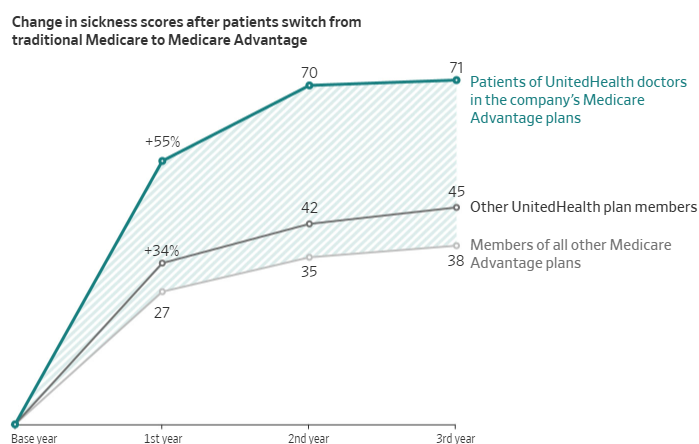
The Wall Street Journal reports that UnitedHealth Group has significantly increased its Medicare Advantage payments by electronically prompting its employed and affiliated doctors to add new diagnoses.

Patient sickness scores rose by 55% among those patients who switched from traditional Medicare to UHG’s Medicare Advantage plan, boosting UnitedHealth’s revenue by $5 billion over three years.

UnitedHealth disputes the findings, asserting that it complies with Medicare payment rules and that its patients are sicker. Doctors have pointed out that the company’s motivations are likely non-clinical since it does not suggest additional diagnoses for traditional Medicare patients, as doing so would raise its costs without increasing revenue.

A previous WSJ analysis revealed that Medicare Advantage insurers collected $50 billion over three years by adding diagnoses for which doctors performed no treatment. One example is a bruising condition that generated an additional $1,900 per year per patient, which was diagnosed 28 times more often in MA patients versus traditional Medicare, with one doctor saying that the diagnosis is pointless since all she can do is tell affected patients, “Wear some sunscreen. Maybe stop bumping the wall.”


HIStalk Announcements and Requests

image

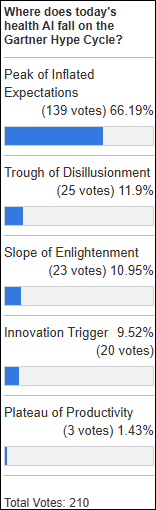
Two-thirds of poll respondents think that health AI has reached Gartner’s Peak of Inflated Expectations, which is defined as generating a lot of excitement and widespread adoption attempts that fizzle when the technology’s limitations are discovered.

New poll to your right or here: Which of your local care providers has earned your most positive brand perception? I ran this poll a few years ago and a hospital / health system was the winner, but that outcome may have been influenced by respondent demographics.

I’ve played so much R.E.M. during the slow last week that I created a playlist of similar bands from all eras (mostly old by definition) that play alternative, guitar-heavy, melodic indy pop. My research turned up these and a bunch of others, all of which I’m enjoying: The Lemonheads, Bob Mould (I notice that the video includes former Superchunk drummer Jon Wurster), The Connells, Michael Penn, Matthew Sweet, Teenage Fanclub, The Posies (I recognized co-founder Ken Stringfellow because he played keyboards and bass on several R.E.M. tours), Urge Overkill, and The Auteurs. I pasted the list into ChatGPT and asked for similar bands, which gave me another few dozen to investigate.

image

Pundits are cranking out their annual attention-seeking lists of safely vague predictions for 2025, which hopefully will prove to be more accurate than the ones from previous years. Here is my one and only: the new administration and its replacement of Federal Trade Commission Chair Lina Khan, JD will allow private equity firms and big companies (including big health systems and their vendors) more leeway in acquiring, merging, and engaging in potentially anti-consumer behavior. Beyond that, FTC has been directly involved in the Health Breach Notification Rule, the proposed (but failed so far) banning of non-compete clauses, the requirement to disclose pay-for-play social media product reviews, the distribution of potentially biased AI algorithms, the use of consumer data by health app vendors, drug company and pharmacy benefits manager pricing, healthcare price transparency, and health-related advertising.

If I was forced to make a second prediction, it would be that major health systems will turn over some of their specialty-specific chronic care management and care coordination functions to AI tools, which will test FDA’s willingness to give its OK to such systems under the new administration. The good news is that (a) even mediocre AI is probably better than the best current efforts; (b) those new systems don’t need to connect to external data that could cause hallucinations; and (c) the scope of this work focuses on specific conditions and clinical rules. The unknown is the extent of payer willingness to give hospitals money for performing those functions, whether AI or manual.

OK, one more. My aspirational #3 prediction is that doctors will finally reassert their autonomy and push back against their undervalued role as compliant rubber stampers of patient-unfriendly corporate decisions that are imposed by insurers, health systems, and private equity owners. However, I doubt that disunited physicians can effectively challenge the status quo, as they fail to recognize the collective power they could wield if they overcame divisions based on specialty, employer type, geography, and fears of being displaced by non-physician clinical providers. The lack of cohesive leadership compounds the issue, particularly given that so few practicing physicians—especially younger ones—are AMA members and don’t agree with its business-friendly, revenue-generating positions, which leaves basically no other group or individual to lead the charge.


image

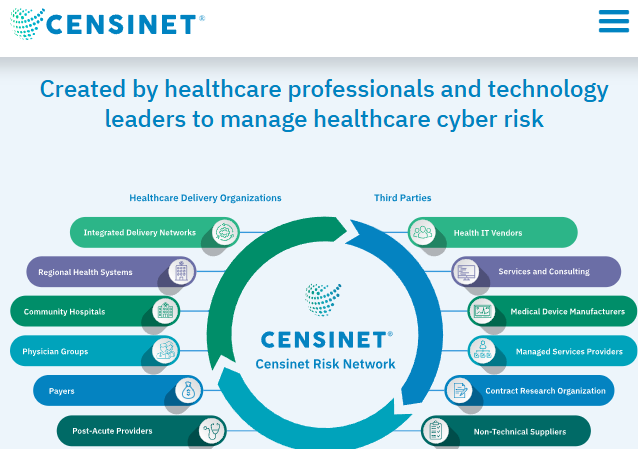
Welcome to new HIStalk Platinum Sponsor Censinet. The company is the leading collaborative risk network for healthcare organizations and vendors. Censinet RiskOps is the first and only cloud-based integrated platform that consolidates enterprise risk management and operations capabilities across critical business areas: clinical, regulatory, cybersecurity, research, and supply chain. This includes the company’s foundational success with third-party risk management (TPRM) for healthcare and transforms enterprise risk by making data and insight actionable. Thanks to Censinet for supporting HIStalk.

I found this video that describes how Northwell Health converted its TPRM programs and processes to Censinet.


Webinars

None scheduled soon. Previous webinars are on our YouTube channel. Contact Lorre to present or promote your own.


Acquisitions, Funding, Business, and Stock

Siemens questions whether its 75% ownership of Siemens Healthineers justifies its $47 billion investment, advising investors that it will make a decision about its involvement by the end of the year.

A Financial Times opinion piece says that investors aren’t realizing a substantial return on the $100 billion they put into digital health companies from 2020 to 2022. Factors include stiff competition, low consumer switching costs, high user acquisition costs, and the introduction of competing products from big tech companies such as Amazon.

image

Veradigm extends the six-month contract of interim CFO Leland Westerfield for the second time. The company fired its CEO and CFO in December 2023 for failing to comply with financial reporting. Original interim CEO Shih-Yin Ho, MD, MBA stepped down in May 2024 and was replaced as interim by Tom Langan, who remains in that role. MDRX was delisted from the Nasdaq in February 2024 for not filing its annual report for 2022.


People

image

ChristianaCare hires Rob Hartmann, MBA (Tegria) as VP of EHR transformation, where he will oversee its Oracle Health to Epic project.

image

Justin Mooneyhan, MBA (Amsurg) joins IVX Health as VP of IT / CISO.

image

Charlie Gibbs, who founded early hospital IT software companies Gibbs Computer Systems and First Coast Systems, died December 30. He was 84. Long-timers may want to search Vince Ciotti’s HIS-tory for his name to get a fuller picture of Jacksonville-based FCS.


Announcements and Implementations

A Department of Defense crowdsourced test identifies 800 vulnerabilities in using AI to summarize clinical notes and for powering a consumer medical chatbot. DoD will use its findings to evaluate future vendors and to develops its best practices and policies. The study was conducted by the non-profit Humane Intelligence, which gives AI model evaluators a platform for auditing and performing impact assessments. Co-founder and CEO Rumman Chowdhury PhD, MS has done similar work at Twitter and Parity, the latter of which she founded.

Black Book reports its top EHRs for specialty practices for 2025, also naming as top innovation leaders ModMed, NextGen Healthcare, Netsmart, ClinicMind, Epic, and RXNT.

DirectTrust announces updated versions of its 26 accreditation programs that took effect on January 1.


Sponsor Updates

clip_image002

  • HCTec offers holiday support to an elderly care facility in Hohenwald, TN, and Operation Stand Down Tennessee.
  • First Databank will present at the ASAP 2025 Annual Conference January 16 at Amelia Island, FL.
  • Goliath Technologies publishes a new client success story, “Maimonides Medical Center Quickly Troubleshoots ‘Citrix is Slow’ Complaints.”
  • Black Book Research highlights Australia’s digital health transformation in its “2025 Global Healthcare IT Rankings” report.
  • QGenda publishes a new case study, “Children’s Nebraska Improves Clinical Capacity Management.”
  • The “DGTL Voices with Ed Marx” pPodcast features SmartSense by Digi President Guy Yehiav, “SmartSense Disruption in Healthcare & Simple Hacks to Become a CEO.”
  • TruBridge names Merideth Wilson (Experian) financial health general manager.
  • Clearwater releases a new “Clear Perspective” podcast, “The Truth About EDR Killers.”
  • The Philadelphia Business Journal recognizes Crossings Healthcare Solutions parent company UHS CEO Marc Miller as one of the region’s Most Admired CEOs.
  • Direct Recruiters recognizes its Healthcare IT Team as a top producing team in 2024.
  • EClinicalWorks announces that Indiana University Student Health Center has integrated Sunoh.ai’s AI-powered ambient listening solution with its EHR.
  • Ellkay supports the Pajama Program, an initiative providing children with new pajamas and storybooks to foster a comforting and safe bedtime routine.

Blog Posts


Contacts

Mr. H, Lorre, Jenn, Dr. Jayne.
Get HIStalk updates.
Send news or rumors.
Follow on X, Bluesky, and LinkedIn.
Contact us.

Morning Headlines 12/31/24

December 30, 2024 Headlines Comments Off on Morning Headlines 12/31/24

UnitedHealth’s Army of Doctors Helped It Collect Billions More From Medicare

Patients who switched to UnitedHealth’s Medicare Advantage plans and were seen at the company’s owned and affiliated practices saw an immediate 55% rise in sickness scores as its software pushed doctors to consider often irrelevant or incorrect diagnoses to boost payments.

Will AI Help or Hurt Workers? One 26-Year-Old Found an Unexpected Answer.

A study finds that use of AI boosted the scientific output of the top 10% of researchers, had little impact on less-accomplished ones, and was disliked by 82% of scientists overall because it took away the parts of their job they enjoyed most.

Siemens reviewing Healthineers majority stake, CFO tells Handelsblatt

Siemens says the synergies of its 75% ownership of Siemens Healthineers don’t justify its $47 billion investment, leading it to review the business’s prospects and announce its intentions toward the end of 2025.

Curbside Consult with Dr. Jayne 12/30/24

December 30, 2024 Dr. Jayne 3 Comments

The end of the year is within striking distance. I was fortunate to have a nice break since nearly everyone who I work with was taking time off.

Running your own business can be labor intensive, so now it’s time to finish up those end of year accounting reports and get ready to open the books on a new one. I enjoy opening a nice, clean spreadsheet, probably a holdover from the heady days of picking out school supplies and having brand new Pink Pearl erasers at your disposal. Maybe I should start the new year with some brand new shoes as well. I’m sure there will be something sparkly in the post-New Year’s sales that would be suitable for HIMSS. 

Plenty of people ask me what I predict will happen in healthcare and healthcare IT in the coming year. I think we are going to see a lot more conversation about the role of insurance in the healthcare system and how it needs to change. Unfortunately, I think it’s going to be all talk and little action, as powerful lobbying forces work to prevent any kind of substantive change. Profit is a powerful motivator, and shareholders aren’t going to stand for lower returns when more dollars are spent on patient care.

There will also continue to be resistance to any kind of universal healthcare, despite the fact that other developed nations do a pretty good job at it, with better clinical outcomes at a lower overall cost. Anecdotal stories about people who had to wait for care in Canada will continue to sway opinions, despite the fact that care rationing and delays have been the norm in the US for years if you don’t have “good” insurance that comes at a hefty price.

One prediction that I think many of us would agree with is that Epic will continue to grow market share. Given the uncertainties at Oracle Health, Epic is a safe bet when you’re about to open your wallet to the tune of tens or hundreds of millions of dollars. Small to mid-sized practices might continue to select niche EHR vendors for a particular specialty, especially if they have a low need to integrate with the local health system, but everyone else is gravitating towards the folks in Wisconsin.

Hopefully, this leads to more patients demanding full use of the Epic solutions, including self-scheduling or the lower-key ticket scheduling option, which would allow patients to have greater control over the services they receive without having to make inconvenient phone calls to try to book appointments. I still marvel at the number of organizations that haven’t implemented these features and am always happy to have a conversation with the physicians who are typically blocking their implementation.

Another prediction: physicians will continue to leave medicine earlier than they planned, particularly if they are in primary care. I hear from a number of former colleagues who are trying to find non-patient-care roles and who think that informatics is a logical jump. I advise them that it takes more than being an EHR user to be a successful informaticist and recommend that they do some formal coursework before they decide that it’s the next phase of their career.

It feels like the majority of physicians I know have some kind of side hustle (including real estate, life coaching, crafting, baking, and photography) that they are hoping to grow to a point where it can generate income if they are too burned out to practice. I’ve already received notice of three retirements this year, along with one offer to buy a practice for an insanely low price that I gently declined.

As for non-physician workers, I think we’ll continue to see more of the so-called “quiet quitting” and “coffee badging” phenomena. People are continuing to realize that employer loyalty is a thing of the past in many areas. They will work the amount that they feel is appropriate for what they are being paid.

I think we’ll see this more in people who feel they have been forced to be physically present in the office when it does nothing for their productivity. It’s hard to build culture when you demand that people interact just because they receive a paycheck from a common employer even though they don’t even work in the same sector as others who are also forced into the office. I have a couple of friends that drive 20 to 30 minutes to their offices every day to engage in back-to-back Zoom meetings with team members who are located in other states. One goes to an office that is a non health-related division of a large corporation, but it has the same logo as their paycheck and is within 60 miles, so it’s required. Based on our conversations it’s not making for a happy work environment and employees will do the bare minimum in person so as to not be penalized. 

My final prediction is that we’ll continue to see companies try to enter the health sector because they think that they are smarter than everyone else who has been there before, which positions them uniquely to solve problems that are significantly more complex than they think. They will raise a fair amount of money along the way by convincing people that they are unique or have special skills, but I think we’ll see the majority of these companies fizzle out in the same way as their predecessors. I’m hoping that they’ll be smarter about how they operate than the last crop of startups, but I guarantee that we’ll see plenty of them blowing through cash and parading around at the trade shows. It’s what makes the industry interesting at times, and even though you want to look away, you can’t, because it’s just such a spectacle.

I’d be remiss if I didn’t end 2025 with a mention of the passing of former US President Jimmy Carter, who reached age 100 and died at home after choosing hospice care over more invasive treatments. His desire to pass with grace and dignity is admirable and resonates in a particular way with those of us who have had to perform so-called heroic measures on patients who most likely would not have wanted them had they fully understood what was involved. Carter is remarkable less for his presidency than for what he did following it, working to advance the democratic process around the world and to demonstrate a culture of service at home. He embodied service throughout his life, from his time with the US Navy to the White House to Habitat for Humanity and beyond. There’s a lot of talk about servant leadership out there, but he embodied it. Today’s leaders could learn a lot from his example. My condolences to his family and loved ones.

Email Dr. Jayne.

Morning Headlines 12/30/24

December 29, 2024 Headlines Comments Off on Morning Headlines 12/30/24

HIPAA Security Rule to Strengthen the Cybersecurity of Electronic Protected Health Information

HHS OCR issues a proposed update to the HIPAA security rule.

Equasens: strategic acquisition of Calimed, a SaaS software expert for private practitioners and surgeons

France-based medical professional software vendor Equasens acquires Calimed, which sells practice management systems to specialty practices.

Health Tech Company Laying Off 430 – Missouri Workers Impacted

GetInsured by Vimo, which operates healthcare marketplace shopping and enrollment websites in seven states, files a WARN act notice that it will lay off 430 US workers.

Monday Morning Update 12/30/24

December 29, 2024 News 3 Comments

Top News

image

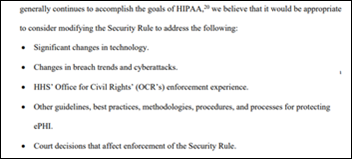
HHS OCR issues a proposed update to the HIPAA security rule, which hasn’t been changed since 2013, to modernize the required cybersecurity practices of covered entities and their business associates.


Reader Comments

From Opus Two: “Re: VA salary cuts. A friend who is a VISN executive is about to finish reclassification of 4,000 lower-level, non-clinical jobs, which will result in sharp pay cuts. The reclassification was recommended in 2012, but the VA was able to avoid cuts by arguing that the jobs are critical. The VA also plans to reduce its workforce by 10,000 FTEs, primarily within medical facilities, during FY2025.” The American Federal of Government Employees union is pressing the VA to stop considering all position downgrades, arguing that they will hurt hiring and retention. Like all federal agencies, the VA claims that that it is understaffed (at 471,000 employees) and disputes the characterization that it never fires underperformers.

From E: “Re: Philips. More ‘silent layoffs’ that avoid drawing attention to their stock dropping.” The company has reportedly laid off around 10,000 employees in the past year or two. PHG shares are up 10% over the past 12 months, but are off nearly 60% from their five-year high in April 2021.

From Ken: “Re: VA EHRM. Is nobody noticing that the plan is now to have no implementations in 2025?” The VA says that its next Oracle Health go-live has been moved back again, this time until mid-2026. Its most recent of its six live VA Medical Centers was in March 2024, although that’s with an asterisk because it was at Lovell FHCC, which is jointly operated between the VA and DoD. Oracle Health is live in three of the VA’s 18 VISNs (Veterans Integrated Services Networks), with the planned Michigan go-lives in 2026 adding no new ones since VISN 10 is already live in Columbus, OH. The VA originally said that all of its deployments would be completed by 2028, 10 years after it signed a $10 billion no-bid contract with Cerner. A VA-commissioned  independent life cycle cost estimate in 2022 said the project will cost more than $50 billion.


HIStalk Announcements and Requests

image

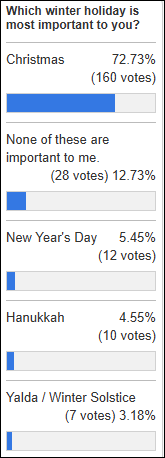
It’s Christmas or nothing for the most important winter holiday, most poll respondents said.

New poll to your right or here: Where does today’s health AI fall on the Gartner Hype Cycle?

I usually throw out an invitation for companies whose marketing budget resets on January 1 to contact me about becoming an HIStalk sponsor, which unlike conference booths or pay-for-play video interviews, offers benefits for a full year. I’ll even add a spiff or two for startups (the definition of which is beneficially vague to such prospects) or former sponsors who come back.


Webinars

None scheduled soon. Previous webinars are on our YouTube channel. Contact Lorre to present or promote your own.


Acquisitions, Funding, Business, and Stock

Telemedicine provider Avel ECare acquires Hospital Pharmacy Management, which offers remote pharmacy order verification and hospital pharmacy management.

William Febbo, CEO of drug company marketing technology firm OptimizeRx, leaves the company


Sales

  • Duly Health will implement Pro Medicus’s Visage 7 Enterprise Imaging Platform in a 10-year, $19 million contract.

People

image image

Workforce management technology vendor Hallmark hires Michelle Lichte (Nordic Consulting Partners) as chief client success officer and promotes Brandon Chamberland to chief strategy and partnerships officer.

image

Haffty Consulting promotes Mark Valutkevich to VP of client services.


Announcements and Implementations

Critics warn that Health New Zealand’s planned layoff of 1,100 digital and data jobs will impact patient care and increase the risk of cyberattacks. Health NZ said two weeks ago that it will cancel or defer 136 IT projects in hopes of saving $62 million following government budget cuts. It had previously diverted funds from its widely touted Patient Summary data sharing system to stabilize its aging, unstable payroll system.

A new study finds that telehealth visits are not reliable for diagnosis tonsillitis due to the lack of ability to remotely assess all of the CENTOR diagnostic criteria (fever, tonsillar exudates, lymph node tenderness, and absence of cough) to determine if antibiotics are indicated.


Other

image

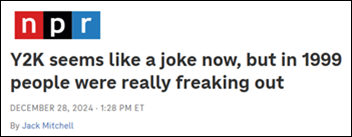
It’s probably more true now than ever, due to declining reading comprehension and pervasive clickbait, that the headline writer is more influential than the reporter. Shame on NPR for making TL;DR types think that Y2K was an IT cry-wolf overreaction or meme-to-be, while the actual story acknowledges that January 1, 2000 was uneventful only because an army of programmers — many of them gray-haired COBOL coders who were brought out of retirement — reviewed and fixed billions of lines of legacy code by the hard-stop due date.


Contacts

Mr. H, Lorre, Jenn, Dr. Jayne.
Get HIStalk updates.
Send news or rumors.
Follow on X, Bluesky, and LinkedIn.
Contact us.

Morning Headlines 12/27/24

December 26, 2024 Headlines Comments Off on Morning Headlines 12/27/24

Digital health companies got pummeled by Wall Street in 2024 as industry adapts to post-Covid slowdown

A CNBC analysis of 39 publicly traded digital health companies finds that two-thirds lost value in 2024 ,with high-profile stumbles by Teladoc Health, Progyny, GoodRx, Dexcom, and 23andMe.  

Adoption of “hospital-at-home” programs remains concentrated among larger, urban, not-for-profit and academic hospitals

Researchers find that CMS’s four-year-old program that encourages a home alternative to hospital admission will need to offer different incentives to expand to smaller, rural, and non-teaching hospitals.

Providers Used Medicare Part D Eligibility Verification Transactions for Permissible Purposes

An HHS OIG investigation finds minimal improper use of Medicare Part D prescription eligibility transactions by providers after CMS tightened controls.

Avel eCare Announces the Acquisition of Hospital Pharmacy Management to Enhance Pharmacy Telemedicine Services

Telemedicine provider Avel ECare acquires Hospital Pharmacy Management, which offers remote pharmacy order verification and hospital pharmacy management.

Morning Headlines 12/24/24

December 23, 2024 Headlines Comments Off on Morning Headlines 12/24/24

Health care AI, intended to save money, turns out to require a lot of expensive humans

The cost effectiveness of AI in healthcare is questioned due to the need for humans to overcome implementation and maintenance challenges as well as to monitor for algorithm performance degradation over time.

App Registration, Delay No More

ASTP says it has received reports that Certified API developers are obstructing patient access to their electronic health information through cumbersome registration practices, which may be non-conformities under the Health IT Certification Program.

Seer Medical, which received $30m from Victoria’s venture capital fund, enters administration

Australia-based Seer Medical, whose at-home epilepsy monitoring equipment was recalled in August in the US and Australia, files bankruptcy.

Health NZ’s IT cutbacks: Faults could ‘snowball’, report warns

A report concludes that the proposed layoff of 1,100 data and digital employees by Health New Zealand is likely to impact patient care, extend the time required to resolve system failures, and increase the risk of cyberattacks.

Curbside Consult with Dr. Jayne 12/23/24

December 23, 2024 Dr. Jayne Comments Off on Curbside Consult with Dr. Jayne 12/23/24

I enjoyed Mr. H’s recent survey asking, “Which winter holiday is most important to you?” It came at a time when someone had sent me a meme about how to best leverage holidays in 2025 for long-weekend travel, and my first thought about it was “yeah, if you’re not a frontline healthcare provider.”

In my first job as an employed physician, we received the minimum holidays: New Year’s Day, Memorial Day, Independence Day, Labor Day, Thanksgiving, and Christmas Day. The rest of the time, I was expected to have my office open and available to see patients, regardless of whether my entire staff wanted to take time off or not. There wasn’t any such thing as flexible holidays and the physicians had no autonomy to modify the schedules in a way that suited them. I’m glad to see that many organizations have evolved from this approach, although I’m sure there are some that still only recognize a minimum number of holidays.

When I moved from traditional primary care into the emergency department, we were assigned to Holiday Track A or Holiday Track B, which alternated years and made it clear which holidays you would be working each year. Honestly, it made things more straightforward and I enjoyed the predictability of the schedule. I suppose that’s why I selected New Year’s Day as my survey response. I’m nothing if not predictable, and I enjoy starting the year with fresh new spreadsheets to track my household budget, fitness goals, and various other things. I use some online tools as well, but there’s just something about seeing my data in the same format I’ve been using since 2009 before wearables and linked software really changed the game.

If your favorite holidays involve snow and you’re a physician, Epic is hiring for its physician team. It’s a relatively small team and I’m not sure if someone is leaving or if they’re expanding, but the job posting was shared in one of my online physician forums. Unlike other physician informaticist job postings I’ve seen over the years, this one doesn’t have a lot of detail as to the actual job description. It focuses on the positive aspects of working for Epic, including the campus, the food, and Epic’s sabbatical program for workers who stay at least five years. The posting received some scathing reviews on the forum where it was shared, primarily because the requirements specify “MD with several years of inpatient and/or outpatient experience” which raised the hackles of physicians who are DOs. I’m not sure if that’s an oversight or if Epic believes the MD credential is more relevant to the work. Others pointed out the fact that it requires COVID-19 vaccination, which isn’t something you often see in job postings in 2024. Let’s just say it was a lively discussion.

clip_image002

Although some people love the holiday shopping experience, I’m not one of them, so I made sure to time my Target run for 10 p.m., which seemed to work out well. In addition to the bathmat that I was in search of, I was surprised to see Oura rings for sale. It’s the first time I’ve seen them in person and the finishes available seemed nice. The store was sold out of sizing kits, so I’m guessing it’s likely to be a popular holiday gift.

Whoever does the merchandising at my local store has a sense of humor. There was an entire endcap display of “things you need to make fudge” but without any kind of signage or display. I only recognized what was going on with those particular shelves because I had just made a batch. I’m not sure others would make the connection. The Christmas section of the store was picked almost clean, but there were still a few things left in the Hanukkah section. I didn’t see specific areas for any of the other winter holidays and observances. Based on my recent mood, if they had anything for Festivus I would likely have considered it.

I wrote a couple of weeks ago about my decision to be part of a clinical trial, and I’ve just completed my first round of testing. Although completing the tests was straightforward, I’ve been told to expect to wait four to six weeks for release of my results. That experience is a departure from what we’ve all become used to over the last decade, with near-instant release of most labs performed locally. Even those that are send-out or complicated typically result within a week or so, unless they’re something really unusual.

It’s a good reminder of the progress we’ve made in healthcare, even when a lot of the other aspects of care delivery seem to be undesirable. Once the test results are back I’ll find out which of the screening interventions I’m assigned to. Not sure how long that piece will take, but at least it gives me something to look forward to in my email other than solicitations by other LinkedIn members looking to sell me something.

I receive hundreds of press releases each week and I admit I probably miss a lot of interesting news because there is just so much junk out there. I did enjoy reading a recent release that covered Providence Mission Hospital’s efforts to provide concierge services as an employee benefit. The goal is “to make life easier for hospital staff by helping them tackle everyday tasks so they can focus on what they do best: providing exceptional care to patients.” Services offered include running errands, scheduling personal appointments, arranging travel, shopping and gift wrapping, and managing household tasks. I’m sure the devil is in the details, but this sounds like a great benefit to me. I know I’m not the only one that puts off straightforward tasks because I don’t have the time to make phone calls during the day and can’t make appointments online – things like having my car’s tires rotated or scheduling a chimney inspection.

I know a lot of corporate employers offer conveniences at the office to increase employee willingness to work long hours, including dry cleaning services as well as discounted meals, gyms, and fitness classes. I’m wondering how many offer this kind of personal concierge service and how it’s working out. Does your employer offer unique benefits? Which is your favorite? Leave a comment or email me.

Email Dr. Jayne.

HIStalk Interviews Erine Gray, CEO, Findhelp

December 23, 2024 Interviews Comments Off on HIStalk Interviews Erine Gray, CEO, Findhelp

Erine Gray, MPA is founder and CEO of Findhelp

image

Tell me about yourself and the company

Findhelp is 14 years old, based in Austin, Texas. We focus on simplifying the way that people find and enroll in social services in the United States.

Our company’s history began with the realization that understanding your options in times of need is not easy. We started by building a search engine that allows people to put in their ZIP code and find available social services, such as affordable housing, food, or even programs that are available through public entities, such as the federal government and state government like Medicaid, Temporary Assistance for Needy Families, Children’s Health Insurance Program, and the Supplemental Nutrition Assistance Program. Our platform supports many of the 1115 waiver programs in the United States, which are experimenting with allowing social services to be paid for with Medicaid dollars. We are doing that work in New York, California, and in other states throughout the United States and plan to be doing more in the coming years. 

The goal is that people will find those services and then click a few buttons to apply and get enrolled if they qualify. Once they do, we’re the largest closed-loop referral platform that allows people to circle back and say, yes, I did receive these benefits. 

Our customers hope to see whether these interventions improve long-term care. We are a full-stack platform for allowing that to happen. They will be able to see what actually occurred from the very beginning, when they were searching Findhelp.org to find a program, to the very end, once they’ve received the program and interacted with their health plan, the health system, or other community organizations. The goal is to study that information over time with the hope that some of these interventions will help them live a healthier life and get through their difficult moments. 

How has the safety net changed recently and how might it change going forward?

Generally it hasn’t changed in the last probably 50 years since the Great Society under Lyndon Johnson. My theory is that it has only changed at the margins. There have been two enormous events with respect to the American safety net. One is the New Deal under FDR and then the Great Society under Lyndon Johnson, where he created all sorts of new programs such as affordable housing programs, expansions, and SNAP benefits and things like that. 

For the most part, the safety net stayed the same. It’s only lately where people are beginning to think about, is this an efficient safety net? After indexing every program in the United States, I believe that the safety net is inefficient, with large cities hosting thousands of redundant non-profits. I think the safety net will see more consolidation among these non-profits as technology makes it easier. 

You’re already beginning to see that consolidation with mergers of different community-based organizations, different United Ways throughout the country. There was one within the last couple of years here in Austin between two of the neighboring United Ways. For those who don’t know, United Way is a great organization that works on collective impact by looking at the entire community and looking at the entire landscape of organizations that serve others. 

What I also think will change at this pivotal point in the future is that the federal government is experimenting with allowing social services to be paid for with Medicaid dollars. But the reality is that it’s still a theory, meaning that despite what vendors may tell you, there isn’t overwhelming evidence quite yet, at least through academic studies, that make the case that these interventions will drive down the cost of healthcare. There are so many variables that it’s hard to manage. It’s hard to study that and there’s not a ton of information.

My gut feeling is that allowing states to have more flexibility around what they spend their Medicaid dollars on will ultimately result in better health outcomes, but it’s going to take years to prove that. If we can prove that, then we as a society, or at least the states, will have the ability to decide what interventions are more relevant. For example, if a Texas Medicaid member is unhealthy and they can’t use their air conditioner because it’s broken or they can’t afford their electric bill, an intervention might make sense, if it’s medically necessary, to pay for that electric bill or that air conditioner repair with the dollars that came out of a Medicaid budget. That might be a different intervention in Maine, where transportation is a big issue, getting to the doctor is a challenge, and those Medicaid dollars could be used in Maine. 

I hope that with the change in administration, more flexibility can be given to the states to allow for them to design their own interventions with some flexibility of using Medicaid dollars to design these social drivers of health interventions that make a lot more sense at a local level. To allow local care coordinators to decide that they will help this family with the rides to the doctor or help with their electric bill based on everything that they see about the person. I’m also optimistic about the future that less regulation at the federal level of the Medicaid program, in this case, will lead to more innovation in the future. I feel like the states probably want that flexibility and are competent enough to administer innovative programs these days.

How are health systems using social determinants of health and what role do they play in addressing the needs that they might identify?

We work with a couple of hundred health systems nationwide. They have different requirements to look after the social needs of their patients. In some cases, those are driven by federal and state requirements. In some cases, those are driven by risk-sharing agreements with payers. Their goal is to make sure that the patient gets healthy and doesn’t consume unnecessary medical services.

Our customers integrate our platform into their system of record, whether it be Epic, Cerner, EClinicalWorks, or NextGen. We are integrated with hundreds of organizations so that they don’t have to do double data entry. We have the patient context when they click into our platform. We utilize SMART on FHIR integrations and some deeper API-based integrations. They want to be able to, within their medical record,  make a referral to one of the social service programs that we index and that we contract with. To be able to make those outbound referrals and also understand what happened after the person received those benefits. That allows them to have a whole picture of what’s going on with the person from right within their electronic health record. 

Different hospitals are doing different things. For example, Boston Medical Center has been innovative over the last five years that we have worked together by implementing all sorts of initiatives. Some are going as far as putting food pantries into their systems. Others are building community gardens. Others are contracting with non-profits to provide additional services for their patients. We’re the software platform that integrates with that and helps make those types of interventions happen.

Do the social services organizations receive the SDOH information in a standardized format and then have it integrated with the systems that they use?

We have indexed about 550,000 distinct program locations in the United States. These are all physical locations that provide social services to people in need. Probably the most common system of record is still on paper. Second to that is Excel spreadsheets or Google spreadsheets. 

There’s a long tail of proper case management systems that non-profits use to run their organization. One of the more popular ones is Salesforce. They have a program where they’ll provide up to nine licenses to non-profits that sign up for it. We’re building integrations on that side as well. We have built several integrations, but the critical mass is still in spreadsheets and on paper for tracking that information.

There remains an enormous opportunity to educate these community-based organizations and bring them onto our platform. We will build integrations with these non-profit systems of record, but when they don’t have one and they haven’t made that investment, we provide a free platform that they can use. We’ve done that ever since the beginning of our business, so we have been able to recruit many to come over and use our platform. 

It’s a big investment area for us going forward. In fact, just this spring, we acquired a company called Kiip. It’s a case management system that is designed for these community-based organizations to be their system of record. We have since launched in the fall a fully integrated version of Kiip that utilizes Findhelp’s network through our APIs to be able to use the Kiip case management solution, make those searches to find services, and make those outbound electronic referrals that hit the Findhelp network. The information is then stored within Kiip. 

We offer this for free, with an optional premium version for non-profits. But because there wasn’t a critical mass case management solution, that was an opportunity for us to create one and to put that out there in the world. We also see this as something that isn’t exclusive to the Findhelp network. If there are other networks that exchange electronic referrals for the purposes of social determinants of health, we think the Kiip solution can be utilized to recognize referrals in other networks.

In the long run, I see this going like the cell phone networks, meaning that you can use your Android phone to connect to a different network if you want to. The same thing should be happening in our space to eliminate the need for one monolith. We can lead by example to provide a system of record to these non-profits and then allow them to add as many networks as they would like so that they can see electronic referrals in one consolidated location. 

The challenge is that we have to find the motivation of the community-based organization. Why should they close the loop on referrals? Some might say that it would help the hospital or it would help the health plan in their community, but that motivation just isn’t enough. It takes good software design to build the closing of the loop into the workflow for reasons that the non-profits want themselves. 

We have a lead user experience designer named Phil Robinson, a great member of the team, who focuses on understanding the motivations of these non-profits. A big part of what they’re motivated by is having good, clean records of what’s happening. Building the loop closure into that workflow so that they have accurate reports that they can use reports for fundraising, for running their operation, is a much better motivator for the non-profits. That’s where we see a huge opportunity, not only in the short term, but in the long term, to have somebody on the other end of that referral closing the loop on that for their own reasons. We expect to see even more growth in that area. 

Who benefits from that? The hospitals benefit from that because they will see a higher closed loop closure rate. They will get information that would allow them to establish better interventions in the long run. If they see that a community-based organization is active in their city, they might want to work together and maybe even reimburse that non-profit for some of the work that they’re doing because it benefits their patients in the long run.

Findhelp is trying to solve the information problem that exists. A big part of that is bubbling up that information so that smarter people than I can do something with it. We believe the key lies in providing good user experiences, Not only at the hospital and plan level, but also at the non-profit level. 

Will AI affect what you do or how you do it?

I’m definitely not an expert on the subject, but I think that the number one benefit that AI can have, at least in our world, is to improve the workflow of the user.

I’ll give you a quick example. Our customers are continually telling us about changes in their community that they discover while using our software. They might discover that a program that serves people who are looking for affordable housing has changed their hours of operation. We built something called the Program Manager that allows our customers to make those updates directly. We have a curation team in-house here in Austin and we work together on those situations. But what we’re building into that application is the ability to proactively suggest those changes and to correct errors in real time.

We use a taxonomy called the Open Eligibility taxonomy. That’s a free and open source version that we built and put out there in the world. A user may not understand the tags as well as some of our employees might understand the tags, so we can build AI models that look at the descriptions of the programs and say, I think this tag is probably more accurate, would you like to select it?

Those are the tiny things around the edges that are going to make for a better workflow in the long run, which makes for a better data set in the long run. That will be an important part of decreasing the amount of time that our customers use to interact with our systems.

Another area is using AI models to help our customers understand which patients might need an earlier intervention. We have a lot of data about a patient, coupled with data that’s in eligibility files with the payers and other systems. When you have a large number of patients that you’ve made outbound referrals for, we learn a little bit of information about what occurred with those referrals. If I’m the case manager sitting in front of my computer the next day, sometimes it can be overwhelming. Building features that allow you to see that Hannah could probably use a phone call right now. That’s where we see our organization using AI to increase or improve on the user experience of our users. There’s probably many more that are there. 

As we uncover the use of AI for looking at large data sets, I’m interested in that in the long run.  We just crossed 50 million users on Findhelp, and over 20 million of those users were within the last year. We want to be able to study that data with the help of some of these models to understand trends that may be happening in a more regional level at the community. It would be more macro, but that’s another area where we think there’s a lot of possibility. The challenge is deciding which ones to focus on first. Right now we are focused on making our workflow better and better by using some of these technologies in the future.

What will affect company’s strategy over the next few years?

The number one thing that affects our strategy is that we are trying to build a new safety net, starting from scratch. When Social Security was first enacted, the business problem that came across was there was not a unique identifier for identifying every American. Hence, the Social Security number came out. If you fast forward to unemployment insurance, it was hard to come up with a rate for unemployment insurance because there wasn’t a centralized way of storing people who were unemployed. 

Information problems have presented themselves throughout our history. That same information problem is happening today with respect to organizing the safety net. I was reading this book by Henry Seager called “Social Insurance: A Program of Social Reform.” He wrote, “It is impossible, with our present knowledge, to estimate the extent to which illness and death are preventable.”  That was written in 1910. What is pretty amazing is that because of the work of a lot of your readers, that’s no longer a true statement. Today, that information has been digitized. The information problem that prevented people from estimating the extent to which these illnesses are preventable has been solved. 

The biggest thing facing us going forward is, how do we do the same thing for the social services sector? Our contribution to the world will be that every American understands what their options are in their time of need, but also trying to ensure that as many non-profits as possible have the tools that they need to solve some of these problems. Just like we’ve solved the unique identifier issue with respect to Social Security, your readers have solved the electronic medical records. Making them electronic in the first place was an amazing feat. We would like to do the same thing for the social services world.


Morning Headlines 12/23/24

December 22, 2024 Headlines Comments Off on Morning Headlines 12/23/24

US hospital operator Ascension says 5.6 million affected in medical data breach in May

The 140-bed health system’s May ransomware attack compromised the medical and insurance information of 5.6 million people.

Commure Acquires Memora Health, a Digital Care Navigation Platform, to Enhance Intelligent Care Navigation

Commure says that its acquisition of Memora Health will strengthen its suite of patient engagement, clinical documentation, revenue cycle management, and RTLS solutions

Medical Records Co. Wants Rival’s Antitrust Suit Tossed

Epic asks a federal court to dismiss Particle Health’s antitrust lawsuit, saying that it’s a revenge lawsuit that fails to prove anticompetitive behavior.

VA begins early-stage planning for the next Federal Electronic Health Record rollout in mid-2026, continues ongoing improvement efforts at existing sites

Four Michigan facilities will go live on Oracle Health in 2026.

Monday Morning Update 12/23/24

December 22, 2024 News Comments Off on Monday Morning Update 12/23/24

Top News

image

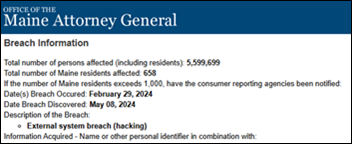
Ascension tells Maine’s attorney general that its May 8 ransomware attack exposed the medical and insurance information of 5.6 million people.

The 140-hospital system’s EHR was down for more than a month.


HIStalk Announcements and Requests

image

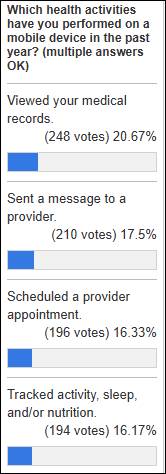
Not making the list above from last week’s poll – entering health tracking information, viewing OpenNotes, and using an app that a clinician prescribed or recommended.

New poll to your right or here: Which winter holiday is most important to you?


A Reader’s Notes from the Joint Annual Meeting of The Sequoia Project and Carequality

The meeting was held December 11-12 in Nashville.

image

Micky Tripathi

  • Nothing groundbreaking or new. Mostly rehashed stats and updates that have been shared in other forums.
  • HTI-2 final rule published that morning is a very lightweight set of changes related to TEFCA, mainly codifying terminology and procedures.
  • Picture shows some TEFCA stats. Unclear why the number of participants per category doesn’t quite add up to the total of 10k.

Panel discussion on what qualifies as treatment

  • Lively conversation and one of the most refreshing panels I’ve seen at a conference, if only because everyone didn’t get up there and agree with one another and pat each other on the back.
  • Unstated but obvious was that the motivation for the session was the Epic-Particle dispute.
  • Panel went through a few nuanced scenarios and debated whether they fit the definition of treatment (specifically, HIPAA treatment…TEFCA treatment has a slightly narrower definition). Example: provider group is part of an ACO and a physician wishes to query an HIE for records on their attributed patients to identify gaps in care, so that the provider can focus on closing those gaps. Deven McGraw (former HHS OCR Deputy Director for Health Information Privacy): once you start asking for patient information in bulk, you shift from a Treatment purpose to an Operations purpose. This led to an interesting debate on whether sending a bulk transaction (e.g., bulk FHIR) would count as Operations but writing a script to send many individual transactions patient-by-patient would count as Treatment.
  • Tripathi: key thing to remember is that under HIPAA, the data responder has the prerogative to identify whether the request is for treatment or not.

Interoperability for public health

  • Electronic case reporting was still a proof of concept by the end of 2019 but suddenly had to go big bang and scale due to COVID.
  • Michelle Meigs (APHL): Public health has a business problem. The funding is piecemeal and focused on specific cases or reportable diseases, so it is challenging to build a comprehensive technology and interoperability framework. The fragmentation doesn’t help. Because public health is mostly handled at the state and local levels, there are 50+ sets of rules to follow.
  • Craig Behm (CRISP HIE): data usability and alert fatigue are major issues for providers. They piloted public health data exchange through TEFCA with three provider organizations, .but they didn’t get any responses to their TEFCA queries in the first few months.

The theme of trust came up several times and was the focus of multiple sessions. That said, it would be more accurate to say “verification” as the main changes seem to be HIEs/QHINs introducing tighter guardrails and stronger vetting processes to prevent misuse of data.

Panel on the Carequality dispute process

  • Purposefully avoided commenting on the Epic-Particle dispute, though everyone knows that’s the impetus for the discussion.
  • Dispute process intentionally errs on the side of “minimum necessary” when it comes to sharing information with the public, to prevent sharing any sensitive info.
  • Panelists (members of the Carequality board and steering committee) generally felt the timelines defined for the formal dispute are OK, given the time needed for the responding party to build a defense against the complaint. It also takes time to establish a dispute panel who will hear the arguments from both sides. These are all volunteers at the end of the day. Goal is that formal disputes are rarely or never needed since parties should work things out informally first.

image

Fireside chat with Daniel Polk (Special Agent, FBI Atlanta field office) on cybersecurity

  1. Broke down the various types of malicious actors (picture attached).
  2. Discussed common infiltration and deception tactics.
  3. 2FA is critically important to good security, but it can be defeated. A common tactic today: hackers send you a phishing email with a malicious link. You click on it and are taken to a fake login page where you enter your username and password. Hacker receives a real-time notification and logins into the real account with your credentials. This triggers a 2FA code or push notification, which you enter or acknowledge, allowing the hacker to access your real account.
  4. As soon as you believe you are the victim of ransomware, reach out to the FBI. They generally don’t publicize this, but they may have a decryption key that will work in your situation.
  5. Polk highlighted the fines OCR has been leveraging on organizations who do not have good cyber hygiene and who have suffered from unauthorized disclosures.

Webinars

None scheduled soon. Previous webinars are on our YouTube channel. Contact Lorre to present or promote your own.


Acquisitions, Funding, Business, and Stock

image

Commure acquires Memora Health, which offers a care navigation platform.

Norway-based healthcare software vendor Omda AS acquires Aweria, which offers a best-of-breed emergency department information system.

Streamline Health reports Q3 results: revenue down 28%, EPS –$0.61 versus –$3.15. STRM shares have lost 32% in the past 12 months, valuing the company at $15 million. CEO Ben Stillwel says that the company may need to seek additional non-equity capital resources to fuel growth and that he “needs to live and breathe sales.”


People

image

Mouneer Odeh, MA (Inova Health System) joins Cedars-Sinai as VP/chief data and AI officer.

image

Haffty Consulting promotes Erin Mueller to VP of client services.


Announcements and Implementations

The UT Health San Antonio School of Dentistry combines the dental and medical health records of its patients by integrating Epic’s Wisdom dental module with its EHR. Patients can view all their records and make appointments through MyChart. Epic replaces Exan’s AxiUm dental system for academic practices, which is owned by Henry Schein One.


Government and Politics

image

Epic asks a federal district court to dismiss the antitrust lawsuit that was brought against the company by Particle Health in September. Epic says the lawsuit fails to prove that Epic engaged in anticompetitive behavior. It adds that Particle filed the suit as revenge for Epic’s revelation that some of Particle’s customers were obtaining confidential patient information under false pretenses.

image

The Department of Justice sues CVS Pharmacy for knowingly filling prescriptions for controlled substances that lacked legitimate medical purpose or were invalid, many of them generated by known pill mill doctors. DOJ says CVS ignored internal data and information from its own pharmacists to keep filling the prescriptions so the company could meet corporate performance metrics that triggered field manager bonuses. CVS is also accused of preventing its pharmacists from warning each other about certain prescribers and setting pharmacist staffing levels so low that they couldn’t perform due diligence or even pay attention to computer safety alerts. One pain management doctor in Hawaii wrote prescriptions for specific patients, then picked them up himself and charged them to his own credit card, generating 60% of the prescriptions that the CVS store filled.

The VA will restart restart Oracle Health go-lives in mid-2026 at its Michigan facilities in Ann Arbor, Battle Creek, Detroit, and Saginaw.

In Canada, a former employee of Alberta Health Services is fined $12,000 for falsifying the COVID-19 records of 200 people in Meditech, which sends data to the province’s immunization system.

image

US healthcare spending rose 7.5% in 2023 to nearly $5 trillion, with prescription drugs showing the biggest increase due to GLP-1 drugs. Hospital services consumed $1.5 trillion of the total, rising by 10.4% in their highest growth in three decades. The US finished in near last place among 38 OECD countries in infant mortality and life expectancy despite spending four times the average dollars per capita.


Other

Doctors in Scotland voice concerns over the bankruptcy filing of In Practice Systems Limited, the provider of the Vision system widely used by the country’s GP practices, citing potential risks to system availability and access to medical records. The company is owned by Cegedim Group. NHS National Services Scotland has set up an incident response team.


Sponsor Updates

clip_image002

  • Healthcare IT Leaders partners with Jackson Health System’s IT group to bring holiday cheer to children.
  • CTG announces the retirement of long-time manager and director Christine Blanchard.
  • Indiana University Student Health Center successfully uses AI-powered ambient listening solution Sunoh.ai, integrated with eClinicalWorks, to streamline clinical documentation.
  • Nordic names Amy Ferro marketing content manager.
  • Black Book Research releases the results of a survey highlighting how nations are leveraging advanced digital solutions to revolutionize population health management and address critical healthcare challenges.
  • Nordic releases a new episode of its “Designing for Health” podcast, “Interview with Brian Urban.”
  • RLDatix releases a new episode of “The Connection” podcast, “Technology + Humanity in Healthcare: Insights from Dan Michelson, CEO of RLDatix.”
  • Sectra will provide its platform for medical education, Sectra Education Portal, to the University of Hartford in Connecticut.
  • SnapCare co-founder and Chief Strategy Officer Jeff Richards receives the 2024 Georgia Titan 100 award.

Blog Posts


Contacts

Mr. H, Lorre, Jenn, Dr. Jayne.
Get HIStalk updates.
Send news or rumors.
Follow on X, Bluesky, and LinkedIn.
Contact us.

News 12/20/24

December 19, 2024 News Comments Off on News 12/20/24

Top News

image

Alphabet’s Verily will reportedly shift focus in 2025 to offering AI tools, data aggregation, and privacy systems for healthcare providers and startups.

The company plans to relaunch Lightpath, its diabetes and hypertension app with AI and human coaching, in 2026.

The most profitable business of Verily, which is often criticized for its unfocused life sciences projects, is Granular Insurance, which helps employers cut healthcare costs.


HIStalk Announcements and Requests

image

Long-time HIStalk Founding Sponsor Healthwise (they first signed up in 2011) is leaving the fold due to its acquisition by WebMD. That leaves a rare opening in the two ad positions at the top of the page, so if your company would like to join Medicomp up there in the HIStalk stratosphere, contact Lorre. Could be a new sponsor, could be an upgrading one … we usually go with whoever commits first.

image

Ms. G from Texas sent over some photos of her fourth graders using the headphones that were provided by a reader’s donation and matching funds from my Anonymous Vendor Executive. She says, “These students are more engaged and confident, showing improved focus during lessons and taking more ownership of their learning. The headphones have also encouraged collaboration, as students can now listen to different parts of a lesson at their own pace while sharing insights with classmates.”


Webinars

None scheduled soon. Previous webinars are on our YouTube channel. Contact Lorre to present or promote your own.


Acquisitions, Funding, Business, and Stock

Finland-based smart ring maker Oura raises $200 million in a Series D funding round that values the company at $5 billion, with glucose biosensing company Dexcom participating in the round.

image

Confido Health raises $3 million in funding to continue rollout of its no-code AI agents for appointment management, insurance verification, and care coordination in specialty practices. It provides the “AI workers” to customers at an hourly rate.


Sales

  • Safety net, 150-bed Nashville General Hospital will implement Oracle Health CommunityWorks.
  • Johns Hopkins Medicine will implement Abridge’s ambient documentation solution across its six hospitals and 40 care centers.
  • Arisa Health selects Netsmart’s CareFabric.

People

image image

Symplr names Steve Filler, MHA, MPH (Boston Consulting Group) as COO and Matt Grill (UKG) as chief delivery officer.

image

Advantus Health Partners hires Rick Roycroft, MBA (Huron Consulting Group) as chief commercial officer.

image

Amwell adds COO to the role of CFO Mark Hirschornm who joined the company in October 2024.


Announcements and Implementations

Doc.com will expand its AI-powered healthcare platform to provide initially free hospital tools for telemedicine and online pharmacy services. The company received $300 million in equity financing a year ago. The Mexico-based company has faced skepticism for making questionable product claims and its active involvement in the cryptocurrency market.

image

Agilon Health will integrate Navina’s AI engine with its value-based care platform.

Mesh Health Solutions and KONZA will partner to stream the prior authorization process.


Government and Politics

The VA will resume its implementation of Oracle Health this fiscal year after placing rollouts on hold in April 2023 due to problems in its first five live sites. The VA says that system crashes and performance issues dropped 50% after its latest round of software updates, also noting that it discovered that many users were logging in via VPN even while connected to its internal network, which caused performance lags. VA officials downplayed the possible impact of having the new administration’s political appointees taking VA leadership roles.


Sponsor Updates

clip_image002

  • Five hundred Meditech employees donate a variety of items to support 32 households during the company’s annual Holiday Giving initiative.
  • Black Book Market Research publishes its survey findings on population health applications in emerging markets.
  • Wolters Kluwer’s new “25 for ‘25” report predicts key healthcare technology trends driving momentum amid dramatic change in 2025.
  • EClinicalWorks announces that customer Fairfax Medical Facilities (OK) was recognized by HRSA with a ‘Health Center Quality Leader – Gold’ badge for its 2023 Uniform Data System submissions.
  • RLDatix supports The Leapfrog Group’s Proposed Changes to the 2025 Leapfrog Hospital Survey, specifically revisions calling for greater specification in the collection of data related to ICU staffing and the nursing workforce.
  • Black Book Research identifies top vendors of FHIR-based prior authorization interoperability solutions, including Availity, Redox, and Rhapsody.
  • First Databank will present at the American Society for Automation in Pharmacy 2025 Annual Conference January 16 in Amelia Island, FL.
  • Findhelp welcomes the Appalachian Children Coalition, Community Foundation of Elkhart County, Hospital Sisters Health System, and Nassau County Department of Health to its network.
  • CTG announces the retirement of Managing Director Christine Blanchard after 27 years with the company and the national search for her replacement.
  • Fortified Health Security launches its inaugural advisory board.
  • Goliath Technologies publishes a new case study, “Leading not-for-profit health system isolates and resolves speed & reliability of Citrix related Epic and ChromeOS device issues.”
  • Healthcare IT Leaders releases a new Leader to Leader Podcast, “From the Gift Shop to the C-Suite.”
  • Impact Advisors releases a new Impactful AI Podcast, “The Ethics of Human Autonomy in AI.”
  • Inovalon releases a new “Inovators” podcast, “AI in Healthcare: The Value of Innovative Technology, Paired with Clinical Expertise.”

Blog Posts


Contacts

Mr. H, Lorre, Jenn, Dr. Jayne.
Get HIStalk updates.
Send news or rumors.
Follow on X, Bluesky, and LinkedIn.
Contact us.

EPtalk by Dr. Jayne 12/19/24

December 19, 2024 Dr. Jayne Comments Off on EPtalk by Dr. Jayne 12/19/24

The US Congress is delivering an end of year cliffhanger in the form of expansive legislation designed to fund the government so that there’s not a shutdown when current funding runs out on December 20. The continuing resolution that is under consideration is over 1,500 pages and includes some healthcare tidbits, including the extension of some Medicare telehealth flexibilities for another year and the extension of acute hospital at home flexibilities through the end of 2029.

The continuing resolution took a beating on the platform formerly known as Twitter this week, with Elon Musk personally posting about it more than 100 times. My heart goes out to all the families that will be impacted if there is indeed a government shutdown, especially essential workers who are expected to continue working but who might not be paid in a timely fashion. National parks and monuments will close in the event of a shutdown, so if those activities were in your holiday plans, stay alert. Even if the resolution passes, it will only cover the nation through March 2025, so there are plenty more budget conversations to come.

From Rotisserie Gal: “Re: predictions. I always make an email folder where store predictions that caught my eye, or announcements of seemingly hot new tech that I want to watch over time. With that, I give you a prediction from CES 2024 – the macrowave oven. I haven’t seen a word about it since then.” Looking back at the article, the device was called “the Tesla of kitchen appliances” and there was plenty of gushing over its ability to revolutionize cooking. I guess it wasn’t that revolutionary though, because an internet search today only brought up articles mentioning the CES debut. I even went to the manufacturer’s website and couldn’t find anything about it, so unless someone else informs us to the contrary, it seems to be a prediction that fizzled.

In addition to looking at predictions for 2025, I’m also a sucker for “year in review” articles covering the one that’s winding down. JAMA Health Forum released its list of most viewed articles for 2024. The titles are telling and align with the hot topics I’ve heard discussed in the physician lounge, whether virtual or in person:

  • “Changes in Permanent Contraception Procedures Among Young Adults following the Dobbs Decision.”
  • “US State Restrictions and Excess COVID-19 Pandemic Deaths.”
  • “What Would Another Trump Presidency mean for Health Care?”
  • “Evaluation of Changes in Prices and Purchases Following Implementation of Sugar-Sweetened Beverage Taxes Across the US.”
  • “Differences in Home Health Services and Outcomes Between Traditional Medicare and Medicare Advantage.”
  • “Projecting the Future Registered Nurse Workforce After the COVID-19 Pandemic.”
  • “What Would a Trump Administration 2.0 Mean for Health Care Policy?”
  • “Job Flows Into and Out of Health Care Before and After the COVID-19 Pandemic.”
  • “Patient-Level Savings on Generic Drugs Through the Mark Cuban Cost Plus Drug Company.”
  • “Patient Safety and Artificial Intelligence in Clinical Care.”

Another year in review article listed the most expensive Epic EHR projects worked on or completed in 2024. Top-tier spenders were in the $800 million to $1.2 billion range, with the low-end contenders seeming rather paltry at $50 million. I’d love to see someone approach the data in a different way to see how it resonates. Although it might be interesting to see the expenditure as a percentage of net and/or gross revenue, it might be even more intriguing to see it compared to patient stats that are commonly used when discussing volumes. I can just see health system CEOs standing around comparing their “Epic dollars per licensed bed” or “Epic dollars per emergency department visit.” I know that these large numbers often represent a cost savings, especially when an Epic implementation allows retirement of multiple unwieldy systems or the efficiencies of standardization. But it doesn’t change the fact that the numbers are indeed staggering.

I recently applied for a committee position and was asked to identify whether I was an early career individual versus mid career or late career. I asked for specific criteria and found that their idea for distribution was substantially different than what I had expected. They define “early” as five years or less, “mid-career” as six to 10 years, and “late career” as more than 10 years. Thinking back, there’s so much I didn’t know before hitting what they would consider late-career. I wonder how they would describe those of us who have been at this for 25 or 30 years, which is what I would truly consider late career. I’m curious how other organizations define this and if this was just an anomaly since I’ve never been asked this question.

I saw a headline about UnitedHealth’s Optum inadvertently making its internal AI-powered chatbot available to the public via an IP address, but I didn’t have time to read it. I finally circled back today and was glad I did, since the story goes well beyond the headline. The chatbot was trained on internal materials that describe standard operating procedures for managing claims. Optum claims it was a “demo tool developed as a potential proof of concept” but was never in production use by employees. That’s all pretty vanilla, but I was glad I read to the end and heard about what happened when TechCrunch asked the tool to “write a poem about denying a claim,” producing a seven-paragraph work which is featured in part at the bottom of the article. Well worth the read folks, well worth the read. I’d love to see the other five paragraphs, though.

clip_image002

Winter is upon us, and I’m wholeheartedly embracing the hygge lifestyle with plenty of books, sweaters, cozy socks, and of course seasonal baking. The different varieties of cookies amaze, me and whether you need a concentrated punch of chocolate in a lumpy form factor or whether you prefer a more demurely dunk able option with greater surface area, I probably have a recipe for you.

What are your favorite holiday cookies? Leave a comment or email me.

Email Dr. Jayne.

Text Ads


RECENT COMMENTS

  1. RE the AI GLP1 company, Washington Post has an article today by someone who used one of those compounded products,…

  2. Re: A chief health AI transformation officer (CHAITO) I predict a position evolution along the following lines. "We have too…

  3. To take the counterpoint to the "don't just schedule more visits" argument - it depends on if you're looking at…

  4. Aaand, 4th to last graf, 1st sentence, not a distance, so you would go further, not farther.

Founding Sponsors


Platinum Sponsors


Gold Sponsors


RSS Webinars

  • An error has occurred, which probably means the feed is down. Try again later.