


Curbside Consult with Dr. Jayne 11/17/25
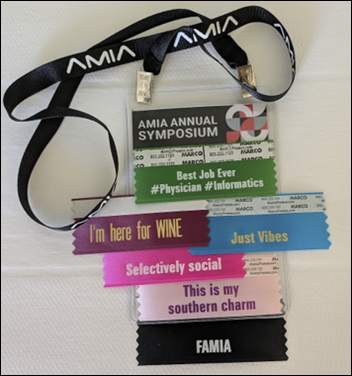
It’s that time of year when clinical informatics types come together to let their freak flags fly, otherwise known as the AMIA Annual Symposium.
This is one of my favorite conferences, largely because it doesn’t take itself too seriously. This is obvious from the moment you pick up your registration credentials and head over to the stash of wacky badge ribbons. These are a heck of a lot more fun than those from other conferences that say boring things like “delegate” or “speaker.”
Attendees were cracking up at one that said “CEO” since it’s rare to see attendees with that title. The event is in Atlanta this year, so the “this is my southern charm” ribbon was a new addition.
It’s a long conference, with a host of pre-conference workshops on Saturday and Sunday. Monday’s opening keynote then kicks off two and a half days of high-intensity programming.
My favorite so far has been the “Designing and Evaluating Trustworthy AI for Consumer Health: Ethical Considerations Workshop.” The session addressed case studies around AI-driven consumer health tools such as fitness apps and mental health chatbots, with an eye to assessing ethical gaps and the potential for the tools to impact health disparities in a positive or negative way.
As one might imagine, algorithmic bias was a focus. Several speakers addressed the biases that inherently exist in datasets that are drawn from large academic centers and the risks of using that data to train AI tools. Also, that training datasets are inherently “old” as soon as they roll out the door, along with the lack of consistency among consumer health vendors for updating those datasets.
Another concern was that data from EHRs is inherently biased since it is structured to support insurance requirements in addition to purely clinical ones. One of my tablemates and I were having a sidebar conversation about how this might impact platforms that use real-world evidence since it changes constantly.
The conversation shifted to understanding the training data that is used in the AI that underlies consumer-facing tools. The point was made that it’s not just about knowing where the data came from, but understanding that it can be harmful if the training data doesn’t reflect the population that is being served.
An example of that was a behavioral health app that was trained predominantly on data from middle class white patients. That left it unable to recognize cultural differences in how patients might express that they are experiencing distress.
Another discussion involved how individuals aren’t experiencing a true informed consent process when they are asked to give up the rights to their data. People aren’t going to read a 40-page terms and conditions document. They are also unlikely to deny consent when they are in a coercive situation, such as needing medical care. One of the speakers noted that users are being treated as data sources rather than as people to be respected.
A speaker who talked about AI’s ability to replace clinicians noted that in an observational exercise, one-third of physician visits contained documentation that was intended to aid coverage negotiations with an insurer or other entity on behalf of the patient. He posed the question of whether AI will do this.
He also noted that in cases where patient histories are unreliable or incomplete, experienced humans have developed the skills to balance those factors, but it’s not clear if AI can do the same. Another hot topic was whether AI will be able to handle conflicting test results or care plans and to manage situations where different patient-side stakeholders, such as patients and their families, have conflicting care priorities.
This flowed into a discussion of how to train new physicians to use AI. It used a driving analogy to pose a good question about how to address older ways of information seeking: Should we require all new drivers to learn how to drive a stick shift? I’ve been in plenty of conversations recently about how younger folks versus older ones are embracing AI. This is a good example that I hadn’t seen.
It reminds me of writing term papers back in the olden days, when you were expected to have a stack of 3×5 cards of your notes that you used to create an outline. Only then were you supposed to start writing the paper itself. The arrival of word processing software and laptops made it easier to take notes electronically and to perform multiple parts of that process in parallel rather than linearly. We don’t teach students to write term papers in the old way anymore, so why should other academic endeavors require potentially outdated processes?
I don’t know if anyone in the room is employed by EHR vendors or other technology companies, but these are “let’s get real” discussions that need to be heard. It feels like vendors don’t get into that level of depth with their stakeholders, or maybe they do and they just aren’t swayed by the conversation. Otherwise, we would see fewer of those lengthy consent forms and more that are like the one-page “truth in lending” forms we see now for certain consumer loans.
During one of the breaks, I had the chance to connect with a friend who was instrumental in my development as an informatics leader, although he always worked more on the practice management and efficiency aspects of healthcare IT. I hadn’t seen him in several years, but it was like we picked up right where we left off. This is a testament to the relationships that were built during the “trial by fire” days when organizations were just starting to go paperless. Although I don’t miss a lot of the things that happened during those days, I treasure the friendships that I’ve made along the way.
The AMIA Annual Symposium is also a great opportunity to connect with the next generation of clinical informatics professionals. In my afternoon session, I was surrounded by residents who are interested in the field, as well as clinical informatics fellows. As we were doing introductions, a few were surprised that I became board certified without completing a fellowship. It hadn’t registered with them that many of us learned our craft largely through on-the-job training when there were fewer opportunities for formal learning. Those of us who fit that description didn’t typically set out to practice clinical informatics. We either fell into it or were gradually pulled in by forces that are not unlike those that are found in a black hole.
I’m sure I’ll appreciate the residents and fellows even more when the AMIA Dance Party happens Tuesday evening. They are more likely to be out on the floor than those of us whose skills lean towards more structured dance forms.
Are you attending the AMIA Annual Symposium, and if so, what is your favorite part? Leave a comment or email me.

Email Dr. Jayne.

There's a typo in your Oracle headline where it says "debilitating wave of layoffs."