


I was born roughly 2 months after the US space program began (Explorer 1), and I've followed it all my…
News 7/18/25
Top News

A Senate investigation finds that direct-to-consumer telehealth platforms that are operated by drug companies steer patients toward their own drugs.
Up to 85% of those patients receive a prescription from hand-picked telehealth providers, with some platforms allowing patients to pre-select the drug they want before the visit.
The report likens pharma-sponsored DTC telehealth to “an Amazon shopping experience” where patients can self-diagnose and pick their drug with a few clicks.
Some telehealth companies don’t use video visits, meaning that their providers are prescribing without seeing the patient. They also do not have access to the patient’s medical records, so they rely solely on patient-completed questionnaires.
The probe found that the drug companies paid their telehealth partners from $510,000 to $2.45 million each over their three-year contracts, but they did not violate anti-kickback laws by paying bonuses for generating more prescriptions.
Reader Comments
From Grammarian: “Re: using mispronunciation as written words, like this vendor’s email that says y’all. Hate it.” Mispronouncing you all as y’all conveys at least a small amount of regional charm. Replicating that mispronunciation as a misspelling seems odd. I blocked some Southern food social media sites because people were expressing their culinary nostalgia by writing taters, okrie, and kilt lettuce as the menu items they “fixed” for “supper.” They also fail to notice that the forum’s creator and moderator isn’t from the South unless you count South Sudan, which is obvious by the misspellings and odd phrasing that those admins use when describing the online photos that they have clearly stolen.
Sponsored Events and Resources
July 22 (Tuesday) 1 ET. “Innovating the Consumer Experience Beyond the EMR with Open Standards.” Sponsor: Praia Health. Presenters: Ryan Howells, principal, Leavitt Partners and program manager, The CARIN Alliance; David LaBine, VP of software engineering, Providence Digital Innovation Group; Robin Monks, CTO, Praia Health; Kristen Valdes, CEO, b.well. As healthcare faces rising consumer expectations and tighter regulations, the high cost of maintaining fragmented, proprietary systems is no longer sustainable. While patient data access has improved, the lack of open standards continues to hinder innovation, drive up integration costs, and limit the potential of digital health beyond the EHR. This webinar will discuss how open standards like OIDC, HL7 FHIR, and open technology requirements are essential for reducing integration burdens, accelerating development, and lowering maintenance costs. Panelists will describe how every closed integration represents a lost opportunity and will offer practical strategies for leveraging open technology as a competitive advantage that improves efficiency, ensures compliance, and strengthens patient trust.
Contact Lorre to have your resource listed.
Acquisitions, Funding, Business, and Stock

Bloomberg reports that UnitedHealth Group sold stakes in some of its businesses last year to private equity firms, then booked the resulting $3.3 billion as operating profit to offset losses from higher medical costs. Analysts say that it is unusual and potentially misleading for companies to selectively disclose asset sales, also noting that the deals appear to require UnitedHealth to repurchase the investments at a higher price after several years. UnitedHealth insisted to those involved that the deals should not be publicly disclosed.
Sales
- Royal Devon NHS implements Wolters Kluwer Health’s UpToDate Enterprise Edition as the first Trust to do so.
Announcements and Implementations
CareCloud launches a dermatology EHR with AI-powered charting.
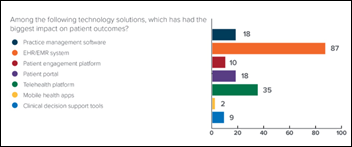
Respondents to an AdvancedMD survey of ambulatory practices say that their EHR has the greatest impact on patient outcomes, with their telehealth platform ranking second, ahead of clinical decision support tools and mobile apps. Two-thirds report that patients schedule their appointments most commonly via a phone call.
Inbox Health releases a patient-facing AI chatbot assistant that is integrated with its billing platform.
Kyruus Health expands its Reach digital provider listing and reputation management solution to improve patient access and drive higher appointment conversions through platforms like Bing, Google, and the websites of 100 health plans.
A CIO survey by CliniComp and CHIME Foundation finds that 81% place the automation of administrative tasks as one of their top three AI strategies, which also include enhancing clinical decision support and improving RCM processes.
Other
Epic SVP of R&D Seth Hain, MS shares his thoughts about AI in healthcare:
- More than 75% of Epic’s health system customers are using generative AI.
- The term EHR no longer reflects its role as a digital colleague that shares insights and guidance with users.
- Epic can embed AI agents into its workflows because it is a single, integrated system rather than one assembled from parts.
- Health systems need to consider dynamic AI governance as the distinction between AI and broader technologies will be irrelevant.
- The technology that has already been invented has enough potential to last for years.
Sponsor Updates

- Impact Advisors staff donate school supplies and stuff them in over 200 backpacks to share with the Family Services team at Ann & Robert H. Lurie Children’s Hospital of Chicago.
- Capital Rx releases a new episode of “The Astonishing Healthcare Podcast” titled “How Low Cost Alternative Programs Can & Should Work, with Jackie Lolos, PharmD, and Haleh Campbell, PharmD.”
- Ellkay will host its virtual user group meeting August 5-6.
- Elsevier releases its “Clinician of the Future 2025 Report.”
- FinThrive offers a Mastering Key Revenue Cycle Metrics checklist.
- Fortified Health Security publishes its “2025 Mid-Year Healthcare Cybersecurity Report.”
- Lincata will exhibit at Epic UGM August 18-21 in Verona, WI.
- Meditech shares highlights from its 2025 Clinical Informatics Symposium.
Blog Posts
- AI and the Big Beautiful Bill: Why Health Systems Cannot Wait to Automate (Get-to-Market Health)
- How Larry H. Miller Senior Health Achieved RCM Clarity, Speed, and Peace of Mind With Inovalon (Inovalon)
- The AI Data Pipeline: How Your Health System Fuels Conversational Search (Kyruus Health)
- 5 Essential Workflow Automation Functions of Outpatient Rehab Software (Netsmart)
- Partnering in pursuit of excellence (Altera Digital Health)
- Nurses are evolving. Now it’s time for healthcare leaders to leverage our growth (Wolters Kluwer Health)
- Patient Portals, Telehealth and Beyond: The Healthcare Technology Solutions Driving Improved Patient Outcomes (AdvancedMD)
- How Counties Drive Impact with Findhelp Data & Infrastructure (Findhelp)
- 7 Essential Characteristics of Seamless Claims Management (FinThrive)
- 5 Oracle Health AI Features to Watch in 2025 (Healthcare IT Leaders)
- MRO Advances Data Exchange for Disability Determination Services (MRO)
- Understanding Retrospective vs. Prospective Risk Adjustment (Navina)
Contacts
Mr. H, Lorre, Jenn, Dr. Jayne.
Get HIStalk updates.
Send news or rumors.
Follow on X, Bluesky, and LinkedIn.
Sponsorship information.
Contact us.


Y’all is neither a mispronunciation nor a misspelling. It’s a word commonly used in some regions. Personally, differentiating between singular and plural 2nd person is a gap in English. I also suspect that there’s some simple discrimination against the South in the characterization of this word as incorrect.
I’m Southern and like (and sometimes even say) y’all even though I would never type it out. Still, you’ve convinced me that it’s just an acceptable contraction and we don’t have a good substitute in English. Now, how about the Pittsburgh version of yinz?
As a trained linguist, (Uncle Sam says I am so I must be) 2nd person plural is in multiple languages.
Now don’t get me started on cola, soda, soderpop, pop, fizzy, etc… Or the various pronunciations of “pecan”
It’s a language, it lives
I use supper as a word for the last meal of the day all the time, and I’m not from the south – is supper not a standard word anymore?
Being from the South, the midday meal was “dinner” and the evening one “supper.” Therefore, I carried my “dinner bucket” to my coal mine job. I never heard anyone use “lunch” except when puttin’ on airs. But I think supper to Europeans who first used the word (I’m guessing)is more of a late snack, less substantial than what was once the grand spread of dinner. They supped.
I’m from the Northeast and we always ate breakfast, lunch, and dinner. Now in Texas, and I hear supper every now and then, but it’s still mostly dinner.
Telehealth providers are popular for many scripts that frankly should be should be OTC. There’s far too much gatekeeping going on. I shouldn’t have to wait 6 months for a derm appointment to get some Tretinoin, only to have them tell me to try something else first and come back in a month (with another copay). Let people have their blue pills and weight loss drugs.
Yep, I’ve sent emails using “y’all.” It’s not a typo, it’s not a slip-up—it’s just how I talk and write. Southern born, Southern raised, and after decades in this business, I’ve learned being real beats being robotic every time.
“Y’all” is short, friendly, and—surprise—it’s in both the Oxford and Cambridge dictionaries. So unless we’re rewriting the English language today, we’re all just gonna have to live with it.
I’ve worked with folks from every region—“yinz,” “you guys,” “all y’all”, “ʻoukou” – never once did I hate hearing their colloquialisms – I soaked it up. That’s what makes this job human.
So if “y’all” in an email is your hill to die on… I wish you luck. I’ll be over here building real relationships.