


I was born roughly 2 months after the US space program began (Explorer 1), and I've followed it all my…
EPtalk by Dr. Jayne 7/10/25
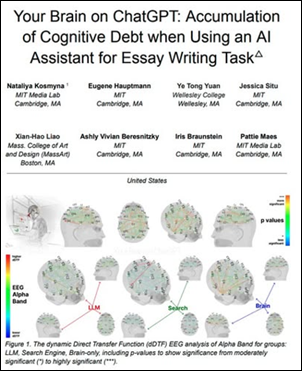
I finally had time to dig into the recent paper about the “accumulation of cognitive debt” that happens when using AI assistants.
As a proud member of Generation X, I first experienced those rites of passage called “the five-paragraph essay” and “writing a research paper” in middle school. My English teacher — this was before everyone called it Language Arts or something else more inclusive — made us create a 3×5 index card for every reference. We had to have cards for every quote or idea we planned to use. For those of us whose brains were wired for reading and writing, it was a painful process. We just wanted to jump in and start writing. However, for others it was an exercise in organizing thoughts and making sure to have enough materials to support your conclusions.
Fast forward to my university days, when I was a teaching assistant for an English 101 “Thinking, Writing, and Research” class. Those pesky index cards were still recommended, although not required. Personal computers had just made their way into dorm rooms, but as I graded research essays, I could easily tell who knew how to organize their thoughts and who was simply phoning it in.
The professor I worked with always selected obscure topics for the assignments, so it was nearly impossible to copy the work of others. That made grading all those essays quite an adventure. This was the era when those with computers had to figure out how to best use them on an as-you-go basis, because there certainly weren’t any classes offered that explained the best ways to use various pieces of software. Subsequent generations always had access to computers for schoolwork, so I’m not sure how much of the process aspect of writing is still taught versus enabling people to just sit down at the keyboard and get to it.
Within that context, I started reading the paper. It looked at how three cohorts completed an essay writing task. LLM-only, search engine-only, and brain-only groups completed three writing tasks using their assigned method. They then had a fourth task where some of them were crossed to another group. The participants were monitored with electroencephalography (EEG) to assess the cognitive load during the tasks. Additionally, essays were assessed using natural language processing, scoring with the assistance of a human teacher and scoring by an AI judge.
The authors concluded that the brain-only group had the strongest brain connectivity, followed by the search engine group. The LLM group had the weakest connections. Additionally, participants in the LLM group had lower self-reported ownership of their essays and had difficulty quoting their own work. Ongoing analysis showed that “LLM users consistently underperformed at neural, linguistic, and behavioral levels.”
The authors commented, “These results raise concerns about the long-term educational implications of LLM reliance and underscore the need for deeper inquiry into AI’s role in learning.” Given some of the personal statements that I’ve read for medical students over the last two years, there’s so much LLM use that it’s hard to get a feel for who the candidates really are as people. Maybe this research will convince folks to dial it back a bit.

I enjoy learning about new players on the healthcare IT scene. One that I’ve been watching in recent months is CognomIQ. The company’s semantic-based data management solution has been optimized for healthcare, in particular for research institutions.
The company originally caught my eye when I heard that industry veteran Bonny Roberts had joined the team as VP of customer success. She’s a long time HIStalk fan and served as co-host of the final HIStalkapalooza back in the day. I trust her to recognize the real thing.
The company’s CTO, Eric Snyder, can discuss the importance of data without succumbing to industry buzzwords or getting bogged down in jargon. He recently delivered a guest lecture for a data and visualizations class at the University of Rochester. He followed it up with a social media post on data literacy and the problems that happen when different parts of the healthcare system describe parts of the care continuum in different terms.
My favorite quote: “I struggle with the answer to the data literacy in healthcare problem because it’s like creating a second floor of a house when the first floor is propped up on sticks. We never solidified the foundation as an industry, instead we moved on to AI.”
I wish more people in the industry understood this way of thinking. I would even go a step farther to say that we’ve built a house of cards and now we’re putting AI on top of it, but I’m trying to be less cynical. Those of us on the patient care front lines have spent the last quarter century creating a tremendous volume of patient-related data that is just floating around and isn’t helping organizations reach their potential. I think of all the wasted hours of clinicians clicking and the back-end systems being unable to do anything useful with the data because of lack of standardization or inconsistent standards.
Snyder has spent the better part of the last decade leading technology innovation work at the Wilmot Cancer Institute and understands the importance of data to solve complex problems. The platform can aggregate hundreds of data sources and transform it in an automated fashion, which sounds awfully attractive to those of us who have had to engage in weeks or even months of cleanup prior to embarking on reporting or research efforts.
I also have to give a shout out to the company’s CEO, Ted Lindsley, whose LinkedIn profile boasts, “Healthcare Data that doesn’t suck.” Honestly, seeing that made my little informatics heart go pitter-patter, because it’s incredibly refreshing to see someone who is excited about what they do and is ready to express it in no uncertain terms.
I reached out to Ted to learn more. He was willing to entertain my anonymous inquiries. Recent highlights include the company coming out of stealth mode, showcasing its work at the recent Cancer Center Informatics Society Summit, and announcing its seed round. He had some great analogies about technology leaping forward and had me laughing about moving from MS-DOS and Windows 3.1 to Windows 95, even though my ability to talk about that transformation likely betrayed my age. He’s certainly no stranger to the work that needed to give the industry a kick in the pants and get it moving ahead. I’m looking forward to seeing where CognomIQ goes this year and beyond.

The last couple of weeks have been pretty exhausting and free time has been scarce, so I had to rely on an AI-generated cake in celebration of this being my 1500th post. I was hoping to whisk myself to a beach to celebrate, but instead I have to make it through another major upgrade first. When I was a young medical student sitting down at a green-screen terminal to access lab results, I never imagined writing about my experiences with healthcare IT, let alone there being people who would read it on a regular basis. Thanks for supporting my work, and a special thank you to those readers who share their comments and ideas so I can keep the words flowing.

Email Dr. Jayne.

Congratulations on your 1,500th post! I always find your comments to be insightful and relevant.
I also enjoyed the feature on the cognitive debt incurred when using AI. I have witnessed this firsthand with some younger colleagues.
When I was younger, I had the advantage of access to a full set of the Encyclopedia Britannica at home, which provided a rich resource of validated information for research.
Of course, now search engines can perform a similar function. Even with those, people still have to validate the sources, digest and understand the information and then apply it to their particular purpose.
With AI tools, people don’t even have to understand anything about a given topic to produce a finished product. Of course, this can backfire if they are asked questions about it or required to summarize it on the spot.
Best wishes for another 1,500 posts!
Another Congrats on your 1500th post. We are all overloaded with incoming data and other efforts from those trying to be ‘influencers’ ad nauseam. But your blog is one I always try to make time for. I look forward to reading many more! Enjoy the beach!
That reference to green-screen terminals hit a little close to home. But then I remembered that I liked amber terminals too!
Happy 1500th post.