Recent Articles:

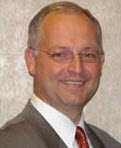
HIStalk Interviews Michael Rothman, Co-Founder, Rothman Healthcare Corporation

October 25, 2010 Interviews 6 Comments

Michael Rothman, PhD is co-founder, chief science officer, and board chair of Rothman Healthcare Corporation of San Francisco, CA.

10-25-2010 6-06-15 PM

Tell me about yourself and about Rothman Healthcare.

I have a PhD in chemistry. I’ve been doing data analysis for 30 years. I spent a good chunk of that time working for IBM, including a stint at IBM Watson Research Lab. I then went off and did consulting for a while. 

The reason that I got involved in this whole thing is a personal one. My mother was a patient at Sarasota Memorial Hospital. She went in to have a valve replacement operation. She did well initially, and then started fading. The problem is that no one understood that she was getting sicker until she was very ill. Without going into the whole story, she ended up dying about a week and a half later.

My brother and I spent a long time trying to understand what had gone wrong. What we decided was that, in a way, the system had failed her. It really is almost impossible to look at the electronic medical record and catch a slow deterioration in a patient’s condition, especially with the fact that there are so many different doctors and nurses that take care of a single patient.

We asked the question: why isn’t there a simple measure of a patient’s overall condition that can be plotted versus time to show a doctor or a nurse that someone is getting sicker?

We went in and spoke to the CEO of Sarasota Memorial, who let us come in to the hospital and try out some ideas for several weeks. That led to a real project about four months later. Over the next couple of years, we analyzed about 60,000 patient visits and data extracted from the electronic medical record at four different hospitals. That led to development of software — in fact, a product and a company to deliver that product — to do that very simple thing that we started out to do: provide a measure of a patient’s condition so that a doctor or nurse can see if a patient is getting sicker.

I have to ask the obvious question in terms of how Sarasota came to be involved with your product. Was that related to … you know what I’m getting at. Was this in terms of a lawsuit or something about your mother’s treatment, or was this just their interest in improving what you had seen firsthand?

That’s interesting. No, it was not involved with a lawsuit. We actually considered the idea of suing and rejected it because it’s an empty thing to do. It would not have been of any value to us to get a sum of money. What we wanted to do was try and prevent what happened to our mother from happening to someone else. No, there were no legal negotiations involved.

Did they undertake this with you in the spirit of recognizing that they had room for improvement and that you had something to offer as someone with skin in the game?

They were a pioneer in electronic medical records. My mother died in 2003 and they had already had an EMR, I think, seven or eight years.

Yes, they’re an Eclipsys client.

Yes, yes, and they had been frustrated really, by the lack of insight that they had been able to extract from all this data. They had all this data and it’s difficult to maintain, it’s expensive, and they were waiting for the real demonstration of value.

My brother had worked in data visualization for many years, and as I said, I worked in data analysis. When we came there, it just caught their attention. The CEO was very sympathetic about what had happened in my mother’s case, but there was something else in the background. There was this underlying feeling that something should be done with all this data.

Maybe what we want is people who are coming at it in a very fresh way. We did not have medical backgrounds. In fact, if we had, I don’t think that we really would have been successful, as it turns out.

If this could happen at Sarasota, it could happen anywhere because that’s a highly regarded hospital using a highly regarded clinical system that they’ve used very well for a long time. If you were talking about the experience of Sarasota to this point, what would be their results?

We developed this index, which we named in honor of my mother — the Florence A. Rothman Index. This is a general measure of a patient’s condition. It’s now part of a software product which we deliver and is being used at Sarasota Memorial.

In terms of a measure of success of this endeavor, it really was if we could help one person avoid what had happened to my mother, then that was the sign of success. But I think we’ve helped many people at this point, but I also think we can help many more.

I guess the toughest part is that you don’t really have any way to know whether your product helped. There’s no recordable event that says, “Hey, we just saved this patient because of something we showed a clinician.” Is that going to be a challenge to go into another site to have something more than just anecdotal discussion?

In fact, we did a clinical trial at Sarasota with 1,600 patients over about five months. It was with a randomized, concurrent control group. If a patient was born in an even year, his doctors or nurses would be able to see the graph, and if he or she was born in an odd year, they wouldn’t be able to see the graph.

We then looked at the outcome as measured, in this case by discharge disposition. What we found was that more patients ended up in a healthier condition and so were able to be discharged to home rather than to rehab or skilled nursing facility. We had a seven per cent increase in discharges to home. It turned out to be a number that was statistically significant.

We’re in the process of setting up clinical trials at a number of other hospitals to replicate this and to extend the work, and to show that we have benefit at not just Sarasota, but other hospitals as well.

As I was trying to conceptualize why this works, I thought of the stock market, where you may track five stocks and think you know everything there is until you look at a stock market index and a long-term trend. Then you realize that you got so wrapped up in the trees that you didn’t see the forest. Does it happen often that the data there but clinicians miss the trend?

Yes, that’s part of it. The thing is, there’s plenty of data. We’re not creating any more data. What we’re doing is two things. We take 26 different medical measurements which are available, basically, at all hospitals. We extract the amount of risk which is inherent in the value of each of these measurements and come up with a single score.

Now in a sense, that’s what a doctor or nurse does when they go in. They come up with an overall sense of how the patient is and a good doctor does it well, or a good nurse does it well. But the problem is if a doctor is rushed, a nurse is rushed, how completely can they really evaluate all the data that’s there? Even even more importantly, do they really know how that patient was the day before when maybe this is the first time they’ve ever seen the patient?

Getting that trend is very difficult to do, even if you’re a doctor and you’re sitting down and studying what’s in the medical record. It’s hard to figure out what the trend is, especially if it’s a gradual deterioration.

There’s one other thing, and that is doctors tend to look at three things when they’re doing an evaluation. They look at vital signs, they look at lab tests, and they look at the last doctor’s notes. However, there is a source of information that they tend to overlook, and that is the nurse’s assessments.

The nurses do what is called “the head to toe assessment” of the patient. It’s something that’s taught at nursing school. They evaluate each physiological system and they record it on the computer. Really, doctors don’t look at it.

One of the things that we’ve done is we’ve said, “Hey, this is actually very valuable information about how someone is.” So we used nursing data in the calculation of our score. It gives the doctor access to something that he doesn’t normally look at.

How did you come up with the 26? How do you know those are the most relevant ones? Are you continuing to see how well the correlate with patient status changes, or do you think you’ll be adding more measures?

We started by going to the electronic medical record and saying, “What’s there?” We looked to see what measurements really are available on all patients. Not only are they available on all patients, but they’re available and they are taken on a continuing basis on all patients. That really brings you down to a relatively small number of potential variables.

Then we tested the variables against different measurements and we looked at the independence of variables. We spent a long time working on the model building itself, but in answer to your question, are we continuing to test it and look for opportunities to enhance it? The answer is yes, although we are comfortable with what we have now. I’m sure that there will be opportunities to enhance it in the future.

Do you think there’ll be ways that you can build into the presentation of the information the ability to collect new information that will help you determine if the correlation is better since your system does not accept data entry?

Let me say two things. One is we’re presenting doctors and the nurses with this graph, and basically, every time a piece of data is entered into the electronic medical record, we recalculate the score and we put another point on the graph. That’s the operational side of it.

But what you’re getting at really is something that we thought of right at the outset, and that is when someone is doing medical research, one of the tough things is to have a good measure of an outcome. If you’re looking for mortality as an outcome, generally mortality is very low in procedures or when you’re dealing with one drug or another. So you need large sample sizes to get specifically significant differences between drug A and drug B, or procedure A and procedure B.

At the point at which our index becomes generally accepted as a measure of patient condition, all of a sudden you have another measure of outcome. You can say, “Hey, we have procedure A and the folks who went through procedure A ended up with an average score of 75 after a week, and procedure B, the folks ended up with a score of 65. And just to calibrate you, 100 is the best and 0 is close to the worst.”

You have a way of getting a quick read on the impact of procedure A versus procedure B, or drug A versus drug B, or workflow A versus workflow B. I think there’s a lot of potential in terms of helping in medical research.

Do you see it as being something that’s applied like a pain scale or a blood sugar reading where there’s a standing order that says if the patient’s Rothman Index gets to this, then transfer them to ICU?

We are not prescriptive, nor diagnostic. We’re not telling a doctor or a nurse what’s wrong with the patient or what to do. We’re basically alerting them that something is happening. But what you’re talking about sounds like the rapid response team Initiative. Is that what you’re referring to?

Yes. It seems like one of the key problems is failure to act. There’s something going on, no one notices, there’s no predefined pathways — someone just says, “Wow, this is bad,” and then nothing happens.

Absolutely. There was a talk given by Dr. Edgar Jimenez, who is the president of the World Federation of Societies of Intensive and Critical Care Medicine. He’s also an assistant professor of medicine at the University of Florida, University of Central Florida, and Florida State University, as well as director of medical critical care at Orlando Regional Medical Center. It was a talk given at the 6th International Conference on Rapid Response Systems in May at Pittsburgh. He was talking about some work that he’s done, preliminary work at Orlando Regional Medical Center with regard to rapid response teams.

One of the problems with rapid response teams is it takes the nurse on the floor to activate the system. Some nurses are going to be great at it, some nurses are not going to be great at it, but many times nurses are overwhelmed. As you say, someone can deteriorate and no one notice, so the team doesn’t get called.

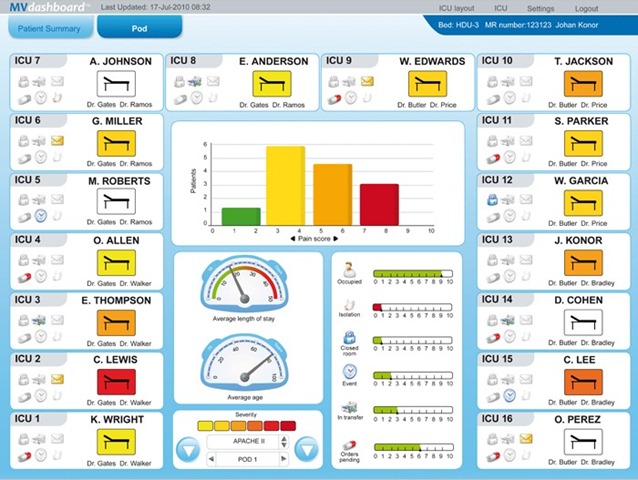
They are very excited about the system because of a capability that we have. We produce a graph showing the patient’s condition over time. We can actually produce a single screen with several hundred graphs on it so you can look at the entire hospital on one screen. The graphs are color-coded and it’s really quite easy to see a decline, even though the size of the graphs themselves is small.

One of the clinical trials that we’re going to be doing is on the order of surveillance, where a member of the rapid response team sits in an office and looks at the entire hospital and says, “Hey, there’s a downturn on the sixth floor,” and picks up the phone and calls the nurse on the sixth floor and says, “What’s going on with Mr. Smith?” If the answer is, “I thought he was going home tomorrow, I didn’t know there was anything going on,” then the rapid response team becomes proactive. They activate themselves. They really become a backup for the doctors and nurses to try and prevent people from falling through the cracks.

I would think there’s some potential use even for things like staffing or for nurse acuity; where you have patients whose diagnosis doesn’t really tell you the significance of their care requirements. The number is relative, right? It isn’t just that your number gets worse, but that if your number is lower than some other guy’s number, you’re in worse condition?

It’s an absolute value and it also shows you changes. It’s interesting that you say that because whenever we’ve spoken to, especially a chief nursing officer, she says, “Hey, I can use this as an acuity tool to help me with staffing.” I think there is some dissatisfaction with the tools that are out there because they require nurses to enter data and they can be subjective.

Our system is, in a sense, an absolute measure of the patient’s condition. As I’ve said, we color-code the graph — red being the worst — and so you can say, “Hey, if I have five red patients in one nursing unit, one thing I’m not going to do is assign them all to the same nurse because that’s going to lead to a bad outcome.” It could also be used at a higher level in terms of management of nursing hours, although we’ve not gone down that pathway yet. But it’s been suggested.

I’m a believer in the 80/20 rule –– show me the 20% of patients who are the sickest and if I manage those well, I’ll improve my overall outcomes.

Yes, I think you are right on. We really think that we have a potential of making significant impact in the quality of healthcare and we have people who have had many years’ experience in hospitals who feel the same way. It’s very exciting for us.

I know that you worked with Helios, or ObjectsPlus as it used to be called, when you started connecting to Eclipsys at Sarasota. What kind of interfacing would be required for a non-Eclipsys user and how difficult is it to manage those interfaces?

We’ve spoken to a couple of the other EMR vendors. We are prepared to interface with any of the systems.

Really, we are self-contained. We touch the world in two ways. On the one hand, we go up to the hospital’s database and we extract data periodically, but we do it in a way which has no impact on response time. Hospitals are very sensitive to anything that may degrade their response time for doctors and nurses, so we have a way of not doing that. Basically, it’s not a real-time query, so we wait for real-time queries to finish.

The other place is when a nurse goes to a nursing station and she goes to her computer and she wants to see the graph. All we need to do is know who the current patient is that you’re looking at and we can be either loosely integrated or tightly integrated with the system. With Eclipsys, we’re tightly integrated, so that there’s actually a tab on the main screen that says Rothman Index. A Sunrise Clinical Manager user wouldn’t know that they’re not using Eclipsys-native software.

But if it’s a looser integration, it might be an icon on the desktop. You click on that icon and you’re already logged on to our system through a single sign-on software system which is controlling their screen. We would know which patient you’re pointing at. We just need to know which patient it is and our server has the data and has the values of the Index, and would then be able to display a graph.

Does it alert or is it just display? Does somebody have to notice that the number’s bad or can it automatically page and escalate?

We produce a graph, but we also produce a number. That number can be used in a rule that is created by the hospital to generate an alert.

What parts of the system do you consider the proprietary and how do you envision this turning into a business?

The algorithm is proprietary, although we’re submitting an article for publication which will give the general outlines of what we’re doing. Doctors don’t like the idea of a black box. I guess that’s the proprietary element of it — the algorithm.

We’ve submitted several patent applications on the work. But we’ve spent years now validating this and so, in a sense, the protection that we have is the fact that we’ve done all this work. If someone wanted to do the same thing, it’s going to take them quite a bit of time.

Are you going to try to sell this directly to hospitals or partner with vendors? How do you see this getting out in the field?

We’re starting out by selling it to individual hospitals. We’re starting clinical trials at a number of them. The basic idea is an annual license fee, which is based on the size of the hospital. But we can see going into the future that we might partner with one or another or maybe all of the EMR companies to make it available to their customers.

Is it satisfying to see this turn into a business when the original point of it was a very personal circumstance that you knew you could improve for others?

I think that in order to deliver this and really have the largest impact, we needed to make it into a business. If it were simply a study or a paper, I don’t think that it would have reached a lot of people.

The fact that we were willing to go the extra distance to make it into a product that hospitals would be able to use easily and it will reach a lot of people, that really is a way to achieve our original goal. We just didn’t want this to happen to someone else’s mother. I think we’re going to end up accomplishing that goal.


Monday Morning Update 10/25/10

October 24, 2010 News 26 Comments

From Polemic: “Re: Epic-certified resources. Only Epic knows and they’re not sharing. That leaves everyone else to make sense of what it means when someone claims to be Epic-certified (what module, what release, etc.) Tightly controlled certification keeps qualified people in high demand, but doesn’t seem to take into account the rate at which they are signing new accounts. One has to wonder whether the ‘we’re Epic, you’ll do it our way’ approach won’t perhaps come back to bite them someday.”

From Celling Yourself: “Re: AirStrip’s Sprint announcement. I don’t get this. AirStrip’s target customer carries an iPhone, which doesn’t work on Sprint.” It is interesting since the deal offers hospitals Sprint’s help creating an in-building Sprint infrastructure for running AirStrip’s apps on 4G smart phones, but AirStrip says it’s staying carrier agnostic. I can’t imagine docs giving up their iPhones (and thus AT&T now and possibly Verizon soon) or carrying a second Sprint-capable device only for on-property access. It sounds like little more than a targeted Sprint promo for its infrastructure business.

From Former McKessoner: “Re: long overdue. I’m one of the many departures from the McKesson senior sales ranks since the June 1 beginning of the fiscal year. It took over 10 years, but the Horizon undoing is coming fast. No new business, customers grudgingly upgrading.” Unverified. All I’ve seen is the recent KLAS report, which says Horizon lost more clients than it gained in 2009 (along with the other faders you might expect — QuadraMed, GE, and Eclipsys). The company has announced nothing pertaining to its Horizon strategy as far as I know, so unless a customer verifies they were told something officially (and those I’ve asked haven’t responded), I’d say it’s business as usual.

From Introspect: “Re: Houston hacker. Here’s an update with the hospital’s side of the story. I wish you had withheld judgment until at least hearing both sides of the story.” I agree, although I assumed the newspaper’s account was accurate and complete and I did hedge my bets by referencing the hospital’s “apparent” security incompetence. The original article said the hospital had to hire outside help to fix the problems the kid claimed he told them about. The CIO’s story is different, although he didn’t mention the problems the kid says he discovered. He says the 21-year-old had installed “back door” code on the hospital’s server that would have let him bypass security to log on at any time, which he accomplished by using a doctor’s password instead of actually penetrating the hospital’s security (I’m surprised he was able to do that with a doctor’s security privileges, which I assume means any doctor could do the same, but that’s not my area of expertise). As the CIO says, “He didn’t discover a breach, he was the breach.” The outside help was engaged to make sure the kid didn’t do anything else, the CIO told the newspaper.

10-23-2010 6-20-32 PM

At least most readers think their employer’s economic conditions are no worse than they were six months ago, although more say they’re unchanged than better New poll to your right: what’s your experience working for an employer that has won a “best place to work” award?

It’s easy to confuse patients about healthcare benefits. A non-profit clinic in California sends out ID cards to all its recent patients that include the patient’s name, medical record number, and doctor name. They wanted to speed up registration by giving staff information needed to look up patients in their new EMR. Puzzled patients seen at the clinic but not its regular patients are calling their providers and insurance companies demanding to know why they’ve been turfed off to a new clinic and doctor.

10-23-2010 8-30-45 PM

RemCare, fresh off $2.7 million in new financing, renames itself (warning: PDF) after its product, Care Team Connect. The Illinois company’s product helps hospital care managers by creating evidence-based discharge care plans and coordinating care, reducing readmissions.

Vanguard Communications, which offers the MedMarketLink marketing service for specialty practices, signs a partnership deal with Intuit Health to market its portal.

HP announces its Slate 500 would-be iPad competitor, which it will market to businesses (note the medical apps featured in the above promo). It’s more expensive (starting at $799) and runs Windows 7, meaning that unlike the iPad, it supports Flash. It comes with 2 GB of memory (which is needs since it’s running Windows), has a shorter battery life (Windows again), and does not support 3G (WiFi only). I’m guessing all of those facts led to the decision to steer a wide berth around the consumer market created and owned by Apple in the hopes that businesses are so pro-Windows they’ll pay more to get less. This will be problematic: all those users with iPhones, iPods, and iPads at home are not likely to be thrilled by their employer’s offering. Apple doesn’t make mistakes too often, but failure to reach detente over Flash is a big one since that’s one of few chinks in its armor and it involves all of its products as its competitors will tell you constantly.

Mobile Health Expo announces its 2010 award winners. HIStalk sponsors winning were PatientKeeper (best patient safety innovation) and Voalte (outstanding contribution to nurse communications).

Greenway acquires Visual MED’s PACS technology, which will power its PrimeIMAGE solution for its PrimeSUITE 2011 EHR.

The radiologist who founded teleradiology services vendor Virtual Radiologic launches an early stage venture fund that will invest in consumer, healthcare, and technology companies. Sean Casey was kicked out of the company, which he started and took public, with $68 million worth of stock. It was the subject of a private equity buyout for $294 million this past May.

HHS CTO Todd Park is added to the speaker lineup of the mHealth Summit next month, run by the NIH, its foundation, and the mHealth Alliance. Also speaking: Bill Gates, Ted Turner, and US CTO Aneesh Chopra. I’ll be filing daily reports from there as will HIStalk Mobile editor Dr. Travis Good.

The Austrian man who was the first person to use a mind-controlled robotic arm for driving dies in a single-car crash that may or may not have been related to the technology.

I can’t decide if HIMSS is clueless or evil with this announcement: attendees at the Orlando annual conference in February will be tracked by RFID for the benefit of exhibitors, who can “… derive a more accurate score of a visitor’s buying potential.” RSNA has been doing this, apparently, triggering specific booth ads to play based on who’s around (Philips is a happy customer cited in the above promo video). An RFID tag will be attached to conference badges that will let vendors track attendees by job and employer (and name if the conference allows it), ending the days of anonymous and obligation-free booth cruising. The technology will log booth visits and duration by product being viewed and will alert vendors in real-time when a “key prospect” is in the area (CIO alert! Ignore everyone else!) The conference keeps getting more similar to a cattle butchering operation: you’re herded into a holding pen (the exhibit hall) since the token educational offerings (getting less useful every year) intentionally go dark during major booth hours, you’re fed and watered in the exhibit hall with vendor snacks until it’s your turn with the the high-paying exhibitors, and now you’ll be tracked like livestock throughout the process. Let me just say that, as a paying attendee and member, I resent the hell out of this (I’m sure I can get info on how to cripple the RFID tag and I’ll run it here if so). I can imagine what was going through the minds of the HIMSS dim bulbs who approved this: hey, we can charge vendors even more by selling them the personal information of attendees, vendors can pounce like snakes when attendees identified by job title as a decision-maker enter their air space, companies can monitor whether competitors are encroaching into their proprietary neighborhood, and HIMSS can justify its exorbitant exhibiting costs by showing who dropped by. People seemed to be resigned to letting HIMSS do whatever it wants in the name of picking the pockets of its vendor members. I say it’s time for provider members to push back and make the conference theirs again. Being tracked as nothing more than a roving sales prospect is just insulting. HIMSS apparently doesn’t extend its claimed interest in patient privacy to its own paying customers in the Ladies Drink Free model in which it pimps access to low-paying providers to high-paying vendors.

AHRQ spends $26.5 million of its ARRA money to hire a high-powered PR agency. Ogilvy Washington will “market and promote” the findings of Patient-Centered Outcomes Research in a newly created Publicity Center. I didn’t volunteer to have my taxes used for wasteful economic stimulus projects, but if I had, I’m pretty sure dozens of millions for a HHS PR wouldn’t have been on my list even though the general idea of comparative effectiveness research is a good one (but hugely expensive – $1.1 billion in stimulus money).

Four NICU babies in a hospital in Canada are given insulin instead of heparin in their TPNs, killing one of them.

Shares in athenahealth jumped by 23% on Friday after good Q3 numbers that beat estimates.

E-mail me.


10-23-2010 6-58-14 PM 

From BeKind: “Re: the Senate Committee on Veterans’ Affairs testimony about MUMPS. This dialog occurred at 75:26 in the video.”

Senator Richard Burr: If you maintain MUMPS can the private sector have full access into the VA system, into the MUMPS system, for the exchange of electronic information?

Roger W. Baker, Assistant Secretary for Information and Technology, Department of Veterans Affairs: I would answer it this way, I believe just as much as if we implemented it in any other language because at the bottom it’s the data that’s important.

Senator Burr: Let me turn to Mr. Tullman if I can just simply because he’s out there. Now, let’s see what the limitation is.

Glen Tullman, Allscripts CEO: What I would say is again that you can extract data from any system. What we’re really talking about, and I don’t want to get too technical, is the native exchange of information. So you can pull information out of a mainframe system and put it into a PC if you want two people to talk to each other. The question is why would you do that when you could have two PCs that were talking with each other? So again we think MUMPS was the right decision to make when it was made. We think there’s a reason to carry it forward. We’re just saying as we go forward into the future we need to broaden the understanding of what systems to use, what architectures to use, and what the general reason we need these systems for and that is for communication and I think that’s this idea of this community is important and no one’s using MUMPS to build systems that communicate and exchange data efficiently today in anywhere else but the US government.

Wow, there’s a lot of interesting stuff in this video of the committee meeting, which runs two hours (meaning I didn’t listen to every word yet). The chair, bless his heart, leads off by reminding everybody that the VA and its contractors flopped big-time with CoreFLS and the projects it had to kill because they weren’t being managed well. Ed Meagher talks about the VistA Modernization Committee’s recommendation to put VistA on a stabilization program while developing its replacement. Glen criticizes MUMPS-based systems (meaning not just VistA, but his company’s competitors Epic, MEDITECH, QuadraMed, etc.) and saying the military’s evolution requires new EMR requirements for data sharing. He also says its replacement should be either Microsoft-based or open source (technically, VistA sort of open source, so I assume he means non-MUMPS open source). He says its time for the government to learn from the private sector.

Tom Munnecke, a former VA guy who helped build VistA, testifies at around the 61 minute mark. He credits the original VistA developers, all of whom were clinicians turned developers, for its success, starting it with “good enough” and then refining it from field experience instead of sitting around writing specs. He said MUMPS criticism isn’t new, going back to the beginning, but it works and has been stable. He likes the open source idea for a VistA replacement but cautions against throwing out the lessons learned from VistA. He also advocates additional forms of communication other than the EMR, saying that 25% of VistA’s use was the Mailman app used to simply communicate among professionals (comparing that to today’s social networking). He talks up personalization that can be delivered by cheap, easily implemented tools.

The chairman also asks VA CIO Roger Baker directly what assurances he can give that they won’t screw up again like they did with their replacement scheduling system. He cites the VA’s cancelled or retooled projects as proof that they’ll kill projects with minimal chance for success (the “fail fast” approach of identifying and killing the dog projects fast before they cost too much). Munnecke agrees, but says users need to scale back expectations and allow the software to develop instead of going for the gold-plated Cadillac upfront.  

Munnecke: “Mr. Tullman’s comments have a number of technical issues that I think we need to talk about over coffee some time, but I probably largely agree with his conclusion. I don’t want to be characterized as pro-MUMPS. I do want to be characterized as having a very successful legacy system that has accomplished a lot and just going with the standards of the information technology industry and thinking we’re going to take the shiny new technologies and word on PowerPoint presentations and develop a successful system is not going to work.” When interrupted by Sen. Burr’s comment that he’s never heard anybody comment that DoD actually has working EMR software and wondering why it’s so hard to send DoD medical records to the VA, to which Munnecke replies, “I think you’d have to look at DoD actually throttling back CHCS and crippling the features that were design into it for communication in order to protect their bureaucratic stovepipes.”

Sen. Burr’s summation (in which he repeatedly refers to VistA as “the MUMS system”): “It is absolutely essential, in my estimation, that private sector companies buy in to what technology decisions you make at VA because of exactly what Mr. Tullman references, and that’s that this is no longer our population of people that we’re taking care of. They’re bouncing back and forth … if we want to reach the efficiencies long-term of private healthcare, as most have realized, then we’ve got to have this interoperability solved … if a company like Allscripts, a leader, is questioning whether they’ll be able to exchange through your system, I think we ought to pause for a minute and talk to those companies and find out what is your concern …”

Then came the comments BeKind mentioned above. Sen. Burr mentions that three people in the room have iPads, yet soldiers returning from the military hospital at Landstuhl have paper medical records taped to their chests, saying that the VA should collaborate with the private sector.

News 10/22/10

October 21, 2010 News 10 Comments

From Wee Man: “Re: [vendor name omitted]. The rumor you recently ran about halted implementations and delayed upgrades for [product name omitted] is true, I’m 95% certain. Also, the same company’s flagship clinical product line [product name omitted] is going to maintenance-only.” I’m chickening out in naming the company since this is big news if it’s true and I’d hate to get in trouble just in case it’s not. I’ll say just this: the non-anonymous source is a good one, this rumor fits with some earlier stories and customer survey results that I’ve run, and some mighty big hospital systems are going to be super PO’ed if it’s true. If you have confirming evidence, send it my way.

10-21-2010 7-32-40 PM

From FormuLarry: “Re: Micromedex. They’ve released free versions of their drug information application for the iPhone and iPod. It’s not as slick as Epocrates, but the price is right.”

From Stifler’s Mom: “Re: Epic certifications. Can anyone share the exact numbers of certified people out there for products like Prelude, Bridges, Beacon, Cadence and the year/version? Also whether they have clinical backgrounds?” I’m pretty sure there’s only one source for that information so I wouldn’t get my hopes up, but if anyone knows, send it over and I’ll forward to Stifler’s Mom (I gave this non-anonymous HIStalk pal that name years ago and she adores it, not to mention it makes me cackle every time because I have a puerile sense of humor).

10-21-2010 10-09-32 PM

From Broadway Joe: “Re: Keane. Being purchased by NTT Data for $1.2 billion.” Rumor is that the Japanese company (part of Nippon Telegraph & Telephone Corp.) is in advanced talks to buy Keane, which is half owned by Citigroup. The deal is imminent, Tokyo newspapers are saying. Keane offers application, BPO, and infrastructure services, not to mention its healthcare presence (Keane Healthcare Information Systems), which markets the Keane Optimum system and other products.

From Oops, Here: “Re: glitches. We are not aware that any of these patients were injured after death.” Errors in loading UK driver’s license organ donor information to the NHS databases cause the wrong organs to be removed from 25 donors. Nobody noticed until prospective donors (the ones not already dead, in other words) complained that their information was wrong.

10-21-2010 7-49-55 PM

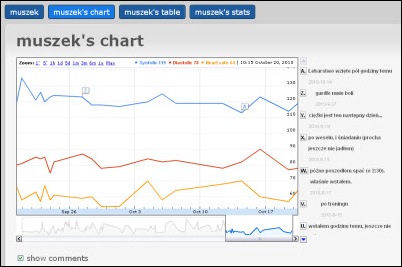
From Matt Mucha: “Re: my blood pressure chart. I’m a Web developer from Krakow, Poland who also happens to have hypertension. I created a tool to let people keep records online and share them with a doctor. I know you’ve written healthcare apps in the past, so I hope you can relate :). Check out the video and forums. I’m not profiting from the site in any way.” It’s a pretty slick with a clean design. Nice job. Take a look

image

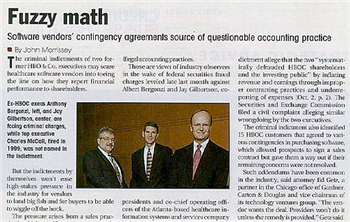
From Greed Earns Justice, Eventually: “Re: McKesson/HBOC scandal. Sales SVP Dominick DeRosa pleaded guilty in 2000 to one count of aiding and abetting securities fraud by hiding side agreements to manipulate revenue recognition. This past April, the judge overrode the prosecution’s request for probation and sentenced him to a year in federal prison. While waiting 10 years for his sentence, he appears to have built quite a resume, serving as CEO of OneWeb Systems, VP of sales at Transcend Services, and executive VP of sales at CareMedic. Rumor is that he was at MedAssets before getting the bad news about jail. Mastermind and former president Al Bergonzi is apparently doing his 41 months in Atlanta after being given more time than the prosecution requested. He’ll get out Christmas Eve this year. He’s been doing consulting work for former friends and one of the many HBOC acquisitions he coordinated. CEO Charlie McCall, who almost got off, is due to be release in 2019. Controller Timothy Heyerdahl was released in 2008 and CFO Jay Gilbertson was released earlier this year. I wouldn’t be surprised if he’s still in HIT somewhere.” He didn’t even mention Jay Lapine, one of few corporate counsels to ever be indicted for securities fraud (he got off on criminal charges a year ago and then settled the civil case against him, barred by the SEC from involvement with publicly traded companies for five years). McKesson’s executives, desperate back in 1998 to prove they could run something sexier than drug warehouses, paid Charlie $14.5 billion for a company everybody knew was a house of cards ready to collapse if he couldn’t fast-talk some rubes into taking it off his hands in a hurry. He did, with the announcement of the accounting scandal just a few months later evaporating $9 billion in McKesson shareholder value in a single day (the stock went from around 90 to less than 20 and still hasn’t hit that level since). Not to mention that a lot of HBOC software was as crappy as their corporate books, also widely known by nearly everybody. It’s always ugly for the foot soldiers when greed meets stupidity. Sorry for the rant, but what those guys did to McKesson’s employees (many of them unfortunate conscripts due to HBOC acquisitions), their hospital customers, patients, and to the industry really ticks me off even after a decade. 

image

Hosted pharmacy applications vendor MedKeeper announces its acquisition of DoseResponse from Keystone Therapeutics, a competitor in outpatient anticoagulation management software.

I mentioned the 21-year-old Georgia computer tech who was arrested for accessing a hospital’s computer system. I’m beginning to think he got a raw deal. He was working on a physician group’s hospital connectivity problems and documented seven problems with the hospital’s server, hoping to impress the hospital enough to land him a job. The hospital CIO and security person met with him, asked him for a copy of his resume and a list of the problems he found, and then came back in with police officers to arrest him. The kid’s been in jail since last week, with the hospital claiming he’s a danger to them since they can’t fix the problems he cited without outside help. Maybe the hospital should swallow its pride, admit its apparent security incompetence, and hire the kid cheap.

 10-21-2010 8-02-02 PM 

Acuitec announced its iCare mobile anesthesia apps for the iPhone, iPad, and iTouch at the American Society of Anesthesiologists conference in San Diego this week. Jessica sent me a press release that I can’t find online anywhere to link to, so you’ll have to take my word for it. The above is a shot of its Vigilance remote presence monitoring system running on an iPad, which I found while looking unsuccessfully for the press release. The Birmingham-based company is a joint venture with Vanderbilt University.

HIStalk pal Justen Deal sent over a position listing for “geek interns” at his Vieu Health startup that was a fun read (he’s a really good writer in a Joel On Software kind of way). I was hooked enough to read the whole thing. If you’re a techie and want to be underpaid (so Justen says), but live and ski free at a resort, get a MacBook Pro and a BlackBerry Torch, and work with “misfits, rebels, square pegs, and troublemakers,” you might want to connect with Justen. I have no idea what Vieu Health is building since they haven’t said yet, but it’s something to do with electronic health records and networks. Maybe I should follow his lead and get some interns myself since I always seem to be buried.

Former NaviNet SVP Tim Mills is named VP of sales and marketing of revenue cycle management company Avisena.

The Toronto newspaper profiles the involvement of Telus in Canada’s move toward digital healthcare. It mentions that Telus provided the software and technology behind The Ottawa Hospital’s plan to buy 3,000 iPads to run on the Telus-provided wireless network to access an aggregated database. That hospital’s CIO says the information needed by key staff members that is available electronically has gone from 30% in 2008 to 100% now. It also mentions the Oacis product, mentioned several times here previously. The healthcare division of Telus is bringing in $400 million a year. It’s a well-done article. Somehow Telus Health seems to come in under the radar in the US, but it’s an impressive operation run by a a large telecommunications company.

Cardinal Health Foundation will award $1 million in medication and OR safety grants in 2011 for the fourth consecutive year. Applications are due by December 3, 2010.

The Chicago Sun-Times covers the local healthcare use of iPads: University of Chicago Medical Center will give iPads to all of its internal medicine residents, a plastic surgeon uses her to explain reconstructive surgery to breast cancer patients, and one hospital says at least half of its ED docs bought their own iPads once they found that they could use the EMR on them.

Jobs on the HIStalk Sponsor Job Page: Clinical Executive Physician, Clinical Executive Nurse, Healthcare Consulting Lead. Platinum sponsors get free listings there. On Healthcare IT Jobs: Epic BSA Ambulatory EMR, Clinical Product Specialist, Epic Consultants.

In Germany, CompuGroup Medical AG says it will invest $180 million in its software over the next five years, most of that to further develop its Software Assisted Medicine medical knowledge system.

Ontario’s health administration is slammed by an auditor’s report that found the same expensive practices previously found in eHealth Ontario scandal last year: single-source contracts, overpaid consultants, and excessive expense reimbursement. One temporary executive who was making $275K per year billed the hospital an extra $150K for helpers, $14K for bonuses, a Christmas lunch, and world-wide travel, including $500 in telephone charges in one hotel stay.

Q3 numbers for UnitedHealth Group, parent of Ingenix: revenue up 9% to $23.7 billion, with net earnings of $2.15 billion in earnings from operations, easily beating expectations on revenue and earnings. The company gave guidance of $94 billion in revenue for the fiscal year. Ingenix revenue was $592 million, up 23%, with $70 million in earnings from operations. The announcement also gave the cost of the Q3 acquisitions by Ingenix (Axolotl, Picis, and A-Life Medical, I assume) at $1.9 billion in cash. UnitedHealth market cap is $41 billion.

Odd lawsuit: a couple says a waiter at the local Steak ‘n Shake gave their child a bottle of Blair’s Mega Death hot sauce for his chili, causing him to break out in hives (assuming the child wasn’t hitting the restaurant on his own, maybe the parents should have intervened). They’re suing for $10,000 in compensation and $50,000 in punitive damages.

E-mail me.

HERtalk by Inga

CMS incentive payments are taxable. That’s the opinion of Steven Waldren, director of AAFP’s Center for Health IT. I’d never really thought about it, but that hardly seems fair. Definitely not nice.

Cerner Ambulatory tops the list of a recent Ovum report entitled Selecting an Ambulatory EHR Vendor in the Healthcare Market. I mentioned this on HIStalk Practice yesterday, but it perplexes me so much that I’m also asking HIStalk readers to share their impressions. I don’t know much about Ovum (which is a division of DataMonitor) so I asked them to provide me more background on their research methodology. No response as of yet. Cerner, along with eClinicalWorks and GE Healthcare, make their short list of top vendors based on strong brand names “in the ambulatory market” and for demonstrating “market-leading positions.” The report also says Cerner is the “most versatile and multi-faceted” of all the vendors reviewed (which included Allscripts, Sage, NextGen, athenahealth, and Amazing Charts.) To be fair, I know Cerner ambulatory by reputation only, so for all I know Ovum is spot on. The Cerner folks have graciously offered to dispel my skepticism and asked me to stop by for a demonstration at MGMA next week.

katina

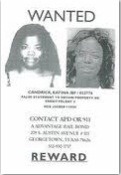
Follow-up: back in March I mentioned the former MedAssets employee who was arrested after using a fake identity to get her job and stealing financial information on more than 1,200 patients. Katina Candrick was sentenced to 10 years and ordered to pay more than $163,000 in restitution. As I was looking for a photo of Candrick, I noticed that in 2008 she had been charged with fraud, falsifying identity, and fraudulent possession of a controlled substance after posing as a medical clinic employee and attempting to pick up prescription drugs at a CVS pharmacy.

HealthGrades says that overall hospitals are improving, but the gap between the best- and worst-performing hospitals is substantial. A typical patient would have a 72% lower risk of dying in a 5-star rated hospital compared to a 1-star rated hospital, and a 53% lower risk of dying by going to 5-star rated hospital compared to the US hospital average.

baptist shelby

Baptist Health System (AL) contracts with Passport Health Communications for Passport’s IntelliSource software for revenue cycle management.

Virtual Radiologic is named the top-rated vendor in the KLAS Teleradiology Study 2010. KLAS notes that teleradiology contracts had historically been held by local radiology groups, but now hospitals and clinics have 40% of the contracts. Look for teleradiology volumes to rise in the next few years.

athenahealth posts a 33% in increase in third-quarter revenues ($63.1 million vs. $47.4 million). Excluding one-time items, the company’s net income doubled from last year, coming in at  $6.4 million or 18 cents per share. Analysts were looking for a 27% increase in revenue and 13 cents share. Basically, a darn good performance. The always entertaining Jonathan Bush will provide more details at 8:45 a.m. Friday on CNN.

AirStrip Technologies collaborates with Sprint to offer a bundled solution that includes Sprint’s clinical grade in-building coverage and AirStrip services for hospitals agreeing to expand or extend an enterprise commitment to the Sprint network for more of their employees.

clincial expert

Thomson Reuters releases a new version of Clinical Xpert Navigator mobile for iPhone, iPod Touch, and iPad devices.

Lots of good stuff on HIStalk Practice this week: in addition to the usual posts, we feature several HIT Vendor Executives who shared their opinions on what attendees will be discussing next week at MGMA 2010 in New Orleans. We also published a handy vendor guide summarizing what each of our exhibiting sponsors will be highlighting at MGMA (you can download a PDF to print and take along). Do us a favor: stop by their booths, ask for a tour of their offerings, beg for a trinket, and tell them thanks for powering HIStalk and HIStalk Practice.

Sponsor Updates

  • Greenway introduces PrimeSPEECH, an integrated direct-to-EHR speech technology and PrimeIMAGE PACS solution. Both solutions are fully integrated with Greenway’s PrimeSUITE EHR and physician workflows.
  • MED3OOO acquires health benefits consulting firm Insurance Solutions Group.
  • Voalte partners with Meru Networks to extend its capacity in hospitals running the Voalte application. The company also announces a trial at Parkview General Hospital (IN).
  • For the third year, Vitalize Consulting Solutions earns a spot on the Philly 100 List, coming in as the 57th fastest growing privately held company in the greater Philadelphia area.
  • Bronx-Lebanon Hospital Center selects the Allscripts Care Management solution, which will integrate with the hospital’s existing Sunrise Clinical Manager system. Bronx-Lebanon also recently deployed Allscripts solutions in its ED and 40-physician multi-specialty practice.
  • SRSsoft is named to Deloitte’s Technology Fast 500, which lists the 500 fastest growing (by revenue increase) high-tech companies.
  • MedPlus parent company Quest Diagnostics releases its Q3 financials: revenues of $1.9 billion, down 1.7% from last year; net income rose to $198 million ($1.13/share) compared to $192.2 million ($1.02/share).
  • McKesson signs an exclusive agreement with MedVentive to offer that company’s SaaS-based Analytics Advisor analytics solution to the payor market, where it connects payors and providers transparently around clinical and financial performance metrics.

I’ll be traveling to New Orleans this weekend to attend the MGMA conference. I’ll be on the lookout for cool HIT stuff, collecting giveaways, and hopefully learning a few new things. Look for updates and photos.

inga

E-mail Inga.

HIStalk Interviews Kevin Maher, VP, McKesson Health Solutions

October 20, 2010 Interviews 12 Comments

Kevin Maher, MHA is VP of product and outcomes management at McKesson Health Solutions.

Give me the elevator pitch on Personal Health Advisor.

I think about Personal Health Advisor as a multi-channel consumer engagement platform at its highest level. It’s really aimed at helping consumers to help them utilize online health tools and, in general, to provide consumers with both inbound and outbound health advice, recommendations, and services.

Who is the targeted user or customer?

The targeted users are health plan members and the target clients are typically health plans, which I would describe as any organization that holds some degree of financial risk for a population. That could translate into at least three segments. Certainly the payer segment, which is where we are focused today. Second, the employer in the self-insured employer market. Third would be the kind I like to describe as the fledgling ACO market.

There’s always a survey claiming consumers want to use tools like secure e-mail, personal health records, and assessment tools. So why don’t they?

I think our point of view on that would be that a lot of the lack of use goes to a few things. One is not enough skin in the game overall today. I agree that consumers are still largely shielded from the financial cost and burden of delivering healthcare.

I think a second issue we’re dealing with is who’s the trusted source for information — the payer or the provider? Our position is that the provider is a much, much better trusted source than the payer, so anything sponsored by the payer — or potentially, by the employer — in and of itself will create some barrier to use.

I think some of those barriers can be removed if the design of the benefit structure encourages the use of online, member-focused tools, which is what we are beginning to see with the clients that we’re working with on this solution.

So you’re saying an insurance company might say, “Sign up for our personal health record and get a gift certificate or get a discount on your premium”?

Correct, and it has to be meaningful. I think what the research has shown, and what we seem to see, is at the individual level, you’re talking somewhere around $500-$600 a year. You’d need to see that level of impact — the consumer would need to see that, and at the family level, at least double that to $1,200 or so — to really move the dial on engagement.

So to your point, without the right level of incentive, we’re seeing use rates in the single-digit range. When we see that level of benefit impact, whether or not it’s discounts or reductions in premium or gift certificates, we can see engagement rates upwards of 50%. That seems to be the big dial that the payer has ability to control and throttle.

When they provide these incentives or whatever encouragement that form takes, how do they do that beyond “you have to complete a questionnaire”? Are there targets that encourage actual outcomes that are wellness related and not just looking at a screen?

I would say that there are probably a few health plans that have moved to outcomes. Or, I wouldn’t even say health plans. I would say more employers, that have moved toward more outcomes-based rewards model, vis-à-vis the Safeways of the world.

I think most of the market is still on “perform an activity and we will reward you.” I think that transition from activity to outcome is likely to be a 3-5-year transition, but we’re certainly beginning to see clients thinking about using more biometric results to ultimately get that, or give that reward. So, whether or not it’s some kind of annual biometrics that’s evaluating blood pressure, LDL panels, BMI — that’s certainly the early, preventive information that consumers need to know about.

More employers and providers also talk about the use of Bluetooth wireless devices that are providing more immediate or more continuous feedback on some of those key metrics versus a 12-month look at it. But I would say again, most of the market today continues to be focused on — and I say this because it’s the reality and it’s relatively still a new concept — but most of the market is paying for activities today. That activity could be, to your point, completing a HRA, participating in a program, getting the biometrics done, seeing their physicians for preventive care testing, etc.

McKesson operates a 24-hour-a-day nurse hotline. In terms of a key differentiator, what resources does that require on McKesson’s end and what infrastructure do you have in place?

We’re the company that was formerly known as AccessHealth, which was actually the first company that offered a nurse hotline to the payer market. We, today, have about 30 million lives under management that we’re providing nurse line services to.

Approximately 600 nurses is a major differentiator. I mean, it provides that human channel, and I think a number of things that we are doing to tie the offline world and online world are, for example, nurses or nutritionists or pharmacists we have available. So we think about our line as a clinical hotline, not just providing nurse recommendations for acute health problems.

The nurses reinforce getting the preventive testing. They’re able to use that information to reinforce the availability of incentives that the sponsor is offering if a member performs a certain function. A clinical staff has the ability to push content after a call to a secure message center as a reminder — could be content, could be videos.

The ability to take information from provider, member, and health plan data and make that information exposed to the nurse, and make that nurse or that clinician smarter about the member’s health. Remember when we get that data, we’re able to push content from the call center or from a telephonic interaction into an a member care plan and tie those two again, those two different worlds come together through the integration of data.

I’m interested in the data sources that the Personal Health Advisor can collect and put together for the subscriber to review.

We have core data sources as follows. It’s basic member eligibility information. It is provider linkage information of provider files, again, from the payer. Medical claim information, pharmacy claim information, HRA health risk assessment information; and biometric information. And the biometric information at this point is contained to blood pressure, BMI, validated smoking cessation smoking status, and the lipid profile.

One of the things that interested me after the e-Patient Dave fiasco at Beth Israel Deaconess was information that may be correct or meaningful for billing purposes that may not be something that a consumer should be turned loose to interpret. Is there any level of oversight or preparation to ensure that what lay people see on the site is something they won’t misinterpret?

The medical claims, I think, is where it gets dicey. What we’re doing there is all of that information is being coded. It’s being coded using the SNOMED standard terminology codes. When members see that information in their personal health record, all they need to do is basically hover over whatever detail is on the page.

Say one of the line items was diabetes. You hover over that, click on it, and it presents a consumer definition of whether or not is was a diagnosis or a procedure code. It provides a consumer again, some sort of definition associated with each of the pieces of information that are being generated by claims data.

Underlying that is that we have mapped all of our clinical reference system content, and you may be familiar with that content. That content, historically, was sold into the provider market, continues to be a strong leader in the provider market. Providers historically printed these kinds of one- to two-pagers out for their members when their members would leave the office, explaining what their upcoming procedure was or their condition is that they’ve been recently diagnosed with.

That’s how we’re handling that pure medical information.

Who do you compete with in reaching the consumer and how is your offering different?

There are two or three big competitors that we see. I think, first and foremost, is WebMD. I think what’s different about our solution than WebMD probably revolves around the point that you made earlier — the telephonic channel, in addition to just the online channel. That’s number one.

I think, secondly, I’m not sure I’ve seen a whole lot of momentum or press release around extending the channel to a mobile channel. We’ve added three capabilities to our mobile channel for PHA. One includes taking the PHR and making that available through the mobile device. Second, is a pharmacy adherence tool. Third is a messaging tool that leverages our clinical staff.

I think it’s the telephonic channel and the mobile channels that we believe are our key differentiators from a WebMD. And then we’ve got our classical health management payer/employer competitors such as OptumHealth, Health Dialog, or Healthways. But we also see ourselves competing with other services that would be competitors of A.D.A.M. I mean, those are potential partners, longer-term.

Do your offerings leverage RelayHealth’s tools?

We looked at that. We do not leverage the RelayHealth tool today, but certainly know that long term, we’re going to need to figure out — along with the rest of the industry — how do you tether this PHR closer to the doctor? I think that’s a downfall in any PHR that is not somehow associated with, tethered to, or connected to that provider’s EMR. We know that’s a challenge we’re going to have to solve in order to make that PHR ultimately more valuable to both the member and the provider.

Quite frankly, the reason we did not reevaluate that when we were first building that, and the big drawback that we could not solve with Relay, was the belief that in the markets that we were selling to, that we needed to be able to pre-populate these personal health records with some type of information in particular, given that we were focused on the payer market.

We felt that we needed to be able to pre-populate this information with claims, and I think we all are aware that there’s significant … it goes back to one of your questions about ‘why aren’t these tools used as often as they are?’ At the time, clearly one of the big feedbacks that consumers were giving around PHRs is too much time to populate that information. We wanted to remove that barrier by pre-populating, and unfortunately, Relay did not have that capability.

What tools are needed to make a difference in either improved outcomes or reduced costs?

I think we think several things. We need to continue to evolve this solution to provide tools that focus on members that are driving the spend, which typically are members with chronic disease. I believe we’re going to need to add a number of features, both through the mobile channel as well as the online channel, that focuses on members with chronic disease.

I think number two is something that we’re working on right now that would tie together the concepts of multi-source data, number one.

Number two is using this data, and then be providing very clear information as it relates to this data — where they can go to take part in programs that utilize this information and where they’re sitting on this data. So are you in range or out of range on your blood pressure or whatever? Letting the member know what the incentive opportunity is and then making it clear in a single view. What are the activities, or what are the metrics you need to get to in order to collect that measure?

This is something that we’re working on right now. We’re calling it a Health Report Card, but it’s literally, you can think of it as a stoplight report — a red, yellow, green report that is a single view, that again, pulls together all of the major sources from claims data, self-reported data, biometric data – that presents whether or not incentives and opportunity, and if an incentive is an opportunity — if the member has to do these three activities, all in a single view — I think we view that as a critical aspect as well.

Pulling together the pieces from the various tools into a single actionable view for the member, and I think ultimately, this data — because of the conversation we had — needs to be able to be accessed to the provider as well. So much of this comes down to — is the provider also focused on making sure that the member’s getting the preventative testing that they need and helping support the messages that the payer is trying to deliver to that consumer, in terms of behavior change?

Readers Write 10/20/10

October 20, 2010 Readers Write 7 Comments

Submit your article of up to 500 words in length, subject to editing for clarity and brevity (please note: I run only original articles that have not appeared on any Web site or in any publication and I can’t use anything that looks like a commercial pitch). I’ll use a phony name for you unless you tell me otherwise. Thanks for sharing!

Note: we asked two consulting company executives to respond to a reader’s question: “Most physician offices say they are waiting for their EMR vendor to let them know how their systems will handle ICD-10 before they do any of their own prep work. Is this common? Vendors seem to be quiet on the subject.”

Preparation for ICD-10
By Peter Butler

10-20-2010 4-47-01 PM 

From what we are seeing and hearing from healthcare organizations we work with, in general, the larger IDNs and healthcare organizations are addressing ICD-10 readiness through appointed committees to head up the planning for ICD-10. It is the smaller physician medical groups that are taking a “wait and see approach” to ICD-10 and vendor readiness. 

In one conversion with a medical group CEO who is also a practicing pediatrician, I was told that his concerns as it relates to ICD-10 were minimal. His view was it was mostly an IT issue. There is a small subset set of ICD-9 codes he uses regularly today and with ICD-10 that list will grow slightly, but nothing that will require a major amount of education or training.

We’ve seen many of the major IT vendors saying they are investing in ICD-10 readiness today. They are still doing their own due diligence internally before communicating details and specific plans with their customers which is why your reader may not be hearing much from the vendors.  

I was recently visiting with a vendor who has made ICD-10 and Meaningful Use their top priorities and slowed other R&D efforts to focus more resources on these two initiatives. We believe that the majority of vendors will deliver ICD-10 compliant upgrades in reasonable timeframes.

For providers, taking a “wait and see” position is dangerous, as ICD-10 codes will affect all services in all settings; and therefore all reimbursement. Providers must begin to inventory all of their vendor systems to determine their ability to be able to accommodate the EDI v5010 enhancements and expanded character sets. Workflows need to be inventoried so organizations can understand where testing and mitigation need to be planned. There are many constituents (i.e., insurance companies, labs, etc.) that also need to be managed and contracts reviewed to minimize the impact to provider reimbursement.

ICD-10 needs to be viewed more broadly than just complying with government regulations. The ICD-10 code set provides organizations with new opportunities to enhance their revenue stream. The key is to begin now and prepare a clearly defined transition plan.

Peter Butler is president of Hayes Management Consulting of Newton Center, MA.

Preparation for ICD-10
By David Vreeland

10-20-2010 4-59-15 PM

I’d say that the burden of implementing CMS V5010 and ICD-10 is largely going to be borne by the vendors, but it’s always the responsibility of the organization’s leaders to ensure that the organization is compliant with such regulations.

In a hospital, there are typically many more information systems in production and so the burden on the organization is larger because they need to responsibly ensure that they have a handle on all those vendors and determine what the plan is for accommodating the change to these new code sets across the various IT providers. They also will likely need to have a testing plan in place for interfaces, downstream system compatibility, etc.

On the ambulatory / physician practice side, I’d say that the approach is the same, but the complexity is likely significantly lower. But simply waiting until the vendor takes action is ill-advised.

As a physician, I’d be requesting information from my vendors about the development plan and timeline for these enhancements, and if the practice operates a practice management system that is provided by a different vendor than the EMR solution, I’d be looking at moving to an integrated solution. Most vendors we work with have a plan and timeline either in mind or on paper by this point, and it’s appropriate to ask for it.

David Vreeland is a partner with Cumberland Consulting Group of Brentwood, TN.

Back to School – For a Master of Biomedical Informatics Degree
By Jeremy Harper

clip_image002 

With the recent influx of government funding in healthcare, educational opportunities abound. I have been lucky enough to receive a scholarship to Oregon Health & Science University’s (OHSU) Healthcare Informatics program. My passion is to work with healthcare organizations to ensure patient safety and innovative technologies. This article will cover how I found the OHSU opportunity and why I decided to attend a program that required moving to the other side of the country.

An elevator story about my personal background is that I attended The Ohio State University’s business degree program from August 2003 to December 2006, receiving a BS in General Business. I worked at Epic Systems from February 2007 to April 2009 and discovered a passion for healthcare IT.

After I left that company, I took my GRE, where I scored well but not brilliantly. I applied and was accepted to three graduate schools for healthcare informatics (Capella, UIC, UW Milwaukee) but I failed to procure funding, so I accepted a full-time position at an amazing hospital as a systems analyst. A month after starting, I transitioned to being the secondary interface engineer and over the past year spanned both positions.

While I found my work environment to be an amazing experience, I had a passion for education and furthering my career. To do this, I needed either to gain further professional experience or consider specific degree programs. I made the decision that I would find an online program that would allow me to continue to gain real world experience while furthering my education and qualifications.

To this end, I researched available programs online and sent a letter to Mr. HIStalk to ask which programs he could recommend. He came back with a number of programs, among them OHSU as one of the leading online programs. I went to their website (along with the others) and found that OHSU had received a grant that would fully fund a one-year online certificate program and a few masters’ degree students. I applied and was accepted to the master’s degree program.

That application was not instantaneous nor was it free. However, spending $358.72, (Including the A&P online course I took to be eligible for the program, not including the sunk cost of my GRE from 2009) was a small price to pay to have a fully funded degree program with stipend. The program itself will take six quarters, two of which will include an internship. This fall, I am taking courses in Java, scientific writing, and introductions to biomedical informatics, biostatistics, and healthcare. This scholarship provides me the freedom to focus solely on my education rather than needing to balance it with work.

There have been opportunity costs. Nothing is free, even on a scholarship. The highest costs are the same anyone attempting a work/life balance will have to face. My personal situation means I have a fiancé 2,800 miles away in Ohio. I will have limited time to see her until we are married next year. I left a position where I enjoyed my co-workers and found the work itself exciting and fun. I moved with only what could fit in my Toyota Corolla (far more and far less than you’d expect). I have needed to find a roommate because of my budget. I have needed to budget my funds closely to assure I will be able to attend school. All the type of sacrificed anyone going back to school will have to consider.

If you are considering further education, now is the time to look into opportunities. OHSU, for example, will be funding hundreds of more certificate program students, leaving those students half way to receiving a MBI degree from the program. If you visit the ONC website, you can research and find additional schools that have been funded. The ONC has also funded community colleges around the nation for a workforce re-education model that will put folks through approximately a nine-month program educating them on healthcare informatics.

Jeremy Harper is a student at Oregon Health & Science University of Portland, OR.

Note: the following original article exceeds the usual word limit, but was valuable enough for its content and citations that I thought it was worth running intact.

Customer Relationship Management in Healthcare
By Lindsey P. Jarrell

10-20-2010 7-43-12 PM

Consumerism is playing an increasingly important role in healthcare, one that hospitals need to address in order to deliver the level of service that patients are starting to expect. In fact, according to a 2009 survey of healthcare consumers by the Deloitte Center for Health Solutions, consumerism is such a powerful force in healthcare that it is a “defining characteristic between its past and its future that will impact every stakeholder’s value proposition and business models. Consumerism is not a fad; it is a trend of enormous significance.”[1]

Today’s consumers are highly attuned to the level of service in healthcare and their attitudes and behavior reflect this. Roughly one in four has switched or has considered switching hospitals, clinics, or doctors because of a negative customer service experience.[2] Slightly more than half of customers report that they choose hospitals “based on whether they believe employees understand their needs.”[3]

Consumers have many choices when selecting their healthcare providers and they are beginning to exercise their options. Almost one-third report comparing doctors before choosing one and 15% compared hospitals.[4] Unfortunately, healthcare consumers believe the system is performing poorly: 76% percent grade the system as “C” or below.[5]

Customer relationship management (CRM) is an approach used in many industries that focuses on addressing the unique needs of customers to increase value for both the customers and the organization.[6] CRM software is currently used in only about 15% of hospitals, but it is a growing trend.[7] It can help streamline operations to handle the multi-headed juggernaut of attempting to compete for lucrative customers, control costs, improve profitability, and foster a customer-focused cultural climate.

Today’s Healthcare Consumer

A growing number of consumers want to be actively engaged in their health. They compare doctors, hospitals, medications, devices, and health plans; explore alternatives to conventional approaches; and spend money to achieve their health goals.[8] They want to control their health information and prefer providers who use Internet-based tools to augment care.

The 2009 Deloitte survey showed that 57% want a secure Internet site that would enable them to access their medical records, schedule office visits, refill prescriptions, and pay medical bills. Forty-two percent of health care consumers want access to an online personal health record connected to their doctor’s office, one in five would switch physicians to obtain such access, and consumers are less concerned about privacy and security issues than in the past,.[9],[10] Many (62%) believe that hospitals vary with respect to quality.

Because they are increasingly sensitive to errors, poor service, and lack of useful tools that would enable them to navigate the system more effectively, they are receptive to innovations that offer greater value, better service, higher quality, and lower costs. What’s more, they embrace innovations that enhance convenience, personalization, and control of their personal health information. Consumers, especially those who are younger, are willing to try new service and change providers in order to obtain better value. They are highly receptive to technology that eliminates redundant paperwork and unnecessary tests and saves time and money.[11]

Why CRM?

It’s not surprising that consumers are often dissatisfied with their healthcare experience. Today’s healthcare environment is fragmented and complex, with numerous entities controlling access to information that exists, yet is inaccessible to both providers and patients. A lack of integration and workflow impedes the ability to deliver complete, accurate patient information, which has a negative impact on patient satisfaction and quality of care.
In seeking better tools to manage patients across the continuum of care, healthcare providers are turning to CRM software because it offers several components to address these issues. It provides integrated business systems that serve the medical staff, the administrative staff, and hospital stakeholders while also directly serving customers, giving them easy access to their healthcare history and on-demand knowledge of potential remedies.

Effective CRM systems are starting to integrate personal health records with the hospital’s data to provide a system for managing care-related activities, costs, and benefits, and enabling patients to have better online access to enhance the management of their healthcare. The benefits of this approach include:

  • The ability to analyze the performance of routine processes over time (such as admissions, discharges, transfers and referrals) in order to eliminate unnecessary steps and increase patient satisfaction.[12]
  • Developing customized workflows to automate care coordination activities between provider organizations (e.g. physician office, hospital and home health) which can lead to improved patient outcomes, increased operational efficiency, and reduced costs.[13]
  • Proactively managing chronically ill patients (e.g., diabetes and congestive heart failure) to target them with communications about educational offerings and remind them of ways to manage their illness.[14]
  • The ability to improve care coordination and reduce the risk of patient readmission.
  • Reducing costs by consolidating systems and pooling resources to obtain economies of scale, improving utilization of appropriate healthcare resources and understanding the cost of treatments to drive business planning
  • Preventing and mitigating medical errors by integrating CRM data with medical history and clinical data.[15]
  • Generating marketing campaigns targeted at specific patient types by combining a knowledge base with scientific analytics and feedback mechanisms.[16]

With the advent of electronic medical records and the infusion of federal stimulus money that is helping to drive the widespread adoption of technology, CRM software may well be the next logical step in the increasing reliance and utilization of IT in healthcare.

CRM Components for Healthcare

Companies such as Siebel Systems, Salesforce, HealthForce and SalesBoom offer CRM solutions that are tailored to the needs of large and small providers. These systems often include the following components:

Integrated Data

In many industries, the majority of revenue comes from existing customers and healthcare is no different: about 80% of annual revenue comes from patients who have previously used the system.[17] Integrating enterprise-wide data is therefore a key component to improving customer service.

An integrated database allows hospitals to collect data, analyze individual needs and preferences, develop relevant messages based on these needs and preferences, and deliver communication through preferred channels (e.g., text messages, e-mails and phone calls). It requires an integrated combination of data and application programs to support analysis, opportunity identification, data mining, and communications management.[18]

Such a system is equipped, for example, to determine which patients are at greatest risk for disease or complications, allowing the hospital to provide appropriate interventions and communications at the right time. It can also help track and improve other processes, such as check-in procedures. The result is a more personalized relationship between providers and patients that increases patient satisfaction.

Customer Care and Recovery

The trend toward consumerism in healthcare means that patients expect to be treated as customers. One in four patients say poor experiences at hospitals or clinics have caused them to use or think about using walk-in centers as an alternative.[19] In its 2008 Hospital Pulse Report, Press Ganey found that the larger the hospital, the lower the overall patient satisfaction rate.[20] Coupled with the fact that the majority of hospital revenue is from repeat business, this means that hospitals need to find ways of increasing customer satisfaction — including rectifying mistakes — so that revenue is not lost.

CRM software solutions can facilitate the collection of patient-related information from a consumer perspective, facilitate complaint management by allowing hospitals to capture, review, approve, and access information about solutions to existing and past problems, and collect feedback data that can be used to improve operations. Feedback also helps mitigates risk in an environment in which government agencies are continually monitoring hospital performance. [21]

Predictive Modeling

CRM software can allow hospitals to predict patients who are at risk for developing certain conditions and identify those already diagnosed who are likely to develop complications, creating an opportunity for preventive interventions instead of more expensive treatments that may otherwise be required for acute episodes or chronic disease.[22] For example, predictive modeling can take into account co-morbidity, severity, frequency, physician, and specialty data to predict the likelihood of a patient with diabetes developing heart disease or the chance of a patient with hypertension developing glaucoma. This translates to earlier disease discovery, better management, improved intervention, and more relevant communications.[23]

Marketing

CRM-driven marketing can allow hospitals to deliver the right message to the right person at the right time. A comprehensive CRM database and analytical software can predict the likelihood of patients to require specific preventive interventions or develop certain health conditions. By leveraging CRM data, hospitals can implement customer-specific outreach to educate both diagnosed and undiagnosed patients.

For example, one hospital implemented a campaign targeted at diabetes patients. This involved mailings that included offers for free glucose screening and nutrition classes, as well as discounted diabetes and cholesterol screenings. The campaign resulted in incremental patients in three categories: patients with a first-ever diabetes diagnosis, patients who used services who had been undiagnosed, and patients who used services who had been previously diagnosed.[24]

CRM software is complimentary to both revenue cycle applications and electronic medical records within physicians’ offices and hospitals. One has only to think of the type and frequency of e-mails from retailers (e.g. hotel chains announcing special deals at exotic locations) that are carefully placed marketing campaigns based on a specific customer’s previous buying experience and profile. The power of using CRM lies in combining data collection, information management and market targeting vehicles to creating a proactive marketing approach that can increase the customer base.[25]

CRM Making a Difference

CRM has been successfully used to help hospitals capitalize on their data to increase patient satisfaction and boost earnings. Today, many hospitals are demonstrating a substantial ROI from implementing a CRM program. Below are a few examples of CRM at work:

  • Children’s Hospital and Research Center at Oakland faced declining referrals and revenue stream, incomplete process follow-through, and decreased patient satisfaction. Using a contact center CRM strategy, the hospital saw a 22% increase in overall referrals and a 50% improvement in both patient and referring physician satisfaction levels.[26]
  • A group of six Florida hospitals used CRM tools to launch a direct mail campaign that generated $1.9 million in new revenue in three months.[27]
  • CRC Health required a platform to manage patient intake, track Web entities, and streamline operations to increase revenue. A CRM system enabled the company’s Web-generated revenue to jump from 4% to 26%. The company can now tie revenue to referral performance, boosting its growth potential. A tool to track web marketing effectiveness indicates to the dollar what is performing and what is not and the system even provides patients with available beds faster. As a result, CRC Health can serve a larger population.[28]
  • Cedars-Sinai Medical Center wanted to improve low call-to-appointment conversion rates and patient satisfaction. The hospital designed a comprehensive contact center-based CRM strategy that improved appointment conversion rates from 22% to 48% and patient satisfaction by 42% over the first year. During that time, more than $3 million was generated in incremental revenue.[29]

Challenges, Tips and Insights

Implementing CRM software can be challenging. It needs to incorporate a variety of security safeguards including patient confidentiality and privacy issues as well as HIPAA compliance. A CRM systems can be costly and time-consuming to get up and running.

Naysayers may point to past efforts of hospitals to implement CRM systems that have failed. But the landscape of healthcare is changing, and CRM can be a valuable tool to help hospitals adapt to the trend toward consumerism and transparency. IT capabilities and technological advances have paved the way for more sophisticated second-generation software-as-a-service platforms and CRM has become both more affordable and more user-friendly.[30]

As with any widespread organizational change, enterprise-wide system compliance can be difficult to achieve. Internal resistance can be significant from top executives and administrators at the outset and from medical staff once implementation begins and the system is in place. It is important to develop strategies to assist team members at all levels in the organization in adopting a new CRM program.

When considering the implementation of a CRM program, hospitals should keep in mind that:

  • Converting from a patient orientation to a customer orientation requires a cultural re-orientation.
  • CRM is not a campaign or a one-time event, but rather an all-out approach to dealing with customers.
  • Modifications in the language used in all customer encounters — even billing — can have a profound impact on the perceived quality of services.
  • Quality is defined by the customer, not the provider.

Conclusion

Information is the fuel on which hospitals run and they must harness it to both continually improve performance and measure their record against competitors. During the next decade, the healthcare environment is likely to see an emphasis on improving, measuring, and reporting the quality and safety of care, link provider reimbursement to care performance, and demand greater levels of patient service.[31]

CRM technology gives hospitals the tools they need to thrive in today’s increasingly consumer-oriented healthcare market, while improving outcomes and reducing costs. While its implementation poses a number of challenges, installing CRM programs is an undertaking worth pursuing.

Lindsey P. Jarrell, FACHE is co-founder of Source88.


References

[1] Deloitte Center for Health Solutions. 2009 Survey of health care consumers. http://www.deloitte.com/view/en_US/us/industries/US-federal-government/center-for-health-solutions/60ea5a1264001210VgnVCM100000ba42f00aRCRD.htm. Accessed April 13, 2010

[2]Datamonitor. Addressing the challenges of consumer-driven healthcare. Published January 26, 2007.

[3] Datamonitor. ibid.

[4] Deloitte Center for Health Solutions. ibid.

[5] Deloitte Center for Health Solutions. 2010 U.S. healthcare consumerism survey. http://www.deloitte.com/view/en_US/us/Insights/centers/center-for-health-solutions/consumerism/2010-survey-health-consumers/index.htm?id=USGoogle%20Consumerism%20_HC_510&gclid=CO6Premo3qECFYNd5Qod9DjKIw Accessed May 17, 2010.

[6] Glaser J, Foley, T. The future of healthcare IT. Healthcare Financial Management. November 2008.

[7] Higgins, JK. Rx for hospitals: a big dose of CRM. CRM Buyer. http://www.crmbuyer.com/story/healthcare/68758.html?wlc=1274277431. Published November 20, 2009. Accessed April 8, 2010.

[8] Deloitte Center for Health Solutions. 2009 Survey of health care consumers. ibid.

[9] Deloitte Center for Health Solutions. 2009 Survey of health care consumers. ibid.

[10] Deloitte Center for Health Solutions. 2010 U.S. healthcare consumerism survey. ibid.

[11] Deloitte Center for Health Solutions. 2009 Survey of health care consumers. ibid.

[12] Smolke P, Virmani S. Why customer relationship management in healthcare? Presented at: Healthcare Information and Management Systems Society annual conference; February 24, 2008; Orlando, FL. http://www.mshug.org/docs/techforumOrlando2008/Smolke_P_Vimani_S_Closing.pdf

Accessed April 13, 2010.

[13] Smolke P, Virmani S. ibid.

[14] Smolke P, Virmani S. ibid.

[15] Healthcare industry CRM software solutions. www.crm.forecast.com.

http://www.crmforecast.com/healthcare.htm. Accessed April 13, 2010.

[16] Higgins, JK. ibid.

[17] Healthcare relationship management depends on tailored database. www.healthcareitnews.com. http://www.healthcareitnews.com/news/healthcare-relationship-management-depends-tailored-database. Published May 13, 2004. Accessed April 8, 2010.

[18] Healthcare relationship management depends on tailored database. ibid.

[19] Healthcare industry CRM software solutions. ibid.

[20] McKay L. Healing the sick. www.destinationcrm.com. http://www.destinationcrm.com/Articles/Editorial/Magazine-Features/Healing-the-Sick-55461.aspx . Published August 1, 2009. Accessed April 7, 2010.

[21] McKay L. ibid.

[22] Schumacher S. Patient relationship management: streamlined approaches for defragmenting healthcare. Health Management Technology. June 2001; 22(6).

[23] Healthcare relationship management depends on tailored database. ibid.

[24] Hallick J. CRM saves lives. www.destinationcrm.com. http://www.destinationcrm.com/Articles/Web-Exclusives/Viewpoints/CRM-Saves-Lives-60149.aspx. Published January 25, 2010. Accessed April 7, 2010.

[25] Higgins, JK. ibid.

[26] Young T. Hospital CRM: unexplored frontier of revenue growth? Healthcare Financial Management. October 1, 2007.

[27] Higgins, JK. ibid.

[28] CRC health builds custom solutions on force.com to streamline intake process and increase web-generated revenue. www.salesforce.com. http://www.salesforce.com/customers/healthcare/crchealth.jsp. Accessed May 18, 2010.

[29] Young T. ibid.

[30] Young T. ibid.

[31] Glaser J, Foley, T. ibid.

News 10/20/10

October 19, 2010 News 19 Comments

From Buck Dharma: “Re: CIO salaries. Are you still keeping a list? Long time reader — appreciate the effort you take to keep this thing fresh.” I stopped running CIO salaries a few years ago when it became kind of a pain to dig them up from tax records, but I’ll try to do some every now and then when I have time (remind me or tell me the ones you want to know). Here are a few new ones for you: Partners Healthcare, $803K. Sentara, $692K. Memorial Hermann, $834K. Detroit Medical Center, $391K. Adventist Health System, $774K. Centura Health, $468K. Children’s Dallas, $635K. University of Maryland Medical System, $569K. Suddenly I’m feeling poor.

From A-Rod: “Re: Audax Health Solutions. One of few healthcare firms to be selected by Google to beta test a unique machine learning algorithm. Audax plans to use it to tag and sort healthcare content to predictively suggest it to the Careverge user.” I’ve read the buzzword-oozing About Us page for Audax and I still have no idea what exactly they do — something to do with social networking and benefit management (you would think they could be succinct being that they apparently worship Twitter and Facebook). Google or not, I ran out of interest before I ran out of prose.

10-19-2010 7-59-05 PM

From Elsie: “Re: UPMC. These are the folks whose $5 million CEO earlier this year closed the only hospital in Braddock, one of the nation’s most underserved cities, and are now rushing to demolish the building. UPMC rationalizes saying they want to turn the site over to Allegheny County for ‘future development’. Anybody who’s seen Braddock, the embodiment of poverty and urban decay in America, knows it’s just block after block of boarded-up storefronts and empty lots. Taking away that community’s only healthcare facility is the antithesis of humanitarian.”

From K-Rod: “Re: anesthesiologists. I agree that they are on the edge for patient safety. Wonder when (or if) surgeons will get there? What you may not know is that these talented nurse anesthetists can sing!” I’ve mentioned these amazing guys before — The Laryngospasms. They’d make great entertainment for an HIStalk event, right?

From WillOurSoftwareEverWork: “Re: McKesson Horizon Enterprise Revenue Management. Implementations have been suspended and Release 2.0 is delayed until next year.” Unverified. I e-mailed a CIO who should know and I think Inga tried an informal company contact, but we haven’t heard anything so far. Consider this false until someone confirms.

From Careener: “Re: DHIN. I don’t know if you saw this Delaware dust-up (no, not former witches as US Senate candidates). The Republican candidate for US Representative took a shot at his opponent over the Delaware Health Information Network, saying it is ‘mismanaged … with no tangible benefit.” I was involved with DHIN as a provider and it was, and is, an unqualified success, with Delaware being the first state to have statewide results delivery, HIE to EMR integration, and public health integration for pandemic and reportable results reporting. It is the model other stares are following. Love reading your updates, please keep up the good work.”

From Lady Pharmacist: “Re: National Hospital and Health-System Pharmacy Week, October 17-23. It’s that time of year again. Can you kindly give a shout-out to pharmacists and pharmacy technicians? If you’re thinking that hospital pharmacists and pharmacy techs are like the drugstore ones that Jerry Seinfeld makes fun of above, you couldn’t be any more wrong. Imagine a small group of professionals who handle with virtually 100% accuracy the thousands of medication-related orders generated in a hospital each day, except unlike lab and diagnostic radiology orders, any one of those orders could kill a patient because of an incorrectly prescribed dose, method of administration, allergy, or conflicting therapy. Pharmacists and techs prevent untold errors every day as unchallenged medication experts whose only interest is patient safety. The hospital pharmacy is a complex, demanding environment involving drug procurement and distribution, clinical monitoring, professional consultation, heavy duty informatics, significant clinical and research work, and careful monitoring of the use of high-risk meds that cure when used correctly and kill when not. I’ve worked in hospitals for quite a few years and watched the transition of hospital pharmacists and techs from the lick-and-stick pill pushers that Jerry skewers to professionals adding indisputable value to patient care with their brains and not just their hands, quietly and unassumingly preventing innumerable bad outcomes without much glory. If you look at the most tragic medication errors (see: Quaid babies), you will nearly always find a situation where doctors and nurses mishandled drugs without pharmacy involvement. My hospital is featuring Pharmacy Week in the lobby display case, so maybe yours is, too.

Listening: Bad Religion, prototypical SoCal punk for over 30 years. Strong harmonies, angry but literate lyrics (the lead singer is a Cornell PhD and UCLA college professor), and a hard rock edge make them better than the Ramones if you ask me. I played a few seconds of two songs from Stranger than Fiction and instantly bought it for my gym iPod. Love it.

10-19-2010 10-09-02 PM

Encore Health Resources is named to Modern Healthcare’s 2010 Best Places to Work in Healthcare, which I’m sharing since they sponsored last year’s HIStalk reception at HIMSS. They just hired their 100th employee. That’s Dana and Ivo above, of course. HIStalk sponsors making the list: maxIT Healthcare and MEDecision.

ThinIdentity changes its name to Aventura. They need to learn to write more disciplined press releases — this one prattles on without giving even a hint at what they sell until the final “About” paragraph (answer: some kind of logon/logoff tool). Their Web site is much better at using the few precious seconds of the average Web attention span to get to the damned point.

Grady Memorial Hospital (GA) chooses Apollo Health Street to convert its legacy patient accounts to a new PA system. 

How do you tell when a CEO is lying? (no, smart aleck, not when his or her lips are moving). According to a researcher’s algorithm, lying CEOs tend to overuse words like we and our team to refer to the company in presentations, also showing fake exuberance with words like fabulous, fantastic, and extraordinary. Honest ones say I, me, or mine to indicate that they take ownership of their claims. That’s until this article came out, of course, which will tip off CEO media handlers to coach their lying executives better.

Cerner will become a reseller of address checking and patient classification software from SearchAmerica, which is part of mammoth credit scoring vendor Experian.

Former Cerner LifeSciences CMO Robert Dubois MD, PhD is named chief science officer of the National Pharmaceutical Council. Their mission statement sounds noble, but based on their sponsors (drug companies) and their emphasis on innovation and value (the “we have enough scientists to sort of prove that our unbelievably expensive drugs are actually a good value” approach), I’m guessing the scientific aspect mostly involves marketing.

Illinois Bone & Joint Institute chooses the SRS Hybrid EMR for its 242 Chicago-area providers.

Weird News Andy awakens from apparent dormancy with this offering, which he titles “Smurfitis?” Police in the Baltimore area are called to check on an 89-year-old woman, who they find blue, motionless, and smelling of decomposition on her bathroom floor. Instead of checking for a pulse, they call up her son and tell him she’s dead. Three hours later, a guy sent over from the State Anatomy Board to transport her body for use as a medical cadaver notices that she’s breathing. She is rushed to the hospital and discharged to hospice a couple of weeks later, where she died for real shortly afterward. The police chief says the case is “deeply disturbing.”

10-19-2010 8-21-19 PM

A Claremont Graduate University research team introduces the HealthATM, designed to give low-income health clinic patients access to their health information anywhere. It can be used to schedule appointments, request prescriptions, look up lab results, and review medical content. Community clinics enrolled up to 100% of their patients, 75% of whom wanted to use it regularly. What a fantastic idea – not everybody has Internet access and PC knowledge.

Lake Health (OH) introduces digital way-finding to its all-digital TriPoint Medical Center. It offers visitors a kiosk-based virtual guide that helps them locate their destinations, including the ability to have directions sent by text message. That makes me reflect on the odd design of hospitals compared to other public buildings, where visitors (many of them first-timers) are expected to traipse around back hallways and through multiple buildings to find lab, radiology, registration, and all kinds of other departments, often within a single visit and involving visitor-unfriendly jarring architectural change along the way since hospitals are often expanded patchwork over decades without any obvious continuity (“take the Red Zone elevator to seventh floor and then follow the blue stripe, then make the first left through the closed double doors marked ICU Waiting …” Clearly the unspoken paradigm is: you may be our customer, but it’s your job to come to us, no matter how hard we make that task. I confess that I can and do easily get lost in my own sprawling hospital campus, hoping that nobody notices my backtracking and frequent “where the heck am I” cognitive dissonance pauses until I finally give up and ask whoever’s at the nearest nursing station.

In Canada, Queen Elizabeth Hospital (PEI) warns of ED delays due to the implementation of Cerner’s FirstNet and PowerNote, which the assistant medical director says have a steep learning curve.

10-19-2010 9-19-31 PM

Bartron Medical Imaging wins FDA approval for its medical imaging software, which uses image segmentation algorithms developed by NASA for analyzing satellite images to find abnormalities in diagnostic images, such as those for mammography. I snagged the knee slice above from the company’s sample image database (you can log in as user guest and password guest).

The FDA issues urgent Class I warnings for the recalled CareFusion Alaris PC 8015 smart IV pump, saying its intermittent wireless network lockups prevent nurses from making programming changes, with the resulting runaway pump potentially causing serious patient injury or death in some circumstances.

A 21-year-old computer technician hired to fix a Georgia doctor’s computer uses the doctor’s password to sign on to a hospital’s computer system. He’s arrested and charged with computer theft, computer forgery, password disclosure, and “theft by taking.” The hospital’s HR VP says he thinks the man was trying to show off his computer knowledge to get a hospital job offer. Doh!

Doctors in Taiwan say their counterparts in China want to work with them on telemedicine and preventive medicine programs via cloud computing, given Taiwan’s superior capabilities in IT and medicine.

An investigative article by ProPublica finds that hundreds of doctors shilling drug company products have been accused of professional misconduct, have been disciplined, or don’t have adequate credentials. They created an online database that lets you look up any doctor to see if they’ve been paid promotional fees for any of seven big drugmakers.

In the UK, the Cambridge University Hospitals trust will take a pass on the defunct NPfIT’s Cerner Millennium or iSoft Lorenzo offerings, choosing instead to do their own system selection.

10-19-2010 9-53-32 PM

East Tennessee Children’s Hospital releases its iPhone app, which offers hospital information, maps, directions, parking information, health articles, and a place to store medical information.

E-mail me.
 

HERtalk by Inga

10-19-2010 6-05-49 PM

David Blumenthal calls on HIT vendors to “include providers who serve minority communities in their sales and marketing efforts,” expressing his concern that EHR adoption rates are lower among providers serving Hispanic or Latino patients who are uninsured or rely upon Medicaid. Having once made my living making sales, I can assure Dr. Blumenthal that salespeople (and their bosses) are happy to sell their EHRs to just about anyone who will buy them. If this segment of providers isn’t buying EHRs, I doubt it is because vendors aren’t knocking on their door, but because these doctors don’t have the money. These are the physicians who have forgone the bigger incomes to treat the uninsured/underinsured and who rely on reimbursements from Medicaid, not the higher-paying commercial carriers.

Philips Healthcare posts a 14% increase in revenues to $2.67 billion for the third quarter. North American sales grew 11%.

Emdeon wins a subcontract from CSC to perform IT services for the Department of Defense Pharmacy Operations Directorate. As part of the 51-month contract, Emdeon will develop interfaces for immunization tracking and lab systems.

Nebraska Medical Center subscribes to the CapSite database to improve its capital expenditure process.

marion general

Marion General Hospital (OH) pays a $1.2 million fine for self-reported Stark law violations that occurred between 2003 and 2009. The hospital’s president says it failed to do the proper paperwork for several physician-related matters, including payments to to independent physicians who saw indigent patients and provided emergency room call. The hospital also did not properly document providing office space and services at below-market rates. If I didn’t know better, I would think the US attorney handling the case is running for re-election. In a statement that seems to ignore the fact that the case was self-reported, he remarks, “This is a significant victory for taxpayers and another step in our efforts to protect the Medicare Trust Fund.”

Texas Health Resources and Alliance HealthCare Services (CA) contract with Sy.Med to provide credentialing software.

union hospital

Union Hospital of Cecil County (MD) selects Wolters Kluwer Health’s ProVation Order Sets as its electronic order set solution.

The Scarborough Hospital in Toronto picks Access Intelligent Forms Suite to integrate with MEDITECH Magic. The Access product will improve forms management by pre-filling forms with patient information and auto-index barcode forms into the EHR.

Audax Health Solutions appoints Henry DePhillips MD as president of healthcare operations. He was previously with McKinsey and was chief medical officer of MEDecision.

timothy mills

RCM software provider Avisena hires Timothy Mills as VP of sales and marketing. He’s worked at NaviNet, Spheris, and CareScience.

Healthcare and financial transaction provider TransEngen appoints Mike Pileggi as EVP of sales. He was previously in sales roles with mPay Gateway and Misys Healthcare Systems.

Shareable Ink launches Shareable Ink Analytics for Anesthesia, a business intelligence module of its anesthesia record.

The American Hospital Association extends its exclusive endorsement of AT&T’s HIE services. AT&T Healthcare Community Online enables the secure exchange and sharing of patient data across multiple health systems. AHA also endorses AT&T’s voice and data networking services and wireless services.

management health

Management Health Solutions, a provider of supply chain software for healthcare, acquires Hospital Inventory Specialists, which offers inventory management solutions and analytical services.

Eight of Minnesota’s largest healthcare organizations connect their Epic systems to electronically share patient data. All are members of the Minnesota Epic User Group using Epic’s Care Everywhere software. The network includes access to estimated 3.6 million patients, or 75% of Minnesotans.

The CDC awards CACI International a 10-year contract to support the CDC’s IT infrastructure. The contract has a ceiling value of $1 billion.

perkins county

The board of directors of the Perkins County Hospital District (NE) approves a $1.5 million allocation to implement an EHR at the 20-bed Perkins County Community Hospital.

Xerox expands its healthcare footprint with the acquisition of pharma tele-services company TM Health.

KLAS reports that vendors offering integrated workforce management solutions are winning more deals than companies offering standalone staff scheduling products, even though providers prefer the functionality of stand-alone products. The top rated vendor was McKesson, followed by Clairvia, Concerro, API, and Kronos.

Evangelical Community Hospital (PA) commissions Keane Optimum as its financial, clinical, and EHR solution.

A reader sent me a note last week, noting that my avatar depicted “a very sweet young lady worthy of my attention strictly in a fatherly way.” A lovely and I am sure well-intentioned comment. A question to my fellow female HIT-types: why do you suppose that that statement leaves me disappointed and reminiscent of my early teens, when only the Ted The Geek-type boys noticed my existence? 

inga

E-mail Inga.

HIStalk Interviews Leland Babitch, CMIO, Detroit Medical Center

October 18, 2010 Interviews 25 Comments

Leland Babitch, MD, MBA is chief medical information officer at Detroit Medical Center, Detroit, MI.

10-18-2010 7-11-35 PM

Tell me about yourself and about your job.

I’m chief medical information officer for the Detroit Medical Center, an eight-hospital system in the city of Detroit and surrounding suburbs. We have both academic hospitals and also more community-based hospitals. About 1,600 beds total, and I think about $3.6 billion in revenue.

I’ve been in the position of CMIO for two years. Prior to that I, was the medical director for information services at the Children’s Hospital of Michigan, and worked closely with our CMO — because we didn’t have a CMIO prior to myself — on the rollout of CPOE, nursing documentation, and closed loop med administration from 2006 through 2007 at our eight hospitals.

DMC tried CPOE in 2003 and said it would regroup and try it again. What lessons were learned from that first attempt?

In 2003 we did try at one hospital — a more community-based hospital — on two units. We did it on our rehab unit, the psych unit. I think the first lesson we learned there was that it was really just designed as, or worked out as, an IT project. I mean, it was really IT-led and there wasn’t clinical involvement from the get-go.

There wasn’t really a leadership pattern that had physician and nursing components to it. There wasn’t a design phase that included a lot of clinicians. There wasn’t leadership buy-in from the hospital. We took the product from the vendor and implemented what they gave us. It was really doomed to fail from the start.

How would you compare Cerner and Epic?

I think they are very similar corporations. We do not have Epic at any of our sites. We’ve been with Cerner since 1998. I think at the time that we were making the decision around CPOE, we entertained the option of switching from Cerner to somebody else, including Epic.

As we looked at Epic, especially back then, the problem was that Epic didn’t scale very well. So whereas it might do well in a large clinic setting, or even in a single large hospital, going up to the scale and size of the database that we had — and it’s continued to grow — was not something we were convinced they could do well. I am not a technical person, I will warn you. That’s what I’ve been told by our CIO and other IT people. It really was an issue of scalability.

If you look at the two vendors competing head-to-head, people talk about the usability of Epic maybe being better. I think they will spar back and forth with each other and the other large vendors in terms of usability, and there are places were each vendor excels.

At the end of the day, the success of a CPOE or EMR launch is partially dependent upon the technology and the vendor, but really it comes down to the team that’s implementing it. It’s the experience and the policies that are in place around it. The clinical transformation is really what makes it work.

We are soon becoming part of the Vanguard System, and Vanguard does not have Cerner. They’re primarily McKesson and Meditech at their existing sites. We are far more advanced than they are at any of their hospitals right now. We’re at HIMSS Level 6 at all of our sites and they just finished nursing documentation at their last site in the past couple of months. They won’t have CPOE in any of them until 2011.

They’re looking, nonetheless, because there’s a lot we’ve learned, in terms of infrastructure and lessons learned, that are applicable regardless of the EMR. The things that we’ve done will work just as well in a McKesson and Meditech environment as they did in the Cerner environment.

How do you think it will change selling out to an investor-owned chain, which are usually less far along in informatics?

It’s not going to change the mission of Detroit Medical Center, especially in the medium run. We have guarantees built into our contract in terms of what we do with the community. We will not close any of the hospitals for the next ten years. We will not change our policies on charity care for the next ten years, at least.

I think in a lot of ways, just because of where we are, we can’t change that significantly. I mean, they can’t come into the DMC in the middle of one of the poorest inner cities in the nation and expect that they’re suddenly going to turn us into a Mayo Clinic where we’re getting tertiary referrals only and picking and choosing patients that come our way. We’re always going to have a base of taking care of our community at the core of what we do.

It makes us think of financials in a different way. There’s really no difference between a for-profit and a not-for-profit. If there’s no margin, there’s no mission. Before, we didn’t call it a profit, it was technically that we were retaining earnings. But nonetheless, if we were losing money, we were in trouble.

At least now we will have some capital that’s put into to allow us to do some of the things that we haven’t been able to do for years and years, in terms of improving our infrastructure. Things that put us at a competitive disadvantage with our suburban counterparts in the same area who had a better payer mix or may have had some reserves that they were able to put away and were able to build the hospitals with Zen gardens. I don’t think we’re going to be wasteful with our money, but it will give us the opportunity to take some of our infrastructure and make it better than before.

From an EMR perspective, I think Vanguard is expecting us to continue along the same path. We fully intend to meet Meaningful Use at the very first opportunity to report, somewhere around April 1, and to receive the first round of checks. As far as Vanguard is concerned, we will take our lessons learned and share them with them and help them to get there, too, so that they don’t miss out on their opportunity.

We’re lucky because out of our eight hospitals — seven separate physical buildings — we have six provider numbers. A lot of the institutions that have the problems of going under one provider number, we don’t have as much. Vanguard in San Antonio, I believe, is all under one provider number. There’s less incentive for them and other hospitals systems right now the way they designed Meaningful use because the dollars just don’t scale to all the separate buildings that they may have.

If Vanguard were to ask whether you could demonstrate higher quality or lower cost since you reached Stage 6, could you?

The press release that got us to this conversation points specifically to pressure ulcers and saving money, and being able to document our before and after because we went into it with that goal. It was part of our launch of that project. The Cerner Lighthouse project was a profit-sharing model, so they went at risk with us. We implemented it, and therefore, we can demonstrate an agreed-on return on investment.

The lessons learned are diffuse. They’re hard to measure. What we want to point out is that this one case, we’re saving $4.5 million. With CPOE and closed-loop medication administration, we had a 75% reduction in medication errors.

In other areas, it’s much harder to put a dollar price tag. We do know, for instance, compared year over year if you look at our Blue Cross perfect scores on core measures, $2.5-3 million increase on quality outcomes, and measures for Blue Cross / Blue Shield reimbursement initiative. How much of that was because of the EMR? Likely a significant portion. I mean, a lot of the changes we made to our EMR in 2008 and 2009 were focused on Core Measures.

There are lots of returns and I think Vanguard realizes that our quality metrics are very good. To a large extent, that is because of the EMR.

Tell me how the Lighthouse Project works.

Cerner essentially packages together a bunch of components. They may be PowerForms, which are for nursing documentation. Parts may involve physician documentation or M pages, which are Millennium pages, an HTML-based view of data from around the EMR, and physician documentation is a component of that. All of those can be packaged together into a Lighthouse. There’s a few dozen of them now. They focus on things like DVT, stroke, and community-acquired pneumonia.

When you look at your key patient priorities, what supporting technologies do you think you’ll need?

Right now we’re really focused on bloodstream infections. We are looking are looking to implement the Cerner Lighthouse for that. We are also interested in the early identification of sepsis and have just put in some tools to alert users of patient status changes for the worse. I also want to take pieces from a Lighthouse that focus on transfusions because I think there’s some low-hanging fruit there in terms of our utilization.

I think that we have a lot that we can do in terms of nursing satisfaction and nursing productivity if we can continue to roll out our automated infrastructure and bring data from monitors and other integrated devices directly into the EMR. We trialed the technology on a few of our floors with success. The problem there is the upfront cost of connecting and/or upgrading the devices so that they can interact with the system.

We actually demonstrated the technology for getting floor vitals into the EMR last year at Cerner health conference. We’re going to be demoing and trying newer units internally over the coming months.

I think we are getting to the point where we will have the luxury of starting to get information out of the system rather than just feeding it all the time. We have some rules and alerts that we’ve gotten from another Cerner client around sepsis.The rules take existing data and report concerning trends and then present those to end users, allowing them to activate rapid response teams faster and earlier.

I think that’s really what the future’s about. It’s the system giving us much more clinical decision support aside from just drug-drug or drug-allergy alerts. At the end of the day, we want the computer to do some computing. You want it to some of the thinking for you. That’s something I’m very excited about.

I’m presenting on the use of the iPad and iPhones at their health conference. Between Android and iPads and iPhones and whatnot, I think that there’s a lot of opportunity to view and enter data and interact with the EMR aside from using WOWs or fixed desktops, depending on what situation the end user is in because those aren’t all the available resources for them.

If you look out five to ten years, where do you think healthcare IT will change the most?

I think that it’s going to stop being about entering the data and it’ll become more about using the data. I think that what we have to get over is the CPOE, the nursing documentation, the physician documentation. All of which, quite honestly, especially in today’s systems, are a little bit harder than to do it the old-fashioned way.

I believe that there will be convergence in functionality and usability, so that the need to train end-users will diminish. I have looked at examples of workflow and screenshots from multiple vendors for the same process and it is remarkable how similar they look.

I think it was and article from the 1830s in The London Times where they said, ”This device is getting in the way of the physician-patient relationship and will never be widely accepted.” They were talking about the stethoscope. I tell people all the time that I am a stethescopist. Early on, you’ve got to convince people that the tool is safe, effective, and useful. Eventually, they accept it, bring it into their regular routines, and even ask for innovations around it.

But by the time I retire, I anticipate that my job will be obsolete. You will be able to move from one hospital system to one down the street and there won’t be a large learning curve in using the EMR. There won’t even really be a thought process in it anymore. There will obviously be enhancements, upgrades, and constant innovation, but it won’t be about the type of sales and promotion that I have to do today.

Any concluding thoughts?

I think this press release on our savings has gotten a lot of air play — you know, bloggers and others. I’m a little surprised by it. Our goal was really to do a little to counteract the New England Journal article from Boston where they were saying that there is no good evidence of real savings from an EMR implementation. It shows there are real examples of real returns and aside from the monies that the Feds are going to give us, which will not quite match what we’ve spent so far.

There are immeasurable returns, and those that are more measurable, and all of that will be considered. This is a process that we undertook, not because of dollars and cents, but because of the common sense behind it. It’s about patient safety at the end of the day. I really do believe that we are adding to the patient’s safety.

We are seeing improving financials year over year for the past several years, and that was part of what attracted Vanguard to us. We were using it as a cornerstone of our profile. We were one of the first on the block. Maybe the first, really, using the EMR as a marketing tool and leveraging it in that way, saying, “We have100% CPOE at our hospitals. Does your doctor do that?” or ” We scan all of our meds before we give them to you or your mother or your kid. Does your hospital do that?”

We see it as a differentiator. We know in the long run it won’t be. It will become something everybody has. But we saw it as important for the physician and the goals of the organization, such that we really turned on a dime.

From our CIO walking through the door and saying, “Our first and foremost goal right now is system stability” to saying, “System stability is key, and critical, but our first and foremost goal is to get the most advanced and safest EMR and systems that we can have.” That was in a very short timeframe that we went from one mandate to another because our CEO and our board really had made the decision to move forward with it.

Monday Morning Update 10/18/10

October 17, 2010 News 13 Comments

10-17-2010 11-57-13 AM  

From Improper Setting, Here: “Re: CVS is caught stocking meth labs.” A $75 million software bug? Drug chain CVS is fined that amount for illegally selling pseudoephedrine (generic Sudafed) from its stores in California and Nevada. The congestion remedy had been moved to behind-the-counter sales since it’s used to manufacture methamphetamine. Meth makers found that they could simply make repeated buying trips to CVS to accumulate enough of the drug, made possible by a CVS software bug that couldn’t detect repeat sales. The apparent personal best: one customer bought the drug 10 times in 53 minutes from a single CVS store.

10-17-2010 12-00-13 PM

From Alicia: “Re: IntraNexus and biometrics. A big piece missing in medical device integration is patient identification, where this might be useful to bind patient ID to medical devices, especially if what they say about vein print is true. Right now you need a myriad of systems such as RFID and/or bar code and it’s usually done indirectly by bed number association.” The shots above from Fujitsu’s PalmSecure illustrate the concept.

From The Purple Computer: “Re: UPMC. Say it and people will come. How many nurses are they giving up?” UPMC rolls out a $16 million “branding campaign” centered around bold, humanitarian healthcare thinking — a purple logo (“fresh and progressive, yet warm and feminine … distinguishes us from the sea of blue in the academic medical center and health insurance space.”) Obviously they’ve let the marketing people run wild. Non-profit hospitals have gone over the edge when they start throwing around terms like “space” to refer to healthcare delivery. If their hospitals aren’t already full, I doubt there are enough patients will switch just because they’re tired of the blue-logo places. Maybe their competitors (if any are left other than West Penn) should run their own UPMC ads during Unemployment TV hours (daytime judge, talk, and soap programs) to dump more uninsured patients onto the newly purpled.

From Jailbreak: “Re: EMR vendor VP. I wrote you before about a sales VP with a criminal record and am amazed his new EMR employer didn’t check references. Here’s a threat to me from the VP, who can’t even write.” I’ve omitted names and details, but the purported e-mail from the VP, nearly unintelligible, is kind of fun in an illiterate, ransom note kind of way: “Why are you such a [genitalia synonym omitted] and hide you indenty .. Law suit coming … You dam well i never stole nothing from you … I will make sure I get on EVERY doctor website (EMRUPDATE) for example to let them know how bad and far back the [company name omitted] technology is … will not even get a whiff of 2011 cchit and over the EMR SUCKS The statements will come from various doctors … NOMATTER what you do I survive.”

From DyingToKnow: “Re: HCA. Persistent rumor in KC this week – HCA is switching from Meditech to Cerner. What’s the real scoop?” I mentioned from a sound inside source that HCA is doing a small Cerner pilot, facing an extensive effort and cost to move to Meditech 6.0 and figuring they might as well explore their options. I think that’s the limit of HCA’s commitment so far.

10-17-2010 12-03-07 PM

From Volare, WoOh: “Re: Moses Cone. They had a 1.5 hour recorded demo of Epic on their physician page, but it looks like it’s been taken down. There is also a CEO video talking about the $80-120 million Epic investment over the next five years.”

From Yosemite Sam: “Re: Most Wired award. I heard that AHA is discontinuing it. Maybe the commentary on HIStalk made them see the light.” Unverified. It can’t be because the award is pointless since that’s always been the case, so I’ll go with the obvious: with Meaningful Use, who cares about a phony award sponsored by skin-in-the-game HIT vendors and magazines trying (but failing) to perpetuate the myth that more HIT is always better? If the rumor is true, the CIO dilemma begins: should you leave the Most Wired vanity entry on your resume once the award is sunsetted? Here’s the award that actually means something: use IT to improve patient outcomes and/or reduce your costs, in which case your reputation will precede you without your having to wave flimsy evidence of it around. Too bad there’s no profit involved in that to attract the interest of AHA, HHN, CHIME, McKesson, and the other Most Wired conspicuous HIT consumption cheerleaders.

From HIT Geek: “Re: Siemens layoffs. The timing of Siemens layoffs follows the fiscal calendar. They are often announced on or shortly before the fiscal year-end (9/30). This year’s round is no exception. It is numbers-driven, with no concern for holidays or employee morale.” You would think well-educated MBA-type VPs could use their legendary quantitative skills to look forward more than one quarter, but that never seems to happen with any company. It’s like, holy crap it’s year end and the numbers suck, so start dumping people.

From Hogs Get Slaughtered: “Re: Cerner and Ingenix. Gonna take on 3M’s monopoly and crazy, hostage-style pricing.” Cerner will integrate coding and PPS solutions from Ingenix with Millennium.

From Kay: “Re: patient estimation tools. Patients want to know what the cost of the service will be and how much they will owe. The time of ‘wait and see’ is over — not just what it costs, but how much they will have to pay. Thirty states require the hospital to provide cost information. Vendors that provide a quick and easy 270/271 transaction code check based upon the hospital’s charge master cost for the service and the patient’s insurance plan  would be able to provide the most accurate estimate for the patient. A cost estimate at time of scheduling, pre-reg, or registration will meet state requirements and help the hospital compete. Time-of-service collection of the accurate out-of-pocket balance reduces collection expense and bad debt. These tools also allow checking addresses and creditworthiness. With medical identify theft on the rise, being able to immediately know that the ID provided by the patient may be associated with ID theft protects the hospital from lost revenue and also prevents the contamination of the EMR.” Kay works for Iatric Systems, which offers this kind of solution.

From ePatient Advocate: “Re: PracticeFusion. The ad-supported vendor said at Health 2.0 that they are the largest and fastest-growing EHR. No breakdown on how many are getting ‘free’ (aka pharma ad-sponsored version) and if patients want their docs to be getting drug rep visits via their EHR.” There’s an overview and demo above, just in case you’re interested. I didn’t watch it all, but ads and patient data sales didn’t seem to be emphasized.

I’m back from a break. Thanks to Inga for capably covering while I was away. I’m sure I’ll inadvertently repeat some of what she wrote about last week, but I’ll catch up eventually. That wasn’t really me in the picture she ran, by the way — that was just some sly Inga impishness. And thank God she didn’t sent out minute-by-minute Chilean miner updates since apparently the entire world had two full days to ignore pressing problems while watching feel-good bios of oppressed miners now turned instant but probably short-lived superstars (the most interesting aspect of that story is that the mining company is too broke to even pay their wages, much less the dozens of millions it cost a previously safety-indifferent government to get them out to create the mother of all political photo opportunities).

I bet not many people can say they couldn’t wait for vacation to be over to get back to their jobs, but I can (especially my HIStalk “job”, but I even missed my hospital one). I missed seeing people in scrubs and white coats, feeling the on-campus energy, and doing geeky IT stuff.

10-17-2010 6-47-38 AM 

Readers don’t have a lot of confidence in the ability of Windows Phone 7 to compete with iPhone and Droid, it seems. New poll to your right — another economy check. From your employer’s perspective, how is the economy doing compared to six months ago? All I know is that my IRA value went up 10% last month, which is nearly as fast as it was going down for the past several.

Chuck Christian (Good Samaritan Hospital) and Judy Kirby (Kirby Partners) win the CHIME Collaboration Award for writing the IT internal marketing book that I’ve mentioned here previously. Chuck co-wrote it with Kirby VP Steve Bennett.

Yuma Regional Medical Center (AZ) names pediatrician Bart Bernstein, MD as its CMIO. He will lead the 333-bed hospital’s Epic implementation, which is costing $73 million. I noticed that the hospital has put up a website hoping to recruit candidates for its 40 newly open Epic-related positions. For some reason, they spell Epic as EPIC, which I see often but don’t understand since even Epic doesn’t go all-caps (unlike Meditech or MEDITECH, whichever is correct since I can’t figure that out at all). My rule is that only acronyms get capitalized and neither Epic nor Meditech is an acronym. It‘s usually those UPMC-style run-amok marketeers that demand to capitalize words against all logic or to stick annoying symbols on them like a proud rancher branding his steers.

Getting a local paper Epic mention: University of Colorado Hospital, spending $67 million.

Listening: the brand new debut album from The Band Perry, three young siblings cranking out polished country pop that sounds more genuine than the usual Disney-style, photogenic and overproduced hat-wearing faux cowboys/cowgirls pretending to know who George Jones and Ralph Stanley are but whose impeccable makeup might melt at the sight of an actual mandolin or pedal steel guitar. They’re from one of my favorite small towns: Greeneville, TN.

Stuff you can do if you want: (a) add your item free to the HIStalk Events Calendar; (b) click the Like button on the Facebook widget to your right or friend Inga or me; (c) search the amazingly deep HIStalk archives using the Search All HIStalk Sites box to your right; (d) send me rumors, news, or a Readers Write article; (e) check out the other sites, HIStalk Practice and HIStalk Mobile; (f) support my sponsors by perusing the ads to your left and clicking any of interest to see what’s new with the folks who keep the virtual printing presses running here at HIStalk; (g) thank yourself on my behalf for reading and for telling others about HIStalk.

On the Sponsor Job Board: Healthcare Consulting Principal – Washington DC, Allscripts Consultants, McKesson Build Analyst. On Healthcare IT Jobs: Senior Analyst – Provider Integration, Application Specialist, Clinical Sales Specialist, Epic Project Managers.

It’s American Idol, EMR style. Intellect Resources, looking to quickly hire 90 short-term Epic trainers for Mount Sinai Medical Center, is running a one-day audition in New York on November 5. The job pays a fixed rate of $20 per hour and lasts for a maximum of 24 weeks.

10-17-2010 9-19-15 AM 

The Milwaukee newspaper profiles Epic with some interesting facts, with the most interesting one being confirmation of our June report that Aurora is dumping its $150 million Cerner system for Epic, which will cost them an additional $100 million. A quarter billion dollars seems like a lot for an EMR considering that Aurora showed a $50 million loss two years ago and a $116 million loss last year. For that performance, the CEO was paid $2.3 million last year (including a million-dollar bonus), the COO made $2.2 million (another million-dollar bonus), two other VPs made more than $1 million (both with >$500K bonuses), and the CIO took home $739K (including a $250K bonus). All while laying people off, of course.

That article about Epic values the company at $2.6 billion, or just 3.3 times revenues. That seems about right given that Cerner’s market cap is just over 4x sales and is better diversified, although Cerner is probably less profitable for the same reason.

Gary York, the founder of patient visibility vendor Awarix that was bought by McKesson in 2007 (and who was also founder of imaging vendor Emageon, since acquired by Merge Healthcare) is named board chair of Emergency CallWorx, an Alabama-based 911 and incident management software vendor.

10-17-2010 9-49-15 AM

A Florida business paper does a nice profile on nurse communication system vendor Voalte, mentioning its rapid growth (20 clients expected by the end of 2011) and its legendary pink pants. Trey Lauderdale told me that Inga gets some credit for those since he asked us for advice before the company’s first HIMSS exhibit awhile back and joked about needing to stand out among the larger and better located ($$$) booths. I don’t recall the details, but Inga either dared them to wear pink pants or picked up on Trey’s joke that they were thinking about it and she ran it in HIStalk before he could change his mind. The rest is history, as the pink represents the company’s fresh culture. Shockingly, we don’t get asked for advice all that often despite having other colors on reserve for those occasions.

GE reports bad Q3 numbers as it tries to shed its GE Capital baggage. Net income dropped 18% and sales fell short of estimates, although Jeff Immelt says orders are picking up (I’m always wary when the audited numbers are bad but the unaudited anecdotes are rosy). GE says its performance was dragged down by the $1.1 billion it had to pump into a Japanese finance division. GE Healthcare’s performance was the only bright spot, with revenue up 4% and profits up 14%.

Speaking of GE Healthcare, it announces a CCD-powered tool for Centricity that allows exchanging basic patient information with non-GE EMRs.

A veteran is denied his request to return to active duty in Afghanistan when a Pentagon doctor using DoD’s AHLTA EMR sees his post-traumatic stress treatment records from the VA’s VistA system. The VA is treating the incident as a data breach since the AHLTA-VistA interface isn’t supposed to exchange information of that type. VA CIO Roger Baker actually suggested that doctors not enter progress notes into VistA if they can’t figure out how to keep it from being viewed in AHLTA. On the other hand, the VA wants to rewrite/replace VistA at huge taxpayer expense, so that kind of warning would help the argument, I’m just saying.

Speaking of DoD, the GAO says the $2 billion AHLTA EMR (double that cost by many accounts, up to $20 billion by some estimates) is mediocre at best (limited capabilities and performance problems) and will be replaced by 2015 with something called "EHR Way Ahead,” with $302 million requested for FY2011. Northrop Grumman got billions to develop and maintain AHLTA (the EMR formerly known as CHCS II before it was rebranded in a PR-company led attempt to hide its many warts), so I’m sure they consider themselves an obvious choice to take a second uber-expensive swing at the ball. In any case, regional droughts are being relieved by vendor and fat cat contractor salivation. I love these AHLTA comments from student doctors:

  • My favorite are the contractors who keep explaining how much easier it is to use than a real chart. I wonder how much medicine they practice.
  • They tell you that all you need to do to fix the system, is keep sending trouble tickets in. since when did software testing get added to my job description? i want out, and as far away from AHLTA as possible.
  • I remember watching the PGUI instructor (similar to AHLTA) show us how "wonderful" that system was. He pretended the pt was there for an asthma appt. I kept track of the time it took just for him (the specialist) to enter the info and the time the computer was "thinking" (hourglass sign). It took 7 1/2 minutes.
  • I was the last holdout and management basically had to come down and hold a pistol to my head to get me to stop writing 600s. I still order things in CHCS and document it later in AHLTA when I get around to finishing notes in the evening. This is the biggest turd of a program I’ve ever seen.
  • I haven’t met an AHLTA contractor yet that I would hire to help anybody program their VCR.
  • For new users, if you’re trying to add a consult and it keeps kicking it out, 95% of the time you can fix it by adding a med first (I like rectal Tylenol), then adding the consult, then go and delete the med. Ha ha of course the fact that I have to do this to work around the bug lets you know how screwed up AHLTA is in the first place.
  • What I hate is that, while psych notes are require a "break the glass" thing to access, the actual psych/counseling diagnoses appear on the front of every note created. Thus some poor kid talks to a social worker about problems with his wife, and every subsequent note has "MARITAL PROBLEMS" plastered to the top of it.
  • It’s funny, I think AHLTA is the most universally despised part of military medicine. Anything else: GMOs, Base Locations, volume of procedures, whatever, you’ll find someone who had a good experience. AHLTA the opinions just seem to vary between ‘it’s pretty bad’ and ‘I’m armed and hiding outside the programmer’s house’.

When anesthesiologists talk about patient safety, I listen, because that group is the only one of all medical disciplines that admitted their own problems and went off on their own to reduce surgery-related mortality by a huge percentage (see: Peter Pronovost). The Anesthesia Patient Safety Foundation has new recommendations (warning: PDF) for medication safety in the OR, indicating its willingness to surrender anesthesiologist independence in the interests of patient safety: (a) put pharmacists in the OR; (b) use high-alert drugs only as premixed products and administered by smart pump; (c) bar code check meds before administration and with decision support and documentation built in; (d) use case kits whenever possible and do not let providers prepare their own drug doses; and (e) establish a just culture for error reporting. Not to perpetuate a stereotype, but if surgeons weren’t collectively such pouting egotistical cowboys, they might save more patients instead of arrogantly standing in the huge patient safety shadow cast by their anesthesiologist colleagues.

Verizon expands its Medical Data Exchange beyond simple dictated notes to include images and lab results. It also announces new partnerships: MD-IT for applications, Alert Notification for communication, Amaji for clinical documentation, Tolven for applications, NLP for natural language processing, ZyDoc Medical Transcription for transcription. I’ve never heard of MD-IT, but I was interested that one of its founders and board chair is an MD/PhD who founded the company that claims to have developed the first antivirus software, later sold to Symantec to become Norton Antivirus. He also founded Cybertrust, which Verizon Business bought in 2007. I guess he didn’t need to practice medicine.

Nurses at Children’s Hospital of Oakland go on strike after management makes them pay 15% of the cost of their healthcare benefits, which have risen 80% in the past five years. The hospital says the nurses all make at least $136K per year and the benefits will cost them only $4,000. Can they really be paying staff nurses $136K?

E-mail me.

News 10/15/10

October 15, 2010 News 13 Comments

HERtalk by Inga

From: JimmyJoe “Re: UW Warning on Cut and Paste. In my prior life I became increasingly concerned about the quality and safety ramifications of mindless cutting and pasting. The practice also causes progress notes to grow and grow (due to cut and paste and add), making the record increasingly unwieldy and less useful. I informally polled a number of people in my position and all of them were equally concerned. None of them had an answer other than policies around not doing it without paying attention. It is important to remember that cutting and pasting is not really an EHR function, it is a Windows function. What to do, what to do?” I don’t have an answer either but it’s good to know you can always blame Bill Gates, should an auditor raise concerns about cutting and pasting in your EHR.

From: Bama Bubba “Re: RFID tracked hospital workers. I wonder if RFID-tracked hospital workers feel like cattle, too. Personally, I never bought the ‘inventory tracking’ rationale (excuse) for tagging workers.” Two Houston-area school districts, hoping to monitor the whereabouts of their students, implement “the same technology used to track cattle.” Despite parental concerns about potential health risks, administrators are pleased attendance is up.

From: Weird News Andy “Re: Medicare fraud-biggest ever. Leads me to wonder. . . Medicare get hits with fraud ALL THE TIME. Do private firms get hit with fraud as often and we just don’t hear about it, or is there something about people looking out after their own money that makes them more vigilant?” WNA asks a compelling question, prompted by news of a $100 million Medicare fraud case. In reading details on this case, it sounds as if the art of cheating Medicare isn’t rocket science. Maybe it’s not as easy in the private sector.

medicare fraud

When I first read details of this same Medicare fraud case, I thought it had the bones for the perfect modern day Godfather saga. Federal prosecutors have charged a band of 40+ Armenian-American gangsters for billing Medicare over $100 million in fraudulent claims (Medicare paid $35 million of them.) The enterprise has been led by Armen Kazarian, whose role is similar to a Mafia godfather. He came to the US in 1996 and was granted political asylum based on a fabricated story that involved his father being doused with gasoline and burned to death.The fraud operations started with the identity theft of doctors, including their medical license numbers. The accused group then stole the identity of Medicare patients. From there, gangsters created 118 fake clinics across 25 states and began churning out fake claims. In most cases, Medicare was happy to pay. The story includes plenty of infighting, threats of violence for not paying debts, and  untraceable money transfers back to Armenia. The US attorney handling the case calls it the “single largest Medicare fraud ever perpetrated by a single criminal enterprise.”

Not a moment too soon: HHS awards TerraMedica a contract to assess fraud, waste, and abuse in Medicare claims using predictive modeling technology.

st. charles

The St. Charles Health System (OR) selects Allscripts EHR and PM solutions for its employed and affiliated physicians. The Oregon Community Health Information Network’s (OCHIN) REC will provide implementation and training support for independent physicians. Allscripts, by the way, also announces its 2010 President’s and Circle of Excellence Hospital awards, which recognizes customers with documented strategies and superior outcomes using Allscripts technology.

eHealth Ontario awards CGI Group a $46.2 million contract to develop a new chronic disease management system. The solution will operate on AxSys Technology’s Excelicare platform.  AxSys, by the way, also just secured contracts with North American Management California and MSO of Puerto Rico to develop HIEs running on the Excelicare platform.

The Denver paper highlights the University of Colorado Hospital’s migration to Epic. The hospital says data integration is one of the major benefits of the $67 million project, which is expected to be completed mid-2012.

mitch fry

Halfpenny Technologies, which recently secured $2.6 million in VC funding, appoints four new execs to its management team, including Mitch Fry as EVP of business development, Daniel O’Brien as CFO, Roger W. Newbury, Jr. as SVP of sales, and Jim Sheils as VP of sales. Individually the group has worked for such employers as Sunquest, Misys, TELCOR, Touchstone Health, United Healthcare Group,  US Laboratory and Radiology, and dbMotion.

DB Technology and BridgeHead Software partner to offer a joint content and storage management solution. The combined solution leverages DB Technology’s document imaging component and BridgeHead’s data and storage management tools.

MEDecision earns accreditation from URAC for meeting URAC’s Vendor Disease Management, Vendor Case Management, and Health Content Provider standards.

Vocera Communications acquires voice technology vendors Clinical Health Communications (makers of OptiVox) and Integrated Voice Solutions (maker of VoiceCare.) Vocera also reports a 39% y/y growth for the third quarter.

Catholic Health Partners (OH) claims its saved over $8 million using Kronos’s time and attendance and productivity solutions. CHP attributes the savings to reduced agency and overtime use.

advocate healthcare

A reader tells me that Advocate Healthcare (IL) is now live on SAPPHIRE for patient registration and accounting in all nine of their facilities.

A class-action lawsuit filed in Arkansas accuses HealthPort of charging patients an illegal fee when requesting copies of their medical records. The lawsuit is not challenging the legality of HealthPort’s basic charge to retrieve/copy/send medical records. However, the lawsuit contends that the $1.71 sales tax imposed by HealthPort is illegal and in-state providers do charge sales tax for similar services.

St. Barnabas Medical Center (NJ) picks Merge’s AIMS, medication management, and patient portal solutions.

UMass Memorial Health Care announces plans to eliminate 350 jobs, or almost 2.6% of its workforce. The seven facility system expects to lay off 130 workers, freeze another 120 vacant jobs, and eliminate the equivalent of 100 jobs by reducing overtime and move employees from full to part time.

Hiring: the Cincinnati Business Courier reports that healthcare systems in tri-state area expect to add more than 100 people to help set up various EMR systems.

medical data exchange

Verizon releases plans to expand its Medical Data Exchange platform beyond its core transcription exchange services; members will soon be able to share X-rays, lab results, and other digital records. Verizon will also begin offering IT consulting services for its Exchange members.

This week on HIStalk Practice: KLAS publishes a new report rating ambulatory EMRs by specialty; the Rhode Island Quality Institute picks several pre-qualified EHR and technology vendors for its REC; Ohio State Medical Association publishes a new social media toolkit for providers.

API Healthcare says it’s recently signed up more than 30 healthcare clients for its workforce management technology.

The Chesapeake Regional Information System for our Patients (CRISP) announces its statewide HIE is now live.

Pemiscot Memorial Health Systems (MO) selects Prognosis Health Information Systems’ ChartAccess EHR.

laptop mountain

Despite taking some well-deserved vacation, Mr. H did manage to check in with me a couple times this week. Mrs. H apparently took this shot of him taking a moment to ensure the HIT world was still on track.  Maybe he’ll post a few more pics when he posts the Monday Morning Update this weekend.

inga

E-mail Inga.

News 10/13/10

October 12, 2010 News 10 Comments

HERtalk by Inga

From: Penny Chenery “Data Innovations.” Data Innovations is taking on a huge amount of capital from an unknown venture capitalist. It is either an outright sale, or a large infusion of cash.” Investment firm Battery Ventures announces it just purchased the maker of software for managing clinical lab data for an undisclosed sum. Data Innovations also appoints former Lawson VP Mike Epplen as the company’s new CEO.

From: WALL-E “Re: Most Wired. I heard AHA is discontinuing the Most Wired award. Maybe all the commentary on HIStalk made them see the light.” Unconfirmed but I am sure that just reading the rumor will make Mr. H smile for a second or two. WALL-E wasn’t clear if AHA is no longer going to be associated with Most Wired or if the Most Wired award as a whole is going away. Send a note if you know.

From: Bertha Lindau “Re: Moses Cone. In case you’re interested, here’s a PDF where the Moses Cone COO talks about replacing GE with Epic.” The internal newsletter includes details from a brown bag lunch with COO Terry Akin, who has a number of interesting things to say about the transition. He points out that the health systems was unable to develop a fully integrated health record after their “big investment with GE” five or six years ago.  Akin calls Epic the “one company that has emerged head and shoulders above the rest” and claims that 99% of their physicians were favorably impressed with the Epic demo.

As WisconsinBiker shared June 23rd, Aurora Health Care (WI) is replacing its 15-year old Cerner system with a $100 million Epic solution. Aurora CIO Philip Loftus says that one the biggest advantages of Epic over Cerner is Epic’s fully integrated solution for both hospitals and clinics. Epic, by the way, is expected to end the year with $780 million in revenue, compared to $650 million last year and has an estimated market value of $2.6 billion.

cerner

Cerner may not be feeling the love from Aurora, but I bet the Kansas City Convention & Visitors Associates are big fans. This week’s Cerner Health Conference will generate $4.5 million for hotels, food, fuel, and related expenses as 6,000 users descend upon the city. Cerner took advantage of the event to announce several new alliances:

  • A reseller agreement with SearchAmerica that includes the integration of Cerner’s revenue cycle offering with SearchAmerica’s financial services
  • An alliance with Ingenix to  integrate Ingenix’s medical coding and prospective payment system (PPS) solutions into Cerner’s Millennium product
  • A reseller agreement with MedAssets to market MedAssets’ web-based revenue cycle services

Here was an odd observation from one of the local papers: Cerner closed many of the leadership forum sessions to the media. Of course now the whole HIT world wants to know what Cerner was hiding.

Also meeting this week: nearly 1,500 Sunrise Enterprise users in San Diego. Attendees had a chance to see the new Sunrise Mobile MD iPhone application, which enables physician to access the Sunrise system. Allscripts also introduced Allscripts Developer Program, which allows clients and third parties to natively integrate their applications with Allscripts’ solutions. In December, clients will be able to search the Allscripts Application Store & Exchange to select or share applications developed through the Developer Program.

Steven Russell

QuadraMed’s former SVP of corporate development Steven V. Russell joins digital pathology vendor Aperio as VP of corporate development.

A longtime HIStalk reader asked us to mention the upcoming HIT Leadership Summit in Atlanta November 9th. Silicon Valley venture capitalist Bob Bozeman (of Google fame) is keynoting the event, which aims to highlight Georgia’s leadership in HIT, plus drive statewide HIT revenue and job growth. There’s a pretty impressive list of HIT companies, universities, and medical schools participating in the event hosted by the Technology Association of Georgia (TAG), the Georgia Department of Economic Development, and the Metro Atlanta Chamber. I am happy to make the mention for Marty Mercer, who is on the TAG advisory board and a faithful reader. Plus I have a soft spot for attractive bald men.

So, Mr. H is vacationing this week, leaving me solo. I’m sure I have left out some earth-shattering HIT news, so give me a break and shoot me an email if you have some juicy news to share.

The Camden HIE (PA) goes live this week, connecting Cooper University Hospital, Lourdes Health System, and Virtua Health. Each of the three health systems is contributing $50,000 a year, plus the Merck Company Foundation is donating $50,000.

Vincent Marin joins Huron Consulting Group as CIO following 16 years with McKinsey & Company. Marin most recently served as director of IT services for the Americas region.

charles lambert

Novella Clinical hires Charles Lambert as its new CFO. Lambert had previously served as CFO for RCM provider Capario and Misys Healthcare before that.

Sponsor Updates

  • CynergisTek CEO Mac McMillan, who also serves as Chair of the HIMSS Privacy and Security Steering Committee, will be a presenter at the Midwest HIMSS 2010 Fall Technology Conference next week in Minneapolis.
  • e-MDs is playing an integral role in the creation of the HIT Certification program at the University of Texas. e-MDs’ CEO Dr. Michael Stearns serves on the curriculum committee and the company has donated their Solution Series EHR/PM system. Of the 34 students eligible for employment from the first graduating class, 21 have secured HIT jobs and seven have been hired by e-MDs.
  • Medical Hills Internal Medicine and Pediatrics (IL) selects SRS Hybrid EMR for its 14 provider practice.
  • Healthcare Coalition of Texas awards EDCO Group a contract to give its 17 healthcare system members to EDCO’s document management solutions.
  • Sunquest Information Systems expands its international operations with the hiring of Dr. David Rossitter as director of customer operations in Norwich, UK. Rossitter most recently served as Interim Head of Operations for Astron Clinica.
  • Frisbie Memorial Hospital (NH) contracts with Voalte for its integrated communication solution for the iPhone.
  • Lourdes Hospital (KY) is working with Informatics Corporation of America (ICA) and Ulrich Medical Concepts to provide a bi-directional CCR for providers. Lourdes providers currently have access to the ICAare Clinical Portal;  bi-directional capabilities are being introduced for practices utilizing the Ulrich Medical EMR.
  • PatientKeeper reports that its customers are processing more than 10 million physician charges annually with its Charge Capture application. PatientKeeper also just added US Memorial Health System (IL) as a new client and expanded agreements with Alegent Health (NE), Boston Medical Center, and the Robert Wood Johnson Medical Group (NJ).
  • University Health System (TX) signs an agreement with iSirona to use iSirona’s technology to automate the delivery of patient medical devices to to the hospital’s EMR.
  • Memorial Hospital (IL) selects Access Intelligent Forms Suite to complement its MEDITECH 6.0 Advanced Clinical/EMR system.

How does this happen: a Pennsylvania paramedic is charged with multiple counts of felony theft for stealing and re-selling as many as 15 ultrasound machines. Over the past few years, Juan Torres worked for a private ambulance companies and several ERs where various ultrasounds equipment was  reported stolen. The units,  some valued at around $35,000 each, were being offered on eBay for under $7,000.

inga

E-mail Inga.

Healthcare IT From the Investor’s Chair 10/12/10

October 11, 2010 News 3 Comments

Health 2.0 2010 – Two Perspectives, One Attendee

I attended my second Health 2.0 conference in San Francisco last week and find myself suffering from multiple personality disorder as a result. My multiples (only 2) are the geeky, health policy, propeller-head Ben; and the Investor Chair Ben. Allow me to share both views.

What an amazing ecosystem (or is it an incubator)!:

clip_image002Health 2.0 is easily the most forward-thinking conference I attend, and the sense of energy and excitement there amazes me. I even started following a Twitter feed for the first time! Yes, it’s a bit like the Internet conferences I attended in the dotcom days, but there’s much more of a focus on empowering patients, improving decision making and making healthcare better.

Unlike the e-health conferences of yore, while investors do attend, they’re not throwing money around. With over 1,000 attendees and close to 50 sponsors this year, the conference is clearly a success. Kudos to Matthew and Indu (who I actually think might be the best entrepreneurs in the room) for putting it together and creating a bit of a sandbox in which people can play.

Another industry veteran and I were musing that it has a similar feel (albeit smaller scale and way hipper) to the Microsoft Healthcare Users Group (MS-HUG) conferences we used to attend about a decade ago. That is to say, it’s an outstanding networking and business development venue. Yes, the term ecosystem was way overused, but there’s a degree of earnestness that I find alternately annoying and endearing.

As expected given the 2.0 theme, many of the “companies” are focusing on social networking and “user generated healthcare”. I’m not sure if tweeting what I eat or posting how many steps I take will change my behavior, but a number of the other attendees seemed to think so.

Bottom line for this Ben is, as a very smart entrepreneur turned venture capitalist observed, “Health 2.0 is a great chance to catch the vibe and see what people are thinking about five years out.” He went on, however, to say he’d likely invest elsewhere for the next few years as he waited for the market to catch up. This brings us to what did Investor Chair Ben think.

Let the Angels Sing (Because the VCs Aren’t Likely To)

clip_image004All of the above notwithstanding, I saw few, if any, investing opportunities.

Yes, some of the sessions had interesting ideas, but I couldn’t shake the 90s Internet conference feel. Too many companies were more into showcasing how edgy and disruptive they were, then how lucrative, proprietary or sustainable they were. There’s this tone of self-congratulation that I find off-putting (but maybe I’m just old!).

While I wasn’t able to attend the DC to VC conference the day before (another part of Health Innovations Week), chatting with some folks from a major publisher who did, I was told that none of the pitches they heard talked about a business model or how they’d make money. Of the companies I saw or spoke with that did have a business model, as with last year, too many were focused on advertising revenue or were just too small in scale to attain institutional financing. That, perhaps, is part of the appeal and charm of Web 2.0 in general. It allows someone to develop a website or app in their loft or garage and perhaps make a few hundred thousand dollars a year doing it, quit their day jobs working for the Man and, best of all, in this case, improve the health status of a sizable number of people in the process.

This shoestring/boot strap ability is great and exciting, but it typically does not create something an institutional investor who wants to generate returns for their funds’ investors (and themselves) is likely to care about, hence my conflicting viewpoints. Did I see a few companies that were likely institutionally backable? Yes, but with the criteria of having reasonably high entry barriers and/or capable of generating $10-20 million in EBITDA (earnings before interest, taxes, depreciation and amortization – a key financial metric used by investors), I’d say less than five. It not being a venture forum event, I will decline to name them, but I’d be surprised if they were EMRs solely for iPads (how long will it take NextGen, Sage or AdvancedMD to develop their own?) or a service that allows me to get a text message of my last STD status to prove I’m healthy before I hook up (though the founder of Qpid.me did a great pitch).

Trying to integrate my two personalities, I’ll observe the following about Health 2.0 and its eponymous conference:

Health 2.0 is real and becoming mainstream. Sponsors included Cerner, RelayHealth (aka McKesson), OptumHealth (part of United, sister of Ingenix), and Sage (fka Medical Manager). These aren’t companies jumping on the bandwagon or trying for some gloss either; for the most part they have a commitment.

clip_image005Part of the power and excitement are the low entry barriers and the ability to bootstrap on a shoestring (Inga, just which is the right footwear metaphor here?) For minimal cost and time, a developer or entrepreneur can make a difference in people’s health status/quality/access…

clip_image006…but raising capital will be a challenge and a home run (or even a triple) exit isn’t a likely outcome.

clip_image007There were some innovative ideas and great, exciting and high energy people…

clip_image008…but more features and products than companies.

clip_image009I’ll close with a link to a very worthwhile Forbes article written by some of the best HCIT VCs in the business. In addition to athenahealth, they’re currently invested in four private companies that I personally find fascinating. Their lessons learned are well worth noting.

ben rooks

Ben Rooks spent ten years as a sell-side equity analyst covering HCIT and related sectors before spending six years as an investment banker where he closed transactions ranging from $40 to 365 million. Seeking to make an honest living, he then founded ST Advisors, LLC where he works with healthcare companies and their sponsors, most often on issues around strategy, financing, and outcomes/exit planning. After all this time, he still can’t wait for HIMSS!

Monday Morning Update 10/11/10

October 8, 2010 News 5 Comments

From The PACS Designer: “Re: Windows Phone 7 launch. Microsoft has scheduled the Windows Phone 7 launch for October 11. If Windows Phone 7 is as good as Win 7 in combination with Bing, then we’ll see some interesting apps that could start to be used by healthcare providers and patients.” I’m not a big fan of the name for sure, and I don’t know how many people care about the Zune Hub. The Windows Phone Live cloud service seems cool. Overall, I don’t think it’s exaggerating to say that lines of would-be purchasers Monday morning (or lack of them) will tell you a lot about the odds that Microsoft will return to innovation relevance. I can’t imagine anyone giving up a recently purchased iPhone or Droid to get one — they’ll have to energize the fence-sitters. You don’t want to be slow to a market involving long-term contracts.

From Five Grand, Here: “Re: Harvard. Capitalizing on fear and anxiety, they’re going to the bank after promoting them. Even with a visit to the Harvard Faculty Club, am I the only one who thinks this is a rip-off?” The Harvard School of Public Health offers two-week program on HIT leadership for $4,995, not including hotel and dinners. Faculty includes Glaser, Halamka, and Middleton. Hospital people are so insecure and indecisive that I’m sure the mid-levelers with budget money show up (and probably add an intentionally vague note about their new Harvard “education” on their resume, which is part of what the $5K buys in their minds, I’d bet). The site says the attendee satisfaction is high. I’ll reserve judgment until someone who has been tells me their outcome, i.e. everything else aside, did their employer, who is likely quite different from Harvard, get their money’s worth in sending them? Sometimes expensive is worth it.

From Paisano: “Re: GE. I heard they’ve restructured the sales force. Any insights?” I don’t usually follow sales force restructurings, but anyone who wants to chime in can. I’m bored easily by endless territory realignments, new management bringing in recycled ideas already tried and failed elsewhere, and messing around with the sales function instead of fixing the real problem of underperforming products or executive management.

From Mark Wagner: “Re: HIStalk article EMR: One Size Does Not Fit All. Evan Steele made some accurate observations in his recent physician practice EMR post. There are many variables that influence the eventual success or failure of an EMR deployment at a practice. Practice specialty is absolutely one of them. Since HIMSS10, KLAS has been compiling a report that drills down on EMR vendor performance by specialty. As the need for more information by specialty was raised in this forum, it seems appropriate to also announce here that KLAS is releasing a first-of-its-kind ambulatory EMR specialty report on Tuesday. Beginning October 12, providers will be able to download a complimentary copy of the KLAS EMR specialty report and vendors can purchase a copy of the report. Mr. Steele correctly points out that KLAS only accepts evaluations from live users of a system. KLAS feels that live users are best equipped to report on current release quality, vendor responsiveness. and the level of customer support. Former users often share comments about failed experiences and KLAS reports that feedback when it is offered. KLAS welcomes research topic suggestions and questions about what we do and how we do it. Please contact us at info@KLASresearch.com.” Mark is the director of ambulatory research at KLAS.

10-8-2010 7-10-33 PM

From Mark: “Re: Meditech’s history. I love telling this story. Beverly Hospital was the beta when Meditech was introducing color terminals. Their controller and CIO went to visit Neil in the development building in Cambridge, which was actually two buildings, one old and one new, joined on a few floors. When you walked from the second floor of one to the second floor of the other, there was still a step because the floors weren’t the same height from the street. They went into the room where Neil was putting the final touches on the EPROM that was going to become the master for the new color terminals. All that was left to do was to pick out the colors that would be used for certain menus and pop-ups. Neil let the people from Beverly choose the color palette for hundreds of thousands of color terminal users.”

From John Smith: “Re: Ingenix. Layoffs in the payer and government group (the division that acquired AIM Healthcare). Rumor is about 100 people this past Wednesday.” Unverified.

HIE vendor Halfpenny Technologies gets $2.6 million in VC funding.

10-8-2010 3-21-06 PM 

Thanks and welcome to North Highland, supporting HIStalk as a Gold Sponsor. The company, based in Atlanta but with 45 offices all over the US and elsewhere, does things differently. Instead of flying consultants out from a central location at the client’s expense, they have experienced consultants who work out of the same cities as their clients, or as they say, “Our consultants trade hotel rooms and security checkpoints for dinner at home and Little League practice.” Their results are real and measurable and their work is guaranteed. Thanks to North Highland for supporting HIStalk.

I was thinking about the impending Siemens layoffs, scheduled to start in early December. I know the Thanksgiving to New Year’s holiday season is long (15% of the year, basically), but companies could at least appear to be more humane by whacking their previously valued associates after January 1 instead of during the holidays. Cutting people loose right before Christmas means executives either don’t care or have let the situation become so desperate that the only answer they have for their own poor planning is to decisively overreact.

Carol from RelayHealth, who describes her specialty as “all-around-helping-providers-get-paid products”, offers a new white paper for readers interested in the point-of-service payment question asked earlier. You can download it here.

10-8-2010 5-26-26 PM

It seems that the IS department is going to be doing the Meaningful Use attestation work in most hospitals, although many clearly haven’t decided for sure. New poll to your right: how well will the Windows 7 phone compete against the iPhone and Droid?

If you’re an HIStalk sponsor and didn’t get your invitation from Inga for out little get-together in Orlando at HIMSS, e-mail her. We look forward to seeing you there.

Nuance and IBM are collaborating to develop Clinical Language Understanding, a healthcare-specific natural language tool to extract discrete data from clinician narrative.

Bon Secours Health System will use medical error tracking tools from Quantros.

BCBS of Nebraska chooses NaviNet’s provider communications portal for real-time eligibility checking and claims status and remittance.

I’ll leave you with one of the many amazing moments (this one from 1987) from St. Elsewhere, the best hospital drama ever. This is the memorable scene where Dr. Westphall expresses his opinion of the hospital administrator sent in by Ecumena, its new for-profit owner.

E-mail me.


News 10/8/10

October 7, 2010 News 26 Comments

From Rickie in the Shadowlands: “Re: Siemens layoffs. 475 jobs in Managed Services and Professional Services (including Soarian support) will be transitioned to India and Romania, with the first wave of layoffs 60 days from last Thursday. The VP emphasized that no job is safe.” Rickie included the internal e-mails from both the VP (I don’t know his name) and from CEO John Glaser (still feels funny to think of him as vendor CEO and not hospital CIO). John’s seemed sincere and personal. The VP used every contrived buzzword and trite phrase known to man, coming across as smug in leading off with the “clarity and applicability” of his memo, moving to “evolve our delivery model,” “drive value to our customers and position for mutual success,” and finally in artfully finding a soothing phrase to describe trucking off 500 American jobs overseas, “introducing additional geographic diversity.” It’s bad enough to lose your job without having to hear brain-numbing Management Muzak as the soundtrack.

10-7-2010 10-01-44 PM

From Hot Nurse: “Re: nurses. The IOM released a report Wednesday recommending that nurses take leadership roles in healthcare redesign as physician partners. Within hours, the AMA issued a rebuttal, saying that nurses don’t have the education and training that doctors have and they should not assume an equal role. The IOM had science in its hand in saying that nurse practitioners have outcomes equal to or better than MDs. Seriously, the best they can come up with is ‘nurses aren’t our equals?’ In fact, physicians don’t want this low-paid work and we can’t recruit enough primary doctors anyway. The physician image has gone from gods to captains of ships to pathetic in my career. They have not supported IOM’s patient safety initiatives (checklists, handwashing) or embraced IT. They don’t want to do primary care, but don’t want anyone else to, either, and they have no plan for the coming tsunami. Nurses excel at patient engagement, communications, and education, which MDs avoid since they can’t bill for it. Their last big proclamation was that they won’t read PHRs for patient histories because nobody will pay them to do it. The poor economy is bringing out the worst in them.”

From Capitulator: “Re: Meditech’s database. We have a data repository, but given the latency in populating it, would like to access Meditech’s database in real time. Can you enumerate the companies that provide tools to do this? I gather that Blue Elm is one of these but we were hoping for something less expensive.” I need some help from Meditech experts on this one. If you have some advice, click the Add Comment link at the bottom of this post and fire away. Thanks.

From Dr. Love: “Re: patient estimation tools or eligibility software used by hospitals. Would you consider this as a topic for the future? We are interested in products that we can use in our application with simple imports and exports.” I’ll have to punt on this question, too. Little help?

From Picka Penny: “Re: Iowa HIE announcement. The scope was changed by the state to 40 hospitals, meaning ACS’s winning bid is less than $3,000 per hospital per month. I don’t see how they can even buy hardware and pay the expenses of the employees who will have to work free.” Unverified.

From Beantown MD: “Re: your list of reasons that hospitals buying physician practices won’t work this time around, either. You are absolutely correct. It will not work for the reasons you describe, which were the same reasons for the failure in the 1990s. Since then I have not seen any real change in how doctors view this issue. And for the record, these reasons are about the same for why Disease Management works so poorly.” Thanks, Doc (he really is a doc – I just didn’t give his name).

Listening: new from Canadian grunge rockers Finger Eleven, a little softer than their older stuff, so I went back to The Bluest of Gray Skies. All of it’s good, though.

I’ll be mostly incommunicado next week as I take a slightly-deserved hiatus with Mrs. HIStalk in a tropical locale, so the fabulous Inga will be wo-manning the helm in my absence. I’m hoping for none of those “it was better without you” comments when I come back.

10-7-2010 7-06-14 PM

My pal Lyndsey from Nuesoft (she friended me on Facebook and Liked HIStalk, so that makes her my pal) sent over some pictures of their sales folk at AAP last week, dressed in vintage clothing representing client-server technology compared to today’s cloud computing. That’s one hideous leisure suit (I’m having disturbing Mr. Furley flashbacks) and a couple of cute Trekkie outfits. You have to be fearless to be in sales, evidently.

Adobe wins the Blue Button Developer Challenge, sponsored by Markle Foundation and the Robert Wood Johnson Foundation. The challenge was to create a Web-based tool that downloads information from the VA or Medicare to help patients manage and improve health. Adobe’s Blue Button Health Assistant extracts immunizations, allergies, meds, health history, labs, and military service histories.

10-7-2010 7-38-56 PM

Terry Ketchersid MD, VP and chief medical officer of Health IT Services Group, suggests the 2010 book above in response to the reader’s interest in a book about HIT and the future. I see chapters by familiar names Don Berwick, Don Detmer, Bill Stead, and Jon Perlin. Terry’s company sells the Acumen EHR for nephrologists (a very small group, apparently) and they produce an EHR blog for them, including Meaningful Use information. Terry also marvels that I have time to write HIStalk, which was exactly what I was thinking Tuesday evening when I came home from work, ate in approximately 120 seconds, and didn’t leave the chair for the next five hours until I was finished writing Tuesday’s post. Tonight was a breeze at just 4.5 hours.

Voalte gets a writeup in their local Sarasota paper for implementing its iPhone-powered voice, alarm, and text system at Wahiawa General Hospital (HI).

10-7-2010 7-56-31 PM

Inga mentioned the new Allscripts Homecare Mobile. Above are a screen shots I found on their site. It will run on Windows Phone 7-based smart phones.

The VA puts its previously mothballed pharmacy re-engineering IT project back on track after redesigning the project structure.

The Technology Association of Georgia and other groups are sponsoring an all-day HIT Leadership Summit on November 9 at the Fox Theatre in Atlanta. I had to dig and scroll to find pricing, but it looks like $39 for members and $59 otherwise.

IntraNexus will integrate PatientSecure biometric patient identification into its SAPPHIRE Patient Access Manager and Advanced Clinical Manager solutions. Registration or clinical staff will direct the patient to place their palm over a scanning sensor, which will retrieve their records if they’ve been seen previously. My first thoughts were addressed in the fourth paragraph: it can be used to identify John Doe patients and can validate the bearer of an insurance card.

10-7-2010 8-27-39 PM

Stockholm-based Elekta boasts of the #1 KLAS rating of its MOSAIQ Radiation Oncology/MOSAIQ Medical Oncology systems among oncology information systems. You may recall that the company acquired IMPAC Medical Systems in 2005, making it the world’s largest oncology software vendor.

10-7-2010 8-31-59 PM

Both Davies Award winners in the ambulatory category are e-MDs clients, the company says. I like this: The Diabetes Center of Ocean Springs, MS is the first non-physician provider to win the Davies — it’s a nurse practitioner clinic. I’m shocked that Inga offered no commentary about their attire, which I think is quite fetching and possibly deserving of an award in the clinical couture category.

Jobs on the HIStalk Sponsor Job Page: Management Consultant for Clinical Workflow, Project Manager, Regional Director of Centergy Sales. On Healthcare IT Jobs: Data Extraction Architect, IT Systems Analyst, Implementation Specialist, Product Manager.

10-7-2010 8-47-42 PM

I like this: Meditech quietly supports the Lesley University New Teacher Community. They got Neil Pappalardo, Larry Polimeno, and Howard Messing to talk about teachers who made a different in their lives and took the great pic above, which I’m appropriating with full credit to their site because I think it’s an excellent shot of some pretty amazing guys. Sounds like a man crush, I know, but you cannot believe the business accomplishments and social contributions made by the Meditech founders and executives over the years. Neil Pappalardo’s story would be a Hollywood hit, I’m convinced. I’ll willing to write it.

10-7-2010 8-51-28 PM 10-7-2010 8-52-09 PM

Among the Phoenix-area companies presenting at a December investor conference: ClearData Networks (healthcare cloud hosting) and WebPT (a Web-based EMR for physical therapy clinics). I figured I’d give them a shout out just to be nice.

A Microsoft executive proposes that PCs be blocked from connecting to the Internet if they don’t have a health certificate, drawing an analogy to vaccinations. A security expert, referring to Microsoft’s endless security updates, said, “There may be some who would say that Microsoft shouldn’t be on the internet until they get their own house in order.” I think Microsoft is right in identifying a need to protect the Internet a bit better, although the devil is in the details.

This might be a record: 24 laptops are stolen in a Troy, MI pain clinic break-in.

An MIT graduate student develops a health monitoring system that uses a webcam built into a mirror to determine heart rate. It measures variations in facial brightness, a technique that the student thinks will also work to determine respiration and blood oxygen levels.

A free Internet tool developed by a UK-based non-profit research group predicts the drug regimen response of AIDS and HIV patients with 80% accuracy, better than any other method.

Former national coordinator (back when the government wasn’t spending much on HIT) David Brailer is elected to the board of Walgreens. I will have to drop him a note to recognize my local store, where I stopped the other day to buy Halloween candy and found a delightfully garish and well-made Hawaiian shirt perfect for vacation for $6.99. That’s healthcare in America: the same store that sells prescriptions and medical supplies also carries heavily discounted Hawaiian shirts, cigarettes, and motorized Halloween skeletons.

E-mail me.

HERtalk by Inga

Robert Wood Johnson University Hospital (NJ) selects ProVation Medical MD software for gastroenterology procedure documentation at is ambulatory surgery center.

Medicity secures contractual commitments with five new health systems representing 12 hospitals.

RemCare, developer of a care coordination software product, raises an additional $1.9 million in equity and warrants, bringing its current round funding to $3.3 million. RemCare’s CEO is Ben Albert, a former VP of client services for PatientKeeper.

The Health Information Partnership for Tennessee selects Axolotl’s Elysium Exchange platform for its state HIE project.

medgift

RelayHealth introduces MedGift, which sounds like a cool departure from its typical RCM and HIE connectivity services. MedGift is a patient gift registry and social network that facilitates communication between patients and their friends and family members. In addition to providing communication tools, MedGift allows patients to register for personal needs, wants, and wishes based on their individual circumstances. MedGift was actually founded by a cancer survivor is a free service for patients and their families.

AT&T partners with eCario machine-to-machine wireless data and mobile connectivity for near real-time, remote monitoring of cardiac patients.

phyllis teater

The Ohio State University Medical Center names Phyllis Teater CIO. She’s been serving as interim CIO since January.

Starting this weekend, downtown Kansas city will be packed with 6,000 Cerner health conference attendees. If you are one of them, send us a picture or a report from the front lines.

mvdashboard

iMDsoft introduces MVdashboard, an ICU tool that displays clinical and administrative metrics graphically.

Emmi Solutions, a provider of Web-based patient communication tools, names David Pearah CTO and SVP of product management. He was previously VP of the e-prescribing business unit of Allscripts and the former director of product management at Nuance-Dictaphone.

todd park volte

Trey Lauderdale of Voalte sent me a note this week saying he’d be presenting at the DC to VC: Investing in Healthcare IT Summit. Even though US CTO Aneesh Chopra and HHS CTO Todd Park were featured speakers, I told him it probably wasn’t worth a mention — unless he could get a picture with one of those guys in the (in)famous Voalte pink pants. Todd Park obviously has a sense of humor.

Halfpenny Technologies secures $2.6 million in VC funding, which it will use to deliver its Lab Hub platform.

A compliance analyst at UW Medicine Compliance warns providers of these patient documentation shortcuts in EHRs that might raise concerns during an audit: (a) cloning (cutting and pasting) form previous encounters; (b) templates that include pre-filled “negative” terms for each organ system, and (c) macros. CMS is especially concerned when they suspect templates are doing the bulk of the documentation.

Ninety percent of CHIME CIOs participating in a recent survey believe their organization will qualify for Stage 1 stimulus funds by September 30, 2012. They expressed concerns, however, that staffing deficiencies could affect their chances at implementing an EHR and receiving stimulus funding. The release of the survey results coincides with CHIME’s annual Fall Forum. Now what will be really interesting is to revisit these same issues over the next couple of years.

blumenthal chime

Speaking of the CHIME meeting, Ed Marx tells me he won the CHIME Charity 5k. Ed also sent over this photo of David Blumenthal, who spoke in front of 600 attendees and stressed the need for the government and healthcare providers to address consumers’ privacy and security concerns.

When reality is crazier than TV: Actor Brando Eaton files a suit against a prop company, charging it failed to inform actors that a defibrillator on set was a “real working device.” A fellow actor on Miami Medical (a show I’ve never heard of, but that Mr. H says he’s seen filming at Warner Brothers in Burbank) applied the defibrillator to Eaton’s chest during a scene and it sent electrical charges through his body. Eaton was taken to the hospital and later needed treatment and counseling for “anxiety, flashbacks, and apprehension.”

Several employees at a Michigan hospital are reprimanded over a photo taken during a break and later posted on Facebook. One picture was of a nurse removing a splinter for another nurse while in an empty operating room. The pair were part of a group written up for “unprofessional” behavior. Unless I am missing something (like patients were left unattended or a patient’s photo was posted), I’m thinking we are getting a bit overly sensitive about policing social media.

inga

E-mail Inga.

CIO Unplugged 10/13/10

October 6, 2010 Ed Marx 14 Comments

The views and opinions expressed in this blog are mine personally and are not necessarily representative of current or former employers.

Healthcare Passion Refueled

My passion for healthcare began in high school while working in environmental services at an outpatient facility (they called us “janitors” back in the 80s). From that point forward, different encounters have renewed that passion. The most dramatic experience was personal.

A Journey Home

Four years ago this month, my mom traded her earthly rags for a robe of righteousness. After a courageous four-year fight against the ravages of ovarian cancer, Ida Wilhelmine Marx bid us farewell. The entire experience had a profound impact on me not only as a son, but also in my profession.

My mom and I were tight. As I blindly plodded my way through adolescence, she represented mercy and grace. When I shoplifted, got arrested for joy riding (at 14 years old), set the house on fire, partied excessively, and flunked junior high, she was there. I’m convinced that if it weren’t for my father’s discipline balanced by my mother’s care, I would not enjoy the successes of today in my education, career, and family.

Radiance

Mom suffered much from illness her entire life. She took the cancer in stride: eight rounds of chemo, two rounds of radiation, and a couple of surgeries. Her sole desire before transitioning from this life to the next was to celebrate her 50th wedding anniversary. When we transferred her to hospice, it became apparent that she would be a few weeks shy of reaching her goal. With my parents’ permission, my brothers and sisters planned an early 50th anniversary party and vow renewal — the final celebration of Mom’s life. Knowing our world would change the following day, that night we put on a heck of a celebration.
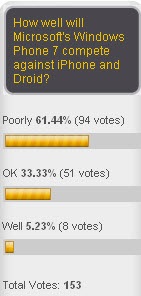
Hollywood could not have written a better script. Hospice physicians agreed to give my mom life-sustaining nutrients and fluids through the big day (normally not allowed). They arranged for a “Sentimental Journey” pass: a limousine (ambulance) service for my mom and dad to the picturesque Cheyenne Mountain Resort in Colorado. Two paramedics waited in the background just in case their services were needed (they weren’t). They quipped how special my mom was because the only other person who ever received two paramedics as an escort was Dick Cheney when he came to town.

All seven of us children attended, plus all 15 grandchildren. My parents invited their closest friends. With the backdrop of the Rockies and all the majesty of a traditional wedding ceremony, I had the privilege of walking my father to the front. My oldest brother Mike had the honor of escorting my mom in her wheelchair to join my dad at the altar. She looked ravishing. My sisters had dressed her to the “nines.” Her dream was unfolding in real time.

Each of her children had a part in the ceremony, as did each grandchild. Assigned to deliver the sermon, I decided not to use notes, but instead prayed that God would intervene and deliver a message that would bless my parents and set vision for successive generations. The primary message: my parents had created a legacy of marriage that would impact not only the first generation (my siblings and me), but the grandchildren, and their grandchildren, and so forth. The fact that my parents stuck it out and endured a lifetime full of sickness and health is a testimony to the world: “Yes, it can be done.”

The ceremony ended with the exchanging of vows. A co-worker of mine had arranged for a Papal blessing of the 50th milestone as well, which touched my parents deeply. We printed the blessing in the renewal program. Unity candles, songs, prayers, and standing ovations lent to the evening’s incredibleness. But this was only the beginning.

One Heck of a Show

We then entered the adjoining room for a superb five-course meal. Taking advantage of the live music and dance floor, Dad rolled Mom out in her wheelchair to dance. My parents are fantastic dancers, and seeing my dad wheel my mom around was moving. Throughout dinner and beyond, we danced to our hearts’ desires. All four sons danced with my mom, who was clearly delighted. Even my son Brandon danced with her, to which she commented, “You’re not dancing. You’re just shaking your ass!”
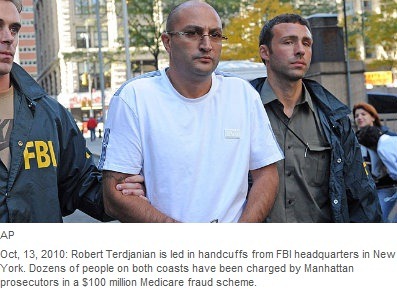
Next came toasts, the garter ceremony, and all the similar accruements of a fine celebration. At that point, Mom addressed the room with loving words. Dad tried but fell apart. As a finale, guests and family formed a tunnel by joining hands. Dad wheeled Mom through as we hugged, kissed, cried, and spoke blessings.

Returning to her limousine, she was still beaming. My dad shared that as he laid Mom in her bed that evening, she said, “We sure gave them one hell of a show tonight, didn’t we?”

Timing

During her illness, I flew out often to visit her. I wanted to be at her side when she transitioned, just as she had been at my side so many times. I missed by eight hours, but that was OK. Over the years, I’d left no doubt in my mother’s heart of my care, admiration, appreciation, and love for her. Arriving shortly after her passing, I supported my brokenhearted father and assisted siblings with the funeral arrangements.

Kiss

My mom had taken her last breath shortly after midnight. Two of my siblings and my father were at her bedside and described that, while painless, her body struggled for every last breath. As a result, her mouth was stuck wide open. The hospice nurse explained that, given the timing, the mortician would be the only one able to close Mom’s mouth. My sister-in-law, an ICU nurse manager, validated this.

Meanwhile, my dad knelt at Mom’s bedside and held her frail body, the first time in months where he could hold her without causing her pain. He kissed her lips. Wept over her. Sometime in the next two hours, while they awaited the mortician’s arrival, Mom’s mouth closed…and she smiled. Comfort permeated the room and reinforced our belief that she had indeed transitioned to a happier place.

10-6-2010 8-20-13 PM

Passion Fueled

My mom’s battle allowed me to spend considerable time in various care settings. I observed the processes, evaluated technology, and pondered how things could be improved to benefit caregiver, family, and patient. The clinicians treating my mom lacked the communications and clinical decision support needed to deliver the highest quality of care. I was shocked by the lack of access to critical and timely clinical data. The wasteful amount of paper utilized and manual processing disappointed me.

I ended up creating medication reconciliation lists and pulling together charts. I swore it would never be this way in my work environment. As I took mental notes from the perspective of patient and family, my passion to leverage technology and transform the clinician and patient experience was renewed.

It’s this passion that drives me in my daily work. This is why I’m tenacious in advocating technology, why I continually innovate and collaborate with clinicians, and why I blog. This is why I advocate for stronger IT leadership. It’s the heartbeat behind why I spend more time with my people on leadership, customer service, process, and passion than I do on virtualization or cloud computing.

Until my people have a heart for patients and are in a position to empathize with their plight, the technology platforms, while critical, will be limited. The full potential of technology in the delivery of high quality healthcare comes with a transformed heart.

Thanks, Mom, for refueling my passion as a leader of healthcare technology.

What fuels your passion? What stokes your fire? Leave a comment below.

Ed Marx is a CIO currently working for a large integrated health system. Ed encourages your interaction through this blog. Add a comment by clicking the link at the bottom of this post. You can also connect with him directly through his profile pages on social networking sitesLinkedIn and Facebook, and you can follow him via Twitter – User Name “marxists

Readers Write 10/6/10

October 6, 2010 Readers Write 13 Comments

Submit your article of up to 500 words in length, subject to editing for clarity and brevity (please note: I run only original articles that have not appeared on any Web site or in any publication and I can’t use anything that looks like a commercial pitch). I’ll use a phony name for you unless you tell me otherwise. Thanks for sharing!

EMR: One Size Does Not Fit All
By Evan Steele

10-6-2010 6-27-07 PM

A recent comment on HIStalk, by a hospital CIO about what he identified as the best EMRs for enterprise systems and their physicians, highlights a problematic and all-too-prevalent misconception. The fact is, it is impossible to satisfy both hospitals and community ambulatory physicians with the same EMR product.  Furthermore, even the ambulatory market cannot be looked at as a whole. EMRs designed for primary-care physicians respond to a set of needs that are very different from those of specialists.

Enterprise EMRs simply do not work in high-volume ambulatory practices. This is particularly true for specialists’ practices. Many hospitals have had some success with Epic and other hospital-focused EMRs, but success has been limited when these same hospitals ask physicians — again, particularly the specialists — to implement these systems in their practices. A monolithic enterprise product cannot possibly support equally well such different workflows, patient care scenarios, and providers’ needs.

Within the ambulatory market itself, it is time to bifurcate the EMR discussion into two groups: EMRs for primary care physicians and those for specialists.

Industry analysts typically lump all EMRs into one category, which does not adequately differentiate the market segments or their distinct needs. The major EMR vendors have massive footprints in the marketplace, yet a small company like SRSsoft has the lion’s share of referenceable high-volume, prominent specialty practices in areas like orthopaedics and ophthalmology. Why? Because one size does not fit all, and it is impossible to satisfy the needs of both groups without compromising the needs of one.

The American Academy of Orthopaedic Surgeons (AAOS) acknowledged this issue in its recently released EMR Position Statement, pointing out that “Many systems are geared toward primary care medical practice, which can limit the utility of EHRs for specialty surgical practice.” It correctly suggests that “the different needs and uses of EHR by disparate medical specialties should be recognized.”

Specialists represent approximately 50% of the physician market, a sizeable segment that is largely being ignored. How are specialists to determine which EMRs are designed for their needs?

KLAS, the closest our industry has to a JD Powers–type of rating source, does not break out its ratings by specialty. This means that if an EMR vendor does well in the ambulatory primary care market and has high KLAS ratings, an unsuspecting specialty practice might purchase their product based on those ratings, only to find out that the product does not fit their unique needs. 

Exacerbating the situation is the fact that KLAS only surveys practices that have actually installed the EMRs. It does not survey practices with failed implementations. Since specialists represent a disproportionate number of the failures, the information is even further biased.

The result is that there are thousands of specialists who purchase EMRs from highly rated and/or household name vendors, but who end up with failed implementations and significant financial loss.

One size does not fit all. There are good EMR solutions available for every type of physician. It is incumbent upon the individual physician to research and identify the product that best suits his/her practice’s needs.
Evan Steele is CEO of SRSsoft of Montvale, NJ.

ClickFreeMD Comment Response
By Bob Gordon

Note: Mr. H here. I’m breaking my “no commercial pitch” rule this one time because Inga had questioned the business model of ClickFreeMD, which offers practice systems including billing for a flat monthly fee rather than the traditional model of a percentage of collections. Inga’s point was that the percentage model encourages the billing company to collect. CEO Bob Gordon was nice enough to e-mail Inga an explanation and we thought his response might interest some readers even though it is hardly unbiased. I’m not endorsing their product and I have no connection to ClickFreeMD.

ClickFreeMD leapfrogs the percentage-based provider business model. Consider the following:

  • No start-up, implementation or training charges.
  • The flat fee is lower on an equivalent percentage basis than most practices would pay for outsource medical billing alone and far less than in-source options.
  • If the practice improves its revenue or we boost it (which we often can do), the equivalent percentage drops through the floor.
  • The breadth, quality, and integrated end-to-end nature of our software, services, and support are unrivaled. Physicians are paying twice as much elsewhere for much less elegant solutions today.
  • The flat fee sticks. If encounter or charge values increase, the flat fee stays the same and the practice captures cost free revenue. If it drops outside ordinary seasonality range, the rate is adjusted down pro-rata so our physicians’ earning power is fully protected.
  • Importantly, the flat fee is backed by a performance guarantee that makes sure we work every claim or we rebate half of the flat fee. There is no equivalent protection in a percentage-based model. In fact, any claim that takes more than 15 minutes to resolve in a percentage system is probably costing them more than they are making, and hence billing company profitability is at some point in the collection continuum inversely correlated to increasing practice collections.
  • Our contracts all have 90-day outs and low price match guarantees for comparable services.

You may ask how we do this. We have deep domain expertise from running billing companies, back offices, and technology companies for decades and have organized a Southwest Air-like discount fee, high-result business model that is very scalable. We expect that ongoing volume will feed a virtuous cycle for all, continuing to allow us to offer more for less while achieving top results.

One of the most striking things we are doing is the least recognized — giving the practice their flat-fee price, online and instantly, as well as their included services, without asking them to give us any information. Try this anywhere else like Athena and what we do in 30 seconds becomes a multi-day process that involves e-mail / telephone / online discussions and/or meetings and requires the practice undressing for the vendor. We are completely ONE-WAY transparent. That’s because we want the practice to decide if they want to contact us — after they are satisfied that this is a superior value for them and only then. We aren’t interested in lead nurturing them to death. 

This is about "more dollars for doctors" and great news in the group practice fight to sustain their independence. We are doing our part to create a reversal of fortune in the group practice community with a unique business model that raises revenues faster than costs, delivers immediate and ongoing savings, and provides the tools and support that allow them to be ready for tomorrow.  

Like the boiled frogs of lore, physicians have been nickel and dimed by payers, billing companies, and others, overpaying to under-produce for so long, they find themselves working much, much harder for less and less. We’re changing that and we’re passionate about it! Thank you for your consideration.

Bob Gordon is CEO of Click4Free of Chevy Chase, MD.

It’s Official: The Rush for Talent Has Begun
By Tiffany Crenshaw

10-6-2010 6-55-56 PM 

In recent weeks, a number of existing and prospective clients have called me for a pulse on the healthcare IT recruitment marketplace and thoughts on how to attract quality resources. After a number of such calls, I decided to put my thoughts in writing and share.

Let’s start with the good news. Industry hiring is definitely picking up and employed candidates are now less afraid to make a career change then they were three to six months ago.

As for hot products, it’s no secret that Epic is hot, hot, hot. Hospitals are purchasing Epic left and right. Honestly, there are simply not enough Epic resources, especially Epic-certified resources, to go around, so the talent war is raging. Cerner recruitment remains modest but steady, while McKesson needs are starting to rebound after quite a lull.

In the ambulatory market, we are seeing more and more requests for eClinicalWorks and Allscripts. New names like Sage and Greenway are coming to light. And occasional needs for Meditech, Siemens, IDX/GE and Eclipsys are surfacing.

On the integration side, Cloverleaf and e-Gate skills are still in demand, but we are seeing more requests for Web-based and lesser known products like Ensemble, Symphony, and Rhapsody.

The hiring demand is highest by far for hands-on resources to design, build, and install EMR applications. However, there is a fair amount of activity for sales, project management, and training professionals, including go-live support.

CPOE, clin doc, pharmacy, oncology, and HIM are generating the most recruitment activity within the applications. Based on new client requests, we foresee growing needs for business intelligence, security, and report-writing resources.

In addition to employers’ desire for one or more of the skill sets mentioned above, most are adding clinical designation to the requirements. Over 50% of our job requisitions right now require clinicians. Pharmacists, nurses, and physicians with healthcare IT experience are in great demand.

However, post-recession hiring is creating challenges previously unheard of in my 12-year history recruiting in this industry. The process is now wrought with excruciatingly slow interview scheduling, shrinking employee benefits packages, little to no relocation assistance, and financially conservative offers resulting in more and more frustrated candidates.

Things have changed drastically since the lowest points of the recession. After the release of Meaningful Use requirements, recruiting mania has taken off. Everyone seems to have hiring needs. Candidates are getting called left and right by internal and external recruiters. Just check out a few of the job boards if you don’t believe me — you’ll see countless job postings. Furthermore, check out all of the recruiting firms with no previous healthcare IT experience trying to break into this market as experts claim abundant need for resources.

If your organization is currently or will be in the market soon for these in-demand resources, you may want to evaluate your hiring process, recognize that your competition is fierce, and take note of a few trends our candidates and clients have shared with us quite candidly over recent months.

  • New car syndrome. Candidates are migrating to new implementations. Who can blame them? It’s more exciting to be on the ground level and see a project through from A to Z.
  • Red carpet treatment. Employers who roll out the red carpet win. When weighing decisions between job offers, candidates almost always choose the employer who provided quickest response time and showed sincere interest in them. (Both response time and sincerity are simple and no-cost ways to roll out that red carpet.)
  • Relocation blues. Relocation is a HUGE issue right now. Even if candidates want to move, they can’t do so because of the housing market. Kudos to all of the organizations willing to work around this by providing remote work, commuting, or coverage of interim living expenses.
  • Communicate. Many, many candidates are feeling jerked around by potential employers because of lack of communication in the interview process. Here’s what they are thinking: “If I don’t feel valued as a candidate, how are they going to treat me as an employee?” On the flip side, these candidates are communicating with plenty of their peers. Too many hospitals and consulting firms are getting bad reputations as being lousy places to interview and to work.
  • Too much is not always a good thing. In the quest for resources, too many organizations are panicking and calling in all of the troops — internal recruiters, employee recruiting bonuses, dozens of external recruiters and advertisements. Candidates get called multiple times by different sources all looking to fill the same positions. Not only do they end up confused, but all the activity makes candidates suspicious. They wonder what’s wrong with an organization that has such a hard time attracting and retaining talent?
  • Get on board. We are hearing more and more horror stories about candidates showing up on the first day only to find their new employer is not ready for them. This gets them off to a bad start from the get-go. Employees stay longer and perform better when they feel welcomed and the transition process is smooth. The period of time between offer acceptance and start date can also be a black hole, when candidates are most vulnerable. Employers are losing candidates this far into the game because they aren’t communicating with them. If you don’t have a formal on-boarding program, now is probably a good time to look into it.
  • Disconnect between human resources and hiring managers. As an outside firm, we work with both HR representatives and hiring managers. We hear complaints on both sides about the other on a regular basis — namely due to lack of response. The hiring managers want candidates fast. And HR wants answers fast. Throw candidates in the mix who get frustrated as well and it’s a nasty situation. However, we find that employers who really engage the final decision-maker in the process from beginning to end and set response expectations up front have the least amount of frustrations and the most successful outcomes.

In summary, you can safely say that the industry is quickly changing to a candidate-driven market and that the market is impacted heavily by post-recession recovery and Meaningful Use. It is official. The rush for talent really has begun.


Tiffany Crenshaw is president and CEO of Intellect Resources of Greensboro, NC.

The Coming Speed Bump in the EMR Market
By Jon Shoemaker

It’s no secret that there is currently a mad rush occurring, not unlike The Oklahoma Land Rush of the 1800s, where hundreds of companies both new and old are getting into the business of healthcare information technology. Some come with industry expertise. Others come to take advantage of the financial opportunity. Consider Best Buy, the consumer electronics giant, that will install your EMR using their Geek Squad. So much for needing clinical expertise!

I believe this climate of frenetic activity will cause the EMR market to encounter a large, steep speed bump in the next 10 years. It won’t be from all of the EMR installations or supporting all of these systems, as this will create thousands of jobs and supporting infrastructure that currently does not exist. The bump in the road will come when all of these new digital silos must talk to each other as required in Phase II of Meaningful Use (MU). It is the very selling point of these systems — simple communication and usability — which become the Achilles heel of these EMRs.

EMR’s to date are not installed with a common code structure for identifying exams, studies, or services, all of which will need to be exchanged outside of the office in Phase II of MU. The reason for this lack of standardization has nothing to do with EMR functionality or capability — it is that everyone is still thinking locally not globally.

To ensure true interoperability and exchange of patient health information, EMRs must be installed to satisfy the local requirements, but also with the forethought that they will integrate to larger systems. This requires standards and standardization. The absence of a standard will require the use of translation services so that HIE repositories use the same codes for exams performed across the region.

Translation services, while a viable alternative to standardization, require one-off knowledge for the database structure and logic for each customized local EMR as well as that of the destination repository. This level of granularity creates layers of complexity for maintenance and mapping. Any changes to local system will mandate updates to the translation engine. The support nightmare of constant mapping modifications to assure the proper codes are sent outbound or received inbound will be effectively unsustainable.

Once all of the paper silos are replaced by digital silos, there will be enlightenment of EMRs that were installed incorrectly, don’t address the clinical workflows of the office, and don’t communicate outside of the office with a standard communication protocol using standard coding methods. This will lead to a second phase of the EMR revolution will include translation services and reinstallation of EMRs to address workflow and data gaps. This will have to be resolved before integration to a larger HIE repository can take place.

If we begin now with standardization of workflow and codes and ensure they are addressed with current EMR installations, we will be in a better place in five years and users will see the true benefits of these systems. With our current strategy of “every man for himself,” we risk losing users’ confidence once these systems are installed and address workflow and physician concerns. Once we lose the users’ confidence, they will stop using the system and re-adoption efforts will prove Herculean.

As you begin planning your EMR implementation, there are hundreds of questions to ask. When it comes to meeting the long-term requirements of MU as well as realization of the true benefits of an EMR, here are a few to begin with:

  1. Have we reviewed and documented our office workflow?
  2. Are we using the new SNOMED codes?
  3. Are we following standardized codes for services rendered?
  4. Does the installation team understand clinical workflow or do they look glassy-eyed when we discuss medical terms?
  5. Is our vendor of choice an IT company trying to cash in on the HIT initiative without clinical experience and knowledge which could place our business at risk?
  6. How will this EMR connect us in the future to larger integrated systems?

Jon Shoemaker is senior consultant with Ascendian Healthcare Consulting of Sacramento, CA.

News 10/6/10

October 5, 2010 News 12 Comments

10-5-2010 5-18-46 PM

From StateHIECoordinator: “Re: Iowa. The state has issued a Notice of Intent to Award to ACS for the Iowa Statewide Health Information Exchange.” SHIEC sent over the award letter that went out to the eight bidders. It includes technical scoring and prices, but I’m not sure if I should run that since it may not be public information. The selection went down to frontrunners ACS and Medicity in the “best and final offer” round, with ACS winning on price.

From Maladroit: “Re: book. You mentioned a book on healthcare IT and the future sometime in the last ear. I don’t remember much about it except it seemed like a great book to help me understand a CIO’s perspective as he/she thinks about maturing their tech org. Do you remember the book?” Hmm. I’ve mentioned a few books, but I don’t remember this one particular. It might have been Ed Marx, too, since he’s well read. Readers, if you know the book or have others to recommend on that topic, let me know and I’ll run a list.

10-5-2010 9-15-22 PM

From Wax On: “Re: medical transcription acquisitions. The big buzz among the MT community at the recent AHIMA convention in Orlando was about Nuance acquiring both OSi and Encompass Medical Transcription. And in another deal, Keystrokes acquired Chartnet.” I’m appreciating the irony that the hottest technologies in healthcare IT appear to involve transcription. Voice and paper are hard to kill for good reason.

From Ex-Employee: “Re: CareTech Web Division. All sales staff let go last week. Management plans to eliminate the Web division and focus solely on outsourcing.” Inga contacted the company for a response:

On the heels of significant growth in its Web products and services segment, CareTech made the decision to adjust its go-to market approach for the Web business with an emphasis on balancing its growth with providing the best delivery service. The decision involved a shift in resources, including a reduction in the area of Sales, and an increase in technical resources for the Web Development and Account Management areas. The company remains committed to its Web products and services business, and is especially looking forward to the opportunity to see current customers and meet new ones at the 14th Annual Healthcare Internet Conference where CareTech will have an exhibit and speaking engagement.

From Long Time Reader, First Time Writer: “Re: MU. Several CIOs I work with are gnashing their teeth because their vendors are telling them they’ll only apply to have their latest software version certified. Clients on the now-current version will have to pay the vendor for an upgrade and service fee to get on a ‘certified EHR’. Some have said they are being quoted months to get the upgrade because customers that signed lucrative contracts with the vendor’s service arm are moving to the head of the line. Love the blog BTW.” I guess I’m seeing it through the vendor’s eyes – ONC made them jump through hoops to get their products certified and to get them implemented by a firm date, so somebody has to pay and not every customer can be the first to go live. I’d blame the government for trying to tie something as complex as EHR adoption to something as desperately made up on the fly as economic stimulus. But if you have a particularly egregious vendor example, tell me since I’m sure some are milking it hard.

10-5-2010 9-16-33 PM

Ingham Regional Medical Center (MI) helped start and fund the Capital Area RHIO, but won’t participate in it. The hospital and its parent company will instead join Michigan Health Connect, explaining that, “A lot of the larger systems decided to go that route so they wouldn’t have to participate in different RHIOs and repeat the investment over and over again.”

Inga trumped Weird News Andy on this article, although she kept it at arms’ length when she sent it my way, saying it’s “a bit icky for my taste.” It’s a little raw for me too, but if you’re fascinated to know the “Strangest Foreign Bodies Removed From Patients”, many of which seem to involve unusual sexual practices, feel free to check it out. I did, but I think I regret it now.

ONCHIT puts up a Certified Health IT Product List page. It doesn’t include the CCHIT-certified products yet.

The Government of Queensland will implement (warning: PDF) the MetaVision Clinical Information System from iMDsoft in the ICUs of 14 hospitals.

10-5-2010 9-21-18 PM

Blessing Health System (IL) will implement Patient Condition Tracker from Rothman Healthcare Corporation within Allscripts Sunrise Clinical Manager. Their nursing school will also participate in research studies involving the system, which turns 26 measurements and observations from the EMR into a single number called The Rothman Index that allows early detection of patients going bad. I’ll have an interview with the co-founder up shortly.

Jack Kowitt, SVP/CIO of Parkland Health & Hospital System, e-mailed to say he was happy that I was puzzled by an ARRA comment attributed to him by the Dallas business paper since he was misquoted. The article said the hospital “won’t seek federal stimulus funds because its electronic records upgrades started before the stimulus bill was passed,” which I thought was odd since HITECH payments aren’t linked to spending. I indicated probable reporter error, which was the case according to Jack: “The question was whether we were using any stimulus funds to implement the EMR. The response was, since we have already implemented, we would not. It wasn’t about MU money, which we are aggressively pursuing.”

It appears that CCHIT’s initial press release that listed certified products was incorrect. ChartAccess from Prognosis Health Information Systems was listed under EHR Modules in the hospital domain, but the current product list shows it as a certified complete EHR in the hospital domain, the only one other than EpicCare.

I got an e-mail blast from a seemingly desperate free HIT magazine today, urging me to post five comments to their online articles to be eligible for a giveaway (so much for highfalutin’ journalistic integrity – what’s The New York Times paying for sending in letters to the editor these days?) Since it mentioned their expert bloggers, I thought I’d check out the competition for the first time. All the blog entries I saw except one seemed to come from other sites – they’re just reprinting them on their own site like they were written for the dead tree people. Maybe I’m an amateur purist, but both the comment bribe and the reposted blogs strike me the wrong way.

Inga contacted the folks at Infogard to get pricing information for their ONC-ATCB certification services. Drummond and CCHIT are pretty transparent about what they charge and were very nice to give Inga the information so she could put a comparison together for readers. Infogard sent her a curt reply: “Unfortunately, we will not be able to provide our price list.” We’ll make sure to help keep their secrets when their press releases come out by not mentioning them.

10-5-2010 9-19-08 PM

A Forbes blog riffs on a New York Times article about EMR vendor ClearPractice, which I didn’t realize was run by big-time VC guy John Doerr (Google, Amazon) and his brother. They also oversee a Medicare Advantage insurance plan. The Forbes writer isn’t impressed with ClearPractice or its iPad version called Nimble, although he’s focusing on the business success and not the innovation or potential:

While electronic medical records are a promising tool, the piece lacks context. For a company like Dr. Doerr’s to have been around for a decade and only have 500 doctors using the software basically means it’s failed. Check out this list of EMR vendors by market share based on physician usage. In a rapidly consolidating market there are at least 10 and probably 50 different vendors with more than 500 licenses. The idea that the Apple iPad will somehow, with an assist from stimulus funds, revive the fortunes on an individual EMR company is optimistic to say the least … The other thing that struck me is that the piece made no mention of the history of hubris when Silicon Valley tries to cure health care’s ills. Remember when Netscape founder Jim Clark devised Healtheon on a piece of paper? Or AOL founder Steve Case’s mostly expired Revolution Health?

Meditech got specific about its expansion plans Monday, announcing its intent to purchase 135 acres in a Freetown, MA business park and to build a 180,000 square foot office building for 800 new employees. A local politician estimates the company’s investment there at up to $100 million.

The University of Louisville School of Nursing gets a $792K HHS grant to develop nursing informatics education. They’ll buy simulation lab equipment that includes a patient simulator, iPads, and EHR simulators.

10-5-2010 8-02-04 PM

Interesting: a company uses Salesforce.com to deliver and analyze patient EEGs, looking for similarities in a database of known EEG irregularities to suggest psychotropic medications to doctors treating mental illness.

MedAssets is holding its Business & Technology Forum this week in Orlando.

Weird News Andy’s contribution this time around: “1/3 off healthcare ‘reform’ … I wish.” A report (warning: PDF) finds that HHS has already missed a third of the deadlines mandated by the Patient Protection and Affordable Care Act, with another 29 coming due in the next three months.

And speaking of government efficiency, health insurance premiums for 8 million federal workers will go up 7.2% in 2011, which the government spins by saying that’s less than increases in the private sector because of savvy negotiating.

10-5-2010 9-24-17 PM

A company brings social networking to crutches, allowing Facebook friends of the injured to create custom “skins” for their crutches. The company will offer advertising materials in the ED and expects to co-brand with healthcare systems.

The Institute for Healthcare Improvement releases a white paper to help hospitals manage serious clinical adverse events.

An interesting analysis: hospitals are buying up primary care practices to prepare themselves to become Accountable Care Organizations, which could be the end of the line for small, independent practices. Hospitals are looking at increasing PCP salaries like a Wall Street analyst looks at price-to-earnings ratios, knowing that internists and family practitioners generate hospital revenues at nine times their average salaries, while expensive specialists generate a multiple of only five times their salary. For industry noobs, it’s time for hospitals to get taken to those 1990s cleaners all over again, because:

  1. Docs sell out precisely because they don’t want to work  as hard for their new hospital employer as they did for themselves (duh).
  2. Hospitals are notoriously bureaucratic and inefficient managers, making them particularly unsuited for running a low-overhead medical practice in every way from EMRs to personnel policies to regulatory compliance.
  3. Private practice docs hate and distrust everything about hospitals except the money they have and don’t usually change their opinions or behaviors just because they sell them their practices.
  4. Doctors resent taking orders and being told how to practice medicine, especially from suit-wearing hospital MBA-types who fancy themselves business experts despite always having worked for a paycheck instead of themselves, making it likely all these deals will fall apart in 4-5 years like they did last time around, with the docs scrambling to start up new practices without the benefit of a location, an EMR, or patients that they sold away to the local hospital in a frenzy of co-opetition.
  5. Patients aren’t much more enthused about hospitals than doctors are, so they aren’t exactly thrilled to see the big sign go up over their friendly little doctor’s office knowing it’s the same folks with ED waits, bad cafeteria food, and terrible parking.

E-mail me.

HERtalk by Inga

From RDU Dude:Word on the street is that Vern Davenport has left Allscripts.” Portly Gentleman sent us a note on October 1 suggesting Allscripts would soon announce some executive changes. He named names (Vern’s being one of two), but we didn’t run them since it didn’t seem right until it actually happened. The company confirms that the former Misys president and Allscripts exec has indeed moved on.

Over 50 practices in Tenet Healthcare markets select MED3OOO’s InteGreat PM and EHR as part of a Tenet/MED3OOO community-based EHR partnership.

greg dorn

Hearst Corporation appoints Gregory H. Dorn MD, MPH president of drug database provider First DataBank. He most recently served as EVP at another Hearst company, Zynx Health, and replaces Donald M. Nielsen, MD, who becomes chairman of the First DataBank Advisory Board.

Omnicell acquires Pandora Data Systems, a provider of analytical software for medication management. The Pandora solution is used by several HIT companies, including CareFusion, McKesson, Cerner, and will continue to be operate as a stand-alone product. Omnicell’s comparable product is about twice as expensive, so there goes your cheaper alternative, most likely.

10-5-2010 9-30-16 PM

Epic wins a five-year,  $14 million EHR contract from the US Coast Guard, replacing a version of the Department of Defense system. That could be a notable Epic foothold in government down the road.

Penn State Hershey claims its use of CareAware technology has contributed to a 90% decrease in manual charting during surgical procedures. Providers now average one minute of charting during surgery, compared to 10 minutes before the CareAware implementation.

I love and appreciate all our sponsors, but this is funny. I received a note from one today (someone in accounting who has probably never heard of HIStalk) asking us to re-issue an invoice. The reason: they had asked to pay their sponsorship over several invoices, so dividing the total led to a per-invoice amount of xxx.1666 (infinite decimal). We invoiced xxx.17. They’re asking to correct the remaining invoices to xxx.16 so that the yearly total hits the amount exactly instead of being four cents over. Who else wonders how that accounting department handles client issues?

The Institute for Health Technology Transformation publishes a new report that examines the current EHR landscape. I can’t say I gleaned much new information, but was struck by the authors’ comment that the EHR “landscape” is still in its “infancy.” Given that I was selling EHRs (or EMRs as we called them in the old days) years ago, I’m thinking there must be some inverse relationship between EHR-years and dog-years.

north kansas city hospital

North Kansas City Hospital deploys Cerner’s P2Sentinel auditing solution to address the hospital’s Meaningful Use Stage 1 access requirement.

Miami Children’s Hospital will spend $67 million to implement Cerner Millennium. The hospital will also extend a 50% discount to community physicians who wish to implement PowerWorks EHR in their offices. The hospital expects the government to provide $7-$8 million in stimulus funds once Millennium is fully operational.

Here is some not-so-pleasant news: at the current rate, 2010 could be one of the worst years ever recorded for mass hospital layoffs. Blame the increased demand for charity cases, the decline in reimbursements, and a reduction in elective procedures. As of August, 8,233 employees lost jobs in 102 separate layoffs, according to the Bureau of Labor Statistics. At the current rate, 12,349 jobs would be cut by December 31st, compared to 11,757 last year.

cvs

Six Texas pharmacies file a lawsuit alleging CVS Caremark of violating patient privacy laws and unfairly competing with its rivals. The complaint highlights Caremark’s plans to establish a data warehouse that includes the names, demographics, and drug histories of patients, plus Caremark’s Rx Review program that is designed to use patient data for direct marketing to patients and physicians.

Sponsor Updates:

  • Allscripts introduces Mobile Homecare, a smart phone application for physical therapists, nurse assistants, and other clinicians caring for patients in their homes.
  • API Healthcare signs up Halton Healthcare Services as its first Canadian client.
  • Quest Diagnostic partners with HP to offer a preconfigured solution that includes Quest’s Care360 EHR and HP hardware, services, and financing.
  • Wahiawa General becomes the first facility in Hawaii to implement Voalte’s iPhone solution.
  • Detroit Medical Center selects the iDoc document imaging system from CareTech Solutions for its eight facilities.
  • The Nashville Chamber of Commerce names Informatics Corporation of America to its Future 50 Award list for the third consecutive year. The award is presented to the 50 fastest growing companies in Tennessee.
  • Catholic Health Initiatives expands its partnership with Allscripts to include Allscripts EHR and PM for all of its 1,200 employed physicians and 7,000 affiliated physicians. CHI is also adding Sunrise EPSi Performance Management solution for its 73 hospitals and will develop its own HIE with the Allscripts Community Exchange solution.
  • PatientKeeper deploys its new physician documentation product, PatientKeeper NoteWriter, to Mercy Medical Center (IA) and Alegent Health (NE).

inga

E-mail Inga.

HIStalk Interviews Paul Hensler, CEO, Kern Medical Center

October 4, 2010 Interviews 2 Comments

Paul Hensler, FACHE is CEO of Kern Medical Center of Bakersfield, CA.

10-4-2010 8-07-55 PM

Tell me about Kern Medical Center.

KMC is a 222-bed academic medical center. We have eight residency programs with the UCLA School of Medicine. We’re the only trauma center between Los Angeles and Fresno. It’s a county-owned facility.

You’re going to be going live soon on Medsphere OpenVista. You’re still on for November, right?

No, we’ve delayed it. We had a rather serious virus.

I heard about that.

It took our IT staff off of everything but getting the virus fixed for about three weeks. As we looked at moving back, we started getting into the holidays and so on, and really felt we needed five weeks of uninterrupted training. We decided to go live February 8th.

What would you say are the good and the bad things about the project?

I’ve been very happy with both sides. Plus, our employees have really stepped up and have done a great job with the builds and have not taken the shortcuts. For just what they were offered, the staff’s just put a tremendous amount of good work into it.

The Medsphere staff has been great to worth with. We started this off with the idea of it being a partnership, and I think it really has been.

How large is your IT staff and what capabilities do you have in-house?

The reason I’m hesitating is we’re moving to a model of the county IT staff taking care of the infrastructure that would move all of our servers downtown. Then we have a small staff left out here to deal with applications. I think out here we have about eight FTEs, but then we’re also supported by people who work at the downtown location. I think probably another six or so are totally devoted to us, as well as some other county IT staff that helps out on specialty things.

It’s difficult for a small- to medium-sized hospital to be looking at a $40 million expenditure for an EMR system. Do you feel that you had to give up something to go with OpenVista or do you have any regrets?

Not yet. We started integrated testing this morning. As of midday, it’s going very well. It looks like it’s a system that will work for us.

I was familiar with VistA from the VA. I wasn’t at the VA, but a lot of our physicians in San Diego worked at both our place and the VA. Physicians generally like the system. I think some of the things we’re giving up on bells and whistles are things that are distractions anyway. So far I really haven’t had any regrets.

The VA model’s a little different since they have somewhat of a captive audience of physicians and nurses who don’t really get to choose whether to use it. How do you plan to get, specifically, physicians to interact with the system?

Our physicians are employed.

All of your physicians are employed?

Yes. We won’t really run into a lot of the issues of Meaningful Use that community hospitals will. Basically, the physicians have really embraced it. They’ve done a lot of the work on the builds. I think they’re excited to see it come.

Are you replacing anything with OpenVista or is this all new?

The CPOE and the electronic medical record are all new.

Up until you go live, you’re purely paper?

Right.

You mentioned Meaningful Use. When you look at what dollars are on the table and your timelines, how are you feeling about the Meaningful Use possibilities?

Even with the delay it looks good. As you probably know, you really have to be up to speed on July 1 to get 90 days in before October 1. We’ll be live in early February, so that will give us several months of experience to see if we’re falling down in any areas before we do that last 90 days. I think that should go very well.

Would you have done it without the possibility of HITECH payment or was that the deciding factor?

I think that really pushed it a lot. It turns out, in looking at cost savings by having an electronic medical record, that will pay for itself even without the stimulus funds. But the stimulus funds really, I think, are what moved it to the front burner and it’s kept us on a tight timeframe.

You mentioned the cost savings. What kind of outcomes do you hope to achieve when you are fully electronic?

We’ll save about a million dollars a year in forms and paper and the storage of the forms and paper. Probably another million a year when it’s fully implemented on costs to the medical records department. That’s really just a little low-hanging fruit. We’re expecting a lot of operational savings, but they’re just a whole lot more hard to quantify.

On your team that’s implementing, I assume you have representation from physicians and nurses that are involved?

Oh yes, and everybody who will touch it is represented in the steering committee.

Did you do a lot of work with standardizing order sets or evidence-based medicine when you were building the system?

That’s really a lot of the work that’s going on. Our clinical people got much more involved in that than we originally thought we would, and they’ve done a lot of good work.

Are these physicians that are practicing physicians? Do you have a physician in charge of the project or is it just a collaboration?

There’s a physician in charge of the project. She’s one of our thoracic surgeons who’s also practicing. All of the physicians who are involved in the project are all practicing.

Do you have any that are naysayers? Are you hearing from those yet or are they just taking a wait and see attitude?

Really no one is naysaying the project. There’s little things here, little things there that they don’t like and there’s some compromises we need to make with some of the other systems that will have to interface to it that we’ll probably eventually replace. But no serious “let’s just pull the plug and forget about it” type of naysayers.

How do mobile devices fit into your strategy?

Actually, the whole input device is one of the things I was most concerned about because we don’t have experience with it and everybody has different ideas of what they should use.

The mobile devices just seem their screens are just too small. We had a device fair here and had all the various vendors bring in various devices from hand-helds to iPad-like devices, to regular PC screens and laptops and so on. I think most of the users pretty quickly realized they needed a much larger screen than an iPhone or something would accommodate. We ended up selecting laptops in some areas and PCs on carts for other areas.

Will you have remote access?

Yes, it will be Internet available.

When you look around the community, what’s the status of EMR adoption among the physician practices? Will this change anything?

I don’t see a lot of physician practice adoption yet. There are a couple of large groups or specialty groups that have electronic medical records, but the community has a lot of still-solo practitioners and small groups of two and three physicians that don’t seem to have done a whole lot yet.

I don’t know if they’re waiting to see what their respective hospitals do, or waiting for the ARRA funding or exactly what’s happening. Since we have an employed group, I don’t really focus a whole lot on the community physicians.

What about interoperability? Are you looking at that at all?

In terms of being able to share information with…?

Yes, among other facilities or regionally.

There are two very large federally qualified health clinics in our area. One of them is actually holding off on their electronic record. They may go with OpenVista as well after they see how we do. But we plan to, as soon as possible, have two-way communication with those clinics. We do some psych patients with Kaiser.

Probably insurance companies will be the next large thing, and then as the other hospitals come up with their own electronic records, we’ll expect to have interoperability with them.

Are you considering anything related to patients or consumers as far as a patient portal or any kind of functionality that patients would use?

You know, we’ve had discussions about it and that’s more of a long-term goal we’d like to do, but that won’t be available at startup.

As a hospital CEO, what elements of your overall strategies involve information technology?

I think that two of the differentiating factors for successful hospitals: one is imaging, which is fairly heavily IT related; and the other is IT and the ability to store and use information.

This obviously is the most important initiative we’re taking on this year, and I think, will be the framework for a lot of the quality, patient safety, and even financial things we do into the future.

When you look beyond Meaningful Use and ARRA and HITECH, how important will information technology be for hospitals that are trying to succeed under healthcare reform?

I think it will be very important for healthcare reform. It will connect the patient-home and the outpatient setting with the inpatient setting and with the ED so that there’s one record that caregivers in each of those settings can access. It will avoid a lot of duplication of testing. I think it brings together more, the medical group — even if it’s a virtual medical group — by the sharing of that information.

It also will give us a lot of information we can mine on how we’re doing with utilization, with quality, with patient safety. I think those elements will be very important under reform.

Do you think the OpenVista product is going to give you the technologies that you need to be ready?

Yes.

What are your biggest fears or biggest opportunities that you see coming from healthcare reform?

I think there’s just a lot of confusion left in exactly how the 3,000 or so pages of the bill are going to be translated into many thousand pages of regulation and what all that’s going to mean for us. As a county hospital, one of our issues is going to be will the indigent patients who we now see who suddenly have coverage. Will they continue to use us?

Is your fear that they will or that they won’t?

That they won’t.

Some are saying they’re never going to get their EDs cleared with all these folks who suddenly have an insurance card.

Well, they’re already using the emergency department, so it’ll just be that they’ll have a payer source all of a sudden.

The real big issue that concerns me though is having insurance coverage doesn’t necessarily give you access. Dumping another 20 million people with coverage onto the system that’s already pretty undermanned, I think, is going to create a lot of waiting issues and appointment issues. A lot of people who may not be able to find a primary care provider.

There’s a concern that just because you have insurance doesn’t mean you can get an appointment. Do you see there being new roles for extenders of primary care physicians, or will doctors move back into primary care?

We’re in a medically underserved area, so we already have a physician shortage. We are talking to our clinics about how can we use mid-levels — how can we be more efficient with the patients we see?

You don’t want to push patients through too quickly or have too much mid-level intervention because part of the spirit of it is that they have a Medical Home and a primary care physician who spends time with them and properly directs them, properly oversees disease entities, properly refers to specialists. If we get into a “let’s just hurry everybody through the system,” we’re going to go right back to high ED utilization, high inappropriate referrals to specialists, and patients with chronic conditions not getting their meds on time, and not getting seen on time and not having intervention done on time. It’s going to be a balancing act.

Do you think that healthcare reform is going to save money or improve quality or both?

I think there’s going to be several years of very turbulent years while it settles in. I do believe the country already spends more than enough money to cover everybody, but it’s going to be those transitional years where we go from reducing payment from people who are currently insured — since, in theory, those plans won’t have to cover uninsured — to a more even system where almost everybody has coverage. But I think it’s going to reduce the coverage for all of us and it’s going to increase the access problem for all of us.

Certainly there’s already some polarity of the haves and the have-nots when it comes to medical care. Not just insurance, but the quality and quantity of care available. Do you see that gap widening between the haves and the have-nots?

No. If anything I think it’ll probably shrink. You mean in terms of disparity among patients?

Yes.

No, I think that will probably shrink, and that’s probably going to be the problem for people who are used to having a full indemnity insurance card. As those plans drift down to looking more like Medicaid and more and more of the uninsured are covered, I think it’s going to be a leveling of the system. People who have lived at the high end of the system probably aren’t going to like it a whole lot.

Do you think it will create another class of patient and provider that go off the grid and use cash?

That’s what happened in England. There’s a National Health Service, and then there’s the private. Actually, private insurance service is down as well as private hospitals and private physicians. There could be some of that.

When you look out five to ten years, what are the hospital’s biggest opportunities and threats?

Health reform is both our biggest threat and our biggest opportunity. It’s the best of times or worst of times. We just don’t know which it is.

I think that there’ll be the turbulent years while we try to get used to regulation and people taking on different roles and our revenue streams coming from different areas. But I think ultimately, if we have good strategies and execute them well, it will be a real opportunity for us.

With our academic connections, we offer some of the advanced care in the community as well as the broader care, so it should be an opportunity for us in the long term. But I think it will be some difficult years getting there.

Text Ads


RECENT COMMENTS

  1. Challenger exploded on lift-off when the O-rings failed. Columbia disintegrated on reentry after one of the heat shield tiles were…

  2. RE the AI GLP1 company, Washington Post has an article today by someone who used one of those compounded products,…

Founding Sponsors


Platinum Sponsors


Gold Sponsors


RSS Webinars

  • An error has occurred, which probably means the feed is down. Try again later.