Recent Articles:

News 4/15/11

April 14, 2011 News 12 Comments

Top News

3-31-2011 7-47-10 PM Healthcare IT is one big reason that private practice docs are taking down their shingles and going to work for hospitals, according to experts interviewed by The New York Times. Unlike the Hillarycare era, there’s no turning back this time since reimbursement is encouraging that kind of vertical integration. The predicted result: less competition, leading to higher prices (although Kaiser is a mentioned as a disrupter in offering cited higher quality at lower cost). The experts seem pretty sure that quality will improve (like in Mayo or Kaiser, with salaried physicians), but not so sure costs won’t go even higher.


Reader Comments

3-31-2011 7-47-10 PM From Hypocrisy: “Re: Judy Faulkner. She was quoted as saying at an ONCHIT Policy Committee meeting, ‘What is showing up in blogs — I have seen and sometimes been told about this — is that we have to be careful of an apparent conflict of interest. That is if, in fact, the primary spokesperson for PCAST does have products that would benefit tremendously by this, do we get into — and I know we’re not supposed to judge — the uncomfortable position of an appearance of conflict of interests.’ She’s apparently talking about Microsoft’s Craig Mundie, discussed a lot on HIStalk as a PCAST committee member. Presumably she does not see a conflict of interest herself in serving on the committee.” I didn’t see the quote, but it’s interesting if accurate. Just to clarify for those who don’t follow the confusing cast of government players, Judy wasn’t actually on the PCAST committee that made recommendations to the President that pretty much had HealthVault or Google Health written all over them – the only for-profit company employees on it were Craig Mundie from Microsoft and Eric Schmidt from Google. Judy is on the HIT Policy Committee, which has for-profit members from Kindred Healthcare, WellPoint, Gastroenterology Associates (a private doctor), and Epic (Judy). I wouldn’t think she carries the level of influence over that group that some have said Craig Mundie had over the PCAST report.

3-31-2011 7-47-10 PM From Ludacris: “Re: rogue Meaningful Use. A vendor is e-mailing consultants offering a ‘private label’ EHR they can sell under their own name for a split of the revenue.” The company’s address appears to be a mail drop and the principals aren’t listed, although I found the CEO’s name elsewhere. The vendor’s Version 1.0 product is certified as a Complete EHR Ambulatory and the offer claims companies that want to private label it get their own name on the list of certified products. I suppose ONC didn’t address that issue – where the same product could be sold by multiple vendors under multiple names, each rightfully claiming to be offering a certified product. Certification was intended to reduce buyer risk, not buyer confusion, and some would argue that it has accomplished neither.

4-14-2011 10-03-17 PM

3-31-2011 7-47-10 PM From Dingin: “Re: Epic. You mentioned Oakwood and Singing River. Both were at a recent class in Verona, along with others you probably already knew about: Nebraska Medical Center, Providence Anchorage, Contra Costa, Norton, MUSC, Wake Forest Baptist, University of Cincinnati, and Driscoll Children’s.” I confirmed with MUSC that they’re going only with the ambulatory products, dropping McKesson Practice Partner since it doesn’t work well with MUSC’s TELUS Oacis Health Data Warehouse, but keeping Horizon Clinicals on the inpatient side.

4-14-2011 10-11-31 PM

3-31-2011 7-47-10 PM From Lorenzo: “Re: ICA. What’s going with them? Rumors of problems.” Not so, according to our Informatics Corporation of America contact. “We have just won Wyoming Medicaid HIE through our partnership with ACS, just selected as VOC with Central IL HIE, and we are hiring as fast as we can to keep up with recent wins of Middle TN eHealth Connect and KHIN. We’ve grown by 100% since the beginning of the year and we expect to grow by another 50% by year’s end in employees. Our funding is solid through our primary owners and we are working as hard as ever to meet customer demands. Go-lives of major clients are scheduled over many of our clients in the near future. Nothing could be further from the truth.”

3-31-2011 7-47-10 PM From HISwalk: “Re: magazine. Does anyone else think this slide show paints a ridiculously rosy picture of several vendors given their current situations?” I’m not a fan of online slideshows when a simple list would have been much easier to read, but this one’s OK (the information it contains was provided by Vince Ciotti’s firm, so I’d trust it more than if the usual sideline reporters undertook their own analysis). I would say the list contains some opinion, some analysis that’s not quite current, and focuses on revenue (which was the point) and not necessarily profit or market trends. I don’t link to other HIT sites or rags since I don’t use them as sources, but you can probably Google your way to it if you’re determined to check it out.
4-14-2011 10-12-35 PM

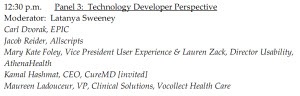
3-31-2011 7-47-10 PM From FACA: “Re: ONC Policy Committee. There’s a Webcast meeting on EHR usability and accessibility on April 21 at 9 a.m. It’s a public hearing, so questions are welcome.” The agenda is here. The presenter list is interesting. For some reason, the government, like others, capitalizes Epic (Epic does not spell it EPIC).


HIStalk Announcements and Requests

inga_small This week exclusively on HIStalk Practice: PracticeWise, a new  column by practice consultant Julie McGovern (who stirs up some discussion in her first post). Reefdiver weighs in on the value of certification in the EHR selection process (readers are opinionated on that topic, too.) KLAS  extends a free offer for HIStalk Practice provider readers. AMA tells CMS what physicians find most burdensome. Dermatologists ask patients for fashion advice. Americans want their physicians to use EMRs. So far, only six states have issued MU incentive checks. In honor of Leonardo da Vinci’s 558th birthday and because it makes me happy, please sign up for the e-mail updates while you are catching up on the latest HIT ambulatory news.

On the sponsor-only job board: Clinical Project Specialist, Software/Implementation Engineer, Healthcare Implementation Project Manager. On Healthcare IT Jobs: EHR/ePM Implementation Project Administrator, Coordinator Clinical Trials.gov, Project Manager – NextGen, Software Product Development Manager.


Acquisitions, Funding, Business, and Stock

4-14-2011 5-55-28 PM

inga_small Allscripts CEO Glen Tullman earned nearly $8.5 million between June 1, 2009 and December 31, 2010. That breaks down to $4.1 million for the 12 months ending May 31 and $4.5 million for last seven months of the year.

Streamline Health Solutions reports Q4 earnings: a net loss of $1.8 million compared to a profit of $1.6 million a year ago. Revenue fell from $6.3 million to $4.9 million.

4-14-2011 5-56-03 PM

inga_small In India, Michael Dell chats with local reporters on a number of topics, including healthcare IT:

We are #1 in healthcare IT globally. We acquired a company called InSite One, the leader in cloud-based archiving of medical images. We have taken that expertise all the way back to our product groups and created new offerings. IT in the healthcare industry is siloed. The CIO can’t make them work together. We have created vendor-neutral archives by speaking to medical equipment makers. We capture all the data and store locally or in our cloud archive.

3-31-2011 7-47-10 PM Add Medicomp Systems to the long list of EMR vendors that have been sued by Prompt Medical Systems over the years. PMS has no Web presence, so I assume its primary output is legal rather than technical. It appears to be the brainchild of Bernard Milstein MD, an ophthalmologist, UTMB professor, and founder of The Eye Clinic of Texas who patented the use of CPT codes in computer systems in 1994 (even though AMA holds the copyright to the CPT codes themselves). He appears to be backed financially in his litigation lottery by an investment banker and securities company founder. None of the previous cases made it to court from what I can tell, so I’m sure PMS is banking (no pun intended) on the EMR vendors paying them to go away rather than risk being tied up endlessly in an expensive legal action.


Sales

The US Military Health System selects Mediware’s blood transfusion management system for 68 military health sites worldwide. MHS will also deploy Mediware’s LifeTrak and InSight to track donor records and product inventories in 28 blood donor facilities.

4-14-2011 4-42-41 PM

Palomar Pomerado Health (CA) chooses GSI Health’s HIE solutions to connect PPH hospitals and affiliated physicians.

Cooper University Hospital (NJ) awards a contract to MedQuist for computer-assisted coding technology and outsourced coding services.

Girard Medical Center (KS) signs with Cerner.

Regional Medical Imaging (MI) chooses Merge Healthcare’s radiology information system, expecting to receive $600,000 from Meaningful Use incentives for its 13 radiologists. Merge says 90% of radiologists are eligible for MU money and it will pursue certification for its RIS to help them earn it.


Announcements and Implementations
4-14-2011 4-36-33 PM

Kaleida Health (NY) says it is actively adding EMR capabilities across it hospitals and clinics. Its $20 million Cerner implementation should be complete by the end of 2012.

Tift Regional Medical Center (GA) goes live with RTLS temperature monitoring and asset tracking from AeroScout.

inga_small athenahealth creates a “burn unit” to handle physician practices that have been burned by old EMR systems and are looking for new solutions. CEO Jonathan Bush says about 35% of his company’s new EMR clients are replacing old EMRs.

ODIN announces EasySpecimen, an RFID-based pathology specimen management system, licensing the technology from Mayo Clinic.

3-31-2011 7-47-10 PM England’s Department if Health announces completion a project to move all prisons to a single electronic medical records system, allowing them to transfer records when inmates are moved. The article takes jabs at NPfIT, saying the prison system has more detailed information than NPfIT’s Summary Care Record.


Government and Politics

3-31-2011 7-47-10 PM CMS’s healthcare fraud enforcer (a pediatrician and lawyer) says he’s going to crack down on criminals, many of them working out of South Florida, who are scamming Medicare and Medicaid for up a quarter trillion dollars per year. Much of his arsenal involves smarter payment software that can detect fraud more quickly, needed since the fraudsters are using electronic billing systems to commit their crimes. Says one expert, “The crooks know now that these computerized payment systems are their best friend. They will study carefully the art of billing correctly, they will produce electronic transactions that are perfect on their face, but it’s just a pack of lies.” An irony: Florida Governor Rick Scott was CEO of the company (Columbia HCA) that admitted to extensive Medicare fraud, costing the company $2 billion to settle.

ONC’s got some job openings for a program manager and three policy analysts.


Innovation and Research

CalPERS claims its integrated healthcare pilot saved $15.5 million between January and October 2010. Pilot participants include Blue Shield of California HMO, Catholic Healthcare West, and Hill Physicians Medical Group. The organizations’ combined efforts led to a 17% reduction in patient readmissions, a half-day reduction in the average LOS, and a 50% drop in stays of 20 days and longer.

West Wireless Health Institute awards its $10,000 developers’ challenge prize to a skin cancer detection app. The physician developer, who is a veteran and a melanoma survivor, created the iPhone app for his own self-examination.


Other

inga_small CIOs say their organizations will qualify for Meaningful Use incentives, but not as early as they predicted a few months ago. In an August 2010 CHIME survey, 28% of responding CIOs predicted qualifying for funds by April 1 compared to 7.5% of CIOs participating in a survey last month. About 32% of the CIOs expect to qualify by September 30, 2011 and an additional 58% anticipate Stage 1 qualification by the end of the 2013 fiscal year. Only 26% of community hospital CIOs believe they will qualify for stimulus funds by September 30, 2011.

3-31-2011 7-47-10 PM Strange: a “stunning blonde” in her 20s, bidding over the Internet, buys more than $50,000 worth of items ranging from a stuffed owl to furniture at an auction in England. The auctioneer called her to arrangement payment, only to have the telephone answered by a doctor, not surprising since she’s a hospital inpatient committed under the Mental Health Act. Her credit checked out, but the hospital won’t let her pay, so the auctioneer says he’ll sue the hospital.

3-31-2011 7-47-10 PM Umass Memorial Healthcare pulls 10 employee kiosks out of service when they discover that anyone walking up to the kiosk could view pay stub information from the previous user. The IT people changed the software and removed bank account information, then put the kiosks back out.

4-14-2011 10-15-49 PM

3-31-2011 7-47-10 PM Associated Press gets punked: a couple of anti-corporate troublemakers float a phony press release with GE’s name on it, saying the corporation will donate its $3.2 billion tax refund to the US Treasury since the American public is upset at learning that GE paid no taxes on $14 billion in profit. AP ran the story without doing anything more than clicking on the link to the convincing-looking but phony Web site, only to pull their news item down less than an hour later.

4-14-2011 9-54-56 PM

A reader sent this in for Inga and her shoe-loving followers.


Sponsor Updates

  • Advanced Endoscopy & Surgical Center (NJ) contracts with Wolters Kluwer Health for its ProVation MD procedure documentation and coding software.
  • Design Clinicals and the AHA are hosting a Web demo April 21 entitled Electronic Medication Reconciliation: Achieving Stage 1 Meaningful Use and Full Compliance Joint Commission Standards with MedsTracker. 
  • Concerro creates a cute video that compares workforce management tools to paper-based systems, à la the Mac versus PC commercials.
  • eClinicalWorks announces that 2,000 practices have successfully upgraded to Version 9, eCW’s ONC-ATCB  certified MU version.
  • Access announces a new version of its e-Signature solution to help providers create paperless registration and bedsid consent processes.

EPtalk by Dr. Jayne

This week marks the 150th anniversary of the start of the American Civil War. What does that have to do with healthcare IT, you ask? Maybe more than you think.

I was listening to NPR when Adam Goodheart, author of 1861: The Civil War Awakening, was interviewed. Charleston, South Carolina (which I’d love to visit if the right invitation presents itself) was the scene. Miscalculations on both sides about who would flinch first ultimately pushed events past the point of no return.

Towards the end of the interview, Terry Gross asks, “Some states today want the right to basically be able to nullify federal legislation in their state and not obey it. For example, not to follow the new health care policy that Congress passed. Do you see that as like a contemporary expression of similar divisions dating back to the Civil War?”

This was just a tiny part of the interview, but it really struck me about how divisive things are in health care politics right now. I certainly don’t think we’re on the brink of Civil War, but we are a house divided.

Acceptance of recent federal legislation is love/hate. There’s confusion on whether Meaningful Use will be repealed, revamped, or replaced. For the first time, I recently heard physicians (who had previously stalled on implementing an ambulatory EHR because they weren’t sure the Meaningful Use final rule was ever going to be final) state that they were holding off on going paperless because they feel healthcare reform (and the accompanying MU legislation) will be repealed.

I think many people agree that this train has somewhat left the station. There’s no guarantee that it might not stop somewhere along the tracks, but it already has pretty good momentum. (Anyone seen the movie Unstoppable with Denzel Washington? Watched it recently — a good diversion from reading yet another stack of documents about forming an Accountable Care Organization.)

It will be interesting to see how quickly challenges (to not only federal, but various state legislation) make it to the United States Supreme Court. Given the current makeup of the Court, I wouldn’t lay odds on any outcomes just yet.

Most large healthcare organizations that depend on Medicare payments aren’t willing to take chances or play the game of wait and see. They need to implement certified systems now and demonstrate Meaningful Use so that they can not only receive incentive payments, but prevent the stick that will ultimately follow the carrot. Whether incentive legislation will be repealed or only partially implemented, we don’t know, but I’m pretty sure the Centers for Medicare and Medicaid Services won’t forget the idea of cutting reimbursements by using lack of technology as an excuse (at least not any time soon).

A lot of people are excited about the billions of dollars flowing into the health IT industry. I envision industry lobbying that will rival Big Pharma in intensity and scope if the effort to repeal recent legislation gains any serious traction. There are plenty of consultants waiting to deal with the things that happen when physicians and hospitals select and implement hastily, not to mention vendors that will be poised to sell replacement systems as the industry consolidates.

There you have it. If you’re ever confronted with an SAT-style question asking for a modern-day analogy to the Civil War, please feel to plagiarize, no citation needed. And if you can recommend a conference that will give me an excuse to visit South Carolina, let me know.


Contacts

Mr. H, Inga, Dr. Jayne, Dr. Gregg.
Readers Write 4/13/11

April 13, 2011 Readers Write Comments Off on Readers Write 4/13/11

Submit your article of up to 500 words in length, subject to editing for clarity and brevity (please note: I run only original articles that have not appeared on any Web site or in any publication and I can’t use anything that looks like a commercial pitch). I’ll use a phony name for you unless you tell me otherwise. Thanks for sharing!

Thoughts on the Department of Defense/VA
By Arturo

Back in the 1980s, Congress, responding to the clamor for greater productivity and using the private sector should the private sector be more efficient (hence leading to such things as outsourced waste pickup and selling of municipal-owned utilities), mandated a competition for selection of the information system to be used by the VA.  And so there was a competition involving EDS, McDonnell Douglas, SMS, and the VA (if I recall properly). 

At that time, the VA VistA system was, in many respects, kludgy, somewhat proprietary (after all, what OS or application isn’t somewhat proprietary in one way or the other for the general population?), had a user interface not particularly friendly to many end users, and quite disjointed. 

By disjointed, I mean that various modules were written at different locations, sometimes with different standards and feels, and that was simply not a standard or uniform implementation of the system throughout the system. There was no such thing as a general release of the system.

The competition ended up with the selection of the VA system.  Now, I’ll never really know if it was the right decision, but I suspect that it really wasn’t. 

Shift forward a couple more years and we had another competition for the Department of Defense TRIMIS system – CHCS (Composite Health Care System). The selection didn’t compare apples to apples in the beta implementations (a single site installed by each competing vendors). The winner in this one was SAIC, which had used the VA system as its basis.

The SAIC bid for the five-year deployment came out about a half billion dollars lower than its nearest competitor. Interestingly enough, SAIC required another $500KK to complete its implementation and the DoD had a system that really wasn’t ready for the future — a database that wasn’t SQL compliant, a more or less command-driven system (MUMPS at work) that wasn’t ready to meet the demanding needs of clinicians, etc.

Eventually, sometime in the first half of the 1990s, as I recall, there was a DoD RFP for a clinical workstation.  I believe that this ultimately led to the 3M proposal for a clinical workstation and clinical data repository which was to become the foundation for DoD’s computer-based patient record system. (3M continues to support the DoD repository – a good thing, I suspect.)

Then came CHCSII.  Now I guess that it’s AHLTA.

And throughout all of this, we just don’t have a tight linking of DoD and VA EHRs.

Now we could talk about some of the inflexibility of VistA, its inability to provide workflows and screens tightly linked with different disciplines, the need for a more robust database manager, or the fact that VistA (and the VA) just didn’t know how to deal with female veterans. Or why the VA delivery system was perceived as being substandard for so long before emerging as a leader in preventative healthcare (although why did we have the disaster with veterans returning from Iraq not so long ago?)

Is it time to use a commercial product for the DoD and VA? Or should the DoD and the VA have taken the lead long ago in providing a robust EHR for deployment throughout our healthcare delivery system? Or if VistA was so good, why didn’t more provider organizations deploy it sooner? 

Something for thought. And, Epic, despite all of its success — is it really the right product or is it really any better?

Filling in the Holes in Your EMR/EHR
By Tim Elliott

4-13-2011 4-44-28 PM

With all the hype about electronic medical/health records (EMRs/EHRs) and pressure from internal folks (everyone from the executive team to various committees), hospitals often rush into their EMR projects without seeing holes between their systems, people, and departments. These typically get filled in later, often with inefficient manual processes. This approach reduces the productivity gains delivered by the EMR and frustrates the IT/IS team, clinicians, and administrative staff members who thought they’d be leaving paper pushing behind.

It’s a good idea to get people from each department that’ll be using the EMR to analyze the potential gaps in their areas well before vendors come on site instead of waiting to find and address these gaps later. Involving experts from outside your organization in the process is often beneficial, because they have the objectivity that it can be difficult to get when you’re running through processes you’re involved in. They’re also not going to be worried about hurting anyone’s feelings, which can be a concern when analyzing your colleagues’ daily tasks.

If you didn’t do this before going live with your EMR, it’s not too late. A good place to start a post-deployment review is to ask yourself and your team the same questions that you posed during project planning. By getting feedback from multiple departments (patient registration, HIM, clinical areas, etc), you’ll figure out how the EMR system is working well in some ways, and how can it can do better in others.

Again, consider why you’re doing what you’re doing. What are your goals for people, processes, and systems? How do these impact your overall initiatives, such as patient safety and disaster planning?

Don’t accept a process that isn’t working just because of a vendor’s limitations. If something’s not working right, call them and tell them exactly what the challenge is and what you need to achieve. Chances are they’ve heard a similar question before and will get right on it. Maybe you need a custom workaround, additional functionality in a newer release you didn’t know about, or a couple of extra training sessions for your staff.

We vendors spend lots of dollars on building products that solve problems. It pains us to see customers not using all of the tools we created to make their facility run smoother. Maybe you don’t want all of it, but if you need additional functionality, please ask. If your vendor is worth their salt, they have it, can build it, or will include it in a future release if several facilities share that same challenge.

We want to help you to cut your costs, enable your staff do their jobs better, and improve your patients’ care and safety. Often, the first step is you picking up the phone.

Tim Elliott is founder and CEO of Access.

Comments Off on Readers Write 4/13/11

News 4/13/11

April 12, 2011 News 11 Comments

Top News

4-12-2011 2-36-14 PM

image  UnitedHealth Group unites its health services businesses under the Optum brand and renames Ingenix to OptumInsight. In addition, Prescription Solutions becomes OptumRx. UnitedHealth says the brand unification makes it easier for the market to understand the company’s full capabilities and helps align market engagements. I say the name change makes it easier for me to be confused and I’ll need awhile to align the name in my head. Mike Mikan will serve as CEO of the Optum group, while the CEOs of each company will remain the same.

HHS launches a $1 billion patient safety initiative aimed at making hospital care safer, more reliable, and less costly. The Partnership for Patients is a public-private collaborative and will work to decrease hospital-acquired infections 40% and reduce hospital readmissions 20% by the end of 2013. If successful, HHS predicts $50 billion in Medicare savings over the next ten years.


Reader Comments

image  From P. Cockroft-Gault: “Re: open source biology. Love this guy’s drive and motivation.” Stephen Friend, MD, PhD, a former Merck SVP of cancer research, quits his job to start a non-profit to turn genomic analysis into a “wisdom of the crowds” type project, putting more intellectual horsepower behind unlocking genetic secrets and making the results non-commercial. “Our hallowed academic institutions have become factories for people who are trying to keep their own employment, their tenure … the whole reward structure keeps people from sharing the data that makes that connection …We’ll make it or not depending on whether our community of interest goes viral,” he says. In the TEDx talk above, he says the era of defining a disease by its symptoms is over since much more information is available at the molecular level.

image From Veronica: “Re: Epic. Judy’s making noise in Wisconsin.” An article says the Greater Wisconsin Committee PAC is funded by children of George Soros, labor unions, and “Madison liberals who don’t unionize their own companies” (that would be Judy).

4-12-2011 7-17-19 PM

image From Harold: “Re: John Caswell. I thought it would be nice if you mentioned his passing. He was with Compucare/QuadraMed for more than 28 years and will be missed by many in the industry.” Sorry it took so long to get this up, but I was waiting on confirmation from QuadraMed since I found nothing online. John David Caswell, 53, died on April 1, 2011. Details, guest book, and memorial contribution information can be found on the funeral home’s site. They did a nice job on his tribute video, set to Steppenwolf’s Born to be Wild. Condolences.

image From Ling Cod: “Re: Black Swan moment. That book suggests that humans are wired to explain complex, chaotic events with simple theories that make them sound plausible even though they don’t predict anything (like reasons that stock markets crash). I challenge your readers to think about the Black Swan moments that may affect the alleged rapid adoption of EHRs and the possibility that, within a couple of years, providers will find the compliance wasn’t worth the aggravation. Possibilities: (a) some or all of the stimulus could be revoked, or (b) CMS may make EHR adoption mandatory with no further incentives if you want Medicare / Medicaid money.” The gauntlet has been thrown down. Feel free to add your thoughtful comments or submit something to me directly. The Black Swan reference, by the way, is the title of a book taken from the fact that experts had all kinds of convincing reasons that swans are always white (chief one being that they’d never seen a black one), which sounded great until a black swan was found.


HIStalk Announcements and Requests 

image Listening: Royal Hunt, a Danish progressive band. Hits the spot in a Dream Theater kind of way.

image Bored? Feeling as though the whole world is a tux and you’re a pair of brown shoes? My suggestions: (a) put your e-mail address in the Subscribe to Updates box to your right and feel immediately spiritually connected to the 7,288 folks who get my spam-free e-mail updates the instant I write something new; (b) do all those friendy / likey / connecty things on Facebook and LinkedIn, which will let you ride the vast social network that Inga, Dr. Jayne, and I enjoy (not really since we’re anonymous, but we get some superficial satisfaction as long as we don’t think too much about it); (c) send me news and rumors suitable for mongering; (d) peruse the sponsor ads to your left or their links to your lower right and investigate their offerings while feigning deep interest; and (e) use your considerable interpersonal influence to send new readers my way by telling people how the information you regularly glean from HIStalk has made you wealthy, self-actualized, and simply irresistible. Thanks for reading.


Acquisitions, Funding, Business, and Stock

4-12-2011 8-22-32 PM

EMR/PM provider ClearPractice forms a strategic partnership with Prognosis Health Information Systems. The companies are collaborating to offer an integrated SaaS-based EMR solution for rural and community hospitals and their affiliated physicians.

A quote from the CEO of Aetna provides some insight into the company’s $500 million acquisition of Medicity:

We recently bought Medicity, a health information exchange (company). We’re using that as a platform to create a data exchange. We will shift risk (financial responsibility for medical costs) to the provider system. We’ll provide them cover with capital as re-insurers. We will be the Intel-inside, if you will. We have dozens of these conversations going on with major systems. We spend $400 million a year on new developments: We are as much a health information technology company as an insurer.


Sales

4-12-2011 8-24-43 PM

The VA selects Authentidate Holding Corp.’s Electronic House Call solution as part of its home telehealth program.

The 49-bed Seymour Hospital (TX) purchases ChartAccess EHR from Prognosis.

image Oakwood Healthcare (MI) signs a $60 million Epic deal, at least from what I can tell from the half-sentence teaser that Crain’s Detroit Business allows non-subscribers to read.

Methodist Dallas Medical Center chooses RemedyMD for its joint registry.


People

4-12-2011 2-01-11 PM

image The Indiana HIE hires James S. Hill as VP of sales, tasked with managing sales operations, including market competitiveness, pricing, and strategy. I have to admit I was surprised the HIE world has matured enough to warrant a VP of sales.

Resurrection Health Care (IL) names Bradley Howard, MD its first-ever CMIO to lead its Epic EMR implementation.

4-12-2011 5-40-07 PM

Kent McAllister joins fellow Sage Healthcare alum Lindy Benton at Medical Electronic Attachment / National Electronic Attachment (MEA/NEA). McAllister, a former VP of client solutions for Sage, is MEA/NEA’s new CIO. Benton is Sage’s former COO and now serves as MEA/NEA’s CEO.

4-12-2011 6-41-46 PM

Healthcare analytics vendor Sg2 names Steve Lefar as president. He previously founded compliance and risk management software vendor MediRegs (acquired by Wolters Kluwer in 2007) and was an Allscripts SVP before that.

4-12-2011 7-34-05 PM

Capella Healthcare (TN) names Alan Smith as VP/CIO. He was formerly with Vanguard Health Systems and Cerner.


Announcements and Implementations

4-12-2011 1-54-06 PM

El Centro Regional Medical Center (CA) implements eMix for the secure transmission of radiology images and patient reports.

Dell launches a mobile clinical computing solution for Meditech. The product leverages technology from VMware and Imprivata’s OneSign SSO technology.

image Here’s what happens when you let HITECH drive your IT projects instead of common sense. Carthage Area Hospital (NY) replaces its Meditech system with CPSI, saying it had to “move quickly to ensure we would receive the $2.8 million in stimulus funding.” So quickly, in fact, that they didn’t have time to train staff or work out billing kinks, resulting in a flood of complaint calls from patients. They say they’ll get everything fixed within a few months.


Government and Politics

4-12-2011 5-57-04 PM

image The Foundation for the National Institutes of Health brings in HIMSS to help it run the mHealth Summit conference, the third of which takes place in Washington, DC in December. I have mixed feelings about that. I went to the last one and while it wasn’t nearly as fun as the HIMSS conference, it was refreshingly wonky and geeky, with mostly academics and non-profit developers sharing ideas with barely a break between sessions and a small, low-key exhibit hall. I’m sure the HIMSS involvement will bring the glitz, vendors who will dominate the entire conference, and the booth babes. I may go since I haven’t been to anything this year other than HIMSS and I like to get out of the house on occasion.

A proposed but floundering bill in Florida would require insurance companies to cover telemedicine services.


Innovation and Research

image HCA Johnston-Willis Hospital (VA) wins a patient care innovation award for its Cancer Survivorship Program, which includes specialized software developed with Varian Medical Systems to generate care plans, schedule visits, and create a comprehensive summary based on evidence-based care. Above is their quite nicely done Pink Glove Dance.


Technology

4-12-2011 5-38-05 PM 

Nashville Medical News profiles Shareable Ink, which moved its headquarters from Massachusetts to Tennessee a few months ago. Shareable Ink President and CEO Stephen Hau provided this comment on the local tech talent pool:

We’ve built an impressive team in Nashville with top-notch, local talent. On the technology front, there are strong candidates in Nashville, but they are few and far between. While I’m not worried about finding the next five strong engineers, sourcing the next 50 will be a challenge.


Other

In honor of National Volunteer Week, 15,000 McKesson employees will build 28,000 care packages for deployed military in Iraq, Afghanistan, and other regions. The initiative is in affiliation with Operation Gratitude and is part of McKesson’s annual Community Days corporate volunteer program.

Singing River Health System (MS) seeks to borrow $37.5 million to upgrade its EMR. Jackson County supervisors are considering issuing a bond to finance the purchase.

4-12-2011 3-34-39 PM

image Occasionally readers will forward me photos or links of interest. I enjoy most of the items, especially since I work out of my house and some days those e-mails are my only link with the “real” world. Quite often the submissions have little to do with HIT, but serve to assure me that I am not the only one who reads the stuff I write.  Thus, thank you to the thoughtful HIT traveler who enjoyed this bottle of wine and thought of me. Good to know I am not the only one who believes shoes and wine are two of man’s best creations.

Here’s the latest installment of Vince Ciotti’s HIStory.

image Fortune’s list of “ridiculous job interview questions” includes one from Epic: “You have a bouquet of flowers. All but two are roses, all but two are daisies, and all but two are tulips. How many flowers do you have?” Pretty easy, and not as ridiculous as my favorite ones, from Intel (“Explain quantum electrodynamics in two minutes, starting now”) and Capital One (“Using a scale of 1 to 10, rate yourself on how weird you are.”)


Sponsor Updates by DigitalBeanCounter

  • Consulting magazine names Aspen Advisors one of “Seven to Watch” in 2011 and beyond. Mr. H interviewed Aspen’s founder and managing principal Dan Herman earlier this year.
  • Clairvia adds Care Value Analytics, a new tool that aligns data from individual patient experiences with an organization’s clinical and financial objectives.
  • Capario partners with Data Media Associates to offer customers customized patient statements, statement mailing, and a  payment portal.
  • Hawaii’s Public Safety Department selects eClinicalWorks for its EMR at its seven correctional facilities.
  • Bridgehead Software will provide data backup and protection solutions for The London Clinic.
  • MD-IT merges with MDnetwork.
  • Brad Swenson, VP and national healthcare leader for Winthrop Resources Corporation, is participating in the American Bar Association’s Spring Meeting this week in Boston. He’ll serve on a health law roundtable.
  • PatientKeeper releases a white paper entitled Toward Meaningful Usability: Five Keys to Creating Physician-Centric CPOE.

Contacts

Mr. H, Inga, Dr. Jayne, Dr. Gregg.

Curbside Consult with Dr. Jayne 4/11/11

April 11, 2011 Dr. Jayne 4 Comments

There’s been lots of buzz this week about the Care Connectivity Consortium. This initiative by Geisinger Health System, Kaiser Permanente, Mayo Clinic, Intermountain Healthcare, and Group Health Cooperative has been noted everywhere from The New York Times to Yahoo and MSN.

I can’t wait to see how this collaboration unfolds. Those of us who have spent the last several years knee-deep in Health Information Exchange know how difficult it can be to actually make this happen.

I’m interested in seeing details on the pre-work: consent, governance, and ownership. It’s challenging enough to get a productive HIE live that meets the legal hurdles of a single state, let alone meeting those of a disparate group covering Pennsylvania, California, Minnesota, Utah, and Washington (which just represent the headquarters states, not all the states where care is delivered, which will also have to be addressed).

The warm and fuzzy scenario presented in The New York Times piece: “A person walks into a clinic in Phoenix, say, and, with permission, her records from her hometown physician’s office in San Francisco are efficiently summoned with a mouse-click.” If only it were that easy!

Having been involved with attempts to jumpstart a regional HIE, I know that wading through the legalese for the patient consent and trying to fit it on a single page reminded me of the scene in the cult classic The Princess Bride, where the bad guy has a machine that sucks years of your life away.

The consent language for many data exchange projects can be nearly unintelligible for the lay person. I suspect the forms will become “just another form” that patients shuffle through and sign if they want to receive care, whether they understand it or not.

(Kind of like the paperwork in the Emergency Department – do they think patients actually read that? I don’t think so. They sign it because they are sick, hurting, and in need of care. When you just want to see your doctor, you don’t care about the HIPAA Notice of Privacy Practices, Patient Financial Responsibility statement, or anything else other than being treated.)

I’d like to see the details of how they’re going to do this. I’m sure it will be more than the proverbial single click – like documenting the patient’s consent or opt-in status, validating patient identifiers, etc. And once you have the patient identified, how useful will it be? I hope the Consortium goes “all in” with this and uses fully discrete data that can be exchanged and consumed by receiving physicians’ EHRs, not just another view vault application that’s the electronic equivalent of asking physicians to review paper documents from multiple institutions.

I applaud the groups’ ability to work out shared goals among the CEOs before it became too public. Kaiser’s CEO George Halvorson is quoted as saying, “The CEOs had to make sure the CIOs didn’t think this was crazy or impossible.” Probably a good idea, as this may have been a non-starter if too many people were at the table before the basics were agreed upon or if the CIOs opposed it.

But now that the basic agreement is done, what about the CMIOs and the actually physicians and caregivers who will have to use the system on a daily basis? I hope their input will be considered starting immediately, if this has not already happened.

How real-time will it really be? How are they going to handle corrections and errors? What about monitoring and maintenance of potential duplicate patients? Sensitive information, such as drug use, HIV status, sexual history, and the like? Patients who change their opt-in/opt-out status to avoid sharing certain information?

The devil will definitely be in the details. The answers to these questions, coupled with ease of use, will determine the success of this initiative (assuming the technical piece can be carried out in a timely and fiscally responsible way).

The New York Times pointed out that the groups also have insurance products. Collaboration could be seen as an attempt to compete with the lines of UnitedHealth, Aetna, and Wellpoint. Halvorson is quoted as saying, “This is totally focused on care.”

I really want this to work and be successful in a big way. This could pave the way for many other collaborative efforts that could be game-changers for the physicians in the trenches. The groups intend to exchange some data by the end of this year, so it should be fun to watch.

If any of the CMIOs from the Consortium organizations are HIStalk readers, I’d love to chat with you about the gory/geeky details of the project (preferably over a glass of wine and some chorizo fondue, but I’ll settle for Skype). Drop me a note if you’re interested in chatting.

E-mail Dr. Jayne.

Monday Morning Update 4/11/11

April 9, 2011 News 8 Comments

4-8-2011 9-28-49 PM

From Man on the Street: “Re: Association for Clinical Documentation Improvement Specialists conference in Orlando. They expected 575 attendees for their fourth conference and actual attendance was 660. An overwhelming majority of attendees are either on Epic or say they’re moving to Epic.” MOTS included some photos, which I always like.

From Ogie: “Re: ISH. Acquired by PwC.” Unverified, but I’m really hating those company names. They aren’t universally recognized brands like GE or IBM, so hacking down a perfectly good and understandable name into gibberish doesn’t seem like much of an accomplishment, especially if your name (like that of ISH) results in a scattershot of unrelated Google search hits.

From EMRconsultant: “Re: acquisition. A Minnesota / Louisville-based HIS is being acquired soon.” Unverified.

From The PACS Designer: “Re: Nimbula Director. It’s a new class of cloud infrastructure and services system (IaaS) that provides a flexible and secure public cloud with advanced data center security tools.”

It’s the weekend (at the time I’m writing this, anyway) so that means less formality as I use the “old” format instead of the new one. It feels like Hawaiian Shirt Friday.

My Time Capsule editorial this week, once again from 2006: Do Technology Surveys Rate the Hammer or the House? These are fun reading for me since I wrote them so long ago it’s like reading someone else’s work.

Results of my Quick Poll on the departure of John Gomez from Allscripts: 39% of respondents said it will have little or no long-term company impact, 30% said it will have some, and 31% said it will have a lot. I’ll be running these polls when big news comes up. Poll results plus the usual reader comments will provide a quick and interesting industry reaction to events.

4-8-2011 9-12-17 PM

Congratulations to Boston, hereby officially named the Capital of Healthcare IT (as it should be, in my opinion). Perhaps I should start a drive to have it commemorated with a monument or something, maybe on the Meditech campus. New poll to your right: should Medicaid and Medicare require biometric identity verification of patients seeking healthcare services?

Kaiser CEO George Halvorson talks up the new Care Connectivity Consortium it formed with Mayo, Geisinger, Intermountain, and Group Health to share patient data. I’d say it’s more of a demonstration project than a true patient benefit since those organizations probably don’t have many patients in common. Here are some excerpts from George:

We are all using our EMRs to improve care and support the delivery of care. We are all learning how to use that wonderful new tool — and we are all interested in sharing what we are learning with the world … The problem with electronic is that when patients go to different doctors for their care, they still tend to have separate records — and that can create electronic silos instead of paper silos … So we are now committed to creating similar linkages with the new set of elite medical groups to create a process that works first for our patients and then — if we do it well — for the world … This is important work. If someone doesn’t figure out how to create links between electronic medical records, those records will not be linked. It will not be done until someone does it. Who better than us to do it? We are patient-focused and we know what can be done and we know what should be done with an EMR. Almost all other care sites are just getting their toes in the water. Some are getting their feet wet. We are swimming. So this is a good contribution for us to make. Instead of keeping our advances and our learning secret and special only to us, we are sharing what we know because we want care to be better for everyone.

By the way, I can’t find a Web site for Care Connectivity Consortium, which seems strange. I searched and careconnectivityconsortium.com is not registered, although the .org variant was grabbed by an anonymous registrant on the day of the announcement.

I ran across a copy the IRS form for HIMSS for 2008, the newest one on file so far. Steve Lieber’s total compensation: $731K (slightly out-earned by Dave Garets, who was running HIMSS Analytics at the time). I’ll have to remember to check back to see if they file a new form soon. The annual conference represented $19 million of its $41 million total revenue.

Those DoD people just can’t stop disagreeing with decisions made elsewhere, but at least they’re finally willing to make fat cat contractors rich in ways other than developing custom software. The VA announced plans to move forward with developing an open source system to be shared by both organizations, but DoD says they’ll look first at commercial software and will consider in-house development only as a last resort.

4-9-2011 6-52-07 PM

Six-campus, 305-bed Central Texas Hospital (TX) chooses inpatient EHR and revenue cycle systems from the US affiliate of Mexico-based eCareSoft, expecting to meet Meaningful Use requirements for 2011-2012. eCareSoft says small hospitals can go live on its products in 120 days.

Merge Healthcare appoints Cheryl Whitaker MD, MPH, FACP as its first chief medical officer. I assume that’s the same Cheryl Whitaker, MD who, along with her physician husband (there’s an interesting story and comments behind that link), is a close friend and advisor of the Obamas, not that there’s anything wrong with that. Merge is in Chicago, a city known mostly for dead people electing ethically challenged politicians, at least until the apotheosis of its junior Senator Obama.

The local paper in Middletown, OH runs down the status of electronic health records in local hospitals: West Chester Hospital, implementing Epic. The Fort Hamilton Hospital, implementing Epic. McCullough-Hyde Memorial Hospital, live on CPSI. Atrium Medical Center, live on Epic. Mercy Hospital Fairfield, live on Epic.

Shares in for-profit hospital operator Community Health Systems gained only 9% from 2008 to 2010, but CEO Wayne Smith’s total compensation nearly doubled in that period, rising to $21 million in 2010.

E-mail Mr. H.

Time Capsule: Do Technology Surveys Rate the Hammer or the House?

April 8, 2011 Time Capsule Comments Off on Time Capsule: Do Technology Surveys Rate the Hammer or the House?

I wrote weekly editorials for a boutique industry newsletter for several years, anxious for both audience and income. I learned a lot about coming up with ideas for the weekly grind, trying to be simultaneously opinionated and entertaining in a few hundred words, and not sleeping much because I was working all the time. They’re fun to read as a look back at what was important then (and often still important now).

I wrote this piece in January 2006.

Do Technology Surveys Rate the Hammer or the House?
By Mr. HIStalk

A disclaimer: I’ve worked at three organizations that were named Most Wired. In no case did we really believe that our IT was any better than anyone else’s, but we sure bragged about our victory at every chance.

The Most Wired survey season is upon us again. Eager candidates yearn for the recognition and improved job prospects they think the award will bring. Past-winner CIOs wake up in a cold sweat after having nightmares of opening the magazine and realizing that they’ve become a Former Most Wired (e.g., loser), while their cross-town CIO competitor bags a spot on the list and waves the rag triumphantly in their face.

I’ve seen the survey encourage the same sort of rationalized fabrication usually reserved for aggressive vendors imaginatively completing RFPs. Said one of my former employees to whom I turfed off completion of the survey form, “The survey’s vague enough that it’s not really about what we’re doing, it’s about how badly you want to win.”

For others, the survey’s detailed questions invite casual answers just to get the damned thing sent off in time. Think of those annoying “qualify for a free subscription” cards that require an hour of your time just to get a worthless rag that you’ll throw out unread anyway.

As I read over the 2006 survey form, I’m encouraged that it asks some really good and meaningful questions. If they’d just spot-check some winners and expose a few frauds, I’d be behind it 100 percent. Still, it is evolving fairly well.

As I remember, the original survey measured what you have. The emphasis was on buying stuff: wireless networks and PCs, for example. The vendor sponsors of the survey aren’t exactly against that concept, and even today, the incessant message is, “Good hospitals spend a lot on IT, bad ones don’t, so which one do you want to be?”

Today’s survey is more along the lines of, “How much of the stuff that you bought gets used?” Better.

Where it hasn’t gone yet is, “Did all that stuff make you better at patient care?”

If technology is something to be admired and honored with awards, then what’s the payoff, other than getting some cool Most Wired shirts? We should see a positive correlation to improved patient outcomes, reduced costs, and a happier work force and medical staff.

Indeed, lots of glossy paper will be sacrificed after the survey trying to prove some frankly questionable premises on why “Most Wired” means “Best” (unconvincingly, if you ask me). Was information technology the cause of the improved outcomes effect, or did they simply coexist in an unrelated way?

Maybe we’re doing this wrong. The hospitals I admire are those with tiny IT departments and budgets who, nonetheless, manage to meet non-IT criteria and instead are best in patient care.

I don’t admire carpenters with cool hammers. I reserve that judgment until I see what they’ve built with them. Maybe a few of the Lesser Wired could teach us all some lessons, after which we could still buy the cool stuff if we’re really convinced it would make us better.

Comments Off on Time Capsule: Do Technology Surveys Rate the Hammer or the House?

HIStalk Interviews Geoff Brown, CIO, Inova Health System

April 8, 2011 Interviews 4 Comments

Geoff Brown is SVP and CIO of Inova Health System of Falls Church, VA.

4-8-2011 7-35-05 PM

We crossed paths when I asked you about Inova’s system selection, which is underway. What are the strengths and the weaknesses of the systems that you have and what you’re hoping to gain in considering alternatives?

I would probably start out by saying, as opposed to the strengths and weaknesses of it, I think we were an early adopter after Stark relaxation. We jumped in pretty early with an offering. That was back in the days where people tended to prefer to keep their current practice management solution. EMRs were being thought of a separate component, with some people having the option if they wanted to go with an integrated product. Most were more comfortable with their own scheduling and billing systems, whether they were sourcing that or they were doing it out of their practice and had relationships already going. I think that really goes back to around 2007-ish or somewhere in there.

As we went forward, we found two or three things. First of all, the model to market and drive this to the physician community was certainly a different market for us, in terms of the teams you needed in place to go and meet — not with the physician, the physician would want to have it, and that was a key starting point — but typically a lot of these smaller practices had contracted resources that might come in periodically each week. Others might have a secondary support staff that might be an extension of family or relationships. Others might have formal contracted relationships.

There was a significant amount of education that had to happen. As a result of that, over a period of a couple of years, we really learned really how to go at it and to attack that market with various offerings and solutions.

Somewhere along the middle of this, sometime midway in 2009, we didn’t see any requirements for the EMR component not to be integrated with the practice management solution. After the initial kickoff, we got clinical EMR modules moving forward, interfaced with practice management. People started realizing the benefit of, “If I’m going to do this, I need to make sure I do it with a product or a solution that would allow me to automate my workflow on the scheduling and practice management end of the loop, as well as be certified in a go-forward mode with CCHIT at the time.”

That’s really the front end piece of that. Up until we started doing work around the health reform space, you really didn’t have a real huge need to manage your integrated workflow differently. Ambulatory to EHR, the interface process could work fairly effectively for most people.

What’s really made it more important for us to have an integrated solution in place is that we have a very large physician community network. As a result, we want to make sure that we’re able to have a way to extend out the clinical workflow more effectively than we can do now.

We’ve attacking it from a couple of different spaces. I won’t say it’s a weak point, but we’ve been involved largely with HIEs that will certainly meet the CCD-32 standards around interoperability and exchanging from an interface perspective through our HIE in delivering results back and forth to the practices. That process works good, but what we discovered — and this has been a different tier of maturity for us, having jumped in a little early, at least here in our market — is that you can’t make that data actionable now. As much as everybody talks about the Continuity of Care Document and the exchange process, many other vendors weren’t really doing that at the time.

We’re just now starting to see the practices being on release versions that will support that. We’ve been just doing the push-pull type of results delivery, versus having a really smart bi-directional type of a population of clinical information that can be discrete in nature in that you could put rules around and make it actionable in other ways.

That’s really a desired state we hope to get to. I think there are two tracks to get there. You can do it through the standards that we’re all moving toward — HIE standards that have been put in place — or you could have an integrated solution. That really is what drove it for us, as opposed to vendor weaknesses and strengths in large markets. We will never have a situation, I believe, at least in northern Virginia, where there’ll be just one solution.

When you signed your deal with GE three years ago, you said that would be the only product you would directly support. What did you learn from that experience?

The GE product would be the only one we would put subsidy assistance around. It was the same platform as our inpatient product. That had the promise of further integration and interoperability progression. Had we had another hospital information system platform, that we would have wanted to stay with whoever that vendor was, simply because of the promise that as releases were released out to us from an upgrade perspective, you know they would be tackling more and more of the interoperability gaps. By definition, you would be bringing your base of EMRs forward in that vein. That’s really why we said that. 

Our story to the community has always been that if you worked with a certified EMR, we would work to provide the interfaces to our environment so that you could move to an electronic process with us. We’ve been that way from Day One, but obviously we wanted to press and have at least a certain base of physicians on what our desire tool was, because that certainly would allow us to move a larger piece of the base forward at any given time.

I saw that you just signed what sounded like a pretty big deal with Oracle for business intelligence and that your CEO was saying it will support “value-based personalized healthcare.” What does that mean and what’s the actual nuts and bolts that you’ll need to work with Oracle to make that happen?

We’re doing like many systems are doing. We’re going down a track where we think the future of medicine is your ability to use analytics to help you actually move further and further toward personalizing care, whether it’s through the improvements that are happening in the genomics environment … again, there’s a huge amount of data that you would have to process and then convert into a format that can be used as good information and can be driven by analytics teams around interpreting that information. So that’s one track. 

I think the other area that makes this an important track for us is we are a large system with many disparate applications. As a result of that, we think that there will always be a number of research databases and other applications that fall outside of our traditional transactional systems that are managed through IT. As a result of that, as you’re moving toward better standardization, better evidence-based practice, that you need to pull out … an example of that might be a process we are developing an in-house what we call Inova Broker, which allows us to take data between a disparate environment into our core hospital information system and coded allergy data.

We learned is that allergies are collected at various access points within our organization. However, we had different standards of practice around how comprehensive that was, and when changes were made, how we managed those changes through all of the other key points in our operation. There’s been rigor around how we populate things — how we actually map from one application to another so the data is normalized.

The Oracle HTB project is allowing us to build a repository that has mapped information from each of these applications. We can then write use cases to identify patterns of patients based on certain results. We give our case management folks and others a front-end look at patients we might need to manage across our system, as opposed to waiting until the end of the day and doing queries. We may be able to do some of this identification real-time up front and get a start on making sure we meet some of the quality core measures we may be emphasizing. 

As we build this infrastructure around our partnerships and around the data that we generate or exchange within our HIE framework, that will be a central hurdle for us to manage that. We hope to offer opportunities for our community physicians if they participate and follow certain policies that we hope to establish. For those that like to participate in forms of research or clinical trial work, they’ll be able to be a part of this ecosystem here.

It sounds like the projects that you’re working on are based on strategic organizational decisions at the Inova corporate level. Backing up to that, what are the main elements of Inova’s strategic plan and what IT functions get handed down to you to support them?

We’ve had a number of strategic planning sessions. As a result of that, we have mapped where we needed to be as an organization. Some of the things you see and hear us doing are around just being able to manage the flow of patients more effectively across our continuum of care. We actually were doing that well, but if you were to ask me if it was all connected in a way that would be seamless to patients, be workflow smoothly for our physicians as they’re trying to manage their patients … there are some opportunities for us to improve on the handoffs from the hospital environment out to the various ambulatory care settings that we manage, whether that be the physician practices, whether they be home health, or whether that be even some of the joint ventures partnerships we have where patients flow from one setting. 

They might not be exclusively in an Inova setting. However, the appearance and the workflow is a coordinated workflow. When they get scheduled, maybe there are multiple steps that can be eliminated in that chain if you had an accident or you needed to have an MRI done.

In some settings, you might have to schedule something unless it’s an emergency, a few days later or a week later. However, we’ll give you the ability through this network or this ecosystem to look at other options if you’re willing. We have these resources available across the continuity of care that we manage with our partners and within our organization. We can give patients and physicians options to get people being seen now or same day, same week, etc. based on the convenience factor for them.

It’s really a whole process around just making the healthcare more fluid. Making access for our patients work more effectively, and in doing so, increasing utilization in ways that we would never be able to address.

You’re on the board of Nova RHIO. How important is interoperability on what you’re trying to accomplish at Inova?

We’re doing a pilot project right now in the ED. It really is around patients when they present in the ED. We’re able to go out as they’re being triaged and check their medication list and compare it with what they’ve told us. The importance of that, based on their allergies and other information that we may or may not have or that they presented just now, is to have a much better profile on the front end.

We’re also talking about other projects in the RHIO that are geared toward getting patients online more effectively with versions of their health record. What we found is the community — folks like you and I, we’re close to it, but when you get into certain elements of the community, people have access to all types of services. But it’s very challenging for most of them to really operationalize those things. The RHIO is coming up with a series of electronic solutions that might be a service or benefit to providers, but also have an element that helps drive it in the Northern Virginia community to a point that they’re able to have their information and access it very easily and share throughout the Northern Virginia space.

At a state level, there’s a certain amount of reporting that will need to happen on a monthly basis. Virginia was one of the states with an HIE grant. What we decided to do, at least here in the state of Virginia , is that Virginia will never be an HIE of its own, but it will require any HIE that is doing business in the state to report to them on whatever the cycle will be and that they comply with certain standards and report to those standards. Virginia can then take all of those feeds and then bring them together in a way that will allow us to do one report out for the Commonwealth.

That’s the real direction that we’re headed here in Virginia. The RHIO will be one of many RHIOs. We have three that actually do work now in the state. I won’t mention them by name, but there are three organizations that have been doing some work. We think there are others that are signing folks up now as well. They can go about the business of competing and having the best programs with the providers that they’re able to sign, but we’ll record them through a single series of standards into the state.

The state will then be responsible for getting their information out as the federal reporting or electronic reporting really start to kick in. The Northern Virginia RHIO’s mission s to help the citizens here in Northern Virginia maximize their ability to receive good care and also manage whatever their requirements are.

Any final thoughts?

It’s a very challenging time. What we’ve learned in being early players with some of the commercial products is that there’s a tier process of maturity that needs to happen between a health system and its community of providers — physicians and other relationships. For instance I’ve learned that your best customer sometimes in this EMR arena is someone that has played around with having electronic solutions, regardless of what product they had. They’re much more educated the second time around the workflow requirements, the commitment to the practice, the commitment to the communication and network activities that have to be in place to make the process work effectively and efficiently.

That’s what we’re starting to see now. That informed client or customer or physician group that has been dilly-dallying in the early days of the EMRs or EHRs. Now they’re going in this second pass much more aware of the type of services they need to have in place, the type of technology support they need to have in place, and quite frankly a lot more aligned and around those individual physicians that are looking to modernize and update their practices to take advantage of these new technologies. That’s the one change that I’ve seen, and that didn’t happen overnight. That happened through levels of maturity you get with moving toward any new platform.

Mostashari Named ONC Head

April 8, 2011 News 7 Comments

image

Farzad Mostashari, MD, ScM has been named National Coordinator for Health Information Technology effective immediately, according to an announcement on the ONC Web site and ONC’s Twitter feed. He was Deputy National Coordinator for Programs and Policies under David Blumenthal.

Mostashari was previously with the New York City Department of Health as an assistant commissioner. He holds a medical degree from Yale and master’s in population health from Harvard.

News 4/8/11

April 7, 2011 News 11 Comments

Top News

3-31-2011 7-47-10 PM I’ve run reader-provided hints over several months that Allscripts EVP/CTO John Gomez was planning to leave the company. That became official on Wednesday, when Allscripts announced his resignation, effective May 31. He’ll be available to the company for 18 months afterward as a consultant. An internal e-mail from CEO Glen Tullman says that Gomez wants “to focus on a number of areas outside healthcare and perhaps running a company himself.” Allscripts shares dropped 6.8% on Thursday following that news and a downgrade by Auriga, which expressed concerns about his resignation, the level of attrition of Eclipsys employees after the acquisition, and recent KLAS rankings of the Allscripts Enterprise ambulatory product.

3-31-2011 7-47-10 PM I’ve been planning to use quick polls to gauge industry reaction to major news, so here’s your first opportunity to weigh in. Feel free to vote and add your comments.


Reader Comments 

3-31-2011 7-47-10 PM From Year of the Cat: “Re: John Gomez. This could really hurt Allscripts. It’s a very sad day for HIT as one of its most innovative minds exits.” He was arguably their least-expendable employee, at least to anyone interested in the former Eclipsys Sunrise and how it will integrate with other Allscripts products. I hope he’ll stick with the industry in some capacity. It wouldn’t surprise me if he doesn’t start his own company since he’s entirely capable, he has great vision, and his developers have always been able to run circles around just about everybody else’s.


HIStalk Announcements and Requests

3-31-2011 7-47-10 PM I mentioned using polls to get a quick read on industry reaction to major news. I’d also like to get comments from a fixed group of readers like Dr. Jayne does with her Medicine Cabinet. When something big happens, I would e-mail that group and ask for their comments, which I would then run (anonymously) at the next opportunity. If you are a provider CIO, CMIO, or other provider C-level reader and would like to participate, let me know.
3-31-2011 7-47-10 PM I see that CCHIT’s Sue Reber, writing for the organization’s EHR Decisions site, mentions my January 2006 editorial that I ran here recently called CCHIT Should Provide More Information to Purchasers. She even found humor in my making fun of their name almost before the ink was dry on the incorporation papers (“whose phonetic sounding-out always gets yuks from the watercooler crowd”) by adding her own observation that it is “an elegant name with initials not even a mother could love.”

On the Jobs Page: Inside Sales Executive/Telesales, Clinical Software Instructor, Healthcare Implementation Project Manager. On Healthcare IT Jobs: Client Relationship Manager, Healthcare Software Product Manager, Test Analyst.


Acquisitions, Funding, Business, and Stock

mail

MyHealthDirect closes $4 million in a Series B investment round. Arboretum Ventures and Chrysalis Ventures provided the funds, which will be used to expand sales, client services, and technical resources. The company’s Web-based solution allows hospital EDs and other high-acuity providers to search open appointments in the community to generate a patient referral.

4-7-2011 9-35-13 PM

CVS Caremark signs a deal with Advocate Health Care and its physician group that will install Advocate physicians as medical directors in 23 MinuteClinic locations in the Chicago area and Bloomington, IN. The organizations will integrate their electronic medical records systems.

4-7-2011 7-18-09 PM

CareFusion acquires Vestara for $17 million. The Irvine, CA company offers a drug disposal system that reads drug NDC bar codes and provides advice on how to dispose of the products to conform with all laws and regulations. CareFusion will rebrand the offering as Pyxis EcoStation.


Sales

Henry Ford Health System (MI) selects Health Care Compliance Strategies’ COI-SMART system to manage its conflict of interest disclosure process.

3-31-2011 7-47-10 PM Allscripts will outsource its Sunrise hosting to Xerox subsidiary ACS in a 10-year, $500 million deal. Allscripts expects the business to grow rapidly and needed outside expertise to manage it. My insiders tell me that Allscripts did a good job in being fair to their existing employees so that they’ll be offered their same jobs, pay, and benefits by ACS. While ACS will run the operation, an Allscripts governance team has control. The only casualties so far appear to be some members of the Allscripts remote hosting management team, with a couple of folks already gone. In an interesting twist, Allscripts remote hosting personnel in India are being told they will be let go if they don’t find another position within the company since ACS will not be using offshore resources. I mentioned on January 21 that ACS was being brought in for a role somewhere between oversight and total outsourcing.

4-7-2011 9-37-11 PM

Rush University Medical Center chooses Zix for secure e-mail.

Open source software vendor Mirth Corporation launches its InformaCare care management platform for Patient Centered Medical Homes and ACOs. It originally developed the cloud-based product for Pfizer more than ten years ago for Florida community projects and has licensed it back for a wider release.


People

4-7-2011 6-06-25 PM

Former Carestream Health GM Todd McNitt joins DICOM Grid as SVP of sales and marketing.

4-7-2011 8-24-49 PM

Nuance names Stefan Herm as VP and managing director for Europe, Middle East, and Asia. He comes from McKesson, which of course amused me endlessly since his last name is the same the acronym for Horizon Enterprise Revenue Management.

Insurance company Arcadian Health hires Prudence Kuai as CIO. She was previously with TriZetto.


Government and Politics

4-7-2011 12-21-25 PM

inga_small “The eHealth boondoggle continues,” according to one Canadian official voicing his objection to the the $673,000 paid to former health deputy minister Ron Sapsford in 2010.

UK Secretary of State for Health Andrew Lansley says fast broadband will improve NHS’s quality and efficiency by enabling greater use of telehealth, mobile computing, and access to information.

Proposed legislation in New York would require Medicaid recipients to have their palms scanned to receive services, saying the identification technology would cost $20 million to implement but would save $5 billion a year while being no more intrusive than electronic toll road payment systems. The state dropped a finger scan requirement in 2009.


Innovation and Research

4-7-2011 7-46-40 PM

3-31-2011 7-47-10 PM A four-member Brigham Young University team makes the finals in Microsoft’s Imagine Cup 2011 student competition with their ultrasound application. It allows physicians to download images and them move them to the cloud for collaboration, lowering the cost of medical imaging so that third-world countries can afford to use ultrasound technology. They built their prototype for less than $8,000 using a Microsoft tablet and an ultrasound probe. You can vote for them (or one of the other healthcare-related entrants) here.


Technology

inga_small The iPhone is the mobile device of choice for healthcare providers, according  to analysis by the online medical journal Bulletin Healthcare. Almost 30% of healthcare providers access daily medication information with mobile devices and over 90%  of the devices are iPads or iPhones. ER docs and PAs are the biggest mobile device users.

4-7-2011 7-55-29 PM

Medicomp has created an online demo of its MEDCIN-powered, browser-based, iPad-ready Quippe EMR documentation system. Sign up and you can play around with it online, provide feedback, and keep yourself busy until the software development kit comes out next month.

3-31-2011 7-47-10 PM Skype has many uses, including for telemedicine and allowing overseas military personnel to watch their babies being delivered stateside. Still, I found this fascinating: police officers are using it from their patrol cars to connect with judges to get warrants issued, especially in time-sensitive cases such as DUI where blood alcoohol levels need to be drawn quickly. One of these days I’m going to sit down and make a list of potential healthcare uses (like checking drugs remotely, walking someone through a procedure, etc.)

Verizon and MEDfx launch a Richmond, VA-area pilot program in which a medical practice scans the paper documentation of diabetic patients and sends it to a physician portal for widespread access. The practice, Dominion Medical Associates, is still paper-based, so the records can be printed and stored in their charts and later migrated to an EHR. The project uses both The Direct Project and NHIN Exchange technologies from ONC.


Other

inga_small From KLAS: one out of five community hospitals will switch EMR products within the next couple of years. McKesson and Meditech C/S clients have the highest level of confidence that their vendors will get them to Stage 1 MU by 2013. Healthland and Siemens MS4 clients are the least confident. McKesson was the highest rated vendor, followed by Meditech and Cerner.

Microsoft adds former HHS Secretary Michael Leavitt to the agenda for its Connected Health Conference.


Sponsor Updates by DigitalBeanCounter

  • FormFast will host an April 19 Webinar on best practices in hospital process improvement, featuring hospital panelists.
  • BridgeHead Software and Laitek Inc. form a strategic partnership that leverages Laitek’s PACS data migration services with BridgeHead’s data and storage management tools.
  • Forbes profiles Medicomp Systems and its Quippe tool.
  • The University of Kansas Hospital Authority will implement McKesson’s PROmanager-Rx automated medication dispensing system.
  • The Ohio State Medical Association (OSMA) will offer Greenway’s PrimeSuite 2011 EHR in its Preferred Partner Program.
  • Arkansas Department of Health chooses AT&T’s TotalMobile solution to help gain efficiencies in the transmission of flu vaccination records across the state.
  • Health Language signs an agreement with the Chicago-based BCBS Association (BCBSA) to facilitate ICD-10 transition.
  • Navicure and the American Academy of Professional Coders (AAPC) form a strategic alliance to educate the industry transition to HIPAA 5010 and ICD-10.
  • TeleTracking Technologies joins the American Hospital Association.
  • Several 3M products, including ClinTrac and Health Data Management, earn ONC-ATCB certification as EHR Modules.

EPtalk by Dr. Jayne

Dear Dr. Jayne,

Do your patients know or care about IT?

Curious George

Dear George,

Some patients are openly curious about the system we use and how it integrates with the hospital and other offices. I’ve found, though, that many patients just assume that we’re fully integrated, and because we’re computerized, that I can see everything in every chart of every physician they’ve ever visited.

I remember when HIPAA first came to pass how concerned everyone was about the records release provisions.

(Don’t get me wrong, some consultants still play this game. Even though a release is not required for us to collaborate on the treatment of a patient, they demand one before sending consult letters. That’s usually the last time I’ll send a patient to one of those types, unless they are something really special in which case I’ll call them personally and re-educate them on HIPAA and what a pain their staff is causing).

What struck me funny at the time was that patients already thought we had all the information, whether from an active consultant or from an old chart 15 years ago. Many had no concept of what HIPAA was designed to do or how it would impact access to information. When asked to sign releases, they were surprised to learn that we didn’t actually have everything at our fingertips.

If I thought the desire for information sharing was high then, it’s even higher now. With the advent of Web-based patient portals, electronic refill requests, e-visits, and more, the expectation on many fronts is that we have 24×7 access to the patient’s chart.

When seeing colleagues’ patients in the hospital, physicians used to be able to plead ignorance because the paper charts were locked up at the office. Now patients expect cross-covering partners to have in-depth understanding of what’s been going on with their care. Although a bother to some of my peers, personally, I think this is a really, really good thing.

I remember being petrified taking weekend call, having to talk to my partners’ patients and knowing absolutely nothing about them. Now, I can keep my secure VPN connection and pop into the EHR when someone calls at 4:30 a.m. with questions about whether they really need to go to the Emergency Department or whether they can wait until the office opens in the morning. Those of us who use nurse triage services can allow them to have limited access to charts. Reducing the number of people in the Emergency Department who don’t actually need to be there is a significant cost savings, which all of my patients definitely care about.

Ten years ago, I was one of the first in my area to trade e-mails with patients. At that point there wasn’t a tremendous interest in it and we actually ended up stopping. (Despite the Mother of All Disclaimers, patients e-mailed inappropriately about urgent issues and the hospital felt the risk was too great).

These days, many health systems and private practices are marketing their services around technology and improved access to physicians and care teams. And if you’re still not convinced that patients care about IT, check out the video below.

Dr. Jayne


Contacts

Mr. H, Inga, Dr. Jayne, Dr. Gregg.

CIO Unplugged 4/6/11

April 6, 2011 Ed Marx 6 Comments

The views and opinions expressed in this blog are mine personally and are not necessarily representative of current or former employers.

The CIO’s best friends. This is the first in a short series of posts BFFs who are critical in ensuring CIO effectiveness.


The CMIO/CIO relationship: Lennon and McCartney Minus Yoko

The magic key to the Beatles’ success was the convergence of songwriting talent and musical genius from John Lennon and Paul McCartney. While individually gifted, together they created one of the most celebrated musical teams ever. I grew up on these guys and I think I have their entire catalog memorized. My family indulges me in Beatles-themed Rock Band nights. Below is my version of Lennon and McCartney as healthcare heroes.

CIO: To be successful, I need a physician who can innovate and sing tight harmonies with me. I want someone who will tell me when I’m off the beat or flat. Depending on our audience, I might need this person to take the lead, or just play bass. For sure, I need someone I can trust who shares the vision. And I have to have a physician I love to be with. Meet Dr. V.

4-6-2011 7-06-06 PM

Dr. V:  Foundations of a great friendship are the hallmarks of a strong and effective CIO-CMIO relationship: mutual respect and trust. Ed and I work well together because we have a deep understanding of and respect for what each brings to the relationship and to the organization.

CIO: How do we accomplish this rich relationship? Spend time together in and outside of the workplace. Our families should mix virtual and physical. Common interests are bonus tracks be they World Cup Soccer, Starbucks, or shared faith. In the workplace, we do interviews together, rigorously debate strategy, lament losses, and present together. We’re to the point we finish each other’s sentences and sometimes ideas. At other times, work is plain fun, like the 45 minutes we spent posing for pictures for a magazine cover. We bantered about taking more photographs together than we had with our wives during our wedding ceremonies. Our diverse backgrounds, talents, and skill sets provide opportunity for creative mash-ups that lead to innovation.

Dr. V: Thanks to a level of transparency only attainable by best friends, we know each other’s strengths and weaknesses intimately. Like brothers, we support one another.

CIO: We fight, too, which makes us more effective in the end. Sometimes it’s over silly things. For example, during video chats, he’ll shut off his camera because his hair is not perfect (I don’t have hair issues). But mostly, our arguments are serious, i.e. the adequate deployment of resources to support the medical staff. Only after a significant debate can we push our organization into new genres. Our sound is not always welcomed, but eventually we’ll even win over the crooners. Synergy at its best.

Dr. V: As healthy friends should, we hold each other accountable for our decisions and for performing at the highest level of our abilities. This sometimes means challenging the other to live up to his full potential, even if that requires putting up with uncomfortable changes.

CIO: To have an effective relationship, we have to lower our guards, be vulnerable, and deliberately set aside time for nonsense … not something typically easy to ask of a cardiovascular surgeon and a Type-A personality. We’ve gotten to the point where we know we won’t be judged for our voices cracking on a high note or for forgetting lyrics. While I receive kudos for use of social media, much of that came from him relentlessly pushing me to try new rhythms and styles. I also know that in a moment of weakness he won’t take advantage of me. Rather, Dr. V will lift me higher. And I do the same for him. I’ve got his back.

Dr. V: A good example of a challenge: Ed encouraged me to assume a matrixed reporting relationship to another leader in the organization. While a logical path to follow, I questioned the wisdom. Ed and I have a great working relationship. Why risk it? Trusting Ed’s vision, I acceded. In retrospect, it was one of the best decisions I’ve made to advance my personal development.

CIO:  Without a doubt, my CMIO makes me stronger. Together we have made an impact larger than either of us could have accomplished on our own. My CMIO gives me confidence that our clinical staff is taken care of and protected and that their interests are heard and acted upon. He gives the clinical staff a voice, and when mixed and played back, it’s music to the ears of our patients.

Dr. V: As the song from the ‘80s goes, “That’s What Friends Are For

Tips for Building That Foundational Relationship

  • Have families over for dinner and parties (significant time together)
  • Follow each other on Twitter
  • Share on a personal level (requires honesty and transparency)
  • Create and give presentations together
  • Conduct joint interviews
  • Maintain trust by following through on commitments
  • We’re still planning trip to Rome together

And like brothers and good friends, we don’t always agree on everything. Case in point: just like the Beatles, only one of us has an affinity for Apple.

Ed Marx is a CIO currently working for a large integrated health system. Ed encourages your interaction through this blog. Add a comment by clicking the link at the bottom of this post. You can also connect with him directly through his profile pages on social networking sites LinkedIn and Facebook and you can follow him via Twitter — user name marxists.

News 4/6/11

April 5, 2011 News 9 Comments

Top News

4-5-2011 10-02-43 PM

inga_small Practice Fusion closes $23 million in Series B financing, bringing the company’s total funding to $30 million. This round was led by Founders Fund, an initial investor in Facebook whose managing partner is PayPal founder Peter Thiel.

3-31-2011 7-47-10 PM Five health systems (Geisinger, Group Health Cooperative, Kaiser, Intermountain, and Mayo) are holding a Wednesday morning news briefing to announce that they will share patient information among themselves under the umbrella of Care Connectivity Consortium. I see that Kaiser trademarked that name this past February.


Reader Comments

4-5-2011 8-11-26 PM

3-31-2011 7-47-10 PM From Mariann from Brooklyn: “Re: Siemens and Epic. This sign makes me think I’ve discovered a secret partnership being formed in rural Ohio. I thought you might get a kick out of it.” Sometimes Epic Technologies press releases throw me off until I recall that Epic Systems doesn’t issue press releases, but there was a company in the Middle East once actually named Epic Systems that had Inga convinced she had uncovered something important.

3-31-2011 7-47-10 PM From Thera-Pissed: “Re: MDs liking to fix stuff and move on. I have seen 40 years of over-trained, egomaniac, car mechanics hustling as MDs and whipping up their minions with their stethoscope. I say put ’em all on salary and disband the AMA. Let the Nurse Practitioners do all the caring, helping, relationship, boring ‘diabetes and high cholesterol’ stuff.” 


HIStalk Announcements and Requests

4-5-2011 7-49-56 PM

Welcome to Capario, sponsoring both HIStalk and HIStalk Practice at the Gold level. The Santa Ana, CA company’s revenue cycle portal provides a validation engine that gets claims paid on the first payer submission 90% of the time. It works with existing practice management and billing systems, allows quick location and resubmission provides workflow and analytics tools to improve cash flow, and offers a dashboard view of the entire revenue cycle. Capario just launched a Customer Resource center with best practices and tools for claims management and revenue cycle management. The company was the highest-rated indirect clearinghouse in KLAS’s 2010 ambulatory clearinghouse report, scored at 88.8 on a 100-point scale by its users. We ran an HIT Moment with CEO Jim Riley on HIStalk Practice a few weeks back, who offered practical information about RCM vendors, 5010, and ICD-10. Thanks to Capario for supporting HIStalk and HIStalk Practice.


Acquisitions, Funding, Business, and Stock

ED charting provider Forerun raises $2 million in Series C financing to bolster its technology development and fund commercial deployment of its FlexChart product.

4-5-2011 11-56-46 AM

inga_small Cerner Chair and CEO Neal Patterson earned $5.1 million in compensation in 2010, up from a mere $3.3 million the year before. That includes $1 million in salary, $1.3 million in cash-based incentives, and $121,777 in “other compensation.” It’s good to be Neal. And probably Mrs. Patterson.

Allscripts shares hit a 52-week high today, with MDRX closing at $22.71 and a market cap of $4.29 billion. CEO Glen Tullman holds $34 million worth.

Harris closes on its acquisition of Carefx.

3-31-2011 7-47-10 PM iSOFT founder Gary Cohen says he may up the ante to acquire the struggling Australian healthcare software company, hinting that he’ll place his own bid against the $188 million offer of CSC. I interviewed him a year ago at iSOFT’s invitation (they must have liked how it turned out since they ran a copy directly on their site). I thought he was quite frank and cordial and I enjoyed talking to him, although he tried to minimize the effect of NHS on the company’s fortunes and that didn’t seem to be how it turned out.

4-5-2011 9-36-14 PM

3-31-2011 7-47-10 PM 3M acquires unspecified “intellectual property, trademarks and products” of Zargis Medical, which develops FDA-approved software to analyze heart sounds, one version of which works over the Internet (like a cross between an electronic stethoscope and telemedicine).


Sales

Hamlin Memorial Hospital (TX) selects Prognosis ChartAccess EHR.

Ochsner Health System (LA) announces plans to deploy Epic’s EMR across its eight hospitals and 38 health centers, having hired 60 FTEs for the implementation.

Trinity Mother Frances Hospitals and Clinics (TX) contracts with Epic. Implementation is targeted for mid-2012.

AtlantiCare (NJ) selects the Elsevier/MEDai Risk Navigator predictive analytics solutions for patient population management and clinical and financial tracking.

Central Texas Hospital picks eCareSoft’s inpatient EHR and RCM technology for its 305-bed, six-hospital health network.

4-5-2011 12-01-51 PM

Armstrong County Memorial Hospital (PA) chooses the Unity CVIS solution from DR Systems.


People

CareFusion announces the departure of COO Dwight Winstead on June 30. He has held that job CareFusion separated from Cardinal Health in September 2009.

4-5-2011 7-17-16 PM

Adventist Midwest Health names Joe Granneman to the newly created position of CIO.

athenahealth names Todd Rothenhaus, MD as its first CMIO. He was previously SVP/CIO of Steward Health Care (the former Caritas Christi).


Announcements and Implementations

4-5-2011 11-58-54 AM

Dartmouth-Hitchcock Medical Center (NH) goes live on its $80 million Epic system.

Sutter Health (CA) will invest over $50 million to help independent physicians implement Epic under its Sutter Community Connect program. Sutter will pay up to 85% of the software and implementation costs.

The Colorado RHIO HIE goes live following the first transmission of patient data by Boulder Community Hospital. Four additional organizations have also signed up to share data.

4-5-2011 6-51-16 PM

3-31-2011 7-47-10 PM Harris County Hospital District (TX) goes live with the PatientSecure palm vein scanning system, putting out some fun facts from their 3.4 million patient database via Twitter and Facebook: (a) patients share  the same first and last names 249,213 times; (b) over 75,000 first name/last name pairs are shared by more than five patients; (c) two or more patients have the same first name, last name, and date of birth nearly 70,000 times; and (d) 231 patients named Maria Garcia have the same birth date.


Government and Politics

3-31-2011 7-47-10 PM Doctors in Las Vegas are declining to treat chronic pain patients after a DEA task force arrests an internist for prescribing medications that led to a patient’s death in 2007. He’s been charged with murder under a Nevada law that says that covers death caused by “a controlled substance which was sold, given, traded or otherwise made available to a person.” Peers concede the internist made mistakes in prescribing too many drugs for the patient, but argue that it’s not a criminal issue, especially since the DEA based its murder charge on information provided my a lawyer who was suing the doctor for malpractice.


Innovation and Research

Apixio lends it financial support to the Center for Biomedical Informatics Research at Stanford University. Dr. Nigram Shah, an assistant professor of medicine, is investigating the impact of utilizing clinical data to enhance quality of care.

Kaiser Permanente opens the Center for Total Health in Washington, DC. They will use the center, located next door to one of their hospitals, to show off their innovations (including IT) to politicians and the public.

4-5-2011 9-07-36 PM

3-31-2011 7-47-10 PM Non-profit healthcare IT incubator RockHealth opens for business in San Francisco with volunteer mentors that include the co-inventor of Guitar Hero and the co-founder of genomics firm 23andMe. Among its partners are Mayo Clinic, California HealthCare Foundation, Microsoft, and Qualcomm, with medical partners Mayo Clinic and Cincinnati Children’s Hospital. Selected startups get a $20K grant, access to capital, mentorship, and Silicon Valley office space. The organization was at SXSW last month.


Technology

4-5-2011 9-43-32 PM

CNN Nigeria covers the counterfeit drug trade there, showing local authorities using technology from Sproxil that puts ID numbers on scratch cards attached to the drug package that are texted by cell phone to verify the authenticity of the drug. The drug companies cover the cost of the service since they obviously have an incentive to prevent counterfeit versions of their products.

InVivoLink releases an iPad app that lets orthopedic surgeons analyze their practice patterns, view implant information, and view procedures over a secure network.

Israel-based eWaveMD will debut its new Virtual Medical Consultation platform in Europe this week. The company has previously developed EHR software, a free PQRI software product, and software used by three of four HMOs in Israel.


Other

Healthcare added 36,600 jobs in March, including 10,200 in hospitals. Total hospital employment: 4.7 million.

3-31-2011 7-47-10 PM Texas County Memorial Hospital (TX) CEO Wes Murray complains about having to spend $88K for a GE Centricity upgrade, saying the version they bought in 2007 was not Meaningful Use ready because “GE was developing new versions of the software that they wanted everyone to purchase.” He says 3,200 hospitals are in the same position and that “GE is manipulating the system for their benefit.” The CFO piles on, expressing unhappiness that the new version requires a larger server than that of the hospital’s inpatient system. I don’t mean to be cynical, but surely GE wasn’t promising in 2007 that the then-current Centricity version would meet MU requirements that weren’t released in draft form until December 2009. Nobody likes an unplanned IT capital expense, but I would be surprised if someone at the hospital didn’t misunderstand.

The latest installment of Vince Ciotti’s HIStory.

3-31-2011 7-47-10 PM Laurens County Hospital (SC) warns patients to follow the road signs and not their GPS if they need to get there in a hurry. Reason: city planners disagreed on the demarcation point separating Highway 76 into East and West addresses, so GPS map-makers were equally confused. The hospital says it sometimes gets calls from lost delivery drivers.

4-5-2011 9-16-59 PM

3-31-2011 7-47-10 PM Johns Hopkins Hospital will dedicate the most expensive building in Baltimore history next week, its $1 billion clinical structure. It has two towers, one named after the deceased president of the United Arab Emirates and the other after the mother of New York Mayor Michael Bloomberg.


Sponsor Updates

  • PatientKeeper names three new regional VPs to its professional services organization, including former Halifax Health (FL) CIO Lori DeLone, former Bassett Health (NY) CIO Joe Diver, and Bill Dwyer, a former manager at SMS/Siemens and Eclipsys/Allscripts.
  • Navicure and the American Academy of Professional Coders form a partnership to develop educational resources to help practices practices transition to the HIPAA 5010 standard and ICD-10 code set.
  • iMDsoft and its clients report improvements in care and efficiency through the use of iMDsoft’s clinical information systems and the MetaVision Event Manager. Examples: Massachusetts General Hospital saved $700,000 over 16 months through the use of drug optimization prompts during long surgeries. Lehigh Valley Hospital (PA) increased compliance with perioperative temperature management from 60% to 92%. Henry Ford Hospital (MI) increased its organ donation rate from 64% to 86%.
  • Baptist Healthcare System (KY) selects T SystemEV for its five hospitals EDs.
  • Hayes Management Consulting is hosting an MDaudit software user group meeting April 13 in Orlando.
  • Williamson Medical Center (TN) chooses ProVation Order Sets as its electronic order set solution.
  • Saint Barnabas (NJ) will replace several legacy medical imaging solutions with McKesson’s Horizon Medical Imaging PACS.
  • 3M Health Information Systems releases its Healthcare Data Dictionary and Enterprise MPI as Web-based applications. The products include APIs to integrate with other applications.
  • GE Healthcare and AirStrip Technologies team up to put GE’s MUSE Cardiology system onto iPhones and iPads via the Airstrip Cardiology mobile device.
  • MED3OOO is ranked 41st on Pittsburgh Business Times Top 100 Privately Held Companies in Pittsburgh, based on 2010 revenue.

Contacts

Mr. H, Inga, Dr. Jayne, Dr. Gregg.

Curbside Consult with Dr. Jayne 4/4/11

April 4, 2011 Dr. Jayne 5 Comments

Surprise, surprise. At least someone in the federal government agrees with the rest of us that there is a conflict between the two CMS programs for e-prescribing. American Medical News reports that the Government Accountability Office has criticized CMS for “failing to align the two programs.”

Practically speaking, this means that some physicians are buying standalone e-prescribing systems (or using free ones) to avoid a Medicare penalty in the future, even though they may be in the process of implementing a certified EHR to take advantage of the Meaningful Use program. The article covers how various groups are lobbying to have this situation remedied. But in response to a reader question, I also emailed the HIStalk Medicine Cabinet for their thoughts. Thank you to all the members of the Medicine Cabinet who responded with your thoughts on this issue.

Dr. Jayne,

You offered to answer questions about the incentive programs, so here is mine. It may sound complex and obscure, but it is actually relevant to a large number of physicians, so please bear with me.

  1. The e-prescribing incentive turns into a penalty in 2012. The penalty is determined by whether or not you use e-prescribing this year. You must use it and report the appropriate code in the first half of 2011 to avoid penalties in 2012-15.
  2. The largest portion of the Meaningful Use incentive is earned for 2011.
  3. According to CMS, you cannot get both of these payments; if you get the eRx incentive, you cannot get MU, and vice versa.

If you use the G-codes in early 2011 to avoid the penalties in later years, do you eliminate your chance of getting the (much larger) Meaningful Use incentive? Or are you better off not using the eRX codes, taking those penalties over the years, but getting the MU money? It seems that we must make a choice.

Can you offer a solution to this dilemma?

Thanks very much,

Perplexed


Respondent 1

On the question at hand, it’s true that you can’t qualify for both incentives in 2011. However, you can delay the launch of your MU odyssey until 2012 and still qualify for the full MU incentive – it will just be shifted out one year. If you want to maximize the incentives across both programs, go for the eRX incentive in 2011 and start MU in 2012. Just make sure that you don’t let your first MU adoption year slip into 2013 — that’s when you’ll start to see decreases in the total MU payment stream.

Another note: due to a bureaucratic snag, if you choose to go for MU in 2011 and give up the eRX incentive, you still have to check the box on the eRX incentive program in order to avoid the penalties in the out years. Such are the wild and wacky ways of federal government programs!

Respondent 2

Since you can’t receive eRX and MU Medicare payments in the program year same year, I would report on eRx in 2011 to avoid later penalties and then start MU reporting in 2012. Ignoring the time value of money issue, one is still eligible for the maximum MU payment by starting in 2012. This approach assumes that all of the money will be available in the out years of the program (I think it will, but if you don’t think the money will be there, it would then make more sense to skip eRx and just pursue the MU dollars).

Just in case there is some confusion, you can get both eRx and Medicaid payments in the same year. It is only Medicare where you must pick.

Respondent 3

This is a perfect example of the left hand not knowing what the right hand will do.

The real crux of all of this is that you have to being willing to see CMS-sponsored patients (Medicare / Medicaid). The issue I have with both these regulations is that most practices cannot even survive financially if they see the required amount of patients that are needed to fulfill criteria to get the incentive payments.

As a pathologist, the e-prescribing and Meaningful Use do not apply. My wife is a psychiatrist and I spend a lot of time with her IT systems. As a solo practitioner, she has simply opted out. But I think if she were participating, the Meaningful Use payments are more money depending on the volume of patients you see.

My guess is that no one will have the volume required. Now don’t get me wrong, there are valuable other reasons to do e-prescribing or an EMR. My wife is using an EMR and will be switching to e-prescribing now that the Controlled Substances Act has allowed it for electronic submission. Before, it didn’t make sense to be doing manual prescribing for controlled psychiatric meds and electronic for others. She is not using either for incentive programs as she doesn’t qualify for either.

The bottom line: physicians should not chase the money, but do what is right for their patients.

Respondent 4

Meaningful Use incentive — total possible $63,750 for EPs (or thereabouts)

eRx incentive — 2% incentive program (2% of the group practice’s total estimated Medicare Part B Physician Fee Schedule). This falls to 99% of PFS in 2012, 98.5% of PFS in 2013, and 98% of PFS in 2014.

I’d make the assumption that both are not available, since that is the supposition, and calculate which provides the greatest return (this does not take account of cost of compliance both in pure monetary terms as well as disruption / effort / resources).

The numbers will depend on how long you think this lasts or applies, but I would assume at least six years (given the MU current timeline payout).

Respondent 5

The maximum incentives for the e-prescribing program were available in the earlier years of the program, 2009 and 2010 (2% of allowed charges). For 2011, the incentive is 1%.

True, you cannot receive e-rx payment concurrently with EHR incentives. But if you decided to participate in the e-prescribing program and collect incentives and not participate in the EHR program until 2012, that’s OK. You just can’t accept incentives from both in the same year (i.e. participate and collect incentives in e-rx program and EHR program in 2011).

Where it has gotten confusing is that while you cannot "double dip," so to speak, by collecting incentives for both at the same time, you are still required by CMS to report the G codes for the e-rx program during the first six months of 2011 just to avoid the penalty for 2012. It is completely permissible to collect EHR incentives in 2011, report the G code for e-rx for the first six months of 2011 to avoid the e-rx 2012 penalty, AND collect incentives for the EHR program for participation in 2011.

The other thing is there is no registration process for the e-prescribing program, but you must register for the EHR program. If you register for the EHR program and report the G code for the e-prescribing, CMS should know that you intend to collect the EHR incentives.

CMS has a FAQ on this. It doesn’t touch 100% on this, but does to some degree.

So there you have it. Providers should make their decisions based on the facts available at this point in time. It’s not clear whether there will be any regulatory, administrative, or legislative remedy to this any time soon. For those of you who are pediatricians seeing greater than 20% Medicaid patients, or other specialties seen greater than 30%, take your Medicaid incentive checks and run! Be glad you don’t have to deal with this silly business and be kind to the rest of us who do.

E-mail Dr. Jayne.

Monday Morning Update 4/4/11

April 3, 2011 News 12 Comments

From Outside Looking In: “Re: Ann Lazerus. The president of the Siemens MS4 division is retiring. MS4 had 500 clients at its height, but Siemens is trying to woo them to the less proven and less stable Soarian. An executive was quoted as saying Siemens will bid Soarian down to 100 beds. MS4 support has been cut back, MS4 executives aren’t even bothering to contact their assigned clients because they’re competing with their Soarian counterparts. ,Once MS4 clients see the price, 90% of them don’t even bring Soarian back as a finalist. If Siemens wants Soarian opportunities from MS4 and Invision clients, they should keep current promises and not make new ones.” Unverified.

From Palomar: “Re: sponsors. Surely you have run across some that were problems. Need to know!” Only one has ever really ticked me off and that was mTuitive in 2006. They begged to have their small Gold sponsorship fee broken down into quarterly payments, then stiffed me after paying one of the four payments due. They were high maintenance to boot, making excuses about not paying, pestering me to sit through a never-ending demo, and even expressing astonishment after they broke our gentlemen’s agreement that I wasn’t giving them enough exposure on HIStalk. I’m nearly always unbiased, but in this case, I’m always happy to ignore their good news and highlight that of their competitors (like Mark Twain said, never pick a fight with a man who buys his ink by the barrel). Other than mTuitive, every company has been great to work with.

From The PACS Designer: “Re: Chrome 10. If you’re a Chrome user, Information Week has published the screen views of the mostly minor changes that improve Chrome 10’s performance. Philips and Siemens are members of the Healthcare IT Workgroup for Chrome 10, Microsoft IE9, and other browsers, along with Cisco and many other IT vendors.” I have to say I like Firefox 4.0 better than Chrome at the moment, but not by much.

4-2-2011 1-54-25 PM

From Sick of Snow: “Re: Bayonne Medical Center (NJ). The CIO has been replaced by a hired gun from Network Infrastructure Technology out of New York.” Unverified. Dimitri Cruz was the CIO and still lists the CIO job on his LinkedIn profile.

From MaxPayneUK: “Re: CSC’s purchase of iSoft. What, exactly, will they get? Perhaps a chance to purge the UK management cupboard, a ready-made client base for Lorenzo, and a chance to jettison some of the acquisitions made — and still pocket some change. Nah, can’t be that easy.”

From Seekhau: “Re: [company name omitted]. I heard they’ve signed the agreement to acquire [company name omitted]. Closing will be in the next two weeks.” I already knew about that one and mentioned it (in redacted fashion) previously (since one of the players is publicly traded). I’ll characterize it as somewhat interesting, particularly with regards to the previously signaled strategy of the acquirer.

4-2-2011 6-59-07 AM

Two-thirds of respondents said Epic wouldn’t be a good choice for DoD when I ran that poll a few months ago. This time around, 58% said VA/DoD should choose a commercial system instead of building their own open source system. New poll to your right, sure to stir up some civic competition: which city has the strongest claim to call itself the capital of healthcare IT?

Listening: The Kooks, cheery British pop. The heavy Brighton accents (like dialed-back Cockney) annoyed me a little until I realized I should commend them for not adopting fake American ones just for singing, the kind that disappear when talking (Jagger, Robert Plant, and just about everybody else from there trying to cash in with US hits). It balances out, though, as frothy US celebrities like the Michigan-raised Madonna trot out pretentious, comically phony generic Brit accents (at least she lived in London for a while).

4-2-2011 2-08-45 PM

Welcome to new HIStalk Gold Sponsor Winthrop Resources of Minnetonka, MN. The company helps organizations make technology financing decisions (operating leases, sale-leaseback, etc.) allowing them to remain independent of technology providers, to refresh technology when needed, and to preserve cash. Winthrop believes that spending cash or expensive bank financing to buy technology assets doesn’t make sense since those assets lose value quickly, require increasing expense to keep running, and need to be upgraded and changed to support organizational goals. The company just earned its HFMA Peer Review Designation and makes its healthcare experts available to help understand the forces in the healthcare and technology markets that affect healthcare strategies. Thanks to Winthrop Resources for supporting HIStalk.

I’ve always wondered why readers send me “hey, did you see this?” news items that I’ve already mentioned prominently. Now I know: they’re speed-reading and missing stuff. I thought I had put in plenty of obvious clues and humor in my “I’m quitting” April Fool’s post to accentuate the joke, but some folks skimmed right over that and e-mailed me to express their sorrow that I’m hanging up my keyboard (or e-mailed Inga to tell her she could do better than to run away with me and my made-up millions — gee, thanks). My summation: (a) I’m not leaving – despite brutal hours and occasional annoyances, I’m having the time of my life; and (b) while Inga is indeed quite the package, when it comes to Mrs. H, to quote the old commercial, I think I’ll keep her. I’m disappointed that nobody seemed to notice that the name of the band Inga and I are starting is an an anagram for “April Fools” (the former chocolate magazine reporter turned healthcare IT expert is true, however). I’ll think positively in assuming that the well-wishing readers were just going along with the gag. Fight the urge to skim HIStalk – it’s not like a newspaper that makes more important articles huge, so you’re guaranteed to miss something important if you just scan down the screen.

Next up in my “time capsule” series of editorials you’ve never seen since they ran in a newsletter you didn’t get: my January 2006 take on the then-new CCHIT. I couldn’t wait to make fun of their name, which I now note happened in the first sentence.

4-2-2011 8-01-28 AM

The VA issues an RFP to launch the project to develop an open source replacement for VistA. It seeks a Custodial Agent to create and oversee a structure that will certify the open source code base, certify proprietary software that can work with it (that could be huge), and allow individual users to get their enhancements certified and distributed. The criteria weighting for the award are, in order, technical, price, past performance, and veteran’s involvement. Sounds great in theory, but you can pretty much bet the same dozen or so fat contractors will be elbowing each other at the trough. It looks like the Wisconsin politicians came to the party too late to push Epic as an alternative to custom development.

Saturday’s New York Times has a great article called The Rise of Desktop Medicine, which says it makes sense for doctors to spend time in front of computers as well as patients. It observes that “bedside medicine” identifies and classifies diseases by symptoms and clinical findings, while “desktop medicine” identifies conditions that can be addressed to improve a patient’s health without necessarily calling them diseases. Example: treating high cholesterol even though the patient has no complaints or symptoms. The role of the computer is to look for opportunities for improvement and tap into outcomes information to determine which treatments will work. It cautions, however, that drug companies and others have a vested interest in convincing doctors to treat numbers that really aren’t diseases themselves, so the doctor’s job is to figure out what’s best for the patient. A great quote: “If doctors change simply into some kind of hybrid of a financial analyst risk broker, we will have lost an essential part of what doctors should be doing.”

epichomepage

Epic’s April Fool home page wasn’t quite as good as the classic “our first press release” one from last year, but it was still pretty funny (click to enlarge).

GE gets some not-so-good press for managing to pay zero federal taxes on its $14.2 billion in profit. The New York Times says the company has steadily trimmed its tax percentage to a far lower rate than most companies, using a combination of lobbying, “innovative accounting,” and moving profits offshore to avoid US taxation. “GE’s giant tax department, led by a bow-tied former Treasury official named John Samuels, is often referred to as the world’s best tax law firm. Indeed, the company’s slogan ‘Imagination at Work’ fits this department well. The team includes former officials not just from the Treasury, but also from the IRS and virtually all the tax-writing committees in Congress.”

Elmhurst Memorial Healthcare (IL) chooses Merge Cardio and Merge Hemo from Merge Healthcare for its new hospital.

AirStrip Technologies gets a spot in the first iPad 2 commercial.

It’s getting ugly between WellStar and its fired CEO, as the Georgia health system reacts to its former CEO’s claim that he was unjustly terminated, producing what it says is evidence that he was fooling around with the health system’s EVP and general counsel and refused to stop even after being warned. Some of the evidence involved supposedly coded messages he sent to the EVP, such as “GNSD” (good night, sweet dreams) and referring to her as his “neutron girl” (that doesn’t sound much like a smoking gun to me, but I’m not a judge). The CEO finally had to fire the woman, who then claimed he sexually harassed her and that WellStar sexually discriminated against her. If you sell luxury cars or gated community houses in Atlanta, you might want to stick your flyer under the wiper blades of cars parked outside the law firms involved.

Speaking of Atlanta, Grady Hospital CEO Michael Young leaves to become CEO of PinnacleHealth in Pennsylvania. That impinged on my consciousness only because he e-mailed me a few weeks ago to clarify statements he made about cutting back contractors on Grady’s Epic project, which I had quoted.

Big financial news from Pink Sheets traded PHR vendor MedeFile: the company’s annual revenue was up over 800% (to $134K) and operating expenses were slashed, leaving the company with a loss of only $2.5 million for the year (I was being sarcastic, in case that isn’t clear). It actually looks pretty cool, but nobody’s all that interested in PHRs, even free ones like theirs isn’t.

I seem to be citing The New York Times endlessly today, but here’s another good article on what new doctors want. The answer: predicable hours working salaried jobs for big corporations, specialties like ED that cater to their short attention spans (anything but primary care, quoting one doc in saying, “I like to fix stuff and move on”), and letting hospitalists handle their inpatients instead of being called out.

Don Berwick’s NEJM article about the proposed Accountable Care Organization rules says IT has a central role “in enabling the organization to manage population health and receive feedback at the point of care.”

4-2-2011 3-19-03 PM

Mediware will acquires the assets of Atlanta-based alternate care software vendor CareCentric, which include applications for home medical equipment, infusion, and home health. I love this article about CareCentric CEO Darrell Young, who had a long history working for HBO & Company (including a stint as president and CEO) up until McKesson bought it. When he went to CareCentric many years ago, it was such a “train wreck” (his words) that he used the company’s exhibit space at two major trade shows to simply hang an “Under Construction” sign and put out tables and chairs for attendees to eat their lunches. When asked if he thought that would make the company look bad, he answered, “How, exactly, could we look any worse?” When asked about how he would improve the company’s legendary poor customer support, he said, “Well, it has gotten much easier now that we have 700 customers to support instead of 2,500.” I bet he would be a fun interview.

Culbert Healthcare Solutions is profiled in the Boston Business Journal. I don’t have a subscription and therefore can’t read it all, but the part I can see says 2010 revenues were up 77% and headcount by the end of this year will have tripled in two years.

Nuance shares rise after an analyst says the company will be Apple’s voice recognition partner for the next-generation iPhone.

E-mail Mr. H.

Time Capsule: CCHIT Should Provide More Information to Purchasers

April 2, 2011 Time Capsule 2 Comments

I wrote weekly editorials for a boutique industry newsletter for several years, anxious for both audience and income. I learned a lot about coming up with ideas for the weekly grind, trying to be simultaneously opinionated and entertaining in a few hundred words, and not sleeping much because I was working all the time. They’re fun to read as a look back at what was important then (and often still important now).

I wrote this piece in January 2006.

CCHIT Should Provide More Information to Purchasers
By Mr. HIStalk

I admit that I paid little attention when, more than a year ago, the Certification Commission for Healthcare Information Technology (CCHIT) was born, sprung from the loins of HIMSS, AHIMA, and the group formerly known as NAHIT (now oddly and sinisterly calling itself just “ Alliance” for reasons surely less justifiable than renaming CCHIT itself, whose phonetic sounding-out always gets yuks from the watercooler crowd).

CCHIT came to life in the early, heady days of David Brailer’s rise to national prominence and, with him, an agenda that included certifying EHR products to reduce buyer risk and therefore increase adoption, particularly by that toughest nut to crack — physician offices.

I wasn’t expecting much — maybe a harmless, stuffy new bureaucracy whose core competency was hiring well-connected job seekers. Darned if CCHIT’s work groups didn’t go off and actually get some real work done that will have a significant impact on the industry.

You might mistake its 300-point evaluation tool and test scripts for a well-prepared RFP that addresses three categories: functionality, interoperability, and security and reliability. CCHIT is piloting the certification process now and will be in full certification mode by spring.

Maybe you didn’t know this: CCHIT will certify inpatient EMRs next, cranking up later this year. We aren’t talking about testing just ambulatory EMRs and interoperability. Hospital applications like those from Cerner, Epic, Eclipsys, McKesson, MEDITECH, and other full-blown inpatient EMR vendors are next.

Some vendors are complaining about the cost of certification and interference with their business. I understand their concerns, but I’ll stand by certification. Y2K Darwinism washed out weak physician system vendors, often spare bedroom programmer operations with minimal financial strength or clinical knowledge. I don’t hear much about them being fondly missed today. Vendors who don’t like CCHIT’s work would definitely be unhappy with full-blown FDA oversight similar to that of the drug and medical device industries.

CCHIT could be our industry’s Consumer Reports, just as KLAS and other companies provide our Gallup Poll. The former is an objective measure of how well products work, while the latter is a subjective assessment from customers. Put them together and you’re well on your way to a good product evaluation.

Here’s what I’d like to see CCHIT do, beyond what it has promised:

  • Release the individual scoring sheets of the products it evaluates. CCHIT plans to only report whether a product has been certified. It stands to reason that some products will do better on the tests than others. Wouldn’t you like to see how well each product did? Why make new EMR adopters re-invent the wheel?
  • Add a category for patient safety. We’ve seen plenty of examples in which new clinical systems harmed patients, either through product deficiencies or poor implementations. We need measurable product standards (and arguably measurable implementation standards, but that’s probably outside of CCHIT’s domain).
  • Add criteria for usability. Part of the maturity of any technology is to make it intuitively and correctly usable by a wide variety of users. We expect doctors and nurses to use complex software that has confusing screens, a 500-page manual, and a two-day mandatory training session without making a mistake. Standards exist, but are rarely used by vendors or customers.

We can argue about specific criteria, but I’m looking forward to CCHIT’s results. The discussions they generate should be interesting.

CSC to acquire iSOFT for $188 Million

April 1, 2011 News 1 Comment

image

Computer Sciences Corp. announced this morning that it will acquire Australia-based iSOFT Group Ltd. for $188 million, a 24% premium to its last traded share price on the Australian Stock Exchange. 

Michael Laphen, chairman, president, and CEO of CSC, was quoted as saying the acquisition is a critical step in the expansion of CSC’s global healthcare IT business. “The combination of these companies will further establish CSC as an innovative leader in global healthcare IT,” he was quoted as saying in the announcement.

The 3,300 employee iSOFT, reeling after a series of delays in its Lorenzo platform in the UK’s NPfIT project and the resulting decimation of its share price, is CSC’s subcontractor in NPfIT. The purchase of iSOFT by its largest customer was widely anticipated.

The announcement says that iSOFT’s products are used by 8,000 hospitals and clinics in 40 countries.

The sale is subject to approval by shareholders and regulators in Australia and the UK.

GE Healthcare Names De Witte CEO of Healthcare IT

April 1, 2011 News 5 Comments

image

GE Healthcare announced this morning that Jan De Witte will lead the company’s healthcare IT business as its president and CEO. He replaces Vishal Wanchoo, who has been reassigned to GE India as vice president of growth initiatives.

De Witte was named president and CEO of GE Healthcare’s Performance Solutions division when it was created this past June. He will continue in that role as the company combines its healthcare IT advisory and technology services under a single reporting structure.

John Dineen, president and CEO of GE Healthcare said, “Having a single leader like Jan De Witte lead both businesses sends a visible signal to our customers that GE Healthcare is dedicated to growing its IT and solutions offerings, providing them with a unique partner that can deliver the strategic advice they need with outstanding technology. Jan’s extensive experience with technology across global markets makes him the right fit to lead and develop the growth of these two businesses.”

The Performance Solutions business is GE Healthcare’s 150-employee services arm, which offers process improvement and technology optimization consulting based on Lean and Six Sigma methodologies.

The 46-year-old De Witte was named an officer of GE in 2007. He has a masters degree in management and engineering and a Harvard MBA in marketing and operations management.

News 4/1/11

March 31, 2011 News 34 Comments

Top News

3-31-2011 9-54-00 PM

HHS posted proposed ACO regulations today. We’re working on an interview that will address the IT implications, but in the mean time, you can review the proposed rule and the HHS fact sheet.


Reader Comments

inga_small From Court Jester: “Re: Nebraska Medical Center. I hear they signed with Epic about a month ago and are unplugging GE. The primary reason Epic was selected over Cerner was its interface capabilities. They’ll be kicking things off in May.” UNMC published an announcement on its Web site in November confirming Epic as the vendor of choice.

inga_small From Steel Curtain: “Re: MED3OOO. Rich Goldberg is leaving his business development job at TeleTracking to take over as president of MED3OOO division CPU Medical Management Systems.” Unverified, although he’s no longer listed on TeleTracking’s site. The move would not be a huge surprise since MED3OOO has filled its executive team with a number of former Misys VPs over the last couple of years.

3-31-2011 8-27-21 PM

3-31-2011 7-47-10 PM From MrSoul: “Re: IE6. This is a great tool as we watch IE6 sloooooowly fade into HIStory.”

3-31-2011 7-47-10 PM From Pescetarian: “Re: Seattle Children’s. Dumping Microsoft Amalga for Tableau Software. The press releases three years apart are eerily similar. The hospital was a lighthouse reference for Microsoft in their own back yard, but implementation was terrible, maintenance was almost impossible, and clinicians hated it.” CIO Drex DeFord didn’t confirm that, but was diplomatic in telling me that they’re still working on Amalga and its small base of users, but are always looking for business intelligence opportunities that will put information into the hands of end users.

3-31-2011 8-42-10 PM

3-31-2011 7-47-10 PM From Cray Zee: “Re: Trinity Health CMIO. Mike Kramer, MD has left the building.” Unverified, but the provided memo looks authentic. They wish him well, but immediately pledge undying love to their Cerner-powered Genesis project (seems strange that they would need to defend it). It’s a really ambitious project, not quite Kaiser-sized, but in the neighborhood.

3-31-2011 8-52-02 PM

3-31-2011 7-47-10 PM From Art Glasgow: “Re: Duke. Mr. H, I thought I’d confirm your note regarding me joining Duke Medicine. I’m scheduled to start around May 1st and am excited and humbled at the prospect of joining such an esteemed institution.” Art is leaving his Ingenix CTO job to become CIO of Duke Medicine, which we ran as a reader rumor earlier this week. He replaces Asif Ahmad, who left Duke last June to take an EVP job with US Oncology. Thanks for the confirmation.


HIStalk Announcements and Requests

inga_small This week on HIStalk Practice: Micky Tripathi, president and CEO of the Massachusetts eHealth Collaborative, debuts Pretzel Logic, his new column on technology decision-making in medical practices. Epocrates introduces a mobile and Web-based EHR. HIMSS and MGMA offer a privacy and security toolkit for small provider organizations. A mainstream journalist attempts to explain the EMR industry — and does a pathetically poor job. The success of the ACO-like Atrius Health. Come visit and stay for awhile.

3-31-2011 7-47-10 PM Listening: new from Whitesnake (yes, you read that right). I had mental pictures of hair-transplanted, shirtless-and-Spandex guys in their 60s leaning into a single microphone for yet another round of their coy, unskilled Reagan-era poser ballads, but it actually rocks out quite nicely with excellent production. David Coverdale sounds better now than then (just do yourself a favor and don’t Google his ex-wife and car-gyrating video star Tawny Kitaen for a current picture). Makes me want to load up the Jag with beer and tramp-stamped bleach blondes and head off to Rocklahoma.

3-31-2011 8-13-38 PM

Welcome to new HIStalk Gold Sponsor UltraLinq Healthcare Solutions of New York, NY. The company offers a FDA-approved, Web-based ultrasound and image management system that lets physicians review exams from anywhere, including on its iPhone app. The physician does their interpretation using auto-populating review worksheets, the reports are distributed through a variety of ways, everything is stored and universally accessed from a secure Web site, and they handle all the infrastructure. The system is low cost, secure, flexible, and portable. Thanks to UltraLinq for supporting HIStalk.

On the HIStalk Job Board: Social Media Manager, Clinical Business Analyst, Regional Director Centergy Sales. On Healthcare IT Jobs: McKesson PM – CPOE, Application Programmer, Cerner Clinical Analyst, Senior Clinical Analyst IT Implementation. I know the job market is good because my work phone rings off the hook from recruiters.

Make me happy: (a) drop your e-mail in the Subcribe to Updates box to your right so I can tickle your e-mail ivories with HIT love; (b) send me your rumors, news, incriminating photos, and secret documents by clicking the garishly green Rumor Report button; (c) acknowledge the great society that lets you read HIStalk free because of the largesse of sponsors listed to your left, who are more likely to continue that support if you click around a little and maybe buy some stuff from them; (d) find Inga, Dr. Jayne, and me on LinkedIn and Facebook and click the correct buttons to boost our fragile egos; and (e) give yourself one of those pistol-pointing gestures in the mirror for reading and contributing here in whatever way makes you (and me) happy.


Acquisitions, Funding, Business, and Stock

3-31-2011 4-34-57 PM

inga_small VisualMed Clinical Solutions issues a press release saying it will launch a “new initiative” in the marketing of its EHR product in the US, following a two-year interruption. The company says that the 2008 financial crisis left many institutions without resources to implement systems and “all decision making was entirely suspended.” Its chairman believes that the time is now right for a re-launch, given that the recovery is underway and government incentives are in place. I found the message curious, to say the least, so I did a bit of digging and found a June 2010 press release that bragged of $2.6 million in new orders. At that time, the company credited ARRA for the the boost in sales and market interest. The chairman was quoted as saying, “thanks to the new reforms, our time has come.” Finally, I went back and found a July 2008 press release saying the company had completed restructuring and planned to focus on the “more promising” markets of oncology, Internet, and private clinics. Nothing like having a consistent vision and marketing message.


Sales

3-31-2011 4-37-49 PM

Winthrop-University Hospital (NY) signs a seven-year order for cloud-based RIS/PACS and archiving services from Carestream Health.


People

3-31-2011 8-11-37 PM

Don Claunch, CIO of Wyoming Medical Center (WY), will take over as interim CFO.


Announcements and Implementations

3-31-2011 11-19-23 AM

Marfraq Hospital in Abu Dhabi launches its Cerner EMR following 12,000 hours of training over the last month.

North Kansas City Hospital migrates to Corepoint’s Integration Engine.

3-31-2011 9-55-55 PM

Strong Memorial Hospital (NY) at the University of Rochester Medical Center launches Epic EHR. URMC’s Highland Hospital will go live in June. Outpatient services are scheduled for the summer of 2012.

The two big Orlando hospital systems, Florida Hospital and Orlando Health, start a one-year data sharing project via the Central Florida RHIO.

Virginia Commonwealth University Medical Center goes live on the Central Logic ForeFront patient flow system.


Government and Politics

Victoria’s troubled HealthSMART project will need $200 million to finish the job, well over the original $360 million estimate.


Technology

If the rumors prove true, Google will be opting out of the health business. However, Cerner is looking forward to working with Google on its “fiber community” pilot. Google selected Kansas City this week as its pilot for a one-gigabyte-per-second broadband network. Other enthusiastic KC folks include representatives from the University of Kansas Hospital and KU Medical Center, who believe the faster network will help with telemedicine and transmission of medical records.

An editorial by Murray Feingold, MD mentions the mixed reviews of “the menage a trois in the examining room” – doctor, patient, and computer, but says it’s doctors using them incorrectly that make patients feel ignored. He closes with wise advice: “The use of a computer will be successful only if the doctor remembers that the patient is the most important person in the examining room, and not an inanimate computer.”


Other

ICSA Labs awards ONC-ATCB certification to its first three products.

Passport Health Communications becomes the first RCMS solutions company to achieves full accreditation with the HIEAP EHNAC.

3-31-2011 4-40-37 PM

inga_small A California health clinic that caters to the porn industry announces the possibility of a criminal breach into its medical record database. Personal information on as many as 12,000 current and former adult film performers may have been exposed. The uncovered details include HIV status, STD test results, and the actors’ “real” names. Mr. H, Dr. Jayne, and I are particularly empathetic about the last item.

3-31-2011 7-29-20 PM

3-31-2011 7-47-10 PM Mark Rogers MD, a member of the Public Health Trust that oversees the rapidly flat-lining Jackson Health System of Miami, resigns with a warning that the Trust is incapable of saving it from failure. His final recommendations include bringing in an outside CIO.

3-31-2011 7-47-10 PM It’s April Fool’s Day Friday, so I’m wringing my hands in anticipation to see if Epic will come up with another world class spoof on their home page. But to amuse you in the mean time, here’s a phony press release from Concerro. Call me peurile, but I love that stuff when it’s done well.


Sponsor Updates

  • Allscripts ED, McKesson’s Horizon Lab, and Design Clinicals’ MedsTracker all earn ONC-ATCB certification. Allscripts ED product qualifies for complete EHR certification, while Horizon Lab and MedsTracker achieve modular certification.
  • Congrats to ESD, which celebrates its 21st anniversary on April 1.
  • Thomas J. Niehaus joins Encore Health Resources as EVP for client services. He’s the former president of CTG Healthcare Solutions and spent nine years with IBAX. We reported this a month before the announcement.
  • Medical Center of Plano (TX) selects ProVation MD Software for gastroenterology procedure documentation and coding.
  • Sayre Memorial Hospital (OK) will convert its ED from the T-System’s T-Sheets paper documentation system to T-System’s EHR.
  • Blue Cross and Blue Shield Association names Health Language its preferred vendor to help BCBS companies transition from ICD-9 to ICD-10.
  • Stephen Newman MD, COO of Tenet, leads a MED3OOO one-hour webinar on physician affiliation.
  • Bridgehead Software is conducting its annual Data Management Survey, which looks at data and storage management trends year over year. Random respondents will be chosen to win an iPad, GPS, or Amazon gift cards.
  • The Network Health health plan chooses MedVentive as its technology partner for Web-based performance analytics that will enhance its care management, outcomes, and finances.

EPtalk by Dr. Jayne

The American Medical Association announces the 2011 AMA APP Challenge, calling for medical students, residents, and physicians to submit their ideas for “innovative medical apps” to impact clinicians’ daily lives. Ideas will be scored on usefulness; appropriate fit with the AMA and its mission; innovation; suitability for app format; and being representative of the submitter’s expertise. Sorry to all the great coders out there, but you have to be a physician, resident, or student to submit (so go ahead, convince your CMIO or CMO to let you be his/her ghost writer!)

Personally, I’d like to see a knock-off of Urbanspoon , the app where you shake your iPhone to receive restaurant suggestions. You could input symptoms and shake it to view different possible diagnoses. Much more fun that the clinical decision support apps that are out there.

What’s your favorite medical app? Send me suggestions and I’ll check them out and report on the coolest.

Abbott Laboratories receives FDA approval for a blood testing system that transmits results wirelessly, allowing caregivers to remain at the bedside. The device does basic blood chemistry testing and blood counts as well as blood gases. I’m disappointed that future generations of medical students will be denied the opportunity to take the blood gas sample from the patient, place the syringe in a Styrofoam coffee cup filled with crushed ice, and run through the halls of the hospital in the middle of the night to the lab and back.

Wednesday was National Doctor’s Day. I’m sad to say I didn’t get invited to any celebratory lunches in the doctor’s lounge this year (cutbacks, I’m sure). Thanks to Inga for recognizing it on HIStalk Practice! Doctor’s Day has been celebrated on March 30th since 1933, when Eudora Brown Almond, wife of Dr. Cha Almond, commemorated the anniversary of the first use of anesthesia in 1842. She and the ladies of the Southern Medical Association would place flowers on physician graves. The day was officially recognized in 1958 by the US House of Representatives and by President George H.W. Bush in the 1990s. Even though you’ll be a day late, show some love to the docs you love (and be thankful for that anesthesia!)

Reading one of my specialty journals, I was surprised to notice that there were more ads for EHRs and technology products than for drugs. I don’t recall the balance being tipped before. There were also two paid advertisements from CMS – one for Meaningful Use, another for the HIPAA 5010 EDI standards. I wonder how many physicians are familiar with 5010 compared to Meaningful Use? The 5010 is mandatory January 1, 2012. If your billing system doesn’t support it, if you don’t have a plan to test it, or you don’t know what it is, time’s a-wasting.

I’m embedded in a practice this week, which is always interesting. It’s extremely challenging to try to train physicians, let alone having them retain the information. I wish there was a better way to help my colleagues understand the following:

  • You actually need to show up for training.
  • Checking e-mail or playing on your iPhone does not constitute “participation.”
  • Your trainers are professionals who put a lot of blood, sweat, and tears into their efforts. Show them some respect.
  • You don’t need an MD behind your name to be able to train EHR. Playing the “no one can understand how complex my specialty is” card just makes you sound whiny.
  • If you don’t understand, or need more practice, speak up. Ignorance is NOT bliss where patient care is concerned.
  • The EHR is not going away and complaining about it is not constructive. Your trainers didn’t select it, but they do have a vested interest at helping you use it the most efficient way possible.
  • Yes, we did bring all this food, primarily to get you to show up. Apparently many physicians still operate under Residency Rules: see a donut, eat a donut. You know who you are.


A Special HIStalk Update from Mr. H – 4/1/11

It’s harder than it looks to continually create HIStalk. I’ve worked on it several hours each day, seven days a week since 2003. It has been my hobby, my passion, and my unintended business for all these years. It defines me more than anything I’ve done, maybe because the time and energy it requires precludes me from doing anything else. For that reason, I always thought I’d just keep doing it forever.

I was wrong. It’s time for me to move on.

I’m weary of the grind. I write from the time I get home until bedtime, rush home to conduct interviews after work, and spend the whole weekend doing everything from browser debugging to invoicing. I’m tired of the never-ending criticism about the site layout, the number of sponsors I have, and my perceived bias for or against certain vendors. Unlike every other blogger in history, I’m not allowed to help an out-of-work friend or make a music recommendation because someone is sure to launch off on me for daring use a couple of dozen words about something that doesn’t fit their personal interest profile.

I started HIStalk as a place I could muse and amuse a little. It’s become so serious that I’m not having fun any more.

Timing is everything. I can’t legally divulge details, but a certain member organization that runs a big conference reached out, wondering if I’d be interested in being acquired. I always say no, but they caught me in a weak moment. Their offer was, to say the least, significant (I can’t divulge the number, but it has six zeroes and the first number is bigger than a one). I think you would do the same if presented the opportunity to be set for life and to be free to do whatever the heck you want instead of what someone else demands.

You’ll see the changes coming here soon. I’m here for the transition until that "wish him well in future endeavors" announcement is made. In the mean time, I’m planning the next chapter in my life and I can’t wait.

Inga really is a woman, as I’ve had to defend to skeptics more than once. In fact, she’s a wonderful woman. Our relationship has grown from terse, pure-business e-mail exchanges to a lot more, resulting in full-on passion at HIMSS. We never meant for it to happen, but we were destined for each other, it seems. I can think of nothing but having her as my soul mate. Mrs. H and I will be parting ways so that Inga and I can head off to the beaches of Mexico to start a new life together, where we’ll be forming the band we’ve always dreamed about, the Frail Loops (think Pink Martini meets Insane Clown Posse). We’re still trying to loosen up Dr. Jayne to get her to join us down there.

We’ll keep reading HIStalk, of course. My replacement is an esteemed industry reporter who won an award for hard-hitting industry analysis at her last job at a chocolate magazine. The site will finally receive that big makeover everybody wants, fancying it up and loading it down with industry-sponsored podcasts and white papers so it looks more credible. There will be no more objectionable material for readers to complain about, like pithy dismissive asides, scandalous reader comments, or contrarian conclusions. The new HIStalk will offend no one.

We may do a little bit of consulting if the acquisition money runs low. Inga is working on a design deal with Jimmy Choo and considering starting a tequila brand like Sammy Hagar did, calling hers Ingatini. We may run a for-profit HIStalkapalooza in our trademarked counterculture way — you’ll have to bring us cash, liquor, food, and iPads to be allowed in. We’ve kept quiet about a planned member organization we may start with the working name of Have Electronic Records, but Sacrificed Solvency (HERSS).

But it won’t be anything like the work we’ve been doing all these years. Like Hollywood types, we need a break from being wealthy, adored celebrities (of the anonymous kind, in our case). Inga’s going to be a great mom to those babies from Cambodia we’re adopting next week. We’re naming them Neal and Judy.

It’s been a great eight years. The record shows I took the blows and did it my way. Thanks for the memories.


Contacts

Mr. H, Inga, Dr. Jayne, Dr. Gregg.

Text Ads


RECENT COMMENTS

  1. That startup mentality can be very positive or very negative based on the person. If they're someone who is great…

  2. I want it to triage incoming communication from multiple channels (works and personal email, SMS, Teams). If the message didn't…

Founding Sponsors


Platinum Sponsors


Gold Sponsors


RSS Webinars

  • An error has occurred, which probably means the feed is down. Try again later.