Recent Articles:

EPtalk by Dr. Jayne 12/19/24

December 19, 2024 Dr. Jayne Comments Off on EPtalk by Dr. Jayne 12/19/24

The US Congress is delivering an end of year cliffhanger in the form of expansive legislation designed to fund the government so that there’s not a shutdown when current funding runs out on December 20. The continuing resolution that is under consideration is over 1,500 pages and includes some healthcare tidbits, including the extension of some Medicare telehealth flexibilities for another year and the extension of acute hospital at home flexibilities through the end of 2029.

The continuing resolution took a beating on the platform formerly known as Twitter this week, with Elon Musk personally posting about it more than 100 times. My heart goes out to all the families that will be impacted if there is indeed a government shutdown, especially essential workers who are expected to continue working but who might not be paid in a timely fashion. National parks and monuments will close in the event of a shutdown, so if those activities were in your holiday plans, stay alert. Even if the resolution passes, it will only cover the nation through March 2025, so there are plenty more budget conversations to come.

From Rotisserie Gal: “Re: predictions. I always make an email folder where store predictions that caught my eye, or announcements of seemingly hot new tech that I want to watch over time. With that, I give you a prediction from CES 2024 – the macrowave oven. I haven’t seen a word about it since then.” Looking back at the article, the device was called “the Tesla of kitchen appliances” and there was plenty of gushing over its ability to revolutionize cooking. I guess it wasn’t that revolutionary though, because an internet search today only brought up articles mentioning the CES debut. I even went to the manufacturer’s website and couldn’t find anything about it, so unless someone else informs us to the contrary, it seems to be a prediction that fizzled.

In addition to looking at predictions for 2025, I’m also a sucker for “year in review” articles covering the one that’s winding down. JAMA Health Forum released its list of most viewed articles for 2024. The titles are telling and align with the hot topics I’ve heard discussed in the physician lounge, whether virtual or in person:

  • “Changes in Permanent Contraception Procedures Among Young Adults following the Dobbs Decision.”
  • “US State Restrictions and Excess COVID-19 Pandemic Deaths.”
  • “What Would Another Trump Presidency mean for Health Care?”
  • “Evaluation of Changes in Prices and Purchases Following Implementation of Sugar-Sweetened Beverage Taxes Across the US.”
  • “Differences in Home Health Services and Outcomes Between Traditional Medicare and Medicare Advantage.”
  • “Projecting the Future Registered Nurse Workforce After the COVID-19 Pandemic.”
  • “What Would a Trump Administration 2.0 Mean for Health Care Policy?”
  • “Job Flows Into and Out of Health Care Before and After the COVID-19 Pandemic.”
  • “Patient-Level Savings on Generic Drugs Through the Mark Cuban Cost Plus Drug Company.”
  • “Patient Safety and Artificial Intelligence in Clinical Care.”

Another year in review article listed the most expensive Epic EHR projects worked on or completed in 2024. Top-tier spenders were in the $800 million to $1.2 billion range, with the low-end contenders seeming rather paltry at $50 million. I’d love to see someone approach the data in a different way to see how it resonates. Although it might be interesting to see the expenditure as a percentage of net and/or gross revenue, it might be even more intriguing to see it compared to patient stats that are commonly used when discussing volumes. I can just see health system CEOs standing around comparing their “Epic dollars per licensed bed” or “Epic dollars per emergency department visit.” I know that these large numbers often represent a cost savings, especially when an Epic implementation allows retirement of multiple unwieldy systems or the efficiencies of standardization. But it doesn’t change the fact that the numbers are indeed staggering.

I recently applied for a committee position and was asked to identify whether I was an early career individual versus mid career or late career. I asked for specific criteria and found that their idea for distribution was substantially different than what I had expected. They define “early” as five years or less, “mid-career” as six to 10 years, and “late career” as more than 10 years. Thinking back, there’s so much I didn’t know before hitting what they would consider late-career. I wonder how they would describe those of us who have been at this for 25 or 30 years, which is what I would truly consider late career. I’m curious how other organizations define this and if this was just an anomaly since I’ve never been asked this question.

I saw a headline about UnitedHealth’s Optum inadvertently making its internal AI-powered chatbot available to the public via an IP address, but I didn’t have time to read it. I finally circled back today and was glad I did, since the story goes well beyond the headline. The chatbot was trained on internal materials that describe standard operating procedures for managing claims. Optum claims it was a “demo tool developed as a potential proof of concept” but was never in production use by employees. That’s all pretty vanilla, but I was glad I read to the end and heard about what happened when TechCrunch asked the tool to “write a poem about denying a claim,” producing a seven-paragraph work which is featured in part at the bottom of the article. Well worth the read folks, well worth the read. I’d love to see the other five paragraphs, though.

clip_image002

Winter is upon us, and I’m wholeheartedly embracing the hygge lifestyle with plenty of books, sweaters, cozy socks, and of course seasonal baking. The different varieties of cookies amaze, me and whether you need a concentrated punch of chocolate in a lumpy form factor or whether you prefer a more demurely dunk able option with greater surface area, I probably have a recipe for you.

What are your favorite holiday cookies? Leave a comment or email me.

Email Dr. Jayne.

Comments Off on EPtalk by Dr. Jayne 12/19/24

Morning Headlines 12/19/24

December 18, 2024 Headlines Comments Off on Morning Headlines 12/19/24

House Bipartisan Task Force on Artificial Intelligence Delivers Report

The House Task Force on Artificial Intelligence publishes its findings and recommendations, which include five recommendations to improve the safety, security, and trustworthiness of AI in healthcare.

VA EHR in better shape to resume go-lives in FY 2025 after ‘incremental’ fixes

VA officials decline to share specific go-live dates for 2025 implementations of the department’s stalled Oracle Health-based EHR, but do stress that career VA employees who’ve been with the EHR modernization program from the beginning will continue their work under the incoming administration.

Aspirion Expands Revenue Cycle Management Capabilities Through Strategic Acquisition of Boost Healthcare

RCM company Aspirion acquires Boost Healthcare, which specializes in tech-enabled revenue recovery and advisory services.

Comments Off on Morning Headlines 12/19/24

Healthcare AI News 12/18/24

December 18, 2024 Healthcare AI News Comments Off on Healthcare AI News 12/18/24

News

image

The House Task Force on Artificial Intelligence publishes its findings and recommendations, which include:

  • Challenges include data availability and quality, incomplete or inaccurate responses, non-individualized recommendations, lack of decision transparency, data privacy, interoperability with existing systems, liability for AI-contributed errors, biased decision making, and deployment for financial gain rather than patient care.
  • AI can help improve the percentage of drugs that are eventually approved by FDA by streamlining study design, finding study patients, and answering patient questions.
  • AI can assist radiologists by performing first-pass image screening, cleaning up images, and applying consistent interpretation criteria across all patients and locations.
  • Clinical decision support can be tailored to an individual patient’s symptoms and medical history and can compare their data to the medical literature or a “patients like this one” model.
  • AI can use population health data to predict response to initiatives among population groups.
  • Physician burnout can be reduced by deploying AI-assisted clinical documentation.
  • AI can reduce the administrative burden of the prior authorization process.
  • CMS will need to evaluate Medicare payment for algorithms and other AI tools.
  • AI has potential in medical management, but could create unnecessary denials.
  • Innovation will require standardization of EHR-specific data formats to be applicable to broader populations and for AI training.
  • HIPAA may require updating to meet the challenges of provider AI deployment.

Principal Deputy ASTP/National Coordinator Steven Posnack, MS, MHS says that healthcare AI should not be strictly regulated since it is constantly changing and because risk tolerance varies by setting, such as back office support versus patient care versus research.

image

A technology reporter shares five weeks of her Apple Health information with ChatGPT and finds that with no prompting, it analyzes trends and makes personalized suggestions for improvement, weaving seemingly unrelated statistics into a fitness journey story.

OpenAI makes the ChatGPT search function available to free users (it was previously available only to paying users) and adds voice-integrated search.

image

ASTP publishes a downloadable inventory of HHS AI use cases, documenting 66% more than a year ago.


Business

Company insiders say that most of the work of EvenUp — which calculates the value of a personal injury case by analyzing customer medical records and case files — is performed by humans rather than the AI that the company touts to investors. Former employees of the startup, which is valued at $1 billion, say that the AI system misses injuries, hallucinates medical conditions, and is not reliable in analyzing doctor visits, leading managers to tell employees not to use it.


Other

Google Cloud’s healthcare solutions director Aashima Gupta, MS predicts the short-term use of AI to be focused on routine tasks such as appointment scheduling and processing forms, clinical documentation, communication, claims processing, marketing outreach, and use of AI agents for member and provider communications. She expects longer-term AI uses to include enhanced access, enhanced imaging screening and early detection, use of AI as a health concierge, multilingual support, medication reminders, and care navigation advice.

The UK’s National Health Service is using AI to identify patients who are at risk for high usage of emergency services, who are then offered coaching and in-home support.


Contacts

Mr. H, Lorre, Jenn, Dr. Jayne.
Get HIStalk updates.
Send news or rumors.
Follow on X, Bluesky, and LinkedIn.
Contact us.

Comments Off on Healthcare AI News 12/18/24

HIStalk Interviews Frank Harvey, CEO, Surescripts

December 18, 2024 Interviews Comments Off on HIStalk Interviews Frank Harvey, CEO, Surescripts

Frank Harvey, RPh, MBA is CEO of Surescripts.

image

Tell me about yourself and the company.

I am privileged to have been in healthcare for over 40 years now. Initially as a practicing pharmacist, then in the life sciences industry with Eli Lilly and Hoffman-La Roche, and with a number of health technology companies servicing healthcare. I was CEO of Liberty Medical, which was the largest diabetic testing supply company in the country. I had the privilege of being CEO of a company called Mirixa, which is a medication therapy management technology company. I ran my own venture fund for about three years. Now I have the privilege of being on the Surescripts team as CEO.

Surescripts is a trusted health information sharing company. We support the movement of clinical data between clinicians, physicians, nurses, and pharmacists across the nation. We are the e-prescribing backbone for the country. Our 24 billion transactions that we do in the movement of clinical data across our networks each year empowers clinicians to not only e-prescribe, but to get price transparency information and to make sure that they are making the right choice for each patient. The medication history information that goes across our network empowers physicians to make the right medication choices based on what a patient’s history has been historically. We are a mission-driven company focused on improving healthcare, reducing the cost of care, and improving patient safety.

How do you see the big picture of interoperability and the business and clinical opportunities that it might create?

The most important thing about clinical interoperability is how it’s going to empower the clinicians to be even more effective at treating patients. It gives them the full clinical history, the important information for what they’re working with the patient on. Last year we had 24 billion transactions across our database from virtually every physician, every pharmacy, every health system, and every EHR we are connected to, across all of healthcare working together. 

TEFCA, the Trusted Exchange Framework and Common Agreement, and the QHINs, the Qualified Health Information Networks, will make data more readily available for the clinicians to make sure they get a complete clinical record. Historically, patients move from health plan to health plan, and sometimes from physician to physician that may be on different EHRs. Many times the clinician didn’t have a complete clinical history to make the right choices. QHINs will help solve that issue and make it transparent to the treating pharmacist, physician, nurse, or physician’s assistant, giving them right clinical information that they need to make more appropriate clinical decisions for patients.

How does the use of an e-prescribing network empower patients compared to paper prescriptions?

The most effective prescription is the one that the patient will actually pick up and take. Many times historically, patients weren’t aware of the price of medication. A physician would write a prescription, the patient would take it into the pharmacy, and then it would be like, well, I can’t afford that. Pharmacists would have to take time to call back the physician’s office, or the patient would just abandon the prescription.

Real-time prescription benefit provides a number of things around transparency. It’s meant to be when the physician is right there writing the script with the patient. They can see not only the prescription that they are thinking of writing, but also the therapeutic alternatives. What medications could be used in place of that? What’s the cost of that prescription based on the patient’s benefit? What’s the cost of that prescription at different locations? Mail order versus retail versus preferred retail?  All of those factors are now at the physician’s fingertips. 

We have over 800,000 physicians in the US utilizing a real-time prescription benefit product. Having all of that information at their fingertips helps them make the right choice for the patient, because it’s not just a clinical decision. If the patient can’t afford the medication, there may be other medications that will be more therapeutically appropriate because the patient can actually afford to pick it up and take it.

What are the technology approaches for improving the efficiency of processing prior authorizations?

The concept around prior authorization was smart. It was to ensure that patients were taking the right medications and the right sequence to make sure they received the best treatments. Often it’s not just the most expensive medication that would be the best, but the most appropriate. There may be step therapy that a patient could go through. Since historically physicians didn’t always have complete medical records for patients, that was one additional way to help inform the treatment decisions.

What has happened with prior authorization is that it is much too cumbersome for the physicians and their offices and the pharmacies that have to delay things and step back. Most importantly, it is much too cumbersome and delays treatment for the patient. It’s really the patients that are being hurt by the delays that take place in the prior authorization process.

Fortunately, we are at the forefront of working on new technology to help solve a number of those issues. We’ve just published our pilot results with Optum and Cleveland Clinic Fairview, looking at what we’re calling no-touch prior authorization. It’s our ability to end the workflow for the physician to get that prior authorization approved while they are prescribing the medication. Because we are connected to every EHR, we have clinical history on these patients. We can reach out across those clinical records in a matter of seconds, pull that record back, and complete that prior authorization so that it goes through smoothly. The medication isn’t delayed for a couple of days because the pharmacy hasn’t received authorization.

New technology and our new advances are helping patients, most importantly, but also cutting down on clinician and staff burnout that is caused by all of this faxing, calling, and delaying work.

Are payers embracing the gold card type program, where prescribers who have history of responsible prescribing aren’t required to go through the same level of prior authorization scrutiny?

The gold card program is helpful for physicians who have proven that they always go through the right step therapy and put the appropriate medications first for their patients. It’s important since all that information is not always available to a physician and the cost of medications is extremely important to the overall system as well. It isn’t always the most expensive medication that is the most appropriate. Prior authorization was trying to solve some of the issues around that and to try to keep healthcare costs at a minimum while still providing good clinical care to patients.

Our real-time prescription benefit product shows what a patient’s coverage is, what their benefit is, and whether a product is covered or not. But in addition, our newest advances in prior authorization are showing those and filling out those electronic forms for physicians in a matter of 30 to 35 seconds in the prescribing process. That’s really freeing up a lot of time. It’s taking a lot of the burden off of the physicians having to do a lot of that work.

Physician offices have a number of people who are working on prior authorizations. Then there’s a whole host of people at the health plans and PBMs who are taking those calls and working through them as well. Creating efficiency through our new technology will help remove a lot of that provider burnout and get patients on therapy quicker.

How do you build a business plan around the possibility of incorporating AI into products and strategy?

We’re just starting to scratch the surface on the benefit that AI is going to be. Surescripts technology has been built around machine learning from the beginning of the company. Generative AI carries some surprises, and caution is needed because it can have hallucinations and make stuff up if it doesn’t have the right answer. Because of that, whenever you have generative AI involved in a recommendation or decision, it has to have human intervention in there as well. It has to be checked. You have to make sure that what that generative AI is coming back with is right. You have to have human intervention in that. I don’t see that going away anytime soon.

Where I think AI generative AI is going to have the most impact is with administrative functions, prior authorization and others, where it can help pull in that information from the notes fields and from other areas to show what a patient has been on. But again, always needing that human intervention to confirm what the generative AI is coming back with.

Does your network offer new opportunities to add value or improve care?

A good network takes a long time to build. We’ve been at it now for over 20 years. The Surescripts Network Alliance is all of our partner companies across that multi-sided network working together on these hard systemic problems. These problems that we are focused on are systemic across all of healthcare. When you find a solution or come up with a solution, it helps everyone in the process, including the patient. As we continue to build out the networks, QHINs are a great example of additional networks being added to the framework. Being attached to every prescribing physician, pharmacy, health system, and EHR lets us see the value that the network can bring to the patient.

What are the technology implications of the Drug Enforcement Administration’s recent warning about the security of e-prescribing systems?

It’s a multi-pronged effort. Bad actors are getting more and more sophisticated. They are looking for new ways every day, and you have to be vigilant. 

At Surescripts, it starts with the rigorous standards that it takes to become a part of the Surescripts network. We at times have heard complaints from some new health technology companies that are trying to get on our network. But once they understand that we’re responsible for protecting the security of this across the nation, and so it’s not easy to become a part of the Surescripts Network Alliance. But when you do, you’re sure that it’s at a level of security that is beyond reproach.

It’s also the standards that you put in place. At Surescripts, we follow the National Institute of Standards and Technology, NIST, Identification Assurance Level 2. This is a higher level of security than is required in general. Every health technology company and EHR on the Surescripts network has to comply with that higher standard.

We work hand in hand every week with the DEA or the FBI as they are investigating cases of prescriber fraud. Physician identities will be stolen and you’ll have somebody sending out 1,000 scripts in a matter of minutes. Our systems catch those sort of things. The tough ones are the onesies and twosies that don’t rise to the top. That’s why we have to continue to be diligent working with the pharmacy operating systems, pharmacies, the health technology vendors, and our systems to make sure that we are staying on top of that. 

There will always be bad actors out there and they will always be looking for new ways. The DEA is wise to recommend that you stay vigilant around that. We require our health technology vendor partners to be vigilant and to have a standard of what’s required of their prescribers on the network. We just announced a new partnership with Clear, which will add another level of ID proofing.

As a pharmacist, how has the profession evolved and how might it change going forward?

I graduated 40 years ago. I’m a  Bachelor of Science pharmacist. We had a couple of PharmDs when I was going through school, but most of them were going into hospital practice. Now every pharmacist is graduating with a PharmD. The rigor of their clinical training is beyond reproach. They are critical members of the overall healthcare team.

The other thing that is driving the need for pharmacists to become even more active is a lack of primary care providers. We know there’s going to be a shortage of about 130,000 primary care providers by 2030. Pharmacists are well equipped from a knowledge standpoint to step into that gap to be a part of that collaborative care team to help make life better for patients. That is the most significant advance I’ve seen in those 40 years, the role that pharmacists are playing as a critical part of that primary care team.

If you look three to five years in the future, I think that at most pharmacies, you’ll see pharmacists spending 70 to 80% of their time interacting with patients in that clinical interaction. Not just immunizations, but working with patients on insulin dose adjustments or with patients who have hypertension or CHF in those in-between visits when they would normally go to a primary care provider in the past where their primary care provider may now not be available.

The role of the pharmacist is going to continue to expand as the legislation expands the pharmacist’s authority. During the pandemic, the federal government stepped in with the PREP Act that allowed pharmacists to give immunizations and to be more active in a number of ways. The federal government just extended that I believe to 2029, maintaining the authority of the pharmacist to do those other clinical functions. We need to continue state by state, because it is a state-mandated or state-allowed monitoring of the practice of pharmacy and medicine. We need to have the states continue to authorize pharmacists to work across the full scope of their training, because they are critical to the care team. The physicians we speak with say they are so much more effective when there’s this collaborative care arrangement with the physicians and the pharmacist working together for what’s best for the patient.

Private equity firm TPG recently took a majority position in the company. How does that change your business?

I can’t overstate how important that is to us. We started about two years ago working with our board to say, what are the opportunities that Surescripts needs to focus on in the future? Those opportunities continue to focus on things like prior authorization, extending clinical practice for pharmacy and empowering them with the right information, and increased interoperability. All those things take a lot of financial wherewithal.

We met with almost 100 equity companies over the last two years, narrowing it down to what we believe is the finest healthcare technology-focused private equity company in the world. TPG is really there with us, enabling us, providing the financial backing that we will need to continue to not only build organically, but to look at the right acquisitions that make sense for Surescripts to add to our technology in areas that we focus.

What are complementary areas that you might consider?

We are focused on things that can help take out that administrative burden for patients, for physicians, and to help patients. Prior authorization. Thirty percent of the pharmaceutical spend goes through the medical benefit, which is another area that’s important. Also, the data and data insights as we look at 24 billion transactions a year. There’s so much value that can help with patient care in that, in the midst of all those data elements, helping us refine and look at the best recommendations that we can help make to providers on the patient’s behalf based on all the clinical data that we have. All of those are areas that TPG is excited about. 

One of the things we like best about them is that we share a similar culture. We know that we’ll do very well as a company by doing good — doing good for patients, doing good for providers. In one of the first meetings we had with TPG, they echoed that we’ll do well by doing good, and the financials of the company will take care of themselves. We share that same vision of healthcare and the impact that we can have in healthcare.

What does the health tech investment climate look like?

The last 18 months has been a little slower on technology investment. I think you will see that start to ramp back up again. The impact of AI in the short term is going to be less than people are stating, but in the long term, I think people are underestimating AI’s real impact on healthcare and on multiple industries. It will help us continue to reduce the cost of healthcare. The climate is favorable for that investment.

Healthcare is such a large part of our overall economy. Healthcare is still broken in a number of areas, and it needs fixing. We don’t need just little point solutions, because many times a point solution solves one problem, but it can create a problem upstream and downstream from that point solution. We need larger, systemic solutions that can solve across the whole healthcare spectrum. That’s what we’re focused on as a company.

What are your priorities over the next few years?

The most important priority is what it has been historically, which is to continue to have the best employees that you can have. I am so proud of our team, the quality of the individuals on our team, and the caring nature that our culture has. We’re really focused on what’s best for the patients and the providers, and that comes through in the quality of the work. Continuing to have the best members of the Surescripts family will always be job one for us. Then it’s continuing to partner across the Surescripts Network Alliance, which is how we will go further faster in working with all of our partners in healthcare to solve these big systemic issues.

A lot of the parts of healthcare are still broken. We need to work as a collaborative across all the healthcare technology companies, the EHRs, the PBMs, the pharmacies, the physician groups, and the health systems. Working on these problems together, we can help fix that healthcare system, take a lot of cost out of that healthcare system, and do what’s best for the patients.

Comments Off on HIStalk Interviews Frank Harvey, CEO, Surescripts

Morning Headlines 12/18/24

December 17, 2024 Headlines Comments Off on Morning Headlines 12/18/24

Health Data, Technology, and Interoperability: Protecting Care Access

ASTP publishes the HTI-3 final rule, which addresses information blocking, adds a definition of “reproductive health care,” and protects patients from legal action where an actor limits the sharing of their electronic health information that may relate to reproductive healthcare.

Texas Tech University System data breach impacts 1.4 million patients

Texas Tech University Health Sciences Center announces that a September ransomware attack compromised the information of 1.4 million patients, some of which has been put up for sale by hackers on the dark web.

Kahuna Workforce Solutions Receives Funding from Memorial Hermann Health System

Memorial Hermann Health System invests in Kahuna Workforce Solutions, which offers skills and competency management solutions.

The Innovation Design Unit: Unveiling the future of inpatient care

Nebraska Medicine opens the 17-room Innovation Design Unit at University of Nebraska Medical Center, enabling clinical staff and researchers to design, test, and validate advanced care models, new technologies, and facility designs.

Comments Off on Morning Headlines 12/18/24

News 12/18/24

December 17, 2024 News 1 Comment

Top News

image

ASTP publishes the HTI-3 final rule, which addresses information blocking.

The rule adds a definition of “reproductive health care” and protects patients from legal action where an actor limits the sharing of their electronic health information that may relate to reproductive healthcare.

HTI-3 will likely require review by the new administration, which may have motivated the publication of the HTI-2 rule and its reproductive healthcare section separately to avoid delaying HCI-2’s USCDI standard version, certification program standards, and TEFCA standards. ASTP said that HTI-2, whose draft version was slimmed down by 85% for the final version, will be spread over several separate rules.


Reader Comments

image

From Bexley: “Re: charges for insurance appeals. See this BCBS notice to clients in which the company has decided to charge $205 for second-level appeals. I have never seen anything like this and am frankly appalled that insurance would put such an onerous demand on rural and CAH markets. My fear is that there will be more to come that will tilt the deck against financially struggling facilities. My suspicion is that they are doing this because automated appeals have broken their revenue models, which depend on a majority of claims never been appealed by hospitals and other providers.”

From Elucidate: “Re: conferences. HLTH was always for-profit and investor-backed, and now the HIMSS conference is, too. Is that the new standard?” Apparently. Member non-profits have done a good job in creating and managing their conferences, but it takes a lot of expertise and focus to scale them up and to extract the maximum all-important revenue from corporate supporters. For member groups, conferences are the core revenue generator but not the core business. One might speculate that the Big Daddy of healthcare conferences, RSNA and its 40,000 attendees, has had options for its future extended. Here’s a fun fact to know and tell: with the HIMSS conference and HLTH/ViVE acquired in just over 12 months, both conferences are now operated by London-based companies, where the sun never sets on the British conference empire.

This item made me think of my previous areas of uncertainty about HIMSS:

  • IRS Form 990 — still hasn’t filed one since FY2021 that I’ve seen. I’m still wondering if they converted to for-profit since IRS requires yearly reporting for non-profits.
  • Listed as a non-profit on the IRS website — no.
  • HIMSS Accelerate — seems to have been finally shut down as the previous link now redirects to the HIMSS membership page and former Accelerate Managing Director Dennis Upah’s LinkedIn says that “much of the functionality was ultimately reorganized within HIMSS itself” as he gave up his Accelerate managing director role in September.

HIStalk Announcements and Requests

image

Welcome to new HIStalk Platinum Sponsor Navina. Navina is the market-leading clinical intelligence platform, leveraging AI to transform fragmented patient data into a concise patient profile with actionable clinical insights. Designed for and loved by physicians, Navina enables proactive and empathic patient care, increasing clinician satisfaction, reducing burden, and improving value-based care outcomes. Privia Health, Agilon Health, and Millennium Physician Group are among some of the leading value-based care organizations leveraging Navina’s AI platform to transform clinical workflows and improve quality performance. The company won recognition in the 2024 MedTech Breakthrough Awards, KLAS Emerging Solutions Top 20 report, and the CB Insights Digital Health 50 list. Founded in 2019, Navina is used daily by over 7,000 clinicians across the United States, impacting the lives of more than two million patients. Thanks to Navina for supporting HIStalk.


Webinars

None scheduled soon. Previous webinars are on our YouTube channel. Contact Lorre to present or promote your own.


Acquisitions, Funding, Business, and Stock

image

Toronto-based Healwell AI will acquire global healthcare technology company Orion Health, based in New Zealand, for $116 million. Healwell acquired a majority stake in Mutuo Health Solutions earlier this month, and acquired Canadian healthcare data software vendor VeroSource for $24.5 million in June.

image

Tuva Health, an open-source healthcare data and analytics startup, raises $5 million in seed funding. Co-founders Aaron Neiderhiser and Jorge Zuloaga spent time in executive roles at Health Catalyst and Strive Health, respectively, before launching Tuva in 2021.

Enterprise identity security company SailPoint Technologies acquires Imprivata’s identity governance and administration business.

Kahuna Workforce Solutions, which offers skills and competency management solutions, receives an unspecified investment from Memorial Hermann Health System.


Sales

  • Mid and South Essex Foundation Trust and Essex Partnership University NHS Foundation Trust in England will implement Oracle Health in 2026-27.
  • Rural healthcare cooperative Cibolo Health selects population health management software from The Garage.

People

image

Mari Spung, MBA (Clinical Computer Systems) joins Medhost as SVP of research and development.

image

Adele Merritt, PhD (Office of the Director of National Intelligence), joins the National Institutes of Health as CIO.

image

HealthEdge hires Julie Coviello (E4health) as VP of professional services – delivery executive.

image image

Aptarro, formerly Alpha II, hires Lori Jones (Agiliti) as chief growth officer and promotes Dave Douglas, MBA to COO.


Announcements and Implementations

MultiPlan announces GA of CompleteVue healthcare pricing analytics.

Black Book Research offers free access to the 2025 edition of “The Black Book of Global Healthcare Information Technology,” a 540-page guide to healthcare IT adoption worldwide. The company also releases its ratings of 175 EHR vendors across 110 countries, based on 18 critical performance indicators. 

Epic announces that its Nexus QHIN has connected 625 hospitals since it joined the framework in December 2023.


Government and Politics

image

Nebraska Attorney General Mike Hilgers sues Change Healthcare, UnitedHealth Group, and Optum for allegedly violating the state’s consumer protection and data security laws during and after the ransomware attack on Change in February 2024 that exposed the information of 575,000 residents. Hilgers says that while Nebraska is the first state to file such a lawsuit, it likely won’t be the last.


Privacy and Security

image

An unidentified ransomware group threatens via fax to publish data stolen from PIH Health (CA) during a December 1 ransomware attack that continues to impact the provider’s IT systems. PIH staff are “scrambling,” according to one employee. “It’s a day-to-day thing. The majority of locations have not used paper in 15 years. It’s a stark awakening.”

image

Watsonville Community Hospital (CA) restores its EHR after a ransomware attack the day after Thanksgiving forced its staff to move to paper-based documentation.

A new federal breach report from Phreesia indicates that 900,000 people that their personal health data was exposed in a May breach of its ConnectOnCall telehealth and on-call answering platform, which it acquired in October 2023.


Other

Houston Methodist and Rice University establish the Digital Health Institute to develop new AI-enhanced solutions for telehealth, patient self-management, medical devices and wearables, predictive analytics, and early detection and diagnosis of conditions.

image

Nebraska Medicine opens the 17-room Innovation Design Unit at University of Nebraska Medical Center. The patient care unit will allow clinical staff and researchers to design, test, and validate advanced care models, new technologies, and facility designs.


Sponsor Updates

  • CereCore releases a new podcast, “Physician CIO on the Value of Clinical IT Support.”
  • Linus Health announces that its Core Cognitive Evaluation solution has earned European Union Medical Device Regulation Class IIa certification. 
  • Artera offers a new customer success story, “Jane Pauley Community Health Center Increases Access to Care Across Community-Based Populations in Central Indiana with Artera.”
  • Ascom launches the Myco 4 DECT-WiFi smartphone, combining DECT and WiFi capabilities.
  • AvaSure becomes a founding sponsor of the American Telemedicine Association’s new Center of Digital Excellence.
  • Capital Rx releases a new episode of The Astonishing Healthcare podcast, “What Project 2025, RFK Jr., and Dr. Oz Could Mean for the Business of Healthcare Under Trump.”
  • DrFirst offers a new whitepaper, “The Perils and the Promise of AI in Healthcare.”

Blog Posts


Contacts

Mr. H, Lorre, Jenn, Dr. Jayne.
Get HIStalk updates.
Send news or rumors.
Follow on X, Bluesky, and LinkedIn.
Contact us.

Morning Headlines 12/17/24

December 16, 2024 Headlines 1 Comment

Healwell to Acquire Orion Health, Creating a Global Market Leader in Healthcare Data Interoperability & Artificial Intelligence, and Launches $50 Million Bought Deal Financing

Toronto-based Healwell AI will acquire global healthcare technology company Orion Health, based in New Zealand, for $116 million.

Attorney General Mike Hilgers Files Lawsuit Against Change Healthcare for Critical Failures to Protect Consumer Data and Prevent Against Harm from a Widespread Cyberattack

Nebraska Attorney General Mike Hilgers sues Change Healthcare for allegedly violating the state’s consumer protection and data security laws during the ransomware attack in February 2024 that exposed the information of hundreds of thousands of residents.

Rice, Houston Methodist launch groundbreaking Digital Health Institute to transform the future of health care

Houston Methodist and Rice University establish the Digital Health Institute to develop new AI-enhanced solutions for telehealth, patient self-management, medical devices and wearables, predictive analytics, and early detection and diagnosis of conditions.

SailPoint and Imprivata Enter Strategic Partnership to Deliver Unified Identity Security and Access Management for Healthcare Organizations

Enterprise identity security company SailPoint Technologies acquires Imprivata’s identity governance and administration business.

Curbside Consult with Dr. Jayne 12/16/24

December 16, 2024 Dr. Jayne Comments Off on Curbside Consult with Dr. Jayne 12/16/24

It’s that time of year when well-known people are delivering their predictions for 2025. I’ve seen plenty of them talk about how “transformative” AI will be. The most commonly cited use cases include the nebulous “operations” and “workforce challenges.”

I’d love to see people put their nickel down and give us a tangible prediction along the lines of, “AI will help us reduce nursing turnover by 10%” or something that’s even remotely measurable. Many of us have been through a middle school science fair, either as a participant or as a parent or coach of a participant, so it shouldn’t be too hard to craft a measurable hypothesis. Unless, of course, you’re just talking to talk and to get exposure so you can “elevate your brand” and figure out how to launch yourself to the next big thing – in which case you’re better off staying in the realm of the nebulous prediction.

I saw one article where an executive was talking about how organizations are going to start collaborating with each other to create networks for delivering more holistic care for patients without having to own all the services. If I’m thinking positively, that means that we might see some health systems considering joint ventures with physician groups or other organizations that can create new options for patients to receive needed care in lower-cost environments. In many communities, though, I doubt we’re going to see much out of this due to the multi-decade turf wars that led to network monopolies with certain insurance carriers, which can make it difficult for patients to get the best care because it might be out of network.

I think of my own city, where a couple of decades ago a handful of otherwise independent hospitals came together in a loose affiliation to try to fight against the two largest players in town. That affiliation lasted less than a decade, with two hospitals spinning back to independence while the others became part of a larger multi-state system. Fast forward again and that organization now owns all but one of those former “independent” members of their alliance. Regardless of current affiliations, the quality measures coming out of those hospitals are largely the same, so I’m not sure what all the merging and unmerging did for anyone other than potentially lowering overhead costs and most assuredly causing confusion for patients.

Executive predictions can also highlight how clueless some individuals are about the current state of healthcare in the US. One mentioned the importance of ensuring that we don’t have a two-tiered healthcare system, with some patients receiving private-pay care and others receiving care paid for through governmental plans. I’m sure she was trying to draw comparisons to the UK and Canada, but it didn’t appear that she was at all aware of the fact that we currently have such a two-tier system in the US right now, in 2024. According to information from the Centers for Medicare & Medicaid Services, the 2022 breakdown for healthcare expenditures was 39% for Medicare and Medicaid and 40% for private health insurance and patients spending out of pocket.

That sure looks like a two-tier system to me, and if you ask a physician who sees the full spectrum of patients regardless of payer, they’ll quickly tell you that patients get different treatment entirely when you try to refer them for subspecialty care. Those with so-called Cadillac insurance plays that pay at the top of the fee scale often receive the quickest appointments, followed by patients with Medicare. In my city, Medicaid patients have ridiculously long waits for specialty care. This means the primary care physician has to try to muddle through and ask colleagues for informal opinions about how to manage a patient for the nine to 15 months it might take for them to actually get an appointment with the appropriate specialist.

When I was in traditional family practice, I literally had patients die while waiting to see a specialist. You can imagine how non-credible many of us find it when someone suggests that care rationing and a tiered system isn’t already here.

I’m sure that over the coming weeks we’ll see even more of these predictions pop up, and I’ll be ready to read them for amusement purposes. What I won’t be reading are content producers that start every single post with either the megaphone emoji or the emergency light emoji. (Side note: the official name of the latter is “Police Cars Revolving Light,” and is that really what you want to have at the beginning of your post?) I’ve decided to change how I’m curating my content in 2025, and anyone using those particular attempts at attention-grabbing for every single post will just go to the bottom of my list. Once in a while, I get it, but after a while it’s just distracting.

There have been a couple of predictions I’ve seen for 2025 with which I can agree. First, I agree with the prediction that while executives say that they’re going to focus on generative AI, only a fraction of them will actually make them a top priority in the next 12 months. I think there are a lot of people out there saying they’re “doing AI” because they don’t want to seem like they’re missing the boat. Or, they may have selected vendors that claim to have an AI-powered solution which is really little more than a souped-up decision tree. There are plenty of those out there, for sure. It’s also difficult to spend on AI when you have things like high nursing turnover that’s directly related to poor company culture, which isn’t going to get better by using AI.

I agree that ambient documentation will remain one of the industry’s darlings in the coming year, because physicians seem to love it. It remains to be seen, however, whether the use of it will lead to improved patient outcomes or clinical quality or true burnout reduction. I’m still skeptical about the burnout studies that I see because a portion of the most burned out clinicians have left the field, which will make the data look better regardless of the true prevalence and severity of burnout. I have a couple of colleagues who are moving away from ambient documentation due to medicolegal concerns, so it will be interesting to see how the industry addresses those.

I personally predict that people in the US will continue to spend plenty of money on unproven treatments in the name of wellness. I had the opportunity to see some financial data on a local med spa, and the amount of profit flowing through there for therapies that aren’t evidence-based is staggering. Vitamin B12 infusions, electrolyte infusions, and even therapies that have been officially debunked are all on the menu and the business is expanding rapidly. Many people don’t have the desire to investigate whether medical things they see on TikTok or other social media platforms are evidence-based and are more focused on following influencers rather than people who have spent decades in school learning the science. Having seen what I’ve seen in emergency and urgent care in the last five years, I don’t see that changing any time soon.

I also predict that the least-paid specialties will continue to be those with the most shortages, a concept which should surprise no one. I guarantee that if you paid primary care physicians based on their actual worth in being able to help prevent disease and reduce disability, and actually supported them appropriately with the ancillary services needed to help patients make lasting changes, people would flock to those disciplines, because they can be incredibly rewarding when you’re working in a supporting environment. When you’re not, though, they can be soul-sucking, and we’ll continue to see people voting with their specialty match preference lists.

Bring out your crystal ball. What are your predictions for healthcare in 2025? Leave a comment or email me.

Email Dr. Jayne.

Comments Off on Curbside Consult with Dr. Jayne 12/16/24

Readers Write: The Path To Getting Value From AI In Healthcare

December 16, 2024 News 2 Comments

The Path To Getting Value From AI In Healthcare
By Vikas Chowdhry

Vikas Chowdhry, MS, MBA is founder and CEO of  TraumaCare.AI.

image

What are the three most critical elements for deriving value from AI in healthcare? In my view, it comes down to: Workflow! Workflow! Workflow!

What does workflow mean in practical terms? It means a deep understanding of:

  1. The jobs that your users are doing.
  2. The constraints in which they are doing those jobs.

And then figuring out how (if) AI can be used precisely to help them with those jobs.

Here, I use “jobs” in the sense of Clayton Christensen’s “jobs to be done” framework, which focuses on the core tasks users need to accomplish.

In healthcare, workflows vary widely. A surgeon’s daily routine differs drastically from that of a critical care nurse or a radiologist. Even within the same specialty, factors like location — an urban hospital versus a suburban health system — further shape how work is done.

A scene from the movie “Shocktrauma,” which portrays the life of Dr. R Adams Cowley (often called the father of trauma medicine), captures this point well. In this scene, William Conrad, playing Dr. Cowley, discusses trauma care with a skeptical hospitalist, Dr. “Tex” Goodnight:

Conrad: “Shock! Think of it as a pause in the act of dying.”

Tex: “So what do you do about it? What’s different here?”

Conrad: “You tell me, a patient comes to see you, what do you do? What’s the first thing?”

Tex: “Well, I first take history.”

Conrad: “OK, so you tell him to sit down, you sit in your chair, and you smile at him, and then you say very slowly and very quietly – have you ever had a heart attack sir, are you a diabetic, is there cancer in your family?”

Tex: “That’s right”

Conrad: “And then what?”

Tex: “Then I examine him.”

Conrad: “Which prompts more questions. Where does that scar come from, does this hurt, have you always had those bumps? All right. Now that the history and examination have been done, now what you do?”

Tex: “I make a diagnosis.”

Conrad: “And then you can start to treat, is that right?”

Tex: Nods.

Conrad: “Except by then, our kind of patient is dead. We’ve got to get them fast.”

This conversation highlights how a clinician’s workflow — what steps they take, in what order, and under what time constraints — defines what information they need and when.

More recently, our potential users have expressed similar sentiments. During a brainstorming session to redesign our user interface, a trauma surgeon we closely collaborate with said, “I think the differentiator now is not just ‘Give me data.’ Don’t just hand me a number from your predictive mode Give me information I can act on. I need something that helps me do something next, right? Give me information so I can make a decision in a very short period of time.”

That’s workflow!

If you’re providing AI software to trauma surgeons, you must deliver actionable insights to them within seconds. If you’re providing solutions for a clinician like Dr. Tex, the functionality and interface need to reflect his more measured diagnostic process. That takes research, effort, and a deep commitment.

In the health tech ecosystem, workflow-oriented solutions are sometimes trivialized as point solutions and the goal often is to become a platform, for two reasons:

  1. Platforms suggest a larger total addressable market and lofty growth projections, which investors love.
  2. Healthcare organizations often prefer fewer vendors to manage, which makes a single platform appealing.

But to truly realize value from AI, we need to see platforms and workflow solutions as complementary rather than competing approaches. Think of it this way: a strong foundation and solid structure are essential for any house. But designing a home that people actually want to live in demands attention to how they will use each space. Healthcare workflows, if anything, are infinitely more complex and variable than day-to-day needs of people living in a house. So, a healthcare AI platform might provide the technical backbone, but truly valuable solutions require deep understanding of the day-to-day workflows of the people who rely on it.

By prioritizing workflow-oriented AI solutions, we ensure that healthcare professionals get the support they need, in the form they need it. That’s the key to driving adoption, improving the quality of care, and ultimately realizing meaningful value from AI in healthcare.

HIStalk Interviews Bob Katter, President, First Databank

December 16, 2024 Interviews 1 Comment

Bob Katter, MBA is president of First Databank.

image

Tell me about yourself and the company.

I’ve spent my entire career in healthcare, primarily health IT and a little bit of health services. Before joining First Databank about 15 years ago, I was with RelayHealth and then McKesson for several years. At First Databank, I’ve previously headed up the commercial and consumer-facing functions, and then at the start of 2020, right in time for the pandemic, I took on the role of president.

First Databank, which I think is referred to by most in the industry as FDB, is one of those companies that few people outside of the industry or even inside it have heard of. We play an important role. Many healthcare delivery organizations, probably a majority, count on us to provide timely and accurate medication information. We support a whole range of clinical, administrative, and financial workflows. We aren’t an application, per se. We’re the content that supports it. That can be an EHR system, a pharmacy management system, a claims processing system, and other types of systems.

We recently expanded beyond that core business to get into the e-prescribing network business with FDB Vela. It’s different than our core content business, but also related, in the sense that a lot of the customers, the people who use the network, are the same people who use our medication content. We think that our expertise with the content gives us a unique and special way to do that e-prescribing network.

How has medication decision support changed in terms of personalization and making the information actionable to the correct person? 

You’re absolutely correct. That is our core business, and in many ways, is the most important thing that we do. It is changing a lot, and I think it’s about to change a lot more because of the advances in technology and generative AI. 

Everyone is probably saying something similar, but even prior to these recent advances in AI, just through FHIR and those types of things, we’re seeing a much greater ability to pull information from whatever clinical system in which our content is being used to make the content or the decision support that we provide more patient specific and more actionable. The clinician not only gets the patient-specific information, but is in a good position to act on it right then. A clinician should consider a number of patient-specific factors when ordering a med, for instance. Those include demographic factors, which we’ve also always had, but also clinical factors such as diagnoses, allergies, other meds the patient is on, lab values, risk scores, and increasingly, a patient’s genetic profile.

The technology is evolving to the point where we can access this information in real time and provide that succinct kind of impact statement. “Here’s what that means for this patient in this order,” and even give some sense to the clinician not just as a safety check, but potentially a more actionable, “Here’s what you ought to do.” We are doing that in the hospital setting. We are also doing that in the pharmacy setting. We’ve rolled out a program with CVS that we’re excited about. They don’t call that decision support, they call it DUR, drug utilization review, but it’s a pretty similar process. It is focused on very patient-specific information and focuses on the actions the clinician should take as a result of this information.

How might that process be changed with generative AI, which could help make sense of the information in context or tie into external references?

As you can imagine, that is question that my senior team and I are spending a lot of time on. In terms of building on what I was talking about a minute ago about patient-specific decision support, one thing that these large language models can do better than any other technology that we have worked so far is to take unstructured data and do a reasonable job of structuring it. Through standards, there are ways to pull structured data out of an EHR and put structured data back into an EHR. We are doing that with several EHR partners. But a lot of the data inside a chart, including meaningful and useful data, is in text form, in an unstructured form. The LLMs provide a lot of promise in terms of being able to pull data out. We are working on that right now to support several clinical and administrative workflows.

Something else that this type of technology can do is in the area of so called real-world evidence that people have been talking about. You can essentially ask the technology, what have clinicians done for thousands of other patients that look very similar in terms of clinical context to this patient? I don’t think that necessarily provides a definitive answer, but it’s another perspective that you can surface in front of the clinician that would be useful advice when combined with the so-called traditional evidence that FDB and companies like us have based our content on to this point.

In our AI testing, it’s very good, but it’s not at the near-perfect or perfect standard that I think our industry will require for clinical decision support. There remains a role for experts to guide and manage the technology. In our business, 99% is not nearly good enough. We’re talking about a 99.9999% standard. Based on what we’ve seen, to get to that level of accuracy and consistency will require expert humans along with it. That said, there’s no doubt the technology is very powerful and is continuing to advance. For pulling things that are unstructured and structuring them, as well as offering that real-world evidence component, we think the technology is going to become very useful.

What opportunities does a prescribing network such as Vela provide in connecting not just providers, but other types of participants, such payers?

In terms of other types of participants, the current network and Vela support all of the NCPDP standards. The currently available networks already support connectivity between the prescribers who use an EHR system; the payers, if you consider the payers to be PBMs in this case; as well as the pharmacies. But one constituent that is left out of that equation is the patient themselves. We think that is important. 

Vela supports a workflow where the patient doesn’t receive an actual prescription that they can do anything with other than forward it. Patient choice becomes an important component, and the networks should support that. That has been done in the past by having a patient-facing app mimic a pharmacy, but we don’t think that’s the right workflow because it removes subsequent pharmacy-to-physician communication that the standards support. You need to have a different role. Thankfully, NCPDP has worked with us and there is a standard that supports that. You need to have a different role for the patient, and that’s an important constituency.

When you get into specialty drugs, you can use the prescribing network for all the standard things. But when you get to prior authorization, specialty enrollment, and patient financial responsibility, those are all separate transactions that the provider’s office has to manage separately. We think there’s a real opportunity to pull all of that into one unified system. The provider would write the prescription in the EHR system. Then, all of the information that you need to support those subsequent workflows — whether that’s a real-time patient benefit request, a prior authorization request, or specialty enrollment request – can be done with data or content from the EHR. That’s where you get back into pulling things out of the EHR that are unstructured and the promise that AI has for that as opposed to just structured information. There’s a lot of opportunity to innovate in that area.

We’re up to somewhere around 10 or so partners that have consumer-facing applications. Something that the patient can use, typically on their phone, to manage their prescriptions. Our network supports the standard by which that application can essentially receive a copy of that prescription, and then the patient has the ability — depending on which application it is — to do all sorts of things that include choosing a pharmacy from the pharmacy network and decide where they want that prescription sent.

It’s also an excellent opportunity to surface other things. You mentioned real-time pharmacy benefit. That, along with a coupon from a company like GoodRx, allows the patient to make intelligent decisions based on their financial responsibility. They can seek to fill the prescription at a pharmacy where they can afford their co-pay or co-insurance, for instance. We also think that here’s an ability, once the patient is in that workflow, to provide information around adherence and things that are going to help that patient fill that drug initially and stay on that drug subsequently. We’re not an application company per se, but we will support any kind of NCPDP-compliant application that can manage and forward prescriptions.

How extensive is the use of precision medicine and genomics in in ordering drug therapy?

There are several hundred drugs that have good, published clinical evidence to support it. A lot of those are in the central nervous system area, mental health drugs, pain drugs. There are certain therapeutic categories where there tends to be more evidence. It’s very specific, such as if you have this particular genetic variant, you’re going to metabolize this particular drug differently, so you need to change the dosing. Sometimes it’s an absolute contraindication given a genetic variant, where we would advise the clinician to prescribe a different drug.

A couple of years ago, I would have said that this is something that we love talking about, but we’re a little out in front. It’s very much going mainstream now. We’re getting both public and private hospitals adopting it, particularly those that use Epic and Meditech EHRs. We are finally starting to see this come into clinical practice in a major way.

What is the status of recording and using medical device information?

For several years, we have published a database called Prizm. It’s a comprehensive database of Class I, Class II, and Class II medical devices. It’s fairly different than medications, and maybe even we didn’t understand how different it was initially. Medical devices are not managed in the same way as drugs. There isn’t that definitive set of content or set of therapeutic categories anywhere near to the same extent as drugs. We are continuing to work with health systems and starting to see traction.

In terms of the use cases, there are almost too many to list, but I guess I could just throw out a couple of pretty obvious ones. One is inventory management. If you truly understand which devices are in which categories, even to the point where you could substitute this particular device for this other device if supply is short or the price goes way up, then hospital systems should be able to manage their inventories much better and probably save a lot of money in the meantime.

There’s also a patient safety aspect to this. Somebody in a hospital told me a couple of years ago, and I hope it’s not completely true, that, “We probably have a better idea of what cans of food are on our grocery store shelves nationwide right now than we do of which devices we’ve implanted in which people.” This idea that we’re putting implantable devices in people and we’re not able to completely keep track of which patient has which device or which generation device it is, affects decision support as well as recalls. I may be being a little too critical of how that’s managed, but I think that with a more standardized content source, the industry can do a much better job.

What consumer-facing use cases do you see for your products?

There’s a big gap in what patients are prescribed. Maybe a Medicare patient has a number of meds and doesn’t understand why they’re taking them, how to take them in cases where it’s more complex than just swallowing a pill, or which meds they should take at different times. We provide specific information beyond the long, industry-approved monograph that covers everything. What are the most salient points that the patient needs to know?

There’s also a need to provide patient information at an appropriate reading grade level, which might involve using pictures or so-called pictograms that are more universal and easier for people to understand. Also making the information available in multiple languages. We have an incredible number of people living in the United States for whom English is not their first language. They might not understand something as complicated as medications in English. This is obviously another area where AI will provide tremendous assistance.

What are the company’s priorities over the next few years?

I’ve been spending a lot of time in the past year or 18 months thinking about that, given how fast things are changing. With the ongoing advancement and adoption of AI technology, clinical practice is going to change pretty dramatically. The amount of information that can be made available to clinicians to aid in their decision-making process will be immense, even relative to what it is today.

The priority for our company is to say,  how do we play?  If more hospitals are using ambient AI technology in patient encounters for charting, that might  kick off a different workflow for how decision support works. We’re going to want to make sure that our information is made available in that setting. Maybe the clinician won’t be typing in the order and managing it the way they traditionally have. Maybe it will be more of a verbal process. A huge priority for us is to understand how those clinician workflows will change and how we can participate and remain valuable to the clinician in that process.

We will determine how we can leverage AI and real-world evidence in new ways. Not to stop doing what we do now in terms of the traditional evidence, but combine it with the larger amount of content and data that we can get using real-world evidence and how that combination of things can be more powerful. 

Morning Headlines 12/16/24

December 15, 2024 Headlines Comments Off on Morning Headlines 12/16/24

American Telemedicine Association Launches Center of Digital Excellence (CODE) to Accelerate Digital Integration in Care Delivery

The American Telemedicine Association launches the ATA Center of Digital Excellence, whose big-name health system members will work to advance the integration of digital care pathways.

Cyber criminals claim they hacked 17 million patient records at PIH Health hospitals

An unidentified ransomware group threatens via fax to publish data stolen from PIH Health (CA) during a December 1 ransomware attack that continues to impact the provider’s IT systems.

Tuva Health Launches Open-Source Platform to Transform Healthcare Analytics Industry

Tuva Health, an open-source healthcare data and analytics startup, raises $5 million in seed funding.

Comments Off on Morning Headlines 12/16/24

Monday Morning Update 12/16/24

December 15, 2024 News Comments Off on Monday Morning Update 12/16/24

Top News

image

The American Telemedicine Association launches the ATA Center of Digital Excellence, whose big-name health system members will work to advance the integration of digital care pathways.


Reader Comments

From Sparky: “Re: Payer EDI systems. I hear they are having major volume and congestion issues, particularly eligibility.” Readers, what say you?


HIStalk Announcements and Requests

image

It’s 2:1 IPhones to Android phones among poll respondents.

New poll to your right or here: Which health activities have you performed on a mobile device in the past year? (multiple answers OK)

Friday will mark the most universal, logical, and non-contentious winter holiday of Yalda, an ancient celebration of the longest night of the year (although not the earliest sunset, which was December 7 for astronomically complicated reasons). Here’s the definition I run every year:

Yalda celebrants, most of them in Iran and nearby countries, observe the winter solstice, the last day of autumn and the longest night of the year, after which hours of daylight start increasing again. People stay up all night, eat watermelon and pomegranates (their glowing colors symbolize dawn and life), read poetry, and dance and play drums when the sun rises in a triumph of light over dark. Yalda means “birth.” I like it even beyond my personal obsession with changing hours of daylight — nobody is excluded or favored since the same sun shines down on us all, although I suppose folks in the Southern Hemisphere would need to buy their Yalda pomegranates in June.


image

Long-time reader Bill made a generous donation to Donors Choose, which after applying some nice matching money from various sources that include my Anonymous Vendor Executive, fully funded these teacher grant requests:

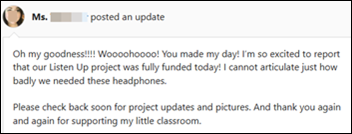
  • Math flashcards and formula reference sheets for the Honors Algebra and Geometry middle school classes of Ms. W in Oklahoma City, OK (she sent the above note within a few minutes of the project’s funding Sunday afternoon).
  • Whiteboard markers and erasers for Ms. B’s middle school class in Tarboro, NC.
  • Math posters and learning games for first-year teacher Mr. P’s bilingual middle school classes in Chicago, IL.
  • Headphones for Dr. H’s high school class in New Orleans, LA.
  • Cell models for Ms. A’s middle school class in Dallas, TX.
  • A document camera for Ms. H’s middle school class in Yonkers, NY.
  • Microscopes, human body models, and STEM building kits for Ms. P’s elementary school class in Dallas, TX.

image

Meanwhile, here’s a photo from Ms. J in San Diego that shows her students using the reader-funded Ozobot coding tools in her elementary school class. She also sent a note: “The students have loved our new Ozobot coding center which has come to life thanks to this project. Thanks to the child friendly way that Ozobot is able to operate, I was able to quickly explain how the Ozobots work with the color code magnets, then leave the students to create pathways and code by themselves. My students are enamored with creating their own instructions for the Ozobots, and then watching the Ozobots go around their custom made paths. I wish I was able to send video through Donors Choose, because the way they interact with each other while building their own paths is heartwarming.”


Webinars

None scheduled soon. Previous webinars are on our YouTube channel. Contact Lorre to present or promote your own.


Sales

  • Bamboo Health will provide the State of Hawaii with enhanced prescription drug monitoring that is integrated with EHR and pharmacy management system workflows.

People

image

David Grandy (Kaiser Permanente) joins Risant Health as chief product officer.


Announcements and Implementations

A Black Book survey of 820 UK clinicians, IT staff, and administrators finds that nearly all believe that NHS needs to replace its antiquated system to reduce productivity losses. They also recommend expanding training and engaging clinicians in EHR procurement decisions. The IT leaders identified the need for vendor-neutral, standards-based platforms to foster data sharing.

image

Orlando Health and the Florida Department of Health go live on CDC-funded Detor, which allows sharing lab test orders and results among providers and public health laboratories. The initial use case is to allow health system clinicians to see the results of newborn screening, which is mostly performed by public health labs. The organizations are Detor’s first users. The system is built on AIMS, the cloud-based healthcare messaging service that was developed by the Association of Public Health Laboratories.

image

Five-hospital Independence Health System (PA) launches a joint venture with Mitsui & Co. to form healthcare analytics firm AveHealth USA.


Government and Politics

A GAO report notes that the VA’s implementation of Oracle Health was preceded by three EHR modernization projects, all of which were abandoned: HealtheVet, IEHR, and VistA Evolution. GAO made 10 recommendations to the VA in May 2023 to address change management, user satisfaction, trouble ticket resolution, and independent assessments, with the VA concurring with all 10 but having implemented none so far. GAO made several other recommendations related to the VA’s IT governance, software licenses, and cloud computing, none of which have been implemented. The VA has requested $894 million for the Oracle Health project for FY2025 and $6.2 billion for the total budget of its Office of Information and Technology. 

NASA posts an RFI for a possible replacement of its decades-old EHR, which is primarily used at Johnson Space Center. I’m not clear on how that differs from a similar one from March 2024.

The government of Slovakia warns 3,300 hospital physicians who have resigned effective January 1 over poor working conditions that they will be jailed if they don’t keep working. A similar dispute with the medical trade union in 2011 required the government to bring in military doctors from Czechia. Doctors also staged a work protest that year in writing sick notes for each other, which has been banned in the new decree.


Other

Eric Topol, MD summarizes a new journal article that calls for developing personalized lab result reference values instead of the current “one size fits all” population-based ones. He suggests using AI to study an individual’s “setpoints” from the results of multiple CBCs to call out subtle changes that could identify high-risk people.

image

In China, a pregnant woman is forced to walk to catch a cab ride to a hospital to deliver her baby after her EV car fails to start because it was in the middle of a 51-minute software update that her husband inadvertently approved. Her husband called Li Auto, the car’s manufacturer, and was told that the update could not be stopped. The woman’s unplanned brisk walk elevated the fetal heart rate, requiring an emergency C-section once she reached the hospital, She summarizes, “I have a car, but I had to walk through the agony of a dilated cervix just to hail a taxi. Every step is excruciating.”


Sponsor Updates

  • Rhapsody Health offers a new customer story, “From data ingestion to production in less than 30 days: How Zephyr AI uses Rhapsody Semantic to create precise AI models at scale.”

Blog Posts


Contacts

Mr. H, Lorre, Jenn, Dr. Jayne.
Get HIStalk updates.
Send news or rumors.
Follow on X, Bluesky, and LinkedIn.
Contact us.

Comments Off on Monday Morning Update 12/16/24

Morning Headlines 12/13/24

December 12, 2024 Headlines Comments Off on Morning Headlines 12/13/24

Health Data, Technology, and Interoperability: Trusted Exchange Framework and Common Agreement (HTI-2) Final Rule

ASTP publishes a slimmed-down version of the TEFCA HTI-2 final rule.

1m Raises $10 million in Series A Funding to Bring Modern Risk Management Capabilities to Healthcare Organizations

Health system risk analytics vendor 1m raises $10 million in Series A funding, most of it from large health systems.

Greenlight Health Data Solutions and Pattern Health Merge to Expand Healthcare, Life Sciences and Insurance Solutions

Greenlight Health Data Solutions, which specializes in patient health record retrieval and sharing, acquires patient engagement, research, and clinical trials software company Pattern Health.

Comments Off on Morning Headlines 12/13/24

News 12/13/24

December 12, 2024 News 3 Comments

Top News

image

ASTP publishes a slimmed-down version of the TEFCA HTI-2 final rule. Some parts that were unrelated to TEFCA, such as those related to public health data exchange and payer API standards, were moved to another final rule that is being reviewed by the Office of Management and Budget.


HIStalk Announcements and Requests

image

Teacher Mr. F in New York City sent over photos of his middle school students using the STEM kits that were provided by a reader’s donation.


Webinars

None scheduled soon. Previous webinars are on our YouTube channel. Contact Lorre to present or promote your own.


Acquisitions, Funding, Business, and Stock

Analytics platform vendor Particle Health, which recently filed a lawsuit against Epic for antitrust behavior, raises $10 million from existing investors. Insiders say the money won’t be used to fund the lawsuit’s expenses.

image

CoachCare,which offers tools for remote patient monitoring and virtual care, raises $11 million in funding.

Patient engagement software vendor SpinSci raises $53 million in growth equity funding.

image

Health system risk analytics vendor 1m raises $10 million in Series A funding, most of it from large health systems. The two co-founders are former Goldman Sachs VPs.

image

Business Insider profiles Claimable, which offers patients an AI-powered platform to help them appeal their health insurer’s medication coverage denials. The company says that its $40 service has an 85% success rate in getting denials overturned.

Microsoft hires several former employees of Google’s DeepMind to run its new London-based AI consumer health team.


Sales

  • University of Cincinnati Health chooses Laudio’s workflow hub for hospital frontline leaders.
  • Gibson Area Hospital and Health Services, the country’s fifth-largest Critical Access Hospital, will implement Meditech Expanse under the Meditech-as-a-Service cloud delivery model.

Announcements and Implementations

The first participants in Meditech’s Traverse Exchange — the company’s nationwide private, FHIR-first network that went live in the US in August following its launch in Canada — begin exchanging health data. The service includes connections to CommonWell and Carequality and offers an embedded record locator service.

image

The Sequoia Project publishes the Data Usability Implementation Guide Version 2 that was created by its Interoperability Matters Data Usability Workgroup.

Ellkay seeks nominations for its Women in Health IT digital health series.

image

Atropos Health, which provides evidence-based clinical insights by analyzing real-world data, offers access to its Atropos Evidence Network to developers and health systems for AI training.


Privacy and Security

Puerto Rico-based clearinghouse Immediata Health Group pays $250,000 to settle charges that it stored the information of 1.5 million patients unsecured on the internet, allowing it to be found via Google searches. The company previously paid $2.5 million in civil settlements that were related to the misconfigured server.

A report finds that hospitals are administering pain and epidural medications to pregnant women during their C-sections, then reporting the women to child welfare authorities when their newborns test positive for the same drugs. Hospitals often file the reports without checking the mother’s medical records, frequently placing the responsibility on social workers who have little drug testing experience or authority. At least 27 states require reporting a baby’s positive test, but none of them require hospitals to confirm the results before doing so.

A UK court dismisses an appeal that would have reactivated a privacy case that involves the transfer of patient data from The Royal Free London NHS Trust to Google-owned DeepMind to use in a kidney injury detection app.


Sponsor Updates

  • A new EClinicalWorks survey finds that AI is a catalyst to transform the healthcare industry, with 90% of respondents reporting favorable views of AI.
  • Ellkay publishes a new success story featuring Delta Pathology + Omega Diagnostics, “Optimizing Efficiency for Independent Labs.”
  • Findhelp offers a new case study, “NYC Health + Hospitals Supports 100,000+ Patients in Six Months Using Automated Epic-Findhelp Social Determinants of Health Assessment Integration.”
  • Five9 announces that it has won the 2024 Aragon Research Innovation Award for AI Contact Centers and been named a Leader in two Aragon Research Globe reports, “AI Agent Platforms in the ICC, 2025,” and “Intelligent Contact Center, 2025.”
  • Goliath Technologies releases a new case study, “Leading not-for-profit health system isolates and resolves speed & reliability of Citrix related Epic and ChromeOS device issues .”
  • Modern Healthcare recognizes Clearwater and Laudio as two of the Best in Business of 2024.
  • Impact Advisors releases a new Impactful AI podcast titled “Inside the ‘Minds’ of LLMs: Behavioral Capabilities & Quirks.”
  • Linus Health names former Providence president Mike Butler as an independent board director.
  • KLAS Arch Collaborative features Meditech customer Ozarks Healthcare’s enhanced physician user experience in two case studies.

Blog Posts


Contacts

Mr. H, Lorre, Jenn, Dr. Jayne.
Get HIStalk updates.
Send news or rumors.
Follow on X, Bluesky, and LinkedIn.
Contact us.

EPtalk by Dr. Jayne 12/12/24

December 12, 2024 Dr. Jayne Comments Off on EPtalk by Dr. Jayne 12/12/24

The US Department of Health and Human Services recently launched the National Healthcare Safety Dashboard that tracks patient and workforce harm. The goal is to monitor patient safety indicators so that improvement can result. It draws data from the HHS Agency for Healthcare Research and Quality (AHRQ) including its Hospital Patient Safety Indicators, Hospital Medicare Adverse Events, and Surveys on Patient Safety Culture (SOPS) Hospital Survey. It also pulls from the CMS Hospital Reporting Program Safety Measures. Hospitals and health systems have been trying to reduce preventable harms for decades and hopefully the additional transparency from such a dashboard will better support those efforts. Future plans include dashboards for other care settings including nursing facilities and ambulatory care sites.

I took a peek at the Hospital Patient Safety Culture Survey (SOPS) data, and although the results weren’t surprising, they were still disheartening. Some of the least-positive scores were around Staffing and Work Pace, Response to Error, and Hospital Management Support for Patient Safety. A number of research articles have listed topics like these as contributing to care team burnout and I hope that institutions are making plans to address them. The most recently displayed data in the dashboard was from 2022. I’d love to see more public information on what staff members think about the culture of the institutions where they work and whether hospital leadership becomes more responsive when light is shining on those kinds of concerns. If you’re working in this space, feel free to reach out.

clip_image002

In conjunction with HIMSS, Medscape has released its 2024 AI Adoption in Healthcare Report. I was saddened to see it delivered in a format I detest, that being a 22-item, web-based slide show. Results are from “a jointly managed survey to practicing physicians and other clinicians, practicing nurses, IT professionals, clinical leadership, and executive leadership at medical organizations” in the US. That’s pretty vague and I was looking forward to seeing increased stratification of the findings based on the type of medical organization – care delivery, payer, software developer, etc. – since all of those are technically medical organizations. Highlights from the survey that should surprise no one: AI is most frequently used with administrative tasks, it’s producing solid results for transcription for everything from meeting notes to patient documentation, and a large number of respondents are concerned about data privacy and/or ethical issues.

Other facts I wasn’t expecting: only 24% of employers are providing AI training, physicians are less likely to use AI away from the office than non-physician respondents, and 28% of physicians believe it will eventually replace the need for human doctors. Looking at respondent demographics, almost a third were nurses and nearly two-thirds worked in hospitals, so I’m not sure this is representative of medical organizations as a whole. Only 1% of respondents were healthcare IT, however. The data wasn’t further stratified by those groups, so it’s really a limited view into the issue. It was one of those attention-grabbing articles, and given the report’s sponsors, I didn’t expect much more from it than a superficial review of the topic.

From The Mitten: “Re: new scam. People are offering fake jobs.” The scam was mentioned in a security bulletin from Michigan’s Munson Healthcare. Scammers are “imitating Munson human resources’ leaders offering people false jobs and sending them fraudulent checks to purchase their own equipment.” From the information available, I can’t seem to figure out what else was involved in the scam, whether it involved theft of financial information related to the phony checks or something else. If you know more about it, feel free to share with the rest of the class.

The year is coming to a close and most of my time now is spent gearing up for 2025. A new year always brings new opportunities. I had the chance to catch up with a friend who works as a healthcare IT consultant and she mentioned that work at her current consulting gig has just about ground to a halt. It seems that all the people who didn’t take their allotted vacation time throughout the year are racing to try to take it before the “use it or lose it” deadline of December 31 and it’s a ghost town as far as finding people with whom to collaborate. It’s a bit surprising to me since this is a care delivery organization that needs to make sure that essential functions are covered, but I guess that as long as they have one person around to field support calls, they’re OK with it.

I’ve worked in organizations with all kinds of vacation policies, some of which make it difficult for employees to take time off on their preferred schedules. One employer had a strict accrual policy that started over each year, essentially preventing anyone from taking a full week of vacation in the early parts of the year. Others have had accrual policies, but allowed you to use vacation in advance of the actual accrual, adding flexibility. I’ve also worked in organizations with unlimited time off, which can be good or bad depending on the company culture and how such a program is administered.

I’m not a fan of use it or lose it plans that are tied to the calendar year since life sometimes doesn’t always deal us opportunities on that kind of schedule. I get that you don’t want people banking ridiculous amounts of vacation, which means that they’re not taking the time they should in order to relax and recharge. On the other hand, it would be great to take a multi-week trip to celebrate a marriage, milestone birthday, or other life event without having to time it to a certain part of the year.

Of all the arrangements I’ve worked under, my favorites are either a well-administered plan for unlimited time off that ensures that employees actually take it, or one that lets employees roll vacation over from year to year as long as they don’t exceed a certain number of banked hours. Either way, those require adequate involvement from managers to ensure that people are taking time away at regular intervals, and it seems that some organizations don’t want the hassle of either.

What kind of vacation or time off plan does your organization have? Does it meet your needs or do you wish you had something different? Leave a comment or email me.

Email Dr. Jayne.

Comments Off on EPtalk by Dr. Jayne 12/12/24

Morning Headlines 12/12/24

December 11, 2024 Headlines Comments Off on Morning Headlines 12/12/24

CoachCare Announces $11 Million Investment from Catalyst Investors, Expanding Growth Potential

Remote patient monitoring and virtual care management vendor CoachCare raises $11 million in new funding.

Dallas-Based Healthcare IT Leader Secures $53M Investment to Transform Patient Care and Expand Global Reach

SpinSci, a healthcare technology company specializing in patient engagement and access solutions, announces a $53 million investment from Aldrich Capital Partners.

Particle Health lands $10 million in funding after lobbing antitrust lawsuit against medical records giant Epic

Business Insider reports that healthcare API company Particle Health has raised $10 million.

Comments Off on Morning Headlines 12/12/24

Healthcare AI News 12/11/24

December 11, 2024 Healthcare AI News Comments Off on Healthcare AI News 12/11/24

News

image

OpenAI launches AI-driven video generator Sora, then disables it when it is overloaded from heavy traffic. It can generate video from text instructions and existing media, but only up to a final length of 20 seconds. The company also releases its Canvas feature to all ChatGPT users, which allows users to work on writing and coding projects with increase editing capability.

Google announces Willow, a new quantum chip that performs a benchmark computation in under five minutes versus the 10 septillion years that is required by the fastest supercomputers.


Business

image

Corewell Health chooses Abridge for ambient clinical documentation, with a rollout to 4,000 physicians planned.


Research

A Washington State University sociologist finds that rural clinics aren’t ready to use AI to optimize proactive text messages to patients. An AI-polished lung screening message drew fewer responses than the traditional one and more than 50% of all sent messages bounced back as undeliverable, raising the question of how the clinic could contact its patients in an emergency. The local hospital also noted that the area has a high population of Hispanics, which raised its own messaging challenges.


Other

image

Corpus Christi Medical Center Chief of Surgery Michael Ewing, MD credits his use of MedQuill’s newly launched SurgeOn Scribe – which he helped create — to saving an hour of clinic time each day. 

Joe Raetano, the VA’s AI architect, says that the organization is using AI to extract social determinants of health from clinical notes and to manage patient data via an agentic chatbot.

image

In England, a woman credits AI with saving her life after her lung cancer was diagnosed by Royal Surry NHS Foundation Trust using AI imaging triage tool Annalise.ai.


Contacts

Mr. H, Lorre, Jenn, Dr. Jayne.
Get HIStalk updates.
Send news or rumors.
Follow on X, Bluesky, and LinkedIn.
Contact us.

Comments Off on Healthcare AI News 12/11/24

Text Ads


RECENT COMMENTS

  1. And which "political exercise[s]" by a private entity are appropriate for state governments in this country to punish with a…

  2. What do you mean? What was the "political exercise" that prompted this response?

  3. Many, yourself included, chose to make healthcare and Healthcare IT a political exercise. Shouldn't be shocked when the other side…

  4. I see a lot of people dislike what I said. I assume some don't like it because what I said…

  5. I have a hard time believing that Ken "unconvicted felon" Paxton does anything in good faith. Daily reminder that during…

Founding Sponsors


Platinum Sponsors


Gold Sponsors


RSS Webinars

  • An error has occurred, which probably means the feed is down. Try again later.