
Recent Articles:

News 4/13/18

April 12, 2018 News 5 Comments

Top News

image

IDx receives FDA clearance to market its AI-based diabetic retinopathy diagnostic system to PCPs, giving them access to a tool that assesses patients without need for physician analysis.

The company received its clearance via the FDA’s Breakthrough Devices program.

Eric Topol noted in a tweet that only four AI medical algorithms – all of them related to pattern recognition – have earned FDA’s approval. Two are for imaging, one for is ECGs, and now IDx’s for retinal changes.


Reader Comments

image

From Rif’d Me a New One: “Re: Hitachi Vantara. RIF’d a number of us, with rumors of 800 to 14,000 globally. What amazes me is how they’ve been able to keep this out of the news. I’ve also found it interesting how certain executives have been getting promotions and pay increases, which might be better spent keeping a few more workers.” A Hitachi Ventara spokesperson responded to my inquiry with this statement: “As we continue to transform to help our customers unlock the value in their data, we must shift certain resources to best support our business. Hitachi Vantara is, in fact, growing significantly. In the past year we have hired more than 1,300 new employees to support high-growth segments of our business, with over 230 current job openings.” The digital tools company that focuses on IoT– a subsidiary of Tokyo-based Hitachi — was formed in September 2017 by combining Hitachi Data Systems, Hitachi Insight Group, and Pentaho.

From Pleasant Valley: “Re: MModal. Has had stability problems nationally for the past couple of weeks with its software as a service product (Fluency for Transcription).” Several transcriptionists on the MT Stars forum have reported having problems, but only over the past couple of days. A company spokesperson provided this response to my inquiry: “As we experience ongoing growth, we continue to scale and have been upgrading our infrastructure to ensure further resiliency, high availability, and adequate capacity. We are proactively addressing any performance concerns to further support a consistent experience for transcriptionists who use top-ranking M*Modal Fluency for Transcription to improve their everyday workflows, quality, and productivity.”

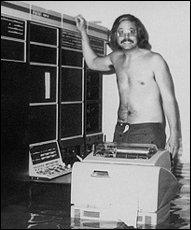
image image

From History Repeated: “Re: Epic and Meditech. As they approach their 40th and 50th anniversaries, respectively, it would be neat to see an article about how Judy Faulkner and Neil Pappalardo met. Ideally as a joint interview, but individual recollections would be fine. The stories I’ve heard are that Judy came to Neil seeking advice about starting a company. What did they think of each other then? Now? Epic uses MUMPS, which Neil invented – was that part of the conversation?” Those two folks are #1 and #2 on my most-wanted interview list, but both also decline every time I ask. It would be fun to capture their memories and, as always, I’m here to do so if they are willing. Above are early company photos of both from the sunny slopes of long ago.


HIStalk Announcements and Requests

image

This week’s question of “What I Wish I’d Known Before … Selecting a Consulting Firm for EHR Implementation or Optimization” is still open.

Listening: new from Denver-based Nathaniel Rateliff & the Night Sweats, big-sounding soul music recorded in Rodeo, NM. There’s also new music from a band I really like but forgot about, The Magic Numbers, whose new single more ballad-y hard rock than before. Their 2005 debut remains one of the best I’ve heard. To address my frequent need to hear the soaring virtuosity of progressive rock, I moved on to Kaipa, a Swedish band that’s been around since 1973 and that spawned the musical career of Roine Stolt, later of The Flower Kings, Transatlantic, and now The Sea Within (whose first album is due in June).


Webinars

None scheduled soon. Previous webinars are on our YouTube channel. Contact Lorre for information.


Acquisitions, Funding, Business, and Stock

image

Glen Tullman’s Livongo Health raises $105 million in a Series E funding round, increasing its total to $248 million. The company announces that it will work with Cambia Health Solutions to develop and market new consumer-friendly digital health offerings for people with chronic conditions.


Sales

  • Peterson Regional Medical Center (TX) selects CloudWave’s OpSus Backup, Archive, and Recover services.
  • Eleven-bed critical access hospital Munising Memorial Hospital (MI) chooses Cerner CommunityWorks.

People
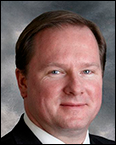
image image

Russ Johannesson (Sharecare) joins diabetes management platform vendor Glooko as CEO. Former CEO Rick Altinger will transition to EVP of corporate development.
image

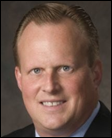
Martin Tursky (Firelands Regional Medical Center), who spent a couple of years as VP/CIO at Aultman Health Foundation (OH), is named president and CEO of McLaren Central Michigan (MI).


Announcements and Implementations

image

MedData develops OneTouch RCM software to bring patient financial services onto a single platform.

image

PatientPing expands the availability of its real-time clinical and administrative data sharing technology for ED patients beyond Massachusetts to hospitals across the country.

image

CVS Health unveils a set of tools to help pharmacists, physicians, and patients make more cost-conscious decisions about prescription drugs.


Privacy and Security
image

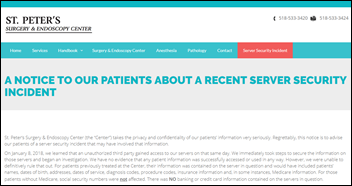
St. Peter’s Surgery & Endoscopy Center (NY) notifies 135,000 patients of a January data breach in which its servers were hacked.

Philips warn that security vulnerabilities in its ISite and IntelliSpace PACS products could affect patient confidentiality and system integrity, some of which could expose systems to remote attacks using publicly available exploits. The company recommends enrolling in its ongoing patch program, which remediates all critical vulnerabilities, or upgrading to newer versions of IntelliSpace and Windows.


Other

image

At an AMIA briefing on Capitol Hill, Geisinger Health System (PA) Chief Clinical Informatics Officer Alistair Erskine, MD points out that Apple’s Health Record app initiative is more limited than headlines suggest, given that it excludes Android users and does not yet give users access to their full medical records. Geisinger was one of the original 12 beta testers of the app; 39 health systems have signed up to partner with Apple so far.
image

This article, highlighting the experiences of early adopters Penn Medicine (PA) and Johns Hopkins Medicine (MD), also presses pause on the Health Record app hype machine, pointing out that providers at non-participating organizations must proactively ask patients to share their data and are then faced with the question of what to do with it in its raw form.

A Black Book survey of health technology managers finds that hospitals that have implemented an enterprise master patient index have fewer duplicate patient records, reducing their cost, denied claims, and the number of repeated tests and procedures. QuadraMed’s product is #1 in user satisfaction and loyalty.


Sponsor Updates

  • HIE technology provider Koble Group will integrate patient risk management software from HBI Solutions.
  • Lightbeam Health Solutions will exhibit at CAPG April 19-21 in San Diego.
  • LiveProcess will exhibit at the Preparedness Summit April 17-20 in Atlanta.
  • MedData will exhibit at the HFMA Florida Space Coast Educational Event April 18 in Titusville.
  • Navicure, a Waystar company, publishes “Easily Increase Patient Collections: Six Steps to Energize Front-Line Processes.”
  • Clinical Computer Systems, developer of the Obix Perinatal Data System, will exhibit at the AL HIMSS 2018 Spring Conference April 18 in Huntsville.
  • Experian Health will exhibit at HFMA AR April 18-20 in Hot Springs, AR.
  • Daw Systems adds electronic prior authorization technology from CoverMyMeds to e-prescribing functionality within its ScriptSure EHR.

Blog Posts


Contacts

Mr. H, Lorre, Jenn, Dr. Jayne.
Get HIStalk updates. Send news or rumors.
Contact us.

125x125_2nd_Circle

EPtalk by Dr. Jayne 4/12/18

April 12, 2018 Dr. Jayne Comments Off on EPtalk by Dr. Jayne 4/12/18

image 

I read a lot of press releases and this one from CMS particularly caught my eye this week. Normally a fairly bland and non-partisan source of news for all things CMS, the media relations group has really dialed up the rhetoric on this one. I don’t disagree that the Affordable Care Act is imperfect and we have a long way to go in achieving a workable and affordable system of healthcare in the US, but it feels like we’re losing the ability to participate in constructive discourse and everything is becoming polarized.

clip_image004

From Gone to the Dogs: “Re: burnout. My institution has dealt with this issue as it deals with many issues. The phrases ‘pennywise and pound foolish’” and ‘putting lipstick on a pig’ are perhaps the best descriptors.They’ve put together various wellness committees, invited speakers on mindfulness, and hired (costly) consultants on ‘improving communication.’ The most legitimately helpful thing they’ve done is have a puppy-petting party with a group of prospective guide dogs (which helps the dogs get socialized and relaxes the staff). At the same time, they continue to ratchet up required numbers of RVUs (on threat of contract non-renewal if targets aren’t met), throw people under the bus for any untoward events, display a general lack of supportiveness, etc. The broader burnout issues are also unchanged: insane regs, endless documentation requirements, frustrating pre-approval demands from insurers, and still trying to help really sick patients.” Our local high school invites a therapy dog agency to work with the students during finals week. I have to say, it’s hard to be aggravated when you’re staring at a cute puppy (unless that cute puppy just chewed the heel off your favorite pumps). The comment about RVUs is also particularly striking since we’re not supposed to be focused on visit volumes in the new world of value-based care. Keeping patients healthy and having fewer visits should be the goal, right? I still see RVUs as a metric in 90 percent of the organizations I serve.

Several readers sent their own “weirdest interview ever” stories.


My weirdest interview was with a major consulting firm. I had passed two telephone interviews and was flown out to have the final round of interviews with major players. I first met with president of the branch and he was bland and did not have many questions or comments (or energy). Then I met with one of their directors who had previously worked at another consulting firm that I had also worked at. He was a great interview and covered a lot of items. But the kicker was the last interview. This director sat down and nearly choked on her coffee when she realized that the date on my resume was when I graduated with my masters and not what she had assumed was my birth date! She didn’t believe I had any of the experience on my vitae, nor did she want to hire someone of my age. She excused herself and had security walk me out of the building. I’m not sure if she had many bad experiences with interviewing candidates, but security? At least I had a nice trip on their dollar.

I once interviewed for a position with an organization where the decision-maker shared a large office with another high-level person in the organization. Let’s call them Mr. Abbott and Mr. Costello. Mr. Costello would ask me questions, while Mr. Abbott, within earshot the whole time, was ostensibly engaged in other matters. But at different points in the process, Costello would call across the room to ask for Abbott’s thought or opinions. Abbott generally replied, “It’s your interview, I don’t know why you’re asking me,” or, “I don’t know – you should know that.” This went on for about 20 minutes or so, at which point I got up and said, “Thank you very much. I am not interested in the position” Costello had difficulty understanding why I abruptly made up my mind that this was not a place I wanted to work, but was apologetic. I don’t know where those two and the firm wound up, but I hope they started group therapy sessions as soon as I walked out the door.


That last story really resonates with me. As a candidate, when we attend interviews, we tend to be on our best behavior and I think we assume the people we are meeting with are likewise on their best behavior. I am sometimes left wondering that if what I have just seen is an organization putting their best foot forward, how wild it must be when they’re not trying.

clip_image006

From Crazy Ivan: “Re: tradeshow booths. This is my favorite ever. The only thing missing is the unmarked white van.” Every year one of my booth crawl BFFs and I fantasize about taking over one of the no-show booths at HIMSS and using the company’s name to create a fake business just to see if we can get prospects to stop by and chat. This year our delusion expanded to a couple of other people in our circle and the idea is gaining steam for next year. Another good reason to always check out the “little guys” on the trade show periphery – you never know who you’re going to find there.

From The Big Divide: “Re: this article. Would love to hear your thoughts. Is this a trend? It makes me nervous. Can’t help but believe it does deepen the divide in healthcare.” Concierge medicine is certainly a trend, although its market penetration varies across different regions of the country. I do see a fair number of direct primary care practices, many of which are priced in a way to be much more accessible to a broader swath of patients especially when those patients have a high-deductible health plan. The more accessible versions differ from typical concierge practices in that they’re more about cutting out the middleman (insurance) and providing value then they are about the white-glove service or 24×7 access than some retainer/concierge practices would be. I think the Michigan program especially raises concerns because of its association with a teaching hospital, and many teaching hospitals have a historical mandate to serve the underserved.

The hospital affiliated with my medical school had a “concierge floor” back in the day, where VIPs were cared for in swanky rooms with better meal service and no house officers. We only had a chance to breathe that rare air in the event of a code blue, when it was all hands on deck for the on-call team. They also sometimes had poorer outcomes because there were no house officers, which sometimes means less attention. Depending on the reason you’re in the hospital in the first place, not having interns and residents and students bothering you can be a bad thing.

On the other hand, when looking at concierge practices, they seem inevitable with the commoditization of medicine. One knows that when one purchases a Lamborghini, they will receive a different level of service than if they purchase a Chevrolet. People of means pay cosmetologists to come to their house to perform a pedicure rather than go to a salon. They have housekeepers rather than clean the bathrooms themselves. If the practice of medicine is no longer a calling but rather a business, why should it be any different than any other service? Even in a hypothetical single-payer system, there will always be people who are willing to pay more to get more. The question is whether we as a society are willing to commit to a minimal level of care for everyone else.

What do you think of concierge practices or direct primary care? Leave a comment or email me.

Email Dr. Jayne.

Comments Off on EPtalk by Dr. Jayne 4/12/18

Morning Headlines 4/12/18

April 11, 2018 Headlines Comments Off on Morning Headlines 4/12/18

Apple’s iOS 11.3 electronic health record initiative ‘might be overhyped’

At an AMIA briefing on Capitol Hill, Geisinger Health System (PA) Chief Clinical Informatics Officer Alistair Erskine, MD points out that Apple’s Health Record app initiative is more limited than headlines suggest, given that it excludes Android users and does not yet give users access to their full medical records.

Epic won’t protest Coast Guard move to Cerner

Epic will not protest the Coast Guard’s decision to move on from its failed $60 million Epic implementation and join the DoD’s $4.3 billion Cerner contract.

Livongo Health Raises $105 Million

Livongo Health raises $105 million in a Series E funding round and announces it will work with Cambia Health Solutions to develop and market new consumer-friendly digital health offerings for those with chronic conditions.

Comments Off on Morning Headlines 4/12/18

Morning Headlines 4/11/18

April 10, 2018 Headlines Comments Off on Morning Headlines 4/11/18

Theranos Lays Off Most of Its Remaining Workforce

Theranos lays off most of its remaining employees following SEC fraud charges and ahead of a likely bankruptcy filing, leaving around 20 employees.

Mayo Clinic offers 400 transcriptionists buyout packages

Mayo Clinic offers voluntary separation packages to 400 transcriptionists as technology replaces them even before it goes live on Epic.

Veterans Affairs on course to top agency health IT spending

Analysts attribute projected growth in federal health IT spending to VA and DoD investments in new EHR software and related network and infrastructure upgrades.

Allscripts Care Management Joins With CarePort Health to Build Next Generation Care Coordination Solutions

Allscripts repositions its care and referral management system under CarePort, the outcomes technology vendor it acquired in October 2016.

Comments Off on Morning Headlines 4/11/18

News 4/11/18

April 10, 2018 News 3 Comments

Top News

image

The Coast Guard, which previously failed in its attempt to go live on Epic, will instead implement Cerner as part of the DoD’s MHS Genesis project.

The DoD will revise its contract with primary contractor Leidos to incorporate the Coast Guard’s requirements. It says it won’t know whether the contract cost will increase until that work is finished.

The Coast Guard spent five years and $60 million – vs. the original budget of $14 million – trying to bring Epic live, only to give up and go back to paper after retiring the systems it was supposed to replace in early 2016.


Reader Comments

From Chance the Rapper: “Re: VA’s VistA. They should keep it, according to this poll.” The HIMSS-owned rag’s poll suffers from a multitude of problems that make its “keep VistA” conclusion useless beyond its intended clickbait purposes. Polls covering a detailed technical topic that generate a small number of responses from unvetted participants are pretty much worthless and certainly not something I’d splash all over social media. Most sites that run health IT polls intentionally hide how poorly they were designed and thus how questionable their results are.

From Firehydrant: “Re: Ascension. Cerner is possibly a victim of Ascension incompetence and political back-stabbing. Ascension IT has eliminated 20+ CIOs and 30+ directors as they drive strategy from St. Louis. They’re focusing on talent from Express Scripts. A recent all-hands webinar was marred by heckling staff using pseudonyms, with executives threatening to eliminate chat tools if the staff can’t be trusted.” Unverified.

image

From Someone Formerly of NextGen: “Re: NextGen. Tweeting to hire new talent. Two days after they announced their $300 million credit with JP Morgan, they laid off 60 people, some of them key individuals in charge of implementing the new vision of NextGen. Depending on how they recovered from last year’s mass exodus of veteran sales professionals, this puts them at a 2-3 percent reduction of workforce.” Unverified. But I’ll say in the company’s defense that layoffs are common in health IT (especially the publicly traded ones like NextGen / Quality Systems) and companies are always cutting back headcount in some areas while expanding in others. It’s too bad that employees assigned to a particular project are often let go, but that’s the easiest way out for executives. QSII shares have lagged the Nasdaq for years, shedding 23 percent in the past five years vs. the Nasdaq’s 116 percent gain. The only QSII executive who’s been with the company longer than three years is the HR VP (who’s also the only woman among the six executives). CEO Rusty Frantz said in last month’s earnings call that “85 percent of our effort is focused on monetizing our existing client base” and that “the replacement market’s a tough place right now,” with obvious hope placed on the August 2017 acquisition of physician practice analytics vendor EagleDream Health as well as the new sales force he brought in.


Webinars

None scheduled soon. Previous webinars are on our YouTube channel. Contact Lorre for information.


Acquisitions, Funding, Business, and Stock

image

Allscripts repositions its care and referral management system (the former ECIN, relabeled as Care Management) under CarePort, the outcomes technology vendor it acquired in October 2016. I interviewed CarePort co-founder and CEO Lissy Hu, MD in February.

image

Healthfinch raises $5.7 million in a funding round.

image

Theranos lays off most of its remaining employees following SEC fraud charges and ahead of a likely bankruptcy filing, leaving around 20 employees left vs. the 800 it had in late 2015.


Sales

HealthlinkNY selects the Quality product of Diameter Health, which is certified for more of NCQA’s e-clinical measures than any other firm.

SNAGHTMLb12edc2

Freeman Health Systems (MO) will conduct an extended pilot of Mobile Heartbeat’s MH-CURE secure smartphone platform after completing a pilot in Freeman Hospital West’s cardiology department.

image

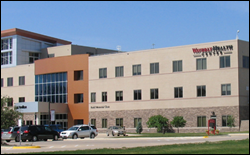
Waverly Health Center (IA) will replace Allscripts Paragon with EClinicalWorks.


People

image

Omnicell hires Scott Seidelmann (Candescent Health) as chief commercial officer. He founded radiology workflow technology vendor Candescent in March 2015 and sold it to Envision Healthcare in August 2017.

image

Dennis Shin (The Advisory Board) joins oncology precision medicine software vendor Syapse as chief commercial officer.


Announcements and Implementations

image

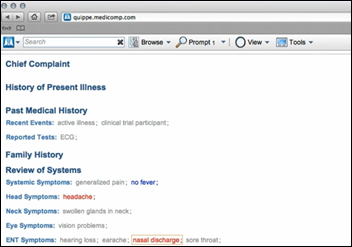
Phoenix Children’s Hospital (AZ) reports that its use of Medicomp’s Quippe Clinical Documentation has increased clinician productivity and enhanced documentation quality while nearly eliminating its $1 million annual transcription costs.

image

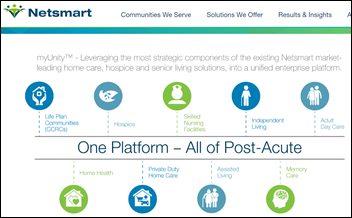
Netsmart announces MyUnity, a cloud-based EHR for home care and senior living providers. It’s being demoed this week at the company’s CONN18 user conference in Phoenix.

Phynd integrates Healthwise’s clinical taxonomy into its Provider Information Management solution.

AMA and its Integrated Health Model Initiative launches an interoperability challenge – sponsored by Google – that calls for ideas on: (a) how patient-generated data can be moved from their mobile devices into physician workflow, and (b) how physician-generated data can be sent back to the patient’s device for action. Prizes are offered, but in the form of one-year Google Cloud credits instead of cash. Residents from anywhere in the world can participate except those countries labeled by the State Department as sponsoring terrorism (North Korea, Iran, Sudan, and Syria) and those in Canada, Mexico, and Brazil (I’m not sure how they got on the wrong side of the AMA to be lumped in with terrorist countries).

Video visit provider Doctor On Demand will enhance its lab ordering services via Change Healthcare’s network, which will allow patients to work with their doctor to choose the closest in-network lab location.

Inovalon launches services for clinical data extraction and natural language processing for its value-based care platform.


Government and Politics

image

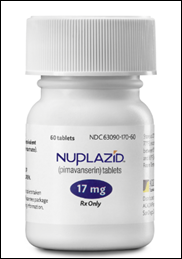
FDA caved to pressure from emotional patients and families two years ago in approving the expensive new drug Nuplazid for Parkinson’s diseases psychosis despite several studies that showed it ineffective at best and dangerous at worst. Now the adverse events reports are piling up.

CMS issues its 2019 insurance exchange rules, with Administrator Seema Verma loading her quotes and tweets with political derision in referring to “the harmful impacts of Obamacare” and “the previous Administration’s one-size-fits-all approach.” States will be given more flexibility in defining Essential Health Benefits, insurer risk adjustment will be tweaked, states will be allowed to request a lower Medical Loss Ratio for insurers to stabilize their markets, and the SHOP insurance program for small businesses will be moved from the exchanges to individual insurance agents. Verma said in a tweet that insurance premiums doubled in states that participated in the federal exchange even as fewer choices were offered, requiring regulatory reform.


Privacy and Security

image

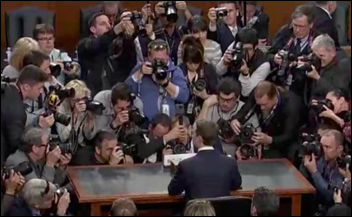
The congressional testimony of Facebook CEO Mark Zuckerberg  suggests that Facebook’s platform is so complex that even the company didn’t know how it could be abused. He said:

  • Facebook versions through 2014 allowed companies to create quizzes that would give access to the information of the quiz-taker’s Facebook friends even though those friends hadn’t given permission and weren’t alerted.
  • Facebook learned from a newspaper story that a personality quiz developer had shared user information with Cambridge Analytica, after which that developer was banned and forced to delete the data.
  • Just two weeks ago, the company found out that a feature that allows looking someone up by their phone number and email address “was abused” by linking public Facebook information to their phone number.
  • Access to user data will be removed for apps that a given user hasn’t run for three months.
  • Apps will only be able to see user name, profile photo, and email address.
  • Users will see in their News Feed which apps they’ve authorized to use their data and whether Cambridge Analytica extracted their information.
  • Facebook will restrict use of some APIs, such as for groups and events.
  • Advertisers will have to confirm their identity and location before running political and issue ads.
  • Zuckerberg vows that “advertisers and developers will never take priority” over “bringing the world closer together” even though they are Facebook’s customers.
  • Some of the mostly elderly, non-technically savvy members of Congress seemed clueless about Facebook, with 84-year-old Senator Orrin Hatch (R-UT) asking Zuckerberg, “How do you sustain a business model in which users don’t pay for your services?” Zuckerberg couldn’t help smiling as he responded: “Senator, we run ads.”
  • Zuckerberg had to explain several times that Facebook doesn’t sell data, it only uses it to target ads.
  • Pressed hard on whether he would support a law requiring that users of any web service opt in before their data is used, Zuckerberg finally said yes.

image

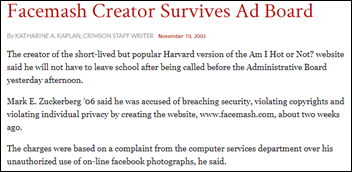
As someone tweeted, above is a suddenly relevant 2003 article from The Harvard Crimson.


Other

A Black Book survey of 19,000 physician practices finds that small-practice doctors who use specialty-specific EHRs are the happiest EHR customers. Leading the satisfaction pack are AdvancedMD, Drchrono, Epic, NextGen, Netsmart, Modernizing Medicine, and SIS Amkai. Other satisfaction leaders are T-System EV (emergency medicine), Praxis EMR (family practice), Surgical Information Systems (general surgery), DocuTap (urgent care and occupational medicine), and PointClickCare (geriatric medicine). The survey also found that while most practices regularly use basic EHR capabilities, those with six or fewer physicians rarely use electronic messaging, clinical decision support, interoperability, and patient engagement.

Mayo Clinic offers voluntary separation packages to 400 transcriptionists as technology replaces them even before it goes live on Epic.

Scientists propose defining Alzheimer’s disease by biological signs that can be observed 15-20 years before the first dementia symptoms are seen, a change that will greatly increase the count of people with the disease. They’re hoping to improve outcomes by starting treatments before brain damage has occurred. The researchers hope to get more patients enrolled in pre-symptomatic stage studies, but don’t recommend that people get tested on their own since there’s no available Alzheimer’s treatment.

A Health Affairs blog post says that only 15-20 percent of Baby Boomers will be able to afford the long-term care services they will begin consuming on a massive scale in the next 10 years. It adds that Medicaid will be stretched as the default insurance for half those people, also noting that less-wealthy Boomers will have to get used to the idea of sharing rooms in old facilities.

image

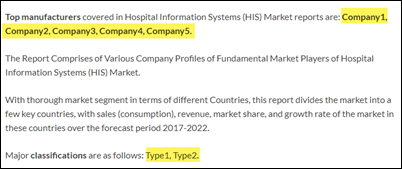
This is the kind of careful editing that makes me comfortable sending $3,500 off to Pune to buy a Global Hospital Information Systems Market Report.


Sponsor Updates

  • AdvancedMD will exhibit at ASCRS April 13-17 in Washington, DC.
  • Agfa HealthCare acquires French e-health specialist Inovelan.
  • Arcadia will host Aggregate2018 April 18-20 in Boston.
  • Forbes names Direct Consulting Associates to its Best Professional Recruiting Firms of 2018.
  • The Hospital Association of Southern California partners with Collective Medical to bring members cost-saving identification and support of frequent ED utilizers.
  • CoverMyMeds will exhibit at the AAP Annual Conference April 12-14 in San Diego.
  • Meditech certifies infrastructure provider SYSDBA as the only systems integrator for Africa and the UK.
  • Spok executives will participate in upcoming events that include AONE, the AMDIS PCC Symposium, and the AHA Leadership Summit.
  • Dimensional Insight will exhibit at the ACO & Payer Leadership Summit April 12-13 in Palm Beach, FL.
  • EClinicalWorks will exhibit at the AAOE 2018 Annual Conference April 14-17 in Orlando.
  • Ellkay exhibits at the ACMG Annual Clinical Genetics Meeting April 10-14 in Charlotte, NC.
  • The HCI Group publishes a new case study, “Luke’s Goes 7 for 7 on HIMSS EMRAM Stage 7.”
  • InstaMed will exhibit at the Office Practicum User Conference April 12-14 in Orlando.

Blog Posts


Contacts

Mr. H, Lorre, Jenn, Dr. Jayne.
Get HIStalk updates. Send news or rumors.
Contact us.

125x125_2nd_Circle

Morning Headlines 4/10/18

April 9, 2018 Headlines Comments Off on Morning Headlines 4/10/18

After botched acquisition, Coast Guard joins Pentagon electronic health record system

The Coast Guard will implement MHS Genesis, joining the DOD’s 10-year, $4.3 billion contract with Cerner.

Google is teaming up with the largest doctor group for a medical data challenge

The AMA and Google launch the Health Care and Interoperability Innovation Challenge to uncover new ways of monitoring and sharing health data between chronic disease patients and physicians using mobile technology.

Specialist-Centric Systems Lead Small Physician Practice EHR Satisfaction, Black Book Survey

Seven vendors – each with specialty-focused EHRs that offer RCM, coding, and practice management tools – score highest for customer satisfaction in Black Book’s latest market analysis.

Comments Off on Morning Headlines 4/10/18

Curbside Consult with Dr. Jayne 4/9/18

April 9, 2018 Dr. Jayne 3 Comments

It was a strange week in my little health IT world. I had my first prospective client call to ask about an “extension” in MIPS data submission. Although CMS extended the deadline from March 31 to April 3, my client had confused the deadline with the federal income tax deadline and thought that you could file an extension to get an even longer time to report.

Sorry, folks, but if you haven’t submitted by now, you’re out of luck. We’re in the 2018 reporting year, so if you haven’t started to get your plan ready, you need to dust yourself off from 2017 and head into the new year.

I also went on the strangest job interview of my life. I had been introduced to this potential position by a mutual friend who works for the medical group in question. The backstory I was given was this — a mid-sized medical group is looking for a blended CMIO / clinical role to complement existing CMO and medical director positions. The group is growing and realizes that they need more administrative leadership to move them through programs such as MIPS and to assist with managed care contracting and their transition into the ACO space.

It sounded right up my alley. The recruiter from the group validated the role by sharing a job description, doing a phone screen interview, making sure we were in the same compensation ballpark, and then scheduling me to come meet with the group.

My first conversation was to be with the group’s physician president, who apparently was “called away.” He didn’t give advance warning to the interview team, which is never a good sign. I was left sitting in a hallway for 20 minutes while they scrambled to find someone else to fill the time block, who of course was unprepared for the meeting and didn’t really know what the role was about. They were, however, a provider, so they could tell me what practice with the group was like, which was important since this role would involve a certain amount of time in clinic.

From a few things he said, though, it sounds like the president gets “called away” quite a bit, which sounds like either poor time management skills or a certain level of chaos that requires the group president to sort it out.

From there, I met with some nursing team representatives who told me more about the clinical aspect of the job as well as some of the pain points they hoped that the new CMIO role would help address. The discussion was candid, the interviewers were friendly, and I felt it was a good opportunity to share my philosophy of clinical practice as well as how I think teams best work together.

They handed me off to members of the informatics team, who met with me over lunch. It was a mix of interviewing and grilling, with many questions about whether I would try to restructure the informatics team or change how their jobs work. There were a lot of very pointed questions about how I work with technical resources. One analyst flat-out asked if I would automatically take a physician’s side in the event of a disagreement between the physician and IT.

The analysts seem to be a good group of people. Although they’re pulled in many directions, I think they are excited about the possibility of someone helping with governance and making sure they are doing well-considered projects rather than reacting to squeaky wheels or shiny objects.

From there, I met with the COO, who talked me through some of the nuts and bolts of the organization and how much she thought the new role would interface with the financial and operational aspects of the organization. It sounded like there has been some friction in the past among operations, IT, and the clinical stakeholders as they decide how to prioritize scarce resources and how they decide which initiatives to pursue as they create their annual planning and strategic roadmaps.

At this point, none of this was surprising or out of the ordinary compared to other interviews I’ve been on, except for the missing interview with the group president. At the end of the talk with the COO, she let me know that I’d have a brief break and then would be able to meet with the president, who had rearranged another meeting to accommodate our interview. It sounded good, so I grabbed a cup of tea and made some notes about what I was thinking so far about the position.

An assistant came by to escort me back to a conference room, which seemed a little strange that we’d meet there rather than in the president’s office. Regardless, I headed in and sat down. That’s where the wheels fell off.  Apparently, the group president wasn’t on the same page as anyone else about this new position. I’m sure my face betrayed what I was thinking about what I was hearing.

The conversation was fairly one-sided. It essentially sounded like he isn’t in support of the position, implying that the people I’d talked to weren’t supposed to be advocating the position I was interviewing for. He said that someone shouldn’t just get to “walk right in and be a leader of this organization,” but rather needs to be a staff physician first and considered for a leadership position only if he or she “falls in the top 25 percent of our productivity curve.” However, any potential CMIO would need to first be a medical director, then given a chance for a promotion if they prove they can “walk the walk.”

He then proceeded to explain that the medical director positions were “stipend positions” on top of a full clinical schedule, which basically means the job would be a 1.25 full-time equivalent. Being anything less than a full-time clinician would be non-negotiable.

I wasn’t sure I heard it right the first time since my brain was still trying to wrap itself around being at the top of the productivity curve, which is terminology I haven’t heard since value-based care started picking up speed. Most of the interviews I’ve been on describe evaluating physicians based on metrics that are scored for clinical quality, patient satisfaction, access, chart completion, cost of care, etc., but not outright productivity. I asked a few questions around that and it sure sounded like their docs are being incented on a cross between RVUs and clinical quality scores, but it wasn’t clear.

By this point, given the total disconnect between the group president and the rest of the people I had talked to, I knew this wasn’t going to be a process I wanted to take forward. Clearly this gentleman didn’t understand how CMIOs and other leadership-level physicians are usually brought into an organization. Can you imagine a hospital CMIO being told that he or she needed to work his way up through the ranks and maybe then he or she would get a shot at the C-suite?

I can’t help but believe that at some point during the conversation my mouth was agape. The rest of the interview ping-ponged around for awhile until the recruiter came back to pick me up and close out the day. She asked what I thought and I threw out some vague comments about it being an interesting opportunity and there being a lot to think about.

I’m not sure if they know how off-script their leader was or what was going on, but at this point, I don’t care if I hear from them or not. I hope they get their act together before they “interview” the next guy or gal (I use that term loosely considering how the day ultimately went). I can laugh about it after a glass of wine, but in retrospect it was rather bizarre.

What’s the weirdest job interview you’ve ever been on? Leave a comment or email me.

Email Dr. Jayne.

Morning Headlines 4/9/18

April 8, 2018 Headlines Comments Off on Morning Headlines 4/9/18

Trump taps new director for office on Medicare reforms

The White House hires Landmark Health CEO Adam Boehler as director of the Center for Medicare and Medicaid Innovation.

Netsmart to Acquire Change Healthcare Home Care and Hospice Solutions

Netsmart will acquire Change Healthcare’s home care and hospice solutions, integrating them into its HIE, analytics, referral management, and mobility technologies.

Roche completes acquisition of Flatiron Health

Roche wraps up its $1.9 billion deal with New York City-based oncology EHR and research company Flatiron Health, which will continue to operate as its own business entity.

Comments Off on Morning Headlines 4/9/18

Monday Morning Update 4/9/18

April 8, 2018 News 10 Comments

Top News

image

Facebook acknowledges that it deployed interventional cardiologist Freddy Abnousi, MD, MBA, MSc (who was then working at Stanford) to try to convince hospitals to give the company anonymized patient information. Facebook was planning to re-identify the medical information of those patients by matching their records to its own data trove, which it claims was to be used purely for medical research purposes.

Facebook has put the project on hold as it deals with its Cambridge Analytica privacy backlash.

The American College of Cardiology was on board, with its interim CEO explaining the research benefit of shipping patient data to Facebook. ACC was apparently aware that Facebook planned to re-identify its data simple database-matching  (“hashing”) techniques.

Abnousi’s LinkedIn shows that he spent 18 months as a Google Distinguished Scholar and remains an innovation advisor to the American College of Cardiology. It also says he has been “leading confidential projects at Facebook” since August 2016.

We can probably excuse Facebook for intruding on the privacy of its users since that’s what Facebook does. Who’s going to call ACC and Abnousi to task for trying to broker a deal for selling patient information knowing that it would not remain anonymous?

I couldn’t find anything online about whether ACC or its contributing hospitals inform patients that their data will be used or allows them to opt in or out, so I assume it falls under HIPAA’s “treatment, payment, or operations” free pass.


Reader Comments

From Apparent Irony: “Re: Ascension WI. Abruptly paused its Cerner OneChart implementation on Tuesday and let go all of the clinical associates on the project unless they can reclaim their former role. No severance and no word on when the project will be resumed.” Unverified.


HIStalk Announcements and Requests

image

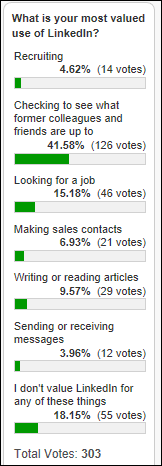
Most poll respondents aren’t using LinkedIn to find employees or jobs, read/publish articles, or exchange messages, but rather to just see what friends and former colleagues are doing. Quite a few don’t use LinkedIn at all. A couple of readers find it useful to prep for the HIMSS conference (to see who works where) or for monitoring competing vendors. Another’s smart job-hunting strategy was to see who previously held the open position to gain knowledge about the company or to look up current and previous employees to understand the technologies they use.

New poll to your right or here: do you think your de-identified patient data is safe from being re-identified?

I received a few responses – some positive, some not — to What I Wish I’d Known Before … Serving on the Board of a Company or Non-Profit.

image

This week’s question involves choosing an EHR consulting firm.

image

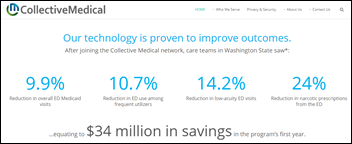
Welcome to new HIStalk Platinum Sponsor Collective Medical. The Draper, UT-based company’s lightweight, interoperable PreManage platform for providers or health plans closes the communication gaps that undermine patient care. Care teams trust it to identify at-risk and complex patients, facilitate collaboration, and provide real-time event notification to improve their outcomes. Hospital care teams get actionable care plan information as well as workflow-driven, point-of-care insights for social determinants of health, prescription histories, and advance directives. Its EDIE (Every ED Instantly) presents information from all ED visits to avoid unnecessary work-ups, cost, and under-informed treatment decision. The company’s nationwide network is engaged by every national health plan, hundreds of hospitals, and tens of thousands of providers. The end result is streamlined transitions of care, improved coordination across diverse care teams, and fewer unnecessary admissions. Thanks to Collective Medical for supporting HIStalk.


Webinars

April 10 (Tuesday) 3:00 ET. “Using Socioeconomic Data, Not Just Demographics, to Create a Healthier Patient Population.” Sponsor: LexisNexis. Presenters: Erin Benson, director of marketing planning, LexisNexis Health Care; Eric McCulley, director of strategic solutions consultants, LexisNexis Health Care. Did you know that 25 cents of every healthcare dollar is spent on health conditions that are caused by changeable behavior? Use of social determinants of health (SDOH) — including information on households, neighborhoods, relatives, and assets — can directly improve care management and risk stratification. However, it’s important to first define what SDOH is and isn’t. A recent LexisNexis Health Care CIO survey found that only 50 percent of organizations are using SDOH data at all, and even then, they have only limited information from their EHR or from patient surveys. The question is: what are you going to do about it? This webinar will reveal the myths and truths that will help you avoid answering, “Not enough.”

Previous webinars are on our YouTube channel. Contact Lorre for information.


Here’s the recording of last week’s webinar titled “Succeeding in Value-Based Care Via a Technology-Driven Approach,” sponsored by Health Fidelity.


Acquisitions, Funding, Business, and Stock

image

An Alabama federal judge rules that 36 Blue Cross Blue Shield insurance plan licensees violated anti-trust laws in creating their longstanding agreements to avoid competing with each other in their respective geographic areas, thus using their clout to reduce competition and raise prices.

A Kaiser Health News investigation finds that drug companies are spending nearly twice as much on patient advocacy groups than direct lobbying, benefiting as group members testify before Congress, organize letter-writing and social media campaigns, and repeat company-issued talking points, all activities that don’t have to be reported as lobbying by the sponsoring company. The American Diabetes Association accepted $18 million of drug company money last year even as those companies repeatedly hiked the price of insulin, often in lockstep with each other.


Decisions

  • Auburn Community Hospital (NY) went live with Philips Interspace Cardiovascular on April 7.
  • Fayette Regional Health System (IN) will switch from Evident to Athenahealth in 2018.
  • Enloe Medical Center (CA) will go live with Epic on April 29.
  • Northern Inyo Hospital (CA) will switch from McKesson to Athenahealth in 2018.
  • MultiCare Deaconess Hospital (WA) will go live with Epic in summer 2018,

These provider-reported updates are supplied by Definitive Healthcare, which offers a free trial of its powerful intelligence on hospitals, physicians, and healthcare providers.


People

image

Gillie McCreath (Oliver Wyman) joins Mazars USA’s healthcare consulting group as principal.

image

The White House hires Adam Boehler (CEO of investor-backed home care vendor Landmark Health) as director of the CMS’s Center for Medicare and Medicaid Innovation.


Government and Politics

image

Texas Agriculture Commissioner and former rodeo cowboy Sid Miller appoints Rick Redalen, MD (self-styled as “The Maverick Doctor”) to the state’s Rural Health Task Force, about which the Austin newspaper observes:

  • Redalen formed software companies ExitCare (patient education, sold to Elsevier in 2012) and Quest Global Benefits (healthcare cost control). He is an advocate for telemedicine, which is offered by the latter company and thus presents a potential conflict of interest.
  • Redalen donated heavily to the campaign of Miller, who wrote, ““I want to thank my good friend, Dr. Rick Redalen (AKA Dr. Maverick) for the wonderful work he is doing in helping educate the people of our country about the threat of four more years of ObamaCare. Rick is recognized around the world for being an innovator in healthcare technology. He is an important advisor to me and my State Office of Rural Health and is a strong supporter of #DonaldTrump.”
  • His medical license was suspended by the medical boards of three states, one of which cited his “psychiatric and drug problems.”
  • Redalen married his 15-year-old former stepdaughter after his wife (her mother) committed suicide. He had pleaded guilty to hitting the mother with a rifle butt and pointing a weapon at deputies, then later was convicted of perjury for lying about the girl’s whereabouts.

Privacy and Security

Steve Long, CEO of ransomware-hacked Hancock Health, is hitting the speaker circuit to provide digital defense advice, presumably to hospitals that, unlike his, (a) haven’t been hacked; and (b) if they were, wouldn’t pay a hacker the demanded ransom and thus encourage further such activity. I might well have done the same if I were in his shoes, but I don’t think I’d feel qualified to advise others.


Other

image

Cardiologist, digital health expert, and HIMSS board member David Scher, MD weighs in on using digital health data for clinical trials, making these points:

  • Some clinical studies have shown that using fitness trackers didn’t deliver the expected weight loss.
  • Few new wearables are being marketed, but existing ones are being used more intensely, such as in his own practice, where Holter monitors have mostly been replaced with wearables.
  • Wearables haven’t had much impact on clinical trials because the information they collect – such as vital signs –- is primitive and mostly irrelevant, not to mention that including wearables makes studies more complicated.
  • Moving wearables into the clinical trials realm will require collecting more information, such as electrolyte levels, hydration, and body temperature.
  • The massive amount of data created by wearables can cause the FDA to scrutinize studies more closely and it’s hard to apply analytics to sort out the data deluge.
  • The cost of clinical trials (and thus the profit of clinical research organizations) will go down in the next 10-15 years as wearables will collect and report information in the background

Vince and Elise cover Athenahealth, EClinicalWorks, and Meditech, which occupy positions #4-6 in their list of top vendors by annual revenue.


Sponsor Updates

  • Logicworks reports record revenue growth as the market for managed cloud services dramatically expands.
  • MedData and PatientKeeper will exhibit at the Society of Hospital Medicine Annual Meeting April 9-10 in Orlando.
  • OmniSYS will obtain access to immunization registries from Scientific Technologies Corporation that will allow pharmacy customers of its Vaccine Management System to improve vaccination rates.
  • Magnolia Regional Health Center CMIO Amanda Finley explains how their Meditech EHR has helped care teams diagnose and treat ED patients.
  • Clinical Computer Systems, developer of the Obix Perinatal Data System, will exhibit at the KY Bluegrass HIMSS Spring Conference April 12-13 in Florence, IN.
  • News: OmniSys and Scientific Technologies Corp. announce strategic partnership
  • Parallon Technology Solutions provides Meditech training and go-live support for Ohio Valley Medical Center and East Ohio Regional Hospital.
  • Experian Health will exhibit at HFMA Oklahoma April 12-13 in Oklahoma City, OK.
  • PerfectServe will present at AONE 2018 April 14 in Indianapolis.
  • QuadraMed will exhibit at the 2018 ILHIMA & MoHIMA Joint Annual Meeting April 11-13 in St. Charles, MO.
  • The SSI Group will exhibit at the Colorado HFMA Annual Conference April 11 in Westminster.
  • Surescripts will exhibit at the OP User Conference April 12-14 in Orlando.
  • Wellsoft will exhibit at the Texas Organization of Rural and Community Hospitals event April 10-12 in Dallas.

Blog Posts


Contacts

Mr. H, Lorre, Jenn, Dr. Jayne.
Get HIStalk updates. Send news or rumors.
Contact us.

125x125_2nd_Circle

What I Wish I’d Known Before … Serving on the Board of a Company or Non-Profit

April 6, 2018 What I Wish I'd Known Before Comments Off on What I Wish I’d Known Before … Serving on the Board of a Company or Non-Profit

That the Robert’s Rules of Order my Dad had occasionally instigated at the dinner table would be so yearned for when pandemonium decimated meetings run by the unaware.


How critical it is to have goals and milestones. We are over a year into a new non-profit and just now getting a board of directors in place. If I had it to do over again, I would sit down at a organizational meeting and put 4-5 big goals on a sheet of paper or electronically with a timeline.


How few of the non-profit board members read the written materials sent before the meeting.


I wish I had known more about the company’s ability to actually focus on, and be accountable to, their strategic mission. This relates to the balance of operational needs, strategic directives/promises, and monitored deliverables.


After being on the executive team of a large hospital and taking up a board spot on a non-profit, I wish I had remembered how little impact (rightfully) the board has on operations. It’s frustrating to offer suggestions and get ignored.


That I would quickly come to hate the comment “we’re all volunteers” as an excuse for why people couldn’t get things done and no one was held accountable.


How complex the interpersonal relationships can be and how much of an impact those interpersonal relationships can have of the function or dysfunction of a board.


How much I would have enjoyed it and how much I learned from a management / leadership standpoint. No kidding. Maybe it’s the non-profit organization itself or the fact that my fellow board members are easy to work with and for the most part share similar goals for the organization. I am going on 12 years serving for this organization in some capacity (eight years on the board) and I love every minute of it. One day I will have to step aside and let another person get as much out of it as I have.


I joined the board of a non-for-profit charity to give back. I didn’t realize just how much giving I’d be doing and what the annual give/get really meant.


I wish I’d known that I’d be working with some other board members who were only on the board because they were busybodies and had no intention of reading relevant documents, including legal depositions, that we needed to make decisions on and vote. Ugh. Never again!


The backstory on infrastructure acquisitions and their political import. Local politics are horrific.


Comments Off on What I Wish I’d Known Before … Serving on the Board of a Company or Non-Profit

Weekender 4/6/18

April 6, 2018 Weekender Comments Off on Weekender 4/6/18

weekender


Weekly News Recap

  • Orion Health Group announces a cost-cutting program and reorganization following release of poor annual results that sent shares down to a 52-week low.
  • The State Department issues an RFI for an EHR following its failed attempts to install Epic as part of the Coast Guard’s halted implementation.
  • GE Healthcare sells its health IT offerings to Veritas Capital for $1.05 billion in cash.
  • Former VA Secretary David Shulkin disputes White House statements that he resigned, indicating that he was fired and thus raising legal questions about President Trump’s right to choose the DoD’s Robert Wilkie as his interim replacement and the possibility of legal challenges of any documents that Wilkie might sign such as the on-hold contract with Cerner.

Best Reader Comments

I would love to see more physicians embracing their role as leaders on a large, heterogeneous care team rather than technicians who operate in isolation and are subject to forces beyond their control. I don’t think many physicians perceive themselves as clinical leaders, but if they did, they could find many resources available that help teach the necessary principles and skills. (Adam K.)

I have to think that the big IDNs like Kaiser Permanente that use Epic and offer genomic testing to certain sectors of their patient population will be doing big things with data mining as more and more people in their populations have their genomes sequenced. If they could get to the point where they had 2 million people with genomic records married with multi-year structured data like what gets captured in Epic, it might be possible to discern some interesting patterns. If you add in the possibility of analyzing the gut biome, too, I have to think that we’ll be seeing an acceleration in discoveries and an improvement in targeting therapies – true personalized medicine. (CanHardlyWait)

National approaches are fraught with dangers to personal privacy and have a predisposition to stifling innovation. There’s also no good way to handle changing priorities – e.g., if a state reduces its opioid problem and has something else more important that it feels it needs to fund, the state approach allows it to focus on their state needs. A federal approach (e.g., like Meaningful Use) tends to be a one-size-fits-all, which we know is not good. Find a way to address these and you’ll find me supportive of national consolidation. What I am in favor of is a national approach to the issue with the ability to share state-level information with minimal cost or impact on workflow. (Joe Schneider, MD)

Interoperability is extremely valuable if done the right way. However, physicians and institutions must first learn to trust each other or the value is diminished. If one facility does a CT, MRI etc. and the next facility insists on repeating the test because they only trust their own techs, there is diminished return with increased patient frustration and patient cost. (Barbara)

The current PDMP process is a bad process. Improvements will only make a better bad process. The logical approach is to scrap the current submission process and move to real time using modern standards submission such as the NCPDP standards. (David)

You would not have to look very far to find some very large healthcare IT vendors being run by teams of middle-aged white men with zero software experience who all come together from company XYZ with light healthcare delivery experience. IV bag and alcohol swab logistics are very important, and while they are in fact delivered, they are definitely not healthcare delivery. Little diversity. Exorbitant compensation. Meager results. And still we wonder why. (ellemennopee87)


Watercooler Talk Tidbits

SNAGHTML17b22394 image

Teacher Ms. E in New York asked for a library of 30 books via DonorsChoose, saying that her kids “have the cards stacked against them because they are minorities from the South Bronx” and asking in her request, “Could you be the ‘somebody’ that helps?” HIStalk readers were indeed that somebody who funded her project. She reports, “Thanks to you, my students are now able to read new books from popular series such as ‘Fly Guy’ and ‘Elephant and Piggie.’ They are spending any free time they have in the classroom reading the books with their buddies and I am so excited that they are now part of our classroom library. Thank you so much for supporting my students. Donors like you are truly the best and we appreciate your generosity immensely!”

image image

Also checking is Ms. F, who asked for take-home STEM activities for hew New Mexico classroom of 48 students. She says, “These math games have been such a fun and exciting addition to our math classroom. When they came in, the kids were amazed and couldn’t wait to play. It is truly a blessing to have supporters that understand that kids should enjoy learning and want to help make it possible. Now that we have learned how to play most of the games in class, I am getting ready to check them out to students to take home and play with their families next week. When I told them that they could borrow the games they were astonished and very excited for the opportunity. Thank you again for making this possible.”

Listening: last year’s solo release from former Megadeth guitarist Marty Friedman, whose music covers more genres than just metal shredding, although he does that really well. His band explodes with energy, especially Kiyoshi Manii, who is one of the most aggressive and technically competent bass players I’ve heard (not even considering that she’s a tiny Asian female). I’m also enjoying the recent reunion of Seattle-based hip hop band Common Market, celebrating the 10-year anniversary of its fabulous album “Tobacco Road.”

image

Forbes notes that Humana has offered to buy Kindred Healthcare’s home division for $800 million as Humana itself is rumored to be the subject of acquisition talks with Walmart. If both transactions go through, that would allow Walmart to extend beyond the walls of its pharmacies and retail clinics into the homes of patients.

image

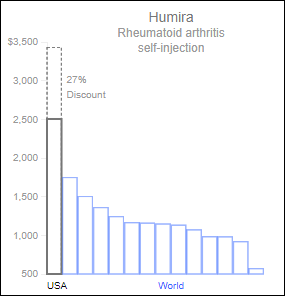
Drug maker AbbVie buys itself five more years of monopoly pricing for the  world’s top-selling drug Humira, paying off a second company to refrain from marketing a cheaper version. Humira’s price has increased from $19,000 per year in 2012 to $38,000 today, generating annual sales of at least $18 billion. US patients pay multiples more than those in other countries, of course, nearly triple what those in France, Japan, and Norway are charged.

image

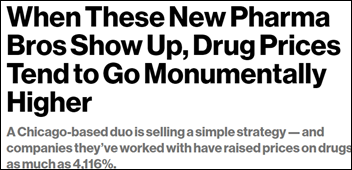
Also related to drug pricing: Bloomberg notes the success of a pair of Chicago consultants who teach drug companies the tricks needed to raise their prices by up to 4,000 percent. Their recommended methods include pressuring health plans to keep paying, using specialty pharmacies, covering patient co-pays, use analytics to find insurance policy holes that will support price hikes and to target likely prescribers, and providing big bonuses to aggressive salespeople. The consultants started as executives for a struggling drug company that has raised the price of one product from $500 to $2,500 in five years, earning the company’s CEO a single-year payday of $93 million. 

image

Surgeons at Memorial Hermann ask a brain surgery patient to play her flute during the operation so they could tell if they had fixed her hand tremor problem, which they did.

image

This seems entirely pointless, yet something Millennials would pay for. Lydian Dental offers concierge dentistry serviced out of designer RV-like clinics on wheels in trying to make dentist trips “fun.” The oh-so-hip design team also specified staff uniforms of workout pants and tee shirts bearing quippy phrases (“all up in your grill” and “nice mandibles”), instruments that remain hidden until needed, and iPads with Dre Beats headphones. The target market of the four-clinic company is clear given its smug use of insufferable hipster terms such as “aspirational,” “curate,” “touchpoints,” and their hope to “transform a transaction into an experience.” They will probably succeed – recall that endless studies have shown that Millennials don’t care how restaurant food tastes, it’s how enviable it looks when posted to Instagram that keeps them coming back.

Bizarre: a woman takes an Ancestry.com DNA test that predicts a “parent-child” relationship with the former OB-GYN who had treated her parents for infertility. The doctor had suggested a fertility procedure in which the mother would be inseminated with a mixture of sperm from her husband and a donor who met their specifications for height, eye color, and hair color. Apparently the doctor decided that the ideal donor was himself.


In Case You Missed It


Get Involved


125x125_2nd_Circle

Comments Off on Weekender 4/6/18

Morning Headlines 4/6/18

April 5, 2018 Headlines Comments Off on Morning Headlines 4/6/18

Jamie Dimon Lays Out JPMorgan-Amazon-Berkshire Health Care Priorities

JPMorgan CEO Jamie Dimon provides shareholders high-level details about the employee healthcare venture the company is undertaking with Amazon and Berkshire Hathaway.

Facebook sent a doctor on a secret mission to ask hospitals to share patient data

Facebook reveals it considered embarking on a research project with several hospitals that would have combined anonymized patient data with its user data to pinpoint patients in need of care.

London doctors protest over NHS smartphone ‘video appointment’ service

GPs in London protest NHS England’s decision to offer patients text-based care via the Babylon Health-powered GP at Hand app, the use of which automatically de-registered users from their local NHS surgery.

Comments Off on Morning Headlines 4/6/18

News 4/6/18

April 5, 2018 News 5 Comments

Top News

image

JPMorgan CEO Jamie Dimon provides shareholders high-level details about the employee healthcare venture the company is undertaking with Amazon and Berkshire Hathaway. He notes that “high deductibles have barely worked” to improve costs and outcomes.

A bipartisan group will “start very small” in working on issues that include:

  • Aligning incentives since the US has the “highest costs association with the worse outcomes”
  • Studying the cost of waste, administration, and fraud
  • Giving employees ownership of their healthcare data to allow them to make better choices and offer them telemedicine options
  • Developing wellness programs, especially around obesity and smoking
  • Investigating why use of expensive drugs are under- and over-utilized
  • Examining the cost of providing end-of-life care

Judging from these and prior comments, Dimon seems to be much less knowledgeable and motivated than Bezos and Buffett and his leg of the stool is the weak one with the most to lose from disrupting the status quo. I wouldn’t necessarily assume that his description of the plan is how it will play out, nor would I rule out Amazon and Berkshire going individually further than the combined venture.


Reader Comments

image

From Not from Monterey: “Re: GE exiting health IT. Does that mean that existing GE/IDX customers will now be dealing with Veritas Capital rather than GE? If so, what does that mean for the future of GE/IDX?” I would expect Veritas to create a new company and name for its acquisition like they did with the Thomson Reuters business (renaming it Truven Health Analytics). GE will surely want its name off everything and Veritas probably has equal but different incentive to downplay the GE connection (every year it’s GE Healthcare and Allscripts vying for “worst vendor” in the HISsies voting). I don’t see much future for the aging, GE-mismanaged product line, so I’m assuming Veritas will just milk the maintenance fees until everybody transitions off the products. The one bright spot is the former API Healthcare, which GE has had only four years to screw up. If I were Veritas, I’d make that labor management software business its own company since it’s the only part of the portfolio that’s likely to generate acquisition interest down the road.

Trivia: according to Vince, this is the second time that GE has bailed out of health IT, the first being in 1971. Some of its acquisitions – again, per Vince – were Loral (renamed to Centricity PACS), Marquette Medical (renamed Centricity Perinatal), Per-Se (Centricity RIS), ORMIS (Centricity Perioperative), BDM (Centricity Pharmacy), MedicaLogic (office EMR), Millbrook (office PM), Triple G (Centricity Lab), and IDX (Flowcast, Groupcast, Carecast, and Imagecast, all renamed to Centricity, including the former PHAMIS product that IDX had acquired). Vince called the shot in his 2013 review of GE Healthcare:

We estimate GE has fallen several positions since their post-IDX peak. They even sold their RX system back to BDM in March! Is it the start of a second retreat from the HIS biz?


HIStalk Announcements and Requests

image

It’s the wind-down of this week’s “Wish I’d Known” question, so answer now and you’ll see your comments in this weekend’s recap.


Webinars

April 10 (Tuesday) 3:00 ET. “Using Socioeconomic Data, Not Just Demographics, to Create a Healthier Patient Population.” Sponsor: LexisNexis. Presenters: Erin Benson, director of marketing planning, LexisNexis Health Care; Eric McCulley, director of strategic solutions consultants, LexisNexis Health Care. Did you know that 25 cents of every healthcare dollar is spent on health conditions that are caused by changeable behavior? Use of social determinants of health (SDOH) — including information on households, neighborhoods, relatives, and assets — can directly improve care management and risk stratification. However, it’s important to first define what SDOH is and isn’t. A recent LexisNexis Health Care CIO survey found that only 50 percent of organizations are using SDOH data at all, and even then, they have only limited information from their EHR or from patient surveys. The question is: what are you going to do about it? This webinar will reveal the myths and truths that will help you avoid answering, “Not enough.”

Previous webinars are on our YouTube channel. Contact Lorre for information.


Acquisitions, Funding, Business, and Stock

image

Welltok raises $75 million in a second Series E round, bringing its total to $252 million.

image

Care coordination software company SCI Solutions acquires patient engagement vendor DatStat for an undisclosed sum. SCI acquired competitor Clarity Health Services in 2015.

image

Virta raises $45 million in a Series B funding round. The San Francisco-based company has developed a clinical treatment and continuous remote monitoring technology for the prevention and reversal of type 2 diabetes.

Microsoft assures customers it will not engage in joint technology ventures with them and then set up competing businesses. It cites as an example 365mc Hospital in South Korea, which has partnered with Microsoft to develop motion-tracking AI software to improve surgeon performance.

A newly filed Allscripts 8-K SEC form seems to say that Netsmart will acquire Barista Operations from Change Healthcare for $168 million. I take to mean the former McKesson Homecare software system that was sent to Change Healthcare as part of McKesson’s technology business.


People

image

Diameter Health hires Kim Howland (Omnicell) as chief product officer.

image

Digital therapy vendor Vida Health hires Randy Forman (Livongo Health) as chief commercial officer.


Sales

image

Kern Medical (CA) chooses Cerner Millennium and HealtheIntent. I assume they are replacing Medsphere OpenVista.


Announcements and Implementations

image

Mercy Technology Services launches a VMware-powered healthcare cloud for hosting EHRs, imaging systems, and office applications. 


Government and Politics

image

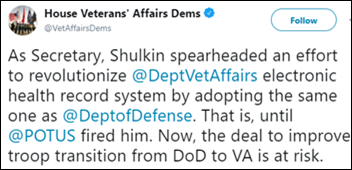
Veterans groups voice their lack of confidence in acting VA Secretary Robert Wilkie and his ability to keep the yet-to-be signed Cerner contract on track.

image

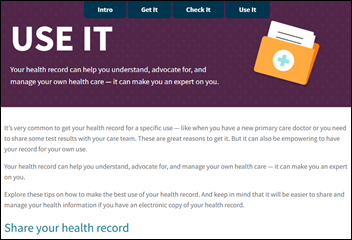
ONC publishes a consumer-friendly guide to obtaining and using digital health records.


Privacy and Security

image

Virtua Medical Group (NJ) will pay $418,000 to settle allegations that it exposed medical records of 1,650 patients. Discovered during a patient’s Google search, the exposure occurred when the group’s transcription company, Best Medical Transcription, misconfigured its server, allowing the records to be accessed via FTP site without a password.


Other

A NEJM op-ed piece says we may be approaching the limits of how much impact changes in process, culture, and narrowly-focused technology can have on patient harm, suggesting that AI-powered computer vision – such as that used in Google’s experiments with self-driving cars – could improve the screening of medical images, evaluate patient mobility, and monitor handwashing compliance.

image

GPs in London protest NHS England’s decision last fall to offer patients text-based care via the Babylon Health-powered GP at Hand app, the use of which automatically de-registered users from their local NHS surgery. Patients are now attempting to re-register, creating extra work for clinicians who also feel the app “cherry picks” healthier, less-costly patients. Babylon Health, meanwhile, has signed a deal with Chinese Internet technology vendor Tencent to incorporate its virtual care tools into WeChat, a social messaging app with 1 billion users.


Sponsor Updates

  • CoverMyMeds partners with McKesson Specialty Health to develop ExpressCoverage prior authorization and medication management services.
  • EClinicalWorks will exhibit at ASCA 2018 April 11-13 in Boston.
  • The HCI Group publishes a new white paper, “Managed IT Services for Healthcare.”
  • PatientSafe Solutions will deliver infectious disease alerts from its integration with the technology of Merck subsidiary Ilum Health Solutions.
  • Healthgrades partners with other Denver tech companies to launch the Colorado Technology Recruiting Coalition.
  • Healthwise will exhibit at the EClinicalWorks Innovation Summit for Enterprise and Urgent Care Customers April 9-11 in Fort Lauderdale, FL.
  • Paula Anthony joins Huntzinger Management Group affiliate Next Wave Health Advisors.
  • InstaMed’s External Payment Page Integration is now available in the Epic App Orchard.
  • InterSystems and Intelligent Medical Objects will exhibit at NetSmart Connections 2018 April 8-11 in Phoenix.

Blog Posts


Contacts

Mr. H, Lorre, Jenn, Dr. Jayne.
Get HIStalk updates. Send news or rumors.
Contact us.

125x125_2nd_Circle

EPtalk by Dr. Jayne 4/5/18

April 5, 2018 Dr. Jayne 2 Comments

I appreciated this article shared on Twitter earlier this week by Farzad Mostashari. He noted, “This particularly resonates – much of the physician anger and burnout is due to cognitive dissonance between how to make a living & doing what they know would be better for patients.” Although the article deals with the larger issue of fee-for-service vs. fee-for value, many of us deal with the micro versions of this on a daily basis. It’s more than just being caught between two payment models. We deal with countless requests for medications and tests that are of questionable value, but are caught between ordering the requested therapy and risking poor patient satisfaction scores that might impact our livelihood, or potentially risking outright patient anger.


In my current clinical situation, I don’t receive any financial boost from ordering more tests, but there is a perceived reduction in medical liability when more tests are ordered. This is common in emergency medicine and urgent care, as we are less able to rely on our knowledge of the patient and their history as we evaluate a problem. There is a pressure to practice defensive medicine that is independent of the compensation issues (although one could argue to that a lawsuit would be financially devastating, so there is indeed a financial reason to practice defensive medicine.)

I would love to be able to sit and explain to patients what they need to do to be well, or avoid injuries, or why they don’t need a medication or a CT or any other testing. However, since coding needs to be accurate and undercoding is as inappropriate as overcoding (at least according to the compliance audits I’ve had at my last three employers), that would mean that I should bill the time spent under the appropriate “counseling and coordination of care” code — which would likely be perceived as padding my bill — vs. billing a less-costly visit for a “treat ‘em and street ‘em” approach.

In this situation, how do you quantify the value of a physician sitting with you and counseling you? The reality is that this service isn’t valued in our current healthcare paradigm. Such interpersonal interactions are now to be delegated to ancillary providers in a team-based approach to care. However, the physicians are now financially liable for the results and outcomes of those patient interactions along with other treatment strategies.

This puts a tremendous amount of pressure on clinicians, regardless of where they fall on the care team. Being liable for the behavior of others is something that most of us are only willing to assume through the bonds of marriage or parenthood. In my community, this assumption of responsibility is one of the prime reasons that clinicians are resistant to value-based care. The article notes that, “many physician organizations have concentrated their energies on maintenance of the fee-for-service status quo, rather than providing a unified professional focus on improving health and creating value.” Although I don’t doubt that this is a real phenomenon, I’m not seeing it in the primary care organizations I’m working with.

I wholeheartedly agree that if you’re ordering more tests or drugs or whatever because it increases your reimbursement and not because it’s the right thing for the patient, you’re doing it wrong. But in real life, there is a fine line involved in figuring out what the right thing is for the patient. What do you do with the 88-year-old diabetic who might live another 10 years? How aggressively should you treat their diabetes? Do they need multiple medications or should they be allowed to relax their diet in their remaining years? Can their medications be reduced to save money in a fixed-income situation? There’s not a lot of data out there for patients in this age group, so how do you apply the evidence?

It’s not easy to point at a given clinician and discern their motives for a particular course of care with a particular patient. Perhaps in this situation, the patient’s spouse is significantly ill, the relatively healthy patient is the primary caregiver, and being aggressive makes sense because there are actually two patients in the picture. Or perhaps this patient has other issues, such as dementia, that might impact treatment and might make a relative “undertreatment” the better option. Unfortunately, our current understanding of data sometimes lumps these patients in the same category. Are you undertreating because it’s the right thing to do for the patient, or because spending less will give you a bigger bonus? Are you overtreating because the patient is demanding it, or because getting lower hemoglobin A1c scores gives you a bigger bonus? These are the forces that are shaping physician-patient interactions across the country and also shaping the data requests and dashboards that they’re requesting from the IT side of the house.

In addition to evolving physician sentiments about value-based care, we need a wholesale cultural program to educate patients and families about the cost of care and what they can do for themselves at low cost and with high return. It’s not as simple as enrolling patients in high-deductible health plans and expecting them to be able to sort it out. We expect patients to be educated consumers, but we don’t provide the level of education needed to really change behaviors. Patient advocacy organizations and patient engagement movements help, but there is just such a tremendous need.

Our state recently voted to require CPR training prior to high school graduation. Additionally, I’d love to see the state-required health classes include material similar to what is taught in the state-required personal finance class. Let’s talk about the future value of money vs. the future value of health in the context of preventive medicine. We teach students how to write a check – let’s teach them how to read an Explanation of Benefits document. Let’s teach them what a deductible is and how in-network and out-of-network works before they wind up with unanticipated medical bills that set them up for medically-related bankruptcy.

If we’re going to ask physicians to completely reject fee-for-service medicine as the article suggests, then let’s make sure we’re setting the system up for success. Not just with their patients, but with the value-based care scoring system. I recently worked with a practice that is coping with state and payer requirements that are just different enough from the MIPS-related clinical quality measures that they can’t use their certified EHR for reporting. They’re having to pay a not-insignificant amount of money to have custom reports created, as is every other practice that plans to participate in these programs.

What waste. Wasn’t the Meaningful Measures initiative supposed to help with this? After watching what this practice is going through, and knowing there are many other organizations in the same boat, I’d like to see rulemaking to halt the promulgation of any more programs like this until they’re brought into alignment with a single set of standards. That might actually get the naysayers on board as we work towards one set of common goals rather than multiple paradigms.

This is an exciting time to be in healthcare IT because we have the power to engineer solutions to help solve some of these problems. If you’re in industry, you have the potential to streamline workflows and put data at the point of care so all of the clicking becomes meaningful, but it might take some money that would make shareholders say “hmmm.” If you’re on the operations or health system side, you have the power to financially incentivize your providers to embrace value-based care, but it’s going to take boldness and bravery. If you’re a provider, you have the knowledge to research the evidence and determine whether you’re in the new game or not. And if you’re a patient, you have the opportunity to vote with your feet and your pocketbook if you want to embrace value.

It will be interesting to see what the next few years hold. There will be ups and downs. but if nothing else, it’s guaranteed not to be boring.

What do you think about payment and delivery model changes? Is your technology keeping up? Leave a comment or email me.

Email Dr. Jayne.

Morning Headlines 4/5/18

April 4, 2018 Headlines Comments Off on Morning Headlines 4/5/18

Welltok Raises $75 Million in Funding

Consumer health tech company Welltok raises $75 million in a second Series E round, bringing its total funding to $252 million.

One vets group wants President Trump to rethink acting pick

Several veterans groups express a lack of confidence in acting VA Secretary Robert Wilkie and his ability to keep the yet-to-be signed Cerner contract on track.

SCI Solutions Acquires DatStat to Lead Digital Patient Engagement

Care coordination software company SCI Solutions acquires patient engagement vendor DatStat for an undisclosed sum.

Comments Off on Morning Headlines 4/5/18

Readers Write: Will PDMPs Remain a Vital Tool in the Opioid Response, or a Costly Burden?

April 4, 2018 Readers Write 2 Comments

Will PDMPs Remain a Vital Tool in the Opioid Response, or a Costly Burden?
By David Finney

David Finney is a partner with Leap Orbit of Columbia, MD.

image

New battle lines are being drawn in an important corner of the nation’s broad fight to control the opioid epidemic. Health IT professionals should sit up and take notice.

Much quiet maneuvering has been taking place for months, particularly among a number of large and well-connected technology vendors sensing a windfall. But with the recent signing into law of the $1.3 trillion federal omnibus spending package, the debate about what the future should look like for prescription drug monitoring programs (PDMPs) has burst into the open.

PDMPs — which are state-based systems for tracking and analyzing the prescribing and dispensing of controlled substances — have existed in some form for a century. Over the last 10 years, they have become more technologically sophisticated and are frequently pointed to as a critical (and mostly non-controversial) tool in the opioid response. Today, 49 states, the District of Columbia, Puerto Rico, and Guam have established PDMPs, while in Missouri, a PDMP instituted by St. Louis County serves most of the state’s population.

In an increasing number of states—over 30—clinicians and pharmacists are required by law to check their PDMP prior to prescribing or dispensing any controlled substance. Though enforcement is so far minimal, failure to do so could result in suspension or loss of license. Among other emerging techniques, many states now also send unsolicited reports to prescribers, using PDMP data, demonstrating that their prescribing habits are outside the norms for their specialty.

The federal government has encouraged these policies with a steady and increasing stream of grant funding to states to cover software development, licenses, and IT staffing. Not surprisingly, the private sector recognized the opportunity. Appriss, a private equity-owned firm that got its start helping states monitor sex offenders, has been the chief beneficiary of this flow of government dollars achieving a near monopoly in the state PDMP market by, among other things, acquiring its two largest competitors.

With 42 state contracts, Appriss has done what monopolists do, bidding up contract prices and seeking to monetize every aspect of the data it controls. Given the commitment by states and the federal government to “do whatever it takes” to address the opioid epidemic—including supporting PDMPs with ever-increasing grant funds—PDMP administrators may grumble, but otherwise few people have stopped and taken much notice.

Few, that is, except for several large healthcare and technology interests (increasingly those are one and the same) and the Washington lobbyists who work for them. Acting no doubt out of a genuine desire to positively impact the opioid epidemic, and also sensing a business opportunity, these interests have quietly been pushing Congress and the Trump administration to rethink the federal government’s traditional support of PDMPs and “modernize” them.

How to do this? By awarding tens, if not hundreds, of millions of dollars in new federal contracts to one or a small number of firms to facilitate the flow of PDMP data at a national level. This new network would leverage existing prescription data feeds that support e-prescribing and third-party payment. Initially, this network might complement and enhance state PDMPs, but in the longer term, it seems likely to make them redundant.

By all indications, the federal omnibus spending bill and subsequent signals from federal officials and lobbyists seem poised to deliver on this new model. Not surprisingly, Appriss is worried. In recent weeks, it has launched a marketing campaign of its own to highlight the benefits of the current state-based approach to PDMPs and the interstate gateway it developed in collaboration with the National Association of Boards of Pharmacy.

Why should health IT professionals care? Frankly (and functionally), whether the nation continues with a states-based model for PDMPs or a federal one probably won’t make a big difference to end users at hospitals, ambulatory practices, retail pharmacies, or other healthcare facilities. The more timely data offered by the federal model may offer some marginal benefit, but states have already been moving in that direction. In either case, though, the outcome is likely to hit the bottom lines of these organizations in a big way.

Already, as prescribers and dispensers are required by law to consult PDMP data, their IT departments face pressure to deliver the data to them in more workflow-friendly ways. Appriss has gladly obliged by presenting hospitals and health systems across the country with steep per-user, per-month fees to access the data it controls via its state contracts via APIs or single sign-on. These fees can reach seven figures per year for some health systems. A federally facilitated approach is likely to look no different—it would use established e-prescribing networks, whose business models are well known, to deliver PDMP data into the workflow. What all of these businesses likely understand is that the last mile into the prescriber and dispensers’ workflow could be the most lucrative aspect of PDMPs.

A few states are attempting to buck these powerful forces. They take the view that PDMPs are a public utility, and as such, PDMP data should be widely and democratically made available to anyone who has an appropriate use for it. In Maryland, Nebraska, and Washington, this has meant collaborating with a statewide health information exchange to publish open APIs and support a range of standards-based integration techniques for bringing PDMP data into the workflow. California’s PDMP, with support from the legislature, is also in the midst of an ambitious initiative to make open APIs available to all of the state’s healthcare institutions.

These states support a nascent ecosystem of third-party technology providers and system integrators that are inventing new ways to present PDMP data to those who need it, when they need it. Companies—and I count my own among them—are demonstrating real innovation that can make a difference in fighting the opioid epidemic. The earnest competition also keeps us honest and hungry and should ultimately drive down cost. If more take notice, these states may present an alternative to the models being pitched by more powerful interests.

HIStalk Interviews Mark Savage, Director of Health Policy, UCSF’s Center for Digital Health Innovation

April 4, 2018 Interviews 1 Comment

Mark Savage, JD is director of UC San Francisco’s Center for Digital Health Innovation in San Francisco, CA.

image

Tell me about yourself and what the Center for Digital Health Innovation does.

I am the director of health policy at the Center for Digital Health Innovation at UC San Francisco. The Center, in some ways, connects a lot of different parts at UC San Francisco, both on the academic side and on the medical center side, trying to build in digital health and innovation within digital health.

Folks may not know this, but UC San Francisco has a deep history in the precision medicine initiative, well before President Obama announced it in his State of the Union. UC San Francisco has done a lot of work on HL7 standards, before the Meaningful Use Program, and the 2015 edition of Certified EHR Technology. We’re one of the top-ranked medical centers in the nation, according to US News and World Report.

We have an interesting mix of delivery systems. We have a medical center, but we also staff the county hospital for the underserved here in San Francisco County and we also staff the veterans’ hospital. We’re a part of an accountable care organization. We bring in lots of different perspectives, bringing together the quality and evidence-based approach of a leading research university.

The Center for Digital Health Innovation works at the center of that to try to build some of that research and effort into systems that can be used by the nation, and indeed the world, going forward.

What was the reaction to your blog post that said EHRs will never be a comprehensive health record as some vendors have claimed?

There’s a lot of people who say, “Yes, that’s exactly what we need. That’s exactly what I believe.” Our blog said “connected health record” and that we’re not alone in thinking that way. We’ve seen from the responses that, indeed, we’re not alone.

I’ll speculate that it’s because that is indeed what the nation needs. We need to be connected. That’s why there’s so much focus on interoperability, as we said in the blog. Standalone EHRs are not meeting the national imperative. Interoperability is a national imperative, according to Congress and the 21st Century Cures Act, and that’s because they need connected health records.

A complete electronic health record and a connected health record are not mutually exclusive. Somebody was saying to me the other day, is it a comprehensive health record or a connected health record? Those aren’t mutually exclusive. You get to the comprehensive and complete health record by being interconnected with all the other sources. I realize from the blog title that sometimes people might think it’s one or the other, but really it’s the connections, the learning health system, that gets us to the true national completeness.

Our complicated health system results in patient information being scattered all over the place. How much of the problem is due to technology rather than it being a reflection of a system that isn’t very logical?

Let me back up even just a little bit further. We are in the midst of some pretty significant systems change and culture change in health information exchange in the United States today. The HITECH Act in 2009 launched us on an absolutely necessary trajectory, an overdue trajectory. So many other parts of our national landscape, our daily lives, are electronic. Finances, commerce, voting, education. But at the time, not really health information and healthcare. So Congress passed the HITECH Act and we have moved a long way in the past nine years, with adoption rates going from, say, 10 percent to around 90 percent.

We know from systems change in other major industries in the country that it’s not perfect. It doesn’t go as smoothly at the beginning as we would like. But that is the nature of building an interstate freeway system or building a national water system. Those kinds of things take some time at the beginning.

That’s in part what’s going on now. We are transitioning to an electronic health information exchange system. It’s not just the technology. It’s not just the logic. It’s trying to bring those things together.

Congress has talked about interoperability because there needs to be better connectivity among the systems. Our lives, our health, our healthcare, and our health data are in motion. We need the connections among those different systems in order to provide the care that people need. And actually, to back up, from treating people at the point of, say, the emergency room and moving more towards prevention and wellness.

Were you surprised by the emphatic announcement at the HIMSS conference by Seema Verma and Jared Kushner that providers have to give patients timely access to their data?

I didn’t have any advance notice that Jared Kushner would be there, but the things that they said are imperative. They’re necessary. Patients and individuals need access to their health data. They have a right to it under HIPAA.

In my career, I’ve been pushing for that for quite some time, both at the policy level and at the implementation level, including building in the capacity to view, download, and transmit one’s health information in the Meaningful Use Program and now the Advancing Care Information piece under MACRA. The innovation in the 2015 Edition of Certified EHR Technology to say that patients also ought to be able to have access through applications using application programming interfaces—the kinds of applications that people are using every day on their smartphones.

Health information exchange is finally catching up with the way that the real world is working for consumers and individuals in the rest of their lives. This is absolutely important. We’ve been pushing for that for a long time. Those kinds of statements meet a need. They speak to it. They speak to a need that patients and consumers have.

I very much look forward to seeing the details of that, though, because I will say that most of the advances that I have seen so far for the reality of patient access to their health information has come through the 2015, the 2014 Edition of Certified EHR Technology, and the Meaningful Use program now under MACRA. Those are the programs that these same announcements said are going to be rolled back. The details will be important. We have to make sure that those capacities remain in place so that patients have genuine access to their health information.

Joe Biden’s op-ed piece says HHS should crack down on providers who won’t give patients an electronic copy of their information within 24 hours of their request. How should the federal government define information blocking and what should they do to eliminate it?

The definition of information blocking is pretty complicated. It gets into a lot of different legal requirements that are already out there. Providers and technology vendors are obliged to comply with the law.

If you don’t mind, I’ll flip around not to focus on information blocking, but to focus on the affirmative. How do we help ensure that there is information flow? That’s one of the major reasons for the blog talking about connected health records — to get people into the mindset of thinking that they don’t just hoard or lock up or collect everything in their own respective electronic filing cabinets, but instead, think about this as the teamwork that it really is.

No one doctor knows everything about a patient. We have referrals to specialists all the time. We end up in emergency rooms and in hospitals when the unexpected happens. We go to laboratories. We go to pharmacies. We travel. Sometimes our care is provided in a state or a nation that’s far from home. We have a teamwork understanding and approach to healthcare, and now with the focus on precision medicine and genomics, we are thinking about how even more pieces of the healthcare system should be working together as a learning health system.

That requires connections and a connected health record for us to move forward. Something as simple as shared care planning, for example, between a doctor and her patient. You have family caregivers. You have these different pieces. We need an electronic platform where each of the members of the care team can plug in the new pieces of information and everybody gets that communication, understands what the change is. Everybody is on the same page and the data are updated seamlessly. That is information flow.

From that perspective, if we’re thinking that way, we don’t really need to be thinking about information blocking any more, because we’re not trying to hoard the data, we’re trying to improve the patient’s care.

What are the challenges in making that happen technically as well as presenting the information to avoid overwhelming a provider?

One of the key things to do is to make sure that certified EHR technology goes into effect quickly. The API access that I was talking about earlier, so that people can access their health information through their smartphones and can use it to make decisions about their health and care. That was supposed to go into effect no later than January 1, 2018, but it was delayed by another year to January 1, 2019. We can’t be putting off the very thing that will make access for patients and individuals much easier and help them to share their information with people who are responsible for their care.

We also need to be building in what you might call bi-directional access. This is not just one way access to health information. Patients have a lot of important information to contribute. Even things as simple as letting the doctor know, did the patient get better or worse after the doctor’s visit?

I remember being at an AMIA policy conference, maybe four years ago, and somebody said from the back, “You know, the single most important piece of information that is missing from the electronic health record is whether the patient got better or worse. That’s the fundamental outcome.”

That’s a good example of what is not a connected health record, where you don’t have the connection between the information that the doctor has and the information that the patient has. That critical information. We need to be building in patient-generated health data. The ability for patients to get key data to doctors, because doctors need access to that data, too. Access is not just a one-way issue. Doctors are missing access to very important information and that connected health record is a way to make that possible.

What incentives will encourage organizations to share that patient information in a central manner and then bring in the patient-reported information for their own decision-making?

When Joe Biden has spoken from the stage about the situation, his personal experience, he talked about how the information should have flowed and did not. When a patient is in an emergency room, the patient should not have to worry about whether one provider or another is thinking competitively about whether they’re going to disclose the health information needed in order to make sure that no allergies are suddenly triggered or that no unnecessary and dangerous tests are ordered. We cannot be thinking that way around people’s health. Patients do not expect that. Consumers do not want that.

I understand what you’re saying, that people are thinking around business models. But the national imperative around healthcare is one where we’ve got to be working together. That’s why the HITECH Act was passed back in 2009. That’s why Congress worked very hard to align incentives and created an incentive program where doctors said, yes, they would accept the incentives in order to adopt and use, meaningfully, for the benefit of patients and the nation, electronic health records, and that it’s not OK to hoard data. I’m not speaking to the important point of preserving privacy and security of health information, but sharing for purposes of treatment, payment, operations, public health, and individual access in a private and secure way. Absolutely that’s what must be happening.

Text Ads


RECENT COMMENTS

  1. It doesn't look like much more than a computer facing a wall!!

  2. Really interesting perspective — especially around the EHR market. What I’m seeing lines up with this: Epic keeps consolidating, Oracle/Cerner…

  3. Why does the displayed "exam room of the future" still have the classic "clinician has their back to the patient"…

Founding Sponsors


Platinum Sponsors


Gold Sponsors


RSS Webinars

  • An error has occurred, which probably means the feed is down. Try again later.