Recent Articles:

Curbside Consult with Dr. Jayne 5/5/25

May 5, 2025 Dr. Jayne Comments Off on Curbside Consult with Dr. Jayne 5/5/25

An article that was published in the Journal of the American Medical Informatics Association this week addresses the realities of primary care staff members trying to manage the ever-growing volumes of EHR inbox messages. The research was done using qualitative methodology, including focus groups and observations at four academic primary care clinics. The output of those sessions was analyzed and coded into different themes. The study was small, with three nurses and nine medical assistants included. The authors highlighted key themes in the abstract: “Staff described inbox work as fragmented, feeling like an assembly line, requiring frequent communication with other team members to clarify and manage tasks, and requiring navigation of expectations that varied between patients, clinicians, and clinics.”

As someone who has spent a great deal of her career working on process improvement projects, I can feel in my core how the staff must have been trying to articulate a day in the practice. I’ve been around since the pre-EHR world and would note that some of these feelings are not unique to managing an EHR inbox. When we managed paper-based phone messages, we had a lot of these same issues, with the additional problems of having delays in messaging due to having to pull the chart from the file room, or even profound delays when the chart couldn’t be found because it was in a pile on the physician’s desk, their floor, or possibly even in their car or at their home. Working messages in the EHR is certainly faster, which makes one think of the old adage about how technology just makes a bad process go faster.

Seeing these results makes me wonder how much process improvement work the organization did alongside the EHR implementation. Did they spend resources to look at unnecessary process variation and make an effort to try to streamline workflows? If they did, what was the plan for sustaining those changes over time and not allowing the processes to drift back to individual ones?

In a group practice environment, it can be challenging to meet everyone’s needs when each clinician or care team is doing their own thing, and this study seems to illustrate that. The authors noted that there were some protocols available to those working the inboxes, so it sounds like there was at least some work in that regard. They also noted, though, that staff had to address messages that contained information that conflicted with the medical record, which required additional work. We had those issues in the paper world as well, especially when patients called about lab or imaging results that had been done elsewhere and we might not have had a copy at the ready.

In the background section of the article, the authors note that primary care physicians often spend an hour or more managing the inbox for every eight hours of patient care delivered. They also comment that primary care clinicians tend to receive more messages than other specialties and as a result have a higher time burden for inbox management. Not surprisingly, they’re often among the most burned out clinicians. As a result, many organizations are delegating some of this work to support staff, with this concept being studied less than physician work in the inbox, hence the need for this type of research.

The work was done at UW Health, which is affiliated with the University of Wisconsin-Madison, and looked at two general internal medicine clinics and two family medicine clinics. The article notes that they focused on adult primary care practices because those clinicians “receive more inbox messages than pediatricians or physicians in other specialties,” which caught my attention. I think we sometimes think that parents make a lot of calls to their pediatricians’ offices, but I suppose that’s more of a perception and not a reality.

The authors used EHR metadata to identify sites where support staff users were helping manage the inboxes based on functions such as pending medication orders during refill requests for controlled substances. This measure was selected because managing those refills is complex, but uses protocols so that staff can review the chart and pend orders for clinician review. They identified sites with high and low levels of this workflow in order to diversify the sample.

Due to the small number of clinics participating, the number of respondents was low, with some sites having only one medical assistant and one nurse participate, and other sites having three medical assistants but no nurses participate. The most common workflow was where messages sent to clinicians would go to the staff pool rather than directly to the clinician. Members of the pool would then either manage the message or forward it on to a clinician based on protocols.

Some of the fragmentation themes weren’t unique to an EHR workflow, such as being interrupted to bring patients back to exam rooms while also trying to manage messages or having to float to another clinic to cover a staff shortage. Another in that category was the fact that different physicians had expectations that the protocol shouldn’t be followed for their patients, which is not an EHR issue but an operational and clinical quality one. Others were unique to EHR work and particularly pool work,  such as refill requests, coming in through multiple pathways (phone, pharmacy interface, patient portal) leading to three different staff members unknowingly working on the same task.

One of the themes in particular caught my attention, that of limited control, with a staff member commenting, “They made these teams without… asking about how we felt about it.” One of the key tenets of any change management project is to identify stakeholders and understand where they’re coming from. If you don’t do this, it’s nearly impossible to define the “what’s in it for me” needed to support a change management campaign.

There’s a chance that this was done early in the process change, but the people who made the decisions are no longer with the practice. Based on some of the projects I’ve recently seen, there’s also a chance that supervisors made the decisions without discussing with frontline staff. Although that kind of effort can make a project go faster, it’s rarely the right answer for long-term success or happiness of the end users.

The authors note “several fruitful directions for future research,” but I’m more interested to learn what the organization is doing with the information that was uncovered through this study. Have they expanded efforts to collect data from a broader segment of the staff, or looked at experiences in more clinics? Have they compared the protocols from site to site to identify areas of unwarranted variability? Is anyone addressing physicians who are telling staff not to follow an agreed-upon protocol? The devil is in the details for all of those elements when trying to move forward with positive change. If you’ve got the scoop, I’d love to hear from you and of course can keep any comments anonymous.

What do you think is the most successful intervention to reduce inbox burdens for support staff members? Leave a comment or email me.

Email Dr. Jayne.

Comments Off on Curbside Consult with Dr. Jayne 5/5/25

Readers Write: Virtual CISOs Bring New Hope to Orgs Without Dedicated Cybersecurity Officials

Virtual CISOs Bring New Hope to Orgs Without Dedicated Cybersecurity Officials
By Ryan Finlay

Ryan Finlay is principal chief information security officer, advisory services, at CereCore.

image

Healthcare CIOs are grappling with tight budgets, leading 71% of them to report their intent to seek alternative labor solutions for top priorities such as cybersecurity services. Virtual chief information security officers (VCISOs) offer a pragmatic solution for organizations that are seeking to enhance their cybersecurity resilience strategy.

VCISOs provide organizations with access to high-level cybersecurity expertise without the need to add a full-time executive to the payroll. This fractional leadership model is particularly beneficial for healthcare organizations that often struggle with limited resources and can also be leveraged in an advisory capacity to extend the resources of healthcare IT leaders. A VCISO brings specialized knowledge and strategic direction, helping to assess current security programs, define improvement strategies, and build resilience against cyber threats.

Organizations that lack a full-time dedicated security official could have growing cybersecurity concerns based on limited internal expertise and governance directed by a leadership team with competing priorities. Engaging a VCISO on a part-time basis introduces collaboration with various internal teams, such as a security council and IT security committee, to assess cybersecurity posture and develop a strategic plan for improvement.

A VCISO can help evaluate the effectiveness of existing security protocols, advising on compliance with HIPAA security rules, and implementing resilience-building measures. By leveraging VCISO expertise, organizations can enhance their cybersecurity posture, mitigate risks, and ensure ongoing readiness for future threats.

The value of VCISOs is further underscored by recent survey results of CHIME (College of Health Information Executives) CIOs. The survey highlights cybersecurity as the top IT priority for healthcare CIOs, with 30% of respondents identifying it as their primary focus. This consistent emphasis on cybersecurity reflects the growing recognition of the importance of robust security measures in protecting sensitive data and maintaining operational integrity.

Additionally, the survey revealed a trend towards adopting fractional and virtual strategies for IT leadership. With tight budgets and limited resources, many CIOs are turning to partnerships and outsourcing to address staffing challenges and enhance cybersecurity capabilities. This approach allows organizations to access specialized skills and expertise without the financial burden of full-time hires.

VCISOs can strengthen cybersecurity resilience and bring new confidence to cyber strategies with these best practices:

  • Conduct regular security assessments. Regularly evaluate the effectiveness of current security measures, identify areas for improvement and options for addressing them.
    Develop comprehensive security programs. Create detailed action plans that address identified gaps and align with industry standards and regulatory requirements.
  • Foster collaboration. Encourage collaboration between VCISOs and internal teams to ensure a cohesive approach to cybersecurity.
  • Stay informed on threat trends. Keep abreast of the latest cybersecurity threats and trends to proactively address emerging risks.
  • Implement continuous improvement. Regularly update and refine security protocols to adapt to the evolving threat landscape.
  • Assist during recovery efforts. In the event of an incident, healthcare leaders can need extra hands to prioritize what needs to be done and make informed recovery decisions.

By providing strategic direction, expertise, and capacity, VCISOs can enable organizations to navigate the complexities of cybersecurity without the need for a full-time executive.

Readers Write: The New Reality of Ransomware: Why Your Epic Environment Needs an Isolated Recovery Plan

May 5, 2025 Readers Write Comments Off on Readers Write: The New Reality of Ransomware: Why Your Epic Environment Needs an Isolated Recovery Plan

The New Reality of Ransomware: Why Your Epic Environment Needs an Isolated Recovery Plan
By Bill Smith

Bill Smith is director of Epic practice at Cordea Consulting.

image

In early 2024, one of the nation’s largest healthcare payment and revenue cycle platforms was hit by one of the most disruptive cyberattacks in US healthcare history. For weeks, the industry watched as claims processing, pharmacy operations, and revenue cycle management were paralyzed. Providers couldn’t get paid. Patients couldn’t fill prescriptions. Some health systems resorted to writing down billing info on sticky notes while scrambling to find workarounds.

This attack was a wake-up call, not just for rev cycle teams, but for every CIO, CISO, and CTO who is responsible for keeping clinical systems online. If ransomware can take down a national clearinghouse for weeks, what could it do to your Epic environment?

“We Have DR,” They Said. “It’ll Be Fine,” They Said.

In 2024, over 180 confirmed ransomware attacks targeted healthcare providers, compromising more than 25 million records. Backups are encrypted. Disaster recovery (DR) plans fall apart. IT teams scramble for answers. The clock ticks, and patient care suffers. Hospitals and health systems limp through outages for weeks, rebuilding from scratch. We’ve seen it happen too many times.

For healthcare IT leaders, the stakes are higher than ever. When an attack disrupts access to Epic on prem, clinicians lose access to patient records, and operations grind to a halt. The organization also loses patient trust and revenue  to the tune of $1.9 million for every day of downtime, on average.

The truth is, traditional DR wasn’t built for ransomware, and it can’t guarantee Epic will come back online quickly or at all. It was designed for hardware failures, natural disasters, and short-term interruptions, not for sophisticated cyberattacks that can quietly compromise your environment, your production systems and backups, over weeks or months before detonating.

We’re long past the point where traditional backup and DR strategies are sufficient. This isn’t about fear, it’s about preparation. The rules of disaster recovery have changed, and the most resilient healthcare organizations are already adapting by setting up isolated recovery environments (IREs) that can keep them running when everything else grinds to a halt.

Enter the Isolated Recovery Environment

Think of an IRE as an Epic safety vault, completely separated from the turmoil outside. It’s encrypted, dormant until you need it, and updated in near real time with mirrored Epic data. When activated, it gives your organization rapid access to Epic Hyperspace via a public URL to enable basic electronic documentation. With standalone deployments of Interconnect and managed services like Kuiper all segregated in the IRE, this version of Epic is protected from the attack.

An IRE isn’t just another backup system. It’s a fully functional, secure replica of your Epic environment that’s cut off from production and the broader network, purpose-built to remain untouched during a ransomware attack. When (not if) ransomware hits, you can keep delivering patient care, even when your production environment is down.

Why AWS: The Business Case Beyond IT

Many organizations are turning to AWS as the platform of choice for Epic IRE, and with good reason. This isn’t just an infrastructure upgrade, it’s a strategic investment in business continuity and patient safety. For Epic on-prem systems, here’s how an IRE on AWS changes the game:

  • Rapid recovery. Switch over to a functional Epic environment in minutes, not days.
  • Real-time access to Epic. Clinicians retain access to schedules, notes, and secure chat, even mid-incident.
  • Immutable data protection. Advanced network isolation capabilities with air-gapped, encrypted backups shielded from tampering or deletion.
  • Operational continuity. Maintain patient care workflows and reduce revenue loss.
  • Limited read/write access. Secure logging of patient data even during an attack
  • Lower risk profile. A stronger recovery plan can lead to lower cyber insurance premiums.

You also get a cloud-native architecture that scales without breaking your budget, along with AWS’ unmatched security and compliance (146+ HIPAA-eligible services and HITRUST CSF-certified environments). Pay-as-you-go pricing minimizes upfront costs, and deployment is fast (you can go from zero to IRE in as little as 10 weeks)

An IRE on AWS doesn’t just protect data. It safeguards continuity of care. It provides your team with confidence and a sense of stability during a period of chaos when peace of mind is hard to find.

If your recovery strategy still relies on assumptions that backups will be accessible and that downtime will be minimal, it’s time to rethink that strategy. IREs aren’t the future, they’re what forward-thinking healthcare organizations are implementing right now because they’re tired of rolling the dice.

If ransomware’s coming for you (and it is), meet it with a tested, isolated copy of Epic in a fortified cloud bunker. An Epic IRE on AWS offers a proven, practical way to build ransomware resilience into your core IT operations. Because in today’s threat landscape, continuity isn’t just about recovering systems, it’s about preserving trust, safety, and care delivery under pressure.

Comments Off on Readers Write: The New Reality of Ransomware: Why Your Epic Environment Needs an Isolated Recovery Plan

HIStalk Interviews Guillaume de Zwirek, CEO, Artera

May 5, 2025 Interviews Comments Off on HIStalk Interviews Guillaume de Zwirek, CEO, Artera

Guillaume de Zwirek is CEO of Artera.

image

Tell me about yourself and the company.

My name is Guillaume de Zwirek, which is a funny name. I was born in Canada. My mom was a physician, my dad was a software engineer, and somehow I turned into a blend of both of them. That’s surprising, right? I turned into a health tech entrepreneur.

I founded Artera 10 years ago, so we just celebrated a decade. I founded it out of personal experience of having to navigate a complex healthcare condition, having to coordinate all of my care by myself. I was frustrated with the status quo, the present state of doing everything on the phone. I didn’t feel like I was a customer, but rather just a cog that came in for a visit, revenue was booked, and I was sent on my merry way. I felt like we could deliver tech that could bring some of the relationships back to healthcare.

What relationship do people want with a hospital or health system? How do you measure the clinical and business value of those relationships?

I never went to business school, but the train of thought that most people are familiar with is that you can do two out of three things, the iron triangle. You can win on service, you can win on quality, and you can win on price.

We think that service is one of the most important things. Relationships are really, really important. They connect us to people. They are the foundation of trust. Especially in an industry like healthcare, when you’re vulnerable and conditions may be life-threatening, it’s important to you know who is caring for you. That flows all the way through from the physician at the top of the pyramid through to the folks who answer the phone and help you get coordinated to the right resources.

From a foundational level, humans want to connect. They want to build trust. They want to build relationships.

Dentistry is a great example. My brother is a dentist, and he shared an interesting anecdote with me. He bought a dental office, which is what most dentists do when they go into business. I asked him why it’s so easy to get funding for a dental practice when the dentist will change and you would expect most patients to leave. He said that I would be surprised that while he spends five to 10 minutes with the patient, the hygienist spends 30 minutes, and people don’t ever want to leave their hygienist. 

You can extrapolate that thought to all of healthcare. If you think back on your best experiences, you knew the person, you trusted them, and they were caring for you. That’s what we’ve been doing for 10 years. We’re only part of it. We are the technology that the people have to be bought in on the other side. But it creates unbelievable connection and loyalty.

As a personal example, I once complained to a solo PCP because her front office staff were clearly incompetent and unfriendly. She urged me to call the practice after hours to avoid them because they would be gone and she would pick up herself. Can technology solve that or does the underlying problem need to be fixed first?

It’s both. The tech can help with monitoring your staff. We released a new product recently, a homepage, which is pretty simple concept. But it highlights how staff is doing in our tool. Are folks productive? Are patients happy with their experience? Are they waiting a long time for responses when cases get routed to a live agent? 

This has been helpful for our customers because they can see where things are going well, and where things are going poorly. They can do coaching on the operational side. So we’ve definitely seen ourselves extend more to the operations.

A lot is changing in tech, like agentic AI. Do we need as many humans as we used to, or, or can these digital employees do the job better? I think the jury is still out on that, but there’s a fundamental technological shift happening right now in the world, but also specifically in healthcare.

Describe agentic AI and how it will be less frustrating than the phone trees of old, where the patient’s time and patience were valued less than preventing them from talking to a human.

The key word in agentic AI is agent. By agent, we mean agency, the ability for an AI to complete a task on behalf of a patient. That is the key condition, the product.

When you think about a generic AI solution, there’s actually at least six underlying technologies that make that possible. Most people probably think about the phone and being able to talk to a digital human just as you described. The alpha version of this technology dates back over two decades, which is what you were describing, a phone tree. Press 1 for Spanish, press 2 for English. That technology is known as dual tone multi-frequency. That technology is dead. That was Version 1.

Version 2 was natural language understanding, which was, please say “one” or “yes” if you would like to continue in Spanish. The patient could respond and say si por favor, ad we would understand that to mean yes and effectively means 1 and then we would continue them down the tree.

With agentic AI and with LLMs under the scene, we can ask open-ended questions, the patients we can respond, and the AI has agency to interpret what is being said and route them down the right path. That right path might be a skill, like resetting a portal password or canceling an appointment, or it could be a skill like routing that patient to a live human being because the agent is not capable of fulfilling that task. The technology has completely transformed.

I have yet to call a health system truly using agentic AI, that final version that I described, but the technology is there. I think for good reason, healthcare should be cautious. You do not want LLMs hallucinating and giving patients bad guidance.

But I think we are on the cusp of a good chunk of the telephonic volume going to these agents, because they can perform tasks more accurately and more quickly than a human can. That will free up our existing staff to focus on the high-acuity cases and building those relationships that I just described, those real, human-to-human relationships that engender trust and loyalty with your provider.

I assume that much of the volume of abandoned calls involves scheduling, which can be complex due to the patient’s primary preference of date, time, location, provider, or soonest visit. How can AI improve that?

Scheduling is by and large the highest use case for call volume. We process nearly 3 billion interactions a year and scheduling is more than half of the inquiries that come into our system.

The interesting thing with scheduling is that we have standards that all the EHRs comply with, and many have FHIR scheduling endpoints. The problem is that those are unusable in practice without the rules you just described that.

There are not only are patient preferences, there are provider preferences. Let’s talk about orthopedics. You can’t just schedule an appointment with any orthopedic surgeon willy-nilly. They have specialized focus. Some may work on pediatrics or adolescents. Other may work on hip replacements, but only for a specific gender. Those preferences get really, really complicated. 

We have a ways to go on the scheduling side in terms of standards. It’s nice that we have the FHIR standards, but without those preferences on top of them, it is hard to deliver fully end-to-end autonomous self-scheduling with an agent. Kyruus, DexCare, and Radix are solutions that provide that filtering logic. The EMRs have started doing this, too. I’m hopeful that those folks will start exposing their APIs, because we don’t want to have to go out and build that logic again on another system.

How important is it that AI products integrate with existing systems?

Before we get to integration, let’s talk about the underlying tech. It’s a complete commodity. We believe that the underlying infrastructure has been commoditized by the big players like Meta, OpenAI, Google, Anthropic, and a bunch of other vendors under the hood.

With AI technology, it is not hard to build an alpha prototype. That’s why you see three-person companies raising a ton of money. We don’t think there is a durable advantage in the technology alone. We believe that the market will shake out in a way where three things will be important to hospital and physician group buyers.

One is that they will look to their existing vendors first, so it’s distribution. Second is content. Do you understand our workflows? Do you have an easy button for turning our documented business practices into autonomous agents? Third, to your point, is integration.

Integration is going to favor folks who have distribution and market share, because they will have connected into a lot of different systems. They will have connected into every EHR. They will have gone deep on their APIs. They may have gone to third parties. But integration in itself is not a durable moat, because anybody can do it. We have a lot of open standards. Integration is critical because the agent needs to be able to perform actions, so full stop. But that is something anybody can do.

I actually think that what is going to shake this market out more is distribution, because it is so easy to build. The folks that build it into their products quickly in a very cost-effective manner and make it super simple are the ones that are going see the most traction.

People have a lot of options when choosing a way to communicate, and many of them seem to least prefer talking to a human on the phone. How do you address that as a business in terms of preference for texting versus calling?

It comes down to patient preferences overall, and it’s not always patient preference. It’s also socioeconomic. Do you have access to a smartphone? Is there somebody who speaks your language on the other side of that text or the other side of the phone? We need to meet patients where they are.

I think the right strategy is omni-channel. It’s multimodal and allows patients to gracefully switch from one modality to another. We talked about dual-tone multi-frequency technology, or DTMF, the phone tree where you’re pressing 1 and you’re just trying to get to an agent or you’re a yelling “agent” at the phone. Poor implementation of automation or AI is worse than just having a human in the first place. 

The right balance, in my humble opinion, will always include humans and AI. I do think AI has the ability to complete tasks faster. I do still think I think there will always be a yearning to talk to a human being when it’s appropriate. So I think it will be a combination, and that’s what we’re seeing from our customers. It’s going to be text, it’s going to be phone, it will be video. In some cases, there’s a combination of all three. Strategically, folks should think about how to bring all three of those things under either a single vendor or a consolidated tech stack to be able to manage those graceful transitions, including language.

There are other dimensions beyond channel that are going to be important to serving patients effectively. I’ll give you an example. For most companies, AI over the past couple of years has been a solution in search of a problem. A lot of people have spent a lot of money and launched a lot of experiments.

One experiment that took off for us more than we expected was translation. It was as a copilot, just a button in the UI. We looked at the patient’s preferred language and we auto-translated communications coming in from the patient into English, so that any staff member could read them. Then when the staff member responded, I could say, “Tim, nice to hear from you. Yes, I have scheduled you for lab work next week.” When we sent that message, we would auto-translate it into the patient’s preferred language.

You wouldn’t believe how popular that has been. A simple tool, very easy to build. So again, the advantage isn’t the technology, the advantage is we have 50,000 call center and back office agents in our application every single day, and they were all able to use it immediately. There’s nothing new to buy, there’s no net new integration, they just automatically were upgraded into capable individuals who can speak 100 languages. 

How hard is it for a health tech business to stay on top of the daily changes to LLMs and also make sure they don’t negatively impact your product?

You have to be experimenting with every cloud service provider at all times. We have simulations in Azure, Google Cloud Platform, AWS, and OpenAI. We are running experiments at all times in all four systems.

I’ll give you a tactical example. The biggest issue with an AI voice agent today, a robot you talk to on the phone, is latency. By latency, I mean, when I say something, how long does it take for the AI to respond? A natural human conversation is not going to be more than, I don’t know, 1.52 seconds. Most of those agent take much longer, which is way too long. You can tell, and it’s a frustrating experience. 

The technology behind that that slows things down is converting speech to text, then making an API call to the LLM, then the LLM returning text that you turn into speech that you read back to the patient. All of that adds a lot of delays. Literally two weeks ago, a new technology was introduced by OpenAI called speech-to-speech, where you don’t actually need to convert anything to text. The LLM is doing all of that natively, which significantly reduces latency.

The day that was announced, we had an experiment running and we were benchmarking the latency against our other system. Every single week, new tech is coming out. We need to understand, does it meet our HIPAA requirements? A lot of the experiments we run, we would never take to production because they’re not ready.

Second, how is it fundamentally going to change the way the software is built? It truly is, if not weekly changes to the underlying infrastructure, daily changes. That is dangerous for people in the infrastructure layer, because investment that you might have spent tens or hundreds of millions of dollars building can be wiped out overnight when one of these large providers releases an update.

What concerns and opportunities for the company do you expect to see over the next couple few years?

We’re in the business of customer service. I try to ignore the noise of what’s going on in the markets, with competition, and other other things in general. How can we make this experience incredible? How can we make the healthcare experience the best experience that the customer, the patient, will ever go through? We are always looking at new technologies. We are patients ourselves. We talk to patients. We talk to providers. How can we make that world class? 

There are advancements that are ready to be taken advantage of by healthcare providers. We talked about one a lot today, agentic AI, but there are others that are even simpler. Branding is one. How often do you get a text message or a phone call from a provider and you have no idea who it is, so you don’t answer. Then you don’t find out what your lab result is. Did you know there’s technology today that allows for branded calling and branded texting? There’s a new protocol, Rich Communication Services or RCS, that Apple just started adopting late last year.

This is all technology that’s available today that can help build that trust. We are focused on being on the forefront of that, deploying that to our customers as quickly as possible to continue building that trust that they have with patients. Our goal is to be that invisible infrastructure layer. When folks work with us, they know that we will be on top of the best technology and the best possible experience that they can deliver to their patients. That’s what drives and motivates us. We will follow the markets and the technologies that come to bear over the next decade and more to come. 

I think fitness as an entrepreneur, as a CEO, comes down to doing the work yourself. I’ve always been in the details. An I building code for agentic AI? No, but could I tell you every single part of our stack? Am I the first person testing a solution? I’m calling agents in French in the morning and I want to know exactly where the technology is. 

That fitness is important. Like if you’re an athlete, you need to go on the track every day and make sure that you’re fit for the next race. As an entrepreneur, as an executive, as a CEO, you have to stay fit and sharp, which means you need to talk to customers every day. You need to understand the tech intimately. You need to understand how you’re deploying to customers. It’s one of the most important parts to doing a good job in business. 

Hopefully you can tell that I love what I do. I’m obsessed with it. I love working in healthcare.

Comments Off on HIStalk Interviews Guillaume de Zwirek, CEO, Artera

Morning Headlines 5/5/25

May 4, 2025 Headlines Comments Off on Morning Headlines 5/5/25

Trump budget offers big increase to VA’s EHR effort, cuts to agency IT systems

The White House’s budget proposal would increase funding for the VA’s Oracle Health EHR project by $2.17 billion and decrease the VA’s spending on specific IT items by $493 million.

Madison Dearborn Partners to Acquire Significant Ownership Position in NextGen Healthcare

Private equity firm Madison Dearborn Partners acquires an undisclosed stake in NextGen Healthcare from Thoma Bravo, which took the company private in 2023.

Waystar Reports First Quarter 2025 Results

RCM vendor Waystar reports Q1 results: revenue up 14%, EPS $0.17 versus –$0.13.

Comments Off on Morning Headlines 5/5/25

Monday Morning Update 5/5/25

May 4, 2025 News 1 Comment

Top News

image

The White House’s budget proposal would increase funding for the VA’s Oracle Health EHR project by $2.17 billion.

The proposed budget also calls for a $493 million reduction in the VA’s spending on specific IT systems.


Reader Comments

image

From Earl: “Re: Baptist Health South Florida. Replacing Cerner with Epic in a huge loss for Oracle Health.” Unverified, but I see that BHSF has been added to Epic’s UserWeb list. The health system has 11 hospitals, 28,000 employees, and annual revenue of $6 billion.

From AI Esquire: “Re: patients correctly diagnosing themselves with ChatGPT after their doctor missed something. Will an AI double-check become the standard of care?” When consumer-grade AI outthinks a doctor, which is surely rare, the best-case outcome is reputational damage. The worst is having a malpractice attorney feigning puzzlement for the jury’s benefit in asking, “Doctor, if your patient thought to check a free version of ChatGPT, why didn’t you?” Most clinical decisions are routine, but when they’re not, a second opinion that is backed by real-time evidence and that is free of confirmation bias isn’t just helpful, it’s malpractice self defense.Those ambient documentation tools that everyone is rushing out could extend beyond the commoditized function of simple transcription and integrate with the EHR to put helpful clinical information on the screen to support treatment decisions or patient questions. That’s a lot more professional than watching your doctor painfully pecking at ChatGPT on their phone.

From Darnell: “Re: hospital EHR count. Was the percentage number you ran based on organizations or beds?” The KLAS report contained both, but I ran the hospital count — Epic 48%, Oracle Health 27%, and Meditech 15%. By the percentage of 887,000 acute hospital beds, it’s Epic 55%, Oracle Health 22%, and Meditech 13%.


HIStalk Announcements and Requests

image

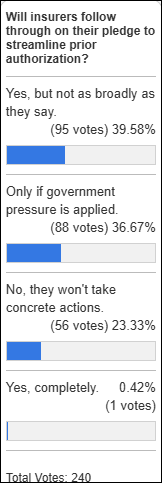
Voting in last week’s poll was both heavy and decisive.

New poll to your right or here: In the most recent major health tech purchase you were involved with, what triggered the buyer’s initial interest? It’s weird wording I know, but I wanted to make the question applicable for people on both sides of the deal.


Thanks to these companies for their recent support of HIStalk. Click a logo to learn more.

image
image
image
image
image
image


Sponsored Events and Resources

None scheduled soon. Contact Lorre to have your resource listed.


Acquisitions, Funding, Business, and Stock

Waystar reports Q1 results: revenue up 14%, EPS $0.17 versus –$0.13. WAY shares have nearly doubled since closing below their IPO price on the first day of trading in June 2024. CEO Matt Hawkins said in the earnings call that the company has shifted “from AI hype to ROI reality” in delivering results through its AI-powered products.

Private equity firm Madison Dearborn Partners acquires an undisclosed stake in NextGen Healthcare from Thoma Bravo, which took the company private in 2023.

Five South Florida Tenet hospitals sue The Leapfrog Group, which they claim penalized them with poor safety grades because they declined to provide proprietary data.


People

image image

Civitas Networks for Health names Jolie Ritzo, MPH as interim CEO following the departure of founding CEO Lisa Bari, MPH, MBA, who has joined Innovaccer as head of external affairs.

image

TigerConnect hires Sean O’Neal (Sinch) as CEO.

image image

Google Chief Health Officer and former National Coordinator Karen DeSalvo, MD, MPH, MSc will retire this summer. Replacing her will be Michael Howell, MD, MPH, Google’s chief clinical officer.

image

Dale Gold, MD (CommonSpirit Health) joins Kaiser Permanente Medical Foundation as CMIO.


Announcements and Implementations

image

Early adopters are piloting an Epic feature that allows patients to schedule appointments using a texting-based AI assistant.

image

A new KLAS report on data and analytics platforms scores Dimensional Insight #1 in customer satisfaction. Oracle Health finished last due to lack of service, support, and communication, but most customers say that they will keep using its product because they are committed to Millennium. Nearly one-third of surveyed Health Catalyst customers plan to replace the product due to high data storage costs and lack of innovation.


Privacy and Security

image

Microsoft will replace passwords with phishing-resistant passkeys for newly created Microsoft accounts. The company hopes that the number of password authentications will decline to the point that it can eliminate password support.


Other

image

The best thing I that read on LinkedIn this week was from Colonel Chani Cordero, MHA, MEd, CIO/CDO of Brooke Army Medical Center and a soldier for nearly 20 years. It’s just a personal update, but it got my attention because her personal branding is outstanding. She’s in great career shape if her plan is 20 and out.

image

UCHealth CMIO CT Lin, MD posted this slide from a presentation by MultiCare at Epic XGM titled “A Wellness Approach to Improving Provider Efficiency and Reducing Burrnout.” It’s a refreshing take from Chris Kelley, MD, MS; Wesley Lane; and Tamara Chang, MD, especially the “B- is good enough” part. I figure it must be insightful if CT’s a fan.


Sponsor Updates

  • InterSystems will host Ready 2025 and the accompanying Healthcare Leadership Conference June 22-25 in Orlando.
  • RLDatix joins The Leapfrog Group’s Partners Advisory Committee.
  • Black Book Research survey-takers rank Netsmart’s GEHRIMED as the top solution for geriatric and gerontology physician practices.
  • Nordic releases a new “Designing for Health” podcast episode titled “Interview with Melissa Welch, MD.”
  • Sonifi Health offers a new case study featuring Henry Ford Health titled “Virtual care, real results: How to successfully transform virtual patient care across an organization.”
  • TrustCommerce, a Sphere Company, publishes a new e-book titled “Safeguarding Patient Payment Data: A Critical Priority for Healthcare Providers in 2025.”
  • WellSky will exhibit at the Ohio Health Care Association Convention May 5-8 in Columbus.
  • VisiQuate offers a new client overview titled “How predictive forecasting helped CHOC plan smarter, act faster, and stay ahead of cash flow challenges.”

Blog Posts


Contacts

Mr. H, Lorre, Jenn, Dr. Jayne.
Get HIStalk updates.
Send news or rumors.
Follow on X, Bluesky, and LinkedIn.
Sponsorship information.
Contact us.

Morning Headlines 5/2/25

May 1, 2025 Headlines 1 Comment

Trump transforms a small federal civil rights office

Politico reports that the White House has shifted HHS OCR’s focus from HIPAA, patient privacy, and cybersecurity to enforcing the federal bans on DEI programs and transgender care.

CVS Health Corporation Reports First Quarter 2025 Results and Updates Full-Year 2025 Guidance

CVS Health reports a 7% increase in quarterly revenue and announces that it will be the first retail pharmacy to fill Wegovy prescriptions from patients of Novo Nordisk’s new direct-to-consumer online pharmacy.

TidalHealth, Atlantic General Hospital sign definitive agreement to bring both systems together

In Maryland, TidalHealth will acquire Atlantic General Hospital and transition it from Allscripts Sunrise to Epic.

News 5/2/25

May 1, 2025 News 1 Comment

Top News

image

KLAS publishes its annual acute care EHR market share report, with these highlights:

  • Vendor partnership strength has become a key differentiator.
  • Oracle Health declined to provide new contract data, so KLAS used public sources.
  • Oracle Health lost a net 74 hospitals and 17,000 beds in 2024, with customers citing broken promises and weak relationships. Loyalty and relationship scores have dropped 10 points since Oracle acquired Cerner.
  • Epic posted its biggest net gain ever, adding 176 hospitals and 29,000 beds in 2024. It dominated small-hospital deals via Community Connect and won 70% of competitive decisions overall.
  • Market share: Epic 48%, Oracle Health 27%, Meditech 15%.
  • Nearly half of Meditech’s customers still run its legacy systems. Of those making a move, two-thirds chose Expanse, often citing the value of Meditech as a Service.

Reader Comments

From Creole: “Re: Oracle Health. Losing a customer also means losing access to its data, which was Larry’s big thing in buying Cerner.” Defecting Cerner customers take their data to Epic, undermining Ellison’s vision of a national health records platform and research repository. Oracle likely viewed Cerner as a valuable data asset, but outside of the DoD (and perhaps eventually the VA), that value diminishes with every lost client. As a tech company, Oracle seems to have underestimated the importance of Cerner’s domain experts, many of whom it has driven away, which has eroded trust and limits future business development. Not to mention that technical whiz-bangery doesn’t change the reality that Oracle Health will need to take business away from Epic to grow unless Epic collapses post-Judy. We healthcare lifers have reason to be wary, having lived through the loud arrivals and quiet exits of outsiders like GE Healthcare, Siemens, McKesson, Misys, and IBM.


HIStalk Announcements and Requests

I checked some of my past Temu orders and found that prices have tripled or more in the trade war environment. It’s probably no accident that I can’t compare further because everything in my order history now shows as discontinued or sold out, making the new, higher prices harder to track, although items that feature the same photo can be ordered for a lot more money.


Sponsored Events and Resources

None scheduled soon. Contact Lorre to have your resource listed.


Acquisitions, Funding, Business, and Stock

image

Teladoc Health acquires UpLift, which offers virtual services for mental health and medication management, for $30 million in cash and $15 million in potential earnout. UpLift’s 2024 revenue was $15 million. 

image

Healthcare AI workflow automation platform vendor Plenful raises $50 million in a Series B funding round.

Ascend Learning acquires TIPreport, which offers medical education feedback and competency tracking.

Amwell posts Q1 results: revenue up 12%, EPS –$.19 versus –$4.94. AMWL shares dropped 17% before the market’s close on Thursday and have lost 40% in the past 12 months.


Sales

  • In UAE, Al Zahra Hospital Dubai chooses InterSystems TrakCare EHR and its fully managed hosting service.
  • Silver Hill Hospital (CT) will implement Meditech Expanse under the Meditech as a Service subscription model.

People

image

Craig Richardville, MBA (Intermountain Health) joins Guidehouse as a partner in its health practice.

image

Henry Mayo Newhall Hospital hires Kevin Shorten (Alameda Health System) as VP/CITO.

image

Matt Madden, MBA (EverCommerce) joins Net Health as VP of product and business development.

image

Advocate Health promotes Matthew Anderson, MD, MHA to SVP of clinical transformation.


Announcements and Implementations

image

Zocdoc launches Zo, an AI phone assistant that manages incoming patient scheduling calls.

An AdvancedMD survey of the owners of private medical practices finds that 44% plan to renegotiate payment rates and two-thirds will hire new employees.


Government and Politics

New York’s fire department issues a directive that requires ambulances to take patients to the nearest hospital as assigned by a computer system, regardless of patient preference or existing provider relationship. An FDNY commissioner dismissed complaints as mostly coming from hospitals that worry about losing volume, explaining, “We’re not the Uber or Lyft business to take people where they want to go.”


Privacy and Security

Politico reports that the White House has shifted HHS OCR’s focus from HIPAA, patient privacy, and cybersecurity to enforcing the federal bans on DEI programs and transgender care. An HHS spokesperson said that the agency is “restoring its tradition of upholding rigorous, evidence-based science” while rejecting “woke DEI policies.” Most regional investigators have reportedly been dismissed, leaving just 18 of the original 100.


Sponsor Updates

A group of people standing around a table full of sandwiches

AI-generated content may be incorrect.

  • Healthcare IT Leaders staff works with The Sandwich Project to make 700 sandwiches to help combat food inequity in Atlanta.
  • The “Provider’s Edge” podcast features Consensus Cloud Solutions EVP Bevey Minder in an episode titled “Tech Equity is the Missing Link in Health Equity.”
  • Black Book Research publishes a new report titled “Women’s Health Information Technology and Software innovations.”
  • Netsmart’s MyUnity EHR achieves Community Health Accreditation Partner verification for hospice care.
  • WellSky announces enhanced capabilities to help healthcare organizations succeed in value-based care models, including the new CMS Transforming Episode Accountability Model.
  • Infinx announces its Patient Access Plus solution listing in Epic’s Connection Hub on Showroom.
  • The new season of the Surescripts award-winning podcast, “There’s a Better Way,” will premiere May 20.
  • Elsevier offers its complimentary, accredited Gen AI Academy for Health to help clinicians utilize generative AI responsibly and effectively in their practice.
  • FinThrive publishes a new case study titled “How Eskenazi Health Transformed Claims Processing.”
  • Artera, Ellkay, HealthMark Group, Inbox Health, Infinx, MRO, and TruBridge will exhibit at the AAOE Annual Conference May 2-5 in Atlanta.
  • InterSystems joins the MIT Generative AI Impact Consortium as a founding member.

Blog Posts


Contacts

Mr. H, Lorre, Jenn, Dr. Jayne.
Get HIStalk updates.
Send news or rumors.
Follow on X, Bluesky, and LinkedIn.
Sponsorship information.
Contact us.

EPtalk by Dr. Jayne 5/1/25

May 1, 2025 Dr. Jayne 2 Comments

A hot topic around the virtual physician lounge this week was the potential for an impending staffing crisis. It’s not the nursing crisis that everyone talks about, however. Instead, it is the risk that we’ll see a bulk retirement of physicians in their late 50s and early 60s who are tired of fighting the system.

These are the folks who have watched medicine completely transform. They’ve witnessed the rise of Health Maintenance Organizations in the 1990s, the creation of Evaluation and Management codes, HIPAA, and more. They bore the brunt of early EHR transitions that may not have been smooth or well orchestrated, and some of them may have gone through two or three EHRs before arriving where they are today. They’ve dealt with increasing prior authorization requirements, aggressive case management and utilization review, and patients who are constantly challenging their knowledge.

With their departure goes quite a bit of collective knowledge, along with many years of learning related to the art of practicing medicine. These physicians are of the generation that were trained that touching the patient is essential and that it can perform a healing function as well as a diagnostic one. Many of them have diagnostic skills far beyond that of newly minted physicians. They also have a “Spidey sense” that they’ve honed over decades of practice. Some organizations have recognized this and put together plans that allow physicians to retire gradually so that the impacts of their departures are more subtle.

One of my favorite colleagues has a desire to retire early. She approached her health system with a plan to transition out of full-time primary care over the next two years. It can take a while to recruit a new primary care physician, and although she is only legally required to give them a 90-day notice, the lengthier notice was intended as a bargaining chip. In exchange for that, she requested the ability to continue to purchase health insurance coverage through the health system while working half time during the latter part of her proposed transition. They typically only allow workers to participate in the plan if they work at least 36 hours per week.

Although the physician leaders of her medical group were supportive, the plan was immediately scuttled by attorneys who were unwilling to even consider evaluating the modifications that would be needed to meet her requirements. 

Her practice is already understaffed by at least one, possibly two, full-time physicians. Recruiting has been difficult because of its location and challenging payer mix. The idea that the organization would risk her walking away rather than taking a structured approach to a long goodbye seems short sighted. There has been an open posting for a primary care physician for over 18 months, which is evidence of the challenge they’re going to face should she decide to leave.

During our quarterly physician lunch today, she confirmed her decision. She will be putting in her notice to depart the organization in August. It will be interesting to see if they counter with a retention offer or if they just let her go. We all agreed that it’s something that health systems need to start figuring out, because none of us is getting any younger and AI solutions aren’t going to replace us anytime soon.

image

The American Telemedicine Association is holding its annual Nexus conference in New Orleans this year, running from May 3-6. ATA is showcasing its Center of Digital Excellence (CODE) that includes provider-side member organizations such as Mayo Clinic, Stanford Health Care, UPMC, Sanford Health, MedStar Health, Ochsner, Intermountain Health, OSF HealthCare, and WVU Medicine Children’s. Solution-side members include AvaSure and Access TeleCare.

For those of us who were working in the telehealth space before COVID, it felt like we were making things up as we went along because there were no solid playbooks for various telehealth use cases. CODE pulls together organizations that are willing to share their successes, create implementation toolkits, and lobby together to promote the value of telehealth in the overall healthcare ecosystem. I’ve attended the conference in the past and found it valuable as far as bringing back a number of practical insights. Unfortunately, this year’s schedule puts it on top of a graduation weekend for one of my favorite students, so I’ll have to miss it.

I was interested to see this article in JAMA Network Open, “Cumulative Burden of Digital Health Technologies for Patients With Multimorbidity.” The authors specifically set out to answer the question, “What digital health technologies (DHTs) are available for patients with multimorbidity and how many individual DHTs would a hypothetical patient need to benefit?” They defined multimorbidity as a patient with five chronic conditions — type 2 diabetes, hypertension, chronic obstructive pulmonary disease, osteoporosis, and osteoarthritis.

They looked at 148 DHTs that had been approved by the US Food and Drug Administration or that had been vetted by the Organization for the Review of Care and Health Apps. They found that only five of the DHTs were intended to help monitor, treat, and/or manage two or more conditions. Some only offered a subset of features, such as recording or tracking health data, where others offered information or real-time interventions. Given the tools on the market, the patient in the hypothetical scenario would need prescriptions for as many as 13 apps and seven devices to provide the benefits that at least three of five clinicians felt were important. 

When I was in a traditional primary care practice, many of the patients I saw had multiple chronic conditions, with the most common combination being hypertension, obesity, and hyperlipidemia. A subset of those patients also had diabetes. All of those can benefit from lifestyle changes and several of them impact each other, so it would make sense to create one app to rule them all as it were.

I’m sure there are challenges with the FDA approval process in trying to get a submission approved for multiple health conditions, but I wonder if it is easier in other countries that have a more holistic approach to health. I’d be interested to hear from readers who may be more involved in the creation and use of DHTs.

Would you use a DHT that was proven to improve your own health condition? Leave a comment or email me.

Email Dr. Jayne.

Morning Headlines 5/1/25

April 30, 2025 Headlines 1 Comment

Plenful Raises $50M Series B to Expand AI-Powered Healthcare Automation Platform

Healthcare AI workflow automation platform vendor Plenful raises $50 million in a Series B funding round.

Teladoc Health Acquires UpLift, Expanding Consumer Access to Mental Health Care Services Through Covered Benefits

Teladoc Health will integrate virtual mental healthcare provider and medication management services company UpLift, which it has acquired for $30 million, with its BetterHelp virtual therapy business.

Epic Systems expands EHR market share lead over Oracle Health

A new report from KLAS Research finds that Epic saw its largest ever gain in hospital market share last year, while competitor Oracle Health lost a significant number of care sites and beds.

Healthcare AI News 4/30/25

News

image

Meta rolls out Meta AI, featuring voice chat, a Discover feed that shows how others use AI, optional personalization that draws from the user’s Facebook and Instagram accounts, and support for Meta’s AI glasses.

Google’s NotebookLM can now create its podcast-like Audio Overviews in 50 languages.

image

Children’s Hospital Los Angeles launches a sensor-based home apnea risk evaluation that uses a newly created data collection app and Apple Watch algorithms. 

AI company Infinitus Systems releases patient- and provider-facing voice AI agents that automate outbound phone calls.

In the UK, Great Ormond Street Hospital for Children evaluates ambient documentation systems in an NHS-funded project.


Business

image

Healthcare AI workflow automation platform vendor Plenful raises $50 million in a Series B funding round.

Cleveland Clinic will use coding assistant and CDI AI tools from Akasa.

Ambulatory health IT vendor CareCloud launches a domestic and offshore AI Center of Excellence to further integrate AI across its technologies and processes. The company says the 50-member team will have 500 employees by the end of 2025.

A drug company and biotech firm will pay precision medicine technology vendor Tempus $200 million in data licensing and model development fees to create a cancer drug development model. Tempus says it has spent billions of dollars over the past decade to develop a database of the de-identified clinical data of cancer patients.


Research

UCSD researchers determine that a gene that was thought to be a biomarker for Alzheimer’s disease may actually cause the condition, which they determined using AI to analyze protein structures.

University of Zurich researchers secretly tested the persuasiveness of AI-generated Reddit comments, some of them falsely claiming to be from rape victims or a trauma counselor. Their 1,700 bot-written posts were 3–6 times more effective at changing user opinions than human ones, raising concerns about AI-created disinformation.


Other

A 19-year-old Case Western pre-law student and a law journal editor write a 50-page paper on the need for healthcare-specific AI regulations in Ohio, after which they were invited by lawmakers to help draft a bill on the topic.

image

Today I learned from a sign that veterinarians are using AI-powered ambient documentation. ScribbleVet’s digital scribe generates SOAP notes in real time, which the company says reduces end-of-day charting from two hours to 20 minutes. Pricing starts at $40 per user per month, while the full-featured plan offers unlimited SOAP notes, dental charts, callback summaries, customizable templates, and a medical record summary for $150 per full-time vet.

image

A woman who asked ChatGPT for a palm reading was surprised when it instead flagged a mole on her hand as potentially acral lentiginous melanoma, a rare skin cancer, and recommended that she see a dermatologist. She hasn’t yet posted the result.


Contacts

Mr. H, Lorre, Jenn, Dr. Jayne.
Get HIStalk updates.
Send news or rumors.
Follow on X, Bluesky, and LinkedIn.
Sponsorship information.
Contact us.

This Week in Health Tech 4/30/25

April 30, 2025 This Week in Health Tech Comments Off on This Week in Health Tech 4/30/25
1746020133066
Comments Off on This Week in Health Tech 4/30/25

Morning Headlines 4/30/25

April 29, 2025 Headlines Comments Off on Morning Headlines 4/30/25

South Bend Medical Foundation expands with acquisition of medical records business

Blood bank and pathology services company South Bend Medical Foundation acquires release-of-information vendor ChartPro.

Netsmart Ranked #1 in Physical Therapy and Outpatient Rehabilitation EMR & Practice Management: Black Book Survey Highlights Critical Tech Trends in 2025

Black Book Research names Netsmart as the top-rated provider of EMR/PM solutions for physical therapy, outpatient rehabilitation, and speech therapy.

Interlock Ransomware Say It Stole 20TB of DaVita Healthcare Data

The Interlock ransomware group claims to have stolen data from outpatient dialysis company DaVita, which announced it was the victim of a ransomware attack several weeks ago.

Comments Off on Morning Headlines 4/30/25

News 4/30/25

April 29, 2025 News Comments Off on News 4/30/25

Top News

image

Community Health Systems (TN) restores computer systems at a reported 45 hospitals after several days of downtime that was caused by an Oracle Health engineer who mistakenly deleted critical storage during routine maintenance.


Sponsored Events and Resources

None scheduled soon. Contact Lorre to have your resource listed.


Acquisitions, Funding, Business, and Stock

image

Private equity firm GTCR is reportedly looking to sell value-based healthcare technology vendor Cedar Gate Technologies at a $1 billion valuation. GTCR launched the company in 2014.


People

image

Direct Recruiters promotes Ben Shamis, MBA to managing partner.

image

DexCare promotes Matthew Blosl to CEO.

image

Pothik Chatterjee, MA, MBA joins Rice University as executive director of Digital Health Institute, which was formed with Houston Methodist.


Announcements and Implementations

image

Houston Methodist implements Ambience Healthcare’s new ambient AI documentation technology for emergency department and inpatient settings.

Black Book Research names Netsmart as the top-rated provided of EMR/PM solutions for physical therapy, outpatient rehabilitation, and speech therapy.

CliniComp adds enterprise PACS to its New Era EHR.

Abbott integrates its FreeStyle Libre continuous glucose monitoring system with Epic.

image

A new KLAS report on PACS finds that customers are expecting technology changes to accommodate AI and cloud. Sectra and Agfa Healthcare earn high marks overall, while GE HealthCare and Optum have lost significant ground due to lack of innovation. Intelerad users complain about poor Tier 1 support and being charged for services that were once free, while users of both systems from Philips — IntelliSpace PACS and Image Management Vue PACS — report deep dissatisfaction because of weak product development and poor support.


Government and Politics

Stat profiles Chris Klomp, the founder and CEO of Collective Medical (sold to PointClickCare in late 2020) who is now director of the Center for Medicare.


Privacy and Security

image

Ascension reports that patient data from care sites in five states may have been compromised during a December cybersecurity incident. It also states that it mistakenly shared some of the information with its third-party partner, which later experienced the software breach.

image

The Interlock ransomware group claims to have stolen data from outpatient dialysis company DaVita, which announced it was the victim of a ransomware attack several weeks ago. The group has posted data screenshots on the dark web, though no public mention of a specific ransom amount has been made.


Sponsor Updates

  • CliniComp adds enterprise PACS to its New Era EHR with Intrinsic AI Solution Suite.
  • Black Book Market Research announces Netsmart as the top-ranked IT vendor in its “2025 Post-Acute Technology Market Report.”
  • Clearsense earns NCQA’s Validated Data Stream Status for the second year in a row.
  • Wolters Kluwer Health announces that select UpToDate Enterprise Edition customers can now access UpToDate patient education content directly within their Epic EHR and MyChart patient portal.
  • AdvancedMD partners with Moyae as an integration partner to boost efficiencies for ophthalmology and optometry practices.
  • Agfa HealthCare will exhibit at SIIM 2025 May 21-23 in Portland, OR.
  • AvaSure, InterSystems, and Philips Capsule will sponsor and exhibit at ATA’s Nexus 2025 May 3-5 in New Orleans.
  • The “Ascendle Unscripted” podcast features Cardamom Health VP of Business Development Bridget Bell in an episode titled “Preparing your healthtech organization for AI.”
  • Censinet releases a new “Risk Never Sleeps” podcast featuring Genesis Medical Associates Director of IT Bill Laukaitis.
  • Consensus Cloud Solutions announces its e-fax cloud fax platform has placed twelfth on G2’s Best Healthcare Software Products list.

Blog Posts


Contacts

Mr. H, Lorre, Jenn, Dr. Jayne.
Get HIStalk updates.
Send news or rumors.
Follow on X, Bluesky, and LinkedIn.
Sponsorship information.
Contact us.

Comments Off on News 4/30/25

Morning Headlines 4/29/25

April 28, 2025 Headlines Comments Off on Morning Headlines 4/29/25

Ascension reports patient data security incident affecting care sites in five states 

Ascension announces that patient data from care sites in five states was likely stolen in a December cybersecurity incident involving an unnamed business partner.

CareCloud Launches Healthcare AI Center Set to Become World’s Largest with 500 AI Professionals

Ambulatory health IT vendor CareCloud launches a domestic and off-shore AI Center of Excellence to further integrate AI across its technologies and processes.

Oracle engineers caused days-long software outage at US hospitals

Community Health Systems (TN) restores computer systems at a reported 45 hospitals after several days of downtime caused by an Oracle Health engineer who mistakenly deleted critical storage during routine maintenance.

LifeMD Acquires Women’s Health Provider Optimal Human Health MD to Accelerate Entry into the Women’s Health Market

Virtual primary care company LifeMD will use newly acquired assets from Optimal Human Health MD to launch women’s healthcare services this summer.

Comments Off on Morning Headlines 4/29/25

Curbside Consult with Dr. Jayne 4/28/25

April 28, 2025 Dr. Jayne Comments Off on Curbside Consult with Dr. Jayne 4/28/25

Even though I’m a contributor, I rely on HIStalk as much as the next healthcare IT person to keep me up to date on what’s going on in the industry. It’s challenging to sort through all the noise out there and the number of podcasts, newsletters, and emails that are trying to get the attention of leaders in our industry. The newsy tidbits are great for conversation openers when talking to my peers. I would much rather ask someone what they think about an industry happening rather than making small talk about someone’s boat or what they did over the weekend.

This week’s tidbit was the item that Mr. H picked up about virtual EHR education and how it has moved from being an uncommon training tactic to being one on which organizations now depend.

I remember my first experiences with virtual training, which were VHS recordings of my organization’s HIPAA training. It included a Roaring 20s gangster theme and questionable production values. From there, things evolved to recorded voiceovers with multiple choice questions that required clicking through to get to the next part of training. By the time I left my first EHR leadership role, we were starting to get modularized training that lived within a learning management system. Users could move through courses with some level of choice rather than having to follow a rigidly prescribed path.

Modern EHR training and education strategies are much more capable of meeting users where they are, rather than assuming that everyone needs the same type or level of training. There’s a difference between training a newly-hired physician who has never embraced computers and merely tolerates them versus training someone who is straight out of residency and who has used computers since they were toddlers. A recent KLAS Arch Collaborative survey shows that almost 70% of clinicians surveyed found it helpful that self-directed learning can be done at the time of their choosing. Most of the organizations that I work with use a blended training approach that includes asynchronous learning, interactive online learning, and in-person learning for those who want or need it.

The last organization where I worked as an in-person physician employed this approach, though it was less than ideal. The initial asynchronous content represented out-of-the-box functionality from the EHR vendor. When I reached the second phase, I realized that the organization had heavily customized its system. In fact, they had customized it in a bad way, taking away the ability for users to personalize their workflows and forcing everyone into the same cookie cutter approach.

There were some online sessions that covered the organization’s customized content, but I didn’t feel that the trainer was terribly capable. Some of the ways that she presented the material created confusion. We had five people in my training cohort, ranging from medical assistants to physicians, and some were directly out of their school-based training with minimal clinical experience in the field.

That probably wasn’t the trainer’s fault, but rather the organization’s shortsightedness at realizing the value of separate role-based training as well as integrated training. Still, she didn’t do much to try to pull it all together so that half of the class didn’t feel like their time was being wasted at any given time.

Personally, I like being able to go back to training that I’ve done in the past when I need a refresher. It’s similar to the concept of circle-back training at 30, 60, and 90 days post-implementation, but it allows people to do so at their own pace. When you’re seeing 40 patients a day, workflows get baked in pretty quickly. You often wind up so focused on getting through them that you don’t have time to appreciate the bells and whistles that might be in your EHR that you aren’t using.

Being able to go back to the training syllabus might be enough to remind you that maybe you should customize or personalize a particular part of a workflow. Or, you could revisit the content for the details if you couldn’t figure out how to do it in a less-than-intuitive EHR.

Embracing virtual training also means that organizations are showing that they value the learning experience of newer members of the workforce. Most of the high school students I know have been using online learning since their early grade school days, so the idea of old-fashioned classroom training may not resonate with them at all.

Many of this decade’s medical graduates were plunged into virtual learning due to the pandemic and had a front row seat to its quick evolution. The medical students who I talk to often don’t attend lectures, but consume the content by watching recordings at high speed and supplementing the school-provided lectures with online flashcards, videos, and tutorials. They’re not going to be excited to sit in a computer lab and be forced to try to learn at a pace that doesn’t match what they’re used to.

I’ve trained on most of the major EHRs at one point or another in my career. The biggest advantage that I see for recorded or asynchronous virtual training is the standardization factor. Variation between trainers doesn’t exist because everyone is presented the same material in the same way.

I’ve had some pretty bad trainers along the way, as well as a handful of truly outstanding ones. I have felt acutely how someone’s methodology or comments or anecdotal stories can have a negative impact on users’ ability to learn. I worked with one trainer who had some unique personal mannerisms and it made me wonder if his supervisor had ever watched him in the virtual classroom. It was clear by the facial expressions of others in my Zoom window that they weren’t a fan of his teaching style either.

Despite the effectiveness of virtual teaching and learning, it’s important for people to be able to access not only in-person support session,s but one-on-one support sessions if needed. Some learners are reluctant to ask questions in front of others for a variety of reasons, such as not feeling like they are looking bad to their peers or to subordinates. Others just need that individual touch to feel like they have reached the point where they can be confident using the system. That’s a corner that shouldn’t be cut, although the costs can be reduced by employing effective virtual learning strategies upstream.

What do you think about the evolution of virtual learning? How is your organization using it? Leave a comment or email me.

Email Dr. Jayne.

Comments Off on Curbside Consult with Dr. Jayne 4/28/25

Readers Write: Early Innovation Matters: What I Learned Building a Glucose Sensor in High School

April 28, 2025 Readers Write Comments Off on Readers Write: Early Innovation Matters: What I Learned Building a Glucose Sensor in High School

Early Innovation Matters: What I Learned Building a Glucose Sensor in High School
By Max Kopp

Max Kopp is a high school researcher who is focused on biomedical engineering and non-invasive sensing systems. He is also the founder and CEO of VitaSense.

image

Diabetes is one of the most widespread chronic diseases in the world. But continuous glucose monitoring remains inaccessible to many patients due to pain, cost, and complexity. While various needle-based solutions exist, they present a barrier to consistent use and adherence, particularly for people with type 2 diabetes who are less likely to be prescribed real-time monitors.
In high school, I began exploring whether a painless and affordable alternative could be possible using light and advanced nanomaterials. What started as a science fair project evolved into a deep investigation into photoplethysmography (PPG) and the semiconductor properties of Germanium Selenide (GeSe) as a potential medium for glucose sensing.

This work eventually became the foundation of a novel approach to non-invasive glucose monitoring that combines flexible, inkjet-printable electronics with wavelength-specific light analysis to estimate glucose concentration in the interstitial fluid beneath the skin. Because the design avoids the need for subdermal sensors or adhesives, it offers potential for broader, long-term adoption.

During the process, I encountered a range of challenges, both scientific and practical. Signal noise, calibration variability, and the need for robust motion filtering were early hurdles. Overcoming them required collaboration with academic mentors, iterative prototyping, and long nights debugging sensor arrays that were built on flexible polymers.

The research was eventually peer-reviewed and published in a scientific journal. It has also earned recognition from national youth science competitions that are focused on applied physics and health innovation. More importantly, it showed that with the right support, young researchers can meaningfully contribute to solving real healthcare problems.

This experience reinforced something critical: the innovation pipeline needs to start much earlier. Most efforts in health technology originate in universities or corporate R&D labs. But students, when given access to tools and mentorship, can identify overlooked patient needs and generate fresh ideas with remarkable speed.

Healthcare leaders should consider how to foster those early-stage ideas. Partnering with student-led projects or offering access to clinical mentors, sensor labs, or data modeling tools can help cultivate innovation from new angles. The barriers to entry are high in regulated health environments, but creating more low-risk educational bridges could lead to high-reward outcomes.

Innovation in chronic disease care will only accelerate if the ecosystem welcomes bold questions from unexpected places. Investing in curiosity, even from classrooms, might help us solve the next billion-dollar problem before it costs patients another dollar.

Comments Off on Readers Write: Early Innovation Matters: What I Learned Building a Glucose Sensor in High School

Text Ads


RECENT COMMENTS

  1. I see a lot of people dislike what I said. I assume some don't like it because what I said…

  2. I have a hard time believing that Ken "unconvicted felon" Paxton does anything in good faith. Daily reminder that during…

  3. Epic's EDI (interoperability) R&D spend is probably more than the total R&D spend of any other competitor. Epic invests millions…

  4. As a former long time EHR salesperson for a competitor of Epic all I can say about the lawsuit is…

  5. The orthopedic and PT strain is 100% accurate. Had a knee injury in the family and the doc had to…

Founding Sponsors


Platinum Sponsors


Gold Sponsors


RSS Industry Events

  • An error has occurred, which probably means the feed is down. Try again later.

RSS Webinars

  • An error has occurred, which probably means the feed is down. Try again later.