Digital healthcare software and services vendor Healthcare Triangle forms new subsidiary QuantumNexis through the acquisition of Niyama Healthcare, which specializes in AI-enabled digital mental healthcare, and Ezovion Solutions, which offers EHR and smart hospital management tech.
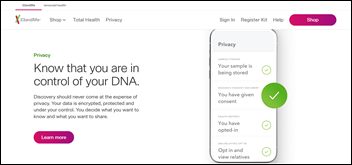
23andMe to delist from Nasdaq, deregister with SEC
23andMe will delist and deregister from the Nasdaq following the purchase of the majority of its assets by Regeneron Pharmaceuticals earlier this month.
An AI-Powered Startup Can Now Perform This Important Task Better Than Doctors
Ambience Healthcare develops an AI medical coding model using OpenAI technology.

Coalesce Capital acquires Das Health, a health IT software and services business based in Tampa, FL.
Once primarily focused on the ambulatory space, Das has expanded to health systems and senior care through its acquisitions of Itentive, VCPI, and Randall Technology Services.

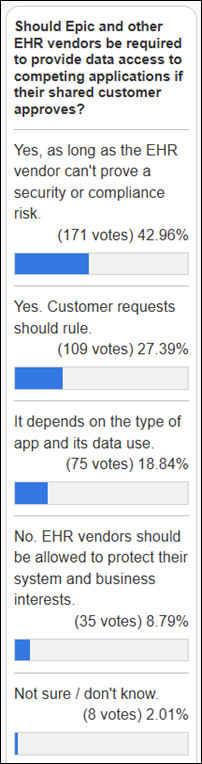
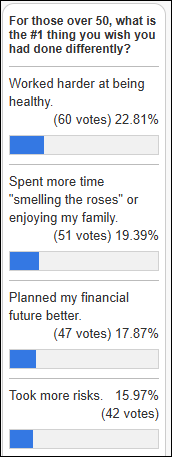
The majority of poll-takers are in favor of EHR vendors being required to provide data access to competing applications with shared customer consent.
New poll to your right or here: Have you ever used a digital physical therapy tool as part of your recovery? With Hinge Health’s IPO in the news and competitors like Luna, Sword Health (rumored to be prepping for an IPO later this year), and Kaia Health seemingly gaining traction, I’m wondering if providers are pushing them or payers are the more typical conduits. Share your experience by leaving a comment.
Live Webinar: June 18 (Wednesday) noon ET. “Fireside Chat: Closing the Gaps in Medication Adherence.” Sponsor: DrFirst. Presenters: Ben G. Long, MD, director of hospital medicine, Magnolia Regional Health Center; Wes Blakeslee, PhD, vice president of clinical data strategies, DrFirst; Colin Banas, MD, MHA, chief medical officer, DrFirst. Magnolia Regional Health Center will describe how its Nurse Navigator program used real-time prescription fill data from DrFirst to identify therapy gaps and engage patients through timely, personalized outreach. The effort led to a 19% increase in prescription fills and a 6% drop in 30-day readmissions among participating patients. Attendees will learn why prescribing price transparency is key to adherence, how real-time data helps care teams support patients between visits, and how Magnolia aligned its approach with value-based care and population health goals.
Contact Lorre to have your resource listed.

Digital healthcare software and services vendor Healthcare Triangle forms new subsidiary QuantumNexis through the acquisition of Niyama Healthcare, which specializes in AI-enabled digital mental healthcare, and Ezovion Solutions, which offers EHR and smart hospital management tech.
23andMe will delist and deregister from the Nasdaq. The consumer genetics testing and research company filed for bankruptcy in March and sold the majority of its assets to Regeneron Pharmaceuticals earlier this month.

The Boulder County Family Resource Network (CO) launches an online social services resource tool using software from Findhelp.

In England, Birmingham Women’s and Children’s NHS Foundation Trust implements Epic.

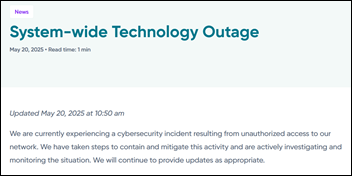
Kettering Health (OH) acknowledges it was the victim of a ransomware attack last week and announces that it has restored its clinical communications and radiation oncology systems. It expects the rest of its network to be up and running soon.
Healthcare cybersecurity leaders are unprepared for AI-enabled physical threats to their facilities, according to a new study from Black Book Research. Seventy-one percent of hospital survey respondents say they are unprepared for things like sensor spoofing or deepfake badge credentials, while just 18% say they have a strategy in place to mitigate this new type of digital manipulation.

A patient catches their therapist using ChatGPT during a virtual session after the therapist mistakenly enables screensharing: “This led to a very surreal session in which out of sheer shock I also ended up basically cribbing from ChatGPT in my responses. For example, I’d say something, he would type it into ChatGPT, it would return a result, like a summary of ‘Cognitive Flexibility,’ and then because I could see his screen, I would say something like ‘I guess I could be more flexible…’ and he’d say, ‘Yes! Exactly!’”

Black Book Research’s latest survey reveals the top technology vendors driving Medicare Advantage five-star ratings amid heightened CMS audit standards, including the following HIStalk sponsors:
Blog Posts
Mr. H, Lorre, Jenn, Dr. Jayne.
Get HIStalk updates.
Send news or rumors.
Follow on X, Bluesky, and LinkedIn.
Sponsorship information.
Contact us.
![]()
Jane Software to be reportedly valued at $1.8 billion in upcoming secondary financing
Canadian practice management software vendor Jane Software is reportedly working to raise an additional $500 million from three US investors, bringing its valuation to $1.8 billion.
Kettering Health talks publicly about cyberattack and frustration of patients
Kettering Health (OH) acknowledges it was the victim of a ransomware attack last week, announces that it has restored clinical communications systems, and expects the rest of its network to be up and running within the next several days.
Hamilton and Burlington hospitals partner on integrated health information system
In Canada, Joseph Brant Hospital will adopt St. Joseph’s Healthcare Hamilton’s Epic system.
Hinge Health shares climb 17% in NYSE debut
Digital physical therapy company Hinge Health raises $273 million during its IPO, giving it a $2.6 billion valuation.
When 20,000 devices were paralyzed by a bad update, a Georgia health system turned to Apple
Emory Healthcare’s Hillandale Hospital (GA) replaces all of its legacy computing devices with Apple products following a successful pilot at another hospital.
WellTheory Raises $5M for Autoimmune Care
Virtual autoimmune care startup WellTheory announces $5 million in new funding and new AI scribe and care coordination tools for providers.
Digital physical therapy company Hinge Health raises $273 million during its IPO, giving it a $2.6 billion valuation.
The San Francisco-based company has raised more than $1 billion since launching in 2014.

Welcome to new HIStalk Platinum Sponsor Fortified Health Security. As a managed security service provider, Fortified offers a broad range of advisory and security operations center (SOC) services that help organizations throughout the healthcare ecosystem protect patient data and reduce risks. Working alongside their clients, Fortified builds customized programs for healthcare organizations that leverage their prior security investments and current processes while implementing new solutions that strengthen their security posture over time. Thanks to Fortified for supporting HIStalk.
Live Webinar: June 18 (Wednesday) noon ET. “Fireside Chat: Closing the Gaps in Medication Adherence.” Sponsor: DrFirst. Presenters: Ben G. Long, MD, director of hospital medicine, Magnolia Regional Health Center; Wes Blakeslee, PhD, vice president of clinical data strategies, DrFirst; Colin Banas, MD, MHA, chief medical officer, DrFirst. Magnolia Regional Health Center will describe how its Nurse Navigator program used real-time prescription fill data from DrFirst to identify therapy gaps and engage patients through timely, personalized outreach. The effort led to a 19% increase in prescription fills and a 6% drop in 30-day readmissions among participating patients. Attendees will learn why prescribing price transparency is key to adherence, how real-time data helps care teams support patients between visits, and how Magnolia aligned its approach with value-based care and population health goals.
Contact Lorre to have your resource listed.

Sources say that private equity firm Blackstone is the frontrunner in acquisition offers for revenue cycle company AGS Health in what could be a $1 billion deal. Parent company EQT began considering strategic alternatives for AGS last September.

Truepill (white label digital pharmacy), Veritas (genetics), LetsGetChecked (home testing kits), and Alto (prescription delivery) come together to form Fuze Health. LetsGetChecked acquired Truepill in 2024 for $525 million, $25 million of which was cash.
Acute care telehealth company Equum Medical acquires the virtual clinical services of VeeOne Health. VeeOne will focus on its remaining service lines that include ambulatory care, virtual nursing, remote patient monitoring, hospital at home, and acute inpatient care.

Michael Volpi (RWJBarnabas Health) joins Comport Consulting as VP of healthcare technology.

Anish Arora (Cardinal Health) joins TigerConnect as VP of product.
TigerConnect announces GA of its CareConduit automated clinical workflow software.
![]()
Wolters Kluwer Health develops Ovid Guidelines AI to help healthcare researchers and organizations develop clinical practice guidelines using agentic AI.
Innovaccer launches Innovaccer Gravity to help providers unify and glean insights from data and expand adoption of AI.
The VA renews its contract with Oracle Health for another 12 months. The department renegotiated its contract with the company in 2023, turning a five-year agreement into five one-year terms.
Emory Healthcare’s Hillandale Hospital (GA) replaces all of its legacy computing devices with Apple products. The health system had already been using some Apple devices at its facilities. It decided to first pilot the all-Apple concept across one floor of its St. Joseph’s Hospital after clinicians noticed that Apple products were not impacted by CrowdStrike’s downtime debacle last year. Staff at Emory, an Epic customer since 2022, say Epic’s integration with Mac also helped to spur the project along.
Blog Posts
Mr. H, Lorre, Jenn, Dr. Jayne.
Get HIStalk updates.
Send news or rumors.
Follow on X, Bluesky, and LinkedIn.
Sponsorship information.
Contact us.
![]()

The American Medical Informatics Association hosted its Clinical Informatics Conference this week in Anaheim. It’s a relatively small meeting compared to some of the healthcare IT blowouts, with a reported attendance of just over 600. A couple of readers sent their thoughts on the meeting, leading to an overarching but not surprising conclusion that much of the conversation was “all AI, all the time.” Just looking at the list of the sponsors for the meeting, three out of the top four are ambient documentation companies – Nabla, Abridge, and Suki – so I’m sure that was a significant topic as well. Another reader mentioned a panel on career trajectories for women in the informatics realm that had good advice for those at the midpoints in their careers. I’m always a bit envious of the clinical informaticists who had coaches and mentors as they came up in the field. Those of us that learned at the school of hard knocks followed by a graduate program in making it up as you go definitely have some unique experiences compared to the newer generation of informaticists.

I’ve only attended that conference a couple of times, and each time I’ve enjoyed its low-key nature and robust conversations. It’s not a place that you go in hopes of coming home with a tremendous amount of SWAG items, but I daresay I’m a bit jealous of this reader’s submission. It reminds me of one of my favorite HIMSS giveaways, a shirt from Intermountain Healthcare that said, “I Like Big Data and I Cannot Lie.” Props to the folks at Regenstrief Institute for knowing your audience and how to reach them. During the meeting, the organization also inducted its 2025 class of Fellows of the American Medical Informatics Association. Congratulations to the 87 new Fellows recognized for their contributions to the field of clinical informatics.
One of the hottest stories around the virtual physician lounge this week covered accusations that UnitedHealth Group paid nursing homes to block hospital transfers in order to slash the cost of care. The scheme involves UnitedHealth care coordinators that were embedded within facilities and is supported by two whistleblower complaints submitted to the US Congress. Another part of the alleged misconduct involves incentivizing providers to place Do Not Resuscitate orders on patient charts despite the wishes of those patients stating that they wanted medical interventions to keep them alive. As expected, the insurance company denies the allegations, but I don’t think any of the physicians that were chatting about this would be shocked should they be proven accurate.
![]()
A reader who knows I like to report on various wearables sent me some comments on Whoop, which is apparently “designed to improve your fitness, health, and longevity.” Claims of the ability to make people live longer always catch my attention, and this one did not disappoint. The solution claims to calculate the user’s “Whoop Age,” which might be younger or older than their birth age based on various lifestyle factors. It also claims to translate “the body’s monthly vital signals into guidance that extends healthspan, not just lifespan.” The company’s CEO touts its ability “to help our members perform and live at their peak for longer.”
The device does contain an FDA-cleared ECG feature, but its documentation is a little more vague about its “patent-pending technology that delivers daily blood pressure insights.” It also claims to deliver “hormonal insights” for women who are “navigating menstruation, pregnancy, or perimenopause,” but I guess those that are actually menopausal are just out of luck. The company promises a “next evolution in personalized health” to include blood tests that are integrated into the app along with clinician reports. The company offers multiple technical garments to allow the device to be worn in different ways, which is also a great revenue stream. It’s sold in three subscription tiers ranging from $199 to $359 per year. I couldn’t shop any of the accessories or apparel without a login, so if you’ve got intel on their offerings feel free to send me your best “fashion week” writeup.
I caught up over lunch this week with one of my pediatrician friends and we spent a good portion of the time talking shop about EHR enhancements and her recent experience with an ambient documentation solution. She has been trying to integrate it into her practice for several months, but let me know that she had decided to notify the IT department that she wanted to be taken off the licensing list for the application. Although she felt that it might be beneficial for some, she was spending too much time editing documents compared to when she used to document manually in the EHR. One of her main concerns was the inability of the system to differentiate key elements of conversations with parents during visits. For example, a parent with multiple children might be discussing the patient who is having a visit and also make comments about her other children – such as comparing the children’s temperaments, developmental milestones, or experiences with respiratory infections being passed around the household. She also ran into a number of hallucinations where social history elements that were erroneous had been injected into notes. Her parting comments: “I’ve been doing this a long time and I’m fast, and this felt like taking one step forward and two steps back.” I’d be interested to hear from other clinicians who have decided that ambient documentation just isn’t for them.

After writing previously about the Open Payments review and dispute resolution process, I’m pleased to report that the mystery payment I reported has been removed from my file. The vendor in question didn’t provide any of the information I asked for in the dispute report, such as when or where the payment supposedly happened. Instead, they just informed me that they were removing it from their reporting. Since I’ve been watching the Netflix detective series The Residence, I was looking forward to having answers to my pressing questions, but I guess I’ll just have to live with the item being off of my record.
Have you had to dispute an item in Open Payments, and if so, did you get a full resolution? Leave a comment or email me.
![]()
Email Dr. Jayne.
Equum Medical Acquires VeeOne Health’s Clinical Services Portfolio, Expanding Telehealth Leadership
Acute care telehealth company Equum Medical acquires the virtual clinical services of VeeOne Health.
San Francisco-based WorkDone, which has developed AI to resolve healthcare documentation errors, raises $1.8 million in pre-seed funding.
Fuze Health launches to offer patients the combined digital healthcare services of Truepill, Veritas, LetsGetChecked, and Alto.
VA continues partnership with Oracle Health to deploy Federal Electronic Health Record
The VA renews its contract with Oracle Health for another 12 months.

AI clinical documentation company Abridge is reportedly looking to raise new funding that would put its valuation at $5 billion, double its value earlier this year when it announced $250 million in Series D funding. The company has raised $475.5 million since getting its start in 2018. I interviewed Abridge founder and CEO Shiv Rao, MD back in 2023.
New Mountain Capital combines portfolio RCM companies SmarterDx, Thoughtful.ai, and Access Healthcare to create AI-powered healthcare revenue management company Smarter Technologies.

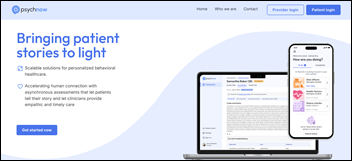
PsychNow develops Chapter, an AI consultation copilot that helps behavioral health providers capture the contextual details of a patient’s story before the first appointment.
OmniMD announces GA of AI Clinicians, an AI assistant that incorporates clinical data, predictive analytics, and real-time decision support.

Onvida Health (AZ) will pilot AI clinical documentation software from Ambience Healthcare this summer.
UnitedHealth Group’s Optum division is working with researchers at the Duke-Margolis Institute for Health Policy to automate Medicare risk coding using AI.
A Phyx Primary Care Innovation Lab survey of 120 physicians determines that their use of Navina’s AI Copilot helped to reduce clinical review time for complex visits by 40%.

Stony Brook Medicine’s cardiology and radiology departments develop HeartFlow Plaque Analysis, an AI imaging tool that assesses a patient’s coronary artery disease and informs treatment plans.
Duke Health (NC) will work with Microsoft services company Avanade to develop an AI governance process for the responsible implementation of clinical AI in healthcare settings.

The DOD’s US Military Entrance Processing Command develops and begins using an AI summary tool to streamline the review of applicant medical documents during the medical pre-screening process.
Mr. H, Lorre, Jenn, Dr. Jayne.
Get HIStalk updates.
Send news or rumors.
Follow on X, Bluesky, and LinkedIn.
Sponsorship information.
Contact us.
![]()
Blackstone emerges as lead contender for mega $1.1 bn-$1.3 bn buyout of EQT-promoted AGS Health
Sources say that private equity firm Blackstone is the frontrunner in acquisition offers for revenue cycle company AGS Health.
Cyberattack brings down Kettering Health phone lines, MyChart patient portal access
Kettering Health (OH) reverts to downtime operations, canceling all elective procedures and diverting ambulances in the wake of a ransomware attack discovered Tuesday morning.
Abridge in Talks to Raise at $5 Billion Valuation as AI Health Startups Draw Investors
AI-powered documentation company Abridge is reportedly looking to raise new funding that would put its valuation at $5 billion, double its value earlier this year when it announced $250 million in Series D funding.

Regeneron Pharmaceuticals acquires 23andMe’s Personal Genome Service, Total Health and Research Services businesses, and Biobank and related assets for $256 million at bankruptcy auction, beating out a bid from co-founder and former CEO Anne Wojcicki.
23andMe retains its Lemonaid Health telemedicine business, though it, too, may be sold off at a later date.
Regeneron has stressed that it will ensure the security of its newly acquired consumer genetics data.
From Tom B. William: “Re: Epic’s latest courtroom win. The company has scored recent wins against patent troll GreatGigz and Decapolis, with the latter win on behalf of a customer. I’d love to know how much money is annually budgeted by Epic for such matters.” Readers, feel free to weigh in with your best guess. I can only assume that the sum is more than some health IT companies spend on line items like sales and marketing. As I mentioned in 2022 after Epic triumphed over GreatGigz in a suit involving Christus Health, “Epic has historically been one of few companies willing to do whatever it takes to defend itself, and in this case, the involvement of one of its customers is likely to unleash its legal dogs.”
Live Webinar: June 18 (Wednesday) noon ET. “Fireside Chat: Closing the Gaps in Medication Adherence.” Sponsor: DrFirst. Presenters: Ben G. Long, MD, director of hospital medicine, Magnolia Regional Health Center; Wes Blakeslee, PhD, vice president of clinical data strategies, DrFirst; Colin Banas, MD, MHA, chief medical officer, DrFirst. Magnolia Regional Health Center will describe how its Nurse Navigator program used real-time prescription fill data from DrFirst to identify therapy gaps and engage patients through timely, personalized outreach. The effort led to a 19% increase in prescription fills and a 6% drop in 30-day readmissions among participating patients. Attendees will learn why prescribing price transparency is key to adherence, how real-time data helps care teams support patients between visits, and how Magnolia aligned its approach with value-based care and population health goals.
Contact Lorre to have your resource listed.

New Mountain Capital combines portfolio RCM companies SmarterDx, Thoughtful.ai, and Access Healthcare to create AI-powered healthcare revenue management company Smarter Technologies. New Mountain Executive Advisor and industry veteran Jeremy Delinsky will serve as CEO of the new business.

Inovalon promotes Karly Rowe to president of its provider business unit.

Valerie Mondelli, MBA (RevSpring) joins Iodine Software as chief commercial officer.

Glooko promotes Mark Clements, MD, PhD to chief medical and strategy officer.
TruBridge adds Microsoft’s Dragon Copilot AI-powered clinical workflow assistant to its EHR.

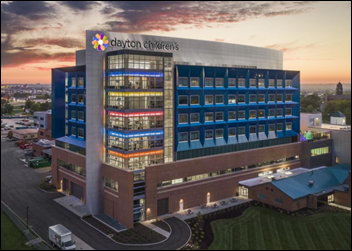
Dayton Children’s Hospital (OH) implements Abridge’s ambient documentation software.
VA EHR Modernization Program Executive Director Neil Evans, MD explains that next year’s slate of 13 implementations will occur in waves of facilities chosen for their pre-existing relationships, with many patients receiving primary care at one facility and specialty care at another. Go lives will occur next year at sites in Michigan, Ohio, Indiana, and Alaska.

Kettering Health (OH) reverts to downtime operations, canceling all elective procedures and diverting ambulances in the wake of a ransomware attack discovered Tuesday morning. Hackers have threatened to publish patient data on the dark web if the health system doesn’t meet their demands within 72 hours.
Researchers at the the Regenstrief Institute and Indiana University School of Dentistry develop an app that connects dentists to health information exchanges so that they can more easily access a patient’s medical history.
Blog Posts
Mr. H, Lorre, Jenn, Dr. Jayne.
Get HIStalk updates.
Send news or rumors.
Follow on X, Bluesky, and LinkedIn.
Sponsorship information.
Contact us.
![]()
New Mountain Capital combines portfolio companies SmarterDx, Thoughtful.ai, and Access Healthcare to create healthcare administrative and revenue management company Smarter Technologies.
Medical and dental practice technology, services, and solutions company Henry Schein announces a $250 million strategic investment from KKR.
Regeneron Pharmaceuticals will acquire 23andMe’s Personal Genome Service, Total Health and Research Services businesses, and Biobank and related assets for $256 million.
One of the hospitals where I am on staff has decided to take a dip into the waters of virtual nursing, at least according to a buzzword-filled newsletter that came out last week. Apparently, the project is going to be transformative, innovative, and cooperative, although having all those words in the same opening paragraph made me wonder if hospital administration was having fun with a thesaurus app while writing it. They left out some of the adjectives that we sometimes associate with technology projects, including disruptive, aggressive, and intrusive.
At no point in the newsletter did they actually explain what type of virtual nursing workflows they planned to implement, or what the timeline might look like. I’ve done plenty of work in this space and know that if you’ve seen a virtual nursing project at one organization you’ve seen one project and that rarely do two of them look alike. There are so many variables, including which EHR will be incorporated, what kind of equipment will be used, and which of the many problems the organization is trying to solve with the solution. There was also no mention of the timeline, the holding of stakeholder sessions, or any contact information about the project other than to contact the director of nursing for questions. I don’t envy the volume that her inbox is likely to see with all the questions I heard thrown about in the physician lounge.
I thought the timing of the newsletter was particularly interesting, since we just had our quarterly medical staff meeting last week and that would have been a fantastic opportunity for socializing the concept with the majority of physicians who are on staff at our facility. Of course, that begs the question of whether administrators actually want to have a dialogue about the project, leading my more conspiracy-minded colleagues to think the lack of information was part of a well-orchestrated plan to cut physicians out of the process. Having watched a number of technology projects unfold here, I’m not sure that I would give some of our leaders credit for being organized enough to intentionally alienate us. More likely than not, it’s just the usual confusion and lack of communication and coordination that we see most of the time.
One of my colleagues asked me what I thought about virtual nursing and which variety of the solution we should adopt. In thinking through current needs and what I hear from the floors, I think a quick win would be to adopt a solution that enables virtual sitters. Right now, the hospital is so short staffed for sitters that they’re floating registered nurses to do the job, which creates an incredible cost burden every time a physician orders a sitter for their patient’s safety. There’s a lot of pushback when the order is placed, which isn’t a good look for any healthcare facility. It’s also a dissatisfier to the nurses who are floated, since they end up working far below the level of their licenses. Although implementing a virtual sitter program would create some operational savings, it’s a huge capital investment, as it would require adding cameras and technical infrastructure throughout the facility.
Having that kind of technology in patient rooms could also be used as a stepping stone to implementation of AI-powered fall prevention programs, which I think are going to be increasingly important as the average age of hospitalized patients continues to increase. Due to the technology lift, organizations that employ these kinds of solutions usually do so on a unit-by-unit basis, which makes sense to reduce disruption. Still, I could see the neurology unit duking it out with orthopedics and the general medical service to see who gets to go first. I suppose if hospital leaders wanted to get creative they could throw in some teambuilding and elements of competition and turn it into a formal challenge to see who can earn the right to go first. Personally, I think it would be more entertaining than the usual teambuilding they try to do, which usually leads to worsening resentment by the lunch break, if not before.
While we were talking about it, someone asked whether I thought it would be better for the staff of such a program to be employed by the hospital or by a third party. There are certainly pros and cons with either approach. Making the virtual sitters part of our hospital would have the potential to build collegiality and trust, and might allow us to tap a larger candidate pool due to the virtual nature of the work. On the other hand, having them work for a third party might lead to culture issues if there is a perception of difference as to how those sitters are treated versus in-person employees. It certainly changes the appearance of the balance sheet, which is more important to some administrative types than others.
When it comes to virtual nursing of the registered nursing variety, I think it’s critically important that the nurses be employed by the hospital so that there is a single cohesive nursing workforce. Virtual nursing has enormous potential when it comes to creating longevity in the staffing pool – allowing nurses to float to virtual roles when they need to because of illness, injury, or disability. There’s potential for hybrid roles where nurses work both virtually and in person, which helps keep skill sets sharp for future role changes. Such an arrangement also prevents the feelings of “us versus them” that I’ve seen in other virtual projects, where the virtual staffers may be in another state or otherwise never set foot within the facility.
I’ve seen so many different kinds of projects, though; I think it would be challenging to figure out where to start first in our facility. Would we want to have virtual nurses primarily for admission, discharge, or both? Or would we use a more hybrid model where several less experienced bedside nurses might be paired with a more experienced virtual nurse who serves as a supportive mentor to the group? Of course, one of the first things we should be doing is having conversations with our stakeholders, which don’t seem to have happened yet based on how the newsletter sounds.
For the projects on which I’ve worked, usually I become involved after the decisions are made and I’m working on implementation and training, so it would be great to understand the thought process of organizations who have tried the different solutions in different combinations. Is there one way that’s more foolproof than others to implement in a mid-tier community hospital as compared to the academic medical centers that many vendors seem to have worked with? Is there enough consistent experience in the field that pitfalls have been identified for organizations to avoid?
What are your thoughts with virtual sitters or virtual nursing? Did it do all that you expected or did the efforts fall flat? Leave a comment or email me.
![]()
Email Dr. Jayne.
Private equity giant Bain mulls bid for London-listed software firm Craneware
Shares of Scotland-based Craneware jump on reports that Bain Capital is considering acquiring the company, which sells health system financial software.
Doximity Stock Drops 20% After Outlook Disappoints
Doximity shares drop 20% after the telehealth and medical networking company issues full-year guidance below analyst expectations.
Fresno hospital kickback scheme was fueled by wine, cigars and Vegas strip clubs
The Department of Justice settles a False Claims Act whistleblower lawsuit against Fresno, CA-based Community Regional Medical Center and its for-profit technology subsidiary Physician Network Advantage for $31.5 million.

Shares of Scotland-based Craneware jump on reports that Bain Capital is considering acquiring the company.
Bain Capital confirmed that Bain Capital Funds is assessing a possible offer, but it has not involved Craneware’s board.
The company, which sells health system financial software, reported 800 employees and $189 million in sales last year. Its market capitalization is nearly $1 billion.
From Japonais: “Re: CureIS versus Epic. What points does Epic need to dispute to prevail?” Unlike Particle Health’s lawsuit against Epic, CureIS makes no claim that Epic created an illegal monopoly, which carries a high burden of proof that is unlikely to prove successful. The CureIS complaint lists these specific items:

Respondents for last week’s poll passed along some advice to those who are planning, or should be planning, their future.
New poll to your right or here: Should Epic and other EHR vendors be required to provide data access to competing applications if their shared customer approves?
Live Webinar: June 18 (Wednesday) noon ET. “Fireside Chat: Closing the Gaps in Medication Adherence.” Sponsor: DrFirst. Presenters: Ben G. Long, MD, director of hospital medicine, Magnolia Regional Health Center; Wes Blakeslee, PhD, vice president of clinical data strategies, DrFirst; Colin Banas, MD, MHA, chief medical officer, DrFirst. Magnolia Regional Health Center will describe how its Nurse Navigator program used real-time prescription fill data from DrFirst to identify therapy gaps and engage patients through timely, personalized outreach. The effort led to a 19% increase in prescription fills and a 6% drop in 30-day readmissions among participating patients. Attendees will learn why prescribing price transparency is key to adherence, how real-time data helps care teams support patients between visits, and how Magnolia aligned its approach with value-based care and population health goals.
Oracle Health, Cleveland Clinic, and Emirates-based AI company G42 will develop an AI-based healthcare delivery platform that will combine Oracle Health applications, Oracle Cloud Infrastructure, and Oracle AI Data Platform. The system will continually analyze population and public health data and provide real-world data for life sciences to enhance diagnostics, personalize treatments, optimize outcomes, and decrease costs.
The VA plans to implement Oracle Health at 13 facilities in 2026, followed by 20 to 25 additional go-lives in 2027. VA Secretary Doug Collins says that the agency will address the lack of standardization that stalled the project.

The Department of Justice settles a False Claims Act whistleblower lawsuit against Fresno, CA-based Community Regional Medical Center and its for-profit technology subsidiary Physician Network Advantage for $31.5 million. The hospital was accused of bribing doctors with cash, wine, strip club visits, and trips in return for using the hospital’s $75 million Epic EHR to refer their patients to its facilities. Michael Terpening, the whistleblower and former PNA controller, says that CMC provided the Epic system under the Community Connect model at no charge in return for referrals. Details from the lawsuit:
Blog Posts
Mr. H, Lorre, Jenn, Dr. Jayne.
Get HIStalk updates.
Send news or rumors.
Follow on X, Bluesky, and LinkedIn.
Sponsorship information.
Contact us.
![]()
Blake Walker is co-founder and CEO of Inbox Health.

Tell me about yourself and the company.
Inbox Health is a software platform that fully automates patient billing, payment collection, and patient support for medical practices and billing companies. We try to make bills clear, help them get to patients faster, and make them more convenient and affordable for patients to pay. Alongside that, and an important part of that process, is to make sure that patients get fast and empathetic support via phone, text, and real-time chat to get their questions about their bills answered while we’re doing that.
I started in the healthcare space right out of college. I worked on a patient financing startup and quickly learned how problematic the patient AR problem was becoming for medical practices, especially smaller medical practices. I then spent a couple of years working on another patient billing startup and then ultimately founded Inbox Health 11 years ago. I have been with the company ever since, growing it from zero to where it is today, with about 3,500 medical practices using the platform nationwide.
How does the patient’s payment experience influence their satisfaction with the provider?
It’s a huge factor. It’s so intertwined today, the way the clinical experience then carries over into the billing experience. The patient can leave that visit feeling good about the clinical care, but then have such a bad billing experience that their entire perception of that provider is dragged down.
If there are mistakes in the way their insurance was billed, the provider may end up getting into an argument with them on the phone after the fact. Or even worse, it’s not even the provider, it’s the provider’s billing service provider. The patient may feel that the clinician provided a worse clinical experience because of how the billing went.
Having a great billing experience is critical to making sure that the entire clinical visit is perceived as positive. So much more frequently than ever, that billing experience is a negative one. Patients owe more money. High-deductible health plans are common now, and patients are surprised by the bills they get and are frustrated by them.

As providers, we owe it to the patients to do everything we possibly can to make sure that the billing is done accurately and clearly and that the experience that they have is convenient. Often it’s paper checks only and poor patient support to answer their questions. That will obviously leave the patient with a bad outcome.

How do practices prevent those awkward financial moments that can start or finish a visit, especially when the practice may not know what services the patient will need ahead of time?
Educating the patient about their coverage at the time of the visit, and how that visit is likely to be billed to the patient, is an important starting point. You don’t necessarily need to have it down to the dollar, just that the patient understands that a bill is likely. If they come in to a nutritionist’s office, their child is sick, and you see that they have a high-deductible plan, give them a sense of expectations, such as that it usually takes about two weeks for us to send bills out. Or after your insurance is adjudicated and we know that you’re on a high-deductible plan, I want to make sure to flag that for you. That’s realistic for most practices with just their standard processes for eligibility checks prior to visit and understanding a little bit about the patient’s insurance. The patient can fill in the rest.
Then, whatever you can do to get the bill to the patient as quickly as possible. You don’t want situations where it’s months and then the patient’s getting a bill 90 or 120 days after they came in to see you. I understand that there’s often trouble getting it through the adjudication process with insurance, but getting that timeline as fast as possible so that the patient is in that same frame of mind as when they came in to see the clinician in the first place. Having that be an easy, convenient digital-native experience as much as possible helps to streamline that whole experience.
How does the method and timing of presenting the bill to the patient affect getting paid?
Most patients want to have both the digital presentment and also the tactile patient statement in the mailbox to know that it’s legitimate. Sending a text message or an email captures their attention, but it doesn’t feel real to them. Once they get the statement in the mail, then it feels more real and they are more likely to pay from the email or text that follows up after the statement. It’s a combination of demographics and who’s more likely to pay from email or text message than a paper statement. But for most patients, email is the most likely way to drive payment.
No method on its own works particularly well. Everyone pays attention to text messages, but are hesitant to click on them and pay because texts are often used for scams. It has to be a holistic approach, where at least in our case, we’re using artificial intelligence to identify what will probably work best for most patients. It’s all dynamic. It has to be an omni-channel, holistic approach to trying to reach the patient in the way that will work best for them and meeting them where they are at any particular time through a process over several weeks and sometimes months.
How common is it for the patient to need or want to contact someone at the practice once they’ve received a bill?
About a quarter of the bills that go out create a question. That’s obviously a huge factor in terms of how you’re running a practice now. If you’re sending these bills out without anticipating and being prepared to answer those questions, it’s going to pull down your collection rates. It’s going to negatively impact the consumer experience with those bills. Most of us aren’t well prepared to do it, but it’s a high proportion that are coming back to the practice with questions.
A big factor is the amount of money owed. The average family has a $4,000 deductible and it’s not uncommon to end up with a $500 or $600 bill from a standard medical visit. That’s a huge number for most families. You shouldn’t expect that someone who gets a $500 or $600 bill will just blindly pay it from all of this wording that’s on the bill, and why it was billed that way. It’s unlikely that someone will just pay without asking a question.
What is the outcome of those billing calls to the practice? Are patients looking for reassurance that the number is correct or perhaps wanting more details that could have been provided on the bill initially?
I would say that about half could have been addressed upfront. Better setting expectations, providing better information on the bill itself, is often a root cause of the questions that come through. But a significant number of them are related to how the billing was done. It’s often somehow related to coordination of benefits, meaning what insurance was billed and in what order was it billed, particularly for patients who have multiple insurances like Medicare or Medicare Advantage plans or multiple commercial plans. A lot of those cases have legitimate issues that feed back to it, and ultimately, that could be prevented to some degree upstream just by collecting better information at the front desk.
I’m just isolating the patient billing itself. It’s a little difficult to control what problems land on the lap of your patient support team because something wasn’t done well up front.
How often does the patient get frustrated by trying to coordinate the practice’s billing, the insurance payment, and their own financial responsibility?
It’s frustrating for everyone. The provider obviously wants the procedures to be covered to whatever extent they possibly could be. The patient is stuck in this loop where they’re asking the provider questions, the providers are deferring to the payer, and the payer defers to the provider. All sides don’t have a full picture.
The patient is the one who’s left holding the bag with a bill that someone is demanding to be paid and the frustration of two parties that aren’t seeing eye to eye. It’s common for the provider’s answer to be “ask your payer” and for the payer’s answer to be “ask your provider.” The patient may finally give up and pay the bill or ignore it and see what happens. Patients are seeking that alternative more and more.
What are some best practices for reducing how long it takes to receive payment for patient responsibility?
Optimizing the number of touch points and the channels that you are able to reach a patient on in that first 15 days is critical. That’s the first thing.
Second is meeting patients, from an affordability perspective, where they are. Understanding where a patient’s threshold is for when they might need payment plan options and making those payment plans available to a patient readily. You don’t want the patient waiting 45 or 60 days, getting three bills from you, and then picking calling you and saying, “I know you keep asking, but I don’t have $1,500. I just don’t.” Then you tell them that you can take $50 a month and that’s fine. You need to be proactive about how you engage the patient, which channels you engage them on, and then offering the payment plans when it’s applicable to that particular patient.
We do predicted payment plan offers, where we’re looking at various data points about a patient, their bill, and their past history with the practice and then determining which ones to offer payment plans to and what kind to offer.
But if you can do those two things well, that will get you the best possible result. Some of this comes back to the more that you do at the front desk to educate the patient and collect cards on the file, the more you can accelerate that back end as well. But if you can’t influence that or change that for whatever reason, then obviously on the back side, that approach makes the most sense.
How are you using AI now and how will you use it in the next year or two?
AI has always played a role in how we manage the outgoing patient billing process. The biggest changes in how we’re using AI, and how AI will be used in the patient experience moving forward as it relates to patient billing, is on patient support. We are investing heavily in making the patient support experience better by training large language models to answer the patient questions that come back, feeding it data from the patient record to be able to help it answer patient questions, and letting it actually take action, such as the patient didn’t get a paper bill and wants one, so AI sends it. Or creating a payment plan.
Over the next two to three years, you will see a transformational change in how patient phone calls are answered and how patient chats are answered relative to where we were a couple of years ago, or a year ago. Or even right now, where most of that is either going to the practice staff in the office or it’s being outsourced to the Philippines or India to lower-cost resources. The quality of AI for patient support is rapidly improving and will play a cool role in improving the patient experience in many ways, but in particular, around patient billing.
What factors will drive the company’s strategy over the next three or four years?
Investing heavily in the role of artificial intelligence in the patient experience is a main focus for us over the next few years. And in general, partnering as closely as we can with the best-in-class EHRs and practice management systems to make the experience as seamless as possible for patients where their providers are using different EHR platforms is really important to us. Those are the areas we’re investing heavily in. We believe there’s a lot of opportunity to improve the front desk experience. That’s another area where we’re focused on trying to build technology to improve how the front desk experience connects back to the patient billing experience post-visit.
That, or we see if Judy will announce Epic's new Aviation module (probably called Kitty Hawk) that has integrated Cruise…