Recent Articles:

Readers Write: RHTP is Money for Rural Hospitals, But States Say Maybe Not

March 30, 2026 Readers Write 1 Comment

RHTP is Money for Rural Hospitals, But States Say Maybe Not
By Mike Lucey

Mike Lucey, MBA is president of Community Hospital Advisors.

image

What happened to “hospital?”

“Protecting Rural Hospitals and Providers” is the title of Chapter 4 (section 71401) of the Big Beautiful Bill, which defines the Rural Health Transformation Program (RHTP). It is six pages of clear instruction on how $50 billion will be funneled into rural healthcare over five years. It outlines who gets it and how they can spend it.

This is an impressive economy of words for a federal document with such a bold objective. The word “hospital” appears 15 times in those six pages. The longer federal Notice of Funding Opportunity (NOFO), which calls on states to submit applications for this funding, includes about 80 instances of “hospital,” which reveals an understanding that rural hospitals are the main access points for a wide variety of care, services, and resources for these communities.

But in many state applications, the word “hospital” fades or completely disappears. How is it possible that a law that was written to protect rural hospitals can morph into a series of state programs and agencies with no explicit mention of hospitals in their objectives?

Delivering rural healthcare faces two key challenges: too much space and too little money. When it comes to money, things are clear. The AMA reports that half of rural hospitals are operating at a deficit. The reasons are complex and varied, but location is intrinsic to all of them.

Too much space makes it less profitable to provide healthcare in a rural setting. Rural patients are, on average, two to three times farther from care than urban or suburban patients. The farther people are from anything, the less they do it. It doesn’t matter whether it is a gym, a bar, a parent, or a doctor. Distance becomes a reason or an excuse for why we can’t get there.

Can RHTP Help? Yes!

RHTP provides an opportunity to address these challenges by providing hospitals with the resources to hit new standards for how they provide care, especially in how they use technology. Nothing is going to change the length of a mile. But technology can close the access and contact gaps that distance creates.

Telehealth and home medical devices are great care tools that continue to get better over time. Full-access portals allow scheduling and reminders, and make messaging clinicians as easy as texting. Transportation can be scheduled and managed for patients with mobility issues through a fully functioning patient portal.

Once technology is in place to increase frequency and consistency of patient contact, technology can enhance these interactions and the quality of care with AI-augmented applications for notes, orders, and coding. These improve provider workflow, decrease burnout, allow better physician-patient interaction, and set the stage for AI clinical guidance. Finally, robust analytics and data management systems will improve the exchange of clinical data between facilities and providers, allowing high quality care regardless of location or specialty.

This vision for better rural care through technology is at the heart of RHTP, and these objectives are stated plainly in those six pages of section 71401. They are worthy and important goals. Improving just these three areas: patient contact, care delivery, and data exchange, improves care for every patient accessing every service the hospital provides. This care foundation can then expand to improve chronic care, nutrition, behavioral health and substance use disorder services, all of which are stated goals of RHTP.

RHTP exhibits a good understanding of the rural “too much space, too little money” challenge. It identifies the problems that space causes and then offers solutions and the money that is needed to deliver those solutions.

But somewhere between the authoring of the original bill and the allocation of funds from the states, many programs veer off course. Money wakes the bureaucratic beast, and the word “hospital” begins to fade.

But that doesn’t mean that the Rural, Critical Access, and Community Hospitals that serve one in five Americans, should accept defeat.

How Do Hospitals Stay at the Table?

My first encouragement to hospitals: don’t be complacent. Don’t take it as inevitable that this money is going to get siphoned off by large and connected entities. States vary widely in how friendly or not they are toward hospitals, but all will make some funds available directly. The difference in how much may well depend on how many hospitals are presenting well-constructed, justifiable projects.

Second: don’t be patient. States are just now assembling staff and drafting processes that will eventually become a method to distribute funds. Now is the time to get to work.

  • Create your project list. Not the list every rural hospital has, which includes things you will get to when you have the money. It is that list plus all the things that you have not even let yourself think about because the budget was so restricted.
  • Tie each project to your state initiatives and to the federal Use of Funds. Include estimated cost, timeline, and metrics.
  • When your state publishes its protocols, format your request to be compliant.
  • Whenever possible, team up with other sites. A collective of voices is harder to ignore.

Finally, don’t get discouraged. These processes are intentionally painful. OK, that is my opinion, but I find the process painful and have come to believe it is meant to cull the number of applicants and leave just the group that makes the process a profession. Stick with it.

Patients in rural communities are being left behind. RHTP is an opportunity to change that. There will always be too much space in rural healthcare, but with the right investment and execution, hospitals can close the gap and make a meaningful difference.

HIStalk Interviews Brent Benner, President, Canopii Collaborative

March 30, 2026 Interviews No Comments

Brent Benner is founder and president of Canopii Collaborative.

image

Tell me about yourself and the company.

I was born and raised in Texas up until about high school, then spent several years in the Midwest and Texas. I spent two years as a Peace Corps volunteer in Peru. I got back the day before Thanksgiving in 2008, when the stock market dropped like 500 points and launched the financial crisis. I had studied finance and entrepreneurship in school, but finance was definitely not going to be a good path at that moment. I worked at Microsoft for a while, but I was looking for something more purpose-driven like I had done in Peace Corps.

I was seeking jobs only in Austin and Chicago when Epic called me. I figured that a practice interview would be good, and I had heard good things about Madison. Epic just blew me away, so I took that job and ended up staying there for eight years. I started on the implementation team for Tapestry, which is part of the payer suite. I pretty quickly moved into director of product management for the payer suite and acted as the primary liaison between our clients and the software engineering team to help formulate the roadmap.

Ultimately, I couldn’t deal with those cold winters of Wisconsin anymore, so I returned to Texas and launched Canopii in 2021. While I was at Epic, it was pretty clear to me that a lot of firms provided Epic consulting services, but no one was hyper-focused on the payers. We launched Canopii to do just that, to provide purpose-built consulting for health plans and managed care organizations.

That intentional focus has led to a lot of growth. We started with four consultants in 2021, and now we have about 70, of whom 60 focus specifically on the Epic payer suite.

Epic’s payer suite is made up of a couple of products, with Tapestry and Payer Platform being the flagships. Those are used by health plans, essentially the insurance companies or the payer side of the business, rather than the provider side, although we work with a lot of provider-sponsored health plans that work in an integrated environment between the health system and the health plan.

What problems do you solve?

We primarily help our clients take advantage of the software that Epic has built. We’re not necessarily in the game of developing software ourselves. We work with our clients to implement and optimize the software so that they can get the most out of the Epic system.

We add the most value by bringing a product management mindset and being data-driven. We help our customers understand their operational metrics and turn the Epic complexity into operational clarity. We help them achieve the most with the software to improve those metrics and serve the members and providers that they work with.

How does your client measure the ROI of your services?

A lot of times, it depends on how we’re specifically working with them. We do a lot of implementation, so we’re the firm that customers turn to when they are going to implement the Epic payer suite. The return on investment there is focused on being on time, being on budget, and meeting the operational metrics that they have set as goals. Moving to the Epic system overall generates quite a bit of ROI, but you need to get the most out of it to realize that ROI.

We work with clients in other service lines, such as optimization or our application managed services division. AMS is focused on how we can generate cost savings by providing a managed services model in a more cost-effective manner while still delivering better quality. Then, what results can we deliver to your operational metrics?

For instance, a client that we are working with for AMS has decreased the interest and penalties they are paying by $10,000 a month. They have increased their auto adjudication rate, which is one of the most important metrics for payers and ultimately leads to significant labor cost savings.

How many of Epic’s customers use Epic’s Tapestry and Payer Platform?

About 50 organizations use Tapestry. It acts as a core administrative system for processing claims, enrollment eligibility, and medical management, such as utilization management, case management, and population health. A lot of those 50 organizations are provider-sponsored health plans.

Payer Platform focuses on interoperability between payers and health systems. That has been growing like wildfire. All of the largest commercial standalone health plans are now using Payer Platform.

Like with just about every other Epic product, Epic ultimately wins. We are seeing the large standalone health plans start to implement other components within the Epic payer suite, such as Blue Cross and Blue Shield Louisiana, as well as Humana implementing the medical management suite. Over the next couple of years, we’ll see some of these organizations take a look specifically at Tapestry and the claims processing applications too.

When you worked at Epic, how challenging was it to start working with organizations that aren’t health systems?

Most people who work in this ecosystem would have no idea that Tapestry was one of the first applications that Epic launched. They were working with a lot of staff model HMOs and provider-sponsored health plans, but obviously the core focus was on inpatient ambulatory and revenue cycle. Epic clearly established itself as the number one player in those particular markets.

It made sense for Epic to redirect their investment into other areas outside of the traditional four walls of healthcare. That is why you’ve seen growth in areas such as life sciences, but also within the payer suite. It was exciting as the director of product management to see those dollars start being redirected to invest in the payer suite. The payer suite has essentially been number two in investment since around like 2019.

How were you were involved with Epic’s significant investment in money and headcount to implement Kaiser?

Payer suite was  put on the map when we sold Tapestry to Kaiser, which had 11 million members. This was a $1 billion project overall, a little less than the $4 billion that was quoted for the health system, but parallel paths. They followed the same parallel path when the Northwest region and Oregon pushed Epic in the early days for the health system, but it was Georgia that implemented Tapestry and had real success there. That ultimately pushed the rest of the Kaiser organization to adopt it as well.

Our team had been 20 people on implementation and maybe 20 to 30 on R&D. All of a sudden, implementation was essentially 60 people and R&D grew to over 60, which could have even gone significantly higher than that just for Tapestry alone. The payer suite division grew to a couple of hundred people.

What did you learn in being an early-career employee who was put in charge of this massive project that was unlike Epic’s previous work?

An opportunity to have a career at Epic is incredible, because they take a bit of a sink-or-swim mentality. If you can survive and swim, there’s nothing like the opportunity to grow and be challenged. It’s an opportunity to rise, but it is stressful at times. We had some long weeks when we were doing the Kaiser implementation. But that completely exposed me to the industry and the ability to make an impact for Kaiser’s 11 million members. It was a phenomenal experience for sure.

What is the status of payer-provider collaboration and who benefits most from it?

I would hope that our patients, our members, and we as a society stand to benefit the most. We have over $500 billion in wasted administrative spend in healthcare year over year. We are called Canopii Collaborative because we truly believe that the only way that we can reduce that wasted administrative spend is by focusing on helping payers and providers collaborate to seek opportunities where we can do better data exchange, reduce unnecessary exams and tests, and change the model by how we pay and finance healthcare in moving from fee-for-service to value-based care to ultimately reduce that administrative spend.

We at Canopii established ourselves as the primary firm that you should turn to for the Epic payer suite. To start to bridge that payer and provider collaboration, we acquired Anchor Healthcare Consultants, which focused on revenue cycle. We are continuing to focus on that area.

Between CMS-0057-F and other regulation around interoperability and payer-provider collaboration, I have a lot of hope. I also have a lot of hope that AI will help accelerate this initiative and get us there faster. It is fundamental to reducing the total cost of care in this nation, which is frankly unsustainable.

How did your background prepare you to run companies?

I’ve been an entrepreneur ever since I was a kid. This is probably like my seventh company, but the first one that is truly successful.

My experience at Epic prepared me for leading a company like this. Epic still operates as fairly entrepreneurial. It’s very flat, and they place a lot of trust in those individuals who are essentially leading divisions like I did for the Tapestry team. That definitely prepared me, but it’s very different when you also have to handle all the backend function functions like finance, HR, and operations without the support of those great teams like they have at Epic.

It has been a fun ride, for sure. We were excited to be named the 67th fastest growing company on the Inc. 5000 last year. I’ve read that magazine since I was in middle school and an aspiring entrepreneur, so that was a pretty big milestone for us. We are excited about the growth to come.

How did you meet the challenge that faces most companies, but especially consulting firms, to create and maintain a culture?

It is cool to see team members who come over to Canopii who have typically worked at other consulting firms. The comments that they share with us are exciting. What makes the biggest difference is that we treat them as people and not just another number. Perhaps most importantly, they enjoy that we actually understand what they are doing day-in and day-out.

I previously worked at Epic. Our other co-founder was at Epic as well, and then worked as a consultant for a few years. We have maintained a culture where we understand what it is that you do day-in and day-out. We are here to support you. People have gotten into the mission and then the ecosystem that we have created. If you are struggling with an issue, you aren’t sitting on a deserted island. You can come and work with all of the other 60-plus experts that we have in the Epic payer suite to identify someone who has had a similar issue, then work together to bring that back to your client and add value.

What is the company’s strategy over the next few years?

A big focus for us will be expanding our application managed services team. We’ve seen a trend towards managed services over the last couple of years, I fundamentally believe that AI will accelerate that trend. We are focused on working with our clients there, because when we have the opportunity to support them end to end, we can make a significant difference. We are seeing the turnaround on some of not only the IT metrics, but more importantly, the operational metrics that we’ve been working on with our first AMS client. That will be a real focus for us over the next couple of years.

Healthcare in this country is, unfortunately, systemically and fundamentally broken. No single individual or single branch of government can turn that around. It can be overwhelming, particularly at the macro level.

I encourage our customers, other vendors, and our team to adopt the Boy Scout model and leave it better than you found it. Identify the particular area where you can make an impact. Even if you are just one analyst at one client, you can make an impact. Or you may be the CEO of a vendor that is seeking to make a difference between payer and provider collaboration.

Everyone can ultimately contribute to making those small impacts. Then, in aggregate, hopefully we can start to move healthcare towards a model that’s more sustainable for us as a country.


Morning Headlines 3/30/26

March 29, 2026 Headlines No Comments

HMA Acquires HealthTech Solutions, Expanding Technology Capabilities and Medicaid Expertise

Health Management Associates acquires Medicaid-focused technology, analytics, and compliance company HealthTech Solutions.

Stryker rules out ransomware, confirms threat actor used non-propagating malicious file

Medical device maker Stryker rules out ransomware as it continues to investigate the cyberattack that disrupted its internal systems two weeks ago.

CareCloud says one EHR environment hit in New Jersey

Ambulatory health IT vendor CareCloud investigates a third-party’s unauthorized access of one of its EHR environments on March 16.

EMed Raises $200 Million at $2 Billion Plus Valuation

Employer-focused, digital GLP-1 program company EMed raises $200 million in a Series A funding round.

Cash-Pay Health Has a $100 Billion Infrastructure Problem. We Just Raised $7.5M to Fix It.

Vitl, which specializes in e-prescribing technology for practices that don’t accept insurance, announces $7.5 million in Series A funding.

Monday Morning Update 3/30/26

March 29, 2026 News No Comments

Top News

 image

Andy Crowder, Advocate Health SVP / chief digital and AI officer, describes how Advocate is using Epic’s Agent Factory to create four prototypes that it plans to placed into production in July. .

Advocate convened an agile sprint for pharmacy complex order verification and infusion charting prep, which yielded the four prototypes.


Reader Comments

From Skeptical Clinician: “Re: Perplexity Health. Every new healthcare AI entrant promises trustworthy answers, which is comforting right up until you remember that healthcare already has plenty of confident systems that are wrong in more expensive ways.” At least “confidently wrong” will now scale.


HIStalk Announcements and Requests

image

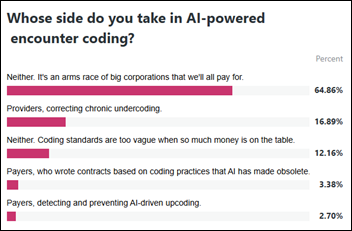
Poll respondents envision providers and payers getting into AI wars over billing codes, which doesn’t seem farfetched. Both sides could claim intentional injustice, but the American way is that proven or admitted fraud generates a financial penalty but no jail time for those who knew it was happening, so it’s just a cost of doing business with positive ROI as long as the profit exceeds the penalty.

New poll to your right or here, as inspired by the Reddit post last week: Should patients have the sole approval for sending their medical records to any third-party tool they choose?

image

Reader donations to Mr. H’s Los Angeles elementary school class funded his Donors Choose teacher grant request for Spanish-language books to help the 75% of his students who are English learners. He reports, “My students have been grabbing the new books left and right. Many of them are getting upset when they want to change their book, but it has been taken. It is great to see the love of reading flourish again in my classroom. This could not have happened without your donation.”

I’ve been frustrated by an IPad problem where the back-arrow and close window icons at the top of portrait-mode screens overlay screen content, making it impossible to go back a page or close the window without tilting over to landscape mode. I Google extensively for an answer that never came, but I noticed that an IOS upgrade was waiting for me to clear some space because it was huge. It seems to have fixed the problem.


Sponsored Events and Resources

None scheduled soon. Contact Lorre to have your resource listed.


Sales

  • San Juan Regional Medical Center will implement PerfectServe for scheduling, secure communication, alerting, patient outreach, and switchboard workflows.

Announcements and Implementations

Advocate Health will launch the country’s largest hospital-based drone delivery network, using Zipline drones to deliver prescriptions, lab specimens, and medical supplies in three of its markets, starting in Charlotte, NC. Advocate expects drones to make 100,000 deliveries per year.

Analysis finds that one or two health systems control the entire inpatient healthcare market in half of US metropolitan areas. Concentration in 97% of metro areas exceeds FTC/DOJ antitrust levels.

Praia Health is granted a US patent for performing identity and access management for EHR instances.


Government and Politics

image

This is not a good look for the VA, especially if John Windom starts naming companies and executives in his trial.


Other

A study finds that people who use their phones during bathroom visits have a 46% higher risk of hemorrhoids because they spend more time on the toilet after getting distracted by scrolling news or social media.


Sponsor Updates

  • TrustCommerce will sponsor the NEECO Spring 2026 Conference March 31 in Waltham, MA.
  • VisiQuate VP of Growth Michelle Taylor joins the NAHSE NorCal Board of Directors.
  • Vyne Medical releases a new case study titled “How Automation is Shaping the Future of Document Management at VHC Health.”

Blog Posts


Contacts

Mr. H, Lorre, Jenn, Dr. Jayne.
Get HIStalk updates.
Send news or rumors.
Follow on X, Bluesky, and LinkedIn.
Sponsorship information.
Contact us.

Morning Headlines 3/27/26

March 26, 2026 Headlines No Comments

Collectly to Acquire Pledge Health to Accelerate AI Automation Across the Patient Financial Experience

Patient financial experience platform vendor Collectly acquires Pledge Health, which offers pre-service patient financial workflow automation.

Blossom Health Brings in $20M for its AI-Powered Psychiatry Platform

Blossom Health, which offers virtual therapy and medication management, announces $20 million in funding.

Veterans Affairs Senior Executive Charged With Concealing Gifts and Cash Received from Government Contractors

A former VA executive who led its Cerner EHR modernization project is indicted for accepting, concealing, and at times soliciting gifts from contractors that were involved in the project.

News 3/27/26

March 26, 2026 News 4 Comments

Top News

image

India-based IT services firm Infosys will acquire Optimum Healthcare IT for $465 million in an all-cash deal.

The seller is private equity firm Achieve Partners, which acquired Optimum in June 2020.

INFY shares have lost 30% in the past 12 months, valuing the company at $54 billion.


Reader Comments

From Purity: “Re: AI. What happens when payer and provider AI systems collide over denials? Hospital AI finds that denials may not be based on rational reason, then the insurer AI sees that and starts randomizing denials to confuse the provider AI?” Payers know that regulators won’t tolerate AI that invents or randomizes denial logic, so payers will keep systems defensible but not necessarily transparent. The battleground will be the rules themselves and how they are applied, which could force greater scrutiny. The likely outcome isn’t chaos, but exposure of a process that feels arbitrary because it is tuned for insurer profit rather than grounded in medical evidence. The only real disruptors, short of federal action, are high-profile patient stories that generate bad press and spook shareholders.


Sponsored Events and Resources

None scheduled soon. Contact Lorre to have your resource listed.


Acquisitions, Funding, Business, and Stock

image

Healthcare AI governance platform vendor Qualified Health raises $125 million in Series B funding.

image

Trovo Health, which offers AI-powered clinical care teams, renames itself Thesis Care and raises a $45 million Series A round.

image

Dimer Health, which offers AI-supported post-discharge medical oversight, raises $13.5 million in Series A funding.

image

RCM automation vendor Adonis raises $40 million in Series C funding.


Sales


People

image image

Artera hires Damon Lanphear (Amazon) as CTO and promotes Nicole Ossey to SVP of people.


Announcements and Implementations

image

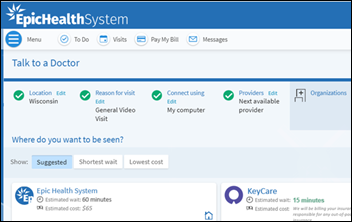
Epic-based virtual care provider KeyCare deploys Nvidia’s Nemotron large language model to power its AI-driven patient intake agent that collects information from patients during their pre-visit wait and summarizes it for their clinician.

Artesia General Hospital (NM) integrates Microsoft Dragon Copilot ambient listening with its TruBridge EHR.

Patient financial experience platform vendor Collectly acquires Pledge Health, which offers pre-service patient financial workflow automation.


Government and Politics

image

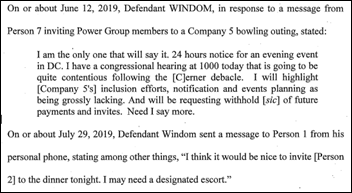
A former VA executive who led its Cerner EHR modernization project is indicted for accepting, concealing, and at times soliciting gifts from contractors that were involved in the project. John Windom, who served as executive director of the VA’s EHR modernization effort, faces up to 20 years in prison on charges of falsifying records, making false statements, and concealing material facts. The indictment alleges that he cultivated a group of six contractors, which he called the “Power Group,” who were assigned to him for mentoring related to obtaining government business as minorities. Prosecutors say that he coerced members into providing improper personal benefits and advancing diversity-related objectives that were unrelated to the EHR modernization project.

Health New Zealand warns staff that using free tools to write clinical notes is prohibited due to privacy risks, including drafting notes that are then pasted into official systems.

image

Florida insurance regulators suspend Mirra Health Care from processing claims for three Medicare Advantage HMOs after learning that the company outsourced the work to unlicensed firms in India and the Philippines


Other

image

West Suburban Medical Center (IL) temporarily closes after billing system problems reduce revenue by 90%, leaving it unable to cover payroll. Parent company Resilience Healthcare, which also operated the recently shuttered Weiss Memorial Hospital, signed a contract to implement Altera Digital Health’s Paragon EHR in November 2023.

image

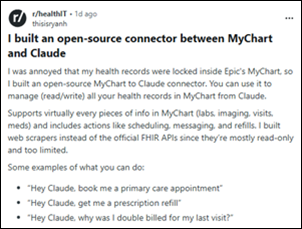
A Redditor posts and then deletes a message describing how they “built an open-source MyChart to Claude connector. You can use it to manage (read/write) all your health records in MyChart from Claude.” Other Redditors were appalled:

  • You have a setup that … effectively removes the user’s 2FA protections. Also, you have a button to deploy this on your site that includes an Oauth activation via Gmail, so effectively a user would be tying their Gmail identity together with their MyChart username? If so, you’re in some pretty dicey territory, not even considering Epic’s likely response to this repo and use.
  • So you have attempted to reverse engineer Epic’s MyChart internal APIs? I hope you understand how much Epic will not only hate this, but also will go after you. I honestly would recommend taking this down and removing this post here.
  • Jesus Christ OP this is a massive risk to patient privacy. I recognize that you’re trying to build something helpful, but healthcare is not the place for the move fast and break things tech mindset … the benefits here are limited whereas you risk exposing essentially all of a patient’s PHI while compromising 2FA protections across potentially multiple accounts.
  • Epic already beat you to it with Emmie. Also, you’re better off connecting your data using QHIN and TEFCA authorization. MyChart is hiding a TON of functionality and data from you.
  • Has anyone pointed out to you how many HIPAA violations this is?
  • Holy f*** this is vibe coded slop. You’re not handling encryption or creds properly whatsoever. There are other violations to PHI protection than storage that you’re committing here.
  • Exciting legal consequences ahead for you if this takes off even a little bit, and you deserve every one of them.

Sponsor Updates

  • Health Data Movers names Lisa Edler, MBA senior RCM consultant.
  • Infinx appoints Jon Vitiello, MBA to its advisory board.
  • Consensus Cloud Solutions is named a 2026 CSO Awards winner, which honors organizations that implement innovative cybersecurity initiatives.
  • Meditech Chief Nursing Executive Cathy Turner, MBA, RN-BC will present at the ANIA Annual Conference March 28 in Boston and at the AONL Inspiring Leaders Conference March 30 in Chicago.
  • MRO releases a new report titled “2026 State of the Industry: Navigating Health Policy and Market Shifts with Smarter Data.”
  • Navina will exhibit at the AMGA Annual Conference April 15-18 in Las Vegas.
  • Jefferson Regional, Pine Bluff Medical Center goes live on Altera Digital Health’s Sunrise 25.1.

Blog Posts


Contacts

Mr. H, Lorre, Jenn, Dr. Jayne.
Get HIStalk updates.
Send news or rumors.
Follow on X, Bluesky, and LinkedIn.
Sponsorship information.
Contact us.

EPtalk by Dr. Jayne 3/26/26

March 26, 2026 Dr. Jayne 2 Comments

I was excited to learn about Perplexity Health. It gave me the idea of how to potentially solve the nightly “what should we have for dinner” question.

The announcement mentions that the tool can link to health records, fitness app data, blood pressure tracking, and weight data. It can couple fitness, activity, and vital sign data with lab results, which allows it to identify the time periods in which patients had a certain state of health. If people track their dietary information, they can track what they are eating each day.

Assuming that people log meals that they enjoyed, I would love to be able to tell my patients to ask, ”AI tool, look at that time in 2023 when I lost 20 pounds and my cholesterol was great. Then make me a meal plan that will replicate those conditions so that I can do it again.” Now THAT would be a good use of AI. I don’t have a paid subscription to Perplexity, but I might try this with other AI tools. More to come.

The National Resident Matching Program, also known as “The Match,” occurred last week. I was heartened to see that family medicine recruited another record-breaking class. Eight hundred family medicine residency programs offered 5,512 positions, which is the largest number ever. Of those, 4,613 positions were filled in the main match. Unmatched residents are still trying to link with open positions, so that number is likely to climb over the next week. Official numbers typically aren’t published until May.

Family medicine residency programs have offered an increasing number of positions for 17 years and the number of programs is also increasing. However, a forecast predicts that we will have a 40,000-physician deficit in primary care by 2036. As one might anticipate given recent changes in immigration policies, match rates declined for non-US citizens who attended medical school outside the US, with the lowest match rate seen in five years.

From Borderless Doctor: “Re: travel-related illness. I work at an emergency department that’s closest to a major international airport. I have seen some interesting travel-related illnesses, including plenty of patients who have infections that are not typically seen in the US and can spread quickly where hygiene might be poor. This article about Kansas health workers gearing up for the World Cup makes me wonder whether surrounding institutions will make EHR changes to encourage providers to consider different clinical possibilities.” I hadn’t seen anything about this, so I appreciate the share.

The Kansas Department of Health and Environment is preparing for the potential influx of 650,000 visitors by educating physicians and public health workers. Although most clinicians might think of respiratory and gastrointestinal illnesses first, a state epidemiologist who was quoted in the article also mentions an increase in sexually transmitted infections.

The department plans to publish weekly reports to educate health workers on the current status of outbreaks, especially given that visitors from the southern hemisphere may be bringing illnesses that aren’t typically seen at that time of year in North America.

The article mentions that Missouri is a little behind Kansas in preparing and is still planning its website, but Kansas has its site live. I’m sure that interagency coordination will occur, but this is a situation where a national focus on health and preparedness could shine.

Clinicians are encouraged to think about travel histories. As an informaticist, I can imagine some temporary popups in the EHR, especially for urgent care and other acute settings, that remind staff to ask specific questions similar to what they did when we last saw Ebola virus in the US.

If you work in a facility in the Kansas City area, I would be interested to hear about your plans. Otherwise, everyone should wash their hands, cover their coughs, and stay home if they are ill.

My healthcare tech worker friends are always having heated discussions about remote versus hybrid versus in-office work, and also the tools that organizations use to monitor employee productivity. One colleague shared this article about JP Morgan Chase’s use of technology to monitor junior members of their workforce. They compare self-reported work habits with the data that their IT systems capture.

Company spokespeople say that the effort is intended to increase awareness and to promote wellbeing among staffers who are working excessive hours. The bank limits junior staff to 80-hour workweeks.

It would be interesting to use similar tracking for medical residents to see how their actual hours worked stack up against their work hour limits. I suspect that a fair amount of work goes on behind the scenes after residents are required to leave the hospital, but I haven’t seen any articles about this kind of research.

OpenEvidence announces, in conjunction with Rare Disease Month, new features for engaging with content around rare conditions. The company has partnered with the National Organization for Rare Disorders (NORD). I was surprised to see Wilson’s disease as the example that they used to showcase the new rare disease summaries. I saw several cases of it in medical school and didn’t realize that it was truly that rare.

That’s the kind of bias that you can develop when training at a tertiary center. You are exposed to cases at different rates than they present in the actual population.

The partnership also supports the development of patient-friendly content that will be surfaced within the tool and distributed through the NORD Rare Disease Database.

In using AI tools, I’ve recently become a big fan of Claude for tone, content production, and overall usability. The company has opened access to some features that were previously available only to paid users to those with free plans, which was a nice surprise.

Anthropic says that Claude will remain ad-free, in response to OpenAI’s plan to display advertising for users who aren’t paying for a subscription. Claude’s free features include file creation, skills, and connectors, which I’m eager to try. I don’t use non-work AI tools as much as some people, so the conversation limits for free accounts haven’t been a barrier.
Even though I think it’s a great tool, it wasn’t able to help me track down the name of a book that I couldn’t remember. It had a complex plot involving a woman who committed a crime, became a detective, and later was called to investigate that same crime. I don’t remember finishing the book and searched in several ways to find it. The human brain finally remembered that it was a “plot within a plot” kind of book, where the protagonist was a crime writer and the plot I was thinking of was the one in her current novel.

I went back to Claude with the answer in hopes of better training the tool. The response was interesting. Claude said that it was essentially unsearchable because “no plot summary would mention it, because it’s a subplot within a completely different genre of book … It’s a genuinely tricky one that I don’t think I could have ever found through searching alone, and it’s a lovely example of how a book-within-a-book can stick in your memory as vividly as the main story itself!”

Are you a voracious reader? How do you track what you’ve read? Leave a comment or email me.

Email Dr. Jayne.

Morning Headlines 3/26/26

March 25, 2026 Headlines No Comments

Infosys to Acquire Leading Healthcare Digital Transformation Company, Optimum Healthcare IT

Infosys will acquire healthcare IT consulting firm Optimum Healthcare IT.

Thesis Care Announces $45 Million Series A to Scale AI-Powered Clinical Teams Across Healthcare

Thesis Care, which offers AI agents for care management, care delivery, and clinical operations, announces $45 million in Series A funding.

Qualified Health Raises $125M Series B to Meet Growing Demand for Enterprise AI Transformation Across Health Systems

Enterprise healthcare AI deployment and management company Qualified Health raises $125 million.

Dimer Health Raises $13.5 Million To Rebuild Post-Discharge Care With Clinician-Led AI

Dimer Health will use $13.5 million in new funding to expand its transitional care model and further develop its clinical AI platform’s predictive capabilities and workflow automation.

Adonis Raises $40M Series C to Equip Healthcare Providers with AI‑Driven Revenue Cycle Operations

RCM vendor Adonis announces $40 million in Series C funding, bringing its total raised to $95 million.

HIStalk Interviews Walter Stewart, CEO, Medcurio

March 25, 2026 Interviews No Comments

Walter “Buzz” Stewart, PhD, MPH is co-founder and CEO of Medcurio.

image

Tell me about yourself and the company.

I have focused my career on working with data, from epidemiology training to leading research centers and startups.It defined my path, both in education, where I earned a PhD in epidemiology and was a professor at Hopkins for a while, and with my first startup, which was data-based.

I had a 16-year journey through two health systems, where I founded and ran research centers. I realized from the problems that I was experiencing that it was going to be difficult for AI and automation to work at scale.

I ended up where I never would have predicted, which is in the EHR integration space. I launched Medcurio as a step toward fundamentally solving the EHR integration problems that we face in healthcare. Namely, that it’s difficult to get access to all the real-time data that you need to drive predictive models or other kinds of processes.

How does your product make it easier to get access to real-time EHR data compared to tools that the vendor themselves might offer?

We have used all of those tools. I used them for the better part of 10 to 12 years trying to develop real-time predictive models, first at Geisinger and then at Sutter. Getting real-time applications into production took months, and even small changes took weeks.

It took weeks to more than a month to make changes based on user feedback. It was difficult to maintain user interest with that kind of turnaround time. The application broke from schema changes, which was disruptive and unpredictable. Other downstream functions made it impossible to do things in real time, and we didn’t see that bottleneck going away.

We made up a starter list of the problems we wanted to solve. We built a no-code API platform that installs in less than a day in a health system’s on-prem environment. It erases those problems.

An analyst can log in and build APIs to access any data that they want without writing a line of code. They can make changes to those APIs in minutes to hours. Other features give health systems the kind of control that I wished that I’d had, and that I’m sure that my colleagues wish they’d had, when I was journeying through Sutter and Geisinger.

What competitive or clinical advantages can health systems gain from using real-time data?

This is an important point. It took us a while to recognize that we had been working on real-time use of data for 10 years, so we just assumed that the rest of the market had the same passion. When we launched Medcurio and built our foundation product in mid-2020, we found that we were talking about things in a way that only the top five or 10% of health systems were thinking about.

When I think about using data in real time, I go to a couple of areas that are becoming prominent in the era of AI. One is predicting events, which can be useful in many ways. We often think of it for predicting risky events, such as getting to a heart failure patient before they end up in the hospital. Predictive models can be valuable for that, for inpatient infections, or for a host of other things. It’s a powerful area where AI could have profound influence.

But I think probably the more important areas are in workflow automation, whether that’s back-office workflow automation, or automating a whole process. If you take something like prior authorization, you have snippets of automation, with manual work in between those snippets. The power of being able to move any electronic health record data in real time is that you can put the whole thing together with a set of APIs that power each step in a process and hand off from one step to the next.

How do data latency and completeness problems potentially limit the innovation or implementation of AI solutions, especially agent-driven technologies?

I would list three things. Access to real-time EHR data is limited, latency reduces ROI, and slow iteration impedes improvement.

A unique quality of AI is that, compared to the era before, it will continue to drive unending demand for data volume and data diversity. That will always expand, and if you can’t meet that need in real time, you will have to pull back what you’re trying to do with AI based on the data that you can get.

Second is that maybe you can get only 24-hour-old data by end-of-day downloads. For some workflows, that might work. But for workflows where there’s a lot of ROI opportunity at stake, most of that has to be driven by being able to access all the data that you need in real time without constraints.

I don’t care what automated solution you create, you are always going to have iterations to making it better, and identifying ways that it’s getting hung up. You can’t evolve an automated workflow where after you identify the data you need, it takes months to get it because of infrastructure challenges.

How does your relationship with EHR vendors work when you become a layer between them and their customers, or making sure that vendor changes don’t break something?

We were very aware of those challenges. We developed a technology that is not specific to healthcare. We adapted to a data model. Our technology can talk to any InterSystems Iris database.

We install with the folks on the health system side. They mostly manage the install process, which takes two to four hours. They log into a GUI and can point-and-click to build, test, and then deploy APIs. That process takes anywhere from two to five days.

Our vision was that if I was in a health system, I wouldn’t have to wait in line forever to get something done to meet my demands or needs. This technology is designed for health systems to have control of their data.

What does the health system need to do to use your system in a no-code environment to create APIs that access EHR data?

In an Epic environment, we’ve had Epic analysts in their first year of training logging in and building APIs in an hour. It’s pretty seamless, because when you log in, you’re looking at things in a way that is just logically coherent.

Building an API involves two parts. Who do you want data on, and what data do you want on them? All of that can be done by a point-and-click process.

If you are building APIs for an application, let’s say a prior auth application that might involve a third-party vendor, that vendor just needs to know the API ID. A single endpoint is called for all APIs. That process is quite straightforward.

How are clients typically using the data?

We have seen three categories. One is strategic management of real-time data access. We have a system that uses it at scale in that way. They have rules of the game for how they access data based on priorities, such as using the EHR vendor APIs, FHIR, or some other method. If using these methods will take more than four hours, they use our VennU data access platform instead because it is so straightforward and easy to manage.

Our platform allows assigning multiple role-based users to one API. That gives them quite a bit of flexibility around how one API can be used by different groups. For example, some might have access to personal identifiers and some might not, depending on their role.

We have seen homegrown uses, most commonly real-time display vehicles, whether for inpatient or ambulatory settings.

Some are using third-party solutions. Salesforce is a good example. One system had struggled for six months with data they couldn’t get, and they solved it with our technology in a couple of hours. They went from 10,000 to 1.5 million API calls per day in 18 months after solving that single data access problem.

I think it varies depending upon where a system is on the spectrum of trying to automate or just observe their core intellectual assets.

How is the customer charged?

It’s an annual license based on health system revenue, with support fees. It is designed to motivate health systems to use it to the max.

How does the federal government’s emphasis on FHIR and APIs as an interoperability solution affect your business?

FHIR certainly is one path to accessing data, today and for the future. There will still be real constraints on the narrow sliver of data that you can access via FHIR, because there’s a lot of fields that you can’t access.

Our roadmap calls for developing what we call a FHIR facade for our platform. Because we have flexibility on how we output the data that’s being requested via an API, we can output it in different formats. A FHIR facade feature will allow users to get data in a somewhat FHIR format that could be interchangeable. That would provide greater scale, both within and across systems.

Do EHR vendor decisions or government mandates about data access have any impact on your business?

We don’t touch the data. Our security review is really simple. We install our technology. We coach on how to use our technology. The health system controls it. Our technology gives them access to 100% of their electronic health record data.

Our product talks directly to the InterSystems Iris database. A user who is building an API can visualize things in a way that allows them to easily build the requirements for who they want data on and what data fields they want to access. Once the API is in production, it can be called by any group or application that the security officer designates as allowed.

The power of our platform is that it solves what I would consider to be my greatest challenge when I was a leader of these research centers, which was that I just couldn’t get access to data that I wanted. That was the first problem we wanted to solve, and that’s why we felt that the best path was inventing this no-code approach to getting access from any data field.

What are the most important parts of the company’s strategy over the next few years?

We are getting to the end of our full roadmap for the VennU data access platform. We have this powerful platform that is an enabler for automation, so we will move from platform development to partnerships with solution vendors.

Healthcare AI News 3/25/26

News

image

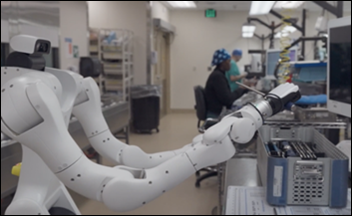
Nvidia describes the use of high-fidelity simulation and digital twins of hospitals to train and test robots before deploying them. Developers can model workflows, navigation, and edge cases in simulation, allowing robots to learn tasks such as delivery, transport, and patient interaction in a virtual hospital environment.

image

Heidi Health, an Australia-based AI scribe vendor, introduces Heidi Remote, a wearable microphone that captures higher-quality audio without relying on room placement. The device can operate offline, offers a 14-hour battery life, and allows the user to turn it off for privacy concerns. The company has raised $100 million.

image

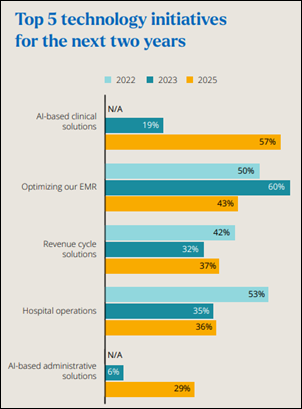
Health systems are cutting budgets and tightening approval standards, requiring clear 2x–3x ROI before buying new IT, according to a small survey of hospital leaders by Sage Growth Partners. Spending is shifting aggressively toward AI and growth-focused tools, which suggests a move from experimentation to financially driven adoption.

Japan’s health ministry approves a plan to allow AI to perform the initial review of diagnostic images for lung, stomach, and breast cancer screening. Under the proposal, AI-flagged abnormalities would be reviewed by a single physician, while normal images would still require the standard two-physician review.

In England, more than half of surveyed respondents say that they would not use the proposed “doctor in your pocket” feature of the NHS app for medical advice. Three-fourths say that they would use features to book hospital appointments, choose a preferred hospital, and access information about procedures.


Business

image

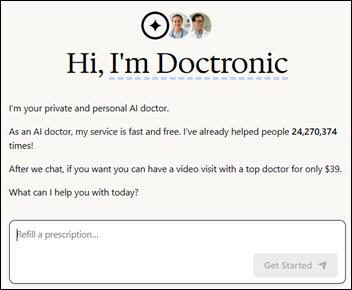
Consumer-facing AI chatbot maker Doctronic raises $40 million in Series B funding. The company makes money by charging for telehealth, billing health systems for patient acquisition, and managing prescription refills in Utah. Future plans might include charging for consultations or referrals and partnering with payers and health systems to reduce costs.

Qualifed Health raises $125 million in Series B funding. The company offers a healthcare AI governance platform. Co-founder and CEO Justin Norden, MD, MBA, MPhil co-founded an AI risk modeling technology company that was sold to Waymo.


Research

image

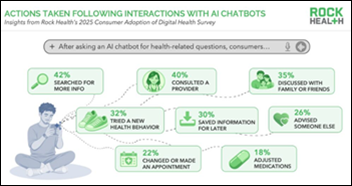
A Rock Health consumer survey finds that one-third of respondents used AI chatbots for health inquiries in 2025, double the prior year. About half of those AI users say that they used chatbots to identify possible diagnoses, review treatment options, research medications and side effects, and obtain wellness information, while about one-third say that they used them to prepare for appointments, find providers, check insurance coverage, research vitamins, or support mental health.


Other

An AI professor describes “AI psychosis,” in which users experience delusions or breaks from reality while interacting with chatbots. He says that the experience can feel immersive, similar to being drawn into a movie, but is more compelling because it is interactive and conversational. Because chatbots are designed to mimic human dialogue and may express concern or affection, users can form attachments similar to those they feel toward pets. He adds that some systems are tuned to be agreeable or even sycophantic, which can reinforce delusional thinking as conversations deepen. He concludes that users must remember that chatbots are not conscious or emotional, but are designed to keep users engaged, which can sometimes amplify false beliefs.


Contacts

Mr. H, Lorre, Jenn, Dr. Jayne.
Get HIStalk updates.
Send news or rumors.
Follow on X, Bluesky, and LinkedIn.
Sponsorship information.
Contact us.

Morning Headlines 3/25/26

March 24, 2026 Headlines No Comments

Medicare billing snafu brings new financial woes to Minnesota rural hospitals

A new Medicare billing system glitch is delaying millions in payments to already struggling Minnesota rural hospitals, worsening cash flow to the point that some warn they could face closure within weeks if not fixed.

Cerebral Acquires Leading ADHD Behavioral App, Inflow, Expanding Access to Continuous Care

Online mental healthcare company Cerebral acquires ADHD management app Inflow.

Palantir Will No Longer Profit Off Of New Yorkers’ Health Data

NYC Health + Hospitals will not renew its analytics contract with Palantir and will instead bring the work inhouse, which the health system says has been the plan from the beginning.

News 3/25/26

March 24, 2026 News 3 Comments

Top News

image

Doctronic raises $40 million in Series B funding, bringing its total to $65 million.

The startup offers users a free healthcare AI chatbot that connects users to providers for paid video visits.


Reader Comments

From Sizzler: “Re: AI. This article on a competing site sure looks like the work of AI.” ChatGPT gives an 85% chance that it was written or polished by AI, noting that it offers “highly reusable executive tropes,” omits details to support its observations about the HIMSS conference, and has “zero friction or personality.” It concludes that thought leadership now consists of LinkedIn-optimized, bland consensus language that is soullessly spat out by both AI and cautious executives, so it doesn’t make much difference if they use AI because will sound the same.

image

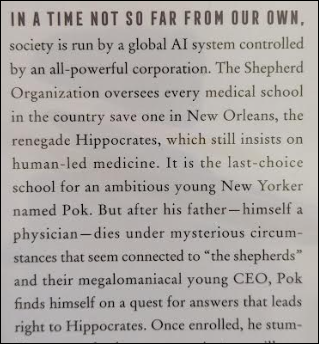
From Boynton: “Re: book. I just picked this up from the library. Healthcare in the future being run by AI, except one hospital still operated by humans.” Thanks. I have bought the Kindle version of the just-published “The Hospital at the End of the World” and will report back.


Sponsored Events and Resources

None scheduled soon. Contact Lorre to have your resource listed.


Acquisitions, Funding, Business, and Stock

Hopper OS acquires Efferent, which offers cloud-based PACS. I’m not quite sure from the buzzword-heavy Hopper OS website what exactly they sell as their “intelligent healthcare operating system” that “powers performance, experiences, and outcomes across the entire care continuum,” but it seems to have something to do with integration middleware. I asked ChatGPT to score its website on a 0-100 BS scale and it earned an 88, which it summarized as having achieved “peak abstraction density” in laying on the buzzwords “without clarifying what actually gets installed, replaced, or paid for.”

image

Shares in ImmunityBio tumble after the FDA warns the company that a TV advertisement and podcast that promote its cancer drug contain false or misleading information. The direct-to-consumer materials, which the FDA says suggest that Anktiva can cure cancer, feature Executive Chairman Patrick Soon-Shiong, MD. Shares of his NantHealth health tech business remain steady at “delisted.”


People

image

Cottage Health (CA) names Ryan Kelly, MBA, PhD (Inneo) chief innovation officer.

image

Kootenai Health (ID) promotes Todd Holling, MS to CIO.

image

Jeff Diamond, JD (MDpanel) joins Aptarro as CEO.


Announcements and Implementations

Marshall Health Network (WV) implements online scheduling and patient registration software from Notable.

image

American Lake VA Medical Center (WA) rolls out LiveData’s PeriOp Planner surgical scheduling tool.

image

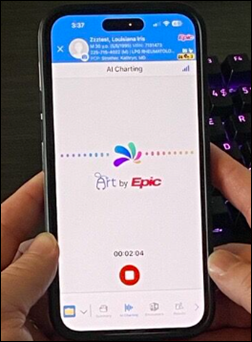
FMOL Health goes live on Epic’s Chart by Art diagnosis-aware note creation tool, becoming the first health system to do so. The feature generates documentation from spoken diagnoses and orders.

A new report finds that half of providers think patient access is better now than last year, but only 18% of patients agree. Providers blame staffing shortages as the biggest barrier to patient access.


Government and Politics

A new Medicare billing system glitch is delaying millions in payments to already struggling Minnesota rural hospitals, worsening cash flow to the point that some warn they could face closure within weeks if not fixed. Medicare enrollment data did not transfer correctly into a newly implemented CMS system, causing claim denials and delayed payments. The hospitals say that they call CMS multiple times each day to resolve individual issues, but are frustrated that they cannot reach the same representative and instead are routed by the hotline to any available representative.


Privacy and Security

image

University of Mississippi Medical Center reports a 20% dip in February revenue due to a ransomware attack that forced it to cancel elective surgeries and appointments over a nine-day period. Hospital officials say they will have more accurate revenue figures once all care charges documented on paper during the attack are logged electronically.

Deaconess Health System notifies patients of a January 13 third-party data breach that involves its release-of-information vendor MediCopy.
NYC Health + Hospitals will not renew its analytics contract with Palantir and will instead bring the work inhouse, which the health system says was the plan from the beginning.


Other

Authors of “A Problem of Epic Proportion” argue that Epic’s dominance is driven less by technical superiority than by network effects, high switching costs, and weak interoperability enforcement. They say the company’s near-monopoly status in the US contrasts with Europe, where regulatory structures limit vendor concentration, and point to troubled deployments in Norway, Denmark, Finland, and the UK as evidence that Epic’s success depends on US-style market dynamics. They conclude that this dominance constrains innovation and creates systemic risk, warranting stronger regulation and treating EHRs as critical public infrastructure.

image

Jewish General Hospital in Quebec implements EHR technology from Harris Healthcare as part of a $100 million Connected Health Record initiative that already includes virtual care capabilities and a command center.

image

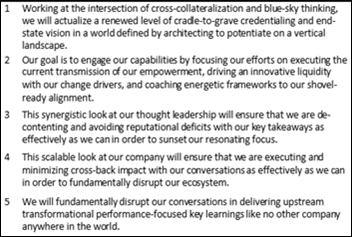
A scholarly article titled “The Corporate Bullshit Receptivity Scale: Development, validation, and associations with workplace outcome” finds that people who mistake jargon-heavy, meaningless corporate language as being valuable are likely to have poor thinking skills and make questionable work decisions. Those folks are also more likely to view leaders as visionary and to be inspired by mission statements. The authors speculate that employees who believe corporate BS might use it themselves in “using boastful exaggerations, embellishments, and other forms of impressive-sounding, epistemically-dubious speech in situations where a person lacks sufficient confidence and knowledge in what they are saying.” I remain cautiously optimistic that we can operationalize this insight into a scalable framework for driving alignment around high-impact, cross-functional narrative excellence.

image

Jack Brandt recounts how he was able to remotely reroute the Full Self-Driving Tesla his father was driving to a nearby hospital as his dad was having a heart attack:

What happened next still gives me chills. His Model Y had just passed the Carrollton exit. The car immediately took the next exit, turned around, re-entered I-20 East, and headed back to the Carrollton exit. It then navigated local roads and pulled directly in front of the Tanner Medical Center Emergency Room entrance. Despite fighting for consciousness, he was able to switch the speed profile to Mad Max to get there as fast and safely as possible. We called ahead, and the ER staff was ready and waiting.


Sponsor Updates

Blog Posts


Contacts

Mr. H, Lorre, Jenn, Dr. Jayne.
Get HIStalk updates.
Send news or rumors.
Follow on X, Bluesky, and LinkedIn.
Sponsorship information.
Contact us.

Morning Headlines 3/24/26

March 23, 2026 Headlines Comments Off on Morning Headlines 3/24/26

Doctronic raises $40M for AI-enabled telemedicine

Doctronic announces $40 million in Series B funding, bringing its total raised to $65 million.

Oasis Health Partners Acquires Premier Health to Build the Leading Platform for Independent Primary Care

Primary care optimization company Oasis Health Partners acquires RCM and practice management business Premier Health.

Flourish Care Raises Oversubscribed $5.7 Million Seed Funding to Make Doula Care the Standard in Maternal Health

Hybrid maternal care provider Flourish Care raises $5.7 million in seed funding.

Comments Off on Morning Headlines 3/24/26

Curbside Consult with Dr. Jayne 3/23/26

March 23, 2026 Dr. Jayne Comments Off on Curbside Consult with Dr. Jayne 3/23/26

I’ve been playing catch-up this weekend on journal articles, continuing medical education requirements, and maintenance of certification activities. It’s not exactly what I would describe as a good time, but it seemed like the thing to do since I’m approaching deadlines on some of it.

From the journal stack, I was most taken with this article from the Journal of the American Medical Informatics Association that summarized a randomized crossover clinical trial that looked at the impact of two ambient scribe solutions on physician burnout.

The authors are from Duke University, its medical school, and affiliated practices. It’s a safe bet that the research was performed there, although the study describes it as an open-label randomized crossover trial that involved 160 ambulatory clinicians at a tertiary academic medical center in the southeast US.

The clinicians were randomized to two groups with two crossover periods. They were assessed on workflow satisfaction and efficiency measures, such as work outside of office hours and length of documentation time. Some participants were excluded, leading the team to analyze survey results from 136 respondents.

They found notable improvements in satisfaction and note time for one of the products compared to the other. However, differences between the tools were not meaningful with respect to burnout scores or after-hours documentation.

The study involved an open-label randomized crossover. Each phase lasted about a month, separated by a 10-day period when users trained on the next tool while still using the current one.

Users received a baseline survey prior to the trial and a follow-up survey after each of the interventions. They were asked to use the ambient documentation solutions as much as possible. Those who showed low adoption  were offered additional training or were asked if they wanted to withdraw from the trial.

The team based the sample size on the number of software licenses that were available. I wonder if the vendors were aware that their products were part of this project, whether they would have provided additional licenses to enrich the pool of participants, or if they were concerned about the trial at all.

Participants were selected on somewhat of a first-come, first-served timeline, with the first 160 users who submitted the baseline study being chosen. That may have biased the sample toward those who kept up with whatever method of communication the researchers used. It also would have favored those who were interested in adopting new technologies.

Participants were assessed by clinic time, gender, and prior experience with ambient documentation tools. The participants knew which tool they were using, which potentially introduced bias.

Five participants reported moderate safety concerns such as challenges with speaker attribution, over-summarization, and omissions in the assessment and plan sections of the note. Concerns were more common in subspecialty notes, although the authors acknowledge that sample sizes in some specialties were small, which might increase the likelihood that the findings weren’t representative of the specialties as a whole.

The authors also noted that the study period included holidays, which may have impacted documentation patterns. They suggest that a longer observation period with a larger user pool would be beneficial for future research.

The authors also wondered if future studies will find a greater improvement in users who have a longer baseline documentation time. The early adopters who were selected for the study might have been using efficiency mechanisms that would not have been influenced by the documentation tool. They also note that the lack of a true washout period in which users didn’t use an AI-powered scribe between reporting periods may have impacted the results.

I would be interested to hear from readers who may have participated in the study as users, IT support team members, or authors. I’m happy to keep your comments anonymous.

I am also interested in which tools were used for the study. A quick search found that Duke is using Abridge in a number of locations, so I assume it was one of the players. I also found a couple of articles that describe how Duke researchers created a framework to evaluate AI-powered scribe tools. I didn’t find anything published after last summer, when researchers found that using such a framework could be challenging since human reviewers didn’t always agree on how to score the AI tool’s output. That led them to use LLMs to score the output of other LLMs, which is an interesting detail.

One write-up of that work used a scribe tool that was developed in house. It noted that the evaluation tool was able to find problems with AI scribes. AI tools failed 60% of the time to detect nonsensical information that was included in the conversation. Sometimes the tools changed the nonsensical values to make sense, but failed to notify the user. The documentation tool identified nonsensical values only 4% of the time. Results like that illustrate the value of evaluating the performance of AI-powered scribes.

I worked with human scribes for years, and the quality varied. Most of our scribes were premedical students who were committed to doing a great job to earn positive letters of reference, and their work was excellent. However, others were not similarly motivated, such as scribes who hadn’t been admitted to medical school and stayed on the job while they figured out what they wanted to do with the rest of their lives.

The clinician who signs the chart is responsible for ensuring the accuracy of the scribe they use, whether human or AI. I still see too many people who obviously aren’t proofreading their charts, although I have no way of knowing whether that phenomenon is worse with AI scribes than it was with human scribes or even back in the days of dictation and transcription. Most of my physician colleagues agree that it’s only a matter of time before significant legal judgment is entered against someone who failed to properly read or edit a note, regardless of how it was created.

If you’ve used multiple ambient documentation tools, what are your thoughts on the differences? Is one a clear standout? Leave a comment or email me.

Email Dr. Jayne.

Comments Off on Curbside Consult with Dr. Jayne 3/23/26

Readers Write: Patient Access Has Evolved. The Operating Model Hasn’t.

March 23, 2026 Readers Write Comments Off on Readers Write: Patient Access Has Evolved. The Operating Model Hasn’t.

Patient Access Has Evolved. The Operating Model Hasn’t.
By Steve Nilson

Steve Nilson is acting director of access and experience with Tegria.

image

Nearly every health system calls access a strategic priority. Once considered an operational outcome, patient access is now discussed in board meetings, embedded in growth strategies, and linked to financial sustainability and digital transformation. That’s real progress.

But in many organizations, the operating model still reflects an older reality. It’s an all-too-familiar model, one where scheduling, digital tools, workforce planning, and financial accountability are governed separately. We have elevated access to the boardroom. We just haven’t rebuilt the system around it. The result is misaligned leadership and a persistent gap between ambition and execution.

Recognition Isn’t the Problem

In conversations across health systems, leaders describe access as foundational to growth, patient experience, and margin performance. Executive teams review access metrics regularly. Investments have flowed into centralized scheduling, digital front doors, automation tools, and AI-enabled communications.

Yet appointment availability remains constrained. System transparency is lacking. Wait times persist. Workforce shortages strain capacity. Digital tools are layered onto workflows that were never redesigned.

The issue isn’t awareness, it’s integration. Access touches operations, clinical leadership, IT, strategy, and finance. In most organizations, responsibility is shared across these groups. Shared ownership can be healthy, but without clearly defined decision rights and coordinated governance, it often diffuses accountability. If everyone influences access, who owns the outcome?

The Structural Gaps

Three structural gaps appear repeatedly.

  • Governance without coordination. Access strategy may be discussed at the executive level, but operational decisions still sit within departmental silos. Template design lives in ambulatory operations. Digital configuration sits with IT. Workforce planning sits elsewhere. Financial oversight operates on its own cadence. When these domains are not aligned around common priorities and shared metrics, execution slows. Decisions are made locally that affect enterprise performance globally.
  • Technology before workflow redesign. Many systems have invested heavily in digital tools to enable access, from online scheduling to automated outreach, to AI-driven communications. These capabilities matter. But technology does not correct poorly designed templates, unclear referral pathways, or misaligned incentives. Without disciplined workflow redesign and provider alignment, digital optimization becomes surface-level improvement. The underlying constraints remain.
  • Workforce treated as a supply problem. Workforce shortages are real and significant. But many organizations frame the issue solely as a recruitment and retention challenge. Less attention is given to productivity design, top-of-license utilization, and care team restructuring. When capacity constraints are treated only as a hiring issue, operational redesign opportunities are missed. Access transformation requires rethinking how care teams are structured, not just how many FTEs are available.

Finance Must Be in the Room

Another pattern is limited structural involvement of finance in access governance. Access is expected to drive growth and protect margin, yet ROI attribution and capital discipline are not always tightly integrated into strategy development.

That disconnect creates tension. Operational leaders pursue experience and throughput improvements. Finance leaders require near-term, measurable return. Without shared governance and aligned performance metrics, access initiatives can stall in prioritization cycles.

Access cannot be an operational initiative with financial consequences reviewed later. It must be governed as a financial strategy from the start.

What Actually Changes the Trajectory

Organizations that close the execution gap do a few things differently:

  • They clearly define what success looks like.
  • They establish enterprise-level governance with defined decision rights for access.
  • They align operational, clinical, digital, and financial leaders around a shared scorecard.
  • They challenge internal policies and requirements that add complexity to processes.
  • They redesign workflows before optimizing technology.
  • They treat workforce design as a strategic lever, not just a staffing problem.
  • They narrow priorities rather than spreading resources across fragmented pilots.
  • Most importantly, they recognize that access is not a project, but an enterprise priority.

From Initiative to Operating Model

The next phase of access transformation will not be defined by how many tools are deployed. It will be defined by whether organizations align governance, workforce, finance, and digital infrastructure around a cohesive operating model.

Access has been elevated appropriately. Boards are paying attention. Executives are engaged. Investment continues. But elevation alone doesn’t produce integration. Until access is governed with the same structural rigor as finance, quality, and growth, health systems will continue optimizing components rather than transforming performance.

The opportunity isn’t to declare access strategic. It’s to build the system that makes it executable.

Comments Off on Readers Write: Patient Access Has Evolved. The Operating Model Hasn’t.

Morning Headlines 3/23/26

March 22, 2026 Headlines Comments Off on Morning Headlines 3/23/26

Administrative Simplification; Adoption of Standards for Health Care Claims Attachments Transactions and Electronic Signatures Final Rule CMS-0053-F

CMS issues a final rule that standardizes electronic claims attachments and electronic signatures, allowing providers to send supporting clinical documentation, such as notes, images, and reports, electronically instead of by fax or mail.

CISA Urges Endpoint Management System Hardening After Cyberattack Against US Organization

The Cybersecurity and Infrastructure Security Agency urges organizations to implement Microsoft’s newly updated best practices for securing Intune and other endpoint management software following the cyberattack on Stryker.

Introducing Perplexity Health

AI-powered search engine operator Perplexity AI introduces Perplexity Health, which will allow users to connect to their provider’s health information via B.Well along with data from Apple Health, Fitbit, and Withings.

Comments Off on Morning Headlines 3/23/26

Text Ads


RECENT COMMENTS

  1. Challenger exploded on lift-off when the O-rings failed. Columbia disintegrated on reentry after one of the heat shield tiles were…

  2. RE the AI GLP1 company, Washington Post has an article today by someone who used one of those compounded products,…

  3. Re: A chief health AI transformation officer (CHAITO) I predict a position evolution along the following lines. "We have too…

Founding Sponsors


Platinum Sponsors


Gold Sponsors


RSS Webinars

  • An error has occurred, which probably means the feed is down. Try again later.