Recent Articles:

Curbside Consult with Dr. Jayne 11/28/22

November 28, 2022 Dr. Jayne 4 Comments

I mentioned last week that I was getting ready for an outpatient procedure, and I’m happy to report it went without a hitch. I was impressed by the professionalism of the surgery center staff as well as their efficiency.

One of the nice touches was a card that was apparently with my patient folder. Each staff member signed the card and indicated the role that they played in the procedure. The card was included in my discharge packet.

I was looking forward to recognizing some of them individually via the patient experience survey that was almost certain to follow. Unfortunately, the link that was texted to me later in the day didn’t work, and the review site’s help functions were of little help, which was disappointing. Knowing that physicians are often graded on patient reviews, I felt bad about not being able to contribute in a positive way.

Mr. H mentioned this JAMA opinion piece last week, which questions whether the focus on patient satisfaction measurements might be harming both patients and physicians. The authors note that “patient satisfaction is an integral element of care, and scholars have argued that positive patient experience represents an important quality dimension not captured in other metrics.” However, they note that many survey instruments were created nearly two decades ago, and “Measures can lose value as they age, and just like the Google search algorithm, patient satisfaction measurement strategies need to be updated to remain useful.”

Unfortunately, many organizations don’t seem too interested in updating their surveys. I’ve experienced this with clients who can’t seem to make updating their surveys a budgetary priority. I’ve also experienced it as a patient, when I was asked how the office performed on aspects that weren’t relevant to the visit. For example, asking about COVID precautions following a telehealth visit, or asking about procedural elements that weren’t part of a given office visit.

My biggest pet peeve about patient experience surveys is when they don’t offer an answer choice for “not applicable,” “did not experience,” or something similar. All clinical encounters don’t contain the same elements, and if you don’t allow me to opt out of a question or respond that it wasn’t applicable, then the data you’re going to get is skewed. When confronted with something they didn’t experience, patients might rate it low, high, or neutral depending on how they interpret the prompt.

Another pet peeve about such surveys is how certain organizations use the data. At one of my previous clinical employers, anything that was less than an overall four-star review generated a “service recovery” call from administration. Since our surveys were constructed in a way that a score of three meant expectations were met, this created a lot of focus on visits that were generally acceptable in the patient’s point of view but didn’t meet the criteria of being exceptional.

In the event that a patient responded with a low score, such as a 2, the immediate assumption by administration was that the physician had done something wrong, even if the low score was a result of the provider giving good care. For example, not providing an unnecessary antibiotic or being unwilling to provide controlled substances without a clear medical need. Administrators always called the patient first, which often led to an accusatory call to the physician, who was on the hot seat to explain the situation.

Having practiced in urgent care and the emergency department for 15 years, I have a pretty good sense of when a patient is dissatisfied with a visit. I make sure to put a lot of detail into the chart note about the visit, what was discussed, the patient’s response to the care plan, and more. It’s easy to read between the lines and see that I already sensed there was going to be a problem and took proactive steps to address it. Still, it felt like our leadership never even looked at the chart and we were always put in a situation where we were on the defensive, which isn’t ideal.

Patient satisfaction surveys aren’t inherently bad. Studies have shown that high satisfaction is associated with lower readmission rates and lower mortality. It should be noted that an association doesn’t mean something is causal, a fact which is often missed by healthcare administrators. The authors also mention a well-known study “The Cost of Satisfaction,” which demonstrated that patients who gave the highest ratings often had higher costs and mortality rates.

One of the specific data elements mentioned in the opinion piece was advanced imaging for acute low back pain. Although such services drive higher costs of care and have little clinical benefit  — to the point of being featured on several prominent lists as things that physicians shouldn’t order — they also yield higher mean patient satisfaction scores.

The authors also mention that many of the survey tools in use were designed to measure aggregate performance and weren’t intended to evaluate individual physicians or care teams. They go on to explain that some instruments in standard use result in skewed data, where a physician can score highly but because of the distribution of responses be considered to be in the bottom 50% of performers. When everyone is high performing but some will be penalized regardless, it creates a continuum of responses with complete withdrawal on one end and something akin to “The Hunger Games” on the other.

The piece also notes that small patient populations or small response rates can create a disproportionate impact on a physician. In my past life, when I transitioned from full-time to part-time practice, this became readily apparent as I spent more time working in clinical informatics and less in the primary care office. Patients were also disappointed that I wasn’t as accessible as before and this showed in satisfaction scores, regardless of the quality of care that patients received. It certainly was a contributing factor in my decision to leave primary care and transition to the emergency department, since I didn’t want to spend half of every visit discussing why I was only there one day a week and the fact that patients refused to see my partners.

While the authors note that patient satisfaction scores are an important component of quality, their use in a “high-stakes” environment “renders them at best meaningless and at worst responsible for physician burnout, bad medical care, and the defrauding of health insurers by driving up use.” They call on payers to reconsider their use in determining quality and payment factors. The authors ask the Medicare Payment Advisory Commission to annually evaluate measures currently in use to make sure they are still fit for purpose.

Although I agree, I know that it’s always easier to keep the status quo, so I’m not hopeful for significant changes. There have also been a number of studies looking at elements of bias in patient satisfaction surveys, and how physicians of certain demographics perform less well than others regardless of outcomes. Until those issues are addressed, patient satisfaction scores will continue to be controversial.

What do you think about the incorporation of patient satisfaction scores in the determination of quality bonuses and payments? Is there room for meaningful transformation? Leave a comment or email me.

Email Dr. Jayne.

Health IT from the Investor’s Chair 11/28/22

November 28, 2022 Investor's Chair Comments Off on Health IT from the Investor’s Chair 11/28/22

HLTH 2022 – Party Like It’s 1999/2019!

First, I hope Mr. HIStalk and all readers will accept my apologies for my delay in writing this. I came home from HLTH with my first case of COVID-19 and it has taken some time to regain focus.

Which brings me to my first observation. HLTH 2022 had absolutely zero COVID-related safety protocols! Where last year’s conference — and the two Health Evolution Summit events that I attended since COVID became a thing — required both proof of vaccination and a negative antibody test, the HLTH organizers opted to eliminate both requirements this year. That’s  a profound disappointment for a healthcare conference. I had heard that even the adjacent cannabis conference was mandating vax cards.

I would estimate fewer than one mask in 250 attendees, and I’m truly embarrassed to say that I, too partied like it was 2019 and doffed both mask and caution for the first time since March 2020, with sadly predictable results. I hope all who were exposed and their friends and families are not too seriously impacted and are recovering well.

Moving on. I think that for most attendees (although this could be sample bias), HLTH is all about networking, or, as the event organizers might call it, “convening.” HLTH does nothing if not excel at helping there. The seemingly limitless conversation spaces is always fantastic. Sharing a ride to the hotel with colleagues who I ran into on the plane and then running into both a former client and another long-term industry colleague as I first entered the hotel were just the first of the many synchronicities HLTH helped promote.

It was undeniably great to be back at a conference with both planned and random meetings. Biggest coincidence? I received a text message from a client thanking me for setting up a great investor meeting and, as I was reading it while walking the floor, I got stopped by the other person in the meeting telling me how impressed he was by the company!

image

As a friend noted, HLTH is the cooler cousin of HIMSS, and I think that is an apt description. In my 20+ years of HIMSS attendance, I’ve noticed that few show up with checkbook. In the case of HLTH, I’m confident that the only folks who are there to spend organizational money on anything but attendance are investors and strategic buyers who are looking to deploy capital on shiny new concepts. As he always does, Jonathan Bush said it better than I ever could – “If HIMSS was the boat show, HLTH is the dog park. Everyone is going around sniffing each other’s butts.” I was glad the HLTH puppy park was back, though.

image

That said, I’m not sure if it was a Vegas versus Boston phenomenon, but I, along with many others I spoke to,  found the event to be over the top in ways that felt, in one colleague’s words, tone deaf. “With hospitals understaffed and losing money, a healthcare conference spending $300K on a rap concert and another $100K to platform a disgraced athlete is questionable,” he pointed out. Where Boston’s HLTH had a five-foot disco ball to meet under, this year there was what seemed to be a 20-foot giant moon in a room where people seemed to be napping.

Santayana famously said, “Those who cannot remember the past are doomed to repeat it,” but it is also said, “Those who understand history are condemned to watch others repeat it.” Having participated in the dotcom boom/bust as an equity analyst, I saw all too many similarities. Changing the paradigm? Check. This time it’s different? Check. Silly exhibit concepts? Oh my word, yes! Party ending with rising interest rates and high profile explosions? Looks like! Yes, valuations remain at relatively historical highs, but I anticipate another cycle before we see the excesses in expectations, self congratulations, and valuations as this HLTH sadly typified.

Now this could be the ramblings of a cranky — and, did I mention, COVID-positive – Gen Xer, but I checked in with one or two hipper proteges in their 30s and got fairly similar reactions “Optum lobby felt like Times Square” and “too much overstimulation.” A VC friend bemoaned the number of mature-enough companies to fit her investment parameters as well as concurring on the dearth of potential customers.

clip_image007

As I shared in my post on the first HLTH, the conference is based on the founders’ proven success formulas and is backed by leading healthcare investor, Oak HC/FT. A VC colleague I ran into said it might prove to be the best health tech investment made in the last few years. While I wouldn’t go quite that far, I do predict it will be in the top decile. Whether it should be is another question, as its value to companies, investors (and me) is clear, but to patients, not so much.

One final question bandied about – will this replace JPMorgan, at least for health tech? I predict that it will not. Vegas is easier, drier, and cleaner (other than the ubiquitous cigarette smoke), but IMHO and based on more than a few conversations and party invitations already sent and received, the JPMorgan conference is too much of a tradition and too ingrained to fall by the wayside. Oh, and it is transparently, not obliquely, focused on investors.

Ben Rooks has now attended every (non-virtual) HLTH, 26 HIMSS, 12 Health Evolution Summits, and JPMorgans as far back as its H&Q Days. He’s also been proud to write this column for HIStalk for over a decade, albeit not often enough, so feel free to email him questions or ideas for future installments. He also really enjoys his day job at ST Advisors.

Comments Off on Health IT from the Investor’s Chair 11/28/22

HIStalk Interviews George Dealy, VP of Healthcare Solutions, Dimensional Insight

November 28, 2022 Interviews Comments Off on HIStalk Interviews George Dealy, VP of Healthcare Solutions, Dimensional Insight

George Dealy, MS is VP of healthcare solutions for Dimensional Insight of Burlington, MA.

image

Tell me about yourself and the company.

We’ve been building analytics technology for the last 30 years. My group uses the Dimensional Insight technology, the Diver analytical platform, to create healthcare-specific analytical applications that solve various problems within the healthcare system, primarily focused on the provider environment, but we also have payer and manufacturer customers.

I have been with Dimensional Insight for 15 years and in the healthcare IT space for 27 years. Before that, I was in the data management database area, working for companies such as Sybase in the early days of RDBMS technology. I was there for 10 years before I moved into healthcare-specific technology.

Do customers want a platform that allows them to develop their own analytics or do they prefer pre-built solutions that have been proven to work elsewhere?

We’ve seen a transition, over the course of the last five or six years, from folks wanting to build their own solutions to their own problems to being open to pre-packaged solutions like the ones that my group builds. Then, extending them for their own purposes.

But even beyond that, we’ve seen some of our larger health system customers essentially almost outsource their analytics process to us. They consume the data and they decide what problems we’re going to focus on solving, but they look to us to do the actual development work. A consequence of that is that they are able to put more focus on actually using the data versus building the systems.

Do they just give you a description of their problem or do they already suspect its underlying cause?

It depends. We have a family of eight healthcare solutions. We will typically start a conversation with a customer for a particular problem. I’ll use the example of a surgical service line where there’s lots of information. There are challenges around things like throughput and patient flow. They’re turning ORs around. We have a solution that provides common KPIs for that particular class of problem. They are able to extend that to more specific manifestations of those problems. We typically start with a pretty well-defined starting point for a particular problem. If their problem is something other than what we have a pre-packaged solution for, we still have a starting point in terms of the way that we go about developing applications.

We’ve created some technology that sits on top of our analytics platform and simplifies the process of defining and then calculating KPIs. One of the things that that tool has allowed us to do is to get the folks who understand the data and the problem they are trying to solve more directly involved in the process of defining and creating these analytical applications. That has also put our customers in a position to create their own applications in a similar style to the ones that we create. Among the organizations that have the wherewithal to do that, typically the larger health systems, we’ve seen a lot of innovation around things that we hadn’t thought about for one reason or another. They are solving the issues that are important to them.

Does the challenge remain that executives commission reports that frontline managers don’t use?

Two observations. One is that it starts at the top. You get good results if a CEO, COO, or C-suite executive who has operating responsibility is watching those numbers and holding the folks who report to them accountable. They have to then do the same thing right on down the line. I have a few customers where that’s the case and their execution is very good, largely as a result of having the information, but also selecting the right information to focus on.

The other thing is that my sense is that being data driven is something of a generational change or evolution. Folks who grew up with electronic media, understand information, and aren’t afraid of it are more open to incorporating it into their thought process. That’s not to say that folks in my generation aren’t open to it, but I think there’s more consistency around the younger side of the workforce because it’s what they’ve grown up with.

Do people have eye-opening moments when analytics shows them something they didn’t suspect?

All the time. There’s tremendous confirmation bias all over the place. You hear the story told frequently about surgeons and physicians who have this intuitive sense that their particular approach to a procedure or a diagnosis is the only way that you would do it and that it’s as effective as it can be. Then they start looking at the data from their peers in similar situations and realize that they didn’t know some things. Similar lessons apply on the operational side pretty much wherever there’s data. 

We have that in our personal lives, too. We think that something is a certain way, but when when we start quantifying it, we realize that it’s very different. You’re used to going a certain route and your GPS system tells you to go a different way that you never even thought about, and it turns out to be shorter and faster.

What are examples of customers using analytics to solve a vexing problem?

I would break this down into a couple of categories. Operational efficiency is a big area where it’s really not clear what is going on in complex processes. You look at patient flow through a hospital, where a patient comes in through the ED or maybe is going for elective surgery, and there are all these way stations along the way where there are potential bottlenecks that get in the way of freeing up beds for patients, getting patients discharged on time so that you can bring more patients into the hospital. Hospitals make much of their revenue on fixed-fee DRG hospitalization, so moving patients through the system as efficiently as possible is key.

Our customers use KPIs that break those work processes and flows down to where they can identify where the issues are. For example, moving certain bottlenecks out of the way to discharge patients from the hospital more quickly, or at least by a particular threshold that they’ve set. That would be one example of something that improves patient flow. Further back in the process, the emergency department, where a variety of bottlenecks can emerge, largely around the ancillary services, getting appropriate turnaround times on things like imaging and lab procedures.

Those are some operational areas where our clients have been able to improve using information to identify the problem, solve it, verify that there was an impact, and then monitor it to make sure that it doesn’t regress back to where they started, which can often happen if you don’t have ongoing visibility into the information.

On the clinical side, I’ll give you one example of a academic medical center customer that we began working with fairly recently who has come up with an algorithm for assessing mental health issues, specifically suicide risk. We work with them to integrate that algorithm into information that was compiled from EHRs. The patient clinical data is combined with the algorithm to come up with a risk assessment for suicide that can be used directly by providers when they are interacting with patients or prior to interacting with them in a formal healthcare setting. Or, to identify cohorts in a population that are at high risk for suicide.

Do customers often learn from analytics how to identify and replicate their own best practices?

That’s the whole premise and the opportunity for some of the advanced techniques around analytics. We have tremendous amounts of data, starting with the Meaningful Use era, where EHRs with clinical capabilities came into the healthcare environment in a way that they weren’t there before. You have 10 years of data that is getting better as time goes on. There’s still a data quality issue and data standardization issue, but as those issues get dealt with and interoperability becomes more standardized, you can compile a more complete picture of a profile of patients and populations. 

Then you are in a position to assemble this big base of information and use it to compare to outcomes over time and determine what care processes, what approaches have been most effective for improving outcomes or attaining a particular target level of outcome and eliminating some of the adverse events and consequences that can come when things fall through the cracks where processes aren’t followed. Or maybe there are suboptimal processes to begin with.

How have health system expectations for return on investment changed with the pandemic?

The big issue during and coming out of the pandemic is around staffing. The physician staffing shortage was there prior to COVID, but nursing is largely a consequence of COVID. Efficiency and productivity become that much more important because you’re dealing with limited staff resources. We have a lot of prospective clients looking at solutions to that type of problem. How do you objectively measure and improve efficiency and productivity given limited personnel resources?

I just realized that I haven’t heard the term “big data” used lately. Do health systems still need external data or they they have enough information of their own to make decisions?

That’s interesting, I don’t think I’ve heard the term “big data” in a while either. I think that may have come and gone. Maybe it’s just taken for granted at this point, with the likes of what we see with Google or Facebook. The amount of information that you can deal with is almost infinite from a practical standpoint. The capability is there, but the issue has shifted to, what big data? What are you going to use it for?

I was reading a research paper that came out of the MIT Healthcare Learning Lab, where they are they are experimenting with what they call multi-modal approaches to machine learning in healthcare. They are looking at not just the traditional, highly structured, tech-based information that comes out of EHR, but combining that with voice recordings, video, waveforms, and time series imaging, teasing value out of that to predict certain well-defined outcomes. This particular paper was looking at predicting length of stay in hospital, 48-hour mortality, and a few other things. They found that they could get a boost — it wasn’t a huge boost, but it was still a meaningful one – by employing some of these other modes on top of what we think of as the traditional information that gets collected and structured within an EHR. That’s huge data, maybe the next step up from big data.

What will be important to the company and the industry in the next few years?

Continuing to get the data house in order. There are tremendous opportunities and possibilities around these advanced analytic techniques, but it requires good data. We are focused on identifying what that data is and curating it to the extent that it’s meaningful within the organization. In other words, you don’t have five different ways of measuring exactly the same thing. There may be some meaningful variation, but reducing that duplication and quantitatively defining outcomes. Once you have that, you open up more opportunities for using these advanced techniques to become more efficient and productive and to improve outcomes.

Things like the standardization of vocabularies on the clinical side. SNOMED, RxNorm and LOINC have been around for a while, but they are gradually making their way into practice. As you get more standardized data, it’s higher quality in terms of what you can do with it. The HL7 FHIR standards are going to help in terms of being able to compile the standardized information around a patient or a population of patients so that you have more and more high-quality data to work with.

A lot of it is somewhat routine blocking and tackling, but until that happens, the potential for the more advanced techniques is going to be limited. But healthcare in general is very much looking forward to what advanced analytics can do. As you look around other industries, it’s pretty clear that it has the potential to make a huge difference, but you need to have the data in place and you need to understand what it is you’re trying to do with it.

Comments Off on HIStalk Interviews George Dealy, VP of Healthcare Solutions, Dimensional Insight

Morning Headlines 11/28/22

November 27, 2022 News Comments Off on Morning Headlines 11/28/22

Apple and Epic Systems team up to launch macOS-friendly health records software

Epic will modify its system to run more easily on Apple devices, Axios reports, although Epic declined Apple’s request to develop an Apple-only native version.

DispatchHealth Raises More Than $330 Million to Expand Its Technology-Enabled Ecosystem of High Acuity Care in the Home

DispatchHealth, which offers tech-enabled, in-home urgent and primary care and hospital-at-home services, raises $330 million in a funding round led by Optum Ventures.

One Brooklyn Health System Offline After Unexplained IT Issue

The computer network of One Brooklyn Health System remains down following a November 19 incident.

Comments Off on Morning Headlines 11/28/22

Monday Morning Update 11/28/22

November 27, 2022 News Comments Off on Monday Morning Update 11/28/22

Top News

image

Australia’s NSW Health chooses Epic to replace nine EHRs, six patient administration systems, and five pathology laboratory information systems to create a Single Digital Patient Record for the state’s public health system.

Epic will displace Oracle Cerner and Orion Health for the EHRs, Oracle Cerner and DXC for PAS, and Citadel and OmniLab for LIMS.


HIStalk Announcements and Requests

image

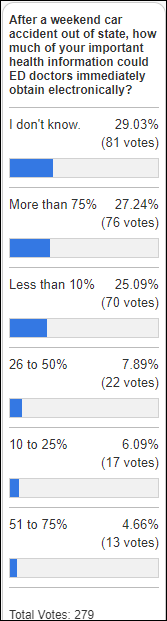
A significant percentage of poll respondents think that other conferences will negatively impact that of HIMSS. Dr. Showoff opines that HIMSS is “outdated, entitled, and bloated;” created lingering resentment over its decisions around the 2020 cancellation; and erred in limiting its conference venues to Las Vegas and Orlando. Jack says that while the association conference model of HIMSS and other member organizations is dying quickly, “CHIME latched onto HLTH for cash flow” and questions whether provider executives really paid to show up at HLTH since the conference won’t share its attendee lists. Meanwhile, the Thanksgiving leftovers are about to be abandoned as RSNA kicks off in McCormick Place.

New poll to your right or here: Which winter holiday is most important to you? Regardless of your choice, I think we can agree that it’s coming soon.


You’ll probably see some bugs on the site over the next couple of weeks as I migrate to a new server, which always involves challenges with timing, PHP version incompatibilities, and problems I didn’t catch during testing. I dread this kind of project because it’s just me trying to get it done without making a technical mess.

Journalism peeve: writers who state that some major story fact is “unclear,” meaning the writer is interjecting their own unanswered questions instead of sticking to known facts. Also, statements such as “the community is in mourning tonight” that attempt to portray emotional color as a universal feeling without quantification or exception. I suppose that these are minor sins compared to crafting entire “news” articles whose only sources are TikTok videos or anonymous Reddit comments.

image

HIStalk reader Mark made a generous donation to my Donors Choose project, which with matching funds applied fully funded these teacher grant requests:

  • Math manipulatives for Ms. H’s elementary school class in Houston, TX.
  • Math books and games for Ms. N’s special education high school class in Alexandria, VA.
  • Math games for Ms. S’s elementary school class in Camp Verde, AZ.
  • STEM kits for Ms. P’s kindergarten class in Lakeside, CA (her note is above).

Webinars

None scheduled soon. Previous webinars are on our YouTube channel. Contact Lorre to present your own.


People

image

Arcadia promotes Michael Meucci to CEO. He replaces Sean Carroll, who moves to executive chair.

image

Jim Dowling (Philips) joins Infinitt Healthcare as SVP of sales for North America.

image

Stephanie Lahr, MD (Monument Health) joins Artisight as president.


Announcements and Implementations

Epic will modify its system to run more easily on Apple devices, Axios reports, although Epic declined Apple’s request to develop an Apple-only native version.


Privacy and Security

Microsoft warns that hackers are exploiting vulnerabilities in the Boa web server for embedded applications, which was retired 17 years ago but is still being used in routers, security cameras, and software development kits.

In India, systems of 2,200-bed AIIMS go offline from a ransomware attack.


Other

The computer network of One Brooklyn Health System remains down following a November 19 incident.

News outlets in Canada warn that several of Ontario’s virtual care sites will shut down after reduced payments take effect on December 1. Most surveyed doctors say won’t accept the new $20 fee of Ontario Health Insurance Plan that affects patients who have not been previously seen in person. Some sites have already starting turning OHIP patients away or requiring them to pay cash. One hospital HIV and hepatitis C clinic that rarely sees patients in person says it will be paid $15 per appointment, less than 25% of what it billed using previous fee codes in the absence of virtual-only ones.

Police in Bhilwara,India shut down the Internet for two days as family members of a man who was shot by “four miscreants” vandalize the hospital in which he died, demanding government jobs and cash payments as compensation.

A patient who woke up during his 2017 back surgery at UCSD says in a lawsuit that a former anesthesiologist stole some of the fentanyl intended for his case, falsified his medical record to indicate that he was given the full dose, and was later found unconscious with drugs and syringes in a hospital bathroom. The anesthesiologist, whose medical license has since been revoked, admitted that he injected himself with unused patient drugs in hospital bathrooms up to eight times per day starting with his UCSD residency in 2003.


Sponsor Updates

clip_image001

  • Pivot Point Consulting Engagement Manager Kathy Inkley works with Cerner Foundation to help pack and ship more than 200 care kits for underprivileged kids in local schools.
  • Optimum Healthcare IT names Melissa Gilman a Beacon Analyst on its Managed Services team.
  • ENT and Allergy Associates wins the NextGen 2022 Excellence in Healthcare Award for its implementation of the RCxRules Revenue Cycle Engine.
  • Sectra releases the first three episodes of its new podcast, “Let’s talk enterprise imaging.”
  • WebPT publishes “The Rehab Therapist’s Guide to Remote Therapeutic Monitoring.”
  • Zen Healthcare IT announces that its Zen SSL Extension is now available via ECommerce.

Blog Posts


Contacts

Mr. H, Lorre, Jenn, Dr. Jayne.
Get HIStalk updates.
Send news or rumors.
Contact us.

125x125_2nd_Circle

Comments Off on Monday Morning Update 11/28/22

Morning Headlines 11/23/22

November 22, 2022 Headlines Comments Off on Morning Headlines 11/23/22

South County Hospital Announces “Phone and Network Issues” Resolved

South County Hospital in Rhode Island resolves phone and network issues that forced it to revert to downtime procedures and cancel surgeries last week.

PayZen Raises $220 Million Growth Round for Personalized Healthcare Affordability

Patient financing solutions vendor PayZen raises $20 million in equity financing.

San Gorgonio Memorial Hospital Back Online After Malware Attack

San Gorgonio Memorial Hospital (CA) recovers from a malware attack that caused it to shut down its EHR for six days.

Comments Off on Morning Headlines 11/23/22

News 11/23/22

November 22, 2022 News 5 Comments

Top News

image

Care.ai, which offers AI-powered ambient monitoring technology for healthcare facilities, raises $27 million.

Its sensor-equipped Smart Care Facility Platform is designed to enhance an organization’s virtual nursing, virtual sitting, and other patient monitoring programs.

Founder Chakri Toleti sold his previous company, patient engagement vendor HealthGrid, to Allscripts for $60 million in 2018.


Reader Comments

From Oslo Dave: “Re: Texas AG Paxton’s inquiry into Epic’s children’s health information policies. Why would he be talking to them? Memorial Hermann has signed to implement Epic, but hasn’t even started.” The health system signed a deal to replace Oracle Cerner with Epic in September 2022, but the implementations won’t start until 2023. The patient portal is Cerner’s, so I’m not sure why the AG thinks Epic is involved.


HIStalk Announcements and Requests

I’ve seen a few Twitter-related mentions of Price’s Law, which that competence grows linearly in a growing company’s workforce while incompetence grows exponentially, with the result being that 50% of the work is accomplished by the square root of the total headcount. If your company has 100 employees, 10 of them get half the work done, while the remaining 90 employees do the other half. The conclusion is to hire and retain those people whose productivity is high enough to put them in that minority of workers, and also to look cynically at employee turnover numbers because losing stars will hurt even with small percentages


Webinars

None scheduled soon. Previous webinars are on our YouTube channel. Contact Lorre to present your own.


Acquisitions, Funding, Business, and Stock

Patient financing solutions vendor PayZen raises $20 million in equity financing.

Hospital for Special Surgery raises $21 million in a Series A funding round to launch virtual physical therapy clinic RightMove.


Sales

  • Telepsychiatry company MindCare Solutions selects Andor Health’s ThinkAndor virtual triage capabilities.
  • Parkview Health (IN) will use Veta Health’s remote patient monitoring and virtual care technology as a part of its telehealth monitoring program.
  • Aware Recovery Care selects Bamboo Health’s Pings real-time care notification software.
  • NSW Health in Australia will replace 20 health IT systems with Epic.

People

image

24By7 Security promotes Ryan Sanders to VP of healthcare and advisory services.

image

Laure Tessier-Delivuk (GE Healthcare) joins Inspirata as VP of operations, oncology informatics.

image

Laolu Fayanju, MD joins RubiconMD as CMO. He was previously a regional medical director with Oak Street Health, which acquired RubiconMD last year.

image image

CPSI promotes Dawn Severance to chief sales officer and David Dye to COO.

image

Divurgent promotes Adam Tallinger, RPh, MHA to EVP of client service.


Announcements and Implementations

image

Evangelical Community Hospital (PA) will go live on Epic December 4.

image

3M HIS announces GA of Ambulatory Potentially Preventable Complications analytics software for outpatient and ambulatory surgery centers.

image

Sonoma Valley Hospital (CA) will replace Allscripts with Epic on December 3.

image

AdventHealth (KY) celebrates the start of its Epic implementation journey with a “Follow the Yellow Brick Road to Epic” party. The system will go live in March 2023.


Privacy and Security

South County Hospital in Rhode Island resolves phone and network issues that forced it to revert to downtime procedures and cancel surgeries last week.

San Gorgonio Memorial Hospital (CA) recovers from a malware attack last week that caused it to shut down its EHR for six days.


Other

A Freedom of Information request finds that IT systems and telephones went down for 20 hours at Queensway Carleton Hospital in September, leading its doctors to question why the ED remained open. They also said that lack of connectivity required them to get imaging reports using their own cell phones, which violates health privacy rules. The hospital distributed backup pagers, assigned runners to deliver hand-written notes, and told nurses to listen for patient call bells since they could not receive alerts via wireless phones. The hospital said that it would normally post downtime signs in the ED, but couldn’t find them. 

image

Heart transplant recipient Tom Johnson, a retired nurse, respiratory therapist, and healthcare IT manager, meets Amber Morgan, the mother of his organ donor, four years after the procedure. Johnson assured Morgan he is taking great care of her daughter’s heart, letting her listen to her daughter’s heartbeat through a stethoscope: “Today, I can play with my five grandkids, something I wasn’t able to do before. I feel so blessed because I’ve been praying for the family ever since my transplant.”


Sponsor Updates

  • Access publishes a new e-book, “Paper Informed Consents Sabotage Your Surgical Services Economies.”
  • AdvancedMD publishes a n e-guide, “Billing Options for the Modern Practice.”
  • Agfa Healthcare Global CMO Anjum Ahmed joins The British Institute of Radiology’s board.
  • Bamboo Health publishes a new intelligence brief, “In-Depth Analysis of Final Cohort Joining the ACO REACH Model in 2023.”
  • CHIME honors TrueCare Chief Innovation Officer Tracy Elmer and Artera with its 2022 Collaboration Award.
  • Clearwater will sponsor the H-ISAC Fall Americas Summit December 6-8 in Phoenix.
  • EClinicalWorks publishes a new customer success story, “Brookhaven Heart &MD365: Streamlining Patient Engagement and Intervention with RPM.”
  • Get Well has been recognized as a Top Company in Patient Education by Avia Connect.
  • InterSystems invites developers to enter its Iris for Health Contest: FHIR for Women’s Health.
  • Lyniate announces that Rhapsody and EMPI have qualified for the UK Government’s G-Cloud Framework.
  • Meditech congratulates its customers named to CHIME’s 2022 Digital Health Most Wired list.
  • Denver Health Medical Plan CMO Christine Seals Messersmith joins Divurgent’s advisory board.

Blog Posts


Contacts

Mr. H, Lorre, Jenn, Dr. Jayne.
Get HIStalk updates.
Send news or rumors.
Contact us.

125x125_2nd_Circle

Morning Headlines 11/22/22

November 21, 2022 Headlines Comments Off on Morning Headlines 11/22/22

Gallant Capital Invests in Lightning Step to Support Growth

Behavioral health IT vendor Lightning Step secures an undisclosed amount of funding from Gallant Capital Partners.

Interstate Health Systems Launches with Oversold Pre-Seed Investment Round

Interstate Health Systems launches with pre-seed funding to develop a network of primary care, urgent care, and telemedicine services along the nation’s highway system.

Care.ai Secures $27M from Crescent Cove Advisors to Introduce Ambient Intelligence to Healthcare

Care.ai, which offers AI-powered ambient facility monitoring technology for hospitals, raises $27 million.

Comments Off on Morning Headlines 11/22/22

Curbside Consult with Dr. Jayne 11/21/22

November 21, 2022 Dr. Jayne 2 Comments

I’m back in the patient trenches again, getting ready for an outpatient medical procedure and loathing the process. I’m an active patient of the physician who will be performing the procedure, with an up-to-date chart at the practice. The ambulatory surgery center where the procedure will be performed is owned by the physicians (although it’s a separate legal entity than the practice) and I’m also considered an active patient there due to a previous procedure.

Even though it would have been perfectly easy for the performing physician to send an appropriate History and Physical document to the surgery center (and for all I know they might have done so), I received an enormous “snail mail” packet to complete that basically treats me like a brand-new patient. Once could claim that it was an artifact of trying to keep the surgery center separate from the practice entity, but all the paperwork has both entities’ logos on it, so that claim doesn’t hold water.

The surgery center called me on Wednesday to pre-register me for the procedure, which is pretty typical. Unfortunately for me, I was still in Las Vegas, so the call came in at 6 a.m. local time and my grogginess was probably entertaining for the registrar. The staffer basically asked me all the information that is already on my chart, although it was from the perspective of confirming existing information rather than being from scratch. I asked about the paper packet, and she indicated that it was mailed from the practice side of the organization rather than the surgery center, and that I should plan to complete it.

I enjoyed answering the COVID screening questions, since I was at a conference with probably 8,500 unmasked people compared to the few of us who might have been masking when we could, and certainly I was exposed to someone with COVID. Another great question was whether I have a Healthcare Power of Attorney, but they didn’t seem interested in knowing who my personal representative is or having me bring a copy. The call took less then five minutes, though, and I was able to get another half hour of sleep before I needed to get ready to head to the airport.

As I went through the paper packet today, I noticed the addition of a new form that might actually be useful to patients, especially those who might not have a lot of experience in our fragmented and messy healthcare system. The page listed out all the different entities that will be involved in my care – including the physicians, the surgery center, the anesthesia group, and the pathology group. Each column had the name of the entity, a description of how they fit into the procedure, the services they provide, and the fact that I will receive a separate bill from each group.

Although it fully illustrates the absurdity of healthcare in the US, I appreciate the fact that they’re trying to educate patients prior to their having a procedure so that there are fewer surprises down the road. I found it interesting that only the surgery center requires payment of my portion of the estimated co-insurance in advance. If I recall correctly, the anesthesia group waited until just shy of the timely filing deadline to submit their claim, so any hopes of wrapping up the procedure and payments will likely be delayed until well into 2023.

I’ve been keeping it low key since I got back from HLTH, partly to avoid having a COVID-related reschedule for the procedure. I’ve heard from two colleagues who brought COVID home from the HLTH conference as an unwanted souvenir, although based on the notifications from the contact tracing app, I suspect there were more cases than we will ever know.

It’s been a good opportunity to catch up on email and some of my virtual water cooler venues. The hottest topic seems to be Amazon’s foray into message-based virtual visits. Most of the physicians I’ve connected with aren’t impressed by the offering, since it’s more of a marketplace than a cohesive service. They’re concerned about the further fragmentation of patient care since these records won’t be making it back to primary care physicians, and the fact that patients may end up receiving care from multiple providers or practices as part of the marketplace arrangement without fully understanding the concept.

There were also some concerns about the business model and how it makes sense for the physicians who are part of the offering. The fees are low, which is good for patient access, but are set at a level which drives physicians toward high-volume processes in order to make it tenable as a major source of income. The virtual visits also include the ability to “message your clinician with follow-up questions at no additional cost for up to 14 days” which further lowers the desire to participate for many physicians, who want to practice telehealth urgent care in a “one and done” type model. Several colleagues guessed that the provider organizations are likely using considerably greater numbers of nurse practitioners rather than physicians.

The main patient-centric concern that was voiced was that of clinical quality, but given the fact that this is Amazon we’re talking about here, I also have concerns about patient privacy. The Amazon Clinic site has a lot of information on how they use Protected Health Information. Things I didn’t like included the fact that patients are asked to accept an authorization for disclosure of contact information, demographic information, account, and payment information, and “my complete patient file” to Amazon.com Services LLC and its affiliates. It notes that “information disclosed pursuant to this Authorization may be re-disclosed by the recipient, and this redisclosure will no longer be protected by HIPAA.” Although I’m not an attorney, it sounds like a bad idea to me. The FAQ page says this authorization is voluntary, but if patients want telehealth services but to not sign the authorization, they will need to reach out to the healthcare providers directly. I’m betting (as I’m sure Amazon is betting also) that patients will just click through the fine print. Patients are exhausted and often just want to get care in the quickest and cheapest way possible, and no one likes to read a wall of text.

What are your thoughts about Amazon Clinic? Will it revolutionize healthcare or just further fragment the patient experience? Leave a comment or email me.

Email Dr. Jayne.

Morning Headlines 11/21/22

November 20, 2022 News Comments Off on Morning Headlines 11/21/22

Elizabeth Holmes sentenced to more than 11 years in prison for fraud

A federal judge sentences former Theranos CEO Elizabeth Holmes to 11 years in prison on four charges of investor fraud.

Mercy employees in payroll limbo after cyberattack against parent company

CHI Mercy Medical Center (OR) employees say that last month’s cyberattack on parent company CommonSpirit Health continues to impact its payroll system, resulting in missing hours and incorrect payments.

Amazon is gutting its voice-assistant Alexa. Employees describe a division in crisis and huge losses on a ‘wasted opportunity.’

Amazon’s Alexa business division loses $3 billion in the company’s most recent quarter, ranks third in usage behind Google Assistant and Apple Siri, and is being hit hard with layoffs.
More stolen Medibank data released, containing information about mental health and chronic conditions

Hackers continue to publish data stolen from Australian company Medibank, releasing on Sunday the medical records of 1,500 patients with chronic conditions, cancer, dementia, mental health conditions, infections, and injuries.

Comments Off on Morning Headlines 11/21/22

Monday Morning Update 11/21/22

November 19, 2022 News 12 Comments

Top News

image

A federal judge sentences former Theranos CEO Elizabeth Holmes to 11 years in prison on four charges of investor fraud.

A law professor concludes, “Fraud cannot masquerade as innovation in Silicon Valley.”

Theranos had raised nearly $1 billion from investors in valuing the company at $9 billion.

Sunny Balwani, former COO and a romantic partner of Holmes, is scheduled for sentencing on December 7 on 10 counts of wire fraud and two counts of conspiracy to commit wire fraud.


Reader Comments

From Les Diables Bleus: “Re: HLTH. I had a full three days of what I felt to be high-value networking — not sales, mind you, which don’t happen at conferences. It’s a good show to see what’s trending (remote point solutions and health equity) and to meet potential partners. Running into a provider was like a unicorn sighting, which is ironic since that is the HLTH mascot. It is like an all-inclusive resort in that food, drinks, and entertainment were easy to find and included. My exhibitor friends said it was easy to have a booth since HLTH manufactures it with your logo and minimal customization, puts it up, and tears it down so you don’t have to deal with shipping, Freeman, or late-night installations. I would definitely attend again purely for the networking.”

From Kitschy Kicks: “Re: HLTH. How appropriate that it was in Las Vegas, where the house always smites players who think their smarts will make them winners.” It’s a pretty good analogy that brash startups were probably emboldened by the heady atmosphere of both the conference and the Strip into thinking that they can beat the house. Companies that don’t provably solve a problem that prospects will pay for in a financially strained environment, that aren’t making money, and that took too much investor cash and have little to show for it probably don’t need to plan much for HLTH 2023.

From Been There: “Re: HLTH. Our company refuses to pay to play for sessions or articles. The challenge is when customers expect us there to support them, and when VC groups are uneducated but still influential (like former CMS execs). It’s worth a 24-hour trip to keep folks honest.” Plus your attendance entitled you to be a guest on an endless number of podcasts and video interviews that nobody will ever consume. And to hear the inspirational story, for his speaking fee of more than $100,000, of how Lance Armstrong overcame adversity (choosing to be the dirtiest doper, cheater, and bullying liar in the history of sports) to start a new and possibly related career in health and wellness investing.


HIStalk Announcements and Requests

image

Most poll respondents have a LinkedIn profile and 92% of them contain a headshot, more than half of which were taken professionally. Nearly 20% of the headshots are more than seven years old, so couple that with professional retouching and there’s a pretty good chance that you might need to squint to see the resemblance in person.

New poll to your right or here: Will HLTH, ViVE, and the CHIME Fall Forum have a major negative effect on the HIMSS conference? I differentiate my readership from that of other sites by the number of decision-makers who read HIStalk, an advantage that HIMSS has traditionally enjoyed in attracting exhibitors. New conferences may be poaching that desirable audience from HIMSS. The biggest threat to HIMSS is no longer the obvious one, that in-person conferences will be replaced by virtual ones (which were pretty much a complete bust during the pandemic’s darkest days), but rather that the newer conferences offer an alternative that is drawing a response.


I mentioned recently an announcement of two companies that consummated what was labeled as a “merger” even though it was obviously an outright acquisition that wasn’t called that to avoid offending the delicate sensibilities of the acquiree. Legally speaking, a merger occurs when two companies join together to form a new company, and if there’s no new company, then it is an acquisition (there’s very little “M” in “M&A.”) Even “AP Stylebook” warns reporters that true mergers of equals are nearly unknown and should be called that cautiously – PR BS aside, if it will be the same company name, CEO, and headquarters location, they bought the other company.

Mrs. H saw my mention of the Meta Quest 2 virtual reality system and got me one as a special occasion gift. It is crazy immersive and lots of fun even with the limited number of apps I have so far — mini-golf, Beat Saber, and table tennis (those last two are sweat-inducing exercise). I don’t like giving money to Facebook and they could kill off the product line as they run the company into the ground chasing a Metaverse pipe dream, but it’s fun in the mean time. I nearly face-planted when I leaned in for a table tennis shot and tried to catch myself on the realistic yet imaginary table.

I’m looking at the short list of conditions that just-launched Amazon Clinic will treat via text messaging, which includes problems such as dandruff, motion sickness, and birth control. I’m questioning how much value the messaging adds clinically over just making the drugs that are used to treat these conditions non-prescription. You could easily train a pharmacy technician to read the questionnaire results from kiosk or online entry, then hand over the meds if indicated with any appropriate instructions or warnings, which is about all online doctors would do. “Prescribing what patients ask for” is a common business model that adds little value. The new Amazon Clinic is really just Amazon advertising the services of other companies, as it does with its fraud playground of China-based sellers of electronic devices or clothing items whose disposable company names look like a cat wandered across a keyboard. 


Webinars

None scheduled soon. Previous webinars are on our YouTube channel. Contact Lorre to present your own.


Acquisitions, Funding, Business, and Stock

Business Insider reports that Amazon’s Alexa business division lost $3 billion in the company’s most recent quarter, ranks third in usage behind Google Assistant and Apple Siri, and is being hit hard with layoffs.


Sales

  • Redox will implement terminology solutions from Intelligent Medical Objects

People

image

Kaiser Permanente promotes Mark Simon to VP/CIO of Washington and Colorado.

image

Stephanie Rogers, RN, MBA (Cerner) joins Children’s Mercy Kansas City as CNIO and senior director of nursing, heath informatics, and technology.


Announcements and Implementations

Sanford Health and Fairview Health Services announce plans to merge into a 58-hospital system under the Sanford Health name and CEO.

image

A report by Providence’s Digital Innovation Group says that health systems should take a retail-like “digital flywheel” approach in using technology to keep in touch with people who otherwise have only infrequent encounters. The authors say the EHR is a big barrier for outreach – it requires clinician involvement, it doesn’t support all lines of business, and it doesn’t address all types of consumer interaction. They recommend an Amazon-type system that applies algorithmic personalization to data to create a digital consumer identity. They say that unlike Amazon, health systems already offer a wide variety of services and have connections to partners that they can recommend to consumers. The report says that such efforts can be profitable to health systems given the $1.2 million lifetime value of a patient and that simply being able to assign a PCP is valued at $3,000. I’m a bit skeptical since Providence and other health systems have profited nicely from selling interventional care and well-intentioned attempts to offer wellness services nearly always fail for several reasons (lack of consumer motivation, ever-changing health plans, and a lack of clinically documented effectiveness). And perhaps the biggest challenge – whether consumers really want an ongoing relationship with their local health system as they might with Amazon or Starbucks. Personally as a “no news is good news” sort, I’m thrilled not to hear from my local medical center.  


Government and Politics

Texas Attorney General Ken Paxton sends a Civil Investigative Demand letter to Epic demanding that the company explain its policies on children’s health information. He says he is following up on complaints from parents that they lost access to the records of their children who were treated at Memorial Hermann Health System once the child reached 13 years of age. The health system, which is also targeted by Paxton’s investigation, says it is not aware of any parent complaints. Paxton said in a comment about his Epic inquiries, “Too many companies are taking marching orders from the radical left, especially when it comes to their all-out assault on family values and parental rights.”


Privacy and Security

First responders in Ontario go back to paper when its IMedic software is taken offline by a cyberattack.


Other

A JAMA Network opinion piece says that patient satisfaction surveys aren’t suitable for evaluating physician performance. The authors reference an interesting previous study in which the patients who rated doctors highest had higher costs and mortality rates. They observe that most patient survey instruments are old and weren’t designed to reward high scorers. They also note that physician panel size and workload means that one disgruntled patient can drag down a clinician’s score unfairly (see: sour Yelp whiners). They urge public and private payers to stop using patient satisfaction scores for quality assessment and payment.

A randomized clinical trial finds that patient portal messages reminding parents that their child is due for a well child visit and COVID-19 vaccinations increased the rates of scheduling both.


Sponsor Updates

  • Meditech Expanse customers in Canada can now integrate directly with digital care journey platform SeamlessMD.
  • Clearsense publishes a new infographic, “Shorten the Runway for Your Data Platform.”
  • PerfectServe announces the full integration of AnesthesiaGo with its Lightning Bold scheduling platform, and new automation capabilities for improved integration between Lightning Bolt and its clinical communication solutions.
  • EClinicalWorks releases a new series of podcasts on “Achieving Success Through Data Capture and Effective Communications.”
  • Wolters Kluwer Health will serve as the exclusive digital distributor of subscriptions to the New England Journal of Medicine, NEJM Evidence, NEJM Catalyst, and NEJM Journal Watch
  • Premier’s PINC AI Applied Sciences team partners with Henry Ford Innovations to host the inaugural Advancing Health Equity Through Innovation and Collaboration event.
  • The Dutch Ministry of Defense expands its use of Sectra’s Tiger mobile encryption system to include secure file distribution.
  • Talkdesk adds Automation Designer and Workspace Designer to its Talkdesk Builder suite of low-code and no-code customization tools for contact center development.
  • West Monroe’s Alanna Discque receives the 2022 Dallas Ft. Worth Admin Award in the Spirit category.
  • Black Book Research names Zen Healthcare IT as the top-rated healthcare IT advisor for interoperability and integration.

Blog Posts

HIStalk sponsors exhibiting at RSNA November 27-30 in Chicago include:

  • Agfa HealthCare
  • Lyniate
  • Nuance
  • Nym Health
  • OneMedNet
  • Sectra
  • Visage Imaging
  • Volpara Health
  • Wolters Kluwer Health

Contacts

Mr. H, Lorre, Jenn, Dr. Jayne.
Get HIStalk updates.
Send news or rumors.
Contact us.

125x125_2nd_Circle

Morning Headlines 11/18/22

November 17, 2022 Headlines Comments Off on Morning Headlines 11/18/22

DirectTrust and EHNAC Announce Merger Agreement

EHNAC (Electronic Healthcare Network Accreditation Commission) will merge with DirectTrust on January 4, 2023, giving DirectTrust access to EHNAC’s accreditation programs.

Hospital info hacked at NY-P/Flushing

NewYork-Presbyterian Hospital notifies patients of a recent data breach that occurred when an unauthorized third-party used a cloud-based, remote IT customer support program to access and then copy and delete files from employee laptops.

Cyber incident shuts down paramedic record system

An unspecified cybersecurity incident prompts EMS health IT vendor ESO to shut down the EHR used by paramedics in several counties in Ontario. 

Comments Off on Morning Headlines 11/18/22

News 11/18/22

November 17, 2022 News 1 Comment

Top News

image

EHNAC (Electronic Healthcare Network Accreditation Commission) will merge with DirectTrust on January 4, 2023, giving DirectTrust access to EHNAC’s accreditation programs.


Reader Comments

From Dr. X: “Re: NEJM telemedicine article. It is classic that in the US, (a) we figure out that we need to do something — in this case, that further research is advocated — long after we actually implement something, and (b) because of our strange way of paying for healthcare (insurance and Medicare covers most costs), we feel that we need to research something that clearly has huge benefits (and some drawbacks), when in all other industries, market forces provide the answers.” The NEJM article, titled “Informing the Debate about Telemedicine Reimbursement – What Do We Need to Know?” says that we still don’t know whether telemedicine costs are additive to existing costs (some studies say yes) or whether its use improves outcomes. The authors conclude that permanent telehealth payment policies could include (a) higher co-payments for lower-value services to encourage clinicians to limit the use of telehealth; (b) implementation of bundled programs that put the usage controls on payers; and (c) paying for audio-only visits only if the clinician attests that they offer video visits that the patient declined.

From Informatics Daktari: “Re: HLTH. There was very little work being done there. I thought it was one of the most low-value conferences I’ve been to in a long time. Very much ‘see and be seen’ and felt like it was all startups looking for money.” I think the definition of “low value” is the key here. I’m not sure patients, taxpayers, or insurance-paying employers got anything except another set of expenses with HLTH’s promise of “solving the world’s biggest health challenges” (especially the unprofitable ones), but “value” to some is “catching up” (i.e., hanging out in Las Vegas bars) and pretending that the lyrics of featured performer Ludacris’s “Move Bitch” are profound rather than profane.

From Brought the Bug Home: “Re: HLTH. I should have known better than to attend a conference that has no vaccination or testing requirements. I tested positive upon arriving back home.” I’m curious about others, although I acknowledge that much of the exposure would have been in airports and on public transportation.

From CC Charges: “Re: Cleveland Clinic charging for some MyChart message responses. For or against?” I’m cautiously “for” since, like other professionals, clinicians should be paid for their time regardless of the form in which their customer requests it (your lawyer and accountant aren’t likely offering free advice just because they type it into email). On the other hand, I’m curious whether those providers get paid for the extra time spent. And for that matter, why providers who waste the time of patients through their own inefficiency don’t give them a discount for the inconvenience.


HIStalk Announcements and Requests

I excise verbal crutches from my interview transcripts, which I’m certain the interviewee doesn’t realize they are using. Most common are verbal tics that are intended to communicate emphasis or authenticity – a recent 20-minute conversation included 33 uses of “really” and 16 of “very” that I omitted from the final version.

HLTH recaps and photos I’ve seen look like quite the glad-handing party for health IT glitterati. I’ve seen nothing to challenge my assertion that conference attendance is driven mostly by mid-level provider executives – of which there are sufficient number to lure exhibitors – who demand that their employer prove their undying love by underwriting their ROI-free mini-vacation. If HIMSS is a boat show, HLTH a glamper-only, investor-focused Burning Man. Meanwhile, Axios opines that HLTH is “eating the conference world” with 9,000 attendees and the possibility of taking some folks away from JP Morgan and HIMSS, although it also notes that the conference’s wagon is hitched to bull market investor glory days that are rapidly becoming a faint memory. I’m pretty sure that quite a few companies blew the last of their investor-donated wads on a HLTH Hail Mary and won’t exist in a year.

Last chance – new HIStalk sponsors who start before December 31 get their 12 months at pre-increase 2022 rates, the same as existing sponsors pay. Lorre has welcomed several new sponsors in the past few weeks.


Webinars

None scheduled soon. Previous webinars are on our YouTube channel. Contact Lorre to present your own.


Acquisitions, Funding, Business, and Stock

FDA and Mitre publish an updated “Medical Device Cybersecurity Regional Incident Preparedness and Response Playbook.”

Genomic testing company Sema4 will exit the reproductive testing business and lay off 500 of its 1,600 employees following a $78 million Q3 loss.

image

KHN covers private equity’s takeover of the profitable parts of healthcare, which has been sometimes accompanied by patient-endangering profit maximization. Most of the acquisitions – which often involve eye care clinics, dental management chains, physician practices, and hospices – are not subject to regulatory scrutiny since they fall under the $101 million threshold. Another new KHN piece observes that hospitals push vulnerable, confused patients into payment plans, run by big banks and private equity firms, that charge high interest rates. A patient whose hysterectomy forced her to borrow money at 11.5% interest concludes, “Hospitals have found yet another way to monetize our illnesses and our need for medical help,” as many have ended their traditional no-interest payment plans and refer patients to third-party lenders in return for an upfront commission.

My health IT employee advice as a Twitter implosion observer: (a) it’s time look for a new job when richly compensated executives can’t up with a better strategy to fix the problems their strategic misfires caused than to demand that the galley slaves row harder; and (b) no matter how deserving your boss is of correction or criticism, you don’t want to be the person delivering it (“free speech” is like “HIPAA” in that it doesn’t mean what 99% of people think it does, and criticizing the boss or airing company dirty laundry publicly will rightfully get you fired almost everywhere). Imagine asking Elon to pay your way to attend HLTH.


Sales

  • Community Bridges, Inc. chooses Netsmart CareFabric.

People

image

JTG Consulting Group hires Philip Garrott (WellSky) as VP of sales.


Announcements and Implementations

Hackensack Meridian Health will run Epic on Google Cloud.

Healthcare Growth Partners publishes a white paper titled “Prepare and Prevent Common Due Diligence Issues in Health IT Transactions.”

Bamboo Health launches a care gap solution for its Smart Signals network

image

A new KLAS report finds that provider burnout leveled in 2022 at 34%, with the main factors being time required to complete bureaucratic tasks, after-hours workload, and efficiency-sapping EHRs and other IT tools.


Government and Politics

A federal grand jury indicts five former employees of Methodist Hospital for selling the names and phone numbers of auto accident victims to a person who then resold them to personal injury attorneys and chiropractors.


Privacy and Security

A review of 12 healthcare websites that focus on substance abuse finds that 11 use tracking cookies, four use session recordings, six use Meta Pixel, and all 12 sent data to advertising companies.


Sponsor Updates

clip_image001

  • GHX hosts its annual Turkey Trot 5K and food drive.
  • Clearsense publishes an infographic on how to shorten the time to building a data platform
  • Nuance publishes a white paper, “Nuance and NVIDIA: Bridging the gap from medical imaging AI development to clinical adoption quickly, safely, and effectively.”
  • AdvancedMD releases its fall update, adding 35 features.
  • Net Health expands its utilization of Kno2’s Communication API to help rehab therapists meet demands for care coordination.
  • Juniper Networks recognizes Sentara Healthcare with an Elevate Award in the early adoption category.
  • Meditech and Google Health advance their search and summarization collaboration to the next phase, with DCH Health System and Mile Bluff Medical Center signing on as early adopters of their integrated solution.
  • Oracle Cerner posts a podcast titled “Evolution of the pager: Creating more effective care team communication.”

Blog Posts


Contacts

Mr. H, Lorre, Jenn, Dr. Jayne.
Get HIStalk updates.
Send news or rumors.
Contact us.

125x125_2nd_Circle

EPtalk with Dr. Jayne 11/17/22

November 17, 2022 Dr. Jayne 1 Comment

HLTH Recap

After leaving CHIME last week, I had just enough time to swing by my home base, run a couple of loads of laundry, and repack for a climate that was 20 to 30 degrees cooler than San Antonio. Many of the people in Las Vegas were complaining about the cold, but there wasn’t any snow like I had at home, so I was happy with the temperatures.

This was my first year attending the HLTH conference and I wasn’t sure what to expect. Registration Sunday was crowded, with lines snaking throughout the halls of the conference center. There were plenty of staffers helping people find the end of the line and it moved quickly though.

Sessions on Sunday were standing room only. It felt strange being packed together like sardines given the social distancing of the last couple of years. I was one of the few people masking during the conference, although I wasn’t able to do it as consistently as I would have liked. Still, I figured that if I can reduce the risk of being exposed by even 50%, it was worth a shot. I have a lot of reasons to not bring COVID home, including the fact that next week is Thanksgiving and I have elderly and immune compromised relatives, and also the fact that I’m scheduled for a long-awaited medical procedure and don’t want a COVID-related cancellation. In some of the conversations I had, however, I felt like I had to explain to people why I was masking, which seemed strange.

Walgreens was offering COVID and flu vaccines onsite, but I didn’t see any mention of testing. I did, however, see multiple people buying COVID test kits at the local pharmacy. Several people I spoke with wished that HLTH had encouraged people to be vaccinated and to test prior to departing for the conference. Within the first day, I received four notifications from the local COVID-tracking app letting me know that I had been exposed. Although I’m glad to get the notifications, it was disappointing to receive so many so quickly.

The exhibit hall opened on Monday. I was initially a bit underwhelmed – there wasn’t the kind of energy I’m used to when HIMSS or another big show has its opening day. This improved as the day progressed, and I think perhaps people just took longer to settle into their booths than expected.

I liked the way that HLTH handed meals, with multiple locations serving food that was included in the price of the conference. I also liked having the “grab and go” options available throughout the day, including a bagel box, sushi lunch, breakfast burritos, a protein box, and more. The only downside of the grab and go stations was the lack of beverages, so unless I had a full water bottle in my bag, I had to trek somewhere to find a drink.

clip_image002

The exhibit hall was set up in a hub-and-spoke configuration rather than a grid structure, although there were grids within the various spokes. While standing near the supersized maps of the hall trying to find booths, I heard many comments that people didn’t like the configuration. The center of the hub was a giant HLTH-emblazoned moon suspended from the ceiling, with a darkened space with bean bag chairs inside.

The wi-fi at the conference center went down a couple of times during the week, and the HLTH app advised attendees not to use personal hotspots as they were contributing to the problem. There’s nothing quite like spotty wi-fi at a healthcare tech conference.

clip_image004

I spotted these cute shoes on Monday at a panel on maternal health that featured Jaime Bland, DNP, RN from CyncHealth, Mandira Singh from PointClickCare, and Thomas Novak from the Office of Policy in the Office of the National Coordinator for Health IT. I don’t think people realize that pregnancy in the US is a risky condition. The panelists did a great job reviewing the challenges of interoperability and how to best let people know at the point of care that a patient is or has recently been pregnant. To paraphrase one of the panelists, you can’t just go around asking every woman if they’ve had a baby in the last 90 days. They discussed efforts happening to improve the situation in Nebraska, where many individuals have to travel an hour or more to receive prenatal care or to give birth.

clip_image006

These less-than-cute and decidedly orthopedic-yet-platform shoes were spotted at Zara, across the street in the Fashion Show Mall.

Speaking of shopping, one of the reasons I chose to stay at The Palazzo was its proximity to the meeting, as well as the fact that you can connect through the Grand Canal Shops and avoid walking through the smoky casino. One of the downsides of that path was that the folks working the cosmetic and bath products shops would stand in the doorways and hassle you as you went by. They didn’t seem to understand “no, thank you” and became increasingly aggressive as the week progressed. I have to say I’ve never made a purchase at a shop where people yelled at me from the door, and I’m not about to start.

clip_image008

Also spotted cutting through the shopping area was this person with a rescue-style backboard. She entered the Atomic Saloon Show theater and didn’t seem to be in a hurry, so I hope it was simply an in-service training session.

clip_image010

Solutions for tired feet were available at this handy vending machine at the Venetian.

clip_image012

Only in Las Vegas do people throw paper money in the fountain in addition to coins.

clip_image014

Although the food options in the exhibit hall were solid, finding dinner in the complex without a reservation was tricky. Many of the restaurants were not operating at capacity, presumably due to lack of staff. Others were packed. I successfully dodged being gifted an alcohol-filled guitar at a place where we stopped for a quick burger. On Monday, I would have enjoyed a nice glass of wine with a friend in the late evening, but we were stymied by the combination of restaurants that close at 10 p.m. and bar/lounge areas with a steep per-table minimum.

Cool things spotted on the floor:

  • Caption Health offers Caption Care, which they describe as a “turnkey, end-to-end echo program” for heart failure with the ability to perform exams in the home or office setting. They offer “AI-guided ultrasound” and emphasized the ability to detect disease earlier.
  • Kahun had a presence alongside a number of companies from Israel. Their digital clinical reasoning engine helps identify patient symptoms and connect them with clinical insights, including citations of peer reviewed studies upon which clinicians can rely. Some recent enhancements include the ability to order labs alongside the clinical information being provided.
  • A blood drive was held Tuesday and Wednesday. Thanks to all who participated.

clip_image016

Hinge Health had plenty of giveaways and there was nary a rep in sight.

clip_image018

I spotted these reps in sperm hats several times, but couldn’t figure out which fertility company they were from.

clip_image020

A colleague of mine was on a panel Tuesday that was titled “Sexual Healing.” That should have been a great attention-getter, but I was disappointed to see so few people attending, especially since this is an important topic that more people should know about. It became busier as the session progressed, and most people stayed for the entire session. Sexual health can be an indicator of overall health and is impacted by many conditions, from depression to vascular disease to pelvic floor dysfunction and more. Often these conditions aren’t covered in medical school, residency programs, or physical therapy programs and it was great to hear this dynamic group trying to cut through the “shame and stigma” that they see in their patients and clients.

Carine Carmy, co-founder and CEO of Origin, noted that they are engaging patients through welcoming environments and “using wellness as a veneer for healthcare.” They are positioning their physical therapy services more like a consumer brand than a medical establishment because that’s what gets attention right now in the US. Lyndsey Harper MD, founder and CEO of Rosy Wellness, Inc. talked about their platform, which offers curated materials to help patients along their sexual health journey.

clip_image022

Tuesday night was party night, and I hit a couple of gatherings including one sponsored by SteadyMD (fresh off the announcement of their participation in the new Amazon Clinic telehealth offering) and Zus Health. Jonathan Bush addressed the audience towards the end of the evening, and although it was entertaining, his speech was tame compared to those he delivered at the HIStalkapaloozas of old.

From there it was off to the Ludacris performance, which was packed. I have to admit I left early, partly due to the crowd but partly due to the volume, which could literally be heard across the street at Caesar’s Palace.

clip_image024

After one more trip past the Bellagio fountains, it was off to bed to rest up for the early flight home.

What things did you think were the best and worst of HLTH? Leave a comment or email me.

Email Dr. Jayne.

Morning Headlines 11/17/22

November 16, 2022 Headlines Comments Off on Morning Headlines 11/17/22

Telehealth Sites Put Addiction Patient Data at Risk

A 16-month analysis of a dozen online addiction and substance use disorder treatment companies finds that each one collects, identifies, and shares information about users with third parties; and engages in ad tracking.

Electronic records issue delaying gynecological referrals on P.E.I.

On Canada’s Prince Edward Island, health officials warn patients that a data entry issue with the island’s newly implemented clinic EHR has caused delays for 700 gynecological referrals.

Cognoa Appoints Pediatric Neurologist and AI in Healthcare Pioneer Dr. Sharief Taraman as CEO to Spearhead the Next Stage of the Company’s Growth

Digital behavioral health vendor Cognoa promotes physician informaticist Sharief Taraman, MD to CEO.

Comments Off on Morning Headlines 11/17/22

HIStalk Interviews Eric Meier, CEO, Owl

November 16, 2022 Interviews Comments Off on HIStalk Interviews Eric Meier, CEO, Owl

Eric Meier, MBA is president and CEO of Owl of Portland, OR.

image

Tell me about yourself and the company.

I’ve been in the healthcare field for the majority of my career, both on the software side as well as the technology and medical device area. This area is probably lagging other specialties in technology, software, and analytics. This is the realm of behavioral health, which is the largest category spend in healthcare — I think it’s over a quarter trillion dollars spent on services. You can look at the impact from our productivity in our society. I don’t know the current prevalence of behavioral health conditions, but I think that an excess of 16% of the American population has suffered from behavioral health issues. 

We came into the market realizing that unlike other specialties, there was really not a good way to determine and understand if care is working correctly. Behavioral health has been a people-based therapy and involves medication as well as psychotherapy. The ability to assess whether treatment is working has been lagging. Somewhere between 11 and 13% of clinicians are practicing measurement-based care, but it has been shown clinically to be extremely effective way to deliver effective and efficient care.

We were founded at University of Washington, looking to deliver an approach that would allow clinicians to understand or address the fundamental question — is care working, and to what extent? We’ve built upon that over the last five or six years.

What’s encouraging about it is that this methodology of measurement-based care clearly works. The platform was designed by clinicians for clinicians. When you take that type of approach, you can get an understanding of how treatment is being delivered and how effective it is at every step of the journey. 

We are seeing engagement rates well in excess of 90%, which means it is integrated into care effectively and is able to understand what’s the patient’s status at intake from a screening standpoint, but also being able to work alongside the treatment throughout the entire course of treatment. When it’s time to discharge, step down care, or have patients transition away from receiving services, understand the effectiveness from admit to discharge, and then if needed, to see if in fact there is a relapse, being able to detect that early on so care can be administered correctly if needed down the road.

What kind of measurements are used, and how many of them reflect the patient’s perception?

Patient-reported information is a true proxy of the patient’s status, not only for screening, but throughout the course of treatment. It minimizes clinician burden and it has been shown to remove quite a bit of subjectivity or bias. If you look at the early days of capturing assessments for clinical care, a lot of these were physician-reported scales. Over time, what has been increasingly accepted and recognized is that the patient can provide a far better status of their own condition. That also avoids the pitfall of many technologies in burdening clinicians with additional work.

We adopted the approach at the outset of capturing the patient’s status using patient-reported outcomes measurements or what is referred to as PROMs, in addition to looking at social determinants of health information, which in many ways can be key indicators of the patient’s status. Often in many cases, even a leading indicator — one needs to address issues like food insecurity, homelessness, et cetera. We provide this information to clinicians to help understand the condition at the time of screening or intake, then risk stratify populations, then being able to monitor or track treatment effectiveness over time.

Will those measurements became a standard for payers, similar to prior authorization?

I would look at the issue and say, why to date has it not been broadly accepted? I think it’s because of a number of previous solutions were fairly burdensome, relying upon either the clinicians to administer these tools or not fitting into the clinical workflow. We’ve taken a deliberate approach to make it fit into the existing behavioral health practice, whether it’s ambulatory, partial hospitalization or intensive outpatient, inpatient, or residential. You have to look at the clinical workflow and make sure that whatever you’re doing to capture critical information, like what we capture in Owl, fits in the existing environment.

On top of that, I’m pleased to say that there are existing CPT codes to support the capture of information that feeds into measurement- based care. We have customers being reimbursed for this. But you could also look at this information to be critical in the utilization management process, if you want to know that effective care has been delivered or if you need to extend treatment. We have customers using this information to help provide greater transparency around the type of services that have been delivered and how effective they are.

Behavioral health providers have been reluctant to use some technologies because of privacy concerns. Is that an issue?

We really haven’t seen that be an issue. The major questions around adoption are, how does this fit into my existing workflow, or how does this help me institute change management in a way that’s not overly burdensome and can actually make the capture of information easier? 

Around privacy concerns, we have developed a HIPAA-compliant system that is observant and supports conditions around privacy. There are additional requirements as it relates to substance use, but at least from our vantage point, we have not seen that be an issue around adoption of technology. It’s more about just making sure that it fits within the existing treatment model and doesn’t overly burden the clinicians, but actually give them greater information around the kind of care they’re delivering and making sure that using a platform to help improve the overall effectiveness and efficiency of care.

Who makes the decision to implement the concept as well as the technology?

If you look at our customer census — Ascension Health, Oregon Health and Science University, Texas Children’s, Inova Health System, and Carilion Clinic — it starts with leadership that is thinking strategically on how to deal with the basic questions of, how do I deliver the most effective and efficient care? How do I deal with access issues and try to address wait lists that may be occurring? How do I better understand, from a population health standpoint, the type of care that is being delivered within my ecosystem and also support alternate payment schemes, such as value-based care?

All of that hinges upon the understanding of the type of care that’s being delivered, which has been well accepted through the capture of clinical outcomes. With any new technology, getting leadership buy-in up front is crucial to embark upon measurement-based care, but also make sure it’s being utilized by the team on an ongoing basis.

We have been fortunate that our customers tend to think strategically on addressing the fundamental question of how effective is the care, how good a job am I doing? Then making sure that as we look at this from an implementation standpoint, it needs to fit the existing ecosystem, which typically consists of integration with their EHR, whether it’s Epic, Cerner, Athenahealth, or behavioral health EHR such as Netsmart, Streamline, and others. Then secondarily, make sure that information can be used on demand by the clinicians as part of an encounter, but also used by the leadership to assess the effectiveness and efficiency of care across their different clinical programs. 

When you think about the ability to benchmark, let’s take for example eating disorder service lines that may be spread across a health system in different locations. What you would like to understand is, how good a job am I doing? Am I seeing kind of best practices in one location that I can now, based upon the outcomes data that the Owl is generating, replicate and standardize on? 

The other point that needs to be understood is that people delivering behavioral health have probably one of the toughest jobs in healthcare. It is a really challenging job. Well accepted is its ability to not only provide effective care, but get more out of existing resources. For example, we’ve seen about a 56% reduction in time to remission from those folks that implemented the Owl versus those that have not.

Secondarily, given some of the resource constraints that have unfortunately become a consistent problem across the United States, we’re seeing about a 30% improvement in staff efficiency. You take an organization that may have 20 to 25% attrition, there’s a need to backfill those positions, but also make sure the consistency of care is happening across a health system, whether it’s in one geography or multiple. The beauty of the Owl is it provides a systematic way to deliver evidence-based care, and when you think of faster time to remission, I can treat more clients with existing resources.

How are measurement-based outcomes being used in telehealth?

We are an enabler to that. We were designed from inception to support telehealth, long before the pandemic occurred. Virtually 100% of our customers, going back to probably the second quarter of 2020, by necessity pivoted to a virtual healthcare model and, there was no interruption of the use. In fact, one of the things we’re proud of is that our platform has been used to assess the overall effectiveness and efficiency of care in both the on-premise as well as virtual setting. We’re seeing a consistent response. The upside for the patients is you have the ability to receive treatment services in probably a more relaxed setting. You avoid having the transportation and having to go to your appointment. Our platform has been used to give confidence to the providers that the quality of care is not compromised.

When you think about what is happening right now with the fact that there’s been a big focus on access to care and our platform is being used to support improved access to a faster time to remission or whatever your treatment target is, as well as the ability to be able to treat more in patients with existing resources, we’ve been well accepted in providing those values. I would say as you look forward, we think there’s going to be increasing focus on quality. As the access issue begins to abate, we are seeing health plans is saying, that’s great, let’s make sure that the quality of care is not compromised. The payers or the health plans are demanding more data, in the form of clinical outcomes, to document and validate that the treatment services have been administered correctly.

That’s the work we do. Think of us as not only supporting the providers and being able to deliver evidence-based care through the Owl of the measurement-based care platform in a seamless way, but secondarily provide the health plans to better understand the performance of their networks. There’s no better way to do that than to have well-documented, patient-reported clinical outcomes and social determinants of health information to make sure that the best care has been provided at the right level to the patients.

What changes do you expect to see over the next few years with your customers and the company?

In the early days of the company, it was around providing or enabling providers to capture clinical outcomes in a straightforward way. We’ve been able to provide information capture to our customers.

If you look at the evolution of measurement-based care, the next piece of the puzzle is providing detailed reporting and analytics to support internal needs around as a health system. How good a job am I doing relative to where I want to be from a performance standpoint? I think of this as a population health support.

The next area has been in supporting clinical decision support. Not only can I use measurement-based care to determine those clients or patients that may be likely to self-harm or harm others, so looking at suicidal ideation, our platform is designed to provide a safety plan to not only notify the clinicians and staff that immediate attention is warranted, but also say, what do you do? We’re building upon that now to look at different conditions such as depression, anxiety, substance use, et cetera, to provide supportive clinical decision-making so you are administering the right care algorithm.

The fourth area I would speak to is providing greater alignment between providers and plans. Providing visibility, which to date has been opaque, around the overall care that has been delivered by both the behavioral health specialty and primary care. Having an understanding of how a health plan’s network is performing, and once you baseline that information, then it provides the opportunity to be aligned around moving towards alternative payment schemes, such as value-based care.

As we look forward, we see not only continued and growing acceptance of measurement-based care by providers, but health plans using this information to understand the quality of care that has been delivered and making sure there’s alignment around payment schemes and addressing total cost of care.

From a business strategy standpoint, where we are focused is having a balanced portfolio of customers. Not only serving health systems, large community mental health clinics, and health systems supporting both behavioral health specialty and those that move into collaborative care or integrative care model, but also making sure the health plans are able to understand the type of care that’s been delivered. Not only behavioral health, but also recognizing that these behavioral health conditions can adversely impact medical care. This whole concept of whole person care is going to be critical and recognizing you need to address the behavioral health component of it.

We benefited from taking a clean slate five to seven years ago and the ability to develop a measurement-based care platform by clinicians, for clinicians. The area we focused on was number one, making sure we integrate in the clinical workflow in a seamless capacity. This is across different clinical approaches to delivering behavioral health services, everything from ambulatory to partial hospitalization, intensive outpatient, inpatient, as well as residential. We’ve extended that to support when behavioral health is being delivered in a primary care setting as well. Secondarily, once you fit the clinical workflows, to make sure you’ve got a broad enough amount of content that support all the different subspecialties, whether it’s eating disorder, substance use, depression, anxiety, adolescent, or late-life care. 

The upside of this is we’ve got a high engagement level, upwards of 90%. You need those kinds of numbers to fully utilize measurement-based care and capture the benefits of accelerating time to remission and improving effectiveness of care as well as efficiency. Once you accomplish that, you start to address one of the primary issues today, which is access to care. In other words, how do you make sure clients are receiving care in a timely capacity? As I mentioned earlier, we’re seeing compelling and supportive statistics with faster time to remission of 56%, as well as being able to get more out of existing resources.

With that in mind, with this information, then it becomes meaningful not only for providers, but also obviously those that are doing accreditation work, such as the Joint Commission or CARF, as part of their audit process. Lastly is making sure that the health plan has a better sense of the type of care that’s being delivered by their network.

We have been fortunate to have supportive strategic investors in the form of the Ascension Health Network, First Trust, Cardinal Partners, Blue Venture Fund, and the Entrepreneurs Fund.

Comments Off on HIStalk Interviews Eric Meier, CEO, Owl

Morning Headlines 11/16/22

November 15, 2022 Headlines Comments Off on Morning Headlines 11/16/22

Introducing Amazon Clinic, a virtual health service that delivers convenient, affordable care for common conditions

Amazon officially launches Amazon Clinic, a message-based service that connects customers with Amazon-approved, third-party virtual care services for more than 20 common health conditions.

Cleveland Clinic to soon bill for MyChart messages

Cleveland Clinic will begin billing patients for certain messages sent through its MyChart patient portal that take physicians longer than five minutes to answer and require a certain amount of clinical expertise.

Hackensack Meridian Health Aims to Boost Innovation, Increase Efficiencies and Strengthen Security with Plans to Run Epic on Google Cloud

Epic customers can now move their medical records to Google Cloud.

Comments Off on Morning Headlines 11/16/22

Text Ads


RECENT COMMENTS

  1. You know what will radically improve patient lives? Universal healthcare, access to housing, paid childcare, better public transport. Improve a…

  2. History strongly suggests that AI applications in health care will be more often than not focused on reimbursement, cost containment…

  3. Ageed Mike, "patients are the widgets that must be processed" additionally when it costs close to $3,700 a month for…

Founding Sponsors


Platinum Sponsors


Gold Sponsors


RSS Webinars

  • An error has occurred, which probably means the feed is down. Try again later.