Home » Advisory Panel » Recent Articles:

HIStalk Advisory Panel: When to Join an HIE 7/16/12

July 14, 2012 Advisory Panel 6 Comments

The HIStalk Advisory Panel is a group of hospital CIOs, hospital CMIOs, practicing physicians, and a few vendor executives who have volunteered to provide their thoughts on topical industry issues. I’ll seek their input every month or so on an important news development and also ask the non-vendor members about their recent experience with vendors. E-mail me to suggest an issue for their consideration.

If you work for a provider organization (hospital, practice, etc.), you are welcome to join the panel. I am grateful to the HIStalk Advisory Panel members for their help in making HIStalk better.

This report involves a question submitted by a health system’s VP of physician systems. When is the right time for a provider to participate in a new HIE initiative: when it first launches, when it reaches financial stability, or when physicians and/or patients demand participation?


At Launch

  • Probably upon launch or shortly thereafter. It could easily become chicken-and-egg and never reach the latter two without significant participation at the onset. If there’s never critical mass, financial stability and public awareness will likely never happen.
  • If everyone waits until the HIE reaches financial stability, very few will get off the ground. It is important to support these as soon as they are available IF they can show a reasonable path to sustainability (if they can’t they shouldn’t be supported.) Limited term funding guarantees, a fair sharing of costs among providers, hospitals, and insurers (the major beneficiaries) should all be considered.
  • Our hospitals is an HIE founding member, but our providers derive almost zero benefit from it. There are a number of reasons for this, but workflow is probably the most important. So, any advice I have about when to engage providers in an HIE must be taken with a very large grain of salt—it could reasonably be argued that I don’t know what I’m talking about. That said, I would say when it is first launched. If you wait until it is financially stable, it may fail because you are waiting.
  • Excellent question, and one that we’re wrestling with as a nascent HIE is forming on our doorstep. Our health system has chosen to be a charter member (long before financial stability or patient and physician demand) in order to ensure this thing evolves in a way that matches our business interests. However, having previously been involved with a failed statewide HIE, I know all this effort may come to nothing.
  • When it first launches, especially if vendor has a significant share of the market.
  • Having been involved back in the early 2000s when we called them RHIOs and everyone loved  the idea but didn’t participate, I would say that getting in early and driving the direction and focus is better than jumping in late and playing catch-up. I think an early aggressive stance is better than sitting on the sidelines. I understand that there are cost issues to play in an HIE, but I would rather try and make the rules than have to follow the rules built by others.
  • I believe that getting in at the ground level, when it first launches, is important. The provider will have some voice in necessary changes, will probably get in for a lower cost, and will not have to wait in line down the road when everyone jumps on the bandwagon.
  • The right time is at the beginning so they can be involved in functionality and governance. But the more pragmatic time is when there is a definite need and business model to support it.

When Other Providers are Jumping On

  • You definitely don’t want to be in early. Too many bugs and no real benefit because there are no other providers to collaborate with within the system. You also don’t want to be last in. There is too much risk of losing patients to providers who offer the service from an HIE with a patient portal. As an MD, I would start publicizing that I will be joining and when patient demand reaches a level that ensures interest and benefit start the process.
  • For most providers, the right time is when the local hospitals start using the HIE. The real benefit for the independent providers is to exchange data with hospitals. Unless there are hospitals signed up, it does not make much sense to invest time and money into this fairly resource-intensive process. Alternatively, there are several incentives (state or federal outside of MU) that help the providers sign up to HIE. Independent providers should seriously consider joining the HIE if one of the financial incentives is strong enough.
  • When the health system the provider affiliates or partners with is actively engaged – makes the individual provider’s efforts more worthwhile and helps to ensure that patient information useful to the provider is going to be available via the HIE.                          

When the HIE Achieves Financial Stability

  • When it reaches financial stability. We have three that we could hitch our wagon to, but two of them probably cannot sustain their current financial model. I’m glad that we waited a year before making a decision. Our physicians and patients are still not demanding it, but it’s the right thing to do. If we wait for them, it might not happen for another three years.
  • We have providers who fall into each of these categories. However, in the spirit of what is best for the patient regarding continuity of care and cost reduction, I would argue that once an HIE is established (assuming early adopters have technically proved it out) and sustainable, that would be the best time. Once patients start demanding, you are already behind the curve and have suffered from a customer service perspective.
  • After it reaches financial stability, but before physicians and patients demand participation. In that window, you should move when you are almost but not completely comfortable that it will be *the* platform.

When Benefits Are Compelling

  • Only when the benefit outweighs the risk. Only when the information offered by the HIE is worth something to your clinicians. We have yet to reach that point.
  • When the participant (physician, nurse, care coordinator, etc.) feels that there is something useful being offered by the HIE, they will join. There must be utility in the service or potential participants won’t be bothered. What is utility? The answer depends on the person offering and receiving the information. Some physicians may want a simple hospital discharge or something as detailed as a complete CCD. Some may find a PDF that can be attached to the patient record useful; others may find utility only in data being stored in fields within their EHR. I just sat in a think tank meeting yesterday (my friends would find irony in that statement!) where a similar topic was discussed for hours among various stakeholders with no clear consensus. All that being said, sustainability is also a concern. Maybe some participants will operate under the “I’ll take what I can get while I can get it” mode, but many others will be more cautious and wait to see if this new service will be around for the long haul. In a pay-to-play model, I would imagine that participants would become hyper-sensitive to both of these points.
  • I’m not sure there’s a magic answer here. The right time should be when any benefit can be realized for providers and/or patients. Ideally, you want a guarantee that an HIE will be financially stable and provide some benefit to the community. However, if someone doesn’t take risks to be the first, then you don’t make progress.  My experience to date is as follows:  our state HIE has wonderful presentations on their technology architecture, but no answer to how they will sustain the solution once the grant dollars dry up. It’s hard to create executive support for any initiative if you can’t tell them how much it’s going to cost. Creating a regional HIE would be an alternative solution, but the competitive environment between the practices and hospitals in the area may make this a pipe dream. Instead we have one-off integration attempts between select hospitals and practices. I think it’s a shame for the patient – most families will end up having their data compartmentalized throughout the community, and if MU Stage 2 continues with the proposed rule, patients will have to utilize multiple portals to gain access to their information. This is not progress.

When Physicians or Patients Express Interest

  • I would say when physicians and/or patients are interested. HIEs are fee based, so value needs to be identified before committing. Stage 2 MU has some specific criteria regarding electronic exchange, so timing could be a moot point.
  • Generally I would say when others demand your participation, but that is not what we are doing. We got involved right at the beginning, assisted with vendor selection etc. It is more expensive to be involved at the beginning, but you can impact the direction more that way. If you miss the beginning and have no input, then wait until physicians demand it. All of these are being funded on the backs of hospitals, so spend only when you need to.
  • This question sounds like it comes from someone at a large organization. From the small practice perspective, not many providers really think about this. Most providers in private practice probably don’t know what HIE stands for. We have 10 providers (doctors and physician assistants). Of them, I know of one who might know what an HIE is. If the demand comes from providers, it will start at large organizations like Kaiser and hospital systems and then spread to communities. 

Depends on the Organization or Area

  • There is no right answer here:  much like any other “bleeding edge” vs. mainstream vs. laggard discussion, jumping in too early can have more pain (growing pains, financial pains, failure) it also can be a marketing tool for patient engagement and connectivity. What is the value of that? Clearly, it depends on the locale, competition, etc. Understanding the dynamics of the local market and needs is more important, and having realistic expectations for all is a necessity.
  • I think this depends on the size of your organization. Larger institutions are typically the earlier adopters and have the resources to get the HIE launched. Smaller institutions will join as it becomes more stable.
  • The timing decision to participate in a new HIE depends on the culture of the provider organization. There are the early adopter benefits of participating at the beginning. You may be viewed as a thought leader and innovator. Additionally, your organization may shift faster to leverage and benefit from the exchange. There may also be early adopter risks of sharing without clear guidelines for exchange participants. Organizational support tends to be key regarding timing along the HIE maturity curve.
  • It depends upon your broader competitive and clinical integration strategy. The more strategic, get in early. The less strategic, fit it in when you can, if it makes sense at all to do.
  • This is really a chicken and egg question. If a provider does not start early, then the chance of the HIE being sustainable — and more importantly, set up in the best interest of all stakeholders — is greatly reduced. However, if the ante to be at the table early is too risky for an organization, then they should stay on the sidelines until the HIE is proven functional and sustainable. The issue across the country, of course, is one of sustainability… and politics.  In our state, an insurer/provider conglomerate tried to convince the state to run on their infrastructure. It took great effort to derail that thought (imagine you are a provider and the insurer side of this company has a deep dive or this kind of data to potentially use against you in contract negotiations) AND as soon as a new direction was set, the state then pushed the provider consortium aside for another politically-driven organization. At that point, the providers exited.
  • HIE participation depends on multiple aspects, and requires frank assessment of both the HIE and the participating provider. If the HIE is inadequately funded, its leadership does not have a proven track record, and questions arise about its stability, then a provider organization should not devote resources to what may turn out to be a failing proposition. The converse is also true: if the participating provider is inadequately funded and dealing with its own internal problems (either staffing or trying to meet government and more pressing internal organizational goals,) then it should not try to devote scarce resources even if the HIE is a stellar player. The character and experience of the participating provider also should determine time of enrollment: if the provider is tech-savvy, at the forefront of the implementation curve, and has both time and resources to deal with startup issues, then they should be a first-launch participant. However, if the provider expects smooth sailing or a plug-and-play experience, then waiting for maturity of the HIE is in order. Looking back on historical ease of implementation and rollout of EMR to individual physicians may provide a template for which providers should go up first on an HIE and which should wait.
  • Depends upon (a) the provider’s tolerance for ambiguity and willingness to shape the HIE. If high, get involved when it first launches and be among the first to participate. You can always use it as a marketing tool with your patients to show how advanced you are. If low, wait until there is demand. If you wait until it reaches financial stability, you’ll grow old and die first in most cases. (b) the cost of participation. There will be limited value at first, sort of like those who had the first telephones when their neighbors didn’t , but there may be discounts (temporary or permanent) that could be negotiated for early participation.

HIStalk Advisory Panel: Wrap-Up 5/28/12

May 28, 2012 Advisory Panel 5 Comments

The HIStalk Advisory Panel is a group of hospital CIOs, hospital CMIOs, practicing physicians, and a few vendor executives who have volunteered to provide their thoughts on topical industry issues. I’ll seek their input every month or so on an important news development and also ask the non-vendor members about their recent experience with vendors. E-mail me to suggest an issue for their consideration.

If you work for a provider organization (hospital, practice, etc.), you are welcome to join the panel. I am grateful to the HIStalk Advisory Panel members for their help in making HIStalk better.

I previously ran the panel’s recommendations to Allscripts and a list of the innovative companies they’re working with. These are their remaining comments.


General Comments

”The coming wave of BI use that will be required for any healthcare organization to be profitable, especially if they get involved in ACO or population health management. There was such a void of these companies at HIMSS it was shocking.”

”CMS and AHIMA are pushing ICD-10, a 30-year-old coding system. Like forcing us all to buy Betamaxes.”

”We have an internal debate ongoing within our parent organization whether EHRs will become a commodity purchase in the next few years. The implication is that you would be able to buy the EHR in pieces from best-of-breed vendors and then meld them together. I would be interested in what HIStalk readers, and of course yourself, feel about this prediction. Big organizations with lots of R&D dollars haven’t been able to pull it off even with just to products to integrate. I don’t think we have the standards to pull this off for at least a decade.”

”I think the platforms being developed by Allscripts and Greenway are an important harbinger of where the industry is going — the idea of the EMR as a platform and companies building apps to sit on top of them to help fill gaps and expand functionality. Other companies talk about it, but are not ready technically. Epic says they won’t do it, but I think they all eventually will.”


Cerner

5-27-2012 3-21-58 PM

”We are getting excellent results with Cerner PowerChart on both the ambulatory and acute sides. The newer mPage technology has let us develop specific apps within PowerChart that address Meaningful Use and quality goals while also improving physician experience and adoption with the EMR. Examples include a physician-designed ED CPOE template (that only an ED doc could love) and an app for admission med rec that better ties in nursing, physician, and pharmacy workflow (for example, the physician hands off therapeutic substitution task to the pharmacy). Cerner’s tools let us optimize workflow.”


Entrada

5-27-2012 3-36-36 PM

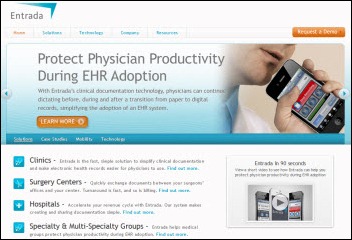
Entrada is an interesting little dictation and transcription service that is partnering to bring voice to data services along. They are making some noise in the ortho markets.”


Epic

5-27-2012 3-22-37 PM

Epic is good and not great. The install methodology is good, but they rely too much on their UserWeb to send customers for information. They also do a poor job of preparing CIOs for what life will be like after the install. We don’t have time to figure out which classes we should attend so we can get an idea of how the suite works and what it takes to support it. I have asked repeatedly for guidance and am still waiting.”


GE Healthcare

5-27-2012 3-23-20 PM

”What’s up with the GE Healthcare product suite? I haven’t heard much. I fear that their ambulatory PM/billing system formerly known as IDX has seen better days. They have been historically strong products.”

”I haven’t heard much lately about what GE is doing with their ‘new product’ or how the new joint venture is going with Microsoft.”


Hyland Software

5-27-2012 3-20-18 PM

Hyland is doing a great job for us. On time, on budget. Can’t ask for more than that.”


InterSystems

5-27-2012 3-25-06 PM

”We’re vendor shopping and you get to see many products and talk to a lot of sales reps. InterSystems gave us their sales pitch, but didn’t even pitch us their correct product. We had met with them at HIMSS and clearly they didn’t take any of that conversation into account.”


McKesson

5-27-2012 3-29-02 PM

”It was painful that McKesson announced in December that they are going to sunset Horizon Clinicals. Having stopped developing their emergency and ambulatory solutions (HEC and HAC) puts lots of things into question. We don’t use HAC, but we do have HEC in all our facilities. Moving to Paragon – really?!?!? They have been unable to execute over the last five years on what they said they would deliver on. Who would believe they could do it with this neophyte product?” 

“It might be interesting to ask of those healthcare organizations using Horizon Clinicals as their primary EHR solution how many are currently considering moving on from McKesson and not waiting on transitioning to Paragon.This question would also be interesting for those organizations utilizing Meditech 5.6 and whether they are going to move to Meditech 6.x or will be selecting another vendor.”


Oberd

5-27-2012 3-38-47 PM

Oberd is an outcomes research company targeting ortho.”


Prognosis

5-27-2012 3-31-10 PM

”We’re opening a new hospital. An interesting EHR vendor they liked is Prognosis of Houston, TX. I haven’t seen the product, but the selection team has raved about it.”


SYSTOC

5-27-2012 3-42-01 PM

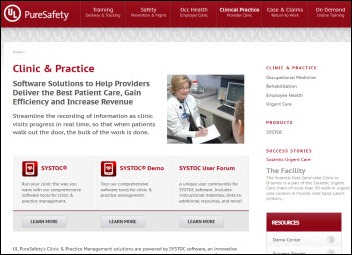
”We installed SYSTOC (now part of PureSafety), the market leader in occupational medicine. It was a very expensive mistake that destroyed productivity. They told us they supported voice recognition several years ago, and are now promising that it will come out in the fall. They have promised improvements with every upgrade and the system just deteriorates more with every release.”


Vocera

5-27-2012 3-13-19 PM

”I have worked a lot with Vocera. Great company, very focused, recent IPO is doing well. Smart guys running it. It’s a good product that works and happy customers.”


HIStalk Advisory Panel: Innovative Companies 5/23/12

May 23, 2012 Advisory Panel 2 Comments

The HIStalk Advisory Panel is a group of hospital CIOs, hospital CMIOs, practicing physicians, and a few vendor executives who have volunteered to provide their thoughts on topical industry issues. I’ll seek their input every month or so on an important news development and also ask the non-vendor members about their recent experience with vendors. E-mail me to suggest an issue for their consideration.

If you work for a provider organization (hospital, practice, etc.), you are welcome to join the panel. I am grateful to the HIStalk Advisory Panel members for their help in making HIStalk better.

For this report, I asked panel members what small and/or innovative companies they’ve worked with recently that readers should check out.


5-23-2012 6-18-54 PM

AirStrip Technologies. “We are implementing our second solution, Cardiology, and they are doing a great job of meeting our expectations.”


5-23-2012 5-36-15 PM

Anypresence. “They have developed a platform so that organizations can create mobile apps.”


5-23-2012 5-39-15 PM

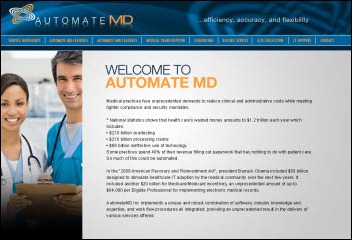
AutomateMD. “They call themselves an EMR company with an interesting suite of products, which I like to call more peripheral additions to an EMR solution. The company is looking for investors and claims to have some big-name partners. Marketing rollout for Northern California is supposed to start June 2. The company offers PM/EMR, e-prescribing, EDI, claims, medical transcription, scheduling, billing, document imaging and management, and collections.  They have offices in California and the Philippines.”


5-23-2012 6-25-46 PM

Aventura. “You’ve profiled them. We have implemented their clinician access solution.”


5-23-2012 6-24-00 PM

CenterX. “Not working with them, but stumbled on an interesting company which is creating competition for Surescripts. This is good, as they are acting like a monopoly – high prices, low innovation. The CEO is an ex-Epic guy.”


5-23-2012 6-06-56 PM

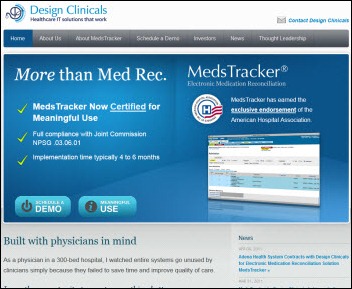
Design Clinicals. “They have a standalone medication reconciliation product, MedsTracker, that works very well. I believe they also have a CPOE product for smaller hospitals.”


5-23-2012 6-12-12 PM

EGIS Systems. “We’ve used them for HIPAA assessments and vulnerability monitoring. So far, I think we get a lot of value for the cost. They’ve negotiated some great deals to resale other security products (e.g., vulnerability monitoring, e-mail encryption, etc.) for greatly reduced prices. Could be a great offering for small to mid-size organizations. “


5-23-2012 5-56-00 PM

Emmi Solutions. “Tracks delivery and consumption of targeted information.“


5-23-2012 6-10-02 PM

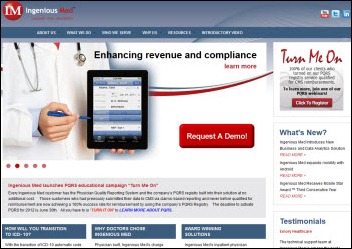
Ingenious Med. Excellent results for inpatient physician charge capture. Cerner is not quite there yet. Good tool and easily adopted by physicians, replacing either spreadsheets and manual tracking or an older tool that hasn’t kept up with mobile technology.”


5-23-2012 5-53-31 PM

Interfaceware. “Its product, Iguana, has a shorter learning curve than HL7 integration and testing. The small, bootstrapped firm is out of Toronto and has an impressive client list of hospitals and vendors. Eliot Muir is founder and CEO.”


5-23-2012 6-00-52 PM

Voalte and InterMedHx. “Awesome. Customer service is over the top and products deliver.”


5-23-2012 6-05-04 PM

MobileMD. “We’ve been talking with multiple HIE vendors and have great experience with MobileMD. They were recently acquired by Siemens, but still act like the small company they started as. Hopefully they keep it up!”


5-23-2012 6-16-30 PM

Nordic Consulting. “We’ve been very pleased with them and their consultants we have engaged.”


5-23-2012 5-46-07 PM

Strategic Healthcare Programs. “A solution of choice for real-time decision support and data analytics in the subacute segment. SHP has a dominant position and its partners page reads like a directory of subacute software vendors. Barbara Rosenblum, founder and CEO, is a great lady.”


5-23-2012 6-20-53 PM

Tableau. “Fantastic visualization software. Allows presentation of complicated information in a ‘simplified’ graphical format.”


5-23-2012 5-58-40 PM

Voalte and InterMedHx. “Awesome. Customer service is over the top and products deliver. “


5-23-2012 6-14-39 PM

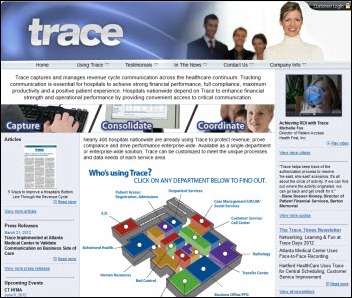
White Stone Group. “On the rev cycle side. Very cool product and technology that helps hospitals and md offices deal with the nasty payors who don’t want to pay on time or want to create ‘stories as to why they can’t pay. Product is called Trace.”


HIStalk Advisory Panel: Allscripts 5/21/12

May 20, 2012 Advisory Panel 5 Comments

The 79-member HIStalk Advisory Panel is a group of hospital CIOs, hospital CMIOs, practicing physicians, and a few vendor executives who have volunteered to provide their thoughts on topical industry issues. I’ll seek their input every month or so on an important news development and also ask the non-vendor members about their recent experience with vendors. E-mail me to suggest an issue for their consideration.

If you work for a provider organization (hospital, practice, etc.), you are welcome to join the panel. I am grateful to the HIStalk Advisory Panel members for their help in making HIStalk better.

For this report, I asked panel members what advice they would provide to Allscripts after the company’s recent earnings disappointment and board shakeup. Their responses have been edited for brevity and to ensure their anonymity. Your comments are welcome.

Vision and Strategy

  • The anti-takeover defense made them look weak in my eyes. They need to communicate their go-forward strategy with large clients as soon as possible. People here are worried that our vendor is going out of business.
  • Phil Pead was all about the stock price and less about the product, integration, and ease of use. Allscripts tried to tell the integrated story with several different legacy flavors of PM/EMR – too many products, too many moving parts. The Eclipsys purchase was 2-3 years too late since Epic and Cerner have already beaten them and Epic is the only one with a real story of true integration. On the low end, they are most likely getting hurt bad by eClinicalWorks, athenahealth, Greenway, and similar companies. My advice: sell Eclipsys and use the money to pick a lane with one or two flavors of product and just kill it in that space. They cannot be all things to all people.
  • They need to re-examine their market and whether this Eclipsys thing is really going to work. Seems like Glen did not learn anything from McKesson and GE.
  • Post-acquisition is difficult and companies sometimes make all the parties feel good by including all the legacy resources – people and products – in the path forward. That leads to lack of vision, resource mismanagement, and excessive costs. I think Allscripts got caught in that vortex. They need to clarify what they want to be, then clean up the operation despite painful changes and bruised egos. A change at the top may be necessary to keep the institutional shareholders and analysts at bay while they right the ship.
  • Put a plan in front of your most important customers and enlist them to create a public statement of support. Customers trump boards of directors every day.
  • Come clean to everyone with what the problem is. Replace the corporate audit firm. Either replace the management team or give them a 12-month notice to clean up their own mess and then get out, assuming there is a belief they can clean it up. Appoint an external firm to work with the board to identify the issues and to decide which board members should stay. Make sure key intellectual capital employees are willing to stay and reinforce your need for their services.
  • Allscripts is a finalist in our inpatient EHR selection. The recent news has raised concerns about the company’s viability. Show the market you can recover and succeed since partnering with Allscripts at this point represents significant risk. The failure to integrate Eclipsys products is a key issue since companies like GE and McKesson promised it after an acquisition and failed miserably, leaving customers in a lurch.
  • A trick of publicly traded companies is to reveal all your bad news at once, let the market kill you, then build back up. I assume this is the case and future revenues will come with a clean slate. I think they will have some good upcoming quarters.
  • They have had a pretty successful ambulatory product offering. They need to leverage that business model to tackle new accounts. With the internal politics hopefully behind them, they can concentrate on integration. They have a good product – I hope they understand that. It’s their execution that’s hurting them.
  • Senior management, led by the CEO, need to be transparent if they’re going to put this turmoil behind them. They need to communicate clearly, thoughtfully, and comprehensively what the plan is, with no BS and PR. Humbly admit past mistakes, acknowledge vulnerabilities, reiterate its strengths and lay out the plan to recover. Spend 30-60 days to do a thorough, honest self-assessment – including consideration of the complaints of its critics – and play out best- and worst-case scenarios. If past decisions (i.e. integration) are criticized, those can’t be changed, but they should be acknowledged and addressed. The market is still large and I don’t believe it’s too late for Allscripts to get its share. It may not achieve a #1 or #2 market position, but it can still emerge as one of the winners. It has good products, a sizable customer base, and many talented employees. The message should be positive and encouraging, but above all, credible. In the absence of an ability or willingness to do this, Allscripts should fire Glen Tullman and hire a CEO with the determination and commitment to turn the company around, like fresh leadership did at IBM with Lou Gerstner.

Sales

  • The sales team needs better access to technical resources. When they do a dog and pony show for our executives, our technical team is always invited and the sales team can’t answer their questions. I want to be sold, but they can’t bring it.
  • Closing deals is the way to show viability. We’ve evaluated their products for our clinics and they didn’t stack up well. One group we’re associated with uses Allscripts and they have not been happy with the product for some time, but I don’t see them moving away from it.

Products

  • They need to focus on clean integration of products they are selling as integrated. The last few times we purchased ‘integrated’ solutions from Allscripts, we had to take over the integration because we were getting nowhere with the company.
  • Articulate the vision of the combine Allscripts-Eclipsys platform and provide a well thought out plan on how they will get there.
  • They may want to take the approach McKesson used for Horizon Clinicals – sunset Eclipsys and focus on ambulatory. They carved out a nice space in the ambulatory area and the R&D dollars going into Eclipsys integration could have been used to further the ambulatory product line. Ambulatory clients are confused. This plays right into the hands of Epic.
  • Allscripts needs to stop talking about an integrated record as though they can compete with Epic. They need to find a way to leapfrog Epic. Take what Sunrise customers are developing using Objects Plus/Helios (some of which knocks the socks off Epic) and incorporate it into the product.
  • We were a long-time Misys client who left after Allscripts dropped the ball. They couldn’t deliver on support. They decimated their personal relationships by replacing dedicated professionals by a different nameless person every time we made a support call. Their salespeople couldn’t even present a proposal for community integration without innumerable failures in the demo. The ‘free upgrade’ from Misys EMR to Allscripts Professional turned into a morass of fees for training that would have cost more than  buying a competitor’s product. Not surprisingly, small practices in our area have turned to eClinicalWorks and Greenway and never looked back. Simply merging individual products repeatedly without true integration and delivering on promises is not sufficient for success.

Services

  • The India-based support we were getting from Eclipsys and then Allscripts was horrible, but they have really taken the bull by the horns and cleaned it up. Recent responses to our problems were clean and focused and I have been pleasantly surprised.
  • Outsourcing support to India was a bad idea. Docs like me call and we get people who don’t know the product. The same is true of their patient portal – it is a Babel Tower.
  • We have seen deteriorating support and turnover amongst the sales/support team that crosses product lines. Physicians are losing confidence in the product.
  • We’re a large Allscripts Professional client and it’s been frustrating to watch them struggle to grow and try to compete with Cerner and Epic. Their overall support and quality has suffered, especially with new releases.
  • Please care about me and provide support. I know life isn’t the best for you right now, but I still have to work and I need you to fix the support structure. Keep current customers from being so put out with you and fewer of use will become someone else’s customer.
  • Hire more qualified staff. They are hiring high school graduates for implementation consultant positions and giving them only basic training before sending them out to clients at $205 per hour.

Text Ads


RECENT COMMENTS

  1. That, or we see if Judy will announce Epic's new Aviation module (probably called Kitty Hawk) that has integrated Cruise…

  2. The $50 billion Rural Health payout is welcome. In context, it's less than the total cost of the F22 raptor…

  3. RE NEJM piece: He shouldn’t future-conditional with “they can retreat, which might mean abdicating medicine’s broad public role, perhaps in…

  4. The sentence was "most people just go to Epic UGM" - that's people going to Epic's annual user conference and…

Founding Sponsors


Platinum Sponsors


Gold Sponsors


RSS Webinars

  • An error has occurred, which probably means the feed is down. Try again later.