Readers Write: Managing Total Medical Expense While Improving Health Outcomes

May 10, 2013 Readers Write Comments Off on Readers Write: Managing Total Medical Expense While Improving Health Outcomes

Managing Total Medical Expense While Improving Health Outcomes
By Michael Gleeson

5-10-2013 8-53-34 PM

As our healthcare system evolves and payment reform expands, providers are forced to deliver higher quality care at a lower cost to curb explosive growth in national expenditures seen in past decades. As a result of this paradigm shift, the industry is responding.

In order to accommodate the incentives and priorities set forth by the Affordable Care Act (ACA), health systems must elevate the importance of primary care. This care model is shifting, with many adopting a patient-centric “Medical Home” approach to patient management. This new model emphasizes cross-provider care coordination, risk-stratified patient management, and proactive, preventative care.

Organizations are also using data more effectively. Increased adoption of electronic health records (EHRs), has led to valuable clinical data that can be mined and analyzed to inform health plans and providers on both their patient population as well as clinician behavior. However, the problem is that it isn’t being mined correctly. By integrating claims and clinical data, building trust and acceptance by care delivery professionals, and reorganizing care teams around actionable information, health systems will start demonstrating reductions in medical costs while improving patient outcomes.

So where should you start?

The four key pillars for success outlined below focus on improving health outcomes and managing total medical expense as critical elements in achieving lasting change within the practice.

Building Trust and Sharing Data

Despite significant investment in technology and data sharing by health systems, health plans and most primary care providers still have no visibility into their patients’ activity outside the four walls. And some health systems are hesitant to share data and/or performance with their counterparts, so as a result, it’s important to do the following when integrating with the network:

  • Create data governance policies. It is important to have a policy that dictates the use and exchange of shared data.
  • Establish role-based security and blinded data policies. This is a good rule for those who are apprehensive to share information. Not everything needs to be shared in order to drive change.
  • Data validation. Assessments to ensure that the data presented to the practice accurately reflects the activities at the point of care is critical to building trust.

Patient Attribution and Outreach

Quality improvement programs are often hindered by the challenge of accurate patient designation. If you can’t accurately identify who is responsible for a patient, you can’t improve the care rendered to them. Health plans often provide member rosters, but these can be large, burdensome to work with, and are often wrong.

It’s important to implement a system that will absorb the membership files from multiple plans, sync this data with the EHR and Practice Management data, and generate a list of members who are inaccurately attributed. The upkeep on this process, once it’s started, can be done monthly and will only take a couple of hours. With the attribution problem solved, the practice can reach out to the non-engaging patients it was responsible for and re-immerse them in primary care.

Fast, Accurate, and Actionable Data

In the whirlwind of external data feeds and complex EHR data structures, finding meaning can be a long process. Utilizing a flexible, transparent and vendor-agnostic data warehouse system allows information from multiple EHR feeds and claims files to aggregate on a nightly basis. This data is merged into a simple, patient-centered data model for reporting and analytics use. A focus on the EHR’s clinical data ensures near real-time analysis and greater relevance to the providers and care teams, resulting in more accurate and efficient patient results that can be monitored accordingly.

Transforming Clinical Care Teams

Even with access to timely and accurate data, practices can still struggle to improve outcomes because of inadequately aligned care teams. Providers are burdened with excessive documentation requirements in poorly optimized clinical systems. When a PCP is spending 10+ hours a day documenting in their EHR, they do not have the time and energy to consume the relevant information to drive proactive care management and move the needle on patient performance measures.

Arranging these roles appropriately within the care team maximizes resources and is critical to successful patient care. Medical Assistants should become the primary consumer of reports and act as a quarterback for the team, beyond their role of taking vitals. Using pre-visit planning reports, they should identify care gaps and coordinate with the RN and care manager to ensure the right actions are taken before the patient arrives. This will enhance the interaction and allows all current and potential problems to have the time to be addressed.

The inevitability of healthcare reform is forcing practices nationwide to shift how they view, plan and deliver care. While there is a renewed focus on managing quality and cost containment, this requires health systems of all sizes to master their data assets and align care team roles around the right tools and mandates.

As noted earlier, this charge is not easy. However, many organizations are currently rising to and conquering this challenge by utilizing these four pillars of success. By meticulously positioning themselves in line with this industry transformation, and keeping their goals and attention keenly on improving patient care and dissolving excessive costs, real improvements are being identified in the current health environment.

Michael Gleeson is senior vice president of product strategy for Arcadia Solutions.

Time Capsule: Dirty Geeks and They’re Done Dirt Cheap: How Wall Street’s Huddled Masses Could Reshape Healthcare IT If We Just Asked Them

May 10, 2013 Time Capsule 5 Comments

I wrote weekly editorials for a boutique industry newsletter for several years, anxious for both audience and income. I learned a lot about coming up with ideas for the weekly grind, trying to be simultaneously opinionated and entertaining in a few hundred words, and not sleeping much because I was working all the time. They’re fun to read as a look back at what was important then (and often still important now).

I wrote this piece in October 2008.

Dirty Geeks and They’re Done Dirt Cheap: How Wall Street’s Huddled Masses Could Reshape Healthcare IT If We Just Asked Them
By Mr. HIStalk

125x125_2nd_Circle

Healthcare IT has always been inbred. The same folks just keep moving between provider and vendor, hospital operations and IT, and Organization A and Organization B. The name tags change, but the faces stay the same. Most of the value of the HIMSS conference is in reconnecting with all those folks who scattered like billiard balls since you saw them last.

HIT is an esoteric discipline, at least according to those who are in it. We’ve kept it that way by demanding healthcare experience for most jobs, ensuring that few strangers and their highfalutin’ new ideas enter our comfortable midst (it also helps that healthcare pays less and uses bizarre technologies that the rest of the techie world has never heard of, like MUMPS and Magic).

Nobody knows whether healthcare will dodge the economic bullet this time around. If it does, lots of non-HIT techies will be pressing their noses to our glass, seeking a chance to start earning a paycheck again. It will look like that Twilight Zone episode where the guy is holding a gun on his neighbors to keep them out of his bomb shelter.

This Mariel boatlift of geeks could be great news for healthcare. Banks and investment companies were (note the past tense) full of experts in online transaction processing, security, project management, and forecasting. What will we tell those folks when they drop by?

Traditionally, it would be a slightly more polite variant of “hit the road.” No healthcare experience means we don’t want you, no matter how skilled and experienced you are at the same kinds of technology that we’re planning to use. We’re healthcare and we’re different.

That’s a mistake. The industry could use some new, baggage-free ideas from people who have spent their lives doing what healthcare is just now learning about: running large-scale, mission-critical systems and conducting business innovatively over the Web. And right now, especially if your hospital or company is anywhere near New York, Boston, Chicago, Hartford, Charlotte, or other cities that revolved (note past tense) around the financial services industry, I bet you could hire them for about the same money you pay those same old retreads.

This could be the most exciting HIT development in decades. Many of our bread-and-butter applications are old, poorly secured, and Web-indifferent. Developing portals and RHIO connectivity is a snap compared to keep tracking of some of those bizarre investment instruments their former finance bosses just choked on.

Interested in patient payment systems, real-time adjudication, Web-based customer service, or throughput modeling? Those are the folks who could knock that out right now, already used to skipping lunch and working long hours.

Healthcare has always been jealous of banking IT people, visibly grinding their jaw when innocent outsiders make the inevitable comparisons of their cutting edge work vs. healthcare’s 1980s-era challenges still being solved. Deep down, we knew they were right. Former hospital staff turned self-taught analysts couldn’t hold a candle to the best and brightest techies who headed to Wall Street in droves and moved that industry from staid old storefronts to cutting edge electronic commerce. Hey, their stuff works – it’s not their fault that their big-dollar bosses were a lot dumber than everybody thought.

Now we get even. Pay them a lot less, squeeze them into cubicles, and make them take orders from clinicians turned semi-programmers. The tortoise won this race. We don’t care about your international arbitrage software – just write an EMR system that doctors will actually use.

Think of this as your own Wall Street bailout, with benefits.

News 5/10/13

May 9, 2013 News 7 Comments

Top News

5-9-2013 7-31-07 PM

Allscripts reports Q1 results: revenue down 4.8 percent, EPS –$0.07 vs. $0.03, missing estimates on both.


Reader Comments

From IT Exec: “Re: HIStalk. Thanks for everything you do. My day wouldn’t be complete without spending a few hours on there.” Thanks. Mine either.

From PCP Doc: “Re: athenahealth. Just got back from their user conference. Jonathan Bush did not mince words on stage, just like in their earnings call, when talking about ‘companies of Epic proportions.’ Athena going to Haiti to install an EMR in a rural clinic that treats spinal injury patients was a noble touch.”

From Green Lantern: “Re: CMIO searches. I am aware of a couple of hospital systems that restarted their search rather than make an offer to an existing applicant. Does that happen often with CMIO searches vs. other C-level corporate officers? Are there enough applicants, or are hospitals being unreasonable?” Your thoughts are welcome.


HIStalk Announcements and Requests

inga_small Highlights from HIStalk Practice this week: the AMA’s board of trustees chair criticizes the federal government for mandating the use of EHRs under threat of monetary penalty while simultaneously accusing providers of cloning documentation. Frederica Krueger responds to the AMA’s complaints in a “Nightmare on EHR Street” Readers Write post. DigiChart changes its name to Artemis. American Medical News reviews the status of various lawsuits against Allscripts since the company announced plans to stop regulatory development of its MyWay product. CMS creates a timeline for aligning quality measurement and reporting for multiple initiatives. Dr. Gregg considers patient engagement and patient empowerment from both the provider and consumer points of view. Get your fix of ambulatory HIT news and sign up for the email updates while you are there. Thanks for reading.

On the Jobs Page: Open Positions in Development, Senior Manager Engineering Development, Clinical Analyst.


Acquisitions, Funding, Business, and Stock

5-9-2013 7-31-44 PM

HealthTap raises $24 million in series B funding led by Khosla Ventures.

5-9-2013 7-32-33 PM

Alere reports Q1 results: revenue up 10 percent, EPS $0.09 vs. –$0.05, beating expectations on both. The company also acknowledged that an investment firm that is a major shareholder will launch a proxy fight.

5-9-2013 10-04-47 PM

The Advisory Board Company reports Q4 results: revenue up 19.1 percent, adjusted EPS $0.33 vs. $0.31, beating analyst expectations for both.

5-9-2013 7-29-59 PM

Canada-based vertical software vendor Constellation Software acquires Quantitative Medical Systems of Emeryville, CA, which offers dialysis-specific revenue cycle and EMR software.


Sales

5-9-2013 6-16-19 PM

The Mount Sinai Medical Center signs a multi-year agreement for Cureatr, a mobile app designed by one of its residents that offers HIPAA-secure group text messaging for care coordination.

Chicago Health System ACO (Vanguard Health Systems) selects Care Team Connect’s integrated care management platform.

SSM Health Care – St. Louis (MO) selects the EDCO Health Information Solutions day forward medical record scanning services for use at its seven area facilities.

Quality Health Solutions, formed to support the virtual network of seven healthcare systems and Medical College of Wisconsin, chooses population health management and clinical integration solutions from Valence Health.


People

5-9-2013 9-14-13 AM  5-9-2013 9-17-38 AM    5-9-2013 1-21-59 PM
Culbert Healthcare Solutions adds Jason Faaborg (Dell), Tom Gurdak (CSC), and David Howe (Public Consulting Group) as VPs of sales.

5-9-2013 6-25-26 PM

Forbes profiles Imprivata CEO Omar Hussain in an article on leadership.

5-9-2013 7-22-43 PM

Adventist Midwest Health names Thomas Schoenig (Wyoming Medical Center) as regional CIO.

5-9-2013 8-40-57 PM

Care collaboration platform vendor CareInSync names Steve Curd president and CEO. The company also announced a follow-on investment from California HealthCare Foundation’s Health Innovation Fund.

NCPDP names First Databank’s VP of Health Policy and Industry Relations Tom Bizzaro to its board of trustees.

Mike Vandiver (SecureWorks) joins Ingenious Med as CFO.

Charlie Ditkoff (Bank of America Merrill Lynch) joins Cumberland Consulting Group’s board.


Announcements and Implementations

5-9-2013 9-37-23 AM

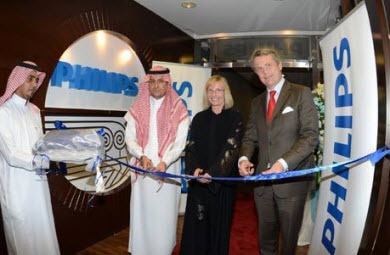
Royal Philips and Al Faisaliah Medical Systems open Philips Healthcare Saudi Arabia, a 50-50 joint venture to market and sell Philips solutions and services in the Kingdom of Saudi Arabia.

5-9-2013 10-04-50 AM

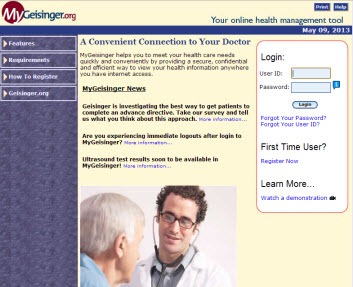
Geisinger Health System (PA) will give patients access to their doctors’ notes in its RWJF-funded OpenNotes program, in which 82 percent of participating patients opened up at least one EMR note.

5-9-2013 7-39-33 PM

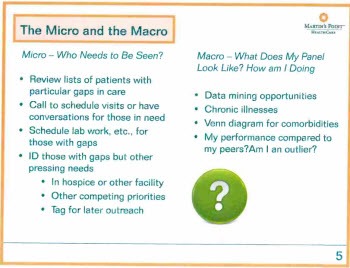
Martin’s Point Health Care will present at the AQA meeting in Washington, DC on May 13. They use Forward Health Group’s PopulationManager at all nine sites and 70 provider panels for micro and macro reporting.

API Healthcare and TeleTracking Technologies enter into a strategic partnership to offer API’s workforce optimization solutions and TeleTracking’s workflow automation offerings.

Project MIST takes first place in an athenahealth and MIT H@cking Medicine-sponsored hack-a-thon for its glaucoma eyedrop spray canister.

Lake Tahoe Regional Hospitalists (NV) and Shasta County Hospitalists (CA) deploy MedAptus for inpatient charge capture.

5-9-2013 10-09-07 PM

Rochester General Hospital (NY) implements EDCO Health Information Solutions’ point of care batch medical record scanning solution.


Government and Politics

HHS releases data on inpatient charges that shows significant variations in pricing, such as joint replacement that ranges from $5,300 to $223,000.


Innovation and Research

5-9-2013 9-49-26 PM

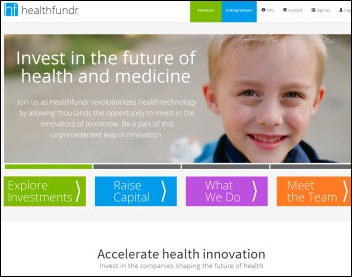
Healthfundr launches its equity-based crowdfunding platform for health startups, open to accredited investors only and working with more established companies.


Technology


Epic gives VMware Horizon View “Target Platform” status for EMR delivery through a virtual clinical desktop, quoting Metro Health CIO William Lewkowski as saying the move is saving his organization $1.6 million per year.


Other

5-9-2013 10-12-15 PM

Fletcher Allen Health Care (VT) will lay off 40 staff members and outsource its transcription services to Nuance Communications, which will offer jobs to 35 affected transcriptionists.

5-9-2013 6-32-04 PM

The Leapfrog Group finds in its spring update that hospitals have made only incremental progress in addressing errors, accidents, injuries, and infections that kill or hurt patients. Sixteen hospitals received an “F” grade.

Gila Regional Medical Center (NM), struggling with uninsured patient volumes, downgrades employees, halts an expansion project, and postpones implementation of a new hospital information system.

Keynote speakers at the MUSE conference May 28-31 in Washington, DC will be Farzad Mostashari and George Will.

5-8-2013 3-03-08 PM

A Surescripts report finds that 69 percent of office-based physicians actively e-prescribed last year and nearly half of patient visits generated an electronically-delivered medication history, 31 percent more than in 2011.

Allscripts will add 350 new jobs over the next five years in Raleigh, NC as it consolidates its US engineering centers. State officials will extend up to $5.35 million in incentives if Allscripts meets investment and hiring goals and maintains its 1,266 jobs in Raleigh.

5-9-2013 3-52-39 PM

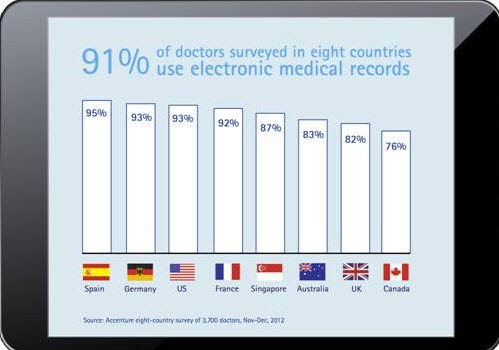
An eight-country survey of physicians finds that 93 percent of US physicians report using an EMR. E-prescribing rates were highest (65 percent) among US providers, as were rates for entering patient notes into EMRs (78 percent.) While the majority of doctors in all countries report EMR and HIE have had a positive impact on their practice, US doctors were the least likely to report that their use reduced organizational costs.

Ken Roberts, MD and Jim Granfortuna, MD sing about EHRs in “Our Song of Epic Proportions.”

5-9-2013 8-06-59 PM

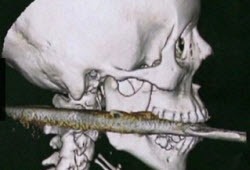
Weird News Andy wonders, “What is it with Brazilians and harpoons lately?” A couple of weeks ago a Brazilian guy accidentally shot a harpoon into his own head. Now a Brazilian man cleaning his spear gun in the living room accidentally shoots off a spear that goes through the mouth of his wife, who was in the kitchen at the time. She’ll recover fully. And in another incident, a Brazilian teen fishing in the Amazon River mistakes his brother for a fish, shooting a harpoon into his face and then paddling 195 miles in a canoe to take him to the hospital.

WNA also ponders this story, in which a South Florida plastic surgeon is arrested for using waterboarding-type torture on his girlfriend for 16 hours after being angered by her Facebook post.


Sponsor Updates

5-9-2013 7-02-12 PM

  • Consulting firm Virtelligence and its client Cone Health (NC) donated 400 tree seedlings via the Arbor Day Foundation to the Guilford County School System, whose students planted the trees around the Triad. The company tracked the number of pages printed during the Epic implementation and used an online program to estimate the number of trees required (361) to manufacture it.
  • NTT Data moves its North American corporate headquarters to Plano, TX.
  • EClinicalWorks releases agenda details for its 2013 National Users Conference October 11-14 in San Antonio.
  • Holon Solutions hosts a May 15 Webinar introducing the value of building an HIE.
  • Sandlot Solutions Director Rosalind Bell discusses how recent emergencies highlight the need for HIEs.
  • Billian’s HealthDATA releases its Provider Portal benchmarking database, which gives hospitals and health systems data for competitive analysis.
  • In a company blog post, Patientco addresses the growing patient payment problem.
  • Red Herring names Awarepoint, InstaMed, and Kony Solutions finalists for its 2013 Top 100 North American Award, which honors private technology ventures.
  • Aspen Advisors consultants will co-present at two sessions during next week’s Texas HIMSS Conference in San Antonio. Aspen’s Director of Clinical Informatics Mark Van Kooy, MD will participate in a panel discussion during an executive summit in San Francisco May 15-17.
  • Kathy LePar, VP of strategic services for Beacon Partners, offers recommendations for healthcare organizations for creating an integrated, holistic approach to strategic enterprise initiatives.

EPtalk  by Dr. Jayne

Georgia Governor Nathan Deal signs the State Physician Shield Act, which is aimed at preventing use of Affordable Care Act provisions to establish standard of care in liability cases. Supporters want to ensure that payment guidelines aren’t used to define care standards to the exclusion of individual patient factors or other clinical standards.

CMS releases Medicare provider charge data for the top 100 most frequently billed discharges across 3,000 hospitals. The variation across some procedures is as much as tenfold.

CNBC recently ran a piece on bad habits demonstrated by younger job-seekers. There are certainly a lot of relatively young workers in IT departments, but I’ve found that regardless of age, behavior is becoming more boorish. I may not be Emily Post, but I’d like to offer some etiquette tips for the age of social media:

  • Learn how to put your phone on silent. Practice this skill often.
  • Texting or checking e-mail on your phone while in face-to-face meetings is just rude.
  • Choosing “Darth Vader’s Theme” as your supervisor’s ringtone is not a career-advancing move, especially if you haven’t learned to put your phone on silent.
  • If you’re hosting a Web-based meeting and sharing your desktop, turn your instant messenger and e-mail notifiers off. I’m tired of seeing embarrassing, unprofessional, and distracting messages come across while I’m trying to work with you.
  • If you’re attending a meeting by conference call, don’t multitask unless you have the skills to pull it off. Asking, “Can you repeat that? I was on mute.” makes no sense and brands you as inattentive and illogical.
  • If you join a meeting late, don’t waste the group’s time with excuses. Say “I’m sorry” then sit down and get to work.
  • Lock your Facebook page down like Fort Knox unless you can keep your mouth shut. Do you really think it’s smart to advertise to your co-workers that you accepted prime hockey tickets from a vendor and thereby violated corporate policy?
  • Learn how to use Scheduling Assistant, Busy Search, or whatever tools your company uses when inviting people to meetings. If an attendee is already booked and you make them “required,” have the courtesy to discuss it and obtain approval first.

clip_image002

Speaking of meeting etiquette, it’s been a rough week, so I was happy to see a tweet for The Ridiculous Business Jargon Dictionary. I think I’m going to try “acluistic” in a meeting I have scheduled for tomorrow and see if anyone figures it out.

Print


Contacts

Mr. H, Inga, Dr. Jayne, Dr. Gregg, Lt. Dan, Dr. Travis.

More news: HIStalk Practice, HIStalk Connect.

125x125_2nd_Circle

News 5/8/13

May 7, 2013 News 8 Comments

Top News

5-7-2013 10-43-55 PM

McKesson reports Q4 results: revenue down 3.4 percent, adjusted EPS $1.45 vs. $2.09, missing expectations on both. In the earnings call, John Hammergren mentions that the company will exit its international technology and hospital automation business. I don’t know which product lines hospital automation includes, for instance whether that means the medication packaging and distribution systems business (ROBOT-Rx, AcuDose-RX, etc.) Technology solutions revenues were up 3 percent, but profit was down 16 percent, “well below our expectations.”


Reader Comments

From The PACS Designer: “Re: Windows 8. The unfriendly start menu for Windows 8 has Microsoft scrambling to fix the problem.” The company admits that its flagship product has a steep learning curve as it forced users to use its touchscreen-friendly tile-based graphical system instead of giving them the familiar Start button.

From Kaye: “Re: HIStalk sponsorship. This remains the best value we get for the money in advertising!” Thanks – that’s a nice comment and we appreciate it, especially coming from a company that has sponsored multiple HIStalk sites since 2009.

5-7-2013 10-45-46 PM

From Anesthesiologist: “Re: Google Glass. How can I partner with companies to develop applications that might be useful in the perioperative setting?” If you’re interested in working with this doc, e-mail me and I’ll forward to him.

From Arcane: “Re: Epic implementation. Do you know of a source for rollout and post-live support staffing numbers?” I have many readers and consulting firms that have implemented Epic, so please add a comment with your thoughts.


Acquisitions, Funding, Business, and Stock

5-7-2013 10-46-35 PM

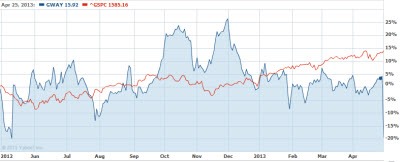
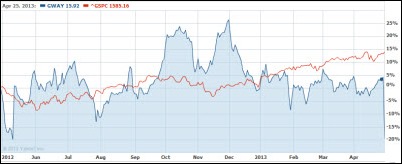
Greenway reports Q3 results: revenue up 3 percent, adjusted EPS $0.01 vs. $0.08, beating earnings estimates of –$0.02  but falling well short of revenue expectations. The company blames a faster-than-expected shift to subscription-based pricing. Shares are near their 52-week low. President and CEO Tee Green also said in the earnings call that with HITECH in the rear-view mirror, buyer fatigue has set in over the past several quarters. Training revenue was also impacted, he said, by customers choosing train-the-trainer and pushing training back to after the quarter’s close.  He also said that Greenway’s participation in CommonWell hasn’t resulted in any sales (without expressing puzzlement at the analyst who apparently thought it might) but said more companies are signing on.

5-7-2013 10-47-20 PM

InstaMed raises $3.5 million in an internal round of funding.

5-7-2013 10-48-05 PM

Healthcare transaction processing firm MediSwipe signs a term sheet with a Chicago-based PE fund to receive up to $600,000 over the next nine months.

5-7-2013 10-48-35 PM

Vocera Communications reports Q1 numbers: revenue down 3.1 percent, EPS –$0.14 vs. -$0.08. CEO and Chairman Bob Zollars says the company saw an increase in new customer signings but did not complete several significant hospital deals.

Siemens Healthcare posts a 4.9 percent increase in Q1 profits, although revenues fell 2 percent.

5-7-2013 10-50-27 PM

Qualcomm Life acquires HealthyCircles, a startup that supports the secure sharing of patient data.

WebMD CEO Cavan Redmond, who has been on the job less than a year, will leave the company, along with CFO Anthony Vuolo.

Perceptive Software blames recent acquisitions for its decision to lay off about 40 employees, or three percent of its workforce.


Sales

5-7-2013 10-51-42 PM

Massachusetts General Hospital selects eHealth Connect Referral Portal from eHealth Technologies to support two-way communication between the hospital and its referring doctors.

East Kent Hospitals University NHS Foundation Trust chooses Harris Corporation’s Clinical Integration Platform to integrate data from six clinical systems across five sites. East Kent will also use Imprivata’s OneSign single sign- on technology.

Upper Peninsula Home Health, Hospice and Private Duty (MI) will implement the Procura for Hospice solution.

SCL Health System (CO) selects Leap-10 from Wolters Kluwer Health to streamline its conversion to ICD-10.

Amarillo Legacy Medical ACO (TX) selects eClinicalWorks Care Coordination Medical Record to advance its ACO objectives and coordinate care among its 100+ provider members.

Physical Rehabilitation Network will deploy NextGen Healthcare’s EHR, PM, PatientPortal, and NextPen products across its 100+ locations and use NextGenRCM Services for revenue cycle management.

Virtual Radiologic signs a five-year deal with Visage Imaging to implement Visage 7 Enterprise Imaging Platform for its 400 radiologists in a read-anywhere environment.


People

5-7-2013 10-38-08 AM

Ernst & Young names Intellect Resources President and CEO Tiffany Crenshaw a finalist for Entrepreneur of the Year 2013 in the Southeast region.

5-7-2013 11-09-04 AM

Former Cerner VP Ian Chuang, MD joins Netsmart Technology as CMO/VP of healthcare informatics.

5-7-2013 11-14-09 AM

Former National Coordinator Robert M. Kolodner, MD joins telehealth provider ViTel Net as VP/CMO.

5-7-2013 2-26-52 PM

Care Team Connect names Richard Popiel, MD (Regence BCBS) to its board.

5-7-2013 3-32-46 PM

Healthcare software solution provider MedicaSoft, LLC appoints Mike O’Neill (VA Center for Innovation) CEO.

5-7-2013 7-29-50 PM

Beebe Medical Center (DE) names Michael J. Maksymow, Jr. (Continuum Health Alliance) VP/CIO.

5-7-2013 10-27-30 PM 5-7-2013 10-28-38 PM

QPID hires Gary Zakon (ModelLogic) as VP of engineering and Caroline Smyth (Smyth Consulting) as VP of sales.

5-7-2013 8-31-06 PM 5-7-2013 8-31-57 PM

Eric J. Topol, MD is named editor-in-chief of Medscape. What’s most interesting to me is that his ongoing full-time employer Scripps Clinic apparently Photoshopped his black suit jacket to look like a white lab coat in the pictures above from their site.


Announcements and Implementations

Access is named as a Meditech Collaborative Solutions vendor, offering Meditech customers an integrated solution to capture and upload electronic signatures and data collected from clinical systems and medical devices.

5-7-2013 10-53-44 PM

Johns Hopkins Medicine integrates Epic with Hyland Software’s OnBase enterprise content management solution in its ambulatory and inpatient departments.

Philips launches Healthcare Transformation Services, a global business unit to provide consulting services to hospitals and health systems.

Trustwave introduces a mobile security practice to help enterprises with their BYOD strategies.

HCA MidAmerica Division equips seven hospitals and multiple physician offices in its Midwest region with Accelarad’s medical imaging solution.

Lifespan (RI) completes its rollout of the the TeamNotes electronic documentation system from Salar.

5-7-2013 8-07-30 PM

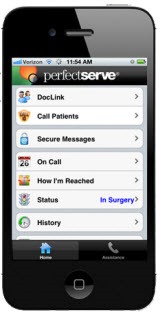
PerfectServe launches DocLink, a secure communications network for physician-to-physician communication.


Government and Politics

5-7-2013 10-21-35 AM

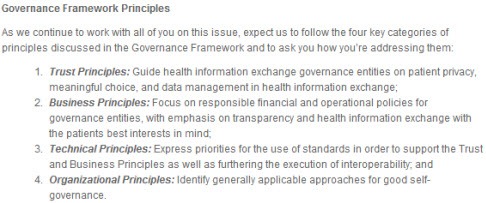
ONC publishes a governance framework for trusted health information exchange to help HIEs and other healthcare organizations understand ONC’s priorities and how to align with “national priorities.”

5-7-2013 10-54-20 AM

CHIME recommends in a letter to six Republican senators a one-year extension for Stage 2 MU before progressing to Stage 3. CHIME contends the extra year will give providers the opportunity to maximize their EHR technology to achieve the benefits of Stage 1 and 2 and give vendors time to “prepare, develop and deliver needed technology to correspond with Stage 3.”

5-7-2013 9-10-19 PM

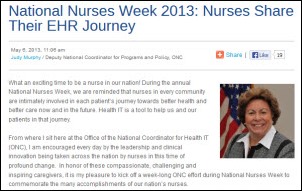
Deputy National Coordinator Judy Murphy, RN kicks off National Nurses Week with a blog post on the role of nurses in healthcare IT and an invitation for nurses to share their stories.


Innovation and Research

5-7-2013 8-55-50 PM

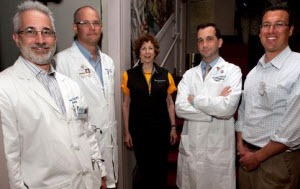
UCSF creates the Center for Digital Health Information. It will be led by UCSF Medical Center CMIO Michael Blum, MD, who will assume the newly created position of associate vice chancellor for informatics and who will continue to lead its Epic implementation (physician leaders of the project are pictured above, with Blum on the left). Current projects include a team-based communications platform, an open source diabetes management system, a Web-based collaboration tool for virtual tumor boards, and a social media-based cardiovascular study.

Kaiser Permanente Center for Total Health will hold a Google Glass event in Washington, DC the evening of June 18.

5-7-2013 10-17-39 PM

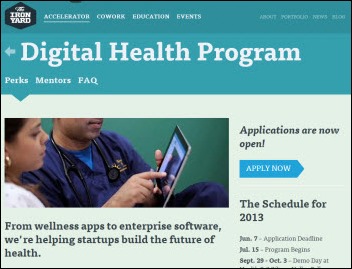
South Carolina-based Iron Yard launches the Digital Health Program accelerator and incubator in the Spartanburg area.


Technology

Bloomberg TV covers the technology used by Palomar Medical Center (CA) and the "hospital of the future.” Palomar Health Chief Innovation Officer Orlando Portale is featured.


Other

An Imprivata-sponsored study finds that clinicians waste 45 minutes per day in using inefficient communication systems such as pagers.

Hospital IT leaders are focused on accommodating greater mobile and wireless connectivity to their networks and with ensuring the security of patient data in BYOD environments, according to a HIMSS Analytics study.

5-7-2013 8-13-09 PM

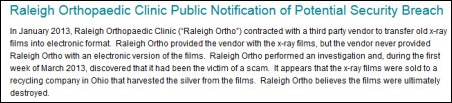
A Raleigh, NC clinic warns patients that it was scammed by a company that claimed it would digitize the practice’s old X-rays, but instead harvested their silver content and then destroyed the films.

5-7-2013 10-56-14 PM

University of Rochester Medical Center warns 537 patients that their PHI may have been compromised when a resident lost a USB drive containing quality improvement information. The hospital thinks it went to the laundry and was destroyed.

John Halamka reports on new Meditech 6.1 development after mixed response to Version 6: a cloud-hosted system based on standards, Web-centric and mobile-enabled, with both inpatient and outpatient capabilities, complete with analytics, a PHR, and care management tools. He says it will ship in 2014.

5-7-2013 9-01-55 PM

Drug chain CVS shuts down its drug company-sponsored refill reminder program because of limitations imposed by the new HIPAA Omnibus Rule on using patient information for marketing.

Weird News Andy refers to this story as “brain drain.” A man who thought his year-round runny nose was caused by allergies finds that it’s actually brain fluid leaking from a tiny hole. It’s been fixed and he’s fine. WNA also likes this story, in which researchers claim to have found the cause of graying hair (hydrogen peroxide buildup in the hair follicle) and a cure for both gray hair and vitiligo (a proprietary treatment involving a UV-activated enzyme).


Sponsor Updates

5-7-2013 10-36-38 PM


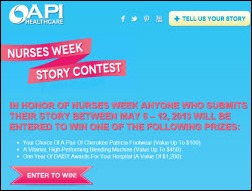
  • API Healthcare and The DAISY Foundation offer The Nurses Week Story Contest, with submissions from nurses due May 12.
  • McKesson releases version 13.0 of its Homecare solution.
  • Orion posts a video featuring Orion clients that have solved interoperability challenges.
  • More than 200 hospitals using CareWorks content management system from CareTech Solutions have received 32 Website awards in the past year.
  • Truven Health Analytics finds that healthcare spending is 20 percent higher for public sector employees than for the private employee population.
  • Passport Health Communications names Texas Health Resources, Trinity Medical Center (AL), and Kadlec Regional Medical Center (VA) winners of its Leaders at the Forefront of the Healthcare Experience contest for best healthcare access management practices.
  • Gwinnett Medical Center (GA) discusses how using RelayHealth services helped the hospital remove patient billing obstacles.
  • iHT2 hosts a May 29 Webinar on security, privacy, and compliance risks in a post-reform era.
  • Greenway Medical President and CEO Tee Green discusses the compatibility of innovation and other topics with PGA tour partner Jason Dufner.
  • Red Herring names Kony Solutions a finalist for its Top 100 North America award, which honors the year’s most promising private technology ventures.
  • EBSCO announces its intent to collaborate with the American College of Physicians to give ACP access to its DynaMed evidence-based clinical summary resources and literature surveillance.
  • Gartner names Health Catalyst to its list of Cool Vendors in Healthcare Providers 2013 and profiles Shareable Ink in its update on 2011 winners.
  • Greenway Medical releases agenda details for its PrimeLEADER 2013 user conference in Washington, DC August 22-25.
  • CommVault launches a customer education services program that includes customized user training and access to online training courses for its Simpana software.
  • ADP launches a Website to help clients and other employers plan for and comply with the Affordable Care Act.
  • Nuance names seven healthcare organizations winners of its Voice of the Customer award for improving quality of care, reducing costs, and accelerating EMR adoption using speech recognition and clinical language technology.
  • CCHIT extends EHR Module certification to the latest version of the Medseek Empower patient portal.
  • TELUS Health and McGill University enter a three-year joint venture to conduct research on how best to use technology to improve health and healthcare delivery for Canadians.

Contacts

Mr. H, Inga, Dr. Jayne, Dr. Gregg, Lt. Dan, Dr. Travis.

More news: HIStalk Practice, HIStalk Connect.

125x125_2nd_Circle

Readers Write: Transitioning from Fee-for-Service to Fee-for-Value Requires Outcomes-Focused Patient Engagement

May 6, 2013 Readers Write 1 Comment

Transitioning from Fee-for-Service to Fee-for-Value Requires Outcomes-Focused Patient Engagement
By Richard Ferrans, MD, ScM

Critical to success under new care models is creating the right IT infrastructure to break down walls and foster better partnerships between hospitals, physicians, payers, and patients alike. We can no longer view inpatient and outpatient settings as different businesses. We must share complex clinical data between the “Care Layer” of physician and hospital EHRs and the “Value Layer” of HIT to integrate their disparate records and promote clinical analytics, value decision support (VDS), care coordination, and digital patient engagement.

Presence Health is the largest Catholic health system in Illinois with 12 integrated hospitals, 29 senior care locations, and more than 4,000 providers and 100 primary and specialty care medical practices. In January 2013, our Accountable Care Organization (ACO), Medicare Value Partners, joined the more than 250 other ACOs established through the Centers for Medicare and Medicaid Services’ Shared Savings Program.

A major part of our journey to becoming an ACO was the integration of employees, providers, and systems during the 2011 merger of Provena Health and Resurrection Health Care that created Presence Health. The combined experience and excellence of the two organizations is helping us succeed in the Shared Savings program. Specifically, both Resurrection and Provena, each with significant Medicare and Medicaid patient populations, had undertaken clinical integration and quality improvement pilot programs before the merger.

The proven patient outcome and financial improvement results of these efforts prepared us for the transition from a fee-for-service model to one based on value. Nevertheless, achieving the CMS’s required 33 quality of care measures while controlling costs will be a challenge.

An integral piece of our “Value Layer” is our patient engagement technology platform that allows us to provide patient-centric communication. We chose our partner, Emmi Solutions, because they have been focused on patient engagement for more than a decade. They have a complete solution proven to motivate patients to take preventive action, transition from one care setting to the next, and participate in shared decision making.

The technology supports web, mobile and interactive voice response (IVR) all in a single platform to deliver actionable information to patients. The platform uses language patients can understand and connects with them at their convenience and on devices they already own – both in and outside the hospital or healthcare setting.

Our patient engagement solution was first introduced to the Presence Health system at Presence Saint Joseph Hospital in Chicago. A survey of nearly 200 patients who had accessed the technology on the Web, conducted over a six-month time period, showed that 94 percent of patients said the engagement platform answered questions for which they normally would have called their doctor. In addition, 92 percent said it motivated them to change their lifestyle and all patients indicated it gave them a better understanding of their treatment options.

We do not passively “educate” patients, but rather use our interactive technology to engage patients in a two-way process where they become motivated participants in their care, exchanging information, validating understanding, and sharing concerns. This is more than a discreet intervention. It is a comprehensive set of reminders, calls to action, and tools needed throughout one’s entire healthcare journey.

We are in the process of expanding it across the Presence Health system and ACO to broaden our ability to cost effectively manage the health of populations and improve both clinical and financial outcomes.

Another reason we chose this technology is because its platform tracks the delivery and consumption of information, which enables us to measure the impact of patient engagement down to the individual patient level. With healthcare transitioning from a fee-for-service to a fee-for-value model, being able to quantify the return on IT investments is becoming a business imperative. Not only are we being held accountable, so is our vendor partner.

Richard Ferrans, MD, ScM is system vice president of Presence Health and CEO of Medicare Value Partners.

Curbside Consult with Dr. Jayne 5/6/13

May 6, 2013 Dr. Jayne 2 Comments

clip_image002

I think many of us in the healthcare IT trenches have simply become beaten down. There are dozens of different initiatives, regulations, and “incentives” causing daily pressure to change how our systems deliver care and how we interact with patients.

Some days I feel like I’m barely able to keep my head above water. There are so many competing priorities you can’t afford to get too worked up over any one issue or you might be sucked under.

In my informatics role, I’m exposed to a lot of different venues for care delivery. This week I served as a locum tenens in a primary care office and again had to confront something that has bothered me for years: pharmacies sending electronic requests for refills on controlled substances when they cannot be refilled electronically. Not only is this bothersome, but it wastes significant time in the practice.

Yes, I’m aware that the DEA issued rules that allow electronic prescribing of controlled substances. However, for this to be legal, the physician has to use certified e-prescribing software and two-factor authentication. Additionally, the pharmacy has to upgrade their systems to receive and process the prescriptions.

My state was one of the last to clarify its requirements for these transmissions, so adoption has lagged. Practices aren’t going to go through the credentialing process if the pharmacies aren’t ready, and our informatics team checks with the pharmacies monthly to see if they’re prepared to accept these scripts.

Our region has several major pharmacy chains that have spent the last decade sending refill requests for drugs that physicians cannot prescribe electronically. The physician (or his/her designee) has to deny the prescription electronically (otherwise be marked as “unresponsive” by the pharmacy intermediary system) then either call the script in if that’s permissible, or print and sign a prescription to mail to the patient or for the patient to pick up. These chains are still not enabled to receive DEA-compliant controlled substance prescriptions, yet they continue to send these refill requests that cannot be processed.

When I first saw this years ago, I called the pharmacy and asked why this was happening. I was told that the prescription management software couldn’t tell the difference between controlled and non-controlled substances, so they couldn’t block the inappropriate refill requests. They didn’t think their vendor would be willing to make a change. Flash forward and it’s still happening. I have to wonder why. Have systems not evolved in nearly a decade? Can vendors really not fix this?

It makes me wonder — where are the Meaningful Use requirements for all the other software systems with which my EHR has to interact? Why aren’t the pharmacies required to document the numerator and denominator for “percentage of refill requests sent that are actually legal to refill?” Why are only the providers and hospitals eligible for penalties?

If we’re going to have de facto regulation, let’s treat everyone the same – from the pharmacy to home health to post-acute care. When only some of the players are jumping through hoops and we’re just passing the meaningless work from one part of the industry to another, we’re not transforming medicine — we’re just being wasteful.

Print

E-mail Dr. Jayne.

Monday Morning Update 5/6/13

May 5, 2013 News 16 Comments

5-4-2013 3-43-24 PM

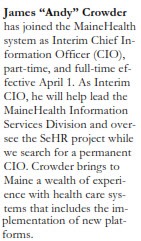
From MaineMan: “Re: MaineHealth / Maine Medical Center. Names interim CIO.” According to the March 25 employee newsletter, Andy Crowder (JC Solutions Group and Florida Hospital before that) is serving as interim CIO.

From The PACS Designer: “R: Intel’s Haswell. We are about to enter a much faster PC user experience with architecture from Intel called Haswell. One of the key features is Haswell provides is a nine-hour battery life through the use of more efficient chips. You can expect to see Haswell powered PC’s in the fourth quarter.” The article says the chip may revive the rapidly dying PC business by making them more competitive with tablets. Of course, that’s what Intel said about the Ultrabook, which hasn’t made Intel-powered laptops a bit more attractive vs. a Macbook Air or an iPad.

5-4-2013 2-00-21 PM

Three-quarters of respondents don’t think it makes sense for innovation conferences to exclude hospitals and physicians under the assumption that they helped cause the problems that seen to require more innovative approaches. New poll to your right: several hospitals have reported financial losses that occurred as they were implementing an EHR. Who is to blame?

Thanks to the following sponsors, new and renewing, that have recently supported HIStalk, HIStalk Practice, and HIStalk Connect. Click a logo for more information.

5-5-2013 9-32-33 AM
5-5-2013 9-26-12 AM
5-5-2013 9-33-39 AM
5-5-2013 9-31-32 AM
5-5-2013 9-19-25 AM
5-5-2013 9-22-33 AM
5-5-2013 9-24-10 AM
5-5-2013 9-23-19 AM
5-5-2013 9-20-44 AM
5-5-2013 9-25-16 AM
5-5-2013 9-21-48 AM
5-5-2013 9-30-42 AM

Two NHS trusts running NPfIT’s Cerner implementation issue tenders for replacement systems.

5-4-2013 2-51-08 PM

Centegra (IL) will go live on McKesson Paragon on May 6.

Some quotes from Jonathan Bush during the athenahealth earnings call Friday:

  • The company that started as an ill-fated birthing clinic and used to hold all-hands meetings from the tailgate of the Jeep Wagoneer is entering the big show. We have done well at the land war that is selling back office services doctor-to-doctor and hospital-to-hospital, but for the first time, we have a crack at the hearts and minds campaign.
  • Take athenaCoordinator. It is a really easy way for any health caregiver to connect to every other one without the complexity of an organ transplant. It is a two-week sales cycle and a two-hour implementation process.
  • We’ve already just announced today Epocrates EDU, which is a whole version of Epocrates to help educators, medical schools, the texting that we are going to be rolling out, secure HIPAA-compliant, patient-related texting between doctors. We’ll be able to attach links to athenaClinicals next year so that doctors who aren’t clients of athenaClinicals will be able to take a quick look at a patient face sheet in athenaClinicals.
  • I think we are seeing — particularly the folks who got pregnant with Epic, sort of they’re going to this sort of desperate burn-bright tactics. We heard where Yale-New Haven has told all the doctors that have privileges that they will either this piece of shit Epic that none of them want or do you have their privileges revoked. So there’s that kind of tactic going on. "Oh, we can’t interface." I’m like, "What you mean? Epic interfaces all the time. They actually do it really well." … The folks that have gone off and laid down more money than they have on Epic have, in the back of their mind, that they are going to make a real impact on referral patterns by getting doctors on to Epic that don’t want to be on it. And it’s — really, Epic is the only one. Cerner builds interfaces, no problem.

5-4-2013 3-19-19 PM

TriZetto announces that CEO Trace Devanny will leave the company immediately after two years on the job “to pursue other opportunities” as a search is undertaken for his replacement. EVP/COO Jude Dieterman is promoted to president, a newly created role. Board member Vicky Gregg will assume the role of non-executive chair.

Intermountain Healthcare is working with Blue Cirrus Consulting to develop a homegrown tele-ICU solution.

UCSF lauches MeForYou.org at the OME Precision Medicine Summit. The precision medicine project will link people with genetically similar others via their genomic information, environmental factors, and their EHR information to help guide clinicians. They differentiate it from personalized medicine in that in precision medicine, the information used goes beyond genomic data and scientists can tap into that information directly to guide research and treatment.

5-4-2013 4-41-19 PM

Team Break Fix won the $25,000 grand prize at the Cajun Codefest 2.0 in Lafayette, LA last week.

Weird News Andy says this gives heart attacks the finger. The EndoPat test predicts heart problems by checking blood flow in the fingers.

Vince has a Part 3 installment on GE Healthcare in this week’s HIS-tory.


Sponsor Updates

  • Cynthia Davis, RN, co-founder and principal of CIC Advisory, is named Entrepreneur Woman of the Year by the St. Petersburg (FL) Area Chamber of Commerce Women’s Leadership Council.
  • Allscripts posts the agenda for its ACE conference, to be held August 20-23 in Chicago.

Contacts

Mr. H, Inga, Dr. Jayne, Dr. Gregg, Lt. Dan, Dr. Travis.

More news: HIStalk Practice, HIStalk Connect.

125x125_2nd_Circle

Readers Write: Healthcare IT vs. Corporate IT

Healthcare IT vs. Corporate IT
By Anonymous

This is in response to an April 29 reader comment suggesting that healthcare IT leaders are unable or unwilling to make decisive decisions that would improve the bottom line.

I don’t think it’s always not making a “responsible” decision on the part of the HIT leadership. There are different priorities in healthcare organizations versus us in the corporate world. 

In the corporate world, we in IT are well aligned to the profit motive of our company. Period. In healthcare IT, leadership is often not worried about that profit motive. They say they are, but the other departments we serve — they say they are worried about finances, but they really aren’t. HIT leadership doesn’t want to have a crucial conversation with the department heads in the healthcare system about their wasteful applications. 

The infrastructure is normally fully under the control of HIT leadership. There is a ton of cost cutting that happens there. Way too much in my opinion, causing unnecessary downtime that would never happen in a corporate IT shop. That’s due to the cost cutting to not have that switch stack be fully redundant or we don’t need to buy ALL that storage area network growth space now … and then you run out. I’m looking at you HIT shops in the North Carolina Tobacco Road region. 

The real HIT waste is in the applications. Nearly every health system I’m familiar with have some pretty serious application redundancies. What I mean is an HR department that runs both Kronos and Lawson and the payroll department is not part of HR and not outsourced to ADP or the like. That’s two very expensive systems that can do the same job if someone can tell or convince HR to just pick one. 

Or better yet, just let someone else run that whole part of your operation. Many of the corporate IT guys handled the payroll / processing / HR system cost issue a long time ago via outsourcing. Then HR can focus on, oh I don’t know, recruiting people and working on benefit plans. That doesn’t seem to be all that common in healthcare IT.  

Also, your hospital maintenance departments run very expensive name-brand systems meant to run whole manufacturing operations. To do what? Inventory objects and print out repair orders. I’m not talking about your medical device department here, just good old facilities and services. 

The list of applications that cost serious dollars and do only  small jobs inside the healthcare operation as a whole goes on and on.  Corporate-based IT shops would have had a programmer build a little Web application or SharePoint portal to eliminate a few hundred little apps inside a typical healthcare IT shop. 

There’s not a lot of movement in HIT shops to simplify. Simplicity equals cost savings in both break/fix and maintenance/purchase dollars. 

Why not focus on those applications particularly that need simplification and save costs? 

I believe it’s political costs mainly in the healthcare IT field. Those department heads often hold much power in an organization. Healthcare IT is not the sole owner or, at minimum, the first owner of the application. That department or unit is. They can claim patient benefit or employee benefit, or most often, that the redundant systems allow them to have their own inflated head counts. 

Will a healthcare IT leader have time to quantify those patient benefits into a dollar measurement to then justify the maintenance cost and support/time cost for that application? No. Who has that kind of time? 

There are often redundant departments in a healthcare operation. Health systems have DBAs/report writers creating reports for clinicians, but there is a whole other Decision Support Services department with their own specialized application. Nine times out of 10, it’s the same data being reported in almost the same way, and let’s not talk about that DSS app and how it gets the data every day or night and the integration and support work there. In some shops, those DSS people with limited SQL writing skills will even tug some of that DBA’s time to help with their work. 

In corporate IT, there is one measure — efficiency measured in real dollars. There are no patients, so the hard math is easier to quantify. How much does that application cost to have support, maintenance, and upgrades purchased? OK, that’s $100. What does it save us in time running the business vs. another application/process? We are in the positive side in $1,000s — it is justified. There isn’t a lot of worry about the business unit’s politics other than making sure their process is as lean and efficient as possible and that usability of the application is good so that the process time is as efficient as possible.

That’s not to say that a corporate business unit doesn’t have its own political pull, but often you can show the C-level the numbers and those numbers win the argument. Proof in the corporate world means something. I’ve been in many healthcare IT ROI discussions showing the cost savings that could happen. They are normally hundreds of thousands to millions when you take into account the database licenses at the infrastructure layer also. Healthcare IT leadership still passes. It’s not their priority to go against the department heads. 

Internal politics are everywhere. In healthcare, political might can win an argument when the proof in dollars are staggeringly in support of the other point.

I’d say this is changing in healthcare IT as many organizations are having their bottom line get worse and now some of those golden goose political situations are getting weaker.

The dollars of cost argument is winning the day here and there. It’s just the wins are only on small projects and applications to show the cost saving committee that we saved $50K. That’s for show. The real cost saving opportunities that exist are hundreds of thousands in savings.

Time Capsule: Every Time I Say It’s About Patient Care, You Tell Me It’s a Business: Healthcare IT Lessons Learned from “North Dallas Forty”

May 3, 2013 Time Capsule 1 Comment

I wrote weekly editorials for a boutique industry newsletter for several years, anxious for both audience and income. I learned a lot about coming up with ideas for the weekly grind, trying to be simultaneously opinionated and entertaining in a few hundred words, and not sleeping much because I was working all the time. They’re fun to read as a look back at what was important then (and often still important now).

I wrote this piece in October 2008.

Every Time I Say It’s About Patient Care, You Tell Me It’s a Business: Healthcare IT Lessons Learned from “North Dallas Forty”
By Mr. HIStalk

125x125_2nd_Circle 

One of my favorite and most insightful lines from any movie comes from “North Dallas Forty,” a cynical and dark football film from 1979. In a key scene, fictional football player O.W. Shaddock, masterfully played by former Oakland Raider John Matuszak, explodes his rage and frustration onto the team’s coaches, who constantly resort to using fear and ridicule to get tired and injured players to keep performing even when they shouldn’t. "Every time I say it’s a game, you tell me it’s a business. Every time I say it’s a business, you tell me it’s a game."

The quote may have been about sports, but it’s relevant to healthcare as well.

I’ve worked for both vendors and hospitals. There were plenty of times on both sides where I wanted to scream at management, “Every time I say it’s about patient care, you tell me it’s a business. Every time I say it’s a business, you tell me it’s about patient care.”

Our unusually capitalist approach to healthcare delivery is schizophrenic. Everybody understands giving massages or tummy tucks for the biggest fee the market will bear, but there’s something inherently distasteful in performing life-saving surgery or seeing patients through their final days of cancer while a business guy taps his calculator every now and then to remind everybody — including the patient — to keep the cost down.

IT is usually smack in the middle of that rift between clinicians and executives, the bearer of bad news about something one group wants that the other is loathe to deliver. Clinicians resent being told how to deliver care by $1 million hospital CEOs and their business-savvy underlings. The people in the mahogany offices can’t talk slowly enough about cost control to get the message across the financially naïve white coats who would bankrupt the place if someone wasn’t watching the till. Somebody wants a CPOE system or a tool to run a balanced scorecard and the IT person knows exactly which part of the organization will be calling for his or her head.

Clinical people working for vendors have the same struggle. They’re supervised by executives who not only have never delivered care, but who most often drifted into healthcare by accident and will probably drift right back out again someday. Every undelivered system enhancement or overstated capability make the clinicians want to scream like O.W. Shaddock, physically threatening an overconfident MBA vendor suit whose last service to others was whispering the Black-Scholes equation to a B-school classmate during a tough finance test.

We’re in a confounding business whose mission is frustratingly mixed. Deliver the best care or the best clinical software possible – as long as it’s profitable. If it’s not, the MBAs are ready to rush in and whip the widgets into shape. That’s a threat and a promise.

Maybe it would help to see how the other half lives. Clinicians should sit through the meetings in which life-or-death decisions are made that concern the health of the entire organization, not that of individual patients. Executives should have to face real patients and caregivers regularly just to remind themselves of a mission more important than fancy new buildings and slick marketing.

And IT folks working for both providers and vendors … well, there’s really nothing you can do except wait for the dust to settle and support and enable whatever strategic plan results. Those other folks are playing tug-of-war and you’re the rope.

News 5/3/13

May 2, 2013 News 2 Comments

Top News

5-2-2013 10-44-47 PM

A selectman and software developer from Edgecomb, ME blames MaineHealth’s decision to close a local ER on the health system’s $150 million Epic implementation. The selectman’s letter to the editor to the local newspaper notes that MaineHealth has charged “millions of dollars” to member hospitals, but has had “a real failure in its implementation,” resulting in unplanned operational costs with minimal benefit to the state. Meanwhile, in a memo to employees last week, Maine Medical Center’s CEO listed several causes for its $13.4 million loss in the first half of the fiscal year, including “unintended financial consequences” of its Epic rollout as well as incorrect charging. The organization has placed further Epic implementations on hold as teams from Epic and the hospital try to fix problems.


HIStalk Announcements and Requests

inga_small A few HIStalk Practice highlights from the last week: patients say the most bothersome aspect of doctor visits is unclear or incomplete explanations of problems. Health Texas Provider Network partners with MediMobile for its mobile charge capture solution. The number of physician office jobs for billers and medical record clerks has declined sharply over the last two years. Epocrates is the most popular mobile app among US physician app users. Athenahealth names St. Boniface Haiti Foundation the winner of its 2013 Vision Award. Physicians are generally making more money this year than last, but are also spending more time on paperwork. Most news items on HIStalk Practice are not mentioned HIStalk, so peruse HIStalk Practice regularly to stay current on the ambulatory HIT world. Thanks for reading.

On the sponsor-only Jobs Page: Regional Sales Director, Senior Director of Business Development, Senior Manager Engineering Development, Open Positions in Development.


Acquisitions, Funding, Business, and Stock

5-2-2013 10-45-35 PM

Merge Healthcare reports Q1 results: revenue up 4.3 percent, EPS –$0.07 vs. –$0.02, missing earnings estimates.

5-2-2013 10-46-12 PM

API Healthcare announces the signing of over 25 contracts in Q1 and bookings that were 25 percent higher than the same period in  2012.

5-2-2013 10-48-26 PM

MedAssets announces Q1 numbers: revenue up 15.3 percent, adjusted EPS $0.41 vs. $0.24, beating expectations on both.

5-2-2013 10-49-46 PM

Athenahealth announces Q1 results: revenue up 30 percent, adjusted EPS $0.38 vs. $0.17, beating on both but adjusting fiscal year EPS guidance to below consensus.


Sales

5-2-2013 10-51-29 PM

University of Nevada School of Medicine chooses GE Healthcare’s Centricity Business, Centricity Practice Solution, and Centricity PACS-IW.

Filmore County Hospital (NE) selects NextGen Healthcare’s Inpatient Clinicals and Inpatient Financials.

Baylor Quality Alliance (TX) chooses Humedica MinedShare from Optum to analyze administrative and clinical data from payers, various EHRs, and the Baylor Health Care System HIE.

Louisiana Specialty Hospital will implement ONE-Electronic Health Record from RazorInsights. 

5-3-2013 7-08-25 AM

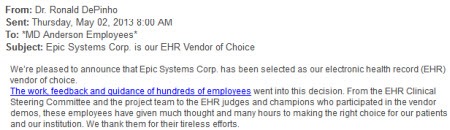
MD Anderson Cancer Center (TX) chooses Epic as its vendor of choice, according to an internal memo forwarded by a reader. Other readers had reported that same rumor late last week, saying that Epic had beaten Cerner as VOC.


People

5-2-2013 6-25-04 PM

UNC Health Care (NC) interim CIO Tracy Parham, RN is named permanent CIO, where she will lead its Epic project.

5-2-2013 6-47-56 PM

Parallon Business Solutions names John Guevara (Allscripts ) as CIO.

5-2-2013 7-14-00 PM

Patient Privacy Rights names Adrian Gropper, MD (HealthURL Consulting) as CTO.

5-2-2013 7-48-03 PM

Stephen Collins (Allscripts) is named president of Austin-based behavioral charting system vendor ChartAssist.

5-2-2013 8-07-48 PM

The Advisory Board Company CEO Robert Musslewhite is named by Washingtonian as one of its 100 Tech Titans and is also profiled in a feature in The New York Times.

Galen Healthcare Solutions appoints Joel Splan (Northwestern Memorial Healthcare) as CEO.


Announcements and Implementations

Rockdale Medical Center (GA) implements Nuance’s PowerScribe 360 voice recognition software for the dictation of imaging reports.

5-2-2013 8-53-10 AM

PointClear will move its corporate headquarters from Huntsville, AL to Dunwoody, GA.

5-2-2013 11-02-55 AM

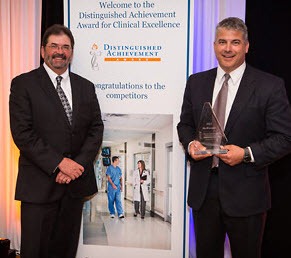
McKesson recognizes Peninsula Regional Medical Center (MD) as the 2013 winner of its Distinguished Achievement Award for Clinical Excellence for effectively using McKesson technology along with Modified Early Warning Scores to proactively identify patients at risk for a code blue.

Aprima Medical Software will interface its EHR/PM system with the Homecare Homebase platform.

LHP Hospital Group implements McKesson’s Paragon HIS at Portneuf Medical Center (ID), Seton Medical Center Harker Heights (TX), and Texas Health Presbyterian Hospital WNJ (TX).

Elsevier launches its third annual “Superheroes of Nursing” contest and is accepting nominations for applicants in the categories of Achiever, Protector, Educator, Validator, and Connector.

SCI Solutions adds text appointment reminders to its Schedule Maximizer scheduling solution.

Modern Healthcare has corrected its article about the State of West Virginia’s payments to Medsphere for implementing OpenVista. The originally reported figure was $8.4 million per year, but that was actually the total amount spent since the contract was signed in 2005. Current payments are just under $1 million per year.

5-2-2013 10-54-20 PM

Mount Sinai Medical Center (NY) announces that it has enrolled 25,000 patients in its BioMe program, which links DNA samples to its Epic EMR information to support targeted medical care and to provide de-identified data for research. 

First Databank announces ICD-10 for Saudi Arabia at the HIMSS Middle East conference.


Government and Politics

5-2-2013 6-30-10 PM

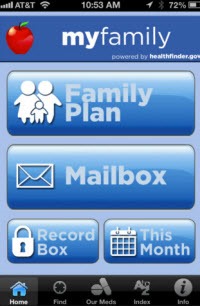
HHS names Lyfechannel the winner of its healthfinder.gov Mobile App Challenge for its myfamily app, which helps individuals manage their family’s health through customized prevention information for each family member.

Healthcare modeling and analytics company Archimedes collaborates with CMS to give users easier access to public payer claims data.

5-2-2013 3-29-16 PM

CMS announces that hospitals and EPs have been paid $13.7 billion through the end of March, with $8.5 billion going to 8,558 hospitals and $5.2 billion to 255,722 EPs.

FDA launches the redesigned FDA Patient Network, which will educate patients and their advocates about FDA and will invite them to attend and present at FDA meetings.

Farzad Mostashari was a panelist in a discussion of technology in healthcare put on by Politico last week. The 77-minute video is of very high quality and it’s an interesting mix of people and topics.

5-2-2013 11-08-05 PM

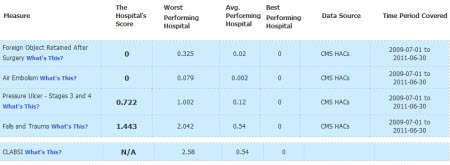
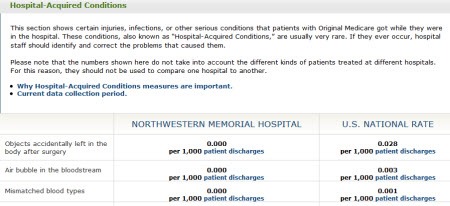
CMS gets criticism for removing information on hospital-acquired conditions from its Hospital Compare site. CMS says the information is flawed and is redundant, but patient groups say CMS is buckling to the complaints of low-performing, high-profile hospitals.


Innovation and Research

Vanderbilt University launches the Health App Challenge to transform clinical summaries into a more patient-friendly form. Entries are due August 1, with the winner receiving $10,000 and up to five finalists being awarded $2,000 or more each.


Technology

5-2-2013 9-43-07 PM

Former Google Health product manager Missy Krasner, now involved in startups and an advisor to Box, says Google Health was a good idea in theory, but “It was a very bumpy user experience for even the most super-charged, IT savvy consumer.” She says Box will take over where Google Health left off for storing personal health records that it supports HIPAA requirements. She concludes, “So here is my hope for the future. If most EHRs can currently export a Continuity of Care Document (CCD) via the Clinical Document Architecture (CDA), why couldn’t Box grab that clinical care summary format and stylize it in a way that made sense to other doctors or patients via its documenting previewing technology? This would help the interoperability and file transfer juggernaut get a whole lot easier.”

FastCompany profiles companies started by founders who were frustrated with existing products, among them Amazing Charts.


Other

5-2-2013 9-48-14 AM

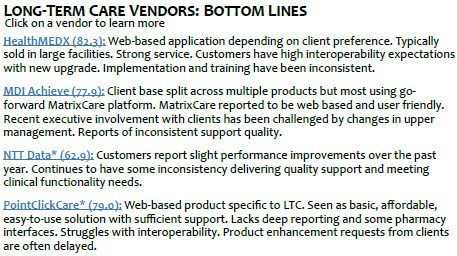
KLAS reports on the post-acute care market, which is critical for managing outcomes and costs. HealthMEDX was named the top performer among long-term care vendors with 100 percent of its customers saying the company keeps its promises and that they would buy HealthMEDX Vision again.

Weird News Andy summarizes this article as “coming clean.” Piedmont Healthcare (GA) admits that for two years it improperly cleaned colonoscopy requirement at one of its ambulatory surgery centers, requiring it to notify 456 patients that they should be tested for hepatitis and HIV. Employees cleaned the equipment with soap, but missed the disinfectant step.


Sponsor Updates

  • T-System posts a photo gallery from its linkED 2013 Emergency Care Conference held in Dallas April 22-25.
  • Emdat posts a case study from Illinois Bone and Joint Institute, which reduced documentation costs by 50 percent by implementing Emdat’s transcription software and the company’s mobile documentation tool.
  • The Nashville Business Journal names Passport CEO Scott MacKenzie one of the most influential business executives in Middle Tennessee.
  • First Databank hosts a May 14 Webinar on the use of RxNorm within information exchange and clinical quality measures.
  • Kareo offers a May 16 Webinar that considers five activities to prevent a government audit.
  • Executives from Yale-New Haven Health System, Hartford HealthCare, and North Shore-LIJ Health System will share strategies to reduce readmissions at the iHT2 Summit in New York City on September 17-18.
  • Porter Research posts a presentation that provides insight into the trends, challenges, and benefits of engaging consumers in every stage of healthcare.
  • Capsule Tech will exhibit at the annual MUSE conference May 28-31 in Washington, DC.
  • Truven Health Analytics receives a five-year accreditation from the National Institute for Health and Care Excellence for its Micromedex Medication Management solution.
  • The National Committee for Quality Assurance certifies Verisk Health’s Quality Intelligence solution to support quality reporting for commercial and Medicare Advantage populations in the California P4P program.
  • As part of this week’s Medical Library Association Annual Meeting and Exhibition in Boston, Elsevier pledges to donate $1 to One Laptop Per Child for every ClinicalKey search made at Elsevier’s booth.
  • Allscripts releases details on its annual ACE client conference in Chicago August 21-23.
  • Liaison Healthcare launches its EHR Partner Program, which give participants access to orders and results connectivity to over 100 major lab and radiology service providers.

EPtalk by Dr. Jayne

HIMSS opens the call for proposals for the 2014 conference in Orlando with 24 topic categories. If you’re like many of us in the non-profit trenches, being selected as a presenter may be the only way to go to a meeting, so good luck!

clip_image002

The hot topic in the physician lounge this week was HR 1701, the “Cutting Costly Codes Act of 2013.” Introduced by Representative Poe of Texas last week, it aims to block ICD-10 implementation. What surprises me most was the number of physicians who think the mere introduction of a bill will support their lack of preparation for ICD-10. News flash – if you haven’t started preparing, you’re already behind, and I certainly wouldn’t wait around to see if this becomes law before I get started.

It’s not health IT, but it’s my favorite story this week: “untethered microgrippers.” Engineers at Johns Hopkins are working on miniature devices to retrieve biopsy specimens. Although they’re not quite ready for human testing, they look cool and are promising as a mechanism to take multiple biopsies in hard-to-reach areas.

I almost missed this little tidbit in the Federal Register that would allow use of eight CMS record systems for emergency preparedness. The change would allow CMS to disclose individually identifiable records to “public health authorities and entities acting under a delegation of authority of a public health authority” for the purpose of providing health assistance in an emergency or disaster.

CMS issues a Call for Measures for potential Quality Reporting System items to be used in future rule-making years. CMS is focusing on measures that cover clinical outcomes, patient-reported outcomes, care coordination, safety, appropriateness, efficiency, patient experience, and patient engagement. Submissions must have strong scientific evidence, so I guess my “number of patients seen on time because they weren’t yakking on their phone when I entered the room” measure won’t make the cut.


Contacts

Mr. H, Inga, Dr. Jayne, Dr. Gregg, Lt. Dan, Dr. Travis.

More news: HIStalk Practice, HIStalk Connect.

125x125_2nd_Circle

Readers Write: Never Had a Breach?

Never Had a Breach?
By Kev Larson

Never had a breach? I find it remarkable that so many on the HIStalk Advisory Panel can answer so swiftly, so confidently, and so authoritatively, “No, we have never had a breach.” 

I want to know how they know that. I want to know what they are doing — day in and day out — to monitor, audit, and confirm their operational performance that allows them to make that bold statement – the one that they report to HIStalk and its readers, their boards, and their patients.

I am sure you know the old saying, “The absence of evidence is not the evidence of absence.” For those that are reporting no breaches, just how hard are they looking? Would their staff even know what to report or how to report a potential breach? 

I am not saying that a perfect record is not in the realm of possibility. It is just so incredibly improbable that it defies common sense. I would really love to know the secret formula that has gotten those CIOs that report no breaches to the place where they have that level of confidence and certainty. I am sure others would, too.

Along these lines, I finally got a chance to read ISMG’s Healthcare Information Security Today Annual Survey in which 35 percent of the 200 respondents reported that their organizations had not suffered a breach of any size in the past 12 months. I realize that this is a dangerously low sample size, but let’s just take it at face value for the sake of illustration. The trend is not too terribly off from the responses from the HIStalk Advisory Panel. 

The question and response that really got me chuckling was this one, though. “What type of breach (of any size) has a BA with access to your organization’s patient information had in the past 12 months?” Can you believe that 59 percent of the respondents answered that their BAs had no breach of any size in the past 12 months? That is downright laughable and borderline reckless.   

CEs are doing precious little to evaluate, interrogate, or assess BA risk or compliance performance. Again, the absence of evidence is not the evidence of absence. If a CE responded to this question based on the BA’s self-report to them alone, that should not be enough information to give that BA a clean bill of health. We have to hold them to more rigorous criteria than that. 

The certain truth is the universe of BAs is exponentially larger than that of CEs, and BAs have only recently received the formal mandate to fully comply with HIPAA.  We have a long way to go in the BA community and CEs should be guarded, probative, and assertive in the management of their BAs. We cannot wait 10 years for our BAs to catch up.

What really matters in this discussion is what has changed under Omnibus. One of the most significant changes is that the Omnibus Rule replaces the “risk of harm” test that was so contentious in the interim final rule with a default presumption that any acquisition, access, use, or disclosure of PHI in a manner not permitted by the HIPAA Privacy Rule is a breach unless the CE or BA “demonstrates that there is a low probability that the [PHI] has been compromised based on a risk assessment.” [78 Fed. Reg. at 5,695] 

Kudos to the organizations that have employed a breach risk assessment process and have implemented it consistently. Interestingly, they seem to be the ones reporting their breaches in real time, even the small ones that they could have reported later. They have a real process and are actively demonstrating a posture of continuous compliance, which is the desired state according to OCR. 

However, there are a whole bunch of organizations that are just winging it. They have no process, no criteria, no tools, and no commitment. We see it all too often and it is just not enough.

Take the five-month window before you must comply with Omnibus to shore up this part of your program –  all things related to breach risk. Consider working with an expert consulting firm to help you. This is probably an area where a little investment can go a long way. 

Readers Write: Are Hospital EHR Vendors Primarily Software or Services Companies?

Are Hospital EHR Vendors Primarily Software or Services Companies?
By Kyle Samani

Hospital EHR vendors are not primarily software companies with professional services divisions. They are primarily professional service companies with software divisions.

Although the core value of hospital EHR companies is the software they develop, the bulk of the value they provide is in training, data conversion, setup, logistics, and support. These services are built on top of the software that they support, but are collectively more valuable than the software itself.

I’ve seen the challenge of deploying an EHR in a hospital first hand. Most of the challenges are with the people, not the software. Hospital EHR vendors derive most of their value for their professional services.

Hospital EHR vendors employ more services staff than software staff. At least 60 percent of the employees at the major hospital EHR vendors are in deployment and support services, not software design, development, testing, or administrative functions. Employees, especially road warriors, are expensive. The more employees involved in a given division, the more expensive and valuable that division is.

But perhaps even more important than sheer costs, healthcare IT staff need to receive sophisticated training in hospital workflows and software systems. Before the HITECH Act, there weren’t enough people with healthcare IT skills to deploy the entire country in five or six years. Many argue that there still aren’t enough people. The EHR vendors had to develop large-scale internal training programs to teach all of these people how to set up, train, deploy, and support hospitals. This is one of the greatest sources of value that the big EHR vendors have generated: an educated healthcare IT workforce. The scale and scope at which they’ve done that has been remarkable.

Epic employs 6,400 people and Cerner 11,900. I would estimate that at least 60 percent of those – or 11,000 people in just these two companies – work in training, deployment, and support roles. These companies and many others have developed phenomenally large internal training programs for their employees, who are usually fresh college graduates.

To provide a sense of scale, the University of Texas at Austin — one of the largest universities in the country by enrollment (60,000+ students) and located in a major US technology center — boasts that it has graduated a grand total of 333 people in its 9-10-week-long healthcare IT program since its inception a few years ago. Vendors are educating the workforce, not the educational system.

Training and conversion costs usually prevent hospitals from switching EHRs. These costs are multi-dimensional, spanning financial cost, employee personal costs, and opportunity cost of working through other initiatives such as Meaningful Use 2 and ICD-10.

As an employee at a smaller hospital EHR vendor, I’ve experienced this phenomenon. We are trying to spearhead the replacement market for hospitals that are dissatisfied with their legacy EHRs. Most of them love our product and are even willing to pay, but aren’t willing to change systems because the non-financial costs of change are too great for the organization.

Because the costs of switching are high, the cost of choosing the wrong EHR the first time is even higher. Most large software projects that fail do so because of the people, processes, and cultures, not because the software isn’t capable. In that sense, the services surrounding the software implementation are even more important than the software itself. The majority of the value that the vendors provide is in services, not software.

Looking at hospital EHR vendors as service companies can help understand management decisions that may not have made sense when looking at them as software companies. Decisions are made based on training and deployment realities, not software limitations. This analytical framework can also help explain vendor practices and methodologies (especially hiring), release cycles, growth rates, stability, and many other operating metrics.

Kyle Samani is inpatient deployment manager at VersaSuite of Austin, TX.

CIO Unplugged 5/1/13

May 1, 2013 Ed Marx 6 Comments

The views and opinions expressed in this blog are mine personally and are not necessarily representative of current or former employers.

It’s Not About the Rock: The Remote Village that Turned our Lives Upside Down
(Part 2 of 2)

While the majority of us climbed Kili, five of our team — including my wife and daughter — went to the village and succeeded in making introductions, finalizing plans, and educating. The village elders opened the schools, and the advance team covered critical subjects on the basics: nutrition, health, and universal precautions.

By the time the rest of us arrived, clinic construction was still a few days behind. We would open without water or electricity.

June 22, opening day. Seventeen of 20 senators plus the former Tanzanian Prime Minister attended the incredible ribbon-cutting celebration. Doug and Martha represented our team, and with the Prime Minister, blessed the clinic. Villagers dressed in a vast array of colors, surrounded their new clinic, singing in Maa. This put most of our team in tears; I hid mine behind a camera lens. We were all humbled and a little shocked by the fanfare and how much this meant to the Maasai and their country. Media from all over Tanzania rolled cameras and a major party wrapped up opening day.

5-1-2013 3-51-36 PM
Talitha Marx

The following morning, we opened for business. Winjie and Liz had us well organized. We had a doc and medical assistant for each of the four treatment rooms plus another working in the lobby. The triage unit included two assistants and two translators. They started the medical records, took vitals, and prioritized patients. Two women manning the supply room / pharmacy / break room dispensed meds and supplies. The rest of us rotated between crowd control and entertaining all the kids. We played lots of soccer and taught them football and Frisbee.

Our first patient was a young mother who had not felt her baby move in 36 hours. “Oh great,” I heard myself saying. “What if our first two patients die?” What would be the risk to the clinic longevity? Would the villagers turn hostile? Had we lured all these people here to die? Even if the village accepted the deaths, it would cast a dour vibe over our clinic. What an ominous beginning. I prayed, but, as much as I hate to admit it, I was more negative than positive.

While I was getting uptight, the team swung into action. One of our docs happened to be an OB/GYN. Liz also went into our “birthing suite.” She held the mother’s hand and assisted her OB/GYN husband with the delivery.

Outside, it seemed the entire village had gathered as news spread quickly (without FaceBook). Crowds pressed in and my thoughts grew darker as we held the line. I could hear the rest of the team behind me going in and out of the room, but no baby. Someone shouted for one of the other docs, who by coincidence happened to be a neonatologist. When he entered the room, I figured the baby had been born. Unbeknownst to me, our CEO, his wife, and some of our ladies met inside the pharmacy room, held hands, and prayed.

Silence fueled my anxiety. The eager crowd grew antsy. Some had traveled many miles to receive treatment and this incident held things up.

Resuscitation attempts were underway. Lacking requisite equipment, improvisation came into play. A plastic baggie turned into an ambu bag; a shoelace became a clamp. Ten minutes passed. The baby took a breath on her own. The precious infant pinked up, and then … the cry that loosed hope. Those in the birthing room heaved deep sighs and shed tears. That one cry carried a message to all the villagers and (as we found out later) reached the Serengeti, a four-hour drive away.

Open Arms Clinic is a good place!

5-1-2013 3-55-16 PM
Baby Elizabeth at birth, with neonatologist Darryl Miao, MD

Isina suffered a second-degree tear. The only suture available was a 5-0 chromic suture, and no needle driver. The OB/GYN found makeshift suture scissors and sewed up the tear. All this time, Liz had been consoling Isina, acting as her birthing coach. She had built a bond with this first-time mother. Toward the end, Isina asked her name, and she replied, “Elizabeth Ransom.” While the physicians are working, Isina announced, “I am naming my baby Elizabeth.” 

Everyone in the room broke out in tears. Nine months prior, Elizabeth Ransom had been the doctor who originally suggested we set up a clinic. Coincidence?

Talitha Marx at TEDxKids

We learned many things in June 2011. A few universal leadership gems include:

5-1-2013 3-50-14 PM
THR CEO Doug Hawthorne and UNTHSC  CEO Scott Ransom, MD

  • Leaders serve. We saw this over and over again, but perhaps nowhere as poignantly as when we caught the Texas Health CEO and UNTHSC CEO kneeling and wiping up urine from an exam room floor. This was not posed.
  • Want what you have because you may not have what you want. We had sparse equipment and facilities. But compared to the locals, we were blessed. Had we focused on what we did not have, our time would have been miserable and full of complaint. Rather we learned to accept the circumstances and did what we could. That is where joy came.
  • Influence knows no boundaries. My then 17-year-old daughter Talitha was the bridge between the villagers and our team. From the mouth of babes. Don’t ever tell me title or experience matters. This video above tells the story from her perspective via TEDxKids.
  • Innovation. Our clinical improvisation saved lives and healed wounds. Always think outside of the box. When the right tools don’t exist, make them.
  • Rewards beyond the vision. We came prepared for any opportunity. While Open Arms Clinic was our mission focus, the team was ready for anything. When the elders realized we could teach the village about universal precautions and nutrition, school was called back in session.

5-1-2013 3-58-14 PM
Baby Elizabeth at age 20 months, two months ago

The Open Arms Clinic continues to serve the village today. An African physician and nurse run the operation. Residents from UTSW will begin rotations there in 2014. The government continues to honor its commitment of service. Several from our team continue to offer in-kind support.

We took care of 350-plus patients and witnessed various other miracles that week. We went to climb a mountain, but found our trip wasn’t about Kilimanjaro. While we impacted a village of 10,000 in a remote part of the world, that village turned our own world upside down. We came back changed, transformed, as the villagers were. We grew as leaders. As friends. As individuals. We found ourselves. We deepened our faith. Our lives will never be the same. It’s not about the rock.

Ed Marx is a CIO currently working for a large integrated health system. Ed encourages your interaction through this blog. Add a comment by clicking the link at the bottom of this post. You can also connect with him directly through his profile pages on social networking sites LinkedIn and Facebook and you can follow him via Twitter — user name marxists.

News 5/1/13

April 30, 2013 News 4 Comments

Top News

4-30-2013 7-09-06 PM

Greenway Medical announces that it will swing to a loss for the current fiscal year because of declining sales and deferred revenue. The company’s fiscal year earnings estimate of $0.10 to $0.17 on $145-$150 million in revenue was revised to a loss of $0.11 to $0.13 on revenue of $132-$134 million. The fiscal year ends June 30. Shares dropped from Friday’s $16.05 close to just above $12 by Tuesday morning, but had rebounded to $13.47 by Tuesday’s close. Above is the one-year GWAY share price (blue) vs. the S&P 500 (red).


Reader Comments
4-30-2013 10-18-31 PM

From Big Tex: “Re: Epic deals. St. David’s Healthcare in Austin and Methodist in Houston are both heading to Epic, though I don’t think either has officially announced yet.” Unverified.

From John: “Re: interesting comment from an FBR analyst covering Nuance’s poor earnings announcement. ‘While several industry/external (smart phone consolidation, transcription transition, EMEA weakness) factors have put pressure on mobile and healthcare growth, we believe the blame lies squarely around Nuance’s execution in the field, coupled with management’s feverish acquisition strategy over the last year, which has put onerous integration risks back into the Nuance story. While we believe potential activism could put a floor on Nuance shares and ultimately enhance shareholder value over time (e.g., management changes, split-up of the company, M&A path), we find it hard to remain positive on the Nuance story as the company goes through a challenging transition process in its business over the next six to nine months.’” Carl Icahn just announced that he’s loaded up on more shares, so the surprisingly poor results for both revenue and earnings help make his eventual argument that the company should be broken up or sold outright.
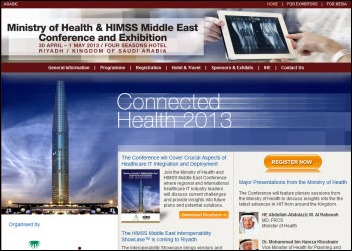
4-30-2013 8-17-49 PM

From Mr. Eko: “Re: HIMSS Middle East. Started Monday. Some American-based companies there are Cerner, GE, and Medicity. Judy Faulkner, CEO of Epic, was spotted yesterday morning eating breakfast in the Four Seasons hotel. Rumor has it they are pitching to the Ministry of Health for Saudi Arabia.”

From Giles: “Re: healthcare IT decision making. Interesting reader comments. What’s your opinion?” I agree with some of the comments that healthcare organizations are quicker to promote and retain executives who wouldn’t qualify for comparable jobs in most other industries based on their education and experience. However, healthcare is a different world, trying to balance the demands of an increasingly interventionist government, regulators, special interests, politicians, clinicians, community leaders, and giant insurance companies with the patients and families who are hardly typical customers. I’ve seen cases where hotshot IT people from allegedly more progressive sectors were brought in with near disastrous results, even though the IT shop looked like a showcase on paper. Some healthcare CIOs are not very good at strategic planning, management, and customer engagement, but they have a small domain with minimal clout and high operating and capital expenses due to decisions almost always made by someone else with more influence. Healthcare CIOs also aren’t given a lot of unilateral decision-making over anything other than infrastructure – everybody likes to suggest and approve massive change management projects that get incorrectly tagged as IT initiatives, but those folks disappear when their own lack of leadership ability starts sending the project down the drain due to poor user acceptance, lack of resources, and poor project decisions. My opinion, therefore, is that healthcare IT leaders aren’t empowered to make a lot of decisions on their own, are struggling to deal with the mess foisted upon them by their fellow executives and third parties, and are trying to deal with the squeeze of ever-increasing demand with an ever-decreasing budget. I’m fairly certain that swapping them out with fat-resume private sector CIOs wouldn’t make much difference on the plus side of the ledger, but would cause all kinds of unintended consequences to patient care. It’s easy to shoot the messenger, and with regard to many high-profile projects, that’s all the CIO is allowed to be. If nothing else, consider the high degree of CIO turnover – if all it took was new people in the chair, you’d be seeing wide swings in success from that alone and that’s not the case.


HIStalk Announcements and Requests

Nick van Terheyden, MBBS, CMIO of Nuance, posted the cool photo above on Twitter. If you’re traveling anywhere interesting, send a fun local photo with something that identifies HIStalk and I’ll run it here.

4-30-2013 8-00-00 PM

Welcome to new HIStalk Gold Sponsor Porter Research, A Billian Company. The company provides its clients with customized market intelligence and research insight that includes go-to-market strategy, focus groups, win-loss analysis, prospect profiling and lead generation, competitive analysis, customer and market analysis, and M&A research. Don Graham (GM of both Porter Research and Billian’s HealthDATA) and Cynthia Porter (president) have many years of industry experience with major healthcare IT firms. The company offers a brochure, case studies, a newsletter, and white papers that illustrate its expertise. Thanks to Porter Research for supporting HIStalk.


Acquisitions, Funding, Business, and Stock

4-30-2013 7-39-52 PM

Emdeon completes re-pricing of its existing senior secured credit facilities, securing lower interest rates on its term and revolving loans.

4-30-2013 7-38-31 PM

Nuance reports Q2 results: revenue up 15.9 percent, EPS $0.34 vs. $0.43, missing estimates on both and sending shares down 18 percent and increasing speculation that activist investor Carl Icahn will use his recently acquired 10.7 percent of the company’s shares to force a breakup.

4-30-2013 7-47-17 PM

USARAD.com launches SecondOpinions.com, which offers same-day medical second opinions. Radiology-related reports range from $29 for an X-ray to $99 for an MRI. The company also offers second opinions for primary care, surgery, dermatology, and other services.
4-30-2013 9-10-16 PM

Forms automation vendor FormFast opens a UK-based subsidiary.


Sales

Trinity Health (MI) signs a multi-year agreement with Explorys for data analytics solutions.

Saint Mary’s Regional Medical Center (NV), Renown Health (NV), and Chandler Regional Medical Center (AZ) select MRO Corp.’s ROI Online platform to manage release of information.

West Florida ACO will deploy Sandlot Connect, Dimensions, and Metrix from Sandlot Solutions for patient health information management.

Methodist Health System (NE) selects Wolters Kluwer ProVation Medical software for its gastroenterology procedure documentation and coding.

Amerinet contracts with Cornerstone Advisors Group to provide HIT advisory and implementation services to its group purchasing members.

Tri-State Orthopaedics (IN) selects SRS EHR for its 24 providers.
4-30-2013 10-35-53 PM

Saudi Arabia’s King Fahd University Hospital will implement Nuance Healthcare Dragon Medical 360 | Network Edition hospital-wide.

The Cleveland Clinic’s MyPractice Healthcare Solutions will provide project management and implementation assistance to Glens Falls Hospital (NY) as it deploys Epic at its physician and specialty practices.


People
4-30-2013 12-25-15 PM

MedMatica Consulting Associates appoints Jerry Howell (KPMG) CEO and a member of the company’s board of directors.

4-30-2013 12-33-30 PM

Thomas H. Lee, MD (Partners HealthCare) joins Press Ganey as chief medical officer.
4-30-2013 12-54-50 PM

CSI Healthcare IT hires Martin O’Neil (Charts In Time) as health information management practice director.

4-30-2013 1-23-24 PM

Meditab Software appoints Adele Nasr (WebMetro) VP of marketing.
4-30-2013 7-55-42 PM

A. John Blair III, MD, CEO of EMR consulting firm MedAllies, is elected chair of independent Direct community DirectTrust.org.

4-30-2013 8-19-02 PM

Christopher Mansueti, former VP of client services for RelWare, died Friday, April 26 of amyotrophic lateral sclerosis. He was 53.


Announcements and Implementations

VHA, Inc. adds physician dashboards to enhance its VHA IMPERATIV Advantage performance improvement solution, which leverages transactional-level data through Truven Health Analytics and UHC.

MDI Achieve, provider of the MatrixCare EHR for long-term acute care, will integrate with Homecare Homebase, a provider of homecare and hospice technology solutions.

Heywood Hospital (MA) streamlines clinician workflow following its implementation of Accent On Integration’s Accelero Connect integration platform.
4-30-2013 3-38-00 PM

Samaritan Albany General Hospital (OR) moves from Meditech to Epic this week.

Transylvania Regional Hospital (NC) goes live on Cerner.

Children’s Hospitals and Clinics of Minnesota implements wireless data transmission between Cerner’s EMR and CareFusion’s infusion pumps.

PeriGen recognizes its client Banner Health (AZ) for reducing unnecessary early-term deliveries by 22 percent, earning the health system a Showcase in Excellence Award from the Arizona Quality Alliance.

Florida Hospital Tampa implements the EarlySense bedside patient monitoring system.

A Modern Healthcare article covers the State of West Virginia’s VistA implementation. It’s paying Medsphere $8.4 million per year for support and an unspecified amount to InterSystems for Cache’ licenses. The state also added financial systems from NTT DATA to replace VistA’s minimal capabilities. Update: Modern Healthcare issued a correction to this article – Medsphere has been paid $8.4 million over the life of the contract (since 2005), around $940,000 per year.

4-30-2013 9-37-04 PM

The Pittsburgh paper profiles Omnyx, a five-year-old digital pathology systems vendor formed as a joint venture between UPMC and GE Healthcare.


Government and Politics

Arizona lawmakers pass legislation that will require health insurers to pay for telemedicine treatment for certain specific conditions for patients living in 13 rural counties.

Rep. Ted Poe (R-TX) introduces a bill that would prohibit HHS from mandating providers to switch to ICD-10 code sets, which Poe contends would cost about $80,000 for individual doctors and $250,000 for practices with five to 10 physicians.
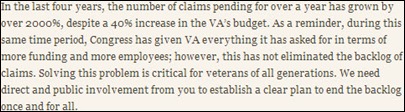
4-30-2013 3-33-08 PM

A bipartisan group of 67 senators sends President Obama a letter calling for him to be more directly involved in the VA’s disability claims backlog situation. The senators note that the average wait time for first-time disability claims is around 316 days, with a delay of up to 681 days in certain parts of the country. Of 900,000 pending claims, more than 600,000 are over 125 days old.


Innovation and Research

4-29-2013 2-10-36 PM

A peer-reviewed article published by the CDC finds that the interface technology of Intelligent Medical Objects is superior to population classification techniques as a disease surveillance tool. The findings are based on a study that showed IMO terminology service was 32 to 42 percent more accurate in identifying coronary heart disease compared to algorithms using reimbursement coding and classification techniques in identifying coronary heart disease.


Technology

AirStrip Technologies settles its patent dispute with MVisum, Inc., a competitor it accused of infringing on its patent for real-time viewing of patient data on mobile devices. MVisum agreed not to offer infringing products that include “streaming or displaying real time or near real-time patient physiological data.”

NextGen Healthcare launches Comparison Utility, a proprietary ICD-9/ICD-10 comparison tool that is available a no charge to its customers.
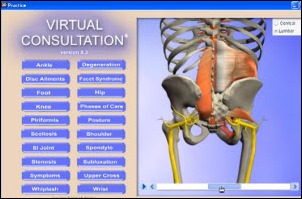
4-30-2013 9-04-40 PM

Healthcare Holdings Group acquires the exclusive rights to 3D-Practice’s patient education graphics technology, which it will embed in its ChartZoneMD EHR.


Other

Athenahealth and MIT’s H@cking Medicine host a May 4-5 Hack-a-Thon aimed at at bringing about disruptive and meaningful solutions to healthcare challenges.
4-30-2013 7-24-51 PM

Anthony Weiner, the former Congressman who resigned after admitting to sending sexually suggestive text messages and photos to several women, is making big money as a corporate consultant. One of his clients is EMR vendor CureMD.
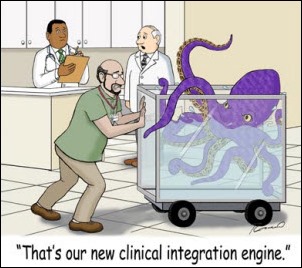
4-30-2013 8-15-35 PM

Here’s Imprivata’s latest HIT cartoon.


Sponsor Updates

  • DrFirst publishes a white paper highlighting the 428 percent growth in e-prescribing for controlled substances.
  • Medseek holds the inaugural meeting of its Clinical Advisory Council , formed to enhance patient engagement.
  • MedAptus highlights three customers and their seamless integrations between the MedAptus charge capture solution and their EHRs.
  • GetWellNetwork recognizes 12 hospitals and individuals for improving clinical care and outcomes through the use of IPC technology.
  • Inland Northwest Health Services releases its 2012 Community Report.
  • Martin’s Point Health Care (ME) discusses how its use of PopulationManager by ForwardHealth Group has improved its ability to respond to patient needs, identify gaps in care, and make systemic changes based on performance.
  • Imprivata hosts May 9 Webinar introducing the benefits of OneSign for healthcare.
  • Nuesoft hosts a May 8 Webinar on  using technology to improve revenue cycle.

Contacts

Mr. H, Inga, Dr. Jayne, Dr. Gregg, Lt. Dan, Dr. Travis.

More news: HIStalk Practice, HIStalk Connect.

125x125_2nd_Circle

Readers Write: Achieving Value, A Different Kind of Medical Miracle

April 29, 2013 Readers Write 1 Comment

Achieving Value, A Different Kind of Medical Miracle
By David Bond

4-29-2013 8-37-19 PM

Practice management system (PMS) vendors have long sought to provide their physician customers with more capabilities than just traditional practice management and EHR capabilities. Specifically, providing outsourced patient statements and RCM services are some of the most important opportunities that have been identified to bring greater value to their customers and increased revenue to their firm.

However what I’ve seen is quite frankly an assortment of “half-measure” solutions that don’t efficiently utilize today’s interconnected world: portals that aren’t truly integrated, systems that don’t enhance a practices workflow or focus on usability for both the practice and patient alike. More importantly, that seek to find a solution that yields untapped profit opportunities for those PMS vendors that are able to satisfy these requirements.

In fact, many PMS vendors are mired in paper-based billing methods or a clunky billing portal instead of looking to implement an integrated solution that truly drives value for both the practice and the patient. I also find it interesting that most of these current billing mechanisms do little to significantly boost the profit margins of the PMS vendors offering these services in addition to their core offerings.

My aim is not to criticize these companies, as many have been very successful and offer fantastic products that are of use to their customers, but instead offer insight into new opportunities they can adopt to increase their efficiency and profitability. While the PMS providers might feel their current outsourced paper billing solutions put them in a more favorable light with their physicians, they do little to put more profits in their own pockets, streamline the billing process, help practices with their workflow, create clarity for patients, speed time to payment, or reduce errors on the back end.

Instead of going with a traditional solution that only marginally helps PMS vendors, how about something that can be easily integrated with most solutions and be welcomed with open arms by medical practices and patients alike?

Online billing, patient balance management, and reconciliation services that can be easily integrated with most PMS vendor offerings is in fact a reality today. It drastically reduces the need for paper bills and the cost and delays they create and makes obsolete billing portals that are not truly integrated. Presenting patient statements that are easily understood and allocate the remittance precisely to the services that were received creates clarity for everyone and is highly profitable for any PMS vendor looking to bolster their bottom line through a recurring revenue stream.

Want proof? A major PMS vendor ran the numbers and realized an additional $3 million in pure profit by integrating this capability with its core practice management offering used by 3,500 medical practices. I don’t care who you are, this is real money.

If you’re a PMS vendor and want to achieve real value, both in profitability and long-term customer retention, providing a simple and integrated online bill pay solution will get you there.

David Bond is EVP of PatientPay of Durham, NC.

Curbside Consult with Dr. Jayne 4/29/13

April 29, 2013 Dr. Jayne 2 Comments

clip_image002

Mr. H posted a question in the Monday Morning Update about the decision-making habits of healthcare IT leadership. It brought in a fair amount of reader comments and I thought I’d contribute my two cents.

First, to the original question/comment:

Healthcare IT leadership seems unable or unwilling to take meaningful actions that would benefit their organizations … In a corporate world, leaders who don’t act on revenue opportunities or cost savings don’t last long. Is it asking too much for healthcare IT to make responsible decisions to avoid wasting money?”

Many of the so-called leaders I work with suffer from analysis paralysis. It’s not just IT leaders – it could be finance, revenue cycle, practice operations, or just about anyone. They spend so much time thinking through various options that they ultimately miss the opportunity to make a decision that would make a difference. There’s no understanding of the concept of opportunity cost.

I tend to see this more in so-called non-profit health systems where the business just isn’t run like a business at all. Sometimes I think altruism or the thought that everyone is “trying to do their best” becomes a smoke screen for failure to lead.

It’s not just analysis paralysis, but there are quite a few healthcare leaders I’ve worked with who are simply ineffective. I’ve worked for and with people who range from passive-aggressive to missing in action. One group I worked with in a consulting relationship had an EHR project head who was missing in action. His favorite pastimes included casino gambling and hanging out at the local coffee klatch with a group of wealthy retirees. He’d come to steering committee meetings completely unprepared and expected his subordinates to bail him out. His direct reports were rewarded by having their one-on-one meetings canceled and receiving performance evaluations that were written by other division directors because he was unable to meaningfully assess their performance.

Inept leadership isn’t the only thing that contributes to poor decision making. Awkwardly constructed team structures can be a factor as well, where different verticals end up unknowingly (or intentionally) confounding the needs of other teams. Teams where leadership obviously doesn’t like each other or share any kind of mutual respect can lead to bickering and efforts to block others just do be difficult. When teams don’t get along, it’s up to the next level of leadership to demand cooperation and congeniality or let people go.

Although I agree that the level of involvement (read: interference) of government in medicine makes it difficult to say ahead of the curve, that often sounds more like an excuse than a reason. I’ve seen more than enough healthcare organizations that have no concept of the true cost of the care they’re delivering, and instead of focusing on the bottom line, spend their time whining about payers. Physicians underestimate the value of their time and shift resources the wrong way, taking on additional work rather than “burdening” their staff members. I see too many administrators who are penny-wise but pound-foolish, trying to do complex projects in-house due to perceived cost savings when a team of experienced consultants could have delivered higher quality product with fewer errors, delays, and cost overruns.

Another major problem that leads to ineffective (or no) decision making is failure to understand the value of active change management within an organization. Sometimes unpopular decisions need to be made, but rather than using a formal change management program to smooth the transition, leadership elects to make no decision at all. Guess what, folks? This isn’t high school. You’re not here to be liked — you’re here to do a job and improve patient care. It’s not a popularity contest.

I also see a fair number of “leaders” who don’t understand their core business or its needs. My favorite corporate “stupid human trick” is the lateral outplacement move, where you take someone who is ineffective in your vertical and move them to another vertical in the organization where they may know even less about the business line. Just because someone knows the inpatient setting doesn’t mean they know beans about ambulatory care, and vice versa.

In the same vein, I also see too many people that place stock in certifications and degrees over experience. I’ll take an experienced CMIO who has had to work with the DBAs to resurrect an enterprise app in the middle of the night, whether they have fellowship papers or not. In my neck of the woods MBAs are a dime a dozen and I continue to watch hospital administrators hire people with no healthcare experience at all, then feign surprise when failure occurs.

Is it really that much worse than other industries, though? I’m not sure. Having worked in healthcare most of my career (unless you count a string of fascinating summer jobs), I don’t have a lot to reference against. My friends in non-healthcare IT seem to have managers and decision trees that are as crazy as those I deal with every day. Sometimes running away to become a rodeo clown looks pretty good – until I remember that’s what I already do every day.

Print

E-mail Dr. Jayne.

Advisory Panel: Surprise Projects for 2013

April 29, 2013 Advisory Panel Comments Off on Advisory Panel: Surprise Projects for 2013

The HIStalk Advisory Panel is a group of hospital CIOs, hospital CMIOs, practicing physicians, and a few vendor executives who have volunteered to provide their thoughts on topical industry issues. I’ll seek their input every month or so on an important news developments and also ask the non-vendor members about their recent experience with vendors. E-mail me to suggest an issue for their consideration.

If you work for a hospital or practice, you are welcome to join the panel. I am grateful to the HIStalk Advisory Panel members for their help in making HIStalk better.

This question this time:  What "surprise" IT or informatics projects have come up recently that you didn’t expect to have to deal with in 2013?


We’re about four months away from a pretty big EHR rip-and-replace go-live. The surprise for me has been the steady drumbeat of “business as usual” requests: a new POC lab system, new offices, clinics and moves, interfaces to the legacy system that will be replaced 30 days after go-live, etc. I guess I shouldn’t be surprised — just a little freaked out.


When we began the fiscal year in October, we had not planned on applying for a CMS Shared Savings ACO. The learning curve was steep on this, and now that we were awarded one in January, we are being cautious to make the right decision on an IT platform to support the ACO.


Not sure that it’s a surprise, but the increased focus on meeting regulatory demands have shifted the focus of IS. Even though the organization focuses well on our EHR and Meaningful Use progress, it is difficult to find the funds to refresh our infrastructure and deliver the smaller application needs of the organization (food management and employee health are recent examples that come to mind). Our average age of infrastructure continues to creep upwards while our MU efforts monopolize most of the IS capital. On top of that, there is renewed focus on patient access and experience that have impact to the IS "pot o’ gold" (and for my organization it’s not really much of a pot to begin with – maybe a cup is more accurate). I have had to redirect money away from the non-regulatory projects and leave organizational needs unmet. Old equipment and unhappy customers create uncomfortable CIOs. Not a complaint really, just a reality of the job. These demands on capital make it more critical for IS to be able to tell the story on how we are
going to decrease costs, increase revenues, avoid penalties, etc.


The surprise projects are currently getting planned for 2014 in our organization. Many of them are focused on Meaningful Use – both for 2014 Stage 1 and Stage 2. From our organization’s perspective, it will probably late 2014 or 2015 before we can focus on any significant IT project that isn’t driven by a regulation or a dependency for a project that is.


Multiple instances in my organization where a doctor or department had spent time and money to build out an application for their use and want to now commercialize it. Who knew there would be so much entrepreneurial spirit going on under our hood? Begs the question – should we better create an atmosphere and infrastructure to support these projects, and what is the best way to support them moving forward (e.g. do we help to spin them off into new companies to help create a way to sustain them?) And of course we
have to work through the IP issues as well.


A couple of large HR system and outpatient business analytics projects competing for resources with ICD-10 and Meaningful Use Stage 2 prep projects.


Replace our software for calculating month end reserves. Replacing software for electronic claims submission.


I’m not sure I would call these a complete surprise, but what has surprised me is the volume of good, value-added ideas that are coming up related to using our EMR to further improve quality, safety, efficiency. Multiple IT-enabled optimizations using our EMR and analytic tools to help further reduce readmissions, provide an early warning on septic patients, reduce catheter -associated urinary track infections, and the like. In addition to ensuring readiness for Stage 2 Meaningful Use, we are spending much effort and energy on optimizing our EMR.


No real surprise projects. What is creating unrest is BI, ACO support, and keeping up after we cut our staff by 20 percent.


Interestingly, most surprises here are due to our operational need to jettison existing partners, in my case, in rad onc and imaging. This was primarily due to the relationships going south fairly quickly. Standing up linear accelerators et al, as well as a new PACS, was definitely not even on the radar. Both are significant projects.


HIMSS Healthcare Transformation Project.


Major modifications to our revenue cycle system and the interfaces to our insurance companies, based upon changes to reimbursement policies, particularly capitated payments. Still reeling.


We have a solid strategic plan that’s updated each year. We also have an engaged IT Governance group. I can’t think of any surprises, but we are only halfway through the fiscal year. My mindset is that IS should expect them and not overreact. This is where you can see what your team is made of. Also, surprises provide teaching and growth opportunities.


We have to go through three major code upgrades before February 2014, rather than just two. And we have to implement our EHR vendor’s HIM module upgrade, to our surprise, because none of the vendor’s new functionality works with our current HIM module. That turns out to be a major project, and a prerequisite that has set several other projects (such as physician documentation) back by nearly a year. Lastly, our pharmacy had been trying to "skate by" the MU Stage 2 regs by only implementing bar-coding for IV meds, but we realized after some calculations and CMS FAQs that still wouldn’t hit our required 10 percent. We’re going to have to do a full medication barcode implementation under very tight time frames.


Most surprises have been in the realm of infrastructure upgrades (additional storage and additional wireless capability). Under the heading of wireless capability, the organization chose many years ago to implement a guest wireless network. Our administration wanted to bring their own devices — they balked at having to give permission to sign on to the guest network even with something as simple as an acknowledgement. Because of this, our guest network is regularly exceeding its connection limit. We are working to create a third network for employees and their devices.


New hospital process reengineering projects that will have IT implications.


There is possibility of squeezing in (at least the beginnings of) more inpatient EHR implementations during the latter part of the year than anticipated as we get ever closer to Stage 2 requirements kicking in.


Not a total surprise, but our physicians and our key ambulatory vendor are very rapidly moving toward multiple mobile solutions as well as patient centric solutions. More quickly than we had anticipated, we are learning to support the iPad EMR version, iPhone  apps, and patient portal.  The vendor is providing new cloud computing solutions and we’re learning how to implement and support these very rapidly.


Text Ads


RECENT COMMENTS

  1. Re: Deliberately Faked Academic Papers in Nature See, this doesn't surprise me at all. Of course AI quotes these bogus…

  2. Challenger exploded on lift-off when the O-rings failed. Columbia disintegrated on reentry after one of the heat shield tiles were…

Founding Sponsors


Platinum Sponsors


Gold Sponsors


RSS Webinars

  • An error has occurred, which probably means the feed is down. Try again later.