Recent Articles:

Morning Headlines 1/12/26

January 11, 2026 Headlines No Comments

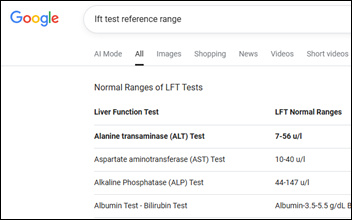
‘Dangerous and alarming’: Google removes some of its AI summaries after users’ health put at risk

Google removes some of its health-related AI Overviews from search results after reports that they were providing inaccurate information.

Canopy Secures $22M Series B to Define the Standard for Connected Safety and Location Intelligence

Healthcare staff protection system vendor Canopy raises $22 million in Series B funding.

New Year, New You: Walmart Launches Better Care Services and Rolls Back Prices on 1,000+ Wellness Essentials

Walmart launches a digital healthcare hub that offers users access to telehealth providers, LilyDirect for weight loss medication, and Walmart Pharmacy for prescription delivery and pick-up.

Anthropic joins OpenAI’s push into health care with new Claude tools

Anthropic debuts Claude for Healthcare, giving users the ability to connect their medical and insurance records, and wearables and app data to the AI app for personalized insights.

Monday Morning Update 1/12/26

January 11, 2026 News No Comments

Top News

image

Google removes some of its health-related AI Overviews from search results after reports that they were providing inaccurate information.


HIStalk Announcements and Requests

image

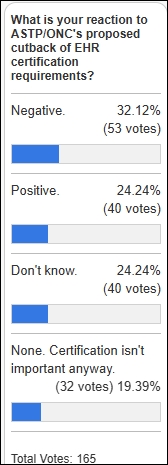
Asked about streamlining EHR certification requirements, poll respondents have achieved the perfect balance of confusion, optimism, pessimism, and indifference.

New poll to your right or here, inspired by Brian Too’s comment last week:  What factors drive health system investment in health tech firms? Multiple answers are OK. It would be fascinating to compare expectations to reality, but of course we hear a lot about the former and little about the latter. If you’ve been involved in a health system’s commercial dabbling, what are your conclusions?


Sponsored Events and Resources

None scheduled soon. Contact Lorre to have your resource listed.


Acquisitions, Funding, Business, and Stock

Healthcare staff protection system vendor Canopy raises $22 million in Series B funding. The company sued Commure in May 2025 for using its insider knowledge as a Canopy reseller to develop a competing product. The lawsuit was settled in July 2025, when Canopy took over customer management of Commure’s Strongline Pro panic button system.


People

image

Aidoc hires former AMA President Jesse Ehrenfeld, MD, MPH as chief medical officer.


Announcements and Implementations

Health systems that have signed up for ChatGPT for Healthcare include AdventHealth, Baylor Scott & White, Boston Children’s, Cedars-Sinai, HCA Healthcare, Memorial Sloan Kettering, Stanford, and UCSF.


Other

A Georgia jury awards $52 million to the family of a woman who died following a Brazilian butt lift. The cosmetic surgery clinic ran out of anesthesia during the procedure, and staff who attempted to revive her found that they also had no oxygen. The clinic, which did not carry insurance and is unlikely to pay much of the damages, was immediately dissolved by its owner. His previous business in the same building was called Butts Gone Wild.


Sponsor Updates

image

  • Five9 partners with the Marine Toys for Tots Foundation.
  • Fraser Health saves seven minutes per patient in discharge with Meditech’s AI-powered Hospital Course Summary in its Expanse EHR.
  • Findhelp opens registration for its virtual Connect Summit, which will take place May 13-14.
  • Nordic releases a new “Designing for Health” podcast featuring Aditi U Joshi, MD.
  • Nym names Shachar Borovitz and Ido Shitrit medical data analysts, Oren Shalom and Inbal Tako software engineers, Sapir Shekhtman R&D medical project manager, and Inbal Rudin linguist.
  • CHIME’s “Leader2Leader” podcast features Optimum Healthcare IT Chief Strategy Officer Rick Shepardson in an episode titled “Empowering Transformation: Leading with Strategy, Purpose, and Partnership in Digital Health.”
  • PerfectServe offers a new case study titled “Improving Clinical Efficiency with Optimized Care Schedules and Integrated Care Team Communication.”
  • Praia Health publishes a new case study titled “LabCorp and Praia Health partner to improve patient adherence, satisfaction, and outcomes at Providence.”
  • Rhapsody expands its AWS Marketplace presence to power AI-ready healthcare data exchange.
  • TrustCommerce, a Sphere company, will exhibit at the HFMA Western Region Symposium January 18-21 in Las Vegas.
  • TruBridge and The Health Management Academy launch the Rural Health Collaborative.
  • VitalChat names Alan Young, MD, MBA general manager.
  • Waystar will present at the JP Morgan Healthcare Conference January 12 in San Francisco.

Blog Posts


Contacts

Mr. H, Lorre, Jenn, Dr. Jayne.
Get HIStalk updates.
Send news or rumors.
Follow on X, Bluesky, and LinkedIn.
Sponsorship information.
Contact us.

Morning Headlines 1/9/26

January 8, 2026 Headlines No Comments

IntelyCare Acquires CareRev to Create Comprehensive Workforce Staffing Platform for Health Systems

Healthcare staffing platform vendor IntelyCare acquires CareRev, which offers a hospital shift-bidding platform.

C3 HealthcareRx and Wellbox Health Merge to Form a Comprehensive Value-Based Care Organization

C3 HealthcareRx, a virtual behavioral health and medication management company, acquires chronic care management vendor Wellbox Health.

Pomelo Care Raises $92 Million Series C, Reaches $1.7 Billion Valuation, to Expand Its Proven Model Beyond Maternity & Set a New National Standard for Women’s and Children’s Healthcare

Virtual maternity care provider Pomelo Care announces $92 million in Series C funding, bringing its total raised to $171 million.

News 1/9/26

January 8, 2026 News No Comments

Top News

image 

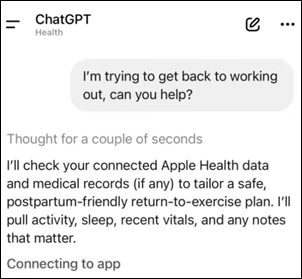
OpenAI announces ChatGPT Health, which supports health conversations with encryption, isolation from model training, and connectivity to wellness and medical records applications such as Apple Health and MyFitnessPal. Access is via waitlist.

B.well is providing the health data network connectivity with its SDK for Health AI.


Reader Comments

From Vendorize: “Re: product names. You should be including our copyright and trademark symbols.” Wrong. US law does not require anyone, even the owning company, to use those symbols to create or maintain rights. I don’t trust third-party sites or LinkedIn posts that include the symbols, which runs contrary to AP Stylebook standards, just because the company itself voluntarily chose to do so. It’s also improper and possibly illegal for someone to use a trademark symbol for a name they don’t own no matter how fawning their intentions.


Sponsored Events and Resources

None scheduled soon. Contact Lorre to have your resource listed.


Acquisitions, Funding, Business, and Stock

image

Healthcare staffing platform vendor IntelyCare acquires CareRev, which offers a hospital shift-bidding platform. CareRev made headlines in 2023 when it reportedly laid off 100 employees following the resignation of its founder and CEO William Patterson, who departed after telling a colleague that he had delivered the company’s $50 million Series A pitch (“Uber for nurses”) while taking LSD.  

Oasys Health, which offers therapist workflow automation with wearables integration, raises $4.6 million in seed and pre-seed funding.

A Bain & Company report finds that global healthcare private equity investment hit a record $190 billion in deal value in 2025, driven by an increase in large transactions and strong activity across sectors like biopharma and healthcare IT, with buyout counts and exit values also approaching historic highs.

image

Sources report that private equity firm TPG is reportedly close to acquiring UnitedHealth’s Optum UK business, which supplies electronic patient record systems to most of Britain’s GPs, for $1.5 billion. Analysts speculate that TPG could combine Optum UK with its portfolio company Nextech, a US-based specialty EHR/PM vendor.


Sales

  • Lifepoint Health chooses ambient documentation from IScribeHealth.

People

image

Lyric names Halsey Wise, MBA (Lime Barrel Advisors) as CEO.

image

Imprivata promotes Tom Shapiro to VP of cybersecurity sales.  


Announcements and Implementations

Dentists who have access to a patient’s shared comprehensive health record in Epic avoided 260,000 potential drug interactions in 2025, the company reports.

image

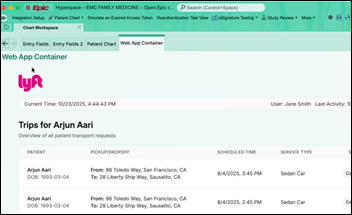
VectorCare launches Lyft Smart on FHIR App, which allows care teams to schedule and manage patient rides within EHRs, starting with Epic.


Government and Politics

The FDA will step back from regulating low-risk wellness technologies, including fitness apps and activity trackers. Products that only share information won’t need clearance as long as companies avoid making medical claims.


Sponsor Updates

image

  • CereCore team members volunteer at the Salvation Army Angel Tree event.
  • Black Book Research recaps 2025 research announcements and customer-related honors.
  • Ellkay offers a new customer success story featuring West Feliciana Hospital titled “Empowering Rural Healthcare: From Integration to Enterprise Data Management.”
  • Health Data Movers names Carl Ferguson (Healthcare IT Leaders) director of client partnerships.
  • Healthmonix’s Emergency and Acute Care Clinical registry earns CMS QCDR approval for 2026.
  • Infinx will exhibit at the HFMA Western Symposium January 18-21 in Las Vegas.
  • Judi Health names Sara Bunn (Boston Consulting Group) chief human resources officer.
  • Clearsense appoints Terry Shaw, former president and CEO of AdventHealth, as its board chair.

Blog Posts


Contacts

Mr. H, Lorre, Jenn, Dr. Jayne.
Get HIStalk updates.
Send news or rumors.
Follow on X, Bluesky, and LinkedIn.
Sponsorship information.
Contact us.

EPtalk by Dr. Jayne 1/8/26

January 8, 2026 Dr. Jayne 1 Comment

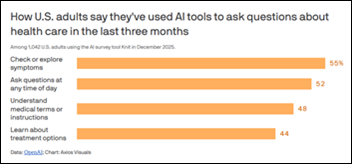
Mr. H’s mention of a recent article caught my attention. It says that 40 million people are using ChatGPT for health-related questions every day.

I agree with the article’s statement that people are “turning to AI tools to navigate the notoriously complex and opaque US healthcare system.” They mention patients using it to decipher billing statements, appeal insurance denials, and answer clinical questions “when access to doctors is limited.”

Another statistic that caught my attention: more than 5% of ChatGPT questions are about healthcare, and 1.6 million questions per week are asked about health insurance.

Clinicians certainly can’t fault patients for using AI tools when they are doing the same. I see physicians every day using AI to write insurance appeals and create patient-facing communications, not to mention all the AI-powered documentation. The risk of hallucinations remains a major concern. Some care delivery organizations have applied their “we can’t control it so we’ll just ignore it” philosophy. 

I would instead encourage organizations to make better use of their existing tools in providing accurate and vetted information to patients. Those institutions that offer robust patient education and engagement solutions should feature that information prominently on their websites and within their patient portals. Patients would be able to self-serve with reputable information.

Clinicians need to look at patient education less as a check-the-box exercise and more as a key part of patient care. In my experience, educated patients who have access to resources that they can consult down the road are less likely to send patient portal messages or call the office with basic questions. They feel more confident about their care and their ability to manage at home.

Another juicy tidbit from the report: 70% of health-related ChatGPT queries occur outside of normal medical office hours. Most medical offices are open for about eight hours per day, usually overlapping the same work hours as people who also work traditional schedules. It’s difficult for many patients and caregivers to get the information they need during the hours that they are available. Patient portals and secure messaging have helped this issue somewhat, but gaps still exist.

In addition to making sure that patients know how to access trustworthy patient education materials, care delivery organizations should do a better job promoting other patient-facing resources, such as after-hours nurse triage lines or on-call services. Organizations that are actively managing risk do a better job with this, because they are incentivized to keep patients from going to the emergency department.

It would be interesting to compare after-hours use of generative AI solutions by patients who have access to after-hours services and those who don’t. Anyone up for some research?

From Midwest Gal: “Re: portal messages. You mentioned waiting for test results, received a patient portal notification that you had a message from the physician, and it turned out it was a general message about holiday hours. The same thing happened to me right before the Christmas holiday. Instead of getting my mammogram results, it was a reminder that the office would be closed.” I reached out to some folks who are experts in the EHR that the reader’s site uses. They said that using the patient portal in this manner is not a best practice. For the love of all things, if you’re on a patient portal team, please work with the operations teams that are sending these messages to help them understand the anxiety that they are causing.

Speaking of anxiety, the clinical trial in which I am a participant published some of its results recently. However, it didn’t bother to notify patients that this would be happening. Those of us that are clinicians saw it in the journals first, which was bad enough. To make things worse, the research team released new recommendations to patients several days later, some of which provided guidance that is counter to the standard of care. That was accompanied by no explanation.

This occurred the week of December 18, when many people are frazzled by year-end work responsibilities or holiday preparations. I can’t imagine a worse time to release that kind of information.

I reached out to the study coordinator with my questions. I didn’t receive a reply within the published service level, so I reached out again via a different method. Guess what? They were experiencing a high volume of calls and were short staffed due to the holidays. The local physician who had referred me to the study wasn’t aware of either the published article or the communication to patients. You really cannot make this stuff up.

From Burned Out CMIO: “Re: help desk. My large health system outsourced its help desk functions at the beginning of December with the assurance that we would see no degradation in service levels. I had complaints from my ED physicians, who said that their tickets had been closed due to lack of customer response. Help desk staff were emailing the physicians about their tickets, then closing them as unresponsive if they didn’t hear back within a few hours. We’ve been having some serious conversations with the vendor about how that’s not how it’s supposed to work, especially for shift-based physicians who might not be able to respond quickly and then might not be working the next day. Ambulatory physicians ran into issues during Christmas week when offices were closed some days, then came back on Monday to find their tickets closed due to ‘no response from customer.’ Everything blew up over the New Year’s holiday, when tickets were closed in bulk on the 31st to meet meet end-of-year service level metrics. I feel awful because people who I had worked with for years were laid off in favor of the allegedly cheaper outsource firm.”

In situations like this, you can’t put a price on the knowledge of former help desk staffers who understood user and office work schedules around the holidays. I wonder if this outsource firm has any healthcare experience. This falls into the category of “you get what you paid for.”

I hope that a robust review of service level expectations happens again and that ticket closure goals are moved out a bit to accommodate the behaviors of real users in the healthcare setting. I can just imagine people trying to slam tickets shut to meet the metrics, not realizing that users have valid reasons for not responding quickly.

What’s the most foolish outsource maneuver your organization has made? Leave a comment or email me.

Email Dr. Jayne.

Morning Headlines 1/8/26

January 7, 2026 Headlines No Comments

Oasys Raises $4.6M to Transform Mental Health Care into a Data-Driven Discipline, Catalyzing Better Health Outcomes

Digital mental healthcare company Oasys Health raises $4.6 million.

Introducing ChatGPT Health

OpenAI launches ChatGPT Health, giving users the ability to integrate data from their medical records and wearables for deeper insights, though the software is not intended as a diagnostic or treatment tool.

Skylight Health Acquires Stellation Care, Adding AI-Powered Provider Analytics to Its Multispecialty Orchestration Platform

Multispecialty care coordination and analytics startup Skylight Health acquires provider analytics vendor Stellation Care.

OpenAI Selects B.well to Power Secure Health Data Connectivity for AI-Driven Health Experiences in ChatGPT

OpenAI uses B.well’s interoperability software to enable users to connect their medical records to ChatGPT Health.

Healthcare AI News 1/7/26

News

OpenAI announces ChatGPT Health, which supports health conversations with encryption, isolation from model training, and connectivity to wellness and medical records applications such as Apple Health and MyFitnessPal.

image

OpenAI reports that 40 million people use ChatGPT each day for health information. Users ask it to help them decipher medical bills, spot charging errors, file insurance appeals, and in some cases diagnose conditions or manage their care. Seventy percent of those conversations take place outside normal clinic hours. The company also cites reports that nearly half of US nurses use AI weekly.

image

A Wall Street Journal analysis finds that 27% of US health systems are paying for AI tool licenses, triple the average across industries. The strongest results come from labor heavy administrative work such as note taking, triaging patient calls, and processing insurance claims. A health system found that its use of an Epic tool to manage denials reduced the labor required by 23% and increased the percentage of overturned denials. However, the report adds that Mount Sinai halted its use of Epic’s draft reply tool for patient messages after physicians said that its output required excessive rewriting and sometimes contained questionable information.

image

Utah launches a pilot to allow AI technology from Doctronic to autonomously manage prescription refills for 190 common medications. The company also markets a free chatbot that assesses systems, offers guidance, and then offers to connect users with virtual providers for a $39 virtual consultation. The goal is to reduce primary care wait times, but medical groups warn that physician oversight is needed. The FDA has not reviewed the automation process and could impose regulations on its use.

The FDA will step back from regulating low-risk wellness technologies, including fitness apps and activity trackers. Products that only share information won’t need clearance as long as companies avoid making medical claims.


Business

image

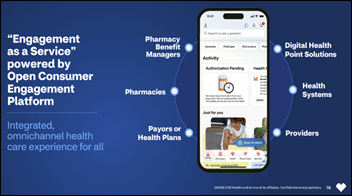
CVS Health highlights technology, including AI, as central to its strategy. It has rolled out an AI-first consumer engagement platform across CVS Pharmacy, Caremark, Aetna, and its care delivery units to support prescription, benefit, and care navigation. The company suggests it may eventually offer parts of the platform to outside customers.


Research

image

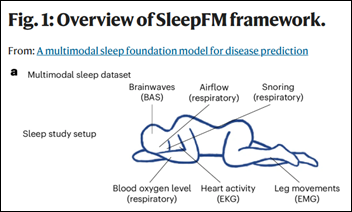
Researchers develop SleepFM, an AI tool that can predict 130 disease categories using only data from polymonography (overnight sleep studies), including dementia, heart attack, heart failure, stroke, chronic kidney disease, atrial fibrillation, and all-cause mortality. The tool’s accuracy was measured by linking each patient’s sleep record to their EHR data to find occurrence of related events such as coded diagnosis, procedure and encounter histories, mortality data, and the timestamps of clinical events.


Other

University of Colorado Anschutz profiles AIDA, a self-developed AI assistant that summarizes a patient’s Epic chart for radiologists. Aakriti Pandita, MD, assistant professor of medicine and co-developer of the tool, says, “We don’t need AI to help diagnosing patients. We need AI to help the tasks that are repetitive and redundant and administrative in nature.”

image

A mother whose teenage son died of an overdose says he used ChatGPT to get advice on dosing illicit drugs and how to achieve different highs. The company says he accessed a flawed version of the model that was known to give unsafe health responses and that he sidestepped safeguards by framing his questions as hypothetical. ChatGPT even suggested a music playlist as part of its recommendation that he drink two bottles of cough syrup.


Contacts

Mr. H, Lorre, Jenn, Dr. Jayne.
Get HIStalk updates.
Send news or rumors.
Follow on X, Bluesky, and LinkedIn.
Sponsorship information.
Contact us.

Readers Write: The Healthcare Cybersecurity Landscape For 2026

January 7, 2026 Readers Write No Comments

The Healthcare Cybersecurity Landscape For 2026
By Russell Teague

Russell Teague is chief information security officer of Fortified Health Security.

image

Healthcare is entering the new year facing the same uncomfortable truth it has confronted for more than a decade: no industry faces a higher financial or operational burden from cyber incidents. Even as technology advances and awareness grows, the cost of a healthcare data breach remains the highest of any sector, and the implications are becoming more severe for patient care, financial performance, and organizational resilience.

The latest data confirms what many leaders already feel day-to-day: cybersecurity is no longer just an IT issue or a compliance checkbox. It is a top-line financial risk, a bottom-line operational disruptor, and one of the most material threats to patient safety.

Healthcare Once Again Leads All Industries in Breach Cost

Healthcare continues its longstanding position as the most expensive industry for data breaches. In 2025, the average cost of a healthcare breach reached $7.42 million, marking the 14th consecutive year that healthcare ranked #1 among all industries. While this represents a decrease from $10.1 million in 2024, the reduction does not signify improved risk posture across the sector. Instead, the decline reflects a combination of factors:

  • Evolving incident reporting methodologies.
  • The normalization of ransomware payments.
  • Increased reliance on third-party negotiations.
  • More sophisticated data-exfiltration containment practices.

But the underlying risk drivers – legacy environments, fragmented vendor ecosystems, thinly stretched workforce capacity, and the growing attack surface from digital transformation — remain unchanged.

The $7.42 million average still places healthcare well above all other highly regulated sectors, and it reflects only direct, measurable costs. The true financial impact is often far greater once organizations consider indirect operational and reputational fallout.

Breach Frequency and Threat Pressure Are Accelerating

The cost of individual breaches is only part of the story. Frequency is rising across the sector, expanding total exposure for hospitals, health systems, and clinical organizations. In 2025, healthcare experienced one of the highest incident rates of any industry, driven by persistent ransomware campaigns, increasingly complex third-party and supply chain intrusions, targeted email compromises involving PHI, and exploit attempts against aging clinical systems and medical devices. The growing automation of attacker workflows that are powered by AI has only accelerated this trend.

Attackers view healthcare as a high-pressure, high-reward environment. The combination of operational urgency, patient safety implications, and deeply interconnected technology ecosystems makes the sector uniquely attractive. Historically, healthcare organizations have been among the fastest to pay and the most vulnerable to disruption, further incentivizing attackers.

As breach frequency rises, so does cumulative financial exposure. Even organizations that avoid large-scale incidents still absorb escalating costs tied to smaller breaches, investigative work, vendor assessments, rising insurance premiums, and heightened regulatory scrutiny.

The Operational Fallout: Downtime as a Major Financial Driver

One of the most significant, and often underreported, costs of a cyber incident is operational downtime. In 2025, hospitals experienced an average of 19 to 23 days of disruption following major cyber events, affecting everything from EHR access to imaging, lab systems, surgical schedules, and emergency department operations. These outages frequently force diversion events, delay procedures, and push frontline staff into manual workflows that dramatically slow care delivery.

The financial impact is substantial. Organizations lose millions in net patient revenue as billing cycles stall, coding backlogs grow, and clinical productivity drops. Delayed reimbursement and extended recovery periods often compound these losses. At the same time, hospitals face increased overtime expenses, temporary labor costs, and rising patient dissatisfaction, all of which further erode operating margins. For rural and independent facilities with limited redundancies or tighter financial constraints, the impact can be especially severe.

Operational downtime also creates long-tail effects that extend well beyond the initial incident. Staff burnout rises as clinical teams struggle through prolonged manual processes, turnover risk increases, and organizations become more susceptible to future attacks during recovery periods. In many cases, the cumulative operational and financial damage eclipses the cost of the breach itself.

Why the Breach Lifecycle Matters: 280 Days of Exposure

A defining characteristic of healthcare is how long breaches persist before being identified and contained. Last year, healthcare averaged a 280-day breach lifecycle, exceeding the global average of 241 days. On average, it took 207 days to identify a breach and another 73 days to contain it.

This extended lifecycle dramatically elevates financial exposure. Lengthy dwell time gives attackers ample opportunity to move laterally, access more systems, compromise clinical applications, and exfiltrate sensitive data.

Prolonged exposure usually reflects deeper, systemic challenges across health systems, such as poorly tuned tools, redundant or overlapping technologies, gaps in visibility across environments, inconsistent processes or response playbooks, staffing shortages that drive alert fatigue, and weak segmentation that enables lateral movement. Many organizations also struggle with incomplete logging or monitoring coverage, which further delays containment.

Shortening the lifecycle is one of the most effective ways to reduce breach costs, often by millions. Health systems that detect and contain incidents faster consistently demonstrate stronger program maturity, more rationalized technology stacks, and clearer operational processes aligned to rapid response.

Cyber Insurance Costs Are Rising — for Both Coverage and Claims

In 2025, cyber insurance premiums for healthcare continued to increase, driven by a combination of higher claim severity, rising incident frequency, expanding legal and regulatory exposure, and the growing complexity of medical devices, cloud services, and interconnected vendor environments. Many recent breaches tied to third-party partners have created additional uncertainty for insurers, especially when accountability is difficult to determine.

As a result, carriers are tightening underwriting standards. Organizations now face stricter requirements around MFA enforcement, patching cadence, SOC maturity, third-party oversight, log retention, and evidence of incident response readiness that includes documented plans and playbooks. Those unable to demonstrate adequate maturity are experiencing significantly higher premiums, reduced coverage limits, or, in some cases, losing eligibility for coverage altogether.

The Hidden Costs: Reputation, Trust, and Long-Term Clinical Impact

Beyond direct financial losses, breaches create a secondary wave of disruption that can last months or even years. Organizations often experience a decline in patient trust, heightened scrutiny from regulators and auditors, and increased turnover among clinical, operational, and executive staff. Many also find themselves at a disadvantage when pursuing new strategic partnerships as potential collaborators question their security posture.

These incidents can also drive up ndor-related costs as partners impose stricter security requirements, more frequent assessments, and higher fees tied to their own risk management obligations. Taken together, these indirect, long-tail impacts create significant financial and operational strain, particularly for health systems operating in competitive markets or with already limited resources.

A Clear Path Forward: Maturity as a Financial Strategy

The latest data reinforces a simple truth: the cost of healthcare breaches remains high not just because of attacker sophistication, but because of program immaturity. Organizations that invest in visibility, alignment, rationalization, and early detection reduce breach lifecycle times and significantly limit downstream financial impact.

The most cost-effective cybersecurity strategy is not more tools. It is a mature cyber program, fully rationalized for better alignment with the business goal of protecting patient safety and operational resilience. When people, process, technology, and financial investment work in concert, breach costs drop, operational stability increases, and resilience becomes a competitive advantage.

Healthcare Can No Longer Measure the Cost of Inaction in Dollars Alone

Last year’s data makes it unmistakably clear that healthcare can no longer afford to view cybersecurity as a technical problem sitting on the periphery of operations. The financial impact of breaches is severe, but the deeper cost is the strain they place on clinical delivery, patient trust, workforce capacity, and organizational resilience. Every day a breach goes undetected, every hour systems are offline, and every dollar spent recovering from preventable disruption reflects a direct threat to the mission of safe, reliable care.

The real risk facing healthcare organizations is not the next attacker. It’s the continued reliance on underdeveloped, unaligned, and unprepared cybersecurity programs. More tools will not solve this challenge, and increased spending without strategic maturity will not change outcomes. What will make a measurable difference is a cyber program that is fully rationalized, integrated, and aligned with the fundamental business goals of patient safety and operational stability.

Organizations that invest in visibility, speed, resilience, and coordinated response are already seeing the benefits: shorter breach lifecycles, fewer operational disruptions, reduced financial exposure, and stronger trust from the communities they serve. Those that delay modernization will continue to face rising costs, extended downtime, and a risk profile that becomes increasingly difficult to manage.

2026 must be the year when healthcare stops treating cybersecurity improvements as optional or incremental and starts approaching them as essential to sustaining care. Cybersecurity in healthcare is no longer just a business function or an IT priority. It is a foundational element of patient safety, and the cost of inaction has never been higher.


Morning Headlines 1/7/26

January 6, 2026 Headlines No Comments

Altaris Acquires Tegria

Healthcare-focused private equity firm Altaris acquires Tegria from Providence St. Joseph Health.

Artificial intelligence begins prescribing medications in Utah

Utah launches a pilot to allow AI technology from Doctronic to autonomously manage prescription refills for 190 common medications.

TPG in talks to buy UnitedHealth’s Optum UK unit, Sky News reports

US-based private equity firm TPG is reportedly looking to acquire UnitedHealth’s Optum UK business, which supplies EHR software to a large percentage of British physicians.

FDA announces sweeping changes to oversight of wearables, AI-enabled devices

The FDA will ease regulation of wearables and AI-enabled devices that provide non-medical-grade information.

News 1/7/26

January 6, 2026 News 3 Comments

Top News

image

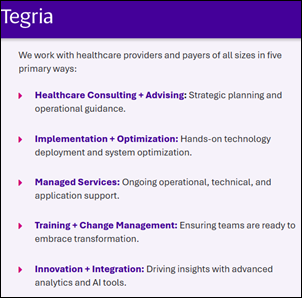
Healthcare-focused private equity firm Altaris acquires Tegria from Providence St. Joseph Health.

Tegria was formed in 2020 from Engage, Bluetree, and Navin Haffty. It then acquired Cumberland, Sisu Solutions, Cloud21. It had previously acquired KenSci, Colburn Hill Group, Lumedic, Community Technologies, and MediRevv. 

Providence spun out analytics firm Advata in June 2022 by combining KenSci, Colburn Hill Group, MultiScale, Lumedic, Quiviq, and Alphalytics. That company apparently shut down in early 2023. Providence sold Acclara to R1 RCM in early 2024 for $675 million.

Altaris acquired Sharecare in 2024. Its exited healthcare holdings include Acclara, AGS Health, Clearwater, and Precyse.


HIStalk Announcements and Requests

image

Welcome to new HIStalk Platinum Sponsor VectorCare. VectorCare is the first patient logistics platform that is built directly inside leading EHRs using SMART on FHIR. Care teams can schedule transportation, home health, and DME in under a minute, without leaving thepatient chart or relying on phone calls and portals. Our SMART on FHIR integration embeds VectorCare into Epic, Cerner, Meditech, Allscripts, Athena, and more with zero code or IT effort. Real-time updates, vendor communication, and live tracking flow directly into the EHR to streamline every transition of care. With VectorCare’s no-code workflow builder, organizations can standardize discharge and care-coordination workflows instantly. This reduces delays, improves handoffs, and helps lower preventable readmissions by up to 30%. Explore our SMART on FHIR app in the Epic Showroom or request a demo. Follow us on LinkedIn and X for updates on patient logistics innovation. Thanks to VectorCare for supporting HIStalk.

I found this YouTube demo of Vector’s SMART on FHIR app within Epic.


Sponsored Events and Resources

None scheduled soon. Contact Lorre to have your resource listed.


Sales

  • Kirby Medical Center (IL) selects Switchboard, MD’s automated healthcare communications software.

People

image

InterSystems promotes Don Woodlock to president.

image

MDAudit promotes Nisheet Goenka, MSEE to CTO.

image

The Guthrie Clinic (NY) promotes Brad Carvellas, MS to SVP and chief digital officer.

image

Asif Ali, MD (University of Houston College of Medicine) joins Kencor Health as chief medical officer.

image

Atropos Health promotes Kevin Smith to chief growth officer.

image

TeleTracking appoints Derek Ritchea, MBA (Lincoln International) as chief strategy officer.


Announcements and Implementations

image

Utah launches a pilot to allow AI technology from Doctronic to autonomously manage prescription refills for 190 common medications. The company also markets a free chatbot that assesses systems, offers guidance, and then offers to connect users with virtual providers for a $39 virtual consultation.

Healthcare data foundation operator CAQH restructures to assign ownership to 12 shareholder entities that are affiliated with national health plans.

Southwestern Medical Center and Comanche County Memorial Hospital merge to form Memorial Health System of Southwest Oklahoma. The combined system will implement Meditech Expanse this summer.

image

Connecticut’s Connie HIE implements Clinical Architecture’s PIQXL Gateway patient data quality measurement tool.


Government and Politics

The FDA issues an RFI on a proposed contracting vehicle that is aimed at making it easier for VC-backed companies to do business with the agency. FDA notes that many breakthrough health technologies come from firms that lack the resources and know-how to navigate federal procurement, and that the government’s use of prime contractors, whose incentives favor billable hours over scalable solutions, often impedes adoption.

The VA sees a 10% annual increase in telehealth use amongst veterans, 92% of whom report being satisfied with the care received.


Other

A social determinants of health-focused survey of 145 healthcare facilities in Arkansas finds that, while providers screen at a high rate, significant gaps exist in referring patients to services and providing services directly. The survey also found that SDOH-related needs most often pertain to housing, transportation, and food insecurity.


Sponsor Updates

image

  • TruBridge staff partner with United Way of Southwest Alabama to support the Africatown Hall & Food Bank in Mobile, AL.
  • Netsmart announces its commitment to the CMS Health Tech Ecosystem initiative as a CMS Aligned Network.
  • TrustCommerce, a Sphere company, announces the release of a KLAS First Look report highlighting strong early results and customer satisfaction for its Cloud Payments solution.
  • Black Book Research releases its “2026 State of Global Digital Healthcare Technology” report.
  • AdvancedMD helps mental health practice Modern Mojo reduce time spent on insurance eligibility by more than 80%.
  • Artera releases new insights on the rising cost of patient no-shows across healthcare systems.
  • Grand Lake Health System will implement Altera Digital Health’s Sunrise Axon, connecting through Health Gorilla’s TEFCA-enabled QHIN.
  • Consensus Cloud Solutions CRO and EVP Johnny Hecker wins the 2025 Gold Globee Business Award.
  • CereCore releases a new podcast titled “A Rural CNO on Healthcare Innovation That Actually Helps Nurses.”

Blog Posts


Contacts

Mr. H, Lorre, Jenn, Dr. Jayne.
Get HIStalk updates.
Send news or rumors.
Follow on X, Bluesky, and LinkedIn.
Sponsorship information.
Contact us.

Morning Headlines 1/6/26

January 5, 2026 Headlines No Comments

40 million people turn to ChatGPT for health care

OpenAI reports that 40 million people around the world ask ChatGPT health-related questions on a daily basis.

CMS no longer requiring childhood vaccination data from states

CMS will no longer require states to report childhood and adolescent immunization statuses as it works on developing new vaccine measures.

CareCloud Appoints Chief Strategy Officer to Lead Enterprise AI Platform as Company Enters 2026 as Its Defining AI Year

CareCloud promotes Stephen Snyder to CEO and A. Hadi Chaudhry to chief strategy officer.

Curbside Consult with Dr. Jayne 1/5/26

January 5, 2026 Dr. Jayne 1 Comment

image

People embrace many traditions to ring in the New Year. My extended family enjoys Hoppin’ John, but my personal ritual is to skip straight to dessert.

I started at midnight by toasting 2026 with an assortment of delightful tarts. I then kept my energy up on New Year’s Day with Fluffy Frosted Orange Rolls, a delightful alternative to cinnamon rolls. Fortunately, the sugar boost helped because I was working clinically later that day.

Nearly every patient I treated had influenza. If the “flu-pocalypse” has not made it to your area yet, chances are it is on the way. If you are at high risk for influenza complications or simply want to avoid forced downtime, I recommend masking up in crowded places.

I had the opportunity over the weekend to chat with several physician executive colleagues. Each shared ideas about what to expect in the coming year.

  • Hospitals will focus on cost control, especially those that have high numbers of Medicaid and uninsured patients. For organizations that have not outsourced functions such as food service or human resources, doing so may look more attractive. One local hospital has dramatically cut non-patient food service, making it difficult for night-shift workers to get a hot meal. Overnight options are limited to self-service, with only a couple of microwaves available in the cafeteria. Since the hospital is already outsourcing, may I suggest a third-party food truck? Staff would love it, although the food service vendor might not.
  • Hospitals will continue to scrutinize pricing for everything from software to patient care supplies to landscape maintenance. Organizations that are not already doing this need to start. One health system is trying to trim several million dollars from its technology budget and is taking steps it would normally avoid, such as asking vendors for discounts mid-contract. Its EHR teams have not attended conferences or user group meetings for the past three years due to budget constraints, and they do not expect that to change. As an interesting side note, leadership teams are also skipping these events, so at least they are showing solidarity.
  • Primary care physicians are extremely worried about patients who have let their insurance coverage lapse due to rising costs. A major concern is that those patients, along with those who still have insurance but now face high deductibles, will avoid seeking care. That avoidance could lead to poorer outcomes and higher costs overall. The old adage about an ounce of prevention being worth a pound of cure does not resonate with people who cannot afford preventive services. A gastroenterologist in the group noted that a cash-pay colonoscopy costs $2,200 at her surgery center, which limits demand. Some patients instead choose cheaper screening tests that may not be appropriate for their individual risk profiles.
  • Many suspect that mergers and acquisitions will increase as organizations try to scale for contracting leverage with vendors and payers. Smaller community hospitals will face greater challenges, particularly if they lack natural partners. The group universally agreed that more practices will sell to private equity firms.
  • Medicare Advantage plans will continue their efforts to grow market share. One group I know is expanding into new markets that are not traditional retiree destinations, such as Wisconsin and Missouri. Physicians are intrigued by promises of employment and robust care team models, but they should perform due diligence. Speaking with former colleagues who had poor experiences could be particularly informative.
  • Organizations will keep adopting AI solutions, especially for ambient documentation and revenue cycle management. Leaders still express concern about AI use in research and treatment planning, which is driving tougher questions about hallucination risk and patient safety. One leader whose organization has gone all-in on AI-based revenue cycle tools said the results are no better than human performance, but the tools are far cheaper than even offshore labor.
  • Regarding the EHR market, the group agreed that Oracle Health / Cerner will continue to struggle and will lose customers to Epic. Sentiment was cautiously optimistic that smaller platforms, such as Meditech and Altera, will hold their ground. Informatics leaders wonder when consolidation will begin in the ambient documentation space, given that a few clear leaders have emerged.
  • One leader is especially excited about 2026. He oversees a relatively new primary care residency program that has been approved to expand its class size in the next match cycle. The program is based at a community hospital rather than a major academic center, and competition for the July start slots was intense. He expects applications to rise further as the program builds a reputation for training strong community-based generalists rather than subspecialists. Kudos to him and his team. I look forward to seeing how the next year unfolds.

During the discussion, I learned a new term: job hugging. It describes people who dislike their current roles but stay put because they fear that moving elsewhere could be worse. At least two participants admitted to this mindset. They worry that other environments may be just as toxic, if not more so, and that mid-career physician leadership roles are increasingly vulnerable to downsizing.

One person noted, “If I’m at risk for a layoff, I would rather stay where I have been for 15 years so I might receive a severance. If I start somewhere new and similar cuts occur, recent hires will not get anything.” Another said he would consider consulting but is too concerned about the cost of health insurance to make the leap.

How did you ring in the New Year, and what are your predictions for 2026? Leave a comment or email me.

Email Dr. Jayne.

Readers Write: 2026 Predictions: The Great Data Quality Reckoning in Healthcare IT

January 5, 2026 Readers Write 2 Comments

2026 Predictions: The Great Data Quality Reckoning in Healthcare IT
By Jodi Amendola

Jodi Amendola is executive advisor for the Supreme Group.

image

The healthcare IT industry has been playing the “Let’s Improve Interoperability!” game for what feels like decades.

Today, it’s CMS Aligned Networks, TEFCA, and information-blocking-rule enforcement. Yesterday, it was “Meaningful Use” and the HITECH Act. Before that, it was Regional Health Information Organizations and HL7.

While these efforts to improve interoperability have certainly been laudable, they’ve obviously been lacking, because we’re still talking about the problem. A recent report from KLAS Research on the state of EHR interoperability today offers some helpful context:

  • While patient records are more available than ever, clinician satisfaction with external integration remains poor.
  • Clinicians continue to grapple with issues like duplicative records, inconsistent formats, and poor data mapping, which limit the clinical value of shared data.
  • Participation in data-sharing networks by EHR vendors has increased, but data usability has not.

The last point is critical, as all the hope about AI in healthcare will go unrealized without a foundation of accurate, comprehensive patient data for AI to base its decisions and recommendations on.

In the coming year, the healthcare industry will continue to grudgingly come to terms with a difficult truth: Interoperability means very little without connectivity. Issues highlighted in the KLAS report, like duplicative patient records and fragmented medical histories, undermine cost and quality improvement efforts and lead to suboptimal patient outcomes.

As a result, when it comes to communicating with the clients and prospects, health IT vendors will need to not only emphasize their role in delivering better interoperability, but also in improving the accuracy and usability of patient data.

It will also mean preparing for greater scrutiny, harder questions from media and industry analysts, and the need to demonstrate real value rather than aspirational promises.

To get ready, it’s important to ensure that PR and marketing do the following:

  • Elevate proof over promises. With key influencers and decision-makers growing more skeptical about lofty promises, every claim needs to be backed with facts and statistics. Punchy copy is great, but hard data, case studies, and third-party research carry more weight.
  • Highlight how data quality delivers clinical value. It’s not enough to merely talk about how your organization enhances interoperability. Instead, how does it bolster data integrity, eliminate duplicative records, improve outcomes, or build clinician trust? Offer clear, measurable examples of your technology’s clinical impact.
  • Focus messaging on responsible AI enablement. Solid data is the difference between “quality in, quality out” and “garbage in, garbage out” when it comes to AI. Accordingly, health tech marketing should strive to position your organization as an industry champion of the accurate, complete, transparent data that is needed to drive responsible and reliable AI insights.

In 2026, it’s less about expanding the pipes of healthcare data, and more about increasing the quality of the information that flows through them. As expectations and scrutiny around data quality grow, organizations that ground their communications in evidence, clarity, and responsible innovation will stand out.

Morning Headlines 1/5/26

January 4, 2026 Headlines No Comments

DEA Extends Telemedicine Flexibilities to Ensure Continued Access to Care

The Drug Enforcement Administration extends telehealth flexibility in the prescribing of controlled substances through December 31, 2026.

California-Based Health Tech Company Files Chapter 7 Bankruptcy

Population health technology vendor Clint shuts down and files Chapter 7 bankruptcy, citing insufficient cash to make payroll and pay creditors.

Federal judge allows HHS to share Medicaid data with ICE

A federal judge in California rules that HHS can share Medicaid data with ICE, with limits remaining in place on what can be shared and used.

Monday Morning Update 1/5/26

January 4, 2026 News No Comments

Top News

image

The Drug Enforcement Administration extends telehealth flexibility in the prescribing of controlled substances through December 31, 2026.

This fourth extension came during the last hours of December 31 and took effect the next day.

The flexibilities allow practitioners to remotely prescribe scheduled drugs without first conducting an in-person visit. They may also manage maintenance and withdrawal treatments for opioid use disorder.


Reader Comments

From Boyd Beaver: “Re: HTI-5. Washington keeps writing rules as if health IT were competitive, while the market keeps behaving like it isn’t.” In health tech, some companies are innovative and some are imitative, but the rules assume equal market power and equal buyer choice. Companies don’t grow unless they are selling something customers actually want over competitive alternatives. It’s not clear that EHRs are in such demand in the post-Meaningful Use era that vendors are staying out of the market primarily because certification costs are too high. It’s also worth noting that EHR certification was created under a Republican administration and announced days into the Obama presidency as the string attached to federal stimulus money, a move that pushed out smaller vendors and permanently shaped the product roadmaps of the survivors. Today’s EHR market was deliberately created by federal certification.

From AI Drop: “Re: AI. Health systems aren’t adopting AI because it is transformational. They are using it because it’s cheaper than people. Nobody should be surprised that workflow messes persist and disruption is limited to financials.”

From UHG Whiz: “Re: the January 1 mess of US health insurance. Premiums have skyrocketed, deductibles are up to the point of making all policies catastrophic coverage only, and the resetting of those deductibles causes people to defer care that they can’t afford. Just try to get through to insurer to ask about new formulary changes or another round of prior authorizations. This isn’t cost control so much as cost shifting, with patients left to absorb the risk and the consequences.”


HIStalk Announcements and Requests

image

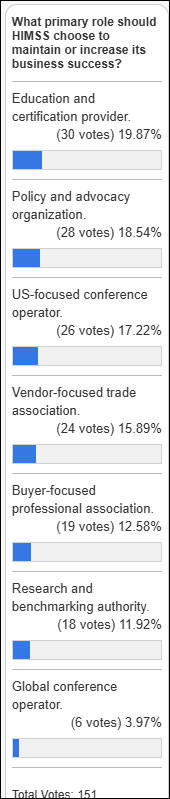
HIStalk readers want HIMSS to pick a lane, but can’t decide on which one, which is probably the same challenge that faces Hal Wolf. The #1 choice could be a moneymaker but only at modest scale, #2 doesn’t generate much revenue, and #3 is history because they’ve sold the annual conference exhibit. Respondents are looking for HIMSS to provide industry relevance while HIMSS itself is trying to stop its post-2020 free fall. Respondents skew heavily US, so the global conference answer might be underrepresented. Maybe the takeaway that both sides is that expertise beats booths, plus its pre-COVID ambitions involved selling consulting services around its now-multiple adoption models. Another good poll question would be – would you pay out of your own pocket for HIMSS membership?

New poll to your right or here: What is your reaction to ASTP/ONC’s proposed cutback of EHR certification requirements? Is it a free pass for vendors, a catalyst for innovation, or are those effectively the same thing?


Thanks to these companies for recently supporting HIStalk. Click a logo for more information.

image
image
image
image
image
image
image
image
image
image
image
image
image
image
image
image
image
image
image
image
image
image
image


Sponsored Events and Resources

None scheduled soon. Contact Lorre to have your resource listed.


Acquisitions, Funding, Business, and Stock

image

Population health technology vendor Clint shuts down and files Chapter 7 bankruptcy, citing insufficient cash to make payroll and pay creditors.


People

image

Rich Rogers, MBA, SVP/CIO at Prisma Health, retires.


Announcements and Implementations

image

The FDA grants 510(k) clearance for BrainSpace’s Intellidrop autonomous brain fluid pressure management system for ICUs. Brain Fluid Interface (BFI) products monitor cerebrospinal fluid, interstitial fluid, and cerebral blood and create training data for Physical AI models.


Other

image

I enjoyed this LinkedIn photo taken by Altera Digital Health during San Gorgonia Memorial Hospital’s (CA) upgrade to Sunrise 25.1. Go-live teams of both vendor and hospital people, united by their immediately recognizable team support shirts, usually get squeezed into temporarily and lightly repurposed conference rooms (hint: tape cables down, make sure computer-controlled HVAC doesn’t automatically take off for the night, wheel in a whiteboard, and source an unreasonable amount of coffee). Go-live warriors will be taken back olfactorily to long nights in the war room — overheated laptops and printers, panic sweat, and the stench of around-the-clock leftover junk food like pizza and everything bagels. Regards to those who know the smell and have thus earned the shirt.


Contacts

Mr. H, Lorre, Jenn, Dr. Jayne.
Get HIStalk updates.
Send news or rumors.
Follow on X, Bluesky, and LinkedIn.
Sponsorship information.
Contact us.

Morning Headlines 12/31/25

December 30, 2025 Headlines No Comments

Mayor Adams, NYC Health + Hospitals President and CEO Dr. Katz Announce Merger Between NYC Health + Hospitals and Maimonides Health Moves Forward

NYC Health + Hospitals will take over the struggling Maimonides Health and implement Epic there.

Health Ministries Worldwide Are Quietly Tightening the Rules on Health IT Vendors

Black Book Research reports that non-US markets are increasingly making data residency, in-country processing, and legal control a pass-fail requirement for choosing systems.

Healthcare AI Update 2025: What Use Cases Are Adopted the Most?

KLAS finds that 79% of health systems are using AI, ambient documentation is the leading use case, and just one of 3,000 respondents say their organization is using agentic AI.

HTI 5 Proposed Rule Info Session

HHS ASTP/ONC posts an information session on its proposed plan to streamline EHR certification requirements and update information blocking regulations.

Text Ads


RECENT COMMENTS

  1. I can't get past the helmets and safety vests. On everyone. Including the model patient. What, are they expecting the…

  2. I'm all for a startup mentality, but there really needs to be a net positive return for all that time,…

  3. Re: It would be interesting to compare after-hours use of generative AI solutions by patients who have access to after-hours…

  4. Would be interesting to see what Providence St. Joe's return has been on all their adventures. When I was on…

  5. Re: Vector's FHIR app. Why is the patient's DOB any transport person's business? They could easily put in the age.…

Founding Sponsors


Platinum Sponsors


Gold Sponsors


RSS Webinars

  • An error has occurred, which probably means the feed is down. Try again later.