


Curbside Consult with Dr. Jayne 10/27/25
Dr. Jayne Goes to Las Vegas

Most healthcare IT people were aware of the HLTH conference in Las Vegas last week. I would bet that only a few knew that the National Association of Community Health Centers was holding its 2025 Workforce Conference just down the street at Caesars Palace.
The conference was formerly known as the FOM/IT — Financial, Operations Management / Information Technology Conference & Expo. It is significantly lower key than HLTH. It focuses on the challenges that community health centers face.
If you’ve never worked in that part of healthcare, I would summarize it as being populated by some of the hardest working and most genuine folks I’ve ever had the pleasure of meeting. They tend to think of situations in a glass half full manner. Even if the glass is less than half full, they are committed to figuring out how they can fill it. They are also focused on patients, outcomes, and figuring out how to do more for their patients with less.
I’ve attended this conference a couple of times. Since the attendees include quite a few CEOs and COOs as well as IT folks, I was looking forward to reconnecting with a couple of friends from medical school who have gone on to the community health center CEO role. The conference is really only a single day, although there were some pre-conference workshops the day prior, so it also presented an opportunity to connect with friends who were attending HLTH since the schedules overlapped.
One of the first things that I did when planning my trip was to compare the two conferences. It’s not surprising that the one focusing on community health centers had a registration fee that was half of that of its glitzier counterpart. The CHC conference featured meaty-sounding sessions on topics such as workforce burnout, building healthy teams through smarter workflows, electronic case reporting for communicable diseases, interoperability, navigating tough financial times, working with aging and underserved populations, using AI to reduce burnout, and financial stewardship.
I certainly didn’t see anything about financial stewardship on the list of topics for HLTH, but I did see some session titles that were a bit edgier. GLP-1 drugs featured in sessions with titles such as Longevity Wonder Drugs and Buy Now, Weigh Less Later. Other longevity-themed sessions included Longevity Reimagined: The AI-Powered Personalized Health Moonshot, Longevity Beyond the Boys’ Club, The Longevity Preparedness Index: Are We Ready for the 100-Year Life?, and Death Becomes Optional.
Other interesting titles included: Decoding the MAHA Movement, Bot Fight Club, Women are Not Octopuses. Care Beyond the Stirrups, Trust Me, I’m an LLM, and Picking Up Uncle Sam’s Slack.
A couple of titles that were interesting to me but didn’t fit my schedule were From Gray Areas to Red Flags: Hot Topics in Fraud & Abuse, The Big Bill Fallout, If Everything is AI, then Nothing is AI, and Is Wearable Data Hitting a Dead End.
The award for best abstract goes to Longevity Beyond the Boys’ Club for this entry:
While tech entrepreneurs dump millions into experimental supplements and cryogenic chambers like modern-day alchemists chasing immortality, the rest of us are left wondering if living longer is reserved for those with venture capital portfolios. Women, who already outlive men by several years without fancy biohacking protocols, are watching this testosterone-fueled quest for the fountain of youth with bemused curiosity, as researchers scramble to figure out why nature already gave half the population a longevity advantage that no amount of ice baths can replicate.
While some tech bros are trying to engineer our way to 150 years, health leaders are working to democratize more proven, practical interventions that don’t require a billionaire’s budget. Because turning longevity from an exclusive club for the ultra-wealthy into an accessible public health priority might just be the difference between extending life for the few versus extending healthspan for the many. Spoiler alert: there’s no silver bullet that works the same for everyone, even those with Y chromosomes.
This brief write-up sums up a lot of what is going on in the health tech space lately. Hats off to whoever penned the blurb with phrases such as “testosterone-fueled quest for the fountain of youth.” Although the whole thing is over the top, I like the idea of making it possible for more people to live longer healthier lives since that’s what primary care is all about in the first place.
Unfortunately, we’re still at the phase where we can’t even guarantee that all people can receive proven interventions such as vaccinations and nutrition counseling to address obesity, so it will be a long time before we increase the average lifespan from its current mid-70s to 150 years.
In the interest of good reporting, however, I did make sure I had a chance to meet up with some of my favorite HLTH attendees for a booth crawl or two. Here is the highlight reel:
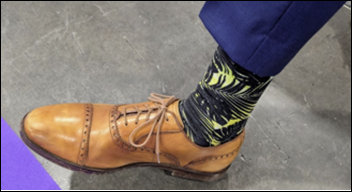
Intelligent Medical Objects (IMO) once again brought its A game with an outstanding shoe/sock combo. The pic also highlights the bare concrete floor and the thin foam aisle runner, which didn’t do much for reducing foot and ankle fatigue.
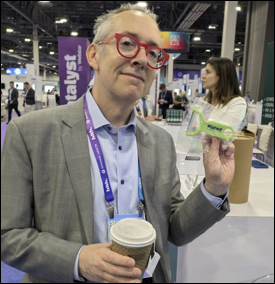
Nordic Consulting CMO Dr. Craig Joseph enjoyed learning about Plated, which aims to improve food service quality for institutional environments. Its frozen meals are warmed via a unique cabinet that prevents overcooking and nutrient loss. Technology includes menu management as well as interfaces with the most common senior care EHRs. Dr. Joseph also gave a thumbs up to their swag, which was an ergonomic vegetable peeler.

Vulvai is a relative newcomer, highlighting health conditions that can impact half the population and which can take upwards of seven years to diagnose. Female patients offer suffer with these conditions in silence, so I applaud their work and will continue to follow them. Extra credit to their booth rep, who had a Las Vegas spin to her outfit.

Weight Watchers, which is back to its original name following the WW branding debacle, sponsored a pickleball court next to the puppy petting area. It also sponsored a cocktail hour with boozy and sugary options, which I thought was ironic.
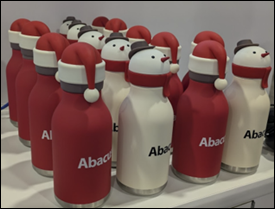
Disease management company Abacus Health had adorable water bottles as swag.
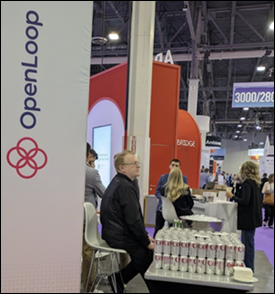
OpenLoop Health understood the assignment for attendees who prefer a cold Diet Coke.

An honorable mention in the footwear category goes to this gentleman from InterScripts. I wasn’t able to assess his sock game, but I’ll keep an eye out for him at future conferences.
On a more serious note, I take my attendance at these conferences seriously since the cost is substantial. It’s not just about looking for the hippest booth, the coolest swag, or the most fun party, but rather identifying solutions that might be helpful and to cut through some of the hype by speaking to companies in person. I was able to learn more about companies that serve parts of the industry outside of large health systems.
I was impressed by the team at PointClickCare, which serves the senior living and skilled nursing environments. Founders, Dave and Mike Wessinger grew up learning about the long-term and post-acute care space from their mother and found a need to improve solutions there. I happened to be chatting with some of the company’s Canada-based leadership team while the Toronto Blue Jays were in the process of winning an important baseball game and it was great to see the smiles on their faces as their team advanced. to the World Series.
I also checked back in with Linus Health as they continue to refine their digital cognitive assessment tools. The company was featured in a research article in the Annals of Family Medicine earlier this year following an early detection study that was done across seven sites, including Indiana University Health. The study found that half of all patients scored as impaired or borderline for cognitive impairment. For a condition that can benefit from early diagnosis, it’s great to see a product that can be easily implemented within my own specialty without a lot of fuss.
Emtelligent’s solution marries natural language processing with AI tools that can turn unstructured chart notes and reports into useful information, including patient summaries. I was impressed by the ability of their booth team to engage about different parts of the industry as well as their own. It was refreshing in a world where most industry folks want to focus on whether you’re ready to spend money with them.
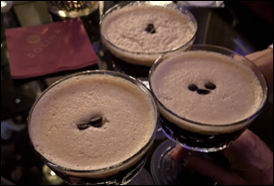
I didn’t make it to the HLTH industry night performance by Big Sean, but I did close out the night sharing espresso martinis with industry long-timers who have become friends. We typically only see one another at conferences and it’s amazing how we can pick up right where we left off last time. Here’s to wrapping up my last work trip for 2025 with a mellow evening.
If you attended HLTH, what did you think about it? Was it worth your time and your company’s investment? Leave a comment or email me.

Email Dr. Jayne.

Yes, but why is Epic "the best in the industry for many healthcare systems"? And sure, it's a complex software…