


Healthcare AI News 3/18/26
News

Mount Sinai Health System will use Midstream Health’s financial AI platform to identify supply chain cost-saving opportunities.
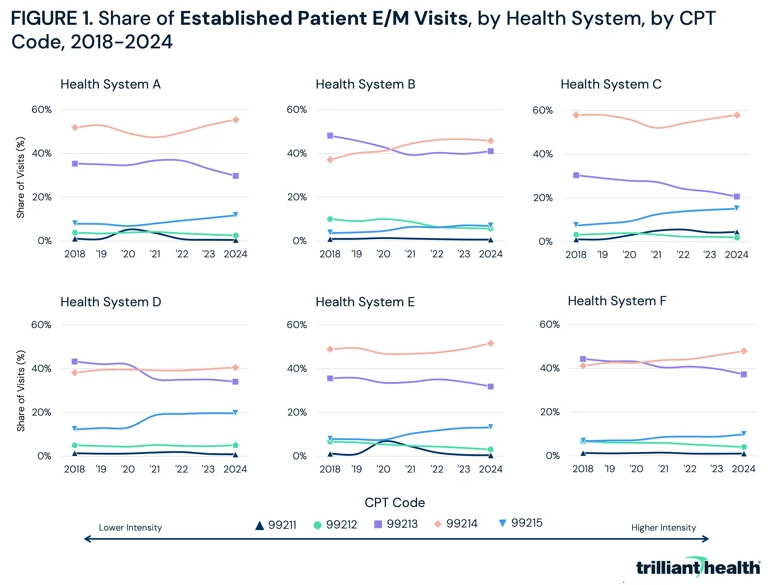
A Trilliant Health analysis finds that hospitals that adopt AI-enabled medical scribing tools subsequently code more outpatient visits at higher complexity. The authors say that the change could reflect more complete documentation rather than upcoding, but the data cannot determine whether the shift represents improved accuracy or a change in billing behavior. They note, however, that all parties have access to data that could identify the reasons for the coding changes.
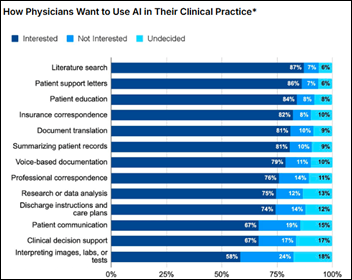
A Doximity report finds that 95% of physicians are interested in using AI, and one-third are already using it daily or more often in practice. The most common use is for literature search, while voice-based documentation increased significantly. Three-fourths of physicians say that AI reduces administrative workload and improves job satisfaction, while two-thirds believe that it has improved patient care and outcomes.
Business
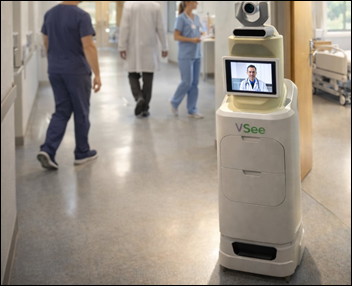
VSee launches an autonomous telehealth AI robot for hospitals that uses LiDAR navigation to allow remote clinicians to send it to a patient’s bedside. The system can be autonomously dispatched for telestroke and rapid response and can perform patient check-in, supply delivery, and patient identification.
Heartio, which offers an AI-powered tool for detecting coronary artery disease from standard ECGs, raises $4.25 million in funding.
West Virginia University Health System deploys Brainomix’s AI imaging stroke diagnosis solution across all of its 25 sites.
Research

Mount Sinai researchers find that clinical AI systems perform more accurately and efficiently when tasks are distributed among multiple specialized AI agents that are coordinated by an orchestrator, rather than being handled by a single general-purpose agent.
Other
OpenAI’s mental health experts express unanimous concern about the company’s plan to allow erotic conversations in ChatGPT, warning that it could foster unhealthy emotional dependence in users and give minors access to sex chats. The company delayed its planned Q1 release of the capability but says that it will eventually make it available. OpenAI has reportedly struggled to implement guardrails that can filter conversations about nonconsensual behavior and sexual abuse. It will also restrict ChatGPT’s ability to generate erotic images, voice, or video.
Contacts
Mr. H, Lorre, Jenn, Dr. Jayne.
Get HIStalk updates.
Send news or rumors.
Follow on X, Bluesky, and LinkedIn.
Sponsorship information.
Contact us.


I was born roughly 2 months after the US space program began (Explorer 1), and I've followed it all my…