


Yes, but why is Epic "the best in the industry for many healthcare systems"? And sure, it's a complex software…
News 12/12/25
Top News
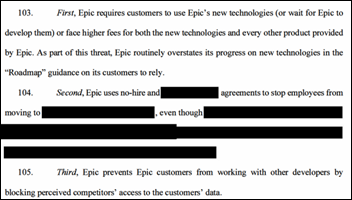
Texas Attorney General Ken Paxton files an antitrust and consumer protection petition alleging that Epic maintains monopoly power. It says that Epic controls more than 90% of US patient records, locks in hospitals through extreme switching costs, restricts competitor access to data, and imposes no-hire restrictions on employees. The petition also argues that Epic delays or limits access to medical records for providers and patients who are outside Epic’s system.
The lawsuit further accuses Epic of misleading Texas children’s hospitals about its parental access rules, which is likely the key issue of the lawsuit.
The lawsuit seeks injunctive relief to restore competitive conditions, civil fines, and court costs.
An Epic spokesperson provided this company response:
The action taken by Texas is flawed and misguided by its failure to understand both Epic’s business model and position in the market and the enormous contributions our company has made to our nation’s healthcare system illustrated by products like MyChart —software that tens of millions of Americans depend on every day. Every month, we improve quality of care by helping providers see a more comprehensive picture of their patient through over 725 million record exchanges—more than any other electronic health records vendor—and over half of these are with non-Epic systems. Health systems using Epic shared information with almost 1,000 patient-facing apps 2 billion times in the past year. Epic does not determine parental access to children’s medical records. Decisions about parental access to children’s medical records are made by doctors and health systems, not by Epic.
Reader Comments
From Dr. Herzenstube: “Re: HELP committee’s inquiry into the American Medical Association. It sounds as if there are some very specific alleged practices around CPT codes that they are investigating.” Sen. Bill Cassidy, MD (R-LA) seeks information from organizations that have licensed CPT about their price structure, AMA’s willingness to negotiate contract provisions, and any other areas outside CPT in which AMA collects royalties.
Sponsored Events and Resources
None scheduled soon. Contact Lorre to have your resource listed.
Acquisitions, Funding, Business, and Stock
Oracle announces Q2 results: revenue up 14%, EPS $2.10 versus $1.10, exceeding earnings expectations but falling short on revenue. ORCL shares fell 11% on Thursday over investor concern about rising AI infrastructure costs. Co-CEO Mike Sicilia said in the earnings call that 274 customers are live on Oracle Health’s clinical AI agent and that its new AI-based ambulatory EHR is generally available.
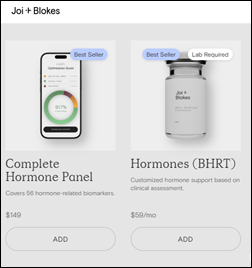
Nashville-based virtual clinic Joi + Blokes acquires women’s-health startup HerMD, creating one of the largest virtual care platforms for menopause, sexual health, and hormone therapy. HerMD previously raised $40 million in venture capital, then closed its five physical locations to focus on virtual care.
Sales
- Val Verde Regional Medical Center will implement Commure Ambient AI.
- Barking, Havering and Redbridge University Hospitals NHS Trust selects UpToDate Enterprise Edition from Wolters Kluwer Health.
People

Healthmonix hires Bill Marella, MS, MBA (HealthShare Exchange) as COO.
Announcements and Implementations
OpenAI’s “State of Enterprise AI” report names healthcare as one of the fastest-growing business sectors for ChatGPT use, with eightfold growth in customers in the past 12 months.

Included Health expands its care navigation platform with an intelligent AI assistant that uses personalized medical, claims, and benefits data to guide employer-based members. It also nudges them toward preventive screenings and better benefits use.
A Microsoft review of 37 million Copilot conversations finds that it is most often used to answer health questions.
A new KLAS report on IT planning and assessment services finds that Chartis, Impact Advisors, Healthlink Advisors, Nordic, Deloitte, and Optimum Healthcare IT are the firms that are most frequently considered and selected.
Government and Politics
More than 100 provider groups and medical societies ask HHS to withdraw its proposed cybersecurity rule that would expand HIPAA requirements, and instead collaborate with industry to develop practical, actionable, and less-burdensome cybersecurity standards.The 393-page Notice of Proposed Rulemaking would require providers, business associates, health plans, and clearinghouses to implement specific safeguards, perform annual compliance audits, document deeper analysis of technology assets, and maintain written documentation. Mandatory technical controls include encryption of EPHI at rest, multi-factor authentication, vulnerability scanning, and network segmentation.
Other

Nordic Chief Medical Officer Craig Joseph, MD says healthcare is betting on the wrong AI horse in embracing purely digital chatbots, which have been found to be less effective in improving outcomes than packaging the same LLM as an inexpensive socially-assistive robot. He says that digital health apps aren’t good at improving behavior change and engagement because they can’t provide the emotional experience and physical presence that engages the brain. Excerpts:
Behavior change is not a content-delivery problem; it is an emotional-experience problem. People don’t struggle with anxiety or diabetes or rehab exercises because they are missing the right paragraph of text. They struggle because doing hard things alone is deeply, intrinsically difficult … humans need accountability, presence, encouragement, and social cues to persist when something feels uncomfortable. Motivation is not downloaded; it’s co-created … The truth is that healthcare already understands the importance of presence. Physicians know that the 30 seconds spent sitting instead of standing changes the perceived quality of a visit. Nurses know that touch conveys trust in ways chart messages never will. Behavioral health clinicians know that therapy is not powerful because of what is said, but because of who is saying it, how they are saying it, and where the interaction occurs. Embodied AI doesn’t replace this relational wisdom. It simply extends it into new settings where humans cannot always be.
Eli Lilly says that a clinical trial of its next-generation, three-hormone GLP-1 drug for obesity and diabetes shows that participants with obesity and arthritis lost an average of 29% of their body weight, about 71 pounds, which exceeds the results reported for Zepbound and Novo Nordisk’s Wegovy. Participants also saw major improvements in their arthritis symptoms. Demand for Lilly’s GLP-1 drugs has driven the company’s valuation to $1 trillion.

The founder of online mental health platform BetterLyf is arrested after he allegedly started a fire at a California winery, threw a wine bottle at employees, intentionally crashed his Tesla into two cars while fleeing, and then locked himself in his car and refused to surrender until police officers pepper sprayed him. Vikram Beri was charged with assault with a deadly weapon and resisting arrest.
Sponsor Updates
- CereCore offers a new e-book titled “The Buyer’s Guide to IT Managed Services: Your Guide to Smarter Healthcare IT Decisions.”
- Findhelp and AIDA Healthcare announce an integration partnership to transform post-acute care referrals.
- Optimum Healthcare IT publishes a white paper titled “Strategic Transformation in the AI Era: Turning Innovation into Impact.”
- Goshen Health (IN) goes live on Meditech’s redesigned Expanse Pathology software.
- Inbox Health partners with Encoda to help physician practices capture revenue.
- Epic adds WellSky CarePort Community Referral Network solution to its Toolbox in the Community Resource Network category.
- Judi Health releases a new episode of its “The Astonishing Healthcare Podcast” titled “Health Benefits that Work for Everyone: Aligning Incentives & Focusing on Members’ Needs, and with Susana Villegas Spillman.”
- RxLogic’s new Formulary & Benefit Connect capability uses eligibility and formulary technology from Surescripts.
- The American Board of Medical Specialties Portfolio Program will use Wolters Kluwer Health’s Ovid Synthesis to streamline the continuing certification credit process and fast-track patient improvement initiatives.
- WellSky’s CarePort Community Referral Network solution is now part of the Epic Toolbox category for Community Resource Network.
Blog Posts
- How Predictive Analytics and Reporting Increase Healthcare Revenue (AGS Health)
- Connected for Better Care: How Strategic Partnerships are Transforming Lab Connectivity (Ellkay)
- Why Drug Knowledge Delivery Must Evolve (First Databank)
- Empowering Value-Based Care in Outpatient Rehab Therapy (Netsmart)
- The CMS TEAM Mandate: What Hospital Leaders Must Know to Be Ready for the 2026 Performance Year (ReferWell)
- Clinically meaningful evidence in the age of AI (Wolters Kluwer Health)
- Consistency in Action: What Industry Recognition Means for Healthcare Progress (FinThrive)
- Five9 Celebrates CRN 2025 Products of the Year Awards (Five9)
- CISO Brief: A Look Back at Healthcare Cybersecurity in 2025, A Year Defined by Disruption (Fortified Health Security)
- Key Regulatory Updates and Compliance Deadlines for 2026 (Med Tech Solutions)
Contacts
Mr. H, Lorre, Jenn, Dr. Jayne.
Get HIStalk updates.
Send news or rumors.
Follow on X, Bluesky, and LinkedIn.
Sponsorship information.
Contact us.


Epic’s EDI (interoperability) R&D spend is probably more than the total R&D spend of any other competitor. Epic invests millions in interoperability development, implementation, and technical support.
I have a hard time believing that Ken “unconvicted felon” Paxton does anything in good faith. Daily reminder that during his Texas impeachment trial, the star witness – his mistress, was deemed “unavailable” to testify despite the fact that she was sitting the witness holding room: https://www.star-telegram.com/news/politics-government/state-politics/article279286904.html
There’s a whole lot of claims and allegations of anti-competitive behavior, about how Epic “forces” customers to do things, but not a lot of evidence for the enforcement mechanism that compels customers. A lot of it is redacted, and perhaps there is some damning contract language. It’s actually hilarious seeing Paxton argue FOR the Biden FTC regulations against employee non-competes. That kind of gives up the intellectual dishonesty of the lawsuit. Ken Paxton doesn’t care about corporations who abuse employees or consumers. I would be willing to bet a fair bit of money that the allegations of anti-competitive behavior are motivated by Paxton’s political proximity to Larry Ellison, and just a way to get a lawsuit that benefits Oracle in the door, with a stapled-on attempt to score manufactured culture war points about parental proxy access.
Full lawsuit: https://www.texasattorneygeneral.gov/sites/default/files/images/press/Petition_4.pdf
The meat of the proxy access arguments start on page 48 of the document (p51 of the PDF). The core of Paxton’s argument is that Epic ‘deceptively’ uses the Epic Model System to foist illegal parental proxy access configurations onto Texas customers. For anyone who knows anything about the Epic Model System, or how an Epic install works, this is one of the dumbest things I’ve ever heard. The follow up argument is that it’s prohibitively expensive for hospital systems to depart from the Model System implement their own proxy access settings. Again, one of the dumbest things I’ve ever heard. The idea that Epic’s model system needs to comply with Texas state law, while simultaneously comply with other states’ laws that conflict with Texas’, is farcical and will get demolished at the jury trial Mr. Paxton has requested. Epic’s public statement is correct – the burden of legal compliance is 100% on Texas customers.
Many, yourself included, chose to make healthcare and Healthcare IT a political exercise. Shouldn’t be shocked when the other side starts to actually play the game.
What do you mean? What was the “political exercise” that prompted this response?
And which “political exercise[s]” by a private entity are appropriate for state governments in this country to punish with a lawsuit?
I don’t see this as fatal for Epic — dominant vendors rarely fail suddenly. What it reflects instead is an accumulation of strain that’s becoming harder to ignore.
When you combine very significant market share, an 82-year-old founder-owner, mounting antitrust scrutiny, and hospitals facing compounding pressure from CMS reimbursement reductions, the risk profile changes.
We’re also seeing increased scrutiny as regulators and industry publications begin to examine Epic more critically as a dominant solution vendor shaping cost structures across healthcare.
The strain is no longer theoretical. Memorial Sloan Kettering reported an operating loss of roughly $62M in its most recent quarter, citing Epic-related implementation and stabilization costs, following over $100M in losses earlier in the year tied in part to the same transition.
This feels familiar. Cerner’s evolution accelerated after the passing of its visionary founder, Neil Patterson — not as a collapse, but as a shift from founder-led innovation to large-enterprise governance, where scale and complexity increasingly constrained agility.
The issue isn’t failure — it’s compounding strain from reimbursement pressure layered on top of costly, inflexible EHR decisions. Taken together, the market increasingly looks poised for a recalibration away from the level of Epic dominance we’ve seen over the past decade.
People have been expressing this exact sentiment for well over a decade and yet Epic continues to succeed: “EHR installs are expensive, surely someone, anyone will disrupt the market to unseat Epic”. Every few years some Big Tech-adjacent VC and/or PE guys get the same bright idea and waste a few hundred million trying it. If you think MSK is the first organization with a cost overrun I have some bad news for you.
Your view of the risk profile is inverted. CMS reimbursement reductions are a big industry concern, but that doesn’t uniquely impact Epic. In fact, it just makes it more likely that Epic will not lose any customers. No one will be able to afford an EHR transition even if they wanted to. Much safer to stay put than mix things up in times of uncertainty. Epic can afford to stay exactly where they are, new market entrants can’t. You’re going to have a hard time finding investors for any new startup to challenge Epic given the healthcare payments outlook, and it’s much more expensive to borrow money than the last time Microsoft, Amazon, Google etc. tried to break into healthcare.
The more I looked into this lawsuit, the more convinced I am that Paxton is trying to gin up support for Ellison to fund his Senate primary campaign against Cornyn. Paxton has a decent shot in the GOP primary but he is way behind in fundraising. You can’t convince me that the Texas state government, or the Trump administration, is going to lift a finger for anti-trust enforcement unless it is politically or personally motivated.
That’s fair — and to be equally fair, I’m not arguing that Epic is about to be unseated by some upstart or VC-backed moonshot. I don’t think that’s likely either.
What I am saying is that evolution matters. You can take almost everything we’re talking about, roll the clock back to ~2010, swap “Epic” for “Cerner,” and the argument still holds. Cerner didn’t collapse overnight. It evolved — and the market around it evolved — and the definition of “success” changed.
That’s really the crux of my point. The question isn’t whether Epic continues to exist or even dominate. It’s what success looks like in the next phase of the market, and what hospitals are willing — or able — to tolerate as that phase unfolds.
Separate from whatever Paxton’s motivations may be (and I agree you can argue those either way), there are now multiple antitrust actions, growing regulatory scrutiny, and a business that is still heavily anchored to visionary leadership. That isn’t inherently bad — but we’ve seen this movie before. Cerner under Neil Patterson was enormously successful, until the center of gravity shifted and the organization struggled to adapt to a different set of constraints.
You’re right that MSK isn’t the first Epic cost overrun, and you’re probably right that fewer hospitals will attempt full EHR migrations going forward. But that doesn’t invalidate the concern — it actually reinforces it. Fewer exits don’t eliminate pressure; they concentrate it. And concentrated pressure changes behavior, purchasing decisions, and ultimately market structure.
So I’m not saying Epic is Standard Oil-level entrenched and untouchable. And I’m not saying it’s about to implode. What I am saying is that it’s starting to look less like an eternal power house and more like other dominant platforms at their inflection point — Cerner, BlackBerry/RIM, even IBM in certain eras.
History doesn’t suggest sudden collapse. It suggests recalibration. And that’s the moment I think we’re approaching.
Interesting argument, but I’m not entirely convinced.
Customers losing money, that they can in any way blame on an EHR implementation, is a real pressure point. Look for that to continue.
However I don’t believe that anti-trust activity seriously threatens Epic. Look at the federal government; they clearly are allergic to regulating businesses. Even more pointedly, there are small actions that Epic can take to get the feds on-side (a couple of political donations, a gold-plated statue or trophy, some blatant pandering, easy peasy).
Sorry Texas, but I just don’t believe you have the pull or acumen to make that happen. Not if Epic is competently run. And we must admit that Epic is competently run.
BlackBerry/RIM is a bad example. They had a powerful and capable, and patient, competitor in the wings.
Microsoft might be a better template. They became subject to anti-trust actions. Yet today, Microsoft is one of the largest, most successful companies on Earth. Microsoft was able to pivot and adapt to the anti-trust restrictions.
There is nothing inevitable about Epic losing their leadership position.
All fair points – I think the core issue I’m trying to articulate is really about how markets behave over long time horizons.
If you believe markets are generally efficient — not perfectly, but directionally — then they tend to move toward equilibrium. That movement can take years or decades, but it still exerts force. And shifts toward equilibrium rarely favor the most dominant player at any given moment. That doesn’t imply collapse or failure; it implies normalization.
We’ve seen this play out before. Cerner under Neil Patterson was enormously successful, but over time the surrounding dynamics changed — cost pressure, customer leverage, ecosystem complexity. Cerner didn’t suddenly become “bad”; the market equilibrium moved, and the organization had to move with it, not always smoothly. It was likely accelerated with Neils passing.
The Microsoft antitrust case is a useful corollary here. It didn’t weaken Microsoft in any absolute sense, but it did change the rules of engagement. Once bundling Internet Explorer stopped being an unassailable default, the browser market diversified. Microsoft remained powerful, but it no longer dictated that layer of the stack. Today, Edge exists — and is fine — but Chrome, Safari, Firefox, and others thrive to a degree. Influence diffused even though Microsoft endured.
BlackBerry/RIM is obviously an imperfect comparison, and I’m not suggesting a one-to-one replay. The point there isn’t sudden collapse, but that dominant market share at a point in time doesn’t inoculate a company from structural forces. BlackBerry looked unassailable at 40+% share, until the environment evolved faster than the model could absorb.
That’s how I think about Epic. Not as a company on the brink, and not as one that needs to be displaced, but as the current dominant platform in a market that — if it behaves even semi-efficiently — will continue to push toward equilibrium. That pressure shows up first at the edges, through fragmentation, unbundling, and shifting leverage, long before logos change.
So the question isn’t whether Epic survives. It’s what success looks like as the market normalizes — and how much control any single platform can retain as equilibrium slowly asserts itself.
Re: Dr. Craig Joseph’s piece on “physical robots, not chatbots, may hold the key to effective emotional and behavioral support in healthcare and transform patient outcomes.”
I believe embodied companions >> disembodied voices, with significant opportunities for healthcare. Easy to imagine something like this AI-powered toy that’s helping children with their bedtime routines… Use cases for loneliness, patient education, data gathering (vocal biomarkers? analyzing small deltas from daily patterns?), integration with telemedicine/video, starting with senior care, analyzing small deltas from expected routines… Toy design mindset on usability/simplicity – and engagement – could be helpful in healthcare as well.
https://www.youtube.com/watch?v=tj3xlYKyMf8