


I was born roughly 2 months after the US space program began (Explorer 1), and I've followed it all my…
Curbside Consult with Dr. Jayne 9/22/25

I am always up for a good read. I tend to read more fiction than anything else, but a couple of non-fiction offerings caught my eye recently.
“Superbloom: How Technologies of Connection Tear Us Apart” by Nicholas Carr came out earlier this year. It takes its title from a botanical event where a significantly higher than normal number of wildflowers bloom all at once. It usually happens when there are unusually wet conditions and seeds that have been dormant are able to come to life.
The superbloom mentioned in the book happened in California’s Walker Canyon in 2019, leading to numerous social media posts around the hashtag #superbloom and a boom in photos that went viral. The phenomenon and widespread promotion of the event drew thousands of visitors to the site and led to massive traffic jams, public safety issues, and damage to fragile ecosystems as people rushed to the area and shared posts about it on social media.
The author looks at the phenomenon and different aspects of internet-based communications and social media, countering the idea that increased communication pathways are good for society. Carr gives a history of media and communication technologies, going back to the days when movable type made mass printing a viable option. He covers the birth of the telegraph, evolution of telephones and radio, and the explosion of TV and internet.
It’s a wide-ranging discussion of how technology impacts society, changes culture, and can create division rather than bring people together. He discusses how being constantly connected can make people feel isolated and how the internet can create vast echo chambers that encourage the dissemination of hateful content.
Carr spends a significant amount of time talking about the evolution of Facebook, and in particular, the creation of its newsfeed. The platform’s users are not only the audience, but also the content creators, and ultimately a product sold to advertisers. He discusses research that looks at why increased time spent on social media makes people less empathetic.
Interesting tidbits: The phrase “social media” was first documented in the 1800s. Radio transmissions were largely unregulated until the Titanic disaster, when private radio operators interfered with the rescue, an early example of “fake news.”
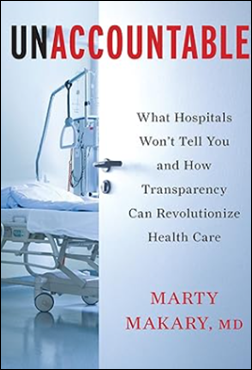
I have a bad habit of seeing or hearing about a book and adding it to my reading list without making a note about who recommended it or why I wanted to read it. “Unaccountable: What Hospitals Won’t Tell You and How Transparency Can Revolutionize Care” was one of these. I added it to my library hold queue at some point and was a little surprised when it turned up on the shelf.
Still, it sounded good. I was excited to read it until I saw that it was published in 2012. I decided to read it with an eye towards understanding how far we’ve come since, although as I got into it, I quickly realized that we haven’t come very far at all.
Author Marty Makary introduces himself as a medical student who left medical school during his third year, disillusioned with the “dangerous and dishonest” behaviors that he saw during his training. He began graduate work at the Harvard School of Public Health and quickly fell into the movement around quality measurement as a mechanism of healthcare improvement. He returned to medical school after a year and began residency training in preparation for a career in surgical oncology.
On page 2 of the introduction, he describes “patients increasingly fed up with a fragmented healthcare system littered with perverse incentives,” which is what grabbed my attention in making me feel like we haven’t come far at all.
He describes situations where dangerous attending physicians aren’t confronted due to hospital politics. That still happens, although at least in my area, it seems to be less of a factor than it was when I first entered practice. He talks about patients winding up at hospitals that aren’t a good fit for their specific medical needs. Although there might be more transparency now with hospitals reporting quality measures and payers publishing that data, it still happens quite a bit due to the narrow networks that many insurance plans create.
Even today, people are talking about patient choice and how important it is for patients to do their research. However, when you are facing an expensive procedure, many in the US make their decisions on where to receive care based on insurance coverage and financial necessity.
He hits on one of my pet peeves, which is hospitals that shamelessly self-promote by naming their own departments “centers of excellence” without actually being accredited or recognized by an independent third party for any specific level of excellence. He puts it right out there: “Patient satisfaction surveys do not capture quality medical care, and ‘top’ scores and rankings in magazines are often paid for.” On these points, nothing has changed in the last decade.
He is open about his role in a few episodes of poor care. I admire his willingness to share this information since many physicians wouldn’t write about those events in a non-protected document. He looks at those episodes of care in a systematic way and identifies how individual decisions can be influenced by systems failures.
One passage in the book gave me a flashback from my own medical training. I was a lower-level resident on call, and the senior or supervising resident failed to provide the backup support that they should have. In my case, the resident told the interns not to call unless something was “really bad,” but didn’t give us any definition of the term.
In Makary’s case, he called his senior resident, who told him to go back to handling his workload (even though what is described in the book is more than one physician should be managing at a given time unless you’re in a disaster situation).
He goes on to skewer some of the same things that we are still skewering, including inflated CEO salaries. He takes particular issue with hospitals that aggressively fundraise from the public while spending money on all kinds of things other than actually treating patients, and finds it “unethical to raise massive monetary surpluses from local schools and charities while making cutbacks to frontline workers.” There’s still plenty of that going on these days.
He also laments “the culture of doing stuff” that is still pervasive in certain subspecialties, although the quality movement and greater patient advocacy are helping chip away at that trend.
Parts of the book were dated, but it still served as a good reminder that there is much work to be done in healthcare and that we need good and thoughtful people to do it. Overall, I’m glad I read it.
What nonfiction book would you recommend to a healthcare or technology colleague? Leave a comment or email me.

Email Dr. Jayne.

Worth noting that Makary is in the MAGA/MAHA movement and got given a big job by Trump/RFK Jr. But did they put him in charge of something that might impact hospitals and the stuff he writes about? No he’s at the FDA….
No More Tears, by Gardiner Harris
Every Deep Drawn Breath by Wes Ely.
The Premonition by Michael Lewis
How We Do Harm by Otis Webb Brawley
Random Acts of Medicine by Anupam Jena and Christopher Worsham
I Contain Multitudes by Ed Yong
The Diabetes Code by Jason Fung
Code Blue by Mike Magee
I just finished reading “Insistent” by Joey Ramp-Adams and I highly recommend it. On one level it is the biographical story of a woman who overcame multiple physical injuries and psychological challenges and, with the help of her service dogs, earned a neuroscience degree and now advocates for others who are service dog handlers. But it has many more lessons for people in all fields but especially academia, medicine, and technology. The book describes the many barriers encountered by individuals who have a disability and the added challenges for service dog handlers. It shows – in a very vivid way– how individual people can either be kind, supportive, facilitators of others or erect artificial barriers that cause added angst, frustration, and impediments to learning and success. It also shows the importance of advocacy, as well as the challenges. But it also shows the positive outcomes and possibilities that arise from providing appropriate accessibility and using creative solutions to enhance accessibility. This is one place where greater understanding of disability can be powerful for those in technology because there is a great deal that can be gained through technological advances in accessibility.
I highly recommend the next conversation by Jefferson Fischer. stress is rising and stress does not bring out our best. this is a great grounding book to move conversations forward.
and Thinking in best by Annie duke. help make better decisions with all the facts. we are drowning in data and dying of thirst of useful information. this book helps frame decision making in differnt lights