

News 2/16/22
Top News

The $17 billion sale of Athenahealth to a pair of private equity firms has been completed.
Reader Comments
From Elizabeth Holmes: “Re: Circadia Health. Touts how they do remote patient monitoring, but FDA’s clearance says specifically that ‘The Circadia C 100 System is not indicated for active patient monitoring.’” I emailed the company to clarify, but haven’t heard back. The website says that the touchless system issues a daily report of respiratory rate and time in bed, which seems to be in conformance with FDA’s requirement that its system not be used to monitor vital signs and is “for retrospective analysis only.” Still, the company’s website touts its capability to “prevent the 3rd leading cause of death” in managing acute respiratory distress syndrome, COPD, sepsis, and pneumonia while earning post-acute care facilities a 2% Medicare incentive payment.
HIStalk Announcements and Requests
HIStalk sponsors who are exhibiting at or attending ViVE and HIMSS22 – click the link, complete the short form, and I’ll include you in my online and downloadable guide. You may recall from last week that my poll respondents gave as their #2 reason for visiting a booth as simply knowing ahead of time the activities that will be presented there, so share your plans and maybe get more feet onto your expensively rented carpet.
Webinars
None scheduled soon. Previous webinars are on our YouTube channel. Contact Lorre to present your own.
Acquisitions, Funding, Business, and Stock
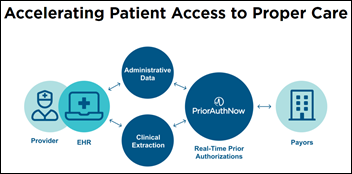
PriorAuthNow, which offers automated, real-time prior authorization software for providers and payers, raises $25 million in funding. The company says its technology has helped Cleveland Clinic staff reduce the prior authorization process from 45 minutes to four minutes.
Kidney care company DaVita acquires transplant software vendor MedSleuth for an undisclosed sum.
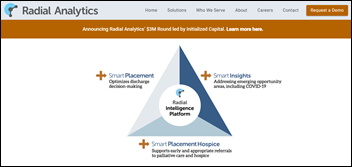
Radial Analytics, a patient care transition software startup based in Concord, MA, raises $3 million in funding.
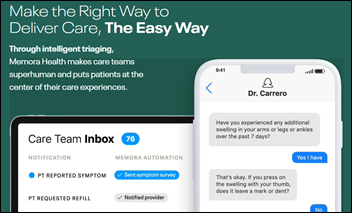
Automated care management company Memora Health raises $40 million, bringing its total funding to just over $50 million.
Sales
- Community Health Systems (TN) selects remote patient monitoring and virtual care technology from Cadence.
- Davis Health System (WV) will implement Cerner across its three hospitals beginning this summer.
People

Azara Healthcare hires Todd Schlesinger (Jvion) as VP of sales.

Patti Baran (Teladoc Health) joins AliveCor as SVP, Healthcare Americas.
Announcements and Implementations
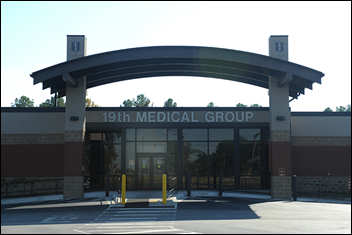
Little Rock Air Force Base Clinic (AR) will transition to the DoD’s Cerner-powered MHS Genesis system next month. The department plans on rolling out MHS Genesis at 54 facilities this year, which would see the technology deployed at more than half of all military hospitals and clinics.
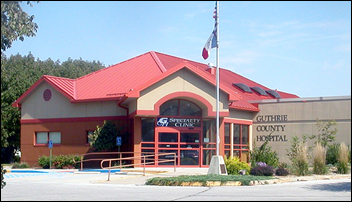
Guthrie County Hospital & Clinics (IA) will go live on Epic this weekend.
A Tegria-commissioned Harris Poll survey finds that 69% of Americans would consider switching providers to gain access to same-day appointments, convenient locations, and self-scheduling. More than half would be willing to have their first visit with a new provider conducted virtually, although only 37% of those over 65 agree.
Government and Politics
VA Acting Deputy CIO Laura Prietula tells attendees at an AFCEA Bethesda health IT event that the department has made significant improvements to its EHR data transfer processes, adding that it has standardized the majority of the high-priority datasets that are being transferred from VistA to Cerner’s Millennium and HealtheIntent platforms.
Privacy and Security

Puerto Rico-based claims clearinghouse Inmediata will pay $1.1 million to settle a class action lawsuit filed by patients who were affected by a 2019 data breach in which the company failed to secure patient data online, enabling search engines to serve up PHI in search results. I mentioned at the time that the majority of the 1.6 million patients alerted about the breach had never heard of the company. Many received multiple notification letters, with some of those being addressed to other patients.
Avita Health System (OH) notifies patients of a network security incident last week that forced it to revert to downtime procedures.
Other
I’m not sure I noticed until reading the CHIME update below that former HIMSS President and CEO Steve Lieber has been working for CHIME as chief analytics officer since October 2021.
Sachin Jain, MD, MBA says big tech firms have accomplished basically nothing in healthcare because scale is hard to achieve, fee-for-service hasn’t gone anywhere so improving health isn’t a priority, managing healthcare means managing risk, and margins are small. He says companies like Apple need to stop tinkering around healthcare’s edges and instead buy a big health system, where they can demonstrate the benefits of technology, make the argument for value-based care, and integrate payers and providers. He says Amazon’s dabbling in the grocery business didn’t amount to much until it bought Whole Foods.
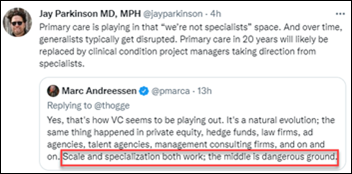
This is an interesting thought about primary care in considering non-healthcare markets, where generalists could be squeezed out by specialists on the upper end, and on the lower end, by less-expensive substitutes who follow protocols that those experts approve.
Sponsor Updates
- CHIME launches new media resource Digital Health Insights as a digital destination for healthcare industry professionals.
- Ellkay will exhibit at Greenway Health’s Engage conference February 18-23.
- The Kansas Hospital Association’s Health Services subsidiary selects ChartSpan as its exclusive chronic care management partner.
Blog Posts
- Patient-centered Care: 3 Ways Data is Transforming Behavioral Health Outcomes (Arcadia)
- The Doctor Will See You Now: Why Patient Experience Matters (CereCore)
- All the Ingredients for Population Health Management (EClinicalWorks)
- MEDITECH to Showcase Expanse at Inaugural ViVE Conference – March 6-9 in Miami (Meditech)
Contacts
Mr. H, Lorre, Jenn, Dr. Jayne.
Get HIStalk updates.
Send news or rumors.
Contact us.


Mm yes, project managers! Everybody likes getting medical treatment from them.
@IANAL – is it care from project managers or everyone operating at “top of license” (with some actual agreement as to what that means)? For many work-ups, I believe the technology exists to aid those operating at top of license, as to when, they should tap-out if they are feeling a little bit of “diagnostic bravado” (aka, I got this!). That is an interesting comment from an astute “straddler.” An organization with gargantuan market cap, could make an investment to put the appropriate guardrails in place to help evaluate scenarios and keep patients and care delivery frontlines out of peril. Is it also an opportunity for some high-profile companies, that are under U.S. and other government (EU?) scrutiny, to invest a bit in a GPT-3 like toolset that can sit over this type of business model? I guess it comes down to the modern age-old argument – is healthcare a human right? Can some of the tech behemoths gain some extra breathing room while identifying a comfy unique win-win (non Skynet) niche in a partial open source collaboration?
I’m not sure I totally understand what that would look like. Here’s why I don’t think
Primary care doctors at their best do some things large organizations aided by computers will never do. It’s important to remember patients and doctors are people, not protocols, data, algorithms, or conditions.
A doctor talks to a lot of people, and they talk to you the patient. You as a person give off many many subtle signals that are impossible to recognize out of context. Voice tempo, pitch and volume, body language, subtext, stutter- these are an abbreviated lists of things a human doctor notices without even noticing they notice. The doctor interprets those using their medical knowledge, the knowledge of the human geography of who comes into their practice, their knowledge of medical and organizational processes. They have a tight feedback loop where they quickly decide what to say, to ask another question, whether the patient and provider have the same understanding. This is all stuff that comes naturally to people having conversations. It’s also impossible to record, it’s impossible to analyze out of context, and impossible to make effective process for. I mean Siri can’t even recognize my mothers accent. Transcription is the absolute easiest part of recording, analyzing and interpreting. And the most well resourced technology company fails at it with roughly half of my mothers speech.
Another aspect of doctors and patients actually being people is that they have a particular social context from which medicine arises. I’ve told my dad he has sleep apnea 100 different ways 100 different times. Anybody who listens to him sleep for 5 minutes could diagnose him. But I’m his kid and he doesn’t take medical advice from his kid. I’m the same way, in that I don’t take medical advice from corporate bureaucracies. That’s partly what I mean by project managers, they don’t know because they don’t do. You can’t protocol your way into people respecting you.
Economics and politics will allow a shrinking number of upper class people to have access to quality primary care. Large scale bureaucracy will deliver substandard medicine as a loss leader to government payers and whatever is left of the middle class. The underclass that doesn’t have access to government support will do without and pursue alternatives.
I see this argument sometimes in conversations about primary care. Primary care could be all of those things. Everyone would love to have a PCP who knows them really well, who subconsciously analyzes the timber of their voice and then collaboratively constructs a personalized care plan just for them. That would lead to objectively better health outcomes.
But that is not the current state of primary care in this country. Schedules are packed and frequently run late. Even folks who have PCPs rarely see them. If my child is ill and I want to get them seen – my PCP’s next open appointment is 2 weeks away, but there is an appointment with a PA who works in the same clinic. We’ve never seen that PA before and we’ll never see them again. The PA definitely doesn’t have time to review the medical history in the chart before the appointment.
The time spent with patients in an office visit is measured in seconds. Providers are rarely using their relationship to or conversation with the patient in their medical decision making. It’s all about their existing protocols for how to deal with a specific complaint.
The prediction that you end your comment with isn’t wrong… it’s already happened.
Yeah In my mind that trend started in the late 80s and has been steadily progressing; it wont have finished running its course for another 10 or 20 years. Not a very interesting prediction, but more likely to be right than the chatbots will save us.
And yeah, what you get I wouldn’t call primary care, I would call it episodic care if you’ve been to the place before, or urgent care if you haven’t. There are still people who get primary care like what I outlined though; the ones that I know have household incomes that are somewhere between 5 and 10 times the median national income. Not enough for concierge but their kids don’t get those five minute appointments the rest of us get.
While I have a lot of respect for Sachin, he is wrong on this one. Big tech enters healthcare for any number of reasons but primarily to sell what they already have built. In Apple’s case, it’s all about selling more watches. For Amazon, it’s primarily about expanding consumer reach/sales. As for Amazon Care, look at model for AWS. They had tons of servers sitting idle after holiday rush and decided to leverage those unused servers into a ubiquitous cloud platform ala AWS. Same might play out for Amazon Care. They already have plenty of employees widely distributed across country. They, like all employers are trying to control healthcare spend so they set up a service for employees and now are rolling out to broader market.
It’s not Big Techs job to “fix” healthcare, it is their job to serve their investors.
Check out this CNBC article:
https://www.cnbc.com/2022/02/19/amazons-sprawling-grocery-business-has-become-an-expensive-hobby.html
Even buying Whole Foods didn’t make much difference. AFAIK, neither Whole Foods nor Amazon has been greatly improved by the union.
This would at least partly undermine Jain’s contention that Amazon entering the food business is some kind of model for tech in healthcare.